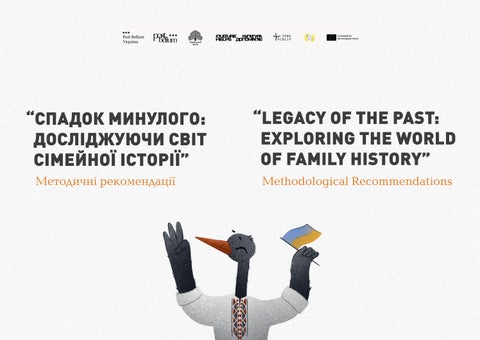
"Спадок минулого: досліджуючи світ сімейної історії" (методичні матеріали)

Page 1


Методичні рекомендації

“LEGACY OF THE PAST: EXPLORING THE WORLD OF FAMILY HISTORY”

Methodological Recommendations

Південної

«Post Bellum CZ» і «Post Bellum – Україна».

BASIC PROJECT INFORMATION

The project “Legacy of the Past: Exploring the World of Family History” was carried out as part of the “Culture Helps” grant program, facilitated by a partnership between the “Ukrainian Initiative of South Moravia” and the organizations “Post Bellum CZ” and “Post Bellum Ukraine”.

The project took place in Brno, Czech Republic, and was designed for Ukrainian children aged 10–14.

Its active phase lasted two months (September–October 2024), during which children attended eight workshops focused on mapping and researching their family roots. However, we believe that two months is insufficient for a project of this nature. Children need adequate time to understand the purpose, significance, and expectations of the work, as well as to develop motivation for active participation. To ensure success, it is crucial to allocate time for repetition, clarification, and practice in areas such as recording techniques, content development, question preparation, and effective communication. Based on our experience, the optimal duration for such a project is a full school semester.

PROJECT LECTURERS

The project involved Ukrainian and Czech lecturers and curators. One of the project’s lecturers, Alyona Kekukh, is a Ukrainian psychologist with over 23 years of experience as a crisis therapist, including 10 years working extensively with adolescents. Her background includes studying at a theater school and running a children’s theater studio for over 5 years, which has deepened her ability to explore and understand the complexities of a child’s inner world. Alyona is passionate about researching her family’s history and approaches her work with children thoughtfully, providing motivation and support throughout their learning journey.

Pavla Tesarzova, representing “Post Bellum CZ”, is a Czech educator with many years of experience working with children and youth. Her professional background includes media and marketing, and her interests span family, nature, ecology, and history. In this project, Pavla guided participants in understanding oral history, teaching them how to engage family members in sharing their stories and how to present their research findings effectively.

The project coordinator was Oksana Klymenko. Her responsibilities included gathering participants, preparing the venue and materials, compiling reports for each meeting, analyzing outcomes, and managing organizational adjustments. Beyond the project, Oksana is a logic teacher known for her energy, positivity, and love of outdoor activities. She enjoys organizing engaging quests for children, blending outdoor games with interesting puzzles.

FEATURES OF THE IMPLEMENTED PROJECT AND RECOMMENDATIONS

The project was conducted in both Ukrainian and Czech languages. Ideally, the project mentorshould be of Ukrainian origin and have a strong understanding of Ukrainian realities, combined with basic knowledge of oral history interview techniques.

The project engaged Ukrainian children aged 10–14 currently living in Brno. However, this age range proved too broad. For better outcomes, we recommend dividing participants into narrower age groups, such as 10–11 and 12–14. Each participant brought unique hobbies, temperaments, and preferences. While most of the children in this project were connected through a Saturday school and already knew each other, additional time is essential at the start of the project to build trust and familiarity among participants who may not know one another.

Classes typically included 12 to 16 children, which proved too large for effective engagement. A group of up to 10 children is optimal, ensuring that the lecturer has sufficient time to work with each participant, but in a joint lesson, it should be a small group. The groups should be carefully moderated (so that different children are not in the same group).

A project of this nature requires adequate space to accommodate all participants comfortably. Ideally, there should be one main room for joint activities and smaller rooms for group work. We encourage you to organize the most informal atmosphere possible so that everyone feels comfortable, and to have enough space to create smaller working groups, with features like good lighting, proper heating, and equipment. In this project, we utilized a traditional classroom with desks alongside a more casual space with a carpet and beanbags for flexibility and comfort.

In this project, the children learned how to formulate questions for respondents in order to find out the information they need. For example, when working in pairs, the participants had to find out what they like/dislike to eat, drink, and do together. All the children tried their hand at being an interviewer and learned how to use a voice recorder.

Children have always welcomed the involvement of adults in the project. Therefore, it is important to involve the children’s parents and relatives by explaining what is expected of the participants. This will also help the children themselves understand the purpose of the project.

To keep the children engaged, it is important to use a variety of multimedia formats such as audio, music, and video. Lecture content should be delivered in a playful and relaxed manner,

with a strong emphasis on small group activities to improve dynamics and efficiency. Simple homework assignments should also be included and monitored regularly to promote systematic work.

Incorporating a psychologist, ideally with a trauma-informed approach, is highly recommended. The psychologist should work with the children at the beginning and end of the project to establish a clear understanding of its goals, explain the process, and summarize the outcomes. This support is important for addressing the unique challenges of Ukrainian realities.

LECTURER COMMENTS

“The project demonstrated that an approach centered on family history and self-identity not only helps children navigate feelings of alienation in a new environment but also fosters the development of a healthy self-concept and a deeper awareness of their own identity. This initiative can serve as an inspiring model for teachers and educators working with children from diverse cultural backgrounds, supporting their personal growth.”

“It is crucial for children to be surrounded by their peers, to develop communication skills, and before that, most importantly, to understand their roots. When someone is forced to leave their home, knowing their roots provides a foundation to rely on. In a foreign country, children often feel like strangers. This project helps restore a sense of belonging and brings back the warmth of home.”

“All the participants greatly enjoyed tasks that involved adults. For instance, they appreciated the opportunity to direct their questions not only to their peers but also to Pavla. They were especially enthusiastic about creating audio or video recordings of conversations with their families. The children excelled in group settings, whether working in pairs or small groups of three to four. Group tasks were approached with more energy and engagement compared to individual assignments.”

Klymenko

https://www.facebook.com/ukrijm

https://www.facebook.com/postbellumua

https://www.facebook.com/pamet.naroda

Post Bellum-Ukraine, postbellumukraine@gmail.com

ADDITIONAL MATERIALS FOR REVIEW:

A video from the final lesson of the project (available in Ukrainian with English subs)

An animated presentation showcasing the project resultsу (available in Ukrainian with English subs)

Methodological recommendations on oral history provided by “Post Bellum Ukraine” – Україна» (available in Ukrainian only)

FOLLOW US ON SOCIAL MEDIA:

https://www.facebook.com/ukrijm https://www.facebook.com/postbellumua https://www.facebook.com/pamet.naroda

CONTACTS OF THE PROJECT COORDINATORS:

Iryna Zabiyaka (“Ukrainian Initiative of South Moravia”), iryna@ukrijm.cz

Post Bellum-Ukraine, postbellumukraine@gmail.com

“Culture Helps /

is a project co-funded by the European Union under a dedicated call for proposals to support Ukrainian displaced people and the Ukrainian Cultural and Creative Sectors. The project is a cooperation between Insha Osvita (UA) and zusa (DE).

Turn static files into dynamic content formats.

Create a flipbook
Issuu converts static files into: digital portfolios, online yearbooks, online catalogs, digital photo albums and more. Sign up and create your flipbook.
"Спадок минулого: досліджуючи світ сімейної історії" (методичні матеріали) by Post Bellum Ukraine - Issuu