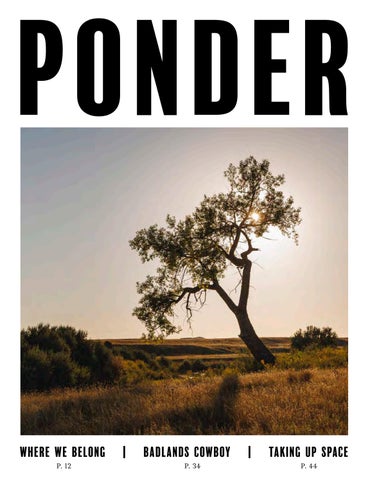
P. 12
P. 34
P. 44
ALWAYS BET ON
RED 4 RESTAURANTS 3 HOTELS 1 CASINO
866.DEADWOOD • CADILLACJACKSGAMING.COM
Issue No. 4
Ponder Magazine Fa l l 2 0 2 5
The Arts
Good Eats Where We Belong The Table We Share 4 | Ponder Magazine
P.12 P.22
The Badlands Indian Cowboy P.34 Taking Up Space P.44
The Current
Culture
A Legacy to Last P.54 Hooked P.64
The Weirdos & The Freaks All It Takes Is All You Got
P.76 P.86 Fall 2025 | 5
Editors in Chief Alec Butterfield Noah Westergaard
Managing editor Nathan Feller
Copy editor Taylor SanFilippo
Journalists Hayden Hill Maralee Rischling Ellen Sheehy
Graphic Designers Hunter Davis Rae Hanzlik Brooke Lammle Noah Westergaard
Photographers
PONDER.MAG
Sierra Hopp Duncan Martin Maralee Rischling Carly Smith
Social Media Tory Brown Ava Elliott
Business Manager Sean Kilpatrick
Advisers Justin Bergh, PhD Skott Chandler, MFA Allen Morris, MFA Desy Schoenewies, MFA
Advertising Inquiries (605) 642 - 6276 Ponder@BHSU.edu
Correspondence 1200 University St. Unit 9003 Spearfish, SD 57799
6 | Ponder Magazine
Ponder Magazine is produced by Black Hills State University Student Media and printed bi-annually. While Ponder is free to you, it costs us $3.86 to print each copy of the magazine. Ponder is also entirely funded by donations and advertisers. If you would like to offset this expense, please consider donating to Ponder. All content copyright © 2025 by BHSU Student Media. All rights reserved. Material in this magazine may not be reproduced in any form without written permission from BHSU Student Media. Content in articles, editorial, and advertisements are not necessarily endorsed by BHSU Student Media or Black Hills State University. Read Ponder online at BHSUMedia.com.
Cover image Featuring the story The Badlands Indian Cowboy on page 34. Photographed by Duncan Martin.
Section Title Illustrations by Rae Hanzlik.
a letter from the editors
If Ponder has taught us anything, it’s that creativity doesn’t sit still. It grows, evolves and challenges us to look closer. This issue is no different. It’s a snapshot of what’s happening right now: showcasing how marginalized individuals in this region are overcoming discrimination, the stories they’re daring to tell and the art that refuses to be ignored. These stories paint a creative landscape that’s alive, complex and so deeply human. It’s a window into the heartbeat of the region. You’ll meet two remarkable chefs. Chef Marcela Salas, whose bold, vibrant cooking tells a poignant story of her, her mother and their economic and cultural contributions to their city. Chef Petrina Peart, executive chef for the Wyoming Governor. Catlin Clifford, the self-proclaimed “Badlands Indian Cowboy,” an actor, stunt man, musician and artist from the Pine Ridge Reservation. Cameron Stalheim, a queer sculptor from Sioux Falls, who transforms fantasy and radical self-love into art that demands space. Cappie and Sprout, builders and stars of “Building Outside the Lines,” show that imagination has no limits. Macy Lundstrum, a fly-fishing guide in the Black Hills, who charts her own path in a field rarely led by women. And finally, the misfits at Ernie November’s and the creatives behind Drekker Brewing in Fargo remind us that culture thrives when people push boundaries—and ask for forgiveness rather than permission. Working on this issue, and telling these remarkable people's stories reminds us why we do this: not the late nights or long drives to places such as Fargo or Cheyenne, but the moments that make us stop and say, “This matters.” It’s been an incredible year, and we’re thrilled to close out 2025 with the release of Issue 4. Ponder’s last two issues have gone on to achieve what we jokingly call the “EGOT” of college journalism. In March, the College Media Association named Ponder the Best Magazine in the Nation with the David L. Adams Apple Award. We went on to earn Gold ADDYs at the local, district, and national levels—placing our work among the top 1% in the competition. Over the summer, we received First Place for General Excellence from the Association for Education in Journalism and Mass Communication. Soon after, Ponder became a finalist for multiple Pinnacle and Pacemaker Awards, ultimately winning several Pinnacles and the Pacemaker itself—the first ever awarded to a college magazine in South Dakota. Learn more about these awards, and individuals from our team who have also won these awards for much of their work on the magazine at BHSUmedia.com/Awards
Alec Butterfield & Noah Westergaard
As we wrap up a very momentous year, more than anything, we hope Ponder continues to be a space that connects us—to learn from one another, to celebrate differences and to keep curiosity alive. So take your time. Ponder a little, or a lot. — Alec Butterfield & Noah Westergaard
Fall 2025 | 7
Ellen
Sierra
Duncan
Ava
Carly
Hayden
Nathan
8 | Ponder Magazine
Alec
Hunter
Rae
Julia
Tory
Maralee
Sean
Brooke
Noah
Taylor
Fall 2025 | 9
tor y c u d ntro * I & ou er Y R f s P n n e A * Wh % Tra 0 e ays 9 k c . D c n 2 a 0 a l e B 9 Ba Rat ash ur First e C s a 0 h $20 0 in Yo Purc n r a E 2,00 $ d Spen
bhfcu.com/love *Offer subject to credit approval. New credit card loan introductory offers and rates are available to primary members who have not had an open credit card loan or balance within the last 18 months. To qualify and receive credit card bonus offer, you must make qualifying purchases (purchases less returns, credits, and adjustments) totaling $2,000 or more during the first 90 days from loan opening. Purchases do not include cash advances, balance transfers, unauthorized or fraudulent charges, account fees, and interest charges. Qualifying purchases must post to your loan account within 90 days from opening. The introductory rate does not apply to cash advances. Terms and conditions subject to change without notice. Additional restrictions apply. Please contact us at 800.482.2428 for details.
14 | Ponder Magazine
WhereWe Belong Story by Nathan Feller Photography by Alec Butterfield Duncan Martin & Taylor SanFilippo
Fall 2025 | 15
16 | Ponder Magazine
“We came to the United States to keep our family together – my mom made the decision,” said Marcela Salas. “My biological father had already moved and was working as a welder. We got travel visas and crossed the border on foot with everything we owned on our backs.” Salas, her mother Patricia Burbine and her two sisters made the trek to El Paso, Texas, in 1999, where they reunited with Salas’ father. Shortly after, the family moved to Omaha, Nebraska, where they attempted to start their new lives in the U.S. “We got our first duplex house there,” Salas said. “But my biological father wasn’t the best father – he kind of left us without financial means at the time.” Burbine became a single mother of three, cleaning houses to keep food on the table and a roof over her daughters’ heads. Without legal status, it was difficult for the family to find ways to make ends meet. The dream of uniting as a family had long since passed. “I guess he abandoned us in that way,” Salas said. “We went through a little period of homelessness, and, without legal status, we had a lot of fear of separation for a while. But we found some help in a local church and were eventually able to become residents [in the U.S.]. At that point, it was a little bit easier to navigate life in the United States.” That local church was the relief Salas and her family needed – it's where Burbine met her new husband and how the family found itself with another chance at a fresh start in a new city. The family followed Burbine’s husband to Sioux Falls, South Dakota, for his work around 2016. There, Salas, her mother and her sisters were able to benefit from a more stable situation. Salas and Burbine, in particular, were able to rediscover something that changed their lives forever. In 2024, Salas and her mother realized their long-time dream of one day opening their own restaurant – a way to share their food, their culture and, most importantly, a way to bring communities together. Their restaurant, BibiSol, specializes in nixtamal and Mexican cuisine.
The culinary world and the ideal of a familial, community-driven side of food culture had always been a part of Salas’ life. Cooking is a large part of her cultural identity and a way for her to stay close to those around her. “I’ve always loved cuisine, and I think that comes from my grandmother and my mother,” Salas said. “Growing up, my mom would always cook for us, and my grandmother would always find her place in the kitchen – it was her place where she could find artistic creativity and express herself. I was very much influenced by the matriarchs in my family.” Even when times were hard, the kitchen was never quiet. “My mom always had this ability to look through our pantry and just make something, even if we didn’t think we had anything to eat,” Salas said. “I think that resilience really helped me understand that, however we’re getting this food, we need to treat it better and elevate it.” The lessons Salas learned from her family were never lost on her. Even to this day, as she navigates the complexities of entrepreneurship and restaurant management in the culinary climate of the Midwest, Salas’ familial mentality shines bright. “I think the matriarchal aspect to the restaurant has been really interesting to witness,” Salas said. “To be in a restaurant where [my mother and I] both, as matriarchs, are leading a team is a different cultural experience for staff members. A lot of our staff members say that they’ve never had their managers care about them or feed them, so we try our best to make sure that we’re providing our staff with meals every time they work because food insecurity is something that nobody should have to go through.” Salas’ passion for bringing the community together doesn’t just stop at the door – she and her mother make it a point to do everything the right way, even when it’s not cheap or easy. Bibisol boasts an extensive list of partnerships with local producers, keeping mass-produced products and ingredients as far away from their kitchen as possible. “We pour into our community locally,” Salas said. “It makes
Fall 2025 | 17
18 | Ponder Magazine
Fall 2025 | 19
20 | Ponder Magazine
for more intentional food, and we couldn’t be happier that way. As chefs, we’re storytellers, and it’s been really cool to be the storyteller of these producers because they work hard, and sometimes they don’t have the means to tell it themselves.” But before the restaurant, the producers and the community, Salas and Burbine only had a vision. “When I moved [to the] USA, it was in my dreams to maybe one day sell something,” Burbine said. “In Mexico, I had a small restaurant – I love to cook. When I moved [to Sioux Falls], I [made] friends at the hospital my husband worked at, so I started selling food in the hospital.” Burbine’s reputation for sharing highquality foods and salsas caught the attention of the owners and founders of the Brandon Farmers Market, who recommended that Burbine and Salas start selling their salsas there. “We founded a salsa company in the summer of 2020,” Salas said. “We started selling at wholesale farmers' markets, and eventually self-funded a food truck.” It didn’t take long for Salas’ Salsas to garner recognition and, given their drive to expand, they quickly caught the attention of several well-established chefs and owners in the area. “Marcela and her mom, Patricia, came to me when they just started their salsa business,” said Beau Vondra, a Sioux Falls native and current Director of Food and Beverage Operations for Fernson Brewing Company. “Generally, when I get product samples, especially salsa and hot sauce, I’m not a huge fan of them, but they blew me away. Above all, they’re genuine [people] and that always strikes a chord with me – talent aside, if you’re a good person, a lot of the time that’s all that matters.” The mother-daughter duo’s dedication to keeping things local and authentic rarely yielded a negative review and created a following that provided the means and confidence to create a more permanent, spacious home for their traditional cooking methods and culinary experiments. “I knew that they knew what they were doing based on the product,” said Jordan Taylor, a nationally recognized chef and owner of Pizza Cheeks, Bread & Circus and En Place Catering. “She reached out to me to get some advice about opening a restaurant downtown, but I doubt they really needed my help. They mostly figured it out on their own, and, obviously, they did a great job – the restaurant is beautiful.” BibiSol opened its doors for the first time July 19, 2024, and, with homey decor and one-of-a-kind food for the area, Salas and her mother have begun to change the food culture in Sioux Falls. “As a chef, I can attest to the fact that she follows the outlook of many good chefs, where she sources locally,” Taylor said. “She brought something to Sioux Falls that was lacking for a long time. She’s educating people on what
actual Mexican cuisine is.” Unlike the typical Tex-Mex eateries and restaurants that populate the Midwest, Salas’ recipes are deeply rooted in her culture. “We grind our own corn every day, and we bring in heirloom corn varieties from Mexico,” Salas said. “We’re mostly known for our hand-pressed tortillas and our masamaking technique that honors the indigenous technique and the landscape we’re a part of.” A combination of classical training, experience and natural creativity allows Salas to keep the menu fresh with interesting and diverse dishes, but it’s her cultural identity and family roots that make her a true chef. Originally from Veracruz, Mexico, Salas grew up around an extremely diverse food culture around the Port of Veracruz, one of the oldest and busiest ports in the Americas. Because of the high level of import/export business and slave trade coming in and out
of the city, the culinary scene was a combination of many cultures. “There’s a lot of Afro-Mexicans in that community, so there’s a lot of influence from Africa and Spain with different seeds and oils,” Salas said. “The cuisine is very interesting, and very heavy on seafood. I love being from Veracruz.” Salas’ time around the port played a large role in the development of her skills cooking with seafood and has definitely influenced her menu, which includes a shrimp and rock fish ceviche tostada and sautéed shrimp tacos. However, with a goal of sharing as many authentic Mexican dishes as she can, Salas incorporates dishes and styles from many other regions of Mexico. “My mom was actually born in Durango, which is on the other side of Mexico,” Salas said. “So she had the
Fall 2025 | 21
22 | Ponder Magazine
experience of eating food from northern Mexico, and the cuisines tend to vary a little bit.” Although Salas tries her best to represent Mexican cuisine as best as she can, encapsulating the complexities and diversities of an entire country’s food culture within one menu is a tall order. “I’m not going to say that our cuisine encompasses the entire cuisine of Mexico, but it is like a foundation of it,” Salas said. “Masa is a foundation of a lot of Mexican cuisine, and to be able to provide people an experience when they taste their first true masa product is so special.” Masa, a dough made from corn that's cooked in an alkali solution and ground into a paste, is what’s used to make many staples of Mexican cuisine, including tamales, gorditas and tortillas. This process – nixtamalization – is what Salas employs to create her masa. It’s an ancient, indigenous technique. However, with the increase of mass production over the 20th century and the invention of Maseca instant corn flour in 1949, the traditional process has been almost completely abandoned in professional kitchens. “[Maseca] led to a product that was so far removed from what it used to be originally,” Salas said. “So we made the decision to go back to our roots. This process of reconnecting with our indigenous roots has been really important to us.” Although nixtamalization is a delicate and time-consuming process, Salas believes the quality is irreplaceable. “The experience of trying a freshly ground and pressed tortilla is so special,” Salas said. “It’s so different - the mouth feel, the aroma – [people] can understand the nuances of it. We feel like our food is an opportunity for people to experience something they may have never had the opportunity to experience.” Although Salas and BibiSol have been widely accepted into the culinary culture of Sioux Falls, introducing something new and attempting to invoke change in a culture will always come with some degree of pushback. “We’re in a state where people sometimes just don’t appreciate [our food],” Salas said. “The concept of Mexican food is really skewed out here, and it’s been difficult to explain that to people because they have their expectations of what Mexican food should be. We’re just trying to educate people on a little bit different of a concept.” In the Midwest, Tex-Mex restaurants have become widely accepted as the standard for “what Mexican food should be” – free chips and salsa, the uniform selection of quesadillas, burritos, tacos and a section for American food on the back of the menu. “I feel like they’re pushing education in a lot of ways, not just food,” Taylor said. For Salas, being a chef is much more than just creating good food – it's about creating connections and spreading positivity in a world that can’t seem to stop trying to tear itself apart. “Instead of coming together, there’s a lot of division and fingerpointing within our communities,” Salas said. “As restaurant owners in general, we should be creating community spaces where people can come together. Anybody who comes through these doors should feel safe and comfortable to be who they are or who they want to be – that’s my main priority.” So far, Salas’ mission for inclusivity has connected with the downtown Sioux Falls community. “We’ve gotten negative reviews, and we’ve had people online make comments that we should be deported or that someone should call I.C.E.,” Salas said. “We make sure not to let that affect us. Our main goal is to create a haven within our community, to make sure that our staff members feel comfortable coming to work and to honor the individual a little bit more.” Salas refuses to be dissuaded from her mission to spread her ideals of kindness, acceptance and the importance of community. “We can’t change the world overnight, but I think food is the universal language,” Salas said. “I think that’s the way we can connect with people – through shared meals and conversations.”
Fall 2025 | 23
the Table we Share
24 | Ponder Magazine
Story by Taylor SanFilippo Photography by Alec Butterfield
Petrina Peart’s culinary journey started in one of the most unlikely of places: Wyoming. Not in a restaurant kitchen or a bakery in Jamaica, but in a dorm room at F.E. Warren Air Force Base 20 years ago. Peart was born in Jamaica and spent her early childhood there before moving to the East Coast of the United States with her mom. It wasn’t until enlisting in the Air Force that Peart began cooking for herself. “That was my first time away from my family, away from home, away from my mom’s cooking,” said Peart, Executive Chef to the Governor of Wyoming and independent business owner. “It meant I had to now take care of myself.” Although her culinary journey began out of necessity, it soon became a hobby and, eventually, a passion. Alone in Cheyenne, Wyoming, Peart started experimenting with recipes, testing them on friends and even dates. “Everyone was my guinea pig,” Peart said. “If they liked it, I kept that recipe. If they didn’t, that one got tossed out.” Her process of trial and error, and her curiosity about the reactions of those who ate her food, sparked the beginning of a lifelong journey for Peart. As a child, Peart had, ironically, avoided the kitchen, choosing the more exciting option of joining neighborhood friends her own age. “My grandmother would be like, ‘Come in the kitchen with me,’ and I just thought it wasn’t fun,” Peart said. “Everyone else was playing outside.” Peart’s grandmother worked in a local bakery and would bring home fresh loaves of bread that filled the house with the smell of warm yeast. “I have an obsession with fresh-baked bread because of her,” Peart said. “I do a really good herb focaccia and sourdough. That’s all her influence.”
26 | Ponder Magazine
Peart later learned her mother had gone to culinary school in Jamaica. “I didn’t even know that until later in life,” Peart said. Not only did Peart draw inspiration from her maternal role models, but also her generational peers. “My sister and I both graduated from Le Cordon Bleu together,” Peart said. “She did pastry, and I did savory. It’s just really embedded in my family.” Before the Air Force, before Wyoming and before her dive into the culinary industry, Peart wanted to be a writer. “I was passionate about journalism,” Peart said. “I loved reading, loved words… Throughout high school, I started taking classes in the Air Force for journalism, writing and American literature.” Now, she looks to blend these two passions – food and writing – by creating her own book that would be part memoir, part cookbook. “[I want it to have] big, beautiful pictures and stories from my life,” Peart said. “Modernized Jamaican recipes and vegan dishes anyone can make. It would be a book from the heart for anyone who loves food, stories and growth.” The Air Force gave Peart more than discipline; it gave her perspective. While traveling the world, from Prague to Italy, she developed a fondness for communal dining. She discovered that there is a type of connection that only happens when sharing a meal. “In Prague, you could sit anywhere, with anyone, and just enjoy your meal,” Peart said. “Strangers became friends over food, and by the end of the night, we all knew each other. We would have never met otherwise.” This experience, and others like it, inspired Peart’s dive into a genre of hospitality that she made her own: intimate dining. “A lot of what I do now is based on smaller groups, maybe eight people, five courses,” Peart said. “They can be friends or complete
Fall 2025 | 27
28 | Ponder Magazine
Fall 2025 | 29
strangers, but by the end of the night, they’re connected.” That approach to finding community in food evolved into The Supper Club, a monthly dining “experience” Peart recently launched in Cheyenne. “It’s something I started to bring creativity back into cooking,” Peart said. “Each month has a theme. Maybe a blindfolded dinner, maybe food from Greece. I wanted it to be open to the whole community, not just my regular clients.” Peart aims to offer more than a meal. She wants to offer a gathering that fosters connection, artistic expression and risk-taking. “It’s about trying something new. It’s not what you’re used to, but it’s still going to be delicious,” Peart said. After appearing on television in popular shows such as “Yes, Chef!” and “Beat Bobby Flay,” Peart faced new struggles pertaining to her sense of perfectionism. “You go on TV and everyone wants to do their best,” Peart said. “But when things don’t go perfectly, and everyone sees it, you have to learn to stand in that light anyway.” She took advice from Chef José Andrés, acclaimed restaurateur and founder of World Central Kitchen, and has been actively working on incorporating it into her day-to-day life: it’s okay to falter. “Someone’s going to watch this and be inspired by it,” Peart said. “So now I just say, ‘Okay, that wasn’t my best, but what’s next? How can I do the next thing better?” Looking ahead to the next thing to do “better,” Peart hopes to open a culinary studio. This would allow her a space to educate people about food they may not have thought to cook before, or teach people how to improve more basic recipes. She also wants the space to be a place where aspiring cooks, or people who need something a little different in their lives, can express artistic freedom and have a safe space to brainstorm ideas. “I’d love a space for cooking classes, dinners, cake decorating – a creative hub,” Peart said. She also hopes that the space could help her educate herself about other people and learn from them. “Every person you meet has something to teach you,” Peart said. “I think of it kind of like a video game. Everyone has a clue you need to finish the quest.” Peart specializes in vegan and vegetarian cuisine, but labels herself as “vegetable-forward” and intentional. “I'm not against meat. I think two things can be true at once,” Peart said. “[But] I start in the produce section. That’s where the color is, that’s where the inspiration starts. I usually cook to the preferences of whoever I’m catering to at that moment, but a lot of my clients, they've trusted me over the years enough to say, ‘Just make us some food on the table, and whatever it is, it will be good.’” Her approach to food and her standards of quality for produce can be traced back to her upbringing in Jamaica. “Growing up in Jamaica, I remember picking mangoes and limes from trees,” Peart said. “When I went back years later, the garden behind [my family’s] kitchen reminded me that nothing beats that freshness.” Her journey into vegan cooking began out of empathy. “There was someone on staff who was a vegan too, and while I
30 | Ponder Magazine
Fall 2025 | 31
didn't understand her, I noticed that,” Peart said. “[At the restaurant] we would have what's called family meal. A lot of times, people would forget to accommodate for her, so she would be left out and not eat anything. I just felt really bad about that, so I started to incorporate something, either on the side, or the majority of what we're eating to be vegetable-focused, so that she could have something.” That state of mind still guides her today: food should be for everyone at the table. This sense of empathy and desire for connection has motivated Peart to continue her journey, no matter what life throws her way. “[Cooking] started as a necessity, and then it became a curiosity,” Peart said. “Then, the more people that fell in love with the things I did, the more of a passion just started growing.” What started in a Wyoming dorm room evolved into a lifelong pursuit of creativity, community and passion. Peart built her life around a microcosm of community: the dinner table.
32 | Ponder Magazine
MULTIMEDIA JOURNALISM | PHOTOGRAPHY | GRAPHIC DESIGN | STUDIO ART
You've got ideas worth sharing. WE’LL HELP YOU BRING THEM TO LIFE. apply to BH BHSU.edu/Admissions
Get Involved BHSUMedia.com/get-involved
MONTANA
54 Locations to Serve You!
SOUTH DAKOTA
to make you feel at home, from design to finish.
WYOMING IOWA
NEBRASKA
MISSOURI COLORADO
KANSAS
2905 4th Ave, Spearfish OKLAHOMA
(605) 642-8836 meadlumber.com
'I GUESS THAT MAKES ME A BADLANDS INDIAN COWBOY' Story by Nathan Feller Photography by Alec Butterfield & Duncan Martin
36 | Ponder Magazine
Fall 2025 | 37
38 | Ponder Magazine
“Whenever you watch the right guy [on a bull], you can see it’s an art,” said Catlin “Cat” Clifford, a native to the Badlands of South Dakota and proud member of the Oglala Lakota Nation. “It’s inevitably beautiful to see two forces come together in that spectacle – it’s just like ballet. That’s where bull riding becomes an art to me, even just being a part of that action – it’s like being in the eye of the storm.” Like many others born on or near the Pine Ridge Indian Reservation, Clifford spent his childhood on the family ranch, learning about life from the back of a horse – the hard way. “I got pretty good when I was around three years old,” Clifford said. “But there was this horse called Rambo I used to ride around my great grandma’s place all the time. One day, he started walking down this hill. I lost control of him, and he ended up bucking me off. I must’ve been knocked out because next thing I remember is my dad scooping me up and saying, ‘Yep, you’re alright.’” For generations, Clifford’s family worked the land and the livestock of the Badlands – a trade that naturally became ingrained in their identity and culture. “[Cowboy] is definitely a contemporary term for many,” Clifford said. “The term is used very loosely depending on where you’re at. It could even be as simple as the way one carries himself or the way he dresses. Personally, I think it’s the lifestyle – a living spirit of the Old West.” Beyond learning to care for the land and livestock, Clifford was exposed to art at an early age. His family is full of artistic talent. Surrounded by craftsmen, musicians, actors and bull riders, Clifford developed into a culmination of it all – an artist with seemingly limitless potential. “Throughout my life, I always found that culture and family [inspired my art],” Clifford said. “I think it all boils down to expressing who I am as an individual by reflecting on my past and my family.” In his earlier years, aside from exploring art, Clifford expressed himself on the back of a bull, risking life and limb in one of the most dangerous dances man has managed to conjure. Clifford chased that storm for years, summer after summer, synchronizing with countless bulls and broncs across the nation, even qualifying for the Indian National Finals Rodeo (INFR) and competing in the Professional Rodeo Cowboys Association (PRCA) and the Professional Bull Riders (PBR) on multiple occasions.
Fall 2025 | 39
However, Clifford's poise on the rodeo grounds is far from his only notable talent cultivated by his family. As rodeo season faded along with the summer heat, Clifford transitioned into a more auditory form of art. “The guy that mainly inspired me to do music is my uncle, Scott Clifford,” Clifford said. Clifford's uncle, a former songwriter, backup vocalist and guitarist for Indigenous – a relatively popular rock band in the ‘90s – made it a point to include his nephew in the musical world as much as possible. After parting ways with Indigenous, Clifford’s uncle started his own rock band with his family, known as Scatter Their Own, in 2012. “[My uncle] incorporated me into his band whenever I learned to play rhythm guitar, and I played bass for him a few times,” Clifford said. “Mainly what he inspired me to do is write songs, and I just took it in my own direction from there.” Unbeknownst to Clifford at the time, the musical influence from his Uncle Scott would become part of the key to unlocking yet another artistic endeavor – possibly his most adventurous. “I was inspired [to be a stuntman] by my uncles and dad,” Clifford said. “Particularly one uncle, C.L. Johnson, who made a career out of it.” Johnson, like many other members of Clifford’s family, grew up on the back of a horse and a bucking bull. He even landed a stuntman gig in “Dances with Wolves” alongside Clifford’s father, the result of his skill with animals, disregard for bodily harm and unwavering interest in performance art. “I guess [Johnson] just learned it as he went,” Clifford said. “I think he mostly got the job just by being a Native stuntman on the market. But just hearing that story, right there, I told him I wanted to be a part of that.” Johnson's other notable appearances include “The Last of the Mohicans,” “Rosewood” and “Geronimo: An American Legend.” Following in Johnson’s footsteps, Clifford met many of his uncle’s friends and colleagues in the film industry. However, Clifford’s musical talent is what landed his name in his first credit reel. In the early 2010s, Chloe Zhao, now an Academy Award-winning filmmaker and director, appeared at the local high school on the Pine Ridge Reservation, scouring the drama program for talent to cast in her very first film production. Clifford’s younger brother, a member of the drama program, invited Zhao, her colleagues and Clifford to participate in a ghost hunting event. The posse spent the night searching for falsified poltergeists to no avail. However, Clifford had bonded with Zhao enough to pass along his first demo of a few original songs he wrote. “She called me a couple months after that
40 | Ponder Magazine
Fall 2025 | 41
42 | Ponder Magazine
and asked me if I wanted to be a part of [the production],” Clifford said. Clifford’s acting career started in 2015 when he appeared on screen playing himself in “Songs My Brothers Taught Me,” which also featured a number of his original songs. Clifford and Zhao’s professional relationship lived on through the early stages of their respective careers, and Clifford and his music were featured twice more in “The Rider” (2017) and “Nomadland” (2020). “It wasn’t until ‘1883’ in 2021 when I really started my stuntman career,” Clifford said. “My uncle passed in 2001, so he never got to see me do this – but, in a way, I believe he’s been helping me out.” Since his two-episode stint in the Emmy Award-winning “Yellowstone” prequel, Clifford earned roles in several big-name productions such as “1923,” “Django,” “American Primeval” and “The Lost Bus.” Despite managing successful careers on both the rodeo grounds and in front of the camera, Clifford still finds time to keep up with yet another passion – one he’s been perfecting for years. “I like to create in general,” Clifford said. “That’s why I just do many different things that incorporate that creativity, but I really enjoy the leatherwork. I’ll take a day doing that over just about anything else.” Creating practical leather art for the community is a torch passed down to Clifford from a great uncle of his, known as Hot Shot Jacobs, who spent much of his time producing quality leather goods for the Badland rodeo cowboys of the 1960s, 70s and 80s. Much like his great uncle, Clifford’s passion for leatherwork consumes most of his attention, from practical accessories and custom orders to personal art projects and sharing his knowledge. He uses this art form to give back to the community that shaped him – the community in which he built a life and a family. “I met Cat at a rodeo at Three Mile Creek in 2021,” said Jordan Carlow. “We got together in 2023, and we’ve been together ever since. Cat is definitely one of the most genuine, empathetic people I’ve ever met.” Carlow, originally from Slim Buttes, South Dakota, was captivated by
Fall 2025 | 43
Clifford and his unique interests that could be considered strange for a rancher and rodeo cowboy. “Cat is such a family man,” Carlow said. “He’s learned so many things from his relatives and developed his own craft with the things he was taught. I’m proud to have a partner like that. He’s constantly making art that represents himself, whether that be his music, the rodeo, the stunt work or the leatherwork.” However, building a life with someone who balances more than one career has challenges, especially when a new life emerges. “When we first got together, I already knew he did rodeos and the stunts,” Carlow said. “But it was something I worried about, especially
44 | Ponder Magazine
when I was pregnant with Wylder, our oldest boy.” In the early stages of the young couple’s relationship, Clifford’s stunt acting career reached a lull due to a widespread writers’ strike. However, as soon as the strike concluded, Clifford returned to his stuntman duties. “When Cat got back into stunts, it was really scary because he could be gone for weeks at a time,” Carlow said. “But it’s all for a good purpose, and I think we handled it in a very graceful way. I know when Wylder is older, he’s going to be so proud that his dad was a stuntman.” For a man like Clifford, it can become difficult at times to balance
the scales between work and life. “In 2023, I was gone for probably seventy-percent of the whole year working on ‘American Primeval’ in New Mexico,” Clifford said. “That was definitely a sacrifice, but that just comes with a profession in the entertainment industry. But, at the end of the day, my goal is to always come back.” Now, with the addition of their youngest son, Lynx, Clifford and Carlow seem to have found their stride as a family, raising two boys, managing their land and supporting all of their artistic endeavors. “He takes everything he does with such seriousness,” Carlow said. “That’s the great thing – he does all these things, but he
never gets lazy. Because of him, I get to be home with our sons. He never complains, and he comes home after long days with a smile on his face.” Although his journey as an artist has already been relatively successful, Clifford remains driven, unwilling to settle. “I think in everything that I do, I want to better myself,” Clifford said. “The competition is within myself – to be better than I was before. What matters most is spending my time in a way that I can cherish and love my family throughout my time here on Earth. No matter the stage or the platform, what it’s really about is doing what I love.”
Fall 2025 | 45
46 | Ponder Magazine
taking
up space Story by Hayden Hill
Photography by Noah Westergaard
Fall 2025 | 47
48 | Ponder Magazine
Predisposed to physical creativity as the son of an art teacher and carpenter, Cameron Stalheim was destined for a career in art from an early age. Sculpture has always been at the forefront of his artistic interest. In many ways, Stalheim has been working towards his latest show, "LORE", currently on display in Sioux Falls, South Dakota, at the Washington Pavilion of Arts and Science, his whole life. He first earned a Bachelor of Fine Arts degree from the University of South Dakota and then went on to complete a Master of Fine Arts program from the Maryland Institute College of Art. Upon execution of his thesis, a sculpture of a gay porn star as a giant merman, Stalheim moved back to his home state of South Dakota. Why? For Jesus, of course. “I’m not religious but…I got a big commision to make a really hot Jesus,” Stalheim said. “It was a good opportunity to come back home, you know, make my mark.” Sioux Falls is a city with strong traditional roots, a remarkably consistent voting history and very high conservative, Christian, heterosexual, caucasian, cisgender populations. So naturally, a queer artist who specializes in the human figure may encounter some hurdles. “It’s one of those things,” Stalheim said. “Is this really feasible to do in South Dakota?” The answer for Stalheim was yes. He noticed growth in the area in recent years as well as the expanding art scene and increasing cultural diversity. He held fast to his decision, even though he has missed out on larger opportunities that would have possibly be presented to him if he lived in a larger city. “I feel like so many of the changes and the political tensions we’re seeing right now are backwards,” said Sierra Young, queer artist and South Dakota native. “And we need revolution. And art and people and community are the only [things] that are going to get us there.” Aside from art, there are non-career-related reasons Stalheim chose to move back to Sioux Falls. It doesn’t hurt to have a lower cost of living and to be near loved ones, but Stalheim also wanted to be a part of the blossoming art culture in his hometown, and thus far, his hometown has had his back. Since moving home, Stalheim has had consistent commission requests for his work, providing opportunities to continue to hone his craft and he’s still having a good time while doing it. “I’m still finding the joy and the fun… I still get to rediscover myself. That’s one thing that’s kept me going is [this] discovery of self that keeps emerging every time I do a show or a sculpture,” Stalheim said. The combination of fantastical characteristics and realistic human figure work serves as an excellent vessel to explore feelings of otherworldliness while still managing to stay grounded in reality and maintain accessibility for the average audience member. Fairies and mermaids are widely known, instantly recognizable mythological creatures that still have a mostly human body, with just a touch of ethereal sparkle. There is an element of escapism in all works of art. Allowing the viewer to get drawn in by the work, captivating them so completely that they may momentarily forget the real world around them. Next comes the fall back down to reality. The viewer is reminded of something from their own lived experience, and they begin ascribing the art meaning, emotion or logic. In visual art media, this all happens in a matter of moments.
Fall 2025 | 49
50 | Ponder Magazine
Stalheim, a self-admitted toucher of all art, has found that sculpture work tethers the art to the viewer the most tangibly. “I like that [a sculpture] takes up space, it takes up your reality more… It takes up part of you and you take up part of the work,” Stalheim said. With the viewer and the art in the same space, one can guess at the meaning of the work, but how is the artist meant to convey that meaning to everyone? Countless variables, including personal histories, cultural backgrounds, different media exposure and countless different first impressions all have to be contended with. There's a simplicity in works involving the human figure in this way. It’s one of the few things that every single person on the planet can relate to because we all have a body. We can toil over the differences in body shape, size, texture, color and worth for ages – and we have done so for much of human history. But at the end of the day, we still know what the human body looks like, and we’re all largely familiar with the additions presented in Stalheim's work. We understand without needing to be told that humans aren't actually four inches tall and don’t come in a veritable rainbow of colors, but that these figures, who Stalheim colloquially refers to as his "boyfriends," represent a repetition of the self and the shared humanity of everyone regardless of physical differences. We’re all essentially the same: human. In order to push the viewer just that bit further, Stalheim implements fantastical elements in his work, playing with concepts that can be more explicitly expressed when he has the benefit of bending reality to his will. “It’s seeing yourself in a fantasy creature. It’s seeing yourself in something that is extremely well done and colorful and unique,” Young said. “I mean, I am identifying with a blue mermaid with a seven-foot tail and floating hair because I also have rolls and squishy softness and that’s awesome.”
Fall 2025 | 51
The largest piece in the collection, “Drift”, evokes an air of regal assertion. A mermaid towering over the viewer, her tail fanning out behind her head in a high-backed throne. Her hair is frozen in upward motion, a crown fit for a queen. Lording over the viewer, she radiates power, triumph and confidence. Qualities hard won by Stalheim himself. “I think what I’m proud of is my tenacity in overcoming these sorts of hurdles that queer artists have to jump through,” Stalheim said. In recent years, the national shift favoring conservatism has led to countless bill and policy proposals that stand to harm queer people, like Stalheim, and their art. Earlier this year, House Bill 1239 was introduced in the South Dakota State House of Representatives. “[This bill is intended to] revise certain affirmative defenses to dissemination of material harmful to minors and obscenity offences,” said Representative Lana Greenfield. In layman's terms, the bill was intended to strengthen existing censorship laws by criminalizing librarians and other public employees by prosecuting them for providing materials some consider harmful to minors. “Curators could go to jail for content that pisses people off,” Stalheim said. “Like that’s a lot of my work. I mean, there’s penises everywhere. And that was really scary. And I did get political, and I, you know, I didn’t want to have to sacrifice this, all these years of hard work.” The bill in question did pass into law in South Dakota, but with amendments removing all potential for criminal charges for librarians and other public employees, such as museum curators. There is a clear and present danger of government intervention to restrict access to any art the current majority party views as unsavory, including Stalheim's work. “I also think that art like this being displayed in South Dakota is really important because it’s exposure," Yound said. "Without exposure, we are naive and we are bigots." Censorship comes in many different forms. It may come from the hallowed halls of an increasingly hollow democratic system, or it could come from Instagram. When Stalheim was creating “Drift,” his large mermaid sculpture that is a centerpiece of the "LORE" showcase, he originally envisioned her with detailed, entirely exposed genitals. But when sharing progress on social media, he faced immediate opposition to the idea. “Okay so, you see those fins on the front of the mermaid? That was originally a vagina,” Stalheim said. “And I got so much fucking flack from everybody for putting the pussy on the mermaid. [Genitalia is] a big part of the sexual appeal, the lure of mermaids. And [when I showed it on a merman] everyone loved it, they loved it. But as soon as I do it on a woman… pushback. So it’s an abstracted vagina now.” The social stigma associated with nudity has nothing to do with the quality of Stalheim's work, but negative feedback tends to have a negative psychological effect on the creator, regardless of circumstance. The criticism made Stalheim begin to question the quality of his work. The blow landing on him rather than its rightful target, prejudiced attitudes about women's bodies. “I cried about it,” Stalheim said. “I was just like smoking cigarettes just looking at this pussy, and I was like, what am I doing?” Stalheim's art can be explicit, but that is not a negative attribute, but rather, a positive one. There are very few things that have remained consistent throughout nearly all of human history, but sex is one of them. Before entering Stalheim's show, there are content advisories warning viewers there is nudity present, so that
52 | Ponder Magazine
Fall 2025 | 53
viewers' wishes can be respected. They don't have to engage with the work if they don't want to, but those within the community attempting to stop it from being created or displayed are actively antithetical to one of our nation's most cherished rights, freedom of speech and expression. Why tolerate such disgraceful behavior? Why stay in Sioux Falls? Stalheim doesn’t have to stay in South Dakota. He would likely achieve more recognition and financial compensation for his work elsewhere, but he stays because it’s important to him. He feels a sense of duty as a queer artist from South Dakota to give back to the blooming art and queer communities of his birthplace. “I feel like I’m a part of that thread that keeps it progressing and keeps the culture of art and public art alive,” Stalheim said. “I feel like I do have some sort of responsibility to invest in this place, but it comes with a lot of drawbacks too.” Aside from worldly motivations, Stalheim also has an intrapersonal hunger to create art. A yet-to-be-fulfilled mission. A quest in search of perfect contentment, rather than resolution. He says he’s at his best when he’s creating, and, simultaneously, it’s a coping mechanism for life’s hardships. “When I make stuff, it gets me closer to this idea of not perfection, [but] radical self-love…there’s no such thing as
54 | Ponder Magazine
perfection, but there is truth,” Stalheim said. “And I think when you are creating, you get closer to the truth.” Much like journeys of personal discovery, Stalheim’s work develops and improves with time. It begins as a concept – for an artwork or of who one is as a person – and then details begin developing. Discovering the desired color doesn’t exist, a new one is pioneered. One may only have the courage to live in their hometown after they’ve moved away and then decided to return. The perfect texture for a mermaid’s tail might come from the most unexpected of places – epoxy clay and truck bed lining. The perfect art studio might be hiding on a Facebook Marketplace listing. Whatever it may be, it takes time. And patience. And perseverance. Art takes time. Self-discovery takes time. And the seeker may even find that they are one in the same. Cameron Stalheim is a queer artist from Sioux Falls, South Dakota. Lover of fanciful escape in his youth and a perpetual creator of things that take up space. Today, after years of working to achieve his art degrees, thousands of miles and dollars expensed on traveling for his art, endless cups of coffee aiding him in creation art and countless hours in pursuit of truth aka radical self love, he lives in Sioux Falls, creating fantical escapes for those around him, taking up space with his art.
A LEGACY Story by Maralee Rischling
56 | Ponder Magazine
TO LAST Photography by Alec Butterfield & Maralee Rischling
Fall 2025 | 57
There are many different ways to tell a story, and there are many different tools you can use to tell that story. For Jared Capp, he builds stories from the foundation up. “I figured out pretty quick I didn’t like to be told what to do, just as a general rule of my life,” said Capp, known to most, other than his parents, as Cappie. Cappie has always loved a challenge, and life as a builder and contractor consistently provides one. Many people know Cappie as the co-host of Magnolia Network’s television show "Building Outside the Lines," but he has worked on construction sites since he was a kid. Cappie, along with his brothers, worked on his Grandpa Swisher’s sites, eventually advancing to an official summer employee by the time he reached high school. Cappie was growing his skills as a contractor while the rest of his life helped form a more important skill: storytelling. Like many people who grew up in the same town their whole childhood, Cappie left Spearfish as soon as he graduated and enlisted in the United States Air Force. His goal: use his time in the U.S. Air Force to travel the world. By the time he left the military, his mission was a success - with a small asterisk. “When I left the military, I'd been to fifty-three different countries, but realized I'd only been to about five states,” Cappie said. “So after I got out of the military, I lived in my car at the time, a ‘78 Volkswagen bus. I was [living] #vanlife before it was a thing.” Cappie spent the next few years traveling across Southwest America working odd jobs. Selling hand-made jewelry, making snow at a ski resort, working as a production assistant for MTV and being a wilderness instructor for troubled youth are just a few of the jobs he worked. During his time as a wilderness instructor in the Utah desert, Cappie got a call from his parents asking if he would be interested in buying Grandpa Swisher’s old property, now
58 | Ponder Magazine
nicknamed Granny Flats. “When I came back [to Spearfish], I didn't have a clear plan for a job,” Cappie said. “[But] I’d always been handy.” Cappie returned to his roots, literally and figuratively, to work as a handyman in Spearfish. Small jobs escalated to larger-scale projects, such as a backyard pergola, a sunroom addition and an entire enclosed garage. “I liked [the handyman job] because you didn't know what you were going to get into,” Cappie said. “When you roll up, you have to investigate and dissect the problem and then rebuild it.” Within six years of returning to Spearfish, Cappie had the opportunity to build his first custom home for a client. One of his favorite and most challenging projects was also completed during this time of his life: an off-grid straw bale house located on Granny Flats. “That actually was a long road because no one had ever heard of it, no one had ever seen it,” Cappie said. “Some new hippie kid moved into town and wanted to build this house made out of fuzzy bricks.” Since the straw bale house was the first of its kind in South Dakota, Cappie worked for four years with city and state officials to acquire the correct paperwork and permits to meet city code standards. The straw bale house was an exercise in patience. Cappie wanted to know what it took to build the structure and tracked every trip, dollar and pound of material. The hand-dug foundation required 633 wheelbarrow trips, and the entire build used 111 gallons of gasoline to operate various equipment. After 11 working months over the course of two calendar years, the straw bale house was completed, completely off-grid, within city limits and up to code. “Some people do crosswords or sudokus, some people want an athletic challenge, like a marathon or something,” Cappie said. “For me, building is a mental challenge.” The unconventional nature of Cappie’s builds often lead to
Fall 2025 | 59
60 | Ponder Magazine
unique challenges. Inside the straw bale house is an earthen floor made from a mix of clay, sand and straw. To finish the build, Cappie recruited fellow contractor and long-time friend, Dusten Ell. “Cappie had never done it, and I’ve never done it, but we did it and it was fun,” Ell said. “It was challenging because we didn’t know how to finish it. I thought I’d take my buffer and screen it. And it worked.” Another challenge Cappie faced with Ell was a unique airplanebased build that appeared on “Building Outside the Lines.” The plan was to create an off-grid tiny home from a Boeing 757 airplane fuselage. One of the biggest challenges of that build was figuring out how to wrap the curved interior walls with wood paneling. “That was fun,” Ell said. “It was very difficult, and difficult is fun.” In addition to challenges within the realm of construction, Cappie has faced exciting challenges in recent years – learning how to do the work he loves while co-hosting a television show. “One of the challenges of the TV show is I wear a lot of hats as the host of that show,” Cappie said. “I have to be the narrator of the show. We have to do scenes that aren't building scenes and all the things that tell a story to the audience. But my greatest joy is literally, tool bag on, hands dirty, beat-up tape measure on my belt. Let's go. Let's build this.” Cappie co-hosts “Building Outside the Lines” with his stepdaughter, Alex Headley, also known by her nickname, Sprout. The two first met when Rachel Headley, Alex’s mom and Cappie’s now-wife, hired Cappie to restore her Spearfish home. Similar to Cappie’s introduction to building, Sprout started out helping with small tasks like sweeping up job sites and marking level studs. “I feel like a lot of people assume he dumped me in the deep end and was like, ‘Have fun kid,’” Sprout said. “You can’t do that and
expect someone to figure it out. It’s always started small.” Since working on their house together, Sprout’s skills have grown exponentially. Now, she thrives when running power tools and operating heavy machinery on the job site. Sprout can often be found running a skid-steer with Cappie close by recording her with a smile on his face. If she’s not operating machinery, Sprout might be making a bet about how many brackets she can get screwed in before lunchtime. “If you would have asked me ten years ago, I would have said there's no way that I would be up there shooting screws all on my own,” Sprout said. “Cappie has been very good about knowing when to give me more freedom with things. The small steps helped build that sort of confidence and make it feel less scary. In reality, it took a long time for us to get here.” The father-daughter duo is a captivating dynamic, bringing optimism, creativity and thoughtfulness to their builds. Cappie contributes the construction expertise and Sprout helps him imagine the unique designs. Both creatives are detail-oriented, especially when it comes to incorporating personal details from the clients’ lives in finished builds. “It takes so little effort to pay attention,” Cappie said. “Sometimes you just need to connect your bottom lip to your top lip and listen to what’s important and watch what’s important.” Cappie and Sprout do more than just build aesthetic projects. Paying attention to the client and their life plays a big role in the design and execution of a build. This could present as a small flowerbed memorializing a pet. Other times it is the inclusion of old photographs from significant times in the client’s life. “We like to do things that will only really be noticed by the clients,” Sprout said.
Fall 2025 | 61
62 | Ponder Magazine
Fall 2025 | 63
One of these builds included a 70-year old grain bin from season one of "Building Outside the Lines." The episode features the movement of the grain bin from a family property to the client’s current home in the Black Hills. The old structure found new life as an outdoor kitchen and hang-out space, complete with a custom barbeque and cozy interior seating. Even small details that most viewers of the show do not notice were considered with care. “We did a painting for them of the original grain bin on the property,” Sprout said. “The sun was setting on one side and the moon was on the other side, but the client loved Star Wars, so we painted the moon to look like the Death Star.” Creating details that only their clients will notice is part of Cappie and Sprout’s creative process. Much like Cappie’s love of a challenge, Sprout’s detail-oriented additions are one of her favorite parts about working on a build. “We like small things like that. Something small that the client can see and think, ‘Oh, that’s so cool!’” Sprout said. “I think that’s probably the best part.” Cappie and Sprout’s goal when approaching a build is to create a finished product that celebrates and contributes to a client’s story. “Life is just this series of stories and experiences,” Cappie said. “Honoring a place is important to me because it's part of that person's story and I want them to have a good story… My job is to be an advocate of the client and their story.” Sprout and Cappie work together to advocate for their clients. Their teamwork is evident in finished builds that display harmony between unique designs based on unconventional construction elements. Working together in this way helps tell their clients’ stories. “I feel like honoring another person's life is really cool just because everyone is so interesting and unique,” Sprout said. “Each of our clients is different and each of our clients has a different story, so it's really fun to work on things that you know will go to someone who will enjoy it.” Celebrating clients’ stories has cultivated a strong sense of connection between Cappie, Sprout and everyone they work with. “Everybody’s very creative,” Ell said. “You bring three, four great minds together and you create this glorious thing at the end, and that's fun.” There is no shortage of creativity between Cappie and Sprout. Another aspect the duo prioritizes is practical sustainability. In an industry that sees so much waste, Cappie approaches builds thinking about longevity. Oftentimes the most sustainable materials and
64 | Ponder Magazine
processes cannot hold up as long as traditional, less sustainable processes. Additionally, the most sustainable projects often take a substantial amount of time. Cappie looks for the perfect balance between cost efficiency, time management, sustainability and longevity. In this search for balance comes chaos. Like many builders, Cappie has stockpiles of old parts and leftover materials waiting to be used in future projects. Sometimes sustainability in a build means repurposing material that is already tucked away. Other times efficiency takes priority and Cappie uses new materials that were created sustainably. Brandon Ruby, Cappie’s foreman for many projects, came from a background of traditional construction. Through working with him, Ruby has been exposed to many sides of Cappie’s practical sustainability approach. “I like the spontaneity,” Ruby said. “I love the repurposing of stuff by bringing old stuff back to life. I love taking great things – barns and old wood and tin – and giving them another one-hundred years of creativity." Practical sustainability and longevity are inextricably linked. Cappie’s goal in building is to create something that lasts – a finished product that will bring joy to his clients long after he is gone. A legacy is not about a name enduring, it is about being able to contribute to someone else’s story while doing something you love. “I still drive around this town and I can point out the houses I built,” Cappie said. “People are making memories in those houses and having Christmases and birthdays and funerals in those houses. I've never signed any artwork I've ever made, I don't need my signature on it. That's not the point. I got the joy of building it, and that's what I wanted from it.” Although "Building Outside the Lines" is a part of Cappie’s legacy, being a TV personality was never a part of his plan. “I wouldn't stop building, or creating crazy wild things,” Cappie said. “I'd just do it without cameras following me around.” Cappie's legacy is formed in the actions he takes now and getting joy in the craft of designing and building. Legacy is rooted in people’s stories, so contributing to others’ stories in a way is also contributing to their legacies. Cappie and Sprout’s time together on the show is unconventional, but an irreplaceable line in their stories. “Everyone has their story,” Cappie said. “What we're doing now, the time I'm spending with Sprout, the projects we're working on, are a part of her story.”
Fall 2025 | 65
Hooked 66 | Ponder Magazine
STORY BY Ellen Sheehy PHOTOGRAPHY BY Duncan Martin, Sierra Hopp & Noah Westergaard
When Macy Lundstrom was nine-years-old, her father took her to the Gallatin River near their home in Big Sky, Montana, and handed her a fly-fishing rod. But Lundstrom wasn’t interested in her father’s hobby. “I was like, I’m just holding this stick in the water,” Lundstrom said. Her father was undeterred. He showed her how to tie a fly onto the end of her line and cast it toward the opposite bank, mimicking the bugs that danced over the surface of the water. Lundstrom, busy wishing she was throwing rocks into the river, didn’t notice when a big brown trout ate her fly, and her father had to grab her rod to reel in the catch. “I got mad at him, like why are you taking my rod? And that was my first fish,” Lundstrom said.
Nine years later, Lundstrom found herself looking at her education the same way she had looked at that first fishing trip: she wanted out. She had started college with the intent of becoming a physical therapist or chiropractor like her mother, but realized seven more years of school and then decades in an office was not a path she wanted to take. So, she quit her studies. “I just really wasn’t happy,” Lundstrom said. She knew she needed something else, though she didn’t know what that something could be. Then Lundstrom saw that Dakota Angler and Outfitter, a fly fishing shop in Rapid City, South Dakota, was hiring. “I was like, I’ll give it a shot,” Lundstrom said. Lundstrom had grown up fishing–and even skipped class to go cast a line in the water–so she thought, why not try to make a living
Fall 2025 | 67
68 | Ponder Magazine
of it? Selling fishing gear and taking people on guided fishing trips for a living didn’t sound so bad. Hans Stephenson, owner of Dakota Angler and Outfitter, remembers Lundstrom walking into the shop for her interview like she belonged there. “She basically was like, my name is Macy, I really want to work here … and you need to hire me,” Stephenson said. “I was just like, well, okay. That confidence she had right from the get-go was impressive.” Within 20 minutes of the interview, Stephenson offered Lundstrom a job. Within two months of her employment, he let her start taking clients on guided fishing trips. “He just trusted me,” Lundstrom said. “He gave me a [guiding] trip and I was like, alright. He’s never even seen me cast a fly rod.”
Though Lundstrom was outwardly confident, she felt slightly unsure of herself. The 18-year-old woman who had learned to fish by going out with her parents and friends was no longer a stranger to casting a line. However, guiding others through the process would be a unique endeavor. But Stephenson had confidence in her–a confidence that wasn’t baseless. He had heard Lundstrom talk fishing with customers and coworkers like she was an expert. Fly fishing is a technical sport. Lundstrom tries to make it sound easy so people will want to do it–“Here’s your rod, here’s your leader. Tie on your bug, put an indicator on, go out and roll cast”–but it isn’t. When she fishes, Lundstrom has to know what insects are currently hatching and choose a fly that mimics them. She has
Fall 2025 | 69
70 | Ponder Magazine
Fall 2025 | 71
to use the appropriate rod and weight of line and tippet. She has to keep her line from getting knotted, and adjust her casts depending on the wind and waterflow. She has to know where the fish are, and she has to see them hiding in the shadows. She has to draw her fly through the water with the same movements as a real bug, so the fish will eat it. In other words, she has to think like a fish. When the fish bites the fly, she has to pull her line away at the right moment–setting the hook–to secure it in the fish’s mouth. If she sets too early, she’ll yank the fly out of its mouth, and if she doesn’t set in time, the fish will spit the fly out after realizing it’s not real food. “When you’re beginning, it’s frustrating,” Lundstrom said. “People constantly get tangled, and they’re like, ‘I suck.’ And I’m like, no you don’t. You just need to listen to me and slow down. A lot of fly fishing is snail speed.” A good guide can spot the difference between a client who wants to catch a fish and a client who wants to learn to fish. They understand guiding is as much about knowing what the client wants and is capable of as it is about fishing. “You’re almost fishing through that person,” Stephenson said. “You’re the one doing the fishing and now you have to get this person to do it for you.” For example, when a guide is standing on the bank of a creek with a client and there’s a fish 10 feet away, the guide needs to know if their client can cast that far. If the client can’t, the guide might need to move them to a different spot, but carefully, because if the fish even sees a shadow of a person, it will spook. All the while, the guide needs to explain the steps–cast, pull in the line, cast, set the hook–to the client in a way they can understand. “You have to be really flexible,” Stephenson said. “That ability to be flexible and read not only the water and the fish, but how the client can make that [catch] possible is going to make the best guide that there is.” Though Lundstrom lived in the Black Hills area during high school and now describes the area as her home waters, she got nervous to guide clients her first year. She would scout her favorite fishing spots before bringing a client out, making sure there were still fish there. She wanted to give her clients a great experience.
72 | Ponder Magazine
Today, as Lundstrom wraps up her fourth year of guiding, she is confident that she knows the water, and she has no doubt that she knows fishing. Most importantly, she knows that while she will always be learning, she is a good guide. Lundstrom no longer checks the creeks and ponds for fish before heading to work. And she tries to teach clients what she’s known for many years–they can still have a good day on the water if they don’t catch anything. Fly fishing is a male-dominated industry. To Lundstrom’s knowledge, she was the only female fly fishing guide in the state of South Dakota until the 2025 season. As a woman, she’s had to prove her worth in ways male guides never do. She’s had to prove that her confidence is well-founded, based on her skill, and she’s had to stand up for herself. Sometimes when Lundstrom takes men on guided trips, they assume they won’t catch any fish because she’s a woman. But once she starts casting like the pro she is, they usually change their minds. “They're like, ‘Oh, she knows what she's doing.’ And it's like, ‘Yep, I do,’” Lundstrom said. “I could probably write a book about [fly fishing]. It wouldn’t be that good with grammar, but I could write a book about it.” And when she fishes with experienced anglers who doubt her fly fishing abilities, she’s happy to show them who’s best. “Don’t make me sound egotistical,” Lundstrom said. “But I’m like, ‘Yeah, it feels great to go out and outfish you.’” Lundstrom had to prove her skill to her male colleagues too. Now, they are quick to vouch for her when other men seem skeptical. “[Stephenson] will be like, ‘You’re completely wrong, she knows what she’s doing. I’ve fished with her myself, she’s one of the best,’” Lundstrom said. Stephenson is quick to second this opinion. “She’s very good,” Stephenson said. “She’s really dedicated to [guiding] and very passionate… She’s good at that balance, helping people have the best possible experience and learning a lot.” While Lundstrom appreciates her male colleagues, there are levels a 22-year-old woman and a 30 or 50-year-old man cannot connect on. So knowing other females in the fishing industry is pivotal for Lundstrom, especially when she starts to feel isolated.
Fall 2025 | 73
Lundstrom, had recently returned from a redfish tournament in Charleston, South Carolina, with 115 female anglers. Connecting with these women inspires her. “When you’re out five days in a row and it’s kind of a beat down,” Lundstrom said. “And I have no feedback coming back to me . . . when I go to these people, and people text me, it keeps me going.” These women also encourage her to be confident in her plans for the future. One, Captain Lacey Kelly, recently convinced Lundstrom to buy a boat and get her captain’s license, since Lundstrom’s current dream is to move South– either to Charleston or somewhere in Florida–and be a saltwater guide. Most people don’t come to the Black Hills to fish; they decide to book a quick trip as they pass through the area. But the South has a fishing destination culture. “When you go down there . . . you're just there to fish,” Lundstrom said. “And you know, you're in fishing gear all day long and you're out in the boat for ten hours of the day . . . Your whole brain is just fishing and how to get that fish.” Eventually, Lundstrom wants to start her own fly fishing lodge, and along with it, a community of fly fishing guides who spend their days on the water, helping people catch redfish and tarpon and learn the tricks of the trade. That’s a dream that requires a boatload of confidence. Lundstrom has come a long way from the little girl who didn’t even realize there was a fish on her line. “I want to be something, you know,” Lundstrom said. “I want people to be like, ‘Oh, that's Macy Lundstrom. Like, she knows what she's doing. And she's got it down.’”
74 | Ponder Magazine
75
78 | Ponder Magazine
Nestled between strip mall churches and remote hiking trails lives a small, but mighty group of alternative thinkers. People who like music they can hold in their hand and stickers that stick it to the man. A place that facilitates such activities in several rural Midwestern cities is Ernie November – a music store, smoke shop, skate shop and lifestyle store with locations in South Dakota, Montana and Wyoming. The store was started by two punk kids who always knew they wanted to open a record shop. But after filing bankruptcy on their first attempt, they decided they would need to expand to more than just music. “We learned that in the eighties -- that we weren't gonna last,” said Keith Coombes, manager and co-owner of Ernie November. “You can’t have one lone, flagship product and expect it to work in a small town. I think in a mega city you can, you can have a free-standing record store in a major city and be okay, but it would still be hard.” There simply wasn't a large enough market to only sell records, so they decided to lean into the subculture and sell more niche products rather than lean into the mainstream culture and sell out of pop albums. Ernie November fills a void in the subculture markets in small midwestern cities. It’s there for certain kinds of people. Not necessarily everyone, and that's fine by them. “We are never trying to appeal to the masses,” Coombes said. “We’re just doing our own thing. One of my favorite quotes is by Lemmy [the main singer of] Motorhead, his quote is ‘Run it up a flagpole and see who salutes it,’ and I would say that's kind of how Ernie’s operates.” This apathetic sentiment toward mainstream cultural opinions seems to be shared by members of alternative subcultures overall. “If you don’t like us, leave. If you’re [at our show] you probably want to hear us play, but if you’re really that against us the door is right there,” said Albert Key, drummer and co-founder of VESONIUS, a metal band based in Spearfish, South Dakota.
Story by Hayden Hill Photography by Julia Wilson & Carly Smith Fall 2025 | 79
There are slightly different economies and demographics in each of the four cities that house an Ernie November store, but all of them have a few major common denominators. They are all home to a vast majority population of deeply conservative and Christian people who may not necessarily appreciate the offerings of an Ernie November store. This struggle for peaceful existence is relatable to any subculture enthusiast who lives somewhere that doesn’t welcome them, or that doesn’t have a place for them at all. There is a certain language that people of the same subculture have with one another, a shared vernacular and history. So something as seemingly innocuous as liking a band called Bad Religion is innocent enough between two members of the in-group, but when someone displays their logo around people that don't have the context of it being a band, they may give that person some trouble. Like, for example, when a concerned woman called the Ernie November store in Rapid City. “We explained to her that [Bad Religion is] a punk rock band and we’re a music store and that was the end of it right? She hung up and then called the main owner in Sioux Falls,” Coombes said. “She was quite offended. My initial reaction is ,‘Don’t fucking shop here then’... [but] it’s good business to keep politics out of the store, keep religion out of the store to a certain degree, but we are who we are.” Ernie November is for the people who feel othered and isolated, and, especially in these rural communities, Ernie’s offers a safe haven for them. Coombes and the people at the Ernie November stores know their audience and have been able to tailor their music choices and – to a smaller extent – their overall business, to target that audience. In smaller communities, you can trust that the weirdos and the freaks are going to flock together, and Ernie November is one of the only spots in these towns that leans into that clientele. Mostly because they are the clientele.
80 | Ponder Magazine
"WE ARE
WHO WE A
RE"
g n i t a e r t y ” ll s a g u n t i e c b a n s a ’ t m u “I h e k i l e l p peo
Fall 2025 | 81
82 | Ponder Magazine
"We are never trying to appeal to the Masses.
Fall 2025 | 83
We’re just doing our own thing."
84 | Ponder Magazine
The stuff they keep in the store is the stuff that sells, but also the stuff they like to listen to on their own. Ernie November store runners understand that they are not here for the majority of people. But the people that will seek it out, or even just seek out one item that is sold at Ernie’s, will find gold there – albeit gold clad in black metal music. “It’s actually treating people like human beings when they come to the door… having something fun you’re not gonna see anywhere else,” Coombes said. Punk and metal music aren't exactly the most approachable of genres. If you’re from smalltown U.S.A., born and bred in a culture that favors country and Christian music far more than rock music, most won’t be familiar with subgenres of rock like punk and metal. But the people who want to find it will find it. And when they do, the community is likely waiting for them with open arms. “The first time we played anything by Gojira or something like that…everybody was like, ‘Wait, what exactly are you playing?’” Key said. “We’ve never truly, really gotten pushback because everybody loves what we’re doing because there’s so much country in the [local music] scene that everybody loves that we’re starting a new metal scene almost.” It’s in the very nature of subcultures to be different from the dominant popular culture. Members feel the need to break away from the mainstream. They don’t feel like there’s a place for them in the music, hobbies, entertainment and attitudes of most people around them. However, it has become increasingly easy to access those things, if only in superficial ways. As time has gone on, technology has developed exponentially and – it would seem that – everyone is more interconnected than ever before. However, modern research suggests people are getting lonelier and lonelier despite
Fall 2025 | 85
the fact that they can connect with nearly anyone in the world at a moment's notice. This phenomenon has affected subcultures like punk, metal, witchcraft and skateboarding severely. Especially in the ways that they seek out and communicate with one another in rural communities. Pre-internet, members would only see like-minded people at punk shows or at the skatepark and would only really talk to them there. They exist separately from everyday life. Now, they can be in line at Target, surrounded by the dreaded normies, but they’re also on a Reddit thread with an extremely niche group of individuals. This technological innovation has positive and negative consequences. It’s detrimental to subcultures because it makes it easier to hide behind a screen and look for people who share similar sentiments from the comfort of one’s own poster-clad room. Going out to any local venues – probably divey, if in the Midwest – to find people around that have similar interests can be intimidating and there may be barriers to entry that aren’t
86 | Ponder Magazine
present online. However, the price will be paid in authenticity and a tangible experience. The vibes, energy and ambiance a subculture provides cannot be replicated in its entirety in a six-by-two-inch screen, no matter how fast one’s connection is. “That’s one of the coolest things, when you're on stage and [you’ve started] a song and everybody’s just kinda in their own world and then all of a sudden everybody’s rushed to the stage and jumping up and down and it’s the coolest [thing] in the world,” Key said. Ernie's has known its brand identity for a long time and they don't care what other people think of them. They are constantly demonized, known as “That Store,” used as a bedtime story to scare good little god-fearing children of the scary man with ink on his skin. But they simply don't care. They care about bringing good music to the people that want to listen to it, and bringing quality skate stuff for the kid that is just trying to land his first kick flip. Providing any and all left-of-center products for the few people of these towns that do subscribe to these subcultures.
t s n i a g a t a h t " Y e ll r a e e h r t e t r h ' g u i o r y s f i I " r oo d e h us t Fall 2025 | 87
Story by Alec Butterfield
ALL
ALL
IT
YOU
Photography by Alec Butterfield & Noah Westergaard
TAKES
IS
GOT
Mark Bjornstad was thousands of miles away from home. 1,347 to be exact. Bjornstad was somewhere between his hotel room and Church Key – “considered the greatest craft beer bar in the world” – in the heart of Washington, D.C., when he got a call from his business partner, Jesse Feigum. “It worked, they all came and they’re doing all the things we talked about,” Feigum said. Feigum was talking about Drekkerfest, Drekker Brewing’s flagship event in Fargo, North Dakota, featuring face painting, tarot card readings, tattoos and countless new beers on tap. “It took several years to kind of build that up so that people can kind of start to see what it’s going to be,” Bjornstad said. “You can’t just drop a giant event on everyone because it’s too big of a room and you’re not going to have enough people to fill it.” The fear of not having enough people wasn’t apparent at the 11th event. The line to get in started forming at the early hours of the morning. Wrestling, concerts and a new hotel market venue are only a few of the additions that drew in a larger crowd.
90 | Ponder Magazine
Before Drekkerfest was created, Drekker Brewing was founded under the belief that beer is more than an avenue to get drunk. It’s a catalyzing agent that brings people together, sparks conversation and possesses the power to build up a community. In October 2014, four friends launched Drekker with the shared dream of what a tap room should be. No TV’s, no screens, just good beer and genuine human interaction. Days before their first location in downtown Fargo opened, realization set in. “I think that was the first time we all sat around and thought, ‘What if no one shows up? What if we did all this and nobody cares,’” Bjornstad said. “That really started to shape a lot of our philosophy behind what we do. We can’t control that stuff, you can’t worry about it, you have to really believe in the idea that hard work puts you where good luck can find you.” Bjornstad and the crew started the brewery with zero investors, bootstrapping the whole operation by putting everything they had into the business. After a dozen years and countless failures, the Drekker playbook was written.
Fall 2025 | 91
92 | Ponder Magazine
The first official day of Drekkerfest 11 started with a beer at 10:30 in the morning, handed to me by a bearded lady. “No tabs,” they said. At first, I was upset at the notion of no tabs, but a couple hours later, I was grateful. The Drekkerfest weirdness started the night before with wrestling in the concert venue. A burly man with a beard as long as his opponent’s slick black hair bounced from the top rope, body slamming, dare I say, bellyflopping, on top of the other. “You like that?” he asked the crowd. There was a break before the next fight and I got caught in the flow of people heading into the taproom. That was only the beginning of Drekkerfest absurdness. “I think boundaries and rules are meant to be broken, and we wanted to challenge the definition of what beer could be,” Bjornstad said. Part of the draw of Drekkerfest is dozens of brand-new beers, brewed specially for the festival. Meat Rocket Rick, Dribble & Nibbs, and Pointy Pete, are just a few of the specialty beers brewed just for Drekkerfest 11. Each one has its own unique flavor profile and design. “We’ve done so many labels at this point that we do different things to challenge each other, within that chaos sometimes you can cultivate a little bit of creativity,” said Matt Mastrud, the lead illustrator for Drekker -- also known as Punch Gut. “I go by Punch Gut because everyone knows a guy named Matt that’s kind of a dick. Everybody does.’” Punch Gut had long silver hair, pulled back into a ponytail with a matching silver beard. He has worked with Drekker for years, and for years before that he worked as a freelance illustrator for various businesses, clients and, most importantly, musicians. The DJ, Girl Talk, commissioned Punch Gut to create a custom concert poster, combining his signature style of dark and cute. Little did he know, this single poster would change the trajectory of his career. “I can’t even remember where it is, but Mark [Bjornstad] saw that poster style,” Punch Gut said. “We met and then we kind of progressed our styles from there. It all took off from that Girl Talk poster.” The weird, comic book/graphic novel-esque style is now a staple of Drekker’s image, just as much as the abnormal beers they brew. The early days of Drekker included only a handful of workers, a few beers and 18-to-20-hour days, every day. “If we could have a twenty-fifth hour in the day, we would have used it,” Bjornstad said. “It never felt like we were looking for the end. It felt like that’s what had to be.”
Starting a brewery is simple, it just takes everything one’s got. Room for failure diminishes with every minute, dollar and ounce of energy that’s sunk into the business. “We put everything out there,” Bjornstad said. “If it didn’t work out, there was nothing else we could’ve done.” The first employees at Drekker weren’t hired in a conventional way. Instead, after volunteering for hours and working closely with the owners, they simply told Bjornstad, “We work here now.” The taproom quickly became a tight-knit group who dedicated everything they could to the dream that is Drekker Brewing. The group has since expanded their dream from a small building in downtown Fargo to a historic train station. Their beer is sold in 34 states, the European Union, United Kingdom, China and a number of other countries within Asia. “What’s really cool about it is that to those international customers, American IPA’s and American fruit sours are just really cool to them,” Bjornstad said. “There’s nobody like us when we look at, like, Germany.” Countries including Germany and various other European states have a very traditional beer market largely made up of lagers, pilsners and helles. But, after the American craft brewery boom of the 80s-90s, innovation was king and the rest of the world wanted a taste. “If you want to be doing new American hazy IPAs, it’s all domestic U.S. hops,” Bjornstad said. “They are like the gold standard in the world, the best IPA hops out there.” Before the growth of the craft brewery market, the import/export game was flipped. Americans couldn’t get enough of European beer, German malt and noble hops. Now, breweries in the U.S. have created their own image and identity. Using raw, domestic materials only found on the land where the breweries stand. “That’s the reason we put so much emphasis on the artwork and the stories we tell on our cans,” Bjornstad said. “Because no matter where you are, Moorhead, Bismarck or in Hong Kong or Copenhagen, you can pick up a can and you can see what Drekker is about.” Among the bland, familiar silver, yellow, red and blue cans, sit Drekker cans. Neon colors, unique names and enough detail that something new is discovered after every look. “I think my ADHD really rubs off on my illustrations.” Punch Gut said. “I like to jam as much shit as possible in there and hide little things and stuff.” Exporting beer, scaling up and moving buildings wouldn’t have been possible without change to legislation. Even with Prohibition being repealed in 1933, it left behind remnants, including a ban on homebrewing. President Jimmy Carter eventually legalized
Fall 2025 | 93
“ I think boundaries and rules are meant to be broken, and we wanted to challenge the definition of what beer could be. ” — Mark Bjornstad
94 | Ponder Magazine
Fall 2025 | 95
it 45 years later in 1978. The legalization of homebrewing was the first and most integral step in the birth of microbreweries and craft breweries. But it was still up to the states to set regulations. “When the laws got written in 2012, breweries were allowed to finally have a tap room,” Bjornstad said. “But you’re only allowed one location, you had to brew on that site. We had to get that changed.” Drekker scaled quickly, earning acclaim and a cult following around the country faster than the owners could’ve predicted. Keeping up with demand domestically and internationally became difficult, and the state of North Dakota wasn’t helping. “We’ve changed the laws over how transfer works, what breweries are allowed to do, the production limits,” Bjornstad said. “We’re kind of going through it and kind of fine tuning that every year with the legislature.” North Dakota's small population means it’s possible to pick up the phone and talk to the legislatures directly. However, North Dakota is a historically conservative state. Lawmakers don’t want change too quickly which doesn’t align with a company that moves fast and breaks things. “It’s also tough that the legislature only meets every two years, after one session we’re already planning what we need for the next one,” Bjornstad said. “We’re always working on state laws that match where the industry is going.” Some of the laws Drekker lobbies to change don’t directly benefit the company, but instead benefit consumers and other smaller breweries in smaller communities. The Drekker playbook is a guide for every decision made at the company, whether that be can design, beer styles, international relations or customer experience. The playbook is simple. “Weird is the way, get shit done, play well with others, piss excellence and have fucking fun,” Bjornstad said. The beers are weird, the owners bootstrapped it all, legislators work closely with them and above all, they create memorable experiences for every customer who walks through the door. “The last rule is have fucking fun,” Bjornstad said. “We need to remember that at the end of the day we are making beer and we’re creating events. The world is a heavy place, there’s chaos everywhere and sometimes people just need a fucking break and get back to the point where it’s all about having a great life.”
96 | Ponder Magazine
Fall 2025 | 97
BHSU Alumni & Advancement Mark and Meg Ward Victor Property Management Mead Lumber Steven Titus Law
BHSU College of Liberal Arts Riddle's Group Inc. Monument Health Svenmar Rentals Coca-Cola High Country
Ponder Magazine would also like to thank the Black Hills State University Office of Marketing & Communications, Office of Admissions, Business Office, As well as the individuals and businesses interviewed and featured in this issue of Ponder.
winter Book your one of our escape in lack Hills Premier B entals. Vacation R
(605)666-4845
SVENMARRENTALS.COM
“You can do something every day of the year. It never gets boring.” - Ryan, RN Intensive Care Unit
There are 1.2 million acres of public land in the Black Hills National Forest. Hunt in the fall. Ski in the winter. Hike in the spring. Fish in the summer. The Black Hills is an outdoor playground. All year long. At Monument Health, you can pursue a career you love in a place you love. To learn more about loving where you work, scan this QR code, visit monument.health/careers or call 605-755-JOBS.
INTEGRITY. It’s what we’re built on.
1130 N Main St Spearfish, SD 57783
605-642-4540 SpearfishLandmark.com