c
l
a
s
s
n
o
t
e
s
in Hopewell Junction, New York, and The Villages, in Florida. He writes: “My son Aaron, 36, works for UPS, while my daughter Nisha, 35, has been a special education teacher for the past 11 years. She is the mother of my gradsons; Carlito, 13, and Damian, seven. They reside in the Kingston, New York area.”
1970
Ronald J. Couri is President
and CEO of Couristan, the carpeting and flooring company that has been in his family for more than 80 years. He has five children, three of whom are still in college. He enjoys travel and skiing.
1971
Mr. Alan E. Feinberg retired from the Federal Government after a distinguished 34½ year career. Before he left, Alan was awarded a Career Achievement Award by the Federal Aviation Administration. Alan is now working as the director of safety assurance and business development for Systems Enginuity, an engineering firm in the Washington, D.C. area, and still resides in Rockville, Maryland.
Alan E. Feinberg ’71
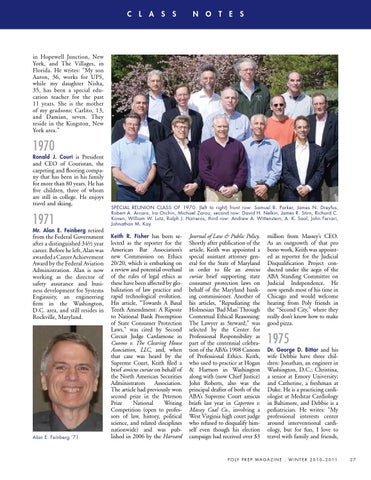
Special Reunion Class of 1970: (left to right) front row: Samuel B. Parker, James N. Dreyfus, Robert A. Arcaro, Ira Orchin, Michael Zarou; second row: David H. Nelkin, James R. Stirn, Richard C. Koven, William W. Lutz, Ralph J. Harreros; third row: Andrew A. Wittenstein, A. K. Saal, John Ferrari, Johnathan M. Kay.
Keith R. Fisher has been se-
lected as the reporter for the American Bar Association’s new Commission on Ethics 20/20, which is embarking on a review and potential overhaul of the rules of legal ethics as these have been affected by globalization of law practice and rapid technological evolution. His article, “Towards A Basal Tenth Amendment: A Riposte to National Bank Preemption of State Consumer Protection Laws,” was cited by Second Circuit Judge Cardamone in Cuomo v. The Clearing House Association, LLC, and, when that case was heard by the Supreme Court, Keith filed a brief amicus curiae on behalf of the North American Securities Administrators Association. The article had previously won second prize in the Peterson Prize National Writing Competition (open to professors of law, history, political science, and related disciplines nationwide) and was published in 2006 by the Harvard
Journal of Law & Public Policy. Shortly after publication of the article, Keith was appointed a special assistant attorney general for the State of Maryland in order to file an amicus curiae brief supporting state consumer protection laws on behalf of the Maryland banking commissioner. Another of his articles, “Repudiating the Holmesian ‘Bad Man’ Through Contextual Ethical Reasoning: The Lawyer as Steward,” was selected by the Center for Professional Responsibility as part of the centennial celebration of the ABA’s 1908 Canons of Professional Ethics. Keith, who used to practice at Hogan & Hartson in Washington along with (now Chief Justice) John Roberts, also was the principal drafter of both of the ABA’s Supreme Court amicus briefs last year in Caperton v. Massey Coal Co., involving a West Virginia high court judge who refused to disqualify himself even though his election campaign had received over $3
million from Massey’s CEO. As an outgrowth of that pro bono work, Keith was appointed as reporter for the Judicial Disqualification Project conducted under the aegis of the ABA Standing Committee on Judicial Independence. He now spends most of his time in Chicago and would welcome hearing from Poly friends in the “Second City,” where they really don’t know how to make good pizza.
1975
Dr. George D. Bittar and his
wife Debbie have three children: Jonathan, an engineer in Washington, D.C.; Christina, a senior at Emory University; and Catherine, a freshman at Duke. He is a practicing cardiologist at Medstar Cardiology in Baltimore, and Debbie is a pediatrician. He writes: “My professional interests center around interventional cardiology, but for fun, I love to travel with family and friends,
P oly P rep M aga z i ne : w i nter 2 0 1 0 – 2 0 1 1
27