L
ONGTIME SPANISH TEACHER Jose Oliveras (who, this year, reached his 20-year milestone at Poly) is also an actor, director, and co-founder of Teatro Círculo. In 2015, Oliveras won the best actor award from the Association of Independent Theaters for his portrayal of the Dominican dictator, Rafael Trujillo, in the play La caída de Rafael Trujillo. As I spoke to Oliveras, he had just wrapped up a program called Abuelito dime tú (Grandpa, tell me a story), which provided theater training to two senior centers on the Lower East Side.
Q&A
As a bilingual speaker who moves fluidly thinking of the emotional world that language must represent for you, how present is the multiplicity of cultures—the nuances and rhythms, histories and idiosyncrasies— in your identity and life?
—————————————————— You are the artistic director of the Latino theater space Teatro Círculo, which you co-founded in the East Village in 1994. Initially, you started off as a traveling company that would perform the classics, but you widened the scope to include the archipelago of Latino and Spanish theater. How has this inclusion of “two but many worlds” been perceived by the New York City community? We created the company out of our urge to work with Spanish classical plays. However, from our inception we decided that we also wanted to work with Latin American theater as well. In fact, the name of the company (Círculo) conveys the idea of inclusion. Historically, as well as in academia, Spain and Latin America have been politically and aesthetically opposed. Even though we share the same language and many traditions, Spain and Latin America have historically “unappreciated” each other’s contributions to literature and the arts. The founding members of Teatro Círculo felt that this cultural sectarianism did not apply to our pluralistic community in New York. For the last 21 years we have been producing plays from both the Spanish classical and Latin American repertoire with very enthusiastic responses from our audiences. I’m aware that at certain levels translation is impossible, and most of Teatro Círculo’s performances are in fact not translated, but would you say there is a proximity, musically or emotionally, that exists? For the last 10 years, we have made a concerted effort to offer English supertitles as an outreach tool to our English-speaking audience. However, these supertitles are not a word-by-word 10
T H E B L U E & T H E G R AY
translation of the plays. For practical reasons we try to give a gist of the dramatic situation without translating all the written text. Fortunately, theater is written to be represented, which means that there are many other theatrical elements that facilitate an emotional proximity that allows the audience to appreciate and understand the play from an experiential perspective.
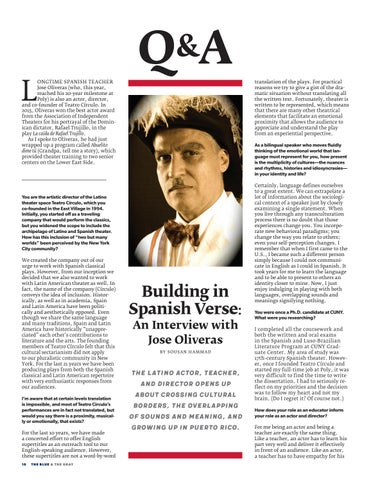
Building in Spanish Verse: An Interview with Jose Oliveras BY SOUSAN HAMMAD
The Latino actor, teacher, and director opens up about crossing cultural borders, the overlapping of sounds and meaning, and growing up in Puerto Rico.
Certainly, language defines ourselves to a great extent. We can extrapolate a lot of information about the sociological context of a speaker just by closely examining a single statement. When you live through any transculturation process there is no doubt that those experiences change you. You incorporate new behavioral paradigms; you change the way you relate to others; even your self-perception changes. I remember that when I first came to the U.S., I became such a different person simply because I could not communicate in English as I could in Spanish. It took years for me to learn the language and to be able to present to others an identity closer to mine. Now, I just enjoy indulging in playing with both languages, overlapping sounds and meanings signifying nothing. You were once a Ph.D. candidate at CUNY. What were you researching? I completed all the coursework and both the written and oral exams in the Spanish and Luso-Brazilian Literature Program at CUNY Graduate Center. My area of study was 17th-century Spanish theater. However, once I founded Teatro Círculo and started my full-time job at Poly, it was very difficult to find the time to write the dissertation. I had to seriously reflect on my priorities and the decision was to follow my heart and not my brain. (Do I regret it? Of course not.) How does your role as an educator inform your role as an actor and director? For me being an actor and being a teacher are exactly the same thing. Like a teacher, an actor has to learn his part very well and deliver it effectively in front of an audience. Like an actor, a teacher has to have empathy for his