

ELBOWS UP: A PRACTICAL PROGRAM FOR CANADIAN SOVEREIGNTY
A strategy for a sovereign, sustainable, and value-added economy—starting right now
Elbows up: A practical program for Canadian sovereignty
A strategy for a sovereign, sustainable, and value-added economy— starting right now
About the authors
Introduction
Jim Stanford and Peggy Nash 6
1. Elbows up, then and now:
The historical context for Canada’s struggle for economic independence
The long arc of Canadian political economy
Duncan Cameron 14
Elbows up: Industrial national strategy
Robert Chernomas and Fred Wilson 21
Trump’s trade bomb leaves Canada with a real choice
Daniel Drache and Marc D. Froese 27
2. Economic nation-building and the energy transition
Sustainable energy investments will spark a jobs boom for building trades workers
Lee Loftus 32
Nation-building initiatives should not obscure Indigenous renewable energy projects
James Jenkins 36
Energy efficiency should be considered a nation-building project
Brendan Haley 39
Canadian communities are choking, burning and drowning— and demanding transformative climate action
Elbows Up for Climate Campaign 47
3. Stronger communities and affordable homes
Building cities with vision for the future—the case of Montreal
Valérie Plante 54
Making a generational investment in non-market and public housing
Marc Lee 57
4. Breaking free of the staples trap :
Sector strategies to add value to Canadian resources
Value creation, industrial strategy, and Canada’s economic future
Angelo DiCaro 65
Building a sovereign Canadian steel industry
Guio Jacinto 74
Comprehensive industrial strategy needed to fulfil Canada’s potential to add value to our resources
Jim Stanford 80
Clean electricity is transforming the global economy: It’s time for Canada to swim with the current
Marisa Beck 85
Sovereignty by design: Infusing economic sovereignty into decision-making
Kaylie Tiessen 92
Deploying Canadian capital to own our economic future
Matthew Mendelsohn 98
5. Fulfilling the potential of the care economy
Getting more for less, or less for more? The future of growth and financing of the care economy
Armine Yalnizyan 106
The care economy: Essential for an independent Canadian future
Marjorie Griffin Cohen 114
A workforce strategy to fulfill the care economy’s potential
Pat Armstrong 1 20
6. Getting it done: Building the right things, the right way
A more resilient Canada
Alex Himelfarb 1 25
Communiqué: Responding to Trump demands a holistic, inclusive, sustainable national strategy 131
About the authors
Pat Armstrong is a distinguished research professor of sociology, York University.
Marisa Beck is research director, Clean Growth, at the Canadian Climate Institute.
Duncan Cameron is president emeritus of the Canadian Centre for Policy Alternatives (CCPA).
Robert Chernomas is a professor in the Faculty of Arts, Department of Economics at the University of Manitoba.
Marjorie Griffin Cohen is a feminist economist and Professor Emeritus, Simon Fraser University.
Angelo DiCaro is director of research at Unifor.
Daniel Drache is professor emeritus, Political Studies, York University.
Elbows Up for Climate Campaign.
Marc D. Froese is professor of Political Science, Burman University.
Brendan Haley is senior director of Policy Strategy at Efficiency Canada.
Alex Himelfarb is co-founder Pledge for Canada and former Clerk of the Privy Council.
Guio Jacinto is an economic researcher with United Steelworkers.
James Jenkins is executive director at Indigenous Clean Energy.
Marc Lee is a senior economist with the Canadian Centre for Policy Alternatives.
Lee Loftus is president and chair of SkillPlan.
Matthew Mendelsohn is Chief Executive Officer of Social Capital Partners.
Peggy Nash is executive director of the Canadian Centre for Policy Alternatives.
Valérie Plante served as the mayor of Montreal from 2017 to 2025.
Jim Stanford is an economist and the director of the Centre for Future Work.
Kaylie Tiessen is the Chief Economist at the Canadian SHIELD Institute.
Fred Wilson was director of Strategic Planning for Unifor and is now retired.
Armine Yalnizyan is an economist and Atkinson Fellow on the Future of Workers.
5 / Elbows up: A practical program for Canadian sovereignty
Introduction
Jim Stanford and Peggy Nash
On September 15, 2025, 40 progressive economists and policy experts gathered in Ottawa for the Elbows Up Economic Summit.
The summit was co-sponsored by the Centre for Future Work, the Canadian Centre for Policy Alternatives (CCPA), and several other national civil society organizations. We were honoured to serve as cochairs for the event.
The co-sponsoring organizations were motivated to organize the summit by the worrisome direction of economic discourse in Canada this year. Canada’s prosperity, and indeed sovereignty, have been jeopardized by Donald Trump’s aggressive tariffs and other threats. Several of Canada’s export industries have been thrown into crisis, unemployment is rising, and economists agree that the worst is yet to come if Trump’s erratic actions continue.
Trump’s attacks awakened a strong sense of national pride and a willingness to stand up for Canada. Indeed, in the April federal election, Canadians made it clear we want a government that is ambitious and confident in confronting Trump: getting our elbows up to defend our jobs, our industries, our environment, and, above all, our values.
However, in the months since then, it is clear that public discourse over the future of Canada’s economy is being shaped by the selfinterested demands of the corporate sector. Corporate leaders and lobbyists are seizing on the fear and uncertainty Canadians are experiencing to demand implementation of the same policies they’ve been wanting for years: deregulation (especially weakening labour and
environmental rules), public sector austerity, tax cuts, and doubling down on fossil fuel exports. They are now trying to justify this longstanding wish list on the basis of the dangers to Canada from Trump’s attacks.
And they are urging acquiescence to Trump’s demands in order to moderate the short-run disruption to their businesses. In the long-run, many are likely to just move their operations south of the border (as has already begun to occur in some industries, from auto manufacturing to whiskey bottling).
Even more worrisome, it appears the federal government is listening to these demands. It has made several concessions to try to appease Trump—including committing to huge increases in defence spending, restrictions on refugees, and abandoning the digital services tax.
This hasn’t worked, of course. Trump is as aggressive and unilateral as ever. The federal government also wants to speed up approval for new private megaprojects, possibly including new fossil fuel export infrastructure—and possibly without proper Indigenous consultation or environmental review. It has already abandoned some important environmental policies, and signalled it may back away from Canada’s previous emissions-reduction commitments under the Paris Agreement. It has used repressive labour laws to crack down on collective bargaining (at Air Canada and Canada Post).
It seems that ‘elbows up’ is at risk of degenerating into a historic corporate shift in economic policy. That would not only leave Canada more exposed to future geopolitical turmoil, without a stable and resilient value-added economy. It would also betray the Canadian values (of sovereignty, sustainability, and equality) that explain why we are passionate about defending Canada in the first place.
There was an obvious need to assemble progressive researchers and policy thinkers to flesh out a more holistic and progressive vision for standing up to Trump. From that recognition, the Elbows Up Summit was conceived. We are very grateful to the other national organizations (listed below) who co-sponsored the summit; to the 20 speakers and panelists who made such valuable contributions to the day; and to all those who attended in person and joined in the discussion.
To set the stage for the summit, we published a pre-summit factbook that identified the full range of challenges that a genuine nation-building strategy needs to confront. For example, the factbook documented that not only are Canada’s exports overly dependent on the U.S. economy for a market, they are also increasingly concentrated in unprocessed primary exports (minerals, forestry, agriculture, and above all fossil fuels). So as we try to diversify our exports geographically, we must also diversify them
Elbows up: A practical program for Canadian sovereignty
across sectors—nurturing our capacity as a country to add value to our resources (through technology-intensive manufacturing and services), rather than exporting them in raw form. The factbook also explained why corporate Canada’s demands (for deregulation, public sector austerity, and more fossil fuel pipelines) would make those challenges worse.
Speakers at the summit proposed concrete measures to protect jobs, living standards, and the environment despite Trump’s attacks— in key areas such as renewable energy, housing and communities, industrial policies, and the care economy. The summit’s co-sponsors issued a communiqué at the end of the day (reprinted at the end of this compendium), calling for “a broader and more holistic vision for how Canada can withstand U.S. aggression, and move forward as a fullfledged, capable, democratic, and principled country.”
The summit was covered by several media outlets, including this feature story in the National Observer, an in-depth interview on Radio Labour (hosted by rabble.ca), and this mention in the Public Policy Forum’s Canada-U.S. Newsletter.
This compendium contains written versions of presentations made at the summit, as well as contributions from others involved in the summit. We hope this will constitute a lasting resource for all those fighting for a truly sovereign, sustainable, value-added economy—and a fairer, inclusive society.
The compendium is organized into six sections, corresponding to the structure of the agenda for the summit itself:
Elbows up, then and now: The historical context for Canada’s struggle for economic independence
The fight for economic sovereignty is as old as Canada (older, in fact, considering the struggles of Indigenous Peoples). Contributors to this section remind us of that important history. Duncan Cameron reviews the history of Canadian trade policy, especially during and after the Second World War, and the tensions between fostering full-fledged industrial development and gaining access to U.S. markets. Robert Chernomas and Fred Wilson remind us of Canada’s first “C.D. Howe Moment,” when strongly interventionist measures were taken during and after the war to steer investment, technology, and trade in preferred directions—lessons that are clearly relevant today. Daniel Drache and Marc Froese review how the 1989 Free Trade Agreement with the U.S., and all the subsequent
/ Elbows up: A practical program for Canadian sovereignty
trade developments it set in motion, made Canada so vulnerable to the rise of authoritarianism in the U.S.
Economic nation-building and the energy transition
Prime Minister Mark Carney (like former Prime Minister Stephen Harper before him) speaks of Canada becoming an “energy superpower.” Private energy interests (especially in the petroleum sector) hope this turbulent moment will be an excuse to abandon environmental concerns and go full speed ahead with more fossil fuel developments. Canada certainly has ample energy potential, but the global transition away from fossil fuels (accelerating despite Donald Trump’s disruption) means we must seize the opportunity of renewable resources. The potential of renewable energy and energy conservation investments to support job creation and economic independence are enormous. Lee Loftus summarizes results from recent research on the hundreds of thousands of jobs for construction and building trades workers that will be created by upcoming investments in the energy transition. James Jenkins highlights many success stories of Indigenous participation in renewable energy projects, and stresses the potential of Indigenous-led renewable energy projects. Brendan Haley explains that investments in energy conservation and efficiency constitute, in aggregate, an energy ‘mega-project’ just as important as (and much less risky than) any other big-build undertakings. Unfortunately, despite the economic and environmental advantages of major investments in renewable energy and energy conservation, petroleum advocates are pushing hard for more (publicly subsidized) fossil fuel infrastructure (such as export pipelines for oil and LNG). The Elbows Up for Climate organization catalogues the risks of this approach, and shows that doubling down on fossil fuel exports will not achieve the security, let alone sustainability, that Canada needs more than ever.
Stronger communities and affordable homes
Housing costs are the biggest single factor in the current cost-of-living challenges faced by so many Canadians. And investing in the livability of cities and towns must be a core component of any strategy to insulate Canada from Trump’s attacks. Montréal’s outgoing Mayor Valérie Plante
/ Elbows up: A practical program for Canadian sovereignty
reviews the economic and quality-of-life benefits of urban investments in renewable energy, public transit, and affordable housing. Marc Lee considers the economic potential of massive investments in non-market housing, and assesses the strengths and limitations of the federal government’s new Build Canada Homes strategy.
Breaking free of the staples trap: Sector strategies to add value to Canadian resources
It is no coincidence that Donald Trump’s Section 232 tariffs have targeted Canada’s most important high-tech, value-adding industries—including auto, primary metals, pharmaceuticals, semiconductors, industrial machinery, and manufactured forestry products. Moreover, these tariffs do not provide any exemption for products compliant with the rules of origin in the current CUSMA trade pact. Without strong countermeasures, this full frontal attack on Canada’s industrial economy could undo our historic efforts to escape being pigeon-holed as a supplier of primary staples products (like minerals, basic forestry products, agricultural commodities, and petroleum). Speakers in this panel addressed the risks facing value-added industries under Trump, and the policy responses Canada needs. Angelo DiCaro summarizes the threats to several key industries, and the need for strong industrial policy measures to reinforce the viability of Canadian production. Guio Jacinto describes the crisis facing Canadian steel producers, and the need for a multi-pronged strategy (including Canadian steel content in major new projects) to sustain this vital industry. Jim Stanford shows that targeted industrial policies have been vital to the export success of other countries (including East Asia, Europe, and even the U.S.), and argues Canada needs to be more proactive in supporting our own value-added industries. Marisa Beck links a forward-looking industrial strategy to parallel opportunities in the energy transition, showing that rapid expansion of clean energy supply and transmission would leverage substantial benefits for other Canadian industries in global trade (including supporting the electrification of the steel, cement, mining, and chemicals sectors). Kaylie Tiessen digs deeper into the complexities of defining a product, service, or technology as ‘Canadian’—and proposes a methodology for measuring how different policies or investments further Canadian sovereignty. Finally, Matthew Mendelsohn shows why Canadian ownership, not just Canadian location, is critical for building economic independence, and
/ Elbows up: A practical program for Canadian sovereignty
makes several concrete suggestions for strengthening and supporting Canadian ownership.
Fulfilling
the potential of the care economy
Most public discussion over how Canada should respond to Trump’s trade war has focused on major projects in trade-oriented goods-producing industries. But almost 80 per cent of Canada’s GDP is produced in nontraded sectors of the economy. And a huge share of that is located in the care economy—industries (like health care, education, social services, and community infrastructure) that provide direct caring services to other Canadians. These services are vital to both quality of life and Canadians’ capacity to play a full role in the future economy—yet they are under threat from misguided policies of austerity and privatization that have gained extra attention in the wake of Trump’s attacks. Armine Yalnizyan reviews the economic importance of the care sector, and discusses how to fund it in a stable, publicly accountable way—resisting the pressures of austerity, privatization, and private equity. Marjorie Griffin Cohen explains how orthodox economic conceptions of productivity and free trade have created a policy mindset that under-values the importance of the care economy to genuine well-being. Pat Armstrong explains why a labour force strategy is vital to the future success of the care economy, including investing in better pay, training, and job stability for those who provide the care.
Getting it done: Building the right things, the right way
In response to the economic uncertainty arising from Trump, federal and provincial governments have implemented special legislation to speed up regulatory approvals for major projects. This has raised concerns among the environmental, Indigenous, and labour communities that these projects would be rushed ahead without proper care and consultation, all in the interest of “building big things” as fast as possible. This would be a mistake: we agree that Canada needs to build big things, but we need to build the right big things, and we need to build them the right way. Former Clerk of the Privy Council Alex Himelfarb knows all about getting things
/ Elbows up: A practical program for Canadian sovereignty
done in government. He warns that preserving Canada’s commitments to democracy, informed consent, and economic equality must be respected as we respond to Trump’s chaos—otherwise we will lose the battle for Canadian values, even if we manage to unleash a new wave of big construction projects.
The compendium concludes with the short communiqué released on the day of the summit by the eight co-sponsoring organizations.
We thank once again all those who contributed to this project. We are particularly grateful to the staff of the Canadian Centre for Policy Alternatives, who undertook the major planning and logistical work associated with the event. Special thanks to Trish Hennessy and Jon Milton who took on the major task of compiling and editing this compendium. We hope the summit will be the start of more lasting conversations, and organizing and advocacy efforts, among all those committed to the vision of a stronger, sovereign, fairer Canada.
The Elbows Up Economic Summit was co-sponsored by:
Canadian Centre for Policy Alternatives
Centre for Future Work
Progressive Economics Forum
Pledge for Canada
Council of Canadians
C40 Centre for City Climate Policy and Economy
Care Economy Team
Elbows Up for Climate
Elbows up: A practical program for Canadian sovereignty
1. ELBOWS UP, THEN AND NOW
THE HISTORICAL CONTEXT FOR CANADA’S STRUGGLE FOR ECONOMIC INDEPENDENCE
The long arc of Canadian political economy
Duncan Cameron
The second appearance of Donald Trump on the world stage posturing about taking over Canada, and making it the 51st state sparked a fierce reaction in Canadians. Habitual travel to the U.S. was curtailed, plane reservations plummeted. In surprisingly large numbers, Canadians began to ask for, and buy, Canadian-made products.
The Trump attack on Canada reversed a political situation favourable to the Conservatives, and in a hasty election ushered in Mark Carney, the newly chosen Liberal leader, as prime minister leading a minority Liberal government. On election night, Mark Carney made a statement that Mel Watkins, Mel Hurtig, and other significant thinkers who worried about Canadian independence being lost were waiting to hear since the 1960s: “Our old relationship with the United States, one based on increasing integration, is over”. (Quote from Carney on YouTube). Carney went on to call the demise of the world liberal trading order a tragedy.
In fact, by hastening economic integration with the United States in 1988, through the bilateral Mulroney-Reagan deal, Canada weakened the international trading regime that had counterbalanced the disproportionate power balance between the two countries. Well before
Donald Trump, Canada has been dealing with the U.S.: its threats, bullying, even invasions; as well as calmer periods of cooperation and allied efforts. Trump looms large today, but I will examine the past Canadian experiences in a world dominated by the U.S.
America negotiates
In 1944, the Bretton Woods conference agreed to create the International Monetary Fund and the World Bank. Headquartered in Washington, these institutions bear the imprint of U.S. dominance. The British representative John Maynard Keynes demonstrated in the British monetary plan that foreign exchange markets were unnecessary. In each member country, foreign payments would be made by accessing the national central bank. Each central bank would have accounts with a central fund, and would settle outstanding balances of external payments with each other—inside the fund—in a common monetary unit Keynes called bancor.
The key principle was that countries with international payment deficits would not be squeezed to come up with foreign exchange, creating deflationary forces such as the deepened Great Depression. Instead, the surplus countries would adjust their policies, importing more, for example, giving a boost to international employment. This would reduce the mercantilist practices that had plagued international economic relations since the 19th century.
The New York money centre banks that controlled the foreign exchange market lobbied successfully to kill bancor and the Keynes plan. The FX market is the largest single market in the world. As reported by the Bank of International Settlements, in June 2025, global FX trading amounted to a staggering $7.5 trillion per day, with the banks taking a slice of each transaction. These artificial profits contribute to the difficulty experienced by most of the countries of the world, as they have few foreign exchange reserves and little capacity to service international debt.
The International Monetary Fund (IMF) envisaged by Keynes to contribute to world prosperity evolved into a foreign debt collection run by the Paris club of representatives of major public lending countries acting on behalf of their banks. Today, the poorer countries have turned away from the difficult process of obtaining funding from the World Bank or IMF. China provides favourable terms for its lending, and assists directly in development projects through its Belt and Roads Initiative.
After World War II, victor nations, led by the U.S. and Britain, agreed under the Havana Charter to create the International Trade Organization (ITO), with the stellar principle of trade being considered as a part of the policy goal of full employment. The U.S. Senate refused to ratify the accord.
In London, the parties to the defunct Charter agreed to establish one section of the ITO: the General Agreement on Tariffs and Trade (GATT), with the founding principle of the Most-Favoured-Nation (MFN) at its heart. Whatever best tariff would be offered by a country to any other country would be available to all parties to the GATT.
The GATT liberalized trade. Properly speaking, liberalization is about using market prices to guide policy. In the initial GATT negotiations of 1949, the war time rules, regulations, and practices were converted into tariffs, estimating the price that a country would have to pay to access a given market. Initially, tariffs set on manufactured goods averaged above 50 per cent. In successive rounds of tariff negotiations, these were reduced significantly. By 1987, Canadian tariffs on dutiable manufactured products averaged 10 per cent, the average tariff on dutiable exports to the United States was one per cent—repeat one per cent.
In the GATT environment of multilateral negotiations, Canada discovered the formula for negotiating with the U.S.: join with others. The GATT process was a series of bilateral talks. Canada sought concessions from the U.S. and, in return, gave up protections to satisfy the U.S. But what made the process so attractive was that the U.S. then sat down with every other participant and made concessions, which were all then granted to Canada, as well under the MFN principle. For example, when the EU granted American citrus fruit increased access, it received from the U.S. a pledge to apply an injury test before levying countervailing duties. Canada benefited, as it was a target of countervail. The U.S. was now obliged to demonstrate its industry had been injured as part of its trade remedy law.
The series of successful GATT tariff talks stalled in the stagflationary environment of the 1980s, and, in 1987, the Conservatives abandoned this trusted method for dealing with U.S. economic power.
When Ronald Reagan called for Canada to join a commercial union from the Yukon to the Yucatan, the Canadian business class wanted in, and the Conservatives eventually promoted the Canada-U.S. free trade agreement, though its leader, Brian Mulroney had been elected by his party opposing the free trade agenda proposed by John Crosbie, a main contender for the post.
The U.S. was growing impatient with the success of other nations in penetrating its market. Opening up the GATT to new members had always meant the U.S. could apply its protectionist trade remedy law 201 to “import surges”, or apply countervailing duties to subsidised exports, or anti-dumping laws to goods priced below costs in the home market. But the protectionist laws did not cover enough measures for the Americans, so they decided on a new strategy.
At a time when the U.S. position of world economic hegemony was fading, the American Business Round Table convinced its congressional allies, and, more importantly, the U.S. President himself to negotiate bilaterally with Canada, Israel, and, eventually, other nations so the U.S. could exert maximum strength directly on the lesser powers to obtain concessions on intellectual property rights, investor rights, and access to markets for financial and other services. The American negotiators decided to include these new elements in international trade legislation, largely so they could use them as new grounds for bringing protectionist measures to bear on China or others building successful strategies as American competitors.
U.S. adoption of bilateralism began with the bilateral 1985 deal with Israel. The Canada-U.S. deal was concluded in 1988 (later to be succeeded by NAFTA, and then CUSMA) before the U.S. launched talks to reform the GATT and create the World Trade Organization. U.S. trading partners were put on notice by the concessions made by Canada as to the agenda of the WTO talks: new provisions on intellectual property, services trade, and intellectual property would allow the Americans to apply protectionism to practices of these types.
In their award-winning, two volume biography of Pierre Elliot Trudeau, Christina McColl and Stephen Clarkson conclude that the failure in the 1968-79, 1980-84 Trudeau era to adopt a coherent, cohesive, widely applied, understood, and accepted national industrial policy left Canada vulnerable after the 1981 major downturn to the economic integration strategy proposed by the heads of the 150 largest Canadian corporations regrouped in the Business Council on National Issues (BCNI). Brian Mulroney, acting much as a corporate lawyer serving his clients, was tasked with convincing Canadians that abandoning the multilateral approach to trade for a bilateral deal with the U.S. was the way for Canada to avoid being hit by American protectionist measures as a result of GATT talks breaking down.
The BCNI membership had undertaken a cohesive lobby approach to the Macdonald Royal Commission on the Economy and the Economic Union, which came out with a recommendation tailored to their demands.
Called free trade, a close reading of the 1985 report revealed it amounted to a project of North American integration.
No government in its right mind would abandon this multilateral process where Canada gained what others paid for in concessions for a bilateral agreement that made us concede sovereignty to U.S. corporations—in return for Canadian corporations having the right to exit the country for the U.S.
Just as bad, the FTA committed Canada to join with the U.S. in international negotiations, giving up its ability to work with other nations independently of the U.S. The Mulroney government did exactly that because the BCNI wanted inside the American protectionist border, creating a fortress North America.
The Conservatives headed into bilateral talks trying to make Canadians believe that the U.S. would cede its sovereign right to impose protectionist trade remedy legislation in return for a deal with Canada. In so doing, the Mulroney Conservatives went out on a limb that got sawed off when the Americans refused what GATT Article XXIV indicated was possible in a Free Trade Area, “the removal of restrictive trade barriers and regulations.”
Despite failing to get their principle trade objective, the Conservatives went ahead anyway because they had so much political capital invested in an accord that they had to sign one. The so-called “free trade” deal revealed a government so desperate to have an accord that they ceded the democratic power of parliament to make legislation as it saw fit under a FTA that amounted to a Charter of Rights for Big Business, or an External Constitution, as Stephen Clarkson called it. Though the ReaganMulroney deal—when measured against the terms of GATT Article XXIX— fell short of establishing a free trade area, the two leaders labeled it free trade. If you call your cat Fido…it’s still a cat.
The 1988 accord was an economic union short of a common tariff, as James Hyndman, former head of the Economic Division at External Affairs put it. Corporations received national treatment in each other’s markets: de facto citizenship. Canada adopted the Reagan-Mulroney deal as an international treaty, meaning it took precedence over the Canadian constitution, and the laws of parliament. Canada undertook to ensure provincial compliance, making policing provincial governments a new priority.
In the U.S., the deal was an executive agreement. It became Public Law 100-449. It could be amended or superseded by new Congressional laws. Its implementation depended on the goodwill of the U.S. authorities.
Allan Gotlieb, an expert in international law, explained in a scholarly article that it was impossible for the U.S. to sign in good faith a comprehensive agreement that engaged the Executive, Congress, and the Supreme Court. The American constitutional principle of the separation of powers did not allow for such an agreement to stick. This public position did not hinder him from acting as a key advocate for the economic integration agreement signed by Canada.
In plotting the international trading relationship after 1945, successive Canadian governments consulted closely with Canadian industry leaders, leaving behind trade unions’ and other groups’ concerns about macroeconomic issues and spending programs such as unemployment insurance, Medicare, and the Canada Assistance Plan. Before each trade negotiation, the level of protectionism deemed necessary by each sector was identified, and fit into the negotiators’ briefing book. Microeconomic policy per sector was trade related, with an important role for taxation incentives, such as the depletion allowance for oil and gas.
Tariffs are established by sectors that are shown in Statistics Canada data. Standard Industry Classification, now replaced by the North American Industry Classification System (NAIC), constitutes a useful framework for examining how the economy operates. Some sectors of the Canadian economy are fully integrated into the world economy, and have been since the beginning: cod fish, and wheat, to name the best known examples, others now historical references like furs, and square timber, were as well.
The first stirrings of 1960s economic nationalism emerged from an unlikely place: the Bank of Canada. Governor James Coyne understood that Canadian economic policy independence was threatened by the United States. In a series of statements in the annual reports of the Bank, he laid out his concerns.
Walter Gordon, in his Royal Commission report, his books, and his 1965 federal budget as Finance Minister, emphasized that U.S. foreign ownership gave the owners great access to Canadian politics, threatening democratic sovereignty.
The dominant position of U.S.-owned corporations in the Canadian economy remains a major obstacle to developing a made-in-Canada economic strategy using new forms of social ownership, and a return to the Canadian model of public ownership through Crown corporations.
The organizers of the Elbows Up conference want to legitimize political debate—the kind of democratic economic thinking that will serve the country in its quest for a better life for its citizens. Why think of the sectors that make up the economy as only businesses ? With a little
imagination, it is possible to see how establishing negotiating tables, and carrying on consultations sector by sector, could give us a democratic economic planning process.
Creating social and economic sectoral accords a just society can flourish. With levers—such as joint trusteeship of pension plans, access to public credit through a reformed Canadian Investment Bank, and sovereign wealth funds built on resource rents—industry, trade unions, local governments, and social partners would be able plan the economy sector by sector, as was done successfully during WWII.
/ Elbows up: A practical program for Canadian sovereignty
Elbows up: Industrial national strategy
Robert Chernomas and Fred Wilson
Canada’s long codependent economic relationship with the United States has abruptly and involuntarily ended. The election of a tariffobsessed, unpredictable, incompetent, crony capitalist, autocratic Donald Trump administration requires Canada to rethink its economic future.
Fortunately, our common history provides guidance on how to deal with such a massive exigency. Given the significance of the isolationist chaos south of the border, the only serious option for Canada is a national industrial policy much like Canada (and the U.S.) had during the Second World War, which transformed this country into a dynamic, advanced industrialized economy that paid dividends for decades.
In 1933, the Canadian unemployment rate was 30 per cent, while 20 per cent of the population became dependent on government welfare for survival. The unemployment rate remained above 12 per cent until the start of the Second World War in 1939. In the six-year period between 1939 and 1945, once Canada entered the Second World War and changed the anatomy of its economy, Gross National Product (GNP) more than doubled, the unemployment rate fell to one per cent by 1944, while wages grew nearly 70 per cent.
How did this happen? The Mackenzie King government took control of the economy in the form of a publicly funded and directed supply-side
industrial policy. Resources and labour were channelled to produce for the war effort and the core needs of the community. Twenty-eight Crown corporations were established, massive public and private investments meant factories multiplied, corporate taxes were doubled and excess profits taxed, generating revenue for these investments.
Along with the stick was the carrot of providing special incentives to renovate plants and acquire machinery, as well as infrastructure development, regulations, and research and development support.
The Canadian economy from the 1940s through to the early 1970s is referred to as the “Canadian Golden Age.” It was a time of unprecedented prosperity for Canada, characterized by rapid and stable economic growth, rising living standards, improved health outcomes, educationbased upward mobility, and Canada’s most income-equal period, thanks to policies that supported broad-based economic growth and strong social programs.
This was the result, also, of public sector funded and planned growth in expenditures on health, education, social welfare and infrastructure. It resulted in a rate of growth of labour productivity and total factor productivity that exceeded, by a large measure, anything that followed after Canadian economic policy shifted to austerity, corporate tax cuts, and the deregulation favoured by its business class. The extraordinary debt-to-income ratio that existed at the end of World War II shrank to a fraction as the Canadian Gross Domestic Product (GDP) expanded, driven by progressive government supply-side policy. The debt rose again as economic growth slowed after Canadian corporate tax rates were reduced by more than 50 per cent between 1960 and 2020.
The United States’ Second World War Roosevelt administration ran massive budget deficits, raised taxes, compelled and incentivized industries to produce what the economy needed, imposed wage and price controls and, at times, purchased half of all production.
In the United States from 1941 to 1945, industrial production and productivity doubled as the war economy brought full employment, wage growth of 50 per cent, higher taxes and, therefore, a compressed income distribution. GDP grew at 11 to 12 per cent and unemployment fell from 14.6 per cent in 1940 to 1.2 per cent in 1944. New technologies, industries, and human skills, mass transportation and new sources of raw materials evolved from the ashes of a decade-long depression as a result of government funding, planning, and regulation. Women in both countries entered the paid labour force in great numbers.
There is a more recent history that echoes the industrial and national policies of the war years. In exchange for dropping out of the Democratic
Elbows up: A practical program for Canadian sovereignty
presidential primary in 2020 and endorsing Joe Biden, Bernie Sanders and his advisers became part of a Unity Task Force along with Biden’s and fellow candidate Senator Elizabeth Warren’s policy team, which produced a 110-page set of potential policies in July 2020. These policies focused on reviving American manufacturing by concentrating resources on climate change and infrastructure, and a second plan focused on racial economic equality, referred to as the “care economy.”
Gone were the days of dealing with climate change with carbon taxes or cap and trade—the Biden government was going to build a green economy. Gone were the days of relying on redistribution alone to create a more equitable society with a program of pre-distribution, requiring union wages to rebuild the green economy.
The U.S. became the envy of the industrialized world with respect to GDP growth, price stability, full employment, real wage increases and an enthusiastic stock market as it revived its manufacturing sector from one end of the country to the other building a green economy. And it was just getting started.
However, what are the prospects for a similar industrial national policy in Canada today and what evidence is there that the Carney government is moving in that direction?
Only weeks after the April 28 federal election, the newly re-minted Finance Minister Françoise-Philippe Champagne indicated that the wartime industrial policies are at least a reference point for the Liberal government:
“When I look at 2025, it reminds me of 1945, where C.D. Howe kind of reinvented modern industrial Canada. It’s one of these moments in history where we’re really rebuilding the nation….” (Politico)
Champagne was referring to Canada’s wartime Industry Minister C.D. Howe who, as the Minister of Munitions and Supply, implemented the War Measures Act (1939) and the War Appropriation Act to rapidly industrialize the Canadian economy. In Howe’s words:
“If private industry cannot or will not do the job, then the state must step in.
The need is too great to wait.” [Cited in J.L. Granatstein, Canada’s War (1975)]
“The demands of war production have brought about the most rapid industrial revolution that Canada has ever known. Plants have been built, techniques learned, and production achieved on a scale and with a speed which a year ago would have seemed impossible.” (Address to the Canadian Manufacturers’ Association, 1941)
Elbows up: A practical program for Canadian sovereignty
Reminiscences aside, any valid comparison to the wartime national industrial program must measure the scale of government policy and the conditionality imposed to direct investment and achieve clear industrial and sector outcomes. By these criteria, despite the rhetoric of nationbuilding, there was not a comparable ambition or leadership role from the Carney government in its first six months.
Arguably, the most significant policy change by the Carney government was on federal procurement policy, potentially to cover over $100 billion annually in federal funding streams. For decades, Canadian jurisdictions were the Boy Scouts of free trade, disavowing Buy Canada policies even while the U.S. pursued Buy American. That is changing, and by November, there will be a requirement that all government spending must give priority to Canadian-sourced goods and services. In defence and construction procurements, there will be a requirement to use Canadian steel and softwood lumber.
The new procurement policies are aligned with national industrial policy goals of strengthening Canadian industry, with a priority on supporting sectors most affected by the trade war with the U.S. The centrepiece of the response is a $5 billion Strategic Response Fund to support companies disproportionately exposed to U.S. tariffs. This includes the previously announced $2 billion Auto Fund, but is in addition to the $1billion allocated in July to the steel sector.
To put this new fund in context, the Strategic Response Fund replaces the Strategic Innovation Fund, which was also significant, with over $12 billion allocated over seven years to 2024. The largest part of it was the Net Zero Accelerator Fund to assist decarbonisation of heavy industry—clearly an important and strategic purpose. However, in 2024, the Auditor General gave a brutal assessment of that program, finding that “the Net Zero Accelerator initiative was not part of any coherent and comprehensive horizontal industrial policy on decarbonization.”
The new Crown corporation, Build Canada Homes, has been created to plan, finance and partially build affordable housing, purportedly seeding a new modular housing sector. More than $40 billion in financial resources has been allocated over 10 years, but this fund also replaces an existing CHMC fund. And compared to the post-war veterans housing program and to the 1970s, when federal housing programs were at an industrial scale at about one per cent of GDP, and as a share of federal program spending, Build Canada Homes is a much, much smaller venture.
In addition to scale, there is a large gap between the purpose and conditionality of the wartime industrial policies and Canada’s new program of nation building by fast-tracking major energy, resource and
infrastructure projects. In 1941, Howe told parliament, “This is no time to quibble about theories. We tell industry what we want; we provide the means; we expect results.” In July 2025, Carney said that his government will not take a “top down approach…saying we want this, we want that.”
The interim list of 32 “national projects” leaked to the Globe and Mail are mixed.
More than half of the proposals are oil, gas and mineral export oriented. Still, there are also hydroelectric projects and transmission grids, critical minerals processing, high-speed rail and other transportation projects that potentially have significant benefits for the Canadian economy. About half of these projects are likely to have strong public sector leadership or involvement, including public energy utilities, ports corporations and direct public investments, although problematically mixed with public-private partnerships. Some projects, like a new oil pipeline to the B.C. North Coast, will meet strong opposition, particularly if it involves lifting the oil tanker moratorium.
Can we see a C.D. Howe moment in history when we are rebuilding the country? Not yet. There is a lack of ambition, a continuing emphasis on resource exports and not yet a coherent industrial national policy that would be transformative of the whole economy by adding value and meeting environmental goals, and an absence of economic investments in the care economy.
But neither is Canadian business stepping forward with the scale of investment or purpose to break Canada free from dependence on the U.S. Canada’s private for-profit sector is a notorious laggard when it comes to research, development, and investment compared to our G20 and OECD counterparts. Canadian companies are currently holding (Q3 2024) $727 billion in cash deposits . For these reasons, in addition to the preoccupation of Canadian Conservatives and their policy think tanks to salvage what they can from the failed free trade and U.S. deep integration model, there is a continuing window of opportunity to influence a stateled national industrial policy.
Moreover, the national industrial policy tools that were wielded by the wartime government still exist today. Two notable tools are the Defence Production Act and the Investment Act, which provide the authority to declare national security interests in industries and sectors, to direct production and supply chains, as well as to order, where needed, disinvestment and securing Canadian ownership and control.
What would it take for Canada to become a leader in green energy, sustainable agriculture, green transportation, biotechnology, a resilient and digitalized, high value-added processing economy? Faced with
/ Elbows up: A practical program for Canadian sovereignty
national emergencies, the wartime government transformed Canada in five years. The five-year mandate of the new Canadian government will be played out in a trade war with the U.S., a shifting geopolitical order that threatens our sovereignty, and a race against time to meet our 2030 climate goals. We simply can’t wait for private sector proposals to provide the jobs, justice or sustainability to meet this moment.
Trump’s trade bomb leaves Canada with a real choice
Daniel Drache and Marc D. Froese
Mark Carney is not negotiating with a rational actor in his U.S. counterpart, Donald Trump—leaving the government with difficult choices.
A scant five years ago, Trump praised the Canada-United StatesMexico Agreement (CUSMA), as the “best and most important trade deal ever made by the USA .” Now Trump thinks he was screwed. He blows up every trade deal he touches because there is always more to grab. He trashed the World Trade Organization’s (WTO) Appellate Body, the Transpacific Partnership, North America Free Trade Agreement, and now, at least in practice if not in law, the CUSMA.
Trump doesn’t want trade deals, he wants shakedowns . According to the Financial Times, hastily agreed-upon deals with the UK and Japan don’t even have a legal text . Furthermore, the deal struck with the EU levies 15 per cent tariffs on most goods, including autos. It was reported to have been struck in an hour at Trump’s golf course in Scotland.
As trade policy experts who have written a book on global populism, we believe it’s highly doubtful any of these so-called deals will ever become anything more than a set of general terms that are open to
revision at all times. But at this point, that’s not exactly news to anyone who has been paying attention.
Trump’s tariff Liberation Day blew a massive hole in the global trading system. And the promised “90 deals in 90 days” never happened. So now countries the world over are expecting their exports to face beggar-thyneighbour restrictions approaching the heights of the infamous Tariff Act of 1930. For example, Canada’s trade letter announced a baseline tariff of 35 per cent, with 10 per cent for oil and gas, and 50 per cent for steel, aluminum, and copper.
Eating bitterness
The Chinese call living through hardship, “eating bitterness” (吃苦, chī kǔ). That term surely describes the feelings among Canadians, now that the shock of the first six months of the Trump administration have worn off.
The new American model for trade relations is one of dysfunction and co-dependence, a term used by psychologists to describe the pathological dynamics of an abusive relationship. But countries aren’t people, and Canada can’t walk out the door.
Trump will try to crack our nut, with or without a new trade deal. It is now clear that an American empire, unconstrained by law or reason, is willing to inflict substantial pain on weaker partners.
We have little experience with resisting this systematic humiliation. As junior partners of first Britain and then the United States, Canadians grew comfortable with a century of mostly benign indifference. Now that we are in the crosshairs, we have few natural defences against the animal aggression of the Trump administration.
So far, Canadians have rallied around the flag, partly out of fear and partly out of wounded pride. But as voters and consumers, they are still unprepared for the kinds of sacrifices it will take to pull back from the American market. We will need to reorient our economy to compete in new markets in everything from entertainment and cloud computing, to lumber, minerals, and oil.
A third of Canadians have already given up American holidays. But fewer have cancelled Netflix, and hardly anyone is dumping their iPhone. Canadians are frozen between hope that Trump will be gone by January 2029, and fear that getting from here to there will require a tolerance for pain that has been, so far, untested.
Elbows up: A practical program for Canadian sovereignty
Carney’s challenge
Prime Minister Mark Carney excels as a high-level technocratic fixer, and his backroom abilities are impressive. By contrast, Trump is a master performer and a bully par excellence. He is callous, vindictive, and his belief that might makes right is bone deep. He also knows that the Canadian government, like Europe and the UK, will retreat in the face of his wrath.
The Liberal government wants to increase interprovincial trade and participate in the new EU system for military procurement. That’s a start. But it’s not enough. Our position is more precarious than most Canadians realize. If we are stripped of our CUSMA protections, Canada will face tariffs far higher than Europe’s. Our economy would implode, giving Trump the opening he needs to offer his only solution, annexation.
Two choices
As a former banker, Carney is used to thinking long-term and that makes him something of an anomaly among modern politicians. He understands that there are only two paths forward: a slow slide into the swamp of American authoritarianism, or a determined pivot towards greater autonomy, painful as that may be. Both are hazardous; we are balancing on a perilous ledge.
In the first instance, Canada will reluctantly conclude some sort of handshake trade deal on the premise that the tariff on offer is lower than the exorbitant rate threatened on July 10, and put into place July 31. It won’t come with any of the security and stability that we’ve come to expect from North American trade arrangements. Trump will continue his assault on the rule of law, becoming more powerful and more capricious.
The only dubious upside is that the rest of the world is in the same boat. Americans are paying tariffs on goods from everywhere. Nobody has any clarity on when they rise and fall.
Even so, the great danger of treating this lawless administration like a rational actor is that we will be pulled deeper into competitive authoritarianism. We will be expected to march in lockstep with the Dear Leader and react with speed and alacrity to his moods and fancies. We don’t have an ocean’s distance and the market heft that Europe has.
The more on-side we remain, the faster he will dismantle our industries and send them south.
In the second instance, negotiations will drag on as Trump continues to kick the can down the road. He recently announced another extension for Mexico. The Carney government will continue to work towards diversified trade, strengthening the east-west ties inside the country and strategically using public debt to finance the next clean energy industrial revolution.
None of this will come close to replacing lost American clients. Nor will it stabilize whatever is left of the postwar North American partnership. But something must be done and it’s a reasonable place to start. Even so, every path out from under the American elephant is narrowed by entrenched provincial interests, Alberta separatism, and the complications of negotiating with many future partners in Europe, Asia, and Latin America. It’s a tall order; not impossible, but not for the fainthearted.
Of course, any rejection of America’s authoritarian brand of pseudoliberalism will be complicated by Trump himself. He is unlikely to allow Canada and Mexico to continue with the status quo of sheltering under the CUSMA indefinitely now that Europe has caved to his tariff demands. The CUSMA is hanging by a thread. Future trade conflict with the Trump regime is inevitable, and an acquiescent Congress may roll over and cancel it outright. Trump promised economic coercion, and this is the only point on which he can be trusted to keep his word.
2. ECONOMIC NATIONBUILDING AND THE ENERGY TRANSITION
Sustainable energy investments will spark a jobs boom for building trades workers
Lee Loftus
The Canadian and global economies are rapidly transitioning toward renewable energy sources, moving away from burning fossil fuels (coal, oil, and natural gas).
This transition is occurring for both environmental and economic reasons:
• Fossil fuel combustion causes damaging increases in global temperatures due to the release of carbon dioxide, methane, and other greenhouse gases.
• Thanks to new technology, renewable energy sources are now cheaper than fossil fuels.
• New energy conservation techniques that reduce the amount of energy needed to heat buildings and power vehicles are also reducing fossil fuel demand.
Canada and most other countries in the world have committed to reach ‘net-zero’ by 2050—by which time most uses of fossil fuels will be phased out, offset by other activities that remove carbon from the atmosphere and help slow dangerous overheating of the earth caused by fossil fuel combustion.
Canada’s construction industry has an important role to play in the transition to a net-zero economy. Enormous capital investments (see below) and construction will be required to expand renewable energy production, build accompanying infrastructure (like transmission lines, batteries, and public transit), and achieve better energy efficiency (in buildings and other structures), creating increased demand for unionized skilled construction workers and an unprecedented opportunity for good, well-paying jobs for building trades workers. Meeting this need will require strong government commitment and investment in workforce training, as well as the need to ensure that high labour standards are in place.
The energy transition will result in massive increases in new capital spending by governments, businesses, and consumers in coming decades, as hundreds of billions of dollars will be required for new construction associated with the energy transition. Those investments will create millions of job-years of work for the full range of building and construction trades, and unprecedented opportunities for unionized skilled trades workers.
Table 1 / Investments required to achieve net-zero in Canada by 2050
Investment
50,000 km of new and expanded transmission lines
Adoption of advanced energy-efficient techniques and materials throughout ICI construction
Energy-saving retrofits on all existing ICI structures over 25 years
Almost $50 billion cumulative investment in district energy systems
Installation of 3.9 million electric vehicle chargers
$180 billion cumulative investment in public transit infrastructure
$50 billion+ investment in 1 to 3 high speed rail systems
200,000 new MW of non-emitting generation capacity (hydro, wind, solar, nuclear, geothermal)
/ Elbows up: A practical program for Canadian sovereignty
Figure 1 / Employment gains from net-zero investments
Million job-years by 2050
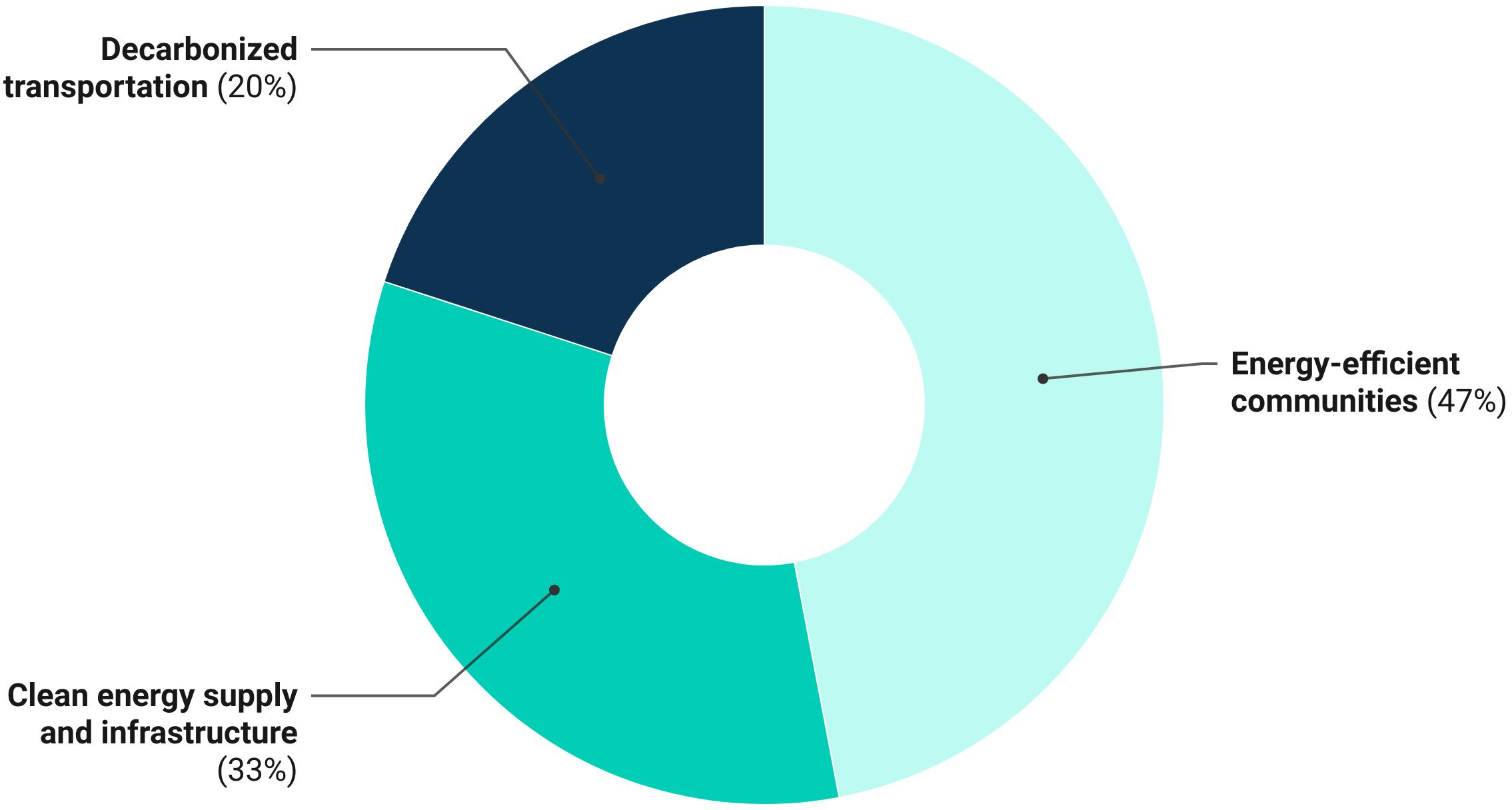
This analysis estimates that between 6.3 and 9.5 million additional jobyears of construction work will be required by 2050 to meet Canada’s netzero goals across all the investments unleashed by the energy transition: building renewable energy facilities, building energy and transportation infrastructure, and constructing and retrofitting energy-efficient buildings. That is equivalent to between 235,000 and 350,000 new jobs, on average, over the next 25 years—increasing current construction employment in Canada by 20 to 30 per cent. Almost half of those new jobs will be in the ICI (industrial, commercial and institutional) construction sector, one-third in renewable energy projects, and the remaining one-fifth in transportation infrastructure (see Figure 1). In addition, another 60,000 to 90,000 new jobs will be created in operations and maintenance roles, many of those also filled by skilled trades workers.
In short, building and construction workers in Canada are entering a period of unprecedented opportunity and prosperity. The historic investments associated with the energy transition, along with other drivers of new work (like Canada’s growing population), will reinforce that positive employment outlook. Work will be abundant. Unionized skilled trade workers will be in strong demand.
While the quantity of construction work required for the energy transition is very encouraging, parallel efforts will also be required to ensure that the quality of that work is top-notch. The shift to renewable energy and sustainable infrastructure will require a highly skilled workforce to ensure a smooth, efficient and effective transition. Governments, employers, and unions need to move quickly to expand training, apprenticeship, and Red Seal programs. New skills will be required for many of these investments: like working with new generations of electrical technology in renewable energy projects, and advanced energy-saving materials and building techniques in the ICI sector. Strong labour standards will also need to accompany publicly supported investments, including union representation, prevailing wages policies, and apprenticeship requirements.
The economic boost from massive investments in renewable energy, transportation infrastructure, and energy-efficient buildings will provide a badly needed boost to Canadian economic growth and job-creation, at a moment when U.S. President Donald Trump’s aggressive tariff policies have created major uncertainty in other parts of the economy. Investments associated with the energy transition are focused on meeting Canada’s domestic energy, building, and transportation needs. They are thus less exposed to harmful U.S. trade actions than many other sectors. The economic uncertainty arising from Trump’s policies can be moderated by accelerating these investments in Canadian energy security and sustainability.
Of course, we cannot predict with full certainty how specific technologies, timelines, and government policies will evolve over the next quarter-century, as the world moves toward a net-zero economy. But what is certain is that this energy transition will continue and accelerate: both because it is necessary for the environment, and because it makes economic sense.
Building trades workers and their unions will play a leading role in the coming energy transition. Unionized labour is essential to successfully complete these many new investments. And unions will fight to ensure that job quality and compensation is top-notch, thus maximizing the opportunities for building workers, their families, and communities.
Nation-building initiatives should not obscure Indigenous renewable energy projects
James Jenkins
Investing in infrastructure has emerged as a cornerstone of Prime Minister Mark Carney’s economic strategy, as the federal government is looking for “nation-building” projects that can be expedited. As part of this vision, Ottawa must keep in mind the booming clean energy sector that has been bolstered by hundreds of successful Indigenous partnerships.
Indigenous ownership or co-ownership is now common for new renewable generation, transmission and energy storage projects in every region of Canada. Indigenous communities and businesses have led clean energy initiatives across the country over the past 15 years, but other levels of government also deserve credit.
Provinces and territories, as well as utilities, are making major strides to address electricity supply demands and affordability concerns. The federal government, for its part, has played a role in supporting Indigenous capacity-building and community readiness, as well as writing down the risks of project development.
Is there a model of Indigenous participation that can ensure the support of impacted communities? Perhaps, but most Indigenous communities in Canada have complicated histories when it comes to resource extraction. Prior to the 1982 Constitution Act, Indigenous and treaty rights had limited legal protection, and were routinely disregarded by federal and provincial agencies.
Over the past four decades, a series of Supreme Court decisions upholding these rights has changed the landscape. There is now an opportunity to start rebuilding the trust required to develop meaningful partnerships with Indigenous nations. However, the current urgency to get mega-projects off the ground may clash with the time needed to rebuild that trust.
Clean energy is one area where Indigenous communities have willingly partnered with resource development with outstanding results. There are now more than 600 electricity generation projects that are owned or co-owned by an Indigenous community or organization, including hundreds of large projects. Collectively, these projects provide hundreds of millions of dollars in net revenue that is further reinvested by Indigenous communities.
The impact of Indigenous-led clean energy is enormous across the country. Most provinces have built community-led clean energy projects into their procurement strategy to address the rapidly growing demand for electricity across Canada. The Atlantic provinces and Manitoba are anticipating projects that will bring billions of dollars in capital to support these initiatives.
For the provinces with large metropolitan centres that have adopted this strategy—British Columbia and Quebec—the amount of capital associated with Indigenous clean energy projects under development may be in the tens of billions. These renewable “nation-building” projects are already bringing investment, jobs and supporting industries to their respective regions.
How do we ensure that these sometimes overlooked nation-building projects are successful in these economically uncertain times? First and foremost, we should acknowledge, support and invest in the programs that have made the growth of Indigenous-led clean energy possible.
The market for large renewable energy projects is straightforward, and once built, attracting capital or investors is easier than many other large ventures. However, navigating the planning, permit approval and other pre-construction stages can be difficult, especially in regions with limited capacity to support this process.
The federal government has played a key role in providing grant programs that have allowed renewable projects to move forward with Indigenous partners. These programs are located across half a dozen federal departments. Together, they provide a framework that has helped to move projects along, especially in regions farther from major urban centres and in off-grid communities.
These programs transcend party lines and have their roots in the Harper government, with major programs such as the Clean Energy Fund. They were renewed and expanded under the Trudeau government’s Clean Energy Plan. Today, grant programs in conjunction with strategic investments from the Canada Infrastructure Bank have provided the stability needed for many provinces to put renewable energy at the forefront of their electricity procurement strategies.
There is always a need to review and improve government programs, but the federal role in the rise of Indigenous ownership in Canada’s electricity generation infrastructure deserves attention. Electricity demand is predicted to double or triple over the next 20 years, making these projects more crucial than ever.
Prime Minister Carney has rebranded the federal Liberals practically overnight, and the word “austerity” has entered the conversation. While any federal government must react to changes in the global economy, the desire for nation-building initiatives should not obscure the success of federal investment in Indigenous renewable energy projects, which have already reaped dividends, with potentially many more to come.
Energy efficiency should be considered a nation-building project
Brendan Haley
Canada is abuzz with talk of nation-building projects. Mark Carney’s mandate letter priorities include “identifying and expediting nationbuilding projects that will connect and transform our country.”
Much of the current nation-building talk centres on energy supply— building more pipelines, transmission lines, and nuclear generators. But big physical megaprojects come with big risks: environmental disruption, community opposition, and attempts to avoid compliance with standard rules.
Of course, expanding renewable energy supply—from wind, solar, geothermal and hydro—must play an essential role in Canada’s nationbuilding strategy. On a life-cycle basis, renewable sources are now cheaper, more reliable, and cleaner than fossil fuels. But we shouldn’t forget the demand side of the energy equation. Embracing and accelerating both sides of the energy transition—demand and supply—
can play a huge role in insulating Canada’s economy against the global turmoil unleashed by Donald Trump.
Investing in energy efficiency doesn’t carry the risks of mega-projects. It delivers the same (or better) gains for housing, manufacturing and public infrastructure—but with less energy. Combined energy savings from thousands of local initiatives can add up to the same impact as a big megaproject; indeed, energy efficiency gains could be enough to account for 40 per cent of Canada’s energy needs by 2050. Efficiency increases self-reliance by using local resources instead of foreign energy imports, and it boosts productivity by increasing the level of economic benefit we get for each unit of energy consumed.
That’s why energy efficiency deserves to be treated as a nationbuilding project—one that the federal government should lead. Here are five benefits a national energy efficiency strategy could deliver:
1. Quick results
Most proposed nation-building projects, even if expedited, will take 10-15 years to show results. That’s too slow for the current parliament and for the urgent need to increase self-reliance in the face of U.S. trade uncertainty. Energy efficiency can be implemented quickly and show results in one to two years, thanks to existing municipal, federal and utility-led program delivery infrastructure.
2. Increased productivity
Prime Minister Mark Carney highlights productivity as a fundamental national challenge. Energy efficiency addresses this challenge headon: every unit of energy saved produces more GDP—a $4-$7 increase for every $1 invested. Canada has also committed to an energy-saving target that directly relates to productivity by measuring energy intensity improvements by the amount of energy used to produce a unit of GDP. In addition, Canada joined 133 other nations in pledging to double the pace of energy efficiency improvement until 2030. That would make a good target for a nation-building project.
3. Support for Canadian businesses and innovations
Energy efficiency is a made-in-Canada resource, powered by Canadian technologies and expertise. Almost all energy efficiency products and services could be purchased from Canadian companies or companies manufacturing in Canada. We have Canadian companies building internationally competitive businesses and innovating in areas such as smart thermostats, pump and motor systems, natural refrigerants, carbon
Elbows up: A practical program for Canadian sovereignty
sequestering insulation, and heat exchange. Products and components not made locally could be sourced from globally competitive supply chains.
4. Regional fairness
Some nation-building projects are contentious because they depend on region-specific resources. Climate federalism often pits hydro versus oil resource-rich provinces, for example. Energy efficiency avoids these conflicts. Energy waste is everywhere, and strategies to improve energy efficiency can be tailored to regional industrial structures and local communities. However, provincial priorities for nation-building projects are likely to mirror regional resource endowments and the political power of regional industry. This introduces the need for the federal government to play a leadership role in supporting a project that creates broad benefits across Canada.
5. A more adaptable and tariff-proofed economy
Energy efficiency strategies, like energy management systems or the retro-commissioning of existing building energy systems, are largely tariff-proof because they optimize existing systems without any material upgrades. They can actually extend the life of existing equipment, which can prevent the need to make a new capital purchase from outside Canada in a highly volatile trade environment. Almost all energy efficiency strategies rely on Canadian professionals and engineers who can strategically work around supply chain disruptions. Efficiency program administrators can move between residential, commercial, and industrial sectors, and across several different types of programs to save energy. That diversity of options makes energy efficiency a highly adaptable energy resource that doesn’t face the same risks as energy supply options that have locked-in production processes and fuel dependencies.
Beyond these direct benefits, energy efficiency initiatives can enhance the spin-off benefits of other nation-building projects. In other words, energy efficiency is more than a stand-alone win—it optimizes and complements every other nation-building project under discussion. Consider transmission lines, for example. It is widely recognized that strengthening the east-west electricity grid will be a critical step in both strengthening interprovincial economic ties, and protecting Canada against Trump. Improving energy efficiency at the same time as expanding transmission capacity will free up more electricity for energy trades and support community-based strategies that make improved
up: A practical program for Canadian sovereignty
transmission truly transformative. (The importance of supplementing transmission investments with energy efficiency improvements is discussed further below.)
Other nation-building priorities would also be enhanced by energy efficiency—like artificial intelligence and affordable housing. Canadian companies are already using AI to save energy, and saving electricity frees up supply for data centres. Meanwhile, building new homes to high energy efficiency standards will ensure long-term affordability and resilience against extreme heat and other weather extremes. Stable demand for both new buildings and retrofits is needed to spur a “modern housing industry” built on digital, pre-fabricated, and modular technologies.
Federal support for energy efficiency
In short, Canada already has the building blocks for a national energy efficiency project. Existing programs and initiatives could be aligned under a transformative goal—like doubling the rate of annual energy productivity. The federal government can act immediately in pursuit of this goal by:
• Maintaining and expanding the Greener Homes Loan Program before funds run out. Then, it should be reoriented as a patient financier that strategically spurs innovative business models that can make the retrofit process easier and more affordable.
• Increasing funding for the new Greener Homes Affordability Program and making the elimination of energy poverty a component of a nation-building goal.
• Making improving energy efficiency in affordable housing part of the Build Canada Homes mandate.
• Transforming how we retrofit buildings by coordinating and aggregating many buildings into larger initiatives. This will spur supply chains to develop new solutions, building on the Deep Retrofit Accelerator Initiative and the Greener Neighbourhood Pilot Project. The Canada Infrastructure Bank can play a key role by providing patient capital for both large and small buildings, and by actively supporting their aggregation into large-scale projects.
• Modernizing the Energy Efficiency Act so consumers can see energy labels when shopping online, and aligning equipment standards with Canada’s clean electricity advantage.
• Insulating Canada from disruptions to the ENERGY STAR labelling and benchmarking system, and developing made-in-Canada efficiency standards.
• Ensuring all new federally supported housing projects meet the top tiers of the national model building code. This will lead by example and help pre-fabricated and modular construction techniques transform the construction industry by demonstrating the value they provide via higher performance building envelopes.
• Developing a unique industrial strategy to improve the productivity of small- and medium-sized contractor businesses. This will create secure, future-proof jobs that digital tools will enhance, not replace.
• Encouraging energy management across all industries is a fast way to boost productivity and protect against tariff risks.
All these steps would establish federal leadership in energy efficiency, which could be complemented by initiatives led by provincial and territorial governments, utilities, municipalities and the private sector.
Making the most of transmission investments
As noted above, expanding interprovincial electricity transmission certainly ranks among the more promising nation-building projects being touted by federal and provincial governments. Proponents emphasize economic efficiencies from interprovincial energy trade, and the technical benefits of coupling wind and solar production with “natural batteries” in large hydro reservoirs.
However, taking lessons from history, past nation-building infrastructure projects of similar scale came up short in many ways, notably by failing to develop diversified technology systems and enhancing Canada’s all-round economic and industrial capability. To better ensure success this time, complementary, regional renewable energy and energy demand innovations must be made a priority, at the same time as transmission infrastructure is being improved.
We have the benefit of important lessons from Canada’s history in how one-sided emphasis on building big infrastructure can neglect key aspects of economic development and national self-reliance. For example, the transcontinental railway that linked east and west after Confederation protected Canada’s territorial integrity in reaction to American threats. Yet, the project’s costs and the related national policy locked Canada into economic dependencies (on expanded staples exports to the U.K. and the U.S.), and failed to spur diversified industrial development.
Policy-makers were more focused on building infrastructure than developing industrial research programs or education systems in new technologies and management techniques. Banks were more focused on financing resource extraction and large infrastructure than industrial development ventures. Thus, Canada industrialized in a way that failed to foster domestic entrepreneurship, and we became precariously dependent on American branch plants.
This pattern of pushing big infrastructure projects in reaction to crises, but failing to spur complementary development, is recurrent in Canadian history. A more recent, but painful, example is Atlantic Canada’s undersea transmission link. In 2010, the provincial energy utilities in Nova Scotia and Newfoundland and Labrador announced a plan to build an undersea transmission link connected to the Muskrat Falls hydroelectric project. In Newfoundland and Labrador, the political drive to build the dam and transmission project prevented an independent assessment of alternatives, such as energy efficiency. The dam project ran significant cost overruns. Customers faced potentially large rate increases.
Today, policy-makers are now focused so much on managing rate increases that they are neglecting new development opportunities—such as allowing utilities to reduce customer bills by switching from oil to electricity for heating and transportation. The Atlantic Loop, a proposed plan to bring hydroelectric power from Quebec to Nova Scotia and New Brunswick, was eventually shelved. Only then was a greater focus placed on domestic energy demand management, storage, and renewables.
If the same policy dynamic is repeated, with interprovincial megaprojects crowding out domestic clean-energy solutions, Canada will repeat this pattern of stifled technological development, and fail to meet our net-zero emission commitments in time.
Leveraging transformative technology systems
Transmission is only one component of a large technology system. To achieve a self-reliant and sustainable energy future, transmission needs to be coupled with renewable energy supply, along with strategies to shape demand and supply in real time. After all, transition to sustainable energy introduces new technical challenges. Electrifying home heating and vehicles could lead to spikes in demand during cold days or if everyone charges up their car at the same time. Wind and solar energy generation rises and falls with the weather.
A flexible system that can ramp up and down would match renewable generation with demand and manage peaks. A stronger transmission grid increases flexibility by connecting a wider diversity of energy resources across larger geographies. But transmission needn’t work alone.
For example, decentralized solar generation can reduce the need to transmit electricity. Insulating buildings reduces electricity peaks. Ratepayers and utilities can work together to pre-charge hot water tanks and pre-heat and pre-cool homes in advance of electricity peaks. Electric vehicles could charge when it makes the most sense for the grid. Industrial operations can time large-scale energy demands to periods when renewables are plentiful and cheap.
Through these and other strategies, making energy demand more flexible and efficient means people and businesses that want to reduce their energy bills can even get compensated, improving both affordability and equity. In addition, homes and local communities can be protected from power outages.
A good example is Vermont’s policy to put batteries in people’s homes instead of building transmission. The batteries balance supply and demand for the grid, and can also be used by households if the power cuts out.
Local renewable energy and demand-side flexibility resources can still face periods when they will generate more energy than they can use locally, or periods when local generators, energy efficiencies and storage can’t keep up with demand. Transmission improvements can help with this problem, but more localized energy systems can play a complementary role. For instance, local grids could mostly balance hourly and daily ebbs and flows in demand and supply. Interprovincial transmission could then manage larger seasonal differences by using wind and solar generation across the country to give time for hydroelectric reservoirs to fill up, so they are ready for the winter heating season in a highly electrified future.
Policies to address both demand and supply
Given these complex interactions between the demand and supply sides of the energy transition, policy choices will determine whether new eastwest-north electricity interconnections spur—or stifle—the development of multiple complementing clean technologies. If new transmission is given primacy as the favoured approach, it is more likely to crowd out other technologies and distract from solutions that are readily available. Conversely, policies that increase local renewable-energy development and electrification will show where transmission can be most effectively used to alleviate constraints that hold back local energy visions.
While building transmission takes years, or decades, demand-side energy solutions can be deployed in months. The creation of local, energy efficient “microgrids” across the country, capable of meeting their own energy needs most of the time, is a national project to increase selfreliance that can start right now. Improving energy efficiency would better prepare for new transmission capacity by hedging against megaproject delays, easing peak demands that require electricity imports, and/or free up electricity for cross-border trading. A national grid will be a successful accelerant for clean energy if it plugs into these microgrids with at-theready plans to use energy trade as a way to further accelerate local renewables and electrification.
If policy-makers react to the current crisis by focusing solely on transmission megaprojects, they are likely to repeat a familiar Canadian pattern that will ultimately stifle technological development. We don’t have to wait for transmission to improve energy self-reliance. A cleanenergy nation-building agenda should start by creating diverse local systems that will be complemented (not overshadowed) by a national grid.
Nation-building doesn’t have to only mean mega-projects like pipelines or power lines; it also means investing in knowledge, innovation and communities to get more from the energy we already produce and use. Energy efficiency would be Canada’s fastest, most affordable nationbuilding project—delivering megaproject benefits without the risks, creating jobs, spurring demand for Canadian-made inputs, boosting productivity, and lowering costs in every community. Energy efficiency would be a strategic addition to Canada’s portfolio of nation-building projects.
Canadian communities are choking, burning and drowning— and demanding transformative climate action
Elbows Up for Climate Campaign
More than 200 communities across every single province and territory experienced the impacts of climate change in summer 2025— droughts, wildfires, unsafe air and extreme weather events that affected up to 15 million people.1 While there was mercifully no repeat of an entire town burning to the ground, as in Jasper last summer or Lytton a few years before, dozens of municipalities faced evacuations, including one in seven First Nations across the country. 2
These are, first and foremost, humanitarian crises. Extreme weather poses a threat to human health, to cultural practices and to the viability of entire communities. However, the rise of climate-driven disasters, which have disproportionately affected smaller, rural communities to date, are also the first signs of a looming economic crisis that governments at all levels have failed to adequately anticipate or address.
Extreme weather events caused $8.5 billion in insurable losses in 2024, the most expensive year in history, according to the Insurance Bureau of Canada.3 Indirect costs, such as lost productivity due to extreme heat and the health impacts of wildfire smoke, are more difficult to measure but are likely on the order of $10 to $20 billion across the economy.4 These figures are significant, especially for the communities and households that are directly impacted, but they are still small enough in the context of Canada’s $2.5 trillion economy that higher levels of government have largely ignored them.
The bigger concern is where costs are headed if we fail to get climate change under control. Estimates vary widely, but, generally, put the global costs of climate inaction in the ballpark of 20 to 30 per cent of GDP by later this century—a cumulative reduction in global income of more than US$1,000 trillion.5 In Canada’s case, that could mean costs on the order of $1 trillion per year by 2100.6 Losing a trillion dollars per year is such a large cost to the Canadian economy that it is almost a meaningless number. The economy would simply stop functioning well before that, as cascading natural disasters, food shortages and deteriorating public health outstrip the capacity of communities to adapt.
This is the troubling context in which more than 250 mayors, councillors and other municipal leaders from across Canada signed on to the Elbows Up for Climate campaign, which calls on the federal government to take decisive action to reduce greenhouse gas emissions and build up a cleaner economy.7 Local leaders are especially attuned to the climate crisis because they are on the front lines of climate impacts but lack the capacity or jurisdiction to address the problem systemically. The campaign emphasizes “nation-building, not nation-burning” projects, including a clean electricity grid, an expansion of non-market green housing, an energy efficiency retrofitting program, high-speed rail, and a disaster response strategy.
These proposals come at the climate problem from different angles, but they have a few key features in common:
1. These projects would all make a meaningful contribution to mitigating and adapting to climate change, either through direct reductions in greenhouse gas emissions (e.g., through improved energy
2. These projects would all create productive and distributed economic activity, which means that communities across the country would benefit from new jobs and investment. Building homes and retrofitting buildings, in particular, are labour-intensive projects that cannot be outsourced. By emphasizing public or domestic ownership, they would also keep the majority of those economic benefits in Canada.
3. These projects would improve household affordability through reduced energy, transportation, housing and/or insurance costs. Besides offering a welcome reprieve in the midst of a cost-of-living crisis, leading with affordability benefits builds crucial political support at a tenuous moment for climate action.
4. While these projects would all benefit individual communities, they are ultimately dependent on federal leadership to create the necessary regulatory environment and to mobilize the necessary capital. None of these projects are viable at scale through local leadership alone.
The Elbows Up for Climate campaign was launched in the midst of the 2025 federal election and the winning Liberal government adopted much of the same framing. Since coming to power, the new federal government has prioritized major projects in the “national interest” including some that are consistent with transformative climate action, such as high-speed rail in the Toronto-Québec corridor and wind power off the Atlantic coast. These are encouraging steps, but where the current federal approach falls short is in its stubborn commitment to fossil fuel infrastructure. Specifically, the government has backed the expansion of LNG Canada, a liquified natural gas (LNG) facility in Kitimat, BC, and is exploring new “energy corridors” (i.e., pipelines) to the Port of Churchill and elsewhere in the Arctic.8 These proposals—and new fossil fuel infrastructure more broadly—fall short on all four measures outlined above:
1. These projects will increase upstream and downstream greenhouse gas emissions, exacerbating the costs of climate change in Canada and around the world. The expanded LNG Canada facility alone will be responsible for at least three megatonnes (Mt) of CO2e per year on the production side and 38 Mt of downstream emissions when its products are ultimately consumed overseas.9 The total global cost of these emissions, based on Canada’s social cost of carbon calculations, is more than $10 billion per year.10 The first phase of the project is already having significant effects on the health and quality of life of local residents, which will only get worse after expansion.11
A practical program for Canadian sovereignty efficiency), indirect reductions (e.g., by displacing personal vehicles) or by increasing economic resilience to climate impacts. All of these projects thus reduce the looming costs of climate change.
2. These projects create concentrated benefits while widely distributing their costs. Pipelines are especially egregious in this regard, because they increase profits for upstream producers but increase risks for every community and ecosystem along their route. Moreover, those benefits are largely privatized. The LNG Canada facility, for example, is owned by a consortium of international corporations, not public utilities or domestic companies.12
3. These projects offer no benefits for individual households and are likely to exacerbate affordability issues. The LNG Canada facility consumes so much natural gas and requires so much electricity that it is driving up both gas and electricity rates for households in B.C.13 Fossil fuel export projects, including pipelines to ports, are explicitly designed to move products overseas for maximum profit rather than provide goods and services to domestic markets.
4. Given the massive profitability of the oil and gas industry—globally and domestically—there is no need for governments to support these projects. If new fossil fuel infrastructure is going to be built, which is already inconsistent with the climate imperative, it should not be with public support. Yet the foreign-owned LNG Canada facility is on track to receive $4 billion in public subsidies.14 While no funding decisions have yet been made regarding new oil and gas pipelines, the $34 billion cost for the Trans Mountain Expansion pipeline is a cautionary tale.15
For local leaders, the problems with fossil fuel infrastructure are twofold. First, oil and gas infrastructure is immediately harmful to the health of communities and, by contributing to climate change, economically destructive over the long term. Second, investments in fossil fuel infrastructure—both public and private—displace funding from more productive and locally beneficial clean infrastructure. The opportunity cost of subsidizing LNG Canada, for example, is $4 billion that could be going toward public projects to reduce emissions and improve affordability in Canadian communities.
The good news is that investing in transformative climate action offers economic benefits that are comparable to fossil fuels in the short term and vastly preferable in the long term. Indeed, achieving net-zero emissions in the coming decades is six times cheaper than attempting to live with the status quo of climate damages.16 It will also create far more jobs than are put at risk. The construction sector alone stands to gain around 350,000 new green jobs compared to the roughly 180,000 jobs in the oil and gas industry today, many of which can be transitioned to retirement or cleaner industries in the coming years.17
Ultimately, we have little choice but to make this transition. The sustainability and prosperity of Canadian communities hinges on measures to reduce emissions and improve affordability. Fossil fuel infrastructure achieves neither, but a bold plan grounded in true nationbuilding projects can.
Notes
1 Elbows Up For Climate, “Climate Impacts on Canadian Communities: Summer 2025,” September 2025, https://elbowsupforclimate.ca/climate-impacts/.
2 Sonal Gupta, “One in seven First Nations impacted as Canada battles raging wildfires,” Canada’s National Observer, August 19, 2025, https://www.nationalobserver.com/2025/08/19/news/canadawildfires-indigenous-communities.
3 Insurance Bureau of Canada, “2024 Shatters Record for Costliest Year for Severe WeatherRelated Losses in Canadian History at $8.5 Billion,” Insurance Bureau of Canada, January 13, 2025, https://www.ibc.ca/news-insights/news/2024-shatters-record-for-costliest-year-for-severeweather-related-losses-in-canadian-history-at-8-5-billion
4 Dave Sawyer et al., Damage Control: Reducing the Costs of Climate Impacts in Canada, Canadian Climate Institute, 2022, https://climateinstitute.ca/reports/damage-control/
5 Maximilian Kotz et al., “The Economic Commitment of Climate Change,” Nature 628, April 2024, https://doi.org/10.1038/s41586-024-07219-0; Amine Benayad et al., Too Hot to Think Straight, Too Cold to Panic: Landing the Economic Case for Climate Action with Decision Makers, Boston Consulting Group & University of Cambridge, 2025, https://www.cam.ac.uk/research/news/ too-hot-to-think-straight-too-cold-to-panic ; Caroline Alberti, “The Cost of Inaction,” Climate Policy Initiative, January 4, 2024, https://www.climatepolicyinitiative.org/the-cost-of-inaction/; Adrien Bilal and Diego R. Känzig, The Macroeconomic Impact of Climate Change: Global vs. Local Temperature, National Bureau of Economic Research, 2024, https://www.nber.org/papers/w32450
6 The $1 trillion figure assumes nominal GDP of $4 trillion in current dollars (a conservative estimate) with 25 per cent costs; for a more detailed estimate, see: Sawyer et al., Damage Control.
7 Elbows Up For Climate, “An open letter from Canada’s local leaders,” April 2025, https:// elbowsupforclimate.ca/.
8 Government of Canada, “Major Projects Office of Canada: Initial Projects under Consideration,” Government of Canada, September 2025, https://www.canada.ca/en/one-canadian-economy/ news/2025/09/major-projects-office-of-canada-initial-projects-under-consideration.html.
9 Stefan Pauer and Jana Elbrecht, An Uncertain Future: Expanding B.C.’s Nascent LNG Industry Would Require Big Trade-Offs for the Province’s Economy, Electricity System, and Climate Goals, Clean Energy Canada, 2024, https://cleanenergycanada.org/report/an-uncertain-future/
10 Environment and Climate Change Canada, “Social cost of greenhouse gas emissions,” Government of Canada, 2023, https://www.canada.ca/en/environment-climate-change/services/ climate-change/science-research-data/social-cost-ghg.html
11 Matt Simmons, “Sleepless nights, toxic smoke: life beside Canada’s first LNG export plant,” The Narwhal, September 26, 2025, https://thenarwhal.ca/kitimat-lng-canada-impacts/
12 James Walsh, “Why foreign companies are driving Canadian LNG projects,” Canadian Affairs, March 24, 2025, https://www.canadianaffairs.news/2025/03/24/why-foreign-companies-aredriving-canadian-lng-projects/.
13 Marc Lee, Painting Itself into a Corner: LNG and the Climate-Affordability Trade-off in B.C., Canadian Centre for Policy Alternatives, 2025, https://www.policyalternatives.ca/news-research/ painting-itself-into-a-corner-lng-and-the-climate-affordability-trade-off-in-b-c/.
14 Danielle LaBrash et al., Launching a Loss: An Inventory of Government Support for British Columbia Liquefied Natural Gas, International Institute for Sustainable Development, 2025, https:// www.iisd.org/publications/report/government-support-lng-british-columbia
15 Jason Stanton, Trans Mountain Pipeline—2024 Report, Office of the Parliamentary Budget Officer, 2024, https://www.pbo-dpb.ca/en/publications/RP-2425-021-S--trans-mountain-pipeline2024-report--reseau-pipelines-trans-mountain-rapport-2024
16 Kotz et al., “The Economic Commitment of Climate Change.”
17 Tyee Bridge and Jim Stanford, Jobs for Today: Canada’s Building Trades and the Net-Zero Transition, Centre for Civic Governance, 2025, https://ccg.eco/research/jobs-for-today/; Janetta McKenzie and Megan Gordon, Drilling Down: Oil and Gas Jobs in Transition, Pembina Institute, 2025, https://www.pembina.org/pub/drilling-down.
3. STRONGER COMMUNITIES AND AFFORDABLE HOMES
Building cities with vision for the future— the case of Montreal
Valérie Plante
As mayor of Montreal, it is always a privilege for me to speak directly to members of the economic community because we’re the first to recognize that teamwork between the private sector and government is essential.
Cities are on the front lines. Faced with the impacts of climate change, economic uncertainty, and the housing crisis, we’re the first to feel the needs of the population, and we need other levels of government to respond to them.
We need to find ways to do several things at once: stimulate the economy, fight climate change, and solve social issues like housing and the health crisis.
We need to stop opposing the environment against other priorities. We can no longer talk about the environment without also talking about the economy, and we can no longer talk about the economy without talking about the environment.
Given the unstable situation with the United States, we have an incredible opportunity to make major investments to stimulate the
Canadian economy. But this opportunity must not jeopardize Canada’s response to climate change.
The drive to stimulate the economy through fossil fuels, which are the main cause of greenhouse gas emissions and increasingly frequent natural disasters, risks having a significant economic impact on our populations and public finances.
We see this in Montreal: the costs of a natural disaster are 10 times higher than the costs of adapting the territory.
That being said, the ecological transition must not be at the expense of the economy. That’s why I’m joining my voice to yours in asking the federal government to focus its national interest projects to revive the economy in three areas:
• Employment and economic development.
• Equity.
• Emissions reduction.
With these elements in place, we’ll be able to offer good green jobs across the country.
We need massive—and unprecedented—investments in the following sectors:
• Affordable and social housing.
• Public transportation.
• Energy efficiency:
• In electricity transmission
• In renewable energy
In many cases, the government must increase program funding 10-fold if it wants to have a real structural impact.
And faced with the resolve to limit taxes and tackle various challenges all together, it must find ways to innovate in financial arrangements by working with the private sector, cities, and civil society.
In Montreal, we have several examples of collaboration that are stimulating our economy while preparing for the future.
For example:
• The development of public and active transportation with real estate development at stations, which helps finance public transportation.
• The expansion of the circular economy, with the goal of doubling our circularity index by 2030.
• The decarbonization of our buildings: Montreal has adopted a roadmap for decarbonizing buildings by 2040. This is 10 years ahead of its initial target for buildings, which was set for 2050. In order to reach that goal, the city was not able to achieve this by itself. This is why we partnered with Hydro-Québec and Energir, two major energy companies.
These examples demonstrate that, at the city level, we have the capacity to innovate, with our partners, to link the environment to several types of investments.
I would also like to reiterate that last year, Montreal joined the C40 Clean Investment Accelerator, which is a firm commitment to:
• Opt out of fossil fuels.
• Invest in local and sustainable economic development.
• Promote green investments.
We don’t see businesses as obstacles to the ecological transition but, rather, as solutions to climate issues.
We strongly believe that the energy transition of cities is a key sector for investment. It’s a key source of jobs and economic stimulation, while Canada negotiates its future in the face of U.S. tariff threats.
It’s more important than ever to work together across Canada and invest in our cities. Every dollar invested today in resilience gives us a slightly stronger shield against future natural disasters.
And let’s never forget: the ecological and energy transition must be fair and inclusive. Because if we truly want to build a greener, more prosperous, and more humane future together, we must leave no one behind.
Making a generational investment in non-market and public housing
Marc Lee
For a generation, housing has been a major economic driver for Canada. Direct employment includes residential construction and real estate services, each of which contributed about 1.2 per cent of Canadian employment in recent years. However, the “success” of Canadian housing in the form of a run-up in prices has also been a key driver of growing inequality: huge wealth effects have expanded the gap between homeowners and renters. And as more are priced out of home ownership, the rental market has also been affected by low vacancy rates and soaring market rents.
Canada’s National Housing Strategy (NHS), first unveiled in 2017 and supplemented with new initiatives since then, has brought some new
federal money to the table, mostly low-interest loans in exchange for modest affordability measures in private rental construction projects. What the federal NHS has failed to do is to substantially increase the amount of non-market housing (including coop, public and social housing) in Canada, as the feds did from the 1960s to early 1990s. The legacy of those public investments is still present in this stock of housing that remains affordable today.
To get Canada back in the game, a new generational commitment is needed. A key initiative from the Carney government is Build Canada Homes (BCH), a new Crown corporation that would “act as a developer to build affordable housing at scale, including on public lands.” BCH would also take over a new federal program to assist non-profits to purchase existing affordable rental housing, and it would expand financing and capital for developers of low- to middle-income housing.
Details on BCH remain scant, but in the September public launch, the feds announced $13 billion in capitalization for BCH and a mandate “to move quickly.” Starting with 4,000 units across six parcels of federal land, to be built with modular construction techniques, BCH is connected to a portfolio of 88 federal properties deemed suitable for housing.
Commentators on the right have come out in force against this publicled housing development—even as the “emerging condo crash” so clearly illustrates the folly of relying too much on market forces. In fact, BCH is a promising model for developing new housing supply—in particular, housing for low- to middle-income households that will not be built by the private sector. BCH could also be an important and necessary break from a dominant mindset that sees for-profit developers as the primary builders of housing and private landlords as the primary source of rental housing.
Challenges with the housing market
In recent years, there’s been one mantra around Canada’s housing affordability crisis—especially pronounced in Metro Vancouver and Toronto: supply, supply, supply. And while the statistics show a major jump in housing starts and investment in recent years, prices remain much too high for many on the outside looking in. We are witnessing, before our eyes, the limitations of market logic when it comes to housing.
For-profit developers can only deliver new housing supply that makes a sufficient return on investment. That is, they are building to what the
market will bear, with the expectation of reaping current market prices for their units. In the case of ownership housing, developer profits are a residual after all costs of building are accounted for, including buying land, paying for labour and materials for construction, and any local government charges/fees. Private developer profits are typically anywhere from 15 to 25 per cent of the final sale price.
For developers, the most profitable units to build have tended to be under-sized units aimed at investors looking to flip the property before construction is complete or else rent out the finished units. This business model is now in tatters as presale buyers have not been able to close their purchases upon completion due to the lack of resale demand and lower valuations than they paid. This can also mean rental income, if they cannot sell, that is less than mortgage payments and strata fees.
A number of commentators have pointed fingers at municipal “gatekeepers” and are calling for reducing or eliminating municipal development charges. However, in a for-profit development model, eliminating these charges won’t necessarily lower prices but will likely lead to increased profits for developers. Clearly stated, up-front development charges mean developers will pay less for land. Part of today’s problem is that developers paid too much for land and now are seeking reductions in fees in order to make their projects work.
The purpose of those development charges is to cover the local costs of new housing expansion—such as water, sewer, electricity lines. Upgrades in these areas must be paid for, somehow, to make housing projects that increase density and, thus, the impact on infrastructure. The Liberals promised in the federal election to support housing-related infrastructure needs at the municipal level. This would build on the 2024 Canada Housing Infrastructure Fund, which planned for $6 billion over 10 years.
The biggest costs for new projects are high construction and land costs; the latter of which is boosted by zoning changes permitting higher density development. Financing costs have also increased substantially in the wake of higher interest rates. While short-term interest rates have come down, longer-term rates remain elevated.
The case for non-market housing
To fix this broken market at its source, we need to greatly expand the nonprofit development and delivery of non-market housing. Even at its best,
for-profit development can meet the needs of middle- to upper-income households, but is unable to deliver the affordable housing needed by low- to middle-income households.
For many years, housing advocates have called for the scaling up of non-profit development of coops and other non-market housing as a key ingredient to achieve the broader goal of affordable housing. The CCPA’s Alternative Federal Budget calls for a million new homes, in this vein, over the next decade to address backlogs and to ensure that new development is aimed at the low- to moderate-income households that need it.
While the federal 2017 NHS included an aspirational goal of making housing a human right, in practice, it was largely aimed at subsidizing private development in exchange for some units in each project meeting a fairly low bar for affordability. While new rental supply, even at market rates, eases the rental market as a whole compared to the alternative of doing nothing, it is still contingent on profitable investments for developers.
The NHS failed to deliver a large-scale build out of community or social housing that would make a meaningful difference for less affluent households. This is the type of housing that was supported federally from the 1960s to the early 1990s and includes a wide range of co-ops and other non-market housing, often developed in partnership with the provinces and non-profit organizations. Other countries in Europe and Asia also have much higher levels of non-market housing compared to Canada, where only four per cent of the housing stock is non-market.
The good news is that upfront housing costs can be reduced through public policy, leading to lower rents on resulting projects. The trick is to lower the whole stack of building costs—land, construction, financing and development charges—which, in turn, lowers the resulting rents. Each of these cost drivers can be positively affected by federal policy, including federal contributions towards housing-related infrastructure and use of public land, as noted above.
Deeper affordability could be achieved through cross-subsidies with even lower rents for specific households offset by others paying closer to market rent. Rather than all one-bedrooms renting at the break-even rent, for example, one-third of the units could rent at market rate in order to allow another one-third to rent at lower than break-even rent. Many combinations are possible, as long as the total rental income from the building is at break-even levels.
A more well-developed non-market housing sector could also lower costs by having more integrated management and maintenance spanning
multiple buildings, or through developing co-op housing, where members contribute sweat equity to the management of collective housing.
Building green and at scale
For climate and affordability reasons, BCH should focus on mediumdensity, multi-unit rental housing, mostly wood-frame construction, built to high-energy efficiency standards and using clean technologies like electric heat pumps. Canada has already developed a lot of expertise in green construction but these efforts need to be scaled up.
Greatly reducing parking requirements can also lower construction costs—it is expensive digging big holes in the ground for parking spaces—especially when in close proximity to transit. This can be part and parcel of more housing development aimed at building complete communities, where walking and biking plus transit can accommodate the vast majority of trips.
In terms of the cost of construction for labour and materials, BCH has big hopes for modular or prefabricated construction technologies transforming the industry, with work shifting to a mix of factory jobs and final assembly on-site. The feds could also help by subsidizing training and supporting the development of supply chains.
Recent studies point to modular construction techniques lowering construction hard costs by about 20 per cent compared to regular construction, while trimming building times up to 50 per cent. While this holds long-run potential, achieving cost-savings requires some economies of scale in production so that bigger panel factories can supply many projects across the city and province.
Building these en masse would enable economies of scale that would also support stronger development of supply chains within Canada. For example, HVAC equipment is largely imported from the United States, but domestic capacity could be ramped up, especially with a large multi-year pipeline of planned development.
Shifting to modular construction based on economies of scale and learning-by-doing should lead to big leaps in productivity. But that also means less labour per home built, so it’s important that this be offset by a firm commitment to build at sufficient scale to maintain the existing workforce.
Use of standardized templates or blueprints, such as the 50 designs recently published by the Canada Mortgage and Housing Corporation,
can also help. BCH should aim to build zero-carbon, energy-efficient housing and develop supply chains for imported materials like HVAC systems.
Done properly, there need not be any cost penalty to building housing that is both affordable and green. And building these units at scale would also reduce pressures in the private rental market that are keeping rents high.
BCH costs and benefits
Adding new density creates land value out of thin air. Where possible, this value should be used to meet affordable housing objectives in both public and private developments, while ensuring projects remain economically viable so that they actually get built. Public land currently zoned for low density could be rezoned for higher density, meaning all of the land lift is captured for the public good.
Building publicly owned buildings on public land through BCH would create long-lived assets that pay for themselves over time through the resulting rental income. Until recently, the federal government was considering parting with its public land holders so that for-profit developers could build. This would have been a big mistake, as it is much better to keep land public.
Keeping developments public also fits into Prime Minister Carney’s plans to separate capital and operating spending in the federal budget, meaning infrastructure and other long-lived capital investments would be separated from ongoing expenses. This is the case in some provinces already, such as British Columbia, where capital projects are listed separately and are amortized over a longer period of time in the operating budget. In any event, the resulting BCH developments would generate rental income over the ensuing decades, eventually paying for themselves.
Let’s hope BCH can be rolled out quickly, and at the scale needed. Federal land assets held by the Canada Lands Corporation have been rolled into BCH. As for scale, 4,000 units is a good start but Canada’s baseline for new housing construction is more than 200,000 units per year, and federal officials have stated intentions for housing starts to more than double that amount. Much of this depends on decisions about immigration and population growth, although there is also much pent-
up demand in the form of kids staying at home longer or people living in cramped accommodations.
If it can ramp up fairly quickly, BCH would be well-timed in light of the flagging state of private housing construction. While housing starts have held up well through the first half of 2025, increasingly, there are stories about projects being cancelled due to unfavourable economics. There is not much likelihood that interest rates will fall low enough to spark the type of boom times Canada has witnessed in the recent past. If anything, higher long-term interest rates are prevailing due to concerns about inflation and overall economic uncertainty.
BCH would ultimately be complementary to other plans aimed at supporting non-profit housing developers through capital grants and lowcost financing. Most importantly, BCH could be a major contribution to the feds living up to the rhetoric of the National Housing Strategy by truly making housing a human right.
4. BREAKING FREE OF THE STAPLES TRAP
SECTOR
STRATEGIES TO ADD VALUE TO CANADIAN RESOURCES
Value creation, industrial strategy, and Canada’s economic future
Angelo DiCaro
Defining value in a changing economy
What is “value” in a modern economy? At first glance, it seems a question for economists and accountants, a product of financial models and balance sheets. Yet value is also a deeply cultural and political matter. It shapes how societies distribute resources, how communities thrive or decline, and how workers’ lives are made more secure—or more precarious. To say something is “valuable” is not neutral. It is a statement about priorities, about purpose, and about the kind of society we want to build.
For the working class, value will be forever grounded in the real economy, not conjured in speculative markets or fleeting asset bubbles. Value is forged in the production of useful goods (e.g. cars, steel, energy, aircraft, food, housing) and services (e.g. health and living care, education, communications) and how those things spur other positive economic
activity, generating social good, including high-paying jobs, governed by strong labour laws and collective agreements, and environmental stewardship. Value is not incidental, but intentional. Creating value, in other words, is fundamentally a political exercise influenced by social actors and social events. Both the COVID-19 pandemic and the current U.S. tariff war have helped Canadians understand value through the sphere of industrial utilization, localized supply chains, and national sovereignty.
Recognizing this leads directly to the framework of industrial strategy. For decades, unions in Canada have argued that democratic, forwardlooking industrial strategy is the essential enabler of value creation. Such a strategy ensures that value is not siphoned off by private interests or footloose corporations, but reinvested in communities, workers, and the long-term sustainability of the economy through an active and mobilized state.
The case for industrial strategy
Industrial strategy begins from a simple truth: societies need useful things. But producing useful things is never simple. Complex production chains, massive infrastructure needs, and steep up front costs mean innovation is inherently risky. New technologies, from aerospace engineering to electric vehicle batteries, require stable capital, coordinated planning, and significant public support.
Economies that reap the greatest rewards are the ones that dare to take risks—where governments and state actors recognize the cost but choose to climb the ladder of industrial development. History bears this out. Canada’s most lucrative industrial projects—from the industrial expansion of the Canadian auto sector to the invention of steam-assisted gravity drainage in bitumen mining—were not creations of the “free market” or risk-taking private investors. They were the outcomes of deliberate, interventionist government policy choices.1 In fact, these—and other—Canadian industrial development projects succeeded despite investor hesitancies and free market barriers. Governments chose to absorb risk, confident that the rewards—in jobs, tax revenues, and technological leadership—would be worth it.
Even when the terminology of “industrial strategy” fell out of political favour in the late 20th century, replaced by a neoliberal strategy involving state de-mobilization, deregulation, and redistributing public resources
up: A practical program for Canadian sovereignty
to the private sector, the practice never truly disappeared. No successful industrial economy has operated with a demotivated state, although neoliberal policy programs of aggressive tax cutting (redistributing resources from public to private hands) and free trade (restricting statedirected economic development policies) have contributed to limiting government policy innovation.
The idea that prosperity simply emerges from free markets is utter foolishness. Amid an unprecedented economic crisis, it is imperative that governments in Canada heed this lesson, as the nation readies itself to ‘build big things.’
Post-COVID shifts
Since 2020, labour unions in Canada have campaigned to “mainstream” industrial strategy as the framework for creating lasting economic value. The COVID-19 pandemic accelerated this effort, demonstrating both the dangers of supply chain fragility and the power of state intervention. From emergency health policies to investment strategies, governments were suddenly forced into a role they had long denied: active economic managers.
Canada’s COVID-19 response efforts stood in sharp contrast to the last major economic crisis to befall the country—the financial recession of 2008-10—when governments forged an economic recovery program through public sector austerity and directionless corporate tax cuts, which proved an abysmal failure. 2 The pandemic, instead, revealed the potential of coordinated public action. It also coincided with an unusual political alignment across North America: progressive leaders in Mexico, Canada, and the United States advancing visions that linked workers’ rights, climate policy, and strategic industrial development into national campaigns, premised on “Building Back Better”—a broadly themed rebuke of predominant neoliberal policies.
This period resulted in:
• Mexico’s federal government delivering sweeping, pro-worker labour reforms.
• Canada’s federal government serving as torchbearer for progressive labour standards reform and commitment to union engagement.
• The U.S. administration, under President Biden, advancing the Protecting the Right to Organize (PRO) Act and efforts to spur sectorwide bargaining.
• Advancements in climate efforts, from Canada’s net-zero 2050 commitments to the U.S.’s re-entry into the Paris Accord.
• Massive state-led investment and incentive programs—anchored by the U.S. Inflation Reduction Act (IRA) —inspired Canada to roll out copycat initiatives, resulting in new factory investments, including in clean technology and electric vehicles.
• Canada’s establishment of affordable, state-sponsored public programs, including dental care for seniors, affordable child care, and pharmacare.
This was the context in which Canada’s own “Build Back Better” strategy unfolded and, critically, the moment in which government began actively steering productive auto industry investment toward zero emission vehicles (ZEVs).
Union engagement in the EV transition
The year 2020 also marked the beginning of a transformative period for Canada’s automotive sector. Negotiations between Unifor and the Detroit 3 automakers secured first-generation battery electric vehicle (BEV) programs and component production. These were not minor wins—they represented early footholds in a fast-moving global transition. The linkages between job creating factory investments and Canada’s natural abundance of clean tech critical minerals helped attract flagship investments, made possible only through large public contributions at the federal, provincial, and even municipal levels.
In fact, for the first time since Toyota Motor Company announced the construction of its Woodstock, Ontario vehicle assembly plant in 2005, Canada saw the announcement of new, large-scale greenfield automotive assembly sites—including brand-new battery cell production facilities, such as NextStar in Windsor and PowerCo in St. Thomas. New vehicle programs and parts facilities offered signs of a long-needed turnaround for a beleaguered auto industry and auto workers ravaged by decadeslong deindustrialization and approximately 50,000 jobs losses since the year 2000.
/ Elbows up: A practical program for Canadian sovereignty
Was it all a waste?
Despite significant efforts by government to secure global vehicle and battery programs, critics rightly note that Canada’s approach was far from a fully realized industrial strategy.
In 2022, Unifor published a suite of comprehensive policy proposals intended to buttress the EV shift taking place—a program designed to synchronize various policy threads (including labour market planning, consumer climate incentives, land-use, infrastructure development, procurement, and others) into a singular, goal-oriented program of industrial re-development. While generating an estimated $50 billion in new electric vehicle supply chain investments between 2020 and 2024, Canada’s industrial investment policy, alone, did not constitute a coordinated industrial strategy. Union proposals to establish a dedicated federal auto transition department, to coordinate the many facets of this industrial transition, were not acted upon. The federal government’s “Mines to Mobility” strategy has moved at a glacial pace, undermining confidence in Canada’s so-called “natural advantage” in critical minerals. When federal policy-makers neglected to include the Canadianassembled Chrysler Pacifica EV from its initial list of eligible vehicles under a federal consumer rebate program (later rectified), it was indicative of this disjointed approach. Today, the federal Electric Vehicle Availability Standard (EVAS), mandating 100 per cent ZEV sales of new vehicles by 2035, is structured as factory-agnostic, meaning it makes no difference if consumers purchase electric vehicles with high levels of Canadian content and built in Canada, or vehicles with no local content at all. This misalignment of policy objectives is the antithesis to an industrial strategy, enabling competing political narratives and objectives between civil society constituents.
Amid this transition, the Trump administration has taken steps to actively disrupt the foundations of the North American auto industry, through aggressive and punishing tariff policy (targeting both Canada and Mexico, the U.S.’s two biggest trading partners) and upending momentum toward EV adoption. U.S. trade actions are undermining scheduled plant retooling efforts in Canada, extending layoffs for autoworkers and forcing some automakers to change product plans or resequence launch plans to prioritize the assembly of internal combustion engine vehicle variants over electrified models. These actions are destabilizing the Canadian, and North American, auto industries, while enabling Chinese automakers to stay further afield in commercial EV technology and dominating global EV sales.
The damage Trump’s policies have wrought on the industrial economy raises serious concerns for the auto industry and its EV future. Yet the core point remains: the investments made by Canadian governments mattered. These investments kept facilities alive that might otherwise have shuttered. Funding provided through the federal Strategic Innovation Fund enshrined job commitments, made by automakers, that would not exist under looser, tax-credit-only models. This demonstrates that even imperfect policy interventions, by active and motivated governments, can stabilize industries and communities.
Cracks in the foundations
Despite these efforts, Canada’s industrial economy rests on increasingly fragile foundations. An over-dependence on the U.S. as an export market puts a heavily integrated Canadian industry at a strategic disadvantage. Expectations of forever-free access has fostered something of an industrial lethargy among Canadian exporters, who will now need to invest and reformulate strategy. What brought us to this point lies in a faux industrial strategy built on free trade, heavy market integration, and no domestic guardrails.
The 1965 Canada-U.S. Auto Pact represented the start of unprecedented cross-border integration, as well as cross-border dependence (albeit with critical production safeguards that resulted in factory and job growth in Canada). The Auto Pact resulted in Canada’s domestic auto industry pivoting away from its trade reliance on the British Commonwealth nations, and toward continental integration with the U.S. In exchange for domestic industrial growth, Canada became a nation dominated by foreign, U.S. automakers. Car parts today cross the border multiple times before final assembly—a production model only made possible by tariff-free cross-border trade within vertically ordered corporate supply chains. That reality—celebrated by industry and government alike—has deepened since the 1988 Canada-U.S. Free Trade Agreement and the subsequent North American Free Trade Agreement (now CUSMA). What was once Canada’s strength has become a tragic liability.
Now, Canada’s situation is dire. Roughly 80 per cent of vehicle production is exported to the U.S., underpinning more than 500,000 jobs. As government and business officials boast that, despite Trump’s trade aggression, 85 per cent of Canadian exports remain tariff-free, they
ignore the deeper problem: Canada’s overreliance on U.S. market access in key industrial sectors, and the almost certain deindustrialization these sectors face, absent a fair resolution. U.S-initiated carve-outs from tariffs for CUSMA-complying goods and other offsets, while presented by some in Canada as a reprieve, often favour American interests and do not represent a long-term solution.
A vision for Canada’s industrial future
If the foundations are cracking, the task ahead is to build anew—a forward-looking industrial strategy that reflects the permanent transformation of Canada’s economic relationship with the U.S. and the broader world.
At its 2025 national convention, Unifor delegates adopted a strategic vision statement, articulating a framework for industrial development for the country, charting a path out of the current economic crisis.
The statement rests on seven key pillars:
1. Defending Canada’s national interest
Governments must take a more aggressive stance against unfair foreign trade practices. Corporations that act against Canada’s economic interest should face penalties. Firms that sell in Canada must also invest in Canada.
2. Developing industrial strategies
Industrial strategies must be guided by genuine dialogue with workers and communities. Sector-wide strategy tables should be established across key industries to design ambitious national programs that enhance self-sufficiency and anchor jobs in communities.
3. Promoting good union jobs
Union jobs are the backbone of economic resilience and workplace fairness. Public funding and contracts geared toward nation-building projects must be tied to strong labour standards, local benefits, and secure employment. Laws must enable union certification and protect free collective bargaining.
/ Elbows up: A practical program for Canadian sovereignty
4. Pursuing a fair-trade agenda
Canada must shed its blind allegiance to a free trade model that disempowers states and restricts public policy innovation. The challenge governments face when deploying Buy Canadian procurement strategies is the result of multiple restrictive so-called “free trade deals”—and threats of retribution from trading partners. Future trade agreements must prioritize human rights, climate responsibility, and economic justice. As the CUSMA review approaches, it is important that Canadian civil society mobilize nationally to defend Canadian interests.
5. Investing in public services
Robust public services are essential for reducing inequality and supporting resilience. Governments must expand, not contract, Canada’s social safety net and resist privatization. Canada must also work to defend and expand its universal social programs, a feature of an advanced, inclusive economy.
6. Enabling Canadian ownership and control
Assets that are strategic to Canada’s national interest—whether critical infrastructure, digital networks, natural resources or certain industrial and commercial goods—must be domestically owned and controlled, including through state and Indigenous ownership models as well as public and democratic management.
7. Building skills and security for the future
Canada’s Employment Insurance program must be reformed to support workplace transitions, future-skills training, and labour market planning, operating within broader, sector-based industrial strategies.
Reclaiming the future
The future of Canada’s industrial economy is not predetermined. It will be shaped by the choices we make today. If value is indeed a political exercise, then so, too, is the decision to defend Canada’s interests, build sustainable industries and empower workers. The forever-changed relationship between the U.S. and Canada’s auto industry provides a case study in how key government decisions can have lasting impacts on value creation and job protection.
Canadians cannot accept a hollowed-out economy, solely dependent on external markets and vulnerable to every political whim beyond our borders. Pretending Canada can completely detach itself from the U.S. economy is not a productive exercise. However, Canada must embrace the development of democratic and participatory industrial strategies, across sectors, grounded in sustainability, equity, and resilience. And, through this, government must work to actively reshape its relationship with the United States.
This is the task ahead of us. It is how Canada approaches the question of value creation for the 21st century. It is the promise of industrial strategy done right. And it is the path toward a future where Canada’s workers, industries, and communities not only survive but thrive.
Notes
1 Mertins-Kirkwood and Kathen, “Bet Big: A citizen’s guide to green industrial policy in Canada,” Canadian Centre for Policy Alternatives, 2022, https://policyalternatives.ca/sites/default/files/ uploads/publications/National%20Office/2022/10/Bet%20Big_FINAL.pdf
2 Polacko, “Canada’s failed corporate tax cutting binge,” 2019, https://www.policyalternatives.ca/ news-research/canadas-failed-corporate-tax-cutting-binge/
/ Elbows up: A practical program for Canadian sovereignty
Building a sovereign Canadian steel industry
Guio Jacinto
The Canadian steel industry is in crisis. The re-imposition of Section 232 tariffs on Canadian steel exports to the United States by the Trump administration poses a structural threat to its U.S.concentrated, export-oriented model. Addressing this crisis requires understanding the path that led here. Forty years of laissez-faire economic and trade policy has left the industry unsustainably dependent on U.S. exports, weakened domestically, and vulnerable to cheap imports. Once capable of servicing the domestic market, the Canadian steel industry has become deindustrialized, import reliant, and export dependent.
To address this structural crisis, Canadians must reject laissezfaire orthodoxy and embrace an industrial strategy rooted in economic sovereignty. After a brief review of the industry’s recent history, this analysis argues for a sovereign steel strategy based on three vectors of action: 1) repatriating the domestic market, 2) state-led capacity and capability investment, and 3) encouraging domestic ownership. Every crisis is an opportunity. While the industry faces a breakdown of its export-oriented model, a strategy built on these three vectors can
rebuild Canadian steel, re-orient it toward the domestic market, and strengthen Canadian economic sovereignty and independence.
Free trade equals deindustrialization and dependence
In 1984, four years before the Canada-U.S. Free Trade Agreement, 21 per cent of Canadian steel production was exported while imports captured 16 per cent of the market. A decade later, exports as a share of production had increased to 32 per cent, while import penetration had hit a then record high of 37 per cent. In 2024, 52 per cent of domestic production was exported, overwhelmingly to the U.S., while import penetration had risen to 59 per cent (down from over 60 per cent in earlier years).1 This transformation from a relatively independent, domestically oriented industry to one marked by import and export dependence can be explained by an “import push and export pull” dynamic.
In the 1980s, Canadian producers heavily supported continental integration, seeing in the U.S. market a lucrative opportunity. 2 A free trade agreement with the U.S. was thought to offer guaranteed access to the U.S. market at a time when protectionist sentiment was rising and the U.S. steel industry continued its painful restructuring. In the decades that followed, Canadian policy-makers did little to curb imports in the 1990s and 2000s. Rising imports slowly “pushed” Canadian steel from the home market as imports from the U.S. and offshore rose faster than domestic demand, while the U.S. market continued to “pull” production southward. By 2024, six MMT of Canadian steel was shipped to the U.S., compared to three MMT in the 1980s. Meanwhile, imports had increased four-fold during the same period, while the Canadian share of the domestic market had declined by 5.8MMT, or 40 per cent.3
This dynamic also reshaped the industry. Import competition led to disinvestment and the closure of crude steel and rolling capacity, particularly, but not exclusively, in lower value-added “commodity” products. Domestic investment instead focused on higher-value flat steel, largely for U.S. buyers. The result was shuttered crude steel facilities and rolling mills which eroded both crude capacity and product capability. The aftermath of the financial crisis and the great recession solidified the trend. By 2009, the re-orientation was complete: the Canadian steel industry was essentially an appendage of U.S. steel supply, while the Canadian market was dominated by U.S. and global steel imports.
Repatriating the domestic market
Canada has one of the most open steel markets in the world, with the highest import penetration in the G7.4 The effects of free trade have been clear: deindustrialization, job losses, import dependence, and concentrated export reliance. With exports to the U.S. now blocked, and limited prospects for market diversification elsewhere due to global overcapacity and rising protectionism, the only viable demand outlet is the domestic market. Domestic demand stimulus and strong import controls are therefore essential.
The federal government has recognized this. On the demand side, its “Buy Canadian” procurement policy, obligating public suppliers to purchase Canadian-melted and -poured steel, will provide an important boost to domestic demand. Similar provincial commitments, made by Manitoba and Ontario, will also help. But the key supply-side policy—the steel tariff rate quota (TRQ)—falls short. Free trade partners (excluding the U.S. and Mexico) are granted quotas equal to 100 per cent of 2024 import levels, while non-free trade partners get 50 per cent; imports above the quota face a 50 per cent surtax. While this should free up some tonnage for domestic producers, there are no guarantees of sales, and the TRQ is simply inoperative in a situation of domestic steel consumption declining below 2024 levels—as is the case in 2025 due to the U.S. trade policy induced economic slowdown. Even in a recovery, the TRQ’s benefit remains marginal unless prohibitive counter-tariffs on U.S. steel are reimposed.5
To effectively repatriate tonnage and protect jobs, the federal government must implement a permanent TRQ program that progressively tightens over time. The guiding objective should be import substitution. The guiding metric should be a progressively declining import penetration rate target that is aligned with domestic demand and the development of new Canadian product capability, ensuring import substitution is possible.
Capacity and capability investment
Liberalized trade opened Canada’s steel market to imports and contributed to the narrowing of its industrial base. Since 2000, Canada has lost more than five MMT of crude steel capacity and hundreds of thousands of tonnes of rolling mill capacity.6 In 2024, about 11 per cent of
steel imports had no domestic equivalent. Canada no longer produces key products like wide-flange beams or rail, and likely lacks sufficient domestic supply of rebar, plate and structural steel.
The federal government’s $1 billion Strategic Response Fund for retooling and upgrading capability is a positive step. But with a high level of import competition, weak demand, and uncertainty around the future course of domestic industrial policy and its steel demand generation capacity, it appears unlikely the animal spirits of the private sector will be induced to engage in risky long-term fixed capital investments.
In this context, the federal government should assume entrepreneurial leadership to fill key supply gaps and reduce reliance on imports. Strategic federal investment could also support regional economic diversification as most (90 per cent) steel capacity is located in Ontario and Quebec. Western provinces rely on imports due to domestic transportation costs and natural geographic barriers while existing primary steelmakers are primarily backward linkages into regional staples supply chains. Federal initiatives could expand on existing raw steel capacity in the West, with accompanying investments to diversify product capabilities that could serve Western steel consumer needs or leverage emerging crude steel technologies that achieve scale at much lower output levels.7
Encouraging domestic ownership
Foreign ownership has undermined Canadian capacity. In 2008, ArcelorMittal shut down hot and cold rolling capacity in Contrecouer, Quebec; in the same year Essar Steel idled its #6 blast furnace in Sault Ste. Marie, Ontario, which remains idled. In 2013, Gerdau, a Brazilian multinational, “temporarily” idled its EAF steelmaking facility in Cambridge, Ontario which remains closed today. This capacity is effectively derelict, even if officially still “temporarily” idled.
In 2009, U.S. Steel temporarily closed its Hamilton facilities shortly after purchasing Stelco, only to re-open and largely transform them into semi-finished steel suppliers for U.S. mills before finally ending steelmaking in Hamilton altogether in 2013—despite production and employment commitments to the Canadian government as part of its purchase. While the Harper government initially sued U.S. Steel, charges were dropped after a back door deal between the federal government and the company.8
/ Elbows up: A practical program for Canadian sovereignty
While some of these closures reflected market downturns after the 2008 financial crisis and the persistence of high levels of cheap import competition, which could thus be “justified” as the actions of rational profit maximizing agents reacting to economic circumstances, they all involved multinational capital shuttering Canadian industrial capacity, accompanied by the diversion of production to other locations, ultimately resulting in the further structural deindustrialization of Canadian valueadded industry.
In the case of U.S. Steel’s purchase, restructuring and ultimate closure of Hilton Works in Hamilton, it was from the beginning, if not nefarious in motivation, then certainly in its practical effect. In practice, the purchase of Stelco by a U.S. competitor ultimately eliminated rival capacity, led to the capturing of Stelco’s lucrative auto sector orderbook and the diversion of value-added production to the United States. As Hamilton’s historic USW Local 1005 correctly identified at the time, it was nothing less than an act of “nation wrecking.”
These examples highlight the failure of the Investment Canada Act and, above all, policy-makers’ and politicians’ inability to safeguard Canadian economic sovereignty in light of foreign takeovers. Today, 78 per cent of Canadian primary steel capacity is foreign owned, often by firms with complimentary North American and global operations. This ownership structure poses a clear risk to Canadian economic sovereignty: as global overcapacity and U.S. protectionism intensify, Canada, at best, could see investment capital diverted to U.S. or other global operations or, at worst, could see production further rationalized away and find itself facing the further erosion of its domestic steel capacity. In fact, the latter is already happening.9
The federal government recently broadened security reviews of foreign investments to include “economic security.” While welcome, this does little to address existing high levels of foreign ownership in the Canadian steel industry. To counteract this threat, the federal government should actively encourage the domestic ownership of steel assets. While nationality does not alter the logic of profit maximization and the negative effects which derive from it, domestic ownership could reduce the threat of shifting production and investment overseas, provide a stronger incentive for the local consumption and reinvestment of profit income, support domestic R&D and employment, and create and sustain Canadian-based employment. If necessary, domestic ownership should also include public ownership to protect threatened domestic capacity.
The Canadian steel industry faces a momentous crisis, but also an opportunity to rebuild. This requires rejecting laissez-faire policies that
fueled deindustrialization and U.S. dependence. Rebuilding must involve productive investment to reduce import reliance, tighter import controls to encourage import substitution, and greater domestic ownership of assets. Along these three vectors, the federal government must play a leading, entrepreneurial role. With Canadian economic and political sovereignty on the line, the time for action is now.
Notes
1 World Steel Association, Steel Statistical Yearbooks, 1984-2024; authors’ calculations.
2 Robert Storey, “Making Steel Under Free Trade?,” Industrial Relations, 4(1993): pp.712-731, https://www.jstor.org/stable/23073976.
3 World Steel Association, Steel Statistical Yearbooks, 1984-2024; authors’ calculations.
4 United Steelworkers Submission to the Department of Finance Consultation on Potential Trade Measures to Prevent Diversion of Steel Products Into Canada, April 21, 2025.
5 United Steelworkers, “USW fact sheet on the federal response to the trade war and the crisis in the Canadian Steel Industry,” USW, June 2025, https://usw.ca/resources/fact-sheet-federalresponse-trade-war-june-2025/; USW Research Department Analysis of TRQ Program Under Static and Dynamic Conditions.
6 Authors’ calculations.
7 See EAF Italian manufacturer Danieli’s “Micro” and “Nano” Steel Mills, Danieli, “Minimills: A Winning Concept and Absolute Market Leadership,” Danieli, https://www.danieli.com/en/ competencies/minimills_87.htm
8 Paul Weinberg, “Is this the end or rebirth for Stelco’s remaining Steelworkers?,” Canadian Centre for Policy Alternatives, January 1, 2016, https://www.policyalternatives.ca/news-research/is-thisthe-end-or-rebirth-for-stelcos-remaining-steelworkers/.
9 Bull Moose Tube, an American managed and British Indian owned hollow structural tube producer in Burlington, Ontario closed its only Canadian facility in May 2025. The company recently opened a 350,000-tonne tube and pipe plant in Sinton, Texas. ArcelorMittal Long Products in Hamilton, formerly Stelwire, a steel wire producer, closed its facilities in July 2025, moving some of its production to a wire mill in Montreal, Quebec. Both firms faced intense import competition and were operating below capacity.
Elbows up: A practical program for Canadian sovereignty
Comprehensive industrial strategy needed to fulfil Canada’s potential to add value to our resources
Jim Stanford
Canada has long striven to be more than a mere supplier of raw resources to more developed trading partners.
From the national policy of the 1870s, to the industrial planning of C.D. Howe after the Second World War, to the Canada-U.S. auto pact of 1965, our economic development strategy tried to nurture secondary and tertiary sectors that add value to primary resources instead of just exporting them raw.
Through the latter half of the 20th century, this strategy largely succeeded. Value-added industries were built in auto, aerospace, pharmaceuticals and technology—in some cases by Canadian-owned businesses, in others relying heavily on foreign investment.
By 2000, less than one-fifth of Canada’s merchandise exports were unprocessed or barely processed primary products. We were no longer just “hewers of wood, drawers of water,” a biblical phrase representing a life of drudgery, which economist Harold Innis used to describe Canada’s dependence on natural resources in the 1930s.
Unfortunately, much of that progress has been undone in this century for a variety of reasons—heightened recently by U.S. President Donald Trump’s tariffs and other economic threats. Today, primary exports make up almost half our merchandise exports.
The federal government should use every tool at its disposal to craft a targeted industrial policy to reverse the current trend toward precarious over-dependence on resource extraction and export.
More than “diggers of critical minerals”
After entering a free-trade agreement with the U.S. in 1989, Canadian governments retreated from proactive industrial strategies, instead relying on our supposedly privileged access to U.S. markets.
The commodities boom of the 2000s reinforced the focus on resource extraction—first and foremost, the massive expansion of bitumen production and export. Evolving global competition, including the rise of China and Mexico as manufacturing powerhouses, further challenged our value-added export industries.
Now Trump is hammering more nails into the coffins of Canada’s value-adding industries with his targeted Section 232 tariffs.
It’s no coincidence these tariffs are aimed squarely at Canada’s most important high-value manufacturing. To date, his sectoral tariffs have targeted auto, aluminum, steel, copper and lumber, while aerospace, heavy trucks, pharmaceuticals and semiconductors are next in his crosshairs.
Trump’s various tariffs, including the so-called “emergency tariffs” levied under the International Emergency Economic Powers Act, are being challenged in various U.S. courts. However, the worrying erosion of the rule of law in the U.S. leaves Canadians with little confidence that his unilateral measures will be significantly constrained.
Trump is happy, it seems, to keep importing Canadian raw materials, which he treats more leniently, with lower tariffs on energy and potash, as well as CUSMA exemptions (for now, anyway) for most other primary products.
His goal is clearly to increase U.S. industrial dominance in the sectors that transform raw resources into more expensive value-added products—the very sectors Canada must defend and grow.
Otherwise, Trump’s trade war will pigeon-hole Canada as a continental resource pit—and a lucrative market for America’s more innovative (and expensive) exports.
To “hewers of wood and drawers of water” we would then add “steamers of bitumen and diggers of critical minerals.” The economic, geopolitical and environmental risks of this structural retreat from valueadded industry are worrisome.
Therefore, this is the moment for Canadian policy-makers to rediscover the importance of targeted industrial policy, which is essential to help our value-added industries survive Trump’s attacks and to reverse Canada’s over-dependence on resource extraction and export.
Believers in the traditional “comparative advantage” theory see little wrong with a country being so reliant on production and export of a specialized portfolio of unprocessed resources. If that’s what global markets want from a country, it should simply go with the flow, they believe. Accepted fully, this approach leads to ahistorical and fatalistic passivity in trade policy.
As Nobel economist Paul Samuelson famously quipped, the fact that “the tropics grow tropical fruits because of the relative abundance of tropical conditions” is hardly useful for a country that wants to do more than export bananas. The same warning applies to other countries that can’t see beyond the limited horizon of their immediate resource endowments.
The industrial success of Asia
Contrary to comparative advantage theory, the most successful global examples of industrialization in the last century have been countries such as Japan, Korea, the other Asian “tigers,” and China. They—more often by necessity than choice—did not focus on building industries based on what was buried beneath their feet.
Instead, they mobilized capital, skills and technology to carve out competitive (not comparative) advantages in strategically important and growing high-value industries.
Those efforts relied on powerful state-directed strategies to twist markets and alter incentives. Governments invoked many tools—all with the overarching goal of expanding domestic capacities to manufacture, innovate and export higher-value products and services.
Comparative-advantage thinking says “export what you were endowed with.” Good industrial policy acknowledges it’s better to specialize in some industries than others, especially industries that are technology-intensive, export-oriented, anchor valuable supply chains and demonstrate high and rising productivity.
Instead of relying on resource endowments and private markets alone to guide a country’s specialization in global trade, these countries take deliberate action to build a presence in targeted, desirable sectors.
They have all used a wide range of industrial policy levers to become global manufacturing giants. These include channeling capital (including public or sovereign wealth) to targeted industries on favourable terms; powerful public-private missions to develop and commercialize strategic technologies; and complementary investments in skills and infrastructure to lubricate the high-value export machine.
Many European countries have followed broadly similar strategies, using public capital, planning, regulation and knowledge to nurture successful global firms and high-value domestic production.
Even the U.S., while mouthing free-market jargon, relies regularly on powerful, targeted interventions, including massive defence and energy subsidies, to buttress its presence in strategic industries.
These lessons of successful industrialization have renewed relevance for Canada as we confront Trump’s economic aggression.
Some have concluded Canada should double down on extraction and export of natural resources—facilitated by new pipelines and other export infrastructure to sell our resources to countries other than the U.S. But the urgent task of export diversification needs to take account of what we produce, not just where we sell it.
Enter industrial policy, which holds new relevance for Canada as we try to protect our economy and our sovereignty against Trump’s erratic actions. Good industrial policy draws on a full suite of policy measures applied to shift incentives, motivate investment and innovation, reinforce the vitality of domestic industry and penetrate high-value export markets.
Call it “sector-development policy”
The tools of industrial policy are many and varied, including fiscal rules and incentives, technology supports, preferential access to capital, public investment (including public equity or co-investments), infrastructure construction, skills and training support, trade policy, government procurement and more.
These tools need to be applied creatively and flexibly, reflecting the specific challenges and opportunities of each sector. Governments need strong internal capacity to understand and manage industrial policy (to avoid being captured by rent-seeking businesses). As well, the goals and performance requirements need to be explicit and enforced.
Industrial policy doesn’t apply only to conventionally understood industry, which is often stereotyped as large-scale goods-producing facilities, such as resources and manufacturing.
Any technology-intensive, high-productivity, tradeable sector— including technology, business, digital, entertainment or education services—is a candidate for targeted attention. A better moniker for this theme might be “sector development policy,” moving past the outdated assumption that industrial policy is only about smokestack industries.
A fully capable industrial nation must do more than harvest resources. This has always been true.
The global energy transition—which will continue despite Trump’s best efforts to roll back history—gives further impetus for Canada to diversify beyond fossil fuels.
The current concern with Canada’s lagging productivity growth provides another important motive. Indeed, it’s no coincidence that the countries leading productivity growth globally (such as Korea, the U.S. and Ireland) are those with the biggest domestic presence of high-tech production.
Those industries didn’t end up there by accident or thanks to the autonomous logic of market forces. They ended up there because those countries undertook targeted efforts to attract and build them.
Trump’s trade war is forcing our governments, businesses and workers to collectively renew Canada’s historic crusade to build an economy that is more than a northern appendage to a larger, more developed neighbour.
A comprehensive industrial strategy—using every tool to add value to our resources instead of exporting them raw, and sustaining and growing a strong Canadian footprint in innovative value-adding industries—needs to play a central role in that nation-building mission.
Clean electricity is transforming the global economy: It’s time for Canada to swim with the current
Marisa Beck
Canada’s economy is facing unprecedented challenges: tariffs from our primary trading partner, a wave of protectionist policies in economies around the world, and heightened geopolitical uncertainty. Faced with these economic headwinds, Canadian governments are working to establish new, resilient drivers for Canada’s long-term competitiveness and prosperity.
It might be easy to overlook that, at the same time, the global economy is transforming in other unprecedented ways. Some call these
changes a revolution that will forever change the drivers of Canada’s international competitiveness and economic resilience: clean electricity technologies, including solar panels, wind turbines and batteries are experiencing drastic cost reductions, driven by and further accelerating unseen investment levels in their deployment. Already, two thirds of global capital flowing in the energy sector is going to clean tech—and the trajectory is upward.
This clean energy revolution can create immense, long-term growth opportunities for Canada by opening doors for new trade relationships and enabling significant productivity improvements at home. Achieving leadership in the emerging global clean electricity economy will allow Canada to reconcile its economic, environmental, and security imperatives. But these opportunities require Canadian governments to take urgent and decisive action now.
This analysis identifies three policy areas where Canadian governments should take action to prepare for these drastic changes and help Canada compete in this new, electrified world.
Falling technology prices drive the global clean electricity boom
Despite recent setbacks on climate policy, most drastically in the U.S. but with reverberations around the world, the global clean energy transition is gaining speed. Energy analysts speak of an electrotech revolution that is shocking global markets and leading to irreversible changes in the way economies generate and use energy.
The source of the shock is not primarily government policy, but prices. Due to economies of scale, solar panels, wind turbines, and batteries are now routinely cheaper to install than new coal or gas plants. Between 2023 and 2024, battery system costs fell by a whopping 40 per cent , and once installed, solar panels and wind turbines have minimal operating costs; they do not require expensive fuels from volatile global markets. They are also much faster to build.
As a result of falling costs of clean energy compared to conventional sources, global investment in clean electricity generation and battery storage is at record-highs. According to the International Energy Agency (IEA), projected investment in clean energy sources will top US$2 trillion in 2025 —twice the projected investment in oil, gas, and coal. Global solar installations rose by 64 per cent in the first half of 2025, reaching a
/ Elbows up: A practical program for Canadian sovereignty
capacity of 380 GW, making it the fastest-growing source of electricity generation. Also according to the IEA, battery storage in the power sector was the fastest-growing energy technology in 2023 that was commercially available, with deployment more than doubling year-onyear.
While the vast bulk of clean energy investments occur in China, Canada has seen an uptick—and developers are signalling an appetite for more. Canadian utilities are set to double clean electricity and storage on their grids, and recent procurement rounds for clean power in multiple provinces have been oversubscribed, meaning that developers see more profitable opportunities to invest in low-cost clean power than what utilities are currently asking for.
These trends have two big policy implications for Canada. First, Canada should expand its clean electricity grids to meet ever-growing demand for affordable, reliable power from Canada’s households and industries (see below). Secondly, with Canada’s old and new trading partners rapidly electrifying, Canada risks failing to meet the growing demand for the materials and technologies driving the electrotech revolution.
A virtuous growth cycle
Low-cost clean power will only accelerate the electrification of industry, households, and transport worldwide. For instance, electric vehicle (EV) sales are soaring: in 2024, every fifth car sold worldwide was an EV; in China, it was every second car. Similarly, global uptake of both residential and industrial heat pumps is soaring, as they can lead to significant efficiency increases in both settings.
In parallel, data centres are emerging as enormous new sources of electricity demand, many with a strong preference for clean power, and their extraordinary strain on existing grids encourages the development of new, innovative agreements where companies act as ‘prosumers’ that agree to shift or modify their consumption patterns to reduce peak demand in return for a lower rate or permission to connect at all.
These global trends are becoming visible in Canada. Projected electricity demand is rising fast in many Canadian provinces, including B.C., Quebec , Ontario, and Alberta, often significantly exceeding projected supply—and the supply gap comes at an economic cost. Already, industrial users are met with long wait lists for connecting to the
/ Elbows up: A practical program for Canadian sovereignty
grid, which leads to immense opportunity cost in the form of foregone investment in industries with high electricity demand.
On the flipside, a rapid build-out of low-cost clean electricity grids offers immense opportunities for clean growth by meeting the growing industrial demand fast, attracting more industrial investment and at the same time enabling industrial electrification (with the accompanying gains in efficiency).
However, not all jurisdictions will be equally well-equipped to realize these economic opportunities created by the electrotech revolution. Governments failing to act now risk being left behind.
What Canadian governments should do now
Canada’s resources put it in an excellent position for becoming a leader in the electrotech revolution. Already, the country has some of the world’s lowest-cost electricity, a comparative advantage born of mid-century hydro megaprojects in B.C., Quebec, and Manitoba, which also provide flexibility—invaluable in grids with large shares of renewables. Canada also has significant reserves of the critical minerals that form essential building blocks to many clean energy technologies and a developing battery industry.
Canadian governments should focus a new economic strategy on setting the right conditions for Canada’s sustained, resilient growth and competitiveness in a new global economy run on clean electricity:
1. Governments should strengthen and adapt policies and incentives to support the build-out of a competitive clean electricity system to power industrial growth, while maintaining grid reliability and competitive rates.
At the federal level, key policy tools for building Canada’s clean energy economy are already in place, including clean electricity regulations, clean energy investment tax credits, and Canada’s large emitter trading system (LETS) (or industrial carbon price). The federal government should strengthen these policies to provide long-term certainty for investors.
A central task for sub-national governments is to remove barriers for clean power investments, which requires a re-think of the rules that shape provincial electricity systems to ensure they are prepared for the electricity supply and demand shocks outlined above. Energy planning processes, procurement rules, and rate-setting policies must enable
/ Elbows up: A practical program for Canadian sovereignty
investment in a large-scale build-out of clean grids (including generation, storage and transmission) and thus facilitate growth in the industries looking for abundant clean power at competitive rates. Jurisdictions not able to meet their demand will experience opportunity costs of foregone industrial investment and activity.
Collectively, Canadian governments should also promote more interprovincial electricity trade , which will allow for a more efficient use of the diverse clean energy resources across the country.
2. Governments should support the electrification of Canadian industry, including steel, cement, mining and the chemical industry, because these investments have positive spillovers for the entire economy.
In addition to strengthening industrial carbon pricing or LETS as a central driver of clean energy investment, Canadian governments should provide strategic, temporary support to industry for electrification. These initial investments in innovative technologies and first-of-kind implementation will realize learning effects and economies of scale that benefit others in the sector and Canada’s economy as a whole.
While technological solutions for electrification readily exist in some industrial sectors, their implementation is typically capital intensive (as is the case for steel). For other sectors (such as chemistry), technologies for electrification are still in development.
LETS is Canada’s most effective policy to curb emissions in industrial sectors and incentivize billions of dollars of investment in cleaner, innovative technologies. Analysis shows that it is good for competitiveness, too: large emitter trading systems have no big impact on companies’ profitability, and the policy allows for a variation in performance benchmarks to address any remaining competitiveness concerns for industries that are both emissions-intense and heavily traded on international markets.
In the long run, industrial electrification will be cheaper and more efficient and productive—a choice that companies would make regardless of emissions restrictions. For example, industrial heat pumps can be three to five times more efficient than traditional boilers, which reduces companies’ energy bills and insulates them from volatile gas prices.
However, in the short term, market failures, including learning curves and scale effects, can slow private investment in innovative electrification technologies. Governments can support companies with the high upfront cost because of the positive spillover effects for the rest of the
economy resulting from building first-of-kind projects for industrial electrification or developing new technological solutions in that space. Capital markets, on their own, will not factor these positive economywide effects into their investment decisions, and industrial carbon pricing alone is often insufficient to close the financing gap. Blended finance instruments enable governments to unlock private investment in these projects and technologies while minimizing public expenditures. In addition, Canadian governments should support the development of a Canadian climate investment taxonomy to direct more investment in clean electricity infrastructure and industrial electrification to keep Canada’s industries competitive in a changing world.
3. Governments should create incentives for investment in Canada’s critical minerals value chain for clean energy technologies.
The world needs more critical minerals to support the clean electricity revolution. Canada has large reserves of essential resources for building electrification hardware: the critical minerals that go into batteries, transmission cables, EV charging stations, etc.
Developing these value chains represents a multi-billion dollar economic opportunity for Canada while strengthening energy security and enabling new trade relationships (for example, in Europe). Seizing the opportunity, however, requires smart policies both at the federal and provincial/territorial level as multiple market and policy failures slow private investment in the sector. Importantly, global critical minerals markets are typically dominated by a few powerful players, which leads to significant market risks for investors due to opaque, volatile prices. Governments should share some of these financial risks with investors to help attract capital at the required scale and pace. Governments should also take action to speed up project development by strengthening Indigenous rights, enabling Indigenous partnerships, and reducing environmental risks.
The electrotech revolution is key to building Canada’s long-term economic resilience
At a time when Canada is looking for new drivers of resilient economic growth and new trade relationships, the global electrotech revolution can create big economic opportunities. Falling costs for clean energy technologies encourage investment in clean energy infrastructure and
/ Elbows up: A practical program for Canadian sovereignty
efficiency-enhancing electrification, while also offering Canada new avenues for achieving leadership in world markets and building new trade relationships.
Canada’s starting position is excellent. The country has the energy resources to build clean, reliable, low-cost electricity grids of the future by enabling the build-out of renewable power, storage, and transmission. Canada also has the critical minerals that are essential for building resilient battery value chains and establishing new trade partnerships. While effective policies to seize these opportunities are already in place, governments must strengthen and coordinate them to form a coherent strategy that is preparing the Canadian economy for the inevitable and irreversible effects of the global electrotech revolution. The global energy economy is changing drastically, and Canada’s new strategy for long-term economic growth must focus on these changes and prepare the Canadian economy to seize emerging opportunities and make Canada a clean electricity superpower.
This commentary was originally published by the Canadian Climate Institute.
Sovereignty by design: Infusing economic sovereignty into decision-making
Kaylie Tiessen
Sovereignty is a hot word right now, buzzing in economic and political circles as nations grapple with maintaining and regaining control in a global period of “ weaponized interdependence.” What Canada’s economic sovereignty looks like for future generations will depend on relentless decision-making, by government and individuals, that ensures the country retains control of its assets, platforms, systems and products so that the value created here benefits Canadians.
We need to do more to capture this value rather than allow the benefits of domestic efforts, resources and innovation to be extracted abroad. A precondition of this ambition is ensuring our laws, including
trade agreements, enable our governments to hold foreign-controlled assets accountable to Canada’s legal and regulatory regimes.
The ongoing trade war with the United States has been destabilizing, to say the least. We may not have seen the economic collapse that many economists and policy-makers warned us about prior to President Donald Trump’s so-called “Liberation Day,” but there are many sectors, cities and groups of people that have been impacted, including young people, auto workers, Western farmers, and folks in the steel, aluminum and forestry sectors.
It’s easy to blame the current U.S. administration for our economic woes, but the reality is Trump is exploiting weaknesses that existed long before he was re-elected late last year.
Over the last 40 years, Canada has slowly relaxed foreign ownership restrictions, agreed to trade deals that gave away our ability to regulate or deliver value-add, and allowed critical industries to be dominated by foreign entities without sufficient checks or balances.
While Trump continues his assault, Canada needs a comprehensive plan to strengthen and grow our economy from the inside out. This will mean restoring sovereignty over the infrastructure and sectors where we have lost it, while simultaneously recapturing value from sectors that currently leak it.
To safeguard our economic future, we must consistently prioritize Canadian ownership and control. This begins with understanding the nuances of what defines a product or service as “Canadian.” Sure, it’s about where something is produced, but it’s also about who owns it, where the profits are delivered, and whether we are leveraging domestic innovations funded by Canadian research and development dollars.
The spectrum of value
We must aspire to capture the full value of economic activity created all along the value chain—from leveraging the results of Canadian government-funded research and development to creating jobs and commercializing innovation in Canada.
There is a whole spectrum of value generated along the business and innovation growth chain, including local job creation and skill development, R&D advancements, GDP growth and profits. Delivering better results for Canadians means capturing gains from all aspects of this chain.
up: A practical program for Canadian sovereignty
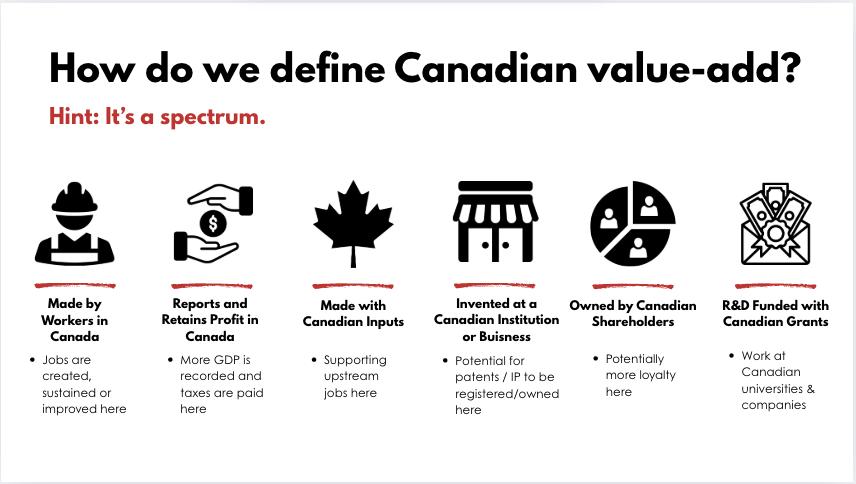
Image 1: The spectrum of value-add
When we focus on only one piece of the spectrum while minimizing the others, we leave tremendous value open to be siphoned away by companies in other jurisdictions.
Not every business will be owned by Canadian shareholders. Not every job created will be based in Canada. But we need to make sure any value that is delivered elsewhere is done so on purpose—not because we weren’t paying attention.
If we want economic sovereignty, we need to understand how to create it. It’s not binary, and it is messy; but it’s worth it.
The SHIELD Score
That’s why we created the SHIELD Score : a tool to help policy-makers and policy-minded Canadians think about the policy decisions the country is facing and make the trade-offs more explicit. We want each decision that government makes to strengthen Canada’s sovereignty and add value to the economy.
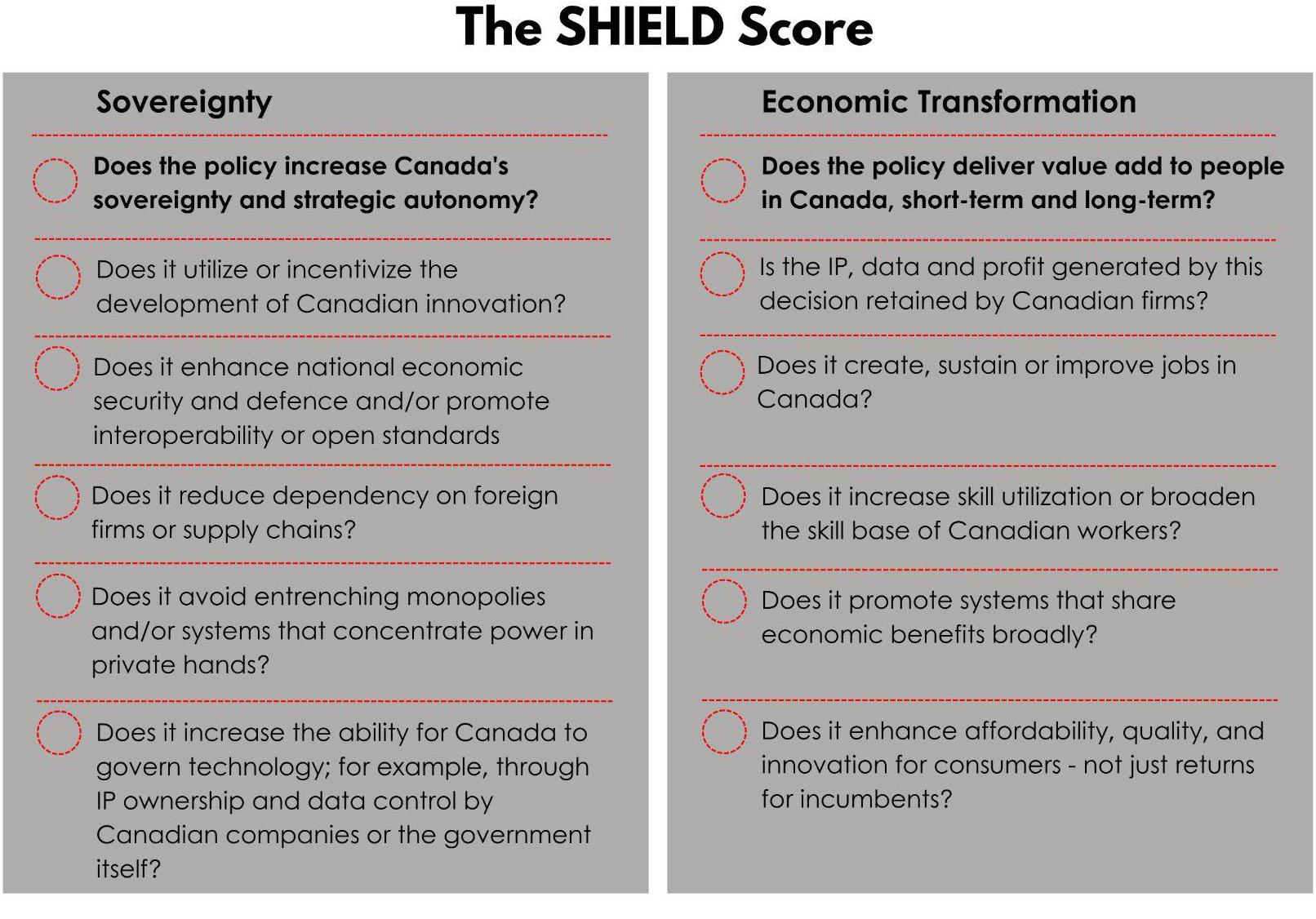
The 10-question scorecard (see Image 2) simplifies a complex policy goal into actionable insights that can improve decision-making and deliver more value to Canadians. Among other things, its criteria considers whether a policy enhances Canada’s ability to govern technology and innovation, reduces the country’s reliance on foreign ownership and supply chains, and builds human capital in a way that broadens the skill base of Canada’s labour market or creates high value jobs.
The following snapshots illustrate the application of the SHIELD score and underscore the complexity of building and maintaining economic sovereignty through every policy decision.
Using examples from different sectors, we demonstrate how strategic decision-making can bolster Canadian autonomy and economic activity.
Image 2: The SHIELD sovereignty score
SHIELD score: Algoma
Steel investment
Last month, the Government of Canada announced it would make a $400-million loan to Algoma Steel as the Sault Ste. Marie firm struggles under the weight of new U.S. tariffs. The loan is designed to support continued operations and help Algoma Steel transition to a business model less reliant on the United States. The Government of Ontario announced it would provide a $100-million loan to the steelmaker as well.
The federal loan will be administered through the Large Enterprise Tariff Loan program, which provides financing for up to 36 months to support the liquidity and operating needs of large companies once all other sources of financing have been exhausted.
This announcement gets a 6/10 on the SHIELD Score for Sovereignty and Economic Transformation.
By helping Algoma shift to new markets, this loan enhances economic security by shoring up the production of Canadian steel, an important component of infrastructure, housing and defence. The loan also secures jobs that generally pay higher-than-average wages and, by keeping the domestically owned company active, government will be able to fulfill its Buy Canadian procurement guidelines. The score could have been improved through incentives to innovate to meet market demand and by ensuring any IP created by said innovation delivers value to Canada’s economy.
SHIELD Score: Purchase of Arctic Over-the-Horizon-Radar (A-OTHR) from Australia
The second policy decision investigated here is Canada’s $6-billion purchase of a next generation Arctic Over-the-Horizon-Radar system from BAE Australia. The decision was soft launched in March and then made official in July.
However, it was reported that a Canadian alternative exists. The details of why the Canadian firm was not chosen were not made public but we do know it was working with the Department of National Defence to develop similar technology.
While the Canadian military will be trained to operate the arctic radar equipment and some workers in Canada may assist in building it, the technology will be owned by the Australian firm. Under the Industrial Technological Benefits (ITB) program, BAE Australia must spend an
equivalent amount of the contract on economic activity in Canada, meaning additional jobs will be created.
This decision receives a four out of 10 on the SHIELD score. Purchasing from an Australian company does not incentivize or utilize Canadian innovations. It does not reduce dependency on foreign firms or supply chains, and it does not deliver ownership of the innovations that materialize as a result of the investment into the hands of Canadian firms.
It does deliver jobs through the invocation of the ITB program. It does increase our economic security and defence capabilities, if we take into account that the decision diversifies the countries Canada’s military relies on.
Sovereignty is built one decision at a time
Rebuilding economic sovereignty is a crucial component of safeguarding Canada’s future prosperity and independence. Winning the fight for economic sovereignty hinges on relentless, incremental decision-making that chooses Canada at every opportunity. The SHIELD score guides policy-makers toward decisions that bolster Canada’s autonomy and economic resilience. By highlighting the sovereignty trade-offs in each policy design, this framework enables more informed and strategic policymaking.
Not every policy design will be perfect, nor will they all fully deliver the goals of sovereignty and economic transformation. But tools that can help us understand and clarify when and why we are giving away autonomy or economic value are essential to ensuring that trade-offs are made with intention instead of under duress. By continuously refining our approaches and learning from experience, we can better align our policies with the overarching vision of a stronger, more independent Canada.
Deploying Canadian capital to own our economic future
Matthew Mendelsohn
Iwas opposed to the free trade agreements with the United States in the 1980s and 1990s, concerned about the loss of Canadian sovereignty.
Over much of the past twenty years, in the context of general economic well-being in Canada, my conservative friends would regularly point out that I had been wrong about the FTA and NAFTA. I genuinely hoped that they were right, but I would often quote Zhou Enlai —that it was still “too early to say” if closer economic and military integration with the U.S. would produce more good than harm.
Well, it now seems clear that our choices have left us extremely vulnerable (Zhou Enlai notwithstanding…).
Canada’s vulnerability to American extortion
Canada’s economic history is marked by debates between those comfortable integrating into the American behemoth and those who resist the pull of the American empire. It turns out that the Canadian
nationalists were right along: by happily accelerating our economic dependence, we put ourselves in a position where the U.S. president can realistically try “ to break us, so America can own us .”
While some refuse to accept the peril in which we find ourselves—and our local collaborators look to see how they can profit from the moment— most Canadians recognize that we must mobilize all our resources to rebuild our economic and political sovereignty.
While Prime Minister Carney has referred to Canadians as “the owners of Canada,” the reality is that too much of our economy is owned by American capital with no loyalty to the well-being of Canadians, and that corporate Canada is heavily integrated with the American economy. If American capital—the actual owners of parts of our economy—decide to flex their muscle alongside Trump, we are in a position of extreme vulnerability.
We should remember the lesson from our history: too often in Canada we have built and invested, only to sell off our assets and resources to the highest foreign bidder, leaving us economically vulnerable. We have actively courted American investment for a very long time, even though the process of American investors acquiring Canadian assets now leaves us highly susceptible to threats .
The series of unpleasant choices we face may only get worse.
So, what should we do with a belligerent neighbour that might be in the early stages of civil war and in the middle stages of democratic collapse?
We need to, first, be realistic about our situation, second, we need to begin to extricate ourselves from dependence on the U.S., and third, we need to pursue an agenda where Canada owns more of our own economy and more Canadians benefit from the enormous wealth that Canada possesses.
Recognize reality and retreat from dependence on the U.S.
For those of us who believe in the role of well-regulated markets to improve human well-being, we first need to acknowledge that capitalism has been changing in dark ways over the past two decades.
This phase of late-stage/gangster/predatory/financialized/rentier/ platform capitalism has been dominated by extracting value, owning and controlling assets, anti-competitive behaviour and consolidating wealth
and power in the hands of a smaller and smaller number of billionaires in the finance and tech sectors.
Too few Canadians have seen the benefits from economic growth. Wealth inequality is growing and housing and food insecurity are getting worse. The benefits from economic growth in recent decades have gone disproportionately to capital not labour. As wealth has consolidated, asset prices have inflated, in turn making barriers to ownership and economic security for most people even more challenging.
In Canada, we are dependent on the largest, most powerful companies in the world, which are American integrated digital, AI media and national security companies. Tech giants have indicated they are prepared to accommodate the whims of an authoritarian president and are comfortable advancing his project, so long as they can profit.
Second, as more Canadians now understand the nature of this stage of capitalism, and the precarity of Canada’s geopolitical position within it, we need to stop leaning into our mercurial neighbour’s economy. Stitching ourselves to the cancer that is America today will make us the junior, expendable partner of a rotten, dying regime. In whatever way we can, with whatever subterfuge is necessary, with whatever strategic retreat is plausible, we need to extract ourselves bit by bit from our dependence on the U.S.
We need to find ways to deepen our partnerships with like-minded democracies who believe in the rule of law, human rights, well-regulated capitalism and hope. From the tech stack to food, from defense procurement to customers for our critical minerals and energy, we need to aggressively build strong, global economic and security alliances.
A new agenda that advances Canadian ownership and strengthens democratic capitalism
Canada must start to execute on a more inclusive economic model, with widely distributed Canadian ownership of economic assets at the heart of the strategy.
We simply do not own enough of our economy. This leaves us vulnerable as a nation, with many Canadians feeling economically at risk. We have celebrated being acquired by American capital, when these acquisitions don’t “build Canada,” they weaken us.
Too many of our businesses and natural resources have been bought by foreign investors. We have accepted being a branch-plant economy.
100 / Elbows up: A practical program for Canadian sovereignty
We have sold our IP to others and celebrated it as a windfall. We have hollowed out our Main Streets and consolidated local economies. Our “industrial policy” has been geared towards writing big cheques to foreign giants or subsidizing business-as-usual amongst Canadian oligopolies. We have built businesses with a mindset towards exit—usually to a large financialized global interest—rather than building for long-term value, as owner-operators do.
These structural problems must be addressed as the government pursues its growth agenda, and they won’t be fixed by listening to the same voices who want governments to cut taxes and regulations. The record shows that corporate Canada prefers to boost profits, extract wealth, hoard cash and sell to foreign buyers rather than invest in their own innovation and productivity.
In particular, the Canadian government should:
1. Prioritize a coordinated suite of initiatives focused on enabling succession opportunities for Canadian business owners, entrepreneurs, social purpose organizations and communities. It should be much easier and less risky for younger Canadians and local organizations to buy existing businesses from older owners. Three quarters of Canadian business owners plan to exit within the next decade, representing $2 trillion in business assets, yet fewer than 10 per cent have a formal succession plan. The government should unleash a wave of business transitions from retiring owners to independent and aspiring Canadian entrepreneurs through changes to the Small Business Financing Program to mirror the successful American 7(a) loan program and by launching a focused “Buy a Business” program through BDC that offers low-cost capital. The government should also use loan guarantees and co-investment to facilitate the acquisition of small- and medium-sized businesses by employees, co-ops, communities and other alternative ownership structures. In a time of decreased housing affordability and rising youth unemployment, buying a business can be one realistic path for young Canadians to build economic security.
2. Enable the growth of robust and accredited Community Investment Institutions .
There are many existing community-responsive financing institutions working across Canada to support local economic investment, development and resilience. By formalizing, accrediting and capitalizing them, the federal government can better support this crucial sector. More formal recognition of this sector would catalyze additional investment
opportunities. For example, loan guarantees could be extended to accredited community investment institutions, amendments to the Income Tax Act could be made to designate accredited institutions as qualified donees to unlock more philanthropic investment and tax credits could be offered for local investment. By making small investments in community investment institutions, the federal government can leverage significant new investment in local economies and local and community ownership of businesses.
3. Create a sovereign fund to invest in and acquire vulnerable or strategic Canadian businesses in key sectors.
Many Canadian businesses are facing pressure to relocate or sell to foreign investors. Others require patient capital to remain liquid and re-tool for new markets. The federal government should invest in a new fund that would buy or invest in existing firms that run into trouble or are critical to our economic sovereignty. The federal government should guarantee a benchmark rate of return for pension funds to catalyze additional investment in the fund. Independent and local news media should be one priority, given that sovereign and democratic control of the news media is one buffer against the attacks on Canadian democracy and our capacity for democratic self-government.
4. Review foreign direct investments more closely to ensure that our strategic assets are not bought up by those seeking to do us harm.
In March of 2025, in response to U.S. threats, the federal government tightened Investment Canada Act guidelines to protect against “opportunistic or predatory investment behaviour ” by non-Canadians. The government must begin to act on these words. In the current context, geopolitical objectives should be paramount. Transactions that transfer control of important Canadian companies to countries with which we are in economic conflict should be rejected. Many foreign acquisitions are not a good deal for Canada and bring with them none of the benefits of foreign direct investment, like job creation. In fact, Americans acquiring Canadian assets at the moment come with a great deal of risk and we need to start saying ‘no.’
In addition to these four priorities, Canada should continue to build new crown corporations and public-ownership models that retain assets in Canada and deliver public value.
A long de-coupling process
Democracies are under threat. Not in an abstract way, but in a “round up political opponents and throw them in jail/cut off public services to those who don’t vote for me/deploy the military against our own citizens” kind of way.
The chaos we are seeing in the U.S. reflects unique pathologies not present in Canada, but the organization globally of the authoritarian right is having an impact in countries around the world, including Canada. This transnational movement is playing a role in undermining successful democratic states, from helping Trump get elected to spreading disinformation in support of Brexit. This movement—aided by digital platforms, AI and the control of the information ecosystem by authoritarian billionaires—will, no doubt, identify divisions within Canada to exploit and magnify them, and manufacture new ones. This will no doubt make working people in Canada even more vulnerable.
Sovereignty isn’t just about control of our border. It’s also about control of our resources and assets. We can’t truly be masters of our own home if that home is owned by an American hedge fund.
The federal government needs to focus on who benefits from growth and how those benefits are shared. It needs to focus on who owns the assets that are generating wealth.
This conscientious and intentional decoupling will be hard for Canada and Canadians. There will be those with power, wealth and privileges who don’t want to make sacrifices and who are prepared to make side deals. They are already out there, testing their arguments in public, getting comfortable with their own collaboration and re-working the permission structure of the Canadian corporate and political class around plutocracy. There are lots of members of our “comprador elite” who are already on the op-ed pages of the Globe and Mail, ready to raise their hands to manage the vassalization process and profit from it. Regular working people and young people always pay the price when their country’s elites collaborate with tyrants.
We will have to make sacrifices today, so we are not a vassal state tomorrow. The Carney government is doing some things right— diversifying our partnerships, mobilizing capital for public investment, building new and better Crown Corporations that can drive strategic industrial strategy. But too much of our policy and intellectual architecture, and too many of our policy instincts, are tied to the dead paradigm of the Washington Consensus and a belief in the magic of neoliberalism to deliver widespread benefits.
It ain’t happening. We need to focus on deploying Canada’s enormous wealth to fight back against inequality and concentrated ownership of our assets and rebuild state capacity to invest in our own economic independence and the resilience of our people and communities. We may not know for certain what the world will look like in 10 years—or even 10 months—but we do know that highly unequal societies, with wealth, opportunity and privilege passed along intergenerationally, are not safe, healthy or happy societies.
5. FULFILLING THE POTENTIAL OF THE CARE ECONOMY
Getting more for less, or less for more?
The future of growth and financing of the care economy
Armine Yalnizyan
From the start of the Elbows Up moment, the care economy should have been one of the centerpieces of an industrial strategy. After all, Canadians didn’t just want to fight against an unprovoked trade war with the U.S. We wanted to fight for what set us apart as a nation: more equal access to health and education, from cradle to grave. We pride ourselves on our distinction from the winner-take-all American approach.
Yet the care economy appears nowhere in Canada’s evolving defensive approach to maintaining economic sovereignty. It’s the proverbial elephant in the room, but it’s invisible.
That’s a dangerous blind spot, for many reasons, not least of which are the purely economic ones. The care economy is an economic
powerhouse. And it is amidst a deepening crisis of our own making. The crisis in care touches us all, directly or indirectly. How we respond, and how access to care evolves, will shape our economy for decades to come. Increasing financialization and for-profitization of care would be a huge mistake, for personal, political and economic reasons; yet this is the path we are on.
The care economy is an economic powerhouse
As described elsewhere in this compendium, at its most reductionist definition, the care economy combines two Statistics Canada industrial categories: health and social assistance, and education. The care economy includes everything from child care to post-secondary education; from health promotion to health care (including mental health) to long-term care and home care. It includes public and private sector services and spending for the development and maintenance of our bodies and minds.
The care economy is not a “nice-to-have” part of the economy. It’s a “must-have”. How we take care of each other—or how we don’t— enhances or drags economic potential. Care consumes public resources; but it also amplifies them. It produces wealth by developing the wellbeing, skills and ingenuity of the main factor of production that generates GDP: people.
The people of Canada have together created the 9th largest economy on the planet .
Statistics Canada includes the care economy as part of Canada’s industrial base. So should the government. And so should Canadians of all political stripes. That’s because it accounts for 13.6 per cent of the nation’s GDP. No sector is bigger. Its closest rival is real estate, which clocks in at 13.2 per cent of GDP. As we have painfully learned, you don’t want real estate to be the primary driver of your economy.
Policy is rightfully concerned about the impact of trade wars on our economic capacity. The care economy produces 1.5 times more GDP than all manufacturing; almost double (1.9 times) more than residential and industrial construction and 2.6 times the GDP generated by all forms of mining and extraction, including, but going far beyond, oil and gas.
It is also the single biggest source of earned income for Canadians . Over one in five jobs (21 per cent) are in the care economy, almost twice as many jobs as the second most job-rich sector, retail.
/ Elbows up: A practical program for Canadian sovereignty
Without enough care, the economy will slow even more
With real growth poised to barely surpass one per cent this year and next , constrained public spending on the rapidly growing demand for care—a result of an aging population, delays in access to care, and more working parents—will mean some people will have to reduce hours of paid work this year as they care for those too old, too young and too sick to care for themselves. Women will do most of this work. Women constitute half of current payroll.
Want to deepen what seems to be an inevitable recession? Ignore the care economy. Potential output could be reduced for years to come. We’re doing this to ourselves.
The care economy is in crisis. Let’s not score an own-goal.
Well before the trade war started in 2025, the care economy was in crisis. Since the pandemic, chronic shortages in publicly funded child care, health care, long-term care and home care have become significantly worse.
• In 2024 only 32 per cent of parents with pre-school aged children had access to regulated/licenced child care and, consequently, to the visionary Canada Wide Early Learning and Child Care program. Licensed care availability ranges from 21 per cent to 69 per cent of the population of school-aged children, depending on the province or territory. Over 80 per cent of licensed care facilities are operating at maximum capacity and almost all have wait lists. Access has been expanding, but 57 per cent of all the net new licensed child care spaces for pre-schoolers added to the system since 2022 have been for-profit , with big chains accounting for a quarter of this growth.
• In 2019, 4.6 million Canadians had no family doctor. By early 2023, it was estimated that 6.5 million Canadians didn’t have a family doctor. That survey has not been updated.
• Since 2019, 34 per cent of Canadian emergency rooms had an unplanned or planned closure due to lack of staffing. In 2024, 1.26 million Canadians left an ER without receiving treatment.
• Operating rooms are closing due to lack of staffing. Among 10 peer countries, Canada had the longest wait time for non-urgent surgeries in 2023, with 20 per cent of those in need waiting for over a year.
• Long-term care and home care is in shambles, and it’s just the beginning of the era when seniors will account for between 22 per cent and 32 per cent of the population (depending on birth
/ Elbows up: A practical program for Canadian sovereignty
rates and newcomer intake), and the population of those over 85 is poised to more than double. As of 2025, wait lists for residential homes can run up to three years, sometimes longer depending on the cost, quality and location of the service. The Greater Toronto Area alone anticipates a 45 per cent increase in demand in the next decade, while older nursing homes are shuttered due to costs associated with renovation. Home care is not publicly insured under the Canada Health Act, accessibility varies tremendously within and across the provinces and territories. International comparisons reveal poor performance on this metric of care.
Show us the money
The care economy needs more money. Public spending has been rising but has been vastly outpaced by rising demand. Private spending is also up, but we rarely talk about that.
We’re paying more, both publicly and privately, for child care, for postsecondary education, for health care, for long-term care, for home care, for mental health and addiction needs. More people are paying more out-of-pocket (not through public or private insurance). You’ve seen what private equity has done to prices in veterinary services . You may have not yet noticed what they’re doing to “deathcare”. Let’s not let it happen to our bodies and minds.
It’s not just leveraged buyouts we need to worry about. Public funding for care is so big, poor planning is both problematic and market-shaping. The use of nursing agencies has doubled in Ontario over the last decade , vastly outpacing the growth in nurses employed in the public sector. There has been a 17-fold increase in the use of temporary foreign workers in health care from 2000 to 2022, from 3,200 to 57,500 such workers. The reliance on temporary foreign workers and others with no security of permanent residency or employment increases job degradation, skills devaluation and consequently quality and continuity of care for everyone. Sold as necessary to ensure service, they are false economies. Now, as governments recalibrate economies amid shifts in global trade and geopolitics, public resources are under even more severe strain. Some governments are actively encouraging private investment in care, while others look the other way as it expands.
/ Elbows up: A practical program for Canadian sovereignty
In Canada, the federal government hopes to lever half a trillion in new business investments over the next five years from $150 billion in public initiatives. The sectors explicitly identified include housing, defence, trade and transportation infrastructure, digital innovations, critical minerals and energy, and “other sectors that will drive good jobs and a higher standard of living.”
It is unclear whether this includes the care economy—Canada’s largest source of jobs, a growth industry across all advanced economies, and a sector where investment choices determine who thrives and who suffers.
What’s next: Getting more for less or less for more?
There is no lack of reasons and ways to create greater efficiencies in the care economy; but the pursuit of efficiencies driven by fiscal pressures or profit-seeking can compromise both the quality and quantity of services. Unlike other industrial sectors, efficiencies in the care economy sometimes come with life-or-death consequences. More investment is urgently needed, but not all investments are equally beneficial. Outcomes depend on whether the end goal of investment is more and better care or higher returns.
So far, there are no guardrails in Canada on how private sector investments in the care economy will be encouraged or regulated.
This leaves the door wide open for private equity, which is expanding its footprint in the care economy globally, drawn by the prospects of growth in demand for the provision of care.
Any form of capitalism will prioritize profits over care. Many publicly traded companies engage in mergers and acquisitions for two reasons: to boost their bottom line in an era of flagging organic growth; and to amass market share, which gives them more price-setting (and, ultimately, rulesetting) power.
Private equity is the most opaque and extractive form of investment. It has also been the most rapidly growing aspect of global finance , despite a recent explosion of investment in publicly traded companies involved with digital technologies, algorithms and “AI”. Private equity’s reliance on debt-heavy leveraged buyouts and roll-up strategies often prioritizes short-term “strip and flip” returns over long-term stability. These practices impose profound risks in the sphere of care.
The Financial Stability Board even names this form of capitalism as poised to impose systemic risk on the global economy without more regulation. Given the “strip and flip” approach to buyout culture, the accelerating levels of debt in leveraged buyouts can become simply unsustainable. This is markedly true in the care economy. For a sector already struggling with chronic undersupply, losing some providers to bankruptcy imposes an existential threat to access to care, irrespective of rural, remote or urban setting.
Don’t waste our money
While private equity is just one type of private sector investment taking place in the care economy, its hallmarks—high levels of leverage, short time horizons and weak commitment to service continuity—carry serious risks for both the quality and availability of services.
Because so much private equity is headquartered in the U.S., it also siphons off public resources, leaking profits and dividends to offshore shareholders while eroding worker pay and hours of work. Unlike publicly funded, publicly delivered services, what comes from here doesn’t stay here. Local economies are hobbled.
At the same time, private equity may outperform other investors in terms of badly needed scale and capital for innovation and efficiencies. It may even be the best way to preserve existing capacity as owneroperators age out of the sector without succession plans.
And, as noted, it’s not just what private equity is buying up. Governments turning to staffing agencies for nursing and encouraging “more supply” through the expansion of private for-profit centres, clinics and residences are driving up public costs without improving quality or quantity of care.
Lengthening wait times are also making more individuals consider spending privately. Perhaps not surprisingly, given the shortage of supply, price increases for out-of-pocket health services alone have constituted one of the fastest growing components of inflation since last year.
Households and governments are wasting money unnecessarily, even as affordability and fiscal restraint remain top concerns. We need an industrial strategy that includes the care economy.
A government focus on levering more investments to maintain Canadian productive capacity and finding efficiencies is important; but the strategy needs nuance.
Guardrails on private investments in care can avert unnecessary growth in both private and public costs. Increased public investments on providing high-quality, low-cost care can boost productivity and growth. How to tackle the moment: PROJECT 2026
• Everybody associated with the care economy (21 per cent of the workforce! Millions more friends and family of those receiving care!) should be demanding more federal funding for the care economy, with more conditionality on that funding. Staffing requirements for care; wage grids, benefits and pensions for care workers; more control over working hours through public creation of temp pools; and more pathways to permanence for temporary foreign workers could make every job a good job in the care economy. That could be the easiest way to create the backbone of the new middle class of the early 21st century, the way the unionized manufacturing sector stabilized and expanded a growing middle class from the 1950s to the 1970s.
• Demand the enforcement of rules associated with terms of receipt of federal public funding. This requires more monitoring (including forensic auditing) and higher penalties for both non-compliant providers and the provinces/territories who sign deals with the feds but don’t stick to the terms of agreement.
• Demand guardrails on “investments” in the care economy. Do not divest public assets. Avoid stripping public and non-profit assets and degrading working conditions in the name of more productivity, higher returns, and more money for everyone but the workers and those needing care. New rules should demand immediate disclosure of owners when firms are bought and sold, limits on debt for leveraged buyouts, new reporting requirements for any operation receiving public funds, and limits on market share, geographically and nationally.
• Demand our pension plans (a huge source of private equity finance in Canada and around the world) fund best practices in care. Don’t trade away today’s workers for tomorrow’s pensioners.
• Demand CUSMA renegotiations ringfence publicly funded health care and education, child care, social assistance, and long-term care so we don’t open the door to more for-profit investments in the care economy. This includes the data management of publicly insured services. If we can do it for supply management of milk and eggs, we can do it for our bodies and minds.
• Create a clearing house of stories. Unions and coalitions must monitor and publish working conditions and new ownership. As Pat Armstrong has long said, “The conditions of work are the conditions of care.”
• Follow the money. Not just cuts to spending (do algorithms truly generate more efficiencies?), but new sources of revenue. Work with the new Canadian Tax Observatory to increase discussion of new ways to talk about and lever new funding through the public sector, not P3s.
113 / Elbows up: A practical program for Canadian sovereignty
The care economy: Essential for an independent Canadian future
Marjorie Griffin Cohen
We are at a crucial, but oddly perverse point in economic directions now in Canada. In reaction to Trump’s actions, Mark Carney’s government is planning to support and expand the sectors already most vulnerable to international trade actions, areas with high levels of U.S. investment, and industries that are especially hard on the environment.
Carney’s government will increase support for more oil and gas drilling, more mining, and more LNG shipping, which also involves more electricity development to support the gas sector. This is in addition to support for industries battered by Trump’s tariffs and huge increases in defence spending that will amount to an increase to five per cent of GDP. At the same time, it will reduce income taxes by one per cent and reduce over-all government spending by 15 per cent. This reduction in government spending will affect some of the strongest areas of the domestic economy.
A large part of the Canadian economy, the care services sector, is not recognized by this government for its economic significance. The care economy is virtually ignored in economic plans—treating it primarily as a cost, not part of the economic base of the country.
This is not unusual in Canada, and normally the care sector’s economic significance is only acknowledged for its contributions to providing an educated and healthy workforce to areas that are considered the ‘productive’ areas of the economy. But the care economy’s significance as an economic driver itself is not much considered in economic planning for the future.
The current government is planning for massive investment and growth in areas of the economy that are based on a traditional notion of Canada as primarily a resource and manufacturing export economy. But this has changed dramatically over time and through the massive disruption of the international trading system by Donald Trump, who is willing to break all rules at any time.
Canada, however, continues to pursue the same well-worn economic approaches it has relied on in the past, but now this approach will be to the detriment of the public sector and the care economy. This is shortsighted—both considering the crisis in care in Canada, but also because of its significance for the total income of the country. With the promise to “spend less and invest more,” Prime Minister Carney does not indicate new beginnings, but a continuation of approaches used when the Washington Consensus governed the economics of trading countries.
Breaking neoliberal trade orthodoxy
The economic directions the Carney government is taking now is crucial because it sets the stage for the future shape of the whole economy.
Trump is carrying out a significant break from neoliberal orthodoxy that sees free trade as the best, most rational overarching framework for capitalist economies—a regime that has reigned for around four decades. In the 1980s the anti-free trade movement in Canada understood that free trade with the U.S. would have a negative impact on Canada’s economy and that it would result in a dramatic reduction in the manufacturing sector and greater export of unprocessed or semi-processed resources. All predictions that came true.
The free trade agreement between Canada and the U.S., a precursor to NAFTA, was the first agreement to include trade in services, but one
The 1988 election was fought over free trade and the pro-free trade party, the Conservative Party, won the election. Since then, other free trade agreements have further cemented the export-led economic development approach to Canada’s future. Yet, even as Trump uses the massive might of the U.S. economy to smash the basic principles of the free trade system, Canada is preparing a response as though export-led growth should continue to be the mainstay of thinking about the future for Canada.
The federal government is promising a future of austerity to pay for this continuity. This type of austerity cannot be accomplished by simply making government more efficient and leaner. It means less support for areas like education, health care, social services, labour, social assistance and other social programs. Less support does not necessarily mean only direct cuts but can be achieved by not increasing spending to deal with price increases, increases in population, and meeting real needs.
We need to remember that the care services are areas that are not directly in Trump’s harms’ way, and that these industries meet crucial needs in the domestic market. If they falter, it will be by Canadian government action. And it will drag down the entire Canadian economy because of its importance for income and economic growth within Canada.
The care economy
The whole services sector now accounts for 75 per cent of the GDP of Canada, with the goods producing sectors of manufacturing and resources making up 25 per cent of GDP. Like most rich countries, Canada is primarily a service economy.
The care economy, within the services sectors, is very large and larger in both workforce and contribution to the national income than all of Canada’s specific export sectors. The care economy, in the widest
/ Elbows up: A practical program for Canadian sovereignty that was recognized at the time for its importance to the private sector. It included measures that give U.S. companies the right of national treatment not only in resource and manufacturing sectors, but also in services. This means, in addition to the right to locate in Canada, they can have access to any government procurement of services on an equal basis with Canadian firms. When governments need to buy care services, as they often do, they cannot distinguish between domestic and U.S. firms.
understanding, includes all activity involved in maintaining the entire population, including both paid and unpaid work. Within the paid sector it includes health and education services, employment insurance, social housing, social assistance, family supports, old-age pensions, and services for the specifically disadvantaged.
There is no formal definition of the care economy by governments or international bodies, but the tendency is to use a limited approach to defining the care economy to include all paid aspects of education, including early childhood education and care; all aspects of health care and social assistance. The health and social assistance sector includes long-term care, child care, hospitals, homecare and primary care.
Even using the restricted definition, the care infrastructure is the biggest employer in Canada, with the industrial sectors of health, social assistance and education accounting for at least 20 per cent of the total paid labour force—larger than the entire goods producing sector. Health care, social assistance and education account for 13.4 per cent of the GDP, contributing more to the total income of the economy than specific sectors such as manufacturing, oil and gas, or finance.
The care economy is a critical part of the overall economy and treating it as an also-ran in economic planning is unwise.
The main arguments favouring cuts to government funding for the care economy rests with their high costs, and that the productive sectors of the economy need the most support because they pay for the care economy. Both arguments rest on faulty economic understandings.
Canada’s care deficit
The OECD regularly compares the social spending of governments and until Canada signed the first Canada-U.S. Free Trade Agreement, Canada was a leader in social spending. The major change affecting Canada’s social spending was the austerity that occurred because of the 1995 federal budget—under Prime Minister Jean Chretien and Finance Minister Paul Martin—where both the amount of transfers to the provinces was reduced, and the way that the federal government allowed provinces to spend the social transfer changed.
Understanding how long and why Canada has been a laggard in social spending gives a good sense of how when things go wrong, recovery is so very hard. Canada’s governments have spent below the average of OECD countries on social spending since 1988, except for the COVID-19
/ Elbows up: A practical program for Canadian sovereignty
pandemic years when Employment Insurance expanded to allow more people to make claims, and when other benefits were instituted for a short term to help workers and industries.
Austerity in social spending is reinforced by economic thinking which focuses on two major problems Canada apparently needs to rectify. One is high budget deficits, which lead to accumulated deficits, and the other is the problem with productivity in general in Canada.
The moral panic regularly created by corporate Canada and the media about Canada’s budget deficits would be laughable, if it did not have such serious consequences. By international standards Canada’s deficits are small. For example, the U.S. deficit is 6.2 per cent of GDP, while Canada’s is 1.6 per cent. This is a problem that controls government actions, much to the detriment of spending on social programs.
The other main issue that disciplines government economic policy is the way productivity is considered a serious problem. By the normal economic counting of productivity, the care economy is unproductive.
Productivity is a fairly simple concept that measures how much is produced by workers and how it changes over time. It is measured by the difference between cost of the inputs and the selling price of the outputs, and normally corresponds with changes in the tools or capital workers use. This measurement works with anything that is bought and sold on the market, but it is crucially inadequate for understanding productivity in the public sector, where little ‘output’ is sold.
Unfortunately, economists have not progressed much more than counting how much is paid for the care service (the input) as ‘output’ in the sector when paid for by governments. This is particularly problematic when considering government-provided services, such as health care and education, where in most rich countries market prices for the services do not provide a way to see if ‘productivity’ is improving. The current practice is to make the ‘output’ of the service equal to the cost the government pays. Clearly with this approach, there is no productivity gain at all, since output equals input. With rising costs of care services, and no corresponding improvement in productivity, the care sector is by this measure, an unproductive sector. Spending in the care sector, then, is by definition, a drag on the economy, activity that lowers GDP/hour worked.
In the post-pandemic period challenging the notion that care services are ‘unproductive’ is important because of the way it informs government actions. Some countries are beginning to try to deal with adjusting volume figures to reflect changes in quality. While this is not yet standard practice, it is crucial for understanding, for example, that while productivity in health care is static, enormous benefits occur for
the population. Now when market-rating agencies call on government to improve ‘productivity’ to spur economic growth, they want investment in tangible things (traditional infrastructure projects like highways and bridges), or in areas of innovation, like high technology, or on increasing exports, which in Canada primarily means supporting the energy and other resource sectors.
The care economy is the Canadian economy
Not including the care economy when planning for Canada’s future will work against the stated objectives of having a more independent and inter-connected economy. The care economy meets crucial needs of people and in doing this, it is a large sector in the total success of the Canadian economy.
The approach now being taken to shape Canada’s economic future will diminish a critical domestic sector that provides a significant proportion of Canada’s national income, contributes to trade within Canada, and meets people’s direct needs. It does all of this in ways that are much less damaging to the climate and environment than are the usual economic export industries.
A workforce strategy to fulfill the care economy’s potential
Pat Armstrong
Our care economy team defines the care economy to encompass the entire range of health and education services, including long-term care and child care. Our definition extends to social infrastructure such as employment insurance, labour standards and their enforcement, immigration policies, and paid sick leave. And it includes a wide range of unpaid work. We assume that a well-functioning care economy is key to the functioning of all the other parts of the economy, as well as to the health of our country. It must be a critical component of our elbows up strategy, a strategy that must encompass the entire economy and, as the Canadian Labour Congress makes clear, be developed in collaboration with unions.
The employment data by industry indicate that more than a fifth of the labour force works in health, social services and education. But these numbers leave out those who build the schools and, when their work is contracted out, many of those who clean the hospitals; it leaves out those who design and sell the technologies used in care and many of those within governments who administer the services, to list just some of the uncounted jobs that depend on care services. In other words, the
numbers leave out the symbiotic relationship between the care industries and other industries, underestimating its importance in the economy.
And they leave out all the unpaid care work, which—like so much of the paid care work—is primarily done by women. When that work is not provided in the public sector or is left out of the pay package, it is still necessary labour. If left undone, it can have significant consequences for the health and well-being of the labour force, as the child care example makes clear. We can say the same about elder care and education, as our experience during the pandemic also made clear.
Insisting that care is an essential component of the economy, we have worked on proposals for a care workforce strategy, using multiple methods to communicate with a broad audience as well as with governments. Although our focus has been strategies that are particularly critical in care, we insist that there is an urgent need for a new national workforce strategy that addresses the entire economy, recognizing its interdependencies and contributions.
A care workforce strategy is both about keeping the workforce in care and about keeping the entire workforce working. A healthy, skilled labour force, one that has its basic needs met, is critical for the economy and even to that part of the economy narrowly defined as defence. Indeed, you can see this if you read the NATO definition of defence, which talks about medical and other forms of care for those employed in the sector.
We argue that a care workforce strategy requires recognizing that the conditions of work are the conditions of care. Failing to provide decent working conditions has a profound impact on both those who provide and those who need care. Failing to provide decent working conditions can undermine not only the care economy workforce but also the entire workforce. Indeed, we also argue that this principle should be understood as applying to the entire economy. The conditions of work are also the conditions for creating quality products, quality services and consistency in the labour force.
Keeping the care workforce, let alone building the workforce to meet this goal, requires public investment and protecting that investment from the profitization and privatization that is undermining this goal. Crisis times are not times for austerity, as we should have learned long ago.
But building and keeping a healthy workforce requires more than protection against privatization and profitization.
Governments across Canada have been investing in education programs and the federal government has been bringing more people in as temporary foreign workers. Indeed, a recent Statistics Canada report
indicated that almost one in 10 people employed in home health care services are temporary foreign workers.
Certainly, we need to educate and recruit more people for care work jobs. However, attrition and turnover rates are particularly high in education, health and social services. A growing number of workers in the care sector are temporary, employed part-time or on short-term contracts, as well as suffering from a host of other factors that increase precarity. There are significant recruitment and retention problems, as more and more workers cannot survive the conditions of work. There is no reason to assume that the newly educated and those newly recruited from outside Canada will stay in the jobs.
Along with many others, we have argued that significantly increased staffing levels are a necessary but not a sufficient condition to ensure workers are there. In expanding the numbers, the skills required must be recognized and there must be more access to and support for continuous learning. And there must not only be decent pay but, also, pay for all work, as the flight attendants have made so clear. Like other workers, care workers need union protection, benefits, opportunities for job sharing, emergency income supports and paid sick leave.
We have also highlighted the need to provide stable, full-time employment, resisting the expansion of part-time, temporary and agency work. In Ontario long-term care, for example, less than half the registered nurses (RNs) have full-time work and most want full-time jobs. We have also emphasized the need for more say and flexibility in scheduling, allowing workers both more predictability and a greater capacity to handle their lives outside paid work. We have used examples to show how employers can see significant benefits through reduced turnover, less overtime paid work, a significant reduction in the need for expensive agency workers, and greater continuity with an experienced labour force. At the same time, support for teamwork combined with a reduction in reporting and monitoring also contributes to continuity and retention. With such conditions, workers can support each other and develop strategies to address the issues they face every day and night.
All these factors play out in individual lives as well as in the economy. I am reminded of a health care workers who participated in a group interview. When I asked what impact her conditions had on her home life, she said “no sex.” Others just nodded. Not incidentally, it can also mean fewer children.
While some of these strategies are more relevant for the care workforce and this is hardly a complete list, our major point is that we need to stress the interdependencies in the economy, prioritizing
/ Elbows up: A practical program for Canadian sovereignty
conditions of work that contribute to recruitment and retention and combining our efforts to present a united front and a coordinated strategy. As the Canadian Labour Congress statement makes clear, workers and their unions must be partners in shaping our economic responses in these critical times.
Care has been and continues to be critical to our Canadian identity, to the skills and health of our labour force as well as to labour force participation. Money in care is not just an expenditure. It is an investment in jobs now and in our sense of community, and a means of addressing inequities.
We can’t keep our elbows up without a care economy.
/ Elbows up: A practical program for Canadian sovereignty
6. GETTING IT DONE
BUILDING THE RIGHT THINGS, THE RIGHT WAY
A more resilient Canada
Alex Himelfarb
The world changed when Donald Trump and his team of billionaires, riding in on society’s discontents, took out their toolkit of bullying and bribery and applied it not only to Americans but to other countries, former allies and, most particularly, Canada. The on-again, off-again, mostly on-again tariffs, the constantly shifting complaints and demands, the relentless and profoundly insulting talk about annexation changed the game.
The Trump regime has ruptured any sense of a rules-based global order, and its assault on our economy and sovereignty has made vivid the enormous costs of decades of increasing dependence on the U.S. It has certainly shaken us out of any sense of complacency, forcing us to consider what matters most, to ask how we got here, and to decide where we are heading. We need to come to some common understanding of just what kind of crisis we are dealing with and what success might look like when we come out the other end.
There is no getting back to normal
We are not dealing with a temporary emergency where we simply have to do whatever it takes to get through the day until things return to normal. There is no return to normal. The risks and costs of our dependency were growing before the Trump regime and will persist long after. Any notion that we just need to appease the Trump regime to buy time or avoid the worst or that all we need is a new deal much like the old deal is a dangerous fantasy.
History has also taught us that, when under attack, appeasement doesn’t work. Making concessions to an extortionist just leads to more demands and weakens our position for no gain. And to paraphrase Churchill, you can’t negotiate with a tiger when your head is in its mouth. No mutually beneficial deal is likely.
Nor can we afford to be oblivious or indifferent to the unravelling of democracy and the assault on human rights, the rule of law—and truth and decency—in the U.S. There are enormous moral and human costs in treating what’s going on as normal. We need moral clarity in how we approach bilateral issues, not least on the treatment of refugees. And we would be unwise to assume that we are somehow immune or that our democracy is assured.
It’s not an economic crisis; it’s a polycrisis
We are already feeling the economic effects of the trade war we never wanted, and we need to move quickly to protect Canadian workers, families and firms, and to start doing the hard work of building a more resilient, less dependent Canada, to diversify what and with whom we trade, to trade more with one another, to make and do more for ourselves.
But we cannot let the Trump effect blot out the challenges we were facing before the Trump assault. That we are a laggard on climate action, that the last Statistics Canada report on income distribution revealed the highest level of inequality since that agency started reporting, that research has revealed an epidemic of loneliness and insecurity, that many young people carry huge debt from high tuitions, find themselves in jobs that offer few prospects and fewer benefits, in cities where they cannot afford to live. Decades of treating housing as a commodity for investment and speculation rather than as a right have contributed to a national affordability crisis.
We cannot treat the health of our economy as if it is somehow independent of the health of our environment and society. To build a more resilient Canada does require us to do big things together, to build big things, but those big things must address economic, social and environmental objectives. What we are facing is not simply an economic crisis but a polycrisis—interrelated crises that need to be addressed in an integrated way.
We won’t find our answers by going down the same path that got us here
Many familiar voices are offering familiar solutions: smaller government, lower taxes, less regulation, less debt—the suite of policies that has been the go-to answer since the 1980s. Some of these same people are also calling for big investments in defence and security and new infrastructure to support trade diversification. Whatever else one might think, it’s very lousy math. Big public investment, generic tax cuts, reduced debt—it doesn’t add up.
Beyond the bad math, how will tax cuts and some version of austerity help us build the Canada we want? The climate crisis won’t abate, nor will nature loss reverse itself just because we are distracted or because the Trump regime prefers to look away and deny the science. Cuts to taxes and services won’t reverse extreme inequality.
We will not build a more resilient, less dependent Canada by going down the same path more quickly and efficiently. We won’t find a new path using the same old map. It’s time for a rebalancing of private and public power, reining in corporate power, breaking up monopolies, deconcentrating wealth, increasing workers’ power, finding pathways to employee ownership, and reimagining and rebuilding our collective toolkit, from industrial strategy to the care economy.
Rather than being sucked into the vacuum the U.S. is creating by climate and science denial, we should fill that vacuum, seize the opportunity for leadership. We cannot and should not try to compete with the U.S. on their terms—cutting taxes for those who need help least, decimating public institutions, removing core protections for workers, the environment, and human rights. No one wins a race to the bottom.
Democracy is not a side issue
Undoubtedly, we are going to do big things together, build big things, more quickly than we are used to. There will be sacrifice and trade-offs. But we need not and must not steamroller through or take a chainsaw to our public institutions. We cannot put at risk in the name of efficiency the elements essential for a more robust, sustainable, inclusive and equitable Canada. As Flyvbjerg and Gardner convincingly argue in their How Big Things Get Done, to get big things done, it’s best to take the time to get things right, to do the planning, win the support, engage the experts and the stakeholders—to act fast, they advise, you should think slow. The steamroller approach is often a false efficiency—failing to get buy-in or to meet legal obligations often results in costly snarls or outright failure to deliver.
In the midst of a crisis we may wonder if democracy is a luxury we cannot afford. We may be more willing to short-circuit democratic processes and undercut democratic values. The Swedish Institute on Democracy’s most recent annual report describes a global decline in democracy, including a weakening of the role of parliaments as executives drive through their agendas. But we have a front row seat to the extraordinary costs of the unraveling of democracy. Democracy is not a side issue—it’s about the balance of power, about who shapes the future, the powerful few or the many, it’s about how sacrifices and benefits are distributed, about what kind of Canada we are building. Seeking free, prior and informed consent from Indigenous Peoples is not nice to have, it’s a moral and legal imperative. Transparency with and engagement of Canadians in the big choices we are making is not nice to have. It’s a moral and practical imperative.
We need to make human well-being and the health of our environment the measure of our economy; social trust and solidarity the measure of our society; equality and the protection of our rights and freedoms the measure of our democracy.
We need government strong enough to harness the market and democracy strong enough to harness government.
We need a tax system that can serve as the foundation of a more just and sustainable Canada.
And we need to work with other democracies and similarly threatened countries to forge new alliances, a new internationalism, and at the very least to pull our weight in international cooperation.
Past generations became what circumstances demanded, in war, in crisis. They fought against fascism, made sacrifices, passed on a world
/ Elbows up: A practical program for Canadian sovereignty
better than they inherited. Canada is the ninth largest economy in the world. We have unique natural resources. We have great talent and values worth fighting for. Notwithstanding the warnings of doom, our public finances are, as Jim Stanford has pointed out, in relatively good shape. We don’t have to bend the knee. It won’t be easy, but we can build a more resilient Canada on our own terms.
In the words of Bob Marley, “We never know how strong we are until being strong is our only choice.”
/ Elbows up: A practical program for Canadian sovereignty
Communiqué
Responding to Trump demands a holistic, inclusive, sustainable national strategy
U.S. President Donald Trump’s attacks on Canada’s economy and sovereignty confront Canadians with a historic challenge. We must once again demonstrate our shared commitment to building a society that is more than the northern appendage to a much larger continental neighbour. Instead, we must reassert our economic, political, and social determination, and capacity, to chart an independent course.
This moment demands a nation-building economic strategy that enlists the full potential of our people, our skills, our geography, our resources, and our values. After all, those values—including commitments to equity, fairness, inclusion, and the natural environment—are why we desire a viable, independent Canada.
We, the co-sponsors and participants in the Elbows Up Economic Summit, express our shared concern that Canada’s response to Trump’s attacks to date has not acknowledged the breadth and risks of the challenges we face, and the opportunities that the world’s 9th largest economy can provide. Hoping that things can get back to “normal,” or trying to negotiate a trade “deal” with the U.S. President that would likely accept punishing U.S. tariffs on some of our most important industries, allows the U.S. to dictate matters (from defense spending to corporate taxation) that should be decided by Canadians. Moreover, beyond the damage of Trump’s unilateral tariffs, there is more risk and uncertainty
facing Canada from the upcoming renewal and review of the full CUSMA. Some business interests argue that appeasing Trump, weakening project approval conditions, cutting taxes and regulations, and doubling down on fossil fuel exports will somehow benefit Canadians and protect against Trump’s attacks; these arguments are both wrong and self-serving.
The Elbows Up Economic Summit catalogued the full spectrum of challenges that must be addressed as we develop and implement a nation-building economic plan. These include:
• Our need to diversify what we sell to world markets (not just where we sell it).
• Our need to invest far more in technology and innovation (including through public channels).
• Our need to protect and grow the non-traded side of the economy (including public and caring services).
• Our need to regulate investment in all parts of the economy (including foreign investment and private equity) so it does not jeopardize the public interest, public services, or public assets.
• Our need to fulfil our international climate commitments.
The summit also highlighted key opportunities to include in a comprehensive economic strategy to build an independent economy: investments in housing, community, and transportation infrastructure; rapid expansion of renewable energy facilities and other decarbonization initiatives; an ambitious, hands-on industrial strategy to preserve and expand Canada’s capacity to add value to our own resources through advanced manufacturing and technology; and continued investment in public services and the care economy (which equip Canada with the most important economic asset of all: a healthy, well-educated, capable population).
We call on the federal and provincial governments, business leaders, trade unions, and all sectors of civil society to collectively articulate and advance a broader and more holistic vision for how Canada can withstand U.S. aggression, and move forward as a full-fledged, capable, democratic, and principled country.
Canada’s response to Trump must maximize our technological and industrial potential, and resist our country falsely being pigeon-holed as a resource supplier. It must reconfirm our global responsibilities to reduce emissions under the Paris Agreement process. It must prioritize meeting human needs (including housing, infrastructure, public services, and care)
/ Elbows up: A practical program for Canadian sovereignty
as the central goal of economic development. And it must fully respect Canadians’ democratic rights and protections (including of Indigenous peoples) as economic development proceeds.
Following the summit, we will keep working together to more fully develop a vision for nation-building that reflects these core principles and values. And we urge governments, business, and other stakeholders to respect and protect those values as we work together to defend Canada.
The Elbows Up Economic Summit was co-sponsored by:
Canadian Centre for Policy Alternatives
Centre for Future Work
Progressive Economics Forum
Pledge for Canada
Council of Canadians
C40 Centre for City Climate Policy and Economy
Care Economy Team
Elbows Up for Climate
133 / Elbows up: A practical program for Canadian sovereignty
This report is available free of charge at www.policyalternatives.ca. The Canadian Centre for Policy Alternatives (CCPA) is an independent policy research organization. This report has been subjected to peer review and meets the research standards of the centre. The opinions in this report, and any errors, are those of the author(s) and do not necessarily reflect the views of the CCPA or funders of the report.
We acknowledge the Anishinaabe Algonquin People whose traditional unceded, unsurrendered territory is where this report was produced.
Acknowledgements
Marisa Beck’s commentary was originally published by the Canadian Climate Institute.
Daniel Drache and Marc D. Froese’s commentary originally appeared in rabble.ca
Portions of Brendan Haley’s commentary were previously published by Efficiency Canada and Policy Options .
James Jenkins’ commentary originally appeared in The Globe and Mail
Lee Loftus’ commentary is excerpted from a major report published by the Centre for Civic Governance and the Canadian Building Trades Unions, Jobs for Today: Canada’s Building Trades and the Net-Zero Transition.
Jim Stanford’s commentary originally appeared in Policy Options.
Armine Yalnizyan’s commentary includes excerpts from a forthcoming report on private equity in the care economy, to be published by the Atkinson Foundation.