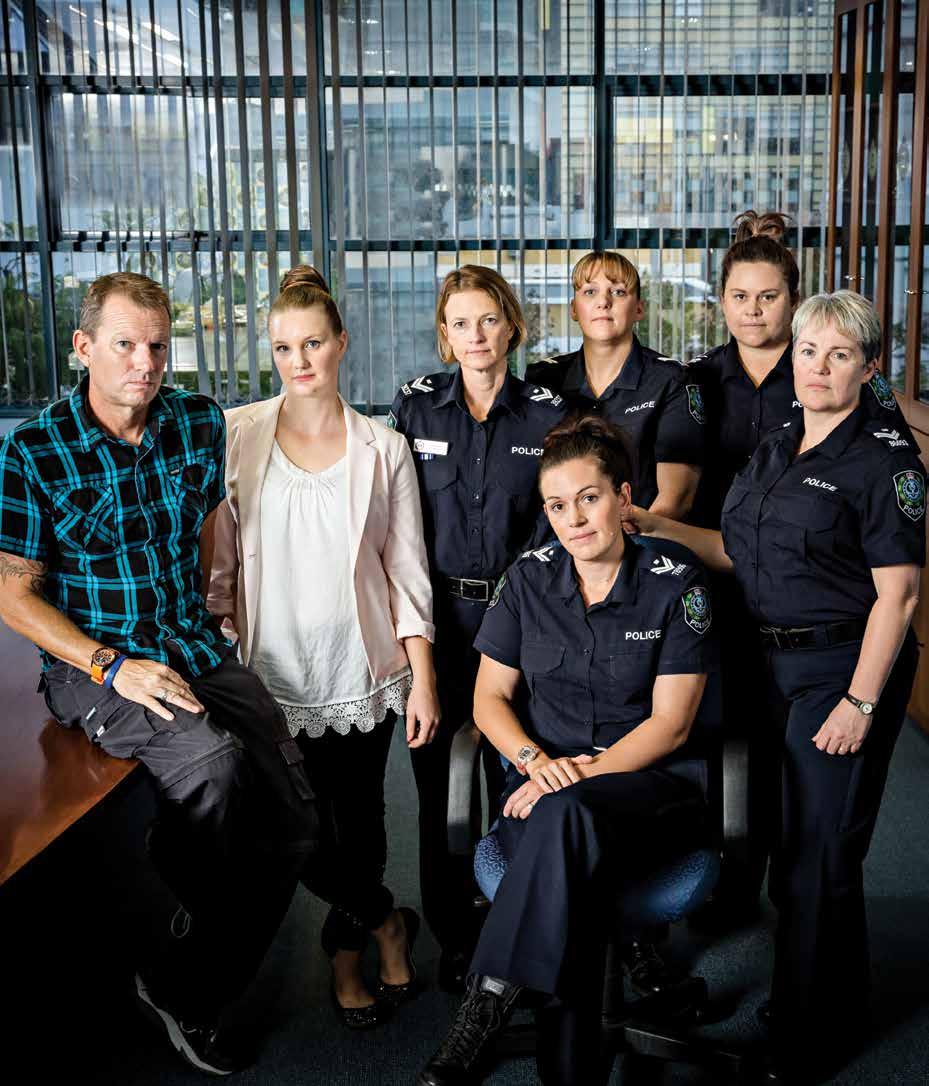
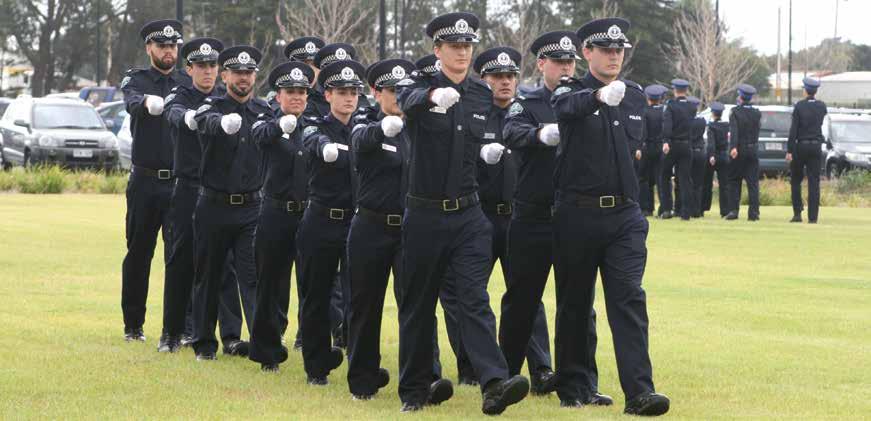
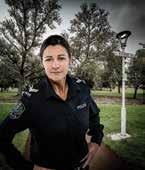
SAPOL continues to promote its 50-50 gender recruitment policy while it refuses many of its existing female police officers access to flexible work arrangements.
21 Police community shows its benevolence
Many winners have come out of special Police Association fundraising events, including an extremely lucky police officer.
REGULARS
COVER:
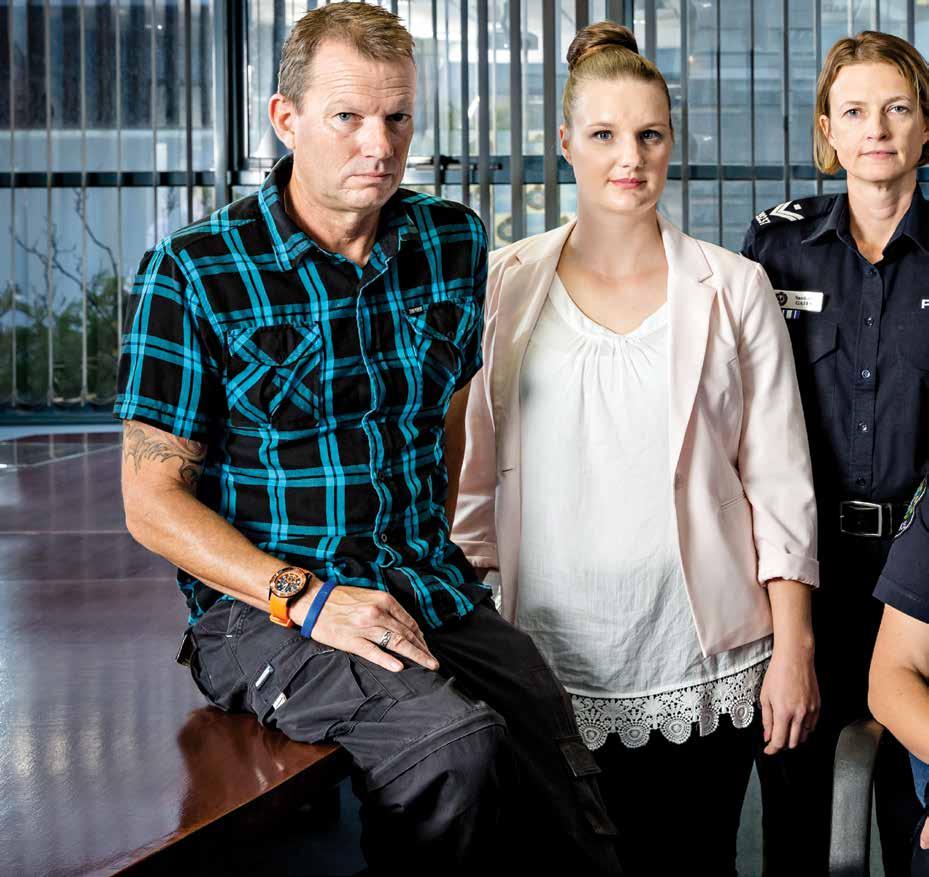
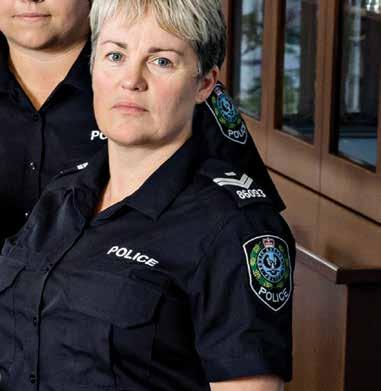
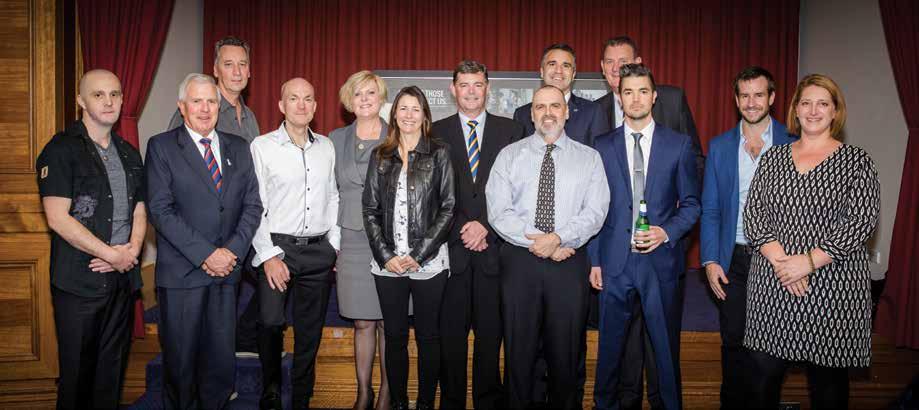
Senior Constable Andrew Salotti, Senior Constable Sophie Wales, Senior Constable First Class
Sandrine Gates, Senior Constable First Class Kellie Hall (seated), Senior Constable Sharan Southall, Brevet Sergeant Carissa Buckley and Senior Constable First Class Phillippa “Pip” McGowan Photography by Dan Schultz
Publisher: Police Association of South Australia (08) 8212 3055 Editor: Brett Williams (08) 8212 3055
Design: Sam Kleidon 0417 839 300 Advertising: Police Association of South Australia (08) 8212 3055 Printing: Finsbury Green (08) 8234 8000
The Police Journal is published by the Police Association of South Australia, 27 Carrington St, Adelaide, SA 5000, (ABN 73 802 822 770). Contents of the Police Journal are subject to copyright. Reproduction in whole or in part without written permission of the Police Association of South Australia is prohibited. Opinions expressed are not necessarily those of the editor. The Police Association accepts no responsibility for statements made by advertisers. Editorial contributions should be sent to the editor ( brettwilliams@pj.asn.au
Police
Editor
It didn’t take long for the 50-50 gender recruitment policy Commissioner Grant Stevens announced last December to become a controversial issue.
Back then, political and SAPOL figures had their say on the initiative through the print media and in radio interviews.
Clearly, the two most relevant contributors to the public conversation were Commissioner Stevens and Police Association president Mark Carroll.
One significant factor to emerge from the discourse was the extent to which the policy lacked support. It drew almost zero backing from police officers themselves – both male and female.
In the firm view of the Police Association, the key issue is that of retaining female officers through easier access to familyfriendly work arrangements.
Eight women who sought those arrangements give us the female rankand-file perspective in our cover story. One male officer gives us his account as well.
On the industrial front, Police Association president Mark Carroll looks at some of the results of the independent, member-wide survey the union commissioned last April.
Media and Communications Officer Nicholas Damiani outlines the key points of the South Australia Police Enterprise Agreement 2016
And don’t forget our third instalment of Family. This time we caught up with father and son Richard and Scott Lambert, who work in the same LSA.
Brett Williams
Allan Cannon VICE-PRESIDENT
Mark Carroll PRESIDENT 0417 876 732
Scheffler SECRETARY 0417 817 075
Police Association of South
STAFF
FINANCE EXECUTIVE SECRETARIES
RECEPTION
DELEGATES
METRO NORTH BRANCH
Port Adelaide................. Kim Williams (chair)
Elizabeth Glenn Pink
Henley Beach Matthew Kluzek
Holden Hill Nigel Savage
Gawler David Savage
Golden Grove Simon Nappa
Parks Kylie Slater
Salisbury Mardi Ludgate
Northern Prosecution Tim Pfeiffer
COUNTRY NORTH BRANCH
Port Lincoln .................... Lloyd Parker (chair)
Ceduna David Bourne
Coober Pedy Jeff Page
Kadina Ric Schild
Nuriootpa Michael Casey
Peterborough Nathan Paskett
Port Augusta Peter Hore
Port Pirie Gavin Mildrum
Whyalla ............................ Les Johnston
CRIME COMMAND BRANCH
Fraud ............................... Jamie Dolan (chair)
Elizabeth Ben Horley
Major Crime Alex McLean
Adelaide .......................... Alex Grimaldi
DOCIB Dwayne Illies
Forensic Services Adam Gates
Holden Hill Narelle Smith
Intelligence Support Kevin Hunt
Port Adelaide Rebecca Burns
South Coast Jason Tank
Sturt Brad Scott
METRO SOUTH BRANCH
Sturt ................................ Michael Quinton (chair)
Adelaide Melissa Eason
Adelaide Daniel Wray
Netley Toby Shaw
Norwood ......................... Ralph Rogerson
South Coast Peter Clifton
Tom
Daryl Mundy
Julian Snowden
Trevor Milne DEPUTY PRESIDENT
Anne Hehner
Jan Welsby
Sarah Stephens
Wendy Kellett
Shelley Furbow
Australia
REPRESENTATIVES
South Coast Andrew Bradley
Southern Traffic Peter Tellam
Southern Prosecution Andrew Heffernan
COUNTRY SOUTH BRANCH
Mount Gambier ............. Andy McClean (chair)
Adelaide Hills Joe McDonald
Berri John Gardner
Millicent Nick Patterson
Murray Bridge Kym Cocks
Naracoorte ..................... Grant Baker
Renmark Dan Schatto
OPERATIONS SUPPORT BRANCH
Dog Ops ......................... Bryan Whitehorn (chair)
Police Academy Francis Toner
Police Band Neil Conaghty
ACB Kerry Rouse
Comcen Brenton Kirk
Firearms Brett Carpenter
Mounted Ops Melanie Whittemore
STAR Ops Wayne Spencer
Traffic .............................. David Kuchenmeister
Transit Michael Tomney
WOMENS BRANCH
Kayt Howe (chair) (no delegates)
ATSI BRANCH
Shane Bloomfield (chair) (no delegates)
COHSWAC Bernadette Zimmermann
Housing Bernadette Zimmermann
Leave Bank Bernadette Zimmermann
Legacy Allan Cannon
Police Dependants Fund Tom Scheffler
Superannuation Bernadette Zimmermann Tom Scheffler
Mitch Manning
Samantha Strange
Chris Walkley
David Reynolds
Michael Kent
Jim Tappin
Goslino
Damiani
PRESIDENT
Mark Carroll
Extraordinary response to member-wide survey on policy changes
THEPolice Association commissioned an independent, member-wide survey last April to gauge member feedback about policy changes SAPOL had announced.
It was timely for members to express their true feelings, especially after SAPOL indicated that widespread civilianization was part of its organizational review plans.
Many years had passed since the association commissioned a member-wide survey. And we understood how recipients often dismissed online surveys or viewed them as a waste of time.
So it was extraordinary that we achieved a response of 37 per cent (1,784 members).
The response was well above industry average for any form of voluntary survey. It clearly demonstrated the level of feeling within the membership about SAPOL’s proposed changes.
The key survey findings highlighted members’ responses to specific questions about job satisfaction, workload, gender equality, leadership, support, and workplace flexibility.
While the results indicated that members still found the job rewarding, they also showed that much work remains to be done in a number of key areas.
A snapshot of some of the key findings showed that:
• 76 per cent of respondents felt their workload had increased within the last three years.
• 26 per cent of respondents felt the workload was quite unmanageable.
• 66 per cent of respondents felt there were insufficient numbers of staff in their workplace.
• 67 per cent of respondents disagreed that SAPOL had conducted an adequate assessment of the workplace before proposed changes.
• 44 per cent of respondents indicated the review affected them negatively.
• 64 per cent of respondents believed service delivery would be worse in the new policing model.
• 75 per cent of respondents did not have trust and faith in the consultation process.
• 90 per cent of respondents believed the proposed changes were to achieve budget cuts.
• 86 per cent of respondents opposed the genderparity recruitment policy.
• 51 per cent of women disagreed that SAPOL provided an environment for retaining them.
• 66 per cent of women disagreed that SAPOL made it easy to apply for and access part-time work.
• 54 per cent of respondents disagreed that SAPOL was an organization that supported officers suffering psychological injury arising from work.
• 51 per cent of respondents felt positive or extremely positive about their job.
• 55 per cent of respondents felt motivated/ extremely motivated to come to work.
Members can view the full report on PASAweb at www.pasa.asn.au
I have provided a copy of the survey report to both Commissioner Grant Stevens and Police Minister Peter Malinauskas.
Our next job is to advocate on behalf of association members for changes to the current policy settings.
The commissioner has the legislative authority and government backing to restructure the force, but it is still incumbent upon both him and the minister to show due regard to members’ views.
The movement away from local service areas to a district policing model and centralization of some functions is not a new policing concept or strategy.
From the survey findings, however, it is clear that SAPOL still needs to enlighten members further on the model, and explain how it will enhance service delivery and how the organization embraces consultation.
Particularly significant in the findings is that nearly two thirds of respondents are concerned or extremely concerned about the number of firstresponse patrols in the new district policing model. They are concerned that response times will increase and that there will be fewer members to cover greater areas of responsibility.
It is now acknowledged that insufficient numbers of first-response patrols were allocated under the Western Australian police restructure.
Our discussions with SAPOL have reinforced that point.
Three quarters of survey respondents did not believe that SAPOL would listen to their concerns.
Failure to listen to the most basic but critical member concerns … will compromise support for the new policing model.
Failure to listen to the most basic but critical member concerns about the number of front-line patrols will compromise support for the new policing model.
Each member is an important stakeholder in the process and outcome.
As this organizational review rolls out, the association will continue to advocate on behalf of its members.
EQUAL OPPORTUNITY COMMISSION INDEPENDENT SURVEY
The Police Association committee of management fully supports the Equal Opportunity Commission’s independent review into sex discrimination, sexual harassment and predatory behaviour in South Australia Police.
The EOC will conduct a confidential, anonymous online survey, in which the association encourages member participation.
SAPOL employees will receive a survey invitation e-mail from the EOC.
Members who do not receive the e-mail, or would prefer a printed version of the survey, should call the review team on 8207 2214 or 8207 2215.
The survey will remain open for five weeks.
It is in the best interests of association members and the police profession to foster a work environment which is free of all forms of discrimination.
This review affords us the opportunity to identify the extent to which sex discrimination, sexual harassment and predatory behaviour exists within SAPOL.
The EOC will, over a three-year period, independently monitor any recommendations it makes to SAPOL owing to the results of the review.
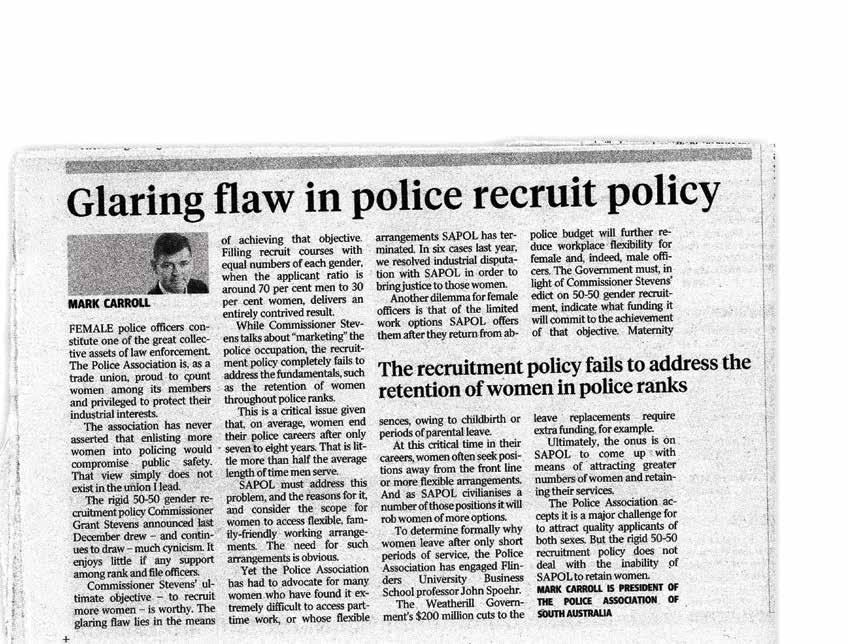
Scores of female police officers denied flexible work arrangements have considered resigning. And they are certain that the new 50-50 gender recruitment policy – which they condemn – will lead to more disaffected women in policing.
MANY of the confidential files in the overflowing in trays of Police Association grievance officers relate to disputes with SAPOL over flexible work arrangements.
In each file, the documentation tells of a distressed police officer desperate to bring balance to his or her professional and personal lives.
Most of the aggrieved are women to whom SAPOL management has denied access to part-time and workfrom-home arrangements.
Almost all of them have partners who work full-time hours and, around that, they care for babies and toddlers. Their professional and personal responsibilities are clearly enormous, and that makes their need for workplace flexibility all the more critical.
But, for reasons sometimes unfathomable to others, SAPOL rejects many applications for flexible work arrangements.
In most of those cases, the affected police officers suffer mental and emotional stress, find it impossible
TRUE FLEXIBILITY
A NEED GREATER THAN 50-50
to strike a work-life balance and, ultimately, consider resigning.
Police Association president Mark Carroll has seen that upheaval play out in officers’ lives time and time again.
“Of the greatest concern to me is the disincentive this situation presents our female members with,” he says. “It’s a clear disincentive to stick with policing as a lifelong career.
“In a time when women serve for only seven to eight years on average, SAPOL should have a far stronger focus on policies to retain them.
“Clearly, women need better, easier access to family-friendly work arrangements. Why make it so unnecessarily difficult for them and, therefore, bring about disputes?
“In several cases, we as a union have had to notify industrial disputation with SAPOL to get justice for some of our women members.
“Of course, a major problem SAPOL has to sort out is the limited work options on offer to women after they return from maternity or parental leave.”
But the bigger issue to SAPOL, insofar as female employees are concerned, is the 50-50 gender recruitment policy it announced last December.
The Police Association welcomes the objective to recruit more women but regards the strategy as deeply flawed.
And support for it is virtually non-existent among association members of all ranks and both sexes.
Says Carroll: “Filling recruit courses with equal
numbers of each gender – when the applicant ratio is around 70 per cent men to 30 per cent women –delivers an entirely contrived result.
“The far bigger issue is retention, and one of the key ways to achieve that is by providing true workplace flexibility.
“SAPOL will hardly attract more women to the job while the issue of access to flexible work arrangements remains so problematic.
“And if it was to achieve the rigid 50-50 quota, how would it accommodate even more women rightly seeking flexibility?
“What the potential female job applicant needs to see is existing female employees receiving the employer support they need to attain true worklife balance.”
her work and intended to remain a CS investigator.
But, in her immediate future lay a relentless battle for the right to return to her post in a part-time capacity after maternity leave in January 2013. She had worked part-time (.7) from as far back as 2011, when she returned from an earlier period of maternity leave.
Now, however, her superiors insisted that, if she wanted to continue to work part-time in CSI, she would have to reapply – so she did.
As she had just become mother to a second child, her family responsibilities had multiplied accordingly. She was attending to home duties, still breastfeeding her then eightmonth-old second-born, and struggling to secure childcare.
“… IF YOU WANT PARTTIME, IT’S JUST SO DIFFICULT”
SENIOR
Constable First Class Phillippa “Pip” McGowan used to ply her craft in some of the grisliest environments in policing. And much of the horror the now former Holden Hill crime-scene investigator saw has remained seared into her memory.
She recalls her time on the scene of the horrific Gilles Plains child neglect case of 2013. A four-yearold boy, whose drug-addled parents had kept him locked in a room and unfed for 12 days, had almost died of starvation.
And just two weeks earlier, McGowan had had to respond to the even more tragic case of a sixyear-old girl who had dropped dead at home. That was extra tough for the dedicated copper because her own son was close in size and age to the girl.
Still, McGowan always stood up to meet the challenges of her crucial role and enjoyed the respect of her peers. They considered her a “good operator” who, in one 12-month period, completed 80 declarations for use in court hearings.
Although many scenes she attended came with blood, gore and a pall of misery, McGowan loved
The only care available to her was two days per week for her eldest child, a two-year-old boy; and her self-employed husband was suffering an incurable autoimmune disease.
McGowan herself struggled with a serious back injury she sustained as a patrol officer lifting a drunk driver in 1999, just before she moved into CSI.
Her need for a flexible work arrangement – which she only wanted until her children reached school age – could not have been greater. But Holden Hill police management refused to allow her back to Crime Scene in a part-time role.
The best that management came up with as alternatives for McGowan were part-time positions in less specialized fields. And, for that, she would have to forfeit her substantive position in Crime Scene and take a reduction in her rank of brevet sergeant. They were heavy prices to pay. Indeed, McGowan considered them too heavy. And, as an experienced investigator, she believed part-time roles in Crime Scene to be entirely workable – but they were off the table. Management considered them unworkable.
So McGowan went back to work as a CS investigator in a full-time capacity, and found it “very difficult”.
And eight months later, in August 2013, that level of difficulty rose even higher. The medical condition her husband suffered from (myasthenia gravis) had worsened substantially.
He could not work and struggled with every family task: housework, grocery shopping, driving his eldest son to day care.
Says McGowan: “I was effectively looking after three kids and doing everything in the household, where normally we could share that between us.
“It was just really difficult trying to do everything. We weren’t really living. We were just plodding along and just surviving. And I was missing out on things I wanted to do with the kids.
“I still went to work. I still did all the duties they (management) required of me. I still did the on-call as they asked. I was doing all the shifts I was supposed to do, all the response shifts.”
With her need greater than ever to access a flexible work arrangement, McGowan submitted another request for a part-time CSI role. It drew another rejection from not only Holden Hill management but also the commissioner.
By now, the aggrieved McGowan had endured many stressful discussions and attempts at negotiation with management, and none had resolved her dilemma. In desperation, she many times considered resigning.
The Police Association, to which McGowan had taken her grievance at the outset, arranged legal representation for her. In May 2014, the union wrote to Gary Burns with a “notification of dispute”.
So the battle to secure a part-time CSI role for McGowan continued. But, ultimately, she agreed, in September 2014, to relinquish her substantive position and take a secondment to Forensic Services Branch.
There, she worked full-time for eight months on an accreditation project. After that came a transfer to Metro Executive, which remained her post for another seven months.
Since January this year, McGowan, 45, has occupied a full-time permanent position as a quality assurance officer at Forensic Services Branch. While she enjoys her current role, she still longs to be working as a crime-scene investigator. From the time she joined SAPOL, it was always the field in which she wanted to work.
“I miss talking with victims and being able to make a difference,” she says.
McGowan is no longer pursuing a part-time role because she cannot now afford to work fewer hours.
“My husband’s better now and works a little bit. But, effectively, we’re a single-income family,” she says.
“The kids are a bit older. One’s at school and one’s at kindy, so things have settled down.”
But McGowan cannot help but harbour some bitterness toward the system that denied her a family-friendly work arrangement in CSI. She feels SAPOL let her down “big time”.
And, in her view, the Stevens 50-50 recruitment policy – which she opposes – will mean nothing to women who can see SAPOL failing its existing female employees.
“It’s very much a case of: ‘Well, if you want to get pregnant, don’t,’ ” she says. “That’s because, if you want part-time, it’s just so difficult.”
Senior Constable First Class
Phillippa “Pip” McGowan
“… I’VE JUST BEEN THROUGH HELL AND BACK …”
WHENSenior Constable First Class Kellie Hall was desperate for a flexible work arrangement, she appealed to SAPOL for support, co-operation and, perhaps, some understanding. What the wife and mother-of-two got was a spirit-sapping industrial fight.
It kept her stressed, sleep-deprived, permanently tired and with fluctuating bodyweight for more than 12 months. The impact of her plight led her to think many times about resigning from the police career she had always wanted.
Hall, a competent prosecutor, was simply seeking a work-from-home arrangement to ease the burden of her multiple work and life responsibilities.
SAPOL management responded to her requests with one rejection after another. And, now, between her professional and private lives, there exists not a scintilla of balance.
Hall, 32, has to confront constant roster clashes – hers and that of her police-officer husband –the struggle to implement household routines, and the endless demands of her children’s care.
“We’re all over the bloody place,” she says. “It’s just very, very hard.”
Hall and her family are essentially at “breaking point”. Indeed, she feels close to broken, and that SAPOL attaches no value to her as an employee, or her 10-year contribution to SA policing.
“I couldn’t understand why they weren’t allowing it (my request),” she says. “I asked for something that I knew would work for the workplace.
“I’m professional enough that I could see they needed to make things work within the organization.
“But I wasn’t asking for anything that I didn’t believe was fair. If I was, I would’ve understood the refusal.”
Hall was serving Far North Criminal Justice when SAPOL initially denied her a work-from-home arrangement. It was September 2014 and she was nearing the end of a period of combined maternity and long-service leave.
Her need for flexibility was clear. She had a newborn who was suffering a medical condition; her husband was a full-time patrol officer; and, in Port Augusta, she was without the support of extended family.
Even in the face of those hardships, Hall was
willing to go back to work full-time, as long as she could operate three days per week from home.
And any capacity in which she could return to her prosecution role – which had gone without backfilling – was set to benefit her under-pressure colleagues.
Management, however, remained unpersuaded and stood by its refusal. It considered that Hall was wrongly seeking the arrangement for “dependant care”.
But temporary relief came to Hall when management eventually relented and she ended up with a work-fromhome arrangement for the six months to June 2015.
Naturally, she applied to get that flexibility extended, but SAPOL decided to “terminate” the arrangement after those six months.
“There had been no issues identified with my working-from-home in that six-month period,” Hall remembers. “Then, bang! I’m on a day off and get a phone call, saying: ‘You need to outline how you’re going to be returning to work full-time, or go to full dispute.’
“So my family, my welfare and all these issues I had were all supposed to magically resolve themselves.”
The Police Association, taking up the fight for Hall, wrote to Commissioner Grant Stevens with a “notification of dispute”.
That intervention drew an agreement from SAPOL to allow Hall and five other women to continue their work-from-home arrangements for another 12 months to September 2016.
But, in late 2015, Hall was to face even more anguish. Seeking a move back to suburban Adelaide with her family, she applied to transfer to Hills Fleurieu Criminal Justice. The transfer came through quickly but ignited caution in her.
“I was thinking: ‘Oh, my God, I’ve just been through hell and back trying to return to work,’ ” she recalls.
“(My husband) Matt and I spoke about it, and I said: ‘Well, if I can take my work conditions, we’ll move. If not, it’s all too hard. It’s just about broken me.’ ”
Hall thought to consult Mount Barker local management, which gave her to understand that Hills Fleurieu Criminal Justice could – and would –accommodate work-from-home arrangements.
So Hall took the transfer and began operating under a work-from-home arrangement, for which she still had a desperate need. Without it, she and her family faced an almost unliveable existence.
to the relevant assistant commissioner in the hope of winning his consent. On Christmas Eve came his response: “… I do not approve the application …”
Says Hall: “We felt devastated. We had just moved and we’d taken on further financial commitments with a mortgage.
“I was always known – and still am known – as a bloody hard worker wherever I’ve gone. So none of (management’s) reasoning ever made sense.”
In January this year, the Police Association arranged legal representation for Hall to dispute the assistant commissioner’s decision. But Hall chose not to get herself entangled in anymore industrial brawling.
“I was just too exhausted,” she says. “Had I pursued it I think I would have had a breakdown.
“I was just beyond angry because, by this time, I was feeling exceptionally discriminated against because there was no valid reason for any of it.”
Now, working full-time and lacking any level of work-life balance, the embittered Hall faces an uncertain future. “I don’t know what the hell we’re going to do,” she says.
“The future for us is probably just dependent on how long before my brain or my back breaks. Every day is a blur. I live by my diary, and I’m so tired of being angry.”
And Hall opposes the 50-50 recruitment policy. Indeed, she has not encountered any female police officer who supports the measure.
“That’s the cart before the horse,” she insists. “They (management) need to fix what’s going on internally first, because (with 50-50) they’re going to compound the problem hugely.
“And it’s done a lot of damage to the reputation all of us have fought for, because it waters down the perception of women in the job.
“The question will be: ‘Oh, were you in the 50-50 or did you actually get in?’ That’s the view out in the workforce.”
Senior Constable First Class Kellie Hall
“I JUST FEEL REALLY EMPTY”
So, for these husband-and-wife cops, an essential part of their life regime was the compatibility of their respective rosters. And for the five years to 2006, that was never problematic: they worked the same three-week roster together at Holden Hill Traffic.
More than just think about other posts he could apply for, Salotti undertook some research. He found that the roster at the Heavy Vehicle Enforcement Group was close to a match with the one Di-Ann worked.
Accordingly, he applied for a transfer there and explained his personal circumstances in a report to Human Resources Management Branch. He won approval to join the section whenever a position became vacant, but management could not predict when that would happen.
In fact, the clear indication was that, in reality, it could take him years to win a position at the HVEG.
Then, from management, came suggestions that left the Salottis agape. It proposed that Di-Ann leave Major Crash and transfer to the Road Policing Section, where she and Salotti could work the same roster.
SENIOR Constable Andrew Salotti has a special daughter for whom he has an equally special love. Jordyn, 18, suffers from cerebral palsy and requires around-the-clock care. Totally dependent on others – including her father – she cannot walk, feed or toilet herself, or talk, other than just a couple of words. And seizures also compromise her health.
Salotti, 54, devotes almost every one of his days off to Jordyn, whose custody he shares with his former wife. And those days are no burden to him: he relishes the time he gets to spend with and care for Jordyn. He misses her whenever she is not with him.
His wife and fellow police officer, Di-Ann, a Major Crash investigator, has long shared the care of Jordyn with him. Indeed, her support to father and daughter has been critical.
Even after Di-Ann had won and accepted a transfer to Major Crash in 2006, the couple’s rosters continued to align. But that changed some months later when, in her workplace, Di-Ann wound up on a new four-week roster.
It clashed substantially with the one on which Salotti had remained, and was set to cause great upheaval to the two-person care arrangements for Jordyn.
So Salotti prepared a written report which he submitted to Holden Hill management. In it, he requested – on welfare grounds – to work a four-week roster aligned with the one Di-Ann worked at Major Crash.
The request won management approval, which enabled the Salottis to continue the care each was so desperate to give Jordyn. And the arrangement came with no disadvantage to SAPOL.
So no one saw any reason for it to come under threat. But it did, early this year, when moves to implement the new Road Policing Section started to gather steam.
Salotti wanted to continue his traffic career in the new section, but management could offer him no guarantee that his four-week roster would remain in place.
“I started to think about other places that I might be able to go,” Salotti says. “It just sank in that I had a bit of work to do. So, pretty much from then on, it’s just been consuming me.
“The first thing I would think of in the morning, and the last thing before I went to bed, was: ‘What am I going to do?’ I’d wake up in the middle of the night and I’d be thinking about it straight away.”
“But that would mean ripping her out of a spot that she loves and excels in and putting her somewhere she didn’t want to be,” Salotti explains. “She would lose her (brevet sergeant) rank, money and the job she loves.”
Management also raised the issue of Salotti making changes to the necessarily regimented care plan which he, Di-Ann and his former wife work to for Jordyn. But the plan operates in a cycle and involves schooling, physiotherapy and a range of other needs.
As the uncertainty of his roster has gone on all this year, Salotti has suffered extreme emotional distress and is now on sick leave.
“I used to exercise every single day,” he says. “That’s just dropped off to nothing. I just feel really empty. I’ve just got no ‘go’.
“I get to the point where I can’t function or speak to people because my voice starts quavering. The main thing is just lack of sleep from the worry of it.”
Salotti suspects that the suffering he has endured would prove a “turn-off” for women who might want to embrace a police career. He is opposed to the 50-50 recruitment policy.
The Police Association has continued to represent Salotti throughout the year. And, now, a temporary resolution has come from negotiations the union undertook with SAPOL just last month.
Management has positioned Salotti in a new workplace as part of a return-to-work plan. This will afford him a roster which correlates with the one Di-Ann works at Major Crash and therefore enable the couple to provide ongoing care for Jordyn.
But this arrangement is not permanent; and what SAPOL is prepared to offer Salotti once he returns to work in his full-time capacity remains unknown.
Senior Constable Andrew Salotti
Sergeant Jo Nicholls
“It (work from home for one day a week) was to just maintain that balance,” she says. “It just gave me that breathing space between work and home.
“My baby turned one in December (2014), so when I returned to work I was still breastfeeding, and my older two weren’t much older. It was very physically demanding.”
Naturally, Nicholls wanted her work-from-home arrangement to continue and, for that, she appealed to management through a formal application.
“IT SHOULDN’T MATTER WHAT GENDER YOU ARE”
ASloudly and as often as it likes, SAPOL management can claim the status of family-friendly employer. But it will never convince straight-talking Elizabeth Prosecution sergeant Jo Nicholls – not until it provides far easier access to flexible work arrangements.
Indeed, she rates the family-friendly claim as “a bit of a joke” and “not reality”. And her strong view is the result of personal experience: a battle she fought with management to secure a work-fromhome arrangement in 2014.
In September that year, she had returned to her role as a senior Holden Hill prosecutor after giving birth to her third child. Her hours were full-time with the flexibility of working one day per week from home.
That arrangement helped ease some of the pressure on her and her husband, a front-line Elizabeth police officer. Each had the responsibility of full-time jobs and three children under five to raise.
She had operated successfully under various flexible work arrangements over the previous four years. So Nicholls, who never believed she was asking for the unreasonable, saw no reason for management to deny her.
But deny her it did, on the grounds that the arrangement constituted “dependant care”. The claim was baseless and left Nicholls “disappointed, very emotional” and “very upset”.
“At certain times, my husband was actually home too, so he would have the kids while I did work,” she explains. “And, in the other times, when he was at work, my mother-in-law would come and have the children.”
Management also assumed that, by her occasional absence from the workplace, Nicholls would disadvantage her subordinates, given that she was a supervisor. But not even the subordinates themselves agreed with that assumption.
In late November, the Police Association –representing Nicholls – wrote to the commissioner notifying a dispute.
SAPOL Industrial Relations Branch management responded by letter in February 2015. It reaffirmed the refusal to grant work-from-home arrangements for Nicholls, as well as two other female employees seeking the same flexibility.
In March, the Police Association wrote back to the commissioner to indicate to him that it now regarded the Nicholls matter to be a stage-three dispute.
“The Police Association was great,” Nicholls says. “(Grievance Officer) Matt Karger was excellent.
“I felt a little bit let down and misguided by the
employer. When I joined the job 10 years ago, SAPOL advertised itself as family-friendly.”
In June 2015, the opportunity came up for Nicholls to swap posts with a colleague based at Elizabeth Prosecution. She wrote to management to indicate that, if her move was to be permanent, she would withdraw her dispute and work entirely on-site.
The swap came to fruition in July 2015 and, since then, Nicholls, 33, has worked full-time at Elizabeth Prosecution without any flexible work arrangements.
“It just worked out better for us as a family,” she says, “because we (my husband and I) were then both in the same place.
“When my husband’s on night shift, I drop our two little ones off to childcare and take my son –who’s in reception – to the police station. From there, my husband takes him home and to school.
“So it works out a bit better whereas, if I was based at Holden Hill, that just couldn’t happen.
“And once the (Holden Hill) courts closed, and I knew that I wasn’t going back to Holden Hill, and I was definitely staying at Elizabeth, that’s when I withdrew my dispute.”
The months-long battle Nicholls fought for a flexible work arrangement caused her stress, anxiety, sleeplessness and frustration. Her greatest frustration came from what she felt was the failure of management to support her.
And while her work arrangements had remained uncertain, she continuously asked herself: “How the hell am I going to juggle everything and keep sane, and keep my marriage going?”
“All I was asking was for SAPOL to be flexible in that short period of my life,” she says. “I’ve been a copper for 10 years now, and I thought: ‘If they can support me through this, I’ll be a copper for the rest of my working life.’
“When they’re not supportive, that’s when women start looking to leave the job. I definitely considered leaving.”
Of concern to Nicholls now are her colleagues, those who are currently pregnant and cannot access flexible work arrangements.
“And I look at the whole 50-50 recruitment policy,” she says. “What’s going to happen when all these women get pregnant?”
Nicholls, who describes the policy as “ridiculous”, stands opposed to police recruitment based on gender quotas.
“It shouldn’t matter what gender you are,” she insists. “If you’re a suitable applicant you should get in.
“If SAPOL wants to attract more women to the job, they need to take a serious look at their policies and how they’re going to retain women.
“And they need to just take care of the women they’ve already got in the job.”
Senior Constable Sharan Southall
DOZENS
of visits to the Industrial Relations Commission over three years has resolved nothing for Senior Constable Sharan Southall.
Even earlier attempts to negotiate flexible working arrangements with SAPOL failed to achieve anything.
That was all because Southall, a police officer for more than 20 years, was unable to secure a parttime roster to facilitate her need to look after her school-aged child.
But it wasn’t always this way. For years, Southall was able to negotiate a flexible roster with relative ease.
“IT FELT LIKE MY ONLY OPTION WAS TO RESIGN”
The former Elizabeth patrol officer, who also worked in Crime Management and Operation Mantle, has worked in the call centre since 2006.
But her life was turned upside down after the Communications Centre took over the management of the call centre in 2013.
She was working .6 and, suddenly, SAPOL asked her to work the full-time fiveweek roster with no flexible shift changes.
“It felt like my only option was to resign,” she says. “I can’t justify paying out all my wage on childcare.
“And policing is not like other professions, like nursing, where you can find an alternative employer. There’s only one employer, so what am I going to do?”
Eventually, through Police Association advocacy, she wound up in the IRC. Her case is still pending.
“Going through this process with the IRC has probably labelled me with people I don’t even know in (SAPOL) HR and management,” she says.
“I know (that, because of this) I probably won’t go any further than a senior constable.”
In essence, Southall, 48, has only asked SAPOL for flexibility with shift starting times. So she regards as misleading the image of SAPOL as a family-friendly organization.
“I think that perception that we’re all one big family (is) not quite the case,” she says. “We (part-timers) are not considered (the same way) as the full-timers.”
Police Association intervention occurred at more than just the IRC stage. The union undertook talks with SAPOL well before the issue moved into that last-resort forum.
“I’ve had countless meetings which have been quite frustrating,” Southall says.
“I still have to go back and work with these same (managers) so I get quite wound up.
“Having the association there making you feel
like you’re not selfish has been good for me, to know I actually am doing the right thing for me.”
Southall believes that whatever commitment SAPOL has to its industrial obligations should come under the microscope.
The way she sees it, things go pear-shaped when “you don’t do the things SAPOL wants you to do”.
“They give the impression you’re being selfish and you’re asking for something you’re not entitled to,” she says.
“I’ve often had to walk away, turn off, and wait til the next meeting.”
During negotiations in the IRC, Southall was even prepared to trial SAPOL’s fixed roster, on the proviso that if it did not work out she could return to her old roster.
When she asked to make limited changes to the roster, SAPOL refused.
“So we ended up in the IRC going over these five or six shifts,” she says.
“The hardest part was preparing everything (for the IRC), having to go through rosters and shifts and explain to people who don’t have any idea about (police) rosters.
“(Association assistant secretary) Bernadette Zimmermann understood because she’s worked on the road. It was a relief having that person available to explain it to people, even lawyers, who couldn’t quite get their heads around the roster complexities.”
With the result of the dispute still outstanding, Southall fears what her future might hold.
And the only roster negotiations currently taking place are ones that meet SAPOL’s “organizational needs”.
Southall now sees her image is irreparably tainted because of her involvement at the IRC. She suspects that managers likely see her as a “trouble-maker”.
And, to her, the 50-50 recruitment policy will serve no purpose as long as SAPOL fails to improve its record on flexible working arrangements – for women and men.
“If my partner was still in SAPOL, there’d be no reason I couldn’t come back full-time and he could go part-time,” she explains.
“Men would probably find it refreshing to get out of the shift-work role as well, to have the opportunity to stay at home with their kids.
“The perception is more that women will go part-time and we’ll forgo our superannuation and our full career path.”
Southall is not bitter toward but rather disappointed in SAPOL management. Her value as an employee is evident in her refusal to allow that disappointment to dampen her will to serve the community.
“Our job’s different,” she explains. “We’re dealing with people’s problems every day, and that’s why I joined. My passion to do that is still there.”
THEfirst sign of an uncertain future for Senior Constable First Class Kylee Simpson was a phone call she received on maternity leave from Police Media management.
As a Major Crash victim contact officer for five years, she had supported victims whose family members had been killed in road crashes.
For nine years before that, she worked stints in Henley Beach patrols, Communications and Port Adelaide police station. She joined the Police Media team in 2014.
Whether it was a call at 2am to attend a fatality, a patrol shift, or her work in Police Media, her history of service to SAPOL had been exemplary.
So that phone call from Police Media management seemed somewhat disrespectful of a police officer with a background like hers.
Simpson had been working full-time but her aim was to return to the media section from maternity leave at .7.
During that phone call, however, management told her there was no room in Police Media for part-time workers.
Management offered to put Simpson on the employee management register and pay her a flexible shift allowance.
“It wasn’t even a case of: ‘We’ll look at it,’ ” she says. “It was purely a ‘no’. And they made me feel as if they were offering me the world by offering me the EMR – like I’d won the lotto.
“I was very hurt. I was upset, stressed, pregnant, and had four other kids… I needed to know where I was going to be working.
“One of my kids has special needs – she has mild cerebral palsy – so that adds extra pressure, too.”
Simpson kept her cool and told management it was not her preference to go onto the EMR.
The Police Association, representing Simpson, wrote to the commissioner.
“Not one person within the whole department checked on us,” Simpson says.
“Considering SAPOL has so many issues with (members’) mental health, I found that really disgusting.”
When the association sought legal advice and assisted Simpson with her official application, SAPOL finally acted, eventually granting Simpson a position at .7.
Simpson, however, still harbours resentment about what she considers unfair treatment. And she has a warning for any women seeking police careers with SAPOL.
“I have four daughters and one son,” she says.
“If my daughters wanted to join SAPOL I’d say: ‘Don’t bother.’ If you want to be a mum and a police officer, it’s too hard.”
And Simpson, 38, is part of the overwhelming majority of police officers against the SAPOL 50-50 recruitment policy.
“It doesn’t surprise me that most women (in the job) are against it, either,” she says. “If the right person applies, the right person should get the job, regardless of gender.
“And how is SAPOL going to manage all the extra women that will want to go part-time?
“I think (management should) get it right (with the women) they’ve got in the job now.
“If I was a woman that wanted to have children or I already had children, I would be very hesitant
(to join SAPOL) knowing what I know now.”
Simpson also touches on the perception of part-time employees in many workplaces.
“It’s almost like people think you get paid full time,” she jokes.
“You get paid for the amount of hours you’re there. You don’t get PDOs; you’re not actually getting any special conditions. You’re just working less and getting paid less.”
“IT WASN’T EVEN A CASE OF: ‘WE’LL LOOK AT IT’ ”
Simpson proposed an arrangement with a colleague and, between the two officers, it covered the equivalent of 1.2 staff members.
“But I felt like they just wanted to get rid of me,” she says. “They didn’t want a part-timer. I think they thought it was just too much trouble.”
In fact, SAPOL rejected Simpson even before she had officially applied for part-time work.
Kylee Simpson opted for personal reasons not to have her image appear with this story.
“The association came in to try and negotiate either my contract being renewed for a little while until I found another spot or some other (arrangement),” she explains.
“There was also an issue at home with my eldest who was on the autism spectrum, and she was quite demanding emotionally.”
Gates wound up doing a full-time, five-month prosecution course in the hope of securing part-time work as a prosecutor.
She eventually found a part-time position in Adjudication and negotiated to work from home for two days a week.
“THEY DIDN’T WANT PARTTIMERS …”
SHEER
good fortune was the reason Senior Constable First Class Sandrine Gates was able to attain her first part-time position in SAPOL.
After the 2004 birth of her daughter, Zoe, a colleague in Communications happened to relinquish a part-time position, which SAPOL allocated to Gates.
But the uncertainty leading up to that stroke of good luck took an emotional toll on her.
She didn’t know what area she would return to and was told there were no part-time positions available.
In fact, Gates recalls how she was told to go on maternity leave and “see what happens”.
“That’s when the stress started to come in,” she says. “All the part-timers there had been longterm part-timers.
“I couldn’t see any of them leaving, so I thought: ‘What am I going to do?’ I had no idea.”
And, for Gates, access to flexible work arrangements was to become even more difficult.
In 2007, after giving birth to her second child, she found SAPOL even less amenable to approving family-friendly work arrangements.
Gates recalls how she negotiated tirelessly with her manager to keep up her part-time arrangement.
Eventually, she went to the Police Association for its industrial advocacy.
“All I did was traffic (files), which no one else wanted to do,” she says.
“I was quite happy to do it. I took my files home; I did all my files; I worked crazy hours because I was at home, to make sure I did my volume of work.”
But the
uncertainty surrounding part-time work persisted.
“Every time I would encounter other people and talk about my situation it was always: ‘Well, you better make the most of that because that’s going to go,’ ” she says.
One view Gates and many other part-time workers express is that management does not value their contributions as much as it does those of full-time workers.
She has found that perception to exist even when part-timers go beyond the call of their duty.
“I was .6 but I felt like I was working .9,” she says. “It was ridiculous. But there was little understanding of what I did at home. You really (feel like) a parttime fill-in.
“After 15 years in the job, it’s been like that every (area) I’ve worked.”
In 2013, Gates’ situation worsened. She took a year off for personal and family reasons and
eventually suffered the rejection of a further application for flexible work arrangements.
Eventually she was able to negotiate a position in the call centre with a former colleague who understood her need for those arrangements.
“I don’t know what I would have done if she had said no,” Gates says. “I had nowhere to go. There was no one in SAPOL that could help me find somewhere. I did all the legwork and got told: ‘No, no, no, not interested.’
“They didn’t want part-timers and so, now, I’m at the call centre at .4 because I don’t want any more trouble with negotiating this.
“I’m done. My fighting’s over. I’m sick of it, so I’ve gone to .4, the minimum possible amount of work that I can do, so that there’s the least possible clashes with my husband’s work at Forensic Response.
“So I’ve resigned myself to this and my financial situation is what it is.”
And Gates stands to suffer another drawback under the SAPOL restructure.
“At the call centre, my (senior constable first class) position will become a brevet sergeant position under the sergeant as a second-in-charge,” she says. “But, because I’m part-time, it’s not really open for application.
“So I will now have to forego my brevet sergeant and just be the senior connie, sort of third in line of everyone else.”
Yet Gates has 15 years’ experience in SAPOL as a sworn police officer.
So, for women thinking about a police career, Gates has a warning in light of the SAPOL 50-50 recruitment policy.
“I just wish I could let them all know that this is what it’s like,” she says. “I’d say: ‘Just take a step back before you apply.’ ”
Senior Constable First Class
Sandrine Gates
BREVET
“THEY’RE NOT
SUPPORTING WOMEN
Sergeant Carissa Buckley started her police career as a Gawler patrol officer in the early 2000s.
After she fell pregnant in 2007, she returned from maternity leave to what she thought would be a “family-friendly” work arrangement.
But she wound up with a work-from-home industrial dispute which, for the best part of a year, turned out to be a constant bane in her life.
“When prosecution merged as one to Prosecution Services Branch (city),” Buckley says, “(SAPOL management said) ‘whoever is on workfrom-home and doesn’t have an updated contract, it must cease immediately.’
“By 2010, I’d had a second child, and didn’t want to be at work every day when I had two young children.
“I’d never been questioned about my workfrom-home arrangement before, but it just became a blanket ‘no’.”
Buckley couldn’t comprehend the decision. SAPOL reneged on her arrangement even though her circumstances had not changed.
“All of a sudden it was not approved for the same reason it had been approved,” she says.
“The other women in the office all received the same treatment, so that’s when we got together and came to the Police Association.”
The association acted accordingly, lodging an industrial dispute late last year. That forced SAPOL to keep Buckley’s work-from-home arrangements in place while the dispute was in progress.
Buckley, like so many officers seeking flexible or family-friendly work arrangements, considers that SAPOL “swept the issue under the carpet”.
“All they’ve really done is just extend the period we could work from home,” she says.
“They haven’t got to the root of the problem. They’re still stuck in the Dark Ages.”
With both her children now at school, Buckley works full-time at Elizabeth Prosecution again. But the experience has left her disappointed.
“I think the general order and flexible working arrangements have to be looked at,” she says.
“They have it there in the general order; it’s just that it’s very conflicting.
“It (working from home) works in Prosecution and it can be managed. If it’s well managed I don’t see why people can’t do it.”
And like the overwhelming majority of both female and male Police Association members, Buckley is against the SAPOL 50-50 recruitment policy.
“It’s terrible,” she laments. “They’re not supporting women as it is. If they’re going to recruit 50 per cent women, what are they going to do with those women once they have babies or want to go part-time?
“Until they actually start looking after the women they already have – trying to keep them in the job –it’s a waste of money recruiting new women to go through the same thing again.”
Buckley insists that the policy should be based on merit rather than gender.
“If a woman is better than a man at the recruiting stage, no worries, take her,” she says. “But, if she’s not, there’s no point taking her just because she’s female but not up to the standard.”
Based on her belief that SAPOL lacks commitment to flexible work arrangements, Buckley has stopped short of endorsing police careers to other women.
“I would tell them: ‘Good luck,’ when it’s time to have a family and you want to go part-time,” she warns. “I’d definitely make sure they understood that.
“There’s no point being in the job for a couple of years, get married, have a baby, knowing you’re not going to get looked after.
AS IT IS”
“Maternity leave is great, but you don’t get looked after when you want to come back.”
Were Buckley 19 again and knew she would eventually get married and have children she would herself reject the idea of a police career.
She describes as peculiar the SAPOL attitude toward women returning from maternity leave to work part-time.
“If it’s full-time, that’s no problem, they’ll take you,” she explains.
“But if you come back part-time, it’s sort of like every time your contract comes up, they ask if you’re ready to go back full-time.
“And they begrudgingly give you another shortterm part-time contract.”
Based on her experience, Buckley asserts that the legislative obligation SAPOL has to provide flexible work arrangements comes an extremely distant second to its own organizational needs.
“And that’s fine if you’re on the road,” she says. “Obviously you can’t work from home then but, in areas like prosecution, it should be a bit different.
“To just keep getting a blanket ‘no’… Everything is all about the organization and not about family-friendly flexibility. There’s really no flexibility at all.”
Brevet Sergeant Carissa Buckley
Senior Constable Sophie Wales
eventually wound up in the Crime Prevention Section at Mount Barker police station.
But, after giving birth to her second child, SAPOL again seemed disinclined to grant family-friendly work arrangements.
In 2015, Wales took leave without pay (outside her allocated maternity leave) and was told her position in Mount Barker would not be available again.
Job-share was SAPOL’s default solution. But, when Wales could not settle on a roster with her job-share colleague, SAPOL insisted that she return to work full-time.
Wales then approached the Police Association.
“I ceased my dealings with HR, letting (the association) do it on my behalf,” she explains.
“I WAS JUST LOOKING FOR FLEXIBILITY”
SENIOR Constable Sophie Wales, along with her police-officer husband and one-year-old child used to fly in a police plane from Port Augusta once a month.
That was to go to work on the APY Lands back in 2013. Her part-time work arrangement meant she lived and worked on the Lands for two or three weeks every month.
That was until SAPOL intervened. A new policy introduced in 2014 precluded Wales’ family from any further flights on the police plane.
Wales was asked to go back to full-time patrols at Port Augusta – a station at which she had never worked.
“It was bizarre,” she says. “It was disappointing because I was enjoying what I was doing.”
After much angst and disappointment, Wales
“I then got a phone call saying I could go back to Mount Barker (to work part-time).”
But when Wales went back to the station to confirm her flexible work arrangements, management told her it was no longer possible.
“I went in there a little naively and little bit unprepared thinking they’d welcome me back with open arms,” she says.
On the contrary, management told Wales that her requests were not going to suit SAPOL organizational needs.
Eventually, earlier this year, Wales settled on a position in Family Violence.
“It’s worked out well,” she says, “they seem to need the staff.”
Like many members who have sought parttime resolutions, Wales struggles to understand why association intervention was required for SAPOL to act.
“I was just looking for flexibility,” she explains.
“Never at any point was I wanting any sort of special position. I didn’t care what I did. I just wanted to be able to work part-time. That was the core of it.
“I didn’t want to put my kids in care full-time at such a young age. I wanted to be able to raise my children, but keep my career open.”
In fact, so uncertain was Wales about her place in SAPOL she considered walking away from her police career.
“It was sad because I have career aspirations for when my children are older,” she says.
“I have goals career-wise and, if I leave SAPOL,
all of that is out the window. I’d feel that the years that I’ve put into SAPOL are wasted.
“I have no other skills: I’ve been in the job since I left school pretty much. All of my training is in policing. It’s been my life. My whole working career has been SAPOL.”
Like many police officers seeking part-time work, Wales believed SAPOL would do whatever it could to make the process easy.
“I guess I naively thought that SAPOL, being a large organization, and being promoted as a family-friendly organization, would afford me (flexible work arrangements).”
Eventually, the stress of not knowing if she would have a position on her return from maternity leave took its toll on Wales.
With her family unable to plan for the future, she became anxious and stressed at home. The uncertainty of her position also took its toll on the family.
And, to Wales, the SAPOL 50-50 recruitment policy is nothing more than a false economy.
“We already have a retention issue with females and their average time in the job,” she says.
“And it feels like they’d prefer to get a probationary constable who’s going to come in and work full-time and take a full-time position over someone that’s got 10, 15, 20 years’ experience in the job.”
Wales believes that, until SAPOL shows a stronger commitment to a family-friendly and flexible work environment, women will be discouraged from taking on police careers.
“It’s not going to be an encouragement,” she says. “I guess it depends if she’s had the foresight to think about children.
“I didn’t even consider SAPOL’s policy in relation to part-time and flexibility.
“So I would have thought that if (women considering police careers) could hear some of these negative stories, it would have a negative impact on them.
“It’s certainly not going to have a positive one.” PJ
Police community shows its benevolence
By Nicholas Damiani
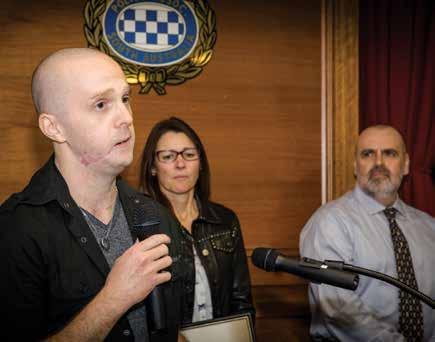
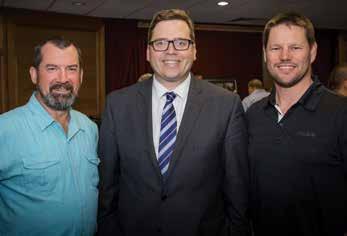
Ryan Rigano receives the keys to the Commodore from Police Association secretary Tom Scheffler
NOVITA
Children’s Services and the Police Association have raised more than $234,000 for special-needs children since the formation of their partnership in 2011.
The two organizations – with the support of the Sunday Mail, Channel 7 and Holden – have raised the impressive figure via two annual events: the Police Lottery (since 2011) and the Melbourne Cup Luncheon (since 2012).
The proceeds have helped brighten the lives of children living with disabilities. Novita provides therapy, equipment and family support to more than 2,000 special-needs children.
The lottery and the Melbourne Cup luncheon also promote the police community’s strong history of benevolence.
Police Association member Brevet Sergeant Ryan Rigano (pictured) was Police Lottery winner for 2015.
He took home a Holden Commodore SV6 four-door sedan, valued at $42,834 (including 12 months registration, stamp duty and dealer delivery).
Police Association president Mark Carroll said the association and its partners were deeply grateful to all who gave both these events their support. PJ
LETTERS TO THE EDITOR CAN BE SENT BY:
Regular mail Police Journal, PO Box 6032, Halifax St, Adelaide SA 5000
Email editor@pasa.asn.au Fax (08) 8212 2002
Internal dispatch Police Journal 168
CIB reunion
The 10th annual CIB reunion will be held at the Police Club from 2pm to 6pm on Monday, September 19, 2016.
Any former or retired detectives – or serving detectives on the verge of retirement –are invited to attend this popular event.
A $10 fee covers organizational costs.
As usual, invitations will be sent out via email and the post to all current group members on our list.
Those who have never been to the reunion, would like to attend or want to receive future e-mails should contact me by e-mail (grahamwp2@gmail.com) or phone (0417 881 745) by September 12, 2016.
Kind regards Graham Puckridge Detective Sergeant (ret)
Cops’ $800,000 for kids
Cops for Kids (CFK) is a registered children’s charity run by a dedicated group of current and former metropolitan and country police employees in South Australia. We operate independently of SAPOL but maintain a close working relationship.
Among our goals is to raise funds for registered/licensed charities or foundations that are specifically child-oriented, or have a programme supporting or benefiting children’s lives.
We aim to see that donated money can be used for:
• Research, study or educating to assist in finding and curing illnesses that affect children.
• The care of sick children, or to enhance the quality of children’s lives.
CFK members took part in the recent TeamKids Easter Appeal to raise money
for the Women’s and Children’s hospital foundation competing in a fire engine pull against the Australian Professional Firefighters Foundation.
Conceived in 2006, CFK’s first donation was $500. Our 100th donation on May 19, 2016 exceeded a total of $800,000 in donations since formation.
I would urge anyone who is not a member to consider joining more than 1,620 CFK members contributing as little as $1 a fortnight via payroll deduction.
CFK issues tax receipts at the end of the financial year. For more information visit copsforkids.org.au and go to Contact Us. We can also be found under Clubs & Societies on PASAweb.
Kind regards Nick Patterson
CFK committee member
Millicent Police
Lives depend on accurate mapping
I read with interest the comments on the AVL (Q&A, February 2016). Constable Bradley Wingate touched on one aspect I find missing on the system. I think the MCA should display all the patrol locations in the car. Not just to the sergeant.
This gives officers the ability to see who is around and where they are. From a traffic officer perspective it gives the opportunity for others to “drive by”.
In the event of an 801, they can see where the patrol in trouble is (status would change colour to, say, red). It would be just more efficient and safer.
There is a high dependence on the map being accurate and, as a result, there seems to be no clear way to quickly get errors fixed or for users to add corrections, same as TomTom and Navman allow.
As an example, I discovered that the MCA maps have the Augusta Highway named as Port Wakefield Highway. That meant someone looking for the Augusta Highway at Redhill could never find it.
Yet the operator looking at the map in Communications would be telling officers the incident was on the Port Wakefield Highway at Redhill and no officer would know where that was for sure. I am certain they might have an educated guess.
There needs to be a formal process to get things like this fixed quickly, as two of the biggest GPS providers in the world have recognized, new roads, errors and so on are more common than people think.
And, in our job – unlike the taxi industry in which the same mapping system is used – our lives and others can depend upon the correct information.
Cheers
Norman Hoy Heavy Vehicle
Enforcement Section
Will police service delivery improve under the new policing model?
Constable Katie Evans
Adelaide Police Station
At this stage, with the somewhat limited detail we have, it’s hard to see how police service delivery will improve.
It appears there will be lower staff levels within the districts as compared with the current totals within LSAs. We have not been shown any evidence to suggest an increase of staff within the Communications Branch will reduce the number of taskings.
The proposed rostering throughout districts provides little coverage, or secondary shifts for response teams. This could be particularly concerning within the CBD during those busier periods on weekends.
It might also see district policing teams absorbed into the response team role and, as a result, there will be far less proactive or tactical policing of crime.
By dividing operational members into response and district policing teams it may create conflict around roles and responsibilities which could result in lower team morale and a poorer service to the community.
Senior Constable 1C
Nicholas Millard
Eastern Adelaide CIB
It’s difficult to determine whether service delivery will improve under the new district policing model without having conducted a trial period. Service delivery lies with each individual member to provide a high standard of service to the community.
In order for the reform to have a positive impact on both community and members in the early stages, it’s imperative that any feedback – positive or negative – is considered.
Coming from an investigations area, it will be interesting to see the impact of gaining a substantially larger district with limited extra resources.
But, as an individual, I will continue to maintain a high level of service delivery and I have confidence that my colleagues will have a similar opinion.
Senior Constable 1C
Kelly Chidgey
Holden Hill Police Station
The new policing model has the potential to improve service delivery. However, it will come down to how the public reacts to the change.
The introduction of new technology to coincide with the new policing model will be a good way to improve the service given to the public.
The ability to report matters via the telephone and online and then be able to monitor the progress of their report online will make the process more convenient. Hopefully, it will reduce the amount of time currently taken by officers, thus freeing them up to attend more urgent matters.
There are, however, members of the public who want a uniformed police officer to deal with their issue even if no “crime” has taken place. They tend to feel reassured when they see an officer in person.
This might mean that they may not be satisfied with their issue being resolved over the phone.
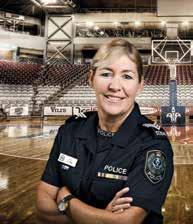
From top: Constable Katie Evans, Senior Constable 1C Nicholas Millard and Senior Constable 1C Kelly Chidgey.
INDUSTRIAL
Nick Damiani
Worth the wait for highly competitive enterprise agreement
THEIndustrial Relations Commission has ratified the South Australia Police Enterprise Agreement 2016
It comes after the Police Association navigated its way meticulously through many months of negotiations with the SA government.
Association members overwhelmingly endorsed the EA offer via a recent SAPOL ballot.
A 2.5 per cent wage increase will apply from the first full pay period on or after July 1, 2015, 2016 and 2017.
A police-specific interjurisdictional adjustment from the first full pay period commencing on or after July 1, 2016 will also take effect on pay date July 20, 2016.
In addition, a midpoint adjustment will apply on January 1, 2018, if applicable; and the association has secured a guaranteed payment date for the next agreement from the beginning of the first full pay period commencing on or after July 1, 2018.
(2IC) of patrol teams, traffic teams, Passenger Transport Safety Branch and communication group teams.
• In situ progression to senior sergeant first class when completing 10 years’ service at the rank of senior sergeant.
• Trial of an extended-hours roster.
• New allowance strategy for brevet sergeant, prosecutors, detectives and STAR/Water Ops to operate from July 1, 2016.
• Officer of police – increased flexibility allowance. Association president Mark Carroll told the Police Journal members had been rewarded for their patience.
“Importantly, no conditions were sold off to achieve this offer. In a difficult economic environment, this EA is highly competitive.”
The offer also includes adjustments to allowances on July 1, 2015 and July 1, 2017.
Of particular importance is that the offer satisfies the association’s claim regarding injury and income protection for injured police.
Other improved conditions include:
• Payment of a one-off allowance that equates to 1 per cent of the employee’s gross salary as at end of financial year ending June 30, 2015.
• Creation of a minimum 145 new brevet sergeant positions which are designated second-in-charge
“It’s been a long negotiation process, but it was necessary to get the agreement which satisfied our requests,” he explained.
“Importantly, no conditions were sold off to achieve this offer.
“In a difficult economic environment, this EA is highly competitive.”
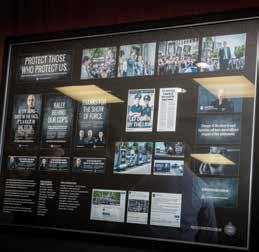
Mr Carroll said last year’s Protect Our Cops campaign had delivered success via the enterprise agreement.
“To have injury compensation entitlements restored via the EA is a great – and just – outcome,” he said.
DRUG AND ALCOHOL TESTING – THE FACTS
Several media outlets have approached the Police Association for comment about the new SAPOL drug and alcohol testing general order.
The association entered into an agreement with SAPOL in 2007 to support the introduction
of legislation to enable drug and alcohol testing of its members.
Those negotiations were finalized by the passing of the Statutes Amendment (Police) Bill 2013 and an agreed position between SAPOL and the association on the Police Variation Regulations 2013
The Police Regulations 2014 came into effect in September 2014 and included amendments regarding drug and alcohol testing in the workplace.
SAPOL provided a draft general order in January this year.
The Police Association provided its view on that draft general order in early April 2016.
SAPOL noted that correspondence before the promulgation of the general order in mid-April.
Any member of SA Police might now be required to undergo testing if:
• He or she is involved in a critical incident on duty (including incidents involving death and serious bodily incident in certain circumstances).
• He or she is engaged in driving that is classified as high-risk (including pursuits, urgent response, traffic stops, authorized covert driving).
• There is reasonable cause to believe that he or she or a police cadet has recently consumed alcohol or used a drug.
• He or she or a police cadet is applying for a classified appointment or position.
The testing also applies to individuals who apply for employment with SAPOL.
Go to PASAweb (pasa.asn.au) to view a full copy of the South Australia Police Enterprise Agreement 2016 and the accompanying pay calculator.
Police officers look after each other.
And that flows through to how Police Health do their business and
look after us as members.”
Ian Moore (W.A.)
We’ve got your back.
Policing is all about looking out for other people. Which is why it’s important to have someone look out for you.
At Police Health, not only do we stand by the force, we stand with it as well.
We’re run by police for police and their families, which is why we have a unique understanding of a unique job.
And why over 50,000 members trust their welfare to us Australia-wide.
For more than 80 years we’ve served police and their families, and only police and their families; it’s how we all want it and how it will stay.
To find out more call us on 1800 603 603 or go to policehealth.com.au
If you had an ordinary job, all you’d need is an ordinary health fund. But you don’t, and that’s why you have us.
Yes, you grind your teeth!
Dr Deborah Rea
But
there are means of prevention which can spare your teeth a lot of damage
SOyour dentist has told you that you grind or clench your teeth. To this, people often respond with: “No I don’t. I don’t feel myself do it. Are you sure?”
And if your dentist responds with: “Yes, I’m sure,” the odds are pretty good that he or she is right.
It is quite common not to realize that it’s happening because it occurs mostly at night. That’s when those areas of the brain that tell you to ease up on your teeth turn themselves off, leaving you to go to town on your pearly whites.
And with those parts of your brain turned off, you will often grind and clench with more force than you would ever generate in the daytime.
After I tell a patient he or she grinds or clenches, I commonly hear:
• “My partner doesn’t hear me.” No, because he or she is probably asleep, too; and clenching is silent.
• “I don’t hear or feel myself do that.” No, probably not, but you likely feel the after effects without connecting the signs – headaches, neck tension and pain, jaw pain, broken teeth or fillings.
The termed for clenching and/or grinding is bruxism. Occasional grinding or clenching is fairly common and, generally, not a problem. It becomes problematic when it is habitual or causing pain or damage to teeth or fillings.
Your dentist determines that you have the dreaded bruxism by observing subtle but quite distinct signs. They can range from a broken filling, about which a patient says: “I was only eating something soft and my filling fell out.”
But fillings don’t usually fall out: the clenching or grinding does the damage and the soft food just finishes it off and pulls the filling out.
Other signs are fracture lines on your teeth. One fracture in isolation is not so problematic. But, once we start to see a few, it really is a big flashing light to us.
We also look for micro fractures, which are usually only visible with magnification and the dental light. Sometimes these fractures are quite visible, even to the patient.
Other indicators are wear facets, especially when they are pronounced and match beautifully between the upper and lower teeth.
We also listen to what you tell us. You might, for example, say your teeth hurt but we can’t find any other cause.
We might ask you if you get headaches, neck aches or tension. And we might ask you about your stress levels or feel your facial muscles for signs of pain, tenderness or overdevelopment.
So, once we establish that you grind or clench, we have to do something about it. It is all well and good to say: “Decrease your stress levels,” but that’s not always possible and, often, it doesn’t completely solve the problem, anyway.
And it’s not as easy as saying: “I just won’t grind and clench my teeth.” We cannot really control what we do in our sleep.
The first treatment suggestion is that you wear a night guard. It is not the sexiest item but it will save your teeth, fillings, crowns and implants, and that will save you money and spare you pain and suffering in both the short and long terms.
Quite often, the added benefit of wearing a night guard is a reduction in headaches and face, head and neck pain.
The guard might look like a little chunk of plastic but a fairly complicated process and design goes into it.
The dentist takes an impression of your top and bottom teeth to start the process. That impression goes to a technician who uses it to make models of your teeth and fabricate the acrylic night guard to fit your mouth and your opposing teeth perfectly.
Night guards are generally worn on the top teeth but are occasionally made to be worn on the bottom teeth.
Wearing a night guard can take some time to get used to but, surprisingly, most patients eventually find it difficult to sleep without it.
Other treatments involve:
• Facial exercises.
• Stress reduction techniques.
• Botulinum toxin (Botox) injections to the grinding/clenching muscles (a fairly common treatment these days).
It (a night guard) is not the sexiest item but it will save your teeth, fillings, crowns and implants, and that will save you money and spare you pain and suffering in both the short and long terms.
• Minor surgery techniques (usually only in extreme cases).
So if your dentist says you clench or grind your teeth, you will now have at least some idea of what he or she is talking about. Go with it. Dentists really are there to help.
MOTORING
Jim Barnett
Like a lively SUV
Because, for one thing, it performs with such smoothness and agility on rough surfaces
DESIGN
Pajero Sport might share some underpinnings with Triton Ute, but any similarities are hard to pick.
It has a sharp, modern front end and athletic profile but looks narrow at the rear, perhaps owing to its long, vertical tail lights.
Roomy inside, it offers comfortable seating for five, a commanding driving position, and a sporty dash which features a gauge and trip computer layout common to other Mitsubishis.
Central in the sweeping console is a seveninch touch screen with Smartphone Display Audio. This enables smart-phone connectivity through both android and Apple systems on which users can connect to various apps including navigation via the touch screen or voice control.
Power is courtesy of Triton’s new 2.4-litre turbo diesel coupled to a completely new eight-speed automatic transmission.
All models score Mitsubishi’s Super Select II 4WD system which can run in either 2WD or 4WD on bitumen. The centre diff can be locked in High or Low range for more difficult terrain.
Selections between 2H and 4H (up to 100km/h) are made via rotary dial on the console. An Off-road mode switch enables drivers to toggle between Gravel, Mud/Snow, Sand and Rock.
VALUE FOR MONEY
The entry GLX costs $45,000. Standard features include:
• Eighteen-inch alloy wheels.
• Electric park brake.
• Push-button entry and start.
• Auto climate control.
• DAB+ digital audio.
• Reach and rake adjustable steering. GLS costs $3,500 more and gets:
• Rear diff lock.
• Auto headlights and wipers.
• Dual-zone climate control.
• Leather trim.
Top-spec Exceed costs $52,750. Its extras include:
• Rear-seat DVD entertainment system.
• Eight-speaker audio.
• Heated front seats with power adjustment.
SAFETY
Pajero Sport has won a five-star (ANCAP) safety rating. Standard items include:
• Seven airbags.
• Rear-view camera.
• Reversing sensors.
• Auto door locking.
• Trailer-sway control.
• Hill-descent control.
Top-spec Exceed boasts advanced safety features including forward collision mitigation, blind-spot monitoring and a multi-camera system that displays a bird’s-eye view around the vehicle.
STATS
The 2.4-litre diesel produces 133kW of power and 430Nm peak torque at 2,500rpm. Combined fuel economy is claimed to be 8.0 litres/100km. Braked towing capacity is 3,100kg and warranty is five years/100,000km.
ON THE ROAD
Pajero Sport feels more like a lively SUV than a serious diesel 4x4 sitting on Triton’s ladder chassis. It’s surprisingly smooth and agile on rough surfaces and corners confidently.
The engine, more powerful than expected, is both smooth and quiet at all but high revs.
The superb new eight-speed auto provides excellent flexibility and easy manual control via the stick shift or paddle shifters.
VERDICT
Pajero Sport is a refined, versatile 4x4 wagon at a realistic price. Pity the genuine tow bar looks like a tacked-on afterthought.
The engine, more powerful than expected, is both smooth and quiet at all but high revs.
For the young… and young at heart
And the buyer can personalize it with his or her own colour scheme
DESIGN
Vitara, a compact SUV, comes in two spec-levels with a choice of two engines. Entry RT-S (2WD only) features a naturally-aspirated four-cylinder petrol engine coupled to manual or automatic transmissions.
Top-spec S Turbo (2WD or 4WD) features a more powerful turbocharged petrol engine coupled to an automatic transmission with paddle shifters.
Inside Vitara, a smart dash layout features
a seven-inch colour touch screen. Drivers score a thick steering wheel with reach and rake adjustment and a height-adjustable seat.
Storage around the cabin consists of large door bins with bottle holders, a sizeable glovebox and various trays. The absence of a lidded console bin doubling as an armrest is obvious.
The rear seats come in a 60/40 split-fold design and, like the front seats, are comfortable.
Cargo space ranges from 375 to 1,120 litres while a two-tiered floor creates a hidden shelf. An emergency-style spare sits under the floor.
S Turbo can be optioned ($4,000) with a 4x4 system with four driver-selectable modes: Auto, Sport, Snow and Lock.
Buyers can personalize their car by selecting various colour combinations both inside and out.
VALUE FOR MONEY
RT-S is priced at $21,990 (add $2,000 for auto). Standard items include:
• Satellite navigation.
• Seventeen-inch alloy wheels.
• Climate-control air conditioning.
• Bluetooth, iPod and USB connectivity.
• Privacy glass.
• Touch-screen audio with Apple Car Play. S Turbo 2WD auto ($28,990) also comes with:
• Leather seats with suede inserts.
• Speed limiter.
• Keyless entry and start system.
• Black 17-inch alloy wheels.
• Front and rear parking sensors.
• Self-levelling, auto on/off LED headlights.
• Auto wipers.
SAFETY
All models feature seven airbags, daytime running lights, ISOFIX child seat anchorages and reversing camera. S Turbo 4x4 also has hill-descent control.
Suzuki Australia is confident Vitara will be awarded a five-star (ANCAP) safety rating.
STATS
The RT-S 1.6-litre petrol engine produces 88kW of power with claimed fuel economy of 5.8 litres/100km (manual).
S Turbo’s 1.4-litre turbo petrol four produces 103kW of power with economy of just 5.9 litres/100km.
ON THE ROAD
Vitara, with its airy cabin and good visibility, is comfortable, light and easy to drive.
The 2WD S-Turbo provides effortless performance, brisk acceleration and easy cruising. The smooth turbo four never sounds stressed and is well matched to the six-speed auto.
Vitara remains quiet inside, has a firm but compliant ride and is agile in corners.
Its voice-control system is excellent. It seems easier to use than many others particularly when entering a destination into the satellite navigation system.
VERDICT
Vitara is a trendy, versatile compact SUV that will appeal to the young at heart.
SURVEY TO BENEFIT THE WORKPLACE
As a police officer, you know best about the environment in which you work. On that subject, you’re the authority.
That’s why the Equal Opportunity Commission (EOC) is asking for your help.
You might have heard that the commission has been asked to do a review of sex discrimination and sexual harassment within SAPOL.
We don't know, and we’re not assuming, what we will find in SAPOL. We’re hoping you’ll tell us.
Naturally, we want to identify any opportunities for improvement but we also want to hear about any existing practices that work well.
So, to that end, we’re asking that you complete a confidential online survey.
And we think there’s good reason for you to take part.
Sex discrimination and sexual harassment come at a cost to everyone.
What you tell us in the survey, whether that's about room for improvement or about good practices, will feed into the independent EOC report.
The report will not gather dust on the shelf: we will release it publicly and the EOC will monitor implementation over three years.
The aim is simply to make SAPOL workplaces as safe and as healthy as possible, so please take the time to fill out the online survey which will be e-mailed to all current staff.
If you miss the e-mail or prefer to get a hard copy sent to you, call 8207 2214 or 8207 2215 or e-mail us at EOCIndependentReview@sa.gov.au.
The survey will be open until 9am on Monday, July 4, 2016.
Budget 2016 – implications for police super
Paul Modra Executive Manager – Member Value and Distribution, Police Credit Union
Proposed changes to superannuation will affect defined-benefit schemes such as Police Super and unfunded or constitutionally protected schemes such as Super SA Triple S
TREASURER
Scott Morrison
delivered the federal budget for 2016 on Tuesday, May 3. One main area of change was superannuation, as the government attempts to rebalance the super tax concessions to reduce the benefits provided to the wealthy in favour of support for lower-income earners.
These are still only proposals and, before any changes become law, both houses of parliament must approve them. The results of the upcoming election on July 2 will also determine whether these proposals are implemented.
CHANGES TO SUPER
salary sacrifice contributions) to $25,000 per year from July 1, 2017.
Previously, if you were over 50, you could contribute up to $35,000 per year. In a related change, it is proposed that people with a super balance of less than $500,000 will be permitted to make “catch-up” contributions. These changes mean unused annual concessional contributions cap amounts can be carried forward for up to five years, but only for those with lower balances.
As this change looks backward, if it then becomes law, it will be very important you know how much of your lifetime cap you have used and revisit your contribution strategies before making any further nonconcessional contributions.
One of the least controversial changes was the introduction of a transfer balance cap of $1.6 million on the amount of super that can be held in the pension phase from July 1, 2017.
The government has taken this step to limit the tax concessions provided to those with large super balances by reducing the amount of tax-free earnings. The balance in the pension is permitted to exceed $1.6 million if it grows because your investments perform well.
A similar measure – designed to limit tax concessions mostly used by those with higher incomes – is a reduction in the concessional contributions cap (which includes employer and
The government has also proposed a lifetime cap of $500,000 on nonconcessional contributions (also known as after-tax personal contributions).
This change is proposed to commence from May 3, 2016 and takes into account any non-concessional contributions made since July 1, 2007.
As this change looks backward, if it then becomes law, it will be very important you know how much of your lifetime cap you have used and revisit your contribution strategies before making any further non-concessional contributions.
Investment income within transition to retirement pensions, from July 1, 2017, will no longer benefit from the tax-free nature of the pension phase.
This change will reduce the effectiveness of transition-to-retirement strategies. However, the tax treatment of pension payments has not changed in that those over age 60 receive pensions tax-free while those under age 60 might have some tax liability.
TAXATION CUTS
The threshold at which the 37.5 per cent tax rate becomes effective will be lifted from $80,000 to $87,000.
This will mean a small tax cut, worth about $300 per year, for those people who earn $87,000 or more per year.
The government has also proposed a reduction in the corporate tax rate to 25 per cent. This change will be gradually phased in over the next 10 years.
BRIDGES FINANCIAL SERVICES
Police Credit Union, through its joint venture with Bridges Financial Services, is here to assist with all your financial planning needs. For more information visit www.policecu.com.au or give us a call on 08 8208 5700 to book an appointment with one of our financial planners today.
The financial planning team at Police Credit Union Ltd is aware of the potential impact of superannuation changes to members of Police Super and Super SA Triple S, and will keep Police Association members up to date with any developments.
ABN 60 003 474 977, ASX Participant AFSL No. 240837. Part of the IOOF group. This is general advice only and has been prepared without taking into account your particular objectives, financial situation and needs. Before making an investment decision based on this article, you should assess your own circumstances or consult a financial planner. In referring members to Bridges, Police Credit Union Ltd does not accept responsibility for any acts, omissions or advice of Bridges and its authorised representatives.
Bridges Financial Services Pty Ltd (Bridges)
Free Legal Service for Police Association Members, Their Families & Retired Members.
Leading Adelaide law firm, Tindall Gask Bentley is the preferred legal service provider of the Police Association, offering 30 minutes of free initial advice and a 10% fee discount.
To arrange a preliminary in-person or phone appointment contact PASA on (08) 8212 3055
INJURY COMPENSATION
• Motor accident injury compensation
• Workers compensation
FAMILY & DIVORCE
• Public liability
• Superannuation claims (TPD)
Matrimonial, De Facto & Same Sex Relationships
• Children’s Issues
• Child Support matters
• Property Settlements
• “Pre Nuptial” style Agreements
BUSINESS & PROPERTY
• General business advice
• Real estate & property advice
• Business transactions
• Commercial disputes & dispute resolution
WILLS & ESTATES
• Wills & Testamentary Trusts
• Enduring Powers of Attorney
• Advance Care Directive
• Advice to executors of deceased estates
• Obtaining Grants of Probate
• Estate disputes Michael Arras Rosemary
Gary Allison
Richard Yates
Wendy Barry Dina Paspaliaris
Giles Kahl
Michael Arras
Caruso
Intervention orders against police
Luke Officer Tindall Gask Bentley Lawyers
They can come with significant personal and professional consequences
IN THE
wake of the Abrahimzadeh inquest there has been a proliferation of intervention orders in South Australia.
If a police officer is the defendant to a policeissued or court-ordered intervention order, the consequences might have an impact on him or her both personally and professionally.
Intervention orders can take a variety of forms and be issued in almost any relationship. You do not need to be in the typical spousal relationship to be the possible defendant to an intervention order.
The far-reaching arm of the Intervention Orders (Prevention of Abuse) Act 2009, and the definition of the term “relationship”, provide for situations in which an intervention order can be sought against a neighbour, a former partner, a sibling or even the barista at the local coffee shop.
In other words, intervention orders can be sought against anyone.
The overarching principle for an intervention order to be issued is that some “act of abuse” has been committed.
The term “act of abuse” also has a broad definition. An “act of abuse” can be physical; it can
be verbal; it can be a threat to do or not to do something; it can be the restriction of financial access; it can be in the form of harassment; or it might result from a myriad of other actions or inactions.
Given that intervention
orders
can have
a
significant detrimental impact on the ability of a police officer to continue to work, it is critical to seek early legal advice.
Not all intervention orders are police-issued. Victims can seek an intervention order by private application to the Magistrates Court. If the court is satisfied of the need of an order, orders are always first issued on an “interim” basis.
THE IMPACT ON A POLICE OFFICER
If a police officer is the defendant to a policeissued or court-ordered interim intervention order, he or she will almost certainly be deemed non-operational because a compulsory term for all interim intervention orders is that the defendant cannot have access, possession or exposure to firearms or such licences.
Even if a police officer does not have a firearms licence, by virtue of the conditions of the interim intervention order, a police officer cannot carry or possess a SAPOL-issued firearm.
To do so would be a breach of the conditions of the interim intervention order and a criminal offence.
If a police officer is the defendant to (an) … interim intervention order, he or she will almost certainly be deemed non-operational because a compulsory term for all interim intervention orders is that the defendant cannot have access, possession or exposure to firearms or such licences.
It was initially unclear as to whether an application could be made to the courts to either revoke such a condition, or vary the conditions to enable the officer to use or have access to firearms for the purpose of employment while the order is in its interim phase.
It is, however, now crystal clear. A recent amendment to the act has confirmed that the firearms conditions cannot be varied or removed from an interim intervention order.
This leaves a police-officer defendant with the difficult decision to confirm the intervention order (usually with a denial of the allegations noted on the court file) or contest the order. If a matter is contested, it usually won’t come on for trial for several months.
If the order is confirmed by the defendant, he or she can make an application to vary the terms of the order to remove the firearms restrictions.
The court will need to be satisfied that the police-officer defendant needs access to firearms for purposes related to earning a livelihood.
Given that intervention orders can have a significant detrimental impact on the ability of a police officer to continue to work, it is critical to seek early legal advice.
Tindall Gask Bentley Lawyers provides free initial advice through a legal advisory service to Police Association members and their families, and retired members. To make an appointment, members should contact the association (8212 3055).
Hard Cold Winter
Author Glen Erik Hamilton
Publisher Faber
RRP $29.99
Former army ranger and thief Van Shaw is thrust into a maelstrom of danger as lethal as the war he left behind in this gritty follow-up to Glen Erik Hamilton’s acclaimed debut, Past Crimes.
When an old crony of Shaw’s late grandfather calls in a favour, he embarks on a journey deep into the remote forest of the Olympic Mountains in search of a missing girl tied to his own criminal past.
Discovering a brutal murder scene, Shaw finds himself caught between a billionaire businessman on one side and vicious gangsters on the other.
To survive, he will have to face some of the toughest questions of his life, not least over his relationship with his iron-willed girlfriend, Luce.
But with the clock ticking, Shaw might just need every ally he can get.
The Exclusives
Author Rebecca Thornton
Publisher Bonnier
RRP $19.99
No one can hurt you more than a friend. 1996 – Freya Seymour and Josephine Grey are invincible. Beautiful and brilliant, the two best friends are on the cusp of Oxbridge, and the success they always dreamed they’d share.
2014 – Freya gets in touch, looking for a conversation Josephine has run away from for 18 long and tortured years.
Beginning with one ill-fated night, The Exclusives charts the agonizing spiral of friendship gone wrong, the heartache and betrayal of letting down those closest to you and the poisonous possibilities of what we wouldn’t do when everything we prize is placed under threat.
A Time of Torment
Author John Connolly
Publisher Hachette Australia
RRP $29.99
Jerome Burnel was once a hero. He intervened to prevent multiple killings and, in doing so, damned himself. His life was torn apart. He was imprisoned, brutalized.
But in his final days, with the hunters circling, he tells his story to private detective Charlie Parker. He speaks of the girl who was marked for death but was saved, of the ones who tormented him, and an entity that hides in a ruined stockade.
Parker is not like other men. He died, and was reborn. He is ready to wage war.
Now he will descend upon a strange, isolated community called the Cut, and face down a force of men who rule by terror, intimidation and murder.
All in the name of the being they serve. All in the name of the Dead King.
The Steel Kiss
Author Jeffery Deaver
Publisher Hachette Australia
RRP $29.99
Jeffery Deaver, master of suspense, returns with the latest gripping thriller featuring paraplegic forensic detective Lincoln Rhyme.
Amelia Sachs is hot on the trail of a killer, chasing him through a Brooklyn department store when her pursuit is fatally interrupted. An escalator gives way, forcing Sachs into the machine to help those trapped in its depths.
But was it simply a freak accident? Could the killer’s presence in the store just before the disaster really be a coincidence, or is there a deeper connection?
Sachs and forensic detective Lincoln Rhyme must find out, before more people die.
Because machinery malfunctions every day, and in the hands of someone smart enough, every piece of technology can become a murder weapon.
A Sunburnt Childhood
Author Toni Tapp Coutts
Publisher Hachette Australia RRP $29.99
Toni Tapp Coutts, the eldest of 10 children and daughter of cattle king Bill Tapp, had an extraordinary childhood on the legendary Killarney cattle station in the Northern Territory.
She lived in a shack with no electricity or running water. The oppressive Territory climate tested everyone.
Toni grew up with the Aboriginal people who lived and worked on the station, and got into scrapes with her ever-increasing number of siblings.
She was happy on the land with her friends and family, observing the many characters who made up the Killarney community.
When she was sent to boarding school all she wanted to do was go back to the land, despite her parents’ struggling marriage: Bill Tapp succumbed to drink and June Tapp refused to go under with him.
Ten Days
Author Gillian Slovo
Publisher A&U Canongate RRP $29.99
Dawn is about to break over the Lovelace estate. Cathy Mason drags herself out of bed as she swelters in her overheated bedroom – the council still hasn’t turned the radiators off despite temperatures reaching the 30s.
In a kitchen across London, Home Secretary Peter Whiteley enjoys the tea that his security detail left for him before he joins his driver and heads to parliament, while his new police chief, Joshua Yares, clears his head for his first day with a run.
All three will have reasons to recollect this morning as their lives collide over 10 days they will never forget.
Ten Days takes an unflinching look at how lives are ruined and careers are made when small misjudgements have profound effects on frustrated communities and damaged individuals.
WIN A BOOK! For your chance to win one of these books, send your name, location, phone number and despatch code, along with the book of your choice to giveaways@pj.asn.au
Wealth –how to create it, protect it and use it:
Seminar and dinner invitation at the Police Club
Tuesday 9 August 2016 6 00pm 7.00 pm
The Police Club, Fenwick Function Centre 27 Carrington Street, Adelaide
Members and their par tners welcome A meal/drink voucher to the value of $25 per person will be provided
As a police officer, how much are you planning to accumulate for the future or to receive as an income?
The Japanese proverb says “A plan without action is a daydream, but action without a plan is a nightmare!”
By clearly defining your needs and objectives and getting the most out of your money and savings, you can remain on track for future financial success.
Attend this free seminar which has been created specifically for police officers.
Call Police Credit Union by at least two weeks prior to the seminar date to reser ve your seat on 08 8208 5700 or email fp@policecu .com .au
DVDs
Tomorrow When the War Began
SRP $29.95 1 disc
The thrilling six-part drama series, Tomorrow When The War Began, tells the story of a group of young friends whose lives are changed forever when their hometown becomes a warzone.
Separated from their families, they battle to overcome seemingly insurmountable odds and discover that, in order to save the things they hold most precious, they must be prepared to sacrifice everything.
Tomorrow When The War Began stars a line-up of fresh new Australian talent, including Molly Daniels, Jon Prasida, Narek Arman, Madeleine Clunies-Ross, Andrew Creer, Madeleine Madden and Fantine Banulski.
Together with some of Australia’s most accomplished actors they bring to life this epic story that has captured the imagination of millions of young readers around the world.
Concussion
SRP $29.95 1 disc
Concussion is based on the incredible true story of the American immigrant Dr Bennet Omalu and his emotional quest to bring to light the dangers of football-related head trauma.
While conducting an autopsy on former NFL player Mike Webster, forensic pathologist Omalu discovers neurological deterioration that is similar to Alzheimer’s disease.
He names the disorder chronic traumatic encephalopathy and publishes his findings in a medical journal.
As other athletes face the same diagnosis, the crusading doctor embarks on a mission to raise public awareness.
That puts him at dangerous odds with one of the most powerful and beloved institutions in the world.
London Has Fallen
SRP $39.95 1 disc
The sequel to the worldwide smash hit OlympusHasFallen begins in London, where the British prime minister has passed away under mysterious circumstances.
His funeral is a must-attend event for leaders of the western world. But what starts out as the most protected event on earth, turns into a deadly plot to kill the world’s most powerful leaders, devastate every known landmark in the British capital, and unleash a terrifying vision of the future.
Only three people have any hope of stopping it: the president of the United States, his formidable secret service head, and an English MI6 agent who rightly trusts no one.
London Has Fallen stars Gerard Butler, Angela Bassett, Aaron Eckhart and Morgan Freeman.
Grimsby
SRP $39.95 1 disc
Nobby, a sweet but dim-witted English football hooligan, reunites with his long-lost brother Sebastian, a deadly MI6 agent, to prevent a massive global terror attack and prove that behind every great spy is an embarrassing sibling.
Nobby has everything a man from Grimsby could want, including 11 children and the most gorgeous girlfriend in the northeast of England.
He sets off to reunite with Sebastian, unaware that not only is his brother MI6’s deadliest assassin, but he’s just uncovered plans for an imminent global terrorist attack.
On the run and wrongfully accused, Sebastian realizes that if he is going to save the world, he will need the help of its biggest idiot.
WIN A DVD! For your chance to win one of 15 copies of these DVDs from Roadshow Entertainment, send your name, location, phone number and despatch code, along with your choice of DVD, to giveaways@pj.asn.au
CINEMA
Room
SRP $39.95 1 disc
Both highly suspenseful and deeply emotional, Room is a unique and unexpectedly tender exploration of the boundless love between a mother and her child under the most harrowing of circumstances.
Room tells the extraordinary story of Jack, a spirited five-year-old who is looked after by his loving and devoted Ma.
As Jack’s curiosity about their situation grows, and Ma’s resilience reaches its breaking point, they enact a risky plan to escape, ultimately bringing them face-to-face with what might turn out to be the scariest thing yet: the real world.
Staring Brie Larson in her Oscarwinning performance alongside the absolutely incredible Jacob Tremblay, Room demonstrates the triumphant power of familial love even in the darkest of circumstances.
Independence Day: Resurgence
Season commences June 23
We always knew they were coming back. After Independence Day redefined the event movie genre, the next epic chapter – Independence Day: Resurgence – delivers global catastrophe on an unimaginable scale.
Using recovered alien technology, the nations of Earth have collaborated on an immense defence programme to protect the planet.
But nothing can prepare us for the aliens’ advanced and unprecedented force. Only the ingenuity of a few brave men and women can bring our world back from the brink of extinction.
Independence Day: Resurgence stars Liam Hemsworth, Jeff Goldblum, Bill Pullman, Judd Hirsch, Vivica A Fox, Brent Spiner, Charlotte Gainsbourg, Jessie Usher, Maika Monroe and Sela Ward.
Jason Bourne
Season commences July 28
Matt Damon reprises his role as the titular former CIA agent with a hazy past.
Jason Bourne is the fifth instalment in the action franchise, and the third to be directed by Paul Greengrass. Its cast includes Alicia Vikander, Matt Damon and Julia Stiles.
Suicide Squad
Season commences August 4
It feels good to be bad…
Assemble a team of the world’s most dangerous, incarcerated super villains, provide them with the most powerful arsenal at the government’s disposal, and send them off on a mission to defeat an enigmatic, insuperable entity.
US intelligence officer Amanda Waller has determined only a secretly convened group of disparate, despicable individuals with next to nothing to lose will do. However, once they realize they weren’t picked to succeed but chosen for their patent culpability when they inevitably fail, will the Suicide Squad resolve to die trying, or decide it’s every man for himself?
The cast includes Will Smith, Margot Robbie, Jared Leto, Jai Courtney, Joel Kinnaman, Cara Delevingne, Viola Davis, Adewale Akinnuoye-Agbaje, Adam Beach, Jay Hernandez and Karen Fukahara.
WIN A MOVIE PASS! For your chance to win an in-season pass to one of these films, courtesy of Palace Nova Eastend Cinemas, send your name, location, phone number and despatch code, along with your choice of film, to giveaways@pj.asn.au
WINESTATE MAGAZINE
MEMBER EVENTS 2016 - 2017
2016 - 2017
WINESTATE MAGAZINE MEMBER EVENTS 2016 - 2017
US TODAY!
MEMBER EVENTS 2016 - 2017
MEMBER EVENTS 2016 - 2017
MEMBER EVENTS 2016 - 2017
JOIN US TODAY!
JOIN US TODAY!
SEPTEMBER 2016
Cabernet & Bordeaux tasting
JOIN US TODAY!
JOIN US TODAY!
JOIN US TODAY!
becoming a Winestate Member you will receive one complimentary all of our events listed below upon request!*
JOIN US TODAY!
JOIN US TODAY!
JOIN US TODAY!
By becoming a Winestate Member you will receive one complimentary ticket to all of our events listed below upon request!*
APRIL 2017
SEPTEMBER 2016
SEPTEMBER 2016
By becoming a Winestate Member you will receive one complimentary ticket to all of our events listed below upon request!*
By becoming a Winestate Member you will receive one complimentary ticket to all of our events listed below upon request!*
By becoming a Winestate Member you will receive one complimentary ticket to all of our events listed below upon request!*
By becoming a Winestate Member you will receive one complimentary ticket to all of our events listed below upon request!*
By becoming a Winestate Member you will receive one complimentary ticket to all of our events listed below upon request!*
ADELAIDE - Cabernet & Bordeaux tasting
SEPTEMBER 2016
SEPTEMBER 2016
Centre Adelaide 6pm – 8.30pm Year Awards Lunch Queenstown (NZ)
2017 - National Wine Centre Adelaide early 2017)
SEPTEMBER 2016
SEPTEMBER 2016
SEPTEMBER 2016
By becoming a Winestate Member you will receive one complimentary ticket to all of our events listed below upon request!*
ADELAIDE - Winestate ‘Wine of the Year 2016’
ADELAIDE - Winestate ‘Wine of the Year 2016’
Friday 7th April 2017 - National Wine Centre Adelaide (Tickets available early 2017)
Subscribers Tasting
By becoming a Winestate Member you will receive one complimentary ticket to all of our events listed below upon request!*
APRIL 2017
Subscribers Tasting
ADELAIDE - Winestate ‘Wine of the Year 2016’ Subscribers Tasting
ADELAIDE - Winestate ‘Wine of the Year 2016’ Subscribers Tasting
ADELAIDE - Winestate ‘Wine of the Year 2016’ Subscribers Tasting
APRIL 2017
ADELAIDE - Winestate ‘Wine of the Year 2016’ Subscribers Tasting
ADELAIDE - Winestate ‘Wine of the Year 2016’ Subscribers Tasting
2 September 2016 - National Wine Centre Adelaide 6pm – 8.30pm (Tickets available June 2016)
ADELAIDE - Winestate ‘Wine of the Year 2016’ Subscribers Tasting
2 September 2016 - National Wine Centre Adelaide 6pm – 8.30pm (Tickets available June 2016)
Australia - Vinitaly Veronafiere, Verona, (Italy) sales@winestate.com.au regarding tickets early 2017)
2 September 2016 - National Wine Centre Adelaide 6pm – 8.30pm (Tickets available June 2016)
2 September 2016 - National Wine Centre Adelaide 6pm – 8.30pm (Tickets available June 2016)
APRIL 2017
APRIL 2017
APRIL 2017
APRIL 2017
APRIL 2017
APRIL 2017
APRIL 2017
ADELAIDE - Cabernet & Bordeaux tasting Friday 7th April 2017 - National Wine Centre Adelaide (Tickets available early 2017)
ADELAIDE - Cabernet & Bordeaux tasting Friday 7th April 2017 - National Wine Centre Adelaide (Tickets available early 2017)
2 September 2016 - National Wine Centre Adelaide 6pm – 8.30pm (Tickets available June 2016)
ADELAIDE - Cabernet & Bordeaux tasting Friday 7th April 2017 - National Wine Centre Adelaide (Tickets available early 2017)
Italy - Wines of Australia - Vinitaly 9 -12 April, 2017 - Veronafiere, Verona, (Italy)
2 September 2016 - National Wine Centre Adelaide 6pm – 8.30pm (Tickets available June 2016)
2 September 2016 - National Wine Centre Adelaide 6pm – 8.30pm (Tickets available June 2016)
2 September 2016 - National Wine Centre Adelaide 6pm – 8.30pm (Tickets available June 2016)
NOVEMBER 2016
NOVEMBER 2016
NOVEMBER 2016
NOVEMBER 2016
NOVEMBER 2016
QUEENSTOWN NZ - Wine of the Year Awards Lunch
Non-Subscribers - NZD$180 p/p Awards Convention Centre (Trade only)
NOVEMBER 2016
QUEENSTOWN NZ - Wine of the Year Awards Lunch
QUEENSTOWN NZ - Wine of the Year Awards Lunch
NOVEMBER 2016
Contact sales@winestate.com.au regarding tickets (Tickets available early 2017)
ADELAIDE - Cabernet & Bordeaux tasting Friday 7th April 2017 - National Wine Centre Adelaide (Tickets available early 2017)
ADELAIDE - Cabernet & Bordeaux tasting Friday 7th April 2017 - National Wine Centre Adelaide (Tickets available early 2017)
ADELAIDE - Cabernet & Bordeaux tasting Friday 7th April 2017 - National Wine Centre Adelaide (Tickets available early 2017)
APRIL 2017
ADELAIDE - Cabernet & Bordeaux tasting Friday 7th April 2017 - National Wine Centre Adelaide (Tickets available early 2017)
ADELAIDE - Cabernet & Bordeaux tasting Friday 7th April 2017 - National Wine Centre Adelaide (Tickets available early 2017)
APRIL 2017
APRIL 2017
APRIL 2017
APRIL 2017
APRIL 2017
APRIL 2017
APRIL 2017
QUEENSTOWN NZ - Wine of the Year Awards Lunch
NOVEMBER 2016
QUEENSTOWN NZ - Wine of the Year Awards Lunch
18 November 2016 - Gantleys of Queenstown (NZ)
QUEENSTOWN NZ - Wine of the Year Awards Lunch
QUEENSTOWN NZ - Wine of the Year Awards Lunch
18 November 2016 - Gantleys of Queenstown (NZ)
Italy - Wines of Australia - Vinitaly 9 -12 April, 2017 - Veronafiere, Verona, (Italy)
QUEENSTOWN NZ - Wine of the Year Awards Lunch
MAY 2017
18 November 2016 - Gantleys of Queenstown (NZ)
Italy - Wines of Australia - Vinitaly 9 -12 April, 2017 - Veronafiere, Verona, (Italy)
18 November 2016 - Gantleys of Queenstown (NZ) Winestate Subscribers - NZD$95 p/p, Non-Subscribers - NZD$180 p/p
Italy - Wines of Australia - Vinitaly 9 -12 April, 2017 - Veronafiere, Verona, (Italy) Contact sales@winestate.com.au regarding tickets (Tickets available early 2017)
24 November 2016 - Adelaide Convention Centre (Trade only)
ADELAIDE - Wine of the Year Awards
ADELAIDE - Wine of the Year Awards
ADELAIDE - Wine of the Year Awards
Friday 26th May 2017 - National Wine Centre Adelaide (Tickets available early 2017)
ADELAIDE - Wine of the Year Awards
24 November 2016 - Adelaide Convention Centre (Trade only)
24 November 2016 - Adelaide Convention Centre (Trade only)
24 November 2016 - Adelaide Convention Centre (Trade only)
ADELAIDE - Wine of the Year Awards
24 November 2016 - Adelaide Convention Centre (Trade only)
24 November 2016 - Adelaide Convention Centre (Trade only)
JANUARY 2017
24 November 2016 - Adelaide Convention Centre (Trade only)
Regency Hotel, Riverside Ballroom
SEPTEMBER 2017
24 November 2016 - Adelaide Convention Centre (Trade only)
JANUARY 2017
JANUARY 2017
PERTH - Best of the West
ADELAIDE - Winestate Wine of the Year Australia & NZ
Italy - Wines of Australia - Vinitaly 9 -12 April, 2017 - Veronafiere, Verona, (Italy) Contact sales@winestate.com.au regarding tickets (Tickets available early 2017)
JANUARY 2017
JANUARY 2017
Winestate Wine of the Year Australia & NZ September 2017 - National Wine Centre Adelaide mid 2017)
12/05/2016 1:34:24 PM one complimentary request!*
Italy - Wines of Australia - Vinitaly 9 -12 April, 2017 - Veronafiere, Verona, (Italy) Contact sales@winestate.com.au regarding tickets (Tickets available early 2017)
Italy - Wines of Australia - Vinitaly 9 -12 April, 2017 - Veronafiere, Verona, (Italy) Contact sales@winestate.com.au regarding tickets (Tickets available early 2017)
Italy - Wines of Australia - Vinitaly 9 -12 April, 2017 - Veronafiere, Verona, (Italy) Contact sales@winestate.com.au regarding tickets (Tickets available early 2017)
Contact sales@winestate.com.au regarding tickets (Tickets available early 2017)
MAY 2017
Contact sales@winestate.com.au regarding tickets (Tickets available early 2017)
Italy - Wines of Australia - Vinitaly 9 -12 April, 2017 - Veronafiere, Verona, (Italy) Contact sales@winestate.com.au regarding tickets (Tickets available early 2017)
MAY 2017
MAY 2017
MAY 2017
ADELAIDE - World’s Greatest Shiraz Challenge XII
MAY 2017
MAY 2017
ADELAIDE - World’s Greatest Shiraz Challenge XII
ADELAIDE - World’s Greatest Shiraz Challenge XII
MAY 2017
MAY 2017
PERTH - Best of the West
JANUARY 2017
PERTH - Best of the West
ADELAIDE - World’s Greatest Shiraz Challenge XII
JANUARY 2017
PERTH - Best of the West
JANUARY 2017
PERTH - Best of the West
PERTH - Best of the West
PERTH - Best of the West
PERTH - Best of the West
Friday 20th January, 2017 - Perth Hyatt Regency Hotel, Riverside Ballroom (Tickets available late 2016)
Friday 1st September 2017 - National Wine Centre Adelaide (Tickets available mid 2017)
Friday 20th January, 2017 - Perth Hyatt Regency Hotel, Riverside Ballroom (Tickets available late 2016)
Friday 20th January, 2017 - Perth Hyatt Regency Hotel, Riverside Ballroom (Tickets available late 2016)
Friday 20th January, 2017 - Perth Hyatt Regency Hotel, Riverside Ballroom (Tickets available late 2016)
Friday 20th January, 2017 - Perth Hyatt Regency Hotel, Riverside Ballroom (Tickets available late 2016)
ADELAIDE - World’s Greatest Shiraz Challenge XII
Friday 20th January, 2017 - Perth Hyatt Regency Hotel, Riverside Ballroom (Tickets available late 2016)
first in/first served basis. Numbers strictly limited.
Friday 20th January, 2017 - Perth Hyatt Regency Hotel, Riverside Ballroom (Tickets available late 2016)
Friday 20th January, 2017 - Perth Hyatt Regency Hotel, Riverside Ballroom (Tickets available late 2016)
12/05/2016 1:34:24 PM
Friday 26th May 2017 - National Wine Centre Adelaide (Tickets available early 2017)
ADELAIDE - World’s Greatest Shiraz Challenge XII
ADELAIDE - World’s Greatest Shiraz Challenge XII
Friday 26th May 2017 - National Wine Centre Adelaide (Tickets available early 2017)
Friday 26th May 2017 - National Wine Centre Adelaide (Tickets available early 2017)
Friday 26th May 2017 - National Wine Centre Adelaide (Tickets available early 2017)
Friday 26th May 2017 - National Wine Centre Adelaide (Tickets available early 2017)
Friday 26th May 2017 - National Wine Centre Adelaide (Tickets available early 2017)
SEPTEMBER 2017
Friday 26th May 2017 - National Wine Centre Adelaide (Tickets available early 2017)
ADELAIDE - World’s Greatest Shiraz Challenge XII Friday 26th May 2017 - National Wine Centre Adelaide (Tickets available early 2017)
SEPTEMBER 2017
SEPTEMBER 2017
SEPTEMBER 2017
SEPTEMBER 2017
ADELAIDE - Winestate Wine of the Year Australia & NZ
SEPTEMBER 2017
ADELAIDE - Winestate Wine of the Year Australia & NZ
ADELAIDE - Winestate Wine of the Year Australia & NZ
SEPTEMBER 2017
SEPTEMBER 2017
ADELAIDE - Winestate Wine of the Year Australia & NZ
ADELAIDE - Winestate Wine of the Year Australia & NZ
* This applies to paid members only, on a first in/first served basis. Numbers strictly limited.
ADELAIDE - Winestate Wine of the Year Australia & NZ
Friday 1st September 2017 - National Wine Centre Adelaide (Tickets available mid 2017)
ADELAIDE - Winestate Wine of the Year Australia & NZ
Friday 1st September 2017 - National Wine Centre Adelaide (Tickets available mid 2017)
Friday 1st September 2017 - National Wine Centre Adelaide (Tickets available mid 2017)
Friday 1st September 2017 - National Wine Centre Adelaide (Tickets available mid 2017)
ADELAIDE - Winestate Wine of the Year Australia & NZ
Friday 1st September 2017 - National Wine Centre Adelaide (Tickets available mid 2017)
Friday 1st September 2017 - National Wine Centre Adelaide (Tickets available mid 2017)
* This applies to paid members only, on a first in/first served basis. Numbers strictly limited.
Friday 1st September 2017 - National Wine Centre Adelaide (Tickets available mid 2017)
* This applies to paid members only, on a first in/first served basis. Numbers strictly limited.
Friday 1st September 2017 - National Wine Centre Adelaide (Tickets available mid 2017)
* This applies to paid members only, on a first in/first served basis. Numbers strictly limited.
* This applies to paid members only, on a first in/first served basis. Numbers strictly limited.
* This applies to paid members only, on a first in/first served basis. Numbers strictly limited.
* This applies to paid members only, on a first in/first served basis. Numbers strictly limited.
* This applies to paid members only, on a first in/first served basis. Numbers strictly limited.
* This applies to paid members only, on a first in/first served basis. Numbers strictly limited.
Friday 17 June, 5 – 8pm
Sample from 100s of Australian and New Zealand New Releases Cheese tasting | Acoustic guitar – with Dave Freeman Dinner menu available with complimentary wine | Wine Raffle
Hahndorf Hill
Winery
Hahndorf, Adelaide Hills, South Australia hahndorfhillwinery.com.au
Blueblood Blaufrankisch 2013
Screw cap 14% alc $40
Hahndorf Hill Winery is situated outside historic Hahndorf village – the oldest-surviving German settlement in Australia – so it’s not surprising that Germanic/Austrian grape varieties take centre stage in its vineyard.
This delicious, medium-bodied red is produced from the Blaufrankisch grape (the prestige red grape of Austria). Hahndorf Hill is currently the only producer of this variety in Australia, having grown the grape for 20 years.
This current vintage has won gold medals at the Australian Alternative Varieties Wine Show, the Winewise Small Vigneron Awards and the Berliner Wein Trophy in Germany.
The grapes were hand-picked, crushed and de-stemmed, and the juice underwent cold maceration for an extended time before fermentation. The wine was aged in French oak for 11 months before bottling.
This new-wave wine is bursting with blue fruits: blueberries, blueblack cherries and boysenberries. It is extraordinarily smooth with a gentle structure balanced by a juicy acidity.
GRU Gruner Veltliner 2015
Screw cap 12.5% alc $28
Gruner Veltliner is Austria’s famous white grape, and Hahndorf Hill is one of the pioneers of this variety within Australia, having produced South Australia’s first Gruner Veltliner wine in 2010.
Today the grape has truly settled into the cool climes of the Adelaide Hills, with about 20 Hills producers now growing Gruner Veltliner.
This 2015 vintage from Hahndorf Hill won a gold medal at the Royal Adelaide Wine Show. It displays an enticing nose of citrus and pear, with an intense palate of stone fruit, grapefruit and spice. The finish is long and complex.
Three separate fermentations were done – a warm ferment in stainless steel, a cold ferment, and a wild ferment in old barriques, with extended lees contact.
2015 Rosé
Screw cap 12.5% alc $23
In recent years there has been a rosé revolution within Australia, with more and more wine lovers reaching for dry-style rosé as their summer sip of choice.
Hahndorf Hill’s rosé is unique inasmuch as it has been made from a blend including the rare Germanic red grape, Trollinger, plus Pinot Noir and Merlot.
Made in the typical French Provençal style, it features a beautiful copper-pink colour and is light and dry with a tumble of red berry flavours and quince notes on the palate, and a lingering, textural finish. It is the perfect food wine, being a terrific accompaniment to seafood, chicken, pork and summer salad dishes.
This wine was rated 95 points by James Halliday and was awarded gold and the trophy for best rosé at the Adelaide Hills Wine Show.
Take control of your retirement strategy
Seminar and dinner invitation at the Police Club
Tuesday 12 July 2016 6.00pm — 7.00 pm
The Police Club, Fenwick Function Centre 27 Carrington Street, Adelaide
Members and their partners welcome A meal/drink voucher to the value of $25 per person will be provided.
Call Police Credit Union by at least two weeks prior to the seminar date to reserve your seat on 08 8208 5700 or email fp@policecu.com.au
SEPTEMBER QUIZ NIGHT – BOOKINGS NOW OPEN
Retirement should be about enjoying life’s pleasures. Don’t leave it to chance. Come along to our pre-retirement seminar, especially designed for Police, and find out how you could maximise your benefits, minimise your tax and make the most of your retirement savings.
Everyone’s needs are different but a Bridges financial planner can develop a strategy that specifically works for you, by organising your finances effectively. You have worked hard. Make sure you have the retirement you deserve.
Police Club Quiz Night
FRIDAY 16 SEPTEMBER, 6pm for a 6:30pm start – 10pm $22.00 per person
Ten rounds of all your favourites, plus • Silent Auction • Lucky Squares • Wine Lucky Dip • Raffle
Entry includes a complimentary snack plate (choice of Asian basket, seafood platter, party favourites or mini beef & chicken satay skewers) and drink on arrival (choice of beer, wine or soft drink). Additional refreshments available on the night.
Please purchase your tickets in advance www.trybooking.com/137381 or speak to Police Club staff for further information (No
Free WiFi | Private function rooms available | Free entry into weekly meat tray OPENING HOURS Mon – Wed 10am till 3.30pm | Thurs 10am till 5pm | Friday 10am till late HAPPY HOUR 4.30pm till 6.30pm every Friday
The Last Shift
ANDY HALL (01)
CHRIS WALLACE
TIM DODDS (02)
STEVE TULLY (03)
SENIOR CONSTABLE
1C CHRIS WALLACE
Office of the General Counsel
11 years’ service
Last Day: 04.04.16
Comments…
“I thank the Police Association for ensuring that SAPOL members receive some of the best pay and conditions in this state.
“Having worked within SAPOL’s legal team for about three years I can’t stress enough the importance of association membership for all police officers.
“It is not uncommon for members of the public to take criminal or civil action against police officers individually. The Police Association provides an invaluable service in these circumstances and ensures that members’ interests are protected.”
SENIOR CONSTABLE 1C TIM DODDS
Media & Public Engagement Section
31 years’ service
Last Day: 25.04.16
Comments…
“Never in my wildest dreams, as a wide-eyed, enthusiastic cadet, could I have mapped out the journey and the highlights.
“Henley Beach patrols were my first foray, then remote area policing (APY Lands) provided a lifetime of memories.
“East Timor beckoned. I feel honoured to have served my country with UNCIVPOL and worn the Australian flag on my arm as part of the United Nations (UNTAET) Peacekeeping in 2001.
“That left me with six months of the greatest memories and life-altering experiences. Watching men and women materialize from the jungle, lay their machetes at the base of a tree and vote with freedom for the first time in their lives was a great moment in my life.
“I finished my career at Media and Public Engagement Section which tossed in working with Victoria Police Media Unit for the Black Saturday bushfires in Victoria in 2009, and Queensland Police Media Unit for the Queensland floods in 2011 as highlights.
“I thank the Police Association for its tireless work on our behalf and for the chance to write my last media release.
“It has been both an honour and a privilege to be a copper, even more so a South Australian police officer. I did my best. No regrets and I wouldn’t have changed a thing.”
SENIOR CONSTABLE
1C
ANDY HALL
Sturt Operations
40 years’ service
Last Day: 23.03.16
Comments…
“I owe a great deal to SAPOL and the Police Association. My decision to join SAPOL was the right one: so many varying roles, locations and experiences created long-lasting memories along with many treasured friendships.
“I thank all those with whom I have served and I wish the new generation of serving members all the best for the future. It is a challenging career both professionally and personally.
“And many thanks to the Police Association team which has represented its membership well and I know it will continue to do so.”
For the full version of The Last Shift, go to PASAweb at www.pasa.asn.au
Above: from the story Marked with an X, ( Police Journal, February 2012): Steve Tully at the scene of the discovery of the body of three-year-old Imran Zilic; right: Tully with Detective Senior Sergeant Mark McEachern who investigated the Zilic murder; far right: SES Mine Rescue workers lower Tully into a mine shaft
Brevet Sergeant Steve Tully
Forensic Response Section
32 years’ service
Last Day: 27.04.16
Comments…
“Who would have thought that by joining SAPOL as a motor mechanic at Novar Gardens back in those early days, I would end up doing and seeing things that the general public could never ever imagine.
“I thank the people, past and present, at Major Crash and Forensic Response, for their friendship and support, as both postings were highlights in my career.
“Their dedication to the job is very much underrated. Who else has to deal with such horror?
“I also thank all the people within SAPOL and other outside agencies (such as FSSA)
that I have had the pleasure of dealing with over my 32 years.
“I thank the Police Association for what it has achieved over the years for us all, especially for helping me to those postings above. Without the association’s support we would never be able to achieve the good conditions and wages we all receive.
“Lastly, thank you to Police Journal editor Brett Williams for those great articles he writes (especially the ones about me. Ha, ha). Keep up the good work.”
Course 6/2015 and Conversion Course Graduates’ Dinner
Fenwick Function Centre Friday, May 6, 2016
1. Christopher and Alyssa McDougall
2. Stephen Tiller and Renee Bilic 3. Richard Eston and Brittany Marsh 4. David and Simone Daniells 5. Pooja and Ashwin Menon and Nicholas and Melinda Gamtcheff 6. Jacquie Emsley and Veronica Cook Course
7. Martina Kurtin and Ashlee Carlaw
8. Simon Lloyd and Ria Harrison 9. Paul Heaft, Simon Lloyd, Yolanta Hentosz and Stephen Faull
10. Guests listen to a speech 11. Members of the conversion course
Graduation: Course 6/2015
Wednesday, May 11, 2016
1. Stephen Faull
Alyssa McDougall
Ashlee Carlaw
Callum Armstrong-Woodland 5. Angela Leigh, Anthony Buccella and Andrew Leigh
David and Simone Daniells and Bailey
7. Police Association vice-president Allan Cannon with Academic Award winner Ashwin Menon
8. Ashlee Carlaw congratulates a coursemate
9. Coursemates Veronica Cook and Nicholas Gamtcheff congratulate one another 10. William, Veronica and Gregory Cook
Protect our Cops Campaign Appreciation Night
Fenwick Function Centre Thursday, May 12, 2016
Brett Gibbons, Robert Brokenshire, Steve McCawley, Brett Williams, Bernadette Zimmermann, Alison Coad, Mark Carroll, Brian Edwards, Peter Malinauskas, Tom Scheffler, Nicholas Damiani, Tristan Glover, Amber Sprague
3.
4.
5.
6.
7.
8.
9.
1. Brian Edwards and family
2. Bernadette Zimmermann and Tammy Franks
David Colovic and Morry Bailes
Josh, Tom, Terry and Steve McCawley with Mark Carroll
John Darley, Vickie Chapman, Mark Carroll, Brian Edwards, Brett Gibbons and Alison Coad
Tori Jaffer, Alyce Ferguson and Tristan Glover
Framed images of the Protect our Cops campaign
Brad Scott and Steven Marshall
Allan Cannon, John Gardner and Daryl Mundy
Brett Gibbons, Alison Coad and Brian Edwards
DETECTIVE CHIEF INSPECTOR
RICHARD LAMBERT
Holden Hill CIB
Family
A friend told Richard Lambert that the act of a child taking on the career of his or her parent is the ultimate compliment. He suspects his friend was right and takes great pride in son Scott, who joined SAPOL and the Police Association in April, 2014.
RL: “I was somewhat surprised when Scott first told me he wanted to be a police officer. At the time he was studying for his psych degree and had never previously mentioned he was interested. Then, one day, he announced it, like it was a revelation. He then had direction and purpose in his life. His attitude changed from that moment.”
SL: “I don’t even recall if we discussed it before I had copies of the application. But Dad was a great support in the preparation phase. He helped me practice for my interview. I guess it doesn’t take a detective to work out he would be proud of my decision. He's supportive of everything I want to do, especially with regard to SAPOL.”
SL: “Having a family member in the job isn’t drastically different from having a family member in any other job. There's definitely a feeling of extra pressure when I’m recognized by complete strangers who know the name. Dad’s part of the management at my LSA, so we have conversations where I defend patrols’ common sense and he rambles about procedure.”
RL: “One day I was waiting for Scott to see me in my office on the second floor. I was standing there looking out the window, appreciating the view across the metro area. One of my detective senior sergeants stuck his head in and said: ‘When Scott arrives you can look out across the view and say: Ah, one day, son, this will all be yours.’ Funny guy.”
SL: “Most of the humour I get is from my own team (5). There are usually jokes about getting things authorized by Dad, running to him to solve problems, and even the occasional spying-for-management joke. I do get the occasional crack from others, too, but it’s all harmless fun. If you get sour over it, you’re probably not going to last.”
RL: “I think it’s natural that we discuss work because that’s one part of our lives we share. Police work can be very stressful, particularly as an operational officer; and I encourage Scott to communicate with me as the need arises. From our conversations, I’ve learned the duties of operational police have changed since my time. To some degree, he keeps me grounded.”
RL: “In my current position there’s likely to be the odd occasion where I will be his boss, and I have to ensure we interact in a professional manner. If we were working together, I would revel in the situation because Scott never listens to me at home. At work I can tell him what to do and there are consequences if he refuses. Can’t wait.”
SL: “A week or so ago I was first on scene at the front door of a knife job. We spent a couple of hours talking to this young suicidal girl. I was engaging with her the whole time and, when negotiators came, I was part of the entry team. When it wrapped up, I found out Dad was the forward commander overseeing everything. Glad I didn’t mess up.”