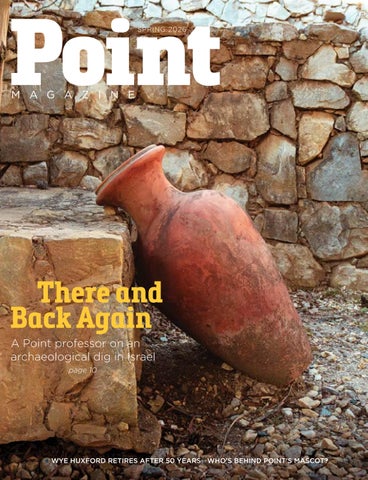
Point Magazine | Spring 2026

Page 1


Have you ever noticed that, just when you begin to feel exhausted or discouraged, the Lord will energize and encourage you? Let me share a few recent examples from the Point community.

In late November, we had the privilege of serving at the International Conference on Missions, or ICOM. Held in Atlanta this year, the conference brought together thousands of people from our faith tradition. By the end of the fall semester, everyone on a college campus feels tired and ready for Christmas break. But our whole team was so energized by talking to prospective students and donors, reconnecting with alumni and friends, and seeing what God is doing through the work of many mission organizations.

January brings its own challenges for college students: getting back into the routine, dreary skies, and even winter weather-related class cancellations. But the first week of classes, a group of students led a prayer time for our semester. It felt joyful to pray and worship together in the courtyard, even though it was cold! At the end of the month, we hosted prospective students who’ve decided to pursue vocational ministry for the Pursue conference on our campus. It was moving to talk with these young people who are committed to serving the Lord and following His call to ministry.

I could go on about the ways God energizes me through what’s happening at Point, including through the inspiring stories in this issue. Biblical studies professor Dr. Rachel Nabulsi shares about her recent trip to Israel, and you’ll hear from young alumni who are serving Christ as band directors and music teachers. Finally, Prof. Wye Huxford ’73 shares some of his reflections after 50 years in the classroom at Point – and you’ll learn about our new Wye Huxford Center for Spiritual Formation!

I’m so grateful for the many ways that our alumni, friends, faculty, staff and students continue to encourage me personally as I complete my first year as president. Please continue to share your prayers and support as we strive to do God’s work through Point University.

In Christ,

Point Magazine

Volume 64, Number 2

Spring 2026

EDITOR/DESIGNER

Sarah Huxford Camp

ASSISTANT EDITOR

Amber Bowman

CONTRIBUTORS

Ragan Barnes Johnson ’21

Alexa McCoy ’27

Dr. Rachel Nabulsi

Point Magazine exists to tell Point University’s stories. It is intended to serve as a vehicle for connecting the University’s alumni and friends. For the first 49 volumes of its existence, Point Magazine was known as The Gold & Blue. The magazine is published by the Communications Office, which retains the right to determine the editorial content and presentation of information contained herein. Articles or opinion pieces contributed by guest writers do not necessarily reflect the official views or policy of Point University and its board of trustees. Point Magazine welcomes reader responses to its content.

CONTACT US:

Point University

Attn: Point Magazine 507 West 10th Street

West Point, GA 31833

706-385-1000

editor@point.edu

© 2026 Point University

Point University’s mission is to educate students for Christ-centered service and leadership throughout the world.

Point University is accredited by the Southern Association of Colleges and Schools Commission on Colleges to award associate, baccalaureate and master’s degrees. Contact the Commission on Colleges at 1866 Southern Lane, Decatur, GA 300334097, at http://www.sacscoc.org, or call 404-679-4500 for questions about the accreditation of Point University.

SNAPSHOT

The International Conference on Missions, or ICOM, filled the Georgia International Convention Center in November. Point students, faculty, staff and alumni were everywhere, from greeting attendees at the doors to staffing the Point booth. To see photos of this and other campus events, visit point.edu/photos.

Point university inducted four members into the athletics Hall of Fame during a luncheon during Homecoming weekend, including Leah Schnell ’01, Heather Bolton Suber ’02, Dr. Ralph Swearngin and Sarah Grimes Wiggins ’93. The Hall of Fame exists to recognize outstanding athletic accomplishments from Point University athletes and coaches.

in october, alumni gathered in West Point to celebrate Homecoming. The weekend kicked off on Friday with the athletics Hall of Fame luncheon, followed by men’s and women’s basketball games and an alumni meet and greet. On Saturday morning, alumni gathered for brunch, followed by a commemorative brick installation ceremony in the Sizemore Courtyard of the Lanier Academic Center. Skyhawks football kicked off at noon, and men’s and women’s soccer competed in the afternoon. That evening, alumni and students led the Grand Ol’ Singalong, a musical event featuring old and new favorite worship songs. On Sunday, a special alumni-focused worship service was held at Spring Road Christian Church.

“Homecoming was incredible, featuring alumni as early as the 1970s to recent grads from the class of 2025,” said Aaron Lewis ’13, director of alumni relations. “Alumni were able to connect and share their experiences, funny stories and memories while also networking to collaborate on projects in the future. Having our alumni in town allowed our community to engage in a way that connected them to the heart of our University and the passion we all share for Jesus.” Visit point.edu/homecoming in the coming months for details about next year’s Homecoming. See more photos at point.edu/photos.

News

The University began the spring semester with a student-led day of prayer in the Sizemore Courtyard on the West Point campus. Students from the spiritual formation team led faculty, staff and fellow students in prayer for the University and its future, and the group joined in several worship songs before returning to the classroom.

“We enjoyed honoring our inductees for the second annual Hall of Fame luncheon,” said Jaunelle White, vice president of intercollegiate athletics and chief student development officer. “The Hall of Fame was created to acknowledge the athletic accomplishments of Atlanta Christian College and Point University student-athletes. We can’t wait to receive nominations for the 2026 class.”

Nominations for the Hall of Fame Class of 2026 can be made at skyhawkathletics.com

3.56

FALL 2025 GPA FOR THE SKYHAWK SOFTBALL TEAM, THEIR HIGHEST TERM GPA EVER. MEN’S AND WOMEN’S GOLF HAD THE HIGHEST TEAM GPAS FOR THE FALL TERM AT 3.49 AND 3.59, RESPECTIVELY.

Last fall, Point recognized four students pursuing careers in vocational ministry with the Philip Anthony Mitchell Scholarship. The students — Memphis Cardone ’29, BethAnn Maddox ’27, Malachi Mitchell ’26 and Olivia Zimbardi ’29 — each received a $10,000 award.

Paige Raynor Dees ’03 has been named to the University’s board of trustees. Dees serves as the Georgia State Director for LifeWise Academy, helping bring Bible classes to public school students.

Point hosted the Pursue conference, a two-day event for students who are interested in pursuing vocational ministry, in January. Students got a chance to see what life is like on campus and to attend sessions providing them with practical tools to prepare for a career in ministry. Visit point. edu/pursue in the coming months to see dates for the next conference!

Making Math Click: A New Professor’s Quest

Dr. Chuk Amagwula joined the Point faculty this year as assistant professor of mathematics. We caught up with him to learn about his background and what people frequently misunderstand about math.

What’s a common myth about math that you find yourself constantly debunking?

A common myth I often debunk is the belief that mathematics isn’t needed in a person’s field or daily life. In reality, every new field I learn about, whether in the sciences, business, technology or social sciences, I find that it relies on mathematics in some form. Math is often working behind the scenes, shaping decisions, models and outcomes even when people don’t realize it.

How do you help students who walk into your class convinced they’re “just bad at math”?

I focus on building confidence early. I start by giving students approachable, foundational problems that everyone can successfully solve. Once they experience early success, their mindset begins to shift. From there, I gradually introduce more challenging problems, encouraging them to see difficulty as part of the learning process rather than a reflection of their ability. What’s the most unexpected place you’ve seen math show up in everyday life?

Sports. From angles and estimation to speed, momentum and force, math and physics are everywhere in athletics. Whether it’s analyzing player performance or understanding strategy, sports are full of real-world mathematical applications.

What’s something students might be surprised to learn about you?

I used to be part of a six-person a cappella group.

More than 400 students were named to the dean’s list for the fall semester. The dean’s list recognizes fulltime, undergraduate students who earn a grade-point average of 3.5 or above.

Faculty, staff, students and community members celebrated the Christmas season together with a concert in early December. Students performed a variety of Christmas songs, both vocal and instrumental. Vist point. edu/events for future performance dates.

Alumni Enjoy Homecoming Weekend
FOUR INDUCTED INTO ATHLETICS HALL OF FAME

The Face Behind THE FEATHERS

Life Inside the Mascot Suit

THE ROAR OF the crowd sounds throughout the football stadium as Charger bursts out onto the field, arms pumping and yelling loudly into the crowd. Students leap to their feet, cheering and waving signs; children squeal with delight, pointing at this larger-than-life figure that seems to embody everything fun about college life. No one in the stands knows who is behind the mask, and that is exactly how it’s supposed to be. For students at Point, the mascot is not just a symbol or entertainment, it is the living embodiment of school spirit, energy and community.

In the suit this year is a junior who has been at Point since his freshman year. He loves music, playing basketball and building the Point faith community. Outside of the stadium, you can find him in the dining hall, eating a slice of pizza with his friends or simply starting a conversation with a new friend. Inside the suit, he becomes the iconic figure on campus. He is full of joy, laughter and energy to bring life into every game, as well as some community events.

The tradition of mascots being part of an American university setting is over a century old, with each mascot serving as both a symbol and an ambassador for the respective schools. The phenomenon began in the late 1800s, when schools first used live animals or costumed characters to rally their students. Modern-day mascots fulfill many purposes, like promoting school spirit at games and events. Whether it is a well-recognized mascot, like UGA’s Hairy Dawg or Georgia Tech’s Buzz, or a lesser-known mascot at a smaller school, mascots across the nation give students and staff a physical representation of school pride, tradition and community spirit.

Point University is no different. Charger — named by alumni in honor of the University’s

historic mascot, prior to the University’s 2011 name change — is so much more than a student in a suit. He is also a symbol that rallies the campus together, energizes the crowd and reminds everyone why they love being part of the Point community.

As with many colleges, the role of the mascot is also shrouded in mystery. Because no one knows which student is hiding behind the mask, the character can take on almost mythical dimensions. “I love that no one knows who’s inside,” the mysterious student says. “It lets me focus on spreading energy and joy without being recognized for myself or my own accomplishment. For a little while, I become a different person.” This anonymity frees him to play around with people in the crowd, enhance his role at games and interact with students freely.

Being Charger is not just a fun gig. It is also hard physical work and mentally demanding. The mascot costume is heavy and insulated, hot and difficult to maneuver in, particularly during long games under the sun or gym lights. Visibility is limited, balance is tricky, and one wrong step might result in an embarrassing fall. Despite the challenges, the role is exhilarating. “It’s physically exhausting,” he admits, “but every high five, every cheer, every kid waving at me makes it worth it.”

One extremely hot day, he recounts a late-season football game, saying, “By the fourth quarter, I could barely see through the mask, and my energy was fading. But then I saw a group of kids waving signs and yelling my name, and I felt an instant rush. That’s when you realize it’s all worth it.”

During another memorable football game, a young fan ran onto the field and hugged the mascot so tightly, he almost fell over. “Moments like that remind you why you do it,” he said, laughing. He recalls other instances when students asked for selfies with him and he had to come up with new poses on the spot, making the performance both fun and spontaneous.

The mascot also has to be a source of continued energy. When a team is losing, the student who plays Charger said his job is to keep everybody in the stands hyped and cheering loudly. “Your job is to keep the energy going for hours, no matter what the scoreboard says,” he says.

The mystery student, who gave his life to Christ while a student at Point, adds that the mascot role has given him some particularly significant insights into community, leadership and faith. “I’ve made lifelong friends who

will always be there for me,” he says. “These friends have helped guide me toward Christ and supported me in my journey, not only in my faith, but in everyday life.”

Despite the challenges of the role, the student playing Charger is continuously surrounded by the fun and energy of campus life and gets to be a representative for Point in ways that few Point students can say they have. “It’s amazing to see how much joy a mascot can bring,” he says. “It reminds me that the little things, like high fives or silly dances, have the potential to make a huge difference in someone’s day.”

“Every time I suit up, I remind myself that I am representing much more than myself,” he adds. “I’m representing my school, my friends and the values we share.”

To the students who attend games, he brings energy and humor. To the junior wearing the mask, it’s an opportunity to serve, engage and personify the spirit of Point. As he crosses campus between classes — chatting with friends, stopping by the dining hall or enjoying the lawn at the Feast campus ministry house —he knows that in a couple of hours, he’ll get back into the suit, ready to energize the community one cheer, one dance and one high five at a time.

Behind every mascot, there is a student with a story and a passion for community. Charger is more than a suit or a symbol; our mascot is a bridge between students, tradition and values. The role of being Charger has been an avenue for this junior on the path of growth, faith and friendship, through which he impacts others in both visible and invisible ways. And though no one may ever know who is behind the mask, the energy, joy and community he brings are undeniable. Every jump, dance and cheer is a sign of what it means to be part of the Point family, proving that sometimes the most powerful presence on campus is the one whose face we never see.

Alexa McCoy ’27, of Columbus, Georgia, is a secondary education major and softball player at Point. She wrote this feature article for a Media Writing course.

THERE AND Back Again

The Tel Goren Excavation of the Ein Gedi Oasis Project

InJanuary, I was honored to take part in an archaeological excavation at a place called Ein Gedi, which is an oasis located in Israel on the coast of the Dead Sea. The project is run by the Hebrew University of Jerusalem under the direction of Dr. Uri Davidovich. With the support of both of our institutions, my colleague Emily Pritchett, staff archaeologist with the Biblical History Center of LaGrange, Georgia, and I traveled to the site for a two-week participation with this excavation.

According to the Archaeological Institute of America, “The research project focuses on illuminating the history and economy of En-Gedi during the first millennium B.C.E. Historical and archaeological sources suggest that during this period, when En-Gedi was established as a permanent settlement, the oasis functioned as a key administrative and economic center specializing in the cultivation and production of valuable cash crops, mainly dates and aromatic plants.”

Ein Gedi is part of the national park system of Israel, and the team from Hebrew University has permission from the Israeli Antiquities Authority to investigate this very rich site of human activity. The natural springs found in the area have drawn human attention at widely varied periods of history. Physical remains include a late Stone Age temple located at a very high mountainous site nearby, Iron Age crop processing installations, a Roman lime kiln, and the remains of a large Persian period building complex. Late-stage occupation is represented by a third-century C.E. synagogue with an ornate mosaic floor and a Byzantine fortress. All of these were within walking distance of our location, which was on a steep slope of Tel Goren. Tel Goren is the name for our smaller site within the Ein Gedi area. A “tel” signifies a mound or low hill created by long periods of human habitation. “Goren” means “threshing floor” and relates to the agricultural life of the area. For this article, I will share only what I

learned in our specific “square”: the defined, small section which archaeologists focus closely on as they investigate specific questions related to the time, location and the people who once lived there. Our area of investigation at Tel Goren was inhabited during the Judean period of the Iron Age.

Ein Gedi appears in several places in Scripture, most notably as the location where David hid from the persecutions of Saul: “And it came to pass, when Saul was returned from following the Philistines, that it was told him, saying, Behold, David is in the wilderness of En Gedi. Then Saul took three thousand chosen men out of all Israel and went to seek David and his men upon the rocks of the wild goats. And he came to the sheepcotes by the way, where was a cave; and Saul went in to cover his feet: and David and his men remained in the sides of the cave.” (1 Samuel 24:1-3)

The life-giving springs of Ein Gedi also make their way into the literature of Scripture: “My beloved is to me a sachet of myrrh resting between my breasts. My beloved is to me a cluster of henna blossoms in the vineyards of En-gedi.”

(Song of Songs 1:13)

And also in prophecy: “Fishermen will stand along the shore; from En Gedi to En Eglaim there will be places for spreading nets. The fish will be of many kinds — like the fish of the Mediterranean Sea.” (Ezekiel 47:10)

We were very excited to be able to make connections between these references in Scripture and the physical, material evidence produced by the science of archaeology. While many people think of archaeology as “Indiana Jones” excitement or dream about finding the golden treasures of Egypt, evidence from the everyday lives of people is also fascinating. Our square area contained part of a stone wall, some of which had collapsed. This collapse was part of what we call a “destruction layer”: that is where we find evidence of fire, destroyed pottery, ash, and broken and degraded mud brick. As we carefully removed the earth, layer by layer, from this area, we uncovered pottery, fragments of animal bones, charred wood, and several pieces of bronze/copper jewelry, including multiple earrings and finger rings. Clay pottery in the ancient world is very distinctive to the time, location and purpose for which it was formed. Our pottery included cooking pots, jars, and small juglets. Just as we can easily identify the difference between grandma’s Pyrex dishes and our new Martha Stewart bowls from Target, these clay vessels tell us a detailed story about how and when they were created and used.

Tel-tale (see what I did there?) impressions on the handles of these items from Tel Goren included a rosette from our own square, and from another area of the dig an “lmlk” stamp. Such stamps, meaning “to/of the king,” probably signified that the contents belonged to the royal storage. In other contexts, these stamps have been important in dating materials to the time of Hezekiah and the Assyrian threat against Jerusalem found in 2 Kings 18 and Isaiah 36. The value of pottery did not end there, however. Once broken, pottery continued to be used for writing messages. These items are called “ostraca” and were a common

way of sending “mail” in the ancient world. One such inscription was also found this season at the dig. Much more can be said about these artifacts, but we must wait until they have been fully cataloged and reconstructed or translated.

Other than the very steep, rocky, and rough terrain, this excavation at Ein Gedi was relatively easy. Winters in Israel are typically mild, and the days were cool and breezy, so heat exhaustion and dehydration were not the serious issue that they can be during summer work in Israel. We were not removing large amounts of earth to reach our area of investigation, so we worked primarily with small hand tools rather than the large pickaxes and hoes that are sometimes used. Our accommodation was at a campground located on a kibbutz near the site, so we had access to bathrooms, showers and even a small coffee shop, for which we were profoundly thankful each day when we returned from our work!

scholars and very kind people.

Communication was easy, as most Israelis speak English well, and English is a common tongue for communication among the very diverse population of the country.

Emily Pritchett, my colleague from the BHC in LaGrange, and the entire team of staff and graduate students from the Hebrew University in Jerusalem were absolutely wonderful. They

There is much more I could share about this amazing experience, including our short stay in Jerusalem as we traveled to Ein Gedi, but space does not allow. I am very grateful for the support of our own Point University and the LaGrange Biblical History Center for making this adventure possible!

Dr. Nabulsi is associate professor of biblical studies at Point.

DIGGING DEEPER
At right, base camp at Tel Goren. Below, a Judean pot, a view of Tel Goren from the square, and Dr. Nabulsi on site at the dig.
A DIG WITH A VIEW
A view of Tel Goren, overlooking the Dead Sea.

FROM CAMPUS TO CONDUCTOR Alumni Shaping the Sound of the Next Generation

Point University’s mission is to educate students for Christ-centered service and leadership throughout the world, but when a student graduates, there is no way to know how they will choose to live out this mission. Some pursue careers in ministry, some choose to further their education with a master’s degree, and others choose to pass on what they have learned through a career in education. In recent years, several Point alumni have chosen to pursue careers in music education a little closer to home. In fact, more alumni are working in music education than this magazine had space to profile! These alumni are passionate about passing on a love for music to their students, but they are also acutely aware that they are educating not just a mind, but a whole person — something they saw modeled for them during their time at Point.

“I learned many things at Point University, and I am so thankful for my time as a student, because it definitely prepared me for a career, both musically and professionally,” says Tori Smith ’21, an elementary music teacher at Clearview Elementary School in LaGrange, Georgia. “Personally, I was able to develop my faith and deepen my knowledge of the Bible. In addition to that, Point also brought me some of the greatest people in my life.”

Paisley Patterson Ramsey ’20 is the band director at Troup County High School. Her journey into music education was shaped by the values ingrained in her at Point. She was a part of Feast, Point’s campus ministry. There, she learned how to serve others first, meet tangible needs and provide a welcoming environment for everyone. She also served as an admission counselor for the University, where she assisted students and families through the enrollment process. “Through those experiences, I began to see a deeper connection between helping, educating and guiding students, and the role music could play in that work,” she says. “Shifting my focus from my own musicianship to help -

ing students grow, both musically and personally, affirmed that music education was where I was meant to be.”

Similarly, Smith’s path to a career in music education was guided by one of the professors at Point. In 2021, Dr. Lacey Southerland attended Smith’s senior recital, where Smith mentioned to the audience that she was considering a career in education. Four years later, Dr. Southerland, the department chair for the early childhood education program at the time, forwarded Smith an email about an elementary music teacher position open in West Point. Dr. Southerland offered Smith advice on how to proceed, and Smith passed the Georgia Assessments for the Certification of Educators test on her first attempt.

rehearsal plans and high expectations; Dr. Nathaniel Gworek sharpened my sense of rhythm and detail; Mr. Andrew Harry pushed rigorous musicianship in theory and piano and taught me the value of versatility,” says Avery.

As educators, these alumni must be prepared to teach each day, but they also know that their students and their lives are unpredictable. Teachers are there to lend support in whatever way a student needs.

“I also had wonderful professors write recommendation letters for me, and I am so thankful for those,” says Smith. “I’m just thankful for the connections at Point that helped me get started in my career.”

For Jaquavion Avery ’21, band director at Callaway Middle School in LaGrange, Georgia, filling this role was a lifelong dream — one that was inspired in him after watching the film Drumline at age five. Between the rigorous coursework in the classroom and intentional mentorship from fine arts faculty members, Avery’s time at Point transformed him from someone afraid to make mistakes into a confident leader who pushes his students to be resilient and persevere. “Mr. Lanier Motes taught me to listen with intention in ear training; Dr. Chapel McCullough, as band director, modeled clear

“The most important thing is being personable,” says Kourtney Ramsey ’20, the head band director at LaFayette High School in LaFayette, Alabama, and husband to Paisley Ramsey. “Being able to meet my students where they are and tackling every obstacle they bring through the door. ‘Every day is not always about band, but every day is about band.’ Those are wise words from Dr. Byron Cartwright that I live by daily.”

Smith adopts a similar philosophy in her teaching of elementary students. “There have been many times where I get in the car after an entire day of planning and doing lessons, and I will say to myself, ‘I don’t know if I actually taught anything today.’ But sometimes I’ve given a hug or listened to a little friend who was upset, and that made a big difference to them. So, if my lesson wasn’t completed the way I wanted it to be, it’s okay,” she says.

Smith’s priority as a teacher is to be a caring

and encouraging presence in the lives of her students.

“Teaching music is my job, but sometimes the most important thing I do each day has nothing to do with music. Sometimes it’s just showing up, a hug or a conversation that really makes all of the difference,” she says.

At the middle-school level, Avery’s focus on mentorship and character development is just as important to him as musical skill. “I love watching students transform,” says Avery. His classroom instruction centers around relationship building, such as regular one-on-one check-ins, offering students leadership opportunities, and publicly recognizing the individual accomplishments of his students.

The best moments in his career are when he hears his students talking about their excitement about band outside of class. “I love the shared experiences of band,” says Avery.

“Pep band, halftime shows, holiday concerts. Those events remind me the work is bigger than any single rehearsal.”

Teachers must juggle a variety of roles and expectations, from students, fellow teachers, parents, the school board and administration. Not every day is incredibly rewarding, but they are reminded of why they press on when they see the moment when a student finally grasps a concept. “The thing I love the most and what keeps me going every day is that lightbulb mo-

ment for my students,” said Kourtney Ramsey. “Every day may not be the best day ever, and that’s okay. But I love those moments and days where things click and my students grasp the concepts.”

Paisley Ramsey agrees. “The best moments are the random clicks you see on a daily basis,” she says. “Seeing a quiet child transition step by step into a confident musician really makes your week.” For Smith, that encouragement always comes right when it is needed. “There have been a million tiny moments that have made me sure of being in education,” she says. “Every time a student asks, ‘Do I get to come to music today?’ or says, ‘I love you!’ it makes me sure. These little moments always come at the right time, too. It’s just all of the little things that are huge to me.”

In Mark 4, Jesus compares the Kingdom of God to a man who scatters seeds on the ground. “Night and day, whether he sleeps or gets up, the seed sprouts and grows, though he does not know how. All by itself the soil produces grain — first the stalk, then the head, then the full kernel in the head” (v. 27-28). The professors and instructors at Point University experience the same phenomenon when they teach college students. Day in and day out, for four years, they invest in the lives of students, not knowing when or how the seeds will sprout and grow, but believing that they will. In these four alumni, the seed has sprouted, and they have now chosen to sow it back into a new generation, believing that these new students will grow and flourish in the same way — not just as musicians, but as people of perseverance, compassion and love.

Jaquavion Avery ’21 (left) and Tori Smith ’21 (right)
Kourtney Ramsey ’20 (left) and Paisley Patterson Ramsey ’20 (right)

HALF a CENTURY IN HIGHER EDUCATION

Wye

Huxford '73 Reflects on 50 Years in the Classroom

WHAT IS A

LEGACY?

It is far more than fame, notoriety or having thousands of followers. A legacy is built slowly, after years of dedicated service, of quietly stewarding what has been entrusted, of diligently working for the building up of others. This is a legacy worth striving toward.

This is the kind of legacy Wye Huxford will leave at Point University this spring, when he retires from his position as dean of the College of Biblical Studies and Ministry and professor of New Testament after 50 years with the institution. A lot changes in 50 years — especially at a small, Christian university — and Huxford has witnessed it all. Although these changes are likely too many to count, Point Magazine is taking a look at Huxford’s list of the five most significant changes he has observed in the last half century.

1. REGIONAL ACCREDITATION AND EXPANSION OF CURRICULUM

When Huxford began teaching at Atlanta Christian College, the College was accredited by the American Association of Bible Colleges. This accreditation was stringent in the reporting required by the College on the spiritual lives of students, and it was not a regional accreditation.

In 1990, ACC received SACSCOC accreditation. “Dr. Jim Donovan was president at the time, and among the many outstanding things he did

as president, I would identify this project as the most important,” says Huxford. “SACSCOC accreditation opened many doors that would have never been opened had we not moved in this direction. Dr. Eddie Groover was academic dean and worked tirelessly on the project, as well.” This new accreditation meant that ACC could now certify teachers, and today, the University certifies educators from kindergarten to high

school, along with special education and music. “When I think of the spiritual impact ACC- and Point-educated teachers have made in many communities, I can only praise God that Dr. Donovan led this charge to become SACSCOC-accredited,” says Huxford.

At the time, some were concerned about the transition to a secular accrediting organization, but Huxford felt those fears were unfounded. “SACSCOC was not us walking away from our historic commitment to the kingdom of God,” says Huxford. “But it sure did open up doors for our graduates to take faith into the workplace in ways that had never been true before.”

2. HOPE SCHOLARSHIP AND FINANCIAL AID

After achieving regional accreditation with SACSCOC, the potential arose for HOPE Scholarship recipients to attend ACC. The HOPE Scholarship is for Georgia residents with outstanding academic achievement. In the early years of the HOPE Scholarship in Georgia, private colleges were not eligible.

“President Eddie Groover spent countless hours lobbying key members of the Georgia legislature to provide fair treatment to private college students, as had been given to students in public institutions,” says Huxford. “Every

student who has attended Point University and received HOPE Scholarship dollars owes a debt of gratitude to President Groover.”

While an expanding curriculum caused the cost of tuition to rise, the HOPE Scholarship made it possible for many more students to afford a private, Christian education. “I think I was blessed to teach many very bright students who might not have attended ACC and Point were the HOPE Scholarship not available, and I have had many conversations with students about how this scholarship motivated them to do well in class so they would keep the scholarship in place,” says Huxford.

3. CHANGES IN STUDENT AND EMPLOYEE DEMOGRAPHICS

During Huxford’s freshman year at ACC, in 1969, two Black students moved into Roberts Hall, the main men’s dormitory. “I think that is the first time Black students lived on campus, and while they weren’t the first Black students to attend classes, the numbers were very low,” says Huxford. “To my memory, there were no Black employees.”

When Huxford returned to ACC to teach, the number of Black students on campus was still very low. “Vicki and I determined that we would do our best to make sure Black students felt welcome,” says Huxford, referring to his late wife, Vicki Kindt Huxford ’73, also a Point professor at the time. “It thrills me to know that one of those students from way back then, Marvin Bussey ’86, has served as a trustee at Point, has preached in chapel for us and has made a noticeable impact on metro Atlanta.”

When President Dean Collins ’79 took the helm in 2006, one of his goals was to continue to increase diversity on campus. “I am amazed every time I come on campus, go to chapel, eat in the dining hall, go to athletic and fine arts events, and see such a beautiful expression of God’s magnificent creation — people from all walks of life — living and thriving on our campus,” says Huxford. “We not only look like heaven is going to look, but we look like what the world looks like now!”

These demographic changes are reflected in Point’s faculty and staff, as well. For many years, most of the degree programs at ACC were unavailable for women, and in Huxford’s early years at ACC, there were only a few female faculty members. “Today, a woman of color is the dean of the College of Arts and Sciences, three women teach in the College of Biblical Studies, people of color work in every area at Point, and our new president is

a woman!” says Huxford. “People of color and women serve on the Board of Trustees. I don’t think I am capable of measuring the positive impact such changes have had on this college that I so deeply love and care about.”

4. EXPANSION OF ATHLETIC PROGRAMS

In 1969, Huxford's freshman year, ACC had one athletic program: men’s basketball. Eventually, men’s soccer and baseball were added, followed by more programs. At that time, ACC was a member of the NCCAA, but could not offer scholarships — and thus could not leverage athletics to grow enrollment.

“We started working on applying to the NAIA,” says Huxford. “Coach Alan Wilson did a lot of the leg work to help make that happen. Once accepted to the NAIA, we could offer scholarships for athletes and expand the number of sports for both men and women.” Today, Point University has 13 intercollegiate athletic teams competing in the NAIA.

“We continue to hire coaches and staff who take Jesus seriously and who want to make a transformative impact on the lives of Point student-athletes,” says Huxford. “We also take academics seriously — the team GPA each semester is an important measure of success. Most of our teams engage in a variety of activities in the Greater Valley Area being the hands and feet of Jesus.”

This expansion of athletic programs has allowed the University to reach more and different students, while equipping them to live out their faith everywhere they go. “I could tell you a story of a baseball player who is now planting a church in Stone Mountain and a football player who will graduate in May who already has a job in a church in north Georgia,” says Huxford. “I know stories of athletes — men and women — who didn’t earn ministry degrees, but who have done incredible ministry in places where they ended up living, across the globe in campus ministry, and a wide variety of other areas.”

5. A BROADER UNDERSTANDING OF MISSION AND MINISTRY

Huxford became a student at ACC in 1969. At that time, ACC’s degree programs were focused on church ministry. “If you weren’t planning on being a minister — preacher, youth minister, education minister, missionary — there wasn’t much at ACC for you,” he says.

Once the College was accredited by SACSCOC, ACC’s curriculum began to expand beyond ministry-related programs, but no matter a student’s major, every Point University student still studies the Bible extensively. “In my mind, that means we became more missional than ever,” says Huxford. “The stories I know of Point graduates who have entered a variety of careers after graduation but have had authentic kingdom influence are stunning. The Great Commission — ‘as you go, make disciples’ — is being carried out daily in places ACC and Point graduates weren’t always qualified to work.”

Point is still training men and women to work in vocational ministry, but now it is also training men and women to view their workplace, no matter what it is, as a ministry, too. “I am all about our need to train young men and women for ministry,” says Huxford. “I will never be satisfied with the number of vocational ministry graduates we have each year. But I’m not so sure that ministry can be done only by people on the payroll of a church.”

This adjustment in Point’s missional mindset means that more communities, churches and types of people are hearing the gospel than ever before. “All of our ministry graduates today won’t likely spend their entire working career on the payroll of a church — but many, many do,” says Huxford. “And then, to add to that incredible kingdom reality, so many of our graduates take faith into the workplace, no matter what it is, and engage in their communities and churches in transforming ways. I think that means we take the Great Commission more seriously today than ever.”

HUXFORD IS QUICK TO LIFT UP the achievements of others, to recognize the impact they have made on Point University in the last 50 years. But it is leaders, teachers and servants like him who have modeled a life of faithfulness to the next generation — a life of impact that can only be measured in heaven. It is certain that his legacy will continue to reverberate through the halls of Point University for another 50 years and beyond.

Point is raising $100,000 to fund the Wye Huxford Center for Spiritual Formation, which will provide spiritual growth opportunities for Point students for generations to come. If you'd like to give in Professor Huxford's honor, visit point.edu/ huxford or scan the QR code above.
ACC students in class in the 1970s; women’s volleyball in the 1990s
Prof. Huxford in class in East Point in 2011

Over the course of 50 years in the classroom, Wye Huxford ’73 has taught thousands of students. Some students will remember him as a great teacher and others as an influential mentor. For John Houchens ’84, Huxford holds many titles in his memory — namely those of discipler, mentor and friend.

Houchens came to Atlanta Christian College in fall 1980 as an unbeliever seeking the truth about the Bible and who Jesus was. “I showed up without an application submitted, permission to come or prior notice,” says Houchens. “Seeds of the Gospel had been planted in my life, but they had yet to be watered.” Houchens’ life began to change after meeting Huxford and his wife, Vicki Kindt Huxford ’73. “Atlanta Christian College — and especially Wye and Vicki Huxford — watered those seeds,” says Houchens. Huxford quickly became a favorite professor for Houchens. “I had a

number of New Testament courses, Hermeneutics and Exegesis, Greek I and II,” says Houchens. “He was a favorite professor, and some courses were pursued merely because he was teaching them.” During Houchens’ senior year, he completed an independent study in Greek II with Huxford.

Today, Houchens is pastor and executive director of Maritime Bethel in Savannah, Georgia, where he seeks to balance teaching and challenging in a similar way to Huxford.

“There is an art and a balance when it comes to challenging cherished beliefs about the Bible, in order to teach what the Bible says and doesn’t say,” says Houchens. “Wye did that exceptionally well, and I have always tried to model that approach in all my teaching and preaching of the Bible. He never challenged a cherished belief or preconceived notion without offering a superior replacement for it.”

LEAVE A LEGACY

You can now celebrate your Point University story with a commemorative brick, installed in the Lanier Academic Center. Honor a loved one, celebrate your time at Point or show your support for the next generation. These customized bricks serve as a lasting tribute, recognizing the individuals and families who share Point University’s mission of educating students for Christ-centered service and leadership.

Order today at polarengraving.com/pointuniversity

While Huxford was influential in shaping Houchens’ understanding of the biblical text, his greatest impact in was in revealing what it looked like to live those teachings out. “Wye and Vicki loved us outsiders and invested time into our lives,” says Houchens. “Vicki played the organ in my wedding, Wye did the ceremony, and then they lent us their car so Debbie and I could go on a honeymoon. Just one act of love out of many.”

For Houchens, Huxford is far more than an exceptional New Testament teacher. “I will be forever, and eternally, grateful for Wye and Vicki Huxford and their love of Christ that overflowed into the lives of students — especially me,” he says. “What Paul said of the Ephesians, I echo in reference to Wye and Vicki: ‘I have not stopped giving thanks for you, remembering you in my prayers.’”

Have a photo from your college years you want to share with us? Email the photo and your story to editor@point.edu.

DEBTFREE COLLEGE.

Turn static files into dynamic content formats.

Create a flipbook