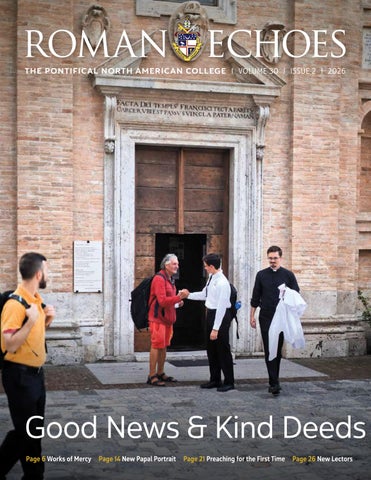
Roman Echoes 2026 - Volume 30, Issue 2

Page 1


From the Editor

Have you ever heard people talk about “the Good News”? I used to wonder exactly what the Good News is: What is this message, this great truth that we need so badly to hear? Is it Do good and avoid evil? Is it Love God and neighbor? Is it Be like Jesus?

In reality, the Good News isn’t a message that you can put into words alone; it has to be made incarnate through acts of mercy and kindness. In this issue of Roman Echoes, we hope to share with you about our work in the city, where we meet the poor and those far from home. We’ll also share the fruits of our homiletics program, where we learn to preach the Good News in words.

Ultimately though, the Good News isn’t a message that you can put into words alone, because the Good News isn’t a philosophy, or an insight, or a moral principle. The

Good News is Jesus Christ. The Incarnation is the greatest truth—the best news—because it means that God wants to be with you. And God wants you to be with him.

As you pray for us seminarians, please pray that our words and deeds will open hearts—including our own—to the Good News of God with us.

With gratitude,

Contributors

EDITOR-IN-CHIEF

Graham Fassero ‘27, Diocese of Richmond

ASSISTANT EDITORS

Liam Daigle ‘28, Diocese of Worcester

Christian Howlett ‘28, Archdiocese of Saint Paul and Minneapolis

PHOTO EDITOR & PHOTOGRAPHER

Ryan Both ‘28, Diocese of Austin

Administration

of The Pontifical North American College

RECTOR

Rev. Msgr. Thomas W. Powers ‘97

VICE RECTOR

Rev. Michael Pratt ‘11

CARL J. PETER CHAIR OF HOMILETICS

ROMAN ECHOES FACULTY LIAISON

Rev. Peter John Cameron, OP

DIRECTOR, CASA SANTA MARIA

Rev. Msgr. William V. Millea ‘80, C‘89

DIRECTOR, INSTITUTE FOR CONTINUING THEOLOGICAL EDUCATION

Rev. Edward Linton, OSB

EXECUTIVE DIRECTOR, INSTITUTIONAL ADVANCEMENT

Mark Randall, CFRE

For more information about The Pontifical North American College, subscription questions, or to learn about ways you can financially support “America’s Seminary in Rome,” please contact Mark Randall, CFRE, Executive Director, Institutional Advancement.

Tel: (202) 541-5411 Fax: (202) 470-6211

Email: pnacdc@pnac.org Website: www.pnac.org

This publication is written, edited, and photographed by the seminarians, deacons, and student priests of The Pontifical North American College.

COVER: Elijah Buerkle ‘29 (Charlotte) and a homeless man greet each other after Mass at Chiesa Nuova in Assisi.

THIS PAGE: Rev. JunHee Lee ‘13, Coordinator of Human Formation, celebrates Mass at the Basilica of Saint Clare in Assisi.

BACK COVER: The Sacred Heart stands in front of the College.

RECTOR’S CORNER

The theme of this issue of Roman Echoes is “Good News and Kind Deeds.” It is a fitting theme because it highlights what priestly formation at the College is all about.

Dear Friend of the Pontifical North American College,

In our Catholic faith, the word “and” has a unique place. Not only do we begin every Mass and prayer with the Sign of the Cross—“In the name of the Father, and of the Son, and of the Holy Spirit”—but we also often see phrases like “God and Man,” “Virgin and Mother,” “Scripture and Tradition,” and “Faith and Works.” More than just holding up the wonderful mysteries of our faith, the word “and” also reveals the all-encompassing fullness of what we believe and how we act as Catholic Christians.

The theme of this issue of Roman Echoes is “Good News and Kind Deeds.” It is a fitting theme because it highlights what priestly formation at the College is all about. Men are formed here to be evangelizers who effectively preach the word of God and to be men of charity who embody and live out the corporal and spiritual works of mercy.

The two really go hand in hand, of course. The priest can only be an effective preacher for his listeners if his life models his words. Similarly, the priest who serves others generously and offers his life as a gift to those whom he serves will certainly be able to articulate God’s love and goodness. In his excellent book Why Preach?, the College’s Carl J. Peter Chair of Homiletics, Reverend Peter John Cameron, O.P., writes, “The preacher serves as a mediator. The influence that a preacher exercises on his hearers is the result of the revelation of who he is—one set apart by God to proclaim the Word of God. A preacher can be such a mediator only if he is a person deeply convicted by the Gospel and his love for Jesus Christ.”

The formation team and I are honored to help prepare our seminarians to be such mediators: efficacious mediators through their preaching and inspiring mediators through their charity. Good News and Kind Deeds, indeed!

Be assured of my prayers and the prayers of the entire community of the Pontifical North American College.

Sincerely yours in Christ,

Rev. Msgr. Thomas W. Powers ‘97 Rector

Ministering in Rome

THE EDITORS

Works of mercy to the needy—organized through various “apostolate” ministries—make up a major dimension of priestly formation. While Rome often brings a unique flavor to any kind of service, it also prepares us to minister to the needy of our home dioceses. Most importantly, it gives us a chance to meet Christ among the poor and those far from home.

Feeding the hungry: At Casa Dono di Maria and at a nearby men’s shelter, seminarians serve with the Missionaries of Charity to feed the homeless in the immediate area of the Vatican. Each meal is accompanied by a Gospel reading, a reflection, and conversation with the homeless.

Sheltering the homeless: At San Gregorio Home for Men, seminarians work with the Missionaries of Charity to care for residents struggling with poverty, illness, and homelessness. Seminarians help with cooking, cleaning, feeding, bathing, laundry, and conversation.

Visiting the sick: At a retirement home served by the Little Sisters of the Poor, seminarians visit the elderly for conversation. This is an opportunity to grow in relationship with the residents and to minister simply by being present.

Visiting prisoners: At Regina Coeli Prison, seminarians minister to nonItalian inmates, especially those who are far from home. Together, they talk, reflect on the gospel, and pray. Each year, seminarians provide catechesis for inmates preparing to enter the Church.

Giving alms to the poor: Seminarians meet the poor along the walk to class each day and during two-hour missions on the streets of the city. Distributing food, blankets, and clothing, seminarians meet the poor, learn their names, hear their stories, and pray with them.

Welcoming refugees: At Centro Astalli, seminarians meet and minister to refugees, often from Africa and the Middle East. Seminarians host refugees for a midday meal, share about the Catholic faith, and listen to refugees’ stories and experiences.

Welcoming pilgrims: Seminarians lead tours of holy sites that attract both Catholics and non-Catholics. Some visitors have never heard the name of Jesus! A good tour can lead pilgrims to a moment of prayer with Christ.

Ministering to students: Seminarians minister on nine college campuses, welcoming students from American universities for a semester in Rome. Seminarians lead weekly talks, tours, games, and times of prayer, encouraging students to make their time abroad a time of pilgrimage.

Ministering to the faithful: Seminarians minister to the faithful in three parishes across Rome and to American families on two military bases in Aviano and Naples. Mass, catechesis, pilgrimages, hikes, and time with parishioners are highlights of these assignments. n

PONTIFICAL NORTH AMERICAN COLLEGE

Where We Go

CORPORAL WORKS OF MERCY:

• Casa Dono di Maria

• Men’s shelter near Vatican

• San Gregorio Home for Men

• Little Sisters of the Poor

• Regina Coeli Prison

• Street ministry

• Centro Astalli Refugee Center

PLACES OF PILGRIMAGE:

• Saint Peter’s Basilica

• Saint Paul Outside the Walls

• Catacombs of Saint Callixtus

• Saint Peter’s Scavi

• USCCB Visitor’s Office

COLLEGE CAMPUSES:

• University of Notre Dame

• Saint John’s University

• Duquesne University

• Catholic University of America

• University of Dallas

• University of Mary

• Christendom College

• Thomas More College

• Ave Maria University

PARISHES:

• Santa Galla Parish

• Santa Maria in Monserrato Parish

• Saint Patrick’s Parish

• Aviano Air Base

• Naval Support

Activity Naples

What Can Separate Us from Christ?

CARTER DOMINGUE ‘28, DIOCESE OF LAFAYETTE

Every week, Nicholas Vande Hey ‘27 (Green Bay), Justin Seidleck ‘27 (Washington), Christian Howlett ‘28 (Saint Paul and Minneapolis), and I go to Regina Coeli Prison to minister to the English-speaking prisoners there. Our role is a combination of several works of mercy, as we are there to catechize these men about the faith and simply to visit the imprisoned and show them the joy of the Gospel.

This year, we have been teaching them truths of the faith through the Rosary and its mysteries. After all, the prison is named for

Our Lady, and, while we can’t do much to aid in their external circumstances, we can introduce them to the Queen of Peace and teach them how to allow her merciful maternity into their lives. Ministering to and spending time with these prisoners has led me to reflect on the nature of the peace and joy that comes from the love of Christ. Saint Paul asked the Romans, “What can separate us from the love of Christ?” I’ve learned more deeply and tried to share with these men—who are separated from almost everything they previously knew—that the answer is “nothing”: Nothing can separate us from the love of Christ. n

from left: Nicholas Vande Hey ‘27 (Green Bay), Christian Howlett ‘28 (Saint Paul and Minneapolis), and Carter Domingue ‘28 (Lafayette) stand outside Regina Coeli Prison.

Love in the Heart of Rome

NATHANIEL BOYD ‘28, ARCHDIOCESE OF OKLAHOMA CITY

The Casa Dono di Maria (“Gift of Mary House”) is a humble building that thousands of people walk past every day without a second thought. Little do these crowds know, however, that the most joyful, Christ-like human beings one might ever encounter live there. The Missionaries of Charity run this humble abode with love and dedication day after day.

Every Wednesday night, I am privileged to work alongside them as they carry out the daily work of their Beloved, feeding and caring for the poorest of the poor. Through the plethora of personalities, problems, and situations I have witnessed at the Casa Dono di Maria, the sisters always maintain serenity and joy which, emanating from Christ in their hearts, pacifies any disturbance. Their witness to Christ edifies my heart, mind, and soul every time I am around them. The radicality of these sisters’ lives communicates their all-consuming love of Jesus and his flock. I thank God that he has given me the grace to experience firsthand the love of the Missionaries of Charity at the Casa Dono di Maria n

Finding Our Meaning in Christ

RYAN SALTNESS ‘27, DIOCESE OF WINONA–ROCHESTER

Our college ministry apostolate with Duquesne University’s Rome Program is an act of mercy. Through our journeys to see the beautiful churches (and gelaterias!) of Rome, showing them around Assisi, and leading “food for thought” reflections after dinner on Tuesday nights, these students are exposed to a lot in a short time. All this takes place in under three months with people they barely knew previously. In our conversations with students, these experiences usually lead to some form of the same question: What does this mean for me?

At our closing banquet, hours before the students would return home from their three-month adventure, a staff member from their university proposed that the reason we study abroad is because it is an experience that makes us more human. Not a bad answer. After all, it is only Jesus Christ, true God and true man, who gives meaning to all things human. These students are overwhelmed by the beauty of Rome, anxious about friend dynamics, and grateful for new perspectives, sometimes all in the same day. In experiences like this, helping them find meaning—in Jesus Christ—can be the ultimate act of mercy. n

top: Nathaniel Boyd ‘28 (Oklahoma City, left) and Casey Burgess ‘29 (Manchester, right) stand outside Casa Dono di Maria bottom: Ryan Saltness ‘27 (Winona–Rochester).

A Solid Faith

If I had to choose one word to describe the Papal Basilica of Saint Paul Outside the Walls, it would be “faith.” The columns, the walls, the courtyard—in short—everything speaks of the virtue of faith in this ancient basilica. In fact, the famous statue in its courtyard depicts Saint Paul as a new Moses, coming down from the heights of the mountain to teach God’s people His saving revelation. Past the statue into the basilica, one sees that the solidity of the walls and the grandeur of the columns are dwarfed by the vast space within. One can see clear across to the other side from practically any angle. Like faith, it is a strong and sure edifice, immovable and lovely. But once inside the sure

guard of faith, one can see far greater than before. Indeed, the basilica reminds me of Saint Paul, whose body it contains: strong and firm, yet gentle and kind. The structure itself is a symbol of that great virtue which Saint Paul loved so much, for it brings us to Jesus Christ Himself. “By grace you are saved through faith” (Eph 2:8).

Contributor note:

The author, Andrew Ketch, hosts a weekly tour for pilgrims to the Papal Basilica of Saint Paul Outside the Walls. n

Andrew Ketch ‘28 (Nashville) welcomes pilgrims to the Papal Basilica of Saint Paul Outside the Walls.

Welcoming Refugees at Centro Astalli

JACOB MUTCHLER ‘28, DIOCESE OF SCRANTON

Located just behind the Chiesa del Gesù, Centro Astalli is an organization run by the Jesuit Refugee Service that provides services to refugees in Rome, such as serving meals and offering medical care and legal support. In our apostolate, we work with other volunteers to serve lunch to guests from all over the world, including Asia, Africa, and the Americas. Due to the various challenges they face, such as finding work and housing, many of our guests have been connecting with

Centro Astalli for an extended period of time. As a result, we often see familiar faces, adding a certain personal element and a sense of continuity. And although the interactions we have with the guests are often brief, this growing familiarity has had a profound impact on us. The opportunity to offer moments of kindness, levity, and humor that might not often be encountered has been a life-giving experience. n

from left: Matthew Wilson ‘29 (Lansing) and Jacob Mutchler ‘28 (Scranton) serve lunch to refugees at Centro Astalli

Dishes and Mops at San Gregorio Home for Men

As I struggled to understand the dish-cleaning system at San Gregorio Home for Men, I was speaking to one of the residents whom I was helping. I had no idea what he said, so I tried to reformulate my Italian. Kyle Rohan ‘28 (Green Bay) came up to me smiling and said, “Yeah, Ryan, he doesn’t speak a lick of Italian. He has no idea what you’re saying. You can just use English.” In that moment, I could only laugh at myself. It was such a beautiful reminder to me of the gift and simplicity of service to others. As Saint Paul says, “We have become a spectacle to the world, to angels and to men. We are fools for Christ’s sake” (1 Cor 4:9-10). It often does not take much to give of yourself as a gift to someone else, only a bit of vulnerability. That is certainly one thing I have learned from being in Rome for a few months: To see God’s providence at work, you have to put yourself in a situation that allows him to be provident. n

The Saint Lawrence Food Pantry

THE EDITORS

For seminarians in Rome, nearly every day is an opportunity to meet the poor. Walking from the College to our universities across the city, we see the poor often—begging in front of churches, sleeping under colonnades, sitting on marble stoops along the streets. We stop and speak with them; we exchange names; sometimes they tell us their stories.

The College maintains a simple food pantry supported by donors and stocked with food, toiletries, blankets, and clothing. Each day, as we leave for school, we can pick up a few items to carry with us in hopes of blessing the poor whom we will meet during the day.

Saint Lawrence, the deacon and martyr for whom our food pantry is named, once called the poor of Rome “the treasures of the Church.” As we walk the same streets that he walked, we still meet the treasures of the Church, talking with them, offering them what we can, praying for them, and accepting their prayers for us. n

top: John Imbimbo ‘29 (Bridgeport, third from left), Ryan Pierce ‘29 (Gary, fourth from left), and Dylan Stefanich ‘28 (Evansville, sixth from left) serve with Missionaries of Charity and other volunteers at San Gregorio Home for Men. bottom: Neal Anderson ‘28 (Saint Cloud, left) and Anthony Vera ‘28 (Sioux City, right) stop at the Saint Lawrence Food Pantry before leaving for school.

Supporting the Faithful

THE EDITORS

In addition to ministering to those who suffer from material poverty on the streets of Rome, seminarians also support five parish apostolates across Rome and Italy, ministering to diverse populations in multiple languages. In Rome, seminarians serve at Santa Galla Parish (Italian), at Santa Maria in Monserrato Parish (Spanish), and at Saint Patrick’s Parish (English). Outside of Rome, seminarians serve American families at Aviano Air Base and at Naval Support Activity Naples. Mass, catechesis, pilgrimages, hikes, and time with parishioners are highlights of these assignments. n

top: Rev. Mr. Michael Figura ‘26 (Omaha) speaks with a U.S. Air Force veteran after Mass at Aviano Air Base in Italy. bottom: Rev. Mr. Noah Huddleston ‘26 (Grand Island), Coulter McIntyre ‘27 (Portland in Oregon), and Rev. Mr. Charles Warner ‘26 (Saginaw) hike in the Alps near Spiazzi, Italy, with a parish youth group.
The new portrait of His Holiness Pope Leo XIV hangs in the College’s O’Toole Refectory. inset left to right: Artist Sheryl Moran at work in her studio; The new portrait in progress.

A New Papal Portrait and An Interview with the Artist

LIAM DAIGLE ‘28, DIOCESE OF WORCESTER

Sheryl Moran is a mother, an artist, a spiritual director, and the founder of Bethany Center for Prayer and Renewal in Scandia, Minnesota. She recently painted a new portrait of His Holiness Pope Leo XIV for the College. The portrait hangs in the O’Toole Refectory to remind seminarians of their closeness to the successor of Saint Peter. Danny Romano of Chicago generously provided the funding to frame the painting and ship it to Rome.

In this interview with Roman Echoes, Sheryl Moran discusses painting the new portrait.

Roman Echoes: How did you get the opportunity to paint the portrait of Pope Leo?

Sheryl Moran: A friend of mine is from Chicago, and this family is also known well by Monsignor Powers. When they were asked about the portrait, they reached out to me. I never charge anything for my art, which allows me to be free. In July, I was leading spiritual exercises for thirty days. So I started by sketching Pope Leo in charcoal in my room during the retreat. In prayer, I asked the Lord about the commission. The Lord said to me in prayer, “This could be an encouragement to them and give you a connection with my people.”

Roman Echoes: What do you enjoy about painting?

Sheryl Moran: It really is exciting to see something come to life. There is some frustration, too, because only God is perfect; I will never be able to completely capture what is in my heart or in my mind. On the spiritual level, if God anoints my work, he will use it to touch people’s lives. So, it’s not about what I’m doing, but what he’s doing through what he’s asked of me.

Roman Echoes: Are there any works that you have particularly enjoyed painting?

Sheryl Moran: I really did enjoy painting Pope Leo. At first I said, “I don’t do portraits. The only portraits I do are family.” Then my friend from Chicago said, “What about the Pope?” “Well,” I said, “he’s my Holy Father, so…” It was really fun

to do a portrait again. I also love making crucifixes and tabernacles. The crucifix is the epitomy of love, and the tabernacle, I’m making for the Lord. These are in bronze.

Roman Echoes: How did your sense of Pope Leo grow in the process?

Sheryl Moran: It connected me to Pope Leo through prayer. I felt like I was praying for him in a way I had never prayed for the Pope before. My main image of Pope Leo was from when he was a Cardinal, but then I also used other images from his papacy. I was praying for him to be able to carry the weight of filling the seat of Peter, and that he would be so docile to the Holy Spirit as he’s doing this.

Roman Echoes: Has painting the portrait impacted your faith?

Sheryl Moran: The Lord asked me to step out in faith, and so I did it. It is such a joy to see people in their charisms; and now I get to lead retreats and create art. The Lord really empowers me when I’m in his will for my charism. To do it for his glory; I praise you, Lord! A friend of mine asked what different apostolates need to thrive. When a person encounters the particular love of God, it’s not just, “God loves me because the Bible says so,” but, “he chose me, Sheryl Moran, from the foundation of the world, because he delights in me.” When I saw that, my life went to a whole new level of experiencing love that I didn’t even know was possible.

Roman Echoes: Do you have any advice for seminarians?

Sheryl Moran: Saint Charles Borromeo says, “You have to take care of the parish that is your own soul.” You come into this call, and there is this incredible desire to serve—which is beautiful—but it has to come from the great reservoir of God’s love. So you need to take time every day to let God love you, to show you how precious you are to him, that he has called you by name, and that you are his. That has to be first. And then you give him your “yes,” and he is the one who will do it all. All we have to offer him is our own impoverished soul and our will. So we give him our poverty and we give him our “yes,” and it’s an adventure to the next step. n

From the Apostolic Exhortation Dilexi te

“Poverty marked every aspect of Jesus’ life. From the moment he entered the world, Jesus knew the bitter experience of rejection…. He experienced the same exclusion that is the lot of the poor” (no. 19) “and in that form he brought us salvation.” (no. 18).

“On the wounded faces of the poor, we see…the suffering of Christ himself” (no. 9).

“Love for the Lord, then, is one with love for the poor…. This is not a matter of mere human kindness but a revelation: contact with those who are lowly and powerless is a fundamental way of encountering the Lord” (no. 5).

“Almsgiving will touch and soften our hardened hearts It will not solve the problem of world poverty, yet…we need to give alms as a way of reaching out and touching the suffering flesh of the poor” (no. 119).

“Almsgiving…offers us a chance to halt before the poor, to look into their eyes, to touch them and to share something of ourselves with them” (no. 116).

“The poorest are…teachers of the Gospel. It is not a question of ‘bringing’ God to them, but of encountering him among them…. Serving the poor is not a gesture to be made ‘from above,’ but an encounter between equals, where Christ is revealed and adored…. When the Church bends down to care for the poor, she assumes her highest posture” (no. 79).

“There are many forms of poverty: the poverty of those who lack material means of subsistence, the poverty of those who are socially marginalized…, moral and spiritual poverty, cultural poverty, the poverty of those who find themselves in a condition of personal or social weakness or fragility, the poverty of those who have no rights, no space, no freedom” (no. 9).

“Works of mercy are…a sign of the authenticity of worship” (no. 27). n

Dilexi te : I Have Loved You

On October 4th, His Holiness Pope Leo XIV published his first apostolic exhortation, Dilexi te (I Have Loved You), on Love for the Poor. In this section, seminarians reflect on the Pope’s words. n

REV. MR. LUCAS FOLAN ‘26, DIOCESE OF PATERSON

“We came to know [God] in the smallness of a child laid in a manger and in the extreme humiliation of the cross, where he shared our radical poverty, which is death” (no. 16). This line stood out to me and remained in my mind as I read the rest of the Holy Father’s apostolic exhortation on Love for the Poor. It is a challenging reminder that love for the poor is not merely an important part, but the beating heart, of our life as disciples of Jesus.

We are all poor. Jesus loves us in our poverty, and he does so by taking on that poverty and filling it with his infinite love and mercy. Authentically loving the poor is challenging because it demands that we face our own poverty, which we are afraid to do. However, Jesus proves that the fullest expression of humanity is the fruit of embracing poverty—both our own, and that of our neighbor. By showing how love for Jesus in the poor is inseparable from love for Jesus in the Eucharist, Pope Leo calls us to a renewed surrender in faith to both of these mysteries. n

RUBÉN CASTAÑEDA ‘28, ARCHDIOCESE OF MOBILE

When we think of sacramentals, we picture crucifixes, holy water, and other sacred objects that direct our thoughts to God. We do not usually think of the poor in this way. Yet in Dilexi te, Pope Leo XIV urges us to recognize the poor as a “sacramental presence” of Jesus on Earth (no. 44). The Holy Father stresses that the poor are not simply recipients of charity, but living signs—sacramental signs—of Christ’s nearness. Just as sacramentals dispose the soul to receive grace, encountering the poor disposes the heart to encounter Christ. Their vulnerability and dependence mirror Jesus’ own poverty. When the Pope writes that the poor make visible “the suffering of Christ himself” (no. 9), he calls us to shift our spiritual vision beyond material need to the mystery of Christ dwelling among those whom the world overlooks.

This insight reshapes how I encounter the poor I meet in Rome—those sitting along the colonnade of Saint Peter’s Square or curled beneath blankets by the Tiber River. I once saw only need—now I see an invitation. These people are not interruptions, but reminders of Christ’s presence near to us. n

from left: Rev. Mr. Lucas Folan ‘26 (Paterson), Liam Daigle ‘28 (Worcester), and Rubén Castañeda ‘28 (Mobile) discuss the Apostolic Exhortation Dilexi te over dinner at the College.

RECENT AND UPCOMING

Events

December 6 – 7

Advent weekend of recollection in-house retreat

December 8

Immaculate Conception Mass and dinner: Patronal feast of the College

December 12

Feast of Our Lady of Guadalupe: Christmas party

December 14

Evening of Sacred Music for Advent and Christmas

December 20

Christmas break begins

January 6

Return from Christmas break

January 9

Bowling tournament finals

January 11

Institution of Lectors: First-year class

January 26

Exams begin

February 13

Exams end

February 16

Second semester begins

February 18

Ash Wednesday: “Station Church” pilgrimage begins

February 21 – 22

Lenten weekend of recollection: in-house retreat FEBRUARY

March 1

Institution of Acolytes: Second-year class

March 14

Saint Patrick’s Day party

March 19

Carl J. Peter Lecture by His Eminence Arthur Cardinal Roche

March 29

Palm Sunday: Easter break begins

April 12

Return from Easter break

April 16

Rector’s Dinner

MARCH

Preaching the Good News

THE EDITORS

By the time of his ordination as a deacon, each seminarian of the College has already prepared and preached about twenty practice homilies. These homilies touch on a variety of scripture readings and celebrations from throughout the liturgical year. Each seminarian preaches to a small group of his classmates and a formation team member, each of whom offers feedback afterward.

For many of us, homily practica are a highlight of the weekly formation schedule. We are delighted to preach from the fruits of our prayer, and then to hear our brothers’ reflections on

the same scriptures and mysteries—all pointing back to the Good News that “Jesus Christ loves you; he gave his life to save you; and now he is living at your side every day to enlighten, strengthen and free you” (Evangelii Gaudium, no. 164).

As a glimpse into our homily practica, we would like to share this practice homily by Noah Hernandez ‘28 (San Angelo) on the story of the healing of Jairus’s daughter in Mark 5:21-43. This was Noah Hernandez’s first practice homily, and an outstanding foretaste of good homilies to come! n

Noah Hernandez ‘28 (San Angelo) preaches in one of the College’s six practice chapels as two classmates listen.

The Blood of Jesus

I recall a moment when I was eight or nine years old, playing football on the street with my brother and cousins. And somewhere in that game, while I was running with the football, I went sliding across the asphalt street. In getting up in tears, I remember the pain of having my skin torn open on my elbow and my knee. And seeing the blood flowing from these wounds, I ran to my father. He met me with a look of love and concern as his son cried in pain. As he looked me in the eyes, he offered the simple, comforting words, “It’s going to be OK. Let’s get you cleaned up so you can go play again.”

Jesus saw Jairus’s bleeding heart and offered the simple, comforting words, “Do not fear, only believe.”

What a unique love a father has for his child! As he first holds them and looks in their eyes, realizing they are so fragile, he knows deep down that he will protect and love this little life with every ounce of his being, in every moment of his life.

Jairus had this love for his daughter (Mk 5:21-43). And his heart was torn open by the reality that he could no longer protect his daughter from death that crept closer.

How his heart must have bled with a frantic sorrow, hemorrhaging every ounce of failure as a father! Yet, he didn’t stop to mourn in defeat, but in one last effort, he sought out the scandalous one who stood contrary to the world he was established in.

Jairus fell at the feet of Jesus, pleading for the life of the daughter he loved. And Jesus met him with the same look of love and concern as that with which my father looked at me. But rather than wounded elbows and knees, Jesus saw Jairus’s bleeding heart and offered the simple, comforting words, “Do not fear, only believe.”

These words echo out to us as Christ sees our bleeding hearts. In our own personal failures, we turn not merely to the simple comfort of words, but to the scandalous comfort of embracing Christ bleeding on the Cross. His heart was torn open for us, fatally hemorrhaging every ounce of love so that we may run and fall at his feet, even if it is contrary to the world we are established in.

Not just once, but every day, we can run to the same Jesus. The same love, the same Blood that was poured out on that Cross, is consecrated on this altar. You and I can fall at the feet of Christ every day, so we too may be told, “Little child, I say to you, arise.” n

I Will Come and Cure:

Matthew 8:5-7

REV. MR. NOAH HUDDLESTON ‘26, DIOCESE OF GRAND ISLAND

A centurion comes to Jesus and notifies him, “Lord, my servant is lying at home paralyzed, suffering dreadfully.” And without thinking—without hesitating—the very first response from Jesus’ lips is this: “I will come and cure.” Jesus, when he is notified of pain, says, “I will come and cure.”

This is Jesus’ heart toward you.

There are times when our sin, or our weakness, makes us feel unlovable. We feel unwanted, unseen, unknown; we feel burdened. It is precisely in this pain that Jesus says to us, “I will come and cure.”

Today we wait with hopeful expectation for Jesus to come and to cure us. The whole world groans in pain, waiting for Jesus to come. Because he will come; he will come to cure us. And in fact, we need not wait long. n

Three days each week, student priests or deacons preach the homily for the College’s morning Mass. We are excited to share a sampling of recent homilies that have pointed us toward Jesus Christ.

No Better Remedy

Jesus longs for us to come to him, to share our joys, our sorrows, our doubts, everything. We don’t have to travel to the ends of the earth to find him. We don’t have to go around to every holy site so we can find him. We merely need to step into the chapel here, and he’s waiting for us.

There is no better remedy at the end of a rough day—at the end of any day—than to seek out the God of the universe, to share your struggles with him, to share your joys with him. He knows you and died to care for you. And he loves us more than we ever imagine.

Just come into his presence and love him. More importantly, let him love you. n

Jesus Is a Treasure Hunter

Jesus is a treasure hunter. He looks for good wherever he can find it. He’s not afraid to enter into the messy, sinful situations of our lives to pick out and find the good. And when he finds those parts of us really deep in our hearts—finds pieces of good even in situations that are sinful—he’s like a magnet: He uses those pieces of good to bring the whole situation to himself. Those parts of good, those pieces of good, are drawn

to the one who is good—to Jesus—and he uses them to draw the entire situation to himself.

Jesus knows the sinful elements in our lives, and our mixed intentions. But he draws us to himself, draws us to the altar, where we receive him in the Eucharist—that final, ultimate good that transforms us into him. n

Rev. Mr. Noah Huddleston ‘26 (Grand Island) preaches during Mass in the College’s Immaculate Conception Chapel.

I Found My Vocation Among the Homeless

Growing up, the idea of becoming a priest was the last thing on my mind. It was never even an option, but God had other plans. As a child, my main priorities were sports, school, family, and exploring the great outdoors of northwest Montana. I grew up Catholic and went with my family to Mass every Sunday, but it was not my main priority. Throughout high school, I was successful and generally happy, but I felt like I was missing something. I graduated at the top of my class and went off to college to study mechanical engineering and to wrestle. It was during this time that Jesus found me and my life radically changed.

I studied at a good Catholic school, and my faith deepened. Yet, my faith was still predominantly exterior. I went to Mass more often than before, but there was no interior conversion in my heart. During my senior year in college, this changed. I went to confession for the third time in my life and had a powerful experience. The priest welcomed me by saying, “Welcome home, son. Welcome home, son.” Jesus had me at this point, and I started to develop a life of prayer. Then the question of my vocation came up, and I did not know what to do. I was in a serious relationship and was ready to take an engineering job, but I knew that I had to do something else—something that would require giving of

myself in a different way than I had expected. After a summer working at a Catholic summer camp in the Diocese of Helena, I moved to Denver to serve as a missionary with Christ in the City.

Christ in the City is a missionary organization of young Catholics who serve the chronically homeless throughout the country. Their daily Mass and a holy hour was essential for my growth in holiness. We served the homeless every day, primarily by walking the streets to encounter them in relationship, and I found that I was fully alive when I gave of myself and focused on others. It gave me energy and a purpose in life. In serving others, I discovered how God wanted me to serve him.

After an incredible year of serving the poor, I knew I had to enter seminary. I moved to the seminary in Denver for three years before coming to Rome to complete seminary. I have continued to have great experiences serving those who are less fortunate, and I grateful for the opportunity. I worked with the Missionaries of Charity in Rome and also spent a summer in Kenya at an orphanage. These experiences have helped shaped me and have enabled me to lay down my life for God and for his Church as a deacon this past October. It has been an incredible journey, and I look forward to my priestly ordination this coming June in Helena and serving the People of God in western Montana for

Rev. Mr. Kaleb Mitchell ‘26 (Helena, right) promises obedience during his diaconate ordination by the Most Rev. Joseph G. Hanefeldt ‘84 (left). right: Deacon Mitchell (right) greets a homeless man (left) while serving with Christ in the City in Denver in 2018.

VOICES OF NAC

Who is an example to you in their love of the Good News and in their works of mercy?

After serving with the Missionaries of Charity in Calcutta for two weeks this past summer, I came to admire and learn much more about the work of Saint Mother Teresa. I find it inspiring that she was able to transform the world by doing small things with great love and by loving each person who was in front of her.

Michael Rhatican ‘28, Diocese of Columbus

I look up to Saint John Henry Newman for his articulation of the Good News. His profound insights on the truths of the faith in his sermons are a continual reminder of our call to share Christ with others.

Rev. Chukwuma Odigwe ‘25, Archdiocese of Washington

I look up to and admire Saint Charles Borromeo for his tireless works of mercy and pastoral zeal. In a time of great difficulty, he lived the Gospel with courage and kindness, recognizing that true reform begins with the reform of one’s own heart.

Ian Mendoza ‘27, Archdiocese of New York

When I share my vocation story, I always mention Pope Benedict XVI and his deep love for the liturgy, because his teaching helped me see how the beauty of the Mass unveils the supernatural truths of our faith.

Daniel Spears ‘29, Diocese of Rochester

I admire J.R.R. Tolkien in his articulation of the Good News, because he does not shy away from the resounding truth that good always triumphs over evil—and this is essentially the Gospel. The fact that he does this in his own fantastical way allows for this message to be more palpable to our human sensitivities.

Rev. Mr. Mauricio Romero ‘26, Diocese of San Angelo

New Lectors

THE EDITORS

Thirty-two men of the Class of 2029 were instituted as lectors by His Eminence Fabio Cardinal Baggio, C.S., Under-Secretary of the Dicastery for Integral Human Development, on January 11th during Mass at the Pontifical North American College. Lectors are commissioned to read at Mass and to lead the faithful to “a warm and living love for Sacred Scripture” (General Introduction to the Lectionary, no. 55). Institution as a lector is a major milestone in a seminarian’s priestly formation. n

this page top, center from left: His Eminence Daniel Cardinal DiNardo ‘76, Cardinal Baggio, and Rev. Msgr. Thomas W. Powers ‘97, Rector, with the new lectors; bottom: Members of the Class of 2029 pray before their institution as lectors; opposite page top: Luis Araiza ‘29 (Ordinariate of the Chair of Saint Peter) and other members of the Class of 2029 prepare for their institution as lectors; middle: Andrew Lehnen ‘29 (Saint Paul and Minneapolis) receives the lectionary from Cardinal Baggio as Nathan Lirette ‘29 (Shreveport) looks on; bottom, from left: Ryan Pierce ‘29 (Gary), Ethan Rice ‘29 (Austin), and Anthony Nguyen ‘29 (Portland in Oregon) vest for their institution Mass.

“Take this book of holy Scripture and be faithful in handing on the word of God, so that it may grow strong in the hearts of his people.”
—Rite of Institution of Lectors

Newly instituted lectors:

Mr. Carter Anderson, Diocese of Helena

Mr. Luis Araiza, Personal Ordinariate of the Chair of Saint Peter

Mr. Shae Bills, Diocese of Helena

Mr. Christopher Braden, Diocese of Orange

Mr. Elijah Buerkle, Diocese of Charlotte

Mr. Casey Burgess, Diocese of Manchester

Mr. Thomas Cain, Archdiocese of Saint Paul and Minneapolis

Mr. Jordan Damewood, Archdiocese of Baltimore

Mr. Joseph Derico, Diocese of Wheeling–Charleston

Mr. Michael DesOrmeaux, Diocese of Lake Charles

Mr. Gianni DiTola, Diocese of Gary

Mr. Gabe Fanning, Diocese of Rapid City

Mr. Dakota Gates, Diocese of Saint Petersburg

Mr. Paul Guertin, Diocese of Saint Cloud

Mr. Nicholas Hays, Archdiocese of Baltimore

Mr. John Imbimbo, Diocese of Bridgeport

Mr. Andrew Lehnen, Archdiocese of Saint Paul and Minneapolis

Mr. Nathan Lirette, Diocese of Sheveport

Mr. Joseph Marra, Diocese of Providence

Mr. Max Megaffin, Diocese of Salina

Mr. Luke Metzer, Archdiocese of Denver

Mr. Anthony Nguyen, Archdiocese of Portland in Oregon

Mr. Salvatore Orosz, Diocese of Bridgeport

Mr. Nicholas Patin, Diocese of Saint Augustine

Mr. Ryan Pierce, Diocese of Gary

Mr. Ethan Rice, Diocese of Austin

Mr. Michael Santos, Diocese of Saint Petersburg

Mr. Brandon Smith, Diocese of Beaumont

Mr. Michael Snyder, Diocese of Austin

Mr. Daniel Spears, Diocese of Rochester

Mr. Timothy Spjut, Archdiocese of Galveston–Houston

Mr. Collin Thielen, Diocese of Salina

Saint Philip Neri: A Model of Mercy and of the Gospel

I love watching Christmas movies, and one of my personal favorites has always been How the Grinch Stole Christmas. In particular, I like the scene where the Grinch’s heart grows three sizes. One of my favorite saints, Saint Philip Neri, also had his heart grow several sizes—not because he previously had a small heart, but because he loved God so much that his heart physically grew. In fact, one of his ribs is broken from where his heart protruded beyond its normal space.

Saint Philip Neri was a counter-reformation saint. Born in Florence and having moved to Rome while he was quite young, he took the cries of the Church from the Council of Trent quite seriously and spent himself in rebuilding the spiritual life of the city of Rome. He had an ardent love for the poor, perhaps another reason for his miraculously expanded heart, and he

worked tirelessly to serve them. He also heard numerous hours of confessions each day, mercifully and lovingly drawing so many people back to the state of grace which they had abandoned.

Renowned for his warmth, humor, and ability to draw people to Christ, he gathered young men for informal spiritual conversations and works of charity. At the same time, he also was devoted to the reform of the clergy, especially as regards holiness of life, and he founded the Oratorians, a community of secular priests who live together in community and center their life on the celebration of the liturgy and on preaching. He modeled this way of life for his community, and the Oratory has gone on to produce numerous saints, including, most notably, Saint John Henry Newman, our newest Doctor of the Church. Saint Philip Neri, the Third Apostle of Rome, pray for us! n

Wonder for Jesus

One class that I particularly enjoy this semester is called Christology and Soteriology: the study of Christ and salvation. It is common to think that salvation is only about the forgiveness of our sins, but it is so much more. Salvation is union with Jesus Christ, that is, participation in his very life. So, whatever is true of Christ becomes, in a certain sense, true of us as well. In addition to such reflections gained in the class, I enjoy the way our professor teaches the course. Each lesson is immersed in Scripture and Church history. It is fascinating to dive into the great drama of the story of redemption.

The greatest thing about the course, though, is how it has ignited in me greater wonder for the person of Jesus. For instance, when we affirm that Christ is both “true God and true man,” it is easy to confess this truth with our lips, yet without the awe in our hearts that inspired the early Church. This course, however, causes me to leave many meetings feeling like the Apostles, who were often left in holy fear and amazement as they came to know Jesus more fully. I desire to bring this awe back home to the People of God. If at any point we are bored about Jesus, then we may have missed him, or he is inviting us deeper into the mystery of who he is. As Jesus himself says in John 17, “This is eternal life, to know you, the one true God, and Jesus Christ whom you have sent.”

Morality and Life

Rev. Mr. Tristan Schubert ‘26

Archdiocese of Portland in Oregon

This year I began a licentiate program in moral theology and have particularly enjoyed one of my classes on the moral teaching of Saint Thomas Aquinas. I find the Summa Theologiae hard to penetrate, so it has been a great boon to have a good professor, Sister Catherine Joseph Droste, O.P., who both has a deep understanding of the material and is skilled in presenting it in easily understandable language. As someone who previously studied engineering, I greatly appreciate the way Sister diagrams the material and presents it as a holistic system, since flow charts and “blueprints” are much easier for my brain to understand than uninterrupted pages of text. It is incredible how Aquinas describes the decision-making process and how to discern where morality comes into play. Piecing an act apart into its components is remarkably helpful for identifying precisely why that action is either virtuous or sinful.

Another standout class I am currently taking is bioethics, with a primary focus on end-of-life issues. Many of the controversial issues surrounding the topic of life in modern discussion involve people talking past each other without ever reaching the heart of the issue; so, identifying core principles is highly valuable. This class has been excellent for examining the historical development of issues such as euthanasia, as well as articulating the precise response of the Church in the face of grave violations of human dignity. I now feel much better equipped to speak about the ethics of these situations in a manner that confidently asserts the truths of Church teaching while remaining pastoral and compassionate.

from left: Ethan Rice ‘29 (Austin), Carter Anderson ‘29 (Helena), and Salvatore Orosz ‘29 (Bridgeport) study together.

Journeying to Holy Week

THE EDITORS

Lent traces the journey of Christ toward the Cross, inviting us to grow close to him by journeying with him. At the Pontifical North American College, we mark Lent by the ancient tradition of a daily journey to one of forty “station churches” throughout the city. The seminarians and priests of the College are joined by many of our university professors, friends studying in Rome, and pilgrims from around the world. Mass begins at 7 a.m. and ends in time for a quick breakfast before school.

Ash Wednesday: Saint Sabina on the Aventine Hill

February 19th: Saint George in Velabro

February 20th: Saint Sebastian on the Palatine Hill

February 21st: Saint Augustine at Campo Marzio

February 23rd: Saint Peter in Chains

February 24th: Saint Anastasia on the Palatine Hill

February 25th: Saint Mary Major

February 26th: Saint Lawrence in Panisperna

February 27th: The Twelve Holy Apostles

February 28th: Saint Peter in the Vatican

March 2nd: Saint Clement

March 3rd: Saint Bartholomew on the Island

March 4th: Saint Cecilia in Trastevere

March 5th: Saint Mary in Trastevere

March 6st: Saint Vitalis & Companions

March 7nd: Saints Marcellinus & Peter

March 9th: Saint Mary in Vallicella

March 10th: Saint Pudentiana on the Viminal Hill

March 11th: Saint Mary of the Soul

March 12th: Saints Cosmas & Damian

March 13th: Saint Lawrence in Lucina

March 14th: Saint Mary of Victory

March 16th: The Four Crowned Saints

March 17th: Saint Lawrence in Damaso

March 18th: Saint Paul Outside the Walls

March 19th: Saints Silvester & Martin

March 20th: Saint Eusebius on the Esquiline Hill

March 21st: Saint Nicholas in Chains

March 23rd: Saint Chrysogonus in Trastevere

March 24th: Saint Mary on Via Lata

March 25th: Saint Marcellus on the Corso

March 26th: Saint Apollinaris

March 27th: Saint Stephen in the Round

March 28th: Saint John at the Latin Gate

March 30th: Saint Praxedes on the Esquiline Hill

March 31st: Saint Prisca on the Aventine Hill

April 1st: Saint Mary Major

Holy Thursday: Saint John Lateran

Good Friday: Holy Cross of Jerusalem

Holy Saturday: Saint John Lateran

CSM CASA SANTA MARIA

The Casa Santa Maria is a house of continuing formation and residence for English-speaking priests who are assigned to pursue graduate-level studies in Rome. Below, Rev. Ryan McMillin C‘27 (Chicago) reflects on preaching the gospel in a foreign language.

Good News in a New Language

REV. RYAN MCMILLIN C‘27, ARCHDIOCESE OF CHICAGO

The Greek word kenosis (an “emptying”) has long fascinated theologians. Saint Paul uses it to describe the eternal Son who, though already rich in glory, emptied himself by taking the form of a servant among us (Phil 2:7).

A beautiful mystery to be sure, but isn’t it a little too lofty to be felt? Hardly, at least for anyone who knows the everyday sufferings involved in trying to communicate in a new language. In stumbling through speaking, we can encounter this kenosis first-hand. We know what we want to say, but we often don’t know how to say it clearly in the

target language. It feels as though we’re babbling kids all over again—but more impatient.

If there’s one aspect of my time at the Casa Santa Maria that continues to reinforce this reality for me, it’s not just speaking but also preaching in a foreign language. We’re blessed to have a small community of sisters whose native language is not English but Polish, whom we “meet halfway” in Italian at daily liturgies.

No doubt, preaching in English can already be a difficult translation exercise, helping the Church’s ancient readings speak to our current reality. But add a new tongue into the mix, and the challenge doubles: once I find the Good News, how do I make sense of it for others, impoverished as I am in vocabulary, syntax, and fluidity?

The challenge, however, is fun and life-giving. It forces me to pray twice, both in English and in Italian. It takes more time and thought, but maybe that’s just the exercise that the divine Teacher has prescribed.

Sometimes, though, the words I thought I knew refuse to come out the right way. The best I can do is to accept the frustration that I can’t say what I’d like to say or preach exactly the same way I do in English, another small form of kenosis. I have to accept my limits. I already knew I’d never be Shakespeare: Now I know I’ll never be Dante.

Still, there’s a richness that I’ve experienced in my poverty of language. I depend more strongly on the Spirit who comes to our aid in weakness, not to mention the great kindness and patience of those who lend their attention. If getting up in front of them lacking fluency can feel like a crucifixion for me, their cross in listening may be much heavier to bear!

Even so, the blessing of being together in prayer in a language not quite our own—in a place not quite our own— highlights for me our shared poverty before this magnificent Lord of ours. And as the Gospel reveals again and again, it is precisely in that empty space that we can hear the new language of grace most clearly. n

Reverend Ryan McMillin (Chicago, left) and Reverend Przemyslaw Tomczyk (Chicago, right), studying at the Casa Santa Maria, attend the inaugural Mass of His Holiness Pope Leo XIV at the Papal Basilica of Saint Peter in the Vatican.

ALUMNI

Rev. Jose Juan Serna ‘00, C‘03 (Stockton), reflects on how the College forms men who can respond to God's call to preach, to evangelize, and to serve the poor.

God’s call to preach, to evangelize, and to serve the poor…

A distant call: As new men at the Pontifical North American College in the summer of 1996, we could hear the bells of Saint Peter’s Basilica with their unique resounding toll. Those bells are a true marker of time and a call to prayer. Most of all, they were for us a clear reminder of our closeness to the successor of Peter, Pope Saint John Paul II. We were living in the threshold of the new millennium, under a great leader whom we loved, who taught us to be ready to evangelize and to lower our nets—Duc in altum. Like so many others before The latest news and photos from

God’s Call

REVEREND JOSE JUAN SERNA ‘00, C‘03, DIOCESE OF STOCKTON

and since, we were being “called and sent” to study in Rome and to be formed at the College, truly a unique blessing and privilege.

A call to be formed: From 1996 to 2000, our class experienced many unique Roman blessings and experiences. With his joyful laugh, friendly personality, rosary on hand, and solid leadership, our Rector, then Monsignor, now Timothy Cardinal Dolan, guided us with his monthly rector’s conferences. We were inspired to love God, deepen our faith, and be ready to serve God’s People back home. We also had the opportunity to embrace the College’s traditions. Who can forget the three important toasts—for our Holy Father, our country and our College—at every big cenone, praying Vergine immacolata, aiutateci!

A call to learn: The daily community Mass was a perfect start to each day, with short, to-the-point homilies given

by faculty and student priests, then a quick colazione before we set off down the Roman cobblestones to “the Greg” or to “the Ange.” It was a challenge to learn theology in Italian, from foreign professors teaching in their own accents. Now, decades later, classmates still tell stories of the professors they loved or loathed, or how poorly they did on a particular exam.

A call to live the Jubilee: Studying in Rome might be a challenge, but what made the difference was living together on “the hill” with so many others who were also far from home—and the strong brotherhood that formed as a result. On October 7, 1999, our class was ordained to the diaconate by Cardinal Joseph Ratzinger, later Pope Benedict XVI, at the Papal Basilica of Saint Peter in the Vatican. A few months later, most of us went home to be ordained as priests and to serve in parishes. When we came back for the College’s Jubilee class reunion in January 2025, we met Pope Francis, visited our beloved College, and enjoyed anew the Roman culture. Now, at the close of the holy year of Jubilee, we continue to preach, evangelize, and serve the poor throughout the Universal Church. To one and to all, having been called to be priests, we echo, in “gift and mystery,” Ad multos annos! n

The 31st Annual Rector’s Dinner – Take 2

We are looking forward to hosting one of our biggest events of the year, the Rector’s Dinner. And most of the planning is already done!

You may recall that last April’s Dinner had to be canceled following the death of Pope Francis, as the scheduled date fell within the Novendiales, the Church’s nine days of mourning. We greatly missed the opportunity to welcome our guests, and especially to honor our Rector’s Award recipients, Sr. Raffaella Petrini, FSE, and Mr. and Mrs. Curtis Martin.

We are therefore especially pleased that the Rector’s Dinner will return on April 16, 2026, with the same distinguished honorees. Last year’s circumstances prevented us from presenting the awards, and we look forward to doing so at last in their presence. The evening will once again begin with a cocktail reception in the main courtyard, featuring live music and classic American cocktails, followed by a plated dinner in the O’Toole Refectory.

As always, our seminarians and student deacons will play a central role in hosting the evening. Guests consistently tell us that their interaction with the students is the most memorable part of the Dinner, offering a uniquely personal glimpse into life on campus.

With the Jubilee Year now concluded, Rome is expected to be less crowded this April than it was in 2025. Spring is a particularly beautiful season in the Eternal City, with mild weather and the unmistakable joy of the Easter season filling the streets, churches, and piazzas.

The week of the Rector’s Dinner has come to be known as “America Week in Rome,” as several American and Italian organizations host events throughout the city. For details on these gatherings or assistance in planning your itinerary, my office would be happy to help.

We are profoundly grateful for the continued success of the Rector’s Dinner and anticipate another sold-out evening this year. Your support is vital to our annual fundraising efforts, but even more meaningful is the opportunity to thank you personally. We very much look forward to welcoming you back to campus this spring. n

For more information about The Pontifical North American College, subscription questions, or to learn about ways you can financially support “America’s Seminary in Rome,” please contact Mark Randall, CFRE, Executive Director, Institutional Advancement.

Tel: (202) 541-5411

Fax: (202) 470-6211

Email: pnacdc@pnac.org

Website: www.pnac.org

Turn static files into dynamic content formats.

Create a flipbook
Roman Echoes 2026 - Volume 30, Issue 2 by Pontifical North American College - Issuu