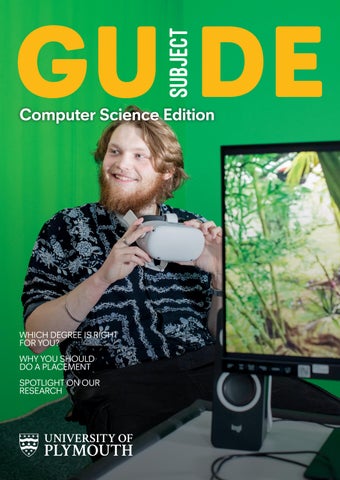
SUBJECT Computer Science Edition
WHICH DEGREE IS RIGHT FOR YOU? WHY YOU SHOULD DO A PLACEMENT SPOTLIGHT ON OUR RESEARCH
Admissions +44 (0)1752 585858 admissions@plymouth.ac.uk plymouth.ac.uk Schools & Colleges Liaison outreach@plymouth.ac.uk
University of Plymouth Drake Circus Plymouth Devon PL4 8AA United Kingdom Follow us on social media @PlymUni
Computer Science Edition
Inside...
SUBJECT
FEATURES: P.10 Which degree is right for me? Which Computer Science course is right for you?
It’s never too early to start thinking about what you would like to do after school or college, or if you are thinking of a career move. At Plymouth, we know that choosing a university and course is a big decision. If you have a career aspiration or an inkling of which profession or industry you would like to enter into but are unsure of what to do next, then this is where our handy subject guide comes in.
P.12 Built for industry, designed for your career How our degrees integrate real-world work and industry knowledge and experience.
Meet some of this issue’s contributors: P.24 Ryan’s story Ryan’s final-year project developing an app to help asthma sufferers manage their condition.
Dr Vasilios Kelefouras Computer Science Admissions Tutor Vasilios shares his top 10 reasons why studying at Plymouth is special. P.4
Esther BSc (Hons) Computer Science (Cyber Security) Esther shares her experiences with her placement. P.16
Daniel BSc (Hons) Computer Science Daniel speaks about his career path since leaving university. P.36
E XPLO R E YO UR FU T UR E H O M E Visit us at an Open Day
Discover our city by the sea
When it comes to finding out if university feels right for you, nothing compares to an open day. Talk to current students and quiz lecturers about your course. You can register to attend here plymouth.ac.uk/open-days
Our city-centre campus is the focal point for student life at the University of Plymouth. Picture yourself studying here with us – we know you’ll enjoy the view.
P.26 Careers support that grows with you Find out how our Careers Service can support you throughout your degree and after you graduate.
4
10 R E ASON S TO S TU DY AT PLYMOU TH If you’ve picked up this guide, you’ve already started considering your future and are perhaps asking yourself if studying Computer Science is something you would like to do, and whether the University of Plymouth is the right place for you. At this stage, you will have a mixture of emotions as you’re going through this process: one perhaps of excitement, maybe nervousness or even stress. This may not be the first guide you’ve looked through saying similar things, and you’re probably overwhelmed with a lot of choices that need to be made. Well, let’s see if I can help you. Here are my top 10 reasons for studying with us for starters!
Dr Vasilios Kelefouras Computer Science Admissions Tutor
5
1. THRIVE IN YOUR FUTURE CAREER
Our Computer Science degrees equip you with an industry focused skill set that is attractive to potential employers. We have a strong network of industrial contacts, some of which visit us every year to give talks and meet our students. We also offer an optional, but highly recommended, paid placement year. Our placement team can help and support you with finding a placement. This industryfocused approach is endorsed by our excellent graduate employment rates, which are well above the sector average.
2. FREEDOM TO EXPLORE
Our degrees all share a common first year and selected common modules in the second year. Modules in your final year allow you to focus on a specific area of interest, i.e. artificial intelligence, cyber security, games development or software engineering. You have the opportunity to transfer between Computer Science degrees at the end of the first year giving you flexibility as your interests develop.
3. OUR HUB AND SPECIALIST LABS
Our Computer Science open plan learning space provides a dedicated space for our community of students, staff and technicians. We also have artificial intelligence, games development, cyber security and software engineering labs to support our suite of specialist degrees.
6
4. YOU WANT TO MAKE A DIFFERENCE
Computer Science continues to shape the modern world, advancing quicker than ever before and benefiting humanity in multiple ways. The application of Computer Science can be found everywhere: it is in our phones, cars, TVs, and even in our bodies, e.g. hearing implants.
5. CHOOSE AN ACCREDITED COURSE
Our Computer Science courses are accredited by the BCS, the Chartered Institute for IT. Accreditation is a mark of quality that provides employers with confidence that your knowledge and skills are cutting edge and that you will quickly become an asset to their organisation
7
6. GAIN REAL-WORLD EXPERIENCE Our ‘learning through doing’ ethos means you build the skills to make you desirable to employers. You will learn by solving real-world problems and by developing real-world applications. You’ll learn from dedicated teaching staff who are actively working at the frontiers of internationally significant research.
7. COLLABORATE WITH OTHERS
Find your place within the team and work on projects from week one. Learn how to develop workflows, processes and understanding that allows your team to innovate. All of our courses are practical to ensure you gain hands-on experience of the topics discussed in lectures.
8
8. RESEARCHINFORMED TEACHING
All your lecturers are active researchers in their field, and their research underpins the curriculum’s content. The University is committed to enhancing your experience of research-informed teaching. Linking teaching with research benefits you in many ways, e.g. developing critical thinking, enhancing employability, improving your confidence and enhancing your experience of real-world issues.
9. EXTRACURRICULAR OPPORTUNITIES Outside of academic life, Plymouth offers a vibrant city surrounded by a relaxing environment in which to study and live. A range of student societies offers something for everyone, with a notable example being CompSoc, our student-run computing society. CompSoc offers regular hackathons and activities and is a great way to meet like-minded students from your course. Lastly, the University campus is located in the city center which makes commuting very easy.
9
10. CHOOSE AN UNBEATABLE LOCATION
By living and studying in Plymouth you can explore the stunning beaches and beautiful countryside Devon and Cornwall have to offer. Only 30 minutes’ drive from the University campus is Dartmoor National Park with its wild, open moorlands, deep river valleys, rich history and rare wildlife. The surrounding landscape has stunning views, awe-inspiring granite tors and deep wooded valleys.
10
WHICH DEGREE IS RIGHT FOR YOU?
BSc (Hons) COMPUTER SCIENCE Technology continues to revolutionise the way we live, build, work, shop, learn and even access medical care. At Plymouth, you will gain handson skills across a range of topics including coding, algorithms, database and software development, cyber security, networks and social, legal and ethical aspects of IT. Through studying with our experts and applying your knowledge, you too will advance new technologies such as artificial intelligence, automation, virtual reality and smart devices. Find out more
about our BSc (Hons) Computer Science degree
BSc (Hons) COMPUTER SCIENCE (ARTIFICIAL INTELLIGENCE) Artificial intelligence (AI) is a rapidly growing field within computer science. With this course you will gain skills in realworld applications, AI theory, and creating tools for Industry 4.0. You will also explore the wider ethical and societal implications of AI. Taught by a team of internationally recognised AI experts, this course offers you an exciting opportunity to engage with world-leading research.
Find out more
about our BSc (Hons) Computer Science (Artificial Intelligence) degree
BSc (Hons) COMPUTER SCIENCE (CYBER SECURITY) Cyber security is now widely recognised as an international priority, with hacking, malicious code and data theft being just three of the many reasons why it’s vital in the design, development and implementation of today’s IT systems. This NCSC certified course delivers a view of security threats and solutions, alongside an essential background in wider IT topics. This is particularly important considering the national Cyber Security Strategy and the current shortage of related skills in the marketplace. Find out more
about our BSc (Hons) Computer Science (Cyber Security) degree
11
BSc (Hons) COMPUTER SCIENCE (GAMES DEVELOPMENT) Create your own apps, indie releases and games while building your profile as a software developer. This course challenges you to innovate in the games sector while honing your software development skills and working for real clients on live projects. Work individually and as a part of a team, and prove your capabilities with tech demos and releases. Our course is built on a core of computer science topics and supported by industry-leading games technologists. Find out more
about our BSc (Hons) Computer Science (Games Development) degree
BSc (Hons) COMPUTER SCIENCE (SOFTWARE ENGINEERING) Computer science and software development drives many of the world’s greatest technologies, helping us to live, learn, build and even save lives. On this course, you will develop the hands-on technical skills that are currently in demand by employers, as well as the appropriate foundations in computer science, software engineering and information systems, to support you in the long term.
Find out more
about our BSc (Hons) Computer Science (Software Engineering) degree
BSc (Hons) COMPUTER SCIENCE WITH FOUNDATION YEAR Our foundation year provides a solid grounding in the disciplines underpinning computer science while developing hands-on skills across a range of topics. You will be introduced to the fundamentals of computing and electronic systems, including programming and software development, ensuring you’re well-prepared for advanced study. Successful completion of the foundation year enables you to progress into the first year of any of our Computer Science degrees.
Find out more
about our BSc (Hons) Computer Science with Foundation Year degree
12
BUILT FOR INDUSTRY DESIGNED FOR YOUR CAREER Real-world work experience from day one with hands-on projects and industry placements Being at the forefront of the next generation of computer scientists means more than learning theory – it means learning by doing, working in industry, tackling real-world challenges and seeing first-hand how computer science operates in practice.
mirrors professional software, cyber and digital teams.
Our Computer Science degrees are built around employability, with a strong focus on the technical, professional and collaborative skills employers actively look for. From week one, you’ll be working in specialist labs on both individual and team-based projects, learning in an environment that reflects how the industry actually works.
As you progress, you’ll develop a portfolio of work that demonstrates not just what you know, but what you can do. This portfolio becomes a powerful way to evidence your technical ability, problem-solving skills and innovative mindset to employers – helping you graduate ready to step into the industry with confidence and impact.
Along the way, you’ll be challenged to develop ideas, solve complex problems and work effectively with others – building confidence as well as capability.
You’ll use industry-standard tools and agile development processes, contribute to real-world and simulated projects. You’ll gain experience that
SOME OF OUR PREVIOUS PLACEMENT PROVIDERS
“We regularly have students securing placements and jobs at FTSE 100 companies. There’s a perception that only students from red brick universities go to these places – but it simply isn’t the case. Our students are highly competitive and win these placements as well.” Nathan Clarke, Professor in Cyber Security and Digital Forensics
13
OPTIONAL PLACEMENT YEAR: PREPARING YOU FOR THE FUTURE
global companies such as IBM, Intel, HP and Microsoft; national and government organisations including the BBC, Met Office and Land Registry; and at local companies and organisations such as Delt Shared Services, Plymouth City Council, Plymouth Marine Laboratory and the University of Plymouth’s Technology Information Service (TIS) department.
“My placement really set me up for the final year by giving me experience of what it’s actually like to do this as a job. It means everything becomes much more familiar and by the time you come back, you think, ‘I know what I am doing,’ and it’s actually a really nice feeling.” Lewis, BSc (Hons) Computer Science (Software Engineering)
In your third year, you’ll have the opportunity to take an optional placement year – a chance to step fully into the professional world and apply your learning in a real working environment.
Whether your interests lie in software engineering, cyber security or emerging technologies, a placement year will help you test career paths, grow your professional network and strengthen your CV. All whilst developing the communication, teamwork and problemsolving skills that set our graduates apart.
“It wasn’t until I worked at Renishaw that I fully understood what it takes to become a successful software engineer. It was the most important year of my degree – and possibly my life – in terms of my career and personal development.” Jodie spent her placement working on software for the neurological products division in the concept and design team at Renishaw.
With a minimum of 48 weeks of full-time employment, the placement year allows you to build experience, confidence and insight that can be genuinely career-defining. Students have secured placements with leading
14
FROM LECTURE THEATRE TO OPERATING THEATRE Jodie O’Reilly
15
WHO WAS YOUR PLACEMENT WITH AND WHAT WAS YOUR JOB TITLE? For my placement year, I worked for a company called Renishaw in Wottonunder-Edge, Gloucestershire. Renishaw is predominantly an engineering company specialising in metrology and precision. Renishaw have taken their expertise in metrology and applied it to many different areas over the years, from industrial manufacturing to healthcare. CAN YOU DESCRIBE THE VARIOUS ROLES AND RESPONSIBILITIES OF YOUR PLACEMENT? I worked within a small team called the Concept and Design Team, who worked solely on software for the Neurological Products Division. Our focus was working on future releases for neuroinspire, a surgical planning software for stereotactic neurosurgery. A new feature for neuroinspire is proposed and researched thoroughly by the research team. As the concept
and design team, we then take the research and create prototype work for the requested feature. Our prototypes take the feature end to end and prove whether it is feasible or not. We also meet with various stakeholders, from management to users, throughout the duration of prototyping to ensure it is heading in the right direction. When complete, the prototype is passed on to our production team who enhance the performance of any complex calculations and then integrate the feature into neuroinspire. When I first started at Renishaw, I was given small tasks to implement in the prototype (for example enabling buttons in certain scenarios and adding labels) to give me a chance to learn the code base. Once my confidence grew, I contributed to more difficult aspects of the development, some of which required a high level of maths and problem-solving. I was also more involved in meetings and demos to stakeholders.
IN TERMS OF YOUR CAREER DEVELOPMENT SO FAR, WHAT HAVE BEEN THE BENEFITS OF UNDERTAKING THIS PLACEMENT? The most obvious benefit would be that I have managed to secure a year of experience before even graduating. This makes you stand out massively when applying for graduate jobs as some candidates may not have been given this opportunity. As the year gave me the chance to massively improve my skills and learn new things, I feel I now also have a chance of getting a higher degree classification than I would have if I went straight into my final year. It was the most important year of my degree and possibly my life in terms of my career and personal development.
16
HOW A PLACEMENT YEAR HELPED SHAPE A FUTURE IN CYBER SECURITY
Esther Lupton A placement year at Salto VisionWorks as a cyber security intern gave Esther real industry experience, boosted her confidence and helped her secure a graduate job before finishing university. From improving her coding and cyber security skills to speaking at tech events and inspiring younger girls to explore careers in STEM, the experience confirmed the career path she wants to follow and showed just how valuable a placement year can be.
ISO 27001, which is an international information security standard. Alongside that, I contributed to the company’s codebase by implementing new features, fixing bugs and helping improve the overall security of systems. The placement gave me experience in both cyber security and software development, which helped me understand how different areas of tech work together in a real company environment.
WHO WAS YOUR PLACEMENT WITH AND WHAT WAS YOUR JOB TITLE? I completed my placement at Salto VisionWorks as a cyber security intern.
HAS YOUR PLACEMENT HELPED YOU WHEN APPLYING FOR GRADUATE JOBS? Massively. I don’t think I would have felt as confident applying for graduate roles without the experience I gained during my placement year.
CAN YOU DESCRIBE YOUR ROLE AND RESPONSIBILITIES DURING THE PLACEMENT? My main role was supporting the R&D department in working towards
I secured my graduate job in February of my final year, and a lot of that came
down to the skills, confidence and experience I built during the placement. It gave me real examples to talk about in applications and interviews, which made me feel much more prepared. DID THE PLACEMENT CHANGE WHAT YOU WANT TO DO AFTER GRADUATION? Yes – it helped me understand both what I do and don’t enjoy. Towards the end of my placement, I spent some time working in software development and realised it wasn’t the right path for me. That gave me a lot of clarity and confirmed that I want to pursue a career in cyber security. HOW DID YOUR PLACEMENT HELP WITH YOUR UNIVERSITY COURSE? It made a huge difference. My programming skills improved a lot, and I became much more confident
17
using GitHub, which made my final-year project feel far less overwhelming. The placement also helped me develop a much stronger work ethic. I found it easier to stay focused, manage my workload and get things done efficiently. WHAT WERE THE BIGGEST BENEFITS OF DOING A PLACEMENT YEAR? It was honestly one of the best things I’ve done for my career. I met so many amazing people and had opportunities I never would have experienced otherwise. During the year, I attended a 12-week cyber security course for women in Cornwall, went to tech conferences and got involved in projects outside of my day-to-day role. It also gave me the chance to experience working life in a supportive environment before
moving into a full-time graduate role, which made a huge difference to my confidence. WHAT WAS YOUR PROUDEST ACHIEVEMENT DURING THE PLACEMENT? Through people I met on the cyber security course, I was invited to give a talk about my role in cyber security to around 100 girls aged 8–10. Being able to share my experience and hopefully inspire even a few of them to consider a future in tech was a really proud moment for me. DID YOU RECEIVE ANY AWARDS, SCHOLARSHIPS, OR MENTORING? I was shortlisted for Cornwall’s “30 Under 30” awards for my contributions during the placement, which was really nice recognition.
I also had fantastic support and mentoring from the people I worked with throughout the year, which helped me grow both professionally and personally. WOULD YOU RECOMMEND DOING A PLACEMENT YEAR TO FUTURE COMPUTER SCIENCE STUDENTS? Definitely. It was one of the best decisions I’ve made. Not only did it help me grow in confidence, but it also gave me a much clearer idea of what I want from my career. I loved the experience and still miss the people I worked with. A placement year also lets you experience the workplace in a more supportive and less stressful way before moving into a full-time role, which I think is invaluable.
18
19
Our specialist “Computer Science might sound like it’s all about labs aid our machines, but ultimately the technology and our researchexist to support driven, hands- projects people – whether that’s making tasks easier on teaching
Having labs combined with the open plan learning space means that students are able to collaborate with each other across disciplines and with industry, exactly as they would in employment.”
through AI, enhancing protection in cyber security, Dr Rory Hopcraft or providing recreation Programme Director for through games design. Computer Science
20
As a computer science student at Plymouth you will benefit from a range of specialist facilities, including six dedicated labs and an open plan learning space. These environments provide diverse hardware and software setups, from high-performance Graphical Processing Units (GPUs) for AI development, to flexible networking infrastructure for cyber security and penetration testing on our cyber range. Open plan learning space – our open plan communal space sits at the heart of our facilities.
While it doesn’t house traditional lab hardware, it offers an ideal environment for collaboration, idea exchange and student-led events. It’s complimented by our artificial intelligence, games development, cyber security and software engineering labs that support our suite of specialist degrees. While we encourage everyone to use the facilities in person for hands-on collaboration with peers and staff, remote access is also available — allowing 24/7 virtual access to our labs.
FIND OUT MORE Explore our computer science facilities
“There’s a fantastic openplan study space with high tables, comfy sofas and plenty of room to work solo or in groups. It’s a great place to meet people, share ideas and get inspired. Studying Computer Science at Plymouth already feels like being part of a forwardthinking, supportive community.” Aspa, Computer Science student
21
“The computers and labs have all the software you’d use for any of your projects. It’s great and ensures that any student can access what they need to.” Charlie, Computer Science student
“I honestly don’t think there’s been a single week where I haven’t used the computing lab at least five out of seven days. Having free, full access to specialised software like MATLAB, VirtualBox, Azure, Eclipse and more has been a game-changer. The technical staff have also been incredibly supportive. They’re always approachable and helpful, whether it’s installing software, fixing equipment or answering questions about specific facilities.” Samuel, Computer Science student
22
THE PLACEMENT CHANGED EVERYTHING Why I chose BSc (Hons) Computer Science and never looked back From building his first website at ten years old to leading projects for real clients during his placement year, Jassim has made the most of every opportunity during his Computer Science degree. Now preparing for his final year, Jassim has gained industry experience, built professional networks and even secured a graduate job offer. We caught up with him to hear why studying Computer Science was one of the best decisions he’s made. “I didn’t expect to enjoy university as much as I have. The experience has been way better than I thought it would be.” “I have just accepted a job offer as an Associate Lecturer in Cyber Security and Software Engineering at Exeter College – which I’ll be doing alongside my final year at the University. I’m really excited about the opportunity, which is not something that would have been possible without the placement!” A PASSION THAT STARTED EARLY Jassim’s interest in technology began long before university. “I’ve been fascinated by computers for as long as I can remember,” he says. “I was always trying to work out how they worked and started learning to code when I was really young.”
As he grew older, that curiosity developed into a passion for solving problems through technology, particularly in cybersecurity. “I realised how much technology impacts everyday people. That’s what made me want to build a career in the field.” WHY I CHOSE THIS COURSE When it came to choosing a university, Jassim wanted a course that offered more than theory. “I looked carefully at the modules and the opportunities available. What stood out was how practical the course felt and how relevant it was to the industry.” The chance to specialise, learn from experienced academics and stay connected to industry made his decision an easy one. LEARNING FROM PEOPLE WHO CARE One of the biggest surprises for Jassim has been the support available from academic staff. “The lecturers are really passionate about what they teach. You can tell they genuinely care about helping students succeed.”
Whether it’s asking questions after lectures, getting advice on career opportunities or discussing future plans, he says support has always been easy to find. “You never feel like your questions are silly. The staff are approachable, supportive and genuinely invested in your success.” MORE THAN CODING While technical skills are a huge part of the degree, Jassim believes some of the most valuable lessons happen outside the classroom. “University helped me become more confident speaking to new people, networking and working with different teams.” Through networking events, industry talks and collaborative projects, he developed skills that employers actively look for. “Learning how to communicate, work with others and build professional relationships has been incredibly valuable.” WORKING WITH REAL CLIENTS One of Jassim’s favourite experiences came during a second-year project
23
where students worked with external clients. His team developed an AI-based project that challenged them to learn new technologies while managing client expectations and working collaboratively. “It pushed me outside my comfort zone and taught me how real projects work.” The experience gave him practical insight into teamwork, project management and problem-solving. “It felt like a genuine industry project rather than a university assignment.” THE PLACEMENT YEAR THAT CHANGED EVERYTHING Although Jassim initially wasn’t sure about taking a placement year, he now describes it as one of the best decisions he has made. After securing a role with software company GOSS, he quickly discovered that placement students are trusted with meaningful responsibilities. “I expected to be given small tasks and sit in the background. Instead, I was treated like a member of the team from day one.”
Within months, he was working directly with clients and leading technical projects. One standout achievement was becoming technical lead on a project that managed sensitive information requests. “All the technical decisions were my responsibility. It was challenging but incredibly rewarding.”
MY ADVICE TO FUTURE STUDENTS For anyone considering computer science, Jassim believes university offers far more than a qualification. “Yes, you learn technical skills. But you also develop confidence, independence, professional networks and real-world experience.” His advice is simple:
The experience helped build confidence and showed him that he could thrive in a professional software development environment. “The placement gave me proof that I could do this professionally. That confidence is priceless.” CAREER-READY BEFORE GRADUATION The impact of the placement has already extended beyond the workplace. Jassim has received a conditional graduate job offer and returns to university knowing he has exciting opportunities ahead. “It takes a huge amount of pressure off. I can focus on finishing my degree, knowing I’ve already got options for the future.”
“Get involved. Go to events, meet people, take opportunities and push yourself outside your comfort zone. That’s where the biggest growth happens.” THINKING ABOUT A CAREER IN TECHNOLOGY? Whether you’re interested in software development, cyber security, artificial intelligence or emerging technologies, computer science gives you the skills, experience and industry connections to build an exciting future. As Jassim puts it: “University isn’t just about getting a degree. It’s about discovering what you’re capable of.”
24
25
AIR QUALITY APPLICATION DEVELOPER
Ryan Perry
For his final year project, BSc (Hons) Computer Science graduate Ryan developed an app that interprets air quality data from monitors sited around city centres. Its aim: to help people with asthma manage their condition. Named Breathe, the app draws on live readings from monitoring stations to give users a clear picture of the air around them — allowing them to plan their day, avoid problem areas and prepare for conditions that might trigger symptoms. For Ryan, who has asthma himself, the project was personal as well as technical. “I didn’t know what I wanted to do after college; to be honest, I felt a bit lost. I’ve always been interested in programming and tinkering, and especially the joy that comes from creating things. Four years ago, when I began this journey, I never thought I would be where I am now. I’ve gone from writing scripts for games in my bedroom to making a difference to real people’s lives. That’s what I want to do with my life. And Plymouth has given me the skills I need to do that. “My final-year project was driven by this same passion. I designed Breathe to help people take control of their environment by giving them the information they need to do so. From activists lobbying their local government to reduce traffic, to ensuring people with respiratory conditions (like myself) can monitor their surroundings and prepare for the unexpected, it offers people the agency to improve their own lives.
“This project is the largest I’ve taken on to date. From inception to delivery, the staff at the University were nothing but supportive. I never would have dreamed I’d be doing this just a few years ago. My experiences at university and on my placement year imbued me with the confidence needed to begin my career as a software engineer, and spend a lifetime solving global problems in ways I never thought possible. “I know exactly where I’m going now, and uni helped me get there.”
26
CAREERS SUPPORT THAT GROWS WITH YOU Career development is embedded throughout your studies. You’ll be introduced to a wide range of computing disciplines while developing the essential professional, communication and teamwork skills needed to thrive in industry.
27 27
EXPERT GUIDANCE, EVERY STEP OF THE WAY Alongside your academic mentors, our dedicated Careers Service bring industry insight directly to you. You’ll receive specialist, personalised support throughout your degree. You’ll take part in our Enhance Your Future programme, which helps you explore career options, shape your goals and understand where your skills can take you. Employer-led sessions and work experience preparation workshops give you invaluable insight into recruitment and selection processes. Our targeted support boosts your confidence in applications, interviews and assessment centres.
REAL CONNECTIONS. REAL OPPORTUNITIES. We open the door to industry early. You will regularly meet employers through careers fairs, guest talks and networking events. You’ll gain direct access to graduate and placement opportunities. You’ll receive individual placement support before, during and after your placement, ensuring you make the most of every opportunity. Our paid work placement programme draws on extensive industry connections, while our industry mentoring scheme matches students with professionals – often University of Plymouth alumni – who offer first hand insight, advice and encouragement from inside the sector. DIGITAL TOOLS FOR CAREER SUCCESS All students and graduates have access to myCareer, the University’s online careers platform. With an extensive vacancy database, CV builder, interview simulator, online courses and video resources. myCareer equips you with everything you need to manage your career – now and in the future.
A SECTOR FULL OF OPPORTUNITY With demand for computing and IT professionals continuing to grow, job prospects remain excellent. The sector has proven its resilience and importance, offering graduates long term career security, flexibility and opportunity. With expert careers support embedded throughout your degree, you’ll graduate confident, connected and ready to make your mark in industry. SUPPORT FOR BUDDING ENTREPRENEURS If your dream is to start your own company by yourself or with a team, we will support you with the help of the The Cube’s entrepreneur programme. The Cube’s services are open to students at all levels of study and graduates. We offer advice, funding and support at every stage of your entrepreneurial journey; you can come to us with anything from an idea to a fully-fledged business. FIND OUT MORE ABOUT THE CUBE’S SUPPORT SERVICES.
“The Careers Service supported me during my placement and helped me secure it. I first heard about the opportunity from my current employer and many others at the careers fair.” Daniel, Computer Science graduate
GET IN TOUCH Follow us on , , or @uniplymcareers Contact us or visit our website for more information. careers@plymouth.ac.uk +44 (0)1752 587456 plymouth.ac.uk/careers
28
I’M NOT JUST HERE TO MAKE THE POWERPOINT PRETTY I CAN WRITE THE CODE TOO After returning to education for the first time since leaving school in 2008, Aspa has discovered a passion for software engineering, ethical hacking and problem solving. Now in her first year after completing a foundation year, she’s using her experience to encourage more women into tech and challenge stereotypes around who belongs in STEM. “I’ve just finished my first year, after completing a foundation year last year – and honestly, it was one of the best decisions I’ve ever made. I left school in 2008 and hadn’t been in education since, so jumping straight into first year would have felt really overwhelming. The foundation year helped me ease back into studying, understand what was expected of me and build my confidence before starting the degree itself. My experience so far has been fantastic. The staff are incredibly supportive, the course content is engaging and interesting, and the facilities are great. Everyone is approachable, which made settling in much easier. One of the most exciting topics we’ve studied so far has been cryptography and ethical hacking. I absolutely loved it. It genuinely felt like being in one of those films where hackers are rapidly typing away cracking passwords – except we were learning the real science behind it.
When I started computer science, I already knew I wanted to specialise in software engineering, and that’s still the path I want to follow. I love problem solving and figuring things out – I’ve always enjoyed a good riddle. What motivates me most is the idea of using technology and my skills to make a positive difference. One thing I’m particularly passionate about is representing women in STEM, especially in computing. My course is still heavily male-dominated, and I want more women to feel confident entering the field. But it’s also important that men become allies. We don’t want people working against us – we want to normalise women working in tech. There are still outdated expectations placed on women about what their future should look like, and it’s frustrating that those stereotypes still exist today. We should be seen for our abilities, not our gender. The same applies in careers like nursing or midwifery, which are often seen as female professions – why shouldn’t men succeed there too?
Women in tech are capable of so much more than the stereotypes suggest. I’m not just the person who makes the PowerPoint look pretty – I can write the code too. What surprised me most about computer science is how many opportunities it opens up. People often assume it’s just sitting at a computer coding all day, but coding is only one part of it. Computer science connects to almost every industry and every part of modern life. One day, the work you do could contribute to life-saving technology, groundbreaking research or innovations that change people’s lives. That’s what excites me most. Whatever your interests are, there’s a place for you in computer science – because technology is part of everything we do.”
29
30
31
INTO ORBIT: BUILDING THE TOOL THAT BUILDS THE WEB
Samuel Holmes “My choice to study Computer Science at the University of Plymouth (or any university, even) was both an obvious one and, equally, one fraught with unknown after unknown. Don’t get me wrong, I’ve always loved programming and computers, but it’s always been more of a means to an end for me. I don’t love spending days and days in front of a screen doing nothing but typing; what I really love doing is making things. Things to make my own life and other people’s lives easier. Every single time I see a notification pop up that someone, somewhere, has downloaded my software – or even when somebody files a bug report to let me know that it’s not working as it should – that’s what I live for. It’s worth the time and effort spent, even if I’m able to help just one person. My final-year project is absolutely no exception to this rule. It is by far the most ambitious software project I’ve ever attempted, and I’m really proud of what it’s turning out to be.
See, making most kinds of websites these days is trivial. Pop on over to Squarespace, Wix or WordPress, and you can have a website up and running within about an hour (all bells and whistles included). That’s exactly what my dad did when he wanted to make a website for his business, both because he could and because it was easy. I love the fact that oodles of much-smarter-than-me developers have made tools that make it easier for folks like my dad to be a web developer without writing a single line of code. Now, that works great for most websites. You have some text, links, images and maybe even some videos and music. Web ‘applications’, however, are a whole different kettle of fish. These are websites like Gmail, Facebook and YouTube. Y’know, complicated stuff. All of those ‘bells and whistles’ from earlier are now all things you have to worry about yourself (and where lots of things can go wrong).
Here’s where my final-year project, Orbit, comes in. It’s designed to allow people like my dad to deploy complicated web applications without having to write a single line of code while automating away pretty much all of the hard parts. I’m going to open source it and release it entirely for free (and continue to support it while I do). As far as I’m aware, nothing quite like it exists yet, and I’m crossing my mostlytyping fingers that it helps as many people as I believe it has the potential to.”
32
A BROAD DEGREE, A CLEAR DIRECTION
Laura Haddy
33
“With a wide variety of modules throughout the first and second year, my degree has allowed me to develop the knowledge I already had before I started university, as well as learn completely new things, one of which was programming. It wasn’t something I had any real experience of beforehand, so getting to grips with it was a genuine turning point — this was something I wanted to learn more about, and is something that continues to interest me. Having now developed programs in languages such as C#, ASP.NET, SQL, HTML and CSS, my degree has given me the knowledge to create and develop several types of applications, from database-driven systems to web-based tools.
My degree is broad, allowing me to develop skills in areas I am more interested in, as well as gain an understanding of areas such as security, and the business aspect of computing. That mix has been really valuable — it means I can look at a problem from a technical angle, but also understand why it matters to the people and organisations involved. All of these skills have prepared me well for my upcoming placement, and are also preparing me for when I graduate. With computing developing more and more every day, it is something that is going to be an ongoing interest for me.”
34
TURNING IMMERSIVE TECH INTO REAL-WORLD IMPACT
My career path since graduating “Different gaming companies came in to give us advice and insights into the industry, which helped me secure a year’s paid placement as a game engine programmer.” After graduating, I went on to complete a PhD in immersive data visualisation, specialising in virtual reality (VR) for complex data. Since then, I’ve built over a decade of experience teaching in higher education across game technologies, AI, programming and graphics, working with tools like Unreal, Unity and Godot. Today, I’m a Research Fellow at the University’s Centre for Health Technology, where I use immersive technologies to tackle real-world challenges. My work includes developing XR (extended reality) solutions to reduce digital exclusion, creating training to support autistic individuals in the workplace, and leading an innovative project that uses a custom paragliding simulator to improve mobility and reduce frailty.
My time studying at Plymouth played a key role in shaping this path. For my finalyear project, I created a fully immersive paragliding simulator – an ambitious idea made possible by strong academic support, industry links and access to specialist resources. That experience helped set the foundation for the research and impact-driven career I have today. “Studying for this degree at Plymouth was crucial, because it allowed me to explore unique projects and focus on the area that really interested me.” Dr Marius Varga, BSc (Hons) Computing and Games Development graduate, PhD Computing. Research Fellow in Healthcare Technology and Social Care at the University of Plymouth.
FIND OUT MORE About Dr Varga and his work
35
36
37
FROM PLACEMENT HUNT TO JUNIOR DEVELOPER Daniel Hirst
WHAT ADVICE WOULD YOU GIVE TO A PROSPECTIVE STUDENT CONSIDERING STUDYING, AND THUS DEVELOPING THEIR CAREER, IN THE SAME FIELD AS YOU? “Software development is a growing industry, which puts you in a good position when you graduate. From speaking to other developers, what struck me is that you’re constantly learning and improving your understanding of concepts. No two projects are quite the same, and there’s always a new tool or approach to get to grips with — that’s what attracted me to the field in the first place, and it’s still what I enjoy most about it. My main piece of advice would be not to underestimate the importance of soft skills. The technical side is what most people focus on, but being able to explain your thinking clearly, ask the right questions and work well within a team matters just as much. One way to build those skills is to get a part-time job involving customer-facing work — it’s good practice for dealing with people in a professional setting. Coming across professionally on video calls can also be difficult when you’re working from home, so one method I use is to have a dedicated space that I only work in. That separation keeps my work and home life in balance, and it makes it much easier to switch off at the end of the day.”
TELL US ABOUT YOUR CAREER PATH SINCE GRADUATION. “Since graduating, I have been working at Software Solved, a software consultancy based in Exeter. My role is Junior Developer, and in less than a year I’ve already learned about and contributed to a wide variety of projects. Working for a consultancy means the work changes regularly, so I’ve been exposed to different clients, different technologies and different ways of working — which has been a great way to build experience quickly and find out where my strengths lie.” WHAT IS THE MOST REWARDING ACHIEVEMENT YOU HAVE EXPERIENCED THROUGHOUT YOUR CAREER, TO DATE? “Securing my software placement was a huge achievement. Like a lot of people, I strongly dislike the interview process, and I applied to a lot of different companies in the hope of landing a placement for my final year. There were plenty of knockbacks along the way, but each one taught me something, and going through it gave me a real insight into how different companies approach interviews and what they’re looking for. It was hard work, and that made finally getting the offer all the more rewarding — it felt like proof that everything I’d been working towards at university was paying off.”
38
SPOTLIGHT ON OUR RESEARCH
At Plymouth, research is at the heart of everything we do. Many of your lecturers are active researchers, working on real-world challenges which they bring directly into the classroom. As a computer science student, you’ll learn from experts who are shaping the future of technology and have opportunities to contribute to exciting research projects of your own. From tackling cybercrime to developing AI-powered technologies that protect our oceans, our research is making a difference around the world. CYBER SECURITY AND DIGITAL FORENSICS Help tackle some of the biggest digital challenges facing society today. Our researchers work on areas including: • Cyber-attacks and online safety • Digital investigations and forensics • AI-powered security systems • Biometrics and identity verification • Cyber awareness and education. Working closely with industry, law enforcement, defence organisations and international partners, you’ll gain insight into how cyber security is applied in the real world.
Recent student projects: • Ethical hacking and AI-generated malware • Digital forensics and passwordcracking techniques • Cyber awareness and online safety education • Designing and testing biometric systems • Security for connected and autonomous technologies. These projects help students develop highly sought-after technical, analytical and problemsolving skills while tackling genuine industry challenges. ARTIFICIAL INTELLIGENCE, ROBOTICS AND DATA SCIENCE Discover how emerging technologies are transforming industries and solving global problems.
Our researchers are developing intelligent systems and robotic technologies for applications including: • Healthcare • Environmental monitoring • Defence and security • Autonomous vehicles and drones • Human-centred AI. Through collaboration with industry and international research partners, you’ll explore how AI and robotics are being used to improve the way people live and work. Recent student projects: • Autonomous drones • Intelligent healthcare systems • Robotics for hazardous environments • AI-powered decision-making tools • Human-centred AI applications.
39
RESEARCH WITH REAL-WORLD IMPACT
PROTECTING OUR OCEANS WITH AI “By combining deep learning, autonomous drones, edge AI and realtime visual analytics, we’re developing technologies that can monitor marine life, assess ocean health and support renewable energy infrastructure. Computer vision is becoming a powerful tool for protecting our oceans, supporting climate resilience and advancing sustainable marine technologies. Our students have the opportunity to work at the forefront of AI-driven innovation and contribute to research with global impact.” DR DENA BAZAZIAN Lecturer in Robotics and Machine Vision
RESEARCH-INFORMED TEACHING “Research and industry engagement are central to everything we do. Whether we’re testing the security of maritime systems in our nationally unique Cyber-SHIP Lab, exploring how the human brain can inspire new AI technologies, or developing innovations for healthcare and medicine, our research directly shapes what we teach. This means students benefit from cutting-edge knowledge and opportunities to work on exciting, real-world projects throughout their studies.” PROFESSOR NATHAN CLARKE Professor in Cyber Security and Digital Forensics
IT’S YOUR FUTURE MAKE IT COUNT Over 93% of our graduates are in work or further study*
Apply
now
* Excludes those travelling, retired or caring for someone, out of all UK domiciled, full-time first-degree graduates. Graduate Outcomes Survey 2026
DPC26318