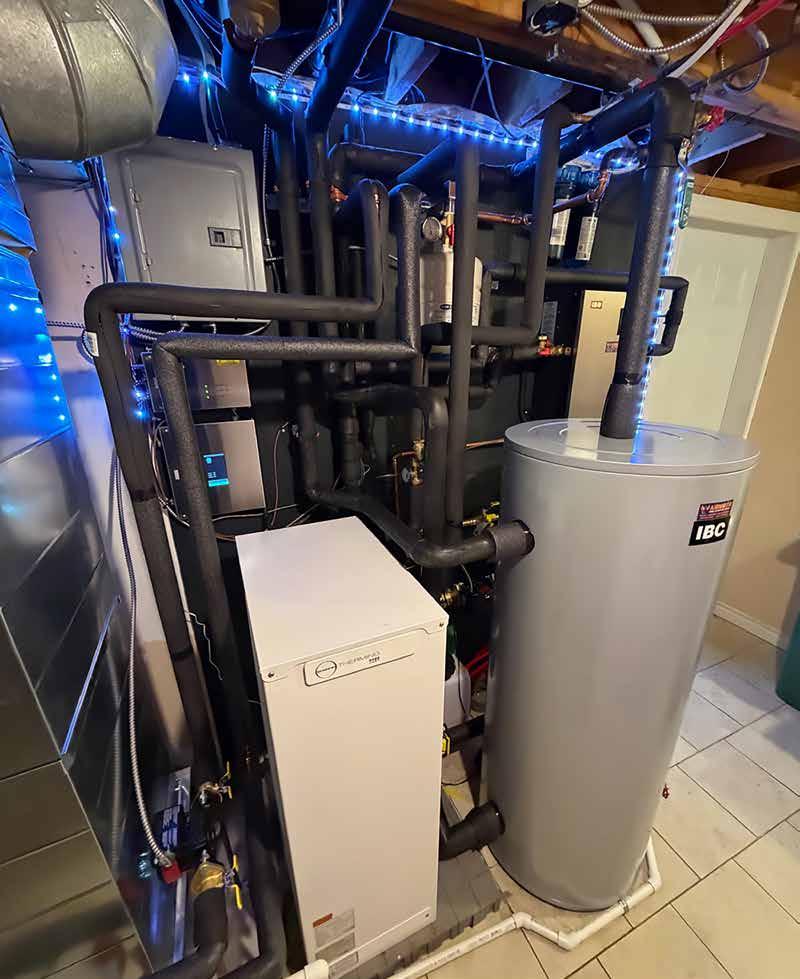
Learn about some of the latest hot topics hitting the hydronics sector.
INSIDE
n Designing hydronics made easy
n Recirculation sizing
n Hydronics products
n Integrating smart controls
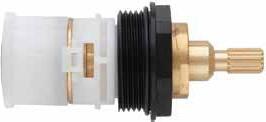
Power thermostatic cartridge
# 02-01686
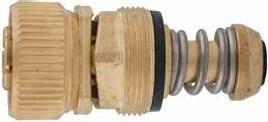
Oasis bubble cartridge
# 02-01615
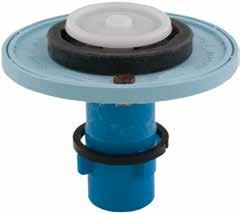
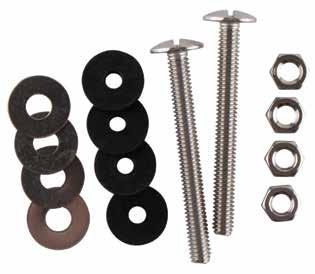
Zurn commercial flush valve repair kit
# 02-01303 – 1.5 gal.
# 02-01304 – 1 gal.
# 02-01308 – 1.6 gal.
# 02-01307 – 3.5 gal.
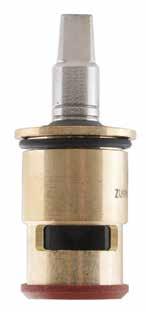
Zurn ceramic cartridge (hot)
#02-01673
Zurn ceramic cartridge (cold)
# 02-01674
Choosing the proper size of circulator will help ensure the system isn’t over pumping and that the piping isn’t damaged.
RECIRCULATION SIZING
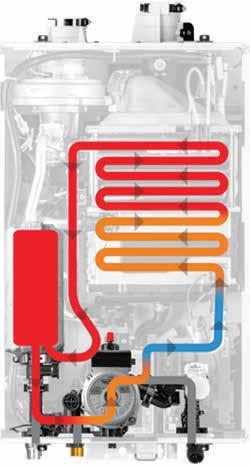
A recirculation system primes the pipes for when there is a need for hot water without having to drain any water from those pipes and waste it.
By David Holdorf
View the full presentation on “Proper Sizing and Installation for DHW Recirculation” here:
Recently, I was invited to present at Plumbing & HVAC magazine’s Hydronics Technical Training Day. I was really looking forward to this opportunity again. What topic do I talk about this time? Yes, I do spend a lot of time talking about hydronics, circulators, circulator sizing, and controls, and being that this was the Hydronics Technical Training Day, I thought I might mix it up a little bit and talk about some plumbing.
I decided to bring up the topic of domestic hot water recirculation and circulator sizing. Wait, what does he mean sizing a circulator for domestic hot water recirculation? You might think “It’s not that complicated, not like sizing circulators for a heating system. This is so much easier, you just slap a pump in it and call it a day; you’re done!” However, that statement is so far from the truth.
Sizing circulators for domestic hot water recirculation is very important. Often, these circulators are oversized just like they are for heating systems. However, when circulators are oversized for heating systems, it doesn’t mean the system doesn’t work, it doesn’t mean the system is not heating, it just means that our system may short
Continued on page “35”
n Hydronics Technical Training Day
Continued from page “33”
cycle a little too often, creating inefficiencies. When a circulator is oversized for a domestic hot water recirculation system, it doesn’t mean that the water is going to get there faster or hotter, making it more convenient, it becomes detrimental to your plumbing systems.
Damage to pipes
Sizing a recirculation system is important because when the circulator is oversized, you end up with a high velocity of the water flowing through the pipes. This high speed can cause damage to the interior wall of those pipes, whether they are PEX, copper, or your pipe of choice.
It really comes down to the definition of what a domestic hot water recirculation system is. A hot water recirculation system is a plumbing system that replaces hot water to fixtures without draining and wasting water. Recirculating systems mechanically moves temperature from a water heater to the fixtures. I want to focus on that last sentence, it said “moves temperature from a water heater to the fixtures.” It is not looking to move water at a high flow rate. A recirculation system just needs to prime the pipes for when there is a need for hot water without having to drain any water from those pipes and wasting it.
In order to not design or install a recirculation system with a high velocity, you want to maintain a velocity of around two to three feet per second running through the pipes. In a residential system, that flow rate will be anywhere between 1.1 and 3.2 gallons per minute maximum depending upon pipe size and type. Those flow rates are not targets; they are maximums. The flow rate can be lower, and I suggest that we try to design as low as possible. The copper pipe manufacturers, as well as your plastic pipe manufacturers, will give you those recommendations on flow rate based upon keeping two to three feet per second.
Pinhole leaks
What is detrimental about a high flow rate and a high velocity? Pinholes. Pinhole leaks in the piping. Well, it can’t just be the velocity that’s going to create those pinholes, other contributing factors are having elevated water temperatures at or above 140 F, the chlorines and chloramines that are in the water itself, and continuous circulating systems. All these factors together can start to create those pinhole leaks.
As the installing contractor or the designer of a recirculation system, we have the ability to control quite a bit and try to eliminate those pinholes from ever occurring. By choosing the correct circulator and setting it up properly, you can get the speed down to two to three feet per second.
So, how do you size a residential domestic hot water recirculation system to minimize the velocity and still provide the comfort and convenience of delivering hot water to the fixtures? All that is needed is just a little bit of information.
The type and size of that pipe and the approximate length of each size to the furthest fixture from the water heater. All you need is is the approximate length, and the number should end in five or zero. You should be able to eyeball a length of pipe being 10 feet long so stand there in the middle of the house, look at the water heater and assume, “Well there is 3/4-inch copper and that runs for 50 feet and the last little bit is some 1/2-inch hitting that last fixture at about 30 feet. From there, we run some 1/2-inch PEX all the way
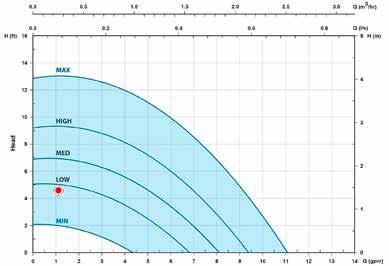
Understanding pump curves will ensure the correct circulator has been picked.
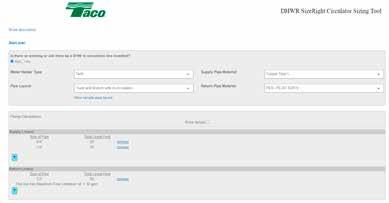
By plugging in the system’s information into sizing tools, the math is completed for you.
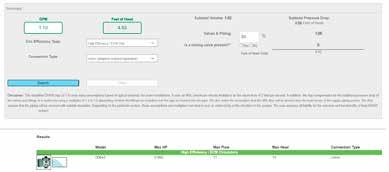
Design software can now simplify picking which circulator is best for the installation.
back to the water heater for a length of about 80 feet.” If you start taking out the tape measure, you’re working too hard!
With this information, we can now open up the sizing app to do the math for us. When you open the DHWR Size Right circulating sizing tool, it’s going to ask you some basic questions about the system you’re working on: the type of water heater, your pipe layout, and the piping material being used.
Continued on page “37”
n Hydronics Technical Training Day
Continued from page “35”
The right tool for the job
Once you finish with those questions, then you input the information about the size and length of pipe installed. Hit search and it will calculate everything that is needed; it will select a circulator and more importantly the setting of that circulator to achieve the flow rate that is needed for this system focusing on not oversizing the circulator.
It really doesn’t get any easier than this. For our example, it used 1.1 GPM at the maximum flow rate based upon the 1/2-inch pipe size used and had an estimated head loss of 4.6 ft. of head. This flow and head combination for this project is relatively low. Making the correct choice of circulator is critical to ensure we are not over pumping.
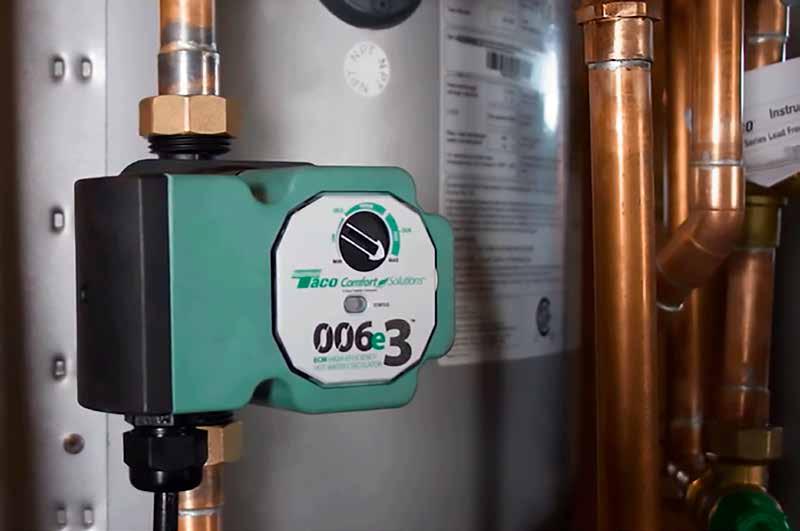
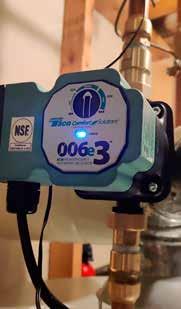
Standard fixed-speed circulators, when chosen, will probably still over pump a recirculation system and therefore can still create those high velocities we are trying to avoid. A variable speed circulator has an adjustment to change the speed of the circulator to match the flow rate the system needs. This dial allows you to adjust the speed, not just a selection of one of three speeds, but wherever you stop the dial, that’s the speed you get from a minimum of four watts to 44 watts.
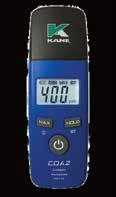
For over 70 years, KANE International has been at the forefront of HVAC/R innovation, providing professionals like you with the tools they need to succeed. Now, upgrading to the unparalleled performance and reliability of KANE is easier than ever with our industry-leading trade-in program.
For our project, a setting of just below low (seven watts of power) will be more than enough.
Domestic hot water recirculation systems are all about comfort and efficiency, but that requires more than just installing a pump. Oversizing a circulator doesn’t improve performance, it can damage piping, waste energy, and shorten system life. By focusing on proper sizing, maintaining low velocities, and using tools like the DHWR Size Right app, designers and installers can ensure systems deliver hot water quickly without compromising reliability. In the end, a little attention to detail during design can save significant headaches down the road, ensuring both comfort and system longevity.
Dave Holdorf has been in the hydronic industry for 25 years, specifically in the radiant heating side of the business, for the better part of his career. Starting in the technical support/design role, and then took over as engineering manager, overseeing the technical support and design department. He has been with Taco Comfort for over 13 years.
Domestic hot water recirculation systems are all about comfort and efficiency but that requires more than just installing a pump.
Zero Hydronic Solutions
LOW CARBON HYDRONIC HEATING, COOLING AND DOMESTIC HOT WATER SYSTEMS
u Natural Gas Alternatives for Electrification
u Trusted Performance, Quality and Reliability
u Reduces Energy Consumption Over Comparable Natural Gas and Electric Resistance Heaters
u Strong Canadian Customer Support Team
ECODAN
STEP BY STEP GUIDE: DESIGNING HYDRONICS
Modern software takes away the grunt work required for designing hydronic systems.
By Michał Strzeszewski
View the full presentation on “Step by Step Guide to Designing Hydronic Heating/ Cooling Surface Systems” here:
Designing hydronic systems can feel quite daunting. The passion, artwork, and ingenuity that goes into these types of systems are palpable anytime you walk into a mechanical room.
A simple tool for hydronic professionals is the Audytor SET program. It is designed to graphically support the design and adjustment of central heating installations, cold, hot and circulation water installations, as well as central cooling installations in which the medium is water or water glycol solution.
A program with a built-in mechanism for importing building bases from Autodesk Revit and exporting the installation design to Autodesk Revit. The Audytor SET 7.4 program introduced the possibility of designing surface systems — an underfloor system, a ceiling system, and a wall system.
The Audytor SET software encompasses four specialized modules dedicated for the following types of systems:
Audytor CH: central heating systems
Audytor CC: central cooling systems
Audytor H2O: domestic water supply systems
Audytor FC: quick heat load estimation and quick calculations for hydronic central heating and cooling systems
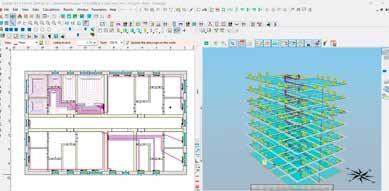
The Audytor SET software offers two design methods: diagrams or floor plan views. The second method results in an automatically generated complete 3D model of the system, see Figure 1.
Continued on page “43”
n Hydronics Technical Training Day
Continued on page “43”
Figure 1: Plan view and 3D model of the convection heating and underfloor heating system in Audytor SET.
Cooling design
When commencing a design in Audytor CH software module, it is essential to define general parameters of the system, with mandatory and optional parameters.
The program makes extensive use of data inheritance techniques. It involves the ability to define default data for the entire system or its parts. Then, the default data is automatically accepted by the program, unless the designer sets a different value manually for a given element.
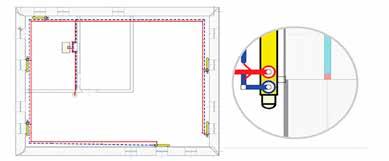
In this case, the data entered manually takes priority over the default data. The data inheritance technique not only saves time (there is no need to enter duplicate data multiple times) but also allows for a quick analysis of alternative variants (typical data is changed only once in one place). When you change the default data, all inherited values are updated automatically (just note that manually set data is not changed). Once the model of the building has been obtained, Audytor SET allows modelling the HVAC system, see Figure 2.
Figure 2: Plan view of pipes and radiators connected in Audytor SET.
After drawing the system model, the calculation function needs to be called.
Diagnostics
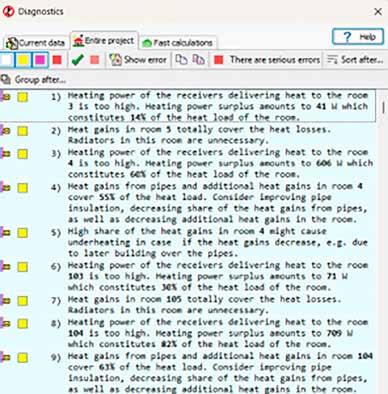
The program has an extensive data and results diagnostics module. To evaluate the diagnostics of results generated by the program, messages are classified using four colours, according to their relevance, see Figure 3.
White: Informative, no action required.
Yellow: Minor warnings, not critical.
3: Diagnostic window for results in Audytor SET software.
Purple: Serious issues that should be corrected if possible. Red: Critical errors.
Once calculations are validated, results can be viewed in general tables where you’ll find information on pipe types, heat source parameters, etc.; room-by-room results where you’ll see heat load and selected radiators; valve preset tables, with a list of valves with their preset values; and pipe circuits, including calculation details. which is useful for identifying potential problems. The calculation results are also available in the results drawings.
The Audytor SET software modules represent a comprehensive solution for the development of heating systems, facilitating the work of engineers and designers by enabling a more agile, automated, and accurate design process. Due to their functionalities of quick estimation, automatic selection of components and detailed hydraulic calculations, these modules can improve efficiency and significantly reduce the time required to complete the design.
The ability to calculate system fragments, based on their graphical representation, along with the integration of predefined parameters of radiator and pipe selection, allows professionals to obtain accurate and reliable results.
Hydronic professionals interested in checking out this software can do so as part of a free trial.
Michał Strzeszewski is the director of research and development at Sankom. He has 25 years of experience in developing engineering software. He is also a faculty member at the Warsaw University of Technology, in the Department of Air Conditioning and Heating.
Figure
RELIABILITY MEETS EFFICIENCY
00e Series High-Efficiency Circulators
At
. That’s
When
n Hydronics Products
Biofuel boiler
Weil-McLain, Burr Ridge, Illinois, announces that its Ultra Oil, WGO, WTGO and SGO residential oil boilers are now certified for use with biofuel blends up to 100 per cent (B100). A B100-compatible boiler is one that operates on a fuel blend containing 100 per cent biodiesel. WeilMcLain’s residential oil water boilers have an AFUE rating of 87 per cent, and its Ultra Oil boiler features a three-pass heat exchanger.
Weil-McLain u www.weilmclain.com
Self sensing in-line pumps
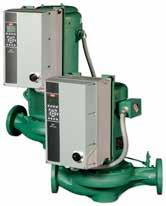
Taco Comfort, Cranton, Rhode Island, adds to its pump technology product portfolio with its SKV series SelfSensing vertical in-line pumps. The SKV series features Taco’s advanced SelfSensing capabilities with the Oe Package, utilizing an IE5 permanent magnet motor technology. By integrating IE5 permanent magnet motors, these pumps significantly reduce energy consumption, lower operating costs, and support sustainability goals.
Taco Comfort u www.tacoinc.com
Descaling pump systems
High-voltage boiler
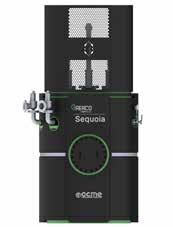
Aerco, Blauvelt, New York, expands its Sequoia high-voltage electrode hot water boilers series with the introduction of the Sequoia J and Sequoia S models for large commercial and industrial applications. The Sequoia J and Sequoia S are alternatives to traditional fossil-fuel boilers, converting nearly 100 per cent of electrical energy into steam with zero combustion emissions to reduce the carbon footprint. The Sequoia J is available in models from six MW to 70 MW. The Sequoia S is available in capacities from two MW to 70 MW.
Aerco u www.aerco.com
Three-piece ball valve
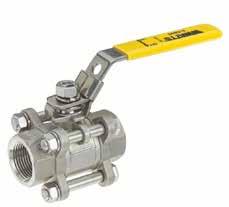
Watts, North Andover, Massachusetts, launches its new line of three-piece stainless steel ball valves for industrial applications. The Series S-6800, S-6801, and S-6802 models all feature a stainless steel body, ball, stem, and handle, offering superior corrosion resistance. The ball valves are available with threaded, socket weld, and butt weld end connections, and come in sizes ranging from 1/4 to two-inches.
Watts u www.watts.com
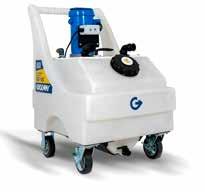
Goodway Technologies, Stamford, Connecticut, launches its new line of descaling pump systems, PulseFlo. Each PulseFlo unit features acid-proof pumps and fittings, an easy-to-reach on/ off switch for enhanced operator safety, and a compact design for easier access to equipment and improved maneuverability. The PulseFlo is available in two models: the GDS-200 and GDS-400. The GDS200 features a 50 GPM flow rate, ideal for cleaning systems with capacities of 50 to 500 gallons. The GDS-400 features a 95 GPM flow rate and is ideal for applications that handle 100 gallons or more Goodway Technologies u www.goodway.com
Wall-hung condensing boiler
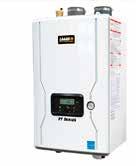
Laars, Halton Hills, Ont, released its new FT series wall-mounted boiler, with user-friendly controls to allow access to current and past fault codes. It also features a removable front panel, that is secured by four screws, to ease serviceability. This high-efficiency, wall-hung condensing boiler has a 199 MBH heat input with full modulation and a stainless steel fire tube exchanger. It requires category four venting using PVC, CPVC, polypropylene, or stainless steel, and a maximum vent run of 50 ft. with a two-inch diameter pipe, and 100 ft. with three-inch diameter pipe. Annual maintenance kits are available, and many parts are used across multiple FT models. Standard warranty includes 10-year limited coverage on the stainless-steel heat exchanger and a five-year parts warranty. Laars u www.laars.com
n Hydronics Technical Training Day
INTEGRATING SMART HYDRONICS
Make sure to use language that a homeowner would understand when discussing hydronic controls as there are still many out there that believe they have a furnace when in fact there is a boiler in their mechanical room.
By Francesco Lo Presti
View the full presentation on “Integrating Smart Hydronics,” here:
During our Hydronics Technical Training Day event, we hosted a panel discussion on integrating smart hydronics. This discussion featured Bo DeAngelo of Stone Mountain Technologies, Jeremy Young of Pro-West Sales, Dave Holdorf of Taco Comfort, and Jay Vath of tekmar Controls. Our editor, Leah Den Hartogh, moderated this discussion, which focused on residential hydronics and controls. Below are some highlights from the discussion.
Question: Controls in hydronics can mean a wide variety of products within a system. What components would you say fall into that category?
Young: Generally speaking, we are talking about everything from the thermostat to zone controls, which feature circulators and valves, as well as priority controls for various tasks, focusing on loads such as domestic hot water, outdoor reset, and staging. There are numerous places for controls in hydronics, and I like to think of controls as a concept. Controls need to
be a major part of the design phase, well before you start piping. It is an underappreciated part of the industry.
Holdorf: I’d look at the thermostat, which is probably the most powerful piece of equipment we can put in someone’s home. The reason I say that is because there is no such thing as a house having a normal number of zones. Because of this, the thermostat becomes so powerful because it’s the only interface to what goes on in the basement. I’m sure all of us have had conversations with customers who say, “You can come take a look at my furnace, but it’s actually a boiler.”
The thermostat is extremely powerful because homeowners want to have more and more zones, and the thermostat is their control.
Vath: I’d like to expand on that and add that mobile apps are also a part of your control system. For many people, these apps serve as their primary user interface for their heating and cooling systems. Whether it’s a phone or tablet, those devices and apps are how homeowners see their systems. I also completely agree with Dave that homeowners are scared of mechanical rooms. They are very reluctant to open the door, and even those who do are very nervous.
Observation from chat: The term mechanical room gets glazed over; we should try referring to them as indoor comfort equipment rooms.
From top left to bottom right: Bo DeAngelo of Stone Mountain Technologies, Jeremy Young of Pro-West Sales, Jay Vath of tekmar Controls, Leah Den Hartogh of Plumbing & HVAC magazine, and Dave Holdorf of Taco Comfort participated on a panel discussion about integrating smart hydronic controls on Nov. 12.
Question: Jeremy, you highlighted how controls should be considered a concept. Can you explain what an effective controls concept should look like?
Young: I always like to start from the end, with the person/user who just sees this thing on the wall. Ultimately, we start with comfort, which can involve a sensor for a snowmelt system or an aquastat in a domestic hot water tank. No matter what, the signal starts at the load and works its way back from there, which goes to some kind of controller for zoning, aka the right valves or circulators, depending on the load. You also need to enable your heat source, which differs in hydronics from forced air.
With forced air, you have an immediate call for heat, and immediately, the furnace or heat pump turns on. Hydronics is responsible for targeting water temperatures, so I always like to think of hydronics as a conveyor belt — you put heat into the water at the beginning, and it needs to be carried down the belt to the finish line. But just because there is a call for heat doesn’t mean the appliance needs to be turned on, which becomes more prevalent in systems with buffer tanks. As long as the sequence is followed — thermostat to zone controller to circulator to analyze water temperature — you can deliver reserved heat effectively.
DeAngelo: To go back to Jeremy’s point on concepts, one of the things that’s very important in residential hydronic controls, especially when talking about
Continued on page “47”
"When it comes to talking controls to homeowners, I find that a lot of us talk to them in our “speak”, which can put homeowners off. I call it ‘hinge neck syndrome,’ as they are just nodding and saying yes, but they are thinking, ‘When will this person leave?’ So, we need to do a better job of talking to customers in their “speak."
APPROACH TO
ductless innovation A SMARTER
Simplified Inventory & Mix-and-Match Flexibility
Only 40 SKUs across three unique lines – UltraTM, Achiever Plus® and Achiever® Series—allow for optimal inventory management.
4 Indoor Unit Options – Wall-Mounted, Ceiling Cassettes, Concealed Ducted, and Air Handlers.
FastPro® Technology on wall-mounted units1 allows for quick access to internal components without full disassembly.
Heat pump operation as low as -22°F (-30°C) on UltraTM Series Single-Zone
n Hydronics Technical Training Day
Continued from page “45”
radiant heating systems, is the design and understanding of the objective of the thermal comfort of the envelope. What I usually see in the thousands of radiant floor heating systems I’ve designed, when it’s left to the homeowner or architect/builder, the system is not strategically zoned.
In a radiant heating system, the rule of thumb is that you can’t have too many zones, as you have so much control over the system, and there can be a
significant difference between rooms. It’s important to understand what that zoning strategy is. Going back to the beginning in the design phase, I always consider how the building will be used and gain a good understanding of how it will be controlled, as well as the desired level of comfort.
Vath: I’d add that it’s essential to understand who your customer is and what matters most to them. For example, the important thing may not be about comfort. I’ve had customers who are very focused on efficiency and decarbonization, so you need to learn what’s important to them and then design the system to accommodate their needs.
Question: What suggestions would you give installers when talking/ explaining hydronic controls to customers?
DeAngelo: I would try to instill the idea that the simplest approach is often the best. Controls can become quite complicated, so it’s essential to simplify the system as much as possible to achieve the homeowner’s objective. I would also try to listen attentively and understand what the customer wants, while also being confident in providing suggestions that help meet the objectives.
Holdorf: I agree; make it simple, but don’t make it simplistic. When it comes to talking controls to homeowners, I find that a lot of us talk to them in our “speak”, which can put homeowners off. I call it “hinge neck syndrome,” as they are just nodding and saying yes, but they are thinking, “When will this person leave?”
So, we need to do a better job of talking to customers in their “speak.” Explain it to them in words and ideas that they can easily understand. For example, in this conversation alone, we’ve referenced outdoor reset, which everyone here knows. But does the homeowner know what that means? You know, when you’re talking about this and start mentioning that when it gets warmer outside, the water’s going to get cooler, homeowners get confused and start thinking, “Wait, you’re sending cold water to my house?” So, when it comes to outdoor reset, I like to explain it like cruise control in a car; it’s all about fuel economy, which is something they can understand.
Vath: You know, hydronics systems are typically two to three times more expensive than forced air systems. So, when you’re selling hydronics, you really need to appeal to how the customers will feel. You’re essentially selling them the vision/dream of feeling comfortable all the time. Sometimes I feel we get too caught up with explaining/selling the details rather than the experience.
I’d also like to highlight that when you’re dealing with custom homes, architects, and interior designers, not only does the system need to function properly, but it also needs to look aesthetically pleasing. The system also depends on the customer’s aesthetic preferences and their desired outcome.
Observation from chat: A picture is worth a thousand words. Many of us understand concepts and designs better than words/talk.
Young: I agree and believe it’s essential to leave behind wiring diagrams, piping schematics, or some sort of clear understanding of the sequence of operation when talking about complicated mechanical systems.
-30°C
UNIX SERIES
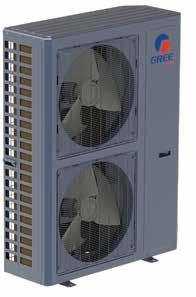
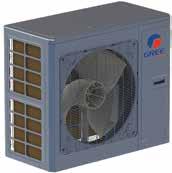
HIGH-EFFICIENCY CENTRAL HEAT PUMPS WITH CASED COILS
Heat pump combination AHRI Certified for installation with ANY 3rd party furnace.
OFFICIAL DISTRIBUTOR IN CANADA
ROOFTOP
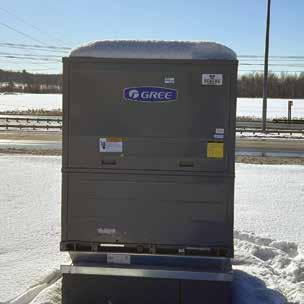
COLD CLIMATE
DC INVERTER HEAT PUMP
Two-stage, two-cylinder compression and hot gas injection for unparalleled heating efficiency.
Eligible to financial incentives in certain provinces, contact us for more detail.
SPARE PARTS
TO FULLY SUPPORT OUR DEALER NETWORK
*GREE Canada is not responsible for warranty on units sold outside GREE Canada’s sales channel.
For more detail, contact our team at proservice@gree.ca.