The purpose of the publication is to raise awareness and provide education about youth physical activity, fitness, and play. It is not considered an all-encompassing resource. Please refer to manufacturer specifications and safety warnings, which are supplied with equipment, and continue to provide recommended safety inspections. While the intent is to provide general information, the authors and program sponsors disclaim any liability based on the information contained in this resource. SHAPE America, PlayCore, and its family of brands provide these comments as a public service while advising of the restricted context in which they are given. ®
This book, or parts thereof, may not be reproduced in any form without permission from the publisher.
PlayCore develops and disseminates high-quality research and publications, and we are unwavering in our commitment to accessibility and the rights of all people to learn and participate. For special accommodations or an alternate format of this publication, please submit your request to core@ playcore.com
The Fun-damentals of Play On!
Play On! History
In 2008, Play On! was created as a set of Playground Activities to help maximize use of the playground space by providing fun and well-rounded activities for children that aligned with physical education teaching standards. Play On! playgrounds were designed as high-quality outdoor play environments that could support the implementation of these activities and therefore promote health and wellness in schools and parks.
Research on the profound impact playground design has on the type, intensity, and enjoyment of children’s play has only grown over the years and it’s become clear that Play On! playgrounds are used for so much more than just structured physical education. This Play On! Best Practice Design Guide is a valuable resource to help
communities design a high-quality playground that intentionally promotes active play – with or without the companion Play On! Playground Activities. Of course, try out the Playground Activities to make an even bigger impact on children’s physical activity and fitness, promote engagement, and to make programming easier. Investing in high quality playground design and programming playground spaces is good for everyone!
BEST PRACTICE DESIGN GUIDE
High-quality playground design can serve as a powerful tool for communities to support children’s health and development. The Play On! Best Practice Design Guide aims to promote physical activity and improve physical fitness through the creation of well-designed outdoor play environments. This Design Guide provides comprehensive information about the importance of play, physical activity, and physical fitness for childhood development, emphasizing how playgrounds in parks and schools serve as settings to encourage these vital outcomes.
The Design Guide provides evidencebased design recommendations centered around the six elements of active play to ensure playgrounds are thoughtfully equipped to foster diverse engagement and developmental progression while helping children to establish healthy habits that last a lifetime. Additionally, the Design Guide includes case studies of three
exemplary playgrounds that successfully implemented these principles, offering practical examples and inspiration for creating dynamic play spaces that support physical activity and physical fitness.
Play, Physical Activity, and Fitness
Play is not just about fun. It is important to understand three concepts that are central to designing and maximizing the benefits of a Play On! playground. First, we describe play – a broad concept best described as a state of mind – anything can be playful if it’s absorbing and done solely for the enjoyment of the activity. One type of play is active play – which is physical activity, a health behavior that is widely known to be related to numerous physical, psychological, and social benefits. Many physical activities help develop one’s physical fitness, or ability to do more activities – being strong, fast, and
flexible. But the relationship goes both ways – children who are more fit are better able to successfully participate in a range of physical activities.
THE BENEFICIAL RELATIONSHIPS BETWEEN PLAY, PHYSICAL ACTIVITY, & FITNESS
There are multiple types of PLAY that benefit whole-child development in domains like physical, social, and cognitive.
• Play with Objects
• Symbolic
• Imaginative or Sociodramatic
• Play in Nature
• Rough and Tumble
• Games with Rules
• Risky
Each type can be ACTIVE PLAY if children are moving
Certain intensities and types are PHYSICAL ACTIVITY that impact lifelong health and wellbeing
The variety and intensity impact PHYSICAL FITNESS which is a child’s ability to do activities they want or need to do
PLAY
Defining Play
Play is critical to healthy human development and is considered a fundamental right of childhood.¹
While it is difficult to define, the United Nations defines play as:
“any behavior, activity or process initiated, controlled and structured by children themselves; it takes place whenever and wherever opportunities arise. Caregivers may contribute to the creation of environments in which play takes place, but play itself is non-compulsory, driven by intrinsic motivation and undertaken for its own sake, rather than as a means to an end. Play involves the exercise of autonomy, physical, mental or emotional activity, and has the potential to take infinite forms, either in groups or alone. These forms will change and be adapted throughout the course of childhood. The key characteristics of play are fun, uncertainty, challenge, flexibility and non-productivity.”²
There are many types of play. Free play is play that is fully directed by children without adult input or guidance. Guided play is still child-led, but occurs in a setting or situation where an adult has a goal, or offers a loosely defined framework of rules. Providing a balance of guided and free play opportunities is important for children’s development because each has benefits. Within these two general types of play, there are many more specific types of play like active play, play with objects, symbolic
play, imaginative/pretend/sociodramatic play, games with rules, risky play, play in nature, and cooperative play.3-5
Benefits of Play
Children are at their highest level of development when they are at play. As the foundation of learning, play helps to develop children’s physical, social, cognitive, communication and sensory skills, while providing emotional fulfillment and enjoyment. It is important for recreation professionals to advocate for play initiatives and effectively communicate how investing in play results in healthy outcomes for children and their families. Here are some important points from the American Academy of Pediatrics’ report on the importance of play6:
• Play allows children to use their imagination while developing curiosity, creativity, language and social skills like the ability to make and follow rules.
• Play is important to brain development – both structure and function - at the molecular, cellular,
and behavioral levels. It helps children learn cognitive skills that are critical for academic success like selfregulation and the ability to focus one’s attention.
• Play allows children to create and explore a world they can master, test boundaries, understand risks, and conquer their fears, all of which enhances their confidence and develops the resiliency they will need to face challenges.
• Play allows children to learn how to work in groups, share, negotiate and resolve conflicts.
• During free play, children practice decision-making, move at their own pace, discover their own areas of interest, and engage fully in the passions they wish to pursue. When adults constantly control play, children revert to adult rules and concerns and miss out on some of
the benefits of play, like developing creativity and leadership skills.
• Play provides a forum for parents and children to joyfully interact, bond and engage in recreation together, which helps children develop and strengthen relationships.
• Play builds active, healthy bodies and the fundamental motor skills that are necessary for participating in physical activity across the lifespan.
PHYSICAL ACTIVITY
Defining Physical Activity
Active play occurs when children are moving their bodies to explore, learn, and have fun through movements like running, jumping, and climbing.7 Active play is important to children’s health and development because it is a form of physical activity, which is any movement that raises energy expenditure above resting values.8 This includes aerobic, muscle-strengthening, and bone-strengthening activities, which are defined in the table on the next page. The intensity of physical activity can be classified as light, moderate, or vigorous based on the metabolic equivalent of task (MET), a multiple of resting energy expenditure.9 For example, a 3 MET activity requires 3 times as much energy expenditure compared to rest. Light physical activities are those which are not sitting or lying and <3 METs, such as standing or walking slowly. While light physical activities raise heart and breathing rate, children would rate this activity as about 3 or 4 out of 10. Moderate physical activities are 3-5.9 METs such as walking briskly, or riding a bike (just not fast). The “talk test” can be used to identify
moderate-intensity physical activities –if one can talk but not sing, it is likely a moderate intensity activity. Children rate moderate intensity activities as a 5 or 6 out of 10. Vigorous physical activities are ≥6 METs, or self-rated as anything above a 7 or 8 out of 10. A child doing vigorous activity can say a few words, but not easily carry a conversation without pausing to catch their breath. Examples of vigorous activities are running, riding a bike fast, and playground games/ activities like ‘Sharks and Minnows’ or jump rope.
Definition
Aerobic Rhythmic movement of large muscles
Musclestrengthening Moving muscles against a resistance
Bonestrengthening Producing high-impact force movement with the ground
Benefits of Physical Activity
There are many benefits of being physically active during childhood. The 2018 Physical Activity Guidelines Advisory Committee concluded that there was moderate or strong evidence that more physical activity in childhood is related to10:
• Smaller age-related increases in body weight and adiposity
• Higher cardio-respiratory and muscular fitness
• Greater bone mass, bone strength, and bone structure
• Better cardio-metabolic health
• Improved cognition and academic success
• Enhanced mental health
Being active during childhood also has lifelong benefits! Physically active children are more likely to become physically active adolescents and adults.11,12 For example, the most active children at 9 to 12 years of age are more than 3 times as likely to be the most active in adulthood, 21 years later.13 Being active in adulthood is associated with lower risk of all-cause and cardiovascular disease mortality, various chronic conditions (including hypertension, type 2 diabetes, adverse blood lipid profiles, multiple cancers, dementia), and risk of falls and related injuries, plus improved sleep, weight management, bone health, and physical function.14 Helping children develop physical activity habits during childhood can have a long-term impact on their well-being.
FITNESS
Defining Physical Fitness
To participate in play and physical activity, children need physical fitness, which is the ability to perform activities of one’s choice without undue fatigue.8 Certain types of physical activities also help develop children’s physical fitness. There are health-related components and skill/performance-related components of physical fitness. The health-related components of physical fitness are body composition, cardiorespiratory fitness, muscular strength, muscular endurance, and flexibility.
Skill/performance-related components include balance, coordination, agility, speed, power, and reaction time. Together, these components shape how children move and play, which is vital for their development and for building healthy habits that last a lifetime.
Component
Component Definition
Body composition
Cardiorespiratory (or aerobic) fitness
Muscular strength
Muscular endurance
Percentage of the body that is fat, muscle, bone, and other components
Ability to perform large muscle, wholebody activity at moderate to high intensities for extended periods of time
Ability of a muscle or muscle group to exert force
Ability to sustain force exerted against resistance over a period of time
Flexibility
Balance
Coordination
Agility
Speed
Power
Reaction time
Ability to move through a full range of motion
Ability to maintain the body’s equilibrium while stationary or moving
Ability to carry out motor tasks smoothly and accurately
Ability to change position of the entire body in space with speed and accuracy
Ability to move the body in one direction as fast as possible
The rate at which work can be performed
Amount of time it takes to respond to a stimulus
Benefits of Physical Fitness
Each component of physical fitness is important:
• Several research studies have demonstrated the link between cardio-respiratory fitness and cognitive function15, including learning16 and even one’s ability to safely cross the street while distracted.17
• Along with cardio-respiratory fitness, muscular strength, muscular endurance, and power are necessary for children’s daily activities like playing or lifting and carrying heavy objects.
• Fitness components like balance, coordination, reaction time, and flexibility are key to preventing falls and injuries.18
• Skill-related components of physical fitness are important for athletic
performance, so can impact a child’s ability and desire to participate in activities like sports and games.19
• Physical fitness is related to children’s fundamental motor skills, such as the ability to throw or catch a ball, hop, or run.20,21 The relationship goes both ways – children who are more fit are better able to practice and develop their motor skills, while having the necessary motor skills allows children to participate in physical activities, like sports, which also promote fitness.22 Fundamental motor skills are also called foundational motor skills because they are necessary for a lifetime of physical activity.23
All components of physical fitness track from childhood into adulthood, just like physical activity, meaning fit children become fit adults.24 For example, 77% of 2- to 5-year-olds classified as obese remained obese 19 years later in adulthood.25 Even when these children do not remain obese in adulthood, childhood obesity negatively impacts adult health, increasing risk for cardiovascular and metabolic comorbidities and premature death.26 This demonstrates the lifelong impact physical fitness can have on a child.
NATIONAL GUIDELINES FOR PROMOTING PHYSICAL ACTIVITY AND FITNESS
Active play that provides an avenue for physical activity and the development of physical fitness is recommended by government officials and health professionals.
The Physical Activity Guidelines for Americans14 state that young people aged 6-17 years should engage in moderate-to-vigorous physical activity for at least 60 minutes each day of the week, with at least 3 days a week each of vigorous intensity activity, musclestrengthening activity, and bonestrengthening activity. The guidelines also specify that these activities should be age-appropriate, fun for youth, and offer variety. Examples of ageappropriate muscle-strengthening activities are climbing playground equipment or trees, and games like tug-of-war. Example age-appropriate bone-strengthening activities are jumping rope, hopscotch, and running. While the guidelines do not directly focus on physical fitness, adhering to the recommendations is expected to improve one’s physical fitness, and physical fitness plays a role in the type and intensities of activities in which one can engage.2
In 2018, the United States added recommendations for preschool-aged children (3-5 years) to the national guidelines, recommending that young children should be active throughout the day (including light, moderate, and vigorous activity) and participate in a variety of activity types including those which strengthen bones.12 While
no specific amount of physical activity time is recommended, 3 hours per day is provided as a “reasonable target.” Other leading national organizations, such as the Institute of Medicine, National Association for the Education of Young Children and SHAPE America have more specific recommendations for preschool-age children, indicating they should have access to a variety of physical activity daily, indoors and outdoors, that is both structured and unstructured.28–30 Specifically, SHAPE America’s (2020) Active Start Guidelines suggest that young children engage in 60 minutes a day of structured physical activity, 60 minutes but up to several hours of unstructured physical activity, and not be sedentary for more than 60 minutes at a time. The Active Start Guidelines further recommend the need for safe indoor and outdoor play areas, and that children need to develop fundamental motor skills like running, hopping, and skipping.28
RECOMMENDATIONS DURING THE SCHOOL DAY
Schools can greatly influence children’s health and development, and there are some additional guidelines for promoting physical activity and fitness in this setting.
Recess is the primary opportunity for active free play during the school day. SHAPE America and the Centers for Disease Control and Prevention published recommendations for recess in schools31 stating that children should be provided at least 20 minutes of daily recess, and adequate space, facilities, and equipment that meet or exceed safety standards. Recess supervisors should be provided on-going training and not exclude children for disciplinary or academic performance reasons.
Physical education is another active opportunity during which children develop fitness and motor skills. SHAPE America publishes National Physical Education Standards, most recently updated in 2024.32 These standards describe what students in K to 12th grade should learn and be able to do in highly effective physical education programs. The new standards focus on children’s development of motor, social, and personal skills and overall, their physical literacy, which is the ability, confidence, and desire to be physically active for life.
For young children, the National Association for the Education of Young Children publishes standards for high quality early childhood education programs.33,34 Standards relevant to physical activity and fitness include those which address aspects of the
physical environment, curriculum, and health-related practices. Preschool learning environments should provide children with access to a variety of materials and activities that encourage vigorous exercise and physical skills (e.g., catching, running, balancing, jumping, and climbing), can be used for both child- and adult-led activities, and be safe and accessible to everyone. Activities should be research-based, support children’s physical, social, emotional, cognitive, and identity development, and provide opportunities for playful learning.
Playgrounds Are Critical Infrastructure for Health and Wellness
Playgrounds are found in public parks, schools, recreation centers, churches, apartment complexes, housing developments, zoos, museums, campgrounds, and more. Away from home, playgrounds are the place where children spend the most time playing.35,36 Outside of school, parents report that children spend over 100 hours per year playing on playgrounds.35 If children get 30 minutes of playground time during school (e.g., during recess), that’s another 90 hours on the playground each year!
Playgrounds are for more than just play, though – they are key infrastructure for promoting children’s physical activity and physical fitness. Playgrounds are the most common physical activity amenity available in children’s neighborhoods.37,38 Children spend the majority of playground time being moderate-tovigorously physically active.39,40 Activities like hopscotch, climbing, and running are all vigorous intensity activities.9 Muscleand bone-strengthening activities like brachiating, climbing, and jumping are also common on the playground – making it easy for children to work towards meeting all components of the physical activity guidelines.
Children who live closer to a playground benefit the most – those who live within ½ mile of a playground are 5 times as likely to visit at least once a week compared to those who live further
away.41 Living within ½ mile of a park with a playground also means children are 2.5 times more likely to engage in 60 minutes of moderate-to-vigorous physical activity five days a week42 and 4.9 times more likely to be classified as a healthy weight than those living near a park without a playground.43 But not all playgrounds are created equally –the design impacts the quality of the children’s play behaviors, how intensely they play, how long they stay engaged in the activity, and whether they want to come back and keep playing.
School Playgrounds Can Promote Healthy Behaviors Beyond the Bell
Schools are present in every community, making school playgrounds an important setting in children’s day-today lives. Through schools, every child can be provided access to a high-quality and safe environment in which to play. And because most children attend school most days of the week, for most months of the year, this is a key setting in which to promote healthy behaviors like physical activity, and to develop skills like physical fitness. Schools can serve as community health hubs, especially when school environments are made available to the wider community outside of school hours through joint or shared use agreements. School-park partnerships, specifically, can be created to allow communities to use playground spaces outside of school hours.44
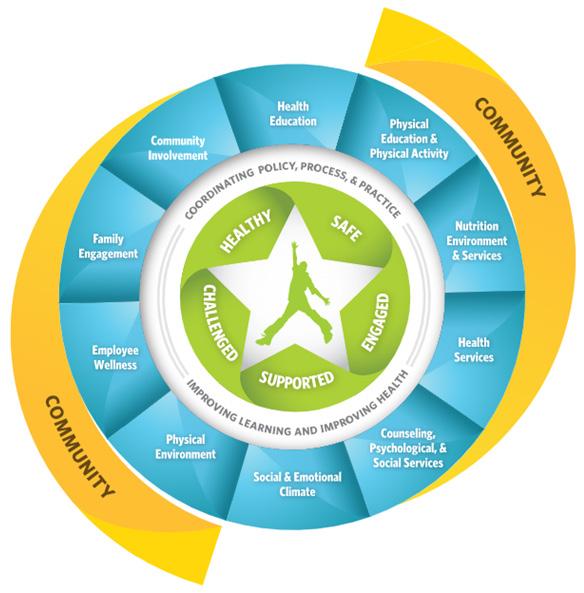
WHOLE SCHOOL, WHOLE COMMUNITY, WHOLE CHILD (WSCC)
The WSCC model highlights the role the school playground can play in children’s health. Created by the Centers for Disease Control and Prevention, this model aligns the public health and education sectors which work to improve the lives of children.45 At the center are children, who must feel safe, supported, challenged, engaged, and healthy to succeed. The framework then has 10 school-related components, the first of which is Physical Education and Physical Activity. Surrounding these school-level components is the community because of its overarching role in influencing child and school health, and the close ties and cooperative relationships that should exist between schools and the communities in which they exist.
Play On! playgrounds can be tied to several components in the WSCC model:
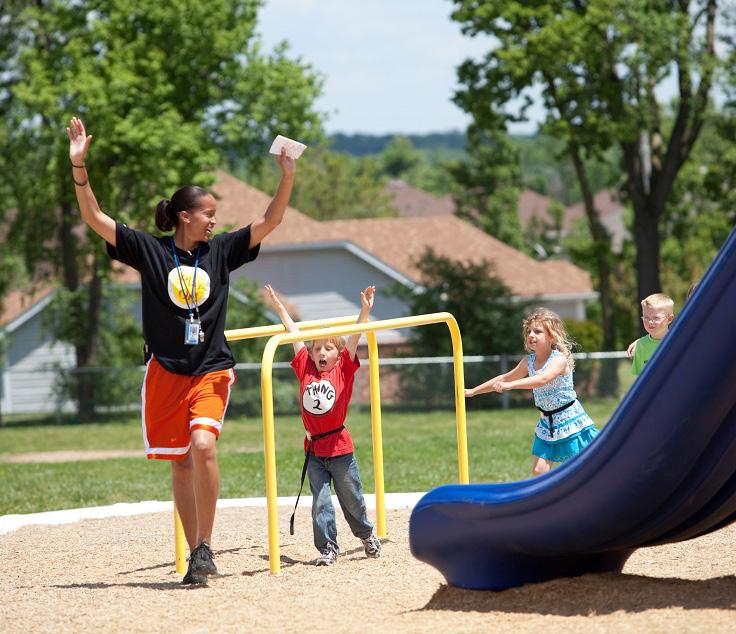
• Physical education and physical activity. The playground is a key setting for physical activity before, during, and after school. Most commonly this is through school recess, but also physical education lessons, unscheduled classroom breaks, and before/after school clubs.
• Social and emotional climate. Playgrounds can help children feel more excited to come to school and engage with learning. Playing strengthens relationships amongst students and staff and improves emotional well-being.
• Physical environment. A safe and health-promoting playground positively contributes to the overall school environment by providing children with a safe space for play, while not exposing them to undue
risks like traffic, injuries, or pesticides.
• Employee wellness. The schoolyard can promote active lifestyles for staff as well. Employees can use amenities like tracks to be active or spend time in nature to reduce stress.
• Family involvement. Allowing families to use the playground before or after school promotes engagement with the larger school community. They may also volunteer to supervise playground activities.
• Community involvement. Sharing school facilities, like the schoolyard, with community members fosters relationships between community and school members. Community members may also volunteer to supervise playground activities.
• Health education. The goals of health education include teaching students about the importance of physical activity, mental and emotional health, and personal wellness, and safety and injury prevention. These topics can be related to the playground, providing a relatable example to students.
COMPREHENSIVE SCHOOL PHYSICAL ACTIVITY PROGRAM (CSPAP)
The Physical Education and Physical Activity component of the WSCC can be operationalized using CSPAP, which is considered the national framework guiding the integration of physical activity throughout the school day.46 CSPAP coordinates physical education,
physical activity during school, physical activity before and after school, staff involvement, and family and community engagement.47
Play On! playgrounds can be tied to every component of CSPAP and play an integral role in school-based physical activity:
PHYSICAL EDUCATION
Playground equipment can be used for physical education lessons in a variety of ways 48 Physical education teachers may also monitor other playground activities like recess
PHYSICALACTIVITY
PHYSICAL ACTIVITY
DURING SCHOOL
DURING SCHOOL
On average schools provide 27 minutes per day of recess, which takes place on the school playground, weather permitting.49
PHYSICAL ACTIVITY BEFORE & AFTER SCHOOL
Before- and after-school programs can make use of playground space.50,51 Joint or shared use agreements (school-park partnerships) can be created to allow communities to use playground spaces outside of school hours.44
CSPAP
FAMILY AND COMMUNITY ENGAGEMENT
Joint or shared use agreements (school-park partnerships) can be created to allow communities to use playground spaces outside of school hours.44
STAFF INVOLVEMENT
Playground monitors should be trained and can play an integral role in promoting physical activity, helping with conflict resolution, and mitigating hazards, all while preserving children’s autonomy and allowing for appropriate levels of risk.52
Design Considerations for a Play On! Playground
“If we are going to solve the problem of sedentary childhood, we have no choice but to refocus intense professional attention on design for outdoor free play.”
- Robin Moore, MCP, DipArch
A well-designed play space can address the needs of the whole child and afford activities that motivate, engage, and challenge all children. Playgrounds should include all key elements of active play, provide opportunities for beginning, intermediate, and advanced levels of challenge to engage children in healthy risk-taking and foster development, and offer a wide variety of play activities to promote sustained engagement. Understanding the core concepts of each element of play, the benefits, and design tips will help ensure a high-quality design that promotes children’s physical activity and fitness. These design tips also enable the playground to be programmed using the Play On! Playground Activities.
6 KEY ELEMENTS OF HIGH-QUALITY ACTIVE PLAY
The foundation of a Play On! playground is the thoughtful implementation of six key elements of active play which provide a well-rounded environment for physical activity while promoting the development of physical fitness through balancing, brachiating/upper body, climbing, sliding, spinning, and swinging opportunities. These activities
are developmentally important to children and providing more of these opportunities has been linked to greater playground visitation and physical activity.40,53,54
LEVELS OF CHALLENGE
Having the six key elements of active play in the play space is a great start. But a truly valuable play environment is one where every child can participate while also being challenged appropriately to further their development and skill acquisition.55 Children grow and develop at different rates56, and playgrounds are often meant to be used by children across a wide range of ages, so providing a developmental progression of skills for beginning, intermediate, or advanced level allows children to participate no matter their current skill level. This also creates safer play experiences and ensures that children can engage in developmentally appropriate play that encourages movement and healthy risktaking.
Children are naturally drawn to challenging opportunities – for example, 70% of children say they want to play on equipment which seems challenging to them, even if they have never played on it before.57 By trying something that is challenging to them, children gain a sense of confidence, but they also develop their physical fitness and increase their capabilities.
More challenging play feels risky to children because it involves uncertainty.5 Risky play is an opportunity for physical activity, but is also associated with motor competence, ability to assess and manage risks, psychological outcomes like reduced anxiety, and overall health.58
VARIETY
Children also want a variety of play experiences.59-61 Different types of equipment, even with the same purpose, provide diverse experiences for children, and help them to use and develop different skills. For example, different climbers rely on different muscles, types of movements, and grasps, requiring children to develop more coordination skills than a single climber type. While some climbers can be traversed more quickly, others teach children how to look ahead, see if anyone else is on the equipment, and navigate around them. Providing a variety of options therefore helps children develop well-rounded skills.
Children also have different interests and preferences, and providing a range of experiences (not just more of the same opportunities) gives them the chance to identify these interests and find something they like. A larger variety of equipment allows more children to participate at one time and promotes sustained engagement over time, preventing boredom which can lead to bullying, aggression, and other antisocial behaviors.62,63 This is particularly important at school, where children may play on the same playground for years.
OTHER CONSIDERATIONS
• Support intuitive play patterns. Placing play elements adjacent to other play elements increases physical activity.64 The elements of play should be placed together in a way that encourages children to intuitively move between them. For example, looping occurs when a child uses a slide and then can immediately climb back up to slide again. Children will complete this loop multiple times in a row before moving on. Sequential patterns occur when one play element naturally leads to another play element, such as a balancing element that ends at the start of a brachiating element. This naturally keeps the play episode going as children are drawn to their next play “step.” These intuitive play patterns engage children and promote physical activity.
• Facilitate socialization and cooperation. Playing together is a key way children learn how to share, navigate conflict, and consider
other’s wants, needs, and abilities. It is also just fun – when asked to remember their time playing during childhood, adults almost always think about playing with someone else.65 Social skills during childhood have been linked to greater educational attainment and likelihood of being employed, and lower risk of criminal behavior and substance use in adulthood.66 Including play elements that children can use together, such as double or triple slides, promotes the formation and strengthening of peer relationships, and the development of social skills children will use throughout their lives.
• Foster inclusion. Including different levels of challenge is one way to ensure that more children are able to be active on the playground. But there is so much more you can do to create an inclusive environment
where all children (and their parents) are able to participate and enjoy doing so. Inclusion is important because children with disabilities are 25% less likely to meet physical activity guidelines compared to their peers without disabilities. Those with mobility impairments are 72% less likely to meet physical activity guidelines compared to their peers without disabilities.67 Children with disabilities like Autism Spectrum Disorder also spend more time alone (30 vs 9%) and less time engaged with their peers (42 vs 72%) on the playground compared to children without disabilities.68 Features like adaptive hand holds, high contrast colors or textures, and accessible play equipment are simple ways to be more inclusive while promoting physical activity and fitness.
Design Considerations
6 KEY ELEMENTS OF ACTIVE PLAY
Balancing
Ability to maintain equilibrium control when stationary or moving, understanding of counterbalancing and base of support, sensory integration skills
Sliding
Integrates visual, tactile, spatial and directional awareness information, postural control, core strength, and social skills like patience and behavior regulation
LEVELS OF CHALLENGE
Brachiating
Upper body muscular strength, endurance, flexibility, hand-eye and bilateral coordination, sensory integration, confidence, and healthy risk taking
Spinning
Kinesthetic awareness, postural control, and understanding of speed, force, and directional qualities of movement, cooperation and risk management
Climbing
Spatial awareness, coordination, problem-solving skills, motor planning, self-confidence, and whole-body muscular strength, endurance, and flexibility
Swinging
Whole body muscular strength and endurance, motor planning skills, coordination, imagination, risk assessment, and social awareness
VARIETY
OTHER CONSIDERATIONS
BALANCING
Balancing requires a child to maintain equilibrium, usually on their feet. It is a key skill for preventing falls but also allowing children to participate in a variety of activities from walking to sports. Successful balancing is an interplay between bio-mechanical attributes (strength, static stability), proprioceptive skills (the body’s ability to sense its own position and movement), dynamic stability, sensory integration, cognitive processes, and use of movement strategies like reacting to an external disturbance.69 Developing well-rounded balance skills in childhood is important because they track into adulthood. For example, 10-year-olds with poor balance are 7 times more likely to have poor balance at age 46.70
Children learn how to maintain balance under static or stationary conditions, like standing or balancing on one leg, and dynamic conditions while moving, such as walking across a balance beam.
They also need to learn how to balance under both voluntary conditions, like when choosing to move from sitting to standing, and involuntary conditions, like in response to an external disturbance like tripping.71 Finally, children learn how to balance while focusing on just the balance activity (single-task) and when simultaneously doing another task (dualtask) such as catching a ball (motor interference) or counting (cognitive interference). With the right equipment, children can develop each of these balance skills on the playground.
Design Best Practices
A. Ensure Variety of Types and Forms
Offering a variety of types and forms of balancing provides children with choices, encourages exploration, and addresses their diverse developmental needs:
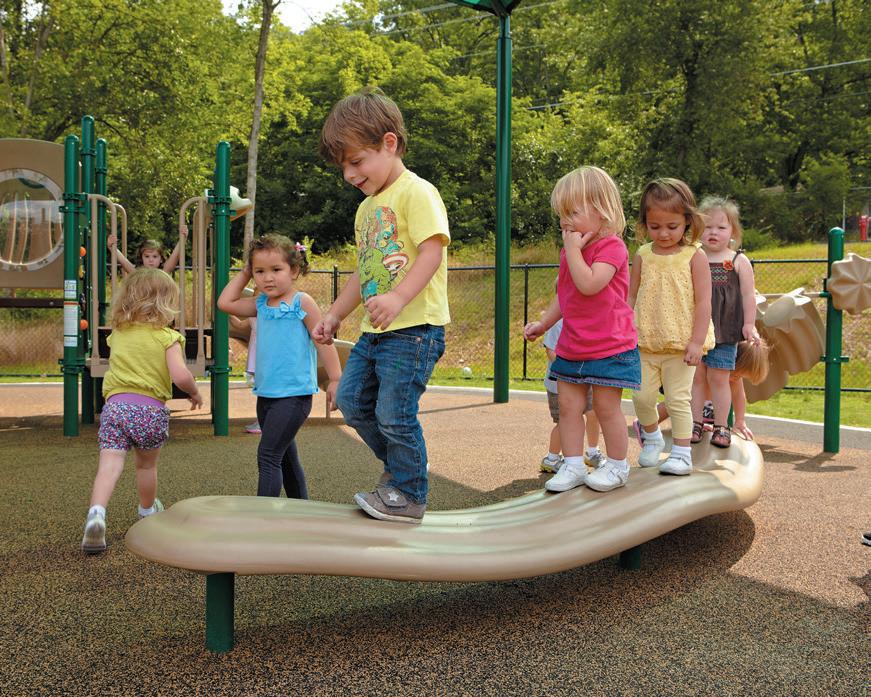
• Select different types of balancing elements such as balance beams, a series of pods/steps, bridges, links,
or log rolls. A variety of balancing elements targets different outcomes like independence, socialization and cooperation, or dynamic balance.
• Include a balance element that children can easily use portable equipment on (e.g., bounce ball) to give children opportunities to practice maintaining balance while multi-tasking.
B. Offer Graduated Levels of Challenge
Balancing activities should provide beginning, intermediate and advanced levels of challenge through the following attributes:
• Distance. Maintaining dynamic balance is more difficult when children are asked to move between different pieces of equipment (e.g., between pods) instead of staying on a single piece of equipment (e.g., balance beam). When children move between different pieces of balance equipment, the level of challenge increases when the distance between steps increases or becomes more varied.
• Handrail/Support. Having additional support or a handrail for children to grasp to help maintain their balance reduces the overall difficulty. The type and location of the support/handrail also matter. Handrails that can only be used by one hand (overall or at a time), that are less accessible (e.g., higher), or less stable (e.g., ropes) will increase the level of challenge. The wider the base of support, the easier the equipment will be to balance on. A thinner balance beam will be more difficult than a wider balance beam.
• Stability. Elements that provide dynamic movement are more difficult to balance on than stable (fixed) surfaces. For example, a spring pod, rolling log, or rope would be more challenging than a step/pod or beam that is completely fixed in place. A mix of stable and unstable balance elements can be placed together for variety. Both the stepping surface and handrails/supports (if available) can be fixed or dynamic. A fixed balance element with fixed handrails would be the easiest, while a movable balance element with a movable handrail would be the most difficult.
• Incline and Height. Difficulty increases if the piece(s) of equipment is/are on an incline instead of flat or if the balancing component offers a variety of heights. Balance elements closer to the ground (<3 feet) are easier than those at moderate (3 to 5 feet) or higher (>5 feet) heights.
C. Other Design Considerations
Designing for intuitive play patterns, socialization, and inclusion can support engagement and the developmental needs of the whole child.
Support Intuitive Play Patterns:
• Consider how balancing elements might link to other playground activities to encourage movement, leading/following social opportunities, and sequential patterns. Placing a balancing element between two other elements - such as between a climber and an upper body element or between two decks of the same height - can help connect them, allowing children to seamlessly move from one activity to another.
• Balancing elements can serve as links/connectors between the open space surrounding a play structure and the play structure itself. Placing balancing activities, like stepping pods, at the entry point of a structure creates an enticing and playful way to access or exit the structure.
• Include at least three pods/steps together or a beam at ground level to encourage movement and sustained balancing across the components. This can increase the overall challenge and provide opportunities to implement the Play On! Playground Activities with portable equipment.
Facilitate Socialization and Cooperation:
• Demonstrate how children can play imaginative games while balancing like “the ground is lava” or “pretend to be an acrobat.”
• Link balancing elements together or combine with other play elements to encourage continued social participation where children to lead and follow each other. This requires children to practice responsible decision making and important skills like paying attention to the location and intentions of others.
• Use portable equipment with balancing elements to encourage movement and cooperative play. For example, children may pass/ toss a ball to one another or as they move across the balancing element.
Foster Inclusion:
• Ask peers to create a balancing obstacle course using portable equipment, pathways, and/or chalk drawings at ground level for their friends who are unable to access or use balancing elements due to a disability or comfort/skill level. Together they can move through and introduce balancing activities before moving to elevated components. For example, a child may pretend to “balance” as
they move around or across the drawings of circles or lines on the ground with their mobility device.
• Use high contrasting colors or textures to provide visual cues for children with low vision.
• Encourage peers to assist their friends by lending a hand for support, pushing their wheelchair if needed, or encouraging the use of handrails/supports if available.
• Use playground activities to help individuals at the ground level play with their friends on the balancing element, such as by “racing,” providing directives or activity cues – including by using communication picture symbols or a recorded voice output device(e.g., “Be a ballerina!”), or by using portable equipment.
• Use elevated components with a wide base of support such as ramps, decks on structures, and bridges to help beginners develop balancing skills. Handrails/supports can assist children in maintaining their balance and increase confidence.
BRACHIATING/UPPER BODY
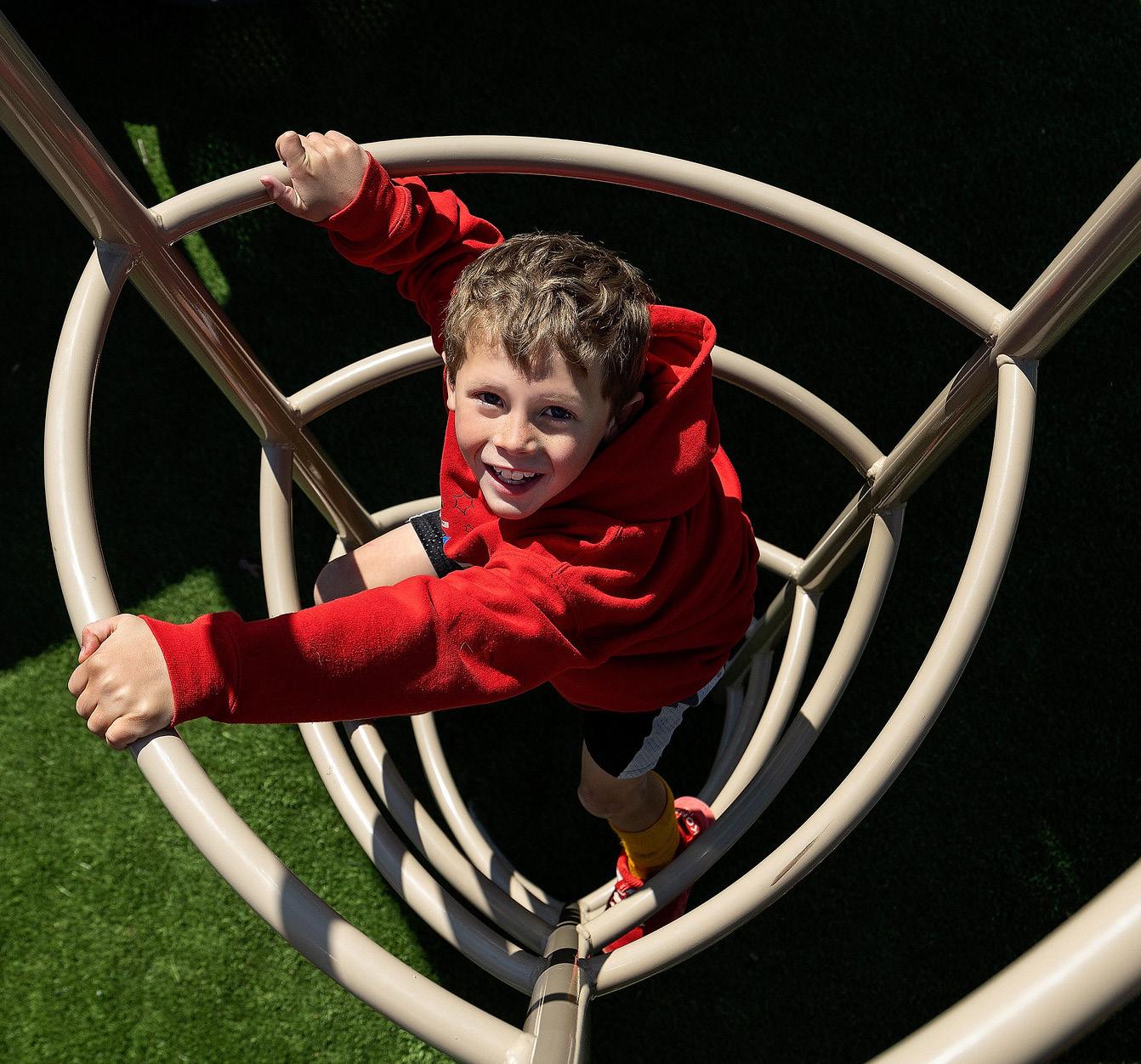
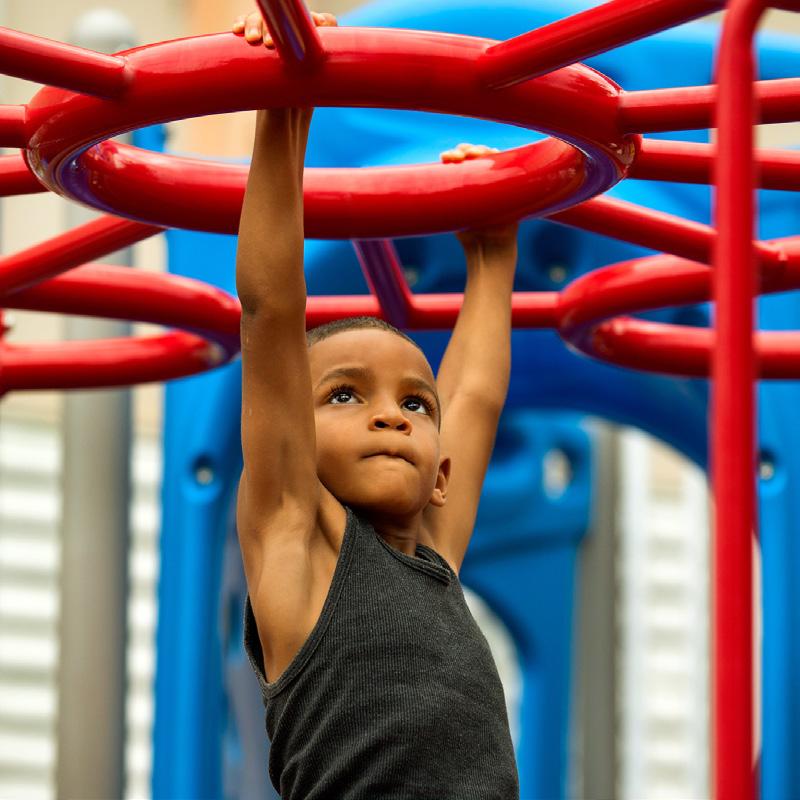
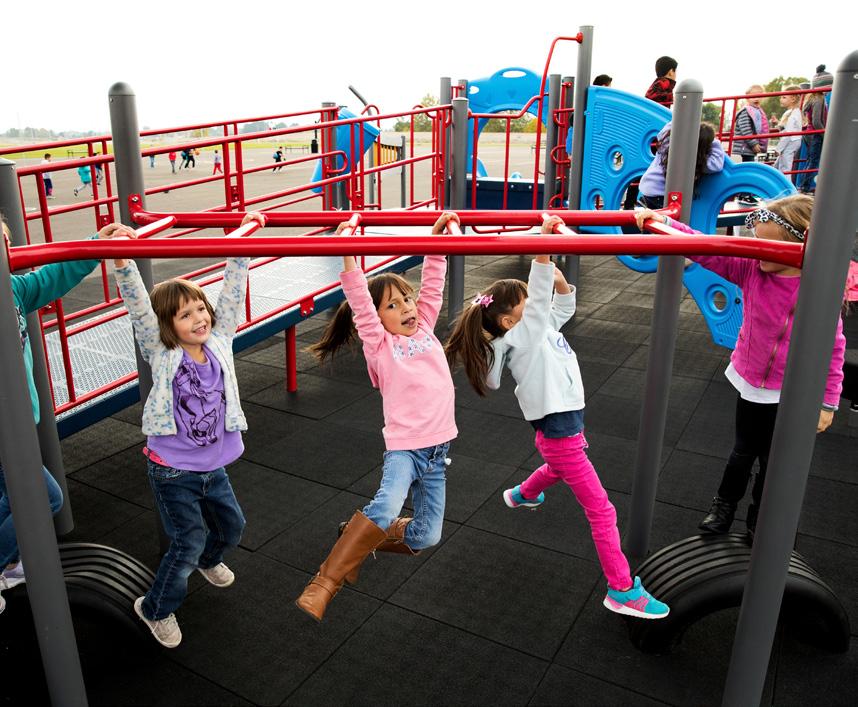
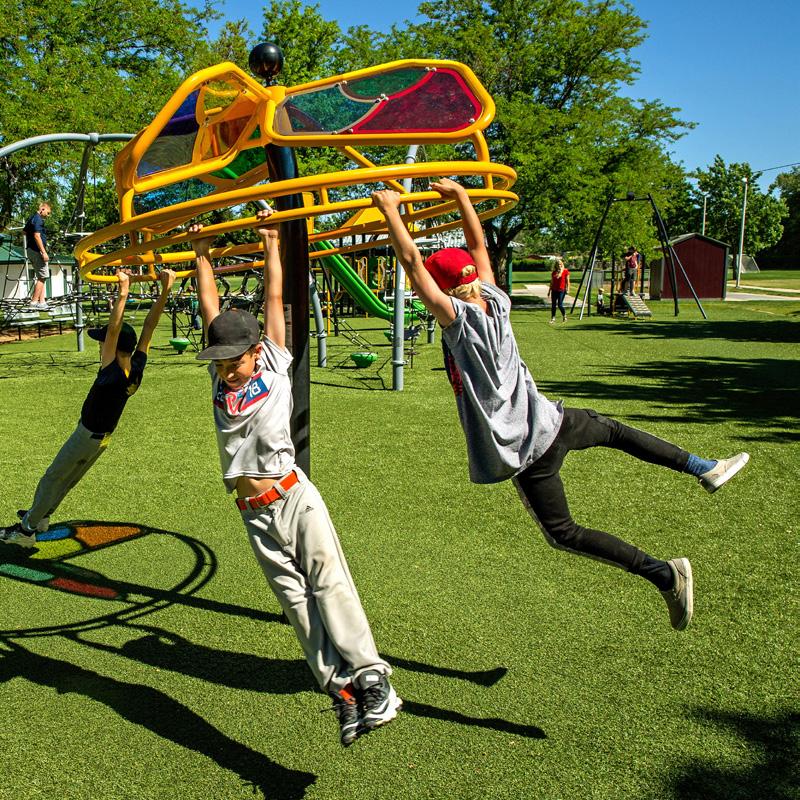
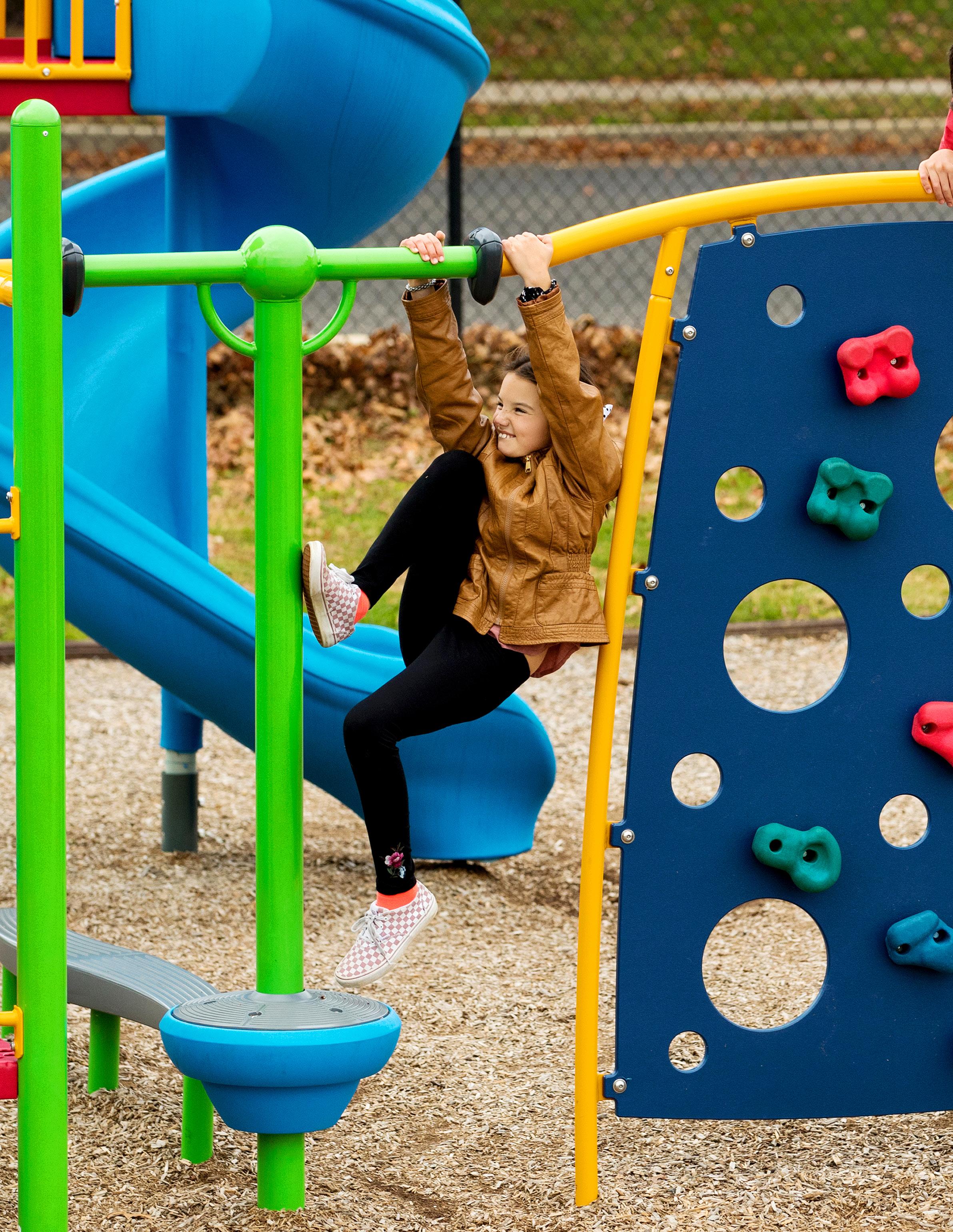
Upper body activities allow a child to engage their arms, usually requiring the child to move one hand at a time as they support and transfer their body weight to move or translocate. This includes brachiating, which is moving by alternating support from one arm to the other (like a monkey!) across an upper body play element (like monkey bars!). Upper body movements improve upper body and grip strength and endurance,72 eye-hand coordination, and bilateral coordination between both sides of the body.53 Brachiating relies on the proprioceptive system (the body’s ability to sense its own position and movement) but requires children to integrate this information with the vestibular system (the body’s balance and spatial orientation system that helps us stay upright) and visual feedback. This type of activity can help children feel a sense of accomplishment, developing self-confidence. Children also learn to assess risk (e.g., ‘can I reach that next bar?’) and be resilient.
Design Best Practices
A. Ensure Variety of Types and Forms
Offering a variety of types and forms of brachiating/upper body activities provides children with choices, encourages exploration, and addresses their diverse developmental needs:
• Choose upper body components that provide a variety of experiences due to different types of handholds (e.g., rings, bars, or ladders), distances, or patterns. While some upper body elements help children learn to hang and support their body weight, others allow them to move across, up and over, in circles, or choose in which direction to move. Offering a variety develops a wide range of skills and keeps children engaged as they try new feats.
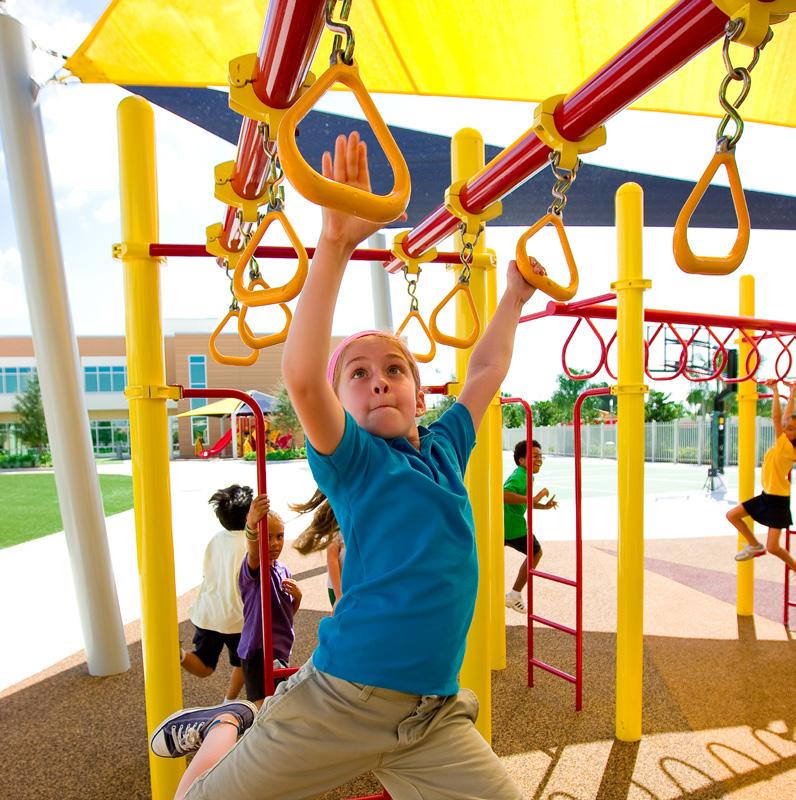
• Provide at least three rungs or components for the child to move across/translocate to be considered brachiation. Examples include horizontal ladders, sets of trapeze rings, and loop/circular ladders.
• Upper body components may be incorporated under a play structure at an appropriate height, freestanding at ground level, attached to the deck of a play structure, or they can be part of a deck-less play system.
• Track rides are an upper body activity, but they should not be the only upper body activity offered on a Play On! playground.
B. Offer Graduated Levels of Challenge
Upper body activities should provide beginning, intermediate and advanced levels of challenge through the following attributes:
• Translocation & Body Weight Support. The level of challenge of upper body components can be increased by requiring translocation (instead of staying stationary) and reducing a child’s ability to support their body weight via the ground (e.g., by standing or sitting). Increasing the distance one can move across also increases the challenge. For example, translocating across more than 5 rungs of a horizontal ladder is more difficult than 3-5 rungs, which is more difficult than no translocation. Older children, 5-12 year-olds, should be provided upper body activities that they can traverse across (brachiating). As they become more skilled, these children will develop a lead hand, become more confident in their movement, and may practice skipping rungs.
Younger children, 2-5 year-olds, should practice hanging and
supporting their body weight through activities that encourage bilateral coordination. Providing upper body opportunities at a low height with rungs closer together or in which a child simply hangs reduces the level of challenge. These activities allow children the opportunity to practice these skills which are prerequisite for more skilled upper body movements like brachiating.
• Stability. The stability of the handhold impacts the difficulty of the activity. Less stable/fixed handholds are more difficult than fixed/stable handholds due to the increased fine and gross motor skill and grip strength required. The easiest option are fixed bars, while rings which pivot around a central axis are more difficult. An upper body element that fully rotates as the child brachiates from one to another is the most difficult. For this type of play activity, a child must be able to move across at least three rungs or components for it to be considered brachiating/ upper body instead of spinning.
• Incline and Height. Level of challenge increases with height and the amount of incline. Upper body activities less than 3 feet high are the easiest, while over 5 feet is the most difficult. Requiring children to move up and down while brachiating is challenging as they must use superior hand-eye coordination to correctly judge distance in multiple directions. Similarly, changing direction – such as a curve – is more difficult than brachiating across a straight ladder.
C. Other Design Considerations
Designing for intuitive play patterns, socialization, and inclusion can support engagement and the developmental needs of the whole child.
Support Intuitive Play Patterns:
• Consider the routes of travel to promote sequential play patterns – do children end up in a place that encourages them to connect with another play element? Place a brachiating/upper body element so that it leads to another element, or between two play elements, to encourage continuous engagement in active play.
• Place brachiating/upper body elements at an entry point to a structure to create an enticing and playful way to access or exit the structure.
Facilitate Socialization and Cooperation:
• Incorporate upper body elements designed for multiple players. This can foster imaginative games like “follow the leader.”
• Encourage children to provide support to their friends as they develop upper body skills or try new movement patterns (e.g., backwards, sideways, skipped rungs).
• Create opportunities for parallel play by placing upper body activities next to each other, while abiding by use zones and safety standards. For example, therapeutic rings, an upper body trainer, and a horizontal loop ladder offers various levels of challenge and a choice of how a child might engage in an upper body activity alongside their friends.
Foster Inclusion:
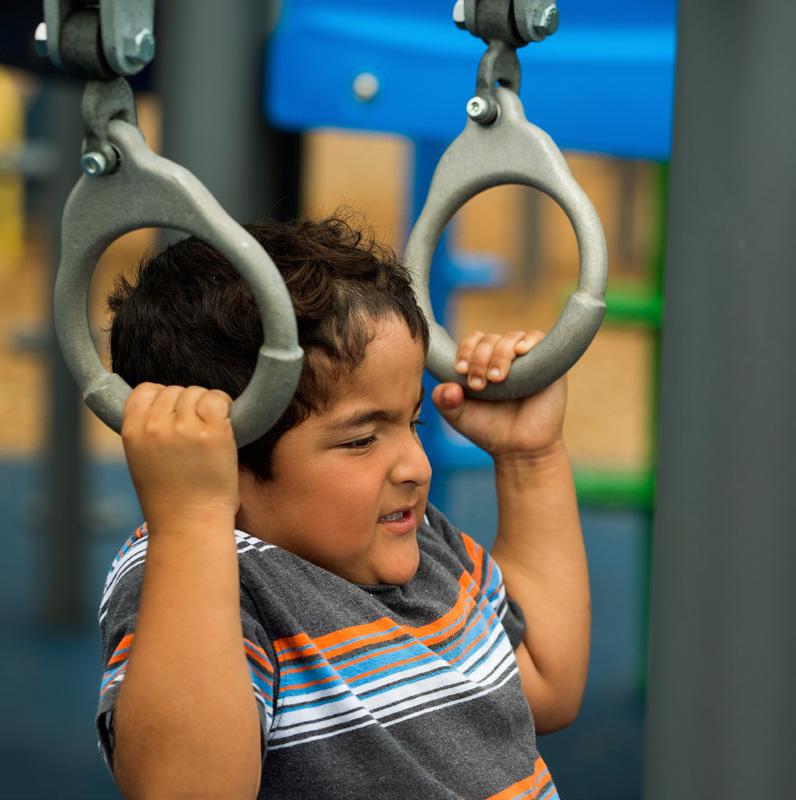
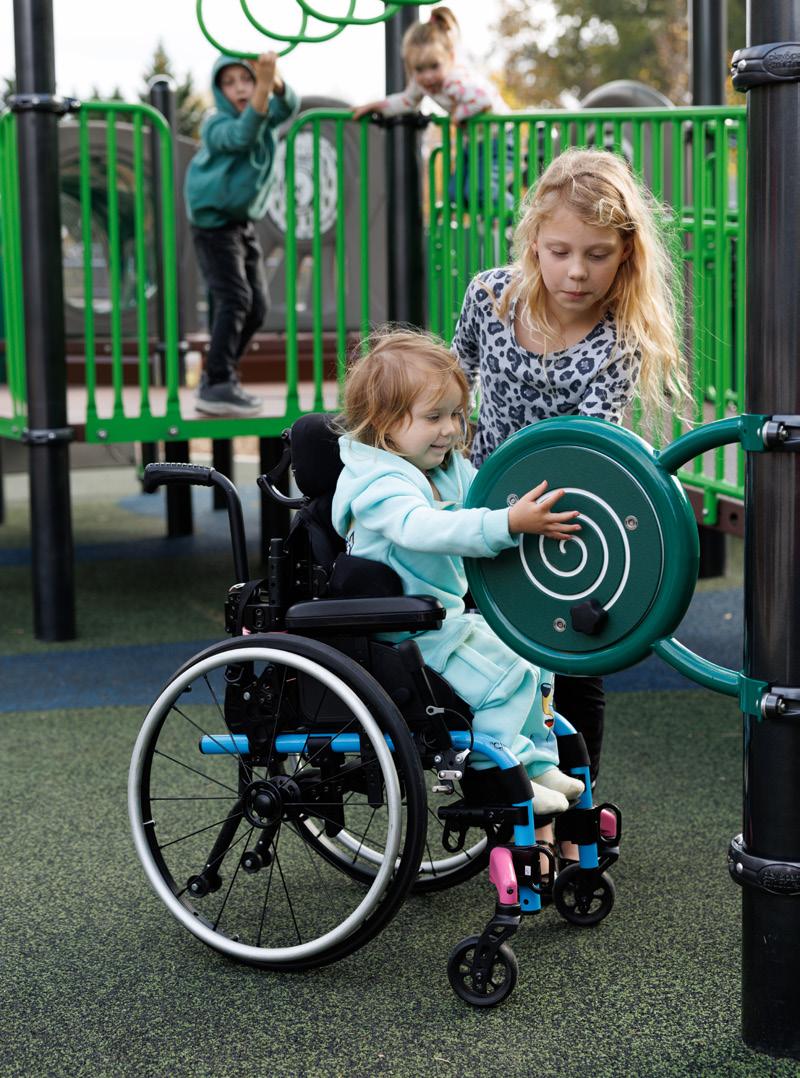
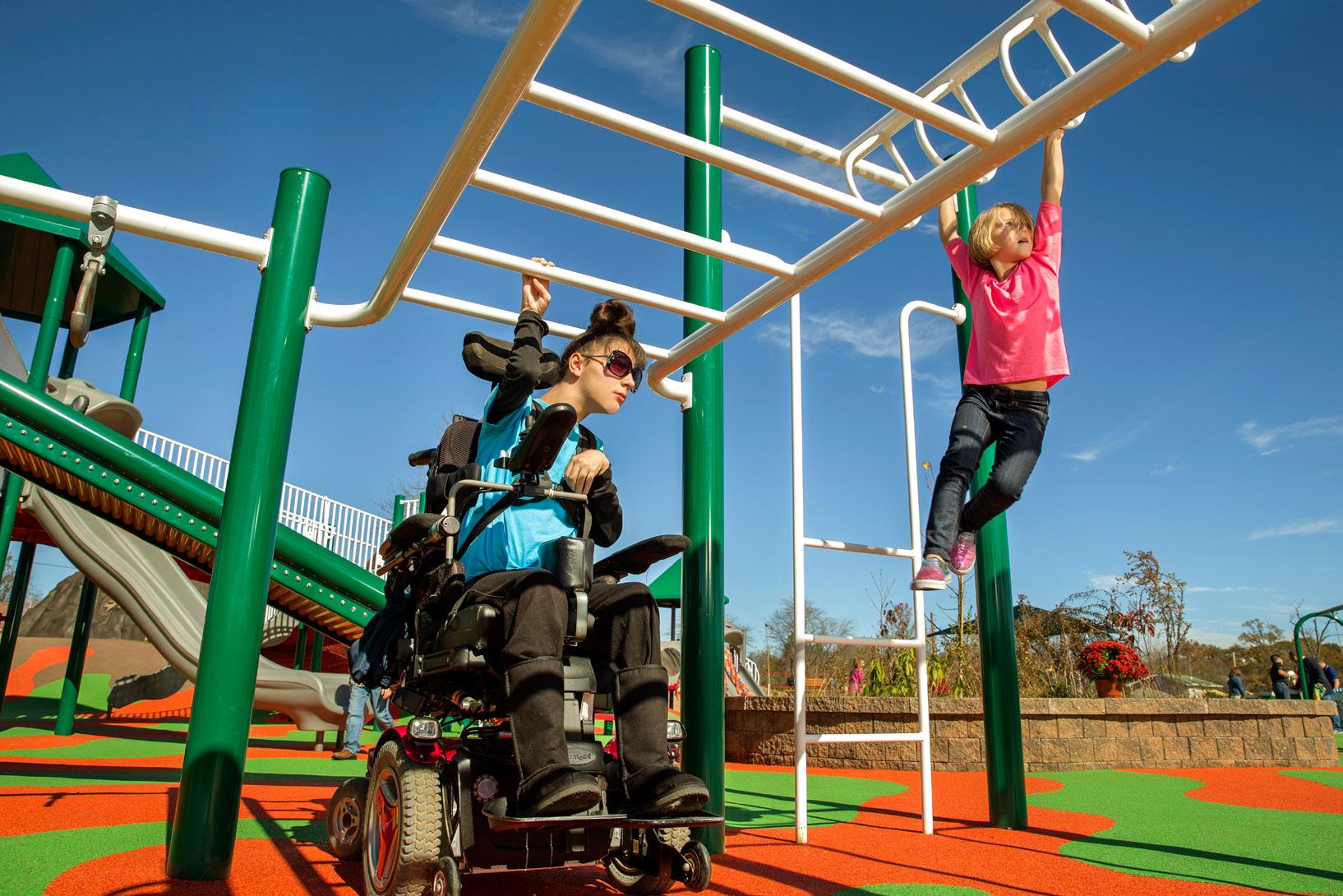
• Install upper body activities such as accessible ladders and therapeutic rings which are lower to the ground and ideal for children in the beginning stages of developing upper body skills. This is an equitable and more inclusive alternative for children who are seated in a wheelchair, use adaptive equipment, are shorter in
stature, or are still developing skills to support their own body weight.
• Include accessible hand cycles (where a child uses both hands to turn a cycle or bar) or roller table (where a child lies down on a surface and pulls themselves across a horizontal ladder while on their back) to allow children of all abilities to reap the fitness benefits of upper body activities.
• Consider the type of grip/grasp required to effectively use upper body activities as individuals may have limited fine motor skills or grip strength. Large knobs or adaptive handholds can be beneficial for these individuals.
CLIMBING
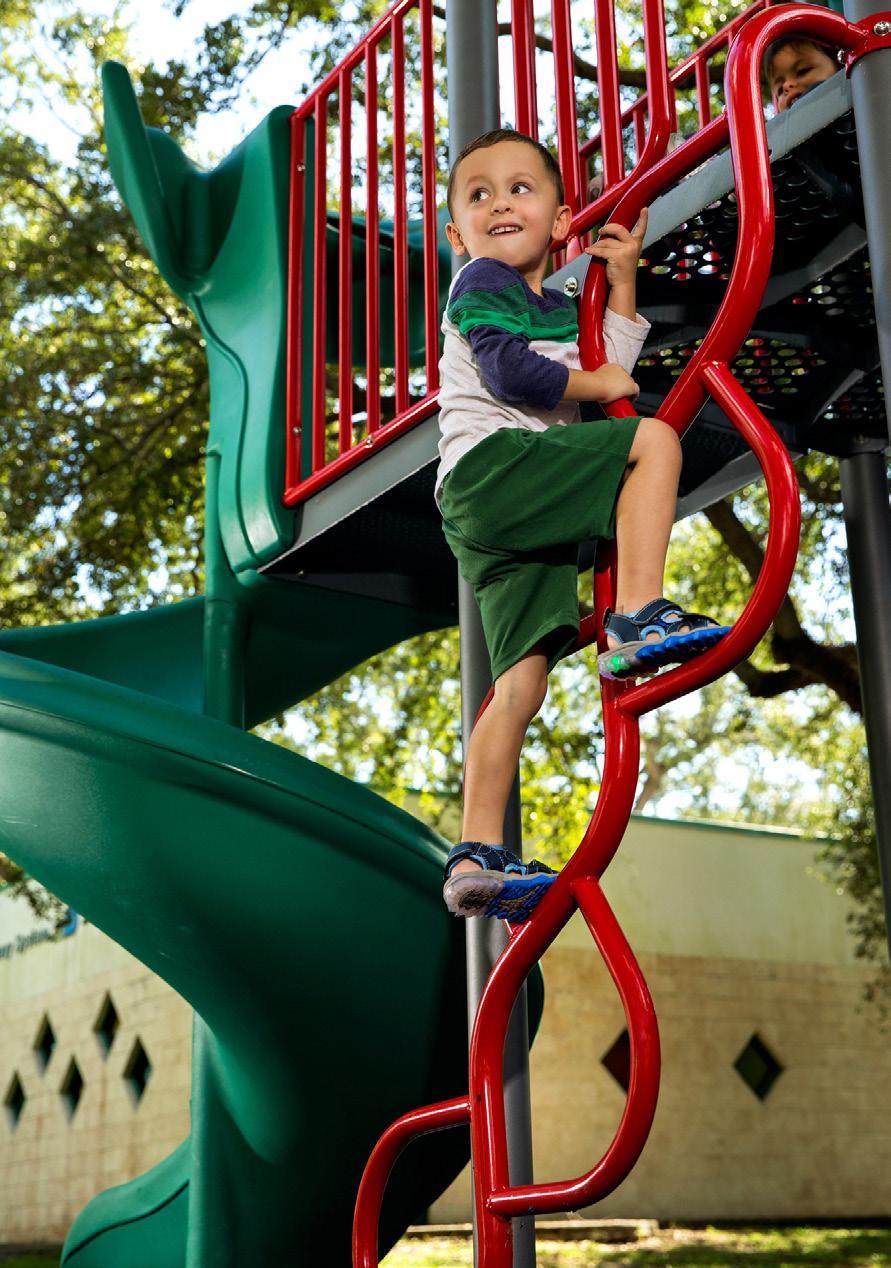
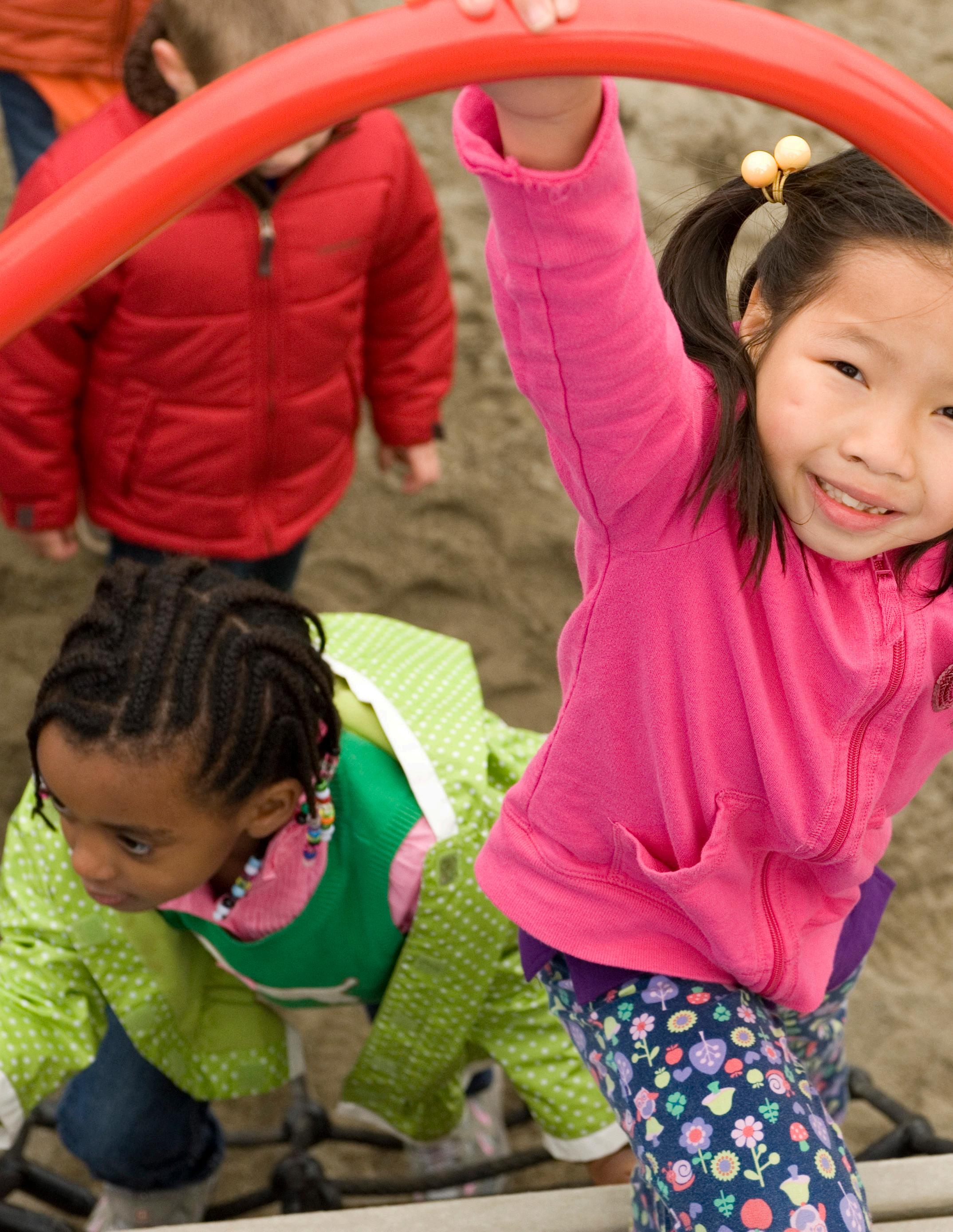
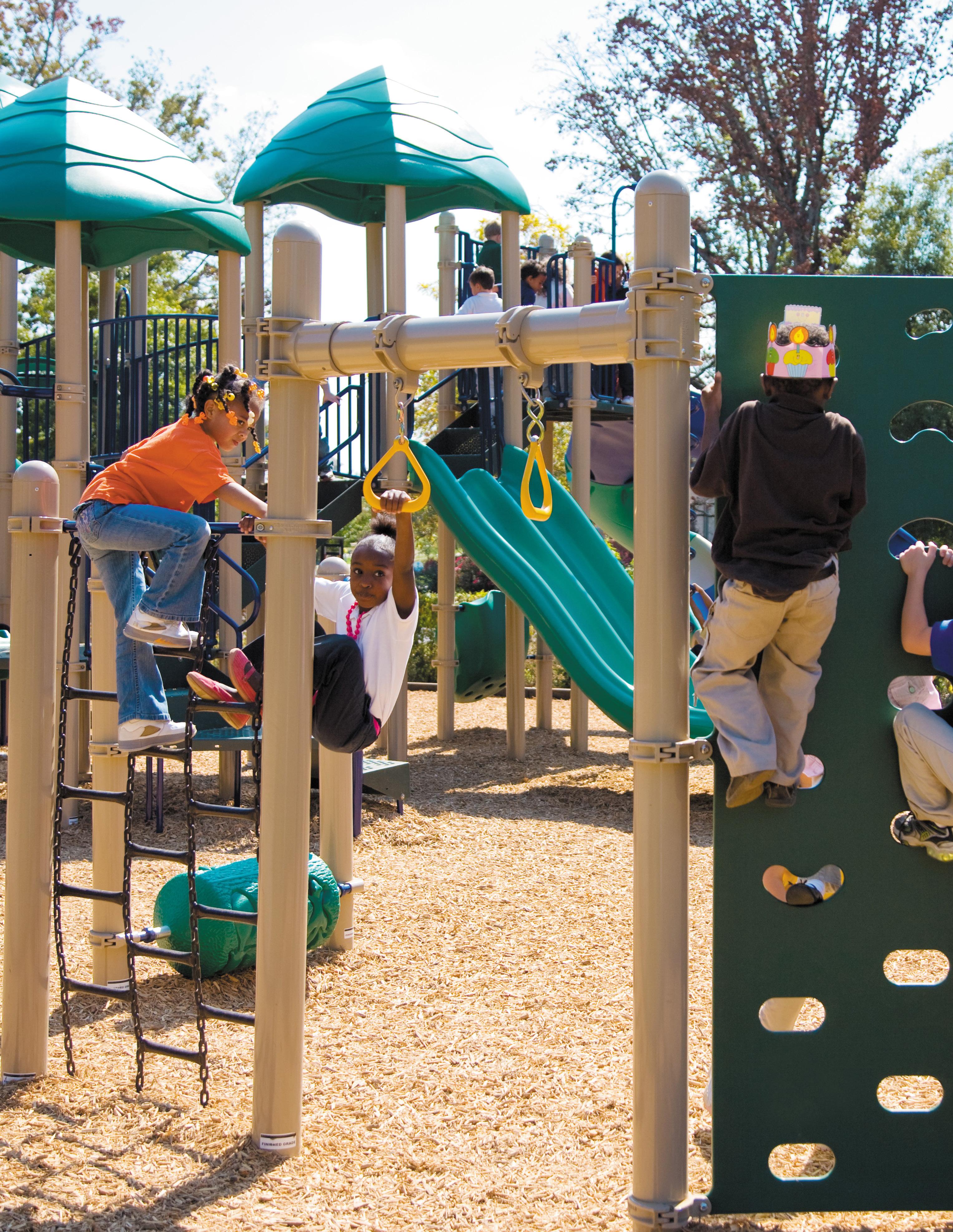
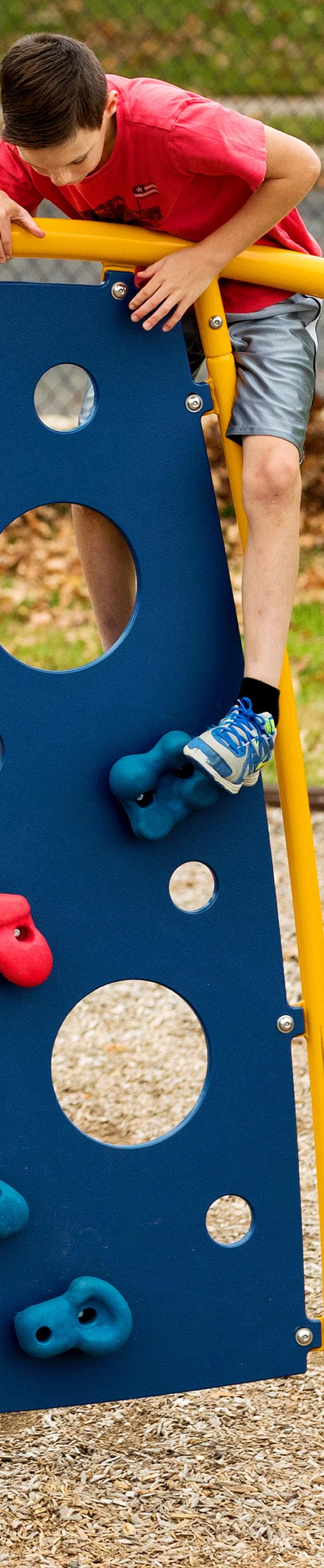
Climbing activities allow children to move up, down, side-to-side, up-andover, or even change planes using both feet and hands. Climbing develops upper and lower body muscular strength and endurance, grip strength, and flexibility.53 Climbing develops perceptual-motor skills like bilateral coordination, the coordination between both sides of the body, and hand-eye coordination, both which will be required later in life to do things like play sports or drive.73 It also develops children’s proprioceptive abilities (the body’s ability to sense its own position and movement) while requiring them to integrate other sensory information such as what they see and feel.53 These skills improve their motor planning abilities.
While climbing, children build selfconfidence, increase independence, and feel a sense of achievement.74 They problem solve, test and learn their own limits and abilities, understand cause and effect, and how to manage risk.74
Design Best Practices
A. Ensure Variety of Types and Forms
Offering a variety of types and forms of climbing provides children with choices, encourages exploration, and addresses their diverse developmental needs:
• Select climbers that use different materials such as ropes, chains, rocks, metal, and/or plastic, or are in different forms, such as ladders or poles. A variety of climbers provides children with different experiences, textures, and opportunities for skill development and can also promote different imaginative play themes.
• Include freestanding climbers and those attached to a play structure.
• Incorporate climbing opportunities that were intentionally designed for multiple players to climb together.
• Choose climbers that offer a variety of foot/handholds
designed for children to climb using different routes. Some climbers allow children to climb vertically, horizontally, or at an angle, change climbing planes, or climb over multiple planes as they twist their bodies.
• Use climbing links between different playground structure deck heights. Links are considered climbers when they link decks at different heights (e.g., a link between a 5’ deck to a 7’ deck would be considered a climber).
B. Offer Graduated Levels of Challenge
Climbers should provide beginning, intermediate and advanced levels of challenge through the following attributes:
• Distance. Solid surface climbers with steps/risers at regular distances are easier for children to master and are ideal for beginners. The level of challenge increases as the distance between the foot/ handholds increases and if the climber is framed rather than solid. Poles with no foot/handholds would offer the greatest challenge.
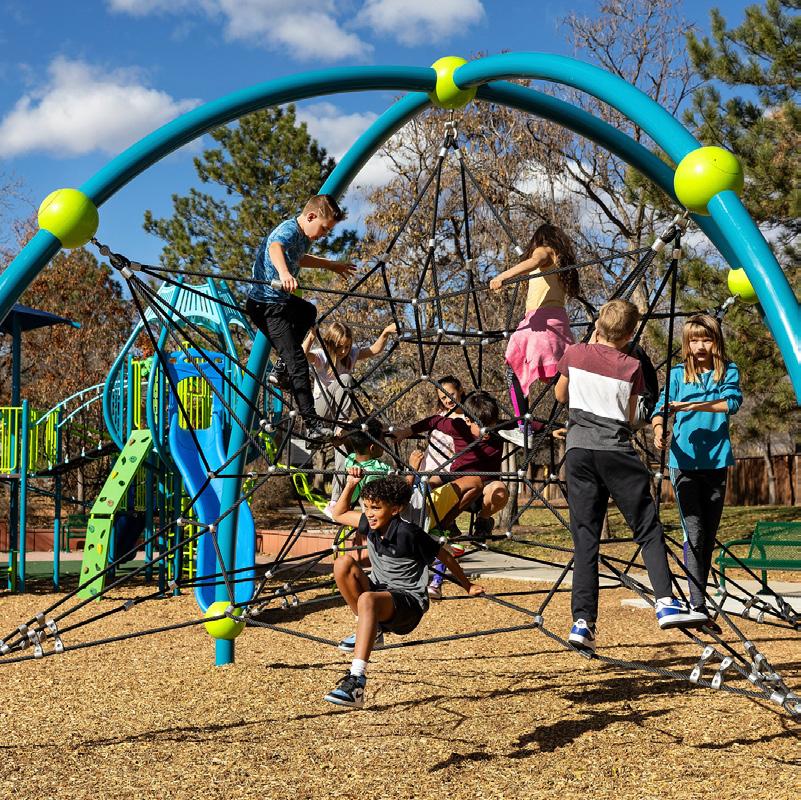
• Direction. Climbing in a single plane of movement (up-down, side-to-side) is easier than changing planes while climbing, such as when a child starts climbing on an upslope and then switches to climbing on a downslope (e.g., arch or dome climber). The level of challenge is even greater when a climber requires a child to climb in more than two planes or change planes, such as climbing up a spiral or engaging in a twisting motion.
• Stability. Climbers with larger and stable footholds and handholds are ideal for beginners. Keeping the step stable, but making the connectors between steps dynamic, increases the difficulty and challenge. Climbers where both elements – the foot/ handholds and connectors - are dynamic, like rope/net or chain climbers, provide more advanced levels of challenge.
• Incline and Height. Climbers with sharp, vertical inclination are more challenging than climbers with light to moderate inclination. The level of challenge increases as the inclination increases from <30°, to 30-60°, and 60-90°. Climbers become more challenging as the height increases. For example, a climber of less than 3 feet is more likely to be ideal for beginners and climbers that reach greater than 7 feet are more advanced.
C. Other Design Considerations
Designing for intuitive play patterns, socialization, and inclusion can support engagement and the developmental needs of the whole child.
Support Intuitive Play Patterns:
• Use climbers as an entry or exit to the play structure or within the play structure.
• Place climbers near slide exits to encourage intuitive looping patterns where children can slide, then quickly and actively reenter the playground structure to slide again. This repetitive behavior keeps children engaged in play, increases physical activity, and develops planning skills.
Facilitate Socialization and Cooperation:
• Choose climbers that allow multiple players to climb at the same time. This requires children to consider other’s actions and intentions and helps facilitate game play.
• Place climbing elements with varying levels of challenge next to each other to encourage children to observe their peers with more advanced skills, gain confidence and understanding of the activity, and then test and develop those skills when they are ready.
Foster Inclusion:
• Include play structures with ramps, use topography/berms to reach higher elevations, or use crawl tubes or links with wide, solid frames or handholds to connect decks to create opportunities for
children with physical disabilities or that need additional assistance the ability to explore various heights.
• Consider climbers with inclusive features such as a transfer area with handholds, larger or adapted handholds that are easier to grasp for children with fine motor challenges, and/or that offer a wide base of support at a light inclination.
• Use color and texture to support children with vision disabilities. High contrasting colors can provide visual cues and/or demonstrate elevation changes. Solid steps can be easier to navigate. Colors and textures can be used to guide children with low vision and to highlight multiple routes which vary in difficulty, so children can choose what works best for them.
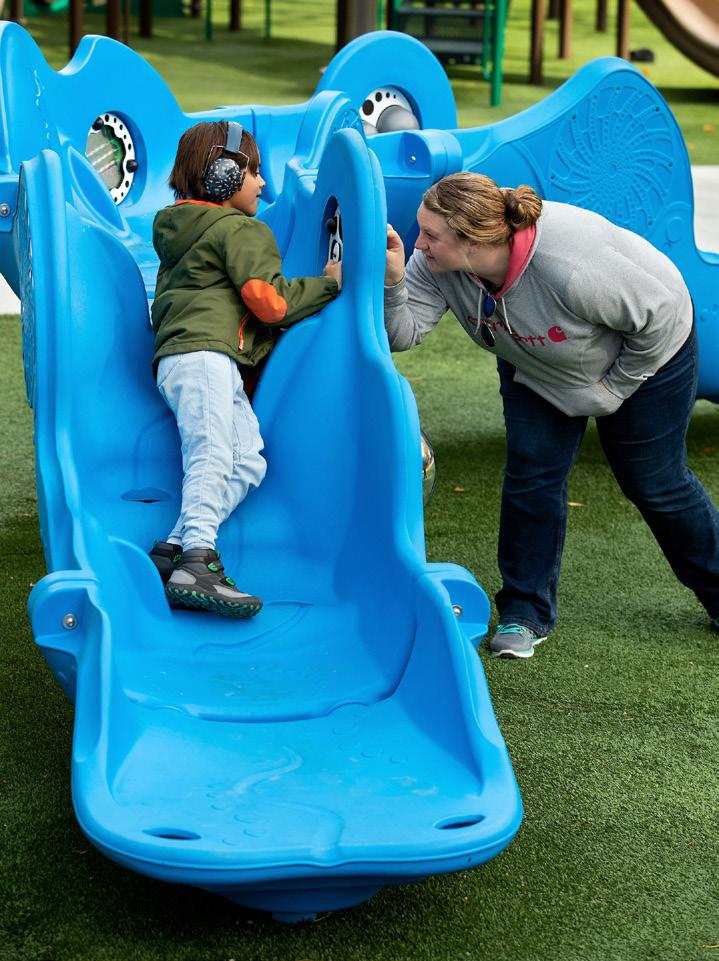
• Choose climbers that provide sensory features (auditory, tactile, visual) where a child might engage with the climber or other players through sensory and social play. For example, talk tubes could be incorporated at ground level and throughout the structure for children to communicate with one another, children may engage with a component on the structure that casts a colorful shadow/light on the ground, or a child at ground level could use a musical element or signal to tell a friend it was their turn go up or down a climbing activity.
• Think outside the box! For children that have not developed the gross motor skills to climb, caregivers may assist a child in accessing a climber with a solid surface, where they may enjoy gathering and engaging with peers. Consider climbers that include accessible routes through the climber or cozy spaces at ground level.
SLIDING
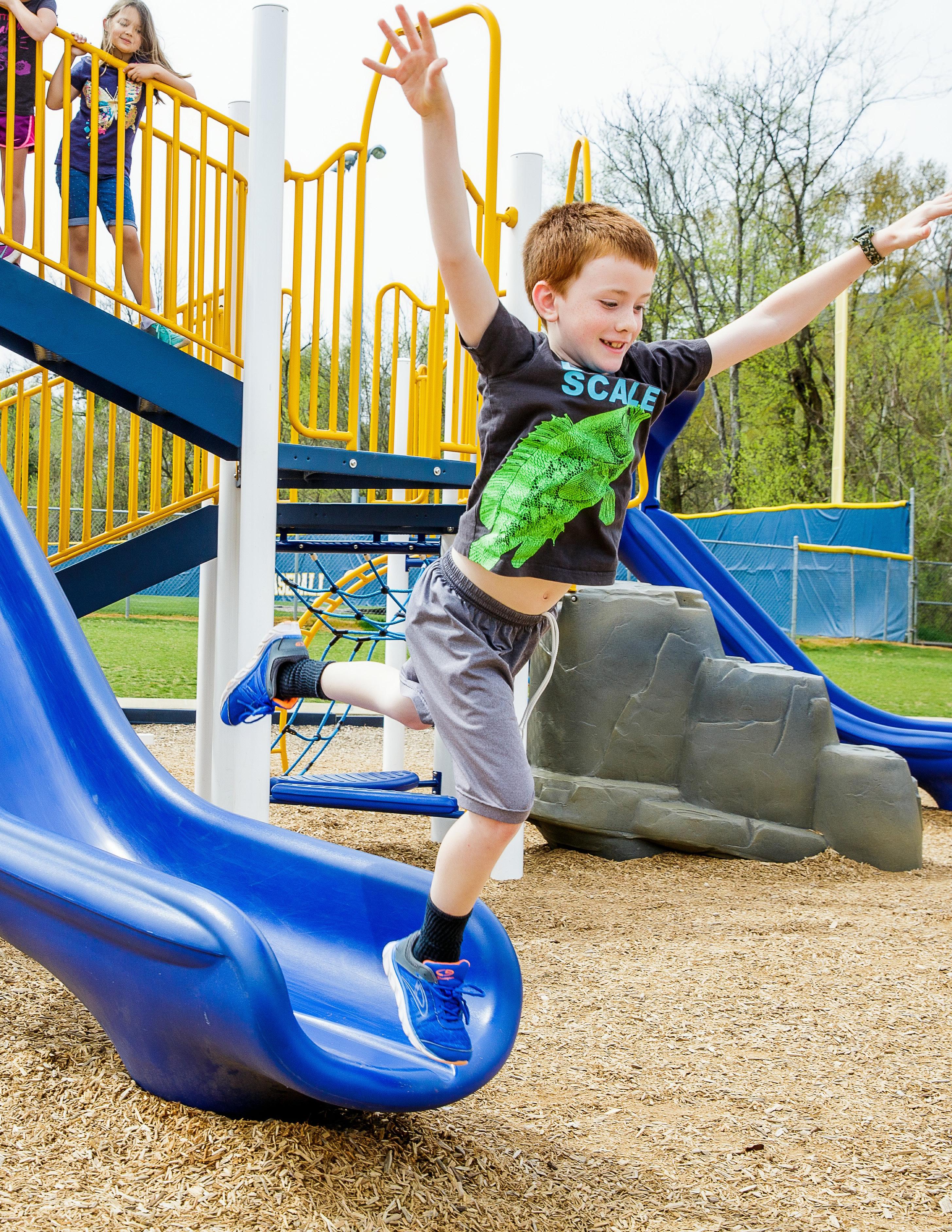
Sliding activities provide children opportunities to move down a surface while maintaining continuous balance and contact. This stimulates multiple sensory systems, including visual, vestibular (the body’s balance and spatial orientation system that helps us stay upright), and proprioceptive (the body’s ability to sense its own position and movement) and requires children to use their senses as an integrated system. As children slide, they engage their core muscles to maintain an upright position while in motion. Sliding activities help children develop spatial awareness and understanding of how bodies and objects occupy and move through space, as well as directional awareness as they learn to exit the slide.
Sliding allows children to practice responsible decision-making and make respectful choices about their behavior while considering the well-being of themselves and others. For example, they must pay attention to decide when it is safe or their turn to go, which helps
them learn to cooperate, take turns, be patient, abide by shared social rules, and regulate their behavior.
Design Best Practices
A. Ensure Variety of Types and Forms
Offering a variety of types and forms of sliding provides children with choices, encourages exploration, and addresses their diverse developmental needs:
• Provide slides that differ in shape (straight/zip, curved, twisted), height, and enclosure (e.g., tube slides). Different slides offer different types of experiences, such as the sensory feedback a child gets while sliding or the opportunity for social interaction, and different slides vary in speed and direction of the sliding movement.
• Include slides with sensory-rich features. Choose slides with tactile features such as bumps or rollers integrated into the slide surface. Use colors to create visual patterns or provide cues or use slides
with themes or customization to provide high-value imaginative play.
• Offer double or triple slides that are designed for multiple children to slide side-by-side to promote social interaction and games.
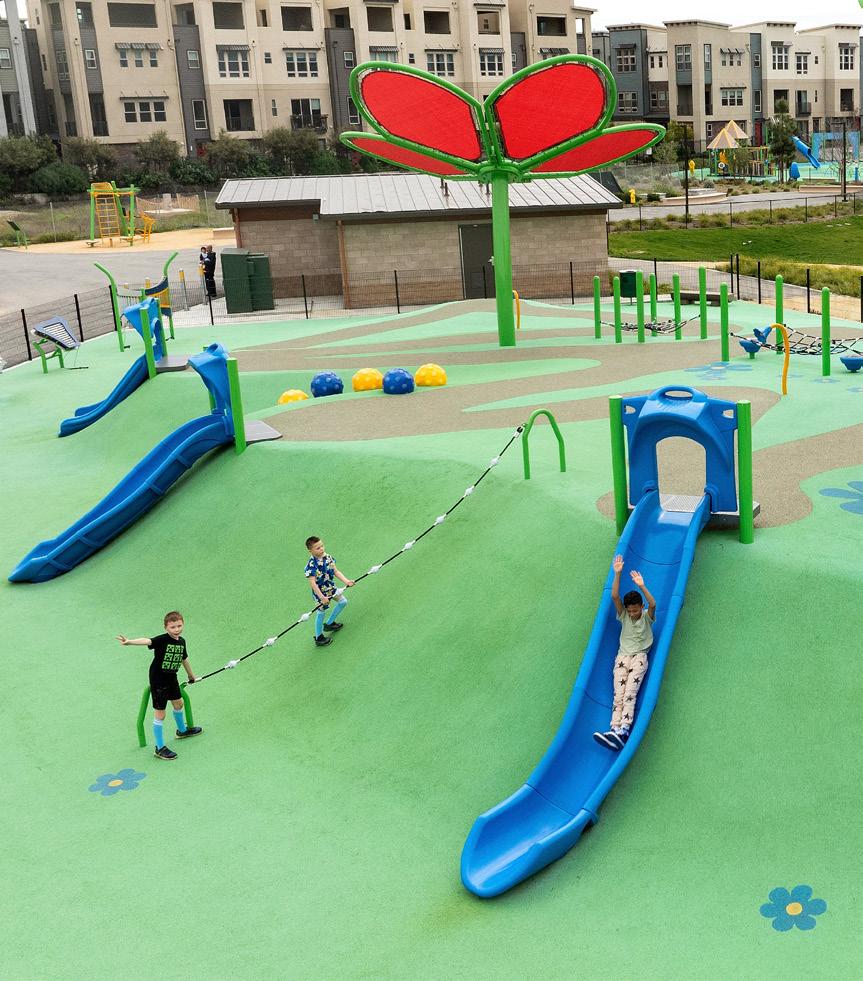
• Hillside slides use topography and integrate nature in unique ways while supporting intuitive physically active looping patterns as children go up and down the hill to access the slide.
B. Offer Graduated Levels of Challenge
Slides should provide beginning, intermediate and advanced levels of challenge through the following attributes:
• Direction. Slides may offer different experiences as children slide down straight, on a curve, or in a spiral. Straight slides are typically less challenging than curved slides – and the more a slide twists and turns, the greater challenge!
• Enclosure. Enclosed (tube) slides are more challenging than slides with partial enclosures (intermediate) and no enclosure (beginning). Enclosures can add fun, and healthy-risk taking experiences as they limit the child from being able to fully see below them, adding an element of surprise.
• Height. In addition to the level of curve and enclosure, slide height influences the level of challenge children experience. Higher slides feel riskier to children and require greater endurance
and skill. Specifically, taller and steeper slides (>7 feet) offer more advanced sliding opportunities than shorter slides (<3 feet) which provide beginning sliding opportunities.
C. Other Design Considerations
Designing for intuitive play patterns, socialization, and inclusion can support engagement and the developmental needs of the whole child.
Support Intuitive Play Patterns:
• Place entryways to the main play structure, including climbers, transfer points, stairs, or ramp entrances, in close proximity to slide exits. This encourages intuitive “looping” patterns where children can slide, then quickly reenter the playground structure to slide again. This increases physical activity, boosts confidence, and supports the developmental progression of skills.
Facilitate Socialization and Cooperation:
• Offer dual or triple slide bed ways for children to have opportunities to slide side-by-side with a friend or family member. This is a great way to increase the number of sliding opportunities with minimal additional space required.
• Encourage playground games where children can race, identify which slide they like best, and practice responsible decision making and developing awareness of the well-being of self and others.
Foster Inclusion:
• Promote independence and create more enjoyable sliding experiences for children who use a mobility device by including slide transfers on slides attached to decks with accessible ramp access so children can comfortably exit/transfer from their mobility device to the slide entryway. Slide transfers can also provide support for caregivers assisting children in transferring
out of their mobility device. Consider providing a slide transfer area at the base of the slide to offer a space where children who need assistance may move to the side while they wait. This allows others to continue to participate in the sliding activity and supports their social-emotional well-being.
• Provide multiple ways of entering the play structure so that everyone can access the slide. For example, an accessible ramp to a deck supports a child using a mobility device’s ability to access sliding activities.
• Offer additional sensory input through tactile feedback – such as textures or roller slides.
• Encourage children to help friends needing assistance or encouragement to participate in sliding activities. Slides with wider bed ways may provide opportunities for a caregiver to assist a child as they participate.
• Incorporate visual cues around active areas of the bottom of the slide. Graphics or contrasting colors can increase awareness of high traffic areas for safer play.
• Suggest an alternate activity when a child cannot or prefers not to use the slide. For example, they may wish to participate in the fun by catching a stuffed animal or soft object that a friend sends down the slide, or they could communicate to their friends when it is their turn to go down the slide with a verbal command, visual cue, or with an auditory sound such as a bell or whistle.
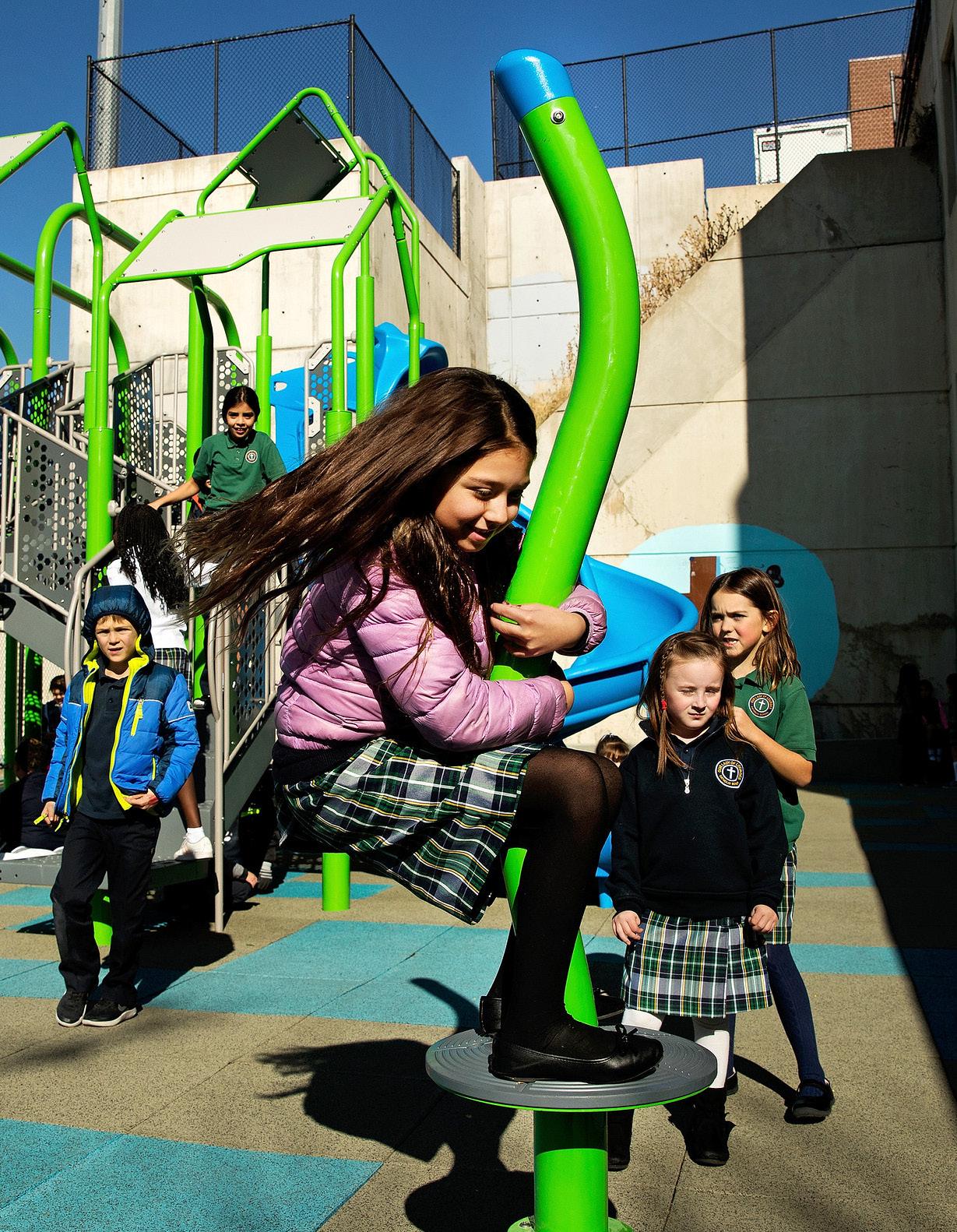
SPINNING
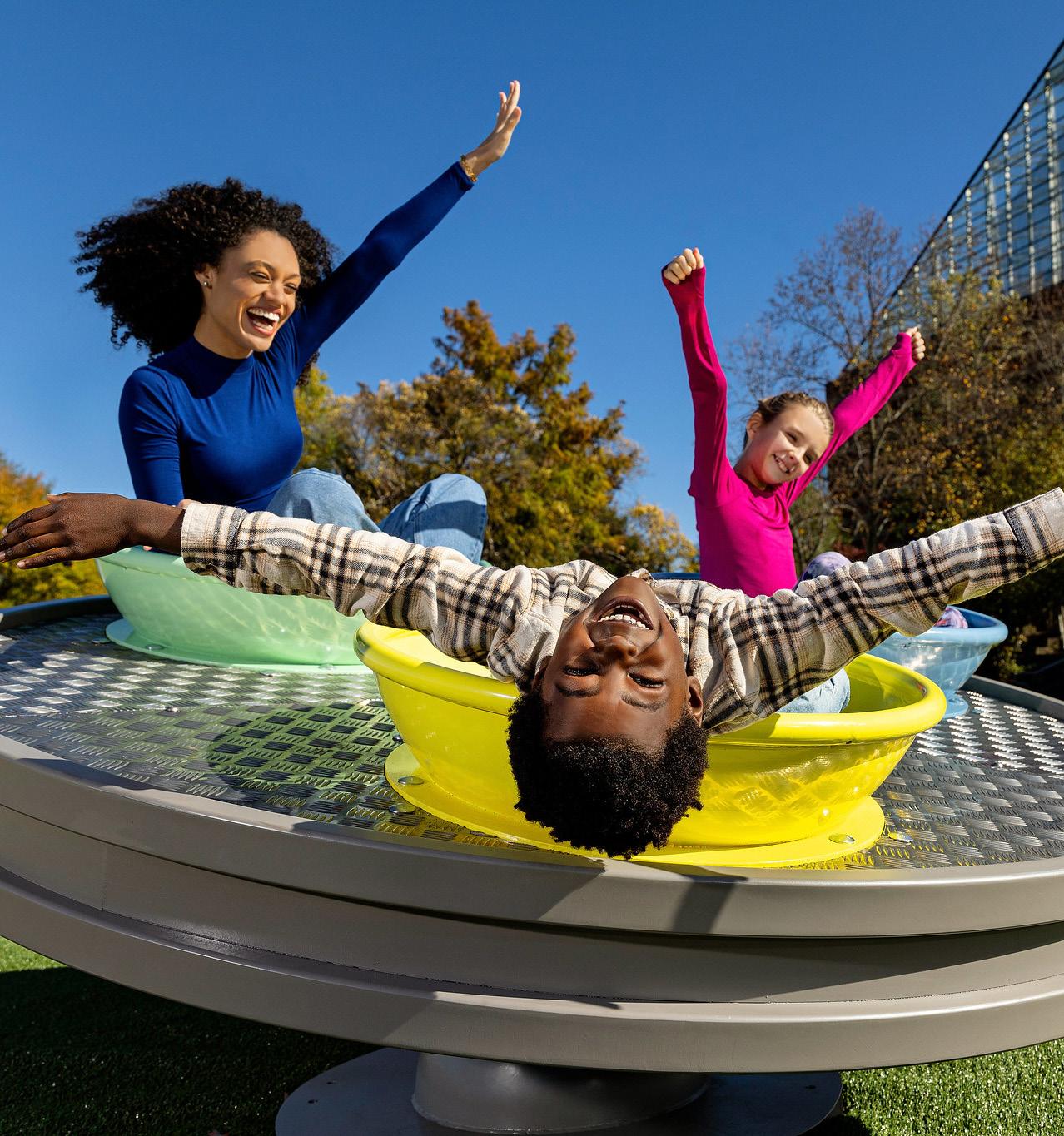
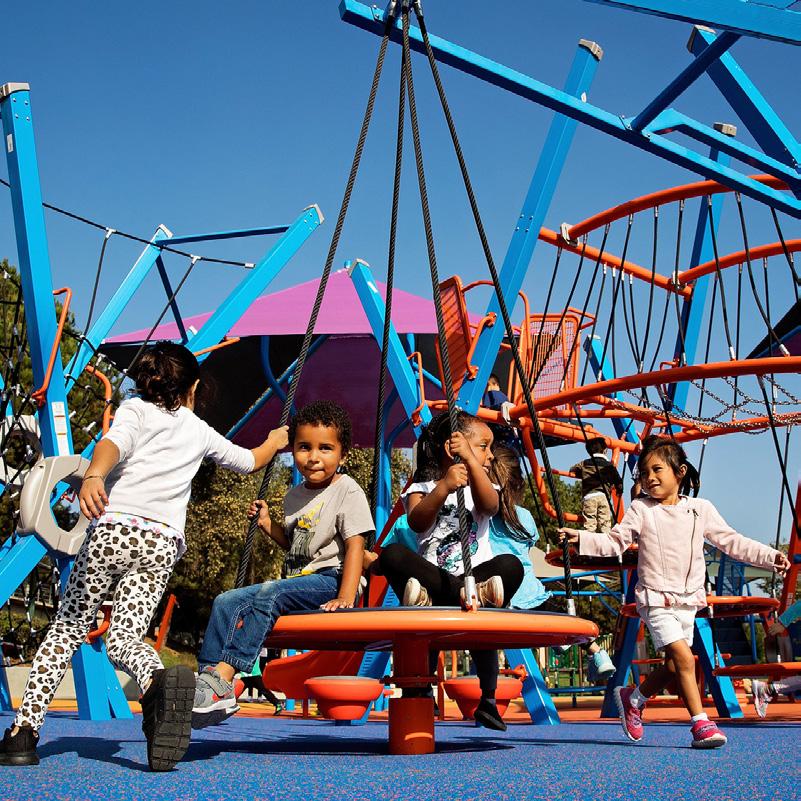
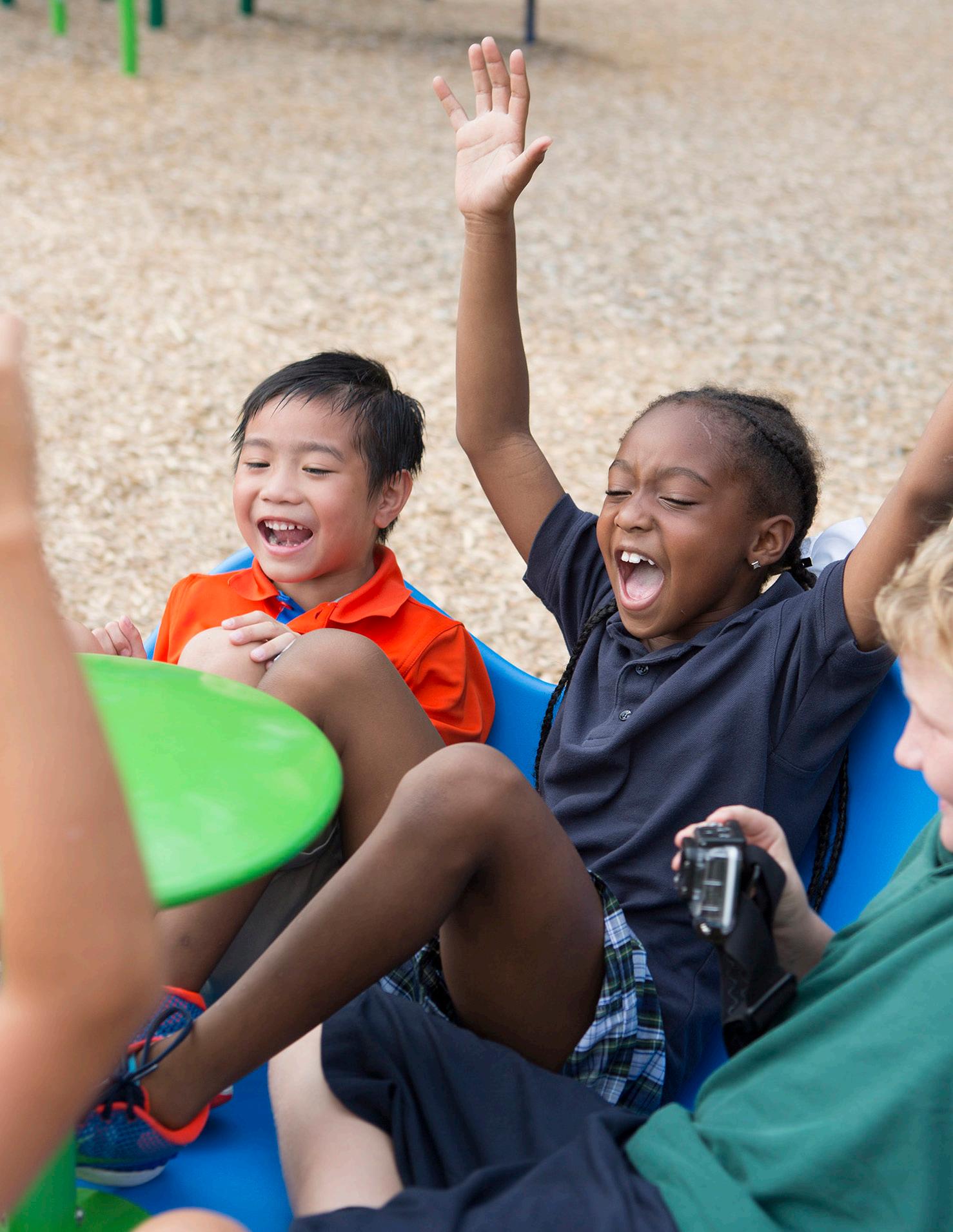
Spinning allows a child to turn or whirl on an axis in a circular direction. This is the most potent type of stimulus for the vestibular system, which has the primary role of knowing the speed, direction, and position of the head. While the vestibular system is critical for posture and balance, it is closely tied to parts of the brain responsible for memory, and a well-developed vestibular system allows a child to focus their cognitive resources on other tasks like learning.75,76 Spinning also stimulates the proprioceptive system, which is the body’s ability to sense its own position and movement. Spinning has long been used as a therapeutic intervention for individuals with sensory processing needs, such as children with cerebral palsy or autism.77,78
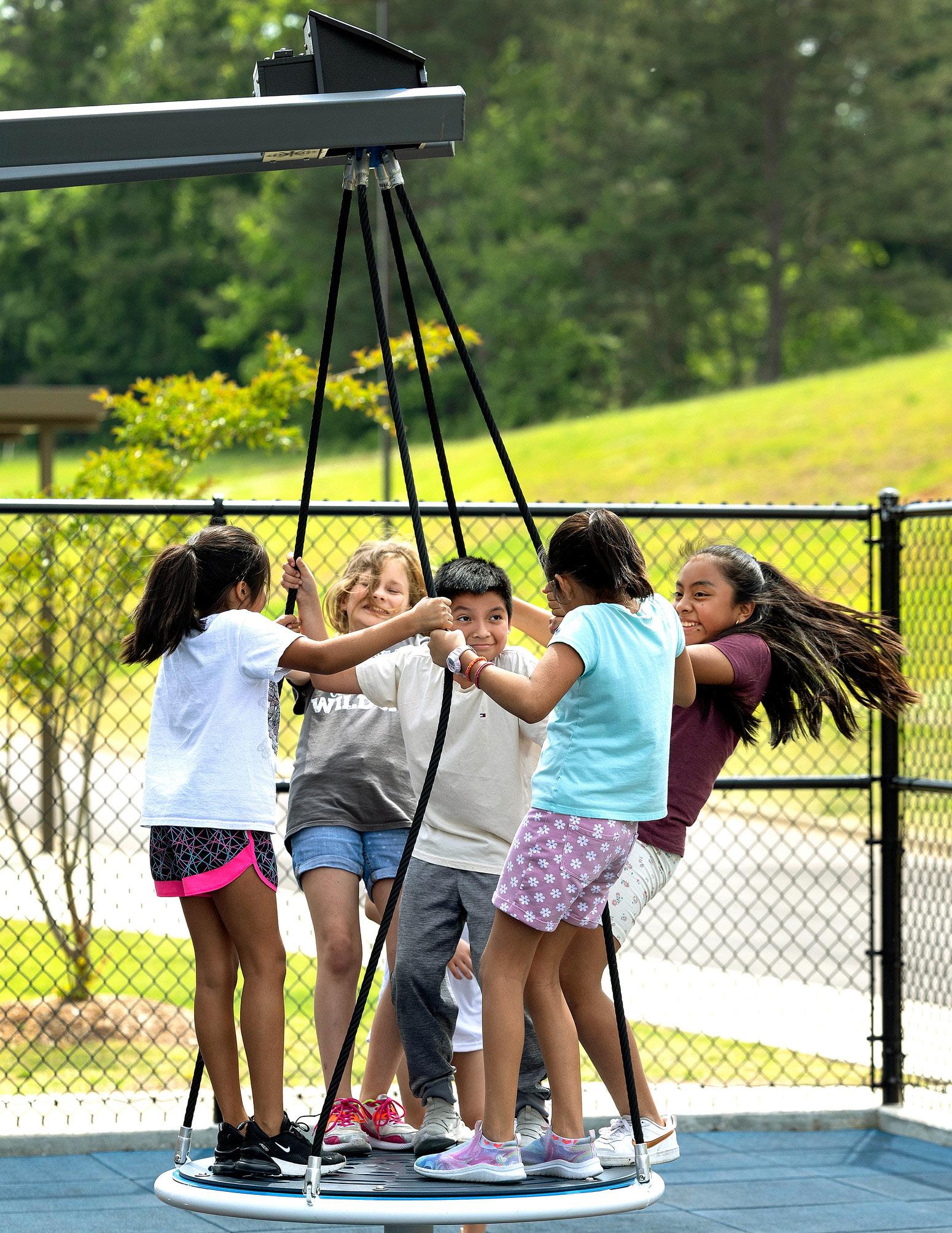
Spinning helps children learn about movement properties like speed, force, and direction. Many playground spinners require children to work together to spin, fostering cooperation skills.
Design Best Practices
A. Ensure Variety of Types and Forms
Offering a variety of types and forms of spinning provides children with choices, encourages exploration, and addresses their diverse developmental needs:
• Spinning activities may include play components like merry-gorounds, spinning seats, overhead spinning components, standing spinners, or tire swings. Different spinning experiences expose children to different types of sensory information (e.g., spinning while standing versus sitting).
• Include spinning activities designed for single, dual, or multiple children.
• Choose spinners designed for sitting or standing and/or elements that spin at various speeds.
• Incorporate freestanding spinning activities at ground level and/or spinning elements attached to the play structure.
B. Offer Graduated Levels of Challenge
Spinning activities should provide beginning, intermediate and advanced levels of challenge through the following attributes:
• Support. A spinner that provides body support or a seat helps children maintain stability and is a lower level of challenge compared to a spinner that requires children to support their own body weight, such as by using their core and/
or upper body. For example, a spinning seat with full back support will be lower level of challenge than a spinning seat with no back support. A spinning activity with no body support, like an overhead spinner which requires a child to use their upper body strength while spinning, is the most difficult. Support provided by handholds should also be considered. A fixed handhold, like a bar, is easier, while a flexible or dynamic handhold, like a rope, is more challenging.
• Incline. The inclination of a spinning activity allows children to explore spinning at various angles and slopes. Spinners become more difficult when tilted or when placed on an incline.
• Speed and Direction. Spinners that spin more quickly will require the child to use greater strength and stability, and process more sensory information, compared
to a spinner moving more slowly. For example, a child playing alone on a single seat spinner may not spin as quickly as a multi-use spinner where several children or adults could help coordinate the spinning action at the same time. Spinning direction can also impact level of challenge. Spinners which can simultaneously go multiple directions, where the larger spinner moves clockwise but the child’s seat moves counter-clockwise, are more challenging than a spinner that moves in a single direction at a time. Spinners which move back and forth in multiple planes are more challenging than spinners which remain in one plane of movement.
C. Other Design Considerations
Designing for intuitive play patterns, socialization, and inclusion can support engagement and the developmental needs of the whole child.
Support Intuitive Play Patterns:
• Install ground level spinning activities in a defined activity setting to help children remain immersed in repetitive behaviors and to avoid conflicts as those spinning need room to move around the spinner.
Facilitate Socialization and Cooperation:
• Offer a variety of spinning activities that encourage reciprocal and interactive experiences between multiple players. Spinning activities designed for
multiple users offer high-value play experiences where children can collaborate and develop friendships.
• Install two or more spinning seats in proximity of one another for parallel play.
• Encourage children to assist each other or take turns as they experiment with concepts such as speed, force, and other directional qualities of movement.
Foster Inclusion:
• Choose spinning activities with inclusive features such as high backs, molded/deeper bowls or seats, harnesses, easy-tograsp handholds, transfer areas at appropriate heights, and/or a pommel (a knob or raised portion of the front part of the seat which goes between the legs to keep the child from sliding forward). Seats designed to help children maintain an upright, neutral body position are more inclusive.
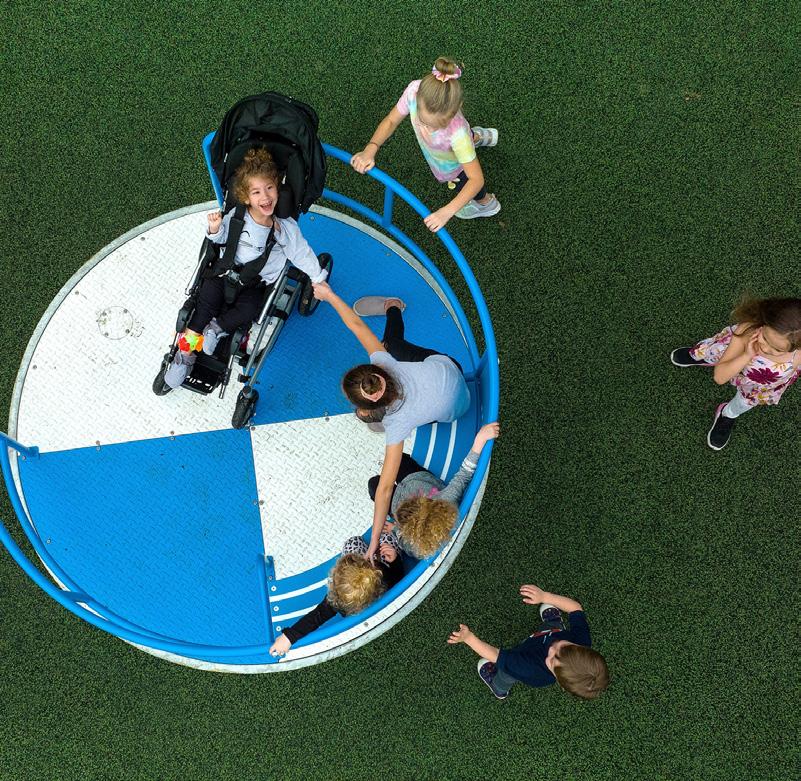
• Consider including an inclusive whirl that is flush with the surface
(‘zero-entry’) to allow people using a mobility device to roll directly onto the spinning platform. This gives individuals the ability to enjoy spinning with others without transferring from their mobility device, fostering their independence.
• Include spinners with visual and auditory features such music or shadow play with colors to create multi-sensory opportunities.
• Use playground safety surfacing with contrasting colors or graphics to incorporate a visual cue around spinning activities to indicate the area where children should use caution when approaching this high activity area.
• Introduce children who cannot or choose not to use a spinning element by encouraging a caregiver or friend to assist them in turning/spinning around on the ground or spinning an object such as a steering wheel on a play panel.
SWINGING
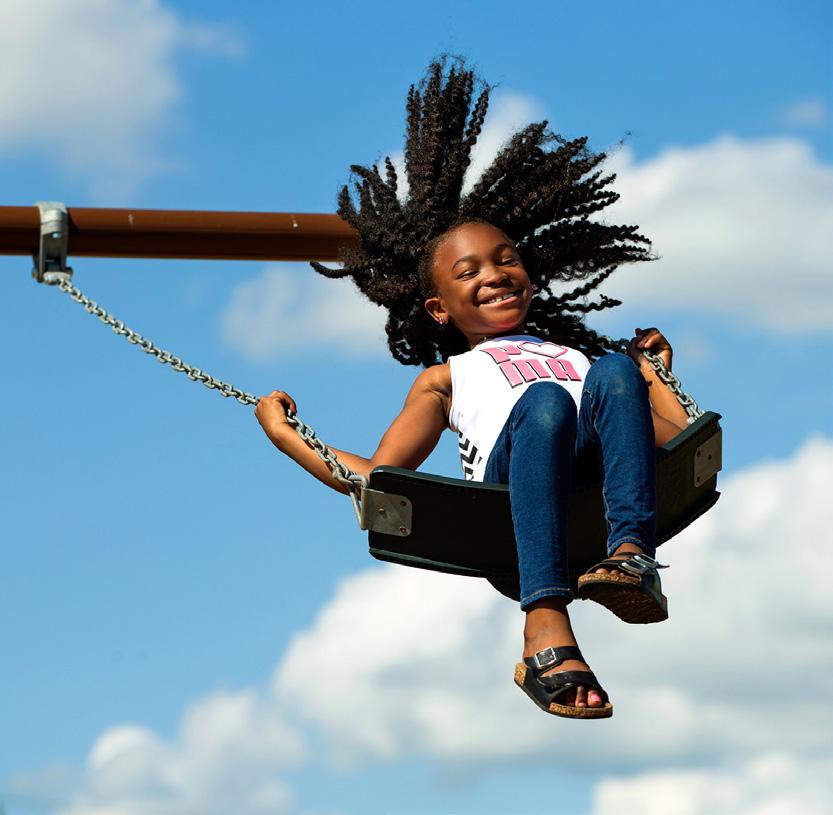
Swinging components allow a child to move forward and backward, sideto-side or in multiple directions while being suspended in the air. Swinging stimulates the vestibular system, which tells a child the speed, direction, and position of the head and is critical for maintaining posture and balance.53 Children must integrate vestibular information with proprioceptive information (the body’s ability to sense its own position and movement) and visual information.79 Swinging requires grip, core strength, coordination, and motor planning to use the required leg pumping motion. Swinging is also fun and can support imaginative play as children pretend to fly, and fosters children’s confidence and risk management skills as children choose the height at which they swing, how they exit the swing, and how to land.53 To swing safely, children also have to pay attention to what others around them are doing and/or might plan to do.
Design Best Practices
A. Ensure Variety of Types and Forms
Offering a variety of types and forms of swinging provides children with choices, encourages exploration, and addresses their diverse developmental needs:
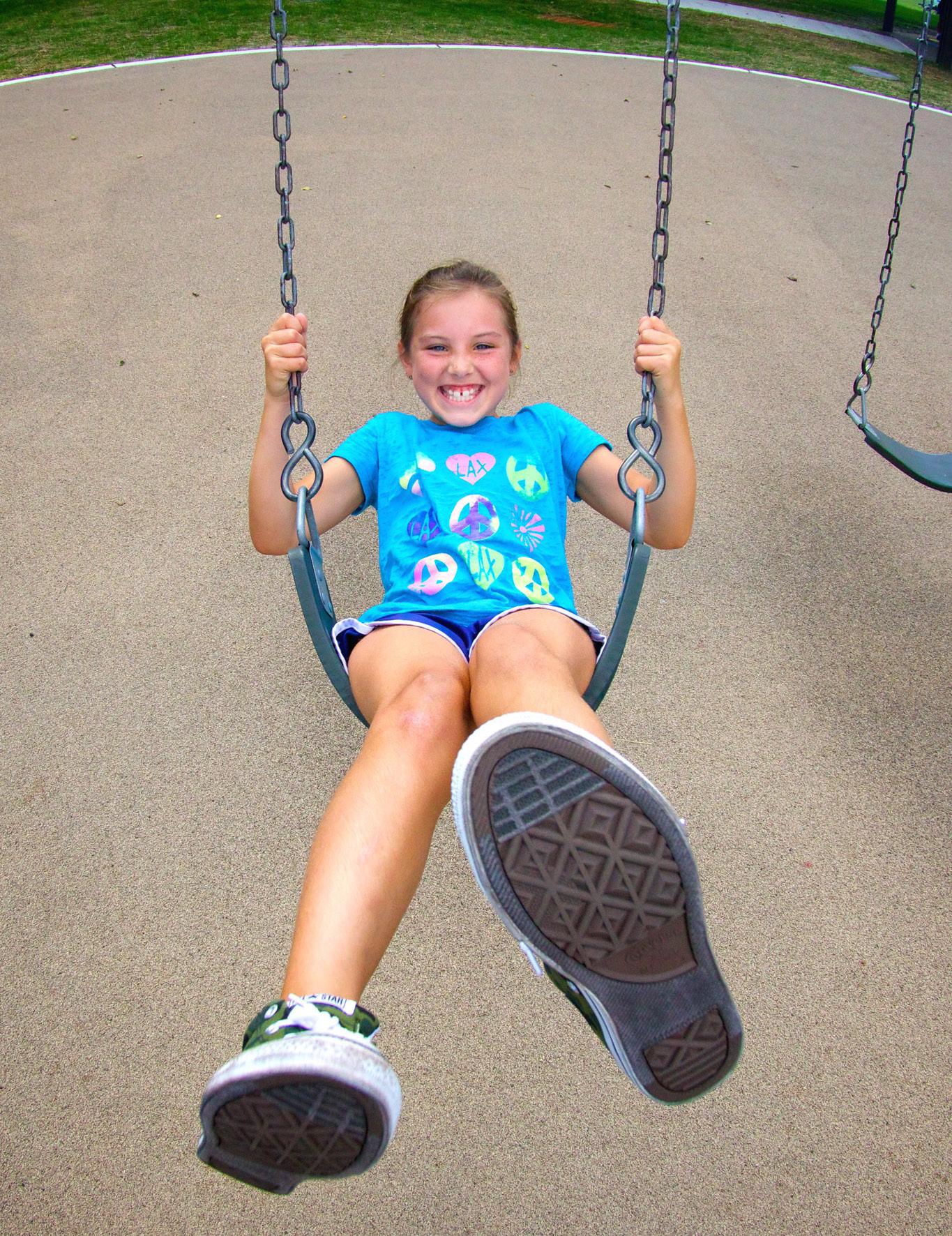
• Swings can include traditional belt swings, toddler/bucket swings, platform/saucers, inclusive swing seats/platforms, and more. Different swing types have unique benefits and can accommodate different age groups and body sizes or shapes.
• Offer an alternative play component if there are restrictions on providing a swing bay. Incorporate a dip station, parallel bars, cruise rails, or other element that has two rails in which the child can use their upper body to support their body weight while swinging their legs back and forth to simulate the “pumping” motion used while swinging.
• Zip lines are considered a type of swing, but they do not offer the fitness benefits of traditional swings where children “pump” their legs and therefore should not be the only swinging activity offered on a Play On! playground.
• The primary function of a tire swing is spinning, and therefore they should not count as swinging activity on a Play On! playground.
B. Offer Graduated Levels of Challenge
Swinging elements should provide beginning, intermediate and advanced levels of challenge through the following attributes:
• Support. Support can be provided by the size and shape of the seat or platform and the availability of a harness or upper body support. Providing more support reduces the level of challenge and offers beginning swinging experiences to children who are still developing trunk control. Providing less support increases the level of challenge because it requires the child to coordinate and engage their core for physical stability. For example, a swing with a high back/ adaptive seat is a lower level of challenge than a belt swing.
• Points of contact. Reducing the amount of contact between the swing and the frame increases the level of challenge because it dictates the amount of swing movement and the level of control required of the child. A swing with four points of connection between
the swing seat and the frame will be more secure, move less freely, and require less of a child than a swing with only two points of contact. A swing with two chains converging on a single hanging point on the frame will be a greater level of challenge than a swing with two chains that connect at two hanging points on the frame.
• Movement. Swings that move in a single plane – such as forward and backward - are a lower level of challenge than those which move in unique or multiple planes of motion, providing greater sensory feedback to the child.
C. Other Design Considerations
Designing for intuitive play patterns, socialization, and inclusion can support engagement and the developmental needs of the whole child.
Support Intuitive Play Patterns:
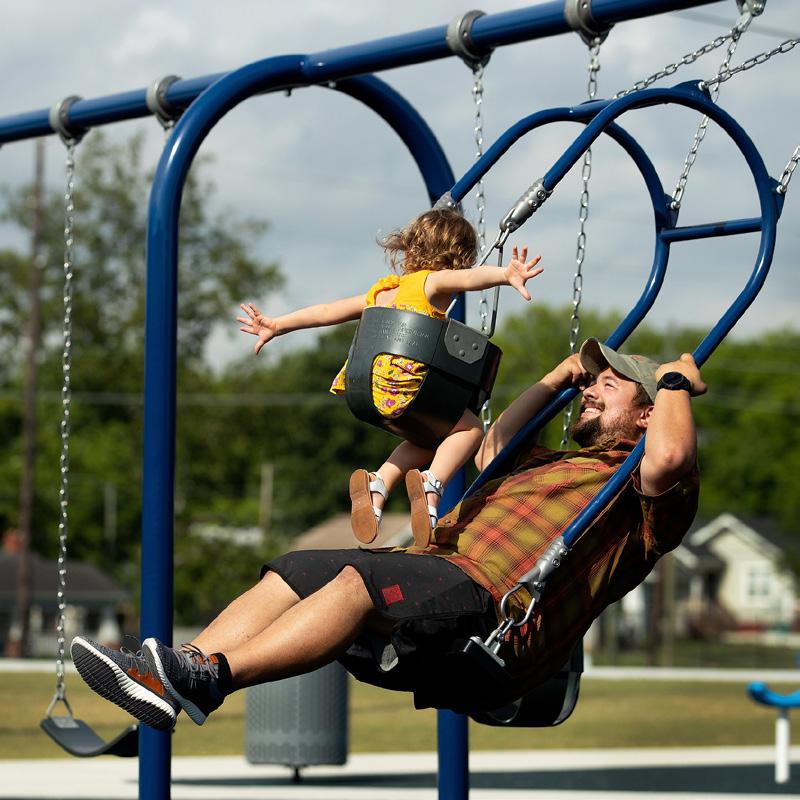
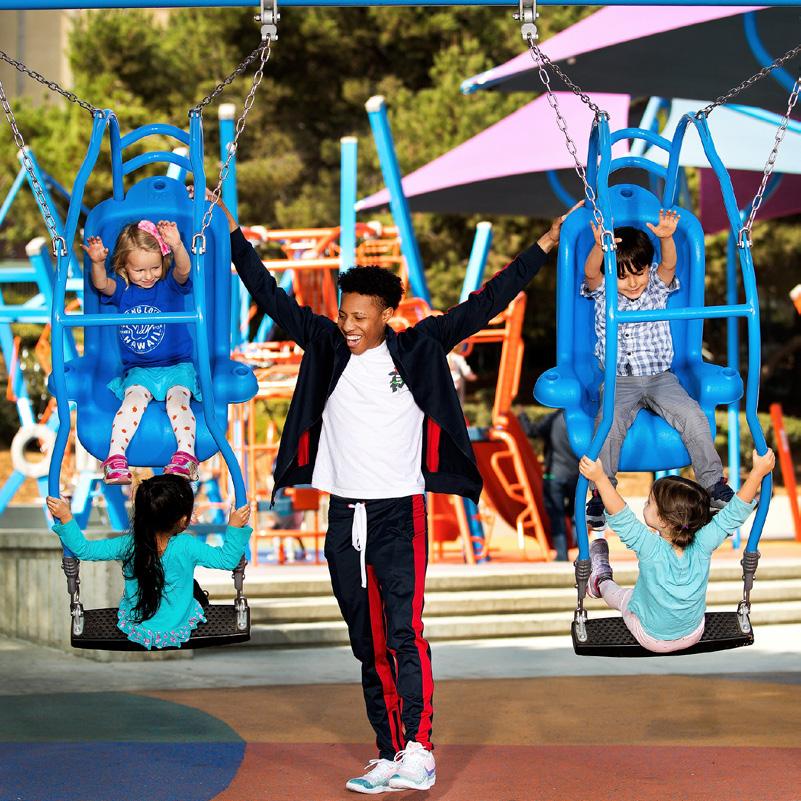
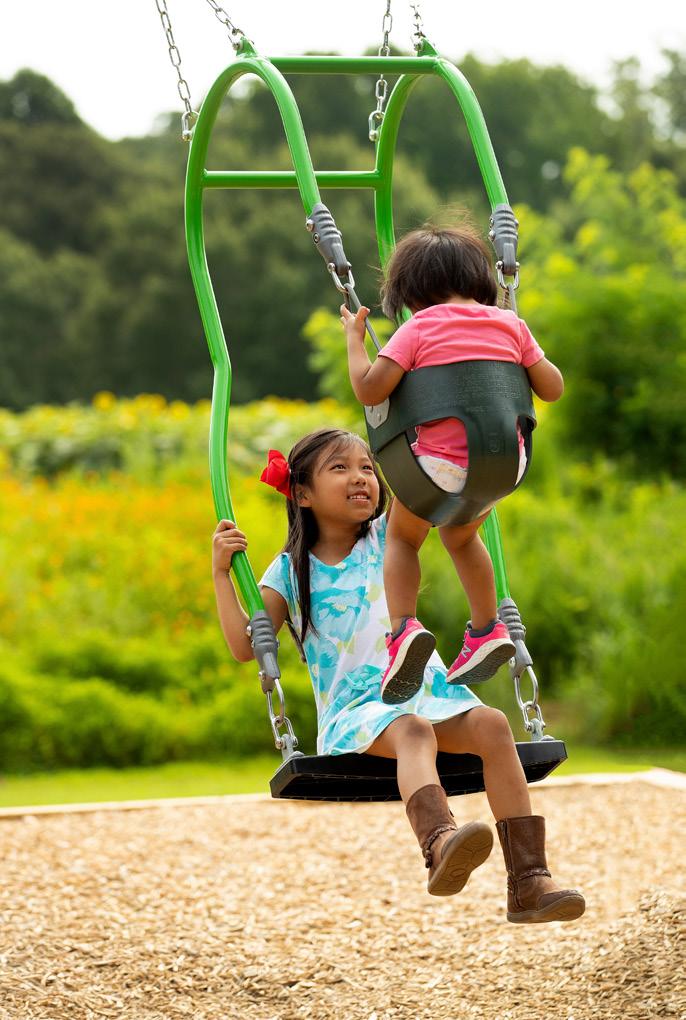
• Offer multi-generational swings which allow children and adults, or two children, to swing face-to-face to support a naturally occurring developmental play behavior called attunement. This instinctive, joyful
experience occurs through the power of movement and good eye contact. This builds emotional bonds, trust, and connections with others.
Facilitate Socialization and Cooperation:
• Place swings side-by-side in a bay to promote social interaction, cooperation, and enhanced pretend play.
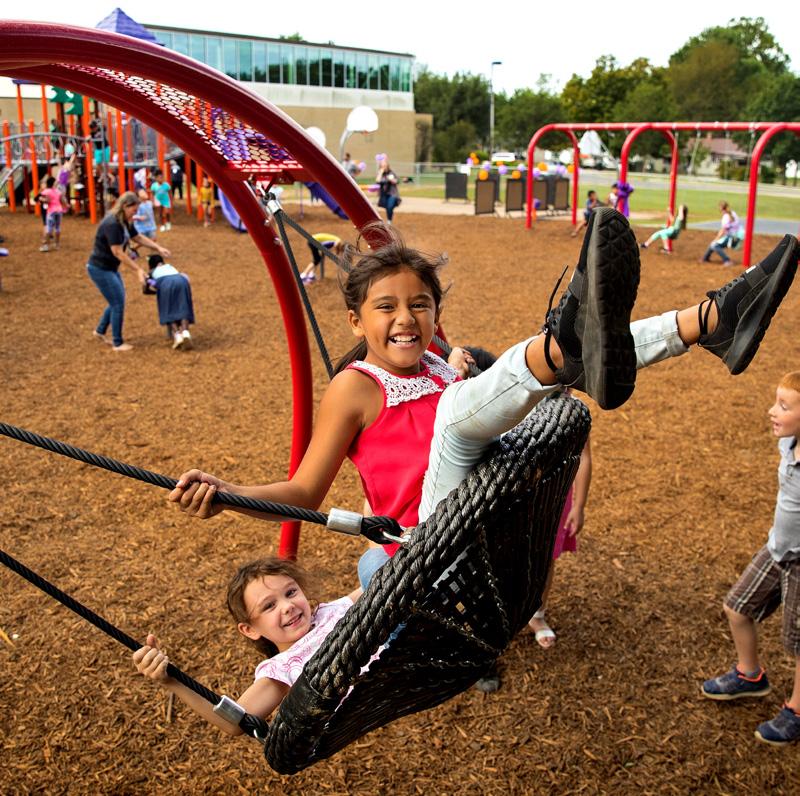
• Provide a platform or saucer swing to encourage children to take turns, work together to create the swinging motion, and develop conversational and interactive play skills.
Foster Inclusion:
• Include inclusive swing seats with features such as high backs, a harness, and/or molded features and inclination designed to keep children in a neutral/upright position. Consider the type of grip/ grasp required as some individuals have less fine motor skills or grip strength or the ability to use their arms.
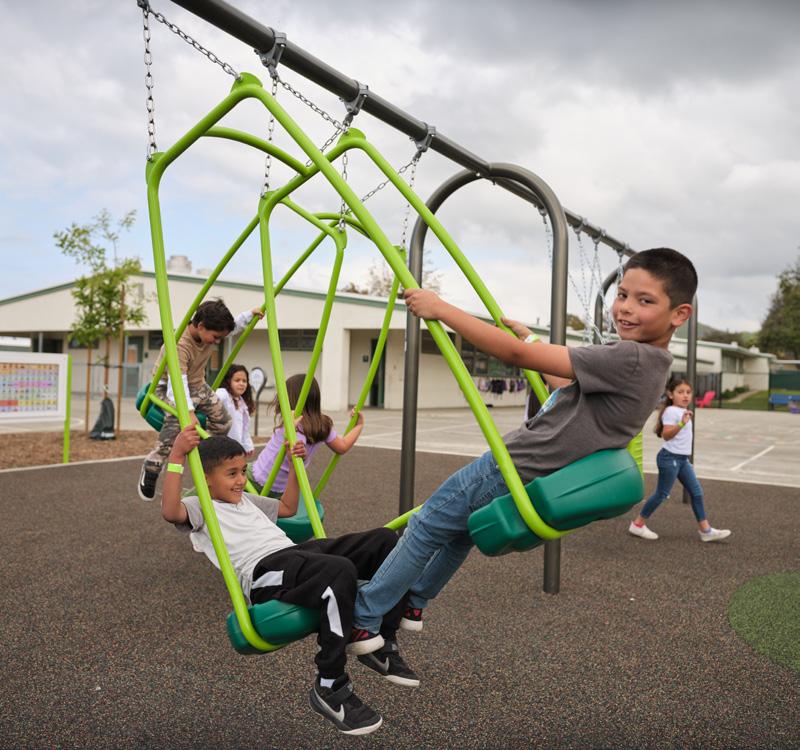
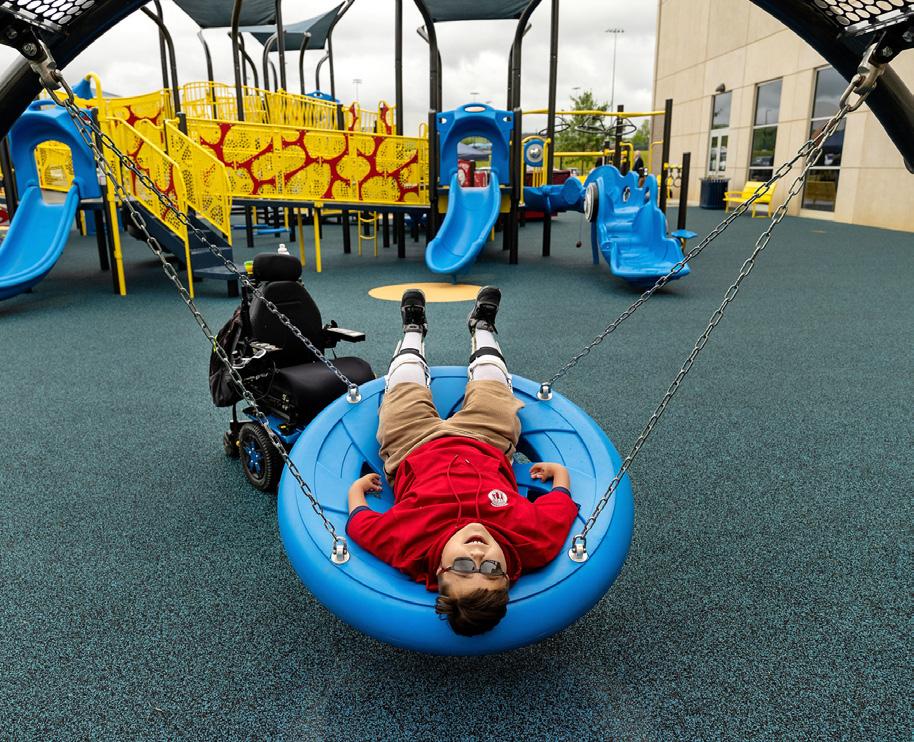
• Platform or saucer swings can provide opportunities for children to enjoy the motion of swinging with friends or caregivers.
• Install swing bays on an accessible route with appropriate safety surfacing, and consider using landscaping, contrasting colors, or graphics to create boundaries and give visual and behavioral cues to children to caution when approaching these highly active areas.
Putting it All Together
Including each of the six elements of active play encourages physically active play and helps children develop a set of skills they will use throughout life. But within each of these six components, providing a variety of opportunities can keep children engaged and make the skills they develop more diverse.
ELEMENT
BALANCING
BRACHIATING/UPPER BODY
BENEFITS OF PLAY
Ability to maintain equilibrium control when stationary or moving, understanding of counterbalancing and base of support, sensory integration skills
Upper body muscular strength, endurance, flexibility, hand-eye and bilateral coordination, sensory integration, confidence, and healthy risk taking
Spatial awareness, coordination, problem-solving skills, motor planning, selfconfidence, and whole-body muscular strength, endurance, and flexibility
CLIMBING
SLIDING
SPINNING
SWINGING
Integration of visual, tactile, spatial and directional awareness information, postural control, core strength, and social skills like patience and behavior regulation
Kinesthetic awareness, postural control, and understanding of speed, force, and directional qualities of movement, cooperation and risk management
Whole body muscular strength and endurance, motor planning skills, coordination, imagination, risk assessment, and social awareness
VARIETY EXAMPLES
Balance beams, balance pods, bridges, links that are not inclined, log rolls
Belt swings, toddler/bucket swings, platforms/saucers, inclusive swings
Dip station, parallel bars, or cruise rails can be used if a swing bay is not possible
• Support
• Incline
• Speed and direction
• Support
• Points of contact
• Swinging movement
Including opportunities at different levels of challenge ensures that all children are given an opportunity to engage in the six key elements of active play while advancing their developmental progression. Supporting intuitive play patterns, facilitating socialization and cooperation, and fostering inclusion are also important elements to keep children engaged and meet the developmental needs of the whole child.
SUPPORT INTUITIVE PLAY PATTERNS
• Place between other elements to link
• Use balancing element as an entry/exit point to the play structure
• Place between other elements to link
• Use upper body element as an entry/exit point to the play structure
• Use climbing element as an entry point to the play structure
• Place near slide exits to encourage looping
FACILITATE SOCIALIZATION AND COOPERATION
• Use for imaginative games
• Link with other elements to encourage leading/following
• Provide portable equipment
FOSTER INCLUSION
• Ground-level alternatives
• High contrast colors and textures
• Communication elements like talk tubes or portable equipment
• Wide base of support and handrails
• Place other play elements near slide exits to encourage looping
• Choose upper body elements that allow multiple players to use at the same time
• Place upper body elements next to each other
• Choose climbers that allow multiple players to climb at the same time
• Place climbing elements with varying levels of challenge next to each other to encourage children to try more advanced equipment
• Dual or triple slide bedways encourage games and races
• Upper body elements that are lower to the ground
• Accessible hand cycles or roller tables
• Adaptive handholds or larger knobs
• Ramps, topography, crawl tubes, and wide links
• Transfer areas, adapted handholds, a wide base of support, and light inclination
• Color and texture
• Solid-surface climbers
• Sensory features like talk tubes
• Slide transfers at the top and bottom of the slide
• Multiple play structure access types like ramps
• Tactile feedback
• Wider bedways
• Visual cues at the bottom of the slide
• Place in a separate, defined activity setting to encourage repetition and avoid conflict
• Multigenerational swings allow for attunement
• Choose spinners for multiple users
• Place spinning seats next to each other
• Place swings side-by side
• Choose saucer/platform swings
• Inclusive seats and handholds
• Zero-entry whirl
• Visual or auditory sensory features
• Accessible routes and surfacing
• High contrast to show active areas
• Inclusive swing seats and grip/grasps
• Saucer/platform swings
• Accessible route and surfacing
• High contrast active areas to provide visual cues
Site-Specific Amenities to Promote Physical Activity and Fitness
Playgrounds are often situated in larger park or schoolyard contexts. Comprehensive reviews of research in this area demonstrate that there are several elements of the design of these spaces proven to be related to children’s physical activity and physical fitness.49,80–85 It is highly beneficial to incorporate them whenever possible to maximize usage and benefits.
• Inclusive elements. Playgrounds should be accessible in accordance with the Americans with Disabilities Act (ADA), which bans discrimination on the basis of disability. To determine if a playground is in compliance with ADA, consult the United States Access Board for detailed information regarding playground accessibility. However, effort should also be made to go beyond the minimums and design playgrounds so that the most people can use it to the fullest extent possible. PlayCore’s 7 Principles of Inclusive Design® provides insights as to how to design a playground to
promote the healthy development of the whole child. PlayCore’s Beyond the Minimums resource describes how other considerations, such as seating and restrooms, impact inclusivity of a play space.
• Portable equipment and loose parts. Portable equipment is manufactured, freely-movable equipment with a purpose, like balls, hula hoops, or bats. Loose parts are more open-ended, interactive, natural and manufactured materials than can be manipulated like mulch, sand, plants, gravel, or grass.86 Both portable equipment87 and loose parts88 are associated with greater physical activity. Portable equipment play is also important for motor skill development, especially object control skills.
• Naturalization. Playground greening promotes active play, as well as children’s socio-emotional health.89 Adding a hill doubles the amount of moderate-to-vigorous physical activity in the area.90,91 Playground naturalization has also been tied
to components of fitness including balance, power, muscular endurance, and cardio-respiratory fitness.92
• Paths. Paths, especially looped paths, promote physical activity. Changing a linear path to a looped path increases moderate-to-vigorous physical activity from 8 to 33% of time in that area.90 In young children (2-5 years of age), use of wheeled toys is an active and popular activity.93 As children age, paths are used for races, and walking and talking.94
• Sport court. Sport blacktop and court areas promote physical activity and fitness. These spaces become increasingly popular as children age into older childhood and adolescence and can help reduce differences in physical activity levels between boys and girls.80 Sufficient space and portable equipment are needed to ensure everyone gets to play and that inactive waiting time is reduced.
• Field/open space for portable equipment Open spaces can be used for a variety of activities, many of which are active games or sports, especially when the right portable
equipment is provided. A careful balance is needed as too large of an open space can result in empty or unused spaces and crowding in other areas of the play space. But overall, providing this type of area is associated with physical activity levels.95,96
• Painted markings or zones Painted markings that facilitate games (e.g., four square) are a way to promote active play, although painted markings can also be educational (e.g., map of the state), imaginative (e.g., a dragon), or support children’s social skills (e.g., mood identifier). Percent of time spent in moderateto-vigorous physical activity during recess increased from 37 to 50% after the addition of painted markings like hopscotch or mazes.97 Paint or surfacing can also be used to break the playground into different-colored use zones like quiet, non-active games, or sports areas. Playground zoning has been shown to increase the percent of time children spend in moderate-to-vigorous physical activity by 3%, which is sustained even 12-months afterwards.98
• Shade and amenities. Natural or man-made shade can help reduce playground temperatures and exposure to ultraviolet radiation, allowing children to play safely for longer.99,100 Providing shade over both play and rest areas makes parents want to stay longer, and children more active.101–103 Water fountains and restrooms also allow for longer visits.102 Shaded gathering areas on school playgrounds can promote their use as outdoor classrooms, keeping the playground close by for use during short class breaks.
Additional Considerations for Young Children
KEY DIFFERENCES BETWEEN YOUNGER AND OLDER CHILDREN
Playgrounds are important for children of all ages. The Play On! Best Practice Design Guide applies to both younger children, 2-5 years of age, and older children, 5-12 years of age, but there are some important considerations when designing for the younger age group.
• Less developed motor skills and fitness. Younger children are still developing the skills needed for the six elements of play.56 For example, they are developing the upper body strength and coordination needed to traverse a horizontal ladder (brachiate).53 Most motor skills improve exponentially from ages 2 to 5 years, and providing opportunities to develop and practice these skills is critical to future participation.56
• Less developed sensory skills. Sensory systems like the vestibular (the body’s balance and spatial orientation system that helps us stay upright) and proprioceptive (the body’s ability to sense its own position and movement) are developing throughout early childhood. This is a critical time period for child development as 95% of the development of the central nervous system, where sensory information is received, processed, and responded to, is done before age 7 years.56 Stimulating the nervous system through sensory experiences like spinning or swinging is important for development.
• Smaller bodies. Younger children are physically smaller. Their overall size (height, weight) is changing rapidly, as is the shape, size, and proportion of specific body parts such as their hands, legs, and head which can affect their ability to complete physical activities.56 For children to be able to fully participate, grips/grasps or handles need to smaller, heights shorter, and steps or bars closer together.
• Different types of play. Younger children tend to engage in openended exploration instead of rule-based or competitive games. With age, play progresses from solitary play and observation to parallel play (engaging in similar activities alongside peers without direct interaction) and eventually to cooperative play. Exploratory, sensory-rich experiences and opportunities for social side-by-side play are especially important during early childhood.
DESIGNING FOR THE SIX ELEMENTS OF ACTIVE PLAY FOR YOUNGER CHILDREN
Young children should be encouraged to further develop the skills needed to successfully participate in the six elements of active play. The other design considerations of levels of challenge, variety, intuitive play patterns, socialization, and inclusion still apply, just like for older children.
However, what is considered beginning, intermediate, or an advanced level of challenge is different for younger versus older children. Activities for younger
children are not simply “beginner” level activities and playgrounds should always contain activities of different challenge levels for the target age group. For 5-12 year-olds, a simple overhead, horizontal ladder would be a beginner level of challenge while a brachiating element which fully rotates while a child brachiates across is considered advanced. For 2-5 year-olds, many of whom are still learning to brachiate, a simple overhead, horizontal ladder is an advanced level of challenge and the rotating type would be inappropriate to include. Providing a variety of ageappropriate levels of challenge ensures that all children in the 2-5 year-old age group can be active and have fun on the playground.
OTHER CONSIDERATIONS
• Programming the play space. There are 25 Play On! Playground Activities specifically designed for this age group. Each activity aligns to SHAPE America’s Active Start guidelines.
• Separate play areas. Separating play areas for younger and older children can help signal parents (and children) as to where is the most appropriate place for them to play, providing an appropriate and safe level of challenge. Signage can be used to clarify the playground space is designed for the 2-5 year-old age group.
• Safety standards. American Society for Testing and Materials (ASTM) standards and Consumer Product Safety Commission (CPSC) recommendations differ for playgrounds designed for younger
versus older children. For example, specific recommendations for grip diameter, maximum heights, and stair rise heights are provided. Playgrounds for younger children can also be installed in childcare or preschool settings, which may be subject to other, often state-specific, regulations. Work with the manufacturer to ensure compliance.
Element Considerations
Balancing
• Place lower to the ground.
• Have a shorter distance between steps/pods, and overall distance to traverse.
• Include components that are more stable with a wider base of support.
• Provide handrails for additional support.
• Log rolls are not appropriate for this age group.
Brachiating
Climbing
• While children can learn to brachiate as early as 2-3 years of age,53 many children will still be developing these skills.
• For children who do not yet brachiate, include components to develop upper body and grip strength and bilateral coordination like a single overhead bar or set of rings.
• For children who do brachiate, use stable, evenly spaced rungs that are closer together.
• For all children, use a lower height and smaller diameter bars.
• Track rides are not appropriate for this age group.
• Climbers with a solid surface will be the easiest, followed by those with stable, close together and/or evenly placed footholds.
• Use a lower height.
Element Considerations
Sliding
Spinning
Swinging
• Some freestanding climbers (e.g., complex rope climbers, arched rungs) and poles are not recommended for this age group.
• Use a lower height and less steep slide chute.
• Curved slides can curve at wider angles and include single instead of multiple curves.
• Spinners which can be used by 1-2 children at a time allow for more control over the intensity of the sensory experience.
• Include supportive seats, such as deeper bowl seats or those with a high back, and handholds for additional support.
• Overhead spinners are not appropriate for this age group.
• Supportive seats (like a bucket or chair swing) are easier for young children because they do not have to support their own body weight.
• Face-to-face swings can allow younger, less skilled children to experience swinging with a parent, sibling, or friend.
Implementation of Best Practice Design
6 ELEMENTS OF ACTIVE PLAY OTHER CONSIDERATIONS
• Variety
• Levels of challenge
• Intuitive play patterns
• Socialization
• Inclusion
SITE-SPECIFIC AMENITIES
Inclusive Elements Sport Court
Portable Equipment and Loose Parts
Field/Open Space
Naturalization c Painted Markings/Zones
3 4
Programming the Playground to Maximize Impact
The design of a playground is critical to ensure high quality user experiences and outcomes. Programming the space can help increase or sustain engagement over time, bring in new visitors, ensure that users know how to use the space or give them new ideas for how to use the space.104,105 In fact, park programming has been shown to be the strongest predictor of park visitation with approximately 25% more park visitors for each additional organized activity.106
The Play On! Playground Activities
A companion Play On! Playground Activities curriculum was created through a partnership with SHAPE America to further enhance the impact of playgrounds built using the Play On! Best Practice Design Guide. This curriculum helps park and recreation professionals and educators use the playground to promote physical activity and fitness all in the context of having fun. For more information on the Play On! Playground Activities, visit:
• 125 activity cards for preschool to 5th grade children
• National Standards of Physical Education alignment matrix
• Assessment worksheets and equipment lists
• Safety, implementation, inclusion, and teaching strategies
• A resource to send home to families (in English and Spanish)
Each activity card includes:
• Activity description
• Which of the six elements of active play are included
• Benefits
• Alignment to the SHAPE America Active Start or National Standards for K-12 Physical Education
• Equipment needed
• Teaching tips
• Variations
• A “Did you know?” fact
Turn the page to see five example Play On! activity cards.
Assessment Worksheets to assess the physical, fitness, social, and personal development of a child.
Family Send-Home Resource that describes the Play On! program, family engagement ideas, and playground safety.
Did you know?
Ant hills have one queen, who lays the eggs.
Ants go Marching
Preschool-Age Children (Ages 2-5)
Children march around the playground, following the leader over various surfaces and obstacles such as stairs, ladders and slides. Children take turns leading the group as they imitate the designated leader (The ants go marching up the stairs! The ants go sliding down the slide!, etc.) Children may wish to incorporate the song in their movements as they perform.
Play Elements: Climbing, Sliding
Active Start Guidelines: #1, #3, #4, #5
Benefits:
• Encourage gross motor skills while following a model
• EIDP - Gross motor imitates one part body movement 3 - 3.5 years, imitates body movements with integration of both sides of body 4 - 4.5 years
Teaching Tips:
• Add more challenges to the march, such as spinning, hopping or crawling, for variation.
• Lead the group to get started and model the activity, then allow the children to take turns being the leader.
• Ensure that multiple children have a chance to lead the group by either specifying a starting and ending point or timing each child’s turn.
Variations:
• Easier: Assist children in completing gross motor activities by providing physical assistance or additional support.
• More Challenging: Put out additional obstacles such as crawl tunnels or cones to increase the complexity of the course. Encourage children to march across balance beams and ramps already on the playground; this adds to the complexity of the course.
Did you know?
A space shuttle is a reusable space vehicle that is designed to return to Earth like a giant glider.
Space Shuttle Landing
Grades K & 1
An adult or designated child leader “launches” (throws) a ball as high as possible in the air. Others start at the base of the climbing equipment and climb to see how high they can get before the ball lands. When the ball lands, the thrower yells, “space shuttle landing!” and retrieves the ball as everyone freezes. The child who climbed the highest becomes the launcher and the game begins again.
Play Elements: Climbing
National Standards Guidelines: #1, #2, #3, #4
Benefits:
• Enhances focus and develops the ability to perform under pressure.
• Develops upper and lower body strength and endurance.
Teaching Tips:
• Limit participation to the number of children who can safely climb available equipment at one time; integrate others in a circuit system.
Variations:
• Easier: Allow children to keep climbing through two or more launches.
• More Challenging: Have children jump twice before climbing.
• Adaptation: Give some children a head start.
For safety tips, reference the Safety Strategies section of Play On! Playground Activities
Did you know?
Mr. Olympia is the title given to the best body builder in the world.
Spinning Bodybuilders
Grades 2 & 3
A team of children stand on a spinning apparatus. On command, a second team pushes the apparatus to get it spinning, then watches what develops. As the spinning apparatus spins, children establish a firm base of support with their legs, then perform a series of bodybuilder poses of their choice. They continue posing until the whirl or spinning apparatus stops. They then jump off and “hand off their pose” to another child who jumps on. The hand off can be a high five, a handshake or another creative means of tagging. The first team now pushes the apparatus for the second team as team members imitate, as best they can, the poses of the children who tagged them.
Play Elements: Balancing, Spinning
National Standards Guidelines: #1, #2, #3, #4
Benefits:
• Cultivates awareness of and respect for the diverse characteristics of others.
• Improves body control, kinesthetic awareness and ability to perform in public. Improves balance and core stability.
Teaching Tips:
• Instruct children to hold on with one or two hands, as needed.
Variations:
• Easier: Children hold on with two hands at all times.
• More Challenging: Children all face a certain direction, as if having their picture taken, despite the spinning of the apparatus.
• Adaptation: Have the child perform a bodybuilder pose off the equipment or from a sitting position on the equipment. For safety tips, reference the Safety Strategies section of Play On! Playground Activities
Did you know?
In the story of Frankenstein, Frankenstein is the name of the scientist who creates the monster, not the actual name of the monster. The monster is never given a name.
Creature Feature
Grades 4 & 5
The youngest child is the first leader. All other children spread out on the playground equipment in an area where they can spin around freely (but in close proximity to the play equipment). The leader yells, “Zero!”. The children must “freeze” in the form of a creature (person, animal, or monster) while balancing on the play equipment. For example, one child might pose as Frankenstein then goes around to each of the “frozen” creatures and tries to guess what they are. The first correctly named creature is the next leader, and a new round of play begins. If no creatures are identified correctly, the leader tries again!
Play Elements: Balancing, Spinning
National Standards Guidelines: #2, #3, #4
Benefits:
• Promotes muscular endurance and static balance (center of gravity over base of support).
• Fosters creativity, child interaction and leadership opportunities.
• Provides a body- and spatial-awareness movement experience.
Teaching Tips:
• Clearly identify and mark boundaries (i.e. playground surfacing).
• Ask children to choose their pose before the activity begins.
Variations:
• Easier: To lessen the length of time poses are held, creatures that are not being guessed may relax until approached or multiple leaders may guess simultaneously.
• More Challenging: The leader must tag all creatures before poses are relaxed and a new round begins.
• Adaptation: If a child is unable to mount a piece of equipment, he or she can perform a pose on ground or, as the leader, point to the “frozen” creatures from the ground.
For safety tips, reference the Safety Strategies section of Play On! Playground Activities
Did you know?
At the end of basic training, Marines have to complete the Crucible, a 54hour field event to test what they’ve learned.
Basic Training
All Ages (Grades K - 5)
Together with the children, devise an obstacle course through the playground. Include each play element: balancing, brachiating, climbing, sliding, spinning, and swinging. Some children may wish to be timed to see how quickly they can complete the course — either individually or as an entire class.
Play Elements: Combination (balancing, brachiating, climbing, sliding, spinning, and swinging)
National Standards Guidelines: #1, #2, #3, #4
Benefits:
• Integrates fundamental motor skills and movement concepts in a pleasurable way.
• Develops muscular strength, endurance, and flexibility.
• Provides self-challenge, social interaction, and a sense of group membership.
Teaching Tips:
• If necessary, post arrows to help children follow the activity sequence.
• Provide children with plenty of time to practice the activities and sequence.
Variations:
• Easier: Children complete several shorter courses that collectively address all play elements; children complete the course with a partner.
• More Challenging: Children complete courses that span the entire playground; children complete the course in reverse.
• Adaptation: The child completes the course with a partner.
Implementation Strategies
The Play On! Playground Activities offer fun ways for park programmers, camp counselors, and teachers to facilitate meaningful, engaging, and playful experiences that promote physical activity, fitness, and fun by incorporating the six elements of play, portable equipment, and an active imagination.
IN PARKS AND PUBLIC SPACES
The Play On! Playground Activities can be used in a variety of settings, like parks, community centers, or anywhere a Play On! playground is located. Here are some ideas on how to get started:
Summer camp
• Provide the activity book for camp leaders to use.
• Plan a week-long unit to teach about physical activity and fitness concepts through play.
After-school club
• Use as a warm-up or instant activity at the start of programming.
• Give kids a break between other activities, to promote physical activity and on-task behavior.107
• Engage kids during outdoor play time, by using as an activity zone to provide health-promoting options while maintaining their autonomy108, or as an energizer to get kids moving again, encourage them to interact with new people, and prevent boredom.109
• Use as an end-of-the-day wrap-up while children wait to be picked up.
Signage
• Post an activity of the week to inspire community members to visit and be active together.
• Include a permanent QR code to link to a selection of activities.
Social media
• Post an activity of the week to inspire community members to visit and be active together.
• Use ‘Did you know’ facts to enhance engagement and learning.
IN SCHOOLS
While the Play On! Playground Activities are aligned with National Standards for Physical Education, the activities can be used in a variety of situations across the school day, not just physical education class:
Physical education
• Use as a warm-up or instant activity to physiologically prepare students for the day’s activities or to review previously learned skills or concepts.110
• Include as a fitness activity to ensure that, regardless of the lesson topic, children experience a health-related fitness component each time you meet.
• Incorporate into the main lesson to teach intended topics within the psycho-motor, cognitive or affective learning domains of physical education.
• Close with an end-of-lesson wrap up to assess the retention of physical skills (such as dynamic balance), or cognitive concepts (such as spatial awareness), or attitude development (such as teamwork) taught in the lesson.111
Recess
• Engage in a warm-up activity to get students engaged and ready to play – drawing them out on to the playground faster, so they can maximize their time outside.
• Provide as an activity zone to give students health-promoting options while maintaining their autonomy.108
• Use as a mid-recess energizer to get kids moving again, encourage them to interact with new classmates, and
make sure everyone participates in physical activity during recess.109
• Close with a wrap-up activity to bring children together at the end of recess, while squeezing in a few more minutes of active play before they go back inside.62, 109
Class
• Engage in an active classroom break if your classroom is located near the playground, to aid in learning retention and classroom focus.107, 112
• Use as a learning supplement – some activities are related to classroom topics. For example, Exploration Transformation is about shapes, while 12 O’Clock Rock relies on clockreading skills.
Before and/or after school
• Let students use the playground, and these activities, as part of a formal before- or after-school club.51
• Provide children something to do while waiting for school doors to open, or to be picked up after school even outside of a formal club.50
Research and Evaluation
The Play On! Best Practice Design Guide was created based on a compilation of years of research on how playgrounds influence children’s active play, with input from researchers and practitioners. For an example of our foundational work in this area, see Joe Frost’s book, The Developmental Benefits of Playgrounds.53 Following the Play On! Best Practice Design Guide ensures an evidence-based design for a highquality playground, which leads to high-quality outcomes. There have been several studies that demonstrate the effectiveness of Play On! playground environments and/or the Play On! Playground Activities to maximize usage.
THE
PLAY ON! PLAYGROUND ACTIVITIES ON PLAY ON! PLAYGROUNDS LEADS TO FUN, PHYSICAL ACTIVITY, AND SKILLS
“In summary, we as researchers and evaluators of this project have full confidence to support the implementation of the Play On! curriculum as a means of maintaining and improving regular and fun participation in physical activity for young children.”
- Dr. Yuanlong Liu and Dr. Suzan F. Ayers, Western Michigan University
Researchers from Western Michigan University conducted an objective analysis of the impact of using the Play On! Playground Activities on playgrounds following the Play On! Best Practice Design Guide. They wanted to
evaluate its role in getting kids moving by having fun! The study, which was supported by SHAPE America, included pre- and post- intervention surveys and measurements of over 100 children and 11 teachers from 15 schools across 10 states. A subsample of children wore an accelerometer to measure physical activity levels.
Findings were overwhelmingly positive:
• 91% of teachers reported playground use increased
• 90% of teachers planned to use the Play On! Playground Activities in the future
• 100% of teachers reported the Play On! Playground Activities were easy to use
• >50% of teachers thought the
activities improved children’s fitness, while 94% of children thought so
• The largest skill improvements were reported in brachiating
• 100% of students reported having fun while engaging in Play On! activities
• Activity intensity was measured 38% higher during Play On! activities than during free play
PLAY ON! PLAYGROUND ACTIVITIES MEANS MORE PHYSICAL ACTIVITY DURING AN AFTER-SCHOOL CLUB
Researchers from Arizona State University used the Play On! Playground Activities as part of an after school program four days a week for 16 weeks.51 Children wore an accelerometer to measure physical activity levels before and after implementing the Play On! Playground Activities. 66 children were in the final analysis. Over a typical 3-hour after-school session, they found that children in the intervention group:
• Participated in 10 fewer minutes of sedentary behavior
• Participated in 5 more minutes of light intensity physical activity
• Participated in 6 more minutes of moderate-to-vigorous physical activity
• Had greater improvements when their school implemented the program more often and teachers completed trainings
PLAY ON! BEST PRACTICE DESIGN MEANS REPEAT VISITORS IN A NATIONWIDE SAMPLE
PlayCore’s National Demonstration Site program has resulted in countless Play On! playgrounds across the nation in schools, parks, community centers, and
more. These sites are all designed to align with the Play On! Best Practice Design Guide and some use the Play On! Playground Activities. Many National Demonstration Sites have signage with a QR code, and approximately 6,000 visitors have provided the following feedback across Play On! sites:
• 95% plan to return
• 60% are return visitors
• The most common visit durations are: 21 to 40 minutes (35%), 41 to 60 minutes (29%), and more than an hour (27%)
• 47% reported that someone in their group was moderately active, while 27% reported that someone was vigorously active
• 95% were satisfied
• The number one reason they visited was for physical health reasons (52%), and social and emotional health (19%)
Projects of Excellence
Play
On!
Design Elements Promote Increased Park Usage and Physical Activity — Long Beach, California
I love the size of the park and the quality of equipment. It’s engaging for my kids’ brain and physical strength with the varied activities and modern play equipment.” - Parent of Play On! playground visitor
Recreation Park in Long Beach, CA, is a large 210-acre recreation center in the southeast section of the city. The park has a variety of active areas, including lawn bowling, a dog park, and a playground designed utilizing the Play On! Best Practice Design Guide. The play area includes two separate age-appropriate playground structures for children ages 2 to 5 years and 5 to 12 years. Rubberized surfacing allows playground enthusiasts of all abilities to access each of the different types of play offered including the six elements of active play - balancing, brachiating/ upper body, climbing, sliding, spinning, and swinging. The interactive play areas include features such as a “Dino Excavation Zone” digging area, multiple dinosaur structures, a megaphone and color play. Xylophone and bongo drums are also included to offer playground users an auditory experience.
As a National Demonstration Site, Recreation Park had the opportunity to receive three data reports to demonstrate the impact of the space
on the community. The reports helped them incorporate data-driven strategies to showcase the vital role they play in promoting health-focused outcomes through the playground. The reports provided valid, reliable data that has been translated and scaled to community needs. From assessment and planning to implementation and measuring results, the Play On! Best Practice Design Guide and National Demonstration Site program help maximize positive impact throughout the community.
Recreation Park Impact Data:
• Total visits to the park increased 38% in the year after their Play On! playground opened
• Unique visitors to the park went from 49.3K to 102.1K, an increase of 107%
• Visitors traveling from a distance greater than 3 miles increased by 8%
• Health Impact Estimations showed a total health care savings potential of $226,118 annually
Research shows that each additional play element on a playground attracts 50% more users and 50% more physical activity.40 Multiple studies also indicate that physical activity and sedentary behaviors remain consistent over time, and while physical activity is influenced by genetics, personal and cultural preferences, patterns established at young ages are likely to influence physical activity across the life span.11,12
Utilizing the Play On! Best Practice Design Guide can be an effective tool for creating innovative play spaces, and establishing healthy habits at a young age by increasing physical activity while at play.
In addition to the overall impact of the Play On! designed playground in Long Beach, the user specific survey feedback demonstrated high satisfaction:
• 98% of surveyed visitors were satisfied with their experience
• 98% plan to visit again
• Ages of visitor groups showed an intergenerational mix, including 49% children, 37% adults 6% adults 65+, and 8% adolescents
• 86% reported reaching the recommended levels of moderate-tovigorous physical activity while using the space
• 42% of users visit the space more than once a week
• The majority of visitors come from more than one mile away, with 29% traveling more than 5 miles, showing that people are willing to travel to use well-designed play spaces
By implementing Play On! design and measuring impact through the National Demonstration Site Program, Recreation Park in Long Beach, CA, has helped children and families be more active and demonstrated their commitment to overall community health and wellness.
Implementing Play On! Teacher Training to Help Improve Student Health — Various Sites, Mississippi
It was a pleasure visiting such joyful school playground sites in Mississippi and working with teachers and administrators to maximize the benefits of play. The smiles (and little beads of sweat) on children’s faces let me know they were getting the most out of their play time.”
- Brian Dauenhauer, PhD, Active Schools Institute Director
Adult obesity rates in the state of Mississippi are among the highest in the nation and significantly above the national average.113 As of 2022-2023, the prevalence of overweight or obese children in Mississippi is 43.1%, higher than the national average of 32.2%.114
As part of a state school playground initiative, Play On! representatives
implemented a training program to coincide with playground replacement in several schools. The need for new play spaces was immense, partially because of the tornadoes experienced throughout the state. Many elementary schools had outdated playgrounds or lacked them entirely.
Studies show creating environments for children to experience unstructured play supports their physical health and increases their chances of succeeding in the classroom.115 Outdoor play can also have a marked effect on obesity rates by helping children better manage healthy age-related changes in weight.116
It was determined that playground designs would include the six elements of active play that promote physical activity and fitness (balancing, brachiating/upper body, climbing, sliding, spinning, and swinging). Teacher education was also provided to facilitate the implementation of the Play On! Playground Activities.
Schools selected to receive a playground either did not currently have a playground or had a playground that was aged and in disrepair. Each of the 5,380 square foot playgrounds include turf safety surfacing, shading systems, and 24 pieces of play equipment.
Teacher training took place both inperson and virtually. During the virtual session, trainers focused on key training content, including:
• Physical, cognitive, and socialemotional benefits of play
• The six active play elements integrated in playground designs for greater physical activity and fitness
• Standards-aligned Play On! activities and the associated learning benefits
• Play On! parent resources to involve students’ families in understanding and participating in the Play On! program
• Student assessment tools to help school-based educators measure progress
• Teaching strategies and curriculum integration strategies
During the inperson training, each school was provided with the Play On! Playground Activities book and playground equipment kit including cones, cone folders, gator skin balls, beanbags, poly spots, and hoops The trainers demonstrated activities across multiple grade levels to showcase ageappropriate activities for all students
At some of the schools, students drew themselves participating in the activities and described how the Play On! playground made them feel to help gauge emotional well-being generated by participation. Memorable playground experiences depicted among the 48 students who participated included:
• Common descriptors: “happy” (n=23 children), “fun” (n=9)
• Common images: smiles (n=27), equipment from the kits (n=44), swings (n=23), slides (n=18)
• Student quotes: “I feel happy when I’m on the playground”, “I feel good; it was fun; I feel sooo good; I love it”, “Happy, safe, excited, loved”
The new playgrounds and the Play On! Playground Activities provide the children and teachers in the participating Mississippi schools with a fun, expressive outlet to maximize both physical health and emotional well-being. As Windy Faulkner, Superintendent of Union County Schools said, “Our students are going to enjoy the benefits of this for years to come.”
Overall Impact:
• 96,000+ square ft of new play spaces across Mississippi
• 17 schools and over 7300 students impacted by new playgrounds
• 25 educators participated in over 20 hours of curriculum training
• 100% of participants agreed with training outcomes and would recommend Play On! to other schools
Utilizing Play On! Programming to Promote School/Park
Partnership Goals on the Playground — Springfield-Greene County, Missouri
Physical educators and programmers play a critical role in the planning and development of school playgrounds and the overall utilization of the space. Playgrounds are large investments for schools, and a thoughtful play space should provide a wide variety of activities that motivate, engage, and challenge all children. Planning a high-quality playground design along with programming the space in and out of school time can positively impact students and community.”
- Peggy Riggs, Ret. Superintendent Springfield-Greene County School District
Combining resources from a school district and a parks and recreation department is a highly efficient way to build or renovate playgrounds. This partnership approach often requires less funding from each organization as they pool their resources, making large-scale improvements more feasible. School playgrounds with school/park partnerships can be used in and out of school time to maximize usage during weekends, evenings, and school breaks. For communities, especially those with limited park space, this expands
community access to safe, conveniently located areas for exercise and play. In many cities, low-income neighborhoods and communities of color have fewer parks and green spaces.117 Partnering to open school playgrounds can help close the “park equity gap” and ensure all children have access to the developmental benefits of play.118 The Trust for Public Land estimates that opening all public schoolyards after school hours would put a park within a 10-minute walk of 20 million people who don’t currently have access.199
Springfield-Greene County, MO understands the value of partnership. A pioneering city for school/park partnerships, many school playgrounds in Springfield are open to the public during non-school hours. This partnership creates significant value by providing broader community access, maximizing resources, and improving health and social outcomes for both children and adults.
The pioneering attitude around shared use in Springfield also led to nine local elementary schools participating in a national research study to show the value of the Play On! program as a component of elementary school physical education. Peggy Riggs, Superintendent of the Springfield School District at the time of the study, was intrigued to learn about how to maximize usage of the playground investment while providing both students and educators the opportunity to expand activity through physical education curriculum.
The physical education teachers received training on Play On! Playground Activities implementation and led physical education sessions on the school playground. They noted during the sessions that all students in class were active at the same time, as opposed to “waiting for a turn” and that even children who didn’t enjoy typical physical education loved Play On! because play is perceived as fun rather than exercise. Each session included a warm-up or energizer, the main session, and a wrap-up. Students wore accelerometers to track the quantity and intensity of physical movement, providing an objective measure of sedentary time, and light or moderateto-vigorous physical activity.
Send home guides in both English and Spanish informed parents and families about the program and encouraged after school, family-centered usage of
the Play On! program in the park setting. Students could practice their skills at home, engage in school/park sponsored family activities like Family Fitness Nights, and complete home-based challenges. Schools could encourage participation by holding parent-teacher events, providing family-friendly resources and modification options (provided in the Play On! Playground Activities) and by proactively inviting families to events or even to observe classes.
The Springfield-Greene County School District continues to prioritize healthy schools by supporting wellness, good nutrition, and regular physical activity as part of the total learning environment in which children learn and participate in positive dietary and lifestyle practices that will last throughout life. See the findings from this study in the Research and Evaluation section of this guide.
Call to Action: Advocating for Active Playgrounds in Your Community
PlayCore’s Center for Outreach, Research, and Education (CORE) can help you advocate for and execute highquality designs to have a widespread and positive impact on the whole community. Through a variety of scholarly resources and tools, CORE can also help you defend and grow your active play initiatives by quantifying your impact and telling data-based stories to engage community members and key partners.
Want to bring physical activity and fitness to children in your community? Champions like you can play a critical role in advocating for high quality spaces that promote health and wellness. Below are four steps to help you successfully advocate for your community.
1. Build Your Case
Gather supporting data and build your case for a healthy play space. Begin by documenting how opportunities to participate in active, equitable play experiences throughout one’s life is a right that enhances quality of life for children, families, and our greater society. Take steps to understand your community demographics and align your project goals. Seek out what recreation opportunities, if any, are currently available and how they are
meeting the diverse needs of all children in your community. Interviewing families at this stage can help you understand how and if they are engaging with existing services, and to get feedback on what an active play and recreation environment could mean to the community.
CORE has a variety of resources to help you build a meaningful case. Understanding current research and best practice can help inform your planning and help you make evidencebased decisions. Attending learning opportunities through the Professional Development Hub and gaining continuing education credits (CEUs) is a great way to get started. CORE’s resources are all aligned to the Community Vitality Framework which is a tool that can help you prioritize your community needs, strengths, and areas of opportunity, and build a data-driven case.
2. Educate and Engage Community Advocates
Once your research is underway, encourage others to advocate and invest in the process. Meet with people who are invested in the community, including children and their families, organizations, and/or businesses, to address specific needs and identify partnership opportunities. Creating an interdisciplinary committee of community partners can help build momentum for the project and break down potential barriers early. Educating and engaging a variety of community
members and champions can also help solicit potential funding opportunities. Marketing through communications, social media promotions, and holding special events throughout the project lifecycle are important ways to build momentum, demonstrate progress and sustain excitement, and even share outcomes post opening.
CORE’s Funding Tool provides robust funding opportunities that can help turn dreams into reality. Use CORE’s Community Vitality Framework to organize your story in a way that resonates with your community needs while highlighting the widespread impact a high-quality environment can have on the whole community.
3. Turn Research into Practice in Planning, Design, and Use
The Play On! Best Practice Design Guide is a valuable tool to help ensure the space you’ve worked so hard to plan and fund has lasting impacts on children’s active play and physical fitness and is truly beneficial in supporting the health and wellness of your community. Utilize the planning tips and strategies in this guide to help inform and educate other key players about intentional design. In addition, thinking strategically about how the playground can be programmed can greatly increase the usage of the space.
CORE partners with an unequaled network of scholars and supports research that identifies evidence-based design best practices. Research done by our Scholar Network informed and evaluated the Play On! Best Practice Design Guide and Playground Activities. Visit the Resource Library to find
additional resources to help your community implement best practices for planning and design, curriculum and programming, advocacy, and community impact initiatives.
4. Become a National Demonstration Site
Intentionally aligning to scholarly design criteria provided in the Play On! Best Practice Design Guide helps ensure that your community can maximize the value of your investment to implement healthy and active spaces for your community. PlayCore’s National Demonstration Site program recognizes sites that align with the evidence-based design best practices to promote healthy behaviors like physical activity and fitness.
Your site will get national recognition through the National Demonstration Site map, and you’ll receive a marketing toolkit with resources, like press releases and social media posts, to help you promote the value of your site to your community. CORE’s Data Service Lab also helps National Demonstration Site communities measure and showcase the positive outcomes the site is making on Community Vitality through site-specific data gathering and reporting.
Learn more at:
www.playcore.com/CORE
Youth Physical Activity and Fitness Supports Your Community Vitality
Parks, playgrounds, and other outdoor recreation spaces can have a widespread impact on the whole community and that’s why everything CORE does – research, providing resources, professional development, and data storytelling – is centered around positively impacting Community Vitality.
WHAT IS COMMUNITY VITALITY?
In a vital community, individuals are healthy, connected, and empowered to thrive - physically, emotionally, socially, and economically - within a sustainable and supportive environment. Community Vitality is a multifaceted concept driven by both collective and individual wellbeing in a community but also the dynamic interplay between individuals, groups, institutions, public services, and other place-based factors. PlayCore’s
Community Vitality Framework maps the concept onto domains, providing a way to organize conversations surrounding community strengths and areas for improvement, and the potential impact of play and recreation spaces.
HOW DO PLAY ON! PLAYGROUNDS PROMOTE COMMUNITY VITALITY?
The evidence is clear that playgrounds are more than just fun. They can have a lasting impact on communities in a variety of ways. Healthy playgrounds align to the Community Vitality Framework domains of Physical Health; Social and Emotional Health; Diversity, Equity, and Inclusion; and Education.
Physical Health.
Individuals within a vital community are in a state of well-being where they are able to perform daily activities and do not suffer from chronic conditions – such as obesity, diabetes, and asthma. Play On! playgrounds promote physical activity, reducing risk of excessive weight gain, and improving bone health, cardiovascular and muscular fitness, cardio-metabolic risk factor status, and cognition including memory, processing speed, attention, and academic performance. This directly impacts the vitality of community members and their ability to go out and engage with their community.
Social and Emotional Health.
Individuals within a vital community can manage their emotions and cope with life’s challenges, form and maintain meaningful relationships with others, and feel a sense of purpose and life satisfaction. Many of the Play On! elements of play can be social, such
as sliding side-by-side with a friend or family member or working with others to use a spinner. In addition to forming and strengthening relationships, this helps children learn how to share, understand different perspectives, and follow social rules. Being physically active makes children happier, and less likely to have mental health problems like depressive symptoms.120 By offering different levels of challenge, children can participate in more risky play, which makes them more resilient, and less anxious.121
Diversity, Equity, and Inclusion. A vital community is comprised of a diverse population (including race, ethnicity, disability, etc.) where all individuals have equal access to opportunities and no disproportionate burdens across all domains of Community Vitality. Aligning with the Play On! Best Practice Design Guide ensures that every playground in your community is a high-quality, evidence-based design, bringing the health benefits to everyone in your community. A cornerstone of the Play On! Best Practice Design Guide is the inclusion of different levels of challenge, so that children of all ability levels can
participate, be physically active, and get the associated benefits.
Education. Individuals within the community are educated, both formally and informally, and have the ability and desire to be lifelong learners by expanding their knowledge and skills, being open to new ideas, and thinking creatively. Play On! can be implemented on school and/or park playgrounds, and the Play On! Playground Activities aligns with national physical education standards set forth by SHAPE America.32 Physical education is recognized as an academic subject that teaches students physical literacy, the ability, confidence, and desire to be physically active for life.122 Play On! playgrounds, with or without the Playground Activities, can be used during recess as research demonstrates that active breaks improve on-task behavior in the classroom and are necessary for children’s learning.123
Resources and References
Resources
• PlayCore websites of interest include education.playcore.com, playcore. com/research, playcore.com/ resources, and playcore.com/NDS
• The Developmental Benefits of Playgrounds by Joe Frost, PeiSan Brown, John A. Sutterby, Candra D. Thornton. Published by The Association for Childhood Education International in 2004. ISBN: 9780871731647
• SHAPE America Active Start Guidelines www.shapeamerica.org/ MemberPortal/standards/guidelines/ activestart.aspx
• SHAPE America National Physical Education Standards www.shapeamerica.org/ MemberPortal/standards/pe/Default. aspx
• United States Consumer Product Safety Commission Public Playground Safety Handbook www.cpsc.gov/Playground-Handbook
References
1. Convention on the Rights of the Child [Internet]. Geneva: Office of the High Commissioner for Human Rights (OHCHR); [cited 2025 Nov 3]. Available from: https://www.ohchr.org/en/instruments-mechanisms/ instruments/convention-rights-child
2. Committee on the Rights of the Child. General comment No. 17 (2013) on the right of the child to rest, leisure, play, recreational activities, cultural life and the arts (art. 31) [Internet]. Geneva: United Nations; 2013 [cited 2025 Nov 3]. Available from: https://www.refworld.org/legal/ general/crc/2013/en/96090
3. Whitebread D, Basilio M, Kuvalja M, Verma M. The importance of play. Brussels: Toy Industries of Europe; 2012.
4. Parten MB. Social participation among pre-school children. J Abnorm Soc Psychol. 1932;27:243–69.
5. Sandseter EB. Categorising risky play—how can we identify risk-taking in children’s play? Eur Early Child Educ Res J. 2007;15(2):237–52.
6. Yogman M, Garner A, Hutchinson J, Hirsh-Pasek K, Golinkoff RM; Committee on Psychosocial Aspects of Child and Family Health; Council on Communications and Media. The power of play: a pediatric role in enhancing development in young children. Pediatrics. 2018;142(3):e20182058.
7. Truelove S, Vanderloo LM, Tucker P. Defining and measuring active play among young children: a systematic review. J Phys Act Health. 2017;14(2):155–66.
8. Caspersen CJ, Powell KE, Christenson GM. Physical activity, exercise, and physical fitness: definitions and distinctions for health-related research. Public Health Rep. 1985;100(2):126–31.
9. Butte NF, Watson KB, Ridley K, Zakeri IF, McMurray RG, Pfeiffer KA, et al. A youth compendium of physical activities: activity codes and metabolic intensities. Med Sci Sports Exerc. 2018;50(2):246–56.
Scientific report of the 2018 Physical Activity Guidelines Advisory Committee [Internet]. Washington (DC): U.S. Department of Health and Human Services; 2018 [cited 2025 Nov 3]. Available from: https://odphp.health.gov/ sites/default/files/2019-09/PAG_Advisory_Committee_ Report.pdf
11. Telama R, Yang X, Leskinen E, Kankaanpää A, Hirvensalo M, Tammelin T, et al. Tracking of physical activity from early childhood through youth into adulthood. Med Sci Sports Exerc. 2014;46(5):955–62.
12. Craigie AM, Lake AA, Kelly SA, Adamson AJ, Mathers JC. Tracking of obesity-related behaviours from childhood to adulthood: a systematic review. Maturitas. 2011;70(3):266–84.
13. Telama R, Yang X, Viikari J, Välimäki I, Wanne O, Raitakari O. Physical activity from childhood to adulthood: a 21year tracking study. Am J Prev Med. 2005;28(3):267–73.
14. Piercy KL, Troiano RP, Ballard RM, Carlson SA, Fulton JE, Galuska DA, et al. The physical activity guidelines for Americans. JAMA. 2018;320(19):2020–8.
15. Khan NA, Hillman CH. The relation of childhood physical activity and aerobic fitness to brain function and cognition: a review. Pediatr Exerc Sci. 2014;26(2):138–46.
16. Raine LB, Lee HK, Saliba BJ, Chaddock-Heyman L, Hillman CH, Kramer AF. The influence of childhood aerobic fitness on learning and memory. PLoS One. 2013;8(9):e72666.
17. Chaddock L, Neider MB, Lutz A, Hillman CH, Kramer AF. Role of childhood aerobic fitness in successful street crossing. Med Sci Sports Exerc. 2012;44(4):749–53.
18. Larsen LR, Nielsen CM, Møller NC, B Andersen LB, Wedderkopp N. Motor performance as risk factor for lower extremity injuries in children. Med Sci Sports Exerc. 2016;48(6):1136–43.
19. Battista RA, Pivarnik JM, Dummer GM, Sauer N, Malina RM. Childhood physical fitness and performance as predictors of high school sport participation. Meas Phys Educ Exerc Sci. 2021;25(1):43–52.
20. Cattuzzo MT, dos Santos HR, Ré AHN, de Oliveira IS, Melo BM, de Sousa Moura M, et al. Motor competence and health-related physical fitness in youth: a systematic review. J Sci Med Sport. 2016;19(2):123–9.
21. Barnett LM, Stodden DF, Cohen KE, Smith JJ, Lubans DR, Lenoir M, et al. Through the looking glass: a systematic review of longitudinal evidence, providing new insight for motor competence and health. Sports Med. 2022;52(5):875–920.
22. Stodden DF, Goodway JD, Langendorfer SJ, Roberton MA, Rudisill ME, Garcia C, et al. A developmental perspective on the role of motor skill competence in physical activity: an emergent relationship. Quest. 2008;60(2):290–306.
23. Hulteen RM, Morgan PJ, Barnett LM, Stodden DF, Lubans DR. Development of foundational movement skills: a conceptual model for physical activity across the lifespan. Sports Med. 2018;48(7):1533–40.
24. García-Hermoso A, Izquierdo M, Ramírez-Vélez R.
Tracking of physical fitness levels from childhood and adolescence to adulthood: a systematic review and metaanalysis. Transl Pediatr. 2022;11(4):474–86.
25. Freedman DS, Khan LK, Dietz WH, Srinivasan SR, Berenson GS. Relationship of childhood obesity to coronary heart disease risk factors in adulthood: the Bogalusa Heart Study. Pediatrics. 2001;108(3):712–8.
26. Reilly JJ, Kelly J. Long-term impact of overweight and obesity in childhood and adolescence on morbidity and premature mortality in adulthood: systematic review. Int J Obes. 2011;35(7):891–8.
27. U.S. Department of Health and Human Services. Physical Activity Guidelines for Americans. 2nd ed. Washington (DC): U.S. Department of Health and Human Services; 2018.
28. SHAPE American. Active Start: A statement of physical activity guidelines for children from birth to age 5. 2nd ed. Reston (VA): SHAPE America; 2020.
29. McGuire S. Institute of Medicine (IOM) early childhood obesity prevention policies. Washington (DC): The National Academies Press; 2011. Adv Nutr. 2012;3(1):56–7.
30. Haupt AL, Massare B, Nizer J, Paul M, Valenti LA. Healthy young children. Washington (DC): National Association for the Education of Young Children; 2024.
31. Centers for Disease Control and Prevention and SHAPE America—Society of Health and Physical Educators. Strategies for Recess in Schools. Atlanta (GA): Centers for Disease Control and Prevention, US Dept of Health and Human Services; 2017 [cited 2025 Nov 3]. Available from: https://www.cdc.gov/physical-activity-education/media/ pdfs/2019_04_25_SchoolRecess_strategies_508tagged. pdf
32. SHAPE America – Society of Health and Physical Educators. National physical education standards. Champaign (IL): Human Kinetics; 2024.
33. National Association for the Education of Young Children. Early childhood program standards [Internet]. Washington (DC): NAEYC; 2025 [cited 2025 Nov 3]. Available from: https://www.naeyc.org/sites/default/ files/globally-shared/downloads/PDFs/our-work/publicpolicy-advocacy/2025_early_childhood_program_ standards.pdf
34. National Association for the Education of Young Children. Early learning program quality assessment and accreditation assessment items [Internet]. Washington (DC): NAEYC; 2025 [cited 2025 Nov 3]. Available from: https://www.naeyc.org/sites/default/files/globally-shared/ final_naeyc_quality_assessment_and_accreditation_ assessment_items_english.pdf
35. Dodd HF, FitzGibbon L, Watson BE, Nesbit RJ. Children’s play and independent mobility in 2020: results from the British Children’s Play Survey. Int J Environ Res Public Health. 2021;18(8):4334.
36. Corder K, Sallis JF, Crespo NC, Elder JP. Active children use more locations for physical activity. Health Place. 2011;17(4):911–9.
37. Scott MM, Cohen DA, Evenson KR, Elder J, Catellier D,
Ashwood JS, et al. Weekend schoolyard accessibility, physical activity, and obesity: the Trial of Activity in Adolescent Girls (TAAG) study. Prev Med. 2007;44(5):398–403.
38. Suminski RR, Connolly EK, May LE, Wasserman JA, Olvera NE. Youth physical activity opportunities in lower and higher income neighborhoods. J Urban Health. 2011;88(4):599–615.
39. Reimers AK, Schoeppe S, Demetriou Y, Knapp G. Physical activity and outdoor play of children in public playgrounds—do gender and social environment matter? Int J Environ Res Public Health. 2018;15(7):1356.
40. Cohen DA, Han B, Williamson S, Nagel C, McKenzie TL, Evenson KR, et al. Playground features and physical activity in U.S. neighborhood parks. Prev Med. 2020;131:105945.
41. Young DR, Lee E, Cohen DA, Evenson KR, Han B, McKenzie TL, et al. Playground location and patterns of use. J Urban Health. 2023;100(3):504–12.
42. Besenyi GM, Kaczynski AT, Wilhelm Stanis SA, Vaughan KB. Sex differences in the relationship between park proximity and features and child and youth physical activity. Child Youth Environ. 2016;26(2):56–84.
43. Potwarka LR, Kaczynski AT, Flack AL. Places to play: association of park space and facilities with healthy weight status among children. J Community Health. 2008;33(5):344–50.
44. Young DR, Spengler JO, Frost N, Evenson KR, Vincent JM, Whitsel LP. Promoting physical activity through the shared use of school recreational spaces: a policy statement from the American Heart Association. Am J Public Health. 2014;104(9):1583–8.
45. Lewallen TC, Hunt H, Potts-Datema W, Zaza S, Giles W. The Whole School, Whole Community, Whole Child model: a new approach for improving educational attainment and healthy development for students. J Sch Health. 2015;85(11):729–39.
46. Webster CA. The comprehensive school physical activity program: an invited review. Am J Lifestyle Med. 2022;17(7):762–74.
47. Centers for Disease Control and Prevention. Increasing Physical Education and Physical Activity: A Framework for Schools. Atlanta (GA): Centers for Disease Control and Prevention, US Dept of Health and Human Services; 2019 [cited 2025 Nov 3]. Available from: https://www.cdc.gov/ physical-activity-education/media/pdfs/2019_04_25_PEPA-Framework_508tagged.pdf
48. Hyndman B. Contemporary school playground strategies for healthy students. Cham (Switzerland): Springer; 2017.
49. Clevenger KA, Dunton GF, Katzmarzyk PT, Pfeiffer KA, Berrigan D. Adherence to recess guidelines in the United States using nationally representative data: implications for future surveillance efforts. J Sch Health. 2023;93(12):1145–55.
50. Parrott HM, Cohen LE. Advocating for play: the benefits of unstructured play in public schools. Sch Community J. 2020;30(2):229–54.
51. Poulos A, Wilson K, Kulinna PH, Schulke M, Perlman D, Carson R. Degree of implementation of a play-based curricular intervention affects children’s movement in afterschool settings. J Healthy Eat Act Living. 2024;4:128.
52. Massey WV, Stellino MB, Fraser M. Individual and environmental correlates of school-based recess engagement. Prev Med Rep. 2018;11:247–53.
53. Frost JL, Brown P-S, Sutterby JA, Thornton CD. The developmental benefits of playgrounds. Child Educ. 2004;81:42.
54. Stevens-Smith DA, Murdock J. Fundamentals of play and how these influence learning in the classroom. Int J Early Child Learn. 2020;27:1–9.
55. Morgenthaler T, Schulze C, Pentland D, Lynch H. Environmental qualities that enhance outdoor play in community playgrounds from the perspective of children with and without disabilities: A scoping review. Int J Environ Res Public Health. 2023;20:1763.
56. Malina RM, Bouchard C, Bar-Or O. Growth, Maturation, and Physical Activity. Human Kinetics; 2004.
57. Little H, Eager D. Risk, challenge and safety: Implications for play quality and playground design. Eur Early Child Educ Res J. 2010;18:497–513.
58. Brussoni M, Gibbons R, Gray C, Ishikawa T, Sandseter EB, Bienenstock A, et al. What is the relationship between risky outdoor play and health in children? A systematic review. Int J Environ Res Public Health. 2015;12:6423–54.
59. Willenberg LJ, Ashbolt R, Holland D, Gibbs L, MacDougall C, Garrard J, et al. Increasing school playground physical activity: A mixed methods study combining environmental measures and children’s perspectives. J Sci Med Sport. 2010;13:210–6.
60. Jerebine A, Fitton-Davies K, Lander N, Eyre EL, Duncan MJ, Barnett LM. “All the fun stuff, the teachers say, ‘that’s dangerous!’” Hearing from children on safety and risk in active play in schools: a systematic review. Int J Behav Nutr Phys Act. 2022;19:72.
61. Hyndman B. Contemporary School Playground Strategies for Healthy Students. Springer; 2017.
62. Massey WV, Perez D, Neilson L, Thalken J, Szarabajko A. Observations from the playground: common problems and potential solutions for school-based recess. Health Educ J. 2021;80:313–26.
63. McNamara L. What’s getting in the way of play? An analysis of the contextual factors that hinder recess in elementary schools. Can J Action Res. 2013;14:3–21.
64. Smith WR, Moore R, Cosco N, Wesoloski J, Danninger T, Ward DS, et al. Increasing physical activity in childcare outdoor learning environments: the effect of setting adjacency relative to other built environment and social factors. Environ Behav. 2016;48:550–78.
65. Sandberg A. Play memories from childhood to adulthood. Early Child Dev Care. 2001;167:13–25.
66. Jones DE, Greenberg M, Crowley M. Early socialemotional functioning and public health: the relationship between kindergarten social competence and future wellness. Am J Public Health. 2015;105:2283–90.
67. Ross SM, Smit E, Yun J, Bogart K, Hatfield B, Logan SW. Updated national estimates of disparities in physical activity and sports participation experienced by children and adolescents with disabilities: NSCH 2016–2017. J Phys Act Health. 2020;17:443–55.
68. Locke J, Shih W, Kretzmann M, Kasari C. Examining playground engagement between elementary school children with and without autism spectrum disorder. Autism. 2016;20:653–62.
69. Sibley KM, Beauchamp MK, Van Ooteghem K, Straus SE, Jaglal SB. Using the systems framework for postural control to analyze the components of balance evaluated in standardized balance measures: A scoping review. Arch Phys Med Rehabil. 2015;96:122–32.e29.
70. Blodgett JM, Cooper R, Pinto Pereira SM, Hamer M. stability of balance performance from childhood to midlife. Pediatrics. 2022;150:e2021055861.
71. Pollock AS, Durward BR, Rowe PJ, Paul JP. What is balance? Clin Rehabil. 2000;14:402–6.
72. Gabbard C. Playground apparatus experience and muscular endurance among children aged 4 6 [Internet]. College Station (TX): Texas A&M University, College of Education; 1979 [cited 2025 Nov 3]. Available from: https://files.eric.ed.gov/fulltext/ED228190.pdf
73. Nemanich S, Schindler-Ivens S. Age-related development of bilateral coordination of the upper limbs in children and adolescents. J Mot Behav. 2025;57:12–20.
74. Gull C, Goldenstein SL, Rosengarten T. Benefits and risks of tree climbing on child development and resiliency. Int J Early Child Environ Educ. 2018;5:10–29.
75. Smith PF, Zheng Y, Horii A, Darlington CL. Does vestibular damage cause cognitive dysfunction in humans? J Vestib Res. 2005;15:1–9.
76. Guo J, Wang J, Liang P, Tian E, Liu D, Guo Z, et al. Vestibular dysfunction leads to cognitive impairments: state of knowledge in the field and clinical perspectives. Int J Mol Med. 2024;53:36.
77. Topley D, McConnell K, Kerr CA. A systematic review of vestibular stimulation in cerebral palsy. Disabil Rehabil. 2021;43:3291–7.
78. Choudhery A, Ansarii T. A systematic review study on the effects of vestibular stimulation in children with autism. Eur J Public Health. 2020;2:70.
79. Post AA, Peper CE, Beek PJ. Effects of visual information and task constraints on intersegmental coordination in playground swinging. J Mot Behav. 2003;35:64–78.
80. Clevenger KA, Wierenga MJ, Howe CA, Pfeiffer KA. A systematic review of child and adolescent physical activity by schoolyard location. Kinesiol Rev. 2020;9:147–58.
81. Pawlowski CS, Madsen CD, Toftager M, Amholt TT, Schipperijn J. The role of playgrounds in the development of children’s fundamental movement skills: A scoping review. PLoS One. 2023;18:e0294296.
82. Clevenger KA, McKee KL, Harris T, Pfeiffer KA. Schoolyard-redesign strategies and outcomes in children and adolescents: a systematic review. Kinesiol Rev.
2025;1:1–22.
83. Schipperijn J, Madsen CD, Toftager M, Johansen DN, Lousen I, Amholt TT, et al. The role of playgrounds in promoting children’s health–a scoping review. Int J Behav Nutr Phys Act. 2024;21:72.
84. Ávila-García M, Medel-Carbonell LM, Ruiz-Alarcón A, Huertas-Delgado FJ. How can schools increase children and adolescents’ physical activity? A systematic review of playground features. J Sch Health. 2025;95:765–75.
85. Pfledderer CD, Kwon S, Strehli I, Byun W, Burns RD. The effects of playground interventions on accelerometerassessed physical activity in pediatric populations: A meta-analysis. Int J Environ Res Public Health. 2022;19:3445.
86. Gull C, Bogunovich J, Goldstein SL, Rosengarten T. Definitions of loose parts in early childhood outdoor classrooms: a scoping review. Int J Early Child Environ Educ. 2019;6:37–52.
87. Verstraete SJM, Cardon GM, De Clercq DLR, De Bourdeaudhuij IMM. Increasing children’s physical activity levels during recess periods in elementary schools: the effects of providing game equipment. Eur J Public Health. 2006;16:415–19.
88. Caldwell HA, Spencer RA, Joshi N, Branje K, Cawley J, Hobson H, et al. Impact of an outdoor loose parts play intervention on Nova Scotian preschoolers’ physical literacy: a mixed-methods randomized controlled trial. BMC Public Health. 2023;23:1126.
89. Bikomeye JC, Balza J, Beyer KM. The impact of schoolyard greening on children’s physical activity and socioemotional health: a systematic review of experimental studies. Int J Environ Res Public Health. 2021;18:535.
90. Nicaise V, Kahan D, Reuben K, Sallis JF. Evaluation of a redesigned outdoor space on preschool children’s physical activity during recess. Pediatr Exerc Sci. 2012;24:507–18.
91. Haug E, Torsheim T, Sallis JF, Samdal O. The characteristics of the outdoor school environment associated with physical activity. Health Educ Res. 2010;25:248–56.
92. Fjørtoft I. The natural environment as a playground for children: The impact of outdoor play activities in preprimary school children. Early Child Educ J. 2021;29:111–17.
93. Brown WH, Pfeiffer KA, McIver KL, Dowda M, Addy CL, Pate RR. Social and environmental factors associated with preschoolers’ nonsedentary physical activity. Child Dev. 2009;80:45–58.
94. Black IE, Menzel NN, Bungum TJ. The relationship among playground areas and physical activity levels in children. J Pediatr Health Care. 2015;29:156–68.
95. Springer AE, Tanguturi Y, Ranjit N, Skala KA, Kelder SH. Physical activity during recess in low-income third-grade Texas students. Am J Health Behav. 2013;37:318–24.
96. Brink LA, Nigg CR, MR Lampe S, Kingston BA, Mootz AL, van Vliet W. Influence of schoolyard renovations on children’s physical activity: the Learning Landscapes
Program. Am J Public Health. 2010;100:1672–8.
97. Stratton G, Mullan E. The effect of multicolor playground markings on children’s physical activity level during recess. Prev Med. 2005;41:828–33.
98. Baquet G, Aucouturier J, Gamelin FX, Berthoin S. Longitudinal follow-up of physical activity during school recess: impact of playground markings. Front Public Health. 2018;6:283.
99. Vanos JK, Middel A, McKercher GR, Kuras ER, Ruddell BL. Hot playgrounds and children’s health: a multiscale analysis of surface temperatures in Arizona, USA. Landsc Urban Plan. 2016;146:29–42.
100. Vanos JK, McKercher GR, Naughton K, Lochbaum M. Schoolyard shade and sun exposure: assessment of personal monitoring during children’s physical activity. Photochem Photobiol. 2017;93:1123–32.
101. Lanza K, Alcazar M, Durand CP, Salvo D, Villa U, Kohl HW. Heat-resilient schoolyards: relations between temperature, shade, and physical activity of children during recess. J Phys Act Health. 2022;20:134–41.
102. Tucker P, Gilliland J, Irwin JD. Splashpads, swings, and shade: parents’ preferences for neighbourhood parks. Can J Public Health. 2007;98:198–202.
103. Buller DB, English DR, Buller MK, Simmons J, Chamberlain JA, Wakefield M, et al. Shade sails and passive recreation in public parks of Melbourne and Denver: a randomized intervention. Am J Public Health. 2017;107:1869–75.
104. Otero Peña JE, Kodali H, Ferris E, Wyka K, Low S, Evenson KR, et al. The role of the physical and social environment in observed and self-reported park use in low-income neighborhoods in New York City. Front Public Health. 2021;9: 656988.
105. Cohen DA, Marsh T, Williamson S, Derose KP, Martinez H, Setodji C, et al. Parks and physical activity: why are some parks used more than others? Prev Med. 2010;50:S9–12.
106. Cohen DA, Han B, Derose KP, Williamson S, Marsh T, Raaen, et al. The paradox of parks in low-income areas: park use and perceived threats. Environ Behav. 2016;48:230–45.
107. Daly-Smith AJ, Zwolinsky S, McKenna J, Tomporowski PD, Defeyter MA, Manley A. Systematic review of acute physically active learning and classroom movement breaks on children’s physical activity, cognition, academic performance and classroom behaviour: understanding critical design features. BMJ Open Sport Exerc Med. 2018;4:e000341.
108. Barnas JL, Ball SD. The effects of activity zones on physical activity during recess. Health Behav Policy Rev. 2019;6:182–91.
109. McKenzie TL, Sallis JF, Elder JP, Berry CC, Hoy PL, Nader PR, Zive MM, Broyles SL. Physical activity levels and prompts in young children at recess: a two-year study of a bi-ethnic sample. Research quarterly for exercise and sport. 1997;68:195-202.
110. Barney DC, Leavitt T. A qualitative investigation of PE teachers’ perceptions of introductory/warm-up activities in K–12 PE. Phys Educ. 2019;76:86-97.
111. Young S. Recommendations for teaching physical education to students with EBDs. Strategies. 2012;25:8–11.
112. Pellegrini AD, Bjorklund DF. The role of recess in children’s cognitive performance. Educ Psychol. 1997;32:35–40.
113. United Health Foundation. America’s Health Rankings: Obesity in Mississippi [Internet]. 2023. [cited 2025 Nov 3] Available from: https://www.americashealthrankings.org/ explore/measures/Obesity/MS
114. Long MW, Ward ZJ, Resch SC, Cradock AL, Wang YC, Giles CM, et al. State-level estimates of childhood obesity prevalence in the United States corrected for report bias. Int J Obes. 2016;40:1523–8.
115. Bento G, Dias G. The importance of outdoor play for young children’s healthy development. Porto Biomed J. 2017;2:157–60.
116. Ansari A, Pettit K, Gershoff E. Combating obesity in Head Start: outdoor play and change in children’s body mass index. J Dev Behav Pediatr. 2015;36:605–12.
117. McKenzie TL, Moody JS, Carlson JA, Lopez NV, Elder JP. Neighborhood income matters: disparities in community recreation facilities, amenities, and programs. J Park Recreat Adm. 2013;31:12.
118. The Trust for Public Land. Community Schoolyards™ Projects: A Game-Changing Solution to America’s Park Equity Problem [Internet]. 2021. [cited 2025 Nov 3] Available from: https://www.tpl.org/wp-content/ uploads/2022/09/Community-Schoolyards-Projects-TheTrust-for-Public-Land_083121.pdf
119. The Trust for Public Land. School’s Out: In a Time of Compounding Crises, America’s Schoolyards Are Packed with Potential [Internet]. 2020. [cited 2025 Nov 3] Available from: https://www.tpl.org/wp-content/ uploads/2020/08/Schools-Out_A-Trust-for-Public-LandSpecial-Report.pdf
120. Recchia F, et al. Physical activity interventions to alleviate depressive symptoms in children and adolescents: a systematic review and meta-analysis. JAMA Pediatr. 2023;177:132–40.
121. Sandseter EBH, Kennair LEO. Children’s risky play from an evolutionary perspective: the anti-phobic effects of thrilling experiences. Evol Psychol. 2011;9:257–84.
122. The Aspen Institute: Project Play. Physical Literacy in the United States: A Model, Strategic Plan, and Call to Action. [Internet] 2015. [cited 2025 Nov 3] Available from: https:// www.aspeninstitute.org/wp-content/uploads/2025/08/ PhysicalLiteracy_AspenInstitute-FINAL.pdf
123. Stapp AC, Karr JK. Effect of recess on fifth grade students’ time on-task in an elementary classroom. Int Electron J Elem Educ. 2018;10:449–56.