GROWING GREEN SCHOOLYARDS GROWING GREEN SCHOOLYARDS
In partnership with:

Executive Summary
Why green schoolyards?
Research has found that children’s exposure to nature is beneficial to their academic, social, psychological, cognitive, and physical health. According to studies featured in NatureGrounds® and Pathways for Play™, students in outdoor environments:
• Demonstrate increased physical activity, focus, and cognitive function
• Engage in more creative and selfdirected forms of play
• Show reduced symptoms of attention deficit disorders and stress
• Benefit from improved social relations and self discipline
• Have positive opportunities to engage with family and community members
Collectively, this body of research demonstrates the importance of green schoolyards in the overall health and success of children, families, schools, and communities. Since students spend most of their weekday hours in school, greening schoolyards is a vital and logical step to support children’s overall health and well-being.
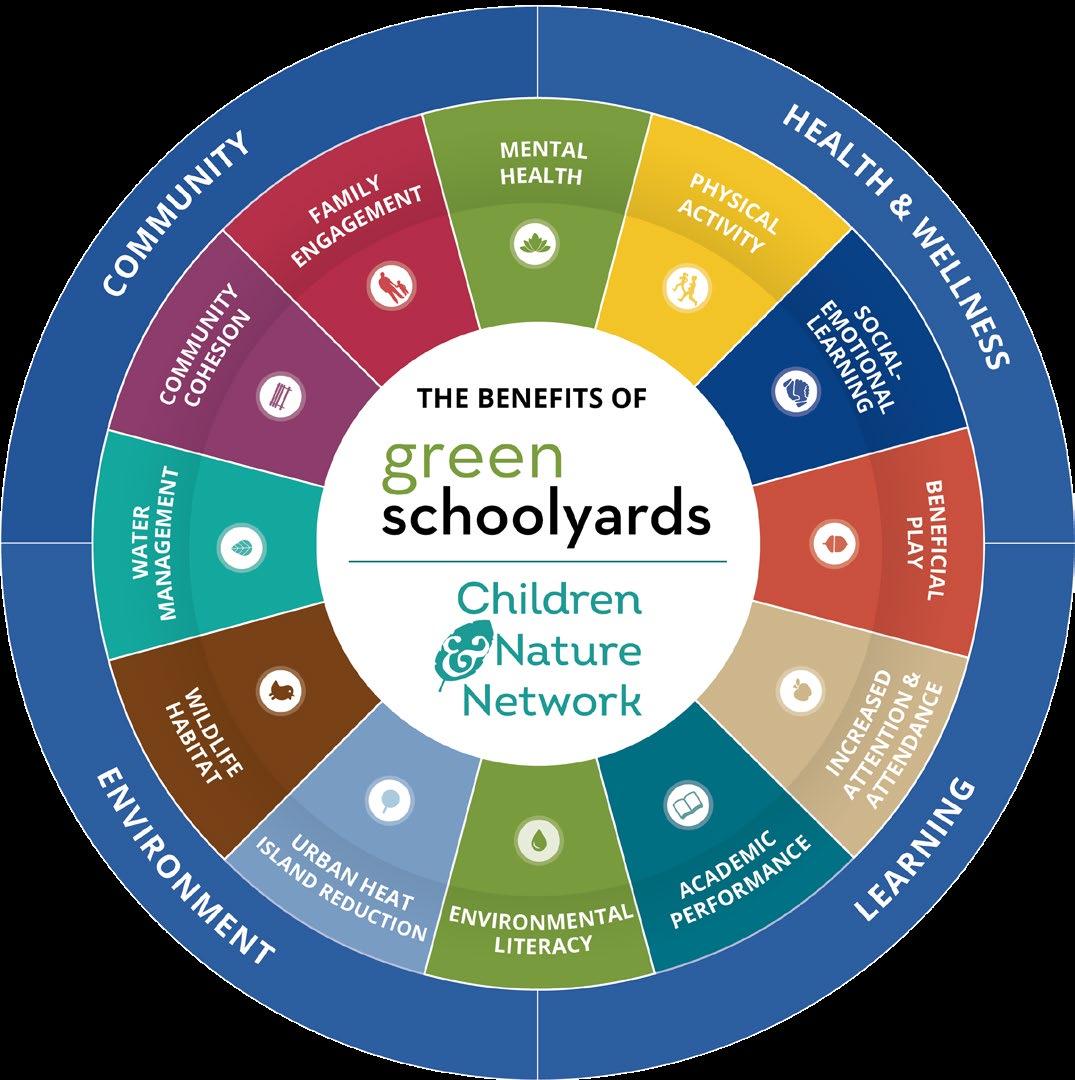
PlayCore has joined forces with the Children & Nature Network (C&NN) and their partners throughout the U.S. to raise awareness and overcome barriers in the implementation of green schoolyards. C&NN has also demonstrated a variety of ways that Green Schoolyards provide multiple benefits to children, schools, and communities. Together, we are working towards a big vision that all communities have access to green schoolyards by 2050.
Building communities through play & recreation™
OUR SURVEY/RESEARCH OUR SURVEY/RESEARCH
In the fall of 2018, PlayCore and Children & Nature Network created and distributed a green schoolyards survey through social media, conference sessions, partner networks, and other key media outlets. This survey was intended to capture why participants were most interested in green schoolyards, and understand the resources needed to support implementation. A total of 193 responses were collected: 116 were complete and 77 were partially complete. The survey was mostly completed by school personnel (29%), community agencies/organizations (24%), and parents (15%). School personnel were from public schools (44%), private schools (28%) or early childcare settings (28%).
Key takeaways from the national survey:
Reasons to invest in green schoolyards (Choose
Play and physical activity (PPA)
Helpful
Physical health (PH)
Mental health (MH)
tools for designing green schoolyards (Check all that apply)
Social-emotional learning (SEL)
Native plant inventories
Print materials, including case-making documents
In-person training
CAD for
Skills / Resources needs for green schoolyards
Child development research-based design
Nature play design
Stormwater capture features
Playground design
Parent and neighbor engagement
Landscape architecture
School staff and student engagement
Helpful
Top reasons to invest in green schoolyards
After combining related responses, health interests (physical, mental, social/emotional) accounted for 58% of respondent’s reasons to invest, followed by academic interests (literacy, performance, behavior) at 24%. Physical health reasons (33%, including play and physical activity) were the top health reasons to invest in schoolyards and academic achievement reasons (14%, including performance and behavior) were the top academic reasons. Physical health and academic achievement reasons were expressed by a wide range of professionals, but mainly parents (63%), school staff members (61%), school administrators (58%), and non-profit employees (56%). Findings demonstrate the health and academic importance of green schoolyards is widely understood.
Needed Green Schoolyard Skills/Resources:
The most prevalent skills/resources needed (50% or more survey respondents) fell into three categories: green schoolyard design samples (for purposes around nature play, playground, and wildlife habitat), strategies to engage different audiences, and research-based principles.
Over two-thirds of respondent’s identified helpful tools for designing green schoolyards. The top requests were native plant inventories (73%), print materials (71%), and trainings, whether inperson (70%) or web video-based (61%).
1.8% 59.3% 59.3% 61.1% 69.9% 70.8% 72.6% Funding and finance tools Case studies CAD for school-based playground and garden design Web video-based trainings In-person training
materials, including case-making documents Native plant inventories
Print
tools for designing green schoolyards (Check all that apply) 62.6% Child development research-based design Skills / Resources needs for green schoolyards 2% 2% 3% 3% 3% 5% 5% 9% 10% 12% 13% 14% 19% Wildlife habitat Other* Water management Community Cohesion Urban heat island reduction/stormwater capture Family engagement Increased attention and attendance (IAA)
performance (AP) Environmental literacy (ENV)
Academic
top 3) Other*: value to real estate, cost benefits, increased park diversity, community involvement, value of children 1.8% 59.3% 59.3% 61.1% 69.9% 70.8% 72.6% Funding and finance tools Case studies
playground
school-based
and garden design Web video-based trainings
50.0% 50.5% 54.6% 55.1% 56.0% 56.0% 57.4% 62.6%
Wildlife habitat design
WHAT IS A GREEN SCHOOLYARD?
The Children & Nature Network defines green schoolyards as multi-functional school grounds designed for and by the school community that offer places for students, teachers, parents, and community members to play, learn, explore, and grow.
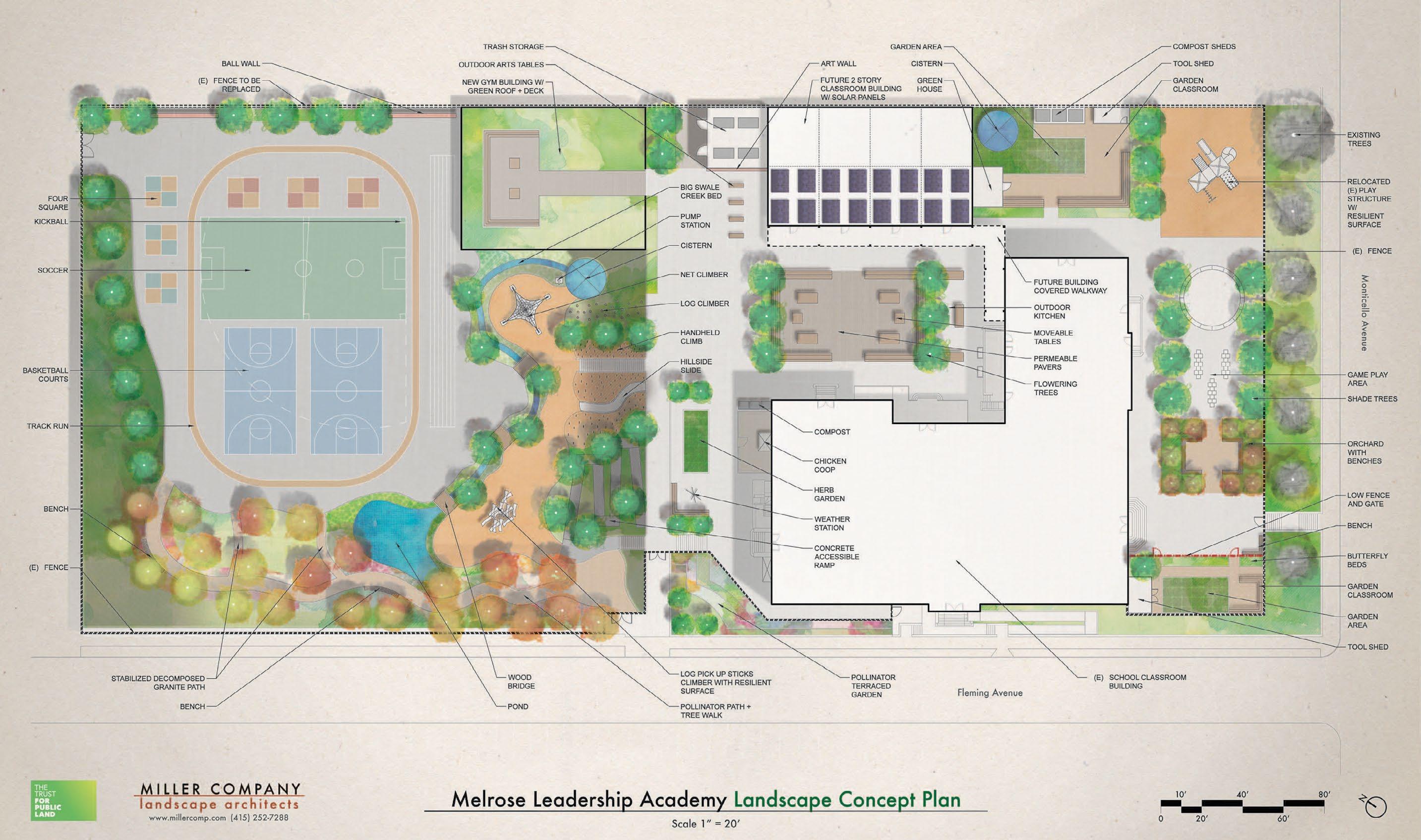
This rendering was created as part of the Trust for Public Land’s work to redesign schoolyards in the Oakland Unified School District for learning, health and climate resilience. The design highlights opportunities to include all eight design principles. Though strategic planning, Green Schoolyards can be phased as a multiyear project as budget allows.
BEST PRACTICE DESIGN PRINCIPLES
The Children & Nature Network recommends a green schoolyard includes at least 5 of 8 the design principles. However, having these features installed alone is not enough. To achieve these listed benefits, the features must be used throughout the school day, after school, and on weekends. For instance, a green schoolyard may be kept open to the community to use during out-of-school time.
Green Schoolyards Design Principles
Outdoor Classrooms Edible Gardens Native Gardens Trails Trees Playground Equipment Nature Play Storm Water Capture
Increase physical activity
Social Emotional Learning
Support beneficial play
Key Benefits
Enhance academic performance
Support mental health
Increase wildlife habitat
Capture storm water
Increased enviro literacy
Increased attendance and attention
Source: https://www.childrenandnature.org (CNN Green Schoolyards Evaluation Framework)
The 8 key design principles of a green schoolyard include:
1. Outdoor classrooms. Centralized or scattered seating for students and teachers, depending on teaching aims and pedagogy. Seating can be in the form of benches, stones, or logs.
2. Edible gardens. Designated areas for vegetable and fruit planting of annuals or perennial food sources. These gardens are usually in raised beds, unless they are fruiting shrubs or trees.
3. Native and pollinator gardens. In-ground planting areas supporting local ecology through native plants that attract local wildlife. These gardens usually consist of flowering plants and grasses.
4. Trails. Crushed stone or paved paths can support connectivity throughout the schoolyard features, and provide walking and running routes for the entire school community.
5. Trees and landscape enhancements. These plantings are essential for nature integration into schoolyards and provide needed shade. Trees, in particular, are ideally situated to provide shade over outdoor classrooms and playground equipment to keep these spaces shaded and cool for learning and play.
6. Traditional play equipment. One central structure or scattered pieces throughout the schoolyard support physical activity and play, and can attract users to benefit from the natural areas even if those aren’t the intended areas of use.
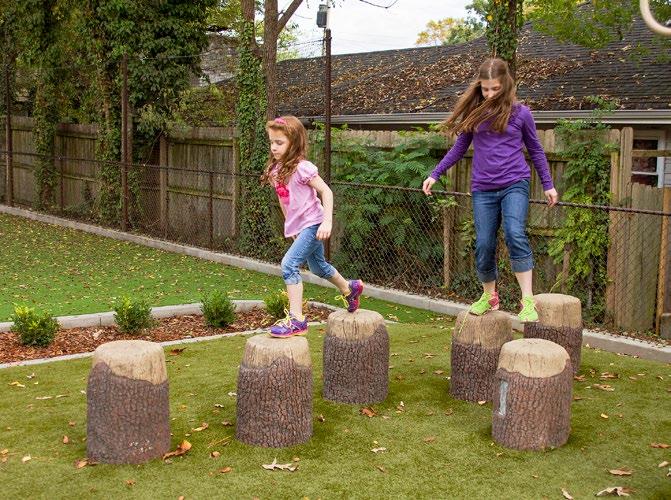
7. Nature play areas. Using natural materials such as logs, sticks, mulch, and leaves, these areas usually include moveable parts that support creative play.
8. Storm water capture. Intentionally designed, permeable spaces that capture rainwater. This can include: rain gardens; bioswales; permeable pavers, asphalt or concrete; cisterns, native landscaping, and downspout disconnection.
1.1. 1.1.
2. 2.
2. 2.
3. 3. 3. 3.
4. 4.
5. 5. 6. 6.
6. 6.
6. 6.
7. 7.
8. 8.
1. 2. 3. 4. 5. 6. 7. 8.
5. 5. 5. 5.
GREEN SCHOOLYARD MODEL
ENVIRONMENTS
ENVIRONMENTS
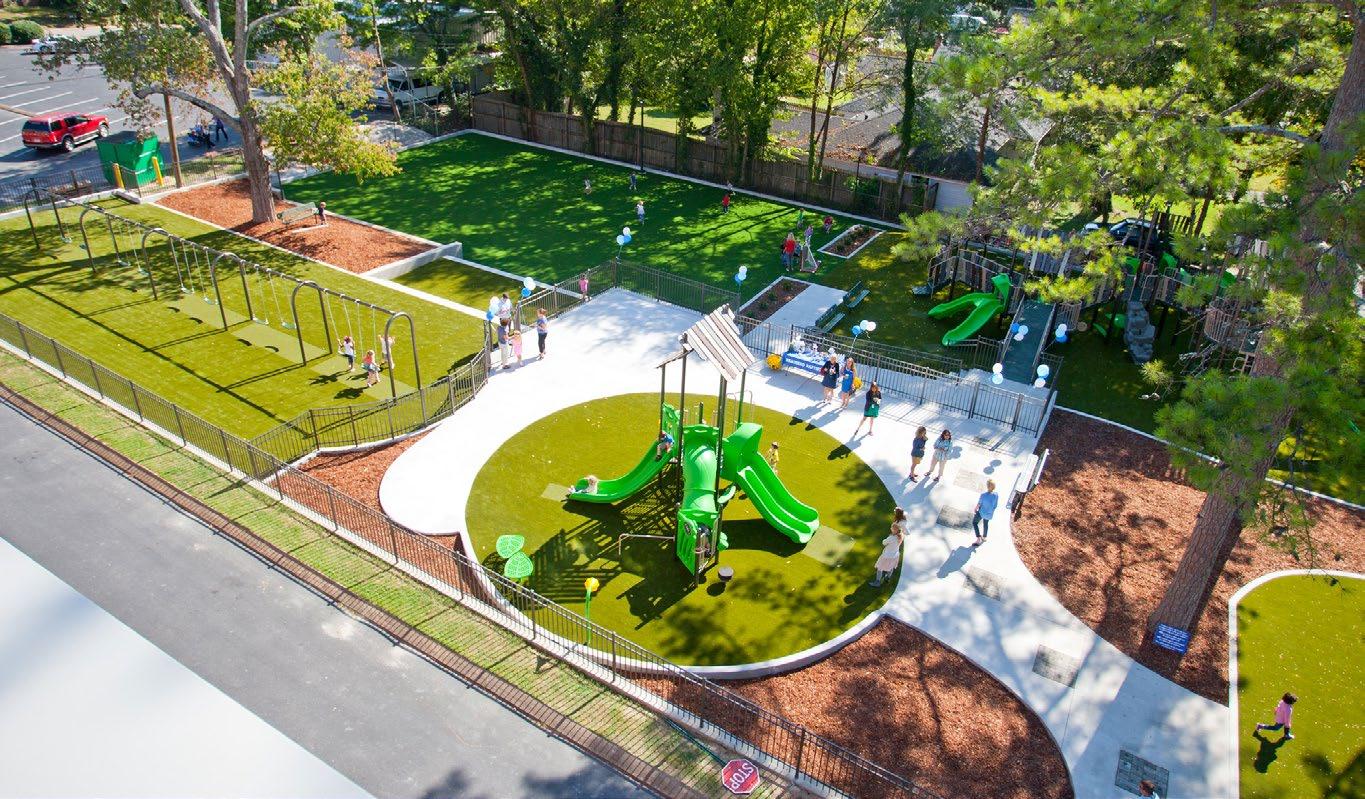
An inclusive playground anchors an outdoor classroom to the left, and herb gardens along the perimeter. A poured path/trail serves as an accessible route of travel throughout the area to ensure students with mobility devices can comfortably navigate the entire environment. The layout was strategically implemented to take advantage of existing trees which shade the outdoor classroom through the majority of the day.
Green schoolyard spotlight: Brainerd Baptist School, Chattanooga, TN
A key focus for this school was to redesign their schoolyard for both play and learning. The school provides after school care as well as summer programs so the yard had to be multifunctional for children Pre K-grade 5.
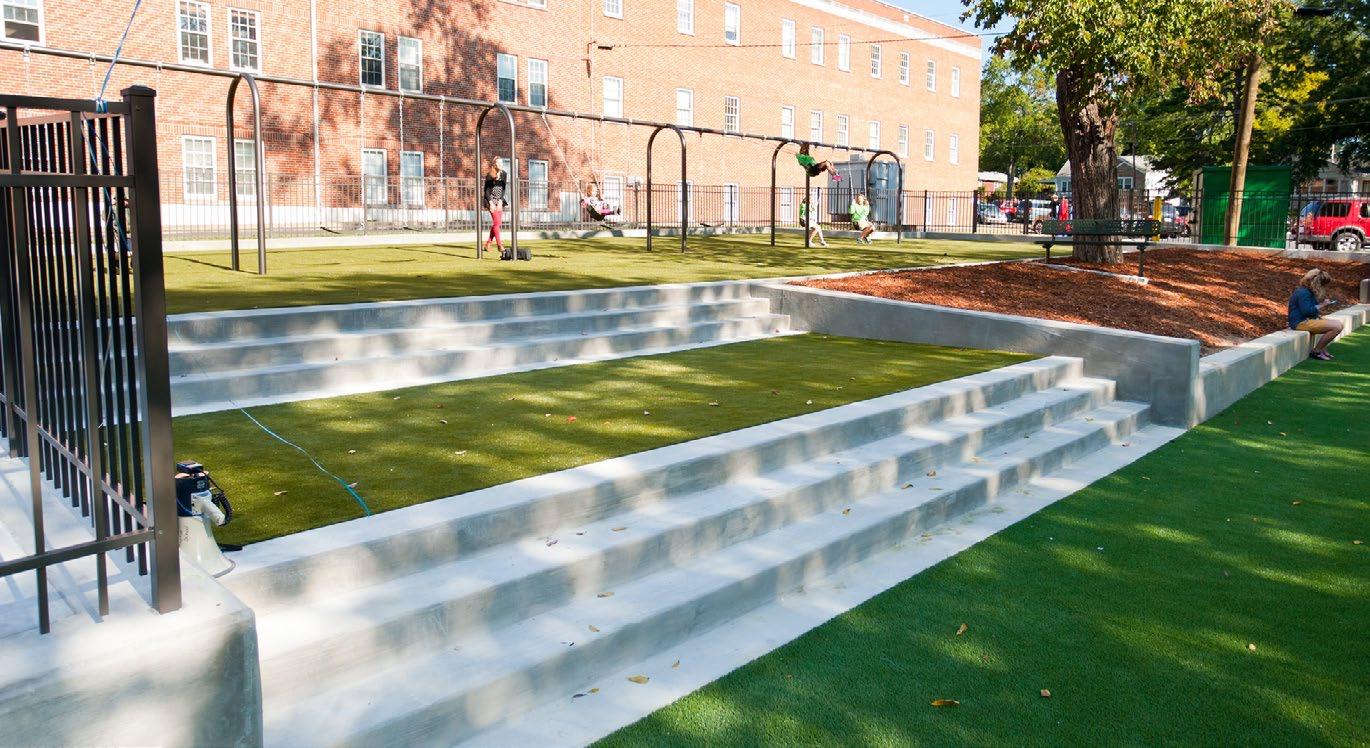
The resulting schoolyard features green lawns for sports, relaxation, and observance, play areas for children 2-5 and 5-12, an outdoor classroom “amphitheater,” as well as a variety of places to enjoy quiet time reflecting on the beautiful trees and existing landscape that was preserved throughout the schoolyard. The majority of the area was landscaped with grass or impact-absorbing turf to maintain a natural feel. Many of the play components were themed to resemble logs, while still maintaining adherence to ASTM standards. The Amphitheater, which consists of concrete steps separating grass landings, serves as a site for class time, outdoor play, and relaxation for the students. Areas surrounding trees are set up for future plantings of native and herb gardens


Many resources are available to get started today.
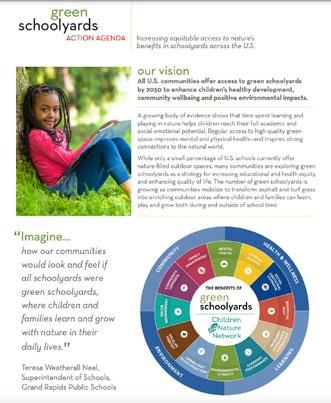
●100 organizations have endorsed a Green Schoolyards Action Agenda, designed to increase equitable access to nature in schoolyards across the U.S. Download the action agenda and sign on today!
https://www.childrenandnature.org/greening-school-grounds-outdoorlearning-global-action-agenda/
The “Green Schoolyards Advocacy Toolkit” can help you and your allies confidently “make the case” for green schoolyards, whether the audience is your school board, superintendent, principal, teachers, parents or community members. It includes a slide deck, handouts, case studies, and more! https://www.childrenandnature.org/resources/green-schoolyardsadvocacy-toolkit/
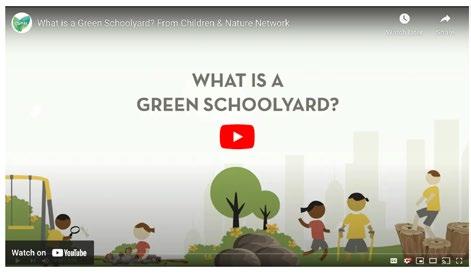
Use this video to help make the case for green schoolyards in your school district. It addresses questions such as: What is a green schoolyard? How can it benefit students? How do you start one and make the case for one at your school? youtube.com/watch?v=T3HmUZPf2FQ
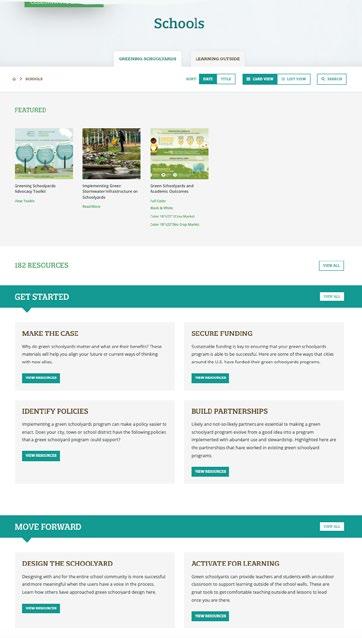
The Green Schoolyards Resource Hub is a step-by-step set of resources curated by national advisors. Green schoolyard leaders have identified a 3-stage process for building and sustaining successful green schoolyards programs. This resource hub offers tools and resources to support each stage of the process, from advocacy kits that will help you make the case and secure funding, to resources for activating and maintaining green campuses. No matter where you are in the process, we encourage you to explore all resource categories to make sure you haven’t overlooked an important step. https://www.childrenandnature.org/resource-hub/resources/
For more information about planning Green Schoolyards:
Visit: playcore.com/green-schoolyards
Email: info@playcore.com
Call: (877) 762-7563
JOIN THE MOVEMENT!
Building communities through play & recreation