




PYRAMID ISSUE • N° 45 • 2026
From the virtuosity of his Etruscan granulation to classically-inspired figures and “quantum” sculptures, the unpredictable metamorphoses of visionary artist Akelo
by Monica Caiti
Ithink I can safely say that nobody understands quantum mechanics.”
The famous quote from physicist Richard Feynman seems to reverberate as a conceptual threshold in the work of Akelo, the pseudonym of Andrea Cagnetti, an artist who moves freely between ancient knowledge and contemporary scientific vision. His work places him in a world of frontiers, where memory is never nostalgia but living material, ready to transform itself into and generate new forms of knowledge.
Akelo was born in 1967 in Corchiano, in the Tuscia Viterbese region, what was once ancient Etruscan Fescennia. When a young man he embarked an intense, autonomous course of study – Greek and Roman literature, alchemical texts, esoteric disciplines and above all applied metallurgy and materials processing. He then spent time in Rome as a graphic artist in the advertising business, eventually returning to his native region to dedicate himself exclusively to art.
The first area where Akelo made his mark internationally was jewellery making, and he became one of the world’s greatest authorities on the study and reproduction of Etruscan jewellery techniques, displaying an ability to recreate with extraordinary precision ancient techniques like granulation and filigree, often using Renaissance methods. Gold,
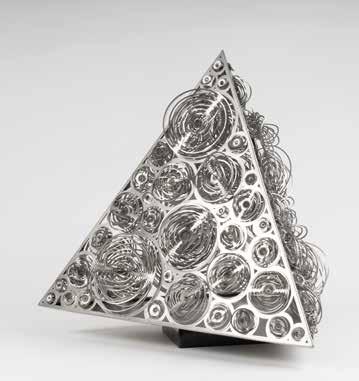
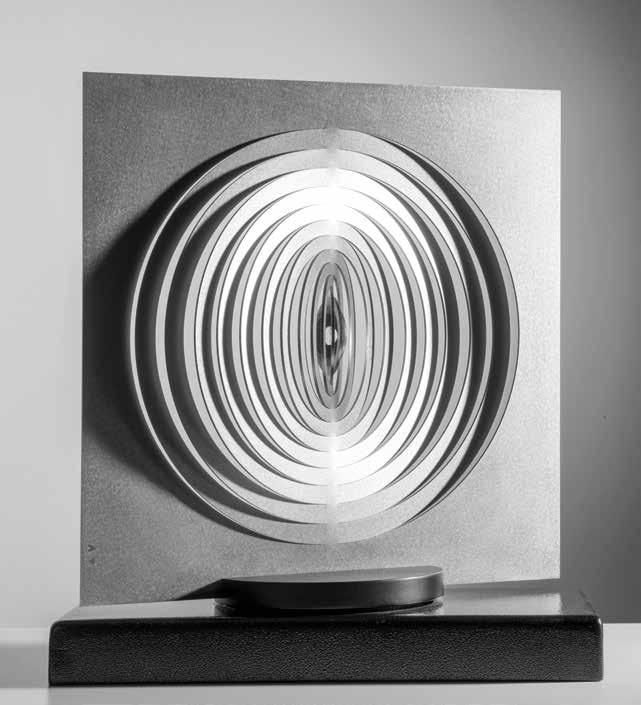
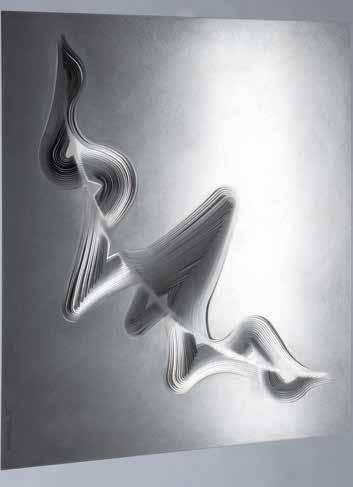
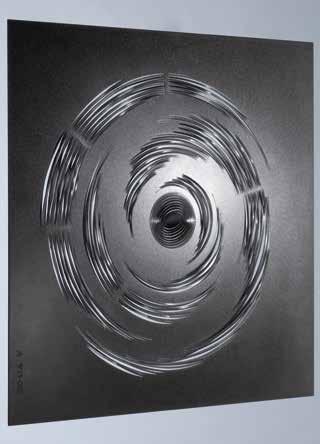
Some sculptures from Akelo’s Wave Function collection, inspired by quantum physics. From left, clockwise: Wave Function ψ 020-004, 2020 – stainless steel (H. 50 x W. 50 cm); Wave Function ψ 024-P01 2024 –stainless steel (H. 61 x W. 65 x D. 65 cm); Wave Function ψ 18-P02 2018 stainless steel - (H. 70,5 x W. 49,2 cm). Opposite page, Wave Function ψ 021-006 2021 – stainless steel (H. 50 x W. 50 cm)
Akelo’s works are all unique pieces and many are displayed in international shows and have been acquired by private museums and collections.
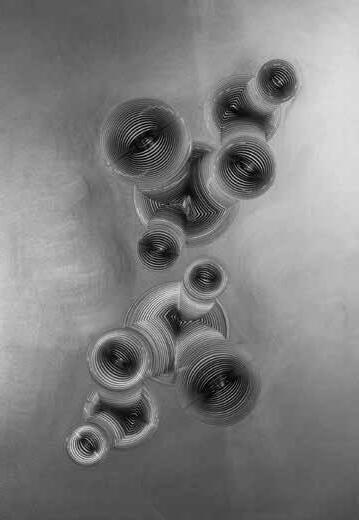
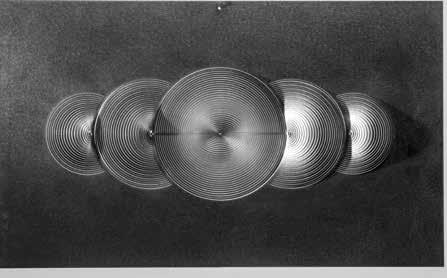
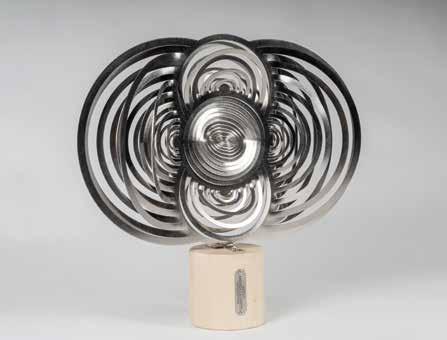
Above, Wave Function ψ 19-002 - 2019 – stainless steel - (H. 38 x W. 38 cm). Right: top, Wave Function ψ 021-001 - 2021 – stainless steel (H. 30 x W. 50 cm);
below, Wave Function ψ 020-013 2020 – stainless steel (H. 45 x W. 50 cm, with base)
a dense material with symbolic and alchemical resonance, becomes for him an instrument of knowledge, a way to miniaturise the world, understand its harmony and dominate its most intimate laws. His works are displayed in a number of international exhibitions, have been acquired by museums and private collections and are a subject for academic study. Even Britain’s Queen Camilla wears a Garnet Star necklace by Akelo.
In recent years Akelo’s research has taken a profound turn. The artist expanded his language and turned his attention to sculpture, also taking on the challenge of new materials. The result is work that draws inspiration from classical sources – headless busts, anthropomorphic figures and fragmented bodies that seem to be remains from an imaginary archaeology or ruins from a remote future. Governed by harmony and equilibrium,
these sculptures are nevertheless instilled with a fretful tension, a sense of precariousness that makes them deeply contemporary. They have a high profile even outside artistic circuit – in Ridley Scott’s House of Gucci, for example, they help create a visual image suspended between classicism, power and decadence.
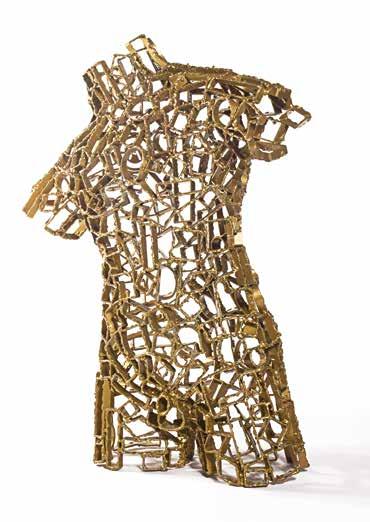
Akelo’s sculptures are never compact masses. Made of steel, they present themselves as hollow bodies, frameworks, architectures of emptiness. Light passes through them, dissolves their weight and transforms absence into a load bearing frame. The construction technique is based on modular elements – metal tubes, segments and rings – welded and combined according to a logic that recalls computer algorithms, as simple shapes give birth to complex, dynamic, open structures that are in a constant
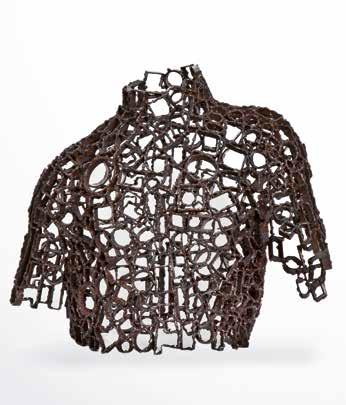
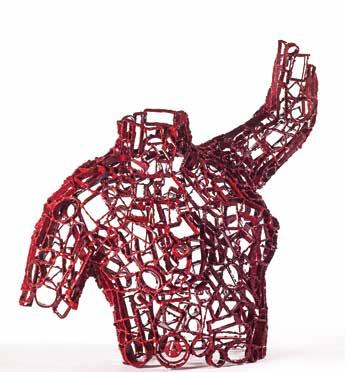
relationship with space.
This reflection on materials and voids gave rise to the most innovative cycle of works in his production – Wave Functions, inspired by quantum physics. Like the function, which describes a probability rather than a fixed state, these works do not represent stable forms but energy that is becoming. Akelo looks towards the infinitely small, a subatomic world governed by the indeterminate, and crystallises some of its states, making it possible to perceive them through sculpture. Light, reflections on metallic surfaces, generates orbitals, shifting planes of light and shade and visual textures that seem to pulse in space, suggesting a non-linear perception of time and the material world. “With these works I’ve sought to “photograph” some of the infinite vibrations of energy in the cosmos that are hidden from our
Akelo’s art evokes archaic severity without ever resorting to mere replication, using the old as a key to reading the present.
Anti-clockwise, from left, Falero, The Argonauts 2008 – oxide-treated steel with clear varnish finish (H. 43.2 x W. 52 x D. 26.4 cm); Atalanta, The Argonauts 2002 – Steel coated with coloured powder varnish (H. 61.4 x W. 62.8 x D. 23.3 cm); Niso 2004 - Steel coated with coloured powder varnish (H. 58 x W. 43 x D. 19.5 cm)
view. The sub-atomic universe that like a scientist I’ve decided to investigate, fixing some miniscule but essential portions in a determined space-time”, says the artist.
This vision is completed by a consistent ethical choice – all the sculptures are made from stainless steel sourced from industrial waste, transformed in line with upcycling principles where materials otherwise destined to become refuse are converted into works of art in a process that creates value, reduces consumption and promotes aesthetic and environmental responsibility. From Etruscan gold to quantum physics, Akelo traverses time like a knowledgeable traveller. His works exist on a threshold where past and future reflect one another and where the material, traversed by light, once again becomes thought, questioning the gaze and consciousness of the observer.