



Ph Luca Carrà, Milano
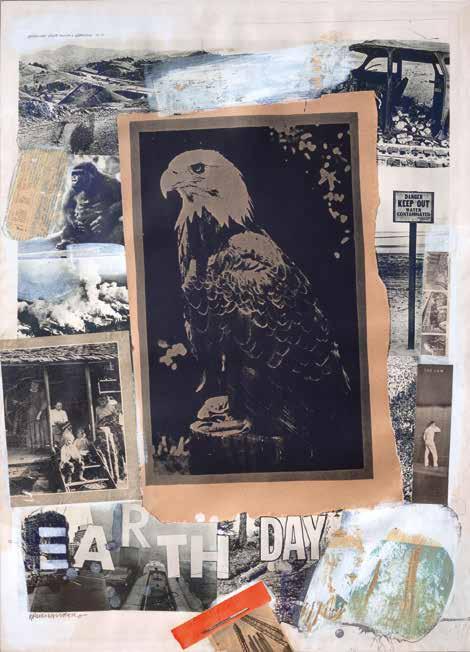
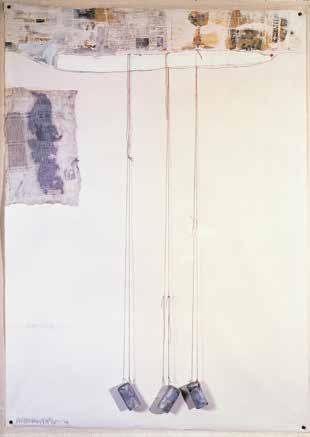
Robert Rauschenberg (Port Arthur, Texas 1925Captiva Island, Florida 2008) Earth Day, 1970-1971 lithograph with chine collé, 132 x 95 cm
Luigi e Peppino Agrati Collection- Intesa Sanpaolo ©Robert Rauschenberg Foundation
In the centenary year of his birth, Robert Rauschenberg sets records at auctions and is celebrated by exhibitions all over the world
by Micaela Zucconi
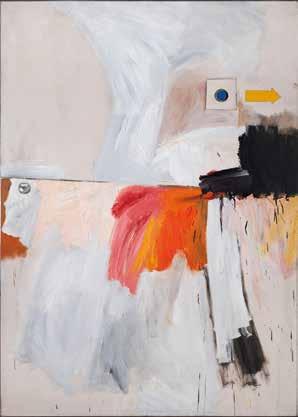
Robert Rauschenberg - (Port Arthur, Texas 1925 - Captiva Island, Florida 2008) - Blue Exit, 1961
Combine: oil and graphite on canvas, 213.5 x 153.5 cm
Luigi e Peppino Agrati Collection - Intesa Sanpaolo
©Robert Rauschenberg Foundation
Credit: Archivio Patrimonio Artistico Intesa Sanpaolo
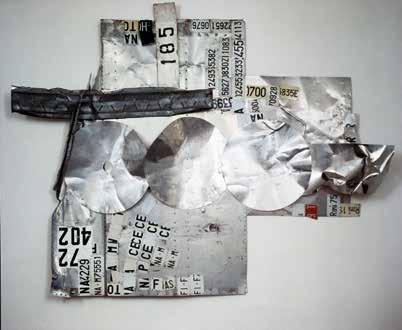
MRobert Rauschenberg - (Port Arthur, Texas 1925 - Captiva Island, Florida 2008)
Trasmettitore Argento Glut (Neapolitan), 1987 - Assembled metal, 249 x 320 x 32 cm - Luigi e Peppino Agrati Collection - Intesa Sanpaolo
©Robert Rauschenberg Foundation
ilton Ernest Rauschenberg, known as Robert (Port Arthur, Texas, 22nd October 1925 – Captiva Island, 12th May 2008), is regarded as one of the most important artists in the American avant garde, a man who made a great impact on 20th century art. His fame grew in the 1960s, especially after he won the grand prize at the 1964 Venice Biennale, where the Leo Castelli gallery of New York presented the famous “Combines”. He was the first American painter to be so honoured. His works are often the star lots at auction, as recent results show. Last May at Sotheby’s New York, “Rigger” (oil, metal, rope, wood, fabric, plastic buttons, paper, graphite and sand on canvas) of 1961 was sold for eight million dollars, while “Deli Down (Borealis)” (tarnish, silkscreen ink on copper) of 1991 went under the hammer for 781,200 euro at a sale by Christie’s Paris in October 2024 (Collection Danute et Alain Mallart : Brussels - Paris – Vilnius). In the same year at Bonhams London, “Cradle Tilt (Borealis)” (acrylic and tarnish on brass) of 1991 reached a price of £584,600. Such record prices are especially linked to masterpieces of the 1960s, like “Buffalo II” (oil and silkscreen ink on canvas) of 1964 (with an image of J F Kennedy), which sold in 2019 for 88.8 million dollars at Christie’s New York. Many shows are being held to celebrate the artist’s centenary, providing an opportunity to enjoy a close-up view of his work. A list of these can be found on the website of the foundation established at the will of the artist in New York in 1990: rauschenbergfoundation.org. In Milan, Italy, after a show at the Museo del Novecento with eight masterpieces from the
Robert Rauschenberg - (Port Arthur, Texas 1925 - Captiva Island, Florida 2008) - Trasmettitore Argento Glut (Neapolitan), 1987 - Assembled metal, 249 x 320 x 32 cmLuigi e Peppino Agrati Collection - Intesa Sanpaolo - ©Robert Rauschenberg Foundation
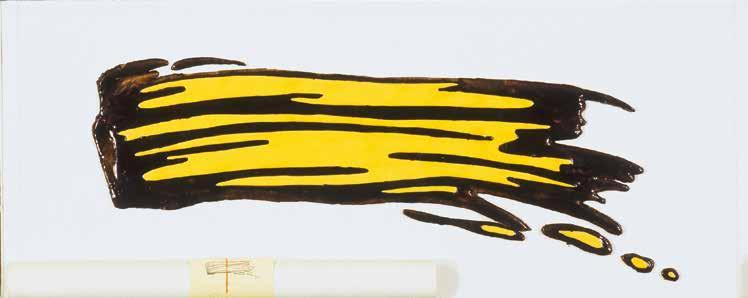
Roy Lichtenstein (New York 1923 - 1997), Yellow and Black Brushstroke (Eat Art), 1965-1966, Painted plastic on plywood, 47 x 116 cm
Luigi and Peppino Agrati Collection - Intesa Sanpaolo
1970s and 80s from across Europe, his works can be admired at the Gallerie d’Italia (Intesa San Paolo). The exhibition “Una Collezione inattesa. La Nuova Arte degli Anni Sessanta e un Omaggio a Robert Rauschenberg” (“An Unexpected Collection. The New Art of the 1960s and a Homage to Robert Rauschenberg”) curated by Luca Massimo Barbero, on until 5th October, offers a journey through the trends of the period and celebrates the American artist with 17 works, in a dialogue with other European and American artists such as Roy Lichtenstein, Giulio Paolini, Jasper Johns, Edward Ruscha, Andy Warhol and James Rosenquinst. Almost all the works are part of the Luigi and Peppino Agrati collection, donated to Intesa Sanpaolo. Born in Texas, Rauschenberg studied at the Kansas City Art Institute, the Académie Julian in Paris and the famous Black Mountain College in North Carolina, where his
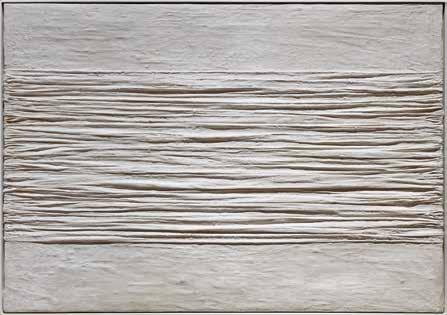
Piero Manzoni (Soncino 1933 - Milano 1963)
Achrome, 1958
China clay on canvas, 70 x 100 cm
Intesa Sanpaolo Collection
tutor, the painter Josef Albers, one of the founders of the Bauhaus in Germany, would opine that his pupil was an “outstanding example of what he was not talking about”. Rauschenberg then moved to New York, studying at the Art Students League. Alongside Cy Twombly and Jasper Johns he challenged the prevailing trend of Abstract Expressionism as exemplified by Jackson Pollock and Willem De Kooning. From the first monochromes of 1954 he moved on to his “Combines”, which combined elements of painting and sculpture in an assembly of different materials, photographs and everyday objects integrated on the canvases, in line with the work of the New Dada movement founded by the composer John Cage, which differed from Marcel Duchamp’s original Dadaism through its references to personal experience. One famous work was his “Bed” (1955, Museum of Modern Art, New York): oil and graphite on a
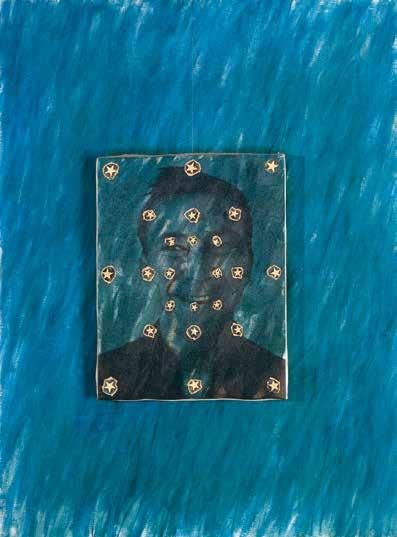
Giulio Paolini (Genoa 1940), Jasper Johns, 1967, oil on photographic canvas and on prepared canvas, collage on photographic canvas, nylon strand, 94 x 70 cm, Luigi and Peppino Agrati Collection - Intesa Sanpaolo
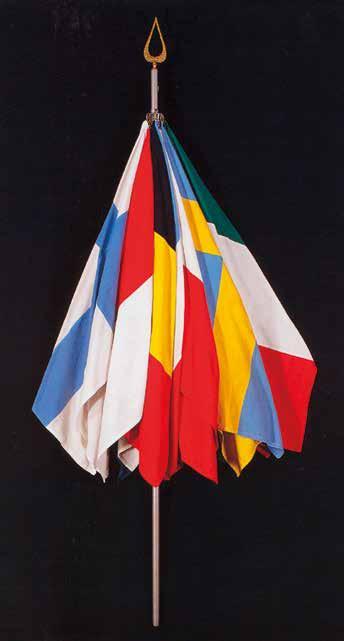
Giulio Paolini - (Genoa 1940) - Averroè, 1967 - cotton drapes, steel rod, brass topper, h.180 cm, Luigi and Peppino Agrati CollectionIntesa Sanpaolo
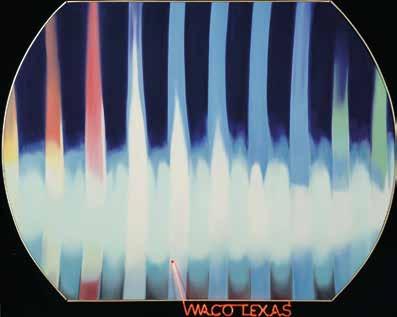
James Rosenquist -(Grand Forks, Dakota del Nord 1933 - New York 2017) Waco, Texas, 1966, oil on canvas, neon, 154 x 203.5 cm
Luigi and Peppino Agrati Collection - Intesa Sanpaolo
© JAMES ROSENQUIST, by SIAE
cushion, a quilt and a sheet on a wooden frame. Influenced by New Dada with dashes of Pop Art sensibility, Rauschenberg was a tireless explorer, working with silkscreen, performance, set design and textiles. From 13th September to 26th April 2026 the Museum of the City of New York (MCNY) is to host the exhibition “Robert Rauschenberg’s New York: Pictures from the Real World”, dedicated to Rauschenberg’s relationship with photography in the context of the Big Apple.