Room 315 The Use of Acoustic Panels and Sound Proof Partition Walls An Acoustics Case Study BORRES, BUENAFE, CABARLES, CORDERO, AND ERECRE | BSA 3A
Background of the Study Children and young adults will find it difficult to learn in a noisy classroom. Lots of children won’t need much of an excuse to become distracted so excessive noise will be a perfect reason to hinder learning. It is important to have good acoustic performance in the classroom when the children learning have: Hearing loss in one or both ears A learning disability Attention disorders or problems
Statement of the Problem Excessive noise in a classroom can significantly hinder the learning process, posing numerous challenges for students and teachers alike. Background noise can also disrupt the flow of information during lectures and discussions, causing important information to be missed. Additionally, constant noise can alleviate stress levels, impacting the overall well-being and mental focus of both students and educators.
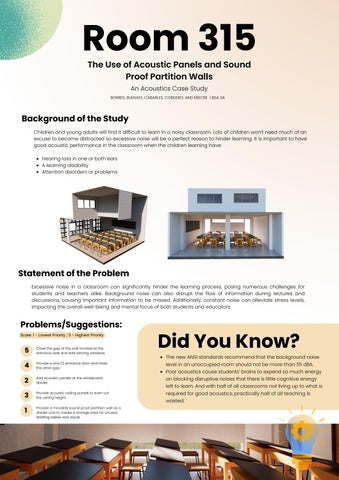
Problems/Suggestions: Scale: 1 - Lowest Priority ; 5 - Highest Priority
5
Close the gap of the wall located at the entrance side and add awning windows.
4
Provide a one (1) entrance door and close the other gap.
2
Add acoustic panels at the whiteboard divider.
3
Provide acoustic ceiling panels to even out the ceiling height.
1
Provide a movable sound proof partition wall as a divider and to create a storage area for unused drafting tables and stools.
Did You Know?
The new ANSI standards recommend that the background noise level in an unoccupied room should not be more than 35 dBA. Poor acoustics cause students' brains to expend so much energy on blocking disruptive noises that there is little cognitive energy left to learn. And with half of all classrooms not living up to what is required for good acoustics, practically half of all teaching is wasted.