Send materials for publication directly to the creative director at the address or email address to the right. Letters to the editor will be printed at the discretion of the STAR & LAMP team.
We accept materials on an ongoing basis at: PiKapp.org/SubmitNews.
The single line across the page represents the throughline of Pi Kappa Phi, the thread that runs through every story in this issue and through the lives of all men who call themselves brothers. Each brother’s life is shaped by many unique lines: family, friendships, passions and purpose. Yet, for Pi Kappa Phi brothers, one line runs through them all, a shared bond that endures. The throughline of Pi Kappa Phi has woven men together across generations and continues to guide their lives to intersect in ways only brotherhood can.
THROUGHLINES
In storytelling, there’s something called a throughline: the thread that ties each moment together. It gives a story direction and meaning, connecting where it begins to where it ends.
Our lives form a tapestry of many different lines: family, faith, belonging, service, careers, connection, purpose and more. Woven together, they shape who we are and how we move through the world.
But for every man who’s worn our letters, there’s one line we all share: the throughline of Pi Kappa Phi. It’s the bond of brotherhood that connects us across generations and guides us long after our college years have ended. It reminds us that while our stories may differ, they’re part of something larger and lasting.
That throughline runs through every story in this issue of the Star & Lamp.
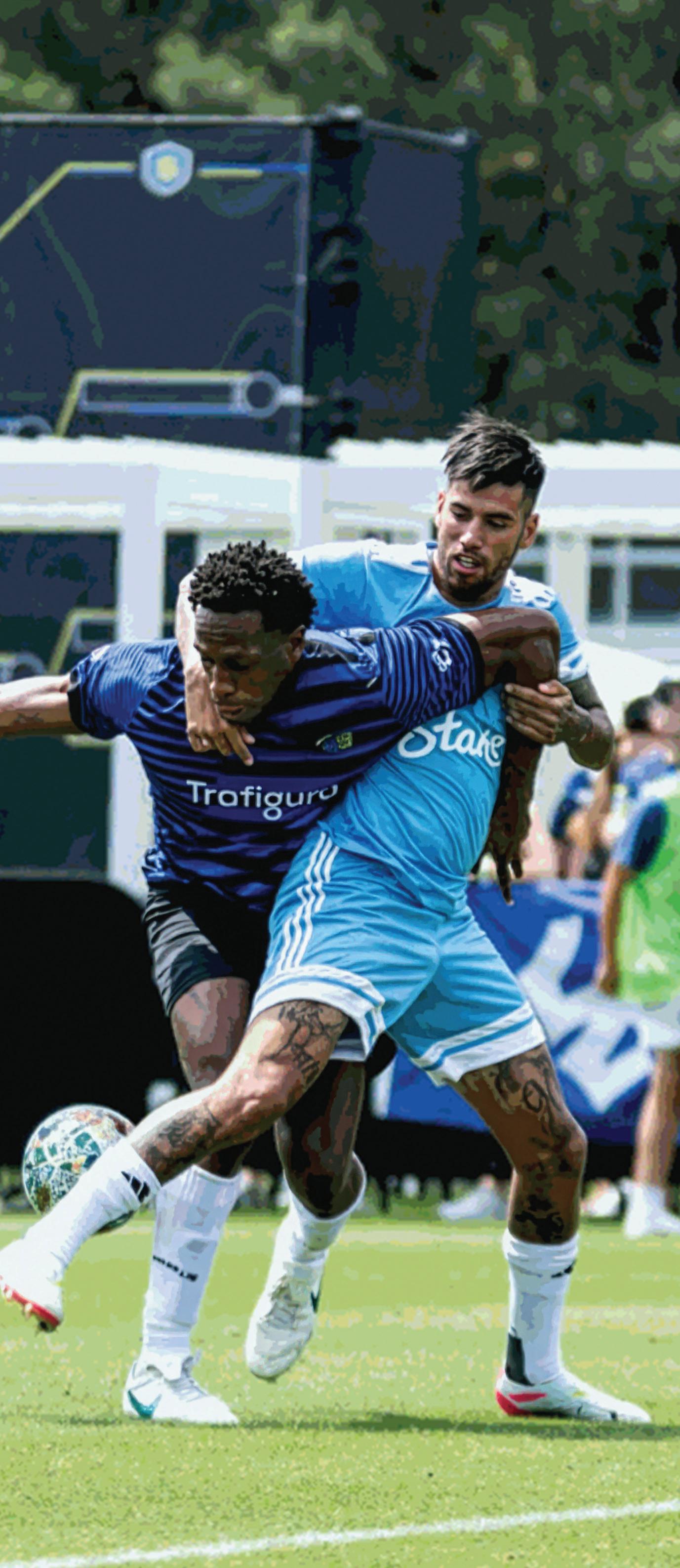
You can see it in two brothers who turned their shared love of soccer into Trident FC, a professional club built on teamwork, trust and brotherhood; the same values that once connected them as undergraduates.
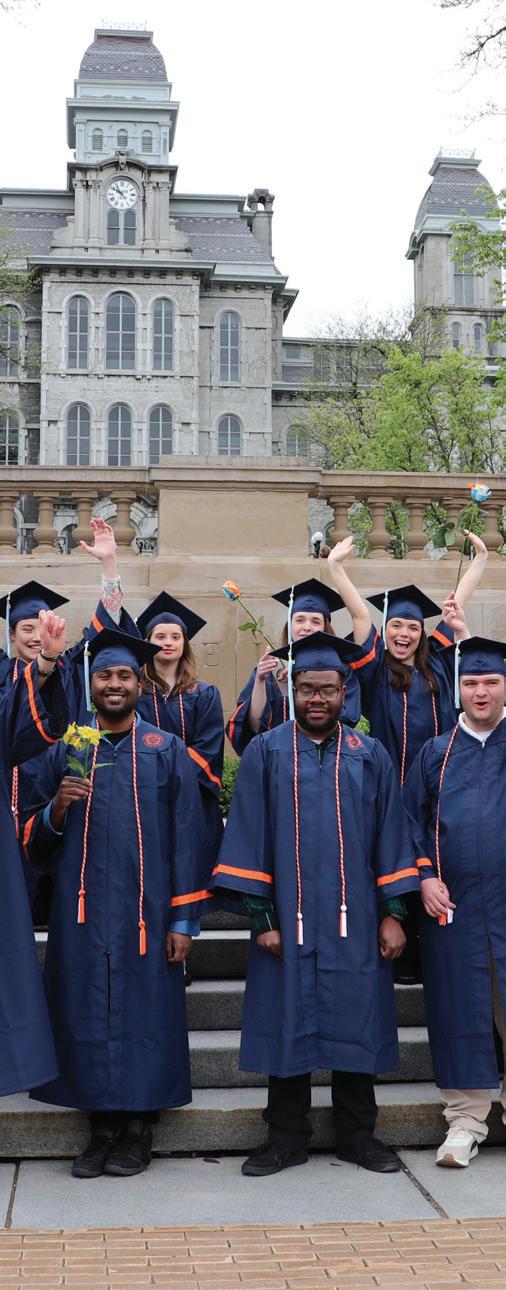
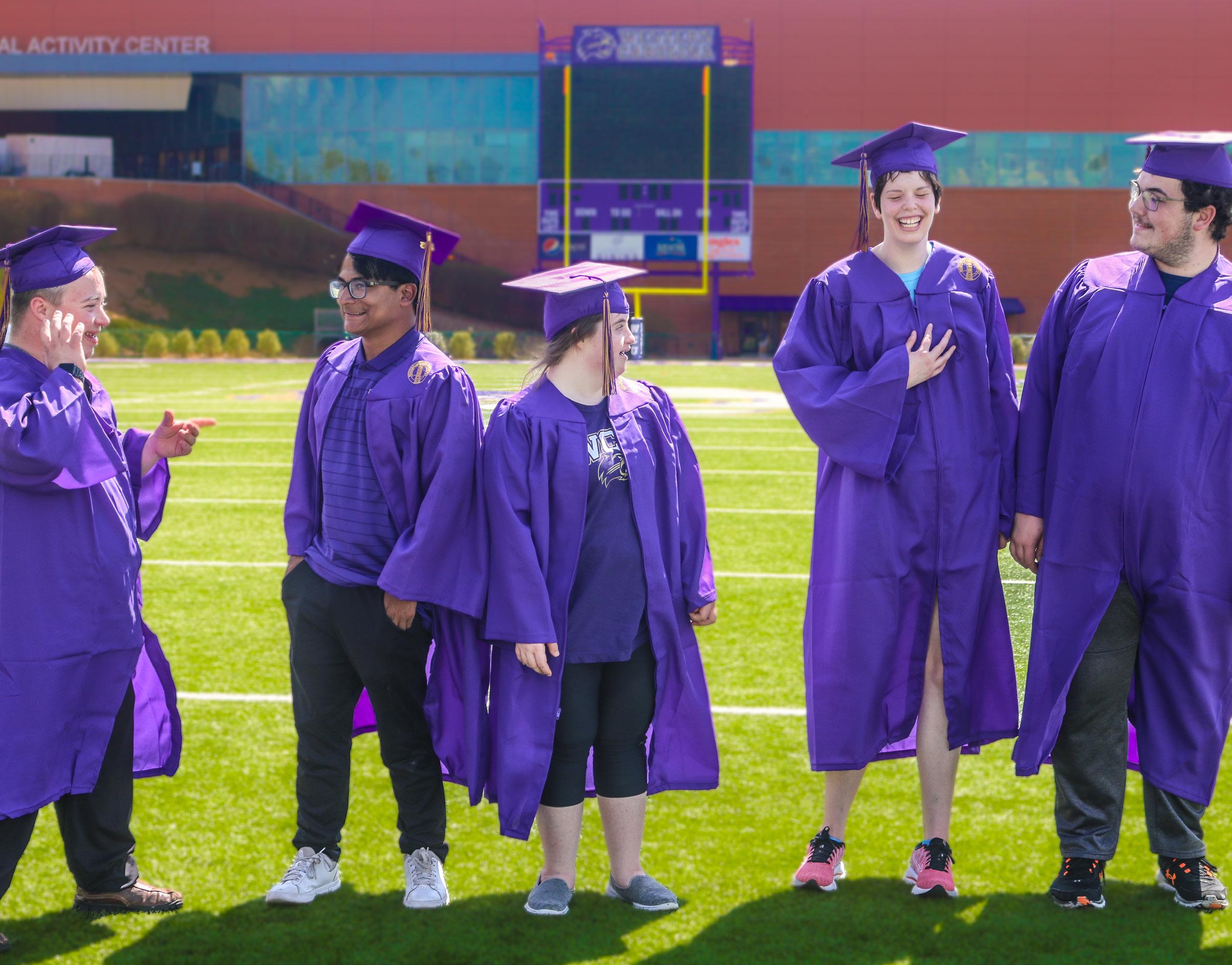
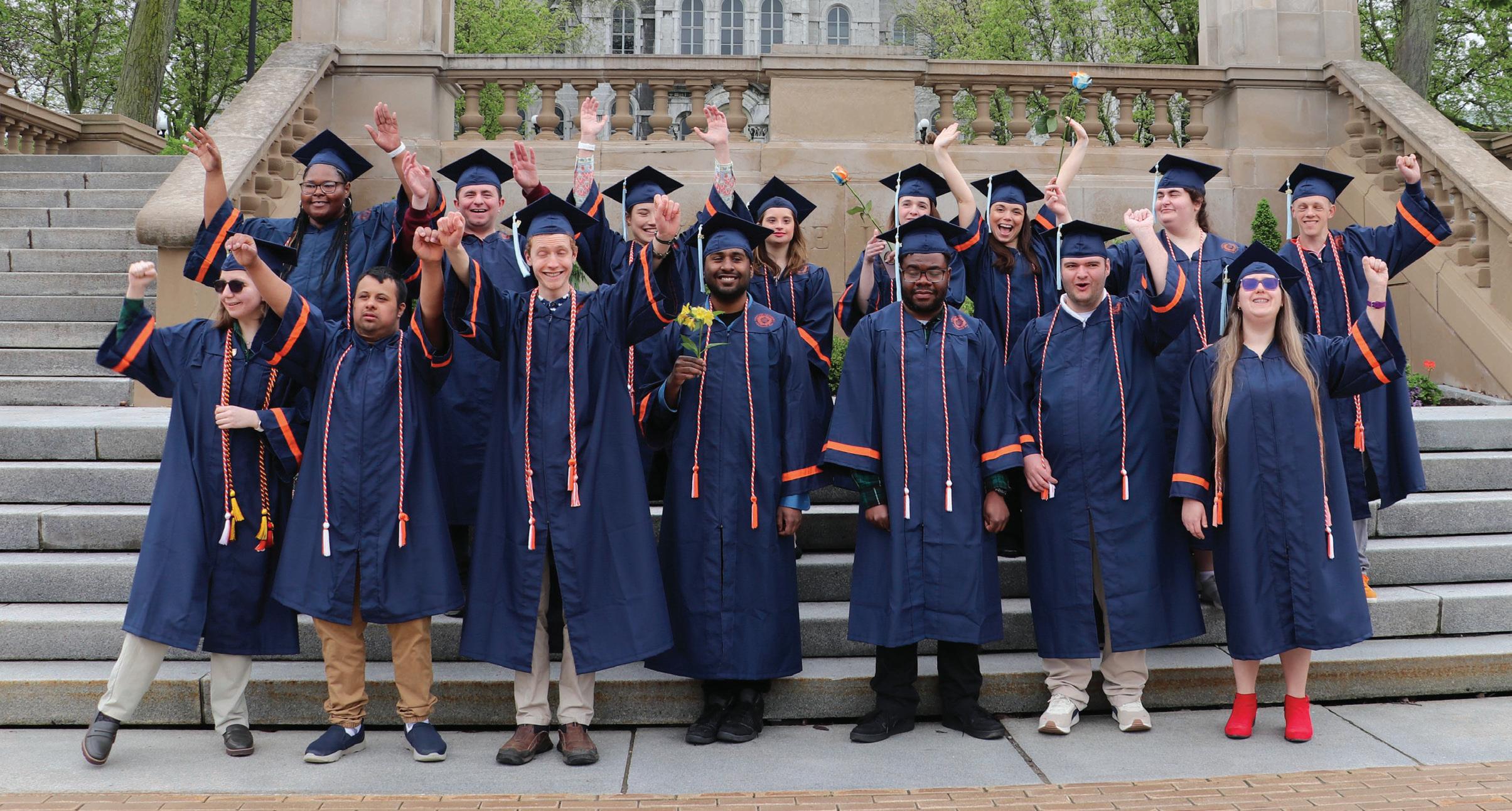
That same thread stretches beyond our chapters, running parallel to and sometimes intersecting with a growing movement on campuses across the country: the creation of inclusive degree programs for students with disabilities. The ideals Pi Kappa Phi has championed for decades now find their place in classrooms and communities nationwide.
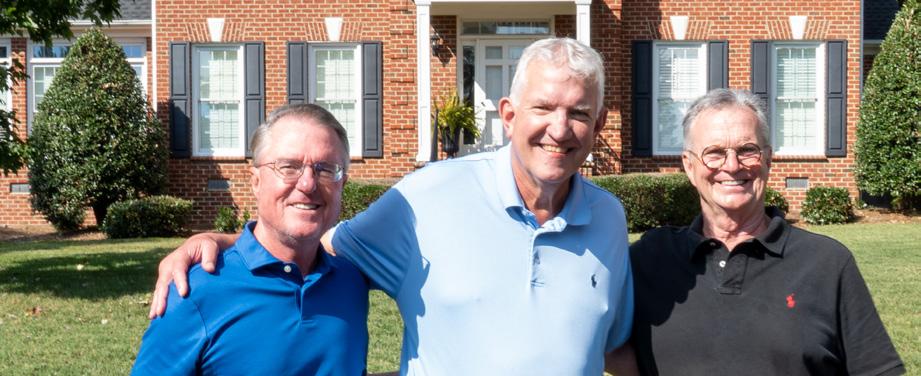
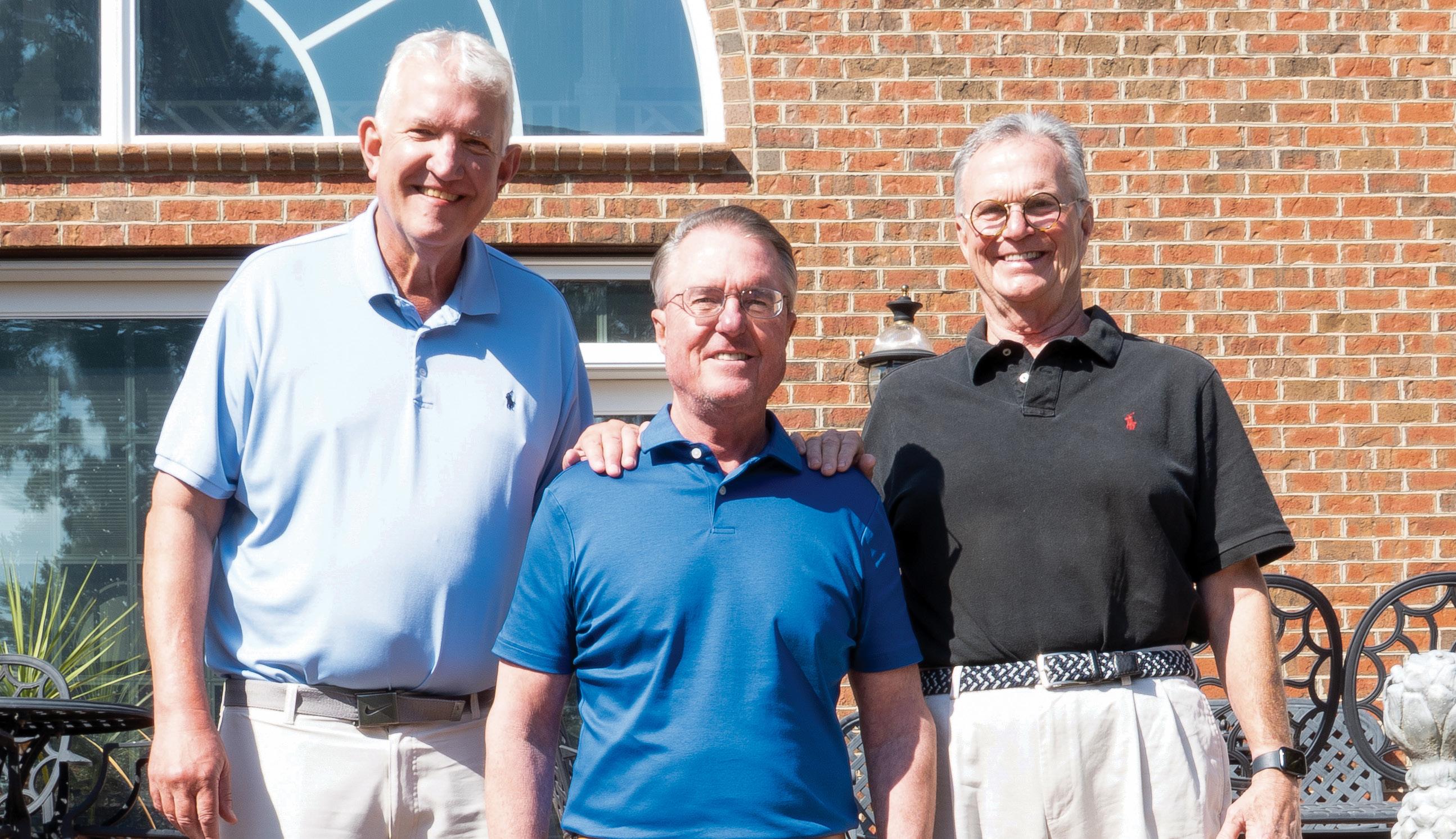
It lives in three brothers who, by coincidence or perhaps fate, now call the same North Carolina cul-de-sac home. Though they come from different chapters, their shared experiences in
Pi Kappa Phi brought them together years later, proving that brotherhood leads us to one another, even in the most unexpected places.
You can trace it through the Omega Chapter at Purdue, where brothers have made The Ability Experience the foundation of their recruitment process. Their commitment to service begins on day one and shapes how they live our values every day.
And it’s woven through the story of Penn Holderness, whose life has long been defined by connection, humor, authenticity and family. Those threads led him to Pi Kappa Phi and helped him discover himself, with brothers by his side.
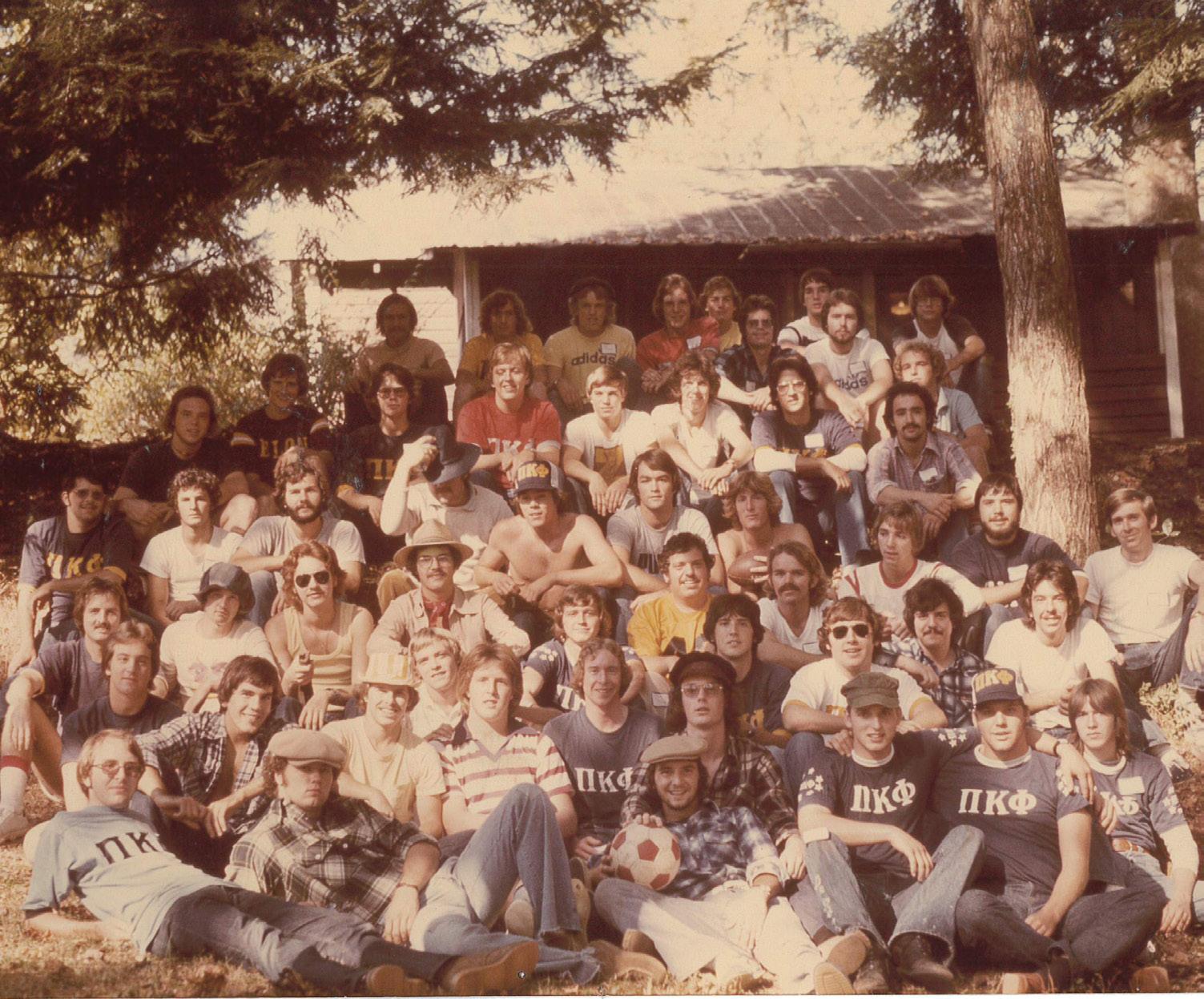
It even runs through the fabric of our history. In this issue’s “Moment at the Museum,” you’ll open the closets of Pi Kappa Phi brothers across generations and see how the way we’ve worn our letters, whether stitched on wool sweaters, cotton tees or modern performance polos, has changed with time, but never in meaning.
Every story told within these pages follows its own path, but they’re all tied together by one shared thread: the throughline of Pi Kappa Phi. It connects our past to our present, our undergraduate years to our adult lives and our personal successes to the brothers who helped shape them.
As you follow the throughline of Pi Kappa Phi through this issue, I hope you’ll take a moment to reflect on the lines that guide your own life; the people who’ve influenced your path, the moments that changed your direction and the values that continue to guide you each day.
Our stories may each look different, but one line connects us all: the brotherhood of Pi Kappa Phi.
In Pi Kappa Phi,
JAKE HENDERSON CHIEF EXECUTIVE OFFICER
Dear Brothers,
The Nominating Committee for the 59th Supreme Chapter is now accepting nominations for the National Council of Pi Kappa Phi.
Every two years, a slate of leaders is selected to guide our Fraternity forward, and we want your help identifying the right brothers for the job. The five-member committee is comprised of a student member and four past National Presidents. The Nominating Committee includes: Tracy Maddux, Zeta Theta (Texas-Austin); Jeremy Galvin, Alpha Omicron (Iowa State); William Sigmon, Alpha Sigma (Tennessee); James Smith, Alpha Eta (Samford); and student representative Andrew Davis, Kappa (UNC-Chapel Hill).
Per Supreme Law, Pi Kappa Phi’s student and alumni chapters or individual initiated members can nominate any brother (including themselves) to serve on the National Council. Nominees should be men who live the values of Pi Kappa Phi, have a track record of meaningful service and understand the big picture of our Fraternity’s mission, vision and operations. Those elected will serve on the National Council through the 60th Supreme Chapter in 2028.
HOW TO SUBMIT A NOMINATION
It is preferred that nominations be sent via email to nominations@pikapp.org; however, if you need to mail it, you can send it to:
All nominations must be received by January 15, 2026. The committee’s proposed slate will be announced no later than March 24, 2026, and presented during the second business session of Supreme Chapter on Friday, July 24, 2026.
We know not everyone can serve on the National Council, but Pi Kappa Phi is built on the strength of our volunteers at all levels. If you’re interested in getting involved in another way, we encourage you to fill out our volunteer interest form.
We look forward to seeing you at Supreme Chapter 2026 from July 23-27 in Scottsdale, Arizona! Thank you in advance for your thoughtful consideration of brothers who will continue to lead Pi Kappa Phi forward.
Yours in Pi Kappa Phi,
James Smith
Alpha Eta (Samford)
Nominating Committee Chairman
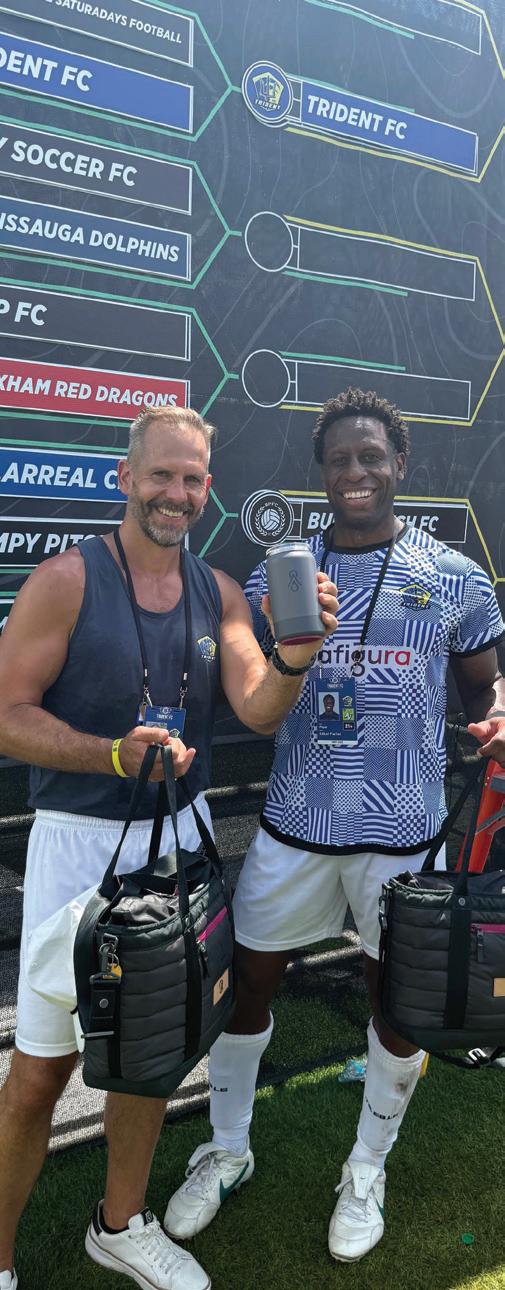
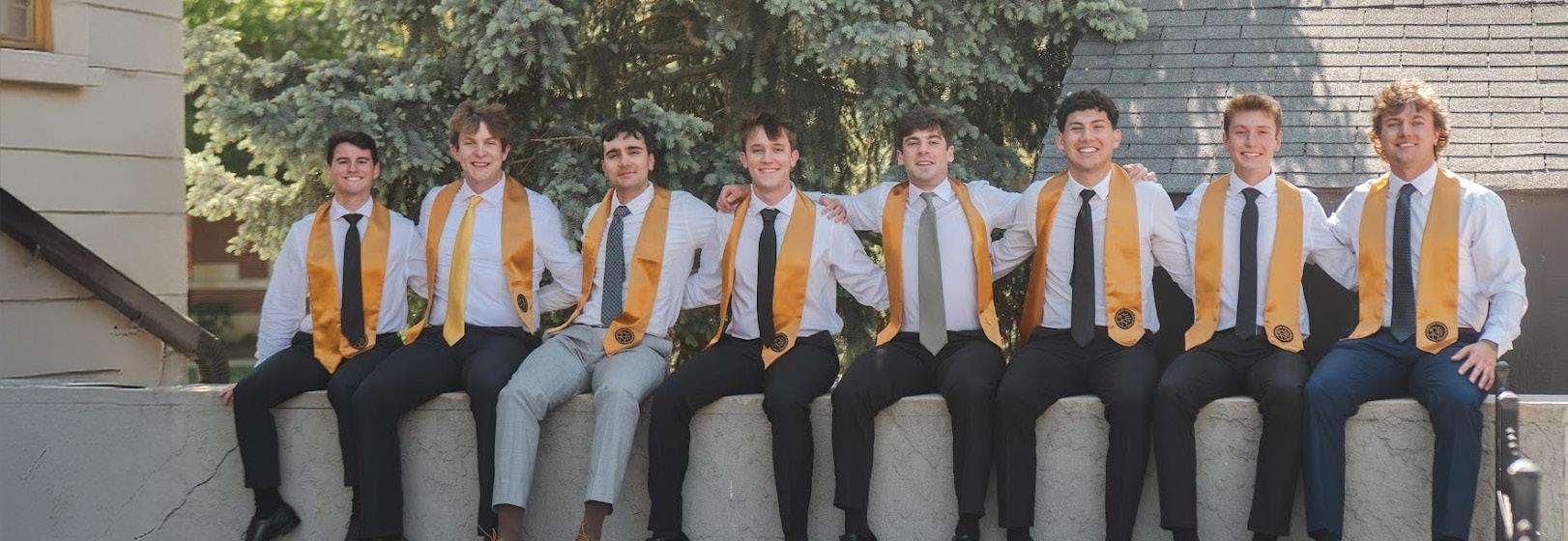
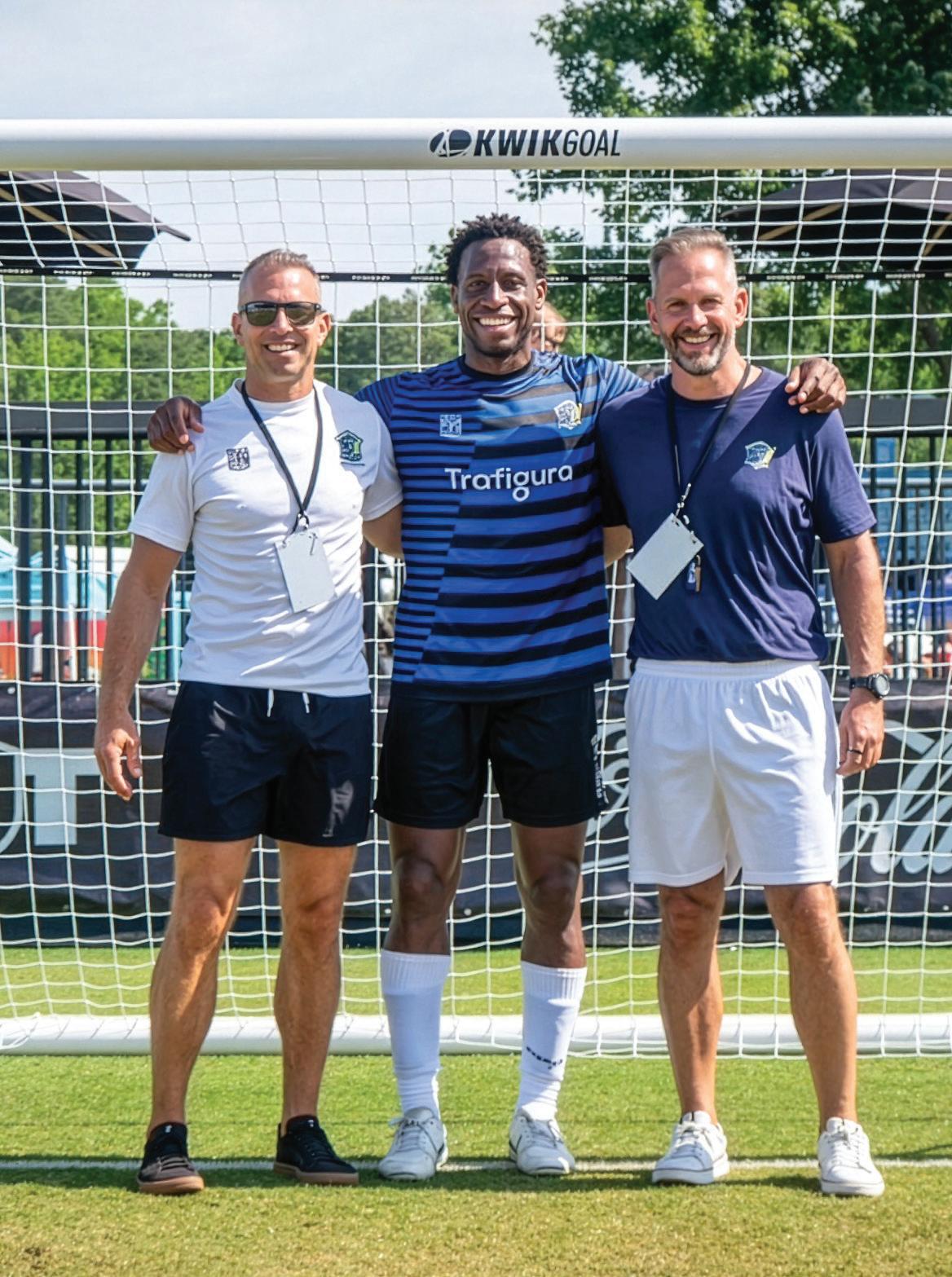
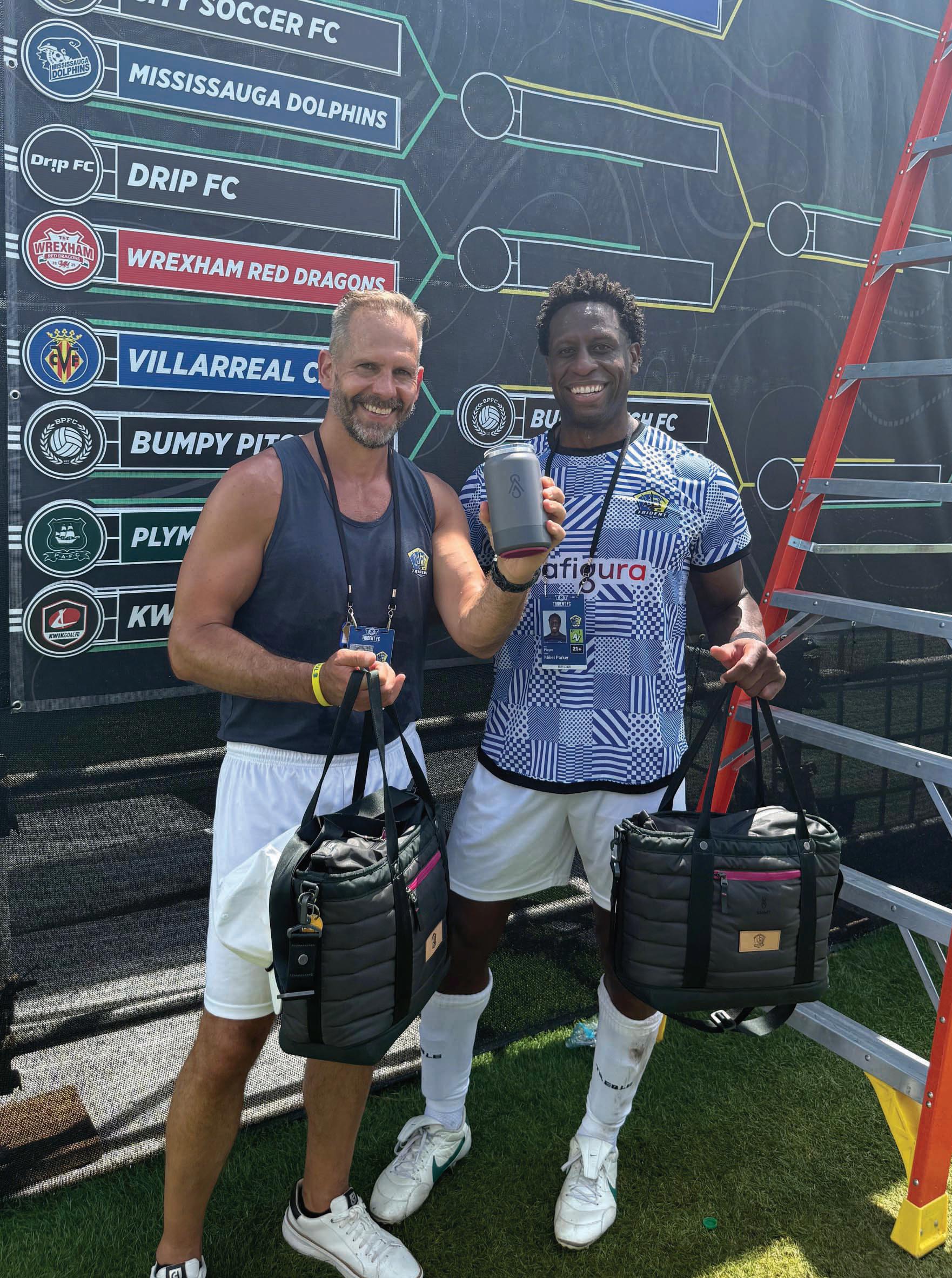
Trident FC Head Coach Todd Mordecai with Mikel Parker, Rho (Washington & Lee) and Jason Jarecki, Rho (Washington & Lee).
by Matt Ramsay (Delta Lambda, UNC-Charlotte)
The North Carolina sun pressed down, the air thick enough to drink. Two former teammates crossed onto the field, the smell of fresh-cut grass and competition hanging over them, one ready to play, the other to coach. They hadn’t faced stakes like this since their college days, 30 years ago.
Back then, Mikel Parker and Jason Jarecki were wide-eyed freshmen at Washington and Lee, walking onto another field as members of the Generals’ soccer team. After practices and games, they would walk home with their teammates, who doubled as fraternity brothers, to the Pi Kappa Phi house, sharing meals hours after sharing the field, bonded by each game, whether they won or lost.
These soccer-playing Pi Kapps stuck side by side on and off the field, from grueling practices to chapter meetings, from tough losses to brotherhood events. Juggling the chaos of an exam, a game and a chapter fundraiser all in the span of one week, to finally tossing their caps at graduation.
Some relationships fade after graduation. Others, especially the kind forged between teammates and fraternity brothers, endure far beyond it.
As teammates, they were bound to become friends, but through Pi Kappa Phi, that friendship evolved into a deeper bond of brotherhood. At graduation, Parker and Jarecki knew it was unlikely the team of brothers would ever be together in quite the same way again. Life would lead them in different directions.
(continued from page 7)
Parker, now recognized in Washington and Lee’s Athletics Hall of Fame, pursued a career in investment banking, while Jarecki began his own path in the business world.
Some relationships fade after graduation. Others, especially the kind forged between teammates and fraternity brothers, endure far beyond it. But this isn’t something that happens automatically. It takes commitment and an uncommon bond that can withstand time and distance, the kind of bond formed on the field and in the chapter house.
The thought of losing touch didn’t sit well with Jarecki. He was determined to keep everyone connected. Phone calls, visits and daily messages in a 12-person group chat kept the teammates-turned-brothers close. But his bond with Parker was different. That’s why, when Parker heard about a new soccer tournament in Cary, North Carolina, he knew exactly who to call: his old teammate, Jarecki.
In 2023, an exciting new soccer competition called The Soccer Tournament (TST) made its debut at WakeMed Soccer Park in Cary, North Carolina. Dubbed the “Coachella of soccer” by some, TST quickly became one of the top 7v7 soccer festivals in the world. The open competition format attracts a range of talented players, including former pros, all vying for the $1 million winnertake-all prize. Across six days and seven fields, more than 130 live matches unfold, each ending not with the clock, but on a goal, thanks to a TST rule known as Target Score Time®. It was the kind of event that caught Parker’s attention instantly, as a fan and lifelong soccer player. He knew he had to play in TST 2024.
Months went by as Parker and Jarecki reached out to every soccer contact they had, from college teammates to adult league friends and anyone else they could think of, in search of an open roster spot that would get Parker onto the field. With only two months left before the tournament, they were running out of options. Then, a call came that changed everything.
On the other end of that call was Paul Hourigan, a chapter brother and former teammate, who had connections to TST through his professional network. “A team
just dropped out for financial reasons,” he told Jarecki. “They’re looking for someone to step in and create a team. I recommended you and Mikel.”
More than just securing Parker a spot on a roster, this was a chance for the
brothers to walk onto the field together once more, this time as a player, a coach and co-owners of their own team. Met with this sudden opportunity, Parker and Jarecki didn’t think twice. “We have to do this,” they agreed.
Thirty years of brotherhood, defined by vulnerability, support and trust, became the foundation of their partnership as co-owners.
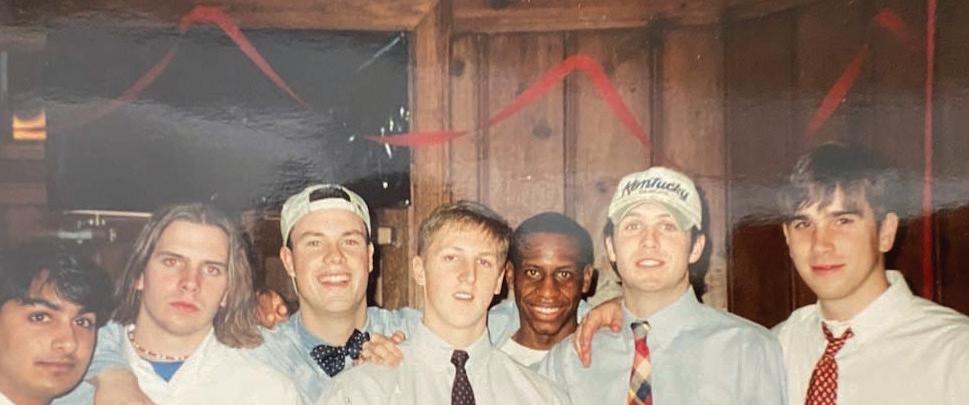
Jarecki and Parker alongside their Rho Chapter brothers from the class of 1999 during their undergraduate years.
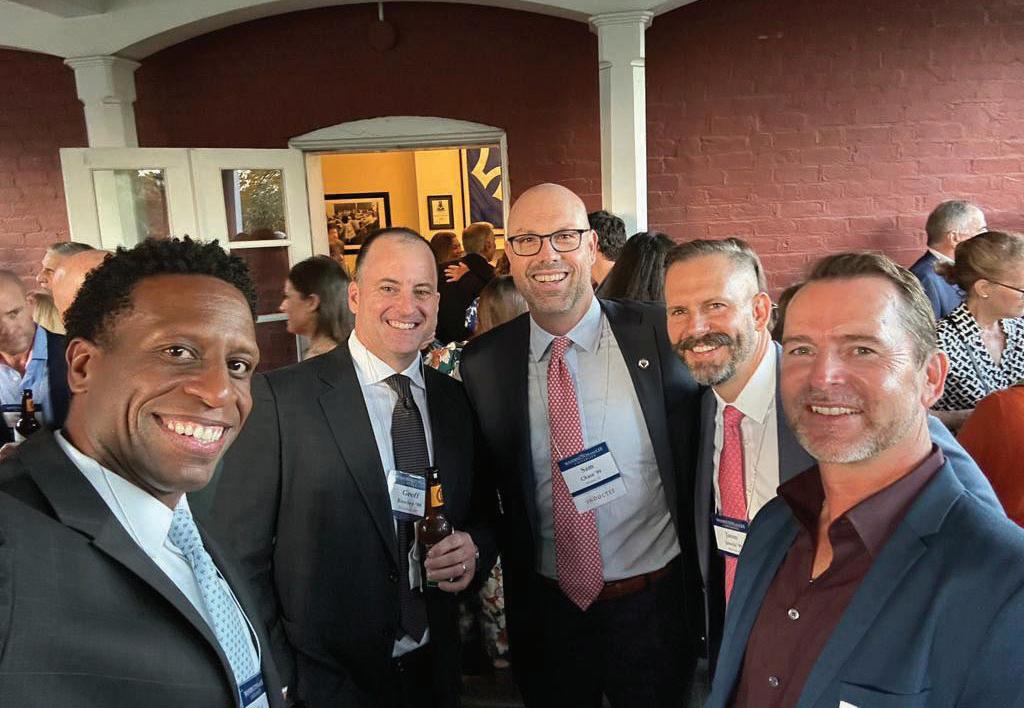
Jarecki, Parker and former teammates at a Washington & Lee athletics alumni event.
out travel plans.” But when it was all said and done, Parker and Jarecki had created Trident FC.
They knew they wouldn’t be doing this alone; they’d had each other’s backs so many times before. Ask either one about their friendship, and they’ll tell you the same thing: “He’s a true brother.”
Once they said yes, the whirlwind began. In a matter of days, Parker and Jarecki were interviewed by TST leadership for approval to own a team and enter the tournament. When their approval came,
so did a series of tight deadlines. “It was an unbelievable crunch time,” Parker said. “Weeks of sleepless nights, calling every player we knew, designing logos and uniforms, securing sponsors and figuring
Thirty years of brotherhood, defined by vulnerability, support and trust, became the foundation of their partnership as co-owners. They knew they wouldn’t be doing this alone; they’d had each other’s backs so many times before. Ask either one about their friendship, and they’ll tell you the same thing: “He’s a true brother.”
When the first day of the tournament finally arrived, it wasn’t just the soccer that made it special. As they walked onto the field, reflecting on weeks of frantic preparation and the decades-long journey that led them there, Parker and Jarecki looked to the stands. For a moment, they wondered if their eyes were playing tricks on them. But sure enough, there in the
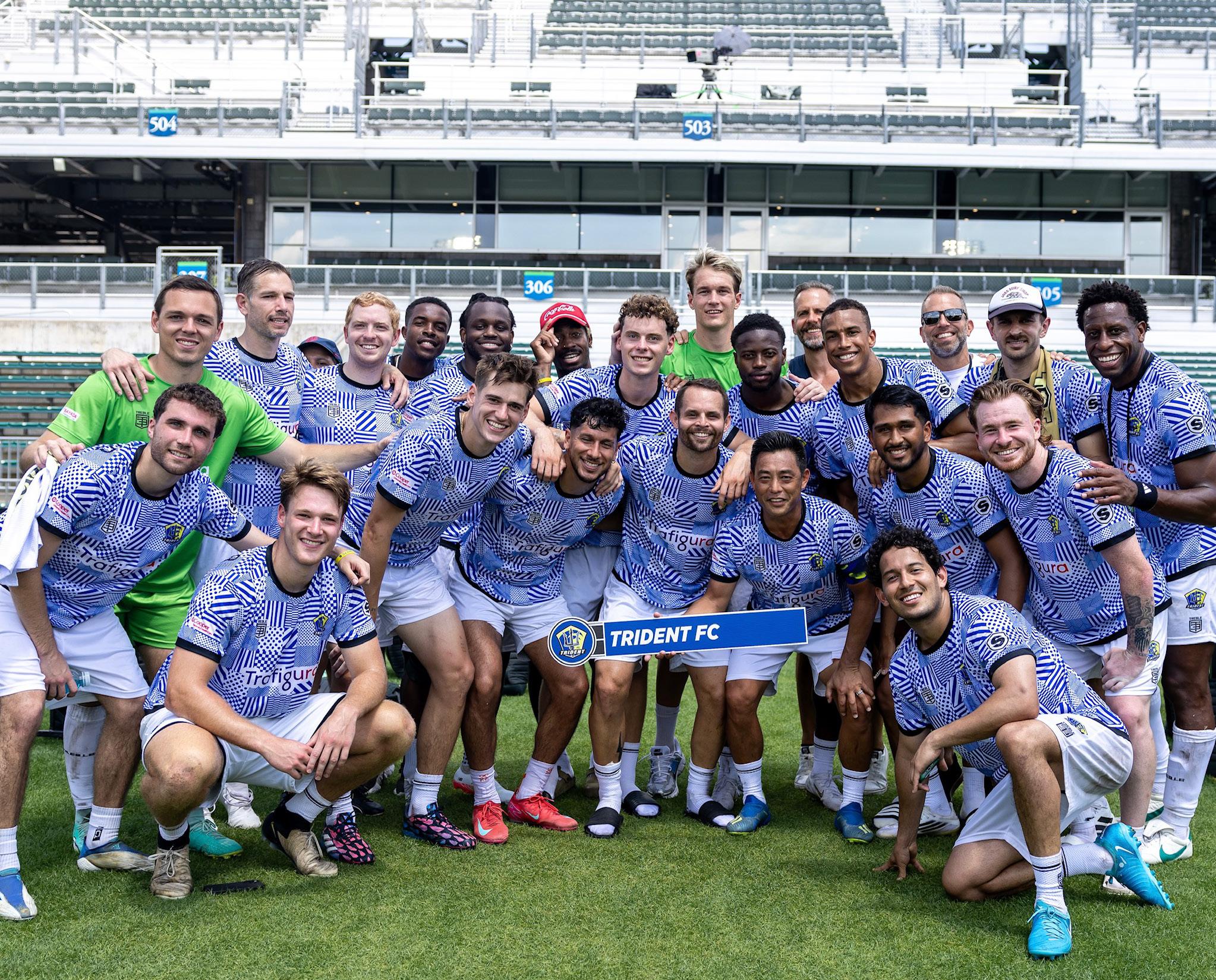
The 2025 Trident FC team at the TST tournament, ready for a day of competition, camaraderie and teamwork.
(continued from page 9) crowd were their Pi Kappa Phi brothers, some former teammates, others from their initiation class, joined by fellow Washington and Lee alumni who had come to cheer them on.
After nearly 30 years apart, they found themselves together again. It felt like old times. “It says a lot about our brotherhood that those guys would travel all the way to Cary, North Carolina, just to cheer us on,” Jarecki said. The brothers in the stands took advantage of the occasion, turning the weekend into a mini reunion of sorts. They rented a house, played golf and spent time reminiscing about their days on the field and in the chapter house. Many have since become sponsors of Trident FC, helping their brothers’ shared dream come to life.
Parker and Jarecki’s first TST appearance was only the beginning. Trident FC played well in 2024, then built on that momentum
in 2025, advancing past the early stages of the tournament to the Round of 16, an impressive step forward. While their progress was obviously a highlight, it was just as rewarding to see their brothers back in the stands for a second consecutive year.
Soccer brought Parker and Jarecki to Washington and Lee. There, they found not just teammates, but a lifelong community. Decades later, the same game has reunited them with their Pi Kapp teammates. “It wasn’t like we planned this all along, but life goes fast,” said Parker. “When an opportunity to do something you’re passionate about comes up, you’d better act on it, and that’s easier to do when you’ve got brothers you can trust, who you’ve known for years.”
Maybe they would have created Trident FC without being Pi Kapps, but that seems unlikely. While fraternity may not be at the forefront of their story, it’s undoubtedly at the core. That’s what brotherhood looks
like, not always in the spotlight, but always there when it matters. It’s the kind of bond that keeps showing up, long after the final whistle blows. When it came time for Parker and Jarecki to share the field again, they did, standing side by side as brothers, just like always.
Parker and Jarecki already have their sights set on TST 2026, building on Trident FC’s momentum and working to grow their presence in the tournament. You can follow the team’s journey online at tridentfcsoccer.com
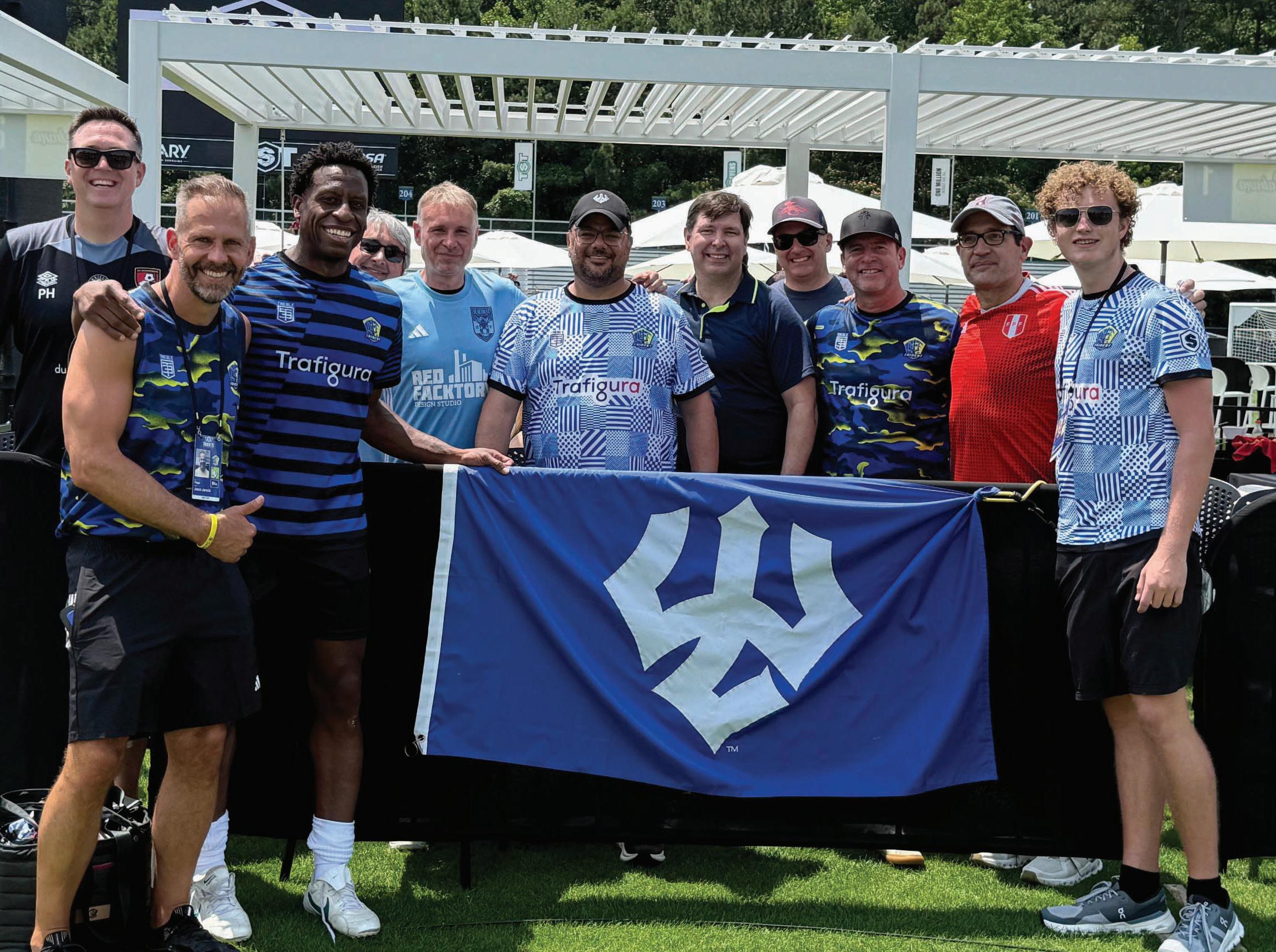
Jarecki and Parker hold a Washington & Lee flag alongside past teammates and fellow Pi Kappa Phi brothers who came to support them.
FCHANGE OF DEGREES
by Rachel Greene
or most Pi Kappa Phi brothers, the college experience is a given; lecture halls, late nights and friendships that stretch far beyond campus. But for students with intellectual and developmental disabilities, higher education and the college experience have too often been out of reach.
That exclusion has deep roots. For much of U.S. history, people with intellectual and developmental disabilities were barred from public school and funneled into institutions under the belief that they were “uneducable.” State laws in the early and mid-20th century let schools turn away students with disabilities, and many families were told their children belonged in custodial institutions.
Progress came slowly. In 1954, Brown v. Board of Education declared that “separate but equal” had no place in America’s public schools. Families of children with disabilities raised the question: why shouldn’t that promise apply to their sons and daughters?
It wasn’t until the passage of the Education for All Handicapped Children Act of 1975 (later known as IDEA) that public schools were required to serve students with disabilities, sparking an era
of deinstitutionalization as these children first entered schools. The Americans with Disabilities Act of 1990 built on that foundation, mandating access to college campuses and reasonable accommodations. Still, access did not always equate to belonging.
For Pi Kappa Phi, this shift in higher education feels less like a new direction and more like a continuation of a journey the Fraternity has been on for decades.
Even then, most students with disabilities were routed into vocational training or certificate programs, shaped by policies such as the federal gainful employment rule, which emphasized workforce readiness over academic education. Certificate and occupational programs hold value and remain the right fit for many. For too long, though, degree pathways have been off the table, even for those students who aspire to them.
The hard-won progress of public schooling and disability rights of the past has laid the groundwork for what is beginning to unfold today. Universities are now developing degree-granting programs for students with intellectual and developmental disabilities, affirming that all students belong in higher education.
For some, the question may still linger: Do students with intellectual and developmental disabilities need a college degree? The assumption behind that question reveals the stigma that has long kept the disability community at the margins of society: that their futures are limited. However, that assumption forgets that a college degree is more than a credential. It affirms belonging, opens opportunities and recognizes the human desire to learn, grow and be seen as capable.
At the same time, it’s important to acknowledge that intellectual and developmental disabilities vary widely, and for some students, the traditional classroom may not be the right fit. Success in a degree program may not be possible for every individual, just as it isn’t for every student without a disability. But that reality doesn’t diminish the value of inclusion; it underscores that dignity comes from choice, something students with disabilities have too long been denied.
Nationwide, the push to create degree-granting programs for students with disabilities is gaining traction. Through the federal Transition and Postsecondary Programs for Students with Intellectual Disabilities (TPSID) initiative, universities are building inclusive programs. But the future of these efforts isn’t guaranteed, as federal support has remained modest and advocates warn that funding uncertainties could limit expansion.
Even with those uncertainties, the impact is already visible. On campuses, inclusion is taking root. At Edgewood College, the Cutting Edge program has opened degree pathways for more than 100 students since its founding. At Lipscomb University, the IDEAL (Igniting the Dream of Education and Access at Lipscomb) program supports students earning four-year degrees through peer mentorship. And at Millersville University in Pennsylvania, the Integrated Studies program offers students with intellectual disabilities a chance to pursue degrees while fully immersed in campus life.
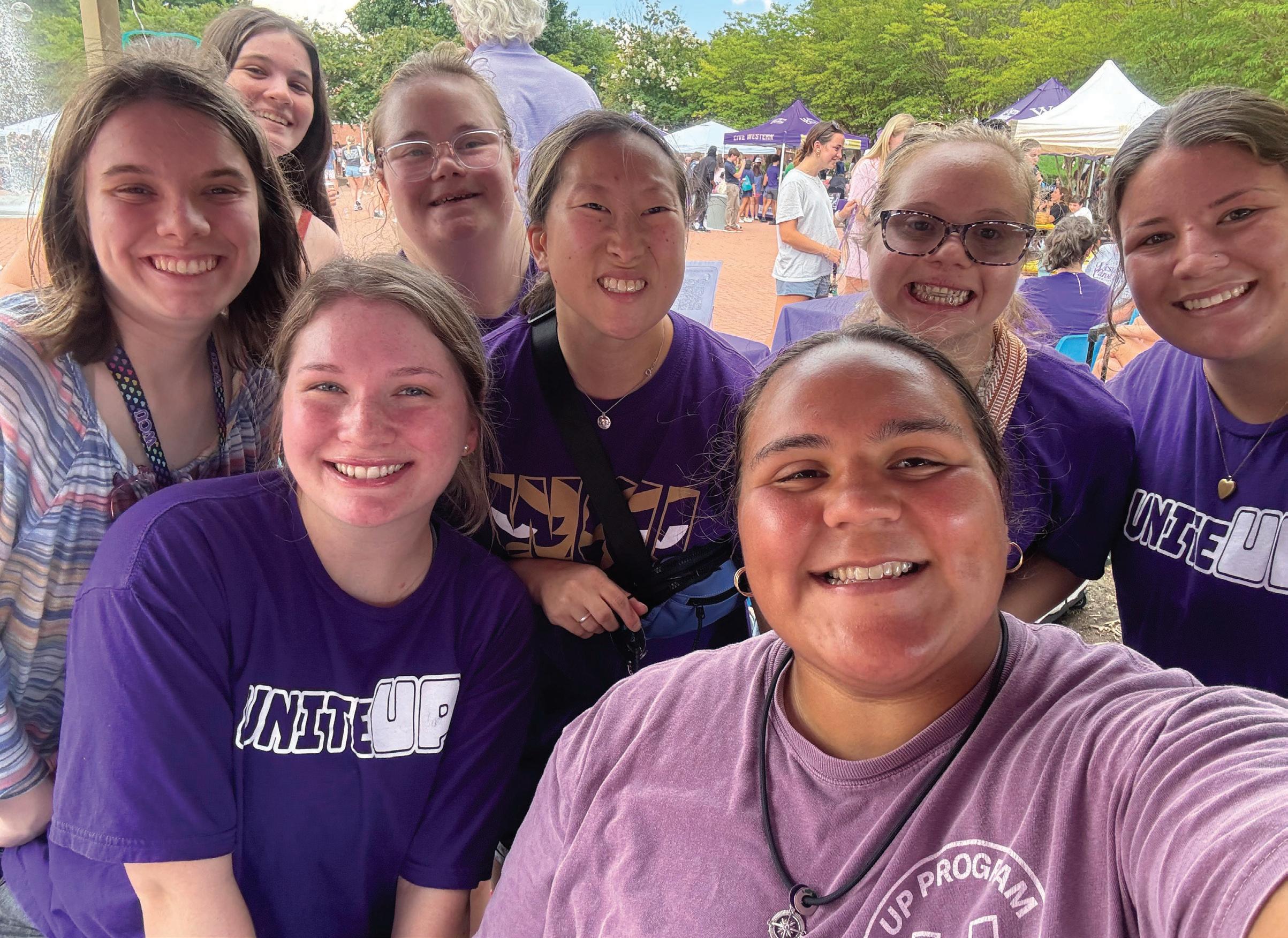
Alongside them, some of the most respected certificate programs are shaping national models of inclusion. At the University of Iowa, UI REACH (Realizing Educational and Career Hopes) provides a residential certificate program that equips students for employment and independent living. At Western Carolina University, the UP (University Participant) Program offers a similar two-year certificate experience, becoming the first inclusive postsecondary program accredited by the Inclusive Higher Education Accreditation Council. While not degree pathways, REACH and UP have become national models for inclusion, showing how certificate and degree options can coexist to meet diverse student needs.
Through mentorship, advocacy and intentional friendship, Pi Kappa Phi can help make sure the college experience belongs to all.
(continued from page 13)
Together, these examples reflect a growing national movement, ensuring that students with intellectual and developmental disabilities can pursue the same breadth of opportunities as their peers.
These programs are not without their challenges. Students with intellectual and developmental disabilities often still face social isolation and encounter accessibility barriers. But none of these obstacles are insurmountable, and if fraternities and student organizations commit to being intentional partners, those challenges can give way to opportunity.
For Pi Kappa Phi, this shift in higher education feels less like a new direction and more like a continuation of a journey the Fraternity has been on for decades.
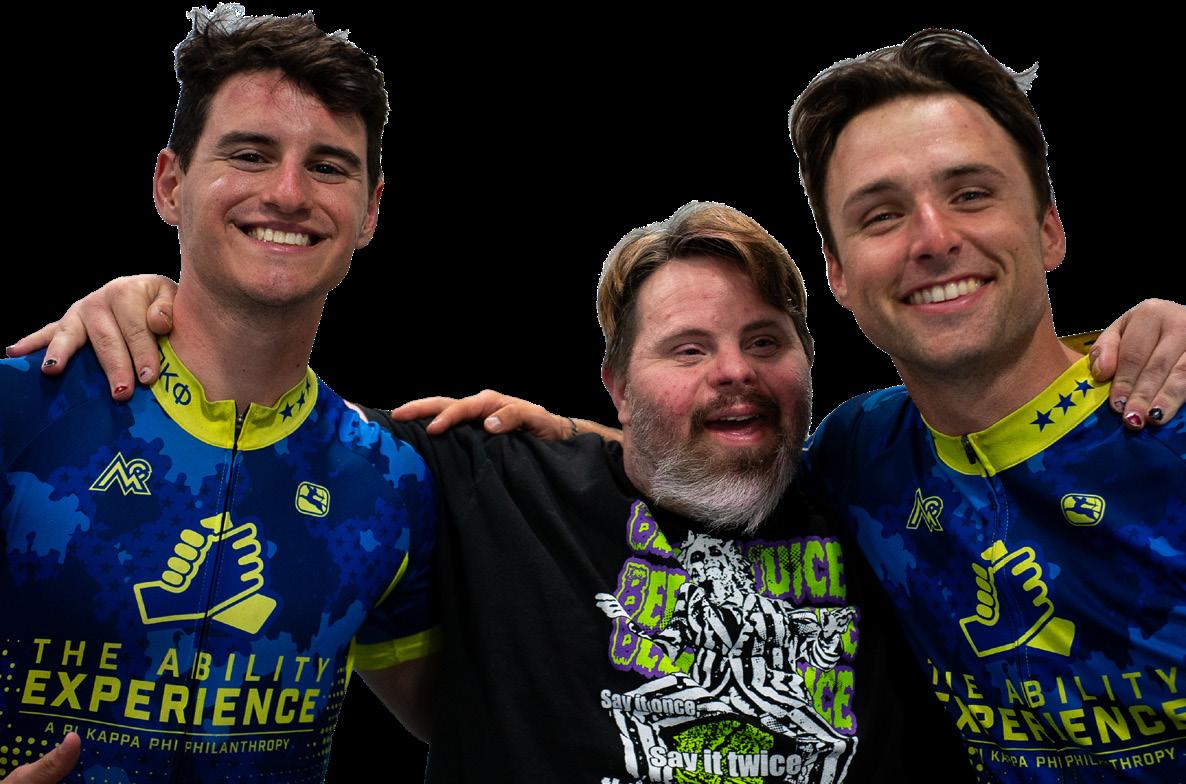
Through The Ability Experience, generations of brothers have long worked to create opportunities for inclusion, friendship and shared community. Now, as universities move toward a more inclusive model, the question is how Pi Kappa Phi chapters, undergraduate brothers and alumni can extend that work, ensuring that students with disabilities are not only welcomed into higher education, but embraced as valued members of their campuses and fraternity communities.
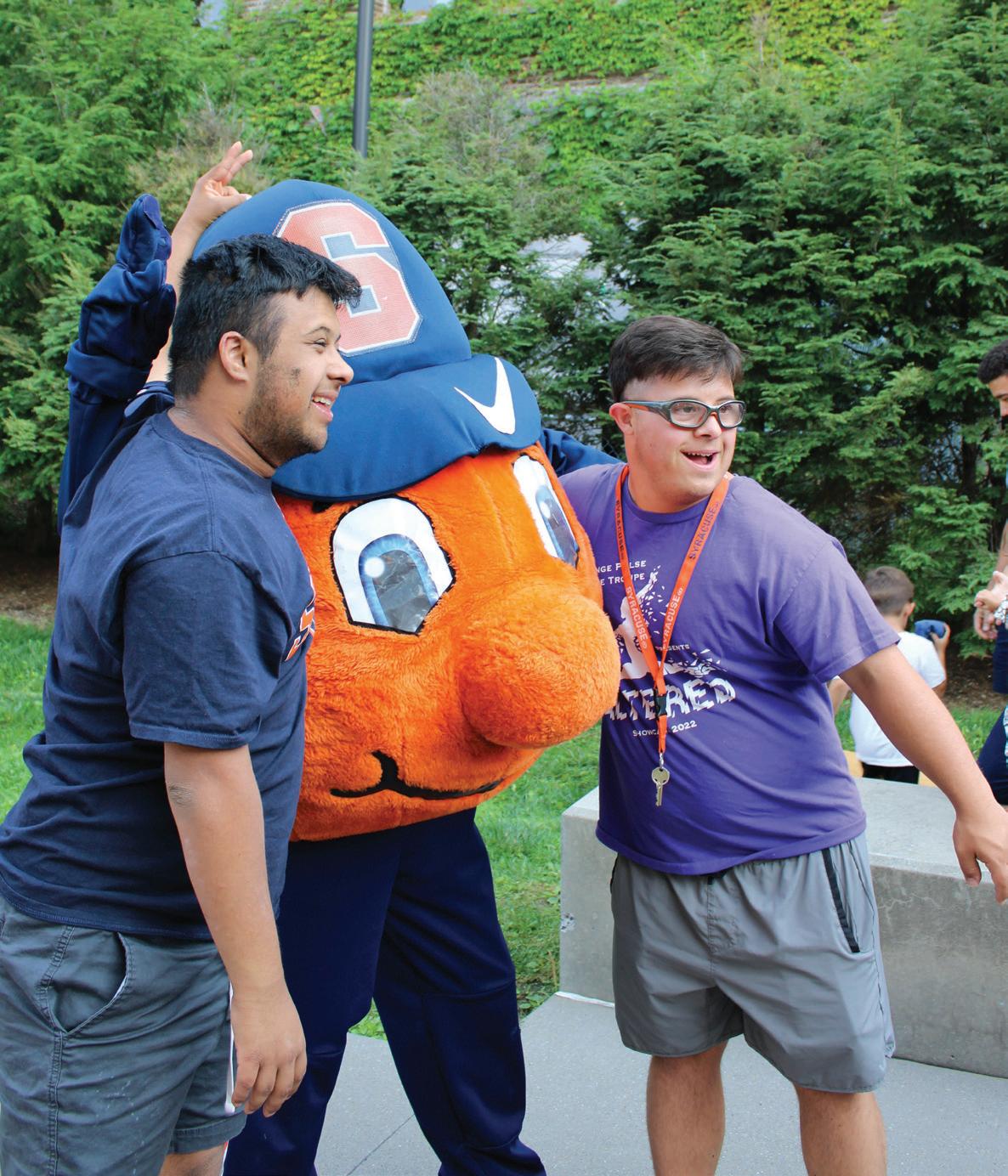
Undergraduate and alumni chapters located in proximity to institutions of higher education can start by supporting inclusive programs, partnering with disability service offices and creating spaces where students with disabilities feel not only welcome, but valued. Just as brothers from the recently chartered Lambda Beta Chapter at Syracuse University have done this past year, petitioning a campus GPA policy to ensure that students in the InclusiveU program, who do not receive GPAs, could join the Fraternity.
Their petition stemmed from a belief that brotherhood should be about belonging and shared experiences, rather than a GPA, and that students in the InclusiveU program deserved the chance to call Pi Kappa Phi home.
Pi Kappa Phi is also re-chartering its chapter at Clemson University, where the Interfraternity Council has partnered with the ClemsonLIFE program. In 2025, Clemson fraternities added six new brothers from the program, while campus sororities welcomed five sisters. For Pi Kappa Phi, returning
to Clemson reflects a commitment to help lead this cultural shift, grounded in the mission to champion the abilities of all people.
And at the College of Charleston, the birthplace of Pi Kappa Phi, the CharlestonLIFE program offers students with intellectual and developmental disabilities the chance to earn a four-year certificate while living and learning alongside their peers. For the Fraternity, such a program where Pi Kappa Phi was founded feels like a full-circle moment.
The movement toward inclusion in higher education is still young, and its future will depend on the willingness of campuses and communities to welcome change. Pi Kappa Phi, through The Ability Experience, has spent decades laying the foundation for this moment. Now it is up to every brother, undergraduates and alumni alike, to ensure that as classrooms open, so do chapter houses. Through mentorship, advocacy and intentional friendship, Pi Kappa Phi can help make sure the college experience belongs to all.
Editor’s Note: In light of recent federal budget developments and the government shutdown, funding for programs under the Individuals with Disabilities Education Act (IDEA) has been affected. These changes may influence some higher education programs for students with disabilities mentioned in this story, though the extent of that impact remains uncertain. We encourage readers who wish to learn more about similar programs to contact local campuses or their alma mater.
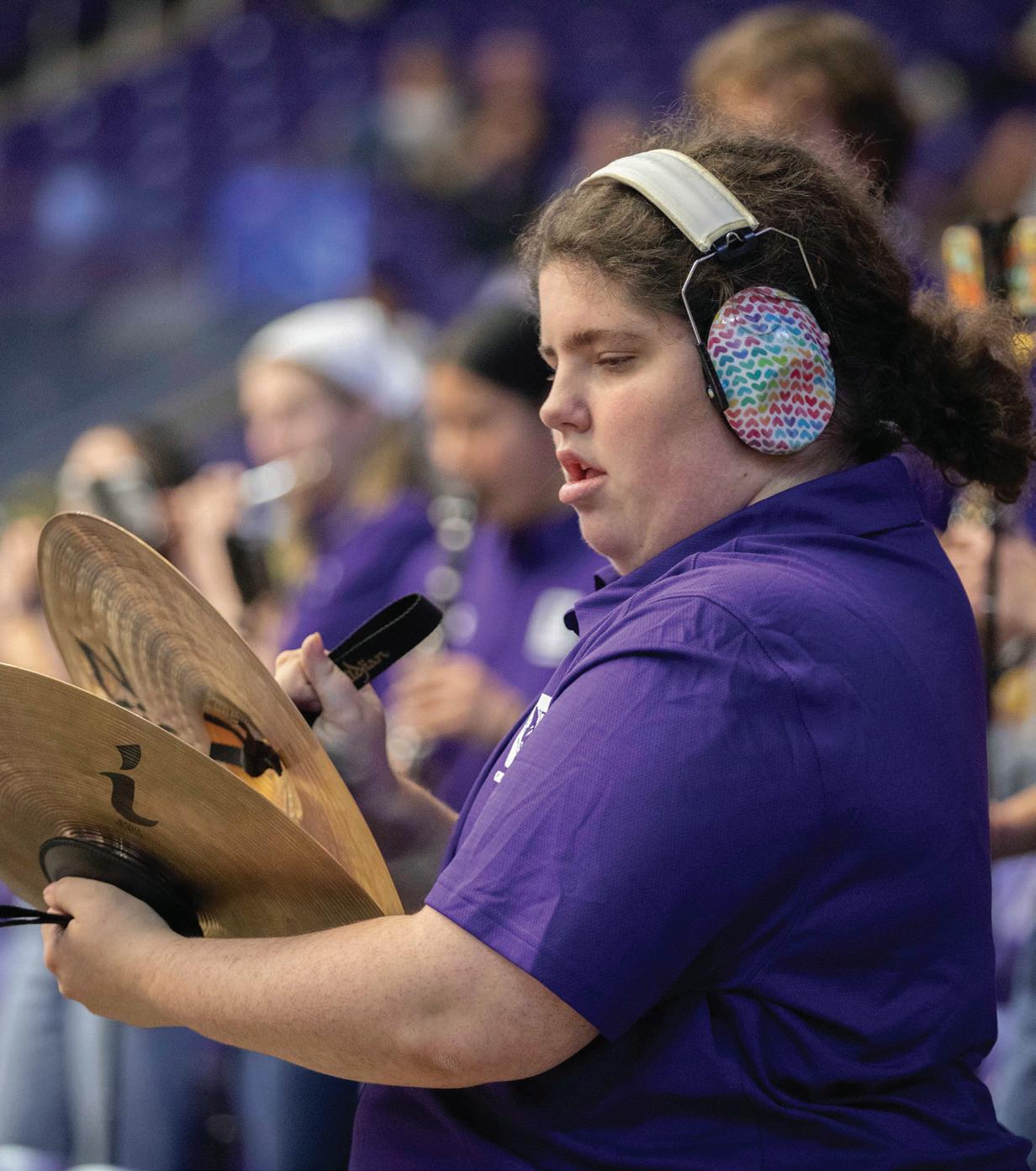
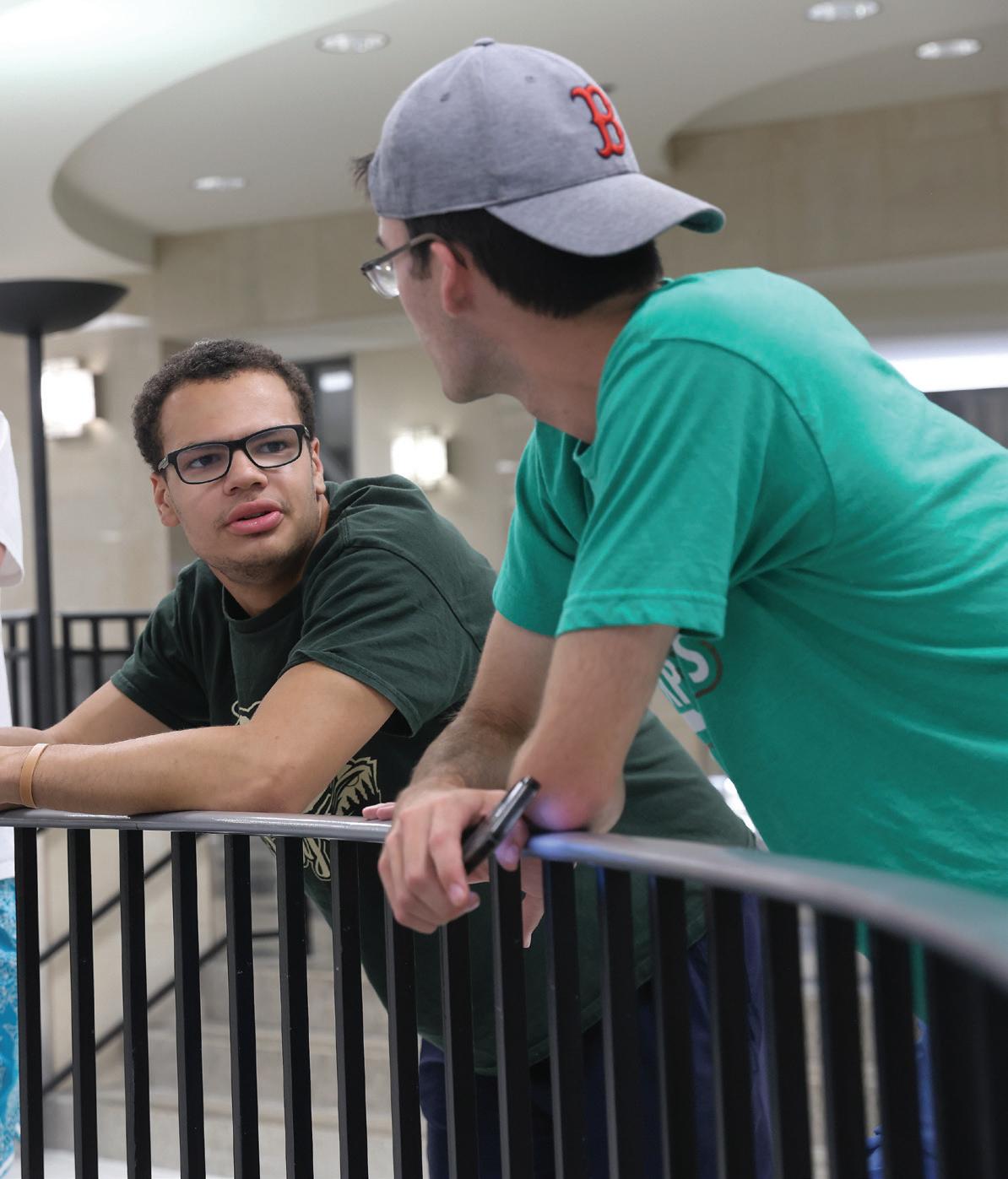
Photos in this story have been provided by Western Carolina University’s UP Program, Syracuse University’s InclusiveU Program, Dan Welk (University of Iowa) and Kristi Jones (Lipscomb University).
/rə’krōōtm(ə)nt/
See also: Pi Kappa Phi · The Ability Experience
by Rachel Greene
Each school year, as students return to campus and welcome events fill their calendars, fraternities compete for attention. Too often, though, fraternity recruitment events look the same and blur together.
At Purdue University, the Omega Chapter is taking a different approach to recruitment. Instead of another cookout or game night, potential new members are introduced to Pi Kappa Phi’s philanthropic initiative: The Ability Experience. From the start, the chapter makes it clear that service is not something they do, but who they are.
In fall 2021, Justin Bonanno walked into his first Pi Kappa Phi recruitment event expecting introductions and small talk. Instead, he met a brother who had just completed the Journey of Hope. Bonanno learned that he had raised money for people with disabilities and biked across the country.
“That’s what brought me back to Pi Kapp for their next event,” Bonanno said. “The guys I clicked with most were the ones who had already lived out the mission through The Ability Experience. Hearing their stories made me realize the caliber of men in the chapter.”
Omega’s approach is deliberate. Early in recruitment, they host a casual “meet the brothers” night, where Pi Alphas — brothers who have completed an Ability Experience summer event — and brothers active with the chapter’s Friendship Partners lay the foundation for what comes next.
“When you go to college, you learn skills and knowledge. When you join a fraternity, you develop friendships and leadership. And then you have The Ability Experience, which builds character,”
said longtime advisor Pat Kuhnle, Omega (Purdue). “We look for three things in recruitment: academics, leadership and service. If someone has done service projects, especially with the disability community, they go to the top of our list. If you’re looking for a fraternity just to have a good time, we may not be for you, and that’s okay. We expect 100 percent participation in serving others.”
Next comes a panel focused on The Ability Experience that puts service front and center. Pi Alphas sit beside brothers who plan fundraisers and lead Friendship Visits. In just 30 minutes, potential new members learn about The Ability Experience, how the chapter supports it and what the commitment entails. The message is clear: if you join this chapter, you commit to this mission.
The guys I clicked with most were the ones who had already lived out the mission through The Ability Experience. Hearing their stories made me realize the caliber of men in the chapter.”
“Often, potential new members tell us they want to join because they heard our stories and want to take part in the Journey of Hope or be involved with this mission,” said Kuhnle. “When you recruit men of character, everything else falls into place.”
Bonanno recalls how clear that expectation felt from the very beginning. “It’s woven into everything we do,” he said. “If you don’t have class, you’re expected to show up to a Friendship Visit. It could be playing basketball, grabbing lunch with our buddies or helping with a big event. It’s just part of who we are.”
The consistency of that message and the follow-through on those expectations have created traditions that define the chapter’s identity. One is the 72-hour bike-a-thon, a longtime staple that began as a fundraiser for a brother who needed a service dog and has continued in his memory. Another is the classic War of the Roses week, reworked to emphasize direct engagement with the disability community.
Just as crucial as those time-tested traditions are the smaller habits embedded within the chapter’s culture. The Omega Chapter maintains ongoing partnerships with local organizations, The Arc of Tippecanoe and Life Has No Boundaries, and keeps three to five visits on the calendar each week. Attendance isn’t mandatory, but it’s considered the norm. Once men join, they learn quickly that showing up is the expectation, whether to a gym, a dance floor or a conversation. Older brothers pair with associate members, model the basics and invite them in. No expertise is required. Bring a smile, listen and be open to new friendships.
For chapters that feel intimidated by the thought of doing things differently, Kuhnle offers a starting point. “Volunteer once. You will see the joy. Then find a local organization that needs help and begin with two or three brothers. Step outside the social aspect and be about something bigger. That spark will spread.”
Recruitment plants the seed, and the culture tends to it. Expectations are clear, opportunities are accessible and support from brothers is constant. Over time, men who once arrived nervous or unsure become the ones bringing new brothers to the next visit.
For Bonanno, that culture translated into a decision he never expected to make: cycling across the country on the Journey of Hope. “I never thought I’d do it,” he admitted. “But watching the brothers around me commit to something bigger than themselves made me want to take that leap, and it absolutely changed my life.” He trained with brothers all spring and leaned on an alumni network of more than 100 Pi Alphas for advice and support. He learned to ride for miles and still bring energy to a Friendship Visit at the end of a day’s ride. “You have to show up the same way every day,” Bonanno said.
Now an analyst at Deloitte in Dallas, Bonanno credits that foundation of service with shaping how he approaches challenges and opportunities. “The resilience, the discipline, the ability to show up for others; it’s something I benefit from every day.”
For Omega Chapter, that’s the point. By centering recruitment on philanthropy, they attract men who already value service or who are ready to grow into servant leaders. The result is a culture where service comes naturally, leadership grows from it and brotherhood strengthens around a shared purpose.
It’s a model other chapters can adopt: be clear about your expectations upfront, set a high standard early and make philanthropy more than just an event to attend. Make it the culture.
As Bonanno put it, “It’s so much harder to wait until men have already joined to try to convince them to care. If service is part of why they joined in the first place, it defines everything that comes after.”
Bonanno is one example of the men Omega produces. Recruit with the mission at the forefront, and you build a chapter that reflects it. Build a chapter that reflects the mission, and you give the world more of what Pi Kappa Phi promises to produce: men for whom service, leadership and brotherhood are not buzzwords, but second nature.
STEP 3
STEP 4 Explain early on that joining Pi Kappa Phi means showing up and serving others.
STEP 5 Bring associate members to Friendship Visits early, so they learn by doing alongside brothers.
Plan visits, fundraisers and projects year-round so involvement becomes second nature.
STEP 6
Build brotherhood around shared purpose, letting consistent action define your chapter’s identity.
Bonanno and teammates cycle across the country, a summer full of service and scenic views.
Bonanno (left) shares laughter and camaraderie during a Friendship Visit, showing that many of Journey of Hope’s most meaningful moments happen off the road.
different mailboxes SAME LETTERS
by Rachel Greene
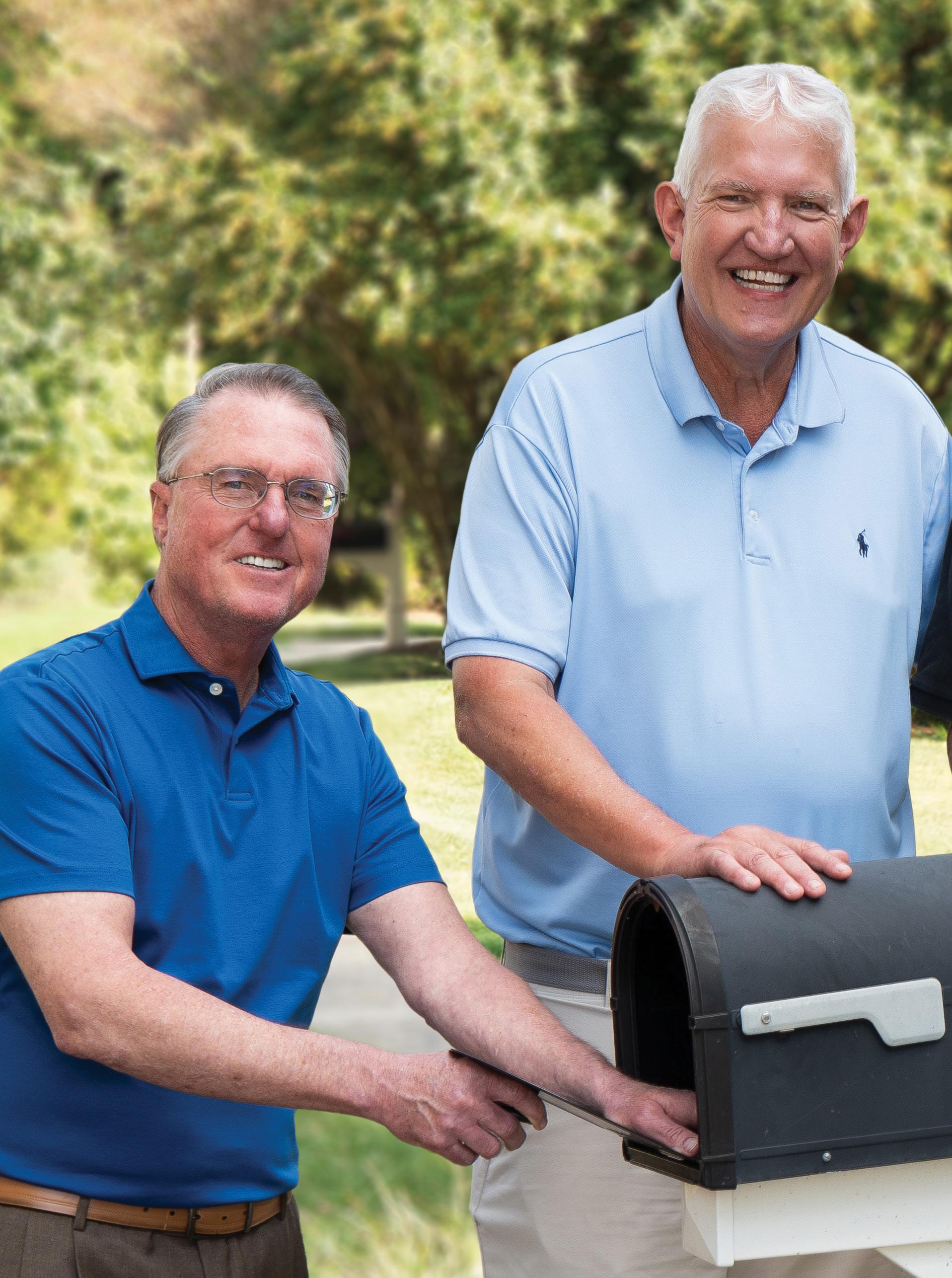
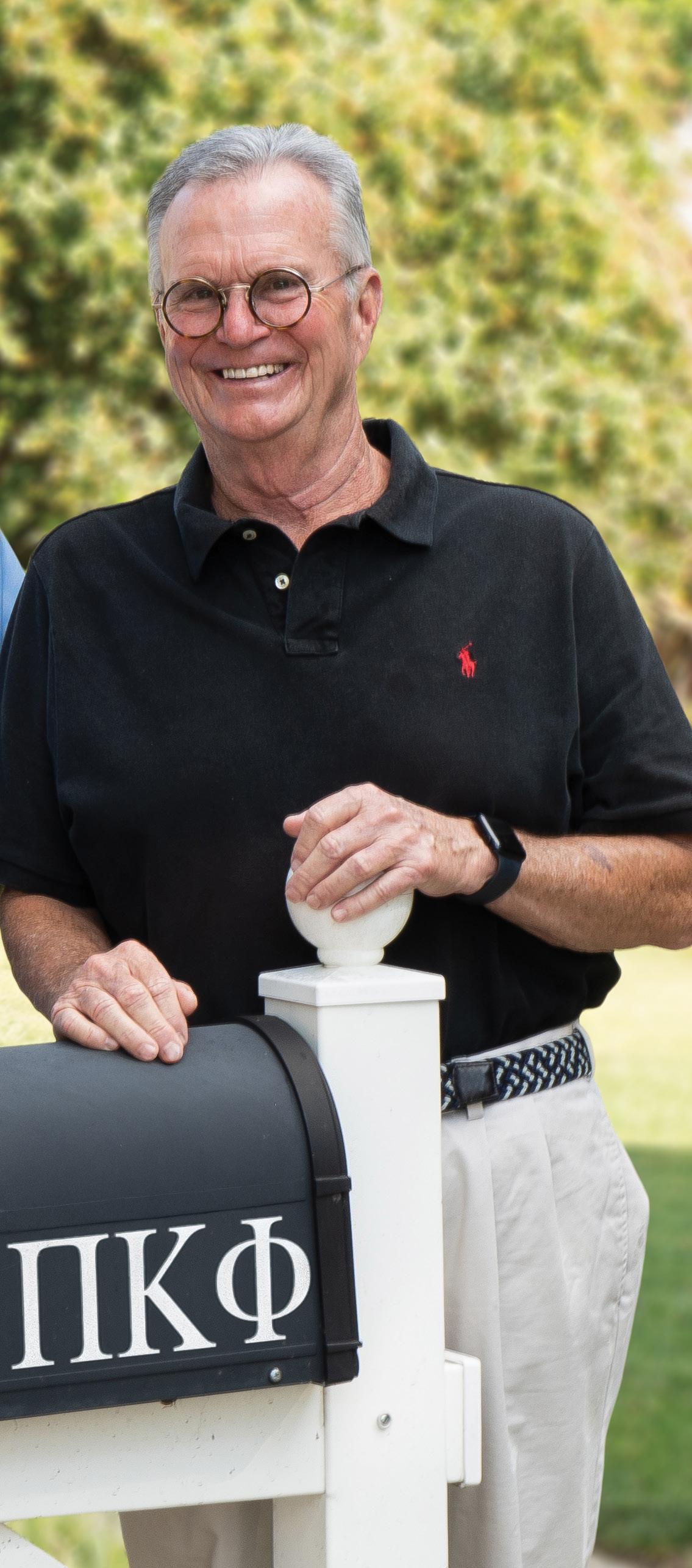
Tucked off a winding road in the idyllic college town of Elon, North Carolina, nothing about this cul-de-sac would catch your eye at first glance. It could pass for any other street, in any other town. But three of the mailboxes here carry more than names and numbers; they have a connection that runs deeper than property lines, one forged decades earlier on different campuses. Each one of these mailboxes belongs to a different man who shares the same three letters: Pi Kappa Phi.
They didn’t know each other in college. Each had joined the Fraternity in his own way. At first, they were simply neighbors, exchanging waves across the driveway, chatting about golf and engaging in the casual conversations that stitch neighbors together. Then one afternoon, a casual chat about sprinkler systems turned to talking about Pi Kappa Phi.
As human beings, we’re always looking for a common denominator. When you meet someone new, you look for something you share. For us, that was Pi Kappa Phi. It’s a bond that never leaves you.
(continued from page 19)
“We were just standing on the porch one day, talking about sprinkler systems or something,” David Vaughn, Delta Zeta (Appalachian State), recalled. “Someone mentioned Pi Kapp. Then another one of us said, ‘Wait, you’re a Pi Kapp?’ and then the third chimed in. It was wild.”
In that moment, what was once casual driveway friendships and ordinary neighborly chatter suddenly shifted into something more familiar — the bond of brotherhood.
It felt almost like fate. After years out of college, building careers, raising families and facing life’s ups and downs, they had all landed here, on the same street. They did not rediscover fraternity at a reunion or through an alumni event; they rediscovered it in the most organic way, through the neighbors living just steps away.
It mirrored the moments when they first realized Pi Kappa Phi was something they wanted to be a part of. It was nothing they searched for, but something they
found. And they found it again. Through this discovery, they were reminded that fraternity has never been confined to a place or time. It shifts, it endures and it reappears when you least expect it.
Their paths to Pi Kappa Phi had been different, but the reasons they joined were more alike. Howard Hawks, Kappa (UNC-Chapel Hill), remembers walking through the row of fraternity houses and sensing almost immediately that some were less interested in who he was and more interested in his “resume and dad’s financial statement.” When he found Pi Kappa Phi, he saw something else entirely. “Pi Kappa Phi had a little bit of everything,” he said. “Morehead Scholars, cheerleaders, athletes, med students and more. It just fit.”
At Elon University, Rick Barnes had been searching for stability during his parents’ divorce. “I needed structure in my life,” he said. “Pi Kappa Phi and the Epsilon Alpha Chapter gave me that. Looking back, I’m grateful. The structure and discipline taught me how to rely on others and be accountable.”
Hawks, Barnes and Vaughn gathered in one of their backyards, a regular occurrence for the brothers turned neighbors.
And at Appalachian State, David Vaughn had transferred from another school that never felt like home. A visit to a Pi Kappa Phi event with a friend sealed his decision almost instantly. “We were the first national fraternity on campus,” he recalled. “I was in the second pledge class, and I was all in from day one.”
When they look back on those years, what stands out isn’t the chapter events that make it into the history books, but the day-to-day moments. It was the afternoons spent playing intramural games, the weekend trips filled with laughter and the late-night study sessions that turned into long talks about life and the future. Those were the bonds that lasted long after the last exam or chapter meeting.
Hawks remembered one road trip in particular, taken almost on a whim. He and two chapter brothers drove to Houston and stayed with an alumnus they had never met before. When they knocked on his door, he welcomed them inside without hesitation. “That spoke volumes to me,” he said. “We could walk into this man’s home, and he opened the door like we’d known each other forever. That’s fraternity.”
That same truth has revealed itself time and time again. Recently, when Hawks faced a serious health scare, the support he received was more than he could have imagined. Cards came from churches he’d never attended. Prayer groups gathered in towns he’d never set foot in. Brothers, some close and expected, others long absent and unexpected, reached out in ways that reminded him how wide and enduring fraternity truly is. “When a hard thing happens, brothers reach out.” He said. “Moments like that remind you what kind of community Pi Kappa Phi really is.”
Barnes has had a similar realization. “Dorm friends? I don’t keep up with them. But fraternity brothers? I do. You don’t build trust like that just anywhere.”
Now, they believe fraternity is worth passing on. “The gift of Pi Kappa Phi isn’t meant to stop with you,” Hawks reflected. “It’s something to share; by mentoring, supporting and opening the same doors that were once opened for you.”
Even after all these years, the fraternity continues to surprise them with its impact.
You don’t know what fraternity means while you’re still in it. That part comes later. It’s not just a college thing; it’s a people thing.
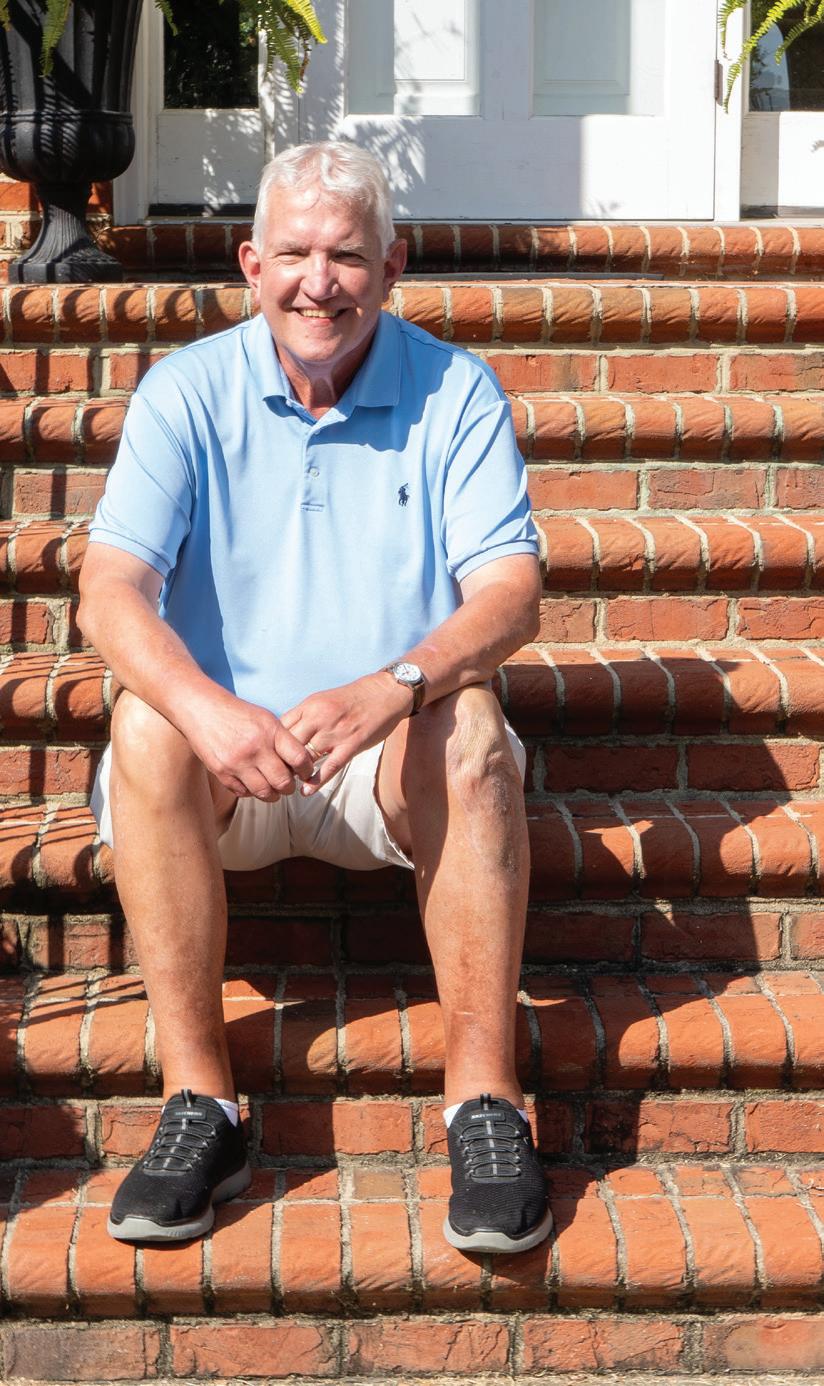
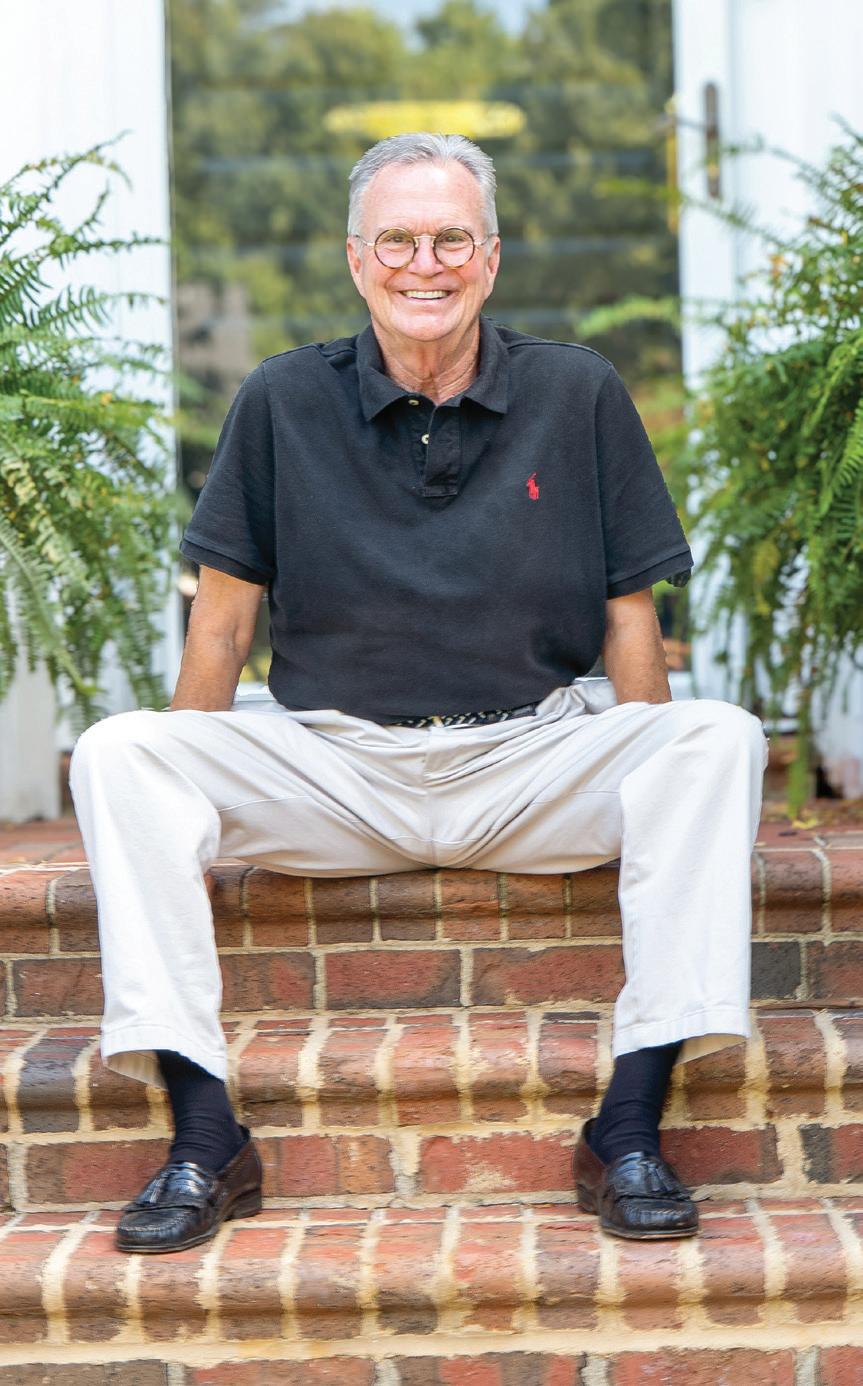
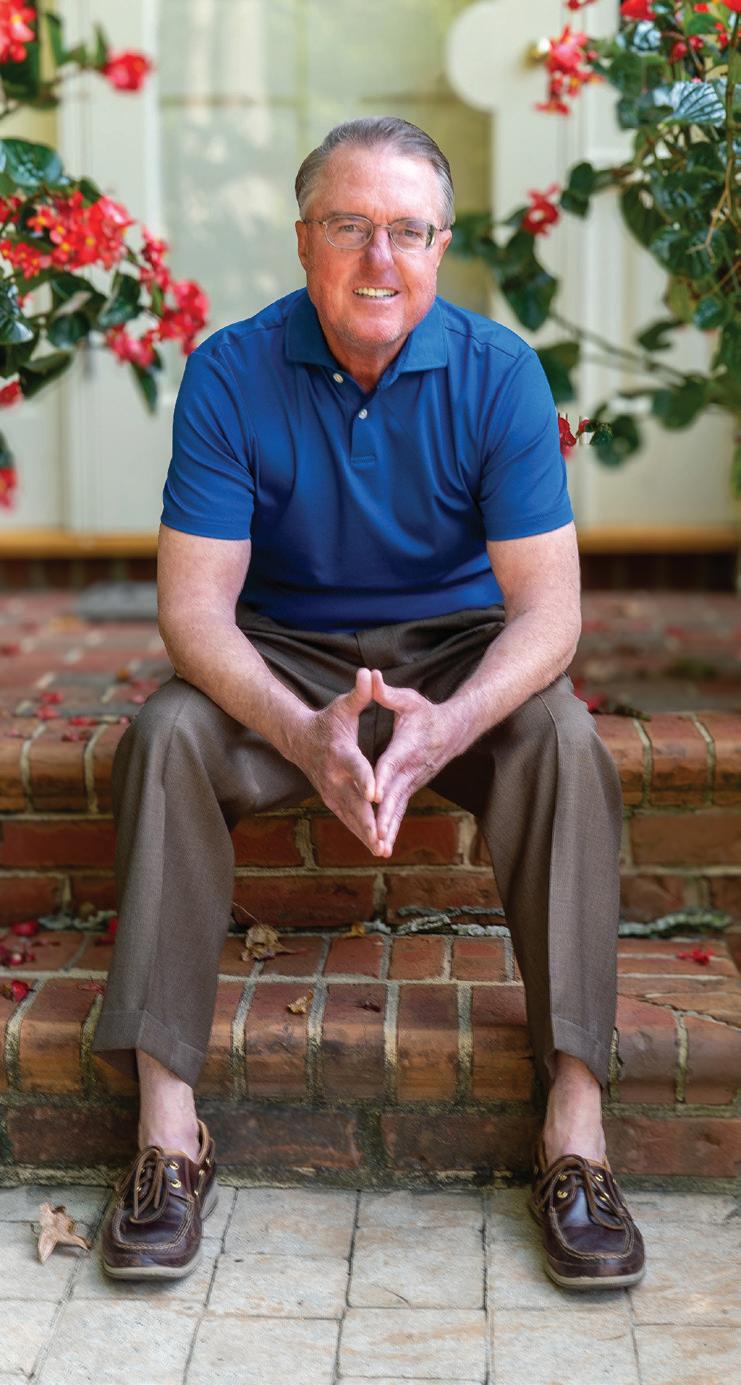
Howard Hawks, Kappa (UNC-Chapel Hill)
David Vaughn, Delta Zeta (Appalachian State)
Rick Barnes, Epsilon Alpha (Elon)
(continued from page 21)
“Being in Pi Kappa Phi in college was life-changing,” Vaughn said with a smile. “And as good as Pi Kappa Phi was in college, it gets better with age. You realize how much you love your brothers, and how much they love you. We still talk weekly, we still show up for each other. Our fraternity experience looks different now, but it’s just as real.”
Now, living side by side, these three men are reminded of that every day. They golf together, share stories at the country club and lend a hand when needed. One makes sure to blow out the irrigation system each fall, and each of them can always be counted on for a good laugh or an encouraging word. In their routines, they find proof that the bonds built in chapter houses hundreds of miles apart still shape their lives today.
That connection runs deeper than their shared street name or zip code. “As human beings, we’re always looking for a common denominator,” Vaughn said. “When you meet someone new, you look for something you share. For us, that was Pi Kappa Phi. It’s a bond that never leaves you.”
Their cul-de-sac has become a testament to what fraternity really is, not something left behind after graduation, but something that keeps showing up. Sometimes, in a chapter house. Sometimes, in a card from a brother you haven’t spoken to in years. And sometimes, in three mailboxes lined up in a row. When asked what advice they would give a young man unsure about fraternity life, they didn’t hesitate. “Don’t let school interfere with your education,” Hawks said with a laugh.
David Vaughn, Delta Zeta (Appalachian State)
Then, more seriously, “A well-rounded experience matters. I’d rather be in business with the C student who learned to lead and communicate than the A student who only sat in the library.”
For these three men, the real value of fraternity lives in the relationships that endure through decades of change, in the comfort of knowing that no matter what life brings, brotherhood will be there, even in the most unexpected places.
“You don’t know what fraternity means while you’re still in it,” Barnes added. “That part comes later. It’s not just a college thing; it’s a people thing.”
At first glance, it could be any other cul-de-sac, shaded by tall trees and tucked behind a golf course. But look closer, and you might notice it: the laughter of men who share a unique bond, the trust of neighbors
who know they can count on each other and the realization that Pi Kappa Phi is not only something you join in college, it’s something that follows you for life.
For these three men, brotherhood didn’t end on graduation day; it found them again, on an ordinary cul-de-sac in the company of neighbors who turned out to be so much more. Different mailboxes. Same letters. A reminder that Pi Kappa Phi never leaves you. It just finds new ways to show up, sometimes right next door.
Howard Hawks, Kappa (UNC-Chapel Hill), far right
THE OTHER SIDE OF PENN HOLDERNESS
by Rachel Greene
e almost didn’t make it across the stage at graduation.
By his junior year at the University of Virginia, the academic probation notices had stacked up, notices that made him wonder whether he belonged there in the first place. Faced with this reality, he felt stuck. Lectures left him zoning out, assignments went unfinished and he began to believe that maybe he just wasn’t as capable as everyone else on campus.
But while his grades told one story, his fraternity brothers would tell another. In the Beta Upsilon Chapter of Pi Kappa Phi, he wasn’t just a guy whose GPA kept slipping; he was the guy everyone wanted around. The one who made everyone laugh, the one who could strike up a real conversation with a stranger during rush and help turn them into a brother. While his transcript showed his grades, his brothers saw the person behind them.
That brother was Penn Holderness, Beta Upsilon (Virginia). Today, millions know him as an internet personality; one part of the Holderness Family, whose viral videos, podcast and books have reached audiences worldwide. He’s won “The Amazing Race,” written candidly about his struggles with ADHD and turned family life into comedy that resonates with people far beyond the walls of his own home. Long before the spotlight, though, Holderness was an undergraduate Pi Kapp brother, trying to understand why success in the classroom felt impossible when everything outside of it came so easily.
But while his grades told one story, his fraternity brothers would tell another. In the Beta Upsilon Chapter of Pi Kappa Phi, he wasn’t just a guy whose GPA kept slipping; he was the guy everyone wanted around...
While his transcript showed
his grades, his brothers saw the person behind them.
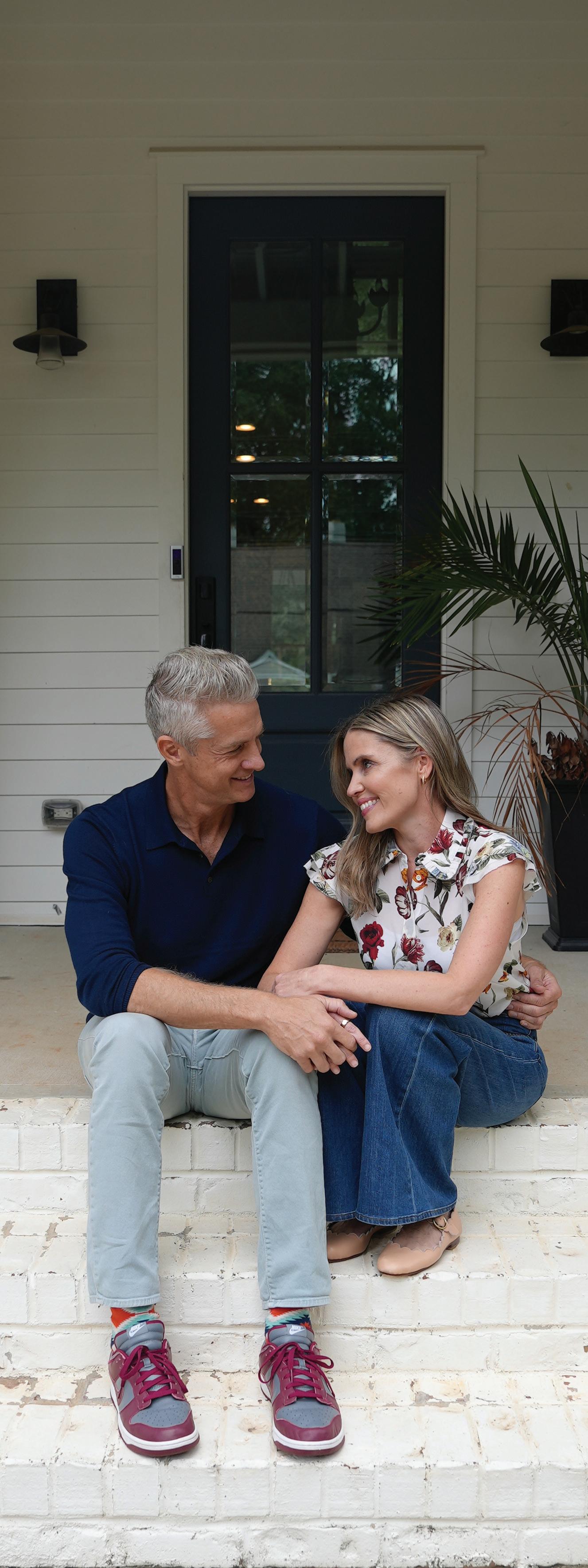
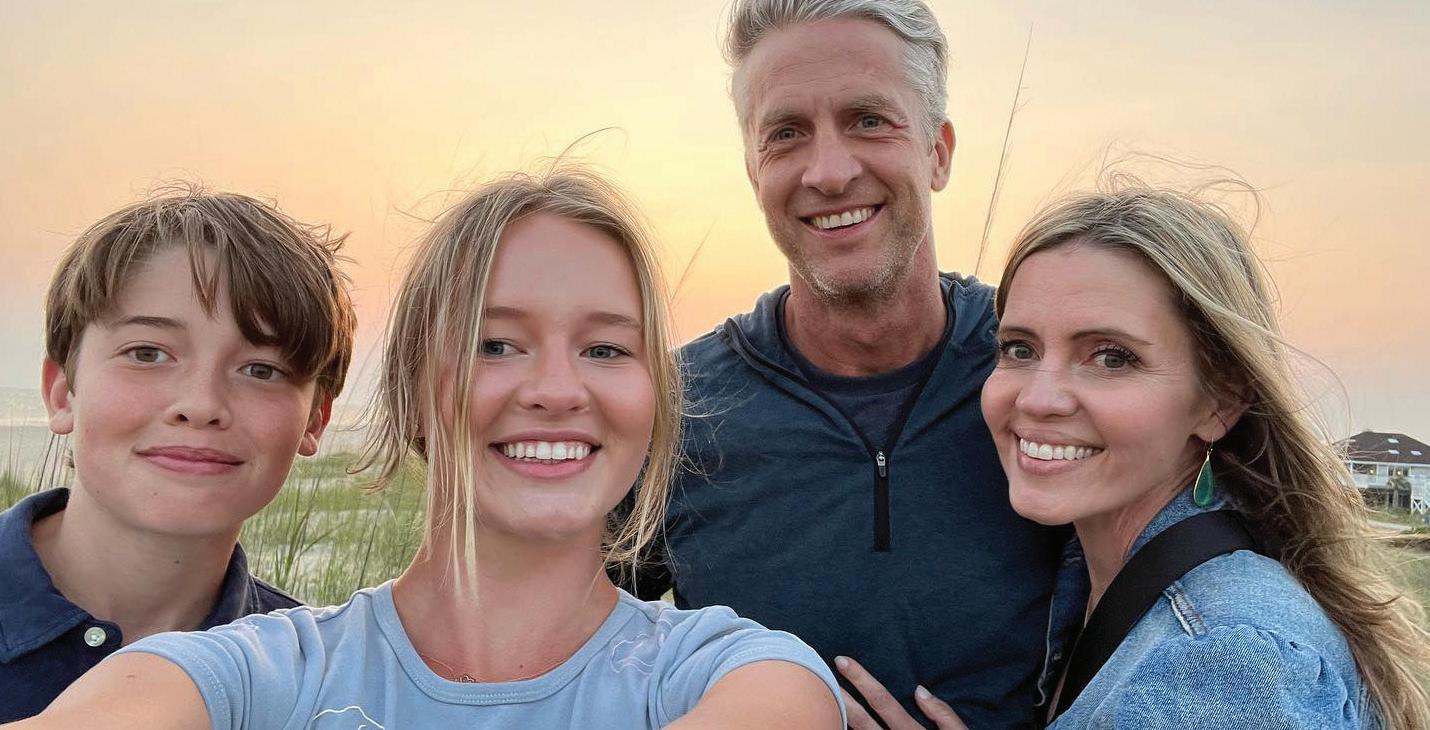
Holderness and his wife, Kim; partners not just in life, but also in writing, podcasting and entertaining through their creative work.
(continued from page 25)
It wasn’t until the summer of his junior year of college that he was finally able to put a name to what had been holding him back: attention deficit disorder (ADD), now recognized under the broader classification of attention deficit hyperactivity disorder (ADHD). Suddenly, the missed assignments, the blank stares during lectures, the constant frustration of knowing he was capable but was unable to prove it in the ways college demanded; it all made sense. With medication, his grades improved enough for him to graduate, not with honors, but with a sense of relief and the realization that maybe he wasn’t lazy or broken after all.
“Back then,” he recalls, “the model was: you describe your symptoms, they give you a prescription and you check in once a year.” That approach gave him the tools and focus to graduate, but not the understanding or tools he needed to live life with both the challenges and strengths of an ADHD brain.
For Holderness, the story of his ADHD is multifaceted. Sure, there were the unfinished assignments and inability to focus, but there was also his high energy, humor and his “people person” nature, qualities that helped him thrive in fraternity life and beyond.
While he left college with a diploma, that was not the most important thing he gained in those four years. He found community through his brothers. Pi Kappa Phi gave him more than parties or a place to belong; it taught him resilience, empathy and that he had value, even when his transcripts might not have shown it. Those lessons, more than any textbook, would shape the rest of his life.
Pi Kappa Phi gave him more than parties or a place to belong; it taught him resilience, empathy and that he had value, even when his transcripts might not have shown it.
After graduation, Holderness had no clear plan, but he found his way into local television news. Considering his ADHD, journalism proved to be a perfect fit for him. Stories were fast, deadlines were tight and he only had seconds to capture an audience’s attention. Holderness thrived in that environment, where his energy, humor and need to keep moving became assets, rather than obstacles.
Still, local television had its drawbacks. The long hours, late nights and constant fast pace wore on him and his wife Kim, who also worked in the industry. They eventually stepped away, not
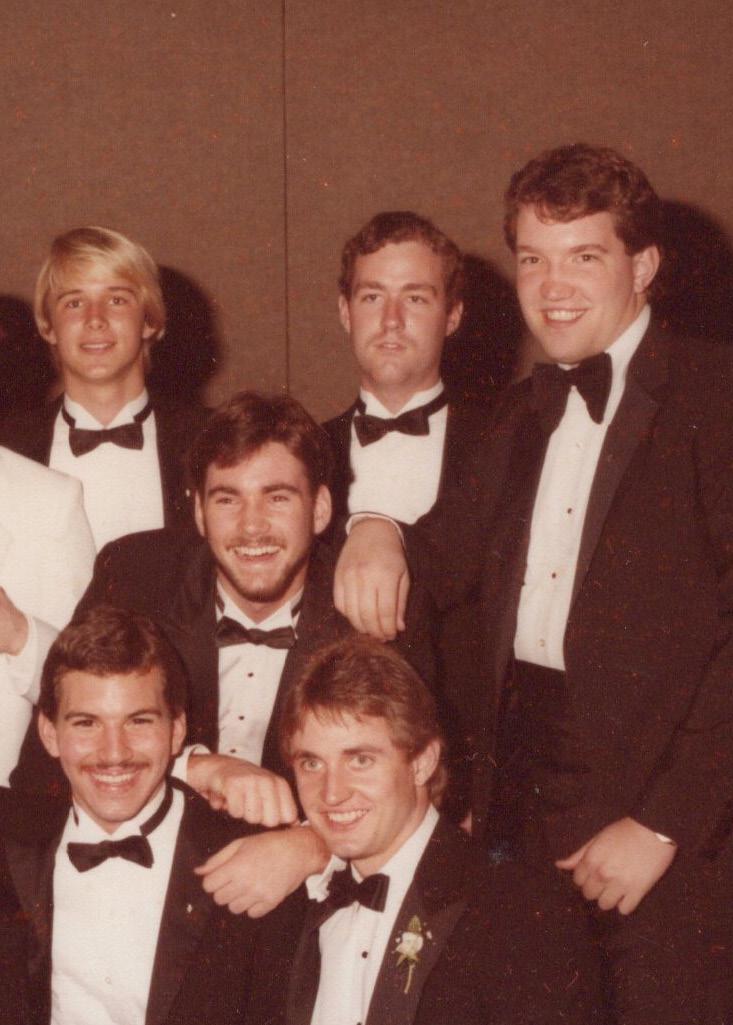
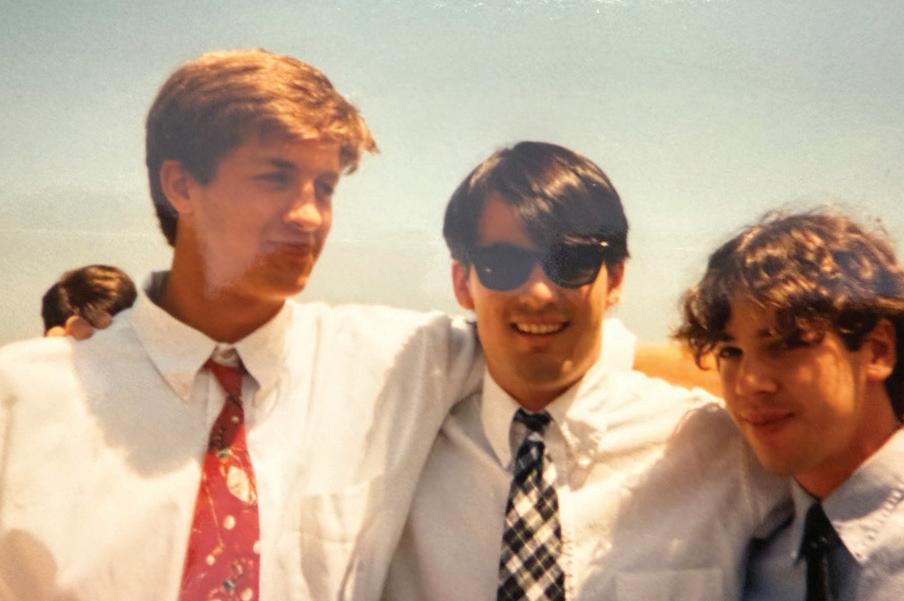
Holderness with brothers at a football game during their undergraduate days in the Beta Upsilon Chapter at the University of Virginia.
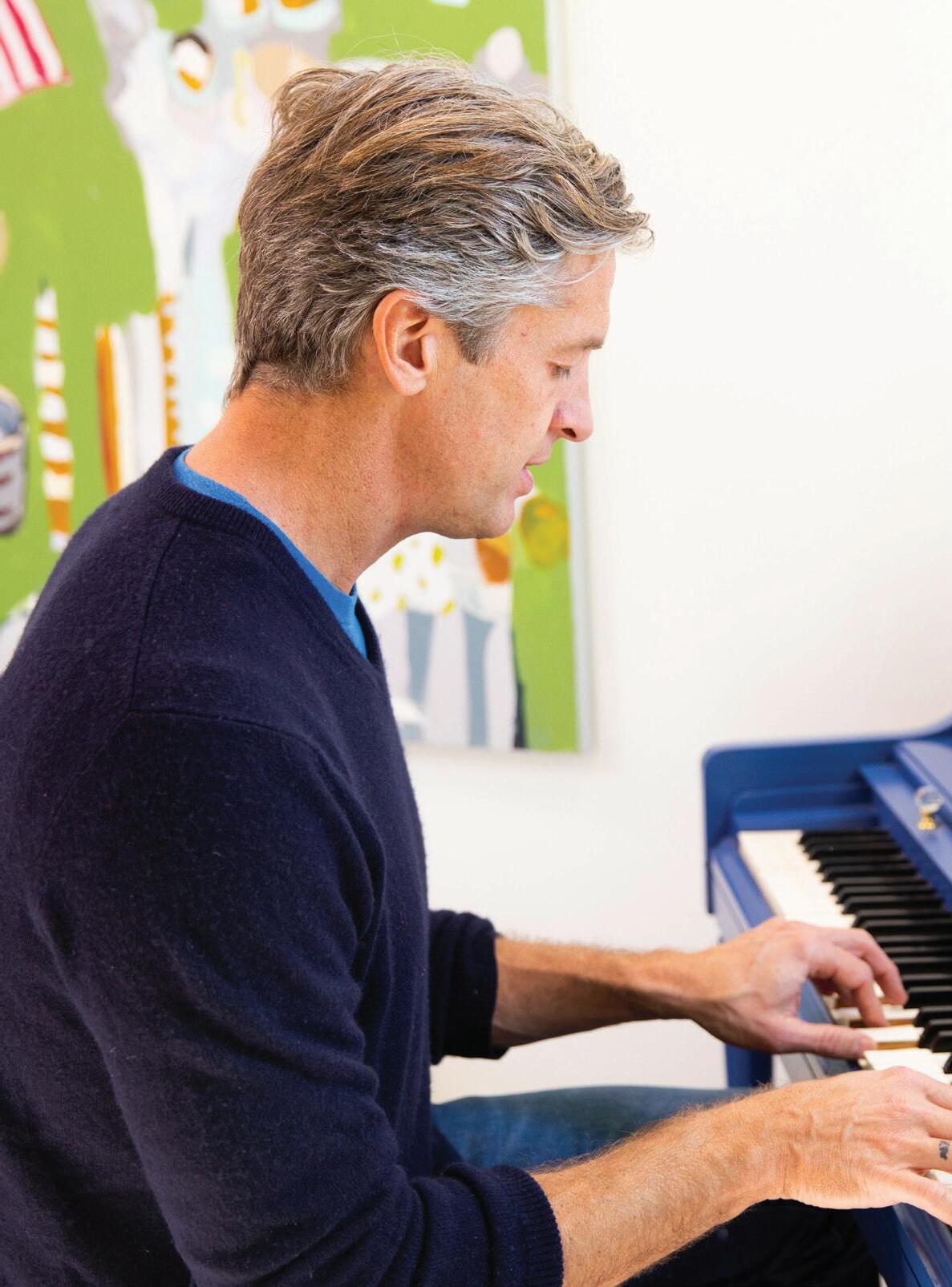
Holderness at the piano, where he writes and plays music, a talent that’s become an essential part of his family’s online content and success.
Holderness and chapter brother Christopher Fidyk on their annual fantasy football draft trip, this time in Switzerland.
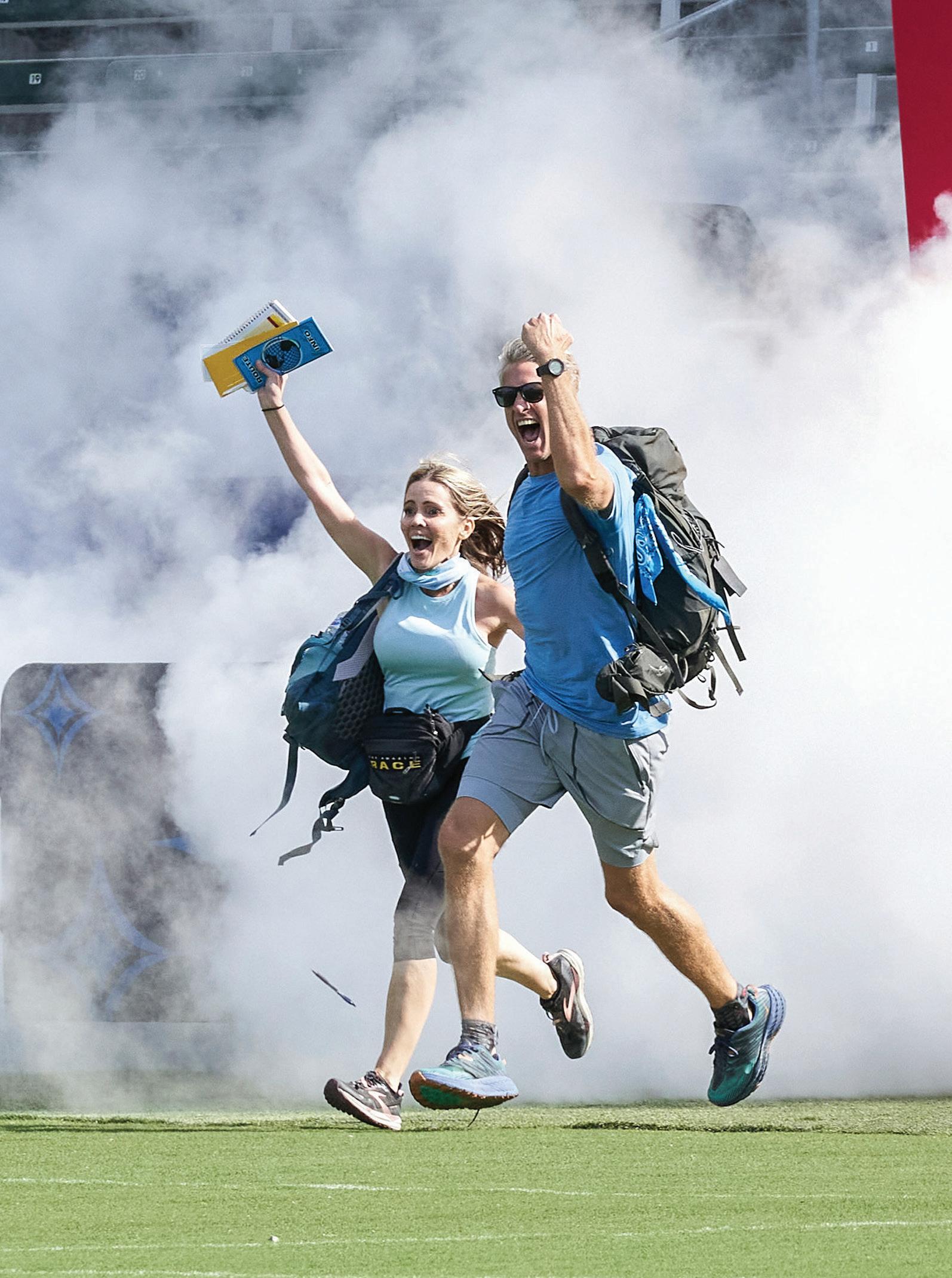
The Holdernesses crossing the finishing line as the winners of The Amazing Race (Season 33, 2022).
(continued from page 26) because they were presented with any particular opportunity, but because they wanted something different for themselves and their kids. That “something different” started small: homemade music videos, holiday parodies and lighthearted glimpses into the family’s everyday life. The clips were funny and well-received, but the response was modest.
The real turning point came in 2016, when Holderness uploaded a parody to YouTube called “You Down With ADD?”, a play on Naughty by Nature’s “O.P.P.” Back then, ADD was still the term he and most people used before ADHD became the more widely recognized diagnosis that better captured the full scope of the disorder. It was the first time he’d used the platform to talk openly about his ADHD; the distractibility, the upside of creative energy and the constant push and pull between joy and frustration. That video went viral, drawing millions of views and an avalanche of comments from people who said they finally felt seen. What had once been something he kept to himself suddenly became the thing that connected him most with his audience.
The response to their first viral video taught the Holderness family something important: people wanted more than just quick laughs. They wanted real stories; ones that reflected their own experiences, their own lives. To keep telling those stories, though, Holderness realized he had to continue stepping outside his comfort zone and be willing to succeed, and fail, in front of his audience.
So when “The Amazing Race” came calling in 2020, he and Kim hesitated at first, knowing they’d be going off the grid, leaving their kids and phones behind for weeks, but after some encouragement from their teenage daughter, who said, “What do you want to look back and remember, some random February or the time you went on The Amazing Race?”, the couple decided to step outside their comfort zone and go for it.
“The Amazing Race” tested them in new ways, even as partners who’d already built a marriage and a business together. It demanded communication, patience and humor under pressure. When they crossed the finish line as the winners of the show’s 33rd season, Holderness was reminded that when properly harnessed, his ADHD could help him thrive.
Coming off that win, the couple leaned further into honest storytelling in their next chapter. With their backgrounds in storytelling and a growing audience hungry for honesty and
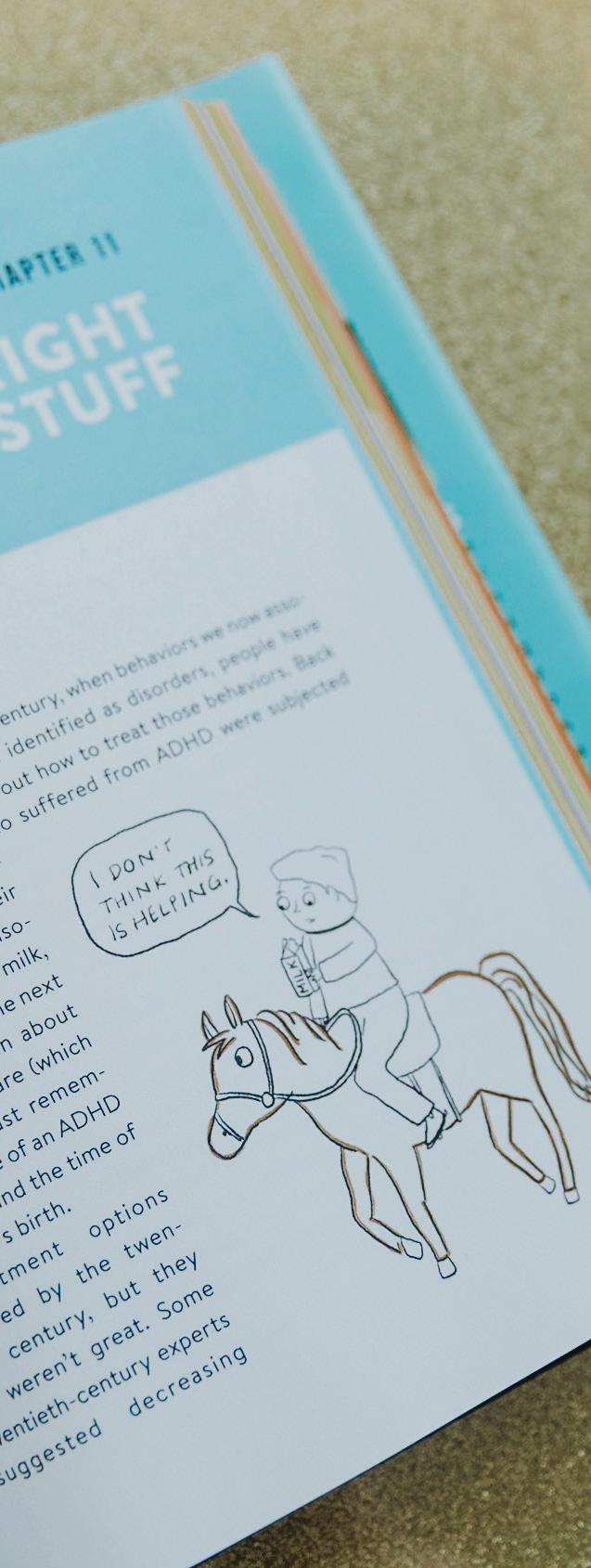
A page from “ADHD is Awesome,” designed with ADHD readers in mind through short sections, visual breaks and clear formatting.
The Holderness family, whose videos and podcasts have built a global community around laughter and authenticity.
Long before the cameras and the comedy, there were the chapter brothers who helped him make it through college and have been a part of every chapter of his life since.
vulnerability, the Holdernesses turned their attention to the messy, funny and challenging aspects of marriage in their first book, “Everybody Fights: So Why Not Get Better at It?” Through humor and honesty, they showed readers that conflict isn’t something to fear, but something to work through together, a lesson taught by their own marriage and the challenges they’d faced on “The Amazing Race.”
It was their next book, “ADHD is Awesome,” that pulled Holderness’s personal story into focus yet again. Released in 2024, it was a continuation of the conversation that their viral video had opened up years earlier. Written with Kim, the book offered two unique perspectives: Holderness’s as someone with ADHD, and Kim’s as the partner who loves and supports him.
As he clarifies in the book, when Holderness says, “ADHD is awesome,” he means it in every sense of the word. “ADHD can be great, inspiring, incredible, eye-opening, marvelous, wondrous, staggering and many other positive things,” he wrote. On the other hand, he continued, “Awesome can also mean hard to comprehend, overwhelming, challenging or daunting. If you find ADHD scary, I’m with you. It can be overwhelming. But can it also be awe-inspiring? Yep. When you think about everything a person with ADHD manages in a single day, absolutely. Both things are true.”
While his brain may have a few channels playing at all times, one constant through every stage of his life has been the people beside him. Long before the cameras and the comedy, there were the chapter brothers who helped him make it through college and have been a part of every chapter of his life since. They stood up at his wedding, just as he stood up at theirs. They’re the godparents to his children, just as he is to theirs.
The circle of people who support him has grown over time, but has never broken. What began in the Pi Kapp house became decades of friendship; kept alive through text threads, reunions and a fantasy football draft that’s become an annual excuse to take a guys’ trip, the same weekend every year for more than two decades now. The draft itself takes only a few hours, but the rest of the weekend is dedicated to catching up, retelling old stories and making new ones.
Now, his circle includes the family he’s built. Kim and their kids have stood beside him through this stage of life, as he’s learned
to share his ADHD story with the world. Together, through their videos, podcasts and books, the Holderness family has helped millions see that being open about who you are and how your brain works isn’t a weakness; it can be a bridge that brings you closer to the people you love.
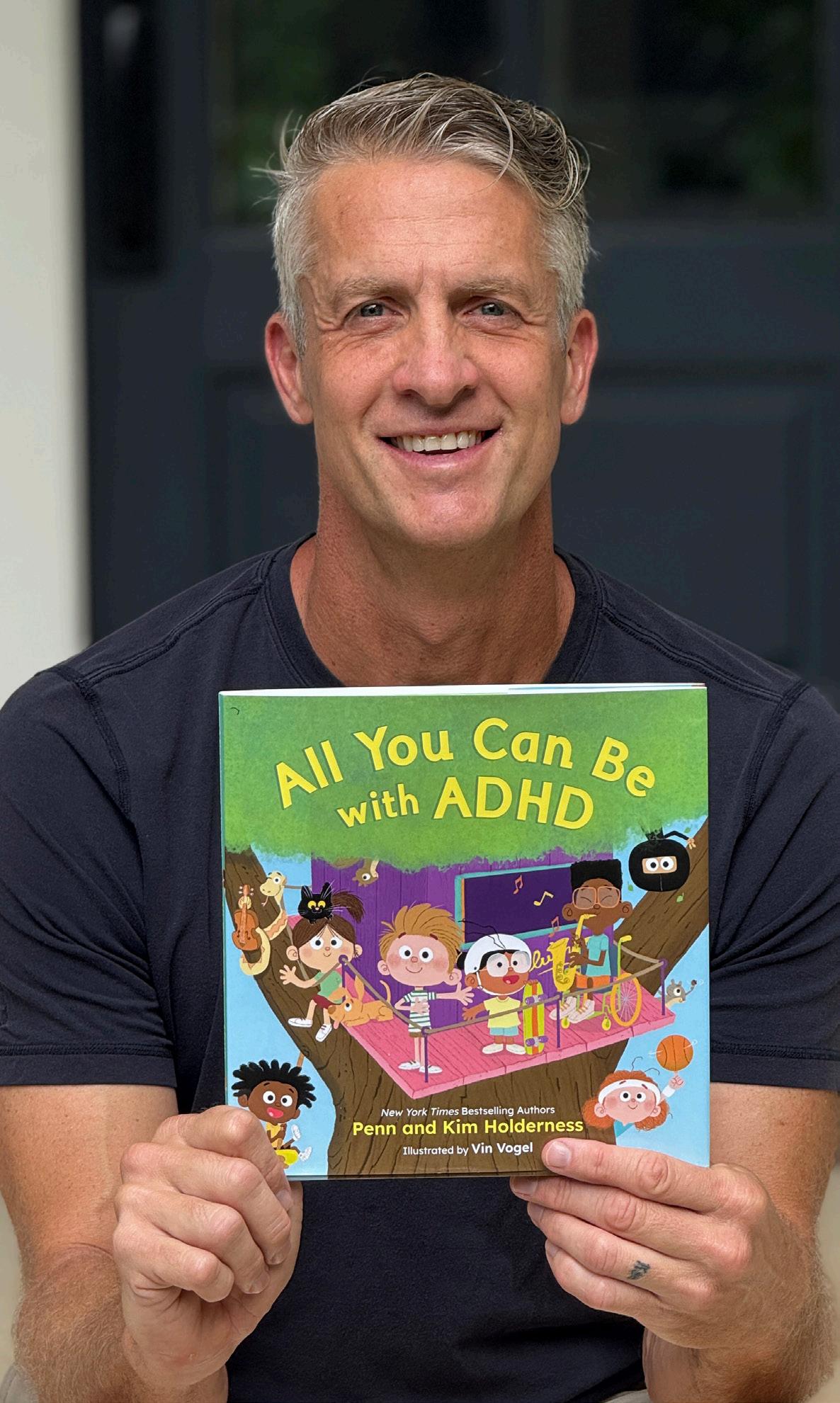
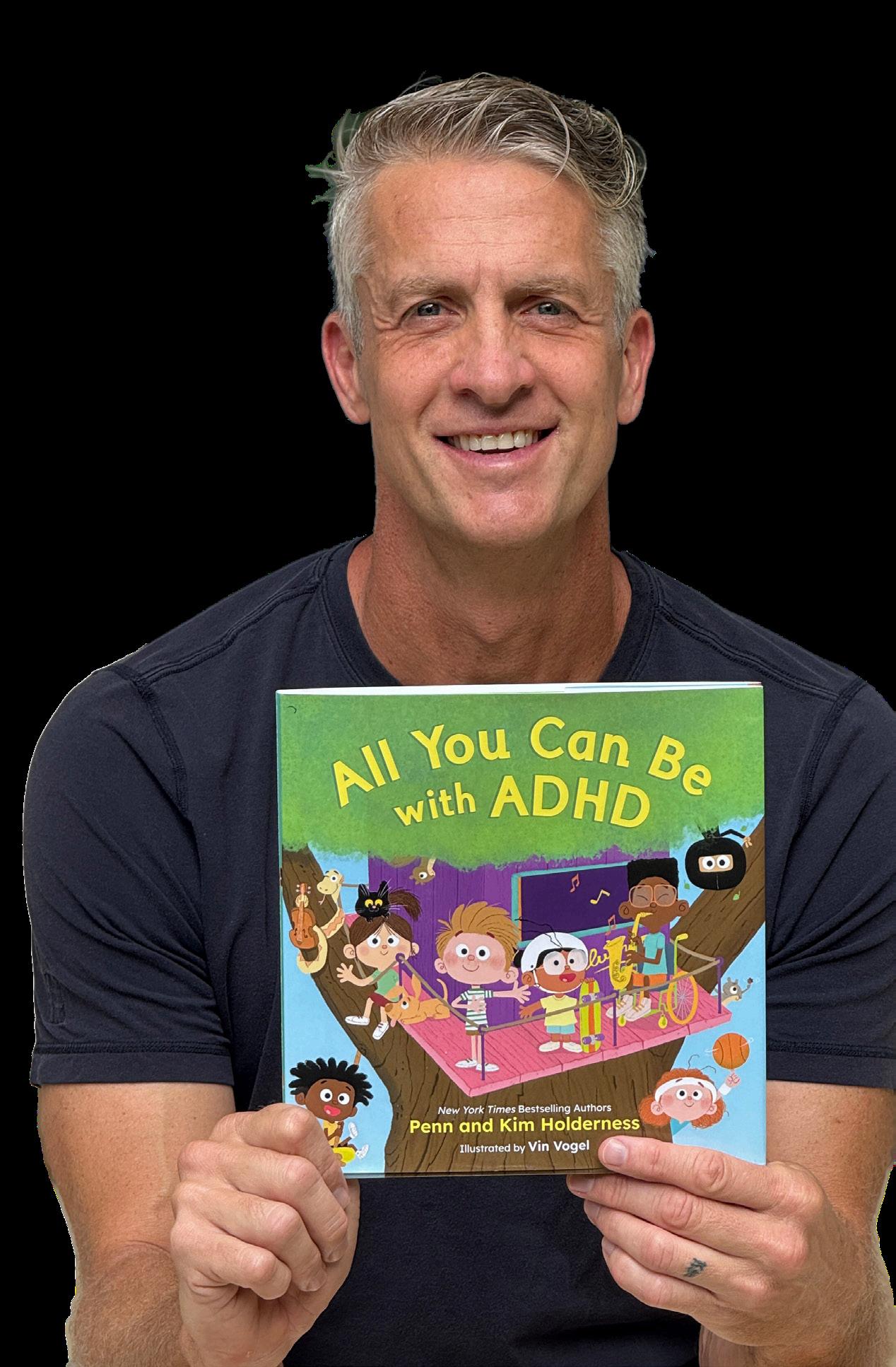
Most recently, he aimed that message at the next generation with “All You Can Be with ADHD,” a children’s book that helps kids see their potential the way he finally learned to see his own.
Today, Holderness has come a long way from the days when he wasn’t sure he’d make it across the graduation stage. He crossed it, and on the other side found a life that’s shown him just how far vulnerability, humor and the right people by his side can take him. He hopes his story inspires others; that someone, somewhere, who feels distracted, misunderstood or behind in life might see what’s possible for them, not in spite of an ADHD diagnosis, but right alongside it.
Holderness with his and Kim’s latest publication, “All You Can Be with ADHD,” a book he wishes he’d had as a child navigating undiagnosed ADHD.
MOMENT AT THE MUSEUM
by Rachel Greene
Imagine opening the closet doors of Pi Kappa Phi brothers over the years.
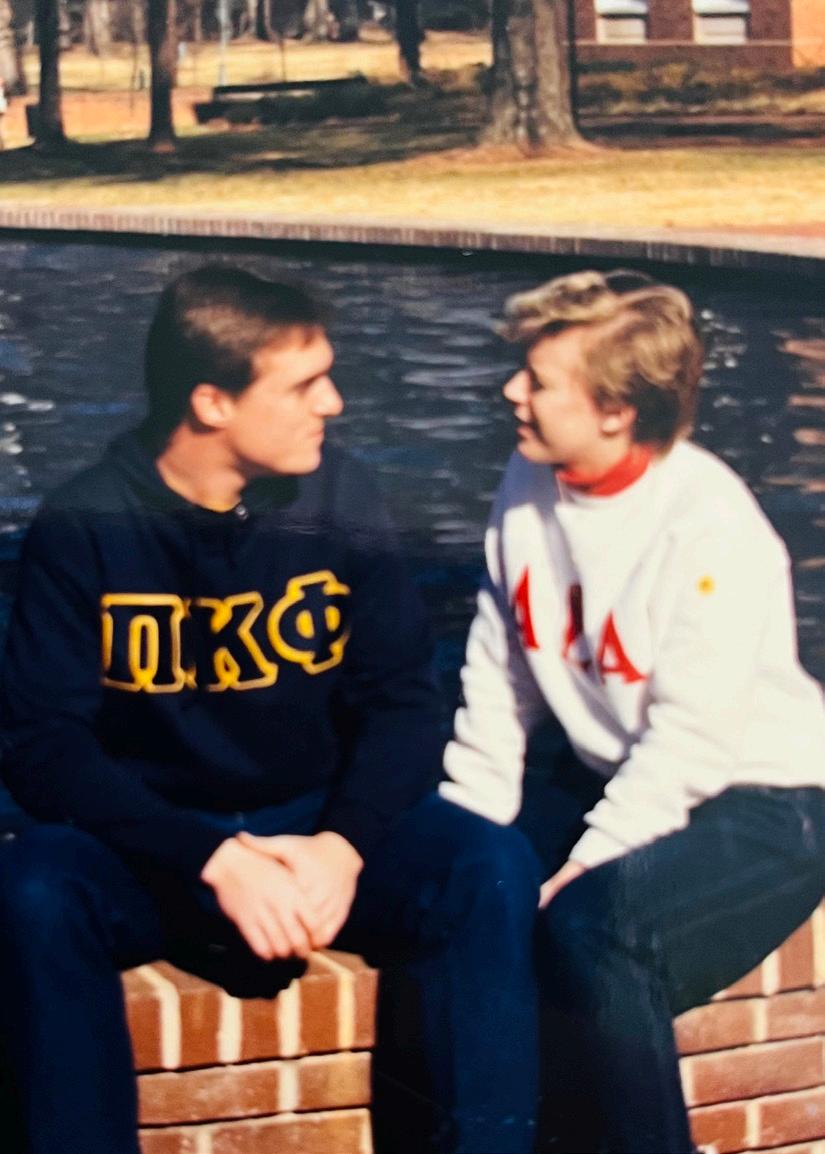
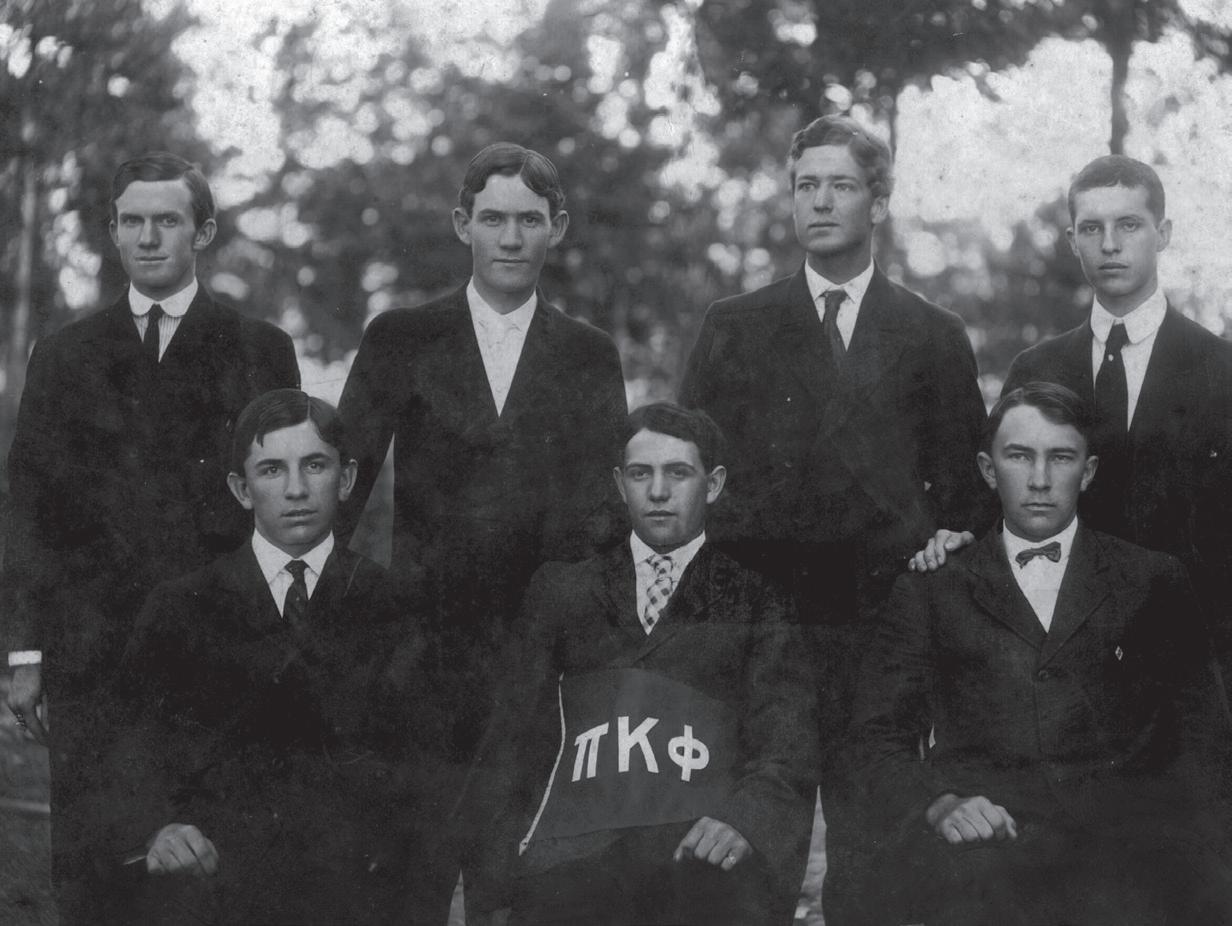
On one hanger, you’d find the dark wool suits and stiff collars of the Founders. On another, a well-worn sweater stitched with the Greek letters ‘ΠΚΦ,’ its block stitching frayed from being handed down through generations of brothers. Next to it, a faded cotton t-shirt, the graphic worn thin and flaking after years of washing. Each piece of attire tells the same story in a different fabric: how Pi Kappa Phi brothers, for generations, have shown their fraternity pride.
Every Pi Kapp knows the story of the seven men who met at 90 Broad Street in Charleston on a December evening in 1904; it has been told countless times. A
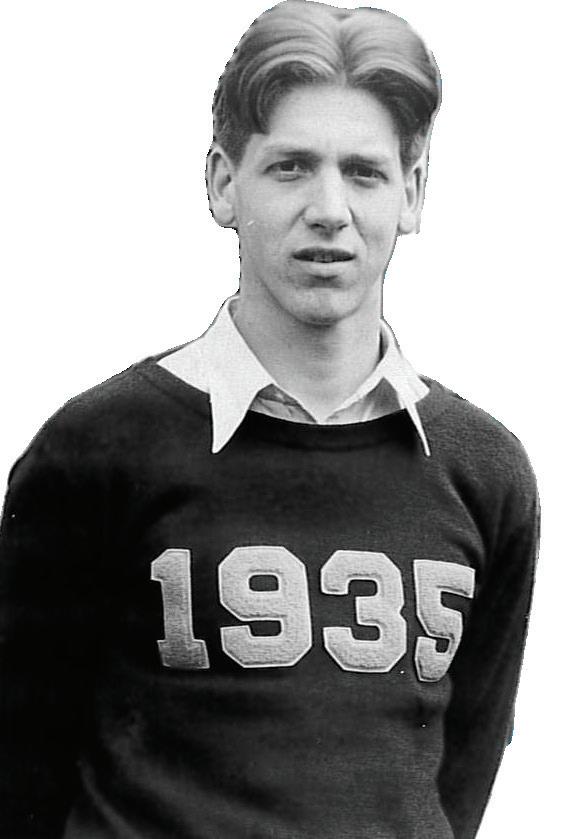
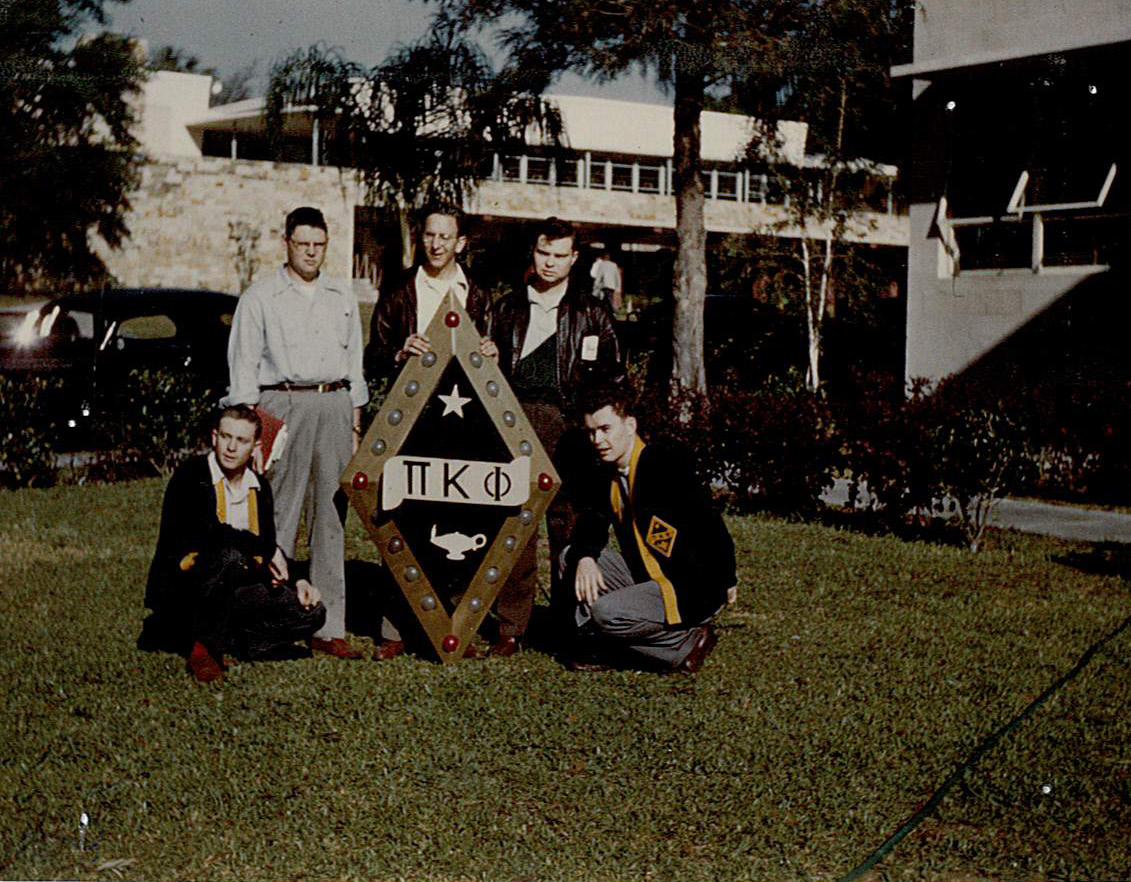
story that remains untold though, is how they represented their membership to the world. In those early photographs that have become synonymous with Pi Kappa Phi’s beginnings, the Founders pose in dark, three-piece suits with stiff collars and polished shoes. They dressed as young men and scholars, determined to be taken seriously, to be leaders not just on campus, but in the world. Their fraternity pride wasn’t stitched loudly across their chests but rather pinned discreetly to a lapel in the form of a small, exclusive and sacred badge.
By the 1920s and 1930s, as varsity athletics took a firm hold of campus culture, so did the style they inspired. The term “varsity” came from “university,” first
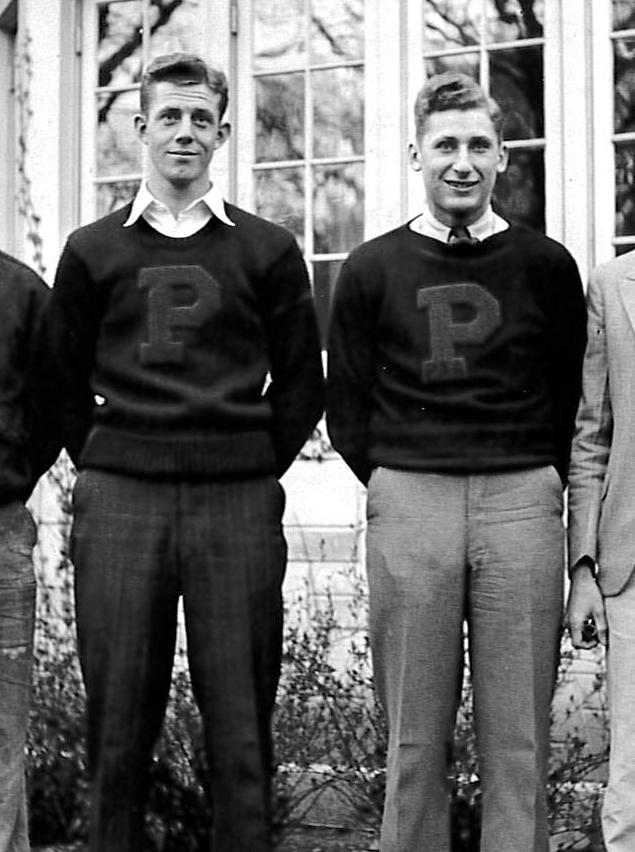
describing collegiate athletic teams and later becoming synonymous with the sweaters and, eventually, the jackets that carried their letters. Those early wool sweaters became symbols of pride and belonging, soon adopted by fraternities and reimagined with Greek letters on the heavy knits sold by campus clothiers. For many brothers, owning one of these sweaters would have been both a privilege and a sacrifice, costing as much as a week’s wages. Some men reserved them for special occasions, like homecoming or chapter photos, while others wore them until they were tattered. Either way, stitched letters offered a visibility for their beloved Pi Kappa Phi that the Founders could never have imagined.
Then came the Great Depression, when closets thinned along with wallets. Luxury fabrics gave way to sturdy jackets and trousers built not for fashion, but to withstand the test of time. The letter sweater endured but grew scarce. On Southern campuses, formality still ruled, while Midwestern and Northeastern brothers began to lean into casual, athletic wear. Though increasingly rare, the sight of stitched letters across a chest remained an unmistakable marker of belonging.
By the early 1940s, World War II had fundamentally altered the world, including closets. Wool and cotton were rationed, and many chapter houses grew quiet as brothers left to serve their country. A few modest sport coats and saddle shoes marked the era as trends for those who could afford them, but lettered sweaters became even rarer. For the men who remained on campus and had inherited those sweaters, or even less likely, had purchased one of their own, the garments became keepsakes, reminders of happier days, worn carefully and cherished as treasures in a time of uncertainty and fear.
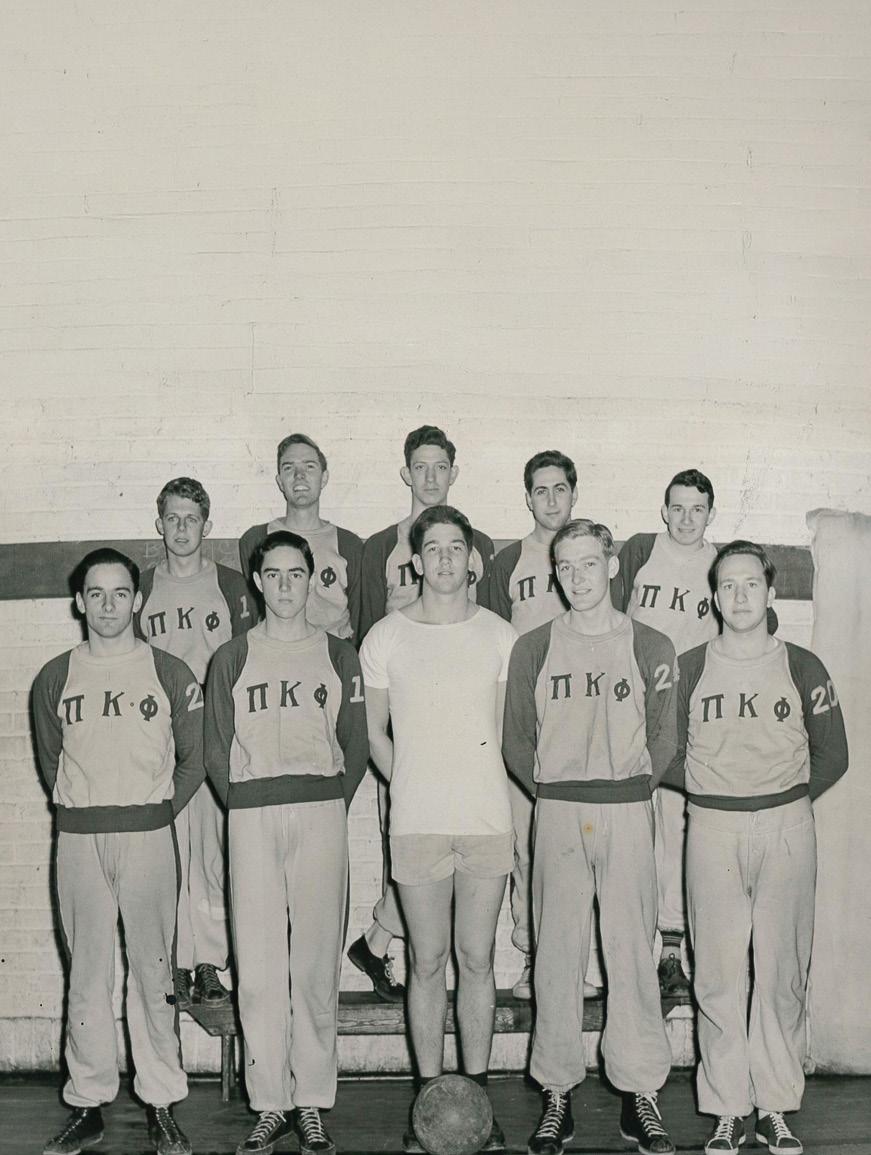
After 1945, life was breathed into campuses once again. Veterans who left school to serve returned, and other men who had not previously had the opportunity to attend college joined them under the G.I. Bill. With this bill expanding access to college to many students of more diverse socioeconomic backgrounds, brothers emerged from different walks of life, bringing with them a more practical approach to student fashion. The advent of mass production made sweatshirts, jackets and khakis affordable staples, and fraternity insignia began appearing on everyday clothing. Letters were no longer relics to be preserved; they were an integral part of daily student life.
Early Pi Kapps often wore their pride only on their lapels or by holding up a simple Pi Kappa Phi pennant; later brothers wore it more casually and visibly, on their sweaters and even their front lawns.
Wool sweaters and knits, inspired by the original varsity sweaters worn by collegiate athletes, defined early Pi Kappa Phi wardrobes.
(continued from page 31)
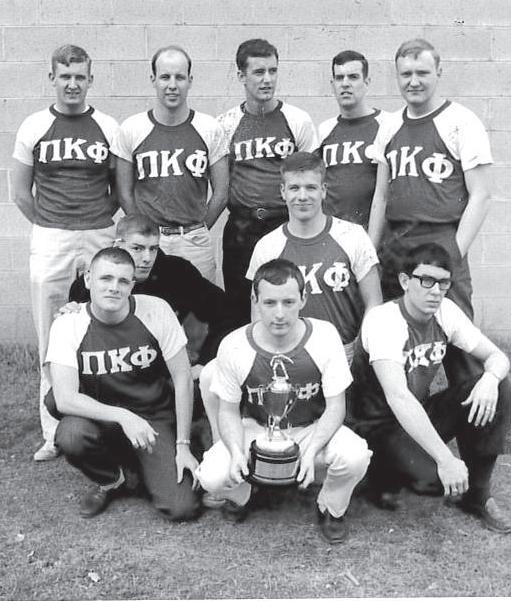
By the 1960s, one garment defined the American campus: the t-shirt. Inexpensive, comfortable and casual, it quickly became the most recognizable uniform of fraternity men. Block letters stitched across cotton mirrored the wider casualization of American fashion. Where earlier generations had often reserved their letters for formal occasions, brothers now wore them across the quad with jeans, loafers and even protest buttons, reflecting the turbulence of the times.
And always, the lettered shirt, an enduring symbol of fraternity life. The fabric and fits may change, but the meaning of those three letters never does.
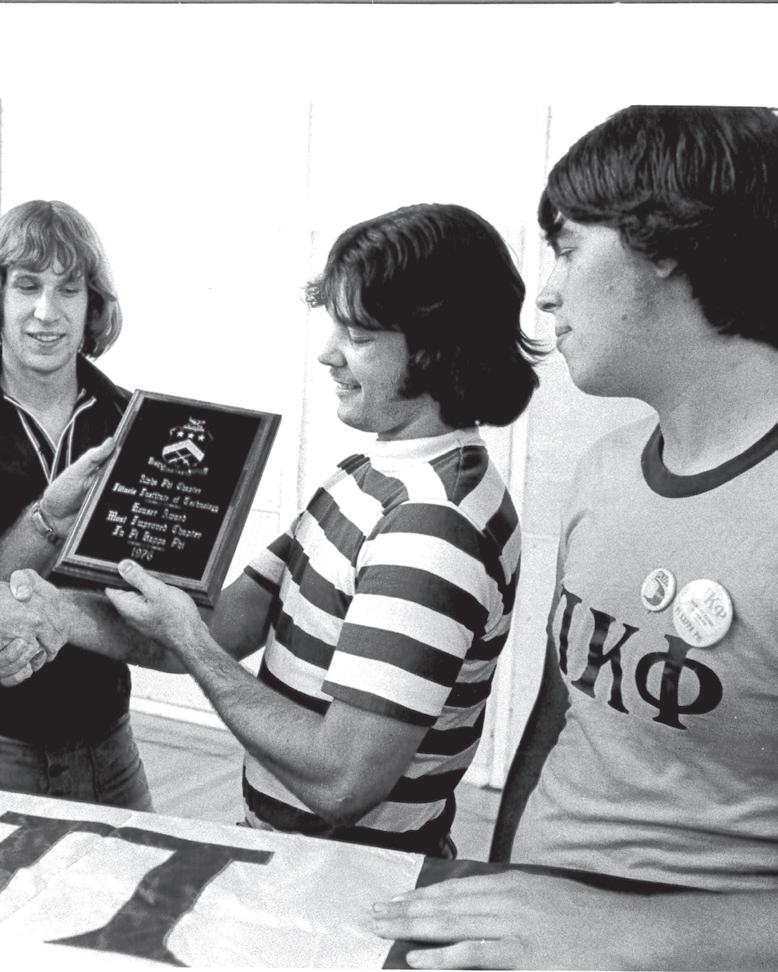
In the 1970s, campus fashion absorbed the countercultural energy of the era. Lettered t-shirts and sweatshirts were paired with jeans, corduroys or bell-bottoms. Jerseys modeled after athletic uniforms gained popularity, bringing fraternity fashion full circle to the early inspiration of varsity sports. New methods, such as machine embroidery and heat transfer, expanded options beyond hand-sewn twill, allowing brothers to experiment with colors, cuts and styles like never before.
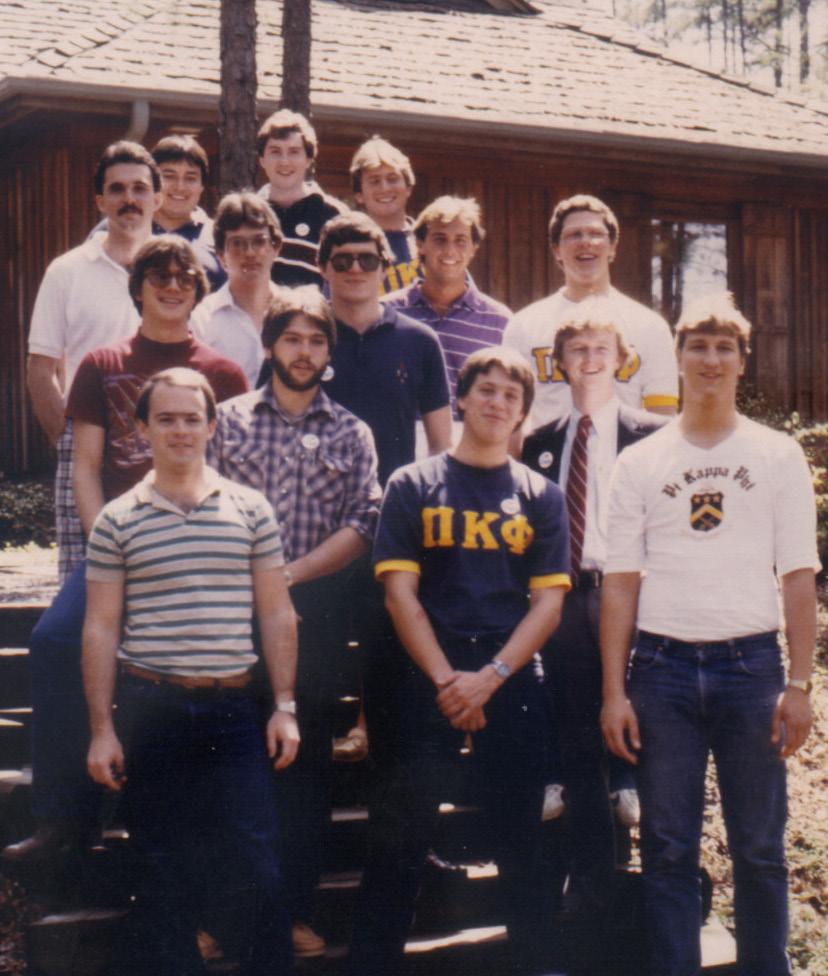
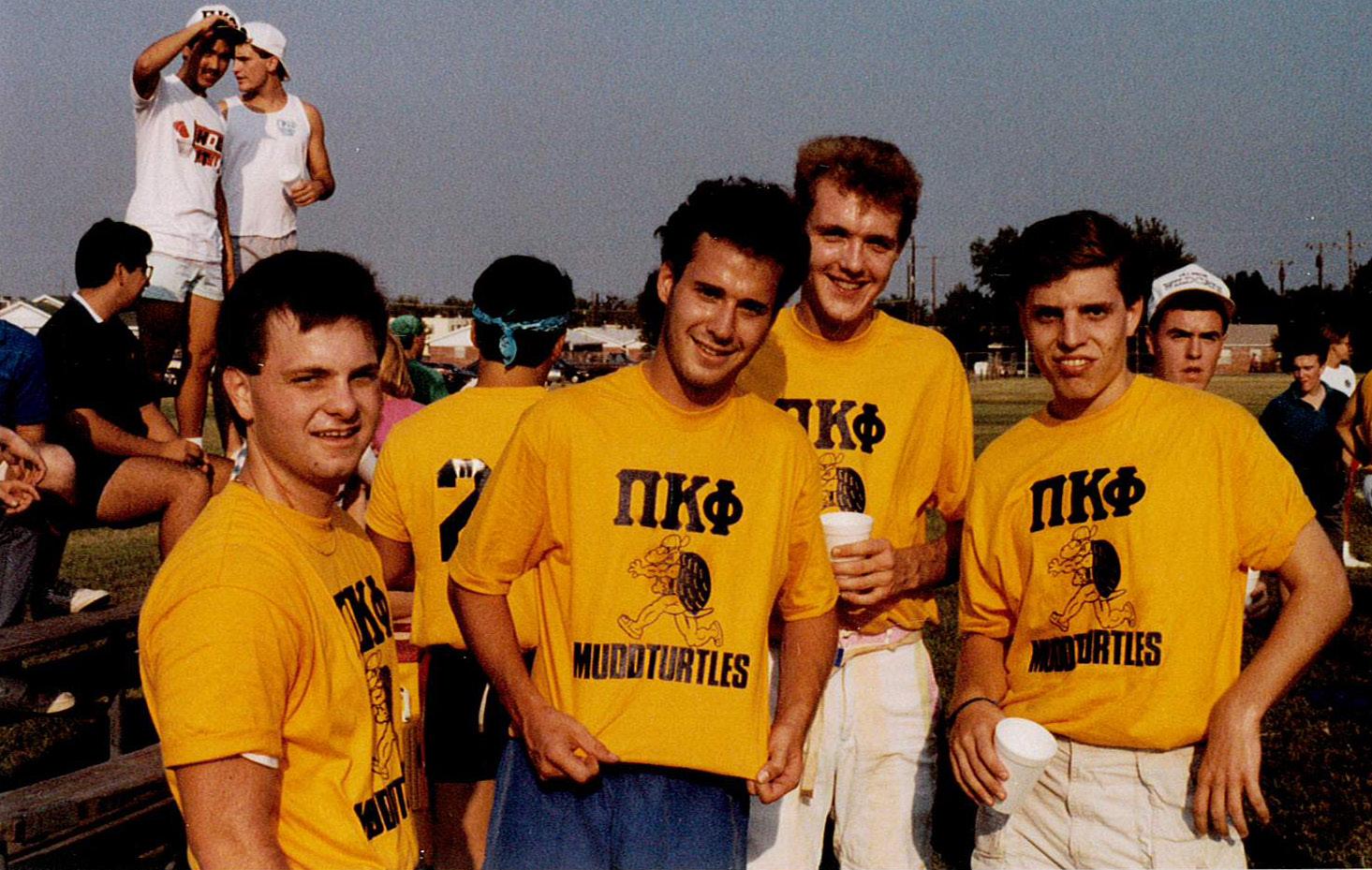
The 1980s were defined by boldness: oversized fits, polos with stitched letters and an explosion of graphic tees. National licensing agreements transformed fraternity fashion into a business, as catalogs and bookstores replaced local clothiers. Whether at a large Southern flagship or a small Midwestern campus, Pi Kappa Phi brothers were dressed in nearly identical stitched letters, linking chapters nationwide through shared style.
From the 1960s through the 1980s, Pi Kappa Phi’s letters shifted from hand-sewn keepsakes to everyday shirts and polos, reflecting a new, more casual chapter of fraternity life.
By the 1990s, fraternity letters were everywhere. Chapters ordered shirts in bulk for recruitment, philanthropy events and mixers. Gone were the days of coveting just one piece of Pi Kappa Phi apparel; now, brothers owned many. Oversized tees and sweatshirts in bold colors, as well as tie-dye, were the decade’s trends, while grunge fashion introduced flannels and ripped jeans into the mix. Wearing letters daily was common, from intramural practice to the walk to class and beyond. What had once been a rare investment was now a dime-a-dozen campus uniform.
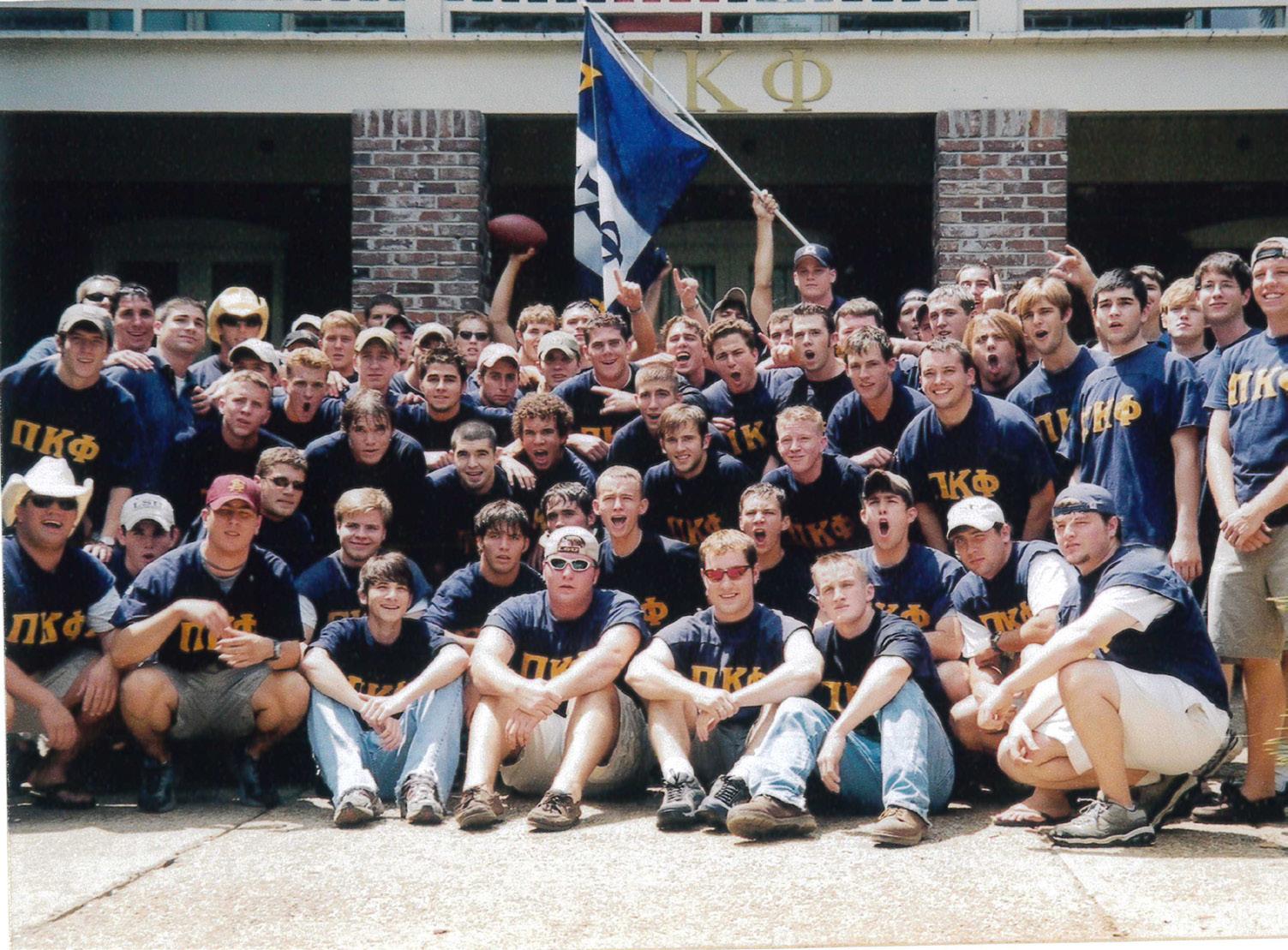
With the new millennium came a shift toward a new, sleeker look. In the 2000s, polos embroidered with Greek letters gained popularity, alongside fitted tees and performance fabrics. Digital printing meant endless customization, and chapters embraced it, producing designs for nearly every event. Fraternity fashion no longer just reflected Greek affiliation; it also commemorated chapter milestones and created a tangible way for undergraduate Pi Kappa Phi brothers to remember special moments.
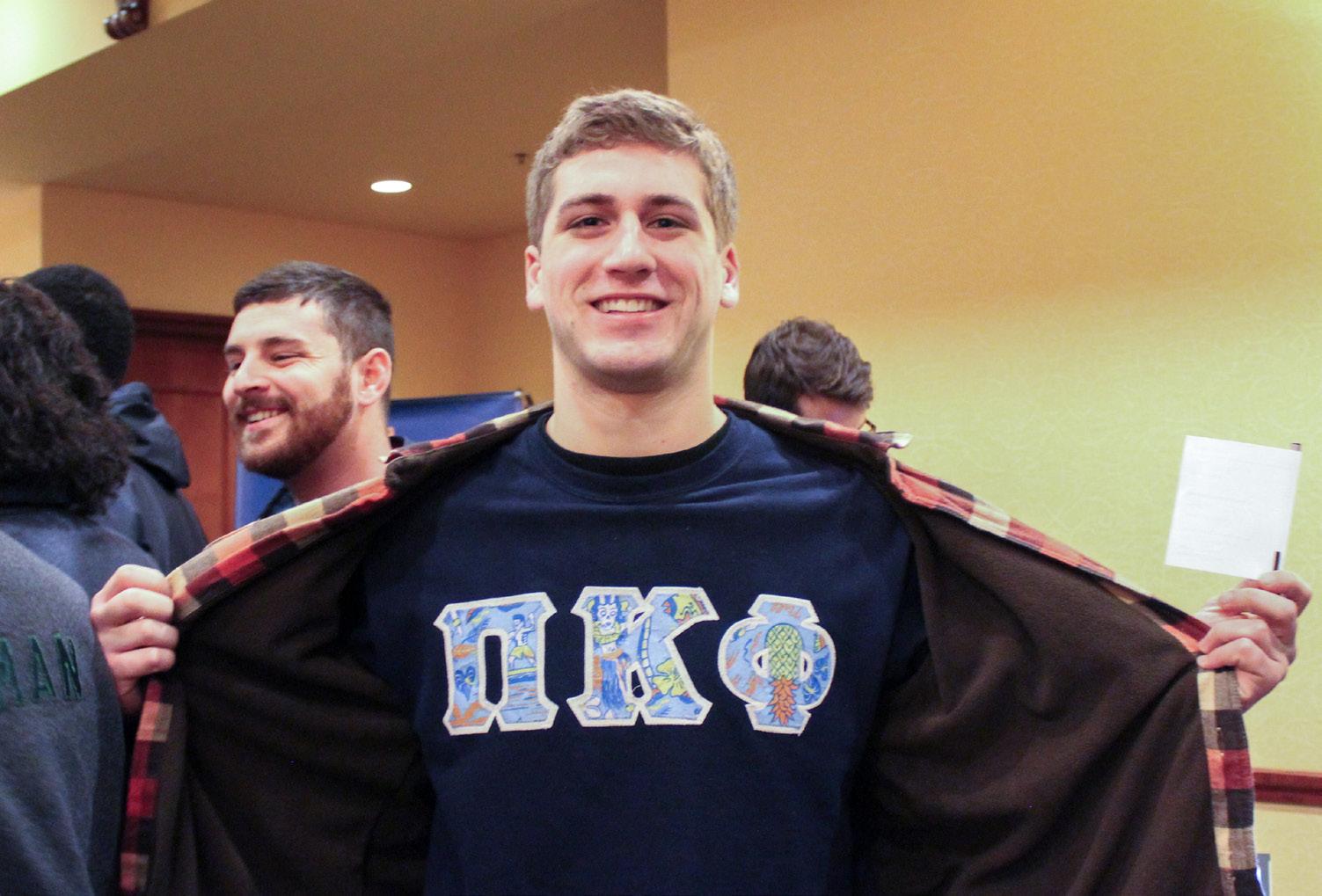
So far, the 2010s and 2020s have blended tradition and trend. Stitched-letter shirts remain a classic uniform, but brothers also wear retro ringer tees, lettered athletic jerseys and tend to gravitate toward more minimalistic designs. Reverse-weave knits and two-tone colors have recently gained popularity along with sustainable fabrics and retro throwbacks. Online ordering makes customization simpler and faster than ever, while thrift culture and passing down letters from one generation to the next keep vintage clothing alive, adding individuality to a sea of massproduced merchandise.
Open the closet doors of a chapter house today, and you’ll find that it holds more than clothes; it holds history. Suits, once worn daily, now reserved for formals. Hoodies, once unheard of, now the uniform of late-night study sessions. Jerseys modeled after those of campus athletes, not too far removed from the first stitched sweaters. And always, the lettered shirt, an enduring symbol of fraternity life. The fabric and fits may change, but the meaning of those three letters never does. Every piece of attire, whether wool, cotton or polyester, carries the same thread first woven in 1904: the bonds of brotherhood that tie Pi Kappa Phi men across generations.
From the 1990s through the 2000s, 2010s and today, brothers have worn their letters on event shirts, matched in traditional mass-produced tees and expressed their individuality through designs that make the letters their own.
LACERTA
SAGITTA
We express our condolences and mourn the passing of our brothers now in the Chapter Eternal. May their memories remain in our hearts and their families be surrounded by love.
CYGNUS
Earlier this year, Pi Kappa Phi mourned the passing of Durward W. Owen, Xi (Roanoke), honorary Fourth Founder and executive director emeritus. Read the special issue of the Star & Lamp honoring his life and legacy at issuu.com/pikappaphi.
This list reflects notifications received at National Headquarters between March 12, 2025, and September 30, 2025. First name, last name and date passed to Chapter Eternal are listed for each member.
To inform National Headquarters of a member who has passed to the Chapter Eternal, please email letusknow@pikapp.org.
ALPHA (College of Charleston)
William Runyon, 11/24/2022
BETA (Presbyterian)
Herbert Myers, 3/31/2025
DELTA (Furman)
Harold Miller, 4/30/1976
John King, 11/9/2008
MU (Durham)
James Seay, 1/11/2014
Robert Weeks, 5/10/2016
Claude Adams, 1/1/2018
Battle Robertson, 2/23/2019
Ruurd Leegstra, 2/17/2020
Nick Galifianakis, 2/27/2023
James Merritt, 11/13/2024
CHI (Stetson)
Alfred Richards, 3/27/2024
Bernard Cochran, 11/13/2024
Steven Buckner, 3/16/2025
George Cason, 4/2/2025
PSI (Cornell)
Donald Duvernoy, 6/27/2014
George Heinrich, 6/19/2025
ALPHA MU (Penn State)
CEPHEUS
Joseph Ruyak, 12/4/2016
Vincent Maggio, 2/2/2021
William Exley, 10/27/2023
Bryan Hoover, 5/20/2024
Richard Hill, 3/11/2025
Joe Cope, 3/22/2025
Norman Douglass, 4/1/2025
Richard Defrancisco, 4/6/2025
LYRA
Michael Campanelli, 6/12/2025
SIGMA (South Carolina)
Burton Bennett, 4/16/2017
Wayne Zurenda, 3/21/2025
William Gray, 4/15/2025
Kenneth Forti, 5/31/2025
EPSILON (Davidson)
Robert Keown, 7/16/2025
Philip Winstead, 11/24/2024
ZETA (Wofford)
NU (Nebraska-Lincoln)
Robert Werner, 3/9/2021
XI (Roanoke)
John Zipfel, 8/7/2022
David Doyle, 11/25/2022
Richard Klare, 2/27/2025
Durward W. Owen, 4/20/2025
David Coates, 5/10/2025
John Cochran, 8/6/2025
James Hamilton, 9/3/2025
OMICRON (Alabama)
Frederick Thorne, 8/5/2025
OMEGA (Purdue)
Larry Reed, 10/26/2021
Harry Winters, 12/2/2023
Allan Reynolds, 6/20/2024
Jamison Hawkins, 5/8/2025
Richard McKnight, 8/8/2025
ALPHA XI (St. John’s)
Robert Butt, 5/9/2014
Allen Fedewitz, 7/1/2015
Michel Frippel, 3/29/2017
HERCULES
Nile Brunner, 2/2/2011
James Lineberger, 10/12/2015
ETA (Emory)
Alexander Biddell, 2/3/2017
IOTA (Georgia Tech)
Luther Davis, 8/29/2013
Charles Campbell, 2/17/2017
Richard Almand, 12/2/2021
John Teramo, 4/17/2025
KAPPA (UNC-Chapel Hill)
Vonnie Smith, 9/30/2013
Henry Beck, 12/20/2022
Jerry Womack, 2/25/2024
Alfred Cole, 2/10/2025
James Ward, 1/16/2024
Robert Grimes, 3/25/2025
RHO (Washington & Lee)
Walter Harrod, 8/5/2007
Floyd Garrett, 8/11/2024
Frederick Cooper, 6/14/2025
TAU (NC State)
Jack Gunn, 3/11/2015
Troy Doby, 2/5/2018
Harold Davison, 11/12/2019
William Newsome, 2/16/2020
John Vaughan, 3/20/2022
Paul Johnson, 4/2/2022
Thomas Davis, 1/13/2023
CORONA BOREALIS
David McAllister, 5/2/2025
LAMBDA (Georgia)
Matthew Nichols, 4/12/2023
John Tolson, 4/19/2025
Wallace Reams, 2/20/2025
Donald Barker, 5/15/2025
UPSILON (Illinois-Urbana-Champaign)
John Poppelreiter, 7/30/2003
Warren Guthrie, 3/27/2025
Richard Regnier, 5/20/2025
John Stroehlein, 6/9/2025
DRACO
ALPHA EPSILON (Florida)
Howard Pettengill, 6/14/2024
DeHaven Fleming, 9/10/2024
Delumus Brim, 1/25/2025
Johnny Stokes, 7/2/2025
ALPHA ZETA (Oregon State)
Noel Flynn, 12/28/2018
Richard Saunders, 2/16/2025
ALPHA ETA (Samford)
Chad Klauser, 5/14/2017
Ernest Canfield, 9/22/2022
Joseph Cochran, 3/24/2025
Dorsey Shannon, 4/4/2025
Charles Griffies, 7/24/2025
ALPHA THETA (Michigan State)
Bruce Lessien, 5/30/2017
Edward Banfield, 2/20/2023
Jack Bushong, 1/29/2024
ALPHA IOTA (Auburn)
Newton Wright, 2/28/2022
Robert Weaver, 5/3/2025
Robert Mayo, 5/23/2025
CASSIOPEIA
Donald VanDerveer, 1/30/2022
William Hammel, 11/30/2024
ALPHA OMICRON (Iowa State)
Harold Wiebke, 8/18/2021
Charles Rehman, 4/6/2023
Richard Fritz, 1/29/2024
Robert Casey, 2/23/2025
Travis Burk, 5/8/2025
James Carson, 6/18/2025
ALPHA SIGMA (Tennessee)
Claude Harvey, 2/21/2018
ALPHA TAU (RPI)
Charles Mount, 5/3/2009
Paul Comitz, 4/12/2017
ALPHA UPSILON (Drexel)
William Jaus, 7/22/2003
Cornelius Cornelssen, 12/17/2018
ALPHA PHI (Illinois Tech)
Ronald Weiland, 8/5/2020
Roger Logeson, 10/18/2023
Victor Terrana, 6/4/2024
Paul Koffend, 1/14/2025
CASSIOPEIA
ALPHA PSI (Indiana)
Bradley Durnell, 5/7/2003
Thomas Bossung, 9/2/2021
BETA ALPHA (NJIT)
Theodore Jensen, 4/13/2004
Thomas Hark, 9/18/2015
Glenn Romanek, 10/20/2022
Leslie Cadigan, 3/11/2025
Stefano DeSteno, 5/25/2025
BETA BETA (Florida Southern)
BETA TAU (Valdosta State)
Kenneth Ferrell, 8/25/2025
BETA UPSILON (Virginia)
James Clendenin, 11/26/2024
Richard Sandstrom, 7/20/2025
BETA PHI (East Carolina)
David Knoch, 1/16/2025
BETA OMEGA (East Tennessee State)
Robert Yackanin, 12/9/2023
DELTA ZETA (Appalachian State)
Wayne Henson, 7/3/2025
DELTA IOTA (Middle Tennessee State)
Robert Wauford, 11/13/2024
DELTA LAMBDA (UNC-Charlotte)
Roderick Sloan, 4/28/2025
Scottie Mickey, 8/1/2025
DELTA MU (Methodist)
Billy Spriggs, 7/21/1985
ZETA UPSILON (Bloomsburg)
Caleb Shaner, 8/2/2025
ETA GAMMA (Colorado) Patrick Simonian, 3/25/2025
ETA ZETA (Queens-Charlotte) Robert Bowler, 9/6/2025
ETA LAMBDA (SUNY-Brockport) Richard Shamus, 2/16/2025
PERSEUS
Howard McMichael, 6/2/2020
Carl Koch, 3/14/2025
John Dunn, 8/5/2025
BETA GAMMA (Louisville)
William Weber, 5/3/2023
Charles Hoffman, 3/28/2025
James Grissom, 6/27/2025
BETA DELTA (Drake)
Kim Meadows, 10/3/2024
BETA ETA (Florida State)
Thomas Hogle, 6/13/2025
BETA THETA (Arizona)
René Willekens, 2/19/2012
BETA IOTA (Toledo)
Franklin Masters, 3/2/2025
GAMMA IOTA (Louisiana State)
George Flick, 6/3/2023
GAMMA MU (Belmont Abbey)
Sam Jernigan, 5/22/2025
GAMMA NU (LaGrange)
James Menge, 6/11/2025
GAMMA RHO (Lander) Thomas Rankin, 9/6/2025
DELTA ALPHA (Virginia Tech)
Timothy Boyd, 7/15/2025
Stephen Johnson, 8/9/2025
CAMELOPARDALIS
Matthew Butchko, 2/9/2025
BETA LAMBDA (Tampa)
Donald Small, 8/23/2025
BETA MU (McNeese State)
Carl Smith, 6/19/2025
BETA XI (Central Michigan)
Robert Luedtke, 7/12/2021
Errol Caszatt, 2/6/2023
BETA SIGMA (Northern Illinois) Roger Musser, 5/12/2025
DELTA BETA (North Georgia)
Joshua Carvalho, 8/1/2025
DELTA DELTA (Truman State)
David Gordon, 11/25/2015
Gregory Cotton, 6/22/2017
Michael Prather, 3/30/2019
Richard Rennells, 10/19/2019
John Erhart, 1/20/2021
Richard Crissinger, 4/8/2021
Daniel Lenz, 6/3/2022
Thomas Crowder, 9/21/2022
Gary Frandson, 3/15/2024
William Sweeney, 8/15/2024
JAMES CLENDENIN
DELTA XI (North Alabama)
Lawrence Guess, 6/14/2024
DELTA OMICRON (Nicholls State)
Michael Barrilleaux, 10/24/2011
Aaron Fanguy, 9/20/2018
Michael Gravois, 2/7/2024
Dana Guidry, 5/5/2025
DELTA OMEGA (Texas A&M)
ETA PI (Coastal Carolina) Joshua Cobo, 4/8/2025
ETA PSI (Central Florida) Theodore Miller, 5/15/2025
THETA IOTA (Washington State) Luke Ross, 4/5/2025
CHAPTER ETERNAL
IOTA TAU (Rutgers) Uri Hochfeld, 9/2/2025
John Duggan, 11/4/2021
EPSILON ETA (Winthrop)
Oscar Chandler, 3/12/2020
John Keller, 1/19/2023
EPSILON THETA (Seton Hall)
Michael Santangelo, 8/1/2025
William Battista, 9/13/2025
EPSILON IOTA (UNC-Greensboro)
Thomas Omohundro, 1/12/2025
EPSILON UPSILON (Georgia College) David Hawkins, 5/15/2025
ZETA MU (Cal State-Northridge) Brian Stoll, 3/21/2025
ZETA OMICRON (SUNY-Cortland)
Charles Kirol, 8/27/2012
Pasquale Mastandrea, 4/10/2022
GEMINI
JAMES “JYM” EDWIN CLENDENIN joined the Chapter Eternal on November 26, 2024, surrounded by his family. Born in Paris, Tennessee, on June 10, 1939, Clendenin lived a life filled with adventure, learning and dedication to his family and community. He grew up in a military family and spent much of his youth in southern Virginia, before going on to study electrical engineering at the University of Virginia. There, he became the first brother initiated into the Beta Upsilon Chapter of Pi Kappa Phi. His experience at the University and in the Fraternity helped shape his lifelong commitment to friendship, learning and service to others. It was also at the University of Virginia that he met the love of his life, Judith Poole. After earning his degree, he was commissioned as an ensign in the U.S. Navy in 1962 and married his college sweetheart later that year. Following his military service, Clendenin earned a Master of Religion degree from Union Seminary and later a Ph.D. in atomic physics from Columbia University. In 1975, he began a distinguished 33-year career at the Stanford Linear Accelerator Center (SLAC) in California. Renowned for both his brilliance and humility, Clendenin inspired generations of colleagues and students with his intellect and integrity. Outside of work, he was an avid runner and cyclist, a devoted supporter of the arts and a volunteer within his community. He will be dearly missed by his family, friends, community and Fraternity brothers alike.
IMAGINE FOUR DAYS AMONG BROTHERS UNDER THE ARIZONA SUN, SET IN ONE OF THE MOST DISTINGUISHED RESORTS IN THE COUNTRY.
SAVE THE DATE FOR THE 59TH SUPREME CHAPTER OF PI KAPPA PHI, JULY 23–26, 2026, AT THE PHOENICIAN IN SCOTTSDALE.