On page 8, the opposing team is MiraCost College, not El Camino College.
Scan the QR code below to subscribe to our weekly newsletter
On the cover:
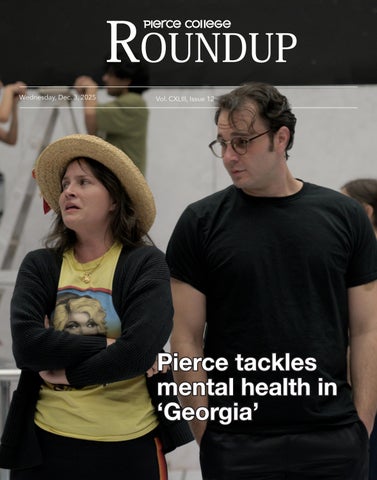
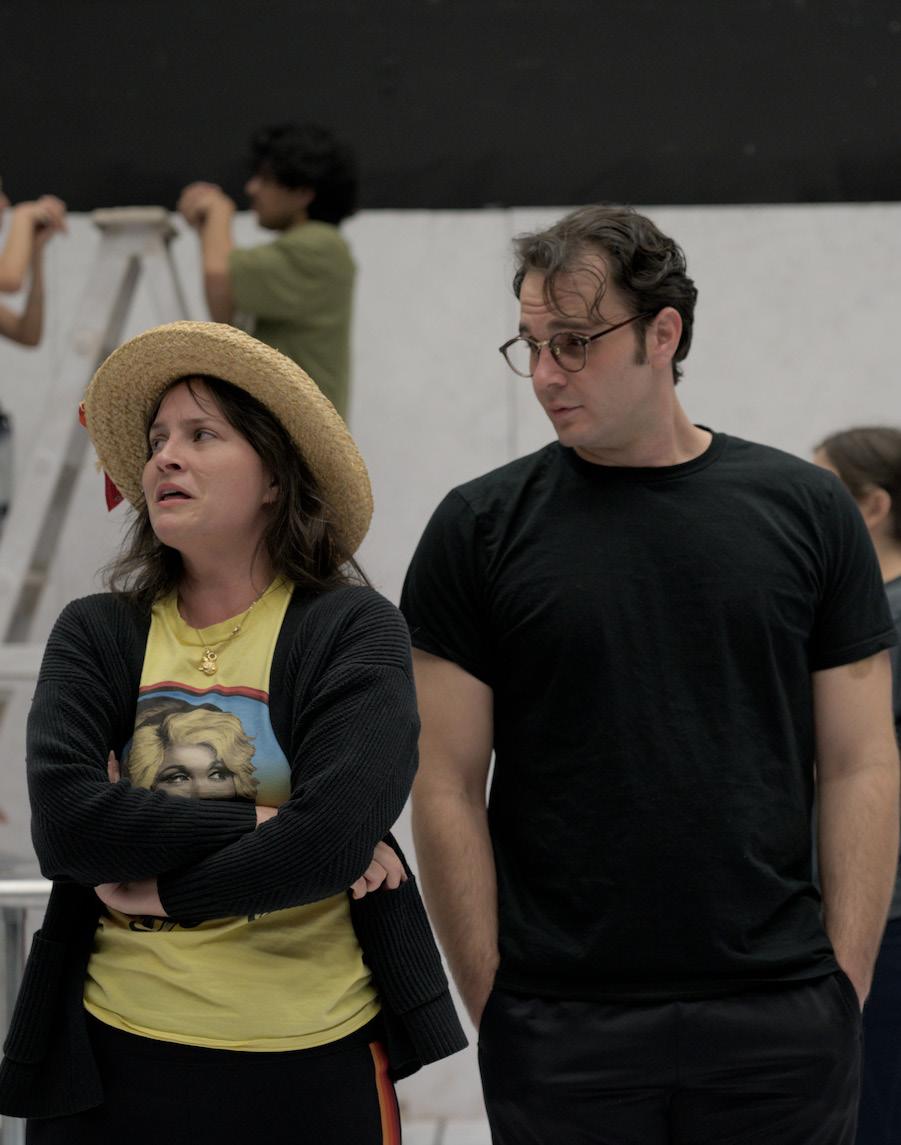
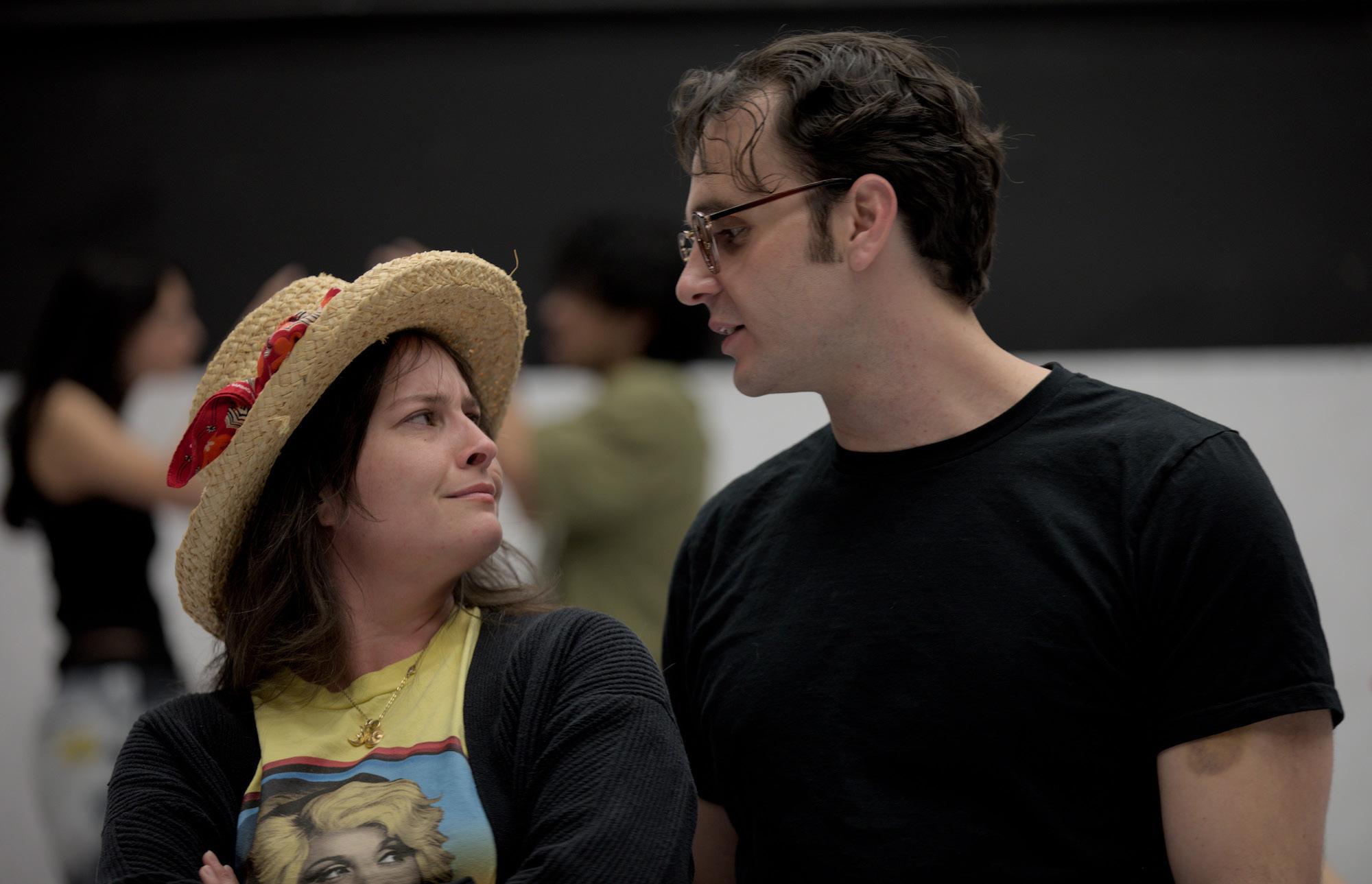
Pierce College Theater majors Meagan Truxal, playing the role of Grandma June, and Deniz Boysan, playing the role of Jaime, rehearse a scene from “Georgia” at the Pierce College Dow Arena Theatre in Woodland Hills, Calif., on Nov. 25, 2025.
Photo by Josue Aguilar.
Editorial: From the desk of the Roundup A Winter Fest could warm up Pierce College
Asthe semester winds down, students at Pierce College find themselves racing from class to study sessions and then heading home often with little time or energy left to form connections
A commuter-heavy campus can struggle to build community, especially when students feel disconnected from campus life. Establishing a winter festival at the end of the fall semester could be a step toward making that change.
In 2022, CSUN Newsroom reported that CSUN’s Associated Students held its annual Winter Fest in Matador Square, next to the Farmers Market. Students enjoyed free hot cocoa, a photo booth and craft stations, CSUN Newsroom reported that the event drew students together, offering both
fun and connection during a stressful time
Organizing a winter fest would give students a reason to stay on campus instead of commuting home during their final weeks of the semester. They can create opportunities to meet peers and engage with student organizations.
According to the National Association for Campus Activities, co-curricular events help students feel a sense of belonging, which increases engagement and improves retention.
Programming a winter festival allows clubs and organizations to showcase their work and recruit new members, creating a more vibrant campus culture.
With booths, performances and interactive stations, a winter festival would create a natural space for interactions, helping students explore interests beyond the classroom and encouraging long-term participation on
campus. Even small features such as student art displays, local vendor tables and hands-on craft activities can spark curiosity and involvement.
Such an event could be especially valuable for students who have struggled to adjust to community college or struggled to make friends. By providing a shared experience, a winter festival can help students connect with others, form new friendships and feel included before the holidays.
Involving students in the planning and execution of campus events gives them practical opportunities to build leadership skills, take ownership of projects and engage meaningfully with the campus community.
A study by Ohio State University found that “ student involvement is positively related to academic performance, cognitive
development, well-being, leadership and multicultural awareness.”
Importantly, a winter festival would offer Pierce’s Associated Student Organization (ASO) a hands-on opportunity. ASO members could take ownership of event planning, logistics and marketing, building teamwork and decision-making skills. Collaborating across committees, discussing responsibilities and coordinating with vendors or campus groups would give them real-world leadership experience along with networking opportunities.
Coordinating an event similar would transform the final weeks of the semester from a period of isolation and stress into one of connection and celebration.
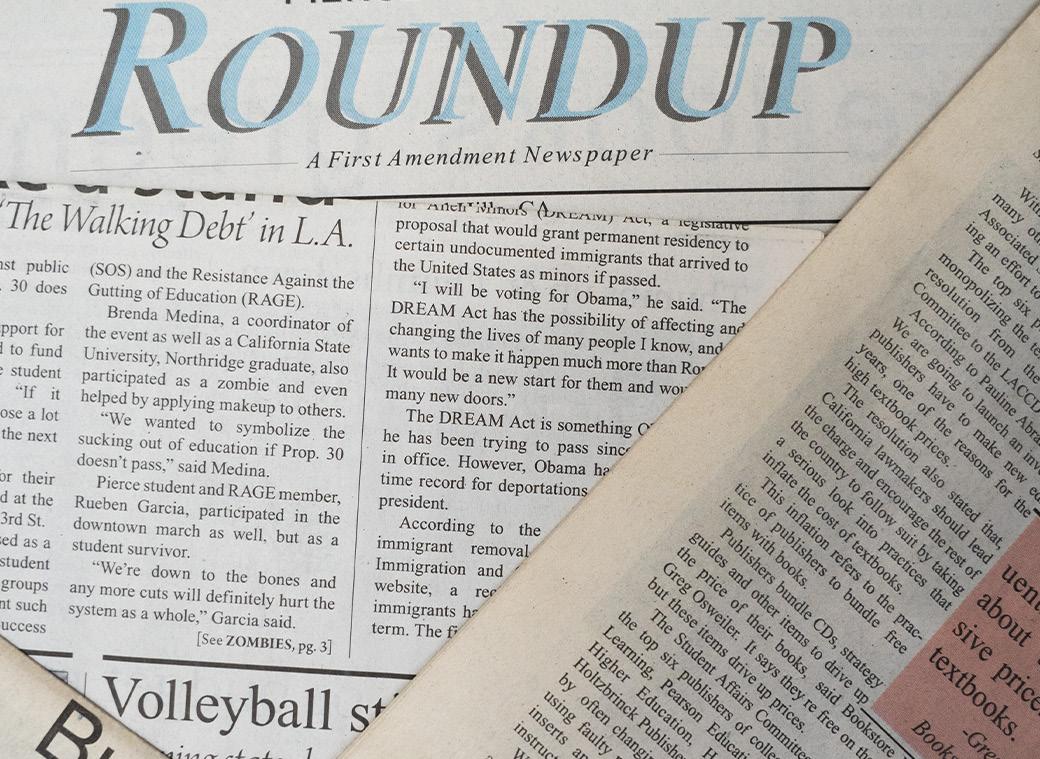
A look into the archives: 70+ years of the Roundup
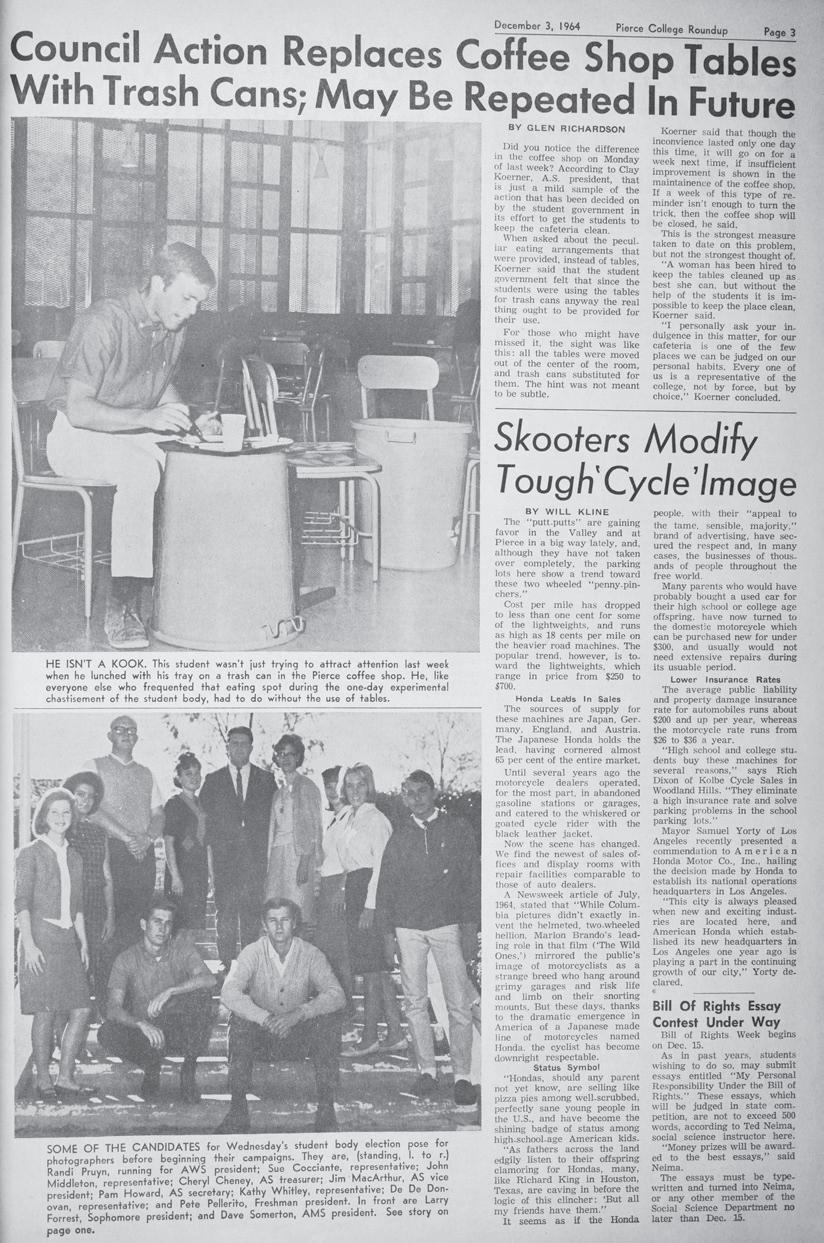
OnDec. 3, 1964, Pierce College published Volume 27, Issue 10 of The Roundup. The issue featured an article by Roundup reporter Glen Richardson, who covered a solution to a problem that Pierce has had in their cafeteria..
During this time, Pierce has had a rough time keeping the tables in the cafeteria clean. To combat this.
A.S. President Clay Koerner decided that the student government replaces the tables in the cafeteria with trash cans.
Koerner highlighted a staff member from Pierce that was hired to clean the tables of the cafeteria, but with the amount of trash that was left, it was
impossible to clean up by herself. The woman was not named in the article.
“A woman has been hired to keep the tables cleaned up as best she can, but without the help of the students it is impossible to keep the place clean,” Koerner said. “I personally ask your indulgence in this matter, for our cafeteria is one of the few places we can be judged on our personal habits. Every one of us is representative of the college, not by force, but by choice.”
Copy by Abraham Elizalde
December 3, 2025
Should movie theaters still be in business?
Movie theater’s big-screen advantage
By Chris Rubinstein Reporter
Streaming over screenings
By Brianna Fuerte Reporter
“Two McDoubles and an extra sloppy McChicken from McDonald’s. I just put it in my bag and walked in.”
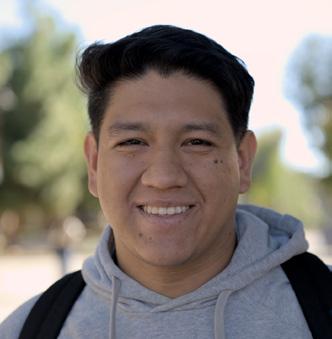
NelsonNolasco-MarineBiologyMajor
The20th century saw the biggest and fastest technological advancement the world had ever seen. Improving all different areas of human life many thought couldn’t be improved.
The biggest contribution to culture, specifically pop culture, was the creation of movies. And with that, came movie theaters.
A social tool that shaped the thoughts and minds of many generations and has shaped American culture as we know it. It’s a social tool that has helped the people of the world for over a century.
Movietheaters are no longer enjoyable as they once were. What used to be a go-to romantic date idea or a fun late-night outing with friends has become less and less of a comfort over these past few years.
The decline of movie theaters has been happening slowly.
According to the Michigan Journal of Economics, movie theaters are slowly disappearing across the country. Originally, there were 7,000 movie theater locations in 2005, however, in 2019, the number had dropped to around 5,500 locations, and then in 2023, the number dropped by another 3,000.
The Michigan Journal of Economics also states that the impact of COVID-19 left
In a 2023 article by Vox, Psychology Professor Shira Gabriel of the University at Buffalo explains that “When we’re all focused on a concert or a play or a movie, we feel a sense of social connection and it makes us feel really good,” If you wait until a movie hits streaming every time something new comes out, you miss out on that connection and bond every human so desperately desires and craves.
Going to a theater also helps you focus. When watching a
Yet, with the rise of streaming services, people have come to take them for granted and forget why they are still a staple in everyday life for people all over the world. Because humans are so social, they experience heightened emotions with a crowd than they would alone, regardless of whether they know anyone in that crowd or not. This is called “Collective effervescence.”
movie theaters having an 81% decrease in gross revenue, as in 2019, the box office earned $11.4 billion, and in 2020, they earned $2.2 billion.
The disturbance of the pandemic forced people into their homes, and as a result, more found out about the convenience of home streaming services.
According to Forbes, streaming services skyrocketed during 2020, as digital entertainment grew 35% totaling $24.7 billion.
According to an article written by the ACCA, Netflix alone added 26 million global subscribers during that year, and other streaming services like Hulu and Disney+ were also on the rise. The original goal for Disney+ was to gain 60-90 million subscribers within five years, but due to the
film at home, it is easier for you to get distracted and start another activity while still trying to watch a film.
However, it’s been proven that multitasking will not emotionally satisfy you as much. A 2008 study found that individuals are more likely to experience stress, frustration, and increased pressure on themselves after just 20 minutes of multitasking. In a theater, you wouldn’t have this problem.
Researchers found in a 2009 study that people experience steadier heartbeats and feel more emotional resonance the bigger the screen is.
Not only does going to the theater improve your emotional resonance, but it also improves your health as well, as a 2000 study in Sweden found that individuals
rise in digital entertainment and the pandemic, they reached their target in eight months.
With the pandemic and the rise of streaming services, the effect left more people preferring to stay at home rather than going out to the movie theaters.
A poll done by the Associated Press found that about three-quarters of adults watched newly released movies on a streaming service, rather than going to the movie theaters. In addition to that, only 16% said they went to a movie theater once a month.
Not to mention, movie theater tickets are expensive.
On average, one movie ticket costs around $16, and if it’s tickets for two, around $42, according to CableTV. In California, an average ticket
that frequented cinemas were as much as 4 times less likely to die of health problems. While many people don’t recognize it or appreciate it, art isn’t just an extra luxury or fun bonus that humans get to enjoy in life. It’s a necessity, and theaters are a part of that necessity.
Theaters help power the beating heart of pop culture and could even help keep your heart going a few extra beats too. So the next time you think about seeing a movie in a theater or waiting until it hits streaming, see it in a theater. It will help you more than you think.
costs $19, and the state with the highest price is New York, with an average cost of $23. However, at Walmart, they sell a box of movie theater popcorn for $5, almost 50% less than what would have been paid at the theaters. At home, there’s less of a worry about the movie being disturbed by a phone ringing or a baby crying, and fewer awkward moments where legs need to be squished in so another person can get to their seat.
Movie theaters were once loved but, with new developments in at-home streaming services and the high cost of both tickets and snacks, it’s time to leave movie theaters in the past and embrace movies being enjoyed at home.
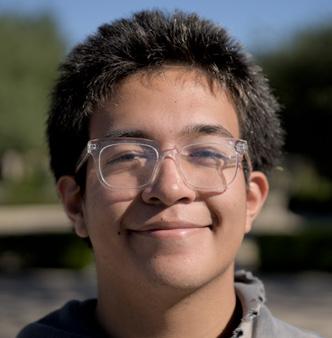
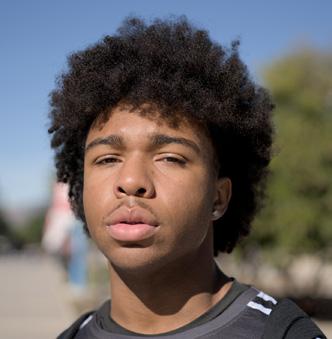
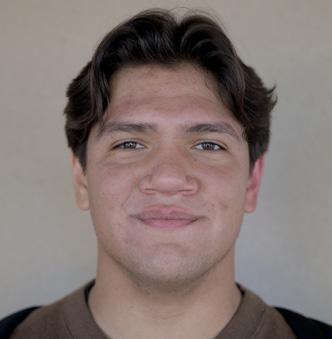
What is the craziest items you have brought in a movie theater?
“I snuck a burrito once. I had to suck in my stomach and just put it under my sweater, and I didn’t get caught.”
JonathanDominguezPerez-Business EconomicsMajor
“The craziest thing I snuck in was a Costco hot dog. I just put it in my pocket and raw dogged it.”
JoelMacias-NursingMajor
“It has to be a water gun. I was playing a game called Senior Assassin, and I had to get somebody in the theater. I just ran out right after.”
Stacey Allen Bey - Undecided
“I snuck in a bunch of fast food in a bag. I brought a big hoodie, and I put all of the food underneath it. We had a few employees come and check, but we never got caught.”
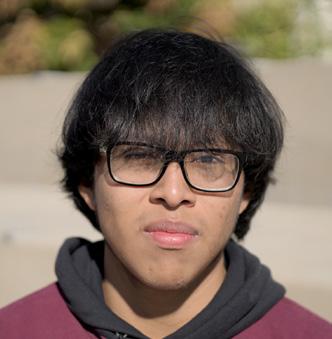
Aaron Cueva -Undecided
Interviews by Olivia Muñoz
Photos by Josue Aguilar
Pierce launches first AI-powered research program
By Natalie Baharian Reporter
Pierce College is the first ever community college to explore STEM-related research using artificial intelligence as a primary component.
The Pierce Science Center allows students to dive into academic research of a topic of their interest and work with a team that fosters learning and growth.
The intent of the program is to expose students to machine-learning tools that can organize untraditional and extremely complex data. From genetic mutation to breast cancer prognosis to self-driving car simulations, students participate in real-life issues.
One of the major projects that Pierce students are working on is breast cancer research. Using various research tools and AI models to organize and display data, students can analyze the specific factors that worsen breast cancer among certain individuals or why in some cases, the cancer has a longer sustainability.
“My major involves computer science, and I have very limited understanding of AI and machine learning. I thought this program would be a good way to combine what I know about computer
science and apply it to machine learning in a way that is meaningful, for example, to predict survivability of breast cancer diagnoses,” said George Sibalis, a sophomore at Pierce. “I think it’s a good way to both learn and do something meaningful, and that’s why I joined the program.”
Pierce student Ron Cohen thinks it’s good to have interdisciplinary people to have these conversations, because nurses may not know computer science, but computer science people may not know nursing.
“But together they can talk to each other in a way that can start a meaningful conversation about how you can get questions answered,” said Cohen. “And I think that Pierce College’s approach to this interdisciplinary, more welcoming way of introducing AI is useful for that, but also for people who just want to learn more about a growing field.”
Other than breast cancer research, the program offers another project: genetic mutations. This time, AI is used to detect genetic mutations and organize datasets so that students can analyze possible causes and their side effects. In the long run, this research will help in identifying key factors of mutations such as gene expression and predict the general health of an
individual.
“Using the resources we’re given, including research articles, I’ll learn more about genetics and how to apply AI to assist in research,” biology major Giovanni Nolasco said.
“The whole project is learning how we’re forming genomic patterns with binary code. And it’s important to learn how it actually works and how we implement it in our future jobs.”
The benefits of this program
“I think it’s a good way to both learn and do something meaningful, and that’s why I joined the program.”
George Siablis Sophomore
also extend to other science majors, such as chemistry and engineering, by finding ways to incorporate aspects of those disciplines into this kind of research.
“I think for me, as a chemistry major, I don’t have too much experience either in the genetics side or with coding and Python,” said Anissa Kahn, a chemistry major working on the genetics project. “But I do want to go
Campus squirrel strikes a pose
into medicine down the line, so I figured this would be a really amazing opportunity to improve my skills on all sides.“
Other than these two projects, students work oneon-one with professors and faculty members that help structure the program, serving as guides throughout the entire process.
As mentors and professors, they divide the projects into more manageable tasks, depending on the specific pace of the student. Due to many students being new to AI-related research, faculty members working on the program teach them how to use AI-tools with large data sets and identify patterns after they have been organized.
“The students that we have here, it’s a very diverse group. They are students from engineering, they are students from electronics, they are from nursing, biology, computer science,” said Farahnaz Nezhad, one of the co-coaches and faculty member for Electronic Support. “So we kind of distribute the job of who does what, but at the same time we encourage everybody to try to do the assignment as much as possible.
The faculty involvement helps students not only understand how to use AItools such as Python but also to remain organized on what tasks need to be done.
“When I heard about the National AI, I thought there’s got to be a way to bring it forward that helps the students, but honestly, the good work really comes from the faculty,” said Villanueva, the dean of Math and Sciences.
“If it weren’t for the faculty at Pierce, we wouldn’t have been able to adopt this program.”
What makes this program different from others is its integration of AI as a main tool for research. This program prioritizes teaching students how to use AI to process information and analyze it so they can create scientific interpretations based on that.
“We actually guide them from the very beginning: from installation, how to upload the file, how to look at the file, how to make a graph from the data and then kind of walking through with them step by step,” said Chemistry Professor Ngo-Hazelett. “And I respond with, ‘Okay, this is what you need to try this with. This is what you need to try to do the following week.’”
Being there and providing support, they help students who may be struggling or have questions regarding what to do next.
“We at Pierce really
believe in practical learning,” Villanueva said. “What I love about this project is that you’re not just learning about science; you’re actually seeing how these two things go together. We’re not using AI to replace thinking.”
Challenging the idea of whether or not AI should be welcomed in academic spaces, particularly for research, this program emphasizes the ethical use of AI. Students still have to do the work using tools.
“What caught my attention was the AI component. I recently went to a biotech conference, and one quote stuck with me: ‘AI won’t replace scientists. Scientists who know how to use AI will replace those who don’t,’” said Giovanni Nolasco, a biotech major. “I feel like this gives me an advantage over people who haven’t been exposed to AI in science.”
Although the AI research program is primarily STEMfocused, the on-campus team hopes to expand it to include a range of majors beyond the traditional sciences, including the social sciences and humanities.
“I hope to get the attention of different people, generating interest, getting them on board, and providing the support they need,” said NgoHazelett. “For example, a faculty member might be an expert in their discipline but need help on the technical or programming side. Partnering them with someone complementary allows them to feel more comfortable and work effectively as a team.”
Squirrel having a snack during in the rain at Pierce College in Woodland Hills, Calif., on November 11, 2025. Photo by Jesus Rivas.
Review: ‘Wicked: For Good’ ... or for worse?
By Daisy Aguinada Online Editor
Ozhas never been more thrillingly wicked than in the highly anticipated film “Wicked: For Good” directed by Jon M. Chu.
The sequel brings a darker and more playful energy, blending elements from the stage musical and the classic 1939 “Wizard of Oz” film. Picking up a year after “Wicked,” the second act follows Elphaba, played by Cynthia Erivo, and Glinda, played by Ariana Grande, as they navigate power, friendship and the fallout of their choices.
The story opens with animals being forced to build the yellow brick road, immediately establishing a darker tone in contrast to the first act. Elphaba remains targeted while Glinda basks in the admiration of Oz’s citizens, though both hope for a chance to reunite.
Erivo and Grande lead the film with strong performances. Erivo makes a powerful return as Elphaba, setting the stage for the conflict that drives the story. Grande’s performance shows Glinda evolving from a carefree, popular girl to a young woman navigating through leadership and responsibility.
Marissa Bode captivates
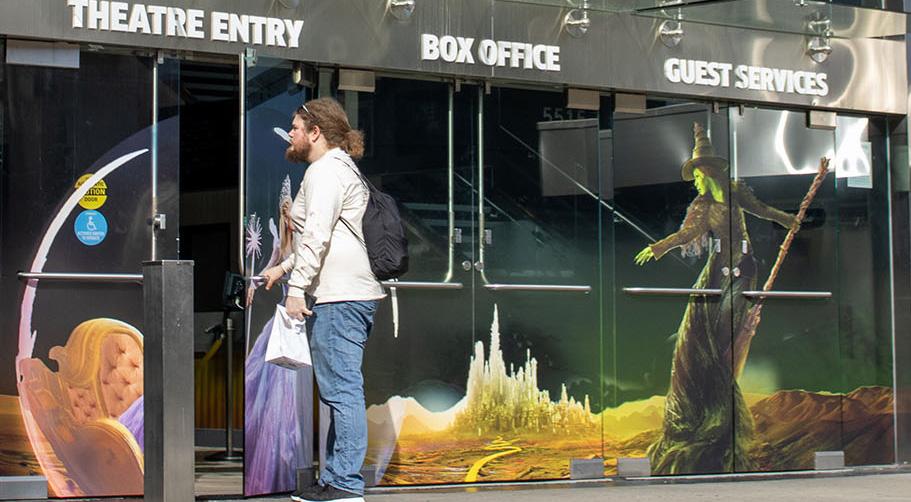
A “Wicked: For Good” mural outside of the AMC movie theater at Universal Studios in Universal City, Calif., on November 27th, 2025.
as Nessa Rose, whose harsh treatment of Elphaba and rise to governor of Munchkinland after her father’s death reveal a layered character shaped by resentment, power, and circumstance. Ethan Slater impressively transforms Boq from a timid student into a menacing, hardened Tin Man. Jeff Goldblum brings an easy charm to the Wizard, balancing humor with seriousness that fits the character’s shifting motives. His duet of
“Wonderful” with Grande is warm and entertaining, while maintaining authority.
Michelle Yeoh as Madame Morrible is less consistent, with vocals that occasionally fall short of the film’s emotional demands, yet her presence still adds authority to the political world surrounding Glinda and the Wizard.
Stephen Schwartz, the composer of the “Wicked” musical, delivers a full score including two new songs,
“There’s No Place Like Home” and “The Girl in the Bubble.” In “There’s No Place Like Home,” Elphaba reflects that Oz has never truly appreciated her, yet she still loves it even if the feeling isn’t reciprocated. “The Girl in the Bubble” captures Glinda’s belief in validation through appearances, praise and perfection. Her carefully controlled world begins to burst as she slowly realizes the harm caused under her watch.
Jonathan Bailey brings warmth and charm to Fiyero, whose maturity since the first film is clear. His chemistry with Erivo peaks in “As Long as You’re Mine,” a hypnotic, intimate duet that reveals vulnerability and strengthens their connection.
Erivo’s standout moment comes in “No Good Deed.” As a vocal powerhouse, she soars alongside the flying monkeys, delivering a ballad that captures Elphaba’s anger, struggle, and rising power.
Cinematographer Alice Brooks captures Oz with sweeping, vibrant compositions. Occasionally the color grading washed out certain scenes, yet the world remained visually engaging. Costume designer Paul Tazewell created a world of vibrant, distinct silhouettes and detailed textures, giving each character a clear identity.
As the film nears its conclusion, “For Good” is performed by Erivo and Grande as a duet. Their voices carry longing, regret and gratitude, capturing the bittersweet nature of friendship, how people shape us, drift away and leave lasting impressions.
It’s a wickedly moving finish to a story about choices, consequences, and the people who have shaped us into who we are today.
ASL brings students together at sign and dine
By Elizabeth Holodnak Reporter
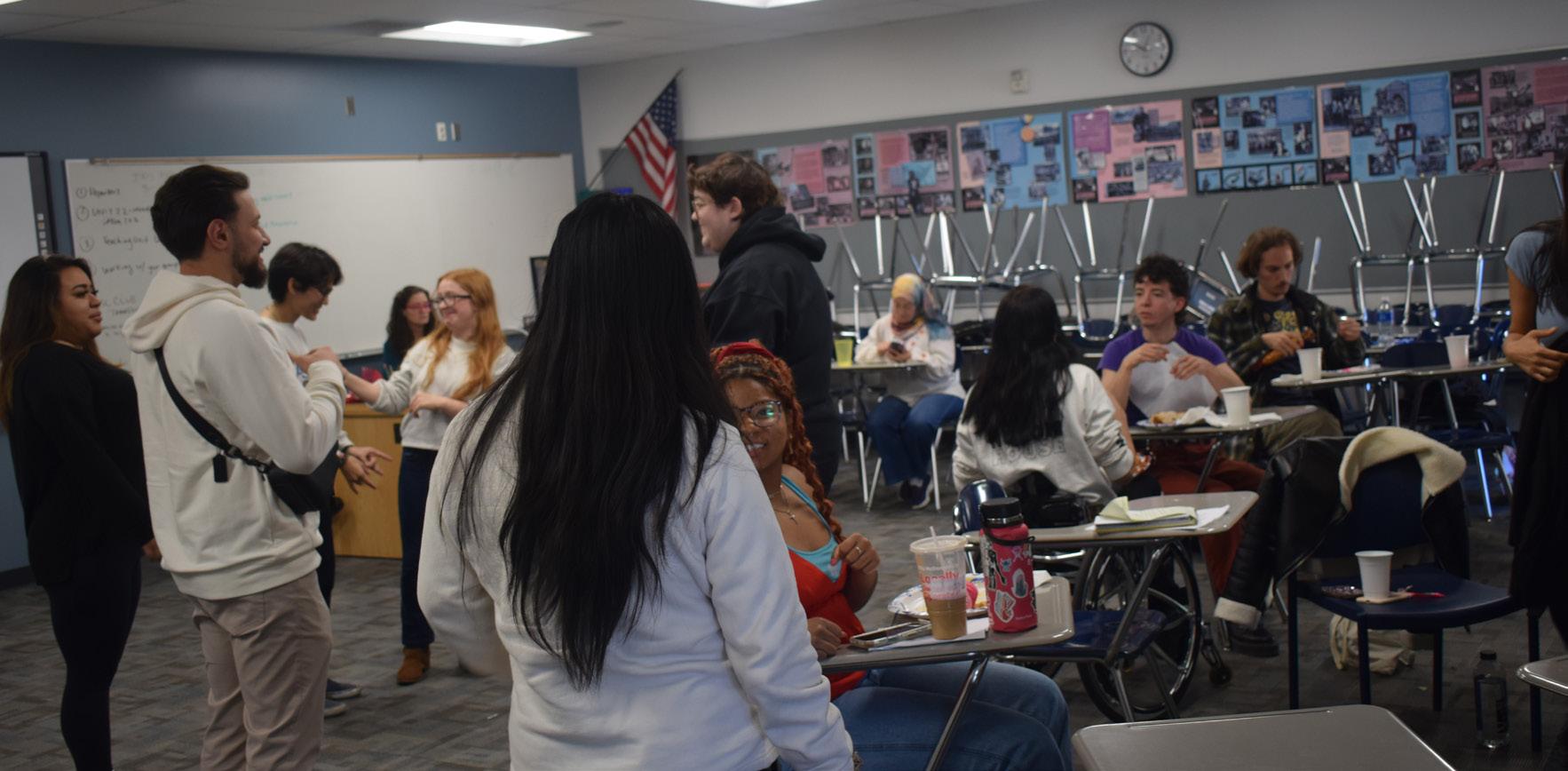
The American Sign Language (A.S.L.) club transformed Pierce College’s A.S.L. classroom into a lively, heartfelt gathering during their Sign and Dine Potluck Social. Students, faculty and interpreters shared food and cultures while communicating in American Sign Language.
A.S.L. instructor and club advisor Shmuel Khorsandi, whose interview was signed and interpreted by Abbey Nuñez, said many students don’t have anyone to sign with outside of school, and the potluck gives them an opportunity to practice with others.
“If they can’t sign at home, they can come here,” Khorsandi said. “This is where we can get to watch over them, support them, and keep the language alive.” Khorsandi mentioned there are two deaf teachers on campus who have shared their culture and history.
A.S.L. professor Christine Hall, interpreted by Abbey Nuñez, shared her own family experiences and her understanding of deaf culture.
She said a single gathering can mean a lot to someone who has spent their life without access to communication.
“So many children grow up at the dinner table with no communication or access,”
Hall said. “Today, nobody is pushed to the side.”
Hall described the potluck as more than food, it was unity, shared culture and the feeling of finally being included. She referred to the class as a “big family.”
A.S.L. Club President Lior Klein said the team wanted this potluck to feel open, comfortable and welcoming, especially with Thanksgiving approaching.
“It’s just nice to be around sign language,it’s like a little break from the real world,” Klein said. “Being surrounded by signing, I tease them by relying on spoken language, making the afternoon feel peaceful, natural, and
refreshingly different.”
Deaf Studies major Amber Cosich learned A.S.L. as a way to support her mother, who was disabled and wanted to learn sign language. After her mother passed away, Cosich continued studying
the language to honor her memory. Cosich said the potluck carried that personal meaning. .
“I wanted to remember my mom and get my degree in ASL,” Cosich said.
Today, Cosich runs a
nonprofit inspired by her mother’s story.she felt at home among others who value the method of communication and community just as strongly as she does.
Pierce College ASL Students talk during the ASL Sign and Dine Potluck at Building 900 at Pierce College in Woodland Hills, Calif. on Nov. 25, 2025.
Bryce Edwards / Roundup News
Damian Celedon / Roundup News
Family at the heart of Pierce production of ‘Georgia’
By Josue Aguilar Photographer
Whena child suffers, they don’t understand how far their parent is willing to go to save them. Pierce College’s theater production of “Georgia” is about the trials and tribulations of a father and daughter. The play explores mental illness, self-harm and unconditional love.
The story follows 13-yearold Georgia, who struggles with borderline personality disorder, and her father Jaime’s attempts to help her which causes their relationship to go through turmoil.
It’s an original production, created collaboratively by the cast and directed by student Dale Van Slyke. The story is based on faculty mentor JP Evans’ real life experiences with their own daughter.
Van Slyke said the story is about overcoming daily obstacles that any audience member can relate to.
“This is a vintage story about family, and struggle, and what you would do to overcome,” Van Slyke said. “It’s very beautiful. It does hit hard, so expect this really kind of exploratory, celebratory show about overcoming hardships, and just about the the beauty of storytelling.”
Evans said in recent years, they had been interested in taking parts from real life and turning them into a story.
“Last year we started exploring how we would take parts of my life and make it into theater. I’d never intended to do that,” Evans said. “It wasn’t something that I thought would be a good idea necessarily, but when we started to do it, that was kind of a magic with taking real things and turning them into
a piece and it just sort of evolved out of that.”
According to Van Slyke, there was no script when they started, but the cast created and worked on it throughout the process.
“Writing it as we were working on the day, we’d come on the new pages,”
Van Slyke said. “Directing it was very fun because a lot of people were watching it, [at] times I didn’t know what I would be directing.”
As the titular character, theater major Maya Zeltzer did extensive research to portray Georgia’s mental illness. Zeltzer said she did readings, listened to podcasts, and watched YouTube videos to be respectful of the true source and not fictionalize it completely.
“It is hard because I don’t have that mental illness, so I had to do a lot of research,” Zelzter said. “And obviously had many conversations with JP because I wanted to make sure that I’m representing the mental illness in the most authentic way possible.”
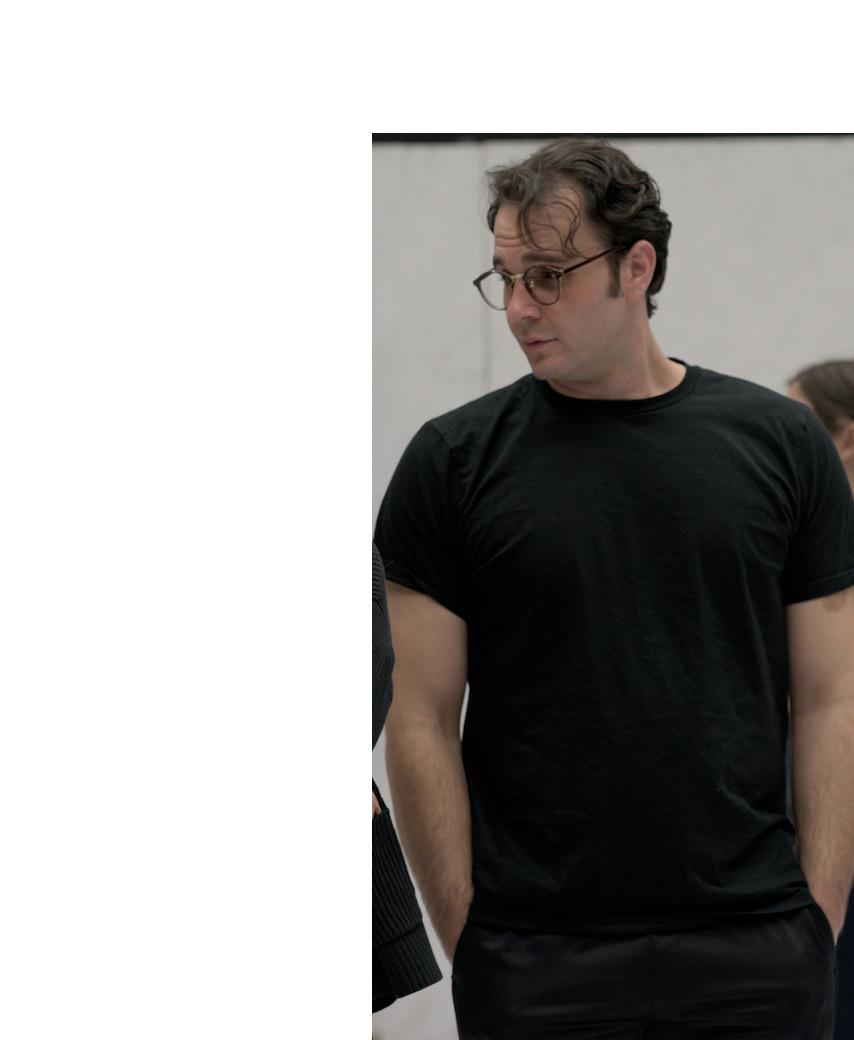
Theater major Deniz Boysan said he worked closely with Evans to portray Georgia’s father Jaime, who is an analogue of Evans.
“I can listen and see their mannerisms and try to adopt some of those things without it being imitation,” Boysan said. “But beyond that, I just kind of do what I do with most roles, where I just really sit with the circumstances of the character and of the show and just really imagine how that would make me feel and how I would react.”
The production “Georgia” opens on Friday, Dec. 5 and runs until Sunday Dec. 14, at the Dow Arena Theatre. Show times are at 7:30 p.m. on Fridays and Saturdays; 2 p.m.
on Sundays. Tickets are $20 for general admission and $15 for students or seniors which can be purchased online at lapctheatre.org.
majors Meagan Truxal, playing the role of Grandma June, and Deniz Boysan, playing the role of Jaime, rehearse a scene from “Georgia” at Pierce College in Woodland Hills, Calif., on Nov. 25, 2025.
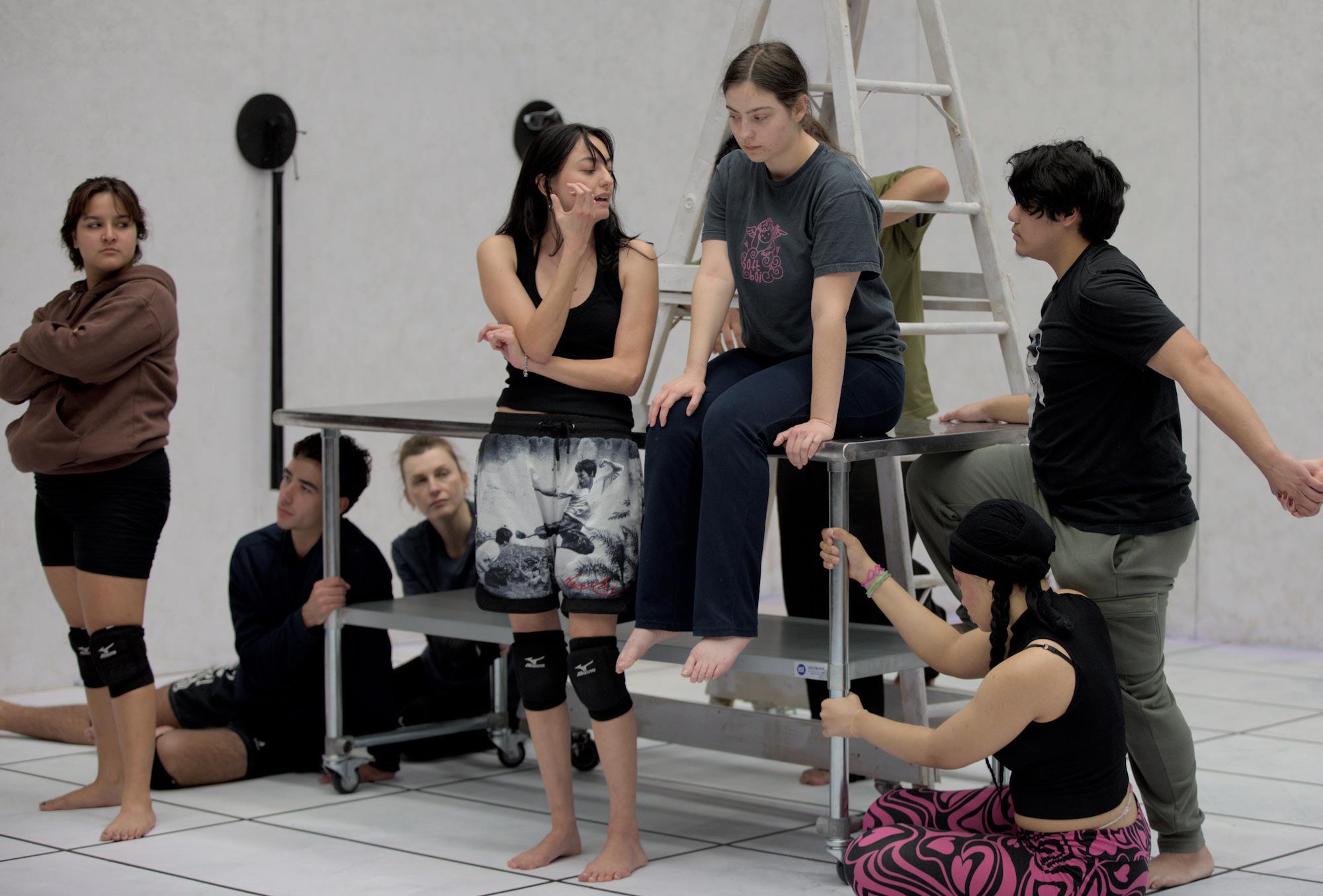
(Center Left to right) Theatre majors Olivia Espinoza, playing the role of Hanna’s mother, and Melinda Birke, playing the role of Hanna, rehearse a scene from “Georgia” at Pierce College in Woodland Hills, Calif., on Nov. 25, 2025.
Pierce community attends annual telescope night
By Gabriella Carlos Reporter
Stars weren’t the only things out Wednesday night, as many students came for the annual Telescope Night hosted by the Center for the Sciences from 6 P.M. to 10 P.M.
Pierce College Astronomy professor Dale Fields and Los Angeles Astronomical Society (L.A.A.S.) outreach coordinator David Yakerson hosted the event to educate and communicate with the community on science students.
Telescope night has been hosted at Pierce College for more than 10 years, it is open to the public for free to view the night sky.
Fields said it’s important for this generation to be able to experience science and the universe.
“I love that there’s so many curious people coming to this event and it always makes me really happy for individuals,” Fields said. “It also makes me really proud as a human being that these are my people, this is humanity itself that are curious about things and want to know more.”
Kinnesiology major
Alexandria Guzman attended the event because of her personal interest in telescopes. She said the event healed her in a positive way.
“I like telescopes because it heals the inner child in me. It just makes me happy being here as far as my inner child,” Guzman said. “I liked the cluster of stars because it looked like glitter to me.”
Political Science major Shayna Steinberg said she attended the event because it’s difficult to see the stars from the valley.
“We don’t really see the stars much in LA or the valley because of light pollution and
everything, so I thought it was cool to come over and see the stars through a telescope more clearly,” Steinberg said.
“It was very informative. The guys taught us all about telescopes and how they developed in history.”
Two digital telescopes and one manual telescope were provided by the Los Angeles Astronomical Society who are working on spreading information about space to people and students around Los Angeles.
The digital telescopes took live photos of space including Mars and Saturn after sunset, which were then produced on
an iPad to see a clearer visual. Fields said he likes seeing the excitement people have when looking at the telescopes and space.
“It’s so easy to be jaded nowadays and see someone be unimpressed and cynical about the world,” Fields said. “This has ‘oohs’ and ‘ahhs.’ People make little sounds to indicate that they love what they’re seeing and that’s the greatest part.”