TheScienceof Waves
Explaining the Parts of WAVES

Otherwise known as the peak, the highest point of a wave
Rest or Equilibrium Position
The undisturbed position of the particles if they do not vibrate
The lowest point of a wave Crest Trough
rest or equilibrium position
direction of wave propagation
It is the maximum disturbance from the crest of the wave from its rest position. It represents the wave's height. The unit for amplitude (A) is metres (m).
amplitude
direction of wave travel
It is a set distance that represents the full cycle of a wave. It can be measured from crest to crest, from trough to trough, or any two consecutive points in the wave cycle. The unit for wavelength (λ, Greek letter lambda) is metres (m).
one wavelength
direction of wave travel
It is the number of waves passing a specific point per second.
The unit of frequency is hertz (Hz), which is equal to 1 cycle per second (1/s).
low frequency
high frequency
Wave speed, or velocity, is defined as the distance a wave travels per second. We can also define wave speed as the rate at which energy is transferred through a medium.
The unit for wave velocity is metres per second (m/s).

slower wave faster wave (longer wavelength, lower frequency) (shorter wavelength, higher frequency)
direction of wave travel
The velocity of a wave depends on its frequency and wavelength.
When calculating wave velocity we use the following formula:
wave velocity in m/s = frequency in Hertz or 1/s × wavelength in m
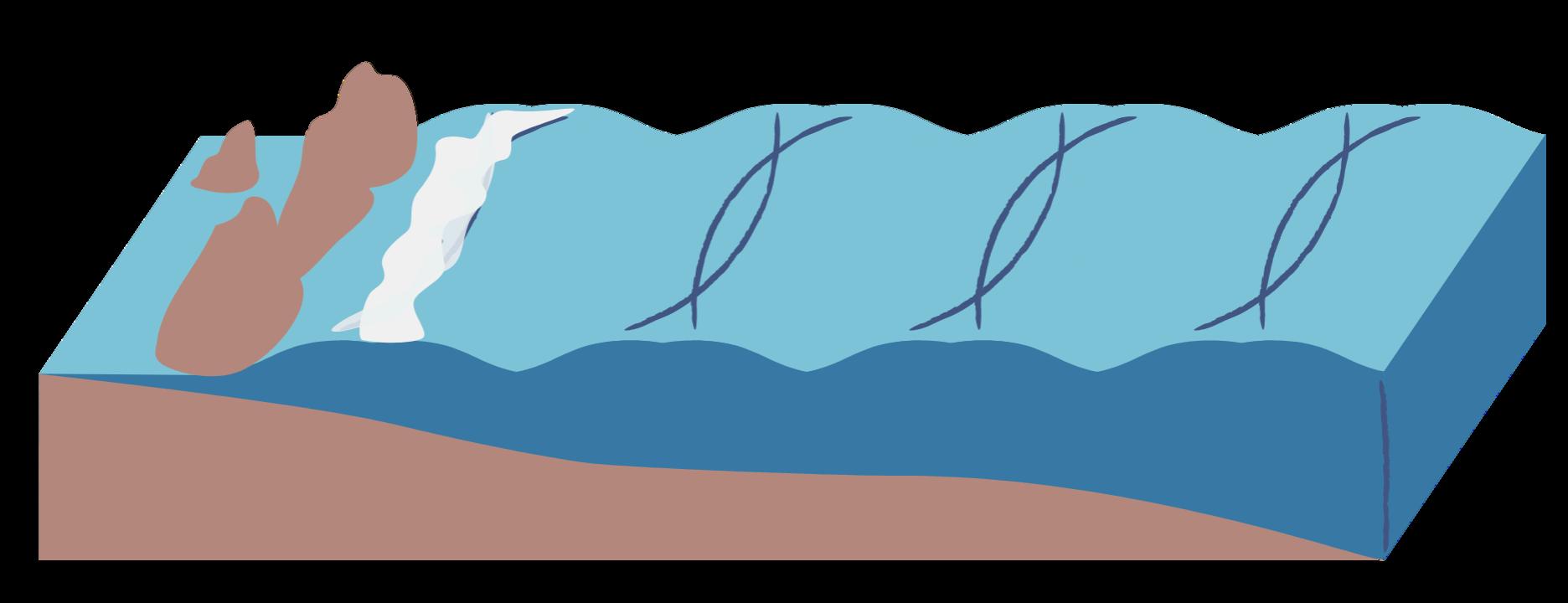
While at the beach, you observed that the waves hit he shore at a frequency of 0.5 waves per second. You also estimated the distance between the crests of the waves to be 2 metres.
What is the velocity of the waves as they travel towards the shore?
Here's the information given:
frequency (f) = 0.5 waves per second = 0.5/s wavelength (λ) = 2 m
Now, we plug these values into the formula:
v = f × λ
v = × 2 m s 0.5
v = 1 m/s
The wave travels at 1 m/s towards the shore.