the promise of a bright future —Goodyear
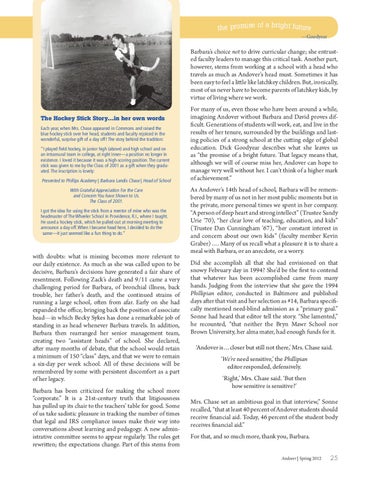
Barbara’s choice not to drive curricular change; she entrusted faculty leaders to manage this critical task. Another part, however, stems from working at a school with a head who travels as much as Andover’s head must. Sometimes it has been easy to feel a little like latchkey children. But, ironically, most of us never have to become parents of latchkey kids, by virtue of living where we work. The Hockey Stick Story…in her own words Each year, when Mrs. Chase appeared in Commons and raised the blue hockey stick over her head, students and faculty rejoiced in the wonderful, surprise gift of a day off! The story behind the tradition: “I played field hockey, in junior high (above) and high school and on an intramural team in college, at right inner—a position no longer in existence. I loved it because it was a high-scoring position. The current stick was given to me by the Class of 2001 as a gift when they graduated. The inscription is lovely:
Presented to Phillips Academy | Barbara Landis Chase | Head of School With Grateful Appreciation For the Care and Concern You have Shown to Us. The Class of 2001. I got the idea for using the stick from a mentor of mine who was the headmaster of The Wheeler School in Providence, R.I., where I taught. He used a hockey stick, which he pulled out at morning meeting to announce a day off. When I became head here, I decided to do the same—it just seemed like a fun thing to do.”
with doubts: what is missing becomes more relevant to our daily existence. As much as she was called upon to be decisive, Barbara’s decisions have generated a fair share of resentment. Following Zack’s death and 9/11 came a very challenging period for Barbara, of bronchial illness, back trouble, her father’s death, and the continued strains of running a large school, often from afar. Early on she had expanded the office, bringing back the position of associate head—in which Becky Sykes has done a remarkable job of standing in as head whenever Barbara travels. In addition, Barbara then rearranged her senior management team, creating two “assistant heads” of school. She declared, after many months of debate, that the school would retain a minimum of 150 “class” days, and that we were to remain a six-day per week school. All of these decisions will be remembered by some with persistent discomfort as a part of her legacy. Barbara has been criticized for making the school more “corporate.” It is a 21st-century truth that litigiousness has pulled up its chair to the teachers’ table for good. Some of us take sadistic pleasure in tracking the number of times that legal and IRS compliance issues make their way into conversations about learning and pedagogy. A new administrative committee seems to appear regularly. The rules get rewritten; the expectations change. Part of this stems from
For many of us, even those who have been around a while, imagining Andover without Barbara and David proves difficult. Generations of students will work, eat, and live in the results of her tenure, surrounded by the buildings and lasting policies of a strong school at the cutting edge of global education. Dick Goodyear describes what she leaves us as “the promise of a bright future. That legacy means that, although we will of course miss her, Andover can hope to manage very well without her. I can’t think of a higher mark of achievement.” As Andover’s 14th head of school, Barbara will be remembered by many of us not in her most public moments but in the private, more personal times we spent in her company. “A person of deep heart and strong intellect” (Trustee Sandy Urie ’70), “her clear love of teaching, education, and kids” (Trustee Dan Cunningham ’67), “her constant interest in and concern about our own kids” (faculty member Kevin Graber)…. Many of us recall what a pleasure it is to share a meal with Barbara, or an anecdote, or a worry. Did she accomplish all that she had envisioned on that snowy February day in 1994? She’d be the first to contend that whatever has been accomplished came from many hands. Judging from the interview that she gave the 1994 Phillipian editor, conducted in Baltimore and published days after that visit and her selection as #14, Barbara specifically mentioned need-blind admission as a “primary goal.” Sonne had heard that editor tell the story. “She lamented,” he recounted, “that neither the Bryn Mawr School nor Brown University, her alma mater, had enough funds for it. ‘Andover is…closer but still not there,’ Mrs. Chase said. ‘We’re need sensitive,’ the Phillipian editor responded, defensively. ‘Right,’ Mrs. Chase said. ‘But then how sensitive is sensitive?’ Mrs. Chase set an ambitious goal in that interview,” Sonne recalled, “that at least 40 percent of Andover students should receive financial aid. Today, 46 percent of the student body receives financial aid.” For that, and so much more, thank you, Barbara. Andover | Spring 2012
25