MDRT Speaks: Kiwi stories
From fund manager to broker to adviser
New insurance law means changes to benefits
ISSUE 4 | 2025 | WWW.GOODRETURNS.CO.NZ
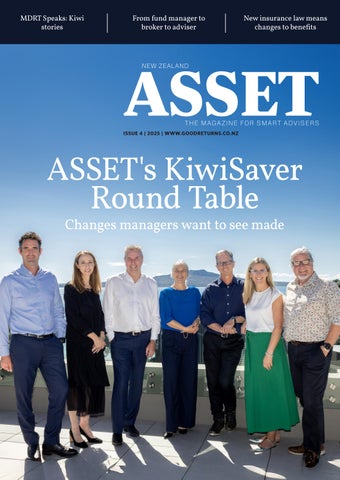
ASSET's KiwiSaver Round Table Changes managers want to see made
Wise advisers make every choice count. With the GoalsGetter KiwiSaver Scheme, you get access to a wisely curated selection of quality funds from some of New Zealand’s leading fund managers - built to spark better client conversations. So whether they’re saving for their first home or a comfortable retirement, you’ve got the tools to offer rich advice that truly counts. That’s the wiser way. 2 ASSET Issue 4 2025
To find out more, scan the QR code or visit goalsgetter.co.nz/wiseradviser
Sponsored Content
AMOVA ASSET MANAGEMENT
KiwiSaver and the value of good advice Stuart Williams
M
assey University Retirement Expenditure Guidelines (REG) report, published in October, served up a timely and indeed stark reminder as to the vital role KiwiSaver will play in our futures. The labels given to what our future lifestyle might be: one of ‘choices’ or one that has ‘no frills.’ I’m sure that when you ask your clients what their vision of retirement might be, you’d be hard-pressed to find any that paint a picture in line with the latter. We all aspire to enjoy a future in which work is not replaced by worry: one of variety, opportunity and choice. But for those of us who will seek to enjoy this lifestyle in and around our major cities, close to our kids and then their kids, the reality is that we’ll need to fund this from additional income streams such as investing, over and above the NZ Super. And as the cost of living inevitably continues to rise, this figure will only grow bigger. KiwiSaver is now sufficiently established in the New Zealand psyche that it is almost universally acknowledged as integral to retirement planning. This is why, since it was launched less than 20 years ago, the overall pot has grown to around $130 billion. But the problem here is not one of awareness. It’s one of understanding. More than three-quarters of this $130 billion has been invested without financial advice or strategy, and as such risks being sat underperforming in funds poorly correlated to savings ambition.
The squeezed middle For generations, life has traditionally been broken down into a series of stages.
You have as much fun as you can while you’re young (obviously). You then start to build a career, before buying a first home and starting a family. Then comes what might be termed the ‘middle stage’, in which you embrace the responsibility of adult and parenthood while enjoying your biggest earning years, before working your way towards retirement. Whereas previous generations may have been well into this middle stage by their early 30s, today many Kiwi families will not yet have been able to afford to buy their first home by this time. Therefore, having utilised their KiwiSaver balance to do this, their timeframe to save for their desired retirement or indeed however much will actually be needed by the time they turn 65, will likely require investing in higher growth strategies to reach their retirement goals.
How we’re backing advisers As my colleague Sam Bryden wrote about in the last issue of Asset, we know and you know, that taking a more growthoriented approach with your KiwiSaver investment across a diversified portfolio through this middle part of your life is not a high-risk gamble. Rather it is essentially now the most practical retirement savings strategy available to most of us. But we also know that it can take time and effort to educate clients who may traditionally have seen themselves as low-risk investors to alter their mindset. When we launched GoalsGetter back in 2019, our guiding philosophy was to provide easy access to quality managed funds to as many New Zealanders as possible. This philosophy hasn’t changed as we’ve evolved the platform into a tool
for advisers. And having introduced our multi-manager KiwiSaver Scheme that allows you to create bespoke, diversified fund portfolios for your clients that offers the opportunity to invest in higher growth strategies, we’ve now decided to take this one step further – by recognising the value you provide in guiding them along this path. KiwiSaver can be at the end of a long list of items you’ll discuss with your clients, but ensuring they have the right advice now, and then providing them with exposure to diversified quality funds that can deliver on this advice, can mean the difference between them enjoying a ‘no frills’ or ‘choices’ future. A better-informed and better-positioned KiwiSaver community is ultimately better for everyone’s future. At Amova, and through GoalsGetter, we see advisers as playing a vital role in the future prosperity of New Zealand and New Zealanders, which is why we’re keen to drive and support Financial Advisers to help enable more advice in KiwiSaver. For more information on this, please get in touch with George and our dedicated GoalsGetter team. Stuart Williams is the Managing Director for Amova NZ, part of the global Asset Management company formerly known as Nikko AM which has over US$260B in funds under management. A This material is general in nature and is not intended to constitute financial advice therefore should not be relied upon. We recommend that you seek financial advice before proceeding to make an investment. We also recommend that you read the product disclosure statement of any financial product that you are considering investing in before proceeding. A copy of the PDS is available at goalsgetter.co.nz.
www.goodreturns.co.nz 3
In this Issue
CONTENTS
Issue 4 Features
14
KIWISAVER ROUND TABLE KiwiSaver is looming as a big election issue next year. ASSET assembled a group of six key industry players to discuss the state of the national savings team and found out what enhancements they would like to see.
14
KIWISAVER Hear from six KiwiSaver leaders.
22
MDRT Two Kiwi MDRT members reveal some of their secrets.
24
INVESTMENT ADVISER PROFILE Edward Glennie shares his journey from Generate to Hobson Wealth to becoming an adviser.
30
INSURANCE How much consideration do you give to indexing life insurance for inflation? Is it simply a tick box exercise or is there more to it?
Regulars
24
26
INVESTMENT COMMENTARY David van Schaardenburg delves into KiwiSaver on its 18th year.
28
RUSSELL HUTCHINSON New insurance law means changes to benefit definitions. This is why.
32
MORNINGSTAR DATA Find out how hundreds of funds are performing
34
GOOD RETURNS TOP 10 What advisers have been reading on Good Returns in the past month.
INVESTMENT ADVISER PROFILE Edward Glennie shares his journey.
Up Front
08
PEOPLE SOC gets big international award, Smart changes, Booster recruits from FMA and more.
06
EDITORIAL All I want for Christmas.
11
OUT AND ABOUT ASSET went to the Beehive for the annual Booster conference.
07
NEWS AIA chief calls for changes.
4 ASSET Issue 4 2025
12
KIWISAVER MJW KiwiSaver Market Review
Proven performance. Consistent results. Generate’s original KiwiSaver funds have held top-three rankings for 10-year returns in their respective categories every quarter for the past two years – a track record that speaks for itself.
Help your clients invest with a proven performer. generatekiwisaver.co.nz/partner
Generate Moderate Fund
for 10-year returns in the moderate category *
Generate Focused Growth KiwiSaver Fund for 10-year returns in the growth category *
Generate Growth KiwiSaver Fund
for 10-year returns in the aggressive category *
NZ Gold Medallists and Generate Ambassadors, Finn Butcher and Dame Lisa Carrington. *Morningstar KiwiSaver Survey September Quarter End 2025. © 2025 Morningstar, Inc. The Generate Moderate Fund ranked 1st out of 13 NZ Multi Sector Moderate Category Funds; the Generate Growth Fund ranked 3rd out of 14 NZ Multi Sector Growth Category Funds; and The Generate Focused Growth Fund returns ranked 2nd out of 8 NZ Multi Sector Aggressive Category Funds, all for a period of 10 years as of 30/09/2025. © 2025 Morningstar. All Rights Reserved. The information contained herein: (1) is proprietary to Morningstar and/or its affiliates or content providers; (2) may not be copied, adapted or distributed; (3) is not warranted to be accurate, complete or timely. Past performance does not guarantee future returns. The issuer is Generate Investment Management Ltd. See the Product Disclosure Statement at generatekiwisaver.co.nz/pds www.goodreturns.co.nz 5
Up Front
EDITORIAL
How to update your mailing address Make sure you don't miss an issue by changing your address. Go to: tarawera.co.nz/coa
All I want for Christmas
W
elcome to the final issue of ASSET for the year. This is our bumper KiwiSaver issue featuring our annual Round Table. There is a clear view that changes need to be made to KiwiSaver - indeed it was the theme a year ago. Unfortunately, and this is a failing of government very little has changed in a year. This is best illustrated by our question where we ask participants to rate KiwiSaver out of 10. The scores are little changed from a year ago. Post our Round Table, National announced that it plans to campaign on increasing contribution rates to 12% over time. While the policy has had mixed reactions, it’s a step forward after what it proposed in the previous election. What was good to see this month was the Retirement Commission’s three-yearly review of New Zealand’s retirement savings settings. It had 12 recommendations with many relating
Head office and advertising 1448A Hinemoa Street, Rotorua PO Box 2011, Rotorua 0274377527 philip@tarawera.co.nz
Publisher
Philip Macalister
Photography Steph Creagh
Staff Writer
Ksenia Stepanova, Jenny Ruth
Design
Michelle Veysey
6 | ASSET SPRING | 2024
to KiwiSaver specifically. The KiwiSaver recommendations are sensible, but will the government adopt them? You’d like to think so. While Commerce Minister Scott Simpson welcomed the report, his following comments didn’t seem to show he was in any rush or was going to advocate for changes with his ministerial peers. The greatest win for KiwiSaver and retirement settings would be a return to an accord between political parties. But it’s probably wishful thinking. The previous administration scored some cross-party agreement on various issues around building and climate change, but the current coalition government has pulled out of them. For the good of the country and New Zealanders we need more cross-party agreements and KiwiSaver is one area where agreement is sorely needed. NZ Superannuation is another – but the prospects of agreement here is, sadly, wishful thinking. Coming up we will publish some interesting research on how much
KiwiSaver is worth to the financial advice sector. Without giving too much away I can say it is significant and will continue to grow. I draw some comparisons to mortgage advice where the majority of home loans are originated by advisers and borrowers get a better deal. With KiwiSaver advisers are playing a bigger role, particularly in the transfer market, plus the evidence is clear that advised members have higher balances than those without advice. Thanks to those companies who have supported ASSET this year and to readers who often express how much they enjoy the mag. Wishing you all a wonderful Christmas and a prosperous New Year.
Philip Macalister Publisher
Contributors
ASSET is published by Tarawera Publishing Ltd (TPL). TPL also publishes online money management magazine Good Returns GoodReturns.co.nz and TMM – The Mortgage Mag.
Subscriptions
All contents of ASSET Magazine are copyright Tarawera Publishing Ltd.
Russell Hutchinson, David Van Schaardenburg, Steve Wright P: 0274 377 527 E: subscriptions@tarawera.co.nz
Disclaimer All articles in ASSET are for information purposes only, the content is intended to be of a general nature, does not take into account any person’s specific circumstances, and is not financial, legal, or other advice. It is recommended you seek advice from a suitable expert before taking any action in relation to anything contained in this magazine.
Any reproduction without prior written permission is strictly prohibited. ISSN 1175-9585
Up Front
NEWS
Rising costs need fresh thinking AIA NZ CEO Health insurance premium increases are hurting New Zealand customers and insurers are asking the government to help find solutions, AIA New Zealand chief executive Nick Stanhope says. New Zealand's health insurance inflation is among the highest in the Asia-Pacific region. Stanhope says the affordability pressures require fresh thinking from both insurers and policymakers, potentially including smarter products, better understanding of health trends,
and Australian-style tax deductibility for health insurance. AIA NZ has met with Health Minister Simeon Brown twice this year - first one-on-one in June, then in August as part of the FSC's CEO Forum. "I was very impressed with Minister Brown," Stanhope said. "I think he was thoughtful, listened to what we had to say and took notes. We're looking at the types of illnesses people are getting, age groups, etc. We're asking the government to focus on areas where there is high-cost inflation and to get to the root of it." AIA has also raised fringe benefit tax on group health schemes with the government. Currently employers who provide healthcare to staff face a 49% penalty on top of the premium they pay. Stanhope has met with Revenue Minister Simon Watts and Prime Minister Christopher Luxon to discuss the issue. The Australian model offers a useful
comparison. Tax deductibility there has created significant capital investment in hospitals and a stronger public-private healthcare relationship. Insurers have taken different approaches. All major insurers have raised premiums, nib introduced co-pays on some diagnostics, and AIA has rolled out lower-cost options with fewer benefits, including a $10,000 excess option and specific cancer care products. Stanhope says the biggest issue is still rising claim numbers, particularly as wait times in the public system have stretched to six to 12 months. For advisers, Stanhope says one approach that's worked well for clients considering cancelling policies is encouraging them to get a health check first. "If you're going to do it, know your health," he says. “Some advisers have had clients getting those health checks and finding they have cancerous lesions, or something else they’ve been unaware of.”
Life and health: a tale of two sectors The Reserve Bank’s Financial Stability Report shows life and health insurance going in wildly different directions on profitability and premiums. The Reserve Bank has released its latest Financial Stability Report, and it shows that New Zealand's health insurers are under a lot of strain, while life and general insurers are slowly improving. As a result, premiums in health insurance have skyrocketed while life premiums have remained relatively stable. Here's what's happening in each sector. A health insurance crisis The report noted that health insurers have lost almost 40% of their financial reserves over two years. They're still meeting legal requirements, but they're losing money every quarter.
The main problem is rising medical costs. Until 2022, price increases were normal and manageable - but in 2023, insurers were reporting quarterly losses. New Zealand's public hospitals became overwhelmed, pushing more people into private healthcare. Insurance companies hadn't planned for this surge in claims. Additionally, new medical technologies now cost more, supply chains are under pressure, and healthcare workers are demanding higher wages. All these factors have pushed claims costs even higher. By 2024, insurance companies responded with massive premium increases - about 19% in a single year. The biggest jumps came in late 2024 when insurers came out with "material repricing," which means significant changes to their entire pricing structure. Despite these huge premium increases, health
insurers are still losing money. There's a delay between announcing higher prices and collecting that money as policies renew throughout the year.
Life insurance recovery Life insurers are making money again after several difficult years, but profits remain low. Returns don't match what investors could earn elsewhere. Solvency margins in the life insurance sector have remained “well above” regulatory requirements, but the Reserve Bank noted that they have trended lower in recent years. Life insurers have responded by paying bigger dividends to shareholders and keeping smaller cash reserves. Some technical accounting changes make life insurers look weaker than they actually are. The Reserve Bank says their financial positions are still adequate despite the subdued figures on paper.
Regulatory response The Reserve Bank is intensifying its supervision of the insurance sector. Health insurers will now be included in its stress-testing programme, and will be put through scenarios where the pressures mentioned above continue to escalate. The Reserve Bank will also be engaging with health insurers to ensure that responses support both the long-term sustainability of the sector and the resilience of households and the broader financial system. Both the life and health sectors were mentioned as part of a broader look at the insurance industry. The report noted that general insurers have largely maintained strong profits, supported by premium increases following the severe weather of 2023. Overall, health is the outlier in more serious stress, with health insurers still making losses. A Source: RBNZ
www.goodreturns.co.nz 7
Up Front
PEOPLE
The latest appointments
wealth by investing in Smart's extensive range of products." Smart has also appointed James Wesley to a newly created role of chief sales and marketing officer. Wesley, formerly chief executive of Nikko Asset Management Americas, begins in November. NZX chief information officer Robert Douglas has been appointed acting chief executive of NZX Wealth Technologies, with head of capital market and digital technology Daniel Juchnowicz stepping into the CIO role on an acting basis.
8 ASSET Issue 4 2025
GUARDIANS APPOINT FORMER GOLDMAN SACHS EXECUTIVE
INSYNC BOLSTERS TEAM WITH DERIVATIVES SPECIALIST
PAUL DARWELL
SMART NAMES NEW CEO AS NZX RESHUFFLES LEADERSHIP Lisa Turnbull has been appointed chief executive of Smart, replacing Anna Scott who left to head up Mercers. Turnbull has led NZX subsidiary NZX Wealth Technologies since 2017, growing the investment platform from start-up to a key business within the NZX Group, with annual recurring revenue reaching $11.9 million by June 2025. NZX chief financial and corporate officer Graham Law said Turnbull is a chartered accountant with a background in funds management, finance, strategic development and investment platforms. "Lisa is the ideal person to lead Smart and ensure more New Zealanders build their
director of fixed income and currency trading at CBA. His prior experience includes senior roles at Macquarie Bank and Citigroup, where he spent 12 years leading derivatives and trading teams. Chief investment officer Monik Kotecha welcomed Darwell to the team. “His deep experience across derivatives and structured risk management enhances our ability to continue delivering strong, risk-adjusted outcomes for our investors,” Kotecha said. “Paul’s appointment reflects our ongoing commitment to building a team capable of navigating the ever-evolving global market landscape with discipline and foresight.”
ANDREW WILSON
Stephen O'Connor has been awarded the FPSB 2025 Noel Maye Award for Outstanding Contribution to the Profession. The award, presented by the Financial Planning Standards Board at its global meeting in Chicago, recognises individuals who have made a lasting impact on financial planning and CFP certification worldwide. Since attaining his CFP designation in 1996, O'Connor has served in leadership roles with New Zealand's professional associations and held significant positions within FPSB, including chair of both the board of directors and council.
LISA TURNBULL
STEPHEN O'CONNOR
O'CONNOR RECEIVES GLOBAL FINANCIAL PLANNING HONOUR
Paul Darwell has joined Insync Funds Management, bringing more than 35 years of experience in trading and managing derivative risk across equity, interest rate and foreign exchange markets. Most recently Darwell served as
Andrew Wilson has joined the Guardians, which manages the $85 billion New Zealand Superannuation Fund. Wilson worked at the Reserve Bank of New Zealand, Bank of England and Rothschild Asset Management before spending more than 25 years with Goldman Sachs Asset Management in the United Kingdom. He served as both head of fixed income, currency and money markets and CEO of Goldman Sachs Asset Management International.
MDRT NAMES NEW REGIONAL CHAIRS Christine Zhou will take over from Aaron Baker as MDRT New Zealand's North Island chair, and Joel McLachlan will replace Paula Jones as South Island chair.
DIANA GORDON
BOOSTER RECRUITS FMA INVESTMENT CHIEF
Diana Gordon has joined Booster as senior portfolio manager in the investment management team. Gordon's most recent role was head of investment management at the Financial Markets Authority. Her career has spanned roles at Kiwi Wealth in New Zealand and international positions
managing fixed interest funds in New York and London. Chief executive Di Papadopoulos said Booster was excited to welcome someone of Gordon's breadth and depth of experience. "Delivery of outcomes like these takes talent and dedication. We're delighted to be adding Diana's experience and capabilities to the Booster team." Gordon said Booster's ability to combine innovation and purpose was a key factor in her joining the company.
RHIANNON MCKINNON
Zhou is a director and financial adviser at Maxicare Financial Services in Auckland. A multi-year MDRT member, she brings extensive experience in personal insurance and KiwiSaver advice, working in both English and Mandarin. She has recently expanded into mortgage services and is known for helping migrant families navigate New Zealand's financial system. McLachlan, who runs AdviceKiwi, has added the MDRT role to his recent appointment to the Woodend-Sefton Community Board at Waimakariri District Council.
FORMER KIWIWEALTH CEO JOINS RBNZ BOARD The Reserve Bank of New Zealand has appointed Rodger Finlay as its new chairman, and and added former KiwiWealth chief executive Rhiannon McKinnon to the board. McKinnon has managed complex financial operations, including hedging programmes, bond issuance, and M&A transactions. She has held senior executive and board roles, including CEO of Kiwi Wealth, founder of executive coaching firm Cassiobury, and board member of the NZ Film Commission, CFA Society of NZ, and Dress for Success Wellington. McKinnon is a Chartered Financial Analyst (CFA) and holds an MA from the University of Cambridge. “Mrs McKinnon is an experienced financial professional with a strong background in leadership and strategy. We welcome her appointment to the RBNZ board and look forward to the contribution she will bring towards delivering on the strategic objectives,” Finlay says. Finlay will serve as chairman until the end of his current term, June 30, 2027.
McKinnon will serve for a five-year term. Finlay was appointed to the RBNZ Transition Board in October 2021, the RBNZ board on July 1, 2022, and was elevated to deputy chairman from February 1, 2023.
BITCOIN FUND GETS NEW MD Former Apex NZ and Co-operative Bank executive Gareth Fleming has taken on the the role of managing director of Raise Investments. Raise is the licensed entity behind the Bitcoin ETF PIE. Besides taking over the helm he has acquired a 50% stake in Raise. Raise was established last September and bought the Vault fund from Vinnie Gardiner. Vault launched in October 2021 and currently has about $38 million in funds under management. A
KIWISAVER PROVIDER OF THE YEAR. AGAIN.
It takes focus and dedication to consistently be recognised as a top performing KiwiSaver provider in New Zealand, and we are grateful for the recognition. If you’d like to partner with an award-winning active manager, we’d like to talk to you.
0800 662 975 | www.milfordasset.com Milford received the Canstar KiwiSaver Provider of the Year award in 2025, 2024, 2023, 2022, 2021 and 2020. Past performance is not a reliable indicator of future performance. Milford Funds Limited is the issuer of the Milford KiwiSaver Plan and Milford Investment Funds. Please read the relevant Milford Product Disclosure Statement at milfordasset.com.
www.goodreturns.co.nz 9
Download the free investment guide A practical guide to commercial property investing in New Zealand.
Powered by Scan to download
10 ASSET Issue 4 2025
Up Front
OUT & ABOUT
Booster at the Beehive 1
Booster held its annual conference in the Banquet Hall at the Beehive at the start of November.
2
4
6
The theme this year was: Future Ready: Thriving in a shifting Landscape.
3
5
7
PHOTOS: 1. Booster chief executive Di Papadopoulos opens the conference. 2. Sam Walter and Hans van der Wilt 3. The Cole Murray team 4. FANZ CEO Nick Hakes and Warwick Slow from KAN 5. Hans van der Wilt and Jeremy Cole 6. Panel session: Fraser Whineray, Jane Wrightson, Nick Hakes and Di 7. In session at the Beehive
www.goodreturns.co.nz 11
We show the data in a “risk return” chart for the ten he trade-off between return (vertical axis) and vola ow much the value of the investments fluctuate. 10 year KiwiSaver Feature
KIWISAVER
fund performance
10 years to March 2025 (
12 12
88 Return (% pa)
Return (% pa)
10 10
Milford Boos
SuperLife Westp Westpac Booster Generate Westpac ASB Fisher Two Booster AMP Milford Fisher Mercer Fisher (KW) BNZ M MAS Westpac ANZ ASB Fisher (KW) AMP AMP MAS BNZ AMP Booster Fisher Two Mercer ANZ
66 44 22 00
2
2
3
3
4
Conservative
Source: Melville Jessup Weaver KiwiSaver Market Review
12 ASSET Issue 4 2025
5
4 5 Volatility (% pa)
6
6
Volatil Moderate
mance
nlarge years ended 31 March 2025. chart shows amount of different investment funds across many This providers, the analysis has been largest seventeen providers by assets. Between them, these providers accounted fo atility (horizontal axis). Volatility is a measure of n, or 94% of the entire system. MJW has compared the 10-year performance of KiwiSaver funds in its latest annual report on the sector. As one would expect, there is a positive
groups over this period. Also, interesting is that there is a reasonable spread of performance in each of the four groups; growth, balanced, moderate and conservative. MJW says that due to the large amount of different investment funds across many providers, the analysis has been limited to largest 17 providers by assets. Between them, these providers accounted for $116 billion, or 94% of the entire system.
The graph has the flagship diversified funds, categorised based on their funds’ strategic weighting to growth assets. • Growth: 66-85% growth assets. • Balanced: 50-65% growth assets. • Moderate: 30-49% growth assets. • Conservative: 15-29% growth 1 assets. Also, performance is shown after deductions for fund charges but before tax.
not shown all between the risk funds relationship and return. available from each provider. Instead, we show the flagship Conservative funds have been more stable but funds, categorised based on the funds’ strategic weighting to growth assets. have realised lower returns. Milford features at the top of its respective peer
h: 66-85% growth assets.
(after costs, before tax)
ced: 50-65% growth assets.
ate: 30-49% growth assets.
ervative: 15-29% growth assets.
ce is shown after deductions for fund Milford charges but before tax. Full details of this survey re included in Appendix B.
Generate
he data in a “risk return” chart for the ten years ended 31 March 2025. This chart shows Fisher Two off between return (vertical axis) and volatility (horizontal axis). Volatility is a measure o BNZ Fisher Two dtheBNZ Fisher value of the investments fluctuate.
SuperLife Booster MAS ASB ASB 10 SuperLife years to March 2025 (after costs, before tax) Fisher (KW) pac MAS AMP ANZ Westpac ANZ ANZ Milford SuperLife Generate Mercer Fisher (KW) Fisher Two BNZ Mercer Milford BNZFisher Two Fisher AMP SuperLife Booster Booster
ster
SuperLife ASB SuperLife Westpac Westpac Booster MAS Generate Westpac ASB Fisher Two ANZ ANZ Booster AMP Milford SuperLife Fisher Mercer Fisher (KW) Fisher (KW) BNZ Mercer AMP MAS Westpac ANZ ASB Fisher (KW) AMP AMP MAS BNZ AMP Booster Fisher Two Mercer ANZ
7
8
9
10
ASB
MAS
AMP Westpac
ANZ
Fisher (KW)
Mercer
11
12
4 8 5 69 7 9 11 10 11 12 12 7 3 108 Volatility (% pa) Conservative Moderate Balanced Growth lity (% pa) Balanced Growth
uld expect, there is a positive relationship between risk and return. Conservative funds www.goodreturns.co.nz 13 more stable but have realised lower returns.
Lead
KIWISAVER ROUND TABLE
What next for KiwiSaver? ASSET assembled key industry leaders to talk about the health of the investment scheme, and what might be next as it closes in on 20 years. BY PHILIP MACALISTER
14 ASSET Issue 4 2025
LEFT - RIGHT: CHRIS WILSON, FIONA MCKENZIE, DAVID BOYLE, ANA MARIE LOCKYER, STUART WILLIAMS, HELEN SKINNER, PHILIP MACALISTER
advisers were coming into the market and connecting with a cohort their own age. “The Reddit community does think KiwiSaver is really interesting. Ana-Marie Lockyer, chief executive of Pie Funds, agreed perceptions had improved significantly compared to when she first entered the industry. “I can remember when I was invited to work in the KiwiSaver space a very long time ago and my initial reaction was ‘I don’t want to work in the boring superannuation industry.’ I’m pleased to have been proven wrong.” She said any impression the scheme was tired was probably related to a lack of differentiation. “From a providers’ point of view, sometimes if feels there’s a lack of engagement from members. There could be a bit of fatigue at play, but that’s not necessarily a bad thing - it comes with the long-term proposition. I prefer to see it as an opportunity. It’s up to us to spark that interest and engagement and at the same time help people understand the role of KiwiSaver and what it’s meant to be achieving.” Fisher Funds general manager of KiwiSaver David Boyle said the fact the percentage of the population in KiwiSaver was falling slightly just reflected
FIONA MACKENZIE
ANA-MARIE LOCKYER
STUART WILLIAMS
K
iwiSaver is generally doing fine. Maybe even great. But it could be better. That’s the general view of the KiwiSaver leaders ASSET brought together for this year’s round-table discussion about the retirement savings scheme. Now in its 18th year, KiwiSaver has about 3.4 members, and more than $130 billion under management. But with growth in numbers stalling as it nears its third decade, is the scheme getting tired? Fiona Mackenzie, managing director of ANZ funds management represented the country’s biggest KiwiSaver provider. She said it was unfair to describe the scheme as tired – but said it was maturing into its goal of helping improve New Zealanders’ financial wellbeing as a long-term vehicle. “I know there’s lot of debate and media focus on new things KiwiSaver could or could not do,” she said. “But at the end of the day… I think steady is actually a good part of the brand.” Helen Skinner, head of distribution and sustainability at Kernel Wealth, said superannuation “isn’t meant to be sexy”. “Actually it’s about dependency, it’s about the long-term and the maturity of the scheme.” But she said there were younger people taking an interest in the scheme. Younger
demographics. “When KiwiSaver first started, everyone who was my age or older just signed up. It was a no brainer and the incentives were really attractive. Now that many of that cohort are retired they’re leaving the KiwiSaver scheme, cashing up so to speak and the new joiners are lower by number and there this has an impact on the total membership. “There will come a time when [numbers] are going to be flat or even going a little bit back,” Boyle said. Chris Wilson, co-chief executive of Harbour Asset Management, said there was less incentive for parents and grandparents to start their children early with the scheme, now there is now $1000 kickstart incentive. He said what mattered was how engaged the 16 to 65 age group was. People who are self-employed or outside the workforce are often contributing at lower rates, or not at all. There are also concerns about women being left behind if they take on the bulk of child-rearing and leave the workforce. ”Who is not in KiwiSaver, who is not being supported, who is KiwiSaver not working for? The people being left behind should be the key focus.” Boyle said overall KiwiSaver contribution
www.goodreturns.co.nz 15
Lead
KIWISAVER ROUND TABLE
rates remained too low. About 30% of eligible members are not actively contributing, a level which has not changed much over many years. Mackenzie said ANZ continues to try a number of ways to increase engagement with KiwiSaver. “We’re leverage our customer data and to identify where are the pockets where we can influence change to deliver improved customer outcomes over time.” Skinner agreed the number of noncontributors was a worry but she said it partly due to the economic environment. “Most of those people are still focused on making sure they’re paying their bills. It’s a budget not a KiwiSaver question.” Mackenzie said the way KiwiSaver is hard linked to wages and salaries risks increasing the divide between the poor and well-off. But she said just trying to increase the percentage of members contributing can be a sensitive subject to try to address. “We’ve got to be careful about this because again listening to calls with our members, simply encouraging a member to start contributing again [after a pause]…. particularly as a bank when we can see their overall financial profile, can sound incredibly tone deaf. You’ve got to be really careful with these conversations and meet our customers where they are currently. “Most providers are doing a really good job trying to encourage people to think about contributions if they are in a position where they can. Without spamming inboxes with their “thou shalt contribute” It’s a careful line we’ve got to walk.” Lockyer said total remuneration packages should be banned and employer and employee contributions decoupled so that if people could not afford to contribute themselves, they could still have something being saved for their future. Lockyer said this was something the
Government could have targeted when it announced changes to the scheme as part of its Budget earlier this year. “I would have personally liked to have seen them reallocate the government contribution to lower-income people which would help address some of the inequities in the system.” There was widespread concern among participants about the prospect of ongoing small changes that could dent public confidence in the scheme without meaningfully improving outcomes. But all acknowledged that bigger changes were likely to be needed. Lockyer said she was surprised at the varying opinions that followed the news that contribution rates were increasing and the member tax credit being cut. “We could have walked out of that Budget with KiwiSaver not even mentioned but the Minister of Finance was very clear. She said KiwiSaver is a key part of the superannuation conversation and needs to sit alongside NZ Super. Neither scheme on its own is going to be enough to support New Zealanders in a comfortable retirement. As of today, there's almost a million New Zealanders over the age of 65. That's a big number to be supported by NZ Super alone. “So the Government’s said we're going to start a programme of change with KiwiSaver. It’s not perfect and these are just the first steps, but I applaud the fact they’ve recognised KiwiSaver is part of the solution, signalled more change is to come and they’re moving quickly.” Boyle said the move to require contributions for 16- and 17-year-olds was welcome. “I think the key is certainty for New Zealanders. I think that’s lacking a little bit around what is KiwiSaver going to be without being used as a bit of a political football from time to time or being dipped into … I thnk it’s a framework that the industry as much as government needs to work together to develop. “We’ve got to be respectful and protect
‘I think the big challenge is achieving cross-party agreement, and that’s a massive challenge for the industry: to get in a room and talk to each of the parties.’ Fiona McKenzie
16 ASSET Issue 4 2025
the brand as well. Make sure what’s on the tin is actually delivered inside it. I think having a higher level of certainty and encouragement for those that need support.” Mackenzie was particularly worried about “tinkering”. “New Zealand as a country has a very low hurdle when it comes to regulatory change, it's part of New Zealand's fabric. We are very quick to tinker with regulation or legislation which doesn’t always drive desired changes.” She said changes should be made outside the political cycle, with sufficient warning so that people particularly employers, know what is coming. The three-year election cycle risked little being achieved. “I think the big challenge is achieving cross-party agreement, and that’s a massive challenge for the industry: to get in a room and talk to each of the parties. The problem is they don’t want to go cross-party until they actually spend a year thinking about it, but by then you’re already too far through the three-year term and it’s almost too late.” The participants were split on whether compulsion was an appropriate next step in KiwiSaver’s evolution. Lockyer said the scheme should be made compulsory, with a transition programme to smooth the way to get
‘The people being left behind should be the key focus’ Chris Wilson
there. Mackenzie supported it, too, but said contribution rates would need to start lower for people being forced in. Wilson said there needed to be cross-house support. Boyle said Australia had managed it because the “moons aligned” and the employers, unions and government agreed on the path forward. But Mackenzie said it should be doable in New Zealand as long as it was wellplanned. “Well-signalled without the risk of tinkering and flopping backwards and forwards… I think the industry has a massive role to play with employers if we’re able to come together and come up with a plan.” She said KiwiSaver had left New Zealanders in a better position than they would have been without it. “Research, which comes from Australia admittedly, found people were roughly split 50% savers by natural style versus 50% spenders. “The savers likely would have been savers but for spenders this nudge, the set and forget of KiwiSaver… it does its dollar cost averaging over a long period of time. A lot of those spender-type people would not be where they are now without KiwSaver.” Stuart Williams, managing director of Amova Asset Management, said New
Zealanders generally liked the idea of making their own choices. But he said issues around the affordability of aged care and superannuation were coming into the spotlight now. “There’s a very thin wedge potentially right now … we might all agree has or had to come at some point. The people who can afford to pay should pay otherwise we have even greater problem coming… I think that’s probably where the government is moving in the right direction.”
How they rate KiwiSaver Participants were asked how they would rate KiwiSaver out of 10. They fell into two camps: About six, and eight. Boyle said he rated it seven last year and was sticking with that. “Could do better, you know. “A lot of the fundamental things haven’t necessarily improved. Contribution rates… it doesn’t matter how well we provide a service or what fees we charge or what returns we gain if we’re not regularly contributing, Kiwi’s retirement nest eggs won’t be sufficient for an enjoyable retirement. That has to be improved.” Mackenzie said she tends to err on the positive side so would give the scheme an eight. ‘ “Given it’s not mandatory, the fact total KiwiSaver balances have got to this level is quite extraordinary. The strong brand and
how simple it is are real positives.” Lockyer said she rated it a six last year and retained that view. “I don’t think we can ever get to an eight until there’s some sort of long-term plan around KiwiSaver.” But Williams said he thought it deserved an eight. “I think we should be a bit more optimistic about it. We can make some small changes and it will get better than where we are currently.” Skinner said she thought it was a six. “I’m thinking about the members that are in at the moment and if the we think that a third of them roughly aren’t contributing… we’re not doing well for everybody.” Wilson said a six felt right. “There are good building blocks but we’ve just probably got a few too many gaps.” Lockyer said the goalposts would move as the scheme matured.
Private assets KiwiSaver schemes’ investments in private assets has been a topic of conversation this year as the Government looked at how it might ease the path for providers. Lockyer said Pie Funds’ KiwiSaver scheme already invested in private assets through an allocation to Icehouse Ventures. She said she had been converted to the idea. “I spoke at a private capital conference last week. The last time I’d www.goodreturns.co.nz 17
Lead
KIWISAVER ROUND TABLE
spoken there was 15 years ago and back then my view was ‘no, private assets don’t sit with KiwiSaver, there’s too many issues such as liquidity and pricing.’ “15 years on and I’m now 100 percent supportive. We’ve got such a small percentage of private assets in New Zealand versus what happens internationally and it’s awesome to be able to support some of that growth in early stage development in New Zealand.” Williams said he agreed but was worried about the net-of-fees contribution. “I have a fundamental issue that the different asset classes return X or Y need to be correct and accurate, that we need to be excellent custodian of adequate net of fees returns.. “If that happens then that’s fine. Capturing an illiquidity premium is a great idea if you’ve got the mechanisms to do so. It’s a massive point of interest for Amova Group.” Skinner said it was concerning when an entire market was talking about a single asset type. “Here and offshore it’s the flavour of the month. When you think about the illiquidity premium from an investment perspective I think that’s shrinking, . To access that premium you need to be of a certain size. Regardless, I think it’s an investment decision. You have to balance the cost of it, the return, and the liquidity.” Wilson said people talked about it because of the dearth IPOs and opportunities to invest. “If we want exposure to great companies in these areas we need to think about the access points of those companies. “I think where we would all get concerned is if the Government comes in and starts talking about private assets being a solution for a funding issue.’ Mackenzie said governments around the
world were talking about pension assets as a way to solve infrastructure deficits. “This is not unique to New Zealand, it’s a global thing.” She said it would be important for managers to have the investment and governance expertise to make it work. “I think for us it’s probably investing in small sizes so you don’t need some of the more extreme stuff like members being gated. “It’s not an instant solution for infrastructure deficits because to Chris’s point we are meant to be professional investors on behalf of of our members, not being picked up and put down by various interest groups.” Trends such as the capital required to invest in Artificial Intelligence, from the necessary infrastructure all the way through to computing power, are driving the rise of private markets globally as a much, much bigger force in global capital markets.” Skinner said investments that went sour could be bad for KiwiSaver’s reputation but that did not only apply to unlisted assets. “Some investments in NZX are not very liquid either. “Even the ASX we look at them and go sheesh they are massive but they are getting concerned about a lack of listings.”
Role of financial advisers Financial advisers were seen as an important part of the KiwiSaver universe. Williams said Amova had decided to pay advisers upfront for providing advice on their GoalsGetter Scheme. “We basically decide it takes an amount of time for an adviser to sit down with the client, to spend time with them to understand investing. We are prepared to pay for that upfront investment of time, to reimbursement for the task.
“When you look at it you think to yourself ‘how much time are you going to spend with a client to understand their needs, what do you pay a professional adviser? What do you pay your doctor, what do you pay whatever adviser you want to talk to’…” He said advisers did not have to allocate their clients to Amova funds to qualify. “It is basically an open forum as long as you use as least two funds within the multi manager scheme and none of them have to be ours.” Skinner said Kernel charge low fees and so facilitate an adviser fee that is charged to clients, and fully transparent. Boyle said the country still did not have enough financial advisers to support the New Zealanders who needed advice. “It’s about accessibility and affordability and how can they get a really good lite advice proposition that doesn’t create a lot of cost to deliver and access? “If you get some of those elements in place then there’s a really good trajectory to a better financial outcome. I think financial advisers generally are really important. Not just around the growth but to support those clients particularly when they are getting nearer to actually wanting to use that money.” Mackenzie said there was advice “with a capital A” which had a legal definition and which was not easily scalable. “But there’s a whole lot that we’re doing for our members around the nudge and guide, and advise. At those moments that matter, ‘you just bought your first home, have you managed to restart KiwiSaver contributions so you are back on track for life after 65? “Because we certainly have in the past seen cases where members have taken the first home withdrawal and gone off the grid a little bit. But again time is their
‘Diversifying their business services and getting their level five investment qualification is a no brainer. ’ David Boyle
18 ASSET Issue 4 2025
biggest advantage so nudge, guide advise is how we think about it.” She said some investors who were “digital natives” did not want to talk to a human adviser and were happier using digital tools. “We’ve invested in our digital features because some members do not want to speak to a person. However there are many other members, based on our call data, who want the reassurance of speaking with someone when they need help.” Skinner said it was likely that advisers would be able to help clients who had not been through a market cycle before understand what was happening if investment returns were volatile. “Talking to and working with advisers, those that haven't been through an event…they tend to have a higher risk profile. I think that’s natural.. And are we getting to a point where another event might be triggered?” Boyle said insurance and mortgage advisers are part of the advice solution. “Diversifying their business services and getting their level five investment qualification is a no brainer. Mortgage brokers play a great role getting their clients into their first home. To me it makes sense they can make sure their KiwiSaver gets back on track and well positioned for their retirement years. Lockyer said she agreed there was a spectrum of advice. She said it was notable that Australia had banned commission on advice for superannuation. “The more people who can access advice to help them make good decisions, the better. As long as what we’re seeing is in the members’ best interests - as opposed to being commission-driven - then the right conversations are happening. “I’m not sure there is a huge amount of oversight today around what is driving increased churn in the adviser space. I think that’s something we should probably keep an eye on as an industry. “We don’t play in the advice space but we’re heading in that direction. You’ve got to consider the different remuneration models because there’s absolutely value in advice – the question is who pays: providers or clients? “At the end of the day the client ultimately pays for it whether it’s paid by the client or to their adviser, but good advice allows for better decisions.” Williams said it was “remarkably simple. “If you want ongoing advice there has to be a way to pay for this. .. the models we are familiar with look pretty logical.’ Mackenzie said it was the value for
‘The advisers are creating decumulation products through their portfolios. I think this is more a question of access to advice at different forks of a person’s investment journey’ Helen Skinner money that mattered. “Are we delivering to our members investment returns net of reasonable fees, and are we genuinely offering the a service?” Williams said people were likely to pay more attention to fees in the near future. “All the broker books are basically being swamped with money coming out of banks because they’re not getting [the interest rate returns].” “We don’t want the same problem we had in 2021, when that happened,” Boyle said. “That’s where the advice matters, making sure they’re motivated for the right reasons and not just chasing a return.”
Decumulation New Zealand does not have some of the decumulation products that are common in other countries, such as annuities. But the providers were not convinced that this was necessarily a problem. “I don’t think we need a product,” Boyle said. “We just need providers to provide a really good service and experience around how to decumulate. We talk about accumulating so much but for those who are getting close to or in retirement, or turning 65 his year, how much thought have they given to what they want to do with that money? “So it’s about preparation.”
He said the Retirement Commission’s Retirement Navigator tools which showed rules of thumb for decumulation were a good option. “But we’ve got to bring that to life ourselves and make it personalised for our investors.” Skinner said the role was being filled by the advice channel. “The advisers are creating decumulation products through their portfolios. I think this is more a question of access to advice at different forks of a person’s investment journey.” Lockyer said she used to assume that decumulation products would be needed but now thought the opposite. “People are retiring at 65 or later, but they’ve still got at 20 years of living left. KiwiSaver fulfils that need at low cost because people have the ability to use it as an income stream next to NZ Super. “But the biggest thing is we can’t just let people access all their savings at 65 without the tools and knowledge on how to make it last for the rest of their life. For example, the common wisdom is you should switch to lower risk, incomeproducing assets once you retire, but the reality is if you want to make your savings last 20 years or more, you need to retain some exposure to growth assets.” Mackenzie said there would be a lot of technology developed in the next 10 years that would help provide solutions. A
www.goodreturns.co.nz 19
Sponsored Content
FISHER FUNDS
All aboard the AI train? AI-fuelled exuberance has lifted technology’s share of the market beyond the dot-com peak and left benchmarks increasingly driven by a handful of mega-cap stocks trading on rich valuations. Caution is warranted.
Caution warranted amid market euphoria There’s no denying that markets are roaring. Artificial intelligence stocks have been surging, unprofitable tech firms are back in vogue, and speculative pockets have re-emerged with an energy not seen in years. From quantum-computing start-ups to loss-making software names, investors seem happy to pay any price for the promise of exponential growth. Retail investor favourites like Palantir and Tesla now trade on valuations north of 200 times earnings – levels rarely seen outside of the dotcom bubble. Cryptocurrencies and meme-stocks have also been attracting a wave of speculative flows. Have investors forgotten the lessons from 2021 & 2022? Debt markets, too, are exuberant, and we’ve seen record-high corporate bond issuance. ChatGPT owner, OpenAI, has said it has over US$1 trillion of financial obligations to help build 30 gigawatts of data-center infrastructure over the next few years. That’s a big commitment given the company only generates around $15 billion in annual revenue currently. That kind of ratio says much about the current mood — optimism bordering on exuberance. It may be a vote of confidence in the future of AI, but it also reflects a willingness among investors to suspend disbelief, at least for now.
Significant long-term potential, but does the math work for today’s investors This isn’t to say we are sceptical on the potential of AI. We see it as a game changer for business and personal productivity – much like the internet was.
20 ASSET Issue 4 2025
Capex Plans by Hyperscalers
Source: Bloomberg
It will no doubt transform society and the economy in ways we can’t currently imagine. But that doesn’t mean it will lead to easy rewards for investors. As we saw in the early 2000s, many of the early dotcom names didn’t survive, and many of the big internet winners weren’t even listed on the share market in the late 1990s (eg. Alphabet, Netflix, Meta, Uber). Market analysts forecast that c.US$34 trillion will be spent on building out AI infrastructure over the next five years. But if this doesn’t happen, or if it happens more slowly than expected, the valuations of semiconductor, datacentre and other AI-beneficiary stocks could be recalibrated downwards abruptly. Even if all this infrastructure is developed, which it likely will be at some
point, it is still far from certain that it will ultimately deliver an acceptable return on investment. Estimates suggest that over US$2 trillion of new industry revenue would be required to justify this investment by 2030 – more than the current revenue of Alphabet, Amazon, Meta and Microsoft combined. We’re not saying it’s impossible – but a lot must go right for investors to be adequately rewarded. In the dotcom bubble of the 1990s hundreds of billions of dollars was spent on the buildout of fibre-optic cable networks. This resulted in significant overbuild, a sharp decline in pricing, and the bankruptcy of once high-flyers like Global Crossing in the early 2000s.
High quality stocks’ underperformance is at 1999 extremes
Source: Bloomberg
Quality lags While this excitement is occurring in the AI sphere - quality companies – those with strong balance sheets, durable earnings, and consistent returns on capital — have been left behind. By some measures, high-quality stocks (like Visa, Costco and Coca-Cola) have lagged the market by the most in twenty-five years. The last time this happened was during the late-1990s tech bubble, when investors similarly crowded into a handful of growth names and ignored fundamentals. The pattern is familiar: valuation discipline erodes, story stocks dominate headlines, and prudent investing starts to look outdated — until it doesn’t.
Market Concentration Risk A handful of firms have powered much of the market’s gains recently. In fact, since the launch of ChatGPT in November 2022, ~75% of markets gains have been driven by AI related stocks. While not necessarily a problem in isolation, concentration is higher than at any point in modern market history – and it is a risk factor to watch. The top ten US companies1, eight of which are mega-cap tech companies, now account for more than a third of the S&P 500’s total market capitalisation, and in many global benchmarks, the story is similar. This kind of dominance creates fragility. When market leadership narrows, breadth declines, and the fortunes of investors become increasingly tied to a small cluster of names. As the chart below shows, the Tech sector’s share of the S&P 500 Index has recently hit an all-time high. If those companies continue to deliver on lofty earnings expectations, the rally
can persist. But if growth disappoints — or if rising competition, or regulation, or capacity bottlenecks slow the leaders — the unwind could be sharp. The lesson: this isn’t the time to buy the index blindly. It’s a time to be selective, to understand not just what you own but why you own it.
What Innings Are We In? To use an American saying, no one knows exactly which inning we’re in. Bubbles rarely announce themselves, and exuberance can endure far longer than logic would suggest. As prior market cycles reminds us, markets can stay irrationally strong well past traditional valuation limits. The late 1990s dotcom mania carried on for years before bursting. In the last 6 months of the bubble alone, the Nasdaq Composite doubled in valued.
Time for prudence While this cycle could have further to run — particularly if AI continues to deliver tangible productivity gains — investors should resist the temptation to believe that momentum will protect them indefinitely. The higher valuations climb, and the narrower leadership becomes, the greater the importance of investment discipline. As stewards of capital, an investors job isn’t to predict the precise top but to ensure portfolios can withstand the inevitable correction that follows periods of irrational exuberance. Pick carefully. Avoid the more speculative names, those trading on stratospheric valuations, and those yet to turn a profit or prove their business model. A 1 Nvidia, Apple, Microsoft, Amazon, Alphabet, Meta, Tesla, Broadcom, JP Morgan, Berkshire Hathaway
Technology’s index share has surpassed the dot-com era
Source: Bloomberg
www.goodreturns.co.nz 21
Feature
MDRT
From lockdown launch to social media success Becoming an adviser right before the first lockdown meant Louise Grinstead focused heavily on social media presence – a strategy that continues to bear fruit. BY KSENIA STEPANOVA
L
ouise Grinstead first landed in New Zealand on ANZAC Day as a backpacker - and didn’t take long to decide this was home. Now, as director and insurance adviser at The Insurance Team, she's using social media and a passion for health to build a thriving practice, after starting at one of the toughest possible times. Speaking at the recent MDRT roadshow in Auckland and Christchurch, Grinstead shared how she became an adviser in March 2020, contracted for several years, and then launched The Insurance Team as a business owner. Right in the midst of the Covid lockdowns. "I'm newly self-employed, new to the industry, and I can't go out and do anything," Grinstead recalls of her early time as an adviser. "That was an incentive to work harder, and so we spent lots of time on socials, getting online to look for clients." "Even though it was a challenging time,
22 ASSET Issue 4 2025
we worked through it, and it actually worked out." Called to insurance Before becoming an adviser, Grinstead had landed a role at ASB in Napier, where she quickly realised insurance was her calling. She became an insurance manager at the bank before making the leap to advice, with a desire to protect people. “Everyone wants money, but nobody wants to think about 'what if' and 'what next'," she says. A lot of Grinstead’s success since comes down to her strong social media presence. At a time where everyone is online, a strong and visible brand is everything for an adviser. Her content strategy has a dual focus: approachable and fun, but also informative and not afraid to tackle serious topics. "Insurance is an important subject, but
it's not always the most fun subject to talk about,” Grinstead explains. “Social media platforms are great for showcasing who you are. I like to speak in plain terms, make fun posts, and get clients to think about their health, their family and their future." Social media posting doesn’t come naturally to everyone, but her advice for other advisers is to just be authentic and consistent. And don’t hesitate to bring in outside expertise where it makes sense. "The way of the world is now online. Get on the platforms that suit you, make engaging content, but also make sure you put calls to action on there to get people to call you or come through your website. “You can engage specialists in their fields to help you put it all together - SEO specialists, for example. “You need to be authentically yourself, and you need to commit, and consistently post to help yourself and your brand."
The claim that proved why independent advice matters MDRT adviser Navroop Randhawa got the call overseas: her client had died. A month earlier, she'd talked him out of cancelling his cover. BY KSENIA STEPANOVA
F
or Navroop Randhawa, insurance adviser at BIMA, one phone call several years ago put her work into sharp perspective. She was attending a conference overseas when she received the news: a client had passed away. Just a month earlier, that same client had called wanting to cancel his cover due to high costs. As the sole breadwinner for his family, he was struggling with expenses. Randhawa had convinced him otherwise, explaining how critical the protection was and suggesting they review the policy later; it had been in place for only eight months. Just 38 years old, he died at his workplace. "The family didn't know how they were going to arrange the funeral costs," Randhawa recalls. She immediately contacted their insurer
about a claim, and ensured the money reached the family's account so they could perform their rites properly. "The text I received from them made me so satisfied - and made me realise just how important independent advice is,” she says. “If he hadn't received that advice to keep the cover for a longer term and review it later, that cover would have been cancelled, and the family would not have received that support at the right time." "It's not easy losing loved ones,” she adds. “But we can help people during a difficult time to ensure they at least don't have a financial crisis. “This story has made me more connected to my job, and has made me think about how to do my job more efficiently in the longer run." Growth through MDRT Speaking at the recent MDRT roadshow, Randhawa credited the organisation with
helping her develop both personally and professionally. She goes into each day knowing that there’s a family and a story behind every claim, and that her work truly matters. "MDRT helped me to present myself with excellence and discipline," she said. "I started to focus not on what I needed to achieve, but on what I needed to become to achieve it. I would say that dreams and goals do come true when you follow the right advice." Randhawa also notes that advisers owe it to their clients to constantly look for ways to be more efficient. These days, she uses AI tools like meeting trackers to speed things up, and encourages other advisers to get on the technology bandwagon. "Technology will never replace great advisers,” she said. “But advisers will be replaced by the ones who use it.” A
www.goodreturns.co.nz 23
Features
INSURANCE ADVISER PROFILE
Paving the way Edward Glennie, adviser at Genesis Advice, is enjoying the opportunities a new direction is offering – but asks whether the industry is giving enough thought to wider succession plans.
A
an employee-shareholder of Hobson Wealth, its acquisition by Forsyth Barr in 2023 was good news for Edward Glennie. But as an investment strategist who was not required in the new structure, it meant a change of direction was needed. Glennie had been at Hobson Wealth for seven years, following a stint as a senior portfolio manager at Generate KiwiSaver, and a long period working in Hong Kong, including time as head of Asian research at Lighthouse Investment Partners. While pondering a career change, a coach suggested he was likely to succeed in his own business. Glennie figured he enjoyed client interaction and had useful skills - and feedback confirmed he was good at communicating and explaining things. He had spent his time at Hobson Wealth working largely with advisers, providing portfolio research and other support. “I effectively was dealing a lot with clients, and probably the more sophisticated, larger clients like the charities and what have you. “I thought, ‘Why don't I go ahead and just do the papers?’ “So I did my Level 5 certification at the beginning of last year.” By the end of the year he had made a decision to join Wealthpoint – in part because the fathers of two school friends were still working in the network as 24 ASSET Issue 4 2025
senior advisers, proving that a long and enjoyable career was possible. He was then introduced to David Lowe, one of the principals at Genesis Advice, a founding Wealthpoint member. “There was an opportunity to come in, be the first investment person coming into what was investments but also insurance.”
A bird in the hand Glennie started by focusing on the firm’s legacy clients. “The baseline was, ‘Hey, we've got all these clients that we touch either from insurance needs or investment over the years, and advisers have come and gone… why don't you come and try to engage with the clients that we've got. But if you bring in any other clients, they can be your clients.’” The arrangement gave him confidence that he would have a base to start from, and to which he could add value. He was also able to move into KiwiSaver advice, building on Wealthpoint’s relationships with a number of providers. “You’re joining something that was already established, but you're building up; it's sort of a co-op within a co-op. “So you're starting from zero effectively, and you're building up a business within a business. And that's exciting. “And gradually now, 11 months on, it's building on itself.” Glennie says his business has grown
to 500 clients and $30 million of funds under management in less than 12 months.
Stroke of luck In his second week on the job, another adviser asked whether he wanted to buy his KiwiSaver book. “I sort of couldn't believe my luck… I started on the first of October; on the first of November, I essentially had nearly 400 clients to get out there and introduce myself to. ‘How can I help you? You're in the right fund…’ “That was a great windfall, just to be able to hit the ground running. “But also I found, at the stage where I am in career, I tend to now know people who are in professional jobs, and they've actually got quite big KiwiSaver balances. “So you can reach out to people that you know, and really add value. “They already have a provider, but you're able to say, ‘Hey, look, I can be your adviser there, help navigate, make sure you're in the right funds where you are. If it makes sense to move you, we'd consider that.’ “You can really add value to people.”
Background a bonus Glennie says his experience with Generate and other KiwiSaver providers earlier in his career is a point of difference - as is his investment knowledge, which
allows him to give customised updates on what’s happening to clients’ investments. “That’s been quite rewarding, given my investment background. “The other nice thing is now these days, pretty much everybody you speak to has got a KiwiSaver… they're just not optimising it in the same way that they probably should, which means then you can help them. “And then through that, you then get investment leads, you might help someone on the KiwiSaver and you go and meet them and they've actually got an investment fund, money sitting in the bank. “That can also be an opportunity to help them, and you build out that side as well.”
Ride the waves Having been in in the industry for a length of time, Glennie says he is able to bring experience of market cycles to help clients navigate volatility. “I've seen the tech wreck, I've seen the GFC, I've seen Covid, I've seen the temper tantrum in the Fed many years ago… being able to look through that a little bit is where I can demonstrate my value to clients, and even just being able to do some analysis for them. “Because often when they're thinking of the change, by the time they actually get to the point where they want to change something, the market's already bottomed, and is on the up. “A lot of my job is just coaching them through that. “Trying to make them make the right choices at that right time. “Even though I've only recently become an adviser, because I've worked through markets for 25 years, you can really add value.”
Many years ahead Glennie says he expects to have many years ahead of him in the industry. “I’ve always enjoyed markets. I really enjoy the people interaction side of it. And knowing that you can help people. “The good thing with KiwiSaver is you've got long lead times.” He says that’s also why he likes to have a mix of clients of different ages. “I have clients that are over 65 who can actually access the money. “But part of that education is just because you can access it [should you?]… people are living a lot longer; in my mind they’re not taking enough risk. “The textbooks say you've got to get more conservative coming into either retirement or you're buying a house because you don't want the volatility with the asset that you've got. “But actually, if you're not going to be able to buy another house for two more years, because prices aren't where you want them to be, you're missing out on that potential to grow that capital for the two years.
‘There are a lot of older advisers who don't really want to give up, because they've built these businesses up… But you've got to let the next person have a go.’ Edward Glennie
“Look at this year: the market sort of dive-bombed and has rallied back to record highs again. “If you'd gone to cash in the beginning of April, and stayed there, because you got nervous… it's always challenging to get back into the market, because you just can't pick it. “People are moving away from default funds and balanced into more growth funds. “But with living a lot longer, you want your money to be working… not just in a conservative fund the day you hit 65 because that's what your age says.”
How best to relate As an example, Glennie cites the story of a client who rang him recently – a man working in McDonalds who will be turning 65 in October. “He hasn't got a large amount, but he wants to be able to access it the day he's going to retire. “The day he hits 65, he's going to take his money out. “And I was trying to say to him, ‘Look, that's fine. But even if we structure it such that you have an extra $100 a week, or $50 a week, and you can have it for this many years after…’” Glennie says he enjoys the art of engaging with people, figuring out how best to relate to them. “It's about getting a message across, I suppose, in a way they can understand. “And look, that's something I enjoy doing.”
Succession challenges However, Glennie says the industry has some questions to tackle in regards
to how it brings in the next generation of advisers. “In the advice space, coordinating succession plans can be something that's a challenge.” Existing advisers usually value their relationships with clients highly, but, he says, if they could bring people in earlier, “on that pathway together”, it would help the newer advisers to understand the clients they would eventually take over. “It is hard to start from scratch. “I'm lucky because I had obviously worked at a firm, and, as a shareholder, I was able to monetise that to some degree. But it's not easy starting from nothing.” He also advocates making sure new advisers are well trained – especially the younger ones – and have opportunities to gain experience. “You’ve got to have a little bit of maturity. “You can't go to someone to manage their money if you haven't really seen the cycles, and you don't really understand the investment. “I think you want to get people into it, but it takes time to build up. “And that's where someone like a Generate has been really good about bringing advisers in, in-house and training and what have you. “They see the value of having [well-] advised clients. “It’s tricky. There are a lot of older advisers who don't really want to give up, because they've built these businesses up. They enjoy the client interaction. “But you've got to let the next person have a go. “So I'll be quite mindful, when we get to that point; you want to make sure that you give someone an opportunity coming in as well.” Glennie says he was at a conference where a speaker said a typical adviser coming in would often not last more than two years. “I went up to him afterwards and said, ‘I didn’t like what you said, I’m not even a year here’. “He said, ‘You’re different, don’t worry’.” But it remains challenging for people coming into the industry and building something new, he says. “I met a guy in his 30s who is really passionate about wanting to build his own firm. “I’m a bit more agnostic about that; to me, it’s about the relationship with a client and it doesn’t necessarily matter who’s behind me, as long as the systems and compliance are in place, but he is very much about building something. That’s quite challenging. “It’s not necessarily an easy industry to just come into… you’re always beholden to the market, which is another challenge. “But there are tailwinds there. What to do with your capital or your KiwiSaver… people do need advice.” A www.goodreturns.co.nz 25
Regulars
INVESTMENT COMMENTARY
Now I’m an adult Now 18 years old, KiwiSaver is still experiencing highs and lows - achievements and struggles – just like any young adult. David van Schaardenburg looks at the latest statistics on our national savings scheme. BY DAVID VAN SCHAARDENBURG
26 ASSET Issue 4 2025
E
ighteen years of KiwiSaver and the scheme continues to mature and become more sophisticated – albeit with sudden changes of mood between euphoria and gloom, as expected with any new adult.
The good news Here’s the good news, according to key statistics: $123 billion in size at March 31; up 10% with around half that growth from investment returns; and the average balanced fund is returning near 5% over the financial year. KiwiSaver is now the #1 financial asset for NZ households. Contributions are up 8.8%, with most of that growth coming from rising member contributions. KiwiSaver is being used in the way intended: withdrawals are up 16%, with over 50% of these being for retirement lifestyle and 30% for first-home purchases. And retirees appear to being prudent in how they withdraw, with over 65s reducing the dollar level exited from KiwiSaver by 1.3% compared to 2024 and gradually decumulating as opposed to total account closure. Similarly, with a flattening out of the property market, the sum withdrawn for first-home purchases has bounced - being 22% above the prior peak year of 2022.
Savers savvier KiwiSaver members are getting more savvy in terms of aligning the long timeframe between the present and their likely date of commencing drawing down on their KiwiSaver account. We see this in the proportion of KiwiSaver balances allocated to the ‘growth’ category expanding in percentage terms from round 25% market share at March 2021 to 48% in 2025. While the FMA (Financial Markets Authority) report does not comment on the role of financial advisers, the combination of increased account sizes and relative financial importance is hopefully driving more New Zealanders to seek professional financial advice, leading to better quality decisions with respect to their KiwiSaver accounts. Since March this year, the average KiwiSaver fund has had around a 10% return over the six months to 30 September, and, based on financial market trends during October, most KiwiSaver balances will have increased further. In the absence of a market shock, I expect KiwiSaver to have total funds under management of over $140 billion by 31 March 2026.
The bad news On the other hand, while 65% of the working-age population (three million Kiwis) have a KiwiSaver account, 30% of these, or 900,000, are not contributing. This will create a divide between those who have meaningful KiwiSaver balances to fund retirement lifestyles and a big chunk of the population who will have modest balances, defeating the primary aim of KiwiSaver, which was to reduce the social reliance on state-funded superannuation. Hardship withdrawals are up 68% on the previous year – reflecting, one can presume, the weak economy and rising un- and under-employment.
‘It’s not hard: if you want people to lock their savings away for long periods, they need an incentive’ Investment-management fees are up 10% to $868m, in line with growth in funds under management. Fees as a proportion of assets have not declined in the last two years, despite KiwiSaver FUM rising by $30b, or 32%, in that time frame. I suspect this is in part due to the rising allocation to growth funds - which are typically more expensive - offsetting the market share increase of low-fee providers like Simplicity.
A broader failure However, a broader failure of the potential benefit of true competition, and of the FMA’s vision of value for money, is clearly occurring between some of the largest KiwiSaver providers. Why is it that Simplicity and Kernel can deliver passive-investment-based KiwiSaver funds for a 0.25% fee per annum, while two large mainstreet banks, a former large life insurer and the subsidiary of a listed company, who also manage their KiwiSaver using low-cost passive investing, have their KiwiSaver fund fees range from 0.6% to 0.79% per annum (balanced fund option used as the fee example)? It’s extraordinary to see such price difference between suppliers of a commodity item in the investment management world – a bit like choosing to buy 91 petrol at a full-service petrol station for $6.90/litre, instead of driving down the road five minutes to, say, an
NPD (Nelson Petroleum Distributors) station, and getting the same product for $2.30/litre.
Would you? Collectively these four providers manage $36.7 billion in KiwiSaver funds, equating to a 27% market share. Broadly adding up, their excess fees above Simplicity’s total around $141 million per annum based on their funds under management per Morningstar’s KiwiSaver report as at 30 September 2025. Three of these four are New Zealand subsidiaries of Australian companies whose shareholders enjoy the benefit of such excess charging. We definitely need a ‘Gaspy’ for KiwiSaver, because, despite best efforts, the Sorted app appears to have yet to put sufficient light on excess fee-charging in KiwiSaver.
Politicians keep meddling National continues its track record of reducing Government support for longterm household savings into financial assets– a strategy that has proven so important to the longer-term growth in domestic capital markets and economies for our Trans-Tasman friends, as well as the US and many European countries. As the supposed political party with higher levels of economic competence, you’d think they’d be putting in place more - not less - support for growth in KiwiSaver (read long-term savings) balances. So no surprise to see their reduced Government contributions, which will reduce KiwiSaver membership levels irrespective of increased minimum contribution rates. It’s not hard: if you want people to lock their savings away for long periods, they need an incentive. On the other hand the incumbent Government has made promises to their support base to free up withdrawals for a range of business activities. They have also led more discussion on the use of KiwiSaver to invest on illiquid assets such as infrastructure, private equity, and so on. Take a look across the ditch at AusSuper private equity problems, and APRA’s review of illiquid assets in superannuation schemes, to see how complex this issue can become. A David van Schaardenburg is independent of any fund manager and is CEO of the Ignite Adviser Network, whose FAPs provide advice to over 15,000 investment clients including their KiwiSaver savings.
www.goodreturns.co.nz 27
Regulars
PRACTICE MANAGEMENT
New insurance law means changes to benefit definitions. This is why. In order for an insurance policy to be fair, how it works has to be clear. It can be complex, but not ambiguous. BY RUSSELL HUTCHINSON
I
n order to be fairer to customers, insurers will need to be clearer about defining how their contracts work. To illustrate, consider a promise to pay for non-Pharmac medicines for noncancer disorders as example - and this one is real: what if we don't tell the client what kinds of disorders are considered, we don't tell them what threshold the disorder needs to pass to be considered, we don't tell them what evidence will be required, and we won't tell them any limitations or exclusions, and we won't tell them how much will be paid? Although I'm reluctant to describe this feature as 'unfair', equally I cannot in good conscience describe it as reliable, or predictable. Put another way, how much would you pay for such a vague promise? If insurance fails to improve much on the unpredictability of the uninsured state, what good is it? So, predictability = some terms and guidance that would enable the customer to plan. I think this is what's at the heart of a well designed and constructed insurancebenefit definition.
28 ASSET Issue 4 2025
What is a benefit definition? A well-designed benefit definition isn’t simply a contractual artefact. It’s a promise that can be understood, anticipated, and – crucially - relied upon. And while the structure of a policy document may vary from insurer to insurer (and in some cases from product to product), the underlying conceptual building blocks of a benefit remain remarkably consistent. Strip away layout, formatting and crossreferencing, and what you are really left with is a cluster of ideas which explain what the benefit is for, when it applies, and how it will behave at claim time.
Raison d’être The first of these elements is purpose. The purpose of a life or health policy is not always universally obvious, even when treated as such. Purpose matters, because it grounds the customer’s expectations. A life benefit exists to protect dependants from financial loss; a trauma benefit exists to provide immediate financial support after a serious medical event or diagnosis; an income protection
benefit replaces a portion of earnings during incapacity to meet commitments. Purpose is not just conceptual scaffolding, it’s the anchor that keeps the contractual promise aligned with the real-world risk it is supposed to address; it often, but not always, connects the cover to the principle of indemnity. If a feature does not connect strongly to purpose – it is likely to be weak.
Who, what & how Benefits also depend on a set of contractual preconditions: who is insured, at what stage of life the cover applies, whether waiting periods are over, whether the policy is in force. These are the policy-wide eligibility rules; they operate at a level higher than a specific feature. Conceptually, they matter just as much as the event trigger. They define the environment in which the promise operates.
What pulls the trigger? Next comes the trigger event or contingency which activates the insurer’s obligation to pay.
Ambiguous or shifting evidential expectations undermine trust and make the benefit feel conditional, in ways the customer never agreed to.
The benefit we described in the opening of this article is at the opposite end of the spectrum, and would probably not pass a fairness review.
How far does it go? Then we have the benefit parameters - sum insured and other limits—defining where the promise stops. Think of limitations such as sum insured, benefit duration, indemnity, and so on. We could include, say, in health insurance, the limits excluding noncurative care. Conceptually, these are all doing the same work: they prevent the benefit from being stretched into areas the insurer never intended to cover. These boundaries are not inherently “unfair”—in fact, they protect the integrity of the benefit—but they must be expressed clearly. When the rules are opaque or overly complex, customers lose the ability to understand the shape of the promise. Clarity here is essential for predictability.
How is it paid out?
This is the beating heart of the benefit definition. For medical and disability benefits in particular, claim triggers rely on precision: diagnostic criteria, functional-loss thresholds, the duration of impairment. These sections read like the inside of a clinical textbook, but, if the trigger is too vague, like the example at the start, everything else becomes unstable. A customer cannot plan around a benefit that depends on someone’s subjective impression of what “seriously ill” or “significantly impaired” might mean. Precision helps people know what to expect.
What proof is needed? No benefit operates without evidence. This is the conceptual component that deals with how a claim is proven. Medical evidence, diagnostic tests, the qualifications of the diagnosing specialist, how the specialist is selected, financial records—these aren’t bureaucratic hurdles, they’re the mechanism through which the insurer distinguishes valid claims from invalid ones. But the requirements must be proportionate, clear, and achievable.
Finally, we reach payment rules, the question customers care about most. Whether the benefit is a lump sum, an income stream, a partial payment, or something contingent on other financial information, customers should be able to understand the terms if required, or at least the outcome, with reasonable certainty. If the amount is too variable or too dependent on opaque internal rules, we have to ask, ‘Can they plan any better than if they didn’t have the cover?’ Taken together, these elements purpose, contract preconditions, event or contingency, evidence, parameters, and payment rules - form the conceptual framework of a good benefit definition. Now consider the degree of discretion to each area listed. The extent to which the insurer retains discretion is a good way of thinking about how much they are committed to the benefit. Most adviser-focused death benefit products have, in effect, no discretion: after 13 months of being in force, if the insured is dead, they will pay the sum insured. Sure, you must produce the required evidence, but do that and it’s paid. You know the event that will trigger a claim, you know the evidence required, you know the parameter is the sum insured, and the payment rules. Courtesy of the Contracts of Insurance Act 2024, you even know that after a period, interest must be paid.
‘A customer cannot plan around a benefit that depends on someone’s subjective impression of what “seriously ill” or “significantly impaired” might mean.’
Be fair, be predictable These terms and definitions and guidelines are not abstractions; they are the very things which make the promise predictable. And predictability is not merely desirable under the new law, it is fundamental to fairness. Customers cannot assess value, make plans, or feel genuinely protected if the contract behaves like a black box, in which rules may change or shift too much, or without fair notice, or in ways which cannot be planned for. A fair benefit definition does not remove complexity, but should remove ambiguity. If ambiguity cannot be removed entirely in the case of outcomes, then clarity can be given about process. It gives the you the tools to explain to the customer the promise they are buying - not with perfect literacy or specialist knowledge, but with confidence that the insurer has spelled out the rules of the game. If we can achieve that - if we can build benefit definitions that are stable, intelligible, and predictable - then we will have taken a meaningful step towards fairness. And for many insurers, that will require less reinvention than it seems: just a clearer expression of what is already, conceptually, there. A www.goodreturns.co.nz 29
Column
INSURANCE
Inflation indexing – not just a box ticking exercise? Opinion: How much consideration do you give to indexing life insurance for inflation? Is it simply a tick box exercise or is there more to it? BY STEVE WRIGHT
30 ASSET Issue 4 2025
I
ndexing life insurance is, of course, something that requires careful consideration. For some products and clients, it may not be necessary, while for others, it is critically important and fundamental to ensuring their life insurance protection plan remains suitably adequate for many decades. There is, however, much more to indexing than simply ticking a box. Does your client understand what premium cover does and how valuable it is?
What is inflation indexing?
•
Inflation indexing typically refers to the contractual obligation of the insurer to increase either the client’s sums insured each year, any regular monthly benefits being paid, or both. Such increases are made regardless of the life insured’s health, claims history and sometimes age, thereby ensuring policy benefits maintain their real value over time.
sum insured and monthly benefit claim payments? Ensuring longterm monthly claim benefits being paid (by the likes of income protection and mortgage repayment cover) are properly protected against inflation is a non-negotiable for me. In some cases, simply ticking one ‘indexing’ box won’t mean claims being paid will be indexed, a separate option may require selection for claims indexing. What inflation rate will apply? Some providers will use an objectively determined
Are the benefits of indexing worth the concern?
Why is inflation indexing so important? Inflation can quickly decrease the purchasing power of a dollar. A useful tool for demonstrating how quickly inflation can destroy value is the ‘rule of 72’. The rule of 72 provides a quick and simple way of estimating how long it will take for a dollar’s value to fall by half at a particular inflation rate. Simply divide 72 by the inflation rate and the answer is the number of years it will take for inflation to reduce the purchasing power of that dollar by half. For example, at an inflation rate of 5% your dollar’s value drops by half in just over 14 years. But you don’t need inflation at 5 % for 14 years to create a problem for your client. Even just a few years at ‘high’ inflation rates can reduce benefits to levels of unacceptable underinsurance – particularly problematic if your client’s health is such that they cannot increase cover. There is no guarantee inflation will remain relatively low in the future. In fact, we have had high inflating in the past. Inflation spiked in NZ at 18.9% in June 1987. At that rate the value of a dollar drops by half in under four years (3.8 years to be more precise). If you think that was then and now is different, we recently had a couple of years of high inflation, as high as 7.3 % (in June 2022).
Not all providers are equal Understanding the details of the indexing benefit in the product you are recommending is important. There are various questions to ask: • What will be indexed? Both the
no further indexing increases will be allowed and where is this specified or is it entirely at the insurer’s discretion? Finally, ensure you understand the consequences if your client regularly declines indexing increases, they might lose their indexing benefits altogether. It takes some research to determine what each provider’s product does and does not do, as far as inflation indexing goes (this is a major reason why advisers are so valuable to their clients). Perhaps this is a useful CPD topic to consider, particularly if you’ve simply been ticking (or not ticking) a box as the case may be.
‘Ensure you understand the consequences if your client regularly declines indexing increases, they might lose their indexing benefits altogether.’ Steve Wright
•
•
• •
•
CPI rate, by Stats NZ, for example, others will apply a rate that the insurer determines. No prizes for guessing what I think is appropriate. Is there an upper limit to the indexing increases that will be applied? Any upper limit could spell problems for your client if inflation exceeds the limit. Do indexing increases expire at a particular age? Are the terms and conditions different if level premium structures are selected and if so, how? Is there an upper limit after which
There are various calculators about that can show how valuable inflation indexing is over time, particularly for monthly claim benefits. Using a tool like this to show the value of compounding can be very powerful. For example, a 35-year-old client disabled permanently could be paid income protection benefits for 30 years (assuming a ‘to age 65’ payment term applies). A benefit of $5,000 per month, paid over 30 years, without indexing, will deliver that client a total of $1.8 million (and their last proverbial cheque, still only $5,000, will be worth half that, at about $2,500 per month in today’s dollars, at an inflation rate of 2.4% (roughly the inflation rate of NZ over the last 30 years). Indexing at just 3% will boost that total payment to $2.85 million plus change and keep purchasing power roughly the same. Many years ago, I did some training for a group of advisers. When I explained the value of indexing, they told me that indexing wasn’t important to them because they never selected indexing for their clients. The reason? It was hard enough explaining annual premium increases for age, adding indexing increases just increased their fear the client would cancel their policy! Imagine the impact of the last five years’ inflation on their disabled clients still receiving the same nominal value ‘disability cheque’! A Steve Wright – Has qualifications in economics, law, tax, and financial planning. He has spent 20 years in sales, product, and professional development roles with insurers. He is now independent and helping advisers navigate the new advice expectations. This article is for information purposes only, its content is the writer’s opinion and intended to be of a general nature, does not take into account any person’s specific circumstances, and is not financial, legal, or other advice. It is recommended you seek advice from a suitable expert before taking any action in relation to anything contained in this article.
www.goodreturns.co.nz 31
Regulars
Latest 1Yr 3Yr 5Yr Transaction Return Return Return Exit price %
Size $M
Morningstar Rating Overall
AMP KiwiSaver Cash AMP NZRT Cash ANZ Default KiwiSaver Scheme-Cash ASB KiwiSaver Scheme's NZ Cash
1.7969 1.81155 1.7726 1.8185
3.36 3.35 4.08 3.67
4.41 4.40 5.06 4.79
2.85 2.85 3.44 3.23
103.10 77.47 42.53 876.03
-----
BNZ KiwiSaver Cash Fund
1.4234
4.02
4.96
3.32
347.65
--
Booster KiwiSaver Enhanced Cash Fisher Funds KiwiSaver Plan Cash
1.7887 --
4.13 --
2.73 --
92.42 437.16
Fisher TWO KiwiSaver Scheme-Presv
3497.8401
4.92
2.98
49.12
Mercer KiwiSaver Cash Milford KiwiSaver Cash Fund NZ Defence Force KiwiSaver Cash OneAnswer KiwiSaver Cash Fund SIL Cash Plus Fund SIL Cash Plus Fund Summer KiwiSaver New Zealand Cash Westpac KiwiSaver Cash Fund
-1.18409 -1.7115 2.6964 2.6964 1.2265 1.729
3.55 -4.03 3.79 3.87 3.66 4.08 3.84 3.84 3.95 4.25
4.77 4.91 4.66 5.06 4.84 4.84 4.90 5.15
3.18 3.38 3.03 3.45 3.22 3.22 3.17 3.51
32.08 156.39 2.86 90.96 1.67 1.67 4.79 667.45
------------
8.09 6.59
5.00 2.74
9.11 33.89
3 3
7.98 8.08 4.92 10.18 12.15 12.71 10.18 12.15 12.71
8.09 17.98 17.98
1 3 3
3.12 -7.66 8.29 8.29
9.38 11.65 24.96 19.28 19.28
1 -3 4 4
Name
NZ Insurance Cash
NZ Insurance Equity Region Australasia AMP NZRT Australasian Shares 2.24069 OneAnswer KiwiSaver Australasian Share 2.9904
7.96 5.84
NZ Insurance Equity Region Australia AMP KiwiSaver Australasian Shares Summer KiwiSaverAustralian Equities Summer KiwiSaverAustralian Equities
1.8366 2.2007 2.2007
NZ Insurance Equity Region NZ Fidelity Life NZ Shares Portfolio Fidelity Life Super-Super NZ Share SIL New Zealand Share Fund Summer KiwiSaver New Zealand Equities Summer KiwiSaver New Zealand Equities
9.6792 -9.1665 1.9042 1.9042
5.08 -6.47 6.29 6.29
1.09 -2.29 4.67 4.67
NZ Insurance Equity Region World Mercer KiwiSaver Sustainable Shares NZ Defence Force KiwiSaver Shares OneAnswer KiwiSaver Intl Share OneAnswer KiwiSaver Sustainable Int Shr SIL International Share Summer KiwiSaver Global Equities Summer KiwiSaver Global Equities
--4.499 5.9112 8.6292 2.4531 2.4531
16.65 19.00 22.06 19.71 22.13 15.74 15.74
15.15 15.99 15.61 20.24 15.69 18.63 18.63
10.69 11.17 13.28 17.33 13.40 9.31 9.31
78.62 44.24 89.01 71.82 11.31 42.52 42.52
2 2 3 4 3 2 2
NZ Insurance Equity Region World - Hedged AMP KiwiSaver International Shares AMP KiwiSaver International Shares No. 2 AMP NZRT International Shares AMP NZRT International Shares No. 2 Booster SuperScheme High Growth Port Fidelity Life International Fidelity Life Super-Sup Intl Fisher FuturePlan - Intl Coms
2.8811 3.0638 3.59807 3.73764 -5.2465 -6.48581
22.61 22.48 22.53 22.60 -17.31 -13.88
20.49 20.59 20.69 20.71 -16.74 -15.12
15.33 15.44 15.57 15.55 -12.37 -11.15
46.41 62.71 41.90 61.41 89.07 3.43 25.96 33.04
4 4 5 5 -3 -3
5.20
7.37
3
NZ Insurance Equity Sector Global - Real Estate OneAnswer KiwiSaver Intl Property
1.7478
-1.11
6.35
NZ Insurance Equity Sector NZ - Real Estate MFL Property Fund OneAnswer KiwiSaver Australasian Prpty Summer KiwiSaver Listed Property Summer KiwiSaver Listed Property
6.0518 2.4585 1.4306 1.4306
5.56 9.41 11.99 11.99
7.10 4.37 5.51 5.51
4.25 370.20 -0.54 18.41 0.98 8.58 0.98 8.58
4 2 3 3
1.0866 1.29416 1.8284 1.1799 1.1799
3.23 3.31 3.97 5.74 5.74
3.80 3.89 4.59 4.96 4.96
-1.01 -0.91 -1.09 1.28 1.28
1.45 1.66 2.46 1.06 1.06
2 3 2 4 4
AMP KiwiSaver International Shares No.3 1.7127 Booster KiwiSaver Capital Guaranteed 1.3444 Booster KiwiSaver Geared Growth 4.7302 Fisher Funds KiwiSaver Plan CashPlus -SBS Wealth KiwiSaver Income 1.22096
22.68 5.01 16.29 -4.84
14.86 7.89 7.70 5.44 3.36 92.11 17.14 11.91 708.93 --- 109.08 4.73 0.98 272.20
------
16.15 10.78 1111.73 13.37 6.55 44.35 15.95 10.69 506.39 14.02 9.95 950.21 15.57 10.60 889.55
4 1 4 3 4
NZ Insurance Global Bond AMP KiwiSaver Global Fixed Interest AMP NZRT Global Fixed Interest OneAnswer KiwiSaver Intl Fxd Int Summer KiwiSaver Global Fixed Interest Summer KiwiSaver Global Fixed Interest
NZ Insurance Miscellaneous
NZ Insurance Multisector - Aggressive AMP KiwiSaver Aggressive AMP KiwiSaver Growth No.2 AMP NZRT Agressive Booster KiwiSaver High Growth Booster KiwiSaver Socially Rsp Hi Gr
3.0285 1.9547 6.28566 3.0547 3.836
18.94 16.43 18.74 13.41 14.30
32 ASSET Issue 4 2025
Name
Latest 1Yr 3Yr 5Yr Transaction Return Return Return Exit price %
Fisher TWO KiwiSaver Scheme-Eq 9320.84387 9.50 Generate KiwiSaver Focused Growth 3.2984 14.24 Fund Mercer KiwiSaver Sustainable High -15.29 Growth Milford KiwiSaver Aggressive 1.98 14.96 NZ Defence Force KiwiSaver High Growth -17.32 SBS Wealth KiwiSaver High Growth 2.43871 15.98
13.67
9.47
Morningstar Rating Overall 353.47 3 Size $M
17.43 10.21 4682.02
4
13.67 10.35 445.57
3
14.40 11.26 2925.74 14.87 10.30 74.90 16.36 11.49 482.10
3 3 --
12.20 12.18 10.28 11.04 12.07 12.02 11.62 10.64 8.68 8.68 12.56 12.65 9.97 10.73 -9.25 -9.32 10.19 10.26 10.56 10.26 10.88 8.68 9.83 9.83 11.36 11.89 10.69 7.12
7.22 7.85 6.32 6.37 7.16 7.83 5.37 5.88 5.41 5.41 7.58 6.95 6.24 6.30 -5.21 -5.03 5.85 6.73 6.59 8.29 6.57 5.41 5.55 5.55 6.68 6.71 5.55 4.62
1392.22 35.45 60.97 43.16 927.59 11.81 123.16 292.33 281.51 3842.08 4634.83 1009.66 905.88 436.27 249.96 5.71 2522.00 121.44 1857.82 689.21 126.25 2258.37 127.21 637.33 131.20 131.20 105.31 2403.96 64.33 64.14
3 4 3 3 3 4 3 2 2 2 4 4 3 3 -2 -2 3 3 3 5 3 2 2 2 4 4 2 2
NZ Insurance Multisector - Balanced AMP KiwiSaver Balanced 2.7558 13.73 AMP KiwiSaver Balanced Fund No.2 1.8322 13.77 AMP KiwiSaver Mercer Balanced 2.8765 11.99 AMP KiwiSaver SuperLife Balanced Fund 1.7775 10.30 AMP NZRT Balanced 4.91777 13.59 AMP NZRT Balanced No. 2 1.86093 13.54 AMP NZRT Balanced No. 4 4.28742 13.56 AMP NZRT Moderate Balanced 3.35626 12.19 ANZ Default KiwiSaver Scheme-Balanced 2.6177 9.61 ANZ KiwiSaver Balanced 2.734 9.62 ASB KiwiSaver Scheme's Balanced 3.2428 14.04 BNZ KiwiSaver Balanced Fund 2.4232 12.99 Booster KiwiSaver Balanced 2.7998 9.69 Booster KiwiSaver Socially Rsp Bal 2.2176 10.10 Booster SuperScheme Balanced Portfolio --Fidelity Life Balanced 6.9281 9.31 Fisher Funds KiwiSaver Plan Balanced --Fisher FuturePlan - Balanced 6.27787 7.67 Fisher TWO KiwiSaver Scheme-Bal 8033.17137 8.59 Mercer KiwiSaver Sustainable Balanced -11.42 Mercer NZRT Balanced 3.96463 12.35 Milford KiwiSaver Balanced Fund 3.8535 11.68 NZ Defence Force KiwiSaver Balanced -12.63 OneAnswer KiwiSaver Balanced 2.7726 9.61 Summer KiwiSaver Balanced Selection 1.7344 10.23 Summer KiwiSaver Balanced Selection 1.7344 10.23 SuperLife NZRT Balanced 3.41946 10.60 Westpac KiwiSaver Balanced Fund 2.9018 13.23 Westpac Retirement Plan - Balanced Port 5.5074 12.05 Westpac Retirement Plan - Balanced Port 5.2297 7.64
NZ Insurance Multisector - Conservative AMP KiwiSaver Defensive Conservative 2.1449 AMP KiwiSaver Global Select Consrv Fd 1.3923 ANZ Default KiwiSaver Scheme Consrv 2.3162 ASB KiwiSaver Scheme's Cnsrv 2.4133 BNZ KiwiSaver Consrv 1.6789 BNZ KiwiSaver First Home Buyer Fund 1.4503 Booster KiwiSaver Consrv Fund 1.6239 Fisher Funds KiwiSaver Plan Def Conserv -Fisher FuturePlan - Capital Prot 1.42768 Fisher TWO KiwiSaver Cash Enhanced 2.36544 Mercer KiwiSaver Responsible -Conservativ Milford KiwiSaver Conservative Fund 2.3401 NZ Defence Force KiwiSaver -Conservative OneAnswer KiwiSaver Conservative 2.1902 Westpac KiwiSaver Defensive 1.6314 Conservative
7.81 7.93 6.61 9.24 7.50 6.40 7.12 -5.33 6.70
7.26 6.82 7.20 8.13 7.81 6.94 7.09 -3.37 7.67
3.27 438.24 2.73 18.58 3.37 657.78 3.40 3730.90 3.00 931.45 3.68 386.80 3.30 53.74 -- 397.17 2.28 15.64 3.55 318.58
3 2 3 3 3 3 3 -1 4
7.29
7.16
3.06
801.62
3
7.58
7.61
4.11
403.22
4
7.94
6.82
3.09
12.37
3
6.51
6.45
2.68
481.56
2
8.16
7.65
3.50
254.26
3
AMP KiwiSaver Balanced No. 4 AMP KiwiSaver Global Select Bal Gr Fd AMP KiwiSaver Global Select Gr Fund AMP KiwiSaver Growth AMP KiwiSaver SuperLife Growth AMP NZRT Global Select Balanced Growth AMP NZRT Global Select Growth Fund AMP NZRT Growth AMP NZRT Growth No. 2 ANZ Default KiwiSaver SchemeBalanced Gr ANZ Default KiwiSaver Scheme-Growth ANZ KiwiSaver Balanced Growth ASB KiwiSaver Scheme's Growth BNZ KiwiSaver Growth Fund Booster KiwiSaver Growth Booster SuperScheme Growth Portfolio Fidelity Life Growth
2.8425 3.4765 2.0802 2.9393 2.035
13.72 13.89 15.46 16.43 12.44
11.21 11.05 12.24 14.61 13.10
5.05 80.02 7.40 322.22 8.91 109.73 9.48 1310.44 8.56 76.13
1 2 3 4 3
4.48588
12.78 9.98
6.38
251.23
2
2.11628 4.20678 1.97546
15.64 12.49 16.32 14.52 16.31 13.63
9.04 9.50 6.79
43.62 414.82 24.99
3 4 3
2.8567
11.07 9.83
6.88
290.63
2
3.083 3.032 3.6027 2.9195 3.1154 -7.9658
12.56 11.07 16.70 15.35 11.36 -12.56
8.42 299.16 6.88 3981.79 9.92 7167.92 9.05 2129.04 8.12 792.47 -- 184.41 8.34 5.93
3 2 5 4 3 -3
NZ Insurance Multisector - Growth
11.02 9.83 14.71 14.80 11.92 -12.51
Name
Latest 1Yr 3Yr 5Yr Transaction Return Return Return Exit price %
Fisher Funds Growth KiwiSaver Fund Fisher Funds KiwiSaver Plan Growth Fisher FuturePlan - Growth Fisher TWO KiwiSaver Scheme-Gr Generate KiwiSaver Growth Fund Mercer KiwiSaver Sustainable Growth Milford KiwiSaver Active Growth Fund NZ Defence Force KiwiSaver Growth OneAnswer KiwiSaver Balanced Growth OneAnswer KiwiSaver Growth Fund SIL Balanced Plus Fund SIL Balanced Plus Fund Summer KiwiSaver Growth Selection SuperLife NZRT Growth Westpac KiwiSaver Growth Fund Westpac Retirement Plan - Dynamic Port
3.7028 -5.256 3.15985 2.9435 -7.1184 -3.0768 3.356 7.0879 7.0879 1.5647 2.05908 3.2684 6.8775
Morningstar Rating Overall 4351.96 3 3058.89 -91.60 3 1541.61 3 2148.22 4 304.19 3 8319.66 5 60.02 3 595.13 2 618.87 3 87.69 2 87.69 2 115.66 3 36.58 3 3601.88 3 92.02 3 Size $M
9.05 -8.04 8.99 12.27 13.31 14.46 14.60 11.06 12.56 11.13 11.13 11.89 12.53 15.53 14.38
11.77 7.44 --10.89 6.88 11.24 8.04 14.59 8.93 12.11 8.79 13.67 11.16 13.01 8.61 9.83 6.88 11.01 8.42 9.95 7.03 9.95 7.03 11.71 7.46 13.30 8.77 13.87 8.38 12.72 7.28
3.50622 2.3212 1.4575 2.4268 3.75413 1.48145 3.12768 2.4011 2.4428 2.7622 2.0492 2.3281
4.79 8.24 8.26 10.79 6.98 8.27 10.70 7.56 7.57 11.43 10.34 7.23
4.81 7.65 7.53 9.35 6.40 7.63 9.28 7.41 7.42 10.05 10.30 7.35
4.21 94.70 3.40 548.11 2.82 28.44 4.81 816.55 2.24 290.63 2.98 6.44 4.80 209.67 4.00 109.27 4.00 1760.50 5.06 3128.20 5.04 881.06 3.65 258.60
2.1344
6.72
7.37
3.23 1312.01
2
-2.42569 2.0148 -1.4731 -2.4671
-6.72 9.75 9.13 9.24 9.87 7.56
-7.41 9.96 8.40 8.74 8.67 7.41
-- 1097.40 3.23 354.41 5.51 770.25 4.91 244.02 5.98 282.62 4.71 9.13 4.00 205.67
-2 5 4 5 4 3
1.2889
8.30
7.78
3.58
10.83
3
1.4801 1.51968 2.2815 1.8538
8.00 8.20 8.77 10.68
8.54 8.79 8.10 9.80
3.90 33.68 4.11 20.77 3.69 3274.57 5.00 961.39
3 3 3 4
1.1614 1.43479 4.6955 -2.038 3.5227 3.5227 1.2751 1.2751 1.2751 3.6099
6.57 6.90 5.11 -7.26 6.87 6.87 7.04 7.04 7.04 4.21
4.48 4.76 4.14 -5.72 5.37 5.37 6.40 6.40 6.40 4.24
-0.93 -0.67 0.70 -0.41 0.11 0.11 1.48 1.48 1.48 0.74
2.89 5.93 4.43 1.02 7.87 3.44 3.44 7.36 7.36 7.36 7.50
1 1 2 -3 2 2 4 4 4 2
1.0501 1.33113 1.56556 1.5868 1.71429 1.20651 2.2767
4.22 3.42 3.12 3.82 3.84 3.87 8.95
5.26 4.47 4.14 4.72 4.87 4.90 1.19
3.61 2.91 2.58 2.82 3.30 3.37 1.65
424.40 29.09 1.46 12.85 302.29 978.50 1.84
--------
3.92 7.01 9.23 4.84 21.45 10.36 -0.92 1.57 -1.25
7.43 3.68 17.36 7.15 4.34 102.91 0.08 -1.55 40.32 7.83 9.61 161.12 10.25 11.09 16.75 10.49 11.01 129.30 9.20 4.98 106.51 6.70 2.48 129.80 6.82 4.02 26.33
3 2 1 3 3 4 4 3 3
NZ Insurance Multisector - Moderate AMP Declared Rate AMP KiwiSaver Conservative AMP KiwiSaver Conservative No. 2 AMP KiwiSaver Moderate AMP NZRT Conservative AMP NZRT Convervative No. 2 AMP NZRT Moderate ANZ Default KiwiSaver Scheme-Cnsrv Bal ANZ KiwiSaver Conservative Balanced ASB KiwiSaver Scheme's Moderate BNZ KiwiSaver Moderate Fund Booster KiwiSaver Moderate Fisher Funds Conservative KiwiSaver Fund Fisher Funds KiwiSaver Plan Cnsrv Fisher TWO KiwiSaver Scheme-Cnsrv Generate KiwiSaver Moderate Mercer KiwiSaver Sustainable Moderate Milford KiwiSaver Moderate Fund NZ Defence Force KiwiSaver Moderate OneAnswer KiwiSaver Conservative Bal Summer KiwiSaver Conservative Selection SuperLife KiwiSaver Moderate SuperLife NZRT Moderate Westpac KiwiSaver Conservative Fund Westpac KiwiSaver Moderate
3 2 2 4 1 2 4 3 3 5 4 3
NZ Insurance NZ Bonds AMP KiwiSaver NZ Fixed Interest AMP NZRT NZ Fixed Interest Fidelity Life NZ Fixed Interest Fidelity Life Super-Super Fixed Int OneAnswer KiwiSaver NZ Fixed Interest SIL New Zealand Fixed Interest Fund SIL New Zealand Fixed Interest Fund Summer KiwiSaver New Zealand Fixed Int Summer KiwiSaver New Zealand Fixed Int Summer KiwiSaver New Zealand Fixed Int Westpac Retirement Plan - Accum Port
NZ OE Cash Amova NZ Cash AMP AIT New Zealand Cash AMP PUT Select Cash Fisher Cashplus Fund Mercer Macquarie NZ Cash Fd Milford Cash Fund Westpac PIF Enhanced Cash Fund
NZ OE Equity Region Australasia Amova Concentrated Equity AMP AIT Australasian Shares Castle Point Ranger Fund Devon Alpha Fund Devon Dividend Yield Devon Trans-Tasman Fund Fisher Trans Tasman Equity Trust Harbour Australasian Equity Harbour Australasian Equity Focus Fund
3.0859 4.50566 2.1363 2.3739 2.1023 5.2446 9.9259 3.9863 2.661
For more information call 0800 888 361
Name
Latest 1Yr 3Yr 5Yr Transaction Return Return Return Exit price %
Harbour Australasian Equity Income Milford Trans-Tasman Equity Mint Australasian Equity Fd (Retail) OneAnswer SAC Equity Selection Pie Australasian Dividend Growth Pie Australasian Emerging Companies Pie Australasian Growth 2 Fund Pie Australasian Growth Fund QuayStreet Altum
2.2427 4.6511 4.3544 2.9436 5.8557 10.1348 3.4267 11.9569 2.4547
Size $M
Morningstar Rating Overall 3 4 3 1 5 5 4 4 4
9.34 6.48 2.76 4.33 30.57 34.18 19.76 45.52 15.76
7.75 7.71 39.64 10.06 7.65 886.36 7.11 2.22 208.98 5.47 2.02 1.84 19.94 17.90 497.76 26.44 14.33 179.76 17.09 6.86 462.29 27.59 11.30 223.03 11.05 9.34 136.78
13.81 -1.42 -1.09 16.39 7.37 13.91 20.55 10.04 7.22
13.32 9.78 10.11 14.30 6.31 13.16 16.22 8.33 10.28
14.85 8.38 8.57 13.84 8.31 12.59 12.51 12.64 11.38
12.33 101.58 210.12 45.81 178.30 1230.27 898.15 22.64 147.06
4 3 3 4 2 3 4 2 2
2.27036 1.9564
29.73 18.74 29.18 18.53
7.52 8.11
0.88 7.26
2 3
2.0897
18.67 11.96
9.67
139.47
--
3.0558 4.25802 3.18252 14.547 3.5031 2.033 3.46731 5.147 4.4927 7.0691 4.0196 2.038 1.5932 1.7994 1.632
4.95 6.65 6.65 -0.05 0.18 10.00 4.29 6.21 8.14 7.52 5.36 5.65 6.68 11.35 --
6.23 5.92 5.88 8.79 9.02 6.15 7.74 9.23 6.04 6.30 5.62 5.92 6.40 6.68 --
3.16 23.26 2.44 1.68 1.85 1.85 2.47 197.07 2.68 212.32 3.85 700.05 3.20 34.99 4.64 1180.78 4.42 145.74 2.12 54.19 3.16 198.32 2.61 221.13 2.51 1456.52 4.28 92.73 -88.57
3 2 2 3 4 3 3 5 4 2 3 3 3 3 --
5.13473 4.79148 3.31691 2.4276 4.2246 3.9979 4.27688 4.8268 5.106 2.7071 5.234 4.3225
21.95 22.65 22.62 21.91 7.26 20.87 26.36 22.63 22.15 7.23 24.34 25.07
14.38 20.56 20.57 10.41 7.97 18.49 22.04 18.30 15.60 7.01 21.61 19.33
7.42 14.85 14.92 12.45 8.21 11.23 18.81 13.64 13.28 6.54 18.21 16.74
0.78 2.18 3.22 26.37 165.08 718.37 63.52 5212.08 181.07 221.04 920.93 358.95
4 3 3 2 2 3 5 3 3 1 4 3
20.10 19.97 20.65 19.50 14.00 14.26 15.28 19.91 18.86 8.43 20.35 19.14 15.58 11.54
13.23 15.24 16.16 15.16 6.57 6.91 11.33 14.67 13.68 10.71 15.16 15.30 10.99 10.18
NZ OE Equity Region Australia Devon Australian Fisher Funds Australian Growth Fund Fisher Funds Premium Australian Fund Mercer Macquarie Australian Shares Fd Milford Australian Absolute Growth Fund Milford Australian Equities Wholesale Milford Dynamic OneAnswer SAC Australian Share QuayStreet AU Equity
2.0009 7.0913 3.1591 5.37081 1.7485 1.9573 4.1551 6.0863 2.5184
NZ OE Equity Region Emerging Markets AMP AIT Emerging Markets Mercer Emerging Markets Shares Fd
NZ OE Equity Region Europe Pie Growth UK & Europe
NZ OE Equity Region NZ Amova Core Equity AMP PUT New Zealand Shares AMP PUT New Zealand Shares No. 2 Fisher Funds NZ Growth Fund Fisher Funds Premium New Zealand Fund Harbour NZ Index Shares Fund Mercer Ethical Leaders NZ Shares Fd Milford NZ Equities Wholesale Fund Octagon New Zealand Equities OneAnswer SAC NZ Share QuayStreet NZ Equity Russell Investments NZ Shares Simplicity NZ Share Smartshares NZ Core Equity Trust Smartshares NZ Core Equity Trust
NZ OE Equity Region World AMP AIT International Shares No. 5 AMP PUT International Shares No. 2 AMP PUT International Shares No. 3 Elevation Capital Global Shares Fund Fisher Funds Property and Infrastructure Harbour T. Rowe Price Global Equity Mercer Core Global Shares Fd Milford Global Select Wholesale Fund OneAnswer SAC International Share Pie Global Growth QuayStreet International Equity Russell Investments Global Shares
NZ OE Equity Region World - Hedged Amova Global Equity Multi-Manager Hdg AMP AIT International Shares AMP PUT International Shares No. 4 ASB World Shares Fisher Funds International Growth Fund Fisher Funds Premium International Fund Fisher Global Fund Mercer All Country Global Shares Idx Fd Mercer Core Hedged Global Shares Fd Mercer Global Listed Infrastructure Mercer Global Shares Fd Mercer Responsible Global Shares Milford Global Equity Pathfinder Global Water Russell Investments Hedged Global Shares
4.0501 2.70545 5.57578 3.6059 3.8652 4.1223 10.9807 2.03404 3.07944 2.2892 6.62301 3.72193 3.2569 3.7033
12.47 21.80 22.69 19.48 7.40 7.63 14.04 21.86 16.74 8.73 21.70 20.84 16.92 8.04
23.03 9.49 3.19 506.55 95.28 426.37 171.27 101.08 18.88 83.15 32.21 13.51 1932.79 66.29
3 4 4 4 2 2 3 4 3 1 4 3 3 2
3.7348
19.14 17.63 13.61 303.04
3
Mercer Global Listed Real Estate OneAnswer SAC International Property
1.61681 1.7547
NZ OE Equity Sector Global - Real Estate 3.00 -1.14
6.50 6.30
5.18 5.12
65.95 208.18
2 3
Name
Latest 1Yr 3Yr 5Yr Transaction Return Return Return Exit price %
Size $M
Morningstar Rating Overall
9.30 16.78 54.83
5 3 1
NZ OE Equity Sector NZ - Real Estate Mercer Australian Property Index Fund Mint Australasian Property Fund OneAnswer SAC Property Securities
3.32049 2.5137 4.3049
4.34 13.65 6.76 9.98 6.08 0.66 9.35 4.32 -0.59
1.0979 1.29495 2.03916 1.93322 2.3577 1.2967
4.55 4.34 3.09 3.35 4.50 5.91
5.48 3.99 3.64 3.90 4.46 7.78
-0.18 393.99 0.25 17.12 -1.19 3.47 -0.93 1.82 -0.60 99.98 2.96 43.92
3 2 1 2 3 5
1.09573
7.02
6.52
2.60
0.43
5
1.081 1.2969 0.986
6.37 3.84 4.59
7.02 4.47 4.37
2.36 484.60 -1.21 4.50 -0.41 552.42
4 1 3
3.4221
17.58 16.55 19.10 158.07
--
17.53 18.28 15.00 17.80
14.80 9.64 16.13 10.66 13.32 8.39 14.99 9.77
26.33 1.51 17.98 14.70
2 4 1 2
12.71 13.14 12.60 9.58 13.58 9.76 4.86 5.07 11.14 9.58 13.83 16.29 12.89
11.17 11.77 11.03 8.64 12.11 9.75 5.96 4.71 10.03 8.64 12.74 14.53 11.56
6.28 42.97 6.88 14.12 6.13 28.09 5.37 892.77 7.11 873.22 6.95 31.28 4.26 26.46 3.61 2.97 8.08 2491.34 5.37 892.77 9.92 547.50 9.97 37.42 6.34 341.86
3 3 2 1 4 2 1 1 4 1 5 5 3
1.79189 1.956 2.0611 1.3138 1.956 2.4198 1.3212 2.4318
4.98 6.48 8.68 7.62 6.48 8.15 7.38 7.86
3.85 6.41 7.56 7.65 6.41 8.12 7.11 7.34
-0.33 2.64 2.84 4.09 2.64 4.79 4.53 3.06
0.96 102.42 76.67 866.81 102.42 140.66 274.69 119.91
1 2 2 5 2 5 5 3
2.39378 3.102 3.5411 2.895 6.9748 3.102 3.5411 4.9409 3.7835 3.7519 3.2493
15.79 11.03 12.52 16.19 14.20 11.03 12.52 11.03 16.50 15.21 13.03
14.05 9.12 4.69 9.79 6.84 657.80 10.97 8.37 391.11 14.24 9.42 395.00 13.75 10.77 5785.14 9.79 6.84 657.80 10.97 8.37 391.11 9.79 6.85 48.56 14.86 12.16 678.40 13.56 8.03 114.27 6.47 6.71 102.46
4 2 3 4 5 2 3 1 5 3 3
1.54411 1.72562 2.49261 2.15172 2.2754 2.158 2.2853 1.0838 2.0356 1.067 2.2754 2.1315
7.98 10.41 9.90 7.30 7.53 9.86 10.98 7.48 8.71 6.06 7.53 10.39
7.41 8.98 8.46 6.59 7.38 8.53 9.59 8.31 8.21 6.51 7.38 9.50
3.20 1.84 4.52 6.38 4.01 24.66 2.43 6.16 3.97 513.24 3.48 535.12 4.59 952.51 5.92 315.11 6.05 3404.51 3.12 50.77 3.97 513.24 4.66 400.30
2 3 3 1 3 2 4 5 5 2 3 4
1.0099
7.83
6.60
0.67
3
NZ OE Global Bond Amova Global Bond AMP AIT Fixed Interest Income - UT36 AMP AIT Global Fixed Interest AMP PUT Global Fixed Interest No. 2 Fisher BondPlus Fund Fisher Funds Income Mercer Macquarie Global Income Opps Fd Milford Global Corporate Bond Fund OneAnswer SAC International Fixed Intrst Russell Investments Global Fixed Int
Name
Latest 1Yr 3Yr 5Yr Transaction Return Return Return Exit price %
Amova NZ Corporate Bond AMP AIT NZ Fixed Interest Fisher New Zealand Fixed Inc Trust Harbour NZ Core Fixed Interest Harbour NZ Corporate Bond Mercer Macquarie NZ Fixed Interest Fd Mercer Macquarie NZ Short Duration Fd Milford Trans-Tasman Bond Octagon New Zealand Fixed Interest OneAnswer SAC NZ Fixed Interest QuayStreet Fixed Interest Russell Investments NZ Fixed Interest Simplicity NZ Bond
1.2233 1.95318 1.5561 1.0481 1.0283 1.65681 1.28379 1.2135 2.148 2.0201 1.5188 1.2368 1.1661
7.65 6.49 7.23 7.40 7.69 7.26 5.97 7.15 7.09 7.12 7.10 6.86 7.16
7.02 4.42 6.12 6.24 6.98 5.74 5.96 7.20 6.41 5.60 6.88 5.90 5.65
1.92 -0.73 0.30 1.01 1.81 0.28 2.54 2.36 1.45 0.28 2.67 0.56 -0.34
Morningstar Rating Overall 478.45 5 133.98 1 81.78 3 317.57 3 601.05 4 237.77 2 48.02 4 1737.35 5 294.98 3 11.54 2 504.14 5 162.13 3 648.90 2 Size $M
NZ OE Miscellaneous Salt Long Short Fund
NZ OE Multisector - Aggressive AMP AIT Aggressive AMP AIT eInvest Aggressive AMP AIT Growth AMP AIT Select Growth
3.49896 2.64002 3.15968 3.11478
NZ OE Multisector - Balanced AMP AIT Balanced AMP AIT eInvest Balanced AMP AIT Select Balanced ANZ Invmt Fds Balanced ASB Balanced Mercer Ethical Leaders Balanced Fd Mercer Income Generator Fd Mercer Macquarie Real Return Opps Fd Milford Balanced Fund OneAnswer MAC Balanced QuayStreet Balanced QuayStreet Socially Responsible Inv Westpac Active Balanced Trust
2.9635 2.03778 2.6744 2.6486 2.657 2.97974 1.1425 1.53213 3.7335 2.6486 3.2887 3.2381 3.5051
NZ OE Multisector - Conservative AMP PUT Select Income ANZ Invmt Fds Conservative ASB Conservative Milford Conservative OneAnswer MAC Conservative QuayStreet Conservative QuayStreet Income Westpac Active Conservative Trust
NZ OE Multisector - Growth AMP AIT eInvest Growth ANZ Invmt Fds Balanced Growth ANZ Invmt Fds Growth ASB Growth Milford Active Growth OneAnswer MAC Balanced Growth OneAnswer MAC Growth OneAnswer SAC Balanced Growth QuayStreet Growth Westpac Active Growth Trust Westpac Active Growth Trust
© 2016 Morningstar, Inc. All rights reserved. Neither Morningstar, nor its affiliates nor their content providers guarantee the data or content contained herein to be accurate, complete or timely nor will they have any liability for its use or distribution. To the extent that any of this information constitutes advice, it is general advice and has been prepared by Morningstar Australasia Pty Ltd ABN: 95 090 665 544, AFSL: 240892 and/or Morningstar Research Limited (subsidiaries of Morningstar, Inc.) without reference to your objectives, financial situation or needs. You should consider the advice in light of these matters and, if applicable, the relevant Product Disclosure Statement (in respect of Australian products) or Investment Statement (in respect of
NZ OE Multisector - Moderate AMP AIT eInvest Conservative AMP AIT eInvest Moderate AMP AIT Moderate AMP AIT Select Conservative ANZ Invmt Fds Conservative Balanced ASB Conservative Plus ASB Moderate Harbour Income Milford Diversified Income Fund Mint Diversified Income OneAnswer MAC Conservative Balanced Westpac Active Moderate Trust
Returns are calculated to 31/10/2025. Returns are calculated before tax, after fees, except for the non-PIE categories, which are after tax and after fees. For more information about this table and the methodology behind the data, contact helpdesk.nz@morningstar.com or go to www.morningstar.com.au
New Zealand products) before making any decision to invest. Neither Morningstar, nor Morningstar’s subsidiaries, nor Morningstar’s employees can provide you with personalised financial advice. To obtain advice tailored to your particular circumstances, please contact a professional financial adviser. Please refer to our Financial Services Guide (FSG) for more information www.morningstar.com.au/fsg.asp
NZ OE NZ Bonds Amova NZ Bond
342.11
www.goodreturns.co.nz 33
Regulars
TOP 10
TOP 10 Here is a list of the top 10 most read stories on Good Returns over recent weeks.
01
Rising costs require fresh thinking, AIA NZ CEO says
06
Partners Life CEO took advisers through some key performance stats at the insurer’s recent roadshow
Nick Stanhope has met with various Ministers throughout the year and says the conversations have been promising. 02
Mixed reviews from advisers on FMA regulation
07
Advisers are generally confident in the regulatory environment, but want clearer realworld examples and less regulatory burden on simpler transactions 03
Life and health: a tale of two sectors
Paying advisers for KiwiSaver advice
08
Complaints are on the rise – here’s how to handle them Ombudsman Susan Taylor says there’s been a deluge of complaints recently, and many could have been resolved quicker with better handling.
Keep up with the news at
GOODRETURNS.CO.NZ
34| ASSET ASSETSPRING Issue 4 2025 34 | 2023
The Great Yield Reset: Why Income Is Back in Focus on the NZX After two years dominated by tightening cycles and deposit rates beginning with a “6”, the income conversation is shifting again..
09
Amova (nee Nikko) has rolled out a new remuneration option for advisers offering KiwiSaver advice. 05
Minister not rushing to respond to Retirement report Commerce Minister Scott Simpson welcomed the Retirement Commission's review of New Zealand's savings regime, but isn't rushing to respond.on.
The Reserve Bank’s Financial Stability Report shows life and health insurance going in wildly different directions on profitability and premiums.. 04
39-minute processing, 95% claims paid, 164 new advisers trained
Lifetime celebrates 10 years with a new scheme under its belt Lifetime Asset Management is now the manager of the SuperLife UK Pension Transfer Scheme (SLUK).
10
Investors eye local recovery Harbour Asset Management discusses reaction to the mega-cap tech stocks recent announcements along with how it is positioning its portfolios at the moment.
POWERING YOUR INDEPENDENCE You’ve built your business your way — one client, one decision, one bold step at a time. But even the most independent business benefits from support. At Wealthpoint, we believe independence doesn’t mean doing it alone. It means having the strength of a national network behind you — with products, compliance, training, and a community of advisers all committed to helping you succeed. Your business, your way, powered by Wealthpoint. To find out more, visit Wealthpoint.co.nz
Powering your independence
www.goodreturns.co.nz 35
Meet the team and the tools to help your business grow. Fisher Funds Connect is your dedicated adviser online portal, giving you instant access to client and portfolio management tools.
Track clients and FUM with the adviser dashboard. Track investment details with client and account reporting. Create a range of access levels for different staff.
Call us today on 09 941 5946 or email partnerships@fisherfunds.co.nz
David Buell General Manager Growth
Shannon Murphy Senior Manager Intermediary
Fund your ambition
Amanda Ng Business Development Lead
William Potter Business Development Lead
Neil Prakesh Intermediary Support Specialist
fisherfunds.co.nz
Fisher Funds Management Limited is the issuer of the Fisher Funds branded managed investment schemes. PDSs for the Fisher Funds branded retail schemes available at fisherfunds.co.nz. Fisher Funds Digital Platform Terms and Conditions apply to the use of Fisher Funds Connect.