
Step Through Time Pages 15-18
Revisiting the Written Pages 29-30
Hopeless and Burnt Out Pages 35-40
Step Through Time Pages 15-18
Revisiting the Written Pages 29-30
Hopeless and Burnt Out Pages 35-40
I’ve always been sentimental. Maybe even a little too sentimental.
Growing up, I formed attachments to things easily — my favorite stuffed animal, a new book or even an old pair of shoes that were two sizes too small. This carried over into my teenage and now college years, as I have several memory boxes across all the different places I call home.
From film photo booth strips to handwritten notes to pieces of confetti from concerts, everything holds meaning to me. Nothing is thrown away, and nothing is forgotten. Each time I return home from college, I turn on my favorite playlist, entitled “a simpler time,” and I go through every birthday card, every receipt and everything in between. I smile, I cry and I laugh.
It should be no surprise, then, that I’m a dweller. I often think back to the times when my homework consisted of coloring pages and my biggest worry was what flavor ice cream to get from the Thrifty stand inside Rite Aid.
After years spent wishing things could go back to the way they once were, one day it dawned on me — the past is not something to dwell on but something to celebrate. The past shapes us, teaches us and inspires us, and that is a beautiful thing.
My inspiration for this magazine comes from the prominence of time and the past in my life. I see the past as a sole definer of who I am today, whether it’s through my taste in old music, the mass amount of vintage clothes in my closet or the lessons I carry with
me through each day.
Through revisiting history, discovering ways people remember the past, how people are creating their own marks in history and exploring the ways we still revert to the past, I hope this magazine captures the simplicity of life that the past can help remind us of.
Among these pages, you will find stories about growing up to emulate the images of our parents, how our shoes serve as time capsules of each place we have been, how vastly Pepperdine and Malibu have changed and more.
After reading and seeing the
beautiful stories inside, I hope you feel a little more nostalgic, a little more grateful, a little more seen and a little more inclined to appreciate your past. Whether it be a handwritten letter or a small gift, give someone that new item for their memory box. Capture the photograph that will stand the test of time. Create the stories that will someday become history.

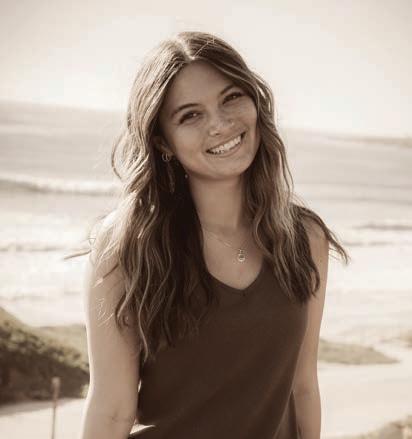
Amanda Monahan Editor-in-Chief


Assistant Editor
Lila Rendel

Production Assistant I
Soliel Lara Aponte

Creative Director & Photo Editor
Betsy Burrow

Assistant Photographer
Griffin Pilcher

Assistant Editor
Nick Charkhedian

Production Assistant II
Alicia Dofelmier

Design Assistant
Lauren Brown
Nina Fife
Tony Gleason
Alexa McGlathery
Christine Park

Production Assistant I Haylie Ross

Production Assistant II
Cristal Soto

Design Assistant
Ella Monte

Sophie Rogers
Karla Suzuki
Rochelle Williams
Michelle Myers
Christina Littlefield, Associate Professor of Journalism and Religion Adviser
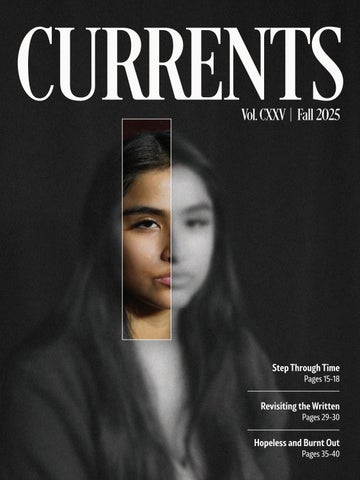
cover modeled by Emi Escobar













Reduced travel time led to the gradual development of businesses and shops.
Malibu is commonly associated with oceanfront mansions, celebrity residents and fancy cars riding along Pacific Coast Highway. But beyond the facade that hovers over Malibu lies a small beach town, populated with a community of surfers, skaters, teachers and families who call it home year round.
One such local is Georgie Topovik, who has lived in Malibu since 2001 and worked in the hospitality industry for nearly two decades. Topovik has worked at Malibu’s beloved Greek restaurant, Taverna Tony, since 2015.
Topovik’s relationship with Malibu runs deep. When he first moved here, Malibu looked nothing like it does now, he said.
“When I came here 20 years ago, there were horses on the beach,” Topovik said. “You’d be walking your dog and they’d tell you not to spook the horses.”
Malibu has an extensive history engraved in its foundation.
“Long before Malibu came Humaliwo, a Chumash village,” said Michelle Myers, a lifelong resident of Point Dume and Pepperdine junior. “Point Dume was sacred before it became real estate gold.”
The construction of the former Roosevelt Highway in 1929 marked a pivotal moment for Malibu’s history of development, connecting the town with neighboring coastal communities.
Today, the smaller, homegrown places that characterized Malibu are mostly gone, replaced by high-end stores and restaurant chains, Topovik said.
“Many of the places that I went to when I was younger are gone,” said Tom Myers, Michelle Myers’ father who has been a Malibu resident for 40 years.
The newer commercial spots — restaurant chains, luxury brands and exercise studios — are morphing Malibu into more of a commercial attraction, curated for visitors.
“I keep hearing about new spots coming to town,” Tom Myers said. “But in the early days, one had to travel through Zuma or Malibu Canyon to get anything beyond basic groceries.”
These newer developments replaced local staples of Malibu, washing away the small-town taste.
“We don’t even have small businesses here in Malibu anymore,” Topovik said. “There used to be all kinds of smaller places, like pet stores and bookstores.”
Malibu keeps expanding its commercial horizons, making it more appealing for newer residents or tourists, yet locals said they wish these changes would slow down.

“For most of Malibu’s modern history, there has been a constant conflict between progress and preservation,” Tom Myers said.
Watching the transformation of a town she grew up idolizing has been difficult, Michelle Myers said. She often reflects on “what once was.”
“Papa Jack’s Skate Park was where Whole Foods is,” Michelle Myers said. “Planet Blue is now Brandy Melville and Coffee Bean used to be where Alfred is now.”
Myers’ childhood memories are a bittersweet reminder of what Malibu used to be.
“I saw ‘The Wizard of Oz’ for the first time in the movie theater that is now Fred Segal,” Michelle Myers said.
Malibu is a small town that faces trials and tribulations. Fires, floods and road closures often slice through locals’ lives. They have become used to the uncertainty of these disasters and grow closer as a community because of it.
“Malibu is prone to natural disasters, but that has never dimmed its light,” Topovik said. “We have a hardworking community, so when anything hits Malibu, we pick back up.”
Tom Myers said he understands this firsthand.
“The majority of Malibu’s residents don’t live in a luxury bubble,” Tom Myers said. “In reality, the commercial spots are relatively new, and most of us who have lived here for a long time know that the real Malibu comes with struggles sometimes.”

Struggles make Malibu’s local community stronger and are a reminder of how fragile the town can be, Topovik said, having lived through eight fires since 2001.
To locals, Malibu in its truest form is not about wealth or fame but a community that sticks together.
“Developers see ash and they smell profit,” Michelle Myers said. “They don’t care about the Malibu families or the Malibu communities.”
As prices soar, exclusivity and luxury replace local spots. Although Malibu

holds its soul, its essence is fading and locals lament the quiet beach town it once was.
“We all used to know each other,” Tom Myers said. “It feels as if the Malibu I grew up and raised my kid in is disappearing.”
His daughter shares this sentiment. There are few places that remain untouched by commercialization that are still private to locals, Michelle Myers said.
“There is a side to the community that not everyone sees,” Michelle Myers said. “Like how locals enjoy a good surf at Little Dume and a skate at Bluffs across from Pepperdine.”
She holds on to the memories she has made with her community throughout the years.
“On summer nights at Trancas, live music plays and the same families that have known each other for decades dance together,” Michelle Myers said. “Everyone is barefoot and smiling.”
As she watches her college friends create memories in the town she grew up in, Michelle Myers recalls memories from her childhood, growing up near the ocean with her friends.
“We learned to spot a rip before it spotted us and to duck under a breaking wave and come up calm,” Michelle Myers said. “By late summer, tan lines were a Zuma badge of honor.”
Michelle Myers said she hopes to
remind people that Malibu doesn’t begin and end with expensive beach houses and luxury stores but with the community and its members.
“I chose to stay in Malibu for college because I love it here,” Michelle Myers said. “It is such a special thing to call it home.”








Asimple press of a button can freeze a sentimental moment forever.
For senior Billy Zhao, a screenshot from a video call holds a special place in his heart.

“[It’s a picture] of me and my nanny, who raised me since I was brought into this world,” Zhao said. “I don’t call her enough ever since I moved to Canada. I went from seeing her every day to now through a phone screen.”


Occasionally, Zhao finds himself going over photographs, looking for the comfortable feeling of nostalgia.
Just like that snapshot of time,

they remind him of the importance of maintaining connections. Other students at Pepperdine feel the same way.
“When revisiting pictures, I always get this overwhelming feeling of fullness in life and embrace it,” Zhao said.
Students said they feel nostalgia when looking at old photographs. It allows them to reflect on the experiences they have already lived and try to reconnect with those moments again.
“When I’m going through an old photo album and come across childhood photos, feelings surface more than the memories themselves,” senior Lynn Kim said.
Zhao described nostalgia as one of the best feelings in the world.
“Regardless of whether it’s sadness or happiness, looking through photos makes me feel like I’ve lived a life,” Zhao said. “It reminds me of the things I’ve done that have made me the person I am today.”
For sophomore Riley Smith, one worn image carries the weight of sisterhood and the warmth of years gone by.

“There’s this picture of me and my sisters that my mom took eating bagels at the beach,” Smith said. “It reminds me of how much I love my family and love watching my sisters grow as the oldest.”
Being the oldest sister of four at the time, Smith said the photo’s warmth makes her acknowledge how much she loves her family.
“I loved growing up with them — it’s such a joy to see them grow and take after me,” Smith said.
Kim said her dad is the reason she started taking pictures, and now, looking back, it makes her relive all the good memories they formed together.
“Growing up, my dad always took a camera with him for our family trips,” Kim said. “I would always take his camera and pretend to be him — now looking back at those photos reminds me how happy I was.”
Capturing the perfect picture can come at the expense of missing the moment. Zhao tries to balance appreciating the “now” with
preserving it for later admiration.
“Taking pictures has recently slowed down,” Zhao said. “I’m trying to be more present in the moment.”
Smith acknowledged the fleeting, priceless moments that can pass by when one focuses on taking photos instead of letting them happen organically.
“When I’m with my friends, I want to bring out my camera when it feels more authentic to be able to capture something more genuine and timeless,” Smith said.
Taking pictures helps remind Zhao of what once was and frames moments that outlast time. He said he often loses himself in a sense of nostalgia.
“Some photos remind me of the state of mind I was in when taking them,” Zhao said. “More significant photos can transport me back to the smell, the taste — all the senses I was experiencing at the time.”
In a world where technology is everything, students said they take pictures daily for autobiographical remembrance.
“I take pictures pretty often,” Zhao said. “My camera roll has around 67,000 photos of my daily life.”
Austrian Researchers Kurt Kotrschal and Leopold Kislinger studied photography in their dissertation, “Hunters and Gatherers of Pictures: Why Photography Has Become a Human Universal.” They argued that the human urge to take, view and share pictures comes from natural tendencies influenced by evolution and technology.
“Photography is part of my self-expression,” Kim said. “It allows me to express how I see the beauty in the moments I’m living in.”
Students document their experiences and deepen their involvement with their community by creating digital diaries using social media and photography.
In one of their last nights as first-years, Smith described how she and her friend, sophomore Keira Kim, created an Instagram account called “memsandmemos” to document their college life and share it with their friends who were leaving to study abroad.
“We wanted to find another way to keep in touch with our friends besides texting,” Smith said. “The account feels like an online scrapbook, perfectly curated so our
friends don’t feel like they’re missing out in Malibu.”
Smith hopes that when she and her friends see each oth er again, it will feel as though no time has passed — as if they’d witnessed each other’s growth in person rath er than filtered through a screen.
“Although all of our friends are on differ ent continents, I want the account to feel as if we are living together but through an online format,” Smith said.
Kim said she created a photography account called “lynns35mm” where she posts pictures taken from her Kodak M35 camera.
“I wanted a creative out let to showcase my photos,” Kim said. “Somewhere I could keep track of all my memories and serve as a digital diary.”

Students use social me dia as a creative way to frame moments that will outlast time. Zhao said photographs help him remember those in tricate details that he might have forgotten had it not been for a picture.
“Some mem ories fade with out photographs,” Zhao said.
“It’s like ev ery time I look at one, it stirs my untapped subconscious and I instantly remember.”


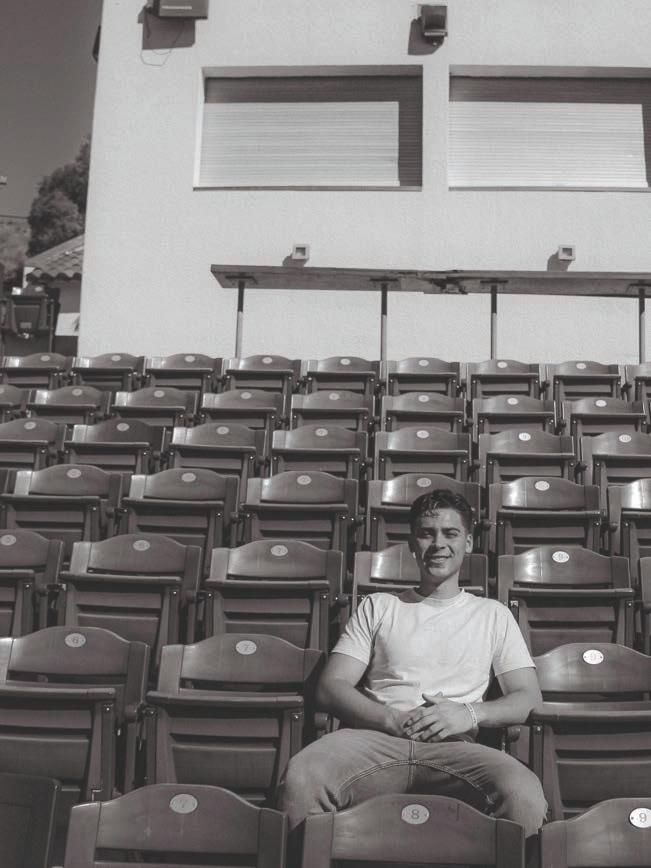
Senior Justin Foster is on track to be the first in his family to graduate college. Growing up, he never thought college was an option for him.
Most people in his primarily Hispanic community in Oxnard went straight to work after high school. In South Oxnard, where Foster attended high school, many schools were underfunded and lacked the resources to support students’ journeys to college.
“I probably wouldn’t have applied at all just because everyone I grew up with, right out of high school, thought, ‘OK, I’m going to join the workforce’ or ‘I have to support my family in some way,’” Foster said. “The majority of my friends are not in college.”
Starting from a place of learning and growth in his first year, Foster’s advisers said he embodies the values of service, academic excellence and determination in all aspects of his college life.
Though his high school had college advisers, there was often a disconnect between the faculty and students. Many students felt the teachers didn’t really understand what the students were going through since they weren’t from the community, Foster said.
“A lot of times, teachers would just thank us for showing up, like, the bare minimum,” Foster said. “There wasn’t a lot to prepare us for higher education. It was kind of like, ‘You guys are here to check the box.’”
“I wrote my essays and she helped me with some revisions, but I didn’t really know much else,” Foster said. “I mean, I looked up online, ‘How do you apply to Pepperdine?’ and found the application through that.”
Foster decided to major in Sports Medicine after shadowing an athletic trainer in high school. With some encouragement from the athletic trainer, he realized he wanted to pursue physical therapy.
In an attempt to support first-generation college students, Pepperdine offers a Summer Bridge to College Leadership Program to help incoming students transition into the rigor of higher education.
Foster was one of 30 students in the first cohort of the program, said Marissa Davis, the previous director of the Seaver Student Success Center.
“Once he came to the Summer Bridge program, he really jumped in with both feet,” Davis said. “He spent the time getting to know his fellow cohort members, making friends.
I remember he attended every information session, even the optional ones, and took the time to get to know all of the different resources and opportunities.”
The program helped Foster hit the ground running, where he became familiar with the campus and well connected with the community.
for help is a big one.”
Chemistry Professor Todd Bennett and Sports Medicine Professor Rachel Tan have been integral mentors throughout his time at Pepperdine, Foster said.
“[Professor Bennett] really cares for the students, and even to this day, whenever I have a life thing, or I’m applying to grad school right now and there are applications, I go to him and talk to him about it,” Foster said.
Foster has found similar support from Davis as well.
“A lot of times, people just need a little boost of encouragement, and sometimes we all just need someone to bounce our ideas off of,” Davis said. “I’d like to think I was helpful to encourage him, but really he’s an amazing kid and took the initiative on his own.”
Davis said the transition to college life and academic rigor can be an adjustment for anyone. For first-gen students, it is often just having the courage to ask questions and navigate the different resources the school offers.
Foster plans events for Pepperdine Athletics, serves as a First Wave ambassador for the Student Success Center and founded the first pre-physical therapy club on campus. He’s also co-president for Love Does in Action, a club that partners with Bob Goff’s organization, Love Does, to do outreach projects across various communities. And off-campus, he works at a physical therapy clinic, Foster said.
“Despite all his accolades and achievements and how busy he is with working, interning, class, tutoring, all the things, Justin is never too busy to help out a fellow first-gen,” Davis said. “He’s very humble and down to earth.”
Foster said his faith and experience as a first-gen student has helped shape his values and perspective on life.
Foster’s father introduced him to Pepperdine because he worked in the warehouse and his older sister helped him apply. He didn’t consider looking for any other colleges to apply to.
“Don’t be afraid to ask for help,” Foster said. “A lot of times, we feel, especially when we’re doing something new, ‘Oh, I should be able to do this on my own’ or ‘I don’t know why I can’t,’ but just asking
JustinFoster , Senior
“It gives you an ability to stop and listen to what someone else is feeling, thinking or even going through,” Foster said. “If someone’s not doing too well, it might not be their fault, might be the circumstances they’re in or around. I know for myself, being first-gen and wanting to give back to people who are in underprivileged communities is a big part of my life and how I want to live my life.”
”


Foster Shines in His Research
Foster conducts research alongside Tan, someone who Foster said is really supportive and constantly pushes him to be his best.
“I was so impressed with how he conducted himself and how curious he was that I invited him to a summer awarded intern research that following summer,” Tan said. “He was, at that time, the youngest researcher that I believe I’ve ever taken on to my group.”
Foster has received several awards and co-authored a publication with Tan, which is rare at the undergraduate level. He’s
worked on four other papers and presented at multiple conferences, Tan said.
Foster is currently applying to graduate school for physical therapy.
“As a physical therapist, you get to help people recover from an injury — it sounds pretty straight up, but in reality, you’re able to restore something that someone’s lost in their life,” Foster said. “It’s where someone feels vulnerable in their life and you get to give that back to them and the confidence over that part of themselves again.”
His continuous motivation in wanting to succeed is for his family, for everyone he grew up with who didn’t go to college
because of their circumstances — to show people who are in underprivileged communities that it can be done, Foster said.
“Don’t be afraid to be your biggest advocate — you’re not always going to have people fighting for you and keep pushing at something even through failure,” Foster said. “Keep advocating for yourself — whether that be trying to get a job, trying to do well in class — keep knocking on that professor’s door until they answer.”


story by Alicia Dofelmier
Every Pepperdine faculty member has a unique story to tell. They each have their own journey of how they ended up where they are and how working at Pepperdine has shaped them along the way.
However, for some, their Pepperdine journeys began long before becoming faculty members. Their journeys began as Pepperdine students who have since returned to help inspire and mentor students the same way they were once guided.
“I feel so lucky that I get to teach and learn as a part of my job and interact with students from all over the world with all different worldviews and backgrounds,” Communication Professor Jennifer Phillips said.
Some professors once sat in the very same classrooms at Pepperdine where their students now learn.
“My experience teaching here has been surreal and a blessing,” Religion Professor Stanley Talbert said. “It’s surreal
because you’re teaching in the same classrooms that you were a student in, you’re colleagues with the same professors you had and it’s very full-circle.”
Talbert graduated from Pepperdine in December 2011 with his Bachelor of Arts in Religion, but he came back to walk with his class in Spring 2012. While at Pepperdine, he was a club convocation intern, a Spiritual Life Advisor, part of the Black Student Association and a member of the Genesis Gospel Choir.
Some faculty members received multiple degrees from Pepperdine, such as Kindy De Long, associate dean of Seaver College and Religion professor. De Long received her Bachelor of Arts in English in 1987 and her Master of Divinity in 1994.
“My experience at Pepperdine was excellent, and the faculty were wonderful,” De Long said. “I grew so much as a scholar and researcher. I also went to Kenya right after I graduated with a group of Pepperdine students to do an internship with a church in Nairobi, and that’s where I first felt a call to ministry.”
During her time as a Pepperdine student, De Long worked on the yearbook, was chaplain of the Pi Gamma Phi sorority, which is now Pi Beta Phi, and directed Songfest her senior year with her sorority and a fraternity.
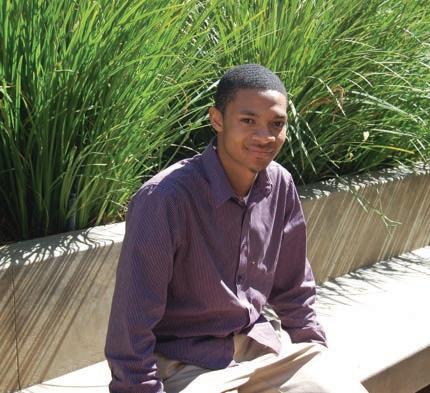
“Those helped me gain leadership experience,” De Long said. “I always encourage students to jump into leadership wherever you can find it on campus because it keeps growing your ability to be a leader when you graduate.”
Upon graduation, each of these faculty members decided to leave Pepperdine in order to forge their own paths before life eventually led them back to where their journeys began.
Charlie Engelmann, senior director of Operations for International Programs, was a class of 2001 graduate.
“Upon graduating, I was not planning, expecting or wanting to stay at Pepperdine,” Engelmann said. “I just felt that you leave college and do other things.”
Engelmann moved to China to teach English as his first job after graduation. From there, he worked in media for a few years and then held a corporate job at Exxon Mobile.
Similarly, Phillips said she also did not plan to stay at Pepperdine upon graduating in 2006.
“I very intentionally did not want to come back to Pepperdine right away,” Phillips said. “I had such a positive experience that I knew if I were to stay that I would be too comfortable. I was offered opportunities to apply for positions, and I turned them down because I wanted to be uncomfortable and see what my degree was worth.”
Post-grad, Phillips taught English abroad in Spain and pursued a double master’s degree in Music and College Student Affairs at Azusa Pacific University (APU). She also worked in student affairs at Cal Poly Pomona, Occidental College and APU.
De Long said when she returned from her post-grad trip to Kenya, she did not know what she wanted to do.
“I answered an ad in a newspaper and got a job as a recruiter of accountants and was promoted to account manager,” De Long said. “I really enjoyed it, and I grew more, but I still felt a call to ministry, and in fact, I was thinking about going back to Kenya to work with a church there.”
During that period of her life, De Long said she was being mentored by
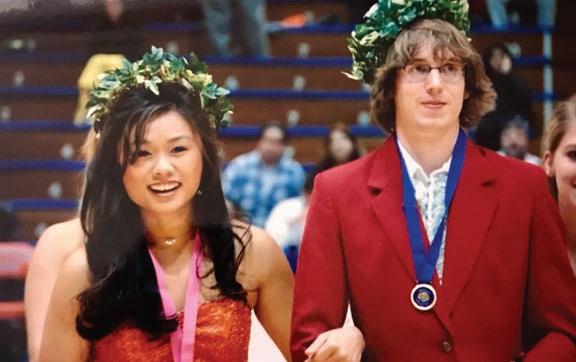
the missions minister at her church, who encouraged her to further her religious education. She decided to return to Pepperdine to work on her Master of Divinity.
Ultimately, each of these four faculty members returned to their Pepperdine roots. Though each took a different path to come back home, they all made the intentional choice to return and inspire the next generation of Waves.
While Talbert was writing his dissertation at Union Theological Seminary, he applied to the Seaver Faculty Fellowship.
“The fellowship is designed for members of the Churches of Christ and is an opportunity to research, receive mentorship and teach,” Talbert said. “I did that during the academic year of 2019-2020.”
Some faculty members, like Engelmann, have taken unconventional paths back to Pepperdine. When he returned to the Pepperdine community, it wasn’t to the Malibu campus but rather to serve as the director of the Shanghai program.
“When Shanghai was first established in 2008, I was there while they were setting it up, and I had met with the dean
at the time and given him some thoughts and advice,” Engelmann said. “I saw the beginning stages of the program, but I did not think that I would ever do it.”
Following his time in Shanghai, Engelmann worked a corporate job at Exxon Mobile, where he said he felt comfort and stability but not fulfillment. It was the most secure he had ever felt in his life.
“I was at church, and the pastor made an off-hand comment that most Americans, if they’re given a choice between comfort and meaning, they will choose comfort, and I felt that I had become too comfortable,” Engelmann said. “I was very much thinking that I needed to change careers, and then I got a Facebook message about being the director of the Shanghai program, which immediately resonated with me.”
However, Engelmann’s journey back to Pepperdine did not end there, as the Shanghai program permanently closed in 2021.
“When the decision was made to permanently close Shanghai, one of the questions was, ‘What do we do with Charlie?’” Engelmann said. “The offer was made to offer me a Malibu-based role, and they kept me on as a part of Pepperdine.”
Phillips returned to Pepperdine to teach while finishing her PhD in Higher Education at APU. She said there are three things that she looks for in a job: the ability to empower students, the ability to do something creative and the ability to work with autonomy.
“Here at Pepperdine, I just feel like I get those three things that I wanted fulfilled in a job,” Phillips said. “I feel like I get autonomy, that I can be creative and that I can build relationships with students and empower them, which gives me such purpose in my everyday job.”
Returning to Pepperdine has been nothing short of wonderful, De Long said. After receiving her Master of Divinity and then her PhD from the University of Notre Dame, she returned as a professor.
“It’s been amazing, life-giving and I’m so thrilled to be able to work somewhere where I believe in our mission and the work that we are doing with students in melding together a faith perspective,” De Long said. “It’s gratifying to be able to help students have the same kind of transformative experience that I had, almost like paying it forward.”



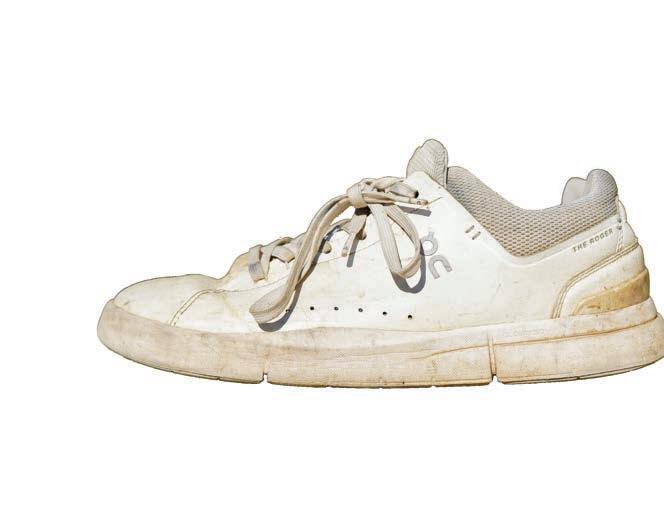
by On Cloud.
“Those shoes went to every country I went to,” Auxier said. “Through
but they had to deal with it.”
Through the multitude of countries and memories in their shoes, Vanderhorst,

Youssef and Auxier have certain experiences that stick out to them.
“They saw a camel in the Sahara, but then they also saw a lion because we got to go to Kenya,” Auxier said. “Those may be my favorite things that I did all of abroad.”
Youssef said he was able to check off a ton of bucket list experiences in his most trustworthy pair of shoes.
“I wore them when I was snowboarding in Zermatt, and snowboarding in the Swiss Alps was like one of my dreams,” Youssef said. “I wore them to Oktoberfest in Munich and then seeing the Northern Lights for the first time in Iceland.”
Even when her Reeboks were the least conventional option, Vanderhorst always chose to wear them. In one favorite memory, her shoes helped her complete a hike up a glacier while studying abroad in Argentina.
“As you can imagine, flat shoes with not a lot of tread on the bottom is not the best idea,” Vanderhorst said. “It was cool to know that my shoes got me up there, and even though it’s only a pair of shoes, it feels very meaningful.”
Even with a few standout memories, the shoes mean so much more to their owners than the little moments they associate them with. For Auxier, he said his On Clouds encapsulate his entire study-abroad experience.
“It’s a reflection of the whole experience,” Auxier said. “They were super worn out, I was super worn out, but also, I love that pair of shoes. They’re sentimental, they’re cool to look back on.”
Youssef echoed Auxier’s sentiment and said he is reminded of the hundreds of miles his Golden Gooses walked every time he looks at his shoes.
“I drew an emotional attachment to them,” Youssef said. “Every time I look at them, I can see some of the scuffs and different markings that were made in different countries.”
Some people’s go-to shoes are impractical for worldwide traveling, but they hold the same power to create an emotional attachment.
“Everyone told me I was silly for wearing them abroad the whole year,” Youssef said. “They held up and looked good when I was dressing them up or dressing them down, and on accident, they became my favorite shoe.”
When junior Kaylee Snyder spent a year studying abroad in Switzerland, which gets at least 100 inches of snowfall a year on average, according to On the Snow, her travel shoes left the entire program questioning her choice of footwear.
“Rainbow sandals were my go-to,” Snyder said. “I wore them in the thick of the winter. I wore them in the summer, no matter the time of day. They were just my go-to if I was running, if I was walking, if I was hiking. I knew I could just take them along for the adventure.”
Not only did Snyder wear her flip-flops in the midst of Switzerland winter, but she took them on every trip she embarked on. From Morocco to Portugal and all the way home to Oregon, Snyder was known
in the program for her Rainbows.
“I was known around the Chateau for only wearing my flops, even in the dead of winter, even when we were told, ‘Stop wearing flip-flops, stop wearing shorts,’” Snyder said.
Despite warnings from other students and staff in her program, Snyder chose her flip-flops every time she had the chance. They were the most comfortable in her collection, but they also meant a lot to her personally.
“It goes back to humility on a deeper level of things,” Snyder said. “Grounding is so important because it’s a humble reminder that we were gifted this planet.”
Many travelers said their shoes are now in rough condition, which can be expected after they traveled the world for months on end. However, Youssef said he glued his shoes together because his connection was too strong to part with them.
“It’s pretty full circle to keep wearing them because I carried all these memories with me as I was making them,” Youssef said. “Now, I get to continue making more memories here, and I’m still exploring and taking every opportunity to make new memories.”
Some students said their travel shoes are in such bad shape that they are beyond saving.
“They started out very pretty, clean and white, and after visiting 22 countries, as you can imagine, they were disgusting and had holes in them and smelt really bad,” Vanderhorst said. “But regardless, they are loved shoes that bring all of my memories with me.”
Although she came to the tough realization that she will probably have to part with her Reeboks, the impact the shoes made on Vanderhorst throughout her travels stay with her, she said.
Vanderhorst plans to honor their journey by writing each country on the inside of the shoes, but to her, they symbolize

much more than the places she’s been.
“Those shoes remind me of finding my independence and my ability to travel,” Vanderhorst said. “Regardless of how torn up and destroyed they are, it’s hard to part with the shoes because of all the memories that they have carried me through.”
Snyder, Youssef and Vanderhorst all said they plan on buying a new pair of the exact same shoe.
“If anything, it’s a continuation of memories that I’ve made in these shoes,” Youssef said. “I don’t think I’d ever get rid of that.”
Before they get to the point of buying a new pair, the students have to cope with moving on from their current pair.
“It would be heartbreaking,” Snyder said. “These shoes helped me in a way of learning to be myself. Wearing them is a humble reminder of the little things that can make you so happy in life and what really fulfills you.”



story by Haylie Ross photos and art by Betsy Burrow design by Ella Monte
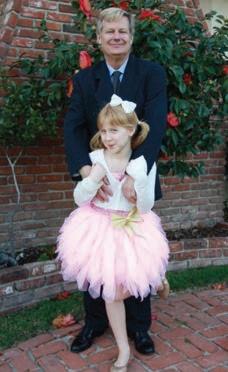
As children grow, they watch their parents as guiding lights. Now that they are navigating their own lives and personal styles, they reflect on the ways their parents have molded them into who they are today.
From the quiet corners of their childhoods, they watched — mimicking the way their mothers put on their heels, how their fathers laced their shoes and how their sisters twirled in mirrors — until, piece by piece, they stitched together a style of their own.
The idyllic eyes of a child capture wonders that often go unnoticed. Eventually, those wonders evolve into the pieces that make them whole.
Watching parents and siblings helps shape people into who they are — influencing not only their sense of style but their sense of self.
“I remember the first day I ever put on a pair of heels for the first time,” sophomore Olivia Christensen said. “And I remember tearing up at the thought that I once idolized the way I watched my mom do this very thing.”
Children see the world from below. They look up to the ways their mothers run a dance studio, how their fathers teach and how their siblings grow into their own people.
Jenn Jacobs, Christensen’s mom, said she never longed to have a girl — she simply wanted a healthy baby. But when Christensen came into the world, Jacobs was forever changed.
“Olivia is my ride or die,” Jacobs said. “I was a single mom [while she was] growing up — she was my little wing man, my little buddy, and she kind of just had to be.”
Throughout her childhood, Christensen would lean over her bathroom sink and watch her mother with eager eyes as she would apply her makeup and change into her nicest clothes.
“I remember seeing my mom in a really pretty dress one time, and that
sticks with you,” Christensen said. “I think as I got older, I would realize my mom’s not putting on six inch heels and a gown every day to go to work.”
This epiphany helped Christensen understand that femininity doesn’t have a dress code.
“It helped me realize that, as a woman, you don’t have to dress up every day,” Christensen said.
Christensen said her mom was a single mother who would choreograph and teach dance all while being a superwoman she always looked up to.
Junior Ben Hoffman views his father through a similar lens.
“Everyone sees their dad as a hero and a protector,” Hoffman said. “And I definitely did.”
When Hoffman was young, he and his family would go on mission trips for his father’s nonprofit, Engineering Ministries International. During that time, Hoffman would watch and admire the way his dad led by example.
Hoffman said his dad’s personal style was never flashy — rather, he would wear the same rotation of clothing and would rarely go shopping for himself.
“I think he always wanted to lead by example, so he never wanted to buy anything fancy and seem arrogant,” Hoffman said.
Although Hoffman shares his father’s simplistic style, he regards them as very different. Yet he doesn’t deny the impact his father had on him.
“There’s probably physical traits that I do copy from him that I don’t even realize,” Hoffman said.
When twin girls, sophomores Ruby and Scarlett Gardiner, were brought into the world, they automatically became best friends.
“I would say having a twin sister as a built-in best friend is an advantage that I sometimes take for granted,” Ruby Gardiner said.
Their mother would dress them up in matching outfits for every event, even if it was simply going to the grocery store.
“I feel like, as twins, we definitely started out dressing similarly because

we grew up with a mom who prided herself on dressing us the same,” Ruby Gardiner said.
Although matching bows and tutus are endearing, especially on twin babies, Scarlett Gardiner said it came with some harmful stereotypes of them being considered the same person.
Through the evolution of their personal styles, Scarlett Gardiner said she has been able to explore her own personal autonomy.
“As twins, you’re told, ‘You’re the same person,’” Scarlett Gardiner said. “But I learned how to really express myself differently, and that came through my fashion.”
Scarlett Gardiner described her style as more of an elevated minimalist aesthetic, whereas Ruby Gardiner emphasized her eclectic vibe and love for a pop of color to add flare into her wardrobe.
Every piece people wear — the clothes, makeup, shoes, caps and jewelry — carries a story. Where they found them, the moments they wore them and the memories stitched between all tell the tale of how they have moved through life and become who they are today.
Hoffman described his father as a storyteller and teacher. He would go out of his way to ensure Hoffman and his siblings were learning to the fullest extent they could.
“I think that kind of influenced me at a young age to try to seek out religion and find my own faith because I saw how much good it caused in my dad’s life and how much good he was doing in the world because of his faith,” Hoffman said.
Hoffman now sees himself walking in those same footsteps, hoping to create a life where he can continue his father’s joy of serving others.
“The work he did was all work that was going toward the common good of people,” Hoffman said.
With a mother who taught dance throughout her childhood, Christensen often saw her mother in workout clothes getting ready to teach her classes. Now, she sees herself walking to her classes wearing similar outfits as her mother once did on her way to rehearsal.
Olivia Christensen
Yet recently, Christensen realized this style mirroring goes both ways. She said


she may leave clothes at her mother’s house and then see her mom wearing the top she left.
Around sixth grade, Scarlett Gardiner started to branch out into a style of her own and developed a passion for singing at the same time. On the other hand, Ruby Gardiner always preferred to express herself through her athletic talents.
“I think Scarlett and I found ourselves and stepped away from just being ‘the twins,’” Ruby Gardiner said. “We were able to find ourselves in another way while still holding on to something as special as being a twin.”
Christensen always admired her mother’s ability to adapt and hustle to get things done. She said she and her mother have always been each other’s best friends.
“She’s the yin to my yang,” Jacobs said.
Having a little girl is something Jacobs will forever cherish. She said she is incredibly proud of the person her daughter has turned out to be.
“Liv is the kind of smart that can’t be taught. She has innate wisdom where she’s so grounded, but she sees people and feels things that I feel like can’t be taught,” Jacobs said. “She’s always been that way. She understands people and sees the bigger picture in everything.”
Hoffman’s father was always active in molding and shaping the man his son would someday become.
“He taught me how to tie my shoes, he taught me how to ride a bike, he was my soccer coach, he was my football coach,” Hoffman said. “He honestly did everything.”
From experiencing kindergarten through college together to now study ing abroad in London, Ruby and Scarlett Gardiner said they are living their lives, learning new things and making memo ries alongside each other.
“We seemed like we had the same trajectory of life,” Scar lett Gardiner said. “But now I think we’re finding the yin to our yang to each other, and we are literally best friends.”
For these individuals, style is more than clothing — it’s the reflection of every person who’s shaped them along the way.
From the mothers who showed grace in the mirror, to the fathers who led with quiet strength, to the siblings who helped them see themselves more clearly — each moment they watched and each lesson they learned
has become woven into who they are. The way they dress, move and live becomes a tribute to them all — a tapestry of love and growth that becomes stitched gently from within.

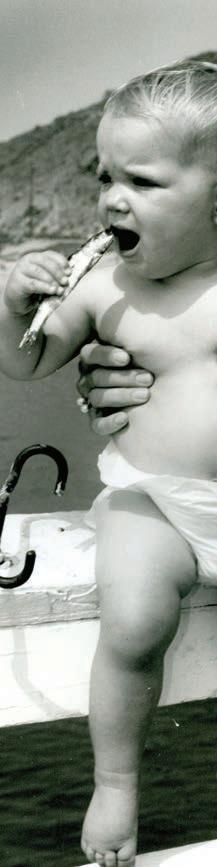






“A Little College to a University”
Pepperdean.”
That was the name East Coasters would sometimes use to misidentify the small Bible college in South Central Los Angeles known as George Pepperdine College, said John Watson, founder of the Sport Administration Program and a 1972 alumnus.
Before the move to Malibu, George Pepperdine College was a Church of Christ affiliate far from its Southern-based denomination. The college was facing financial shortfalls and was strapped for space. Additionally, the college was struggling for survival as growing racial tensions during the turbulent 1960s made it hard to recruit students to the campus. After surviving the 1965 Watts Riots, a campus security guard killed a young Black man, Larry Donnell Kimmons, in 1969.
Administrators praised the move to Malibu in Fall 1972 as a miracle that paved the path to today’s Pepperdine University — an R2 university with five professional schools and 26 national athletic championships.
“I don’t think Pepperdine would have been able to survive another 50 years. I don’t think they could have increased the curriculum. I don’t think they could have been competitive athletically,” Watson said. “I don’t think they could have drawn people for Theatre majors or Science majors. There just wasn’t space to do what you needed to do, and that’s why I think it would have struggled and perhaps not financially be able to succeed.”
In September 1937, George Pepperdine College opened its doors off the corner of 79th Street and Vermont Avenue in Los Angeles to 167 students. The 34-acre campus was home to the University for the remainder of Founder George Pepperdine’s life.
Within less than a decade of Pepperdine opening its doors, the University saw major growth in its student population. The G.I. Bill — which increased university opportunities for veterans — was passed in 1944, and in the years that followed, Pepperdine’s student population grew rapidly from the high hundreds to slightly under 2,000 students, according to Pepperdine’s website.
The University was then faced with a
dilemma. While their population size grew, there was no more room to ex pand. On top of that, Pepperdine was in a tough financial situation.
“Around 1951, George Pepperdine’s personal fortune evaporated in what he called ‘unfortunate investments,’” said Pepperdine historian Sam Perrin, also known as the Ghost of George Pepperdine. “So he lost all of his money, and he was no longer able to be the sole donor to Pepperdine that could single-handedly support the col lege’s operations.”
The University’s Board of Trustees appointed a com mittee to evaluate the next steps for Pepperdine. The committee conclud ed that buying prop erty adjacent to its South Central loca tion would actually be more expensive than building anoth er campus somewhere in the nearby suburbs, according to W. David Baird’s book “Quest for Distinc tion: Pepperdine University in the 20th Century.”


The Watts Riots, also known as the Watts Uprising or the Watts Rebellion, broke out in 1965 and lasted six days, involving 34,000 people and 34 deaths, according to the History Channel.
Pepperdine’s LA campus wasn’t just close to the riots but a part of the action. The National Guard camped out on campus as one of their staging grounds for trying to stop the rioting, said retired Journalism Professor Ken Waters, a 1972 alumnus.

dine history occurred: the death of Larry Kimmons.
“The Watts Riots erupted on the school’s doorsteps. Campus was evacuated, and more than 400 National Guardsmen bivouacked in the Pepperdine dorms. The whole country watched on television,” former Pepperdine President William S. Banowsky wrote in his book “The Malibu Miracle: A Memoir.”
Just four years later, one of the darkest
Kimmons, who was 15 years old, and a group of friends went to Pepperdine’s campus to play basketball, but their plans were cut short by a campus security officer who shot Kimmons in the chest with a shotgun.
Perrin pointed out that Pepperdine’s president at the time, Norvel Young, had been looking for another campus before the Watts Riots — far before the Kimmons shooting — but the events that took place on campus and in the surrounding community brought a sense of urgency to the situation.
“I think it is fair to say that both of those events probably accelerated Pepperdine’s move to Malibu, and the reason for that, to be totally clear, is that Pepperdine was having a really hard time attracting residential students who wanted to come live and study on the Los Angeles campus,” Perrin said. “At the time, a lot of Pepperdine students were members of the Churches of Christ, and [they] tended to come from small towns, from rural areas.”
Despite this outside perception that the area was unsafe, people on campus didn’t feel this way.
“
The options for a new campus had included more than 40 potential properties, but the University had narrowed it down to just three options: one in Calabasas, one in Westlake Village and one in Palos Verdes.
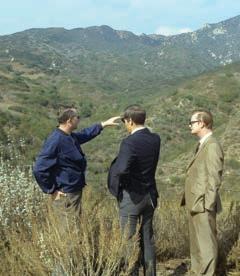
Then, the Adamson-Rindge family donated 138 acres to Pepperdine for a new campus, creating an opportunity for the University to move to the heart of Malibu.
In Banowsky’s memoir, he recalls receiving a phone call from President Young, excitedly telling him that Pepperdine received an offer for land in Malibu. However, the offer was not as simple as it might have initially seemed.

“There’s one huge negative,” Young told Banowsky. “It’s rough and mountainous without any of the basic utilities whatsoever. Some trustees already say site development costs are prohibitive.”
The two then visited the 138-acre site, as Young told Banowsky about the property that had no roads, water, gas, electricity or a public sewer system.

“I never felt unsafe,” Watson said. “My wife lived in the housing right there at 79th Street, and she lived by herself, and she never felt unsafe.”
to them by selling themselves as aligning with their values, Perrin said.
“The emphasis of the University was going to, and did, change to some extent, still staying a Christian institution but also focusing on donors that would help us who are more interested in a conservative, free-enterprise focus of the institution,” Watson said. “That’s what I think a lot of the major donors to help build this campus valued in the Pepperdine curriculum and the philosophy that was being articulated by the leadership.”
At the time, conservatives and corporations were pushing back against previous expansions of the social safety network and new regulations to promote clean air and water that increased taxes and the costs of doing business, as historian Darren Dochuk documented in his book “From Bible Belt to Sunbelt: Plain-Folk Religion, Grassroots Politics, and the Rise of Evangelical Conservatism.” The U.S. was also in the midst of the Cold War, and conservatives sought to promote the freedoms of a capitalist democracy over a communist control of the economy and limitations on individual rights.
While Pepperdine aligned itself with capitalism, Watson pointed out that it didn’t mean Pepperdine students wouldn’t study socialism or communism but rather that Pepperdine brought in speakers who emphasized the positives of a capitalist society.
alibu . Theycallitamiracle.
“I think [Banowsky and Young] visualized a beacon on the hill, from a spiritual perspective,” Watson said. “A place that they could really articulate their Christian faith and educate young people in an environment that could just shine and ultimately shine worldwide.”
While the donation appeared to be ideal for Pepperdine, the rugged terrain would come with financial complications, since Pepperdine needed to build its facilities.
As a result, the University looked to donors within the Churches of Christ, which proved to be unsuccessful. Pepperdine then turned to conservative businessmen in the community, appealing
” WilliamBanowksy , formerPepperdine President
Seaver, widow of oil executive Frank Seaver, was the main contributing benefactor who helped Pepperdine’s Malibu campus become a reality. Seaver donated an estimated $300 million to help develop the Malibu land, according to Pepperdine.
“In terms of the fundraising operation, it was so successful that it has few rivals in the history of American higher education,” Perrin said. “To go from a school as small and unknown as Pepperdine was to what it has become, even just in those first 10 years in Malibu, I think was a tremendous accomplishment.”
Ronald Reagan was an early friend of the University while governor of California and then as president of the United States, helping connect administrators with numerous conservative donors. At the major fundraising dinner in 1970 called ‘The Birth of a College Dinner,’ Ronald Reagan delivered a speech.
“He called himself the ‘bait’ that night,” Perrin said. “Because he knew that if he was giving a speech, he could get all of the wealthy and powerful people in Los Angeles to come here, and they all ended up donating to Pepperdine.”
The current image of Pepperdine is far removed from the older days of being a small, unrecognizable West Coast college.
While Pepperdine was building the Malibu campus, the understanding was that the University would preserve the Los Angeles campus and have a secondary location in Malibu. This dual-campus experiment went on for some time, but ultimately, administrators shut down and sold the Los Angeles campus. At that point, some community members questioned Pepperdine’s values in moving from the inner city to the beachside campus.
“On the one hand, you have the community members who probably did feel like Pepperdine had given up on them. And maybe that’s true,” Perrin said. “On the other hand, you had a lot of people, a lot of Pepperdiners, both faculty and students, staff, who felt that Pepperdine was betraying its own principles, that the reason they came to work at Pepperdine in the first place or came to study [at] Pepperdine is because they wanted to come serve in this underprivileged neighborhood and that they felt that by moving off to live with the movie stars in Malibu, by moving to Malibu, they had sort of shortchanged this goal that Pepperdine had always had.”
Waters was a part of the Pepperdine community during the events of the Kimmons shooting as an undergraduate and stayed with the University as an assistant director to the public relations director and a student during the University’s Malibu beginnings.
“The student body was either apathetic or opposed to the move, and the reason for the opposition primarily was, ‘Wait, you say Pepperdine that you’re Christian, that
you care about the poor, you care about the community that at that time was all African American,’” Waters said. “‘You care about all of these things, and yet you’re running away from the inner city.’”
Although it looked like Pepperdine’s move abandoned the community that it had served for years, that didn’t paint the whole picture.

“There was a lot of resentment from the LA community that we were abandoning them because we’ve been part of that community,” Watson said. “We’ve been serving that community, and we continue to serve them. We continue to serve them even today — our School of Education is down there a lot and working in that community, but it’s not known.”
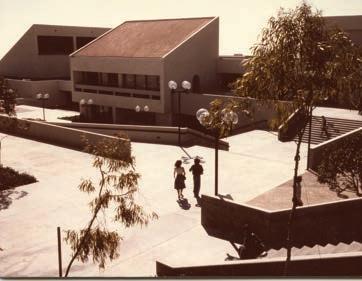
Whether focusing on the pain of the journey or the hope that it provided for the University, the momentous move to Malibu significantly changed the course of Pepperdine’s future. In a 2010 interview about his memoir, Banowsky described the change that Pepperdine went through with this move.
“It was from being a little college to a university, from being 30 acres to 830 acres, from no endowment to Mrs. Seaver’s 300 million dollars,” Banowsky said. “From South Central Los Angeles to Malibu. They call it a miracle.”

undeniably remain.
Amailbox flooded, a ringer turned on, a phone glued to the body — society has grafted these “necessities” onto this generation, the “givens” of living today. Communication has become close to constant in a culture built predominantly on speed and efficiency, fulfilling a deep human craving for easier and more frequent connection. And yet, in the wake of this miracle of communication inundation, traces of emptiness and loneliness and staleness

“With social media and everything with phones nowadays, I think it just takes a lot of the joy out of life,” sophomore Grace Kepes said.
Students echoed how a buzz on the hip can become more of a burden than a blessing and how this might call for a change in their habitual communication.
“Our generation, specifically, I think a lot of people are starting to prefer the older practices of life — it’s less stimulating, less addictive,” Kepes said. “A lot of people in our generation are moving toward the written things because we’re all starting to realize how there’s so much more enjoyment and beauty when life is more simple.”
Some students are taking up writing letters, creating cards and sending postcards in pursuit of slower, more intentional communication.
First-year Grant Folkerts said these written forms provide a meaningful contrast to digital communication.
“Honestly, the more I’m in college, the more I’m on my phone and the more I see a text message, I just click it up and not really respond to it,” Folkerts said. “So with a letter, it’s like, ‘Oh, it’s right here’ — I get intrigued because it’s covered in an envelope, so it’s more of a mystery.”
Folkerts said he keeps a box
“I get intrigued because it’’s covered in an envelope, so it’’s more of a mystery.”
full of the written notes he’s received over the years as they feel more genuine than a simple call or text.
Kepes said the amount of time she spends on her phone can start to desensitize her to the messages received, making a simple text no longer stand out.
“When you get a text of someone saying, ‘I love you,’ it just doesn’t feel real because I feel like you’re just on fake things all day,” Kepes said. “But when you get a letter, it feels so much more real because someone had to think, ‘I feel this about someone, I want her to know how I feel so strongly that I’m gonna do the ex tra 20 minutes that it might take to prove that to her.’”
Grant Folkerts, First-year
actually allow for a new way to connect with loved ones as older methods become more sacred.
“For the older generations, [physical communication is] more of a big deal, so I’ve noticed that it means a lot when I send my grandparents letters and that kind of thing,” junior Abby Rader said. “It’s just a fun way to connect intergenerationally.”
Similar to note-taking on paper versus

something really hard but I can’t really bring myself to say it out loud.”
Rader said her parents would encourage her to write letters to people she was annoyed with growing up, especially her sister, allowing her to slow down and process her emotions.
Whether writer or receiver, old or young, students and faculty alike note the vital nature of keeping these forms alive — preserving humanity, bridging intergenerational gaps and reinstilling reality and intentionality into a desensitized,

DearPepperdineCommunity,
“WhenIopenaletterfromsomeone,itmakesme feelclosetothembecauseit’’stheirhandwritingand theirhandwasonthepaperandtheirpen.”
From,GraceKepes Sophomore









Childhood


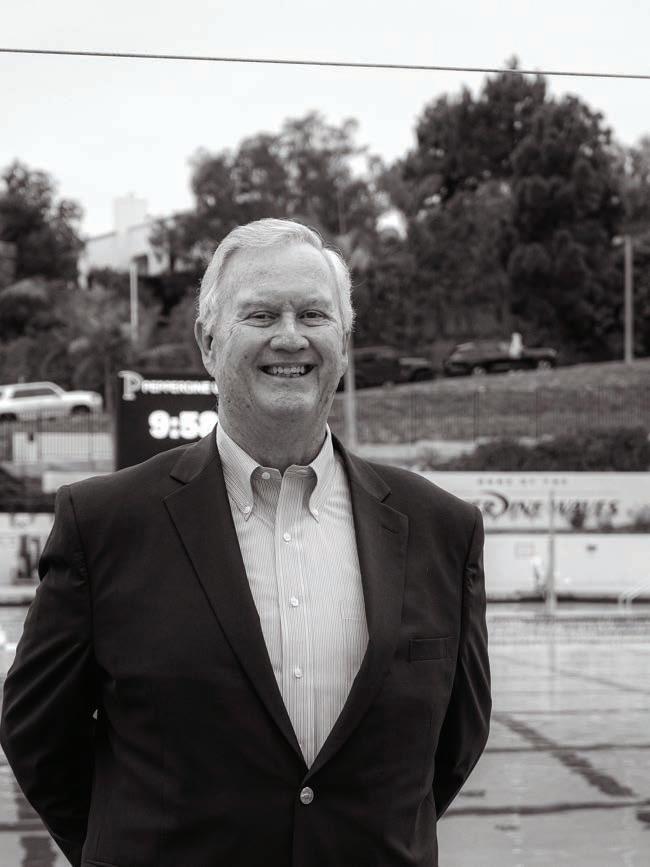
Through his over 50-year career at Pepperdine, John Watson, founder of the Sport Administration program, has seen massive changes. He’s worked under five presidents, was a part of the shift from the Los Angeles campus to the Malibu campus and saw the Malibu campus grow into what it is today, among several other changes.
he saw were vastly different from what students see today. All of the administration was on the top floor of the library, except for the payroll office, which was in a trailer in a parking lot. The Country Mart was a single grocery store, and the area around Ralphs was just a single restaurant called “The Greasy Spoon” and a field.
Watson said he saw the University struggle financially after first moving to Malibu, as Pepperdine had to ask employees to go a month without a paycheck. Despite the struggles, the leadership persisted forward.
“I saw this on the cusp of nonexistence and saw them be able to maneuver us to a place where we maintained our mission and also were able to survive,” Watson said.
“Of all the Olympic sports, this venue was the best, and John Watson put that together with the help of the president,” Dunphy said. “But again, not too many people know that, but everybody brags about having the most beautiful venue of all sports.”
Dunphy said Watson was always supporting the athletes on an individual level as well. Watson was present every day, arriving early in the morning, with an opendoor policy in his office, always willing to listen to anything a student-athlete had to say.
Watson originally joined Pepperdine full time in 1973 and joined the Seaver faculty full time in 1992. Throughout his tenure, he said he has held numerous roles such as director of Athletics, director of Business Services, vice president for Administration and faculty athletic representative to the NCAA, among others.
“It’s been the right place for me, and they’ve been gracious enough to allow me to have a variety of experiences,” Watson said.
Before he began working at Pepperdine, Watson studied at California State University, Long Beach before he was drafted into the Army. Afterward, Watson finished his bachelor’s degree in Political Science at Pepperdine when the campus was still in LA. He then went on to earn his master’s degree in Teaching from Pepperdine in 1975 and doctorate of Education from UCLA in 1984.
During Watson’s time as director of Athletics, he saw the University win two national championships — Men’s Volleyball in 2005 and Men’s Tennis in 2006 , according to Pepperdine Athletics.
While Watson was the director of Athletics, he said there were much heavier restrictions on the amount of athletes who could be given a scholarship. Men’s Volleyball could only offer four and a half scholarships, while some others — like Women’s Swim and Dive — didn’t offer any.
After Watson finished his tenure as director of Athletics, he said he returned to the Seaver faculty in January 2011. When he was the director of Athletics, he saw many student-athletes choosing majors that fit their schedules instead of ones they wanted to pursue.
Watson created the Sport Administration major with the hope that the program would offer opportunities to students who were interested in athletics while also being academically rigorous. The new major began offering classes that blend Business and Communication with specific courses in sports in Fall 2014.
Watson’s open-door policy extended to his students in the new major, always willing to listen no matter the topic, said James O’Callaghan, senior Sport Administration major.
“ I said , ‘ ThisiswhatIwantinmylife. ’”
Watson said he realized Pepperdine was the place for him after arriving at the original LA campus due to the difference in environment between Pepperdine and the Army.
“People on [the LA] campus, whether they knew you or not, greeted you, looked you in the eye,” Watson said. “You felt welcomed and appreciated. There was no more drinking, cussing and all that other stuff, and I said, ‘This is what I want in my life.’”
When Pepperdine first moved to Malibu, Watson said the campus and city
Watson said seeing so many athletes pay to be at Pepperdine but still give their all competing made him equally as proud as the two national championships did.
“It was our duty to be certain they had the quality experience because they were investing their time in supporting us and representing us,” Watson said.
When the 1984 Olympics were held in LA, Pepperdine’s Raleigh Runnels Memorial Pool was the location of the Olympic water polo matches, said Marv Dunphy, Pepperdine Men’s Volleyball head coach emeritus.
Watson, along with then President Howard White, made that happen and brought Pepperdine massive amounts of publicity, Dunphy said.
“I’ve gone and talked to him even when I haven’t been in a class with him that semester, and he’s always there to talk,” O’Callaghan said.
The opportunity to develop students into strong leaders, along with Pepperdine’s mission, has kept Watson at the University all this time, he said.
“When they write the history of Pepperdine University, I don’t know if he would be on the cover,” Dunphy said. “But for me, [he’s] chapter one, two, three because he knows, and he’s given so much to this University in so many different roles.”


story by Amanda Monahan
photos by Betsy Burrow design by Betsy Burrow
Polarization. Right and left. Climate change.
These are words that don’t just appear in headlines, but words that have been a part of Generation Z’s (Gen Z’s) vocabulary since childhood.
Growing into an adult is difficult. Buying groceries, paying rent and cooking every meal for oneself is no easy task. But these issues amount to little when polarization is tearing families and friendships apart, and natural disasters have overtaken the world.
“Regardless of where you are, I think everybody has this sense that there’s something broken and that Congress isn’t really working,” Political Science Professor Karie Riddle said. “Our institutions are kind of just deadlocked, and things are failing, and everybody has anxiety over that.”
Several national polls have found that young people today are more “anxious about their lives, disillusioned about the direction of the country and pessimistic about their futures,” according to New York Times’ reporting. Three Pepperdine students shared their thoughts on their futures in a changing nation.
Senior Evan Inrig said he grapples with a never-ending sense of distress as he looks toward graduating this spring and becoming a “real adult” for the first time. Entering a world that feels so uncertain is daunting, he said.
“It feels like things are gonna go bad quick,” Inrig said. “It feels like a lot of pressure is building, and there’s a lot of short-term changes that I see trying to make some sort of stop, but I kind of feel like it’s a little too late sort of thing.”
Riddle grew up in a family that prioritized being informed and up to date on current events. This sparked her interest in studying political science, she said.
However, this practice sometimes created an increased sense of anxiety.
“I think as I studied political science more, I was maybe even more concerned with what I thought was the erosion of some of our own democratic norms and principles,” Riddle said.
Riddle teaches a Women in Politics course that addresses several difficult topics. With issues like abortion rights and immigration policies, Riddle emphasized a common idea in politics that “the personal is political,” which she described as the tendency to think one’s struggles are individualized, when in reality, those struggles are tied to much larger social and political forces.
“Sometimes in the past, it’s been occasionally harder to get students to really see what that means,” Riddle said. “But now, in this climate where literally everything seems to be political, everybody’s like, ‘Oh yeah, let me tell you about all the ways that politics is infringing on my personal life right now.’”
Junior Molly Sams spent the Spring 2025 semester studying in Pepperdine’s Washington, D.C. program, where she interned for a Democratic representative on Capitol Hill. She started her internship the day after President Donald Trump’s inauguration, which she said was an emotionally challenging time for her as well as the rest of the country.
The first few days after the current administration took over, Sams said the Senate received nearly 16,000 calls a minute, which took a personal toll on her.
“I personally was really discouraged, especially when we started getting all of those phone calls,” Sams said. “Because overall, the American people, I feel like a lot of people were really disappointed after the election. We just lost a bit of hope already.”
Though she was answering calls and talking to people who felt just as disheartened as she did, Sams said she felt the level of political polarization was growing. She believes that social media bubbles often lead people to become more closed-minded.
“When [people are] confronted with something that opposes their beliefs, they automatically consider it as incorrect, false information,” Sams said.
Inrig views social media as a severe issue dividing society, especially Gen Z. The way social media feeds its users information that solely aligns with posts they like or view for a longer amount of time creates an unhealthy online environment, he said.
“I think through social media, it can be very easy to just see one side of someone versus seeing a whole human

being and talking to them as if they’re a whole human being in person,” Inrig said. “It is really good at polarizing people.”
Common Sense
Media conducted a study, “The State of Kids and Families in America 2025,” that found more than half of parents and two thirds of children believe the mental health of children is just fair or poor, with social media being the dominant reason respondents pointed to.
Senior Emi Escobar serves as the president of Pepperdine’s Latino Student Alliance (LSA), which she said is a difficult role to hold during a time of fear within her community. Her primary goal is to create a safe space for people to be able to talk about issues such as Immigration and Customs Enforcement (ICE)
Though she understands every student at Pepperdine grapples with their own challenges, she said being a member of the Latinx community during this time of mass deportations adds an extra layer of distress that no one else can understand.

Despite these struggles, Escobar said she reminds LSA members that regardless of their own stance on issues, being ignorant to opposing viewpoints only worsens polarization.
“I do think it is very important to still understand that people are human and that it feels like we’re very divided because of how easy it is to get outraged at things on social media,” Escobar said. “It leads to even worse compatibility with people, and there’s just no progress if no one’s talking about anything.”
All three students interviewed identified with more progressive politics. Members of the Pepperdine College Republicans executive board did not respond to requests for an interview.
Climate anxiety, which Yale experts describe as “distress about climate change and its impacts on the landscape and human existence,” is an issue unique to current college students’ lives, as they are the first to grow up in a time when climate change is undeniably aggravating weather patterns and wildfires have become more frequent.

not ‘doom scrolling,’ but you definitely are thinking about worstcase scenarios a lot more than the average citizen,” Doran said.
Doran said climate change and political polarization are linked.
“Climate-related issues have become so partisan, politically-driven and dividing our country when they’re just not in other countries,” Doran said. “It’s not that other countries are dealing with climate change better because I don’t think there’s a perfect place where that’s happening.”
While the recent election has sparked anxiety for a wide range of people for an array of reasons, Doran said there’s been an especially large shift in public perception of climate change, especially looking forward.
Escobar said if she could encapsulate her feelings about the current state of the U.S. and world, it would be “hopeless.”
“That’s the word I’ve been grappling with lately,” Escobar said. “Whenever I see something come up, I go, ‘We’re hopeless.’”
A main contributor to her feelings of hopelessness stems from seeing people protest but seeing no real change, Escobar said.
“It’s weird to me because I feel like so many people, more than ever, are standing up against [these issues] and, in their social circles, recognizing that they can be a safe space, but no real action is happening,” Escobar said. “And I don’t know if that’s as a result of the pushback from Trump and his government, or if we’re just not doing enough, but I don’t know.”
“I don’t want to be responsible for bringing something into this world that’s going to watch our world die.”
Molly Sams Junior
Chris Doran, Sustainability Program coordinator and Religion professor, said while being informed on issues like climate change is important, overconsumption of information can lead to increased anxiety.
“When you teach about the issue all the time, you’re probably
“The shift in federal government after the 2024 election has discombobulated a lot of us for a lot of different reasons,” Doran said. “We’re definitely in a fullblown climate denial mode, and I think that’s causing its own type of anxiety for students to think about jobs and futures. Climate deniers now have a far bigger microphone.”
The current federal administration dismantled the United States Agency for International Development (USAID) soon after Trump came to office, Riddle said. Several of her students are drawn to working in that sector of politics, and she felt dumbfounded as to what advice to provide them with.
“I was teaching two sections of my Global Development course, and we were just about to talk about foreign aid, and I have all these things that I’m prepared to say about USAID and its role in the world,” Riddle said. “And then I’m like, ‘Well, wait a minute, it was dismantled last week, so what do I say now?’”
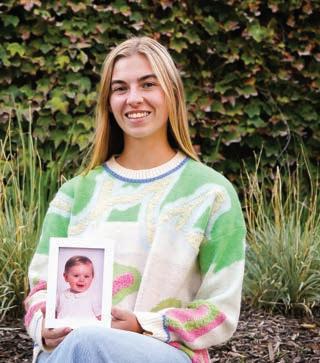
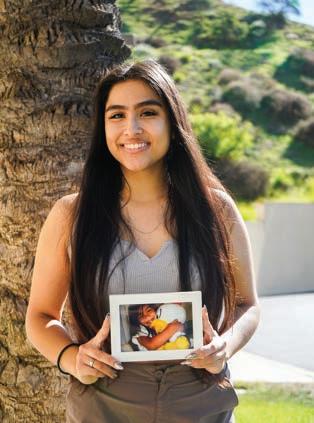
hear all of these stories about op portunity being ripped away from the individuals that live in our country and came to our coun try for those reasons — it was truly heartbreaking.”
Though these issues are in tense and difficult to grapple with, Riddle and Doran both accentuated the importance of leaning on one another during trying times.
“Creating those safe spaces are important and processing that with students because what
acknowledging it, then you’re not creating a chance for trust to be built, and you’re just being dismissive of something that is pretty serious.”
With teaching such heavy topics for an entire semester, Riddle said she tries to provide her students with resources at the end of the course. She is not certain it helps with students’ anxiety, but she feels it is necessary after being “down in the depths” for several months.
“I probably feel more anxious while I’m teaching that class — I’m guessing they feel more anxious when they’re taking it too,” Riddle said.
“But I think you can’t do anything in a world where you don’t know what’s happening, so I think you need to know — I don’t think it’s helpful to put your head in the sand.”
Similarly to Doran and Riddle, Sams emphasized the importance of engaging in conversations with people from a variety of perspectives and being educated on current issues.
“If I understand what’s going on, I’m not afraid of the issue as much,”

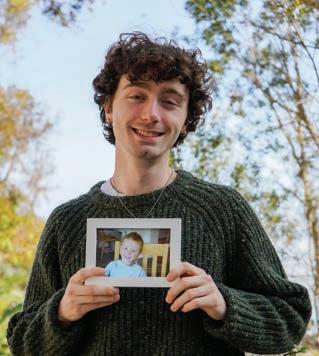
Inrig said that as passionate as he is about these issues, it can sometimes feel difficult to bring up these conver sations, especially at Pepperdine.
“I’m not a very loud-spoken indi vidual to other people about my polit ical ideologies, and sometimes I wish I had more courage to talk to people about ideas and stuff,” Inrig said. “I think it’s a very sensitive line because people can just outburst at any mo ment.”
While having these conversations can be intimidating, Escobar reiterat ed the importance of being educated.
“They always say, ‘Trump hates the educated,’” Escobar said. “We try to be as educated as possible. We try to actually have conversations that will impact ourselves, pull from our class material, pull from whatever we remember and use the information we’re getting for the better.”
According to a survey by Gallup and the Walton Family Foundation, members of Gen Z are “significant ly less likely to rate their current and future lives highly than millennials were when they were the same age.”
Pepperdine students are reflecting this national trend, believing their fu tures may be doomed.
Looking toward the end of their Pepperdine journey and into the be ginning of “the real world,” Escobar and Inrig, though both American cit izens, said they have both considered leaving the U.S.
As the government continues to
this
“The idea of there being more stability in a country, like say Germany, where their economy is not currently as strong as the United States, but it’s not as remarkably unstable as the United States, right now, the idea of living somewhere else does seem more appealing to me,” Inrig said.
“It just keeps building and building, and what does life look like in 20 years if it continues to build at that rate?” Sams said. “I don’t know if I can have a child that would have to see 80 more years of this. I don’t want to be responsible for bringing something into this world that’s going to watch our world die.”


on each other in an even more serious way because it’s going to be a much rougher, bumpier ride with this particular federal administration.”


story by Cristal Soto photos by Betsy Burrow design by Lauren Brown
Elevated style, casual celebrity sightings and its small coastal town charm have made the Malibu Country Mart a cultural landmark since its opening.
For generations both old and young, the Country Mart serves as a community center to unwind and socialize. Junior Clare Mortimer said it almost functions as the city’s town square.
“I really love the Malibu Country Mart,” Mortimer said. “It’s such a good hub of food and shopping and just meeting people.”
However, the original concept for the Country Mart differs from what it is today. Fred Segal, owner of the luxury clothing store, originally bought the land in 1975 with the idea of bringing high-end fashion to Malibu. Malibu as a city wasn’t formally established until 1991, History Professor Megan Kendrick said.
Segal’s presence brought a wave of change to Malibu’s retail identity. Before his arrival, Malibu had been known more for its laid-back surf shacks and beachbum fashion, Kendrick said. However, Segal transformed the former Malibu Colony Motel property into a destination for style.
Segal originally owned plots of land and built up the Country Mart on the north side of Cross Creek Road, including the playground, said Cooper Deani, a long-term Fred Segal employee and Malibu native.
“A long time ago, when Fred Segal started doing the high-end thing in Malibu, it kind of was the first stone,” Deani said. “Now we have Paige over there, the Kith over there — it’s still very competitive in that area with all of the high-end fashion.”
Koss Real Estate bought the property in 1986 and continued this development, according to Los Angeles Times reporting.
Where the Fred Segal store now stands, on the south side of Cross Creek Road,
was a movie theater until 2017.
“The space has been pretty iconic in the Country Mart for a really long time,” Deani said.
Even today, traces of that cinematic history remain.
“That’s why we have these theater curtains,” Deani said. “We’re kind of paying homage to the whole movie theater. We want to get a marquee as well. And we have a little popcorn machine that we bring out sometimes.”
While boutiques like Fred Segal helped redefine Malibu’s image, the Country Mart’s roots are deeply local.
“I’ve been here working for John’s Garden for 45 years,” said José Valle, lead cook at the sandwich shop. “I like it here. Well, there have been a lot of changes from when it first opened, even more now with the fires. A lot of business has gone down. At least 50% of business has gone down.”
Valle said he remembers a very different Country Mart from the one visitors and locals see today. His version was filled with celebrities, Malibu locals and a strong sense of community.
“When the Malibu Country Mart opened, it was so beautiful,” Valle said. “There were a lot of famous artists who would come by to shop as well — Madonna, Charlie Sheen and Martin Sheen are just a few of the artists I would see and serve on the regular.”
There is a strong historical connection between Malibu and the Hollywood stars seeking privacy away from the city. This links back nearly a century, when the Malibu Beach Colony began in 1926 as a small seaside community, according to Topanga News Times. By 1928, it had transformed into the Malibu Movie Colony, according to the City of Malibu.
Decades later, celebrity culture and trendsetting remains part of the Mart’s allure.
“I got to meet Simon Cowell, Kourtney Kardashian and a ton of other celebrities who come in just to feel that kind of community the store offered,” Mortimer said.
Mortimer said when she worked at The Malibu Colony Company, seeing celebrities was a norm she quickly became

accustomed to. Everyone treated them like any other shopper and included them within the community.
Valle said there’s been a decline in lo cal patronage due to the fires and econom ic pressures that followed.
“Now, we’re seeing more tourists than locals,” Valle said. “Tourists most ly come to see the aftermath of the fires. Back when we first opened, there were not that many tourists. Mostly, it was just locals here.”

Between the 2018 Woolsey Fire and the COVID-19 pandemic, many shops faced closure, but the Palisades Fire increased the financial strain.
“The golden years of shopping and retail in this Mart were only a handful of years ago,” Deani said. “Even just after COVID, it was still pretty crazy. I would say the fires were kind of where things started to get rough here.”
Valle echoed this sentiment, recalling the toll on small businesses. The Palisades Fire damage in Malibu was extensive, with 234 businesses damaged and 99 destroyed, according to the Pepperdine
Economic stress led to the closure of several Country Mart businesses, Valle said. This includes The Malibu Colony Company, a locally owned gift shop that had served the community for over 30 years. The final economic blow came after the Palisades Fire, when no one had access to shop at the Country Mart, Mortimer said.
“The store was primarily geared toward locals,” Mortimer said. “When the fires happened, a lot of locals moved out of Malibu or lost their homes. No one was shopping.”
Mortimer said she is afraid the local
shops will be replaced with retail store chains, leading the Mart to lose its charm. While Mortimer mourned the loss of the long-standing store, Valle reflected on what it took for his store to endure.
“I think it’s because business went down and the rent stayed high,” Valle said. “For a while, John’s Garden thought it might close as well. However, they got a lawyer, and all the businesses rallied together so that it wouldn’t close.”
That sense of solidarity is part of what has kept Valle at John’s Garden for so long.
“Even though we have been here for the longest, the owners have changed —
we no longer have that relationship with the original owners,” Valle said. “But it’s comfortable. There are no problems here, and I have it good. It’s peaceful. A lot of the customers know my name.”
For Valle, the Country Mart’s charm is all about the locals. The enduring loyalty between locals and long-term workers has given the Country Mart a sense of continuity amid constant change.
“We have a really lovely relationship with the locals,” Valle said. “They will always come over to say hello to me, and I to them.”
Deani sees that same potential for connection in newer generations. With Pepperdine nearby, he believes students can play a key role in the Mart’s future.
“I’m a firm believer that [Pepperdine students] are going to be the most impactful customers we could have in this area,” Deani said. “We try to cater to them a little bit more — we have a lot of cool vintage stuff, and a new denim brand that these two
young, 20-year-old girls started.”
Both Deani and Valle hope to see more people rediscover the charm of the Malibu Country Mart.
“I would encourage people to come out to Malibu,” Deani said. “It’s still beautiful out here every single day, and there’s a lot to do.”
For newer residents and students, the Mart represents a familiar gathering spot amid Malibu’s slower recovery.
“You might not expect it, but like, there is a lot of community and a lot of love for the Country Mart,” Mortimer said. “These people, they have been shopping there for decades. I think you wouldn’t really expect how important the Country Mart is to locals.”
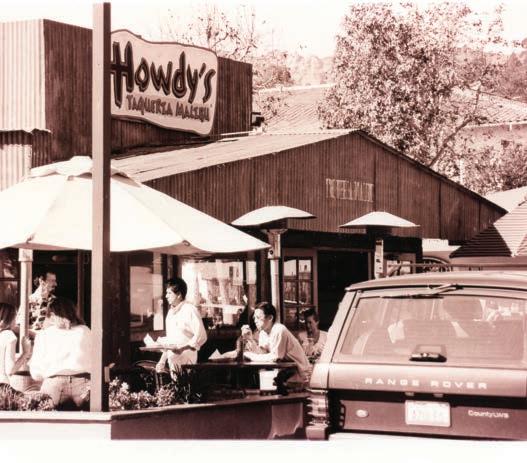


College is a threshold. A place where childhood fades softly into independence.
Between ocean views and crowded dorm halls, students learn to grow, change and carry the small pieces of who they used to be. The echoes of home and nostalgia follow them, tucked inside old trinkets, favorite playlists or the faint scent of something familiar.
“Nostalgia is a sad feeling, but nostalgia isn’t so much about wanting to go back, it’s almost like, ‘I’m grateful it happened,’” sophomore Liam Stringer said.
At Pepperdine, nostalgia lingers for students. Not as something to outgrow, but as something to hold gently, like a thread weaving together past and present.
Childhood traditions are quiet threads that weave identity across generations.
In her Pepperdine dissertation, “The Intergenerational Transmission of Culture Through Attachment-Based Parenting Practices and Their Effect on Child Neurology,” UCLA Neuropsychology Fellow Elvina Chow describes how the smallest rituals — such as stories told at bedtime, family recipes shared in familiar kitchens, the sound of a song on the car ride home — carry far more than nostalgia.
These rituals are the living pulse of culture, passed down not just through words but through tone, rhythm and care.
“When I would drive my brother to school, that’s when we really bonded,” junior Ava Walters said. “He is a bit more
Chow writes that families are “cultural agents” who transmit traditions both explicitly and implicitly, through the warmth of daily routines and gestures of love.
“My family bakes Christmas cookies every year and we like to prank each other by making one cookie that tastes disgusting,” Walters said. “For example, we’ll swap icing for cheese and prank whoever


neuroscience, first-year Andi Barger lives through memory.
“My mom loves the smell of lavender,” Barger said. “So
whenever I smell it, it just reminds me of my childhood and my love for her.”
The scent is more than nostalgia — it’s the imprint of attachment, a thread of culture and love passed quietly from one generation to the next.
The scent of lavender, for Barger, turns the science of intergenerational transmission into something tangible: a single fragrance that carries an entire childhood.
Students carry their childhoods in memories, mementos and the ache of missing those who shaped them.
“If there was really anyone in my childhood who was truly special, it would probably be my dad,” Stringer said. “He passed away right as I turned 18, and when I think of someone who really impacted my childhood, it would be him.”
Stringer, who grew up in Richardson, Texas, said his dad traveled often for work when he was a kid, but the time they shared in between trips made those moments and memories even more meaningful.
“He was probably the most selfless person I’ve ever met, and his selflessness showed my whole life,” Stringer said. “Even at the end of his life, he just cared about others more than himself, always.”
One of Stringer’s most cherished me mentos from his dad is a sealed LEGO Death Star, a limited-edition set he keeps
Stringer said. “I built it and keep it at home in mint condition.”
Alongside the phys ical memento from his dad, Stringer said the smell of the ocean re minds him of his fa ther and the times they shared together.
“I spent every sum mer in Balboa with my dad and grandpa, and the smell of saltwa ter and seaweed takes me back,” Stringer said.
Similarly to Stringer, Barger also threads her childhood memories together with Texas and the ocean.

“I grew up for the first years of my life in Corpus Christi and I lived on the beach, and me and my family used to surf competitively,” Barger said. “It was a good way to hang out with each other and enjoy some friendly competition.”
Walters grew up north of Barger in a small Texas town called Abilene, where she enjoyed spending holidays with family.
“We did a fall fest called ‘Trunk or Treat’ where we converted a chunk of our

according to Texas Highways Magazine.
“The homecoming mums are so funny and they truly remind me of how extravagant Texas is,” Walters said.


said the gift symbolizes their shared passion and the time they spent together.
“Apparently my dad bought it new in 2008 and kept it hidden in his garage until my 18th birthday, right before he passed,”
season in Abilene is her high school marching band playing during Friday night football games and collecting a “mum” during homecoming season.
A homecoming mum is a large, elaborate floral arrangement made with artificial flowers and decorated with ribbons and cowbells. It’s usually worn to a
These special childhood memories and nostalgia have found their way into students’ college experiences.
Stringer, Barger and Walters all make sure to keep their Texas pride with them in Malibu. From keeping the Texas flag hanging in dorm rooms to rewearing clothing passed on from generations, childhood nostalgia lingers.
“I wear my grandma’s boots and my grandpa’s old jacket all the time,” Walters said.
For these Texans, scattered across landscapes but tied by memory, tradition isn’t just a set of customs. It’s a way of staying sewn to home, even as they build new versions of it miles away.
“Nostalgia is the feeling of wanting to go back, knowing you can’t and realizing if you went back that it couldn’t be the same because you and the place have changed,” Walters said. “You are just as different as the place you left.”
Before my feet first touched this sand, The Chumash prayed to sea and land.
They named the tides, the moon, the mist, and lived by what the waves had kissed.
Their voices hum through cliffs and caves, Their echoes dance along the waves.
I feel them here as night gives way, and morning warms the edge of day.
The ocean wakes in golden hue, Malibu calm, eternal, true.
I was tossed in deep when I was small, and the waves became my teacher after all.
They taught me strength, they taught me grace, to move in rhythm, not in race.
No matter what may fall or stand, the sea still takes me by the hand.

by Michelle Myers
When summer fades, the warm winds sigh, their whispers thread through cloudless sky.
The fires burn, yet when they cease, the poppies bloom, the hills find peace.
Malibu’s heart cannot be erased, her soul is wild, her edges traced with salt and sage, with bloom and dune, forever sun, forever moon.
Greed still comes with polished schemes, with silver tongues and profit dreams.
They buy the bluffs, they raise the rent, till locals fade where roots were meant.
They build their glass above the bay, while every tide takes ground away.
Their mansions gleam, but time will prove, the sea decides what she’ll remove.
For salt will creep and metal rust, and glass will fade to wind and dust.
She needs no fence, no man, no crown, her beauty lifts what they tear down.
So let the surf speak loud and near, the song the faithful always hear.
I’ll stand for her through loss and sin, for she is where my soul begins.
Malibu’s grace will never fade, no house or hand can make her trade.
She blooms, she breathes, she will remain, the holy pulse within my vein.
Myers is a Pepperdine junior and a lifelong resident of Point Dume.
by Amanda Monahan






by Betsy
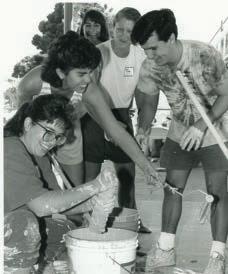
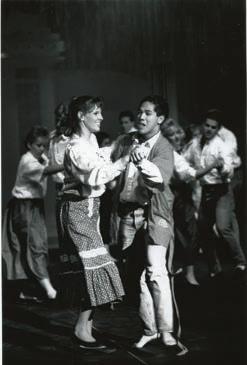


Unlike its larger neighboring schools, Pepperdine does not have many school traditions centered around sports. Instead, Pepperdine traditions have promoted community through events such as Songfest, Frosh Follies and Step Forward Day.
“It’s something that connects people regardless of what year they are at Pepperdine,” said Sharon Beard, interim vice president of Student Affairs.
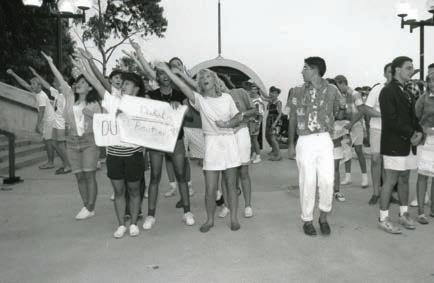
Pepperdine traditions, past and present, shape students’ experiences as a Wave.
Although many traditions are still an active part of students’ experiences, other traditions like Songfest have ended.
Songfest was a spring semester tradition where groups of students participated in a competition for the best 12-minute mini-musical that incorporated the year’s theme into the story, said Chris Stivers, the former music director of Songfest. Stivers is also a Pepperdine alumnus and former Communication professor.
Stivers said the nearly 50-year-old tradition revealed a new side of students.
“The groups put this on on a shoestring budget,” Stivers said. “So they’re very creative about costumes and makeup and scenery and all that sort of thing.”
In working together on Songfest, many students met new friends and created a sense of community within their performance groups, Stivers said.
“For just the average participant, [they might think], ‘This is a chance for me to work on something meaningful with a bunch of students who I may have never met before,’” Stivers said.
Songfest evolved from a tradition known as Spring Sing, which Pepperdine hosted during its time in West Los Angeles, and it became known as Songfest when Pepperdine moved to Malibu in 1972.
“It started off very simply, of course,” Stivers said. “But then [it] rapidly grew into something with, you know, there have been years when we had up to 500 students performing in Songfest.”
After the COVID-19 pandemic canceled Songfest in 2020, University officials laid off the director in 2021. A single student group produced its own performance in 2022, after which Songfest faded from student memories,


according to past Graphic reporting. While Stivers said he does not anticipate Songfest’s return, he believes the event will live on in alumni’s memories.
“The mountain-top experience where you’re just so excited about being alive at that moment, that is the thing that you’re gonna remember,” Stivers said.
Frosh Follies Helps First-Years Explore Pepperdine Culture
Senior Angel-Tien Nguyen has been a member of Housing and Residence Life (HRL) for three years. This has allowed her to participate in Frosh Follies for the last four years as a first-year student and then as a Resident Advisor (RA) and Spiritual Life Advisor (SLA).
Frosh Follies is a skit that first-year houses put on to tell the story behind certain aspects of Pepperdine. Participating in Frosh Follies is a bonding experience for many new students, Nguyen said.
“I love how close it gets people,” Nguyen said. “It’s the only thing that people talk about for weeks after.”
Frosh Follies has been a part of New Student Orientation (NSO) for decades.
However, in the last three years, the subjects of the skits have shifted.
“It used to be more about things that students actually experienced on campus,” Nguyen said. “I think now it’s more of the history of Pepperdine.”
Even with the evolution of this tradition over time, the goal of bringing students together to bond and learn about Pepperdine is still the heart of Frosh Follies, Nguyen said.
Step Forward Day Emphasizes Pepperdine’s Mission of Service
In 1988, a group of students started Step Forward Day — an annual Pepperdine tradition that takes place every fall semester.
“Step Forward Day is both kind of the grand gesture of the University, as the annual day of service,” said Christin Shatzer Román, director of Community Engagement and Service. “It also is hopefully planting a seed for folks that they can continue to be involved.”
For many participants, Step Forward Day is their first opportunity to get involved in the Malibu community and serve others.

“I really like boots-on-the-ground service,” first-year Libby Parkins said. “Being able to go and work with people, work alongside whatever community that you’re trying to help [and] not seeing from a help standpoint [but] more of a solidarity standpoint.”
While Step Forward Day aligns with Pepperdine’s value of service, this tradition extends beyond the Malibu campus.
“Whether it’s Houston, Las Vegas, San Francisco, Nashville — alumni chapters that are active in those locations look to do a Step Forward Day together every year as well,” Shatzer Román said.
Spending the day in service allows students to learn something new as they serve a greater cause. These experiences often help students see beyond themselves and into the greater community.
Step Forward Day 1990

“I find it to be such an eye-opening experience for all of our volunteer participants,” Shatzer Román said. “It provides a window into understanding ei ther a nonprofit organization bet ter or understanding a community better.”
Frosh Follies 2019
“Traditions can convey the values of the student body and also of the greater school community, and it can kind of communicate that to a broader audience,” Parkins said.
However, for many students, Pepperdine traditions feel reflective, as they look at how much they have changed from year to year as a tradition comes around again.
“[It’s a] full circle moment — some people might appreciate it as the chance to see, like, ‘OK, here’s me freshman year, and then here’s me senior year,’” Nguyen said.
As the University grows, Pepperdine is creating new traditions for the next generation of students. Pepperdine’s newest event series, Late Night Lineup, is some
“I think it will be developed into a tradition,” Beard said. “It’s not a tradition yet, but it will be.”
Traditions, new and old, are formative parts of what it means to be a Wave and help form students’ strongest Pepperdine memories.
“It helps us recognize certain moments in time or helps us mark the academic year,” Shatzer Román said. “Whether it’s a beginning or an end, I think it allows us just to be a little bit more present.”
Step Forward Day helps stu dents serve communities around the world, and the tradition hopes to continue expanding its impact,” Shatzer Román said.
The spirit behind school traditions is that they should be memorable events that shape how students think of Pepperdine as an institution.


Institutional leaders tend to portray their organizations as equal and inclusive — but that is not always the case. Women faculty members at Pepperdine face many unique challenges, striving to pave the way for women in higher education.
Professors said it can be difficult to gain respect from their students, receive recognition for their work and be represented in higher administrative positions.
“I do have a degree and authority and should get respect from those things that I’ve earned in the classroom,” Communication Professor Sarah Stone Watt said.

Whether on the student or administrative side, women faculty members explore how they must overcome inequality to reach their full potential.
For women faculty, it can be difficult to maintain a balance between approachability and authority. Students sometimes perceive their female professors as less professional than their male counterparts, making it harder for women faculty to feel as if they receive the respect they deserve, faculty said.
Sociology Professor Anna Penner said she
believes women faculty should not allow students to call them by their first names because it can undermine their authority with students.
“If [students] call me by my first name, that gets too casual,” Penner said. “I need either a ‘Doctor’ or a ‘Professor’ there. Please don’t call me Mrs. Penner. I earned this degree, and I am an expert in these fields.”
Other women faculty have faced the same struggles and said they have had to navigate them with time.
“I think I struggled with [balancing approachability and authority] when I was younger and more worried about that boundary,” Psychology Professor Jennifer Harriger said.
Harriger said she has become more maternal to her students while still maintaining professionalism and boundaries.
“I have teenagers who are not that much younger than my students. I think that has made me become a little more maternal to my college students,” Harriger said. “I’m going to care and I’m going to listen [to students] but also make sure they are doing the work that is required for class.”
Beyond their titles, women faculty also face challenges with student feedback on course evaluations. There tend to be more comments surrounding women faculty’s physical appearance and personality rather than their ability to teach.
Penner said she has dealt with

microaggressions from students.
“You see things like not being taken as seriously and not being seen as credible or authoritative,” Penner said.
Rate My Professor is a platform where students can leave comments and reviews about their professors. Stone Watt said she has noticed male faculty receiving more objective reviews, while women faculty are more often targeted for their appearances or emotional tendencies.
Stone Watt said one of her female colleagues received a course evaluation that said, “You remind me of my Sunday school teacher.”
She said comments like this helped her understand, early in her career, the complex dynamics between female professors and students.
“If you look into the website, you’ll start to see there are huge gender discrepancies in the ways that students evaluate faculty,” Stone Watt said.
Beyond the students, University administrators also play a role in making women faculty feel equally valued and respected.
Penner said that while the University does a good job supporting women faculty in some areas, there are also areas where Pepperdine could better support women.
A major setback is supporting women as parents. Penner said she wishes the
University offered on-campus childcare or better accommodations for women on maternity leave. Pepperdine offers grants that offset the cost of care for faculty.
Penner said these grants are said to be up to $5,000, but she has never received more than $1,500 — the equivalent of one month of childcare for her preschooler.
“[Childcare] is one of those things that other faculty [understand] and the administration doesn’t,” Penner said. “That is going to predominantly impact women because women are typically engaging in childcare more than men.”
Penner said it is harder for Pepperdine administration to understand this struggle since they are typically paid more and can better afford childcare.
Other female faculty members feel they are expected to do more service, pointing to the issue of gender. Faculty’s time spent guiding and supporting students outside of class is one of the services they provide.
“My favorite students were coming in and telling me about a crisis or something like that,” Stone Watt said.
Stone Watt said women faculty spend more time with their students, taking away from their research. She said these situations are typically overlooked.
“There is a lot of informal mentoring and just being with students, which is really the thing Pepperdine faculty are known for,” Stone Watt said. “But female faculty are doing a lot of informal conversations.”
Stone Watt said this is difficult be-

cause she doesn’t want to complain about being with her students, but it can be hard as a woman when so much service goes unnoticed.
Pepperdine has a significant number of women faculty, but this number becomes scarcer as positions rise in the ranks.
President Jim Gash, who initially received criticism regarding the gender equality in his cabinet, has worked to make this gap more proportionate, Stone Watt said.
The Pepperdine University Executive Leadership team currently consists of 10 men and six women. Of 10 academic deans, four are women.
“There are relatively equal numbers of men and women hired at an assistant level,” Harriger said. “But more men get promoted to tenure and are in higher positions like administration compared to women.”
English Professor Maire Mullins, who previously served as the divisional dean of the Humanities and Teacher Education Division, said she would like to see women in positions of higher authority at Pepperdine.
“[Positions like] the dean of Seaver College, provost of Pepperdine or president of Pepperdine,” Mullins said. “It would be nice to see that women could do those leadership roles, and I think that
there are women who are very capable.”
Stone Watt, former divisional dean for Communication, said most of the female faculty are clustered around lower-level positions — like assistant or visiting professors — and men are more represented at the top.
The issue isn’t about women getting hired; it is about women being trusted with the same roles as men.
“It is diverse but not at the levels it should be,” Penner said.
Even though women faculty pointed to ways in which Pepperdine can improve its support, there are also some systems in place to address the hardships they face.
Mullins, who wrote the proposal for the Committee on Women Faculty, said the committee is a source of help and support in representing women faculty at Pepperdine.
“[The committee] used to advocate [maternity] leave for women as well as grants for faculty,” Mullins said. “All of those things have now become a part of the institution.”
The Committee on Women Faculty has helped several women faculty members feel represented and heard in their concerns. Both Stone Watt and Mullins said the committee’s work has been extremely helpful.
“One of the things they do is have a
Women’s Leadership Award every year in a banquet,” Mullins said.
Harriger said she had many experiences as a junior faculty member where senior-level faculty members looked out for her. She appreciates the Psychology department’s efforts to create equality across the board.
“Our Psychology department does a great job of supporting both young faculty and men and women,” Harriger said.
Pepperdine has a significant number of women faculty members who have climbed to leadership positions.
Stone Watt said she had several mentors earlier in her career who, at the time, she didn’t even realize were helping her grow. Now, she strives to pass this on to her own students.
“Look around at the people who you see doing the things you want to do and go ask them how they ended up doing what they do,” Stone Watt said.
Stone Watt said she almost always says yes to people asking her to mentor them. Mullins said mentors help young women grow further in their careers.
“My advice would be to be resilient, to follow your heart and find really good mentors who are willing to work with you and who want to see you succeed,” Mullins said.

“Create the stories that will someday become history.”
Amanda Monahan Editor-in-Chief