

CHARTING THE COURSE
Risk Isn’t the Enemy but Misunderstanding it Can Be Costly
By Mitch Siegler, Senior Managing Director
Some investors think of risk like a contagious disease. Risk is something to be avoided, neutralized, hedged or minimized. Investment firms trumpet their “risk management” departments and strategies for reducing volatility.
But here’s a little secret: not only is risk unavoidable, but it’s also a key building block for generating investment returns. No risk, no return (or only the bare minimum “risk-free return”). In an environment of perfect information and zero uncertainty, there would be little in the way of investment opportunity or unique advantage (“alpha”).
The real challenge for investors isn’t eliminating risk entirely. Rather, it’s understanding the level of risk you’re taking on and distinguishing between risks that matter a lot, risks that may matter a little and perceived risks which may actually be opportunities in disguise.
Risk and Volatility Aren’t the Same Thing
Modern financial theory often equates risk with volatility (e.g. “beta”) – prices moving higher or lower. Often, stock prices or asset values which fluctuate dramatically are seen as “risky,” while those that stay flat or operate within a narrow range may be considered “safer”. That’s not always true. Volatility measures movements in price or value. True risk reflects the likelihood of permanent loss. Those are very different concepts.
In our world, when the value of an apartment declines 10% following a spike in interest rates, there’s volatility, which is tough to control. That’s very different from the apartment building across the street which is financed with excessive leverage which forces a distressed sale –that’s risky. The former is uncomfortable. The latter may be existential.
Investors who conflate volatility and risk often make poor decisions, like rushing to sell good properties during

periods of temporary turbulence. A steady hand on the tiller and a patient mindset help take emotions out of decision-making and temper volatility – ultimately reducing risk over the long haul.
The Most Dangerous Risks: Those You Don’t See
Think of risk like an iceberg. It’s not the tip that’s visible above the surface that should most concern you; it’s the much larger piece hidden beneath the surface that can sink you.
True investment risk rarely arrives dramatically. It doesn’t announce itself with flashing lights or ominous headlines. Instead, it creeps in quietly through assumptions which feel reasonable at the time. Like Hemingway wrote about how bankruptcy happens in “The Sun Also Rises” –gradually, then suddenly.
That’s why we build pro forma analyses when we acquire a property which include sensitivity analyses. What if rent growth is just 2% instead of 4%? What if exit capitalization (cap) rates are 5.5% instead of 5.0%? What if renovation costs are 120% of budget? By modeling various scenarios, we better understand downside cases making us less prone to nasty surprises. Sensitivity analyses mitigate risk in the sense that they help you think through various scenarios up-front to reduce unpleasant surprises.
As we enter our 20th year in business, we reflect on a few market cycles we’ve navigated: the Great Financial Crisis (2008-2010), the Pandemic (2020-2021), periods of spiking inflation (2021-2022), rapidly rising interest rates (2022-2023) and “pencils down”, when Pathfinder and many other disciplined investors did not transact (spring 2022 to fall 2024). We also recall a few widely

understood truisms, many of which proved to be canards, including:
“Don’t worry, interest rates will remain low.”
“Aw, liquidity will always be available.”
“C’mon, cap rates only move in one direction.”
“We’ll always be able to refinance.”
Trees don’t always grow to the sky. Markets – like tides –ebb and flow. Risk is always present, even if it’s not visible or apparent.
While the future rarely behaves just like the recent past, we can learn from prior cycles. Markets shift and many asset classes – including real estate – can be cyclical. Interest rates rise and fall. Supply can spike or fall and demand can also shift.
Ironically, many investors feel more comfortable when stock prices or asset values are at peak levels since they’re in good company. Ironically, these are often the more dangerous times when risk is most concentrated. In stable periods and especially when values are rising, investors feel confident. This may cause them to take on more leverage and other risks. That leads to conditions of fragility.
Conversely, when values are falling or at low levels, investors may feel dispirited or lonely. They’re loath to double-down or to take on additional risk or leverage. Ironically, that’s generally the best time to do so since the entry point is lower and margin of safety (a timeless concept popularized by legendary investor Benjamin Graham) is higher.
Leverage: Risk’s Favorite Multiplier
Leverage is neither good nor bad – it simply amplifies outcomes on the upside or the downside. When everything is moving right along or prices/values are moving higher, the highly levered investor couldn’t be happier. When markets are moving in the other direction, the feeling is the opposite. Leverage magnifies outcomes: small misses can have large consequences. We’ve observed that investors who are aggressive in their use of leverage are often also aggressive about their operating assumptions and flimsy when it comes to building in cushions – like sufficient property/casualty insurance and adequate contingencies for construction cost overruns. Similarly, investors with a predilection for stretching limited equity with excessive debt often also prefer floating rate debt to fixed rate debt

(the former can be less expensive and is generally available at higher leverage) and unwilling to pay a premium rate for a longer loan term – causing them to be caught short in down market cycles.
Investor Mindset Plays an Outsized Role
Each investor brings his or her personal biases and experiences to the party. Some investors are naturally fearful, others exceedingly greedy or overconfident. Great investors are unemotional, with ice water in their veins. They behave with the same discipline in good and bad markets alike. They are intentional about decision-making, consistent about the size of investments and thoughtful about portfolio construction and diversification. They also are disciplined about using risk mitigation strategies like sensitivity analyses, insurance and cost contingencies.
As Warren Buffet famously said, “buy when others are fearful, sell when others are greedy.” Hedges and derivatives can offload risk but there are generally no better hedges than patience and a steady temperament.
Playing it Too Safe is Also a Form of Risk
A ship is always safest in the harbor but that’s not what ships are built for. Similarly, an investor can invest 100% in cash (treasury bills, bank CD’s or Money Market Accounts). But, over time, inflation may eat up these “risk-free” returns, leaving the investor’s capital impaired. That’s why a well-diversified portfolio often has shorterand longer-term investment horizons and investments with more and less risk (and by extension, higher and lower return profiles).
Like the ship which never leaves the harbor, the investor who stays entirely in cash is guaranteed to see his
principal erode over time. And the investor who tries to time the market – buying when he thinks it’s a low and selling when he thinks it’s a high, usually doesn’t fare as well as the investor who remains invested through market cycles. Waiting for the perfect moment rarely works over the long haul. Risk mitigation strategies are appropriate but those seeking to avoid risk entirely often have a roadmap that causes them to miss out on opportunities. Astute investors do not seek to eliminate risk entirely but rather to choose which risks are worth bearing, which ones should be avoided, and which signal misunderstood opportunities.
Complacency Can be Risky
Extended periods of good times can lead to complacency, which can cause less experienced investors and operators to take on more aggressive postures – which can have disastrous consequences. We see that in economic cycles and in markets.
It is said that tough times create strong leaders, strong leaders bring about good times, good times lead to weak leaders, which bring about tough times. There’s a similar dynamic with markets and investors. Challenging times create investment discipline, leading to strong long-term performance. Good times (think easy money) can lead to undisciplined, even dangerous decisions (excessive leverage, overly rosy assumptions), producing poor investment results.
When things feel easy, investors can become complacent. What follows can be transaction volumes and pricing hitting record levels – and it’s in these moments that risk
may be elevated. When the environment is challenging, financing is scarce and good opportunities are hard to find. At these moments, transaction volumes and pricing are falling or hitting new lows and astute investors take this as a sign that there may be opportunities to find value, to buy well.
In the wake of the rapidly rising interest rate environment of 2021-2022, we experienced a couple of lean years when transaction volumes plummeted and few acquisitions made sense. As noted above, we were “pencils down” from spring, 2022 through fall, 2024. The multifamily investment market began inflecting about 18 months ago and we’ve made five acquisitions since then. The interest rate and operating environment today is rather different from just 18 months ago and our mindset about acquisitions reflects that shift.
Risk is not about predicting storms. And the ship was not intended to spend its life in a safe harbor, though that’s a comfortable feeling in rough weather. We build ships to survive rough conditions and recognize that stormy weather can create memorable voyages – and opportunities.
In investing, the goal should not be avoiding uncertainty or risk, which will always be with us. It’s learning how to navigate in and profit from it.
Mitch Siegler is Senior Managing Director of Pathfinder Partners. Prior to co-founding Pathfinder in 2006, Mitch founded and served as CEO of several companies and was a partner with an investment banking and venture capital firm. He can be reached msiegler@pathfinderfunds.com.
FINDING YOUR PATH
Pathfinder Partners at 20 Years: Some Lessons Learned
By Lorne Polger, Senior Managing Director
A 20-Year Partnership with Investors
Twenty years ago, we founded Pathfinder Partners on a simple but enduring commitment: disciplined investing, transparency, and true alignment with our investors. From the outset, we focused on protecting investor capital, generating consistent risk-adjusted returns, and navigating both strong and difficult markets in a prudent fashion.
Over two decades, we have invested through multiple market cycles – the Global Financial Crisis, the long recovery that followed, the pandemic, the period of rapidly rising interest rates, and now an environment presenting distressed investment opportunities. Each phase tested different aspects of our strategy and reinforced the importance of patience, discipline, and selectivity. There have been periods when we fully deployed our capital and periods when we chose to wait on the sidelines. Both proved equally important to longterm success.
Six Things That Served Us Well
1. Strong Team and Good Governance Created Stability
Early in our history, we understood both our strengths and our limitations – particularly in underwriting, analytics and asset management. During the financial crisis, when distressed opportunities were abundant but uncertainty was high, we implemented clear investment guardrails across our funds, including well-defined investment return thresholds, tight geographic focus and defined time horizons.
We also strengthened the team by adding professionals whose skills complemented our own and formed an Advisory Council in 2009 comprised of experienced industry leaders. The Council has consistently challenged

our assumptions and provided perspective during key inflection points. In several cases, choosing not to invest preserved capital and positioned us to deploy into stronger opportunities during the downturn. In other cases, guidance about leaning in harder and taking a more aggressive posture served us well.
2. Conservative Leverage Protected Investor Capital
During the 2008–2010 financial crisis, many real estate investors faced severe distress driven by excessive leverage and recourse debt. With no legacy portfolio at risk, we chose a different path – moderate leverage and predominantly non-recourse borrowing. This approach allowed us to maintain stability, avoid forced sales, and hold properties through volatile periods. Predictable cash flow and manageable debt levels proved critical in protecting investor capital during uncertain times.
3. Never “Betting the Farm” Enabled Resilience
We have consistently avoided concentration risk – by geography vintage or individual investment. Even strong markets experience cycles, and diversification across regions helps mitigate volatility. We declined large portfolio acquisitions that, while attractive on paper, would have concentrated too much capital in a single area. This discipline reduced the risk of a single investment materially impairing the fund or broader portfolio.
4. Self-Reflection Improved Performance Over Time
Not every investment performed as expected. In one instance, we entered a market where strong demand and limited supply quickly reversed, compressing rents and delaying value creation. We analyzed the trendlines, reassessed our market selection framework and shifted out of that market for new investments. We are continually
assessing existing and new markets to maximize risk adjusted returns.
We study both our successes and our setbacks carefully. Continuous learning – combined with empowering our team to grow and evolve – has strengthened our investment process and helped make us better investors.
5. A More Focused Investment Strategy
In our early years, we invested broadly across residential, industrial, retail, hospitality, land, and development, and across both for sale and rental housing. Over time, performance data made one conclusion clear: our strongest and most consistent results came from improving existing rental housing –particularly suburban workforce housing.
By 2020, we made the deliberate decision to exit non-core strategies and concentrate exclusively on workforce multifamily properties. This sharpened focus has improved execution, reduced risk, and strengthened long-term performance.
6. Investing in People Strengthened the Firm
We have been fortunate to build a team with exceptional longevity. Turnover is one of the greatest hidden costs in any organization, and we have largely avoided it by fostering a culture of accountability, growth, and entrepreneurial thinking. Team members are encouraged to take ownership, accept responsibility, and learn from both successes and failures. This culture has been instrumental in Pathfinder’s durability and progress.
Our Strategic Pivots
Experience has reinforced the importance of focusing on what we do best. Earlier in our history, we explored adjacent strategies that produced mixed results and diluted our competitive advantage. By refining our approach – focusing on markets, asset types, and operating models where we possess deep expertise – we improved the consistency of our performance and our business plan execution.
Following the post-financial-crisis recovery, for example, we shifted toward value-add investments in markets with strong population and job growth rather than pursuing development-heavy strategies. This pivot produced more
predictable outcomes and reduced risk exposure during uncertain periods.
What We Might Have Done Differently
One area of ongoing reflection involves capital structure. Since 2007, we have primarily utilized commingled fund structures rather than deal-by-deal syndications. While syndications offer selectivity that some investors prefer, discretionary funds provide portfolio diversification and allow faster execution during periods of market dislocation – such as 2009–2011 and today – when speed and scale are essential.
This is not regret, but perspective. Every structure involves tradeoffs, and the key lesson is ensuring alignment between capital structure, strategy, and market conditions.

Looking Ahead – The Next 20 Years
While experience is invaluable, long-term success depends on continuity and thoughtful evolution. Through mentorship and leadership development, Pathfinder’s next generation is already assuming greater responsibility across investments, operations, and investor relationships. Our objectives: preserve our culture of discipline while embracing innovation.
Technology, particularly artificial intelligence and advanced data analytics – is rapidly reshaping how we invest and operate. While technology evolves rapidly, the fundamentals remain unchanged: sound judgment, disciplined risk management, and alignment with investors.
If our first 20 years were about building a durable
foundation, the next chapter will focus on continuity, disciplined growth, and thoughtful adaptation. Markets will change, cycles will repeat, and new challenges will emerge – but our core principles remain constant:
• Protect investor capital.
• Invest with discipline.
• Adapt intelligently.
• Maintain a long-term perspective.
We are deeply grateful for the trust our investors have placed in us over the past two decades and look forward to continuing the journey together.
Lorne Polger is Senior Managing Director of Pathfinder Partners. Prior to co-founding Pathfinder in 2006, Lorne was a partner with a leading San Diego law firm, where he headed the Real Estate, Land Use and Environmental Law group. He can be reached at lpolger@pathfinderfunds.com.
GUEST FEATURE The Power of Deferring Taxes
By Brent Rivard, Managing Director
Benjamin Franklin famously wrote that there are two certainties in life: death and taxes. Most investors accept that statement at face value. Taxes are inevitable, so we plan for them, pay them and move on.
Of course, we would strongly prefer to delay both of those events for as long as possible!
In real estate investing, there’s an important nuance to Franklin’s observation. While taxes may be certain, the timing of those taxes is not. And when it comes to investing, timing can make a meaningful difference.
At Pathfinder, we spend a lot of time thinking about timing – when to buy, when to sell, when to refinance and when to hold. One of the advantages of investing in real estate, particularly multifamily properties, is that the tax code and capital markets provide several ways to defer taxable gains and keep capital invested longer. That additional time can dramatically increase the power of compounding. Our Pathfinder Income Fund is a good example of our decision to hold properties, defer taxes and allow the value of investments to compound.
Another smart guy, Albert Einstein, called compound interest the “eighth wonder of the world.” The principle is undeniable: Compounding is powerful. A challenge is that taxes interrupt it.
When an investor sells an asset and pays taxes on the gain, a portion of their capital leaves the investment ecosystem permanently. The government becomes a “partner” in the transaction. Unfortunately, Uncle Sam is a partner who never attended the investment committee meetings, didn’t help with the late-night underwriting sessions, never participated in any of the value-add strategy sessions or even helped collect the rent.
That reduction in capital as a result of capital gains tax payments can have a significant impact over time.
A simple example helps illustrate the point. Assume an investor sells a property with a $1 million gain. In high-tax states like California, combined federal and state capital gains taxes can easily reach 35%. After paying taxes, the investor may have roughly $650,000 remaining to reinvest.
Now compare two scenarios over ten years:
Scenario I: $1,000,000 invested at a 10% annual return grows to approximately $2,590,000.
Scenario II: $650,000 invested at a 10% annual return grows to approximately $1,680,000.
The difference is roughly $900,000, attributable solely to tax drag. To reach the same ending value, the aftertax investment in Scenario II would need to generate significantly higher annual returns. An investor would likely have to invest in a significantly riskier investment to make up the difference. (See my partner Mitch’s article this month about investment risk…) Achieving those higher returns consistently is much easier said than done.
This is where real estate investing becomes particularly interesting.
Unlike many other asset classes, real estate often allows investors to access capital without triggering a taxable event. One of the most common ways this happens is through refinancing or recapitalization. As a property increases in value and income grows, owners can often refinance the property and return a portion of the equity to investors. Because the distribution of loan proceeds is not generally taxable, investors can receive liquidity while the property continues to operate and generate income.
This approach allows investors to continue to own a strong asset while still accessing capital (by borrowing on the appreciated value of the property) for new investments or other opportunities.
But what about liquidity? Investors may be able to use their real estate holdings to secure lines of credit or other financing arrangements. These tools provide flexibility and liquidity while keeping the underlying investment intact and continuing the miracle of compounding.
These strategies are widely used by institutional real estate investors and are why many long-term investors are reluctant to sell high-quality properties unless there is a compelling reason to do so.
Another option available to real estate investors is the Section 1031 like-kind exchange, which allows an investor to sell one investment property and reinvest the proceeds into another property without immediately paying capital gains taxes. A 1031 exchange can be a useful tool when an investor wants to reposition their portfolio (by selling older properties and exchanging for new properties or selling smaller properties and exchanging into larger properties, for example) or move capital into a new opportunity while preserving their entire equity base.
Over long periods of time, these strategies can create an outcome that looks somewhat like a Roth IRA, where investors contribute after-tax dollars and their investments grow tax-free. With real estate, the mechanism is different, but the effect can be similar. Investors defer taxes while their investments continue to grow and compound over long periods of time.
In some cases, investors may refinance properties or exchange into other properties multiple times over the life of an investment. If properties are held for very long periods and passed on through an estate, current tax law provides for a step-up in basis to market value at the time of inheritance. In practical terms, that means years – and sometimes decades – of deferred gains may never be taxed.
This dynamic becomes even more meaningful for investors in high-tax states such as New York or California. Between federal capital gains taxes, state taxes and the Net Investment Income Tax, the combined tax burden can exceed one-third of an investment gain. Losing that much capital to taxes significantly reduces the amount available to reinvest.
Deferring those taxes allows investors to keep a much larger capital base working for them over time.

At the end of the day, tax deferral strategies are really about one thing: TIME. Time allows:
Rents to grow.
Properties to appreciate.
Loans to amortize.
Every dollar that remains invested continues to work. Every dollar paid in taxes stops compounding forever.
Which brings us back to Benjamin Franklin’s quote about life’s two certainties. Taxes may indeed be inevitable. But for real estate investors, the timing of those taxes can make a meaningful difference in long-term investment outcomes.
At Pathfinder, we focus on acquiring and operating multifamily properties in markets with strong fundamentals and long-term housing demand. We understand the sensitivity our investors have to taxes, and continually evaluate opportunities to refinance, recapitalize or exchange properties in ways that maximize long-term value for our investors.
Because…while death and taxes may be inevitable, good real estate investors spend a lot of time figuring out how to delay them.
Brent Rivard is Managing Director and COO of Pathfinder Partners. Prior to joining Pathfinder in 2008, Brent was the President of a national wealth management firm and CFO/ COO of a one of southern California’s leading privately-held commercial real estate brokerage firms. He can be reached at brivard@pathfinderfunds.com.
ZEITGEIST –SIGN OF THE TIMES
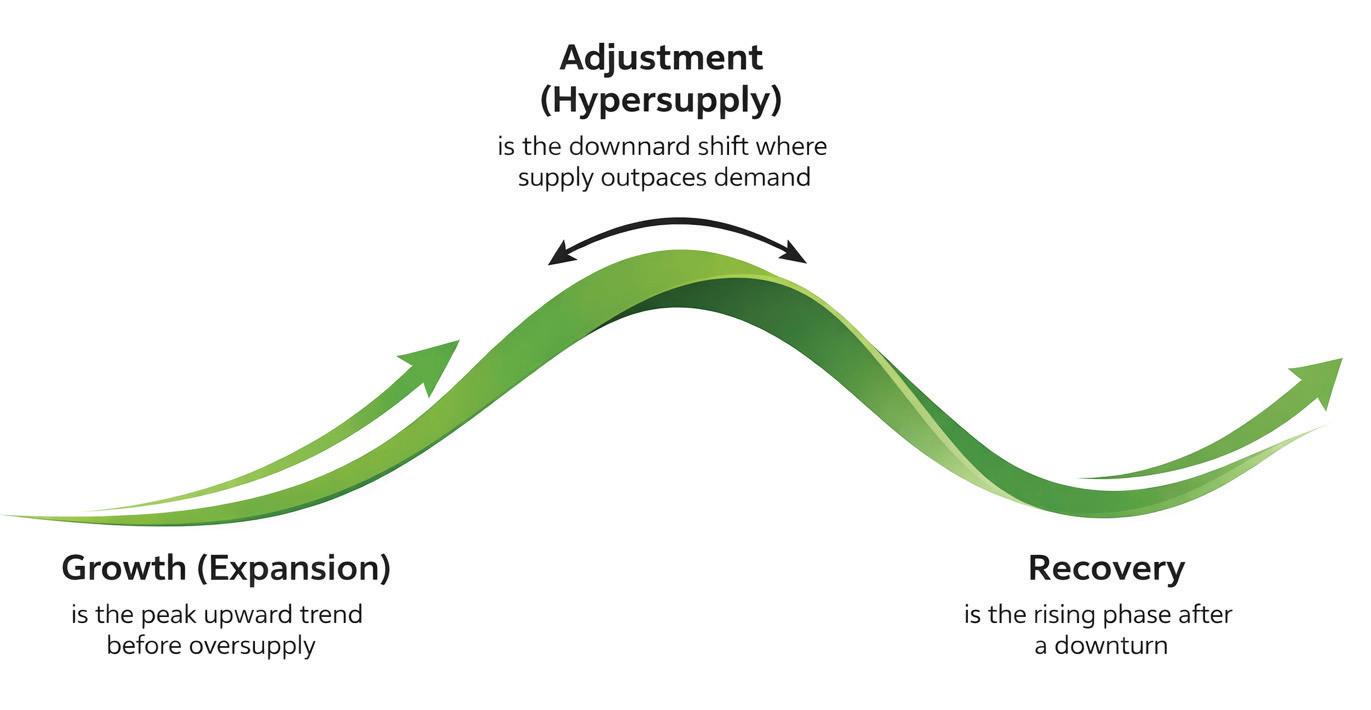
Multifamily at an Inflection Point Multifamily real estate historically moves through predictable cycles driven by supply, renter demand and the timing of new apartment deliveries. Strong rent growth and low vacancy encourage development, but long construction timelines mean new supply often arrives after demand has peaked, temporarily increasing vacancy and slowing rent growth.
The most recent expansion occurred during the postpandemic recovery. In 2021, national apartment vacancies fell below 5% while rent growth reached a record 15.3%, according to RealPage. These unusually strong fundamentals triggered a surge in new development across the U.S.
By 2023, nearly 970,000 multifamily units were under construction nationwide – the largest pipeline since the early 1970s, according to the National Association of Home Builders. As these projects delivered in 2024 and 2025, vacancy increased and rent growth slowed. By late 2025, national vacancy approached 9% and rent growth moderated to less than 1%.
Historically, the most attractive investment opportunities occur when new supply peaks and development activity begins to decline. That shift is now underway. The multifamily construction pipeline has fallen roughly 50% from its recent peak, leading to significantly fewer new deliveries coming in 2026-2028.
At the same time, renter demand remains strong. The U.S. absorbed approximately 335,000 apartments last year –one of the highest levels of the past 25 years. And elevated home prices and mortgage rates continue to support renting as the most attainable housing option for many Americans.
As the recent deliveries are absorbed and new supply
declines, multifamily fundamentals are expected to improve, signaling a good time to invest.
The Power of Onsite Management
In multifamily investment, the importance of onsite property management is often underestimated. Lenders push back on salaries viewed as “too high” and acquisition teams sometimes reduce headcount to improve margins. These decisions can have a negative impact on property performance. In reality, experienced onsite teams –including management, leasing and maintenance –generate meaningful returns on investment.
Great property managers build lasting relationships with residents, set clear operational standards and resolve issues before they escalate. Skilled maintenance teams improve resident satisfaction and preserve properties by addressing small issues before they become costly problems.
The financial impact of strong onsite management includes lower turnover, fewer concessions, higher collections, faster leasing velocity and higher renewal rates. Well-run communities also generate better online reviews and attract higher-quality prospects. Conversely, under-investing in onsite teams can reveal itself through rising bad debt, deferred maintenance, avoidable vacancy loss and declining resident satisfaction.
The salary premium for great onsite teams is often a small fraction of the value they create. Multifamily assets function like small businesses and the right personnel can drive superior performance.
TRAILBLAZING: THE DIGITAL FRONT DOOR
“How Renter Preferences are Reshaping the Apartment Website Experience”

Apartment searches no longer begin with a drive through the neighborhood; they begin online. According to the National Apartment Association , roughly 98% of renters use digital tools during their search and most visit a community’s website before contacting a leasing agent. As a result, the apartment website has become the foundation of the modern leasing process.
Digital-First Renters
Prospective residents increasingly approach apartment searches like online shopping – researching pricing, floor plans and amenities before visiting a property. The traditional “drive around and walk-in” model has largely been replaced by a research-driven process.
First Impressions Matter
Within seconds of visiting a website, prospects form opinions about a community’s quality and professionalism. Clean design, intuitive navigation and mobile optimization build credibility. And outdated or confusing sites drive renters elsewhere.
Lifestyle Over Layouts
Today’s renters are evaluating lifestyle as much as price and square footage. High-quality photography, neighborhood highlights and clear storytelling help prospects envision living in the community before they step onsite.
Better Tours, Better Leads
Because renters conduct more research online, they often visit fewer communities in person – but with greater intent. By the time a prospect schedules a tour, they typically understand the pricing, floor plans and overall feel of the property, helping improve conversion rates.
For apartment owners and operators, the website has become the industry’s digital front door and a critical driver of lead quality, leasing efficiency and community positioning.
(Editor’s Note: This year, Pathfinder is redesigning our property websites to improve AI search visibility and modernize layouts and photography, with a focus on today’s digitally driven renter.)
NOTABLES AND QUOTABLES
“Contrarian Thinking”
“Whenever you find yourself on the side of the majority, it is time to pause and reflect.”
- Mark Twain, American Author
“Don’t follow the crowd. Let the crowd follow you.”
- Margaret Thatcher, British Prime Minister
“Conformity is the jailer of freedom and the enemy of growth.”
- John F. Kennedy, U.S. President
“The people who are crazy enough to think they can change the world are the ones who do.”
- Steve Jobs, Apple CoFounder
“The greatest danger in times of turbulence is not the turbulence; it is to act with yesterday’s logic.”
- Peter Drucker, Austrian-American Educator
“
“Be fearful when others are greedy and greedy when others are fearful.”
- Warren Buffett, American Investor
“If everyone is thinking alike, then somebody isn’t thinking.”
“
- George S. Patton, U.S. Army General
“To think differently, you must be willing to see differently.”
- Paul Graham, American Computer Scientist
“You have to be willing to be misunderstood if you’re going to innovate.”
- Jeff Bezos, American Entrepreneur
“Discovery consists of seeing what everybody has seen and thinking what nobody has thought.”
- Albert Szent-Györgyi, Hungarian Biochemist
“Most entrepreneurial ideas will sound crazy, stupid and uneconomic, and then they’ll turn out to be right.”
-Reed Hastings, Netflix CoFounder
IMPORTANT DISCLOSURES
Copyright 2026, Pathfinder Partners, L.P. (“Pathfinder”). All rights reserved. This report is prepared for the use of Pathfinder’s clients and business partners and subscribers to this report and may not be redistributed, retransmitted or disclosed, in whole or in part, or in any form or manner, without our written consent.
The information contained within this newsletter is not a solicitation or offer, or recommendation to acquire or dispose of any investment or to engage in any other transaction. Pathfinder does not render or offer to render personal investment advice through our newsletter. Information contained herein is opinion-based reflecting the judgments and observations of Pathfinder personnel and guest authors. Our opinions should be taken in context and not considered the sole or primary source of information.
Materials prepared by Pathfinder research personnel are based on public information. The information herein was obtained from various sources. Pathfinder does not guarantee the accuracy of the information. All opinions, projections and estimates constitute the judgment of the authors as of the date of the report and are subject to change without notice.
This newsletter is not intended and should not be construed as personalized investment advice. Neither Pathfinder nor any of its directors, officers, employees or consultants accepts any liability whatsoever for any direct, indirect or consequential damages or losses arising from any use of this report or its contents.
Do not assume that future performance of any specific investment or investment strategy (including the investments and/or investment strategies recommended or undertaken by Pathfinder) made reference to directly or indirectly by Pathfinder in this newsletter, or indirectly via a link to an unaffiliated third-party web site, will be profitable or equal past performance level(s).
Investing involves risk of loss and you should be prepared to bear investment loss, including loss of original investment. Real estate investments are subject to the risks generally inherent to the ownership of real property and loans, including: uncertainty of cash flow to meet fixed and other obligations; uncertainty in capital markets as it relates to both procurements of equity and debt; adverse changes in local market conditions, population trends, neighborhood values, community conditions, general economic conditions, local employment conditions, interest rates, and real estate tax rates; changes in fiscal policies; changes in applicable laws and regulations (including tax laws); uninsured losses; delays in foreclosure; borrower bankruptcy and related legal expenses; and other risks that are beyond the control of Pathfinder or the General Partner. There can be no assurance of profitable operations because the cost of owning the properties may exceed the income produced, particularly since certain expenses related to real estate and its ownership, such as property taxes, utility costs, maintenance costs and insurance, tend to increase over time and are largely beyond the control of the owner. Moreover, although insurance is expected to be obtained to cover most casualty losses and general liability arising from the properties, no insurance will be available to cover cash deficits from ongoing operations.
Please add msiegler@pathfinderfunds.com to your address book to ensure you keep receiving our notifications.