
PerkinsWill—Adaptive Reuse

Page 1


Adaptive Reuse

Buildings, like the communities they serve, are not static entities. They evolve, age, and, at times, lose their original purpose.

As stewards of our environment we are in a unique position to breathe new life into these structures, respecting their history and the stories they hold while reimagining their future.
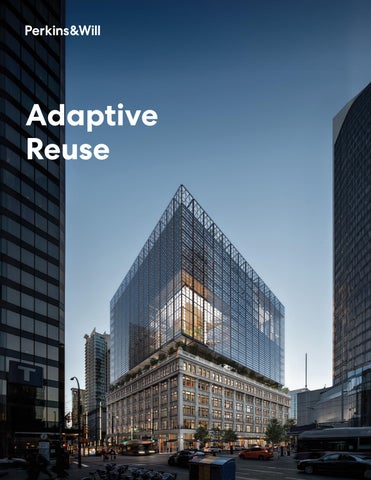
We approach each project with a balance of boldness and respect. Our goal is not merely to build but to thoughtfully adapt, transform, and enhance the spaces that form the fabric of the city. This approach stems from a deep belief that every building, regardless of age or condition, holds potential—a potential to once again serve its community with renewed purpose and vitality.

The work we present reflects our dedication to this vision. Each project, whether in the planning phase, under development, or in the final stages of execution, is a testament to our commitment to regenerative design, innovative solutions, and a collaborative process. Through these projects, we aim to create compelling spaces deeply rooted in each community.

We recognize that the most sustainable building is often one that already exists. By repurposing and revitalizing our city's architectural assets, we reduce environmental impact, lower operational costs, and preserve the city’s cultural heritage.

This is not just an economic or environmental strategy—it is a philosophy that drives us to imagine a future where the past and present coexist harmoniously.

As you explore the projects showcased in this document, you will see how we have approached each with a spirit of innovation and care. These are more than buildings; they are spaces crafted for people and designed to foster connection, community, and a sense of place.

We invite you to participate in this journey, advocating for a thoughtful, responsible design that honours our city’s unique character and paves the way for its future.

Definitions

Preservation

Maintaining and protecting a building in its current form without making significant alterations. The primary focus is preventing deterioration and preserving the building’s historic, architectural, and cultural significance for future generations. ¹

Restoration

Returning a building to a specific time period, often its original or historically significant condition. Restoration can include repairing or replacing certain features based on historical documentation or evidence to match the original. ¹

Rehabilitation

Repairing and making a building usable again while allowing for some updates and alterations to meet modern requirements. The goal is to retain the building’s historical features while incorporating elements that allow it to serve contemporary uses. ¹

Adaptive Reuse

Repurposing an existing building for a use other than its original design while maintaining its structural integrity and character. The goal is to extend the life of the building by giving it new functionality. ²

Works Cited

1. Parks Canada. (2010). Standards and Guidelines for the Conservation of Historic Places in Canada (2nd ed.). Parks Canada. https://www.historicplaces.ca/ media/18072/81468-parks-s+g-eng-web2.pdf

2. The American Institute of Architects (AIA). (2020). Adaptive Reuse Guide: A Framework for Creating Community-Centered Architecture. The American Institute of Architects. https://content.aia.org/sites/ default/files/2020-03/ADR-Guide-final_0.pdf

Adaptive Reuse

Adaptive reuse projects significantly enhance the value of existing assets, offering benefits that can be broadly categorized into social, economic, and environmental dimensions.

Social

Adapting existing buildings carries plenty of significant social value, preserving the architectural and historic essence of a community while maintaining its unique identity and cultural heritage. Buildings often act as catalysts for neighborhood rejuvenation, attracting investment and creating vibrant spaces for community interaction. This approach builds upon the values embedded in these structures and enhances them by integrating modern functionality, encouraging an appreciation of history alongside innovation. By doing so, neighborhoods retain their character while adapting to contemporary needs, creating spaces that bridge the past, present, and future.

Economic

Adaptive reuse projects offer a range of economic value by increasing property worth. Redeveloping existing structures often enhances their appeal, attracting higher market demand and boosting resale or rental potential.

Reusing existing assets, opens opportunities to minimizes the expenses associated with new construction, such as material procurement and waste disposal, while fostering sustainable growth. Through upgrading existing assets to higher energy performance, cost related to carbon pricing can be mitigated. This approach not only maximizes financial gains and savings for property owners but also contributes to broader economic vitality by attracting businesses, residents, and investment to revitalized areas.

Environmental

Adaptive reuse projects provide significant environmental benefits by reducing construction waste, extending building life cycles, conserving resources, and minimizing landfill impact. These practices algin with circular economy principles by prioritizing reuse over demolition.

Adaptive reuse supports climate resilience and green building standards by reducing embodied carbon emissions associated with new construction. By repurposing existing structures instead of rebuilding, these projects contribute to a more sustainable, low-carbon future.

Prioritizing Embodied Carbon Reduction in Building Design

As we design more energy-efficient buildings, embodied carbon—the emissions associated with manufacturing, transportation, installation, maintenance, and eventual disposal of building materials—becomes ever more important to address.

In British Columbia, where buildings are connected to a clean, low-carbon electrical grid, embodied carbon can represent a major portion of a building’s overall carbon footprint. The preservation and reuse of existing building structures offers significant benefits in our efforts to reduce carbon emissions within the building sector

Image adapted from BS EN 15978:2011 Sustainability of Construction Works—Assessment of Environmental Performance of Buildings—Calculation Method

Embodied Carbon Reduction Hierarchy

1. Reusing existing buildings instead of constructing new ones avoids the need to extract raw materials from the earth and manufacture new building products and materials, both of which are carbonintensive processes.

2. Planning spaces efficiently can lead to reduced material volumes and construction waste during construction.

3. Specifying materials and products with a low global warming potential (GWP) reduces a building’s overall embodied carbon.

REDUCE SPECIFY

80% of the buildings that will exist in 2050 have already been built.
Repurposing our current building stock is essential for a sustainable future.

World Economic Forum, 2022

Case Studies

01. 1185 W Georgia

02. Hudson's Bay Company (HBC) Redevelopment

03. Anthropology and Sociology (ANSO) Building

04. 4th and Ontario

05. 365 Railway

06. Lorne Davies Complex

07. 1220 Homer Street

08. 609 Granville Street Envelope Replacement

How can we increase the development potential while reducing the whole life carbon emissions of the project?

How can we reimagine the use of a historical landmark?

How can we prioritize the natural environment to create a sense of community and identity?

How can we draw inspiration from heritage to create a community asset?

How can we maximize the reduction of embodied carbon?

How can a structure be seismically upgraded while respecting its architectural legacy?

What are ways to recognize the value of an ordinary building?

Can a new identity be created through a façade upgrade?

1185 W Georgia

Vancouver, British Columbia

Client: Allied Size: 14,870 square meters (~160,060 square feet)

Date of Original Construction: 1985 Completion Date: TBD

Current Stage: Rezoning

How can we increase the development potential while reducing the whole life

carbon emissions of the project?

Reinventing a Central Business District Asset

This proposal exemplifies the adage that the most sustainable building is the one that already exists. A super sustainable addition proposed atop an existing, rehabilitated building creates an urban workspace that fulfills economic and environmental aspirations.

ASSET VALUE ASSESSMENT

1185 W Georgia Street is in one of Vancouver’s most valuable real estate zones, the Central Business District (CBD). The existing 17-storey office building, constructed in the 1980s, holds intrinsic value due to its central location and concrete structure, allowing for the retention and optimization of the building without complete demolition. A key asset to retaining the existing structure is the low floor-to-floor height within the building, which allows for increased density under current height limits. This results in an addition of two extra floors to the overall building relative to the scenario of a full rebuild.

The proposed redevelopment, which will add 160,000 ft² of office space through an 11-storey mass timber-steel hybrid addition, will enhance the building’s asset value by capitalizing on the increasing demand for premium office space in the central business district. By retaining and upgrading the existing structure, the project will maximize the value derived from the property while minimizing environmental impacts through reuse.

RISK MITIGATION

Comprehensive structural analysis, seismic assessments, and energy evaluations guided the decision to retain the existing structure, avoiding demolition costs and environmental toll. Seismic risks are being addressed with external steel bracing. The new mass timber-steel hybrid design increases density sustainably, and an upgraded HVAC system with Air Source Heat Pumps and heat recovery ensures energy efficiency. This system will reduce operational costs and meet Vancouver Building Bylaw requirements.

ENVIRONMENTAL PERFORMANCE

The new system will exceed municipal Green Building Policy energy benchmarks, targeting a Thermal Energy Demand Intensity (TEDI) of 20 kWh/m² and a Total Energy Use Intensity (TEUI) of 100 kWh/m².

Central to this effort is an envelope-first approach, which minimizes reliance on active mechanical systems and reduces overall energy demand. The building will feature high-performance curtain wall systems for both the new addition and the existing structure, while deploying high effective R-values for exterior wall and roof assemblies. These upgrades will work in tandem with new Air Handling Units on the rooftop and level 2 will improve ventilation and indoor air quality. Mass timber construction will further reduce the building’s embodied carbon. Additionally, rooftop green spaces will retain rainwater, reducing stormwater discharge and enhancing on-site biodiversity.

Hudson's Bay Company (HBC) Redevelopment

Vancouver, British Columbia

Client: Streetworks Developments Size: 130,800 square metres (1,407,900 square feet)

Current Stage: Rezoning Date of Original Construction: 1910s-1940s Completion Date: TBD

How can we reimagine the use of a historical landmark?

Revitalizing a Vancouver Icon

The adaptive reuse of Vancouver’s historic HBC store is guided by a century-old commitment to supporting the city’s social and economic health. Much has changed over the past century and, as in all good relationships, there have been moments of recalibration. This is one of those moments.

The proposition is to realize the latent development potential of the HBC store. The benefits of this future-facing proposal are significant. The HBC site will help to diversify the downtown economy, providing largeformat office floor space for as many as 5,000 workers at the very centre of the city.

A reimagined and reformatted HBC store will be a catalyst for the reactivation of Granville Street, a retail environment in a rapidly changing context that can become, once again, a destination address. The site offers a chance to redefine sustainable urban mobility by integrating active and public transit networks at a key intersection of Vancouver’s central route and it's most ceremonial street.

Guided by Vancouver’s Transportation 2040 plan, the proposal envisions a Green Mobility Hub prioritizing walking, cycling, and transit. With a Walk Score of 98 and a Bike Score of 86, it supports sustainable transportation.

Key features include a publicly accessible City Centre Cycle Hub with secure bike storage, end-of-trip facilities, and connections to cycling underpass and metro lines. The plan emphasizes connectivity, transit integration, and a car-free approach, leveraging existing parking to prioritize future-focused infrastructure. It blends green space with the public realm, preserves heritage value, and establishes the site as a multimodal hub for future generations.

Present-day view of HBC.

ASSET VALUE ASSESSMENT

HBC is one of Vancouver’s most significant heritage assets. Located at the iconic Granville and Georgia intersection, this early 20th-century architectural landmark, with its iconic terracotta façade, has contributed to shaping the city’s urban fabric for over a century. Beyond its architectural significance, the building has been a cornerstone of the city’s commercial and cultural heritage for over 130 years. Preserving this cultural and architectural heritage is paramount. The project aims to honour the building’s legacy while enhancing its economic viability. Introducing new commercial office space, totalling approximately 1,000,000 square feet, will ensure the site’s long-term sustainability by balancing conservation efforts with modern functional use.

RISK MITIGATION

Seismic analysis revealed that the building operates at only 15% of the required seismic capacity and has a 40% chance that the capacity will be exceeded by an earthquake in the next 50 years. Additionally, key heritage elements needing upgrades include the terracotta façades, original wood windows, Granville Street staircase, and level 6 skylight. The conservation strategy adheres to Canada’s Standards and Guidelines for Conservation of Historic Places, emphasizing:

nj Preservation: Reinforce the concrete superstructure (constructed between 1913 and 1949), secure terracotta façades, and upgrade the building envelope to modern energy codes for long-term durability and safety.

nj Restoration: Restore the terracotta façade, preserve or replace wood windows, reinstate the historic colour scheme, and remove non-original additions while restoring key architectural features.

nj Rehabilitation: Adapt the building for ongoing use as a retail space, which it has been since 1893. This involves balancing modern functionality with preserving historical character.

ENVIRONMENTAL PERFORMANCE

The HBC store redevelopment targets LEED Gold certification, integrating sustainability strategies to create a high-performance, low-carbon building that preserves its historic character. The project aims for a 50% reduction in outdoor water use and a 30% reduction indoors through rainwater reuse and highefficiency fixtures. A water metering strategy will further minimize potable water consumption. Energy-efficient upgrades to the building envelope and heritage façade, along with energy modelling, predict the project will surpass Green Building Policy targets, achieving a 50% reduction in Greenhouse Gas Intensity (GHGI) beyond requirements. Active transportation is supported with a first-class bike hub and no on-site parking, discouraging single-occupancy vehicle use. The project includes 925 bike racks and strategies to promote cycling, walking, and public transit for site access.

Anthropology and Sociology (ANSO) Building

Vancouver,

British Columbia

Client: University of British Columbia (UBC) Size: 6,370 square metres (68,570 square feet)

Current Stage: Design Development Date of Original Construction: Varies (1950s-1970s)

Completion Date: TBD

How can we prioritize the natural environment to create a sense of community and identity?

Preserving

Legacy and Enhancing Sustainability

The ANSO rehabilitation prioritizes the human and natural environment, fostering a cohesive collective identity and a strong, inclusive academic community. Located at the campus edge, the building is surrounded by green spaces and forests, with views of the Georgia Strait and nearby mountains, enhancing its connection to nature.

The redesign focuses on creating meaningful spaces to strengthen social and academic connections for all who engage with the building. Centralized and smaller “hearts” throughout the structure draw on outdoor views, community needs, and their locations, enriching the ANSO community and academic departments.

The ANSO building prioritizes human health through all aspects of the design. All interior building materials have been rigorously reviewed to meet the Perkins&Will SWITCH List for healthy building materials. Upgrades to the exterior envelope will significantly improve occupant comfort, access to daylight, and provide operable windows in all office spaces. The colour and material palette, inspired by the surrounding landscape, bring elements of biophilic design from exterior to interior spaces.

Present-day view of the ANSO Building.

ASSET VALUE ASSESSMENT

The ANSO Building, comprised of four connected buildings constructed between 1950s to 1970s. The building’s original wings were built as women’s residence halls in the early 1950s. Of architectural historic signifies is the wing design by Arthur Erickson. In the mid-1970’s the complex underwent significant changes and was converted to academic uses. Currently, the building is home to the departments of Anthropology and Sociology with teaching spaces, offices, and research labs.

As a Routine Capital Comprehensive Renewal Project, the project will address the building’s poor condition (Facility Condition Index of 0.48) and seismic vulnerabilities. Retaining the existing structure, rather than demolishing and rebuilding, maximizes the asset value by balancing heritage preservation and modern functionality. This approach ensures the complex serves as a vital academic hub for a new generation of students.

RISK MITIGATION

Comprehensive assessments of the existing building revealed seismic vulnerabilities necessitating critical structural upgrades. The structure on both sides of the central spine of the building complex currently lacks lateral support and is in critical need of seismic retrofit. To address this seismic upgrade, a concrete roof slab with punched openings have been proposed to not only tie the wings together structurally but also to bring daylight into the existing compressed central corridor. The roof above the main central space is lifted to create a sense of relief and expansion upon entering the building—introducing a direct connection to daylight and the outdoors. The mechanical systems will be replaced with high-efficiency systems that meet current UBC technical standards. New HVAC, plumbing, electrical systems, and fire safety upgrades will mitigate operational and safety risks while enhancing occupant comfort and energy performance.

ENVIRONMENTAL PERFORMANCE

In support of the University’s sustainability goals, the ANSO project is targeting LEED v4 BD+C Gold Certification. The decision to reuse the existing structure will significantly reduce the building’s embodied carbon footprint, with a projected 51% reduction in embodied carbon compared to a baseline developed using the City of Vancouver's Embodied Carbon Guidelines. The building will feature a new energy efficient rainscreen envelope and high-performance mechanical systems upgrades to optimize energy efficiency, bringing its performance to current standards. Set within the heavily landscaped North Campus precinct, the design will also prioritize tree retention and the introduction of low-maintenance, drought-tolerant planting preserving the natural character of the site.

4th and Ontario

Vancouver, British Columbia

Client: PCI Developments Size: 44,400 square metres (434,800 square feet)

Current Stage: Rezoning Date of Original Construction: 1910 Completion Date: TBD

How can we draw inspiration from heritage to create a community asset?

Transforming Mount Pleasant’s Industrial Landscape

The West 4th and Ontario project, located in the Mount Pleasant Industrial Area within the new Broadway Area Plan, spans ¾ of a city block. The unique combination of a recognized heritage asset as well as a uniquely large site proximate to the downtown provide wonderful opportunities for redevelopment.

Our longtime client PCI Developments challenged us to create a compelling design on this site that would both enrich and engage this unique neighbourhood. With this mandate, we envisioned a large-scale community hub for innovative industrial uses with office and streetlevel retail to serve this dynamic community. In designing an inviting venue, we introduced a mid-block courtyard along West 4th Avenue and planned for activation of the laneway that separates the heritage building and the north portion of the site off the Ontario cycleway. The terraced massing breaks down the large site providing outdoor spaces for occupants, better views and light, and a scale that respects the both the heritage building and neighbourhood context.

ASSET VALUE ASSESSMENT

The development at West 4th Avenue and Ontario Street is in the heart of the Mount Pleasant Industrial Area, known for its vibrant industrial landscape. The project leverages its prime location near key industrial zones, the Olympic Village SkyTrain station, and the new Broadway Line, integrating modern industrial spaces, flexible office floorplates, and neighbourhood amenities while preserving the historic Nelson’s Laundry Building.

Retaining the original mass timber structure and masonry skin of the heritage buildings preserves the neighbourhood’s industrial history and enhances the site’s cultural significance. This thoughtful mix of heritage retention, modern design, and community-focused features establishes the project as a cornerstone in Mount Pleasant’s revitalization.

RISK MITIGATION

Comprehensive due diligence included seismic upgrades and energy efficiency measures that align with City’s policies. The project’s heritage retention approach includes seismic upgrading to the Nelson’s Laundry Building and enhancements to the building’s envelope to ensure long-term viability and safety. Integrating flexible floorplates across the development supports future proofing against market demands for creative industrial and office spaces, which are essential to Vancouver’s evolving industrial economy. This strategy ensures compliance with the City of Vancouver’s Green Building Policy and mitigates risks related to sustainability and regulatory requirements.

ENVIRONMENTAL PERFORMANCE

This project is committed to exemplary environmental performance, meeting and exceeding the City’s sustainability goals. The project is pursuing LEED Gold and Zero Carbon Building Standard certifications to demonstrate its low carbon footprint, occupant health and wellness, and climate resilience. Key strategies include:

nj Water Efficiency: Incorporating green roofs and rain gardens to manage stormwater and reduce runoff while enhancing biodiversity.

nj Energy Efficiency: Advanced building envelopes and sustainable systems will exceed the City’s Green Building Policy benchmarks, reducing greenhouse gas emissions and operational costs.

nj Active Transportation: The project’s proximity to the Ontario Street Bikeway and commitment to pedestrian-friendly public spaces supports sustainable mobility and reduces reliance on single-occupancy vehicles.

Present-day view of building on West 4th and Ontario.

365 Railway

Vancouver,

British Columbia

Client: Allied Properties Size: 5,730 square metres (62,750 square feet)

Current Stage: Development Permit Date of Original Construction: 1951

Completion Date: TBD

How can we maximize the reduction of embodied carbon?

A Radical Reduction in Embodied Carbon Through Building Reuse

Railtown is an industrial neighborhood with shops, design studios, and restaurants. Its zoning policy supports preserving industrial spaces, enabling new mixed-use developments like 365 Railway. Looking to enhance their asset at 365 Railway, our client approached us to add an addition on the existing structure. Limited by the existing building’s structural capacity, which was designed to support three additional concrete floors, we proposed a lighter mass timber structure, allowing a 4-storey addition—maximizing density and providing a warm aesthetic in contrast to the industrial neighborhood. Mass timber columns are located directly above the existing concrete columns and the CLT floor slab’s ability to span large distances allows for fewer beams providing open ceiling space. Furthermore, using mass timber structure contributes to lowering the overall embodied carbon of the project, which is targeting CaGBC Zero Carbon Building Standard certification.

Present-day view of 365 Railway.

ASSET VALUE ASSESSMENT

The redevelopment at 365 Railway involves transforming the Fleck Brothers Warehouse, a two-storey Late Modern-style building, by adding a four-storey office space. The existing warehouse, built in the late 1940s, has significant historical and architectural value. Allied prioritized its designation n its redevelopment, recognizing in Vancouver’s Heritage Register, recognizing the value of retaining and revitalizing the structure to minimize embodied carbon and preserve its historic fabric.

A key highlight in retaining the structure is its ability to support additional density, which would have been more costly and environmentally impactful through demolition and rebuilding. Other aspects that are reduced as a result of retention is reduced loading, parking, and access. The design leverages the inherent strength of the concrete base and incorporates a lightweight mass timber addition—achieving, cost and time savings while expanding the usable space.

RISK MITIGATION

Risk management for the 365 Railway redevelopment has been thoughtfully aligned with Allied’s commitment to holding the building asset as a long-term landlord while addressing key operational risks. Given the building’s age, seismic upgrading is a central focus of the redevelopment. The existing freight elevator and stair cores are removed to allow for the installation of a new core, improving the seismic performance and universal accessibility. The structural upgrades are implemented without compromising the building’s historical façade or existing structure, ensuring the project maintains its historical character while meeting modern safety standards.

ENVIRONMENTAL PERFORMANCE

The 365 Railway project aims to meet CaGBC’s Zero Carbon Building (ZCB) Design Standard (v3) and LEED Gold certification . As a winner of the inaugural 2023 BC Embodied Carbon Awards (Large Buildings in Vancouver category), the project exemplifies leadership in embodied carbon reduction. The redevelopment leverages an iterative Life Cycle Assessment (LCA) to target a total embodied carbon impact of no more than 350 kgCO2e/m², a 45% reduction relative to the project baseline. Reusing the existing building contributes to 29% of this reduction, with another 16% achieved through material optimization, such as the specification of low-carbon concrete and the use of glulam columns and crosslaminated timber in the addition.

New building materials were carefully considered for their carbon impact. When rigid insulation was identified as having a high relative impact on overall embodied carbon, the design team engaged with building trades and was able to identify lower carbon alternatives, while optimizing insulation thickness to reduce overall thickness and balance the impact of embodied versus operational carbon.

Lorne Davies Complex

Vancouver, British Columbia

Client: Simon Fraser University (SFU) Size: 15,280 square metres (164,470 square feet)

Current Stage: Under Construction Date of Original Construction: 1965

Completion Date: 2025

How can a structure be seismically upgraded while respecting its architectural legacy?

Preserving Architectural and Athletic Legacy

After 54 years of service, Simon Fraser University’s (SFU) Lorne Davies Complex is in desperate need of repair and upgrade. Not only is the sports and recreation facility at the end of its life but also has lost its original sense of clarity and function through multiple targeted additions, renovations, and upgrades.

Notwithstanding all these challenges, its spirit is strong. Essential to the University’s initial vision, the iconic building is a significant part of the campus and its programs have produced over 100 Olympic athletes, including multiple gold medal winners.

With a goal to enhance student, athlete, and community experiences, we worked with the University to develop a comprehensive master plan and building upgrades to update and modernize the complex—both restoring elegance to the facility and celebrating the athlete achievements throughout the history of the University’s athletics programs.

Pre-construction view of Lorne Davies Complex.

ASSET VALUE ASSESSMENT

The rehabilitation of Lorne Davies Complex addressed the aging infrastructure and outdated systems to ensure the facility remains a functional and resilient asset on SFU’s Burnaby campus. Structural upgrades improved seismic resilience, while envelope renewal replaced deteriorated Kalwall panels with durable, high-performance systems that maintain the building’s design integrity and meet current code requirements.

Interior renovations optimized functionality, including updated athletic facilities and support spaces to meet NCAA standards and enhance accessibility. By prioritizing adaptive reuse, the project retained existing materials where feasible, reducing embodied carbon and capital costs compared to a complete rebuild.

These upgrades modernize the complex while preserving its architectural character, ensuring it continues to support students, athletes, and the broader campus community.

RISK MITIGATION

Central to the complex’s renewal is enhancing seismic resilience, fortifying the structure to endure a 1/1000-year seismic occurrence, a significant leap from the current state, which poses a risk of failure under such conditions.

Stakeholder engagement has been paramount, involving university representatives and a steering committee to guide the design development process. This collaborative approach ensures that the complex will not only meet immediate needs but also anticipate and adapt to the evolving landscape of sports and recreation facilities.

Our plan is a pledge to the future—a reimagined space that will continue to foster champions and community for generations to come.

ENVIRONMENTAL PERFORMANCE

The renewal of the Lorne Davies Complex focuses on energy efficiency and sustainability. Façade upgrades, including triple-glazed curtain walls and thermally broken frames, improve thermal performance by 300% relative to the existing condition.

Mechanical updates incorporate heat recovery ventilation (HRV) with up to 80% energy recovery, reducing heating and cooling demands. LED lighting, designed to use 70% of ASHRAE 90.1-2016 allowances, reduces lighting energy consumption by 45%. These measures contribute to a 15% annual energy savings, aligning with SFU’s 2030 climate targets.

Rainwater reuse supports water efficiency, while the improved envelope reduces heat gain and maintains daylighting, lowering reliance on artificial cooling.

1220 Homer Street

Vancouver, British Columbia

Client: Perkins&Will Size: 2,710 square metres (23,400 square feet)

Date of Original Construction: 1946 Completion Date: 2000

Sustainability: LEED EBOM Platinum ®

What are ways to recognize the value of an ordinary building?

Transforming a Historic Warehouse for Modern Use

Creativity can happen anywhere, but when a space can inspire and support collaboration and creativity, the possibilities are endless.

The 1946 warehouse building presented enormous opportunities for high-efficiency by virtue of its high ceilings, exposed concrete mass, and open floor plan. To create opportunities for creativity, we focused on improving daylighting and ventilation throughout. To infuse natural ventilation into the space, two large openings were cut into the floor slabs creating atria at the front and center of the building, each sized for optimum levels of ventilation and daylighting.

The central atria serves as the organizing element for the office, providing visual connection between the three levels of workstations, while also directing natural light throughout the space via an operable skylight overhead. The atrium space allows us to spread work out and collaborate with other teams and groups within the office.

ASSET VALUE ASSESSMENT

1220 is a 4 ½ storey 1946 warehouse in Yaletown, formerly an industrial neighbourhood which, through the 1980s / 1990s was becoming converted into an office, retail, and residential centre. Perkins&Will selected this empty warehouse as the new home for their growing business as it gave a great opportunity for significant business growth.

While the building did not have any heritage designation, it was part of a streetscape that the City Heritage department mandated limited alteration. In accordance with the City guidelines, the significant alterations were made to the building interior.

As a simple concrete box, the building provided a blank slate for the design team to work, which was ultimately flexible and comparatively very affordable compared to market office space elsewhere in the city.

RISK MITIGATION

While the building had been in place and essentially unchanged in over 50 years, the building standards of the day, were significantly more relaxed than in 2000 when the renovations took place. The building required considerable seismic upgrading, the envelope was very leaky, both relative to rain ingress from the roof and exiting windows, and the thermal performance of the exposed walls. Seismic challenges were addressed through the introduction of new stair core upgrade and the underpinning of the foundations with mini-piles.

The envelope upgrades balanced the technical needs and aesthetic desires of the tenant so the lobby atrium exterior wall was left as exposed concrete however other exterior wall area’s were upgrades with an insulated new interior wall assembly.

ENVIRONMENTAL PERFORMANCE

Maintaining the existing 1946 building extended its utility and preserved its original carbon “investment.” Minimal intervention limited new materials, all chosen for low environmental impact—such as flooring made from recycled tire rubber.

The passive mechanical system included minimal perimeter heating, with heatrecovery units and small radiant heaters for colder months. Ventilation and cooling relied on operable windows and a central atrium skylight, managed by a Building Management System to enable natural ventilation via the stack effect. Air conditioning was added only for the Network Server Room and one meeting room. The 1220 Homer Street renovation achieved LEED EBOM Platinum Certification.

609 Granville Street Envelope Replacement

Vancouver, British Columbia

Client: Cadillac Fairview Corporation Limited Size: 13,470 square metres (140,990 square feet)

Date of Original Construction: 1981 Completion Date: 2019 Awards: ‘The Outstanding Building of the Year’ (Renovation Category), Building Owners and Managers Association of British Columbia, 2020

Can a new identity be created through a façade upgrade?

Renewing a Downtown Office Tower

Canaccord Genuity Place, a 25-storey commercial office tower in downtown Vancouver, was showing its age and needed an envelope upgrade. Constructed in 1981, the building interconnects with the three-block long Pacific Centre Mall in the city’s main business district. The owner, Cadillac Fairview, was motivated to not only address the poor envelope performance, but to update the tower’s appearance to match its triple-A location—all with minimum disturbance to the building’s tenants.

We proposed a full glass replacement with small but effective interventions that improved both the building’s technical performance and interior environment quality, while updating its aesthetic relationship to the cityscape. In addition to lightening the glazing colour, we transformed the tower’s expression from horizontal to vertical: highlighting the top floor with a crown of narrow, delicate lines of white light.

Pre-construction view of the building.

ASSET VALUE ASSESSMENT

Constructed in 1981, the Canaccord Tower (609 Granville) underwent interior renovations in the 2020s, but its original glazed envelope was failing, causing water ingress during Vancouver’s wet season. Demolishing the 25-storey tower for a taller rebuild was rejected due to tenant disruption and prolonged income loss. With no heritage designation (it may have heritage value but not recognized) we were free to consider a full envelope replacement and revision to the architectural reading of the facade.

RISK MITIGATION

The “risks” or shortcomings addressed in this building renewal were threefold: envelope failure, reputational damage for Cadillac Fairview, and, finally, significant income risk as this building was losing favour in the market; while a “AAA” location, looked like a “B” or “C” class building.

By upgrading the envelope, all three risks were addressed. The new envelope put an end to water leaking into the offices. The new modern white expression and the clearer glass elevated the perception of the larger Pacific Centre development and are much more aligned with the corporate image and the recent common space upgrades done to the tower. Finally, the tenants loved the new look of their building; as tenant leases came up for renewal, existing tenants renewed at significant rates, and these increased lease rates more than paid for the $25M renovation.

ENVIRONMENTAL PERFORMANCE

The environmental performance of the new building envelope had multiple positive outcomes. Energy analysis was done based on a typical floor plate, considering the assumed operational schedule and internal gains (plug load, occupant load, lighting, air changes, etc.) Based on this modelling the following performance improvements are expected:

nj 8% decrease in solar heat gain through the facade

nj 5% reduction in energy use through the integration of new thermal breaks

nj Calculated energy use reduction for thermal comfort by 32% and energy cost reduction of 18%

nj Peak cooling loads increased by 12%, but heating loads significantly reduced by 32%. The cooling load increase is a result of improved U-value (heat retention at hotter times of the year)

Envisioning Tomorrow: Adaptive Pathways Forward

As urban landscapes evolve, sustainability is more essential than ever. The projects highlighted here demonstrate that the most sustainable building is often one that already exists. Through adaptive reuse, environmental upgrades, and innovative design, we renew the value of our built heritage to meet today’s needs and prepare for the future.

These projects succeed through a shared vision among architects, clients, policymakers, and communities—working together to redefine our relationship with the built environment. Identifies the inherent value in each building, and then showcases how we can shift beyond traditional development models toward a future where architecture is both responsive and resilient.

We invite our partners, clients, and communities to join us in this mission of responsible transformation, preserving architectural heritage while addressing the demands of a sustainable future.

TO DEVELOPER CLIENTS

Responsible adaptation of existing buildings increases property value, reduces environmental impact, respects our history, and creates new spaces that are desirable in our contemporary world.

TO POLICY MAKERS

Supporting reuse and revitalization ensures sustainable practices take root, balancing growth with conservation and strengthening community character.

TO

BROADER COMMUNITY

Advocating for projects that sustain our heritage and enhance neighborhoods will create lasting social, economic, and environmental impact.

Together, we can build a future where the past enriches the present, fostering a city that is enduring, inspiring, and sustainable.

1075 West Georgia Street, Suite 2200

Vancouver, British Columbia V6E 3C9

822 – 11th Avenue SW, Unit 100

Calgary, Alberta T2R 0E5

Turn static files into dynamic content formats.

Create a flipbook
PerkinsWill—Adaptive Reuse by Perkins&Will - Issuu