Designing for Five Generations at Work
WHAT WE'RE LEARNING FROM ACROSS OUR PRACTICES
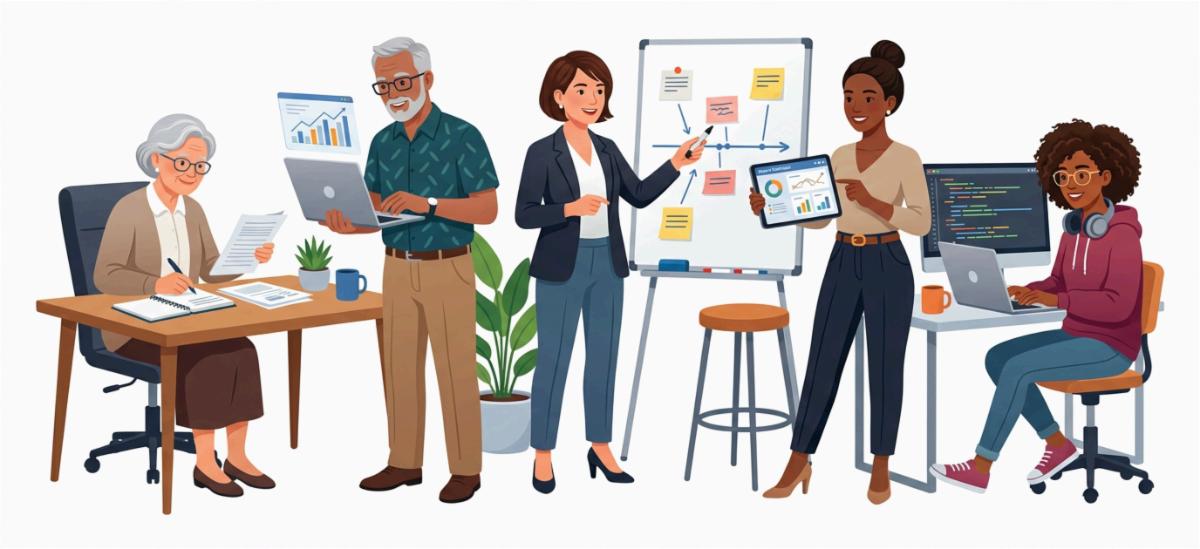
“For the first time in history, five generations—each with unique technological and formative experiences—are working side-by-side.”
World Economic Forum
Today’s workforce spans a broader age range than ever before. Gen Z now makes up nearly one-fifth of workers, while Baby Boomers remain active well into what was once considered retirement. In practice, this means a 22-year-old who has never known life without a smartphone could be working with someone whose career began decades before the internet.
Generational labels are imperfect proxies for how people think and work, but they point to something important: the diversity of experiences shaping today’s workforce is greater than it has ever been.
Yet many workplaces are still designed for a much narrower range of needs, expectations, and ways of working.
To understand how workplace design might respond, we looked across our K–12, college + university, and senior living practices, drawing on leaders with decades of experience designing for people at different stages of life. We asked what they’re seeing and what those patterns suggest for multigenerational workplace design.
What emerged are a few clear ideas to inform how we approach workplace design.
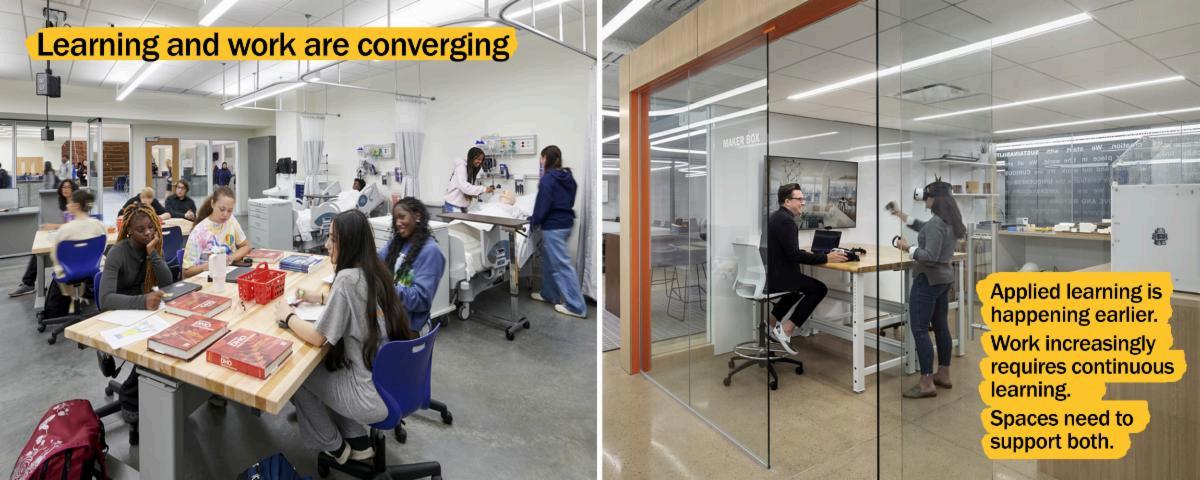
The boundary between learning and work is collapsing
“We’re seeing a steady collapse of the traditional boundary between education and the workplace,” says Sean O’Donnell, a leader of Perkins Eastman’s K-12 Education practice. “Co-ops, dual enrollment, work-based learning—these aren’t add-ons anymore. They’re central to how people learn.”
In K–12, students are taking on real responsibilities earlier and moving between classroom and workplace in ways that were once sequential. This reflects a broader shift: students are increasingly treated as capable participants in real-world environments, not as future contributors waiting their turn.
This isn’t just an early-career shift—it extends much later in life. In senior living, people are staying engaged well beyond what used to be considered retirement.
“Residents are looking to continue using their knowledge and skills,” says Emily Pierson-Brown, a Senior Living practice leader. “They’re contributing as mentors, consultants, advisors.” Work is no longer confined to a single stage of life or a linear path. People are entering the workforce with experience and remaining engaged far longer than before.

For workplace design, this shifts the focus to how people continue to learn and contribute over time—often in informal, self-directed ways. Environments need to support mentorship, visibility of work, and knowledge exchange as everyday conditions, not just structured onboarding programs.
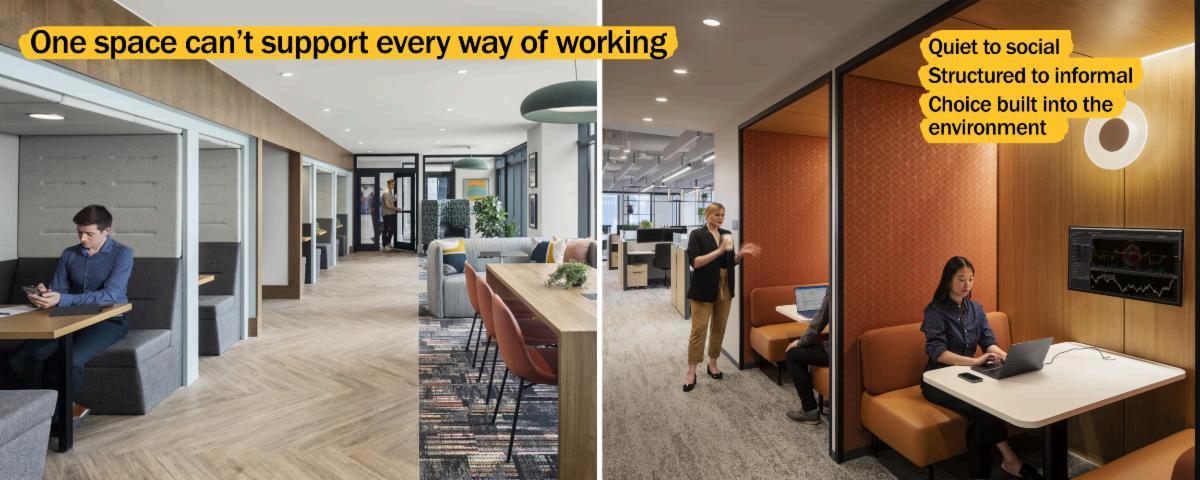
Effective environments offer range, not uniformity
Across sectors, environments are moving away from one-sizefits-all solutions.
In higher education, Dan Arons, a leader in the firm’s College + University practice, describes how projects often begin with open, collaborative concepts, then evolve in response to how people actually work.

“Spaces are becoming more cellular—not cubicles, but enough to support focus,” he says. “The goal isn’t to eliminate collaboration, but to make room for different modes of work.”
Dan notes that when new third spaces—informal settings that sit between focused work and formal meetings—are introduced, “they’re immediately occupied—people are just drawn to them.” This points to a strong, often unmet demand for environments that support a broader range of ways of working.
In K–12, that range extends beyond layout to how a space feels. Kim Coffeen, another of the firm’s K-12 Education leaders, emphasizes environments that feel
“warm and inviting”—spaces that support human connection and create a sense of ease. Acoustics, lighting, and access to nature are not just design features; they shape how people focus, recover, and move through the day.
In senior living, shared spaces are expected to support individual work, group activity, and community use—often within the same day.
At the center of it all is choice. The best environments support different ways of working and make it easy for people to move between them as their needs change.
Proximity supports more than collaboration
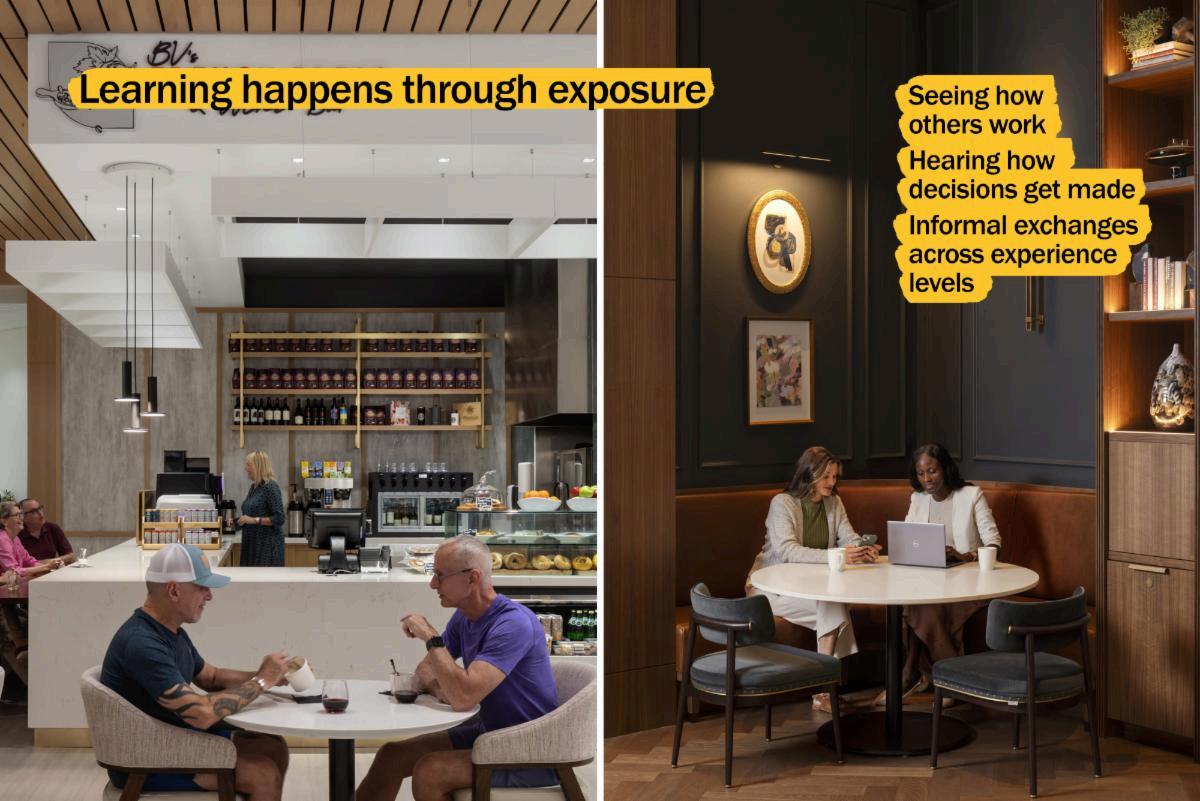
When people talk about the value of being together in person, they often point to collaboration. But much of what people gain comes from indirect exposure or “eaveslearning.”
“A lot of learning comes from casual listening and being exposed to what others are doing,” Dan says. “This is especially valuable early in a person’s career.”
In K–12, career and technical education is becoming more visible and integrated into the core of the school, allowing students to see how learning connects to real-world work. In senior living, residents act as mentors, guides, and advisors, creating opportunities for intergenerational exchange that benefit both residents and staff.
Academic environments recognize that much of the most valuable learning happens through observation, proximity, and shared context—and are intentionally designed to support it.
For the workplace, this suggests less focus on meetings and more attention to how work is made visible day to day, designing spaces where people can see, hear, and learn from one another.
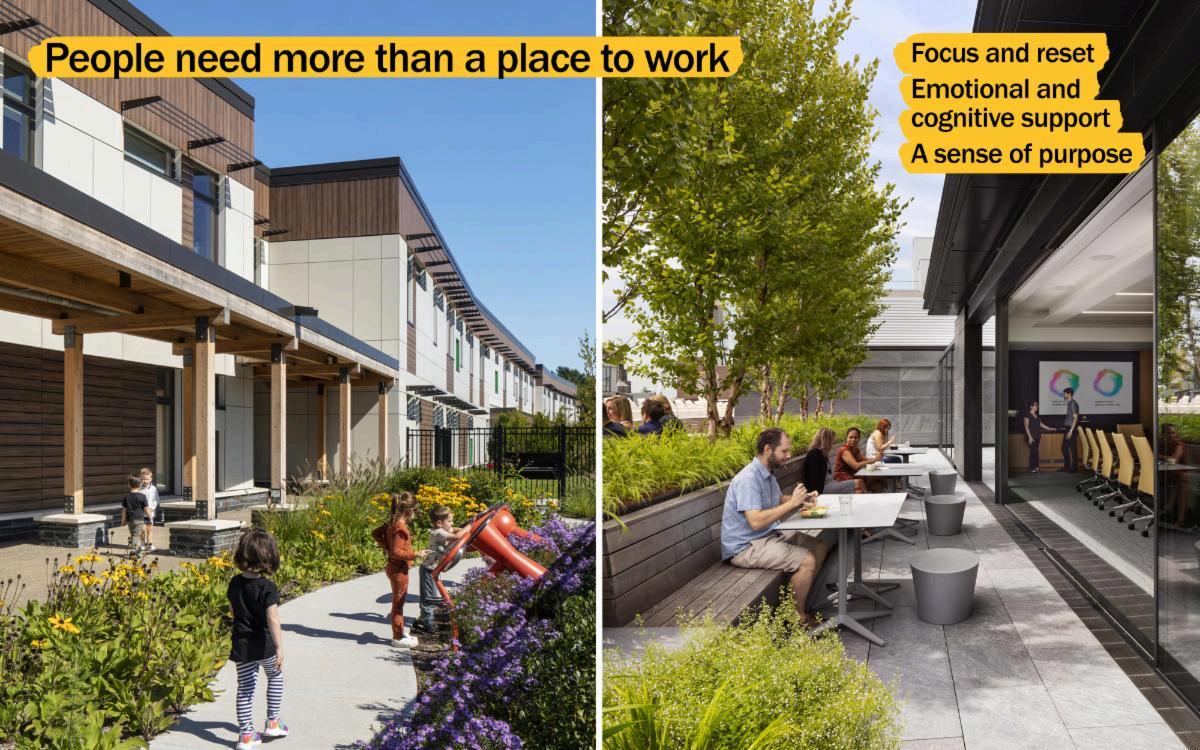
People are looking for environments that support them—not just their output
Across sectors, expectations are changing.
“The emerging generation is driven by a desire for purpose and meaning,” says JinHwa Paradowicz, a Senior Living leader. “They want to understand the impact of what they’re doing.”

That expectation extends across age groups. In senior living, the challenge of attracting and retaining staff has led to greater investment in environments that support well-being—access to daylight, outdoor space, and places to step away.
“When staff are supported emotionally and physically, they’re better able to perform their roles,” Emily says.
In K–12, similar thinking is shaping environments that support a wide range of cognitive and emotional needs—spaces that feel inclusive, adaptable, and supportive of different ways of engaging.
Across sectors and age groups, people are looking for environments that support them as individuals—cognitively, emotionally, and socially—and allow them to connect meaningfully with others through their work..

What this means for the workplace
Rather than designing around age-based preferences, perhaps a more useful approach is to focus on what people have in common.
People need to keep learning. Design for continuous development by making work visible, supporting mentorship, and creating spaces where knowledge can be shared informally—not just in structured settings.
They need some control over how they work. Provide a range of environments that support different modes of work—quiet focus, collaboration, social interaction—and make it easy to move between them throughout the day.
They benefit from being around others. Design for proximity and exposure, not just meetings—spaces that allow people to see how work happens, overhear conversations, and learn through shared context.
They want to feel that their work matters. Create environments that support well-being, connection, and purpose—spaces that make people feel valued, supported, and part of something larger than their individual tasks.
The workplace can learn a great deal from how other sectors are responding to these conditions. The opportunity is to apply those lessons with intention, creating environments that support learning, choice, connection, and purpose across the full arc of working life.
SURVEY
Where are you focusing most in your workplace right now?
Improving employee experience and well-being
Upgrading technology and hybrid tools
Creating more spaces for collaboration and connection
Making better use of existing space
How did you like this email?


Perkins Eastman | 115 Fifth Avenue | New York, NY 10003 US
Unsubscribe | Update Profile | Constant Contact Data Notice