PDBY PDBY
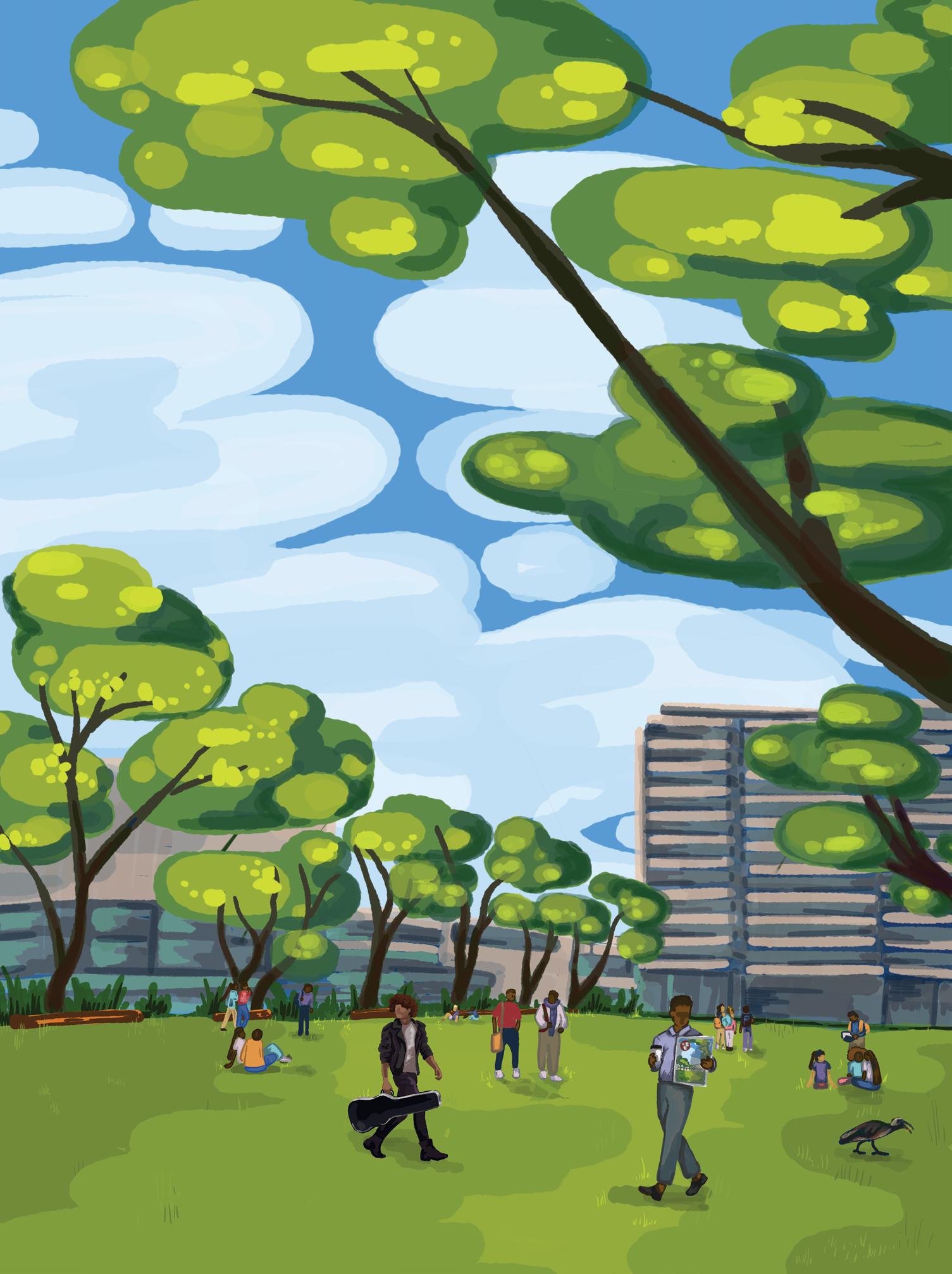




Irealised that my previous editorial wasn’t the sweetest of writings, and as much as that had to do with the heaviness in the news, I think part of it was also my own heart in turmoil navigating a new year, another year away from home. Having gone to boarding school and then trekking across provinces for university, I am no stranger to homesickness. I know that the start of the new year, no matter what year of university you’re in, can be an emotional rollercoaster. So, I’ve been thinking of how to address that and bring some light back into this page. And I’ve found the solution in a song by the sweet Olivia Dean.
I’ve been stuck on “I’ve Seen It” since the beginning of the year, and I’ve found a great deal of reassurance in Dean’s lyrics. What draws me to the song is her description of love without even mentioning the word. I’ll confidently say that it is one of the loveliest love songs I have ever heard. Dean describes very mundane moments and as you listen, you know exactly what she’s referring to. A great big masterpiece of threads tying her to the world around her – a crafting of love. So, taking her song into consideration, I thought I’d share some threads of the love I’ve experienced since being back in Pretoria – as a form of cultivating hope.
Recently, I sat in the newspaper office with Hannah (your lovely copy editor) and Jason (your thoughtful deputy) and laughed until I could not breathe. We were like toddlers on a sugar high, filling the office with a magical lightness. One evening, I walked to Steers with my closest friend, Sibonga. We ordered ice cream and before serving us, the staff member at the counter wiped down the ice cream station with a genuine kindness in her eyes.
Not because it was her job, but because she wanted to. I thought, “Here is someone looking out for my friend and I just because she can.”
A few weekends back, after that dark editorial piece was written, my best friend Kerri-Anne came home from Potch to surprise me for the weekend. I heard her telling her parents that she’d come because she knew I had a bad week and she just wanted to make sure that I was okay.
I took Sibonga to the Varsity Cup game, which was the first rugby match she’d ever watched. And seeing her face light up when she got to pose next to our UP MVP filled my heart to the brim. Gran Gran told me on the phone that Aunty Gaynor, a close family friend of ours, had spoken to someone at church who wanted a crocheted blanket and told her that she needed to get wool for Gran Gran first. Backstory: my Gran often gets crochet orders and usually does it out of her own pocket, so knowing that there is someone who understands the value of this craft and who is looking out for my Gran back home really made my day.
I made a new friend, Jenna, and after our tutorials on Groenkloof campus, she took me to Groenkloof Spar, bought us croissants, and showed me around the little shopping centre. She wanted to share a little piece of her life with me, a little piece of the love she gets to experience. When getting ice cream at Aroma, the young man’s enthusiasm while offering us tasters was infectious. His passion about something so silly made me giggle. Dad sent me a voice note one morning, and just hearing the pet name my family calls me and his “I love you” gave me the strength I needed for my day. After nearly talking Jenna’s ear off about Wicked, I felt a little insecure about my habit of yapping aimlessly.

NEWS
And she told me I could tell her more when we got in the car. She made space for my aimless yapping, and that made me feel seen. I’m no Olivia Dean, but I think I’ve just written you a beautiful love story. Because every one of these moments was an expression of love, all carried out in different ways but equally significant. And I think that’s what we need to be doing during these times of political heaviness and homesickness and academic exhaustion –look for the love. I promise you, it is literally everywhere. As Dean sings, “The more you look the more you find. It’s all around you, all the time.”

Please find our online articles on pdby.co.za
• Safety at UP: Where University Protection Ends and Personal Responsibility Begins by Ompha Mudau
• Financially Strained: Where to Start, Who to Talk To by Lutricia Phiri
• The First Few Weeks of the Campus Experience by Mandilive Mbethe
ENTERTAINMENT
The Timeless Magic of The Muppets by Melissa Aitchson

Editorial
Editor-in-chief carel.willemse@up.ac.za
Carel Willemse @Ed_in_Chief
Editor editor@pdby.co.za
Domonique Bennetts @pdbymedia
Deputy Editor digitalmanager@pdby.co.za
Jason Visser
News news@pdby.co.za
Relebogile Manana
Features features@pdby.co.za
Gabriella Hobson
Entertainment entertainment@pdby.co.za
Cara Heymans
Sport sport@pdby.co.za
Neo Paledi

Copy copy@pdby.co.za
Hannah Roberts
Layout layout@pdby.co.za
Alyx Bell
Visual Media multimedia@pdby.co.za
Danielle Oosthuizen
Dynamic Media
Jason Visser
Web webeditor@pdby.co.za
Sivenathi Makhanda
Social Media
Amai Ngulube

PDBY appreciates that freedom of speech is an inalienable right enshrined in the Constitution of
Africa. We encourage our readers to engage in discussion and debate on issues that affect them through letters to the Editor, comments on our website, tweets, or posts on Facebook. We ask our readers to keep the following in mind:
1. PDBY will not edit letters, comments, tweets, or Facebook posts in any way.
2. PDBY will label letters, comments, tweets, or Facebook posts as opinion. These do not represent the views of PDBY in any way.
3. The PDBY editorial must approve letters, comments, tweets, or Facebook posts before they are published.
4. PDBY will not publish letters, comments, tweets, or Facebook posts that are defamatory, or libelous, or that contain offensive content.
5. PDBY reserves the right to practice discretion when publishing letters, comments, tweets, or Facebook posts.
6. PDBY reserves the right to publish any content we receive unless the sender specifically requests otherwise.
7. PDBY reserves the right to retract a letter, comment, tweet, or Facebook post after it has been published.
8. PDBY will not accept responsibility for any consequences the author of a letter, comments, tweets, or Facebook posts may experience as a result of the letter being published.
9. PDBY will only publish letters between 150 and 200 words.
10. PDBY will not publish letters unless the writer confirms their full name, student number and contact number. PDBY will not publish this information, we need it for our records.
Hannah Hambly
The University of Pretoria is buzzing with the return of students, and like many urban student hubs, the surrounding area can become a target for opportunistic theft. A student survey conducted for this article suggests that while many students feel safe during the day (54.5%), they feel less confident walking at night (63.6%). Many indicated that they will only do so in groups. Several students also reported that they have recently changed their behaviour due to safety concerns.
An anonymous student reported an incident in which she was driving back to her residence (during the day) and was stopped at a red light at Fountains Circle when she experienced an attempted smash and grab in which her window was broken and her arm bruised. However, she managed to speed away before anything was taken. She reported that after sharing her experiences, other students came forward and said that they had experienced the same thing at that circle, but most had not been so lucky to escape with their phones. She shared, “I will no longer drive that route anymore as I am scared it happens again.” She also explained that she is “constantly searching and watching people when [she] stops at a robot now”. This experience illustrates how it is often the case that we are victims of crime, and this can usually cause severe stress, which changes our behaviour in the future.
The University of Pretoria has issued official safety guidelines to students through its Department of Security Services. In these guidelines, they state that we should avoid speaking to strangers,

“especially when walking alone”, and that we should “avoid using cell phones while walking” and keep “them stored in our bag”. They promote walking in groups and sticking to “well-lit, busy streets, main roads, and official footpaths”. Students are also encouraged to reach out via the Security Services emergency number which can be found on the back of your student card. The guidelines say, “The Department of Security Services is fully committed to maintaining a safe and secure environment.”
One of the key safety measures implemented by UP is the Green Route. This system aims to “maintain a secure work and study environment for all”. The service provides safety to students and staff and allows them to be accompanied by a UP-security officer to and from their residence, vehicle, or any nearby place.
Students who chose to share personal experiences described instances where their phones had been stolen and they felt the security did nothing. They have changed their behaviour because of crime and avoid walking at night, not going out with just a group of girls, or even avoiding going to late lectures if this means they must walk to their car alone.
The emphasis from both UP and student experience is maintaining awareness and simple habits like walking in groups at night, avoiding making your valuables visible, and staying alert to significantly reduce any chance of risk.
An extremely popular church among Hatfield’s youth, Unite180, was established in 2013 by Pastors David and Chanelle Grobler. The community currently boasts over 40 000 members with church campuses in Stellenbosch, Namibia, the Netherlands, London, and many more, with its main venue, Unite City, being in Pretoria. The venue’s official opening was in 2023, with construction costs totalling to over R100 million as per the church’s website. Its members detail the positive impact that the church has had on their lives, particularly the church’s “uGroups” – bible study meetings that take place weekly at various locations. It should be noted that the church has still received its fair share of criticism from detractors, with some even insinuating that the ministry displays cult-like behaviour.
PDBY spoke with Unite180 Executive Pastor Willbert Kinnear to gain further insight on the inception, growth, and philosophy of the church. In regard to the church’s establishment and growth, Kinnear details that Pastor David began the ministry in an effort to create a space in which the youth could genuinely encounter God, citing that the goal was not to build an organisation, but to preach the Bible and proclaim the message of Jesus Christ into authentic Christian life. Kinnear details that the church’s growth has been spearheaded by the joint participation of its members, saying that the biblical responsibilities that each member takes on allows the church to grow spiritually and communally. Ultimately, Kinnear explains that it is the gospel that attracts the youth to Unite180, highlighting that the church cannot and should never attempt to compete with the world in entertainment, concluding that the church’s strength lies not in trying to imitate the world’s spectacle, but in the gospel instead.
Christian orthodoxy, saying that members are free to come and go as they please and that there is no coercive control of its members. He also says that the church does not isolate its members, nor does it claim to be the only true expression of Christianity and that financial giving is voluntary, not enforced or controlled in any way. Finally, Kinnear details that the church’s decentralised leadership structure further separates it from cultlike characteristics. When asked why he thinks these allegations had been made, Kinnear exclaims that strong conviction, visible unity, or passionate worship can be misunderstood outside of the community, further adding that theological disagreements may lead to labels being attached. Ultimately, Kinnear provides that
Biblical worship has always been expressive, the goal of worship is not hype; instead, it is spirit and truth. Regarding criticisms on the importance of Pastor David, Kinnear said that although Pastor David is a significant leader of the church, particularly in its origins and ongoing vision, the church is very clear on the fact that no church should be built around a single leader. Kinnear again highlights the church’s decentralised leadership structure to indicate that the church functions based on the entire community, not a single individual.
To gain insight on the way the church impacts its members’ lives, PDBY spoke with uGroup leader Khanya Komako who detailed how his life has been on an upward trajectory since joining a uGroup himself about five years ago. Komako explained that prior to joining Unite180, he had struggled with dark thoughts, lamenting over the idea that his life had no future. However, through the efforts of his uGroup leader at the time – who inspired him, got him a job, and helped him clean himself up – Komako says that he was able to look forward to the future through a new hopeful lens. He ultimately provides that he became a uGroup leader himself with hopes of helping others the same way his uGroup leader helped him.

In 2025, during a Sunday service, Pastor David had addressed rumours of the church being a cult, dismissing the allegations in a light-hearted manner. Pastor Kinnear further elaborated on the church’s position regarding these allegations. Kinnear details that Unite180 does not meet any of the characteristics of a cult in the theological and sociological sense, those being a denial of historic Christian doctrine, replacing scripture with extra-biblical revelations, authoritarian control over members’ lives, isolation from broader Christianity, manipulation through fear or coercion, and financial exploitation.
Kinnear further explains that the church affirms historic
when thoroughly examined, the cult accusations do not hold. Further critiques come from Keegan Loudon, a third-year Law student, who attends a more traditional-style church. Loudon dislikes the “concert-like” worship services that the church conducts, saying that the church may have too large a focus on drawing in the youth at the expense of teaching traditional Christian values. He further highlights a “celebrity pastor” culture that he had noticed amongst the church’s members, citing that there is a large focus on Pastor David and his charismatic personality, once again at the expense of bestowing traditional Christian teachings.
In response to such critiques, Pastor Kinnear says that although
PDBY also spoke with Leago Manala who a member of Unite180 since 2024 has been. Manala detailed some of her initial experiences and thoughts upon joining the church, citing that she felt a sense of community that provided her with guidance, patience, and understanding. She did express that she felt initial concerns of exclusion when attending her first few Sunday services due to the church’s majority white membership base, however, these fears were largely unfounded. Notably, Manala did provide that at times, she felt frustrated at the sparse use of Afrikaans during sermons due to her lack of understanding of the language. However, this seems to be something that the church has improved on. Manala further highlights the church’s sense of community, detailing that members’ dedication to helping and serving one another contributed to her gravitation towards the church. She concludes by highlighting the church’s patience, saying that she had never felt pressured to do anything she did not want to do, proving that the church’s leadership guided her spiritually, one step at a time.
Unite180 has grown substantially since its inception, being able to host thousands of members and impact each of said members’ lives. Like many large churches, Unite180 has faced many criticisms, some more concerning than others, but ultimately, the church seems to function as churches should. So, whether you want to join the church, or eventually leave it behind, the choice is yours.
Relebogile Manana
On quiet mornings in Hazelwood, long before the brunch rush starts, a different kind of crowd gathers.
Sunday, 15 February, was no different as a large group of people assembled outside of Pantry for an early morning run club. No cocktails in hand or late night stories to recover from, just running shoes and a vibrant early morning energy. It is here where OnlyFriends, a growing social run club, meets for a wider movement that is reshaping how young people socialise.
As can be seen on social media, social run clubs are experiencing a surge in popularity across cities. What was once seen as a niche fitness hobby has evolved into a cultural shift in which people have fused the craving of community with fitness and well-being. For many young professionals, the appeal is not just in clocking kilometres on Strava, but in reclaiming a sense of community in this modern and digital age.
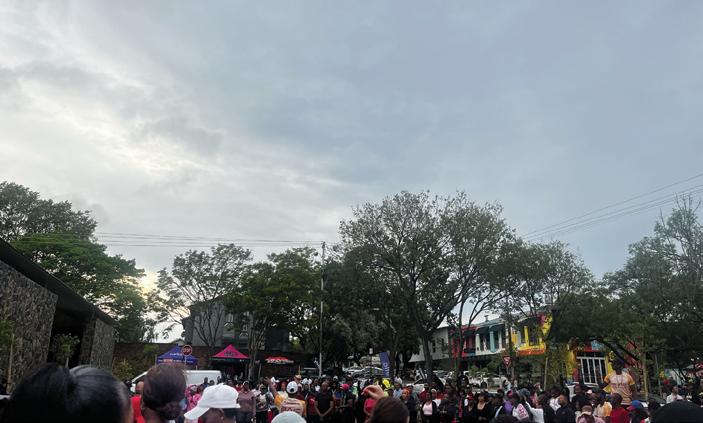
“People want to take their health and fitness more seriously,” says Nimbo, a representative of OnlyFriends. “But there’s also a lack of community in the society we live in. Social run clubs combine the two. You are able to work towards your fitness goals while getting to know new people.” In an era dominated by screens and demanding schedules, the simple act of showing up and moving together has become extremely powerful.
“We’re all stuck on our phones so much that we don’t talk to each other anymore,” Nimbo explains.
The rise of these run clubs also signals a subtle shift away from traditional nightlife. While evenings out still hold their appeal, especially in student life, many young people are gravitating towards experiences that leave them feeling energised rather than depleted.
Photo: Relebogile Manana
“You go out with your friends and it’s amazing,” Nimbo says, “But when you wake up the following morning, there can be regrets. With a run club, you wake up early, you get those endorphins going and there are no regrets, only rewards.”
OnlyFriends has found that balance is key to its appeal. For some, the Sunday 5K is about shaving minutes off a personal best. For others, it is about conversation between the strides. “It’s a beautiful balance between fitness and connection,” Nimbo says. “Some people come for the fitness, some for community, but whichever you choose, you’ll find it.”
The timing plays a crucial role in shaping the atmosphere. The early Sunday morning 06:00 slot offers a reset before the week begins.
“People are fresh. They have just woken up, they haven’t started thinking about their problems yet,” Nimbo says. With the crisp Hazelwood air and quiet streets, the environment itself feels designed for clarity and connection.
The sense of intentional community is amplified by OnlyFriends’ collaboration with Pantry. More than just a coffee stop, Pantry has positioned itself as a lifestyle and wellness space – somewhere to meet, linger, and share.
“We approached Pantry because it is already set up as a space where people can socialise and interact with one another. You can go there for coffee, groceries, a date, or an ice cream. It already creates a space where people can come together.” After the run, participants return to Pantry for electrolyte drinks, coffee, and conversation, often with exclusive discounts as a reward for completing the run or walk. But the partnership goes beyond these incentives as it reflects a wider trend of collaborations between community groups and hospitality venues that transform spaces into social hubs.
“Hospitality venues create a space where people sit down and talk to each other, away from their phones,” Nimbo says. “Our social run is geared towards that as well. Partnering with Pantry enhances the experience and keeps the momentum going of being in a healthy, social environment.”
As the trendy wellness culture continues to grow, so does the demand for spaces that offer more than just a workout. Social run clubs like the OnlyFriends training group demonstrates that fitness can be structured, social, and disciplined. On Sunday morning runs at Pantry, it is clear that people are not just running for fitness, but connection too.

Who and what is the UP Formula Student Project? This is an engineering-led student initiative focused on designing, manufacturing, and racing a single-seater formula-style racecar. Formula Student is an international competition that is common in Europe, the US, and Asia. It features university teams that will design and build a Formula student car to compete with.
PBDY spoke to Daivik Tulsee, a final-year Mechanical Engineering student. As one of the student participants, Tulsee noted that the team is primarily made up of engineering students who work across various fields, including aerodynamics, main systems, and subsystems. Within these sub-teams, each student is working on a design/testing contribution to the car.

Tulsee confirmed that the primary team is a finalyear mechanical engineering team, adding that they currently have ten students who range from second year to third year in various disciplines of engineering that have joined the mission.

The following students were mentioned as part of this innovative project: Ryan Flemix, Natasha Peters, Daivik Tulsee, Muhammad Faydhan Kala, Ryan Bennet, Aislin Van Schaik, Filip Poludniak, Daniel van der Merwe, Onweng Angura, Kemeshan Moodaly, Gustav McCabe, Shekhar Rooplahl, Ryel Naidoo, Ian Bakker, Kayla Naicker, Priyadarshini Naidoo, Disiame Mokoena, Ayrton Contreiras, Francois Bennett, Imraan Karanie, Armand Cruywagen, and Christian Du Plessis. All of these students work together to empower future generations, showing that potential, alongside hard work and teamwork, can result in definite success.

Tulsee reported that "bridging from the engineering team, a marketing team was formed, with the Head of Marketing being one of the engineers. The rest of the team is composed of various other disciplines. These include computer science (web development), graphic designers, 3D animators, and we are looking to expand further.
The marketing is utilised to showcase the talent of the team, the mission, and to inspire the next generation. We are currently utilising Instagram and LinkedIn, with our YouTube launching in March at the latest."
While they are designing and building according to the International Formula Student regulations, their “competition” will not be the same. Four other universities in South Africa have joined their mission to design and build a racecar. These universities include the University of Cape Town, the Tshwane University of Technology, Stellenbosch University, and Nelson Mandela University.
When asked how long it would take to make the racing car, Tulsee noted that they are “looking to have it built and running by August.”
PDBY will be following this project over several editions
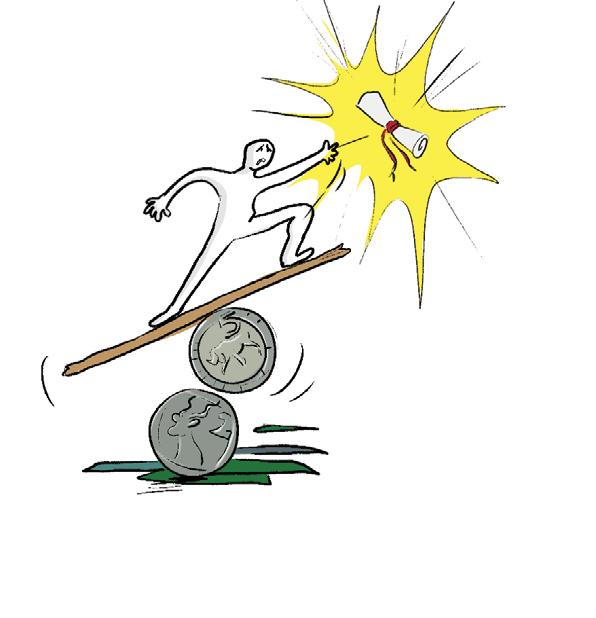
For many students at the university, the decision to pursue postgraduate studies is an academic one. The reality, however, is often financial.
Admission into honours, master’s, or doctoral studies does not automatically mean registration will be straightforward. Funding timelines, application deadlines, and confirmation processes often determine whether a student starts the year on time, waits, or possibly does not start at all.
“It has been a tough couple of weeks,” said Amira Wanga, an honours student in Religious Studies, describing the uncertainty she experienced before her registration was confirmed. She was able to register later after receiving assistance through First Payment Assistance (FPA) and noted that her faculty provided support during the process.
Other Theology postgraduate students explained that some of their required, noncore modules are attached to scholarships that fund those specific modules, reducing part of the financial burden within the programme.
Not every applicant’s experience is the same. One postgraduate applicant, who asked to remain anonymous, said she is currently not registered and remains at home without accommodation and registration fees while she awaits financial aid and external funding outcomes. She is considering transferring to a more affordable university if funding is not secured.
At UP, postgraduate funding is administered through structured processes. The Postgraduate Support Office (PSO) announces funding calls through the university website, faculties, social media platforms, information sessions, and the weekly research funding bulletin managed by the Department of Research and Innovation (DRI). Funding opportunities include internally funded bursaries, such as the UP Postgraduate Bursary and UP Doctoral
Research Bursary, as well as externally funded programmes including the National Research Foundation (NRF), the Department of Science, Technology and Innovation and Council for Scientific and Industrial Research (DSI-CSIR), Mandela Rhodes, and the Organization for Women in Science (OWSD). These bursaries are available to honours, master’s, and doctoral students. Students registering for postgraduate diplomas, certificates, or the fourth year of a bachelor’s degree are not eligible for UP postgraduate awards.
The university advises students not to rely solely on institutional funding and encourages them to begin searching at least a year in advance. Funding deadlines may fall months before registration deadlines. Prospective master’s and PhD students are also encouraged to identify supervisors early and begin communication prior to application.
In addition, the Financial Aid Office manages a database open to all students regardless of household income or programme to allocate bursaries, discounts, and other assistance when funds become available. However, registration on the database does not guarantee funding.
Beyond formal offices, SRC shares funding links and application guidance through their Instagram page and WhatsApp channel. Faculties may nominate eligible students for FPA depending on circumstances.
The transition into postgraduate study is therefore not only an academic step, but also a planned process. Understanding funding categories, deadlines, eligibility, and available support structures may shape whether registration proceeds smoothly.
For students considering honours next year, preparing for master’s applications, or returning for doctoral study, funding is not an afterthought. It is part of the transition itself.
There was a time when completing a degree felt like triumph. Walking towards the finish line has an expectation of success tied to it. At that moment, all the late nights, test weeks, financial strain, and moments of self-doubt finally culminated into one symbolic walk across a stage. Unfortunately, the tables have turned. In 2026, many students walk towards a graduation that feels less like a celebration and more like a step into the unknown.
South Africa’s youth unemployment crisis casts a long shadow over the class of 2026. According to Statistics South Africa (Stats SA), the youth unemployment rate (ages 15–34) remains alarmingly high at above 40% in recent Quarterly Labour Force Surveys. Among graduates, the rate is lower, but it still sits in the double digits. While a qualification improves employability, it does not guarantee immediate employment. These numbers are the influence of growing fear and anxiety among final-year students and postgraduates. They ask themselves what is next, but the government cannot answer. Therefore, for many final-year students, the final semester feels emotionally complex – a walk towards an overwhelming win. “I should be excited,” says Naledi Mokoena, a final-year BCom student. “But every time someone asks me ‘What’s next?’,
I feel this knot in my stomach. I have applied for internships, but there are thousands of us applying for the same positions and not enough seats to accommodate us all.”

The current crisis of unemployment is proof that her fear is from Higher Education South Africa highlighted the mismatch between and labour market absorption, certain fields. While South Africa thousands of graduates annually, economic growth has not kept pace with the number of job seekers entering the market. For postgraduate students, the pressure often intensifies. Sipho Dlamini, currently completing his master's degree, describes a different kind of anxiety. “There is an expectation that with a postgraduate qualification, you should be sorted, but funding runs out, research contracts are short term, and academic posts are limited. Sometimes, it feels like you are overqualified but underemployed.”
Perhaps the most important message for the class of 2026 is that the anxiety they feel is shared. Behind the graduation gowns and celebratory photos are thousands of students quietly wondering what comes next. The fear of crossing over into adulthood during economic uncertainty is real. It deserves acknowledgment, not dismissal.
Mpho Mahlangu
When asked about the scale and purpose of the 2026 FLY@UP Orientation, Tayla Jonker emphasised just how much intentional planning goes into welcoming first-year students to the University of Pretoria. “Orientation Week is fully arranged, managed, and co-ordinated by a three-person team – Orientation Manager Hestie Byles, FLY@UP and Orientation Co-ordinator Tayla Jonker, and Orientation administrator Dina Maboko,” she explained.
Despite the magnitude of the event, which welcomes nearly 10 000 first-year students, the programme is driven by a small but highly dedicated team working behind the scenes to ensure everything runs seamlessly. One of the standout features introduced this year was the use of faculty-specific coloured lanyards. Each student received a lanyard representing their faculty, making it easier for them to identify where they belong and fostering an immediate sense of academic identity and community.
In addition to this, every first-year student received a comprehensive Start-Up Guide. This practical resource includes everything from how to access student email accounts and apply for financial aid to understanding the 2026 university calendar, academic exclusions, and how to structure a timetable. The guide was designed to serve as a reliable reference point, especially during the overwhelming first few weeks of university life.
The structure of the week itself was carefully curated to balance social integration with academic preparation. The first day focused on being fun, social, and supportive. Students met their Faculty Houses, explored student life in the Piazza, attended sessions at Rautenbach Hall to learn about campus support services, and were introduced to the library and its academic resources.
The second and third days shifted towards academic readiness. First-years met their lecturers, gained clarity on modules and credits, and familiarised themselves with timetables and class expectations. The final day concluded with a lively campus crawl – a treasure hunt designed to help students explore and become comfortable with navigating the campus environment.
The team also worked closely with STARS mentors and student helpers who were easily identifiable in brightly coloured FLY@UP attire. These student leaders played a crucial role in assisting first-years with directions, programme guidance, and campus tours.
According to Jonker, the purpose of Orientation extends far beyond logistics. “Orientation is a student’s first introduction to university life. First impressions count, and they last,” she noted.
Banthatile, a second-year Law student, also shared her experience. “Helping with orientation was nice – a lot more fun than I had expected it to be. The first-years were such nice people, very curious to learn, very friendly. The highlight was getting to know other volunteers, because apart from that space, I do not think there would have been an opportunity for us to meet, so that was a top tier moment. Also, shoutout to the managers of the FLY@UP volunteers. Without their enthusiastic approach, mentoring, [and] words of encouragement, it would not have been possible without them. That is why I will be doing it again next year,” she shared.
A final-year student, Laurane, also gave us insight into her experience. “As someone who never got to attend orientation during my time [in first year], this experience reminded me of the version of myself that stepped into UP without any guidance. It was just my school map and I against the world. This time, I got to be the person I once needed. There is something powerful about turning what you lacked into what you give. Watching students arrive nervous and hopeful reminded me why community matters, why mentorship matters, and why presence matters. It was honestly a full circle moment, and in giving them the welcome I never had, I found a quiet kind of healing,” she said.
The overarching goal is to ensure that every student feels welcomed, included, and supported, while also equipping them with essential information without overwhelming them. By creating a structured yet enjoyable programme, FLY@UP aims to help students confidently transition into university life, setting them on a path to graduate on time and successfully cross the finish line.









Buhle Jantjies
In South Africa, the “missing middle” is defined by DailyNews as a group of people who are not “poor enough” to qualify for government assistance and are not “wealthy enough” to afford housing or tertiary education without falling into debt. On paper, they are meant to be managing. In reality, they are constantly negotiating survival. Being middle class in South Africa is not about comfort. It is about fragility. It is the knowledge that one unexpected expense could undo everything. It is understanding that when systems fail, they expect the love of your family to fill the gap.
Our parents did everything they were told would lead to stability. They worked hard. They paid taxes. Month after month, money was deducted from their salaries in the name of building a country that promised opportunity in return. We were raised to believe that education would secure a better future. But when it was time to go to university, that promise disappeared.
On paper, we earn too much to be eligible for financial aid schemes. In truth, we cannot afford tuition without giving up everything else. Income brackets did not account for rising prices, increased family responsibilities, or the thin line between stability and crisis. We are considered capable, but capability is not the same as capacity. So families rearrange their lives to make our education possible, not easier. Not secure. Possible. They use their emergency savings for us. They postpone their own needs. They absorb stress quietly. And we end up absorbing something too: guilt.
We, as children, are a part of the missing middle and we end up feeling guilty when our fees increase. Guilty when emails from the school arrive. Guilty knowing how the pursuit of education stretches our parents’ finances thin. Guilty watching our parents sacrifice their needs. Passing your courses does not bring relief; it brings the question of whether the sacrifice was worth it.
University was supposed to be a space of growth. For many, it often feels like a space of fear. Every email from the finance office tightens your chest. Every new semester carries uncertainty
You learn quickly that academic success is not enough. You can pass every course and still be blocked from registering because of historical debt. Effort is not what stops you: money is.
We watch students turn to crowdfunding campaigns such as BackABuddy, where they are forced to explain personal financial struggles to strangers just to clear their historic debt. There is something deeply painful about having to publicly justify why you deserve an education. That is not resilience. That is what happens when the system steps back.
When the #FeesMustFall movement began, we were still children. Years later, we now understand it differently. It was not chaos; it was exhaustion from being excluded from the system. It led to expanded funding through the National Student Financial Aid Scheme (NSFAS), but the missing middle remains largely unsupported. We are still expected to cope quietly.
As a Black student from a working- to middle-class background, it is evident how inequality shapes access in subtle ways. Universities assume we can afford upfront payments, private accommodation, laptops, and have access to emergency funds. These assumptions reflect a history where wealth was racially distributed and never fully dismantled. Apartheid ended, but its economic legacy still shapes who struggles to finish a degree. People call families like ours resilient, but resilience suggests choice. We are not choosing strength, we are enduring necessity. We are all deeply grateful for our families. Their love, sacrifice, and gratitude made our access to education possible. However, gratitude cannot justify a system that transfers public duty to individual sacrifice.
Education is meant to reduce inequality. For the missing middle, it often deepens anxiety and debt. The pursuit of education should not come at the cost of our families’ stability. No family should have to break themselves to secure their child’s future. Until the missing middle is recognised and supported, South Africa’s promise of equality will remain unfinished, and families will continue paying a price that was never theirs to bear.
Awoman makes a choice, and suddenly it is a statement. If she submits in her relationship, she is accused of betraying progress. If she prioritises her career, she is told that she is intimidating or selfish. If she embraces her sexual freedom, she is called names or shamed. If she chooses modesty, she is assumed to be oppressed. Women’s choices are not treated as simply personal. They are analysed, judged, moralised, and debated. The issue is not that women have choices.
The issue is that women have autonomy, and autonomy makes people uncomfortable. Choice, but With Conditions Modern society prides itself on progress. We celebrate independence. We speak of empowerment. We defend sexual liberation. Yet in practice, women are often applauded only when their choices align with what is socially acceptable at that moment. Sexual liberation, for example, promised freedom from shame. And in many ways, it delivered. Women gained greater control over their bodies, their desires, and their narratives. But liberation came with new expectations. Be confident, but not excessive. Be open, but not reckless. Be empowered, but not threatening. The rules changed, but scrutiny remained. A woman who is sexually expressive may be praised in theory but judged in reality.
competing. Be independent, but nurturing.
Be ambitious, but not intimidating. Be liberated, but respectable. No matter what direction a woman chooses, she risks being labelled. It is not the choice itself that unsettles people, it is the fact that a woman does not owe anyone an explanation. Autonomy Without Applause

The Politics of Being a Woman Social psychology offers insight into this tension. Role congruity theory suggests that people react negatively when women behave in ways that conflict with traditional expectations. However, the contradiction today is that expectations are no longer singular – they are layered and
True empowerment should not depend on whether others agree with the outcome. Respecting autonomy means accepting that women will make decisions that differ, sometimes radically, from one another. Some will choose to marry young, and some will not. Some will prioritise career, others will prioritise family, and some will juggle both. Some will embrace sexual exploration, others will not. The problem arises when society claims to support choice, but only celebrates choices that confirm its own ideology. When every decision is treated as a political statement, women are forced into constant performance, either defending, proving, or justifying their lives. This pressure creates anxiety, division, and unnecessary hostility between women themselves. A woman’s life is not a public referendum. She should not be pressured into being a person children can look up to. Her life is not a symbol to be claimed by any movement or tradition.
The Real Question
Do we truly support women’s freedom, or do we simply prefer women who make choices that make us comfortable? Until a woman can make a decision about her body, ambitions, relationships, or sexuality without it becoming a cultural battleground, freedom will remain conditional. Empowerment is not agreeing with women’s choices, it is respecting their right to make them.
Lydia le Grange
We live in an age of post-truth where even the most unbelievable facts are twisted into more grotesque versions of themselves for the sake of sensationalism. On 31 January, the US Department of Justice released a new batch of documents forming part of the infamous Epstein Files. These documents contain testimonies, correspondence, and images related to convicted sex trafficker Jeffrey Epstein and his associates. The files were meant to support the ongoing mission for legal accountability and clarity in a case that devastated so many women and children. The social media frenzy around them has muddled an already complicated and painful process.
The facts surrounding the Epstein Files have been disfigured for the sake of sensationalism where reporters prioritise public attention and shock value at the expense of facts, nuance, and truthful reporting. A clear example of this can be seen in the flood of social media posts accusing celebrities of involvement with Epstein simply because their names appear in the documents, even when they are mentioned only in passing and not in connection to any illegal activities. For example, comedian Jon Stewart was widely cited online as having been “named in the files”, a claim which paints someone as guilty of being involved in Epstein’s trafficking ring in spite of his name appearing only once – in a hypothetical pitch for a standup special. There are so many names in the 3.5 million documents published that assuming guilt based on someone’s name being mentioned not only implicates them in something that could ruin their reputation, but also distracts from the true criminals that these files are meant to expose.
Some sources have taken it even further and made up purely false information for the sake of personal or political gain. Certain partisan outlets have published false claims for personal or political gain, constructing narratives claiming that opposing politicians were involved with or knew of Epstein’s crimes based on incomplete excerpts or unverified allegations. The rise of AI has made this even worse by making the creation of false images possible, letting fake news sites publish images of Epstein with different celebrities and claiming that they were from the files.
A good way to ensure that these fake images do not trick you is by using one of many AI image checkers to verify whether the image was AI generated or not. For potentially false articles, you can check the authenticity by looking at whether or not the news source itself is credible, whether the source has any reason to defame those it mentions in relation to the files, or by simply checking the Epstein Files themselves on a website created by the FBI called “The Vault” (the more explicit content in the files might be triggering for some, so approach them with caution).
Fact checking such a vast amount of information can be challenging, but that extra time spent helps to ensure that we do not end up believing potentially harmful lies.
It is our shared responsibility to minimise the spread of fake news, especially when it comes to cases like the Epstein Files where this news can end up denying the victims justice, distracting from the real facts that should be scrutinized, and letting the truly guilty parties off the hook by taking attention away from their crimes.



Dearest gentle reader – this is a safe space to shoot your shot at all those cute people you see on campus Tell those people how you feel about them, hit on your crush, or compliment a person on that outfit they were wearing the other day. Anything positive really. Try to be as descriptive and creative as possible with your description so it makes it easy for the person to identify themselves If both people agree, PDBY will arrange a meetup Do you think this is you?
Email: shootyourshot@pdby co za
I CAN LIVE WITH YOU HATING ME. I JUST CAN’T LIVE WITHOUT YOU.

To the pretty performative male in ENG310 Youre too matcha for my heart Grab your tote bag and come to my place maybe we can listen to some Clairo together xoxo
To the gorgeous girl in INY711 Your voice over Blackboard Collaborate sent shivers down my spine I cant remember your name and I've never seen your face, but your voice haunts my dreams <3
To the girl doing her MSc on Prinshof with the very cute nose and freckles You have stolen my heart Would love to explore the lab and you
To the pretty guy with blonde highlights and nice arms in OPV 212, I'd let you ruin my life
To the guy I ve seen smoking all the time I'm ACTUALLY in love with you (like actually for real) I'd love to (consensually) lick hot wings crumbs off your belly soon
To the lovely ginger man who sat in the Aula eating your pie all alone, I ll keep you company ;) if you only give me a shot, I'll make it worth it! xoxo

To the girl we locked eyes during jcp week in Eng3-7, I think you stole my heart You'll have to take care of it as I'll take care of you and our kids in the future
The hot redhead in SLK210, you could sweep me off my feet ditch that bf of yours and be mine valentines already past but i’m going to let you pass by me

To the new guy in computer science honours class I know your gf treated you badly but let me show you what being with a real woman is like Call me x
To the majestic blond, curly haired actuary first year who pulls up in a Jimny I don’t know exactly what actuaries do but I know I’m a risk worth taking If you ever want to upgrade your ride, I’m here
To the first year boy with the curly hair and the goatee (F F) doing computer science , I d let you access my private variables no password required you already passed the vibe check
To the girl with red highlights comp eng who's always with your man with red highlights i can take ur man any day of the week as soon as u fumble i'm there xoxo�� ��

F U N A N D G A E S M
1. The product of a positive integer and all the integers below it (9)
2. A curve or geometrical figure, each part of which has the same statistical character as the whole (7)
3. An expression of more than two algebraic terms (10)
4. The enclosing boundary of a curved geometric figure (13)
5. A straight line joining the ends of an arc (5)
6. Identical in form (9)
7. A number to be divided by another number (8)
8. The longest side of a right-angled triangle (10)
9. A triangle with two sides of equal length (9)








Lydia la Grange
Most students already know about, or have interacted with, the UP Security Officers who can often be seen on or around campus. Whether in an attempt to find parking on or near campus, to figure out where their next lecture venue is, or simply in the hope that some missing item has ended up in lost and found, very few know the full scope of the work that these officers and others at the Department of Security Services do. The services they provide include controlling access to university grounds, managing student safety, lost and found, and so much more.
The department has a total of 510 staff members, of which 453 are security officers, who work 12-hour shifts at different UP campuses. These employees limit access at campus gates, manage parking, or patrol the campus and surrounding areas. They also walk with students to different areas around campus between 18:00 and 06:00 each night as part of the Green Route that helps students get to and from their cars or residences safely.
Their Operational Management Centre monitors the CCTV footage and electronic security systems around campus while also managing the university’s lost and found. Many students are first introduced to this unit, not when they are concerned about security, but when they go looking for a lost pair of earphones or other personal items.
The Investigation Component of Security Services is responsible for addressing all criminal activities that occur on or around UP grounds, as well as investigating misconduct cases that require referral to a disciplinary committee. They even implement crime prevention strategies like security briefings and student orientations while working with the Hatfield City Improvement District (CID) and SAPS to make Hatfield a safer place for students, residents, and workers.
When PDBY reached out to the DSS to ask if they had any statements on the work done by their employees, they said: “We value our Security Officers and their contribution to create a safe and secure environment on campus in support

Meet The Plant-Based Society’s founders Jacob Gordan (left) and Pieter Botha (right). The society is meant to foster a community for vegans, vegetarians, and any person interested in plant-based living on campus. Founded by first-year BSc Ecology student Gordan, the society was established after he noticed a gap on campus: a lack of support for vegans or vegetarians on campus. However, the leadership has been passed on to Botha and Meela (not pictured) to transition the club into an informal society. It is aimed at reducing the isolation that can come from living this lifestyle in a “meat-heavy” society.
While the group is rooted in veganism, which the founders define as a way of living that rejects the use of animals for any human purpose, it is designed to be inclusive of everyone, including:
• Vegans: People who do not eat any food derived from animals.

Vegetarians: People who do not eat meat or fish.
Flexitarians: People who are exploring plant-based living or simply looking to increase their vegetable intake and reduce their carbon footprint.
• Anyone curious: Anyone interested in learning more about the lifestyle without feeling pressured or judged.
But why would anyone pursue a plant-based lifestyle? The two respectively shared various motivating factors, beginning

with the health benefits. A plant-based diet can prevent or reverse most chronic illnesses from cancer, high cholesterol, or type 2 diabetes. Another factor is ethical reasons based on animal rights. Gordan notes what pushed his decision to become vegan was learning about the cruelty of industrialised animal agriculture from a documentary called Earthlings, as well as the rejection of speciesism – which is the belief that one species’ needs are inherently more important than another’s and that animals are living beings who want to live and can show affection.
Other motivating factors could be understanding the environmental impact of a plant-based lifestyle on climate change, deforestation, or a reduced carbon footprint, as well as religious convictions that emphasise health and natural healing.
The two hope that people who join the society would feel a sense of unity, community, pride, and enjoyment in their lifestyle choices. The society will provide friendly education through group trips to vegan markets, documentary screenings, cooking classes, and many more.
The group currently communicates via a WhatsApp group, which already has around 58 members, including exchange students.
If you want to get in touch, you can contact Jacob or Pieter by using the following:
• Jacob: 060 988 3965/@jakegordz101 on Instagram
• Pieter: 082 848 3495
Rona Disetlhe
It is the first quarter – prime time for setting up an aesthetically pleasing Notion Dashboard and scrolling through the templates. It all looks great on screen, but there is a greater question at hand. How long does productivity actually last?
The problem is not Notion itself: it is the distraction it provides from the actual pressure and expectation of your work due. Because Notion allows you to build your own plan and pick your own colour scheme or custom database, it creates a psychological dilemma. We value things we make more, regardless of whether it makes us more productive or not.
Tweaking your dashboard with all its icons and covers feels like an accomplishment, but it is often just productive procrastination – replacing one primary adaptive behaviour with a less important adaptive behaviour inside or outside the academic domain that mimics “work”. For instance, you are not actually studying, you are just organising the idea of studying.
The idea of productive procrastination is not rooted in laziness. It is rather avoidance as an emotional shield. Daunting tasks or assignments carry the risk of “not doing it right”, so as a psychological response, you retreat into low-stakes tasks because

you know you can do them right.
There is nothing wrong with having Notion as a digital workspace, but it needs to be tempered with realism. To stay effective, it has to be kept practicable and attainable by embracing microproductivity. Small, daily rituals that save time instead of consuming it.
Firstly, if it can be done the night before, then do it. Tasks such as writing your to-do list the evening before saves your time in the morning by giving you one less thing to think about. Laying out your clothes before going to bed or packing your bag before bed is also a good mechanism.
Additionally, push yourself to do the thing that will take less than two minutes but will build momentum for big tasks, like making your bed or tidying that one shelf.
By all means, keep your Notion aesthetic if it brings you joy. But remember: the most productive plan is the one that stays out of your way. If you spend more time decorating your to-do list than checking items off of it, it is time to close the tab and get to work.
Thiya Kalan
Have you ever craved a knock on the door after a soulcrushing day? Someone standing there, unannounced, with a pint of ice cream and no expectations? Have you ever wanted someone to love you quietly – a gentle squeeze of the hand before an exam or someone who picks up after the first ring? Everyone wants a village. A community. A safe space. And yet, it seems like no one wants to be the one holding the ice cream.
Gen Z is the most digitally active – and therefore the most connected – generation in history. We drink the least, move more, track our protein, go to therapy, and set our boundaries with diligence. On paper, Gen Z should be happier, healthier, and living culturally-rich lives. However, statistically, we are the most anxious generation. The most depressed generation. The loneliest.
We are a generation fluent in boundaries. In “protecting our peace”. In “guarding our energy”. In cancelling plans without guilt and muting notifications without explanation. And to be clear, a lot of this is good –necessary, even. For the first time, young people speak openly about burnout, anxiety, and emotional labour. We are more self-aware than ever. But because of it, that selfawareness has turned into self-isolation.
Over the last few years, friendship has become optional. Community is something you consume rather than
contribute to. We expect availability but offer flexibility, and we want support without obligation despite the fact that historically, a village was not convenient.

Villages meant shared responsibility. You showed up when you were tired. You helped when it was not your problem. You listened when you would rather have been alone. You carried parts of other people’s lives simply because they were yours to carry.
compromise, we question it. If someone needs more than we can comfortably give, we label it unhealthy.
But real friendship is often tiring. It disrupts your schedule. It demands you leave your room when you would rather stay in. It requires sitting in conversations that do not energise you. It asks for forgiveness. It asks for patience. It asks for time – the one thing we guard most aggressively.




Now, we call that “too much”. There is a quiet shift happening in how we relate to one another. Discomfort is interpreted as misalignment. Effort is interpreted as emotional strain. If something feels draining, we retreat. If a friendship requires repeated
Promise Erero
What does it take for a criminal to be pardoned from their crimes? Is it rehabilitation, accountability, or time served? Apparently, all it takes is for a large part of society to find you attractive. Now this claim may seem far-fetched, but a study called Justice Needs a Blindfold by Psychology and Law scholars Ahola, Christanson, and Hellström suggested that there is a positive correlation between attractiveness and criminal justice based on the assumption that “what is beautiful is good”.
From the likes of Ted Bundy to Jeffrey Dahmer, people all over the world have sexualised these notorious figures, ultimately ignoring their violent crimes of murder and sexual abuse. Bundy was an American serial killer who targeted vulnerable women by presenting himself as a harmless person who either sought help or was an authoritative figure. Dahmer was also a serial killer who tortured his victims and targeted young men of colour. These two figures are especially important for this correlation because despite their obvious crimes, they received love letters from young women. Vidhi Damani on Medium also makes the point that a further distortion of these criminals’ humanity is made when they are portrayed by good-looking actors in movies made about them. The media plays a very important role in people’s idealisations, and a beautiful portrayal takes away from the brutality of what actually matters – their crimes.
Perhaps a more distinctive example of this concept can be made by one of South Africa’s own recent criminals. Vusimusi “Cat”
Matlala is an accused criminal facing multiple charges including attempted murder, and yet there are countless tweets and TikTok comments defending him on the grounds of being attractive to said commenters. South African artist Focalistic made a song named after him, which further
desensitises the gravity of his crimes. It begs the question – does society take crime seriously when it is done by people they find attractive?
The bizarre aspect about the attractive criminal analysis is that many of these widely known cases are about criminals who have been accused of violent crimes. In the social climate we live in today in South Africa, there is no question that there is a genderbased violence (GBV) epidemic. In November 2025, the Human Sciences Research Council reported that 33.1% of South African women over the age of 18 have experienced physical violence in their lifetime.

Visual: Mila Jordaan
When crimes are pardoned due to the attractiveness of the perpetrator, these statistics increase. In the GBV epidemic we live in, there should be no room for an increase in such horrible crimes. There are many detrimental effects to society when the severity of crimes are downplayed surrounding the basic concept of injustice – victims do not get vindication, criminals do not serve deserved sentences, and society’s morale is pushed further down. Do we really want to live in a world where people do not fear the justice system because they are aware that they will get sympathy points for being conventionally attractive? As pretty as a face may be, there should be nothing this superficial to excuse behaviour that disgraces humans. So the next time you see an edit of a criminal on TikTok, remember that the world is becoming increasingly worse because of their actions.
The irony is painful: in trying to avoid emotional exhaustion, we are creating emotional isolation. In protecting our energy, we are starving ourselves of the very thing that replenishes it: belonging. A village does not exist without villagers. It does not exist without the friend who drives across town at midnight. Without the one who remembers birthdays. Without the person who initiates plans even after being left on read. Without the uncomfortable conversations. Without the inconvenience.
We talk a lot about “love languages” – physical touch, words of affirmation, quality time, acts of service – but it is deceptively easy to assume that a well-timed text or a single afternoon together is enough to sustain a relationship. Love languages are ways of expressing care. They are not substitutes for commitment. Time. Effort. Showing up when it is inconvenient. Choosing to stay when it would be easier to withdraw. That is the real language of love.
Everyone wants a village. The harder question is are you willing to be a villager?
Thiya Kalan
It starts in your childhood. Bedtimes at 8pm. Brushing teeth before bed. Homework, then play. It endures when you get to high school. Timetables and assemblies, leadership roles and deadlines, swim meets and hockey tournaments. Whether by choice or imposition, the rhythm of routine is instilled in us. So why is it working against us?
When was the last day that felt new to you? Not productive or successful, but new. Where the air felt different and the conversations lingered. Where you remember every detail of the day because time stretched and did not sprint by. We glorify stability and discipline. We romanticise routine because it signals success. There is, of course, truth in that – there is genuine skill in developing a regimen that works. In an unpredictable world, we find comfort in the same alarm tone, the same coffee order, and the same route to work. Repetition feeds our need for control. But what if that repetition is actually shrinking our lives?
Neuroscientists suggest that the brain does not measure time in minutes or hours, it measures change. Newness. Surprise. Emotion. When something is novel, the brain releases dopamine, sharpening attention and strengthening memory formation. The moment stands out and it gets stored. Have you ever noticed how vividly you remember your childhood summers? It was not because it was a “happier” time, but because it was novel. Every sight, smell, and friendship was a first, forcing the brain to constantly rewire itself. As adults, however, the years seem to collapse into one another. When we repeat the same responsibilities day after day, our experiences are stacked so neatly on top of each other that they eventually blur into a single, indistinguishable mass.
Psychologist and Nobel laureate Daniel Kahneman describes the difference between the “experiencing self” and the “remembering self”. We live moments once, but we remember them selectively. The remembering self holds onto peaks, novelty, emotional intensity. It edits out repetition. A week filled with identical days will feel shorter in hindsight than a week filled with firsts. Routine compresses memory and, in turn, compresses time.
There is, of course, nothing inherently wrong with stability. There is a profound safety in ritual and a restorative calmness in consistency. But in our quest to be productive and practical, we have accidentally become predictable. We have begun to run on autopilot. The solution is not a radical abandonment of our daily structures, but rather a gentle disruption of our rhythm It is found in the “micro-fractures”: ordering the dish you cannot pronounce, taking the long way home, or swapping your reliable coffee for something unfamiliar. These small breaks in the circuit are not about changing who you are; they are about deliberately reintroducing novelty into the machinery of your life.
Perhaps a long, rich life was never measured by grand milestones or accolades, but by these scattered moments of curiosity. It is the quiet daring of doing things slightly differently and choosing, just for a moment, to disengage the autopilot. So, look back at your week, your month, your year. When was the last day that felt new?
Milan Govender
Do you know who MVP is? Our TUKS mascot is named Most Valued Player, aka MVP the Eagle. Do you ever stop to wonder why our mascot is an eagle? It could be because many of us have eagle eyes to spot the baddies on campus. However, I do not believe that the eagle truly represents all of us here at Tuks, so here are some other suggestions for our paradigmatic bird.
The first possibility is a penguin – reason being that many students try to succeed in university but the reality is that, much like the penguin, some of us do not FLY@UP. But when looking at the dating pool, because penguins mate for life and Hatfield students mate over the lengthy period of a one-night stand, maybe a penguin is a misleading representative.
Another suggestion could be an owl, specifically a night owl, for three reasons. Firstly, the frequented “WE OUTSIDE TN!” of UP students and the city coming alive at night is surely indicative of an owl’s nocturnal lifestyle. Secondly, some of our students are determined receipt-collectors and many a time will their noses be stuck in your business.
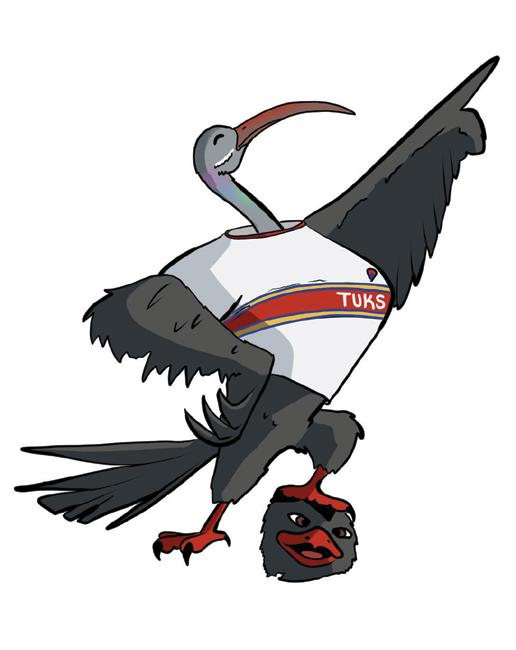
And as the owl calls, these collectors routinely ask, “Who? Who?”.
Thirdly, the difference I have observed (and also love) between UP students versus other university-goers is that we are, much like an owl, wise, street-smart, or perhaps street-wise, but that would make us chicken, I suppose. A parrot would be the perfect academic representation for us. When test week rolls around or when exams hit us like a moving truck, what do we do? We parrot. We parrot the slides. We parrot the textbooks. We parrot the handouts. We parrot and we parrot well.
Many of the guys on campus could be compared to birds of paradise, ruffling their feathers (low taper fades) and performing (nonchalant baddie performative male final boss) to attract a mate. Less commonly known, birds of paradise are also sexually dimorphic, so that makes a lot of sense, does it not?
We could use a pelican because pelicans can hold their liquid in the same way that we can hold our liquor. On average, pelicans hold thirteen litres of water while the average UP student can hold thirteen klippies and coke.
Ultimately, we could even question why we have to have a bird. We could have a goat (self-explanatory) or, hear me out, a party animal.
Tia Haswell
It is a sobering reflection of our times that a sentiment so seemingly self-evident is considered a radical political statement. Perhaps it always has been, which is a societal fault in itself. However unfortunate a reality, it is one we must boldly confront with recognition of our shared humanity.
On Monday, 9 February, the NFL hosted the 2026 Super Bowl. Officially it was Patriots vs Seahawks. Unofficially, it was Benito Bowl.
Making history on its 60th rendition and the centennial of NBC, Bad Bunny, aka Benito Antonio Martínez Ocasio, graced the American public as the first ever solo Spanish-speaking headliner in Super Bowl history. This milestone follows his streak of achievements, including being the first artist to ever win a Grammy for Album of the Year with an entirely Spanish project, “Debí Tirar Más Fotos” (“I Should Have Taken More Photos”). The album cover, featuring two white plastic garden chairs, is a deceptively simple yet profound symbol of community, shared culture, and belonging.
Arguably, the Super Bowl half-time show is the main attraction of the event. Bad Bunny transformed for thirteen minutes on American football’s biggest stage into a message that transcends cultural or geographical borders. Against the socio-political backdrop of rising anti-immigrant rhetoric in the United States, his performance was a vibrant, unapologetic celebration of Puerto Rican and Latin American culture. Most notably, his performance was unapologetically human.
For those of us watching from the sidelines, let me set the scene:
The curtains open to a deluge of greenery enveloping the central stage – a sugarcane field. In a striking metaphor, the “cane” was composed of real people dressed in grass costumes. This was a poetic nod to the labourers who work and sustain the land while reflecting the intertwined history in which Puerto Rico was folded into the US economy following the 1901 Presidential Proclamation. It was a reminder of the enslaved labour on which Puerto Rico’s sugar cane industry was built for much of the 1800s. Among them stood workers in traditional pava straw hats, paying homage to rural farmers. On the world’s most expensive commercial event, Bad Bunny gave unseen labour a face. Faces, in fact. It is a necessary reminder that without people, an economy is but a husk.
his Grammy to a small Latino boy dressed in a brown striped shirt reminiscent of his younger self. Launching into his song “MONACO”, Bad Bunny spoke directly to the audience in Spanish saying, ”If I am here, it is because I never stopped believing in myself. You should also believe in yourself. You are worth more than you think.” Before panning to a Latin arrangement of “Die With a Smile” by Lady Gaga and Bruno Mars, Bad Bunny sang his song’s introduction which says, ”Dime, ¿esto es lo que tú quería?”, translating to,”Tell me, is this what you wanted?” – a not-so-subtle critique of the expectations posed on Latin people to assimilate into Englishdominated culture and the gentrification and erasure of culture scourging the United States. Gaga was styled in the light blue shade of the original Puerto Rican flag, recognising the initial design that was forcibly replaced by an “Americanized” dark blue in 1952 following the oppressive “Gag Law” which illegalised its display. In an act of historical reclamation, Bad Bunny ended the segment waving the original light blue flag.
Atanda Ntlantsana
It seems that with fame comes the expectation to be politically vocal. We demand a greater level of activism from celebrities than we do from ordinary people, suggesting the existence of a “celebrity social responsibility”, according to The Influence Agency. They have a greater reach and much more money than us, so why shouldn’t society expect them to use their position for good?
The power celebrities have is undeniable. When Taylor Swift shared a voter registration link during the US’s 2024 elections, her Instagram story drew over 300 000 people to the site. However, this number did not necessarily equate to the same number of new voters, nor does it guarantee that new voters necessarily voted in favour of Kamala Harris, the presidential candidate who Swift publicly endorsed.
“With great power comes great responsibility”
This begs the question: does solidarity create any change or is this simply an act? Some argue that sharing one's political views encourages the supporters of a celebrity to take the initiative to learn more about and actively participate in political affairs. However, when they choose to not provide resources or suggest actionable steps people should take to enact change, the effectiveness of outspokenness actually leading to change is questioned. Furthermore, proclamations of political stances without proper nuance may encourage people, especially younger, more impressionable fans, to adopt a celebrity’s political stance without actually understanding what it means.
So, celebrities should be providing political education, resources, and nuanced perspective. Easy peasy, right? But, is it possible that this is too much responsibility to put on a single person? A single person who does not have a degree in political science and, quite frankly, may not be the most knowledgeable on the state of current affairs? At least not to the extent that they should be looked to for political guidance. Politics is a complex field, and it is difficult to fully understand the state of current affairs, let alone formulate one's own opinions on it. In an era of fake news and misinformation, it is difficult to know what is true and what is not. The world is not black and white, and most political issues do not have a simple solution. Is it so wrong for a celebrity to not speak on an issue that they simply do not know enough about when there are people who are willing to choose the path of activism and do the work that it takes to responsibly be an agent of change?
“THE ONLY THING MORE POWERFUL THAN HATE IS LOVE”
Alongside a crowd of people waving international flags, Bad Bunny marked the finale of his performance shouting the words, ”God Bless America!” and calling the countries of the Americas from South to North, effectively decentering the United States and reframing America as a continent, not a single country built independently of transcontinental support. Criticisms that Bad Bunny is “not American enough” to headline a quintessential American event, especially a performance almost entirely in Spanish, reveal more historical illiteracy than intellectual acuity. Puerto Rico has been a US territory for over a century, making Puerto Ricans US citizens by birthright. Moreover, the United States has no official language, but that is beside the point. The impulsion to gatekeep “America” underscores why a performance centred on a boundless humanity was not just appropriate, but necessary.
The final screen projected the words “The Only Thing Stronger Than Hate is Love”, as Bad Bunny stated, ”Segiumos aquí – We are still here.” End Scene.
The alternative perspective is that neutrality is complacency. Fans want to know that by supporting a celebrity, they are not unintentionally supporting people with bigoted views, especially when those celebrities are active in their bigotry. Everyone loves Harry Potter, but there is a reason why supporting JK Rowling by buying products related to the franchise is generally frowned upon. Rowling is vocally against the realisation of the rights of the transgender community. By making her political stance known, Rowling allows readers to spend their money in ways that align with their own politics. Maybe this is why we want celebrities to be vocal on the political stage – so that we, as fans, can be comfortable in the fact that we are aligned with the people we support. But then comes the argument that we should be able to separate the art from the artist and enjoy the work of people we do not necessarily agree with.
Bad Bunny’s manifesto of a setlist was poignantly defiant. As the camera moved across the field, the audience was exposed to various aspects of Latin American culture, from children sleeping outside La Casita, depicting a typical Puerto Rican house party, to a tributary setting of Latin American businesses and culture in NUEVAYoL (the Caribbean-Spanish spelling of New York). Later, Bad Bunny is seen handing over
As a South African, this message felt familiar. Multiculturalism is not a threat; it is a gift. And it is a gift that we, as South Africans, are so privileged to hold in abundance. We understand the weight of inheriting a painful colonial history. We know the cost of division. We also know the difficult, courageous power in reconciliation, and love. Our tapestry of cultures, history, and identities allows us to understand the message on 9 February loud and clear. Our “plastic chair” stories, our mixed masala of culture and history, connect us. I don’t know about you, but love is not political.
The question of celebrity activism is a nuanced topic and there is no clear-cut answer. On one hand, celebrities seem to have a wide reach and impact that most activists and politicians simply do not have. But on the other hand, those working in the realm of politics have the knowledge and perspective to responsibly and effectively act on the political stage. So the question remains: are

Choosing your top four favourite films should be a fairly simple choice. When one must do this in a public space like Letterboxd that everyone – yes, everyone (including a burned ex-flame) – can see, things can get a bit complicated.
Letterboxd is a platform designed for film lovers that allows them to publicly log the films that they watch. On Letterboxd, every single follow, like, tag, and rating is tracked in the activity tab, inviting an audience into your personal experience of watching a movie. As Letterboxd user Atanda describes, there is always “a vague sense that someone is watching”.
An example of a feature that is open to all users is the Letterboxd Top 4. This is a ranking of one’s top four films that is pinned to their profile. As Letterboxd user Ayesha explains, the top four acts as a first impression and, as the old saying goes, “First impressions are very important”. For some users, their top four is an intentional portrait of the kind of films that they wish to support. Ayesha writes reviews for “beautiful women who like weird movies”. They care deeply about women in film and they make sure that their top four reflects this. In the same way, Atanda sees their top four as being “representative of what [they] enjoy” and what they want to be associated with.
According to author Aleksandra Maria Brania, certain movies have a higher ranking on the Letterboxd totem pole. Unfortunately, your favourite rom-com may not make the cut for some users on Letterboxd as anything mainstream is usually
frowned upon. When speaking of their experiences, Atanda says that “it can… feel like I have to make my Letterboxd activity agreeable and have the right opinion on movies”. You can hardly blame anyone for feeling like this when there are users like Jason who “would not trust an opinion from a guy who rated a Marvel film 5 stars”. This means that any regular Joe who logs onto Letterboxd for the first time and sees some obscure French films on his friends’ activity tabs might feel insecure when it comes to picking their top four. They may even settle for something that the film bros would definitely approve of instead of giving films like Terri Joe: Missionary in Miami the five stars that they rightfully deserve. Even worse, some like Humphrey may just avoid having a top four altogether in fear of being judged.
For others, their top four is a genuine collection of their favourite films regardless of what the community views as “good”. User Jules loves being able to share the films that she enjoys with her friends. For her, Letterboxd is a way to process how she feels about a movie after watching it. She has no interest in “strangers thinking [she] is funny or sophisticated” and her number one film on Letterboxd is her all-time favourite, film bros be damned. Similarly, Andrea’s top four films are a collection of movies that have amazed her. She rates films based on her enjoyment and not what the film bros
Athink qualifies as “high scoring”, writing reviews for her future self to look back on.
You may use your top four to bag a hottie from your local film club or to express your love for films. Whichever purpose you choose, just remember that you are not alone. Everyone is putting on some performance.
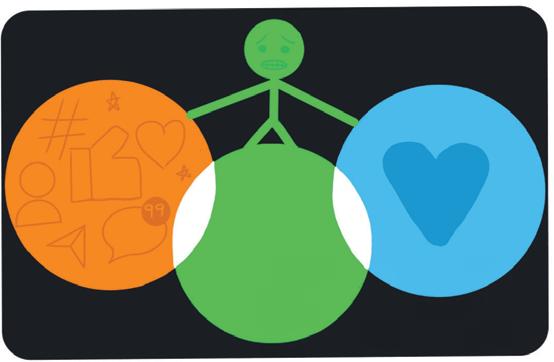
number that hunts musicians and lurks in the shadows, stalking them silently and patiently. It taunts them, waits for them to reach their peak, and then it beckons their bright light into the dark side. 27. Where 27 is concerned, coincidences become legends – an anthology of haunting stories about untimely demises.

AEerie Origins
A young musician is gone too soon with others following close behind. The pattern first emerges with the death of The Rolling Stones guitarist Brian Jones on 3 July 1969. This seems like an isolated incident, a tragedy, a young star dead and buried at the age of 27, at the height of his career. That is, until Janis Joplin, Jimi Hendrix, and Jim Morrison followed suit, all aged 27, with the last death being on 3 July in 1971. Four deaths starting and ending on the same date, as if it were a perfect symphony. These names are the first inscriptions etched into what would be a ghostly mural titled “The 27 Club”, with each new death echoing the last.
Death is What Keeps the Club Alive
This club holds no initiations in the realm of the living; the requirement for your membership is death. The 27 Club persists, as if the dead are leading some phantom society. In 1994, Kurt Cobain died, with his mother expressing her sorrow by saying that her son has “gone and joined that stupid club”. Amy Winehouse followed almost two decades later in 2011, and her untimely death reignited the myth for a new generation. Each new addition to the club not only strengthens this legend but also creates a death bond between musicians who have never even interacted, proving that different parts of history can haunt the same narrative.
The 27 Club has seeped into every aspect of pop culture, not just music. Documentaries such as 27: Gone Too Soon linger on the mystery, while songs such as “Club 27” by Mac Miller invoke its name. Brands such as Streetwear Official have clothing collections referencing the 27 Club, with the faces and names of the late stars plastered across the pieces, transforming grief into an aesthetic rebellion. Online, the myth thrives in conspiracy theories, where netizens speculate about Faustian pacts and industry curses. Each retelling of the 27 Club’s story ensures its survival. The myth is not sustained by truth, but rather by the eerie allure of its tragedies.
The most haunting element of the 27 Club is the reality of it: these musicians’ deaths were related to suicide and drug addiction, a result of their struggles with their mental health compounded by the crippling nature of stardom. Their premature deaths have been romanticised as if dying at that specific age is fate, forever preserving their talents and geniuses.
Our interest in their demise lies in our fascination with what could have been had they not been forever 27. Their voices are forever immortalised in their music, but their careers are, somehow, forever unfinished.
“Wait…Harry Styles Was In A
nybody with a working phone can remember being bombarded with TikToks backed by the sound of “As It Was”. Harry Styles has managed to assert himself as one of the main Pop Boys of the 2020s. The 2024 Album of the Year winner has a fanbase that spans various countries, ages, and genders. His gender-fluid fashion and retro-pop sound has been a catalyst for his unique standing in mainstream music. His success has reached so far and wide that a considerable amount of his audience are unaware or unfazed by his past as a member of the English-Irish sensation One Direction.
For decades, boybands played a major role in (teenage girl) pop culture, with bands ranging from The Jacksons to The Beatles. One Direction was no exception and is seen as one of the last examples of a culturally relevant boyband. Despite this, in the entirety of their five-year-run, One Direction neither won a Grammy nor reached the top of the Billboard Top 100 chart –both signifiers of the pinnacle of success in the music industry. On the other hand, as a soloist, Harry Styles has seen both achievements many times over. This is not a new phenomenon: many former boyband members have seen immense success after the disbandment of their group, with Michael Jackson and Justin Timberlake being the most prominent examples. All of the aforementioned artists were coincidentally the “Beyonces” of their respective groups. Styles was positioned as the main heartthrob of One Direction, receiving the most lines and screentime throughout their career.
Zayn Malik was the first member of One Direction to forge a
solo path, and he cited feeling that the band’s musical trajectory was not enjoyable to him. As a result, his solo work has been a complete change to the pop-rock genre of the band and is instead a darker, R&B-influenced style. His unexpected departure and turn to a genre on the opposite end of the spectrum led to a lack of interest from a gross majority of Directioners after the novelty of his departure faded. Unlike Malik, the rest of the One Direction members have still maintained a semblance of the personalities that they marketed themselves as during their time in the band. In the case of Styles, he still has the charming, heartthrob image that he had in One Direction. Because of this, he kept a majority of his 1D fans while enticing new listeners with his matured, retro take on the pop-rock genre.
seen more success as soloists, their management has played a major role in their heightened success.

I would be remiss to not take into account that Styles’ ability to reach astronomical heights in comparison to his former bandmates has much to do with those pulling the strings behind him. He is represented by Jeffrey Azoff, the son of Irving Azoff, a well-connected, legendary figure in the entertainment industry through his executive running of The Azoff Company and Full Stop Management. Similar to other former band artists who have
Marketing an individual is easier and more profitable, hence why many boybands have an unofficial leading man – like Harry Styles was. This has also guided the way the K-Pop industry has still managed to rely on bands to lead the genre. The members’ individuality is heavily highlighted, and many K-Pop groups have members running solo and group activities concurrently to cater to multiple audiences and streams of income. This is most famously seen with BTS. The Western music industry has not done well to exploit this concept, as seen with One Direction and other boybands honing in on group work only, sometimes to the detriment of individuality.
Harry Styles has his past as a member of One Direction to thank for the leg-up he had in the beginning of his solo arc. However, he is an intriguing case study of how marketing and knowing the right people can create a successful career and make solo work more valuable in the music industry.
Kopanyi Ramokgopa
Have you ever watched a movie and thought to yourself, “How did the actor make that emotion feel so real?” If so, then you can give credit to Konstantin Stanislavski, a Russian theatre practitioner who gained prominence in the 20th century for coming up with what we would know today as method acting. Stanislavski believed that acting should move beyond the dramatic, artificial gestures that dominated his era. Instead, his method encouraged performers to portray emotions, not imitate them. For instance, instead of wailing dramatically to show sadness, actors were urged to use “emotional memory”, a technique where the actor draws emotion from a real-life tragic experience. This enables the performance to feel more human. But more importantly, he emphasised that method acting should not be indulgent because that is where true vulnerability and emotional depth go to die.
This practice that found its roots in genuineness and emotional honesty evolved into something more extreme. Instead of actors portraying internal vulnerability, the focus deviated to the visual of vulnerability through physical suffering, disruptive behaviour, and, in some cases, downright illegal behaviour.
An instance of this was when Christian Bale drastically lost 55kg for his role in The Machinist and subsequently gained 45kg in a span of six months for his role in Batman Begins. Jared Leto’s role in Suicide Squad as the Joker took this new form of method acting even further by sending his co-stars used condoms, boxes of bullets, and pornographic magazines all in the name of creating a “dynamic of surprise and spontaneity”. It is important to note that Leto had less than eight minutes of screentime in the movie. On an even more disturbing note, while preparing for his role in The Fall, Jamie Dornan would stalk women from the train station down multiple streets to “immerse” himself in his role as the fictional serial killer Paul Spector, stating that the action of stalking these women was “exciting in sort of a dirty way”.
Unfortunately, these male actors are rarely shamed for their actions. Instead, they are praised for being misunderstood, tortured figures with their extreme antics being deemed as peak artistry. This lack of pushback enables them to avoid the portrayal of true vulnerability. They believe that their starvation, destruction, and machismo are substitutes for emotional vulnerability. Actress Kristen Stewart articulates this best by saying that this type of method acting by male actors is like “a gorilla pounding their chest before they cry on camera”. This makes the “inherently submissive” nature of being a vessel of another individual's ideas feel “less embarrassing” and therefore less emasculating.
Ironically, the method Konstantin Stanislavski created to help actors bring about emotional depth and vulnerability in performances has mutated into a shield against that very same vulnerability. This poses a very important question: if an actor feels the need to take such extreme measures to accurately portray a character, are they a good actor to begin with? In the words of Laurence Olivier to his co-star Dustin Hoffman, who used method acting by depriving himself of sleep to portray his character's exhaustion, “my dear boy, why don’t you just try acting? It is so much easier.”

SOCIETY PAPERS
Dearest Gentle Readers,
Society has long been assured that the Bridgertons are the glittering centre of our social season. With eight siblings and one formidable mama, the family bond appears sturdy enough to withstand any scandal. And yet, as the seasons turn, one cannot ignore a most curious development: for a household so plentiful in number, the drawing room feels increasingly sparse. With each new debutant to the ballroom and love story floating about the ton, it would seem only natural that the Bridgerton household would grow ever larger, enriched by the addition of spouses, children, and the promise of a flourishing family line. Yet the siblings seem to either vanish one by one each season or move into the periphery of the ballroom. Even the family dinners appear less crowded, less chaotic, less… Bridgerton. Therefore, this author cannot help but ask: in a story that bears their title, how have the Bridgertons become guests at their own affair?
The Bridgertons, once a household bound by loyalty and unbreakable sibling bonds, now oddly drifts in fragments. The promise of an ensemble show falls decidedly flat as characters vanish or are all but ignored in a series that once seemed built upon the family’s very centre. Miss Daphne, absent since the second social season, leaves a most conspicuous void. Her absence ripples through the storylines of her siblings as they step into society and navigate the delicate affairs of marriage. The same may be said of the Viscount himself, who practically raised his siblings and carries the weight of the household upon his shoulders. His role, vital and commanding, is nonetheless strangely diminished, with the most crucial moments seeing him curiously absent. What was once a close-knit, spirited household now feels hollow, its heart weakening as each season’s stars fade from view or are reduced to mere cameos. This author can only hope that, should this unfortunate trend continue, society might at least be spared the frequent presence of Colin Bridgerton.
The Bridgerton family first waltzed into society’s gaze six years past, courtesy of Miss Daphne’s tempestuous affair with the Duke of Hastings. Their popularity, dear reader, owed much to the heady allure of scandalous embraces and whispered intimacies, but no less to the clever arrangement of the ton itself: a bold reimagining of society in which rank and romance mattered far more than race, and romance might bloom unencumbered by prejudice. It is a truth once proudly
Pisces
Listen to your intuition and let it guide you.
Aries
Keep a look out for unexpected opportunities.
Taurus
Release yourself from that which burdens you and break cycles.
Gemini
Mend that relationship.
Cancer
You are going through a rite of passage this month.
Leo
Do not always take on criticism – sometimes, this is just jealousy disguised.
Virgo
You are not the same person you were. Lean into this new you.
Libra
Focus on healing your inner child and being less harsh on yourself and others.
proclaimed. How novel. How refreshing. How applauded. And yet, how fleeting that triumph now appears.
When it was announced that Miss Kathani Sharma would stand as the romantic equal to the ever-stubborn Viscount Anthony Bridgerton in the second season, this author allowed herself a most uncharacteristic indulgence: hope. Surely, one thought, this was no mere decorative gesture; it was proof that the ton’s reimagining would deepen rather than retreat. Yet as promotional materials were unveiled and moments that might have deepened her inner life were abbreviated, it began to seem that this restraint existed chiefly to make ample room for the ever-lingering Featherington theatrics. What should have marked a decisive triumph instead felt curiously diminished – a leading lady in name, yet rarely afforded the full narrative gravity such a title demands.
This same pattern has followed other leads of colour, including this season’s own Sophie Baek, who is made to share her spotlight with other less scintillating tales. What is presented as prominence feels increasingly conditional while the sole white pairing clings obstinately to the centre of every gathering. It feels as if this couple’s presence is artificially protracted and their narrative has stretched far beyond its natural merit. And dare this author whisper what society has murmured behind its fans? That this most favoured union, lavished with attention and afforded the longest stay, is, quite frankly, the dullest and most uninspired of all the seasons’ romances. It seems in matters of love and society, progress is as fragile as lace.
And so, dear reader, the question remains: where has the Bridgerton promise gone? Siblings vanish once their seasons conclude, promising leads of colour are sidelined, and a single favoured couple dominates the narrative. If the ton is to be properly entertained, perhaps future seasons will recall that the heart of the story lies not in the latest tryst or whispered intrigue, but in the household that gives it all meaning. If the series hopes to reclaim the charm and cohesion that first captured society’s imagination, it must remember that a story built on a family requires more than fleeting appearances and favoured pairings. Perhaps, in future, the ton will see this family properly restored and allow the Bridgertons to truly live up to the title they bear.
Yours Truly, Lady Aitchison
Scorpio
Look at life from different perspectives.
Sagittarius
Soon, you will receive the recognition you deserve.
Capricorn
The familiar leads you to the same results. Take that leap into the unknown.
Aquarius
Go for your secret wishes – there is nothing to lose.
Anastacia Couloubis and Cayden Coetzer
When most South Africans think about the Olympics, they picture sprinting tracks, swimming pools, and packed rugby stadiums. They do not picture snow, skis, or athletes hurtling down icy tracks at high speed. Winter sports feel distant from our reality, almost foreign. Yet every four years, South Africa quietly appears on the Winter Olympic stage. It may not dominate headlines or medal tables, but its presence tells a far more compelling story – one not of resources or tradition, but of resilience, sacrifice, and belief in something bigger than geography.
South Africa at the Winter Olympics almost sounds like the start of a joke. We are a country known for beaches, bushveld, and blazing summers, not snowcovered mountains and ski resorts. We do not have natural snowfall, we do not have proper winter sports infrastructure, and there certainly is not a culture where children grow up skiing before school. And yet, somehow, we show up. At the 2026 Winter Olympics in Milano Cortina, South Africa sent five athletes, our biggest Winter Olympic team since 1960, according to Olympedia and Team South Africa. That statistic alone says so much. These athletes are not products of a well-funded system or a national winter sports programme. They are individuals who chose a sport that technically does not even exist at home, and then found a way to make it work anyway. That takes a different kind of courage.

place 25th in her qualification round. Nicole Burger competes in skeleton, a sport that does not even have a track in South Africa. Not one. So she trains and competes internationally because that is the only option. These athletes are not following a clear, supported path. They are creating one. Every training session, every qualification, and every race is built on personal sacrifice and determination rather than national convenience. What makes this even more powerful is what it represents. In 2018, Connor Wilson was the only South African athlete at the Winter Olympics. One person. Now we are seeing younger athletes like Thomas Weir and Lara Markthaler stepping onto that stage. That growth may seem small compared to powerhouse nations, but for a country with no snow culture, it is significant. Their presence challenges the idea that winter sports are reserved for wealthy, cold climate countries. It proves that representation is not about geography, it is about grit. South Africa may not have snowy mountains, but it clearly has athletes willing to chase impossible dreams, even if they have to travel halfway across the world to find the ice to stand on.
Lindiwe Dubazane
The Springboks’ 2025 season was a clear reminder of rugby's significant role in South African culture. It kicked off with a strong 54–7 victory over the Barbarians in Cape Town, setting a positive tone for a year filled with both successes and hurdles.
In July, they celebrated impressive wins against Italy and Georgia, highlighting the team’s offensive skills and solid defense. However, August posed a challenge as they lost 22–38 to Australia in Johannesburg. Instead of giving up, the Boks bounced back just a week later in Cape Town with a 30–22 victory, demonstrating that setbacks only strengthened their determination.
September was definitely a pivotal month for the team.
After a close 17–24 defeat to New Zealand in Auckland, the Springboks shocked everyone with a 43–10 rout of the All Blacks in Wellington. That win was more than just a score – it was a clear message of their dominance, resilience, and confidence.
The season rolled on with a 67–10 beatdown of Argentina in Durban, and their November tour solidified their status as global powerhouses. Victories over Japan, France, Italy, Ireland, and an incredible 73–0 win against Wales left no question about their strength.
What made this season stand out was not just the scores, but the narrative behind them. The Springboks showcased resilience, recovering from losses with performances that inspired fans and quieted critics. For the players, every victory was a reflection of their motivation and teamwork. For the supporters, it validated their loyalty and faith, creating moments that brought communities together across South Africa. Rugby once again demonstrated that it is more than just a game. It serves as a cultural powerhouse, a symbol of unity, and a reminder that determination can transform challenges into victories.
When you look at their stories, it becomes even more impressive. Matthew Smith only began cross country skiing after moving to Norway in 2022 because that is where the snow actually is, according to the International Ski and Snowboard Federation. Imagine having to leave your country just to properly practise your sport. Malica Malherbe competed in freestyle moguls against athletes from countries where skiing is practically a childhood rite of passage and still managed to
Betty Molefe
The Campus Hockey League is back, so get ready to skate, score, and take part! Regardless of your skill level, this is your opportunity to shine with exciting games, incredible goals, and constant action in the rink.
Playing hockey is not the only reason to join the league. It is a chance to network, grow, form friendships, and experience a sense of belonging on campus. The goal of the league is to make hockey enjoyable, inclusive, and accessible to all players, regardless of experience level. So, any student who wants to have fun, be active, and be involved in campus life can join the league. Additionally, hockey will keep students engaged, inspired, and focused. Playing will enhance co-ordination, increase physical fitness, and valuable life lessons like discipline, leadership, and collaboration.
Registration runs from 27 February to 27 March, so do not miss your chance to be part of the team. Be sure to lace up your skates and register!
South Africa may never become a winter sports powerhouse, and that is not the point. The significance of these athletes lies beyond medals and rankings. It lies in the fact that they show up at all. They train abroad, fund their own journeys, compete without home infrastructure, and still choose to carry the South African flag onto ice and snow that most of us will never even see. In doing so, they redefine what is possible for athletes from unlikely places. The Winter Olympics may not be built for countries like ours, but athletes like these prove that sometimes, belonging is something you claim, not something you inherit.

Lindiwe Dubazane
From 6 to 10 February, Bloemfontein’s Mangaung Oval hosted one of South Africa’s most thrilling domestic cricket showdowns – The CSA 4-Day Series Division
Two Final featuring the Flexbrands Knights and Eastern Storm. What transpired was beyond just a game of bat and ball – it was a tale of perseverance, inspiration, and the unifying force of sports.

The Knights stepped into the final eager to restore their reputation, and right from the start, they made their intentions clear. Their bowlers made early breakthroughs, disrupting Eastern Storm’s batting lineup and pushing them into a defensive position. Each wicket fell to loud cheers from the home crowd, highlighting the strong connection fans have with their team's success. When it was the Knights' turn to bat, they formed solid partnerships, not allowing pressure to control their game. Runs piled up, the scoreboard changed, and the momentum clearly shifted in their favour.

The Easterns, on the other hand, were not just sitting back. They put up a fight with determination, scrapping for every run and wicket, eager to show they were worthy of the spotlight. Still, even with their tenacity, the Knights' steady play and calmness saw them through. The result of this enthralling match ended in a draw. However, the Knights clinched Division Two 4-Day Series victory with a strong display, taking home the Division Two trophy while the Easterns were left to ponder the lessons they had learned.
In the wider community, the Knights' series victory reminded us of how sports can inspire and bring people together. Cricket has always been a part of South Africa's culture, uniting communities in joy and a sense of belonging. This win was not just about winning a trophy. It was about boosting morale, raising the bar, and showing that determination can transform obstacles into successes.
The Knights' series win will be remembered not just for the score, but for the message it sent: that with determination and belief, a team's journey can become something truly unforgettable. In sports, just like in life, the most rewarding victories are usually the ones that are the toughest to achieve.

Cayden Coetzer
The 2026 Varsity Cup did not ease its way into life at Tuks Stadium on 16 February –it exploded.
Under the Pretoria lights, with the student section roaring and music echoing across the stands, UP-Tuks produced a stirring 38–22 comeback victory over the defending champions, UCT Ikey Tigers. It was high-intensity, emotional, and deeply personal – a performance that felt like more than just Round One. It felt like a statement.
If anyone expected a cagey start to the new season, they were mistaken. Inside the first minute, Ikeys winger Lezane Davis dotted down for a point-of-origin try, stunning the home crowd before many had even taken their seats. The early concession exposed some opening nerves from Tuks – a sloppy start in a fixture that demanded precision.
But great teams do not panic. They respond. And that response came swiftly.
Captain Dillon Smith crossed for a pointof-origin try of his own, restoring belief in the stands and calm on the field. Newly signed flyhalf Divan du Toit slotted the extras, announcing himself to the fans who were faithful in the process.
Still, the visitors were relentless. Winger Jack Benade added another point-of-origin try as Ikeys threatened to dictate the tempo, keeping Tuks pinned and probing for weaknesses. But beneath the pressure, something was building. Tuks began to look lethal in transition. Twice in two minutes, they came within inches of scoring, slicing through the defence with intent. The crowd could feel it – the momentum was
shifting.
Then came the moment.
Winger Andile Myeni ignited the stadium with back-to-back tries that turned the contest on its head. His first was individual brilliance –footwork sharp as a blade, cutting through the Ikeys’ defensive line “like a sharp knife”.
His second? Pure awareness and execution. Du Toit’s cross-field kick hung perfectly in the Pretoria air before landing safely in Myeni’s hands out wide. Clinical. Composed. Devastating. Suddenly, the Stripe Generation had control.
In the 68th minute, centre Kobus Janse van Rensburg extended the advantage, stretching the lead and seemingly breaking the visitors’ resistance. Ikeys responded through Aiden Norris five minutes later, but the comeback energy that defined the first half belonged firmly to the home side.

Photo: Cayden Coetzer
These men were not done. Flank Abel Pretorius powered over from a driving maul to extend the lead, allowing Tuks to enter half-time 28–17 ahead – a remarkable turnaround from that shaky opening minute.
The comeback was not accidental. It was deliberate.
The second half lacked the early fireworks but demanded maturity.
Tuks remained composed, sticking to their structures while Ikeys searched desperately for cohesion. The defending champions pressed, but they could not quite find rhythm against a disciplined Pretoria defence.
As the game descended into a scrappy final stretch, fullback Hopewell Ntshangase dived into the corner to seal the 38–22 victory. Game. Set. Statement.
“We owed them one.” For captain Dillon Smith, the victory was personal.
“It was crazy. Obviously, you don’t expect things like that, so it just kind of happens. I’m very grateful that we could walk away with the win here. It gives us a lot of momentum for the rest of the season.”
Beating the defending champions on home soil carried extra meaning for this side. “It was massive. In front of our home fans – it’s a very special crowd to play in front of. We kept telling ourselves that last year they came here in that semi-final and beat us on our home field. So we definitely said we owe them one this year.”
The memory of that semi-final loss lingered.

On Monday night, this team rewrote that narrative. If there was one player who embodied the emotion of the evening, it was flyhalf Divan du Toit, who was named FNB Player of the Match on debut. “It’s my first game in the Tuks jersey. The history and everything that comes with it is just amazing. I could only have dreamed of this and now I’m here. To be able to do that tonight was such a blessing.”
When asked what it meant to beat the reigning champions in his first outing, he paused, and then said, “I don’t have words. It’s still sinking in… it’s really just amazing. God truly blessed us.” His performance – composed kicking, intelligent game management, and that perfectly weighted crossfield assist – suggests that this debut is only the beginning.
Varsity Cup is never just about the scoreline. It is identity. It is pride. It is residence culture, painted faces, and chants that echo long after the final whistle. On Monday night, Tuks Stadium was more than a venue – it was a statement of belief in what this team can become.
The 2026 campaign is only one game old, but the message is clear: Tuks are not here to participate. They are here to reclaim.
The next game is against the UFS Shimlas – another test, another chapter. But if opening night is anything to go by, this team has the resilience, firepower, and unity to shape something special. For the players who poured themselves into those 80 minutes and for the students who stood behind them, this was not just Round One. It was the beginning of a story worth telling. And if Monday night is any indication, it is going to be one unforgettable season.
Anastacia Couloubis
South African motorsport is entering a new era, and the GR Cup is right at the centre of it. Designed as a one-make championship, the GR Cup South Africa puts every driver in nearly identical Toyota GR racecars, meaning the only real difference on track is the person behind the wheel. It strips away the advantage of bigger budgets and forces drivers to rely on pure skill, confidence, and bravery. The result is some of the closest and most exciting racing currently happening in the country.
Among those on the grid in 2024 was Alex Shahini, Brand Communications Manager for Alfa Romeo, Jeep, and Leapmotor South Africa, who finished second overall in the championship. Despite not coming from a traditional racing background, Shahini quickly proved himself as a serious competitor in one of the most demanding series in the country.
He explained that while the cars may look similar to their road-going versions, they are fully transformed for racing. They are stripped out, fitted with roll cages, bucket seats, harnesses, and fire safety systems, and built to meet strict standards set by Motorsport South Africa. Yet at their core, they remain true to the production cars people recognise,
which is exactly what makes the series so powerful. It shows that these cars are not just for showrooms, but for real racing.
What makes the GR Cup especially exciting is the mix of drivers it attracts. The grid includes media drivers, dealership drivers, and young academy drivers, some of whom are still teenagers. Shahini described racing alongside drivers as young as 16 and 17, calling them fearless and incredibly brave. “They go for gaps you wouldn’t even think exist,” he said. It creates an environment where experienced professionals and young future stars are sharing the same track, learning from each other and pushing each other constantly.
But the season was not without its challenges. Shahini experienced brake failure during one race weekend, forcing him to confront the reality of how unpredictable and unforgiving motorsport can be. At high speed, where decisions are made in fractions of a second, trust in the car is everything. Losing that trust, even briefly, can change the way a driver approaches every corner. He admitted that rebuilding that confidence took time, and it gave him a completely new respect for professional drivers who are able to compartmentalise fear and continue pushing at
the limit.
Despite this, he delivered one of the most memorable drives of the season. Starting from the back of the grid after a difficult qualifying session, he fought his way through the field and took his first win. It was a moment that perfectly captured what the GR Cup is about. It is unpredictable, intense, and incredibly rewarding.
Beyond the racing itself, the GR Cup represents something much bigger. Backed by Toyota Gazoo Racing South Africa, the series is actively investing in the future of South African motorsport. It creates opportunities for drivers who may never have had access to this level of racing while also developing young talent who could one day represent South Africa on the global stage.
For Shahini, the experience was about more than just results. It was about being part of something that is growing and evolving. The GR Cup is not just another racing series. It is a platform. It is a proving ground. And most importantly, it is showing that the future of South African motorsport is faster, younger, and more exciting than ever.
The First-Year Seven-a-Side Football Tournament kicks off on 7 March 2026, and it is not just about scoring goals.
For many first-year students, the tournament is a fantastic way to meet new people and make friends in a fun, relaxed environment. These early connections help ease the transition into university life and often create bonds that last well beyond the final whistle.
The tournament will help keep students active and healthy. Playing football improves fitness, builds teamwork skills, and gives students a welcome break from their studies, helping to reduce stress and boost energy.
Additionally, beyond the field, the tournament brings the campus together. Cheering for teammates, supporting friends, and celebrating wins and losses alike shows that campus life is about community, teamwork, and belonging.
The First-Year Seven-a-Side Tournament is more than a game – it is also a celebration of friendship, fun, and being part of something bigger than yourself. Be there or be told!