is already above the limit and we could give a prediction of its durability
the predicted durability obtained with the Rancimat differs greatly from
as being less than 2 months at room temperature. On the contrary, the
the one obtained in more realistic conditions.
sample of soybean oil supplemented with Loxidan E20 dry could increase the storage life to 4 months.
In summary, the Rancimat test is suitable for a quick and costeffective, qualitative comparison of antioxidant efficacy in fats and oils. It is not possible, however, to obtain a plausible estimation of storage life.
Quick test: RancimatTM In the RancimatTM method, the conditions for a rapid oxidation, i.e. high
Quick test: Oxygen bomb and OxipresTM
temperatures and continuous oxygen flow, are applied to the sample.
Oxygen bomb and OxipresTM (a modification of the oxygen bomb method,
These conditions considerably accelerate the oxidation of fatty acids
not to be confused with an oxygen bomb calorimeter) are used to estimate
and consequently the formation of peroxides and secondary oxidation
the antioxidative resistance of oils, fats or food products containing
products.8
fats and have the advantage that no sample preparation is needed.6
The Rancimat method is based on the fact that chemical reactions
In general, these methods are based on the oxidation of a sample
− in this case the oxidation of fatty acids – depend on temperature.
under pressure and at high temperatures. The oxygen consumption
However, under high temperatures further chemical reactions, other than
is monitored and results in a pressure drop in the vessel during the
the ones expected at room temperature may take place. This means,
experiment.10 The pressure in the cell is measured electronically and
e.g. some antioxidants which degrade at temperatures above 100°C
the time needed until the pressure drops is called induction time. As in
may no longer be effective in the prevention of lipid oxidation or even
the case of Rancimat, it indicates the time elapsing until a sample turns
TM
9
be swept out of the oil by the air flow. In addition, only one parameter
rancid under the corresponding experimental conditions.
is measured in Rancimat trials, the induction time. This parameter gives
Trials at high pressures and temperature do not correspond to
the time that elapses until the sample gets rancid. This value, usually
the real storage conditions and the mode of action of antioxidants can
given in hours, characterizes the resistance of the sample to oxidation.
be different. Only one parameter is measured, which gives no further
The longer the induction time, the more stable a sample is. No further
information about the oxidative status of the sample.
information is obtained about the oxidative status of a sample before
Like data obtained from Rancimat, the oxygen bomb and OxipresTM
or after the trial. The fats are severely deteriorated when the end-point
methods are intended to give a first indication of the oxidative stability of
is reached. Furthermore, it must be kept in mind that mathematical
a product and must be used with care. A recommendation for storage
extrapolation of hours to months and years involves a high degree of
life cannot be given by these methods.
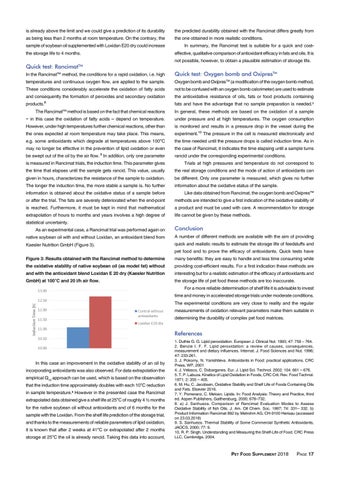
statistical uncertainty. As an experimental case, a Rancimat trial was performed again on
Conclusion
native soybean oil with and without Loxidan, an antioxidant blend from
A number of different methods are available with the aim of providing
Kaesler Nutrition GmbH (Figure 3).
quick and realistic results to estimate the storage life of feedstuffs and pet food and to prove the efficacy of antioxidants. Quick tests have
Figure 3: Results obtained with the Rancimat method to determine
many benefits: they are easy to handle and less time consuming while
the oxidative stability of native soybean oil (as model fat) without
providing cost-efficient results. For a first indication these methods are
and with the antioxidant blend Loxidan E 20 dry (Kaesler Nutrition
interesting but for a realistic estimation of the efficacy of antioxidants and
GmbH) at 100°C and 20 l/h air flow.
the storage life of pet food these methods are too inaccurate. For a more reliable determination of shelf life it is advisable to invest time and money in accelerated storage trials under moderate conditions. The experimental conditions are very close to reality and the regular measurements of oxidation relevant parameters make them suitable in determining the durability of complex pet food matrices.
References
In this case an improvement in the oxidative stability of an oil by incorporating antioxidants was also observed. For data extrapolation the empirical Q10 approach can be used, which is based on the observation that the induction time approximately doubles with each 10°C reduction in sample temperature.8 However in the presented case the Rancimat extrapolated data obtained give a shelf life at 25°C of roughly 4 ½ months for the native soybean oil without antioxidants and of 6 months for the sample with the Loxidan. From the shelf life prediction of the storage trial, and thanks to the measurements of reliable parameters of lipid oxidation, it is known that after 2 weeks at 41°C or extrapolated after 2 months storage at 25°C the oil is already rancid. Taking this data into account,
1. Duthie G. G. Lipid peroxidation. European J. Clinical Nut. 1993; 47: 759 – 764. 2. Benzie I. F. F. Lipid peroxidation: a review of causes, consequences, measurement and dietary influences. Internat. J. Food Sciences and Nut. 1996; 47: 233-261. 3. J. Pokorny, N. Yanishlieva. Antioxidants in Food: practical applications. CRC Press, WP, 2001 4. J. Velasco, C. Dobarganes. Eur. J. Lipid Sci. Technol. 2002; 104: 661 – 676. 5. T. P. Labuza. Kinetics of Lipid Oxidation in Foods, CRC Crit. Rev. Food Technol. 1971; 2: 355 – 405. 6. M. Hu, C. Jacobsen, Oxidative Stability and Shelf Life of Foods Containing Oils and Fats. Elsevier 2016. 7. Y. Pomeranz, C. Meloan. Lipids. In: Food Analysis: Theory and Practice, third ed. Aspen Publishers, Gaithersburg, 2000; 678–732. 8. a) J. Sanhueza. Comparison of Rancimat Evaluation Modes to Assess Oxidative Stability of fish Oils. J. Am. Oil Chem. Soc. 1997; 74: 331– 332. b) Product Information Rancimat 892 by Metrohm AG, CH-9100 Herisau (accessed on 23.03.2018) 9. S. Sanhueza. Thermal Stability of Some Commercial Synthetic Antioxidants, JAOCS. 2000; 77: 9. 10. R. P. Singh. Understanding and Measuring the Shelf-Life of Food. CRC Press LLC, Cambridge, 2004.
Pet Food Supplement 2018
Page 17