Writing SNHU’s Story
VOLUME XXVII
ISSUE 2
OCTOBER 9, 2020
PENMENPRESS.COM
SNHU adapts to Covid-19 and plans for the future
Joshua DiNapoli Staff Writer
With the COVID-19 pandemic continuing to reshape the world, colleges are scrambling to deliver effective solutions to their communities that adapt to the health crisis. While SNHU has had to accommodate like the rest, its existing online environment has undoubtedly made the transition smoother. Last spring, when SNHU decided to move to a completely online environment, it was already ahead of the curve. Thanks to online tools like Brightspace, professors already had virtual access to all of their required coursework. The scalability of Brightspace also made it perfect for the massive influx of users. To help with this transition, professors had to go through a four-week boot camp before classes started to understand the online tools they had access to. Lynn-Murray Chandler, Executive Director of Teaching and Learning, helped lead a team that trained up to 188 faculty members. She worked in collaboration with staff that included Aaron Flint, IT Director of Instructional Support,
Katie Rector, an Instructional Support Consultant, Michael Evans, Vice-President of Academic Affairs, and many more. Because the plan to move online was announced in advance, the team had plenty of time to plan for the fall semester and beyond. Chandler spoke positively about the general reception towards the training, as many faculty members were already well-acquainted with online tools such as Brightspace. Adjunct Professor and Academic Advisor Devin Chaloux, who has had experience teaching in the College of Online and Continuing Education (COCE) as well as on-campus classes made the adjustment to online teaching quickly. "One huge benefit is that the online classes are far more structured than classes on campus...it is much easier to clarify assignments and deadlines in a centralized online space," Chaloux stated when asked the most positive aspect of the online classes. Chaloux believes that the online environment has increased student engagement, saying, "In traditional classes, you would have a high percentage of
people who would not talk. Now, with online discussions, the quality of discussions has improved dramatically." Chaloux attributes this growth in engagement to the online environment, in which students get to thoroughly process their thoughts before posting. Despite all
of the apparent benefits, Chaloux sees the lack of face-to-face interaction as a downside to exclusively remote learning. "In-person, it was easier to detect what students may have been struggling with classwork. It was also easier to immediately reach out to help students. Without
that in-person interaction, it requires an extra level of engagement to contact them." For the future of SNHU, the development team has already worked with teachers to outline each program's curriculum. Recently, the team submitted their plans to President
LeBlanc and are currently waiting on his approval. When students return to campus, their feedback to the new programs will shape its future. The general goal is to increase project-based learning and incorporate more industry knowledge into courses.
litical unrest nationwide. The plan includes a $5 million Social Justice Fund, which was added by the Board of Trustees to help aid community members in need, as well as to make lasting positive changes regarding equity in the SNHU
community. Jeda Hebra, Senior Vice President and Chief Diversity and Inclusion Officer as of 2016, further elaborated on the fund’s plans for the $5 million dollars. Different “workstreams” have been discussed for how to set
up the oversight board, examine and improve student experiences, examine social mobility, as well as the eligibility for who should have access to the funding and how that access should be determined. These “workstreams”
have been ordered into five pilot programs for the fund to be allocated to. The first is an oversight board to quickly deliver funding where it’s needed. This is expected to launch within the next few weeks. Another one is a
digital bundle including a free laptop, internet and eBooks. This pilot aims to see if by providing these resources students will have fewer barriers to block their learning. On-campus . . . . . . . . . . . Continue to page 2
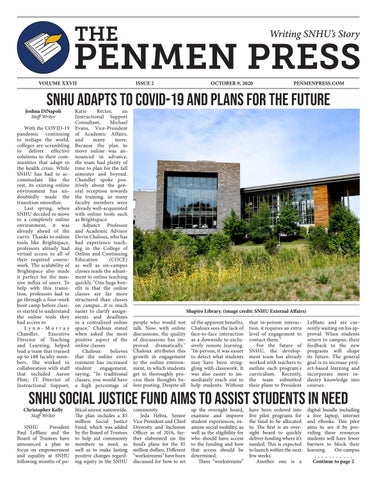
Shapiro Library. (image credit: SNHU External Affairs)
SNHU Social Justice Fund Aims to Assist Students in Need
Christopher Kelly Staff Writer
SNHU President Paul LeBlanc and the Board of Trustees have announced a plan to focus on empowerment and equality at SNHU following months of po-
the penmen press
NEWS
tHE PENMEN PRESS STAFF 2020-2021 CO EDITOR-IN-CHIEF Grace Mage grace.mage@snhu.edu CO EDITOR-IN-CHIEF Daniel Hopler daniel.hopler@snhu.edu ONLINE MANAGER Ryan Barrett ryan.barrett3@snhu.edu BUSINESS MANAGER Julie Armstrong julie.armstrong@snhu.edu EVENTS MANAGER Eliza Fandel eliza.fandel@snhu.edu MARKETING MANAGER Kyle Griffin kyle.griffin@snhu.edu LEAD COPY EDITOR Bailey Arnold-Fuchs bailey.arnold-fuchs@snhu.edu NEWS CO-EDITOR Stefan Karlberg george.karlberg@snhu.edu NEWS CO-EDITOR Andrew Wilson andrew.wilson8@snhu.edu LIFESTYLE EDITOR NOW HIRING: email penmenpress@snhu.edu RTS & ENERTAINMENT/ A Talib Williams OPINION EDITOR talib.williams@snhu.edu SPORTS EDITOR Sofia Barassi sofia.barassi@snhu.edu LAYOUT EDITOR Hailey Tremaine hailey.tremaine@snhu.edu FACULTY ADVISOR Jon Boroshok j.boroshok@snhu.edu
The Southern New Hampshire University Penmen Press is a news publication produced by Southern New Hampshire University students and funded largely by the Student Government Association of the University. It is our responsibility to inform the SNHU community about events on and around campus. The Penmen Press will print any material found to be factual and in good taste by the editorial staff of the paper. The views published do not necessarily reflect the views of Southern New Hampshire University. The Penmen Press is published biweekly during the academic year and is printed by Copies Plus. To contact the newspaper, please email us at penmenpress@snhu.edu.
SNHU students are able to access the resources in the Shapiro Library, but it can be difficult for some students to access the technology needed to work remotely. A third pilot looks to create "Learner Resource Groups," groups of people from diverse backgrounds who share a common passion: to figure out how the school can make improvements in collaboration with students, rather than unilaterally without any input from the community. A student town hall has been considered in order to hear directly from community members on how things can
page 2
Continued from page 1 . . . . . . . . . . . improve and what issues are important to the students. The fourth pilot would work to combine Academic Advisors with Career Advisors to take a focused look at a student's coursework to help prepare them for the workforce early on in their college career. Hebra says that this pilot would put these positions “under one roof to drive how your degree can lead to future employment earlier.” The final pilot focuses on how SNHU can help retain those who have dropped out shortly before their graduation. A fund could help those
no longer able to make tuition or any other reason not to complete their degree. These are expected to launch at various points within the next few months. These pilots aren’t expected to use the entirety of the $5 million grant, leaving the left-over money to go into emergency funds like rent, bills or car repairs for those who need it. This fund further shows how SNHU is focusing on the SNHU community even at a distance. Should community members wish to donate to the fund they can email ODI@snhu.edu for more information.
dents as they adjust to the remote learning environment, not to mention the stressors of the pandemic,” says Wil Zemp, the Interim Campus President at the time. “As part of the University’s commitment to supporting students during remote learning, the Office of Academic Affairs has encouraged faculty to consider two optional ‘blackout periods’... to cancel class meetings and assignments. This is not a campus-wide mandate; each instructor has the flexibility to build these blackout weeks into their syllabi according to the needs of their particular courses.” While some may have a week off, students need to be aware that both blackout periods are not vacations, but rather should be treated as a time to catch up on work, as well as a chance to step away from the computer. Given the current global condi-
tions, students are now juggling school, work, and personal lives while restricted at home. With the blackout weeks being presented as an option, it will allow some breathing room between synchronized classes for many students and staff. “The honest truth to what I hope to benefit from these weeks is time to make sure I have done everything I can do… as I work 35hour work weeks on top of five online classes…” says Kayleigh Maier, ‘23. Throughout remote learning, both staff and students need to remember to not spread themselves too thin and to take a break once in a while. “We appreciatehow hard students are working during this remote semester, and we hope that any canceled classes will give everyone a chance to rest, take good care of themselves, and get caught up on their work,” says Zemp.
Blackout Weeks: Are They Mandatory?
Taylor Posik Staff Writer
The fall online semester is in full swing, and with it comes some changes to the usual SNHU academic calendar. Naturally, there has been some confusion regarding these changes, specifically about what SNHU is calling “Blackout Weeks,” which are the weeks of October 12th and November 23rd. The confusion begins with inconsistencies between classes. Some professors have those weeks “Blacked Out,” meaning there will be no scheduled classes during those times. Others still have classes planned and have no mention of the breaks in the usual course load. Students and professors alike are confused as to what the situation with these blackouts is, and how it will affect them. “We know that this is a challenging time for many of our stu-
the penmen press
page 3
Lifestyle
Ways to Practice Self-Care During the COVID-19 Pandemic
Elizabeth White Staff Writer
Self-care is important for our mental, emotional and physical health. When self-care is practiced, we feel better, more energized, less stressed and overall happier. However, the COVID-19 pandemic and distancing regulations seem to have taken a toll on our overall well-being. The practice of self-care has never seemed more necessary than now. There are many different ways you can overcome the negative effects the pandemic may be causing. Spend Some Time Outdoors Simply taking a walk around the block or sitting outside can improve your stress and anxiety levels immensely.
Especially when being cooped up in the house all day attending virtual classes, it is important to get some time in the fresh air. Many things can be accomplished outdoors rather than indoors. For instance, yoga and other forms of exercise can be done outside. Doing homework or responding to emails can also be accomplished this way. Or you can just sit and spend some time enjoying some fresh air away from screens. Create Art Another way selfcare can be practiced is by painting, drawing, writing or reading. To some, all of these can be therapeutic. Personally, painting has always been a way for me to escape from my stressors, and just relax. These activities promote emotional
stress relief. The best part is that there is no right or wrong way to show creativity because art is how you express your personal self, your feelings and your imagination. Art isn’t just paintings and drawings, it is also dancing and playing an instrument. Expressing and accepting your authentic self through art is a great way to care for yourself. Use the Headspace App Finally, you can also practice self-care by using Headspace. Headspace is an app that guides its users through different types of meditations and other calming activities. Their mission is to improve the health and happiness of the world. On the app, there multiple meditation courses and techniques, as well as quiet
Headspace Graphic. (image credit: cnet.com) stories to help you sleep, called Sleepcasts. One meditation course that always clears my mind is “Finding Focus.” This one allows me to have a productive workday, especially when trying to stay focused on remote assignments. SNHU offers Headspace for $9.99
per year. Students can also get Headspace free with Spotify Premium. Conclusion However, you choose to relax and unwind from your day is up to you. There are so many more ways you can get started on your self-
care that haven’t been mentioned. As long as you are feeling relieved from stress and are also feeling better mentally, emotionally and physically, then you are exercising self-care. Right now, we all need to take a little more care for ourselves than usual.
a person a feeling of responsibility in ensuring the care of watering and tending to the plants, which would ease a person’s mind and have them focus on the task in front of them. Planting also motivates a person to go outside and can help you feel at one with nature. Being around plants can even make a person less likely to get sick, according to the New York Department of Environmental Conservation, as well as improving mood. This can help with the motivation to do daily tasks and improve their work ethic - good moods promote good work. It is uniquely discovered that growing plants around the house can even lower background noises such as vacuums, televisions, or conversations by having their
leaves absorb, diffract, or reflecting all background noises. Going out building a garden house and adding unique plants inside can create a peaceful and sensible workplace that acts as an escape if your home feels overcrowded. The experience of laying under a tree, sitting inside a garden bed, or smelling the fresh air can help you stay grounded in the
present and forget the stress in the wider world. It can also take your mind off social media and help relieve stress when working in a garden. Hopefully with this in mind, you’ll be inspired to grow a new garden house with beautiful plants and a nice tree next to it to lay under during the evening, or simply add some greenery to your home for a little positivity.
The pros of growing plants during COVID-19
Indoor cactus plant. (image credit: Kyle Griffin) Talib Williams Opinions Editor With COVID-19 spreading through the country and around the world, people everywhere are trying to find ways to pass the time and make their homes more comfortable. Though it may
take some time before a breakthrough is made with treatment, there are still plenty of things to do in the meantime to boost your spirits. One of those activities specifically is being able to go outside (or stay inside) and start putting plants around
the house. Research founded from Ambius, a business that aims to improve hygiene and well-being using plants, says that just the sights of the plants around the home can make a person feel less stressed, or feel calm and safe. Keeping plants around also gives
Red floral plant. (image credit: Kyle Griffin)
the penmen press
page 4
arts & entertainment New Horror Comedy With A “Freaky” Twist
Freaky Movie Poster. (image credit: Movies in Focus). Devin Pouliot Staff Writer With Halloween quickly approaching, it’s time to get in the spirit of the season. There’s no better way than with the next installment in the Happy Death Day cinematic universe: Freaky. Starring Vince Vaughn and Kathryn Newton, Freaky takes a unique twist on the idea of the
movie Freaky Friday. Freaky Friday follows two people who switch bodies after a supernatural event and have to find a way to switch back to their bodies. Freaky takes a different approach to this idea by telling the story of high school student Millie Kessler (Newton). Millie is a social outcast trying to navigate through her insecurities towards
her popularity and attractiveness. After spending another football game as the school’s mascot and left alone on the night of Homecoming, she contemplates how she would be the first to die in a horror movie. The story drastically shifts as Millie is attacked and killed from the shadows by the serial killer known as the Butcher
(Vaughn), using an ancient knife. However, Millie wakes up the next morning seemingly fine, until realizing that the body she inhabits is not her own but is instead the body of the Butcher. With the aid of her best friends and the intimate knowledge of herself, Millie must track down the killer to stop a massacre from occurring
in her home town, persuade people to listen to her, and must successfully reclaim her body or be trapped in the body of the Butcher forever. All in one day. Freaky is directed by Christoper Landon, the director of Happy Death Day and the sequel Happy Death Day 2U. The trailer was released on Universal Pictures’ YouTube chan-
nel on September 10. It shows Landon will offer the same combination of horror and comedy which made his Happy Death Day franchise popular. With a slew of comedic and overly gory death scenes Freaky will have no trouble fitting in with the rest of the Happy Death Day Universe. Freaky is set to release in theaters on Friday, November 13.
the penmen press
page 5
Sports
Overwatch and Valorant Esports Teams Playing This Fall
Christopher Kelly Staff Writer
Given current restrictions around collegiate sports, many people have been missing them. While some professional leagues have started to play again, the same cannot be said for many college teams. Sports at SNHU have been almost completely shut down with the closing of campus this fall term leaving only one student sport still playing, SNHU Esports. SNHU Esports of-
fers a large variety of events to watch, with six different teams represented. These teams play Fortnite, Overwatch, Valorant, Rocket League, Super Smash Bros and Hearthstone. SNHU Esports even streams their competition to ensure their supporters are able to watch from home. The East Coast Conference (ECC), will be playing one game a week up until November 13. Starting during the last week of September, they began playing two
games a week of either Valorant or Overwatch leagues for the National Association of Collegiate Esports (NACE). This will continue until the end of the semester. The game Overwatch is a team-based, first-person shooter set up where characters are able to face off in teams of six. They use their unique abilities on a wide variety of maps over points of control or to push payload forward. The payload is a truck that reaches different checkpoints. When
defenders are near the truck, it moves backward and moves forward when the attackers are near it. As for the game Valorant, it is a firstperson tactical shooter set up made by Riot Games where two teams of five face off on different maps with unique characters and abilities while purchasing weapons with in-game money. “The characters I’m playing [in Overwatch] are very meta [“popular among professionals”]
right now, so I am getting a lot of use. It’s definitely a bit nerve-wracking, but I think I’m confident enough in my abilities,” said Sophomore Varsity Support, Dominic Rizzo ‘23, when asked about the upcoming season. Despite a rough first game, however, the Overwatch team is ready to continue the season. Each season there is room for adjustment when players graduate and spots to play open up. “Last year’s MVP left me some pretty big shoes to fill. As of right
SNHU Esports wallpaper of their logo. (image credit: SNHU Esports)
now, I am currently [substitute] for the tank line up. I know I have a lot to improve on for this upcoming season, and I hope that later on down the line I can be on equal footing with the other tanks,” said Anthony Darrigo, ‘23 Sophomore Varsity Tank for Overwatch. Fans of Overwatch can tune in to Twitch.tv/snhuesports every Friday at 7 p.m., or can watch the Valorant team play on Wednesdays and Tuesdays also at 7 p.m.
the penmen press
page 6
Sports
NE10 Suspends Fall Sports for the 2020 Season: What Happens Now?
NE10 Fall Update. (image credit: NE10) Sofia Barassi Sports Editor The Northeast-10 (NE10) suspended conference-sponsored competition for this upcoming fall semester leaving its contender, SNHU, expunged from fall sports. Furthermore, the National Collegiate Athletic Association (NCAA) Division II canceled its 2020 fall championships, likewise leaving SNHU’s fall teams with no trophies to compete for in 2020. Under normal circumstances, the majority of fall athletes would return to school in August to give them time to practice their sport, get into shape and bond with their teammates before the regular
season commences, but that did not happen this year. The SNHU Field Hockey Team, who made it to the NCAA Championship in 2019, will not be dominating the conference again this fall. “Our number one priority for our team this fall is to make sure we have positive mental health. At some point, we will send them an optional training workout and many of them are doing stick skills and playing with their club teams on their own. No FH [field hockey] will be mandatory,” said Head Coach Julie Munson when asked what their goals are this fall. She continued, “This change has given me
more time to focus on my players as individuals rather than as a team. I am connecting with them in different ways and learning how they (and myself) deal with stressful situations, challenges, and setbacks like this. It is a perfect opportunity to work on our mental strength when this time of the year we are usually working on physical aspects of our game. The absence of athletics has not only affected the athletes of SNHU. Many coaches put countless hours into their teams and work hard to strive for success. This fall is no different even when they are not physically together. For Ainsley Knox
(’23), playing volleyball has always been her fall routine, so being unable to play on an organized team this fall is what she considers strange. Although the team isn’t together, they are still connecting in other ways. “Our team has been meeting through Zoom with our coaches,” said Knox, who’s located in Texas. “We got to meet our recruits which was cool. It’s a little strange because most people on the team are in different time zones, so this makes team meetings a little difficult, but we are managing.” To keep the routine alive, Knox will still play volleyball, but in a different setting than the Stan Spirou Field House at SNHU. “With vol-
leyball, I was just able to get into my old club and start some private lessons. I am hoping I will be able to help out at my old high school as well,” said Knox. For Knox and many collegiate athletes, staying involved in sports at home is the closest thing to normality. In hopes of a return in the spring semester, staying connected and positive is a priority. Head Coach Munson reassured us, saying, “What we do know is the NE-10 and SNHU are working hard at creating an opportunity for fall sports to compete in the spring, which is something that gives us all a lot of hope.” It is still undecided if students will be able
to participate in sports this upcoming spring. “I am looking forward to our season… It was just postponed to the spring, so that and being with my team is what I am looking forward to,” said Knox about the current and potential future plans. Players and coaches are both finding ways to fill the fall season with their beloved sports, whether it is online or in their respective towns. Hope for the spring semester is still prospering as the year 2020 progresses forward. NE10 posts their announcement for the fall semester update on July 16, 2020, leaving all Division II sports without play.