tracing the elusive urban imprints of paidia and ludus: an illustrated catalogue Principal Investigator: Dr Penélope Plaza UROP student: Oreoluwa Ijinigba
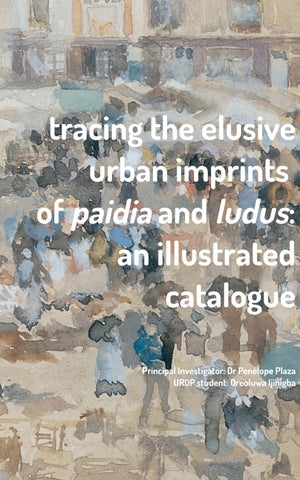
Cover image: James McNeill Whistler, Variations in Violet and Grey—Market Place, Dieppe, 1885. Gouache and watercolor on off-white wove paper, mounted on academy board (20.2 x 12.7 cm). Gift of Douglass Campbell, Richard Strachan, and Stephen M. Strachan, in memory of Mrs. Douglass Campbell and Mrs. William Lyman Campbell, 2000. The Metropolitan Museum of Art, New York. www.metmuseum.org
tracing the elusive urban imprints of paidia and ludus: an illustrated catalogue
Principal Investigator: Dr Penélope Plaza UROP student: Oreoluwa Ijinigba School of Architecture, University of Reading June 2020
contents
1 10 18 25 26 29 34 39 43 46 72 81 90 94 98 102
1
context: play and public life a review of selected texts findings Illustrated Catalogue of Play Bilboquet Blindbock Diabolo Hide and Seek Hopscotch Kite Flying Leapfrog Marbles Osselets Pasemisí Pétanque Rope Jumping
115 119 122 127 133 136 140
Shove Ha'Penny Shut the Box Skittles Spinning Top Shuffleboard Yo-Yo reflections
2
a personal manifesto for play and public life in times of turbulence Dr Penélope Plaza 3
The invisible but very real menace of the mobile and highly infectious Covid-19 has disrupted life and introduced into our vocabulary words seldom uttered with such familiarity in recent memory: pandemic, quarantine, isolation… experiences of fearful retreat to the domestic sphere that although exceptional, are very familiar to me. My childhood, adolescence and adulthood in Caracas, Venezuela, were filled with more instances than I can count of retreats to the home out of fear of potentially deadly excursions around the city, in fraught attempts to avert urban crime, disease, coup d’états, urban revolts, blackouts, landslides, tremors... when catastrophes are inscribed into the everyday, the connections and relationships we build with our neighbours and our communities become essential to our survival, a life-line to cope with the pervasive powerlessness that serves as a daily reminder of an imminent mortality. This instilled a paradoxical mix of caution and defiance, placing great value in celebrating life and relationships through play-full interactions in the streets and public spaces with the people sharing our urban environment, whether friends, acquaintances or strangers. What could be mistaken as carelessness and indifference to urban disaster and chaos is in reality a very sophisticated coping mechanism devised to momentarily suspend fear to release a shared playful humanity, before being reabsorbed into the turbulent every day. This is the backdrop to the work of many urban play activist collectives, such as Ser Urbano and CollectiVoX, that have emerged in recent years in Venezuela and Latin America.
4
I co-founded CollectiVoX in 2008 and was an active member of the urban collective Ser Urbano from 2010 until 2012, both based in Caracas. CollectiVoX is a not-for-profit organisation that engages in co-designing small scale interventions in public space to create new positive forms of belonging, occupying, enjoying and inhabiting the city (Plaza, 2020, p. 2). Ser Urbano, created in 2008, mixes art, play and protest to promote La buena vida pública (the good public life). They organise disruptive temporary ludic interventions to re-claim public space, challenge urban fear and dominion over use of public space by local authorities, but most importantly, it offers a space for consumption-free playful leisure for all (Plaza, 2020, p. 20). Small scale urban interventions are the ideal platform for the enjoyment, re-occupation and appropriation of urban space in a way that is participatory, inclusive and playful (Plaza, 2020, p. 0). The covid-19 pandemic has simultaneously flattened and emptied the publicness of our lives. Socialisation, meetups, our work environment, our favourite places, our mobilities in the outside world at large at once collapsed into the twodimensional glowing rectangles we carry with ourselves. Our public spaces and streets had to be emptied of human presence, for the sake of public health all public interactions were abolished at once, now regarded as dangerous, harmful, infectious, adding an extra layer of fear and suspicion over any encounter, with loved ones and strangers alike. A blanket decision that whilst necessary, neglected to acknowledge how historical spatial inequalities would be magnified.
5
Whilst access to public spaces and green spaces are vital for public health, in cities like London, those ‘living in deprived areas and those from BAME backgrounds share less space and have less access to private gardens and public parks’ (Duncan ,McIntyre and Cutler, 2020). Public spaces, parks and open green spaces are an essential part of our social infrastructure, vital for developing meaningful human connections through assembly in the public realm. All kinds of public interactions, including playing out with neighbours, had to be restricted by the necessary measures of social distancing and widespread lockdown (Klinenberger, 2018, p. 16; Stenning, 2020a). The high value we place on the positive effects of public assembly on our social and psychological wellbeing was evidenced by groups of people who, whilst following social distancing and mask-wearing, gathered in parks to preserve a sense of togetherness (McCann, 2020). We tend to underestimate how our local face-to-face interactions, when supported by a robust social infrastructure, form the ‘building blocks of all public life’ (Klinenberger, 2018, p. 5); this is how we forge bonds, collaboration and mutual support with our neighbours. When eroded, it can lead to widespread loneliness and isolation, ‘leaving families and individuals to fend for themselves’ (Klinenberger, 2018, p. 5) in times of crisis. In areas deprived of public space and parks, the covid-19 safety measures meant that meeting out and playing out with friends and neighbours was not possible, increasing the risk of loneliness and isolation. For these communities, the coronavirus was ‘another insult, yet another stress’ (McCann, 2020).
6
Alison Stenning, Professor of geography at Newcastle University and play streets activist, asserts that communities that ‘connect through play are well-placed to know and support each other in times of crisis, large and small’ (2020a), further explaining that: Play has long been identified as an activity that facilitates connections between people, young and old. Most children make friends through play, of various kinds, and play-like activities (hanging out, chatting, sharing hobbies and interests, for example) are also important sites for friendships and relationships for adults. (Stenning, 2020a) Her current research is focused on Playing Out, a national grass-root movement leading and supporting a campaign for children’s freedom to play close to their door step (Playing Out, no date). Stelling is interested in how Playing Out shapes residents’ attachments, material and emotional, to their streets and the people on them, and how play has the potential to challenge the erosion of relationships in everyday places. The evidence presented in the report Tackling Loneliness with Resident-Led Play Streets (Stenning, 2020b) highlights the ‘value of everyday, neighbourhood connections and the place of play in connecting communities’ (2020a). According to their survey, 95% of residents knew more people because of playing out, 86.7% felt their street was safer and friendlier, and 91.7% felt an increased sense of belonging (2020b, p. 1). Many of these new connections achieved through play were intergenerational, with children and adults of varying ages getting to know each other
7
(2020b, pp. 2–12). The report also identifies significant barriers for participation, particularly for adults, such as regarding playing in the street an activity exclusive for children, apprehension about meeting strangers or lack of awareness of the event taking place, and for some there may be additional cultural/language barriers and struggles with
illness or mobility (2020b, pp. 3, 28).
Whilst the report stresses that playing out is not a single magical solution to structural spatial and social inequalities, it does make a compelling case for the direct positive effect playing on streets and public spaces have in fostering a sense of belonging, neighbourliness and friendlier streets (2020b, p. 39). Play then, particularly in adulthood, is not a sign of frivolousness or immaturity; in the words of poet and children’s author Michael Rosen: ‘Play isn’t an extra, it isn’t an add on […] Play is a fundamental human right […] Whoever you are, maybe you’re a mum, a dad, an auntie, an uncle or a grandparent, a child, a teenager, a teacher, whoever you are, let’s get out there and play’ (British Psychological Society, 2020) It is then fair to say that play is not trivial, it should be given the same importance and respect as any other ‘serious’ aspect of daily life, and considered ‘part of a broadened conception of human needs’ (Stevens, 2007, pp. 27–28, 31; Smith, 2020) with public spaces as the primary and essential arena.
8
References Duncan, P., McIntyre, N. and Cutler, S. (2020) ‘Coronavirus park closures hit BAME and poor Londoners most’, The Guardian, 10 April. Available at: https:// www.theguardian.com/uk-news/2020/apr/10/coronaviruspark-closures-hit-bame-and-poor-londoners-most (Accessed: 3 July 2020). Klinenberger, E. (2018) Palaces for the People, How to Build a More Equal and United Society. London: Bodley Head. McCann, E. (2020) ‘Spaces of publicness and the world after the Coronavirus crisis’, Society+Space, June. Available at: https://www.societyandspace.org/articles/spaces-ofpublicness (Accessed: 3 July 2020). Playing Out (no date) What is ‘Playing Out’?, playingout.net. Available at: https://playingout.net/about/what-is-playingout/ (Accessed: 13 July 2020). Plaza, P. (2020) ‘urban play & artivism for living the good public life: experiments, interventions & antics’. London: SelfPublished. Smith, G. (2020) ‘An insider’s view of Play Well’, Wellcome Collection, 16 January. Available at: https:// wellcomecollection.org/articles/XfpagxEAACEAG0W0 (Accessed: 3 July 2020).
9
Stenning, A. (2020a) ‘Is play a cure for loneliness?’, The Developer, 23 April. Available at: https:// www.thedeveloper.live/places/places/is-play-a-cure-forloneliness (Accessed: 3 July 2020). Stenning, A. (2020b) ‘Tackling Loneliness with Resident-Led Play Streets’. Newcastle University. Stevens, Q. (2007) ‘Play and the Urban Realm’, in The Ludic City. New York: Routledge, pp. 26–53.
10
11
a review of selected texts on play, the city and coronavirus Dr Penélope Plaza and Oreoluwa Ijinigba 12
The terms play and game tend to be used interchangeably but this is inaccurate: game is a form of play. For a more precise differentiation, French sociologist Roger Caillois, building on the work of Johan Huizinga, coined the terms Paideia and Ludus, borrowed from the Greek and Latin respectively (Pérez de Arce, 2018, p. 4). Paideia (for Caillois, the cradle of play) is chance, improvised, spontaneous, devoid of rules it is eminently tactical, snatching ‘ludic opportunities from any given place’; Ludus is organised, structured with explicit and stable rules and a priori agreements with ‘mandatory norms and spatial criteria’ (Pérez de Arce, 2018, p. 4). Thus, Ludus has a direct relationship with architecture whilst Paidia can only be indirect (Pérez de Arce, 2018, p. 5). Up until the nineteenth century, in the West, play was embedded within the ordinary life of the city, disrupting routine activities rather than creating urban spaces for it to unfold. Outdoors play usually took place on shared grounds, there are little to no urban traces left of outdoor play up until the late 19th century (Perez de Arce, R. 2018). By contrast, the twentieth century separated play from the flow of ordinary life by creating the division between -useful- work and useless- play (Pérez de Arce, 2018), play began to take architectural and urban form. Starting with Le Corbusier putting play as a prime subject in the Athens Charter, a change in urban priorities ensued with modernist architects discourse and architectural programme embracing a new ludic agenda that accounted for the city ‘as the ultimate ludic space’ (Pérez de Arce, 2018, p. 4). For architect and scholar Rodrigo Pérez de Arce:
13
Play is like art in its unproductiveness, its essential
freeness; it develops in parallel with productive activities. It is not labor or work (in Hannah Arendt’s terms), but more like the field of action, the area of appearance –essentially political– where the individual presents himself to the community, although play (the simple experience, purely expressive and with “a propensity for beauty”) lacks a plan. Idleness and freedom, modern social aspirations, find their expression in play. It has a powerful urban impact in the 20th century. (Pérez de Arce, 2003, p. 10) The interest on play in the city throughout the twentieth century primarily focused on playgrounds and play-spaces for children, understood as an essential component to their healthy psychological development and wellbeing. By contrast, adult play has tended to be considered a frivolous concern, only available to those with the money to afford leisure (Donoff and Bridgman, 2017, p. 297). Emerging research in the fields of psychology, urban sociology and cultural studies are challenging this notion of the ‘uselessness’ of play in adulthood, and across generations. Whilst children’s public play (parks, playgrounds, the street) is embraced as a normal component in city life, for adults, being seen playing in public can become a ‘political act’, as making a statement about who they are and who they choose to interact with rather than a normal everyday public behaviour (Koh, 2014). For this reason, adults require to be ‘given
14
permission to play’ through verbal, physical or spatial ‘keys’ that signal an accepted shift of frame from a non-play situation into a play situation (Walsh, 2019, p. 2). These keys serve the function of temporarily suspending social embarrassment or awkwardness, and re-framing the situation into play mode: Most frames for adults are inherently non-playful based on previous experiences, so although adults do play, it is often short-term playful interludes, or in strictly controlled circumstances. This suggests that giving adults permission to play is about signalling, or keying, more playful behaviour, and potentially giving alibis for behaviours that go against the normative frame for a situation. (Walsh, 2019, p. 2) Owing to the fear of social embarrassment, when public play is frowned upon, or regarded as socially unacceptable or too political, adults will tend to retreat to their private realm when engaging in play activities (Walsh, 2019, p. 6). This highlights the importance of providing a ‘safe space’ and welcoming environment for adults to participate in play and interact with other groups. There is a myriad of intangible and tangible ways in which this ‘safe space’ can be encouraged, such as emphasising there is no competition for better inclusion and exploration, developing an alternative narrative before playing , as well as props and play spaces so adults are enabled to inhabit more readily an ‘alternative play world’ (Walsh, 2019, p. 12). Whilst children’s playgrounds are an unmistakable, but potentially narrow, key for play, for adults the scope for integrating play into their complex social
15
existence, available in ways which are not available to children, particularly when it comes to public spaces (Stevens, 2007, p. 27). Rather than segregating play, integrating interaction between younger and older generations can function as keys for reframing urban space as potential play-spaces, which would also bring benefits in terms of creating bonds, interactions, safety, friendliness and overall wellbeing. In this sense, the recently published report Together in the 2020s: twenty ideas for creating a Britain for all ages by 2030 (United for All Ages, 2020) highlights strategies for reframing urban space to enable, even if temporarily, spaces in which adults can engage in play with each other as well with older and younger generations. For example, making wider use of current traffic legislation to enable Play Streets for children can also create opportunities for grown-ups to meet in a relaxed situation, breaking down barriers, melting assumptions and for older residents, a great opportunity to venture out, take in the sun and often, show the children games from the last century. (United for All Ages, 2020, p. 7). The street can be transformed into a temporary playground for the entire community. Adults are further encouraged to engage because the safe signal to join are the kids themselves. Opening opportunities for interventions and play-forms to integrate older generations in both
16
unstructured (Paideia) and structured (Ludus) play, they may be familiar to them as well as allowing younger generations to appreciate their elders’ play experiences. Crossgenerational relationships that play can enable can also be make positive contributions in tackling loneliness, isolation, inequality and ageism (United for All Ages, 2020, pp. 6, 7, 18). The lack of public play contributes to the fact that the UK is one of the most age segregated countries in the world, ‘people of different ages are unlikely to mix with each other outside their own families’ (United for All Ages, 2020, p. 4). It is not hard to image that play in public spaces such as fields, parks and commons, can become an effective contributor overcome age segregation in urban spaces. Unfortunately, the global pandemic of Covid-19 and the actions needed to reduce its spread, such as social distancing and widespread lockdowns, has added a new dimension of fear of the city; it is overwhelming for all people, young and old (Centers for Disease Control and Prevention, 2020; Robson, 2020). The effects of the uncertainty during lockdown include heightened anxiety, stress, feelings of isolation and constant worry about daily lives, in both children and adults (Dodd, H. and Gill, T. 2018). However, free play can ease these feelings: ‘Play has helped families get through the anxieties created by the coronavirus outbreak’ (Peachey, 2020), helping parents to not feel as irritable and bored through by engaging with their children at home. In addition, playful interventions in the context of the home can be ‘a great leveller’ in terms of how space is used and how money is spent (Peachey, 2020). Unsurprisingly, the lockdown has
17
sparked an increase in sales of playthings, regarded to be a worthy investment for keeping the whole family connected through the ‘lens of joy, purpose and meaning’(Griffin, 2020). Paraphrasing Pérez de Arce, play dislodges routine (2018, p. 12), and this is particularly true when the routine has turned into monotony and isolation in the midst of the enforced widespread quarantines to deter the spread of Covid-19. Hopefully, once the pandemic crisis has been overcome we can steer our focus back to the a lack of play-space and play opportunities in urban spaces, so that the disruption is of a ludic nature, inciting play moments in the existing spaces we haveavailable, be it during rush hour or our walk to the supermarket and make the each other aware again that the city can be enjoyed together in a ludic way. References Centers for Disease Control and Prevention (2020) Pandemics can be stressful, National Center for Immunization and Respiratory Diseases (NCIRD), Division of Viral Diseases. Available at: https://www.cdc.gov/ coronavirus/2019-ncov/daily-life-coping/managing-stressanxiety.html (Accessed: 21 July 2020). Donoff, G. and Bridgman, R. (2017) ‘The playful city: constructing a typology for urban design interventions’, International Journal of Play, 6(3), pp. 294–307. Griffin, A. (2020) ‘Coronavirus: World Health Organisation tells
18
people to stay at home and play games’, The Independent, 31 March. Koh, A. (2014) The Political Power of Play, Hybrid Pedagogy. Available at: https://hybridpedagogy.org/political-power-ofplay/ (Accessed: 22 April 2020). Peachey, K. (2020) ‘Coronavirus: The toys and games that saved lockdown’, BBC Business, 10 June. Pérez de Arce, R. (2003) ‘Materia lúdica: Arquitecturas del juego’, ARQ (Santiago), (55), pp. 9–15. doi: 10.4067/ s0717-69962003005500003. Pérez de Arce, R. (2018) City of Play. An Architectural and Urban History of Recreation and Leisure. London: Bloomsbury. Robson, D. (2020) ‘The fear of coronavirus is changing our psychology’, BBC Future, 2 April. Available at: https://www.bbc.com/future/article/20200401-covid-19how-fear-of-coronavirus-is-changing-our-psychology. Stevens, Q. (2007) ‘Play and the Urban Realm’, in The Ludic City. New York: Routledge, pp. 26–53. United for All Ages (2020) Together in the 2020s: twenty ideas for creating a Britain for all ages by 2030. Happisburgh, Norfolk, UK. Walsh, A. (2019) ‘Giving permission for adults to play’, The Journal of Play in Adulthood, 1(1).
19
findings
Oreoluwa Ijinigba 20
The historiographical survey to catalogue depictions of play and play-things focused on online visual archives, under Open Access or Creative Commons license. Access to museum collections or physical archives was not possible because of COVID-19. The survey resulted in a partial catalogue comprised of: Images collected: 164 Play activities taking place indoors: 19 Play activities taking place Outdoor: 94 Play-things and play catalogued: 27 Types identified as Paideia (spontaneous, unstructured play): 13 Types identified as Ludus (organised, structured play): 14 Prior to starting with the archival research, we produced an initial list of play and play-things we considered would be able to create equal opportunities for people of all ages and abilities to participate, which also little to no competition. The review of selected texts from the literature on play, adults and urban space suggested that we would mostly find that images of adults playing would be taking place relatively private locations as to avoid embarrassment. Otherwise, where adults are depicted to be in a public setting (crowd in a street for example) engaging with a play-thing or play-form to happen outdoors it would need to have been regarded as socially acceptable. Or that play among adults may be depicted more in comparison to children. The idea that play
21
and play-things are conventionally aimed at children is quite recent. In the same wayPérez de Arce describes play as combining artifact and space, one can deduce that public space historically was for citizens (men and, later, women) to participate in public play, this does not necessarily imply that citizenship was extended to children. It was not surprising that Paideia has less concrete written evidence of its history due to its lack of structure in the form of rules and ephemeral imprint on urban space. Games such as Tag have many variations such as Blind Man’s Bluff or Statues but it is very difficult to pinpoint exactly what their origins were. This being said, their endurance across generations is worth noting as, even in the digital age, a game of Tag is still present in playgrounds worldwide. As we intended to include a collection of play from before the 19th century depicted in the West, it was clear beforehand that play may be depicted more so in public spaces outdoors than indoors. Up until the 19th century, urban spaces were not created specifically for play to unfold. As a result, play was intertwined with ordinary life as a way to disrupt routine activities e.g. in streets.
22
23
24
25
26
reflections
Oreoluwa Ijinigba 142
Being part of Generation Z brings to mind the mastery of digital and technology and software for social connection and play. However, being one of the older indiviuals of this generation has meant I can also identify with a time before playing behind a screen. So one of the main values I now hold thanks to this placement is the memory ‘imprinted’ on my mind by play objects which date a while back. My interest in fair and equal play prompted me to submit my application to this UROP project. Learning about structured (Ludus) and spontaneous (Paideia) play began to align better with my initial beliefs about play, especially when reading about what the results of play should be. Contrary to popular belief, many experts who have written about play such as Rodrigo Perez de Arce indicate that play should be unproductive in order to bring about intergenerational connection. What surprised me was that the research focused on adult play. I entered this project with the firm belief that young people see play far removed from the ‘adult world’ of work and politics, as suggested by the boycott of schools (and, effectively, play time) to take part in climate change strikes last year. This placement has taught me that this is a mindset worth changing because adults need to be made aware that there is no shame in prioritising ludic activities as highly as our professional lives. In addition, the rise of mental health awareness has shown the negative effects of poor intergenerational mixing on loneliness and isolation which I now believe can be alleviated by play in public spaces.
143
Personally, being a member of the Our Lady of Peace (OLOP) table tennis club in Lower Earley gave me first-hand experience with the advantages of welcoming all generations to play. I quickly realised that friendly matches were not easy or guaranteed wins against the more senior members of the club. It had taught me to keep an open mind about how universal popular games can be as it can be easy to become caught in your own bubble, assuming that only your generation can participate. Upon reflection, I have been reminded that adults don't suddenly forget what games are or how to play them! For this reason, I have enjoyed tracing the history of play forms and objects which have had an impact nationally as well as worldwide. In fact, I believe that the more substantial the history of a play form (for example jacks), the more likely the public will decide to interact with it in a public space such as a common. This can open doors to experimenting with the scale of the play form. such as coming up with creative design tactics to re-imagine and re-create age-old games for all to play together.
144
145
146
References
Basic Diabolo Tricks, Instructables. Available at: https:// www.instructables.com/id/Basic-Diabolo-Tricks/ (Accessed: 7 July 2020). BOYER, A. (1715) The Royal Dictionary Abridged ... The Third Edition, Carefully Corrected and Improv’d, Etc. D.&J. Brown. Blindman’s buff | game (no date) Encyclopedia Britannica. Available at: https://www.britannica.com/topic/blindmansbuff (Accessed: 22 July 2020). Catching Seven Pieces (no date) Activity Village. Available at: https://www.activityvillage.co.uk/catching-seven-pieces (Accessed: 29 June 2020). Cup and Ball (no date) National Museum Wales. Available at: https://museum.wales/traditional_toys/cup_and_ball (Accessed: 2 July 2020). hide-and-seek | Definition, Rules, & Facts | Britannica (no date). Available at: https://www.britannica.com/topic/hideand-seek-game (Accessed: 29 June 2020). ‘History and rules of the game’ (2013) Frankfield Pétanque Cork, 27 May. Available at: https://frankfieldpetanque.com/ history-and-rules-of-the-game/ (Accessed: 29 June 2020). History of diabolo playing in China (no date). Available at: http://english.visitbeijing.com.cn/a1/aXCXW2OC1280C74F5A6DA88 (Accessed: 7 July 2020). Hopscotch | Play Encyclopedia (no date). Available at: https://www.pgpedia.com/h/hopscotch (Accessed: 29 June 2020).
147
‘History of Kites’ (no date) American Kitefliers Association (AKA) - Kites, Kite Flying, Education and Community. Available at: https://kite.org/education/history-of-kites/ (Accessed: 2 July 2020). Leishman, G. J. (2006) Principles of Helicopter Aerodynamics with CD Extra. Cambridge University Press. London Bridge | children’s singing game (no date) Encyclopedia Britannica. Available at: https:// www.britannica.com/topic/London-Bridge-childrenssinging-game (Accessed: 7 July 2020). No. 7 Fly a kite (no date) National Trust. Available at: https:// www.nationaltrust.org.uk/features/no7-fly-a-kite (Accessed: 7 July 2020). Pack, L. H. (2013) Appalachian Toys and Games from A to Z. University Press of Kentucky. How to Play Dreidel | My Jewish Learning (no date). Available at: https://www.myjewishlearning.com/article/ how-to-play-dreidel/ (Accessed: 22 July 2020). Quick, P. S. (2014) 100 Playground Games for Children. Andrews UK Limited. ‘Research – UNBOSI’ (no date). Available at: http:// www.unbosi.org/research/ (Accessed: 6 July 2020). The Rules / Instructions of Shuffleboard (no date). Available at: https://www.mastersofgames.com/rules/shuffleboardrules.htm (Accessed: 6 July 2020). Shove Ha’penny - Online Guide (no date). Available at: https://www.tradgames.org.uk/games/Shove-HaPenny.htm (Accessed: 29 June 2020). shove ha’penny - YouTube (no date). Available at: https:// www.youtube.com/watch?v=AA4y5gakofU (Accessed: 21 July 2020).
148
Shuffleboard (2013). Available at: https:// www.youtube.com/watch?v=R74yolowFPs (Accessed: 22 July 2020). Shuffleboard History (no date) Shuffleboard.net. Available at: https://www.shuffleboard.net/history.html (Accessed: 29 June 2020). Skittles | game | Britannica (no date). Available at: https:// www.britannica.com/sports/skittles (Accessed: 22 July 2020). Shut the box - Online guide (no date). Available at: https:// www.tradgames.org.uk/games/Shut-The-Box.htm (Accessed: 29 June 2020). The Rules / Instructions of Fivestones and Jacks (no date). Available at: https://www.mastersofgames.com/rules/jacksrules.htm (Accessed: 6 July 2020). The Rules / Instructions of Marbles | How to Play Marbles (no date). Available at: https://www.mastersofgames.com/ rules/marbles-rules.htm (Accessed: 6 July 2020). The Rules / Instructions of Shove Ha’penny (no date). Available at: https://www.mastersofgames.com/rules/ shove-hapenny-rules.htm (Accessed: 29 June 2020). The Rules / Instructions of Shut the Box (no date). Available at: https://www.mastersofgames.com/rules/shut-boxrules.htm (Accessed: 29 June 2020). Toy History - Antique Toys, Collectible Toys, rare toy memorabilia, old wood toys, Christmas party games. (no date). Available at: http://www.woodentoys-shop.com/toyhistory-toys-games.php3 (Accessed: 7 July 2020). Wedia (no date) English expressions with the word “Dutch”, IamExpat. Available at: https://www.iamexpat.nl/expat-info/ dutch-expat-news/english-expressions-word-dutch (Accessed: 22 July 2020). Yo-yo | Encyclopedia.com (no date). Available at: https:// www.encyclopedia.com/sports-and-everyday-life/games/ games-and-hobbies/yo-yo (Accessed: 22 July 2020).
149
150
This UROP project is part of a longer-term practice-led research project that aims to investigate theories and methods of urban commoning through small ludic interventions and playable spaces. It will explore their potential for enabling new forms of commons in the city by temporarily transforming urban spaces into playablespaces for intergenerational socialisation in the 21st century. Drawing on Dr Penélope Plaza’s urban artivism in Caracas, Venezuela as co-founder of CollectiVoX and active member of the playful protest collective Ser Urbano, this UROP placement offers the opportunity to make a meaningful contribution to research by carrying out a historiographical survey of traditional and contemporary forms of ‘analogue’ play that bridge cultures, generations and abilities. The UROP student will produce an illustrated catalogue of play-forms, play-objects and play-spaces drawing on Caillois categories of Paidia (spontaneous play) and Ludus (structured play). School of Architecture, University of Reading