01Layout P&S_Mossie Layout Master 06/01/2012 14:44 Page 12
12
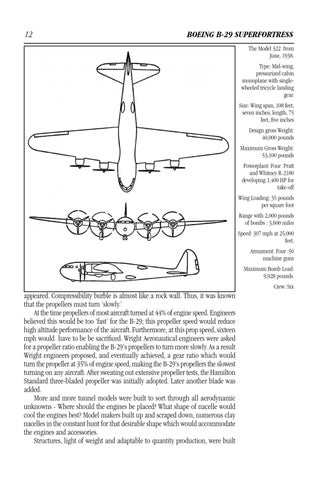
BOEING B-29 SUPERFORTRESS The Model 322 from June, 1938. Type: Mid-wing, pressurized cabin monoplane with singlewheeled tricycle landing gear. Size: Wing span, 108 feet, seven inches; length, 75 feet, five inches Design gross Weight: 40,000 pounds Maximum Gross Weight: 53,100 pounds Powerplant: Four Pratt and Whitney R-2180 developing 1,400 HP for take-off Wing Loading: 35 pounds per square foot Range with 2,000 pounds of bombs : 3,600 miles Speed: 307 mph at 25,000 feet. Armament: Four .50 machine guns Maximum Bomb Load: 9,928 pounds. Crew: Six
appeared. Compressibility burble is almost like a rock wall. Thus, it was known that the propellers must turn ‘slowly.’ At the time propellers of most aircraft turned at 44% of engine speed. Engineers believed this would be too ‘fast’ for the B-29; this propeller speed would reduce high altitude performance of the aircraft. Furthermore, at this prop speed, sixteen mph would have to be be sacrificed. Wright Aeronautical engineers were asked for a propeller ratio enabling the B-29's propellers to turn more slowly. As a result Wright engineers proposed, and eventually achieved, a gear ratio which would turn the propeller at 35% of engine speed, making the B-29's propellers the slowest turning on any aircraft. After sweating out extensive propeller tests, the Hamilton Standard three-bladed propeller was initially adopted. Later another blade was added. More and more tunnel models were built to sort through all aerodynamic unknowns - Where should the engines be placed? What shape of nacelle would cool the engines best? Model makers built up and scraped down, numerous clay nacelles in the constant hunt for that desirable shape which would accommodate the engines and accessories. Structures, light of weight and adaptable to quantity production, were built