24 HMS (ex SS) Rajputana 13 April 1941
92
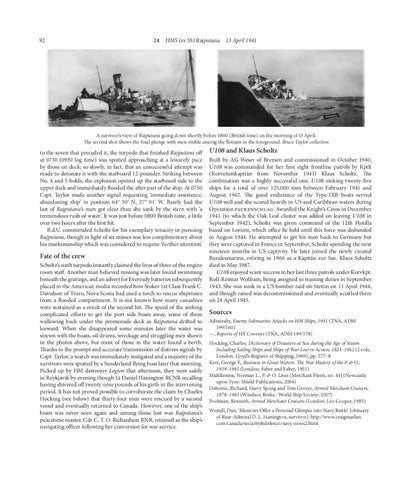
A survivor’s view of Rajputana going down shortly before 0800 (British time) on the morning of 13 April. The second shot shows the final plunge with men visible among the flotsam in the foreground. Bruce Taylor collection
to the seven that preceded it, the torpedo that finished Rajputana off at 0730 (0930 log time) was spotted approaching at a leisurely pace by those on deck; so slowly, in fact, that an unsuccessful attempt was made to detonate it with the starboard 12-pounder. Striking between No. 4 and 5 holds, the explosion opened up the starboard side to the upper deck and immediately flooded the after part of the ship. At 0750 Capt. Taylor made another signal requesting ‘immediate assistance, abandoning ship’ in position 64° 50' N, 27° 01' W. Barely had the last of Rajputana’s men got clear than she sank by the stern with ‘a tremendous rush of water’. It was just before 0800 British time, a little over two hours after the first hit. B.d.U. commended Scholtz for his exemplary tenacity in pursuing Rajputana, though in light of six misses was less complimentary about his marksmanship which was considered to require ‘further attention’.
Fate of the crew Scholtz’s sixth torpedo instantly claimed the lives of three of the engine room staff. Another man believed missing was later found swimming beneath the gratings, and an advert for Eveready batteries subsequently placed in the American media recorded how Stoker 1st Class Frank C. Davidson of Truro, Nova Scotia had used a torch to rescue shipmates from a flooded compartment. It is not known how many casualties were sustained as a result of the second hit. The speed of the sinking complicated efforts to get the port side boats away, some of them wallowing back under the promenade deck as Rajputana drifted to leeward. When she disappeared some minutes later the water was strewn with the boats, oil drums, wreckage and struggling men shown in the photos above, but most of those in the water found a berth. Thanks to the prompt and accurate transmission of distress signals by Capt. Taylor, a search was immediately instigated and a majority of the survivors were spotted by a Sunderland flying boat later that morning. Picked up by HM destroyer Legion that afternoon, they were safely in Reykjavik by evening though Lt Daniel Hanington RCNR recalling having shivered off twenty-nine pounds of his girth in the intervening period. It has not proved possible to corroborate the claim by Charles Hocking (see below) that thirty-four men were rescued by a second vessel and eventually returned to Canada. However, one of the ship’s boats was never seen again and among those lost was Rajputana’s peacetime master, Cdr C. T. O. Richardson RNR, retained as the ship’s navigating officer following her conversion for war service.
U108 and Klaus Scholtz
Built by AG Weser of Bremen and commissioned in October 1940, U108 was commanded for her first eight frontline patrols by Kptlt (Korvettenkapitän from November 1941) Klaus Scholtz. The combination was a highly successful one, U108 sinking twenty-five ships for a total of over 125,000 tons between February 1941 and August 1942. The good endurance of the Type-IXB boats served U108 well and she scored heavily in US and Caribbean waters during Operation paukenschlag. Awarded the Knight’s Cross in December 1941 (to which the Oak Leaf cluster was added on leaving U108 in September 1942), Scholtz was given command of the 12th Flotilla based on Lorient, which office he held until this force was disbanded in August 1944. He attempted to get his men back to Germany but they were captured in France in September, Scholtz spending the next nineteen months in US captivity. He later joined the newly created Bundesmarine, retiring in 1966 as a Kapitän zur See. Klaus Scholtz died in May 1987. U108 enjoyed scant success in her last three patrols under Korvkpt. Rolf-Reimar Wolfram, being assigned to training duties in September 1943. She was sunk in a US bomber raid on Stettin on 11 April 1944, and though raised was decommissioned and eventually scuttled there on 24 April 1945.
Sources Admiralty, Enemy Submarine Attacks on HM Ships, 1941 (TNA, ADM 199/160) —, Reports of HX Convoys (TNA, ADM 199/178) Hocking, Charles, Dictionary of Disasters at Sea during the Age of Steam Including Sailing Ships and Ships of War Lost in Action, 1824–1962 (2 vols, London: Lloyd’s Register of Shipping, 1969), pp. 577–8 Kerr, George F., Business in Great Waters: The War History of the P. & O., 1939–1945 (London: Faber and Faber, 1951) Middlemiss, Norman L., P. & O. Lines [Merchant Fleets, no. 44] (Newcastle upon Tyne: Shield Publications, 2004) Osborne, Richard, Harry Spong and Tom Grover, Armed Merchant Cruisers, 1878–1945 (Windsor, Berks.: World Ship Society, 2007) Poolman, Kenneth, Armed Merchant Cruisers (London: Leo Cooper, 1985) Westell, Dan, ‘Memoirs Offer a Personal Glimpse into Navy Battle’ [obituary of Rear-Admiral D. L. Hanington, survivor]: http://www.craigmarlatt. com/canada/security&defence/navy-news2.html