
VALKYRIES RISING

Credits
Sports editor
Christina Kahrl
Photo editor
Alvin Jornada
Editorial director
Sarah Feldberg
Deputy sports editor
Jon Schultz
Assistant sports editor
Michael Lerseth
Writers
Marisa Ingemi, Ann Killion, Ron Kroichick, Scott Ostler, Mia Wachtel
Superfan profiles
FRONT COVER PHOTO CREDITS | Players from left to right: (Veronica Burton)
Carlos Avila Gonzalez; (Temi Fágbénlé) Stephen Lam; (Laeticia Amihere)
Santiago Mejia; (Kayla Thornton) Yalonda M. James; and (Kate Martin)
Santiago Mejia
Staff photographers
Carlos Avila Gonzalez, Anna Connors, Richard H. Grant, Yalonda M. James, Stephen Lam, Santiago Mejia, Scott Strazzante
Copy editors
David Curtis, David de la Fuente
Creative director
Alex K. Fong
Editor in chief
Emilio Garcia-Ruiz
Publisher William Nagel
Senior vice president, sales
Sean Jacobsen
Tony Bravo
Copyright © 2025 by San Francisco Chronicle
All Rights Reserved • ISBN: 978-1-63846-181-4
No part of this book may be reproduced, stored in a retrieval system or transmitted in any form or by any means, electronic, mechanical, photocopying, recording or otherwise, without prior written permission of the copyright owner or the publisher.
Published by Pediment Publishing, a division of The Pediment Group, Inc.
www.pediment.com • Printed in Canada.
This is a book by the San Francisco Chronicle based on newsworthy events. It is not affiliated with or endorsed by the Golden State Valkyries or the WNBA.
Preseason
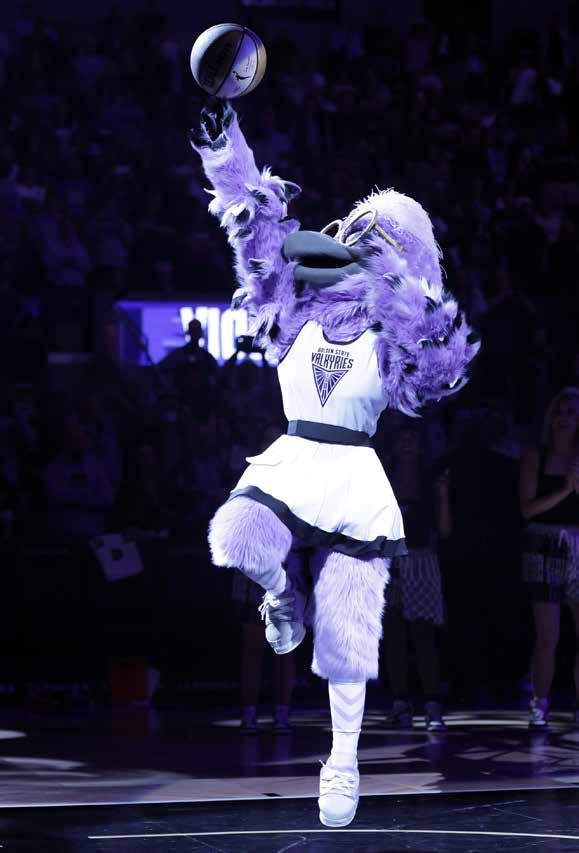
LEFT | Violet the Raven is introduced as the Golden State Valkyries’ mascot during halftime of a game against the Connecticut Sun at Chase Center on August 11, 2025. SCOTT STRAZZANTE / S.F. CHRONICLE

A new force in sports
Bay Area fans waited years for a WNBA team. The Golden State Valkyries didn’t disappoint
BY ANN KILLION
The energy. The joy. And the violet — everywhere the violet!
For several months in mid-2025 we experienced the Summer of the Valkyries, one of the most spectacular business launches in Bay Area history and one of the most successful team debuts ever in sports.
The triumphant season was a collective effort, shaped by the heart of the players, the savvy of the coach, the expertise of management and also by you, the fans. Whether you were cheering in the building at Chase Center, or captivated from afar, you lifted the team, awed opponents and carried the message throughout
the league: the Golden State Valkyries are a new force in sports.
In 35 years as a Bay Area sports writer, I’ve covered a lot of cool things. The debut season of the Valkyries ranks as one of the most magical and delightfully surprising, from start to finish.
For years, the Bay Area longed for a WNBA team, waiting impatiently for expansion so long in coming. Heightened anticipation holds the potential for a letdown — can the experience truly be as special as hoped? The Valkyries exceeded expectations in every way.
From the packed preseason games and the joy of opening night, to the early on-court
success of the team, the Valkyries became an instant sensation and ongoing celebration. Every home game was a raucous, deafening sell out. The fans embraced the team from the first tipoff until the roars of approval at the final buzzer of the season.
Valkyries gear was the fashion statement of the summer, along with delightful, individual accouterments: violet wings, violet wigs, violet glitter. Fans not only dressed for the occasion, they were prepared for the season: knowledgeable, eager and ready to bond with their new team.
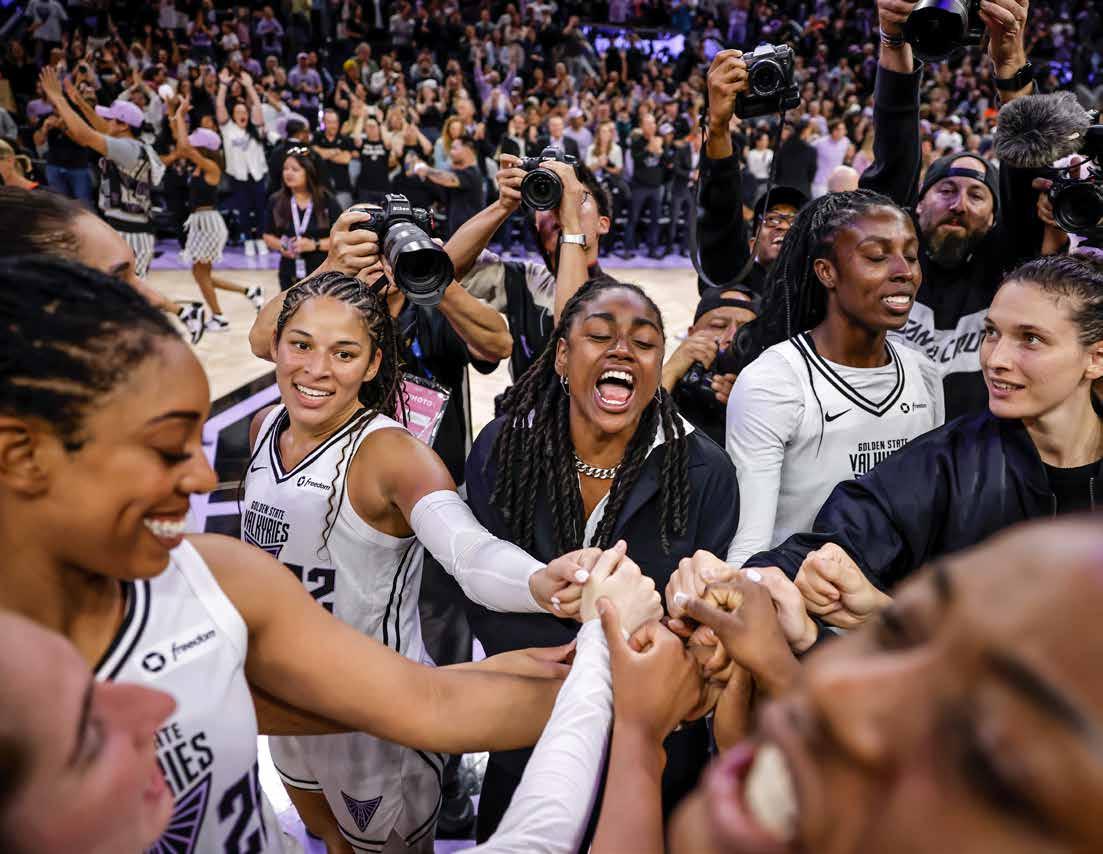
OPPOSITE | The Valkyries celebrate after defeating the Dallas Wings 84-80 to clinch a playoff spot at Chase Center in San Francisco on September 4, 2025. CARLOS AVILA GONZALEZ / S.F. CHRONICLE
A team takes shape
With expansion draft, Valkyries select size, defense and deep shooting
BY MARISA INGEMI • DECEMBER 6, 2024
The Golden State Valkyries have the makings of a roster. The expansion WNBA franchise made 11 picks from the other WNBA teams Friday in the league’s first expansion draft in 16 years; the Valkyries did not take a player from Seattle.
The Valkyries drafted seven international players, something head coach Natalie Nakase said wasn’t intentional in their draft planning, but just the way it unfolded while trying to add the most versatility they could.
“It actually just kind of happened,” she said. “It just was a coincidence. I’m excited for their competitiveness, high character, and their never-satisfied mindset. That’s exactly what I was looking for.”
Though guard Kate Martin from the Las Vegas Aces is the biggest name on the list of players drafted, the availability of center Temi Fagbenle from the Indiana Fever is likely the biggest surprise.
Martin averaged 19.3 minutes over her first 10 games as a rookie and made 37% of her 3-point tries but dropped out of the Aces’ rotation after Chelsea Gray came back from injury. The Iowa alum quickly became a fan favorite despite her limited playing time, although she was hampered by a lower-body injury in August.
“I’m going to take the winning mindset and winning culture over to San Francisco,” Martin said. “It’s new beginnings, and building something brand new from scratch is going to be really exciting and pose its own challenges. … I’m really excited to play for coach Nat. She instills a lot of confidence in her players. Once I get there, I’ll figure out my role and what my job is.”
Fagbenle, listed at 6-foot-4, played in just 22 games for the Fever last season, but averaged 6.4 points and 4.7 rebounds in her 18.9 minutes per game. In her first season in the league in 2017, the 32-year-old USC alum won a WNBA title as a reserve with the Minnesota Lynx.
“When I saw her name, I was very excited,” Nakase said. “She played very well against (the Aces) last year, and I even made a special defense for her.”
Monique Billings of the Phoenix Mercury was the one unrestricted free agent the Valkyries selected, and general manager Ohemaa Nyanin said they would consider adding the core designation to her in January, but that also might be an overpay for a role player. A forward who averaged 7.4 points and 5.8 rebounds per game for Phoenix last season, Billings started the 2024 season in the Los Angeles Sparks’ training camp, went to Dallas on a hardship contract,
and then finished the season in Phoenix. At 6-4, she is terrific at attacking the basket but doesn’t have much shooting range.
“That’s an option,” Nyanin said about core-designating Billings. “I think we just want to have conversations with (the players), just to kind of see where their heads are at and what they’re excited about. And for Monique, more specifically, I haven’t had a conversation yet. She’s in China at the moment, so the time difference was rough.”
Veronica Burton, a shooting guard from the Connecticut Sun, was another surprise. She was buried behind other strong guards like DiJonai Carrington and Marina Mabrey but delivered in the postseason as one of Connecticut’s top bench options. With Golden State, she might get the chance to start. Many expected the Sun to protect Burton.
Both the picks from the Dallas Wings and Chicago Sky in guard Carla Leite and forward Maria Conde, respectively, have no WNBA experience but are top prospects.
Conde is a small forward who was a thirdround selection in the 2019 draft. The Florida State alum has been a key contributor on both the Spanish national team and on the Czech club ZVVZ USK Praha in recent years.
Leite is a French guard whom the Wings took
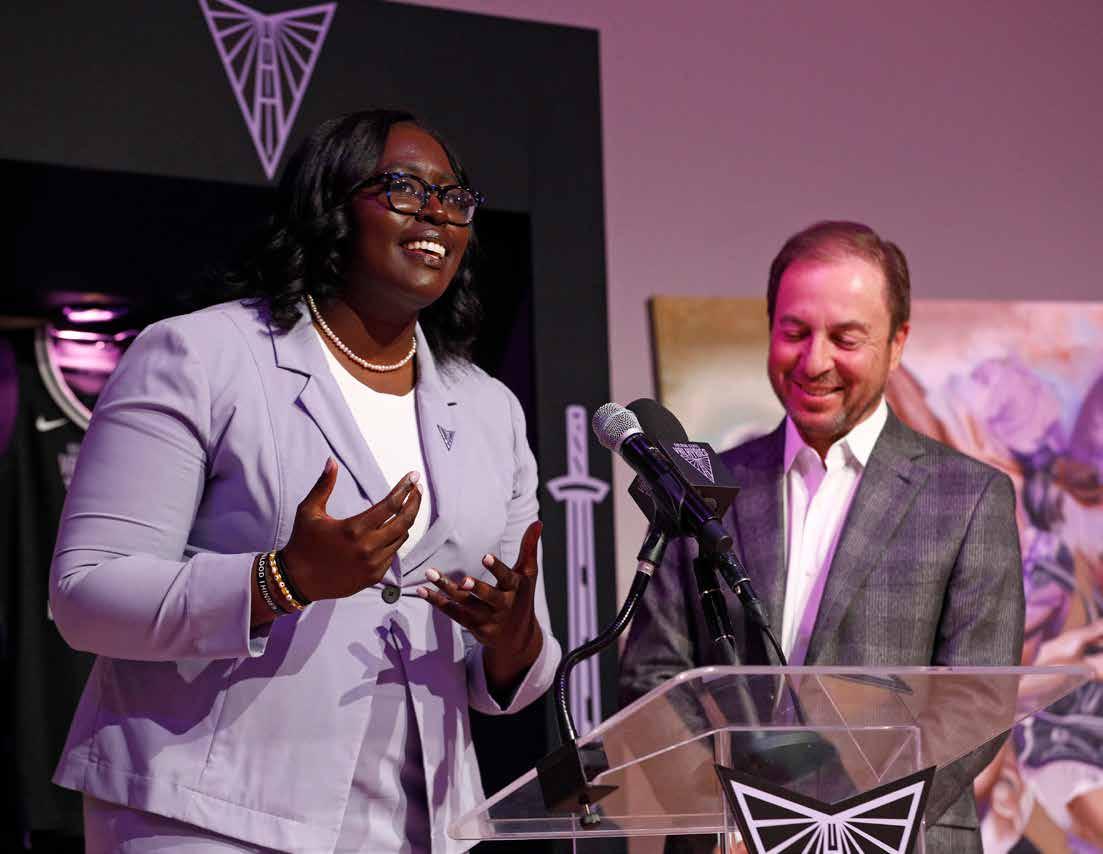
OPPOSITE | Golden State Valkyries general manager Ohemaa Nyanin, left, and majority owner Joe Lacob speak at the team’s expansion draft event in San Francisco on December 6, 2024. SANTIAGO MEJIA / S.F. CHRONICLE
with the No. 9 overall selection in April’s draft.
She is just 20 years old and a scorer, averaging 18.4 points in last year’s FIBA U20 Women’s European Championship. She has strong upside as someone who can run an offense.
The Valkyries added three players who should get plenty of minutes in the New York Liberty’s Kayla Thornton, Stephanie Talbot from the Los Angeles Sparks and Cecilia Zandalasini from the Lynx.
Thornton averaged 12.5 minutes while coming off the bench during the Liberty’s WNBA title run, and she’s a player whom Nyanin knows well from her time in New York’s front office. The 32-year-old forward has one year left on her contract and has been one of the league’s
6-4 French center saw more playing time as a rookie with the Aces the previous season, where she was averaging 13.1 minutes, and at 23 years old, she still has upside.
Guard Julie Vanloo played 40 games last season for the Mystics, starting 34, and averaged 7.4 points while shooting 34.6% from the floor. The 30-year-old also averaged 4.3 assists per game. She has played professionally for more than a decade, but last season was her first in the WNBA.
Nyanin said the Valkyries explored trades but ultimately decided to use their picks on players they wanted.
“We had good conversations with my colleagues across the league, and I think at the end of the day, the human aspect of all of this is what very much held true,” she said. “I didn’t want an athlete to hear they were selected for a trade pick.”
better defenders off the bench.
Talbot averaged 3.5 points per game and 2.1 assists coming off the bench for the Sparks last season. The 30-year-old tore her ACL in 2023 and wasn’t as quick after she returned, but she can shoot from range and dish the ball, and played at three different positions last season.
Zandalasini spent five years away from the WNBA but returned to the Lynx last season, playing 12.2 minutes per game and averaging 4.6 points. The 28-year-old forward shot 45.3% from the field and 44.3% from 3-point range, sixth best in the WNBA.
Iliana Rupert played 7.9 minutes per game with Atlanta two seasons ago — she skipped last season — and averaged 1.8 points. The
The WNBA’s free-agency period opens Feb. 1, and the Valkyries will be active in filling out the rest of their roster and could make several trades before then. Golden State appeared to prioritize players on inexpensive contracts, with just three players — Martin, Talbot and Thornton — on deals that can’t be renegotiated. Martin and Thornton give them two players who could be important parts of their rotation, and Fagbenle could start. But there is plenty of room for Golden State to add in free agency and build a roster that could reach the playoffs.
“We’re ready to talk to any and everybody that wants to have a conversation with us about being a part of this journey,” Nyanin said. “We are just really excited about the opportunity to welcome these free agents and these college athletes as well, and just wanted to give ourselves as much flexibility to be able to go and get athletes in the near future.
“We want to be competitive from Day 1. I don’t know what the adjective around it is, but we’re going to put our best foot forward.”
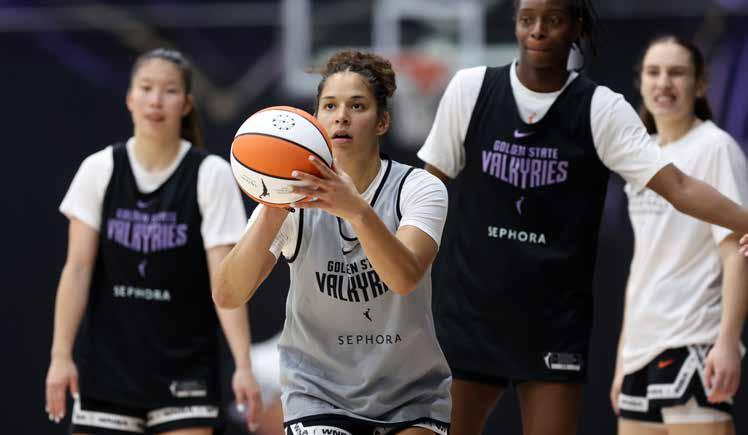
ABOVE | Golden State Valkyries, from left, Kaitlyn Chen, Veronica Burton, Migna Touré and Carla Leite during practice in Oakland on April 28, 2025.
SCOTT STRAZZANTE / S.F. CHRONICLE
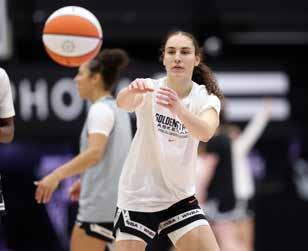
FAR LEFT | Guard Carla Leite, unlike several of her Golden State Valkyries teammates, did not participate in EuroBasket, a midseason tournament that depleted the roster. SCOTT STRAZZANTE / S.F. CHRONICLE
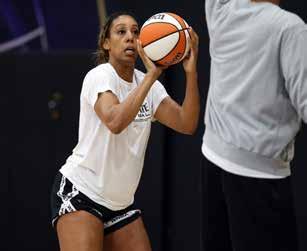
LEFT | With the Valkyries, forward Monique Billings remained a steady rebounder and took more 3-point shots than ever before. SCOTT STRAZZANTE / S.F. CHRONICLE
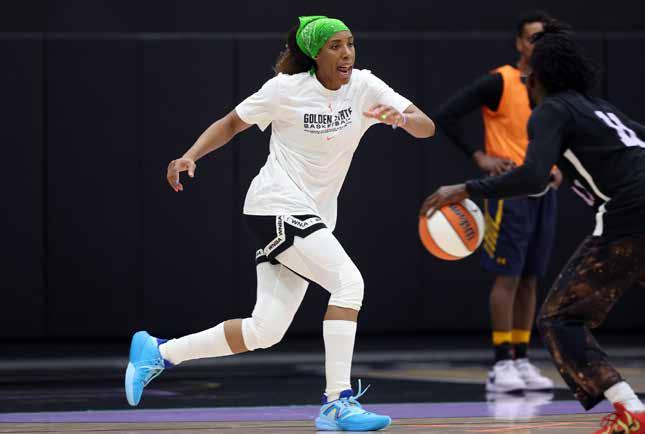
BELOW LEFT | Valkyries forward Kayla Thornton became the franchise’s first All-Star after averaging 14 points and 7 rebounds per game. SCOTT STRAZZANTE / S.F. CHRONICLE
Bay Area paved the way for WNBA
Decades before the Valkyries, women’s pro basketball was pioneered right here
BY SCOTT OSTLER • MAY 16, 2025
The Warriors have made some eye-rolling draft picks through the years, but none of them top their 13th-round selection in 1969.
Franklin Mieuli, the eccentric owner of the San Francisco Warriors, drafted a high school star who had averaged 69 points per game as a senior, scoring 111 in one game, and had packed 15,000-seat field houses in Iowa.
There were a couple of problems, though: Mieuli’s draft pick had never played fullcourt basketball.
And she was a she.
Denise Long was summoned to her high school principal’s office in tiny Whitten, Iowa, and informed that she had been drafted by the Warriors. Oblivious to the NBA world, Long assumed Uncle Sam was planning to make her a soldier.
“Do I have to go?” Long asked her principal. That was the start of the first women’s professional basketball league in America.
Full circle. As the Golden State Valkyries began their inaugural season in the WNBA on Friday, the players and their fans should have tipped their caps — $29.95 on the WNBA website — to a nutty old Franklin Mieuli and a perplexed young Denise Long, and to Bay Area trailblazers.
Let’s not be modest here. The Bay Area is the
cradle of women’s pro basketball in America.
Mieuli and Long got the party started in ’69, San Francisco picked up the thread in ’78 with a team in what is widely considered to be the first U.S. women’s pro league, and in 1996 a group of San Jose dreamers created a league that led directly to the creation of the WNBA.
Whatever it is in the Bay Area water and fog that inspires progressive and creative thought, that empowers dreamers and risk-takers — the Beat poets, the Black Panthers, the Silicon Valley OGs — flows through the veins of the WNBA.
Gather ’round the campfire, boys and girls, and learn how it all came to be.
Mieuli’s draft pick in ’69 was widely dismissed as a silly publicity stunt.
The NBA commissioner instantly voided the selection, since the league had a four-year college rule, and did not welcome female players.
That didn’t bother Mieuli (he died in 2010), whose plan was a snowball beginning to roll downhill. A genius at radio/TV sports programming and marketing, Mieuli hatched brilliant ideas that he often disguised behind a somewhat cartoonish persona. In the words of Hank Greenwald, former announcer for the Warriors and Giants, “Franklin is the one man in the world who works hard at having people
underestimate him.”
Mieuli’s idea was to use the attention generated by his wacky draft pick to kick-start his latest brainchild, a women’s professional basketball league, which he named the Warrior Girls Basketball League.
“I needed to generate interest in the women’s basketball thing,” Mieuli said years later. He had two daughters, by the way, a recurring theme in this overall narrative. “I think the statement I made (with the draft pick) was very valid. I don’t know if women can play this game, but if anyone can, (Denise) can. She was a very sweet, innocent, lovable girl.”
First, Mieuli had to talk his teen draftee out of retirement. Long (now Denise Long Rife) loved basketball, she still gets up shots at the gym at age 74, but in 1969, she hung up her sneakers. After starring in wildly popular Iowa girls’ basketball, she had no appetite for rinky-dink college ball.
“I didn’t want to play in front of nobody, for nothing,” Long said.
Mieuli flew to Whitten, charmed the Long family with glorious tales of San Francisco, and convinced Denise to delay her plans to study pharmacology.
Before reporting for duty in San Francisco, Long, who otherwise would have faded into
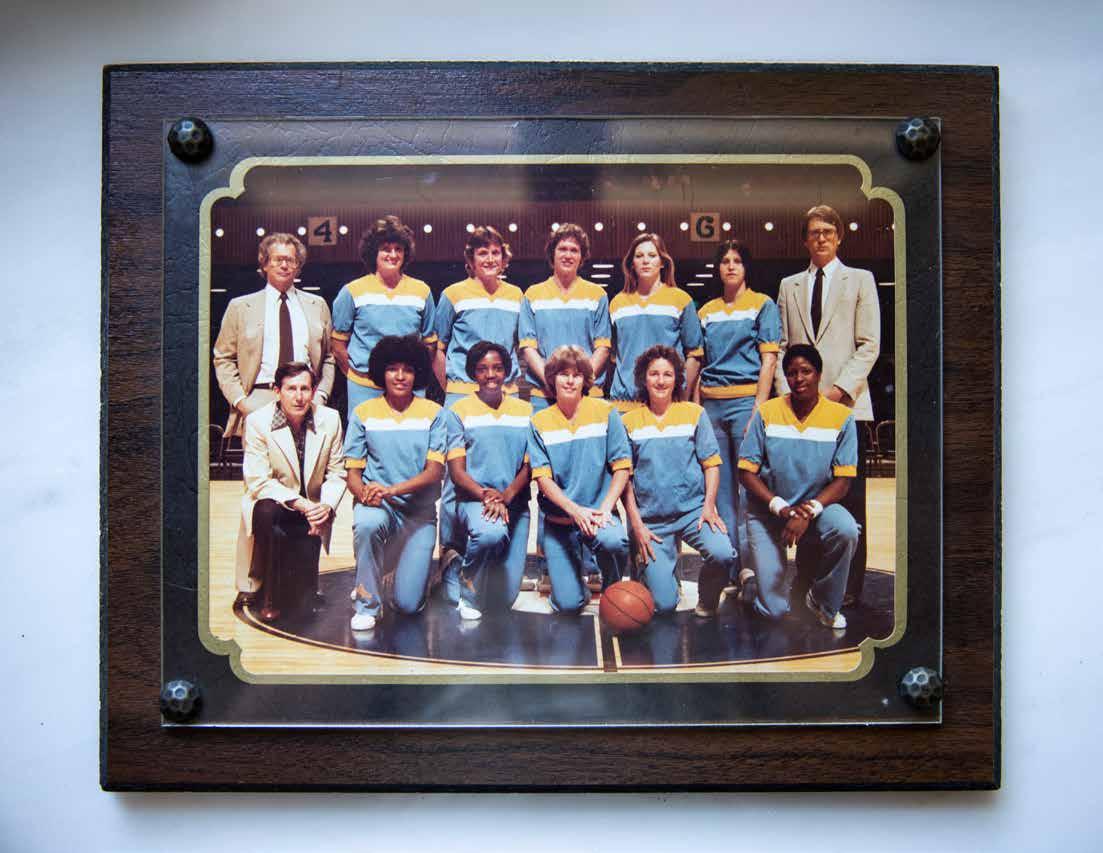
OPPOSITE | The first team photo of the San Francisco Pioneers, as displayed at majority owner Marshall Geller’s home in Los Angeles. Geller is top left. JENNA SCHOENEFELD / FOR THE S.F. CHRONICLE
obscurity, appeared on Johnny Carson’s “Tonight Show” and on NBC’s “Today” show, schmoozing with Bob Hope, Robert Wagner and Jack Dempsey.
Then Long landed in San Francisco as the building block for Mieuli’s new league, which consisted of four teams, all four based in the city, made up of 48 players chosen at an open tryout at USF.
The teams were named the Warriors, Giants, A’s and 49ers. The “girls” played preliminary games before Warriors’ NBA games at the Cow Palace, and played another exhibition quarter at halftime of the men’s games.
Mieuli’s promotion tactics were sometimes cringey. One brochure: “Get your hands on the hottest girls in town.”
The players received room and board, but no salary, so as to preserve their amateur standing. Apparently, part of Mieuli’s grand plan was to use his league to develop a U.S. team to compete in the 1972 Olympics. However, the debut of Olympic women’s basketball was delayed until 1976.
Long, the league’s meal ticket, got the best deal. Mieuli gave her spending money and paid her tuition to attend classes at USF, where she lived in a dorm. He took Denise shopping to lease her a car.
“He pointed at a car,” Long Rife said in a recent interview with the Chronicle. “I said, ‘I don’t want that one, I want that one,’ and I pointed at a purple Jaguar. I saw him have a lump in his throat, but that’s the one that he got me.”
Long Rife says she actually played briefly in two or three Warriors’ preseason exhibition games, with Nate Thurmond and Al Attles and the fellas. She remembers taking a few shots, but can’t recall if she made any of them.
Of the four WGBL teams, the only player from the Bay Area was Nancy Dito, fresh off a career as a three-sport star at San Francisco
State. Every time she scored, the Warriors’ PA announcer would shout, “And our own-n-n Nancy Dito!”
“I got nothing” as far as a salary, Dito says, “but I had the experience of a lifetime, it was wonderful. It’s something not very many people can say they did.”
She adds with a smile, “Denise Long’s team did not win (the league championship), it was my team, are you kidding?”
Does Dito take pride in having helped break ground for women’s pro basketball?
“I do feel that way,” she says. “We are all on the backs of other people, and that would apply here. Whatever we did, a little or a lot, (the Valkyries) are on our backs.”
Mieuli’s league lasted one season. Dito said she heard that other NBA team owners had promised Mieuli they would join his effort, “but it all fell apart.”
It wasn’t until the 1970s that women achieved the level of stamina required to run the entire length of a basketball court without fainting.
At least that was the perception of the men who ran the sport back then. Before that time, much of girls and women’s basketball was a hybrid version of the sport, six-person teams. You played either offense or defense, and never crossed the midcourt line. Two-dribble limit. That’s the sport Long had played in high school. Women and girls fought their way out of that stereotype box and into the 1976 Olympics, where the U.S. women’s team — all 12 of them bunking in a two-bedroom flat — stormed to a silver medal. It was a huge upset, considering that Europe and the Soviet Union had begun taking women’s hoops seriously decades earlier. It was time to rekindle Mieuli’s dream, and San Francisco was ready to do its part.
In 1978, an Ohio sports promoter/entrepreneur/dreamer named Bill Byrne, in his second attempt at forming a women’s league, created the Women’s Professional Basketball League,
or WBL. Byrne (who had a daughter, remember that theme) is considered by many historians to be the godfather of women’s pro basketball. Whatever. Byrne and Mieuli, who have both passed on, can sort that out in hoops heaven.
Byrne’s WBL didn’t soar, but it did take off, thanks in part to the star quality of Molly Bolin, who still holds pro scoring records. “Machine Gun Molly” played for the Iowa Cornets and was the league’s marquee attraction.
For the WBL’s second season, 1978-79, it expanded by four teams. A San Francisco stockbroker, Marshall Geller, bought into the league for $100,000, backed by minority owners like Alan Alda, future mayor Willie Brown, and Gordon Getty, who would later become business partners with Gavin Newsom.
Geller (who had two daughters) named his team the Pioneers, because, duh, they were pioneers!
The Pioneers played a 36-game schedule, with home games at Civic Auditorium, now the Bill Graham Auditorium.
They quickly became the WBL’s role-model franchise, in financial stability and player treatment. That wasn’t hard in a league where players frequently went unpaid and teams disappeared overnight.
“We were well treated, compared to other teams,” says Pamela Martin, one of the players. “We stayed in nice hotels, we flew (many teams traveled by bus or van), we had a per diem, paychecks came on time.”
The Pioneers’ first coach was Frank LaPorte, who had coached the St. Mary’s men to a combined 69-93 record over six seasons, and who had never coached women.
“Nice man, like your grandfather, very patient and soft-spoken,” says Martin, who made the team out of an open tryout at the old Potrero Hill Gym.
Martin was fresh off a modest career at UC Davis, then a very low-budget program. She was no great talent, but LaPorte liked her because she was smart and could run plays in practice against the starters. Martin survived the open tryout, worked out with the team for a while, then was invited back for training camp, but nobody mentioned pay.
‘We’re going to sign you tomorrow.’ Then I’m shaking: ‘My gosh, this worked!’”
Martin’s salary: $6,400, or $178 per game.
The Pioneers, and the league, weren’t sure whether they were selling athleticism or sex appeal, so they straddled the line.
“I’m a quarter short of my (college) degree, so I needed to play hardball,” says Martin. “I called the coach, said, ‘Look, I really would like to be part of this, but I need to know if I have a future with this team. If not, I can go on with my life.’ I got a call right back, they said,
“They made us go to charm school,” Martin recalls. “We were looking at one another like, ‘You got to be kidding.’ They taught us to do place settings at a dinner table, how to be prim and proper. You had to walk with a book on your head (for good posture). I found it amusing.
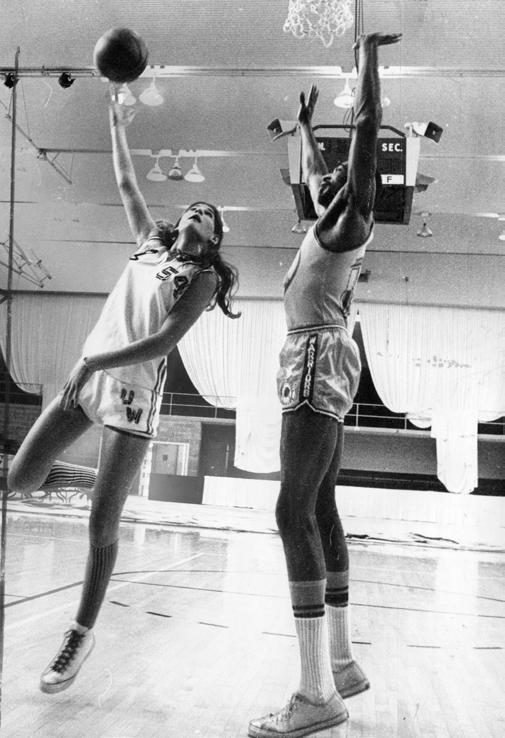
OPPOSITE | High school player Denise Long, drafted by the Warriors in the 13th round in 1969, shoots over Warriors center Nate Thurmond. The NBA disallowed the pick, but Long went on to play for Warriors owner Franklin Mieuli’s women’s league.
ART FRISCH / S.F. CHRONICLE
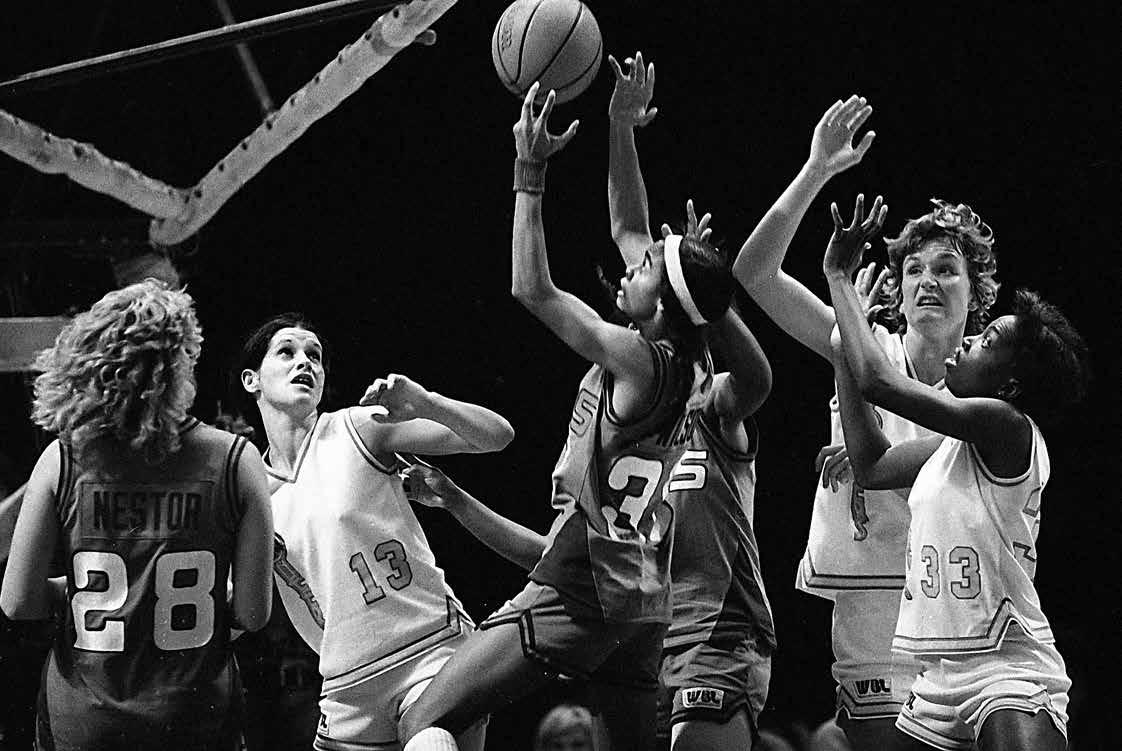
ABOVE | The Women’s Professional Basketball League’s San Francisco Pioneers play the Milwaukee Does on November 29, 1979.
JOHN STOREY / S.F. CHRONICLE
vs. Washington Mystics • W 76–74
Clutch performance makes Valkyries history
Veronica Burton’s career-high game delivers Golden State’s first win
BY MARISA INGEMI • MAY 21, 2025
A historically bad 3-point shooting half. A buzzer-beater. A career game from an unlikely source. The Golden State Valkyries’ first win had it all.
Veronica Burton’s career-high 22-point evening rescued the Valkyries from one of the worst offensive outings in WNBA history as her near-double-double (nine rebounds) carried the expansion team to a 76-74 victory over the Washington Mystics on Wednesday night at Chase Center.
Tiffany Hayes, Golden State’s leading scorer in its first game, exited in the second quarter with a nose injury, forcing the Valkyries to alter their offensive game plan. Up stepped Burton.
The fourth-year guard came up clutch for a team desperate for an offensive spark after starting the game 0-for-17 from 3-point range. Burton, who tallied 14 points with two assists in the fourth quarter alone, hit three massive 3-pointers, first a buzzer-beating prayer before halftime, a fourth-quarter go-ahead try and then, with 29 seconds left, the dagger for a
seven-point lead. But Valkyries head coach Natalie Nakase thought Burton’s drives to the rim changed the pace in the second half.
“In the second half, I was like, ‘Y’all can get to the paint too, you know, and get to the freethrow line,’” Nakase said. “So that was just one thing we emphasize is like, we’re still going to get the 3, but let’s try to get to the paint first, and that’s what Veronica did. Veronica went straight down the gut a lot of times where she was able to get back past her defender.”
Golden State’s (1-1) dreadful start from distance tied a WNBA record for missed 3-pointers to begin a contest matched by three other teams, most recently the Atlanta Dream in 2013. Janelle Salaün’s first career trey snapped the streak with 2:07 left in the second. The Valkyries finished 7-for-37 from behind the arc, becoming the sixth team in league history to miss 30 or more 3-pointers in a game. They shot 31.9% from the field overall.
The Valkyries started their two preseason games 0-for-13 and 0-for-14 from 3-point range, respectively, then went 9-for-35 in their
regular-season opener. The group spent the preseason claiming a 3-point shooting offensive identity, but it has yet to click.
“Coaches just continue to emphasize letting the ball fly,” Burton said. “You got to find a way to get things done. And we still are emphasizing taking our shots, good quality shots, and a lot of those are 3, but also when that’s not falling, we’re an aggressive team in the paint, too, and in transition, looking to get downhill, looking to get to the foul line, those are some of our strengths, too. Putting more of an emphasis on that was big for us, and we saw the results of it.”
A year ago, Burton was out of the league after being waived by Dallas. She latched on with Connecticut midseason, where she became a defensive specialist off the bench. Before Wednesday, she had never scored more than 15 points in a game.
“She has the opportunity now that she has the freedom to do what she needs to do,” said forward Kayla Thornton, who had 18 points, five rebounds, two steals and an assist. “She’s in a different position now, and she’s not where
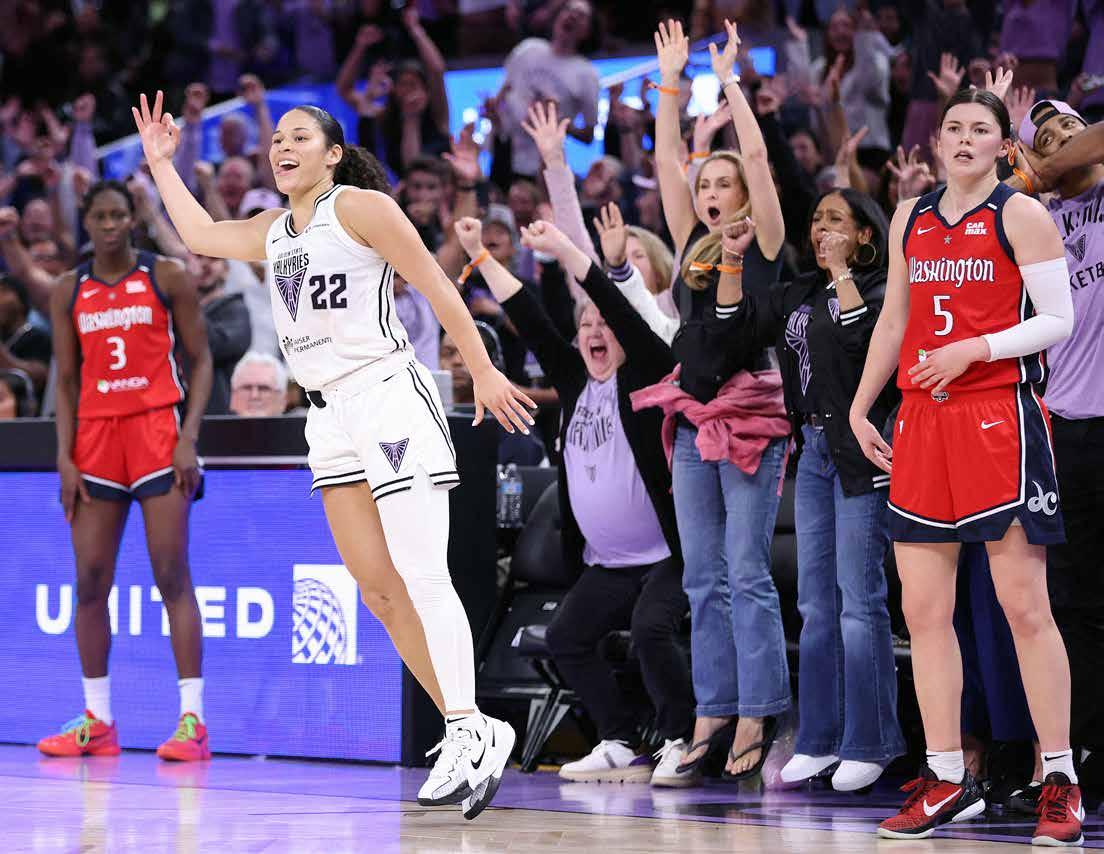
OPPOSITE | The Golden State Valkyries’ Veronica Burton celebrates a 3-pointer late in the game against the Washington Mystics during the Valkyries’ 76-74 win at Chase Center on May 21, 2025.
SCOTT STRAZZANTE / S.F. CHRONICLE
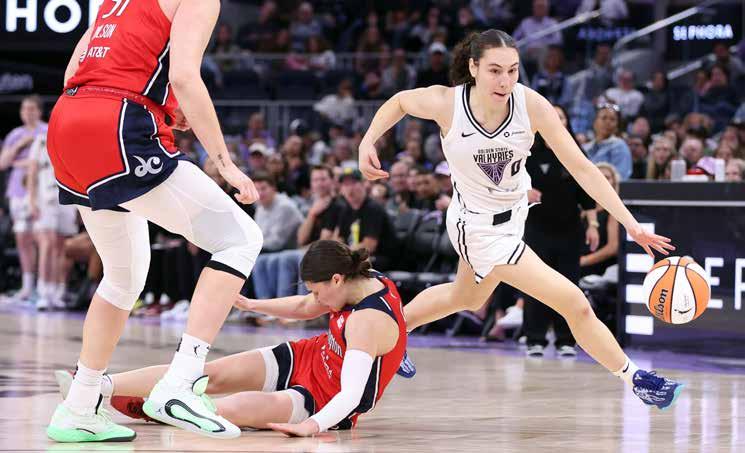
| The Golden State Valkyries’ Carla Leite drives past the Washington Mystics’ Jade Melbourne during the Valkyries’ 76-74 win at Chase Center on May 21, 2025.
she used to be. She’s our point guard, so she has to lead in that way. Tonight was a night that showed what she is capable of doing.”
Despite the cold shooting, the Valkyries led 31-30 at the half and 47-46 going into the fourth. Much of that was thanks to 17 turnovers from the Mystics (2-1), which the Valkyries turned into 17 points. Golden State had just 11 giveaways after a 20-turnover performance in the opening loss to the Sparks. Golden State added 11 offensive rebounds to the Mystics’ turnovers to gain 28 possessions. Every Valkyries player had a rebound, led by the 5-foot-9 Burton’s nine — of which four
were offensive.
“It’s not just crash (the boards) to crash,” Nakase said. “We want to try to get more possessions, and Veronica grabbed four. … That’s huge, considering she’s not one of the tallest people on the floor.”
The Valkyries finished with 28 points in the paint, primarily off of drives from Burton and Carla Leite, who came off the bench to score 10 points and finish plus-17 in 21 minutes. In her first WNBA game, Salaün got the start and added 10 points in 28 minutes; the first play of the game was her surge to the rim for a basket.
“The first play was for me, and that was great to get going in that way,” she told the Chronicle.
“I just read the defense, and I couldn’t dream of anything better than winning for my first experience.”
Thornton and Burton combined for 12 of the final 13 points in the Valkyries’ 29-point fourth frame. Offensive flashes from Salaün’s midrange game and Leite’s drives to the rim were positive signs for an offensive finding itself without Hayes.
“These are the moments you don’t really forget,” Burton said. “Obviously, we’ve been in the gym, we’ve been working training camp and there’s been a lot of anticipation, a lot of buildup to be here. ... We have a lot to learn from.”
RIGHT
SCOTT STRAZZANTE / S.F. CHRONICLE

SUPERFAN SPOTLIGHT
Anjelika Temple (and family)
City: Mill Valley
Age: 41
Games attended: A couple times.
How big of a fan are you? Huge fans. We come as a family (husband David Temple and daughters Indira Temple, 6, and Anokhi Temple, 8). It’s such good energy. For this being the first season, the fact that everyone is geared up, pulling purple out of their closet, it’s very joyful. Being a parent to two girls, it’s so fun for the first professional games they’ve seen to be WNBA.
What inspired your fan style? I got this at the preseason game. I’m excited about the full sequin situation. The eye shadow is Nars.