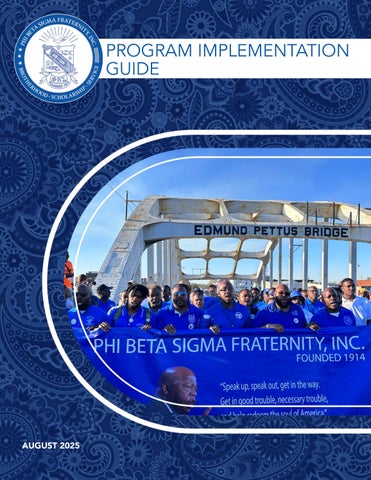

PROGRAM IMPLEMENTATION GUIDE
• Community Initiatives and Programs Position Statement Page 6
• Prioritized Fraternity Programs Page 6
• About the Fraternity’s Program Implementation Page 6
• What Does Success Look Like? Page 6
• Key Terms and Definitions Page 7
Fraternity Programs
Fraternity Initiatives
Fraternity Incentives
• Required Steps for Fraternity Program Design Page 7
• Sigma Annual Global Day of Service Page 10
• Fraternity Demographics Page 11
• Fraternity Profile Page 11
• Our Organization Tone and Culture Page 11
• Annual Community Impact Page 11
• About Our Chapters Page 11
• Membership Demographics Page 11
• Our National Partnerships and Alignment with Our Community Page 13 Initiatives and Impact
• Fraternity’s Program and Community Initiatives Timeline Page 16
• Prioritized Programs and Community Initiatives Page 16
• Economic Development Page 17
• Adopt-A-Business Initiative Page 18
• The Black Spend Initiative Page 20
SOCIAL ACTION
• Financial Literacy, Investment Club, Investment Contest Page 22
• Men’s Wearhouse Dress for Success/Interview 101 Initiative Page 24
• NAREB Homeownership Initiative Page 26
• Project VITA (Volunteer Income Tax Assistance Program) Page 28
• Small Business Administration Page 30
• The Sigma Business Network (SBN) Initiative Page 32
• Billboard Jackson Entrepreneurial Development Program Page 34
• Education and Scholastic Achievement Page 37
• Adopt-A-School (External doc)
• Global Education Page 38
• The S.T.E.M. Program (Science, Technology, Engineering and Mathematics) Page 42
TABLE OF CONTENTS TABLE OF CONTENTS
Social Action, Justice and Advocacy Page 44
• Brotherhood for Justice Reform 3 Days of Good Trouble Page 47
Blue and White Legislative Day Page 49
Expungement & Sealing of Criminal Records Summit Page 51
• Healthy Communities
American Red Cross Chapter Blood Drive Page 53
Mental Health Awareness Page 55
Prostate 5k Run/Walk Page 57
Prostate Health & Sexual Recovery Page 59
Sigma Community Food Giveaway Page 60
Sigma Wellness – Fitness Challenges Page 63
Walk a Mile in My Shoes Page 65
Walk with the Stars Run/Walk or Sickle Cell Disease Page 67 Awareness Program
• Safe Communities
Establishing the Faith – Building a Bridge Between Law Page 69
Human Trafficking Awareness Page 71
Gun Violence Prevention & De-Escalation Training Day Camp Page 73
National Night Out Page 75
Sigma Justice Alliance Page 77
Sigma Self Defense Series Page 80
• Voting Empowerment
Let’s Talk Politics – Candidate’s Town Hall Page 82
Sigma Impact 365: Blue Boots on the Ground Page 84
Voter Registration, Education & Mobilization Page 86
• About the Sigma Beta Club Page 88
• Program Reporting and Assessment Page 89
• Required Annual Chapter Audit – The Chapter Self-Assessment Page 91
• Completing the Annual Chapter Report Page 93
• Celebrating A Chapter’s Hard Work through Awards & Recognition Page 95
• Fraternity Mentoring and Member Development Page 97
• Appendix and Supporting Resources
• Adopt-A-School – Creating MOU with Schools and Agencies
• Crossing Paths Event
ФВЕ OUNDED 1910


COMMUNITY INITIATIVES AND PROGRAMS POSITION STATEMENT
Brotherhood, service, and community impact is core to who we are, which encompasses our focus on Economic Development, Scholastic Achievement, Healthy and Safe Communities Social Justice, Advocacy and the Development of Our Youth.
PRIORITY FRATERNITY PROGRAMS
• Economic Development
• Education and Scholastic Achievement
• Social Action, Justice and Advocacy
• Healthy and Safe Communities
• Development of Our Youth (Sigma Beta Club)
ABOUT THE FRATERNITY’S PROGRAM
IMPLEMENTATION
What Does Success Look Like?
• Complete roll out of Conclave mandate on programs and community initiatives
• At the end of 2024: 80% of alumni chapters will have completed a minimum of 5 community programs within the 5 focus areas and documented in a timely manner through the program implementation assessment process (PIA).
• At the end of 2024: 80% of collegiate chapters will have completed a minimum of 3 community programs and documented in a timely manner through (PIA).
• At the end of 2024 there will be a comprehensive Annual Report showing community impact and accountability.
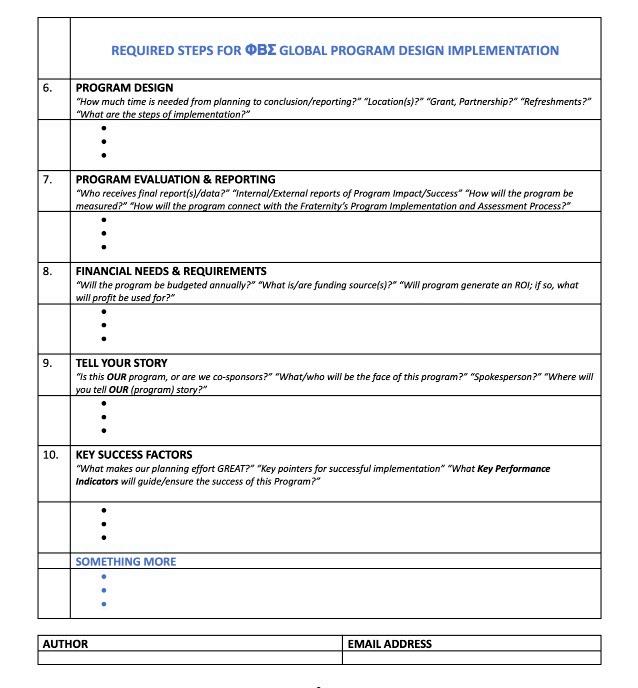
REQUIRED STEPS FOR FRATERNITY PROGRAM DESIGN
The program design planning consists of 10 sections:
• Need Assessment/Summary Statement
• Program Purpose & Goal(s)
• Expected Outcomes and Deliverables
• Program Targeted Audience and Projected Impact
• Resources
• Program Design
• Program Evaluation & Reporting
• Financial Needs & Requirements
• How Do You Tell the Story (Marketing, Communications and Publicity)
• Key Success Factors
Key Terms and Definitions
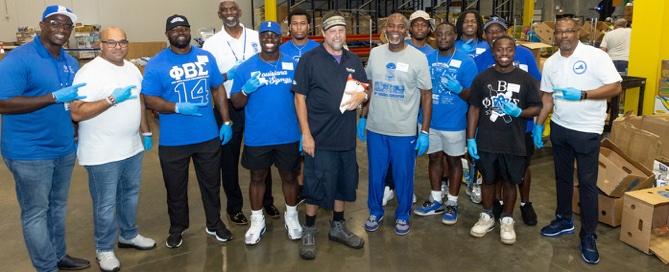
Fraternity Programs: All official Fraternity Programs will have completed all required steps in the Fraternity Program Design. The Fraternity Programs are focused on community impact which encompass economic development, scholastic achievement, men’s health and wellness, social action, justice, advocacy, and development of our youth. The Fraternity Program is a structured set of activities or procedures designed to achieve a specific goal or provide a specific service or educational content. Programs often have a defined duration, objectives, and resources allocated.
Fraternity Initiatives: Fraternity Initiatives are internal programs or events created and focused on membership. An initiative is a plan or strategy intended to address a problem or seize an opportunity. Initiatives are often more about starting something new or making significant changes to improve the current state of affairs. Initiatives can be less structured than programs and might involve a broader scope of activities or changes.
Fraternity Incentives: Fraternity Incentives are value adds and perks for Sigma Brothers. A perk (short for “perquisite”) refers to an extra benefit or privilege resulting from being part of the organization, often intended to improve satisfaction 5 and loyalty. Perks are usually less formal than programs or initiatives and are often seen as bonuses.
PROGRAM DESIGN TEMPLATE
PROGRAM DESIGN TEMPLATE
SIGMA ANNUAL GLOBAL
DAY OF SERVICE

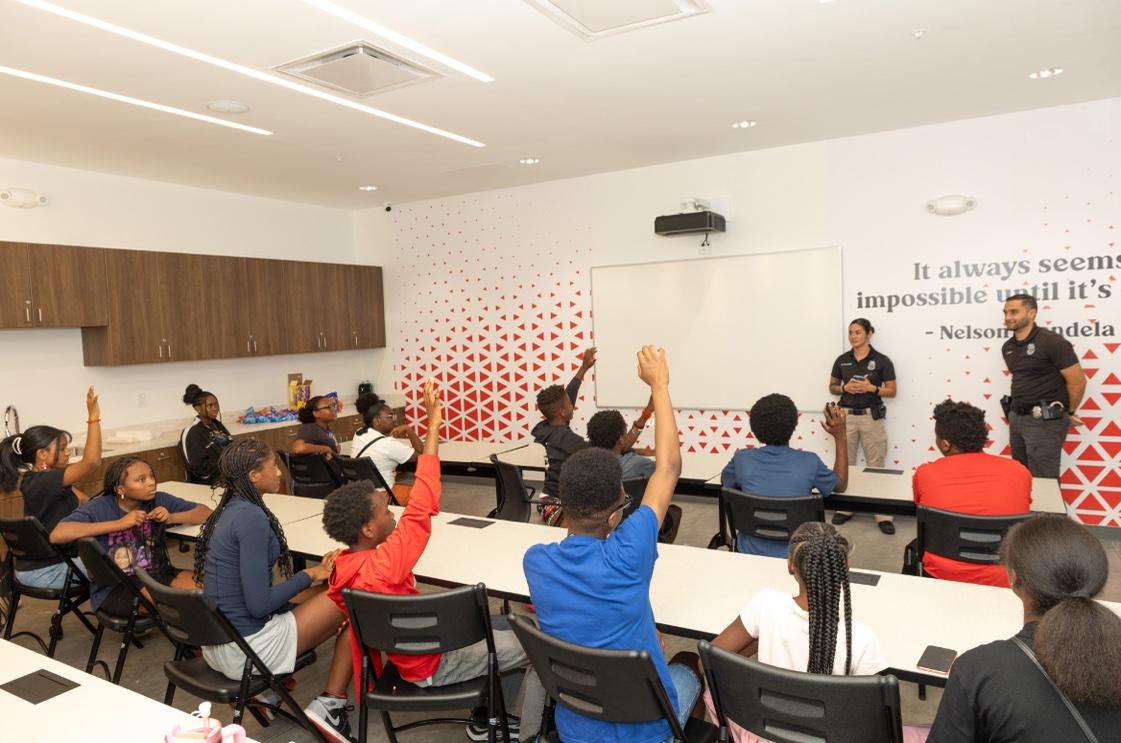
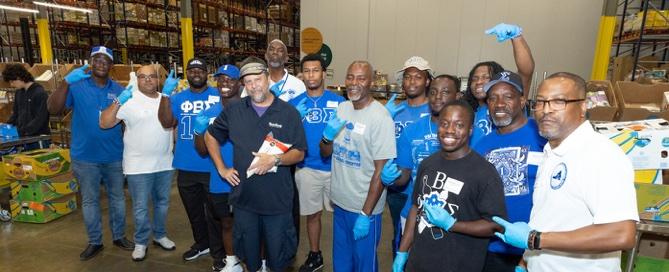
The Fraternity’s Annual Global Day of Service is scheduled for the last Saturday of September of every year.
Phi Beta Sigma’s commitment to service is expressed in our motto, “Culture for Service and Service for Humanity.” This service is manifested in the communities we serve, and every Sigma Chapter should have a notable presence in constantly working to remove all badges of second-class citizenship to emphasize and demonstrate our collective impact. This showing of our collective strength, impact, and commitment to service in our communities is a continued clear call to action for each of our Chapters.
FRATERNITY DEMOGRAPHICS
Phi Beta Sigma is proud of the diversity of its membership. Together we make an impact in the communities we serve.
FRATERNITY PROFILE
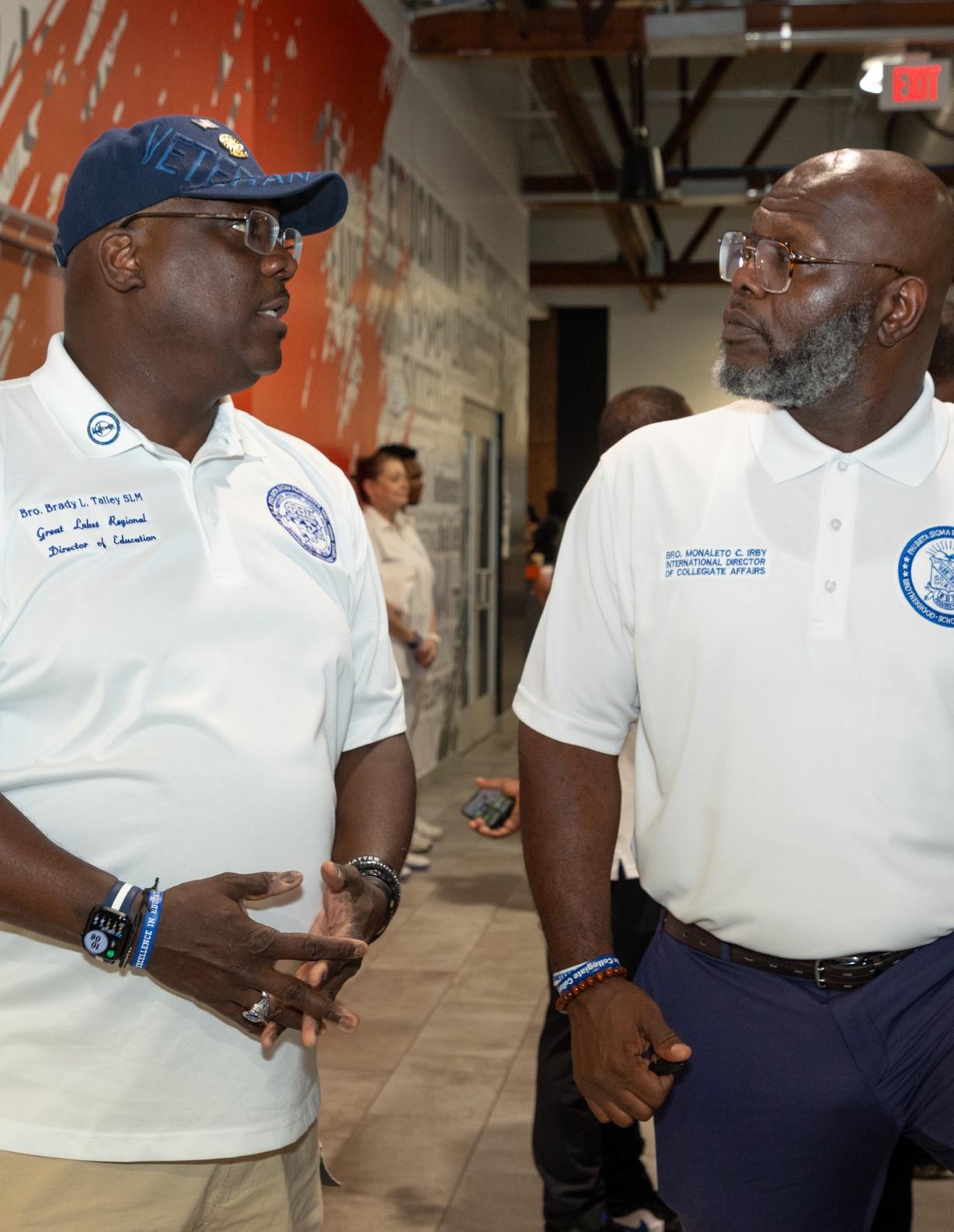
Phi Beta Sigma Fraternity, Inc. is a recognized leader in proactive community service, focusing on educating and empowering men in our communities to make a positive difference. The Fraternity’s motto is “Culture for Service and Service for Humanity” and we’re proud to inspire and develop leaders.
OUR ORGANIZATION TONE & CULTURE
Optimistic, Compassionate, Uplifting, Advocate, Innovative, Engaging and Disruptive
FRATERNITY PROFILE
• 576,000 Service Hours Annually
• 110 Years of Brotherhood
• 4,500 Young Men Mentored Annually
• 225,000 Men Initiated Since 1914
• 600+ Active Chapters
• $1.2M in Scholarships to Students Annually
• $10.1M Black Spend Initiative
ABOUT OUR CHAPTERS
• Collegiate
• Alumni
• Member-At-Large
• International
MEMBERSHIP DEMOGRAPHICS
EDUCATION
• Undergraduate 20%
• Bachelor 80%
• Masters 38%
• Post Graduate 12%
SALARY AND INCOME
• $45K – $75K 22%
• $76K – $100K 28%
• $101K – $200K 40%
• Above $200K 10%
RACE AND ETHNICITY
• Black/African American 91%
• White 4%
• Latino/Hispanic 3%
• Asian
•
AGE
•
•
MILITARY SERVICE
• Over 4,500 Members with Military Service
• 69% Active
• 31% Retired
OUR NATIONAL PARTNERSHIPS AND ALIGNMENT WITH OUR COMMUNITY INITIATIVES AND IMPACT
NAACP- James Weldon Johnson
Scholarship
NAACP
Minority Business Development Agency
National Association of Black Real Estate
Brokers
Micah’s Voice
National Park Service (Selma)
Fish and Wildlife (Dept. of Interior)
Kean University
National University
Small Business Administration
American Red Cross
Sickle Cell Society of America
St. Jude
Edward Jones
Men’s Warehouse
NCNW
IRS
Adopt-A-School
Zero for Prostate
Center for Policing Equity
For national contacts to leverage partnerships, contact the International Director of Programs: Programs@phibetasigma1914.org

OUR NATIONAL PARTNERSHIPS
NAACP
The NAACP provides access to a voting platform for voter registration and promotes events and initiatives that align with Phi Beta Sigma’s programming.
NAACP-
James Weldon Johnson Scholarship
The Phi Beta Sigma James Weldon Johnson Scholarships provide 25 scholarships, each valued at $1,000, to graduating seniors.
Minority Business Development Agency
The agency fosters, promotes, and develops the Nation’s Minority Business Enterprises (MBEs).
National Association of Black Real
Estate Brokers
The association offers training and classes in specific cities and regions to increase the number of minority homeowners.
Micah’s Voice
This partnership raises awareness about autism in children.
National Park Service (Selma)
The National Park Service provides internships, resume-writing workshops, and educational programs for Sigma sites, such as the GWC Museum.
Fish and Wildlife (Department of Interior)
The Fish and Wildlife Service offers one internship, provides opportunities for regional and Conclave attendance, and promotes relevant literature.
Kean University
Brothers attending Kean University in person receive a 10% discount, while those attending virtually receive a 20% discount.
National University
Discounts are provided to brothers attending National University, and financial support is offered to regions for conference participation.
Small Business Administration
The Small Business Administration offers training to chapters and brothers on starting small businesses.
American Red Cross
Phi Beta Sigma organizes blood donation campaigns to support minority communities in partnership with the American Red Cross.
Sickle Cell Society of America
The fraternity supports efforts to fundraise and raise awareness for sickle cell anemia.
St. Jude
Phi Beta Sigma conducts fundraising to support the initiatives and raise awareness about the work of St. Jude and its research programs.
Edward Jones
Courses on financial literacy are provided through the Learning Management System (LMS), along with additional training for chapters.
Men’s Wearhouse
Discounts are offered to brothers, and Sigma Beta Clubs receive training on purchasing suits and tying ties.
National Council of Negro Women
Grants are provided to chapters conducting programs that raise awareness about COVID-19 and mental health.
Phi Beta Sigma aligns with Project VITA to provide financial education and support.
Chapters adopt schools and offer ongoing support to the sites they have committed to assisting.
PRIORITIZED PROGRAMS AND COMMUNITY INITIATIVES
Brotherhood, Service, and Community Impact are core to who we are, which encompasses our 5 prioritized community program focus areas:
1. Economic Development
2. Education and Scholastic Achievement
3. Social Action, Justice, and Advocacy
4. Healthy & Safe Communities
5. Development of Our Youth
PRIORITIZED FRATERNITY PROGRAMS
Economic Development
Bigger & Business became the first national program of Phi Beta Sigma Fraternity. It was first introduced at the Tenth Anniversary Conclave, in Philadelphia, Pennsylvania (December 1924). When Bigger and Better Business was adopted as a national program, special emphasis was placed on encouraging and promoting Negro business. At its inception, the program sought to encourage Negro Businesses to improve their business acumen, efficiency and service to the public, to be competitive with other businesses.
There are 7 programs in this area of focus:
• Adopt-A-Business Initiative
• The Black Spend Initiative
• Financial Literacy, Investment Club, Investment Contest
• Men’s Wearhouse Dress for Success/Interview 101 Initiative
• NAREB Homeownership Initiative
• Project VITA (Volunteer Income Tax Assistance Program)
• Small Business Administration
Key Initiatives
• The Sigma Business Network (SBN) Initiative
• Billboard Jackson Entrepreneurial Development Program


ECONOMIC DEVELOPMENT PROGRAMMING

ECONOMIC DEVELOPMENT
For All Programming
TELL YOUR STORY
All CHAPTER PROGRAMMING should include the creation and distribution of:
• Public service announcements (electronic and hard copy)
• Press releases (electronic and hard copy)
• Feature articles suitable for print (electronic and hard copy) and for submission to IHQ (for the Crescent Magazine and the Crescent Newsletter) and Regional and State Phi Beta Sigma communications officers. Email information and high-quality pictures to communications@phibetasigma1914.org (be sure to include Crescent News in the subject line)
• Post pictures on your website, in your newsletters and social media pages
• Invitations/press releases/feature stories to local organizations, especially the NPHC and local school officials to participate in our programming
• Feature partnerships on Chapter’s website, newsletters, social media pages and during Chapter events
KEY SUCCESS FACTORS
Numerous factors will contribute to the success of your program. We collect data to validate our activities, to maintain a history of Phi Beta Sigma community service, to fulfill our mission and purpose, and to provide data to entities who support, underwrite, and co-sign our commitment to be stewards of our communities:
• Document number of partnership engagement events
• Document number of Brothers at all programs
• Document number of attendees at all programs – provide demographics (when possible):
• Age
• Gender
• Ethnicity
• Provide survey to participants designed to track/measure impact of partnership
• Detail growth/development in customer base
• Detail growth/development in adopted business’ reach in the local community
• Detail growth/development in profits (or other suitable measurement)
• Detail causal relationship of Chapter involvement and the business’ outcome(s)
• Plan early and make clear delineations of Chapter Brother assignments
• Meet with the local partners
ADOPT-A-BUSINESS INITIATIVE
NEED ASSESSMENT/SUMMARY STATEMENT
Black business owners are working to build stronger communities—75% told Intuit QuickBooks they believe Black-owned businesses are critical for a thriving Black community. And according to the Bank of America report, 87% are committed to driving social change through their businesses.” (Source: “ Reports Show Black Small Businesses Still Face Major Challenges. ” See Resources below for complete article). Phi Beta Sigma is committed to working with Black-Owned businesses to promote self-sufficiency, growth, and development in communities of color.
PROGRAM PURPOSE & GOAL(S)
• The International Adopt-A-Business Initiative will assist Black-Owned businesses with the development, promotion, and growth of their businesses
• By establishing Memorandums of Understanding (MOUs), Chapters will cultivate investment in communities and organizations of color, and will provide opportunity to developing interagency relationships within our communities
• Brothers with subject-matter expertise in entrepreneurship, marketing, finance, and social media development may lend their services to the adopted business(es) to enhance business development, growth, and education
EXPECTED OUTCOMES AND DELIVERABLES
• Black-Owned businesses will expand marketing reach and community awareness
• Black-Owned businesses will be provided with industry specific knowledge, resources, and partnership opportunities for growth and development
• Black-Owned businesses will benefit from a volunteer base provided by the Chapter
• Back-Owned businesses will leverage Chapter’s workforce and skillsets to enhance their business acumen
• Through establishing of MOUs, Chapters will create mutually beneficial opportunities for the Chapter to also expand its reach through complimentary marketing opportunities and other benefits provided by the Black-Owned business
PROGRAM TARGETED AUDIENCE AND PROJECTED IMPACT
• Black Owned Businesses across the international landscape: the projected impact will be to assist Black-Owned businesses within our respective communities, to assist them in the improvement of their business acumen, efficiency, and service to the public to favorably compete with other businesses
• Local think tanks and community organizations addressing/supporting minority entrepreneurship
• Local community consumers
PROGRAM DESIGN
• Establish an MOU:
• Written evidence that a partnership exists between the Chapter and the adopted business
• Sets the terms, understanding, and projected outcomes shared between the Chapter and the adopted business
• Include benefits to the business as well as to the Chapter (such as the offering of discounts to your membership)
• Invite local businesses to Chapter meetings to discuss their goods and services
• Sponsor workshops and forums for the adopted business with professionals as well as Chapter members with certain expertise on business topics
• Conduct an environmental scan on behalf of the adopted business – review and advise on the business plan, marketing, social media presence
• Identify local entities that provide services to businesses and facilitate partnerships
• Patronize adopted business(es) in a show of financial support
• Conduct business fairs as well as business forums within your respective communities (live and virtual)
• Host an event or Chapter meeting at a minority- or Sigmaowned business
• Include adopted business on a page of Chapter’s website/ facilitate the creation of the adopted business’ social media page(s)
RESOURCES
• https://www.sba.gov/business-guide/ grow-your-business/minority-ownedbusinesses
• https://www.uschamber.com/co/start/ strategy/resources-for-black-ownedbusinesses
• https://www.forbes.com/sites/ allbusiness/2023/02/20/reports-showblack-small-businesses-still-face-majorchallenges/?sh=2e56778074d9
• https://www.sba.gov/ article/2023/10/24/ biden-harris-administration-announcessignificant-increase-lending-blackowned-small-businesses
PROGRAM EVALUATION & REPORTING
• Program evaluations are submitted to Phi Beta Sigma using the preferred tool and matched (where able) to the Fraternity’s Program Implementation Priority areas
• Chapter files should maintain all program evaluations for successive Chapter administrations to utilize for ongoing Chapter assessment and annual planning
• All programs (overview, summary, and outcomes) should be included in Chapter’s annual report
FINANCIAL NEEDS & REQUIREMENTS
A prepared budget, to include the following (if applicable):
• Printing costs for advertising and marketing: signs, swag, and tabling, giveaways
• Honorariums, related fees for guest presenters or speakers
• T-Shirts and other marketing items
• Transportation cost
• Contingency (money set aside for unanticipated costs that may arise)
• Possible MOU contents:
• Chapters discounts
• Funding from the adopted business (Ex: business may provide a certain percentage of the net proceeds that your chapter and the community spend within a specific day, month, or year back to the chapter)
THE BLACK SPEND INITIATIVE
NEED ASSESSMENT/SUMMARY STATEMENT
We must change the mindset of our communities in their support of Black-Owned businesses:
• In 2020 more than 43% of Black-Owned businesses were disproportionately impacted by COVID and were dissolved
• Blacks spend less money in Black-Owned businesses than other ethnic groups spend in businesses owned by members outside their groups
• Blacks have a $1.4 trillion dollar annual spend, but only spend approximately $0.02 per dollar with Black-Owned businesses
• Blacks comprise 13% of the U.S. population, yet own only 7% of businesses
• Black business owners receive less business financing, less often, and at higher rate
PROGRAM PURPOSE & GOAL(S)
• To be a change agent for Black-Owned businesses
• To increase the circulation of the Black dollar within our communities
• To capture/document the Fraternity’s ability to spend dollars with Black-Owned businesses
• To solidify Memorandums of Understanding (MOUs) and Returns on Investments (ROIs) that strengthen our partnerships
• To develop a process to include the IHQ Black spend dollars to be embedded in the same report as Chapters
• To increase the awareness of the black owned franchisee
EXPECTED OUTCOMES AND DELIVERABLES
• Documenting the increase of black-owned business’s visibility in communities we serve
• Building relationships with Black-Owned businesses through our Adopt-A-Business, and the sharing of their marketing through various social media platforms
• Investing in Black-Owned businesses and facilitating the sharing of business resources with new Black-Owned business owners
• Documenting consumer support through spending
• Documenting programing that will expand the awareness of community-based BlackOwned businesses
PROGRAM TARGETED AUDIENCE AND PROJECTED IMPACT
• Chapter Brothers
• The Community
• Black-Owned Businesses
PROGRAM DESIGN
• Black Spend Implementation processes have been defined since 2020
• https://phibetasigma1914.org/wp-content/uploads/2020/08/ BBB-Black-Spend.pdf
• Chapters will promote Black-Owned Businesses
• Chapters will document money spent and the businesses supported, making a monthly report to IHQ
PROGRAM EVALUATION & REPORTING
• Program evaluations are submitted to Phi Beta Sigma using the preferred tool and matched (where able) to the Fraternity’s Program Implementation Priority areas
• Chapter files should maintain all program evaluations for successive Chapter administrations to utilize for ongoing Chapter assessment and annual planning
• All programs (overview, summary, and outcomes) should be included in Chapter’s annual report
FINANCIAL NEEDS & REQUIREMENTS
No budget required
RESOURCES
• https://gitnux.org/black-consumerspending-statistics/
• https://www.sba.gov/ article/2023/10/24/ biden-harris-administration-announcessignificant-increase-lending-blackowned-small-businesses
• https://usblackchambers.org/
• Regional Directors of Bigger & Better Business
FINANCIAL LITERACY, INVESTMENT
CLUBS AND INVESTMENT
CONTESTS
NEED ASSESSMENT/SUMMARY STATEMENT
According to FORBES Magazine:
• “Financial literacy refers to your grasp and effective use of various financial skills, from budgeting and saving to debt management and retirement planning
• It equips you with the knowledge to make informed decisions, leading to greater monetary stability, less stress, and a higher quality of life
• Financial literacy empowers you to take control of your finances and navigate the challenges and opportunities that arise
• It is a crucial element in achieving financial health”
• (Source: https://www.forbes.com/sites/truetamplin/2023/09/21/financial-literacy-meaning-components-benefits--strategies/?sh=78bf653f68cd)
• Brothers and Chapters and communities will be introduced through increased awareness and investment opportunities through financial literacy training and exposure
PROGRAM PURPOSE & GOAL(S)
To promote financial literacy amongst our Brothers and Chapters and communities we serve by:
• Facilitating financial knowledge, understanding the impact of money, how to participate in the stock market, embracing future investments
• Creating generational wealth within the Black community
• Sponsoring financial seminar series
EXPECTED OUTCOMES AND DELIVERABLES
• Transitioning behavior from a consumer mindset to an ownership mindset
• Introducing the stock market through investment clubs and investment contests
• Increasing community awareness and participation in financial planning
PROGRAM TARGETED AUDIENCE AND PROJECTED IMPACT
• Chapter Brothers
• Our communities
• Local small businesses and minority financial planning agencies
PROGRAM DESIGN
• Sponsor webinars (virtual and in-person) on a quarterly basis
• Create investment clubs for Brothers, Chapters, and communities
• Teach communities to establish their own investment clubs
• Sponsor virtual investment contests on a quarterly basis
PROGRAM EVALUATION & REPORTING
• Program evaluations are submitted to Phi Beta Sigma using the preferred tool and matched (where able) to the Fraternity’s Program Implementation Priority areas
• Chapter files should maintain all program evaluations for successive Chapter administrations to utilize for ongoing Chapter assessment and annual planning
• All programs (overview, summary, and outcomes) should be included in Chapter’s annual report
FINANCIAL NEEDS & REQUIREMENTS
A prepared budget, to include the following (if applicable):
• Printing costs for advertising and marketing and event invitations
• Honorariums, related fees for guest presenters or speakers
• T-Shirts and other marketing items to brand investment club membership, financial literacy contest winners
• Line item for contest winner prizes
• Contingency (money set aside for unanticipated costs that may arise)
• Possible Memorandum of Understanding contents:
• Chapters discounts
• Funding from the adopted businesses and/or corporate sponsors
• Return on Investment expectations for Brothers, Chapters, and communities
RESOURCES
• Operation Hope Financial Literacy Programs - https://operationhope.org/
• Association of African American Financial Advisors - https://www. aaafainc.com/
• The Black Wall Streeter - https://www. theblackwallstreeter.com/
• Allspring Global Investments - https:// www.allspringglobal.com/
• The PBS Investment Clubs are in partnership with BetterInvesting.org, www.facebook.com/betterinvesting the oldest investment club in the country. BetterInvesting offers a turnkey web-based solution that educates, provides research, and provides all the administrative and accounting needs for our Brothers and Chapters across the international landscape
• Bro. Julian Heyward - https://www. linkedin.com/in/julianheyward/ Bro. Heyward is the Market Leader/ Regional Director at Allspring Global Investments, and he is the Fraternity spokesperson for the Allspring and BetterInvesting programs
MEN’S WEARHOUSE DRESS FOR
SUCCESS AND INTERVIEW 101 INITIATIVE
NEED ASSESSMENT/SUMMARY STATEMENT
• Underserved and marginalized communities frequently lack the resources and/or funds necessary to ‘dress for success.’ In business and social settings, there is a culture of acceptable attire that contributes to self-motivation and advancement of individuals through systems, especially employment and employment opportunities
• Through an ever-evolving HR environment, enhanced frequently through technological advances, knowledge of interviewing skills and business etiquette is rapidly changing, inclusive of acceptable business attire. To compete in the workplace, knowledge of these changes is essential, especially for men of color
PROGRAM PURPOSE & GOAL(S)
• To provide resources in partnership with The Men’s Wearhouse (TMW) to our respective communities and to our Brotherhood
• To partner with TMW associates across the international landscape to conduct workshops on dressing for success and interviewing techniques
• Through partnership, to expand the reach of these services to underserved and minority communities
• To support and advance TMW’s Merchandise Donation and National Suit Drive programs, providing professional clothing to nonprofit organizations that conduct workforce and job readiness programs
EXPECTED OUTCOMES AND DELIVERABLES
• TMW will provide access to the Brotherhood and to our communities to speak about job interview preparation, selecting the appropriate interview attire/apparel, and how to avoid common interview mistakes
• TMW associates will create interactive opportunities for participants to learn how to meet and greet a prospective employer, how to tie a tie, and tips for making a positive first impression
• On occasion, TMW associates will provide silk tie giveaways to audience members, and/ or provide them as door prizes for correctly answering trivia questions about the host organization
PROGRAM TARGETED AUDIENCE AND PROJECTED IMPACT
• Sigma Beta Clubs
• High school students
• College students
• Local communities
• Unemployed individuals and/or individuals looking for job advancement
• Citizens re-entering the workforce
• Brothers of Phi Beta Sigma
PROGRAM DESIGN
• To coordinate/schedule a Dress for Success/Interview 101 Workshop, see Sigma and TMW contact information above under RESOURCES and provide the following information:
• Name, email, and phone
• Chapter address (include University information if on-campus)
• Details of the event (Dress for Success or Interviewing)
• Event Date
RESOURCES
• https://www.menswearhouse.com/blog/ style-tips/what-to-wear-to-an-interview/
• https://www.realmenrealstyle.com/5truths-black-men-style/
• Phi Beta Sigma Regional Directors of Bigger & Better Business
• TWM resources available:
• Dress for Success Program Power Point
• How to Tie a Tie (handout)
• Interview Do’s and Don’ts
• TMW Contact:
• Mr. Richard Dorval
• Richard.Dorval@tailoredbrands.com
• Internal Outreach Manager
• Northeast Men’s Wearhouse
• TMW National Suite Drive (July 1 through July 31) – collect gently used professional clothing to any TMW location:
• Suits
• Sport Coats
• Dress Shirts
• Jackets and outwear
• Ties
• NOTE : As appreciation for your donation, you will receive a special coupon for 40% off your next purchase at TMW
• Plan your Dress for Success/Interview 101 events at least three weeks in advance
• Make sure location has enough space for the event
• Confirm appropriate lighting and on-site elements (restrooms, ADA-compliant entrances)
• Confirm in advance that all audio and visual equipment is in proper working order
• Provide refreshments for face-to-face events
• Provide incentives/giveaways for participants
• Rehearse virtual presentations in advance and confirm roles of Chapter members
• Always have Phi Beta Sigma brand materials for presentations (pop-ups, banners, tablecloths, etc.)
• Include Sigma logos on ALL printed/posted materials
PROGRAM EVALUATION & REPORTING
• Program evaluations are submitted to Phi Beta Sigma using the preferred tool and matched (where able) to the Fraternity’s Program Implementation Priority areas
• Chapter files should maintain all program evaluations for successive Chapter administrations to utilize for ongoing Chapter assessment and annual planning
• All programs (overview, summary, and outcomes) should be included in Chapter’s annual report
25

NATIONAL ASSOCIATION OF REAL ESTATE BROKERS (NAREB)
HOMEOWNERSHIP INITIATIVE
NEED ASSESSMENT/SUMMARY STATEMENT
The National Association of Real Estate Brokers (NAREB) is committed in partnership with the Fraternity to assist the Brothers and our communities with promoting and educating them on the real estate industry in general, utilizing economic, political, legal, and social leverages to remediate disparate and discriminatory housing and property ownership policies and practices prevailing in the United States.
PROGRAM PURPOSE & GOAL(S)
• To foster the expansion of inter-generational wealth creation by Black households through promotion and retention of elevating levels of real property ownership investments sustained by NAREB’s enduring commitment to preservation and fulfillment of NAREB’s credo, ”Democracy in Housing”
• To educate communities and provide resources on the real estate industry
• To advocate against disparate and discriminatory housing and property ownership policies and practices
EXPECTED OUTCOMES AND DELIVERABLES
NAREB and Phi Beta Sigma will:
• Facilitate presentations, joint seminars, workshops, and forums identifying and/or developing prospective Black homebuyers
• Facilitate presentations, joint seminars, workshops, and forums regarding Building Black Wealth
• Develop and publish a series of recurring, multi-media, public information, and national marketing campaigns designed to promote awareness of homeownership opportunities/ benefits and increase levels of Black homeownership and wealth
• Provide homebuyer/homeowner education, counseling, retention, and estate planning programs, and services to generate and support increased levels of sustainable homeownership and generational wealth by Black and diverse market segments
• Collaborate on the formulation of mutually agreed projects and initiatives that educate and uplift underserved communities and that create economic development and opportunities for its residents
PROGRAM TARGETED AUDIENCE AND PROJECTED IMPACT
• Brothers that aspire to be homeowners or real estate brokers
• Our Communities
• NAREB and its Affiliate Organizations
PROGRAM DESIGN
• Plan NAREB events at least three weeks in advance to allow for adequate marketing and communications to the community
• Ensure the meeting space is large event for the event
• Ensure adequate lighting and audio/visual equipment is in place
• If the event is face to face, provide refreshments and incentives for participants
• If the event is virtual, rehearse and confirm all technology equipment is functioning – assess the equipment BEFORE the time of the event
• NAREB is available to conduct workshops at International, Regional and State Conferences – contact your Regional Director of Bigger & Better Business for more information
PROGRAM EVALUATION & REPORTING
RESOURCES
• www.nareb.com
• https://harvardpublichealth.org/equity/ fighting-for-more-black-homeownershipand-less-systemic-racism/
• https://uniteddeveloperscouncil.org/
• Program evaluations are submitted to Phi Beta Sigma using the preferred tool and matched (where able) to the Fraternity’s Program Implementation Priority areas
• Chapter files should maintain all program evaluations for successive Chapter administrations to utilize for ongoing Chapter assessment and annual planning
• All programs (overview, summary, and outcomes) should be included in Chapter’s annual report
FINANCIAL NEEDS & REQUIREMENTS
A prepared budget, to include the following (if applicable):
• Printing costs for advertising and marketing: signs, swag, and tabling, giveaways
• Honorariums, related fees for guest presenters or speakers
• Refreshments
• Room rental
• A/V rental
• Contingency (money set aside for unanticipated costs that may arise)
PROJECT VITA (IRS VOLUNTEER INCOME TAX ASSISTANCE PROGRAM)
NEED ASSESSMENT/SUMMARY STATEMENT
• The IRS’s Volunteer Income Tax Assistance (VITA) programs offers free basic tax return preparation to qualified individuals:
• People who generally make $64,000 or less
• Persons with disabilities; and
• Limited English-speaking taxpayers
• Our communities, including our Brothers, are eligible for these IRS services
• The IRS frequently partners with community organizations to extend the reach of this service into communities of color and to provide information and training on the income tax process
• Through partnership with the IRS, opportunities of employment, educational advancement and internships are possible
PROGRAM PURPOSE & GOAL(S)
• To provide a learning experience to understand the tax process
• To promote the VITA services in our communities
• To maintain and build our relationship with the IRS and its resources by participating in the unified effort of assisting taxpayers to satisfy their tax responsibilities on a yearly basis
• To expose our Brothers and communities to the employment, internships, and educational programs available through the IRS
EXPECTED OUTCOMES AND DELIVERABLES
• Increase knowledge and understanding of the income tax process
• Match a free service to community members who are eligible to receive it
• Network and connect with local tax professionals and industry partners
• Advocate IRS employment, internships, and educational program opportunities to our communities and Chapters
PROGRAM TARGETED AUDIENCE AND PROJECTED IMPACT
• Taxpayers in our communities meeting the eligibility requirements above, including Brothers
• Community tax professionals
• Campus communities (for employment, internship, and educational opportunities)
PROGRAM DESIGN
AUGUST-SEPTEMBER
• Determine the capacity in which your Chapter will support VITA
• Partner/volunteer at an existing VITA site
• Establish a Sigma VITA site
• Determine roles – Brothers volunteering to be certified as tax preparers or trainers must be certified through the IRS
• Contact your Regional Director of Bigger & Better Business for IRS local contacts
OCTOBER-DECEMBER
• Attend IRS training dates for certification (online available)
• Finalize hours of operation of your VITA site and the volunteer schedule to assure adequate time to process taxpayers
JANUARY-APRIL
• Inform your community – communication should continue through the duration of the operation of the VITA site
• VITA Program hours should occur between January and April, the income tax season in the United States
PROGRAM EVALUATION & REPORTING
RESOURCES
• https://www.irs.gov/individuals/ free-tax-return-preparation-forqualifying-taxpayers
• https://www.irs.gov/individuals/becomean-irs-partner-to-help-in-your-community
• https://www.irs.gov/individuals/ volunteer-training-resources
• https://www.jobs.irs.gov/find-job/ students
• Local IRS offices - the IRS provides presenters to facilitate various Project VITA topics through webinars and informationals
• Contact your Region’s Bigger & Better Business Director for the IRS representative in your Region
• Program evaluations are submitted to Phi Beta Sigma using the preferred tool and matched (where able) to the Fraternity’s Program Implementation Priority areas
• Chapter files should maintain all program evaluations for successive Chapter administrations to utilize for ongoing Chapter assessment and annual planning
• All programs (overview, summary, and outcomes) should be included in Chapter’s annual report
FINANCIAL NEEDS & REQUIREMENTS
• IRS provides the resources necessary to operate the VITA site
• A prepared budget, to include the following (if applicable):
• Refreshments
• Honorariums, related fees for guest presenters or speakers (if hosting workshops or town hall meetings prior to the opening of the VITA site)
• Room rental
• Contingency (money set aside for unanticipated costs that may arise)
SMALL BUSINESS ADMINISTRATION
(SBA)
NEED ASSESSMENT/SUMMARY STATEMENT
• The SBA is the only cabinet-level federal agency fully dedicated to small businesses, providing counseling, capital, and contracting expertise as the nation’s only go-to resource and voice for small businesses
• Community businesses will benefit from having access to the SBA resources
• Brothers who are business owners and Brothers who aspire to become entrepreneurs will benefit from having access to the SBA resources
• Serving as a conduit by expanding SBA community reach in providing services and resources throughout our communities, Phi Beta Sigma plays a significant role in the expansion and growth of Black business and Black entrepreneurship in our served communities
• The SBA will also host webinars and informationals on an as-needed basis for the local, state, region, and international levels
PROGRAM PURPOSE & GOAL(S)
• Our partnership with the SBA will provide the Brotherhood and served communities with the resources they need to expand upon and provide pathways and strategies for successful business ownership and operation
• Chapters will facilitate/sponsor SBA-hosted webinars, workshops, and informationals on successful business ownership, access to resources, obtaining funding capital, and beginning entrepreneurship
• Information and counseling services will be available on numerous topics, including obtaining government contracts and starting a business
EXPECTED OUTCOMES AND DELIVERABLES
• To support small businesses, resulting in increased revenue and job growth
• To build healthy entrepreneurial ecosystems and create business-friendly environments.
• To restore small businesses and communities following disasters
• To strengthen SBA’s ability to serve small businesses within our communities and the Fraternity
PROGRAM TARGETED AUDIENCE AND PROJECTED IMPACT
• Brothers aspiring to be business owners or entrepreneurs
• Community businesses
• Community development corporations and entities
• Through this partnership, Chapters will:
• Facilitate counseling, assistance, and protective strategies for business interests of small businesses
• Preserve free competitive enterprise within the Black Community
• Maintain and strengthen the overall economy of our nation and within the Black community
• Provides paths forward to Chapter Brothers branching out in entrepreneurship
PROGRAM DESIGN
• Plan your SBA events at least three weeks in advance
• Make sure location has enough space for the event
• Confirm appropriate lighting and on-site elements (restrooms, ADA-compliant entrances)
• Confirm in advance that all audio and visual equipment is in proper working order
• Provide refreshments for face-to-face events
• Provide incentives/giveaways for participants
• Rehearse virtual presentations in advance and confirm roles of Chapter members
• Always have Phi Beta Sigma brand materials for presentations (pop-ups, banners, tablecloths, etc.)
• Include Sigma logos on ALL printed/posted materials
PROGRAM EVALUATION & REPORTING
• Program evaluations are submitted to Phi Beta Sigma using the preferred tool and matched (where able) to the Fraternity’s Program Implementation Priority areas
• Chapter files should maintain all program evaluations for successive Chapter administrations to utilize for ongoing Chapter assessment and annual planning
• All programs (overview, summary, and outcomes) should be included in Chapter’s annual report
RESOURCES
• https://www.sba.gov/
• https://www.sba.gov/business-guide/ grow-your-business/minority-ownedbusinesses
• https://www.washingtoninformer.com/ black-entrepreneurship-bidenomics/
• https://www.sba.gov/ article/2023/10/24/ biden-harris-administration-announcessignificant-increase-lending-blackowned-small-businesses
• The SBA provides presenters to facilitate various topics (Grants, Loans, Bonds, Capital, Contract, Counseling and Entrepreneurship) through webinars and informationals
• Contact your Regional Bigger & Better Business Director for your SBA representative
FINANCIAL NEEDS & REQUIREMENTS
A prepared budget, to include the following (if applicable):
• Printing costs for advertising and marketing: signs, swag, and tabling, giveaways
• Honorariums, related fees for guest presenters or speakers
• T-Shirts and other marketing items
• Refreshments
• Room rental
• A/V rental
• Contingency (money set aside for unanticipated costs that may arise)
SIGMA BUSINESS LOCATOR (SBL)
NEED ASSESSMENT/SUMMARY STATEMENT
Phi Beta Sigma’s Bigger and Better Business Program established our very own Sigma Business Locator that can be found on our website www.phibetasigma1914.org . You will then log into Bluprint (Membership Portal) and input your Business information under your profile. The goal of this website/network is to provide networking, educational, wealth building and advocacy support to Sigma men nationwide who are business owners.
PROGRAM PURPOSE & GOAL(S)
• The purpose of the Sigma Business Locator (SBL) is to focus on building relationships that facilitate assisting Brothers in growing their businesses
• This network assists Chapters in identifying Sigma-owned businesses that offer products and services that Chapters can utilize in the execution of their day-to-day business
EXPECTED OUTCOMES AND DELIVERABLES
• Brothers will create an account to add their business profiles. This will assist in increasing business visibility by adding photos, hours of operation, services offered and list the various ways customers can reach your business
• The SBL administrator will review business profiles and confirm the information entered.
• By adding Sigma business profiles to SBL and maintaining said business profiles, Brothers will add to their business self-promotion
PROGRAM TARGETED AUDIENCE AND PROJECTED IMPACT
The Sigma Business Locator business profile listing is limited to Brothers of Phi Beta Sigma. Business listing approval is contingent upon being in good membership standing with the Fraternity. The SBL Administrator reserves the right to approve or reject business listing requests.
PROGRAM DESIGN
• Through this website, Sigma businesses will be spotlighted, and their services celebrated within the Brotherhood as well as within the communities in which Sigma Businessmen provide services
• Brothers and our communities will be encouraged to support these businesses through patronage and referrals. Additionally, this site will:
• Present additional resources to assist entrepreneurs in starting a business
• List various contract and grant opportunities from a variety of sources
RESOURCES
• The SBL focuses on pooling various resources together to create a collaborative network of successful businessmen to improve the quality of life in our communities through wealth creation and economic empowerment.
PROGRAM EVALUATION & REPORTING
• The SBL Administrators will track the number of Sigma-Owned Businesses that are listed in the SBL and report it monthly to the International Bigger and Better Business Team
• The Region’s Directors of Bigger and Better Business will encourage Chapters across their regions to have Sigma Business Owners register their businesses in the SBL
FINANCIAL NEEDS & REQUIREMENTS
There is no financial requirement for Brothers, who are business owners, to register their businesses in the Sigma Business Locator.

THE BILLBOARD JACKSON
ENTREPRENEURIAL DEVELOPMENT PROGRAM
NEED ASSESSMENT/SUMMARY STATEMENT
• The Billboard Jackson Entrepreneurial Development program was established in 2000 as part of the Eastern Region’s Bigger and Better Business initiative. The program was named in honor of Hon. Bro. James A. “Billboard” Jackson, a corporate pioneer and the first black editor of Billboard Magazine
• The Bigger and Better Business Program of Phi Beta Sigma invites all aspiring entrepreneurs to participate in the biennial James A. “Billboard” Jackson Entrepreneurial Development Program (the Program). All eligible participants will compete for one of two $20,000 business development grants, which will be presented at Conclave
PROGRAM PURPOSE & GOAL(S)
The Program is designed to invest in Brothers of Phi Beta Sigma who wish to start a business. The Program is a component of the Fraternity’s Sigma Business Initiative, which is the networking and small business support arm of the Bigger and Better Business Program.
EXPECTED OUTCOMES AND DELIVERABLES
Phi Beta Sigma will provide start-up capital to Brothers who present outstanding business plans at Conclave. An expert panel of businessmen will objectively evaluate each presentation according to a rubric system. The Fraternity will recognize the outstanding businesses with investment capital to assist in their start-up venture.
PROGRAM TARGETED AUDIENCE AND PROJECTED IMPACT
Each participating Brother will complete and return the Program application, along with a business plan, to his Regional Director of Bigger & Better Business. A panel of judges will review all application packets and will select finalists for the competition. All finalists will then be assembled and asked to present their business plan and idea to the panel; from there, the panel will select the two grant winners.
PROGRAM DESIGN
• Two $20,000 grants will be awarded (one Collegiate and one Alumni) for the best business plan and presentation as judged by a panel of business development professionals
• The grants will be presented to the company the Brother is representing. The company must have—or is in the process of securing—a legal entity and a DUNS number
• Business plans may be submitted by teams if all members of the team have the same membership status within the Fraternity
• Plans may be submitted for either new or existing business ventures if the plan is the original creation of the Brother or team participating in the competition
RESOURCES
• Region and State Directors of Bigger & Better Business will determine region and state grant amounts if they decide to host the Program on region and/or state levels
• All Brothers who submit a plan must be in good financial standing at all levels of the Fraternity. Each finalist must be registered for the Conclave by the final round of competition
• Each plan will be judged on the merits of the explanation of the concept in written form, concise goals and projections, proof of market research and overall visual presentation in addition to the formal ten-minute live presentation
• Each submitted plan will be initially judged on a regional level—either at the Regional Conference or at another designated location. Winners from each region will then compete for the two international grants at the International Conclave
• The information contained in each plan will not be shared, sold, or copied by any other entity
• An electronic copy of all business plans for regional winners/representatives must be submitted to the International Directo of Bigger & Better Business (bbb@phibetasigma1914.org) by the Regional Director of Bigger & Better Business
PROGRAM EVALUATION & REPORTING
• Each submitted plan will be initially judged on a regional level—either at the regional conference or at another designated location. Winners from each region will then compete for the two international grants at the Conclave
• All finalists will be assembled at the Conclave and asked to present their business plans and ideas to the panel; from there, the panel will select the two grant winners
FINANCIAL NEEDS & REQUIREMENTS
• Participants will manage their own financial obligations to attend Program competitions on all levels (i.e., conference registration, travel, hotel)
• Region and State Directors of Bigger & Better Business will determine region and state grant amounts if they decide to host the Program on region and/or state levels
EDUCATION AND SCHOLASTIC ACHIEVEMENT
EDUCATION AND SCHOLASTIC ACHIEVEMENT
For All Programming
TELL
YOUR STORY
All CHAPTER PROGRAMMING should include the creation and distribution of:
• Public service announcements (electronic and hard copy)
• Press releases (electronic and hard copy)
• Feature articles suitable for print (electronic and hard copy) and for submission to IHQ (for the Crescent Magazine and the Crescent Newsletter) and Regional and State Phi Beta Sigma communications officers. Email information and high-quality pictures to communications@phibetasigma1914.org (be sure to include Crescent News in the subject line)
• Post pictures on your website, in your newsletters and social media pages
• Invitations/press releases/feature stories to local organizations, especially the NPHC and local school officials to participate in our programming
KEY SUCCESS FACTORS
Numerous factors will contribute to the success of your program. We collect data to validate our activities, to maintain a history of Phi Beta Sigma community service, to fulfill our mission and purpose, and to provide data to entities who support, underwrite, and co-sign our commitment to be stewards of our communities:
• Document number of partnership engagement events
• Document number of Brothers at all programs
• Document Brothers’ hours of service
• Document number of attendees at all programs – provide demographics (when possible and/or appropriate):
• Age
• Gender
• Ethnicity
• Provide survey to participants designed to track/measure impact of partnership
• Plan early and make clear delineations of Chapter Brother assignments
• Meet with the local partners
• Track attendee experiences with 3- or 6-month follow-up surveys
For a concise program implementation assessment of the Adopt-ASchool program post-MOU submission, focus on these key KPIs in addition to the Key Success Factors:
• Student Achievement: Track improvements in test scores and graduation rates
• Resource Enhancement: Measure the increase in educational materials and technology available
• Participation and Engagement: Monitor volunteer hours, student, and teacher attendance
• Facility Upgrades: Count the infrastructural improvements made to the school by the Brotherhood
• Community Involvement: Assess the rise in parental and community participation
• Program Growth: Note the expansion of program activities and student reach
• Financial Management: Review funds raised and donated
• Sustainability: Consider the longitudinal impact on students and the community
THE S.T.E.M. PROGRAM
In addition to the Key Success Factor, each STEM Key Performance Indicator (KPIs) should be SMART: Specific, Measurable, Achievable, Relevant, and Time-bound. Regular monitoring and evaluation of these KPIs will be crucial to understanding the program’s performance and making informed decisions for continuous improvement.
• Recruitment and Training: Number of volunteers recruited; Percentage of volunteers who complete training
• Program Delivery: Volunteer hours contributed to program activities; Ratio of volunteers to students to ensure personalized attention
• Student Engagement and Satisfaction: Student attendance rates at workshops or events; Pre- and/or post-program surveys to measure changes in student interest in STEM
• Educational Outcomes: Number of student-led projects or competitions entered/won; Student progression to advanced STEM courses or programs
• Volunteer Engagement and Retention: Percentage of volunteers returning for subsequent programs or events. The number of volunteer-led initiatives or improvements
• Community Impact: Local school participation in STEM events; Number of community partnerships or sponsorships established; Media mentions or public recognition of the program
EDUCATION AND SCHOLASTIC ACHIEVEMENT
The Education Program stands as a testament to the Fraternity’s enduring commitment to advancing excellence in education and community impact. Originating from the transformative 1945 Conclave in St. Louis, Missouri, this program evolved into an international initiative, reflecting the Fraternity’s belief in education as a foundation for success. Recognizing the interconnectedness of education and community well-being, our initiatives extend beyond individual academic pursuits to make a positive impact at the broader societal level.
These are the programs in this area of focus:
• Adopt-A-School (AAS)
• Global Education
• The S.T.E.M. Program (Science, Technology, Engineering and Mathematics)
NEED ASSESSMENT/SUMMARY STATEMENT
Equal educational opportunities must exist for all citizens. Education as a foundational principle calls for our Chapters to be advocates of equal and quality education on all levels.
PROGRAM PURPOSE & GOAL(S)
• To cultivate and improve Phi Beta Sigma’s commitment to delivering services to our communities of color for uplifting and advancement. Education is one of our international programs which allows Chapters to impact, influence, and shape a positive outlook in a child’s life. We are dream builders inside schools; we sponsor and become role models for kids to follow.
• The Adopt-A-School program is designed to involve our Chapter Brothers in our community’s schools. The effort is to brand this component of Phi Beta Sigma’s Education program as value-added activities, to build student literacy and accrue educational service hours and a greater presence in schools.
EXPECTED OUTCOMES AND DELIVERABLES
• To improve academic performance by enriching students’ lives
• To decrease tardiness and absenteeism
• To promote student, parent, and community involvement
• To increase student motivation to complete elementary, middle, high school, and college programs
• To increase the Fraternity’s commitment to education
• To provide professional and personal development to students and staff
• To participate in teambuilding activities
FINANCIAL NEEDS & REQUIREMENTS
A prepared budget, to include the following (if applicable):
• Printing costs for teaching materials
• Honorariums, related fees for guest presenters or speakers
• T-Shirts and other marketing items
• School supplies to donate to classroom (paper products, books, backpacks)
• Contingency (money set aside for unanticipated costs that may arise)
• Grants opportunities will be made available to the Brotherhood on an annual basis.
PROGRAM TARGETED AUDIENCE AND
PROJECTED IMPACT
• Students
• Local schools
• Local school councils
• Local parent/school partnerships
• School administrators
PROGRAM DESIGN
Establish an MOU with your adopted school. It should document the relationship between the school and the Chapter, and DETAIL what services/resources the school will provide and what services/ resources the Chapter will provide
PROGRAM EVALUATION & REPORTING
• Program evaluations are submitted to Phi Beta Sigma using the preferred tool and matched (where able) to the Fraternity’s Program Implementation Priority areas
• Chapter files should maintain all program evaluations for successive Chapter administrations to utilize for ongoing Chapter assessment and annual planning
RESOURCES
• Memorandums of Understanding (MOUs)
• https://phibetasigma1914.org/ programs/education/
• The Impact of a S.C.O.R.E.S. Analysishttps://www.lighthouseresourcegroup. com/the-impact-of-a-scoresanalysis/#:~:text=analysis%20is%20 defined%20as%20an,%2C%20 Risks%2C%20Environment%20and%20 Systems
• All programs (overview, summary, and outcomes) should be included in Chapter’s annual report
• External (assessment to be done by students)
• Emote with Emojis | Elementary / Middle / High School
• ‘X’ marks the Spot | Middle / High School
• Hashtag | Middle / High School
• 3-2-1 Countdown | Elementary / Middle / High School
• Exit Ticket | Middle / High School
• One-Minute Paper | Middle / High School
• Muddiest Point | Elementary / Middle / High School
• Thumbs Up/Thumbs Down | Elementary / Middle School
• Polls/Quizzes | Elementary / Middle / High School
• Internal
• A S.C.O.R.E.S. analysis is a beneficial technique that can be implemented to help a Chapter identify its Strengths, Challenges, Opportunities, Risks, Environment, and Systems. A SCORES analysis helps gauge a wide range of internal and external factors that affect any organization and identify areas of improvement. For example, this analysis can be done before or after executing an educational program, as well as a tool to assess gaps in a Chapter that might need an MOU
• Strengths: Identifying internal and external assets
• Challenges: Identifying areas of potential improvement that currently hinder performance.
• Opportunities: Identifying chances for growth, innovation, and best practices
• Risks: Identifying situations or conditions that could have a negative impact or threats to success and sustainability.
• Environments: Identifying the impact of internal/external cultures/dynamics at play
• Systems: Identifying internal, external, operational, institutional, and other systematic lenses, we have not considered or are considering that will impact integration, engagement, and successful implementation.
GLOBAL EDUCATION
NEED ASSESSMENT/SUMMARY STATEMENT
Implementing an education program outside the continental United States addresses a crucial need for culturally relevant and accessible education tailored to the specific circumstances and challenges of the target country. By focusing on events that respect and integrate local customs and languages, the program fills a significant void in providing education that is both meaningful and respectful to the community it serves. It also addresses gaps in the existing educational systems, bringing new learning opportunities and methodologies that may not be currently available.
PROGRAM PURPOSE & GOAL(S)
The Global Education Program is designed to provide quality, culturally relevant educational support on both U.S. military bases and in communities outside the continental United States. It aims to bridge educational disparities by adapting to local needs and overcoming barriers like limited technology access. The program emphasizes cultural competency among instructors and staff to effectively meet the unique requirements of each community, ensuring responsiveness to the evolving educational landscape, striving to make impactful education accessible, and tailored to the diverse cultural and social contexts it serves.
EXPECTED OUTCOMES AND DELIVERABLES
The Global Education Program is designed to significantly enhance educational access in underserved regions outside the continental U.S. and on U.S. military bases, particularly in areas with limited resources. A primary outcome will be the development of culturally competent curricula that integrate local customs and practices, making learning more relevant and engaging. This approach aims to elevate educational standards to align with both local and global benchmarks. The program also focuses on optimizing the use of technology in education and promoting literacy while adapting to the resources available in each region. The impact on local communities is expected to be substantial, fostering understanding, collaboration, and development. The program will create adaptable learning models, flexible to different environments and needs, and establish sustainable educational practices for long-term benefits. Continuous evaluation and feedback mechanisms will ensure the program’s responsiveness to evolving educational needs. Lastly, the program aims to strengthen global connections and mutual understanding between the U.S. and host countries through educational and cultural exchange. These outcomes collectively aim to create a more inclusive, adaptable, and culturally sensitive educational environment.
PROGRAM TARGETED AUDIENCE AND PROJECTED IMPACT
The targeted stakeholders are underserved regions outside the continental U.S. and on U.S. military bases, particularly in areas with limited resources.
PROGRAM DESIGN
To implement the Global Education Program effectively, several key steps will be followed:
• Conduct a thorough needs assessment in the target regions to identify specific educational gaps and resources. Based on this assessment, develop a culturally competent curriculum that subtly incorporates literacy improvement.
RESOURCES
• Local community outreach organizations and nonprofits
• Recruit and train instructors and staff, emphasizing cultural sensitivity and effective teaching methodologies. Set up the necessary infrastructure, which includes technology and physical spaces, tailored to the local resources and needs. Launch the program with a pilot phase, allowing for the adjustment of strategies based on initial feedback. Implement a robust evaluation system to continuously monitor and assess the program’s impact, making data-driven adjustments as needed.
• Establish partnerships with local organizations and communities to ensure sustainability and alignment with regional educational goals.
PROGRAM EVALUATION & REPORTING
• Program evaluations are submitted to Phi Beta Sigma using the preferred tool and matched (where able) to the Fraternity’s Program Implementation Priority areas
• Chapter files should maintain all program evaluations for successive Chapter administrations to utilize for ongoing Chapter assessment and annual planning
• All programs (overview, summary, and outcomes) should be included in Chapter’s annual report
To effectively evaluate the success of the Global Education Program, a comprehensive approach should be adopted:
• This includes assessing student learning outcomes through improvements in knowledge, skills, and academic metrics like test scores and literacy rates.
• Program participation and retention rates are crucial indicators of engagement and interest.
• Gathering feedback from participants, including students, parents, and community members, provides valuable insights into the program’s impact and areas for improvement.
• Feedback from instructors and staff is vital to understanding the efficacy of the curriculum and teaching methods.
• Evaluating the cultural relevance and responsiveness of the program ensures alignment with the local context.
• The effectiveness of technological integration in enhancing learning outcomes also forms a key metric. Finally, assessing the broader community impact, such as increased literacy and educational awareness, helps gauge the program’s overall effectiveness.
FINANCIAL NEEDS & REQUIREMENTS
• A budget will be dependent upon the activity that is chosen.
• Community partners can be leveraged to offset some of the cost
THE S.T.E.M PROGRAM
(Science, Technology, Engineering and Mathematics)
NEED ASSESSMENT/SUMMARY STATEMENT
Phi Beta Sigma’s meticulous needs assessment for our STEM program has pinpointed a glaring void in the realm of STEM education for high school students—a deficit that we are poised to rectify. The findings are unequivocal: there is an imperative demand for direct, experiential STEM learning opportunities that transcend conventional academic boundaries. Our program is designed to fulfill this critical need by delivering robust, immersive STEM activities essential for cultivating a competitive advantage in an increasingly tech-centric world. Moreover, the assessment has cast a spotlight on the stark shortage of direct mentorship from established STEM professionals—an element vital to the comprehensive development and advancement of students. Phi Beta Sigma’s STEM program is not merely an extension of our educational initiatives; it is a strategic and necessary response to empower the next cadre of STEM leaders. Through the implementation of this program, we are set to bridge the educational divide, ensuring the cultivation of a generation equipped to navigate and triumph over future scientific and technological challenges.
PROGRAM PURPOSE & GOAL(S)
• The necessity for Phi Beta Sigma’s STEM program arises from a critical gap in experiential STEM learning for high school students. Traditional educational models often fall short of providing the direct experience that is vital for mastering STEM disciplines. Our program addresses this deficiency by delivering immersive learning opportunities that prepare students for higher education and careers in these fields.
• Additionally, there is a pressing need for mentorship from seasoned STEM professionals. Such mentorship equips students with real-world insights and professional guidance, fostering a skilled workforce to thrive in a tech-centric economy. The Phi Beta Sigma STEM program is therefore essential, poised to inspire, educate, and cultivate the next generation of STEM innovators and leaders.
EXPECTED OUTCOMES AND DELIVERABLES
The STEM program will deliver multifaceted benefits across our community:
• Students will receive direct STEM education, fostering their academic and career prospects, while educators will gain enriched resources to enhance their teaching methods.
• Parents will see their children better prepared for future challenges, benefiting from the program’s focus on engagement and mentorship.
• STEM professionals will have the chance to mentor emerging talent, ensuring a continual infusion of fresh perspectives into their fields.
• Local businesses will benefit from a burgeoning pool of skilled workers, bolstering economic growth.
• Collectively, these impacts will cultivate a more technologically proficient community, promoting innovation and societal advancement.
PROGRAM DESIGN
• Embarking on Phi Beta Sigma’s STEM program journey, the timeline from the spark of planning to the final flourish of reporting is a fulfilling expedition expected to span 6 to 15 months.
• The initial 1 to 3 months are a vibrant period of ideation and preparation, where dreams are charted into actionable plans.
RESOURCES
• Local community outreach organizations and nonprofits
• Following this is a 3 to 9-month phase of dynamic implementation, the heart of the program, where interactive learning and mentorship unfold, sparking wonder and knowledge in equal measure.
• As the program wraps, a 1 to 2-month evaluation phase allows for reflective analysis, a time to harvest the feedback that will inform future growth.
• The concluding month is dedicated to crafting a report that does more than just conclude; it celebrates the journey, encapsulates the achievements, and sets the stage for continued inspiration and future endeavors.
• This timeline is not just a schedule but a narrative of progress and impact, a testament to the commitment to enriching lives through STEM.
PROGRAM EVALUATION & REPORTING
• Program evaluations are submitted to Phi Beta Sigma using the preferred tool and matched (where able) to the Fraternity’s Program Implementation Priority areas
• Chapter files should maintain all program evaluations for successive Chapter administrations to utilize for ongoing Chapter assessment and annual planning
• All programs (overview, summary, and outcomes) should be included in Chapter’s annual report
FINANCIAL NEEDS & REQUIREMENTS
• A budget will be dependent upon the activity that is chosen.
• Community partners can be leveraged to offset some of the cost
PROGRAM TARGETED AUDIENCE AND PROJECTED IMPACT
The STEM program is set to leave an indelible mark on its stakeholders:
• Students will carry with them the excitement of engaging, direct STEM experiences that spark a lifelong interest in the field.
• Educators will hold onto the enriched instructional experiences and the rewarding sight of heightened student engagement. Parents will remember the program as a turning point in their children’s academic and professional trajectories.
• STEM professionals and mentors will reflect fondly on their roles in nurturing the next generation of innovators.
• Local businesses will value the program for cultivating a skilled workforce that promises to invigorate the local economy.
• These memorable aspects underscore the program’s transformative potential for individuals and the community alike.
SOCIAL ACTION, JUSTICE AND ADVOCACY
SOCIAL ACTION, JUSTICE AND ADVOCACY
For All Programming
TELL YOUR
STORY
All CHAPTER PROGRAMMING should include the creation and distribution of:
• Public service announcements (electronic and hard copy)
• Press releases (electronic and hard copy)
• Feature articles suitable for print (electronic and hard copy) and for submission to IHQ (for the Crescent Magazine and the Crescent Newsletter) and Regional and State Phi Beta Sigma communications officers. Email information and high-quality pictures communications@phibetasigma1914.org (be sure to include Crescent News in the subject line)
• Post pictures on your website, in your newsletters and social media pages
• Invitations/press releases/feature stories to local organizations, especially the NPHC and local school officials to participate in our programming
KEY SUCCESS FACTORS
• Numerous factors will contribute to the success of your program. We collect data to validate our activities, to maintain a history of Phi Beta Sigma community service, to fulfill our mission and purpose, and to provide data to entities who support, underwrite, and co-sign our commitment to be stewards of our communities:
• Document number of partnership engagement events
• Document number of Brothers at all programs
• Document Brothers’ hours of service
• Document number of attendees at all programs – provide demographics (when possible and/or appropriate):
• Age
• Gender
• Ethnicity
• Provide survey to participants designed to track/measure impact of partnership
• Plan early and make clear delineations of Chapter Brother assignments
• Meet with the local partners
• Track attendee experiences with 3- or 6-month follow-up surveys
MENTAL HEALTH AWARENESS
• Document number of individuals reached at all mental health events
• Document number of health-related partnerships at Chapter’s events
• Report the SVI of the location of the event
• Poll Chapter partners to obtain copies of their evaluation methods and data
• Secure speakers early (perfect mix of personal experience with clinical expertise)
• Determine the delivery format for the greatest reach
• Offer program disclaimers, be clear what the program will and will not be – some may attempt to use the event as a counseling opportunity; the moderator needs to be skilled at identifying and redirecting this if it occurs
• Many people have negative thoughts or feelings about joining a mental health conversation and/or making public disclosure. Consider having some mental health events in small group settings
THE SOCIAL VULNERABILITY INDEX
When appropriate in social action programming, report the SVI of the location of the event. NOTE: The SVI uses U.S. Census data to determine the social vulnerability of every county and tract, based on 15 social factors, including poverty, lack of vehicle access, and crowded housing.
• Student Achievement: Track improvements in test scores and graduation rates
• Resource Enhancement: Measure the increase in educational materials and technology available
• Participation and Engagement: Monitor volunteer hours, student, and teacher attendance
• Facility Upgrades: Count the infrastructural improvements made to the school by the Brotherhood
• Community Involvement: Assess the rise in parental and community participation
• Program Growth: Note the expansion of program activities and student reach
• Financial Management: Review funds raised and donated
• Sustainability: Consider the longitudinal impact on students and the community
SOCIAL ACTION, JUSTICE AND ADVOCACY


HEALTHY COMMUNITIES
• American Red Cross Chapter Blood Drive
• Mental Health Awareness
• Prostate 5k Run/Walk
• Prostate Health & Sexual Recovery
• Sigma Community Food Giveaway
• Sigma Wellness – Fitness Challenges
• Walk a Mile in My Shoes
• Walk with the Stars Run/Walk or Sickle Cell Disease
• Awareness Program
SAFE COMMUNITIES
In 1934, Bro. Elmo M. Anderson called for the reconstruction of the social order while fighting against anti-lynching practices. Today, our communities need strong leadership with a clear BOLD vision and message from our great fraternity. We need to continue to be the voice for the voiceless and work in the communities we serve to drive the most impact. We also need to ensure that we have a lens of equity when it comes to the partnerships that we have established. Our Social Action program is segmented into four focus areas: Brotherhood for Justice Reform, Healthy and Safe Communities, and Voter Empowerment.
BROTHERHOOD FOR JUSTICE REFORM
• 3 Days of Good Trouble
• Blue and White Legislative Day
• Expungement & Sealing of Criminal Records Summit
VOTING EMPOWERMENT
• Let’s Talk Politics – Candidate’s Town Hall
• Sigma Impact 365: Blue Boots on the Ground
• Voter Registration, Education & Mobilization
• Establishing the Faith – Building a Bridge Between Law
• Human Trafficking Awareness
• Gun Violence Prevention & De-Escalation Training Day Camp
• National Night Out
• Sigma Justice Alliance
• Sigma Self Defense Series
3 DAYS OF GOOD TROUBLE
NEED ASSESSMENT/SUMMARY STATEMENT
The “Three (3) Days of Good Trouble” honors and pays tribute to Honorable Brother John R. Lewis, civil rights activist who served in the United States House of Representatives for Georgia’s 5th congressional district from 1987 until 2020. This program shall occur the first weekend in March, commemorating “Bloody Sunday,” when in 1965, hundreds of people marched across the Edmund Pettis Bridge in Selma, Alabama to fight for voting and civil rights of African Americans, only to be attacked and met with unjust violence. Over the years, the Supreme Court of the United States has gutted key measures of the Voting Rights Act of 1965, which has led to states passing laws that have unleashed a wave of voter suppression efforts.
PROGRAM PURPOSE & GOAL(S)
To positively impact this country’s voting culture by
• increasing participation in elections amongst people of color and marginalized communities with an emphasis on African American males
• promoting political advocacy through education of the political process
• promoting political advocacy through education of the Voting Rights Act
• promoting political awareness through combating and disarming voter suppression efforts
• participating in and sponsoring voter registration drives
• participate in activities that will influence decisions within political, economic, and social systems, and institutions within our communities
EXPECTED OUTCOMES AND DELIVERABLES
• Documented and quantifiable data demonstrating positive impact(s)/increases in
• Voter registration in communities of color and marginalized communities
• Political advocacy in communities of color and marginalized communities
• Reopening polling places and advocating for more polling places in communities of color and marginalized communities
• Sponsorship of community engagement and programming to combat and disarm voter suppression efforts
• Sponsorship and co-partnering in efforts to assist getting more people to the polls to participate in the election process
PROGRAM TARGETED AUDIENCE AND PROJECTED IMPACT
• General Public
• Individuals 18 years and older who are legally eligible to vote
• Community partners (ex. Jubilee, NAACP, NPHC, Urban League)
• Community leaders who demonstrate influence and whose experience and reputation can be leveraged to bring awareness and co-sign in educating a broader audience on the importance of political equality and equity
PROGRAM DESIGN
• Participation in Annual Selma Bridge Crossing Jubilee
• Plan to travel the first weekend in March
• The Bloody Sunday Commemorative Church Service and March occurs the 1st Sunday in March
• If planning a local ceremonial march to commemorates the Bloody Sunday March, contact local government for permits
• Brothers should walk at least the length of the Edmund Pettus Bridge – 1,248 feet - in honor of Honorable Bro. John R. Lewis
• Brothers may track their steps using various health apps and post how many steps were walked ex: I walked 1248 feet just like John Lewis on the Selma, Alabama Edmund Pettus Bridge
RESOURCES
• Local chapters of civil rights organizations such as the NAACP and the Urban League
• The Annual Selma (Alabama) Bridge Crossing Jubilee
• https://www.selmajubilee.com/
• Sigma International and Regional Program Directors
• The walk may be followed by a specific message or call to action within specific states, rallies, and/or town halls addressing advocacy of voter registration rights, voter education, distribution of memorandums of understanding to partner against local voter suppression activities and to suggest solutions
• Facilitate Black/civil rights tour or museum visit with Sigma Betas
• Draft an article to local free press on Voting Rights and Voting Suppression
• Attend a church service with Brothers asking church to recognize their collective presence in solidarity with Voting Rights
• Public comment on justice issue during weekly city/county council/ward meeting (w/ collegiate if applicable)
• Public vigil with local NPHC members
• Meeting or letter to local governing authorities on issues impacting voting rights, voting protection, and discrimination laws
• All PROGRAMMING should include the distribution of
• Public service announcements (electronic and hard copy)
• Press releases (electronic and hard copy)
• Feature articles suitable for print (electronic and hard copy)
• Invitations to local organizations, especially the NPHC and local school officials to participate in our programming
PROGRAM EVALUATION & REPORTING
• Program evaluations submitted to Phi Beta Sigma using the preferred tool and matched (where able) to the Fraternity’s Program Implementation Priority areas
• Chapter reviews these evaluations and uses them during Chapter assessment and planning
• All programs (overview, summary, and outcomes) should be included in Chapter’s annual report
FINANCIAL NEEDS & REQUIREMENTS
A prepared budget, to include the following:
• Printing cost for advertising and marketing: signs, swag, and tabling, giveaways
• Honorarium and related fees for guest presenters or speakers
• Refreshments
• T-Shirts or swag
• Transportation cost
BLUE AND WHITE LEGISLATIVE DAYS
NEED ASSESSMENT/SUMMARY STATEMENT
Politics is not a spectator sport – it requires US to be focused, informed, and engaged as a Brotherhood. It is OUR job to not only be players in the game of politics, but to serve as coaches as well. As Thomas Jefferson once said, “Democracy demands an educated and informed electorate.”
PROGRAM PURPOSE & GOAL(S)
Phi Beta Sigma continually stands on the frontlines for social justice, and we will continue to be servant leaders and staunch supporters for ‘equitable rights for all.’ Each year Phi Beta Sigma Chapters are encouraged to convene at their respective state capitols to engage their elected government officials and representatives to discuss issues and legislation that affect the communities we serve.
EXPECTED OUTCOMES AND DELIVERABLES
• To be an active voice in political advocacy for issues that directly impact our communities
• To have a seat at the table when decisions are made that relate to our communities
• To exercise influence and leverage in the local political process and advocacy of political equality and equity
• Participation in activities that influence decisions within political, economic, and social systems, and institutions of the communities we serve
PROGRAM TARGETED AUDIENCE AND PROJECTED IMPACT
• Chapters of Phi Beta Sigma
• Local and state elected officials
• Community leaders and institutions that co-sign the Phi Beta Sigma agenda of advocacy, equality, and equity
• General public
PROGRAM DESIGN
Six Months in Advance
• Begin pre-planning meetings with State Directors, State Coordinators, General Assembly Staffers
• Develop contact lists (names, addresses, titles, email addresses) of all stakeholders
• Meetings/logistics at the statehouse (one or two weeks after initial meeting)
• Establish roles and responsibilities of all stakeholders including communications procedures and protocols
Four Months in Advance
• Determine Advocacy Day Date and Time: choose date legislators are in session – work in partnership with State Assembly Delegates/Staff
• Identify/project number of participants
• Reserve enough seats [as many as possible] in the galleries of both chambers after the date is set (if necessary to attend a session)
• Check for major event conflicts (e.g., rallies, protests, shutdowns, etc.)
• Request Resolution re Phi Beta Sigma’s event and/or intent from both House Speaker and President of the Senate
• Create ‘Save the Date’ fliers for General Assembly members (sponsored by [insert member]) and for the public
• Invite energizing, influential, and charismatic speakers
• Identify a location and secure meeting space in or near the state capitol or legislative building to hold a briefing and to work as a base for participants to gather. Preferred: secure a room in the capitol or legislative office buildings so everything is centrally organized and creates an opportunity for legislators to stop in and bring greetings or even be part of the briefing agenda
RESOURCES
• The Blue and White Family – Zeta Phi Beta Sorority, Inc. and all Sigma and Zeta auxiliaries
• NPHC
• Co-Partners of political advocacy – local chapters of the NAACP, Urban League, and grassroots voter organizations
• Campus organizations that co-sign legislative equality and equity as well as voter rights
• https://www.usa.gov/elected-officials
• https://www.vote.org/
• https://whenweallvote.org/
• Local community outreach organizations and nonprofits
• Confirm food/beverages allowed in space you are using (your estimate of the number of participants may dictate what rooms will accommodate the group; be sure to coordinate and register with any event planning staff at the state house; your lobbyist may also be able to assist)
• Determine an RSVP deadline, include it, and contact information in all communications. (RSVP deadline should be at least one month prior to the advocacy day)
Three Months in Advance
• Schedule bi-weekly meetings for updates, progress reports, and strategy refinement/development and agenda setting with Zeta/Sigma State Coordinators; Chapter State Social Action Chairs
• Inform State Legislators of the date and time – request their presence and invite them to bring greetings
• Have participants (members/auxiliaries) make appointments with their legislators via phone or e-mail
• Invite any affiliated PACs or C4 to the event
• Invite Zeta/Sigma dignitaries
• Develop talking points on the issues and general FAQs
Two Months in Advance
• Search Legislative directory for names and room numbers
• Research capitol and legislative office building complex maps; information on parking
• Transportation coordination and assistance as needed
• Secure location for reception/mixer
• Prepare information packets that include advocacy information for specific bill(s) and issue(s); also include logistics information with maps, transportation, attire, notice of capitol protocols for admission
• One Month in Advance
• Conduct advocacy training skills workshop and education on the roles and responsibilities of state elected officials
Target Date: Advocacy Day!
• Day will start with everyone arriving at designated location (or virtually), registering to enter the briefing room, and receiving information packets
• Coordinate legislator visits
• Invite legislators to bring greetings and discuss current legislative bills, short Q&A
• Attend legislative session
• Assemble for state photo on chamber steps or designated area
• Wrap up, early visit reports
• Attend reception/social event
EXPUNGEMENT AND SEALING OF CRIMINAL RECORDS SUMMIT
NEED ASSESSMENT/SUMMARY STATEMENT
Creating more opportunities for our returning citizens is essential. We have a responsibility to ensure that all individuals can lead successful and fulfilling lives, regardless of their past mistakes. Educating former felons on ‘how’ and ‘what’ can be expunged from their records (Class C, D, and E felonies, along with some misdemeanor convictions can be expunged). There is also a need to identify and provide monetary resources to cover expungement fees.
PROGRAM PURPOSE & GOAL(S)
• To assist returning citizens facing significant barriers to society reintegration
• To expunge or seal criminal records, affording a fresh start in society
EXPECTED OUTCOMES AND DELIVERABLES
• To educate returning citizens on the expungement process
• To provide resources to assist in the process
• To document increased employment possibilities once a record has been expunged
• To document a reduction in recidivism because of increased employment after records have been expunged
PROGRAM TARGETED AUDIENCE AND PROJECTED IMPACT
• Returning citizens/formerly convicted felons
• Impact: Increased employment opportunities.
• General Public
• Impact: Expungement advocacy and awareness
• Sigma Chapters
• Impact: Increased community presence and activism
PROGRAM DESIGN
• Event may be scheduled annually/biannually
• Secure meeting space
• May be conducted virtually as a workshop/webinar.
• Partner with the bar association, favorable law firms, or the circuit court.
• Secure, create factsheets on expungement, procedures for your locale, key agencies, individuals contact list
• Provide electronic sources for job searches
• Provide location information for free computer access to conduct job searches
• If in person, secure tables, tents, flyers
RESOURCES
• Local circuit courts and bar associations
• Local community outreach programs
• Local non-profits
• https://www.facebook.com/ expungementworks/
• https://www.cleanslateinitiative.org/
• https://ojjdp.ojp.gov/publications/ expunging-juvenile-records.pdf
• If virtual, CONFIRM equipment, connections, all audio-visual needs are in proper working order BEFORE the scheduled event
• This program will require a post-tracking process – part of the success of this program is to follow-up with attendees to document their re-entry into the job market
PROGRAM EVALUATION & REPORTING
• Program evaluations submitted to Phi Beta Sigma using the preferred tool and matched (where able) to the Fraternity’s Program Implementation Priority areas.
• Chapter reviews these evaluations and uses them during Chapter assessment and planning
• All programs (overview, summary, and outcomes) should be included in Chapter’s annual report
FINANCIAL NEEDS & REQUIREMENTS
• Printing cost for advertising and marketing: signs, flyers, invitations
• Fee for space rental, accessories as applicable such as audio-visual equipment
• Honorarium and related fees for guest presenters or speakers
• Fees related to use of technology if conducted virtually
• Refreshments
• Transportation cost
AMERICAN RED CROSS CHAPTER BLOOD DRIVE
NEED ASSESSMENT/SUMMARY STATEMENT
Currently there is a national shortage of blood donations in the United States Sickle Cell disease affects mostly African Americans and frequently requires blood transfusions. For Sickle Cell patients, the ideal donation types are whole blood or Power Red, especially from blood donors who are of African descent. Donated blood must be very closely matched to the donor’s blood type to avoid transfusion-related complications. Since most patients with Sickle Cell disease are Black or African American, the most compatible blood type match is from a donor of the same race or ethnicity. By increasing blood donations, we play a significant role in filling blood banks that are at critically low supply numbers, identify more donors who match with sickle cell disease patients, and we provide much needed blood for both sickle cell disease patients as well as cancer patients.
PROGRAM PURPOSE & GOAL(S)
• To donate blood
• To sponsor blood drives
• To increase advocacy and awareness of the need for African Americans to donate blood
EXPECTED OUTCOMES AND DELIVERABLES
• To support and provide blood bank supply to our four national partners in this area: (1) American Red Cross Blood Center, (2) American Cancer Society, (3) Sickle Cell Disease Association of America, and (4) St. Jude
• To recruit 1,500 units of blood back into blood banks
• To distribute advocacy materials and educate our communities on the benefit of donating blood as well as the effects of Sickle Cell disease
• To increase the supply of blood units to patients and those with urgent blood transfusion needs in our communities
PROGRAM TARGETED AUDIENCE AND PROJECTED IMPACT
• Historically Black Colleges and Universities: to develop HBCU partnerships and increase frequency of campus blood drives and educate and advocacy on donor issues of concern in the African American community
• Local Chapters of our four national chapters in leveraging resources to conduct local blood drives
• General Public: our impact will be on our advocacy and action that affects positive changes in our communities regarding blood donations
PROGRAM DESIGN
• The American Red Cross has a wealth of tip sheets, fact sheets, checklists, and forms to direct in the planning, implementation, and follow-up to hosting a blood drive
• The American Red Cross also provides Coordinator Checklists for key steps to complete 12 weeks out, 2 weeks out, the week before and the day before the drive
• https://www.redcrossblood.org/hosting-a-blood-drive/learnabout-hosting/how-hosting-a-blood-drive-works.html
• https://www.redcrossblood.org/hosting-a-blood-drive/ learn-about-hosting/how-hosting-a-blood-drive-works/ running-successful-drive.html
PROGRAM EVALUATION & REPORTING
• Program evaluations submitted to Phi Beta Sigma using the preferred tool and matched (where able) to the Fraternities Program Implementation Priority areas.
• Chapter reviews these evaluations and uses them during chapter assessment and planning.
• All programs (overview, summary, and outcomes) should be included in Chapter’s annual report
FINANCIAL NEEDS & REQUIREMENTS
RESOURCES
• Phi Beta Sigma International contact for the American Red Cross is Bro. Jarred Honora (jhonora1914@gmail.com).
• Their Fight is Our Fight: Partnering with the American Red Cross. Chapter link to volunteer including to host blood drives: https://forms.office.com/ r/4ENj7i3es3
• American Red Cross Resources
• Find your blood type: Blood Types Explained - A, B, AB and O | Red Cross Blood Services.
• Types of donation: Blood Donation Eligibility Requirements | Red Cross Blood Services.
• Track you donation: American Red Cross Blood Donor App
• The Red Cross will provide many on-site needs (equipment, refreshments)
• Budgeting will be a function of meeting with the co-sponsoring blood agency and determining what, if any needs will come at an additional cost
• Chapters should consider a budget to include printing and related costs for advertising the drive (some of which is provided by the Red Cross)
MENTAL HEALTH AWARENESS
NEED ASSESSMENT/SUMMARY STATEMENT
• The Substance Abuse and Mental Health Services Administration defines mental health as including “our emotional, psychological, and social well-being. It affects how we think, feel, and act, and helps determine how we manage stress, relate to others, and make choices.” (https://www.samhsa.gov/mental-health) However, the historical Black and African American experience in America has and continues to be characterized by trauma and violence more often than for their White counterparts and impacts emotional and mental health of both youth and adults.
• The Mental Health Axiom for Phi Beta Sigma developed by the International Mental Health Committee is as follows: “While being a Black Man does not always equate mental illness, and even though some of us may live with it in private or quietly, we reserve the right to breathe and be heard.”
PROGRAM PURPOSE & GOAL(S)
• To create varying levels of engagement opportunities increasing the awareness of various mental health initiatives or causes resulting in a sustainable mental health eco-system within Phi Beta Sigma. These spaces are not intended to serve as counseling or therapy but to increase understanding of mental Health principles, conditions, and illnesses. Sustainability, in this context, is defined as the creation and production of programming on both the collegiate and alumni levels in all 7 regions with some level of consistency and predictability absent from the International Mental Health Committee.
• To normalize mental health conversation in communities of color by the creation of safe spaces when honest conversation can flourish without judgment.
EXPECTED OUTCOMES AND DELIVERABLES
• The expectation is the creation, implementation, and qualitative evaluation of layered mental health programming. The expected outcomes are that Brothers, and our communities will develop: (1) an increased knowledge of mental health terms; and (2) a better understanding of the selected mental health terms, conditions, and challenges, i.e., self-care, seasonal affective disorder, and stress, to mention a few.
• Surveys, less than 5 questions, should be administered in the beginning and end gauging understanding of the principle or topic. If the event is recorded and posted on the Chapter website or social media accounts, it will give the Chapter and the partner more exposure and opportunities.
PROGRAM TARGETED AUDIENCE AND PROJECTED IMPACT
• Chapters and Sigma Beta Clubs
• Zeta Phi Beta Sorority and auxiliaries
• Communities of color
PROGRAM DESIGN
• The average time from program conceptualization to implementation is about two months
• A general mental health program should be focused on a question (ex. what is holidaze? What is self-care?)
• A speaker or two should be identified from the community or on campus who is/are qualified/credentialed to speak to this topic. If a Chapter has a licensed therapist, counselor, social worker, etc., where mental health is a focused area, they too may be used. A video from a reputable mental health resource may also be used as a focal point with the qualified person, or persons, facilitating the discussion.
• Chapters should be facilitators – not subject matter experts. No Chapter should research a topic and present as if they are the expert.
• A program should last between 30-45 minutes with the opportunity for questions and answers at the end.
• A flyer should be released no later than 7 days prior to the event.
• The PowerPoint should be completed 5 days prior and shared with the speaker(s),
• These events can occur in-person or virtual.
• All mental health programming should include disclaimers like the following:
• The topic of mental health can be dense and complicated. Please use this space to seek clarity for yourself.
RESOURCES
• Black Health Matters - https:// blackhealthmatters.com/
• NPHC Black Health Series - https:// www.nphchq.com/programs/blackhealth-stories-series
• Mental Health America
• https://www.who.int/southeastasia/ health-topics/mental-health/key-termsand-definitions-in-mental-health
• https://b2b.healthgrades.com/insights/ blog/2024-health-observancescalendar/
• International Mental Health Committee. Chapters are encouraged to connect with the Committee for services, supports and opportunities in program development
• Campus and local mental health advocacy agencies, clubs, and organizations
• For many possible reasons, open conversation about mental health can be uncomfortable, perhaps even vulnerable. You are encouraged to see this space as confidential and courageous.
• All questions and topics cannot be answered in an hour.
• This event is for educational purposes only and not intended to provide actual counseling.
• In addition to programming, chapters are also encouraged to consider the following:
• Creating social media images with mental health resources or statistics around particular mental health observances.
• Identifying a local person or entity enthusiastic about mental health and asking them to share their insight and observations. (Note: This should not be self-promotion or encouraging the purchase of an item or service)
PROGRAM EVALUATION & REPORTING
• Program evaluations are submitted to Phi Beta Sigma using the preferred tool and matched (where able) to the Fraternity’s Program Implementation Priority areas
• Chapter files should maintain all program evaluations for successive Chapter administrations to utilize for ongoing Chapter assessment and annual planning
• All programs (overview, summary, and outcomes) should be included in Chapter’s annual report
FINANCIAL NEEDS & REQUIREMENTS
• Most mental health events do not have a need for budget considerations other than refreshments and flyer development.
• Programming can be annually in alignment with the Mental Health calendar. (See #5 above)
PROSTATE 5K RUN/WALK
NEED ASSESSMENT/SUMMARY STATEMENT
• Prostate cancer is a common cancer which causes over 34,000 deaths per year
• Black men are more likely to develop prostate cancer earlier and may have worse outcomes
• Prostate cancer screening recommendations are cumbersome and most high-risk men do not get screening
• Treatment options for prostate cancer are different and have different long-term effects
PROGRAM PURPOSE & GOAL(S)
• To raise money for prostate research
• To drive action to influence social determinants of health to drive the need for early detection and eliminate health inequalities in men’s health
• To increase knowledge of prostate cancer, screening, and treatment considerations
• To increase in screening behavior for men at high-risk
• To identify resources for men diagnosed with prostate cancer to learn about treatment options
EXPECTED OUTCOMES AND DELIVERABLES
• Increase awareness of prostate health
• Promote annual prostate screenings
• Combating the prostate examination “stigma”
• Community benefits through education and advocacy
• Individual men benefit through appropriate screening, resource identification and advocacy
• Partners benefit through increased visibility and possibly financial support
• Males 18 and older
• Minority communities PROGRAM TARGETED AUDIENCE AND PROJECTED IMPACT
PROGRAM DESIGN
• Planning should begin in March with goal to execute the program during Prostate Awareness Month in September
• Location should be secured first – starting with contacting your county for permit submission
• Location should be handicap accessible for all participants
• Program should include prostate health representatives, state government representatives, Sigma leadership (no more than 4 people to speak)
• Program registration should be online to attract more people to the event
• Registration fee should be responsible and based upon swag giveaway cost
• Backup date is recommended in case of inclement weather or unforeseen circumstances
• Vendors/Partnership opportunities should be explored to offset cost
• Work with the Sigma Impact Foundation to setup Donation Campaign Page
RESOURCES
• American Cancer Society - https://csn. cancer.org/categories/prostate
• Black Health Matters - https:// blackhealthmatters.com/
• Zero Prostate Cancer - https:// zerocancer.org/
• Phi Beta Sigma International Health Committee
• Local medical providers (urology/cancer centers preferred)
• Regional, State and Local content experts
• Regional, State and Local advocacy agencies
PROGRAM EVALUATION & REPORTING
• Program evaluations submitted to Phi Beta Sigma using the preferred tool and matched (where able) to the Fraternity’s Program Implementation Priority areas
• Chapter reviews these evaluations and uses them during Chapter assessment and planning
• All programs (overview, summary, and outcomes) should be included in Chapter’s annual report
FINANCIAL NEEDS & REQUIREMENTS
• Planning costs (times, virtual platform subscriptions, location fees, publicity)
• Implementation costs (speaker incentives, refreshments, facility fees, equipment fees, printing, security, insurance)
• Evaluation/Reporting costs (survey creation platform)
• Funding sources: National Fraternity partners (e.g., Good Health WINS - https://goodhealthwins.org/ American Cancer Society); Local/State/Region partners; Chapter budgeting for program (done in advance)
• If funds are received (be clear from the beginning where funds will go before accepting funds and have clear plan for how this will impact the partners)
PROSTATE HEALTH AND SEXUAL RECOVERY
NEED ASSESSMENT/SUMMARY STATEMENT
• Prostate cancer is a common cancer which causes over 34,000 deaths per year.
• Black men are more likely to develop prostate cancer earlier and may have worse outcomes.
• Prostate cancer screening recommendations are cumbersome and most high-risk men do not get screening.
• Treatment options for prostate cancer are different and have different long-term effects
PROGRAM PURPOSE & GOAL(S)
• To advocate for and persuade social determinants of health to drive the need for early detection of prostate cancer in communities of color
• To advocate for and persuade social determinants to eliminate health inequalities in men’s health in communities of color
• To increase knowledge of prostate cancer, screening, and treatment considerations
• To increase screening behavior for men at high-risk
• To identify resources for men diagnosed with prostate cancer to learn about treatment options
EXPECTED OUTCOMES AND DELIVERABLES
• Increase awareness of prostate health
• Promote annual prostate screenings
• Combating the prostate examination “stigma”
• Community benefits through education and advocacy
• Individual men benefit through appropriate screening, resource identification and advocacy
• Partners benefit through increased visibility and possibly financial support
• Males 18 and older
• Minority communities PROGRAM TARGETED AUDIENCE AND PROJECTED IMPACT
PROGRAM DESIGN
• Virtual: webinar with experts and people currently impacted by prostate cancer (ID/secure speakers, set-up webinar in appropriate virtual platform, using multiple methods begin publicizing the event, meet with panelists before event to review program and set expectations, determine how audience will interact with panel, determine speaker incentives)
• In-person: panel discussion with experts and people currently impacted (in addition to the steps above for a virtual event: ID/secure location based on desired format, determine A/V needs and plan speaker incentives)
• In-person event: prostate cancer screening (need medical entity to conduct screening, location to do screening, publicity, and recruitment of participants)
PROGRAM EVALUATION & REPORTING
RESOURCES
• American Cancer Society - https://csn. cancer.org/categories/prostate
• Black Health Matters - https:// blackhealthmatters.com/
• Zero Prostate Cancer - https:// zerocancer.org/
• Phi Beta Sigma International Health Committee
• Local medical providers (urology/cancer centers preferred)
• Regional, State and Local content experts
• Regional, State and Local advocacy agencies
• Program evaluations submitted to Phi Beta Sigma using the preferred tool and matched (where able) to the Fraternity’s Program Implementation Priority areas
• Chapter reviews these evaluations and uses them during Chapter assessment and planning
• All programs (overview, summary, and outcomes) should be included in Chapter’s annual report
FINANCIAL NEEDS & REQUIREMENTS
• Planning costs (times, virtual platform subscriptions, location fees, publicity)
• Implementation costs (speaker incentives, refreshments, facility fees, equipment fees, printing, security, insurance)
• Evaluation/Reporting costs (survey creation platform)
• Funding sources: National Fraternity partners (e.g., Good Health WINS - https://goodhealthwins.org/ American Cancer Society); Local/State/Region partners; Chapter budgeting for program (done in advance)
• If funds are received (be clear from the beginning where funds will go before accepting funds and have clear plan for how this will impact the partners)
SIGMA COMMUNITY FOOD
GIVEAWAY
NEED ASSESSMENT/SUMMARY STATEMENT
• One in 8 households (12.8 percent) experienced food insecurity, or lack of access to an affordable, nutritious diet – WFP.Org
• The scale of the current global hunger and malnutrition crisis is enormous. World Food Programme - https://www.wfp.org/overview - estimates from 78 of the countries where it works (and where data is available) that more than 333 million people are facing acute levels of food insecurity in 2023, and do not know where their next meal is coming from
• The is a need and responsibility to feed the disenfranchised in low-income communities across the country
PROGRAM PURPOSE & GOAL(S)
The program is necessary due to low-income communities not getting the necessary resources of food on a regular basis. A bimonthly grocery give away will supplement these families to cut food cost to devote funds to other essential resources in their household.
EXPECTED OUTCOMES AND DELIVERABLES
• Our partners will benefit by having a stake in the communities they serve
• Families’ food will be supplanted through donations of dry goods
PROGRAM TARGETED AUDIENCE AND PROJECTED IMPACT
• Chapters
• College campuses
• Neighborhoods, other community-based programs, and facilities
• Low-income communities
• Families in emergency circumstances in need of food and related resources (hygiene and cleaning items)
PROGRAM DESIGN
• One Year Out: Conduct meetings with local Chapters to start the USDA grant process (must be a 501c3 to get food from the USDA)
• Six Months Out: Once USDA grant is secured the Chapter should inform them when the first pick up will be scheduled (secure a truck large enough to manage 5-7k of food at one time). Check with local U-Haul for deals for community service. Chapters can negotiate with the USDA on the size of food pickups
• Three Months Out: Start meeting with volunteers for training purposes: Identify roles, coordinate training, dates of giveaways, paperwork for the USDA, volunteer sign ins
• One Month Out: Date of giveaway should be set, volunteers should be ready to serve, any partners should be ready to assist with funding (donors) and manpower
• Day of Event: Open the giveaway with advertising to local radio stations and social media
• NOTE: Chapters who do not have the resources to sustain their own giveaways should plan to support, co-sponsor, and/ or volunteer at local food giveaways – many may be found through online searches
PROGRAM EVALUATION & REPORTING
• Program evaluations are submitted to Phi Beta Sigma using the preferred tool and matched (where able) to the Fraternity’s Program Implementation Priority areas
• Chapter files should maintain all program evaluations for successive Chapter administrations to utilize for ongoing Chapter assessment and annual planning
• All programs (overview, summary, and outcomes) should be included in Chapter’s annual report
RESOURCES
• Feed America - https://www. feedingamerica.org/ways-to-give/fooddrives
• Students Against Hunger - https:// studentsagainsthunger.org/wp-content/ uploads/2017/10/NSCAHH_Food_ Pantry_Toolkit.pdf
• The Global FoodBanking Network - https://www.foodbanking.org/ advancing-food-banks/supporting-newand-start-up-food-banks/
• USDA Food Distribution - https://www. usda.gov/topics/food-and-nutrition/ food-distribution
• World Food Programme - https://www. wfp.org/overview
• Build a volunteer base: Brothers Zeta Chapters, NPHC affiliate organizations, local church members, and other organizations with an interest in serving the community
• Determine the frequency of grocery giveaways
• Collegiate Chapters can share resources by collaborating with Alumni Chapters
FINANCIAL NEEDS & REQUIREMENTS
• Designated Program Lead should manage all paperwork (USDA requires data of names, address, and household size)
• Create a monthly and annual budget
• Gather a list of donors who will eventually become patrons if they are consistent with their funds
• Engage a financial advisor for 501(c)(3) purposes (for tax purposes)
• The Return on Investment will be low risk as funding will pay for transportation of the food (truck rental, gas, driver if necessary)
• No profit will be realized as all funds recycle back into the sequence of food giveaways
• Multiple Chapters can invest in this project with local Zeta Chapters
SIGMA WELLNESS – FITNESS CHALLENGES
NEED ASSESSMENT/SUMMARY STATEMENT
• Heart disease, cancer, and stroke are some of Black Americans’ leading causes of death
• Racial disparities in health in the United States are substantial
• Death rates for Black Americans remain 40% higher than White Americans
PROGRAM PURPOSE & GOAL(S)
Chapters are encouraged to develop plans and programs that help “challenge” and modify behavior. Chapters should also encourage participants to change behavior that they can repeat, for example, actions that are positive and gradually build in quantity and intensity as they develop into healthy habits.
EXPECTED OUTCOMES AND DELIVERABLES
• To become engaged in healthy fitness practices
• To become engaged in healthy nutrition practices
• To combat and bring awareness to the racial disparities in health in the U.S.
• To bring awareness to ways to combat social discriminates of health in the Black and Brown community
PROJECTED IMPACT
• Sigma Brothers
• Sigma Beta Club members
• NPHC affiliate organizations
• General public PROGRAM TARGETED
AUDIENCE AND
PROGRAM DESIGN
• Planning should begin a month before each activity to determine location and fitness objectives
• To maintain ongoing interest and engagement, Chapters should offer a variety of activities/events at various times throughout the year. (ex: three 6-week programs/year)
• Your Fitness Team plan should determine the following:
• Program topics
• Program timelines
RESOURCES
• Phi Beta Sigma - Sigma Wellness Committee
• Phi Beta Sigma certified fitness professional and certified nutritionists
• American Cancer Society
• Black Health Matters
• Types of challenges available, varying between team or individual challenges
• How incentives will be used to promote participation and results (ex: will participants earn points for completing challenges?)
• Establish incentives for winning team members, individuals, and teams
• Implementation of checklists
PROGRAM EVALUATION & REPORTING
• Program evaluations are submitted to Phi Beta Sigma using the preferred tool and matched (where able) to the Fraternity’s Program Implementation Priority areas
• Chapter files should maintain all program evaluations for successive Chapter administrations to utilize for ongoing Chapter assessment and annual planning
• All programs (overview, summary, and outcomes) should be included in Chapter’s annual report
FINANCIAL NEEDS & REQUIREMENTS
• Minimal cost … most activities can be done outdoors
• Cost for rewards for challenge winners may be considered
WALK A MILE IN MY SHOES
NEED ASSESSMENT/SUMMARY STATEMENT
According to the CDC, Autism spectrum disorder is a developmental disability caused by differences in the brain. People with Autism often have problems with social communication and interaction, and restricted or repetitive behaviors or interests. (https://www.cdc.gov/ ncbddd/Autism/index.html). Children may be diagnosed at 2 years old, but the general age is 5 years old.
Among all U.S. 8-year-olds, 1 in 36 had Autism in 2020, the CDC estimated. That’s up from 1 in 44 two years earlier.
About 3% of Black, Hispanic and Asian or Pacific Islander children have an Autism diagnosis, compared with about 2% of white kids.
Studies have shown that Black and Hispanic kids had less access to Autism services than white children.
Black children with Autism have historically been diagnosed at later ages than their white peers
PROGRAM PURPOSE & GOAL(S)
• To raise money for Autism research
• To increase knowledge of Autism, screening, and treatment considerations
• To raise awareness of the frequency of Autism in children in communities of color
• To raise awareness of Autism research to communities of color
EXPECTED OUTCOMES AND DELIVERABLES
• Increase Autism awareness
• Provide information leading to greater access to Black and Brown children for appropriate screenings, resource identification and advocacy
• Partners benefit through increased awareness, visibility, and possibly financial support
AUDIENCE AND PROJECTED IMPACT
• Children 4 years and older
• Communities of color PROGRAM TARGETED
PROGRAM DESIGN
• Planning should begin in February/March with goal to execute the program during Autism Awareness Month in April
• Location should be secured first – starting with contacting your county for permit submission (if applicable)
• Location should be kid friendly as parents may bring their children to the event
• Program may include Autism Representatives, State Government Representatives, Sigma Leadership (no more than 4 people to speak)
• Backup date is recommended in case of inclement weather or unforeseen circumstances
• Work with the Sigma Impact Foundation to setup Donation Campaign Page
• Notify the Chapter of location and encourage their participation in the “Mile Walk/Run”
• NOTE: find an existing walk-a-thon for Autism - https:// act.Autismspeaks.org/site/SPageServer?pagename=walk_ homepage
RESOURCES
• Micah’s Voice - https://micahsvoice.org/
• Autism Speaks - https://www. Autismspeaks.org/
• Centers for Disease Contract/Autismhttps://www.cdc.gov/ncbddd/Autism/ index.html
• Child Mind Institute – Why Do Black Children with Autism get Diagnosed Late? - https://childmind.org/article/ why-do-black-children-with-Autism-getdiagnosed-late/
• Phi Beta Sigma International Health Committee
• Regional, state, and local content experts
• Regional, state, and Local advocacy agencies
PROGRAM EVALUATION & REPORTING
• Program evaluations submitted to Phi Beta Sigma using the preferred tool and matched (where able) to the Fraternity’s Program Implementation Priority areas
• Chapter reviews these evaluations and uses them during Chapter assessment and planning
• All programs (overview, summary, and outcomes) should be included in Chapter’s annual report
FINANCIAL NEEDS & REQUIREMENTS
• Planning costs (times, virtual platform subscriptions, location fees, publicity)
• Implementation costs (speaker incentives, refreshments, facility fees, equipment fees, printing, security, insurance)
• Evaluation/Reporting costs (survey creation platform)
• Funding sources: National Fraternity partners (e.g., Good Health WINS - https://goodhealthwins.org/ American Cancer Society); Local/State/Region partners; Chapter budgeting for program (done in advance)
• If funds are received (be clear from the beginning where funds will go before accepting funds and have clear plan for how this will impact the partners)

WALK WITH THE STARS RUN/WALK OR SICKLE CELL DISEASE AWARENESS PROGRAM
NEED ASSESSMENT/SUMMARY STATEMENT
• Although classified as a rare disease, Sickle Cell Disease has a large impact on Black and Brown communities in the United State and around the world (impacting 1 in every 365 Black babies born in the U.S.)
• The presence of Sickle Cell Trait is extremely high (1 in every 12 in U.S. Black communities)
• Structural racism has impacted Sickle Cell Disease care, research, and advocacy (a much less common genetic disorder like Cystic Fibrosis receives significantly more federal research funding than Sickle Cell Disease research)
• New advances in Sickle Cell Disease treatments will require intentional advocacy to make sure that they are available for people living with Sickle Cell Disease
PROGRAM PURPOSE & GOAL(S)
• To increase knowledge of Sickle Cell Disease, screening, and treatment considerations
• To increase access to treatments that improve quality of life of people with Sickle Cell Disease (blood donation, bone marrow donation registry, financial support for partners)
• To advocate for access to evidence-based care for Sickle Cell Disease in all communities
EXPECTED OUTCOMES AND DELIVERABLES
• Community benefits through education and advocacy
• Individual men benefit through appropriate screening, resource identification and advocacy
• Partners benefit through increased visibility and possibly financial support
PROGRAM TARGETED AUDIENCE AND PROJECTED IMPACT
• Brothers
• Communities of color
• Phi Beta Sigma international, regional, and local partners
PROGRAM DESIGN
• For the SDAA 5K Walk/Run
• Planning should begin in March with goal to execute the program during Sickle Cell Disease Awareness Month in September
• Secure a location – starting with contacting your county for permit submission
• Location should be handicap-accessible to accommodate all participants
• Program should include Sickle Cell Disease Health Representatives, state government representatives, Sigma leadership (limit to 4 speakers or less)
• Program registration should be online to attract more people to the event
• Registration fee should be responsible and based upon swag giveaway cost
• Backup date is recommended in case of inclement weather or unforeseen circumstances
• Vendors/Partnership opportunities should be explored to offset cost
• Work with the Sigma Impact Foundation to setup Donation Campaign Page
• Virtual: webinar with experts and people currently impacted by Sickle Cell Disease (ID/secure speakers, set-up webinar in appropriate virtual platform, using multiple methods begin publicizing the event, meet with panelists before event to review program and set expectations, determine how audience will interact with panel, determine speaker incentives)
RESOURCES
• International Partners
• Sickle Cell Disease Association of America (SCDAA) - https://www. sicklecelldisease.org/
• St. Jude Children’s Research Hospitalhttps://www.stjude.org/
• Black Health Matters - https:// blackhealthmatters.com/
• Centers for Disease Control and Prevention - https://www.cdc.gov/ ncbddd/sicklecell/index.html
• The American Red Cross - https://www. redcross.org/
• Zeta Phi Beta Sorority Incorporated, Be The Match, the National Panhellenic Council
• Phi Beta Sigma International Social Action Liaisons to National partners
• Phi Beta Sigma International Health Committee
• Health care organizations
• Pharmaceutical companies
• In-person: panel discussion with experts and people currently impacted (in addition to the steps above for a virtual event: ID/secure location based on desired format, determine A/V needs and plan speaker incentives)
• Blood Drives (partner with local Blood Bank service provider, secure location, promote event, incentivize donors)
• Bone Marrow Registration Drives (add to pre-existing event; obtain kits, identify location, champion
• Partner fundraising efforts (determine method, publicity and how to connect with other programs)
PROGRAM EVALUATION & REPORTING
• Program evaluations submitted to Phi Beta Sigma using the preferred tool and matched (where able) to the Fraternity’s Program Implementation Priority areas
• Chapter reviews these evaluations and uses them during Chapter assessment and planning
• All programs (overview, summary, and outcomes) should be included in Chapter’s annual report
FINANCIAL NEEDS & REQUIREMENTS
• Planning costs (times, virtual platform subscriptions, location fees, publicity)
• Implementation costs (speaker incentives, refreshments, facility fees, equipment fees, printing, security, insurance)
• Evaluation/Reporting costs (survey creation platform)
• Funding sources: Fraternity partners, local/state/region partners; chapter budgeting for program and the pharmaceutical industry
• If funds are received (be clear from the beginning where funds will go before accepting funds and have clear plan for how this will impact the partners)

ESTABLISHING THE FAITH –BUILDING A BRIDGE BETWEEN LAW ENFORCEMENT AND COMMUNITIES OF COLOR
NEED ASSESSMENT/SUMMARY STATEMENT
• To build a bridge between law enforcement agencies and communities of color
• To provide an opportunity for the community to learn from law enforcement
• To discuss police brutality issues and how to de-escalate potential conflict between communities, citizens, and law enforcement officers
PROGRAM PURPOSE & GOAL(S)
To encourage and provide a platform for communities of color and law enforcement officers to work together
EXPECTED OUTCOMES AND DELIVERABLES
• To establish community partnerships with law enforcement agencies
• To work proactively to improve existing relationships between law enforcement agencies and communities of color
PROGRAM TARGETED AUDIENCE AND PROJECTED IMPACT
• Chapters
• Law enforcement officers/public safety officers
• Local communities
• The project impact is for the community and law enforcement agencies to develop acceptable relationships and for both entities to perceive the other as positive elements in the relationship process
PROGRAM DESIGN
• Establish a town hall/workshop series/panel discussion
• Plan for the event by securing space, time, attendees to invite, AV equipment, giveaways, and refreshments
• Engage representatives from all stakeholders to speak, present, and/or share concerns, suggestions, and solutions
• Determine frequency of meetings
• Consider utilizing a Memorandum of Understanding
• Establish goals for the event – create an agenda
• Follow-up with distribution to participants of any agreements, decisions, documents created
PROGRAM EVALUATION & REPORTING
• Program evaluations are submitted to Phi Beta Sigma using the preferred tool and matched (where able) to the Fraternity’s Program Implementation Priority areas
• Chapter files should maintain all program evaluations for successive Chapter administrations to utilize for ongoing Chapter assessment and annual planning
• All programs (overview, summary, and outcomes) should be included in Chapter’s annual report
FINANCIAL NEEDS & REQUIREMENTS
• A prepared budget, to include the following (if applicable):
RESOURCES
• American Bar Association – https:// www.americanbar.org/groups/crsj/ publications/human_rights_magazine_ home/civil-rights-reimagining-policing/ how-police-and-communities-can-moveforward-together/
• Community Relations Toolkit for Policing - https://www.justice.gov/ file/1437336/download
• Community-Police Engagement
– https://www.theiacp.org/ topics/community-policeengagement#:~:text=Trust%20 and%20transparency%20between%20 law,solid%20foundation%20for%20 that%20trust.
• Campus public safety/security offices
• Chapters
• Community leaders
• Community social and civic organizations
• Law enforcement agencies/officers
• Printing costs for advertising and marketing: signs, swag, and tabling, giveaways
• Honorariums, related fees for guest presenters or speakers
• Refreshments
• Room rental
• A/V rental
• Contingency (money set aside for unanticipated costs that may arise)
HUMAN TRAFFICKING AWARENESS
NEED ASSESSMENT/SUMMARY STATEMENT
• Human trafficking involves the use of force, fraud, or coercion to obtain some type of labor or commercial sex act. Every year, millions of men, women, and children are trafficked worldwide. It happens in every community and victims can be any age, race, gender, or nationality.
• Traffickers might use the following methods to lure victims into trafficking situations:
• Violence
• Manipulation
• False promises of well-paying jobs
• Romantic relationships
• Language barriers, fear of their traffickers, and/or fear of law enforcement frequently keep victims from seeking help, making human trafficking a hidden crime.
• Traffickers look for people who are easy targets for a variety of reasons, including:
• Psychological or emotional vulnerability
• Economic hardship
• Lack of a social safety net
• Natural disasters
• Political instability
• The trauma caused by the traffickers can be so great that many victims may not identify themselves as victims or ask for help, even in highly public settings.
PROGRAM PURPOSE & GOAL(S)
• To bring awareness, educating communities of color on:
• What human trafficking is and why it matters
• Who trafficking affects and how traffickers operate
• Myths and misconceptions about human trafficking
• Indicators of potential human trafficking situations
EXPECTED OUTCOMES AND DELIVERABLES
• To educate the communities of color on human trafficking
• To educate the community on the importance of understanding the indicators of human trafficking situations
• To increase awareness of human trafficking
PROGRAM TARGETED AUDIENCE AND PROJECTED IMPACT
• Communities of color
• Community leaders and advocates of human rights and the rights of women
• Law enforcement agencies and officers
• School administration and school counselors
PROGRAM DESIGN
• Planning should begin in November/December with the anticipation of the program to be implemented in January
• National Human Trafficking Awareness Day is January 11 so plan to participate on #WearBlueDay by encouraging your Chapter and community to:
• Wear Blue, the international color of human trafficking awareness, to state your commitment to help save lives.
• Post a photo of yourself, or with your Chapter, on your personal and/or Chapter’s social media channels using the hashtag #WearBlueDay to show your commitment to wearing blue and raising awareness to end Human Trafficking.
PROGRAM EVALUATION & REPORTING
• Program evaluations are submitted to Phi Beta Sigma using the preferred tool and matched (where able) to the Fraternity’s Program Implementation Priority areas
• Chapter files should maintain all program evaluations for successive Chapter administrations to utilize for ongoing Chapter assessment and annual planning
• All programs (overview, summary, and outcomes) should be included in Chapter’s annual report
RESOURCES
• U.S. Department of Homeland SecurityDHS BLUE Campaign - https://www.dhs. gov/blue-campaign/how-participate
• Freedom Network USA - https:// freedomnetworkusa.org/
• The Polaris Project (Polaris operates the U.S. National Human Trafficking Hotline) - https://polarisproject.org/ understanding-human-trafficking/
• U.S. Department of State – Trafficking in Persons - https://www.state.gov/ acknowledging-historical-and-ongoingharm-the-connections-betweensystemic-racism-and-human-trafficking/
• Local community outreach organizations and nonprofits
FINANCIAL NEEDS & REQUIREMENTS
A prepared budget, to include the following (if applicable):
• Printing costs for advertising and marketing: signs, swag, and tabling, giveaways
• Honorariums, related fees for guest presenters or speakers
• Refreshments
• Room rental
• A/V rental
• Contingency (money set aside for unanticipated costs that may arise)
GUN VIOLENCE PREVENTION AN
DE-ESCALATING TRAINING DAY CAMP
NEED ASSESSMENT/SUMMARY STATEMENT
• Our youth can participate in bringing down the rate of gun violence in our communities
• Our youth are taught that guns are not an option for them
• Our youth can stop a conflict or de-escalate without gun violence
• Our youth are taught a skill that can save a life
PROGRAM PURPOSE & GOAL(S)
• To educate our youth on the dangers of gun violence
• To encourage a positive relationship between law enforcement and our youth
• To teach our youth how to navigate a conflict without guns
EXPECTED OUTCOMES AND DELIVERABLES
• To establish a partnership with local police departments and schools
• To build a better working relationship between the community and law enforcement
• To ensure that our youth understand the steps of de-escalation
PROGRAM TARGETED AUDIENCE AND PROJECTED IMPACT
• Chapters
• College students
• Community leaders
• Parents
• NPHC youth auxiliaries
• Law enforcement agencies
• Sigma Beta Clubs
• Youth between the ages of 12-18
PROGRAM DESIGN
• Plan for the event by securing space, time, attendees to invite, AV equipment, giveaways, and refreshments
• Engage representatives from all stakeholders to speak, present, and/or share concerns, suggestions, and solutions
• Determine frequency of meetings
• Establish goals for the event – create an agenda
• Follow-up with distribution to participants of any agreements, decisions, documents created
• Stop the Blood Training
• Preferably secure a school to host the event
• Secure trainers for Stop the Bleed
• Provide breakfast and lunch for participants
• Distribute Stop the Bleed kits
PROGRAM EVALUATION & REPORTING
• Program evaluations are submitted to Phi Beta Sigma using the preferred tool and matched (where able) to the Fraternity’s Program Implementation Priority areas
• Chapter files should maintain all program evaluations for successive Chapter administrations to utilize for ongoing Chapter assessment and annual planning
• All programs (overview, summary, and outcomes) should be included in Chapter’s annual report
FINANCIAL NEEDS & REQUIREMENTS
• A prepared budget, to include the following (if applicable):
RESOURCES
• Chapters
• Local law enforcement agencies
• Institute - https://www. crisisprevention.com/blog/education/ how-to-successfully-implement-deescalation-training-in-schools/Local schools, school district officials and local school councils
• Parent Teacher Associations
• Presenters
• Facilitator to conduct Stop the Bleed training
• Crisis Prevention
• Stop the Bleed - https://www. stopthebleed.org/
• The Professional Youth Worker - https://training.yipa.org/blog/ de-escalation-strategies-for-youngpeople-and-youth-workers/
• Youth De-Escalation and Conflict Resolution - https://www.theiacp.org/ resources/webinar/youth-de-escalationand-conflict-resolution-for-school-safetyofficers-webinar
• Printing costs for advertising and marketing: signs, swag, and tabling, giveaways
• Honorariums, related fees for guest presenters or speakers
• Refreshments (possibly full meals)
• Room rental
• A/V rental
• Contingency (money set aside for unanticipated costs that may arise)
• Stop the Bleed kits range from $38 to $60 per participant - https://www.stopthebleed.org/
NATIONAL NIGHT OUT
NEED ASSESSMENT/SUMMARY STATEMENT
• There is a need for better communication between communities of color and law enforcement agencies and officers
• The law enforcement community has historically been accused of unfair treatment of citizens and inequities in the treatment (especially young adults) in communities of color
• Communities need opportunities to dialog and engage with their local policing agencies outside of situations of escalation
• Opportunities need to be created to engender trust and mutual support amongst all community stakeholders
PROGRAM PURPOSE & GOAL(S)
• To provide resources to the community and facilitate events and dialog between communities of color and law enforcement agencies and officers
• To reduce situations of escalation through communication and understanding
• To provide high level community engagement which should contribute to a reduction in policing conflicts
• To provide an enjoyable and fun evening for families to feel safe and connected to the resources in their community
EXPECTED OUTCOMES AND DELIVERABLES
• To established community partnerships with other non-profit and for-profit organizations
• To provide opportunity for community leaders to meet other officials
• To facilitate positive and enjoyable dialogs and interactions between communities of color and their law enforcement agencies
• To build trust, understanding, and appreciation between communities of color and law enforcement officers
PROGRAM TARGETED AUDIENCE AND PROJECTED IMPACT
• Community leaders – engagement with men of Sigma and other community leaders
• Law enforcement – engagement with the community and increased police legitimacy
• Men of Sigma – increased presence in the community and networking opportunities
• Community organizations – businesses, schools, non-profits
• Community families
PROGRAM DESIGN
• Event date is always first Tuesday in August
• Begin meetings and planning with key stakeholders 3-6 months in advance
• The location should be established by the policing agency
• Register as a participant with the local police department
• Utilize skills of chapter members for event set-up (tables, tents), outside games and sports activities, ambassadors to the law enforcement and to the families in attendance
• Provide giveaways, literature, flyers, and information to benefit members of the community, chapter upcoming community events and/or services provided to the community
PROGRAM EVALUATION & REPORTING
RESOURCES
• National Night Out – https://natw.org/
• August 6, 2024, National Night Out - https://nationaltoday.com/nationalnight-out/
• Chapters
• Local businesses (to volunteer services, funds, resources)
• Local civic organizations
• School administrators
• Program evaluations are submitted to Phi Beta Sigma using the preferred tool and matched (where able) to the Fraternity’s Program Implementation Priority areas
• Chapter files should maintain all program evaluations for successive Chapter administrations to utilize for ongoing Chapter assessment and annual planning
• All programs (overview, summary, and outcomes) should be included in Chapter’s annual report
FINANCIAL NEEDS & REQUIREMENTS
A prepared budget, to include the following (if applicable):
• Printing costs for advertising and marketing: signs, swag, and tabling, giveaways
• Refreshments
• Rentals of equipment (for gyms, outside activities)
• A/V rental
• Contingency (money set aside for unanticipated costs that may arise)
SIGMA JUSTICE ALLIANCE
NEED ASSESSMENT/SUMMARY STATEMENT
• Enhancing Community Education and Cultural Awareness: Addresses the critical need for increased understanding and awareness within communities regarding social action and developments. This program aims to educate and inform community members about the dynamics of social justice, fostering a more culturally aware and engaged society.
• Facilitating Dialogue Between Community and Law Enforcement: Fills the gap in communication and understanding between community members and law enforcement agencies. By establishing a platform for open dialogue, the program seeks to build trust, mutual respect, and a collaborative approach towards public safety and community well-being.
• Empowering Communities and Promoting Transparency in Public Safety: Responds to the community’s call for empowerment, transparency, and insights into efforts for improving public safety. The program provides tools and knowledge for communities to engage effectively in social action, ensuring their voices are heard and considered in public safety strategies.
PROGRAM PURPOSE & GOAL(S)
• Building Stronger Community-Police Relations: The program is necessary to bridge the existing divide between communities and law enforcement. By fostering open dialogue and mutual understanding, it aims to build stronger, more trusting relationships that are crucial for effective community policing and public safety.
• Cultivating an Informed and Empowered Community: This program is essential in equipping community members with knowledge and resources about social justice, law enforcement practices, and public safety initiatives. The goal is to create a more informed and empowered populace that can actively participate in shaping public safety policies and practices.
• Enhancing Cultural Competency and Sensitivity: The necessity of this program also lies in its potential to increase cultural competency and sensitivity among law enforcement agencies and community members. By promoting awareness and understanding of diverse cultural dynamics, the program aims to foster a more inclusive and respectful approach to community policing and social action.
EXPECTED OUTCOMES AND DELIVERABLES
• Creation of a Sustainable Roadmap for Community Engagement and Policing: This program will significantly impact the community by establishing a comprehensive roadmap and framework for success in bridging the gap between law enforcement and community members. It will facilitate the development of long-term strategies and best practices for effective and culturally sensitive community policing, leading to more harmonious and cooperative relationships.
• Empowering Regional Social Action Directors with Tools and Skills: Through the program, regional social action directors will be trained and equipped with essential tools and skills, enabling them to implement these strategies within their regions. This ‘train the trainer’ approach ensures that the program’s impact is not only immediate but also sustainable and far-reaching, as these directors become catalysts for positive change and enhanced community-police relations in diverse localities.
• Leveraging CPE’s International Leadership and Expertise: As the Center for Policing Equity (CPE) is a leader in this space with an international voice, the program will benefit immensely from its expertise in working with diverse audiences. This partnership will enhance the credibility and effectiveness of the program’s approach, ensuring that the strategies developed are informed by global best practices and are adaptable to various cultural contexts, further enriching the resources and knowledge base available to partners and communities.
PROGRAM DESIGN
• Diverse Stakeholder Engagement - Collegiate Students, International Communities, and Youth: The program specifically targets collegiate undergraduates, international Chapters, and youth in communities where Phi Beta Sigma has a presence. These stakeholders will benefit from a built roadmap and framework around educational initiatives and dialogues designed to address the unique challenges and opportunities within their specific environments. The program’s adaptability to different cultural and community contexts ensures a broad impact.
• Empowering Communities with Knowledge and Tools for Social Action: Stakeholders, especially in areas served by Phi Beta Sigma, will take away enhanced knowledge and practical tools for effecting positive change in their communities. They will be equipped with the skills to understand and navigate the complexities of social justice, community policing, and public safety, leading to empowered and proactive community members.
• Strengthening Ties Between Communities and Law Enforcement: For law enforcement agencies in these areas, the program offers an invaluable opportunity to build stronger, more trusting relationships with the communities they serve. Stakeholders will remember the program as a turning point in improving community-police relations, marked by increased dialogue, understanding, and collaborative efforts toward creating safer and more inclusive communities.
RESOURCES
• Diverse Partnership and Resource Integration: The key to the program’s success are sponsors, Phi Beta Sigma members, volunteers, sorority affiliates, and experts in presenting and facilitating. United by a goal to enhance community engagement and social justice education, their varied insights are vital for a dynamic, effective program. While CPE will engage law enforcement experts, we rely on local sponsors to connect us with grassroots and influential leader’s unknown to CPE, enriching our approach.
• Building a Network of Continuous Collaboration: Implementing this program will create a network of stakeholders including community leaders, law enforcement agencies, educational institutions, and international chapters. This network will facilitate ongoing collaboration and sharing of best practices, thereby strengthening the program’s impact. The connections formed through this program will be instrumental in fostering long-term relationships and collaborations among all involved parties.
• Sustainability and Future Programming Potential: The resources and connections established through this program are not just for one-time use; they lay the groundwork for ongoing and future initiatives. The frequency of repeat programming can be determined based on the initial program’s success and feedback, with potential for annual, bi-annual, or quarterly events to maintain momentum and continue building upon the progress made. This approach ensures that the program remains dynamic, relevant, and responsive to evolving community needs.
PROGRAM TARGETED AUDIENCE AND PROJECTED IMPACT
• Diverse Stakeholder Engagement - Collegiate Students, International Communities, and Youth: The program specifically targets collegiate undergraduates, international Chapters, and youth in communities where Phi Beta Sigma has a presence. These stakeholders will benefit from a built roadmap and framework around educational initiatives and dialogues designed to address the unique challenges and opportunities within their specific environments. The program’s adaptability to different cultural and community contexts ensures a broad impact.
• Empowering Communities with Knowledge and Tools for Social Action: Stakeholders, especially in areas served by Phi Beta Sigma, will take away enhanced knowledge and practical tools for effecting positive change in their communities. They will be equipped with the skills to understand and navigate the complexities of social justice, community policing, and public safety, leading to empowered and proactive community members.
• Strengthening Ties Between Communities and Law Enforcement: For law enforcement agencies in these areas, the program offers an invaluable opportunity to build stronger, more trusting relationships with the communities they serve. Stakeholders will remember the program as a turning point in improving communitypolice relations, marked by increased dialogue, understanding, and collaborative efforts toward creating safer and more inclusive communities.
PROGRAM EVALUATION & REPORTING
• Recipients of Final Reports: The final reports of the program will be received by both the leadership of Phi Beta Sigma and (CPE. Qualitative surveys and the results of these surveys can create internal and external reports detailing the program’s impact and success, providing critical insights for stakeholders within the Fraternity, CPE, communities and partnering organizations.
• Justice Alliance Hub as a Key Reporting Tool: The Justice Alliance Hub, developed in partnership with Microsoft and set to be completed later this quarter, will play a pivotal role in program evaluation. As a public-facing tool, it will serve to narrate the program’s story, enhance transparency, empower communities, and offer insights into all initiatives. This Hub will be instrumental in visually and analytically presenting the outcomes and successes of the program to a broader audience, including community members and external stakeholders
• Measurement and Integration with Fraternity’s Implementation and Assessment Process: The program’s success will be measured using a range of qualitative metrics, tracked, and observed through the Justice Alliance Hub. This approach ensures a seamless integration of evaluation methods. The Hub will facilitate monitoring and assessment, allowing for timely adjustments and highlighting areas of success and opportunities for improvement, thereby enhancing the overall effectiveness of the fraternity’s social action initiatives.
FINANCIAL NEEDS & REQUIREMENTS
• Annual Budgeting and Non-Profit Collaboration: The program will be part of CPEs traditional partnerships which is budgeted annually reflecting the ongoing collaboration between CPE, a non-profit organization, and Phi Beta Sigma. As CPE provides its services at no cost to the Fraternity, financial planning primarily involves internal to CPE operational and programmatic expenses, ensuring the program’s continuity and effectiveness each year.
• Fundraising: Phi Beta Sigma will engage in fundraising efforts to support CPE’s ongoing work. These efforts are important to support the ongoing work of CPE. The Fraternity’s commitment to fundraising underscores its dedication to the program’s success and CPE’s mission.
• Return on Investment and Fund Allocation: While the program is not designed to generate a traditional financial ROI, the ‘return’ is measured in terms of social impact and community empowerment. Any surplus funds raised through the Fraternity’s efforts will be reinvested into the program or used to support CPE’s broader mission and initiatives. This reinvestment strategy ensures that any financial gains contribute directly to advancing the program’s objectives and enhancing CPE’s overall impact.
SIGMA SELF DEFENSE SERIES
NEED ASSESSMENT/SUMMARY STATEMENT
• Approx. eight-in-ten U.S. murders in 2021 – 20,958 out of 26,031, or 81% – involved a firearm
• There were 48,830 total gun deaths in 2021
• Self defense techniques are a preferred response to using guns in an altercation or assault
PROGRAM PURPOSE & GOAL(S)
• To bring awareness to gun violence, safety, and training
• To educate the community on gun safety
• To educate the community on proper self-defense
EXPECTED OUTCOMES AND DELIVERABLES
• To educate and empower participants to learn about self-defense and understand elements
• To teach participants the proper way to bring down the temperature of a conflict
• To illustrate that grabbing a gun should be a last resort
• To increase community constituencies with a firm grasp on de-escalation and self-defense techniques
• To reduce the use of guns in solving conflicts
• To increase education and awareness in gun safety and training
PROGRAM TARGETED AUDIENCE AND PROJECTED IMPACT
• Youth (12-18 years old)
• College students
• Adults
• School administrations
• Law enforcement agencies
PROGRAM DESIGN
• Minimum of 3 months planning
• In-person or virtual
• Refreshments if done in person
PROGRAM EVALUATION & REPORTING
• Program evaluations are submitted to Phi Beta Sigma using the preferred tool and matched (where able) to the Fraternity’s Program Implementation Priority areas
• Chapter files should maintain all program evaluations for successive Chapter administrations to utilize for ongoing Chapter assessment and annual planning
• All programs (overview, summary, and outcomes) should be included in Chapter’s annual report
FINANCIAL NEEDS & REQUIREMENTS
A prepared budget, to include the following (if applicable):
RESOURCES
• Effective Self-Defense – https:// effectiveselfdefense.com/blogs/news/ how-to-defend-yourself-againstweapons
• Presenters
• Facilitators
• Chapter Brothers
• Community members
• Law enforcement agencies
• Printing costs for advertising and marketing: signs, swag, and tabling, giveaways
• Printing costs for one-page factsheets on self-defense, gun control, safety tips
• Honorariums, related fees for guest presenters or speakers
• Refreshments
• Room rental
• A/V rental
• Contingency (money set aside for unanticipated costs that may arise)
LET’S TALK POLITICS – CANDIDATE’S TOWN HALL
NEED ASSESSMENT/SUMMARY STATEMENT
• In today’s political climate, the person with the most money gets the most visibility. By creating spaces like this forum, Phi Beta Sigma can help provide an equal opportunity for all candidates to provide their platforms to communities of color.
• Knowing who the candidates are and what their platforms are is an integral part of the political process. Knowledge, understanding of process, and equal access are all necessary components for our community members to determine who will be the best candidate to represent our communities on all levels: local (including school boards, county board supervisors) state, and federal.
PROGRAM PURPOSE & GOAL(S)
• To educate voters on the candidates
• To educate voters on the processes to create a more informed electorate
• To facilitate forums for local and state candidates to voice their platforms on political issues and direction for our communities of color
EXPECTED OUTCOMES AND DELIVERABLES
• Information is Power! By creating spaces that allow for a more informed electorate people will be able to make informed decisions in all election processes.
PROGRAM TARGETED AUDIENCE AND PROJECTED IMPACT
• Brothers
• Local communities
• Local businesses and institutions
PROGRAM EVALUATION & REPORTING
• Program evaluations are submitted to Phi Beta Sigma using the preferred tool and matched (where able) to the Fraternity’s Program Implementation Priority areas
• Chapter files should maintain all program evaluations for successive Chapter administrations to utilize for ongoing Chapter assessment and annual planning
• All programs (overview, summary, and outcomes) should be included in Chapter’s annual report
PROGRAM DESIGN
Three Months Out
• Initial event checklist
• Establish an event budget
• Establish an event planning timeline
• Establish a date and time for the Town Hall
• Establish a venue (consider access, location, ADA compliance, size based upon community)
• Establish list of candidates
• Determine Chapter Brother roles
• Identify any other roles to be filled (i.e., moderator, facilitator – may be Brothers and/or other community leaders)
• Format and Logistics
• Agenda (includes presentation format and amount of time allotted to each candidate)
• Seating
• Livestream/virtual
• Obtain list of candidates from appropriate voting/election office to acquire the candidates’ campaign email addresses
• Establish a list of press contacts to cover the evet Two Months Out
• Invite candidates (include an RSVP for adequate planning time)
• Begin social media campaign to advertise the event
RESOURCES
• Chapters (support for setup, ushering and guiding constituents, and overall representation by the chapter)
• Moderator (the person who advances the agenda once the Town Hall has started)
• Technology/social media expert for live streaming of the Town Hall
• Facilitator (the person who starts the forum with a welcome, acknowledgement of dignitaries, administrative notes, Phi Beta Sigma’s statement on non-endorsement, and returns after the Moderator to conclude the forum)
• Promote the Town Hall to all local stakeholders and on university campuses
• All Chapter Brothers to promote through their respective social media accounts
• Determine what technology equipment is needed for the Town Hall One Month Out
• Continue event promotion
• Finalize RSVPs from candidates
• Finalize candidate questions
• Create schedule based on opening location, executing plan, and cleanup
• Confirm all technology and equipment is in place Week of Event
• Provide questions to all candidates
• Confirm refreshments and set-up if contained in the budget
• Final walkthrough of Town Hall
• Make sure all equipment is acquired and setup and in working order
• Perform a rehearsal (without the candidates) to make sure all Brothers understand their roles and responsibilities – script parts as necessary Day of Event
• Have Chapter members arrive early to the event
• Execute plan based on the created schedule One-Two Weeks Following Town Hall
• Finalize all evaluations
• Send thank you letters/emails to candidates and all who participated in the Town Hall
SIGMA IMPACT 365: BLUE BOOTS ON THE GROUND
NEED ASSESSMENT/SUMMARY STATEMENT
Empowering Phi Beta Sigma Chapters in Political and Civic Engagement
• It is evident that a strategic initiative for political and civic engagement is not only beneficial but imperative for the sustained growth and influence of our Fraternity. The need is clear: fortify our Chapters with a comprehensive guide and operational framework empowering them to navigate the complex terrain of political and civic engagement effectively. Chapters require a standardized approach and a uniform strategy to harness their collective power and to advocate for the interests of our respective Black and Brown communities.
• Our Chapters require a structured guide, underlining the essential steps and best practices for organizing and executing political and civic initiatives. This strategy will establish effective Chapter structures, communication channels, leadership roles, and the deployment of civic outreach efforts that will resonate within our various communities. The establishment of such a systematic will enhance and advance our full potential as a force for positive change.
• Operationalizing Phi Beta Sigma’s Voting Empowerment Initiatives is urgent. The Fraternity must be able to effectively engage in open dialogue with elected representatives and provide unbiased information to the public. Building relationships with elected officials, hosting nonpartisan candidate forums, and engaging the public in a collaborative manner demands a standardized, cohesive strategy. The need to strategically plan and execute voting engagement and mobilization activities is paramount. We must expand our social and civic partnerships with organizations supporting fair voting rights and maintain a focused community engagement strategy.
PROGRAM PURPOSE & GOAL(S)
• Sigma Impact 365: Blue Boots on the Ground represents a transformative social action campaign committed to fortifying community engagement. Through impactful initiatives and grassroots efforts, our objective is to strategically immerse ourselves in the core of local, state, and international issues. By metaphorically lacing up our ‘blue boots,’ we will cultivate a profound sense of unity, fostering collective action for substantive and positive change within our communities.
• Short-Term: Create an international campaign aimed to build social and political awareness, socio-political leadership capacity, and socio-political action across all PBS geographic regions.
• Long Term: Create and establish a framework that can be operationalized to ensure PBS at the international, national, regional and the local Chapter level is fostering social and political education, engagement, and community influence.
• This initiative establishes a lasting civic and social community impact annually, utilizing the Capacity Building 4C’s:
• Capacity Building (skills and knowledge)
• Connections (building civic relationships and networks)
• Cognition (shifts in organizational beliefs and values regarding civic education and action)
• Confidence Building (self-efficacy within every Chapter)
PROGRAM DESIGN
• See the Sigma Impact 365: Shaping Our Future, Empowering our People Guide (located in the BluPrint)
PROGRAM EVALUATION & REPORTING
• Program evaluations are submitted to Phi Beta Sigma using the preferred tool and matched (where able) to the Fraternity’s Program Implementation Priority areas
• Chapter files should maintain all program evaluations for successive Chapter administrations to utilize for ongoing Chapter assessment and annual planning
• All programs (overview, summary, and outcomes) should be included in Chapter’s annual report
• The conclusive reporting on the Sigma Impact is within the domain of the Impact 365 Committee and the International Director of Social Action. The reporting hierarchy mandates strict adherence, with local Chapter Social Action Chairs reporting to the State Social Action Chair, who then reports to the Regional Social Action Chair. The latter conveys the information to the International Chair. The International Chair, in collaboration with the 365 Committee, is responsible for providing quarterly updates to the International President and the General Board.
• A comprehensive measurement framework will be presented as a tool for assessing the effectiveness of the Sigma Impact program. Key performance indicators (KPIs), aligned with the program’s objectives, will be regularly tracked as a measure of support need rather than a checkbox, on a quarterly basis. This data-driven approach ensures a thorough evaluation of the program’s impact.
RESOURCES
• The successful implementation of this program demands the active engagement and collaboration of our Chapters. Collegiate Chapters, particularly those seeking a deeper involvement in civic engagement, will benefit from tailored support, reinforcing their capacity to take on more prominent roles. The Fraternity’s senior leadership, including the International President, the International Director of Social Action, and the International Collegiate Representatives, stand as pivotal figures in ensuring a unified message and cohesive execution of this transformative initiative.
• The creation of strategic partnerships with potential community allies, particularly nonpartisan civic organizations at all levels, is integral to the initiative’s success. This collaborative network will serve as a powerful force advocating for just and equitable voting rights, magnifying our impact on a global scale.
• The resources and connections cultivated through this program are not only envisioned for sustained utilization but are poised to be instrumental in shaping the future of Phi Beta Sigma’s involvement in political and civic initiatives. As we embark on this impactful journey, it is with unwavering confidence that we foresee repeat programming becoming a hallmark of our commitment. Recognizing the need for effective branding, presentation, and marketing support, as well as digital and communication expertise, we are primed to express a compelling national and local narrative through Sigma Impact 365.
• Looking ahead, our leaders will play indispensable roles in conveying a unified message about the significance of this initiative, particularly as we approach the 2024 presidential election cycle. Their leadership will serve as a beacon, guiding Chapters towards a future where Sigma Impact 365 stands as a testament to our enduring commitment to effecting positive change through purposeful political and civic actions.
VOTER REGISTRATION, EDUCATION AND MOBILIZATION
NEED ASSESSMENT/SUMMARY STATEMENT
Politics is not a spectator sport – it requires US to be focused, informed, and engaged as a Brotherhood. It is OUR job to be players in the game of politics, and to be coaches. As Thomas Jefferson once said, “Democracy demands an educated and informed electorate.” Our commitment to civic engagement must start with protecting the voting rights of all citizens and especially communities that are historically disenfranchised by our societal institutions. During the election cycle, we must not only implement comprehensive voter registration, education, and mobilization efforts – we must also rally support to protect the fundamental rights of minority voters.
PROGRAM PURPOSE & GOAL(S)
The purpose of our Sigma Voter Engagement Initiative is aligned with the mission to change the voting culture and to increase participation in each election by helping to close the race and age gap within our prospective communities. The goal is to assist our Chapters on all levels to effectively implement our Sigma Voter Engagement Initiative to ensure that more males are participating in the voting process
EXPECTED OUTCOMES AND DELIVERABLES
• To increase awareness in the voting process in state and national elections
• To increase minority participation in the election process
• To increase the number of registered voters
• To identify solutions to assist people to the polls and increate their level of participation in the election process
• To advocate for more polling locations and assist in reopening polling locations in underserved communities
• Chapters are encouraged to participate in activities that aim to influence decisions within political, economic, social systems, and institutions of the communities we serve.
PROGRAM TARGETED AUDIENCE AND PROJECTED IMPACT
• 18-year-old individuals
• High school students (seniors)
PROGRAM EVALUATION & REPORTING
• Program evaluations are submitted to Phi Beta Sigma using the preferred tool and matched (where able) to the Fraternity’s Program Implementation Priority areas
• Chapter files should maintain all program evaluations for successive Chapter administrations to utilize for ongoing Chapter assessment and annual planning
• All programs (overview, summary, and outcomes) should be included in Chapter’s annual report
PROGRAM DESIGN
Voter Registration
• There is no timeframe to begin voter registration drives, these can be done throughout the year during Presidential and mid-term elections
• Leverage our partnerships with NAACP, Vote.org, and When We All Vote
• Use QR Codes to help with voter registration Voter Education
• Find out your state’s early voting schedule and advertise that to the community
• To prepare voters for Election Day, reference these questions when you are educating the community at your voter registration drives:
• What offices are on the ballot?
RESOURCES
• NAACP - https://naacp.org/
• National Urban League - https://nul. org/
• When We All Vote - https:// whenweallvote.org/
• Vote. Org - www.Vote.org
• Vote Riders - https://www.voteriders. org/cards/
• Local community outreach organizations and nonprofits
• Phi Beta Sigma Fraternity, Inc. Election Guide
• What are the ballot initiatives, referendums, or propositions on the ballot?
• How to find your polling place?
• What times are the polls open?
• Does your state have early voting?
• Who can vote by absentee ballot and how?
• Prepare voters for new voter identification laws in your state
• Vote Riders is an organization that offers pocket-sized Voter ID Information Cards that can be used as guides to what types of IDs are accepted to vote in each state. Cards are available in English and Spanish for all 50 states and DC.
• Contact family, friends, and community members to make sure they are prepared for the polls, whether its absentee voting, early voting, or Election Day voting
• Host a Get Out The Vote community rally in their neighborhood to help educate and prepare their neighbors to vote
• Attend political events and local strategy sessions to ensure election information is being distributed throughout the community Voter Mobilization
• Transport people to the polls. This requires securing the right liability insurance or partnering with another organization who has already made the appropriate legal arrangements to transport people to the polls.
• Support local churches efforts. For early voting and Election Day, churches often organize “Souls to the Polls” efforts - the church goes to the polls together and vote.
• Organize a neighborhood group to meet up and go to the polls together – “Stroll to the Polls.”
• “Corner Waving” is a fun election activity. A team of volunteers are strategically placed on street corners waving election signs to remind people to vote or to provide important election information.
• Support or host a phone bank program to encourage people to go to the polls and vote.
• Stay in contact with your circles of influence who are registered to vote and remind them to vote.
FINANCIAL NEEDS & REQUIREMENTS
• A prepared budget, to include the following:
• Printing cost for advertising and marketing: signs, swag, and tabling, giveaways
• Honorarium and related fees for guest presenters or speakers
• Refreshments – food & water (Stroll to Polls activities and voter appreciations efforts)
• T-Shirts or swag
• Transportation costs (Stroll to the Polls)
ABOUT THE SIGMA BETA CLUB
MALE YOUTH MENTORING
PROGRAM
CLUB MOTTO
“The Next Generation of Leaders, Accepting the Responsibility and Loving the Challenge.”
Founded by Hon. Brother Dr. Parlett L. Moore in 1954, the Sigma Beta Club is an essential part of the total organizational structure of many Alumni chapters of Phi Beta Sigma Fraternity, Incorporated. Becoming a youth mentor within a Sigma Beta Club offers Men of Sigma a unique opportunity to help develop their leadership skills, opportunities to network with other mentors, gain an enhanced connection with their community, and help develop tomorrow’s leader. Being a mentor can also aid in their own personal development and provide a heightened sense of personal fulfillment knowing that you are helping to improve the legacy of our beloved Fraternity.
Sigma Beta Clubs seek to provide each of our youth members the chance to participate in events, activities, and learning opportunities that expose them to new things, help them build their confidence, provide them guidance and direction, and help them build meaningful skills to help shape their futures. Mentors have the opportunity to serve as their role models and accountability partners. Through our work with Sigma Beta Club members, we can play a vital part in their development while aiding in helping them achieve their own personal goals Brothers of Phi Beta Sigma mentor more than 4,500 young men and boys, annually through our Sigma Beta Clubs. Phi Beta Sigma Fraternity is the first of the Divine Nine organizations to establish a male youth mentoring initiative as an international program. Our youth are the life blood of our future. Phi Beta Sigma is confident that investing in our youth today will produce effective leaders of tomorrow.
For more information on our Sigma Beta Clubs, please visit sigmabetaclub.org
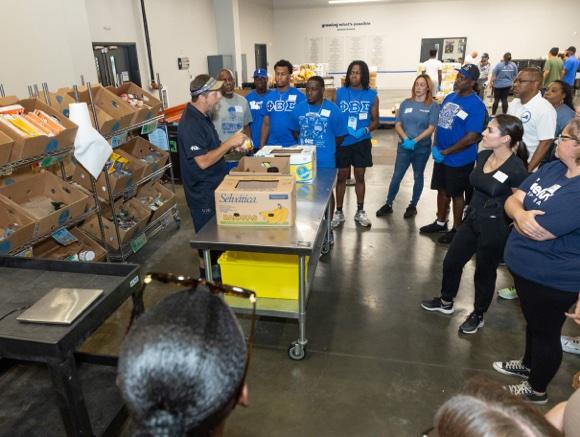
PROGRAM IMPLIMENTATION AND ASSESSEMENT (PIA)
PROGRAM REPORTING AND ASSESSMENT
In 2008 we created a standard mechanism for the assessment and reporting of our national programs and initiatives. Our reporting tool, the electronic PIA captures key result indicators for assessment of key outcomes. These key result indicators (KRI’s) are tracked for benchmarking, measuring, and reporting. We are excited to roll out the 2024 updated version of the PIA that includes step by step instructions as well as Do’s & Don’ts. Start your reporting today!
Follow these steps to fill out the “Program Implementation Assessment” (PIA) form. This guide assumes the form is meant to evaluate and report on a specific event organized by the fraternity.
Ensure all information is accurate and reflects the event’s outcomes.
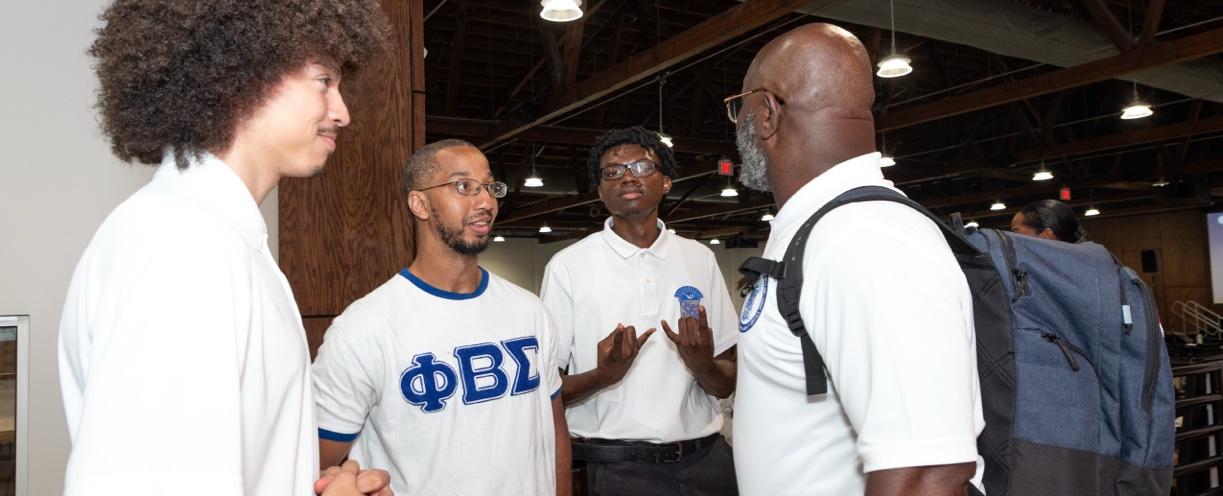
PROGRAM IMPLIMENTATION AND ASSESSEMENT (PIA)
PROGRAM AREA
• SELECT ALL THAT APPLY: Check or mark all the boxes corresponding to your event’s covered areas. This could include community service, leadership development, educational programs, etc. If the form provides specific options, select the ones that apply to your event.
EVENT SUMMARY DATA
• DATE OF EVENT: Enter the date when the event took place. Remember, it must be within the past 30 days.
• EVENT DESCRIPTION: Provide a brief but comprehensive description of the event, including its purpose, key activities, and any notable highlights.
• EVENT LOCATION: Specify where the event was held. Include both the venue name and its address if possible.
FOR BIGGER & BETTER BUSINESS SELECTED EVENTS
• BLACK SPEND AMOUNT: If your event falls under the Bigger & Better Business category and involves financial transactions, input the total amount spent with Black-owned businesses.
FOR SOCIAL ACTION & EDUCATION EVENTS
• SCHOLARSHIP-RELATED EVENT QUESTIONS: If the event was related to scholarship activities,
• If applicable, confirm whether scholarships were disbursed.
• If yes, how much was disbursed in scholarship funds?: Enter the total amount of scholarship funds given out during the event.
PARTNERS AND ATTENDANCE
• WHICH PARTNER: Choose or input the name of any partner organization(s) involved in the event.
• TOTAL IN ATTENDANCE: Enter the total number of people who attended the event.
• SIGMA BROTHERS IN ATTENDANCE: Specify the number of Phi Beta Sigma members present.
• NUMBER OF ZETAS ATTENDING: If applicable, indicate how many Zeta Phi Beta Sorority, Inc. members were in attendance.
• TOTAL SERVICE HOURS: Input the cumulative number of service hours contributed by all participants during the event.
COMMENTS AND ATTACHMENTS
• UPLOAD PICTURES: Attach any photographs from the event. These could be pictures of the activities, attendees, or any significant moments.
• ADDITIONAL COMMENTS/NOTES: Use this space to provide any further information about the event that has yet to be covered in the previous sections. This could include insights on the event’s impact, challenges faced, or suggestions for future events.
After filling out all the sections accurately, review the form to ensure all information is correct and complete. Please submit the PDF version via Blueprint. If there are questions or concerns, please submit an email to the technology team at IHQ.
REQUIRED ANNUAL CHAPTER AUDIT
THE CHAPTER SELF-ASSESSMENT

All Chapters are required to self-evaluate and submit electronically. Prior to submitting, the chapter will confirm that all information in the report is presented accurate and true. Any falsification of this report will result in immediate chapter suspension by the Regional Director. Each Regional Director will review and approve his chapters’ report through the Fraternity’s electronic reporting process.
Chapters will be required to self-evaluate through the Chapter Self-Assessment Tool in five key areas:
• Scholarship and Academic Achievement
• Program Implementation and Reporting
• Membership Growth and Retention
• Chapter Operations
• Risk Management
REQUIRED SUBMISSION PERIOD
All chapters are required to submit an Audit to the Regional Director through an electronic process by January 31st of each calendar year. Each Regional Director is required to submit to the Corporate Headquarters for the International Standards and Awards Committee Review for review.
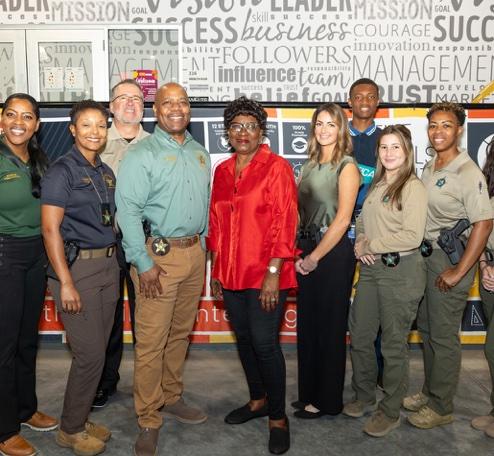

COLLEGIATE CHAPTER
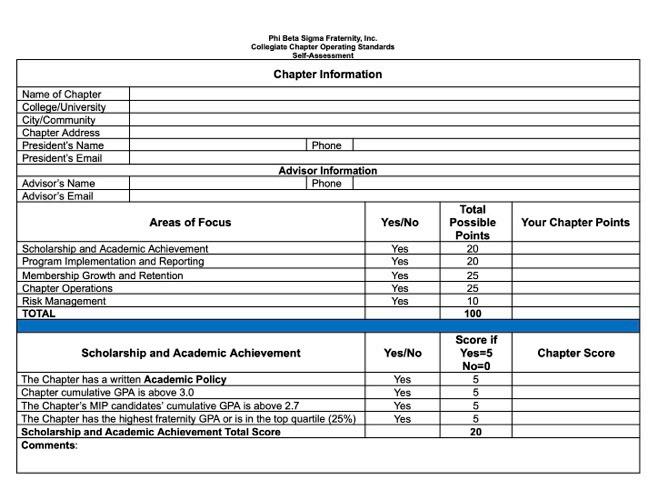
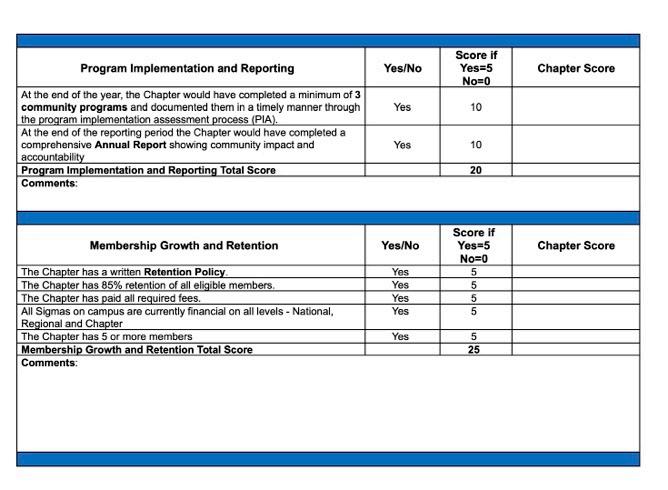
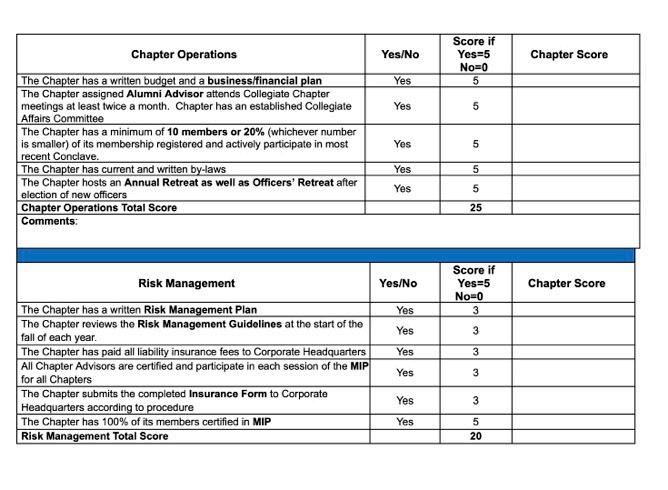
Access this audit document by contacting IHQ.
ALUMNI CHAPTER
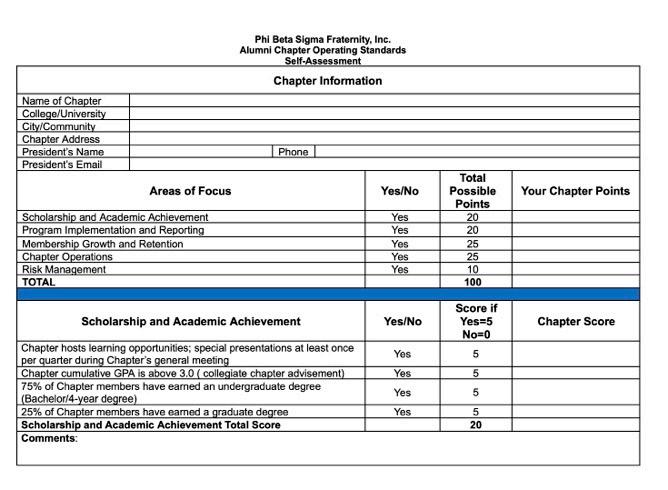
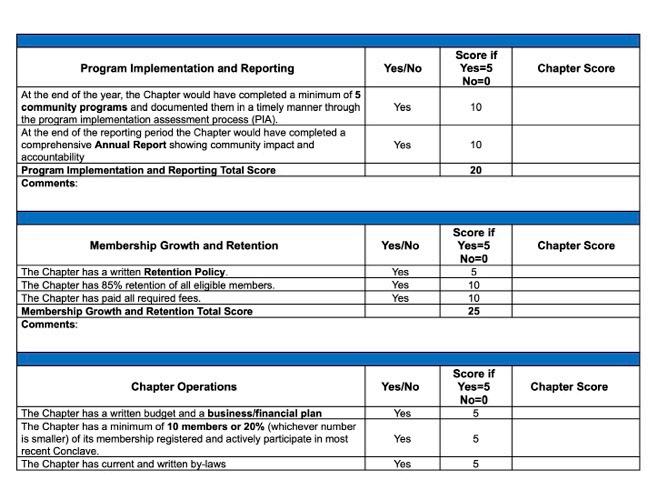
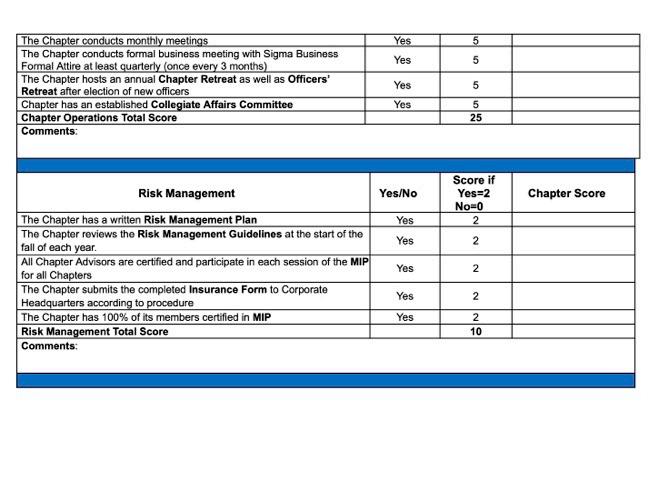
Access this audit document by contacting IHQ.

EACH CHAPTER ANNUAL REPORT IS REQUIRED TO BE SUBMITTED BY FEBRUARY 9 OF EACH YEAR.
PURPOSE:
To provide details on implementing the Fraternity’s Chapter Operating Standards and Awards Recognition process. Chapters will be required to self-evaluate and report through the Annual Chapter Report in 5 focus areas:
• Scholarship and Academic Achievement
• Program Implementation and Reporting
• Membership Growth and Retention
• Chapter Operations
• Risk Management
POLICY STATEMENT
• All Chapters are required to self-evaluate through the Chapter Self-Assessment Tool and submit the Annual Chapter Report. Prior to submitting, the chapter will confirm that all information presented in the report is accurate and true. Any falsification of this report will result in an immediate chapter suspension by the Regional Director. Each Regional Director will review and approve his region’s chapters’ reports through the Fraternity’s electronic reporting process.
REQUIRED SUBMISSION PERIOD
• All chapters are required to submit the Annual Chapter Report to the Regional Director through an electronic process by February 9 of each calendar year. The Regional Director, or through the establishment of a regional Standards & Awards Committee, will review the Annual Chapter Reports prior to final submission to the Corporate Headquarters for the International Standards and Awards Committee
REQUIRED SUBMISSION PERIOD
• All Chapters are encouraged to follow the established submission period.
TRAINING AND AWARENESS
• Recognizing that thorough training of chapters is important for the full implementation of chapter reporting, as well as creating a culture of accountability to our community and other stake holders, we have created a training schedule for roll out. The initial training sessions will include webinars and workshops at upcoming Regional Conferences.

CELEBRATING A CHAPTER’S HARD WORK THROUGH AWARDS & RECOGNITION
KEY DEFFINTIONS:
1. Level I Classification – Chapters with active membership with 40 or plus.
2. Level II Classification – Chapters with active membership with 15 to 39
3. Level III Classification – Chapters with active membership with 5 to 14
4. Gold Status – Highest ranking of chapters with audit scores above 781-880 plus.
5. Silver Status – Second Highest ranking of chapters with audit scores ranging from 681-780 plus
6. Bronze Status – Third highest ranking of chapters with audit scores ranging from 580-680.
7. Marginal Status – chapter scoring less that 580. Chapters in Marginal Status will be placed on review until performance is brought up to a minimum of Bronze status.
8. Annual Chapter Report – Mandated report that chapters are required to submit according to constitution. Template of report in Appendix section of this policy.
9. Conclave Display – To be displayed on an 8 Foot table consisting of bound books, unique scrapbooks, plaques, limited electronics. Display must be able to stand alone. Backboards, and/or sideboards, not exceeding the length of the table, may be used.
10. Formal Interview – An interview session facilitated by selected members of Fraternity’s Standard and Awards Committee with members of the competition chapter leaders competing for Sigma Model Chapter honors.
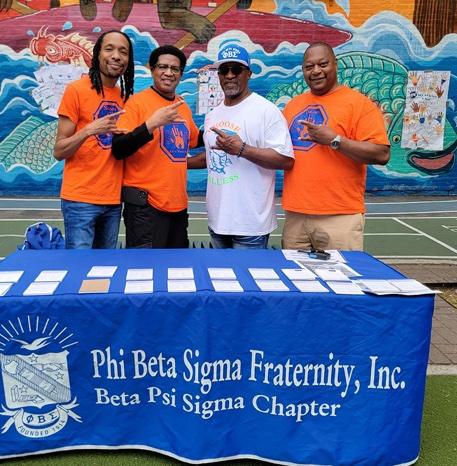
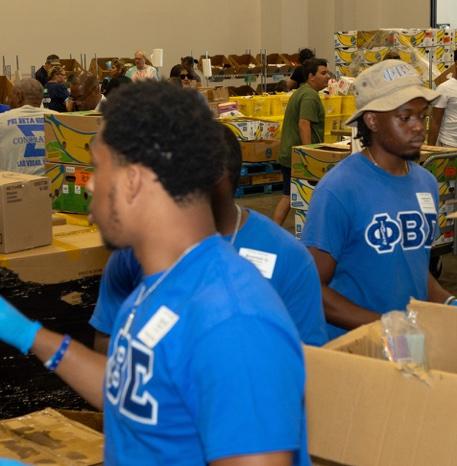

GUIDELINES FOR OUTSTANDING CHAPTER AWARDS COMPETITION
Outstanding Collegiate Chapter - Regional
This chapter will be judged on the following criteria:
1. Final score of Chapter Awards and Recognition Audit Report with Regional Director’s recommendation.
2. Annual Chapter Report submitted by required deadline.
3. Degree of participation in Sigma National Programs
4. 21 Awards to be given in this area(includes award for each of the 7 regions and recognition at each of the 3 Chapter Levels)
Outstanding Alumni Chapter - Regional
This chapter will be judged on the following criteria:
1. Must be recognized as the Outstanding Regional Chapter
2. Final score of Chapter Awards and Recognition Audit Report with Regional Director’s recommendation.
3. Annual Chapter Report submitted by required deadline and procedures.
4. Degree of participation in Sigma National Programs
5. 21 Awards to be given in this area (includes award for each of the 7 regions and recognition at each of the 3 Chapter Levels)
Sigma Model Collegiate Chapter “Most Outstanding Chapter in Fraternity Award”
This chapter will be judged on the following criteria:
1. Must be recognized as the Outstanding Regional Chapter
2. Highest score of Chapter Awards and recognition Audit Report with Regional Director’s recommendation.
3. Annual Chapter Report submitted by required deadline and procedures.
4. Degree of participation in Sigma National Programs
5. National display (presentation, neat, logical, relevant and attractive)
6. Formal Interview with Chapter Leadership by Standard & Awards Committee. Committee will follow established interview protocol with scoring.
Sigma Model Alumni Chapter “Most Outstanding Chapter in Fraternity Award”
This chapter will be judged on the following criteria:
1. Must be recognized as the Outstanding Regional Chapter
2. Highest score of Chapter Awards and recognition Audit Report with Regional Director’s recommendation.
3. Annual Chapter Report submitted by required deadline and procedures.
4. Degree of participation in Sigma National Programs
5. National display (presentation neat, logical, relevant and attractive)
6. Formal Interview with Chapter Leadership by Standard & Awards Committee. Committee will follow established interview protocol with scoring.
FRATERNITY MENTORING AND MEMBER DEVELOPMENT
SPIRIT OF MENTORING
BROTHER-TO-BROTHER
Background:
• We will develop a Fraternity Mentoring System with the focus on personal and professional growth of our collegiate and young alumni membership. A formal, structured mentoring program that serves to develop leaders with an eye toward future development and leadership. Why a strategic mentoring program?
• Mentoring is a key component of collegiate leadership development.
• Provides a strategic approach to enhancing collegiate personal and professional development.
• Utilizes tailored system of development and 1 on 1 personal development matches.
Goals
• Demonstrate Phi Beta Sigma’s commitment to collegiate development
• Support cross- regional communication and learning
• Contributes to organizational performance by enhancing skill development that is linked to collegiate/ leadership development
• Helps attract and retain collegiate brothers
• Strengthens reputation as the “Fraternity of choice” What Mentoring is...
• An equal partnership with two way learning
• An opportunity for the mentee to enhance their skill set, expand their network and benefit from career guidance.
• Clearly defined goals, roles, expectations, and time frames
• Learning to value different perspectives and styles
• An opportunity for the mentor and mentee to focus together on the mentee’s growth and
• developmental needs. What Mentoring is not...
• Sponsoring
• Tied to advancement
• Remedial
• Spontaneous or casual advice Program Objectives
• Supports Phi Beta Sigma’s value proposition strategy
• Expands developmental opportunities for collegiate brothers
• Positions Sigma collegiate leaders for success in the business and professional ranks.
• Recruit, engage and retains top Phi Beta Sigma talent
• Exposes collegiate brothers to cross-regional leadership experiences
MENTORING PROGRAM
TIERED APPROACH
Level 1:
• Open to members in good academic standing with the organization with Sigma sponsor letter of referral.
• Successfully complete Mentee Onboarding sessions; a leadership curriculum developed to help mentees successfully transition into a mentoring relationship.
• The focus is personal development and preparation.
• Who am I?(assessment)
• Effective communication skills
• Leadership curriculum
Level 2:
• Open to members who have completed level 1 and are in good academic standing.
• The focus is professional development.
• Open to up to 25 collegiate per session.
• Must have completed the Mentee Onboarding sessions.
• Must demonstrate a passion for leadership and growth development
• Paired with an executive sigma mentor.
• Commit to a 1 year
• Serve as a peer mentor for mentees in level 1.
Benefits to Mentees?
• Provides cross regional learning & personal/professional development experiences
• Provides access to broader organizational understanding
• Provides knowledge and skill building opportunities to increase effectiveness
• Provides an opportunity to take ownership of personal and professional development
• Provides an opportunity to build and strengthen personal networks
Benefits to Mentors?
• Provides an opportunity to build and strengthen coaching skills
• Provides new insight into organizational issues through the eyes of the mentee.
• Provides an opportunity to demonstrate leadership
• Provides an opportunity to contribute to the development of less experienced Sigmas.
MENTORING PROGRAM
PROGRAM SCOPE/PROCESS
Mentoring Program Details (High Level):
Tiered approach to focus on personal and professional development. (Level 1)
• Mentee Onboarding sessions
• Leadership Development (No cap on participation numbers)
• (1 year) mentoring partnership (goal of 25 undergraduate placements per session).
• Nominated by Regional Director with a Sponsor letter referral reference
• Application / screening process (timeframe TBD) Participants engage in:
• Attendance at/in- Mentor Program Launch Session (timeframe TBD)
• Monthly mentoring sessions--can be virtual
• Virtual development/ check in webinars (Level 2)
• Recommended: Mentees create and develop 3 developmental goals/project (2 personal/ 1 community related) during year
• Monthly mentoring sessions--can be virtual
• Fourth, eighth and twelfth month virtual development/ check in webinars
Organizational Commitment:
• Support is required by General Board
• Support is required by Regional Directors and Regional Boards
Selection criteria:
Level 2
Selection Criteria- Mentees:
• Junior and Senior collegiate brothers with Sigma Sponsor letter of referral
• Goal of 10 candidates per region.
• Participate in Mentoring Orientation
• Must demonstrate a passion for leadership and growth development
• Commit to the program for 1 year.
Mentors (Advisors):
• Senior Executives, Board of Directors, Professional Services, Thought Leader/ Influencer, Business Owner/Entrepreneur, Non-Profit Leadership, Military/ Government, Retired Sigma Leadership (Current/Past and national officers)
• Participate in Mentoring Orientation
• Must demonstrate a passion for leadership and growth development
• Commit to the program for 1 year.
**Mentors must have the necessary experience to provide mentees with a broader perspective of business and leadership.**
EMERGING LEADERS FORUM
It is essential for Sigma leaders to optimize our organization’s performance - as well as their own professional careers - with executive leadership training. To exhibit true executive leadership, a leader must prove himself a visionary, trailblazer, strategist, communicator, coach, diplomat and politician – and that’s just the beginning!
The world’s most successful leaders are able to focus on the big picture and uphold high standards while wearing many hats. This intensive Sigma Emerging Leaders Forum combines proven-in-action techniques with peer interaction and insights from the latest research to help leaders and leaders-in-training to master the competencies of effective executive leadership.
The Emerging Leaders Forum will develop your strategic leadership skills and refine and advance your existing leadership skills. This dynamic, challenging 10-month program offers aspiring and current leaders an opportunity to develop the strategic leadership skills needed for success. Selected participants will work in partnership with members of the SLA Faculty, Sigma leaders, and past presidents of Phi Beta Sigma Fraternity on high-visibility fraternity business and leadership situations.
About the Forum
The curriculum utilizes a variety of learning methodologies to engage participants and challenge their ‘leadership reach,’ including:
• Active involvement from internal leaders throughout the organization
• External partnerships with dynamic opportunities for breakthrough learning
• Working groups to encourage collaboration and develop critical thinking skills
• Action learning projects that probe the fraternity’s strategic imperatives
• Virtual classroom experiences with online learning, video casts, business reviews,
• and blog discussions
Participants will strengthen their skills in five leadership practice areas that contribute to their success as strategic leaders within Phi Beta Sigma Fraternity:
• Building Personal Effectiveness
• Executing for Results
• Managing Change
• Inspiring and Developing Diverse Talent
• Influencing Membership
Participants will complete the program empowered with insights and enhanced critical thinking skills, enabling them to:
• Embrace a larger responsibility for the success of the entire organization
• Make wiser choices within the context of the “big picture” of Phi Beta Sigma
• Use better and tested judgment in balancing short and long-term challenges
• Accurately assess leadership situations and apply effective critical thinking skills to resolve issues
• Embrace the concept of ‘servant leadership’ - operating as an integral part of a leadership team for the success of the enterprise
• Evaluate and manage appropriate risks
• Anticipate future recruitment needs for the chapter or chapters, as well as for the fraternity, and take responsibility for the development of talent to fulfil those needs
• Anticipate and continually prepare for change - working daily to create a climate that embraces change.
Participants complete the program taking ownership of the development of their own personal effectiveness and better able to manage and process their opportunities for continued training and development.
100
EMERGING LEADERS FORUM
PROCESS REQUIREMENTS
• Complete the application and return it by November 1.
• Submitting an application does not guarantee admission into the class. Application to the
• Emerging Leaders Forum is a 10-month process since many exceptionally qualified Brothers are expected to apply.
• Chosen Brothers will be notified before Conclave and will be required to attend the Emerging
• Leaders Forum Virtual Orientation and Training.
• All applications MUST be completed in full – incomplete packets are disqualified from scholarship consideration.
• All applications MUST be typed.
• All submitted materials become the property of The Sigma Leadership Academy.
CALENDAR
All applications MUST be postmarked by November 1 and mailed to: The Sigma Leadership Academy International Headquarters 1025 Connecticut Ave., NW, Suite 917 Washington, DC 20036 (TEMPORARY) OR programs@phibetasigma1914.org