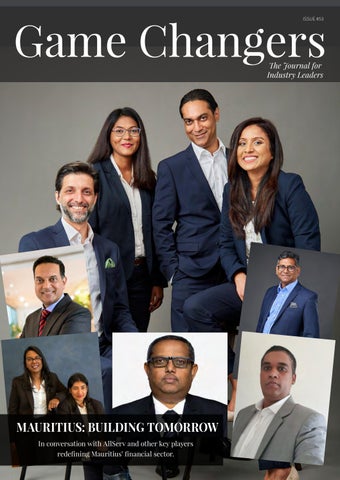
In conversation with AllServ and other key players redefining Mauritius’ financial sector.
and regulatory experts to highlights what makes Mauritius so unique: professionalism, pragmatism, and a willingness to adapt without compromise.
As always, we’ve approached this with the same energy and editorial independence you’ve come to expect. We’ve spoken to the firms doing the work—not just the ones shouting the loudest online. The goal is simple: to bring you real insight, real stories, and real people changing the game.
I’m incredibly proud of this issue and the network it represents. Whether you’re a seasoned investor looking for a new home for your fund, a high-risk brand searching for stable financial services, or simply curious about what makes Mauritius tick—there’s something here for you.
On behalf of the Game Changers team, thank you to everyone in Mauritius who opened their doors, gave their time, and trusted us to tell their stories. This is your moment, and we’re proud to share it with the world.
Let’s get into it.
Paul Orford
EDITOR-IN-CHIEF
AllServ
PERSONAL JOURNEY & VISION
Q Akshay, what inspired you to launch AllServ, and how does your vision differ from traditional Management Companies in Mauritius?
Q What shared philosophy or gap in the market led you to launch AllServ together?
We founded AllServ because we wanted to do business differently. Over time, many management companies have started to resemble factories — clients become numbers, measured mainly by the margin they generate rather than the value of a long - term relationship. That wasn’t the spirit on which the global business sector was built. Our aim was to return to a boutique model where clients have direct access to decision-makers, and where we act as their extended team in Mauritius. We see ourselves as partners in their journey, combining strong compliance with practical, hands-on support so they can focus on growth while knowing they have us on the ground.
We also had another vision — to build the company on trust, always striving to help clients find solutions rather than seeing every interaction as a billing opportunity. Equally important to us was building a team that trusts us, understands our values, and is treated with respect and support — not the way we were often treated earlier in our own careers.
Q Hyder, with your background in asset management and fiduciary services, what unique value do you bring to AllServ’s offering, particularly for high-growth financial sectors?
My career has allowed me to sit on every side of the table. Years as a trader and investment manager taught me how markets really work — the pace, the risk, and the discipline required to protect investors while capturing opportunities. Experience inside management companies then gave me an insider’s grasp of regulatory expectations, governance, and operational substance. That combination means I can bridge business strategy with compliance in a way that speaks the language of both regulators and entrepreneurs. At AllServ, this perspective helps us craft frameworks that are robust yet agile, giving investment firms, FX brokers and fintech companies the confidence to grow while staying firmly aligned with regulatory standards.
We shared the same conviction: that there was space for a nimble, relationship-driven firm in Mauritius, one that could combine world-class compliance standards with the accessibility and agility clients expect today. Those conversations planted the seed for AllServ, and eventually we decided to turn that vision into reality. We are committed to creating an environment where our people are trusted, respected, and aligned with our values — because happy, engaged staff deliver the best client experience. We are ‘custodians of Mauritius’ reputation as an international financial centre, and we take this responsibility seriously by championing transparency, good governance, and innovation.
WHY MAURITIUS?
Q Mauritius is often called the “gateway to Africa” and a rising fintech jurisdiction — what makes it an attractive base for FX firms and digital financial companies?
Strategically positioned in the Indian Ocean, Mauritius is widely regarded as the gateway to Africa, offering a safe, internationally respected platform to enter and scale across the continent. Its extensive network of investment and tax treaties, coupled with strong trade and cultural links with African nations, enables businesses to access high-growth African markets with reduced risk and greater ease.”
Mauritius combines political stability, a sophisticated legal framework, attractive tax regime and a well-regulated financial centre with access to also Asia and the Middle East. The jurisdiction has modern legislation for securities, fintech, virtual assets and funds, yet retains the flexibility to accommodate new business models. For FX brokers and digital finance companies, this means you can anchor your operations in a jurisdiction that offers credibility, tax efficiency and investor confidence, while remaining close to emerging markets that are hungry for innovation.
Q How does the local regulatory framework in Mauritius compare to more established jurisdictions in terms of speed, clarity, and innovation?
The Financial Services Commission has made significant progress in balancing investor protection with business agility. Compared to older, more rigid centres, Mauritius is often faster at issuing licences and more open to dialogue with industry on new products such as virtual assets, payment intermediaries, or private wealth structures. It ranked 13th out of 190 economies in the last World Bank’s Ease of Doing Business Report, reinforcing the jurisdiction’s reputation for efficiency and speed. There’s still rigour — the process is thorough — but there’s also a willingness to innovate and adapt regulation to keep pace with international standards.
Q What misconceptions do international clients often have about setting up or operating from Mauritius — and how do you help address those?
A common misconception is that Mauritius is either a low-cost “paper box” solution or, conversely, a difficult place to get things done. The truth is more nuanced:
the jurisdiction is serious about substance, governance and compliance, and that’s a strength, not a hurdle. We help clients understand what’s genuinely required — local banking, qualified staff, board oversight — and then guide them through the steps so they can meet those standards efficiently and focus on building their business.
ABOUT ALLSERV & 5COMPLY
Q Can you explain what the 5Comply approach at AllServ involves, and how it benefits clients operating in complex or high-risk sectors?
5Comply is a key partner in the way we serve our clients. They bring deep, hands - on compliance expertise across multiple jurisdictions — from licensing standards to evolving regulatory expectations. Most of our clients hold licences in more than one country, so having 5Comply alongside us means they benefit from a truly global perspective while we ensure that their operations meet the specific requirements of the Mauritian regulator. Together, we provide a joined-up service that helps businesses stay compliant everywhere they operate, without losing focus on growth.
Q How does AllServ support clients with licensing, AML/CFT requirements, and regulatory approvals — especially for FX and fintech operations?
We take clients from concept to launch and beyond. That starts with helping them choose the right licence, build a credible business plan and prepare a complete submission to the FSC. From there, we support the implementation of AML/CFT frameworks, internal controls, governance charters and staff training. Our strength lies in blending technical accuracy with practical insight — making sure compliance isn’t just documented, but embedded in day-to-day operations.
Q Do you provide tailored services for companies in crypto or alternative finance — sectors that often struggle to find compliant service providers?
These emerging sectors often find it hard to secure partners who understand both innovation and regulatory discipline. At AllServ, we’ve invested time in building the expertise to support them — from
understanding the Virtual Asset and Initial Token Offering Services (VAITOS) licensing regime in Mauritius to guiding applicants for Payment Intermediary Services (PIS) licences. While the market is still developing locally, we are well placed to accompany them from licence application through to administration once they launch.
Q What does a typical onboarding journey look like at AllServ? How do you balance rigorous due diligence with speed to market?
The onboarding journey starts with a clear discussion of objectives, timelines and substance requirements. We then gather KYC information, assess the business model and align governance with the applicable licence. Our due diligence is thorough — we protect our clients and the jurisdiction — but we keep processes lean by using smart templates, direct access to decision-makers and close collaboration with 5Comply. The result is an onboarding that’s both robust and efficient, giving clients confidence to go live quickly without compromising standards.
COMPLIANCE, GROWTH & STRATEGY
Q How does AllServ help its clients maintain long-term compliance in the face of changing global standards such as FATCA, CRS, and ESG - related expectations?
Compliance isn’t a one - off event; it’s an evolving discipline. We help clients stay ahead by mapping their obligations across regimes like FATCA and CRS, and by integrating ESG considerations into governance as these expectations grow. Our approach is to embed compliance into business routines — policies, training, reporting calendars, board oversight — so that meeting new standards becomes part of normal operations, not a scramble at year-end.
Q Can you share a recent example where your team helped a client overcome a major licensing or compliance hurdle in Mauritius?
Recently, we assisted a financial services firm whose licence was at risk because its governance and AML/CFT framework didn’t fully meet the FSC’s expectations. We stepped in to carry out a gap analysis, redesign key controls, and coach their team ahead of the regulator’s onsite inspection. By coordinating closely with management and aligning documentation with international best practice, we helped them retain their licence and emerge with a more resilient compliance framework on schedule — giving management and investors renewed confidence in the business.
Q How important is local talent to what you do? Are you seeing a growing pool of specialists in compliance, risk, and fintech within Mauritius?
Local talent is essential. Mauritius has a strong pool of graduates in accounting, law, and finance, and we’re seeing more professionals specialising in compliance, risk and fintech. At the same time, demand for experienced specialists is growing faster than supply, so finding the right people is key. We’ve invested early to hire and build what we like to call our “dream team” — people who combine technical know - how with commercial awareness.
Looking ahead, we also see technology, particularly AI, playing a role in easing routine workloads and allowing our professionals to focus on higher - value tasks, making the most of the talent we’ve nurtured.
FUTURE OUTLOOK
Q What upcoming regulatory or geopolitical trends do you think will shape the future of the Global Business over the next five years?
The next few years will see tighter alignment between onshore and offshore regimes. Transparency, ESG reporting, and cross - border data sharing will keep expanding, while virtual assets and payments will remain under intense regulatory focus. Jurisdictions like Mauritius that can combine robust standards with an agile licensing environment will stand out. At the same time, geopolitical shifts — from regional trade pacts to global tax reforms — will influence how investment flows are structured. For service providers, success will depend on helping clients stay ahead of these changes without losing commercial agility.
Q Where do you see AllServ in the next chapter — do you plan to expand into new sectors, jurisdictions, or technology platforms?
Our ambition is to keep building a firm that clients see as a trusted extension of their team. Over the next few years, we aim to broaden our reach into carefully selected markets where Mauritius can add value, and to develop deeper expertise in sectors such as fintech and alternative finance. A key part of that journey is our collaboration with 5Comply, whose global insight complements our local expertise and allows us to support clients with multi-jurisdictional needs. We’re also investing in smarter internal processes so that, as regulation grows more complex, our advice remains clear, practical and timely. Ultimately, we want AllServ to stay boutique in ethos but global in outlook — a partner that combines regulatory rigour with real-world understanding.
PwC Legal (Mauritius)
ASHVEEN GOPEE
Q What distinguishes PwC Legal (Mauritius) as a law firm with an international network and brand, and how does this benefit your clients?
PwC Legal (Mauritius) stands out as a truly international law firm, not only because of our local expertise but also due to our integration within the PwC Global Legal Business Solutions Network and the broader PwC Global Network, which spans over 151 jurisdictions worldwide. While we are an independent law firm, our membership in this network allows us to harness a wealth of global expertise and best practices, enabling us to deliver solutions that are both innovative and tailored to the unique needs of each client.
Our approach is inherently client - centric. We recognize that our clients’ challenges are rarely confined to a single jurisdiction or discipline. In today’s complex business environment, legal issues often intersect with tax, regulatory, financial, and strategic considerations. As part of the PwC network, we are uniquely positioned to collaborate seamlessly with professionals across various lines of service—be it tax, assurance, advisory, or consulting. This multidisciplinary approach ensures that our clients receive comprehensive, integrated solutions rather than fragmented advice.
We pride ourselves on our ability to think and act both globally and locally, depending on what best serves our clients’ interests. Whether a client requires a solution that leverages international best practices or one that is finely tuned to the nuances of the Mauritian market, we have the resources and expertise to deliver. Our global reach, combined with our local insight, means that we can anticipate cross - border challenges, navigate complex regulatory environments, and provide holistic support that extends well beyond traditional legal advice.
Ultimately, what demarcates PwC Legal (Mauritius) is our ability to offer clients the best of both worlds: the personalized attention and agility of a local firm, and the depth, breadth, and multidisciplinary strength of a leading international network. This ensures that our clients receive not only legal solutions, but fully comprehensive assistance that addresses all aspects of their business needs.
Q As the Partner and Managing Director, how are you nurturing the next generation of legal professionals in Mauritius, particularly those interested in the intersection of technology and the law?
My own journey as an engineer - turned - lawyer uniquely positions me to guide the next generation. I understand both the technical and legal dimensions of the challenges our clients face. This dual perspective allows me to mentor young professionals, helping them appreciate the nuances of both worlds and encouraging them to think innovatively about legal solutions in a tech-driven context.
However, that being said the next generation of legal professionals in Mauritius, particularly those interested in the intersection of technology and law, require less traditional nurturing and more strategic guidance. Having grown up in a digital-first world, these young professionals are inherently comfortable with technology.
Our role at PwC Legal (Mauritius) is to channel their innate digital fluency into meaningful legal expertise, ensuring they are equipped to navigate and shape the rapidly evolving legal landscape.
At PwC Legal (Mauritius), we ensure that young professionals are not just observers but active participants in the technology space. Our involvement in landmark projects — such as the establishment of RuPay in Mauritius and our ongoing support for tech firms in payment services and virtual assets, means that our team is constantly exposed to the latest developments in technology law. This hands - on experience is invaluable, providing young lawyers with direct insight into the practical application of legal principles in a digital environment.
As part of the PwC global network, we pride ourselves on being avant-garde—constantly pushing boundaries and setting new standards in legal services. Our firm is recognized as a leader in advising on cutting - edge technology matters, from payment services to virtual assets. This reputation is not accidental; it is the result of a deliberate strategy to remain at the crossroads of technology and law.
By providing guidance, real - world exposure, and a collaborative environment, PwC Legal (Mauritius) is shaping the next generation of legal professionals to be not just competent lawyers, but visionary leaders at the intersection of technology and law. Our commitment to innovation ensures that any young professional joining our team is naturally immersed in this dynamic space, ready to make a meaningful impact from day one.
Q How has your leadership style adapted to industry shifts—whether it be digital transformation, evolving client expectations, or hybrid work models?
Let me answer this by way of an example of how traditional finance is leveraging technology, a eflection of how my leadership style has evolved in response to digital transformation, changing client expectations, and new work models.
In a recent engagement with a client in the mining sector, we advised on the use of blockchain technology to provide innovative liquidity solutions. Traditionally, raising capital in this sector was a slow and complex process, often constrained by conventional financial systems. By embracing digital transformation, we guided our client to issue stablecoins and security tokens, enabling them to raise capital more efficiently and create a secondary market for investors to trade these tokens seamlessly.
This experience exemplifies how my leadership approach has shifted. I prioritize fostering a culture of agility and openness to new ideas, encouraging my team to think beyond traditional legal frameworks and to collaborate across disciplines. I recognize that clients now expect not just legal advice, but holistic, forward-thinking solutions that address their broader business challenges—often involving technology, regulation, and strategy.
Ultimately, my leadership style is defined by adaptability—embracing innovation, anticipating client needs, and creating an environment where my team can thrive in a rapidly changing industry.
Marketing & Strategy
Q You've published on blockchain and virtual assets in notable journals. What insights or trends do you believe are most urgent for legal professionals to grasp right now?
We are witnessing the dawn of a new era in the legal and financial sectors, driven by the transformative potential of blockchain technology and virtual assets. The traditional frameworks and ways of thinking that once governed these industries are rapidly becoming obsolete. For legal professionals, it is imperative to quickly grasp this paradigm shift—not only to remain relevant, but to actively guide and enable the industry as it evolves.
Legal professionals must recognize that their role is no longer limited to interpreting existing laws, but also to acting as enablers who bridge the gap between innovative industry practices and evolving regulatory frameworks. This requires a willingness to move beyond conventional approaches and to embrace progressive, technology-driven solutions.
Q As part of PwC’s Digital Assets Global Team, how does your office in Mauritius contribute to and benefit from global initiatives in digital assets and blockchain?
As part of PwC’s Digital Assets Global Team, our office in Mauritius is both a contributor to and a beneficiary of the network’s collective expertise and forward-thinking initiatives in digital assets and blockchain. We are privileged to collaborate with some of the finest minds in this field, drawing on the deep knowledge and experience that exists across the PwC network. This positions us at the forefront of digital asset innovation, both within Mauritius and on a global scale.
Our contribution is exemplified by our recent engagement with the Bank of Mauritius, where we
organized and delivered a comprehensive workshop on the adoption of stablecoins. Recognizing the importance of a global perspective, we brought together partners from other PwC offices (including the UAE and Germany) to share their insights and practical experiences. This collaborative approach enabled us to provide the Bank of Mauritius with a nuanced understanding of the opportunities and challenges associated with stablecoins, as well as concrete guidance on how to develop an effective regulatory framework.
We also drew on the successful example of Dubai, where PwC has played a prominent role in assisting banks and regulators to navigate the digital asset landscape. By sharing these international best practices and lessons learned, we helped local stakeholders in Mauritius envision a path forward that is both innovative and aligned with global standards.
Being part of PwC’s global network means that our team in Mauritius is constantly exposed to the latest developments, regulatory trends, and technological advancements in digital assets and blockchain. This not only enhances our ability to advise clients locally but also allows us to contribute Mauritian perspectives and experiences to global discussions. In turn, our clients benefit from solutions that are informed by both local realities and international expertise, ensuring that Mauritius remains a competitive and progressive player in the digital economy.
Q With your engineering background and expertise in fintech, how do you assess Mauritius’s potential as a fintech and virtual - asset hub? What legal frameworks are critical to supporting that growth?
Drawing on my engineering background and expertise in fintech, If irmly believe that Mauritius is exceptionally well-positioned to emerge as a leading hub for fintech and virtual assets. However, this assessment is best made through the lens of regulatory robustness, which is the cornerstone of any sustainable and reputable financial ecosystem.
One of the most pressing concerns in the fintech and virtual asset space globally is the risk of money laundering and illicit financial flows. Mauritius has proactively addressed these challenges by establishing a comprehensive Anti - Money Laundering and Counter - Financing of Terrorism ( AML / CFT ) framework that is recognized internationally. Notably, Mauritius is fully compliant with all 40 recommendations of the Financial Action Task Force (FATF), a distinction that very few jurisdictions can claim. Furthermore, Mauritius is among the rare jurisdictions worldwide to have adopted a comprehensive “ travel rule, ” ensuring that information on the originators and beneficiaries of virtual asset transfers is collected and transmitted
throughout the payment chain. This level of regulatory diligence provides a high degree of comfort to serious market participants and international investors.
The strength of Mauritius’s regulatory environment is not limited to AML/CFT measures. Over the past several years, the country has meticulously developed a suite of regulatory checks and balances tailored to the unique risks and opportunities presented by fintech and virtual assets. This includes clear licensing regimes, ongoing supervision, and a commitment to transparency and good governance. These frameworks are designed not only to protect the integrity of the financial system but also to foster innovation and growth in the sector.
The importance of such regulatory oversight cannot be overstated. The recent collapse of FTX in the Bahamas, for example, was fundamentally a regulatory failure—an absence of effective scrutiny and governance that allowed significant risks to go unchecked. Mauritius has learned from such global events and has taken deliberate steps to ensure that similar vulnerabilities do not arise within its own jurisdiction.
Q What’s your strategic vision for PwC Legal Mauritius under your leadership? How are you blending innovation and legal expertise to outpace traditional models?
Strategic Vision for PwC Legal Mauritius: Blending Innovation with Legal Expertise
My strategic vision for PwC Legal Mauritius is to position our firm as the leading legal advisor for technology-driven businesses and to infuse avant-garde thinking into traditional areas. I recognize that the future of business, and by extension, legal services, will be shaped by the exponential adoption of technology across all sectors.
To outpace traditional models, I am steering the firm to not only keep pace with technological advancements but to anticipate and lead them. This means equipping our team with the skills and mindset to advise on emerging technologies, digital assets, and innovative business models, while maintaining our deep expertise in established corporate and financial matters.
A key example of this approach is our recent work advising a client in the mining sector, where we leveraged blockchain technology to facilitate capital raising and liquidity, as stated above.
Ultimately, my vision is for PwC Legal Mauritius to be recognized not just as a top-tier corporate law firm, but as a pioneer at the intersection of law, business, and technology, delivering forward - thinking, practical solutions that empower our clients to thrive in a rapidly evolving landscape.
Q PwC Legal has a strong and growing presence in Mauritius. From your perspective, what makes Mauritius a strategically valuable jurisdiction for legal and advisory services—particularly in financial services, fintech, and international structuring?
Mauritius as a Strategically Valuable Jurisdiction for Legal and Advisory Services
Mauritius stands out as a strategically valuable jurisdiction for legal and advisory services, particularly in financial services, fintech, and international structuring, due to its unique blend of history, innovation, and global connectivity.
With over 30 years of experience as a global International Financial Centre (IFC), Mauritius is built on exceptionally solid foundations. The country’s journey from humble beginnings to becoming a respected IFC is a testament to the visionary mindset and determination that continue to drive its growth today. This pioneering spirit has enabled Mauritius to develop and offer innovative financial products and services that meet the evolving needs of global investors and businesses.
One of Mauritius’s greatest strengths is its proven track record. The jurisdiction has consistently demonstrated its ability to adapt to international standards, maintain robust regulatory frameworks, and foster a businessfriendly environment. This reliability is underpinned by political stability, which provides investors and clients with the confidence that their interests are protected and that the legal and regulatory landscape will remain predictable.
Mauritius’s strategic geographic position further enhances its value. The country serves as a natural bridge between Africa and Asia, with particularly strong economic and diplomatic ties to major global powers such as India and China. This connectivity not only facilitates cross-border investment and trade but also positions Mauritius as a gateway for businesses looking to access emerging markets across the African continent.
In the context of financial services, fintech, and international structuring, these attributes make Mauritius an attractive destination for sophisticated legal and advisory work. The jurisdiction’s innovative mindset, c oupled with its stability and global reach, ensures that clients benefit from both cutting-edge solutions and a secure, well-regulated environment.
Q What areas of legal expertise does PwC Mauritius specialize in today? How do you integrate traditional legal disciplines with emerging fields like virtual assets?
PwC Mauritius specializes in a broad range of corporate legal services, including mergers and
acquisitions, corporate structuring, the establishment of family offices, private equity transactions, and regulatory advisory work. We also have significant expertise in international structuring and capital markets, providing clients with robust support across the full spectrum of traditional legal disciplines.
With regard to emerging fields, we can proudly say that we are very active in the space of Virtual Asset assisting Virtual Asset Service Providers in the setting up of their businesses and activities in Mauritius.
We integrate traditional legal discipline with emerging fields like virtual asset by approaching every mandate with a creative and forward - thinking mindset, ensuring that our advice is not only legally sound but also anticipates the challenges and opportunities presented by technological innovation. For example, when advising on M&A or setting up virtual asset service providers, we address not just the legal and regulatory requirements but also the implications of digital assets, data privacy, and cybersecurity. This holistic approach allows us to deliver comprehensive solutions that empower our clients to thrive in an increasingly digital and interconnected business environment.
Q Can you give us a sense of the types of clients PwC Legal (Mauritius) typically advises — from local businesses to international investors? What kinds of challenges are they bringing to your team today?
PwC Legal (Mauritius) advises a diverse portfolio of clients, ranging from prominent local businesses and family - owned enterprises to international conglomerates and institutional investors. Our client base reflects the dynamic nature of Mauritius as a global financial centre, attracting both homegrown companies seeking to expand and foreign investors looking to establish or structure their operations in the region.
The challenges our clients bring to us are increasingly complex and demand the highest standards of legal expertise, efficiency, and responsiveness. In today’s fast-paced business environment, clients expect not only robust legal solutions but also quick turnarounds and practical, commercially minded advice.
To meet these expectations, we have integrated artificial intelligence into our practice for over two years, leveraging Harvey AI to streamline research, document review, and other routine processes. This adoption of AI has allowed us to deliver faster and more precise outcomes for our clients, while freeing up our lawyers to focus on strategic analysis and nuanced problem-solving.
Importantly, we view AI as a supportive tool that enhances, rather than replaces, the critical human judgment and expertise that our clients rely on. This blend of advanced technology and deep legal insight enables us to address the evolving needs of our diverse clientele with agility and confidence.
Forvis Mazars
ROOMESH RAMCHURN
Q You’ve spent a significant part of your career at KPMG and Deloitte before joining Forvis Mazars. What initially drew you to the Big Four environment, and how did those experiences shape your approach to tax advisory — particularly in the Mauritian context?
The initial draw to the Big Four environment likely stemmed from the opportunity to work with a diverse range of clients, access to extensive resources, and the chance to be part of a global network. These firms are known for their rigorous training programs, exposure to complex tax issues, and a culture of continuous learning and professional development.
At KPMG and Deloitte, I have gained invaluable experience in handling intricate tax matters, navigating regulatory changes, and developing strategic solutions for clients. This exposure has honed my technical skills and deepened my understanding of the global tax landscape. Moreover, working in such a dynamic and challenging environment have instilled a strong sense of professionalism, attention to detail, and a client-centric approach.
In the Mauritian context, these experiences would be particularly relevant. Mauritius has a unique tax regime that aims to attract international businesses and investors. My experience with the Big Four has enabled me to provide insightful advice on leveraging Mauritius's tax incentives, ensuring compliance with local regulations, and optimizing tax positions for both local and international clients. The ability to navigate the complexities of the Mauritian tax system, combined with the strategic insights gained at KPMG and Deloitte, has made me a valuable asset to Forvis Mazars and its clients.
Q Tax legislation and regulatory compliance in Mauritius have evolved significantly over the last decade. What key changes have you seen, and how have you helped clients adapt?
Tax legislation and regulatory compliance in Mauritius have indeed evolved significantly over the last decade. Here are some key changes and how I have helped clients adapt:
1. Introduction of the Common Reporting Standard (CRS): Mauritius adopted the CRS, which requires financial institutions to report information about financial accounts held by non - residents to the Mauritius Revenue Authority (MRA). I have assisted clients in advising them of their reporting obligations and implementing same to ensure compliance.
2. Base Erosion and Profit Shifting (BEPS) Measures: Mauritius has implemented several BEPS measures to prevent tax avoidance by multinational enterprises. This includes the introduction of Country - by - Country Reporting (CbCR) and the Multilateral Instrument (MLI). I have helped clients navigate these changes by providing advice on CbCR and ensuring that their international tax structures are compliant with the new rules.
3. Substance Requirements for Global Business Companies (GBCs): The Financial Services Commission (FSC) introduced new substance requirements for GBCs to ensure that they have adequate presence and economic activity in Mauritius. I have worked with clients to review their operations and make necessary adjustments to meet these requirements, such as increasing local staff and rental ofoffice space.
4. Tax Incentives and Schemes: Mauritius has introduced various tax incentives and schemes to attract investment, such as the Partial Exemption Regime (PER) and the Investment Tax Credit (ITC). I have advised clients on how to take advantage of these incentives while ensuring compliance with the relevant conditions.
5. Digitalization of Tax Administration: The MRA has been modernizing its tax administration by introducing online filing and payment systems. I have assisted clients in transitioning to these digital platforms, ensuring that they are familiar with the new processes and can meet their tax obligations efficiently.
By staying up-to-date with these changes and providing tailored advice, I have helped clients adapt to the evolving tax landscape in Mauritius and maintain compliance with regulatory requirements.
Q What makes Forvis Mazars stand out in the Mauritian tax landscape, especially when competing with the Big Four? What kinds of clients seek your services today?
Forvis Mazars stands out in the Mauritian tax landscape for several reasons, particularly when competing with the Big Four:
1. Personalized Service: Unlike the Big Four, Forvis Mazars offers a more personalized approach to client service. This means that clients receive tailored advice and solutions that are specifically designed to meet their unique needs and circumstances.
2. Local Expertise with Global Reach: Forvis Mazars combines deep local knowledge with the resources and expertise of a global network. This allows them to provide clients with insights that are both locally relevant and globally informed.
3. Innovative Solutions: The firm is known for its innovative approach to tax advisory. They leverage on the latest technologies and methodologies to provide clients with cutting-edge solutions that help them stay ahead in a rapidly changing tax environment.
4. Strong Client Relationships: Forvis Mazars places a strong emphasis on building and maintaining long - term relationships with their clients. This client-centric approach ensures that they understand their clients' businesses and can provide ongoing support and advice.
5. Agility and Flexibility: As a smaller firm compared to the Big Four, Forvis Mazars is more agile and flexible. They can quickly adapt to changes in the tax landscape and respond to client needs in a timely manner.
In terms of the kinds of clients that seek Forvis Mazars' services today, they typically include:
• Small and Medium-sized Enterprises (SMEs): These businesses often seek the personalized service and local expertise that Forvis Mazars offers.
• Multinational Corporations: Companies with operations in multiple countries value the firm's global reach and ability to provide coordinated advice across different jurisdictions.
• High Net Worth Individuals: These clients appreciate the tailored advice and innovative solutions that Forvis Mazars can provide.
• Start-ups and Emerging Businesses: These clients benefit from the firm's agility and ability to provide flexible solutions that can grow with their business.
Q How does Mauritius’s tax regime position itself globally today — particularly for international funds, holding companies, and businesses exploring Africa and Asia?
Mauritius has strategically positioned itself as a favorable tax jurisdiction for international funds, holding companies, and businesses looking to explore opportunities in Africa and Asia. Here are some key aspects of the Mauritian tax regime that contribute to its global positioning:
1. Attractive Tax Incentives: Mauritius offers various tax incentives to attract international businesses, including the Partial Exemption Regime (PER) and the Investment Tax Credit (ITC). These incentives reduce the effective tax rate for qualifying companies, making Mauritius an attractive destination for international funds and holding companies.
2. Double Taxation Avoidance Agreements (DTAAs): Mauritius has an extensive network of DTAAs with numerous countries, including many in Africa and Asia. These agreements help prevent double taxation and provide tax certainty for businesses operating in multiple jurisdictions.
3. Substance Requirements: The Financial Services Commission (FSC) has introduced substance requirements for Global Business Companies (GBCs) to ensure that they have adequate presence and economic activity in Mauritius. This enhances the credibility of Mauritius as a jurisdiction for holding companies and international funds.
4. Compliance with International Standards: Mauritius has implemented several measures to align with international tax standards, including the Common Reporting Standard (CRS) and Base Erosion and Profit Shifting (BEPS) measures. This demonstrates Mauritius's commitment to tax transparency and compliance, which is crucial for attracting international businesses.
5. Gateway to Africa and Asia: Mauritius's strategic location and favourable tax regime make it an ideal gateway for businesses looking to invest in Africa and Asia. The country's stable political environment, robust legal framework, and business-friendly policies further enhance its attractiveness as a regional hub.
By leveraging these advantages, Mauritius continues to position itself as a competitive and attractive jurisdiction for international funds, holding companies, and businesses exploring opportunities in Africa and Asia.
Q With increased global pressure on tax transparency and BEPS compliance, how is Mauritius aligning with international standards while remaining investor-friendly?
Mauritius has been proactive in aligning with international standards on tax transparency and Base Erosion and Profit Shifting (BEPS) compliance while maintaining its attractiveness to investors. Here are some key measures and strategies that Mauritius has implemented:
1. Adoption of the Common Reporting Standard (CRS): Mauritius has adopted the CRS, which requires financial institutions to report information about financial accounts held by non - residents to the Mauritius Revenue Authority (MRA). This move enhances tax transparency and aligns Mauritius with global standards.
2. Implementation of BEPS Measures: Mauritius has introduced several BEPS measures to prevent tax avoidance by multinational enterprises. This includes the introduction of Country-by-Country Reporting (CbCR) and the Multilateral Instrument (MLI). These measures ensure that Mauritius complies with international tax standards while providing a transparent and fair tax environment.
3. Substance Requirements for Global Business Companies (GBCs): The Financial Services Commission (FSC) has introduced new substance requirements for GBCs to ensure that they have adequate presence and economic activity in Mauritius. This move enhances the credibility of Mauritius as a jurisdiction for holding companies and international funds.
4. Tax Incentives and Schemes: Mauritius continues to offer various tax incentives and schemes to attract investment, such as the Partial Exemption Regime (PER) and the Investment Tax Credit (ITC). These incentives reduce the effective tax rate for qualifying companies, making Mauritius an attractive destination for international funds and holding companies.
5. Digitalization of Tax Administration: The MRA has been modernizing its tax administration by introducing online filing and payment systems. This digital transformation ensures that tax compliance is efficient and user - friendly, further enhancing the investor experience.
By implementing these measures, Mauritius has successfully aligned with international tax standards while remaining an investor-friendly jurisdiction. This
balance ensures that Mauritius continues to attract international businesses and investors, contributing to its position as a competitive and attractive tax jurisdiction.
Q You also served as a CFO before returning to advisory. How has that client - side experience informed your approach to tax planning, risk management, and client relationships?
My experience as a CFO has significantly informed my approach to tax planning, risk management, and client relationships. Here are some key insights:
1. Holistic Understanding of Business Operations:
Serving as a CFO provided me with a comprehensive understanding of business operations, financial management, and strategic decision - making. This experience allows me to approach tax planning with a broader perspective, considering the overall financial health and strategic goals of the client.
2. Risk Management Expertise: As a CFO, I was responsible for identifying, assessing, and mitigating financial risks. This expertise translates into a proactive approach to tax risk management, ensuring that clients are aware of potential tax risks and have strategies in place to mitigate them.
3. Client-Centric Approach: Having been on the client side, I understand the importance of building strong relationships and providing tailored advice. This client - centric approach ensures that they prioritize the needs and concerns of their clients, delivering personalized and effective tax solutions.
4. Strategic Tax Planning: My experience as a CFO has equipped me with the skills to develop strategic tax plans that align with the client's business objectives. This includes optimizing tax positions, leveraging tax incentives, and ensuring compliance with regulatory requirements.
5. Enhanced Communication Skills: As a CFO, I had to communicate complex financial information to various stakeholders, including board members, investors, and employees. This experience has honed their ability to explain tax concepts clearly and effectively, ensuring that clients understand the implications of their tax decisions.
Q What trends do you see shaping the future of tax advisory in Mauritius — whether it’s digital tax systems, ESG - linked compliance, or AI in tax reporting?
The future of tax advisory in Mauritius is being shaped by several key trends, including digital tax systems, ESG-linked compliance, and the integration of AI in tax reporting. Here are some trends:
1. Digital Tax Systems: The digitalization of tax administration is a significant trend in Mauritius. The Mauritius Revenue Authority (MRA) has been modernizing its tax administration by introducing online filing and payment systems. This digital transformation ensures that tax compliance is efficient and user - friendly, further enhancing the investor experience. The move towards digital tax systems is expected to continue, with further advancements in technology making tax processes more streamlined and accessible.
2. ESG-Linked Compliance: Environmental, Social, and Governance (ESG) factors are becoming increasingly important in the global business landscape, and Mauritius is no exception. Companies are now expected to demonstrate their commitment to sustainable practices and social responsibility. This trend is influencing tax advisory services, as businesses seek guidance on how to align their tax strategies with ESG principles. Advisors are helping clients navigate the complexities of ESG-linked compliance, ensuring that their tax practices support their broader sustainability goals.
3. AI in Tax Reporting: The integration of Artificial Intelligence (AI) in tax reporting is another trend shaping the future of tax advisory in Mauritius. AI technologies are being used to automate and enhance various aspects of tax reporting, from data collection and analysis to compliance and risk management. This not only improves the accuracy and efficiency of tax reporting but also allows advisors to provide more strategic and value-added services to their clients.
These trends are transforming the tax advisory landscape in Mauritius, enabling businesses to stay compliant, optimize their tax positions, and align their practices with global standards and sustainability goals.
McMillan Woods Global
OSMAN BADAT
Q You’ve led major accounting and advisory initiatives across Mauritius—from CFO roles to now Partner at MMW LLP. What core values have guided your leadership across public, private, and entrepreneurial settings?
Throughout my career, whether in public practice, industry or entrepreneurial ventures, the key values that have consistently guided me are integrity, teamwork and learning. Integrity is non-negotiable, trust is the cornerstone of both the accounting profession and effective leadership. I believe in putting people at the centre, empowering teams, listening to clients, and creating environments where collaboration and innovation can flourish. And learning is a powerful value as it goes beyond acquiring knowledge and skills, it cultivates a growth mindset. These values have helped me navigate complex challenges while staying true to the broader purpose of creating lasting value.
Q MMW LLP is part of McMillan Woods Global, with a presence in 75 countries. How does that global affiliation influence how you serve clients locally in Mauritius—particularly those with cross-border or regional ambitions?
Our affiliation with McMillan Woods Global (now McMillan Woods Worldwide) allows us to combine local insights with international reach. For clients in Mauritius, especially those with regional or crossborder ambitions ( including globa l business companies), this means they benefit from our deep understanding of the local business environment while also tapping into the expertise from over 75 countries. It strengthens our ability to anticipate challenges in areas such as cross-border taxation, regulatory compliance, and expansion strategy. More importantly, it reassures clients that while their operations may be based here, they have access to a global platform that supports growth beyond borders without losing the personal, hands-on service that defines MMW LLP. Finally, the affiliation helps up maintain quality. Being part of an international network also means we must adhere to its rules and quality standards.
Q You co-founded Olive Crowd, the first licensed equity crowdfunding platform in the Indian Ocean. What inspired that venture, and how do you see alternative capital raising evolving in Mauritius?
The inspiration behind Olive Crowd came from a simple observation: too many promising entrepreneurs in Mauritius struggled to access capital through conventional finance. We wanted to bridge that gap by
creating a platform where ideas could meet investors in a transparent, regulated and efficient way. The goal was not only to democratise access to funding, but also to foster a culture of innovation and entrepreneurship. Looking ahead, I believe that Mauritius could become a regional hub for alternative finance from equity crowdfunding to venture capital and impact investing. This can give entrepreneurs alternative avenues to scale their businesses while offering investors new asset classes.
Q You chair audit committees across private banks, energy firms, and financial institutions. How do you approach risk oversight and financial governance in such varied sectors?
Across all sectors, my approach to risk oversight and financial governance is anchored on independence, discipline, and adaptability. Independence ensures decisions are objective and in the best interest of stakeholders. Discipline provides the framework for robust processes, from financial reporting to internal controls. And adaptability allows me to tailor oversight to the unique dynamics of each sector. Ultimately, I see my role as helping organisations strike the right balance between risk and opportunity, ensuring resilience today to prepare for sustainable growth tomorrow.
Q You speak often about sustainable change in business. What does sustainability mean to you beyond ESG checklists — and how are your clients integrating long - term thinking into their business models?
It is about building resilience and relevance over the long term. It means asking how a business creates value not just for shareholders, but stakeholders at large: employees, customers, communities, and the environment it operates in. Increasingly, I see clients integrating this mindset into their strategies: embedding energy efficiency into operations, rethinking supply chains, investing in people development, and adopting governance structures that support transparency and trust. These are not good-to-haves anymore but are strategic choices that position businesses to thrive in a world where expectations and risks are constantly evolving.
Q Having advised across public institutions like the Financial Reporting Council and the Mauritius Institute of Professional Accountants, how would you describe Mauritius’s evolving role as a regulated financial services hub?
Indeed, I was chairperson of MIPA and the Society of Chartered Accountants and sat on the Board of the FRC. You know that Mauritius today counts over 3,000 professional accountants, one of the highest accountants per capita in the world. This has helped to make significant strides in strengthening Mauritius position as a regulated financial services hub. Over the past decade, we have seen a deliberate shift towards greater transparency, stronger governance, and alignment with international standards. Institutions like the FRC, MIPA, ACCA and ICAEW have played key roles in raising the bar for quality, accountability, and professional conduct. This evolution has not only enhanced investor confidence but also positioned Mauritius as a trusted jurisdiction for cross-border investment and financial services. The challenge (and I guess opportunity as well) now is to maintain the agility and innovation that have always been the hallmark of our financial services sector.
Q You’ve worked closely with business owners and startups across your career. What’s one mistake you see entrepreneurs make over and over — and what’s your best piece of advice to avoid it?
One of the most common mistakes I see entrepreneurs make is focusing solely on growth without building financial discipline and resilience. Many underestimate the importance of cash flow management, governance structures, team building and customer-service in the early stages. My advice is simple: treat financial discipline as a strategic enabler, not a constraint. When entrepreneurs put the right controls, reporting, and accountability in place from the outset, they create a stronger foundation to scale and are better positioned to seize opportunities as they arise.
VBS Business Services
VICKY BOODHOO
Starting out at KPMG provided a strong foundation in audit and financial services. The exposure to a wide range of businesses highlighted recurring pain points: smaller and mid-sized firms often struggled to access high-quality, personalized financial advice at a cost that made sense for them. In 2009, after the global financial crisis, there was a clear need for agile, independent firms that could combine technical excellence with a more tailored, client - centric approach. This inspired the launch of VBS Business Services — with a vision to bridge the gap between “big firm” expertise and the hands - on, relationship - driven support that businesses truly valued.
Q VBS Business Services is well-known for its work with investment funds, investment dealers, and protected cell companies. What makes Mauritius attractive for these types of structures, and how does your firm support them?
Mauritius has built a reputation as a well-regulated, business-friendly jurisdiction, particularly attractive for investment funds, investment dealers, and protected cell companies (PCCs). Its competitive tax regime, adherence to OECD standards, and strategic location as a gateway to Africa and Asia make it appealing for structuring cross-border investments. For global investors, the jurisdiction strikes the right balance between cost efficiency and international credibility — being fully compliant with OECD, FATF, and EU standards while maintaining business-friendly policies.
As an audit and assurance firm, VBS plays a crucial role in supporting these structures. Our focus is not just on compliance, but on building trust and transparency - the key pillars for attracting and retaining investors.
By combining technical audit expertise with a deep understanding of the Mauritian financial services ecosystem, we give our clients the confidence they need to operate cross - border structures — and provide assurance to their investors that financial information is accurate, reliable, and fully compliant.
Q VBS is a member of Affilica International, a UK-based network. How important is international affiliation in building client trust—especially when servicing cross-border structures and investors?
Being part of Affilica International reinforces credibility, especially for clients with cross-border
structures. International affiliation provides access to a global knowledge base, peer collaboration, and referrals - which helps VBS deliver solutions that align with global best practices. For investors, seeing a local firm connected to an international network builds trust, as it assures them that the firm meets rigorous professional and ethical standards.
Q Audit is often seen as a traditional service, but client expectations are evolving. How is VBS modernising its audit and assurance practice to meet new regulatory and digital demands?
Audit is no longer just about compliance; stakeholders expect insights. VBS has invested in digital audit tools that allow for more data-driven testing, continuous monitoring, and faster turnaround times. The firm is also strengthening its cybersecurity reviews, ESG reporting capabilities, and compliance checks to align with international trends. The goal is to deliver not just assurance but actionable recommendations that improve clients’ operations and risk management.
Q You also provide insolvency services. In your experience, what trends are emerging in Mauritius when it comes to corporate restructuring or distressed asset resolution?
In Mauritius, companies are taking a more proactive approach to restructuring, seeking advice earlier rather than waiting for crisis. Since the pandemic, there’s been a rise in distressed asset resolutions, particularly in tourism and retail. We are seeing greater use of schemes of arrangement and voluntary administration to preserve value, along with growing interest in turnaround consulting - showing that businesses increasingly favour recovery and continuity over liquidation.
Q What types of clients typically approach VBS today — from local trading firms to offshore investment vehicles—and what recurring challenges are they trying to solve with your help?
As an audit and assurance firm, VBS supports a broad spectrum of clients:
• Local trading and service companies looking for compliance, statutory audits, and strengthened internal controls.
• Global investment funds and dealers requiring audited financial statements, regulatory reporting, and cross-border tax alignment.
• Entrepreneurs and high-net-worth individuals seeking assurance on estate and succession structures.
The key challenges we help address include navigating an increasingly complex regulatory landscape, meeting substance and reporting requirements for global business entities, and adapting to digitalisation - including e-invoicing and ESG disclosures.
Our role goes beyond compliance: we provide independent assurance that builds stakeholder confidence and delivers insights to improve governance and performance.
Q As Mauritius continues to develop as a financial services jurisdiction, what opportunities or challenges do you foresee for accounting firms in the next five years?
Mauritius is entering a period of transformation. The next five years will see rising demand for ESG assurance, digital reporting, and cross - border compliance as the jurisdiction strengthens its role as a financial hub.
For audit firms, the challenge will be to adapt quickly — meeting global tax reforms, stricter regulations, and growing stakeholder expectations. At VBS, we see this as an opportunity to pair rigorous assurance with technology and insight, helping clients turn compliance into a competitive advantage.
SC Legal
SHAHEENA CARRIM
Q You founded SC Legal in 2022 after years at the Chambers of Sir Hamid Moollan KC. What inspired you to launch your own boutique firm, and how does your independent practice differentiate itself in the Mauritian legal market?
My years of practice at the chambers of Sir Hamid Moollan KC and also under his mentorship were truly formative, both professionally and personally. I had the privilege of working on high-stakes, complex matters that shaped my legal thinking and gave me a deep appreciation for the discipline and strategy required in our field
Founding SC Legal in 2022 was a natural next step — a desire to build a firm rooted in excellence, agility, and client - centricity. As a boutique law firm, we offer specialised, high - quality legal advice with the flexibility and responsiveness that larger firms sometimes struggle to provide. Our independence allows us to be more innovative in our approach and more tailored in our client service. What differentiates us is our ability to combine technical rigour with strategic commercial insight, which is increasingly essential in today’s fast-evolving legal landscape.
Q SC Legal is known for its wide range of expertise — from M&A and financial services to insolvency and taxation. Which of these practice areas are seeing the most demand today, and how are you tailoring your services to meet client needs?
We’re seeing sustained demand across all these practice areas, but there’s been a noticeable uptick in advisory work related to financial regulation, cross - border transactions, and insolvency restructuring. Clients are navigating increasingly complex regulatory frameworks, and they require not just legal advice but strategic guidance that anticipates risk and regulatory change.
At SC Legal, we focus on understanding the sectors in which our clients operate. This allows us to deliver not just technical advice, but commercially relevant solutions. For example, in M&A, we’ve worked closely with clients to streamline due diligence and post - transaction compliance. In insolvency, we’re advising both creditors and distressed entities on navigating restructurings that are efficient and compliant, with an eye on long-term viability.
Q As a Board Member of the Financial Services Commission, what are some of the key regulatory priorities you see for Mauritius in the next 12–18 months — particularly in investment funds, capital markets, and digital finance?
I have the privilege of sitting on the board of the Financial Services Comission. I am proud that Mauritius is actively consolidating its position as a sophisticated and credible international financial centre. Over the next 12 to 18 months, key priorities will likely include strengthening the regulatory framework around digital finance—including virtual assets and fintech—while ensuring robust AML/CFT compliance aligned with global standards.
In the investment funds and capital markets space, we expect further enhancements aimed at increasing transparency, governance, and investor protection, and also enhancing our legislative framework to cater for more sophisiticated but investor friendly structures. The focus is on striking the right balance between innovation and regulation— facilitating market growth while maintaining the jurisdiction’s reputation for probity and regulatory soundness.
Q In your view, what gives Mauritius a competitive edge as a financial and legal hub for cross - border investment, fund structuring, and dispute resolution?
Mauritius offers a compelling blend of stability, robust legal infrastructure, educated and talented workforce, stable banking ecosystem and strategic geographic location. Our hybrid legal system—drawing from both common law and civil law traditions — makes us particularly well-suited for cross-border structuring. The presence of a sophisticated financial services sector, supported by a good regulatory framework and an independent judiciary, further enhances investor confidence.
In dispute resolution, Mauritius has invested in building an international arbitration hub with modern legislation and support institutions. This makes it an increasingly attractive venue for resolving commercial disputes, particularly those with an African or Asian nexus.
Q As a woman leading a law firm and holding a board seat at the FSC, what challenges or opportunities have shaped your path—and what advice would you offer to young female legal professionals in Mauritius or abroad?
While the legal profession globally—and in Mauritius— has made progress, challenges around representation, visibility, and work-life balance persist – as a matter of fact, I am the sole female on the board seat of the FSC. I’ve been fortunate to grow around those who believed in me ever since I started practising in 2003 and I never lacked the energy and confidence to grow, to speak and
to occupy space around the table – especially in the corporate field.
My own personal journey is that I was given opportunities at a stage when I knew nothing about corporate law - because people around me trusted me – and it is this trust which lead me to work hard, learn, unlearn and relearn over the years.
The key for young women in law is to believe in the value they bring to the table. Competence, consistency, and courage go a long way. I’d also encourage them to build strong support networks — both within and outside the profession—and to seek out opportunities even when they feel out of reach. Leadership is not a title, it's a mindset. And there is no alternative to passion and hard work. We now live in an increasing complex world and my advice would be to always go beyond the purely legal world.
Q Looking ahead, how do you see the legal profession in Mauritius evolving—especially in areas like tech regulation, insolvency law reform, or cross-border enforcement?
The legal profession in Mauritius is undergoing a quiet transformation. With digitalisation accelerating across sectors, legal professionals will need to be increasingly conversant in technology, data privacy, cybersecurity, and the legal implications of AI. We cannot ignore the fact that AI is changing the way we carry out our legal research, provide our advice and prepare our cases. I believe that the legal profession will evolve into more high end and niche services, with a lesser requirement for legal services for standard “run the mill” work.
We’re also likely to see reforms in insolvency law to align more closely with international best practices and address the realities of modern corporate distress. Cross-border enforcement will become increasingly important as Mauritius continues to serve as a platform for international investment. This will require not only legislative reforms but also judicial capacity building to handle complex transnational matters efficiently.
At SC Legal, we are preparing for this future by investing in knowledge, leveraging technology, and deepening our international networks. If we fail to leverage technology in our profession now, the articifical mind will rule our human mind. The evolution to me today is making the most of the hybrid mind.
Sky Links Capital
In the ever-evolving world of forex and CFD trading, marketing isn’t just about visibility - it’s about building trust, creating meaningful engagement, and staying ahead of the curve. At the heart of this mission for Sky Links Capital is its Head of Marketing, Irungbam Apollo, who is redefining how brokerages connect with modern traders.
From blending data-driven insights with bold creative strategies, to embracing digital transformation and community - driven engagement, Apollo has been instrumental in positioning the new financial institution Sky Links Capital as a brokerage that not only competes - but leads.
In this exclusive Game Changers interview, we explore Apollo’s career journey, the campaigns that have shifted the needle, and their vision for the future of FX marketing.
Personal & Career Journey
Q What drew you to join Sky Links Capital, and how has your journey here been a “game changer” for your career?
Sky Links Capital is an ambitious brokerage with a clear vision to become a trusted global brand, and that challenge was exactly what attracted me. After years of leading marketing functions at established players, I wanted to take on a role where I could build something bold from the ground up. At Sky Links, I’m not just executing campaigns - I’m shaping the strategy, the positioning, and the voice of the brand in an incredibly competitive landscape. That level of influence and responsibility has been a game changer in my career.
Q The FX industry is fast-moving and competitivewhat unique perspective do you bring as the Head of Marketing that helps Sky Links stand out?
I bring a global lens. Having led marketing across the Middle East, Europe, Latam and Asia with different brokers, I’ve seen what works - and what doesn’t - in different markets. I understand how to localise campaigns without losing brand consistency, and that’s essential for standing out in today’s FX industry.
Q Looking back, what has been the boldest career decision you’ve made so far?
Leaving the comfort of a senior role at a large, established broker to join a challenger brand was bold.
It meant stepping into uncertainty, but also into opportunity. That decision has pushed me to be more creative, more agile, and more entrepreneurial than ever before.
Marketing & Strategy
Q How do you position Sky Links Capital in a market full of established and challenger brokers?
Differentiation is everything. Sky Links Capital isn’t competing on just spreads or promotions - we’re competing on credibility, digital innovation, and client experience. We position ourselves as a forward-looking broker that traders can rely on for both execution and education. Trust and transparency sit at the heart of our brand narrative.
Q What has been your most impactful campaign or initiative that truly shifted the needle for client engagement?
In the past I have built campaigns around unique trading pairs that changed how the industry thought about product positioning. At Sky Links, our most impactful initiative so far has been our education-led campaigns. By offering value first - webinars, trading guides, influencer collaborations - we’ve seen traders engage with us not just as a service provider, but as a trusted partner. That shift in perception is powerful.
Q In a world where traders have more choice than ever, how do you build trust and loyalty through marketing?
Trust comes from consistency. Every touchpoint - our website, our client portal, our ads, our social channels, even our support team - must deliver the same clear, transparent message. Loyalty comes from going beyond transactions. We invest in personalised communication, community-building, and continuous education so traders feel they are growing with us, not just trading with us.
Q Where do you see the biggest opportunities for growth - acquisition, retention, or brand awarenessand why?
Right now, retention is the most undervalued metric in our industry. Acquisition drives numbers, but retention builds businesses. A client who stays with us, grows with us, and advocates for us is more valuable than ten one-time deposits. That’s why we’re doubling down on client experience and long-term brand building.
APOLLO IRUNGBAM
Industry Trends & Innovation
Q Technology is transforming FX - how is Sky Links using digital innovation and AI to engage the modern trader?
We’re already using AI - driven analytics to refine targeting, optimise campaigns, and predict client behaviour. Beyond that, we’re deploying AI chatbots for instant support, using AI to qualify leads more effectively, personalising content so traders get insights tailored to their strategy, and applying AI in risk management to monitor volatility and flag exposures. For the modern trader, efficiency and personalisation are everything, and technology is the enabler.
Q Many brokers lean heavily on promotions. How does your team move beyond that to create long-term value?
Promotions may bring traders in, but they don’t keep them. We focus on education, thought leadership, and innovation. Instead of one - off campaigns, we’re building programmes - educational webinars, analyst insights, ebooks and courses on financial literacy - that provide ongoing value. That creates a stronger relationship than any bonus ever could.
Q How do you see the rise of social trading, influencers, and communities shaping the brokerage industry?
They’re reshaping the entire client journey. Traders today don’t just learn from brokers - they learn from each other and from voices they trust online. That’s why partnerships with influencers and KOLs are key. But it’s not about paid endorsements - it’s about authentic, knowledge-driven collaborations that strengthen credibility and build community.
Q Regulation often restricts creativity in financehow do you find ways to still be bold and innovative in your messaging?
Boundaries force innovation. Instead of flashy promotions, we focus on storytelling, education, and transparency. For example, we create campaigns around trader journeys, market insights, and technology rather than bonuses. It’s about finding creative ways to be engaging without ever crossing compliance lines.
Leadership & Culture
Q What are the key skills a marketing leader in FX must master today?
Agility, data literacy, and creativity with discipline. You need to move fast, interpret complex analytics, and still think like a storyteller. Just as importantly, you need to be a leader who builds strong, diverse teams that can execute with passion and precision.
Q How do you nurture creativity and innovation within a high-compliance industry like trading?
I encourage my team to think like traders. When you step into a trader’s shoes, you see what matters - clarity, confidence, and opportunity. That perspective allows us to craft campaigns that are both compliant and compelling. Internally, I also push for cross - team collaboration - marketing should never be a silo, it should work with sales, compliance, and product. That’s where innovation happens.
Q What’s one lesson about leadership you’ve learned that you wish you knew earlier in your career?
That leadership isn’t about doing everything yourselfit’s about enabling others to succeed. Earlier in my career, I tried to micromanage. Over time, I’ve learned that the most powerful thing a leader can do is to empower their team with trust and ownership. That’s how you build high-performance cultures.
Future Outlook
Q If you had to describe the future of FX marketing in one word, what would it be - and why?
Community. The future of FX marketing lies in building ecosystems where traders feel connected - not just to the broker, but to each other. A strong community fosters trust, loyalty, and growth. That’s where the industry is heading.
Q What exciting initiatives are on the horizon for Sky Links Capital that our readers should watch out for?
We’re expanding aggressively in MENA and APAC, with a strong emphasis on digital-first engagement. Expect to see more education-led initiatives, enhanced influencer collaborations, and client-driven campaigns. But most importantly, we’re building the foundation of a brand that traders can rely on - not just for execution, but for guidance and growth. That’s the long game, and we’re fully committed to it.
DHF Capital S.A.
“Altitude Through Attitude: The Journey of Erik Boekel”
Personal Philosophy & Mindset
Q “Your attitude determines your altitude” is a powerful motto. How has this mindset shaped your approach to leadership in both Global Markets and endurance sports?
I am personally convinced that you can be who you want to be, but you have to be willing to put in the hard work. Success either in sports or business does not come easy, and requires the right attitude. This means being able to sustain a positive, energized, and focussed approach to the goals you set for yourself and your team.
For example, within our Dubai Triathlon team we use these three words to capture what it takes to finish an Ironman race: Determination, Discipline and Desire. This mindset keeps inspiring my leadership approach, which could be described as a resilience based approach to team members and our collective efforts. For me, the role of a leader is to inspire everyone to bring their best through example and appreciationkeeping everyone’s motivation up to perform.
Q Triathlons and investment banking may seem worlds apart to some. What parallels have you found between high - performance sport and high - stakes finance?
I think there are many parallels between them. One could say both a long distance triathlon and investment banking are highly demanding in terms of long term consistency, focusing your attention every each step of the way, and facing unexpected challenges.
A key element in both enterprises is finding the right pace, in which one can maintain a sustained and sufficient level of energy. For this, it is important to efficiently juggle times with family, team building, friends, sport and our business mandate.
Q You’ve worked across Developed, Emerging, and Frontier Markets - which of these challenged your mindset and resilience the most, and how did you adapt?
Over the span of more than 25 years of professional experience, I have been privileged to have worked and lived in Europe, the Middle East and Africa. Each of these experiences has presented many different challenges and opportunities for me and my family.
Amongst many, there is one experience in particular that I think is worth mentioning. In 2006, I gave up a fantastic role within ABN AMRO Banks in the Netherlands as Head of Regional Treasury to move to Qatar to take up a role as Head of Financial Markets Sales for Standard Chartered Bank Middle East. This presented a big leap of faith not only for me, but for my young family as well, with a broad set of challenges that come with changing the country and organisation - all in one swift move. However challenging, settling with my young family in Doha back in 2006 was thrilling, and I think we all loved it from day one. With this optimist attitude we adapted quickly to the culture, people and made amazing friends for life.
Professional Journey & Evolution
Q You’ve held leadership positions across global banks like ABN AMRO, Standard Chartered, and Bank of America Merrill Lynch. How has your approach to risk and opportunity evolved over the years?
The majority of my banking roles were within regulated, listed financial institutions or large corporations, which means there are strong risk management frameworks in place for the employees to operate within. Becoming deeply knowledgeable about these frameworks and the rationale behind them is extremely important to ensure that sufficient capital and liquidity is in place at all times especially in highly volatile markets.
Over the span of my career I have experienced various different shock events in the banking system, like the DotCom, Financial Crises, 9/11, African liquidity crises, Covid-19 etc. I have been in the middle of all of them and got first hand experience managing currency risks, interest rate risks and commodity price risks for both the Bank and their clients. These experiences teach you that volatility and disruption are inevitable from time
to time, but it is being consistent with our risk management frameworks what makes the difference.
In my last banking role I was the Group Treasurer and Head of Global Markets and Treasury for Atlas Mara and African Banking Cooperation in South Africa. During a time span of five years we bought, managed and sold a portfolio of local African banks in markets like Botswana, Zambia, Zimbabwe, Rwanda and Mozambique. The risk management challenges of these operations are clearly very different in Africa than in Europe or the Middle East. One has to keep a reasonable degree of flexibility in different contexts, but the core principles or risk management remain the same.
At the same time each market presents business opportunities. Therefore, I always work very closely with the clients to understand their business requirements and then translate that to tailored solutions for them. This concept of closeness and case-by-case analysis works universally.
Q At Atlas Mara, you led Global Markets & Treasury across volatile African economies. What were some of the most critical decisions you had to make under pressure, and what did they teach you?
Atlas Mara was built by Acquisitions, and part and parcel of it is to ensure the newly acquired assets are equipped with the best people available in the local markets. This also meant letting go of people, which is hard but critical to shape up the acquired bank to the performance levels shareholders expect. This difficult experience taught me that if the circumstances demand it, a leader needs to act with diligence to the individuals involved, while being agile and not letting hard decisions hang in the middle - which is not helpful to both the company or the individual.
Q You’ve navigated both the structured world of large financial institutions and the dynamic pace of entrepreneurial ventures. Which environment do you thrive in more - and why?
Looking back, it is clear that I have thrived more as an entrepreneur. However, if I’m being completely honest, I could not have been an entrepreneur without the rich experience gained from the banking teams I have worked with.
I have always tried to be an entrepreneur within the bank, focusing on transformational business mandates or client deals. Having set up my own advisory firm in 2012 in Dubai has given me unlimited opportunities to help other businesses and individuals to find solutions to their own challenges. The model is a pure partnership model, which is very efficient and ensures the right expertise is available for the client.
Also, being based in Dubai provides great access to the global business community, as most of them either have a local office or travel here frequently, so it is very efficient to build and maintain a global network of professionals.
Technical & Strategic Insights
Q You’re known for deep expertise across derivatives, hedging, and structured products. Which market events tested your knowledge and creativity the most?
Within the European markets, I have been working on several innovative tailor made risk management solutions for large corporations, hedging all currency risk for multinationals, large interest rate positions for real estate companies, and hedging energy price risk for Energy consumers. That first hand experience was the cornerstone for my mandate at Standard Chartered in Qatar afterwards, where the bank became a preferred solution for hedging solutions to large Oil & Gas producers, Refineries and Energy consumers.
Q How do you approach building and managing ALM (Asset & Liability Management) frameworks in highly unpredictable macroeconomic environments like Zimbabwe or Mozambique?
In my experience, Zimbabwe is one of the most challenging countries to manage market risks. As the local currency devaluation is often out of control, the local balance sheet presents huge challenges in terms
of liquidity management. Even more, another relevant challenge is the translation risk, meaning bringing the local currency balance sheet back to the functional currency (American dollar).
In the unprecedented times of hyperinflation in Zimbabwe, one way of hedging was to acquire real estate in an attempt to dampen the impact, which is very unusual in developed markets. On the currency side, one key strategy is to work closely with exporters in the country who are bringing back hard currency, which each bank desperately needs in order to manage inflation risk.
Q What’s the most misunderstood aspect of treasury and liquidity management in emerging marketsparticularly by global investors?
For most of the global investors who have never visited, worked or done business in Africa, I would say that risks in this part of the world are often not well understood. You have to have boots on the ground to understand the risk, manage it, and above all, keep looking for business opportunities. Unusual markets present unusual business opportunities and I have seen many of them only because we have exceptional talent and treasury teams as eyes and ears in the local markets. Without it, a global investor will not truly understand the risk and could make decisions which can go seriously wrong.
Leadership & Legacy
Q As Group Chairman of multiple committees - including Covid-19 Crisis and Risk & Compliancehow did you ensure cohesive decision-making across teams during uncertainty?
Covid-19 was incredibly complicated. In the first week of the pandemic I got appointed by Atlas Mara as the Covid-19 coordinator for the entire African group of banks. We set up a core crisis team, which communicated non-stop about how to keep our staff safe, organise logistics of work remotely, and keep engaging with clients who all of a sudden had to sit at home. Incredible creativity kicked in to work around the lack of systems, procedures, laptop and non-existence of Wi-fi at remote places where staff lived.
We had a few real life tests during Covid-19, for example in Rwanda, the online banking project got fast tracked and within the shortest time possible, a leap frog made to get clients online and avoid traffic to the bank branches to get cash. In Zambia - at the border crossing with Angola - the volts of our branches with USD cash got full, so we had to arrange cash transports with the Zambian Army to Lusaka, and organize the export with private charters ourselves as the commercial airlines were all grounded.
These type of challenges required quick decisions and immediate action, this was a unique experience to see teams acting way beyond their mandate. They were committed human beings, which was really a great leadership experience.
Q What principles have guided you when mentoring the next generation of treasury and investment professionals?
First, keep learning, get your certificates and diplomas. Then, stay curious, keep asking questions, embrace new challenges, and always take well-calculated risks.
Q You’ve worked in transformative M&A environments. What makes or breaks a successful post - acquisition banking integration?
The hardest part post the M&A deal is the blending of both corporate cultures, and creating a new culture where people on both sides can feel connected, and therefore will intrinsically sign up for. I have seen examples that even after 10 years of the merger, people still identify themselves more with the entity pre-merger.
Over the span of 25 years I have been involved in dozens of acquisitions and integrations, and managing people’s expectations and sense of self-worth within their teams is always key when building-up a new corporate culture.
Personal Drive & Future Vision
Q If you could give your 25 - year - younger self one piece of advice as you started out in banking, what would it be?
Follow your passion and do not let anyone stand in your way of fulfilling your dreams.
Q And finally - when you're pushing through the last few kilometres of a triathlon or closing a major deal, what keeps you going?
After a 3.8 kilometer swim, 180 kilometer bike ride, and a 42 kilometer run, I can say that the last few kilometers of the Ironman are really the best. It is the desire to finish that keeps you going. It means the finish line is getting closer each step towards the stadium, where your family, friends and supporters are waiting for you and the speaker shouts “You are an Ironman”. That is an unbelievable experience - every single time. Closing great deals is pretty much the same. It is the satisfaction that comes with pushing yourself to the limit, with determination to reach your goal, that makes these two experiences extremely similar.
Game Changers Spotlight:
Zaid Barem
Head of Media Relations, YMM
In today’s noisy media landscape, building a reputation that stands out requires more than just press releases - it demands strategy, credibility, and trusted relationships. At the centre of this for Your Mind Media (YMM) is Zaid Barem, the firm’s Head of Media Relations. With a proven track record of securing coverage in Forbes, WSJ, Bloomberg, Sky News, CNBC, BBC Arabic, Al Arabiya, Entrepreneur, Gulf Business, and more, Zaid is redefining how financial and lifestyle brands cut through the noise and earn meaningful visibility. In this exclusive Game Changers interview, he shares his journey, his philosophy on leadership, and his vision for the future of media relations.
Q Zaid, you’ve built an impressive career in media relations. What first drew you into this field, and how has your journey led you to become Head of Media Relations at YMM?
I’ve always been fascinated by the power of storytelling - how one narrative, told in the right way,
can completely shift the perception of a brand. Early in my career, I realised I had a talent for bridging the gap between what companies wanted to say and what journalists wanted to hear. Over time, I honed that into a craft: identifying angles, spotting opportunities, and ensuring brands had a voice in the conversations that matter.
Joining YMM was a natural next step because of its international footprint across finance, fintech, real estate, and luxury lifestyle. These are industries where credibility and visibility can open (or close) doors very quickly. Leading media relations here gives me the chance to influence how our clients are seen not just in one market, but globally.
“One well-placed story can be truly transformational.”
Q What’s been the most defining “game changing” moment in your career so far?
Without question, it was when we secured a client’s very
first feature in Forbes. This was a brand that had struggled to gain traction and visibility. The moment the story went live, everything changed - their credibility skyrocketed, inbound investor interest increased, and even their internal team started to carry themselves differently because they were being taken seriously on a global stage. That moment showed me the real impact of media relations. Coverage isn’t just about headlines - it can shift the trajectory of a business.
Q How do you approach building a narrative that resonates across diverse markets?
It starts with research and listening. Each market has its own cultural nuances, regulatory environments, and media preferences. What works in Dubai, where financial media often focus on innovation and growth, might not resonate in London, where journalists demand hard data and proof points. LATAM audiences, meanwhile, tend to connect more with entrepreneurial success stories. My approach is to anchor everything around the client’s core brand values and then adapt the storytelling to each market. That way, we maintain consistency in message but ensure local relevance.
“Consistency is global, but storytelling must be local.”
Q You manage and mentor a team of media relations professionals. What’s your leadership philosophy, and how do you inspire your team to deliver impactful campaigns?
My philosophy is simple: empower, don’t micromanage. Media relations is an art as much as a science, so I give my team room to experiment, test new ideas, and learn from both successes and setbacks. At the same time, I emphasise accountability and ownership. When you give people the freedom to shape a strategy and then back them with trust, you see incredible creativity. I also mentor actively sharing my own experiences, opening my media network to them, and encouraging them to build their own journalist relationships. In this field, people make the difference.
Q Can you share an example of a media relations strategy you’ve led that significantly boosted a client’s visibility or reputation?
One example that comes to mind is a financial client who was almost invisible in the media when they came to us. We built a three-phase strategy:
1. Positioning through thought leadership – placing their executives as credible voices in Gulf Business and Entrepreneur.
2. Visibility through high - impact interviews –landing them live spots on CNBC and Sky News, where they could comment on global market trends.
3. Sustained presence through events – organising press roundtables and securing post-event features.
Within six months, this client went from being relatively unknown to being seen as a serious player in their industry.
“Media isn’t about size- it’s about substance.”
Q You’ve built relationships with outlets like Forbes, WSJ, CNBC, BBC Arabic, and Al Arabiya. How do you nurture these connections while ensuring clients consistently earn placements in such high - value platforms?
Relationships with journalists are like any other relationship, they’re built on trust, consistency, and value. I never send generic pitches. Instead, I study what each journalist covers, understand their audience, and craft angles that genuinely add value. When you do that consistently, journalists start to see you as a reliable partner, not just another PR professional filling their inbox. That’s how you earn repeated coverage for clients, even in the most competitive outlets.
Q What’s the secret to securing coverage in top - tier outlets for clients who are less well - known or emerging in their industries?
The secret is the hook. Even if a client doesn’t have brand recognition yet, they can still have a unique perspective, proprietary data, or a bold opinion. My role is to uncover that and package it in a way that resonates with journalists. Media wants new voices, if you can demonstrate relevance, expertise, or originality, you don’t need to be a household name to land a top-tier feature.
Q How do you balance global visibility with the nuances of regional media — for example, MENA vs. Europe vs. LATAM?
It’s all about customisation. In MENA, Arabic-language media like Al Arabiya or BBC Arabic hold massive sway, and storytelling often leans into regional growth and opportunity. In Europe, credibility comes from global heavyweights like FT, Reuters, or WSJ, and the focus is sharper on data and regulation. LATAM, on the other hand, thrives on fintech and entrepreneurship narratives. We don’t take a one-size-fits-all approachwe adapt, while keeping the brand DNA consistent.
Q You oversee press conferences, media tours, and product launches. What’s the most memorable campaign you’ve led, and what made it stand out?
One standout was a high-profile brand launch in Dubai where we combined a press attendance with curated one-on-one interviews with senior executives. We invited regional tier-1 media, gave them exclusive access,
and packaged ready-to-publish materials. By the time the event ended, stories were already going live across major tier-1 media. The real success story wasn’t just the event itself, but the ripple effect it had in cementing the client’s reputation across the region.
“An event without a story is just noise.”
Q How do you ensure that client events not only generate buzz but also translate into lasting media value?
Events are just the start. We plan them with media deliverables in mind - exclusive data releases, analyst commentary, or access that journalists can’t get elsewhere. Then we follow up with tailored pitches and sustained content pushes. That ensures the buzz continues long after the event ends, and clients see lasting visibility rather than a one-day headline.
Q Media relations isn’t just about coverage - it’s about measurement. How do you track success, and what insights do you provide to clients and leadership?
We track both quantitative and qualitative metrics. That means measuring not just the number of placements, but the reach, tone, sentiment, backlinks, and share of voice compared to competitors. Clients don’t just want “clips” - they want to know how coverage is shaping reputation and impacting business outcomes. That’s why we prepare detailed reports with insights they can use to inform strategy at the highest level.
Q In today’s media environment, what role does creativity play in finding and maximizing opportunities for client exposure?
Creativity is what cuts through. Journalists are flooded with press releases every day, and most of them look and sound the same. To stand out, you need to think differently - whether that’s framing a client’s perspective around a breaking news cycle, turning proprietary data into a compelling story, or collaborating with influencers to amplify reach. Some of the highest-value coverage we’ve secured has come from taking a creative risk that paid off.
Q How do you see the integration of technology, like AI or advanced media monitoring tools, changing the way PR professionals work?
AI is transforming our workflow. With advanced monitoring tools, we can now analyse sentiment, track breaking trends, and predict where the conversation is going. That allows us to be proactive rather than reactive. But while technology is a game changer, the human element is irreplaceable. At the end of the day, relationships with journalists and creative storytelling are what drive impact.
“AI can predict the story—but only people can tell it.”
Q What advice would you give to young PR professionals who want to build strong media relationships and thrive in this field?
Start by listening. Too many young professionals rush to pitch without understanding what a journalist covers or cares about. Take the time to study, follow their work, and engage authentically. Be consistent and reliable, and always deliver value. Media relations is a marathon, not a sprint - and the best results come from persistence combined with empathy.
Q Finally, what’s next for you and YMM, any exciting media initiatives we should keep an eye on?
We’re expanding YMM’s global footprint, particularly in MENA, LATAM, and Europe, and investing heavily in digital-first storytelling. We’re also piloting AI-driven media monitoring tools that will give our clients real - time insights into their brand perception. Ultimately, our vision is to make YMM the go-to agency for financial and lifestyle brands that want not just coverage, but true influence in their industries.
Thanks everyone for taking the time to vote for Game Changers and for us to succeed in winning best global media provider at the Global Forex Awards by Holiston Media.
With this being the sixth year in a row that we have won this coveted award, we take it as a huge positive from our readers that we are giving you the content that you want to read.
In each of the six xxxxyears that we have won the award, we like to think that as a brand we have evolved with the new tastes and standards that our readers expect. Fingers crossed, if we win in year six we will have had our rebrand as we have big plans for the coming year.
A big thank you also goes to Vera who does all the wonderful design work that continues to get ever better on each issue. Thanks for your patience. Also, thanks to everyone who contributes to GC, as it really is nothing without the contributors' world class content. Long may it continue.
As a note to anyone who wants to do their own thing. Just go for it. A couple of hours a night can make a huge difference over the course of the year. Moreover, there are so many free tools out there which can help you establish an online presence.
The idea I had for this, many said I was crazy (probably still do) However, the modern world kind of demands from you that you have to build your brand. Use my model of obtaining a presence online and making sure that you go for quality over quantity. There are far too many news sites out there that just feed off each other's news, and not really produce anything unique. This model will only get you so far, make something creatively different.
Further to this, there is no such thing as failure. The only way you can fail is by not trying and thinking what if I had done it. The only people who will criticize you on your journey really are upset with themselves more than you, so don't take it personally.
The final piece of sage advice is, don't do it for the money. If you are producing quality content it will catch, it can just take a little time. You just need to keep the standards high and be consistently producing even when it seems a pointless exercise. This is the ultimate keys to victory and from this the sponsors will come… alternatively just offer a 90% partnership agreement with all heads of marketing giving them chunky rebates (Just kidding).
Don't be a slave to perfection as you will become hesitant in production, your product will evolve from day one to one hundred. Begin with a base template of an idea and see where the muse takes you.
This isn't meant to be a rant, more of a motivational speech for those who are on the edge of taking action, disenfranchised from the job or just looking for something else to creatively fill their time with.
Thanks again everyone… on to number even!
The Banking Expert
Why Having a License Isn’t Enough
The Banking Hurdle for FX/CFD Brokers in Mauritius
You’ve done the hard part — incorporated your offshore entity, secured a Mauritius investment dealer license, and built out your trading platform. But when it comes to opening a proper bank account, the door slams shut.
This is the paradox that many FX and CFD brokers face: they’ve complied with regulation, but traditional banks still treat them like radioactive risk. The result? Operational limbo. Without reliable banking infrastructure, it’s impossible to handle incoming client funds, pay counterparties, or even operate payroll with confidence. But why is this still happening?
The Problem: When Compliance Meets Caution
Mauritius is often seen as a mid-tier regulatory jurisdiction — stricter than the Caribbean, lighter than the EU — and its Financial Services Commission (FSC) license gives brokers legitimacy in global markets. On paper, that should open doors.
But many international banks still hesitate. Why?
• Perceived Reputational Risk – FX/CFD brands, even licensed ones, are still painted with the same brush: volatile leverage, retail loss rates, and aggressive marketing tactics.
• Jurisdictional Bias – Mauritius is not on blacklists, but it’s also not on mostTier 1 banks’ "friendly"lists either.
• Source of Funds Concerns – With global AML pressure mounting, many banks struggle to verify the ultimate flow of retail deposits or justify onboarding clients with “exotic” regulatory footprints.
• High Chargeback Risk – Particularly if brokers are handling card transactions via third parties or unregulated PSPs.
So, despite being fully licensed and operational, many FX brands are effectively unbanked.
The Solution.
At The Banking Expert, we’ve been on the front lines of this problem for years. Waiting for banks to become more flexible wasn’t working — so we helped engineer a solution from scratch.
We supported a client in establishing a new bank, designed specifically for B2B operations and tailored to handle high-risk industries like FX, CFDs, and digital asset platforms.
Here’s what we built:
Licensing & Regulatory Foundation – Guided the entire process of securing a banking license, building the governance framework, and ensuring compliance with global standards.
Payment Rails – Integrated key networks including SWIFT, SEPA, and faster cross-border options to give clients frictionless global access.
Investment Banking Capability – Structured the trading desk, sourced institutional traders, and built out tools for proprietary asset management and FX flows.
Crypto Compatibility – Enabled fiat-crypto-fiat processing through regulated partners, offering clients flexibility and speed without compromising compliance.
B2B-Focused Onboarding – Built a compliance model that welcomes transparent offshore structures — including Mauritius-licensed brokers — provided they meet AML and operational standards.
This isn’t a generic EMI or payment provider workaround. It’s a regulated bank, built from the ground up to support high-risk B2B financial operations — with the stability, systems, and scale that the market needs.
A Banking Partner That Actually Understands Your Business
If you're a regulated FX/CFD brand, especially one operating under a Mauritius license, you know that being compliant doesn’t guarantee you’ll be treated fairly.
At The Banking Expert, we’re changing that.
Our solution is live, tested, and accepting selected clients. With direct access to payment networks, investmentgrade execution, and even crypto processing support, we’re offering more than banking — we’re offering a functional financial ecosystem for high-risk brands.
Want to learn more?
Connect with The Banking Expert via LinkedIn or visit thebankingexpert.com to schedule a discovery call.
GC: THINK It’s Not Burnout. It’s the System.
Late capitalism and why your burnout isn’t personal
If it feels like life is too much, that might be because it is.
There’s a rising hum beneath the surface of polite society—a quiet, collective unease. A sense that despite mindfulness apps, fitness trackers, supplements, and even weekly therapy, something remains profoundly off. More and more people are suffering. Diagnoses of anxiety, depression, and burnout are reaching epidemic levels, particularly among the young. And yet, the mainstream discourse often treats this as a personal failure. You're told to sleep better, meditate more, cut caffeine, get organized, journal, breathe, stretch. But what if the root cause isn’t inside you at all?
What if the system itself is making us sick?
In a recent cultural essay titled “It’s Not You: How Capitalism Drives Depression,” writer and commentator Michael Burns explores this very premise with clarity and urgency. His argument is both ancient and painfully contemporary: emotional suffering doesn’t arise in a vacuum—and in an age defined by market logics, productivity worship, and algorithmic self-surveillance, distress is a rational response.
It is not you brain that’s broken. It is the world. Historically, the language of mental illness has been private, medicalized, and internal. We speak of neurotransmitters, genetic predispositions, and chemical imbalances. This is not without merit; mental illness can and does have biological roots. But biology alone is a narrow lens. And when we zoom out, a far more troubling picture emerges: we live in an economic system that demands endless productivity, commodifies every emotion, and then sells us back wellness as a product. Under such conditions, depression is not a glitch. It is a feature.
Capitalism, particularly in its late-stage consumer form, thrives on dissatisfaction. The system must constantly convince you that something is missing. You are not thin enough, productive enough, spiritual enough, successful enough. But you could be—if only you bought the right thing. Even self-care has been co-opted. Practices that once fostered collective healing and inner reflection have been repackaged into monetized, algorithmically delivered services. Mindfulness becomes a paid subscription. Gratitude journals are marketed as performance tools. The self becomes a brand. Suffering, when it comes, is treated not as a symptom of larger structural breakdowns, but as personal failure. Your burnout is yours to fix. Your sadness, yours to hide. Your exhaustion, yours to transcend.
At no point are you told to question the system.
The Korean-German philosopher Byung-Chul Han describes this shift with chilling precision in The Burnout Society. For Han, the era of top-down repression has morphed into something more insidious: self-exploitation. In this new regime, we are no longer forced to work by external powers—we compel ourselves. Individuals have become “achievement subjects,” obsessed with self-optimization, self-discipline, and selfbranding. The result is not liberation, but exhaustion. As Han writes: “The complaint of the depressive individual, ‘Nothing is possible,’ can only occur in a society that thinks, ‘Nothing is impossible.’” Depression and burnout are no longer signs of resistance, but the side effects of hyper-functionality—of lives lived in service to abstract metrics, perpetual growth, and ceaseless hustle.
Mental health, once understood as a deeply social condition, has been collapsed into a private burden. Solutions are individualized. Feeling overwhelmed by the cost of living? Maybe you need a gratitude journal. Exhausted from working two jobs? Try an adaptogenic smoothie. The implicit message is clear: the problem is you.
But anxiety and depression are not merely internal states—they are often sane responses to insane conditions. It is not irrational to feel anxious about climate collapse, political instability, economic precarity, or the loss of communal bonds. These are structural problems. To treat them solely as personal pathology is to depoliticize pain.
The mental health industry, for all its virtues, is not immune to economic incentives. Pharmaceutical companies have a vested interest in keeping diagnoses high and prescriptions flowing. While many psychiatric medications are life-saving and should not be stigmatized, their dominance reflects a system that prefers pharmacological control over social change. Therapy itself—where accessible—often orients individuals back toward resilience, coping, and adaptation, rather than transformation. “Fix yourself” becomes the mantra. Rarely: “Fix the world.”
These critiques are not new. Thinkers such as Erich Fromm, Herbert Marcuse, and Michel Foucault all argued that emotional suffering cannot be disentangled from structures of power. The psychiatrist R.D. Laing once claimed that “insanity is a perfectly rational adjustment to an insane world.” The idea is not that individuals are broken, but that society demands too much—and offers too little.
Late capitalism amplifies this contradiction. Individuals are told they are entirely responsible for their success or failure. This belief breeds chronic self-surveillance and internalized blame. Your résumé, your body, your online persona—these become performances to be optimized. And yet the standards of “enough” always shift. What begins as empowerment often ends in exhaustion.
So what do we do?
The first step is to understand that mental health is not simply a private matter but a political one. Your exhaustion, your sadness, your anxiety may not be signs of personal inadequacy—but of systemic pressure. Therapy, medication, and personal tools have their place. But they cannot compensate for the collapse of community, the erosion of public trust, the vanishing of secure livelihoods, or the atomization of modern life.
The deeper task is not to soothe ourselves back into compliance, but to imagine what kind of society would not produce such levels of suffering in the first place. One where well-being is not a consumer choice, but a collective right. Where health is not something you have to earn.
“It’s not you.” That phrase carries a quiet but radical power. It interrupts the spiral of self-blame. It creates a space in which something new can be imagined. Because if the problem isn’t you, then maybe the solution doesn’t have to be either.
It won’t be found in an app or a supplement. It begins by naming what hurts—and by refusing to accept a world where hurting is normal.
That may not be a cure.
But it is a beginning.
GC: HEALTH
Health Flexing: When Wellness Becomes a Performance
It starts with a 5 a.m. wake-up post. A cold plunge video. A still life of chlorophyll drops, collagen coffee, and a gratitude journal arranged like a flat lay altar. Welcome to modern wellness — where self-care is no longer something you do, but something you show.
Once an intimate and inward journey, wellness has been transformed into public theatre. The pursuit of physical, mental, and emotional wellbeing is now something to be broadcast, curated, and admired. It’s no longer about how well you feel, but how “well” you appear to be.
This phenomenon — casually dubbed health flexing — is the new frontier in performance culture. And in a world where optics often trump authenticity, it’s thriving.
You see it everywhere. Wellness routines filmed like editorials. Ice baths turned into content. Morning meditations documented with soft lighting and lo-fi soundtracks. Being seen as grounded, self-optimized, and in control has become its own kind of status signal. It’s not just that you exercise — it’s how you recover. Where you journal. What your smoothie looks like. Wellness is no longer private — it’s production.
There’s a logic to the obsession. In an age of burnout and digital overwhelm, those who appear to have mastered their health project authority and aspiration. Their routines aren't just rituals — they're branding assets. You’re not just disciplined, you’re the kind of person who biohacks. You’re not just eating clean, you're broadcasting it in HD.
Digital wellbeing researcher Bailey Parnell warns of this exact dynamic. “When people curate their wellness routines for social media,” she says, “they start measuring themselves against a completely unrealistic standard — one designed not to heal, but to impress.” For Parnell, performative wellness is a side effect of a deeper digital dysfunction: we’ve turned everything — even our healing — into content.
And the industry responds. Wellness tech and luxury self - care products are marketed not just for their benefits, but for their aesthetics. Oura rings, red light panels, cold plunge tubs — they aren’t just tools for health, they’re props. And while they may offer real value, they also signal exclusivity. The message? You’re serious about health… because you can afford to be.
Mental health has entered this arena too. Vulnerability has gone public — and often, stylized. Posting about therapy, burnout, boundaries — all framed in visually curated ways — can start to feel like emotional branding. As Latham Thomas, founder of Mama Glow and a longtime critic of commercialized wellness, points out: “ There’s a difference between practicing self-care and performing it. We have to ask: who are you really doing this for?” For Thomas, the trend toward aestheticized wellbeing risks turning something restorative into something performative — and exhausting.
This is where the paradox sharpens. Wellness, when done well, is about tuning in. But health flexing often shifts the gaze outward. We compare our routines, supplements, sleep scores, and skin radiance to someone else’s feed. The intent becomes distorted: less about how it feels, more about how it looks.
Even the science world is starting to take notice. Behavioral psychologist Dr. Sherry Pagoto, director of the UConn Center for mHealth and Social Media, studies how social media impacts health behaviors. “When health practices become performative,” she explains, “they may lose their effectiveness. People start engaging in wellness behaviors not because they’re helpful, but because they’re visible — and that can lead to burnout or disordered thinking around health.”
Pagoto adds that while platforms can motivate healthy behaviors, they can also promote harmful perfectionism. “What’s missing in the feed,” she notes, “are the skipped workouts, the mental health dips, the moments of imbalance — the real stuff that makes wellness human.”
And that’s the issue. When health becomes branding, imperfection becomes invisible. And yet, it’s precisely in the messiness — the missed routines, the anxious nights, the untracked meals — that real wellbeing happens.
So what’s the fix?
It’s not about rejecting wellness. It’s about reclaiming it. That starts by interrogating the why behind your rituals. Are you cold plunging because it helps with inflammation — or because it photographs well? Are you meditating for mental clarity — or because it makes you feel like someone who has their life together?
Because wellness isn’t always beautiful. It’s sometimes dull. Sometimes ugly. Sometimes slow. And it doesn’t always need an audience.
The healthiest habits aren’t necessarily the most cinematic. Sometimes they’re silent. Sometimes they’re internal. Sometimes they don’t make your skin glow, or your abs tighten, or your followers rise.
The real flex? Living well in a way that actually feels good — even when no one sees it.
In a culture obsessed with appearing whole, maybe the most radical thing we can do is not perform at all. To sweat without selfies. To cry without captions. To heal, privately. To choose rituals that replenish us, not ones that validate us.
Because when the camera’s off, and the audience disappears, your health still matters. Not for its optics. But for you.
GC: FEMME
Christian Louboutin: The Red Sole Effect
Some shoes are made to be worn. Others are made to be remembered. And then there are the shoes of Christian Louboutin — designed to be both. With their instantly recognisable lacquer-red soles and provocatively sculpted silhouettes, Louboutins are more than accessories. They’re declarations. Confidence, seduction, audacity — all captured in a single click of a heel.
But before Christian Louboutin became the name whispered on red carpets and behind velvet ropes, he was just a Parisian teenager sketching stilettos in the margins of his notebooks. Born in 1963, Louboutin grew up in the 12th arrondissement of Paris. His
fascination with footwear began early, sparked not by fashion shows, but by a sign in a museum. It was at the Musée des Arts Africains et Océaniens that he saw a posted warning: “No high heels allowed.” Rather than obey, he rebelled — imagining shoes so daring, they could never be banned, only admired.
That defiant spirit became the foundation of his career. In the early ’80s, Louboutin interned at the legendary Parisian shoe house Charles Jourdan and went on to freelance for fashion powerhouses like Chanel and Yves Saint Laurent. By 1991, he opened the doors to his first boutique in a tucked-away passage in Paris. Princess Caroline of Monaco was among his first clients — and soon, a cult following emerged.
But the moment that changed everything happened in 1993, in a flash of frustration. Louboutin was reviewing a prototype, unimpressed with the energy of the design. His assistant happened to be painting her nails. He grabbed the red polish, painted the sole of the shoe, and instantly, something clicked. The silhouette came alive. It was sensual, powerful, subversive. That stroke of red became his signature — and eventually, his legally protected trademark.
The red sole is more than branding. It’s theatre. It's movement. When a woman walks away in Louboutins, she leaves an impression — literal and symbolic. It’s that balance of elegance and provocation that defines his work. Louboutin heels are famously high, often sculptural, and always designed with the female form in mind — enhancing the arch, elongating the leg, demanding attention without ever asking for it.
Over the past three decades, Louboutin has created some of the most iconic shoes in modern fashion. The Pigalle. The So Kate. The Hot Chick. Each a masterclass in precision, line, and drama. But what’s perhaps most remarkable is how Louboutin shoes make people feel.
Women don’t just wear them — they inhabit them. They walk differently. They speak differently. That’s not just good design. That’s cultural resonance.
Heels aside, Louboutin has always been willing to break boundaries. His brand now includes flats, sneakers, menswear, handbags, fragrance, and even beauty. And still, everything pulses with the same DNA: fantasy, glamour, and craftsmanship. Step into a Louboutin boutique — whether in Paris, Dubai, or Beverly Hills — and you’re entering a curated universe where every detail, from the crimson carpet to the gilded displays, is part of the story.
His work has become a staple on red carpets around the world. From Beyoncé to Blake Lively, from Madonna to Zendaya, celebrities don’t just wear Louboutins — they celebrate them. His shoes are regularly custom-designed for performances, appearances, and couture collaborations. Case in point: for Taylor Swift’s Eras Tour, Louboutin personally crafted performanceready heels — complete with non-slip soles, shock absorption, and hand - placed crystals. A blend of showbiz sparkle and engineering genius.
And while the shoes scream glamour, behind the scenes there’s discipline. Louboutin has always insisted on craftsmanship above all else. Many of his designs are still handcrafted in Italy. Materials are sourced from the best tanneries. The process is slow, detailed, and deeply human — a deliberate contrast to the speed and noise of trend-chasing fashion.
But Christian Louboutin’s legacy isn’t just technical or visual — it’s emotional. His shoes have become rites of passage: a woman’s first major splurge, a wedding day choice, a divorce party gift to herself. They appear in film, pop lyrics, and fashion editorials with the kind of recognisability usually reserved for global logos. And yet, the magic is that each pair still feels personal — like a secret only the wearer fully understands.
In a world where everything is branded, posted, and priced for virality, Louboutin has carved out a quieter, more lasting kind of power. His shoes don’t just go viral. They go on. And they go with you — from nights you remember to nights you don’t.
So what is it about the red sole that still captivates after 30 years? It’s not just the color. It’s the intent. Christian Louboutin didn’t set out to create status symbols. He set out to make women feel invincible. He just happened to do it in patent leather and six inches of architectural desire.
And once you’ve walked in them, you never walk the same again.
GC: HOMME
The Timeless Cool of Adidas Originals
Some shoes demand attention. Others simply earn it — not through flash or noise, but through form, function, and the kind of cultural weight you can’t fake. That’s the magic of Adidas Originals: a line of sneakers so quietly iconic, they’ve managed to stay relevant across generations without ever chasing the trend cycle.
In an age where hype fades as fast as it’s posted, Adidas Originals remain the slow burn — worn by athletes, artists, skaters, supermodels, and entire subcultures who never needed permission to be cool. These aren’t just sneakers. They’re cultural shorthand.
To understand why, you have to go back. Not to the last decade — but to post-war Germany in 1949, where Adolf “Adi” Dassler founded Adidas with the goal of giving athletes better tools. He built shoes not for style but for performance: clean lines, durable materials, razor-sharp purpose. And in doing so, he accidentally designed the future.
Take the Samba, originally created for footballers training on frozen pitches. It was practical, low-profile, fitted with a gum sole for grip — and somehow, decades later, it’s still the most in-demand shoe on the planet. There’s a reason Bella Hadid wears them like she invented them. Or why every fashion editor in Paris seems to own a pair in black and white. The Samba doesn’t try to be relevant — it just is.
Then there’s the Stan Smith, which looks less like a tennis shoe now and more like the international passport of understated style. You’ve seen them everywhere: crisp white leather, green heel tab, barely - there branding. They don’t shout. They whisper. And somehow, that whisper echoes from New York boardrooms to Berlin nightclubs.
The Superstar, meanwhile, came in a little louder — the shell-toe basketball shoe turned hip-hop icon. In the late ‘80s, Run-D.M.C. turned it into an anthem (and a movement) when they rocked them unlaced on stage and shouted "My Adidas" to the world. Suddenly, sport met street, and the Superstar crossed the boundary from gear to gearhead.
Together, these silhouettes — the Samba, Stan Smith, Superstar, and their suede cousin the Gazelle — make up the heart of Adidas Originals: a sub-brand launched in 2001 to house the legends. The Trefoil logo (that rounded three - leaf crest) became the signature. Originals weren’t about new tech or marathon records. They were about heritage, identity, and remixing the past with the now.
And that remix? It’s never been hotter.
The resurgence of Adidas Originals has been impossible to ignore. What was once seen as retro — the kind of shoe you borrowed from your dad’s closet or spotted in grainy ‘90s photos — is now on the feet of the most photographed people on Earth. Kendall Jenner in a tailored coat and Sambas. Kaia Gerber in white tube socks and Gazelles. Harry Styles pairing Stan Smiths with pearls. The style mood has shifted — and the Originals fit it perfectly.
Why now? Maybe it’s a backlash to the overdesigned sneaker trend. Maybe it’s the rise of “quiet luxury” and the thirst for things that feel grounded, unbranded, and real. Or maybe it’s just the fact that good design ages like wine — and these shoes, frankly, haven’t aged a day.
Adidas hasn’t just coasted on nostalgia either. Strategic collaborations have kept the Originals line culturally sharp. Wales Bonner reimagined the Samba with hand-stitched flair and a luxe silhouette. Pharrell added earthy minimalism. Gucci brought their signature palette to classic Three Stripes models in a mash-up of heritage meets haute. Every drop respects the DNA — never overhauling the shape, just fine-tuning the story.
And that’s what sets Adidas Originals apart. In a landscape where brands constantly reinvent themselves to stay in the conversation, Originals is the conversation. The shoes don’t bend to trends. They bend time. You can wear a pair of Sambas in 1972 or 2025 and still look like you’re ten minutes ahead of everyone else.
There’s a kind of design humility in that. No loud logos. No gimmicks. Just perfect proportions, tactile materials, and silhouettes that feel familiar even if it’s your first time slipping them on. That’s what cool is. It doesn’t beg for attention — it just exists, and lets the rest of the world catch up.
Adidas Originals didn’t need to come back. They never left. And now, as culture swings toward the understated, the functional, the quietly iconic, it’s clear: Originals didn’t just predict the moment. They built it.
STACY THOMSON - REDDI APP
CEO & Founder of REDDI - a private members-only dating club.
Throning: The Dating Trend That Puts Status on a Pedestal
In the ever-evolving world of modern dating — where curated bios, swipe fatigue, and influencer aesthetics dominate — it’s no surprise that a new breed of dating behavior is gaining traction. Meet throning: a trend where the goal isn’t just to fall in love, but to climb higher by association.
Far from the search for emotional connection, throning is about choosing a partner who can be placed — metaphorically — on a pedestal. Not for who they are behind closed doors, but for how impressive they look in the spotlight.
What Is Throning?
At its core, throning is the act of dating someone for their perceived prestige, social clout, or "brand value." Think of it as social climbing in stilettos — the person you date becomes your calling card, your trophy, your crown jewel.
Rather than seeking an equal or a true emotional connection, the "throner" is chasing admiration by
proximity. They’ re drawn to high - achievers, influencers, polished public personas — the types of partners whose glow reflects well on their own image.
It’s less romance, more PR strategy.
Why Is Throning Taking Off?
We live in a world obsessed with optics. From the filtered sheen of Instagram reels to LinkedIn power-couple aesthetics, status has become seductive. Throning isn’t a glitch in dating culture — it’s a reflection of it.
Social Validation plays a central role. Being seen with someone successful boosts self-esteem and garners attention. When your partner is aspirational, so are you — at least, in the eyes of others.
Influencer culture has only intensified this. Relationships are now part of one’s personal brand. Whether it’s matching aesthetics or high-profile date nights, coupling has become performative — a strategic extension of one’s social identity.
There’s also the allure of success - as - attraction. In a culture where hustle is romanticized and ambition is sexy, many people are drawn to those who signal achievement. Throning, then, is a modern remix of an old idea: date up, and level up.
The Risks Behind the Pedestal
While the idea of being with someone impressive might seem harmless — even inspiring — throning comes with its downsides. Because when relationships are built on admiration rather than intimacy, cracks tend to show.
Superficia l Connections: If your bond is based on status, not substance, you may find there’s no real emotional depth. When the glitz fades or the persona shifts, so too might your interest.
Imbalance of Power: The “throned” partner often becomes an object of constant praise or expectation, while the other feels pressured to earn their place beside them. The relationship tilts, and equality erodes.
Idealization Fatigue: Placing someone on a pedestal is a setup. Once they reveal their humanity — their flaws, contradictions, or just normalcy — disappointment kicks in. The fantasy collapses, and with it, the connection.
How to Spot Throning in Your Relationship
Not sure if you're part of a throning dynamic? Here are a few warning signs:
• Image Over Intimacy: Your partner seems more interested in your résumé than your thoughts, and compliments lean toward your lifestyle, not your character.
• Status Bragging: You’re being presented to friends and followers more like an acquisition than a partner. The relationship feels like a social flex.
• Emotional Disconnect: Despite all the admiration, something’s missing. The conversations stay shallow, vulnerability is avoided, and genuine connection feels out of reach.
Can Throning Ever Be Healthy?
Like many modern trends, throning exists on a spectrum. Admiring your partner isn’t inherently toxic — admiration can be a powerful foundation for mutual growth. It becomes a problem when admiration replaces intimacy, and when being with
someone is more about how they make you look than how they make you feel.
In some cases, throning can spark self - improvement. People may feel inspired to rise to their partner’s level, to grow, evolve, or explore new worlds. But if that growth is driven by insecurity or a need to “earn” your partner, it stops being empowering — and starts being performative.
What This Says About Us
Throning isn’t just a dating quirk. It’s a cultural mirror — a reflection of how social status, personal branding, and curated identities have crept into our most intimate spaces. We don’t just date people anymore. We date the idea of who they are, and what they represent.
And in doing so, we risk missing out on the messy, imperfect, deeply human magic of real connection.
A Throne or a Mirror?
Before you crown someone king or queen of your world, ask yourself: are you seeing the person, or the pedestal? Are you in love with them — or what they do for your image?
It’s easy to be dazzled by brilliance. But real love doesn’t need a spotlight. It needs honesty. Balance. A shared space, not a platform.
So next time you find yourself swiping or bscrolling, pause. Look beyond the titles, the travel shots, the followers. And ask: could I sit next to this person — not as a fan, but as an equal?
Because in the end, a throne is only as strong as what it’s built on. Choose something real.
GC: EAT
Kellaki Taverna: Mountain Air, Honest Food
If you're looking to escape the baking heat of the city, do what most locals do — head for the hills. The mountain air is cleaner, cooler, and mercifully free of humidity. On a recent summer evening, we did exactly that, driving up into the foothills of Limassol for dinner at Kellaki Taverna, tucked away in the quiet village of Kellaki, about 25 minutes inland from Chesters.
The drive itself is enough to reset your head. You wind through olive groves and limestone ridges, past quiet hamlets and forgotten chapels, until the city finally slips from view. Kellaki greets you like a postcard: old - style village houses, gently weathered by time, with a slower architecture that stands in quiet contrast to their sharper, modern city cousins. There's a sense
of calm here that isn't designed — it's inherited. The taverna is housed in a repurposed village building, sympathetically updated with a modern rustic touch. Think warm stone walls, natural wood, and minimalist decor that avoids the usual village-restaurant kitsch. It feels authentic because it is—but it’s also clean, calm, and considered.
We sat outside beneath a shaded pergola. The evening light filtered in, and someone nearby was picking grapes off a vine that seemed to have always been there. No rush. No fuss. Just the sense that this was exactly where we were meant to be.
We started with the Greek village salad — tomato, cucumber, pepper, red onion, olives, and a slab of feta
you could build a small house with. It was the kind of salad that doesn’t try to impress you, but quietly reminds you that good ingredients don’t need much help.
Then came the mixed grill: chicken, lamb, steak, and pork, served on a broad wooden board, still sizzling at the edges. Each piece was seasoned just enough to step aside and let the meat speak. The lamb was the standout—tender, herby, and kissed by the grill. The pork came with that rare combination of crisp skin and juicy centre. Even the chicken, usually the first to dry out, was spot - on. The steak was bold and unpretentious — exactly how steak should be in a mountain village.
Service was low-key but efficient. There’s no scripted welcome, no over-trained theatrics. Just people who seem genuinely happy you made the effort to come up.
To finish, a plate of melomakarona and kourabiedes appeared on the house. Sweet, familiar, and generous—like the place itself.
Kellaki Taverna isn’t trying to reinvent anything. It’s doing the simple things well: fresh local food, presented cleanly, cooked with care, and served in a setting that reminds you why Cyprus remains one of the last places where time still knows how to slow down.
If you're overheating, overthinking, or just over the city, head for Kellaki. You'll find food worth the drive—and a little quiet, too.
GC: GOING OUT
Mason Bar: A Summer Night in Limassol’s Coolest Hideaway
There are nights when you want noise, and then there are nights when you want Mason. Not to be confused with the kind of places t hat try to impress you with indoor trees and a man playing sax over a house remix of Fleetwood Mac. No, Mason Bar is a different breed— stripped back, thoughtful, and just the right side of ironic.
It’s somewhere in the depths of Limassol’s Old Town, the kind of spot you find half by accident, half because someone slightly cooler than you dropped it into conversation a few weeks ago.
We arrive just before 10. It’s summer, obviously — late enough that the sun’s finally given up and early enough that everyone else is still faffing about deciding where to go. The bar itself looks like a warehouse conversion, though whether it ever
warehoused anything beyond vinyl and good intentions is unclear. Think bare brick, matte black walls, and a small courtyard strung up with lights that feel like they were put there by a friend with an eye for aesthetics and a six-pack of IPA.
I order a mojito, because I’m not trying to win awards here — I just want something cold that doesn’t taste like a mistake. And to their credit, it arrives exactly as it should: mint that hasn’t been butchered to death, lime that doesn’t taste like it came from a bottle, and enough crushed ice to remind you you're in the Mediterranean, not Shoreditch.
My co - conspirator for the evening, who suggested Mason, orders something that involves thyme and gin and an eyebrow raise from the bartender, which is always a promising sign.
The music is subtle but intentional. None of that café-del-mar-on-a-budget nonsense — this is a carefully curated deep house. The sort of thing that lets you lean into a conversation without feeling like you’re shouting through a fog of bass. It’s the music equivalent of someone who reads Proust but doesn’t mention it.
The people? A welcome mix. I imagine there are a few graphic designers, two very thin men in matching shirts, and a girl sketching what might have been her ex-boyfriend on a coaster. There’s no dress code, no influencer ring lights, no queue at the door. Just people who seem comfortable being there, which is rarer than you think.
By midnight, the courtyard has a pulse. Not a full-blown dance floor, but that lovely in - between stage where everyone’s moving just a little bit and smiling like they’ve remembered how to be human again.
We stay for one more round. The mojito holds up. So does the bar.
If you’re looking for fireworks, velvet ropes, or a bouncer with a podcast—go elsewhere. But if what you want is a decent drink, good sound, and the chance to observe the city without feeling like it’s observing you back, then Mason might be the only sensible option left.
GC: CHARITY
Caritas Cyprus: Restoring Dignity, One Life at a Time
In a world often overwhelmed by crisis, Caritas Cyprus stands as a quiet but powerful force of compassion — delivering vital support to the island’s most vulnerable people. Born out of a need for healing and hope, the organization has spent nearly four decades helping those left on the margins find their place again.
A Legacy Born from Conflict
Caritas Cyprus was founded in 1986 as a response to the enduring effects of the 1974 Turkish invasion, which displaced thousands of Cypriots. What began as a grassroots initiative to support local refugees quickly evolved into a much broader mission: helping anyone in need, regardless of background, nationality, or legal status.
Today, Caritas operates under the global umbrella of Caritas Internationalis — one of the world’s largest humanitarian networks — but its soul remains deeply local. The organization’s reach now extends to thousands of people across Cyprus, especially migrants, asylum - seekers, and low - income families who face hardship in a fast-changing society.
What They Do — And Why It Matters
At the heart of Caritas Cyprus’s work are two Migrant Centres in Nicosia and Larnaca, where anyone can walk in and find assistance. But the real impact lies in the breadth and humanity of their services:
• Emergency Aid: Food, clothing, and hygiene products are distributed weekly to families struggling with poverty.
• Healthcare & Wellbeing: Many migrants and asylum seekers lack access to the national healthcare system . Caritas steps in with medical referrals, psychological support, and basic health services.
• Legal & Administrative Support: From asylum paperwork to job applications, their team helps people navigate daunting bureaucracies.
• Education & Empowerment: Greek and English language classes, computer training, and integration workshops help newcomers build the skills and confidence to thrive.
• Community Building: Events like World Refugee Day festivals and “Green Markets” foster a sense of belonging and mutual understanding between locals and newcomers.
A Year of Impact
In 2024 alone, Caritas Cyprus reached over 2,900 families, providing humanitarian aid to nearly 900 and medical assistance to more than 400. Clients came from over 60 countries — each with their own story, each treated with the same dignity and care.
Their work is not just about giving — it’s about rebuilding. Rebuilding lives, families, trust, and futures.
How You Can Help
Caritas Cyprus runs on generosity — from volunteers who give their time to donors who give financial and material support. There are several ways readers can get involved:
• Donate: One - off or monthly contributions can go a long way in funding food, shelter, and essential services.
• Volunteer: Whether you can teach a class, sort donations, or offer a professional skill, your time is invaluable.
• Raise Awareness: Share their mission on social media, or host a fundraiser to support their programs.
• Corporate Partnerships: Businesses can support Caritas through sponsorship, in-kind donations, or CSR collaboration.
A Message of Solidarity
Caritas Cyprus reminds us that the smallest act of kindness can ripple into profound change. For every life they touch, they restore more than basic needs — they restore dignity, purpose, and hope.
To learn more, volunteer, or donate, visit www.caritascyprus.org
GC:BRAIN
MARIA MEREMVELIOTAKI
How Nietzsche Can Help You With Branding
Most brands lose themselves in the effort to be seen. They adjust, refine, imitate. They listen too closely to what the market rewards and forget the quiet truth of what they are. What begins as expression slowly turns into performance. Nietzsche saw this problem long before marketing existed. The herd, he warned, is comforting but comfort is where meaning goes to die.
It might sound absurd to take branding lessons from a man who spent his days wandering the Alps and writing about the death of God, yet few thinkers understood identity as deeply as he did. Nietzsche never wrote a campaign brief or optimised a click-through rate, but he grasped something most brands still don’t: the rare courage it takes to be original, and the cost that comes with it.
That’s why he still matters: his work shows how identity is built, how imitation weakens it, and how meaning survives in a culture addicted to sameness.
1. Become Who You Are
“Become who you are” is not a slogan. It is the foundation of identity. Nietzsche saw that most people spend their lives imitating what already exists because it feels safer than facing the uncertainty of originality. Brands do the same. They build themselves through comparison, adjusting what they are to fit what the market already understands.
But imitation makes a brand predictable, easier to place, and therefore easier to forget. It replaces conviction with compliance. The more a brand studies others, the further it moves from the source of its own strength.
To become who you are means to return to that source. It is the discipline of stripping away what is convenient or expected until what remains feels inevitable. A brand that reaches this point no longer competes for attention. It commands it, because it speaks from a place of truth.
2. The Will to Power
The will to power is the instinct that refuses to shrink. It’s the urge to stretch beyond what you were yesterday, to create something that didn’t exist before. Every brand has it buried somewhere — that hunger to
do more than compete, to shape how people see, feel, and behave.
Refinement has its place, but it’s not enough. Brands that lead don’t orbit what already exists; they tilt the axis. They spark new desires, build new language, change the conditions of the game. That’s the will to power in its truest form: not about control, but about evolution, about daring to become something larger than the sum of what you sell.
3. Against the Herd
The herd promises comfort, but comfort kills distinction. Nietzsche saw the herd instinct as the enemy of vitality, and branding keeps proving him right. The more a brand tries to please everyone, the more it begins to disappear.
Patagonia is an example of a brand that refused this logic. While most of the outdoor industry built its identity around consumption and adventure, Patagonia turned toward restraint and responsibility. It asked people to buy less. It built its campaigns around repair, reuse, and activism, a position that could easily have alienated its own customers. Yet that honesty made the brand magnetic. It stood apart not by being provocative, but by being principled.
What truly connects with people is never cautious. It comes from the rare clarity of knowing what you stand for, even when it narrows your circle. Enduring brands are not those that mirror culture back to itself, but those that shift its centre of gravity. They move quietly, yet their presence changes how people think, buy, and belong.
4. “God Is Dead.” Now What?
When Nietzsche wrote that God is dead, he was describing the moment when inherited meanings fall apart. What once held us together — belief, order, moral certainty — begins to dissolve, leaving a space that feels empty at first but is also full of potential.
Branding exists inside that same condition. The narratives that once created trust and aspiration no longer work. Progress, perfection, and authority have lost their power to inspire. People are no longer drawn to ideals that feel external. They look for coherence, for something that feels grounded in truth.
Some brands have recognised this shift. Airbnb turned travel into an idea about belonging. Aesop built a world around reflection and quiet intellect instead of persuasion. Tesla transformed technology into a symbol of defiance against inertia. Each of them created meaning where there was none. They did not claim belief. They became belief.
When shared meaning fades, people look for something to hold onto. The brands that last are not the ones repeating values but the ones giving shape to a new kind of orientation. In a world that has lost its old gods, we still search for symbols that feel alive.
5. The Eternal Recurrence
Nietzsche imagined a question that tests the truth of a life. If you had to live it again and again, exactly as it is, would you choose it? He used it as a measure of alignment, of whether something feels real enough to bear repetition.
The same test applies to a brand. If you had to tell the same story again tomorrow, next year, a decade from now, would it still hold? Would it still feel necessary? If the answer is no, then what you are building is temporary.
Campaigns expire. Tactics change. What endures is the idea that still feels true no matter how many times it’s expressed. When a brand reaches that point, repetition isn’t the enemy. It becomes a kind of ritual, a way of reaffirming what is true. Each expression reinforces the centre rather than diluting it. Consistency stops being maintenance and turns into meaning.
Final Thought
Branding was never about noise or visibility. It has always been about coherence, about knowing who you are, why you exist, and what you awaken in others. Nietzsche never cared about marketing, yet his ideas reach the centre of it. He understood that imitation empties things of life, and that meaning begins where conformity ends.
The question is no longer how to stand out. It is how to stand true. When a brand begins to speak from that place, everything changes. It stops performing. It starts to move people. And that, in the end, is the only strategy that endures.