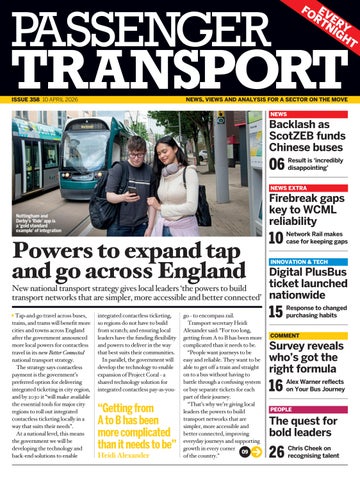

Powers to expand tap and go across England
New national transport strategy gives local leaders ‘the powers to build transport networks that are simpler, more accessible and better connected’
Tap-and-go travel across buses, trains, and trams will benefit more cities and towns across England after the government announced more local powers for contactless travel in its new Better Connected national transport strategy.
The strategy says contactless payment is the government’s preferred option for delivering integrated ticketing in city region, and by 2030 it “will make available the essential tools for major city regions to roll out integrated contactless ticketing locally in a way that suits their needs”.
At a national level, this means the government we will be developing the technology and back-end solutions to enable
integrated contactless ticketing, so regions do not have to build from scratch; and ensuring local leaders have the funding flexibility and powers to deliver in the way that best suits their communities.
In parallel, the government will develop the technology to enable expansion of Project Coral - a shared technology solution for integrated contactless pay-as-you-
“Getting from A to B has been more complicated than it needs to be”
Heidi Alexander
go - to encompass rail.
Transport secretary Heidi Alexander said: “For too long, getting from A to B has been more complicated than it needs to be.
“People want journeys to be easy and reliable. They want to be able to get off a train and straight on to a bus without having to battle through a confusing system or buy separate tickets for each part of their journey.
“That’s why we’re giving local leaders the powers to build transport networks that are simpler, more accessible and better connected, improving everyday journeys and supporting growth in every corner of the country.”
Nottingham and Derby’s ‘Ride’ app is a ‘gold standard example’ of integration

This time the promise of better must be delivered

Robert
This month saw the launch of England’s new Better Connected transport strategy, designed to make everyday journeys simpler, easier to pay for and more reliable. This wide-ranging document sets out priorities for the various transport operators, authorities, stakeholders and branches of government that must work together if we are to create a more robust, affordable and easily navigable system. Is history repeating itself? The last time a Labour government came to power in the late 1990s, it also published an integrated transport strategy with ‘better’ in the title - A New Deal for Transport: Better for Everyone. Much has changed since then, perhaps especially the increasing digitisation of our daily lives and the expectations that go with that, but a look at the late John Prescott’s foreword in that document reveals how many of the challenges remain the same. “With our new obligations to meet targets on climate change, the need for a new approach is urgent,” Prescott declared. (The current secretary of state for transport, Heidi Alexander, doesn’t mention the climate challenge in her foreword - a worrying sign of how this has slid down the agenda as the window for action grows shorter.)
Almost 30 years on, a new approach remains urgent. The focus must now be on delivery. By knitting together different transport modes, and placing transport at the heart of our planning decisions, we can deliver a better future for everyone.
IN THIS ISSUE

12
EDGBASTON TESTS DECARBONISATION TOOL
Cricket crowds travelling to Edgbaston Stadium in Birmingham are part of new research to help cities identify how and where to cut transport emissions. It’s part of a five-step approach to using digital twins to decarbonise transport.
ORGANISATION PAGE
Alexander Dennis 6, 7
Avanti West Coast 10-11 Campaign for Better Transport 9 Dumfries & Galloway Council 7
East Yorkshire Buses 13 Ember 6, 7
First Bus 5, 6 FirstGroup 13
Go-Ahead Group 13 Go-Ahead London 5 Greater Anglia 15
Highland Council 7 Hitachi Rail 14
KeolisAmey Lothian 6 Lumo 10-11
McGill’s Group 6
Network Rail 10-11
Oxford Bus Company 13
Project Coral 1
Rail Delivery Group 15
Scottish Borders Council 7
Scottish Government 6
South Yorkshire MCA 5
Stagecoach Group 6, 7
22 RETHINKING CONTRACT PERFORMANCE
Authorities need to prioritise data to strengthen performance regimes and effectively deliver reliable franchised bus services, says CitySwift CEO and co-founder Brian O’Rourke. “The move to franchising is a once-in-ageneration opportunity,” he says.
24 RETHINKING FRICTIONLESS TRAVEL
A conversation with Dr Jenny Wood, head of sustainability at Worldline, about the path net zero. “Rail accounts for only 1.4% of transport emissions in the UK, but that doesn’t mean we shouldn’t look for opportunities to reduce,” she says.
25 I CAN’T GRUMBLE ABOUT THIS STRATEGY
EDITORIAL
Telephone: 020 3950
Managing
Robert Jack
Deputy Editor Andrew Garnett
Contributing Writer Rhodri Clark
Directors Chris Cheek, Andrew Garnett, Robert Jack
OFFICE CONTACT DETAILS
Passenger Transport Publishing Ltd PO Box 5496, Westbury BA13 9BX, UNITED KINGDOM
Telephone (all enquiries): 020 3950 8000
Stagecoach South East 5
Stagecoach Yorkshire 5
Stirling Council 7
Sustainable Transport Alliance 9 Transdev 4 Transport Scotland 6
Great Minster Grumbles: Our Whitehall insider imagines what’s going on inside the minds of the mandarins at Great Minster House, home of the DfT. “The thought that kept on popping into my head was simply this: shouldn’t all of this be happening anyway? ”
‘Bump in the road’ for Brabin’s mass transit
Confidential review raises questions about West Yorkshire plans
MASS TRANSIT
Confusion has emerged over the future shape of West Yorkshire’s proposed mass transit system, following reports that transport secretary Heidi Alexander has not committed to a tram-based network as initially envisaged.
The debate centres on longstanding ambitions to deliver a tram network linking Leeds and Bradford. West Yorkshire mayor Tracy Brabin has previously set out plans for early construction activity, with a target of beginning works in 2028.
However, findings from a confidential review carried out by the National Infrastructure and Service Transformation Authority (NISTA) last year were revealed by The House, an influential parliamentary magazine, this week. The review questioned
WEST MIDLANDS METRO EXTENDED
Short Eastside extension opens for business
NETWORKS
Passenger services on the West Midlands Metro to Millennium Point commenced over the Easter weekend. The Birmingham Eastside extension includes two stops serving Moor Street Station and the Birmingham City University campus. The route provides interchange links with bus and rail and will eventually be extended towards Digbeth, Birmingham Airport and the new HS2 station at Curzon Street

several aspects of the current approach to the project, including concerns around delivery milestones and the basis on which key decisions are being made.
According to the reports, NISTA found that the programme carried a risk of “political embarrassment” if there were significant differences between announced construction milestones and actual delivery
NISTA raised concerns about light rail choice
timelines. It also emphasised the importance of completing detailed planning and risk assessment before committing to fixed project dates.
The review also raised concerns over the evidence supporting the selection of a tram system, citing a “lack of unbiased thinking” on the question. It added: “There is a need to build the case for trams which has not been completed.

“This is particularly important because the likely cost of a Bus Rapid Transit (BRT) mode is significantly less than for trams and the BRT benefit:cost ratio is significantly better.”
Following the review, project timelines have been revised, with delivery now expected in the late 2030s rather than the mid-2030s previously indicated.
In an exchange of letters between Brabin and rail minister Lord Hendy last December, the government reaffirmed its commitment to delivering a mass transit system in collaboration with the combined authority and local authorities. However, at a combined authority scrutiny committee in March, officers suggested to members there was now only an “aspiration” for a light rail-based solution.
Brabin was more direct and told the meeting the delays to the project represented “a bump in the road”. She added: “I’m enormously irritated about it. We’re now in a process where we have to prove it can’t be a bus. We have to make the case.”
She subsequently stated: “It will be a tram”.
KEOLISAMEY WINS DUBLIN LUAS DEAL
Partnership wrests Irish contract from Transdev
CONTRACTS
A €1.3bn (£1.1bn) contract has been awarded to KeolisAmey to operate Dublin’s Luas light rail system by Transport Infrastructure Ireland and the National Transport Authority. The seven-year contract will commence in September with an optional six-year extension.
Current Luas operator Transdev has said it is reviewing the decision and has sought legal advice and a potential judicial review.
South Yorkshire starts contract procurement
Operators sought for People’s Network as depots purchased
FRANCHISING
South Yorkshire Mayoral Combined Authority (SYMCA) has launched the first stage of procurement for its franchised bus network, inviting operators to bid for contracts that will deliver services in Doncaster and Sheffield from September 2027. The process marks the beginning of formal competition for the region’s People’s Network and follows a period of preparatory work including depot acquisition, funding awards and engagement with operators and communities.
“This next phase of procurement is where things start to become real,” said Matt Goggins, SYMCAs director of bus franchising. “It’s about turning what people have told us into something deliverable, and doing that in a way that’s open, collaborative and rooted in South Yorkshire.”
Phase 1 of the franchising programme will be delivered through two contract lots covering services operating from key depots. Lot 1 relates to services from Olive Grove depot in Sheffield, while Lot 2 covers operations from Leger Way depot in Doncaster. The estimated total value of the contracts is approximately £522.6m, with a contract period running from September 2027 to September 2032, and the option of a two-year extension.
The procurement follows the recent completion of depot

acquisitions by SYMCA. Last month, the authority secured six depot sites. They are Olive Grove in Sheffield and Leger Way in Doncaster, currently operated by First Bus, with the latter already owned by the SYMCA, while the depots at Ecclesfield and Holbrook in Sheffield, Rawmarsh in Rotherham and Wakefield Road in Barnsley are operated by Stagecoach Yorkshire. Both operators will lease their respective facilities back from SYMCA in the interim.
The depot programme forms part of a wider £350m investment package covering infrastructure, fleet and depot upgrades. Plans include electrification of depots, installation of dynamic charging infrastructure, and refurbishment of staff facilities.
“This next phase of procurement is where things start to become real”
Matt Goggins, SYMCA
KENT HERALDS 20 YEARS OF FASTRACK
Milestone for system that carries three million
BUS RAPID TRANSIT
Kent’s Fastrack bus network is marking 20 years since the first service was introduced between Dartford and Gravesham.
New office buildings are planned at Ecclesfield and Rawmarsh, while essential roof works will be carried out at Olive Grove, one of Britain’s biggest bus depots.
SYMCA has indicated that early fleet planning includes more than 220 new buses for Olive Grove and around 110 for Leger Way, with final allocations to be confirmed. From September 2027, at least 70% of new buses entering service in Doncaster and Sheffield are expected to be zeroemission, supported by £33.4m in government funding to introduce more than 180 electric buses at Olive Grove.
The authority is also progressing its wider franchising programme, with subsequent procurement phases scheduled for 2028 and 2029. These future phases are expected to include additional contract packages and opportunities for SME operators.
Operators interested in participating in Phase 1 have until April 22 to submit questions, with final tenders due by May 5. Contract awards are expected early next year.
The network began in March 2006 with Route B, linking Temple Hill and Gravesend via Dartford and Bluewater. A second route, Fastrack A, was introduced in June 2007 to serve developments including The Bridge Estate and Greenhithe, following higher-than-expected demand. Further routes have followed in the Kent Thameside areas with services now operated by Go-Ahead London.
A Fastrack service was launched in Dover in 2024, linking the town centre with Whitfield, supporting an area undergoing major housing expansion. That service is operated by Stagecoach South East.
Passenger growth has exceeded initial forecasts. In the first full year of Routes A and B, usage reached 1.75 million journeys against a forecast of just under 1.1 million. In 2025, total ridership across the network was 2.88 million, with more than 3 million journeys expected in 2026.
“Twenty years on from that very first journey, Fastrack has grown into a public transport success story,” said Peter Osborne, Kent County Council’s cabinet member for highways and transport.
“The distinctive buses have carried millions of people, helped new communities find their feet, eased congestion and supported the growth of our towns. We’re proud of how far the service has come, and we hope residents will continue to enjoy and make the most of Fastrack for many years to come.”
Goggins: ‘People’s Network open, collaborative and rooted in South Yorkshire’
Backlash as ScotZEB3 favours Chinese buses
Wrightbus decries “national scandal” and McGill’s considers legal action. Alexander Dennis announces Falkirk closure with loss of up to 115 jobs
ZERO-EMISSION VEHICLES
The Scottish Government and its Transport Scotland agency would have been expecting a backlash last month when it announced the third and final round of Scottish Zero-Emission Bus Funding (ScotZEB3).
Despite having agreed a first-of-its-kind furlough scheme only last September to protect jobs at bus builder Alexander Dennis and maintain long term manufacturing capacity in Scotland, the biggest beneficiary of ScotZEB3 was China’s Yutong. The awards, which mark the conclusion of funding from the Scottish Government to support large operators to make the transition to zero-emission vehicles, see £45m shared between five projects (see table). This investment will bring 334 zero-emission buses and coaches to Scotland’s operators - but half of these vehicles (166) will be supplied by Yutong.
Fiona Hyslop, Scotland’s transport secretary, said ScotZEB3 “signals our
commitment to a net zero future for Scotland’s bus sector”, and declared that “it’s supporting jobs” as well as reducing emissions.
But the backlash was swift.
Jo Bamford, owner of Ballymenabased bus builder Wrightbus, attacked the “national scandal” of government funding for zeroemission buses going overseas raher than to UK manufacturers.
“We have the capability, the workforce, and the technology right here in the UK,” he said.
“What we need now is a level playing field and a commitment to back UK industry.”
McGill’s Group, the UK’s largest independent bus operator, voiced concern after its own £4.3m bid to add 33 Alexander Dennis vehicles to its electric bus fleet was overlooked. The group is taking legal advice in a bid to force
a rethink over “the inppropriate use of funding”.
Ralph Roberts, chairman of McGill’s Group, said: “McGill’s Group made a bid which would have been worth £16m to Alexander Dennis and supported skilled manufacturing jobs here in Scotland. We are disappointed that we were unsuccessful and will be reviewing how the bid was scored with our team.”
Referring to the award of £13m to intercity coach operator Ember to add 100 Yutong coaches to its existing fleet, Roberts said: “The original purpose of these rounds of funding was to convert diesel buses to zero-emission - improving air quality in local communities and accelerating the sector’s journey to net zero. It now appears the fund is being used to support new competing
“We will be looking closely at the scoring process and will consider legal remedies to challenge this decision”
Ralph Roberts, McGill’s Group
SCOTZEB (SCOTTISH ZERO-EMISSION BUS CHALLENGE FUND) PHASE 3 AWARDS
Source: Transport Scotland
services rather than replace existing diesel fleets, which raises serious questions about whether it is delivering on its stated aims.”
He added: “We will be looking closely at the scoring process and will consider legal remedies to challenge this decision and ensure the process has been conducted properly.”
Five days after the ScotZEB3 announcement, Alexander Dennis revealed that it was consulting on plans to close its Falkirk manufacturing facility and convert its facility in nearby Larbert into a chassis manufacturing site. It would retain approximately 350 roles within Scotland but up to 115 roles would be placed at risk of potential redundancy. Bus body manufacturing could be reintroduced at Larbert in the future if it is required.
While expressing gratitude to the Scottish Government for the furlough scheme that has secured jobs, Alexander Dennis president and managing director, Paul Davies, said the results of the ScotZEB3 scheme were “incredibly disappointing”.
Davies also said that the output of the UK Bus Manufacturing Expert Panel “does not place enough focus on the significant jobs and economic contribution the domestic bus manufacturers make to the UK”. He urged the UK and Scottish governments to “level the playing field”.
Ember plans expansion with 100 new coaches
£13m ScotZEB award boosts fully electric coach network
ZERO-EMISSION VEHICLES
The 100 electric coaches for Ember which are due to receive ScotZEB3 funding will enable the operator to increase services on existing routes and launch new routes.
Subject to finalisation of grant award agreements, Ember will receive the biggest single SotZEB3 allocation, £13.2m. This will assist with provision of 43 chargers as well as 100 Yutong coaches. Private investment of more than £40.6m is also planned, with the project costed at £53.8m overall.
Most of Ember’s growth to date has been privately funded, including a loan from Triodos bank. Ember has a range of financial partners to help with match funding for the ScotZEB3 grant.
Ember has grown rapidly since
COUNCILS TO ELECTRIFY BUS OPERATIONS
Dumfries & Galloway and Highland will get vehicles
ZERO-EMISSION VEHICLES
ScotZEB3 will result in 69 electric buses for local authority bus operations, via a grant to leasing company Rock Road.
The move reflects how bus services in many areas of Scotland are increasingly coming under public sector control, without the franchising option being exercised, usually as a response to commercial
it was created by Keith Bradbury and Pierce Glennie and launched its first route, with two coaches, in 2020. Its routes now connect all Scottish cities and extend to Wick and Thurso in the north and Oban and Fort William in the west.
On April 29 it will launch an Ullapool to Inverness route with £2 fares, in line with the Scottish fare cap pilot. So far, however, Ember has not launched any routes south of the central belt.
“This is a big moment for us,” said the company after the ScotZEB3 grants were announced.
“It will allow a major expansion of our network, bringing high quality and frequent public transport to more cities, towns and villages across the country. When all of this is delivered, Ember will
operate the largest intercity and regional coach network in Scotland.
“We’re grateful to the Scottish Government for the support. We genuinely believe ScotZEB has helped make Scotland a global leader in zero-emission coaches and buses. It means Scotland is now the only country in the world with a fully electric national coach network and is seeing the benefits, with quieter roads, lower emissions and improved air quality.”
The 100 new vehicles are all planned as additions to the current fleet, rather than some being replacements for existing coaches. Ember is not planning to operate on behalf of larger coaching businesses, such as National Express or FlixBus,
“When all of this is delivered, Ember will operate the largest intercity and regional coach network in Scotland”
operators withdrawing services or contract prices rising significantly. Rock Road’s Scottish electrification project has a total cost of £40m, of which £11.5m is expected to come from ScotZEB3. Rock Road will purchase 14 Alexander Dennis double deck buses, along with 69 Alexander Dennis and 10 Wrightbus single deck vehicles. These will be deployed across 10 depots and five operators. Dumfries & Galloway Council will lease 52 of the buses for routes serving communities such as Dumfries, Stewartry, Castle Douglas, Kirkcudbright, Newton Stewart, Stranraer and Lockerbie. It expanded its in-house bus routes by around
because it does not wish to dilute “the Ember experience”.
Passenger Transport asked Glennie if Ember’s successful bid had reduced funding available for zero-emission buses which would have spent all their time in urban areas, where air pollution can be a problem.
“I don’t think that argument stands up to much scrutiny,” he replied. “The government has consistently picked Ember’s applications because they meet the scheme’s objectives. If anything, this is likely to lead to more funding being deployed via future schemes since they can show a high return on investment. In ScotZEB3, Ember is leveraging £3.08 of private capital for every £1 of public support, which is well ahead of most of the other grant recipients.
“In addition, Ember’s coaches spend a significant amount of time in towns and cities, and have very high utilisation, so there is a direct benefit to urban air quality. And the high utilisation means they have an outsized impact on reducing CO2 reductions, the primary driver behind electrification of vehicles.”
40% last summer, in response to Stagecoach withdrawals.
Highland Council will lease 10 of the Rock Road vehicles and its D&E Coaches company a further seven. It began to operate its own bus services in 2022 and is now preparing a model for the creation of a municipal bus company.
Rock Road’s project also includes 20 electric buses for Craig of Campbeltown (10 for West Coast Motors services in the Oban area and 10 for route 17 in Glasgow). It will also provide four electric buses for Bay Travel of Fife, for subsidised local services and school routes.
The ScotZEB3 grant for Rock
Road includes installation of depot charging infrastructure. Operators will own the charging infrastructure and fund the remaining capital themselves.
While not featuring in ScotZEB3, other local authorities have also increased their bus operations. With its 34 buses, Scottish Borders Council operates more routes in the region than any other operator. Its routes include two in Berwickshire and Northumberland.
On March 30, Stirling Council launched a two-year pilot of two bus services which, if successful, will replace Demand Responsive Transport provision.
NEWS ROUND-UP
Guidance confirms EPs can act as latest BSIP
EP plan can fulfil the role of an up-to-date BSIP according to DfT
GUIDANCE
The Department for Transport has published new statutory guidance on Enhanced Partnerships (EPs) in England, marking the latest stage in the government’s reform programme following the Bus Services Act.
The guidance provides updated direction for local transport authorities (LTAs) and bus operators on the establishment, governance and operation of EPs, one of the two principal delivery models available to improve local bus services alongside bus franchising. It forms part of a wider policy framework intended to support implementation of the 2021 National Bus Strategy.
The document is the second of three publications focused on the
SOCIAL SERVICES
FRAMEWORK SET
Socially necessary bus services must be identified
GUIDANCE
The Department for Transport has set out detailed expectations on the treatment of socially necessary bus services within its new statutory guidance on Enhanced Partnerships(EPs) in England.
The document places emphasis on joint working between local transport authorities (LTAs) and bus operators to identify and prioritise services that are considered essential to local communities. It states that authorities and operators should agree which routes fall into
EP model. It follows a review of EPs and sits alongside previously issued franchising guidance and a franchising manual. A dedicated EP manual will follow.
A central feature of the guidance is its treatment of the relationship between EPs and Bus Service Improvement Plans (BSIPs). The DfT sets out how EP plans and schemes should align with the objectives and commitments contained within BSIPs, which remain the primary strategic documents through which LTAs articulate their ambitions for local bus networks.
The guidance highlights that EPs are the principal delivery mechanism for BSIPs in areas not pursuing franchising, and that the two should be closely integrated in both development and ongoing management.
In this context, the document confirms a significant policy
this category and then include them within the EP plan.
The guidance goes further by providing a definition of a socially necessary service. It state they are those that provide access to essential goods and services, employment and education opportunities, and wider social activities. The guidance adds that the role and importance of such services will vary depending on local circumstances, and should be assessed on a case-by-case basis.
LTAs are expected to maintain ongoing dialogue with operators regarding the performance, usage and financial viability of these routes. Operators should notify the authority where there are indications
development from the 2026/27 financial year. It states that an EP plan may serve as the up-todate BSIP for the purposes of government funding conditions, provided it meets the relevant requirements set out across both BSIP and EP guidance. This provision is intended to reduce duplication between documents and streamline the planning framework for LTAs. They will also be expected to demonstrate clear strategies for service improvement.
The guidance also sets out the statutory processes for creating and varying EPs, including requirements for consultation, operator engagement and governance arrangements.
It also clarifies the legal thresholds for operator objection and the circumstances under which schemes may be amended or revoked. In addition, it outlines
that a service may be subject to a substantial variation or cancellation within the following 12 months.
The guidance defines a substantial variation as a change that would have a materially negative impact on passengers, including circumstances where a journey would be permanently extended by at least one hour.
In such cases, LTAs and operators are expected to work together to identify potential mitigations aimed at maintaining service provision. These options should be explored before any consideration is given to additional public funding, with the intention of supporting the effective operation of the socially necessary element within an EP.
the range of measures that can be included within an EP, such as service standards, frequencies, fares, ticketing initiatives and infrastructure improvements.
Significant attention is also given to the role of EPs in supporting socially necessary local services. The guidance explores how partnerships can be used to sustain routes that may not be commercially viable but are considered essential for connectivity, particularly in rural or under-served areas.
It details the mechanisms available to LTAs to specify requirements relating to such services within EP schemes, including provisions linked to service levels and network coverage.
The guidance also addresses a wider set of requirements linked to EPs, including minimum standards, accessibility and ticketing provisions, scheme content, competition considerations, governance arrangements, and mechanisms for accountability and enforcement.
The guidance makes clear that the inclusion of socially necessary services does not create an obligation on LTAs to fund services that are not commercially viable. It also states that the provisions are not intended to act as a mechanism for introducing new routes or reinstating those that have been withdrawn.
Where no appropriate or affordable mitigation can be found, LTAs are required to document how that conclusion was reached and be prepared to publish the outcome. Operators are expected to wait until this process has been completed before submitting any formal notification of service changes to the registration authority.
I
can’t grumble about this strategy. Page 25
Transport campaigners urge focus on delivery
...as CPT hails ‘game changer’ for the coach industry
BETTER CONNECTED
An alliance of eight charitable organisations has urged that decisive action must follow the launch of England’s new strategy for integrated transport, Better Connected, to implement the measures proposed.
The Sustainable Transport Alliance is calling for the new Department for Transport strategy - alongside wider reform to planning, rail, bus, and ongoing transport devolution - to be used as a springboard for efforts to:
Get transport operators and authorities, and housing and planning professionals, working together, prioritising connectivity between sustainable modes (rather
BETTER CONNECTED STRATEGY
Continued from Page 1
Looking beyond the city regions, the government is “developing technologies to give local areas in every part of England a menu of choices for implementing integrated ticketing - supported by standards and tools developed nationally, and close partnerships with government, operators and the private sector, without being mandated a single solution”.
The Department for Transport says “gold standard examples” like Nottingham and Derby’s ‘Ride’ app, launched in December 2025
than private cars), and positive outcomes for communities;
Accelerate progress towards high quality, accessible interchange, active travel infrastructure, shared mobility schemes, aligned timetabling, and fully-integrated fares, ticketing, journey planning, real-time information and personal assistance; Ensure communities are able to shape the integration and improvement of local transport.
Jools Townsend, chair of the Sustainable Transport Alliance, and chief executive of Community Rail Network, said:
“It’s the delivery on the ground that matters” Jools Townsend
and part-funded by government, show what is possible when local leaders are backed to improve local transport. The app allows passengers to plan and pay for journeys on buses and trams, as well as shared transport services, including car clubs, e-scooters and e-bikes - all in one place.
To help local areas go further, the government is also offering £40m in new funding for local authorities to trial technologies to improve transport, reduce congestion and ease disruption.
Alongside these new features, the government is also publishing new local transport plan guidance, giving local leaders clear blueprints for building joined-up transport, making the most of their funding and boosting local growth.
“An integrated transport strategy is a start, but for the millions trapped by ‘transport deserts,’ or tipped into poverty by having to run a car, it’s the delivery on the ground that matters.
Townsend added: “We need to seize on this new strategy, alongside devolution and rail and bus reform, to ensure real progress in improving transport for all and tackling our reliance on private cars, which has become a huge factor in the climate crisis, transport poverty, and unequal access to opportunity.”
These remarks were echoed by Ben Plowden of Campaign for Better Transport. He said: “We are pleased that the strategy focuses on integration between modes, and also between different government departments and different levels
The strategy also announces that Google and the Department for Transport will work together to integrate the live location and expected arrival times of local bus services in England into the Google Maps app for the first time. This will include operators who are meeting their Bus Open Data legislative requirements, and where the data feeds provided by the operator “are meeting the highest standards of data quality as defined by Google”.
Better Connected also announces £6m of support for a ‘Mini Switzerland’ pilot in the Peak District’s Hope Valley - a scheme that has been promoted by transport expert Thomas Ableman, formerly of Transport for London and Chiltern
of government, across different policy areas and between different forms of investment and funding.
“With transport playing such an important part in all of our lives, the key issue now is delivery of the intentions in the strategy in practice.”
Meanwhile, the Confederation for Passenger Transport welcomed the DfT’s announcement that it expects local transport authorities to “recognise and plan for the role and contribution of coach services” in their transport strategies. New guidance has been published alongside the DfT’s Better Connected transport strategy. Alison Edwards, director of policy and external Relations at CPT, said: “This is a game changer for the coach industry. From today, every local authority in England will need to think strategically about coach travel. It’s an endorsement from the Government of coaches as the hidden backbone of the public transport network.
Railways. The trial “will explore integrating existing rail services with an hourly or better bus service to demonstrate a rural public transport system that works for local residents and visitors alike”.
Commenting on the MiniSwitzerland trial, Ben Plowden of Campaign for Better Transport said: “This sort of visionary project can create ripples, inspire others and lead to broader changes.”
Meanwhile, the government will establish a Mass Transit Taskforce “to assess the wider economic, spatial and social benefits of integrated mass transit systems, and examine the funding, governance and delivery barriers that can impede their development”.
‘Firebreak’
gaps key to WCML reliability
Network Rail tells Office of Rail and Road capacity gaps are essential to maintain performance and delay recovery. Andrew Garnett reports
Network Rail has acknowledged that the southern section of the West Coast Main Line (WCML) is “not performing to a consistently high level” in a letter to the Office of Rail and Road. It warns that attempts to introduce additional services risk exacerbating delays on an already constrained railway.
At the centre of the issue is Network Rail’s claim that apparent spare capacity on the fast lines between Rugby and London Euston is, in many cases, not usable in practice. Instead it argues that these paths are deliberately retained as gaps in the timetable to support robust operational performance.
The correspondence comes at a time when multiple operators are seeking to introduce or reinstate services on the WCML. Avanti West Coast has proposals to restore some specific services to the timetable. In addition, other prospective open access operators have identified potential paths within the timetable structure.
The letter, which was written in February but disclosed by the rail regulator last month, sets out Network Rail’s position that, while there appear to be additional train paths within the timetable structure, many of these are not practically available for use. Instead, they function as “firebreaks” - gaps deliberately retained within the timetable to enable service recovery and mitigate the impact of delays.
Central to the letter, which
was written by Jake Kelly, Network Rail’s north west and central region managing director, and Hannah Linford, capacity planning director, system operator, is the infrastructure controller’s clarification of earlier analysis which identified nine additional theoretical paths in each direction on the WCML fast lines between Rugby and London Euston. These paths were highlighted in a supporting capacity assessment accompanying the correspondence.
However, Network Rail distinguishes between paths included in the December 2022 Concept Train Plan (CTP) and those that exist only as structural gaps. Of the nine paths identified in each direction, four in the Up direction and three in the Down direction were part of the CTP and had been assumed in baseline performance modelling undertaken by the cross-industry Event Steering Group.
The remaining paths - five Up and six Down - are described as “firebreak gaps”. These were incorporated into the timetable structure not as spare capacity for additional services, but as recovery margins intended to absorb delays and prevent disruption from spreading. Kelly and Linford highlight that this distinction is critical. The firebreaks formed part of the assumptions underpinning earlier modelling and were designed to maintain performance stability
on what is described as a “mixed traffic railway” operating close to its capacity threshold.
The letter reiterates findings from detailed modelling undertaken in 2022, which assessed the performance implications of different service levels on the WCML fast lines.
According to Network Rail, the timetable structure defined in the December 2022 CTP represents a “critical threshold” of capacity utilisation.
Beyond this threshold, the addition of further services is said to result in a disproportionate deterioration in performance. The modelling showed that introducing additional fast line services, effectively increasing hourly paths beyond the established level, led to measurable declines in punctuality metrics (T-1 and T-3) and increased total delay minutes.
A sensitivity test mentioned in the letter examined the removal of five planned Euston-Stirling services, presumably Lumo’s forthcoming open access service, in each direction. This indicated that removing those services would reduce total delay minutes by just over 100 minutes, which illustrated the cumulative impact that additional services can have on network performance.
Network Rail states that these modelling outputs remain valid because the current timetable structure continues to align closely with the December 2022 CTP assumptions.

A recurring theme throughout the letter is the operational challenge posed by “flighting”the scheduling of trains in close succession, often at or near minimum headways. While this approach maximises throughput, it also increases vulnerability to reactionary delays.
The analysis highlights multiple examples where inserting a train into a firebreak gap would result in extended sequences of closely spaced services. For instance, using the 10:58 arrival slot at London Euston would create a sequence of six consecutive arrivals within an 18-minute window. Network Rail states that such patterns increase the likelihood of delays propagating between services.
“The WCML is currently not performing to a consistently high level, and recovery from incidents are taking longer”

Network Rail argues that ‘firebreaks’ in the timetable enable recovery on the WCML
“Having firebreaks in the timetable at key conflict points helps to prevent spread of delay”
Similar concerns are outlined for other potential Up direction slots, including those at 16:58, 18:58 and 20:58. In each case, the removal of a firebreak would eliminate recovery time immediately ahead of tightly spaced service groups. In the Down direction, the risks are described as particularly acute where inserting a train would merge two separate “flights” into a single continuous sequence. For example, filling the 08:36 departure slot from Euston would create a run of seven trains operating on or near minimum
at Ledburn Junction and again at Rugby, especially during the afternoon and evening peak periods. These locations act as key conflict points where multiple service groups interact, increasing the complexity of operations.
Network Rail’s analysis indicates that firebreaks ahead of these locations are important in allowing the timetable to absorb “sub-threshold delays”, minor delays that would otherwise escalate into more significant disruption if not managed.
Particular attention is given to the 07:00 Manchester Piccadilly to London Euston service, operated by Avanti West Coast. This service has been the subject of regulatory scrutiny, including an earlier position by the ORR that it should initially run as an Empty Coaching Stock movement following timetable changes, before that stance was subsequently revised amid publicand political - outcry.
Network Rail clarifies that the 07:00 service is not a firebreak path. It was included in the December 2022 CTP and therefore formed part of the baseline assumptions in performance modelling.
the train generated 58 minutes of reactionary delay affecting other operators, including Avanti West Coast, freight services and regional passenger operators.
Despite these performance issues, no cancellations or failed stops were recorded for the service during the period analysed.
“The WCML is currently not performing to a consistently high level, and recovery from incidents are taking longer to recover due to the successive flighting of trains on the WCML fast lines,” say Kelly and Linford. They attribute this in part to the cumulative effects of operating at high levels of capacity utilisation, combined with the realities of a railway that mixes long-distance passenger, commuter and freight services.
The letter also notes that recovery from incidents is taking longer due to the successive flighting of trains on the fast lines. In this context, firebreak paths are presented as a key mechanism for limiting the spread of delays between service groups.
headway. Network Rail notes that delays to earlier services in such sequences are already frequent, with knock-on effects extending through the entire group.
Kelly and Linford identify specific locations where performance issues are most pronounced, notably in the Rugby area. Network Rail states that the effects of closely spaced services are “particularly being felt at Rugby in the Up direction when services are converging”. In the Down direction, similar challenges are reported
Operational data covering the period from the December 2025 timetable change to late January 2026 shows that the service departed Manchester on average 0.3 minutes late but arrives at Euston 6.7 minutes late. The loss of time occurs at multiple points along the route.
The service recorded T-3 failures at Euston on 11 days within the reporting period. Daily arrival lateness ranged from two minutes early to as much as 37 minutes late.
In total, 115 delay minutes were attributed to the service over the period, with the majority classified as infrastructure-related.
Network Rail also reports that
On the proposals for additional services, Network Rail’s position, as set out in its earlier representations to the ORR and reiterated in this response, is that it does not support the introduction of additional services on the WCML South fast lines. The infrastructure controller states that doing so would have a “significant detrimental impact to performance”.
This stance is framed within the decision-making criteria set out in the Network Code. It requires infrastructure managers to balance capacity allocation with considerations that include safety, efficiency and train performance.
“Having firebreaks in the timetable at key conflict points helps to prevent spread of delay service group to service group,” add Kelly and Linford.

Edgbaston tests new decarbonisation tool
Researchers studied cricket fan travel in Birmingham as part of work to develop prototype passenger transport ‘digital twin’ of the West Midlands
RESEARCH
Cricket crowds travelling to Edgbaston Stadium in Birmingham are part of new research to help cities identify how and where to cut transport emissions.
Match day travel to the sports ground was used as a real-world scenario to test a new five-step approach to using digital twins to decarbonise transport. Digital twins are digital replicas of the physical world that can be used to test different interventions and ‘what if’ scenarios.
The research, which is published in the journal Urban Science, was led by Durham University and will be used to help develop a prototype passenger transport digital twin of the West
Midlands. This will incorporate different transport modesincluding buses, trains and cycling - and is being built by TransiT, a UK research hub using digital twins to identify the lowest-cost, least-risky pathways to transport decarbonisation in the UK.
Heather Steele, a TransiT researcher and rail systems expert at Durham University, explained:
“Decarbonising transport in cities is complex. Digital twins can help us understand this complexity. But we need to know
how planners would practically use them, starting with what real-world scenarios they want to test. Our five-step framework is designed to start bridging that gap, and travel to Edgbaston Stadium is one of the case studies we used to test our approach.”
Up to 25,000 spectators can arrive at Edgbaston on match days, and this accounts for up to 80% of total emissions from the event. Although there are frequent bus services to and from the city centre to the stadium, the
“Decarbonising transport in cities is complex. Digital twins can help us understand this complexity”
Heather Steele, Durham University
location is defined as a ‘transport desert’, because the stadium is not well connected to other parts of Edgbaston or Birmingham. Railway stations on commuter lines are at least a half-hour walk away. And the neighbouring A38 trunk road can be affected by local road closures on match days.
Applying the new framework, researchers mapped out how a digital twin could support planners by testing transport service changes including: additional shuttle buses or rail-bus interchange services; revised match-day road access; park-and-ride options; alternative active-travel routes; the impacts on local congestion and carbon emissions.
Real-time data sources, like bus occupancy, parking demand and road traffic data, would feed the digital twin with the information needed to make its analyses. Journey planning and real-time information systems could then be used to transmit information from the digital twin back to realworld transport settings, to help influence traveller behaviour.
The researchers describe their five-step approach as a ‘co-created’ framework that was developed in an industry workshop with local authority practitioners, transport planners, modellers and policy specialists. Participants included experts from engineering consultancy WSP, local transport planners from Transport for West Midlands and Midlands Connect, and researchers from HeriotWatt University in Edinburgh. The framework identifies five aspects that need to be clearly defined when digital twins are being designed for transport decarbonisation. These are impacts, interventions, location types, data sources and feedback mechanisms.
Cricket fans heading to Edgbaston Stadium. Photo courtesy of Warwickshire County Cricket Club
FirstGroup moves up ‘most sustainable’ list
Bus and rail operator is among Europe’s 50 greenest corporations
BENCHMARKING
FirstGroup has again been recognised as one of Europe’s 50 Most Sustainable Corporations, rising 15 places from last year to number 31 in the rankings.
The report, produced by sustainable business media group Corporate Knights, ranks Europe’s largest publicly listed companies, drawn from the STOXX Europe 600 Index and the top 100 Europe-headquartered publicly traded companies.
The Europe 50 ranking is based on a sustainability assessment of more than 620 publicly listed European companies. It looks at measures covering environmental impact, social responsibility, and good corporate governance.
As one of the UK’s leading bus
ELECTRIC BUSES ARRIVE IN HULL
New fleet is unveiled at iconic venue, The Deep
ZERO-EMISSION BUSES
East Yorkshire Buses unveiled its brand-new fleet of zero-emission vehicles last month in Hull at the iconic aquarium, The Deep. A joint investment of £16.5m through the government’s ZEBRA (ZeroEmission Bus Regional Areas) initiative will see 27 new British-built Wrightbus electric vehicles delivered to East Yorkshire Buses. The funding partnership includes Hull City Council, the East Riding of Yorkshire Council and East Yorkshire Buses, part of the Go-Ahead Group.
and rail companies, carrying over two million passengers a day, FirstGroup has a major role to play in sustainability, through the transition of its fleets to low/zeroemission technologies, as well as electrification of depots and investment in new sustainable and renewable technology.
This achievement in the Europe 50 ranking follows on from FirstGroup’s earlier recognition in Corporate Knights’ Carbon Clean 200 list, which placed FirstGroup at number 118, making it the UK’s fourth top company. The ranking assesses global companies based on revenue generated from sustainable products and services
such as renewable energy, electric vehicles and energy efficiency.
Graham Sutherland, FirstGroup CEO, said: “Our bus and rail operations have a critical role in creating a connected, healthy, zero carbon world. That’s why we are leading the way by decarbonising our fleet, reducing emissions, improving air quality and protecting the environment.
“We’re proud to again be recognised for our commitment to environmental and social responsibility, as we play our part resolving some of society’s most important challenges - climate change, congestion and air quality.”
“Our bus and rail operations have a critical role in creating a connected, healthy, zero carbon world” Graham Sutherland, FirstGroup
GREEN BUSES FOR OXFORDSHIRE
Electric buses will extend more widely across county
ZERO-EMISSION BUSES
Thirteen new electric buses will soon take to Oxfordshire’s roads following an investment of more than £5.1m. The Go-Ahead Group, the parent business of the Oxford Bus Company, has spent £3.9m, backed by a £1.2m investment from Oxfordshire County Council, which has utilised some of the £10m in funding awarded to Oxfordshire by central government to improve bus services in the area.
The bus operator is rolling out nine new large electric single-deckers and four smaller electric single-deckers, supplied by UK-based manufacturers Wrightbus and Alexander Dennis, on routes extending outside the Oxford SmartZone, with the first tranche of vehicles going into service last week.
Luke Marion, managing director of Oxford Bus Company, said: “The exciting news is it will enable us to operate electric vehicles more widely across the county, rather than mainly on routes within Oxford.”

New electric buses outside The Deep
Hitachi Rail agrees to acquire Clever Devices
Strategic acquisition will extend Hitachi Rail’s footprint into the wider public mobility space, while expanding its North American business
ACQUISITIONS
Hitachi Rail has entered into a definitive agreement to acquire Clever Devices, a leading US-based provider of Intelligent Transportation Systems for transit agencies around the world. Clever Devices, headquartered in Woodbury, New York, is recognised for its pioneering, advanced technology solutions that enhance fleet management, passenger experience and operational efficiency for public transport authorities. The company has offices located in the US, Europe, and South America.
Hitachi Rail says the proposed acquisition of a company with deep digital expertise and expected 2026 revenues of over $220m (£166m), marks a significant step in its strategy to operate as a leading global digital mobility player. Upon completion, the business will extend its footprint from rail to multimodal mobility and strengthen its
VR HIGHLIGHTS RAIL RISKS
Immersive virtual reality technology is being used for the first time on the Wales and Borders route to help educate school pupils of the consequences of unsafe behaviour on the railway through a first-person perspective - highlighting the real-life risks in a safe and controlled environment . The technology has been rolled out on the Wales and Borders route for the first time - already reaching more than 2,000 school children.
presence in North America.
With over 600 employees and a customer base that includes eight of the 10 largest North American transit agencies, Clever Devices brings a robust portfolio and a track record of innovation and delivery. Its Intelligent Transport System solutions are deployed across transport modes, including buses as well as rail systems. Alongside its strength in North America, Clever Devices has achieved substantial growth in countries such as Brazil and Chile, as well as in Europe.
Clever Devices’ portfolio of onboard and centralised data solutions will complement Hitachi Rail’s HMAX Mobility suite, bringing added functionality
and benefits for customers across public transport around the world.
HMAX Mobility is Hitachi Rail’s digital asset management platform that optimises the performance of railways around the world. It connects data from fleets of trains, wayside signalling assets, and track infrastructure to create an operational twin of railways. It brings together advanced sensor technology, deep rail expertise and the latest in AI and edge computing to maximise rail performance, extend asset life and optimise costs.
The acquisition of Clever Devices will enable Hitachi Rail to offer enhanced solutions that support the digital transformation of public transport beyond rail,
“This is an important milestone in our strategy to accelerate the digital transformation of public mobility”
Giuseppe Marino, Hitachi Rail
optimise energy management and contribute to the reduction of greenhouse gas emissions.
In the Smart Mobility space, combining Clever Devices’ fleet management technology with Hitachi Rail’s Operation Control Centres will enable real time multi-modal solutions for urban public transport systems. This technology will enable connected and sustainable intermodal transport and support the transition to more sustainable and efficient transit systems.
Giuseppe Marino, group CEO, Hitachi Rail, said: “This investment is an important milestone in our strategy to accelerate the digital transformation of public mobility. Clever Devices’ proven expertise in intelligent transportation systems, combined with our global scale and our HMAX Mobility platform, will allow us to offer our customers a suite of data-driven mobility solutions that optimise transport infrastructure and services
“Together, we will expand our capabilities beyond rail and deepen our presence in North America, supporting cities as they transition to more innovative and efficient transport networks.”
The transaction is expected to close later in the year.

Digital PlusBus ticket launched nationwide
Innovation reflects changed customer purchasing habits
INTEGRATION
A new digital version of the PlusBus ticket, which makes it easier for customers to complete a journey using the train and the bus, has been launched nationwide by Rail Delivery Group (RDG) in partnership with Traveline.
Customer purchasing habits have changed dramatically in recent years, with over two-thirds now using digital tickets for their journeys. Previously only available as a paper ticket, PlusBus is now available in most areas nationwide as an eTicket following a successful trial in Yorkshire and Cambridge in 2025, enabling passengers to combine bus and rail travel without the need for separate paper tickets.
PlusBus is a rail ticket add-on that allows unlimited travel on
IPSWICH GETS INTEGRATED INFORMATION
Station screen provides onward bus connections
Passengers at Ipswich station are now benefiting from a new largeformat information screen, designed to make it easier to plan journeys and stay up to date while travelling. Installed through a partnership between Greater Anglia and Blackbox Company, and funded and supported by Suffolk County Council, the new screen provides real-time train departures, onward
most buses and trams within each PlusBus zone, with no on or off-peak restrictions. Most bus operators recognise and accept the new PlusBus eTicket, which is purchased at the same time as a rail ticket through online retailers and train operators.
Customers now only need to make a single purchase when planning their journey, and when choosing to access their tickets digitally, will receive separate barcodes for the rail and bus elements. They no longer need a separate paper ticket for the bus.
The key innovation behind the launch of digital PlusBus tickets is the acceptance of the National Rail barcode on most local
buses and trams within over 280 PlusBus zones across England, Wales and parts of Scotland.
Since 2021 the PlusBus scheme has been managed by Traveline Information Ltd, a not-for-profit organisation funded by bus operators and the RDG
Julie Gray, chief executive at Traveline, commented: “Our customers asked us for a digital PlusBus ticket that they can use at both ends of their rail journey, and we’ve delivered!
“This fantastic new product for England, Scotland and Wales is already going from strength to strength with 60% growth year on year, making truly integrated travel a reality for more and more
“Making PlusBus available as an eTicket is a major step forward in a seamless ticketing experience for customers”
Paul Bowden, Rail Delivery Group
bus connections, and clear updates during disruption, all in one place.
The new 4.8 metre-wide display uses high-resolution LED technology to ensure information is clear and easy to read from across the concourse, helping customers quickly access the information they need, whether catching a train or continuing their journey by bus.
The installation also features the new UK railway clock, a modern interpretation of a classic railway symbol, appearing at a Greater Anglia station for the first time.
The Ipswich screen builds on the successful introduction of a similar system at Norwich station in June 2025.
people every day.
“We’ve worked hard with RDG, as well as bus and train companies, from design to test and roll out of the new PlusBus ticket and are excited for the next phase of growth; to expand PlusBus availability to customers through new and larger areas, across more retailers, and to promote it more widely.”
Paul Bowden, commercial director at RDG, said: “Making PlusBus available as an eTicket is a major step forward in a seamless ticketing experience for customers. Being able to receive their rail and PlusBus ticket together online, in one transaction, suits the customer of today, with more and more people preferring the flexibility of digital tickets.
“This is a significant achievement that helps remove barriers between different forms of public transport and makes journeys easier, sustainable and more convenient. As the industry moves towards the creation of Great British Railways, we are working hard to make buying tickets as straightforward as possible for customers.”

The new 4.8 metre-wide display
ALEX WARNER

Survey reveals who’s got the right formula
It should be so simple, shouldn’t it? The Your Bus Journey survey shows us who’s getting it right for their customers, and who isn’t
When I joined the bus industry in 2008, I recall a very experienced train operating company managing director telling me how much he’d love to head up a bus business. He claimed it must be really simple: sitting upstairs in a depot, popping down every so often, and needing only to be concerned with getting clean buses out every day with friendly drivers. He wasn’t being condescending - rail sector style - towards the bus industry, and I could see he genuinely wished he had the chance to run a bus company. If only it were that simple - but it should be!
The release a fortnight ago of the latest Transport Focus Customer Satisfaction Survey results for 2025 made me reflect, once more, on how it should indeed be simple. The scores on the doors were pretty promising, with increases overall and in the key attributes. You might have blinked, though, as there wasn’t really much, if any, media coverage reporting on the good news - this, I suspect, a mix of the fact that a positive story isn’t that compelling in these doom-laden times in which we reside and also the general reticence and, to some extent, inability of the bus sector to make a song and dance about its successes. If this were the rail industry, there would be a daily press release for the 364 days leading up to the release of the next survey!
In England, overall satisfaction with the journey on the day rose to 85%, up 5% over the previous two years. There were gains in perceptions around the bus stop,
waiting time (up 6% since 2023 to 74%), and punctuality (up 7% over the past couple of years), whilst the bus driver stayed the same at 87%. Disappointingly, value for money went backwards by 6% to 63%, and by 4% compared to 2023 - reflecting potential consternation with the rise in the fares cap from £2 to £3, even if, in real terms, fares are much lower than pre-pandemic.
The scores in Scotland are fascinating. Satisfaction continues to grow to 92% (from 90% in 2024 and 89% in 2023), and waiting time satisfaction increased from 78% in 2024 to 84%. Best of all, overall satisfaction was up 5% to 91%, and all the key attributes increased, except value for money, which stayed the same at 75% but is still 7% up on 2023. McGills topped the charts at 97%with Lothian Buses in second spot at 94%. I find this unsurprising as I have always had excellent experiences with both operators. With ComfortDelGroowned Scottish Citylink, with whom I recently enjoyed a week’s travel across their stunning network, Scotland is definitely worth exploring by bus or coach.
For sure, I really do love seeing whether the operator results reflect my own experiences both as a seasoned customer on buses across
“The ALBUM culture is such that it feels like a harmonious family”
the nation and my observations of seeing how these companies act behind the scenes. I wasn’t surprised by Nottingham City Transport topping the charts in England. In recent times, their trophy cabinet has been bulging, and from my interactions with the company, it’s obvious why they are so successful. They care about the meticulous detail around the customer proposition and reward and recognise drivers for how they deliver for customers. For several years, my company has been running its mystery shopping programme, linked to an annual awards scheme for employees. In Dave Astill, as managing director, they have one of the most affable, experienced and popular top dogs in UK transport.
The independent companies that constitute the ALBUM group, once again, scored highly, and it’s not difficult to see why. They are a bunch of businesses that work collegially, unshackled by large, burdensome group overhead, and are all run by down-to-earth, inclusive individuals who care passionately about the bus industry, its customers, and employees. They aren’t CEOs who are just flitting in and out of the sector, using it to further their own careers and slagging it off once they’ve left as though they were some kind of saviour among dinosaurs.
The longevity of tenure among ALBUM company top brass is both telling and also creates continuity and the ability to develop a strategy and enact plans over time, largely undistracted by franchise bidding and certainly bereft of the kind of politics and pointless projects that are the ilk of owning groups, many of whom are now run by private equity businesses where caring for the bus industry isn’t so high on the agenda as it was when transport organisations were standalone entities. The ALBUM culture feels like a harmonious family, whilst also being receptive to feedback and to trialling new ideas and approaches. It also treats suppliers with respect, welcomes them into the fold, and recognises the benefits they can bring. In short, they set the benchmark across all aspects of running a transport company.
Looking down the league tables of operators, it was interesting to see how the Go-Ahead companies continue to perform highly, mirroring their success at bus industry awards events, and, again, like the ALBUM folk, they represent best practice. Bar Transdev (another
“I know some owning groups where there is rancour on an unprecedented level”
organisation that sets the standard), GoAhead feels like the only owning group to truly enable its subsidiaries to have autonomy, while also managing local brands that resonate with the markets they serve. They also benefit from low turnover among senior managers - another sign of satisfied, fulfilled leadership - and continually attract the crème de la crème. It was interesting to see First perform strongly. I spent some time on their services in Yorkshire fairly recently and was struck by the investment in vehicles, customer information and branding, so too in other parts of its network. Perhaps, with a much-shrunk footprint across the UK due to selling and closing businesses over the past half-decade or so, First is finding it easier to manage a less unwieldy, more compact setup. Whether this can be capitalised on once its new organisational structure, which creates superregions and removes local managing directors, is in place remains to be seen; this approach has failed in previous eras, with remote leadership leading to a lack of attention to detail in product delivery and local markets. Some very good people have left First through its various reorganisations in recent years. Stagecoach scored highly and unsurprisingly so in Portsmouth, where a combination of a supportive and experienced local authority (First in Portsmouth also scored strongly) and a class act managing director in Marc Reddy - one of the most experienced in the industry - reaped dividends. Stagecoach’s business in Pompey has consistently hit 91% for the last three years since Reddy has been at the helm. Arriva’s travails in the Transport Focus survey continued, but with Martijn Gilbert getting his feet under the table as its bus division CEO, it will be a matter of time before it emerges from the doldrums. Refocusing on local markets and placing a greater emphasis on industry experience would appear to be high on the agenda and long overdue. Whilst I wasn’t surprised by those organisations scoring strongly in the results, I don’t think the full set of results reflected the chaos and unhappiness in some parts of the bus sector right now. It’s good that this lack of positivity hasn’t been taken from the dressing room onto the pitch, though it’s difficult to conceal it for a sustained period of time and cracks will appear. I know some owning groups where there is rancour on an
unprecedented level between the subsidiaries and bloated central functions - a real distrust from the former towards the latter and disquiet around work ethic, dismissiveness towards local markets and incredulity around the number of group-based folk turning up at budget reviews to ask questions of tiny management teams the other side of the table.
Fuel price hikes and potential shortages as a result of the ongoing Middle East conflict, coupled with the usual challenges in recruiting and retaining drivers, as well as the difficulties in spinning plates to bid for franchises and dealing with patronage declines, make the job of a bus managing director, anything but simple and they can do without some of the pointless picking holes from the nine-to-fiver home workers at the centre. The barmy thing about all this is that these managing directors have had marketing resource taken away from them and put into one of these central teams, yet they are still on the receiving end of rollockings when revenue numbers go south.
A few words on the survey itself. The foreword says that it is in its third year, which must be referring to it in its current ‘Your Bus Journey’ format and because it’s been at least a decade since the consumer body has been producing surveys. The sample size at 50,000 might seem significant, but in the overall scheme of the number of bus journeys taken and the scale of the sector, it’s underwhelming and misses out on parts of the country.
The ‘What next? Our actions and how partners can use these results’ section is helpful in encouraging operators to analyse trends, incorporate targets aligned with the results into Bus Service Improvement Plans, and use benchmarking data to compare and contrast scores with peers and work together on targeted initiatives. This may sound like stating the obvious, but operators and authorities will seldom proactively do this.
Transport Focus also commits to working collaboratively, sharing good practice, holding workshops and webinars to increase understanding of the scores, identify national patterns and expand the survey in the future. They include, in the foreword, some case studies, which read well. Apart from this, I would be interested in understanding more detail about how Transport Focus is implementing its commitments and how the rest of the industry, including local
authorities, is using the results. Whilst the Enhanced Partnerships process is generating some great initiatives around patronage and customer service, I hear and see very little on my travels across the sector of discussion and activity linked to the Transport Focus survey, which seems a real missed opportunity. It would be good for Transport Focus to hold organisations more to account around its scores, or even if it doesn’t have the power to do so, it can give the impression it does - a bit like it used to many years ago with its National Rail Passenger Satisfaction Survey.
The problem is that bus companies are quick to post on social media when they’ve scored highly in the Transport Focus survey, but quietly dismiss it as a ‘waste of time’ and discredit the format if they’ve not got the result they wanted. It’s human nature, but in doing so, they don’t take the time to do a drains-up on where they fell short. Mystery shopping, customer service training, online and additional face-to-face customer satisfaction surveys and the use of customercentric KPIs to help govern the business are all basic tools, so too the development of route-based Customer Satisfaction Plans.
A supportive owning group also goes some way - not one that expects its subsidiary teams to manage portfolios that have the Outer Hebrides at one extremity and the Scilly Islands at the other, if you get my gist. Or one that has removed talent and experience just to save a bob or two, or has an indolent central marketing team that has probably never heard of the places served by its buses.
As that old-timer rail managing director explained to me when I began my time in the bus sector all those years back: “It really must be so simple and therefore so much fun.” He was right and if you don’t believe it, spend a day or two at one of the ALBUM companies to see how it should be done.
ABOUT THE AUTHOR
Alex Warner has over 33 years’ experience in the transport industry, having held senior roles on a multi-modal basis across the sector. He is co-founder and CEO of Great Scenic Journeys and also transport consultancy AJW Experience Group. Alex is also a Board advisor to various organisations.
COMMENT
NICK RICHARDSON

Towards a future of modal agnosticism
We tend to focus strictly on specific transport modes rather than purpose or outcomes, but are the lines now starting to blur?
There is a tendency to think instinctively about transport in terms of modes - rail, bus, walk, cycle and everything else - but this may lose sight of what we are trying to achieve. A recent example is Helen Godwin, the West of England elected mayor, who has ‘reliable buses and trains that connect our communities’ as a priority and is promoting the rapid transit concept but without identifying which mode this might be. The area already has busways, park and ride sites, a bus-only motorway access and an improving local rail network but has suffered from some schemes which have helped traffic and cyclist movements to the detriment of bus users. This hesitancy highlights the problem of defining a system that raises aspirations but would be difficult to achieve with high costs and lengthy implementation. However, the solution may be more obvious with a mode agnostic view.
Wrong focus
Whenever a new transport strategy is devised, a current situation analysed or a particular proposal is presented, one outcome is that different modal factions appear. For example, there are people for whom any proposal involving a former railway alignment must be rail-based and anything else is a conspiracy and an inevitable failure; there can be particular hostility if a solution involving buses is identified rather than trains. Alternatively, proponents of bus networks and associated designated infrastructure may actively avoid
any thought about rail-based options. I have seen certain viewpoints presented at public inquiry in a definitive and often dismissive way, all based on a particular mode rather than what it might achieve and some individuals who should know better have fallen into this blinkered trap. Somewhere in between lies the cycling lobby for whom anything that detracts from supremacy for anyone on two wheels is difficult to swallow; dealing with equestrians can be particularly challenging.
Priorities need to be established which can be painful for some. However, it may be possible to create improvements for one mode on the back of another such as the inclusion of a cycleway alongside a busway. Taking a broader mode agnostic view overcomes a lot
of heated debate and rivalry and considers outcomes which then helps to identify the means of achieving them. Government guidance ostensibly adopts this approach but often compares apples with pears in testing the merits of a preferred scheme against other options, particularly when passenger transport is considered. For example, in presenting the case for a road capacity scheme, the options a few more buses and new bus stops is usually as far as it goes with the inevitable conclusion that the road scheme is the only true possibility. Rarely does a detailed public transport alternative provide the necessary challenge, often because options are misunderstood or misrepresented. A lack of credibility undermines some proposals, for instance when a railway revival is not supported by any train operator or the infrastructure costs are grossly under-estimated.
Being mode agnostic avoids bias and is objective. For example, a former rail alignment could be used for trains or buses with a much higher frequency and range of destinations. Another example is the building of a bypass which unlocks opportunities for universal bus priority in the urban centre and options for park and ride. This is why there are processes in place to assess the relative merits of options and test them against a range of objectives, provided that each option is defined appropriately.
Predictable conflicts
Recent debates about the efficacy and safety of floating bus stops demonstrates the conflicts that occur. Some bus users, notably disabled people, have particular problems negotiating

Tel: 01536 740100

@ciltuk

a cycle route between the sanctuary of the footway and the bus. Both getting on and off the bus are perceived as hazardous because cyclists don’t slow down or stop as intended. Separating cyclists from bus movements has its merits also but it all illustrates how finding solutions that appease everyone can be difficult. Active Travel England, allegedly advocating walking and cycling, would like to see some carriageways narrowed so that cyclists can maintain a secure position in which cars are unable to overtake them; this is fine in some circumstances but what about buses and other larger vehicles? I regularly encounter delays caused by a single cyclist who holds up buses and other traffic because it is impossible to overtake. Hence one road user delays hundreds of others, clearly unsatisfactory all round (apart from one individual).
Being creative
We have at various times come up with solutions that challenge modal entrenchment. A good example is tram-train i.e. part tram, part train which adopts the best of both for transit solutions. The concept is wellestablished in Europe and is beginning to filter into the UK psyche with South Yorkshire Supertram (after an extended gestation) and Transport for Wales now running services. There have been various attempts at combined road and rail vehicles, recently with cars adapted for use on disused railways in France but also here in the past, manifest as various buses with rail wheels, retractable or otherwise. None really came to much because it turned out that people could move themselves from a bus to a train and similarly goods could be transferred easily with consignments of pallets and containers to minimise handling. Putting road vehicles onto rails doesn’t overcome the basic problem that infrastructure costs a lot to maintain and operate. Forever in search of low cost minor railways, the railbus concept has been with us for a long time since early steam railmotors and subsequent diesel-powered units in the 1930s. The use of Leyland National bus components for Pacer units on the railway was an attempt at thinking differently but suffered from various problems including design by committee, a questionable bus design as its basis and an uncomfortable outcome. In principle the concept was good but in practice

the units were derided and unpopular although they fulfilled their role for many years. Meanwhile, cross-Channel trains feature driveon/drive-off arrangements for road vehicles, a modern variant of the extinct train ferries. Other cross-mode solutions have included amphibious buses to overcome the innate difficulties of local ferries, i.e. that virtually everyone has to find a means of getting to them because no-one lives at a ferry terminal or landing stage. This isn’t as odd as it might sound and Seahorse Amphibious Vehicles is producing electric-powered marine/road vehicles in the UK for sightseeing operators globally. While this is a modern version of much older designs, there is considerable potential to provide seamless journeys from places that can be linked by water in place of traditional small ferries - there are lots of possibilities beyond leisure applications. Other applications of cross-modes could include cycle carriage on buses, currently rather sporadic but offering potential for combined leisure journeys in particular, subject to space in the bus being available. Some buses have tried external cycle racks and trailers but there hasn’t been widespread adoption. In many respects park and ride is a means of substituting bus, tram or train travel for part
of a journey that would otherwise be made by car, although the quantity of cars might be overwhelming in some circumstances. Provided the process of getting from one mode to the other is as seamless as possible and there are clear objectives such as traffic reduction, air quality improvement and other benefits such as pedestrianisation, attention shifts from single mode solutions to the bigger picture. In reality, many people are not tied to one mode because they may use cars but walk to destinations beyond or use passenger transport or cycle sometimes so they may be more multi-modal than they appear. We know that a good passenger transport scheme will attract car users so the route to mode agnosticism may be easier than some believe. For the West of England, the mass transit conundrum could be solved by innovative integration and quality rather than a particular mode.
ABOUT THE AUTHOR
Nick Richardson is a Chartered Transport Planner and Chartered Geographer and a former Chair of the Transport Planning Society. In addition to providing consultancy advice, he drives rural bus services.
The tram-train concept challenges modal entrenchment

Celebrating the role of public transport
Progress has been made and should be celebrated - but ambitious, long-term strategies are required, backed up by serious funding

April 17 marks the first ever World Public Transport Day. It is an opportunity to celebrate the role of public transport systems around the world, while maintaining momentum for continued progress.
Since the launch of the omnibus and the steam locomotive, public transport has revolutionised mobility. The numbers are staggering. A survey conducted across five European capitals found that 81% of people use it for day-to-day travel, with over 20,000km of metro networks and 15,000km of light rail lines around the world. In Great Britain, 1.7 billion journeys were made by rail last year; and in England alone, 3.7 billion journeys were made by local bus.
From urban metros and tram networks to Bus Rapid Transit, high speed rail and semi-formal minibus services, public transport is not just the backbone of our mobility systems. Maps, stations and even tickets have become local and national icons: the London bus, Lisbon’s trams, the New York subway.
How far have we come?
In the UK, upward trends in public transport service capacity and quality over the last several years provide much cause for celebration. Accessibility, which has long been a substantial barrier to ridership, is being given greater priority. For many people with disabilities, public transport provides essential connections to economic, health and social opportunities. “Over the past few decades we’ve seen encouraging progress in bus service quality - from more accessible vehicles and better passenger information to stronger recognition of passengers’ rights. The introduction of low-floor buses, audiovisual announcements and clearer complaints processes has made a tangible difference to many people’s daily journeys,” says Lydia
“Over the past few decades we’ve seen encouraging progress in bus service quality”
Lydia Horbury, Bus Users UK
Horbury, chief executive, Bus Users UK.
This reflects global change. According to UITP research 90% of buses studied in 18 countries are equipped with spaces for wheelchairs, with use of low floors, sound and visual signals growing too.
“Cities, regions, operators and transport authorities are increasingly moving from trying to understand the challenges of public transport inclusivity (collecting data, mapping mobility gaps, and discussing systemic barriers) to putting practical solutions into action,” reflects Alessia Giorgiutti, co-coordinator of the Just Transition Taskforce at POLIS, a European network of cities and regions working towards more sustainable mobility.
Affordability of public transport has also been at the forefront of national and local agendas. In the UK, transport costs make up 14% of household spending. Therefore, the first rail fare freeze in 30 years (expected to save existing rail passengers £600m in 2026/27), and the extension of the £3 bus fare cap, are welcome moves for people across the country. This echoes shifts on the other side of the channel. Flat rate passes have been introduced in Germany and Spain in an effort to boost ridership and improve connectivity for disadvantaged communities. Several cities like Tallin and regions including South-Holland and Limburg have been experimenting with fare-free transit models for all or select groups of residents. Meanwhile, innovation in ticketing and infrastructural adaptions have provided integration between public transport, active travel and shared mobility, rivalling the ease, and cost, of jumping in the car.
“Governments across the UK are speaking more positively about enabling joined up journeys and some improvements have been made to make these multi-modal journeys simpler and encourage people to travel in a more sustainable way,” says Jim Densham, Policy Manager, Cycling UK.
“The establishment of Great British Railways is an important opportunity to improve station infrastructure to better support integration with shared transport,” echoes Anna Lewis, Advocacy and Engagement Manager, CoMoUK.
We have also seen operators across Europe expanding the types of services they offer. Île-de-France Mobilités carpooling service saw 2.8 million subsidised carpooling trips in 2024,
Isobel Duxfield
an indication that fast-moving technological change is prompting an evolution in public transport offerings.
However, progress cannot be taken for granted. Enhancing and expanding public transport is key to tackling congestion, connecting communities and driving down carbon emissions. In the UK, transport emits more carbon than any other sector.
Is the price right?
Making fares more affordable and consistent must be a priority. Despite freezes, bus and coach fares in the UK have increased over 500% since 1987, and rail fares increased by 5.1% just last year, with the cost of taking the train rising twice as much as the cost of car travel over the last four decades.
Yet, fares are just one side of the coin when it comes to affordability of services. Addressing the relative cost of alternative modes of transport is also essential. Given that around 40% of households in the UK’s lowest income quintile do not have access to a car, high fares do not only encourage more polluting means of travel, they also have an outsized impact on those on the lowest incomes.
Cities across Europe are working to discourage personal passenger vehicle use, and prioritise public transport and active travel. Congestion charges, such as those implemented in Stockholm and London, have dramatically reduced traffic volumes - with London’s leading to a 30% drop in the first year alone, with revenues reinvested into essential public transport improvements.
Pricing signals will also be increasingly critical for encouraging the use of rail for international travel. In the UK, airlines pay neither kerosene tax nor VAT on international flights, while rail operators are subject to energy taxes and track access charges. Trains are more expensive than flights on up to 95 percent of cross-border routes.
Analysis from the New Economics Foundation has shown that this is threatening the UK’s ability to meet decarbonisation targets, while also not in fact bringing the economic benefits often assumed.
“The most sustainable modes must be the most affordable for international travel, and that means rail must be able to offer favourable pricing signals when compared with the unsustainably low cost of air travel,”
“The most sustainable modes must be the most affordable for international travel”
Michael Solomon Williams
says Michael Solomon Williams, head of campaigns for Campaign for Better Transport.
“People love travelling by train, so it is great news that Channel Tunnel ridership is booming and the demand is there; yet only half of available passenger capacity is currently being used.”
The announced arrival of another operator running services through the tunnel (Virgin trains are set to run services from 2030), and the establishment of working groups with Switzerland and Germany to explore rail connections, promises exciting changes. Nonetheless, research from Campaign for Better Transport highlights the nexus of regulatory, investment, and infrastructural barriers which need to be tackled to bring down prices, cut journey times and connect to new destinations.
“Better use of capacity through competition and increased service frequency will bring ticket prices down, but we must look at all available mechanisms to ensure that people chose railways rather than runways for international travel,” says Solomon Williams.
Accessibility is key
Meanwhile there remains a long way to go in making public transport, particularly bus travel, more accessible. “Accessibility varies widely between vehicles, routes and local areas, making journeys unpredictable,” says Emma Partlow, CEO, National Centre for Accessible Transport (ncat).
Research from ncat shows that 90% of disabled bus users in the UK experience barriers, with 79% travelling less often as a result. Disabled people reported that accessibility varies widely between vehicles, routes, and local areas, making journeys unpredictable.
Wider service quality is also key to boosting passenger numbers.
“The urgent priority now is to ensure services are dependable, accessible in practice
as well as policy, and shaped around the needs of the communities they serve,” says Horbury. Campaign for Better Transport’s research into bus stops highlights the deterring effect of a lack of comfort, insufficient information and poor maintenance, leading to calls for a National Bus Stop Standard.
Don’t ignore safety and security
Personal safety and security also remain a significant barrier to ridership across the globe, particularly for women and minority groups.
A range of operators, authorities and networks have coordinated campaigns to tackle gender-based violence in and around stations. Yet evidence repeatedly demonstrates that violence remains a major deterrent to using public transport networks. British Transport Police data revealed that nearly a third of women have been victims of sexual harassment while commuting by train or tube, with Transport for London finding that women are almost twice as likely as men to cite personal safety as a barrier to using public transport or walking. This is having a substantial impact on public transport usage, with young women and girls spending an average of £44 a month (£528 per year) on alternative modes in an effort to secure their safety.
Going forward
Despite growing political febrility at national and local level, both in the UK and in Europe, the demand for better, more affordable public transport services continues to cut across divisions. And, as we have seen in New York, Brussels and Paris, investment in public transport and improvements in services is proving an election winner.
As new technologies emerge for integrated ticketing, predictive maintenance, dynamic forecasting (and more), there is growing potential for exciting innovation. However, we need ambitious, long-term strategies, backed up by hard cash.
ABOUT THE AUTHOR
Isobel Duxfield is Research and Policy Manager at Campaign for Better Transport. She joined the organisation in November 2025 and has worked in transport policy in Brussels and Canada.
FUTURE OF BUS CITYSWIFT

Rethinking performancecontract
Authorities

As the UK shifts from deregulated, commercial bus services to franchised networks, the role of transport authorities is being redefined.
Authorities are becoming active governors, tasked with the holistic planning and management of entire transport networks. This transformation brings a range of new responsibilities and, perhaps more significantly, new risks. If the underlying transport network systems, planning, and management processes remain unchanged or unable to handle complexity, the promise of franchising delivering more reliable, efficient
services may be hindered before the first bus even leaves the depot.
One of the biggest risks in this transition lies in how the industry manages contract performance. Currently contract performance is treated as a combination of legal oversight and basic accounting that matches reported activity to a pre-defined set of contractual payment rules. The primary measure of success is reconciliation. If the operator’s spreadsheet aligns with the authority’s contract, the assumption is that the network is performing as planned.
However, this assumption overlooks the most important factor in franchising bus services - setting, tracking, and improving key
performance indicators (KPIs) using a system that’s trusted by both authorities and operators. Treating contract performance management as a retrospective accounting exercise risks embedding inefficiency, financial waste, and operational instability from the outset. For authorities to succeed as true network governors, the very nature of managing contract performance must evolve. It must move away from this manual, subjective approach and toward an accurate, data-driven ecosystem focused on “commercial truth”, collaboration, and continuous service improvement.
Redefining contract and performance management
To prioritise contract performance over contract consolidation, authorities must first address network data blind spots. Many systems assume that the information they receive is an accurate reflection of what’s happening on the road, but they lack the granular capability to verify it. They can’t identify whether a service actually ran as intended or whether a bus served every stop on its route. Instead, they accept reported inputs, often sourced from manual controller logs or incomplete GPS pings, and process them into payments or penalties.
This creates two fundamental challenges. The first is the truth-to-payment gap resulting from a lack of objective, automated verification to check if the service actually matched the contractual expectation, leaving payment to guesswork.
Secondly, current systems are often technically incapable of calculating the specific KPIs they’re meant to monitor. Without stop-level visibility, metrics like Excess Wait Time or punctuality at intermediate points become impossible to track accurately, leaving authorities unable to understand exactly what’s happening on the road.
Relying on patchy verification, often using duty completion logs or manual incident reports rather than granular, stop-level data makes it challenging to track performance. Even where GPS technology is utilised, it is often used to record that a bus completed a route rather than confirming it served each stop on that route. Heavy reliance on manual coding, which requires human intervention to interpret and classify delays, introduces an unavoidable level of subjectivity; what one
Powers have been made available to authorities to take control of buses
Brian O’Rourke CitySwift
operator considers a traffic delay, an authority might view as a scheduling issue. Without reliable data, the reporting becomes a matter of negotiation rather than fact.
This approach also limits contracts to being static legal documents that exist in a silo, separate from the operational bus performance data. Contract management processes simply apply predefined rules to a set of data, without any dynamic interaction. These processes are designed primarily for the authority to verify payments, offering little to no transparency or shared insight for the operator. While this may cover the authority’s basic financial reconciliation needs, it falls far short of the demands of a high-performing, franchised environment where the goal is network stability and a performance regime built on truth.
The challenge of accurately measuring performance
However, the challenge for many authorities isn’t just a lack of “truth” in reporting, it’s a fundamental lack of data and fit-for-purpose KPI measurement. In many transport environments, the data required to formulate KPIs simply doesn’t exist in a usable or trusted format.
Many authorities enter franchising expecting to measure contract performance accurately from Day One. In practice, they inherit a patchwork of onboard AVL and CAD systems from different operators, often configured inconsistently and not designed for contractual reporting. For example, punctuality is typically calculated within these systems in real time on a ping-by-ping basis, using each GPS update to estimate adherence at that moment. While suitable for operational control, this process falls short when used to assess performance. A more robust method reconstructs each journey end-to-end, combining AVL data with schedules, stop definitions, ticketing events and telematics signals to determine actual arrival and departure times, and identify issues
“For bus franchising to reach its full potential, siloed contracts and performance data need to be consolidated”
like early running, missed stops or dwell time anomalies.
Embracing service-led verification and automated root cause identification By prioritising a unified, high-quality data architecture rather than over relying on fragmented onboard systems, authorities can move from approximate real time indicators to a more accurate and auditable view of contract performance. This creates an objective, datadriven view, ensuring that the information used to assess performance against contracts actually reflects what’s happening on the road. Measuring performance at this level effectively closes the truth-to-payment gap and gives authorities confidence that services are being reliably delivered.
A milestone to achieving this level of performance accuracy is replacing manual coding processes with automated root-cause identification. Modern performance data systems can instantly cross-reference bus behaviour against traffic patterns, roadworks, and historical performance data. Automating root-cause identification allows authorities to quickly distinguish between a delay caused by a city-wide diversion, a driver’s behaviour, or a technical fault with the vehicle itself, shifting the conversation from “what happened” to “why it happened”, and reducing the time it takes to manually complete this analysis.
Capturing the franchised network’s “commercial truth” through a shared, objective understanding of network performance based on high-quality, independent data creates a sustainable foundation for effective collaboration between the authority and operators. This transparency reduces friction and builds a culture of accountability that benefits authorities, operators, drivers, and passengers.
For bus franchising to reach its full potential, siloed contracts and performance data need to be consolidated. When both the authority and the operator have access to the same data, conversations move from reactive fixes to proactive planning. For operators, this shared data layer also provides objective evidence to defend against unfair penalties, removes the burden of manual reporting, and creates a fairer basis for performance conversations. Dynamically managing network performance through data allows authorities and operators
to not only monitor compliance but also test new scenarios, adapt contracts to changing urban conditions, and respond to disruptions as they happen.
Setting the foundation for better bus services
At the centre of this entire transformation is a single, critical shift: redefining what the industry considers to be “truth”. In a franchised environment, manual reporting is no longer a viable standard for tracking performance. Truth must be grounded in the physical reality of the network.
This requirement for “commercial truth” is not just a technical upgrade; it’s a foundational requirement for governance. Without it, the entire franchising model is built on unstable ground. Reliable, high-quality data, processed through intelligent systems, provides the foundation on which a successful transport network can be built.
Ultimately, the purpose of a contract in the bus industry should not be to collect fines or validate line items on an invoice. Its purpose is to deliver outcomes: reliable services, satisfied passengers, and the efficient use of public funds. To achieve this, performance and contract management must go hand in hand to become a proactive tool for identifying and resolving issues before they impact passengers.
The move to franchising is a once-in-ageneration opportunity for the UK. The success of this transition will be determined by the systems used to manage the network every day. Without a clear, objective understanding of what is happening in the network, no contract can achieve its intended outcome of delivering the best possible services to passengers.
ABOUT THE AUTHOR
Brian O’Rourke is CEO and co-founder of CitySwift, an Irish-based performance optimisation platform that helps public transport authorities and operators to deliver dynamic services that are ultra-efficient and reliable. CitySwift’s customer base features some of the world’s largest public transport bodies, including Go-Ahead Group, Transport for Greater Manchester, National Express Group, Translink, and Bus Éireann.
FUTURE OF RAIL WORLDLINE
Rethinking frictionless travel
A conversation with Dr Jenny Wood, head of sustainability at Worldline, about the path net zero
Frictionless travel is often positioned as sustainable. Is that always the case? It’s more nuanced than that. It can improve the customer experience and encourage modal shift, but it still has an environmental footprint. Digital systems require energy and can increase emissions in the short term compared with traditional ticketing methods until the national grid is decarbonised. Ticketing waste also represents only a small share of overall impact. There’s also a social dimension because fully digital systems can exclude some customers, so frictionless travel needs to be designed in a way that remains inclusive.
Where is Worldline having the greatest impact on decarbonisation beyond energy efficiency?
One immediate opportunity is reducing the footprint of the infrastructure behind our services. Moving from internally managed data centres to hyperscale providers like Google Cloud gives access to far more efficient environments. Our commitment to embedding circular economy principles such as extending hardware lifespan, reusing equipment and avoiding unnecessary replacement cycles is also significant.
You’re new to the business and industry, so what’s your background? I’ve been with Worldline for around six months. In addition to sustainability, I have previously worked in product development and project management, primarily in the Fast Moving Consumer Goods and pharmaceutical sectors. That experience has shaped a strong focus on the consumer and what sustainability means to them.
Partner (Scope 3) emissions remain a major challenge. What does leadership look like when the impact is outside your control?
Scope 3 emissions often represent the largest source of emissions for companies, so clearly no one can decarbonise in isolation. Good leadership is about engaging the supply chain
constructively - also understanding that suppliers are at different stages so support through training, tools and collaboration is essential. The organisations making progress are those that treat decarbonisation as a shared challenge rather than a compliance exercise.
How can ticketing data be used more intelligently at a system level?
Data is one of the most powerful levers available as modern systems such as LENNON provide real clarity on how customers move across the network. That insight allows operators to better match capacity with demand, reducing underused services, cutting emissions and improving efficiency.
How can ticketing innovation help drive modal shift?
People usually tend to choose the easiest and best-value option - not necessarily the most sustainable one. Innovation helps by removing friction, simplifying fares and using insight to design better products, making public transport the more attractive choice and helping close the gap between intention and action.
Are there any sectors rail should be learning from?
Retail is a strong example, driven by regulation and scrutiny. Requirements like Extended Producer Responsibility have pushed sustainability into businesses’ core strategy and been a catalyst for innovation. Rail can take a similarly proactive approach to meet expectations and strengthen long-term resilience.
What can rail learn from other sectors around digital transformation and sustainability?
The main thing is the importance of designing with sustainability in mind from the outset. Retrofitting is often more complex and costly, whereas building it in early leads to more efficient outcomes. In a capital-intensive sector like rail, that will have a significant impact on long-term performance.
What does credible net zero delivery look like in transport?
It means moving beyond targets to detailed, actionable plans. Rail accounts for only 1.4% of transport emissions in the UK, but that doesn’t mean we shouldn’t look for opportunities to reduce. The shape of the emissions profile of a train company can vary depending on their level of electrification and other business activities. For some, direct business emissions (known as Scope 1) will be the largest, whilst for others it could be Scope 3, which is emissions from the business value chain. Organisations need to identify their largest material emissions, set clear actions and take accountability, including engaging suppliers. Without that, there’s a real possibility that net zero risks remaining purely an aspiration.
How can sustainability become part of everyday decision-making rather than a communications exercise?
By embedding it into business strategy and supporting it with education. When people understand how it relates to their role, they can make better decisions. Then over time sustainability becomes a natural part of dayto-day operations and actions rather than a reporting requirement.
What is the single biggest opportunity for rail to accelerate progress towards net zero?
Electrification remains the most significant opportunity given the continued reliance on diesel. Only 37.7% of UK rail network kilometres are electrified, so expanding this is essential to reducing rail Scope 1 emissions, with further gains as the grid continues to decarbonise. Interestingly just 60 miles of infill electrification around Liverpool, Leeds, Birmingham, Willesden, London Gateway, and Felixstowe would allow decarbonisation of two million train miles annually.
Find out more about Worldline’s five-year Corporate Social Responsibility roadmap. Visit: www.worldline.com
“To what extent should an Integrated Transport Strategy be nationally or locally driven?”
GREAT MINSTER GRUMBLES

I can’t grumble about this strategy
Our Whitehall insider imagines what’s going on inside the minds of the mandarins at Great Minster House, home of the DfT
As I sat down to write this column an email popped into my inbox with the news that this department had finally published its Integrated Transport Strategy. Time has not allowed me to give the strategy the full attention it deserves, but I’ve given it a quick and, I admit, cursory read. You’re probably thinking that I’m going to grumble about it, but I’m not - or at least, not yet!
I can’t imagine anybody will disagree with the aims and aspirations of the strategy. Who can possibly disagree with a central theme of the strategy to put the interests of passengers first, or that simple fare payment systems allowing for one transaction to cover all public transport modes shouldn’t be the norm? Who would disagree that new housing or retail and business developments shouldn’t be planned with good transport links at their heart? The aims and ambitions of the Integrated Transport Strategy are to be applauded.
You’re probably thinking there’s a “but” coming. There isn’t. Well, not really. The thought that kept on popping into my head was simply this: shouldn’t all of the things the strategy is proposing be happening anyway? And actually, they probably are. Indeed, the strategy references a number of case studies highlighting local or regional examples of good integrated transport practice. So do we really need an Integrated Transport Strategy? I can see the obvious retort to that: of course we do, you will say, we need the Department for Transport to lead, to bring all the local
examples of good practice into one centralised place and to develop a national plan that enables local leaders and local public transport providers to deliver at a local or regional level. And, of course, many of the actions that are need to deliver a properly integrated public transport system need funding which, by and large, can only come from central government. I get all of that. It’s a perfectly respectable, even correct, point of view. But I have this thought gnawing away at me. To what extent should an Integrated Transport Strategy be nationally or locally driven? Or is it a combination of both? Let me give you two examples which caused this thought to pop into my head. First, the strategy says that this department is going to publish “an opportunity

mission toolkit” to help local decision makers “evidence the social value of transport”. Really? Are we really saying that local decision takers can’t already do this themselves? Does this really need an “opportunity mission toolkit” to do this? Second, we’re apparently going to publish guidance for local authorities on car clubs to make it easier for them to create dedicated parking bays for car clubs. If we need to issue guidance to local authorities to help them create dedicated parking bays for car clubs then there’s something a bit wrong with the system, to my mind at least. There was hint in the strategy that this is linked to legislation on traffic signs so perhaps there is some very niche legislative issue behind this, but even so it just seems a bit bonkers.
The other issue is funding. How much new money is being allocated to actually help deliver on the strategy’s aspirations? From a quick read, there seems to be some - I spotted a reference to £6m funding to support an integrated transport demonstrator project in the Peak District’s Hope Valley. But much of the funding that’s referenced in the strategy isn’t new money. That’s not surprising because a good deal of what the strategy talks about is work in progress anyway, or at least that’s the way it comes across.
More to the point, now that public transport is increasingly owned or controlled by the public sector, delivering an integrated transport system should be a great deal easier, especially given advances in technology. I can see that when much of the bus and rail operations were owned and managed by the private sector delivering a fully integrated transport system was a great deal harder. That, perhaps, was one of the real drawbacks of privatisation of rail and deregulation of bus. But with renationalisation of rail, and increasing moves to franchise buses, integration should perhaps be a necessary, even natural, consequence.
One of the dangers of strategies such as this is that they are used to judge the success or failure of government policy. I can see why current ministers felt the need for an Integrated Transport Strategy. It’s a genuinely worthy policy aspiration and perhaps not before its time. But it may also become a benchmark against which policy success, or policy failure, is judged. Come the next general election, I wonder how much of the strategy will have been delivered?
Transport secretary Heidi Alexander at the launch of the Integrated Transport Strategy

The quest for ‘bold and inspirational leaders’
As the deadline for LiPTA nominations approaches, Chris Cheek reports on the verdict of industry experts on the importance of leadership
RECOGNITION
Ever since we launched the new Leadership in Passenger Transport Awards (LiPTA) at the end of February, we’ve been delighted with the reaction and the interest being shown by people from across the industry.
As we count down to the closing date for nominations on April 17, we’ve been fascinated to see some of the many comments that the new scheme has stimulated about the nature and importance of good leadership - not least from Passenger Transport columnist Alex Warner. His column in the March 13 issue certainly got people thinking about the sort of qualities that we should be looking for - and avoiding - in our leaders.
Jane Cole OBE, the retiring MD at Blackpool Transport, who joined LiPTA as chair last month, is in no doubt about all this. Her career has encompassed years of front line management at BR and Virgin Trains, as well as running Blackpool’s bus and tram services.
“Throughout my career, I’ve seen the importance of strong and effective leadership at all levels,” she said, adding that it is so often taken for granted and too often goes without reward. “In bus, coach, rail and light rail services, we rely on the skills, talent and commitment of our staff and especially our leaders at all levels.”
To Anna-Jane Hunter, consultant and former manager with FirstGroup and Network Rail, leadership is important to ensure that, as an industry, we
deliver our goals. She characterises these as safety, reliability, and customer trust. “It’s essential for guiding teams to deliver consistent, efficient services in a fast-moving and high-stakes environment,” she told us.
Another long-standing industry expert, Karl Watts, MD at Railmotive and the founder, co-owner and former CEO of Rail Operations Group, sees leadership as “the catalyst of transport efficiency”. He argues that it is the foundation and structure which ensures that, not only do the wheels turn, but they are turning in a direction which satisfies the needs of the economy, local authorities and, of course, the end users. “It is also leadership which recognises achievement and ensures it is recognised accordingly,” he adds.
Jackie Townsend emphasises the customer angle. Drawing on her time at Virgin Trains, First Capital Connect and First Tram Operations, she said: “As leaders we need to be able to ensure that we take our people with us on the journey of ensuring that our customers have the best experience possible each time they travel.” She argues that leaders need to have a vision of
“Good leadership in passenger transport matters more than ever”
what they are wanting to deliver and courage to take risks to deliver their plans.
Jackie adds another important quality - integrity, arguing that it is so important in how the industry deals with colleagues and customers. “It is a strength, not a weakness,” she said, echoing Alex Warner’s call for leaders to exhibit “role-model behaviour”.
Chris Parkinson, bus partnership manager at Transport for the West Midlands, says: “Good leadership in passenger transport matters now more than ever: as the industry stands in an exciting place of rapid innovation, sustainability and shifting passenger expectations, having bold and inspirational leaders to steer the industry and turn complexity into opportunity by guiding colleagues to achieve and deliver the best for our passengers.”
LiPTA is being organised by Transport Events Group (TEG), the not-for-profit business that organises the UK Bus Awards. Chair Giles Fearnley, who himself knows a bit about leadership in bus, rail and light rail businesses, is clear about the reason for launching the new scheme. He says: “At TEG, we’re passionate about recognising and rewarding excellence and good practice, in order to help passenger transport providers to deliver brilliant service to their customers.”
What emerges from this discussion is a clear consensus that there’s a vital need to recruit, develop, and reward exceptional
individuals to lead our industry - ensuring that our transport systems continue to develop and improve, delivering for our customers and stakeholders. Our experience over 30 years of running national awards schemes shows that there are huge benefits for companies who nominate their top performers for awards. Not only is it a great way of saying “thanks and well done”, it can also inspire the nominees to new heights, showing that recognition fuels motivation and innovation.
Nominate your staff, and help us to fulfil Alex Warner’s prophecy: let’s really make LiPTA “the truest judge of character in transport.”
AWARDS TIMETABLE
April 17: nominations close. Week commencing June 8: Short-lists announced.
July 16: Presentation Ceremony at indigo at The O2, London.
THE LiPTA CATEGORIES
Community & Stakeholder Management
Customer Service
Digital Communication
Engineering
Infrastructure & Project Management
Innovation & New Thinking
Leadership Development
Lifetime Achievement
Marketing & PR
Passenger Transport Leader of the Year
Team Management
Service Delivery
Unsung Heroes
Young Passenger Transport Leader of the Year
HOW TO ENTER
Send an email (300-500 words) to: enter@lipta.org.uk
Include three photos
Deadline: 5 pm, Friday, April 17
Full guidance at lipta.org.uk
First Bus reshuffles senior management
Changes see division split into three with senior figures departing
RESTRUCTURING
First Bus has confirmed a series of management changes following a 2025 restructure of its operating model that will see a number of senior figures leave the business.
The revised structure focuses on three divisions: Regional Bus, First Bus Government, and Business and Coach, reflecting differing market and contractual requirements.
Regional Bus, covering nonfranchised operations alongside First Bus London, will be led by managing director Colin Brown. The division is organised into three regions, with Andy Cullen overseeing Scotland and York, Doug Claringbold responsible
TRIBUTES PAID TO EAMONN BOYLAN
Influential civil servant passes away aged 66
OBITUARY
Tributes have been paid to Eamonn Boylan OBE, the former chief executive of Greater Manchester Combined Authority and Transport for Greater Manchester. He led the organisations through key years of English devolution, including the introduction of bus franchising and wider powers for the city region.
Boylan joined the combined authority in 2017, also overseeing Greater Manchester Fire and Rescue Service, and took on responsibility for Transport for Greater Manchester in 2019.
for South and West, and Simon Mathieson leading East and Midlands. Bill Cahill remains managing director for the London bus business.
The First Bus Government division, responsible for franchised and prospective franchised operations, will be led by managing director Gary Hitchmough. Supporting roles include Zoe Hands as managing directorfranchising, covering operations in the Transport for Greater Manchester, West Yorkshire Combined Authority and South Yorkshire Combined Authority areas. Gavin Smith has been confirmed as the division’s solution and mobilisation director.
Within the Business and Coach division, managing director Andrew Jarvis will oversee the growing coach and corporate
He later served as interim chief executive of Manchester City Council and Homes England after retiring in 2024.
Commenting on the news, Andy Burnham, mayor of Greater Manchester, said: “This is a devastating loss, and my thoughts today are with Eamonn’s family, friends, and all those who knew him.
“Eamonn was the public servant’s public servant, and a giant of English devolution.
“At the most crucial moment in Greater Manchester’s devolution journey, he built an effective, efficient organisation that continues to deliver.”
He added that Boylan had been a source of support, guidance and friendship during their time working together.
transport activities. Simon Cursio has been appointed managing director for Specialist Transport Solutions, which brings together Somerset Passenger Solutions, First Travel Solutions and Specialist Passenger Solutions.
The changes will see some high profile casualties with Duncan Cameron, managing director of First Bus Scotland and Simon Goff, managing director of First Bus South, both confirmed as leaving the group.
Commenting on the changes, First Bus MD Janette Bell said: “This restructure and appointment of new leadership will strengthen accountability, simplify decision-making and ensure we have the right leadership capacity and capability in place to support performance today and in the future.”
Steve Warrener, TfGM’s current managing director, added: “Eamonn’s passing is such a shock and will move the many people who worked with him over the years.
“He was passionate about Greater Manchester and committed his career to public service. He knew the impact of devolution and local decision-making could have.”

GO-AHEAD MAKES APPOINTMENTS
New MDs announced at two key bus operations
APPOINTMENTS
Go-Ahead has announced two senior management changes at its UK bus operations.
Matthew Kitchin is to join the group as managing director of Hull-based bus operator East Yorkshire later this summer. He is currently managing director of Stagecoach Yorkshire, where he has led operations for the past four years.
Kitchin’s appointment follows leadership changes announced by Go-Ahead in January, when East Yorkshire managing director Ben Gilligan was named as the new MD of Go North East.
Matt Ashton, operations director at Go North West, has since been covering the East Yorkshire role on an interim basis. He will now move to become the managing director of Brighton & Hove and Metrobus, succeeding interim managing director Rupert Cox.
APPOINTMENTS
The Office of Rail and Road has announced interim leadership arrangements ahead of the departure of chief executive John Larkinson this month.
It will see Feras Alshaker, currently director of planning and performance, become interim chief executive. He has worked at the ORR for nearly a decade.
The ORR has confirmed that the process to appoint a permanent chief executive will now get underway with an appointment expected to be made later this year.
Eamonn Boylan
DIVERSIONS
Marcopolo supersizes the double decker
Paradiseo
G8 1800
hits the road in South Africa
Some readers may recall the 1970s comedy TheBigBus, which parodied the disaster movie genre of the time with its vision of a vast, nuclear-powered double deck coach running non-stop from New York to Denver. Half a century on, fiction is edging closer to reality, as Brazilian manufacturer Marcopolo has unveiled a new double-deck coach that could reasonably claim the Big Bus title - this time for real, and bound for South Africa.

STAGECOACH SAYS GOODBYE
An Alexander Dennis double decker has clocked off for the final time, bringing the curtain down on more than 21 years in service in the South West with

The new Paradiso G8 1800 Double Decker (8x2) will be supplied to Intercape as part of a 21-vehicle order, intended for long-distance domestic routes and cross-border operations across Sub-Saharan Africa.
Built on a Volvo B510R chassis, the coach increases capacity to 80 passengers, moving beyond the traditional three-axle double-deck format. It is also equipped with a mammoth 800-litre fuel tank, designed to support extended intercity journeys with fewer refuelling stops.
The vehicle has been jointly developed by Marcopolo’s engineering teams in Brazil and South Africa, incorporating bespoke components for the 8x2 configuration and a range of refinements aimed at improving efficiency, durability and operational performance on demanding long-distance routes. If you work in finance you read the FT...
Bedlington at Bedlington

BEDLINGTON GOES BARKING MAD
Stagecoach. The bus’s withdrawal reflects the arrival of new batteryelectric vehicles - representing the cutting edge of bus technology - in the Torbay fleet
The ALX400 Dennis trident (fleet number 18308 for our spotting chums) completed its last passenger journey from the operator’s Torquay depot, where it has been a familiar sight since arriving new in 2005. Over the years, it became something of a regular on routes across the Torbay area. At one stage, the bus carried

South Devon College branding and the name ‘Prince’, part of a Trafalgar-themed fleet identity. It later reverted to standard livery before gaining a final flourish as the last vehicle in the region to wear the operator’s heritage Ann Gloag stripes design, a detail that has made its retirement all the more notable for the gricers.
The final trip was marked with a strong turnout, with drivers and bus fans gathering to see it off, offering applause and farewells to a vehicle that had become part of the local landscape.
Who let the dogs on? Northern has at Bedlington. The town’s new railway station opened at the end of March as part of the revival of the Northumberland Line and to celebrate the train operator announced that the first 25 passengers arriving with Bedlington Terriers would get free travel - a paws-itively inspired move.
“We have invested millions to get the project completed,” said North East mayor Kim McGuinness. “I know people in Bedlington have been waiting for this and hope to see lots of passengers and their pooches travelling.”
SEEN SOMETHING QUIRKY? Why not drop us a line at editorial@passengertransport.co.uk

The Big Bus
Farewell old chum