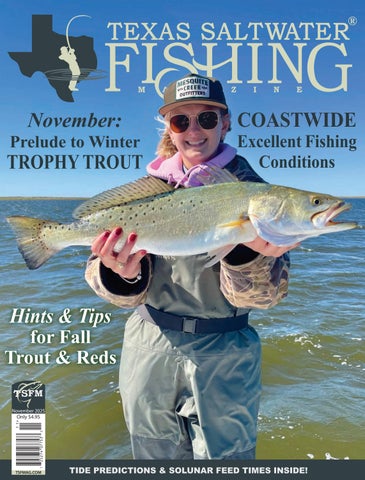
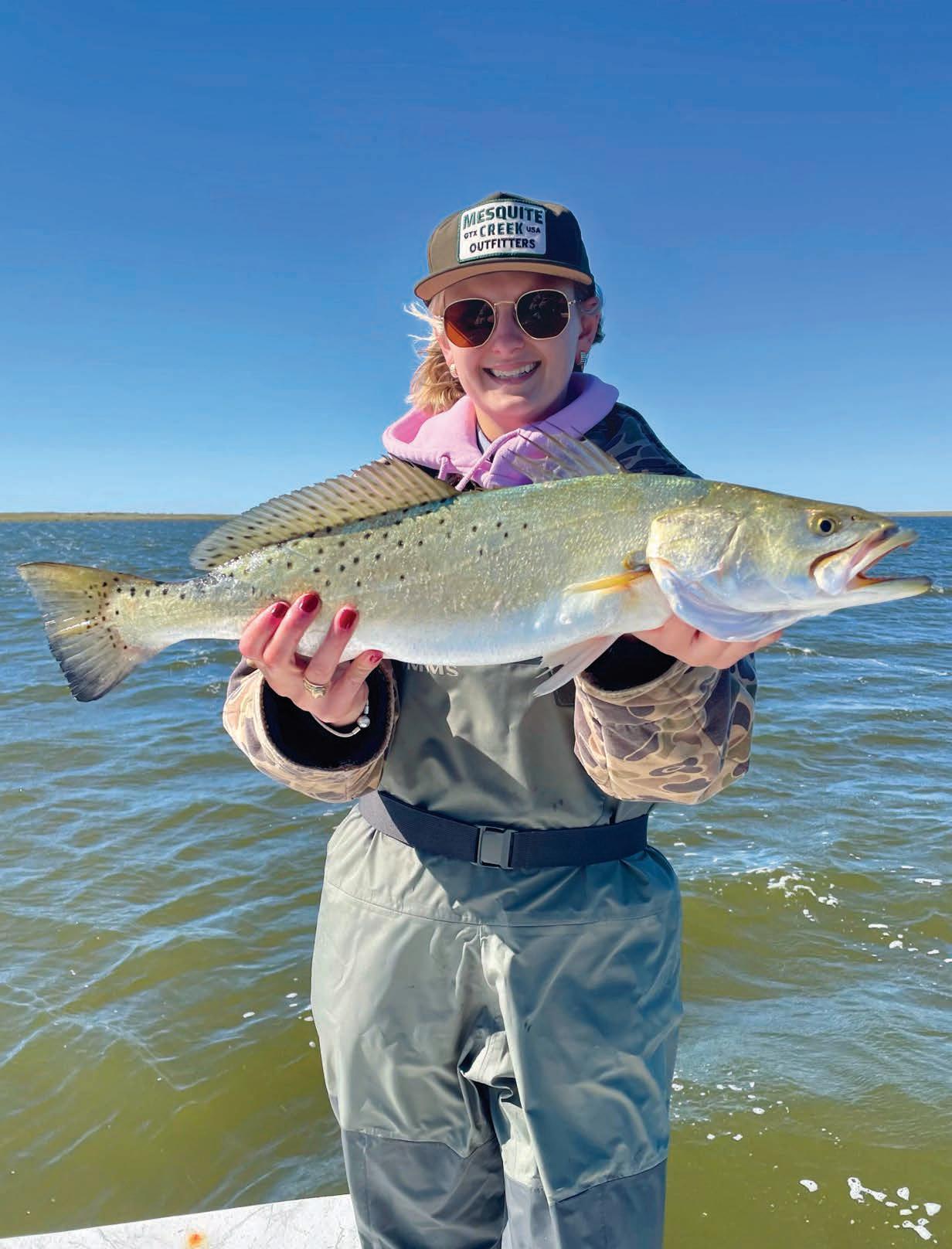
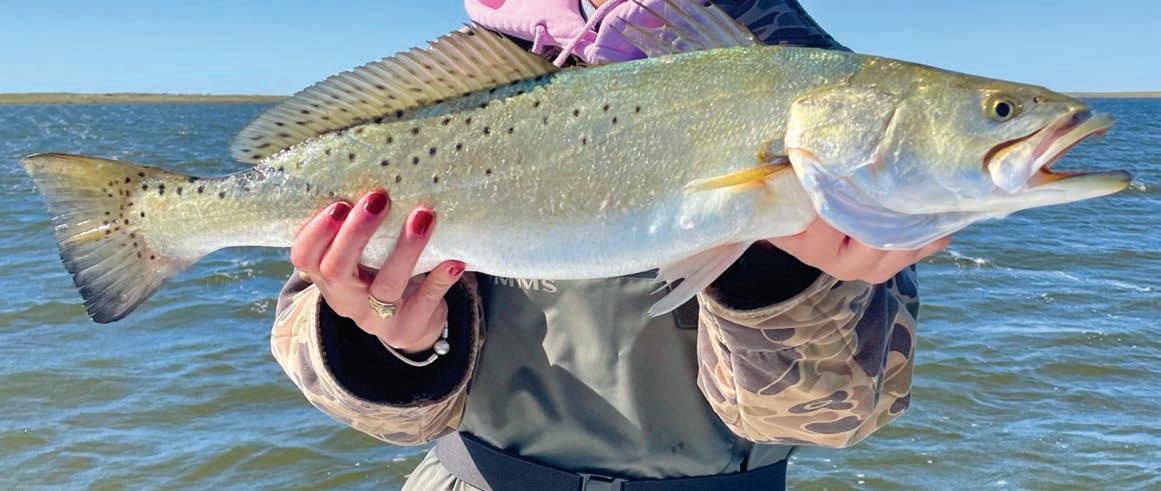
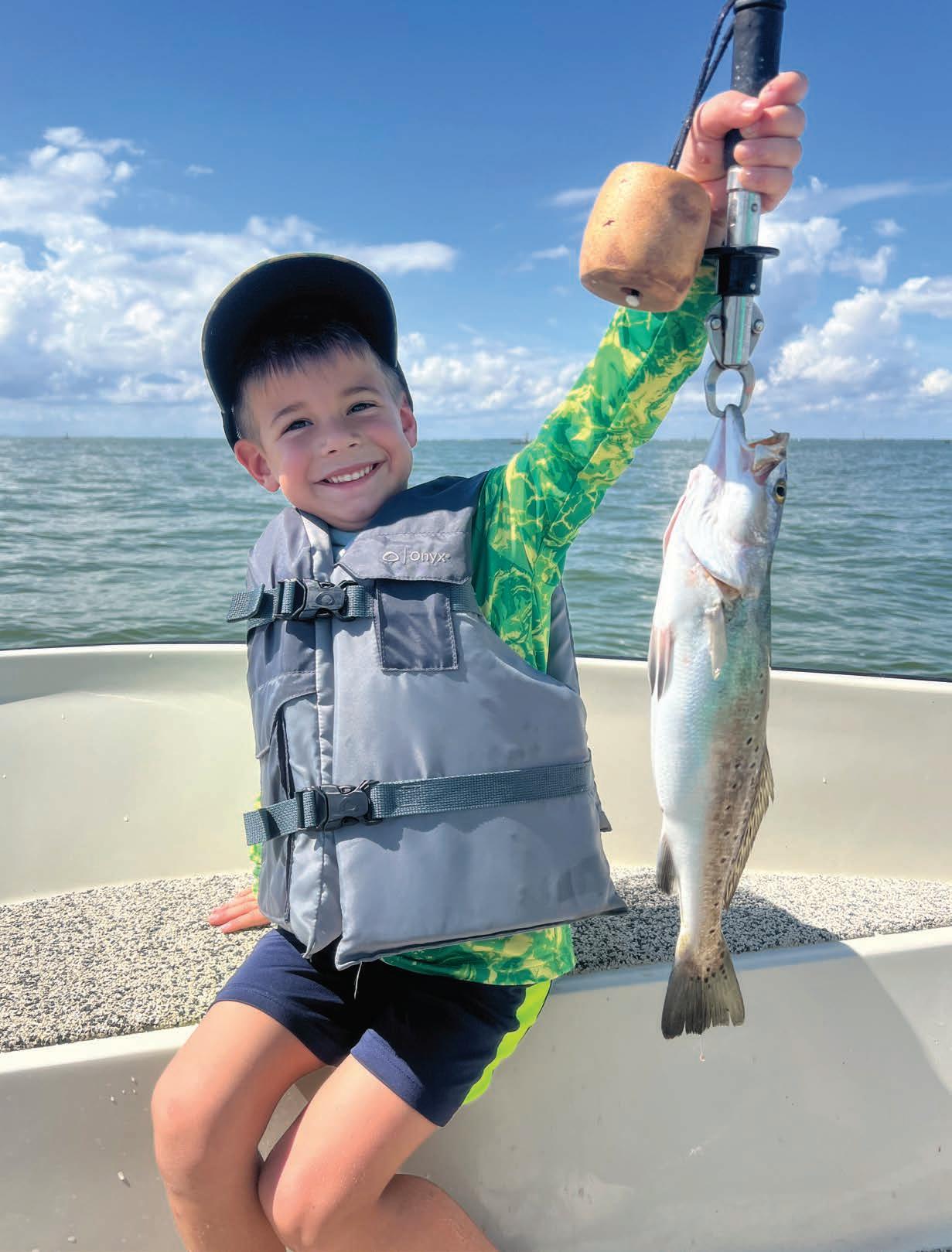
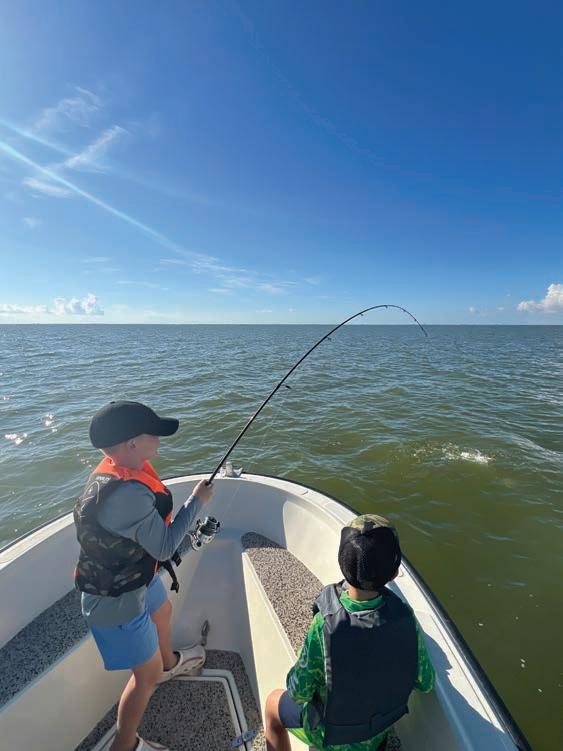
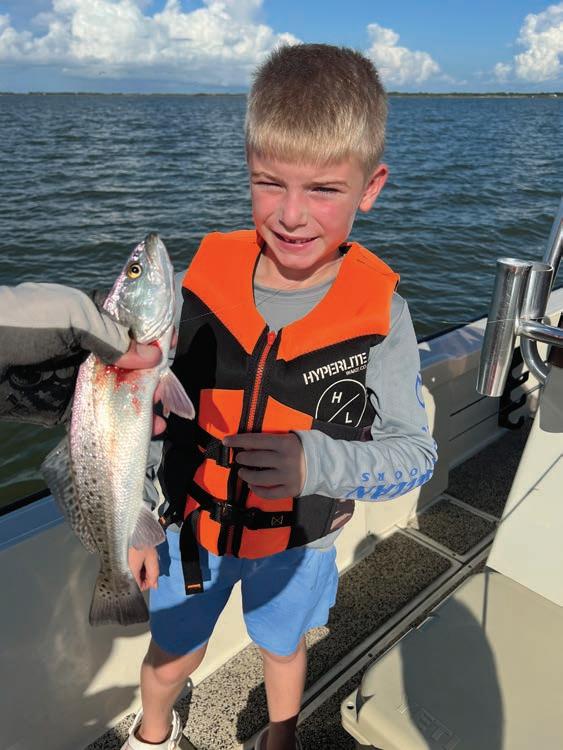
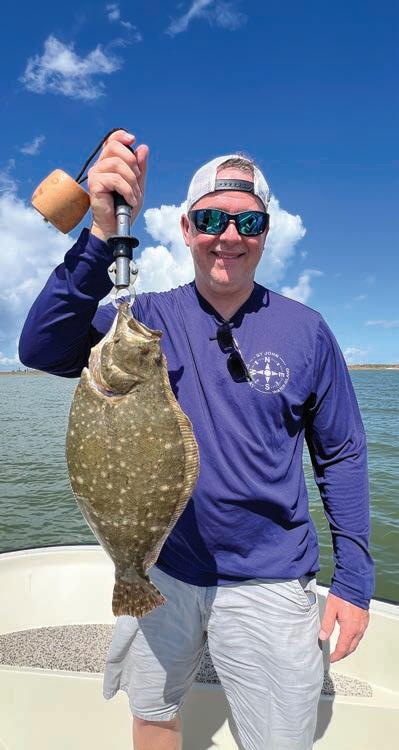
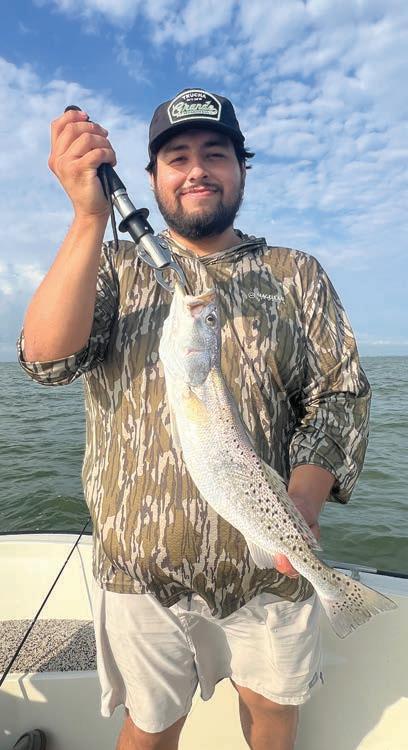
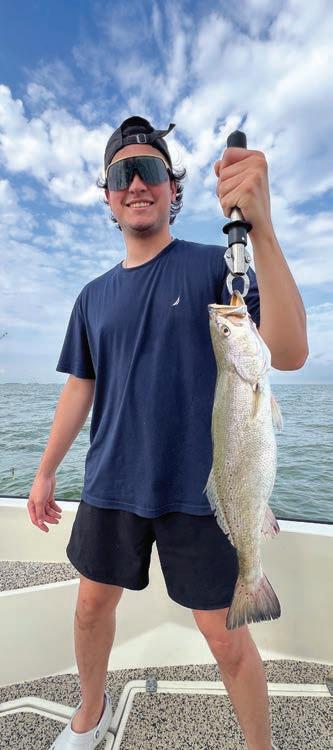
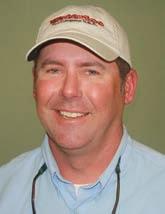
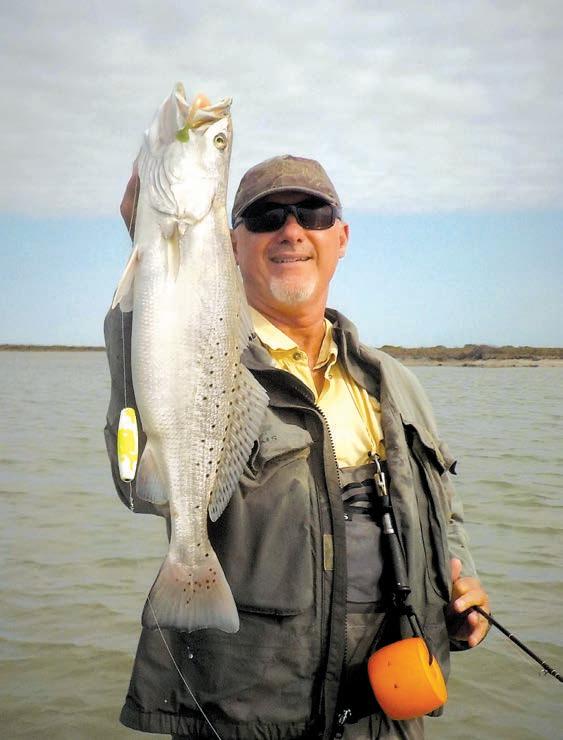
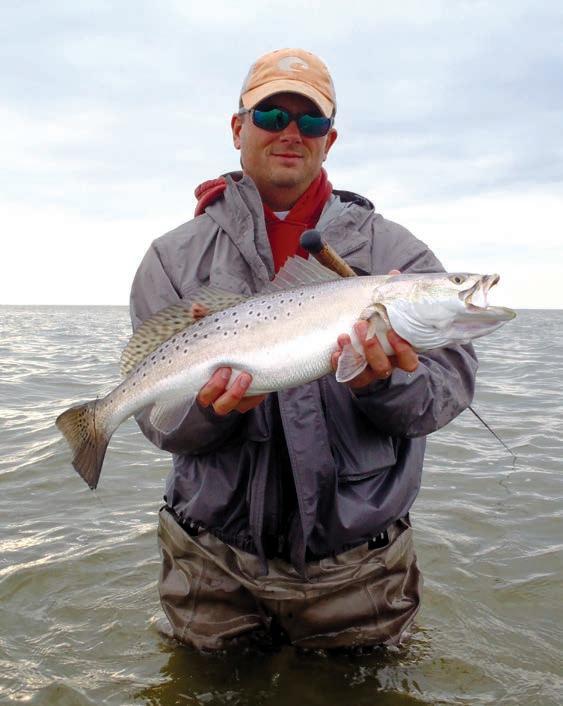
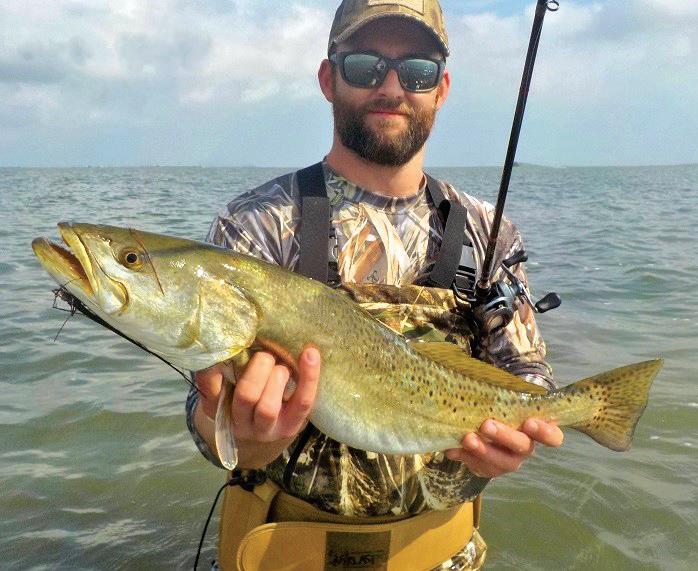
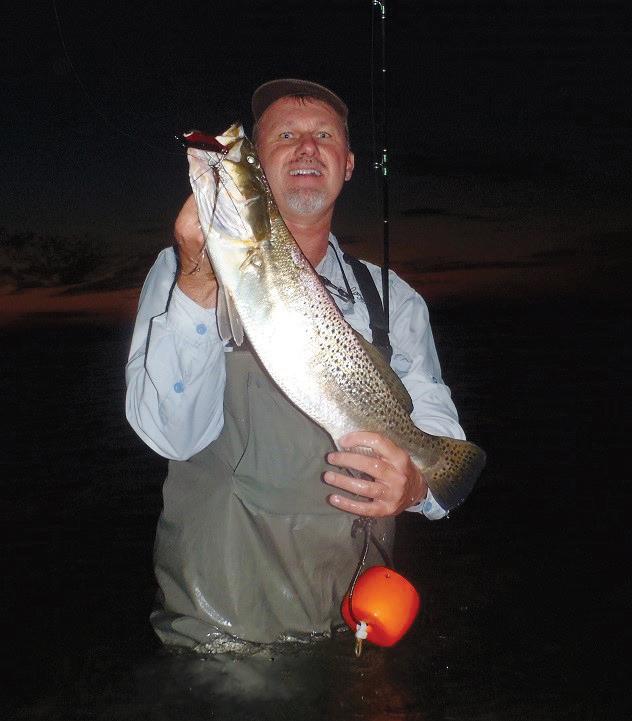
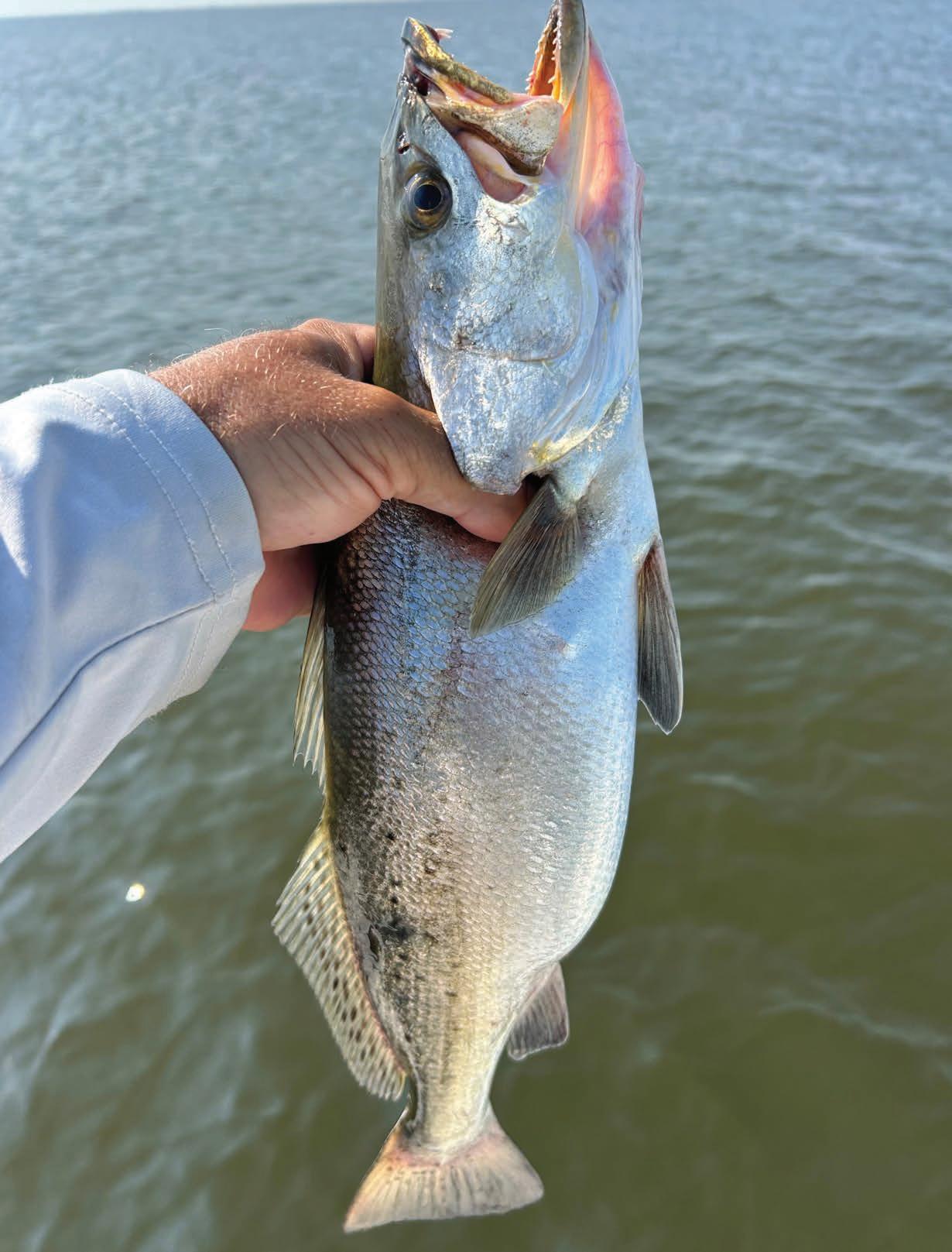
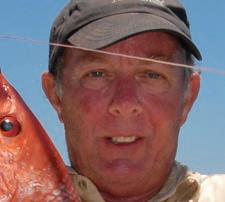
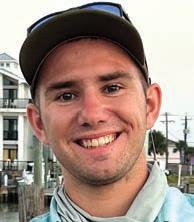
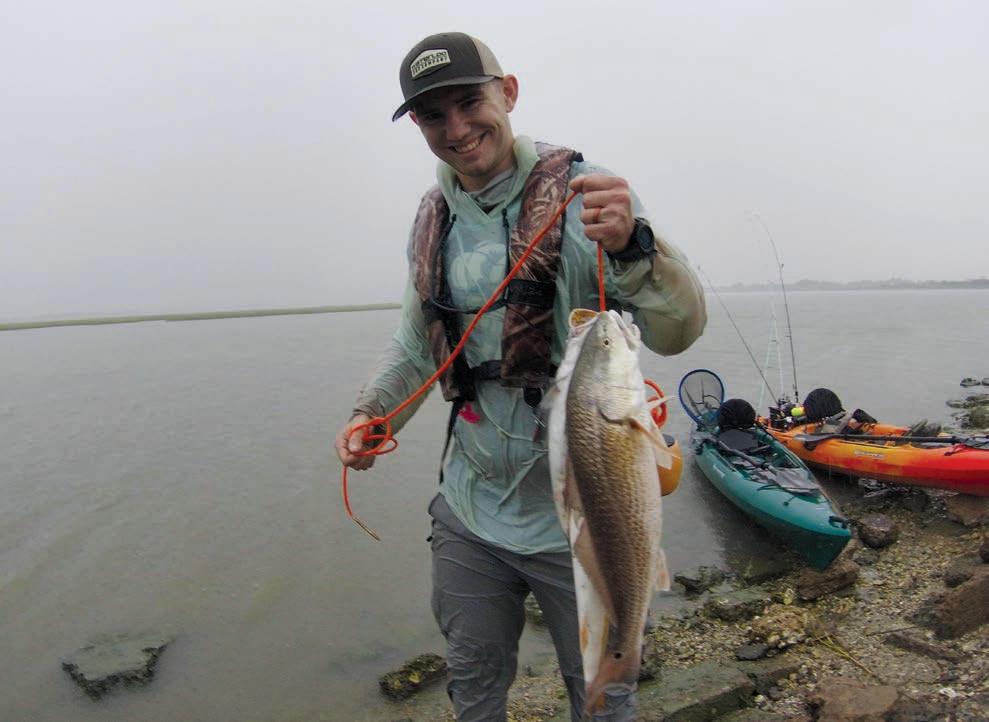
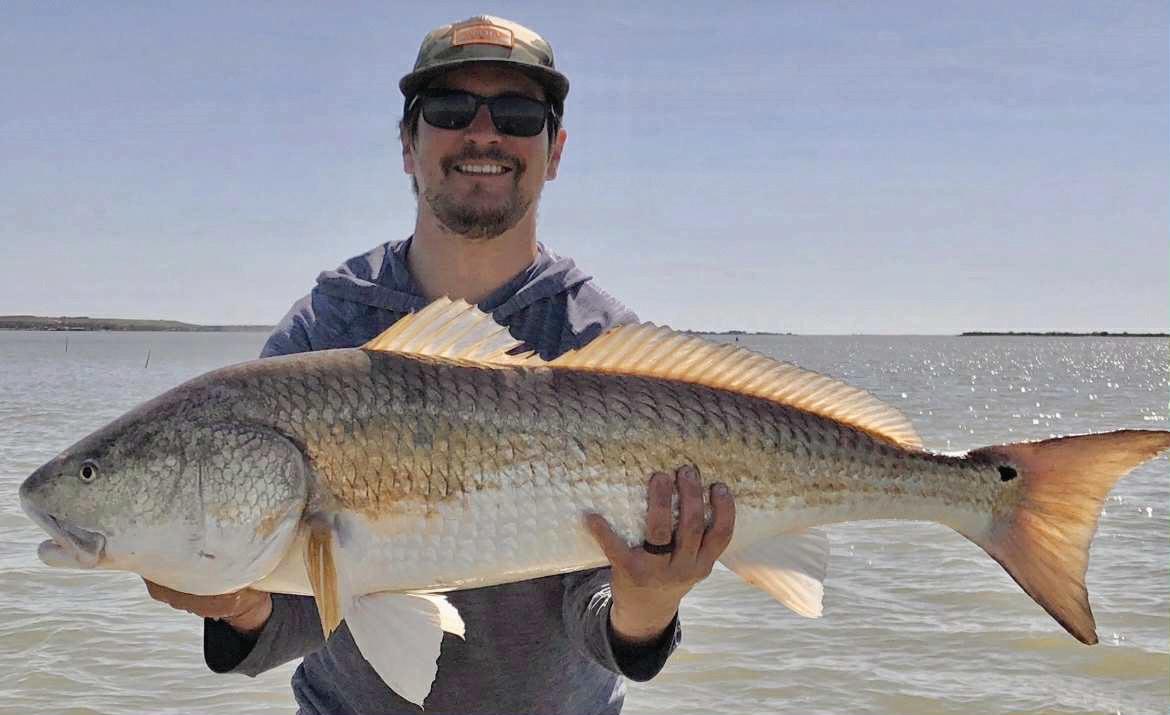
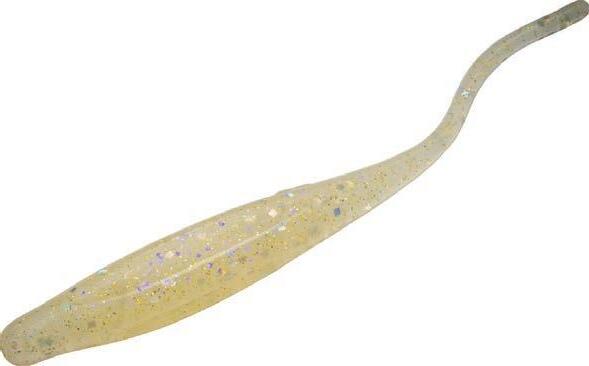
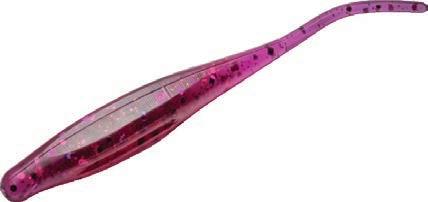
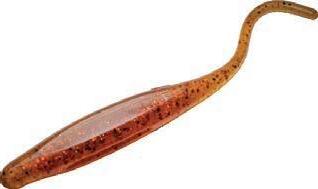
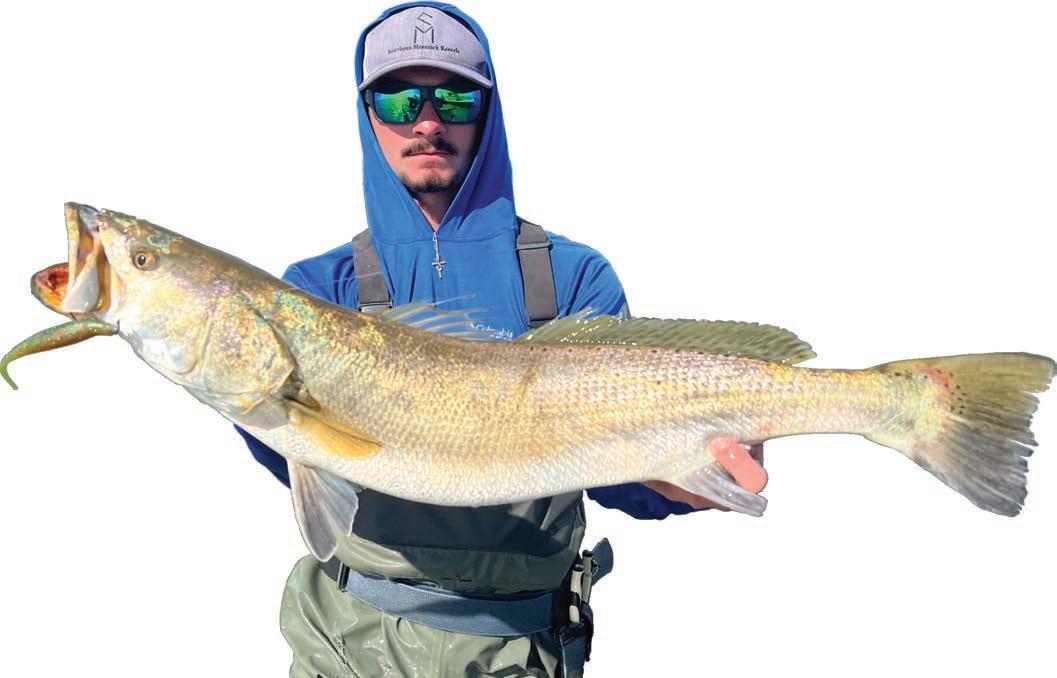
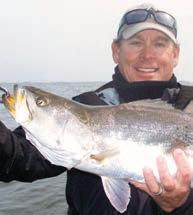
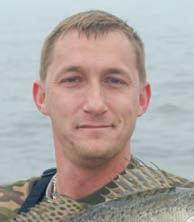
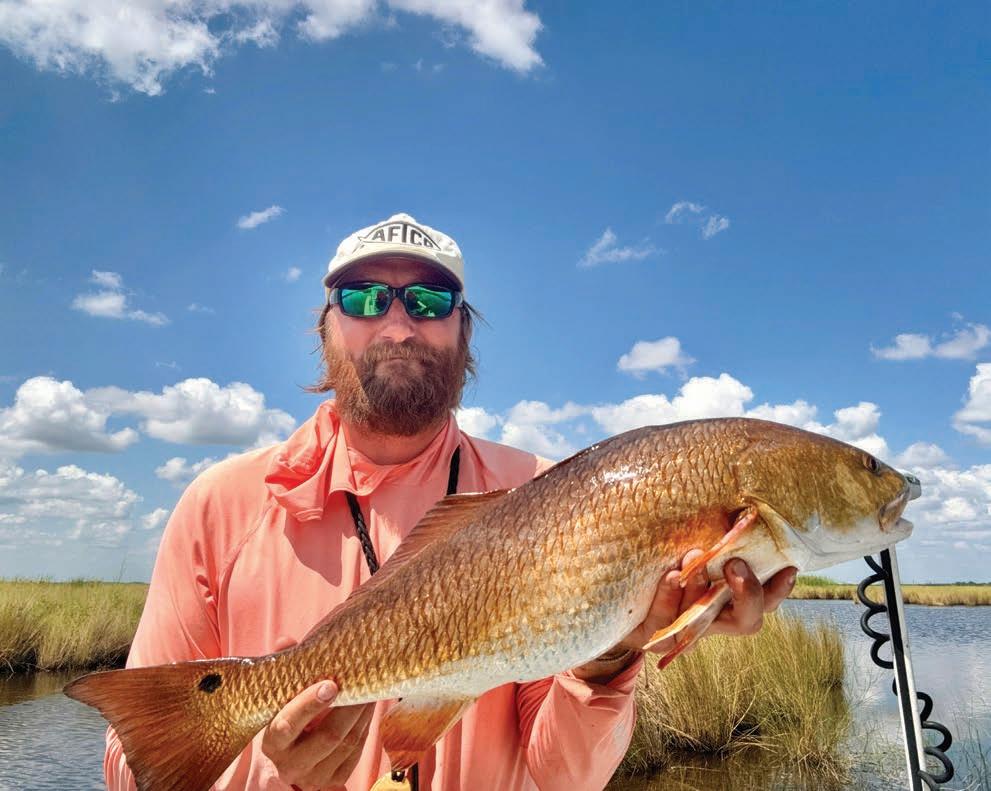
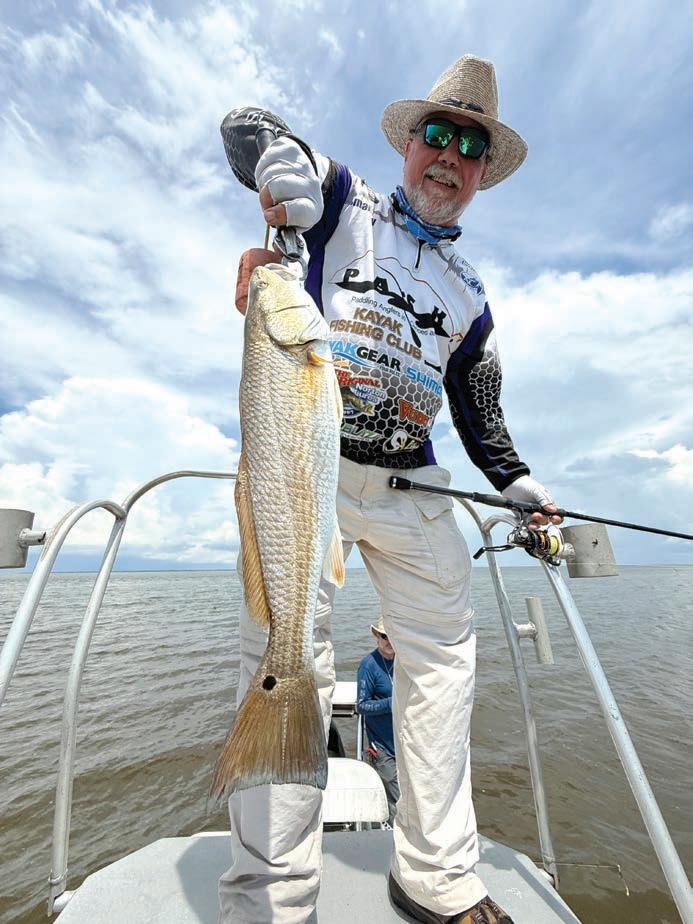
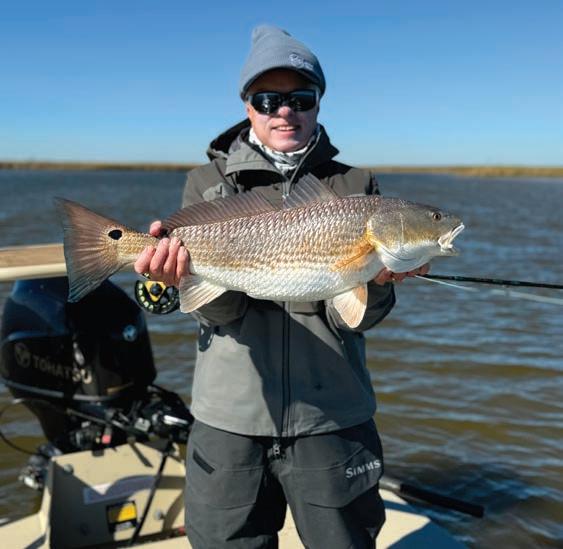
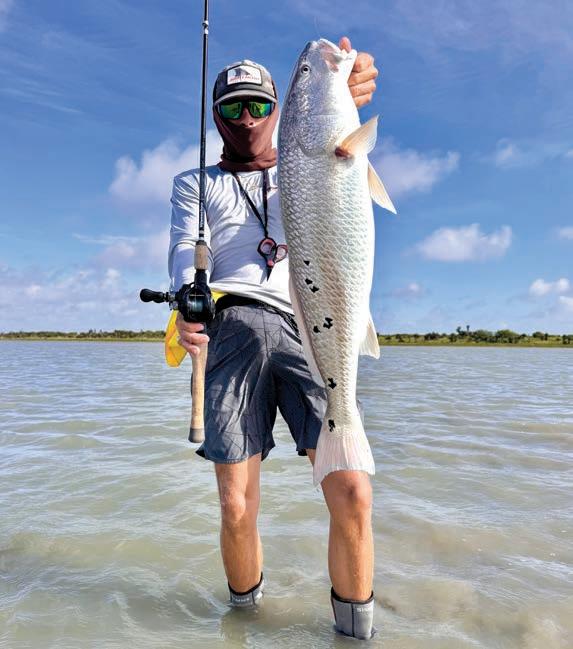
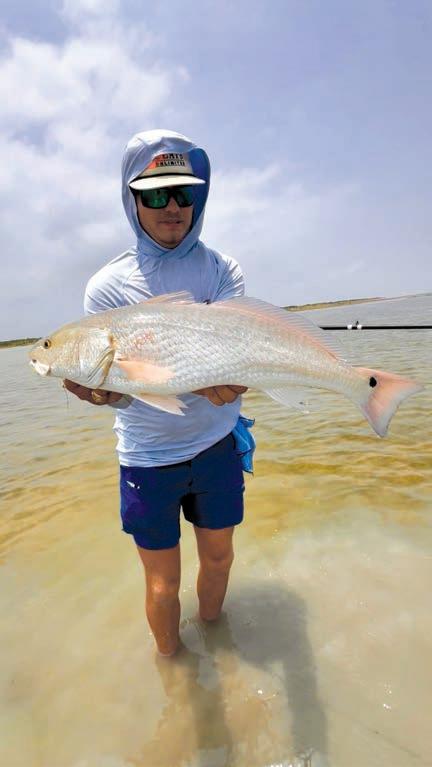
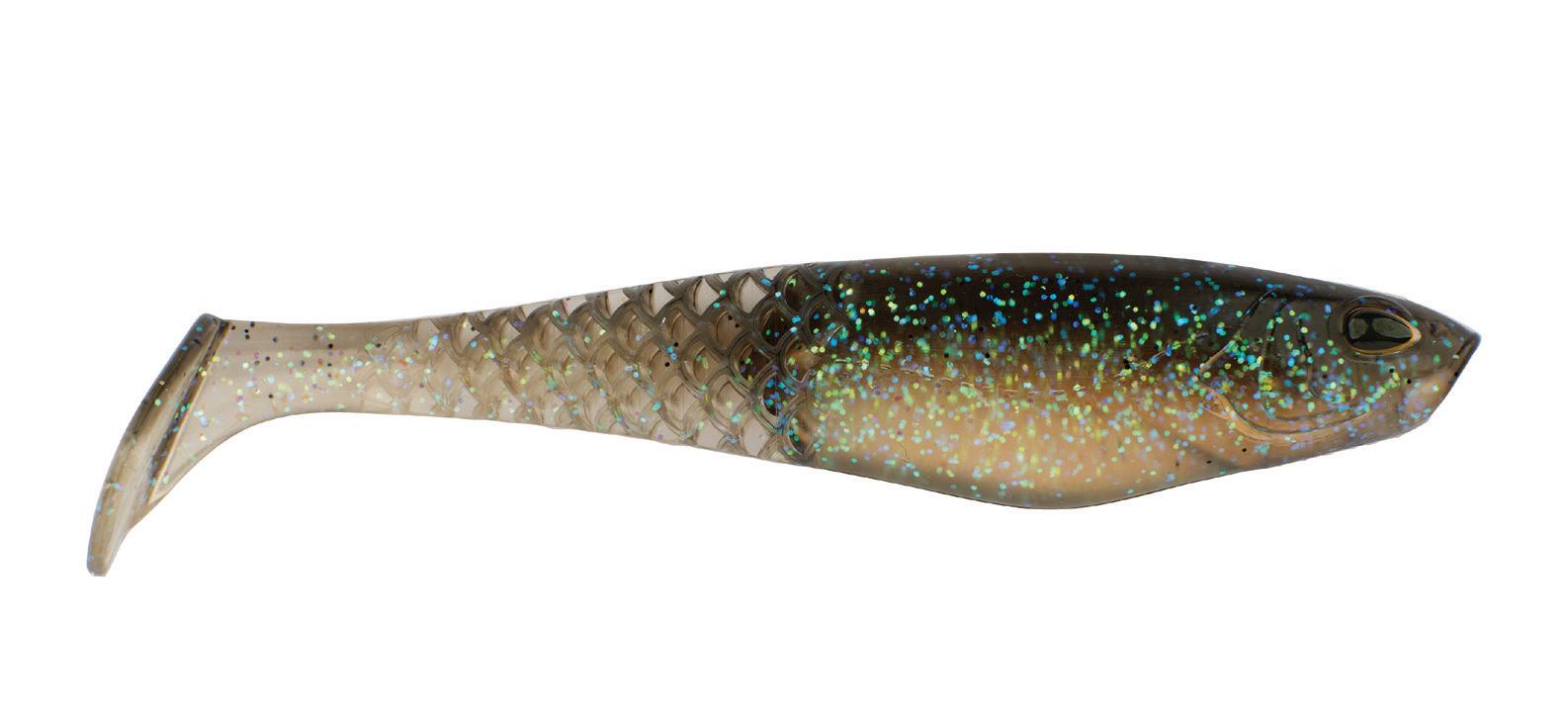
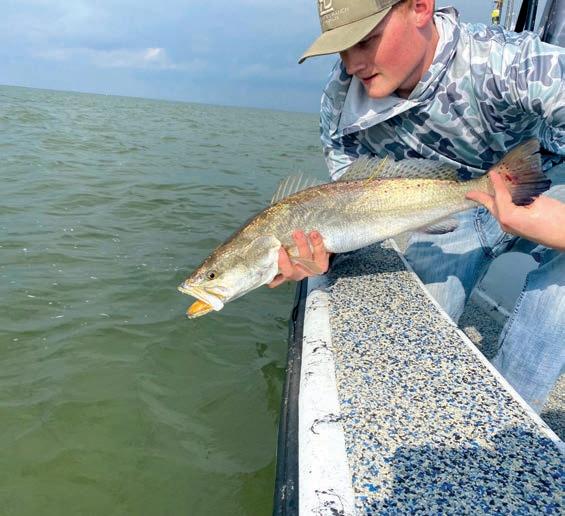
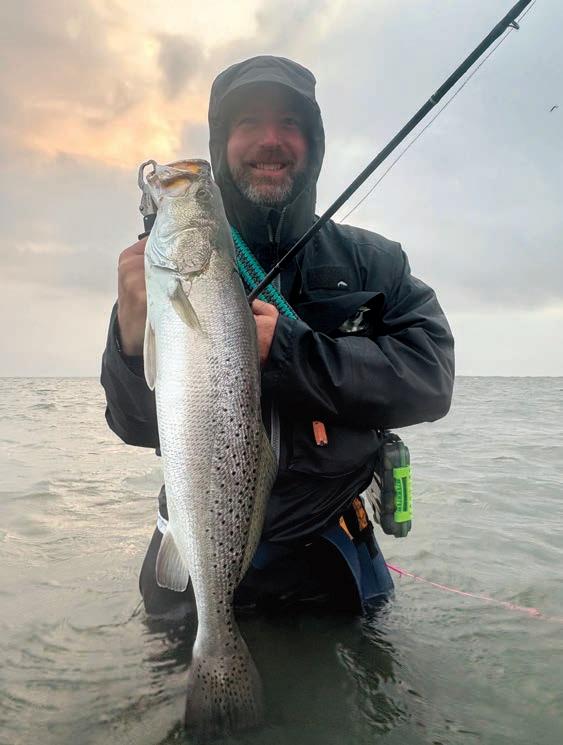
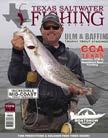
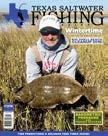
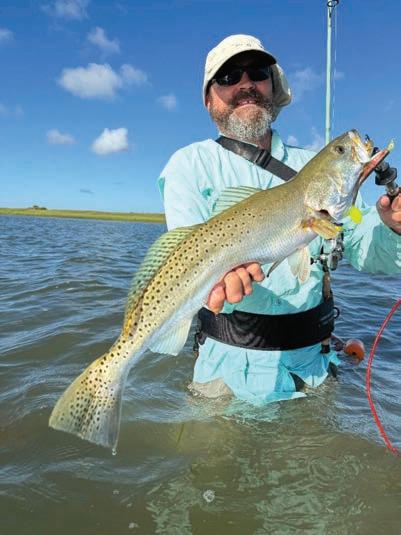
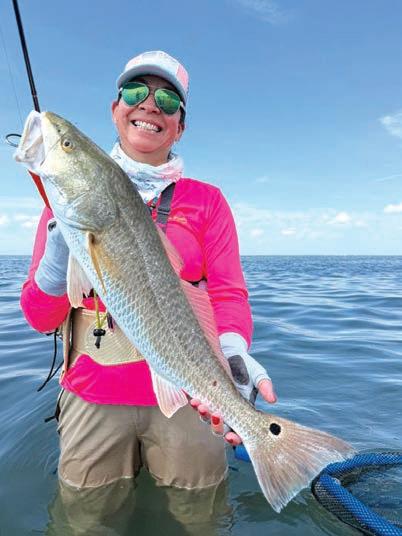
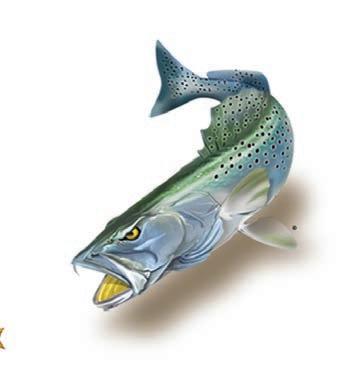
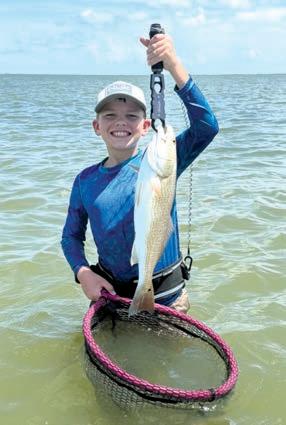
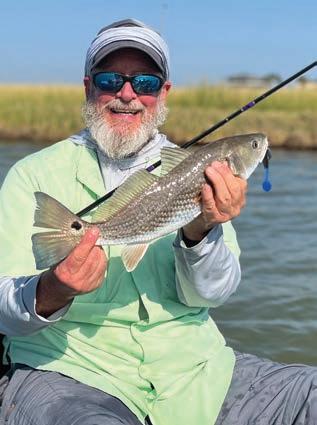
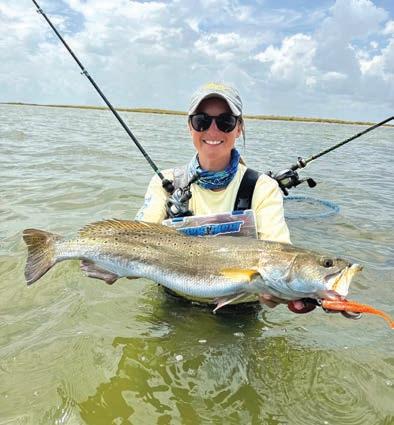
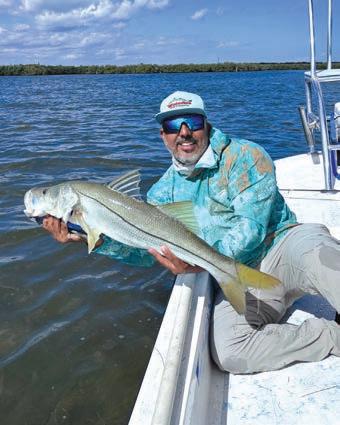
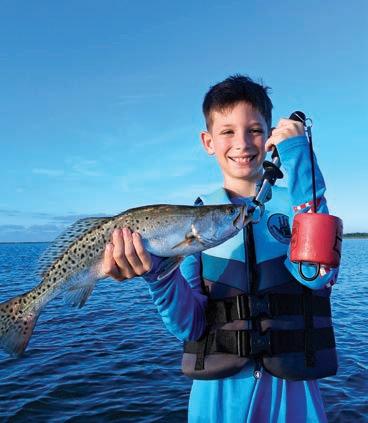
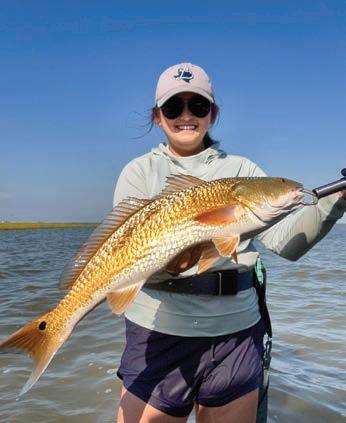
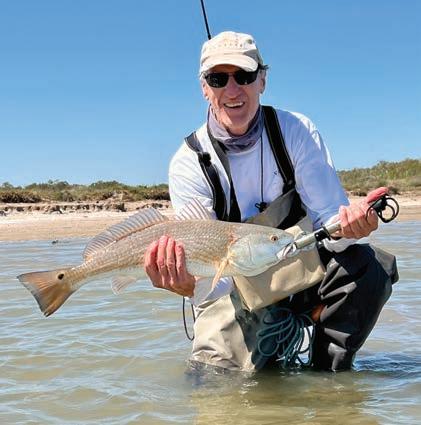
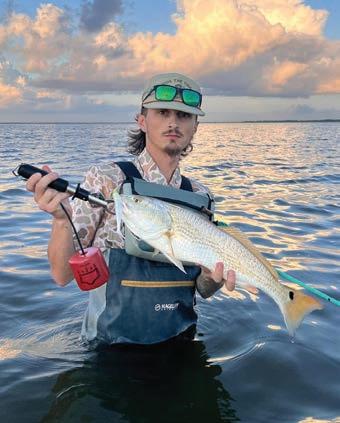
Carson Crisp is our November cover angler and she’s showing off a beautiful speck she landed while drifting a Port O’Connor back-lake last fall with fiancée, Taylor Nix. Carson tricked her prize with her favorite lure – Purple Reign Down South Super Model. Congrats on accomplishing a
EDITOR AND PUBLISHER
Everett Johnson | Everett@tsfmag.com Office 361-785-3420 Cell 361-550-3637
VICE PRESIDENT
PRODUCTION & ADVERTISING DIRECTOR
Pam Johnson | Pam@tsfmag.com Office: 361-785-3420 Cell: 361-550-9918
PRODUCTION / SOCIAL MEDIA DIRECTOR
Jennifer Shive | Jen@tsfmag.com
ADVERTISER REPRESENTATIVES
Bart Manganiello | bartalm@optonline.net
Pam Johnson | pam@tsfmag.com Office 361-785-3420 Cell 361-550-9918
Everett Johnson | everett@tsfmag.com Office 361-785-3420 Cell 361-550-3637
Texas Saltwater Fishing Magazine is published monthly.
Subscription Rates: One Year (Free Emag with Hard Copy)
Subscription $32.00
E-MAG (electronic version) is available for $15.00 per year. Order on-line: WWW.TSFMAG.COM
MAKE CHECKS PAYABLE TO: Texas Saltwater Fishing Magazine Attn: Subscriptions P.O. Box 429, Seadrift, Texas 77983
* Subscribers are responsible for submitting all address changes and renewals by the 10th of the prior month’s issue. Email store@tsfmag.com for all address changes or please call 361-785-3420 from 8am - 4:30pm. The U.S. Postal Service does not guarantee magazines will be forwarded.
I gotta tell ya, I’m as excited as a kid at Christmas, and November is still a couple of weeks away. November is always a special month for me–great weather, great fishing, and hunting season. The whistle of wings across the decoy spread in predawn light has the same effect on me as the grunt of a rutting whitetail or a bugling bull elk. It stirs something deep within our soul-kinda the way a big trout crashes a topwater and threatens to yank the rod from your hands. And then comes Thanksgiving.
I have to chuckle every time I tell this story. It was November, maybe 1999, just Josh and I in the Matagorda Island marsh. He pleaded with Pam to let him skip school and join me for a weekend at Fish Camp. He might have been in seventh grade–plum eat up with fishing and hunting–the way every boy that age ought to be. We had just finished a duck hunt and were hoping for a redfish for our lunch. He was on the bow of the airboat throwing a chartreuse Top Dog, equally intent on eavesdropping my telephone conversation.
A nice redfish had found the Top Dog and was swimming toward us, although Josh was not yet aware. As I ended my phone call he turned back to his fishing.
“Hey Look,” he shouted. “There’s a redfish and it has a Top Dog. Just like mine. IT IS MINE!” Everything happened in a blur after that. He was trying to set the hook with a bunch of slack in the line, reeling frantically and jerking the rod like he was having a seizure. He finally came tight with the fish that miraculously managed to stay hooked; which was a stroke of luck. And that was when he took one final step backward and ran out of deck–and luck.
Knee-deep in marsh mud–waist-deep in water–redfish doing its best to get the Hell out of Dodge. The look on his face was as priceless as the redfish lunch was delicious. We lazied around camp till about 4:00 and then headed down to Welder Flats for another redfish.
Perusing all the material our writers sent in for this issue has the hair standing on the back of my neck, and I pray it does the same for you. I hope you will find time to make some memories of your own this month. And by all means, take a kid fishing.
That young boy that tumbled off the bow of my airboat is on the water with his own family today. Just the way it ought to be.
Happy Thanksgiving and God Bless!
Carson Pawlik’s first trout fell for a Saltwater Assassin Sea Shad in the Opening Night color.
Control Your Fish!
STORY BY STEVE HILLMAN
Ititled my article last month, Giving Ourselves the Best Chance for Success, I talked about areas to target, useful techniques, choosing the right gear and lure selection, to name a few topics to consider. Staying within a reasonable word count often proves to be a challenge for me, not only when writing but apparently when speaking, too! Just ask my wife or any of my friends. It’s not that I’m a motor mouth, I just believe in being very thorough. This said, there was another important topic that I wanted to discuss last month but simply ran out of space. When I was in marketing years ago we called it, “closing the sale.” In the world I live in now I guess we could call it, “landing the fish.”
We spend so much time and effort trying to locate fish and then we use precisely the right tactics and lures to trick them, only to sometimes lose the battle because we made a single wrong maneuver when fighting a trophy fish. This is maybe a more common issue in the nearshore and offshore world with tarpon and billfish but I’ve witnessed it plenty of times with big trout. Hell – I’ve done it myself, and more than once!
I was with my friend, Walt Kalinowski, back in 2009 (I think). Walt had been on some good trout down in Baffin Bay and we needed some footage for some instructional videos that we were helping create at the time. We had caught some decent trout early and Walt decided to make a move to another area that had recently coughed up a few above average trout. Our good friend, Jeff Lankford, had joined us to add another top notch fish-finder in the mix. We all jumped out on a shallow flat and headed in different directions, armed with the lures that each of us felt in our minds were best-suited for the conditions, time of year (March), and the size of trout we were targeting.
I was chunking a MirrOlure Paul Brown Corky Devil in amber with limetreuse tail. We were all catching solid trout up to 6 pounds. After about an hour into our wade, the wind had kicked up to 18 knots or so, causing the water to become streaky (which I love, by the way). I told the camera guy to come with me and that I saw a well-defined mud streak on the inside of the sandbar with mullet flipping in it. We walked down the flat. I fired off a cast along the edge of the streak where the clear water met the turbid water. After a couple of cranks and twitches my Devil got t-boned hard! It was just a drive-by, however. She evidently missed it. I worked the
lure all the way back to me in the waist-deep water where I stood, and then ripped another long cast into the high-percentage area where I had just gotten bit. I let the Devil settle and then reeled a few cranks, which I followed a few seconds later with a couple of short, upward pops before allowing it to settle again. BAM! This trout literally almost took the rod away from me! My hookset was textbook. My drag was set perfectly. The camera was rolling and everything was unfolding almost like it was scripted…until it wasn’t.
The back story goes like this; I had already caught at least one trout over 8 pounds that morning, maybe two, and had trouble getting the Boga Grip on them, so I had to wear them down enough to grab them with my hand or cradle them against my waist. However, this trout was no 8 pounder. Nor was she a 9 pounder. This trout was larger than any speck I had ever seen dead or alive AND IT WAS ON MY LINE! As I’m fighting her she swam straight toward me and then ripped off about 20 yards of line in the other direction. I saw my line rising to the surface. As she jumped like a tarpon, I pointed my rod toward her with my rod tip in the water, hoping to keep her from getting airborne and spitting the hook. I’d done everything right up until this point.
The water temperature was still cool and I hadn’t been fighting her for very long at all, so she was still green. As she came back towards me for a second time I eased my left hand down upon her back then slid it up towards her gills. However, there were two problems. She wasn’t even close to being ready yet and she was too thick to grab with my hand.
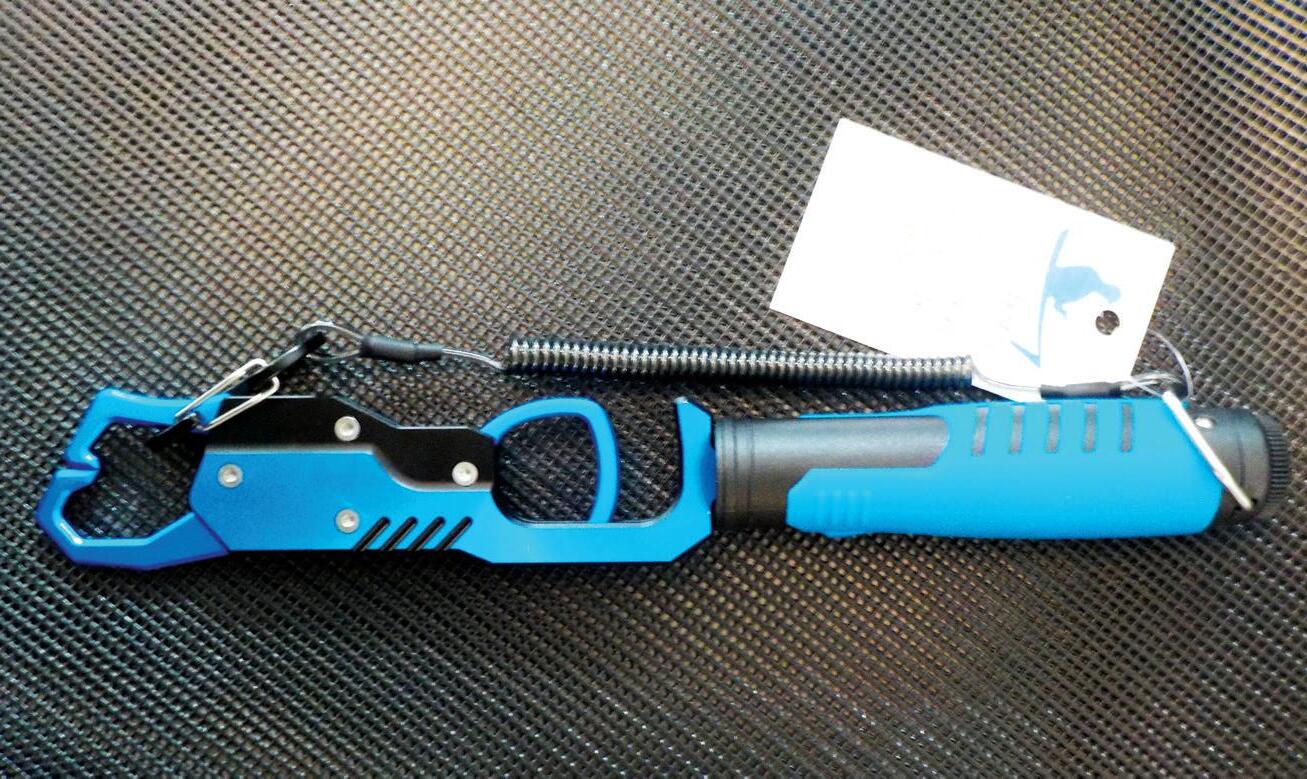
I cannot grab a basketball with one hand and the girth of this giant of a trout made me feel like I was literally trying to grab a basketball. She shot sideways when I tried to grab her. My Boga Grip was clipped to the D Ring on my wading belt, and as this 10-plus pound trout swam to my right the knot that joined my leader to my main line got hung up in the Boga Grip. In what seemed slow-motion, I watched the line break and my would-have-been lifetime best trout just sat there, not quite realizing she was free. My heart sank as she swam away. I was sick and I’m still sick to this day because I feel like I will never have a chance at a trout like that again.
It’s not uncommon to get nervous when fighting a giant trout. It’s like seeing a huge buck when we’re hunting. I got a raging case of buck fever while fighting the biggest trout of my life and it cost me dearly. I brought her in prematurely. She was hooked well. I should have worn her down and then clipped my Boga onto her jaw. I learned a valuable lesson that day that has helped me land countless solid trout since. Stay calm and don’t bring the fish in until she’s ready.
There are some mistakes I’ve seen clients make when fighting a fish.
• Old line - Please make sure you have fresh line on your reel, especially when using monofilament. I can’t tell you how many times I’ve seen folks have a fish break off because of old line.
• Moby Dick Syndrome - One of the most common mistakes I see is when folks pump up and down on a trout like they’re fighting a marlin. When someone pumps up and down, they
It didn’t take Eli Pawlik long to master the proper techniques of fighting fish!
Eli with his first trout!
will often lose the fish because the lines gets slack in it as they come down allowing the hook to back out. Keep your drag set properly and keep tension on the fish and you’ll have better success landing them. Don’t “Moby Dick” it! Fight it with the rod at about a 45 degree angle unless it wants to breach the surface and go airborne. In that case quickly point your rod tip toward the fish (bow to it).
• Too Fast & Too Far – Sometimes it’s difficult especially for newbies, but we have to learn to control our level of excitement when fighting a trout. I had a young man on my boat the other day that not only reeled his trout in like he was in a NASCAR race, but he reeled it all the way to the tip of his rod. Again, we must relax and leave enough line to allow the fish to stay in the water before netting it or grabbing it.
• Don’t let her have her way with you – We hook quite a few large redfish while we’re fishing for trout. They love to take customers around the boat. They seem to know exactly where the trim
Staying In Control
tabs, trolling motor and lower unit are! The key to landing these fish when drifting is to go where they go. If the fish is swimming quickly towards the stern then you move quickly to the stern, all the while holding your rod out away from all the accessories that are attached to the stern. Once the fish starts wearing down you can put more pressure on it and lead it to the net. It’s the angler’s job to lead the fish to the net. The person netting the fish shouldn’t have to use Bruce Lee moves to net your fish. All of the articles I write are from my own personal experiences as well as observations of clients on my boat. I do my best to offer advice, not only on the water but through this fine publication to hopefully provide clients and/or readers, something that will make them better at the sport of catching fish. Now let’s go catch some fish…but remember to keep them under control!
STEVE HILLMAN
Steve Hillman is a full-time fishing guide on his home waters of Galveston Bay. Steve fishes the entire Galveston Bay Complex, wading and drifting for trout, redfish, and flounder using artificial lures.
Phone 4 09-256-7937
Email captsteve@hillmanguideservice.com
Web w ww.hillmanguideservice.com
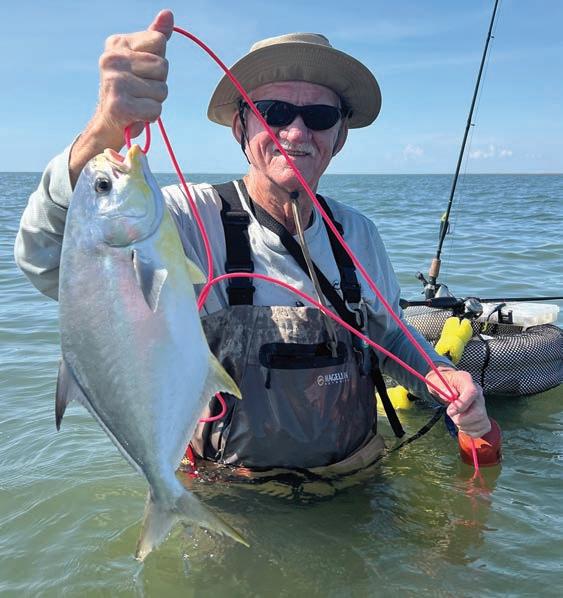
We’re catching more and more flounder lately, like this nice one Mike Little tricked.
Cesar Medina is a true student of the sport and it certainly showed!
Not bad for Robert Atkinson’s first trout!
Angling
is a Game
STORY BY KEVIN COCHRAN
We often think of the terms sport and game as interchangeable. I often do, but I also acknowledge the differences between these two things. When defining a particular activity as either a game or a sport, I use a basic standard. If a woman can be the best in the world at an activity, it’s a game. If a woman cannot be the best in the world, it’s a sport. This works with almost all well-known activities within these two realms.
Track and field is clearly a sport, more accurately, a collection of sports. Because all its events require competitors to display ample strength and power, and because precise times and distances determine the winners, a man will be the best at each and every event. I don’t make this statement to denigrate the performances of splendid female track athletes, some of whom I rightly admire.
Sydney McClaughlin-Magrone is simply amazing. The event she runs requires a combination of speed, strength, agility and stamina, and she dominates it like few other athletes in any sport.
Much faster than any other woman who’s ever laced up the spikes and cleared all the hurdles over 400 meters, she resembles a cheetah and stakes her claim as a female GOAT, but she can’t complete the lap faster than the fastest man on the planet.
Similarly, female sprinters run faster than almost all the men in the world, but they can’t keep up with the fastest man, nor can they threaten the lightning-fast historic times of Usain Bolt. The same can be said of female champion throwers, jumpers and pole-vaulters. They’re great, for women, but they cannot outperform the best men in the world in these events.
This same truth applies in most of the other major sports played by both men and women, including soccer, basketball, volleyball, swimming, skiing, cycling and many more. Because all these activities involve so much athleticism, specifically strength, speed and power, men will always rise to the top in them. The reason is crystal clear; men are bigger and stronger, on average, also in the extremes.
If success in an activity relies heavily enough on physical prowess, it’s a sport. If mental aspects play more important roles, it’s probably not, at least according to the standard by which I define these things. This means billiards is a game. Though it requires acute hand-eye coordination, moving the balls around deftly requires little strength and power, so it’s entirely possible a woman could become the best billiards player in the world. Perhaps she already has. I don’t know; I’m not a billiards historian.
I do know modern statisticians have proven one thing about golf, an avocation I find harder than most to label as either a sport or a game. According to the number crunchers, the best putters on the LPGA Tour make a higher percentage of short putts than the best male PGA players. This doesn’t surprise me at all. Putting closely resembles billiards. Good putters rely on hand-eye coordination, grace under pressure, confidence and feel. The activity requires minimal athleticism.
The same cannot be said for the other components comprising golf. The best male golfers drive the ball much farther than the best females, and their superior power also allows them to wrench the ball out of tall grass easier than the women. While an iconic female player like Annika Sörenstam could likely have survived and made a living
is a sport, not a game.
Putting, then, is a game embedded within the sport of golf. This confuses what at first seems like a simple concept. Furthermore, because golf requires so many different types of skills, it becomes more than just a sport containing a game. In some way, it’s an artform, built on a foundation of athleticism, enhanced by creativity, imagination and grace.
The same might be said about another famous activity, one bearing a broad label – gymnastics. Like track and field, gymnastics includes several different activities, and the lists of events differ for men and women. Surely, the men can do many things the women can’t, but the opposite is also true. Completing an exercise on the rings requires impressive upper-body strength. Men do things on the apparatus that make them appear almost super-human. The best female gymnasts in the world can’t begin to compete with them in this specific event.
Nor can the men tumble and flip on the balance beam like the women. Apparently, the best female gymnasts have better balance than their male counterparts; perhaps they have steadier nerves, as well. Few things in the world of sport require participants to show such bravery while performing. While the feats performed by the best gymnasts on the narrow beam clearly require ample athleticism, the performers look like hybrids while they tumble, part athlete, part artist.
In the form of dance, artistry plays a lead role in another of gymnastics’ feature events. Debating whether men or women perform better floor routines is difficult, always bringing in biases and
playing the PGA Tour, maybe even winning an event or two over the course of her career, she had no way of becoming the best golfer in the world. So golf
Dangling a soft plastic under a cork can solve a tough bite in November, or any other month.
Jason King with a fat trout caught during cool November weather, when the fishing for big trout often perks up south of the JFK Causeway.
subjective beliefs. No man can do some of the things Simone Biles can do, nor can she do some of the things the top men can. Most observers would assert the women look more graceful and elegant doing their floor routines, and most would agree the men look more powerful in parts of theirs. Since all events in gymnastics require judges to assign numbers to performances, eliminating all subjectivity from the events is impossible.
I’d say gymnastics as a whole is something of a unicorn. Because some of the events place such emphasis on balance and graceful agility, women perform better than men, despite the fact the events do require plenty of athleticism. Each event comprising gymnastics is more a sport than a game, so some don’t fit my basic definition of the term sport. These events also include plenty of artistic components, as does diving, another activity which stretches the validity of my method of defining these kinds of things.
In addition to athleticism, gymnasts, golfers and divers display grace under pressure, creativity and imagination. The same can be said about people who fish with serious purposes. Fishing resembles two of the aforementioned activities in a basic way. Like track and field or gymnastics, the thing we call fishing includes many distinctly different activities, requiring different types of skills, elevating different types of participants to the top. Certainly, catching panfish on flies requires different skills than winning a battle with a grander marlin from a fighting chair.
The various activities we lump together under the term fishing differ in many ways other than just the size of the fish targeted. For example,
I refer here specifically to fishing with artificial lures. I’d argue fishing activities, and is not truly a sport. Surely, we can call that kind of fishing
acumen specifically related to the species of fish they target.
On average, men show a higher propensity to develop this kind of acumen than women. Generally, boys spend more time playing in the woods, trying to tug crawdads out of the ditch, shooting at birds with BB guns and participating in other forms of interaction with creatures in the great outdoors. Because this is so, more boys reach adulthood with extensive knowledge and a set of accumulated experiences related to the natural world. This hedges the bet in favor of a man becoming the best in the world at a given type of angling.
But this general truth cannot prevent a specific woman, perhaps one who grew up surrounded by brothers or male friends, or one who naturally possesses every bit as much curiosity and interest in the great outdoors as any boy could, from becoming the best in the world at catching a bass, a rainbow trout or a bonefish. The more strategy, guile, finesse and artistry a form of angling requires, the more likely a female will become the best at it. Surely, all forms of angling which target fish of modest size and require minimal levels of athleticism fall into the category of types of angling which might allow a woman to evolve into a GOAT.
KEVIN COCHRAN
Kevin Cochran is a long-time fishing guide at Corpus Christi (Padre Island), TX. Kevin is a speckled trout fanatic and has created several books and dvds on the subject. Kevin’s home waters stretch from Corpus Christi Bay to the Land Cut.
T ROUT TRACKER GUIDE SERVICE
Phone 361-688-3714
Email kevincochran404@yahoo.com Web www.captainkevblogs.com
Justin Morris caught this nice trout in Baffin during a warm spell in November while fishing with the captain.
Fishing the King Ranch Shoreline through the gloaming and into the first hours of night often produces bites from big trout during the Thanksgiving month.
Fat, healthy trout have been much more common as Sabine continues its rebound.
There’s a catchy little tune from the late-90s by one of those one-hit wonder bands that goes, “Ooh, baby it’s making me crazy. How bizarre, how bizarre, how bizarre,” and it perfectly illustrates Sabine Lake fishing in 2025. This has been a most uniquely frustrating year so far because it has had everything but consistency, nothing remotely normal, yet the overall fishing has been surprisingly good.
Many of the tried and true patterns that produce every year have been scrapped for newer ones out of necessity and desperation. I have spent more time this year doing new things and fishing new areas than I ever have in my 30-plus years of guiding on this body of water and it’s been a roller coaster.
Forever I shunned any water south of the Causeway Bridge, unless it was just absolutely the last program available. It was always a hassle to get down there and deal with folks on the jetty rocks. And, for whatever reason, it seemed like every time I did go I broke something. So, I eventually gave up on the idea altogether and stayed up here on my home end and kept doing what I knew best.
Fast forward to 2025 and all the curveballs that it presented. I now stand before you as a changed man. One who has resorted to a whole host of new fishing patterns that are actually pretty dang cool…once you master them.
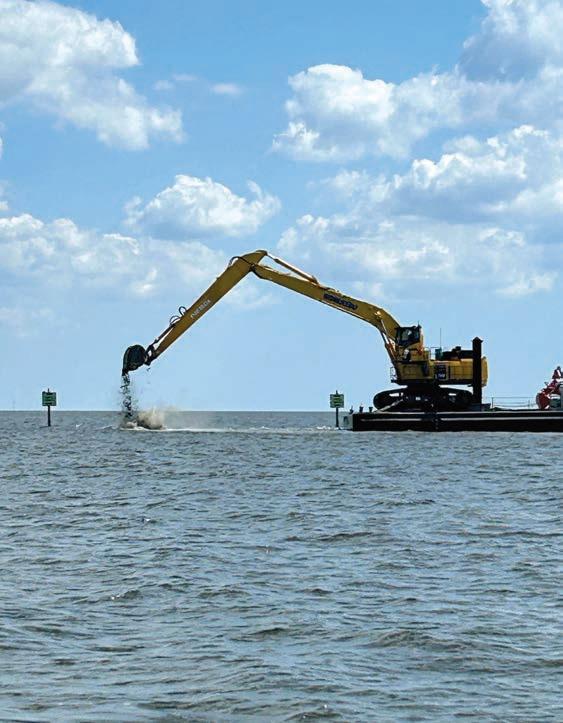
The biggest challenge that Sabine anglers have faced this year has been the constant dredging and pipeline work going on across the lake. A huge gas pipeline is going in and runs from the north end to the south end, almost cutting the lake in half as it enters from the Louisiana marsh in East Pass. The daily dredging and insane amount of boat traffic has wreaked havoc for local fishermen as water clarity and overall travel access are a crapshoot from one day to the next. Due to these activities most folks have migrated towards the south end of the lake where the conditions are less-impacted.
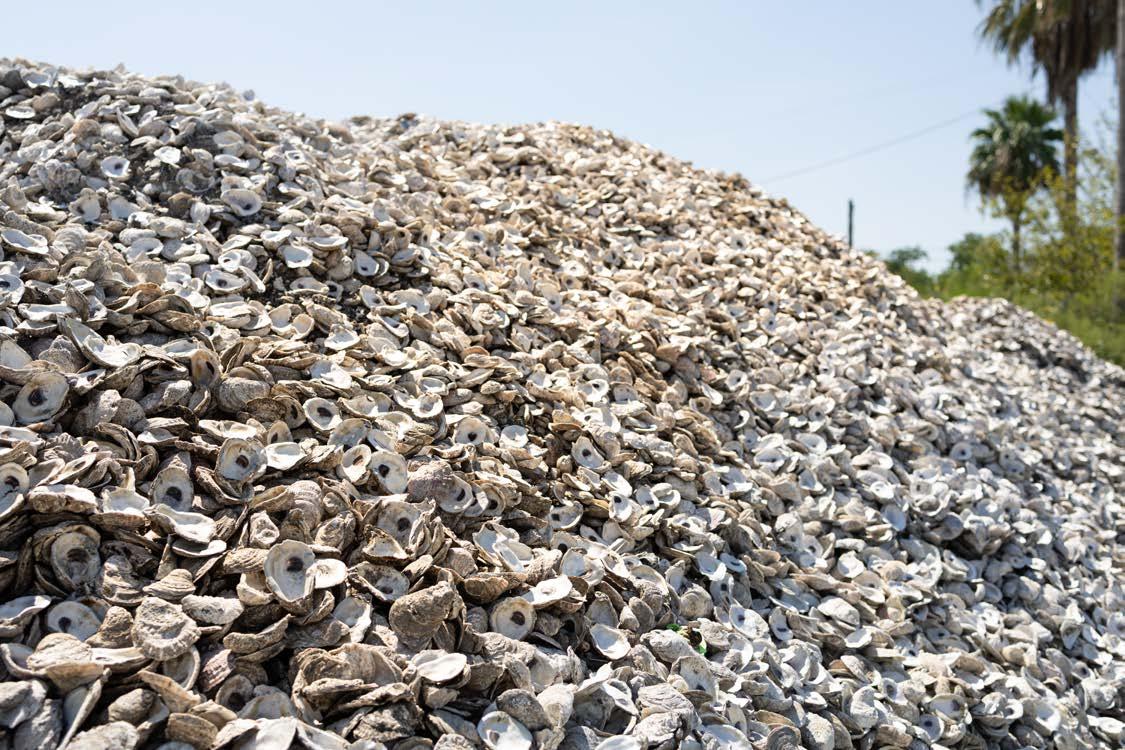
We saw an old pattern come back to life this year as folks congregated on the giant oyster reef near the Causeway and caught good numbers of solid trout drifting soft plastics and bumping the shell; or as locals often refer to it – dredging the reef. Still others continued farther south and called the jetties home for a good portion of the year and that program paid dividends as well.
STORY BY CHUCK UZZLE
The more adventurous anglers took it one step farther and patrolled the beachfront, opting to tangle with the herds of redfish that seemed to be everywhere, along with the solid bite from a very respectable population of tripletail. All of these patterns produced but it left a massive amount of the lake on the north end with little to no traffic as anglers ran south looking for better conditions. However, we should always remember that one man’s trash is another man’s treasure and you don’t always have to have perfect water to catch fish.
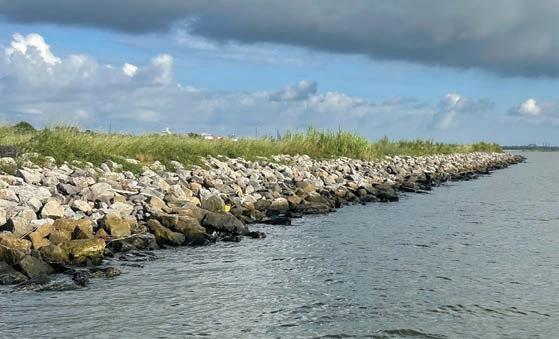
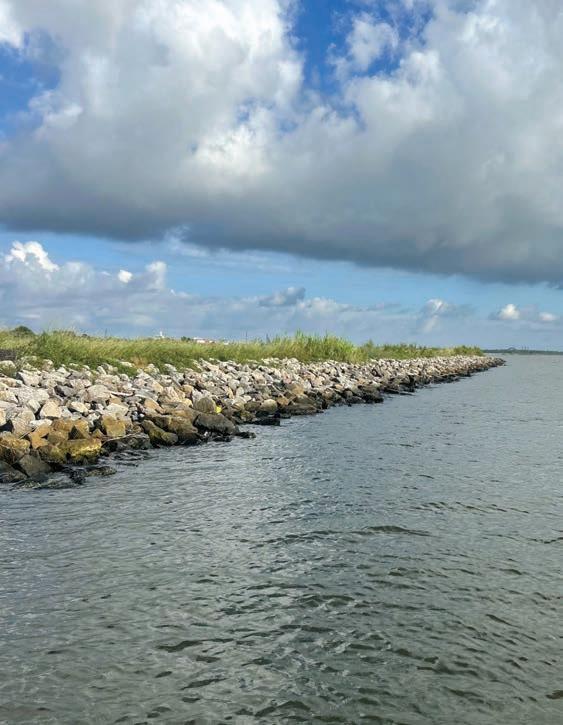
At some point, on my trips back up from the south end of the lake, I would check several areas on the north end, simply because I believed the fish were or should be there. I started seeing all the usual suspects such as ladyfish and dolphins, so I knew there had to be other species, somewhere. During one of my searches I decided to try a pattern we usually reserve for the jetties and that was to fish any rock structure I could find. Now, Sabine Lake has miles and miles of rocky shoreline that very few anglers pay attention to, let alone fish, and some of it looked as good an option as any.
Upon closer inspection the rocks were full of life, small crabs clung to the rocks, baitfish rafted up in all the gaps, and the water clarity was surprisingly decent. It took no time to realize
that patrolling the rocks with a twitchbait such as Heddon’s Swim’n Image or Berkley’s Cutter, along with soft plastic swimbaits like the Mulletron from Z-Man could all be very productive. All these baits can be worked with varying actions and will draw vicious strikes, especially when paused during the retrieve.
Perhaps the toughest part of the rock pattern is deciding when and where to start as the shorelines all look very similar until you really inspect them closely and look for subtle nuances or clues as to what lies below the surface. A long straight bank may have areas where the submerged rocks jut out farther into the lake, making great places for predator fish to ambush bait.
There may also be holes in the rocks that change the direction of the currents or even different kinds of vegetation growing here and there that will attract more forage species than others. I have noticed in areas impacted by ship wakes that small crabs and shrimp are frequently displaced from the rocks by the currents and become easy pickings for predators cruising the edges, looking for an easy meal.
Another thing to watch for is trash or debris that is hung in the rocks making any sort of eddy or break in the current. There are plenty of times that old trees that float down the river or
Constant dredging and pipeline work has altered seasonal patterns on Sabine Lake.
Rock-lined shorelines provide plenty of opportunities for anglers willing to spend some time on them.
Twitchbaits such as Berkley’s Cutter 90 and Heddon Swim’n Image, along with swimbaits like the ZMan Mulletron, are great for probing the rocks.
channels get lodged in the rocks and they are great places to target while you are covering the shoreline. Depending on the area, I like to position my boat about 10 yards off the rocks so I can fish parallel to the shoreline. By staying parallel you can keep you lure in the same depth along the rocks for longer periods of time, which turns into more strikes and more fish.
If you are in an area where there is ship traffic you need to pay close attention so you don’t get washed up on the rocks by the large wakes. In shallower areas I like to target the “seam” where the rocks end and the sand or muddy bottom begins because this tends to produce more trout.
Presentations made tight to the rocks will more often than not draw strikes from redfish as they probe for crabs or ambush small baitfish. Don’t be afraid to get your lure up in those tight places and bounce it off the rocks; it’s those types of presentations that will produce some serious strikes.
Fishing the rocks is a game of covering water and putting in your time but the rewards are definitely worth the effort. Lots of folks will try this pattern but not have the patience to keep doing it for long periods, so dealing with traffic or other fishermen is not often an issue.
The process of discovery using this pattern is eye-opening and can be addictive, especially when the strikes are solid.
As we head into the home stretch of the year we hope that the dredging and work activities slow down or finish up altogether and allow Sabine to get back to a somewhat normal state. It will be very interesting to see how things will change, or if they even change at all. My hope is that we have seen an increase in better fish over the last two years and that trend continues as we get into the much anticipated fall fishing season. For some reason we have been a little behind schedule but with the real cold fronts are on the horizon that could more than make up for lost time as the marshes dump the current shrimp crop and the dinner bell rings for the trout and redfish in the lake.
Please get out and enjoy the opportunity to be on the water during this time of the year and don’t forget to bring a kid fishing when you get a chance.
CHUCK UZZLE
Chuck fishes Sabine and Calcasieu Lakes from his home in Orange, TX. His specialties are light tackle and fly fishing for trout, reds, and flounder.
Phone 409-697-6111
Email wakesndrakes@yahoo.com
Website wakesndrakes.com
Feisty Atlantic sailfish migrate past Cozumel.
Gulf Crossings Both Happy & Cruel
STORY BY JOE RICHARD
Texas fishermen know the Gulf is wide, but how long of a boat ride from Galveston to Cozumel? It’s something like 700 miles from Galveston to popular islands like Cozumel and Isla Mujeres. The long boat run across open water was first accomplished by a few brave souls back in the early ’70s, where the spring run of sailfish offered fast action. (Texas is fairly deprived of sailfish except for accidental catches made late each summer). Then and now, there have been a host of adventures during those crossings, where a weather window was predicted and boats could scoot across the Gulf, hopefully without running into choppy seas. Which could be exhausting, while also consuming more fuel. Boats crossing back then were usually only 31 to 42 feet, smaller than today’s big, modern boats.
For those who succeeded, a real prize awaited: always-clear water, pelagic fish a mile offshore, and generally calm water, especially between Cozumel and Playa del Carmen on the mainland. It’s a real paradise and offers easy fishing, even in shallow water for bonefish. Worldclass diving, too. The Galveston crews sometimes rescued floating divers in the morning, who’d been out there all night in deep water and currents where the mako sharks prowl. It seems the dive boats sometimes failed to pick them up the previous day. At one point, my buddies were told by an official that the island was losing 75 divers annually from various accidents.
Even smaller boats have crossed the Gulf. If memory serves, John Meeks, who owned Meek’s Marine in Clear Lake, decided to cross the Gulf in a 25-foot Boston Whaler. Not sure if he was alone, but weight and space were crucial. It must have been a real tradeoff whether to bring a buddy along, or more fuel. Carrying barrels of gasoline, he first ran the boat with a load propeller, then stopped in mid-Gulf and changed props for better efficiency. Whoops! Don’t drop that prop. Not sure what size fuel barrels he carried, though probably no bigger than 30 gallons. At any rate, he planned it well. It takes some serious stones to cross the Gulf in a small boat with outboards all by yourself.
Galveston’s Capt. Howard Horton’s yellow 23-foot SeaCraft with a single outboard was perhaps the smallest boat that made the crossing. When they weren’t trailering that boat across the Sierra Madre to the Pacific coast, they would scoot across the Gulf down to Cozumel. His friend Billy described returning the boat back to Galveston after the spring sailfish run, and he definitely did it by himself. Because the boat wouldn’t carry enough fuel to cross the Gulf, he timed it when some of the bigger boats were returning home. They met in the middle of the Gulf and transferred barrels of gasoline into the SeaCraft, and kept going. Billy said it was so calm, he went up near the bow, leaned over the side and could see his own reflection. When he stopped by Customs in Galveston, officials there had a hard time believing his story. Again, it was a wellplanned trip perfectly timed.
Other crossings lacked one or both of those factors. An acquaintance bought a 31-foot Bertram and installed brand new Cummins diesel engines. No time to worry about boat insurance, they took off on the 700-mile run. In mid-Gulf they decided they might not have enough fuel for the full run, and changed course for Progresso, the closest commercial port in Mexico with fuel. A rookie helper drove the boat during the “dog watch” and at 5 a.m. crashed into shallow coral on Alacran Reef, the only deepwater island in the Gulf. Its reef stretches 15 miles and it has a lighthouse with a small Navy detachment on the dry part of the island. Daylight arrived soon after impact. The boat, with its bottom mostly ripped out, now sat in 3 feet of water. They were picked up by Mexican fishermen, who delivered them to the Navy, who eventually delivered them to the Federales in Progresso. At every turn, their equipment and fishing rods kept disappearing. They took a bus to Cozumel, but one-way air tickets home were hard to find, and that took a few more days, which they spent in the bars. Eventually they flew back to Houston with “only the
shirts on their backs,” as the saying goes.
So they bought another Bertram and tried again. This time, they ran the ICW to New Orleans, to fuel up there and shorten the Gulf crossing. Running the ICW has its own hazards with barges, sandbars and drawbridges. Hit the shallows and bend a propeller shaft and the trip was over. At one point the owner needed a cigarette so badly, they eased up into a dead-end canal after spotting a gas station sign in the distance. The owner jumped into tall cane and disappeared. Later he reappeared with a triumphant carton of cigarettes held high. But he was muddy, wet and scratched up from pushing through tall cane to reach that farm road. On they went, finally docking near Bourbon Street, seeking serious refreshment.
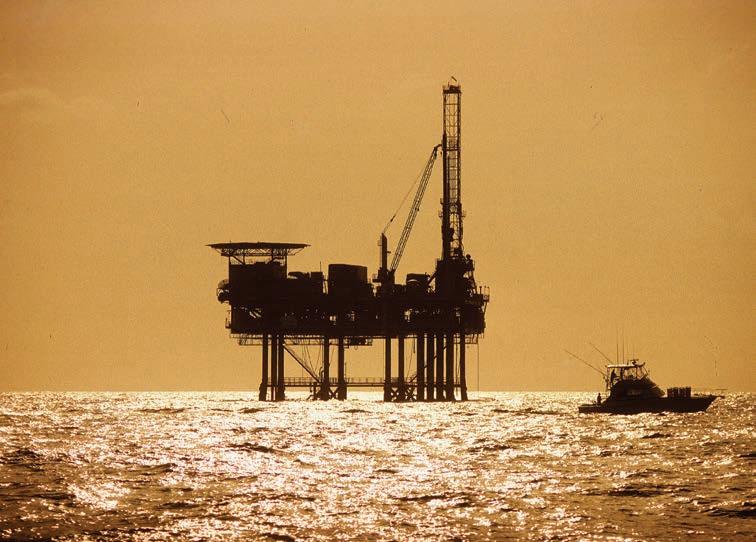
Billftshing boat stopping at a deepwater oil rig way offshore, with fuel drums secured on the bow.
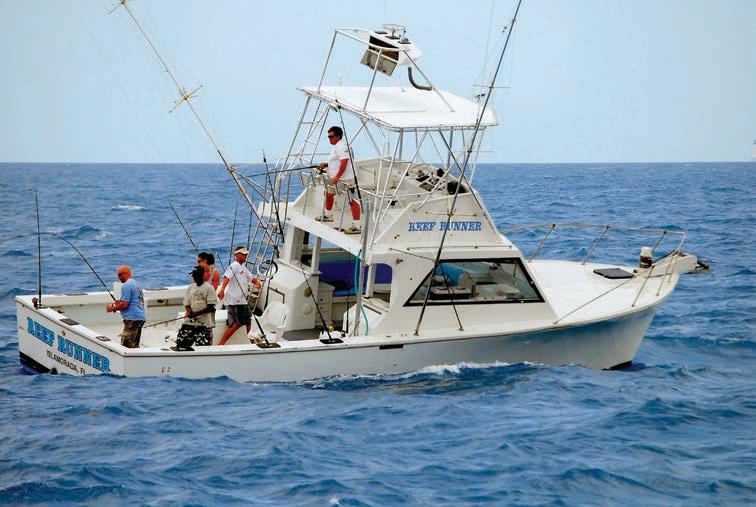
Smaller Bertram trolling for sailfish.
Fueled up, they headed straight south across the Gulf, the route now shortened to 500 miles. And made good time until halfway across, where they encountered rough seas that slowed their speed. The going got rough and their fuel efficiency plummeted, but after rounding the Yucatan peninsula, the seas calmed a bit. They actually ran out of fuel just short of the gas dock in Isla Mujeres. But this time they’d made it. Mostly.
Out there in the Gulf your luck can run out fast and it’s quite the opposite of Disney World. Still, one would think crossing the Gulf in a big sailboat would be a cinch; there’s always wind and diesel power. Our neighbors in Port O’Connor set out in a 50-foot sailboat they’d salvaged in the surf around Freeport, cleaned out the sand
and fixed it up. It was June and the Gulf was hot and smoky from fires in Mexico, the smoke drifting north to Texas. The sailboat plowed into waves with its diesel engine until something disabled it. Raising the sails, they beat into big waves for at least a week, I forget the number of days, but it was miserable. And smoky. They finally rounded the Yucatan and when they reached Cozumel, the return flight home for some of the crew was due to take off in something like one hour; there was no time to see the sights. Some of the neighbors on that trip weren’t really boaters; visiting Pass Cavallo was their idea of a boat trip. It must have taken them a week to recover. Maybe longer.
Mostly, it’s fuel that is the main concern. During our long three-day tournaments in the Gulf, we had to carry a fuel drum or two.
A 50-gallon drum is too difficult to move, but the 30-gallon drums were great and once emptied, could be tied to the bow rail. We always transferred fuel with a clear hose, once near our destination if the Gulf was calm. Thinking it might get choppy later, making fuel transfer more difficult. We never had an electric pump and had to siphon, sometimes spilling fuel, once down somebody’s shorts, who ran howling overboard to wash off.
I have crossed the Gulf myself, as related in an earlier article, but it was aboard a 53foot Bertram in rare, calm June conditions, nothing but ripples on the water for 3-4 days. From Playa del Carmen we trolled due north to the deepwater oil rigs off Louisiana, then turned west, sampling more rigs all the way to Port Aransas. Had those rigs all to ourselves, too. We caught blue and then white marlin, wahoo, plenty of yellowfin tuna at night, and big mahi. It was a bucket list of a trip.
JOE RICHARD
Joe Richard has fished the Gulf since 1967, starting out of Port Arthur, but his adventures have taken him up and down the entire coast. He was the editor of Tide magazine for eight years, and later Florida Sportsman’s book and assistant magazine editor. He began guiding out of Port O’Connor in 1994. His specialty is big kingfish, and his latest book is The Kingfish Bible, New Revelations. Available at Seafavorites.com
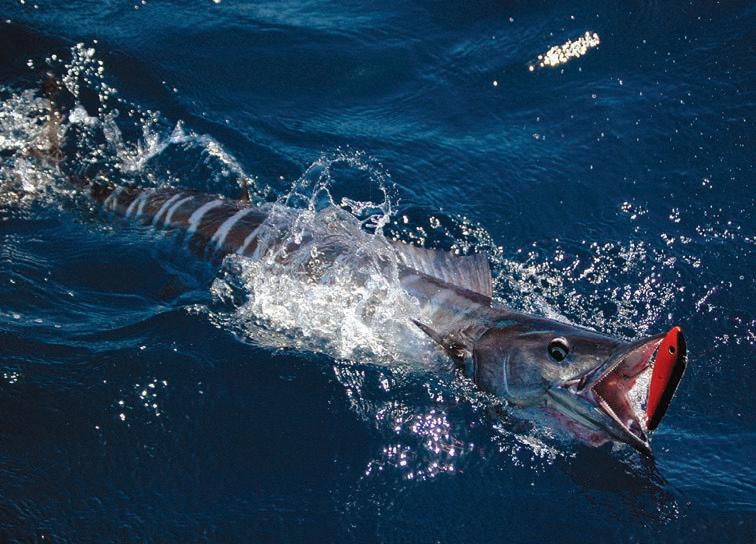
Wahoo hang around deepwater platforms for those crossing the Gulf.
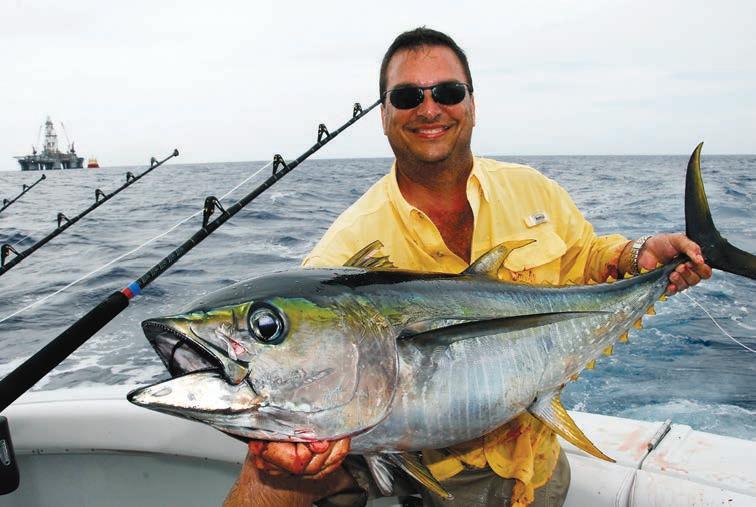
Yellowfin tuna caught at a deepwater rig off Louisiana, on the way home from Cozumel.
JAMES KOSUB SKINNY WATER OBSESSION
MISGUIDED
I had one of those trips where the best catch of the day was the ride back to the dock after the boat broke down. If you have booked enough guided fishing trips, there is a distinct possibility you’ve had at least one bad one. Bad trips can mean a lot of different things, horrible weather, bad fishing, or a guide you don’t get along with.
Growing up, we never had the opportunity to fish with a guide, which only deepened my curiosity about what a guide was. I assumed they had superpowers. After my first guided trip as a young adult, we got off the water at 9:00 am with five limits of redfish. It was confirmed that guides have a supernatural connection with wildlife.
Guides are often asked to do a great deal when bad trips occur, so it feels unfair to hold them fully accountable in all situations. However, I will be the first to say I have had some disappointing boat rides back to the ramp, during which my mind typically drifts back to, “Man, I sure paid a lot per pound for those fish.”
Recently, I had one of those bad trips, where the fish didn’t cooperate, and neither did the guide’s boat. We left out of Galveston. He asked us to arrive at the
ramp at 4:00 AM. We arrived just a bit late due to ferry difficulties. We arrived at the launch ramp super early with the intention of hitting the lights. I thought it was the coolest idea in the world, a guide hitting the lights.
He described perfectly which light would be most productive. We passed several lights that seemingly looked the same, and then, Voilà! ―We hit one that was teeming with life.
Although the activity was plentiful, we only managed to catch two tiny trout. Once the sun was starting to creep over the horizon we decided we would drift the flats. The lack of production at the lights served as an early warning of what we should have expected as the day went on. Three fishermen, thousands of casts, and only one keeper trout to show for it.
We decided we would accept defeat and haul back in around 1:00. While we mulled over the possible reasons why the fishing was so poor, we put everything away for our long boat ride back. Unfortunately, that long boat ride back got a whole lot longer when the lower unit did not engage.
We could move forward around four miles per hour or so, but the lower unit would not stay engaged. We
My first trip with our guide buddy Zech was awesome to say the least.
thought it would be possible to utilize the trolling motor to make progress while we worked on the lower unit. We made little progress with the trolling motor, and even less with fixing the motor.
We accepted defeat for the second time and decided to fish until we could “catch” a lift. Fortunately, on the weekend, we didn’t have to wait long for someone to stop by and, thankfully, the first person we waved down was willing to tow us in.
As they got closer to us, they noticed my brother-in-law’s UT fishing hoodie. They said, “We were willing to help you… but he has to remove his hoodie and give a quick GIG EM.” Being a good sport, Tristan was more than willing to comply. To the fine gentlemen who gave us a tow back, GIG EM, and GO AGGIES! We made it back to the boat ramp, sunbaked, tired, and ready to be home. It was easy in that moment to feel defeated, and that the trip was truly a total loss. The old saying
“We contracted the construction of the TSFMag office building with Farrell Jackson. Jackson also built my son’s bay house here in Seadrift. We were completely satisfied with both projects…a professional and trustworthy contractor.” ~ Everett Johnson | Editor/Publisher, TSF Mag
about a bad day fishing is hard to agree with when it feels like nothing is working.
I have had enough trips, both good and bad, and I try never to judge a guide by the number of fish they bring in on that one day. Honestly, as consumers, we do need to manage our expectations. If you are only booking a guide to “catch lots of fish,” do yourself a favor and go to HEB; it’s a lot cheaper.
Beyond the simple did I catch fish measurement system to determine whether the trip was good or bad, ask yourself whether the experience was enjoyable overall, did you find the personality of the guide agreeable, did he or she bust their butt despite things not working out, did you learn anything new? What it boils down to is if you answer yes to one or more of those questions, the lack of catching might just be less important than you first thought. If you would be interested in sharing your experiences, good or bad, email jammmeskosub@gmail.com.
CONTACT
Email Jammmeskosub@gmail.com
James Kosub James Kosub says, “I fell in love with fishing as a child and my passion deepened when I discover the Texas coast. Shallow water redfish have become an obsession.”
Second trip with Zech produced this bull red from a Galveston back-lake.
ASK THE PRO
CLEAR WATER (AND NOT SO CLEAR) FISHING STRATEGIES
As I sit to write this article a mild cool front with NE wind and slightly cooler air has pushed its way into the Coastal Bend. The temperature is finally beginning to feel a bit like fall. Not too much going on in the tropics at present, but we are definitely still within the peak period of hurricane season. I wish we could get some tropical rainfall without the hurricane force winds. We still need rain in Rockport and of course Lake Corpus Christi and Choke Canyon still need tons of rain to regain positive lake levels. Our bays would also benefit greatly as well, so here’s hoping for moisture without any damaging weather conditions.
Fishing has been challenging lately in the Aransas Bay Complex; larger trout are feeding at night and staying deeper during the day. While there’s no shortage of smaller trout, catching bigger fish has proved difficult for me, even though I frequently spot them near shallow areas, especially around certain moon phases. Grinding usually works, but I’ve found that moving faster and covering more water can help because only a small percentage
of trout are actively feeding. I struggle with this style of wading but am always aware for its need. I would still recommend stopping when you receive a bite or catch a fish of the size that you are looking for.
My sightings of larger trout lead me to believe that more times than not there are more than one in the area where a good fish is caught. Clear water systems can show us these types of things and should always be logged into one’s memory bank. I know a lot of great fishermen that struggle mentally in super clear water. This is normally due to them being confident in the somewhat colored or even murky waters of the bay systems they fish regularly. Most of these systems are north of POC but one would also have to include areas in Baffin and the Alazan systems. I have little problem in either type of water clarity due to having had great success in just about all water conditions imaginable during my career. I will go on record and state that I believe truly big trout are easier to catch in offcolored to downright dirty water versus the air-clear stuff.
In the dirty water, the angler needs to have taken good mental notes as to the whereabouts of the bottom structure during periods of cleaner water conditions. In many of the bay systems that hold dirty water most of the time, bottom grass can struggle to grow due to a lack of sunlight penetrating to the bottom. In these cases, I believe in fishing the edges along shorelines where hard bottom comes together with the softer bottom. Many times, this is located along the shoreline’s primary drop-off. Some areas along the west shoreline of East Matty would qualify for this pattern. Well, at least the last time I fished in this area it seemed this was a pattern that worked for me.
Locating and establishing areas where bait is consistently present is also a key ingredient to locating and catching fish. I do like the fact that shallower, dirty water decreases the strike zone and allows for a stealthy approach from the truly large trout that live in these systems. I believe that it is a must that anglers approach and move slowly, and fish deliberately when encountering dirty water trout. I continue to be amazed at how shallow a 30-plus inch trout can be and we never see them. In my guiding nowadays I get to fish for these trout more often than I did in my earlier years.
Jay Ray – Tank of a redfish on sight-cast.
So many possibilities to explore.
Long wades without bites for many clients is something they only think they want to do. During many of my days in the earlier years I could see the group slowly but surely begin to move too fast and not concentrating on every cast. Luckily, quite often there are a few redfish in the area that provide some action and excitement that keeps us in the game.
The head game as I like to call it is huge in the dirty stuff. I always try to reinforce the thought that a lifetime-best trout could come on the next cast, so staying mentally focused is the key. The best of the best fishermen just setup and ease in, and allow the bite to develop around them. And they never lose focus.
I throw one of four types of lures in this type of situation. A topwater is always a good choice, although as I have said here many times it’s not my go-to. I like the Texas Custom’s Double D and Custom Corky Pro Series and Soft Dine. Mirrolure’s Lil John XL is my go-to but you should always be prepared to downsize to the Lil John series. The newest addition to my wading box includes the 6th Sense Party Paddle. And, you’re right when you say, “Hmm, Jay’s never been a paddletail guy.” Nonetheless this lure has been working great for me, producing some solid trout in 2025.
When fishing clear water, I tend to believe I need a longer leader. I’m also a believer in long casts, coupled with a slow approach, and tons of patience. The bonus to fishing clear water is the ability to see the bottom structure and pick each piece of structure apart with our casts.
You must understand that presenting a lure to a fish holding on a
Results
piece of structure is not always easy. In order to gain the fish’s attention, we must cast at various angles and cut the edges of the points of the submerged grass beds. This allows the lure to meet the bottom structure in a manner that is favorable to the fish. Same is true with casting to potholes. It’s the front and back edges of potholes where the strikes come from. As anglers, we must know where these strikes are being received and then duplicate the cast in every pothole.
Clear water conditions allow for a tremendous learning experience if we will embrace the opportunity. Clear water allows us to see all the many different types of bait fish that trout can eat, giving us an opportunity to mimic the size and shape of the bait fish with our lures. Right now, in my area, both trout and reds are feeding predominately on pinfish. This calls for something with a gold flash and a size of about 3 to 4 inches at the most. Yesterday I watched redfish pushing through the grass and eating perch as the perch spooked into a pothole out in front of them. This is a terrific example of a mental picture that you need to be able to replay in your mind even when you are not seeing it.
I like clear-bodied baits in clear water. This does not mean the lure is completely clear, just the material from which the body is made. It also has glitter or a hologram pattern printed on it. The glitter or hologram has the color and it’s that small glint or flash of color that draws the strike.
I am also a fan of a clear bodied soft plastic with a chartreuse head versus the chartreuse tail. Some color patterns are not offered without a chartreuse tail so there are cases where I throw that but
prefer the head to be chartreuse. If, chartreuse is the draw to the lure, why would you want it on the tail where there is not a hook. Predators know what drives the bus.
One of my very best days in my whole career was 47° with light wind and clear water. I caught every fish on a Plum 5” Bass Assassin with a 1/16 ounce 2/0 short shank hook. It turns out that Plum, Watermelon, Root Beer, White, and Black are dark colors that work very well in clear water, couple these with a 1/16 ounce chartreuse jighead and you’re going to catch some fish.
Other notable clear water colors that I find to be affective are Cajun Croaker-Pistachio, Bone Diamond, Opening Night, and Pink. I am not a huge fan of bright pink, preferring more of a soft pink with silver glitter. Three years ago, there was a stretch in Port Mansfield where pink was the only color I could catch fish on for about two weeks. Didn’t matter the brand of lure, it just needed to be pink. Just so you know, trout see pink as silver and chartreuse as orange, according to Dr. Stunz.
Other unusual facts about trout’s vision; they have “color blindness” for green and red – both appear gray. So, I guess watermelon red glitter is really seen as plain old gray. Interesting, huh? I think many times the longer I fish the more I have to learn.
How do fish see color?
I am excited about our upcoming fall and winter fishing seasons. Despite the rough spot I have gone through the past couple of weeks, I am seeing positive signs that with cooler temperatures due in a few weeks we will see a resurgence in the trout bite and the quality of trout we are catching. Shrimp are pouring out of the back bays right now and when we find them shallow, we are seeing some better action.
I remember a mid-October cold front that dropped water temperatures into the low 50s years ago. It was cold enough to shock the white shrimp, and they fell to the bottom but did not die. As I waded, I could feel them thumping against my waders. Once we got shallow over some clump shell, I was able to see them, hundreds of them. Fishing stopped and shrimping began. What a great fried shrimp dinner I enjoyed. All the trout and reds we caught had long whiskers sticking out of their mouths that day. For the record, it was not the best of bites either.
I hope you enjoy some great fall conditions and good fishing. Remember to keep only what you need and release the rest.
May Your Fishing Always Be Catching! Guide, Jay Watkins
Jay Watkins has been a full-time fishing guide at Rockport, TX, for more than 45 years. Jay specializes in wading yearround for trout and redfish with artificial lures. Jay covers the Texas coast from San Antonio Bay to Corpus Christi Bay.
Telephone 361-729-9596
Email Jay@jaywatkins.com
Website www.jaywatkins.com
DAVE ROBERTS SHALLOW WATER FISHING
TAKE ADVANTAGE OF FALL
When it comes to fishing, I know that we all get in our own little routine and most of us do not like change. We set our alarm for the same time, grab the same three rod and reel setups, stop at the same convenience store and buy the same taco, cup of coffee, and so on.
I’m certainly guilty of it myself but here recently I had to add to my routine and that was due to one of life’s simple pleasures. I took off across the water and quickly realized that it is time to start packing a light jacket! Cool mornings are a sure sign that summer is over and that fall and winter are on the way.
It may be a selfish of me by being glad that summer is over but I can assure you that I’m not alone. If you want proof of that claim, just head to your local fishing hole and you will quickly see what I mean. An angler can go all day and will see plenty of happy life. The redfish will be schooled up in the marsh and pushing down shorelines, gorging on shrimp and everything else they can get in their mouths. Once you decide to leave the marsh and enter the main body of Sabine Lake, you will
quickly encounter large numbers of trout. Right now is by far the best time of the year to be on the water. With the water and air temperatures beginning to drop, fish know that winter is quickly approaching and it is time to prepare. They do so by taking advantage of the mass shrimp migration by gorging at every opportunity. Nearly every fish you catch will have remnants or signs showing that is what they have been eating. Catching fish is quite a bit easier right now compared to other seasons but there are a few things you can incorporate with your standard game plan to give you even more success.
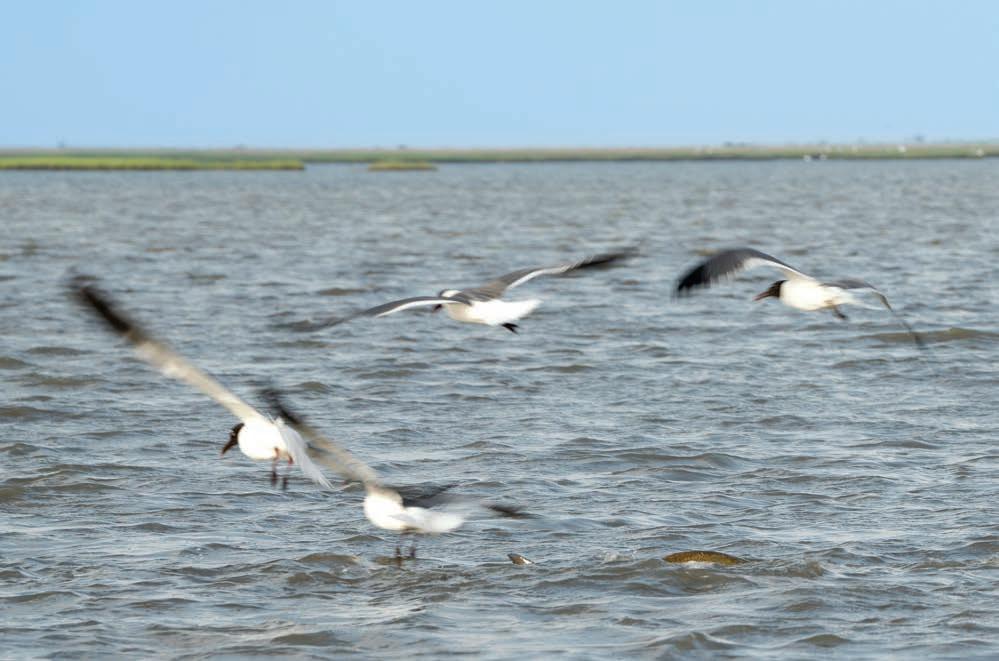
I believe that one of the most important things that an angler needs to do at this time of the year is pay attention to the birds. Trout and redfish are not the only ones taking advantage of shrimp migration. Hungry fish will push shrimp to the surface and this makes an easy target for gulls and terns. Usually when this happens, a screech comes from a competing gull and the word gets out quickly. Before you know it there will be a group
of seagulls wheeling and diving to catch shrimp – a sure sign for the angler as to where feeding fish can be found. Sometimes, flocks of thirty or more gulls can be common, but don’t overlook the smaller groups of five or even two or three birds. It should also be noted that fish can be staged in the area if seagulls are simply resting on the water. It seems to come and go in waves and the birds will rest during this lull but fish can still be caught underneath them.
One other thing that needs to be taken into consideration when fishing working birds is which way they are moving and which way your boat might be drifting. You have to take into consideration the tide and wind and the direction they will take you. This will save you a lot of trolling motor battery and it will also save you from floating right through the middle of the school. This is one of the worst things an angler can do because it will move the fish and the birds will scatter and move on as well, which will likely leave you wandering aimlessly, hoping to get lucky and bump into another school.
Another bird to pay attention to is the Snowy Egret, which often gets lumped into the generic category of white shorebirds. These little guys will line up along a shoreline and wait for redfish to push shrimp up to them. Their white bodies completely stick out from the green marsh grass and are easy to spot. If you see clusters of them lined up and not moving, that usually indicates that fish are just off the bank and will occasionally move towards them. However, if you see them playing leap frog with each other and moving down the bank, there is a school of redfish pushing down the bank and they are staying in front of it, waiting for their turn. This is a dead giveaway that fish are nearby and feeding.
When it comes to chasing the birds, time of day seems to be a factor. An angler can sometimes find them working all day but the most reliable times seem to be at first light and in evening just before dark. I really am not sure why these times of day seem to be better but they sure enough are. One of my favorite things is being on the south end of Sabine Lake with about 3 or 4 other boats all patiently waiting for the right time. As soon as there is enough light to see, you will hear outboards rev up and scatter across the lake as everyone begins to spot their own group of birds to fish. To me, it is one of life’s simple pleasures.
When it comes down to lure choice for this time of year, it’s not too important. I have come to realize and stay away from throwing topwaters completely. I enjoy watching a fish smack it but I don’t particularly like all the seagulls wanting to eat it as well. That, and
dealing with treble hooks in a fast-paced fishing scene can lead to having a hook in the hand. I would just simply rather not. Typically, I stick with throwing a small paddletail plastic, much like a Saltwater Assassin. Pairing this with a 1/4-oz jighead seems to be the best combination to use. You can throw it a little further while having only a single hook to deal with when handling fish. This is pretty much my go-to and I rarely venture away from it during this time of the year. By now, fishing is great and it is only going to get better. Along with that, the weather is following suit…lots of postcard-perfect days ahead. This is also a wonderful time to bring a kid fishing, or anyone new to the sport. It is usually a guarantee to have fun! CONTACT
Dave Roberts is an avid kayak-fishing enthusiast fishing primarily the inshore Upper Coast region with occasional adventures to surf and nearshore Gulf of Mexico.
OF LOCATION PROGRAM OFFERS A WIN-WIN FOR CONSERVATION AND ANGLERS
Healthy Texas coastal ecosystems are vital to coastal communities, providing not only critical habitat and ecological benefits recognized by conservationists, but also supporting the thriving recreational fisheries enjoyed by anglers throughout the state. A program playing a significant role in bolstering oyster populations and enhancing bay health is the Certificate of Location (CoL) program. Recent amendments to the program by the Texas Parks and Wildlife Commission (TPWC) and rule implementation by Texas Parks and Wildlife Department (TPWD) promise to further benefit Texas waters.
What is the Certificate of Location Program?
The CoL program, dually managed by TPWD and the Texas General Land Office (GLO), leases areas in Texas coastal waters for private on-bottom oyster harvesting. Previously, this program focused solely on commercial harvest and was strictly limited to approximately 43 areas under location (2,318 acres total) in Galveston Bay. However, with advances in the 88th legislative session (Senate Bill 1032) and recent rule revisions approved by the TPWC, the CoL program can now be expanded for commercial interests and leveraged for much-needed oyster reef restoration projects.
What Makes The CoL
Program So Important?
These changes are a turning point for the management of oyster resources in Texas. The CoL program will now have the opportunity to create a more vast economic
and environmental impact.
Now, organizations such as non-profits, research institutions, and NGOs can lease degraded areas (up to 100 acres/site) to carry out oyster restoration activities, following active use criteria set by TPWD. During the lease term, these areas will be closed to commercial oyster harvesting. Commercial CoLs follow similar criteria as restoration CoLs but grant the leaseholder exclusive rights to harvest oysters within their leased area. This change creates a dual benefit: dedicated restoration efforts and more sustainable commercial practices.
Setting a New Standard for Oyster Management
Within the oyster community, there is a deep understanding that CoLs are managed meticulously to promote sustainable harvesting. This includes the strategic placement of cultch to provide vertical relief on the reef, which supports the recruitment of oyster larvae for future harvests. This deliberate approach contrasts sharply with the sometimes chaotic conditions on public oyster reefs.
Combined with the successful and robust oyster license buyback program, which was strongly supported by CCA Texas with a $1M donation, the expansion of CoLs will reduce the oyster fishery’s dependence on public reefs. This approach protects oyster reef complexes, emphasizing their ecological and structural importance in coastal ecosystems. Additionally, the expansion of CoLs is a necessity for oyster reef conservation, offering a
Combined with the successful and robust oyster license buyback program, which was strongly supported by CCA Texas with a $1M donation, the expansion of CoLs will reduce the oyster fishery’s dependence on public reefs.
viable off ramp for commercial oyster fishermen reliant on the public reef oyster fishery. It’s a win-win for Texas marine resources, anglers, and coastal communities.
The more oyster restoration efforts can be supported, the better. With 15-year lease terms and the right to renew, CoLs enhance opportunities and encourage investment in restoration, ultimately benefiting coastal fisheries and angling opportunities.
According to Rocky Chase, Chairman of the CCA Texas Government Affairs Committee, the push for restoration Certificates of Location
has been a long-standing effort, achieved with the support of State Senator Lois Kolkhorst and State Representative Todd Hunter.
Looking Ahead
Future investments in CoLs for oyster restoration and commercial interests will leverage the immense benefits oysters provide to water quality, biodiversity, shoreline protection, and carbon sequestration. Collaboration with stakeholders is crucial to ensure the long-term success of restoration efforts.
CCA Texas has pledged $5 million specifically for oyster reef restoration and intends to utilize a significant portion of these funds under the CoLs umbrella when possible. To start, CCA Texas is working with partners such as the Matagorda Bay Foundation and Gulf Trust to identify potential locations and begin the permit application process.
The ability to now have restoration CoLs is a victory for conservation, anglers, and the future of Texas bays. Thanks in part to TPWD and GLO staff for their thoughtfulness in developing these regulations, CCA Texas is excited to witness the restoration of favorite historic reefs through the CoL program. Implementation of the CoL program puts Texas one step further in ensuring coastal ecosystems remain robust for generations to come.
Within the oyster community, there is a deep understanding that CoLs are managed meticulously to promote sustainable harvesting. The industry builds and maintains these reefs to keep sustainable harvesting. The new Laws will also allow organizations as CCA Texas to secure CoL sites and build non-harvestable Conservation Reefs.
By Cynthia Adams | Natural Resource Specialist
FIELD NOTES
REELING IN RELIABLE RESULTS: TPWD’S APPROACH TO DATA QUALITY
Every seasoned angler has put in long hours on the water, year after year, to figure out their favorite spots and best tactics. Their stories and memories on the water are hard earned. Time and time again, I hear the same question from fishermen around the Texas Coast–which is: “How can we trust Texas Parks and Wildlife Department’s fisheries data?”
As a former Fish and Wildlife Technician working in the Aransas Bay ecosystem, I get it. Our fishery is a shared resource, and our constituents want and deserve the assurance that the decisions impacting their livelihoods and weekend fishing trips are backed by solid science—not guesswork. So, let’s take a closer look at how the Texas Parks and Wildlife Department (TPWD) gathers, verifies, and uses fisheries data to manage our coastal waters—and why you can trust it.
A portion of TPWD’s coastwide monitoring program began in 1974. That means today’s decisions are anchored in over 50 years of reliable, protocol-driven observations. Very few fisheries agencies worldwide can claim that kind of long-term dataset. This historical depth and consistency allow TPWD staff to understand not just seasonal patterns, but temporal shifts, and the effects from major weather events. By following standardized procedures that were robustly designed decades ago, TPWD biologists can observe long-term trends in our marine ecosystems with greater certainty. This is something that TPWD is very proud of and hopefully you can be as well.
TPWD field biologists and technicians are out nearly
every day, year-round, and in almost any weather condition, collecting critical information on fish populations, habitat conditions, water quality, and angler harvests. Using techniques like creel interviews, bay and gulf trawl surveys, bag seine samples, and oyster dredges, the team builds a living snapshot in time of Texas’s marine ecosystems. But data collection is just the first layer. What happens next is where TPWD truly sets itself apart.
In a state with more than 350 miles of coastline, the Coastal Fisheries sampling area includes more than 1.5 million acres, encompassing seven major bays, back bays, and portions of the Gulf. To handle the size and diversity of the coastline, TPWD divides data collection responsibilities among eight field stations—from Sabine Lake on the Louisiana border to the far southern tip of Brownsville. Each station covers a distinctive area of the coast, each with its own ecological uniqueness, habitats, salinity levels, and species profiles. This approach provides data at the ecosystem level while maintaining uniform data collection procedures across the state. For the anglers out there, this means your input matters.
Do you remember that creel survey you answered last summer at the boat ramp? It is part of a legacy that helps track fishing pressure, assess stock abundance, and shape next season’s regulations. When conservation decisions affect bag limits, slot sizes, or access to fisheries, it’s natural to have questions. TPWD’s quality control procedures offer answers backed by highquality data. They ensure that regulations aren’t just
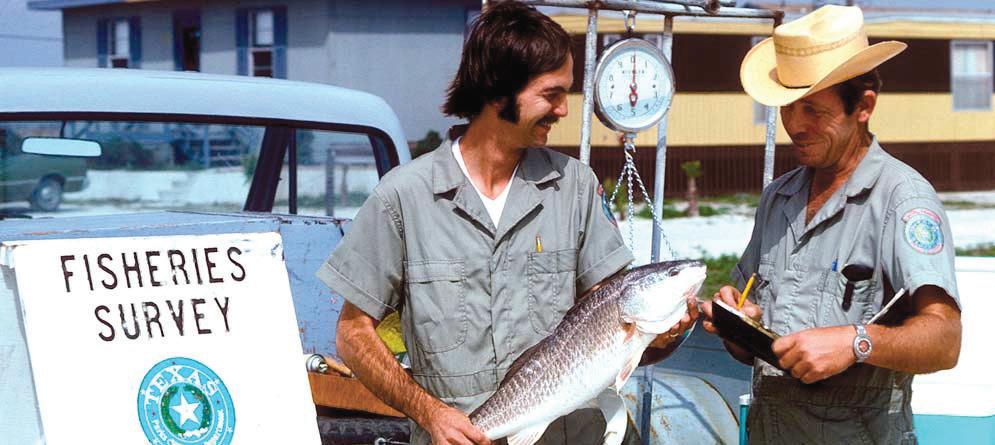
Two TPWD staff conducting a creel survey at a boat ramp in the early years.
arbitrary, but they are informed by one of the most comprehensive fisheries datasets on the planet that includes your input.
TPWD staff adhere to coastwide Standard Operating Procedures (SOPs) as specified in the Resource Operations Manual for collecting fisheries independent data. These scientific methods are detailed for each type of gear and are consistently applied across all bay systems. Similarly, our fisheries dependent data collection methods, such as creel surveys at boat ramps, are outlined in a separate manual. After the initial sampling efforts are completed, local TPWD staff pour over the raw data for any glaring data errors or omissions and correct the data immediately. In addition to staff checking for human-induced errors, the electronic database has been equipped with parameters to check for outliers and other types of field entry errors. Each dataset undergoes multiple layers of review by both humans and machines before moving on to the next set of eyes.
The behind-the-scenes efforts of TPWD may go unnoticed by many, but they are crucial to ensuring that the science supporting our collection methods, statistical analyses, and recommendations to decision makers is robust, transparent, and accurate. TPWD takes extensive measures to verify and monitor data collection from start to finish. This includes monthly quality control checks by team supervisors in real time, and periodic unannounced visits by Regional Directors. An annual rigorous review by an External Quality Control member, assesses each team’s field safety, staff knowledge, and adherence to protocols for each sampling gear. The final safeguard is the Regional Editor, who meticulously double-checks all data entered into the master database. Coastal Fisheries staff and scientists, many of whom are lifelong anglers, are not just performing their daily duties, they too are dedicated to preserving the legacy and health of our coastal resources for future generations. Check the TPWD Outdoor Annual, your local TPWD Law Enforcement office, or tpwd.texas.gov for more info.
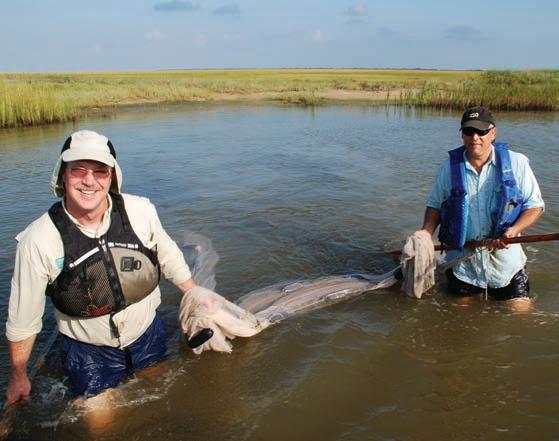
Two TPWD staff using a bag seine to collect juvenile fish and other organisms.
EXTREME KAYAK FISHING & SHARKS FROM THE SAND
XPECE–THE FUTURE OF FLIGHT IN SURF FISHING
Technology affects every structured activity in human society; certainly this is the case with all forms of fishing. For nearly a century, innovations in equipment and strategies have pushed beach-bound shark anglers to better optimize their success rates. In such a competitive world, any discovered advantage will be utilized and relied upon. For surf anglers, in particular the hardcore shark fishermen, bait deployment methods have evolved steadily ever since the introduction of the sport.
In the beginning, while hand-lobbing big baits or swimming through the breakers holding bloody chunks of fish, anglers did what they had to do in order to get enticing baits well out into the water. While the goal has remained the same, deployment methods have changed dramatically over the years. More than twenty years I kayaked hundreds of baits out, covering many miles in the process. This became the traditional practice for the average shark fisherman for a good long while. During the kayak-centric years, a few folks began utilizing jet skis and inflatable motor boats to deploy their baits. More recently, new advances in technology have made it possible for sharkers to get decent-sized baits several hundred yards away from the beach, without even getting wet. On whirring blades, baits are now commonly taking flight in a revolutionary new way, one which would have seemed like science fiction just a few years ago. Specialized fishing drones have entered the
market, and they’ve shaken up the shark fishing world like a sudden storm.
Because of the specific purposes motivating my own personal adventures, I typically run giant baits out, hoping to entice bites from giant sharks. I’ve experimented for nearly ten years now with the seemingly dark magic of drone deployment. Well before specialized fishing drones appeared on the market, I was rigging wire coat-hangers on early generation DJI Phantoms to modify them for makeshift baitdeployment duties. While this restricted me to using a light payload like a whole whiting or something similar, the fact I could even fly a shark bait out into the depths filled me with a sense of awe.
As advances in technology made the drones better suited to our purposes, the desire for them exploded in the land-based sharking world. Various companies leapt at the opportunity, making claims about the superiority of their devices. Now, at least half a dozen drone makers have established themselves at a significant level in the market, some of which I’ve either worked with or assisted in some capacity.
Today, the best fishing drones are rated as safe for carrying six to eight-pound payloads, a significant increase over early models. But like many other newly designed products, flaws with the new drones do still exist. Until recently, almost all drones came from outside
ERIC OZOLINS
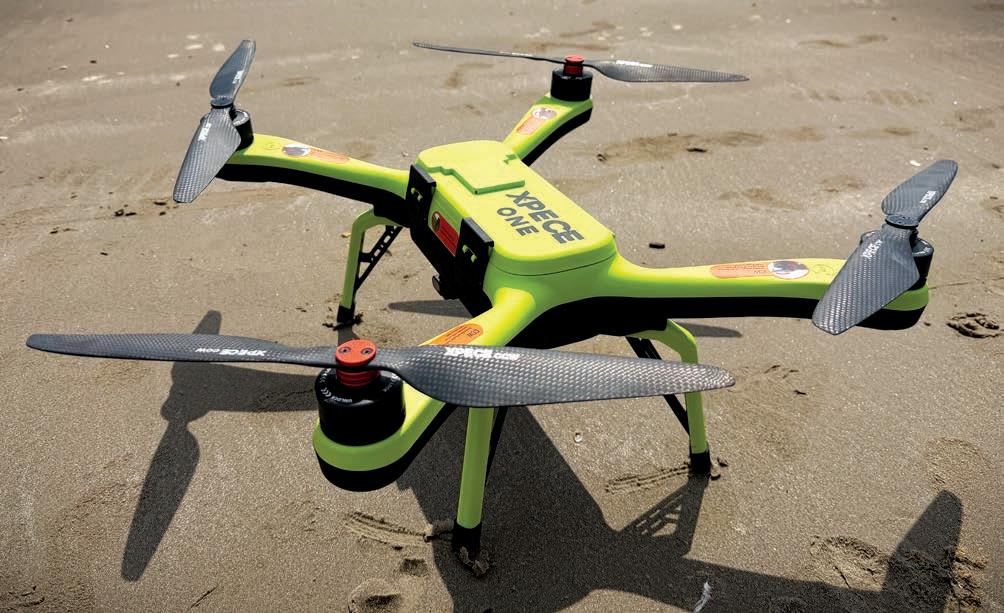
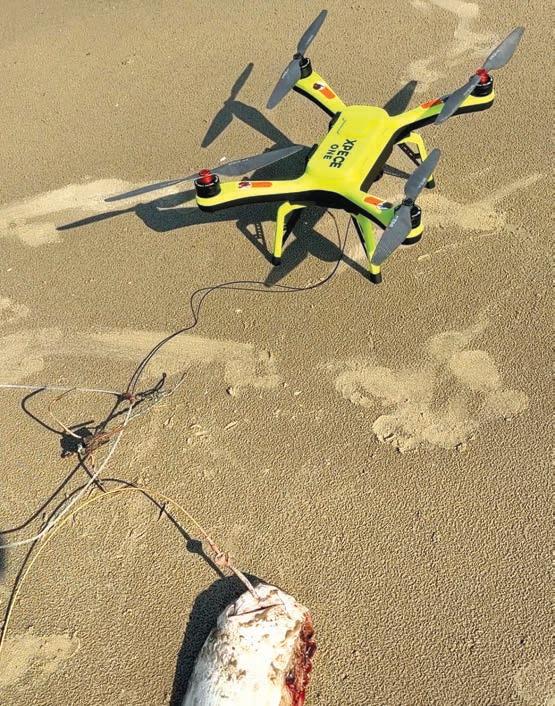
The new Xpece One Fishing Drone.
the shores of the United States. This meant users needing customer support often experienced nightmares getting help.
Through much of these growing pains, the Swell Pro company has been popular because they make drones capable of doing what we as sharkers need. Lately, a revolutionary drone company has emerged, and they’re based right here in the USA. Xpece, a Florida company, has been experimenting with and building specialized waterproof and underwater drones since 2010.
Being based in the USA has major advantages, primarily in the forms of service and customer support. Xpece believes communication with their customers is a key to continual development of their company and of the drones they make. They invest as much into service as they do into the design process. The team wants to learn from both the good and bad things that happen when people use their drones, allowing them to use all information as a tool to continually improve their products. They willingly field and answer questions from customers, and they do so without a language barrier coming into play. They also apply proven technologies in new ways, when they know new users may need guidance.
Unlike many of their foreign competitors, the Xpece crew are avid fishermen who based the design of their flagship drone around the needs they’d identified over years spent fishing the beaches. Their purpose was to simplify running and controlling the drone. This meant excluding unnecessary apps and additional setups, so people using them can just focus on the fishing.
With this concept in mind, they’ve created the Xpece One fishing drone. The release of this model on January 1st of this year really brought the Xpece name into the spotlight among surf and shark fishermen across the nation. The drone is built with a waterproof, buoyant uni-body structure, meaning it has fewer moving parts and fewer failure points than its competitors. In addition, their unique battery utilizes a new, self-managing smart design which fights normal degrading issues. In essence, the battery was designed to work to top capability with minimal maintenance, allowing anglers to focus on tasks related to fishing,
rather than keeping batteries charged.
I’ve personally owned and used about ten different drones for various fishing purposes over the past decade, including all the major brands. Each brand has its positives and negatives. When I had a chance to switch to Xpece after hearing positive testimonials from close friends, I got my Xpece One in September and have never regretted it.
This drone is easy to use and efficient in its performance, well able to carry a seven-pound payload for up to about a mile. Its HD camera is of high quality, providing clear imagery in real time on the remote screen. Its payload release and return-to-home functions operate smoothly and effortlessly. I jumped right in with both feet on the first deployment with the drone, loading it with a
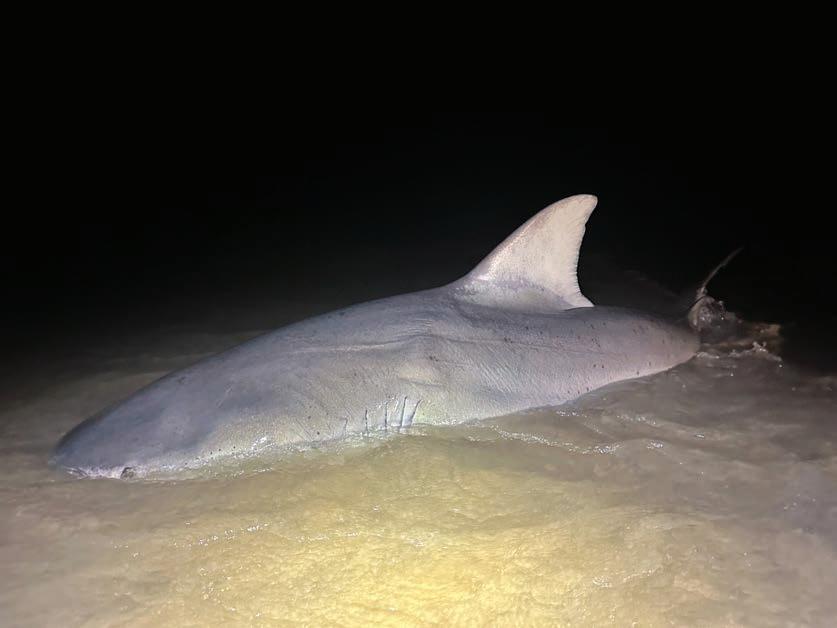
Large bull shark caught on bait deployed with Xpece drone.
Shark bait rigged and ready for drone deployment.
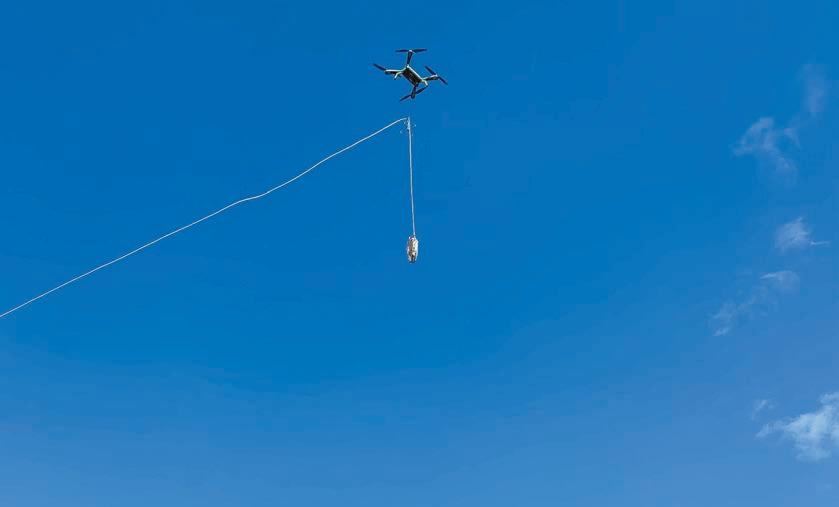
Here’s a 7-pound payload being hauled out to sea by the Xpece.
large section of stingray weighing about the limit of its safe carrying capacity. I deployed the bait with ease several hundred yards out; the drone flew with impressive stability in moderate wind, and I became a complete fan of Xpece.
Currently, several brands of drones prove capable of deploying baits safely and successfully well away from shore if no random technical issues arise. I’d say the future is extremely bright for Xpece, and I recommend the Xpece One as the best all-around drone on the market, partly because of the quality of the team’s support system. No one wants to spend money on fishing tools like these without confidence they’ll receive support if and when they need it. I believe this company’s commitment to service and support could help them rise to the pinnacle of the industry. For purchasing or general information about the company and the Xpece One, visit xpece.com.
The
XPECE Fishing Drone
Follow and Like us on YouTube!
For the past decade Eric ‘Oz’ Ozolins has been promoting shark catch and release and assisting various shark research programs. Eric offers guided shark fishing on Padre Island National Seashore. Also renowned for extreme kayak big game fishing, Eric is the owner of Catch Sharks Tackle Company.
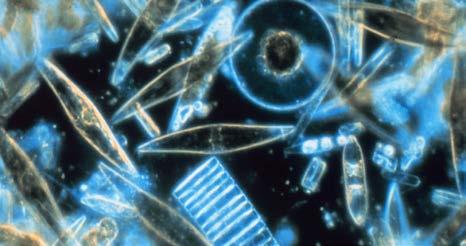
For years, few scientists have devoted much time to studying Arctic diatoms, single-celled algae enclosed within a wall of glass-like silica. These bizarre organisms, after all, appeared frozen in the sea ice, stuck in dormancy, or so many scientists believed. In reality, however, ice diatoms are quite active—skating along the ice at temperatures as low as 5ºF (-15ºC). That’s what scientists recently discovered when they collected diatoms from the Arctic during an expedition in the Chukchi Sea, the body of water that sits between Alaska and Siberia above the Bering Strait, and brought them back to their lab to study them.
the
Back at their lab, the researchers introduced the specimens to ice that resembled the diatoms’ natural environment. Then they watched as the diatoms sped along tiny channels in the ice. The algal cells glided along without the use of any appendages and without the kind of movement, such as wiggling, that other limbless organisms might use. The diatoms do it by secreting mucus that sticks to the icy surface at one end, creating a sort of anchored rope that they can pull themselves along. What stunned the researchers, though, was that the ice diatoms could move in this way at such cold temperatures. No other diatoms or other single-celled plants or animals had been documented as moving at temperatures this low.
Now the researchers are working to understand how diatoms function at such cold temperatures and, even more importantly, how they fit into the broader ecosystem of the Arctic. With the long-term existence of Arctic ice threatened by a warming global climate, researchers want to know: What will happen when the diatoms’ icy highways are gone?
Under freezing conditions in
Arctic, diatoms are very active and skate along the ice. Credit: Dr. Gordon T. Taylor, NSF Polar Programs
JAKE HADDOCK MOSTLY SIGHT-FISHING
IS NOVEMBER THE NEW OCTOBER?
The last few years it seems like fall has been running a few weeks behind. Leaving question whether the season itself still actually exists or if we’re only left with a second summer and pumpkin spiced everything. I’ve heard several complaints about this, and I’ll admit I’ve made a few myself, but after some thought I’m not sure it’s necessarily a bad thing for our sight-fishing program. Let me explain.
Our upper coast marshes go through a cycle this time of the year with heavily fluctuating water levels, both wind and lunar driven. These strong-flushing tides create a phenomenon that sight-fishermen look forward to all year long – big schools of gorge-feeding redfish. The redfish show up to feed in masses, knowing their favorite forage is going to be flushed out of their spartina grass homes right onto their dinner plates. Shrimp, and lots of them, ride the falling tides on a one-way ticket to the gulf before winter arrives, and redfish gladly take advantage of the all-you-can-eat buffet. The milder the fall season might be, the longer this phenomenon can play out. If we have a couple of hard-blasting cold fronts by early November, then that could be all she wrote, and the shrimp are long gone. However, during these mild fall seasons like we have become accustomed to the last few years, I’ve seen
Sure sign of fun ahead! Look close to see the reds.
There’s a fly in there somewhere!
these patterns play out well into December. Thus, why I am no longer complaining about our delayed fall season.
Another phenomenon this time of year is that the water in our marshes becomes much clearer. This change in turbidity I believe occurs from a combination of things like colder water temperatures, and typically less freshwater runoff that in turn makes for less algae suspended in the water column. While hard winds and fast outgoing tides can dirty the water with sediment, it doesn’t take long to settle back out. This cleaner water tips the advantage in our favor as we can see fish much deeper than during the summer months.
For example, oftentimes, as you approach a marsh drain, a fish will pick up on your presence and try to slip away down the edge of the nearest gut. A move that typically works for them in the warmer months, but now with visibility of two feet or more you can see their attempt at escape and slip a cast right in front of him to make an offer he can’t refuse. It is in this season that I feel we get to even the score.
Cleaner water throughout the marsh is a huge game changer for us on the upper coast because it allows for sight-fishing possibilities at any tide level. Even those pesky tides between 1.5 and 2.2 feet, like we’ve become so accustomed to fishing this year. Don’t get me wrong, I’m still not a fan of those water levels but at least there’s some options this time of year.
Locating redfish this time of year is pretty easy if you know what to look for. I like to run up to the opening of a shallow lake or marsh and shut down to observe the area from afar. You do not want to just blow through interior lakes this time of year as there can be schooling fish where you might normally run right through, especially on days with strong outgoing tides. Once in a good position I’ll scan the lake looking for nervous water and low hovering gulls. If it’s a big area, binoculars are a good idea. I feel like this method gets you on the fish faster and cuts out hours of poling empty shorelines. The fish and birds give easy visual clues for those who slow down to observe. Sometimes I feel like my clients think I’m a bit bonkers when I sit at the opening of a lake and stare into the abyss, and then leave the area without fishing it, just to repeat the process two or more times. But they don’t
complain when there’s a fifty-fish school mere feet from the boat.
Once I locate a school of fish, I’ll decide if I need to motor closer or pole my way to them. The direction and strength of the wind are often the determining factors. If the wind is blowing in your face and the fish are traveling into the wind you might need to get a little closer before poling.
The speed the school is traveling can be a factor as well. Generally, I try not to run my engine within 100 yards of schooling fish. Your approach with the boat while poling can make a big difference as well. I try to pole just slightly slower than the fish are traveling. Poling slower pushes less of a pressure wave off the boat and gives you the element of surprise. I struggled to understand this in my first few years pushing a boat. I wanted to get to the fish as fast as possible but then couldn’t understand why the school would vanish before my angler could get a cast off. Some days the fish are more sensitive than others. Reading the reaction of the school as you approach will tell you quickly if you’re making too much commotion.
I n closing, November truly is one of my favorite months of the year on this beautiful Texas coastline. I don’t know if there is another month with more consistent sight-fishing opportunity than this one. Big outgoing tides hit like clockwork and if any of those can coincide with a light north breeze and sunshine, you have a sightfishing trifecta. If all the stars don’t align for those conditions, trout fishing usually starts to get interesting this time of year as well. While I don’t typically guide trout fishing trips, make no mistake, I haven’t forgotten how a plug rod works. With that said I’ll leave you with the words of the late Flip Pallot, “More to come, bye for now.”
Jake Haddock grew up in the back bays of Port O’ Connor where he developed a great passion for saltwater fishing. In his younger years he was a youth writer for this publication. In present day he enjoys guiding light tackle and fly clients in Galveston and occasionally Port O’ Connor.
Phone 713-261-4084
Email frigatebirdfishing@gmail.com
Website www.frigatebirdfishing.com
Ralph Midkiff with a 10lb slot redfish stuffed with shrimp.
The redfish hit so hard it nearly ripped the rod out of my one good hand. My other hand? Busy trying to keep my phone steady. Between the drag screaming and the camera shaking, I wasn’t sure which one was going to give first. It’s a juggling act, one that’s turned into my signature move. Most people scrolling through Instagram probably see a one-handed hookup and think that looks easy. Truth is, it’s anything but. Down here on the Lower Laguna Madre it takes everything I’ve got to sight-cast, set the hook, and fight a redfish–all while holding a phone close enough to capture every second of it.
The first time I filmed a fish one-handed, it wasn’t some big idea or social media strategy. I just wanted to show people what I see when I’m out there. The glint of a tail in skinny water, the way a fish slides through the grass, and that split-second when everything explodes. I figured a quick clip might give folks a look at the raw side of sight-casting. What I didn’t expect was how much
people connected with it. The comments came rolling in; some cheering me on, others saying I was crazy. But the more I posted the more those videos started catching traction. Turns out, folks like seeing the chaos of an up-close hookup. No fancy editing, no camera crew, just a guy trying to hang on.
Holding a rod in one hand and a phone in the other might not sound like much until you try it. Every fight is a balancing act. Keeping tension on the fish, steering it out of the grass, adjusting the drag, and somehow keeping the camera pointed in the right direction.
Sometimes I hook into a strong one and instantly regret not having both hands on the rod. But once you commit, you’re all in. The trick is to trust your instincts and your gear. My Waterloo rod does the heavy lifting, and my KWigglers soft plastic handles the rest. Subtle, lifelike, and deadly when a redfish decides to commit. It’s a bit like trying to pat your head, rub your belly, and dance on a slick deck. All while a 25-inch redfish is peeling line off your reel. But that’s the fun of it. It keeps me sharp and, in a weird way, it’s taught me a lot about control. Not just of the fish, but of myself during the moment.
humble me real quick. But no matter how it goes, every clip tells a story. One of connection, timing, and the constant dance between chaos and control.
The reason these one-handed videos have caught fire isn’t because they’re perfect. It’s because they’re real. The camera shakes, the drag screams, the fish runs right at me and the viewer gets to see it all exactly how I do it. It’s not polished or staged. It’s raw, loud and natural. I think that authenticity is what pulls people in. You’re not watching some highlight reel; you’re right there in the action, watching the lure disappear and the water erupt. Every video is unpredictable just like fishing itself.
If there’s one thing one-handed fishing has taught me, it’s patience. You don’t have time to overthink. You have to react, adjust, and stay present. When I’m recording, I’m hyper-aware of everything, the wind, the light, the fish’s body language. Every movement counts.
It’s also reminded me that sometimes doing something a little different, even a little ridiculous, can open new doors. Those clips have connected me with anglers from all over the coast, sparked conversations, and even brought new clients who saw a video and said, “Man, I want to do that.”
These days, it’s just part of my routine. I see a redfish push, I grab my rod and my phone, and I go. Some fish make it easy. Others
At the end of the day, that’s what fishing is all about, finding your rhythm and sharing those little moments that make it special. Whether I’m poling across the flats of South Padre or standing on the bow with my Waterloo bent and my KWigglers lure swinging, it’s the same feeling every time–heart pounding, camera rolling, and one hand doing its best to hang on.
James Kosub James Kosub says, “I fell in love with fishing as a child and my passion deepened when I discover the Texas coast. Shallow water redfish have become an obsession.”
Berkley PowerBait Unrigged CullShad
The Berkley PowerBait Unrigged CullShad is a versatile swimbait designed for anglers who want full control over their rigging options and presentation. Featuring Berkley’s proprietary Honey Comb Technology, it offers enhanced durability and realistic swimming action, even at slower speeds. Perfect for mimicking various types of prey, the Unrigged CullShad’s natural head wobble attracts fish in any environment. Ideal for use with screw lock swimbait hooks, swimbait jig heads, or line-through treble hooks, it’s adaptable for a wide range of fishing techniques. Customize your setup and target big fish with the PowerBait Unrigged CullShad, the ultimate addition to any angler’s tackle box.
www.PureFishing.com
Landers’ Trigger Fish Grip at Fishing Tackle Unlimited
Landers’ Trigger Fish Lip Grip tool utilizes a handy trigger actuator to open its gripping teeth, which clamp onto a fish’s lower jaw, and holds on securely. It also has a built-in scale to accurately weigh fish up to 30 pounds, with weight graduations displayed on the shaft under the handle. The Landers’ Trigger Fish Lip Grip also has a flexible leash to attach to a belt or belt loop, which keeps it close and handy all throughout the fishing day. www.FishingTackleUnlimited.com
Award-Winning Reel Made Even Better
DAIWA’s enhanced Ballistic MQ LT is laden with features and technology. In the DAIWA-sphere, “Ballistic” is the resulting reel from the science that launches lures unimaginable distances, and the improved Ballistic MQ LT is the latest rendering of this award-winning reel. DAIWA’s advanced, single component, carbon fiber ZAION V MONOCOQUE (MQ) Body is extremely lightweight, rigid, durable, and corrosion resistant. By removing the traditional screws used to attach side plates, MQ maximizes internal space for larger diameter gears. Other features: AIRDRIVE® Rotor, AIRDRIVE® Bail, AIRDRIVE® SPOOL, AIRDRIVE® SHAFT, TOUGH DIGIGEAR, ATD TYPE-L drag system, LONG CAST ABS, MAGSEALED® Shaft, BALLISTIC MQ LT BALL BEARING SYSTEM & DAIWA’s CRBB ball bearings are shielded to seal out sand, fine grit, salt MSRP $239.99 | Daiwa.us
HIGHLIGHTS
Humminbird XPLORE Fish Finders
The XPLORE Series delivers lightning-fast performance and precision, packed with the features anglers love. Locate fishing spots faster with built-in LakeMaster and CoastMaster charts. Manage up to 10,000 waypoints with custom colors and icons, seamlessly syncing them to your phone. Experience unmatched clarity below the surface with compatibility for top-tier sonar, including MEGA Live 2 forward-facing sonar. Stay in control with One-Boat Network integration, effortlessly connecting to Minn Kota products for advanced GPS navigation and shallow water anchor deployment. With cutting-edge technology and an intuitive interface, the XPLORE Series takes your fishing to the next level.
(MSRP $1299.99-$2699.99)
Humminbird.JohnsonOutdoors.com
ZMan - ZWG™ Weighted Swimbait Hook
A simple solution for easily rigging—and securely holding— ElaZtech® swimbaits, the ZWG™ Weighted Swimbait hook features an innovative plastic keeper molded on the neck of the hook that pins plastics in place, even on hard casts and missed strikes. Built around heavy-duty black nickel hooks with double-tapered needlepoints, ZWG hooks include a silicone bead to reduce the need for Texposing and are embossed with weights for easy identification.
ZManFishing
Okuma Catalina Boat Rod
Built for serious saltwater anglers, the Okuma Catalina Boat Rod Series offers the strength, control, and reliability needed offshore. Featuring a responsive 24-ton carbon blank and exclusive UFR tip technology, these rods combine sensitivity with lifting power to handle tough fights and deep drops. Double-foot stainless-steel guides, Fuji reel seats, and ergonomic EVA grips ensure comfort and durability through long days on the water. For heavy-duty action, the Catalina Rail Rods offer aluminum reel seats, zirconium-insert guides, and reinforced grips-ideal for battling big game from the rail. With multiple actions and configurations, the Catalina Series is built to perform coast to coast, no matter the conditions.
OkumaFishingUSA.com
Matagorda
Bink Grimes is a full-time fishing and hunting guide, freelance writer and photographer, and owner of Sunrise Lodge on Matagorda Bay.
I say this every year, but there is no better month for the outdoors in Matagorda than November. Duck hunting in the morning, fishing the afternoons. Pintails and gadwalls over marsh decoys, trout and redfish eating topwaters and soft plastics. Any way you look at it, it’s hard to beat.
Our fishery has been consistent throughout 2025. That’s due to sound management and changing attitudes of anglers. Catch and release is catching on and many anglers have finally seen the benefits of keeping only what you intend to consume fresh – not let go to waste in a freezer. It’s a beautiful thing.
Sight-casting to redfish along a muddy grass-line is always fun, too. Watch for ripples, wakes and jumping shrimp near the grass and wait for the freight train to pass. Then toss a spoon, shrimp or soft plastic in front of the school and loosen your drag. Listen for crunching jaws when a large school of reds work through the grass. Small crabs do not have a chance.
Obviously, the mouths of bayous and marshes on a falling tide are fall hotspots. Places like Oyster Lake and Crab Lake are good choices, while back lakes like Lake Austin and Boggy are also steady players. Live shrimp under a popping cork, plum Bass Assassins, Gulps or small topwaters worked across points are choice offerings.
Don’t be surprised if birds work in the back lakes, especially on a strong, falling tide. Stay back from the pack and gingerly work the perimeter so not to spook the fish. I can recount past autumns where one flock of birds filled a limit of both trout and reds; and, if mild
weather persists, birds could work right on through most of December. Our bays are full of shrimp and that spells great fall catches. We had one of our best falls in a decade last year and there is no reason we shouldn’t enjoy the same since wet weather patterns have almost been identical.
Wading anglers should work the same terrains, but more methodically. In East Matagorda Bay, Boiler Bayou, Kain Cove, Hog Island, Catch-All Basin and Brown Cedar Flats hold solid trout since all of these spots have a mud bottom. Super Spooks, She Pups, Skitter Walks, Corkys and your favorite soft plastics all get the job done.
If you prefer staying in the boat and anchoring with live bait, the fall offers excellent redfish and black drum action. Shell Island, Twin Island and any other piece of shell holds fish that can be caught with live shrimp under a popping cork.
There is always the bull redfish run if you prefer to tangle with a brute. Large reds are caught at the jetty and beachfront on cracked crabs and mullet. The beauty of the Matagorda jetty and beach is you can drive right up to the water and fish.
The first split of duck season will run Nov.1 – through Nov. 30. Second split will run Dec.13 – through Jan. 25, 2026. Here’s hoping for a more consistent campaign. Last year shotgunners suffered through what many consider to be the slowest duck season in their lifetime.
Habitat conditions are fair to good as of press time. Summer rains helped marsh ponds; however, there has not been much rain since. That bodes well if you have water, but could stress a wintering population of waterfowl.
Hypersaline conditions affect our fisheries as well. Our shrimp, crab and minnow crop is often determined by salinity levels. When the bottom of the food chain thrives, so does the sportfish we target at the top. Hence, both hunters and anglers could use the rain – and soon!
Port O'Connor Seadrift
MID-COAST BAYS With the Grays
Captain Gary Gray is a full time guide, born and raised in Seadrift. He has been guiding the Seadrift/Port O’Connor region since 1986. Gary specializes in year ‘round wade fishing for speckled trout and redfish with artificial lures.
Telephone 361-785-6708
Email bayrats@tisd.net
Website www.bayrat.com
Facebook @captsgaryandshelliegray
November on the Texas Middle Coast is marked by cooler mornings, mild afternoons, and frequent shifts in wind direction. Average temperatures range from upper-50s in the morning to mid-70s by mid-afternoon. Cold fronts begin rolling through, dropping water temperatures and stirring up the bays and estuaries. These environmental changes prompt many fish species to move from their cooler sandybottomed summer haunts to the warmer back lakes.
Water clarity often changes following a cold front as increased wind velocity can create turbidity in shallow regions. Fishing conditions tend to be most stable on calmer days, several days after a front has moved through. During this period wind direction and speed are significant factors to assess, sometimes having a greater impact than tidal movement. Strong north winds may displace water from bays and back lakes, overcoming predictions of strong incoming tides.
Redfish tend to be more active in cooler water, often gathering in small groups on shallow flats. They are frequently seen “tailing” near oyster reefs or grassy shorelines, especially on sunny afternoons. Sightcasting near the perimeter of these groups using scented baits can be very effective. It is not necessary to retrieve the bait aggressively
to gain their attention; leaving it almost completely stationary can also be effective, as redfish are drawn to the scent and will approach at their own pace. Retrieving too aggressively may actually startle the fish and cause them to flee.
During low tide periods trout often concentrate near oyster reefs in Espiritu Santo and San Antonio Bay. The majority of catches typically come along drop-offs adjacent to the shallowest portions of the reefs. Slowly bumping bottom with your lure can be a productive technique. Pick your soft plastic colors according to the water clarity. A Bass Assassin 4-inch Sea Shad in Mama’s Chicken would be a good choice in clear water. However, I generally prioritize locating areas with slightly off-colored water, where Slammin’ Chicken or Purple Chicken tend to perform well.
Be mindful of water temperatures. Sudden dips in temperature call for slower presentations. Subtle twitches and pauses while slowly bumping bottom can produce lots of bites, although the take can be quite soft at times.
November’s moderate temperatures offer favorable conditions for wading. Nonetheless, when choosing to fish remote back lakes and marshes, utilizing a boat or kayaking is often advisable. Much of the backwater areas have very soft bottoms, which can make wading quite challenging. Drifting with the wind over shell reefs and drop-offs can be productive. Be mindful of weather forecasts, cold fronts can arrive quickly and bring rough conditions. Dress in layers, wear a life jacket when boating, and carry a waterproof jacket for sudden showers.
In peak summer months, getting an early start to your day is typically necessary to maximize results. However, with the recent notable decrease in temperature, midday may now offer increased productivity. The sun’s warming influence on shallow flats during these hours can stimulate heightened fish feeding behavior.
Fishing the Middle Coast in November can be a very rewarding experience for anglers willing to adapt to changing conditions. Cooler weather and shifting fish patterns offer the chance for trophy catches and memorable days on the water. By understanding the seasonal behavior of popular species, targeting productive locations, and using appropriate tackle and techniques, you can make the most of your late fall fishing adventure. Whether wading, casting from a drifting boat or kayak, November offers abundant opportunities for every angler.
Just a little reminder. The annual flounder closure runs from November 1 to December 14 this year. The purpose of this closure is to provide greater opportunity for escapement to the spawning grounds in the Gulf during the annual spawning migration. No flounder may be harvested during this period. The season reopens with a bag limit of five fish (15 inches or longer) starting on December 15. Many anglers prefer eating flounder fillets compared to other fish, but implementing effective conservation measures is expected to contribute to higher catch rates in the future. That is something I think all anglers can get on board with.
In this season of Thanksgiving, I am very grateful for the many positive experiences I have been blessed to enjoy this year. I feel fortunate to have a supportive family and a dedicated husband who has accompanied me throughout this journey. Additionally, I sincerely appreciate the meaningful relationships I have developed through the sport of fishing. Wishing everyone a very Happy Thanksgiving.
83-year-old Jack Vance was surprised to hook up with this beautiful Pompano while wading Espiritu Santo Bay.
COAST
Upper Laguna/ Baffin
David Rowsey has 30 years in Baffin and Upper Laguna Madre; trophy trout with artificial lures is his specialty. David has a great passion for conservation and encourages catch and release of trophy fish.
Well, she finally got home. After being lost for almost 5 months she came blowing back into town like an F-47 running from a hurricane. When I first saw her, she was cold and hungry. Comforting her was not to be allowed, as she had a mission upon arrival and that was to cool the Laguna Madre waters back into something that resembles a winter trout season. It didn’t take her long to get her belly full as she enveloped south Texas and Baffin Bay. Although her spirit was formidable, she finally settled down and gave us the first opportunity to pet her head and appreciate what we had been missing - the first big cold front of the season. Finally!
Whether a rookie into the game or a seasoned veteran, the lore of trophy trout fishing should be nipping at your Achilles at this time.
I am often asked, “What is the best time of year to have the best chance of a big trout?” The basic truth is anytime you get the chance to go, but the hard and cold truth is when water temperatures begin to drop drastically, with additional assurance that additional fronts will keep it in a range of about 55°-65°. Of course, there are variations due to what else the elements may bring you at any given time, but that’s what I consider the ideal range. Historically, November will be the first month for everything to line up appropriately and get us to where we start seeing patterns we can count on.
I have been pounding the sand, mud, and tripping on rocks in the Upper Laguna and Baffin for such a long time now that I have officially become “sir” around the marina. As many of you know, about the only good thing that comes with age is experience. I’m slow on social media, have to exercise and stretch every morning before a day on the water, but as I type this – on my birthday ironically – I’m so grateful that I got into saltwater fishing at a young age and can rely on past experiences, lots good and plenty of bad, to adjust on the fly and make quick decisions that benefit both myself and clients. One thing all the years on the water has taught me about catching giant trout is that it is much easier to catch them when they are comfortable in their surroundings and more congregated, due to water temps and relative scarcity of their preferred food source – mullet.
For months I have been going on and on about deep structure fishing with bay water temps in the low 90s. As if flipping a toggle switch to activate your running lights, we are now switching over to a pattern that will find us in crotch- to knee-deep water on the regular. Even in the depths of winter, shallow water still warms faster than it does out deep. Shorelines absorb and radiate heat back into the waters, even on the coldest days. Trout and mullet both seek it out for the same
reason, but now the trout’s food supply is in its immediate house where shallower water turns into a more concentrated hunting ground.
I’ve never minded putting in miles of effort to reach what seems an almost unobtainable goal of catching big trout at will, but dang if I don’t like it to get a little easier occasionally! This time of the year is the beginning of that possibility and when your efforts will most likely be rewarded with a personal-best fish, and even a bunch of them if you slow down to think about what you are doing and concentrate on what makes a fish comfortable versus fishing a favorite spot.
Trout are no different than us. They like to feel safe in their home, know where their next meal is coming from, and gather in the company of like-minded individuals. Outside of blistering cold north winds and boats running too dang close to shorelines, this is typically found in the water depths mentioned. We are blessed in this area to have many miles of productive shoreline to welcome them back home this time of year.
Left undisturbed by outboards encroaching on them, they will stay in wading-depth water for the winter season to be caught with regularity, versus only finding them there occasionally. These scenarios are what makes big trout fishing a favorite winter sport to so many up and down the coast.
My most sincere condolences go out to the family and friends of our beloved Capt. Craig West at this time of bereavement. Rest In Peace, Craig.
Remember the buffalo! -Capt David Rowsey
Richard Kattman getting us started off right. Connecting with big trout has a way of warming a cold morning.
Port Mansfield
Captain Wayne Davis has been fishing the Lower Laguna-Port Mansfield for over 20 years. He specializes in wade fishing with lures.
Telephone
210-287-3877
Email captwayne@kwigglers.com
WAYNE’S Mansfield Report
Greetings from Port Mansfield! Well, it’s November, which means that quite a few fishermen will be exchanging their fishing gear for hunting equipment. This is always a welcoming time for me simply because boat traffic and fishing pressure will slow down quite a bit. Twenty years ago, fishing pressure really tapered off during this time of year but those days when you saw fewer than a half dozen boats a day on the bay are over.
Aside from that, the seasonal change from fall to winter has begun and within the next month or so it should have transitioned fully. About the time we are zipping up our Simms waders for the first time is about the time you can count on fish also knowing winter has arrived. Generally speaking, by Thanksgiving, everyone starts wearing waders for the next four to five months.
We have enjoyed a stellar year of fishing thus far to say the least. Back in late September we found reds schooled up nicely and bait strung out for miles on the flats. Big trout were also cruising the flats and often while bringing in a redfish you could see several trout sparring each other over the lure hanging from the redfish’s mouth. Depending on the winds, or lack thereof, during the fall trout and reds stayed on the sand flats until about 11:00am and then, just like clockwork they started to fade off into deeper water. If it was cloudy and breezy the fish stayed up on the flats a little longer but by noon it was over.
November is an excellent time to catch them on topwaters and that has been the ticket so far through fall. The fish are just so eager to eat tops when we have cooler temperatures. Additionally, our floating grass is becoming more tolerable so there is less frustration when working surface lures. As cool fronts start to make their way to the LLM more consistently you can expect fish to start eating more and start to pack on some weight. This is just the start for what is to come as it relates to trout packing on winter weight. This is a perfect time to start thinking about baits with a little bigger profile. The KWigglers 4-inch paddletail and Wig-A-Lo come to mind. As noted earlier, topwaters will not disappoint and can often be fished all day. It seems like I catch myself throwing tops most all day, especially if it is calm. With a good rod and reel setup, such as the G2 Green Rod by Fishing Tackle Unlimited and a Shimano Metanium
baitcast reel rigged with Fins XS 20lb braid you can cast a mile. On good days I have been able to almost spool my reel on a cast. Not to mention the lightness and sensitivity of the entire setup.
Even if fishing seems easy, you should still watch the concentrations of bait and how they are behaving, current lines, and fish activity in general. Recently I was fishing next to another angler and pointed out “ripple” water and “slick” water. We were throwing Mansfield Knockers and I suggested to focus more on the “ripple” water, which I explained had a tad more current. Sure enough, the fish were holding in that zone. They were impressed and so was I, but it made sense, and it worked. Point being is to keep your head on a swivel and pay attention to your surroundings while out on the water.
We had a fairly good snook season, with over thirty hooked and 15-20 landings. We caught one over ten pounds, and a few others nearly that big. Several were tagged for our partners at Harte Research Institute. Hoping for a few recaptures; if you happen to catch a tagged snook, or any tagged fish for that matter, please get the tag number, measure and weigh the fish, and then release it again. So much can be learned from tagging and recapturing a tagged fish.
In closing, we had a great Texas Women Anglers Fish Camp in late September where six women anglers spent three days taking their fishing skills to the next level. Take a look at Maritza in the photo below and tell me you don’t see pure happiness.
Hoping to be able to do a little recap of my Brazilian Peacock Bass adventure next month, so stay tuned for that.
Remember, fresh is better than frozen.
Mark Perry with a dandy fall trout.
Maritza Bujanos sporting a smile that says it all…fishing is fun!
Arroyo Colorado to Port Isabel
A Brownsville-area native, Capt. Ernest Cisneros fishes the Lower Laguna Madre from Port Mansfield to Port Isabel.
Ernest specializes in wading and poled skiff adventures for snook, trout, and redfish.
Cell 956-266-6454
Website www.tightlinescharters.com
SOUTH PADRE Fishing Scene
I enjoy November for a number of reasons, but mostly because it’s wader time. It’s time to break out the Simms waders that have been in storage since April. In this month’s video, (see QR code) I provide some valuable information on Simms waders, including how to check for leaks and the steps for repairing them.
Come Thanksgiving, give or take a week, the water will have cooled enough that waders will be required for most folks. My personal threshold is seventyone degrees. Your threshold may be cooler or warmer, but November is when waders become part of our daily gear.
November also marks the change from fall to winter. Our water temperatures ranged from the low to mid-eighties during early October and will decline steadily through November. We are warm blooded creatures and can add layers of clothing and waders. Being cold blooded, fish are not so lucky. They must relocate to areas where the water temperature better suits their needs, and always with a reliable food source nearby. Finding their winter hideaways will be the key to successful catching.
What should we be looking for? First would be concentrations of bait. Pelicans, seagulls, cormorants, osprey, and other water birds can help you find the bait. They will lead you to the bait and quite likely game fish as well.
The cooler water temperatures during November will trigger gorge-feeding, almost as though the fish know winter is coming and they want to pack on extra weight to get them through hard times ahead. Fish will tend to lie on bottom, resting between feeds. They scurry away quickly when disturbed, creating mud boils of bottom sediments. Mud boils on the flats are dead giveaways that fish are present. The more boils the more fish.
Historically, we experience one to two serious cold fronts in November, which push fish to deeper water. However, this effect is short-lived, as they soon return to their regular shallow-water flats. Later, in the colder winter months, water temperature plays a bigger role in where they will stage than any other influence.
Come November, look for good numbers of redfish holding on grass lines and potholes in thigh- to belly-deep water. Colder days may move them into deeper water. When they are staging deeper I recommend 1/4-ounce jigheads with ZMan Paddlerz in Pearl or Sexy Penny. The 4-inch Minnowz have also been producing well for us.
If you are struggling with hanging up on bottom grass I recommend the Eye Strike Texas Eye weedless jig head. Not only is it virtually weedless, its swiveling head adds more action to the bait. The swiveling head, combined with ZMan’s soft ElaZtech bait material seems to encourage fish to hold on longer, allowing for more secure hook sets.
The overall pattern this month will have redfish moving between shallow and deeper water, depending mostly on changes in water temperature.
Our trout in the Lower Laguna Madre continue to show signs of significant recovery from the Freeze of 2021. We are seeing bigger trout on the flats than in the past several years, which is confirmed in our landings. Trout are more sensitive to fluctuations in water temperature, so their movements during the winter months, starting in November, are more frequent than that of the hardier redfish.
During November, look for trout to continue to stage along and near the ICW, deeper potholes and grass beds, and on shallow flats during warmer days. The good thing about colder weather is that it brings out the bigger trout in larger numbers.
Also during this month, trout will begin moving toward areas with softer bottom and easy access to deeper water. This is not to say they will abandon shallow water completely, but their forays onto the flats will be of shorter duration.
When targeting larger trout in clear, shallow water I will typically downsize to a lighter jighead for less disruption when it hits the water. I like lure colors like ZMan’s Beer Run and Pearl. In slightly stained water I will go with the Bigballerz in Plum-Chart, Gold Rush, or Troutcicle. I will rig these on Texas Eye jighead to provide as much lure action as possible.
Keep in mind that November brings shorter days, which can cause heavier feeding during daylight hours. Fall is a great time to be out on the water, the weather can be pleasant and the fish will be hungry.
Don’t forget to check your waders for leaks. Be sure to check out this month’s video if they need repair. Happy Thanksgiving and Best Fishing!
Why I trust Simms waders
Follow and Like us on YouTube!
Here’s a nice trout for the author last November. She couldn’t resist my Pearl ZMan Paddlerz.
Richard Garza was rewarded with a beautiful snook recently – ZMan Diezel Minnow in Troutcicle color did the trick!
The C.A.L. family of lures offer a wide variety of lure shapes for both freshwater and saltwater fishing. From small ponds to deep jigging ocean reefs, D.O.A. has you covered. Made from tough soft plastic, each lure is made to match up perfectly to D.O.A. short and long shank jig heads.
FISHING REPORTS AND FORECASTS from Big Lake to Boca Chica
Trinity Bay - East Bay - Galveston Bay | James Plaag
Silver King Adventures - silverkingadventures.com - 409.935.7242
Fishing for both trout and redfish improves significantly when November rolls around, after something of a lull earlier in the fall, James says. “The pretty weather we often have in October can make the fishing tough. Light winds, bright skies and weak tide movements create a tough bite, especially if we have a standing high bull tide, which we often do. But, by the time November comes, we usually have gotten at least a couple significant fronts to stir things up in a positive way. When strong north and northwest winds blow the water out of Green’s Lake, Carancahua Lake and Jones Lake, the shrimp get on the move, and the gulls start working. I’m not above stopping off to throw lures under working birds, but other patterns which perk up this time of year get more of my attention. Wading in areas of Lower Galveston, East and Trinity bays picks up significantly once water temps drop and tide levels return to a more normal number. In some situations, fishing in the late afternoon is best. The bite on hard baits can be fantastic in this situation, even for people drifting the open areas of West Bay.”
Jimmy West | Bolivar Guide Service - 409.996.3054
Jim expects to be running some duck hunts in November, though he doesn’t have as much property to use as in a normal year. “I did agree not to hunt some of my fields this year, where seismic activity is taking place, but I do have one really nice pond to use during big duck season. I also plan on fishing quite a bit this fall, since I’ll be running fewer duck hunts. If things continue as they have been, and the water’s salty all the way to Jack’s Pocket in Trinity Bay, I’ll likely be heading up that way somewhere to do most of my fishing. The wading can be great in areas around there this month, if the water’s salty. If we get more rain, the action might center around Smith Point, or over here in East Bay. Watching the amount of water coming through the dam is a key to figuring out where the best action will be. Wading the afternoon hours and even into the first hour or so of the night is often the best way to take advantage of the patterns which work well once the water cools down heading into winter.”
West Galveston - Bastrop - Christmas - Chocolate Bays
Randall Groves | Groves Guide Service
979.849.7019 - 979.864.9323
Randall fishes a variety of productive patterns during the Thanksgiving month. Normally, around Halloween or so, strong cold fronts roll through the area, driving water temperatures and tide levels down, sending all the shrimp and other small creatures out of the numerous marshes and backwater areas in the bays around San Luis Pass. This sets up the perfect scenario for fishing under working gulls, which pinpoint the locations of schools of trout feeding on the migrating herds of shrimp. While this is happening, the fishing in deeper areas between San Luis Pass and Carancahua Reef can also be good. In those places, staying around the giant rafts of jumping mullet and reading the slicks and even the activity of birds like cormorants, pelicans and terns can be helpful in the quest to find the fish. On warmer days, with higher tides, wading in the back-lakes and coves can be great. Throwing slow-sinking twitch baits around reefs and at shoreline points often works well then. Of course, when the tide is moving right, areas right around the Pass produce good catches too, as trout, redfish and flounder intercept some of the species moving out of the bays and into the Gulf for winter.
Matagorda Bays | Capt. Glenn Ging - Glenn’s Guide Service 979.479.1460 - www.glennsguideservice.com
November may be my favorite month of the year to fish Matagorda. Our fall fishing is well under way already, and the fishing has been excellent. Working the birds in East and West Matagorda bays continues to pay off for trout and increasingly more reds as this month goes on. Soft plastics like Hogie’s Major Minnows and Bass Assassin Sea Shads are highly effective this time of year. Soft plastics under Coastal Corks are a great option as well. Vudu Shrimp and MirrOlure Lil’ Johns work well under a cork when working the birds. As fun as fishing the birds is, the wadefishing in November is also outstanding. Wading the reefs in East Matagorda should produce quality trout all month, as long as winds are relatively light. The shoreline coves and reefs will produce some big trout and keeper reds too. Barring any excessive rain, we should see quite a few fish in our area rivers as well. Look for big concentrations of shad and mullet, and the trout and reds won’t be far behind. One of the biggest keys to success in river fishing is playing the moving water; our rivers really produce best when the tide is flowing with good strength.
The last six weeks have produced the best fishing of the year so far. Redfish have dominated our boxes lately, as they have shown up with the big tides. We’ve been fishing as far back in the marshes and creeks as we can go, and they have been thick back there. The 3.5” Vudu Shrimp in Cajun and natural colors tipped with a Fish-bite and dangled under popping corks have accounted for most of the fish in the marsh. Reds on the shorelines have started schooling pretty good, and we’ve been throwing Matrix Shads in Cajun Pepper to catch them best in those places. Redfish have also been numerous around shell reefs in about three feet of water, where they’re taking either live or dead shrimp readily. Our trout bite has not been as good, though there are a few out around deep structures such as well pads and deep reefs in the bays, but not thick like they were in the peak of the hot weather period. Lower water temperatures will spread them out, and then the bird activity will help us find them.
Turtle Bay, South Bay and the spoils along the ship channel will be good spots this fall to look for working gulls.
Port O’Connor | Lynn Smith
Back Bay Guide Service - 361.935.6833
Lynn was having good luck catching trout on topwaters on the trips he took in the days before giving this report. “Lately, we’ve been targeting our trout on big grass beds on flats lying close to deeper water. This pattern has been working for us for quite some time. We’re catching some quality trout too, mostly on topwaters, with a mix of slot reds thrown in. I doubt this pattern will work as well once we get to November. Normally, that time of year, we start getting some stronger cold fronts which drive water temperatures down and change the patterns. I start leaving the dock later in the mornings and fishing through the afternoon hours, to let the sun warm up the water on the flats some. We also usually wind up targeting our fish around reefs surrounded by bottom that’s a mix of silty mud and scattered shell. The trout and reds will often move up out of the deeper water and look for meals around reefs like that when the water temperatures are in the 50s
and 60s. Then, slow-sinking twitchbaits and soft plastics often work better than topwaters, though we do still catch some on top when the weather’s warming.”
Rockport | Blake Muirhead
Gator Trout Guide Service - 361.790.5203 or 361.441.3894
In November, Blake looks forward to the return of cast-n-blast season. “Big duck season brings cast-n-blast charters back around as a mainstay. We like to start off way back in the marsh somewhere, hunkered down in a blind, waiting for ducks to pull into our spreads of decoys. If we experience decent shooting, which we do on most days, we’ll be done with the ducks about the time the sun is up good and has had some time to heat up the water in those muddy back-lakes. Then, we usually start off fishing our way out by targeting redfish not far from where we hunted. This usually means fishing in the shallower parts of the place, if the tide’s high and the weather warm, in some of the deeper guts and drains if the tide levels and temperatures are lower. On the best days, we catch plenty of reds without using up the rest of our time, and we’re able to work our way out and fish some of the grassy, sandy shorelines in the main bodies of water, trying to catch some trout before we call it a day. This entire process is just so much fun.”
Upper Laguna Madre - Baffin Bay
Captain James Sanchez Guide Service - 210.260.7454
November brings colder temperatures and more predictable fishing patterns as our tides drop. With the passing of early fronts and cooling temperatures, we find trout and redfish on shallow flats and along shorelines that remain covered by higher tides. My strategy will involve wading through sets of potholes in knee to thigh-deep water where there are concentrations of mullet. Using topwater lures like the Mansfield Knockers or Texas Custom Double Ds can produce some exciting surface action, which can last throughout the day. If the action at the surface slows down, I’ll switch to rigging a KWigglers Wig-A-Lo or Willow Tail Shad on a light jighead. As stronger fronts drop water temperatures into the upper-50s to low-60s, patterns will change, and fish will move to deeper waters adjacent to shallow structures. Wading drop-offs in waist-deep water, particularly near seagrass beds and potholes, can yield keeper trout, even trophy-sized fish. I recommend starting with a KWigglers Ball Tail Shad in plum perfect, bone diamond, pearl or naked Margarita rigged on an eighth-ounce jighead in the cooler weather, then switching up to a Paul Brown Fat Boy or Soft-Dine XL in hopes of catching a bigger fish in the area.
Corpus Christi & Baffin Bay | Capt. Chris Elliott’s Guide Service captchriselliott@yahoo.com - 361.834.7262
Fall has officially arrived, and the fishing in and around Baffin has been fantastic lately. With cooler water temperatures in the mornings, we’re having a lot of success throwing topwaters on flats covered by shallow water, catching plenty of trout and redfish. The last couple weeks brought us some higher water levels that really pushed the bait up onto the flats that have been too shallow to fish most of the summer. This has caused something of a problem related to floating grass, but I expect that issue to be a short-term situation. As we move farther into fall, most of this grass will get pushed onto the shorelines by the passage of cold fronts. As this next month goes by, expect to see a slow but steady drop in water temperatures. With the dog days of summer behind us, we like to start the mornings fishing in shallow water, looking for signs of nervous bait. Bull redfish are in the midst of their annual migration to the Gulf and the flounder will be starting their migration soon. This is a great time to fish near the Intracoastal Waterway and intercept some of these fish as they move out for the winter.
P.I.N.S. Fishing Forecast | Eric Ozolins
361.877.3583 - Oceanepics.com
By November, some highly anticipated cold fronts should have arrived. As of now, the mullet migration is in full swing, bringing red drum and jackfish into the surf in great numbers. The Upper Coast beaches will have more bull reds moving inshore; farther south, more slot reds will be available, along with other species. By the end of the month and into early December, giant bull reds will move into the surf of South Texas. Mullet caught in cast nets work well to target these. While tossing out mullet, anglers can also expect to catch jacks, mackerel and bluefish. Areas farther south along the coast provide better chances at a surf tarpon before they migrate out. Near the end of the month, expect pompano to move in. Usually, the first waves of pompano of the season produce some of the largest specimens, sometimes big numbers of them. Fish-bites and shrimp are prime baits for both the pompano and black drum. One of the most thrilling surf fishing experiences in the fall in Texas is chasing jack crevalle as they storm the beaches. While they’re easy to catch on live mullet, many of us find sight-casting them with spoons and topwaters more exciting.
Port Mansfield, Texas | Ruben Garza Snookdudecharters.com - 832.385.1431
GetAway Lodge - 956.944.4000
When waterfowl and deer seasons open, we hear lots of shots fired. When moving around in the bays this month, boaters should keep their eyes open for spreads of decoys. No one wants to be peppered by shots from angry or careless duck hunters. Aside from the hunters, strong cold fronts present the biggest hazards to safety in the Thanksgiving month. Anyone heading out onto the water this time of year should have checked the weather forecast and be ready to adjust plans if and when a strong north wind makes crossing some areas uncomfortable or unsafe. This month, the Saucer area produces great catches on a consistent basis. The East Break, where the sand and grass lines meet, is a great area to start the morning off, in the shallows, then working toward middle sections of the area as the sun rises. Action on regular topwaters or floating Paul Brown Lures and Texas Custom Lures is usually hot early this time of year. The Pipeline and the submerged spoils just north of Bennie’s can be productive too. Up north, the west shoreline around Century Point, the Oak Mottes and the shoreline just south of Gladys Hole are best after strong fronts subside.
Lower Laguna Madre - South Padre - Port Isabel Aaron Cisneros | tightlinescharters.com - 956.639.1941
Recent changes in weather have had a positive influence on fishing in the Lower Laguna Madre. Trout fishing has been great, with the most reliable bite coming in water about two to four-feet deep covering grassy flats riddled with potholes and plentiful bait. With calm conditions during early morning hours, areas close to and right on sandbars that lie close to the ICW have been especially productive. Z-Man’s five-inch scented StreakZ in Beer Run color, rigged on quarter-ounce Eye-Strike jigheads have become a go-to setup when jigged slowly along bottom. The redfish bite on shallow flats in the back bays has also been hot. Calm conditions during early morning hours makes it pretty easy to spot the feeding activity of schooling and tailing reds. We search for lots of active bait to help eliminate non-productive patches of water. Right now, Z-Man’s four-inch Gold Fire Big BallerZ rigged on eighth-ounce Eye-Strike Texas-Eye jigheads are hard to beat for reds. Later in the day, when winds pick up, I head to grass flats and target the reds in two to three-foot depths. The good old quarter-ounce gold weedless spoon works great anywhere that floating grass makes it difficult to fish the plastics.
Mason Wendel POC - 23” redfish
Daniel Kloesel Nick’s Lake - redfish
Charlie Byrket Chocolate Bay - 27.75”redfish
Alexandra Lawther Trinity Bay - 37” bull red
Juan Diaz Southbay - 35” snook
Alan Wheatley Laguna Madre - 32” redfish
Perry Baumann Port Lavaca - redfish CPR
Chrystal Watts Lower Laguna Madre - 27” trout CPR
First come – first published! Photos are judged on artistic merit and sporting ethic displayed. No stringer, cleaning table, or hanging board images allowed. Digital images only. Adjust camera to high or best quality. All images become property of TSFMag. Email to: Photos@TSFMag.com Include short description of your catch with name, date, bay system, etc.
Photo
Reed Byrket Chocolate Bay - 23.5” trout
Mary Ellen Deaton redfish
Connor Stripling 28” trout
Tyler Byrket Chocolate Bay - 22” redfish
Bob Wight St. Charles Bay - 26” redfish CPR
Noe Zartuche Upper Laguna - red
Eric Crafts Matagorda Bay - personal best trout!
Got ideas, hints or recipes you’d like to share?
Email them to pam@tsfmag.com or send by fax: 361 792-4530
Gulf Coast
Wild Duck Crostini
Many coastal fishermen are also avid waterfowl hunters. Wild duck; mallard, pintail, gadwall, wigeon, and teal, can be highly delectable when prepared well and this recipe is a gem. The trick lies in avoiding overcooking, medium-rare gives the best flavor and texture. I have prepared this appetizer for dinner guests several times and received rave reviews. They probably will not know it’s duck – unless you tell them. Thank you, Dawn Larson, for creating such a wonderful recipe to use up all that duck meat!
INGREDIENTS
6 to 8 duck breasts
Bag of crostini or loaf of French bread
4 oz room temp cream cheese
Tbsp. mayonnaise
Tbsp. prepared horseradish
tsp lemon juice
1/2 tsp dill finely chopped (reserve half for garnish)
Capers for garnish
PREPARATION
Mix together cream cheese, mayonnaise, horseradish, lemon juice and half the dill. Set aside.
Season breast fillets with salt n pepper, pan fry in butter until medium-rare. Don’t overcook. Let the meat rest for three minutes before dicing into small cubes.
French bread or prepared crostini. I like the garlic and butter crostini from HEB bakery section.
If using French bread, spread with olive oil and bake till golden. Top with cream cheese mixture and diced duck. Garnish with capers and reserved dill.
With your finger on the line, every second counts. X-Series keeps you prepared with its lightweight design, consistent performance, and the control to handle whatever comes your way. When the moment hits, you’re already in control.