Texas Saltwater Fishing Magazine is published monthly.
Subscription Rates: One Year (Free Emag with Hard Copy)
Subscription $32.00
E-MAG (electronic version) is available for $15.00 per year. Order on-line: WWW.TSFMAG.COM
MAKE CHECKS PAYABLE TO: Texas Saltwater Fishing Magazine Attn: Subscriptions P.O. Box 429, Seadrift, Texas 77983
* Subscribers are responsible for submitting all address changes and renewals by the 10th of the prior month’s issue. Email store@tsfmag.com for all address changes or please call 361-785-3420 from 8am - 4:30pm. The U.S. Postal Service does not guarantee magazines will be forwarded.
So go the lyrics of a Christmas song that dates all the way back to the 16th century — and by now, I’m sure everyone has heard it at least ten thousand times. Indeed, we are entering a truly wonderful season. The birth of Christ tops the list of reasons we celebrate and share gifts and goodwill with our families and friends this month, along with the many other “seasons” that make December so special.
Other seasons that come to mind this time of year are ones we wait all year for — and therefore, they too qualify as reasons for celebration: deer season, waterfowl season, pheasant season, and trophy trout season. Depending on where you find yourself along your personal continuum of outdoor pursuits, any or all of these are capable of making us as giddy as a kid on Christmas morning.
Speaking of giddy, I have some wonderful memories of Christmas seasons past. We were a tight-knit family who grew up in a time before the internet and social media. Back then, Christmas pageants and plays at church and school were among the most important events of the year. The world has certainly changed since then — and not always, I’m afraid, for the better.
One of my clearest memories is the traditional family gathering on Christmas morning, everyone on their best behavior as we opened gifts together. I’ll never forget that eight-year-old boy — about to burst with excitement — waiting for permission to tear the wrapping off a long, skinny box that he knew held a J.C. Higgins .22 rifle. I still have that rifle, and I’ll pass it down someday.
We lived on a small farmstead where we raised livestock and tended a big garden. I can still picture those holiday tables proudly filled with the fruits of our own labor — everything homegrown except the flour and sugar. The way we lived and worked the land instilled a deep reverence for nature and the outdoors, something I’m grateful for to this day. I sometimes feel sorry for those who never had that experience.
Christmas has always been very special to me, and I pray it is for you as well. It’s a season for loving, caring, and giving — and for enjoying the bounty of the Texas outdoors with family and friends, whether on the water, in the woods, or out in the fields.
The greatest gifts we can give are the lessons we pass on — teaching our youngsters to respect, appreciate, and cherish the blessings of the great Texas outdoors. Do your best this Christmas season to help create the next generation of Texas outdoorsmen and women.
God bless, and Merry Christmas!
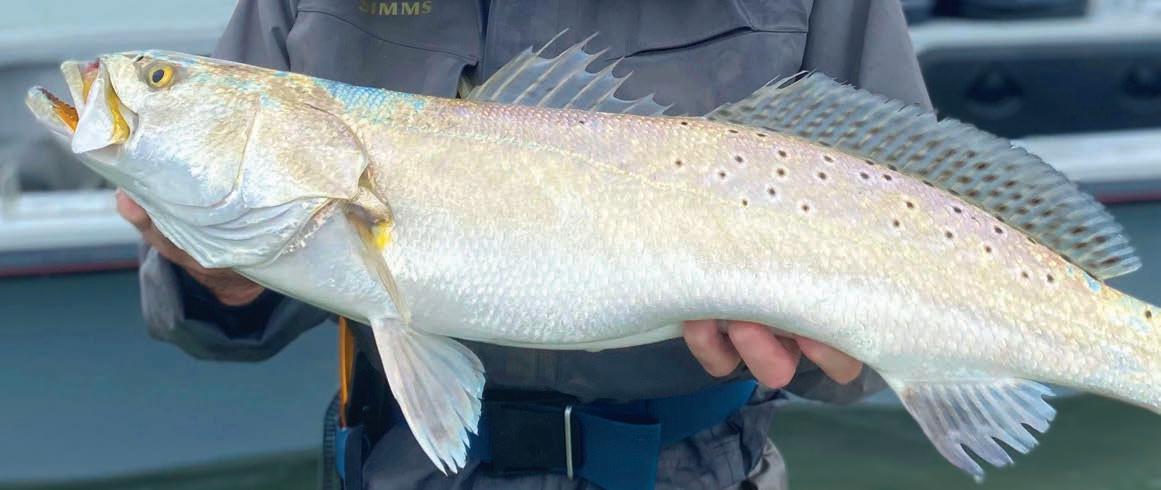
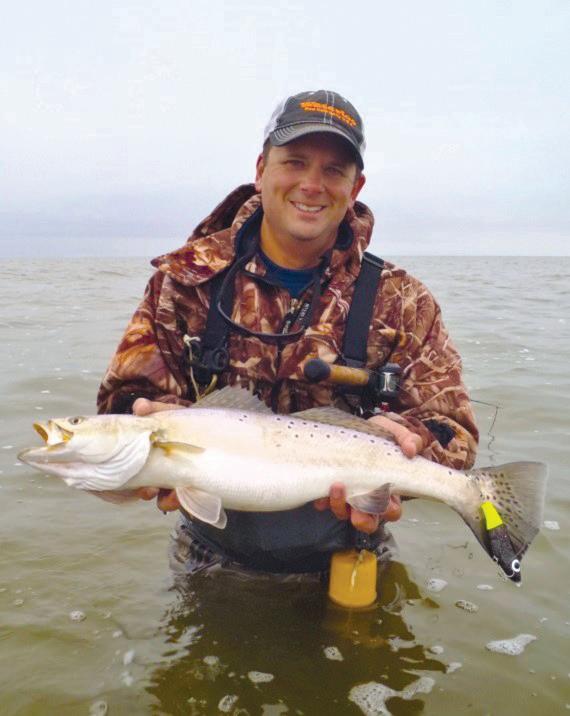
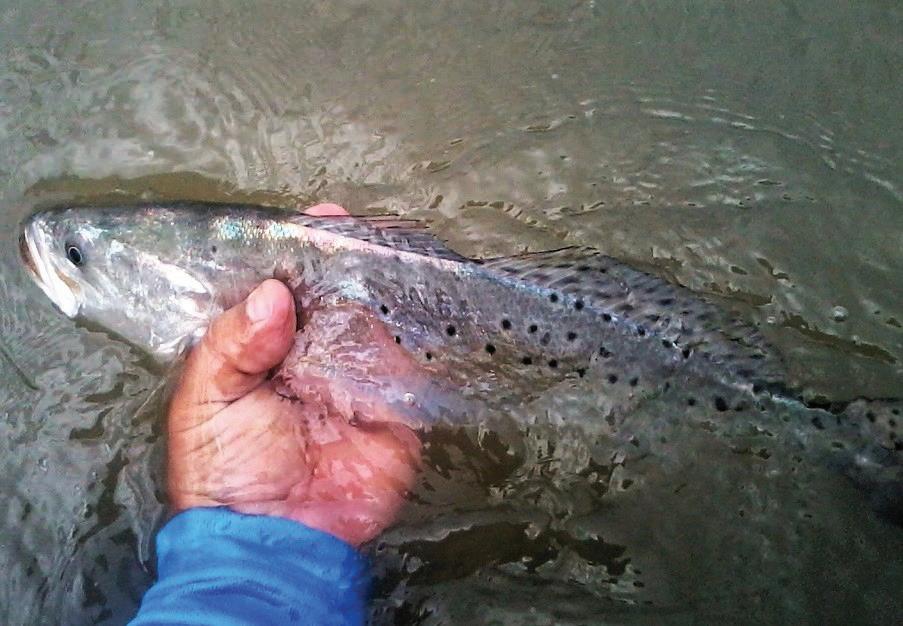
Geoff Wagner caught some very solid ones right up until the cold front hit!
Factors Influencing Winter Trout Patterns
STORY BY STEVE HILLMAN
Our summer pattern is over, and I must say we had a pretty solid run in certain areas of the Galveston Bay Complex this year. Now, seasonal changes and all of the new variables that come with them will alter speckled trout patterns. This means that those of us who chase trout must alter our patterns as well. To do this successfully, we must first take a look at the current dynamic of our bay system by analyzing things like salinity levels, water temperatures, bait migrations, and habitat. We need to understand where most of the trout are now and the factors that will cause them to relocate. Additionally, how will their feeding patterns be affected?
Lake Livingston is currently about a foot below pool, and the dam is discharging at 1,792 cubic feet per second. Our other main freshwater tributary, the San Jacinto River, is at a mere trickle. We haven’t had much recent rainfall in local watersheds, so salinities are holding at a comfortable range for trout throughout the entire complex, including back lakes and up most bayous and rivers. Bay-wide, moderate to high salinity levels help fish stay spread out in more areas. It’s especially helpful for East Bay, Trinity Bay, and the upper reaches of the complex for another reason.
While it’s true we always need some rain, recent years have yielded more than we’d like in certain parts of the bay—from a fishery perspective, anyway. We obviously need low-salinity brackish estuaries to breathe new life into our bays, but in recent years Trinity Bay (mainly because of river flow from upstream) and the back of East Bay (especially since the closing of Rollover Pass) have both seen salinity levels drop too low to allow for a significant reestablishment of base populations of speckled trout.
So what does this mean? It means that when you can’t re-establish a significant biomass, it will take longer to rebuild what we refer to as a resident population of trout. Without a resident population in parts of our complex like Trinity Bay, it’s next to impossible to proliferate older age classes of trout year after year, because the first generations of fish get flushed out by freshwater every winter and spring.
Trout can tolerate a wide range of salinities, but excessive amounts of freshwater can greatly affect their movements. The initial phase of moderate to heavy freshwater inflow occurs when there’s just enough rain to cause the surface to become fresh, pushing trout closer to the bottom where suitable salinity remains. When we’re faced with this scenario, we usually fish the same general area but switch to heavier (eighth- to quarter-ounce) lead heads to work beneath the freshwater layer. Water clarity is typically murky in this situation, so we use darkercolored soft plastics for added contrast.
If rain and runoff persist, we may be faced with a situation where the entire water column becomes too fresh, forcing trout to relocate altogether. Having knowledge of the bay’s hydrology helps us determine where to go when such an event occurs. Much of it is common sense—for instance, the southern areas of our bay are farther from the rivers and closer to the Gulf, so trout are often forced in that direction during flood events. Other times, they may simply stack up in deeper areas or just outside the fresh zone within the bays. Spending time on the water and physically following them through trial and error is usually the best way to determine their new locations.
When everything is salty, as it is now while I write this article, fish can spread into many different locations—and anglers will too. Concentrations of fish won’t get beaten up by multiple boats stacking on top of them. Trout will stay in the areas they’ve been in until other influencing factors come into play.
Water temperature changes are one of the key triggering
mechanisms influencing trout movements. As temperatures drop, trout will find their way toward areas with deeper pockets and guts, often lined with mud and shell. Many of our back lakes, bayous, and rivers possess these characteristics. These same areas also happen to funnel forage species such as shrimp, shad, and mullet.
Some folks automatically assume that trout go deep in the winter. Blanket statements like that can cause an angler to have some very nonproductive days on the water. In most cases, trout will reside near deeper water, but not necessarily in the deepest areas. We usually have one or two arctic cold fronts each winter that force our fish into truly deep water. This occurs because of a combination of factors—the obvious one being a temperature drop into the mid- to upper-40s. Other contributing factors include low tides and high barometric pressure. The timing of the cold event has to be considered as well. Gradual cool-downs allow trout to become more acclimated, resulting in less drastic movements.
Speaking of cold fronts, yesterday we had a decent little one blow through the area. I had one of my long-time clients and his daughter in from Delaware, and we witnessed the textbook version of pre-front and post-front fishing in a span of about four hours. The wind was dead calm as we rolled into our first spot of the morning. Shad and mullet were active on the surface over live oyster reef in about five feet of water. It was too slick to see slicks, but we could smell trout in the air. Geoff and Hayden put on an absolute clinic chunking Slammin’ Chicken Assassins! The bites were very aggressive, and though we
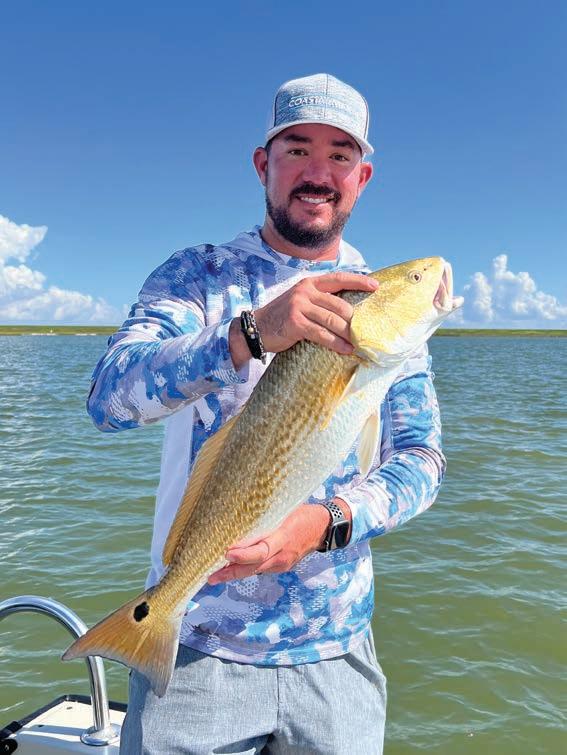
Justin Brown always seems to have the hot hand for redfish!
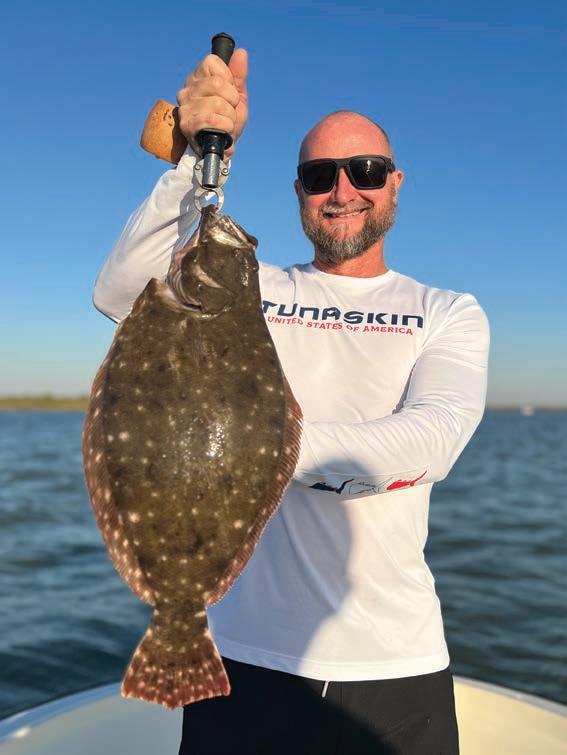
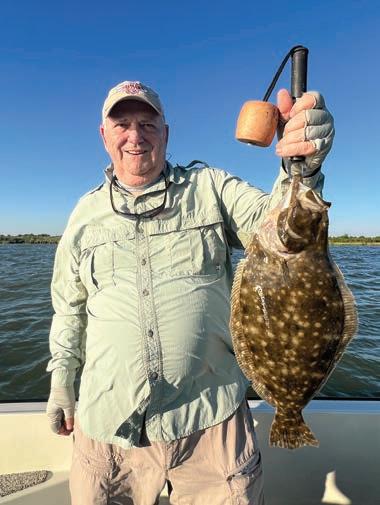
Flounder fishing has really been good recently as evidenced by this 4 ½ pounder caught by Zack Corley!
didn’t throw any topwaters, I’m sure that bite would’ve been insane. By 9 o’clock, the clouds had cleared and the wind was pumping out of the north at 20 knots. It had already been a fine morning, with them catching and releasing 20 solid trout, a couple of redfish, and a black drum. However, anyone who’s ever fished with me knows I’m not a short timer. There was a wind-protected area I wanted to try, hoping for some big flounder and maybe another red or two.
We made drift after drift along a shell-covered ledge, but the lack of surface activity and the bluebird post-front sky might as well have been a giant neon sign reading, “The Bite Is Over, Dummy!” I caught one more nice trout and lost a huge flounder at the boat, but other than that it was just more casting practice for the three of us. The wind became unbearable by 10:30, so we headed to the marina.
High winds following the front caused us to cancel the next day’s trip, but let’s talk about what the pattern would’ve been like had we been able to go. There are three things typically associated with post-front conditions: high barometric pressure, lower tides, and clearer water.
Trout will usually drop and suspend along ledges in extreme postfrontal conditions, even near the bottom of deeper guts. Bites will be more subtle. In most cases, we’ll downsize our lures due to the negative feeding behavior associated with such circumstances. The 3.75” MirrOlure Lil John and 4” Bass Assassin Sea Shad are go-to soft plastics for me. When plugging, I love not only the size of the MirrOlure MirrOdine, but its suspending action can draw strikes from a full-bellied post-front speck when nothing else can. I like brighter colors like Opening Night and pink in clear water; chartreuse with
silver glitter is also one of my favorites.
There will still be plenty of white shrimp in our bays early in December. I’ve even seen trout and reds feeding under birds as late as Christmas, especially during milder winters. As winter progresses, shrimp become increasingly scarce, and trout rely more on shad, pinfish, and mullet. This brings us to one of my favorite times to fish— when we can wade and drift along mud and shell ledges for some of the best-quality trout of the entire year. We’ll still catch plenty on Bass Assassins, but many days will be spent chunking mullet-imitating plugs such as MirrOlure Paul Brown Corkys and MirrOdines
In summary, bay-wide salinity levels are stable, so freshwater inflow isn’t currently a major factor influencing trout movement. Cold fronts will be the primary force driving trout locations and feeding habits. Trout are currently holding in a variety of areas due to mild water temperatures and the abundance of shrimp, shad, and mullet in the bays. As we move deeper into winter, trout will congregate in tighter areas near live habitat (shell reefs) and deeper water as temperatures decline and forage species become less abundant. We’ll then lean more heavily on plugs in our daily arsenals.
Oh, I almost forgot—here’s wishing everyone a Merry and Blessed Christmas!
STEVE HILLMAN
Steve Hillman is a full-time fishing guide on his home waters of Galveston Bay. Steve fishes the entire Galveston Bay Complex, wading and drifting for trout, redfish, and flounder using artificial lures.
Phone 4 09-256-7937
Email captsteve@hillmanguideservice.com Web w ww.hillmanguideservice.com
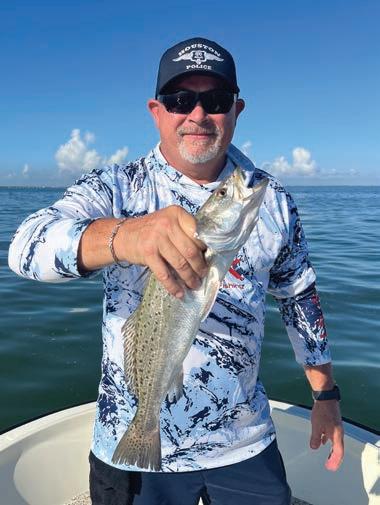
Ray Cibulski was able to get in on a phenomenal trout bite during a recent summer-like stretch of warm weather!
Rick Paige caught this nice flounder while we drifted along a deep shell ledge during post-front conditions.
Hayden Wagner recently got to experience a true prefront feeding frenzy!
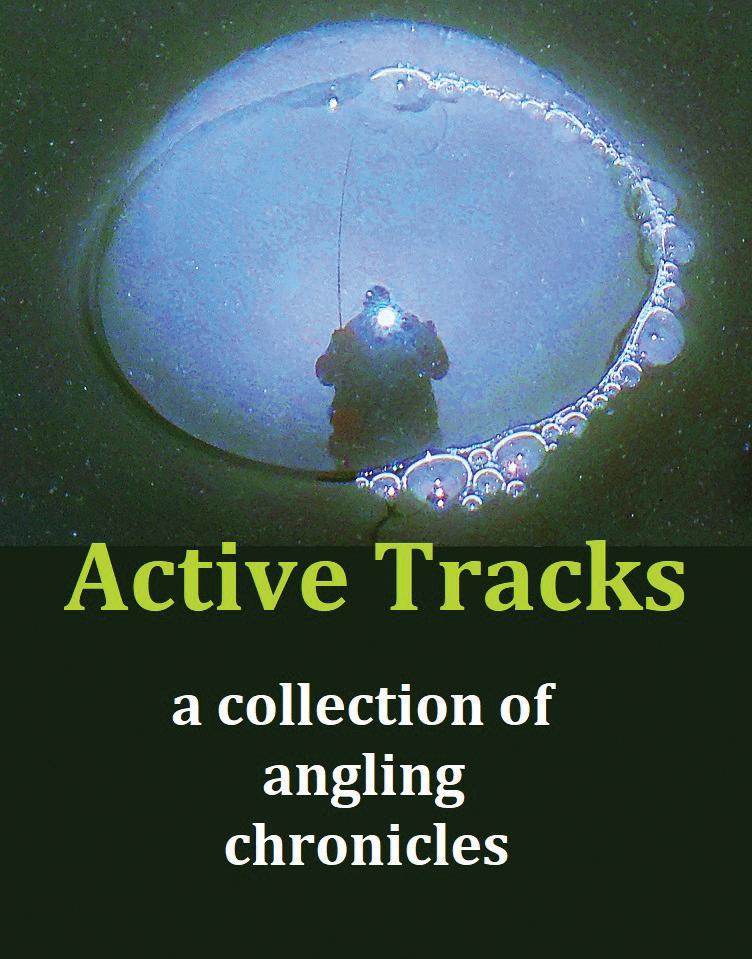
Introducing Active Tracks:
A Collection of Angling Chronicles
STORY BY KEVIN COCHRAN
Earlier this year, I completed work on what will likely be my last fishing book. It’s a collection of 23 of my favorite fishing stories and meditations, many of them previously published in this magazine, over the 27 years in which I’ve been submitting work here. Some are parts of other books I’ve written and published about coastal fishing. I wanted the pieces included in the book to have fresh edits.
I made tiny adjustments to most of them, since I had thoroughly revised them before publishing them previously. I dabbled a bit more extensively with some of the older pieces, mostly because I’ve evolved significantly as a writer over these decades, and I find a need to change more details in things I haven’t touched in a long time.
This is not something I learned about myself while completing the book. I already knew I have a hard time truly letting go of any piece of writing which becomes personally significant to me. I suspect many writers suffer from this affliction. Though we’re forced to sign off on a piece and offer it to the world when we publish it, we never really feel free from the need to scratch an itch and tweak it just a bit more, when and if the proper context for doing so presents itself.
Placing all these stories and ruminations together in one place did reveal some things to me which I had not previously appreciated, at least not with such clarity. For one thing, I realized how often I find myself setting stories in a specific part of Baffin Bay. The actions occurring in many of the included stories happen in the Badlands. The site where I and my friends and clients made many memorable catches, the place is nearly sacred to me.
I also realized how hard I’ve worked over the years to try and accurately present an archetype to my readers. I think of this figure as a kind of cowboy angler; he’s Clint Eastwood in High Plains Drifter , a solitary figure who seems to know many things the rest of us don’t. I’ve spent plenty of time and a whole pack of words trying to vividly describe what we all know as an ‘Old Salt.’
Many of my favorite characters (most imagined, a few real) emerge on the pages of this anthology, including The Phantom, The Hermit, Angler X, Father Time, Mother Nature, two Karankawas, two King Ranch Hands, the trio in The Crew, the probably naked wader, ghost-seeing Johnny and my old friend Jesse Arsola. In addition to making fresh edits to the stories which gave life to these and other figures in the book, I created a short introduction to each included piece, to give readers better insight about why it’s important enough to me to justify inclusion in my collection of favorites. In some cases, I mention the sources which helped me invent the piece; I debunk myths about a few others.
To say I found satisfaction and pleasure while working on this book is a gross understatement. I’m both proud and humbled to have found a home for all these separate pieces, to have placed them together for all eternity. I’ve copied and pasted the introduction to Active Tracks below, hoping to provide further insight into what the book means to me.
“In the early 1990s, when I developed a serious interest in fishing the bays and coastal waterways of Texas, GPS technologies had barely burst onto the scene. After I bought a boat and began trying to learn how to use it, I relied mostly on paper maps, a compass and my wits. I made plenty of mistakes along the way to becoming a capable captain.
In 1997, I started fishing competitively, still operating my 18’ Kenner without the aid of a GPS. By then I’d developed decent navigation skills and proven myself capable of making excursions under the cover of night, using a Q-beam to light my way. In 1998, I studied the books
and other materials necessary to pass the Coast Guard’s tests, earned my captain’s license and began running charters.
Over the years, I’ve guided people on trips targeting speckled trout in all the Texas bays lying between the Louisiana Shoreline in Sabine Lake and the Land Cut connecting the two Laguna Madres. I spent most of my guiding career on the waters of Baffin Bay and the Upper Laguna Madre. When I started guiding full time in 2005, I did so in a 22’ Triton , using a hand-held GPS device with limited capacities to enhance the safety and productivity of my trips.
Soon after, I bit the bullet and bought a better boat, one with a bigger, more sophisticated GPS mounted on the center console. Over time, I came to realize the many ways this amazing technology can make fishing safer and more productive, especially when the efforts take place on wide, wild and treacherous waterways. Knowing exactly where one is, where other things are, where one has been and where one is going simplifies the complex game of fishing and navigating coastal waters. Marking obstructions, sweet spots and anchor sites allows one to avoid dangers and return repeatedly to the same exact locations, even in darkness and/or dense fog.
Placing track lines on the screen makes this process easier to execute safely and precisely. As my catalog of waypoints and tracks became more extensive, I came to think of the Active Track Lines on my screen as roads. They take me back to familiar places, places where I’ve had success, back to where I want and need to be.
Concurrent with these developments, I began writing about the art of fishing with lures for trophy speckled trout in 1998, when I published my first article in Gulf Coast Connections (now Texas
Conversations and experiences with peers like Jason King significantly contributed to the Captain’s perspective on coastal fishing.
In order to catch big trout in dense fog, one must be able to navigate safely in the mists. GPS technology makes doing so safer and easier.
Saltwater Fishing Magazine). Gradually, the writing and the fishing developed a productive, symbiotic relationship. Because I wanted to write well, I needed to fish well, and vice versa. The need to fully and accurately articulate all aspects of the endeavor drove me to fish more seriously and analytically.
I greatly enjoy both avocations, but I’ve come to realize something significant about my creative, sporting spirit. One thing inspires and fulfills me more than any other. I derive more satisfaction from writing than from any other single activity. Nothing makes me happier than producing a narrative I believe is done to the best of my ability. Getting the words right moves me.
To date, I’ve published somewhere north of half a million words on the topic of coastal fishing. The stories and musings included here rank high on my list of favorites. These characters and events, some real, some imaginary, will always dwell in my memory. The truths they reveal and the emotions they evoke all inspire me.
While compiling this book and reworking some of the included pieces slightly, I realized some things. One of the most significant truths the process revealed to me is the profound and influential role a specific place has played in my life. For me and many others, especially anglers bitten by the big trout bug, the area lying adjacent to the west side of the intracoastal waterway in Baffin Bay feels like a hallowed place, uniquely qualified to help us realize our dreams. Many of these stories are set in the Badlands. After completing this book, the statement “I have active tracks in the Badlands” means more to me than ever before.
Another meaningful discovery I made on the road to the
completion of this piece centers on my continuing search for ways to adequately describe the archetypal angler I both know and seek. Subconsciously, I seem drawn to a spiritual world when thinking of ‘Old Salts ,’ when trying to accurately describe their attributes and qualities. Repeatedly, I portray them in ways which make them seem both real and ethereal. I feel their ironic, emblematic essence in most of my stories.
Like track lines on a GPS screen, the words in this book take me back to familiar, productive places. Like country roads, they take me home. In the navigation device mapping memories in my mind, these narratives appear as Active Tracks . They originate in my heart and terminate in my soul. I hope their truths shine favorable light on the substance of my legacy.”
Paperback copies of this 118-page book can be purchased on Amazon.com for $9.99 and digital copies, in PDF form, can be purchased on CaptainKevBlogs.com for $7.99.
KEVIN COCHRAN
Kevin Cochran is a long-time fishing guide at Corpus Christi (Padre Island), TX. Kevin is a speckled trout fanatic and has created several books and dvds on the subject. Kevin’s home waters stretch from Corpus Christi Bay to the Land Cut.
T ROUT TRACKER GUIDE SERVICE
Phone 361-688-3714
Email kevincochran404@yahoo.com
Web www.captainkevblogs.com
The captain’s longtime friend Jesse Arsola captured this interesting image of an apparently transparent trout.
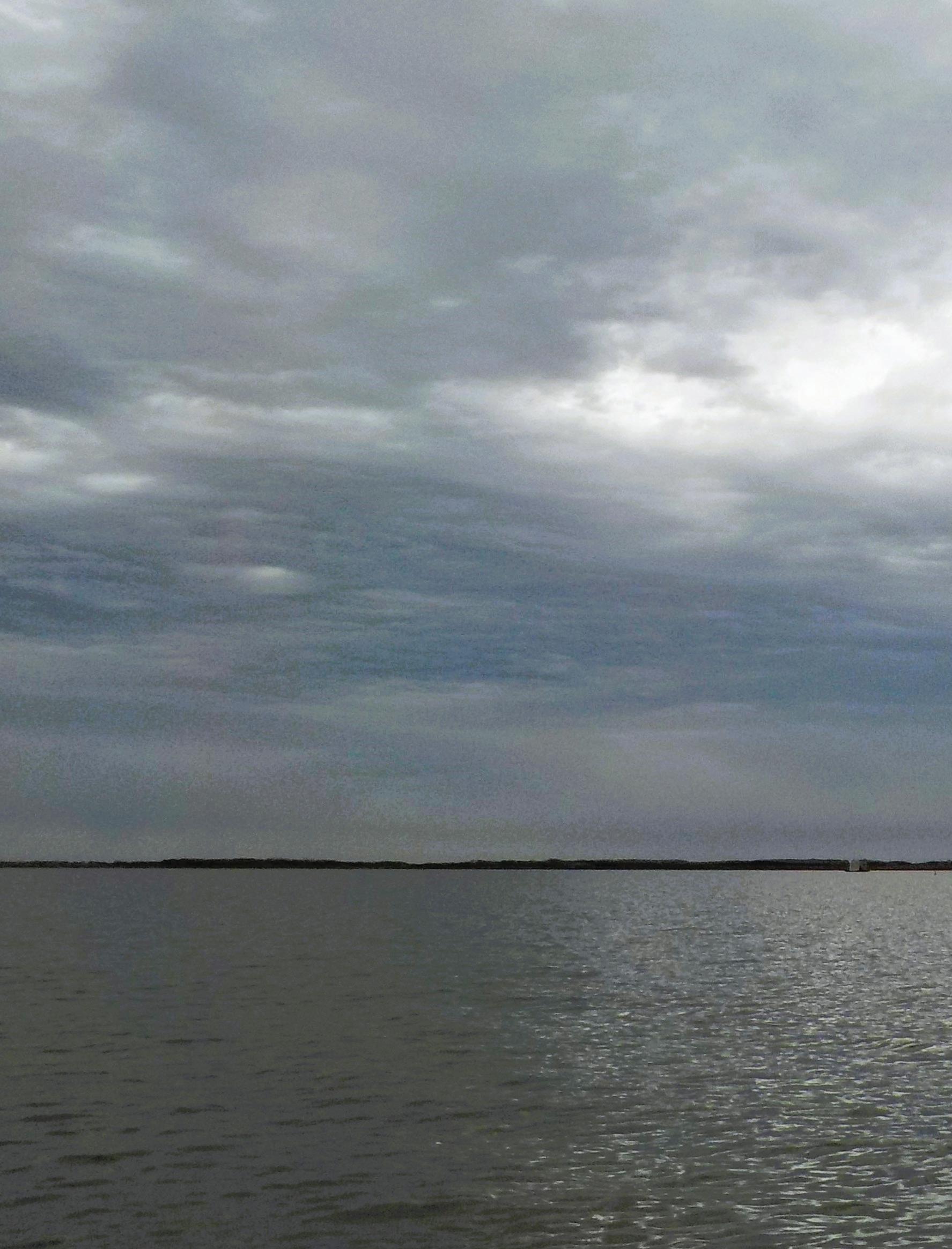
Cold weather and dense cloud cover sometimes create ripe scenarios for catching big trout in Baffin Bay in the Christmas month.
Chasing offshore species on light inshore tackle is a challenge that puts your skill and gear to the test.
Run to the Light Stuff!
STORY BY CHUCK UZZLE
Highly acclaimed angler Larry Dahlberg frequently mentions his 4 Stages of a Fisherman during his seminars and various speaking engagements and I have become a big fan. He explains that during the first stage the angler just wants to catch a fish. In the second stage the angler progresses to wanting to catch a lot of fish. The third stage finds the angler wanting to catch a big fish. And, finally, in the fourth stage, the angler seeks to catch fish only in the way that he or she prefers to fish.
Now, if you stop for a moment and think about it, this really sums it up for most fishermen, especially those of us that have been doing it for a while. For me personally, I have been hanging out in the fourth stage for quite some time and I don’t see myself leaving anytime soon. In fact, here lately, I have become increasingly enamored of chasing fish with lighter tackle and that has brought a renewed element of fun to the sport for me. Using gear that is smaller or lighter than what one would consider standard brings with it a certain challenge and sense of accomplishment, as well as the occasional heartbreak that makes for great stories over a cold adult beverage.
Many years ago, when I first started guiding, I met Pam Basco and learned about her many accomplishments in the fishing world, notably her IGFA Line-Class and World Records. I was truly fascinated. Listening to her tell of the preparation it took to land fish of the caliber she was after did not include luck. It was an incredible skill. Basco had fourteen IGFA World Records at the time and still holds the 20-pound line-class record for yellowfin tuna with a specimen of 203 pounds8 ounces. That world of line-class records requires following some rigid standards and rules that have to be met for record consideration, an undertaking to say the least, and I have the utmost respect for those who choose to go this route.
My own personal light tackle challenge is geared a little different than you might think because I have challenged myself to fish for bigger species of fish with our standard Texas trout and redfish tackle. That’s right, the same rod you grab to throw soft plastics or topwaters in your favorite bay is now my choice for virtually everything when the opportunity presents itself.
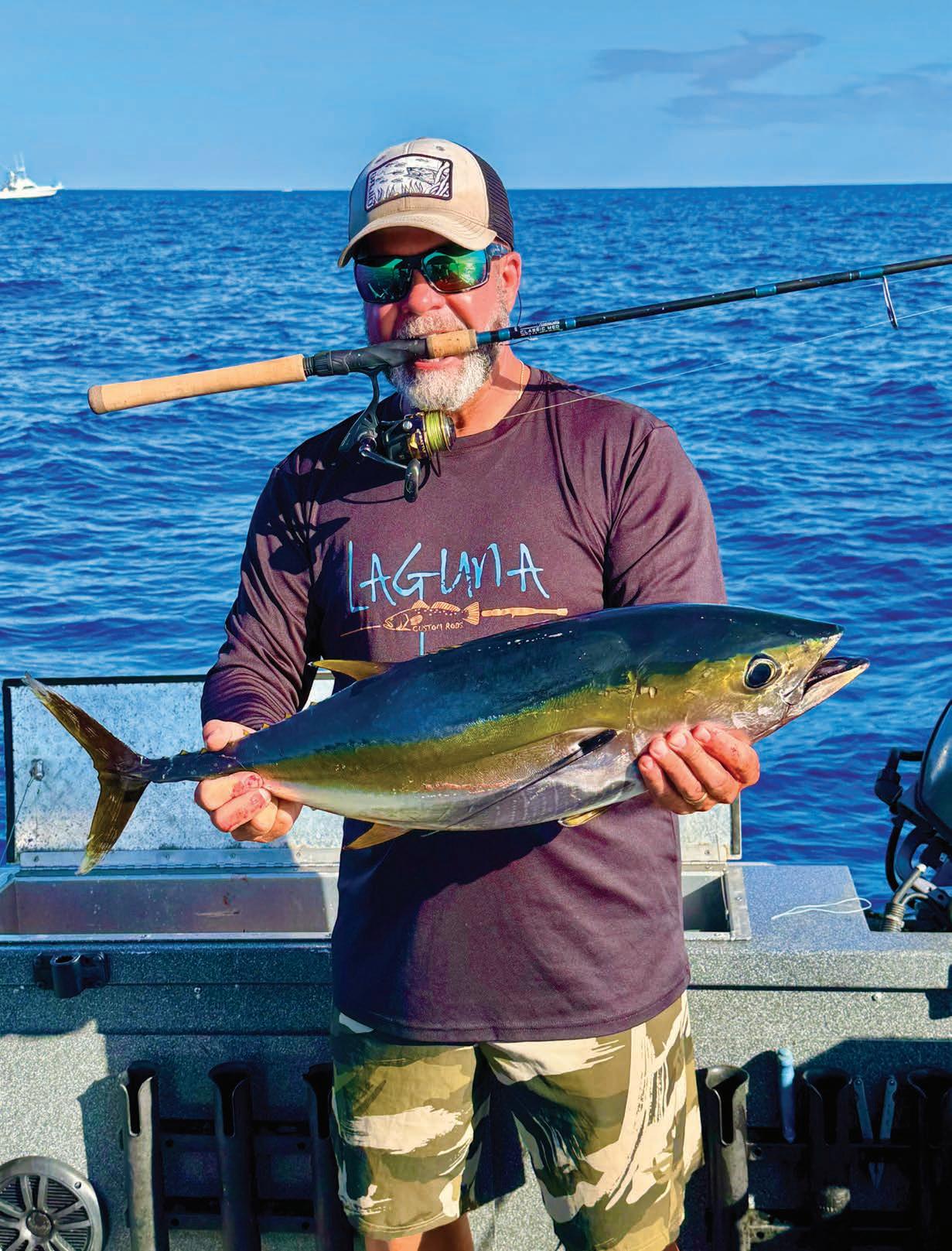
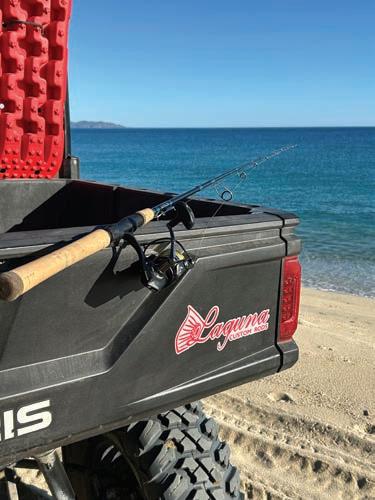
Thanks to the great guys at Laguna Custom Rods, I now carry an array of travel rods that allows me the luxury of bringing my own gear and using it, regardless of the destination. It’s comical to see the faces of other guides or captains when I tell them, “All I want is for a fish to try to run away with all my string and to see if I can stop him.”
I recently added another species to the list of fish that the Laguna Customs whipped – yellowfin tuna in the 30-40 pound class. I must admit when the first fish hit and made the initial run, I thought I had gone to a knife fight with a plastic spoon. Fortunately, I had enough line on my Penn Battle IV 2500 spinning reel to handle that first dragtesting run and regain control of the situation. Using braided line in this endeavor is a must as it affords you much more line capacity than monofilament of equal strength, which certainly comes in handy when the big fish decides to head for parts unknown, and you have to hang on and chase them. My Mexican friends I fish with in the Pacific get as big of a kick out of me catching these fish on smaller gear as if they had done it themselves. Currently, I’m pursuing a sailfish on both the spinning and baitcaster models of the Laguna Travel rods just to see what happens when one finally eats a lure. I’m quite certain it will be a rodeo of epic proportions.
So, if chasing oversized fish on undersized tackle sounds interesting to you, there are a few things to think about before you get started. As mentioned earlier, having a quality setup is paramount to your success. Selecting a reel that affords you comfort, line capacity, and adequate drag tension is a must. When I travel, I use wide frame 300-Series baitcasters from Penn and Okuma because they are durable, have excellent drag, and you can easily fit 300 yards of 30-pound braid on them. With this baitcaster set up I can do just about everything from throwing topwater plugs to deep jigging in 300 feet of water and everything in between. For spinning tackle, I stay in the 2500 series and also go with braid for extra added line capacity. Another aspect that requires your devoted attention when targeting these bigger fish is your ability to tie quality knots, especially to connect your leader. At times this can become a challenge with the small diameter braid being attached to 30 or 40 pound fluorocarbon,
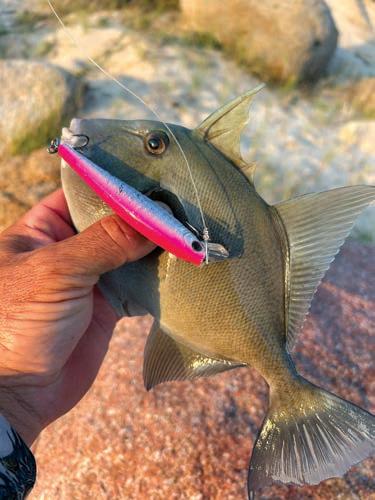
Jerkbaits like this Berkley Cutter help supply triggerfish and other species for fresh ceviche.
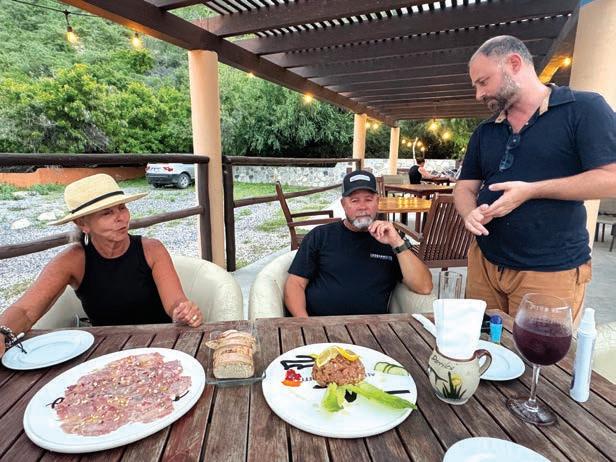
Few things beat fresh tuna for table fare, especially when it’s done by chef Alessandro Cioffi.
They call them skipjacks here in the Mexican Pacific, plentiful and feisty on light tackle.
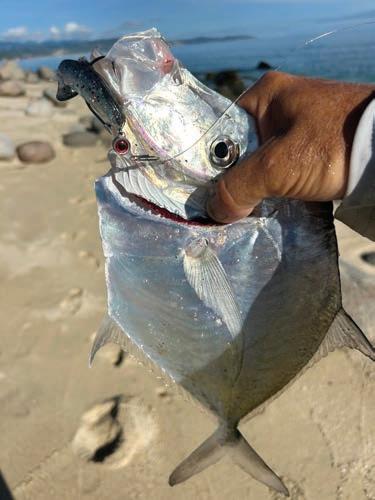
Pompano from the beach on the ZMan swimming jig head and Mulletron soft plastic.
Staying rigged and ready on beach trips is essential.
so knot choice is crucial. Knowing if you want to be able to reel the knot up through the eyes or leaving it out helps make your knot decision easier. You can also stagger your line in gradual increments to make a smoother transition from the small line to the biggest leader material, much the same way fly fishermen tie their tippets and leaders.
I like the Double Uni-Knot in this situation because it’s strong, easy to tie no matter where you are, and runs smoothly through the guides. There are plenty of knots to choose from, so find one you can become proficient with and have confidence in before just doing something halfway and end up losing a great fish.
Lighter tackle, smaller lines and lures will always have a place in the fisherman’s arsenal, and during these months heading into winter are prime for just such a setup. Winter tends to bring some of the clearest water we see all year on the Upper Coast, and the smaller offerings are tailor-made for just such a situation.
I have carried a pattern from late summer. I have been having great success with late-fall and that is shallow diving jerkbaits such as the Berkley Cutter 90 and Heddon Swim’n Image. Both these plugs, along with swimbaits like the Mulletron from ZMan, will be in my daily arsenal as we push towards the end of the year. The redfish schooling activity is in full swing and should remain a constant program for a while if you are inclined to choose this style of fishing.
Hopefully, this winter will produce some of the better-quality trout we have all been praying for over the last couple of years. A quiet tropical weather season coupled with fantastic water conditions over the summer has many anglers, including myself, cautiously optimistic for what the cooler months will produce. We saw some very nice trout this summer in the deeper water near the jetty and hopefully that’s just a preview of what’s in store.
There are plenty of options out there from species of fish to the tackle you choose to chase them with, so take advantage of the opportunity and enjoy some of the best fishing of the year. Remember to be a good steward of the resource, keep only what you will eat fresh and practice CPR (Catch-Photo-Release) on the rest when you can. And by all means, please bring a kid or someone new to the sport next time you head out for the water.
Get light & get right!
fishes Sabine
Calcasieu Lakes
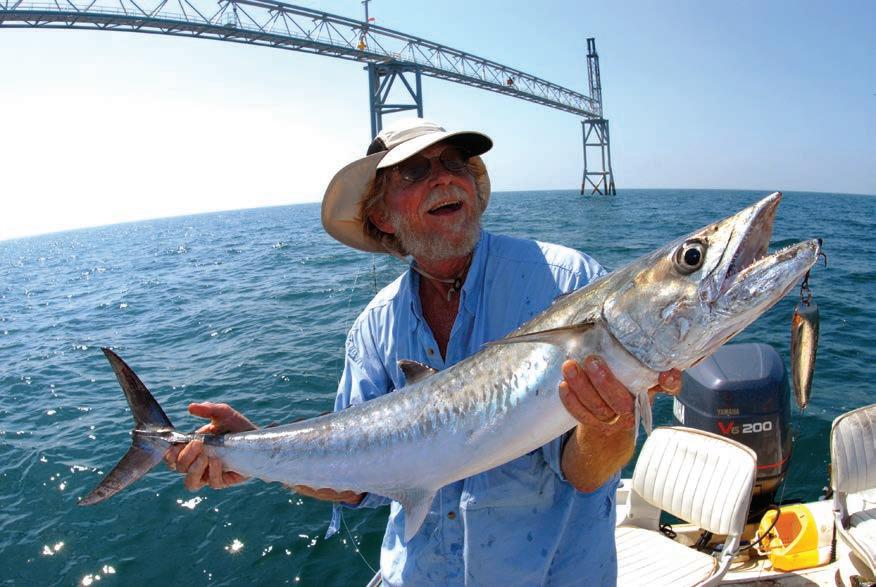
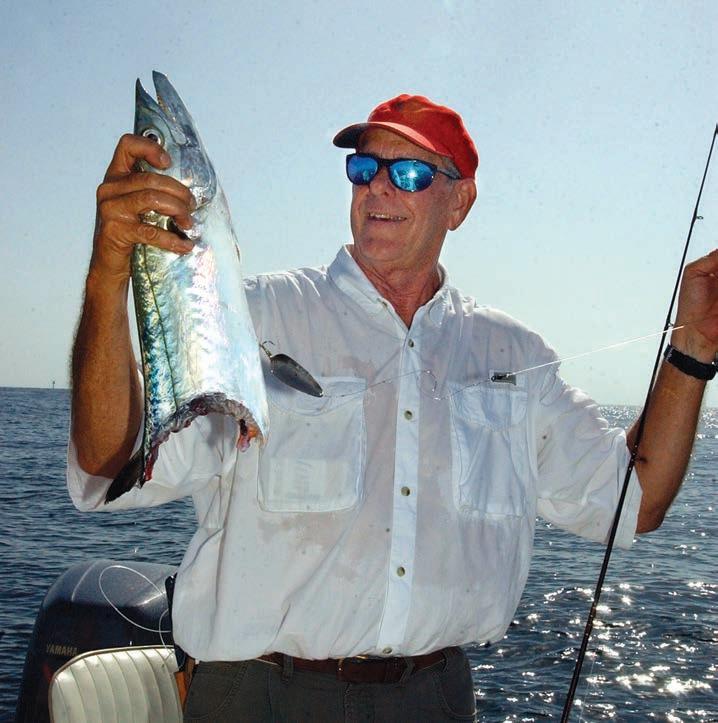
Kingfish are a sporty gamefish that may someday see gamefish protection.
Kingfish Decline
STORY BY JOE RICHARD
One item on my Christmas wish list is that kingfish in the Gulf will somehow reveal why their numbers have plummeted in the last four years. It’s pretty bad when Texas charterboat captains report catching only one percent of kingfish they typically caught only a handful of years ago. Why is this happening? Nobody knows, including biologists.
Fingers have been pointed at the loss of oil rigs offshore, but kingfish were plentiful out there before the rigs were built. The natural “snapper rocks” offshore, which were there before Columbus sailed, attracted big kingfish schools, but no longer. My favorite offshore rock, where we won tournaments, was visited by an acquaintance in Galveston years ago, a commercial fisherman. He reported taking 10,000 pounds of kingfish off that one spot, while trolling with cable and drone spoons. Today, commercial kingfish guys don’t even bother with Texas or Louisiana.
Why kingfish weren’t protected from commercial harvest decades ago is a mystery; this is a popular, sporty fish targeted by everyone from tourists to tournaments. Commercial catches never made that much money off these fish, because it took catching thousands of pounds to make a profit. The fish often had to be trucked to New York City fish markets, or ground up for chum and sold at marinas.
A wasteful fishery, at times. The “dropout” from gillnetting these fish was huge; they drown if they can’t keep swimming forward, and then drop to the bottom where they’re left behind. Today, 14 gillnet boats in Key West are grandfathered into fishing for the rest of each captain’s life. Last year they landed 650,000 pounds, caught where kings winter in the Keys. These boats use spotter planes and once brought in millions of pounds annually. When I was a teenager, a story going around was that a school of kingfish was spotted off Key West that was eight miles long.
For some reason, kingfish are still doing okay from North Carolina to Florida, while Gulf resources have crashed.
Ed Walker with the Gulf’s Fishery Management Council suggests that the Eastern Gulf’s migration of kings down to South Florida may have run head-on into a big red tide between Tampa and Naples four Octobers ago, died and sank to the bottom, leaving no evidence. Those that survived may have migrated into the Atlantic after growing tired of hot water, red tides and pollution. Nobody knows for sure because dead kingfish don’t float.
They prowl open water, often following baitfish schools. Kings are a versatile fish and they’ll eat almost anything. My first kingfish many years ago was caught with a handline trolled behind a slow party boat returning home. Inside that 14-pounder was a single mantis shrimp,
which lives on the bottom. Kingfish schools have even been seen jumping way offshore by tuna longline boats in deep blue water. Perhaps these fish have moved farther offshore seeking cooler water, but nobody knows for sure.
Information on these fish and their movements today may never be
Kingfish are caught from the beach out to 80 or so miles offshore. Or were.
Only five years ago, kingfish were commonly caught off the Texas coast.
known, because you have to tag-and-release lot of them. We marked a couple hundred back in the late 1980s with shoulder spaghetti tags, but some of that data has been lost, the blood-spattered tag info cards accidentally thrown out, the info left entirely on a computer list that can be hacked or deleted. When I worked at CCA, our fish tagging fund was redirected into another direction, at a time when kingfish were plentiful and easily tagged.
The National Marine Fisheries Service (NMFS) also had us putting belly tags in kingfish in 1985, but not sure where that data is today. This year there have been 545 layoffs or accepted buyout offers to retire from NOAA, whose fishery arm is NMFS. However, the Gulf Council is still around and I recently talked to veteran fisherman and member Ed Walker.
“No one really knows what’s happened to kingfish,” says Walker. “Researchers, biologists, guides, recreational, tournament pros and veteran commercial operators all have theories. One thing is certain: landings in the western Gulf have plummeted. Commercial catches are down 70% in Louisiana and Texas where it was once a thriving fishery. Quite a few of the commercial kingfish guys in Texas have quit fishing altogether. West Florida has seen big declines of this species as well. That’s documented.
“One thing that is not suspected is overfishing. There was no notable change in recreational or commercial landings prior to this mysterious disappearance of Gulf kingfish. Some tournaments have now folded and others along west Florida are seeing dismal catches. Some haven’t been able to put 10 fish on the leaderboard.
“One theory put out by NMFS researchers is that perhaps record
high water temperatures in the northern Gulf where these fish spawn in the summer has had a negative impact. When first hatched, kingfish larvae are highly sensitive to water temps and may not be surviving. That’s just one theory, though. There’s some evidence of that, but it’s thin and there have only been small samples taken.
“Sharks have become a problem. Some days, charter captains can’t get a kingfish to the boat without it being chewed up. In Florida, I’ve only seen this once in clear water in the past few years, but a football field-sized school of kingfish on the bottom was completely surrounded by sharks. However, sharks and kings have survived together for thousands of years.
“Some have suggested that kingfish have shifted their preferred habitat to deeper offshore waters and anglers now encounter them less. Lower baitfish populations is another topic, along with loss of oil rig structures off Texas and Louisiana. But then, Florida has never had oil rigs.
“Today, the only sector left in the Gulf that’s filling its harvest quota is the Key West gillnet fleet. Others have all come up short. The western Gulf commercials used to catch their limit in 2-3 months, but now they don’t catch half of it in an entire year.
“A king mackerel stock assessment is currently underway and expected to finish in 2026. The Gulf Council has voted to postpone consideration of management changes until it’s completed. It’s worth noting that mackerel species can be cyclical and do experience historical, natural ups and downs in abundance. Hopefully we’re seeing a natural offperiod and these fish will make a comeback on their own,” says Walker. One thing for sure, if kingfish numbers don’t rebound soon, it will take drastic harvest changes to maybe turn things around. Closed seasons would help, with anglers redirecting their efforts. Gamefish status would certainly help and it’s a shame that wasn’t done with this popular fish 40 years ago. In 1985 commercial guys from Florida moved to Louisiana and hauled away tractor trailer rigs full of huge kingfish up to 75 pounds, the big female spawners. Hauled them away to New York.
JOE RICHARD
CONTACT
Joe Richard has fished the Gulf since 1967, starting out of Port Arthur, but his adventures have taken him up and down the entire coast. He was the editor of Tide magazine for eight years, and later Florida Sportsman’s book and assistant magazine editor. He began guiding out of Port O’Connor in 1994. His specialty is big kingfish, and his latest book is The Kingfish Bible, New Revelations. Available at Seafavorites.com
Sharks have seen far better protection from harvest than kingfish.
Never pass up the obvious!
JAY WATKINS ASK THE PRO
NEW TRICKS FOR OLD DOGS
I had a few weeks off due to some eye surgery, but I’m back out there fishing again and hoping my eyes continue to improve. Cooler weather patterns are making for some nice morning runs across the bay. I love having to wear a light windbreaker for the first hour or two of the morning, then peeling down to just a long-sleeve shirt. I’ll keep wet wading until the water drops into the lower 70s.
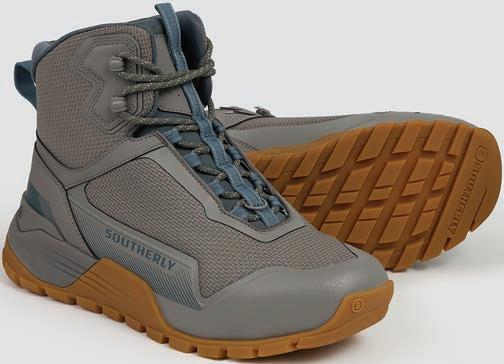
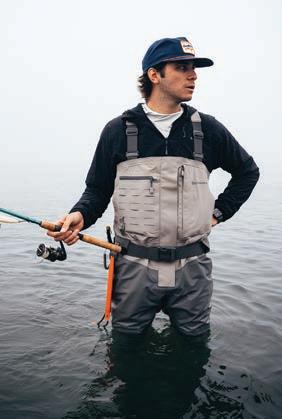
I really love my Southerly wading pants, and being short, I appreciate that these folks nailed the inseam length—finally, a perfect fit. I’ve been wearing mine for two seasons and they’ve held up great. They launder well and don’t look like I slept in them when I put them on, even if I forget and leave them in the dryer
overnight. I also love the Southerly layering gear I wear under my waders. Southerly continues to improve their line of waders, wading boots, and jackets, so keep your eye on this Texas-owned company.
I’m seeing some positive things in what I call the North Country—the area north of Long Reef and Marker 25. Bait is plentiful, and I’m seeing more grass along the barrier island shorelines than last season. We’re still lacking in some areas, but as our oyster reefs slowly rebuild, the current buffering those structures provide will help reduce shoreline erosion and promote better grass growth. We’ve absolutely got to continue fighting to eliminate the destruction of our natural oyster reefs. Thankfully, we’ve got a great crew working hard on that front.
In the past, I typically fished the North Country from about June through April. Since Hurricane Harvey and the 2021 freeze, fishing farther south in Aransas and Corpus Christi Bays has been more predictable—but I’m feeling very positive about winter prospects up north. That’s great news for the Aransas Bay Complex and the anglers who fish it.
The most attractive feature of the North Country is the wide variety of structure available on any given day—and the accessibility of protected areas during less favorable weather conditions. I’ve become more of a “safety first” guide as I’ve gotten older. Don’t run fast. Don’t run in the dark. Don’t take chances when the forecast calls for potentially dangerous weather. I’ve got safe routes programmed into my GPS that allow for slow, careful navigation through fog when needed.
The North Country is full of protected coves and pockets that offer shoreline points with scattered grass beds and small patches of shell. You can’t have a cove without creating some type of point—and there’s always a windward and a protected side. I prefer windward almost all the time, but there are conditions that force me to fish the leeward water. If the protected side has the same bottom structure, you can still find fish there. I especially like areas where shallow bottom structure continues into deeper water along the drop-off.
Of course, a viable food source is key. In the fall, these areas often require casting into the wind. When that’s the case, I’ll bump up to a heavier jighead to get the cast where it needs to be and keep the lure in the strike zone. Lures that cast well are always what I recommend, because distance matters when you’re fighting wind.
I’m a 1/16-ounce jighead fan and rarely throw anything heavier, but in fall and winter I’ll occasionally go to a 1/4-ounce Texas Customs jighead with a 2/0 short shank hook. I remember a day last fall in Copano when a strong east wind kicked up, and that setup instantly became necessary. Lowering your rod tip during the cast allows for greater distance and reduces the risk of backlash. I also try to bend my casts so the lure presentation comes across the fish’s line at an angle—retrieval angles are critical when fish are finicky. Anyone can catch fish when they’re feeding aggressively, but it’s the slow, picky periods that separate consistent anglers from the rest.
Pre-frontal periods are always my favorite, but not all fronts have the same effect. Early fall fronts tend to be weak and often bring little more than a wind shift. You’ll see some increase in feeding activity, but it’s not as dramatic as the stronger winter fronts. I like to target areas where a strong north or northeast wind pushes water into tight, confined spaces—perfect ambush zones that concentrate both bait and predators.
Over the years, I’ve discovered a number of these small, out-ofthe-way areas that consistently produce. Many are narrow ditches or swags cutting through reef structures. Even though the water is barely knee-deep, wind-driven current through those depressions creates a feeding lane.
The water in these areas can be dirty—downright nasty at times—but the key is to watch for pelicans and royal terns. If one of those birds picks up a shad or menhaden, you can bet fish are there in good numbers. These spots typically produce trout, with the occasional redfish mixed in.
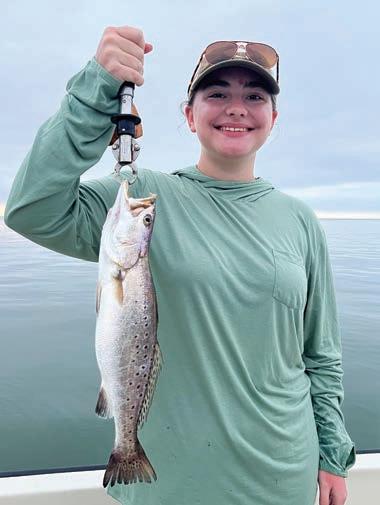
Kylee Dinwiddie with a solid Aransas Bay trout.
Acres and acres of grassbeds and potholes makes for prime trout habitat.
Thirty years ago, the North Country had some primo flounder spots where catching 15 to 20 fish from 3–5 pounds in the fall was fairly common. We still catch a few, but nothing like the old days. I remember pulling up to one of those spots with a client who wanted trout. The northeast wind was howling, and the water looked like drilling mud. “Perfect,” I said. He just stared in disbelief.
I told him exactly where to land his lure and the angle to work it. On his first cast, a 3-pound trout boiled on a Plum 5-inch Bass Assassin. He just shook his head. That scene repeated itself for the next hour and a half.
No matter where I fish, I’m always looking for areas like that. When I find them, I find fish. I have five or six of those spots in Baffin and about the same number in Port Mansfield. Down south they’re sandbars instead of shell reefs, but the principle is the same—add a little wind and dirty water, and the fish will be there. The key takeaway is this: patterns are patterns, and they apply up and down the Texas coast.
As the water cools, baitfish begin exiting the back lakes and stacking along outside shorelines near drains. Right now, we still have some white shrimp in the bays, and they’re moving toward the
Gulf. The combination of falling temperatures and bait migration triggers what many call the “feeding up” period—a seasonal bounty of opportunity.
Lots of lures will work in these conditions, and I always suggest my clients bring what they’re most confident using. Personally, I’ll be throwing Texas Customs Double Ds, Custom Corky Soft-Dines, MirrOlure Lil Johns and Lil John XLs. I’ve also been experimenting with the new MirrOlure Soft-Dine Shallow Diver and 6th Sense Party Paddle and Shindo soft plastics.
Lure color depends on water and weather, but I like to keep a variety in the box: Watermelon, Plum, Pistachio, Bone, White, Black, Opening Night, Pink, and Chartreuse all have their moments. Over the past year and a half, I’ve opened up to a wider range of lures and color combinations—just trying to be that old dog learning a few new tricks.
May your fishing always be catching!
Jay Watkins has been a full-time fishing guide at Rockport, TX, for more than 45 years. Jay specializes in wading yearround for trout and redfish with artificial lures. Jay covers the Texas coast from San Antonio Bay to Corpus Christi Bay.
Telephone 361-729-9596
Email Jay@jaywatkins.com
Website www.jaywatkins.com
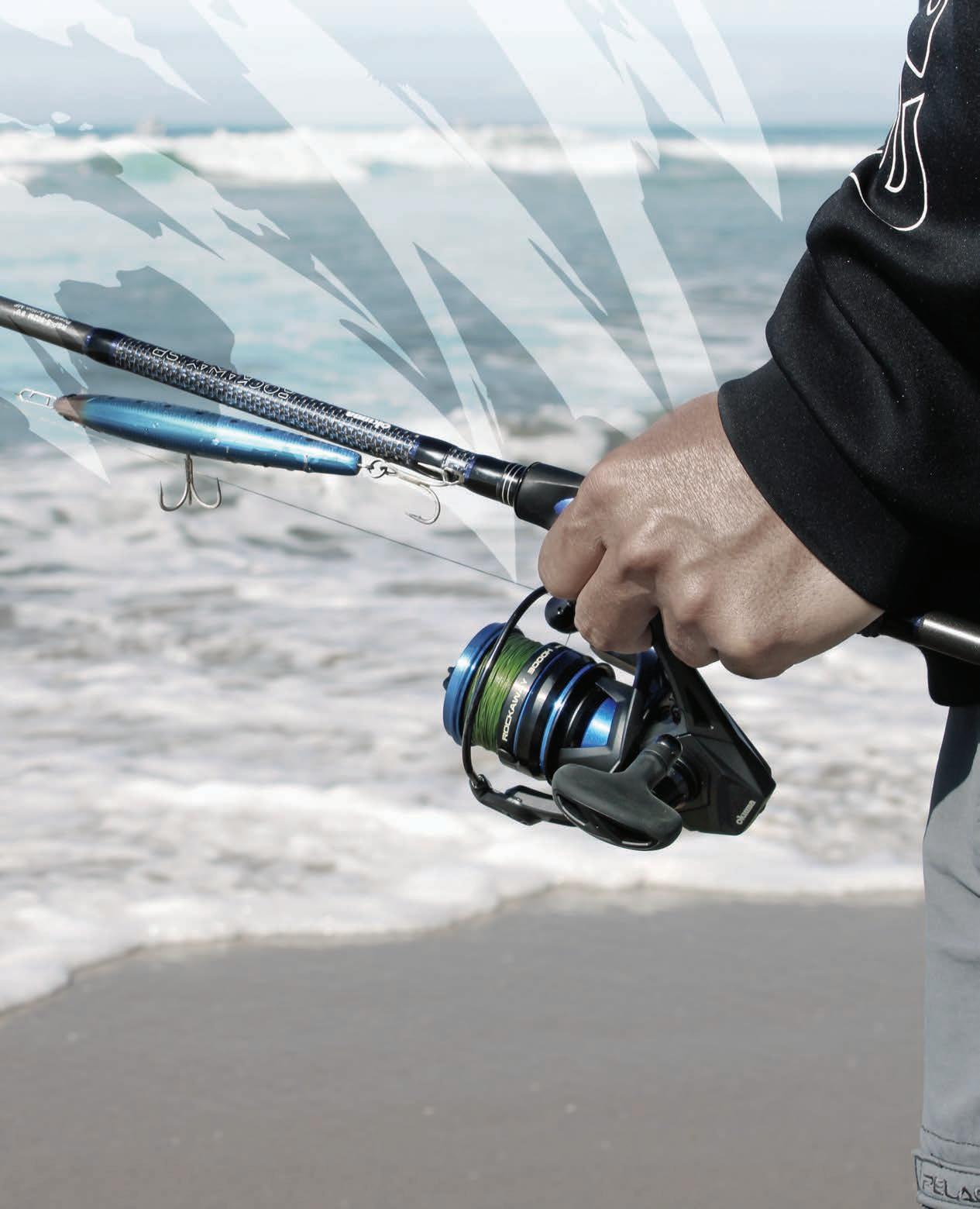
SPINNING REELS
REACH FURTHER. FISH HARDER.
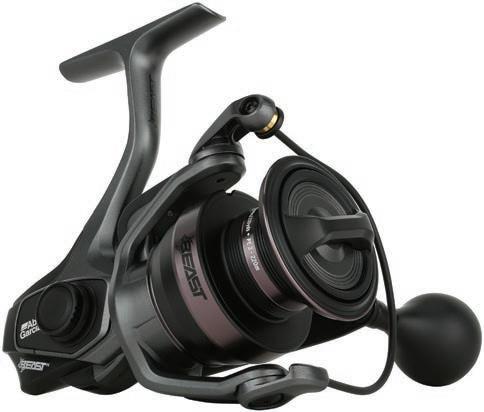
From jetties to flats, the Rockaway SI is built for the rigors of surf and inshore fishing. Its C-40X carbon body and oversized HDG+ gearing deliver relentless power and gear stability. Sealed protection and corrosion-resistant materials guard against salt and spray, while precision internals and multi-disc carbonite drag system keep you in control when big fish dig in. Available in 2500–5000 sizes.
SNOOKTOPIA IX
If you’ve been a regular reader, you might remember an article I wrote a few years ago about snook fishing in South Florida. The reason I haven’t written about it since is simple — I hadn’t made it back down there. But at the beginning of this year, I made sure to pencil in the annual Snooktopia event on my calendar. This time, I was determined not to let it slip by again.
For those unfamiliar, here’s the rundown. My buddy Bart and his brother Donald, both from Jupiter, Florida, live and breathe snook fishing. Years ago, they decided to organize a gathering of kayak anglers with one shared mission — catch big snook. The first few years we camped, which was rough in the South Florida summer heat. But over time, the event evolved. Now, we rent houses, share the cost, and some of us even bring boats instead of kayaks.
The routine is simple: meet up for lunch on day one, swap stories and gossip from the past year, and then hit the water. The fishing is fun — and punishing. Big snook feed mostly at night, which means long days and longer nights if you want a shot at a trophy. The group motto says it all: “No sleep until a 40-inch snook!” In short, Snooktopia is a gathering of great people, tough fishing, and the pursuit of truly giant fish.
My close buddies have heard plenty about these trips and always wanted to tag along. When I told them I was going this year, Colt immediately said he was in. As the departure date approached, he kept reassuring me that he wasn’t backing out — which was great news, because sixteen hours alone in a truck gets old fast. Then, the day before we left, my other buddy Nate called and asked if we could pick him up at the airport if he flew in. I didn’t hesitate. The more, the merrier — and the better the company for a full-blown snook mission.
After the long drive south, Colt and I unpacked and headed straight to the launch. It didn’t take long to get our bearings and find bait. The goal was large mullet, 8 to 12 inches — perfect snook candy. We loaded the net quickly and started fishing just as the sun began to drop. We set up on a point where three channels converged and waited. After a few quiet hours, we decided to move closer to the bridge to catch the outgoing tide.
Around 10:30 p.m., running on fumes from the overnight drive, Colt felt a heavy thump. I told him, “Feed line and count to five before you set it.” As he reeled down, the line came tight, and a massive head erupted from the water, shaking violently. We both knew immediately — this was a big one. I scrambled for the
DAVE ROBERTS SHALLOW WATER FISHING
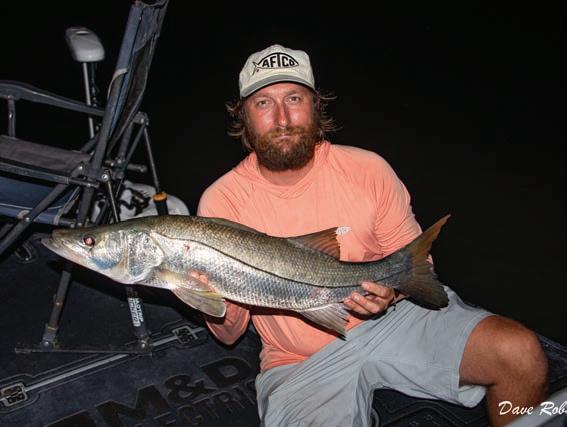
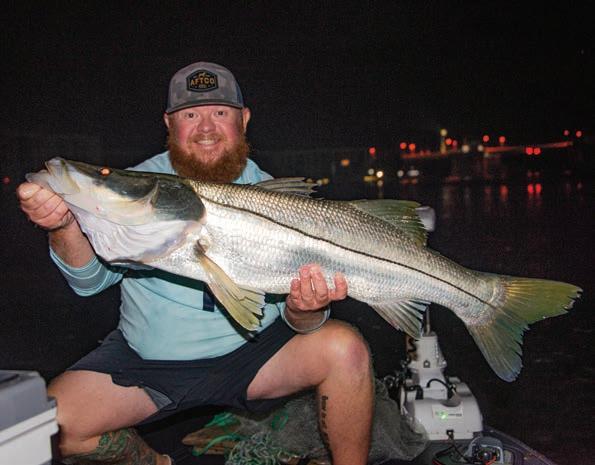
net and a headlamp while Colt hung on. When she finally came boatside, Colt gasped, “Oh my God!” I slid the net under her, and there she was — a solid 40-inch snook, a true trophy. We snapped a few quick pictures and released her back into the dark water. The adrenaline hit hard, but by midnight we were spent and called it a night.
The next day, we slept in late before Nate arrived. Over lunch, we filled him in on Colt’s fish, and he was fired up. That evening, we caught fresh bait and followed the same game plan — fish until the tide turned. The night dragged by without much action, so we bounced around before settling near a rock wall with good tidal flow. My first cast connected, and a few minutes later I had a 35-inch snook in the boat. Finally, the skunk was off.
Nate cast again and hooked another brute. This time, everything held. The fish dug deep, shaking her head and ripping line. When Colt slipped the net under her, Nate was beyond ecstatic — shaking with excitement, almost unable to hold the fish for photos. It was pure buck fever, the kind only a true angler understands. His snook measured 41 inches, a gorgeous, thick-bodied fish. We landed her, got a few shots, and released her strong.
We stayed until sunrise, pulling hooks on a few more fish but never landing another.
The next night played out similarly — a few smaller snook, a handful of missed hookups, and plenty of topwater explosions that kept us casting until dawn. These fish are brutal fighters, even under the best conditions, and we were running on fumes.
The next two nights were a grind — long hours and little sleep — but we stuck it out. Late in the tide, snook and tarpon were blowing up along the wall, but we couldn’t buy a bite. Exhausted, we started for the dock around 4:30 a.m., when Colt suggested one last stop at the bridge. It was a good call. Rafts of mullet were being pushed into the dark side of the bridge, and giant snook were crushing them.
We cut off our weights and started freelining mullet. Within minutes, Nate hooked up — but his line snapped on a piling. I hooked one next and met the same fate. Then Colt lost a good fish, too. Meanwhile, the water was erupting with explosions, and anglers above us on the bridge were hooking up left and right.
Fish the low water after a coldfront
After two nights of fishing until daylight, we were completely spent. We caught a few hours of sleep, then began packing up for the long haul home. Across the Snooktopia crew, several others found success, too — at least five more 40-inch snook and several in the upper-30s. It wasn’t our hottest year, but it was still an incredible trip filled with laughter, late nights, and big fish stories.
Now that my buddies have finally experienced Snooktopia, they understand why I’ve made so many pilgrimages south over the years. They also realize how rare it is to catch trophy snook on your first trip. I couldn’t be happier for them — and I’m already counting down the days until Snooktopia X next year.
CONTACT
Dave Roberts is an avid kayak-fishing enthusiast fishing primarily the inshore Upper Coast region with occasional adventures to surf and nearshore Gulf of Mexico.
Email: TexasKayakChronicles@yahoo.com
Website: www.TexasKayakChronicles.com
Cultch deployment on CoL. CCA Texas has advocated for the expansion of the Certificate of Location program up and down the Texas Coast. By giving the commercial industry the opportunity to expand and create their personal leases for harvest, the ultimate goal is to greatly reduce the pressure on public reefs. As part of the new regulations surrounding CoLs, these sites can also now be built as Conservation sites and be protected from harvest by legislative action.
Story by John Blaha
CCA TEXAS 2025 HABITAT & PROJECT FUNDING RECAP
Coastal Conservation Association Texas (CCA Texas) Annual State Board meeting in February started 2025 off with a monumental commitment to Texas’s coastal resources. At the annual State Board meeting, the board approved $4,458,928 in funding for conservation efforts along the Texas coast. This funding will support a range of initiatives, including oyster license buyback, fish tagging research, habitat restoration, and coastal educational outreach programs. In summary, the funding included:
• $1.0 million – Funding allocated to support oyster license buyback efforts, which will be facilitated by Texas Parks and Wildlife. Round nine of the buyback efforts resulted in 112 of the 115 interested offers with signed contracts, reducing the total number of oyster licenses in Texas by 20%; an enormous step towards ensuring a more sustainable future for our bays and estuaries. The contributions of CCA Texas, Texas Parks and Wildlife Foundation, and private individuals made this accomplishment possible.
• $588,000 - Funding to support tarpon tagging efforts led by the Gulf Research Institute for Highly Migratory Species (GRIHMS) at Texas A&M University – Galveston. This funding will enable a five-year expansion of GRIHMS’ ongoing research into the life history and migration ecology of tarpon.
• $101,152 – Funding to further support the citizen tagging partnership between CCA Texas and the Center for Sportfish Science and Conservation at the Texas A&M University-Corpus Christi Harte Research Institute.
• $50,000 – Funding to the Harte Research Institute to help quantify illegal, unreported, and unregulated (IUU) fishing in the northwestern Gulf of Mexico.
• $125,000 – Funding for an oyster education program at the Texas Surf Conservancy.
• $24,776 – Funding for three educational seagrass billboards along busy coastal highways, and
• $20,000 – Funding to sponsor four sporting clay fundraising events in partnership with Operation Game Thief, Texas’s Wildlife CrimeStoppers Program
• $1.0 million – Funding for oyster restoration project with Matagorda Bay Foundation in Carancahua Bay. **Funded from the CCA Texas Oyster Restoration $5.0 million commitment made in August 2023.
• $1.0 million – Funding for oyster restoration project at Ayers Reef in Ayers Bay led by Coastal Bend Bays and Estuaries Program (CBBEP). This $1,000,000 contribution includes $177,978 in funding from local community foundations. **Funded from the CCA Texas Oyster Restoration $5.0 million commitment made in August 2023.
• $150,000 – Funding for the Nueces Bay Delta Marsh restoration effort led by CBBEP.
• $200,000 – Funding for the Gordy Marsh restoration effort in Trinity Bay, led by the Galveston Bay Foundation (GBF).
• $200,000 – Funding for the Oyster Lake Shoreline Protection Phase IV effort led by GBF. The contribution of $200,000 to the Oyster Lake Shoreline Protection effort now brings CCA Texas support for this multi-phase project to $630,000.
The funding effort at the 2025 Annual State Board meeting was the most ever funded in a single meeting. In addition, and except for $152,000, every dollar funded was raised at local chapter banquets.
During the August 2025 Executive Board meeting, the Executive Board continued to fund important projects and support. At the August meeting, just over $1.2 million for habitat, research and Texas Parks and Wildlife (TPWD) Game Warden support was funded. This funding included:
• $525,000 – Funding for Serpulid reef restoration and research efforts in Baffin Bay with Harte Research Institute’s (HRI) Coastal Conservation and Restoration Lab. This funding will be over a three-year period and include initial surveys, design, permitting, construction and post monitoring.
• $625,000 – Funding for continued support of Harte Research Institute’s (HRI) Center for Sportfish Science and Conservation (CSSC). This funding will be distributed at $125,000 for five years for the efforts that provide critical and important science that can be applied to immediate management needs for species that are being studied.
• $66,660 – Funding for Region IV Wardens. This funding will be for new power and engine conversions for five enforcement vessels in Region IV area of the Texas coast.
Closing the year out, the CCA Texas Management Committee met
in late October and approved funding from the CCA Texas Oyster Restoration Funds for two more oyster restoration efforts. These projects are both Certificate of Location (CoL) projects that will create conservation reefs. Each project has approved funding of $500,000 ea. The first is a 10-acre site in Mesquite Bay near Ranch House Reef and will be permitted by The Gulf Trust. The second CoL is a 10-acre site in East Matagorda Bay, west of the Oyster Farms, and will be permitted by the Matagorda Bay Foundation. Although the East Matagorda Bay site is in open harvest waters, both sites are protected by statute and will be designated conservation reefs. Both projects are in the early planning stages and will have to go through the CoL permitting process and conditionally approved by TPWD, and eventually permitted by USACE and leased by the Texas General Land Office. 2025 has been a tremendously successful year and this success does not happen without great local chapter support and partners that included Texas Parks and Wildlife Department, Coastal Bend Bays and Estuaries Program, Galveston Bay Foundation, Matagorda Bay Foundations and other like organizations. CCA Texas funded over $6.8 million in habitat, research and conservation efforts in 2025. CCA Texas is excited to bring the year to a close and use the success of the year to move many more conservation efforts forward in the future.
Coastal Conservation Association Texas (CCA Texas) is a non-profit marine conservation organization comprised of tens of thousands of recreational anglers and coastal outdoor enthusiasts. Founded in 1977, CCA started in the great state of Texas and has grown to include state chapters along the Gulf of Mexico, Atlantic Seaboard and Pacific Coast. The stated purpose of CCA is to advise and educate the public on the conservation of marine resources. The objective of CCA is to conserve, promote and enhance the present and future availability of these coastal resources for the benefit and enjoyment of the general public.
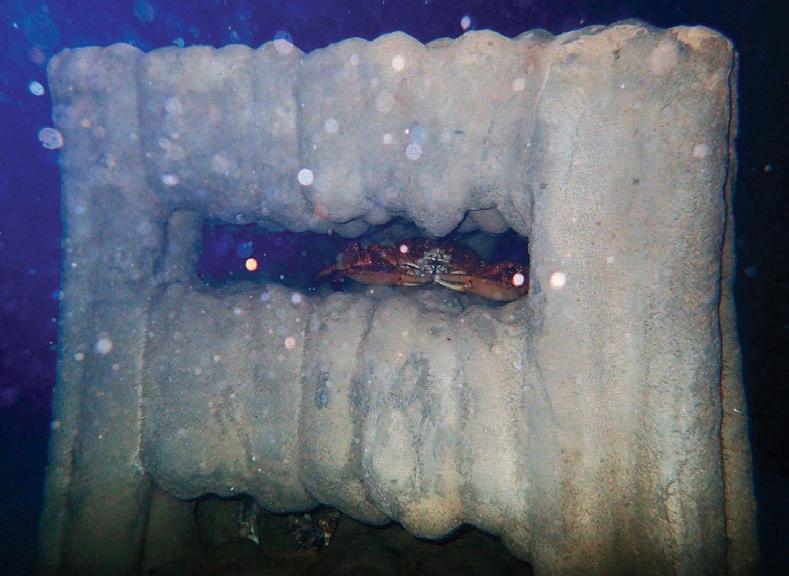
Manufactured Crabitat structures will be used to build serpulid reef sites in Baffin Bay. This new frontier in the restoration of the serpulid reefs in Baffin Bay is exciting to the future of restoration of these historic reefs and for their future survivability.
By Evan L. Pettis | Lead Coastal Ecologist , TPWD Habitat Assessment Team
MORE SHUCKS FOR YOUR BUCKS:
Oyster reef restoration has become an increasingly prevalent strategy to manage and conserve oyster populations in Texas. To date, the Texas Parks and Wildlife Department (TPWD) has restored over 1800 acres of reef across our coastline.
TPWD typically conducts oyster restoration by placing bare “cultch” (shell or rock material) on degraded reef, thereby providing supplemental substrate for larval oysters to settle on. However, in recent years, the cost of cultch material and placement has risen exponentially—totaling only $56 per cubic yard in 2009 and peaking at $271 per cubic yard in 2023. This increase in cost has presented a challenge to restoration practitioners, prompting TPWD to explore new strategies to make the most of limited funds.
To evaluate which restoration approaches were most effective at producing and sustaining adult oysters with the greatest cost-efficiency, TPWD designed and constructed multiple experimental restoration reefs in Aransas, Keller, and Espiritu Santo Bays. The experimental designs tested the differences resulting from (1) deploying cultch as thin, continuous layers versus consolidated mounds, (2) deploying variable depths of cultch layers, and (3) constructing reefs with variable vertical relief. Each reef
was monitored twice per year following construction using hydraulic oyster patent tongs—essentially a giant shellfish claw machine—to evaluate restoration success over time. The monitoring data were extrapolated and standardized to report total adult oyster production per acre of restored bay bottom and then analyzed with respect to the total costs related to each restoration strategy.
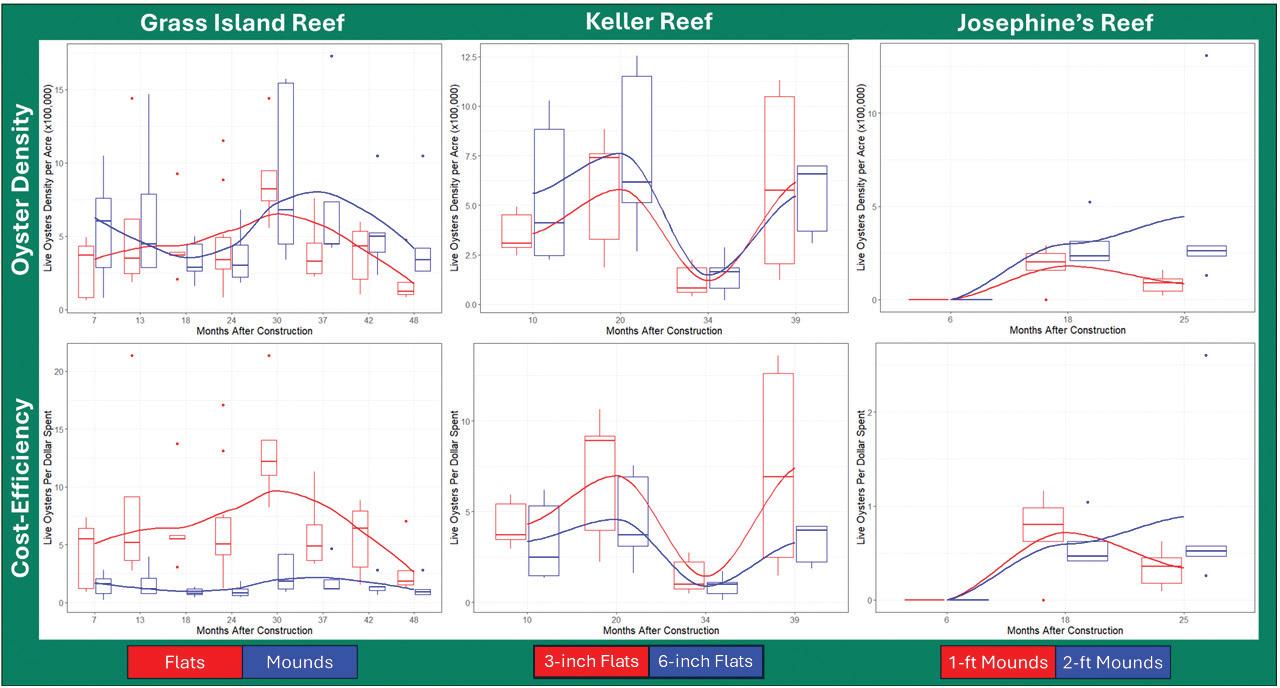
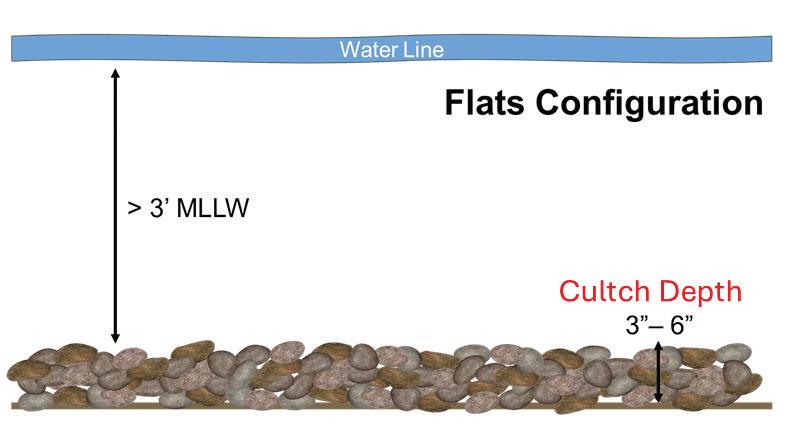
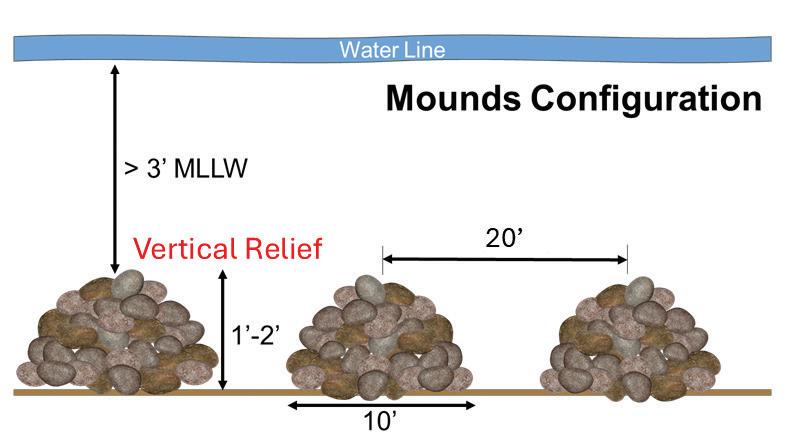
Grass Island Reef, in Aransas Bay, was restored using a combination of different cultch placement configurations. Parts of the reef were restored in a “flats” configuration, using a three-inch layer of rock spread evenly across the bottom. Other sections were restored in a “mounds” configuration, which utilized consolidated piles of rock that were ten feet in diameter, two feet tall, and spaced twenty feet apart. Within three years after construction, TPWD observed consistently higher oyster densities on the cultch placed as mounds. However, the mound approach requires approximately five times the volume of cultch to cover the same spatial footprint of the flats and is therefore much more expensive. As a result, the flats approach was actually more cost-efficient at generating adult oysters over the duration of this study.
Keller Reef, in Keller Bay, was restored entirely using
Figure 1: Monitoring data from experimental reefs at Grass Island (left), Keller (center), and Josephine’s (right). Oyster density, reported as live oysters observed per acre, is shown on the top three graphs. Cost efficiency, reported as live oysters produced per dollar spent, is shown on the bottom three graphs. Experimental treatments are differentiated in red or blue, as described below each column.
the flats configuration. At this site, we tested rock evenly spread across the bay bottom in either three-inch or six-inch layers. TPWD monitoring data indicate that these experimental treatments produced comparable oyster densities to each other. Similar to our results at Grass Island, our analysis concluded that the strategy of using less cultch to cover the same footprint resulted in higher oyster production per dollar spent—as a six-inch layer costs twice as much as a three-inch layer.
At Josephine’s Reef in Espiritu Santo Bay, all cultch was placed in the mounds configuration. Mounds were constructed to extend either one or two feet off the bay bottom, allowing us to compare the effects of differing vertical reliefs. Over the duration of our monitoring, we observed a gradual increase in oyster density on the twofoot mound treatment. After two years, however, we detected a decline in oyster density on the one-foot mounds. This difference in oyster production was large enough that, to date, the taller mounds are more cost-efficient despite being twice as expensive to build. Anecdotal evidence, recorded in TPWD biologists’ field notes, suggests that this trend may be driven by restored reef sinking into the mud at this site.
Collectively, monitoring data from these three experimental restorations provide insight that can help inform TPWD’s future oyster restoration efforts. All treatments tested were successful at increasing oyster density compared to pre-restoration conditions, and within two years were producing oysters at rates comparable to or exceeding those observed on nearby natural reefs. These studies provide evidence that Texas bays are generally not “spat limited.” That is to say that if practitioners place supplemental cultch material in a suitable area, they can typically expect larval oysters to settle on it. Our results suggest that increasing the availability of exposed hard substrate by deploying ‘thinner’ layers of cultch can maximize the cost-efficiency of oyster production, at least in the short-term. This conclusion supports the philosophy of the “maintenance restoration” approach, in which one-to-two inches of cultch material are spread over moderately degraded reefs.
While TPWD’s experimental restorations highlight the benefits of using less cultch to bolster oyster production while minimizing costs, we acknowledge that there is still value to implementing strategies that are not immediately as cost-efficient. Our trends, particularly at Josephine’s Reef, demonstrate that the approaches tested may exhibit different degrees of resilience to natural and anthropogenic processes and placing higher densities of cultch may ultimately be more cost-efficient in the long-term. Moreover, oyster production is just one metric of restoration success. For
example, although mounds were shown to produce fewer oysters per dollar spent, they likely perform better at dissipating wave energy and protecting vulnerable shorelines from erosion. Denser placements of cultch may also be more resilient to periodic disturbances like major storms and heavy dredging activity.
TPWD plans to continue monitoring our experimental restorations to better evaluate long-term success. These on-going assessments provide critical feedback that can assist the Department in adaptively managing Texas’s oysters for both the ecosystem services they provide and the benefit of those that rely on the resource for their livelihood.
Check the TPWD Outdoor Annual, your local TPWD Law Enforcement office, or tpwd.texas.gov for more info.
Figure 2: Diagrams of “flats” and “mounds” cultch placement configurations.
ERIC OZOLINS EXTREME KAYAK FISHING & SHARKS FROM THE SAND
OZ’S CHRISTMAS WISH LIST
As cooler temperatures replace the long hot season along our Texas coast, a cheerful feeling permeates the air. Although many people abandon our favorite surf fishing activities this time of year, the potential for great action on our beaches does not diminish. In fact, December can be one of the most active times for some creatures who live in the surf.
With this past fall producing such longstanding warm air and sea-surface temperatures, I fully expect the fishing to remain productive this Holiday season on our beaches. Warm Decembers rank high on my list of favorite months to work the Texas surf. Among the thrills we can expect are hordes of bull reds storming the surf, pompano appearing in great numbers on the clear and calm days, and better than normal activity among the apex predators. If the warm trend holds, December will provide chances at blacktips, sandbars, tigers and possibly even mako sharks. As the year winds down, I anticipate some stellar outings.
I like to take some time at the end of each year to reflect on a few aspects of my surf fishing adventures that play prominent roles in my success on the sand. So many different tools and strategies play a part in making the hard work of surf fishing productive. Some people seem to think it’s easy–just pick a spot, toss out some baits
and get ready to make countless catches. Such thinking couldn’t be further from the truth.
Much of the success in angling comes from learning how to use the right gear and tackle, and this takes time and experience. In more than 20 years with numerous trips to the coast, I’ve tuned in to many of the Gulf’s patterns. At the same time, I’ve developed an efficient system, utilizing personalized gear to make my trips consistently productive. I have no way of spilling a few words on the page and passing along all the experience I’ve worked so hard to earn, but I can speed up the learning curve by identifying things I consider optimal gear for the surf.
Some anglers will toss lures for a variety of species along the beachfront, but most are soaking baits, and soaking baits properly requires using the right leaders. One of the most crucial aspects of surf fishing gear is terminal tackle, with leaders being some of the most important components. Importantly, targeting different species effectively means using different types of leaders, which generate different presentation styles for the baits. I use different types of Catch Sharks leaders (available at catchsharks.com) for the various applications. I use the Drum Master leaders this time of year when I’m tossing out mullet and large cut baits for reds and jacks.
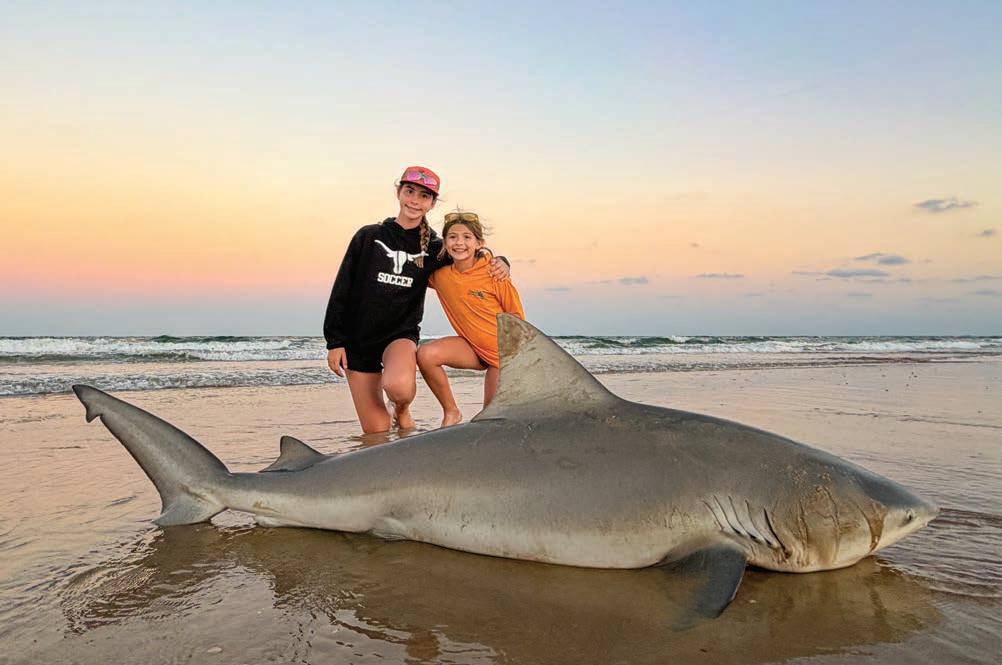
Casady girls posing with late-season bull shark just prior to release.
These are strong, thin, coated cable leaders which cast easily and can withstand attacks from small and medium-sized sharks. When I’m targeting sharks specifically, I use the entire array of Tru-Sand shark leaders, everything from the standard kayaking versions to the more recently acclaimed drone versions.
Many friends and followers often ask me to list other essential
equipment that I recommend specifically for targeting big sharks. I’ve had many brands and models of reels in my arsenal over the years and I’ve found more than a few of them worthy, but right now the two main reels I’m using are the popular Avets and higher-end Alutecnos brands. I recently began experimenting with the Italian-made Alutecnos models, which are like the Lamborghini of fishing reels.
Winter storm approaching the coast – these things are nothing to play around with. Get off the beach or bay ASAP!
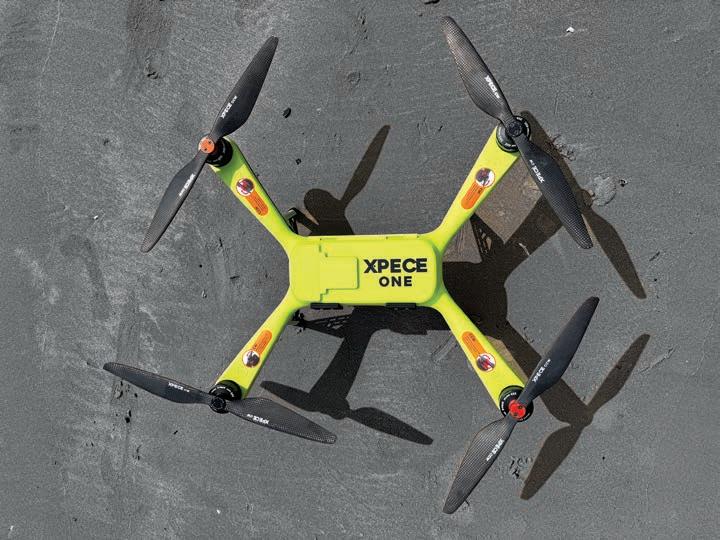
The Xpece Fishing Drone is rewriting the book on bait deployment.
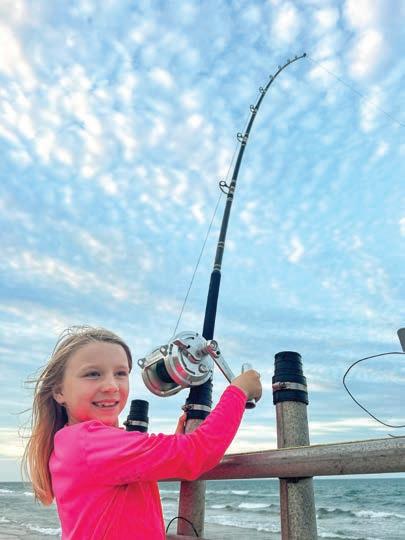
Author’s young daughter, Aurora Ozolins, fighting shark on an Ozmosis Shark Rod.
Overall, I’ve been very happy with these reels; they’re built like tanks but remain ultra smooth and extremely well balanced.
I match up all these reels with my OZMOSIS shark rods. I personally designed these rod blanks to match the heavy 50W and 80W class shark reels. Over the past year, I’ve tested these setups in battles with sharks pushing one thousand pounds. Supplies of the OZMOSIS rods are limited, but both Roy’s Bait and Tackle and Breakaway Tackle in Corpus Christi keep blanks in stock. Anyone interested in owning a dream shark rod can get the experienced rod builders at both these establishments to put one together.
Beyond the terminal tackle, reels and rods, recent advances in technologies have given us effective new tools to use in the surf. Ranking high on the list of best new innovations are the drones. Though drones have been around for a while now, the newest models rise head and shoulders above the older ones.Specifically, the XPECE ONE fishing drone (available on xpece.com) is making the biggest mark in the industry. The company excels because they blend continuing smart research with unequaled customer service and support.
Drones are effective for bait deployment on most of our beaches. With the Xpece, it’s possible to safely deploy a seven-pound payload several hundred yards out from the shore. On days when rough surf makes kayaking dangerous, these little aircraft are pure gold. Significantly, the Florida-based company making the XPECE ONE is dedicated to optimizing the ease of using their drone. Most people can master their use with a variety of baits in a New York minute.
Beyond learning to use the equipment effectively, experience is the key to becoming a better angler. Few things provide a faster learning curve than hiring someone in the know and making an epic surf-sharking charter down on Padre Island. The Padre Island National Seashore is a kind of Jurassic Park to me. For more than a decade I’ve been bringing virtually all skill levels of anglers to this famous beach, from complete newbies and families to the most advanced fishermen.
I focus on educating my clients about our incredible surf fishery while teaching everything from the basics to advanced tricks I’ve learned after years spent working on the sand. Helping people, especially the younger crowd, catch their first big fish, usually a shark, is one of the great joys of my life. We were all kids at one time, and most of us who are obsessed with being out on the water caught the bug at a young age. It’s more important than ever to teach kids to venture into the outdoors, to pull them away from the digital devices that threaten to consume them. Giving them this opportunity and teaching the benefits of conservation for future generations is invaluable.
I run charters year ‘round, targeting a variety of shark species and other sport fish. Information about all my charters is available on OceanPics. com. Due to the fact that I book up early, those hoping to book a winter surf or summer ‘26 shark trip should contact me ASAP. Feel free to mention this article and I’ll honor you with a 20% booking discount.
Science Sea and the
Traveling with a “Baby” Shield
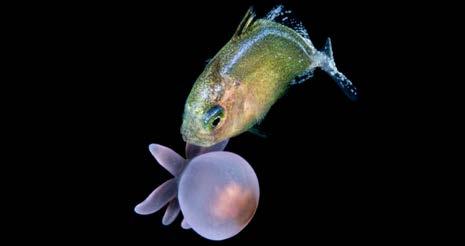
The ocean can be a dangerous place for juvenile fish, but researchers recently discovered a way some of them ward off predators—carrying around a baby. A baby anemone, that is. Divers off the coasts of Palm Beach, Florida and Tahiti have photographed evidence of a particular kind of symbiotic relationship between young fish and larval anemones. Symbiotic relationships are ones where at least one species benefits from the activity. In a mutualistic relationship, like this one, both benefit. In this case, the juvenile fish receives protection from becoming another fish’s dinner, and the anemone gets a free ride far beyond its birthplace.
Captured using blackwater photography, a young jackfish carries a larval anemone. Credit: Linda Ianniello
Researchers used blackwater photography—a technique of taking photos in the open ocean at night—to snap pictures of filefish, driftfish, pomfrets, and a young jack swimming around with larval anemones in their mouths. Anemones are already part of a well-known mutualistic partnership with clownfish, which shelter in grown anemones, eat their leftover food scraps while keeping the anemones free of parasites, and circulate water around them. In this newly discovered relationship, the mutualism is short-term but has potentially long-term ramifications for anemone populations. Larval anemones can only travel so far on their own, but being carried further afield by fish means expanding their range.
The small fish, meanwhile, carry the anemone almost like a defensive shield; anemones pack a nasty sting that predators would likely want to avoid. The sting might not kill a fish that tries to take a bite, but it’s a far less tempting meal. The exciting discovery has now raised more questions for scientists to explore: How far and how long do the fish carry the anemone? Do they swap them out? How many anemones survive the trip? What exactly triggers fish to pick up anemones in the first place? Only further study may reveal some of these answers.
For the past decade Eric ‘Oz’ Ozolins has been promoting shark catch and release and assisting various shark research programs. Eric offers guided shark fishing on Padre Island National Seashore. Also renowned for extreme kayak big game fishing, Eric is the owner of Catch Sharks Tackle Company.
It’s sometimes hard to decide whether December is a blessing or a curse here on the Texas Middle Coast. It all depends on the weather pattern. We can experience stretches of mild days with great fishing action—or periods of bitter cold followed by huge drops in tide due to strong north winds. Fish that were once patterned and producing steady action can suddenly come to a screeching halt, leaving anglers scratching their heads and forced to completely revamp their plan of attack. While many outdoorsmen have shifted their focus to deer or waterfowl hunting, our boat ramps and waterways grow much quieter this time of year. I like to play the weather day by day for fishing. Although not all days are sunny and warm, December can offer many great days on the water. That’s one of the reasons I love fishing this special month. Having entire areas to yourself is a treat, and because of that, fish aren’t
pressured constantly and can return to their normal feeding and travel patterns. For those who prefer a screaming drag over a shotgun or rifle, this is prime time to pattern and stay on a successful bite.
I’ll admit—I enjoy watching a buck chase a doe, and the thrill of stalking a trophy deer. On days when I’m not on the water, you’ll often find me on our family ranch outside Seguin, Texas, guiding hunts and soaking in the abundant wildlife. I always discuss weather patterns with my clients and emphasize how important it is to know your weather each time you leave the dock—especially as winter sets in. I’ve seen the bays turn dangerous in a matter of minutes with the approach of a strong cold front. We always try to time these fronts, knowing the fishing can get very good right before one arrives.
Everyone has their preferred weather apps and routines, but I thought I’d share my top three for winter fishing—apps I use daily to form my onthe-water strategy. Before diving into these, it’s important to understand the layout of the bay complex you’re fishing. These apps all rely on map-based data, so learning how to read your bay’s shape and structure helps you make sense of what you’re seeing. Earlier, I mentioned that I love winter for the reduced boat traffic. However, that same solitude can be a safety concern. During summer, help is often just a shout or a quick phone call away. In winter, with fewer boats on the water—and rougher weather—it might take longer for
assistance to arrive. That’s why staying aware of changing weather conditions is crucial.
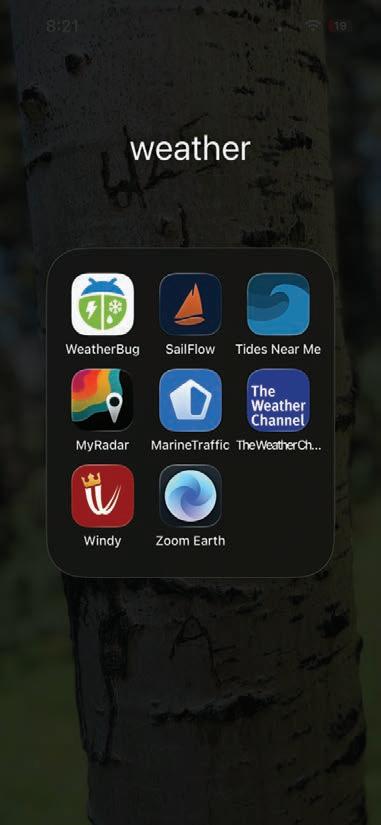
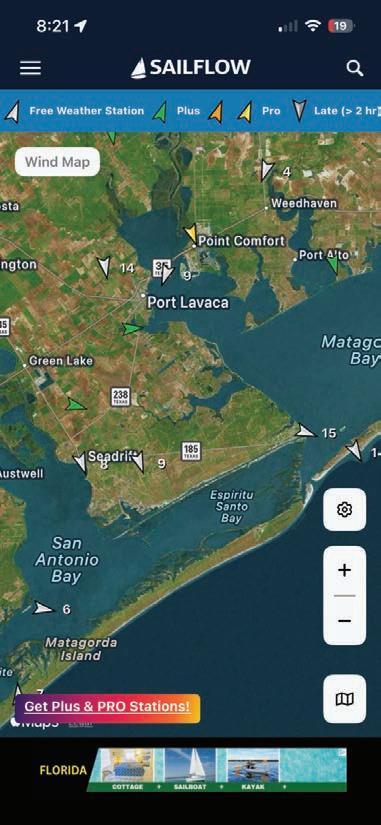
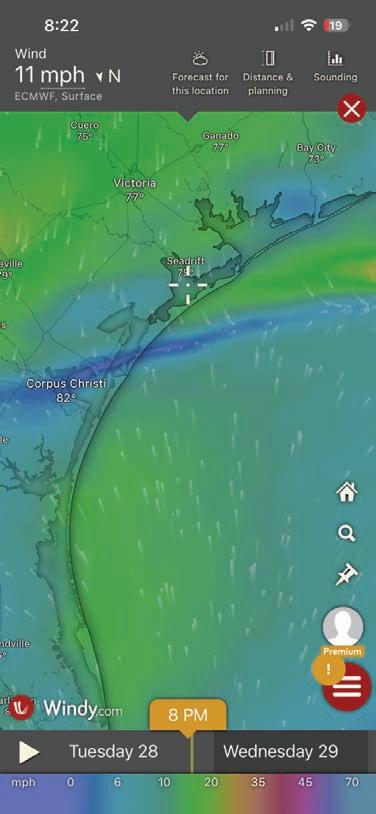
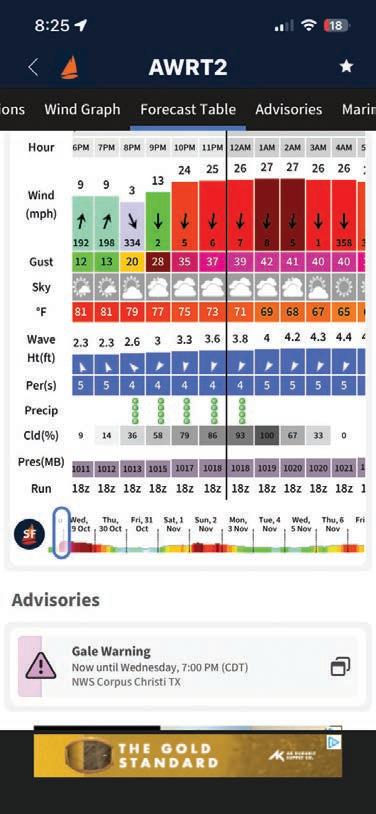
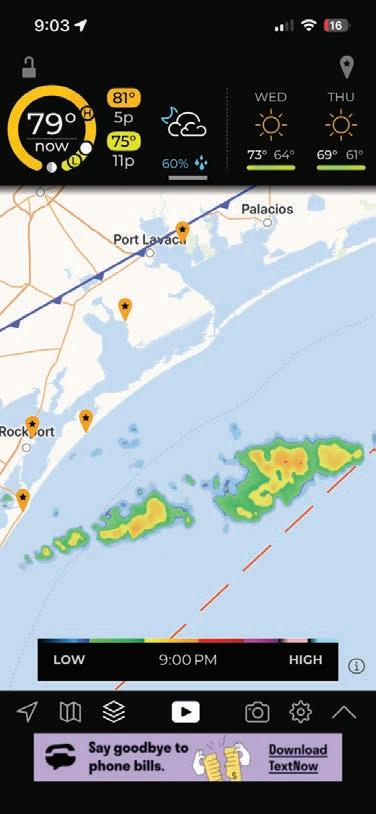
In the accompanying photos, you’ll see my “Weather” folder. Inside it are three apps: SailFlow, Windy, and MyRadar.
Let’s start with SailFlow. I use the free version and find it more than sufficient. When you open the app, you’ll see a map of the San Antonio and Matagorda Bay area showing your current location. My favorite feature is the abundance of weather stations in specific areas. This allows me to track approaching patterns before they hit, giving me time to seek shelter or get off the water. It also helps determine whether certain parts of the bay are worth the run—or if the water might be too rough or dirty. Click on any white weather station icon, and you’ll get a 7-day, hour-by-hour forecast showing sustained winds on top, gusts below, and directional arrows for wind movement. This view makes it easy to see approaching weather and overnight conditions.
Next up is the Windy app. For this one, I pay for the premium package to access the extended 14-day forecast. While it doesn’t show your current location, I like the visual layout—wind arrows and color-coded wind speeds make it easy to interpret. You can zoom in and drop crosshairs on a specific shoreline or back-lake pond to get a detailed wind readout for that exact spot. Tracking approaching fronts this time of year is super easy using Windy’s animations and updates.
Last but not least, for tracking rain I use MyRadar. This app does
show your location and provides a 45-minute radar loop showing precipitation intensity—from light mist in blue to heavy downpours in red and purple. By adjusting the settings, you can overlay frontal boundaries or even projected paths of tropical systems, complete with timelines.
I’ve used these three apps daily for many years and have found them to be the most accurate and reliable for my needs. I hope this helps others who are learning the ropes of winter fishing. I can’t stress enough the importance of knowing your weather—especially this time of year. Conditions on the water can change quickly if you’re not prepared.
Stay safe out there, and enjoy your time on the water.
Captain Nathan Beabout USCG/TPWD Licensed
Full time guide since 2007
Seadrift, Port O’Connor, & Port Mansfield, TX Facebook, Instagram, LinkedIn
RIDING OUT THE SHIFT: FROM OCTOBER’S HIGH TIDES TO THE PROMISE OF COLD FRONTS
Every season on the Texas coast tells its own story, and October’s chapter this year was a bit of a strange one. We usually expect fall to bring that slow, reliable shift. The tides ease back, the air cools, and the bays settle into their winter rhythm. But this October had a mind of its own. High tides hung around longer than they should have, and the weather stayed warmer and steadier than most years. It wasn’t bad fishing by any means. Just one of those months that kept you guessing. When the conditions lined up, especially out on the beachfront, we saw some incredible days chasing big tarpon. Those silver kings gave us everything we could ask for – long runs, acrobatics, and the kind of surface explosions that remind you why you put in the hours waiting for the right window. But those opportunities were selective. One day you’d find clean water and bait pushing, the next day it was blown out or too murky to make it
worth the run. Still, it was magic when it clicked. The days that make tarpon fishing special, when the Gulf surprises you with just enough calm to roll the dice.
Back in the bays, things told a different story. You could wake up to what looked like the perfect setup, light wind, clear water, bait flickering along the grass lines and still end up scratching your head by midmorning. Consistently high tides have a way of spreading everything out. Reds that are normally grouped up and feeding hard seemed to vanish into the marsh. With so much water in the system, they didn’t have to stay bunched in predictable pockets or tight to drains. They could roam…and they did. One day they’d be on a flat you know like the back of your hand and the next day you would swear they packed up and changed zip codes. That’s fishing, but this October seemed to lean into that zone of unpredictability more than usual.
Now, with the first cool fronts on the horizon, I think a lot of us are ready for the change. Cooler air, shifting tides, and those low, crisp mornings when you can almost smell the redfish before you see them. Once those temperatures start to drop and the tides pull back, everything tightens up. Reds begin bunching together, moving along shorelines or stacking in potholes. You’ll find them brushing up in shallow water, warming themselves in the sun between feeding runs. It’s a rhythm I never get tired of, seeing those copper backs sliding across a glassy flat with a light north breeze at your back.
November and December bring a kind of comfort fishing that’s different from the chaos of summer. You can slow things down, pick your shots, and focus on the details. Each cast feels more deliberate.
The fish are heavier, lazier, but just as aggressive when they commit. You can wade into a knee-deep shoreline at sunrise and know that somewhere nearby, a school of reds is doing the same thing searching for warmth, food, and a little comfort of their own.
Looking back, October might’ve been a month of mixed emotions, but that’s part of what keeps the saltwater game interesting. You learn to roll with it. You take the great days like those beachside tarpon mornings and bay flats full of promise, and you accept the slow ones for what they teach you. Every tide, every shift, and every cast adds another layer to understanding this coast.
So, here’s to the coming fronts, to those glass-calm mornings that follow a strong north wind, and to watching reds bunch tight and feed hard again. The patterns will reset, the fish will regroup, and the Texas bays will start telling a new story. And if October taught us anything, it’s that even when the tides don’t play by the rules, there’s always beauty and a few surprises waiting somewhere out there on the water.
James Kosub James Kosub says, “I fell in love with fishing as a child and my passion deepened when I discover the Texas coast. Shallow water redfish have become an obsession.” Email
JAMES
KOSUB
SKINNY WATER OBSESSION
DEATH, TAXES, & SURF TROUT
I’ve always considered unique wildlife appearances to be good omens in my life. On my first day of graduate school at Texas State, a pack of six wood ducks landed right across the pond from me. I took it as a sign that I was on the right path.
Two years ago, I headed down to Port Aransas ahead of my wedding. After finishing my honey-do list on Tuesday night, I found myself with Wednesday morning free. I decided to buy a dozen croakers and fish the surf at first light. A dozen croakers produced a dozen solid trout. I convinced my new wife that we should do it again the day after we got married. Normally, her interest in fishing is fairly passive, but she agreed to give surf fishing a try. That day was just like the two before it.
Eighteen croakers landed us about fifteen trout, all over sixteen inches.
I’ve read plenty of articles, social media posts, and watched videos claiming that catching trout in the surf is “easy.” Based on those results, I’d have to agree. Of course, like all things in fishing, there’s still an art to it. Surf trout fishing might be one of the most productive ways to target these fish, but it’s not for the faint of heart—it comes with real risks.
The most obvious danger is the surf itself. The waves are always worse than they look, and rips can change in an instant. The surf is also brutal on reels. When I get to where I want to fish, I position myself sideways—one shoulder facing the beach, the other
Seagrass is critical to good fishing. Marine organisms depend on it for survival—for food, shelter, and oxygen. But boat propellers are destroying Texas seagrass, which is seriously impacting saltwater fishing in the coastal shallows. When boaters do not lift their propeller in shallow water, the prop cuts and uproots the seagrass beds—leaving long barren trenches or “scars” that may take years to heal ... if ever.
Stop Prop Scarring –Lift, Drift, Pole, Troll
It is ILLEGAL in Texas to uproot seagrass with a propeller. Avoid damaging seagrass –lift your prop!
When in shallow waters, lift your motor and drift, pole, or troll through it. After all, there’s nothing like a redfish on light tackle in shallow water. Let’s keep it that way!
For more information visit: www.tpwd.texas.gov/seagrass
toward the Gulf—and do my best to keep my reel out of the water. Often, that’s impossible.
As for where and how I fish, that depends on the day. If you research surf fishing, you’ll hear talk about guts, cuts, rips, wash, and bars. I like to keep it simple. I wade out to the first or second sandbar, usually standing knee- to belly-deep on top of it, and cast into the area where the sandbar drops off. These deeper sections, called guts, grow successively deeper the farther you wade from shore. I’ve found both the Gulf and beach sides of the bar to be productive. My rigging method is equally simple. A Gamakatsu 2/0 Kahle hook and a fluorocarbon leader cover most situations. I’ve experimented with adding weights but found that doing so reduces hookups significantly. And by now, you’ve probably guessed my bait of choice—croaker.
Croakers can be tricky to keep alive because they require a lot of oxygen, and they’re most effective when lively. I use a 45-quart ice chest and never put more than eighteen croakers in it at once. When wading, I carry about six croakers in a floating bait bucket. More than that tends to stress them. If one starts to fade, I swap it out quickly, returning it to the bucket to recover for later use.
When it comes to rods and reels, there are plenty of good options, and few of them are wrong. I use my standard inshore setups—7foot rods paired with 3500-series reels, spooled with 20-pound braid and 6 feet of fluorocarbon leader. I like to let the croaker swim freely, so I keep my bail open after casting, holding the line with my finger. Trout can behave unpredictably with croakers. Sometimes they toy with the bait before committing; other times, they hit hard and
run instantly. I use a three-second count after the initial strike before closing the bail and setting the hook. This gives the trout enough time to get the hook in its mouth but not long enough for a gut hook. I start my count once the fish is steadily pulling line.
Two final tips—both critical. First, be on the water before sunrise. Surf action can be both fast and short-lived. In the heat of summer, it’s rare for a solid trout bite to last past 9:00 a.m. And with beaches filling up quickly, an early start ensures you can claim a good, uncrowded spot.
Second, find the green water. Among surf anglers, “green water” is spoken of almost mythically—and for good reason. As current and temperature shifts occur, you’ll notice the surf take on a deep emerald hue. Predatory fish follow this water as it pushes closer to shore. This past summer, the green water arrived later than usual, which delayed the surf trout as well.
Trout in the Texas surf offer one of the most reliable ways to target truly exceptional fish. On any given day, you might find yourself among an endless number of twenty-inch-plus trout. And when the bite is hot, the surf can deliver a mixed bag of Spanish mackerel, redfish, black drum, and jack crevalle right alongside them.
CONTACT
James Kosub James Kosub says, “I fell in love with fishing as a child and my passion deepened when I discover the Texas coast. Shallow water redfish have become an obsession.”
Bajío - Las Rocas
Meet Bajío’s biggest frame. This true XL is the elephant in the room every BIG angler needs to face. If you wear size 14 Xtratufs, throw a 12-foot net standing still, and have to duck to sneak under a t-top, this is the frame for you. Paired with proprietary blue light blocking lenses designed for all-day wear and a lifetime warranty you can trust, Las Rocas is the tool you’ll need in 2026. Each pair is hand assembled in Florida with a built-to-order process, allowing for seven lens options in glass or polycarbonate.
Daiwa Tatula X TW 100
The new TATULA X TW 100 is the least expensive model in the TATULA reel family. It maintains the series’ key genetic building blocks and is priced with a sharpened pencil. It is based on DAIWA’s storied HYPERDRIVE System – previously found on only more expensive models – a suite of advanced technologies that enhance overall performance, durability, and smoothness. HYPERDRIVE DIGIGEAR grants a three-point interaction between the pinion and drive gear to provide continuous gear contact, spread the load to eliminate chatter, and extend the life of the reel. DAIWA’s T-Wing System lets line flow freely on both the cast and retrieve. Overall, an adaptable, generalpurpose baitcasting reel that can be used for everything from shallow cranking and bladebaits to topwaters and pitching jigs. MSRP 149.99 Daiwa.us/collections/baitcasting-reels/products/25-tatulxa-tw-100
Fishbites®
Anglers around the world agree: Fishbites® catch more fish! For over 25 years Fishbites® has been revolutionizing the fishing industry with its game-changing baits called Fishbites® and Fishbites Fight Club® Lures. By using a concentrated formula that replicates the natural chemicals that fish use to detect and track their prey, Fishbites® have become the go-to synthetic alternative to natural bait. It’s the bait that stays on the hook longer, lasts longer, and has the flavor/scent technology that releases in the water (not on your hands). As the bait gradually dissolves, Fishbites® and Fishbites Fight Club® Lures release a trail of powerful feeding stimulants that fish cannot resist. Ask for them in your local tackle shop or visit fishbites.com and get ready to Set the Hook!®
ForEverlast Tackle Sling
• Water resistant tackle box to keep tackle protected with customizable compartments
• Heavy duty sling with strategic D loop placement for accessorizing and strap adjustment
• Stainless hardware to resist corrosion
• Built to fish!
Laguna
LAGUNA is Texas saltwater passion bound in print. From the flats of the Laguna Madre, this book captures the soul of our coast — the fish, the people, the stories.
Dixie Jet Lures – The Best Spoons in America
Dixie Jet Lures offers premium, American-made fishing lures designed for unmatched performance and durability. Trusted by anglers for decades, our spoons deliver proven results in freshwater and saltwater fishing, making them a top choice for both recreational and competitive fishermen.
Proudly Crafted in the USA Supporting American Manufacturing Made in the USA!
Packed with hundreds of stunning photos, bold illustrations, and a deep respect for the history of our fishery, LAGUNA is a love letter to the Texas coast. If salt runs in your veins, this book belongs on your table. Images by Jesse Males.
Boat Care Kit with Durable Vinyl Bucket & Marine Cleaners
• ALL-IN-ONE BOAT CARE SOLUTION - Includes everything you need for complete boat maintenance, packed into one durable, unbreakable bucket.
• SAFE FOR ALL SURFACES - Marine-grade cleaners safe to use on every part of your boat.
• REMOVES TOUGH STAINS - Effectively cleans salt, algae, grime, and other tough stains.
• EASY STORAGE & TRANSPORT - The bucket’s secure lid and compact shape make it easy to store and transport, whether you’re on the dock or out at sea.
• PROFESSIONAL-GRADE PRODUCTS - Trusted by boating professionals, STAR BRITE’s products offer superior performance.
• ECO-FRIENDLY CLEANERS – STAR BRITE’s marine-grade cleaners are eco-friendly, providing powerful cleaning without harming the environment.
• PERFECT FOR NEW BOAT OWNERS - An ideal starter kit for those new to boating.
Daiwa’s Isla Ags Inshore Rods
ForEverlast Woods2Water Directional Feeder
• Heavy duty auger system
• Powered by dual 12V motors
• Adjustable legs for sloped/ uneven ground
• 125 lbs. capacity
• Built in Site Glass
• 5-year warranty
Offered with premium HVF NANOPLUS graphite blank construction and superlight Air Guide System guides, Daiwa’s ISLA AGS inshore rods are perfect for any coastal Texas saltwater fishing adventure. An 11-rod lineup – seven spinning and four casting models – the one-piece cork handle rods include medium-light to mediumheavy spinning rods in 6’9” to 7’6” lengths, and 7’ casting rods in medium-light to heavy power. Texas anglers will recognize all the advancements Daiwa has made in rod development over the past five years for inshore saltwater use. Put one in your hand and you’ll quickly notice the advantages of Daiwa’s exclusive AGS guides, the HVF blank construction, plus Daiwa’s X45 carbon weave within the blank that eliminates rod twist and ovalization for longer, accurate casts.
Bates Fishing
The Salty Hundo’50
Hook & Tackle Offshore Haven Short Sleeve Shirt
The Offshore Haven Short Sleeve Printed Fishing Shirt combines performance, comfort, and style for the modern angler. Crafted from ultra-lightweight, 360° stretch fabric, it delivers unrestricted mobility and exceptional breathability. Designed for long days under the sun, it provides over 97% UV protection while ensuring you stay cool with strategically placed rear air vents that
The Salty Hundo’50 (150) takes the comfort and control of the original Hundo and scales it up for serious inshore action. Its compact, ergonomic feel now features a beefier 150-size frame with increased line capacity, drag, and strength—perfect for bull reds, snook, or stripers. Crafted from CNC-cut 6061T6 aluminum, it’s corrosion-resistant, durable, and built for long casts and lengthy fights. With 10+2+1 bearings, adjustable magnetic brakes, up to 20 lbs of drag, gear ratios of 6.3:1–8.1:1, and 100mm aluminum crank arm, it is designed to deliver smooth power and precision. Priced at $449 and backed by our 3-Years – No B.S. Warranty
Floating Sunglasses
Stylish, functional, and built to float—Flying Fisherman Morada Floating Sunglasses are a perfect gift for any angler or water lover. Made from eco-friendly TPX, they stay afloat in both fresh and salt water, so you’ll never lose another pair overboard. Polarized AcuTint lenses cut glare, boost contrast, and block 100% of UV rays, giving you sharp vision on and off the water. A saltwater-resistant coating and non-slip temple grips add durability and comfort for all-day wear. Available in Matte Navy with Blue Mirror, Crystal Violet with Pink Mirror, or Tortoise with Amber lenses—all at a price that won’t break the bank. MSRP: $44.95.
Livingston Lures’ Walking Boss II Inshore
Daiwa Coastal TW 200
A beast of a reel, born for bigger baits. Think topwaters, jigs, larger swimbaits, and jerkbaits. Beyond its capability with larger lures, the COASTAL TW 200’s deeper spool also accommodates more and heavier line. You can load it with 150 yards of 20-pound monofilament or fluorocarbon, or 150 yards of 40-pound braid. At the core of the COASTAL TW 200’s design is DAIWA’s exclusive HYPERDRIVE® System, which starts with the HYPER Armed Housing – a durable, lightweight, precision tooled, and corrosionresistant aluminium frame and sideplate. The HYPERDRIVE DIGIGEAR is remarkably smooth because of the system’s three point interaction between the pinion and drive gear, which maintains continuous gear contact and spreads the load to eliminate chatter and extend the life of the reel. MSRP $299.99
The WALKING BOSS II is a revolutionary inshore topwater lure that features an oversized, cupped lip, which creates a uniquely powerful surface disturbance when it’s retrieved. And it’s simple for even the most inexperienced angler to fish. Simply cast and retrieve (either slow or fast), and the unique design of the lip and jointed body creates a topwater commotion that drives dorado, redfish, roosterfish, and crevalle wild. The Walking Boss II’s action combines with the attraction of EBS Technology to draw fish from double the distance of traditional topwater lures!
The ‘Ahi is designed for the waterman in your life. Its lightweight mesh upper sheds water quickly, while strategically placed drainage windows help keep your feet dry. Made for barefoot wear, the cushioned EVA footbed delivers all-day comfort, and the Wet Grip Rubber® outsole provides steady footing on slick surfaces.
“Available at Roy’s Bait & Tackle, Rockport Tackle Town, Port A Outfitters, Matagorda Outfitters, & Fishing Tackle Unlimited”
Sea Eagle
The Sea Eagle® Stealth Stalker™ STS10 is now available with an optional inflatable drop stitch floor making it 18 pounds lighter while still providing exceptional rigidity. The drop stitch floor doesn’t just make the boat lighter overall; it makes it easier to fold up, transport and store because the floor packs away with the boat – no separate floorboards to stash. Even though it’s 18 pounds lighter, the STS10 still holds up to 1200 pounds of people and gear. Built for anglers and filled with what anglers need, now lighter and easier than ever. See the Sea Eagle® Stealth Stalker™ STS10 at SeaEagle.com
Turtlebox
Born on the bayou in Houston, Turtlebox was the answer to a call for something that didn’t exist, a speaker that could match the intensity of our Texas spirit and the volume of our ad-ventures. Turtlebox speakers are fully waterproof, drop-proof, and built to endure the harshest environments. Designed to project loud, powerful sound over wind, water, and engine noise, Turtlebox provides a premium audio experience without compromise. Fea-tures include impressive battery life, Bluetooth connectivity, left/right stereo pairing, and Party Mode for syncing an unlimited number of speakers. Rugged and durable, Turtlebox is built to handle any adventure and keep the music going no matter the conditions.
Paul Brown’s Fat Boy NEW Pro Series
Fat Boy Pro is perfectly balanced, creating a very natural presentation in the shallows. This lure features a large flat-sided scaled prism insert for added flash, premium black nickel hooks, and a low-frequency rattle.
Paul Brown’s Fat Boy and Floater
The Fat Boy features a wide-bodied profile and suspending action that catches large fish. Fat Boy is weighted for long casts and features a special vacuumed rattle. Fat Boy Floater runs shallower than the Fat Boy, designed to fish “skinny” waters.
Paul Brown Devil
This unique soft-bodied lure is very easy to fish. With slight twitches, the long rattail provides great action for violent strikes. The built-in wire harness, vacuumed rattle, and single treble hook make this lure one of Paul’s favorites.
Plano Edge Series has four new models!
The EDGE series is now available in four new models: the Deep Hang Box, Short Hang Box, Lipless Box, and Hard Minnow Box. All EDGE boxes include Plano’s premium technologies, such as a Dri-Loc O-ring seal for waterproofing, Rustrictor® base for rust protection, DuraView clear lids for quick content identification, and oversized latches for one-handed operation. The Deep Hang Box holds up to 48 larger baits; the Short Hang Box fits up to 48 smaller baits, the Lipless Box stores 38 lipless crankbaits, and the Hard Minnow Box is perfect for hard baits. Together, they provide anglers with superior organization, easy access, and reliable protection on the water.
Waterloo Outfitters – Merman Dry Bag
Built for the water and designed for versatility, the Merman Dry Bag is your go-anywhere, haul-anything solution for carrying tackle, accessories, and all your fishing essentials. Made from the same ultra-durable, waterresistant TPU material as our Pro Merman Wading Bags, it’s built to handle the harshest conditions. Sized at 12” (L) x 6” (W) x 6” (H), it’s compact yet spacious enough for your must-haves. Whether you’re heading to the coast, organizing your boat deck, or need a rugged everyday carry, the Merman Dry Bag delivers. Features include durable TPU construction, two zippered openings, duffle-style handles, and an internal water-resistant pocket.
Okuma Makaira Lever Drag Reel
The Okuma Makaira Lever Drag Reel is built for the heaviest fights offshore. Trusted to land a 443 lb world-record yellowfin tuna, it stands at the top of offshore performance and is made to handle the ocean’s toughest gamefish. Every part of the Makaira is overbuilt for raw strength, smooth drag, and lasting power, giving anglers the confidence to face giants and the power to see every battle through to the end. Built for billfish, monster tuna, and the heaviest fights offshore, the Makaira delivers the strength, smooth drag, and reliability anglers need when the stakes are highest. Available in sizes from 10 to 130 and in standout finishes, including Gold, Black, Sea, Sea Silver, and Sea Mahi - Makaira is ready for any battle and built to match your style.
Southerly
Abu Garcia Beast Low Profile & Spinning Reels
Built for anglers targeting giant fish with heavy baits, the Abu Garcia Beast series delivers unmatched power, precision, and control in both low-profile and spinning platforms. Featuring X2-Cräftic alloy frames, A-Symmetric ergonomic designs, and Power Stack Carbon Matrix drags, these reels combine brute strength with smooth, reliable performance. The low-profile models (200–400) offer oversized Brass Duragear systems, advanced braking for cast control, and balanced power handles, while the spinning models (3000–5000) feature Salt Shield bearings, V-Rotor design, and Rocket Line Management for superior line control and durability. From trophy bass to musky and inshore predators, Beast reels are built to dominate the fight in any water. MSRP - $229.95-$299.95
Fishing Tackle Unlimited – XCel G2 Green Rods
If you’re an avid Texas inshore angler and haven’t had an FTU XCel G2 Green Rod in your hands, you really need to try one. Power and sensitivity are promised by many rodmakers but FTU delivers!
The XCel G2 family of rods are available in three actions – Finesse (Light with Modern Fast Tip, rated for 6-12 pound line); Classic (Medium Light with Modern Fast Tip, rated for 8-14 pound line); and Corky (Medium with Modern Fast Tip, rated for 8-20 pound line. All three models are 6’-6” length with lightweight Carbon Fiber Split Grips for added sensitivity. All three models have titanium frame guides with Torzite inserts for super smooth line flow and also for lightness and increased sensitivity. The Finesse is also available in 6’-6” spinning style. Visit fishingtackleunlimited.com or either of our two Houston area stores.
Matagorda
Bink Grimes is a full-time fishing and hunting guide, freelance writer and photographer, and owner of Sunrise Lodge on Matagorda Bay.
I hope we need a winter coat in December. The chill gets big trout going and prompts new ducks to arrive daily. December once sent anglers off to deer camps and duck blinds for fear of cold boat rides and chilly fishing. You remember? Back when it was cold in December?
Lately, our weather patterns have resembled early October more than December. Water temperatures might dip into the 50s early in the month, but with afternoon highs in the low 80s, temps often rise back into the 60s and even the 70s on the shallow flats.
It was a warm November, with many morning duck hunts feeling more like teal season than late fall.
Still, December is a great month in Matagorda. Birds didn’t really begin to work regularly in East Matagorda Bay until early November, and with the lack of cold fronts, that action could continue right up to Christmas.
The shell in Matagorda has been, and still is, full of fish. We’re working solid 2–4-pound trout on Bass Assassins, Hogie’s, and Down South Lures while drifting—and there are usually redfish everywhere.
Our trout really start to eat lures better in December. MirrOlures, topwaters, and Bass Assassins are our go-to baits. Prepare for winter solstice tides to pull fish from the shorelines and dump them into deeper water. Large schools of trout hang near drop-offs scattered with mud and shell.
When the tides are extra low, redfish congregate in the holes and guts. We run shallow-draft boats and work the back lakes as they drain. The edges of the Intracoastal can be just as productive with a piece of mullet or crab.
The Diversion Channel has great spots to “bass fish” the banks with topwaters and soft plastics. I can remember Decembers past when all we threw in the Diversion was topwaters—and just had
a ball. There are lots of shrimp in the channel now, and with the green water we’ve seen, there’s no reason this December shouldn’t produce the same results.
We also like working the edges of the Intracoastal with a trolling motor and tossing along the drop. It’s paid off all year, especially on windy days when the bay is blown out.
Many of our December days consist of duck hunts in the morning and fishing trips in the afternoon. Our marshes grew loads of wigeon grass during October, and that bodes well for late-season hunting. Gadwalls love our aquatics, and a dozen grey ducks careening across a coastal marsh is a Christmas card waiting to be delivered.
Every year about this time, I get emails asking for gift ideas for outdoorsmen and women. I always say the same thing—call your favorite guide and buy a gift certificate for a hunt or charter in the coming year. It’s a great gift, and the anticipation and conversations that come with planning are often just as good as the trip itself.
Get out with the family and do something together. Put your phone down, look people in the eyes, and talk—but more importantly, listen. Be good neighbors at home and on the water. Love one another. America is the greatest place in the world to live, no matter what anyone says.
Thank the Lord for blessing us to live in Texas and America, and thank Him for our bays and marshes that give us pleasure and provide so many memories.
Merry Christmas to everyone!
Port O'Connor Seadrift
MID-COAST BAYS With the Grays
Captain Gary Gray is a full time guide, born and raised in Seadrift. He has been guiding the Seadrift/Port O’Connor region since 1986. Gary specializes in year ‘round wade fishing for speckled trout and redfish with artificial lures.
If asked to critique the recent fall fishing season, I’d have to say it was a little sub-par compared to previous years. I’d like to think this was mostly due to this guide’s hard-headedness and the late arrival of cooling trends, rather than any decline in the fishery. I say that because other anglers were having great outings on days when we struggled. I’m not saying we didn’t have some outstanding days along the way, but there were certainly a few I wish I could redo.
I ran quite a few “stay-in-the-boat” trips with anglers who had issues with the growing shark population—and others simply concerned with the other things that dwell in the sea. Nonetheless, boat-fishing success was actually slightly better, numbers-wise, than wade-fishing. Granted, the species we targeted were a bit different for these groups. If the wind was blowing hard, we stayed in the backwaters and targeted redfish and black drum using natural bait. If the weather was mild and we could fish the San Antonio Bay reefs, we targeted trout and redfish—again, mostly with natural bait. There were also days when my lure aficionados did very well drifting those same reefs with soft plastics and topwaters. Back to my earlier shark comments—I believe this is a problem that will need to be addressed very soon by TPWD. The shark population seems to have grown rapidly over the past several years and is now reaching the level of a dangerous nuisance, not only along main-bay shorelines but also in backwater areas that we wade almost daily. I’ve personally been knocked down by sharks trying to get to fish on my stringer, and my clients have had several near-misses while landing or handling their catches. Other guides in the area are reporting similar stories, so it’s not just me. Granted, shark encounters will be fewer during the cooler months ahead, but you can bet they’ll be back by
springtime when the water warms.
December’s cooler nights and more frequent cold fronts will continue to drive water temperatures downward. Our lure selection should take advantage of that by focusing on slow-sinking twitchbaits such as the Texas Custom Lures Double D and Double D XL. Their Custom Corky Soft-Dine XL is another solid option. My all-time favorite for extremely cold-water conditions is the Custom Fat Boy series. All their custom colors will catch big trout, but a few of my favorites are Bay Mistress, Crown Royal, Pistachio, and Plum Nasty. These lures are part of the Jay Watkins Series, designed by the man himself, and they’ve proven themselves on trophy trout for years.
Something else that helps improve success in cold water is the type of line you use. Remember that feel is everything when trying to detect the subtle tick of a cold-water trout. For this, I rely on 30-pound FINS WindTamer Pitch Black Braid, and the only leader material I trust is 20-pound Osprey Ultra-Premium Monofilament. Why monofilament instead of fluorocarbon? The main reason I switched is its supple texture—fluorocarbon is inherently stiffer and becomes even more rigid in cold water.
Another product line that’s been a game-changer for Shellie and me while wade-fishing is Southerly Fishing Gear. Based out of Port O’Connor, owners Lance and Christy Abel are avid fishermen and tournament promoters who have designed saltwater gear for every season. I’ve had the pleasure of field-testing their waders, wade boots, and other attire for the past couple of years, and I can honestly say they’ve taken the lead when it comes to functionality and comfort. Hands down, they’ve raised the bar in wading attire.
No discussion of wintertime trout fishing would be complete without mentioning Waterloo Rod Company. I know I’ve said it before, but I’ll say it again—in my experience, nothing transmits the subtle take of a cold-water speckled trout quite like my 6’7” Waterloo HP Lite rods. This is a lightweight stick that still has all the backbone needed to handle the violent headshakes of trophy trout. If you haven’t already, you need to get one in your hands.
The products I mentioned above are all available at your better Middle Coast tackle stores—Jeco’s Marine in Port O’Connor, Waterloo Pro Shop in Victoria, Tackle Town in Rockport, and Roy’s Bait and Tackle in Corpus Christi.
Merry Christmas! Fish hard, fish smart!
“We contracted the construction of the TSFMag office building with Farrell Jackson. Jackson also built my son’s bay house here in Seadrift. We were completely satisfied with both projects…a professional and trustworthy contractor.” ~ Everett Johnson | Editor/Publisher, TSF Mag
Upper Laguna/ Baffin
David Rowsey has 30 years in Baffin and Upper Laguna Madre; trophy trout with artificial lures is his specialty. David has a great passion for conservation and encourages catch and release of trophy fish.
Howdy y’all. Hope this finds everyone with some spent bullets, broken arrows, and dry, cracked hands from exposure to saltwater. I’ve been in the middle of all of it—trying to fill my fun bank before I’m back in the water every day.
There’s not much cool stuff you can say about aging, but experience and knowledge almost always outweigh the aching joints in the morning. Every time I sit down to write an article, my head starts spinning—reflecting on things I’ve done and seen during this month over many years of stomping through mud and tripping over rocks in Baffin Bay. The vast majority have been fun and memorable, while others have involved everything from boat mishaps, bad weather, and confrontations, to search and rescue operations, and even the deceased. They’ve all made for memories—some just better than others.
As I write this, there’s some really bad weather outside—incredible lightning and much-needed rain. This becomes pretty normal as fronts roll in, when the warm coastal air collides with incoming cold air to create huge disturbances. In recent news, there have been numerous reports of people being struck by lightning while enjoying their passions in the woods and on the water.
Many years ago, before I started guiding, I slipped into a shoreline cove in Alazan around midday. I had caught an 8-pound trout there the day before on a last stop. Unfortunately, I’d been on a schedule and couldn’t stay much longer after catching her. With a front forecasted to hit the next day, I made a point to get back.
As I shut my little boat down, I couldn’t help but give thanks that I was the only boat on the bay. Winds were light but steady, the sky was heavy, and mullet were breaking the surface everywhere. I rolled out with a full-sized Spook and immediately connected with about a 7-pounder. Her commotion must have spooked every fish in the area, because little slicks started popping all around me. It was at that instant I realized this had potential to be one of those days. Another quick cast produced two more blowups but no hookups. After about thirty casts, I decided to go subsurface with a Fat Boy. As I was tying it on, thunder erupted overhead. The OG guide of the Upper Laguna and Baffin, Capt. Doug Bird, once told me that nothing spooks trout like thunder—and my sensible self was thinking, I need to get out of here.
But of course, the first cast with the Corky produced a trout that was the spitting image of the one from the day before. That was all it took for me to fully commit to the trout instead of what was riding in on the shifting winds of a norther.
I’m not even sure if I had that trout landed when a bolt of lightning hit very close behind me. Everything in front of me lit up like an old flashbulb camera, and for a second I thought God Himself had stepped off the boat to make a wade with me. When I tell you the hair on the back of my neck stood up, I mean it literally stood straight up.
As soon as I released the fish, I was walking on water back to the boat. The crackling air overhead had me digging deep into my spirituality as I threw the rod on the deck. Pulling the anchor to get out of there felt like it took twenty minutes. I unscrewed the tension knobs on my first-generation GPS and pointed it at the floor, literally driving on my knees while looking up at it.
By this time, the light show was like nothing I’d ever seen before— or since. Big booms and cracks all around me, the deck of the boat flashing like stadium lights. I aimed the boat toward the highest bluff and beached it hard. I ran along that embankment and took shelter in a little undercut, where I stayed well over an hour before feeling safe enough to get back on the boat.
By God’s grace, I made it home safely. I learned a great lesson that day—one I still respect to this day, especially with clients aboard. Y’all be safe out there. It’s that time of year.
Remember the Buffalo! – Capt. David Rowsey
Duane King of Austin caught the first big one in waders this year. Plum Bass Assassin for another win; 28-inches and released healthy.
Port Mansfield
Captain Wayne Davis has been fishing the Lower Laguna-Port Mansfield for over 20 years. He specializes in wade fishing with lures.
Telephone
210-287-3877
Email captwayne@kwigglers.com
WAYNE’S Mansfield Report
Greetings from Port Mansfield! It’s hard to believe another year has come and gone, but here we are in December. As we ease into winter, I’d like to point out that it certainly took its good old time getting here. We had no significant cold—or should I say cool—fronts until just recently, and they were well behind schedule. Fish were eagerly awaiting a breath of cool air, as were most trophy trout enthusiasts. It seemed like we waited forever… which, in truth, we almost did. That said, once the water started to cool, the fish were ready to pack on some winter weight, and they didn’t hesitate.
Water levels remained high through late October and into November, which made fishing fun simply because the sand flats had all the right ingredients to support great action. First, there were rafts of mullet like I haven’t seen in years, and big, fat trout and redfish were right there amongst them. This scenario supported excellent topwater and subsurface twitchbait action. Many days we walked knee-deep water, zinging Mansfield Knocker topwaters and Darters, having the best time ever.
Exceptional trout in the 25–28-inch range were more consistent than in years past, and the reds stayed busy doing redfish things like they always do. Another bonus that sweetened the deal was that wind direction really didn’t matter much. One day we’d wade north, the next day south, and have the same or equivalent results. Heck, some days we didn’t even need our Simms waders because we were fishing so shallow. And on sunny days, wet wading was actually quite comfortable.
Our fun on the east side will run its course in due time, and we’ll eventually be back to probing the west side of the Laguna, along with a few of the back-lake areas. The east side cools quickly on cold nights but also warms fast on clear days. Fish often transition from deeper water to shallower flats as the temperature rises through the day until they reach their comfort zone. This behavior is predictable, and paying close attention to it will yield reliable results.
As for the west side of the Laguna, some fish just hold in those regions, likely due to bait availability, habitat, structure—or a combination of all three. I’ve historically said the heavier fish come from the west side of the Laguna, but I’ve started rethinking that somewhat, since my eleven-pounder came from the east side last January. That fish obviously had great genetics, plus she’d very recently ingested some big baitfish.
I believe points can be made for both east and west-side flats, but if I could only fish one side of the Laguna, I’d still choose the west. That said, your personal best could come from anywhere, anytime—just as mine did—so put your best foot forward and keep casting.
When it comes to lures and strategies for the coming winter, I’ll continue tossing topwaters as long as water temperatures stay above roughly 60 degrees. Wig-A-Lo plastics rigged on 1/16- or 3/32-ounce jigheads, along with subsurface hard baits, will be tied to my G2 Green Rods once temps dip below that mark. Keeping it simple makes sense, and this approach should give anyone a great shot at a personal best on any given cast.
Another tip for wintertime success—slow it down. A good rule of thumb is: the colder it gets, the slower you should fish. More importantly, make mental notes of every presentation that draws a strike so you can repeat it. Don’t be hardheaded, as I sometimes am, and try to force the fish to eat what you want them to eat; give them what they want. Again, keep it simple.
And since it’s Christmas time, don’t forget the anglers in your family. One of my favorite places to shop is Fishing Tackle Unlimited, which has everything an angler could ever need or want. They offer Simms gear, rods, reels, lures, fishing bags, and more. With a fresh seasonal restock, you’ll easily find what you need—or the perfect gift for someone else.
Till next time, remember, fresh is better than frozen.
Arroyo Colorado to Port Isabel
A Brownsville-area native, Capt. Ernest Cisneros fishes the Lower Laguna Madre from Port Mansfield to Port Isabel.
Ernest specializes in wading and poled skiff adventures for snook, trout, and redfish.
Fishing offers enjoyment and relaxation, but it also presents challenges that require decisive thinking — and I’m motivated by those challenges. Figuring out the puzzles of fish behavior means combining past experiences with current water and habitat conditions.
We don’t always get it right; just when you think you have them figured out, the fish will send you home humbled.
While scouting for a tournament recently, I found three areas packed with redfish — our target species for the next day. Later, during the captain’s meeting, an angler from another team asked, “Did you find them?” My confident smile and nod conveyed my optimism.
We headed out early, hoping nobody would beat us to our spot. Arriving to find no other boats present, I expected an easy session. Since the tournament was catch-photo-release, our camera phone would be our main tool for recording catches.
As the day began, I realized things had changed — the wind was stronger and the tide was about four inches lower. That subtle shift had moved the hundred-plus redfish I’d located the day before. We only saw five, hooked one, and it got away.
Moving to the second spot, where I’d previously seen many redfish and large trout in clear water, I now found it much shallower and dirty — and the fish were gone. My mind raced: What now? Fortunately, our luck turned at our third spot, where we finally found plenty of redfish.
This experience reinforced a timeless truth: no matter how much knowledge, experience, or skill you have, fishing can still be unpredictable. And even when you find fish, it doesn’t guarantee a catch. At the end of the day, it’s still the fish — and the prevailing conditions — that call the shots.
During winter, I tend to pay closer attention to water birds — ospreys, pelicans, cormorants, and seagulls. These birds depend on baitfish to survive. If they’re concentrated in an area, whether feeding or not, you can bet their prey isn’t far away, even if it’s not visible.
A water-temperature gauge is another great tool. Knowing the temperature where fish are congregated can guide you to other productive areas with similar conditions. Since fish move slowly in the cold, starting later in the morning to allow for some warming can often be a smart strategy.
since they’re located near deeper, warmer sections of the ICW. Keep in mind that landmasses like spoil islands retain heat longer, which attracts baitfish — and not far behind are the gamefish we seek.
Our lure selection in December will include Z-Man’s PaddlerZ, MinnowZ, and Big BallerZ. Floating and suspended grass remains a problem, and Z-Man’s Eye Strike Texas Eye jigheads help us fish through it effectively.
Our trout fishery continues to show signs of steady recovery, and limits are easily attainable when working along the ICW and other deeper sections of the bay. All one needs to do is look for slicks to locate them. December isn’t quite trophy month for trout, but it’s an excellent month for numbers — and seeing a few big ones certainly isn’t out of the question.
Bigger trout are leery by nature and prefer staging in areas with plenty of potholes, where they can lie in wait to ambush prey. The edges of spoils, where they can adjust depth easily without expending much energy, also attract them. Most areas that hold big trout have quick access to deeper water nearby.
If your goal is simply to catch “keeper” trout, December can be one of the best months of the year for sheer numbers. Water temperatures should remain in the upper 60s to low 70s — an ideal range for active fish all day long.
If you study Google Maps, look for deeper pockets of water within our bay system. You’ll often see larger sandy areas surrounded by grass beds — these zones can hold plenty of fish. They may not all be trophy trout, but the action can be steady and exciting.
Z-Man’s five-inch PaddlerZ in Pearl and Sexy Penny; StreakZ in Space Guppy; and Big BallerZ in Troutcicle, Gold Fire, and Plum/Chartreuse will all be go-to baits this month.
Here’s wishing everyone a Merry Christmas and tight lines!
In November, we found good numbers of redfish on calf-deep flats. They happily showed their backs as they belly-crawled across skinny mud flats. This month, the redfish will continue to be found in the shallows — but in areas with quick access to deeper, warmer water when sudden cold snaps hit.
Potholes around spoil islands will become strong attractors for redfish
This redfish broke a dry spell for Wes Pullen.
Jason Shook landed this nice fall trout on a ZMan plastic bait.
FISHING REPORTS AND FORECASTS from Big Lake to Boca Chica
Trinity Bay - East Bay - Galveston Bay | James Plaag
Silver King Adventures - silverkingadventures.com - 409.935.7242
James says his records show a clear change in patterns across our coastal bays over the years. “Our water and air temperatures are warmer on average than they were 20 years ago. This makes December now more like November used to be, which is a good thing for most people because catching fish in slightly warmer water is generally easier. “This time of year, the fishing is usually best on low tides out in the middle. If the water really dumps out after a front, bait will move out of the marshes and through the bays, and the wading on mid-bay reefs will be outstanding. If the weather’s warmer and the tides higher, wading in the coves and back lakes will be better, as will the wading on sandy spots near the south shoreline of West Bay and the east side of Trinity Bay. “Right now, the water’s really salty and the fish are somewhat scattered. Some have likely headed well up into the bayous and rivers flowing into our bays. If we don’t get heavy rains between now and the end of the year, fishing in those places will be productive.”
Jimmy West | Bolivar Guide Service - 409.996.3054
As fall winds down and cooler weather settles in, Jim enjoys splitting time between hunting and fishing. “I’ve been doing both for many years—it’s just what I always wanted to do. With duck season shutting down for a couple of weeks in early December, I have more time to fish if the weather allows, which it usually does. “By this time of year, plenty of fish are in the shallows as long as it isn’t really cold. I like to wade and throw large topwaters to target trout. In most scenarios when we catch them in shallow water, they’ll be tight to the bank, especially the big ones. “Fishing around drains connecting the marshes and back lakes with the main bays is also good in December, particularly when tides are flowing out of the shallows into the basins. If it’s colder this month, the fishing starts to resemble mid-winter patterns, with more fish concentrated in the bayous and in the middle portions of both Trinity and East Bay.”
West Galveston - Bastrop - Christmas - Chocolate Bays
Randall Groves | Groves Guide Service
979.849.7019 - 979.864.9323
After Thanksgiving, Randall says productive patterns in the San Luis Pass area become fewer but more predictable. “We might still have some birds working and good wadefishing in shallow areas if the weather’s warm, but typically we rely on two main patterns that produce best in December. “Trout fishing is generally best in the deeper basins of the three main bays close to the pass. We prefer drifting four- to six-foot depths, sometimes a bit deeper, staying in areas with giant rafts of mullet. Birds like cormorants, terns, gulls, and pelicans help us locate that activity. If water temperatures stay in the 50s, this pattern works great, and we throw Sand Eels and other soft
plastics with red and gold hues. “When the weather warms after a strong front, wading in muddy areas close to reefs can be the better option. Then, we switch to slow-sinking twitchbaits and occasionally topwaters to target big trout, often finding more reds than trout.”
Matagorda Bays | Capt. Glenn Ging - Glenn’s Guide Service
979.479.1460 - www.glennsguideservice.com
“December is one of my favorite months for fishing around Matagorda,” Glenn says. “In early December I’m usually still targeting both trout and redfish under working birds in East Matagorda Bay. I suggest throwing soft plastics rigged on quarter-ounce jigheads— MirrOlure Lil Johns, Hogie’s Major Minnows, and Bass Assassin Sea Shads are favorites. “Gulp! Shrimp or Vudu Shrimp under Coastal Corks also work great, especially for beginners. As December rolls on, the fish transition to feeding mostly on mullet and concentrate more around shell in deeper water. When bird action fades, I key on mullet over shell bottoms in four to six feet of water and throw topwaters and soft-plastic jerkbaits such as Bass Assassins and Coastal Brew Darts. “Provided we don’t have too much runoff, the Colorado River can also be productive. I like to drift the banks and throw paddletails on 3/8-ounce jigheads, looking for stretches with the most shad or mullet.”
Warm weather has kept fishing in fall mode, and the catching has been fantastic. Trout have been biting steadily over shell in three- to five-foot depths. She Dogs in green/chrome and Down South Lures in Magic Grass have worked well. There are still a few trout at the deeper rigs and shell pads in West Matagorda Bay, where live shrimp about four feet under popping corks have been effective. The redfish bite remains on fire—trolling shorelines with three-inch Gulp! lures rigged about 18 inches under popping corks has been the ticket. Flounder fishing has been better than in recent years, with natural-colored Vudu Shrimp producing around ditches and drains off main bayous and creeks. Pier fishing is solid at sunrise and sunset, especially with DOA Shrimp in glow and pink. Deep structures and the harbor in Palacios should also fish well this month.
Port O’Connor | Lynn Smith Back Bay Guide Service - 361.935.6833
Lynn expects familiar late-fall patterns to start paying off. “We’ll target trout and reds in places with scattered shell over soft, muddy bottoms—typically near deep guts and drains that funnel water from the shallows. “The bite often occurs on outgoing tides, frequently in the afternoon. We throw topwaters and slow-sinking twitchbaits through December, as trout feed mostly on mullet once shrimp and small baitfish leave after strong fronts. Soft plastics work great too,
especially when the bite is tougher. “When tide cycles bring water in during the afternoon, coves and lakes can light up. If a strong incoming tide occurs near dusk, the action can be epic. We like to leave the dock late and fish until dark this time of year.”
Rockport | Blake Muirhead
Gator Trout Guide Service - 361.790.5203 or 361.441.3894
Blake takes a short break from hunting ducks during the midDecember split, and the fishing keeps him busy. “The first half of December is great for targeting trout on soft plastics early in the mornings, when water is coolest, and on topwaters later in the day as it warms. I like a Baby Skitter Walk in black and silver this time of year. “The key to topwater success is seeing bait at the surface—if mullet are jumping, trout will blow up. During the second half of the month, we hunt in the mornings and fish afterward, targeting reds in the marshes if we see them along the way. Otherwise, we work main-bay shorelines in thigh- to waist-deep water with dark Norton Sand Eels or Gulp! lures in pearl and chartreuse.”
Upper Laguna Madre - Baffin Bay
Captain James Sanchez Guide Service - 210.260.7454
Cold fronts have lowered both air and water temperatures, and tides have dropped—opening up new wade-fishing areas holding good numbers of quality fish. “The patterns we’ll see in December depend on the frequency and strength of cold fronts,” James says. “If cold weather persists, fish will stage in deeper water for longer periods. I recommend wading waist-deep seagrass flats with potholes, along spoil islands, and near drop-offs on main-bay shorelines. “Soft plastics are my first choice—KWigglers Ball-Tail Shads in Bone Diamond, Naked Margarita, or Plum Perfect on eighth-ounce jigheads. I also like Paul Brown Fat Boys or MirrOlure Soft-Dine XLs. “Once conditions stabilize and warm after a front, I focus on the same areas but shallower zones with active mullet. Redfish mix with trout and provide good action during slower bites. Topwaters can be effective if it’s warm enough, but Wig-A-Los, Willow-Tail Shads, and Texas Custom Lures Double Ds often produce when fish are less aggressive.”
Corpus Christi & Baffin Bay | Capt. Chris Elliott’s Guide Service captchriselliott@yahoo.com - 361.834.7262
The beginning of winter brings excellent fishing for anglers who like artificial lures. “We’ve been having fun chasing redfish on the flats as the water cools,” Chris says. “Small topwaters like Super Spook Juniors and Baby Skitter Walks are my absolute favorites—redfish stay aggressive toward them as temperatures trend downward. “Trout action has been great and should only improve as winter sets in. We’ve been using soft plastics and slow-sinking lures such as Paul Brown Originals and Mansfield Knockers Darters. Watch water temperatures closely; as they drop, look for slightly warmer areas— often pockets protected from strong north and northwest winds, near main bay shorelines. Windward areas with rolling waves usually hold colder water after a front.”
P.I.N.S. Fishing Forecast | Eric Ozolins
361.877.3583 - Oceanepics.com
“If we have a warm December, we’ll have stellar fishing through year’s end,” Eric says. “Regardless, red and black drum will be plentiful in the surf. Oversized reds will continue roaming, feeding on mullet, whiting, and crab, while black drum feed mostly on crustaceans. “On calm, clear days, pompano action should be fast— shrimp or Fish-Bites are best for targeting this delicious species. Trout in the surf are hit-or-miss, but with this year’s odd weather, surprises are possible. Slow-sinking lures can tempt quality trout when the water’s clear. “Most shark species will move offshore this month, leaving sandbar sharks as the main players—often pushing 200 pounds. We’ll still see blacktips, bonnetheads, and Atlantic sharpnose. Mature sandbars enter our waters to breed during winter. Baits like whiting, sheepshead, and small rays are optimal for targeting them. Sandbars are federally protected and must be released; for harvest, the Atlantic sharpnose makes good table fare.”
Port Mansfield, Texas | Ruben Garza Snookdudecharters.com - 832.385.1431
GetAway Lodge - 956.944.4000
“December should be a great month for fishing between fronts in the Port Mansfield area,” Ruben says. “Always check weather reports before heading out. The topwater bite we’ve been enjoying will slow down, so switch to Texas Custom Lures Floating Corkys—they attract fish to the surface when louder topwaters won’t. Colors like Gringo, Plum Nasty, and Double Bubble all work well. “Soft plastics such as KWiggler Ball-Tails or Wig-A-Lo Shads on eighth-ounce heads in Bone Diamond, Flomingo, Mansfield Margarita, and Plum/Chartreuse excel when the bite’s tougher. “The best areas to target are West Bay, the Saucer, the Pipeline, and just east of the Weather Station. Up north, Gladys Hole and the shoreline south of it are consistent producers, as are the spoil humps along the ICW near the old game-warden shack. Deep potholes from Butcher’s Island to Jones Cut can also produce excellent fish for anglers keying on active mullet.”
Fishing in the Lower Laguna Madre has been excellent through fall and continues to improve with each cool front. “Finding trout means working flats covered by two to four feet of water with sandy patches breaking up the grass,” Aaron says. “Soft plastics have been best—ZMan Big BallerZ in Redbone on eighth- or sixteenth-ounce jigheads. “Reds have been holding slightly shallower than trout, favoring sandy areas. Early mornings, focus on seams where sand meets grass; reds attack small topwaters like bone Spook Juniors aggressively. Later in the day, as the wind picks up, darker soft plastics on light jigheads keep the bites coming. “As tides and temperatures continue to fall, expect fish to transition to areas with muddier bottoms.”
Jaxon Howze
Port Mansfield - 39” 23 lb bull red
Benjamin Vargas Matagorda - 27.875”first redfish!
Mary Hagar Starnes Galveston - 18” black drum
Katherine Kelley Aransas Bay - 31” bull red
Amber Deckman Galveston Bay - 40” bull red
Jackie Rainwater Galveston South Jetty - first red!
Cornelius Murchison East Matagorda Bay - 29” 7.3 lb trout
Rich Gonzales Sabine Pass - 38” bull red CPR
First come – first published! Photos are judged on artistic merit and sporting ethic displayed. No stringer, cleaning table, or hanging board images allowed. Digital images only. Adjust camera to high or best quality. All images become property of TSFMag. Email to: Photos@TSFMag.com Include short description of your catch with name, date, bay system, etc.
Photo
William Cardwell Galveston West Bay - first redfish!
Coen Mitchell Starnes Galveston - 38” black drum
Buck Johnson Freeport - trout
Autumn Welborn Corpus - first tripletail!
David Figueroa Baffin Bay - 32” bull red
Perry Baumann Galveston West Bay - 29” 8 lb bull red CPR
Jeannie Primeaux Baytown - 16” croaker
Gabriel Rocha Matagorda - 42” bull red CPR
Kyle Whitted Lower Laguna Madre - 29.5” 7 lb snook
Got ideas, hints or recipes you’d like to share?
Email them to pam@tsfmag.com or send by fax: 361 792-4530
Gulf Coast
Isle of Matagorda Baked Flounder
This delightful creation comes from the kitchen of Brent Hart at Hurricane Junction in Port O’Connor Flounder is regarded as a delicacy by most seafood aficionados, and this recipe really brings out the best.
Start with one whole fresh flounder of medium size, head and scales removed from both sides.
SAUCE
1 can Rotel Tomatoes (original flavor)
1 Tbs sugar / 1 Tbs thyme / 1 Tbs rosemary / 1 Tbs sage – Equal parts to taste; can add more or less of what you prefer.
1/4 C chopped bell pepper
3 cloves chopped garlic
1 Tbs capers
1/2 cup melted butter
2 tsp Louisiana Hot Sauce
3 Tbs white wine vinegar
Combine ingredients and simmer while preparing the fish
BATTER
Salt and vinegar potato chips crushed
Corn flour
Italian seasoning
Salt/pepper
Dredge fish in batter
Deep fry or bake until fish is done and outside is crunchy
Place fish on serving platter; sprinkle generously with freshly grated parmesan cheese.
Cover fish liberally with sauce mixture above.
Serve with slaw or on a bed of rice.
DIPPING SAUCE
1 cup ketchup
horseradish to taste
1 Tbsp Louisiana Hot Sauce
Splash of Worcester Sauce
1 tbsp Old Bay Seasoning
Paprika, salt and pepper to taste
With your finger on the line, every second counts. X-Series keeps you prepared with its lightweight design, consistent performance, and the control to handle whatever comes your way. When the moment hits, you’re already in control.
24-LBS OF STOPPING FORCE
FEATHERWEIGHT DESIGN SEALED FOR THE SALT
Brought
STRIVE FOR PERFECTION
Delivering power and durability with ev ery turn of the handle, QUANTUM’S STRIVE™ spinning reel was built to excel in saltwater conditions. The STRIVE reel features a high strength aluminum frame to maintain perfect gear alignment and is fully sealed (to IPX6 standards) with Quantum’s SEALOQ™ 6 protection, shielding the inside of the reel from water, salt, sand, and other debris.
The CFX200™ Carbon Fiber Xtreme drag system delivers best-in-class max drag for ample fish stopping power. Blazing trails with forward-thinking innovation to provide the best saltwater gear around QUANTUM STRIVE delivers to the highest caliber ev ery single time.