The Sage Page Vol. 12 | Num. 1 | Spring 2018
Official newsletter of the Boulder Community Alliance
A nonprofit serving Boulder, Utah.
Inside This Issue
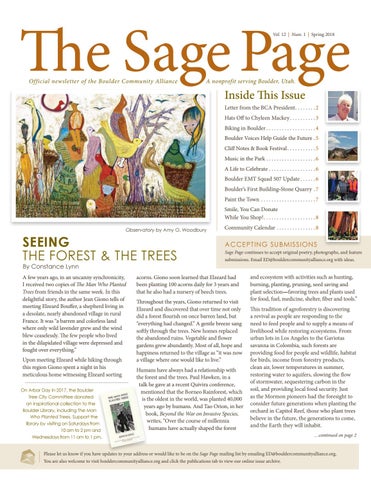
Letter from the BCA President. . . . . . . . 2 Hats Off to Chyleen Mackey. . . . . . . . . . 3 Biking in Boulder. . . . . . . . . . . . . . . . . . . 4 Boulder Voices Help Guide the Future. 5 Cliff Notes & Book Festival. . . . . . . . . . . 5 Music in the Park. . . . . . . . . . . . . . . . . . . 6 A Life to Celebrate. . . . . . . . . . . . . . . . . . 6 Boulder EMT Squad 507 Update. . . . . . 6 Boulder’s First Building-Stone Quarry. 7 Paint the Town . . . . . . . . . . . . . . . . . . . . . 7 Smile, You Can Donate While You Shop!. . . . . . . . . . . . . . . . . . . . 8 Observatory by Amy O. Woodbury
Seeing the Forest & the Trees By Constance Lynn
A few years ago, in an uncanny synchronicity, I received two copies of The Man Who Planted Trees from friends in the same week. In this delightful story, the author Jean Giono tells of meeting Elzeard Bouffer, a shepherd living in a desolate, nearly abandoned village in rural France. It was “a barren and colorless land where only wild lavender grew and the wind blew ceaselessly. The few people who lived in the dilapidated village were depressed and fought over everything.” Upon meeting Elzeard while hiking through this region Giono spent a night in his meticulous home witnessing Elzeard sorting On Arbor Day in 2017, the Boulder Tree City Committee donated an inspirational collection to the Boulder Library, including The Man Who Planted Trees. Support the library by visiting on Saturdays from 10 am to 2 pm and Wednesdays from 11 am to 1 pm.
Community Calendar. . . . . . . . . . . . . . . 8
Accepting Submissions Sage Page continues to accept original poetry, photographs, and feature submissions. Email ED@bouldercommunityalliance.org with ideas.
acorns. Giono soon learned that Elzeard had been planting 100 acorns daily for 3 years and that he also had a nursery of beech trees. Throughout the years, Giono returned to visit Elzeard and discovered that over time not only did a forest flourish on once barren land, but “everything had changed.” A gentle breeze sang softly through the trees. New homes replaced the abandoned ruins. Vegetable and flower gardens grew abundantly. Most of all, hope and happiness returned to the village as “it was now a village where one would like to live.” Humans have always had a relationship with the forest and the trees. Paul Hawken, in a talk he gave at a recent Quivira conference, mentioned that the Borneo Rainforest, which is the oldest in the world, was planted 40,000 years ago by humans. And Tao Orion, in her book, Beyond the War on Invasive Species, writes, “Over the course of millennia humans have actually shaped the forest
and ecosystem with activities such as hunting, burning, planting, pruning, seed saving and plant selection—favoring trees and plants used for food, fuel, medicine, shelter, fiber and tools.” This tradition of agroforestry is discovering a revival as people are responding to the need to feed people and to supply a means of livelihood while restoring ecosystems. From urban lots in Los Angeles to the Gaviotas savanna in Colombia, such forests are providing food for people and wildlife, habitat for birds, income from forestry products, clean air, lower temperatures in summer, restoring water to aquifers, slowing the flow of stormwater, sequestering carbon in the soil, and providing local food security. Just as the Mormon pioneers had the foresight to consider future generations when planting the orchard in Capitol Reef, those who plant trees believe in the future, the generations to come, and the Earth they will inhabit. …continued on page 2
Please let us know if you have updates to your address or would like to be on the Sage Page mailing list by emailing ED@bouldercommunityalliance.org. You are also welcome to visit bouldercommunityalliance.org and click the publications tab to view our online issue archive.