!"#$%!"#&"' !"#$%&'()*+,%$"-(+-%$*."#+%*/$ 0#%12+-3$-%4*$1-5$.6%$(1.%*.$ '"77)-+.8$)951.%*/$,+*+.: !!!"#$%&'()'*+,%"-./
(!)&*#%+',&* !"(("4$)*$"-$;-*.13#17: 0)',1&'()'*+,%
NEWS
LIFESTYLE
SPORTS
San Mateo grants 3.2 million to summer programs. A3
Palo Alto celebrates return of May Fete Parade. B2
Paly Badminton finishes season undefeated. C3
ASB plans Prom, Graduation, Staff Appreciation. A2
Athletes struggle with eating disorders. C1
How TikTok glamorizes mental illness. B1
POPPY BARCLAY/THE CAMPANILE
Tuesday, May 17, 2022
The Campanile
Vol. CIV, No. 8
Palo Alto High School, 50 Embarcadero Road, Palo Alto, CA 94301
PALO ALTO UNIFIED SCHOOL DISTRICT PALO ALTO HIGH SCHOOL 50 EMBARCADERO RD. PALO ALTO, CA 94301
NON-PROFIT ORG U.S. POSTAGE
PAI D PALO ALTO PERMIT #44
PAUSD summer course offerings to decrease Jack Galetti
!"#$%&'(%)&#*#+&+(,-.%/#0'()#&123#4'($%-)5 Poppy Barclay Staff Writer
A
ctivists and Bay Area students gathered outside Palo Alto City Hall on April 22 to rally for climate action in celebration of Earth Day. Climate advocate and Gunn senior Saman de Silva co-organized and spoke at the rally. “Earth Day is just a reminder every year that progress is not finished,” de Silva said. “I think Earth Day is a great place to restore that hope and to inspire people.’” Jo Gardias, a member of the climate nonprofit 350 Silicon Valley, said the Earth Day rally was a great way to unite the community in environmental action. “It's an easy way for the public to get engaged,” Gardias said. “Also, it's an easy way for activists to help funnel people who might be worried or anxious about climate action.” However, de Silva said rallies are not the only way a community should take action. “I think the drawback of Earth Day is that it puts all the hope into one short time, and then people kind of lose that year-round,” de Silva said. “But I think that's a problem to face later down the road.” Gunn junior Katie Reuff spoke about the importance of young peoples’ participation in environmental action. “There’s this (saying that) the youth are our future, and it's true,” Reuff said. “It has to be us who take the first step to engage in (climate) action because this is going to be our planet, and we might as well take charge right now.” Reuff also said it is easier than ever for students to become involved in saving the planet. “Whether you're interested in AI or farming, there's so many different ways to channel
your passions (through) a sustainable lens,” Reuff said. “Even if it's not your main focus, you can find different ways to sneak environmental action into it.” Gardias said there are also ways to be sustainable in day-to-day life, including making minor changes in everyday practices and supporting climate action through voting. “There are three general categories of things that you can do," Gardias said. "One is to decarbonize your personal footprint. So driving an electric vehicle or driving less and electrifying your home. But if you can't do that, then get involved with advocacy or call your representatives about climate bills and vote climate.” De Silva said in the end, while many people support climate action in theory, it is difficult to implement that change into one’s own life. “There are very few people in Palo Alto who would say that the climate is not shaken, that we don't need to change some sort of thing to adapt to the environment,” de Silva said. “I think when push comes to shove, though, you have to choose what you stand for. And I honestly accept that not everybody can stand for the climate if they're standing so actively for other things.”
POPPY BARCLA Y/THE CAMPAN
As the district shifts its priority from transitioning students to in-person learning back to credit recovery for upperclassmen, PAUSD summer school’s course offerings will decrease significantly from last year. Director of Student Services and Supports Guillermo Lopez said the emphasis for this year’s program has returned to its historical goal of helping students fulfill their graduation credit requirements, a change from last year's breadth of course offerings. “The courses being offered are for students who are credit deficient to help them graduate on time or get back on track,” Lopez said. Lopez said with this goal in mind, the classes offered this year will be limited to only those needed by creditdeficient students. “The courses will be offered based on student needs,” Lopez said. “Our current offerings are in line with what was offered every year prior to summer 2021.” Upperclassmen will have first choice in choosing summer school classes, Lopez said, and staff will see little effect despite the decreased enrollment. “Typically, rising seniors have priority, followed by juniors and sophomores,” Lopez said. “Staff is not affected because summer school is not required for them to work, depending on their contract.” Senior Kirtana Romfh, who took Economics through last year’s summer school program, said she appreciated how taking the course over the summer gave her more free time during the school year. “It was great having extra space in my schedule to take other exploratory classes,” Romfh said. “For me, that was gender studies, and I know it would have been difficult to manage putting that in my schedule without having the free spot.” Romfh said because the traditional model will not allow for such flexibility, she hopes aspects of last year’s program will carry over into future years, giving students access to more courses. “I personally think the previous plan from last year was better,” Romfh said. “I think many people used their preps to reduce stress or take other classes, which make the year more enjoyable.”
ILE
Senior Staff Writer
Community rallies against Roe v. Wade draft !"#$%&'()*&+,-.%+)/"#0&+%,1)/2$++#+ Ajay Venkatraman & Joy Xu
The Campanile Staff
Students and activists gathered at Town & Country on May 3 to protest the Supreme Court’s draft opinion to overturn Roe v. Wade. The draft, leaked and published by Politico on May 2, would overturn the original decision made in the 1973 case Roe v. Wade, which laid the groundwork for women’s rights to abortion and privacy. Junior Evie Kramer, who attended the protest, said the leaked opinion would harm women’s right to bodily autonomy. “Female reproductive rights should belong to women and women alone, and restricting them access is taking away (their) fundamental rights,” Kramer said. “Abortions should be safe and accessible for anybody who needs one, and the turnover of Roe v. Wade will directly restrict that.” Freshman Briar Dorogusker, who also attended the protest, said she feels it is important for people to speak out about this issue because of
Up to 30 Chemistry Honors students were penalized for cheating when members of the class leaked photos of the freeresponse section of an upcoming unit test through a group text message. The sophomore who reported the incident, and who agreed to be interviewed only if their name wasn’t used, said a group of students were taking a test before the rest of the class in an adjoining room due to a field trip that conflicted with the test date. While the teacher was proctoring this early test, a student from the other room took a picture of a completed test sitting on the teacher’s desk. This sophomore said they notified the teacher about the incident because it felt like the right thing to do. “It should be an equal playing (field) for all students,” the sophomore who reported the incident said. “No one should
Senior Staff Writers
AUSTIN XIANG/THE CAMPANILE
A student advocates for womens' rights to reproductive freedom during a protest at Town & Country on May 3. Nationwide protests like this one have been sparked by a leaked Supreme Court draft, which would overturn Roe v. Wade.
the universal impact it will have on peoples’ freedoms. “One big part of America is having freedom and having all of these rights,” Dorogusker said. “Forcing (women) to have kids even if they don’t want to be pregnant or aren’t ready to be pregnant just doesn’t seem right.”
Kramer said she was motivated to protest because of the impact the decision could have on her own rights. “I care because I have a vagina, and I’m a woman,” Kramer said. “I’m protesting for my body and my daughters’ bodies ... and for future generations that deserve to have safe healthcare.”
have an advantage over others when taking a test.” Another sophomore in the class, who also agreed to be interviewed only if their name wasn’t used, said students also cheated during the test by texting pictures of the test to their friends. This sophomore said systematic cheating existed long before the most recent test. “Cheating has been going on for at least this semester, if not last semester too,” the sophomore said. “This was a repeat occurrence where people would take pictures of the tests, and they never got punished for it.” This sophomore also said pictures of tests usually ended up being shared in multiple, big group chats, which included students from nearly every Chemistry Honors class. Another sophomore in the class who also agreed to an interview only if their name wasn’t used said photos of Chemistry Honors tests were occasionally Cheating story continues on A2
The Campanile
Tuesday, May 17, 2022
A2
News
FROM THE COVER
Recent cheating incident reveals larger scheme Chemistry Honors tests were occasionally sold too. “A kid who took a picture of his test started using it as a business to sell (the tests) to other students for $5,” this sophomore said. “I personally know of someone who bought the tests. They got it for free through the group chats sometimes and had to buy (a test) other times depending on who took the picture of the test.” Both Chemistry Honors teachers and Assistant Principal Michelle Steingart, who oversees the sophomore class and the science department, said they did not want to be interviewed for this story. According to the Paly Student Handbook, academic dishonesty infractions are categorized into three tiers of offenses: Categories A, B and C. Category A violations include copying minor assignments, Category B violations include plagiarism or violations on major assignments and Category C violations include altering returned tests or stealing exams. “Category C includes taking pictures of a test, which is something that has happened more often
now,” Assistant Principal Erik Olah said. “Taking a photo, in my book, would be a third offense every time.” The traditional disciplinary consequences for Category C violations include suspension and possible expulsion. Colleges must also be notified about the student’s academic dishonesty in their letters of recommendation according to the Student Handbook. Olah said the overall nature of Paly academics likely play a role in student academic dishonesty. “There's a lot of pressure to succeed, and students may feel like they're falling behind and need to take a shortcut,” Olah said. Sophomore Siena Dunn, a Chemistry Honors student in the class period where the cheating incident happened, said poor performances in the class may have prompted students to take extreme measures too. “A lot of people were especially disappointed by the last test,” Dunn said. “The grades weren't as great as most people hoped.” Another sophomore from the class who also agreed to be interviewed
>?;2)$3')$'$*0%0'.$ +117**0(10$3;0*0$%0+%&0$ 3+7&6$.'40$%21.7*0)$+<$.;0$ .0).)$'(6$.;09$(0@0*$5+.$ %7(2);06$<+*$2.AB !"#"$%#&'('#)*#%#+,
ART BY HANNAH SINGER
!"#$%&'()$%*+,-$ ).'/$'%%*012'.2+($ 3004-$5*'67'.2+( Lauren Chung Senior Staff Writer
only if their name wasn’t used said legitimately achieving the grades she wanted in Chemistry Honors took a physical and mental toll on her, which she said may be why some of her peers chose to cheat. “I’ve pulled multiple late nights before chem tests. It’s a habit by now because they’re so difficult,” this sophomore said. “I think PAUSD students can all agree that the environment Paly creates is a rat race. The fact that they’re compromising their integrity to get good grades makes the rat race impossible for a genuine and honest student to win.” Paly Wellness Outreach Worker Shely Benitah said the social and academic pressures to achieve certain grades may make students feel afraid of failure, but that doesn’t mean they should cheat. “Fear is a powerful motivator,” Benitah said. “Some students may use academic dishonesty as a coping mechanism to avoid what they may perceive as failure.” However, Benitah said students should not let the stress of aiming high overwhelm them. “No grade will ever reflect your inherent value and worth as a person,” Benitah said. “You are so much more than your grades.”
Additional reporting by Justin Gu, Lucy Li & Hannah Singer
ASB is working to create a safe, fun prom at the San Francisco Exploratorium on May 14, Co-chair Site Council Representative Gabe Galper said. This will be the first prom in two years. “The Exploratorium has different rules from San Francisco, and San Francisco has different rules from Palo Alto,” Galper said. “So, we are trying to clarify the COVID-19 rules for students to make sure everyone has a great and safe time.” Despite the potential confusion, Paly School Board Representative Micaiah Acosta said tickets have been selling fast. “We’re trying to get as many people to attend prom,” Acosta said. “It’s going to be really fun so we want all students to attend.” The annual prom-asking competition also took place on Instagram through May 9. “We thought it would be fun and cute to see how people are asking each other to prom,” Acosta said. “Winners of the competition (won) free prom tickets.” For Staff Appreciation week, May 2 through 6, ASB worked directly with PTSA to deliver letters to teachers. “Our teachers work really hard, and we’re so thankful for what they do for us, so we’re working really hard to make them feel appreciated,” Galper said. Galper said ASB worked with the Flowers for Palo Alto Club to arrange bouquets for each teacher. “We thought it would be cool to partner with our flower club for our teachers,” Galper said. “Usually the club hands out flowers to students and staff every Tuesday on campus, so we thought it would be a great idea to work with them.” For senior graduation, Galper said ASB is working on arranging guest speakers. “Since Baccalaureate was canceled this year, we really want to work on organizing a memorable graduation,” Galper said. “We’re hoping that our guest speakers will motivate and encourage our graduates.” Galper said ASB is working with Principal Brent Kline to have a safe and meaningful graduation. Galper said, “Mr. Kline and Mr. Gallagher are working diligently to bring a graduation that will satisfy both Paly parents and students.”
8'&9$:(6)$(03$;0'6$<++.='&&$1+'1;
PHOTO COURTESY OF DAVID DEGERONIMO
David DeGeronimo, former longtime Paly football assistant coach including in 2010 when the team won the state championship, will return as the head coach next season. "I am excited to come back to where it all started," DeGeronimo said.
Cole Sturino
Senior Staff Writer David DeGeronimo, Greene physical education teacher and Los Altos High School football coach, will be the head football coach for the 2022-2023 school year following the departure of the previous head football coach, Nelson Gifford. DeGeronimo, one of Paly’s former assistant football coaches for 12 years, said he is excited to return to Paly sports. “I look forward to coaching at Paly and meeting the team,” DeGeronimo said. “I’d like to get their feedback on what worked and what could improve as we look forward to the football season.” DeGeronimo said he plans to focus on Paly’s competitiveness. “We want to continue the great tradition of football at Paly and compete every day to get better,” DeGeronimo said. “We will set high expectations, teach fundamentals and install schemes to compete in the De Anza division.” Varsity football cornerback and senior Alex Born said he is happy DeGeronimo is returning. “I’m excited,” Born said. “I’ve never met him, but I can’t wait to see what he brings to the
table and what big changes he can make to the program.” Varsity football tight end and junior Oliver Marburg said he is sad to see Gifford leave, but looks forward to what DeGeronimo will bring. “(Gifford) was loved by this team and really formed something special,” Marburg said. “With Coach DeGeronimo, you get a guy that many kids are familiar with, and he’s proven he’s a guy who can win games.” However, Marburg also said he hopes not everything will change along with the new head coach. “I hope the playbook for the most part stays consistent, and the scheme that we would run both offensively and defensively,” Marburg said. “It would be really tough to learn a new playbook in one summer.” DeGeronimo said he is looking forward to returning to Paly as the new head football coach, and is making an effort to form connections and prepare the team for the season ahead. “I will meet the team on Tuesday and get started right away to put together a staff,” DeGeronimo said. “I will be on campus after school to get everything ready for the spring and summer schedules. We will be ready to go in (the) fall. I am excited to come back to where it all started.”
Tuesday, May 17, 2022
The Campanile
A3
News
!"#$%&$'(#)*$+)%,(-+./$0% ,123.10)%(*4-,(+.$% 0-40.#"')"1+%',(+ Ajay Venkatraman Senior Staff Writer
ART BY HANNAH SINGER
San Mateo County funds summer programs with $3.2 million grant
5$032#$4'"*%+'C$++'%++2C'04922+'"$03#$430'32'?%/*'=6'.2#'6%&"*?$4'+*%#&$&>'0*3)%4/0 Lucy Li
Staff Writer
A
cknowledging deficiencies in school funding and attempting to make up for learning losses caused by COVID-19, San Mateo County awarded a historic $3.2 million grant in April to over 70 summer enrichment programs for students around the Peninsula. The funding will enable local districts such as the Ravenswood City School District to run after-school summer programs for youth in the area in partnership with the county. “It’s a really great opportunity for kids to go to a safe, supported structure,” William Eger, the Chief Business Officer for Ravenswood, said. “They’re not only able to catch up on things they may have missed during the school year, but also meaningfully engage with friends and
have a joyful learning environment over the summer.” Eger said for many school districts, online learning introduced several academic and social setbacks for students by preventing them from spending time in classrooms. “Students are not where they normally would be in terms of their math and reading test scores, but more importantly, in terms of their social and behavioral needs,” Eger said. “(These programs) are a chance to catch up and make up for the lost time in a way that’s fun and engaging.” Bob Hoover, founder of the East Palo Alto Junior Golf Program and recipient of the county funding, said, for many years, San Mateo was the exception rather than the rule when it came to receiving county funding for extracurricular education. “(In the past), there were 30 to 40 counties that received money through
this grant,” Hoover said. “San Mateo County was the only county that had a program not run through some legal entity that was a part of the county.” While the county’s decision to address funding gaps was mainly met with applause, Rich Cline, former mayor of Menlo Park, said this year’s funding still falls short of students’ needs. “It’s great to see that counties are trying to make an effort and that they see the funding deficiencies,” Cline said. “But the problem is so much more than $3.2 million.” But for East Palo Alto residents like Hoover, who has lived there for nearly 60 years, the grant represents a major landmark in improving education inequality by addressing schooling disparities in traditionally under-resourced areas. Hoover said, “For the first time in my history in East Palo Alto, I have felt the programs that I have been involved in have truly been a partner of the county.”
!"#$%&%'()*#+*,'!"#$*&&*'-*.*&"$,'!+*/0%&"%#'123$4,'!+*/0%&"#%'5266*#,'!+*7'89*&,'!+*7':%&';$*0*&,'!+$02&' 89%2,'!+$02&'<=%&,'!+$02&'5%>%&,'!+6*#'<=+*#,'!?%&"%'!++%&,'!?)*#'89%="9#@,'!?@'A#$*"?%&,'!?@'B>%C%,' !?@'D%&>,'!&%&@%'-%0,'!&>%&$'E%#?%,'!&>*+%'F2&>,'!&>*+$4%'G+%04*&4$%'H%#$20,'!&>*+$I=*'-$33#$49JG#$&0,' !&K%&$'E%#?%,'!&&'L*&"*&9%++,'!&&%'M+%0$,'!&&%'-2?$&>2,'!&&*'-$G%0I=%+*,'!&&*'H$&,'!&&$*'1%+)23,'!&2K%' 5*#%39,'!&=09%':%0="*N%&,'!#$%&*'(#$4/02&,'!0C$&'O$33$6=&,'!N%'5%9&,'M*&'H*&%$+,'M*&%.09%'P#%&$,'M*#*&$4*' H%$,'M+2002?'5=&3*#,'M2&&$*'Q*++*#,'M2#$0'E49=)*#3,'M#%&"$'F%+3*#0,'M#%&3'5%&&%,'M#*33*'5="%4*/,'M#$%&'<=%&,' M#@&&'(C*&,'8%#$&*':%&0+*?)#2=4/JE49=+3R,'8%#+20'89%&>,'8%#2+$&%'M#=49$+%#$,'8%#2+$&*'G*#*0,'8%#@&'M#=S,' 8%39@'F$++$%?0,'8*4$+*'89%#3$*#,'8*+*03*'M%3*0,'89%#$00%'8%?*#2&,'89%#+*&*'O%42)0,'89%#+233*'L@*#0,'89%#=' <=63%,'89%='T>=@*&,'89*&>'U$*,'89*#$*'E26/$&,'89$"*+'5$++%#@JB&=*>)=,'89#$03$&%'L2&"#%>2&,'89#$03$&*' 89*&,' 89#$03269*#' 8=??$&>0,' 89#$03269*#' (#&03,' 89#$03269*#' 5%++*&)*4/,' 89#$03269*#' 5=#33,' 89#$03269*#' H+*C*++@&,'89#$03@'<2#%+&$/,'89=4/'Q%3R,'8$&"@'Q#*$>*#,'8$&"@';2)*#30,'8$&"@'D$6,'8+%$#*'H$&,'8+%#$00*'H**,'82++**&' M%4/03#%&",'82++**&'<2#?+*@,'8#%$>'89%?6$2&,'8=#3'Q$&0/@,'8=#3$0'E?2+%#,'8@&39$%'19%?,'-%&%'<=$++*3,'-%&$*++*' H%=#0*&,'-%N$"'8%?&*#,'-%N$"'<**,'-%N$"'5=&>,'-%N$"'Q%#*+,'-%N$"'L%"C*",'-%N$"'E9*%S*#,'-%C&'M$++?%&,' -*%&&%' 89=3*,' -*)2#%9' M*&&*33,' -*?*4*' <%#*6$0J 52++%&",' -*&%' E*/$,' -*&$0*' 5*&#@,' -$N@%' E$&>9,' -2+2#*0' -$%R,' -2&%' 1N*#0/@,' -2&&%' -2,' -2#%' F%&>,' -2=>+%0' 5%>%&,' (/3%' Q%6=#,' (+%$&*' 89%0*,' (+*&%' 89$=,' (+$0%' "*' L%#3*+,' (+$R%)*39' 892C,' (+$R%)*39' <%##,' (+$R%)*39' L%@,' (+$R%)*39' B+02&,' (+$R%)*39'E2#2/%,'(++*&' L*@*#.#*=&",'(+N@'H**,' (?$+@' T2#39,' (?$+@' F%&>,' (#%&' M*&"%N$",' (#$4' L*$,' (#$/' ;%=049,' (N%' M2#&,' A%&>' V9%2,' A*+$4*'!9&,'A*+$4$%'H**,' A#%&4*0'-%N$*0,'<%)#$*+' A200%3$JM*++%&$,'<%)#$*+%';=*"%,'<%@%39#$'T%#%@%&%&,'<$0*++*'<%+6*#,'<+2#$%'8%9=$49'<2&R%+*R,'<+2#$%'V9%&>,' <2C#$'<#*C%+,'<#%4*'L%#I=%#3,'<#%$&>*#'L%#)=#>,'<#*>2#@'M#%$+,'<#*349*&'5%#"$&>,'5%$@$&>'5=%&>,'5%##$*3' E3*#&,'5%##@'5$#049?%&,'5%@*0';%S*+,'5*%39*#'W$%&,'5**K*2&>'G%#/,'5*+*&'H$,'5*+*&'D*&$JQ2?09$%&,'52&>' U=*,'5=0&%'5%09?$,'P&>#$"'-2&%9=*,'PN%';*$",'O%4/'892I=*33*,'O%?$*'L*#/*+,'O%?$*':$,'O%&$&*'5%@C%#",' O%&&*JH$&&' B.3*"%+,' O%@' M%4/03#%&",' O%@' M#%&"*&)=#>,' O%@%' 89%&",' O*%&&*' -*H*2&,' O*S' E49**+,' O*&&$.*#' !&32&2C,'O*&&$.*#'-$M#$*&R%,'O*&&$.*#'A2#",'O*&&$.*#'<+20,'O*&&$.*#'P))2302&JM#2C&,'O*&&$.*#'H**,'O*&&$.*#' ;%>&2,'O*&&@'-$72&,'O*00*'-2#2>=0/*#,'O*00*'H%"2?$#%/,'O*00$4%'<%+)#%$39,'O*00$4%';*0?$&$,'O*00$*'89*&,'O$%&' H$,'O$?'L$>"%+,'O$&>'O$&>'U=,'O2%&$*'5%&*@,'O2"$*'8#%$>,'O2"$*'F*9&*#,'O2*'8+%#/,'O29%&'G%9+?,'O29%&&%'(9#+$49,' O2+**&';2%49,'O20*'!4203%,'O209'Q*&3,'O2@'8+*N*#$&>%,'OG'19$*?%&,'O="@'1%2,'O=+$%'D=,'O=+$%&%'E2&&*N*+",'O=+$*' 12?%0R,'O=+$*'12?R,'O=&'-*&>,'O=&42'L$&%?$,'Q%?%+'!#"*09&%,'Q%2#='!#$@%0=,'Q%#%'-%N$0,'Q%#*++*'8*+*03$&,' Q%#$&%' (042)%#JF*%N*#,' Q%#+' <%#4$%,' Q%3*' <+%002&,' Q%3*' 89*0+*@,' Q%39%#$&' 89#$03?%&,' Q%39*#$&*' O29&02&,' Q%39+**&'5%#3,'Q%39+**&'Q#%?*#,'Q%39@'52C*,'Q%39@'E*>=#%,'Q%3$*'*#2,'8$0Q%3K%';%=+3JF%&>,'Q%3#$&%'8=##$*#,' Q%3#$&%'F22"C2#39,'Q%N*#**'Q%K%+*,'Q*++@'M%#39*+*?@,'Q*++@'L22#*,'Q$?)*#+@'E49C%&,'Q$#03*&'(00*&?%49*#,'
To reduce ambulance costs for city residents, the Palo Alto Fire Department launched its new Palo Alto FireMed subscription service. The program, announced in a city press release on Monday, allows residents to pay a monthly fee, starting at $8, with their regular utility bill. The program allows participants to receive ambulance rides covered by the Fire Department in the event of a medical emergency. Palo Alto Fire Department Chief Geoffrey Blackshire said the program’s purpose is to eliminate potentially stressful and costly out-of-pocket ambulance fees during crises. “The idea is to give people the peace of mind in an emergency situation that they have the support they need,” Blackshire said. “The principle behind it is creating a lowcost service where people don’t have to pay out-of-pocket expenses.” The program also provides a plan for families and businesses to cover additional family members or employees with an increased fee of between $20 and $1,000 depending on the number of people on the plan. Blackshire said the increased payments will likely go towards improving the Fire Department’s service. “The increased (revenue from) the plan might go towards training or new equipment, so (this program is) helping us improve our service to the community,” Blackshire said. Because Palo Alto’s Fire Department is the only one in Santa Clara County offering emergency ambulance services, Blackshire said Palo Alto took inspiration from other programs in California when designing Palo Alto FireMed. “Cities like Huntington Beach and Anaheim have been doing exactly this for (years), and it has been an additional resource for their communities,” Blackshire said. “We’re the only department locally to offer an ambulance service, so we’ve looked at other cities which offer a similar service.” Blackshire said the department also relied on feedback from residents when determining the structure and base pricing of the individual plan. “We did a focus group with residents to see what’s appealing and what they would pay for,” Blackshire said. “Our model is based on feedback from that group and what they would want to see.” Blackshire said the Fire Department will continue to look at community feedback to determine the future of the program. “Looking at (the cities) we based it on … people are willing to continue to pay for the service,” Blackshire said. “The goal is to serve the community, so if people think the service is not valuable, then we might start to reassess. Based on what we’ve seen, though, it seems like it will be something that continues to benefit residents.”
Q#$03%'H%C+2#,'Q#$03*&'!&"*#0*&,'Q#$03*&'H*$?#239,'Q#$03$'L4L$49%*+,'Q#$03$&*'L2032XR%"*9,'Q#$03$&%':*33*#,' Q=0=?'G%&"*@,'Q@+**'L$++*#,'H%-2&&%'M=3+*#,'H%&*++*'T*=?%&&,'H%#%'5%&>*)#%=4/,'H%#$0%'Y0$49,'H%=#%'<#%&3,' H%=#%'O%42)02&,'H%=#%'H$&"03#2?,'H%=#%'E3%#/,'H%=#%'E3=#$&2,'H%=#*'82&42+%32,'H%=#$*'D2+*#,'H*$+%&$'D%=,'H$'D%&,' H$%&>'D$&,'H$*&':=,'H$+@'H$&,'H$?$&'W$%&,'H$?2#'T$#6%R,'H$&"%'5*&$>$&,'H$&>'5%2,'H$&>+$'O$&,'H$&&%'V9%&>,'H$0%' !#2&*,'H$0%'A2#00*++,'H$0%'L=,'H$0%';$?0%,'H$R'M#$?9%++,'H$R'<%$39*#,'H$R'L=*++*#,'H2#*32'G2&4*'"*'H*2&,'H2#$'Q&2++' 5%##*&03$*&,'H=)&%'W=#*$09$,'H=4@'H**,'H=4@'12?6/$&,'H=$0%'BR>*&,'L%+%'T%#%0$?9%#%K%&,'L%&$&"*#'O%$0C%+,' L%&=*+%'F*$,'L%#4'A$&23,'L%#4'<=$++*3,'L%#4$'L48=*,'L%#4@'L*%>9*#,'L%#>23'H24/C22"'E3*$&,'L%#$'12@%?%,' L%#$%'-*##$4/,'L%#$%&%'M#%&"$,'L%#$%&%'E%$R,'L%#$2&'M*%49,'L%#$6%R'E2)*#>,'L%#/'5266*#,'L%#3%'G2#C$3,'L%#@' T*?*#2N,'L%#@'G*33@K29&,'L%#@':$&4*&3,'L%=#**&'M#%".2#",'L%@%':*&/%3#%?%&,'L**&%'!+%>%66%&,'L**#%' E%7*&%,'L*$JD=&'H29,'L*+%&$'D=*&,'L*+%&$*'T2#%++,'L*+$&%'G%33*#02&,'L*+$00%'<#%&*@,'L*&>'H$,'L*#*"$39' !4/+*@,'L*#"$39':203#*K0,'L$49*+*'H*C,'L$49*++*'8226*#,'L$49*++*'-$/*,'L$49*++*'H%?,'L$/%'5%32@%?%,'L$&>' L2=,'L2++$*'E3$33,'L2++@'T%=>932&,'L2&3@'PKR*#?%&,'L2#>%&'H%09+*@,'L#$"=+%'G%#$/9,'T%"$#'!+$,'T%&'Q$?,'T%&%' 89%&4*++2#,'T%&4@'Q%C%/$3%,'T%2/2'A=K$$,'T%2/2'B/=?232,'T%3%0%'G%9+?,'T**+%'Q=+/%#&$,'T$42+*'<%##%33,'T$42+*' 192?,'T$&%'M+%4/C*++,' T$09$3%'Q239%#@,'T2*++*' ;="2+69,' B$&"#$+%' ;%@,' B+$N$%' 89*&,' B#$3' :$"%0J52#2N$3R,' G%++%N$' 52?%&,' G%?' L2#>*&.*+",' G%2+%' H*N%,' G%3#$4$%' H*$349,' G*$' 8%2,' G*&&@' <%2,' G*##@' L*$>0,' G$&>' V9%2,' G22#&$?%' 5$#*?%39,' G#**39@' G%"?%&%)9%&,'G#$@%3%' <=63%,' G=#N$' Q%6%"$%,' W$&>' 1$%&,' W$&>I$&>' H$&,' ;%49*+' 8+*%#@,' ;%49*+' ;*&,' ;%09$' E$&>9%+,' ;%N$' !"%3#%2,' ;%@?2&"' Q=&$3%,' ;*)*44%'Q$&>,';*)*44%' H=$,' ;*)*44%' E9*&' H2#*&02&,' ;*)*44%' F9$3*,';*09?%'E$&>9,' ;92&"%'O*S#*@,';$4/@'89$=,';$/%'D%?%?232,';$3%'M#2>+*@,';2)@&'G#*$0$&>,';20%&&%'O%4/02&,'E%)$&%'5*&3R,' E%49$/2'M=00*@,'E%++@'D*&4/*&,'E%++@J!&&';="",'E%?':%0I=*R,'E%&"@'H%=,'E%&>**3%'-*'-%33%,'E%#%9'82#&C*++,' E%#%9'O%42)02&,'E%#%9'T*C?%&,'E%#%9'F$*4/2C0/$,'E%32?$'B/%R%/$,'E4233'192?%0,'E**?%'Q%6=#,'E**?%' :2#%,'E9%'D=,'E9%+$&$'M$3R*#,'E9%?%'G%>%#/%#,'E9%#2&'89$&,'E9%#2&'12)$%0,'E9*$+%'E49C*$3R*#,'E9*++*@'1%3=?' Q$*#%&,'E9$+6%';%&>%&%39,'E9$I$%&'D=,'E242##2'B33*02&,'E2&$%'E*39$,'E2&@%'5%&&%,'E2&@%'L=/9*#K**,'E2=?%@%' !#X,' E6*&4*#' O29&02&,' E#$"*N$' :%&/%,' E#=3$9' !09*#' 82+)*#3,' E3%4*@' ;%?$#*R,' E3*69*&' !?*0,' E3*69%&$*' M#%"+*@,'E3*69%&$*'(03#%"%,'E3*69%&$*'A#$4/,'E3*N*'A*##*#%,'E=??*#'E9*&>,'E=0%&'89%2,'E=0%&'Q#%?*#,'E=0%&' E49**+,'E=0%&':%&';$*0*&,'E=0%&&%9'F$K0*&,'EN*&'19*0*&,'EN*3+%&%'E%#>0@%&,'1%+'E%?%3,'1%?%#%'<#%42&,'1%#%' A%#&0C2#39,'1%#=&%'E=#$,'1%3$%&%'E%&"+*#,'1*#*0%'49*&,'192?%0'50$=,'19=@*&'T>=@*&,'1$"%':$2+%&3*,'1$*'V92&>,' 1$&%'L2&"#%>2&,'12""'(#$4/02&,'12?'Q#%?*#,'1#%4$*'F2&>,'1#$&%'8=##$*#,'1#$09'O*?$02&,'Y?%'L%9%&/%+$,'Y?%' L*&2&,'YR?%'L$&9%0,':%&"%&%'!"@%,':%#09%'M9%3$,':*#2&$I=*'H%.%#>=*,':$)9%'!//%#%K=,':$432#'L*@*#.#*=&",' :$432#$%'192#6,':$N$%&'8#2?C*++,'F*$'F%&>,'F*$C*$'F%&>,'F*&"$*'Q%#*+,'F*&"@'52,'U$%2'H=2,'U$%2'F%&>,' U$&' M%$,' U=%&' <=2,' D%09' E9*33@,' D%0=@2' L%/$&2,' D$.%&>' 89%&>,' D$&>' 89*&,' D=?*$' U$2&>,' V9$?*$' -$&>
56789%:;<%=7>:%?;><85@@AB :;<%C79@%7%&D!!@A@8E@F GHGI3GG =7>:%=5B7
The Campanile
Tuesday, May 17, 2022
A4
!"#
Spotlight
!"#$%#&'('%)"*+,-''.+)-/)0'%$"+1-
F
lower bouquets, candles and objects that represented senior Lauren Brierly covered the folding tables on Los Altos High School’s quad on April 4. A poster with handwritten messages dedicated to Brierly stood adjacent. Brierly died on the morning of April 1 following what is being investigated by Mountain View Police as a possible fentanyl overdose. She was 18 years old. Pinewood School senior Rachel Farhoudi, who played soccer with Brierly on the Mountain View Los Altos club soccer team, said Brierly was a role model to her younger teammates. “She didn’t have a mean bone in her body,” Farhoudi said. “She was just the nicest to everyone and got along with everybody.” Farhoudi said Brierly’s death was a huge wake up call for the Los Altos High School community. “Lauren was the last person I would expect this to happen to,” Farhoudi said. “I mean, you never expect it to happen to anyone, but it was definitely a shock.” Fentanyl-related deaths are rapidly
increasing in Santa Clara County: the synthetic opioid 50 times more potent than heroin killed 27 people in 2019, 86 in 2020 and 132 in 2021, according to the Santa Clara Medical Examiner-Coroner’s office. Fentanyl overdose has become the leading cause of death among Americans aged 18 to 45, surpassing suicide and COVID-19. David Fisher, the Crimes Against Persons sergeant in the detective bureau for the Mountain View police department, oversees the detective unit which handles any crime that has a human victim. Fisher’s unit is currently involved in the open investigation into Brierly’s death and waiting on the toxicology report. While he is unable to comment on the case, he said he has seen a general increase in fentanyl poisoning from people who unknowingly consume fentanyl-laced drugs. “For teenagers specifically, I hope that this is a little bit of a sobering event because it’s very scary,” Fisher said. “There’s a potential that just buying a pill of Adderall could have fentanyl in it, and that could be the last thing you do.”
-.&*#).4$%*)-"1*.12+ P+*#8)*'.54+#9.*9#"'%)#4#9'&0#%<*'9%(*# *<*'$#?*1&%G#$-*.+#QRQS#GT@TJC =8H*".*,/GE-*#$-#$,*."/*.$%#'%)(*5%+/4.+*9# 4#1*/241#9%(*#%"#"*+/4+$1#GHC7C#@I8JC I%$*J&("E/'1#%"#"*+/4+$1#24(#/2*#B%/*+/.41# /%#J&((*?66K666*2$"2($*GHC7C#@I8JC L)%#+$#&0*"2&"&,*,$'#+-6#14'0*1$#9&*#/%# "*+/4+$16#'%(**??C7H#3*/-**+#U4+#VS6#QRQR# 4+9#U4+#VS6#QRQS#GHC7C#@I8JC
!"#$%!&"# !"#$%&#%'#(%)*%+*#$%&#,+%-#.(#(/'&001.+0# -./2#(&3(/4+5*#43&(*6#5411#/2*#7&3(/4+5*# 83&(*#4+9#:*+/41#;*41/2#7*'<.5*(#89).+.(= /'4/.%+#;%/1.+*#4/#34566477849:;!*<=>?@A BBBCD%,#/$'#1$%#CE"F 7&.5.9*#>'*<*+/.%+#;%/1.+*?#
56648@>458??
'$()*$)*"++),-).)/!%0),#) +.&"/)(,*')-"1*.12+ @%+A/#/'&(/#4+$#(&3(/4+5*#+%/#B'*(5'.3*9# 3$#4#1.5*+(*9#)*9.541#B'%"*((.%+41#4/#4# /'&(/*9#B24')45$C#D%6+#/*(/#9'&0(# B&'524(*9#.11.5./1$#-./2#E*+/4+$1#F*(/#7/'.B(# /%#9*/*5/#/2*#B'*(*+5*#%"#/2*#%B.%.9# GHC7C#@I8JC
*!".*,10).1)$3"!/$#" !"#$%&#(**#(%)*%+*#*KB*'.*+5.+0#/2*# "%11%-.+0#($)B/%)(#L#.+43.1./$#/%#(B*4,6# ()411#B&B.1#(.M*6#5%19#4+9#31&*#9.(5%1%'*9# (,.+6#(1%-#%'#(2411%-#3'*4/2.+06#<%)./.+0# %'#4#"4.+/#2*4'/3*4/#L#/2*$A'*#)%(/#1.,*1$# %<*'9%(.+0#%+#%B.%.9(C#89).+.(/*'#N41%K= %+*6#*./2*'#/2*#+4(41#(B'4$#%'#/2*#.+O*5/= 431*6#/%#/2*#B*'(%+#%<*'9%(.+0#4(#(%%+#4(# $%&#(**#/2*#(.0+(6#4+9#$%6+#B%/*+/.411$# (4<*#/2*.'#1."*#GHC7C#@I8JC
ARYA NASIKKAR/USED WITH PERMISSION
Los Altos High School students pay their respects to the late senior Lauren Brierly, who died on April 1 from a potential fentanyl overdose, with flower bouquets and various other gifts. Rachel Farhoudi, who played soccer with Brierly, said that her team discussed planting a tree on their home field in her honor. “Losing Lauren unexpectedly has been so hard,” Farhoudi said. “A lot of the girls (on the team) really looked up to her.”
!"#$%&'$()&*"+#,&-./'(&*,0'$01%&,234,53# The 132 people killed by fentanyl poisoning last year in Santa Clara County defy stereotypes held about drug users: they include both poor people and rich people, people of all ethnicities, genders and ages. Fentanyl is being laced into an increasing amount of drugs bought from illicit sources, creating a lethal high for people who may not be aware of fentanyl in the drugs they take. Santa Clara County District Attorney Jeff Rosen said opioid abuse, which includes the use of fentanyl, is the leading cause of drug-related deaths in Santa Clara County and the leading cause of death for people under the age of 25 in the county. In response to the rising number of fentanyl-related deaths in the county, The Santa Clara County Fentanyl Task Force held its first meeting on Zoom in April. The task force is made up of individuals from law enforcement, crime units, behavioral health, medicine, local government and schools; people who study addiction, have been addicted to drugs, and were friends and family of those who died from fentanyl poisoning. Among many topics, the group discussed fentanyl’s circulation, detection and origins, and the distribution of overdose prevention tools. On the criminal justice side of overdose prevention, law enforcement is on alert. Rosen said two people are currently being tried for murder for selling fentanyl laced substances and several have been prosecuted for the felony of violating Santa Clara County’s health and safety code through selling the equivalent of poison. “(We) recently arrested a man who had 11,000 fentanyl pills in his car,” Rosen said at the meeting. “So let’s put that into perspective. The 12-year-old girl who died went into cardiac arrest within minutes after ingesting just part of one pill. Traditional law enforcement approaches can still work, but we also must evolve. Drugs are a health problem. Addiction is a sickness. We will not arrest and prosecute our way out of this crisis.” On the public health approach to overdose prevention, the task force is looking into establishing a fentanyl advisory which informs people of personal and legal consequences of using fentanyl.
Task force member and San Jose State the task force is currently acquiring them University professor Erin Woodhead said to spread throughout local communities. another strategy the task force is using “These strips would allow people to includes raising awareness among younger determine if the drug that they’re about potential users. to take has any amount of fentanyl in “The communications committee is go- it,” Woodhead said. “They’re relatively ing to try to address how we can effective- inexpensive. It is an action we can take ly reach teens with information in a way pretty quickly that isn’t going to cost a lot that they’re going to listen and not feel of money.” we’re just lecturing them,” Woodhead said. Despite these efforts that have de“We’re also trying to incorporate some creased the rates of overdose, Fisher said younger people into this working group to he thinks the problem will continue. really understand their mindset.” He said producing and selling fentanylWoodhead said that information has laced substances generate profit, so it is to be presented in a specific way to be especially important to stem demand successful in deterring as well as supply by making sure people teens away from are aware of the dangers of drugs. fentanyl being laced into “You need any substance not to give both bought directly sides of the from a pharinformamacy. Rosen tion,” agreed. Wood“It’s head said. not like “You’re when you giving go to the both the pharmacy conseand you quences know if of opioid overdoses in 2020 of use you’re buyinvolved fentanyl and ing Advil, you’re acyou’re getting Source: San Francisco Office of the knowledgAdvil, or TyChief Medical Examiner ing why it may lenol, you’re getfeel good for a teen ting Tylenol,” Rosen to use that drug. That’s said. “When a drug dealer part of (teen) development gives you a pill and tells you it’s — understanding new experiences and Xanax or Sudafed, or Vicodin or Percocet, expanding their view of the world.” it might be. It might also have fentanyl Another strategy the task force is using in it which could kill you. So if you need includes overdose reversal kits and testing medication because you’re in pain, talk to strips. Mountain View Police Department your doctor and get a prescription from sergeant David Fisher said all police ofyour doctor, but don’t try to self-medicate ficers carry a Narcan kit with them so that by buying from somebody where you have they can quickly reverse an overdose. no idea what they’re selling.” Fisher said the MVPD used to have drug testing kits, but like many other police departments, they generally do not use them anymore because potential exposure to fentanyl can be deadly. Samples of substances police collect are instead sent to labs to be tested. But while police generally do not test substances, fentanyl test strips are cost-efficient and effective, and Woodhead said
73%
Tuesday, May 17, 2022
The Campanile
A5
Spotlight
-$2-#+3%&+%/"%+2-42+.)255'.6+.$0*"#$+'-7".+%$+/-.8
!"#$%&'(&)*')'+&*#%,-#'*.')(,&/%0+,&.)&1%(.0(2/&-#',', Stanford Professor of Addiction Medicine stronger: it’s 50 to 100 times more potent than Anna Lembke said the drastic increase in other opioids like heroin or morphine.” fentanyl overdoses began with a rise in opioid In addition, Lembke aid illicit drug proprescriptions. ducers started placing fentanyl in other less “In the 90s, doctors began prescribing more potent substances without the user’s knowlopioids to patients for minor and chronic pain edge. conditions,” Lembke said. “Prescription qua“When fentanyl first entered the market, drupled in the United States between 1997 it was often in the heroin supply without and 2012, and as opioid prescribpeople realizing it,” Lembke ing went up, so did the number said. “And so that’s partly of people getting addicted why there was a spike and dying.” in deaths — people >?*8)(851+0&+2$+)7+!$$+ Lembke said the thought they were increase in prescription taking an amount of )0=*&+=7/*+.7)*8)+ opioids naturally resulted heroin that they could &+10@*+ )9(8+7)9*/+7.07: in non-prescribed users tolerate.” having easier access According to 9*/708+7/+=7/.908*AB to the addictive drugs. Lembke, fentanyl lacFentanyl in particular is ing continues today. Anna Lembke much cheaper to produce. “Counterfeit pre“For thousands of years, scription pills like Xanax people have used opioids derived and Oxytocin are being from the poppy plant or opium,” made with fentanyl in them,” Lembke said. “In the last hundred years, Lembke said. “And so people were scientists have figured out how to synthesize taking them thinking they were just taking an fentanyl and other opioids in a laboratory Oxy or a Norco or a Z-Bar and dying because without needing the plant. You don’t need to there was fentanyl in there.” cultivate it, you don’t need to harvest it, you Lembke said when illegal drug manufacdon’t need to ship it, you just need the precur- turers realized fentanyl’s profitability, they sor chemicals. So fentanyl is really cheap to started to put fentanyl in other opioids, such make.” as heroin, effectively cutting costs while giving Lembke said by 2012, doctors began to their customers a more intense and addictive recognize harm of opioids, and prescriptions experience. In addition, fentanyl’s potency decreased, but it was too late for many. can cause customers to return, seeking out the “People who had become addicted at that same addictive effect. point then turned to cheaper and more abun“If you have some heroin, and you want dant sources like illicit opioids like heroin and to make it a little bit stronger so that your fentanyl,” Lembke said. “And fentanyl is much customers get an effect and come back to you,
then you would put a little bit of fentanyl in there,” Lembke said. “But it’s then hard to gauge how much somebody can tolerate.” Santa Clara County District Jeff Rosen said there has definitely been an increase in fentanyl in Santa Clara County and in the state. “Several years ago fentanyl was more prevalent in the East Coast and the Midwest of this country,” Rosen said. “And then a few years ago, it made its way to California. Initially, fentanyl was coming here from Mexico and now it’s coming from China. It’s very inexpensive for drug dealers to get it and it’s highly dangerous.” Today, the practice of lacing other drugs with fentanyl is so widespread that nearly any drug purchased illegally is at risk of being contaminated with fentanyl –– even some forms of marajuana. Just two to three milligrams of fentanyl can be fatal to someone with no preexisting opioid addiction. But there is hope. Lembke said the distribution of Naloxone, an opioid overdose reversal agent marketed under the brand name Narcan, has lowered opioid overdose deaths. “Naloxone has been made widely available in the city of San Francisco since approximately 2008,” Lembke said. “And we think as a result, the heroin-related overdose deaths in San Francisco remain lower than in other regions.” Regardless, she said students should be extremely cautious when taking any drug. “Don’t ever take a pill that wasn’t prescribed to you by your doctor and obtained from a pharmacy,” Lembke said.
!"#$
Fentanyl first synthesized
!"%$& Heroin usage increases dramatically with the Vietnam War
'()*+!""$& Doctors prescribe more opioids to patients for minor to chronic pain conditions
,$!, Opioid prescriptions decrease as medical professionals realize their harmful effects
,$,$ 90 people die of fentanyl overdose in Santa Clara County
,$,!
!."+%(.,&$#0**/%&3'.4&#',5,&)1&,"6,.0(-%&",%
132 people die of fentanyl overdose in Santa Clara County
-./01+,23+,$,, In December 1997, a then-Paly senior was anonymously quoted in The Campanile, saying, “Getting drugs at Paly is easier than water-ballooning a freshman.” A survey of 362 Paly students from the week of Dec. 1, 1997 found that 42.3% of polled students admitted to having used an illegal drug at least once. Back then, alcohol was the illegal drug of choice, followed by tobacco and marijuana. Today, according to the National Center for Drug Abuse Statistics, 10.37% of Californian 12 to 17-yearolds reported using drugs in the past month, with alcohol and marijuana being the most commonly used drugs among teens nationwide. Paly is no exception to these statistics. A Paly senior who agreed to be interviewed only if her name was not used said the majority of people she knows have either done drugs or regularly use them. In fact, she said the competitive environment of the school may contribute to this drug use. “We live in this area with so much wealth. … either the kid feels so much pressure from their parents that they choose to find something like cocaine to study and to work harder, or they’ll do something to cope,” she said.
“They might try something like opiates and see if that’ll have any effect on how they feel.” Paly 2021 alumni and Colorado University at Boulder freshman Benny McShea said fentanyl is a large problem among the Boulder student body, specifically when put into cocaine without the knowledge of the user. “I remember first hearing from social media posts, and parents groups on Facebook how people should tell their kids to stay away from cocaine, especially since it could be laced (with fentanyl),” McShea said. “And in the first week, three freshmen died.” In response to the current fentanyl crisis, the CDC recommends the use of fentanyl testing strips for drugs, since it is nearly impossible to tell if drugs have been laced with fentanyl without them. McShea said other colleges allow students to request drug tests to make sure their substances are not laced. “It’s completely free, completely anonymous,” McShea said. “Receive a little package and you get to test whatever,
marijuana, psychedelic, whatever you’re doing. You get to test it and see if it’s safe or if it’s not.” The anonymous Paly senior said people should be cautious when dealing with illicit drugs that are at risk of being laced with opioids like fentanyl. “If you’re going to do something stupid, do it in the smartest way possible, because everyone does stupid s—,” she said. “But it’s about harm reduction. It’s about minimizing risk. It’s about having fun but not dying (while) doing it.” !"#$%&'(%)"*+,'+C5+D08(+E(*3+D0(88(+ E/7F1*53+G(1*/0*+H9I+J+ E/(:*8+'*I8F
67)*8)0(115+1*)9(1+:7&*&+7;+9*/708+ (8:+;*8)(851+<7=.(/*:+)7+(+.*885 Source: U.S. Drug Enforcement Administration. Fentanyl and heroin doses are represented by granulated sugar for safety purposes. Image enlarged, not actual size.
!"#$%&
'()'*+,-
Santa Clara County Fentanyl Task Force holds their first meeting
4(5+!$3+,$,, First ever National Fentanyl Awareness Day
."&/0&12 ')3+,-
The Campanile
Monday, May 16, 2022
A6
Opinion
4"/.-,5%1##%6"#,&% &'()#*%7,/% 8"&,3/(6.,& Anaya Bhatt
Student promposals overrated 7#"43")(')%&#$(-$%3#$))+#$%8"#%)-+,$.-)%-"%()51%(.)*$#1%3'(&$%8"&+) %".%)9"*/.6%":%/.)-$(,%"8%$0$.-%/-)$'8 Christie Hong
Senior Staff Writer
Lifestyle Editor
ART BY
BY
AJ AY
VE NK AT RA M
AN
Grand, unmistakable banners decorating the 800 building confirm the “when,” while rumors fly about the who, how and where. As spring approaches and cherry blossoms make their appearance on campus, whispers of prom follow suit. Let’s face it: promposals have made a comeback after first gaining buzz in the early 2000s, although not for the better. It seems like promposals have become more about making an extravagant poster and finding a wrist to put a corsage on. If a promposal isn’t captured on a perfectly-posed Instagram picture, did it really happen? Discovering valuable relationships has gone down the
moment that was supposed to be romantic and adorable? Surely, no one wants to be responsible for the ultimate destruction of a high schooler’s precarious ego, so “yes” does seem like the only option. The attempt to put on a show just to impress peers raises tensions among students. Something that could be as easy as asking someone to join you for a fun event turns into a towering hurdle that must be conquered. To the eyes of a student burdened by social expectations, there’s only one thing less desirable than having to say no to a promposal: not even having an opportunity to say anything. Being excluded as the friend who is flying solo doesn’t help. For an event to be ingrained into the prime high school experience long after graduation, it’s much more worthwhile to put emphasis on going to prom with whomever students want instead of presenting an award-winning promposal for the sake of popularity. After all, when looking back on prom photos years later, reminiscing about the memories will be easier than recalling that one date’s name –– even if they did ask you using a sign with a cringeworthy pun and flowers, right?
AR T
Sometimes in life we find ourselves overcomplicating problems when, all along, the answer sits right in front of us. The issue of abortion in this country is a prime example. Ever since Roe v. Wade legalized abortions in the United States in 1973, the U.S. has been divided over the morality and legality of this medical procedure. Abortion reached prime media coverage this month, with Politico publishing leaked drafts of a potential Supreme Court ruling showing the court intends to reverse Roe v. Wade and allow states to determine their own abortion laws. This comes soon after states including Texas, Oklahoma and Florida placed heavy restrictions on abortion accessibility in addition to implementing harsh penalities for those who have or perform abortions. Evidently, Texas, Oklahoma, Florida and even the US government are looking for methods to reduce the number of abortions in the country. What they fail to see is that the most effective and least harmful solution has been sitting in front of them all along: all men in America should be required to get a vasectomy at the age of 18. Now before you tell me this solution is far too intrusive and rash, 1%8"&,3/(6$%(+,-&% let me explain how a vasectomy /',%9,&/%3'"03,%(:% works. A vasectomy ;-(/,3/.(0%"0*%<.##% is a simple, lowrisk procedure #(<,-%"9(-/.(0%-"/,&2% where a doctor makes a few simple cuts that 9(/'%#,7"#%"0*% cut off the supply of sperm to the .##,7"#2%"3-(&&%/', semen, making a male incapable 3()0/-$2%";;,"&.07% of impregnating someone. Vasec6,0%,8,-$<',-,=% tomies can be reversible, so the possibility of having children still exists if his partner decides she is ready to start a family. This form of long-term birth control is the most cost-effective, efficient and least harmful method available. Compared to most forms of female birth control, vasectomies prevent pregnancies 99% of the time. The only form of female birth control that is as effective as vasectomy is an IUD implant. However the insertion of an IUD is considerably more painful and yields more side effects than that of a vasectomy. Other forms of hormonal birth control such as the Pill or an arm implant can cause serious side effects and are meant only for women. With the looming potential reversal of Roe v. Wade and the recent actions of Texas, Florida and Oklahoma, we already know that some states don’t care about bodily autonomy and reproductive rights. If women no longer have the right to choose whether or not to have a child, then neither should men. Condoms break, pills are forgotten, IUDs fail; there are all sorts of reasons a pregnancy happens and why a pregnancy isn’t wanted, but banning legal abortions won’t stop abortions. In fact, countries where abortions are illegal have almost the same rate of abortion as countries where it is legal. Unlike legal abortions, however, many illegal abortions are done unsafely, often in unsterile environments, drastically increasing the risk to a woman. A vasectomy offers the best chance of protection and will lower abortion rates, both legal and illegal, across the country, appeasing men everywhere. If this proposal feels like a violation of a man’s right to their reproductive health, then understand that if Roe v. Wade is overturned, a far more dangerous reality awaits every woman in America.
drain, and in turn, the whole experience has become meaningless. To prepare, the mad scramble begins. Arranging plans with interweaving friend groups and finding the most unique, intricate dress that won’t completely wipe college savings suddenly sits atop everyone’s to-do list. AP Lit essay due tonight? It can wait. Physics test tomorrow? An A doesn’t matter that much. The spirit of Cupid returns from February. Only this time, it’s not love floating through the air and suffocating the oxygen in the halls. It’s pressure — pressure to ask another to prom in an outlandish way, and even greater pressure to answer “yes.” What’s a better way to ruin someone’s selfconfidence than to get rejected in front of half the school with everyone recording the
!!"#$%&'()#*%(+,-%"**./.(0"#%1!2%'(0(-&%3()-&,& !"#$%&'())$)%*"+',%(''"*%)-+,$.-)%-"%,/)&"0$#1%$23'"#$%,/0$#)$%/.-$#$)-)1%,$4".)-#(-$%5."*'$,6$% Erik Feng
Managing Editor
WALLIE
BU TLER
Paly should offer more courses and APs for more diverse majors. With an open campus, a luxurious Media and Arts Center and freedom in course selections, Paly is similar to many colleges. The main differences are that we have easier courses, and we don’t have on-campus housing. We are, after all, a high school. But as a high school that is on par with many colleges, Paly doesn’t offer all the collegelevel courses approved by the College Board. Sure, students could take classes off-campus (once the assistant principal of counseling approves it), and while this is a way to offer more courses, people don’t go to Paly to take off-campus classes. As the number of majors available in undergraduate education increases, for example the majors available at the University of Michigan, growing from 118 in 2016 to 129 today, Paly should accordingly offer more areas of study. UCLA offers over 125 majors. UT Austin offers more than 180, and some schools, like New York University’s Gallatin School of Individualized Study,
allows students to create their own major defined by the classes they take. To provide more choice to students, Paly should offer more advanced or honors courses. For example, Paly doesn’t offer advanced courses in business. The closest class is AP Macroeconomics, but that is only one class, which isn’t nearly enough for all those interested in studying business. Additionally, Paly’s offering of APs does not support all of the College Board’s APs. Half of all AP history courses recognized by the College Board are offered at Paly, excluding AP World History, AP European History, AP Human Geography and AP Government. In general, the more concentrated in an area of study your classes are, the more appealing you are to the majors you select when applying for colleges. Paly currently offers many classes for STEM, arts and computer science majors. Even undecided students have an easy time selecting classes due to Paly’s core requirements and broad curriculum. It’s the students who want to major in niche
subjects who will have a much harder time distinguishing themselves from those who say they’re undecided. Paly’s curriculum just doesn’t offer enough in-depth courses. The current course selection should be praised for its diversity.
With over 150 courses, students can browse the catalog like my dad does clothes. However, with many STEM courses, those who want to major in something that isn’t those subjects will have trouble showing their academic skills.
ART BY AJAY VENKATRAMAN
Tuesday, May 17, 2022
The Campanile
A7
Opinion
Islamophobia stems from ignorance
W
hen I was in sixth grade, I was called a terrorist by a classmate. He said it jokingly, but it pained me nonetheless. I had been called many things, but never that. It pierced my heart because that word doesn’t describe me. As a Muslim, I pride myself on respect and kindness towards others. Terrorists use cruelty for publicity. That is not and will never be me. This word “terrorist” taints people and places a permanent mark on children for the rest of their lives.
VE N
KA TR A M
A
N
and Islam are known as “People of the Book.” They all believe in the same God. Also, one of the most important rules we are taught as Muslims is to never force people to convert. Islam is, and always should be, a choice. People will always have their own perceptions about religion. No matter how much I write, I, unfortunately, cannot enter into the minds of every human being and erase their misconceptions about my religion. However, when it comes to misconceptions about Islam, I feel them. Throughout my life, I have always tried to be the best Muslim I can and put into effect what I learned through 10 years at Stanford Sunday School. I have always believed Islam is the most peaceful religion in the world. Yet people still call Muslims terrorists, and I would rather fall into a pool of vinegar than ever hear one of my fellow brothers or sisters be called that heinous word. So, please, before you tell someone what you think you know about Islam, maybe be educated first?
A JA Y
Religion has fallen prey to misconceptions for centuries. While many people have stereotypical beliefs of what religion is, and while some of these stereotypes may have correct facts nudged in them somewhere, more often than not, people get it completely wrong. And perhaps no religion has been more scrutinized than Islam. Islam is a monotheistic religion that says there is only one God. However, Islam is often portrayed incorrectly. The most glaring misconception about Islam is the idea that all Muslims are terrorists, a belief jumpstarted by 9/11. On Sept. 11, 2001, members of the terrorist group Al Qaeda crashed airplanes into the World Trade Center in New York City, killing hundreds of civilians. They also crashed a plane into the Pentagon, potentially threatening national security. Another plane also crashed into a field in Pennsylvania, and that plane may have been trying to hit the White House. Due to fear caused by the attacks — which still remains when Islamic terrorist groups like ISIS appear on the news — some people think all Muslims are terrorists. While this is clearly wrong, more people are starting to believe this propaganda, which has spread rapidly, even in the schoolyard. A few years ago, I attended a talk sponsored by the Islamic Networks Group, a foundation dedicated to helping Muslims. The audience was shown two clips describing how misconceptions about Muslims can lead to dire consequences. The first clip showed a young boy describing how he was attacked and nearly strangled on the playground by another child who accused him of being a terrorist. This sickened me, not only because children should not be fighting, but also because no Muslim boy should ever be called a terrorist. The next clip was of a woman assigned to an undercover mission in Germany. After disguising herself as a white German, she removes her makeup and starts praying, during which a man opens the door to the room she is in and shoots her because she is actually a Muslim.
These two examples have taught me that life is dangerous for Muslims in countries that are not accepting of them, and I am very grateful to be in a community that accepts us for who we are. A second misconception about Islam is Muslims never eat meat. This may seem small on the grand scale of misconceptions about religion, but it is still apparent in day-to-day life. First off, not all meats are off-limits. The forbidden ones include pork, bacon, ham, salami and sausage, although these may be consumed for survival if no other food is present. While I can’t eat particular meats, I can eat halal meat, which is meat cut in a specific way. Islam is spiritual in all aspects. Cleanliness is essential. All of our actions must be pleasing to God, so we have to eat meat that is cut and prepared in a clean and proper way. If you see a Muslim not eating meat, you should understand it is not necessarily because they are a pescetarian, vegetarian or vegan, but because they eat a special type of meat: halal meat. The third misconception about Islam is that Islam does not support other religions. Groups such as ISIS and the Taliban have created false propaganda that Muslims are superior and Islam is the true faith. These extremists use violence to sway people towards their cause, which is just not the Islamic way. While Islam may be the right religion for Muslims, we know we have no right to question other people’s beliefs. My favorite comedian, Jim Gaffigan, lost some of my respect when he said Muslims alienate many other religious groups. In the ancient doctrines of Islam, Muslims are told to be kind to members of other religious groups. No matter what religion a person follows, Islam stresses that all humans are equal. I always believe the best in people and will not judge someone because of their religion. Just because I see my religion as the way does not mean other people should not believe in what they believe in. I have friends of different faiths, and I accept what they believe in. As a matter of fact, Christianity, Judaism
BY
Senior Staff Writer
A RT
Ali Minhas
<)5)53)"%,9$=/)(.(")$>)4&(,$?4)99$@"; !"#$)&0-2)&$-,+$.)A,%#%(, Shiki Toyama
Business Manager
Theodore Clegg, a homeless man who resided on California Avenue, died behind the Shell gas station at 2200 El Camino on Feb. 23. The day of his death was one of the coldest nights of the year in Palo Alto, with temperatures reaching the low 30s. Clegg’s absence is missed by many Palo Alto community members and I, as he spent over a decade living in Palo Alto. Before his death, Clegg spent years living in San Francisco and San Mateo until finally settling here. For decades, Clegg’s family had searched for him up and down the Bay Area, and according to “The Daily Post,” Clegg was declared dead in 2003 after a
two-decade search. His brother had come to the Bay Area numerous times to find him but left each time without indication that Clegg was alive. Clegg was essentially legally dead, with his only record of existence being his physical self. Although the cause of Clegg’s death is unknown, the unfriendly weather likely contributed to his plight. Could Clegg have been saved if he had a blanket to keep him warm? After his death, the Palo Alto Police located his family in Texas within a week. I assume that immense frustration must have been expressed by his family, who had gone great lengths to locate Clegg. Clegg’s death is an indication of our potential as the Palo Alto community to help the homeless. Every morning, Clegg chose one of three spots to read his newspaper: the bus station on El Camino Real, the gas station next to it or somewhere in between. When he was not reading his newspaper, he would take a nap in the shade, with his cart of belongings tied to his ankle. He never revealed what was inside his blanketcovered cart, but he bound himself to it as if to say, “If you take the cart, you take me.”
ZHANG ART BY ZINA
When I saw him on cold winter nights, Clegg’s blanket was always laid on the cart while he rested on bare concrete without any source of warmth. I felt a sense of irony as he seemed to take better care of his cart than himself. During his memorial in late March, neighbors who lived by him shared that he was particular about his belongings. For example, one neighbor said he rejected many sleeping bags the community offered him because they wouldn’t fit in his cart. However, Clegg’s refusal to take physically necessary offerings may have been an indication of another need. As the Palo Alto community, we do not know if Clegg wanted to communicate with his family, but a simple conversation may have answered this question. Because Palo Alto is a small city with a relatively small number of homeless people, we have a wonderful opportunity to converse and engage with homeless people. During the years I saw Clegg, it never occurred to me that to help him was to have a conversation with him, rather than providing him with physical necessities. What we must realize is that whenever possible, it is important to ask the homeless what they need. What he may have needed was to repair his long-lost connection with his family. His death was enough for the Palo Alto Police Department to initiate a search for his family. But what if the search started a year earlier? The outcome could have been different. And Clegg is not forgotten. Rather than acknowledging Clegg as an indication of how we should treat the homeless in the future, we should remember him as an individual. Theodore Clegg was the man who would lean against his blanket-covered cart of belongings with a vvvv coffee in his hand, and his name should be remembered.
Kyla Schwarzbach definition of art which can apply to Senior Staff Writer
When does art really become art? When does a paint splatter go from being a fifth grade art project to a million-dollar masterpiece hanging in the Museum of Modern Art? And should it really be hanging in the MoMA if it looks just like a 10-year-old’s doodle? In the New York Times article, “Art; Is It art? Is It Good? And Who Says So?” several members of Art Forum magazine tried to explain what makes something art. Thomas McEvilley, a professor of art history at Rice University, said he could tell a modern piece was art because it was in a museum or gallery space but that if it had been elsewhere he would have thought it was laundry. He also said a work is art because it has been designated so. Historically, this has been a straightforward way of defining what is and is not art. However, historically, much of society’s view of art has also been very narrow, very male and very white. What constitutes a work of art cannot be exclusively defined by a small group of powerful individuals, even if that group is the College Board. So if we decide having a group of influential individuals, such as the historical Society of Independent Artists, is an poor method of defining art, then what are we left with? Can any work that evokes emotion be considered art? And by that definition, is my personal favorite work, “Watercolor Scribbles on Mug” (Schwarzbach 2009), art because it evokes nostalgic feelings? William Rubin, a former MoMA director of painting and sculpture, said there is not a clear
all works. “There’s a consensus as to what is art in most periods, but it’s not made by the man on the street,” Rubin said. “It is formed by those deeply concerned with the substance of art. This is not elitist, because anyone may participate. Basically, the larger public makes a subjective determination: ‘I know art when I see it.’” Other critics and artists have argued that art’s defining characteristic is the ability to incite intellectual discussion or share an experience in the world. Other curators have said art requires gaining something in loss, such as how impressionist art lost photorealism but portrayed humanity and light in a new way. So what makes art art? I’ve discussed several different professional opinions, and my own opinion is influenced by those of teachers, peers, my own experience in the art world and the work I’ve been exposed to. I agree with Rubin in that art is for everyone and the court of public opinion is a factor that makes art art, with each individual determining which pieces they like or don’t like. But only time will tell which pieces will have a profound impact on the artistic cannon and human history. In the meantime, we all can choose a definition of art which works for us, whether that means looking to art critics and museums for help or searching through graffiti parks and small galleries. It is important to find pieces that speak to us, make us feel strongly and lead to discussions. But it is just as important to make sure that we’re looking for art in places we normally wouldn’t so that all work is given an opportunity to affect art history, not just pieces by already well-known white men.
!"#$%&$'("$)*)"+(,)$-,.$ #/)$0(1"#$('$2134%0$ (2%,%(,$%&$-$'-0#("$ #/-#$5-6)&$-"#$-"#7$$ 8%#/$)-0/$%,.%*%.1-4$ .)#)"5%,%,9$8/%0/$ 2%)0)&$#/)+$4%6)$("$ .(,:#$4%6);$
The Campanile
Tuesday, May 17, 2022
A8
Editorials Editors-in-Chief Margot Blanco • Rachel Feinstein • Cayden Gu Justin Gu • Jerry Xia News & Opinion Editors Tiffany He Hannah Singer
Managing Editors Erik Feng
Sports Editors Dinu Deshpande Brianna Zhou
Lifestyle Editors Lillian Clark Christie Hong
Business Manager Shiki Toyama ART BY AJAY VENKATRAMAN
"AND FOR OUR NEXT ITEM... WAIT WHERE DID EVERYONE GO??"
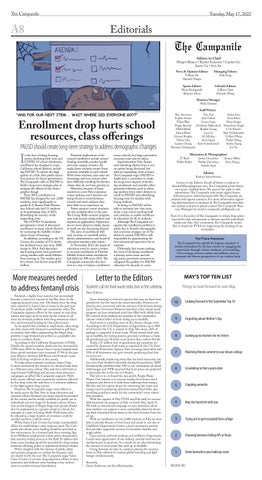
Enrollment drop hurts school resources, class offerings
!"#$%&'()*+,&-./01/&+)2341/.5&'1.01/36&1)&0,,./''&,/5)3.07(8-&-(023/'
I
n the face of rising housing prices, declining birth rates and COVID-19 school shutdowns, enrollment has dropped in many California school districts, including PAUSD. To ensure the high quality of a Palo Alto public education persists for future generations, The Campanile calls on PAUSD to build a long-term strategic plan to mitigate the effects of this demographic change. Since 2015, enrollment in PAUSD has dropped by over 2,000 students, most significantly in grades K-8. Barron Park Elementary School only had 31 students in its graduating class of 2021, illustrating the severity of the impending crisis. The COVID-19 pandemic precipitated a trend of decreased enrollment in many school districts by increasing the viability of alternative forms of learning. In addition, according to the US Census, the number of U.S. births has declined every year since 2008 except in 2014. And skyrocketing housing prices have prevented young families with small children from moving in. The median price for a home now hovers around $4 million.
Potential implications of decreased enrollment include school funding shortfalls, teacher layoffs and even campus closures. Already, fewer students means fewer resources available to each school. With fewer teachers, class sizes are increasing, and non-seniors often have difficulty enrolling for elective classes they do not have priority in. Moreover, because of fewer teachers to cover Paly’s immense course options, more teachers are being forced to travel between schools and teach subjects they have little to no experience in. Fewer summer course resources are also available than in the past. The Living Skills summer program now only accepts rising seniors and requires an application. Opportunities to move ahead or retake classes in math are also becoming limited. The issue of enrollment will only continue to snowball unless district administrators and board of education members take action. In November 2021, the board of education voted to create a lottery to increase enrollment at Fletcher Middle School where enrollment had fallen by 30% since 2015. The Campanile commends this decision as a way to balance enrollment
!"#$%&$'()#$(%*$$+$+% ,"%'++#$((%-$*,'*./%0#1(1( Fentanyl, a highly toxic narcotic, has increasingly become a source for concern in the Bay Area. In the ongoing fentanyl crisis, over 106 deaths from the drug were reported in Santa Clara County in the past year. To promote public health and community safety, The Campanile supports efforts by the county to stop drug misuse and urges more be done by the county to address the fentanyl problem with drug awareness education and increased funding for law enforcement. As an opioid that is lethal in small doses, other drugs are often laced with fentanyl in powdered or pill form to increase their effect, augmenting the illegal drug problem. Legal fentanyl prescribed as a painkiller also poses an overdose threat. According to the California Department of Public Health, the opioid overdose death rate has increased by 139% since 2018. In Santa Clara County, hospital visits from opioid overdoses have increased 57.9% in the past year. District Attorney Jeff Rosen said fentanyl causes half of all drug overdoses in the county. To help reduce fentanyl overdoses, Santa Clara County announced the creation of a fentanyl task force in a February press release. This task force will work to stop fentanyl trafficking and increase drug awareness campaigns, an effort The Campanile supports. With both county officials and community members affected by this drug crisis, the task force is a welcome addition in the fight against drug misuse. However, The Campanile urges more efforts to be made across the Bay Area in drug education and response efforts. Fentanyl test strips should be provided by the county and be readily available for public use so individuals can test drugs for fentanyl content. Education on the dangers of illegal drugs and opioids should also be emphasized to a greater extent in schools, for example, as a part of Living Skills. With better public education, a large number of overdoses could be avoided and lives could be saved. While Santa Clara County has made commendable efforts by establishing a crisis response team, The Campanile also thinks more funding should be provided to law enforcement. In a fentanyl task force meeting, Sgt. Scott Williams emphasized county police departments lack narcotic testing devices in the field. To address this issue, more funding should be provided for drug testing hardware allowing police to apprehend fentanyl dealers. When weighed with the interest of public safety and security, programs to combat the fentanyl crisis are clearly worth the cost. The Campanile urges Santa Clara County to increase drug education efforts to raise awareness and dedicate more funding to law enforcement to combat fentanyl distribution.
across schools, but larger preventive measures must also be taken. Superintendent Don Austin said redrawing district lines is not an option being discussed, but with an impending crisis at hand, The Campanile urges PAUSD to implement a committee to study the long-term impacts of declining enrollment and consider other potential solutions, such as allowing students from other districts to enroll in PAUSD and subsidizing housing costs for families with young students. In doing so, PAUSD will be able to maintain low class sizes, retain a top-notch teaching staff and continue to enable excellence in education for all its students. Although The Campanile recognizes the enrollment problem is partly due to broader demographic and economic changes out of the district’s control, PAUSD is still responsible for guaranteeing the best educational experience for its students. Ultimately, that means making the issue of declining enrollment a priority action item and taking active, preventive measures to safeguard the quality of a PAUSD education for decades to come.
Ben Antonow Sophia Austin
Staff Writers
Eric Fan Aidan Seto Jack Galetti Zack Silver Gina Bae Lucas Guan Maya Singer Poppy Barclay Charlotte Hallenbeck Shamsheer Singh Nikhil Behal Braden Leung Cole Sturino Anaya Bhatt Lucy Li Ajay Venkatraman Gianna Brogley Ali Minhas Colleen Wang Valerie Chu Ken Ogata Parker Wang Lauren Chung Kyla Schwarzbach Austin Xiang Shantanu Deshpande Joy Xu
Illustrators & Photographers
JT Bard Wallie Butler
James Churchley Phillip Churchley Anushe Irani
Jimmy Miller Zina Zhang
Adviser
Rodney Satterthwaite
Letters to the Editors: Email all letters to editors to theeds23@googlegroups.com. The Campanile prints letters on a space-available basis. We reserve the right to edit submissions. The Campanile only prints signed letters. Advertisements: Advertisements with The Campanile are printed with signed contracts. For more information regarding advertisements or sponsors in The Campanile and their size options and prices, please contact The Campanile Business Managers by email at campanile.ads@gmail.com. Note: It is the policy of The Campanile to refrain from printing articles that misrepresent or alienate specific individuals within the Palo Alto community. The Campanile would like to thank the PTSA for supporting the mailing of our newspaper. Our Vision Statement: The Campanile has upheld the highest standard of student journalism for the last century by engaging the community through various mediums of storytelling. Our coverage of news, culture and athletics aims to represent the diverse perspectives of our student body.
<$,,$#%,"%,3$%E+1,"#(
!"#$%&'()&'*+&,-%'
$1*,/21'&-0++&9).&9)),&:0'1/&./,*-18)2&82&1(/&-09/1/.80
!"#$%&'()'*))+',)-./-0'()')12-'3/4
Dear Editors, Since returning to school in-person this year, we have been grateful for the free lunch the school provides. However, we have become concerned with the amount of food waste during lunch. Since Governor Newsom launched a free school meals program, we have witnessed trash bins filled with edible food. We noticed most students are unaware of the unintended climate-related effect of food ending up in landfills. Food waste is a leading cause of the climate change crisis. According to the U.S. Department of Agriculture, up to 40% of all food in the U.S. is wasted. In Palo Alto alone, 26% of garbage is composed of food waste. When wasted food ends up in landfills, the rotting process generates methane, a harmful greenhouse gas 30 times more potent than carbon dioxide. Yearly, 135 million tons of greenhouse gas emissions are created by American food waste as reported by the U.S. Environmental Protections Agency. Tons of energy, land, labor and 25% of all freshwater also goes towards producing food that we never eat. Additionally, results.org states that the food-insecurity rate has more than doubled nationally during the pandemic: SJSU Scholarworks published that 33% in our community are faced with hunger, and NPR reported that food prices are projected to skyrocket due to the war in Ukraine. This led us to co-found the non-profit, People Plates Planet. Our mission is to recover surplus food from school campuses and divert it to help those suffering from hunger. We also aim for a green future by conserving the water and energy used in producing otherwise wasted food while also providing nutritious meals for the community’s most vulnerable members. With the support of Paly PTSA and Paly staff, we successfully launched our program at Paly on Earth Day, April 22. We held an educational campaign to raise awareness about how students can support a more sustainable planet by donating their unwanted lunch items in the food recovery boxes we set up. With an enrollment of over 2,000 students at Paly, we were able to provide dozens of food items and meals in one day to LifeMoves Opportunity Center, a local community partner that provides supportive services for homeless families and single adults. Upon arrival, staff and residents at LiveMoves Opportunity Center were appreciative of our delivery, and the food was immediately put to good use. As a result, we are also eliminating the amount of food waste that ends up in landfills. Going forward, we plan to continue placing the recovery boxes at Paly cafeteria to combat global warming and fight hunger simultaneously. Sincerely, Oscar Anderson and Kai Mirchandani
!"
<""=1*4%-"#>'#+%,"%,3$%5$8,$&6$#%?"8%@A
#
9"#4$,,1*4%'6"),%!",3$#:(%;'.
$
5)0=1*4%)8%,"%,$'03$#(%-"#%#$0%/$,,$#(
%
2',031*4%-#1$*+(%0"&&1,%,"%.")#%+#$'&%0"//$4$
&
50#'&6/1*4%,"%7*+%'%8#"&%+',$
'
B#188/1*4%($*1"#1,1(
(
!'.%,3$%-")#,3%6$%>1,3%.")
)
?#.1*4%*",%,"%4$,%#$(01*+$+%-#"&%0"//$4$
*
B3""(1*4%6$,>$$*%-'1/1*4%CD(%"#%7*'/(
!
51/$*,%-'#$>$//%,"%.")#%3'//>'.%0#)(3
BY JOY XU
Tuesday, May 17, 2022
The Campanile
Lifestyle
Social media affects mental health !"#$%&"'('%)*+%,$-&%./(%'(/0$+('%',"/-0%.$%*-$1(%("%&"($+(2*-%#2'2+3"1#*(2"+
A
LIE BU ART BY WAL
ER ING
!"#$%&'#()*+"
AH S ANN
!"#$%&'()*+%&(,&-( .,*(/#.*0.%&'(.#(,*'/( +*-.%1)&.%2*(.&'3%01( &4#5.()*0.&'(,*&'.,(&0+( *0$#56&1*(,*'/7-**3%01( 4*,&8%#6-9:
BY H
widespread across platforms and create an environment of self-diagnoses. And Wellness Outreach Coordinator Shely Benitah said in an email that when these stereotypes are the only symptoms associated with mental illnesses, people may find themselves in a paradox of inspection. “There are downsides to romanticizing mental illness and self-diagnosis that can lead to misdiagnosis and mistreatment,” Benitah said. Even though social media can perpetuate negative stereotypes about mental illnesses, the platforms can also serve to spread awareness about both the negative and positive aspects of it. Hakeman said wellresearched information can be helpful in de-stigmatizing mental illnesses. “Posts about what people can do to help others that are struggling with mental illness, how to cope with mental illness or even just knowing the signs of certain conditions can be really helpful,” Hakeman said. While junior Miya Whiteley agrees, she said people should still be aware of the risks associated with trusting everything they see on social media. “Awareness posts can make it easier for people to get more knowledge about different issues, but we have to make sure that those posts are actually credible, because otherwise, it could be misinformation,” Whiteley said. While posting about mental illness on social media can result in misinformation, the rise in communication of mental health is ultimately valuable because Benitah said it allows users to be able to relate to one another.
ART
s junior Gabriela Hakeman scrolls through Instagram, posts about mental illnesses come across her Explore and Home pages. Her experience is not uncommon. Social media platforms have become a haven for mental illness-based posts, but Hakeman said the accessibility of posting about mental health on social platforms has advantages and disadvantages. “I’ve seen people sharing their experience and showing people what it’s really like to struggle with mental illnesses,” Hakeman said. “But I’ve also seen people that glorify having mental illness or having certain behaviors, showing the glorified versions as OK and normal when (they) shouldn’t be.” Hakeman also said glamorizing mental illnesses, especially on platforms with users who desire to be different, leads people to treat mental illnesses as desirable personality traits. “They think, ‘Oh my God, I’m so OCD; I’m organizing all this stuff,’ or ‘I have PTSD from the test I had last class,’” Hakeman said. “I’ve heard about people trying to act like they have these issues just to get more attention from the people around them.” Posters who glamorize mental illnesses on social media can create negative stereotypes, Hakeman said. “Social media has played into some stereotypes about mental illness; for instance, people with depression always seem sad or people with eating disorders are always underweight,” Hakeman said. “It can also make people feel like they can’t reach out for help because they don’t have it as bad as somebody else.” These superficial stereotypes can become
;6%3<-()&3*5/(&+8%$* “Social media can be helpful to connect with other people who share similar life experiences, and, as a result, people can feel less alone,” Benitah said. “Social media has the potential to help destigmatize talking about mental health and encourage help-seeking behaviors.” Communicating online about personal struggles can also be easier than talking faceto-face. “Mental health, no matter how much we talk about it at school, is still extremely stigmatized,” Hakeman said. “To say you struggle with depression or an eating disorder is not something people come out and say to everyone. Having these platforms and support groups that know what you may be going through can be extremely helpful, especially when you may not have people in your local community that have the same struggles.” Although the communal aspect of social media can be helpful, Whiteley said the conversations within them can potentially be harmful. Whiteley also said there is a difference between relating with other people and dismissing the struggles people live through. “People will make jokes to help themselves through something, which is fine, but when mental health is repeatedly used as a joke, that’s when it becomes a problem,” Whiteley said. According to Hakeman, creating a space for people with mental illnesses to interact also increases the risk of further stigmatizing mental illnesses because insensitively sharing mental health journeys can lead to dangerous competitive mindsets. “Sharing triggering things quickly becomes a competition,” Hakeman said. “If somebody with an eating disorder shares their lowest weight or how many calories they’re consuming, or how many times somebody with depression has ended up in the hospital, it becomes a competition of who is the most ill.” While social media can both promote wellness and recovery and romanticize mental illnesses, Benitah said it is important to step back once in a while. She encourages everyone to reflect about the effects of social media and the way it depicts of mental illnesses and be aware of the effects posts are having on those who see them. “Each person is unique, and the information on social media is not one-size-fits all,” Benitah said. “At the end of the day, it’s important to know that when something is impacting your quality of life, it’s OK to seek support from resources or trusted adults.”
Tiffany He
News & Opinion Editor
R TLE
!"#$%"&#'&!(%)*&+#,-(.&/+"01&2""&3&456776.8&'(40",&09(.&(&:"0 The pool deck goes instinctively quiet as the eight swimmers, poised atop the blocks, await the starting whistle. With a shrill beep, they leap off into their 50 yard freestyle race, the water quickly becoming a splashing, frothing frenzy as the swimmers scramble across the pool, through their turns and back to the wall. It’s neck and neck, but as the bubbles settle, it’s clear that it’s freshman Jordan Jet Lee — more commonly known as Jet — who takes the win: 34 seconds. Jet said he decided to join the swim team this year after having competed with his club team for the past three years to continue improving and staying in shape through the end of the year.
“Swimming is really good exercise,” Jet said. “It makes you poo a lot, which is healthy.” Jet said joining the varsity swim team came with its fair share of surprises, including the major time commitment and heavy practices, but he said the friendly and close-knit team helped ease the transition. “Swimming is a lot of yardage with you having to constantly swim laps, which is not very enjoyable,” Jet said. “But the team has made the overall experience more fun since swimming is not the most fun sport in the world.” Throughout the season, Jet’s commitment, personality and leadership earned him the inaugural role of freshman captain, a position
Jet said he gladly took on even despite the already significant rigors of freshman year. “It has added lots of responsibilities to myself,” Jet said. “Having as much power as, say, (Captain) Thomas Risma is an honor, and I feel my leadership qualities were really displayed while being freshman captain.” Outside of the pool, Jet said he enjoys playing video games, further connecting with his teammates after swimming practice over games such as Fortnite, Valorant, Apex Legends and Minecraft. “Video games are great because unlike swimming, which isn’t that fun, video games are fun,” Jet said. “So it’s a great way to actually have fun with the team.”
JACK GALETTI/THE CAMPANILE
Jordan Jet Lee is the freshman captain of the swim team. “I feel my leadership qualities were really displayed,” Lee said.
Looking back on the season, Jet said he values the close friendships he has formed with his teammates and looks forward to his next three swimming seasons. “My time on the swim team was the best part of
the entire school year,” Jet said. “Everyone is a family on the team, which I really enjoy being a part of.”
Jack Galetti
Senior Staff Writer
Erik Feng
Makeupologist
For some, the complexities of makeup and morning routines may take only 20 minutes, not including teeth brushing, which you probably forget. For others, the same routine can take two hours, 80% of which is spent in the shower, driving up utility bills faster than my grades the week before school ends. However, as a uncertified makeupologist, I will show you the most efficient morning routine with all the proper steps. And the best part? It only takes a couple of minutes, so you should be ready in no time. I usually start my routine the night before so I can fit in my Four-Dollar Morning Routine, but if you don’t watch TikTok for 30 minutes between every step, you can probably make this fit in the morning. Starting at 14:85 a.m., the first step in this routine is doing your hair. If you dye your hair, a great piece of advice I have never used is to use a Sharpie instead of traditional hair dye. I wouldn’t recommend whiteboard markers because they’re erasable. Once I used transparent whiteboard ink for my hair(less) style, but parts of the ink would dry up and fall off, causing 100% fake dandruff that comes from the whiteboard ink only. If you braid your hair, make sure to wet it first before tying the knots. Twenty-five knots make a braid on two strands of hair. Repeat this process for your hair (on the head). At the end, you should have approximately 100 knots on your four braids. Next comes the most important part: makeup (for the face). Depending on how you use your makeup, the expiration date may or may not matter. If you use makeup for cosmetic purposes, then the expiration date can be disregarded. However, if, like me, you eat your makeup, check the expiration date, and sample the product for safety before fully consuming it. (Editors’ note: Don’t eat makeup.) If you want to be foundationally sound for your day, apply foundation. It also helps build the foundation of your face. After foundation, apply lipstick to make your lips red. Then, apply chapstick to maintain the color. To get some contour on your face, apply contour lines for the authentic look of a contour map. This is a good practical use of multivariable calculus. Finally, let the makeup sit. It needs to rest after all that standing. Next, apply sunscreen to whiten the eyes. Many people don’t realize that SPF stands for Spread Pain Factor, which indicates how much pain you feel when applied to your eyes. If you have a higher pain tolerance then go for the higher SPF ratings — after all, keeping the pupil white is important for your look. While keeping the pupil white is important, maintaining healthy skin should also be a priority. More importantly, you get that pretty privilege, too. Apply whatever works best for you. Go to a derta … demer … der … skinologist. Now would be a great time for a toilet break. While there (STAY OFF YOUR PHONE), use house paint to paint your nails to save money. Once you’re done (on the toilet), hit a royal flush in a game of poker with your friends. I play online because my (real) friends were all doing homework when I asked them to join, even though they asked me for the answers. Next up, time for a bath. It should be quick, no more than π minutes. After the bath, take a shower –– make sure the temperature is above 100°C. The water must be boiling in order for the shower products to properly activate. An increase in pain indicates the shower products are activating. If you’re really into the torture, keep the temperatures below 0°F (255.372 Kelvin) for a cold shower. (Editor’s note: Don’t take a bath in boiling water.) To speed up the shower, use 13-in-1 shampoo. It acts as shampoo, conditioner, body wash, toothpaste, deodorant and much more, all in one bottle. Apply to the head. This should really make your morning routine faster. After showering, your skin will be slightly wet from the water, so you should dehydrate yourself as much as possible. A good way to do this is to put your clothes over your wet skin, absorbing the water from it. And voila. After about an hour of resting, you should be ready for your 2 a.m. dinner. Right on schedule.
The Campanile
Tuesday, May 17, 2022
B2
Lifestyle
May Fete Parade returns
M+12)+/#,;8'#-(/3/#2))82;#*+3451+:%#*%;%'$23+()0#@2+$#@($#N$/3#3+&%#+)#3-$%%#4%2$/
>64(';4#'(6*'&/#(' *&04,,4##%+2' &/&*+('/:'6%26'#.6//$? Joy Xu
Senior Staff Writer
Madhu Ramkumar !G2/3#4%2$0#"#12/#*-+;;+)6#+)#&4#H(():#"# @($6(3#3(#&83%#1-+;%#"#12/#123*-+)6#9+C9(C/# 2):#)(#()%#3(;:#&%#@($#;+C%#2#$%2;;4#;()6# 3+&%<#"#-2:#3(#32;C#3(#&4#3%2*-%$#2@3%$#*;2//<F Reon Hatoyama
POPPY BARCLAY/THE CAMPANILE
The varsity dance team dances and cheers through downtown to Green & White, All Right Now and Sir Duke, played by the pep band. “We do it every year,” junior dancer Victoria Senderzon said. “It’s tradition to dance with the band.”
Poppy Barclay Staff Writer
T
he Kiwanis Club held the 98th annual May Fete Parade for the first time since 2019 on May 7. Marching bands from each PAUSD secondary school, Bay Area nonprofits and local families and pets participated in the parade. Second in the parade, Paly’s varsity dance team performed their routines to the band’s live music with white pompoms. Junior dancer Victoria Senderzon said the Paly dance team has been in the parade for as long as she can remember. “We do it every year,” Senderzon said. “It’s tradition to dance with the band.” Senderzon said it was difficult to learn how to dance while walking down a street. “We’re not used to doing it moving, so we (danced in) circles around the dance
floor to practice,” Senderszon said. “It’s definitely a little bit chaotic … but it’s a lot of fun.” Parade participants marched down University Avenue and Waverley Street, stopping at Heritage park to enjoy a festival complete with games, food trucks and a prize table for kids. For many years, the Kiwanis Club nonprofit organization has orchestrated the May Fete Parade, but Kiwanis member Lanie Wheeler said the parade has a long history of organizers. “(When I first heard) about the fair, it was held at Addison school because that’s where the parade ended, and it was sponsored by the Addison PTA,” Wheeler said. “I think they may have used it as a fundraiser for the PTA, (but) it was a big job to organize and it’s not a real moneymaker, so PIE took it over from Addison and, again, tried to use it as a fundraiser.” Wheeler said the Kiwanis Club also
believed they could use the parade as a moneymaker at first, but when that didn’t work out, they decided to keep organizing the fair anyway because of the positive community response they received. “The first year (we organized the parade), we thought it would be a fundraiser for us too, (but) then we found out that it really isn’t,” Wheeler said, “But we’re all about community service, and particularly community service in Palo Alto so we’ve decided to carry on with the fair.” For the first time since 2019, COVID-19 restrictions have relaxed enough for the Kiwanis to organize the parade and fair. After three years, Wheeler said she and the other Kiwanis are just happy to see everybody come together again and celebrate. “It’s very exciting to be back,” Wheeler said. “It’s so nice seeing real people again, and we enjoy doing this for the kids of the community.”
!"#$%&%&'%$#()*%#+)#,-%&#.()($/0#"#12/#3$45 +)6#3(#123*-#/(&%#7(898'%#:8$+)6#*;2//<#9-%# 7(898'%#$%6+()#12/#=2>2)#'%*28/%#"?#@('0# /(#"#6(3#/(&%#2)+&%#2:<#A4#*(&>83%$#12/)?3# &83%:0#/(#3-+/#2)+&%#=2>2)%/%#6+$;#B(+*%# >;24%:#-%;;2#;(8:#+)#3-%#*;2//$((&#:8$+)6# :%2:#/+;%)3#1($C#3+&%#2):#%B%$4()%#;((C%:# 23#&%<#A$<#.D#3((<#.%#;((C%:#23#&%#;+C%#-%# @%;3#'2:#3((0#;+C%#-+/#@2*%#12/#;+C%##E:2&)<?F Yubin Zhang !I)*%#3-+/#4%2$0#"#J2412;C%:#@$(	(1)#2):# ,(8)3$4#3(#K2;40#2):#L$)%/3(#*-2/%:#&%#()# -+/#6(;@#*2$3#3(#3-%#/*+%)*%#'8+;:+)6#2):#3-%)# 4%;;%:#23#&%#+)#@$()3#(@#%B%$4()%<F
!"#$%&'#(")*+(#',*-*.('/+'/0#*,1%+23' 84(%,*9'#(")*+('.*+(*,3'6/&*'/:'6/(' $"+.63'0,/;+'#(4%+#3')%*#'4('42*'<=' +41%24(%+2'54&4)4+'(6%#'7*4, Brianna Zhou Sports Editor
While Siddiqui said he has also gotten used to fasting during Ramadan, he said he occasionally feels some negative health effects but that his focus is on God during this time. “I’ve been fasting since middle school, so it’s not that hard anymore,” Siddiqui said. “However, I do notice that I get a headache if I spend too much time in the gym or doing any other strenuous physical activity.” Zaky also said Muslims practice acts of philanthropy and benevolence during the month of Ramadan. “In this month, Muslims are encouraged to be generous with their charitable deeds and must in fact give a specific donation called Zakat-ul-Fitr,” Zaky said. “This specific donation aids underprivileged individuals in having some funds to enjoy the Eid celebration.” During this month of observation, it is essential non-Muslims learn how to be respectful regarding their religion, Zaky says. He said non-Muslims should try to be sensitive to food around Muslim friends during this time. “I think teams should shy away from organizing food and drink events during the month that may make those who are fasting feel excluded,” Zaky said. “Another issue I’ve seen is people asking some Muslims why they are not fasting. Many Muslims have medical conditions that prevent them from fasting, and they may already feel they are missing out on their favorite time of year because they cannot fully participate. This is their business and people should not ask or probe as to why they are not taking part.”
Senior Ayaan Siddiqui wakes up before sunrise at 5:30 a.m. for his pre-fast meal and prayer for the entire month of April, observing Ramadan during the ninth month of the Islamic calendar. This year, Ramadan started on April 1 and ended on May 1. Siddiqui said the month is spent as a time to reflect and reconnect spiritually. “For all Muslims, Ramadan is supposed to be a time to get closer to God,” Siddiqui said. “Although I usually pray at least once a day, I do make an extra effort to pray five times a day during Ramadan and keep as many fasts as I can. Ramadan is also a good time to connect with Muslims in my community at the local mosque.” Muslims fast – no eating or drinking from dawn to dusk – during Ramadan to honor their religion, said Zeyad Zaky, a local youth group leader. “During this month, we give up basic needs during the daylight hours in order to internalize self-restraint and discipline and to achieve a remembrance of our Lord,” Zaky said. Sophomore Raed Sheikh said he sees fasting as an opportunity for personal growth. “I fast for Ramadan because I believe it teaches me self-control, self-discipline and empathy for those who are less fortunate,” Sheikh said. Sheikh said a common question from many non-Muslims is how those who fast can physically and mentally survive without eating or drinking during the day. Sheikh said with experience, fasting is not much of a challenge. “To be honest, I was quite used to (fasting),” Sheikh said. “After a while, it became fairly easy for me, but I remember the first time I fasted. I was miserable. I was very sick, and my stomach ART BY HANNAH SINGER grumbled a lot.”
The Student Center, once loved by many and frequented by all, died in the fall of 2016. Why its hollowed-out corpse is still standing is beyond comprehension. The Student Center – built sometime between 1940 and 1980 – is too old to be functional or merit a revamp and is too young to be protected because it is historical. At one point, it fostered creativity, gave shelter from the Palo Alto cold (relatively speaking) and housed art from students across the campus. Now, the only creativity it has is physical: How can I sit on this chair without touching the multi-hued, sticky brown spots on the seat, backrest and left armrest? And because of global warming Palo Alto rarely goes below 45°F, so “shelter from the cold” doesn’t feel like a valid reason to have a huge, hulking brown deformity staring down our quad, ruining the view and forcing students to take detours to avoid it. Let’s be honest – no one goes through the Student Center to get to class quicker; they just skirt carefully around it and add a minute to their walk. And the only art it now houses is pen graffiti, stained wrappers and dirt trails carefully scuffed by anxious feet. How contemporary. Sure, the Student Center is used as more than a cavernous dump. Both brunch and lunch is provided from deep within its bowels. How about instead of redoing our turf fields
every three months we replace some of the grungy remnants of Paly’s past? Instead of what stands in the center of our campus now, why don’t we rebuild? Let’s not repurpose, though. The options and potential are nearly infinite. If we need somewhere to serve hot lunch, why don’t we build a cafeteria – what high school doesn’t have one? Big windows, nice (or at least clean) tables. Let’s take some pointers from the MAC, some from the PAC, perhaps more from the library. And if we want a multipurpose space (and who doesn’t love buildings reminiscent of Swiss army knives), add a balcony and showcase the paintings that are drooping from the lack of attention in the library’s hallway. Paintings in a building full of meandering students who would rather stay than go to class will garner much more attention than those in a breezeway people only use when they’re late. Best of all, we could use the Student Center as a second study area, albeit louder. . If the student center had a solid set-up, with smaller and bigger tables, it could be used both as a dining hall and a study center. During class periods, people could work and study during their preps. During lunch, the building could be an alternative to either starving yourself to study or cramming some food down your gullet right before class. The Student Center has so much potential, and everyone knows real estate here isn’t cheap. The Student Center is a colossal waste of space and an architectural travesty Paly students shouldn’t have to put up with anymore.
Maya Singer
Senior Staff Writer
The Campanile
Tuesday, May 17, 2022
B3
Lifestyle
Seniors show off talents in style
!"#$%&'(&)")*+#,*'-&,'&,."*$&#$,%&+/01*-#,"&*-&2-#0&3$'4"+,%&%.#$")&5*,.&($*"-)%6&(#1*0*"% To recognize senior artists as the school year wraps up, senior showcases allow students to display or perform their work for friends and family. Some of these events are school sponsored, such as the theater program’s senior showcases or the dance team’s spring show, while other seniors put together a performance or display on their own.
perform stuff as seniors because it will be our last chance to at Paly.” Vetter said they hope to continue theater in college. “A favorite memory of mine is doing ‘I love you.’ before one of our last shows in the illusion because it was very fun to tell everyone how awesome they are … when the whole cast and crew goes around and tells people why they love them and compliments them on the night before closing.”
Samantha Yamashita While the personal satisfaction of learning to play an instrument is meaningful, music Trevor Wong Van Haren is meant to be shared. For senior Samantha Yamashita, working hard to share her music Senior Trevor Wong Van Haren has been with family and friends has become a memory playing guitar every day for 10 years, and in she will remember for a long time. that time, he’s had multiple teachers as his “My senior recital was definitely a memory family moved to and from Barcelona. I will forever treasure because I got to share “I work on learning songs, usually for a music that I love with people that I love,” goal like playing a song at a recital or playYamashita said. “We had around 150 attendees ing a couple songs for my grandparents when and I was overwhelmed by how many people I visit them,” Wong Von Haren said. “Most were willing to take time out of their day to recently, I had my graduation recital, a concert come hear me play.” for my friends and family. I prepared 10 songs Yamashita’s recital contained five pieces, for it. I started preparing about six months with one being 30 pages long. She memorized in advance — deciding what songs, learning them starting in fall of this year. them, memorizing them and most importantly, “It was definitely a lot to hold in my brain maintaining them.” at once,” Yamashita said. “But thankfully my Aside from working on his showcase, and teacher was there to help me plan out how honing his talent, Wong Van Haren teaches much to memorize per week so that I felt guitar too. ready by the time the recital “I have been teaching clascame around.” sical guitar through a nonYamashita feels especially profit for over one year now,” passionate about classical Wong Van Haren said. “The pieces. non-profit Peninsula Guitar “I feel like classical is more Series finds underprivileged expressive than other genres of students, supplies a guitar to music in many ways because them, and connects teachers without lyrics, the piece can to them.” communicate many different He has two students at the emotions depending on the moment, one who has been person who is playing it,” Yawith him for over a year, and mashita said. “As a pianist, you one who has been with him aren’t limited by the meaning for about two months of words but can express your “It’s been a very rewarding own interpretation through experience,” Wong Van Haren the notes, which I think is said. !"#"$%&"'("#")&*%" really cool.” Additionally, Wong Van Despite the challenge Haren said younger students Yamashita undertook, she will continue playshould work to find joy in playing music. ing in college and beyond and would advise “Practicing one instrument can be very younger students to continue with the craft. rewarding, and being able to know your way “I would say stick with it,” she said. “Piano around an instrument, but you shouldn’t force provides such an amazing creative outlet, espe- yourself to continue if you don’t enjoy it,” cially as you learn more complicated pieces.” Wong Van Haren said. “Mastering the instrument isn’t the end goal. The end goal is to Renee Vetter enjoy playing it.” Senior Renee Vetter has been part of the Sophia Cummings theater program since their freshman year. They have acted in several plays and also Though ice skating may not be the first worked behind the scenes during their four sport that comes to mind when one thinks of years with the program. Northern California, senior Sophia Cummings “I acted in two of the shows this year and has figure skated since she was 3 years old. did tech for all,” Vetter said. “Right now, I am “I do three types of skating,” Cummings producing, writing and directing for one act.” said. “Synchronized team, dance team and Vetter said the theater program’s senior freestyle.” showcase is a cross between graduation cerCummings’ team begins its practices in emony and performance. January and works towards putting together “Senior showcase is a night that the juniors an end-of-year recital featuring their seniors. plan for the seniors where people give speeches Cummings said she practices a lot in her room, about each graduating student and give them using her floor as a makeshift ice rink, in beflowers,” they said. “We also have the chance to tween bi-weekly practices.
12'(-(3$-#$'+/(4%5( -&"#6+(,$0$+".(74(+8"( 0"-#$#9(%:(;%&.'( 75+(*-#("<3&"''(4%5&( %;#($#+"&3&"+-+$%#( +8&%598(#%+"'=1
PHOTO COURTESY OF SAMANTHA YAMASHITA
Senior Samantha Yamashita performs Gershwin’s Rhapsody in Blue at her senior recital earlier this year. “My senior recital was definitely a memory I will forever treasure because I got to share music that I love with people that I love,” Yamashita said.
“My favorite memory is hanging out with my team after our dress rehearsal,” Cummings said. “It was like 10 p.m., and we just blasted music and danced in our shoes on the ice.” Unfortunately, ice rinks to practice at are few and far between near American University, so practicing regularly may not be possible in college. “I will most likely not continue skating in college because there is no rink near my campus,” Cummings said. “Usually what happens is alumni skaters will come back to the rink during our breaks and get to skate together again, so I look forward to that.” Cummings also teaches ice skating to younger skaters at the Winter Lodge. “Remember to always keep your eye on the end game, there will be so many times you want to give up and you will be falling jump after jump,” Cummings said. “But the gratification you get when you achieve an element is the best feeling ever.” Hannah Wolf Though staying late after school to learn how to make a moose may not sound like the ideal afternoon to many students, senior Hannah Wolf wouldn’t trade it for anything. “My favorite memory was when I stayed after school working on production for
the glassblowing sale, and we made like 20 mooses,” Wolf said. “It was fun to learn how to make one item so efficiently while working with friends.” Wolf has been a part of the art program since freshman year. She, like many of Paly’s visual arts students, has placed her work around the school and submitted pieces to the creative minds persevere show, which will take place at Cubberley this spring. “I try to glass blow at least once a week in class, and if I’m not outside, I am working with clay in the classroom,” Wolf said. “I also volunteer with the Paly Fiery Arts Biannual Sale and occasionally glassblowing on the weekend.” Though Wolf will not be submitting an AP portfolio, she said she hopes to continue to perfect her craft in college. “In college, I hope to possibly minor in studio art and definitely be part of the pottery club,” Wolf said. “There is not a glassblowing program at my college, so maybe I will find a hot shop to work at over the summer. It would also be really cool to work with a glassblowing studio internationally one day.”
Kyla Schwarzbach Senior Staff Writer
!"#$%&'(&")"*+(%#(,"''%#'( ,"-&#"./(0"0%&$"'
CAPTION CONTEST WINNER
Lauren Chung Senior Staff Writer
ART BY BRADEN LEUNG
“What are they feeding these freshman??” — Yash Shetty (‘23)
For more caption winners, visit thecampanile.org/cartooncontest
As the 2021-2022 year starts to wind down, Paly seniors in the class of 2022 get a chance to reflect on the past four years. Senior Zoe Norall was accepted into her first-choice university and feels grateful for the valuable opportunities Paly has provided her. “I’m really excited to go to college next year, but I’m also sad to be leaving all my friends behind,” Norall said. “At Paly, I was able to find my passions through the various clubs offered. I even had the opportunity to create my own club which was super cool.” Norall said her advice to underclassmen is to try your best and never give up. “I think the biggest thing that helped me in school was simply asking (my teachers) questions,” Norall said. “It’s important to find ways to be proactive in your learning, like going to PRIME or staying after class to clarify information. And, of course, not to procrastinate.” Senior Yubin Zhang also said he has fond memories of Paly. “My teachers were all so nice, and I felt supported every step of the way — especially throughout the college admissions process,” Zhang said. “Of
course, going into the college admissions process was scary, but all the counselors and advisors at our school are so knowledgeable. I felt like I was in good hands throughout the entire process.” Zhang said he thinks it is important for students to live their life to the fullest rather than spending time worrying about minuscule tasks. “Throughout high school, there were times (when) I felt like my whole future depended on one test or one assignment,” Zhang said. “But now looking back at it, I realize it doesn’t really matter. Of course, it’s important to try your best in school, but school is not all that matters in life.” Senior Aidan Do said he is proud of the challenges he endured during his time at Paly. “My years at Paly were definitely a period of growth for me,” Do said. “My freshman year, I had a bit of trouble adjusting to high school life and adapting to the new environment. It wasn’t until my junior year that I found my group of people … I’m definitely going to miss the community Paly provided for me.” Do said he believes becoming more confident helped him improve in school and have a better time. Do said, “I would say the biggest advice I have is to be confident and proud of yourself.”
The Campanile
Friday, May 13, 2022
Lifestyle
‘Our Flag Means Death’ marks improvement in LGBTQ representation on TV
!
!""#$%"&'(#)&"*#)+*",#$-('..$#/+('!,+#+%(#$'-&*.#0%1&*#2%%1#*"1#"'/&-%$#2*"*(/#*"1#0*"3#4'$/$#*"1#1&$-!$$&'"$#2'(#*#"%5# #$%(&%$6#78!(#9.*,#:%*"$#;%*/+<=##>2/%(#1%-&1&",#/'#-+%-?#&/#'!/6#$+%#&$#&00%1&*/%.3#+''?%1#*"1#%@%"#1(*5$#2*"*(/#'2#+%(#'5"<
“Our Flag Means Death” has received praise for its LGBTQ representation, beloved characters and lighthearted mood. The historical romantic comedy is set in the 1700s and follows protagonist Stede Bonnet, an aristocrat who suddenly abandons his life and family to become a pirate. Together, Bonnet and his newly gathered crew endure obstacles like clashing with the infamous pirate captain Blackbeard. Most of the characters are queer, subverting the norm of a predominantly cisgender and straight cast. The show also depicts a variety of healthy, loving relationships including gay couples like Bonnet, who falls in love with another man. Another character, Jim, played by nonbinary actor Vico Ortiz, is nonbinary and transmasculine and uses they/them pronouns. When the crew finds out Jim is transmasculine, the crew easily accepts it and moves on. Zhang said she enjoys “Our Flag Means Death” because it introduces complex characters. And unlike other shows, Zhang said this one doesn’t play into stereotypical portrayals of stoic, tough men. “In media, men are usually emotionally repressed,” Zhang said. “But in ‘Our Flag Means Death,’ if a character feels something, they actually express themselves. We see tears falling and men emotionally reaching out to each other.” Not only does the show display examples of healthy masculinity and emotions, it also creates a range of queer characters with unique traits. Some are more outgoing and flamboyant, while others are quieter. Some are more traditionally masculine, while others are not. Paly senior Jade de Anda said she appreciates the LGBTQ representation in “Our Flag Means Death,” highlighting the subtlety and normalization of queer relationships. “(Being queer) is normalized and part of (the show’s) world,” de Anda said. “Characters are gay, and it is what it is. It’s not something that’s put in the spotlight simply to
gain a larger following, it’s put there because people deserve to be represented.” Compared to other shows, de Anda said “Our Flag Means Death” is a big improvement for representation in media particularly because it clearly depicts a gay relationship. “A lot of characters in other shows that I thought would be in a relationship would never (be) put into a relationship outwardly; they (were) always just ‘implied’ to be part of the LGBTQ community,” de Anda said. “So I’m really glad (the show) put a gay relationship out in the open like that.” Paly senior Grace Muma agrees with de Anda and
said the show subverts tactics used by producers to gain the appeal of LGBTQ audiences without actually showing a queer relationship on screen, also known as queerbaiting. “The show isn’t queerbaiting like a lot of shows do, where they just toe the line between having representation but not fully committing to it so they can still retain the largest audience possible,” Muma said. Zhang also said she commends “Our Flag Means Death” for not falling into common harmful tropes in media like the killing of queer characters, most notably done by TV series such as “Supernatural,” “Killing Eve” and “The 100.” Furthermore, she said “Black Sails,” similar to
ART BY ZINA ZHANG
“Our Flag Means Death,” is a show set in the 1700s focusing on queer pirates, yet some of its queer relationships end in tragedy, another overused trope. The tendency for queer characters to be killed, especially after a revelation of their queer identity, ultimately perpetuates the idea that queer people are expendable or will never find happiness. “David Jenkins, the producer of ‘Our Flag Means Death,’ said in an interview (that) it was going to have a romantic, happy ending,” Zhang said. “That brings hope to the viewers because usually, not a lot of queer people get a good ending in TV shows, or any ending at all — they’re just written off.” Historical movies and TV shows, especially ones set before the 20th century, almost never have queer representation. Even the few shows that are set in the 1700s and 1800s, including “Harlots,” a feminist and lesbian perspective on London brothels, “Gentleman Jack,” based on a historical English lesbian figure, and “Black Sails,” only have cisgender characters. In comparison, “Our Flag Means Death” includes characters with different sexualities and non-binary characters, who are often underrepresented in media. “Including variety (in genders) just brings the show to life because I highly doubt everyone back then was all, ‘I’m a man,’ or ‘I’m a woman,’” Zhang said. Because of the show’s open and healthy representation of queer relationships, de Anda said “Our Flag Means Death” went above and beyond, and she’s excited to see how it will proceed. “When I first started watching, I didn’t really know what to expect other than pirates,” de Anda said. “However, it exceeded my and especially the LGBTQ community’s expectations, and I really hope it gets renewed for season two.”
Colleen Wang Senior Staff Writer
The Crossword 24 Conversation subject 26 Light weights, Imperially 28 Robert Pattinson’s new animal inspiration 30 Insect that’s in it to win it? 33 Anticipates 35 Supernatural glow 36 99-named deity 37 Sternward 38 Edvard of “Mountain King” renown 43 Steinbeck’s ___ of Eden 45 Like heaven’s gates 46 Winning insect? 51 Perfume unit 52 ___ jumping (or the title of a popular teacher, informally) 53 Computer character code 55 Where you can find many a 61Down 56 From the top, make it ___ 59 Informations 62 Pork cuts 64 Insect brought in from abroad? 66 Bantu ethnic group 67 Hide-and-___ 68 Largest active volcano in Europe 69 Cook, as clams 70 Concludes 71 ___ Theodosia (“Hamilton” hit)
Down PUZZLE BY RONAK MONGA AND NEIL RATHI
Across 1 Actress Rooney or Kate
14 Detail
19 Poultry purchase
5 Quite a way away
15 She cried power, in a Hozier song
20 Arab bigwigs
9 Conflict (or the title of a popular
16 Yo-Yo strings?
21 Apple product?
17 Insect that’s ready for battle?
23 Party
game, informally)
1 2 3 4 5 6
Trackpad alternatives Molecule part Debt cancellation Food of the gods “Insect” Debacle
7 Actress Hathaway e.g. 9 MD divided by V 10 Memorized, in Manchester 11 Llama relative 12 Messy person 13 Truthful 18 Cleopatra’s killer 22 Thinker’s counterpart 25 Suffix with tact or linguist 27 Way a word is utilized 28 What did ewe say? 29 Leatherworking tool 31 U.S.-Can.-Mex. treaty 32 Chiding sound 34 This puzzle is about bugs 37 Bonfire residue 39 Emitted, in waves 40 Annoy 41 She, in Portuguese 42 Workout site 44 Mimicked 45 Score units (Abbr.) 46 Low-risk investments 47 Become depleted 48 Waiting to check out, say 49 East African country 50 Dozed for a bit 54 Navy rank below Captain 57 Move up, as in through ranks 58 Foreboding sign 60 Actress Kendrick 61 One can be found in the sky or on the red carpet 63 America’s Uncle 65 Gives a thumbs-up to
!"#$%&'#()*+#,%%-.+#+"/0(*"1+2#3*+*(4 !"#$%&'%()*#+,-./0,*1!),(0/
Tuesday, May 17, 2022
The Campanile
Sports
!"#$%"&&' ()*#'+$',*-"' &$"./$'0)0&$
AUSTIN XIANG/THE CAMPANILE
Senior Danny Peters steals third base during a May 3 game against Los Altos. The Vikings won, 13-3.
Austin Xiang
Senior Staff Writer
VALERIE CHU/THE CAMPANILE
New athletic director and field hockey coach Jenny Crane writes down the day’s to-do list on her office whiteboard. She said one of her first goals is getting to know coaches and students. “I think it’s important for students to be involved in athletic decisions in terms of funding,” Crane said. “And I know that there’s a lot more that goes into the conversation.”
Crane appointed as athletic director !"#$%&'(#)*$&+%,-(+#&$.#/()#0$/%1#0("&+.(+,(-#2(",0%+%,-3("'&-0(4,/(0",/+0()#"&/+5#-+
N
ew athletic director Jenny Crane writes a sees the athletic department and was involved in Bishop said Crane truly takes in student feeddifferent quote on her classroom’s whiteCrane’s selection, declined an interview but said in back from the field hockey team and tries her best board every week. This week, it is “Hard an email that Crane’s core values are in alignment to implement suggestions. She said Crane’s dedicawork beats talent when talent doesn’t work hard.” with the goals and aspirations of Paly Athletics and tion, empathy and active attempts to connect with Crane said hard work is one of three core values, PAUSD. the students she coaches helped foster a strong field along with building character and having humility, “Jennifer Crane is a creative forward thinker hockey team dynamic, something Bishop is excited that she emphasizes as a coach and hopes to intethat understands the current athletic department to see Crane bring to Paly athletics. grate into her new role as athletic director. Crane model from the inside-out,” Butler said in an email. “She just makes everyone she talks to feel like said her first step is building relationships and get“Her student-centered approach is essential to our they can be exactly who they want to be and she’ll ting to know every coach on campus along with belief that athletics is an extension of the classroom, support them no matter what,” Bishop said. “You their programs. where student-athletes learn life-long lessons that can really tell she wants to see everyone she meets “I’m an athlete, and I know sports, but I need to teach them to compete between the lines of the succeed and reach their full potential.” know the sports here,” Crane said. “I need to know classroom, in the athletic arena and toward their Crane said she plans to balance her new job as their culture. I need to know what goes into the post-secondary pursuits.” athletic director and her current job as a special edcoaches’ relationships with the kids, the coaches’ Ken Tinsley, who co-teaches two periods of ucation teacher for the rest of this school year, then values and their philosophies — and hopefully try tenth grade history with Crane, said he appreciates make athletic director her only job beginning next and foster relationship building and get all of us in how well they work in tandem, and how she always school year. Although Crane said she would love to agreement with core beliefs and thinks a few steps ahead in terms continue fostering the growth and development of values. My goal is to find at least of perceiving potential problems, the field hockey program and the girls who play in one common thread between able to quickly identify the stuit, she is not sure about whether she will continue those core values within each dents who need extra help in the to coach the team in the fall. However, Crane said athletic program here.” classroom. she will make that decision with the best intentions Before becoming one of Paly’s “She is known as an orgafor student athletes and the athletic program as a special education teachers in nized, thoughtful and thorough whole. 2014 and starting Paly’s field person who lines up everything For now, Crane said her priority is building relahockey team in 2018, Crane’s in a row to make sure that the tionships and connecting with coaches and athletes. athletic career included playing process — especially when And while she said she knows athletic department Division I Field Hockey at UC it comes to special education finances and sports funding is a hot button issue Berkeley and being on the Caliservices — is done correctly,” among students and parents, she said she isn’t ready fornia Regional Field Hockey Tinsley said. “She’s pretty funny to talk about specifics until she is more familiar Team. and she’s pretty light-hearted, with her role as athletic director. Since at the time VALERIE CHU/THE CAMPANILE “It’s been really neat to see the but when it comes to work and of the interview, Crane had only been the athletic growth and development of something that was things like that, she’s really committed.” director for four days, Crane said answering quesvery small,” Crane said. “In the last four years, most Carolina Padilla-Pineda, a school-based mental tions about athletic department funding would be of the girls who have tried out for (the field hockey health therapist in the therapeutic support program, tough. team) just express how neat and fun it is to learn has worked directly with Crane in the classroom “Some changes were made with the last athletic something new and be a part of the field hockey for two years, where they currently co-teach classes director as far as shifting funds from sports boostcommunity. I just love seeing the girls learn somefor students with IEPs. She said she highly values ers to ASB,” Crane said. “I think it’s important thing new and have fun and bond together.” Crane as a teammate and admires how action-orifor students to be involved in athletic decisions in Sophomore Ella Bishop, who played outside ented and effective her communication style is. terms of funding, and I know that there’s a lot more mid on the field hockey team in the fall, said Crane “She sees where issues are starting to arise, and that goes into the conversation.” was always there for the team, on time and in the she comes to me right away, and Crane said before she became moment, even when she was balancing a heavy we nip it in the bud,” Padillathe athletic director, she was a teaching workload. Pineda said. “She’s got a great student, a teacher, an aide, an “Every practice during warm ups, we would all ability to reach out to the rest of athlete and a coach. With each be joking around talking and what not,” Bishop the team and keeps everybody of the positions she held, Crane said. “That was kind of our time to get all our enpretty much in the loop about said she was able to hear all the ergy out before starting the actual drills, and we everything. It’s a whole team different stories that students would always bring up random things or reference effort. She’s the captain, and I come to school with, something some sort of trend going around at the time. And put out fires when I need to to that made her want to get to Jenny would always try so hard to get down with put out fires, but oftentimes, know and value all the people our language and it was just so wholesome. they don’t get to be flames beshe works with beyond just Crane said she completed an administrative cre- cause she’s on top of things all shallow first impressions. She dentials program as one of her long-term goals to the time.” said she hopes to continue this seek opportunities for personal and career growth. Padilla-Pineda said she mindset of making students feel “And then I started thinking, ‘Where’s my real believes one of the biggest valued and connected as part VALERIE CHU/THE CAMPANILE passion?’ and it was outdoors, moving my body,” strengths Crane can bring to of the athletic community as Crane said. “I love coaching. I love sports.” Paly’s athletic programs is her solid understanding she steps into her role of athletic director, because Crane said she went back to school for a general of social emotional needs, something Padilla-Pinethis is what she believes athletics can represent for education credential that qualified her to become a da said Crane is familiar with from working with students. PE teacher in February 2022, a credential that add- students who have significant needs. “I have high standards,” Crane said. “I expect ed onto her special education and administrative “She has that lens,” Padilla-Pineda said. “And things of people, but that goes hand-in-hand with credentials. Shortly afterward, the position of Paly’s I’m really proud that she’s going to be in (the athcompassion. I tell my field hockey girls, ‘I’m going athletic director opened, a job she said enabled her letic director) role, because although she’s not going to hold you to this standard because I know you to combine her love of sports with administration. to be working directly as a PE teacher, I think from can achieve it. And when you achieve it, great, we’re “It all happened really quickly,” Crane said. the top down, she’ll be able to influence others who going to talk about it. And when we don’t, we’re go“This job got posted, and within a week, I had an do work with students to look out for those things, ing to talk about how we can get there.’” interview. And then at the end of that week, I was because it means a lot to students when a teacher or delivered the information that they would like to higher up can be like, ‘I can understand you’re gooffer me the job.” ing through some stuff and I get it, and we’re going Valerie Chu Senior Staff Writer Assistant Principal LaDonna Butler, who overto figure this out.’”
!"#$%&'(&)'*"$)+&%,-*,),*",(&).&#*/*"'*#0)12*1"2*,)/(2)334) The badminton team finished the season undefeated with a 12-0 record, succeeding despite a series of coaching changes throughout the season. Varsity badminton coach Leonard Hill said the last games of the season went well. “They were easy victories,” Hill said.
With the season now over, captain and junior Emma Edwards said the team is preparing for CCS and SCVAL championships. “(CCS qualifications) haven’t happened yet,” Edwards said. “But we’ll find out if we qualify at the league finals next week.” Edwards said she is confident
some players on the team will qualify and believes they can win. “I hope we can come first in at least one event,” Edwards said. “I think it’s definitely possible because we have some really, really good people on this team.” While Coach Hill said he’s unsure whether or not his players will win
at CCS, he said the Paly badminton team has a history of placing first. “In the past Paly has sent 65 players to CCS,” Hill said. “And 35 of them have won first place.”
Poppy Barclay Staff Writer
With a 24-5 record and a 13-1 league record, the varsity baseball team has clinched the number one seed in the De Anza League. After going 2-2 in the Boras Baseball Classic — a nationally-recognized tournament consisting of the top teams in California — earlier in the season, the team hopes to use its experience playing against tough opponents to finish out the season strong, head coach Pete Fukuhara said. “We did not come away winning the tournament, but what we did get was a lot of experience against some unbelievable pitching,” he said. “We faced a left hander from Franklin High School who was probably the best pitcher we’ve seen all year. It was great for us to see guys that were really talented because it just helps us down the line when we run into another guy like that.” Despite a strong regular season record, junior pitcher Sam Papp said his team has faced significant adversity. “When two of your Division I commits (get injured), it’s pretty hard to rally back, especially when a guy like Xavier (Esquer) goes out during the Mountain View game,” Papp said. “He’s one of the core dudes on the team, so without him out there, it’s a whole different ball game, and the energy level was totally different.” Papp said due to injuries, the team had its first losing streak this season with back-to-back losses against Mountain View (12-5) and Saint Francis (4-0). However, the team bounced back with a commanding win over Los Gatos (9-1). “We just play our brand of baseball,” Papp said. “We’re not a team that should be losing like this. I just think everyone knows that. We’re better than that.” Moving forward, Fukuhara said the team’s practices will continue to vary from day to day, identifying areas of improvement in-game and drilling on specific weaknesses in the following practices. “We’re not installing bunt defense, and we’re not putting in plays,” Fukuhara said. “At this point, we’re reactionary. If we end up getting beat by a slider from a good pitcher, like what happened (against) St. Francis, we will get the (pitching) machine out there, and we’ll have it throwing sliders.” Fukuhara said this team is the most physical and dedicated team he’s ever coached. He said the chemistry and leadership of this year’s seniors make the team stand out. “I think every single person that’s involved in our program knows that we have a pretty special ball club, and I would like them to play their best baseball and play together, and we’ll see where the chips fall,” Fukuhara said. “We’re not going to worry about results or who we’re playing or when we’re playing. We’re just going to play our brand of baseball, play the best we can, and I think that we have a good chance of doing some special things.”
The Campanile
Tuesday, May 17, 2022
C2
Sports
PHOTO COURTESY OF KAREN AMBROSE HICKEY
Senior Sawyer McFarland and junior Ethan Tsoi attempt to defend a player from Burlingame High School from scoring a goal on March 15. “We didn’t end how we wanted to, but we still made history and overall had a great season. We pushed ourselves to improve the whole season, and we were rewarded for it,” Senior co-caption Evan Wong said.
Boys lacrosse reaches first CCS playoff appearance in school history
A
fter becoming the first Paly boys lacrosse team to qualify for CCS, the team’s season ended with a 16-3 playoff loss to Menlo School on May 11. Throughout the regular season, the team had its struggles with COVID-19 outbreaks and having to face tougher, private-school opponents from other leagues, senior co-captain Ben Schweitzer said. “We knew going into it that (Serra and Menlo) would be tough games, but we also knew that there was still a chance we’d win,” Schweitzer said. “We lost a couple key players that would have benefited the team if they had been there. If more of our starters had been there, it definitely would have gone a different way.” Schweitzer said the season had a lot of ups and downs
as the injury bug hit the team and younger, inexperienced players had to fill in. “It’s definitely been a roller coaster,” Schweitzer said. “In preseason, it was looking really good. And then right off the bat in our first game, we had several injuries and the season dipped down. Coming out of spring break, it went straight back up.” Senior co-captain Evan Wong said the team has skilled players on both offense and defense, but needed to work on effective communication in order to see better results. “We have individually really talented players on offense, and we have really athletic guys (who) help on the defense and clears,” Wong said. “Our biggest weakness is teamwork on both offense and defense — our defense doesn’t communicate enough.”
:;)(,3,0<$()0,(/"7(7)( 7&0$),($"8(%5$(7)(6$3''(*&,)( /36$"+-(&0,("=)+&''(/&,(&( 1+)&$(6)&6"0> !"#$%&'(")*+",
To overcome the team’s struggles, Schweitzer said he has been trying to use his experience as a senior to lead the group. “As a senior, I definitely tried to take a step and lead the team, being one of the more experienced players and obviously becoming captain,” Schweitzer said. “I’ve tried to work on my individual skills a lot and understand the game as well as possible so I can help those who are just beginning to learn it.” While the team came up short in its first CCS game, Wong said he is happy to have been a part of this historical season. “We didn’t end how we wanted to, but we still made history and overall had a great season,” Wong said. “We pushed ourselves to improve the whole season and were rewarded for it.”
Austin Xiang
Senior Staff Writer
!"#$%&''($)&*(+)&,-(#"+(./&'')01)
23.4')%&''(.'5%(#"6$)+6(1+"73018( !"#$%&'()*+#,&-')-&.#/0)$"012&03)/0)3&#.4')*"3&03/#+ 9&663"0&$)(."**503$On May 2, players and coaches of Paly’s softball team felt hopeful about their chances to deliver the program’s first playoff appearance in a decade. Head coach Keith Stamper, leading a 4-5 team at the time, said he liked the team’s chances. “If we win out in league games and go 7-5, we’ll have a good chance of making the postseason,” Stamper said. “That’s been our goal.” Senior Co-Captain Ruth Roach said she consid-
AUSTIN XIANG/THE CAMPANILE
Junior Katie Dorogusker swings for a pitch in a tough match against Mills High School on May 4.
ered the team’s May 3 matchup against crosstown rivals Gunn to be their biggest challenge to reaching the playoffs. “We have to win against Gunn,” Roach said. “If we do, winning out should be a breeze.” Against Gunn, Paly jumped out to a 2-0 lead in the bottom of the first inning, before surrendering nine unanswered runs over the next five innings, dropping the team’s league record to 4-6 and effectively ending their chance at a CCS playoff appearance. Despite this, Stamper said he feels that the team is building up for success. “This program has had a different coach every year for the last several years, so we’re really focusing on laying a strong foundation for coming years,” Stamper said. “I think we’ve done that, and we’re winning more games than we did last year, so it’s a step in the right direction.” Stamper said he hopes to see a defensive improvement from the team as they look to improve in the coming years. “We need to cut down on our errors,” he said. “We keep giving other teams extra chances through mistakes in the field.” Roach, meanwhile, worries about a lack of commitment from the team’s players. “It’s tough because our season is in an awkward place with spring break and AP tests, but we need everyone (to be) giving 100% if we want to be competitive,” she said. Within the program that has suffered from a lack of stability in recent years, Stamper said he’s still optimistic about the future of the program. “The Paly program has the potential to be really successful,” Stamper said. “There’s a lot of great talent.”
Zachary Silver Senior Staff Writer
As the final bell rings on Monday, freshman Christian Su heads straight to the outdoor basketball courts, sets up nets and brings out rackets, preparing for his team members to join him. Su is president of the Pickleball Club, created this school year, where students of all different skill levels can learn more about how to play the sport. Su said he started playing in 2019 because his dad wanted him to crosstrain for two other sports he is a part of. “Pickleball is a perfect blend of tennis and ping pong, which were two sports that I was playing at the time,” Su said. “I fell in love with the sport and have been playing it ever since.” Since Paly did not have a pickleball club, Su said he wanted to create a club where all students could participate and have fun. “One of our goals in the Pickleball Club is to create a supportive environment for anyone and everyone to join,” Su said. “I think it’s really important to create a team-like atmosphere so everyone feels included and continues to come out (to play).” Freshman Rohit Sengupta, who said he joined the pickleball club because he was curious about the sport, said he has now fallen in love with it. “I had very little experience playing pickleball before joining, so I was a little worried,” Sengupta said. “But the other members were so nice and helped me learn how to play, (and) I
quickly fell in love with the sport.” Su said pickleball has been gaining traction in the United States and is one of the fastest-growing sports in America, which is why he thought students would enjoy being part of the club. Like Sengupta, senior Hathaway Bush said she had little experience with pickleball when she joined the club. However, Bush said she has found a great community and warm environment there. “Everyone in the club is so nice and supportive,” Bush said. “It really makes it easy to come out and play.” In the future, Su said he wants to create a tournament for members to add a competitive component to the club. “One of my goals as president is to make a tournament so that players can have a healthy competition against each other,” Su said. “It’s a great way to foster growth in skill, and it would be fun to see members implement the skills they have learned.” Su said he’s looking forward to the future of the club and encourages any student who is interested to join. “My hope is for many people to join the pickleball club and fall in love with the sport, just as I did,” Su said. “I’m excited for what the future holds with this club.”
Lauren Chung Senior Staff Writer
Tuesday, May 17, 2022
The Campanile
C3
Sports
Eating away at athletes !"#$%"%&'()*+,-'%)"+,-'.+&/0.%0&'10/21"&')""%21"&'"/'&)$3)-%'0%$)"+/,&#+1'4%"5%%,'(//.6'&1/0"&
A
fter months of disciplined eating and fitness habits and a successful cross-country season, Duke sophomore and Menlo School alumni Charlotte Tomkinson was diagnosed with a grade-four stress fracture — the most severe type — in her sacrum — the bone connecting the spine to the hips. In her article “Running Dangerously” for The Oval, Tomkinson discusses her journey with compulsive exercise disorder and orthorexia as a collegiate runner. “Often, injuries can feel as though the body has betrayed the athlete, but this time around I finally admitted that by underfueling and overexercising, I was the one who had betrayed my body,” Tomkinson wrote. “I had run until my bones literally broke.” While orthorexia is not formally recognized by the Diagnostic and Statistical Manual, the National Eating Disorder Association characterizes it as an obsession with proper and healthy eating. “I insisted on doing most of my own cooking, kept a daily mental inventory of everything I ate and routinely held back tears as I watched my mom put olive oil in a pan,” Tomkinson wrote. “I’m ashamed to recall one specific night when I involuntarily broke down over bread. Yes, literal bread.” Stanford Psychologist and Clinical Professor Kristine Luce said orthorexia often presents itself with rigid eating behaviors. In particular, athletes develop rigid beliefs that food needs to be earned through physical activity instead of acknowledging that it is required for normal biological functions. Luce said she frequently hears language such as “food is fuel,” “food is energy” and “I try to eat clean.” Unlike many eating disorders that involve caloric restriction, Luce said athletes with orthorexia commonly alter their eating habits due to prescribed plans by trainers, nutritionists and dieticians. “These athletes aren’t losing weight just to lose weight, they are trying to eat healthy and do the right things,” Luce said. “But they (instead) find themselves undernourished — vitamin deficiencies, bone density problems, organ damage, brain atrophy and heart damage.” Conventional eating disorders, such as anorexia nervosa or bulimia nervosa, are often motivated by body image distress, Luce said. This psychological disturbance motivates patients to lose weight and keep their weight suppressed. “With a lot of athletes, that isn’t the motivation,” Luce said. “They actually start changing their diets for their sports to maximize athletic performance and then they become undernourished and once they’re undernourished it’s really hard to gain weight.” Additionally, athletes often go undiagnosed because they naturally have lower heart rates — a typical sign of an eating disorder. Luce said this is especially pertinent because low heart rates coupled with eating disorders can be dangerous. “Sometimes physicians don’t realize an athlete has an eating disorder because they attribute their low heart rate to them being fit, but sometimes it’s just because they’re undernourished,” Luce said.
In addition to heart rate, Luce said amenorrhea — loss of menstruation — is a sign of being unhealthy and a potential eating disorder, but this diagnosis wasn’t commonly used until recently. “We used to think that being really physically fit caused people not to menstruate, but we didn’t realize it’s because they don’t have enough body fat to sustain menstruation,” Luce said. “It’s an important biological process because if you’re not menstruating, then you’re not getting enough nutrients to your heart and other organs.” However, Luce said it’s harder to diagnose men with orthorexia and other eating disorders because there’s no sign like amenorrhea, even though eating disorders are equally common among female and male athletes. “Failure to identify biological men with malnourishment or anorexia delays the onset of treatment and increases the risk of death,” Luce said. “Early identification and treatment are vital because, next to opiate overdose, anorexia has the highest mortality in mental health disorders.” To combat eating disorders on his teams, Paly wrestling coach Jonathan Kessler said he has worked to create an environment where his athletes have a positive relationship with food. Kessler said he understands athletes who participate in sports like wrestling that require weigh-ins are more at risk of developing a bad relationship with food, so he has implemented visual nutrition reminders and expectations. Laminated sheets of paper cover an entire door in the wrestling room and display different meal options depending on the level of intensity that day — hard training/race day, moderate training and easy training. “This is what we expect (wrestlers) to put into their bodies,” Kessler said. “We always tell them to put in a vegetable, a grain, a carbohydrate and a protein.”
;<3&/,7*#1/*$",6&',7& )=*#*>*#("%",6?&@&5'%&0-*& ),*&5-)&-'7&A*0#'3*7&B3& A)73C&@&-'7&#/,&/,0"$&B3& A),*%&$"0*#'$$3&A#)D*CE
Despite participating in a sport where weight matters, Kessler said he believes in properly fueling the body no matter food’s impact on weight. “If you’re not putting enough food into your body, then you’re not going to have enough energy to practice,” Kessler said. “We’re all about working hard and eating food so that you have the fuel to practice.” Through personal experience, Tomkinson is now aware of the consequences of her disordered eating habits and hopes to create more discussions around orthorexia to help others avoid it altogether. “By sharing what I’ve gone through, I can help even one person salvage their relationship with food and sports — and avoid the physical and emotional pain that comes with disorder, and ultimately, injury,” Tomkonson wrote. “After all, it doesn’t matter how your uniform fits — or even how fast you race — if you can’t run at all.”
Charlotte Hallenbeck Senior Staff Writer
!"#$%&''()*&+,-./&.
!"#$%&$'(#)%%*&+,"%-&%*'%),&./%0&%-)#0& )1&2$'3)4%&5"0-&$*'6/*&#*()#7&)1&89:
KAREN HICKEY/USED WITH PERMISSION
Senior Anika Chang defends against opponent in a heated varsity game against Menlo School. “I feel like this season our team morale has been really high,” senior captain Reilly Bruff said.
Paly Girls Lacrosse finshed the season on May 4, missing playoffs with a final league record of 5-7. Coach Ana Flooks said this season was challenging due to injuries and the team’s relatively young age. “We lost 11 players to senior graduation and transfers last year. So, we came in with a super young team,” Flooks said. Despite these challenges, Flooks and Francis said players kept positive attitudes and were fun to coach. “As far as attitude goes, and willingness to come to practice, to always put in the work, we really could not ask for a better group,” Flooks said. “They’re everything we wanted and more.” Senior captain Reilly Bruff agreed, adding the team’s sense of community was the best part of the season.
“I feel like this season our team morale has been really high, and we’ve just been super supportive of each other,” Bruff said. And Coach Sharon Francis said she is proud of the team’s improvement throughout the season. “We definitely met some challenges and played some very competitive teams, but overall, we’re on an upward trajectory,” Francis said. Francis and Flooks both announced their retirements as coaches at practice on Wednesday, April 27. “It was a really hard decision,” Flooks said. “We want to make sure this team has a coach with the amount of time that they deserve.”
Ben Antonow
Senior Staff Writer
A DR
T AR
BY
AN EX AL
A
M
The Campanile
Tuesday, May 17, 2022
Science & Tech
War ravages Ukranian wilderness !&%9'&&#)*%#*2)&#/*%/:%;<1)#*0%./*(#*'0&4%7#,$=10&4%1)$#)(#/*%3/#&/*#*54%3/).6#*54%.)'&0 %#110201&#+,0%$)")50%(/%./'*(1->&%0./&-&(0"4%7/1,$>&%0*2#1/*"0*(?
W
hile the world’s focus on the Russian which is not a new phenomenon. invasion of Ukraine has often been told According to Loomis, during the Iraq through the eyes of Ukrainian citizens, there is war in the 1990s, wetlands were set on fire, a silent victim: the Ukrainian environment. AP destroying the marsh environment. environmental science teacher Nicole Loomis “Iraq actually set fire to their wetlands said the invasion has taken a large toll. because there’s a lot of oil in their wetlands –– Ukraine has a vast landscape that Loomis They basically set the oil on fire, and it burned said is made of grassland and and burned and burned,” fleeting forests. Loomis said. “That was dev“They are located in the astating for the environment steppes of Asia, so that would there.” be a grassland area,” Loomis Similar to the destroying said. “But they are also on the of Iranian wetlands, these edge of Eastern Europe, which pollutants used not only I know has a lot of deciduous cause immediate damage to forests. And north of them, they environments but leave ecohave a lot of boggy wetlands.” systems polluted, according In February of this year to Minskoff. when Russian forces captured “As well as overall polluthe Ukrainian city of Chernobtion that war causes, weapyl, the troops released a large ons and discarded material amount of radiation, according left in environments that to Loomis. were ravaged by war can “Certainly the area around lead to the inability to !"#$%&'()*+, Chernobyl (was affected),” Loohave this land accesmis said. “There’s evidence that sible for agriculturthey dug up into the ground… al practices, with a very high radiation area that may have been polluted soils and water sources some radiation released from their activities from toxic materials and metals there.” leftover,” Minskoff said. According to Eco In addition to negative environClub presi- mental impacts from the usage of dent and artillery and toxins, Loomis also said junior Jade native animals are victims of war. On Minskoff, in top of the damage to their habitat, any war scenario, Loomis said it is common for like that of Chernobyl, troops to poach and eat the war is detrimental animals. to the environment “In some situations, and ecosystems. you need food to feed your “War definitely troops,” Loomis said. “So affects ecosys(troops) will definitely hunt tems in a drastic the edible animals in the way, for example, place they are fighting in.” military activities Not only are animals produce extensive affected due to poaching, amounts of greenhouse but they are also affected gasses,” Minskoff said. because their ecosystems are “These greenhouse gasseverely damaged. ses can be attributed to “Conflict destroys anthropogenic climate animals’ natural habitats, inchange.” troduces new threats which Anthropogenic can be identified as firearms climate change is climate and landmines and displaces change as a result of nearby wildlife,” Minskoff human activity, like war, said. “There is a multitude
<=>'('#.-#5#+;$8.?;?'# ":#5?7'(-'#'@'38-# 8>58#A5(#>5-#"%# '3"-6-8'+-#BBB#-5?$6C# +5%6#5%.+5$-#?.'#.%# A5(#D"%'-BE
of adverse effects that war has on ecosystems and many are irreversible, and sadly, many animals die in war zones as a result of military operations.” The idea of reversing damage may be hard, especially because war leaves a large print on the environment and ecosystems in which war is fought in. However, there are possibilities for restoration. While Loomis acknowledges that restoration can be challenging and costly, it can be accomplished with determination. “It’s the same thing as reversing any kind of damage. It could be war. It could be industry. It could be develop-
ments,” Loomis said. “For example, considering the marshes in Iraq, you would replant them and make sure they have the right tidal flow … you need the will and the money and the people to make it happen.”
Lillian Clark Lifestyle Editor
ART BY RACHEL LEE
!"#$"%&'(##)*+,"--./$'01#2.$.3"%#45$$'6#3"+,5%.'-#'%7.-."%#5#+'589:(''#:;8;('
!"#$%&'&()#*)+#,#(-%./*.01*&%/201%"0)(%./*&'"3(#/*4%,/.),%&.#0*(#&(&%)10%,0)$#*5%(60%.6)150%(/7)1$&%+0((01%3,)*(8+)&0$%),(01*)(#20&
PHOTO BY ERIC FAN
Vegetarian burger options offered at Trader Joes. Impossible Foods, the Redwood City-based company that developed “Impossible Meats,” a popular plantbased meat alternative, questions the sustainability of meat-heavy diets. “Continuing to rely on animals for meat will overextend natural resources beyond repair,” Impossible Foods Head of Impact Rebekah Moses said.
The story of Impossible Foods goes like this: founder Patrick Brown was on a sabbatical from his professorship of Biochemistry at Stanford University when he realized he wanted to tackle what he considered the greatest environmental problem — the use of animals to produce food. He decided the best way to solve the consumption of meat would be to offer a competing product in the market, and Impossible Foods was born. Currently, the meat industry uses 33.5% of all habitable land on Earth and creates nearly 60% of all greenhouse gas emissions from food production, and the demand for meat is growing more than 1% each year. Rebekah Moses, the Head of Impact at the synthetic meat company Impossible Foods, said the world’s increasing appetite for meat is unsustainable. “Farming animals may take up half the
internationally recognized climate budget (for greenhouse gas emissions), despite the flexible nature of what people eat,” Moses said. “Continuing to rely on animals for meat will overextend natural resources beyond repair.” Because of its ease of integration into both the food industry and people’s diet, Moses said the best solution to cut meat consumption is shifting to plant-based meat. “A plant-based meat transition wouldn’t require new infrastructure or new forms of capital,” Moses said. “A plant-based food system would bend existing value chains (other companies’ infrastructure and practices), unlike the drastic energy infrastructure changes proposed to upend coal … It also wouldn’t require depending on rapid and dramatic yield improvements in the existing agricultural system.” Wildtype, a company that focuses on
cell-cultured seafood – seafood grown in a lab – recently raised $100 million to further its research. “Plant-based alternatives have certainly come a long way, and we imagine they will continue to improve in quality and culinary appeal,” co-founder Aryé Elfenbein said. Elfenbein also said many different solutions exist to solve what he called the meat industry conundrum. “We envision a future where wild-caught fish, farmed fish, plant-based fish and cultivated fish all exist on a menu; no single technology or industry category will be able to solve the myriad underlying problems facing our oceans today,” Elfenbein said. “As the problems of unsustainability and increased demand continue to intensify, we believe there is plenty of room for all categories to continue growing”. Despite its fast-paced growth, the meat
alternative industry still faces many obstacles, says Elfenbein. One problem that cell-cultured companies face is the use of animal-derived serum, a component of blood, which is derived from harming or killing animals. This serum is used because of its growth factors - molecules capable of stimulating the growth of cells. However, Elfenbein said Wildtype is working on developing a solution to this predicament. “Academia and the pharmaceutical industries have shown us that animal serum is not required to grow cells at large scale, and this is something that our industry will similarly accomplish,” Elfenbein said. “In our case, our fish cells can grow without serum or with serum; we are currently working to optimize our serum-free formulations to achieve the same yields as serum-containing formulations.” Elfenbein credits a portion of Wildtype’s success in research and development to the Bay Area’s innovative environment and startupfriendly infrastructure. “The starting infrastructure only existed in a small number of US cities when we began in 2016,” Elfenbein said. “The concentration of high-caliber, innovation-leading universities, accelerators and incubators in this area similarly contributed to an environment where this kind of technology could develop.” Culinary Arts teacher Theresa McDermott agrees and said the attitude of Bay Area consumers is perfect for meat-alternative companies. “The Bay Area is a unique and wonderful place,” McDermott said. “ We are not only known for start-ups, but also for strong environmental protections, for progressive thinking, for the diversity of our population, and for the natural beauty of our location. These factors contribute to the drive to find alternatives for traditional food production.”
Eric Fan
Senior Staff Writer