15 TRG loses case against JS Group and Zia Chishti
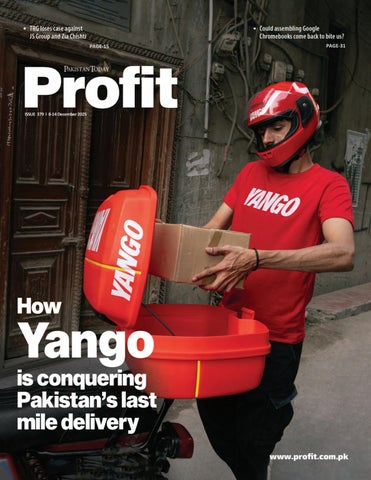
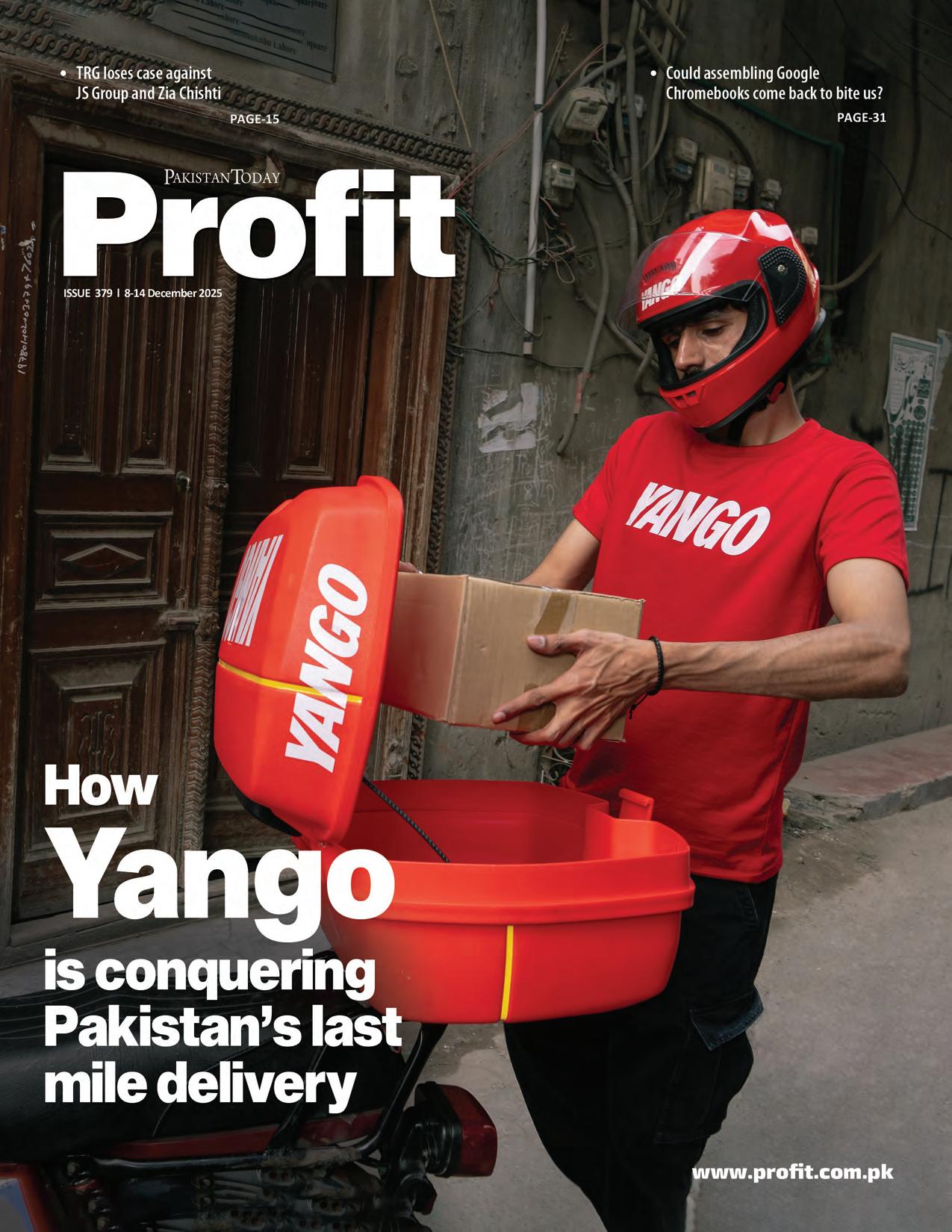
18 How YANGO is conquering Pakistan’s last mile delivery
22 Liven Pharmaceuticals just made a rights issue. Will this prove to be the last throw of the dice?
25 Myth-busting the narrative on the 11th NFC Award Taimur Khan Jhagra
27 Najd Gateway: the latest suitor for Samba Bank Pakistan
29 Ghazanfar Bank bids for Bank Alfalah’s Afghanistan business
31 Could assembling Google Chromebooks come back to bite us?
35 PTA clears the path for telecom shake-up
Publishing Editor: Babar Nizami - Editor Multimedia: Umar Aziz Khan - Senior Editor: Abdullah Niazi
Editorial Consultant: Ahtasam Ahmad - Business Reporters: Taimoor Hassan | Usama Liaqat Shahab Omer | Zain Naeem | Nisma Riaz | Shahnawaz Ali | Ghulam Abbass
Ahmad Ahmadani | Aziz Buneri - Sub-Editor: Saddam Hussain - Video Producer: Talha Farooqi
Director Marketing : Muddasir Alam - Regional Heads of Marketing: Agha Anwer (Khi) Kamal Rizvi (Lhe) | Malik Israr (Isb) GM Special Projects Zulfiqar Butt - Manager Subscriptions: Irfan Farooq
Pakistan’s #1 business magazine - your go-to source for business, economic and financial news. Contact us: profit@pakistantoday.com.pk
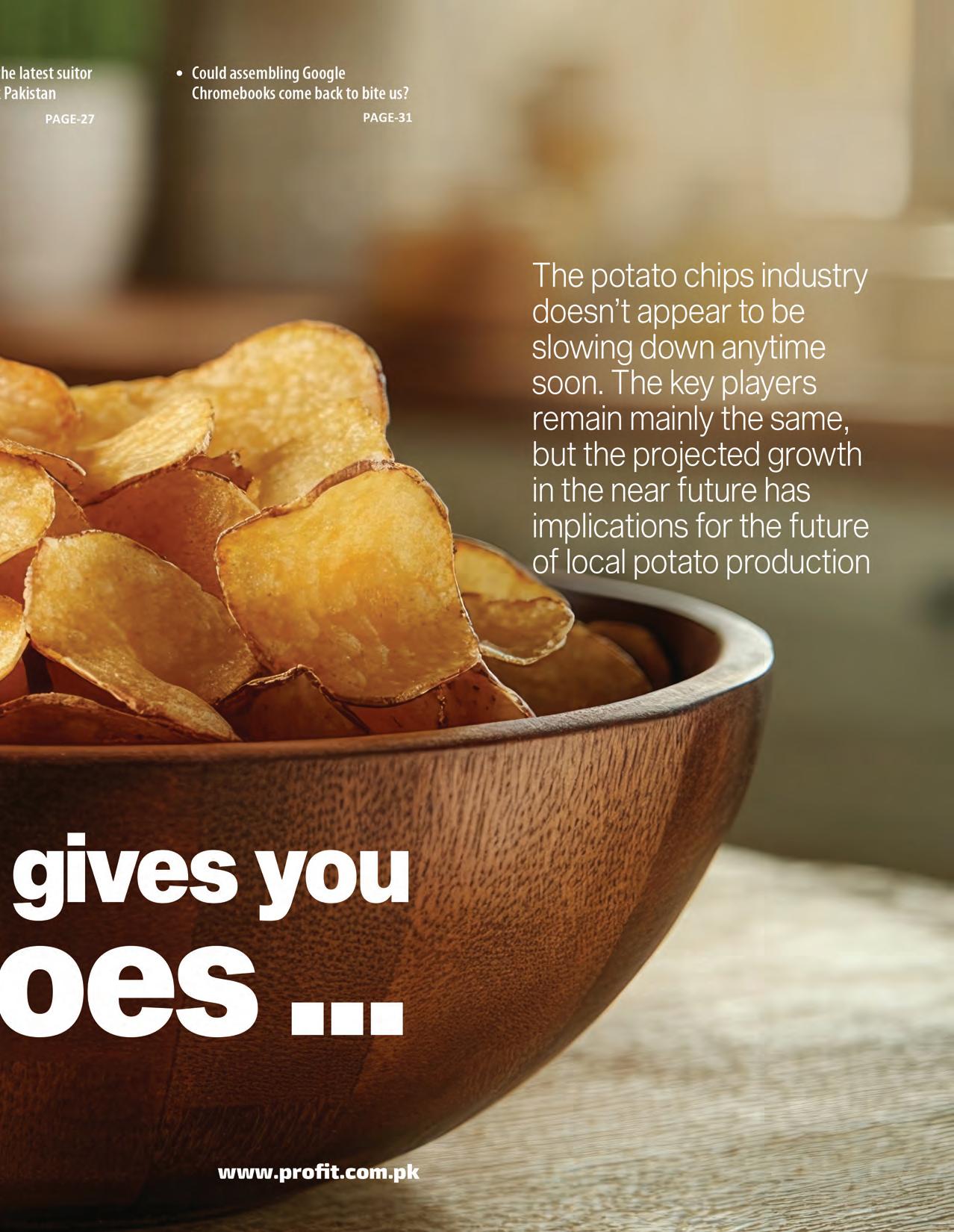
The potato chips industry doesn’t appear to be slowing down anytime soon. The key players remain mainly the same, but the projected growth in the near future has implications for the future of local potato production
By Usama Liaqat
There is nothing that quite matches the versatility of the humble potato. It goes with anything. You can have it in different textures, soft, hard, in-between. It tastes good in broths, it tastes good fried, it tastes good mashed. According to some, it even tastes good in biryani. It is like that annoying cousin whose qualities your parents just won’t stop brandishing in your face. Perhaps that’s the reason that in the popular rhyme Aaloo Kachaloo Miyan, the mean eggplant has had enough and thinks well to land a hefty kick on the unsuspecting potato miyan.
No wonder then that potato is a staple in so many diets. But its ubiquity in the Pakistani pantry is not as inevitable a thing as might have been supposed. In fact, potatoes aren’t even native to the Indian subcontinent. They were brought here from Peru by Dutch settlers in the late 17th century, and planted on the Malabar coast. And at the time of partition, most of the potato in the subcontinent was being produced on the Indian side. Even so, after partition, the potato didn’t take too long to take over local production and become Pakistan’s largest
vegetable crop by area and production.
So much so that in a country where the most prevalent conversation in the agriculture sector is about yields, we have a different problem when it comes to potatoes: we grow simply too many. This year, potato production rose to 9.9 million tonnes, almost 44% higher than official projections, making it the 9th largest producer of potatoes globally. Driven largely by Punjab – which accounts for around 98% of the country’s total output – this rising production is used primarily to satisfy local demand. The surplus is exported to destinations such as Afghanistan, Sri Lanka, UAE, Qatar, Oman, Saudi Arabia, and Malaysia.
While this might sound like good news, Pakistan’s agri supply lines had barely managed to deal with last year’s bumper crop when this year’s even bigger bumper crop showed up. As a result, Pakistan’s potato market is currently in the middle of a crash because of over production. The previous stock is being loaded into the market at prices barely able to cover the costs of their storage and transportation. And the new stock is being sold at prices lower than last year’s.
While this is good for food security, there is simply not enough demand to meet the production. One reason is the ongoing tension on the Afghan border. Over-production of potatoes is a regular occurrence in Pakistan’s agricultural cycle, but farmers end up still making a profit because they simply send them across the Torkham border. Afghanistan has traditionally been the biggest market of Pakistani potatoes. In 2024, exports to Afghanistan accounted for about 42% of the total volume. The closing of the border also has barricaded the potato way to central Asia and Russia, not inconsiderable markets for Pakistan.
While an easing of tensions with Afghanistan will make the potato market go back to its old ways, there are some interesting possibilities that arise from this entire scenario. Most of the potatoes produced by Pakistan are used by households. The consumption rises sharply during Ramadan, as famished fasters look brazenly in the eyes of heartburn and cholesterol, as they gorge on pakoras, samosas, cutlets, and myriad other forms of the potato.
Yet, there is another player, which though relatively minor, dominates the racks at the neighbourhood khokhas and kiryana stores, as well as the billboards around you and your TV screens in your homes. It is the elliptical, crunchy, and flavourful potato chip.
Last year, the potato chip market in Pakistan had a retail value of over Rs 270 billion. Going by the trajectory of the last decade and market prediction, it is expected to rise in value to Rs 690 billion by the year 2030. The big-
gest player in this with half the market share is PepsiCo, which has dominated with its Lays brand of chips. Of course, the entry of Lays in Pakistan’s market is over a decade old. But in the time since it has hit the scene, Lays has thwarted local competition, gained ground, increased the size of the market and dominated in every way possible. That has not stopped local competitors from rising and trying to take them on. Not only have there been major attempts at usurping Lays (United’s Oye Hoye comes to mind), even older players like Super Crisp have tried and in some ways succeeded to get a bit of market share back from the giant MNC. With a core input cost that is over supplied, how has this business evolved, and can some of the local players cash in on the increased cost cutting opportunities of this year’s trade problems with Afghanistan?
Complex carbohydrate, complex problems
The brass tacks of this are simple. Pakistan produces so many potatoes that not only are they found in kitchens and pantries across the country, chip makers use local potatoes for production as well. Even an MNC like PepsiCo with its stringent requirements uses all Pakistani potatoes. This might not sound particularly impressive, but it is when you consider only about 5% of the potatoes grown in Pakistan are suitable for commercial processing.
Now, potato chip makers will tell you this means they only use the best quality potatoes. This isn’t strictly true. Quality in this case is a bit subjective. A particularly starchy potato won’t make for good crisping, but it might make for good mashing or stewing.
But what makes a potato industrial grade? What determines its fate?
A potato has two major ingredients, water and dry matter. Dry matter is composed mostly of starch, a complex carbohydrate. It is the extent of dry matter content which is the most important factor in determining what is to be done with the potato. While table varieties of potatoes have only around 15% of dry matter, industrial processing into crisps requires a higher percentage of dry matter content. This figure is usually around 20%, though the ideal dry matter content percentage is 22.
Other than that, these crisp-fated potatoes must be medium-sized and have low levels of reducing sugar contents and no asparagine content. At the same time, they must look good upon frying, be the right tasteful colour and hold shape, and have the durability to survive long storage times. The farmers that grow them specifically grow them for chip making companies. The biggest proponent in this has
also been PepsiCo.
The most commonly used of these varieties in Pakistan is called Lady Rosetta. Initially introduced in Pakistan by PepsiCo, this variety has since been taken up by local farmers because the local industrial demand kept rising, and it started making financial sense to produce these. Other than Lady Rosetta, the following crisp-suitable potato varieties are cultivated in Pakistan: Lady Jo, Lady Claire, and Hermes.
The State of the Potato Chips Industry
The potato chips industry falls in the broader category of savoury snacks. And this broader category is growing fast according to a recent report by Euromonitor from earlier this year.
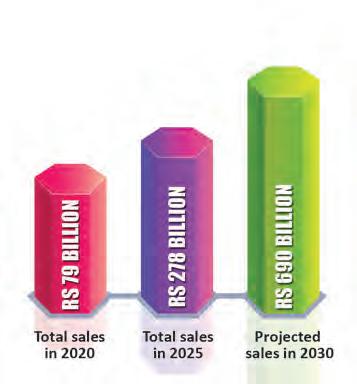
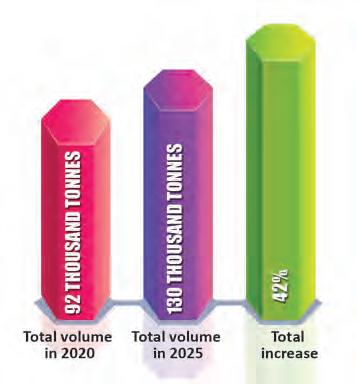
If we look at the growth in terms of value, whereas in 2020, the total value of these snacks sold was Rs 79 billion, by 2025, this had increased by 250% and reached Rs 278 billion. A big reason for this monumental increase, of course, can be attributed to inflation. However, even in terms of volume the chips market has been thriving. While prices may have increased, people have regularly bought more potato chips and savoury snacks.In the five-year period from 2020 to 2025, the savoury snacks category grew 41% in terms of volume from around 92 thousand tonnes to around 130 thousand tonnes
Some of this latter growth could be attributed to the increase in prices, with rupee devaluing, but the general trend of growth seems indisputable. And this trend is projected to continue, with estimates that retail sales would reach Rs 690 billion by 2030. Stable economic growth, advancements in supply chain, as well as rising convenience of buying these are projected to be the key drivers of this growth.
The undisputed market chief of the savoury snacks industry is PepsiCo, whose share in the total retail value sold in 2025 was around 52%. PepsiCo is followed by Triple-Em and KS Sulemanji Esmailji & Sons, accounting respectively for 7.6% and 7.5% of the market in 2025. Triple-Em is the company that makes Super Crisps and KS Sulemanji is the company that produces Slanty. These are trailed by Ismail Industries and Dalda foods, with 2.1% and 1.6% market shares respectively with their own less well known brands.
If we look at the potato crisps category in particular, between 2020 and 2025, sales by volume rose from 41 thousand tonnes in 2020 to just over 65 thousand tonnes in 2025, an almost 60% increase. By sales value, this category grew 288%, from Rs 45.8 billion to PKR 178 billion over the same period.
As far as the brands are concerned, if
we look at potato chips brands as parts of the broader savoury snacks category, the king was PepsiCo’s Lays, with a 40.4% market share. No one even came close. Tripple-Em’s Super Crisp trailed Lays by 3.7%, and was followed closely by Ismail Industries’ Snackcity Kurleez at 2.1%. Dalda Foods’ Knockout accounted for around 1.6% of the market.
We can see how PepsiCo leads, both as the manufacturer and with its Lays brand, the potato crisps – and the broader savoury snacks – market. Lays is almost synonymous with potato chips the world over. Originally started as Lays in the US, it merged with the Frito company to become Frito-Lay, which merged with Pepsi-Cola in 1965 to become PepsiCo. Lays, therefore, is a key part of the PepsiCo brand.
In Pakistan, PepsiCo launched the Frito-Lay (snacks) division in 2006. Its rise was meteoric, and it soon came to dominate the market through its potato chips brand Lays, and corn-based savoury brands like Cheetos and Kurkure. For Lays, locally sourced potatoes are used, and the product is exported to foreign markets such as Qatar and Afghanistan. There are plans to launch Pakistan-manufactured Lays in South Africa and Malaysia as well.
Source:PassportEuromonitorReport
There are three main factors for Lays’ prime position in the local potato chips market. The first is product innovation and quality. Put simply, they taste good, often introduce new flavours that cater to local tastes (think Barbecue, Tikka, Masala), and maintain consistent quality.
The second major factor is PepsiCo’s
extensive distribution network. Leveraging their extensive network for the supply of Pepsi cola, Pepsi has built up a strong supply chain ranging from granular access to the lowest level retail actors to massive supermarket chains. With a strong dealer network, incentivized by the MNC’s ability to offer great profit margins, the product is always in the market. You don’t have to go around looking for it.
Last, but not the least, is marketing and brand visibility. Building on PepsiCo’s illustrious history of developing and marketing brands, Lays has been part of well-coordinated campaigns, online and offline, often coming with endorsements from celebrities like the fast-bowling ace Wasim Akram. All this keeps Lays in the eye of the consumer, and builds an aura of trust around the yellow and red Lays’ logo.
These three factors together actually seem to be the necessary conditions of growth in this sector, whether Lays or not. The story of Oye Hoye serves as a counterpoint to prove this.
Launched in 2016 in Lahore by United Snacks, Oye Hoye rapidly rose as one of the most visible and widely available potato chips brands in Pakistan. In fact, if we look at potato consumption by potato chips brands, in 2017, Oye Hoye processed 10,000 tonnes of potatoes, which was just under 5% of the total potatoes processed by all chip manufacturers.
Yet now, Oye Hoye is all but non-existent. It had run well-publicised advertisement campaigns. Fawad Khan was its face. It even tasted good, and had developed multiple strong flavours. But what primarily caused Oye Hoye’s downfall were shortcomings in its supply chain. It couldn’t compete with brands such as Lays and their strong distributor networks. It didn’t have enough delivery vans – with the product being sometimes unavailable in the market – and couldn’t offer as good margins to the dealers as its multinational competitor could. It couldn’t get prime placement in grocery shops. It was there it was beaten, and there that it fizzled out.
Recent Trends
If we look at the past five years’ data for potato chips manufacturers in the broader savoury snacks industry, however, we can see that PepsiCo actually lost some of its market share in terms of retail value.
In 2021, PepsiCo generated over 58% of the total retail value within the savory snacks category. In 2025, this figure was just under 52%.
Yet in the same time period, Tripple-Em’s share rose from 1.4% to 7.6%.
Although some other major manufacturers also gained – KS Sulemanji Esmaili & Sons from 7.2% to 7.6%, Ismail Industries from 1.7% to 2.1%, and Dalda Foods from 0.6% to 1.6% – it appears that the greatest dent in PepsiCo’s
Source:PassportEuromonitorReport
share was made by Triple-Em.
Some of this can likely be attributed to the recent Boycott, Divest, Sanction (BDS) movement that caught steam in Pakistan when Israel’s bombardment in Gaza, which has now been declared a genocide by all the relevant organsations, began. The effects of the boycott movement have been clear on other segments as well. In an earlier story, Profit reported a 40% dip in the sales of fast food franchises like McDonalds. While these have recovered following a peace deal and an aggressive campaign by the fast food chains to price down and fix the image issue, the problem has remained sticky in other segments. In the same report, Profit talked about how the BDS movement had caused an overall dip of more than 20% in sales of carbonated soft drinks. While local competitors made up some of the difference, they were not prepared to handle the shift. Consumers, however, reacted by simply not drinking carbonated soft drinks anymore.
One wonders if the change would have been more drastic had Oye Hoye entered the market a few years later.
Of course, there might be more to this than a simple zero-sum game, especially given we have the data of retail value and the retail value is determined by pricing. And both might have had different pricing strategies, for example. However, it is still a good view of how the industry is shifting, with local brands trying ever to rise from under the shadow of PepsiCo.
As far as the distribution framework for these chips manufacturers is concerned, we see that almost all the savoury snacks are sold through offline retail. In 2020, offline retail accounted for 99.8% of the retail value of all savoury snacks sold. By 2025, this figure had seen a nominal reduction to 99.5%. So, it is still the main channel by far where you can get your hands on a pack of potato crisps.
Now, offline retail has two main sub-categories: grocery retailers (such as convenience stores, super and hypermarkets, tobacco shops, local grocers, etc.) and non-grocery retailers (such as health and beauty stores, general merchandise stores, and so on). According to the data, grocery retailers make the overwhelming majority of total sales value of the savoury snacks sold. However, like the general category of offline retail, their numbers have seen a slight decline between 2020 and 2025, from 98.5% to 94.5.
This is the primary channel used by major manufacturers such as PepsiCo, Ismail Industries, and Tripple-Em to expand their reach to the widest possible customer range. Their efficient and well-established supply chain networks enable them to optimize stock levels, reduce shortages, and maintain consistent product availability across even remote
Distribution of Savoury Snacks by Format
locations.
Yet what is interesting in this category of grocery retailers is the distribution among its various types. In 2020, this was dominated by small local grocers, making up 87.4% of the market share. Yet by 2025, their share had reduced to a still substantial 80.3%. Conversely, the shares of supermarkets and hypermarkets both increased over this time. For the former, the rise was from 2.9% to 5.3%, almost a doubling. For the latter, it rose by more than double, from 1.6% to 3.6%. So, we can see an obvious, though slight, shift from local grocers to super and hypermarkets. Part of the reason is the shift in lifestyles, with consumer preferences shifting to a single organised, onestop shopping experience. At the same time, these markets offer better visibility for brands, while offering a greater array of options for the consumer.
E-commerce retail, on the other hand, made up a very small share, though it too gained in the previous 5 years, rising from 0.2% to 0.5%. Yet, it appears to be the fastest growing category. Driven primarily by an increase in online grocery platforms, as well as the increasing convenience of online delivery channels, it has seen its greatest increase with young people, who are more willing to try niche brands such online platforms might offer.
Where things go
Whatever pan outs in the coming years, one thing seems fairly certain: the consumption of these potato chips doesn’t appear to be declining any time soon. Yet, as we saw earlier, the overwhelming majority of locally produced varieties of potato aren’t suitable for industrial processing into
Source:PassportEuromonitorReport
these chips. Only 5% or so make the cut.
Currently, Pakistan imports potato seed, which is used mostly to produce the industrial grade varieties fuelling the potato chips industry. In 2021, the total potato seeds imported were worth around USD 12 million, and the demand for the import of these seeds keeps growing on the back of the rising demand of industrial grade potato varieties, fuelled partly by the potato processing companies to make fries and chips.
In order to fuel this rising demand, the area planted of these potato varieties must be increased. At the same time, one way to sustainably increase and facilitate the growth of these crisp-worthy potatoes is by developing some local varieties and incentivising their production by local farmers. The current level of production of these types will not be enough to match the forecasted demand.
But, at the same time, if we go back to where we started, we are producing a surplus of potatoes. Part of the market crash this year, as we saw, is the closure of the Pakistan-Afghanistan border. Of course, potato is one of the crops we export, and plays a key part in helping offset – for whatever it’s worth – Pakistan’s gargantuan trade deficit.
Yet, this incentive to export potatoes must be balanced in the near future against the pressure to import potato seeds for these varieties driven by the surging demand for potatoes, both in the household and in the processing industry. In fact, doing this might open new opportunities to improve the general economic situation. Rising investment in the local production of these industrial grade varieties might at one stage, for example, even open a new opportunity for the export of both these more vaunted varieties of potatoes as well as locally produced potato snacks. n
TRG loses case against JS Group and Zia Chishti
The company had alleged improper conduct by JS and its ousted CEO in a hostile takeover bid that began shortly Chishti lost his board seat
More than three years after TRG Pakistan Ltd accused Jahangir Siddiqui & Co. Ltd (JSCL) and the company’s own ousted founder, Zia Chishti, of mounting an unlawful hostile
takeover, that case has been thrown out at the very first hurdle.
In a notice to the Pakistan Stock Exchange (PSX) dated 4 December 2025, JSCL disclosed that the VIth Senior Civil Judge, Karachi (South), has rejected in its entirety Suit No. 1696/2025 – previously High Court
Suit No. 1589 of 2022 – titled TRG Pakistan Ltd & Others vs. Jahangir Siddiqui & Co. Ltd. & Others.
According to the JSCL filing, the judge dismissed the plaint under Order VII Rule 11 of the Code of Civil Procedure, 1908, holding that the suit was “barred by law” and that
TRG Pakistan, as plaintiff, had failed to demonstrate any “legal character or proprietary right” that would entitle it to the declaratory relief it was seeking.
The court also observed that the allegations levelled by TRG were unsupported by “legally cognisable material” and did not meet the statutory prerequisites for the orders requested. Crucially, the order records that no adverse findings or directions were issued against any of the defendants, including JSCL, its subsidiaries or any officer – collectively described as the “JS Group”.
JSCL’s letter reminds investors that the case originated as High Court Suit No. 1589 of 2022 and was later transferred to the civil court, where it was renumbered as Suit No. 1696/2025. In effect, what began life as a headline grabbing allegation of securities law violations has ended, for now, on procedural grounds rather than after a full trial of evidence.
JS Group has seized on the decision as vindication. In the two page notice, the group reiterates that it has “consistently maintained” TRG’s accusations were “baseless, frivolous and mala fide”, and says the judicial determination has “fully vindicated” its stance.
The order of a Senior Civil Judge is appealable, and TRG Pakistan could still challenge the rejection at a higher forum. The JSCL filing, however, makes no mention of any such move, and as things stand one of the most prominent chapters in the TRG–JS–Chishti saga has been closed by the courts.
What TRG had alleged in 2022
To understand the significance of the dismissal, it is worth revisiting what TRG Pakistan was alleging when it went to court in October 2022.
In a PSX “Material Information” notice dated 25 October 2022, TRG disclosed that it had filed Suit No. 1589 of 2022 before the Sindh High Court at Karachi. The defendants were described as “various companies belonging to the JS Group, Mr Muhammad Ziaullah Khan Chishti and his spouse, and various other companies and individuals whom the Company believes are acting in concert.”
TRG told the exchange it believed these parties had violated the Securities Act, 2015 by acquiring more than 30% of TRG’s shareholding without making a mandatory public tender offer as required under regulations governing such transactions.
The notice also highlighted that the Sindh High Court had already granted an interim order on 19 October 2022, restraining the defendants from “taking the benefit or
acting in pursuance of the voting shares held by them in excess of 30%” pending further hearing of the suit.
In other words, TRG’s position was that a bloc of shareholders aligned with JS Group and its former CEO had quietly crossed the key 30% control threshold set out in regulations governing takeovers, without triggering the investor protections built into the law – most notably the obligation to make a public offer to other shareholders.
The media quickly framed this as a classic hostile takeover battle. One report summarised TRG’s case as an effort to fend off an “alleged hostile takeover bid of JS Group”, launched after the group amassed a substantial position in the stock. A detailed feature in Narratives magazine later described TRG’s lawsuit as alleging that Chishti and JS Group had “surreptitiously” accumulated around 34% of the company without making the required disclosures, thereby breaching the Securities Act and takeover rules.
JSCL responded within 48 hours. In its own PSX communication dated 27 October 2022, the group “vehemently denied” all allegations, calling TRG’s suit “concocted, baseless and [a] defamatory distortion of facts” and reserving its right to sue the plaintiffs for what it described as “unsubstantiated, frivolous and farcical allegations”.
Alongside the litigation, JS Infocom Ltd – one of the JS entities – filed a separate disclosure under section 110(3) of the Securities Act. That filing, forwarded to PSX by TRG on 8 September 2022, stated that JS Infocom and related parties acting in concert held about 69.55 million TRG shares, or 12.75% of the company, and identified JSCL, JS Bank, JS Infocom, Energy Infrastructure Holding, a JS Bank gratuity fund and key JS executives as members of that concert party. It also noted that JS nominees Suleman Lalani and Asad Nasir sat on TRG’s board.
TRG’s lawsuit went further, arguing that other investors and individuals – including Chishti and his wife – should be treated as part of the same “acting in concert” group, pushing the effective control stake past 30%. JS Group has always disputed that characterisation. The Karachi civil court has now said, in essence, that even if TRG’s narrative is taken at face value, the suit could not proceed in its present form.
The scandal that toppled TRG’s founder
The hostile takeover narrative cannot be separated from the dramatic circumstances under which Zia Chishti lost his grip on TRG Pakistan in the first place.
In November 2021, a former employ-
ee of Afiniti – a TRG linked AI call routing company also founded and led by Chishti – testified before a subcommittee of the US House Judiciary Committee. She described a pattern of alleged sexual harassment and assault by Chishti and told lawmakers that an independent arbitrator in the United States had already ruled in her favour, awarding her significant damages. (Enews)
The testimony, widely reported in the international press, triggered immediate reputational damage. Afiniti announced that Chishti had stepped down as chairman, CEO and director with effect from 18 November 2021.
Shortly afterwards, the boards of TRG Pakistan Ltd and The Resource Group International Ltd (TRGI) – the Bermuda based holding company through which TRG’s global portfolio is controlled – issued a statement confirming that Chishti had resigned from all his roles at TRG and its affiliates. According to that statement, he left his positions as CEO and director of TRG Pakistan and as chairman and director of TRGI “with immediate effect”. Pakistani coverage at the time portrayed the move as a forced exit by a board anxious to contain the damage. Business Recorder, in a later overview of the “TRG saga”, noted that the company was “first rocked” in November 2021 by the disclosure of the arbitration award and the congressional testimony, and that what began as a reputational crisis soon evolved into an extended battle for control of TRG Pakistan.
It is important to stress that Chishti continues to contest aspects of the allegations. In March 2025, for example, The Telegraph in the UK issued a prominent apology and agreed to pay substantial damages after Chishti sued over its coverage of the congressional testimony; the newspaper withdrew its defence of truth and acknowledged that its reporting had created an unfair impression. The arbitration award and congressional record, however, remain part of the public domain backdrop to his departure.
What is not in dispute is the corporate outcome: by late 2021, Chishti was out of his executive roles. His final remaining lever was his substantial shareholding – and even that soon became the subject of litigation.
Losing the board –and plotting a return with JS
Formal control was prised from Chishti’s hands in January 2022. On 11 January, TRG Pakistan held an Extraordinary General Meeting to elect a new board for a three year term. A PSX filing following the meeting listed a nine mem-
ber slate that did not include the company’s founder.
This was a decisive shift. Mettis Global reported that Khaldoon Bin Latif of Faysal Asset Management secured the highest number of votes, with TRG executives Hasnain Aslam and others also elected, while four nominees linked to JS Group – Zafar Iqbal Sobani, Abid Hussain, Asad Nasir and Suleman Lalani –joined the board as directors. The report noted bluntly that “individuals from JS Group won majority in the election” and that “Mr Zia Chishti … has not been elected as the director of TRG Pakistan.”
From that point, the company’s governance rested with a board dominated by Chishti’s former partners and institutional investors, with JS Group sitting inside the boardroom rather than outside it. Chishti retained a large block of shares but no formal role.
He did not stay quiet.
Chishti began rebuilding his position almost immediately, aligning himself closely with a “major brokerage firm” – a clear reference to JS Group – that had already accumulated a significant stake in TRG. Business Recorder’s later reporting on related proceedings in Bermuda similarly describes how Chishti transferred tens of millions of dollars to family members, including $25 million to his wife in 2023 to buy TRG Pakistan shares as part of what the court characterised as a joint plan to take over the company, and another tranche to his mother to fund share purchases intended to influence board elections.
Around the same time, JS linked entities were increasing their own exposure. The September 2022 disclosure by JS Infocom and persons “acting in concert” openly declared a 12.75% holding, set out the holdings of JSCL, JS Bank and related funds, and formally acknowledged that Lalani and Nasir represented the group on TRG’s board.
By late 2022, then, the share register and the boardroom told a simple story: a disgruntled founder, flushed with cash from earlier international transactions but facing growing personal liabilities, was edging back into his old company’s stock alongside one of Pakistan’s most powerful investment houses, which already had nominees on the board. TRG’s current leadership saw this as nothing less than a coordinated attempt to wrest control.
The October 2022 lawsuit against JS Group and Chishti was management’s legal response to that perceived threat. In their suit, TRG and its top executives argued that JS Group companies, Chishti, his spouse and others were “acting in concert” to surreptitiously build a de facto controlling block of around one third of the company, while sidestepping the takeover code.
At the same time, Chishti was pursuing
his own political shareholder strategy. In September 2023, he invoked his rights as TRG’s largest individual shareholder to requisition an Extraordinary General Meeting aimed at removing “essentially all” members of the board, accusing management of mismanagement, regulatory breaches and poor performance. TRG rejected his allegations and defended its record; the confrontation further polarised the shareholder base.
Internationally, too, the conflict spilled over. TRG International and Afiniti pursued arbitrations and court cases alleging that Chishti had pledged TRG Pakistan shares in breach of earlier agreements, while the US Internal Revenue Service and Bermudian courts scrutinised his tax affairs and asset transfers. Chishti, for his part, launched defamation cases in Pakistan and abroad, some of which – such as the action against The Telegraph –have gone his way.
Against that background, the TRG versus JS versus Chishti suit in Karachi came to be seen as the domestic legal front of a cross border war for corporate control. Its abrupt dismissal therefore carries symbolic weight well beyond its immediate legal effect.
A hostile bid still looking for a victory
Does the court’s rejection of TRG’s suit mean that JS Group and Chishti have “won” the fight for TRG Pakistan? The reality is more complicated.
On the one hand, the dismissal is unquestionably a win for JS Group. TRG’s most direct legal attack on JS and on the alleged concert party around Chishti has not merely failed; it has been rejected at the threshold as not maintainable in law, with the judge expressly recording that there is no adverse finding against JS, its subsidiaries or any of its officers.
Coming after JSCL’s loud denunciations of the suit in 2022 as concocted and defamatory, the ruling strengthens the group’s argument that it has been unfairly cast as a villain for what it portrays as legitimate investment activity within the confines of Pakistan’s takeover code.
For Chishti, the picture is more mixed. He remains out of TRG Pakistan’s boardroom, which is still controlled by a coalition centred on his former co founders and institutional investors. The Supreme Court’s status quo order in mid 2025, which paused a Sindh High Court ruling that had sought to void Greentree Holdings’ nearly 30% stake and force new elections, has – at least temporarily –preserved the existing board rather than ushering in a new line up that might favour him.
Multiple Pakistani courts have also
restricted his ability to freely deal with his TRG shares. Earlier this year the Sindh High Court restrained Chishti and his wife from selling or transferring their holdings while various shareholder suits seeking to delay board elections are heard. Abroad, he faces a freezing order from the Supreme Court of Bermuda and tax proceedings in the United States, both of which, according to court filings cited by Business Recorder, are partly intertwined with the financing of his TRG related manoeuvres.
At the same time, TRG’s current management has suffered its own setbacks. The Sindh High Court’s June 2025 judgment in the Greentree Holdings case – though now effectively on hold – was scathing about the company’s conduct and questioned the legality of a major share buy back and tender offer structure used by an affiliate to repatriate value to Pakistani shareholders. That ruling, followed by a barrage of litigation in Islamabad and Lahore, has left governance at TRG under a cloud and delayed further capital returns.
From a narrow takeover battle perspective, however, the scoreboard is clear: despite years of legal salvos and share market skirmishes, Zia Chishti has not yet succeeded in regaining control of the company he founded.
In that context, the collapse of TRG’s own 2022 suit against JS Group looks less like a decisive turning point and more like another twist in a still unresolved saga.
For minority shareholders and market observers, the bigger worry is not which faction ultimately prevails, but the way the entire affair has turned a once glamorous tech sector champion into a case study in governance dysfunction. The PSX notices, court orders and media investigations over the last four years read less like the history of a single company and more like a running commentary on Pakistan’s evolving corporate law architecture.
The latest Karachi ruling removes one major piece from the chessboard. JS Group can now say, with some justification, that a court has examined TRG’s hostile takeover accusations and refused even to entertain them. Chishti, for his part, gains indirect comfort from seeing his alleged co conspirators cleared in this forum.
But the basic reality remains unchanged: TRG Pakistan is still controlled by the board that removed him, its international affiliates remain at arm’s length, and the founder who built the group now fights for leverage in the same courtrooms and regulator offices where his successors are trying to fend him off.
In other words, the hostile takeover bid that began soon after Zia Chishti lost his board seat is still a campaign, not a conquest – and the latest judgment, while a setback for TRG’s legal strategy, has not yet delivered him the victory he has been chasing. n
How
Yango is conquering Pakistan’s last mile delivery
YANGO ENTERED AND DOMINATED THE RIDE HAILING MARKET AT A TIME WHEN ITS ARCHITECTS WERE HITTING THE QUIT BUTTON. HOW WILL THEY FARE IN THE DELIVERY BUSINESS?
By Abdullah Niazi
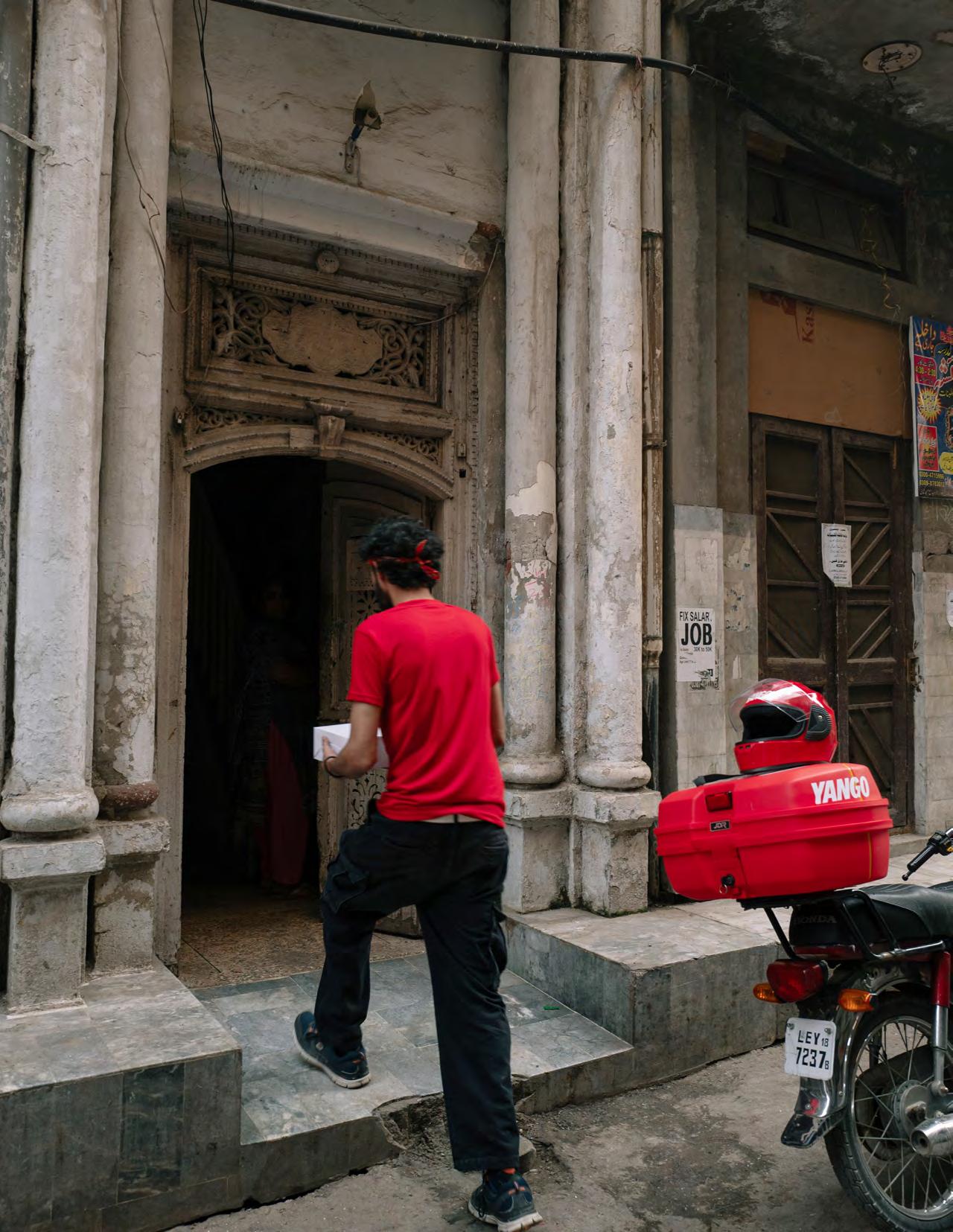
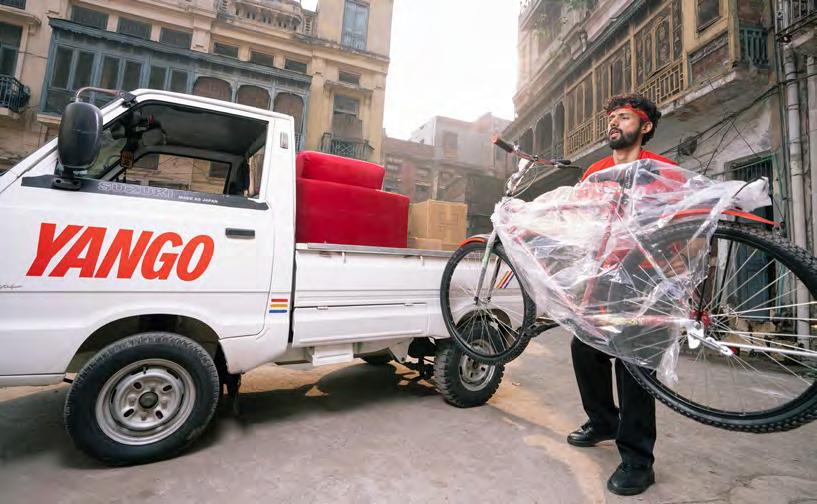
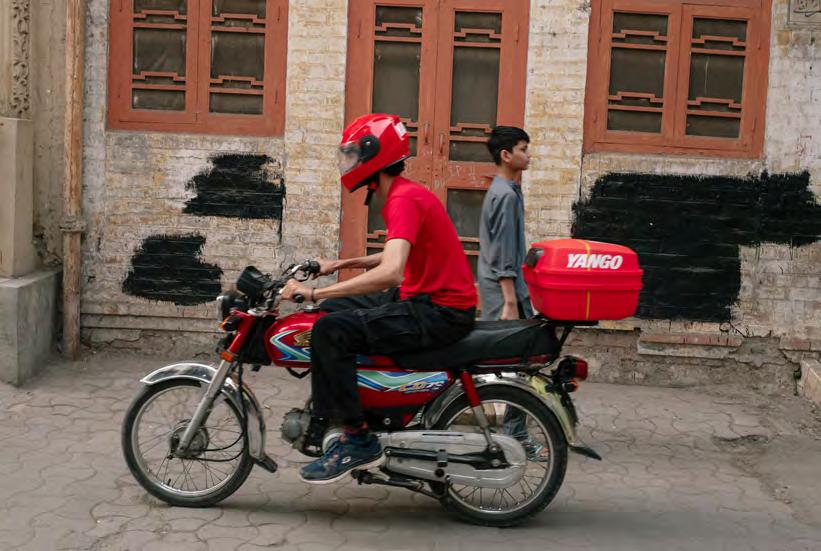
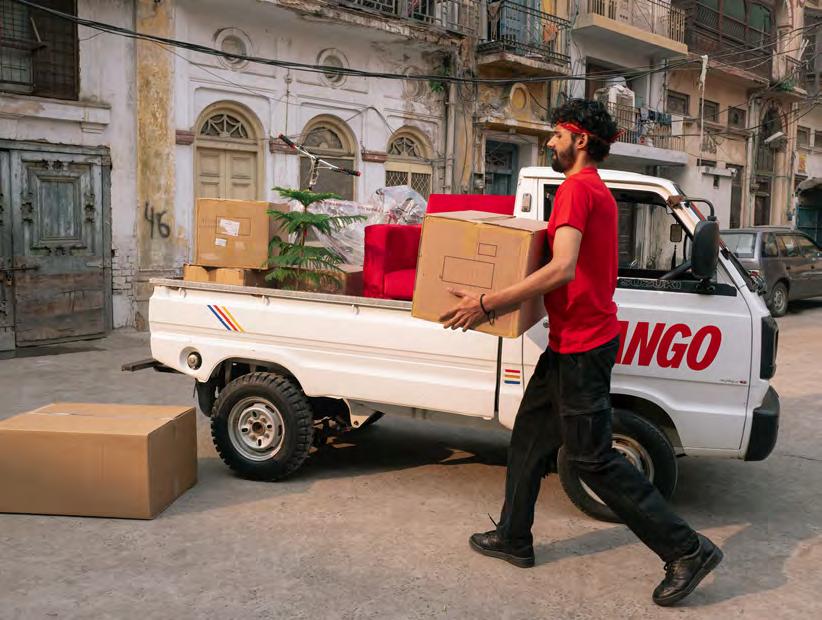
In the choked arteries of Karachi, on Lahore’s wide avenues, and on the quiet Islamabad highways, a new colour has begun to dominate the streets. Red-helmeted motorbikes swiftly weave through traffic jams, ferrying everything from urgent medicines to forgotten laptops. The riders wear the unmistakable crimson of Yango, the Dubai-headquartered tech company that few Pakistanis had heard of three years ago. Today, in the cut-throat world of express delivery, Yango claims to be the undisputed leader — a remarkable feat in a market that has chewed up and spat out bigger names.
It is a story that begins not with parcels, but with passengers. And it is being driven, in no small part, by a young Pakistani executive who once helped Foodpanda push beyond biryani and into pharmacies and supermarkets.
The man at the centre of it is Mohammad Ahsan Akbar, Regional Head for South Asia at Yango Delivery. When we connect over Zoom — Ahsan is at home in Karachi nursing a stubborn flu, voice slightly hoarse but energy undimmed — he is still buzzing from the latest internal numbers. “In 18 months we went from zero to market leadership in express,” he says, eyes lighting up even on a grainy video feed. Bykea has been here for almost a decade. We overtook them in one-and-a-half years.”
The claim is bold, and independent data on Pakistan’s opaque logistics sector is scarce. Yet anecdotal evidence from retailers, pharmacies and e-commerce players supports it: Yango’s red bikes are suddenly everywhere, and its promise of delivery in under an hour (often at prices 15-20 per cent below rivals) has proved addictive in a country where speed and affordability trump everything else. On any given day the top categories racing through the city are food, clothes, medicine, documents, and electronic gadgets — the daily essentials of a young, urbanising population.
Today Yango operates in more than 30 countries across Africa, Latin America, the Middle East and South Asia. Its global playbook is simple but ruthless: enter as a low-cost ride-hailing player, learn the in’s and out’s of the market, focus on ‘local first’ strategies, leverage the driver supply and use global technologies to basically update services and mix solutions to find the exact combination for each specific market. In short, stitch everything together beautifully into a “super app” — ride-hailing, parcels, groceries, even fintech in some markets. It is the same vision Careem once sold investors (and Pakistanis) before Uber acquired it in 2019 and later wound down the ride-hailing business here in 2025, citing unsustainable economics.
Yango launched ride-hailing in Pakistan in mid-2023, starting quietly in Lahore, Islam-
abad and Rawalpindi. The timing could hardly have been better. Uber had already exited the country in 2022, selling its local operations to focus on more profitable markets. Careem, now under Uber’s umbrella for ride-hailing, was raising prices to chase profitability amid soaring fuel costs and a depreciating rupee. InDrive, the bidding-based app from Latin America, and local hero Bykea were gaining ground with motorbikes and aggressive pricing, but neither had the global tech muscle Yango possessed.
It was brilliant as far as timing was concerned. While Bykea and InDrive were battling it out in the bikes space because of the rising cost of fuel, Yango came in with lower prices and started tucking into the market that Careem and Uber had created for ride hailing. Careem, a name that has become synonymous with ride hailing in Pakistan and was a brilliant business in its own right, tried to make the super app happen. It did not work for them and in the process they began to lose their ride hailing business as well. Which is why when Careem quit the ride hailing business in Pakistan in June 2025, not many were surprised. But with the market essentially captured, Yango proved they had swooped in at exactly the right time.
“Super App is our global strategy which has successfully helped us to win over multiple markets and geographies,” Akbar explains. “The main value proposition behind this approach is convenience for the customers at one stop based on a strong ecosystem.”
The Pivot That Changed Everything
Mohammad Ahsan Akbar’s own journey mirrors Yango’s trajectory in Pakistan. A 2015 IBA graduate, he cut his teeth in software consulting — Oracle and Microsoft implementations, project sales, stints in Singapore and Australia. When Covid-19 hit, he saw e-commerce and fintech exploding and jumped ship to Foodpanda, then the undisputed king of food delivery in Pakistan.
Foodpanda was hungry for growth beyond restaurants. “They were looking to expand into non-food segments such as groceries, pharmaceuticals, gifting, apparel etc,” Akbar recalls. Hired as manager non-foods, he quickly leveraged his B2B contacts. “Because I had software consulting and sales experience my relationships in B2B were quite strong. Very quickly I was able to bring good opportunities.”
The result was pandago — Foodpanda’s on-demand logistics arm — and partnerships with major pharmacy chains and grocers like Al-Fatah and Naheed Supermarket. “You might remember a time when DVAGO was delivering via 3PL companies in 3-4 days and we made our aim to get medicines to people within a few hours,” he says, grinning at the memory.
After three-and-a-half years heading pandago (later rebranded panda go), Akbar began to feel the limits of Foodpanda’s vision. Delivery was an add-on, not the core. Then, in early 2024, Yango came calling.
“Yango reached out to me looking to build an end-to-end logistics system,” he says. “Foodpanda’s core business was something different and I felt Yango’s vision aligned with mine, and I took on this challenge.” He joined as Country Manager for Yango Delivery in March 2024. Within weeks the first red bikes hit the streets.
Learning from the Graveyard of Ambition
Pakistan’s delivery market is not virgin territory. Careem Express tried and largely retreated. Foodpanda’s pandago remains strong in certain niches but has never dominated pure-play express logistics. Daraz relies on third-party logistics giants like TCS and Leopards for anything beyond same-day. Bykea and InDrive have parcel services, yet neither has achieved the scale or speed Yango now flaunts.
“What sets Yango apart is a mix of added features and operational excellence,” Akbar insists. “We researched the market well enough to understand the requirements for express delivery and added features like multi-stops, easy UI/UX, affordable options, picture upload of address location to guide drivers, variety of delivery options to cater different consumer needs, real-time
tracking, and most importantly free insurance.”
Free insurance on every parcel — unheard of locally — has become a calling card. “Our insurance coverage reinforces trust,” Akbar says. “It’s one of the reasons drivers and users choose Yango. The claim rate has remained low thanks to efficient safety measures and real-time tracking. It’s an investment in
reliability and trust, not a financial risk.”
Affordability is the other pillar. Yango usually offers the best rates in the market- one can say true ‘value for money’. When pressed on how this is sustainable, Akbar is careful: “We are more focused on continuously trying to add value to our services to meet market demand. This is definitely aided by our technology and operational efficiency advantage. Our focus is never to get into price wars.”
Behind the scenes, Yango’s algorithms — battle-tested in dozens of emerging markets — optimize routing and driver allocation with an efficiency local players struggle to match. Multiple vehicle classes (bikes for small parcels, cars, rickshaws, even cargo vans and trucks) allow the company to maximise utilisation of the same driver pool that powers its ride-hailing arm.
“This is our vision to ensure the promise to deliver,” Akbar explains. “The decision to have multiple delivery options was based on two things. First is simply to cater to different needs of the consumer and second was to optimise the output from our given supply ecosystem to maximise gains for both consumer and driver.”
The Super-App Dream, Pakistani Edition
Yango’s endgame is the same one that eluded Careem: the everything app. In Latin America and parts of Africa, the Yango app already bundles
ride-hailing, food delivery, groceries, cargo and parcel services, kicksharing, navigation and public transportation services. Pakistan is moving fast in that direction. Grocery delivery via partnership with DealCart launched in Karachi in 2025; cargo services — Akbar’s personal favourite — are scaling rapidly.
“Cargo is my favourite business stream,” he says, enthusiasm bubbling over despite the flu. “We as a team are so excited to scale cargo as we feel it is one of the most disruptive initiatives that we have taken in Pakistan. Currently cargo-related requirements are mostly catered offline. We are trying to digitise this entire process where now people, and SMBs can easily book a cargo ride to deliver bulkier stuff from Point A to Point B in just a few taps.”
Small and medium businesses form the backbone. “SMBs account to a significant share of our cargo business,” Akbar notes. “Simply because it’s so easy to book an order and get items delivered. We save cost and time for businesses so that they can focus more on their core business requirements.”
Cross-service usage is climbing. “A significant percentage of users now engage with multiple Yango services and this number is improving every month,” Akbar reveals. “We encourage this through in-app rewards, bundled offers, and seamless navigation between verticals.”
The Challenges Beneath the Red Wave
For all the momentum, cracks exist. Pakistan remains a brutal market. Inflation hovers stubbornly, fuel prices gyrate, and regulatory oversight of ride-hailing and delivery is patchwork at best. Driver protests over commissions flare periodically.
Akbar is candid about the headwinds. “Pakistan’s urban mobility and delivery sectors face challenges of inflation, regulation, and fuel price volatility,” he acknowledges. “We constantly adjust our pricing and incentives to reflect market realities. Technology helps reduce the impact of rising fuel costs through optimised routing. Additionally, bonus programs help drivers maintain steady earnings even in volatile conditions.”
On the super-app question, he draws a clear line from Careem’s missteps: “Read the consumer pulse and needs. Don’t limit your business growth by your product limitations. Build your service/product around the needs of the customer… It has to be a continuous improvement process. Long-term sustainability and adaptability are really helping us grow faster in the market.”
A Fragmented Giant in the Making?
Pakistan’s logistics sector remains astonishingly fragmented — thousands of small fleet owners, traditional 3PLs, informal couriers. Yango’s ambition, Akbar says only half-jokingly, is nothing less than to knit it together.
“At a more strategic level, our main goal is to integrate the fragmented structure of the delivery/logistics business in Pakistan,” he declares. “While we have taken a start from express lastmile, the option of multiple kinds of vehicle gives us the base to build a more diversified delivery operational network. Hopefully this will be witnessed by our customers in Pakistan very soon.”
Whether Yango can avoid the fate of predecessors — Careem’s retreat, Uber’s exit, Foodpanda’s partial pivot — remains to be seen. What is undeniable is that, for now, the red wave is surging. In a country where digital convenience is still a novelty for millions, the sight of a Yango bike screeching to a halt with your forgotten medicine or last-minute gift has become oddly reassuring.
As Mohammad Ahsan Akbar signs off from the Zoom call — pausing to cough, then flashing one last grin — he checks the app on his phone — another red dot racing across the map. “Localization is at the heart of our model,” he says. “‘Going Local’ is one of our top values at Yango… Pakistan isn’t just another market for us but a partnership built on relevance and real impact.”
If the red bikes keep multiplying, Pakistan’s chaotic streets may yet find their unlikely organiser. n
Liven Pharmaceuticals just made a rights issue.
Will this prove to be the last throw of the dice?
The pharmaceutical company has had a torrid history. The new development could prove to be its redemption
By Zain Naeem
For many, the name Liven Pharmaceuticals will be new. The company came into existence less than a decade ago and has only recently been listed on the stock exchange. Liven was
established by a group of sponsors who wanted to create a pharmaceutical company providing health and medication solutions. The company name “Liven” was a play on the word living.
But Liven’s roots can be traced farther back. The company’s origin story goes all the way back to the early 1990s when a company
called Merchant’s Glass began manufacturing medical ampoules which are used to package certain medication and medical products.
Liven was going to be the next stage of evolution for the company as it was going to address the patient needs by producing high quality medicines, biologicals and Active
Pharmaceutical Ingredients (APIs).
But what started as an ambitious expansion project has had consistent issues along the way. From the outset, Liven suffered through a long period of losses as the low volume and sales meant they were not able to cover their expenses completely. Going from the success of Merchant’s Glass, it was felt that things will workout over time.
Any such turnaround has failed to materialize. In the face of this, the company saw an opportunity to get listed on the stock exchange cheaply which it has done. Now it is looking to raise additional funds using its listing to gain access to public funds.
This could prove to be the final option left for the company which is staring down the barrel. Just what exactly is a right issue, how does it work and what are the plans of the company in terms of utilizing these funds? Profit looks to answer all these questions.
History of the sponsors
The beginnings of Liven Pharmaceutical can be traced back all the way to the early 1990s when Merchant’s glass was established.
The purpose of Merchant’s glass was to manufacture empty ampoules which were being used for medicinal packaging. Initially the company started out producing around 1.1 million ampoules per month which had increased to around 24 million ampoules per month by the end of 2013. The importance of such a company can be seen in the context of the pharmaceutical industry in general.
Around that time, there were smaller competitors which existed in the market namely Friends Glass (Pvt) Limited, MultiGlass, Pharma Glass which were involved in the manufacturing of high quality ampoules and vials. These were being sold to the national and international pharmaceutical companies operating in the country.
There was a gap in the ampoule manufacturing industry which was quickly being filled by the local producers. As the manufacturers started to improve the quality of the product, there was a demand for them by local and international companies. The product that was being produced was being seen as a cheaper alternative to imports which were the norm before.
The rapid increase in the production capacity of Merchant’s shows how well it was able to fill the gap that existed in the market and how it was able to grow its revenues accordingly.
Liven comes into existence
The experience learned from this business was later used to fund the infrastructure and capital of Liven. This step was going to help the sponsors go from producing the packaging to now producing the medicines inside these vials. The knowledge gained in the pharmaceutical supply was going to be applied and vertical integration was being carried out to manufacture medicines as well. From the seed of Merchant’s glass came the next fruit called Liven Pharma.
The core business of Liven was to manufacture pharmaceuticals and allied products which were produced in a variety of dosages. These were in the form of tablets, capsules, injectables and infusions. In order to meet the regulatory standards and requirements, the company complied with the regulations applicable to it and also adhered to cGMP (Current Good Manufacturing Practices). It also gained ISO 9001:2015, ISO 45001:2018 and ISO 14001:2015 in order to comply with quality, workplace and environmental management.
The success of the earlier venture, however, could not be replicated at Liven.
The initial performance of Liven proved to be tumultuous to say the least. The earliest financial data available for the company starts in 2021 which show that the company made net losses of 1.5 crores in 2021 which translated to loss per share of Rs 1.21. The key element hurting the company was its small size and revenues being earned. These losses persisted throughout 2022 and 2023 as loss per shares consolidated at around Rs -1.18 and Rs -1.02 respectively.
Revenues recorded in 2024 were around Rs 24.5 crores which did yield a profit of Rs 1.04 per share, however, 2025 saw revenues fall back to Rs 12.7 crores and loss per share of Rs -8.37.
Getting listed
In late 2024, the management at Liven took the decision to get listed on the stock exchange. The usual route of getting listed is to carry out an Initial Public Offer (IPO) which allows interested investors to invest in the company while the issuer gives out a portion of their shareholding in return. In order to attract investment, the issuer has to release all of its financial data to show well they are performing.
Liven chose a different approach. Rather than releasing its own data, Liven looked to merge itself with a company which was already listed on the stock exchange. Landmark Spinning Industries was chosen which was
a defunct company which had closed down its operations a long time ago. Liven chose to buy out the assets and liabilities of Landmark Spinning Industries and then changed the name of Landmark to Liven.
In this process, the memorandum of association, the registered office of the company and other details can be changed once the merger is approved by the courts and approval has been given by the Securities and Exchange Commission of Pakistan.
The purpose of getting listed is to have access to funds of the investing public and create a market where the shares of the company can be traded. Through the reverse merger, the company could not go for an IPO, however, recently it went for a rights issue which is another benefit of getting listed on the exchange.
So what is a rights issue?
Right issue
The purpose of getting listed on the exchange for a company is to allow it to sell some of its shareholding in return for investment which is provided by the market participants. For many companies, this investment is used to give a part of the shareholding to the investors who are interested in the company. But this is not a one time thing only. Just like a company can go to a bank for subsequent and further borrowing, the capital markets can also be used to raise additional funds in the future.
This happens in the form of a rights issue. The shareholders who already own the shares of a company are given an opportunity to invest further in a company. Assuming a company has 100 shares and these are held by 100 different shareholders. When a right issue is carried out, each of the investors gets a chance to invest more in the company. If all the shareholders subscribe to the right issue, then each of them gets the same amount of shares yet again. In this case, a right issue of 100 additional shares is carried out. After the issue, each of the 100 shareholders will now own 2 shares. This will mean that they each hold 1% of the shares of the company yet again.
But what if you feel that you do not want to invest in the company any more? In that case, you are allowed the opportunity to sell your right share in the stock market. Someone else might want to invest more than their older shareholding and they will be willing to buy additional rights in the market. Assuming that 50 of the shareholders feel that any additional investment will not be able to yield any benefits to the company. They can wish to sell their 50 shares in the market when the right becomes tradeable.
There might be other shareholders who
feel that they want to invest more so they can buy these rights on the stock exchange and then invest the additional funds that the company requires. The individuals who are selling the shares are aware that now their shareholding will fall after the rights are issued and they will have a lower percentage of shares than before.
Once all the rights have been traded, the shareholders who have the right shares have to provide the subscription amount to the company in order to get the shares. If they fail to provide it, they can see their rights become worthless.
By design, the right shares are giving the first opportunity to older shareholders to invest more in the company. Once they have decided what to do, new investors are given an opportunity to buy the right shares from the market and make their investment as well.
For Liven, it is an understood fact that the previous sponsors are looking to invest further in the company and they want some of the burden to be shared by the other shareholders who have invested as well. At June end of 2025, the owners held more than 85% of the shares which means they will be putting up most of the investment for the new rights issue as well. This is a way for further injection of capital and resources into the company from the capital markets rather than going to banks in order to get more borrowings on the balance sheet of the company.
The case of Liven
In the case of Liven, a right share was announced in order to raise Rs 200 million by issuing 20 million additional shares.
The proportion of shares was going to be 21.496 right shares for every 100 shares held. The subscription price to invest in the company was going to be Rs 10 per share. The shareholders who held a single share were going to get 0.21496 for each share that they held in the company. Now they had a choice to do two things. Either they could invest Rs 10 per share in the company and provide these funds to the company or they could sell these rights to other investors.
But there is one last thing that needs to be addressed here. When the rights were announced, the share price of Liven was trading at Rs 63. How can the investors pay only Rs 10 and then get a share which was worth much more? This is where the price of the trading rights comes into focus. The rights that the shareholders were going to get would start trading at a price around Rs 53 which would justify the subscription price being set at Rs 10. For investors willing to sell, they can get a good price for their share while the buyer will be expected to pay this price in
order to buy the shares.
The company stated that the funds raised from the right issue were going to be utilized for the company’s day to day working capital needs, carry out new investment in sustaining the business, provide some strength to its financial position and to enhance its profitability. Most of the funds were being used to establish a new dry powder injectable division, purchase of vehicles and to process the registration and licensing of the drugs with the Drug Regulatory Authority of Pakistan (DRAP).
In addition to this development, Liven also announced that it had been able to carry out its first successful export shipment to the Arab region which shows that it is capable enough to export any additional products which might not have any demand on a local level. This also shows how the company is looking to shift its focus from local markets to international markets by strengthening itself financially. The funds raised would be used to supplement this region as well.
There are also internal plans that are being discussed at the company to look to expand into API manufacturing. Currently, most of these APIs are imported. Liven is thinking of trying to make these ingredients themselves by carrying out backward integration. This will allow it to reduce its dependency on external suppliers and control its costs while ensuring supply stability for itself.
The revenue drivers of Liven can be seen as being strong as they provide a wide variety of dosages which cater to different therapeutic needs. Having a wide range of products and an ability to tap into new markets is something that Liven has been trying to do in the past which will contribute to better revenues. In addition to that, the exit of many International brands has meant that now more than 70% of the pharmaceutical needs of the country are being met by local manufacturers.
Another factor going in favour of the company is that the demand for medicines is income and price inelastic and demand is usually stable or growing which means that the revenues can increase over a period of time. The recent change in pricing policy applicable on non essential medicines has also meant that pharmaceutical companies have an autonomy over their prices that they did not enjoy before.
In terms of the cost drivers, the biggest challenge to Liven is the fact that most of the APIs that are used in manufacturing are imported which means that any shock in the supply chain or any depreciation of the currency directly impacts the costs of production. Another cost that is being faced
by the company is the increase in regulatory, licensing and compliance fees that have to be incurred as the product portfolio of the company is extensive and covers different forms of dosages. In order to maintain the quality and comply with the standards set, the cost that has to be borne is much higher.
Breaking down the financial data
As the company was listed recently, there is a dearth of relevant financial information which can be used. The focus will be put on the most recent annual statements which provide a snapshot of 2024 and 2025. The revenues for 2024 were registered at Rs 24 crores which fell to Rs 13 crores in 2025. The dip in the revenues was seen as the volume of sales for Liven fell during this period. While sales fell, the cost of sales increased leading to gross profit falling from 25% to 13%. The primary issue here was that as sales were falling, the costs associated with production were causing gross profits to fall.
The biggest reason for the slump in performance and profitability from 2024 to 2025 was taht administrative expenses, selling and distribution and other expenses increased from Rs 2 crores to Rs 51 crores. These expenses included increase in salaries and benefits, fee and subscription and listing expenses which made up most of the administrative expense increase. In terms of other expenses increasing, bad debts and allowances of expected credit losses had to be recorded due to accounting treatments. Many of these entries were mandated by the reverse merger and were not under the control of the company itself.
The impact of this was that profit after taxes fell from Rs 4 crores in 2024 to losses of Rs 58 crores in 2025. The start of a new financial year will see a much clearer picture of the company in terms of how the new year starts off, however, based on its historical performance, it can be expected that signs of improvement will start to show when the new product line comes online.
The financial performance of Liven has been seeing losses since its inception and there are efforts being made to allow the company to turn profitable. The sponsors of the company have shown a commitment to running the business using their skills and experience in the industry. All these efforts have failed to bear fruit till now. The listing has provided an additional avenue for the company to raise finances which it has utilized now.
The results of this investment will take time to show their impact in the future. For now, it seems like the sponsors have played the only move available to them. Will it prove to be their last card to play? Only time will tell. n
OPINION
Taimur Khan Jhagra
Myth-busting the narrative on the 11th NFC Award
The upcoming National Finance Commission (NFC) award, with its first meeting set for December 4 seems to be structured around a single, misguided belief. That belief is now well known, because of all the propaganda peddling it. In simple terms: “Pakistan’s fiscal problems are because too much money has been given to the provinces, and this has left the federal government broke. If the NFC award is restructured to take back resources from the provinces, all will be well.”
Needless to say, this belief is wrong. All we need to do is look at the facts. There are four key questions to consider.
Is
57.5% really too high an NFC share for the four provinces, and is this what leaves the federal government broke?
The answer is no, absolutely not. The truth is that provinces do not receive anywhere near 57.5% of what should be the divisible pool. Certainly, what they are allowed to spend is a lot less.
Hafiz Pasha, in his excellent article in the Business Recorder on October 7 (Link) proved this. If the current NFC award is adjusted to include the impact of the forced provincial
The
writer is former Finance Minister KP
surpluses that the provinces cannot spend (Rs921 billion in fiscal year 2024-25; Rs1,500 billion in fiscal 2025-26), and the Petroleum Levy Collections (Rs1,220 billion in fiscal 2024-25, Rs1,468 billion in fiscal 2025-26), the effective provincial shares reduce to 45.8% for 2024-25, and to 42.3% for 2025-26. This is a far cry from the marketed 57.5% provincial share at which so much outrage is expressed.
But regardless, don’t the provinces have too much to spend?
No, they do not. It can be argued that they can spend much better, but this critique will apply equally to the federal government. However, the story that provinces are flush with cash despite all of their spending needs being fulfilled is complete fiction.
Just take the state of education and health outcomes in the country and the fact there is near unanimous agreement that spending in both sectors is abysmal compared to global benchmarks for developing countries. Doubling government spending on education, from less than 2% of GDP to an agreed 4% of GDP would require provinces to spend Rs2,000 billion more annually. This is needed to get our 25 million out of school children into school, or to improve abysmal learning levels.
Doubling government spending on health, from less than 1% of GDP to 2% of GDP, still below global benchmarks, would require another Rs1,000 billion. That is Rs3,000 billion annually just between education and health that the country has long said it needs to spend.
Beyond this, any number of sectors, from security to rescue services, to municipal services and local governments, to family and population planning, to road and infrastructure maintenance and upkeep, all need greater spend than current provincial resources allow.
Remember that all of this is not factoring in the fact that the share of ex-FATA, and the national commitments to ex-FATA of committing 3% of the NFC post-merger to address the development lag there, have not even been incorporated into the NFC.
Now, instead of increasing that funding for provinces, think of the impact of reducing it by another Rs1,000 billion to contribute towards federal government debt. There will be a significant impact on service delivery budgets and on development, and it will be the people of Pakistan that suffer.
So again, it is not that the provinces have too much to spend, but that all of Pakistan, including the federal government and the provinces, have too little to spend. That is the problem
the NFC needs to try and solve.
But won’t restructuring the NFC will solve the federal government’s financial issues?
Figures show that what provinces can give up to the federal government will hardly make a dent in the federal government’s deficit, but what it may do is create a complacency, and yet another excuse to delay the sort of economic reform that Pakistan desperately needs.
The federal government will spend over Rs8.2 trillion this year on servicing debt; Rs2.5 trillion plus on defence; Rs2 trillion in grants; Rs1.1 trillion on subsidies; Rs1 trillion on the federal government; Rs1 trillion on unfunded pensions; and Rs1 trillion on a very ineffective and inefficient Development Budget.
This is close to Rs17 trillion in spending, of which Rs 6.5 trillion is financed through additional debt. Any provincial contribution in an NFC that attempts to give a greater share of resources to the centre can only really be to the tune of Rs500 billion to Rs1,000 billion; between a sixth and a tenth of the additional debt incurred. That is really not a huge dent at all, and one that will become meaningless unless, as both the IMF and World Bank have said, our economic and governance models change drastically.
Again, what this proves is that it is not that the provinces have too much money to spend, but that the country doesn’t have enough.
What should be done then?
Instead of sob stories about how the 18th Amendment and the NFC award have made the federal government broke; what the NFC should be doing is to work on a
formula that prioritizes fiscal equalization, as NFC awards the world over do above all else, and builds in performance criteria that incentivize good government.
What it must also do, and this must be non-negotiable, is to tackle difficult issues, but issues that are commitments to the constituent parts of the federation; in KP’s case, this implies the financial merger of ex-FATA, and a resolution to the issue of net hydel profits.
Because the NFC cannot be structured in a silo or in a vacuum, it must also tackle fiscal and economic issues including the national revenue generation model, and the structure and cost of government, including controlling pay, financing pensions, and reforms such as in procurement.
However, having said all that, we know that the NFC will do none of this. We know this, because we know that unrepresentative governments neither understand the interests of the country, nor care about them. And if we allow that to happen, it will be all of Pakistan that will pay the price.
Najd Gateway: the latest suitor for Samba Bank Pakistan
The Saudi conglomerate is the latest in a long line of companies that have sought to use Samba Bank as their springboard into Pakistani banking
Another year, another suitor for Samba Bank Pakistan.
In its latest notice to the Pakistan Stock Exchange (PSX), Samba Bank Ltd disclosed that its parent, Saudi National Bank (SNB), has received a non binding offer from Najd Gateway Holding Company of Saudi Arabia to acquire SNB’s entire shareholding in the bank – roughly 84.5% of the issued shares.
The wording is familiar to anyone who has followed the Samba story over the past few years. The PSX disclosure describes the approach as a “non binding offer relating to the proposed divestment” of SNB’s stake, with any eventual transaction subject to internal approvals, satisfactory due diligence and the usual round of regulatory consents in both Pakistan and Saudi Arabia.
For now, that makes Najd Gateway the latest in a procession of would be buyers that have circled Pakistan’s smallest commercial bank – a list that already includes Meezan Bank, United Bank, Askari Bank, Bank Alfalah, a management–Fatima Fertilizer–Gulf Islamic Investments consortium, and even a troubled fintech startup, TAG.
The difference this time is that the suitor is not a domestic bank or a Pakistani industrial group, but a Saudi investment and agricultural conglomerate already positioning itself as a flagship partner for Pakistan’s Special Investment Facilitation Council (SIFC) in livestock and food security.
SNB, for its part, has been here before. In November 2024, after Bank Alfalah had already submitted a public announcement of intention and completed due diligence, SNB pulled the plug on the sale, telling the PSX that it had “decided to terminate the sale process” for its equity stake in Samba Pakistan. Bank Alfalah withdrew its bid shortly afterwards.
Barely a year later, the sign is back up on the lawn – and this time, the enquiry is coming from Riyadh rather than Karachi.
Unlike the domestic banks that previously tried to buy Samba, Najd Gateway is not a regulated financial institution. It is best understood as a Saudi investment and operating group, active in agriculture, livestock and increasingly technology, with a visible tilt towards Pakistan.
Arab News describes the Najd Gateway Agricultural Company as “a key player in the expansion of agricultural and livestock initiatives, both domestically and internationally”. The company has become familiar to Pakistani policymakers through the SIFC, the powerful civil–military investment body set up to court Gulf money.
In March 2024, the SIFC and Najd Gateway Holding Company signed a headline agreement under which Najd will cultivate about 5,000 acres of alfalfa fodder in Pakistan for export, targeting Saudi demand for high protein animal feed. Government statements explicitly cast the deal as part of Riyadh’s plan to outsource water intensive fodder cultivation to friendly countries, while giving Pakistan’s livestock sector a shot of foreign capital.
Najd is a frequent flyer in Islamabad. A year after the fodder agreement, Najd’s executives were again in Pakistan discussing plans to develop their own farms and expand agri investments, with state media calling the firm a “leading Saudi agricultural company” focused on livestock and agriculture both at home and abroad.
Najd’s ambitions are not limited to fodder and farms. In 2024, technology news outlets reported a strategic partnership between Najd Gateway Holding Group and Pakistan’s Brillanz Group / Softoo, aimed at expanding IT and digital solutions offerings in Saudi Arabia and co investing in Pakistani tech. Statements around that deal name Prince Mansour bin Mohammad Al Saud as Chairman of Najd Gateway Holding Group and credit his “leadership and vision” for pushing the partnership forward.
Taken together, the picture that emerges is of a royal led Saudi group building a portfolio at the intersection of agriculture, food security, livestock and technology, with Pakistan as a key geography. The proposed purchase of Samba Bank fits that pattern in two ways: it would give Najd a regulated financial sector foothold in a country where it already has deepening agribusiness commitments; and it would hand the group a ready made banking licence, branch footprint and local management team, at a fraction of the cost and complexity of applying for a fresh banking licence or setting up a greenfield operation.
Najd is not, in other words, a fintech in the narrow sense; it is an investment platform with a sectoral thesis – and banking, via Samba, would simply become another spoke on that wheel.
To understand why so many buyers have queued up for Samba over the years, it helps to start with what the bank is – and what it is not.
Samba Bank Ltd began life as Crescent Commercial Bank, a small local institution that drew the interest of Samba Financial Group of Saudi Arabia in the mid 2000s. In 2007, Samba Financial Group acquired about 68.4% of Crescent, and the bank was rebranded as Samba Bank Ltd in 2008.
Following a later merger in Saudi Arabia between Samba Financial Group and the National Commercial Bank, the enlarged entity was renamed Saudi National Bank (SNB), which today controls roughly 84.5% of Samba Bank Pakistan’s shares.
Samba’s own corporate profile emphasises that it is a majority owned subsidiary of SNB, offering a full range of retail, corporate, Islamic and investment banking services in Pakistan.
In Pakistan’s crowded banking landscape, Samba is small. Very small.
A detailed 2021 feature in Profit bluntly labelled it “the smallest commercial bank in Pakistan”, noting that the bank had added only around 10 branches in 10 years, taking its network to roughly 40 locations. More recent data from EMIS suggests about 34 offices in nine major cities, which still puts Samba firmly at the lower end of the branch network league table.
That modest footprint translates into a tiny deposit share. Over roughly the past decade and a half, Samba’s share of total sector deposits has hovered between 0.3% and 0.5%, the lowest in the industry by some distance.
Yet the bank is not a basket case. The same analysis pointed to a five year compound annual growth rate (CAGR) for deposits of about 15.9%, comfortably ahead of the industry’s roughly 13.9%. Revenue and profit growth were also described as “healthy”.
More recent financials tell a similar story of small but solid. Samba’s asset base stood at roughly Rs180 billion as at 31 March 2024, up
around 1% from year end 2023.
Independent data providers currently classify Samba as a small cap stock, with a market capitalisation in the ballpark of Rs11.6–12.1 billion – a rounding error next to the big five banks, and comfortably within the reach of any serious strategic investor.
Credit rating agencies, meanwhile, assign Samba entity ratings of around ‘AA/A 1’ with a stable outlook, signalling high credit quality and strong capacity to meet obligations, in part thanks to SNB’s backing.
Adding another layer of intrigue, Samba has recently signalled an intention to convert from a conventional bank into a fully Islamic institution, riding the wave of demand for Shariah compliant products.
In March 2025, the bank informed the PSX that its board had given in principle approval to transition into a full fledged Islamic bank, with a detailed conversion roadmap to be submitted to the State Bank of Pakistan (SBP).
For a potential buyer like Najd – coming from a conservative Saudi context, and already investing in food security and real economy sectors – the combination of a small balance sheet, clean credit culture, AA rated franchise and a planned shift to Islamic banking could be particularly attractive.
All of this explains why so many very different suitors have seen Samba as an ideal springboard into Pakistani banking. It is too small to move the needle for a Gulf giant like SNB, but large enough to give a new owner an instant footprint, banking licence and deposit base. Its branch network and asset book are Ltd, but its credit profile and governance are broadly viewed as clean, with no major scandal or political baggage attached. Buying Samba allows a new sponsor to bolt on capital, products and technology and grow the franchise, rather than spending years in line for a fresh licence.
For many investors – from domestic banking incumbents to industrial groups and fintechs – Samba has looked like the lowest cost, lowest risk way to “buy a bank” in Pakistan.
Which brings us to the long list of those who tried – and failed – to do just that.
Najd Gateway is stepping onto a well worn stage. Over roughly the past four years, at least half a dozen serious bids for Samba have been launched, and every single one has ended with SNB ultimately walking away.
The first organised push came in late 2021, after SNB’s merger and consolidation in Saudi Arabia triggered a strategic review of its overseas operations.
By December 2021, a consortium comprising some members of Samba Bank’s management, Fatima Fertilizer Company Ltd (FFCL), part of the Fatima Group conglomerate, and Gulf Islamic Investments LLC (GII),
a UAE based investment firm, had submitted a Public Announcement of Intention (PAI) to acquire up to 852 million shares – roughly 84.5% of Samba Bank’s equity – together with management control.
Arif Habib Ltd acted as manager to the offer, highlighting how seriously the market took the attempt.
Coverage at the time suggested that FFCL and its partners saw Samba as a way to add a financial services arm to their portfolio, with the existing management staying on to run the bank under new sponsorship.
In the end, however, SNB opted not to proceed. By May 2022, SNB had notified the market that it was terminating the sale process for its stake due to “considerable uncertainty in current market conditions”, effectively killing the management–Fatima–GII deal.
Running in parallel to the consortium’s efforts, Meezan Bank, Pakistan’s largest Islamic bank, also had a serious look.
In an on the record interview with Profit in December 2021, Meezan CEO Irfan Siddiqui confirmed that his bank had submitted an initial non binding offer for Samba to the seller’s advisers at KPMG Pakistan. Ultimately, he said, the offer did not progress because the pricing was not acceptable.
Meezan’s logic was simple: Samba was small, clean, and well run, and absorbing it would have added a modest but neat conventional franchise that Meezan could potentially steer towards Islamic banking over time.
One of the more colourful chapters in the story involves TAG, a Pakistani fintech startup that saw Samba as a way to short circuit the long regulatory road to a full banking licence.
A 2022 investigation in Profit revealed that TAG Fintech Inc. had written to the SBP seeking approval to conduct due diligence on Samba’s majority stake, framing the move as part of a consortium bid backed by Descon Private Ltd and Hong Kong based TT Bond Partners – the so called TAG Consortium.
The same reporting, and a later SBP enforcement action, noted that the central bank suspended TAG’s Electronic Money Institution (EMI) pilot operations after discovering a forged document in the material TAG submitted “while aiming to buy Samba Bank Ltd”, and eventually ordered the startup to refund all customer balances.
Descon subsequently issued a clarification distancing itself from the consortium, saying that while initial discussions with TAG had taken place, no binding agreement was ever signed and it had not authorised its inclusion in the SBP letter.
For Samba and SNB, the controversy amounted to little more than background noise. The TAG gambit never reached the PAI stage, but it underscored how attractive a fully fledged commercial bank licence was to
Pakistan’s new age fintechs – and how central Samba had become to that conversation.
The more serious action in 2022 came from two established banks: United Bank Ltd (UBL) and Askari Bank Ltd.
On 3 February 2022, UBL filed a Public Announcement of Intention to acquire up to 852 million shares of Samba – again, about 84.5% of the capital – together with management control. The PAI, handled by AKD Securities as manager to the offer, was duly notified to the PSX and published in newspapers.
A single day later, on 4 February 2022, Askari Bank Ltd lodged its own PAI, stating its intention to acquire at least 84.5% of Samba Bank, with Topline Securities acting as manager.
Both banks were effectively competing for the same asset – a rare moment in Pakistan where two sizeable incumbents publicly vied to take over a much smaller rival.
But here, too, SNB ultimately flinched. In May 2022, following a period of due diligence and market turbulence, SNB informed the market that it had decided not to proceed with the sale of its stake. UBL and Askari, in turn, withdrew their PAIs.
After a pause of almost two years, the Samba sale process was revived in 2024, this time with Bank Alfalah Ltd (BAFL) in the lead.
On 29 March 2024, BAFL submitted a non binding indicative offer to SNB to acquire its entire 84.5% stake in Samba Bank Pakistan. SNB signalled a willingness to consider the proposal, and by 9 April 2024, BAFL – through Arif Habib Ltd as manager – had filed a Public Announcement of Intention to acquire up to 84.5% of Samba’s shares and assume control.
The State Bank granted in principle approval for due diligence, and market commentary framed BAFL as the suitor most likely to finally close a deal where others had failed.
Then, in November 2024, the familiar pattern re asserted itself. SNB notified the PSX that after completing due diligence and exploring options, it had decided to terminate the sale process for its equity stake. Within days, BAFL formally withdrew its PAI, bringing that chapter to a close.
A Profit feature, pointedly titled “Samba Bank sale process terminated yet again”, described the bank as “the smallest commercial bank in Pakistan… the suburban white picket home of bank shopping” and noted, with some exasperation, that UBL, Meezan, Askari, Fatima Fertilizer and now Bank Alfalah had all taken runs at the same target without success.
Against this backdrop, Najd Gateway’s 2025 bid is less a bolt from the blue than the next chapter in a long, stop start courtship.
The structure is familiar: a non binding offer for SNB’s entire 84.5% stake, evaluation and due diligence to follow, and all the usual regulatory conditions. n
Ghazanfar Bank bids for Bank
Alfalah’s Afghanistan business
Alfalah has sought to offload some of its foreign branches in a consolidation move
Bank Alfalah has taken the first formal step towards exiting Afghanistan, after accepting a non-binding offer from Kabul-based Ghazanfar Bank to acquire its Afghanistan operations.
In a notice to the Pakistan Stock Exchange (PSX) dated 4 December 2025, the bank said its board had approved a non-binding offer from Ghazanfar Bank to buy “Bank Alfalah Limited’s Afghanistan operations/ business”, subject to satisfactory due diligence, execution of definitive agreements and all necessary regulatory approvals. The bank will now seek permission from the State Bank of Pakistan (SBP) and Da Afghanistan Bank (DAB) to allow Ghazanfar Bank to begin due diligence on the business.
The disclosure does not put a value on the potential transaction, nor does it guarantee that a deal will close. But it is the clearest signal yet that Alfalah is again serious about a strategic exit from Afghanistan, a market where it has operated for well over a decade and where regulatory complexity and geopolitical risk have steadily increased.
For investors, the move is also part of a broader pattern. Over the past several years, Bank Alfalah has been gradually rationalising its overseas footprint, even as it expands within Pakistan and doubles down on digital and retail banking at home. The proposed sale of its Afghanistan business sits alongside a parallel plan to sell its Bangladesh operations to Bank Asia, and together they mark a quiet re-centring of the bank’s ambitions around its domestic franchise.
The PSX notice frames Ghazanfar Bank’s approach as an “acceptance of a non-binding offer” rather than a firm sale. That phrasing matters. It signals that both parties agree on the broad intent and high-level commercial terms, but that Ghazanfar still needs to pore over the Afghan business’s books, legal exposures and operational set-up before committing capital.
Under the process outlined in the letter, Ghazanfar Bank must now secure regulatory clearances from both SBP in Karachi and DAB in Kabul just to start due diligence. If that hurdle is cleared, the two sides would negotiate definitive agreements, and only then would regulators consider approvals for an actual
transfer of assets and liabilities. That could include branch licences, customer deposits, loan portfolios and associated staff and infrastructure.
This is not Alfalah’s first attempt to sell in Afghanistan. Back in May 2018, the bank informed the PSX that its board had authorised management to explore a sale of its offshore Afghanistan business and that it had signed a business transfer agreement with Azizi Bank to sell those operations, again subject to regulatory and corporate approvals. That transaction never fully materialised, and Alfalah continued to operate in the country, underscoring how complicated cross-border banking deals in Afghanistan can be.
The Ghazanfar interest therefore comes against a backdrop of at least one aborted exit attempt, a changed political landscape following the Taliban’s return to power, and a banking sector grappling with sanctions-related constraints and correspondent-banking pressures. For Alfalah’s board, the renewed attempt suggests a belief that a local buyer –especially one backed by a powerful domestic conglomerate – may now be better placed to navigate the regulatory thicket than a Pakistani institution trying to run a small franchise from Karachi.
To Pakistani investors, Ghazanfar Bank is not a household name. Inside Afghanistan, however, it is one of the more prominent privately owned banks and part of a wider commercial empire.
According to its own corporate profile, Ghazanfar Bank is a full-fledged licensed commercial bank, authorised by Da Afghanistan Bank and operational since March 2009. Its shareholders belong to the Ghazanfar Group, a business family with interests across petroleum and gas import and distribution and other industrial sectors.
The bank runs a comparatively compact but focused network – roughly 15 branches spread across key Afghan cities, including Kabul, Mazar-e-Sharif, Hairatan, Kunduz, Takhar, Pul-e-Khumri, Jalalabad, Herat and Kandahar. Its head office and main branch are in Kabul’s Wazir Akbar Khan area, the capital’s traditional diplomatic and commercial district.
Ghazanfar offers both conventional and Islamic banking, with products ranging from
current and savings accounts to Murabaha and Musharaka financing for retail and corporate clients. It handles foreign-exchange transactions, trade finance, remittances through SWIFT and Western Union, and SME lending – all critical services in a country heavily reliant on cash and cross-border flows.
One notable detail is its regulatory standing. Ghazanfar Bank highlights that it has received top-tier CAMEL ratings from the central bank over the past several years, suggesting a relatively strong position on capital adequacy, asset quality, management, earnings and liquidity compared to peers. In a fragile banking system, that can be a competitive advantage – and may give regulators more comfort about a domestic consolidation move that leaves Afghan banking assets under local control.
For Ghazanfar Group, acquiring Alfalah’s Afghanistan business would be a strategic expansion: it would cement the bank’s standing in corporate and trade banking, expand its franchise into segments where Alfalah has historically been stronger, and symbolically mark a transfer of a foreign-owned banking asset into Afghan hands.
Bank Alfalah itself is one of Pakistan’s leading private commercial banks. Established in the early 1990s and backed by Abu Dhabi-based shareholders, it has grown into a network of over 1,100 branches across about 240 cities in Pakistan, alongside a significant digital footprint of more than 100,000 touchpoints, including ATMs, cash deposit machines and digital channels.
The bank’s international presence historically included full branches in Afghanistan, Bangladesh and Bahrain, plus operations in the UAE and a representative office in Abu Dhabi. These footprints were built during an era when Pakistani banks were pushing regionally, particularly into South Asia and the Gulf, to follow corporate clients, tap trade corridors and diversify earnings.
Financially, Alfalah has been in robust shape. For 2024, the bank reported profit after tax of around Rs38.3 billion, according to its results announcement, even as the wider Pakistani banking industry grappled with high interest rates and macroeconomic volatility. Domestic operations drive the overwhelming bulk of those earnings.
The foreign branches, by contrast, are strategic but small. They often serve specific corridors – such as Pakistan–Bangladesh trade or Pakistan–Afghanistan remittances and commerce – but do not significantly move the needle on group profitability or capital. That imbalance becomes more salient when regulatory and geopolitical risks rise, as they have in recent years.
Against this backdrop, Alfalah’s management has increasingly signalled that it sees its core growth story at home: consumer and SME banking, digital payments, Islamic banking and corporate banking in Pakistan, where it already enjoys strong brand recognition and scale. Rationalising smaller overseas outposts fits naturally into that narrative.
The Afghanistan sale process has a long history. As early as 2018, Bank Alfalah had told the PSX that its board had authorised management to explore selling its Afghanistan offshore business and assets. In that disclosure, the bank said it had executed a business transfer agreement with Azizi Bank, then one of Afghanistan’s largest private commercial banks, to sell its Afghan operations, subject to regulatory approvals and completion of documentation.
The fact that Bank Alfalah still owns and operates branches in Afghanistan – and is now accepting a new non-binding offer from Ghazanfar Bank – suggests that the Azizi transaction either stalled or was ultimately abandoned. Industry observers point to a mix of factors that could have complicated matters: shifting regulatory expectations in both Pakistan and Afghanistan, increased scrutiny of cross-border transactions, and later on, the dramatic political transition in Kabul in 2021 that redrew the risk map for all foreign banks in the country.
While Afghanistan was the first market where Alfalah signalled an intent to exit, it is Bangladesh that has recently provided the clearest template for its overseas consolidation strategy.
In May 2025, the bank announced that its board had approved the sale of its Bangladesh operations to Bank Asia Limited, a Dhaka-based bank, and that a memorandum of understanding/term sheet had been signed on 28 May 2025. The transaction is still subject to approvals from SBP, the central bank of Bangladesh and other regulators, as well as the execution of definitive agreements.
Coverage in Bangladesh and Pakistan alike has described the move as a strategic refocus: Bank Alfalah exits a relatively small overseas franchise, while Bank Asia gains a ready-made foreign-owned network and customer base. The Alfalah–Bank Asia deal is part of a broader trend of Bangladeshi banks consolidating domestic operations and absorbing
foreign banks’ local branches as those foreign parents reconsider their regional portfolios.
Put together with the renewed effort to divest Afghanistan, a pattern emerges: Alfalah is pruning markets where it lacks scale and where the cost–benefit calculus of staying has worsened, be it because of regulatory effort, capital requirements or operational complexity. The bank retains a presence in Bahrain and the UAE – markets with deep financial sectors and large Pakistani communities – but appears to be signalling that secondary South Asian markets may no longer be core.
If the Ghazanfar transaction goes through, what exactly would it be buying?
The most detailed picture of Bank Alfalah’s Afghanistan business comes from its stand-alone audited financial statements for 2024, prepared for the Kabul branch network. These show that as of 31 December 2024, total assets stood at AFN 6.39 billion, down from AFN 7.75 billion a year earlier. Customer deposits were about AFN 4.61 billion, while equity (capital contributed by the head office plus reserves and retained earnings) stood at AFN 1.58 billion.
On the income side, the Afghan business generated profit after tax of AFN 90.0 million in 2024, up from AFN 79.3 million in 2023, despite a contraction in the balance sheet. Net interest income, fee income and other operating income together produced modest but positive earnings after operating costs and tax.
In practical terms, these numbers underscore two things:
• The franchise is profitable but small. Even using conservative exchange rates, the Afghan operations amount to only tens of billions of Pakistani rupees in assets and a fraction of a billion rupees in annual profit – a tiny slice relative to Bank Alfalah’s multi-trillion-rupee balance sheet and Rs38-billion-plus annual profit.
• The business is primarily deposit-funded. Customer deposits account for the bulk of liabilities, while capital injected by the Pakistani head office underpins regulatory compliance in Afghanistan.
From Ghazanfar Bank’s perspective, that combination is attractive. It is acquiring not just a book of assets and deposits, but also an operating platform: branches, systems, staff, and a client base that includes multinational corporates and cross-border traders accustomed to dealing with a Pakistani bank. That could be particularly valuable in trade finance and remittances, where relationships matter and KYC histories can reduce friction.
For Alfalah, the strategic logic of exit is different. The Afghanistan book is manageable in size but disproportionately demanding in management attention. Operating under Afghanistan’s unique political and regulatory
constraints has meant navigating correspondent-banking relationships, sanctions risk, and evolving rules from both DAB and foreign regulators. These complexities consume compliance and risk resources at group level that could arguably be deployed more productively in the bank’s home market.
The Ghazanfar–Alfalah story is ultimately about two banks moving in opposite strategic directions.
For Ghazanfar Bank, the prospective acquisition is a chance to bulk up – to add another network, more customers and additional capabilities in corporate banking, trade finance and perhaps digital channels. As a domestically owned player with an industrial conglomerate behind it, Ghazanfar has a strong incentive to consolidate banking resources inside Afghanistan and to show that local institutions can absorb the assets foreign banks are shedding.
For Bank Alfalah, by contrast, it is another step in a gradual tightening of focus. The bank’s board seems intent on simplifying the group structure, shedding smaller and more complex foreign units, and concentrating capital and management bandwidth on Pakistan and a smaller set of overseas markets where it enjoys genuine scale or strategic relevance.
None of this is guaranteed to culminate in a closed deal. The Azizi Bank episode in 2018 is a reminder that regulators, politics and practical hurdles can derail even signed business transfer agreements. Afghanistan’s banking system remains under unusual strain, and both Pakistani and Afghan regulators will scrutinise any sale that touches on cross-border capital flows and deposit protection.
Yet, even at the stage of a non-binding offer, the transaction is significant. It suggests that there are still local Afghan institutions strong enough – or at least confident enough – to absorb foreign-owned branches. It also confirms that Pakistan’s larger private banks are re-evaluating the regional forays they made in the 2000s and 2010s, as the regulatory and economic calculus of cross-border branching shifts.
If Ghazanfar Bank eventually takes full control of Bank Alfalah’s Afghan franchise, Kabul’s banking landscape will gain a slightly larger domestic champion, while Karachi’s PSX investors will see another incremental tidying-up of a major listed bank’s balance sheet. If the deal falters, it will join a growing list of aborted cross-border banking transactions in a region where geopolitics, regulation and commercial logic rarely line up neatly.
Either way, the non-binding offer marks an important waypoint: a small Afghan business that once symbolised Pakistani banks’ outward push is now at the heart of two very different consolidation stories – one in Kabul, one in Karachi. n
Could assembling Google Chromebooks come back to bite us?
The government will send tens (possibly hundreds) of millions of dollars to buy Chromebooks from Google, giving the tech giant a risk free entry into Pakistan
By Taimoor Hassan
When the Government of Pakistan announced that Google would finally register a company in Pakistan and partner on a local Chromebook assembly plant, the headlines were pumped with news about the tech giant entering Pakistan, marking a step towards a digital revolution, creation of jobs and unlocking of export potential. All of this is true but it needs to be taken with a grain of salt. The PR around Google coming into Pakistan is great but the underlying economics might not necessarily be.
Beneath the patriotic excitement lies a complicated and uncomfortable truth. If Pakistan doesn’t tread carefully, this initiative could undermine its local businesses, distort incentives, drain public money, and recreate the same dependency traps that have crippled other industrialisation attempts in the past.
This is not an anti-technology argument. It’s an anti-mistake argument. And Pakistan has made this particular mistake many, many times. Below is the side of the story not appearing in official press releases why the Chromebook assembly plant may be far less of a breakthrough, and far more of a strategic misstep.
Assembly is not manufacturing
Pakistan is not joining an exclusive club of tech-producing nations. In reality, Chromebook manufacturing and assembly is already spread across multiple countries, many of which have far more mature electronics ecosystems and deeper integration into Google’s hardware supply chain.
Google generally doesn’t own these factories directly; instead, it certifies manufacturers in different regions to build ChromeOS devices according to its specs. Pakistan’s new line is only one of many and not among the most advanced, which means that the range of Google Chromebook’s assembled in Pakistan could be limited. The more advanced ones might be manufactured or assembled outside of Pakistan.
Across the broader world, Chromebook assembly or manufacturing plants are located in Vietnam, China, India, Brazil and
Australia. India is one of Google’s largest Chromebook production hubs. In 2023, HP and Google began manufacturing Chromebooks at the Flex Ltd. facility near Chennai. These devices serve the Indian education market and are part of the country’s much larger electronics manufacturing ecosystem. This was India’s move to deepen local value-addition.
In Taiwan, the world’s hardware producing powerhouse, companies like Quanta, Compal, and Wistron have been manufacturing Chromebooks for years. A Forbes report even described Taiwan as Google’s “Chromebook hardware hub”. In 2025, Google doubled down by opening its largest AI hardware engineering centre outside the U.S. in Taipei, further strengthening Taiwan’s role in its hardware ecosystem.
The original Google Chromebook Pixel was assembled in China, and many Chromebooks, especially older and mid-range models have long been built there through various contract manufacturers.
Multiple Chromebook lines, particularly Samsung’s and some Acer/Lenovo models, carry “Made in Vietnam” labels. The country has become a preferred site for laptop assembly as companies diversify away from China. Similarly Australia and Brazil have fully localised Chromebook production facilities.
Pakistan joins the list now. A late addition and only at assembly level. Pakistan’s new line at National Radio Telecommunication Corporation (NRTC) in Haripur in partnership with Tech Valley and Google for Education, is an assembly plant, not a manufacturing hub. Chromebook assembly would mean parts like motherboard kits, screens, chips, and other required components would be imported as completely knocked down (CKD) or semi-knocked down (SKD) kids and then screwing them together at the facility in Haripur.
This places Pakistan at the lowest value-addition tier compared to other countries. Pakistan’s electronics ecosystem does not become part of the component manufacturing process, no designing input and no scope for advanced R&D like in other countries. Assembly is far from production in an industrial sense. It is packaging at best.
But as Dr Syed Ali Abbas, a Pakistani economist at Cardiff Institute of Management argues, you have to start somewhere. When asked why the government might have asked Google to set up an assembly plant in Pakistan, he said that a move such as setting
up an assembly plant by Google is a great step forward exactly because of the lack of an existing advanced hardware ecosystem and knowledge base to produce advanced machinery. “Even an assembly plant will lead to knowledge and technology transfer that would be helpful for the ecosystem. The local economy would absorb this knowledge and a few years down the line develop their own capabilities to manufacture components locally. That is when a full production plant for Pakistan would make sense.”
Dr Ali Abbas makes a fair point because even a basic Chromebook assembly plant brings certain advantages. It creates entry-level technical jobs, builds familiarity with global hardware standards, and exposes local technicians to international workflows such as quality control, supply-chain management, and large-scale device testing.
These skills are transferable and can, over time, contribute to the broader electronics ecosystem. Local assembly also shortens delivery times for large orders and can reduce foreign-exchange pressure slightly by importing components rather than fully assembled units. Politically, such plants become symbols of industrialisation and may help attract future investors who want to see some form of physical hardware activity already happening in the country.
The benefits however come with clear limitations that must be acknowledged honestly. Assembly is the lowest rung of the manufacturing pyramid and adds minimal value. The bulk of the economic benefit still leaves the country in the form of imported components, royalties, licensing fees, and payments to foreign partners. Without a pathway to progress from assembly to actual manufacturing, the plant risks becoming a permanent screwdriver operation rather than a stepping stone to real industrial capability.
Additionally, assembly plants often create dependency instead of independence. Because all critical parts are imported, the local operation is highly vulnerable to supply disruptions, currency devaluation, or shifts in Google’s global strategy.
An assembly plant is good for a starting point but only if it is paired with a serious, long-term industrial strategy. Without that, it becomes yet another well-publicised but hollow initiative that flatters the government, benefits foreign corporations, and leaves Pakistan in the same place it started: participating at the edges of global supply chains rather than shaping them.
Whenever a country promises to buy a product in order to secure a substantial investment, they become the company’s essential customer in that country. There may be upsides for both parties, but like most marriages of convenience, either party can quite easily get caught up in the many strings that are inevitably attached to such arrangements
Professor John Paul Rollert, adjunct associate professor of behavioral science at the University of Chicago Booth School of Business
Who is the buyer?
Regardless of a full manufacturing facility or an assembly plant, the full spectrum of problems with Google coming into Pakistan is multi dimensional. For that dear reader, you need to understand who the buyer of a Chromebook is. To understand that, we’ll start with what a Chromebook actually is.
A Chromebook is a lightweight computer that runs on Google’s Chrome Operating System, which is a cloud-first operating system designed primarily for web use. Unlike traditional Windows or macOS laptops, Chromebooks rely heavily on online applications, cloud storage, and Google’s own services, which allows them to boot quickly, stay secure through automatic updates, and operate smoothly even with minimal hardware.
Think that a Chromebook does not have a hard drive but a laptop does. According to Google’s official Chromebook overview, they are built around simplicity and speed, allowing users to work through the Chrome browser and Android apps. Because ChromeOS is less hardware-intensive, they tend to be more affordable, more portable, and easier to maintain than full-featured laptops, making them attractive to users who value ease of use and reliability over raw processing power.
Chromebooks are best suited for tasks that revolve around the internet and productivity. Google’s documentation highlights their strengths in word processing, spreadsheets, presentations, email and note-taking. They are also ideal for online research, video conferencing, streaming, and general web browsing. However, because they are built around the browser and cloud apps, they are not intended for heavy workloads like high-end gaming, video editing, or advanced programming environments. Their power lies in efficiency and simplicity, not high-perfor -
mance computing.
The strongest demand for Chromebooks comes from students, schools, and educational institutions. Google for Education reports that Chromebooks dominate the K-12 market in many countries because they are low-cost, easy to deploy, simple to manage across large groups, and secure out of the box. Schools prefer them because IT administrators can manage hundreds or thousands of devices centrally, with minimal setup.
Beyond education, budget-minded home users often choose Chromebooks for basic tasks like browsing, emails, and streaming, while some businesses and remote workers use them for light productivity and cloud-based workflows. For organizations with large device fleets, Chromebooks offer a cost-effective, low-maintenance alternative to traditional laptops. Ultimately, Chromebooks appeal to anyone who prioritizes affordability, portability, and cloud-based work over heavy computing power.
In Pakistan, as our understanding after communicating with the Ministry of IT is, Google’s main customer is going to be the education sector but through the government. According to publicised plans, the facility can churn out 600,000 Chromebook units each year. This is the maximum number that can be assembled.
According to the Ministry of IT, “50,000 [units] is the production [essentially assembling] capacity of the assembly line but our target is that by 2026 we will assemble at least 5 lac books.”
The caveat here is that the government, as confirmed by the spokesperson for the IT Ministry in a conversation with Profit, is going to buy the majority of these Chromebooks to distribute among students. That is what is confirmed. They might even buy more for digitising operations of the governments at national and provincial levels, establishing the government as the major buyer of Chromebooks from this partnership.
Subsidising Google for tens (possibly hundreds) of millions of dollars
That translates into tens of millions to possibly hundreds of millions of dollars worth of Chromebook units the government has confirmed that it will buy. The market prices of Chromebooks available online show it ranges anywhere from $200 to $750 depending on how advanced the machine is. If the government buys the majority, say even half, which would be 250,000 units in a year priced at $200, that’s a $50 million bill for the government in a year. If the government buys most of these units, say 90% of Chromebooks which would be 450,000 units produced by the Haripur facility, the government’s bill would be $90 million in the year. For more high end Chromebooks, the government pays even more. Say all Chromebooks are the most advanced ones priced at $750. For 250,000 units, the government pays $187 million.
For 450,000 units, this bill would go up to $337 million. The range we have here is of $50 million minimum to $337 million the government is going to spend on buying Chromebooks to distribute among students This could possibly be a successor to their earlier laptop scheme. They may distribute some among ministry officials.
This money is essentially a subsidy from the GoP to Google, giving them a risk free entry into the Pakistani market. Google has not come into Pakistan based on a strong commercial demand from the Pakistani market, it’s here on the back of this confirmed contract that can potentially go up to a couple of hundred millions dollars. In exchange, Pakistan gets to create jobs and receives some technology and hardware knowledge.
The project seems to be based on political motives rather than on commercial viability. Pakistan’s known laptop imports bills (which
Even an assembly plant will lead to knowledge and technology transfer that would be helpful for the ecosystem. The local economy would absorb this knowledge and a few years down the line develop their own capabilities to manufacture components locally. That is when a full production plant for Pakistan would make sense
Dr Syed Ali Abbas, economist
include Chromebooks) are anywhere between $100 million to $200 million. The expenditure by the government on Chromebooks shows that a strong commercial demand for Chromebooks might not actually exist. That is to say if the government wouldn’t have committed to buy Chromebooks and Google had come into Pakistan, their Chromebooks wouldn’t sell and they would generate losses.
“Whenever a country promises to buy a product in order to secure a substantial investment, they become the company’s essential customer in that country. There may be upsides for both parties, but like most marriages of convenience, either party can quite easily get caught up in the many strings that are inevitably attached to such arrangements,” warns Professor John Paul Rollert, adjunct associate professor of behavioral science at the University of Chicago Booth School of Business
Because the government is the primary buyer, the plant may remain viable only as long as the state keeps purchasing devices to sustain it. This turns the plant into a politically dependent project, rather than a commercially competitive one. Because it is not based on commercial motivation and just bilateral understandings, the arrangement would likely have many ifs and buts too. The more the ifs and buts, the more chances that they can be violated risking the project faltering.
Is the education sector even ready for Chromebooks?
What we know is that the government is going to buy these Chromebooks for schools. There are problems here too regarding the availability of infrastructure to use Chromebooks, at least in public schools.
Chromebooks can simplify digital learning for sure. Omer Salamat, founder of SICAS schools system testifies to the ability of Chromebooks that helps with learning but he argues
that the required infrastructure is missing to make the implementation of Chromebooks in schools worthwhile. “Availability and reliability is very important and it is vastly missing, for instance,” he says.
Because Chromebooks are designed around cloud-based applications, the most essential requirement is reliable internet connectivity. For students to work using Google Classroom, Docs, Sheets, and schools must have stable, high-speed Wi-Fi that reaches every classroom. Inadequate bandwidth results in slow performance, disrupted lessons, and frustrated teachers. This would need a super fast and reliable internet that can support learning on hundreds of devices simultaneously. At homes too, students should have reliable and fast internet to be able to use Chromebooks. Without this backbone, Chromebooks cannot deliver their intended benefits.
Internet access in Pakistan has grown substantially over the last two decades. According to a recent report, as of early 2025 there are approximately 116 million internet users in the country, roughly 46 per cent of the population. Mobile broadband (4G/5G) accounts for the vast majority of connections, showing that much of Pakistan’s internet usage is via smartphones.
But even if infrastructure was in place, Omer Salamat still questions the sensibility of this move. Why? Because in his experience running SICAS needs are already being fulfilled at the stage we are at in educating our children. That is to say that technology currently can not add a lot of value to learning in Pakistan. That the marginal value of implementing technology is low.
Founder of Edtech Knowledge Platform, Mahboob Mahmood echoes a similar sentiment. He supports that the lack of internet infrastructure would not reap the desired benefits of implementing Chromebooks in school systems. In his experience running an edtech, implementing technology in classrooms is a very challenging task and will take decades to implement.
That is to say that the adoption does not simply take up by handing Chromebooks.
Training students and teachers and making them realize the benefits of technology is going to take a long time.
Shutting out private sector
Another troubling aspect of the Chromebook assembly initiative is how little room it leaves for Pakistan’s own private sector. Rather than opening the opportunity to a competitive process where local hardware companies, IT assemblers, or tech startups could participate, the government opted for a state-controlled partnership centered on a public-sector entity, the NRTC. Even if the government were to become the major customer of Chromebooks, letting a private enterprise partner with Google to assemble Chromebooks would have been more beneficial for the market than the government doing itself. Airlink CEO Muzaffar Peracha, whose company could have a potential partner for the Chromebook assembly plant, goes on to even say that the government is confused. Because on the one hand, the words vividly exhibit frustration with the government’s policies. On the one hand, he says, the government is trying to privatise state owned enterprises and on the other hand, they are strengthening some. He labels the government anti-business and anti-growth. Because the excluding private sector concentrates benefits within a narrow ecosystem, effectively sidelining the private businesses that could have brought agility, innovation, and genuine industrial growth.
Think of a scenario where Airlink or any other company secures a contract to assemble Macbooks or android tablets in Pakistan in partnership with foreign tech giants, they would have a difficult run competing with Google Chromebook because they are state backed. The competition would be inorganic and uneven and maybe even scare other companies from entering into Pakistan through private partnerships. This is not just an unhealthy precedent, it’s a dangerous one. n
PTA clears the path for telecom shake-up
An
imminent merger could catapult PTCL into the ranks of multi-billion-dollar enterprises
By Ahtasam Ahmad
In Pakistan’s cutthroat telecom arena, where monthly revenues per user barely scrape past a dollar, PTCL has just played its ace. The company’s acquisition of Telenor Pakistan for a bargain basement Rs. 108 billion, less than one times annual sales, isn’t just another merger. It’s a blueprint for resurrection.With
the recently announced Pakistan Telecommunication Authority’s (PTA) approval, PTCL’s fortunes are likely to change.
When Etisalat acquired 26% of PTCL in 2006, the implied valuation touched USD 10 billion. Today, the entire company trades at USD 707 million. But Chase Securities analyst Yousuf M Farooq sees this as the turning point, projecting a 58% surge to Rs.62 per share. The audacious target: reclaiming a USD
5 billion valuation by late 2026.
The transformation story begins with understanding how far PTCL has fallen. In 2004, the company generated USD 500 million in profits with ARPU hovering around USD 6 monthly. The telecom giant commanded respect, wielded pricing power, and dominated Pakistan’s communications infrastructure. Two decades later, that same company struggles with single digit margins, faces ARPU
below USD 1.10, and watches competitors erode its market share quarter after quarter.
Yet this acquisition represents more than financial engineering. It’s a strategic masterstroke that consolidates Pakistan’s fragmented telecom sector while creating a platform for sustainable profitability. The enterprise value of less than one times sales compares to Thailand’s True DTAC merger at 3.23 times sales and Brazil’s Oi Móvel carve out at 2.29 times sales. This pricing differential alone suggests PTCL has secured the deal of the decade.
The new telecom colossus emerges
PTCL’s mobile market share catapults from 14% to 36%, creating a 50 million subscriber powerhouse controlling 41% of Pakistan’s spectrum and 44% of its telecom infrastructure.
The merged entity will command 25,853 sites nationwide, but here’s where strategy meets opportunity: 7,000 overlapping towers become redundant overnight. Their elimination unlocks Rs. 21 billion in annual savings, a synergy goldmine from rent, energy, and maintenance costs alone. When combined with IT convergence, procurement optimization, and distribution streamlining, the total synergy potential rivals the acquisition price itself.
Consider the operational implications. Each redundant tower currently costs approximately Rs. 3 million annually in rent, diesel, electricity, security, and maintenance. Multiply that across 7,000 sites and the savings become transformational. But the benefits extend beyond mere cost cutting. The consolidated network will operate more efficiently, deliver better coverage quality, and require less capital expenditure for future upgrades.
The spectrum consolidation creates another layer of value. With 112 megahertz of combined spectrum representing 41% of all spectrum assigned in Pakistan, the merged entity gains the ability to refarm frequencies, optimize coverage patterns, and deploy advanced technologies more effectively. This spectrum advantage becomes particularly crucial as Pakistan moves toward 5G deployment, where contiguous spectrum blocks determine network performance and user experience.
Revenue synergies, though harder to quantify, promise equal impact. The combined entity’s enhanced distribution network, broader product portfolio, and improved customer service capabilities create cross selling opportunities that neither company could capture independently. Fixed line customers become mobile prospects. Mobile users upgrade to convergent packages. Enterprise clients gain access to comprehensive solutions
spanning connectivity, cloud services, and digital transformation.
Global playbook, local execution
In the domain of telecom market transformation, Pakistan is following a well worn trail blazed by emerging markets worldwide.
For instance, India’s transformation tells a remarkable story. When Bharti Airtel emerged from India’s brutal consolidation wars, its ARPU doubled from INR 123 to INR 250. EBITDA margins soared from 47.5% to 64.8%. Today, with just three players remaining, pricing discipline has replaced price destruction. The Indian market’s evolution from 13 operators to three private players took less than five years but created hundreds of billions in market value. Reliance Jio, Bharti Airtel, and Vodafone Idea now generate returns that seemed impossible during the price war era.
Ghana’s dominance play offers another template. MTN Ghana leveraged its 70% plus market share to achieve 55% EBITDA margins and USD 343 million in profits from just 30 million subscribers, less than PTCL Telenor’s combined base. The Ghanaian example proves that market concentration, when properly managed, benefits all stakeholders. Consumers enjoy better network quality and innovative services. Operators generate sustainable returns. The government collects higher tax revenues from profitable companies.
Nigeria’s tariff revolution proved the power of regulatory support. After years of suppression, regulators approved a 50% tariff increase in 2025. MTN and Airtel’s combined ARPU jumped 32% overnight, proving that consolidated markets can successfully reprice. The Nigerian Communications Commission recognized that sustainable telecom operations require fair pricing that reflects inflation, currency depreciation, and infrastructure investment needs.
Brazil’s experience with Oi Móvel’s asset distribution among TIM, Claro, and Vivo demonstrates how distressed asset sales can catalyze sector wide improvements. The Brazilian market moved from four to three national players, improving network utilization, reducing operational redundancies, and enabling better returns for all participants.
Pakistan’s ARPU sits at USD 1.10 monthly, among the world’s lowest. India operates at USD 2 to 3, African peers at USD 2.5 to 3.5. The gap represents billions in untapped value. Even reaching USD 2 monthly ARPU would nearly double sector revenues while remaining affordable for Pakistani consumers whose telecom spending as a percentage of income would still lag global averages.
Navigating the regulatory labyrinth
The Pakistan Telecommunication Authority’s approval comes wrapped in 26 stringent conditions, a regulatory straitjacket designed to prevent abuse while allowing efficiency. The framework spans four critical domains:
Operational safeguards require MergeCo and PTCL to remain separate entities until formal amalgamation, with mandatory accounting separation and transparent infrastructure deals. This structure prevents cross subsidization while allowing synergy capture. The regulator has learned from global precedents where merged entities used market power to disadvantage competitors through discriminatory pricing or restricted access to essential facilities.
Competition controls demand that every tariff requires pre approval. Cross subsidization is banned. Interconnection agreements need regulatory blessing within three months. These measures ensure that PTCL cannot leverage its wholesale dominance to unfairly advantage its retail operations. The framework mirrors successful regulatory approaches in Europe and Asia where dominant operators face stricter oversight to maintain competitive markets.
Technical restrictions mean no network mergers or site decommissioning without consent. A detailed 16 week integration plan is mandatory. Real time performance monitoring gives regulators unprecedented visibility. This technical oversight ensures service quality doesn’t deteriorate during integration while preventing the merged entity from degrading competitor interconnection quality.
Consumer protections include new service codes within 90 days, quality maintenance obligations, and coverage parity requirements. Pakistani consumers have suffered through years of poor service quality, dropped calls, and inconsistent data speeds. These protections guarantee that consolidation benefits flow to end users rather than just shareholders.
“The bottom line is clear,” notes a regulatory insider. “Compliance is the hinge on which the deal swings.”
The stakeholder take
Market leader Jazz welcomes “transformative potential” but demands rigorous safeguards. With its 38% to 43% market share, Jazz understands that a stronger PTCL Telenor combination creates a more formidable competitor. Yet Jazz also recognizes that rational competition benefits all players compared to the destructive price wars that have plagued Pakistan’s telecom sector.
Zong warns of spectrum concentration and vertical integration risks. As the smallest of the major operators, Zong faces the greatest strategic challenge from consolidation. The Chinese backed operator must now decide whether to pursue organic growth, seek its own acquisitions, or focus on niche segments where it can differentiate effectively.
Wateen seeks protection for enterprise services. As a specialized provider of corporate connectivity solutions, Wateen depends on wholesale access to PTCL’s extensive fiber network. The company’s concerns reflect broader worries among smaller players who fear that consolidation might restrict their access to essential infrastructure.
USF Company emphasizes continuity of universal service obligations, highlighting how Telenor’s rural connectivity projects must continue post merger. This concern reflects Pakistan’s ongoing struggle to bridge the digital divide between urban and rural areas.
PTCL’s response cuts through the noise with strategic clarity: “This brings Pakistan in line with global consolidation trends while ensuring digital transformation, better resource optimization, and superior customer experience.”
Financial alchemy in motion
Strip away one time charges like the UBank cleanup, add Telenor’s steady contribution, and PTCL’s normalized earnings leap to Rs. 19 to 32 billion annually, equivalent to Rs. 3.7 to 6.3 per share. EBITDA margins, currently hovering around 40%, have a clear path toward 55% to 65%, matching successful consolidation stories globally.
The financial transformation extends beyond headline numbers. PTCL’s quarterly results already show improving operational metrics with gross margins stepping up from the mid 20s to mid 30s percentage range. Operating margins have reached mid teens from single digits just quarters ago. This improvement occurred before adding Telenor’s contribution or capturing any merger synergies.
Chase Securities projects revenue reaching Rs. 527 billion by 2028, with earnings per share hitting Rs. 15.59, a 50% compound annual growth rate that could justify P/E multiples of 10 to 12 times. At just USD 10 per subscriber versus peer valuations of USD 42 to 623, the re rating potential is explosive.
The valuation disconnect becomes more pronounced when considering PTCL’s infrastructure assets. The company owns Pakistan’s most extensive fiber network, controls critical international connectivity gateways, and operates the nation’s largest data center footprint. These assets alone could justify valuations
exceeding the current market capitalization, even before considering the mobile business or merger synergies.
The oligopoly dividend
Pakistan’s telecom landscape is crystallizing into a Jazz-Zong-MergeCo triopoly, with PTCL dominating wholesale services at 56% of IP bandwidth and 69% of international leased lines. This concentration, while triggering regulatory vigilance, mirrors successful consolidation patterns worldwide.
For consumers, the promise is compelling: better network quality, innovative bundles, and enhanced customer service as operators shift focus from subscriber acquisition to value creation. The days of free SIM cards and ruinous price wars are ending. Instead, consumers can expect improved 4G coverage, faster data speeds, and innovative digital services that extend beyond basic connectivity.
The wholesale market dynamics deserve particular attention. PTCL’s dominance in international connectivity, domestic backbone infrastructure, and enterprise services creates a steady, high margin revenue stream that competitors cannot easily replicate. This wholesale strength provides financial stability during retail market volatility while generating cash flows to fund network expansion and service innovation.
Beyond financial metrics, the merger positions PTCL to lead Pakistan’s digital transformation. The combined entity’s enhanced scale justifies investments in artificial intelligence powered network optimization, advanced cybersecurity capabilities, and next generation services that smaller operators cannot afford.
The 5G opportunity looms large. While Pakistan lags regional peers in 5G deployment, consolidation creates the financial strength and technical capabilities needed for successful rollout. The merged entity’s spectrum holdings, financial resources, and technical expertise position it as Pakistan’s likely 5G leader, potentially capturing first mover advantages in enterprise services, Internet of Things applications, and smart city deployments.
Risks in the rearview mirror
No transformation comes without hazards. Integration complexity looms large, merging two networks, cultures, and systems while maintaining service quality. Currency volatility threatens dollar denominated costs. Legacy pension obligations and tax disputes add uncertainty. Starlink’s satellite ambitions cast a long term shadow.
The execution challenge cannot be understated. Merging Ufone and Telenor requires harmonizing different network technologies, billing systems, and organizational cultures. Historical precedents show that telecom mergers often take longer and cost more than initially projected. Cultural integration poses particular challenges given Ufone’s government heritage and Telenor’s Scandinavian management philosophy.
Macroeconomic headwinds present another concern. Pakistan’s volatile currency, persistent inflation, and challenging fiscal position create an uncertain operating environment. While telecom services typically demonstrate resilience during economic downturns, severe currency depreciation could impact dollar denominated costs and delay network investments.
The bear case, as per Chase securities, sees 20% to 30% downside if execution falters. But with the acquisition priced at 60% to 70% below global precedents, much pessimism is already baked in.
The verdict: multibagger or mirage?
PTCL stands where India’s Bharti Airtel stood in 2019, where Ghana’s MTN stood in 2017, where every successful consolidation story began: at the inflection point between destructive competition and rational oligopoly.
The ingredients for a dramatic re-rating are in place: a bargain acquisition, clear synergies worth Rs. 21 billion annually, ARPU normalization potential of 100% to 200%, and regulatory clarity despite stringent conditions. The path from today’s USD 707 million market cap to Chase’s USD 5 billion target by 2026 requires execution, not miracles.
As Q1 2026 approaches, the deadline for formal amalgamation, Pakistan’s telecom sector prepares for its most consequential transformation. For PTCL shareholders, the wait may finally be over. The company that lost 93% of its value since 2006 has engineered a comeback strategy that global markets have validated repeatedly.
The question isn’t whether consolidation creates value. India, Ghana, Nigeria, and Brazil have answered that definitively. The question is whether PTCL can execute the playbook. With Telenor acquired at a historic discount and synergies exceeding the purchase price, the odds increasingly favor the bulls.
Welcome to Pakistan telecom’s new era: fewer players, rational pricing, and the promise of sustainable returns. For PTCL, the journey from price wars to pricing power has officially begun. n
Idea that MilBus corporates have it easy is lazy, says CEO of MilBus corporation between 4th
and 5th hole on Wednesday afternoon
By Profit
Dismissing what he called “unfounded stereotypes” about the country’s MilBus conglomerates, the CEO of Frontier Strategic Holdings Limited (FSHL) insisted Wednesday that running a MilBus enterprise is “back-breaking work”—a statement he delivered while gliding between the 4th and 5th holes during his daily mid-afternoon golf review meeting.
Pausing briefly to select a driver handed to him by an aide whose official title is “Deputy Director Golf Logistics,” the CEO stressed that critics simply do not understand the pressures faced by defence-adjacent corporations.
“People think we have unlimited land, zero competition, and guaranteed contracts,” he said, squinting at the fairway with the burdened expression of a man whose turf maintenance budget exceeds the annual development budget of two districts. “But they don’t see the grind. Just this morning, I had to attend a 25-minute
board meeting in person. I barely had time to finish my post-breakfast nap.”
According to the CEO, misconceptions about MilBus ease often come from “armchair economists” who ignore the countless operational challenges faced by the sector.
“You try coordinating dividends with five different pension funds while also keeping track of which housing scheme is launching which phase,” he said, wagging a gloved finger. “It’s an intense environment. Just last week, we had to push the ribbon-cutting of Phase-VIII Extension-II Block C to Monday. Do you know what that does to stakeholder morale?”
He further noted that MilBus companies face the same market forces as everyone else.
“Sure, we have some advantages,” he admitted, lining up his next shot as two uniformed assistants held umbrellas for optimal shade. “But at the end of the day, we operate in a competitive landscape. For example, have you ever tried bidding for a
government contract when you don’t know whether your own sister corporation is also bidding? It’s chaos.”
The CEO brushed aside allegations that MilBus firms enjoy unfair privileges such as tax benefits, regulatory exemptions, and automatic land allotments.
“That’s such a reductive view,” he said. “People forget the sheer stress we feel when NOC approvals are delayed by up to 48 hours. That’s two whole days of uncertainty. Sometimes, I can’t even focus on my swing.”
As he stepped onto the 5th tee, the CEO reiterated that these stereotypes damage the hard-working image of the MilBus sector.
“At the end of the day, we’re just like any other business,” he said, before instructing his secretary to move a low-hanging branch that had been “affecting productivity.”
He then excused himself to attend an “urgent operations meeting” at the clubhouse café, where a light lunch had been pre-set.