Wednesday, 2 February, 2022 I 29 Jamadi-al-Sani, 1443 I Rs 15.00 I Vol XII No 215 I 12 Pages I Lahore Edition
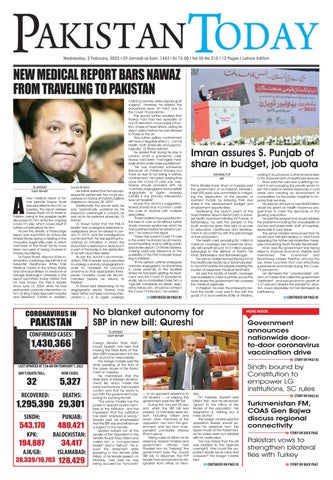
New medical report bars Nawaz from traveliNg to pakistaN
ISLAMABAD
a
staff report
new medical report of former premier Nawaz Sharif was submitted to the LHC on Tuesday. The report advised Nawaz Sharif not to travel to Pakistan owing to the possible health risks posed to him amid the ongoing Covid-19 crisis, which could result in further complications for him. As per the details, a three-page report was submitted by Advocate Amjad Pervez during a hearing of the Chaudhry Sugar Mills case, in which members of the Sharif family have been accused of being involved in money laundering. Dr Fayaz Shawl, director of the intervention cardiology department at Adventist Healthcare White Oak Medical Centre in the United States and clinical professor of medicine at George Washington University, in the report submitted today stated that he had known the PML-N leader since June 13, 2004, when he had performed coronary intervention on him at King Faisal Specialist Hospital and Research Centre in Jeddah,
Saudi Arabia. He further stated that he had subsequently performed two more procedures on Nawaz at Dubai’s Zulekha Hospital on January 28, 2007. Additionally, the doctor said, he was “periodically updated by his (Nawaz’s) cardiologist in London, as well as by his personal physician, Dr Adnan”. Dr Shawl noted that the PML-N leader had undergone extensive investigations since he arrived in London in 2019, and the investigations confirmed that “he has significant ischemia (a condition in which the blood flow is restricted or reduced in a part of the body) in the distribution of his left circumflex artery”. As per the doctor’s recommendation, PML-N leader was supposed to undergo coronary angiography in order to “reassess his coronary anatomy so that appropriate therapeutic modality could be recommended before he returns to Pakistan”. Dr Shawl said depending on his angiography results, Nawaz may need “either complex coronary intervention […] or to again undergo
coroNavirus iN
pakistaN
CONFIRMED CASES:
1,430,366
LAST UPDATED AT 7:56 AM ON FEBRUARY 1, 2022
DAY'S DEATH TOLL:
NEW CASES:
32
5,327
RECOVERED:
DEATHS:
1,295,390 29,301 SINDH:
PUNJAB:
543,170
480,421
KPK:
BALOCHISTAN:
194,887
34,417
AJK/GB:
ISLAMABAD:
38,339/10,703
128,429
CABGS (coronary artery bypass graft surgery)”. However, he added, the procedures were “on hold” due to the Covid-19 pandemic. The doctor further recalled that Nawaz had had two episodes of non-ST-elevation myocardial infarction, a type of heart attack, during his stay in prison before he was allowed to travel to the UK. “Any further solitary confinement will have a negative effect […] on his health, both physically and psychologically,” Dr Shawl warned. He added that during his stay in London amid a pandemic crisis, Nawaz had been “managed medically and is under close surveillance”. “He has improved somewhat [because of] medical therapy but more so due to not being in solitary confinement,” he noted, adding that once the Covid-19 crisis was over, Nawaz should proceed with his “coronary angiography and possible angioplasty or again undergo CAGBS if the [former] intervention was not feasible”. As per the doctor’s suggestion, Nawaz should stay in London under the care of doctors with multiple specialties. “These facilities have provided him the best of care so far without further acute coronary syndromes, which he had sustained before his arrival to London,” he noted in the report. “Given the current Covid-19 crisis in the world, he should, by all means, avoid travelling and/or visiting public places like airport,” Dr Shawl advised, making particular reference to the possibility of the PML-N leader travelling to Pakistan. “In my opinion, until he undergoes coronary angiography, he should stay in close proximity to the facilities where he has been getting his treatment and the Covid-19 [pandemic ends]. His co-morbidities make him a ‘high-risk’ candidate for death, respiratory failure, etc., should he contract the Covid-19 infection,” he added.
CONTINUED ON PAGE 05
Imran assures S. Punjab of share in budget, job quota BAHAWALPUR app
Prime Minister Imran Khan on Tuesday said the government of his Pakistan Tehreek-iInsaf (PTI) party was committed to mitigating the deprivation of the people of southern Punjab by ensuring their due share in the development budget and employment opportunities. Addressing the launch event of the Naya Pakistan Qaumi Sehat Card, a universal health insurance initiative for Punjab, in Bahawalpur, he said the people of the south would be given their right of access to education, healthcare and development in accordance with the percentage of their population. The health card, providing Rs1 million in medical coverage per household annually, will benefit around 10.5 million people belonging to the districts of Rahim Yar Khan, Bahawalpur and Bahawalnagar. The prime minister termed the launch of the healthcare facility as a “landmark step” to accommodate the people bearing the burden of expensive medical treatment. He said the facility of health coverage was available in a few countries across the world where the government fully covered the medical expenses. In Pakistan, he said, the philosophy behind the health card was in line with the goals of a socio-welfare state of Medina,
No blanket autonomy for SBP in new bill: Qureshi
CONTINUED ON PAGE 05
more inside
Government announces nationwide doorto-door coronavirus vaccination drive
ISLAMABAD staff report
Foreign Minister Shah Mahmood Qureshi has said that making the State Bank of Pakistan (SBP) independent is in line with economic responsibility. The foreign minister said this while speaking at the floor of the Upper House of the Parliament on Tuesday. He maintained that the State Bank of Pakistan (Amendment) Bill, which made the bank autonomous, has caused conflict and that he wants to put forth the government’s reasoning for backing the bill. “The prime minister has the power to appoint board members of the institution, and the impression that the institution has been enslaved is wrong,” Qureshi said. He emphasised that the SBP was and will remain a subject to the Senate. Qureshi lashed out at the Leader of the Opposition in the Senate Yousaf Raza Gillani and called him a “compromised leader” and a “sell-out”. He issued the statement while speaking in the Senate after Gillani, in his Senate speech on Monday, had said he was being accused by “turncoats”
adding it would prove a phenomenal step in the improvement of healthcare services. Khan said the card was a defining moment in encouraging the private sector to join the medical network especially in rural areas and creating an environment of competition for the public hospitals to improve their services. He said an amount of over Rs400 billion would be spent on health insurance programmes to meet the demands of the growing population. He said the programme would address the problems including the unavailability of doctors and paramedic staff at hospitals, especially in rural areas. The prime minister announced that he would soon visit Bahawalpur in near future regarding the further administrative measures concerning South Punjab Secretariat. Khan said the government was taking steps to improve economic stability and mentioned The Economist and Bloomberg ranked Pakistan among the top three countries that had effectively sustained economically during the Covid19 pandemic. He dismissed the “unreasonable” criticism of media that called the government “inefficient”, and said economic growth of 5.37 percent despite the pandemic situation could absolutely not be dismissed as inefficiency.
STORY ON PAGE 02
— in an apparent reference to FM Qureshi — of helping the government pass the SBP bill. During the January 28 session, when the SBP bill was passed, 12 members were absent, including Gillani and seven other members of the opposition, two from the government, and two from independent candidate Dilawar Khan’s group. Taking a jibe at Gillani for his absence, federal ministers and government officials had thanked him for “helping” the government pass the crucial SBP bill. In response, the PPP leader had announced his resignation from office on Mon-
day. On Tuesday, Qureshi said Gillani “lies”, and he will remain “glued” to the office of the leader of the opposition. “His resignation is nothing but a mere drama”. The foreign minister said the opposition leader should explain his absence from the Upper House of the Parliament, as his voters were not satisfied with his clarification. “He has stated that the bill was [added to the agenda overnight]. How could the opposition leader be so naive and unaware?” the foreign minister said.
CONTINUED ON PAGE 05
Sindh bound by Constitution to empower LG institutions, SC rules STORY ON PAGE 03
Turkmenistan FM, COAS Gen Bajwa discuss regional connectivity STORY ON BACK PAGE
Pakistan vows to strengthen bilateral ties with Turkey STORY ON BACK PAGE
02
Wednesday, 2 February, 2022 | LAHORE
NEWS
two policemen killed in Hangu attack ISLAMABAD staff RepoRt
Two policemen were killed in an attack in the Hangu district of Khyber Pakhtunkhwa late on Monday, police and rescue teams said. The incident happened in a busy market area of the district, where two unknown gunmen riding on a motorbike, shot the policemen dead and fled the scene, the police said. The two victims were associated with the traffic police department and were performing their duty on a road adjacent to the marketplace when they were attacked. The police termed the attack an incident of targeted killing, saying that an investigation into it is underway. A search operation has also been kicked off in the area to nab the on-the-run militants. No group or individual has claimed the attack.
inflation quickens to 13 percent in January: statistics bureau
Government announces nationwide door-to-door coronavirus vaccination drive ISLAMABAD
t
staff RepoRt
HE government on Tuesday announced a twoweek-long vaccination campaign to administer over 35 million jabs door to door with a focus on hard-to-reach and deprived communities amid fears that coronavirus could become a disease of poverty. Addressing a press conference along with Minister for Planning and Development Asad Umar, Minister of State for National Health Services Dr Faisal Sultan said 55,000 mobile teams will carry out vaccinations at homes. The announcement came weeks after Karachi launched a door-to-door campaign to vaccinate women, who are lagging behind men in rates of inoculation. “We have found that a sizable population of housewives are unvaccinated, and they socialize and attend weddings without face masks,” Qasim Siraj Soomro, provincial parliamentary secretary health, told Reuters. Today, Sultan appealed to the people to support
these teams, stressing the vaccine is effective to protect them from medical complications of Covid-19 variants. He said that with the start of the latest drive, many people who could not get the vaccine earlier will now have the opportunity to avail this facility to protect themselves from potential supply chain hurdles like admission to a hospital, oxygen issues, or other healthrelated problems. “Only vaccine can protect you from all such complications. I advise country people to must go for vaccination against the virus to avoid facing more complications and hospitalization.” He also recommended the citizenry to go for a booster six months after the second Covid-19 vaccine dose as according to the evidence available, this enhances immunity against the disease. He added these booster shots were being provided by the government free of cost just as two previous doses. The minister also urged the nation to fully exploit the initiative, which will not only protect them against the latest Omicron variant but ensure protection from other restrictions such as wearing of masks etc.
He said the only option to avoid carrying this disease and living a normal life was ensuring vaccination. Sultan said the vaccination against Covid-19 entered its second year while the government was facing several challenges in fighting against the disease first identified in Pakistan in March 2020. He said the government was making all-out efforts to ensure the availability of the vaccines at all centres. He said that a large number of people have been vaccinated in the country. He advised to strictly follow Standard Operating Procedures (SoPs) in offices and markets to prevent the spread of disease. He said that the pandemic is a deadly disease but we can control it just as we controlled the earlier waves by following the guidelines. He said the government is seeking full cooperation in adhering to the SoPs. “We can save precious lives including those of our near and dear ones by taking preventive measures. Wear a mask, maintain social distance, wash hands with soap frequently and avoid crowded places,” he said.
Police call for PUBG game ban after family massacre LAHORE MonitoRing RepoRt
ISLAMABAD ReuteRs
The consumer price index (CPI) rose 13 percent in January from a year earlier, the official statistics bureau said on Tuesday, the highest in two years. In December, the inflation figure was 12.3 percent, the Pakistan Bureau of Statistics (PBS) said in a news release. The State Bank of Pakistan (SBP) paused monetary tightening last week, saying inflation momentum had slowed and fiscal tightening by the government would also have an effect on rising prices. It had increased the main policy rate by 275 basis points since September in the face of accelerating inflation but last week said it would hold the rate to see the effects its earlier measures had on rising prices. The next monetary policy announcement is expected in March. Compared to December 2021, CPI rose 0.4 percent in January, the statistics bureau statement said. The increase in CPI compared to last January was led foremost by electricity costs, which went up by 56.20 percent year-on-year, and cooking oils, which rose 50.33 percent. Compared to December 2021, however, electricity prices fell in January by 2.52 percent, the statistics bureau said. Rising fuel and electricity costs have put increasing pressure on the government of Prime Minister Imran Khan. The government last month passed a mid-year budget increasing taxes in a bid to control the fiscal deficit — a move meant to improve chances of a successful review of its International Monetary Fund (IMF) programme. The lender’s board is expected to meet this week to review the nation’s reforms progress and economic targets, the finance minister said. Pakistan entered the three-year $6 billion IMF programme in 2019. A successful review would release $1 billion to the country.
rehman malik hospitalised with covid-related complications ISLAMABAD
The police called for the wildly popular PlayerUnknown’s Battlegrounds (PUBG) game to be banned after a teenager confessed to killing four members of his family in a rage after bingeing for days playing online. Police said Ali Zain shot dead his mother, two sisters and a brother on January 18, and claimed under questioning at the weekend that the game had driven him to violence. “This is not the first incident of its nature,” police investigator Imran Kishwar told reporters in Lahore Monday, adding: “So we have decided to
recommend a ban”. PUBG is an online multiplayer “battle royale” game in which the winner is the last survivor. Kishwar said Ali, 18, lived in complete isolation in his room and was addicted to the game. Reports quoted a Lahore police officer as saying Ali “fired at his family thinking that they will also come back to life, as happened in the game”. Often likened to the blockbuster book and film series “The Hunger Games”, PUBG has become one of the world’s most popular mobile games. Pakistan Telecommunication Authority (PTA) has previously temporarily blocked access to the game
after complaints about its violent content. The game has been banned —
Priest’s killing reignites fear in Christian community PESHAWAR ReuteRs
The killing of a Christian priest in Peshawar has reignited fear amongst local parishioners and brought back painful memories of one of the nation’s bloodiest attacks on the community in the Khyber Pakhtunkhwa capital. Gunmen shot and killed Pastor William Siraj and wounded another Christian cleric, Naeem Patrick, as they drove home from Sunday service at a small church located on the outskirts of Peshawar. “We felt insecure [even] before this. The feeling of insecurity increases when these kinds of incidents take place,” Naqqash Bhatti, a relative of Siraj, told Reuters at the funeral service for the slain priest on Monday. The service, attended by hundreds of mourners, was held at the colonial era All Saints Church in Peshawar
— the site of a twin suicide bombing that killed scores of worshippers in 2013. Following the bombing, a small Christian community set up a smaller discreet church on the outskirts of Peshawar in 2014 — and named it the “Martyrs of the All Saints Church” in memory of the attack. Siraj was targeted just after he had attended Sunday mass at the memorial church, which is nestled in a crammed brick-walled lane surrounded by the modest houses of the local Christian community — many of whom shifted there after the 2013 suicide attack. The intimate community and the memorial church served as a comfort zone for many who lost friends and family in the suicide attack, and struggled to get on with their lives. “We are poor people and work till late night in the city and then return home quite late at night,” said Waheed Masih, 36, who lives across from the church,
briefly or permanently — in several other countries, including India and China.
where Siraj was a regular. “The killing […] has created panic and nobody wants to leave their homes due to fear and terror,” he added. No one has claimed responsibility for the attack on Siraj yet, but it comes amidst a resurgence in militant attacks in Pakistan, particularly along the western border with Afghanistan. Protestant Bishop Humphrey Sarfaraz, who also attended Siraj’s funeral service, told Reuters he had requested the region’s top police official to arrange more security for the Christian clergy and enhanced patrolling for Sunday services. The police have widened their manhunt for two unidentified assailants after the provincial police chief, Moazzam Jah Ansari, ordered investigators to use all available resources to ensure the arrest of the perpetrators. Hina Jilani, chairperson of the Human Rights Commission of Pakistan (HRCP), on Monday condemned the killing, saying the commission sees the attack “as a blatant assault not only on Pakistan’s Christian community but on all religious minorities whose right to life and security of person remains under constant threat”.
First transgender doctor Sarah Gill gets house job at JPMC
news Desk
Pakistan Peoples Party (PPP) leader and former interior minister Rehman Malik has been shifted to a private hospital here after he fell critically ill with Covid-related symptoms. Malik was admitted to Intensive Care Unit (ICU) of the hospital for treatment of lung complications which he developed after contracting Covid-19. The PPP leader had recovered from the coronavirus recently but his health suddenly deteriorated on Tuesday. The number of active Covid-19 cases stayed above 100,000 for the fourth consecutive day in the country, as 5,327 more people tested positive for the virus during the past 24 hours, according to the daily update of the pandemic issued by the NCOC on Tuesday. The National Command and Operation Centre (NCOC) has commenced a countrywide door-to-door Covid-19 inoculation drive from today, according to Planning Minister Asad Umar. Addressing the media and flanked by SAPM on Health Dr Faisal Sultan, the NCOC chief said 55,000 teams are conducting the drive aimed at providing vaccination services at people’s homes. He said the teams would provide first, second and booster doses of the vaccine.
KARACHI news Desk
Pakistan’s first transgender doctor and rights activist Sarah Gill on Tuesday received her employment letter from the Jinnah Postgraduate Medical College (JPMC) and is set to begin her house job in Karachi’s institute. According to a statement released by the Chief Minister’s House, Gill met Executive Director JPMC Professor Shahid Rasool to receive the letter. It further stated that Chief Minister SIndh Murad Ali Shah congratulated Gill on receiving the letter, and said that the government was taking steps to give employment opportunities to transgenders in every sector. The CM vowed to earn the transgenders the respect and dignity “that they deserve in every sector”. The communique further said that
Pakistan People’s Party (PPP) chairman Bilawal Bhutto had directed the institute to offer employment to Gill. It added that CM Murad had also earlier directed the institute to issue the letter as per the directions. About a week ago, the leading transgender activist became the country’s first transgender doctor. Dr Gill had received her education from the JMDC Karachi and cleared the MBBS (Final) exam from JMDC. The JMDC is an affiliate of Karachi University. Dr Gill is also working for an NGO working for the welfare of the transgender community in Pakistan. “I am proud to be the first transgender doctor in Pakistan,” she said. “I will work for the welfare of my community.” Dr Gill said that although her classmates knew her identity, she had to identify herself as a male on the
college admission form because of her parents’ insistence. “Being transgender, I faced many serious problems in my education but I never lost my courage. I would ask all
transgender persons to come forward in the field of education. I have worked really hard to become a doctor. With hard work and dedication everything can be achieved.”
Wednesday, 2 February, 2022 | LAHORE
sindH bound by constitution to emPower LG institutions, sc ruLes ISLAMABAD
t
inp
HE Supreme Court on Tuesday directed Sindh to devolve financial, administrative and political powers to local government institutions as directed by the Constitution as it binned a Muttahida Qaumi MovementPakistan (MQM-P) petition seeking empowerment and
autonomy for grassroots bodies. A three-judge bench, headed by Chief Justice of Pakistan Gulzar Ahmed, heard the case. Delivering his last verdict before his retirement, outgoing Chief Justice Gulzar Ahmed ruled the Sindh government was bound to install effective LG institutions. The apex court earlier had reserved its verdict on the MQM-P’s petition against the Sindh Local
Government Act, 2013, on October 26, 2020. Announcing the short order, the judge said framing master plans and their execution fall under the domain of the local governments. “The provincial government cannot initiate a project which falls under the local government’s control,” he maintained. He remarked the Sindh government was also bound to have a “good working relationship with local governments” for the effective functioning of the system. The judge also ordered to amend the rules of the Sindh Building Control Authority (SBCA) and the Karachi Development Authority (KDA) in line with the Constitution, “while the laws related to the Malir Development Authority (MDA) and the Hyderabad Development Authority (HDA) must also be changed in accordance with the Constitution.” Salahuddin Ahmed, counsel for MQM-P, earlier argued that Karachi’s building control, water supply, local transport and solid waste authorities, among other agencies, are under the control of the Sindh government. He said the local government had the sole responsibility for the maintenance of parks and libraries. The lawyer had maintained that civic amenities, including parks and playgrounds, fall under the responsibility of the Karachi Metropolitan Corporation. He continued that however, KMC does not have authority over the whole of Karachi.
NEWS
03
nePra takes notice of unscheduled load shedding by discos AHMAD AHMADAnI National Electric Power Regulatory Authority (NEPRA) has taken serious notice of unscheduled electricity load shedding by the electricity distribution companies (DISCOs). NEPRA categorically directed DISCOs to avoid such undue load shedding as the same is in clear violation of NEPRA laws. NEPRA on Tuesday said that the authority has taken serious notice of consumer complaints regarding AT&C (Aggregate, Technical and Commercial) based load shedding in the country particularly in the areas of PESCO, QESCO, SEPCO, HESCO and K-Electric. The authority while taking notice of consumer complaints regarding unscheduled load shedding, has directed PESCO, QESCO, SEPCO, HESCO and K-Electric to avoid such undue load shedding and submit a report within one month, failing which the Authority shall initiate legal proceedings under NEPRA Fine Regulations 2021. Similarly, the authority while showing concerns on the data pertaining to T&D (Transmission and Distribution) losses, recovery and AT&C losses have directed PESCO, QESCO, HESCO, SEPCO and K-Electric to initiate proceedings against their concerned officers who are directly responsible for such poor performance.
ecP disqualifies KP transport minister for inciting violence during LG polls nEWS DESK
FIA launches operation against money laundering SHAHAB OMER The Federal Investigation Agency (FIA) has tightened its grip on those involved in the business of illegal foreign transactions. Till now 61 criminals have been arrested in Khyber Pakhtunkhwa (KP) and more arrests are expected, Profit learnt here on Tuesday. FIA sources informed Profit that there has been no reduction in money laundering cases across the country.A large number of Pakistani and foreign
currency transactions were being conducted on an illegal basis. Sources also informed that after the video that went viral on social media regarding the money laundering of Tik Tokker Hareem Shah, authorities have stepped up pressure on officers to identify and arrest those involved in the business. Sources further informed that KP had more people involved in this business than other provinces and people were running this business secretly from their homes. However, lists of all such persons have been
islamabad harassment case: io says police ‘unable to find any witnesses’ ISLAMABAD staff RepoRt
Sub-inspector Tariq Zaman, who is investigating the Islamabad harassment case, told a court on Tuesday that during the probe, the law enforcement agency was “unable to find any witnesses when the couple was allegedly undressed.” He added that the plaintiff “provided the video showing the couple being assaulted in a USB.” During the hearing on Tuesday, lawyers of the accused cross-examined the investigation officers of the case. He informed the lawyers that there are “no eyewitnesses of the case” and the other residents of the apartments were not included in the investigation. Zaman informed the lawyers that “apart from the informant, no eyewitness confirmed the location of the apartment”. He added that when the police visited the alleged crime scene, the apartment was “locked”. The cop informed the lawyers that they tried knocking on the door but nobody responded and they mapped the crime from the outside. He added that in the first information report (FIR), the location of the crime has not been identified. Shafqat Mahmood, the other IO, when asked by the lawyers about who uploaded the harassment video on social media, responded that the “police have written to the FIA for details but are yet to get a response.” At this point, the case was adjourned and the next hearing is scheduled for February 8.
oGra increases LPG price by rs10 per kg AHMAD AHMADAnI The Oil and Gas Regulatory Authority (OGRA) has issued a notification increasing the price of Liquefied Petroleum Gas (LPG) by Rs10 per kg for the month of February 2022. After this increase, the domestic LPG cylinder will be available at Rs2440 after witnessing a hike of Rs120 per kg while price of a commercial cylinder is Rs9387 after an increase of Rs458 for the month of February 2022. The new price is effective from February 1, 2022. LPG Distribution Association Chairman Irfan Khokhar has already demanded from the government to reduce all taxes imposed on LPG to ensure availability of LPG at low rates.
prepared and the process of making raids and arrests has been started against them. The Deputy Director said that this illegal transaction was fatal for the economy of the country and there is a severe punishment in the law. As per FIA Deputy Director “We have cases of money laundering, hawala hundi and banking offenses in KP. We have conducted 62 raids during December and January and arrested 61 accused and recovered Rs105 million. This business is done all over the country but KP is considered its stronghold.”
The Election Commission of Pakistan (ECP) on Tuesday disqualified Khyber Pakhtunkhwa (KP) Transport Minister Shah Muhammad for five years for disturbing law and order situation during the first phase of local government elections in the province. The ECP disqualified Shah Muhammad and his son Mamoon Rasheed for five years for attacking a polling station in Baka Khel, snatching polling material, and abducting the polling staff. On the polling day, incidents of abduction of police personnel and polling staff, and snatching of polling bags at different polling stations of Baka Khel were reported. “The situation warrants the postponement of the polling process in Baka Khel till the normalisation of law and order situation,” the ECP had said. The ECP had also constituted a three-member inquiry committee to probe the incidents.
Full court reference held for outgoing CJP Gulzar nEWS DESK A full court reference was held in honour of outgoing Chief Justice of Pakistan (CJP) Gulzar Ahmed at the Supreme Court on Tuesday. The reference was attended by CJP-designate Justice Umar Ata Bandial, all the judges of the Supreme Court, Attorney General of Pakistan Khalid Javed Khan, Supreme Court Bar Association President Mohammad Ahsan Bhoon and a large number of lawyers. Addressing the reference on the eve of his retirement, CJP Gulzar Ahmed said that since his appointment as a judge of the Supreme Court in November 2011, he performed his functions fearlessly and to the best of his ability. He said since December 2019, when he was appointed as chief justice of the Supreme Court, he did his level best in discharging of his functions. He said there has always been difference in institution and disposal of cases and invariably the institution has always been on the higher side. However, he said during his tenure as CJP, against the institution of 38,680 cases, the court decided 27,426 cases, adding that he, as the CJP, heard and decided 4,392 cases. He said the court has navigated from difficult times, but the current scenario shows that it is still not over. He said the principle of separation of powers is the bedrock of our constitutional structure. It provides the system of checks and balances to ensure that each organ of state stays within the limits of its power or jurisdiction. He said there must be harmony between the three state organs, and they are expected to work for achieving the goals set out in the constitution. The most important attributes of judiciary and judges are independence, fearlessness and integrity. Similar is the onerous and arduous task to be followed by the members of the bar. He said the consultation with the bar has been a continuous process and in this, issues of lawyers were addressed and the matters relating to the court working were amicably resolved. He said during his tenure as the CJP, three
meetings of the National Judicial Policy Making Committee (NJPMC) were held, in which all members participated and major decisions were taken. He said measures were adopted to deal with the crisis of Covid-19 pandemic and a crisis management committee was constituted for monitoring implementation of the measures. He said the process of appointments in district judiciary was expedited. He said history was made with the appointment of first female justice in the Supreme Court. According to a news outlet, Ahsan Bhoon, in his address, said Justice Ahmed had violated the principle of seniority in appointments to the superior judiciary. He said due to this “violation of merit” in appointments, the judiciary was facing a serious
crisis. “If the decisions of the top court and the standards of their implementation are synchronised, then no one will have a chance to point fingers at the court,” he added. He said most of the appointments of judges in the Supreme Court of late were made on the basis of personal likes and dislikes. AGP Khalid Javed Khan said it was necessary to create an ideal procedure for the appointment of judges, “but the current system has yielded good results”. He said Justice Ayesha Malik’s recent appointment as the first female Supreme Court judge was on merit, adding that “transparency in the appointment of judges cannot be compromised.”
Wednesday, 2 February, 2022 | LAHORE
04
NEWS
Lahore court dismisses Meera’s plea, declares her marriage valid A Lahore sessions court rejected a petition filed by actor Meera against a family court’s decision rejecting her plea to declare her marriage document with businessman Attiqur Rehman forged. The Additional District and Sessions Judge Mazhar Hussain, in a short ruling dismissed the appeal and upheld the family court’s decision. It is pertinent to note that the actor denied having any relationship with Rehman and accused him of blackmailing her by claiming to be her husband. She further claimed that Rehman prepared a fake nikahnama to grab her property. In this regard, the family court rejected her plea in May 2018 and declared her marriage with Rehman valid. However, it cancelled said marriage on the basis of a khula sough by her. The plea was filed nine years earlier, in 2009. news desk
IndIan MaLIcIous propaganda agaInst aMbassador Masood Khan faLLs fLat ISLAMABAD
M
MiAn AbrAr
ALICIOuS propaganda by Indian media targeting Ambassador Masood Khan suffered a major dent as Ministry of Foreign Affairs (MoFA) Tuesday exposed Indian lies and also shared details of the career of Masood Khan as a decorated and seasoned diplomat. Foreign Office spokesperson Asim Iftikhar also rubbished the malicious propaganda by Indian media regarding a delay in the appointment of Sardar Masood Khan as the country’s envoy to the uS, saying the “agrément [of Masood] is being processed in the uS system”. Referring to Indian media claims, the spokesperson said that India’s malicious propaganda “is a part of the wider Indian disinformation campaign to malign Pakistan and those who represent Pakistan, by using fake news to make scandalous claims and baseless allegations”. Speaking about Masood, who also served as the former president of Azad Jammu Kashmir, Iftikhar noted that Ambassador Masood Khan “is a highly accomplished diplomat with 40 years of experience in both multilateral and bilateral diplomacy”. After his retirement, Masood became the AJK president and has been advancing Pakistan’s case for the longstanding Kashmir dispute with India. Masood has vast experience in multilateral diplomacy and has been a frequent negotiator for Pakistan. Masood Khan has served in various diplomatic positions at the Pakistan missions in Beijing, The Hague, and Washington DC. Masood during his service served as the ambassador to China as well as a permanent representative to the united Nations. He also remained a spokesperson for the Ministry of Foreign Affairs. His appointment to Washington comes at a time when relations between Pakistan and the uS are facing an uncertain future. Since the uS exit from Afghanistan, there is no clarity about the kind of relationship the uS wants to maintain with Pakistan. Although Pakistan has been seeking broad-based ties with the uS covering all aspects, the uS has so far given little indication
if it is ready to enhance the scope of ties beyond security and Afghanistan. There has been some movement on the ties in recent months after the Biden administration named a full-time ambassador to Pakistan. The uS has not had a full-time ambassador since August 2018. Sardar Masood Khan served as the 27th President of Azad Jammu and Kashmir from August 2016 to August 2021. Immediately before becoming the President, Masood was the Director General of the Institute of Strategic Studies Islamabad, one of the top think-tanks in Pakistan. Sardar Masood Khan Khan had an extensive and distinguished diplomatic career. Most notably, he served as Spokesman of the Ministry of Foreign Affairs from 2003 to 2005; Pakistan’s Ambassador and Permanent Representative to the united Nations and other International Organisations in Geneva, Switzerland, from 2005 to 2008; Pakistan’s Ambassador to China from 2008 to 2012; and Pakistan’s Ambassador and Permanent Representative to the united Nations Headquarters, New York, from 2012 to 2015. In his earlier diplomatic career, Masood held important diplomatic positions in China, The Netherlands, united Nations (New York) and the uSA (Washington D.C). Over the years, he has also held leadership positions in the international community which include: President of the Conference on Disarmament; President of the Biological Weapons Review Conference 2006; President of the Governmental Group of the International Labour Organization (ILO); Chairman
of the ILO Reform Committee; Chairman of the Council of the International Organization for Migration; Chairman of the Organization of Islamic Cooperation in Geneva; Chairman of the Group of 77 and China. In New York, Sardar Masood Khan represented Pakistan as a non-permanent member of the uN Security Council from 2012 to 2013 and became the President of the Security Council in January 2013. While in New York, he was also the Vice President of the Economic and Social Council; Vice President of the uN General Assembly and President of the Executive Board of uNICEF. Masood Khan also remained Pakistan’s Chief Negotiator at the Nuclear Security Summit from 2009 to 2015. In the Ministry of Foreign Affairs, Masood served as Director General united Nations, Director General Nuclear Disarmament, Director General Organization of Islamic Cooperation and Director General East Asia and Pacific. Earlier, he was Director Secretary General’s Office and Director International Conferences. His areas of specialization include nuclear diplomacy, South Asia, Pak-China relations, Pak-uS relations, e-governance, multilateral diplomacy and international humanitarian law, among others. Masood Khan has spoken at prestigious universities and think tanks in the uS, the uK, Europe, the Gulf, China and South East Asia. Masood Khan has led scores of Pakistani delegations to international conferences. Before joining the foreign service, he was a Pakistan Television host and a radio newscaster.
UK PM Boris Johnson cannot answer party questions because of police, minister says British Prime Minister Boris Johnson cannot answer specific questions over lockdown parties in Downing Street because he does not want to prejudice a police investigation into 12 gatherings, his deputy said on Tuesday. British police are reviewing more than 500 pieces of paper and over 300 photographs as part of an investigation into whether the Downing Street gatherings broke Covid-19 lockdown laws. “If he does start answering specific questions that have been referred to the police, he will be accused, in fact fairly and rightly, of prejudicing or preventing or interfering in that investigation,” Deputy Prime Minister Dominic Raab told Sky News. After initially saying that no rules were broken, Johnson has repeatedly declined to answer specifics about his own attendance at some of
the gatherings. He later admitted being at one gathering but said he thought it was a work event. On Monday, he repeatedly declined to say if he had been at a gathering at his own apartment above the Downing Street office, citing the police investigation into the incident. Opposition parties said a police inquiry should not preclude Johnson from answering specifics, especially in parliament — the supreme crucible of British democracy. “What happened was the Metropolitan Police asked that the full report not be published at the moment, but the idea that that prevents the prime minister from saying whether he was at a party on a particular day is absolute nonsense,” Opposition Labour Party leader Keir Starmer told BBC TV. Agencies
Turkish hijab, abaya designs attract women in Pakistan LAHORE AnAdolu Agency
The latest designs of Turkish abayas and hijabs are gaining popularity in Pakistan. The abaya look like a jacket or a formal coat and the hijab covers the head. They are making it easy and modern to adapt. On World Hijab Day which falls on February 1, Karachi-based abaya and hijab designer Nida Imran launched her latest collection of Turkish designs. “Most of my customers are young girls who go to school, college or the office. They are now preferring the Turkish style abaya and hijab as they are more comfortable and easy to carry,” the 34-year-old designer told Anadolu Agency. Due to demand and the latest trends, the designer has to launch a new collection every few months. “In Pakistan, due to weather conditions, we have to launch a new collection after four to five months. And as the wedding season starts in
CMYK
winter, we get lots of orders for the festive collection. In that collection we create fancy abayas with their matching hijab, again taking inspiration from Turkish styles,” said Imran. According to research by Pulse Consultant, a marketing firm, the “hijab” trend — a trend from the Arab world — has nearly tripled among young urban females from ages 16 to 28 in Pakistan. Ten years of research show that 9 percent of young urban girls prefer wearing hijabs outside their homes in 2008. That figure soars in 2018 to 25 percent. The report was released in 2019. “The study was conducted in 14 top cities of the country and the latest data is also being ready at the moment which will be released in coming months. The data shows that numbers have increased more than double again,” Pulse Consultant CEO Kashif Hafeez told Anadolu Agency. SuStainable faShion with budget: By carrying hijabs and abayas, women are choosing sustainable fashion that
is also in their budgets. “One casual abaya with hijab starts from Rs2,000 and the festive collection goes to a maximum of Rs8,000 to Rs9,000 and the customer wears the casual abaya eight to nine hours daily and the fancy abaya four to five hours depending on the function they are attending,” said Imran. With trends in the different Muslim countries, options and styles have expanded from the basics. “Just four to five years ago, we only used to make abayas and hijab in black color but now after the Turkish and Malaysian trends, we have launched a range of colors because those style of hijabs look better in different colors and black absorbs more heat. That is why people are now preferring nude, white or light color hijabs,” according to Imran. Pulse Consultant data showed almost 40 percent of young urban females prefer to carry the chaddar — a big piece of cloth to cover themselves — when they go outside of their houses.
Wednesday, 2 February, 2022 | LAHORE
NEWS
New medical report bars Nawaz from traveling to Pakistan continued from page 01 The doctor further mentioned that during Nawaz’s recent evaluation, “I found Mr Sharif under a lot of stress, [and] if he returns to Pakistan without undergoing a definitive treatment in London, the stress of living in solitary confinement and loss of a partner can further compromise his cardiac status.” “If he returns to solitary confinement, he may develop what we call the takotsubo syndrome (a type of heart failure) due to stressful environment” and it could have “devastating consequences”, Dr Shawl warned. It is pertinent to note that Nawaz has been in London since November 2019, when he was undergoing medical tests, and he was scheduled to undergo cardiac catherisation at the time. In January 2020, doctors evaluated whether he would need a heart operation, bypass, or a stent. Due to his haematological issues, family sources had said that at the time, they had considered travel to the US to address his complications. The former prime minister has had two major cardiac interventions in the past (2010 and 2016) and experienced thrombocytopenia in 2019, when he was granted permission by the Pakistan Tehreek-iInsaf government to travel abroad for medical treatment. Without the third cardiac surgery he has been advised to undergo, it appears unlikely that the former prime minister will return to Pakistan. Meanwhile, the Punjab government recently constituted a nine-member special medical board to examine the documents submitted as medical reports of the former premier by his UK physician, Dr David Lawrence, and give its expert medical opinion regarding the patient’s physical condition and his ability to travel back to Pakistan. However, the board members claimed that they could not give a structured opinion on Nawaz’s condition or ability to travel without details of his current clinical evaluation, blood reports, imaging results and procedures. Information Minister Fawad Chaudhry, while reacting to Nawaz’s medical report presented in court today, advised the former prime minister to return the country’s “looted” money and to continue living in London. He stated that a doctor from the US state of Washington had written Nawaz’s medical report, even though the former premier was residing in London. Terming the report as “fake”, the minister said that such reports were making a mockery of the country’s judicial system and laws. “You will not achieve your goals by sending such false reports,” he said. The information minister also mocked the contents of the medical report and said that it was only missing the direction that Nawaz could not walk in any other place apart from Hyde Park as it would increase his stress levels. Chaudhry was apparently referring to a photo of Nawaz from 2020, wherein he was seen having tea outside his son’s office near Hyde Park. After the photograph was widely shared on social media, PTI leaders, including Chaudhry, had lambasted Nawaz, accusing him of lying about his health to leave the country. He further expressed the hope that the courts would take notice of the false report and the manner in which Nawaz left the country.
Governor Sindh instructs SSGC to disconnect gas of industries using suction devices SSGC management met with Governor Sindh Imran Ismail and delegation of trade associations and industrial bodies at the Governor House, Karachi today. Besides other issues, use of heavy and strong suction boosters by the industrial units was also discussed. Governor Sindh took serious notice of this blatant violation and an unethical practice that is severely affecting the gas supply system in Karachi. It should be noted that the use of suction boosters is tantamount to committing gas theft as additional gas drawn by Suction Boosters affects the metering system and its measuring capability. On the occasion, SSGC Management presented a list of around 189 industries suspected to be involved in the use of illegal suction devices. The Governor ordered immediate disconnection of gas to all such units involved in this criminal activity. Press release
05
PM lauNChES QauMi SEhat Card ProGraMME iN BahaWalPur BaHaWaLpur
P
With inclusion of more than 10.5 million people from Rahim Yar Khan, Bahawalpur and Bahawalnagar districts, the number of eligible families and individuals benefiting from the Qaumi Sehat Card scheme in Punjab will increase by 63 percent. Qaumi Sehat Card is a revolutionary initiative by the government which will provide free medical treatment in government and selected private hospitals up to one million rupees. Earlier, in a tweet today, Minister of State for Information and Broadcasting Farrukh Habib said the PTI is the first government which is providing Sehat Cards to each family without any discrimination.
staff rePort
RIME Minister Imran Khan on Tuesday launched Naya Pakistan Qaumi Sehat Card Program. According to details, Chief Minister of Punjab (CM) Sardar Usman Buzdar and other provincial and federal ministers were also present on the occasion. As per Prime Minister’s Office, Qaumi Sehat Cards have already been issued in Khyber Pakhtunkhwa, some divisions of Punjab, Islamabad, Tharparkar, Gilgit-Baltistan and Azad Jammu and Kashmir.
Pakistan to host Commonwealth youth ministerial conference in Aug: Dar iSLamaBad staff rePort
Special Assistant to the Prime Minister (SAPM) on Youth Affairs Muhammad Usman Dar has said Pakistan is all set to host the 10th Commonwealth Youth Ministerial Conference on August 12, which will prove to be an important platform to present soft image of the country and showcase the youth talent. Addressing a press conference here on Tuesday, Dar said that around 54 youth ministers of commonwealth countries were expected to attend the conference. He said that Pakistan will observe 2022 as the year of youth. The federal government will assist the provincial youth departments in organising youth engagement
events during the current year.” Under the vision of Prime Minister Imran Khan, the government has been working on youth development initiatives and also ensuring best employment opportunities, he added. He said the Kamyab Jawan Programme has organized over 500 events of youth engagement like job fairs, sports and talent hunts and cultural shows. The SAPM said the government has allocated Rs100 billion for the disbursement of soft loans under the Kamyab Jawan Programme and is distributing two to three billion rupees per month to around 2,000 young entrepreneurs. The Kamyab Jawan Programme has disbursed Rs8.1 billion in the last three months for
establishing 5,000 businesses and providing some 15,000 jobs to the youth, he added. He said that in the third phase of “Skills for All” (Hunarmand Pakistan) scholarships programme around 60,000 youth will be provided scholarships for various courses in traditional and high-teach trades. The SAPM mentioned that over 100,000 youth had already completed their courses in multiple trades under the two phases of Hunarmand Pakistan Programme that was launched a couple of years ago under the banner of Kamyab Jawan Programme (KJP). Under the third phase, he said technical and vocational training would be provided to the youth in 250 courses in more than one thousand institutions across the country.
Imran assures S. Punjab of share in budget, job quota continued from page 01 Instead, he pointed out the international media, including BBC, reported about the “stories of massive corruption” committed by the leaders of two previous governments of PML-N and PPP. He said Pakistan suffered immensely during these two tenures just like that “even a factory can become bankrupt if a dacoit is appointed at the top”. The prime minister said the government was committed to bringing the corrupt answerable before the law and recovering the nation’s looted money. Chief Minister Sardar Usman Buzdar said the launch of a healthcare project in the Bahawalpur division will raise the number of people and households in the national health programme in Punjab by 65 percent. He said over 100 hospitals had been empanelled in three districts where the patients would be able to avail medical treatment from the public and private hospitals. By March, he said, the programme would be expanded to all 36 districts of Punjab benefiting around
110 million, adding the provincial government was contributing billions for the health coverage, especially for cancer patients. Minister for Industries and Production Khusro Bakhtiar said Bahawalpur was the first division in South Punjab to get the facility of health insurance from the Rs400 billion mega programme of federal and provincial governments. He said several revolutionary projects including Ehsaas socio-welfare programme was in line with the government’s vision of facilitating the common man and urged the local public representatives to guide the public to benefit from the initiative. Prime Minister Khan flanked by Chief Minister Buzdar and Punjab Health Minister Dr Yasmeen Rashid launched the programme by distributing health cards among the locals of the Bahawalpur division. The programme has already been launched for the people of Khyber Pakhtunkhwa, Punjab, Islamabad, Tharparkar, Gilgit-Baltistan and Azad Jammu and Kashmir.
PEW lauds PM’s Sehat Card scheme iSLamaBad staff rePort
The Pakistan Economy Watch (PEW) has lauded Prime Minister Imran Khan for launching the Naya Pakistan Qaumi Sehat Card scheme to provide health insurance to families across Pakistan. Now private and government hospitals will no longer have to pay premium for universal health coverage and both private and public hospitals will offer treatment to the people. In a statement issued here today, Chairman PEW Brig. (R) Aslam Khan said that the ambitious project will help the rich and the poor to have free healthcare for the first time in the country. The scheme will cost the government Rs450 billion and will provide free medical treatment to the people and each family can avail treatment worth Rs1 million annually, he said. The introduction of the health card scheme would put pressure on government hospitals to raise their standards and if they fail to do so, then people would opt for private hospitals and the government hospitals will not be able to generate revenue, he added.
No blanket autonomy for SBP in new bill: Qureshi continued from page 01 Commenting on the SBP bill, the foreign minister said it is not right to say that the central bank had been enslaved by foreign bodies. “The State Bank is an autonomous institution.” Talking to journalists after the Senate session, Gillani said he did not expect Qureshi to “stoop so low” and termed the foreign minister’s speech against him a “contempt of the Senate”. He lashed out at FM Qureshi, saying that he had requested to give a policy statement. “But instead of a policy statement, he started a tirade against me. The foreign minister has lowered his ethical standards without any reason. I did not expect him to stoop so low,” the PPP leader added. The Senate session was adjourned till Friday.
PIA unveils IATA-prepared five-year business plan KaracHi staff rePort
The Pakistan International Airlines (PIA) on Tuesday unveiled its five-year business plan prepared by International Air Transport Association (IATA) and presented it to the Ministry of Finance for approval. Federal Minister for Finance and Revenue Shaukat Tarin, chairing a meeting on PIA’s Corporate Business Plan 2022-26, on Tuesday said that the government believes in reviving and regaining the past glory of PIA and making it a profitable organisation. He stressed to focus on the Pakistani diaspora, better customer services and consider the possibility of direct flights in the business plan to make PIA a flourishing organisation that may contribute for economic development of Pakistan and service our
communities at home and abroad. While appreciating hard work done by the consultant, the chair emphasised that PIA is a national flag carrier and needs to be a world class airline. The business plan is aimed at eliminating the deficit and restoring the lost glory of the national carrier. The IATA had prepared the business plan at the request of the government and the finance ministry and as per the plan, the PIA would fly into profits by 2024. The number of PIA planes will be increased from 29 to 49 gradually and the fleet will consist of 16 big and 27 small aircraft and six modern turbo propellers. Resultantly, the number of PIA passengers will also go up from 5.2 million to nine million. As per the five-year plan, PIA’s assets will be increased from $1.196 billion to $2.183 billion in 2026. The national airline will expand its net-
work, adding more flights to lucrative routes such as the UK, UAE, Saudi Arabia and the Gulf. “PIA will launch new routes to destinations of Baku, Hong Kong, Istanbul, Kuwait, Tehran, Urumqi and Singapore,” the fiveyear plan document reads. The IATA plan stated that the PIA will focus on the cargo and the charter business as well along with passengers’ revenue model. However, the implementation of the business plan has been linked with few things like the federal government will have to complete PIA’s financial restructuring. It has also been stated in the plan that the government has to implement the 2019 National Aviation Policy in true letter and spirit that asks the government to protect the national airline’s interests. To establish the PIA on a commercial basis external influence and
cmYK
interference must be eliminated. Federal Minister for Aviation Ghulam Sarwar Khan, Secretary Aviation, Secretary
Finance, Secretary EAD, PIA board of directors and members, CEO PIA and senior officers attended the meeting.
06-07 Comments - 2nd February 2022_Layout 1 2/1/2022 10:34 PM Page 1
Wednesday, 2 February, 2022
06 COMMENT
Events that Shape Our Lives
How to remove a constitutional trap Through Parliament or courts?
School shootings are also scarring
W
HAT appears from the petition of the SCBA President to the Supreme Court is that there is a strong opinion in the lawyers top association against the lifetime disqualification of lawmakers which it considers to be against the norms of justice. In 2018, a fivejudge Supreme Court bench unanimously held that disqualification handed down under Article 62-1(f) of the Constitution is for life. It was maintained in the SCBA’s plea that the Supreme Court exercises extraordinary and original constitutional jurisdiction but does not act as a trial court. Reportedly the SC office has returned the plea on the ground that the matter had already been resolved. Further, an objection was also raised on the locus standi of the petitioner. The lawyers’ body is now supposedly considering moving an appeal against the registrar’s objections. What turns out to be the fate of the petition remains to be seen. Interestingly none of those who could be beneficiaries in case the SC reverses the lifelong ban is a party to the appeal. Estranged PTI leader Jahangir Tareen has in fact told media that the SCBA did not consult him before filing the petition. Both nawaz Sharif and Tareen were disqualified for violation of Article 62(1)(f), which sets the precondition for a member of parliament to be “sadiq and ameen” i.e., honest and righteous. There is a view that as the disqualification is based on a constitutional provision, this can only be undone through a constitutional amendment with retrospective effect. In fact both the PPP and PML(n) failed to make any move to strike down the constitutional provisions introduced by military dictator Ziaiul Haq with ulterior motives. While the lawyers may try to get the lifelong disqualification changed to a time-specific punishment, it does not suit the politicians to seek the SC’s help by accepting the legality of the punishment while seeking reduction in sentence. The politicians have been rightly accused of resolving political differences through litigation rather than through mutual talks or recourse to Parliament. It has been rightly maintained that by going to the courts they surrender the Parliament’s turf to judiciary, thus becoming a party to the reduction of what happens to be their own sphere. While Parliament may take longer to reach a consensus, this will remove a permanent source of political destabilization and enhance its prestige.
Washington Watch Dr JAMes J Zogby
I
n his ground-breaking 2008 book, The Way We’ll Be, my brother John used his decades of polling to observe and define the values and worldviews that are unique to different age groups of Americans. It wasn’t their biological age that was determinate; it was the life experiences— the defining events and traumatic moments— they shared with their contemporaries that shaped their views, their values, and their sense of future possibilities. I’m speaking here of events and moments that have impacted the nation, not those that have occurred in our personal lives or those that have impacted groups or communities within the nation. And while this is true for every generation in every country, I want to look at how this has played out in my life in the USA. My mother’s generation, for example, was shaped by the two world wars that bracketed the Great Depression. These dramatic events left scars, to be sure, but they also altered people’s outlook and behaviour. Because that generation knew hardship and loss, they scrimped and saved in their struggle to achieve security and stability in their lives and those of their offspring. The shared sacrifices that accompanied the great wars also fueled a patriotic fervour, a belief in government as a constructive agent for change and a commitment to national service. My generation lived through the Cold War and the “Red scare.” In school we had regular drills where we were required to hide under our desks to protect ourselves from nuclear attacks. This, of course, provided no protection, but it did create a powerful fear both of “the bomb” and the Communists who we were told might attack us.
Accountability farce A failed experiment
T
WO acquittals by accountability courtsin highprofile corruption cases, and a contempt of court notice served to the national Accountability Bureau (nAB) by the Islamabad High Court (IHC) in the last one day, has further exposed how big a farce the accountability process under the PTI government over the past three years really is. Sixteen persons, including a PML(n) MPA, who were made part of a reference in the SaafPani corruption case filed by nAB in 2018were found not guilty of any alleged financial malfeasance or procedural irregularities. Separately, Mir Shakil Ur Rehman, who was arrested and kept behind bars for eight months in relation to a 34-year old property transaction dispute case was also acquitted, with the court commenting that pursuing the case further would be a “futile exercise” due to a lack of evidence presented by nAB. Lastly, the IHC issued a notice to the nAB chairman asking why an investigationm into former President Gen (retd) Pervez Musharraf’s assets had not been initiated by the accountability watchdog despite the court’s ruling that Musharraf had been an office holder and therefore was not exempt from a probe into how he amassed assets well beyond his known sources of income. All three cases display a selective system of accountability that was heavily influenced by politics, that was quite obviously skewed against opposition politicians and bureaucrats related to past regimes. That the prosecution in theses cases was not able to produce a shred of evidence that would support its case but was still able to keep the accused incarcerated for months, in some cases years, just goes to show how the motivation behind the entire exercise never really was to genuinely address the ‘menace of corruption’ but to persecute the opposition into submission and in some cases even to settle petty personal scores. nAB’s resistance to pursuing certain individuals or cases with the same ferocity and determination to arrest with which it has gone after virtually every major opposition politician, including a former Prime Minister and a sitting provincial assembly speaker, is a symptom of the malaise that runs much deeper than just the individuals calling the shots at nAB. Those who pushed this policy through in 2018 are perhaps now dialing it back as the political climate changes and the net effect of this failed accountability experiment is that abuse of public office for financial gain has only increased.
MUHAMMAD ALI ALVI
Y
OUTH shapes the future of a nation. Investing in youth today will ensure a better and more productive future tomorrow. Pakistan has been blessed in a way that a major chunk of its population is young. It is one of the youngest nations in the world. According to the UnDP, 64 percent of Pakistan’s population is below 30 years of age and 29 percent of it is in the age bracket of 15 to 29 years. Youth should and must engage and participate in the electoral process wholeheartedly. Its participation means the involvement of a young and vibrant population in the electoral process for the selection of the best rulers suitable for the state. It also transfers power back into the hands of a young population which is more aware of its rights and duties and cannot be tricked easily. And, if it is somehow deceived, it can learn from its mistake to not repeat it in future. But, for that, youth must vote. And, the youth voter turnout ratio should be very high if not 100 percent. Voter turnout is very low in Pakistan as compared to other countries. In the 2018 general elections, voter turnout was 51.7 percent which saw a drop of more
Founding Editor
Yousaf Nizami Umar Aziz
Joint Editor
Joint Editor
Executive Editor
Lahore – Ph: 042-36300938, 042-36375965
Then there is the toll taken by covid-19. Normal life has been disrupted for the past two years. For the greater part of this period, children, at different stages of development, were denied needed interaction and social development— not to speak of the impact it has had on their learning.
Youth turnout is even lower than average turnout
Arif Nizami (Late)
M. A. Niazi
ers were faced with foreclosure on their mortgaged homes. During this moment of national angst, Barack Obama was elected president with a message of hope and change. He succeeded for a time in inspiring many, but was soon undercut by a divisive campaign with subtle and not-so-subtle themes of racial resentment and racially infused fear of his “otherness.” This campaign gave way to deeper and now dysfunctional partisan polarization, xenophobia, a decline in public confidence in once revered institutions, ultimately paving the way for the election of Donald Trump. With this backdrop, one cannot help but wonder what moments and events that will shape and/or scar the lives of our grandchildren? Over the past week, conversations with my children gave me some answers. My daughter told me that a classmate of one of my granddaughters recently boasted of how during an “active shooter drill” he had secured the “best hiding place”— one where he would never be found by a gunman. I hadn’t realized that these drills are a common feature in schools that children now accept as routine. And why wouldn’t they? With mass shootings occurring almost daily and an average of two school shootings each month, it is felt that such measures are in order. Add to this, the deepening racial divide, and the mass movements that erupted in response to wanton police and vigilante violence. And then there is the toll taken by covid-19. normal life has been disrupted for the past two years. For the greater part of this period, children, at different stages of development, were denied needed interaction and social development— not to speak of the impact it has had on their learning. And finally, there is the partisan anger, the weaponization of the hatred of “others,” and the vulgarity of the Trump era and its residual effects on our political and social culture. These era-shaping developments will have a farreaching effect on the generation that is coming of age in the third decade of this new century. How they play out and whether, in this context, it will be possible to recreate a sense of national purpose and unity remains to be seen. The writer is President of the Arab American Institute
Abysmal voter turnout in youth: an alarming sign
Dedicated to the legacy of late Hameed Nizami
Editor Aziz-ud-Din Ahmad
Then came the Vietnam War and the military draft which compelled millions of young men to fight in a war that could never be won. Reaction to Vietnam and the draft spawned an anti-war movement that divided the nation and shattered the Cold War notion of “patriotism.” Simultaneous with the transformative impact of the war was the rise of the civil rights movement, which not only saw advances in rights for Black Americans, but also created a growing awareness of racial injustice among many in the majoritywhite community. And finally, my generation was rocked by the assassinations of President John F. Kennedy, his brother Robert, and Martin Luther King, and the demise of President Richard nixon, who was forced to resign in disgrace. The trauma created by these momentous events combined, left the country in shock that ultimately challenged the dominant political and social culture that had held sway for a generation. My children came of age during a period that began with relative calm. The Cold War had ended with the USA feeling that it had emerged as the victorious sole superpower. There were also problems to be sure. Partisan politics became bitter. Economic disparities grew and racial injustices continued to boil. Yet, for nearly a decade and a half, many lived with a renewed sense of promise and hope in the future. This calm was shattered by the terror attacks of 9/11 and the fear and national hysteria that followed. Americans didn’t just watch the attack on new York’s iconic World Trade Center. They lived and felt it personally, creating fear and feelings of vulnerability. Then came the two long wars in Afghanistan and Iraq with the steep price they exacted in lost lives, innocence, and prestige. In their effort to recreate the patriotic fervour that sustained national unity during the great wars and the Cold War, ideologues in the Bush administration sought to elevate first Al Qaeda and then Saddam Hussein and the Islamic Republic of Iran as existential threats. As the wars dragged on, however, what became clear was that the USA was no longer the singular superpower. We were broken. Cynicism and division replaced patriotism. Then came the great recession of 2008-2009. In just a few months, unemployment doubled, some Americans lost their entire life’s savings, and one in five homeown-
I
Karachi – Ph: 021-35381208-9
I
than three percent compared to the election in 2013. In 2013, Pakistan ranked at “164th in terms of voter turnout among the 169 counties that have had democratic elections over the past 50 years” according to a document jointly produced by nADRA and ECP, a newspaper reported. The most worrisome aspect is the abysmal youth voter turnout ratio. According to a report published by PILDAT, “the youth voter turnout in the last eight elections happens to be just 31 percent which is 13 percentage points lower than the average overall voter turnout in these eight elections.” It also revealed that the average youth voter turnout in the last two general elections was estimated at 31.5 percent as compared to the average voter turnout of 53 percent.. There are several reasons for the low voter turnout in youth. The first among them is the lack of trust in the electoral process. Almost every election has been marred by controversy in Pakistan. The cries of election rigging and stolen mandate start to echo soon after the results are announced or sometimes they are even heard before the election. When children grow up witnessing these events, a firm belief is established in their minds that their votes have no meaning, no value, as everything is pre-planned or lacks transparency. So there is no point in taking part in the voting process. The penetration of these thoughts not only makes the youth alienated from the electoral process but also creates mistrust in youth about the system of which they are going to be part of in future. Similarly, the lack of awareness also prevents the youth from using their rights. The youth is unaware or uninformed about the constructive role they can play. They are ignorant of the fact that every vote matters. And, voting is a national duty and responsibility of an informed and mindful citizen. Children learn from their parents, peers and elders. As voter turnout is low in Pakistan, they do not learn to vote from the ones they learn from. Other than a national duty or the need of a state, voting is a personal choice as well. A personal choice
Islamabad – Ph: 051-2204545
I
Web: www.pakistantoday.com.pk
I
of a person with an opinion. But, unfortunately, children grow up in a way that they have to conform with the political ideas of their family, caste or tribe instead of developing their political understanding. It is rare for teenagers to have their own political opinion. It is rather difficult for a young person to develop an opinion and vote for the person of his or her choice. So this results in a lack of interest in youth. Dynastic politics, feudalism, and elitism have marred our political setup. Educated youth often do not fall prey to these elites and disapprove of this elitist culture. But, when they cannot change anything, they take the least difficult option,which is not to be part of the process. The ultimate aim of an elected government is the welfare of the state. That is the reason people vote. Youth has high ambitions and aims. It wants to progress by leaps and bounds. But, when youth do not see any improvement in the situatio, like. jobs creation, more business opportunities, education, recreation and health facilities, and so on, they feel discouraged and deceived. This discouragement and disappointment prevent them from voting in future. Having said that, youth should be encouraged to vote. It should be made part of the cycle. Its participation is so important because it gives them a reason to believe in the system and be involved in the process. First of all, youth should be made to realize the importance of voting. They should be given awareness of the change they can bring because of their numbers. They should be given a free hand in developing an opinion and exercising that opinion in the form of a vote. It will give confidence to the youth and ensure their participation in the electoral process. Unfortunately, youth do not get systematic training at school, college and university levels. Because student unions are banned in Pakistan. Student unions with all their pros and cons do provide requisite training to youth and allow them to develop an opinion and exercise the right to vote in a systematic way. This training helps the youth understand the importance of voting for the national cause and foster a culture of political participation. But, it is very unfortunate that the politicization of the student unions in the past has prevented the current generation from becoming part of a learning cycle. The writer is freelance columnist
Email: editorial@pakistantoday.com.pk
06-07 Comments - 2nd February 2022_Layout 1 2/1/2022 10:34 PM Page 2
Wednesday, 2 February, 2022
COMMENT 07 Editor’s mail Send your letters to: Letters to Editor, Pakistan Today, 4-Shaarey Fatima Jinnah, Lahore, Pakistan. E-mail: letters@pakistantoday.com.pk Letters should be addressed to Pakistan Today exclusively
Transparency International (TI)
Roadblocks in Pak-Afghan relations There is much in the history of the two to make for a difficult relationship
Dr rAJkUMAr sIngH
T
HE regional and global powers are equally anxious to establish a stable and development-oriented government in Afghanistan which, in the recent past, has suffered a lot in the shape of internal civil war and external pressure with the hope that soon a day will come in its favour and all odds will also set aside sooner or later In the phase of uncertainty and chaos beginning from April-May 2021three possibilities emerged, which could be realised in future: a. negotiated settlement, b. civil war, c. Taliban takeover. As the first ideal idea aborted, the second prolonged for months but ultimately, the third option emerged stronger and it became clear on 15th August 2021that the Taliban’s regime, repeating many features of earlier rule is the current fate of war-torn Afghanistan and with this, the Taliban of the country emerged as the strongest political force of the nation in days to come for internal development and as chief negotiator with foreign countries. There onwards the future of Afghanistan was tagged on securing a stable position by the Taliban, recognition of the new regime by foreign countries and amount of funding received from foreign countries, particularly the USA. In the whole Kabul episode, Pakistan played an important role and remained standing by the side of the Taliban, provided moral as well as material support and also convinced the People’s Republic of China to help the Taliban against India and the USA. In the name of opposing the USA, Russia kept itself mum for having a soft corner for China and maintaining working relations with new Delhi, upsetting the entire regional strategy and balance of power. However, in no way, this development cast a positive shadow on bilateral relations between Pakistan and Afghanistan which has a history of decades-old sovereignty concerns, security interests, geopolitical dynamics, cross-border ties, two-way connectivity and trade. They all deserve proper attention to make their relations smooth and normal in future. Despite differences on several counts, the seven-decades relations between the two remained interesting for regional politics and superpower strategy in South Asia as Islamabad
aligned itself with the USA and its forces in the global arena where it faces a hostile USSR for a long time, while its arch rival and enemy, India, after maintaining a non-aligned position for decades, ultimately sided with the USSR against the USA in the wake of the Bangladesh crisis. Initially, Afghanistan refused to recognise Pakistan when it was formed as a result of division of the Indian Subcontinent in August 1947, yet over the years and decades the coming happenings of global politics-US-Saudi backed proxy warfare, sponsorship of the Taliban and the post9/11 event put the two countries, Pakistan and Afghanistan, in the same basket in regional and global parameters to be aligned with the USA. The current and past connections between the two failed to check the roadblocks of bilateral relations which kept them poles apart till date. In that context the most pinching for Islamabad is Afghanistan’s refusal of the colonial-era boundary, called the Durand Line, as a defining international border which divides the entire population of Pashtun people in two parts who are living alongside the border and on the issue, both accuse each other for fomenting proxy groups by interfering in one’s internal matter and shape policy orientation. Having no solution in sight, Pakistan deepened its anti-Afghan approach in post-1971 periods and began arming and training Islamist fighters to counter proPashtun groups in Kabul. In the 1980s Pakistan also refused Kabul’s demand to close the border to stop entry of the Mujahideen who were fighting against the Soviet forces in the name of religion. Afghanistan took it seriously and assumed that Pakistan had/has no respect for Kabul’s security and at the same time feared a comeback of anti-national forces from across the border. Even the present Taliban’s dispensation of Kabul is in no mood to accept the settlement in favour of Islamabad. Long pending issues between the two have, to a large extent, shaped their perceptions towards each other which shaped their relations. Under the impression that Islamabad had sought to develop strategic depth in Afghanistan by backing friendly governments in Kabul and limiting new Delhi, Afghanistan continued to accuse Pakistan for much of the violence in recent decades. For years and decades Pakistan, in the wake of Soviet intervention in Afghanistan, helped anti-Soviet forces in the country and desired a government
that liked to hate both the USSR and India. The funsd taken in the name of ending terrorism in the region and specially from Kabul were strategically spent for fueling and arming anti-Afghan guerilla groups living in Afghanistan through the Inter Services Intelligence (ISI). In another words, the money and materials given by the USA were used against the US interests in the region and nourishing terror groups in the post- 9/11 phase which ultimately defeated the forces of the USA and its allied Western powers in the year 2021. In a nutshell, the bilateral relations between Pakistan and Afghanistan remained under pressure as Islamabad refused to comply with Kabul’s security concerns in terms of its relations with India and alleged Indian and Afghan support to anti- Pakistan militants for a long time on an almost regular basis. Security and strategic concerns apart, the emergence of Tehrik-iTaliban Pakistan (TTP) has been a hot and burning issue between the two countries. In the context Islamabad accuses both Afghanistan and India not only for the TTP’s emergence, but for its becoming a potent anti-Pakistan terror group responsible for many blasts in the country. In addition, there is the cross-border people-to-people relationship and movement of refugees as well as families, commercial commodities, supported by the Pashtun population along both sides of the border, who are still angered on account of their having inadequate representation in government and bureaucracy as well. It all has limited the opportunities for the trade, investment and cross-border engagements essential for the smooth sailing in troubled waters for a long time to come. The trade pact negotiated between the two in 2010, the Afghanistan-Pakistan Transit Trade Agreement (APTTA), largely useful for both countries, have been slowed down in recent years, often leading to the closure of the border, limiting its scope around the border and the situation is likely to continue for some time to come harming the national interests of both.
Security and strategic concerns apart, the emergence of Tehrik-iTaliban Pakistan (TTP) has been a hot and burning issue between the two countries. In the context Islamabad accuses both Afghanistan and India not only for the TTP’s emergence, but for its becoming a potent antiPakistan terror group responsible for many blasts in the country
Dr. Rajkumar Singh is presently Professor and Head, Department of Political Science and Dean of Social Sciences at B.N. Mandal University, Madhepura (Bihar), India. His 19 books published in addition to 900 articles in national and international journals and daily newspapers from 25 foreign countries.
TI is considered a credible authority when it comes to reporting the Corruption Index of different countries. For many donors its reputation is impeccable and it is considered a genuine benchmark like many other international watchdogs in their respective areas of expertise. This fact may be difficult to contest however, many such international or national watchdogs have gradually started losing their finesse and shine with the passing time as they have embedded themselves within the local institutional landscapes and social fabrics, be it in the East or in the West. Take the case of the TI Pakistan Chapter. They were bubbling with reporting corruption cases from 2008 to 2012 as they were being actively supported through Suo Moto of the then Chief Justice. Come the next government and the TI Pakistan stopped reporting corruption cases with the same frequency. The ratings for the period 2012 to 2018 are unfortunate. no matter how much significance international donors give to the work of TI, the reality at the country level in many cases is different. With this remark, it should not be construed that corruption does not exist. it does at all levels across the globe, be it in the corporate or in the public domain, it’s both tacit and rampant. Unfortunately, the root causes remain unaddressed while it continues to rot from inside systemically. Pakistan is no exception to it. What can an honest Chief Executive of a country do when corruption is so rampant that honesty remains confined to the four walls of his/her office or home. As soon as you step out corruption is there to embrace you and to facilitate you both at the individual and the institutional level. All the pillars of the state are affected by its venom, it is thoroughly institutionalized. The most dent it has made is on the morality of the nation by becoming socially acceptable as a norm of life. The international financiers of the watchdogs need to restrategize the way the menace of corruption can be reported and dealt with. They need not continue financing an obsolete initiative that has lost its touch. Rather learn from its experiences and finance initiatives that can help address root out corruption and restore/save the morality of the nations in general and youth in specific. For Pakistan, the most powerful seem to have rendered ineffective in dealing with corruption. There needs to be a coming together of all the relevant movers and shakers, national think tanks, intellects, leaders on an emergency basis to devise ways and means to pragmatically deal with corruption in an effective and efficient manner. Unfortunately, in current times most of us are harping on national problems (e.g. economic crisis, inflation etc.) only to gain political mileage, which is evident from the fact that none of them has a solution to tackle these. As a nation, it is high time we transit from being a part of the problem only to becoming a part of the solution also as this is the minimum we owe to our country. MRS. GHAZALA MALIK USA
Foreign remittances RELIAnCE on foreign remittances from expatriates as a permanent reliable source of revenues for the annual budget does not bode well for our economy. Almost 85% of these foreign remittances are sent by our skilled and semi-skilled workers and professionals residing on work visas in the Middle East to support their families. The number of such workers is likely to decrease because of economic recession, politics, and policies of countries to cut down reliance on foreign workers, or alternate choices of cheaper labour. The reverse flow from Pakistan to foreign countries will continue as long as the ruling elite deciding our economic policies have split loyalties and vested interests. Only 15% of our professionals and skilled workers living with their families in countries like the US, Canada, the UK, the EU, Australia, new Zealand, etc send part of their savings to support their families. Over time, these remittances are likely to reduce and finally cease when the aged parents or siblings are no longer alive. The children of families holding foreign nationalities will have no emotional attachments with their relatives living back home and these remittances will cease. Unfortunately, the reverse flow of foreign exchange from Pakistan is likely to increase when these aged dual nationals or their surviving children start selling their inherited or allotted assets here. As if this was not enough, the fact is that a large majority of the political elite have already shifted their families to foreign countries during service or post-retirement. The quantum of foreign exchange transferred through regular and irregular channels is on the rise and exceeds almost 60% of total foreign remittances. Millions are being transferred and islands have been purchased by a few who held sensitive assignments. MALIK ALI LAHORE
National Health Card THE Prime Minister of Pakistan is launching a Health Card for deserving families in Punjab by 2022. The government would be spending Rs400bn to offer health insurance to 30m families in the province. The health card is meant to save the precious lives of unhealthy people is valid. It is criticized that this scheme is for only Punjab, not other three provinces. The prime minister should ensure that he give his services for entire country rather than Panjab. The scheme might would cover the all expenses of patients, but only for Punjabi people. The three have been in the state of poverty too where expensive hospitals charge much, and the government hospitals lacks facilities. A huge problem is present in Balochistan as the senior citizens of the country don’t even know the worse conditions of the province. Balochistan is a province where the lack of essentials persist. There is shortage of electricity, water, gas, etc. It is currently ignored by the government. The government needs to provide equal rights to this province, including the health card. This is peculiar that the population of Punjab is much than other the facilities are equipped to them. The rights must be distributed equally at hook or crook as each province is in the same condition. MUDASIR KARIM TURBAT
wednesday, 2 February, 2022
08 woRld view
WhaT happens nexT in Ukraine coUld change eUrope forever WE LIVE IN A NEW ORDER WHERE POWER MUST BE BALANCED WITH POWER
TiMe
a
Bruno MaÇÃES
consensus is beginning to form that a new war in Ukraine has become inevitable. In large measure this is due to the escalation in both rhetoric and military preparedness coming from Moscow. Combined, they create a situation where the costs of retreating for Russia might now be too high. The clout and credibility acquired over the last decade—which people close to the Kremlin applaud as a return to superpower status—would suddenly evaporate were President Vladimir Putin to order the troops amassed on Ukraine’s borders to return home. At present, it seems very unlikely that the Kremlin will get more than symbolic concessions from Washington, much fewer than it perhaps hopes to get after more concrete tokens of Russian determination. The problem is not just that Washington will never make the kind of commitments about NATO expansion that Russia has demanded, but that most people in the Biden Administration think such commitments are a red herring. Putin is less interested in substantive commitments than in the spectacle of Russian assertiveness and American retreat. A deal would invite further provocations from an emboldened Russian leader. hence the gloomy forecasts.
The question, were Russia to make a move, is what kind. Kremlin insiders such as longtime foreign policy advisor Sergey Karaganov have downplayed the prospect of an invasion followed by territorial occupation as leading nowhere. “The seizure of Ukraine is not included in our military plans,” he recently said, “if only for the reason that capturing a country with a destroyed infrastructure and an angry population is the worst possible scenario.” Similarly, a document authored by a number of leading Ukrainian military experts argues that “a large-scale offensive operation in an attempt to hold large occupied territories is an adventure that has no chance of a positive outcome for Russia.” One mooted possibility is an amphibious invasion through the Sea of Azov. Such an operation would not be easy to accomplish. Ukrainian forces have been preparing for just such a scenario since 2014 and would be able to put up sufficient resistance that a Russian invasion would become prohibitively costly, measured in either Russian casualties or the time needed to conclude the hostilities. Russia could always combine a ground invasion with massive air support, but at what cost in civilian lives? As a former european head of State put it to me this week, “the big question is whether it will be also an air war. If yes, it will be a slaughter. If not, it will not be easy for Russia.” Putin is certainly aware of the dynamics of public opinion in Western democracies. News of repeated atrocities in Ukraine would lead to the adoption of the most punitive economic sanctions. And then there is the possibility of a Ukrainian insurgency, inevitably supported by the West. In urban areas and in the west of the country, Russian troops and even transport convoys would be subject to isolated but deadly attacks. Sabotage would be another weapon of Ukrainian insurgent groups and even targeted assassinations could not be ruled out. When I talked to a number of security and intelligence officers in Kyiv in 2018, they offered that argument as final reassurance that Russia would not try to invade and occupy further Ukrainian territory, including the famed land bridge connecting the Donbas to Crimea or isolated bridgeheads somewhere
on the Black Sea Coast. Although militarily less ambitious and therefore less risky than an outright invasion and occupation, other kinds of military intervention might be politically bolder, as the intervention in Syria in 2015 undoubtedly was. One model Putin might be tempted by is the punitive strike. In a way he would be mimicking American practice—as exemplified by the air strikes Bill Clinton ordered against Iraq after it refused to cooperate with weapons inspections—while overturning the existing American monopoly on the use of military power, a monopoly already breached in Syria. The logic of a punitive strike would flow naturally from the ratcheting up of tensions we have seen in recent weeks. New incidents may be manufactured in coming days, after which Putin would address Russia and the world, explaining that he had no alternative but to order a series of air strikes and limited ground operations against targets inside Ukraine, as a way to eliminate a threat against Russian interests. his goal would be to degrade Ukrainian defence capacities, provoke a political crisis in Kyiv and affirm a new precedent for Ukraine and beyond. A symbol of imperial power rather than an ugly battle for territory. After a humiliating military defeat, Ukrainian President Zelensky might even be ousted by a Moscowaligned new government in Kyiv, as suggested by revelations from the British Foreign Office over the weekend. And with Ukrainian defenses significantly degraded, Russia would be in a privileged position to launch new hostilities at any time in the future. If the strikes end after a week or so, and mass civilian casualties are avoided, would they qualify as the kind of “minor incursion” President Biden thinks one could live with? We know european countries remain deeply divided over what level of Russian aggression should trigger sanctions, with Germany even pushing for an energy exemption in proposed dollar sanctions on Russia. Given these constraints, the Western response might be kept within certain limits, but neither Ukraine nor world politics would survive unchanged.
Russia has upper hand on energy sanctions EUROPE IMPORTS ONE THIRD OF ITS NATURAL GAS FROM RUSSIA — WITH GERMANY GETTING HALF ITS IMPORTS FROM MOSCOW
MoScow TiMeS
T
PEtEr rutland
he U.S. administration is talking up its ability to impose “swift and severe” sanctions on Russia that will deter it from military action against Ukraine. The problem is that economic sanctions are a two-way street — and Russia has positioned itself to have the upper hand in an economic war. europe is on the brink of an energy crisis, in part engineered by Russia, and it would be a serious casualty in an economic war. In contrast the U.S. would benefit by expanding its gas exports to europe. europe imports one third of its natural gas from Russia — with Germany getting half its imports from Moscow. Gas accounts for 30% of Germany’s total energy consumption. Russia is anxious to start up the $11 billion Nord Stream 2 pipeline, which brings gas directly to Germany across the Baltic Sea. The Trump administration, keen to export liquefied natural gas (LNG) to europe, sanctioned the companies building Nord Stream 2 in 2019, delaying its construction. Biden pledged to waive those sanctions in May 2021, and in July Germany and the U.S. agreed to pay
Kyiv $1 billion to compensate for lost transit fees, assuming Russia will cut back on gas deliveries via Ukraine. The pipeline was completed in September 2021 but is still awaiting regulatory approval from the German authorities. Germany’s ruling coalition is split on the issue: the Social Democrats want the pipeline, the Greens do not. Despite conceding on Nord Stream 2, the Biden administration is nevertheless interested in expanding LNG sales to europe. Amos hochstein, the State Department’s senior advisor for energy security, worked for the Tellurian LNG company from 201720. In addition to the tussle over Nord Stream 2, Russia is also pushing back against the european Union’s policy of switching from long-term contracts to the spot market for natural gas sales. Gazprom prefers ten-year contracts — with prices determined by average global oil prices — to cover the costs of developing new fields. Qatar, the leading exporter of LNG to Asia, also relies on long-term contracts. The eU’s ideological commitment to deregulation is behind its push towards spot prices. They are also favored by the powerful financial lobby, who can profit from speculation in futures markets, but are shut out by direct contracts between suppliers and customers. Over the past year, Russia has cut back on gas sales through the spot market, while meeting its long-term contractual obligations to european customers. It also put less gas into storage facilities in europe. This caused a squeeze in gas markets, with wholesale gas prices closing the year up 350%. households across europe are now facing monthly bills that are 30-50% higher, and some industrial gas users are cutting back on production of fertilizer, aluminum, steel and other energyintensive products. Some small energy traders have gone bankrupt, and others
are looking for government bailouts. One measure of German electricity prices has hit 300 euros per megawatt hour — up from an average under €50 over the last decade. According to a report published by the Brussels-based Bruegel Institute released, Russia currently supplies 18 terawatt hours (TWh) of gas per week to europe — against capacity of 54 TWh. Norway provides another 18 TWh and LNG adds 35 TWh. As of the end of January, europe’s gas storage facilities were 38% full, down from an average of over 50% in previous years. The continent barely has enough import capacity to make up the shortfall if Russia were to cease all gas deliveries. Most of the LNG regasification capacity is in Spain and the U.K., and there are not enough pipelines to ship that gas to other countries. Germany itself has no LNG terminals. In any case, there is little spare global LNG production and tanker capacity with much already locked into other long-term contracts. The global LNG market of 5,000 TWh cannot sustain a sudden 1,000 TWh boost in demand from europe. There would also be a crippling price war with Asian customers. europe would have to cut demand, and bring back some coal and nuclear power plants. Germany just closed three of its six nuclear plants, and intends to shutter the remaining three by the end of this year. These steps would be anathema to the Greens in the coalition — and would undermine the pledges at November’s COP26 summit in Glasgow to move away from coal. If the weather turns cold, european gas reserves will be exhausted by March, and prices will skyrocket. Assuming the standoff continues, there would be the challenge of replenishing gas storage for next winter. As the Bruegel report concludes: “reaching the scale required to entirely replace Russian volumes would be at best very expensive, and at worst physically impossible.”
The existing security order in europe would be broken beyond repair. europeans would suddenly be living in a world where Russia would have a claim to intervene anywhere in its near abroad or even beyond, any time it felt important interests were at stake. The Russian television anchor Dmitry Kiselyov, known as a reliable Kremlin mouthpiece, explained on air during the past weekend that the current crisis is not about Ukraine: “The scale is much bigger.” he is right, but then the military endgame is unlikely to be the prolonged and costly battle for territorial control over Ukraine—a new Chechnya, as Boris Johnson called it earlier this week—that Western leaders keep warning Moscow about. The crisis is not about Ukraine but about Russia. If Washington is serious about limiting Russian power, it should focus less on what comes after a Russian attack than on offering Ukraine the tools to defend itself, especially during the initial stages of conflict, when air and standoff missile strikes will be deployed against military bases, power plants, key transportation nodes and other critical infrastructure. A visit to Washington by Ukrainian Defense Minister Oleksii Reznikov in November detailed an urgent need for air defense capabilities. Ukraine believes the ability to shoot down Russian aircraft can deter Putin from invading. We no longer live in the old liberal order where rules must be enforced and violators punished. We live in a new order where power must be balanced with power. The U.S. must reflect on whether it can afford to reduce its presence in europe before a proper counterweight to Russia has been created in Brussels. The pivot to Asia may need to wait for a solution to the european crisis. As for europeans, they need to quickly prepare themselves for a new world, where their sovereignty and security may well be at stake. economic sanctions may influence how the Kremlin plans its actions in the next few months and years, but they cannot change the underlying dynamics. The existing order is starting to buckle and Washington needs to decide how best to replace it with new arrangements. Does it prefer to reach a grand bargain with Moscow whereby the two powers divide europe among themselves? Or does it prefer to encourage and support the development of a new european pole capable of balancing Russian power? Should Biden spend the rest of his term in fruitless summits with Putin or should he sit at the table with the european Union and Britain to discuss how europe can become a sovereign actor in foreign policy and security? To me the choice seems an obvious one, but what is frustrating about the current crisis is how we keep avoiding the larger questions of political order. By hesitating we allow others to assume the role of reformers and innovators. eurasia, the supercontinent, is being reshaped before our eyes. Maçães was Portugal's Secretary of State for European Affairs and is currently a consultant at Flint Global.
Rising inflation is about to change the economic debate HOUSEHOLDS AND INVESTORS WILL HAVE TO CHANGE THEIR MINDSETS Sydney Morning Herald
T
Editorial
he Australian economy seems to have just turned a corner that will have major consequences for businesses, people paying off mortgages and political debate. The news is that inflation, which had been dormant for almost a decade, is rising. The consumer price index, which measures a “basket” of goods and services for an average household, rose by 3.5 per cent in 2021. If inflation keeps rising, pressure will grow on the Reserve Bank of Australia to raise interest rates which have been stuck at the historic low of 0.1 per cent since November 2020. The RBA has a target of keeping inflation in a band between 2 per cent and 3 per cent. The rise in inflation was driven by some short-term, or one-off, factors such as a rise in petrol prices and the end of government subsidies to homebuyers but many economists believe inflation is probably to last. The underlying rate of inflation which adjusts for these one-off impacts rose to 2.6 in 2021, its highest in eight years. The RBA has previously said it would not raise rates until 2023 or 2024 to give the economy time to recover from the pandemic but many bank economists say that the unexpectedly rapid rise in inflation will force it to move sooner. Almost no one expects the RBA to raise rates at its first meeting of the year next Tuesday but RBA governor Philip Lowe will probably provide some signals about how fast he expects to return rates to a more normal level. The RBA will probably wait for the next official inflation data in April before raising rates. There are good grounds for the RBA to be cautious. Some economists say the rise in inflation has been exaggerated by shortages and bottlenecks caused by the pandemic; once things return to normal, prices will stop rising so fast. Some argue that the RBA should wait for signs that wages are rising strongly before worrying about inflation. The pandemic, of course, is still a huge unknown. The rise in inflation is a global phenomenon and it seems like a solid bet that it is coming to Australia. The market now expects official interest rates will be about 1 percentage point higher by the end of this year. That will be bad news for mortgage holders. Fixed-rate three-year mortgages have already climbed from just 2 per cent to 3 per cent in the past few months as banks prepare for the expected increase in the cost of funding the loans. higher rates could put an end to the crazy boom in house prices and perhaps raise levels of mortgage stress for many low- and middle-income earners. Investment markets are already shaking because higher interest rates make it less attractive to borrow to invest in shares or cryptocurrencies. The S&P/ASX 200 has fallen 7 per cent this year. Bitcoin is down 27 per cent. There is a political dimension to this deep change in the economy. Interest rates and “the cost of living” pressures will become major topics at the next federal election. The rise in interest rates to a normal level after 10 years, during which interest rates only went down, is good news because it shows the economy is recovering. But there will be winners and losers along the way. households and investors will have to change their mindsets.
Wednesday, 2 February, 2022 | LAHORE
NEWS corporate corner
QUreSHI LAUDS NAVY’S eFFOrtS FOr SeCUrING PAkIStANI wAterS, CPeC PrOjeCtS ISLAMABAD
Pakistan’s leading pharmaceutical company Martin Dow becomes Pakistan’s first company to introduce Artificial Intelligence tool ‘MD AlDer’ in dermatology. Fawad Abbasi, Director Business Unit at Martin Dow Ltd and top dermatology consultant of Mayo Hospital were present during the launch ceremony. PR
Zong organizes Digital Health Awareness Session on Omicron Variant ISLAMABAD: Pakistan’s digital frontrunner, Zong 4G, in collaboration with telehealth startup, Sehat Kahani, organized a digital health session on the Omicron variant of the novel coronavirus for all the country at large. Employees and their families also attended this useful session. Of late, Omicron has taken the world by storm as the most infectious variant of Covid, causing a rapid surge in the spread of Covid-19 worldwide and giving rise to the 5th wave of the pandemic in Pakistan. Being aware of the virus’s changing patterns and the risks it brings for Pakistan, Zong joined forces with Sehat Kahani to educate the people about preventing the disease and leading a healthy life amid the pandemic and its new variants. “We want to equip all our people with the right information regarding Coronavirus and its emerging variants of which Omicron is the latest and most infectious,” shared Zong’s official spokesperson. “With most of the people continuing to work from home, it was crucial to educate them and those around them on the hazards of Omicron and the ways to prevent it to lead a healthy life amid the surge.” “We’re happy to have joined hands with Sehat Kahani once again, this time to appraise our people and their loved ones about how Omicron behaves so that it can be avoided as much as possible. This is just a small show of our care for Zong employees and all other Pakistanis,” the spokesperson added. Zong had partnered with Sehat Kahani last year to offer thousands of free remote and online consultations for the marginalized strata of the society. This collaboration is still on-going and shall continue to support the people of Pakistan. Zong offered more than 12,000 e-health consultations to the underprivileged members of the community via the Sehat Kahani Retail app. 7,000 of these consultations facilitated Covid-19 relief patients whereas 5,000 consultations were applicable to non-Covid cases. PR
Philip Morris (Pakistan) Limited celebrates a decade of Good Agricultural Labor Practices Program KARACHI: Philip Morris (Pakistan) Limited (PMPKL), along with Philip Morris International (PMI),celebrated the 10-year anniversary of the Agricultural Labor Practices program (“ALP”) that has been in place for a decade to continuously reform its green leaf supply chain and improve the lives of its contracted farmers (“Farmers”). Marking ALP’s anniversary, PMI published a report that also highlighted PMPKL’s contributions towards generating a positive impact in the lives of tobacco Farmers along with several other initiatives undertaken to protect, promote, and support the socioeconomic well-being of tobacco farmers. In line with the principles of ALP to achieve the required targets, PMPKL introduced several initiatives to improve the Farmers’ livelihood. One such initiative was the launch of an automated platform that communicated messages to over 6,800 Farmers and workers in local languages on their mobile phones that focused on issues such as ALP code, sustainability, crop integrity and COVID-19 prevention. A platform was also created that served as a portal for farm workers to register any potential complaints or grievances regarding noncompliance with ALP. In addition to this, PMPKL, under its ‘Crop and Diversification Program’, provided technical and material support to Farmers in form of mushroom farming and sale during off season and also distributed 7 different types of vegetables for cultivation in the Farmers’ backyards with the aim of increasing their living income. Furthermore, PMPKL provided modern machinery, 109 Re-Ridgers and 3 Transplanters, to facilitate the Farmers in transplanting the green leaf crop. PMPKL also provided 168 “Green Leaf Stringing Machines” in an effort to eliminate child labor while also making the activity cost effective. Mr. Irshad Khan-Head of Leaf PMPKL, while commenting on the successful completion of 10 years of ALP said, “Philip Morris acknowledges that swift and urgent action is needed to ensure continuous improvement in the lives and livelihood of our agricultural workforce. The targets we have achieved through the ALP program are not only encouraging for our farmers but also motivate PMPKL to become more steadfast in its mission to ensure the wellbeing of tobacco-farming communities.” PR
09
F
Mian abRaR
OREIGN Minister Makhdoom Shah Mahmood Qureshi Tuesday acknowledged efforts by Pakistan Navy (PN) for regional maritime security and measures taken to ensure security of Pakistan coasts, Gwadar Port and maritime-related projects of the China, Pakistan Economic Corridor (CPEC). During his visit to Naval Headquarters and a call on Chief of the Naval Staff Admiral Muhammad Amjad Khan Niazi, the Foreign Minister reposed complete confidence on the preparedness of Pakistan Navy in safeguarding the country’s sea frontiers. Upon arrival at Naval Headquarters, the Minister was received by
Chief of the Naval Staff and both dignitaries had a one-on-one meeting at CNS office. The Foreign Minister greatly appreciated the professionalism and operational readiness of Pakistan Navy (PN) and lauded PN’s significant contributions
in achieving Pakistan Foreign Policy objectives through Naval Diplomacy. He assured all out support of the Government for Pakistan Navy to meet the evolving challenges in maritime domain. Afterwards, the Minister was given a detailed briefing on Pakistan Mar-
itime Security Challenges geostrategic milieu by Deputy Chief of Naval Staff (Operations) Vice Admiral Naveed Ashraf. The Foreign Minister during his talk at the briefing session added that Government of Pakistan fully realizes the importance of maritime sector and its immense economic potential for prosperity of the country. Foreign Minister praised Pakistan Navy’s contribution for regional maritime sector development of the country. Chief of the Naval Staff Admiral Muhammad Amjad Khan Niazi thanked Foreign Minister for visiting naval headquarters and reposing his confidence in Pakistan Navy. The Naval Chief assured that Pakistan Navy shall continue to defend the country’s sea frontiers and maritime interests of Pakistan with honour and valour both during peace and war.
Engro donates 14000 medical-grade scrubs to Patients’ Aid Foundation for frontline healthcare workers As part of the PKR 1 billion Hussain Dawood Pledge, Engro Foundation – the social investment arm of Engro Corporation - has committed financial assistance to Patients’ Aid Foundation, JPMC, for the procurement of 14000 medical grade scrubs to protect medical staff against the rising incidence of COVID-19 in Karachi. According to Sindh Health Department figures, the COVID19 positivity rate in Karachi has climbed significantly in recent weeks and reached double digit figures, causing a surge in the number of hospitalizations in medical facilities. Under the Memorandum of Understanding (MoU), Patients’ Aid Foundation will utilize the 14,000 medical scrubs for the JPMC medical staff, who remain highly exposed to the infectious Omicron variant of COVID-19. Under the Hussain Dawood Pledge, PKR 498 million have already been allocated to different initiatives across Pakistan. Earlier, Engro Foundation had collaborated with the National
Disaster Management Authority (NDMA) and provincial governments to donate 459,000 units of personal protective equipment (PPE) worth PKR 100 million for frontline healthcare practitioners. According to Ghias Khan, President & CEO of Engro Corporation and Trustee of Engro Foundation, “With an alarming increase in COVID-19 cases during this fifth wave, it is imperative that our healthcare practitioners and other key frontline staff feel safe and well-equipped to perform their duties in the best possible manner. We hope that our humble contribution towards this cause will help protect our frontline heroes and prevent the spread of COVID-19.” Speaking on the occasion, Ahsan Zafar Syed – CEO of Engro Energy, said that “Currently, Karachi is witnessing one of the highest number of Omicron cases in Pakistan. Therefore, we feel that it is our duty to help frontline health workers and medical staff as much as possible. We are pleased to partner
with JPMC for this initiative as it is one of the country’s largest and most respected hospitals, offering services not only to the people of Karachi but also other far-flung areas of Pakistan.” Dr. Tariq Mahmood, Executive Director at JPMC, added that “Our healthcare workers are at an increased risk of being infected with the Omicron variant. We are thankful to Engro for recognizing the urgent need to protect and enable the medical staff so that they can effectively serve the patients.” In April 2020, Hussain Dawood, on behalf of Engro Corporation, Dawood Hercules Corporation and his Family, pledged a contribution in services, kind, and cash of PKR 1 billion to support COVID-19 relief efforts on multiple fronts. The pledge focuses on disease prevention, protecting and enabling healthcare practitioners and frontline workers, enabling patient care and facilities, and bolstering livelihoods and sustenance of the most deserving in society. PR
Tarin, Wada review spectrum of business, investment between Pakistan and Japan ISLAMABAD PR
Japanese Ambassador Mr. Wada Mitsuhiro and Federal Minister for Finance and Revenue Mr. Shaukat Tarin Tuesday reviewed the spectrum of business and investment relations and identified areas for further strengthening and expanding economic cooperation. The discussion took place as the Japanese envoy called on Finance Minister. Extending warm welcome to Mr. Wada Mitsuhiro, the Finance Minister stated that Pakistan and Japan have enjoyed cordial and friendly relations over the years and this relationship will continue to become even stronger
with every passing day. The Finance Minister appreciated the support extended by the Government of Japan for infrastructural and institutional development in Pakistan. He further said that Japan is a major development partner of Pakistan. The Finance Minister also highlighted the initiatives taken by the Government for economic progress and social uplift of the masses. The Ambassador said that Japan greatly values its bilateral relations with Pakistan. He highlighted operations of the Japanese entities in Pakistan and expressed confidence that business and economic linkages would further strengthen between the two countries. He congratulated the Finance Minister on achieving important economic reforms.
Governor Sindh Imran Ismail presenting shield to Tournament Director of 48th Pakistan Open Golf Col Zahid Iqbal in recognition of successfully delivering country's prime championship that was held at Karachi Golf Club. PR
FFC holds first corporate briefing for the Year 2022 Fauji Fertilizer Company (FFC) on Tuesday held its first Corporate Briefing for the year 2022, as a part of its best corporate governance practices. FFC has been recognized by Pakistan Stock Exchange (PSX) as first amongst Top 25 Companies consecutively for 10 years attributed to its Compliance of Code of Corporate Governance, Company Performance and Efficient Management. In the same backdrop the subject briefing for the year ended 31st December 2021 was held at FFC’s corporate Head Office, Rawalpindi where prominent capital market analysts and dignitary from PSX Ms. Raeda Latif attended the event virtually. Company Secretary FFC, Brig Asrat Mahmood SI (M) (R) opened the meeting and apprised the house about significance of the event. Chief Financial Officer, Mr. Mohammad Munir Malik briefed the house about FFC’s performance for the year 2021, responded to various queries raised by analysts and assured Company’s commitment to achieve higher standards of performance and sustained earnings. PR
AIOU provides online facility for submission of admission fee ISLAMABAD: As a result of the digitization of Allama Iqbal Open University, students can now submit admission forms for any program from Matric to Ph.D. online, even facility of online fee submissions through Jazz Cash, EasyPaisa, and UPaisa mobile app * 786 # USSD String / Retailer Agent / Franchise and branches of Mobilink, Telenor and Ubank has also been provided to them. More information can be obtained from the University website or the helpline 051-111-112-468. PR
NTDC completes & energizes Phase-I of 500 KV Faisalabad West grid station LAHORE PR
The National Transmission and Despatch Company Limited (NTDC) has energized phase-I of 500 kV grid station Faisalabad West two months prior to its timeline. The efforts of NTDC for completion of this vital project supported the fulfillment of commitment of Govt of Pakistan to provide the uninterrupted power supply to the consumers of FESCO during upcoming summers. Managing Director NTDC Engr.
Manzoor Ahmad inaugurated the 500 kV grid station Faisalabad West along with CEO FESCO and NTDC engineers & senior officials. While addressing the inauguration ceremony held at grid station, the Managing Director NTDC said that in line with the directions of Federal Minister for Energy Mr. Hammad Azhar, Power Division and Board of directors, the NTDC is focusing on upgradation of its transmission network to meet the maximum demand of power during summer season and Holy month of Ramzan.
Wednesday, 2 February, 2022 | LAHORE
10 FOREIGN NEWS
RCEP TRAdE PACT TAkEs EFFECT in souTh koREA
T
AGeNcieS
HE mega free trade pact of the Regional Comprehensive Economic Partnership (RCEP) took effect in South Korea on Tuesday. South Korea is the 11th country to formally join RCEP after the trade pact came into force on January 1, 2022, for China, Japan, Australia, New Zealand and six ASEAN economies – Singapore, Brunei, Cambodia, Laos, Thailand and Vietnam.
RCEP, signed by a total of 15 Asia-Pacific countries in November 2020, covers a market of 2.2 billion people with a combined economic size of $26.2 trillion, or 30 percent of the world’s GDP. Under the partnership, members will further ease market access standards, cut tariffs and offer reciprocal policies. “This organization breaks through history and breaks down some assumptions about who will join what organizations. In that sense it breaks down barriers,” Professor Michael Powers of the School of Eco-
nomics and Management of Tsinghua University has said. “Asia as a whole has to first and foremost work hard to ensure their development is going to be sustainable, their development is going to be equitable, their development is going to be inclusive. And equally important I think Asia as a whole, big countries China, India and Japan and others have to cooperate by taking care of their differences,” Rong Ying, deputy dean of the China Institute of International Studies.
Rights groups blame Taliban for missing journalists AFP
Former Taliban hostage urges world to engage with Afghan rulers ANKARA AnAdolu Agency
Timothy Weeks, 54, an Australian teacher kidnapped in Afghanistan along with his American colleague in 2016, is intending to return to the country and serve its people under the Taliban. The longest-held captive in Afghanistan’s four-decade-long conflict, he spent 1,192 days (more than three years) in Taliban custody along with his American colleague, before they were swapped with the US in exchange of three Taliban leaders. In an exclusive interview with Anadolu Agency, Weeks, who converted to Islam in the second year of his captivity and prefers to be called by his new name Jibra’il Omar, said he is planning to team up former Afghan parliamentarian Soona Barakzai, currently in Australia to set up a charity for Afghanistan. He is also encouraging the minority Sikh community to return to their homeland, who had escaped fearing for their lives after the Taliban take over. “Inclusivity is happening gradually in the country,” said Weeks, while referring to a recent meeting between former Afghan Sikh MP Narendra Singh Khalsa and Taliban leaders. Jibra’il said he had contacted Khalsa, and arranged his meeting with Sirajuddin Haqqani, the acting interior minister in the interim Taliban-led government. Although he was tortured by the Taliban during his threeyear captivity, the Australian teacher wants to help the new rulers and promote education in the country. “Once I was listening to children’s voices through a small window in one of the cells, and as a teacher, I adored them. This was the moment of my gradual shift, and I decided to help the people after my release,” he said, adding that “Afghan children deserve an education and a better life.” UnderStand taliban: While negotiating with his reflexes and eating food slowly, he pleaded with the world, to understand the Taliban and give them time, as they gave to guerillas, who after decades of fighting became rulers in East Timor, a Southeast Asian nation dominated by Christians. “I ask the world to understand the Taliban and give them time, just like they gave to guerillas who became rulers in East Timor,” said Weeks, who was in Ankara. Recalling the dreadful day, when he was kidnapped, Weeks or Jibra’il stated that on Aug. 9, 2016, on his way back to home, after finishing teaching Afghan police officers at the American University at 8 p.m. local time, the van in which he was traveling was intercepted just outside the university. “I was still trying to sort out things in my bag that vehicle came to a stop and my head was smacked against the front seat’s steel bar. When I regained consciousness, I found himself and my American colleague Kevin King being guarded by four armed kidnappers dressed in military fatigues,” he said. Tall and thin Weeks had lost 14 kilograms of weight and soon after his release was diagnosed with advanced-stage prostate cancer and has undergone 11 surgeries in the past 10 months. During the captivity, the Taliban moved him 33 times and many times avoided death by a whisker. He said the best moment in his life was when he was swapped in the southern Afghan province of Zabul on Nov. 19, 2019, in exchange for two Taliban leaders. The group that had tortured and banged his head on the steel bar hugged him and pledged to stay in touch before he boarded one of two US Black Hawk helicopters that had landed to take him home. Keeping the commitment, he continued to keep in contact with the Taliban. “I am now Afghan and (ethnic) Pashtun, and if given the chance, I will get a passport,” he said. new name on paSSport: Showing his Australian passport, where he has changed his name to Baar Muad Jibra’il, he said he will return to Afghanistan in three months to help the people. “I adore them because they deserve,” he told Anadolu Agency. He said in the second year of his captivity possibly in Gazni province, he had begun to find the answer to the question as to why he is alive.
The Taliban have arrested two Afghan journalists working for a local news channel, rights groups said on Tuesday, weeks after two women activists went missing. Since seizing power in August, the group has cracked down on dissent by detaining critics and forcefully dispersing protests against their regime. Several Afghan journalists have also been beaten while covering rallies not approved by authorities. The Afghan Media Association — a newly formed journalists’ rights group — said Ariana TV reporters Waris Hasrat and Aslam Hijab were picked up by the
Taliban on Monday “and taken to an unknown location”. Without naming the Taliban, an official at Ariana told AFP the reporters were seized by masked gunmen in front of the channel’s office as they went out for lunch. He said Taliban officials “have assured us of a comprehensive investigation”. Rights group Amnesty International demanded on Twitter that the Taliban “unconditionally and immediately release” the pair. A Taliban spokesman told AFP he had no information on the missing journalists. A fortnight ago, two women activists went missing after taking part in a demonstration in Kabul calling for women’s rights. The Taliban have denied knowledge of
US lacks moral authority to criticize rights abuses: Cuba HAVANA AFP
Cuba, marking six decades under American sanctions this week, has lashed out at US “cruelty” against the island nation and said Washington lacked the moral authority to criticize rights violations in other countries. Deputy Foreign Minister Carlos Fernandez de Cossio, in an interview with AFP, said the effects of the US blockade against communist Cuba were now “greater than ever.” “The United States has a disastrous record in terms of human rights, it has a disastrous record in terms of its people’s democratic rights, and the United States has no right to give lessons to anyone,” he said. “Above all, it doesn’t have the right to manipulate a subject as sensitive as human rights to attack countries it doesn’t agree with,” added Fernandez de Cossio, while conceding that “all countries, Cuba included, have much to improve in the area of human rights.” The deputy minister’s comments come on the eve of the 60th anniversary of Washington’s embargo against Cuba, announced on February 3, 1962, after the revolution that gave rise to a communist regime. It also comes as the United States has ramped up criticism of Cuban authorities following the arrest of hundreds of people for taking part in anti-government protests last July. Last week, Cuban authorities acknowledged for the first time that more than 700 people had been charged over the protests, and 172 already convicted. ‘we are hUngry’: Washington has been vocal in its condemnation of the crackdown. “Freedom of expression & the right to a fair trial are universal human rights that all countries should protect & uphold,” Brian Nichols, the US Assistant Secretary for Western Hemisphere Affairs, wrote on Twitter. Fernandez de Cossio, who is in charge of relations with Washington, retorted that Nichols’ criticism was based on “false pretences” being used “to justify a policy that the international community and a significant part of the people of the United States reject.”
Thousands of protesters turned out countrywide, shouting “Freedom” and “We are hungry” in July’s unprecedented, spontaneous demonstrations. The government response left one person dead, dozens injured and 1,300 arrested. Havana says all defendants had access to defense lawyers but critics, including Human Rights Watch, say the attorneys were not independent and decry the proceedings as sham trials. Havana blames the United States and its sanctions for the misery of the Cuban people, who have to stand in long queues daily for food and other essentials, always with the risk of leaving empty-handed. Former US president Donald Trump ramped up financial and diplomatic sanctions during his four-year term, putting Cuba back on a list of state sponsors of terrorism. ‘crUel and immoral’: Hit by a sharp drop in tourist numbers due partly to the blockade and partly to the coronavirus pandemic, Cuba recorded an 11 percent economic decline in 2020, followed by a modest two percent recovery last year. It recorded an official inflation rate of 70 percent in 2021 amid its worst economic crisis in almost three decades, with food imports slashed due to dwindling government reserves. There were hopes of a change of direction when President Joe Biden entered the White House, but not one sanction has been lifted during his first year in office. During his presidential campaign, Biden had promised a “new policy towards Cuba” and the lifting of certain restrictions. “The Cuban government had reason to believe that… the president would carry out what he promised,” said Fernandez de Cossio. But “life has shown us that it wasn’t the case.” He said the United States was either unable or unwilling to change its “failed” policy towards Cuba. “If there is something that demonstrates the cruel and immoral nature of the embargo, it is that in 2020 and 2021, the toughest period of the Covid-19 pandemic when the whole world was calling for solidarity and support, the United States government decided to ramp up sanctions,” said Fernandez de Cassio.
their whereabouts and say they are investigating. Last month, the Taliban detained a well-known university lecturer and regime critic but released him days later after a media furore in Afghanistan and abroad. Despite promising their second time in power would feature a softer brand of governance, the Taliban have slowly introduced restrictions on freedoms — especially for women. Western countries insist the Taliban must respect women’s rights in order to unlock billions of dollars in assets and foreign aid. The halting of aid has triggered a catastrophic humanitarian crisis in a country already devastated by decades of war.
Activists launch ‘silent strike’ as Myanmar marks coup anniversary under fresh sanctions YANGON AFP
Myanmar’s junta marked one year in power on Tuesday despite fresh foreign sanctions as demonstrators promised to rally against the army and its bloody crackdown. The military takeover ending the Southeast Asian country’s brief democratic interlude has triggered mass protests and a crackdown on dissent with more than 1,500 civilians killed, according to a local monitoring group. The junta is struggling to contain the backlash unleashed by the coup, with daily clashes and swathes of the country remaining outside of its control. In comments published Tuesday, junta chief Min Aung Hlaing repeated the military’s claim it had been forced to take power following fraud in 2020 elections won by Aung San Suu Kyi’s party that international observers said were largely free and fair. It would hold “free and fair” polls by August 2023 if stability in the country is restored, he told the state-run Global New Light of Myanmar newspaper. The streets of commercial hub Yangon were busy Tuesday morning, AFP correspondents said, as residents ran errands and met friends ahead of a “silent strike” protest expected to begin around 10 am local time. A similar strike in December emptied the streets of cities and towns across the country. On Tuesday, morning images on local media showed around a dozen young protesters gather in a flashmob in Yangon, unfurl a pro-democracy banner and set off a flare. SanctionS: The United States, Britain and Canada unveiled coordinated sanctions on Myanmar officials Monday, including on officials involved in the trial of Suu Kyi. Washington sanctioned Attorney General Thida Oo, Supreme Court Chief Justice Tun Tun Oo and Anti-Corruption Commission chairman Tin Oo, who it said were closely involved in the “politically motivated” prosecution of Suu Kyi. “We are coordinating these actions with the United Kingdom and Canada… to further promote accountability for the coup and the violence perpetrated by the regime,” US Secretary of State Antony Blinken said.
China slams Japan’s so-called resolution on human rights situation StAFF RePORt China has lodged stern representations with Japan over its so-called resolution expressing concerns about China’s human rights situation, said Foreign Ministry spokesperson Zhao Lijian on Tuesday. He made the remarks after the House of Representatives of the Japanese parliament adopted a resolution on what it called the “serious human rights situation” in China, referring to the Xinjiang Uygur Autonomous Region, the Tibet Autonomous Region, the Inner Mongolia Autonomous Region and the Hong Kong Special Administrative Region, among others. “The so-called human rights resolution disregards
the truth, maliciously denigrates China’s human rights situation, seriously violates international law and basic norms governing international relations, and grossly interferes in China’s internal affair,” Zhao said. Noting the wars of aggression waged by Japan and the crimes committed during the wars, he said that Japan is in no position to point fingers at other countries’ human rights situation. “In disregard of the overall interests of China-Japan relations, some Japanese politicians forced together the so-called resolution, which is a serious political provocation to the Chinese people,” he said. China reserves the right to take further actions, he added.
Wednesday, 2 February, 2022 | LAHORE
SPORTS 11
DaviD Willey terms Pakistan a ‘Great PlaCe for CriCket’ KARACHI
t
News Desk
ERMING Pakistan a “great place for cricket”, England’s white-ball cricketer David Willey has hoped for more exciting cricket for Pakistan fans at home in years to come. In an exclusive interview, the 31-year-old cricketer said that earlier, he was a bit nervous before arriving in Pakistan but his experience in the country has been fantastic. “I was a little bit nervous before I came. But everything is as we were told it would be. The security has been fantastic. We’ve been looked after exceptionally well. And the cricket is brilliant,” he said. “There’s no question about the passion and love for cricket in this part of the world. It’s a great place to come and play cricket and it’s brilliant. So, let’s hope it stays that way and cricket can go on and there can be more great matches,” the England cricketer said. The bowling all-rounder said that when visiting any country, cricketers are bound to obey the advice of the cricket board and relevant authorities. He, however, revealed that Rasheed and Ali have also spoken high about Pakistan. “We’ve got Moeen Ali and Rasheed who played for England and spoke very highly of Pakistan. So, I sort of had a good idea what I was coming to,” he said. “It’s unfortunate that we are stuck in a hotel with the COVID-19 bubble. But it’s a great place. The passion for cricket is exceptional and we’ve been looked after really well and overall it’s been a great experience so far,” Willey said. The Northampton born cricketer has been part of IPL, BPL, BBL and other T20 competitions around the world and making his maiden PSL appearance this season donning in Multan Sultans colors. And, he was impressed with the standard of cricket at display during PSL. “I’ve not been out here before, but I’ve watched it
Paris 2024 boss to miss Beijing Games after testing positive for Covid-19 BEIJING
on television previously and the standard is exceptionally high. I think that the most noticeable thing is the battery of the fast bowlers that you have here. It’s exceptional. I think the number of teams is perfect to keep that standard and competition really high. And you only have to look at the benches of some of the teams to see the quality that’s still left to come in,” he said. He also appreciated PSL franchise Multan Sultans saying that the environment is very caring and he is lucky to be part of this team where everyone is playing for each other. He also praised his team mate Shahnawaz Dahani for the energy he brings in the dressing room. “He is very jolly and is a brilliant character, full of energy. The energy that he brings to the group is second to none. He is a great person to have in your team, not only from a cricket perspective but from a personality point of view as well,” he said. Replying to a question, Willey said that he’d like to think of himself as a team player and will always put the team’s needs first. “My personal goals are to be part of a title trophywinning side. And if I can contribute, in whatever way I need to, if my contributions can lead to success, that’s more important for me,” he said. David, who is the son of former England Cricketer Peter Willey, added that in age-group cricket, people used to say that he was there because of his father and there was added pressure on him because of all such things. But, with time, all such pressure has gone. “As I grew up, coming through the age-group cricket, there was a lot of scrutiny from other people that I was only in the side because of who my dad was. And that is challenging, particularly when you’re a young boy,” he said. Willey also said: “[When] I started playing professional cricket, my father wanted me to have my own career and not be in the shadow of his. So, I think with
time that that is as sort of gone. “But at the same time, I had the best advice and best sounding board — that is to be able to talk to my dad and listen to him about the game. So, in some ways, it was difficult. And in contrast, it was a blessing as well.” Willey was in England’s white-ball squad for years in lead up to the 2019 Cricket World Cup in England but he was later dropped from the team to make way for Jofra Archer in the squad. The cricketer said that it was disappointing for him to miss out the World Cup at home as he grew up with the dream of playing the highest tournament of the game. “I was part of that one-day squad for four years
leading up to that World Cup, and I was the one to miss out at the last minute for Jofra to come in. So, I think that could have gone two ways I could have been very bitter about it. But I’ve been a part of that group and I was absolutely elated for them to go on and win the World Cup,” he said. “Obviously, I was disappointed. But at the same time, I think the amount of pressure for sort of 12 months leading up to that. There’s been a lot of talk that somebody was going to miss out Jofra and I knew it might have been me as I wasn’t playing my best cricket,” he expressed. Willey said that he actually got to a stage that he’d put in so much pressure on himself that he wasn’t enjoying playing cricket. “I wasn’t performing on the field, I couldn’t say it wasn’t fair or whatever like that but actually I wasn’t playing very well so I didn’t deserve a place in that squad,” he said. “As much as it was disappointing, it was a relief that you know the decision had been made and it was done. I was delighted for the boys that played and were a part of that World Cup squad, and disappointed because I dreamt about playing in a World Cup on my home soil,” he recalled. Willey has played 52 ODIs and 32 T20Is for England and last donned in England’s shirt in July 2021. He was also part of England’s T20 World Cup squad but didn’t play any game there. When asked about his future plans, the Yorkshire player said that he is not putting himself under pressure of having any expectations. “I would love to continue playing for England. I would love to win a World Cup. I would love to play franchise cricket and win trophies. And I feel the best way for me to do that is to continue enjoying my cricket. I don’t have that pressure on myself to be part of squads. I just want to enjoy playing cricket and I think my performances were will reflect my enjoyment,” he concluded.
Premier League clubs spend nearly £300 million in transfer window
ReuteRs
Paris 2024 chief Tony Estanguet will not attend the Beijing Olympics after testing positive for Covid19, the French organising committee said. Estanguet was due to fly to the Chinese capital to observe the first part of the Games but will now stay in France, with Etienne Thobois, the Paris 2024 chief executive, expecting to make the trip. Estanguet was at the start of last year’s Tokyo Olympics after also attending part of the 2018 Winter Games in Pyeongchang. French Sports Minister Roxana Maracineanu will also fly to Beijing during the Games to visit French athletes.
LONDON AFP
Premier League clubs splashed out nearly £300 million in January — the second-highest amount ever spent in the winter transfer window — boosted by a flurry of late big-money moves. The arrivals of Luis Diaz, Bruno Guimaraes and Rodrigo Bentancur in the last few days of the month lifted the league’s gross spending to £295 million ($398 million) according to figures from finance company Deloitte. January 2018’s figure of £430 million remains the record but this year’s outlay is more than four times higher than last year’s figure of £70 million, when the coronavirus crisis hit budgets. The clubs’ net expenditure –. player purchases less player sales — of £180 million is the highest since the January transfer window was introduced in 2003.
The five clubs currently at the bottom of the Premier League spent around £150 million, more than 50 percent of the total. Among the big moves, Liverpool signed Porto’s Colombia winger Diaz for a reported initial fee of £37.5 million while Newcastle paid an initial £35 million for Lyon’s Brazilian midfielder Guimaraes. Newly wealthy Newcastle also paid Burnley £25 million for New Zealand international striker Chris Wood and signed England defender Kieran Trippier for £12 million from Atletico Madrid. Dan Jones, head of Deloitte’s sports business group, said: “This transfer window indicates that the financial pressures of Covid on Premier League clubs are easing, with spending firmly back to pre-pandemic levels and remarkably among the highest we’ve ever seen in January. “The Premier League continues to lead the way globally, retaining its status as the world’s biggest do-
All set to launch Beijing Olympics 2022 MIAN ABRAR The organizers of the Beijing Winter Olympics said that all preparations are in place for the Games to start on February 4. The Beijing Organizing Committee for the Olympic Winter Games (BOCOG) held a press conference under the theme of “Winter Olympics, Sports, and Culture” at the Beijing 2022 Main Media Center on Tuesday, pledging once again that China will deliver a “simple, safe, and wonderful” edition of the Games. As the Games overlap with China’s Spring Festival, they are being embraced by the nation as a New Year present from the world, said Zhao Weidong, a BOCOG spokesperson. He appeared at the briefing along with another spokesperson Yan Jiarong, chairperson of the Athletes’ Commission, Yang Yang, director-general of the operations team of the National Speed Skating Oval, Wu Xiaonan, and others. Zhao said preparations have been completed, including venue construction and test runs, athletes’ warm-up sessions on site, ac-
cessible facilities in all three competition zones, and hotel and medical services. Meanwhile, 5G, robots, hydrogen vehicles and other advanced techniques are also ready to bring convenience to Olympic personnel during the Games. Yan introduced the thoughts behind the cultural and decorative aspects of venues, including traditional Chinese lanterns, paper cutting, and the calligraphy of “Fu” that symbolizes good luck. Chinese cultural elements can also be found in cuisine, such as dumplings and Peking duck. “We would like to invite everyone to enjoy the Games in all senses, including tastes of the food, while enjoying the matches,” Yan said. COVID protocols are working effectively within the closed loop, according to Dr. Huang Chun, deputy director-general of BOCOG’s Pandemic Prevention and Control Office. Although virus cases have been detected in the loop, they are regarded as reasonable due to the increasing arrivals of Olympic personnel. No cluster infection has occurred in the closed loop.
mestic football league in financial terms, once again supported by full stadia and securing strong overseas broadcast deals. “Other large European leagues are also edging back to higher spending, but it is Premier League clubs that have notched up the largest total spend in this transfer window, spending almost £150 million more than Serie A clubs, the closest competitor.” Total gross spending across Europe’s “big five” leagues (the Premier League, La Liga, Serie A, Bundesliga and Ligue 1) reached 735 million euros ($828 million), exceeding last January’s total by 460 million euros. “In stark contrast to January 2021, the wider European transfer market appears buoyant,” said Calum Ross, assistant director at the sports business group. “Many clubs are starting to bounce back from significant Covid-induced reductions, with rising revenues re-activating activity within the transfer market.”
Wednesday, 2 February, 2022
pRayeR timiNgS
NEWS
TurkmeNiSTAN Fm, COAS GeN BAjwA diSCuSS reGiONAL CONNeCTiviTy ISLAMABAD
d
Staff RepoRt
EPuTy Minister of Foreign Affairs Turkmenistan Vepa Hajiyev on Tuesday called on Chief of Army Staff (COAS) General Qamar Javed Bajwa at the General Head Quarters (GHQ) to discuss matters of mutual interest, the Inter-Services Public Relations (ISPR) said in a statement. According to the military’s media wing, the meeting discussed matters related to bilateral cooperation in various fields with special emphasis on regional connectivity projects and TurkmenistanAfghanistan-Pakistan-India (TAPI) pipeline. Highlighting the issue of the humanitarian crisis in Afghanistan, the visiting dignitary appreciated Pakistan’s role and its efforts for regional stability. The min-
ister also pledged to make better relations between two brotherly countries. MeetIng wIth CAnADIAn hIgh CoMMISSIoner to PAkIStAn: Meanwhile, the Canadian High
Commissioner to Pakistan Wendy Gilmour held a meeting with the COAS to discuss the Afghan situation, including matters of mutual interest between Pakistan and Canada.
Canadian High Commissioner to Pakistan Wendy Gilmour (L) and Chief of Army Staff (COAS) General Qamar Javed Bajwa (R). — ISPR During the meeting, bilateral cooperation in various fields, the overall regional situation, including Afghanistan, came under discussion. “Pakistan desires to maintain the tradition of bilateral engagement and wish for long-term and multi-domain enduring relationship with Canada,” said Gen Bajwa. Talking about the sports in Northern Areas, the COAS appreciated special efforts taken by the Canadian High Commissioner for the promotion of sports. On the other hand, the commissioner appreciated Pakistan’s role in the Afghan situation and efforts for regional stability, pledging to play her role for further improvements in diplomatic cooperation with Pakistan at all levels.
Pakistan vows to strengthen bilateral ties with Turkey ISLAMABAD Staff RepoRt
BAT appoints Mian Mansha as chair of advisory council in Pakistan LONDON Staff RepoRt
The British Asian Trust has appointed leading Pakistani industrialist Mian Mohammad Mansha as chair of their Advisory Council in Pakistan. The British Asian Trust said that Mansha has been made part of the charity working in South Asia due to his credentials and contribution. Mansha, founder and Chairman of Nishat Group of Companies and Chairman of MCB Bank Limited, in a statement, said: “I am honoured and excited to have been appointed Chair of the British Asian Trust’s Pakistan Advisory Council. I have been enormously impressed with the work of the British Asian Trust in Pakistan, especially the ground-breaking mental health programme, and their focus on supporting thousands of women to secure jobs. I look forward to supporting the organisation to be even more impactful.” Chief Executive of the British Asian Trust Richard Hawkes said: “We are delighted that Mian Mansha has joined as Chair of our Pakistan Advisory Council. We hope that his leadership will contribute greatly to our work in Pakistan. It is through the guidance of our Advisory Councils that we do all we can to be impactful, cost-effective and accountable in all our endeavours.”
Senior Turkish diplomat Sedat Önal during his official visit to Pakistan met with Foreign Minister Shah Mahmood Qureshi on Tuesday and discussed matters of mutual interest including the Afghanistan crisis and Kashmir dispute. Önal, who is Turkey’s deputy foreign minister, called on Qureshi at the Ministry of Foreign Affairs in Islamabad, according to an official statement. FM Qureshi reiterated his commitment to further strengthen bilateral relations and cooperation between the two countries in all areas of mutual interest. The foreign minister said the forthcoming 7th meeting of the High Level Strategic Cooperation Council
(HLSCC) will further strengthen the strategic partnership between Islamabad and Ankara. Qureshi also appreciated Turkey’s continuous and unwavering support to the Kashmir cause. “The Kashmiri people value the support of the Turkish leadership,” the FM was quoted as saying. He also commended the close coordination between the two countries on the evolving situation in Afghanistan. The foreign minister also thanked his Turkish counterpart for attending the extraordinary meeting of the Organisation of Islamic Cooperation (OIC) Council of Foreign Ministers, held in Islamabad on December 19 last year. DeLegAtIon-LeveL tALkS: Pakistan and Turkey held bilateral political consultations at the Foreign Of-
fice on Tuesday. According to the FO spokesperson, the Pakistani side was led by Foreign Secretary Sohail Mahmood, while the Turkish delegation was led by Deputy Foreign Minister Sedat Önal. While welcoming the Turkish official, the foreign secretary noted that the long-standing fraternal relations between Pakistan and Turkey were exemplary, marked by mutual trust, commonality of views, and close cooperation on the whole range of bilateral, regional and international issues. During the consultations, both sides reviewed the entire spectrum of bilateral relations as well as opportunities to further strengthen cooperation in diverse areas including trade, investments and economic cooperation.
Pakistan assails India on provocative remarks on ‘AJK integration’ Pakistan Tuesday rubbished the remarks made by a leader of India’s ruling BJP party, who expressed hope for the ‘integration’ of Azad Jammu and Kashmir (AJK) in India under the incumbent Narendra Modi-led government. “Hope AJK is integrated in India by 2024 as these things can be done only by PM Modi. For this we’ll have to come out of (the mindset for)
potato, onions, pulses,” Indian minister Raj Kapil Patil said. Terming the statement the “utterly delusional and provocative”, the foreign office spokesman while reacting to the highly provocative statement said: “It is habitual of political figures from the BJP-RSS combine to drag Pakistan into India’s domestic politics in a bid to
divert public attention from major issues and to stoke hyper-nationalism in order to make electoral gains”. “They would be well-advised to desist from indulging in absurd fantasies and to actually take cognisance of the grave situation on ground in the Indian Illegally Occupied Jammu and Kashmir (IIOJK),” it added. Staff CoRReSpoNDeNt
FAJR SUNRISE
ZUHR
ASR MAGHRIB ISHA
5:36
12:14
3:08
7:00
5:28
6:53
Lahore’s legal fraternity witnesses internal friction over plea against lifetime disqualification of Nawaz Sharif A fresh rift has appeared within the legal fraternity in Lahore over the Supreme Court Bar Association’s (SCBA) initiative of filing a petition against the lifetime disqualification of former PM Nawaz Sharif. In this regard, press conferences were held at the Lahore High Court’s premises on Tuesday, demonstrating the internal split over the petition within the fraternity. It is pertinent to note that the press conference supporting the petition was led by LHCBA’s Secretary Khawaja Mohsin Abbas, LHCBA’s Finance Secretary Faisal Touqeer Sial, LBA Vice President Ehsan Nawab, and other bar representatives. On the contrary, the conference against the SCBA’s petition was led by LHCBA’s president Maqsood Ahmad Buttar, LHCBA’s Vice President Mudassir Abbas Maghiana, and LBA president Rao Sami. The president stated that if the SCBA did not withdraw its petition, lawyers would take the matter to the Pakistan Bar Council, resulting in a countrywide lawyer’s convention to be organized against the decision. Buttar further stated that challenging the lifetime disqualification is the concern of political parties and not of the SCBA. LHCBA’s President Buttar accused the SCBA of impropriety, stating that the lawyer’s community would not support measures taken with vested interests. “It is an individual step and no one supports it”, he maintained. The LHCBA’s former President Shafqat Chohan, sided with Buttar’s stance stating that lawyers should prefer to resolve the community’s problems and would raise their voices across the country if the petition was not repealed. NewS DeSk
SC returns SCBA petition challenging lifetime disqualification with objections ISLAMABAD: The Supreme Court (SC) on Tuesday refused to entertain a petition moved by the Supreme Court Bar Association (SCBA) to challenge the lifelong disqualification of a public office holder under Article 62-1(f). Article 62-1(f) — which sets the precondition for a member of parliament to be honest and righteous — is the same provision under which deposed prime minister Nawaz Sharif was disqualified by the Supreme Court in 2017 in the Panama Papers case. Former Pakistan Tehreek-i-Insaf (PTI) secretary general Jahangir Tareen was also disqualified later that year by a separate bench of the top court under the same provision. Last week, the wide-ranging petition, moved by SCBA President Ahsan Bhoon, sought the declaration that Supreme Court proceedings under Article 184(3) or Article 199 of the Constitution do not constitute declarations by a court of law, as envisioned in Article 62-1(f), since the affected parties have no recourse or right to appeal. Today, the registrar office of the court returned the petition after raising objections. It observed a larger bench of the apex court has already settled the matter and a petition seeking review of those verdicts was also dismissed. Once the Supreme Court hands down a verdict in a matter, a new petition cannot be filed against its ruling, the registrar said. Bhoon maintained in the petition the court couldn’t assume the responsibilities of a trial court under Article 184 (3) of the Constitution. Staff RepoRt
‘File petition for opening jails’ doors too’, Imran Khan takes a jibe at SCBA PM Imran lambasted the Supreme Court Bar Association (SCBA) on Tuesday, after it approached the SC against the lifetime disqualification – under Article 62(1)(f) – of former PM Nawaz Sharif, suggesting the SCBA should now file a petition for the release of poor people incarcerated in jails, as well. The PM, since December 2021, has taken notice of attempts to abolish former PM Nawaz Sharif’s sentence, saying that it was unfortunate that that the bar association of the apex court was willing to help end the disqualification of the PML-N supremo. “The Supreme Court Bar Association is pleading before the court that a man who looted the country’s wealth, was convicted and ran abroad after lying should be given another chance to play a match,” PM Imran said while launching the Naya Pakistan National Health Card scheme in Bahawalpur. “What’s wrong with stealing then?,” he questioned, asking “if you can’t find anything wrong with what the man did then what is wrong if someone steals; why have the poor been imprisoned and should they
not be the first to be released”. The prime minister then chided the SCBA, “file the next petition asking the courts to open jails in Pakistan”, wondering if only the release of the powerful mattered in the country. “Our fight is with the gang of dacoits,” the PM said. “Rule of law doesn’t prevail until the whole nation fights collectively,” he said, stating that regardless of his efforts, if the nation continues to shower the ‘dacoits’ with rose petals then nothing would change. In his speech, the PM said, the two leaders who ruled for the past decade were frequently discussed by the world’s leading media outlets, their names appearing in leading newspapers and magazines. PM Imran added that the BBC produced two documentaries on these leaders to show the world how they looted the country’s wealth and how corrupt they were. “The stories about their corruption would come out every now and then,” PM said. “They were never appreciated for doing anything good for the country.”
“A factory would face bankruptcy if you appoint a dacoit as its head,” the PM said. He shared that corrupt rulers who siphoned off money abroad were the reason behind every country that remained poor despite having an abundance of resources. “Nations never become poorer because of a dearth of resources,” PM maintained while citing Switzerland’s example, saying the country has almost no resources but it is on top because rule of law prevails. “The rulers there [Switzerland] do not dare to siphon money,” he said, adding institutions were strong in the European country and this is where our struggle begins. “Our struggle is to build this country on the rule of law; make it a welfare state that would lift its downtrodden upward,” PM Imran said, reminding that these were the principles upon which Riyasat-e-Madina was built. It is pertinent to note that PM Imran has frequently expressed that it was ironic that even “convicted criminals” were harbouring dreams of becoming the prime minister of the country for the fourth time.
While referring to Nawaz Sharif’s stay at London, PM Imran said that the Sharifs’ were living in properties worth billions of rupees. Emphasizing that he knows London well, the premier furthered that London was the most expensive city in Europe and Sharif family’s properties were located within the most expensive area. PM Imran further added that the country was now moving towards these objectives; the Ehsaas program, Kamyab Jawan Program and universal Health Insurance programs were taking Pakistan towards a welfare state. While shedding light on the the National Health Card, he stated that it is providing Rs1 million medical coverage per household annually, will benefit around 10.5 million people belonging to the districts of Rahimyar Khan, Bahawalpur and Bahawalnagar. He further said universal health coverage was available only in a few countries across the world. In Pakistan, he said, the philosophy behind the health card was in line with the goals of a socio-welfare State of Medin, adding that it would prove to be a phenomenal step in the
improvement of healthcare services. PM Imran also announced that he would soon visit Bahawalpur in the near future regarding further administrative steps for the South Punjab Civil Secretariat in the city. He also dismissed the “unreasonable” criticism of the media that called the government “inefficient”, and stated that economic growth of 5.37%, despite the pandemic, could absolutely not be termed as inefficiency. In this regard, CM Punjab Sardar usman Buzdar said the launch of the health card in the Bahawalpur division will raise the number of people and households in the national health programme in Punjab by 65%. By March, he stated, the programme would be expanded to 36 districts of Punjab benefiting around 110 million, adding that the Punjab government was contributing billions for health coverage, especially for cancer patients. He stated over 100 hospitals have been empanelled in three districts where the patients would be able to avail medical treatment from public and private hospitals. NewS DeSk
Published by Arif Nizami at Qandeel Printing Press, 4 Queens Road, Lahore, for PT Print (Pvt) Limited. Ph: 042-36300938, 042-36375965. Email: newsroom@pakistantoday.com.pk