Thursday, 10 December, 2020 I 23 Rabi al-Akhir, 1442 I Rs 15.00 I Vol XI No 161 I 12 Pages I Lahore Edition
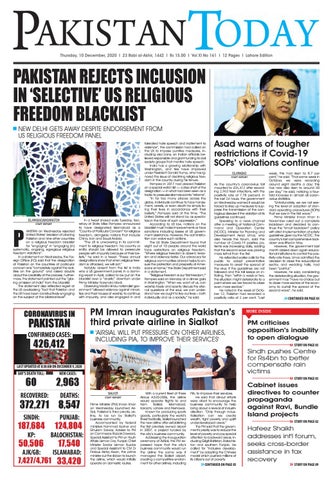
Pakistan rejects inclusion in ‘selective’ us religious freedom blacklist g
New Delhi gets away Despite eNDorsemeNt from Us religioUs freeDom paNel
ISLAMABAD/WASHINGTON staff report
P
aKistaN on wednesday rejected United states’ decision of placing pakistan and nine other countries on a religious freedom blacklist for “engaging” in “engaging [in] systematic, ongoing, egregious religious freedom violations”. in a statement on wednesday, the foreign office (fo) said that the designation of pakistan on the countries of particular concern was “completely against the realities on the ground” and raised doubts about the credibility of the process. furthermore, the statement pointed out the “glaring omission of india” from the blacklist. the statement also reflected regret at the Us overlooking “fact that pakistan and the Us have been constructively engaging on the subject at the bilateral level”.
in a tweet shared early tuesday, secretary of state mike pompeo announced to have designated islamabad as a “country of particular concern” for religious freedom, alongside nations that include china, iran and saudi arabia. “the Us is unwavering in its commitment to religious freedom. No country or entity should be allowed to persecute people with impunity because of their beliefs,” he said in a tweet. “these annual designations show that when religious freedom is attacked, we will act.” Notably absent from the list is india who a Us government panel, in a damning report in april, called to be put on the blacklist over a “drastic” downturn under prime minister Narendra modi. observing modi’s hindu nationalist government “allowed violence against minorities and their houses of worship to continue with impunity, and also engaged in and
coronavirus in
Pakistan
CONFIRMED CASES:
426,412
tolerated hate speech and incitement to violence”, the commission had called on the Us to impose punitive measures, including visa bans, on indian officials believed responsible and grant funding to civil society groups that monitor hate speech. india has a growing relationship with washington, and ties have improved under president Donald trump, who has ignored the issue of declining religious freedom in the country during his tenure. pompeo in 2017 had placed pakistan on a special watch list — a step short of the designation — in what had been seen as a tactic to pressurise islamabad into “reforms”. “in far too many places across the globe, individuals continue to face harassment, arrests, or even death for simply living their lives in accordance with their beliefs,” pompeo said at the time. “the United states will not stand by as spectators in the face of such oppression.” according to Us law, nations on the blacklist must make improvements or face sanctions including losses of Us government assistance. however, the administration can waive such actions. the Us state Department found that eight out of 10 people around the world face restrictions on religious freedom. “where religious freedom is absent, terrorism and violence fester. our advocacy for religious communities abroad helps to ensure the protection and prosperity of americans at home,” the state Department said in a statement. “religious freedom is our ‘first freedom,'” pompeo said on monday at a dinner gala in washington. “when we, each of us, can worship freely and openly discuss the eternal questions of the soul, we can understand how we ought to live our lives – both individually and as a society,” he said.
Asad warns of tougher restrictions if Covid-19 SOPs’ violations continue ISLAMABAD staff report
as the country’s coronavirus toll mounted to 426,412 after recording 2,963 fresh infections, with the positivity rate of 7.78 percent, in the last 24 hours, the government on wednesday warned it would be forced to step up measures to suppress the transmission of the contagious disease if the violation of its guidelines continued. speaking to a news channel after a meeting of National command and operation center (Ncoc), minister for planning and Development asad Umar, who also heads the forum, said the number of covid-19 positive patients was increasing daily, adding that the second wave was proving more lethal than the first. he reiterated earlier calls for the public to adopt preventative measures to arrest the spread of the virus. if the guidelines are not followed and the toll keeps on inflating, then “within a week or two, the situation might deteriorate to a point where we are forced to close even more sectors.” he noted in the week of october 12, pakistan had recorded a positivity ratio of 2 per cent. “last
PM Imran inaugurates Pakistan’s third private airline in Sialkot g
'airsial will pUt pressUre oN other airliNes, iNclUDiNg pia, to improve their services'
60
RECOVERED:
2,963
372,271 8,547 SINDH:
PUNJAB:
187,684
124,804
KP:
BALOCHISTAN:
AJK/GB:
ISLAMABAD:
50,506
17,540
7,427/4,761 33,420
more inside
PM criticises opposition’s inability to open dialogue sindh pushes centre for rs4bn to better compensate rain victims
NEW CASES:
DEATHS:
CONTINUED ON PAGE 05
STORY ON PAGE 03
LAST UPDATED AT 8:30 AM ON DECEMBER 9, 2020
DAY'S DEATH TOLL:
week, this had risen to 8.7 per cent,” he said. “that same week in october, we were recording around eight deaths a day; this has now also risen to around 60 per day,” he said, noticing a fourfold increase in almost all coronavirus statistics. “Unfortunately, we are not seeing the level of adoption of standard operating procedures (sops) that we saw in the first wave.” prime minister imran Khan in November ruled out a complete lockdown and decided to continue the “smart lockdown” policy with strict implementation of safety guidelines given by the Ncoc. the country’s last comprehensive lockdown was lifted in may. however, the government last month closed down again educational institutions to control the positivity rate there. Umar admitted the decision to close the educational sector, and wedding halls, had been “painful.” however, he said, considering the deteriorating situation, the government may “have no choice but to close more sectors of the economy to curtail the spread of the second wave”, he said.
STORY ON PAGE 03
SIALKOT staff report
prime minister (pm) imran Khan on wednesday launched airsial, pakistan’s third private airline, to be run by sialkot’s business community. accompanied by federal ministers hammad azahar and ghulam sarwar, adviser to pm on commerce razzak Dawood, special assistant to pm on youth affairs Usman Dar, punjab chief minister sardar Usman Buzdar and special assistant to cm Dr firdous ashiq awan, the prime minister cut the ribbon to launch the airline, which would initially operate on domestic routes.
with a current fleet of three airbus a320-200s, the airline would operate flights to and from sialkot, islamabad, Karachi, lahore and peshawar. Known for producing sports goods, particularly the world’s finest footballs, sialkot launched the new airline after establishing the first privately owned airport in 2007, a project funded by the city’s business community. addressing the inauguration ceremony of airsial, the pm expressed hope that the city’s business community would run the airline the same way it managed the sialkot airport, creating a competitive environment for other airlines, including
pia, to improve their services. he said that all-out efforts were afoot to encourage the business community to help bring about a revival of industrialisation. “only through industialisation can we create wealth, fight poverty and uplift underdeveloped areas.” the pm said that the government’s priority was to reduce the level of poverty and pay special attention to backward areas, including gilgit-Baltistan, Balochistan and southern punjab. he called for “inclusive development” by adopting the chinese model which pushed millions of its citizens out of poverty.
CONTINUED ON PAGE 05
Cabinet issues directives to counter propaganda against Ravi, Bundle Island projects STORY ON PAGE 02
hafeez shaikh addresses int'l forum, seeks cross-border assistance in tax recovery STORY ON PAGE 09
02
Thursday, 10 November, 2020
NEWS
Cabinet issues direCtives to Counter propaganda against ravi, bundle island projeCts ISLAMABAD
i
AHAMAD AHMADANI
n a bid to counter propaganda against Ravi Urban Development Project and Bundle Island Project, the federal cabinet has directed the officials concerned to highlight the short-term and long-term benefits of the two important federal government initiatives. According to sources, the federal cabinet, in its meeting held on 1st December, had directed the Ravi Urban Development Authority (RUDA) and Pakistan Island Development Authority (PIDA) to put in place an effective communication strategy to keep the masses informed about the short-term and long-term benefits of the two projects. It had also directed Inter Provincial Coordination Minister Dr Fehmida Mirza and Special Assistant to Prime Minister (SAPM) on Climate Change Malik Amin Aslam to highlight in media the environmental benefits of the projects so as to counter the negative propaganda
against these projects. The cabinet had passed these directives after the chairmen of RUDA and PIDA had given a detailed overview of the two projects. RUDA Chairman Rashid Aziz, while briefing the cabinet, said that the Ravi River Urban Development Project (RRUDP) would help address water-related issues in Lahore, which had to go through an imbalance in the aquifer system during 2006-17. "Even in 2017, groundwater extraction stood at 5.2 billion liter per day, while the recharge of groundwater aquifer at the time was only 3.6 billion liter per day." Similarly, he informed, Lahore had less than one per cent area covered by trees and no new urban forests or peri-urban woodlands had been designated in the last 20 years. "In addition, the city had been devastated by smog due to rapid urbanization. Therefore, it is imperative to takeappropriate steps for revival of river ecological system so that issues pertaining to storage of water, provision of clean drinking water and wastewater
management could be addressed. According to documents, RRUDP consists of seven wastewater treatment plants; 46km lake with three barrages having water storage of 270 billion litres; 28 feet high and 46km-long retaining walls; green infrastructure; mass transit; planned transportation; walkways; proper road infrastructure; more than 10,000 acres of forest; orchards and urban farms; cruise; river transport ferries; river ecology through fish industry; and plantation of more than six million trees. After the completion of the first phase, the project would create approximately 873,000 direct and indirect jobs. Land estimates of net developable area in phase-I would be 17,872 acres with estimated cost of Rs939 billion. Meanwhile, PIDA Chairman Imran Amin, while briefing the cabinet about Bundle Island Project, said the project would be completely sustainable, both technically and financially. "No loans would be taken for this project...funding would be through equity and project fi-
nance strategy to support the economy." He said the project would also be exploring more international ventures for hospitality, entertainment and commercial companies. As per document, the Bundle Island Project would be recreated on the existing Bundle/Buddo Islands surrounded by the Arabian Sea. The two island sites would together yield a total developmental area of approximately 8,000 acres. The islands are approximately 22km southeast of Karachi city center and 1.2km from the mainland. As per documents, the project aims to protect the island’s environment and landscape through sustainable development to ensure that it attends to the infrastructural, transport, economic, affordable housing and recreational needs of its residents and visitors. Moreover, it would provide a framework for physical, economical, social and cultural development of the islands for the next 50 years and beyond and preserve the ecology of the surrounding Indus delta and mangroves.
Qureshi for promotion of Pak-Saudi cooperation in various fields SAUDI AMBASSADOR SAYS NO CHANGE IN VISA POLICY FOR PAKISTANIS ISLAMABAD TLTP
Foreign Minister Shah Mahmood Qureshi has said that Pakistan and Saudi Arabia have tremendous opportunities for promotion of bilateral cooperation in various fields, and they need to be exploited. The foreign minister said this while talking to Saudi Ambassador to Pakistan Nawaf bin Said Al-Maliki, who called on him on Wednesday. The two sides discussed bilateral relations and enhancement of cooperation. The foreign minister said that the two countries have deep historical relations. He said that a large number of Pakistanis have been residing in Saudi Arabia for several decades and playing their role in the progress and development of Saudi Arabia. Qureshi expressed gratitude to the Saudi foreign minister and Saudi government for supporting Pakistan's resolution on Kashmir at the Organisation of Islamic Countries (OIC) Foreign Ministers Council (FMC) meeting. He said that the OIC's reiteration of its principled stance regarding Indian Occupied Kashmir (IOK) in the Niamey Declaration is commendable. The foreign minister said that Pakistan
supports the efforts for peaceful resolution of issues in the Gulf region. Separately, Saudi Arabia on Wednesday denied that there was any change in the visa policy for Pakistani nationals travelling to the kingdom. Speaking with the media, Saudi Ambassador Nawaful Malki clarified that only those people who do not have valid documents are being asked to leave the kingdom and Pakistanis are not being targeted. He further clarified that people from other countries were also being asked to leave. “People holding iqamas (work permits) and valid visas are not being asked to leave,” he maintained. Fears of Saudi Arabia sending back Pakistanis grew recently after UAE suspended issuing new visas to citizens of 13 mostly Muslim-majority countries – including Pakistan, Afghanistan, Iran and Syria – according to a document issued by a state-owned business. The authorities later clarified that the steps were being taken only as a measure to limit the spread of coronavirus. A document said applications for new employment and visit visas had been suspended for nationals – those outside the UAE – of 13 countries that also included Somalia, Libya and Yemen until further notice.
India's extremist policies threaten regional peace: FM ISLAMABAD TLTP
Foreign Minister Shah Mahmood Qureshi has said that India's policies based on Hindutva ideology have threatened peace and stability of the entire region. The foreign minister was speaking at a consultative meeting about regional security and Pakistan's priorities in the federal capital on Wednesday. The minister said that Pakistan has presented undeniable and solid evidence
before the world through the dossier about India's sponsorship of terrorism inside Pakistan. He expressed deep concern over the continuity of brutalities by Indian occupation forces in Indian Occupied Kashmir (IOK) amid Covid-19. Qureshi said that economic diplomacy is being pursued to promote investment in the country and reduce the impact of Covid-19 on the economy. He said that timely completion of China–Pakistan Economic Corridor (CPEC) projects is the government’s top priority.
ISLAMABAD: A beautiful view of the federal capital. INP
FBR sees 63pc jump in income tax collection NEWS DESK The Federal Board of Revenue (FBR) has received a record number of returns this year, along with the highest ever amount of income tax at the time of filing. According to a statement issued by the FBR on Wednesday, "A total of nearly 1.8 million returns have been filed together with an amount of about Rs22 billion. Last year, around this time, 1.73 million returns were filed while about Rs13.5 billion were deposited as income tax." Comparatively, the returns are higher by 4pc and tax deposited is higher by 63pc.
It is important to note that the government had decided not to extend the tax filing deadline of 8 December 2020 with a view to restore the credibility and predictability of the final date, and to promote tax discipline. However, to ensure that no hardship was faced by taxpayers, a number of special measures were adopted. These included liberal acceptance of requests for extension in filing date as available under the law; provision to file requests manually besides the online facility; enabling tax practitioners/advisors to file a single request for multiple clients; and enabling the chief commissioners to set up special desks for collection of manual request and sorting their
jurisdiction at their level. The above measures have encouraged a large number of taxpayers to file extension requests, the statement read. It is estimated that at least 300,000 taxpayers have made use of this facility, thus taking the number of potential returns to 2.1 million, which is 21pc higher compared to last year until this date. It is further clarified that the process of filing is continuing unabated. A comparison with the returns of last year at the close of the deadline, which was 30 June 2020, would be meaningful when the number of additional returns to be filed until 30 June 2021 is available.
Rs32.25bn approved for 29 development schemes in KP PESHAWAR TLTP
The Provincial Development Working Party (PDWP)-KP on Wednesday approved 29 schemes worth Rs32.25 billion. The 12th meeting of PDWP was held under the chairmanship of Shakeel Qadir
Khan, Additional Chief Secretary P&D Department Khyber Pakhtunkhwa, via video link. The meeting was also attended by PDWP members and officials of the concerned departments. As per details, the PDWP on the occasion deliberated upon 33 uplift schemes pertaining to health, higher education, water, infra-
structure, relief & rehabilitation, elementary & secondary education, roads and social welfare sectors. Of the total, 29 development schemes were approved, while four were deferred due to inadequate designs and were returned to the respective department for rectification.
Thursday, 10 November, 2020
NEWS
03
diFFerenCes, Mistrust leads pdM to postpone resignations announCeMent at laHore jalsa ISLAMABAD
d
'THERE IS NO DEMOCRACY IN PLACE TODAY’, SAYS PDM CHIEF AHEAD OF LAHORE RALLY
MIAN ABRAR
IFFERENCES and mistrust between the parties of Pakistan Democratic Movement (PDM) have forced the opposition alliance to postpone its previous decision to announce the en masse resignations of its lawmakers during its Lahore rally on December 13. Reportedly, the alliance meeting held on December 8 had to postpone the announcement of the resignations as the Pakistan People’s Party (PPP) Chairman Bilawal Bhutto-Zardari told the meeting that its lawmakers in Sindh Assembly would not tender resignations as the party was ruling the province. Bilawal also told the meeting that the party couldn’t decide on the issue of resignations of its members of National Assembly (MNAs) without consulting them. Furthermore, Bilawal disagreed with proposal floated by Pakistan Muslim League-Nawaz (PML-N) supreme leader Nawaz Sharif at the meeting, who had suggested that all resignations should be submitted with PDM President Maulana Fazlur Rehman. Instead, Bilawal argued that each party
leader should collect the resignations of the party lawmakers and they would be submitted once all the parties gathered the resignations. After listening to the PPP’s perspective, Fazl said that there was a need for further deliberations over the issue leading to the postponement of resignations. Moreover, Nawaz Sharif reportedly suggested that the PDM alliance should contest elections as an entity and all the opposition parties should be given a share in the government if the alliance wins the upcoming general elections. The meeting also discussed other measures to be taken by the PDM. The 11-party alliance discussed a proposal to carry out a long march in January when the harsh weather conditions would normalise and temperatures would rise. The PPP chairman purportedly seemed reluctant regarding extreme measures like resignations and a long march but he wished to remain a part of the opposition alliance.
Human rights Minister shireen Mazari calls pdM resignations a drama
The matter of resignations from assemblies has reportedly not gone well within the PML-N ranks and dissenting voices have started to emerge from within the party. PML-N lawmakers in the Punjab Assembly Jalil Sharaqpuri and Maulana Ghayasuddin have announced they will defy the party decision. Talking to media persons, Jalil Sharaqpuri said that if the party leadership had sought resignations for a national cause, he would have tendered his resignation immediately. He added that no one would resign from the assembly for personal agenda being pushed by a specific family. He said that the PML-N was not a private firm or family property of anyone. He maintained that as a senior Muslim Leaguer, he would not resign without just cause and reasoning. Maulana Ghayasuddin also has refused to resign, adding that he had been in the party longer than Nawaz Sharif. He said that no one could ask for a resignation from him. A PML-N lawmaker who wished to re-
main anonymous told this scribe that there were many senior leaguers who had reservations on resignations issue. The source said that many parliamentarians would refuse to submit resignations when the time comes. Earlier in the day, the JUI-F chief said that “there is no democracy in place today” while assuring that the PDM rally in Lahore will take place in spite of all obstacles. Fazl said the above while addressing a press conference, flanked by two prominent opposition leaders, PML-N Vice President Maryam Nawaz and Bilawal. “There is no democracy in place today. It is dictatorship that has buried democracy. We have spoken of a democratically elected government of the people and the supremacy of the Constitution. We do not accept this government as one elected by the people, or Constitutional or democratic,” he said. Regarding the hurdles placed by the incumbent government, the JUI-F chief said that the 11-party alliance would find a second path, adding that a steering committee is yet to meet and decide on a schedule of activities. The hurdles in question are the administration “turning the venue into a dam”, wherein he accused the government of flooding the venue, Minar-e-Pakistan, on
purpose. Moreover, while Prime Minister Imran Khan had not banned the rally, he had warned that any organisers who partake in the arrangements would be arrested – this ranged from sound and stage workers to simple tea sellers. Furthermore, a threat alert was issued by police on Tuesday for the opposition’s 11party public gathering on December 13, warning that terrorists could target PML-N VP Maryam and other top political leadership of the opposition parties. The police have asked the PDM leadership to cancel the Lahore public gathering owing to the security alert and in case of non-cancellation, has asked the opposition’s leadership, including Maryam, to take precautionary measures – such as the use of bulletproof cars – to avoid any untoward incident, reported a local news outlet. Fazl, on the occasion, referred back to his call for all members of the Opposition to hand in their resignations from the NA. When asked of what will happen to Senate electoral college and elections when the Sindh Assembly will be dissolved due to resignations, he said that they were devising a strategy to stop any more “fake elections”.
Sindh pushes Centre for Rs4bn to better compensate rain victims
NEWS DESK Minister for Human Rights Shireen Mazari on Wednesday said the Pakistan Democratic Movement (PDM) calling for the resignations of the Opposition parliamentarians from the National Assembly was a “drama”. “If they want to resign, they should hand [their resignation letters] to the speaker [of the National Assembly] instead of party leaders,” she said during an interview with a local news station. Furthermore, the human rights minister said the federal government had “information” on the 11-party alliance receiving foreign funding. However, Mazari did not go into details or outright say the ruling party had any evidence to back this claim. “If we get the evidence […] but when we receive hardcore evidence, then it will become the responsibility of the government to take action,” she said, adding “let’s see how things unfold.” She did elaborate that there were “dissident groups aboard” who were sending “encouragement” to the PDM.
pMl-n using political parties for personal gains: Faraz ISLAMABAD APP
Minister for Information and Broadcasting Senator Shibli Faraz on Wednesday said that Pakistan Muslim League-Nawaz was using political parties for its personal gains.vAll opposition parties' leaders had suffered defeat on financial action task force (FATF) legislation, he said while talking to a private news channel. The opposition parties proposed such amendments in the National Accountability Bureau (NAB) Act which were meant to weaken the national anti-graft watchdog, he said. Criticizing the PML-N leaders, he said that the party had a practice to flee the country at the time of crisis.
KARACHI TLTP
The Sindh government on Wednesday urged the federal government to provide Rs4 billion in order to better compensate people affected by this year’s monsoon rainfall in the “calamity-hit” districts of the province. The decision was taken by the provincial cabinet during a meeting to assess damages and losses suffered by the people during this year’s rainfall. The participants of the meeting were informed that around 1,752 dehs, 2,297,108 people, 1,499,411 acres of standing crops, 291,981 households, and 1,292,643 houses were dam-
aged during the monsoon season. It was stated during the meeting that at least 149 people lost their lives and 103 were injured in rain-related incidents. At least 19,858 animals also died. Sindh Chief Minister Syed Murad Ali Shah said that losses in the province amounted to Rs8 billion and added that his government would give compensation to the poor and affected people across the province to rehabilitate them. The cabinet also approved an amount of Rs100,000 for each family of the deceased and Rs25,000 for those who were injured during the rains. In addition, it also approved Rs10,000 for those whose houses were damaged or partially de-
stroyed, while Rs25,000 will be given to those whose houses were completely destroyed. For those who lost livestock, Rs10,000 per animal will be paid as compensation. As per the provincial cabinet, total compensation for rain victims was estimated to be more than Rs4 billion. The cabinet requested the federal government to provide an additional Rs4 billion to double the relief amount for better rehabilitation of the victims. Along with providing relief to individuals, the cabinet further decided to provide relief to small businesses and crops affected by the recent heavy rains. The meeting decided that the provincial government will provide tax exemption to small busi-
PM criticises opposition's inability to open dialogue NEWS DESK Prime Minister Imran Khan said that any time there has been an attempt to open dialogue with the opposition, they have demanded that the corruption cases against them be closed. "Cases were filed against many opposition leaders during their own tenures," the premier said during a conversation with media persons. "Ishaq Dar, Nawaz Sharif's children and his son-inlaw all fled from the country in the past," he said, adding that dialogue is necessary for democracy to work. On the occasion, the premier reiterated his position that the government was willing to hold a dialogue with the opposition on every issue but "no talks on giving NRO will be held with the opposition". "The opposition wants to instigate chaos in the country, they want the government to use force (against it)," he said. "The best place for political dialogue is the par-
liament," the prime minister said. "I had said from the beginning that I was ready to answer all questions in the parliament." It is pertinent to mention that when reports of the PM seeking a dialogue reached Pakistan Democratic Movement (PDM) President Maulana Fazlur Rehman, he said, "He is not worthy of dialogue." PM Imran spoke about various issues, including the opposition’s protest movement, the coronavirus pandemic and international conspiracies being hatched against Pakistan. When asked about the PDM’s calls for resignations of lawmakers from the National Assembly (NA), he said that he could “not understand what they aim to do”. "If the opposition seeks to move a no-confidence motion, they should come and do so in the assemblies," he said while criticising the move. "If they hand in resignations, we will hold byelections on those seat and will emerge even stronger," he added.
Imran welcomes Biden's 'intent' to target kleptocrats ISLAMABAD STAFF REPORT
Prime Minister Imran Khan on Wednesday welcomed United States President-elect Joe Biden’s intention to launch a crackdown on illicit finance both at home and abroad. The prime minister, who has made his electoral promise to end corruption a centerpiece of his administration, lamented that the developing world was “being impoverished by their corrupt elites who launder money to richer countries and offshore tax havens”.
Long before coming to power, Khan has blamed rampant corruption for the country’s current economic woes. Prior to the 2018 general elections, the manifesto of Pakistan Tehreek-i-Insaf (PTI) resonated well with a large section of the middle class due to its emphasis on governance issues — particularly corruption and political accountability. His tweet comes as the PTI government moves towards tougher anti-corruption regulations through a series of measures including the strengthening of state graft busters. Attached with the tweet was a Foreign Policy
piece on Biden’s anticipated tougher stance towards dirty money — a move, it said, “could have profound implications for anti-corruption efforts around the globe”. “Two years ago, Biden and his former advisor Michael Carpenter warned in Politico about the threat posed by foreign money of unknown origins to the integrity of US elections. He echoed those concerns in a Foreign Affairs essay,” the opinion noticed. The FP essay quoted a transition official as saying that “President-elect Biden made countering corruption at home and around the world a staple of his agenda.”
nesses. CM Murad said that he will write a letter to the federal government requesting for exemption in federal taxes to compensate small businesses and crop losses. He added that he will also write a letter to Prime Minister Imran Khan, requesting compensation amount of Rs4 billion for the victims. Earlier, the chief minister said that the amount would be disbursed through ATM cards and directed the chief secretary to discuss with Sindh Bank and work out a detailed plan for the issuance of ATM cards at the earliest. “The beneficiaries must have a CNIC and the cards would be verified from NADRA before disbursement of the compensation,” he added.
public welfare projects worth billions of rupees started in punjab: Firdous LAHORE: Special Assistant to Punjab Chief Minister on Information Dr Firdous Ashiq Awan has said that under the visionary leadership of Prime Minister Imran Khan and Chief Minister Usman Buzdar, public welfare projects worth billions of rupees have been started in the province. In a statement issued on Wednesday, she said that the government is serving the masses whereas opposition is spreading coronavirus. She said that the countrymen are now aware of the corrupt politicians and the mentally sick leaders of opposition should care for the innocent people and stop playing with their lives. INP
Thursday, 10 December, 2020
04 NEWS
Sindh cabinet takeS major deciSionS for kcr, buS, ambulance Service KARACHI
t
STAFF REPORT
HE Sindh government on Wednesday took major decisions for Karachi Circular Railway (KCR), resumption of CNG buses of Karachi Metropolitan Corporation (KMC) and ambulance service of Aman Foundation. While chairing the provincial cabinet meeting, Sindh Chief Minister Syed Murad Ali Shah granted approval
to release the remaining Rs10 million for the KCR project. During the briefing, the cabinet members were told that the Sindh government has earlier released Rs15 million funds for the KCR project. In the meeting, it was decided to register the ambulance service of Aman Foundation as a new company. The company will be named Sindh Emergency and Rescue Services (SERS). The government also approved funds for the ambulance service and decided to increase its capacity to 200 ambulances. The SERS board will be
comprised of nine members, while the provincial health minister will act as its chairperson. The cabinet gave a green signal for the resumption of KMC’s 66 CNG buses, as the buses will be given under private management for five years to provide transportation facilities to the commuters in the metropolis. The government also decided to grant magisterial powers to district administrator for controlling prices of essential commodities. The health told the cabinet members that the
Students, rights activists condemn unlawful killings by Australian forces in Afghanistan
province requires 330,000 Covid-19 extraction kits, 330,000 amplification kits, 480 swabs, and viral transport media (VTM) kits. The cabinet decided to write a letter to the federal government for the procurement of 880,000 Covid-19 testing kits. The provincial government also decided to sign a memorandum of understanding (MoU) between the National Radio Telecommunication Corporation (NRTC) and the home department for the installation of 10,000 cameras under the Karachi Safe City Project.
Punjab cm announces rs17bn projects for Sialkot LAHORE STAFF REPORT
ISLAMABAD STAFF REPORT
A large number of students, rights activists and other members of civil society staged a protest on Wednesday, condemning the unlawful killings of 39 people by Australian elite soldiers in Afghanistan. In the demonstration held at National Press Club, a number of protesters gathered with placards and banners, inscribed with slogans against the Australian
forces, and asked the international community to take action against the armed forces. The protestors demanded that Australian senior officials, including prime minister and army chief, should step down from their posts. Moreover, the Australian government should give one million dollars to the families of diseased as compensation. They said that the act was a serious war crime. “The Australian forces completely violated the Geneva Convention.
They should be removed from the NATO alliance and penalized under international laws of war,” the protesters demanded. The Geneva Conventions comprise four treaties and three additional protocols, which establish the standards of international law for humanitarian treatment during a war. Through the treaties, basic rights of wartime prisoners and measures for protection of wounded and sick people were defined. The demonstrators further said that the Aus-
Afridi urges parliamentarians across the world to play role for Kashmir dispute ISLAMABAD STAFF REPORT
Parliamentary Committee on Kashmir Chairman Shehryar Khan Afridi on Wednesday urged all parliamentarians of the world to play a proactive role in raising voices for Kashmiris and making India accountable for its crimes against humanity in the Indian Occupied Kashmir (IOK). Addressing a conference of
the committee held at Institute of Regional Studies, Shehryar said that the implementation of the United Nations Security Council (UNSC) resolutions on Kashmir is a collective responsibility of all the member states of the UNSC. "The political leaders of several countries, including US, Canada and Europe, and European Parliament chairperson have expressed their concerns on the issue. There is growing momentum among inter-
national parliamentarians to work together to galvanize world conscience for stopping India’s aggression and making it accountable for atrocities against Kashmiris in the IOK," Afridi said. "Pakistan is committed for peaceful resolution of the dispute under Prime Minister Imran Khan’s emphatic narrative, set in the UNGA sessions through a full spectrum of parliamentary and diplomatic outreach, and en-
tralian forces completely ignored this historical treaty and killed number of innocent Afghanis unlawfully. They alleged that some patrol commanders ordered their junior soldiers to shoot innocent people to fulfil their heinous wishes and illegal interests. “The United Nations should pass a resolution against this brutal act of Australia. All other international human rights organisations should also raise voice against the killings,” the protesters suggested. gagement with media, academia, intelligentsia and civil society." “Indian forces cannot deprive the Kashmiri people from their right to determine their own destiny, as enshrined in the UNSC resolutions. Kashmiris' struggles for self-determination have gained a new impetus under Indian Prime Minister Narendra Modi's regime,” he added. Indian forces are martyring innocent Kashmiris in staged encounters under the garb of cordon and search operations. Killings of hundreds of innocent Kashmiris, including women and children, are in complete violation of the fundamental precepts of the international humanitarian law.
Punjab Chief Minister Usman Buzdar on Wednesday announced new projects worth Rs17 billion for Sialkot. Addressing a ceremony, the CM said that the government is initiating development projects worth billions of rupees to facilitate the Sialkot citizens and improve their living standards. The CM said that the provincial government will set up a new industrial state, comprising 10,00 acres of land, in Sialkot. He added that a new 500-bed hospital will be established at a cost of Rs5 billion in the city. Prime Minister Imran Khan will inaugurate the hospital during his next visit to the city. Buzdar also congratulated the people on the inauguration of AirSial airline. He also vowed to provide free healthcare coverage to the entire population of the province by the end of 2021.
lhc summons record regarding auctions of state gifts LAHORE TLTP
The Lahore High Court (LHC) on Wednesday sought complete record from federal government regarding auctions of Toshakhana gifts held over the past five years. While hearing the plea of Advocate Adnan Paracha against the auctions, the court ordered the concerned federal authorities to come up with a detailed report in the matter. Hearing of the case was adjourned till December 15. The state counsel had argued that the auction is held in line with the relevant laws. However, the petitioner had claimed that the auction was not advertised publicly and only government officials were informed about the auctions through official letters. These gifts are being given to bureaucrats in violation of the laws. Paracha further said that gifts available in Toshakhana were given to president, prime minister and ministers by heads of other states and foreign dignitaries as goodwill gestures. The government auctioned these valuables without following any legal procedure. In order to keep the auction process under wraps, the federal authorities wrote letters to officials instead of inviting general public to participate in the auctions. During previous hearing of the case on November 25, the court had restrained the federal government from auctioning precious gifts available in the Toshakhana of the Cabinet Division till further orders.
mercury drops to minus 21 after snowfall in diamer CHILAS: Mercury dropped to minus 21 Celsius in Diamer, Gilgit-Baltistan after sporadic snowfall on Wednesday, according to a weather report. Minus 21 temperature was recorded at Nanga Parbat base camp, while the mercury reduced to minus 11, 12 and 10 at Fairy Meadows, Babusar Top and Battugah Top respectively. Babusar Top, Nanga Parbat base camp and Fairy Meadows received heavy rainfall. Battugah Top and adjoining areas received four feet of snowfall in the spell. The temperature in Quetta and Kalat was dropped to one degree Celsius. The Pakistan Meteorological Department (PMD) has predicted cold weather in most of the districts of Balochistan during the next 24 hours. The department has also predicted rain with snowfall over the hills in Gilgit-Baltistan, Kashmir, Chitral, Dir, Swat, Shangla, Buner, Kohistan, Mansehra and Abbottabad. TLTP
Thursday, 10 December, 2020
NEWS AsAd wArns of tougher restrictions if covid-19 soPs’ violAtions continue continued from page 01 “We worry about the education of children; we know that a lot of Pakistan’s educational institutions charge low fees and they have been severely damaged by the closures,” he said and added thousands of livelihoods were at risk due to the wedding and restaurant restrictions. “But we have to do this, because if you can save 100 peoples’ livelihoods at the cost of one person, then you must take that decision,” he said. The government would deliberate on a relief package for these closed sectors in a meeting of the National Coordination Committee on Thursday, he added. He also urged the opposition parties to suspend their anti-government rallies to effectively counter the pandemic. Earlier this week, the Pakistan Democratic Movement (PDM) announced to go ahead with the proposed Lahore meeting on December 13 “as planned” despite the worrying Covid-19 numbers and government warning of legal action. Umar said the government had also
limited to 300 the number of people allowed at political gatherings. “This guideline is not being implemented,” he said. “Not only is this dangerous because the virus spreads when thousands gather in one place […] more dangerously when people hear their leaders say that rallies don’t spread coronavirus; that it’s a political statement, they reduce or stop adhering to SOPs.” He noticed such meetings “only” impacted a few thousands present at the venue, but the message reached millions across the country. “The biggest difference between the first and second waves [of the coronavirus] is that the message is not being conveyed,” he said. “We [government and opposition] had differences of opinion on preventative measures in the first wave, but our message was the same. This time, this is not happening,” he added. Noting that the government had met Ulema and doctors and paramedical staff last week, Umar praised their dedication and efforts to adopt guidelines. He said the media too had ramped up awareness campaigns to stress preventative measures.
PM Imran inaugurates Pakistan’s third private airline in Sialkot continued from page 01 SUPPORT TO SMES: Later, while addressing a ceremony in connection with cheque distribution among successful applicants of Kamyaab Jawan programme, the PM assured the youth that they would be encouraged and fully supported to start their small & medium enterprises (SMEs). “More loans will be provided to the youth in the days to come so that they can start their businesses,” he vowed. The PM said the focus of his government was to bolster exports and for this purpose the industrial sector would be fully backed. He assured the business community that an industrial zone would be established across 1,000 acres of land in
Sialkot to facilitate industrial production. “This is an era of science & technology and the present government is especially focusing on its promotion to provide a better future to our coming generations,” he added. Referring to the Sialkot development plan worth Rs17 billion, he said the people of the city would see visible change in their lives through this package. “We are now also bringing master plans for all cities to address the issues of water, sewerage and sanitation.” The premier hailed the Ehsaas programme as being a significant initiative launched to tackle poverty in Pakistan. He reiterated the country’s need to increase its exports and decrease imports in order to solve the problem of foreign reserves.
05
Electronic waste: The dark side of industry 4.0 The world is rapidly embracing the various dimensions of Industrial Revolution (IR) 4.0 through the application of Internet-of-Things (IoT), artificial intelligence, cloud computing, block chain technologies, etc. in diverse industries. Contemporary to its devastating impacts on the global economy, the Covid-19 pandemic has served as a driving force for the adoption of digitalization and automation by business operations. Digitalization is being termed as synonymous to green development, but that is not the only side of this digital era. Unprecedented and accelerating amounts of Electronic Waste (e-waste) e-polluting the world’s land, water, and air along with endangering human lives shows us the dark side of digitalization. The United Nations have defined e-waste as the waste generated when an electronic appliance or device has served its useful life and ends up being discarded without being recycled. The United Nation’s Global e-waste Monitor 2020 Report found that the world dumped approximately 53.6 million tons of ewaste last year. If the wastage pattern continues like this, the global e-waste is estimated to reach 74 million tons by 2030. Just like the rest of the global problems, the issue of e-waste is also more profound in the developing countries as opposed to the developed countries. In fact, the developed countries are using the developing countries as an e-easte dumping ground by exporting millions of tons of e-
waste in the form of second-hand electronic equipment or scrap. Pakistan is one such country that imports huge amounts of both new and used electronic equipment which ultimately ends up worsening the country’s natural environment even further. In the fiscal year of 2018/19, Pakistan imported an estimated US$ 3.7949 billion worth of “consumer durables” which includes all types of electrical appliances and equipment. In addition, the country imported US$ 1.132 billion worth of telecommunication equipment. The lack of recycling or improper disposal of this electronic equipment will convert it into e-waste at the end of its life cycle. Informal e-waste collectors in low-income countries, like Pakistan, are facing one of the worst professional health hazards. In the process of manually extracting the high-value metals from various electrical equipment, they hammer and burn electronic components which release toxic fumes, making them vulnerable to life-threatening diseases. The dumping of unused scrap releases toxic and chemical waste leading to serious health complications among the surrounding population. This dark side of digitalization is outweighing the benefits that are gained through the digitalization of various business operations. e-waste is a serious threat to the development of a Clean and Green Pakistan since it creates direct obstacles in the attainment of the UN’s Sustainable Development Goals
(SDGs) 2030. It is contradicting the SDGs of good health and wellbeing, clean water and sanitation, sustainable living communities, green economic growth and responsible consumption and production. Pakistan is a signatory to the Basel Convention which states that the processing of e-waste is to be done responsibly and sustainably. Then, why are we still struggling to survive in an environment plagued with the hazardous fumes of various non-recycled electronic equipment? Our country cannot move forward on the path of sustainable development unless we adopt digitalization by embracing the benefits and mitigating the threats it may pose to our society. Adopting new technologies cannot make us a developed country unless we learn how to use it sustainably and in an environmentally conscious manner. The Government of Pakistan should educate the concerned stakeholders on this important issue and develop actionable plans for mitigating this dire environmental threat. AbOUT ThE AUThOR:- Ali Ashar Jaffri is the General Manager Supply Chain & Procurement and CIO at Bank AL Habib Limited, Pakistan. He has more than 22 years of managerial experience in a number of reputed national and international organizations. Email: ali.ashar@bankalhabib.com LinkedIn Profile: https://www.linkedin.com/in/ali-ashar-jaffri-a1790a1a
International Human Rights Day and women home based workers’ struggle In the patriarchal structures of our society Violence against women is considered as a normal practice. Where no matter what working status a woman enjoys, she is seen in subordinate roles. Women are taught to be submissive and inferior beings. Both men and women can be victims of violence, however, women are more vulnerable due their positions within the home, at workplace and in society. Violence is any act or threat that result in suffering for women. This violence can be physical, sexual, economic and mental in nature. History tells us that women’ bodies have been objectified as a ground for wars. Women have faced oppression since the beginning of age. Over the years the common practice of Patriarchy has become deep rooted with creating a mindset that strongly see women as a problem to society and a threat to male dominancy. HomeNet Pakistan (HNP) aims to work towards sustainable development goal, achieve gender equality and empower all women and girls. HomeNet envisions a society in which home based workers are ensured visibility, recognition, legal and social protection, and a decent standard of living. HNP shares stories of home based workers’ gender based violence and resilience. Fouzia was married at a tender age without her will. Carrying orthodox mentality of early child marriage, her mother forced her into an arranged marriage. Her in-laws detested her presence and to them, she was a maid for their house. Socialized to be a submissive woman like many others in our society, Fouzia never raised her brows on her ill-behaved in-laws. When Fouzia gave birth to her first child, a daughter, she was being verbally abused by in-laws as bearer of “solely daughters”. Behavior of her in-laws worsened upon birth of her second daughter. She tolerated the abuse for the sake of her family and to protect their honor as divorce is associated with stigma for a woman. She thought that things will change as later she gave birth to a son, but soon her husband planned to go to Dubai for job, leaving her behind with his cruel mother, his sister and her husband. Aware of the lecherous acts of her male in-laws, Fouzia demanded her husband to shift her in a new house as she wasn’t
CMYK
comfortable with her male inlaws alone in his absence. Her husband refused to fulfil any such demands. Fouzia was more worried about her daughters than herself. All her pleas were disregarded by her husband which led her to take a strong decision to file for divorce. Unconcerned for her children, her husband agreed and fled to Dubai leaving Fouzia and 3 children behind. Having dexterity in stitching and stone work Fouzia started as a home based worker to earn for her children. She was introduced to HomeNet Pakistan by HNP’ social mobilizer. Soon Fouzia became a member of HNP and attended numerous trainings to empower herself socially and economically. Among these trainings were financial literacy, leadership, ecommerce, 3-day capacity building, group formation, business development, digital literacy and training of trainers. With the help of these trainings, Fouzia was able to gain bargaining skills, communication skills, costing and soon she formed her own group of 50 women home workers. Initially Fouzia used to work for someone but with progress in work, she started getting work in bulk, enough to provide to her own group of workers. She further attended the awareness sessions of HNP that included, awareness on HBWs law, study circle on early child marriage, Violence against women and exposure visits to market and women development department. The exposure visits acquainted her with the knowl-
edge of various products and their worth in market, as well as, knowledge of women’ right. 95% of women home based workers are unaware of their rights as a women and thus end up becoming an easy victim of gender discrimination. Upon consulting the advocate through the exposure visit, arranged by HNP, Fouzia received guidance and soon filed a case against her husband for maintenance of their children. Fouzia believed she could’ve done this early but she was unaware of her rights and laws for women. She was at a stage where she begged her husband to stay and now she has empowered and become economically independent that her ex-husband wants to reunite with her. Fouzia believes she is much better off now and she will not sacrifice her peace for any further gender based violence. Naseem, another woman who became victim of violence, among many others. She married at an early age with a guy who was her extended relative. Her family was unaware that her husband was a drug addict. She was deceived into marriage as her inlaws kept it hidden. Naseem, who was educated till college was married off to a completely uneducated guy from a village. Despite the fact that he was illiterate, Naseem’ family gave her daughter. When her family was informed about his drug addiction, they didn’t bother to free their daughter from him, in order to keep the family’ honor. Drug addiction of her husband came to her as a shock after
the birth of her first child. Naseem faced verbal abuse and physical abuse at the hands of her husband daily. When she informed her parents, they discarded her plea for help as something nugatory, indicating that this is what every woman face as a norm in society, thus, Naseem should also tolerate. Her family cared more about disturbance and rivalries in relation with extended family, rather than violence that their daughter was facing. Naseem accepted that ‘suffering’ was her fate. Since her husband wouldn’t earn money, she started working since the beginning of her marriage. Her husband would snatch all her earnings to fulfil his desire and craving for drugs. With evident misbehavior of her husband, her mother-in-law didn’t leave a chance to mistreat her. Aware of her husband’ behavior she took every advantage to torture Naseem. Since her husband wouldn’t earn money and provide for family’ need, Naseem, who had studied till college, was forced to start work as a domestic worker as there was no other job for her in village. Later, due to severe drug intake, her husband passed away. Upon death of her husband, she wanted to come back to Karachi but her own parents weren’t willing to take her as her mother-in-law showed willingness to keep her, but little did she know about her intentions. Within two months her motherin-law started abusing her and wouldn’t provide her food to eat. She ran away from village with her children and came to her parent’s house where she currently resides and earn for her 2 kids. She started work as a teacher but income was very less. Later she worked in survey, but that job was also short lived. She learned stitching and stone work on her own. After sometime, she attended trainings of HomeNet Pakistan, where she was introduced by social mobilizer. Upon receiving guidance from HomeNet Pakistan, she was linked with a social welfare organization that provides her monthly ration. Slowly and gradually, as a home based worker, she is able to earn enough for her children. Although, her earnings are not enough to do monthly savings but she earns enough to fulfill her basic needs.
Thursday, 10 December, 2020
06 COMMENT
Democratic evolution
Reason must prevail Amidst war cries emanating from both the camps
Bhutto versus Sharif
O
n Tuesday Imran Khan recounted some of the mistakes he had committed after becoming the country’s Prime Minister. He said he did not approach the IMF soon enough after taking over and did not initiate the much needed reforms in the public sector, including the power sector, the PIA and the Pakistan Steel Mills. He confessed that failure to implement reforms immediately hurt the country. What he failed to admit is that hubris led him to commit perhaps the biggest blunder of his political career, of refusing to talk and interact with an opposition willing to cooperate with the government. It was after more than two years of neglect and persecution that the opposition was forced to take to the streets. A day earlier, Mr Khan had arrogantly dismissed the PDM’s protests, maintaining that even if it held 10 rallies at Minar-e-Pakistan, it wouldn’t make any difference. This has led the opposition to reject Mr Khan’s offer for talks which was again predicated on the opposition not seeking the nRO which the opposition has denied umpteen times of having ever sought. Many had wished however that the opposition chose a different time for initiating the movement to avoid being held responsible for helping in the spread the coronavirus. One also expected the opposition to be more responsible than the PTI government. As the opposition goes ahead with the agitation, it too is liable to be blamed for showing scant respect for human life. It needs to be recognized that social convulsions will continue to pose threats to national economy, internal security and the system itself as long as the imbalances created in the system remain embedded. These include transgressions of one institution into another’s turf and the all too familiar and recurring pattern of discreet interference in the elections to replace administrations considered too independent by those expected to act as loyalists. A consensus has to be created over the need for every institution to function precisely within its scope as defined by the Constitution. The national polity has to strictly follow the guidelines provided by the father of the nation.
Dr FariD a Malik
I
n a recent BBC interview when Ishaq Dar was confronted with the fact that his leader Mian nawaz Sharif was himself a protégé of General Ziaul Haq, but now he is complaining of Military interference in politics, prompt came the reply, “It was democratic evolution.” The Pakistan Muslim League (nawaz), like many predecessor ‘King’s Parties’ was launched from the ‘Freemasons Lodge of Democracy’ located at 33 Davis Road Lahore.With no political background or experience and very ordinary academic credentials, Mian nawaz Sharif was discovered by the then Martial Law Governor, Lt Gen Ghulam Jillani Khan. He was first inducted as Finance Minister in the Punjab Cabinet, followed by becoming Chief Minister under Prime Minister Muhammad Khan Junejo. I had the chance of asking Jillani Sahib about the credentials of Mian Sahib, his answer was, good people skills or in other words ‘Mukmuka’. While Chaudhry Shujaat Hussain, who now heads PML (Q) believes in ‘Mitti Pao’ (pour dust), so both of them reached the top leadership positions with the support of the establishment. Perhaps they were the worst possible candidates for this coveted slot. Evolution never touched them, it was the opportunity that they were able to cash in and build their financial empires with the help of political power. Zulfiqar Ali Bhutto (ZAB) belonged to a promi-
What information is sensitive? Plea to protect information about senior officers’ emoluments rejected
T
HE Pakistan Information Commission has allowed an appeal by a number of Women’s Action Forum applicants and, rejecting the Defence Ministry’s objections, has allowed the release to them of information about the income, income tax, assets, perks, privileges, post retirement benefits and plots allotted to all officers above the rank of brigadier or equivalent in all three services. The PIC rejected the Defence Ministry’s contention that the record of defence services and defence installations was excluded under the Freedom of Information Act. Implicit in the decision is that the information sought was about taxpayers’ money, and thus it was the right of the citizen to obtain information about how that money was spent. At the same time, it was a salutary reminder that not everything connected to the defence services is necessarily connected to the actual defence of the country, and thus used to keep under wraps whatever the senior officers of the defence services might do. It was important that PIC decided as it did, for it prevented information being denied on the ground that it was defence-related. It is possible to make up a security excuse for any exclusion. For example, the first item of information to be gleaned is the number of officers in each rank, which would give in turn information on the order of battle of each service. Of course, that assumes that a hostile power (India, in other words) has not got this information already. However, that would have to be balanced against the citizen’s right to know. Another subject, on which information is also required, is that of the pays and perks of senior civil servants. Again, it is not so much the amount spent that matters, as the fact that the money being disbursed is taxpayers’ money. An important principle that the decision upheld was that of the executive operating under the provisions of the law, as made by the legislature. If the Defence Ministry’s designated ‘public information officer’ still has any objection to providing the information rejected, he is free to go to court. Here again, the court will decide according to the law as laid down, not according to any notion of security, vague because it is unwritten.
NaEEM kaNDWal
I
nDIAn government has broken all records of human rights violations. If a country condemns human rights violations in India, the Indian government calls it interference in its internal affairs, but it is the Indian government that perpetrates terrorism in neighboring countries, which it deems legitimate. India’s double standard has been exposed here, which is ridiculous. That amounts to saying ‘’My dog is a dog and your dog is Tommy’’. Sikhs, Muslims and Dalits, all minorities, are victims of the Indian government’s atrocities. The Indian government sometimes massacres the oppressed Muslims in Gujrat, sometime suppresses the Sikhs, sometimes destroys the constitutional status of Kashmir and sometimes tries to destroy the identity of the Dalits. Once again Sikhs are being targeted by the Indian government. Canadian Prime Minister Justin Trudeau and Conservative opposition leader Erin O’Toole both made comments this week expressing concern over India’s response to the demonstrations. “Canada will always be there to defend the right of peaceful protest,” Mr Trudeau said on Monday. Two farmers associations have said they expect 50,000 farmers to reach the Delhi border from the neighbouring state of Haryana. Speaking recently to celebrate the birth of Guru nanak Dev Ji, the founder of Sikhism, Mr Trudeau mentioned the protests and called it a “concerning” situation. “We’re all very worried about family and friends,” he said during the virtual celebration. “We believe in the importance of dialogue and that’s why we’ve reached out through multiple means directly to the Indian authorities to highlight our concerns.” Mr Trudeau’s remarks were echoed by Conservative party leader Erin O’Toole, who called the right to peacefully protest “fundamental” to democracy. Sikhs are important to Canada, not just because of their large numbers, but because they have assumed political importance. A Sikh has served as Premier of British Columbia province, and one is
Editor Umar Aziz
Asher John
Executive Editor
Deputy Editor
Lahore – Ph: 042-36300938, 042-36375965
Dr Farid A Malik is ex-Chairman, Pakistan Science Foundation. He can be contacted at: fmaliks@hotmail.com.
not only the Canadian Prime Minister but also Indian human rights activists are speaking out against India’s government’s misconduct. Supreme Court presently Defence Minister, and another head of the lawyer and social activist Prashant Bhushan tweeted new Democratic Party. ‘’I am happy that Canadian PM has spoken out for Sikhs are demanding a separate homeland in rights to protest in a Democracy & for our farmers India, that is why they are rights. It is important for all being persecuted. The Khalleaders worldwide to stand istan movement is a Sikh up for democratic rights of movement seeking to create people in all nations”. Very recently, India’s Foreign a homeland for Sikhs by esIt should not be forgottablishing a sovereign or auten that the resent farmers Ministry spokesperson tonomous state, called protest is being seen as criticized Canadian Prime Khālistān (‘Land of the being related to the KhalisKhalsa’), in the Punjab retan Movement. It should not Minister Justin Trudeau. gion. The proposed state be forgotten that the original would consist of land that Khalistan Movement started “Such comments are currently forms East Punjab. off with a strong peasants’ unwarranted, especially Ever since the separatist movement, and there was movement gathered force in always a strong support for when pertaining to the the 1980s, the territorial amfarmers’ demands among internal affairs of a bitions of Khalistan have at those who backed the Khaltimes included Chandigarh, istan Movement. It should democratic country,” said sections of the Indian Punalso not be forgotten that the jab, including parts of north Khalistan Movement has Anurag Srivastava. The India and some parts of not been stamped out among Indian government considers the Sai diaspora; of which western states of India. The call for a separate Canada happens to be a natits human rights violations Sikh state began in the wake ural stronghold. to be its own internal affair, of the fall of the British EmVery recently, India’s pire. In 1940, the first exForeign Ministry spokesperwhile it itself perpetrates plicit call for Khalistan was son criticized Canadian made in a pamphlet titled Prime Minister Justin terrorism in neighbouring “Khalistan”. With financial Trudeau. “Such comments countries. This is the strange are unwarranted, especially and political support of the Sikh diaspora, the movewhen pertaining to the interlogic of the Modi ment flourished in the Indian nal affairs of a democratic Administration state of Punjab —which has country,” said Anurag Sria Sikh-majority population vastava. The Indian govern— continuing through the ment considers its human 1970s and 1980s, and reachrights violations to be its ing its zenith in the late 1980s. In the 1990s the in- own internal affair, while it itself perpetrates terrorsurgency petered out, and the movement failed to ism in neighbouring countries. This is a strange logic reach its objective due to multiple reasons including of the Modi administration. a heavy police crackdown on separatists, factional infighting, and genocide upon the Sikh population. The writer is a freelance columnist
India views human rights as merely and excuse for oppressing minorities
Arif Nizami
Joint Editor
gle and ideological base prevailed over the forces of status-quo. It was a real resistance-based democratic evolution. nawaz Sharif gained power not by struggle or support of the masses, it was a grab with full backing of the establishment of the time. In fact he was brought in to neutralize the power base of the PPP. ZAB understood the importance of Lahore, whic is why he launched his party from here and then willed to be buried in the metropolis. nawaz and his ‘Kings Party’ were directed to focus on the city where ZAB had solid support. With the help of the administrative machinery and official dole outs like plots and permits, he succeeded in creating a foothold. The city is now considered to be ‘Takht-e-Lahore’ (Throne) of the Sharif Dynasty. There are no-go areas in Lahore ruled directly by the ‘Gullu Butts’ of Gowalmandi, the area from where the Sharifs emerged. The party is based on vested, personal interests with almost no street power or record of struggle. With a strong hold and influence in the administration, it considers itself to be a chip of the establishment and has now decided to take it on for its pound of flesh. For street support it relies on religious parties like the Jamaat Islami or Jamiat Ulema Islam, which have organized militant wings. Bhutto’s party despite the Zardari plunder remains a genuine political outfit. There are stark differences between the two. Till today PPP remains a progressive anti-establishment party while the PML(n) behaves like its anti democracy designers, the estbalishment. When they are called for accountability they come with stones to attack the national Accountability Bureau instead of documents to be exonerated. By contrast, in his last appearance in the Supreme Court in the 1970s, despite the apparent bias of the four judges of the Lahore High Court, ZAB reposed full confidence in the judiciary. The decision was split, yet he did not appeal for clemency (no Muk Muka). He had all the chances to escape but decided to stay and fight it out. The PPP has won five national elections and still retains power in Sindh. Evolution comes through struggle, not power grab as was done by the PML(n). While the establishment has always tried to curb the PPP vote bank to support ‘ Kings Parties’, Benazir emerged victorious in the 1988 elections. A genuine political party relies on the support of the masses, while an establishment creation like the PML-n scrambles for power grab by manipulating the electoral process which is the anti-thesis of their recent slogan, ‘Vote ki Izzat’ (respect for the vote), while in fact it should be termed; ‘ Voter ki Beizzati’ (Disrespect the voter).
Strange logic of Modi Administration
Dedicated to the legacy of the late Hameed Nizami
Aziz-ud-Din Ahmad
nent political family of Sindh. After completing his studies in the top educational institutions in the United Kingdom and USA he returned to Pakistan to start a career in teaching at a law college in Karachi. He was picked up by President Iskander Mirza as a member of his cabinet. There was no looking back, and President Ayub Khan continued with him till his falling out with the President over the Tashkent Peace Accord in 1965. In november 1967 he founded his political party by the name of Pakistan People’s Party (PPP). Till then most parties were launched by the establishment. On november 30 that year when I arrived at the YMCA Hall on the Mall for my daily badminton practice, I witnessed unusual activity there. On inquiry I came to know that Bhutto was coming to address the people. With my racket in hand I was able to make my way through the crowd. A young and dashing ZAB came on the stage, immaculately dressed in a double breasted suit while the crowd was charged. he asked ‘Awami or Sarkari’? ‘ Awami’ was the unanimous chant. He announced the start of his political struggle on a progressive platform of ‘Islamic Socialism’. Perhaps the concept came from Dr Khalifa Abdul Hakim’s book, Islam and Communism that was published in the early 1960s by the Institute of Islamic Culture, Lahore. This started the democratic evolution of ZAB. The next round of resistance came with a jalsa (public meeting) at nasir Bagh (Gol Bagh then) which was not too far away from the YMCA Hall. The administrative machinery under the much feared Governor of West Pakistan, nawab Amir Muhammad Khan of Kalabagh, had planned to disrupt the gathering and arrest the leader. The ground was watered together with having live electric wires thrown there. ZAB started to speak, but as he touched the mike he was electrocuted and fell on the stage. People ran for safety, and in the prevailing confusion before the agency men could grab him, but Roshan Ali, a rickshaw driver, picked up his leader and escaped. The only light he could see was on the campus of Government College, so he drove inside and landed at the Principal’s residence. Professor Muhammad Rashid was not at home, and while ZAB lay on the sofa of his living room the family called him. By the time he arrived, ZAB had gained consciousness, Roshan Ali drove his leader to safety from the back gate of the College. There were several such episodes in which the Ayub-led establishment came down heavily but the movement kept gaining momentum. Finally, the first dictator had to resign in March 1969 and fresh elections were announced on the basis of one man, one vote. In the first free and fair elections in 1970, ZAB’s party bagged 81 national Assembly seats from West Pakistan. His three years of strug-
I
Karachi – Ph: 021-35381208-9
I
Islamabad – Ph: 051-2204545
I
Web: www.pakistantoday.com.pk
I
Email: editorial@pakistantoday.com.pk
Thursday, 10 December, 2020
COMMENT 07 Editor’s mail Send your letters to: Letters to Editor, Pakistan Today, 4-Shaarey Fatima Jinnah, Lahore, Pakistan. e-mail: letters@pakistantoday.com.pk Letters should be addressed to Pakistan Today exclusively
Sui gas woes in Karachi I want to bring the kind attention of the authorities towards this problem. looking forward to this sudden weather change in Karachi has come to our most concern that this city has to deal with a lot of other problems along with this our city Karachi is currently facing a number of problems among which the most derisively in need of solution is the low availability of gas in our homes and work stations. In this cold weather, this is seriously hard for the citizens to live their basic lives without gas. We need gas to light our stoves, to run the generators in case of load shedding of electricity and also to make the heaters work in ongoing winters. It would really be appreciated if you look over this serious topic as the city which produces the most amount of GDP annually is facing the most problems itself, ironically. ARINA KHAN KARAcHI
Villainy of WAPDA
Beginning of language politics in Pakistan The first step towards break-up Dr rajkuMar SiNgh
I
nITIALLY, with a view to fill the gap between the two wings of Pakistan, Jinnah declared in 1948 that Urdu would be the national language, but the announcement was treated in general and by the students and intelligentsia, in particular, as a sinister design of the West to alienate Bengali Muslims from bureaucratic places. The ill-conceived move offended Bengalis and set them on the path of linguistic nationalism. The Eastern part was represented in administration of the country very thinly and it was almost impossible to trace it. The top layer of the bureaucracy at the time of Partition consisted of 133 Muslim Indian Civil Service/Indian Political Service officials who opted for Pakistan. Of these, only one was from Bengal and the rest were mainly Muhajirs and Punjabis. Most of the powerful bureaucrats such as the Secretary General, Chaudhari Mohammad Ali, and the Chief Secretary to the East Bengal Government, Aziz Ahmad, were Punjabis. The army was mainly recruited from the Punjab and the nWFP, with hardly any recruitment from Bengal, Sind or Baluchistan. The recruiting policy of the British was so narrow that 75 per cent of the Pakistan Army came from a few districts of Punjab. The Bengali students saw in it now only an attempt at cultural subjugation but also a design to perpetuate their under-representation and inferior status in the administrative services, especially in relation to the Punjabis who had better proficiency in Urdu from long. The fear was not unfounded in the sense that though East Bengal had given more solid support to the Muslim League, Jinnah regarded Punjab as the heart of Pakistan. Imposition of Urdu as a national language had widened the gap between the ruler and the ruled in Pakistan. The students and intelligentsia reacted openly and began agitation for making Bengali one of the State languages. As early as in 1948, the students of Dacca University submitted a memorandum to Prime Minister Liaquat Ali Khan demanding equal representation in the central civil services. Widespread opposition began to manifest itself when plans were drawn up to replace Bengali with Urdu in the schools of the province. The Tamaddun Majlis, formed by members of Dacca University, spearheaded the language movement that demanded that Bengali should be the language of the provincial administration and courts, the medium of instruction in the schools and one of the official state languages alongside Urdu. nazimuddin, the then Chief Minister of East Bengal, was grilled by the opposition parties on the language issue and accepted the central demands of the State Language Action Committee. But this was immediately repudiated by Jinnah, who unequivocally supported Urdu as the state language of Pakistan. He reiterated this position on his visit to Dacca, which resulted in widespread protest. The Language Action Committee submitted a memorandum to him demanding that Bengali should be one of the state lan-
guages. However, despite centre’s opposition istan, representing central and federal forces, had nazimuddin introduced a resolution in the caused inordinate delay in making the Constituprovincial assembly which made Bengali a tion. It was only after a tussle between the demmedium of instruction. But the agitation contin- ocratic and religious elements that the ued upto 1952 and Bengali was not given the Constituent Assembly succeeded in producing an status of a state language until a few students Objectives Resolution in March 1949 that desacrificed their lives for the cause. The attempt fined the aims and objects of the proposed conof the Centre to impose Urdu script for the Ben- stitution. The Premier called the Objectives gali language was also foiled by Bengali intelli- Resolution the embodiment of the Islamic pringentsia who thought it a plan of the ruling class ciple, as it invested all authority in Allah and it was accepted by Maulana Usmani, the most imto destroy the national identity of the Bengalis. The widening administrative and cultural portant alim in the ruling hierarchy. However, gulf between the two wings of Pakistan led the the resolution met with two kinds of criticism. country to political instability. The arbitrary, fas- First, from the Congress members of East Bengal cist and Punjabi-dominated policies of the Mus- that it was a mixture of religion and politics and lim League had alienated the people from this secondly, on the ground that there was no proviorganisation, especially in East Bengal. The latter sion for social change and no guarantee of the had opposed vehemently the pro-centralist forces fundamental liberties of the people. The Muslim and favoured decentralisation in the larger inter- League had countered the resolution on the est of the people. Before the transfer of power in ground that theirs was an “ideological” State based on the principles August 1947, the Hindu of the Quran and that, big bourgeoisie optherefore, there could posed federal schemes be no eschewing of rethat would give MusThe resolution met with two ligion. It also objected it lim–majority provinces kinds of criticism. First, from on the issue of proteca measure of autonomy. tion of non-Muslims’ Hence they required a the Congress members of rights, privileges and strong central governstatus and duties as enment to deploy surEast Bengal that it was a joined on the Muslim pluses as required by mixture of religion and by Islam. Liaquat Ali the class interests of the Khan had perhaps misbig bourgeoisie. The politics and secondly, on the judged the mood and big businessmen were ground that there was no depth of opposition as it in favour of making provoked a furious rePakistan where they provision for social change sponse from the ulama could form the system and Bengal. of their choice. Initially and no guarantee of the Liaquat’s motive the dominant bourfundamental liberties of the was only to test the geois-bureaucratic class mood of religious leadattempted to establish people. The Muslim League ers and not to concede the same kind of cenhad countered the resolution their demands in subtralised system which stance. The 22 princiwould help exploit the on the ground that theirs ples for the surpluses produced in establishment of an IsEast Pakistan while was an “ideological” State lamic state confounded suppressing, among based on the principles of Liaquat’s expectation other things, East Pakthat they were incapable istan’s distinct linguisthe Quran and that, of reaching any agreetic and cultural system. therefore, there could be no ment. Further to avoid In contrast, the East complications, a subBengal was in favour of eschewing of religion. committee called the a federal scheme that Basic Principles Comwould have helped the mittee was set up, with formation of various the Prime Minister as competing, national and regional bourgeoisies. They were also equally Vice-President, to frame an outline of the proposed constitution. Despite its apparent concuradamant to save their distinct cultural identity. now the basic difference among leaders en- rence on the fundamentals of an Islamic state, the tered the arena of politics openly, making the for- Constitution Sub-committee stubbornly resisted mation of the Constitution itself its first victim. incorporating any of these principles into their Though the elected members of the provincial proposals. In the meantime, Liaquat Ali Khan elections of 1945-46 representing the Pakistan was assassinated in October 1951 and was sucareas were formed into a separate Constituent ceeded by Khwaja nazimuddin, who till date Assembly and naturally assigned to frame a con- was holding the post of the Governor-General of stitution for the country, it took almost nine long Pakistan after the death of Jinnah. In place of years in completing the work. Several Pakistani nazimuddin, Ghulam Mohammad became the leaders and publicists had highlighted the coun- new Governor-General of the country. try’s quest for security against alleged Indian deThe writer is head of the political science signs on their territory but very few had paid attention to its search for political identity in the department of the B.N.Mandal University, shape of a suitable constitution. In fact the bick- Madhepura, Bihar, India and can be reached at ering and strife between the two wings of Pak- rajkumarsinghpg@gmail.com
WAPDA Established in 1958 through an Act of Parliament, it is an autonomous body under the administrative powers of the Federal Government. It focuses on water and hydropower development. In fact, vallainy of WAPDA is making the Turbat’s people so much disturbed where masses are compelled to violent the roles. In fact, people are paying huge amounts of bills for it. But still innocents and guilty considered equal. They used to cut the links of transformers, where commom public face lots of problems. In reality, unavailability of electricity make people far from their daily activities. Because, it plays a crucial role all over world, where multiple companies including major activities are being done. But in Turbat, people are awaited for the maintenance of it, and majority is paying high amounts of bills, still they face difficulties. It is requested to concern authorities to resolve it with solution. WAleed lAl TuRbAT
Karachi’s garbage problem THROUGH the columns of your esteemed newspaper, I would like to draw the attention of the concerned authorities towards the serious problem of garbage and pollution in Karachi. Because when it comes to garbage and pollution, Karachi is the king of the trash heaps. The garbage situation of Karachi is going from bad to worse, day by day. Open sewage drains and garbage dumps are giving rise to many harmful diseases. Especially after this Eid-ul-Azha the waste material is still lying on roads. And majority of the streets were flooded with water and trash, wreaking havoc for the citizens. Moreover, the stagnant rainwater mixed with the remains of the animals, serves as a serious health hazard for citizens, with the chances of many serious diseases being spread. Karachi is the biggest city of Pakistan but still there is no administration to manage the garbage and pollution, citizens are really frustrated and they need some solution for this problem. Karachi needs serious attention and it is also a matter of great concern , and take some proper steps to make Karachi neat and clean. buSHRA MANZOOR KARAcHI
Irresponsible rallies? REFERRInG to Pakistan Democratic Movement (PDM)’s upcoming public gathering in Lahore, Minister for Information and Broadcasting Senator Shibli Faraz Tuesday asked the citizens to stay away from its rallies to save their own and their families’ lives from the second wave of coronavirus pandemic. Addressing a post-cabinet press briefing along with Special Assistant to the Prime Minister on Youth Affairs Muhammad Usman Dar, Shibli urged Lahoris and others to refrain from falling into the PDM leaders’ trap as they were liar and deceitful, and had nothing to do with the public welfare. He said the PDM leaders did not bother about the ordinary people as they just wanted to use them for their own agendas and vested interests. Their level of sincerity with the people could be gauged from the Bakhtawar Bhutto Zardari’s engagement in which the COVID-19 test was mandatory for the participants. Once the rallies were over, they would not even help the people to get tested for the coronavirus, he added. Their public gatherings were only meant to get relief in the corruption cases by building pressure on the government but they were mistaken as they had to meet their ultimate fate,” the minister said adding Prime Minister Imran Khan was an honest leader and would never compromise with them corruption cases. He said the PDM leaders had looted the country with impunity bringing it at the brink of destruction and weakened the national institutions. The opposition leaders during their tenure promoted nepotism and appointed their blue-eyed people on covet positions that eventually led to the massive brain drain of the country as competent people opted to move abroad for jobs, he added. Shibli said when the PDM leaders were in the power, they took every possible step to weaken the country’s economy. They kept the economic trajectory upward with cosmetic measures and put the tough decisions under the carpet, he added. He said people had rejected them in the last general elections for their corruption, but now they refused to accept the results, especially in those areas where they were lost. Their level of sincerity with the people could be gauged from the Bakhtawar Bhutto Zardari’s engagement in which the COVID-19 test was mandatory for the participants. Once the rallies were over, they would not even help the people to get tested for the coronavirus, he added. Their public gatherings were only meant to get relief in the corruption cases by building pressure on the government but they were mistaken as they had to meet their ultimate fate,” the minister said adding Prime Minister Imran Khan was an honest leader and would never compromise with them corruption cases. eHTISHAM AHMAd lAHORe
Thursday, 10 December, 2020
08 WORLD VIEW
LLoyd AustIn Is the wrong choIce For secretAry oF deFence HE’S HAD AN IMPRESSIVE CAREER, AND IT’S A HISTORIC PICK—BUT THERE’S A REASON GENERALS SHOULDN’T RUN THE PENTAGON
slate
P
FrED KaPLan
REsIDENt-ELECt Joe Biden has chosen retired army Gen. Lloyd austin III to be secretary of defence, and it is not a good choice—so much so that it’s possible the senate, including some Democrats, won’t confirm him. the main point against austin is that, as a rule, it is a bad idea to make any retired general the secretary of defence, a job expressly created for a civilian. the principle of civilian control over the military is so ingrained in america’s political culture that federal law bars officers from becoming defence secretary within seven years of their retirement from the armed forces, unless Congress passes a waiver allowing the exception. austin retired from the army not quite five years ago. Congress has approved a waiver just twice since 1947, when the job was created: for retired Gen. George Marshall in 1950 and for retired Gen. Jim Mattis in 2017. Marshall had been army chief of staff during World War II, then secretary of state shortly after, and so had a broad view of force and diplomacy; Mattis was seen as a stabilizing force to the erratic, ignorant Donald trump. But austin evokes his own causes for doubt. true, he would make history worth celebrating as the first Black secretary of defence. He was also a fine, venerated battle-
field commander in Iraq and an able operations chief on the Joint staff (the staff that works for the Joint Chiefs). But he had lapses as the head of Central Command, the vast, multiservice entity that runs U.s. military operations in the Middle East and south asia, during Barack Obama’s second term. allotted $500 million to organize a rebel army in syria, he recruited only 60 fighters, all but a handful of whom fled or were killed at the first flash of combat. Centcom was also accused, under his command, of slanting intelligence on IsIs to make the militia group seem weaker, and to make U.s. progress in the war against it seem farther along, than was actually the case some say these complaints are overstated. a former official who closely watched the Middle East in the Obama administration told me Monday night that it’s unfair to blame austin for the syrian initiative, saying failure was inevitable, regardless of the commander. and the Pentagon’s inspector general cleared austin of the charge that he had deliberately falsified intelligence. Even so, austin is no Marshall or Mattis—and, besides, Mattis turned out to be an undistinguished defence secretary, in part because he relied too much on a coterie of fellow Marine officers, a fulfillment of the fear that prompted Congress to pass the restriction all those decades ago.* the waiver was meant to be used for truly extraordinary figures. austin doesn’t seem to measure up to the standard. In fact, after the Mattis confirmation, Jack Reed, the top Democrat on the senate armed services Committee, said he would vote against any future waivers, claiming that they should be granted no more than once in a generation. If Reed holds to his word, other Democrats—and certainly many Republicans looking for a way to embarrass Biden early in his term—may join him in rejecting the waiver for austin.
Politico, which first reported on austin’s pending nomination Monday night, laid out two plausible reasons for Biden’s choice. First, the president-elect has been under pressure from the Congressional Black Caucus—especially from Rep. Jim Clyburn, whose endorsement of Biden ahead of the south Carolina primary last February all but sealed his victory for the Democratic nomination—to nominate more Black people to top Cabinet posts. another Black nominee, Jeh Johnson, who was secretary of homeland security and chief Pentagon counselor in the Obama administration, was also on the shortlist for defence secretary but reportedly ran into some objections for his positions on detentions in the former job and on drone strikes in the latter. Johnson is still said to be a possible choice for attorney general. the second factor weighing on Biden’s mind, according to Politico, citing a “former defence official close to the transition,” was that austin “is believed to be a good soldier who would carry out the president-elect’s agenda.” there would be “less tension” with the White House, “maybe less disagreement … the relationship would be smoother.” But someone who is knowledgeable of the transition process told me Monday night that Biden picked austin “not because he’s Black but because he genuinely likes and respects” the general, whom he met several times—and got along with well—a decade ago, when Biden was vice president and austin was the last american commander in Iraq before the troop pullout. all of the president-elect’s national security nominees so far share this same trait—they’ve been close to Biden for a long time, and they’ve earned his trust. One problem that Biden had with Michèle Flournoy—once thought to be the leading choice and certainly the most qualified for the job—is that she never was a
member of his circle. another problem is that, early on in the Obama administration, as undersecretary of defence for policy, she supported the generals’ recommendation to send 40,000 more troops to afghanistan and to adopt a full-scale counterinsurgency (aka “nation-building”) strategy. as vice president, Biden opposed the surge and the strategy—he was the only senior member of the National security Council to do so (he was right)—and he warned Obama not to let the top brass roll him or box him in on budgets and troop levels. Flournoy has since modified her views on the subject, but it could be that Biden regarded her as too beholden to conventional military thinking. In that sense, her endorsements from a wide range of defence specialists—officers, officials, thinktank denizens, and members of the congressional armed services committees— might have flashed more warning lights than reassurances. If so, it might seem odd that Biden should pick a retired general instead. But this is where the Politico source’s reference to austin as a “good soldier” might have paid off. as a policy intellectual with deep roots in the Pentagon, the think-tank world, and Congress, Flournoy might have been more formidable at rebutting and pushing back on some of Biden’s policies or preferences, whatever they might be (though not resisting once the decision is made)—whereas austin, a West Point graduate who has followed the commandment of obeying civilian authority, might be more pliant. In some ways, this is a good thing. Biden was right, and still is, about the military’s tendency to box in the White House. (In the crude but often accurate portrait of this trait, the generals present three options to a president: total war, surrender, and the option that they want the president to adopt.) In other ways, though, it could hamper independent thinking and fresh proposals— which are desperately needed in the
Pentagon, which has remained mired in Cold War concepts, abetted by the uncontrolled spending spree of the trump years. Flournoy also recently come under fire from some progressive Democrats because her consulting firm, WestExec Partners, had contracts with defence corporations and because she sits on the board of Booz allen Hamilton, a notable though relatively small defence contractor. By that measure, austin might set off conflagrations of protest, as he sits on the board of Raytheon, the world’s second-largest defence contractor. the rejection of Flournoy is also likely to irritate women, who voted for Biden in large number. Many women in the national security field, who are just beginning to be recognized as prominent experts, had petitioned Biden to nominate the first female defence secretary, just as many Black politicians had urged him to nominate the first Black person for the job. Biden has now passed over two once-favored women for top Cabinet posts— Flournoy at the Pentagon and susan Rice as secretary of state—which, whatever his reasons (in Rice’s case, the Republican-controlled senate seemed unlikely to confirm her), is bound to demoralize many of his once-hopeful supporters. He did nominate avril Haines, a former deputy CIa director and deputy national security adviser, as the first female director of national intelligence—a nomination widely heralded as a breakthrough—but Haines is less well-known and her new job, by nature, is less visible to the public. Biden said during his campaign that, if elected, his Cabinet would reflect the diversity of the american people—a refreshing idea. But picking top officials solely on that basis risks alienating those of another race or gender who were pushing for someone from their group to get the job. It also risks creating the perception of an identity-politics hierarchy of Cabinet jobs: secretary of defence and attorney general must be Black or female, secretary of homeland security can be Hispanic, and so forth. He did not pick austin solely because he is Black, though the fact seems to have played some role in his decision. a Biden adviser told me two weeks ago that transition officials were figuring out the right balance between race and gender for secretary of defence and attorney general. Does this mean that, since the choice for the former is Black, the pick for the latter will be a woman? We’ll soon find out. the important thing is that, and how well, they do their jobs—and what and how well Biden does as president. all else is trivial. My hope is that, three or four months from now, this column will be irrelevant.
Macron's version of 'French Islam' is state coercion against Muslims PUSH TO COUNTER 'ISLAMIST SEPARATISM' COULD ENSHRINE IN LAW A LATENT HOSTILITY TOWARDS FRANCE'S MUSLIMS
Middle east eye
L
MyriaM François
ast month, French President Emmanuel Macron announced a “historic” initiative: the creation of a formal council of imams to officialise the status of religious prayer leaders. the French secular state, which has justified its policing of virtually all public manifestations of Muslim identity in the name of laicite, is creating an official registry of Muslim imams. the French Council of the Muslim Faith (CFCM), alongside the interior ministry, will establish the legal parameters for the faith practices of around five million Muslims in France. Imams would have to sign a “charter of republican values”, with at least two red lines: political Islam and “foreign interference”. Gone will be the foreign funding that has hitherto, with approval from the French government, provided the means to finance mosques and their staff, in favour of a new model: a French Islam. If the president truly wanted to foster a 'French Islam' might it not be necessary to engage French Muslims, rather than alienate them by treating their religious
organisations as a security risk? Macron is hoping to succeed where his predecessors have failed in bringing to life this political fantasy - a version of Islam that is politically docile and socially compliant. It would be an Islam without teeth, which could assimilate its impoverished adherents into a republic that systematically denigrates their religious identity, with two-thirds of French Muslims saying their faith is negatively perceived. the registry of imams is part of a wider push by Macron to counter “Islamist separatism”. But why would a “French Islam” be any more malleable than other forms? Islam isn’t a centralised faith that can be controlled by a single leader’s approbation, nor should one assume that the French revolutionary and dissenting tradition wouldn’t - and doesn’t - also infuse the local practice of Islam. Both French history and Islamic principles place a primacy on social justice. there is more than a little irony in this recent proposal. Imams are prayer leaders, while Islamic theologians provide the moral substance of the faith, and there are no plans to “officialise” them. What’s more, the CFCM itself is itself made up of federations that receive foreign funding, and although it was created by former President Nicolas sarkozy in 2003 to act as an intermediary between France’s Muslim communities and the government, it has struggled with questions of legitimacy. Of around 2,500 mosques in France, 1,100 did not vote in the CFCM’s most recent elections - and regardless of Macron’s push to exercise control over this sphere, Muslims who wish to seek religious guidance outside of its parameters will be fully able to do so. PERFORMATIVE SPECTACLE: as French imam tareq Oubrou points out, the federations that make up the CFCM are secular organisations, not theological ones; what do they know about training imams in theol-
ogy? Worse still, what version of Islam are they set to “officialise”? Would it be the one imparted to them by the autocratic foreign governments that fund them? What kind of French Islam would that be? Will we see a repeat of former President Francois Hollande’s 2015 initiative, when he sent French imams for training in Morocco to bring “French Islam” back home? Much of this spectacle appears performative, designed to reassure the electorate that Macron has the problem under control. But what exactly has he identified as the problem? If the president truly wanted to foster a “French Islam” - something many French Muslims would no doubt welcome - might it not be necessary to engage French Muslims, rather than alienate them by treating their religious organisations as a security risk? the notion of a French republic under ideological assault from a violent Muslim minority is a far-right fantasy, and yet Macron has capitulated to this vision. the clash of civilisations myth, long peddled by the National Front, now becomes policy through its appropriation by “liberals” vying for votes. the theory of “Islamist separatism” is reminiscent of a deeply flawed neoconservative counterterrorism policy floated in the UK back in 2010. the “conveyor belt” theory pointed to ideology as the “main precursor to violent extremism”. a leaked cabinet committee memo at the time debunked this theory, saying it gave “undue weight to ideological factors” - and yet, not only has the theory been enshrined in the UK’s deeply contested Prevent strategy, but a French variant of this flawed thesis appears to underpin Macron’s latest bill on Islamist separatism. 'APOLOGY FOR TERRORISM': One of the more concerning aspects of the bill, which aims to free Islam in France from “foreign influences”, is that individuals convicted of “apology for terrorism” would be auto-
matically added to a terrorism watch list. Given that hundreds of people, including children as young as 10, have been investigated for “apology for terrorism”, the bill risks criminalising a generation of Muslims whose expressions of opposition, or even benign acts of teenage rebellion - such as refusing to remove a hat and headphones during a minute of silence - could have life-changing implications. are we to believe that this will lessen resentment towards the state and improve security? Institutions of French civil society, from mosques to sporting organisations, would also, according to the bill, come under stricter government control, with local authorities given greater freedom to close them on the basis of the actions of one of their adherents, regardless of whether they hold a position of authority within the association’s structures. the government is already dissolving civil society organisations by decree, including a prominent Muslim charity, BarakaCity, and the Collective against Islamophobia, a prominent human rights group that Interior Minister Gerald Darmanin described as an “enemy of the republic”. It has done so without any evidence of illegal behaviour, sending a stark warning to French Muslims seeking to assert their rights. amnesty International denounced the closures as “undermining freedoms of expression and of association”. PILLAR OF FRENCH IDENTITY: the French constitutional principle of laicite imposes a strict religious neutrality on both the state and public services, and represents a pillar of French identity. Yet this new bill proposes to modify this historic pillar, changing it from a form of legal protection from the state, to a form of political coercion. France undoubtedly faces a threat from terrorism, but the current measures risk putting the very foundations of the republic at risk, while officialising a latent hostility towards Muslims. Macron’s legacy could be enshrining this in law. Myriam François is a Franco-British journalist, broadcaster and writer. she is also a Research associate at sOas, University of London.
Thursday, 10 December, 2020
BuSIneSS 09
HafEEz SHaIkH addrESSES Int'l forUm, SEEkS croSS-bordEr aSSIStancE In tax rEcovEry
corporate corner
ISLAMABAD
ISLAMABAD: Chief of Naval Staff Admiral Muhammad u Amjad Khan Niazi meets Ambassador of the Kingdom of Netherlands to Pakistan Wouter u Plomp at the Naval Headquarters. u PRESS RELEASE
Pakistan finally challenges India’s claim on basmati in EU ISLAMABAD GHULAM ABBAS
With only two days to go in the deadline, Pakistan has finally challenged India’s application for an exclusive Geographical Indication (GI) tag for basmati rice in the European Union (EU). According to officials at Intellectual Property Organisation (IPO) Pakistan, the opposition has been filed pursuant to Article 51 of the Regulation (EU) No 1151/2012 through a Brussels-based international law firm, Messrs Altius. Adviser to Prime Minister on Commerce Abdul Razak Dawood confirmed the development through a tweet on Wednesday and assured rice exporters that the government would defend the case with due diligence and commitment. Earlier, the Ministry of Commerce had shortlisted two law firms, Messre Altius and Messrs Liedekerke Wolters Waelbroeck Kirkpatrick, to fight the Basmati battle. As per the European Commission’s rule, opposition to any application, once published in its official journal, need to be filed within a period of three months. This meant that Pakistan needed to file the application before December 11. Currently, India accounts for 65 per cent of the international trade in basmati, while Pakistan accounts for the remaining 35pc. The long-grained aromatic rice fetches Pakistan around $800 million to $1 billion annually. It may be mentioned here that the notice of opposition should contain a declaration that an application might infringe the conditions laid down in the regulation after which the commission will forward the notice to the relevant authority. If the opposition is followed by a reasoned statement of opposition within two months, the commission will check the admissibility of the latest statement of opposition. The commission will then have another two months to invite the authority or person that lodged the opposition to engage in appropriate consultations within a three-month time frame. It is pertinent to mention here that India had applied for the GI tag for basmati under Article 50(2)(a) of Regulation (EU) No 1151/2012 of the European Parliament and Council on Quality Schemes for Agricultural Products and Foodstuffs, mentioned in the EU official journal dated September 11 whereas the Pakistani government had decided to oppose the application demanding exclusive rights of claiming a GI tag to basmati rice in the EU on September 22. The protection of geographical indications helps a country boost exports, support rural development, and enhance the livelihood of agriculture producers and skilled craftsmen. The marketing of GI products also enhances secondary economic activities and boosts regional economic development. The GI law protects local products such as the Peshawari chappals, Multani blue pottery, Hunza apricots, Hala ajrak, Kasuri methi, Chaman grapes, Turbat dates etc.
a
STAFF REPORT
DvISER to Prime Minister on Finance and Revenue Dr Abdul Hafeez Shaikh said on Wednesday that Pakistan was among the few developing countries to adopt common reporting standards (CRS), as it had already started exchanging data with partner jurisdictions. He stated this while addressing the plenary meeting of the global forum on "Transparency and Exchange of Information for Tax Purposes 2020", organized by OECD. The adviser said that Pakistan has achieved important milestones in transparency and exchange of information and appreciated the technical support extended by the global forum and the UK government, which was instrumental in implementing the CRS. Hafeez Shaikh outlined that tax transparency and exchange of information were powerful tools to enhance tax
compliance. "Pakistan is firmly committed to fighting tax evasion and other illicit financial flows and need more international cooperation for cross-border assistance in tax recovery," he stressed. The adviser also briefed the forum about the negative impact of Covid-19 pandemic and measures taken by the government to mitigate sufferings of the
vulnerable groups. During the Covid-19 outbreak, he said, the government had introduced 'smart lockdowns' to contain the spread of the disease while keeping the economy moving. The smart lockdown approach was acknowledged worldwide as it allowed many businesses to reopen or continue operations on limited
ICCI seeks extension in return filing deadline ISLAMABAD APP
The Islamabad Chamber of Commerce and Industry (ICCI) has urged the government to extend the income tax return filing date, citing errors in FBR’s system and prevalent coronavirus crisis. “December 8 was the deadline to file income tax returns for 2020, but the FBR’s system was not working properly yesterday due to which many taxpayers had to face problems in filing their returns,” ICCI President Sardar Yasir Ilyas Khan said in a statement on Wednesday. “This necessitates further extension in the return fil-
ing date.” Khan said that owing to the second wave of Covid-19 pandemic, most of the country’s tax consultants were unable to provide their services to taxpayers in preparing income tax returns. Therefore, it was the need of the hour that FBR should consider extending the return filing so that maximum number of taxpayers could be facilitated, he added. The ICCI president noted that lockdowns in the past had destroyed many businesses, due to which many businessmen were facing difficulty in paying electricity bills, rents of shops and salaries to workers.
He further informed that out of a population of 206 million, only about 1.7 million income tax returns were filed till December 8, as compared to 2.7 million last year. He said the economic condition of the country would not improve unless the number of filers was increased. “In Pakistan, there are about eight million commercial electricity connections that are subject to advance tax, but filing of only 1.7 million income tax returns should be a matter of concern for the government,” he stated. “The government should utilise the data of commercial connections to expand the country’s tax base.”
FBR slaps penalties on non-compliant retailers ISLAMABAD SHAHZAD PARACHA
The Federal Board of Revenue's Large Taxpayers' Office (LTO)-Islamabad has imposed Rs1-million penalty each on Tehzeeb Bakers and Metro Shoes for failing to connect their retail outlets with FBR's Point of Sale (POS) system. According to sources, POS integration is mandatory for all major retailers of the country, as prescribed under the Sales Tax Act, 1990. It is used to share realtime reporting of retailers' sales to FBR, besides monitoring the overall collection of sales tax.
Metro Shoes is one of the major retailers of ladies branded shoes and bags, having around 40 sale outlets across 24 cities of Pakistan, whereas Tehzeeb Bakers has eight branches spread across Rawalpindi and Islamabad. Sources said that both retailers fall under the category of tier-1 retailers, as defined under the sales tax law. However, despite repeated notices and reminders from the tax office, both Tehzeeb Bakers and Metro Shoes showed persistent non-compliance and failed to integrate their outlets with computerized POS systems. According to sources, the
deadline for all tier-1 retailers in the country to connect their POS with FBR was 31st August. But some tier-1 retailers have still not fulfilled their legal responsibility and are avoiding installation of POS systems in order to suppress their sales and to evade the payment of sales tax to the national exchequer. Sources confirmed that penalties would also be imposed on other defaulters in this category in the coming days, adding that those retailers who do not comply even after imposition of penalty would find their outlets and business premises sealed by LTO.
scale to lessen the adverse economic impact during testing times." In addition, he said, the government also handed out cash stipends to 15 million families under "Ehsaas Emergency Cash Payments". "Amid Covid-19, the government took several initiatives to accelerate economic recovery. A relief package for small & medium enterprises (SMEs) shielded against insolvency and joblessness. Similarly, a special package was announced to boost the construction sector which included an amnesty scheme, tax exemption, and a Rs33 billion subsidy to stimulate economic growth." He said that Pakistan has registered an upward trend in foreign remittances and foreign direct investment during the first quarter of FY21. "The government is firmly committed to correcting fundamentals of the economy through effective policymaking and targeted reforms. The end goal is to achieve sustainable economic growth," he concluded.
MARKET DAILY
Stocks recover 102 points in see-saw trade KARACHI STAFF REPORT
Pakistan Stock Exchange (PSX) endured a volatile session on Wednesday, with the benchmark index swaying both ways in search of a clear direction before finally settling in the green. Global equity markets also showed a positive performance, whereas crude prices inched up from the previous close; WTI crude price rising 0.22pc to $45.69 while Brent crude price improving 0.10pc to $48.89. The benchmark KSE-100 Index started the day on a positive note, registering its intraday high at 42,350.23 (+248.45 points), before losing momentum and falling to its day's low at 42,030.61 (-71.17 points). It, however, managed to recover all losses by the end and closed higher by 102.25 points at 42,204.03. Among other indices, the KMI-30 Index gathered 343.29 points to end at 68,299.88, while the KSE All Share Index added 98.41 points, settling at 29,575.17. The overall market volumes improved from 409.72 million shares in the previous session to 438.13 million shares (+7pc). Average traded value also increased by 3pc, from $115.3 million to $118.3 million. TRG Pakistan Ltd (TRG +3.91pc), Lotte Chemical Pakistan Ltd (LOTCHEM +7.10pc) and Unity Foods Ltd (UNITY +2.27pc) led the volume chart, exchanging 33.73 million, 27.19 million and 26.15 million shares, respectively. Sectors that kept the benchmark index afloat included oil & gas exploration (+44.41 points), technology & communication (+19.59 points) and banking (+13.17 points). Among the companies, TRG (+30.19 points), Oil and Gas Development Company Ltd (OGDC +24.03 points) and Habib Bank Ltd (HBL +13.41 points) remained the top contributors. Adding 1.18pc to its cumulative market capitalization, the oil & gas exploration sector ended as the session’s top performer, with Pak Petroleum Ltd (PPL +0.88pc), Mari Petroleum Company Ltd (MARI 0.09pc), Pakistan Oilfields Ltd (POL +0.64pc) and OGDC (+1.63pc) closing in the green.
WB announces $300m grant for two Sindh projects ISLAMABAD STAFF REPORT
The World Bank (WB) approved on Wednesday a $300 million grant for two projects in Pakistan, namely the Sindh Resilience Project and Solid Waste Emergency and Efficiency Project. These investments will bolster Pakistan’s efforts to build resilience to natural hazards such as floods and droughts in Sindh and will strengthen solid waste management in Karachi to tackle recurrent urban flooding and public health emergencies in the city. “Building resilience to natural disasters and health emergencies is an important and urgent agenda in Pakistan, which will help save lives and protect the economy,” WB Country Director for Pakistan Najy Benhassine said in a statement.
“The debilitating impact of recent floods in Karachi, droughts and extreme rainfall in Sindh, and of course the Covid-19 pandemic, make it imperative that risk reduction investments strengthen multi-sectoral dialogue and coordination at the city, provincial, and national levels to ensure protections for vulnerable communities and fight the spread of disease,” he added. The $200 million Sindh Resilience Project Additional Financing Project will help the government better manage climate and disaster risks, including floods, droughts, and public health emergencies. The project will strengthen linkages between disaster risk management and the health sector by establishing the Sindh Emergency Service to strengthen capacity for disaster preparedness and
emergency response, including health crises such as Covid-19. The project also improves irrigation infrastructure to protect vulnerable communities living in rural areas, which will directly benefit 750,000 citizens in drought-prone areas of Kirthar range hills and the Nagarparkar region in the Tharparkar District. “The establishment of Sindh Emergency Service will greatly enhance the government’s responsiveness to natural disasters and emergencies, particularly in a megacity like Karachi where many lives are lost due to insufficient emergency medical services,” said Ahsan Tehsin, Task Team Leader for the Sindh Resilience Project. “The project will also improve water security for rural communities that suffer from chronic malnutrition and poverty and are forced to migrate due to water insecurity.”
CMYK
Similarly, the $100 million Solid Waste Emergency and Efficiency Project (SWEEP) will improve solid waste management services in Karachi – Pakistan’s largest city of more than 16 million people – and upgrade critical solid waste infrastructure to reduce urban flooding and public health risks. The project focuses on emergency waste removal to restore stormwater drainage capacity before the next monsoon season, especially in vulnerable communities around drainage and waste collection sites. It will also improve living conditions for at least half a million residents of Karachi and increase protections for workers by introducing safety protocols that improve labour conditions. The SWEEP also addresses deficiencies in existing solid waste infrastructure by constructing and upgrading critical infrastruc-
tures, such as collection, transfer and disposal facilities. It also leverages the Competitive and Livable City of Karachi Project approved on June 27 to advance long-term planning, policy reforms, and behavioural changes required to improve the solid waste management sector. “Engaging citizens and community members, including informal workers, is essential for sustainable and safer waste management solutions,” said Solid Waste Emergency and Efficiency Project Task Team Leader Suhaib Rasheed. “Equally important is a focus on financial sustainability, which will require continued efforts to develop private sector partnerships and sustainable revenues streams to offset the costs of delivering these vital services,” he concluded.
Thursday, 10 December, 2020
10 FOREIGN NEWS Turkey's Erdogan shrugs off EU sanctions threat ANKARA: Turkish President Tayyip Erdogan accused the European Union on Wednesday of never acting honestly towards his country and said Ankara was not concerned by any economic sanctions the bloc might impose on it. EU foreign ministers said on Monday Turkey had failed to help end a row with Greece and Cyprus over potential gas resources in the eastern Mediterranean, but they left a decision on sanctions for a summit of EU leaders that starts on Thursday (today). NATO ally Turkey has been at odds with EU members Greece and Cyprus over the extent of their continental shelves in the east Mediterranean. Tensions flared in August when Turkey sent its Oruc Reis survey vessel to waters claimed by Greece. “The EU has never acted honestly, it has never kept its promises (towards Turkey). But... we have always been patient. We are still being patient,” Erdogan told reporters ahead of a visit to Azerbaijan, “Any sanctions decision that can be taken against Turkey do not concern us much,” Erdogan said, adding that Greece had “run” from negotiations with Turkey despite agreeing to resume talks over their conflicting maritime claims. “On the eastern Mediterranean, we will continue to protect whatever our rights there are,” he said. “It is never possible for us to compromise here. But if Greece really acts honestly as a neighbour, we will continue to be available at the table.” After withdrawing the Oruc Reis vessel for what it said was maintenance ahead of a previous EU summit in October, Ankara redeployed it shortly after, citing unsatisfactory results from the summit. It withdrew the vessel again last week. AGENCIES
Moldovan prime minister contracts coronavirus CHISINAU: Moldova’s Prime Minister Ion Chicu has contracted the novel coronavirus, his adviser Boris Harea wrote on Facebook late on Tuesday. “The Prime Minister will run the government remotely,” he said. Chicu had a working meeting with the outgoing President Igor Dodon and the parliamentary speaker Zinaida Greceanii on Monday. There have been 119,204 coronavirus cases and 2,460 deaths in the eastern European country, which has a total population of 3.5 million people. Chicu was appointed as head of a Socialist party-backed minority government in November 2019. Maia Sandu, the proEuropean Union leader who defeated Dodon in last month’s presidential election, is pushing to hold a snap parliamentary election. AGENCIES
ExpErTS find TrACES of lEAd, niCkEl in blood of ovEr 500 pATiEnTS in indiA NEW DELHI AGENCIES
i
NDIAN health officials have found traces of nickel and lead in a few blood samples taken from hundreds of patients who have been hospitalised by a mysterious illness in a southern state, officials said. The Andhra Pradesh state government said in a statement on Tuesday night that investigations by experts from the All India Institute of Medical Sciences have not been able to ascertain the source of excessive nickel and lead particulate matter in the patients blood. Reports from other tests by experts at the Indian Institute of Chemical Technology, including toxicology reports and blood cultures, are being awaited, the statement said. Health officials and experts are still baffled by how the heavy metals got into the patients' blood, and whether they are the cause of the mysterious illness that has left over 585 people hospitalised and one person dead in Andhra Pradesh. The illness was first detected on Saturday evening in Eluru, an ancient city famous for its handwoven products. People with the illness started convulsing without any warning, said Geeta Prasadini, a state health official. Andhra Pradesh Chief Minister Y.S. Jaganmohan Reddy held a virtual meeting on Wednesday with officials who included experts from India's top scientific institutes. Reddy said 502 of the people with the illness have been discharged after showing improvement. The patients showed symptoms ranging from nausea and anxiety to loss of consciousness. What is confounding experts is that there doesn't seem to be any common link among the hundreds of people who have fallen sick. All of the patients have tested negative for the coronavirus and other viral dis-
eases such as dengue, chikungunya and herpes. The patients aren't related to each other and don't all live in the same area. They're from different age groups, including about 70 children, but very few are elderly. Initially, contaminated water was suspected. But the chief ministers office confirmed that people who don't use the municipal water supply have also fallen ill, and that initial tests of water samples didn't reveal any harmful chemicals.
UN rights boss welcomes Biden pledges
A 45-year-old man who goes by the single name Sridhar was hospitalised with symptoms resembling epilepsy and died on Sunday evening, doctors said. Prasadini said his autopsy didn't shed any light on the cause of death. Andhra Pradesh state is among those worst-hit by the coronavirus, with over 800,000 detected cases. The health system in the state, like the rest of India, has been frayed by the virus.
UAE says Sinopharm vaccine has 86 per cent efficacy against Covid-19 DUBAI AGENCIES
GENEVA AGENCIES
US President-elect Joe Biden’s pledges to halt the separation of migrant families, address “systemic racism” and climate change are promising and could reverse setbacks during the Trump administration, the United Nations human rights chief Michelle Bachelet said on Wednesday. “He has made a series of promising pledges like the protection for child arrivals - and I think that’s fantastic that they will stop the family separation - and of course all the issues with the frontier, the border with Mexico,” Bachelet told a news conference in Geneva. “If those pledges are implemented I think they will have a positive impact on human rights in the US and
globally. They could also reverse policies carried out in the Trump administration which have led to serious setbacks for human rights including the rights of women, of LGBT persons, migrants or journalists,” she said. Bachelet also voiced concern at the “rapidly shrinking” civil and democratic space in Hong Kong and urged judicial authorities to uphold the right to due process and fair trial. “Recent convictions of activists for protests that took place last year risk causing a wider chilling effect on the exercise of fundamental freedoms,” she added. Bachelet also talked about “a range of serious human rights violations” in China’s Xinjiang region and said she hoped that a team from her office could go to China in the first half of 2021 to prepare for her visit there, being discussed with Beijing.
Rich countries have bought too many Covid-19 vaccines: Amnesty PARIS AGENCIES
Rich countries have secured enough coronavirus vaccines to protect their populations nearly three times over by the end of 2021, Amnesty International and other groups said on Wednesday, possibly depriving billions of people in poorer areas. Britain approved Pfizer’s Covid-19 vaccine this month, raising hopes that the tide could soon turn against a virus that has killed nearly 1.5 million globally, hammered the world economy and upended normal life. Amnesty and other organisations including Frontline AIDS,
Global Justice Now and Oxfam, urged governments and the pharmaceutical industry to take action to ensure intellectual property of vaccines is shared widely. The World Health Organization (WHO) has also called on governments repeatedly this year to make a vaccine protecting against Covid-19 a “public good”. The WHO has backed a global vaccine programme scheme known as COVAX, which seeks to ensure equitable distribution of vaccines and 189 countries have joined. But some countries such as the United States have not signed up, having secured bilateral deals. COVAX hopes to deliver some 2 billion doses by the end of 2021
but that would still only represent about 20 per cent of the populations of countries that are part of the mechanism. “Nearly 70 poor countries will only be able to vaccinate one in ten people against Covid-19 next year unless urgent action is taken,” Amnesty International said, based on recent calculations. “Updated data shows that rich nations representing just 14 per cent of the world’s population have bought up 53 per cent of all the most promising vaccines so far,” it said. Amnesty said Canada was the country that had bought the most shots when considering the size of its population with enough doses to vaccinate every Canadian five times.
An experimental coronavirus vaccine developed by China National Pharmaceutical Group (Sinopharm) has 86 per cent efficacy, the health ministry of the United Arab Emirates said on Wednesday, citing an interim analysis of late-stage clinical trials. While the positive data comes soon after last month’s upbeat results from Western rivals, such as Pfizer Inc, Moderna, AstraZeneca Plc and from Russia, neither the UAE nor Sinopharm have released detailed data from the pivotal study. In July, the Gulf Arab state started Phase III clinical trials of the vaccine, developed by Beijing Institute of Biological Product, a unit of Sinopharm’s China National Biotec Group (CNBG). In September, it authorised emergency use of the vaccine for certain groups, the first such international clearance for a vaccine developed in China. The analysis also shows “99 per cent seroconversion rate of neutralizing antibody and 100 per cent effectiveness in preventing moderate and severe cases of the disease”, the ministry said in a statement carried by the state news agency. “The analysis shows no serious safety concerns,” it said. It also said it had officially registered the vaccine, without elaborating, and that 31,000 volunteers across 125 nationalities participated in the UAE trial. It did not say what, if any, side effects it identified, how many participants have become ill or how many volunteers were given the vaccine or a placebo. CNBG could not be immediately reached for comment. The vaccine, which uses an inactivated virus unable to replicate human cells to trigger immune responses, requires two doses, past trial data has showed. The UAE trial is a partnership between CNBG, Abu Dhabi-based artificial intelligence company Group 42 (G42) and the Abu Dhabi Department of Health.
Thursday, 10 December, 2020
SPORTS 11
manchester united crash out, lazio reach last 16
LONDON
m
AGENCIES
ANCHESTER United were knocked out of the Champions League after a 3-2 defeat by RB Leipzig on Tuesday. Cristiano Ronaldo scored two penalties as Juventus blew away Lionel Messi’s struggling Barcelona 3-0 to wrest first place in Group G away from the Spanish giants. Lazio also secured a spot in the knockout rounds for the first time in two decades following a tense 2-2 draw at home to Club Brugge in the pouring rain in Rome.
Requiring just a point to advance, Ole Gunnar Solskjaer’s side fell behind to an Angelino goal inside two minutes in Germany. Amadou Haidara soon added a second and United and were trailing 3-0 heading into the final quarter after a Justin Kluivert strike. Bruno Fernandes’s penalty and a deflected Paul Pogba header gave United a lifeline but Leipzig, who reached the semi-finals last term, held on to move top of Group H on 12 points. “We started too late. We showed great spirit to come back again, but you can’t give a team a 3-0 lead and expect to come back,” said Solskjaer. Andrea Pirlo’s Juventus avenged a 2-0
south africa to make historic Pakistan return for test, t20 series CAPE TOWN AGENCIES
South Africa will tour Pakistan next month for the first time in 13 years to play two Tests and three Twenty20 Internationals, officials confirmed on Wednesday. The five-day matches form part of the ICC Test Championship and will be staged in Karachi (January 26-30) and Rawalpindi (February 4-8), before T20 fixtures at the same venues and Lahore, ending on February 14. International cricket has returned to Pakistan in the past 15 months following a militant attack on the Sri Lanka team bus in Lahore in 2009 that killed six policemen and two civilians. The country has hosted Sri Lanka, Bangladesh and Zimbabwe since September 2019, while England recently announced a short two-match 20-over series in October next year in the build-up to the T20 World Cup in India. “It’s pleasing to see so many countries making a return to Pakistan – a proud, cricket-loving nation,” South Africa’s director of cricket, Graeme Smith, said in a statement. “I would like to thank the Pakistan Cricket Board (PCB) for the hospitality and transparency they showed our security contingent when they travelled over there a few weeks ago. The report on their findings and recommendations gives us confidence as an organisation that all of our team’s security, playing and accommodation needs will be met, and that the wellbeing of the team will be the top priority.” Pakistan captain Babar Azam said that aside from the thrill of playing at home, the tour will also be a chance for his side to test their progress across the two formats. “I am delighted that South Africa have confirmed their tour to Pakistan and look forward to captaining my country for the first time in a home Test,” Azam said in a media release from the PCB. “Looking at the calendar of international cricket in 2021, I am pleased we are playing more against the sides which are ranked above us. This is critical to not only our learning and development, but also an opportunity to improve our rankings across all formats.”
home loss to Barcelona in October when Ronaldo was sidelined with Covid-19, edging their opponents on head-to-head record and heaping more pressure on Ronald Koeman. “We’re very happy. We knew it was almost mission impossible (to come top),” Ronaldo said. “It was a difficult task but we played well. The key was to start the match well and from there we saw it was possible.” Weston McKennie scored in between Ronaldo’s two spot-kicks at the Camp Nou as Barca, off to their worst La Liga start in 33 years, were denied a sixth win from six in Europe. “Frankly, I was surprised at how we started, as if we weren’t really hungry to
win the match,” said Koeman. Denys Popov’s header earned Dynamo Kiev a 1-0 victory over their former star Serhiy Rebrov and Ferencvaros in the group’s other game, offering them a place in the Europa League. Borussia Dortmund striker Youssoufa Moukoko, aged 16 years and 18 days, became the youngest player in Champions League history as he came off the bench in a 2-1 victory away to Zenit Saint Petersburg. Cameroon-born Moukoko, who made his European debut as a 58th-minute substitute in Russia, broke the previous record of Celestine Babayaro, who was 16 years and
Australia opener Warner ruled out of first Test against India Kohli rules Pandya out as sPecialist batsman
MELBOURNE AGENCIES
Australia opening batsman David Warner has been ruled out of next week’s series-opening Test against India in Adelaide and will target a return for the second Boxing Day Test in Melbourne, Cricket Australia (CA) said on Wednesday. Warner, who injured his adductor muscle during the second one-day international against India, will remain in Sydney to continue his rehabilitation, CA said in a statement. “I feel I have made great progress in a short amount of time and it’s best for me to stay here in Sydney to continue working on getting back to full fitness,” Warner said in the statement. “The injury feels a lot better, but I need to be able to satisfy in my own mind and to my team mates that it is 100 percent ready for Test match conditions. That includes running between the wickets and being agile in the field. Right now I feel I am short of being able to play at peak fitness and another 10 days will make a difference.”
MELBOURNE: All-rounder Hardik Pandya will not be considered for India’s Test series against Australia starting next week despite starring with the bat in the white-ball series, captain Virat Kohli said. Pandya was named man-ofthe-series after the three Twenty20 matches and scored two half-centuries in the preceding one-day series against the hosts. But the explosive 27-yearold only bowled a handful of overs in the second ODI as he continues building to peak fitness following back surgery last year. Pandya was overlooked in India’s initial squad for the four-Test series starting at Adelaide Oval next week, and Kohli said he would not be picked as a specialist batsman alone. “He’s been outstanding,” Kohli said after India’s 12-run defeat in the third and final T20 in Sydney on Tuesday. “He couldn’t bowl and we knew he’s not going to bowl ... We need him to bowl. That’s when he becomes that one guy who brings a lot of balance for us. He himself wants to get back into the bowling space and be available as a pure all-rounder in Tests, which becomes way more important. Over five days, you need a little extra from a player in that role. So he understands that and is working really hard to come back.” AGENCIES
Warner’s absence is a major blow for Australia, who lose one of their best batsman and a player who has been a rock at the top of the order for most of a decade. Australia’s opening problems
have been compounded by injury to Warner’s likely replacement Will Pucovski, who retired hurt during the tour match against India A on Tuesday after being struck in the helmet by a bouncer.
87 days when he played for Anderlecht in November 1994. Dortmund, who had already qualified for the last 16, equalised within minutes of Moukoko’s introduction, with Lukasz Piszczek cancelling out Sebastian Driussi’s first-half goal before Axel Witsel scored the winner. Jorginho spared Chelsea’s blushes as his penalty rescued a 1-1 draw against Krasnodar in Group E following Remy Cabella’s opener in London. Frank Lampard’s side were already assured of finishing top, while goals from Jules Kounde and two Youssef En-Nesyri eased Sevilla to a 3-1 victory at Rennes.
england's tour of sri lanka rearranged for January LONDON AGENCIES
England’s tour of Sri Lanka will go ahead in January and will feature two Test matches behind closed doors in Galle, the England and Wales Cricket Board (ECB) said on Wednesday. The ECB and Sri Lanka Cricket have agreed on bio-security and travel plans for the rearranged tour following the postponement of the series in March due to the Covid-19 pandemic. England’s touring party will arrive in Sri Lanka on January 3 and play two Tests in Galle starting on January 14 and 22. The visitors will be subject to quarantine in Hambantota on arrival in Sri Lanka. During that period, the players will able to train for five days from January 5-9 at the Mahinda Rajapaksa International Cricket Stadium. England are scheduled to fly back from South Africa on Thursday (today) following the postponement of the three-match One-Day International series after a number of positive Covid-19 tests. After the Sri Lanka series, England are hoping to complete their World Test Championship campaign with the tour of India in February, subject to confirmation of the India tour schedule. England’s last completed Test tour of Sri Lanka was in November 2018, when they won a three-match series 3-0.
World No 1 Ko aims for dream Major win at US Women's Open WASHINGTON AGENCIES
World No. 1 Ko Jin-young of South Korea chases the Major golf title she most dreamed about when the Covid-19 delayed US Women's Open begins on Thursday (today) in Houston. The 25-year-old from Seoul, a twotime Major champion, spent most of the year in her homeland after the pandemic shut down the LPGA Tour from February to the end of July. But Ko came to the United States last month and played in two tuneup events, placing fifth last week in Dallas, to prepare for the year's final major at Champions Golf Club. One of Ko's earliest golf memories was watching South Korea's Pak Se-ri win the 1988 US Women's Open just seven weeks after taking her first major title at the LPGA Championship. "When I was three years
old I watched the TV on my father's knee about Se Ri's win when she won this tournament and then I saw that I want to play the golf, so I started," Ko said Tuesday. "So yeah, I want to get the US Open trophy." Ko captured her first two Major titles last year at the ANA Inspiration and the Evian Championship, but has not played a Major event this year, only returning ahead of the Open and next week's season-ending LPGA Tour Championship. "To be honest, it feels weird because I'm playing in December around Christmas Day. It's the first time," Ko said. "But the course is tough, and then everyone looks nervous, too, so it's fun." Because of the large field and limited daylight hours, the first two rounds will be played over two courses, Cypress and Jack Rabbit. "It's tough. I have to play two courses, but 18 holes for the practice round. It's a little bit tiring to me," Ko said. "But
CMYK
this is the same condition for everyone, so I can accept. I will look forward for the tournament." Ko expects her driver distance and accuracy will be crucial. "I want to try little hit like strong driver," she said. "I will just keep my swing and my energy. That's all. Cypress is bigger. The greens are big, way big. And then the fairways are narrow. So I like Cypress course more because the setup and everything is like more clear. But I like Jack Rabbit, too. Jack Rabbit's greens are smaller than Cypress. I think I will play every club in the bag this course." Among Ko's top rivals this week will be second-ranked Kim Sei-young of South Korea, who won her first major title in October at the Women's PGA Championship. She followed that with her 12th LPGA title last month at the Pelican Women's Championship in Ko's LPGA return event. Kim has the chance to overtake Ko for the world number one spot this week. "Ob-
viously it would feel incredible," Kim said. "Since I was young, I dreamt of being number one in the world one day, and I'm glad that I have a chance to do that." Kim feels greater pressure now that she is a major champion. "I think there's a bit more pressure being a major champion coming to a major tournament, but again, nothing is going to change with my preparation," she said. "I'm going to try to stay composed and try to finish strong." Kim, who skipped last week's event to practice twice in Houston, is the LPGA's hottest player with two wins in her past three starts, a form she credits to consistency. "I felt like previously my game fluctuated quite a bit throughout the season," she said. "But this season what has been different was I was able to be consistent with my performance. And because I'm playing well, I just want to continue on this momentum and try to finish strong."
Thursday, 10 December, 2020
PrAyEr TImINGS
NEWS
PakistaN's coroNavirUs vacciNe drive Needs aNtidote to coNsPiracy theories ISLAMABAD
h
CanSino Biologics’ Ad5-nCoV candidate. The government last week announced it had begun the vaccine procurement process, though it has not said whether it will purchase CanSino’s candidate or an alternative. Worryingly, a Gallup Pakistan poll conducted last month showed 37 percent of Pakistanis would not get a vaccine once one became available. “Given the history of vaccine resistance, this is an alarming number and not just for Pakistan but also for the world, which depends on universal vaccine coverage to control spread,” Bilal Gilani, the pollster’s executive director, said. Countering anti-vax sentiments is a worldwide problem, but in Pakistan, it is more dangerous than almost anywhere else. Dozens of polio vaccination teams have been attacked over the years, and the fear and mistrust that spawns such violence has made Pakistan one of two countries, including neighbouring Afghanistan, where the crippling disease has still to be eradicated.
AGENCIES
ELPING to lead a mass trial for a Chinese-made Covid-19 vaccine in Pakistan, a country where anti-vax sentiment can turn lethal and conspiracy theories are endemic, Dr. Mohsin Ali has heard all kinds of questions from anxious, prospective volunteers. “Is this going to take away my reproductive ability? Is this going to kill me? Is there any 5G chip in this? And, is there a conspiracy to control people en masse?” he said, recounting the sometimes bizarre doubts clouding people’s minds. “I get many questions like this,” he told Reuters at Shifa International Hospital, before adding “I try to answer them with logic and on the level of the individual asking them. Some still refuse.” The hospital is one of a number in Pakistan where phase III trials are underway for Chinese vaccine developer
Number of displaced people globally tops 80m in 2020: UN NEW YORK: Despite calls for ceasefires and compassion amid the coronavirus pandemic, violence and persecution have continued to force people from their homes, with record numbers now displaced, says the United Nations. By the end of 2019, 79.5 million people were living uprooted and displaced, including nearly 30 million refugees – more than one percent of the world’s population. The UN refugee agency (UNHCR) on Wednesday said preliminary figures showed more people had been forced to flee in 2020, pushing the number past 80 million. “We are now surpassing another bleak milestone that will continue to grow unless world leaders stop wars,” UNHCR, the UN’s refugee agency chief Filippo Grandi said in a statement. In March, UN Secretary-General Antonio Guterres had called for a global ceasefire while the world fights the pandemic, which has now killed more than 1.5 million people. However, while some factions heeded the call, UNHCR said preliminary figures through the first half of 2020 showed that violence in Syria, the Democratic Republic of Congo, Mozambique, Somalia and Yemen drove fresh displacement. Africa’s central Sahel region also saw significant new displacement due to violence, including rape and executions, UNHCR said. “With forced displacement doubling in the last decade, the international community is failing to safeguard peace,” Grandi said. The UN agency pointed out that instead of calming the conflicts, the coronavirus crisis has “disrupted every aspect of human life and severely worsened existing challenges for the forcibly displaced and stateless”. It said measures to curb the spread of Covid-19 had made it more difficult for refugees to reach safety. At the peak of the first wave of transmission back in April, for instance, 168 countries fully or partially closed their borders, including 90 that made no exception for people seeking asylum. Since then though, 111 countries have found “pragmatic solutions” to ensure asylum processes can remain functional, UNHCR said. AGENCIES
Several times every year, polio vaccination drives aim to inoculate millions of children, but in some areas, they are often met with refusals from parents who believe conspiracy theories about the vaccine. In more volatile parts of the country, militancy played a role in attacks on polio immunisation teams, notably after a doctor was accused of running a fake vaccination campaign to help the US Central Intelligence Agency (CIA) track down Osama bin Laden in Pakistan in 2011. Yet the dangers of polio have been well known for decades, whereas Covid19 is a new disease, and authorities have struggled to communicate the urgent need to stamp it out. “Many people still don’t believe it is a real disease,” said Tauqeer Hussain Mallhi, an Assistant Professor at Al-Jawf University, in Sakakah, Saudi Arabia, who studies vaccine effectiveness in Pakistan. A national lockdown was quickly abandoned a few weeks into the virus’ spread as too many of the country’s more
than 207 million people were economically vulnerable, and social distancing remained difficult as the public continued to gather in markets and mosques. Infection numbers have continued their morbid ascent with 1,797 new cases and 60 deaths reported on Wednesday — taking the total infections to over 426,142 and fatalities 8,547. Experts claim Pakistan is only doing a fraction of the testing it should be doing. Qibla Ayaz, the head of the Council of Islamic Ideology (CII), which advises the government on social and legal issues, said many of the conspiracy theories about Covid-19 are coming from Western countries, spread by social media. “For now, the majority of scholars have said the vaccine and other treatments are important […] but there are always extremists as there are with polio,” Ayaz told Reuters. “Given the kind of ‘Westphobia’ we have in Pakistan, it might be better to obtain a vaccine from Russia or China, instead of the US or UK.”
Indian farmers to step up protests, reject tweaks on new farm laws NEW DELHI AGENCIES
India’s farmers on Wednesday rejected the government’s proposal to amend three controversial laws and said they would step up protests seeking withdrawal of these laws which they said would harm their economic interests while helping big food retailers. Farmers have been demonstrating since late last month over reforms enacted in September that loosened rules around the sale, pricing and storage of farm produce, that had protected farmers from an unfettered free market for decades. “The farmers have rejected the government’s proposals,” Darshan Pal, president of Krantikari Kisan Union, told reporters after the meeting of over 30 farmers’ unions. Farmers leaders said they would intensify nationwide protests from Saturday that would include boycott of the leaders of Modi’s ruling party, blocking of national highways and picketing at toll plazas.
Expressing their anger towards some large domestic corporations and retailers, including Reliance Industries and Adani Enterprises, farmer leaders said they would boycott the products and services of these companies. There was no immediate comment from both the companies. The majority of farmers believes the news laws could pave the way for some of India’s leading corporations to enter the Indian agriculture trade, leaders said. In a separate statement, Adani Group said the company had no role in the direct purchase or sale of the farm produce, and was only hired by the government agencies for storage of the produce. Earlier, Indian government officials looked for ways to tweak new laws liberalising the agricultural sector, after they put off a second day of talks with farmer organisations that have mobilised mass protests. Small growers, in particular, fear that they will be at the mercy of big business if they are no longer assured of floor prices for staples such as wheat
and rice sold at government-controlled wholesale markets. Unhappy with Prime Minister Narendra Modi’s liberalisation, farmers have set up protest camps and blocked roads surrounding the capital New Delhi, and on Tuesday mounted a nationwide strike. Farmer leaders want the government to retain mandatory government purchases, and said buyers at private markets should pay the same tax as at state-run markets. The protests, led by influential farming groups from the grain-producing states of Haryana and Punjab, pose a major challenge to Modi as he seeks to reform the vast agriculture sector, which makes up nearly 15% of India’s $2.9 trillion economy and employs around half of its 1.3 billion people. Opposition parties criticised the reforms, saying they would benefit big business and be disastrous for the rural economy, and met President Ram Nath Kovind, the country’s ceremonial head of state, urging him to ask the government to accept farmers’ demands.
Fajr SUnriSe
ZUhr
aSr Maghrib iSha
5:25
11:56
3:22
6:51
5:00
6:26
Genocide victims often early targets of hate speech, violence: UN chief UNITED NATIONS: Social media platforms, technology companies, and religious and civil society leaders have a central role in combatting hate speech, “a clear warning sign” of genocide, United Nations Secretary-General Antonio Guterres said Wednesday. In a message on the international day to commemorate the victims of genocide and affirm their dignity, which is observed on Dec. 9, he also highlighted the key responsibility of governments. “Governments need to guarantee civic space for human rights institutions and defenders to do their essential work, and they need to protect the rights of those at risk,” he said. Guterres outlined that genocide is always preceded by “clear, multiple warning signs” and victims are often early targets of hate speech, discrimination and violence. But promptly recognizing and acting on these warning signs, remains a challenge. “Hate speech is a clear warning sign, and we need to do better in rejecting it in all its forms,” said the Secretary-General, highlighting that all of society must be involved. “It is crucial that we all join hands to defend the principles of equality and human dignity and to repair the fissures and polarization that are so prevalent in our societies today.” The International Day of Commemoration and Dignity of the Victims of the Crime of Genocide and of the Prevention of this Crime was established by the UN General Assembly. The day commemorates the adoption of the Convention on the Prevention and Punishment of the Crime of Genocide, in 1948, by the General Assembly. AGENCIES
iran blacklists Us envoy in yemen, reciprocating Us move Iran has blacklisted the US ambassador in Yemen, the Iranian foreign ministry said on Wednesday, a day after Washington imposed terrorism-related sanctions on Tehran’s envoy to the Yemeni Houthis. “Highlighting his key role in Yemen’s humanitarian crisis, Iran puts Christopher Henzel’s name on its sanctions list,” the ministry said in a statement on its website. On Tuesday, the US Treasury blacklisted Hasan Irlu, Iran’s ambassador to the Houthis, describing him as a pillar of Iranian efforts to project its power in Yemen, Syria and elsewhere. Yemen has been locked in conflict since 2014, when Houthis seized Sanaa, the capital, and then much of the country’s north. Iran’s regional foe Saudi Arabia is leading a Sunni Arab coalition fighting the Houthis in the impoverished state on the tip of the Arabian peninsula. AGENCIES
US army fires, suspends 14 soldiers over violence at base WASHINGTON AGENCIES
The United States Army has said it had fired or suspended 14 officers and enlisted soldiers at the controversy-laden base at Fort Hood, Texas, and ordered policy changes to address chronic leadership failures that contributed to a widespread pattern of grizzly violence including murder, sexual assaults and harassment. Two general officers were among those being removed from their jobs, as top army leaders announced the findings of an independent panel’s investigation into problems at
the Texas base. The actions, taken by Army Secretary Ryan McCarthy, come in the aftermath of a year that saw 25 soldiers assigned to Fort Hood die due to suicide, homicide or accidents, including the bludgeoning to death of Specialist Vanessa Guillen. Guillen was missing for about two months before her remains were found. The firings and suspensions include Army Major General Scott Efflandt, who was left in charge of the base earlier this year when Guillen was killed, as well as Major General Jeffery Broadwater, commander of the 1st Cavalry Divisions. The administrative actions are expected to trigger investigations that could lead to a wide array of punish-
ments, which could range from a simple letter of reprimand to a military discharge. The base commander, Army Lieutenant General Pat White, will not face any administrative action. He was deployed to Iraq as the commander there for much of the year. McCarthy also ordered a new army policy that changes how commanders deal with missing soldiers, requiring them to list service members as absent-unknown for up to 48 hours and to do everything they can to locate the service members to determine if their absence is voluntary or not before declaring anyone AWOL, or absent without leave.
Afghan civilian casualties soar 330pc under Trump: report PROVIDENCE AGENCIES
Civilian deaths in Afghanistan have soared by a whopping 330 percent under US President Donald Trump, according to a new report which blames the administration’s move to loosen military rules of engagement three years ago. During the first three years of Trump’s presidency, an average of 1,134 civilians were killed annually by US-led airstrikes and Afghan government forces – an increase of almost 95 percent on the average yearly death toll under former President Barack Obama – according to a report published by
Brown University’s Costs of War Project. In the first six months of 2017, the US bombed Afghanistan 1,984 times, three times as often as it had during the same period of 2016. The increased number of airstrikes was a direct result of the Trump administration having “relaxed its rules of engagement for airstrikes,” according to the report. Freed of the need to have direct contact with enemy forces before unleashing death from above, the Pentagon and Afghan military alike quickly took advantage of the situation by dropping unprecedented numbers of bombs. These included the Massive Ordnance Air Blast (MOAB, a.k.a. “mother of
all bombs”) – the US’ highest-yield bomb. The airborne terror campaign was supposed to “pressure the Taliban into reconciliation,” US Brigadier General Lance Bunch told reporters in 2018. From 2016 through 2019, the number of Afghan civilian casualties increased 330 percent under the new rules of engagement. The US “does acknowledge harming Afghan civilians as part of its military strategy in Afghanistan,” the report explained, observing that in 2019 Washington doled out 65 “condolence payments” totaling over $314,000 to “friendly” Afghan civilians – payments meant as “an expression of sympathy or goodwill” rather than “compensa-
tion or reparation.” Last year proved to be the worst for civilians in the war’s nearly two-decade span, with some 700 Afghan non-combatants killed over the course of 2019 – “more civilians than in any other year since the beginning of the war,” according to the report. However, it will be hard to tell going forward exactly how many civilians are dying at American hands; in March 2020, the Pentagon stopped publishing data on the number of airstrikes, supposedly to avoid impacting peace talks. And while US airstrikes appear to have declined this year following the tentative peace agreement between Washington and
the Taliban, the Afghan government has filled the vacuum, ramping up its own airstrikes over that period. After killing 86 people and injuring 103 more during the first six months of the year, Kabul nearly doubled its casualty rate from July to September, leaving a further 70 civilians dead over the course of those three months During his 2016 campaign for the presidency, Trump pledged to bring American troops home from the never-ending wars in the Middle East. However, he has largely failed to deliver on that promise, even sending more troops to Afghanistan in 2017 before finally beginning to reduce their number this year.
Published by Arif Nizami at Qandeel Printing Press, 4 Queens Road, Lahore, for PT Print (Pvt) Limited. Ph: 042-36300938, 042-36375965. Email: newsroom@pakistantoday.com.pk