Monday, 19 October, 2020 I 1 Rabi-ul-Awwal, 1442 I Rs 55.00 I Vol XI No 110 I 52 Pages I Lahore Edition
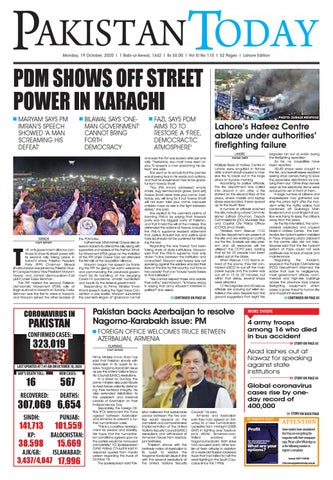
PDM shows off street Power in Karachi g
MaryaM says PM iMran’s sPeech showeD 'a Man screaMing his DeFeat'
KARACHI STaFF rePOrT
t
he anti-government alliance continues to show its street power with its second rally taking place in Karachi where Pakistan People's Party (PPP) chairman Bilawal Bhutto-zardari was joined by Pakistan Muslim league-nawaz vice President Maryam nawaz and jamiat ulema-e-islam-Fazl (jui-F) chief Fazlur rehman. the PPP hosted the second Pakistan Democratic Movement (PDM) rally at Bagh-e-jinnah in Karachi on sunday. Fazlur rehman was the first to arrive in Karachi, and Maryam joined the other leaders of
g
the PDM later. Furthermore, Mna Mohsin Dawar also arrived in Karachi to attend the rally along with supporters and workers of the Pashtun tahaffuz Movement (PtM) group on the invitation of the PPP chief. Dawar had not attended the first rally of the opposition alliance. Maryam began her speech by thanking the PPP for giving her warm welcome, and commending the provincial government for its handling of the resurging covid-19 pandemic amidst humiliation and taunts by the federal government. responding to Prime Minister imran Khan's speech during the tiger Force convention a day earlier, Maryam subverted the premier's slogan of 'ghabrana nai hai'
coronavirus in
PaKistan
CONFIRMED CASES:
323,019
LAST UPDATED AT 7:41 AM ON OCTOBER 18, 2020
DAY'S DEATH TOLL:
16
RECOVERED:
NEW CASES:
567
DEATHS:
307,069 6,654 SINDH:
PUNJAB:
141,713
101,559
KP:
BALOCHISTAN:
AJK/GB:
ISLAMABAD:
38,598
Bilawal says 'oneMan governMent' cannot Bring Forth DeMocracy
15,669
3,437/4,047 17,996
g
Fazl says PDM aiMs to to restore a 'Free, DeMocractic atMosPhere'
and said the PM was scared after just one rally. “yesterday, you must have seen on your tv screens a man screaming his defeat,” she said. she went on to remark that the premier was showing fear in his words and actions, and that he should learn how to be graceful from nawaz sharif. “you [PM imran] addressed empty chairs, dug democracy's grave, [and yet] nawaz sharif never took your name. even today, you will long for it but nawaz sharif will not even take your name, because children have no role in the fight between elders,” she said. she replied to the premier's claims of banning PMl-n by saying that nawaz's party was the biggest party of Pakistan, and that it held the will of the masses. she defended the actions of nawaz, including the PMl-n supreme leader's statement that justice shaukat aziz and justice Qazi Faez isa should not be punished for following the law. regarding the way nawaz had been taking shots at state institutions, Maryam said that the PMl-n supremo had only drawn "a line between the institution and characters". Maryam said nawaz was not speaking against the soldiers who laid their lives on the line for this country, but "one or two people" that can "cause heavy losses to that institution." “we cannot respect those who violate their oaths,” said Maryam. “is nawaz wrong in saying that army shouldn’t interfere in politics?” she asked.
CONTINUED ON PAGE 05
photo: zubair mehfooz
Lahore’s Hafeez Centre ablaze under authorities’ firefighting failure LAHORE Shahab Omer
Multiple floors of hafeez centre in lahore were engulfed in flames after a short circuit caused a massive fire to break out in the large plaza on sunday morning. according to police officials, the fire department was called into around 6 am after a fire started on the second floor of the plaza, where mobile and laptop stores were located. it soon spread up to the fourth floor. a number of officials reached the site, including lahore commissioner zulfiqar ghuman, Deputy commissioner (Dc) Mudassir riaz and capital city Police officer (ccPo) umar sheikh. “workers from rescue 1122 and fire department are present at the site and are working on putting out the fire. snorkels are also present and all resources will be utilised,” the ccPo said, adding that so far 25 people had been pulled out of the blaze. when rescue 1122 teams arrived at the scene, they first contacted lesco to cut off the main power supply and the power was cut off in 15 to 20 minutes, but within that delay, several shops were affected. 12 fire brigades and 60 rescue officials are carrying out relief activities in the area. reports from the ground suggested that eight fire
Pakistan backs Azerbaijan to resolve Nagorno-Karabakh issue: PM g
Foreign oFFice welcoMes truce Between azerBaijan, arMenia ISLAMABAD
CONTINUED ON PAGE 05
more inside
4 army troops among 16 who died in bus accident STORY ON PAGE 03
asad lashes out at nawaz for speaking against state institutions
STaFF rePOrT
Prime Minister imran Khan has said that Pakistan stands with azerbaijan in its quest to resolve nagorno-Karabakh issue as per the united nations security council (unsc) resolutions. in a tweet on sunday, the prime minister also paid tribute to azeri forces valiantly defending their territorial integrity. he also extended felicitation to the president and fraternal people of azerbaijan on their independence Day. separately, the Foreign office (Fo) welcomed the truce agreed between azerbaijan and armenia to prevent a further humanitarian crisis. “this is s a positive development for peace and stability. we hope that the humanitarian conditions agreed upon by the parties would be honoured completely,” Fo spokesperson zahid hafeez chaudhri said in response queries from media person regarding the truce of october 18. the spokesperson said Pak-
brigades ran out of water during the firefighting operation. so far, no causalities have been reported. 30-40 shops were caught in the fire, and eyewitnesses reported seeing shop owners trying to save the expensive electronics by carrying them out. other shop owners wept as the electronic items were reduced to ash in front of them. a large number of citizens and shopkeepers had gathered outside the plaza right after the incident while the traffic police had cordoned off gulberg’s Main Boulevard and a contingent of police was trying to keep the citizens away from the plaza. as the fire intensified, the compressors exploded and caused blasts in hafeez center. the ineffective fire hydrant system installed in Pace shopping plaza adjacent to the centre also did not help. sources said that the fire hydrant system of Pace could not work positively due to lack of repair and maintenance. regarding the incident, sources in the Punjab civil Defense (PcD) Department informed this scribe that due to negligence, most government offices, commercial and high-rise buildings across the province lack proper firefighting equipment, which poses a grave threat to human life and important records.
STORY ON PAGE 03
Global coronavirus cases rise by oneday record of 400,000 istan believed that sustainable peace between the two parties would depend on the complete and comprehensive implementation of the united nations security council (unsc) resolutions and withdrawal of armenian forces from azerbaijani territories. “Pakistan stands with the brotherly nation of azerbaijan in its quest to resolve the nagorno-Karabakh issue in line with the several resolutions of the united nations security
council,” he said. armenia and azerbaijan said they had agreed on saturday to a new humanitarian ceasefire from midnight (2000 gMt) in fighting over azerbaijan’s ethnic armenian-controlled enclave of nagorno-Karabakh. Both sides had accused each other earlier of fresh attacks in violation of a week-old russian-brokered truce that had failed to halt the worst fighting in the south caucasus since the 1990s.
STORY ON BACK PAGE in today’s issue
attention Some readers have complained that they are not getting the magazine with their newspaper copy. Please call or WhatsApp us at the following number to register a complaint. Contact: 0307-7338168 irfan.farooq@pakistantoday.com.pk
02
Monday, 19 October, 2020
NEWS
Covid-19 Claims 16 more lives; 567 fresh infeCtions reported ISLAMABAD TLTP
1
6 more people died of coronavirus in the country over the past 24 hours, taking the overall death toll from the disease to 6,654, said the National Command and Operation Centre (NCOC) on Sunday. According to the NCOC, 567 fresh infections surfaced when 32,062 samples were tested during this period, lifting the national tally of cases to 323,019. Around 307,069 people have recovered from the disease so far across Pakistan with addition of 429 recoveries recorded over the previous 24 hours. The number of active coronavirus cases in the country stands at 9,296 from which 534 patients are said to be in
critical condition. A total of 4,074,024 tests have been conducted so far. So far, Sindh has reported 141,713 cases, Punjab 101,559, Khyber Pakhtunkhwa (KP) 38,598, Balochistan 15,669, Islamabad 17,996, Azad Jammu and Kashmir (AJK) 3,437, and GilgitBaltistan (GB) 4,047. Meanwhile, Balochistan health officials have announced 25 more cases of Covid-19 in the province in the last 24 hours. Total count of coronavirus cases in the province has reached 15,669 after detection of 25 new cases in Balochistan, the provincial health department said in a statement. After a pause of 19 days, a patient of Covid-19 died in Balochistan in the last 24 hours increasing the death toll by the disease in the province to 147, accord-
ing to the health department report. The health officials conducted 1,023 tests in the province in the last 24 hours finding 25 positive cases of novel coronavirus. Ten more patients were recovered, increasing the number of overall recoveries in Balochistan to 15,305. The health department has also reported 18 new infections of coronavirus in educational institutions soaring the tally of total cases in these institutions to 638. Provincial health department earlier said that 98 percent of coronavirus patients have recovered to health in Balochistan. The death rate by the disease remained at 1 per cent of the total cases. Meanwhile, Punjab on Sunday reported 134 new cases of novel coronavirus and 10 deaths by the disease during the last
24 hours. A spokesperson of Punjab Primary and Secondary Healthcare department said that the total number of Covid-19 cases in the province has reached to 101,559 with addition of 134 new cases in the last 24 hours. The death toll by Covid-19 in Punjab has reached 2,298 as 10 more patients died by the disease in the last 24 hours, the spokesperson said. In new cases, 77 reported from Lahore, 13 cases from Multan and 10 new cases from Rawalpindi, according to the spokesperson. Overall, 97,219 patients of Covid-19 have recovered in Punjab. After a downward trend of the reported cases of coronavirus in Punjab, the number of cases has again started surging gradually.
president urges nation to follow sops as Covid-19 cases resurge ISLAMABAD TLTP
President Dr Arif Alvi has urged the nation to strictly follow the coronavirus-related standard operating procedures (SOPs) in view of the resurgence of Covid-19 cases in the country. In a video message, the president said, “We have contained the pandemic to the significant extent however; adhering to the precautionary measures is inevitable to completely overcome the pandemic.” Dr Alvi emphasised the need for wearing masks in mosques and bazaars to keep washing hands properly and observing social distancing so that Pakistan could fully contain the Covid-19. He commended the role of clerics and media in spreading awareness regarding coronavirus. He said that Prime Minister Imran Khan secured the people from being unemployed and helped the deserving people through Ehsaas programme. He added that the government's smart lockdown policy yielded positive results in overcoming the pandemic. The president said that the government has effectively fought the pandemic through maintaining a balance in the lockdown period and other steps for placing a barrier before the unemployment rate. Dr Alvi advised nationals to adopt precautionary measures for a few more months in view of risks for the virus spread during its new wave. It is noteworthy to mention here that 16 more people died of coronavirus in the country over the past 24 hours, taking the overall death toll from the disease to 6,654, according to the National Command and Operation Centre (NCOC).
two Covid positive passengers offloaded from sharjah-bound flight MULTAN TLTP
LAHORE: As the firefighters continued to put out the flame that engulfed Lahore's Hafeez Centre on Sunday, security personnel remained alert to deal with any adverse development. ZUBAIR MEHFOOZ
Youngster rescues 7 trapped in hafeez Centre inferno LAHORE: In a courageous act, a youngster in Lahore rescued seven people who were trapped in a massive fire at Hafeez Centre on Sunday. According to details, the youngster risked his life for the people trapped on the third floor after a huge blaze engulfed the Hafeez Centre. Narrating the entire episode, the youngster, who also suffered injuries during the daring attempt, said that seven people remained trapped on the third floor after the fire engulfed the Hafeez Centre and shutters at the exit points were closed down. “One of the men rescued was also carrying a large sum of money,” he said, adding when he approached the shopkeeper, he was crying while being trapped inside his shop. It is pertinent to mention here that a huge fire erupted at Hafeez Center shopping plaza in Lahore’s Gulberg area early in the morning on Sunday and gutted several shops and valuables worth millions. The firefighting teams remained busy evacuating people in the building, whereas some people remained trapped at the roof terrace. Punjab Chief Minister Usman Buzdar took notice of the incident and ordered authorities to utilise all resources for dousing the fire at earliest. He asked local administration and Rescue 1122 to take every necessary step for saving the lives and assets of the citizens. The chief minister said that first priority was to safely evacuate people trapped inside the shopping plaza and those stranded on the roof of the building. TLTP
Sindh health minister in favour of fining those who flaunt Covid SOPs NEWS DESK Sindh Health Minister Dr Azra Pechuho said that she is in favour of imposing a Rs1000 fine on those who do not wear face masks in public in light of the rising number of reinfection cases of Covid-19. The fine was first proposed by Karachi Administrator Iftikhar Shallwani in March, and he has recently filed the petition for this fine again. The minister said, “Like in the rest of the world, reinfections with the coronavirus are being seen in Sindh too.” She added that in some cases, antibodies are not formed after an infection. Responding to a question, Dr Pechuhu said that there so far has been no empirical evidence to support the idea of herd immunity, which is why is is important to take precautions and follow the standard operating procedures (SOPs). “People should religiously follow precautionary measures as the second attack of the virus caused chronic infection and complications, especially in elderly people,” the minister emphasised. It is pertinent to mention here that in many countries,
the restrictions applied due to the coronavirus have been likened to human rights violations. According to reports, Dr Pechuhu said that those who had previously tested positive for coronavirus but were asymptomatic are now showing severe symptoms as reinfections were being reported at different public and private hospitals in Sindh. Earlier this week, Pakistan People’s Party (PPP) leader Rashid Rabbani had passed after from Covid-19 reinfection. While many cases of re-infection have emerged around the country, as reported by the Aga Khan University Hospital (AKUH) and Dow University of Health Sciences (DUHS), no hospital has reported any deaths save for Rabbani’s. “Rashid Rabbani, 68, had been brought to the Ziauddin Hospital with Covid-19 re-infection last week and his condition was very serious. He had to be shifted to the ventilator but unfortunately, his condition continued to deteriorate and he passed away today evening,” Dr Ziauddin Hospital Chairman Dr Asim Hussain had told a local news outlet on Thursday. He had also said that the cases were rising throughout the country and that most people required ventilator support.
Two passengers were offloaded from a Sharjah-bound flight from Multan International airport after they were confirmed infected with coronavirus. The passengers hailing from Dera Ghazi Khan (DG) Khan were flying to Sharjah, but were confirmed with the coronavirus and off-loaded, said the airport sources. Earlier in May, a pilot and three flight attendants of Pakistan International Airlines (PIA) were detected with coronavirus who had performed duties on a special flight operated between from Australia’s Melbourne to Lahore. The crew members of PIA were waiting for their Covid-19 test results for one week and later they were shifted to Combined Military Hospital (CMH) Lahore. The flight attendants included Waqar Farooqui, Sofia Shaikh and Ahmed Ammad, and first officer Shakil Akram was also shifted to the CMH Lahore.
mehbooba mufti condemns attempts to stifle free press in ioK ISLAMABAD STAFF REPORT
The former chief minister of Indian Occupied Kashmir (IOK), Mehbooba Mufti, has condemned the attempts of administration to stifle free press in the held territory. In a tweet on Sunday, she said that harassing and hounding local news agencies like Kashmir News Service for speaking truth is highly condemnable. The authorities had locked the KNS office in Srinagar. Meanwhile, the Indian government on Sunday amended the J&K Panchayati Raj Act, 1989, to pave way for establishment of district development councils, the members of which will be directly elected by voters in the territory. Following the amendment, each district will be divided into fourteen territorial constituencies.
Monday, 19 October, 2020
NEWS
fissures within pdm suggest huge Challenges for allianCe's fate MILITARY LEADERSHIP UNHAPPY OVER DRAGGING OF STATE INSTITUTIONS INTO POLITICAL RIVALRIES
PML-N GROUPS TO PROTEST ANTI-ARMY NARRATIVE OF NAWAZ SHARIF ISLAMABAD
f
MIAN ABRAR
ISSURES have started to emerge within the ranks opposition alliance, Pakistan Democratic Movement (PDM), as Pakistan Peoples’ Party (PPP) Chairman Bilawal Bhutto-Zardari has distanced himself from the narrative that Pakistan Muslim League-Nawaz (PMLN) supreme leader Nawaz Sharif is against army leadership. The speech made by Nawaz Sharif in PDM’s Gujranwala rally has also sent ripples across the party ranks as the party’s biggest group has raised concerns over its anti-army stance. Its leaders have started contacting each other to craft a new strategy to deal with the matter urgently. Sources within the PML-N have said that the pro-establishment group within the PML-N ranks, including senior members, have expressed reservations over the tirade of Nawaz’s remarks against the army leadership. Furthermore, they are soon planning on holding a meeting of
likeminded colleagues in this regard. The group of disgruntled PML-N members is led by Khawaja Mohammad Asif, Sardar Ayaz Sadiq, Chaudhry Tanveer Hussain and others. “In this regard, former interior minister Chaudhry Nisar Ali Khan has also started contacting the party colleagues and he may also attend the meeting being discussed between the party’s senior cadre,” a source privy to the details of the conversations revealed. PML-N members are upset that they were bypassed and ignored by the party’s leadership in the content of the speech, and they felt that the party did not need to target the top military leadership. The senior party leaders say that the party had already decided that the PMLN leaders should target Prime Minister Imran Khan. But they say that the party’s top leadership shifted the target from Imran to Army leadership in violation of the agreed decision. Meanwhile, the military leadership has also raised its concerns over Nawaz’s words. They have said that the “emerging trend” of “targeting the state institu-
tions” is totally uncalled for. The military spokespersons have previously said as well that the armed forces have nothing to do with any political process in the country. “How a convicted proclaimed offender while illegally sitting in London is commenting on armed forces of Pakistan which are guarantor of peace and stability in the country and who have laid down thousands of lives in defending the motherland,” a senior security official told this scribe. “Even at a time when Nawaz Sharif was using derogatory language against Pakistan Army in Gujranwala, funeral prayers of 20 of its valiant soldiers were being offered, who had embraced martyrdom in separate incidents of terrorism in Balochistan and Khyber-Pakhtunkhwa (KP),” the officials argued. Criticising the insulting narrative about the army, the official warned that the PML-N leadership must not indulge in dangerous games of the behest of the enemies of the country as their agenda is doomed to fail. He said that the PML-N is trying to create divisions and clash between
higher ranked and lower ranked officials of Pakistan Army as well as between different state institutions, adding that this outcome was in complete conformity with Indian Prime Minister Narendra Modi’s agenda. The official added that the opposition has the right to protest in a democracy but the nefarious agenda of maligning the national institutions cannot be tolerated at any cost. The official further said that those politicians hatching a conspiracy against the armed forces of Pakistan cannot be the well-wishers of the country, adding that the 220 million Pakistanis stand by their armed forces. “Nawaz Sharif’s attack on military leadership is in fact attack on the Pakistan Army. This is the same thing Narendra Modi is talking about,” he said. “Indian newspapers are praising Nawaz Sharif and giving extraordinary coverage to his anti-army statements. PML-N’s agenda is gradually coming before the masses. Nawaz Sharif is playing in the hands of the enemies of Pakistan,” lamented the official.
‘nawaz trying to harm national dignity’
Asad lashes out at Nawaz for speaking against state institutions
LAHORE: Punjab Assembly Speaker Chaudhry Pervaiz Elahi has said that the nation has rejected the anti-Pakistan narrative of former prime minister Nawaz Sharif. During a meeting with Federal Minister Tariq Bashir Cheema, the Pakistan Muslim League-Quaid (PML-Q) leader said that Nawaz is trying to harm the dignity of the country he belongs to. Nawaz verbally raised the slogan of democracy but in reality, he fled the country by leaving the masses alone to protect his corruption, he added. The Punjab Assembly speaker advised Nawaz to focus on his medical treatment, for which he fled the country. On Saturday, Prime Minister Imran Khan had said that Pakistan Muslim League-Nawaz (PML-N) supreme leader Nawaz wanted to create chaos in the country. Addressing a Tiger Force convention in Islamabad, PM Imran had said that the government was taking measures to bring back Nawaz, adding that he would be treated as an ordinary prisoner this time. TLTP
Planning Minister Asad Umar lambasted Pakistan Muslim League-Nawaz (PML-N) supreme leader Nawaz Sharif for speaking against the state institutions in the latter’s speech during the Pakistan Democratic Movement (PDM) address. The above was said while speaking to the media in Karachi, and the planning minister was accompanied by Maritime Affairs Minister Ali Zaidi. The Pakistan Tehreek-e-Insaf (PTI) leader was responding to Nawaz’s speech from the Gujranwala jalsa, which was held on Friday. “Mian sahib, your threats will not work now. The time for questions has passed, and now you have to answer,” he said. Asad said that Nawaz spoke against the army because he could not get an NRO. He went on to remark that last year, Nawaz’s party members had been told to vote in favour of the tenure extension of Chief of Army Staff (COAS) General Qamar Javed Bajwa, but now Nawaz speaks against the same man to suit his own agenda. “If General Qamar Javed Bajwa did so much against you, why did you vote for his extension?” the minister questioned. Asad said that Nawaz was dragging state “institutions into politics” in his attempts to secure an NRO
NEWS DESK
for himself and for his daughter. “He has always gone against institutions in the country for his political gains,” he added. He also said that after the opposition had failed to block in Financial Action Task Force (FAFT) bills in the National Assembly (NA), Nawaz sent an envoy to General Bajwa’s house. This envoy claimed that the army chief was an old friend, and they were merely playing ludo, he added. The same enjoy also met with Inter-Services Intelligence (ISI) Director-General Faiz Hameed, the minister said. Furthermore, Asad pointed out that Nawaz spoke against the state institutions, but never raised his voice about the Indian spy. “If you are truly brave, why could you not speak about [Indian spy] Kulbhushan Jadhav […] Why do you not lash out at India?” he asked. Slamming Nawaz for directing questions at certain powerful individuals in his address at the Gujranwala jalsa, Asad said, “You [Nawaz] are an indicted criminal, you do not get to ask questions.” Zaidi said, “The opposition is running a ‘save our corruption campaign’ […] We will bring the law into action and bring back Nawaz Sharif.” Asad’s press conference came shortly before a major PDM rally started in Karachi.
PTI govt to end subsidies worth billions ISLAMABAD SHAHZAD PARACHA
The Pakistan Tehreek Insaf (PTI) government has decided to end subsidies worth billions of rupees during this year. Sources privy to the development told Profit that the economic team has finalised recommendations to end subsidies for the power, gas and agriculture sectors whereas the government will now extend a subsidy to poor people through the Benazir Income Support Programme (BISP). Sources said that the government will make the announcement in this regard sometime in December this year due to the reinstating of the stalled International Monetary Fund (IMF) programme. The PTI government had earlier announced Rs288bn subsidies dur-
ing the current fiscal year (FY) budget and ended around Rs70bn incentives comparable to FY2019-20. According to the details, a Rs189billion subsidy was given to power departments, Rs16billion subsidy in LNG exports, Rs6bn subsidy to fertiliser plants, Rs6bn subsidy for PSO-exchange losses, Rs26bn for food, Rs30bn to Naya Pakistan Housing Scheme, Rs5bn for coronavirus related programmes and Rs10bn for various other sectors. The government had also announced a targeted subsidy during the current fiscal year's budget after which the incumbent SAPM on Revenue Dr Waqar Masood was given the task to work on the issue. Sources said that the government will, however, cotinue subsidies for utility stores, housing, and food security besides giving more money to the poor under the PM’s Ehsaas programme.
Opposition doesn't have a magic wand to solve problems: Qureshi MULTAN STAFF REPORT
Foreign Minister Shah Mahmood Qureshi on Sunday expressed disappointment at Pakistan Democratic Movement’s (PDM) rally and said that the “opposition does not have a magic wand to solve problems.” Addressing a press conference in Multan, the minister further said that if the opposition had the ability to solve the problems they speak of, they would have done so when they were in power. He compared the leaders of the PDM to “old players who lost their wickets to Imran Khan”, and remarked that there is no
sense of unity in this 11-party anti-government alliance. “PML-N [Pakistan Muslim LeagueNawaz] workers started to leave the venue when Bilawal took the stage to address the protest. Similarly, PPP [Pakistan People’s Party] party workers went all quiet when the crowd was chanting slogans for Nawaz Sharif,” Qureshi said. “Poor participation in the Gujranwala jalsa is proof of the fact that people will not repeat their mistakes,” he added. The foreign minister said that the lack of unity would be the PDM’s downfall. He remarked that this alliance did not have a flag to stand under, or a central leadership to follow.
“This alliance, called PDM, is a temporary alliance. People consider it to be an unnatural alliance. Why unnatural? Because this movement does not have one flag, one leader or one ideology,” he said on the occasion. He insisted that the incumbent government would not step aside at the “behest” of the oppositions’ claims of surrender and demands for accountability. Qureshi told the presser that it was due to the efforts of the Pakistan Tehreek-e-Insaf (PTI) that the Kashmir issue had once again been taken up on the international forum. “Dragging institutions into politics is not going to favour anybody.
03
4 armY troops among 16 who died in bus aCCident GILGIT: At least 16 people, including four soldiers of Pakistan Army, died after a passenger bus tumbled off into a deep ravine on Gilgit Road near Tungus due to landslide on Sunday. According to details, the ill-fated passenger van was travelling from Rawalpindi to Skardu when the incident took place at midnight at Tangoos, destroying the vehicle, Assistant Commissioner Rondeau said in a statement. The deceased soldiers were identified as Suna Khan, Asif, Irshad and Farooq. Rescue teams and security personnel rushed to the scene and launched a relief operation to remove the rubble and retrieve passengers of the van under the debris. The rescue operation has been completed and all dead bodies have been retrieved from the debris, according to the rescue sources. The rescuers removed 16 dead bodies from the debris. Gilgit-Baltistan (GB) Chief Minister Mir Afzal has expressed his sorrow over the tragic incident and expressed his condolences with the bereaved families. He also directed the authorities to take steps to send the bodies of the deceased to their families to their native areas. Meanwhile, Minister for Kashmir Affairs and Gilgit-Baltistan Ali Amin Khan Gandapur expressed deep grief and sorrow over the passenger coach accident on Gilgit-Skardu Road. He prayed for the departed souls and commiserated with the bereaved families. He directed the administration to complete rescue operations at the earliest. STAFF REPORT
institutions are our red line, says law minister KARACHI: Federal Minister for Law and Justice Farogh Naseem has said that the government is committed to the rule of law, and the constitutional institutions of the country are all Pakistanis’ honour. Addressing the 5th National Judicial Conference, he said that the federal government is working for welfare and development of the country. He said, “The institutions are our red line and the situation in Pakistan has reached this point due to corrupt political leadership.” The minister said that the Law Ministry has amended some laws to facilitate the common people as they can get their issues resolved sooner. TLTP
govt mandated to eradicate corruption: vawda KARACHI: Federal Minister for Water Resources Faisal Vawda has said that the Pakistan Tehreek-eInsaf (PTI) government has been given the mandate by the people to eradicate corruption and the government will fulfil its promises made with the people. Talking to media persons here on Sunday, the federal minister said that people of Pakistan have rejected Nawaz Sharif. He said that the Pakistan Muslim League-Nawaz (PML-N) leader has been telling lies to mislead the people and his party leaders have been changing their statements quite frequently to support their personal gains. He was of the view that Nawaz has been promoting India’s stance and their party does not have people’s support any more. STAFF REPORT
04
Monday, 19 October, 2020
NEWS
will poliTical inTerFerence in punjab police ever end? PUNJAB PUNCH SHAHAB OMER
b
EFORE coming to power, the Pakistan Tehreek-e-Insaf (PTI) government had claimed to have brought reforms in the Punjab Police and the most important task in these reforms was to eliminate political interference from the police. However, some documents obtained from the Punjab Police revealed that in the last two years, recommendations for the transfer and posting of more than 250 police officials, including junior and senior staff, had been given out by political figures. Most of these figures are members of the Provincial and National Assemblies who belong to the PTI. However, some personalities also belong to other political parties. Documents revealed that former special assistant to the prime minister on information and broadcasting Dr Firdous Ashiq Awan, who hails from Sialkot, had recommended the transfer of two policemen last year. One of them was Nasir Mahmood while the other was Zaheer Abbas. Nasir was recommended to be transferred from Lahore CTD to District Police Sialkot and Zaheer from Lahore Police to District Police Sialkot. Punjab Minister for Auqaf and Religious Affairs Pir Syed Saeedul Hassan approached Punjab Police for the transfer of Ali Zaman from Dolphin Force Lahore to Gujranwala, Muhammad Asif from Traffic Punjab to District Police Chiniot, Muhammad Ilyas from Elite Force Lahore to District Narowal and
Ali Kamran for reinstated into service. The Punjab Police also received recommendations from the minister for the transfer and posting of a few more police officials. Punjab Higher Education Minister Raja Yassir Humayun Sarfraz also recommended to the Punjab Police for the transfer posting of three police personnel. The father and brother of Punjab Chief Minister Usman Ahmed Buzdar have also recommended the transfer of police personnel. Ghulam Sarwar Khan, who is the current Federal Minister for Aviation, has approached Punjab police for the reinstatement of Khurram Shahzad. In the last two years, the sitting members of PTI in Punjab Assembly, including Shahabuddin Khan, Ghulam Ali Asghar Khan Lahri, and Chaudhry Iftikhar Hussain, Mian Khalid Mahmood, Ghazanfar Abbas, have interfered politically in the police department for transfers, postings, reinstatement and cancelation of transfers and postings. Similarly, the sitting members of PTI in National Assembly, including Rai Hasan Nawaz Khan, Haji Imtiaz Ahmed Chaudhary, Raza Nasrullah, Shoukat Ali Bhatti, Sardar Talib Hassan Nakai, Niaz Ahmed, have also approached Punjab Police for various transfer postings of their blue eyed. Sources in Punjab Police believe that most of these recommendations may have been implemented, but it is also possible that these recommendations have been rejected by police officers because many officials are against political interference in the department and they do not like the hierarchy of the department to be disturbed without knowing any background. Sources also claimed that no funds have
Third quake jolTs swaT in ocTober SWAT: Another moderate intensity earthquake on Sunday jolted Mingora and adjoining areas in Swat district. This was the third earthquake in the current month. The intensity of tremors was recorded on 4.7 magnitude at Richter scale, according to a seismological report. The earthquake tremors were felt across Mingora town and adjoining areas at 6:14am. The depth of the quake was 110 kilometres with epicentre in the mountain range in the border area of Afghanistan and Tajikistan, according to seismological reports. Earlier on Friday last, earthquake tremors were felt in different cities of Khyber Pakhtunkhwa (KP), including Sibi, Swat, Lower Dir, Shangla and its suburban parts, on Friday. According to the Met department, the intensity of tremors recorded 5.6magnitude at Richter Scale. However, no casualty or damage was reported. Seismological reports stated that the depth of the quake was 242-kilometre with epicentre in Hindukush Mountain range in Afghanistan. Earlier on October 8, a moderate intensity earthquake jolted Mingora in Swat and adjoining areas of Khyber Pakhtunkhwa province. The intensity of tremors recorded 4.7 magnitude at Richter scale, according to a report. The earthquake tremors were felt across Mingora town and adjoining areas. The depth of the quake was 100 kilometres with epicentre in Hindukush Mountain range, according to seismological reports. TLTP
dumper crushes Three youngsTers To deaTh in karachi KARACHI: Three youngsters lost their lives after being hit by a speeding dumper near Nooriabad on Sunday. Rescue sources said that the incident occurred at Link Road # 7 near Nooriabad, where three youngsters who were riding a motorcycle were hit by a speeding dumper. As a result, three youngsters aged between, 20, 22 and 26 years were dead. The deceased are said to be residents of Haji Zia Khan Goth. The bodies were moved to the nearby hospital. In a separate road crash in the month of September, a speeding tanker overran a motorcycle in Karachi, claiming the lives of three members of a family. According to police, the incident had occurred at a traffic signal in Akhtar Colony area of the city when a moving tanker hit a motorcycle. The bodies were shifted to a hospital for medico-legal formalities. The police found that the victims were siblings and were residents of the Water Board Colony in Gulshan-e-Iqbal. TLTP
been allocated by the government for police reforms so far while political interference in Punjab police has increased even more than the previous government. Two years of the present government have come to an end but the Punjab Police has not been reformed and political interference has not ended. The incumbent government has replaced six inspector generals of police (IGP) in Punjab in its two years. In the first year, Chief Minister Buzdar replaced IGP Kaleem Imam with Muhammad Tahir, while a few weeks after his appointment, he was replaced by Additional IG Amjad Javed Salimi. Nasir Durrani, the chairman of Police Reforms Commission, also resigned after the Tahir’s removal. It is also pertinent to mention here that the PTI government had appointed former Khyber Pakhtunkhwa (KP) IGP Nasir Khan Durrani as chairman of the Punjab Police Reforms Commission and gave him a special task of police reform. Sources said that Durrani had resigned on the issue of change of Tahir and political interference in the police, and he also expressed disappointment that he had been given the responsibility of reforming the Punjab Police and assured for the non-political interference. Even after the recent appointment of Lahore Capital City Police Officer (CCPO) Umar Sheikh, there was an uproar that there were political hands behind this posting, which were aimed at removing anti-government elements through police in Punjab and that was the reason why Shoaib Dastgir, the then-IGP, who was an obstacle in the way of the posting of Sheikh, was also replaced. Punjab Government Spokesperson Mussarat Jamshed Cheema told Pakistan Today
that the culture of police in rural areas is very different from that in cities, “Our government is still trying to depoliticise the police but unfortunately the police have become depoliticised for the PTI but are still facilitating other political parties. The police have to be de-politicised after all and that will happen soon. Of course, the amount of time it took to complete the process was beyond our expectations. We are developing a comprehensive program to prevent political interference in the police. Political interference in the police will not be noticed but action will be taken.” “We also want to run the Punjab Police on the model of KP police as it is the best system which has neither political interference nor recommendation culture. We have to make the police department unbiased and when parliamentarians and politicians know that the police have become unbiased, the culture of political interference will end automatically,” she concluded. The police are already considered to be one of the most corrupt institutions in Pakistan and it is believed that they are engaged in giving the services to a certain class instead of protecting the common man and this particular class gives them every comfort in return for their services. If we take a historical look at the police system in the subcontinent, policing existed here during the Mughal era, but when the British occupied it, it changed the police system, among other things, according to the psyche of each occupier. British imperialism introduced a magisterial system in which the Darogha and other subordinate officers were recruited for policing. The British rulers had introduced that
Punjab to bear expenses of 142 BZU students by 2023 LAHORE TLTP
The Punjab government has decided to bear educational expenses of 142 Balochistan students studying in Bahauddin Zakariya University (BZU) by 2023. Punjab Chief Minister Usman Buzdar took notice of the issue of educational expenses of Balochistan students enrolled in different universities across the province. He directed Higher Education Punjab additional chief secretary to immediately resolve the issues being faced by students from Balochistan.
The additional chief secretary contacted the Balochistan government over the directives of the chief minister. The Balochistan government approved the allocation of Rs20 million funds for its students in Punjab which will be spent on educational expenditures during the new academic year. A total of 142 students from Balochistan are currently receiving education at Bahauddin Zakariya University (BZU). The Punjab government decided to bear their educational expenses by 2023. Buzdar said that the government will continue its tradition to resolve issues of Baloch students on a priority basis.
Pakistan committed to stem biodiversity resources loss: Amin ISLAMABAD TLTP
Special Assistant to Prime Minister on Climate Change Malik Amin Aslam has reaffirmed Pakistan’s commitment to join global efforts for protecting environmentally and biologically-sensitive areas to stem loss of biodiversity resources. Speaking at a virtual meeting of the international
High Ambition Coalition for Nature and People, organized by the French and Costa Rican governments, he emphasised that biodiversity for food and agriculture are among the earth's most crucial resources. Amin said that under the country’s Protected Areas Initiative, measures are being taken to improve environmental governance, management, financing and conservation activities on about 7,200 square kilometres.
Radio can play vital role to counter cultural invasion: Yousafzai PESHAWAR STAFF REPORT
Khyber Pakhtunkhwa Minister for Labour and Culture Shaukat Yousafzai has said that the importance of radio is still evident and it has always played a positive role in promoting culture. “In this age of cultural invasion, when western culture is affecting every aspect of our lives, radio can play an important role to counter the same,” said Yousafzai while addressing a one-day radio conference at Nishtar Hall. “After overcoming the challenge of terrorism and extremism, culture is now threatened by urbanisation. We all, especially the youth, have to work hard for cultural revival. Young broadcasters can play a key role in this regard,” said the minister while referring to the youth of KP. Yousafzai said, “Western nations conveyed their culture to us through media and marketing. But we have not been able to market our culture properly.” The KP government is planning to highlight the province's cultural aspects internationally and the youth of KP must also come
forward in this regard, he added. He said that local radio stations could play a vital role in promoting and reviving local culture. Radio Pakistan, Pakistan Television and Pashto Film Industry have played an important role in shaping the national mood. “But in this race, our cultural aspects seem to be affected,” the minister added. “In the age of media conversion, the youth, especially those associated with the media, have a huge responsibility. The youth have to keep in mind the values laid down by our forefathers in training the new generation and shaping the national mood,” he emphasised. Yousafzai said that every area of KP has a unique cultural aspect which should be reflected in the broadcasting. Experts from Radio and Culture fields also addressed the one-day radio conference which was attended by radio broadcasters from different districts of KP. The radio conference was a joint effort of Khyber Pakhtunkhwa Radio Broadcasters Forum, Directorate of Youth Affairs and Directorate of Culture, KP. The theme of the conference was the role of radio in promoting culture.
modern system of policing to achieve their specific goals so that they could maintain their control over the locals but unfortunately this system made by the British is not only running in our country even after independence but also the specific objectives of running this system have not changed. That is to say, even today, the ruling class and other influential classes are using the police for their specific purposes, the result of which is the destruction of this institution. It is strange that the rulers who have come in every era have first raised the slogan of stopping political interference in the police and later obstructed it themselves because their personal system cannot function without the police. Prime Minister Imran Khan had in many of his meetings and speeches before coming to power stressed that if he came to power, he would improve the structure of this corrupt department through reforms and make it a professional and strong institution which will be free from any kind of political interference. He had repeatedly mentioned that parties like the Pakistan Muslim LeagueNawaz (PML-N) and the Pakistan People’s Party (PPP) have interfered in the police and made it a powerless and paralysed institution but it is unfortunate that members of PM Imran’s own party are promoting political interference in the police department and there has been no progress on police reforms. There is no denying the fact that the PTI's reforms in the KP Police have significantly improved the performance of the provincial police force, but the problem of the Punjab Police is more complex than that of the KP Police and the main reason is its structure and political interference. Unless there is a comprehensive system of police reforms and its accountability and it is free from political interference, it will not make any difference if six IGPs are replaced again by 20 more IGPs. Instead of changing the IGPs and chief secretaries in Punjab, the prime minister should use the option of reforming the police and removing it from politics and changing important political figures.
Fbr unearths rs12.78bn transaction in dry cleaner’s account GHOTKI: The Federal Board of Revenue (FBR) has summoned a dry cleaner of Ghotki, after unearthing a suspicious transaction of Rs12.78 billion from his account on Sunday. According to details, a dry cleaner named Romesh Kumar was shocked after receiving a call-up notice from the FBR to appear before it on October 19 (Monday). According to FBR, a transaction worth Rs12.78 billion was carried out from the account of Romesh Kumar. The dry cleaner after receiving the notice of the FBR said he has no information who carried such a huge amount transaction from his account. Romesh further said he was working in Sardar Ghulam Muhammad Sugar Mills in 2009 and left the job after two years. He has been asked to appear before the FBR on Monday for interrogation. Earlier this year, a driver became an overnight millionaire after a suspicious transaction of Rs4.9 million into his bank account in Jamshoro city of Sindh. The Jamshoro driver, Somaar Channa, was surprised over the presence of the large sums of money in his bank account as more than Rs4.9 million was transacted from an unknown source. TLTP
motorists in islamabad given fuel measurement facility ISLAMABAD: Motorists in the federal capital have been given the facility to check the measurement of fuel dispensers installed at any fuel station of the city. “The facility is being provided under the Islamabad Capital Territory’s (ICT) initiative ‘Quantity on Spot Check’ to remove concerns about incorrect measures at petrol pumps,” Deputy Commissioner (DC) Hamza Shafqaat told APP on Sunday. He said the initiative was aimed at building confidence between motorists and fuel stations’ management, besides keeping a check on short measuring by some filling stations. “The administration will continue to encourage customer-centric programmes,” the DC remarked. Initially, he said that the facility would be available at Shell fueling stations whereas the scope was being extended to other petrol pumps to provide maximum relief to the masses. Moreover, ICT teams responsible for weight and measuring are conducting regular raids on fuel stations across the city and those found in less measuring are being sealed at the spot. APP
Monday, 19 October, 2020
SHemza'S paintingS removed iLLegaLLy, artiStS teLL pnCa LAHORE
t
SHAHAB OMER
he artists’ association feels that the Pakistan National Council of the Art’s (PNCA) letter regarding the return of paintings by renowned artist A J Shemza to his wife was unsatisfactory and have said that the paintings were removed illegally, Pakistan Today learnt on Sunday. The chairman of National Artists Association of Pakistan (NAAP) wrote a letter to Federal Minister Shafqat Mahmood in August stating that Shemza’s paintings had been illegally removed from the National Arts Gallery’s permanent collection. The letter further said that Shemza’s paintings – which had been gifted to or purchased by the government of Pakistan – had been missing since 2016. The letter called on the federal minister to recover the stolen paintings of Shemza and take action against those responsible. In response to the letter, PNCA Director General Fauzia Saeed wrote a reply in September, stating that, “It would have been an embarrassment for the PNCA to have internationally been declared to carry usurped property in its collection. There is no loss incurred by
returning the paintings to the owner or the rightful claimant by a gallery as it was never theirs in the first place.” “The exhibition of Shemza’s paintings was organised in Pakistan in 1985 right after his sudden death. Mary Shemza brought the paintings from the United Kingdom and they were exhibited at four places in Pakistan. Three of the exhibitions were organised by the PNCA. On her return, she was asked by the PNCA to loan 10 paintings for display in PNCA gallery for a slightly longer period and a receipt for the 10 paintings was duly issued to her. “Mary Shemza hung on to the receipt slip and asked for the return of paintings in response to which the then Director of the PNCA, Mr Ghulam Rasool offered her an amount of Rs. 40,000 for purchase of the paintings in 1988. Mary Shemza refused the offer. She persistently continued to demand her paintings over the years,” the letter stated. The letter went to say that Shemza wrote to almost every DG of the PNCA and there were some responses that stated they would look into it or would pursue it. “None of the DGs ever wrote back or claimed ‘Mary Shemza you gifted them to us why are you asking for the paint-
ings.’ This is because all of them knew well that the paintings were loaned while all ownership and IP rights vested in Mary Shemza. All the internal communications and official noting about the paintings expressly, unambiguously and categorically mentioned that these paintings were LOANeD,” the letter stated. The letter made it clear that the paintings were never put in the records of the ‘permanent collection’ of the PNCA and were never a part of the inventory where artworks are recorded when they are acquired or gifted. Later, Mary was asked by the former PNCA DG Jamal Shah to send documentation of her legal representative through the Pakistan embassy. She did accordingly, but still no decision was made by the PNCA. Regarding the return of the painting, the letter added, “I am proud that the current Minister, Board of Governors and the PNCA management have corrected a longstanding wrong. Mary Shemza is very pleased to get her paintings back and has handwritten a letter to PNCA thanking for doing the right thing. I am glad that she has not pressed any legal claims for retention and use of the paintings besides the costs incurred by her in regaining her paintings.”
The NAAP on October 17 wrote a reply to the PNCA DG, wherein NAAP said that the facts presented by her in the letter were unsatisfactory as there was no presented by the DGP PNCA. Rather, these ‘facts’ seemed to be the personal opinion of the DG. The letter also questioned about the qualification criteria of appointment of verification committee by stating that, “Why was Ms Samina Iqbal added to this verification committee (and allowed to comment on 10 Shemza Paintings aspect) when Ms Mary Shemza was personally known to her and she even presented handwritten letters to PNCA on Ms Mary Shemza’s behalf?” The letter further states, “It does not appear that the verification committee ever considered the very obvious questions that have occurred to us as a reasonable and concerned observer. In sum, the whole ‘verification committee’ process smacks of a cover-up and nothing else.” The letter directed the entire record be handed over to the investigation officer appointed by National Accountability Bureau (NAB) to carry out an inquiry into the matter so that the Punjab Forensic Science Agency can verify the authenticity of the documents.
PDM shows off street power in Karachi continued on page 01 She also lambasted pM imran for declaring the opposition as traitors, further claiming that imran was praying for Modi's election and that the premier "gave him Kashmir on a plate". Furthermore, she called the premier a "coward" who hid behind the armed forces. Bilawal, in his speech, lashed out at pM imran for “betraying” the people of Karachi. “You must have heard of the Rs1,000 billion,” he said. “out of that Rs300 billion is from Sindh’s adp [annual development programme] and Rs100 billion is from the ongoing projects from the tenures of Zardari and nawaz Sharif,” he claimed. He also demanded that the pakistan island development authority (pida) ordinance be withdrawn, urging his senators to pass a resolution at the next Senate session. Bilawal accused the country of becoming more fascist, and said that the premier must have done some sort of deal on Kashmir. “He [pM imran] claimed to be the ambassador of Kashmiris, but now he has become the lawyer of Kulbhushan,” he said in reference to the indian spy.
“this incapable and clueless prime minister will have to go home,” said Bilawal. “today, innocent people are being killed, going missing and our state is involved in this,” he alleged. “education, health budgets are being cut but this puppet government does not care because it did not come from people's votes.” the ppp chief said this “a one-man government” cannot bring forth democracy, and that pM imran had ignored the poverty and hunger of the people of pakistan. “today we are fighting the same powers who want shut down the poor’s stove, who want to imprison people who ask for their rights, who come to power not through people's votes but through nondemocratic forces. once again these forces are uniting and we have to fight them, we have to fight them everywhere, in parliament, in the streets, even in prison,” said Bilawal. Regarding the pM’s claims of banning the speeches, the ppp chief said that they would speak in the streets, adding that the masses could not be silenced. Summing up his speech, he said that the pdM’s aim was a government that was “made by people's votes and not selectors".
Fazl, in his speech, spoke of pdM's aims as well. He said that the movement aims to to restore a "free, democractic atmosphere" and to ensure the survival of the state. "no amendment will be accepted which would reduce the rights of the people," he said. "if the people of Sindh do not want, no one can dare to divide Sindh." He said that it is "not conscionable to recognise this government". earlier, dawar, who was the first speaker at the rally, called the 11-party alliance the start of real democracy in pakistan. He called out the incumbent government for repeatedly filing "baseless cases" against political workers all across the country. dawar further said that the incumbent government was "worse than a dictatorship". "in reality, the decision makers are pakistan army and its agencies," he declared, adding that the people should be treated as citizen, and not "slaves" of the state. awami national party (anp) leader ameer Haider Khan Hoti spoke next, and said “imran selected Khan, ask the poor what happens when their electricity bills come, the price of food commodities,
NEWS
05
Lahore’s Hafeez Centre ablaze under authorities’ firefighting failure continued on page 01 Reportedly, pcd organised training sessions for various government departments and high-rise buildings, but these remained ineffective as a majority of staffers at these offices are still unaware of what is to be done in case of any incident. Moreover, in most of the government departments, the fire extinguishers are expired and fire alarms have not been installed either. punjab chief Minister usman Buzdar took notice of the incident and directed that authorities use all resources to put out the fire. “the cause of the fire at Hafeez center will be ascertained. all the facts of the fire incident will be made public. the loss of traders is heartbreaking and i have instructed to estimate damages. We will review the losses of the traders and take steps to rectify the situation,” he said. “priority should be given to rescuing people stuck inside [the building],” he said and directed “immediate investigation” into the incident. Meanwhile, punjab inspector-general of police (igp) inam ghani issued instructions to the police for rescue work to control the fire. He directed dig operations Lahore ashfaq Khan and divisional Sp to remain on the spot and said that police teams should join hands with Rescue 1122 to participate in the firefighting operation. “all possible help should be provided to the teams and citizens, fire should be brought under control as soon as possible and safety of lives and property of citizens should be ensured. police teams should be present on the spot till the rescue operation is completed,” ghani said. Furthermore, Lahore commissioner Zulfiqar ghuman has formed a 14-member inquiry committee headed by the deputy commissioner (dc) on the Hafeez centre incident.
how they are buying medicines". He also asked whatever became of the premier's claim of creating "1 crore jobs" in response to asad umar, who had earlier said nawaz was trying to obtain an nRo through these rallies, ameer said that the pdM's only goal was "to look for solutions to problems such as the economy, the nFc award, protection of the 18th amendment, powers of institutions, protection of the constitution and most of all the supremacy of parliament.” the next speaker was Mehmood Khan achakzai of the pashtunkhwa Milli awami party (pkMap), who said they were not here to insult people or hurl profanities, but to take steps in forming "a Muslim state, where there would be justice, where power would rest with parliament, where the constitution would be supreme and people would be independent.” He went on to point out how the premier had directed the pdM not to talk about state institutions but had himself bragged about how the army was keeping them safe. achakzai said it was the army's duty to keep the country safe, and that it was the same in the uS, germany, and Russia. "We are not mad. We do not want to disrespect our forces," he said, but added that the army should stay within its sphere of responsibility. "[the army] will have to give us their word that they will
stay within the ambit of the constitution." Balochistan national party-Mengal (Bnp-M) leader akhtar Mengal, in his speech, attempted to subvert the usage of the word traitor, saying that anyone who tries to come into power is branded as such. “after all these rallies, so many supporters of their leaders will be declared traitors. Who will remain a patriot here?” he asked. answering his own question, the Bnp-M leader said, "“only those who labelled Mohtarma Fatima Jinnah a traitor, who opposed the reversal of one unit and started movements against it, those who always licked the boots of military dictators.” unlike the first rally, pML-n supremo nawaz did not address the Karachi jalsa. the ppp had been handling the arrangements of the second rally since Saturday, with 1,500 workers volunteering to control the flow of traffic, make seating arrangements at the park, and ensure the coronavirus standard operating procedures (Sops) are duly followed. Bilawal paid a visit to the park earlier to check on the arrangements. He was accompanied by Sindh chief Minister Syed Murad ali Shah and Sindh education and Labour Minister Saeed ghani. the ppp chairman was briefed about the arrangements and preparation for the public meeting.
Social distancing in Gujranwala City NOtES
t
M A NiAzi
he protests in Thailand do not really make sense, as they are against the monarchy. The real question is not whether the monarch is corrupt or not. how can a monarch be corrupt? We have got a precedent in Muhammad Shah Rangila, the last Mughal emperor who had an empire, and who suffered the sack of Delhi at the hands of Nadir Shah. he had two trusted confidants, whose every request he fulfilled. So, if one gave these confidants what they wanted, one could get whatever one wanted from the Padishah. Later on, recently in fact, we institutionalised the confidants, under the name of pharus (those who take). You could not bribe the Great Man (the minister, secretary, judge, ShO, whoever), you gave the money to his pharu. The type has not entirely disappeared in Naya Pakistan, which is not a good sign. I wonder if the Thai king has got a pharu? One of the reasons protesters object to the monarchy is his nexus with the military, who stages a coup if it does not like the election results. At present, there is a military-approved government in place. The former army chief, who took over in 2014, was anointed PM after ‘controversial’ elections last year.
CMYK
That’s what the Pakistan Democratic Movement (PDM) says happened here, that’s what happened in 2018 (Though we got an ex-cricketer instead of a former army chief). On the other hand, the Pakistan Tehreek-e-Insaf (PTI) says that the people are tired of the pharus. Did anyone notice any social distancing at the Gujranwala rally? Any distribution of hand sanitizer? At last, Imran will be able to blame the coronavirus on Nawaz Sharif, as his instincts told him to. The Kyrghyz president has resigned because of street protests against election results, handing the post over to an opposition premier. Imran thinks it is a very poor example and shows that the side is being let down. how could he have resigned without any charges of corruption against him? And to be replaced by someone who had come from jail – It sounds like a nightmare. An election, a refusal to accept results, and a convicted criminal being let into Parliament. And in all of this, no mention of the Kyrgyz army chief or intelligence director-general. how can they run politics like that? The protests in Nigeria did not result in the fall of the government, but it did result in the dissolution of the Special Anti-robbery Squad (SARS) of the police. The protesters had an unaccountable objection of SARS’s methods, which included encounters and other custodial deaths. I wonder how the police here would react to anyone protesting such deaths. The Lahore capital city police officer (CCPO) would proba-
bly tell them where to get off. he must be a disappointed man at the arrest of Abid Malhi, the main suspect in the motorway gang-rape. The CCPO had more or less said it was the victim’s fault, which might explain why Malhi escaped the Lahore, Kasur and Sheikhupura police forces, and was only caught by the Faisalabad police. either the cops have grown inefficient, or they wanted him to get away, or maybe Malhi did not pay enough attention to the fact that the police had taken his family into custody. Turning to other matters, I wonder what advice the CCPO has for Ghous Ali Shah, the former Sindh CM, who at 87 has disinherited his sons and grandsons because they had planned to murder him. They objected, he claimed, to his second marriage and his son by that marriage. I am sure the CCPO would have told him that that is what one gets for taking a second wife. And while polygamy is allowed in our religion, it is a risky undertaking in this part of the world. Still, it is not a preventive against rape, or rather gang-rape, of which there seems to be a rash. It is not just about the one we had here, but also the one in India involving Thakur men and a Dalit girl. And there’s been one in Bangladesh, where five men were found guilty and sentenced to death for criminally assaulting a 15-yearold in 2012. The CCPO probably agrees with the european Union Commissioner who thinks there should not be a death sentence for rape, gang or otherwise.
Monday, 19 October, 2020
06 COMMENT
Imran vs Imran
Dragging institutions into the open
The Gujranwala rally left much to be desired
Imran Khan replies to Nawaz, but raises questions about himself
P
rIMe MINISter Imran Khan used his address to a tiger force convention on Saturday to give a reply to predecessor Mian Nawaz Sharif, who addressed the first Pakistan Democratic Movement (PDM) rally in Gujranwala on friday by video link from London. He accused Mr Sharif of having ‘maligned’ the military leadership. that is likely to be a standard reply in the days to come, because it seems that Mr Sharif intends to contribute to the PDM movement against Mr Khan’s government by discussing the role of the armed forces. His friday speech claiming the military was interfering in politics was not an aberration; it followed up his speeches to the opposition APC which led to the formation of the PDM, and to the PML(N) Central Committee, in which he said much the same thing. Mr Sharif has brought into the mainstream of political discourse something that had previously only been hinted at: the role of the military in politics. Mr Khan, by the very act of pointing out what he is doing, is merely shedding more light. Mr Khan’s own constant refrain of being on the same page with the military would have been enough to raise awkward questions, but his concomitant persecution of the opposition for corruption, painted the opposition into a corner. One proponent of traditional politics, PML(N) President Shehbaz Sharif, has only recently been arrested by NAB, leaving the movement in the hands of those that want an end to a political role they claim has led to the installing of Mr Khan’s government, which they say is incompetent. In a way, Mr Khan may be responsible for getting the military accused of a political role. His threats to bring Mr Sharif back to Pakistan, and to make him answer for what he is saying, is only going to make Mr Sharif speak against Mr Khan’s supposed backers even more. Mr Khan’s reliance on being on the same page with the military does not mean that he must not come to some modus vivendi with the opposition. Politics is supposed to be the art of the possible, and if Mr Khan wishes to remain in politics, he must find a place for both the military and the opposition.
Humayun GauHar
A
fter two years, the opposition finally put up what looks like a forced alliance of 11 parties and named fazlur-rehman as its head. the alliance they called ‘the Pakistan Democratic Movement’ or PDM. this motley crew put up what they called “a power show” in Gujranwala but which actually turned out to be a shit show that couldn’t even raise much of a stench. the cricket stadium where they put up the performance has a capacity of some 25,000. Now let us be generous and say another 25,000 were outside the stadium, which makes it a total attendance of 50,000. 50,000 people attracted by 11 political parties makes it somewhat pathetic by our Asian standards. It was also obvious that much of the crowd was carted in on buses, most probably on payment and the promise of a feast. they certainly were preparing biryani and roast chicken (yum!). the workers of some of these political parties got into physical fights over some issues which shows a lack of unity. Came the speeches and not one of them had anything new to say. the leader, fazlur-rehman, came late, either by design or indiscipline because it is entirely likely that he thought he would make a big entrance by his late arrival. turned out that the delay resulted in a half-empty stadium and a poor mullah who had to speak to empty chairs. the problem is that the 11 parties are not united so they were all trying to steal the show as theirs. So as soon as that particular party’s leader’s speech was over, its supporters and the rented crowd made a beeline for the exits. the
Hafeez Centre fire Yet another reminder that skyscrapers need protection
From foes to friends
t
He fire at Hafeez Centre may well have been caused by short-circuiting, but that does not mean that the electronics trade in Lahore, and indeed in the Punjab, will escape. the destruction of the stock of the largest electronics market of the city means that prices of computers and mobile phones will skyrocket, but only for the time being, until fresh supplies come in. However, as this is a capital-intensive business, with small items costing large sums, this need not be a rapid process. However, it is a safe prediction that a large number of small traders, who had just a small shop in Hafeez Centre, will be hit hard by the loss of their stock. this is not the first fire in a multistory building in Lahore, or even Karachi, which indicates that the problem is generic, and may have the same cause or causes. Short-circuiting is avoidable, and one reason is miserliness about the quality of the wiring at the time of construction, this being one place where the builder might make savings. As such buildings are made for sale, not use, builders need to be kept on their toes by careful quality checking. then there is the proliferation of flammable material, especially where so much packing material is used. efficient disposal should be the responsibility of the market’s traders’ association, but such bodies have developed other roles: as they have become subject to electoral politics, they see themselves mostly as traders’ mouthpieces. that usually means making sure that their members avoid taxes, rather than making sure that they dispose of waste properly. It is something of a mercy that the fire broke out on a Sunday, when the market was closed. that did mean that there were no casualties, and there were none of the heart-rending scenes that might have been seen if, as happened on previous occasions, some hapless shopkeeper or customer, was trapped on some upper floor by the inferno. An inquiry into the incident followed by the relevant authorities formulating and implementing building codes is necessary to avoid any such future disasters.
anum Feroz
T
He recent historic peace deal signed between the UAe and Israel on August 13 is set to change the political dynamics in the Middle east region. the normalization of diplomatic ties between Israel and the United Arab emirates is a highly significant development. the US trump Administration played a major role and helped broker this deal, bringing the decades-long foes to come forward and shake hands, initiating a journey from being foes to becoming friends. the agreement came less than two months before the US election and President trump at once touted the deal as a major foreign policy victory. the UAe is the third Arab state after egypt and Jordan, and the first Gulf State, to normalize ties with Israel and recognize it by opening doors for diplomacy. for the UAe, this deal is an opportunity to build strong relations with the USA and Israel and to gain maximum benefits by developing diplomatic, security and commercial ties including; business relations, tourism, direct flights, scientific cooperation, and, in time, full diplomatic ties at the ambassadorial level. this will also give the UAe a chance to collaborate with Israel on health and technology sector that can help it overcome covid-19, a crisis from which every country wants an escape. On the other hand, Israel has long wanted to normalize its ties with the Arab states in order to achieve strategic goals in the region. this deal will open doors for greater acceptance of Israel in the Middle east region, with the hope that fellow Arab nations will follow the UAe very soon. Moreover, Prime Minister Netanyahu, who was under political pressure facing corruption charges, can get political benefits just like trump by touting the deal as a diplomatic achievement. However, the question remains how far will this relation grow and what consequences will it have on the rest of the Gulf States. Soon after the UAe and Israel peace deal, there was much speculation that the other Arab countries might follow suit. trump disclosed another major
Arif Nizami Editor Umar Aziz
Asher John
Joint Editor
Executive Editor
Deputy Editor
Lahore – Ph: 042-36300938, 042-36375965
Gulf States and the growing diplomatic ties between them, will further materialize the Zionist agenda and will weaken the Palestinian struggle for freedom and Independence. Moreover, the Palestinian Authority has quit its chairmanship of Arab League meetings, with Palestine due to chair a meeting of the council, bringing together the 22 foreign ministers of the regional bloc, until news of a second Arab nation, Bahrain which had March. However, the Palestine foreign Minister riyadal-Maliki recently said, his government no longer fully normalized its ties with Israel. the Arab states have long been boycotting and wanted the position. “Palestine has decided to concede maintained restricted ties with Israel over the Palestine its right to chair the League’s council at its current sesconflict. However, on September 15, both the UAe sion. there is no honor in seeing Arabs rush towards and Bahrain signed a formal Peace Agreement in normalization during its presidency,” Maliki said. the deal can have huge ramifications in the region. Washington with Israel. this is a landmark deal where both the countries have stepped forward and fully nor- for many this deal is more focused on political than on diplomatic ties within the malized ties with Israel. region. the growing diploAnother major concern matic ties between Israel, the is the future of Palestine. USA and the Middle east (inPalestinians have long been cluding oil-rich Gulf states) is fighting for their independThe old rivalry between Iran what many political analyst ence and freedom against and Saudi Arabia is mainly view as an alignment against Israel’s unjust occupation of Iran, a strategy devised by the their land. the Arab world rooted in religious differences. USA and some Sunni Arab too has repeatedly protested against the unjust and Iran is a Shia-majority Muslim States to contain the growing influence of Iran and-Shi’ites forced displacement and state, while Saudi Arabia sees in the region. dispossession of PalestiniIran has condemned this ans from their land by Israel itself as a largely Sunni deal, calling it a stab in the since 1948. they have alback of all Muslims by the ways extended a strong loyMuslim leader in the region. UAe. the Iranian foreign alty and alliance for the Both countries are in a Minister said the deal is, Palestinian cause. the Arab “Strategic stupidity from Abu States support Palestine’s constant struggle to establish Dhabi and tel Aviv that will right to self-determination. undoubtedly strengthen the Unfortunately, this loyhegemony in the Middle East resistance axis in the region.” alty and alliance between the old rivalry between Palestine and the Gulf region. The UAE and Bahrain, Iran and Saudi Arabia is States has seen a major setthe Saudi allies, have shared mainly rooted in religious back. the recent peace deal differences. Iran is a Shiasigned between the UAe their concerns over Iranian majority Muslim state, while and Israel has left the PalesSaudi Arabia sees itself as a tinians stunned; Palestine is influence in the region. largely Sunni Muslim leader in dire need and support of in the region. Both countries their Muslim brethren in are in a constant struggle to boycotting Israel. they establish hegemony in the have outright rejected this deal and feel betrayed. A statement from the Pales- Middle east region. the UAe and Bahrain, the Saudi tinian leadership spoke of the “great harm it causes allies, have shared their concerns over Iranian influto the inalienable national rights of the Palestinian ence in the region. What will be Saudi Arabia’s move? people and joint Arab action”. today, Palestinians Will it follow Bahrain and the UAe and sign a peace feel betrayed and stabbed in the back by the UAe and deal with Israel? that is still to be watched closely. Bahrain for signing a peace deal with their enemy, IsAnum Feroz is a freelance columnist rael. they fear that the recognition of Israel by the
Israel’s growing ties with the Arab World
Dedicated to the legacy of the late Hameed Nizami
Aziz-ud-Din Ahmad
if they managed to do it, otherwise a real opposition with credibility will be born and that’s when the trouble will start. Nawaz Sharif’s speech by video link was, not to use too harsh a word for it, a disgrace. In criticizing and yes, abusing, the Army Chief he actually attacked the armed forces. to many people this is tantamount to treachery. As for me, I think stupidity and desperasecond thing about this show was the reinforcing of tion also had to do with it. He has done more damage dynasticism. each so-called leader seated on the stage to the opposition and his own party than any opponent was either a dead leader’s offspring or brother or of his could do. this Nawaz Sharif sounds like a hypsome such. And some of the dynastic leaders came ocrite. A product of Generals Gilani and Zia-ul-Haq to that position perforce, because monarchy is em- sprouted in the Army’s nursery like virtually all our bedded in our DNA because of our past kings and political leaders. So if the Army has to be criticized queens. fazl-ur-rehman is the son of Mufti Mah- for anything, it is these gifts that they have given to mood, Bilawal is the son of Benazir Bhutto and Asif the country. So one can argue that they should clean Zardari (who became ‘King’ because he was Be- up their own mess. But I would urge them not to even nazir’s husband) and he is also the grandson of You try because they will end up making a bigger mess. Know Who and Maryam of course is trying to take they should now let nature take its course and just on her father’s mantle. forstick to what they should be get the others: they are nonbest at doing, which is deentities. But remember fending the country against though that Asfandyar Wali external and internal eneDon’t get in nature’s way. is the grandson of the fronmies. Most of our political tier Gandhi and the son of leadership can be categorized Mr Nawaz Sharif should Wali Khan. as ‘internal enemies’ for they the most important ascling to a political system remember that while he rails pect of the shit show was that benefits the corrupt and that more than half the against the Army Chief, it was actually leads to the defeat of crowd were common folk the will of the majority. he and his party who bent not associated with any of Whilst they are internal enethe political parties. they the Army should not over backwards to get him an mies, came to register their anger fall into the trap of trying to with Imran Khan for not dedefeat them. they did with extension of three years in livering on his promises, the Mr Zulfikar Ali Bhutto by Parliament. So he should look executing him and see what a worst of them being high food prices, high utility bills storm it has raised. they at himself and his party and runaway inflation, should take the path of least which are making life near resistance by stopping the atbefore attacking the product impossible for the middle tacks of the internal enemy of his efforts and lower classes which rather than defeating them make up virtually the entire head on, for it will just cause population. So it actually an unseemly political kerfufturned out to be Imran Khan fle. Don’t get in nature’s way. vs Imran Khan and this Mr Nawaz Sharif should reshould cause the red light in his head to light up. He member that while he rails against the Army Chief, it has to bring food prices down whichever way he and was he and his party who bent over backwards to get his economic team can do, without damaging the him an extension of three years in Parliament. So he economy. they have to find a way because the first should look at himself and his party before attacking and foremost responsibility of the government of a the product of his efforts. sovereign country, especially an Islamic one, is to As I write, the PDM is staging another so-called feed its people. I remember the former Chancellor of ‘power show’ in Karachi. there is no reason to beAustria, Bruno Kriesky, who co-authored a book with lieve that it will be any different from the one in Gume, saying about the USSr that if a country cannot jranwala. this is all good for it lets steam out of a feed its own people, it has no right to call itself a su- kettle that is bound to burst. It is for Mr. Imran Khan perpower. By the same token, if a country cannot feed to ask himself why he let so much steam build up in its own people, its independence and sovereignty be- the first place? come suspect. So Imran has his work cut out for him and he has to do it in as short a time as possible. He Humayun Gauhar is a veteran columnist in has a good economic team so I wouldn’t be surprised Pakistan and editor of Blue Chip magazine.
I
Karachi – Ph: 021-35381208-9
I
Islamabad – Ph: 051-2204545
I
Web: www.pakistantoday.com.pk
I
Email: editorial@pakistantoday.com.pk
Monday, 19 October, 2020
COMMENT 07 Editor’s mail Send your letters to: Letters to Editor, Pakistan today, 4-Shaarey Fatima Jinnah, Lahore, Pakistan. E-mail: letters@pakistantoday.com.pk Letters should be addressed to Pakistan today exclusively
Anthrophobia ANtHrOPOPHOBIA is generally meant by the profound fear of human beings. It is mainly derived from Greek word "Anthro" which refers to man and phobia which refers to "fear". On the other hand, it is also called interpersonal relationship phobia or social disorder phobia which is a pathological fear of people or human company. Anthrophobia is a toxic and untreatable disease which has captured many pieces in a never releasing prison. It has an atrocious and excruciating affect on human psychology. It may manifest as fear of blushing or meeting others awkwardness and uneasiness, when appearing in society. Anthrophobia is precisely defined when people are in fear during random consequences, additionally, it might also be beyond and leave the person uncomfortable when being around just one person. Having many of the side effects of anthrophobia, people automatically adopt the morbidity of glossophobia which itself owns coutless disorders, including hesitation when speaking up in crowds. It indeed seems the scenario of buy one get one free. It is the only disease which can't be overcome by physical medicine but can only be overcome by engaging in one's own self socially, and publicly and also participating in social issues. GulSamEEn nuahani TurbaT
Embrace the natural world
Dangerous politics democracy. Similarly, Nawaz maybe of the view that a hardline stance, never taken before, is going to help him. He must not forget that it carcerated. His daughter on the other hand is was at the behest of a military dictator that he playing a key role in extending his narrative to found a seat at the table. One must not forget the masses. She is steadfast and unreservedly the humble beginnings from where they start. puts forward her father’s narrative; though often these bold speeches are not going to help him. toeing across the line. the hardline stance that In fact it’ll prove to be disastrous for the counNawaz has adopted after Panama case has try. Our enemies are already celebrating his gained traction amongst his supporters and pur- statement and are targeting Pakistan as a whole. ported flag-bearers of democracy. However, In the end, the military establishment is part of being in an important position, it is imperative the nation; any foreign negativity against it affects the entire system. that a political leader Movements against must balance all odds the incumbent governbefore taking a line or ment may be initiated issuing statements. In The suicidal mission on within the constituterms of their constitutional framework of tional rights, Nawaz which Nawaz has embarked doing so. However, and company have the naming individuals in right to criticize the inis going to create more political speeches in volvement of the miliproblems than it will solve. It order to make them tary establishment in is going political affairs yet, at appears that desperation in controversial to be severely counterthe same time, it is improductive in the near portant to protect the London has forced the future. What does the national interests of the PML(N) supremo to issue PML(N) expect out of country. it? A revolution against As they say, there reckless statements without the military establishis a way to put forward ment? rioting against different narratives. understanding the the PtI government? Unfortunately, it apNone of the above is consequences of such pears that Nawaz beneficial for Pakistan. Sharif has failed to apcomments. Nobody likes A narrative against the preciate the sensitivity establishment of his recent remarks intervention of any sort, but ismilitary not going to absolve and is unaware of the the Sharif family of consequences of his there is a way to criticize being held accountable statements. Criticizing everything. How would the for their actions during the military establishincumbency. ment for allegedly opposition feel if General the suicidal mismeddling in the affairs sion on which Nawaz of the state is one thing Asif Ghafoor was to address has embarked is going but naming individuals a press conference detailing to create more probfrom within the Army than it will solve. takes the game to an althe alleged corruption of the Itlems appears that desperatogether new level. tion in London has While Nawaz may different political leaders and forced the PML(N) have hoped for the desupremo to issue reckoutlining the losses of sired effect; an enless statements without thralling applause from billions which the exchequer understanding the consupporters. However, sequences of such comin the larger context, has faced owing to their ments. Nobody likes taking names of the intervention of any serving Army Chief inefficient governance? sort, but there is a way helps our enemies to criticize everything. more than it helps How would the opposiNawaz. COAS Gen tion feel if General Asif Qamar Javed Bajwa and others continue to play an integral part in Ghafoor was to address a press conference determs of regional security. Maligning them di- tailing the alleged corruption of the different porectly with blatant accusations gives reason to litical leaders and outlining the losses of billions our enemies to exploit and push forward their which the exchequer has faced owing to their invested agendas. Such irresponsible statements efficient governance? A rebellion is appreciated when the rebel is only make their jobs easier. It might gain some praise from his supporters but in the long run it pure. A man tainted with corrupt practices and a heavy baggage of financial embezzlements canis an irrational and uncalled-for statement. Military dictatorships have been con- not become a messiah. A tree whose roots are demned in the past because they held the Con- venomous will only give poisonous fruit, howstitution in abeyance and openly defied the soever serene it may seem. supremacy of Parliament and democracy. Open Syed Kaswar Gardezi is a lawyer and a defiance does not go unpunished, be it by any side. Gen Ziaul Haq is not remembered in the columnist. He can be contacted at nicest of words by most as he openly defied kaswargardezi@gmail.com
The national interest must never be sacrificed
Syed KaSwar Gardezi
P
OLItICAL speeches and statements around the world are often captivating. Mostly, this depends on where the statement is coming from. US President Donald trump may not be taken seriously by most but any remark made by him is considered with seriousness as in the end those are the words of the President of the United States of America. Sometimes senior political leaders issue careless statements which have far-reaching implications. these statements and speeches get into the headlines when issued by a person who is pivotal in the political dynamic of a particular country or region. One may harbour any opinion but the same should be expressed in a manner which may not prejudice the national interests of their country. Similarly any statements which have the potential of damaging an institution should be avoided. the circumstances should be taken into account before embarking on a war of words, especially if one of the parties involved holds a key position in the corridors of power. After all, the enemies of a state are always on the lookout for infighting and the latter mostly benefits the former. While some may disagree, Nawaz Sharif is a central figure when it comes to Pakistani politics. the man has remained the chief executive of the country three times and still has a considerable vote bank and support amongst the people. In fact, his party received the largest number of individual votes even while losing the general election. therefore, Sharif plays a pivotal role in the political arena of Pakistan. for the past couple of years, Nawaz Sharif & Co. have been at the forefront of facing the brunt of accountability. Being disqualified by the Supreme Court, Nawaz has remained the target of NAB authorities, eventually being convicted and jailed. Owing to his coincidental health issues, Nawaz found a safe passage to London where he currently remains holed up on the pretext of an ongoing medical treatment. In his absence, most of the party leaders continue to face challenges at the hands of NAB and his brother and nephew currently remain in-
ASIDeS from America, many countries from european region like england, Germany have been reporting plenty of COVID-19 cases. In england, steps to offset the unemployment crisis and new lockdown restrictions have been chalked out/spelt out. Bizarre as it would seem, countries have been handling COVID-19 with so many strategic things found missing on the ground. What about strengthening immunity even as the world has been scrambling for that perfect vaccine? Not to mention mask wearing, social distancing, there are ways forward to make people of all ages immune to this virus – like taking rich food prepared with vegetables, drinking healthy drinks like milk. these are all the gifts from Nature. Incidentally, there have been no proper messages from anywhere on such natural ingredients considered healthy. the student community has been the hardest-hit, not having been taken care of properly. It is time to reopen education institutions across the world through proper safety precautions. When I was writing this letter, the US Supreme Court pick/nominee Amy Coney Barrett was facing Senate questions live on BBC and CNN [the interaction, questions and diction were just as interesting]. After all, people always want to be welcomed by others. In my native areas like Korkai, tiruchendur,tuticorin, tirunelveli, Nagercoil, Kanyakumari in tamil Nadu, people more so farmers have been working on their farms from dawn to dusk all day. thereafter, they would usually emerge out of their fields “happy and energized” to have their daily needs fulfilled. Sunlight, Nature’s most powerful gift, can bring out many changes to “handling such health crises.” Known for worship of the Sun and many scientific tempers, the Asian region will be able to open new doors to the health care system in terms of ancient medical methods, serene natural worlds like the Himalayas and other inherent natural gifts out there. P SEnThil Saravana Durai mumbai
Rise in cement prices tHe current rise of inflation and high prices of many goods has annihilated lots of professions, and has disturbed every field of life. this recent rise of cement prices has brought a new shape of catastrophe for the construction profession and industry. However, the new price of cement has affected the public in a bad manner, and inflation doesn’t just hurt the public, but also the construction industries and factories. It is the responsibility of the Government to have a solution for the innocent public. aSif JamEEl awaran
Kashmir conundrum tHe tree of liberty must be refreshed from time to time with the blood of patriots and tyrants. On August 5 2019, there were signs of something afoot in Kashmir, various Indian troops were deployed, schools and colleges were shut down, tourists were ordered to leave, internet service was suspended and political leaders were placed under house arrest. Now, this was the time to face the music from Indian government that they revoked Article 370 and 35A, which depicted that the special status of Indian occupied Kashmir was ended. Now, people from India can settle there as well as can purchase and sale property. this situation turned the tables on New Delhi, and put Kashmir on a boiling point, by passing new domicile law, backed by a demographic shift plan. According to Narendera Modi’s settler scheme, 430,000 new domicile certificates were issued in Indian occupied Kashmir, irony is that Indian government announced to impose 50,000 fines on those officers who delay in issuing domicile. Moreover, Hindutva and rSS ideology in the shape of Modi has transitioned the demography of Kashmir by giving new domicile law to its citizens. Basic purpose of these nefarious designs of New Delhi is to change the Muslim majority into Muslim minority. Although, Pakistan condemns the attempts to illegally alter the demography of Indian occupied Kashmir. Prime minister of Pakistan Imran khan stated that this was a clear violation of all international laws and treaties. International community and United Nations are paying only lip service to the misery of Kashmiri people. Now it is high time that the UN and International community must take immediate measures to curb this Indian action and prevent India from changing the demography of occupied territory and hold India accountable for its persistent violations of international laws. At present, Pakistan was re-elected to the United Nations Human rights Council with 169 votes out of 193-members. Hopefully, this will help Pakistan to raise voice for the Kashmir’s people. ZOhaib Jamir KaKa KhEl nOwShEra
Monday, 19 October, 2020
08 WORLD VIEW
How to figHt fascism tHrougH literature ARUNDHATI ROY’S NEW BOOK “AZADI” RAISES IMPORTANT QUESTIONS ABOUT HOW WE CAN RESIST AUTHORITARIANISM BY EXPRESSING NOT ONLY OUTRAGE BUT JOY
in these times
i
APOORVA TADEPALLI
N the early 2000s, historian Ramachandra Guha called Arundhati Roy crazy. For years Roy had been writing scathing essays against globalization and the myth of progress, detailing the human cost of big government’s efforts toward nuclear development and industrial dams. Throughout her career Roy has lambasted the treatment of Kashmiris, Muslims, Naxalites, Dalits and poor villagers; Guha disapproved of her wide range of issues, implying that she lacked seriousness as she “hops from cause to cause.” In an interview with Frontline, Roy responded: “He’s right. I am hysterical. I am screaming from the bloody rooftops. And he is going Shhhh … you’ll wake the neighbors!” Roy has been trying to wake the neighbors for more than two decades, publishing numerous books of acerbic nonfiction. Her latest essay collection, Azadi: Freedom. Fascism. Fiction. (published in September), responds to catastrophes in India and around the world, recently and throughout history. Azadi (Urdu for “freedom”) explores the idea that literature “provides shelter” from these catastrophes — “places off the highway,” “fragile” but “indestructible,” built and rebuilt by readers and writers. Roy has a long history of activism against fascism. She believes writing offers a unique way of clarifying and processing the world around us, especially a world so full of chaos and corruption. To challenge fascism, Roy argues, one must challenge the “sophisticated set of fake histories” that fascism peddles. Narendra Modi’s Hindu nationalism and Donald Trump’s American exceptionalism mirror each other in these efforts, riling up voters with hatred and false origin stories about what has been taken from them. With fiction, Roy writes, one can explore how “stories intersect below the surface of the grand narrative of class and capital.” In Roy’s nonfiction, the grand narrative of class and capital is an omnipresent framework for descriptions of injustice. She is explicit about calling out oppressors for what they are. Her journalism and essays portray endless images of the unprecedented atrocities carried out in Kashmir on the pretext of anti-terrorism. In Azadi, she recounts stories of “soldiers entering villagers’ homes and mixing fertilizer and kerosene into their winter food stocks … teenagers, their bodies peppered with shotgun pellets … hundreds of children being whisked away in the dead of night.” Her talent is in exposing these stories of power and abuse — by governments, corporations, re-
ligious communities — with horrific detail. Stunningly, Roy has not become desensitized. Her objective is to make sure we don’t, either. Understandably, then, Roy’s trademark voice is one of urgency, alternatingly pleading and furious, heartbroken and dripping with sarcasm. Anger comes quickly to her, albeit justifiably. Her writing often comprises long lists of “things we must not look away from.” The essays in Azadi are piercingly human. Roy is particularly unforgiving about our own complicity in atrocities — when we accept them as inevitable — committed by powerful people and institutions. Her fury is directed toward the way fascism takes hold not only in government but in our hearts, how quickly we lose the energy and the spirit for outrage. “For the sake of credibility and good manners, we groom the creature that has sunk its teeth into us — we comb out its hair and wipe its dripping jaw to make it more personable in polite company,” she seethes in Azadi. The outrage Roy inspires is her antidote to this everyday complicity with the project of fascism. According to Roy, her nonfiction and fiction take on the same task of resistance, but in diametrically opposite ways: The former is “quick, urgent and public,” the latter “slow-cooked.” Both struggle against fascism’s attempts to silence literature. Hope lies in the texts which “keep alive our intricacy, our complexity and our density against the onslaught of the terrifying, sweeping simplifications of fascism,” she writes in Azadi. Fiction, though, is “uniquely positioned” because it has the “capaciousness … to hold out a universe of infinite complexity.” Roy’s writing about fiction praises its ability to treat every human being as a “Russian doll” containing “identities within identities, each of which can be shuffled around.” Roy’s most recent novel, The Ministry of Utmost Happiness (2017), is excerpted heavily in the essays in Azadi. At the center of Ministry—amid an increasingly globalized, unequal city and a whirlwind of Maoist and Kashmiri insurgency — is the character Anjum, who builds Jannat (“paradise”) Guest House in a Delhi graveyard as a place explicitly for sheltering the poor, oppressed and marginalized. The novel takes an activist, almost journalistic tone toward injustice and seems to view the world in terms of oppressor and oppressed, victim and enemy. Consequently, the only moral response to fascism is outrage. In a lecture Roy delivered at Trinity College, University of Cambridge in February, printed in Azadi, Roy notes: “My world … is divided very simply into two kinds of people — those whom Anjum will agree to accommodate in her guest house… and those she will not.” To be so morally sure of one’s role and community — indeed, to be so sure of anything — seems a strange choice for a novelist trying to resist “sweeping simplifications.” Roy’s outrage is necessary for a more just world, but at times it can tip into a depressing determinism. “What does it mean to go to school,” she asks
in Azadi, when Kashmiri children return after seven months of lockdown, “while everything around you is slowly throttled?” Roy doesn’t seem interested in explicitly answering her own question, but Italian novelist and essayist Natalia Ginzburg—whose stories are often set against the backdrop of fascism — often answers it quite well. Despite the fury of Roy’s writing, she advocates for fiction that is more tender and sensitive to individual human nature than numbers and news reports (in Azadi essay “The Graveyard Talks Back: Fiction in the Time of Fake News,” first presented as a lecture at Trinity College, University of Cambridge). The lesson is an urgent and valuable one — upon which Ginzburg has much to teach. Several of Ginzburg’s books have been reissued in the past few years, introducing her to a new generation of American readers. Where Roy’s work responds to fascism with high volume anger, Ginzburg meets tyranny with a quiet watchfulness and poignant mundanities, a radically undramatic narrative voice. “Domestic life, its frustrations and miseries, occupies the foreground,” one reviewer says of Ginzburg’s writing, “the outside world barely discernible at the edges.” Ginzburg’s storytelling answers Roy’s question neatly: What does it mean to go to school — or carry out any of life’s daily activities — while the world is unravelling? For the young child Natalia Levi, the protagonist of Ginzburg’s autobiographical novel Family Lexicon, life was rich and layered even despite Mussolini’s fascism; it contained what Roy might call a “universe of infinite complexity.” The members of the Levi family are more than simply victims of an authoritarian government; each is a “walking sheaf of identities.” By contrast, Roy’s descriptions fall short in Ministry, whose characters are too defined by moral absolutes to live up to this complexity. Roy’s pain and anger are invaluable, but unsustainable. Outrage alone is insufficient in the face of fascism. We also need the little joys and unhappinesses of daily life. Natalia Levi’s family shows us these pieces of irrepressible humanity. Around the dinner table, the mezzorado (a yogurt base) is referred to as “the mother.” All overripe fruit is handed immediately to her father, Giuseppe, who laughs and eats them in two bites. During meals, her mother, Lidia, talks endlessly about the cheese, her father endlessly about walnuts; they scold each other for repeating themselves and Giuseppe insists it’s vulgar to talk about food all the time. “Nitwitteries!” he shouts. Giuseppe is a pessimistic, overbearing bully; Lidia sings everywhere she goes, reads Proust and bathes in cold water, joyfully shouting, “I’m freezing!” The family constantly fights about politics, though they are all staunchly antifascist. Being on the right side of history, it would seem, comes in many shades of human. Mussolini is central to the Levi family — and many of Ginzburg’s other stories — but Mussolini is largely witnessed from this vantage of perfunctory
Facebook and Twitter have bitten off too much
Politico JACK SHAFER
Twitter, Facebook, and YouTube have suddenly switched sides. Not so long ago, the three social media giants let their users do their thing at the end of the longest of leashes, allowing them to post almost anything that wasn’t criminal or didn’t violate copyright. But over the past year especially, the Big Three have deployed policies and rules to more aggressively block content they find objectionable or dangerous. At the beginning of the week, Facebook’s Mark Zuckerberg, who had previously resisted policing political speech, announced his site would prohibit content that “denies or distorts the Holocaust.” On Wednesday, Twitter landed hard on a New York Post story about Hunter Biden’s role as a go-between, allegedly connecting his father, Joe Biden, to a Ukrainian businessman,
locking many accounts that posted links to the story or posted images of hacked materials. Over at Google-owned YouTube, executives issued a Thursday proclamation that’s aimed to throttle videos, as a company release put it, from “certain conspiracy theories that are used to justify real-world violence, like QAnon.” Many liberal/truth squad types praised the sites for finally taking misinformation seriously. Conservatives, on the other hand, decried a lockdown specifically aimed at them, one that arrived suspiciously close to the election. Nearly every critic, of whom there are tens or hundreds of millions, takes for granted that the platforms have unmatched reach and resources. But can they really take this one on? Have they bitten off more than they can chew? Can they even digest half of what they’ve swallowed? These initiatives don’t mark the first attempts by social media companies to restrict the more outré examples of political speech from the web. Twitter, whose former CEO once claimed his company was “the free speech wing of the free-speech party,” has locked President Donald Trump’s account for sharing the email address of a columnist and added several warning notices to his tweets for things like claiming that Covid-19 is just like the flu and glorifying violence. Facebook has deleted what it considers Trump’s false claims about Covid-19. And YouTube has squelched Trump campaign ads. But with the election a little more than a fortnight away, they do signal an activist stance by the companies to temper the spread of the sort of disinformation that some believe changed the
course of the 2016 election. The task the companies appear to be carving out for themselves is beyond Sisyphean. Twitter hosts a half-billion new tweets each day. YouTube has logged 2.2 quadrillion video views so far this year. Every 20 minutes, Facebook users share 1 million links. There aren’t enough moderators or an algorithm smart enough to keep tabs on all of these accounts, so the best the social media operations can hope to accomplish is to pretend they’re resisting the incoming tide, not stopping it. For instance, Facebook admitted that while it will police statements about the Holocaust, the new policy won’t apply to the Armenian and Rwandan genocides. Likewise, Twitter affirmed that while it will suppress direct links to the New York Post’s Hunter Biden story, it will make no effort to stifle conversations or arguments that don’t link to personal and private information—or “hacked” material—contained in the story. That QAnon ban at YouTube isn’t really a ban, either. It only applies to videos that might justify or encourage violence. If the social media companies are engaged in a Potemkin Village exercise, for whose benefit is the elaborate staging? Without question, the social media companies have every right to set rules for their sites, just as newspapers, TV networks and bookstores have every right to determine what they find fit to purvey. (When was the last time you found a work of Holocaust revisionism in your local Barnes & Noble?) But as much as these companies worry about what users think, what really drives them is
family life. Lidia is always doing new things “to not be bored,” playing piano and learning Russian and making clothes. She plays solitaire, turning cards over and pretending to read the future: “Let’s see if Alberto will become a great doctor. Let’s see if someone will give me a lovely cottage. Let’s see if fascism will last for a while.” When Giuseppe is arrested, Lidia takes him fresh clothes and nuts and oranges in prison. She goes out in the morning to the market with her basket, singing, “I’m going to see if fascism is still on its feet. I am going to see if they’ve toppled Mussolini.” To answer Roy: Perhaps everyday life goes on, for better and for worse. For many, life carries on even against the backdrop of fascism. Our aspirations, dreams and personal struggles continue to matter in spite of everything. Perhaps, when Lidia is wringing water out of her hair and dancing around the house singing about toppling Mussolini, Mussolini becomes small and insignificant in a way that anger and activism cannot make him. Vittorio Foa, a friend of Ginzburg’s, observes in her writing a strong coexistence between “the continuity of daily life — with its tiny details, its tediousness, its little unhappinesses — and the tragic interruptions.” Foa goes on: “Natalia pays attention to the person and not purely to the political machine.” In our increasingly undemocratic world, we must make room for Roy’s tireless fury toward the institution as well as Ginzburg’s loving attention to the individual, the mundane, the simple pleasures that remind us why we fight in the first place — because life matters. While Ginzburg’s own granddaughter calls her style “sober and austere,” it may be that Roy’s writing is actually the harsher of the two, more closely attuned to “the political machine”— and Ginzburg’s work may actually be closer to the “Russian doll that contains identities within identities.” Even when the undercurrent of Ginzburg’s stories is tragedy wrought by fascism, her narrative voice takes on a tenderness and a love of people that fascism is incapable of doing. The details of her stories can be shuffled around, infinitely layered and — in brief and remarkable glimpses — be seen as something like joy.
how their true customers—advertisers— react. Any time a big advertiser complains, the social media companies take notice, just as newspapers did back in the olden times when newspapers were the go-to venue for ads. Anger one social media user and you might lose him. Anger an advertiser—or make him feel uncomfortable because his content is adjacent to outrageous material— and you risk your bottom line. The other intended audience might be the Democrats who, if you believe the polls and the chatter, are about to be the beneficiaries of an electoral mudslide of gooey and gigantic proportions. The Democrats have been threatening the tech giants with antitrust action and regulation and calling for the revocation of Section 230 because the social media companies are “propagating falsehoods they know to be false,” as their standard-bearer Joe Biden put it. What better way to get on the Democrats’ better side by making the right reformist (if ultimately meaningless) gestures just before a new government forms? Insurance policies this good don’t come any cheaper. The social media companies have also displayed their timidity by going after vile and deranged movements. Few people in their right minds subscribe to the QAnon delusions or to Holocaust revisionism, so it’s safe to blue-pencil them out. To moderate Trump takes little courage—he’s been taunting the referees for all four quarters of his presidency. If we really want to grant social media to ban and police all outrageous thought, it won’t be long until somebody asks them to suppress the work of contentious thinkers like the late Christopher Hitchens, who called for Henry Kissinger to be jailed for war crimes. If Twitter is determined to keep
stolen and hacked materials from being shared on its site, is it prepared to delete all the links to the stolen DNC emails in 2016? If it turns out the Trump tax returns the New York Times recently reported on were originally stolen, as Ross Barkan notes, would Twitter have to expunge links to those stories? Or will it give a pass to high-status publications and authors? The slope the social media companies have stepped onto is very slippery. As much as I like to box the ears of the social media companies, it seems like the real villain of the week is not Twitter but the mendacious New York Post, Rupert Murdoch’s purveyor of dirty tricks and half-baked journalism. Instead of whipping on Twitter, we should be giving it to the New York Post for publishing its halfbaked story. As Washington Post factchecker Glenn Kessler points out, the New York Post story alleges no wrongdoing by Joe Biden. The computer at the center of the story may or may not have belonged to Biden’s son, Hunter, and it was delivered to the newspaper by Trump ally and attorney Rudy Giuliani, who has been under federal investigation for his work in Ukraine. It’s such a shoddy work of journalism that in a sane world we wouldn’t be arguing over whether Twitter was right or wrong to suppress the link to it but how and why the New York Post stooped below its usual standards to publish it. But instead of ruing the existence of the New York Post, perhaps we should celebrate it. As playwright Tom Stoppard has noted, the existence of such “junk journalism” affirms not the decline of a free press but its health by declaring that nobody has the power “to dictate where responsible journalism begins.”
Monday, 19 October, 2020
BUSINESS 09
RCCI demands special stimulus packages for all business sectors ISLAMABAD SHAHZAD PARACHA
Rawalpindi Chamber of Commerce and Industry (RCCI) President Nasir Mirza has demanded special stimulus packages for all sectors as well as additional funds for development projects and lower cost of production from the government. “The business community has been the most affected because of the pandemic. The government should provide a conducive environment for the development of the country’s economy,” the RCCI president added while speaking at an interactive session with a delegation of the Economic Journalists Forum (EJF) at the Chamber House on Sunday. RCCI Senior Vice President Osman Ashraf, RCCI Vice President Shahraiz A Malik, executive members, RCCI Chairman Khurshid Barlas, Azhar Jatoi, Riaz Taheem, Tanveer Hashmi and others members were also present on the occasion. Former president and group leader and well-known industrialist Sohail Altaf also recounted the recent meeting between a group of industrialists with Prime Minister (PM) Imran Khan in which they shared feedback on issues facing the business community, inflation, development projects, FBR tax system and the current political situation. He said that it was brought to the notice of the prime minister that no mega project of any kind has been launched for Rawalpindi in the last two years. “I told the prime minister that the Ring Road project is an important project which also includes economic zones and that with the establishment of industrial zones, Rawalpindi could become a hub for commercial activities.” “The prime minister should take a personal interest and complete it on a priority basis,” he added. On the occasion, Azhar Jatoi, President of the Economic Forum, said that the purpose of the forum was to enhance engagement with the business community and to advance the suggestions of stakeholders for the development of the country’s economy so that the government could effectively formulate policymaking. The RCCI also said that the government should move forward with consensus and resolve issues amicably for political stability, adding that “the current political temperature has increased the uncertainty which is detrimental to the country’s economy.”
KP FlouR mIllS demand alloCaTed wheaT QuoTa To ConTRol PRICeS PESHAWAR
K
AZIZ BUNERI
HYBER Pakhtunkhwa (KP) Pakistan Flour Mills Association (PFMA) has demanded the provincial government to ensure that flour mills are provided with the allocated wheat quota if the provincial government is serious in providing cheap flour. The association said that flour prices continue to rise as mills are not getting their wheat quota in any province. PFMA Chairman Muhammad Naeem Butt told Profit that the govern-
AS MUCH AS 80 PER CENT OF KP'S DEMAND IS BEING FULFILLED BY THE PRIVATE SECTOR ment was currently supplying 3,000 tonnes of wheat to the mills daily, due to which only 20 per cent population of the province could get flour on government stipulated prices. Butt further said that if the government is serious about providing cheap flour to the people then the supply of 12,000 tonnes of wheat per day should be supplied to the mills. He said that mill owners are being
forced to buy wheat from the private sector at a cost of Rs5, 800 per sack due to which the price of a 20 kg flour bag has exceeded Rs1,300 in the province. “At present, the province’s 80 per cent demand is being fulfilled by the private sector due to which flour price has increased in the market,” he added. He said that he has requested the provincial government to issue the quota for at least 50 per cent of the pop-
AGP’s report shows tax evasions of Rs166bn during FY19
MONITORING REPORT MONITORING REPORT The Auditor General of Pakistan (AGP) on Sunday presented its report pointing out variations to the tune of Rs166.055 billion in tax receipts, referring to them as ‘evasion’ in the audit report on the Federal Board of Revenue’s (FBR) accounts for FY2018-19. The report is expected to be placed before the Public Accounts Committee (PAC) within the next few days, according to a report by Dawn. According to the details, the report points out the non-collection of Rs16.647bn on taxable supplies and services in 199 cases. Further, sales tax was short realised in 77 cases due to a difference of sales tax declared in income tax returns and sales tax returns in addition to the short realisation of Rs24.275bn income tax due to concealed income in 144 cases whereas losses brought forward were incorrectly adjusted in eight cases. Losses incurred in both cases amount to Rs5.706bn and
Rs17.455bn respectively. The tax department also failed to recover the adjudged government revenue of Rs5.286bn in 188 cases and allowed adjustment of inadmissible input tax in 255 cases without fulfilling legal requirements causing a loss of Rs5.655bn. The FBR has not assessed in the respective head of income in 134 cases leading to a revenue loss of Rs11.1bn, while super tax short levied to the tune of Rs16.035bn in 123 cases and federal excise duty of Rs1.089bn was not realised in 12 cases. The report reveals that adjustment of tax credits of Rs8.964bn was allowed incorrectly in 536 cases and another Rs7.162bn minimum tax was not levied in 447 cases. The withholding tax of Rs11.340bn was not treated as final tax in 991 cases and another Rs568.34m withholding tax was not realised in respect of 11 suppliers and contractors. The revenue amount of Rs3.29bn remained stuck due to non-disposal of confiscated goods in one 1080 cases and another
Rs2.563bn value additional tax was not realised in 6,874 cases. And another amount of Rs896.32m revenue was short-realised due to the misclassification of imported goods in 3,054 cases. The audit report observed a grant of inadmissible and irregular exemption of duty and taxes of Rs1.473bn in 2,063 cases. The report said an amount of Rs750.13m evaded on imported goods for declaration of lower value in 2332 cases, while a cash award of Rs145.8m was irregularly paid in 1668 cases. The special allowance of Rs127.21m was irregularly paid in 223 cases. Following the development, the AGP has suggested the development of a system to detect discrepancies between sets of data declared in the sales tax return and invoke provisions of laws for the recovery of duty and taxes in addition to the introduction of online validation checks to stop inadmissible claims of input tax and linking software with other departments to discern unexplained investment.
PIA to resume flights to England from October 30 NEWS DESK The Pakistan International Airlines (PIA) will resume flight operations to England from October 30. According to the details, the resumption would be with new European aeroplanes and crew. “The flights will operate directly with new aircraft, comfortable seats, halal food and the world’s best in-flight entertainment,” a PIA spokesperson said. Flights from Islamabad to London, Lahore to London and Islamabad to Manchester will be operated int he first phase.
Textile exports increase 2.92pc in Q1, 11.3pc in September NEWS DESK
FBR announces tax concessions for large retailers The federal government has once again agreed to tax concessions for Pakistan’s big retailers in a deal that would require the businesses to register themselves with the Federal Board of Revenue (FBR). The government would reduce tax rates through amendments to the Income Tax Ordinance at the first available opportunity, either when a mini-budget is presented or if no minibudget is introduced then at the time of next budget, the Express Tribune reported. An agreement in this regard was signed under the supervision of FBR Member Operations Mohammad Ashfaq. It is pertinent to mention here that this is the second deal that has been inked between the FBR and large retail chain stores this year; however, the first one is yet to be implemented. Further, the revenue board has also extended the deadline for online integration of Pakistan’s large retail chains till the end of November, which had earlier to be implemented from December 2019. Provisions for the mandatory integration of retailers were introduced in the Sales Tax Act 1990 through the Finance Act 2019, and proper rules were laid down. Live integration was operationalised with effect from November 1, 2019, but by the end of August, the FBR had hardly integrated the retailers with its realtime invoicing system for documentation of sales. The wholesale and retail sector contributes about 19pc to the national output but its share in tax collection is just 3.7pc of the total collection. Moreover, the FBR has also accepted the demand of not opening records of large retail stores for up to the past six years. It is not clear whether the International Monetary Fund (IMF) was informed before sealing the deal.
ulation taking the provincial poverty ratio under consideration. He further said that flour mills across the province have been issued strict instructions to issue quotas to the government-appointed dealers in a timely manner. The PFMA chairman said that the association has issued the instructions to improve the quality of their flour, supply the full quantity, and to cooperate with the government for ensuring supply in the market. He said that in case of any complaint of irregularity by any mill, the association would take stern action.
The national airline has also started booking tickets. It may be recalled that the European Union Air Safety Agency (EUASA) had suspended the authorisation for PIA to operate in Europe for six months. The airline came under scrutiny after several problems were uncovered recently, including the issuance of fake licenses to pilots. PIA is resuming operations to maintain its slots at England airports although it increases the cost of operation. If the airline doesn’t start operations with foreign crew and aircrafts, they may lose their slots.
CMYK
The exports of textile commodities witnessed an increase of 2.92 per cent during the first quarter (Q1) of the current fiscal year (FY) as compared to the corresponding period of last year whereas, on a year-on-year (YoY) basis, exports grew 11.3pc during the month of September 2020 as compared to the same month of last year. The textile exports from the country were recorded at $3,469.5 million in July-September (FY2020-21) against the exports of $3,371 million in July-September (FY2019-20), showing a growth of 2.92pc, according to data released by the Pakistan Bureau of Statistics (PBS) on Saturday. Meanwhile, the commodities that witnessed negative growth in traded included raw cotton, exports of which declined by 97.5pc, while the exports of cotton yarn decreased by 42.7pc. Exports of cotton cloth also decreased by 8.49pc, from $499 million to $457, yarn (other than cotton yarn) by 22.8pc, from $7.2 million to $0.9 million, art silk and synthetic textile by 2.93pc from $77.894 million to $75.615 million whereas the exports of cotton (carded or combed) witnessed 100pc decline during the period under review. On a month-onmonth (MoM) basis, the exports from the country increased by 18.09pc during September 2020 when compared to exports in August 2020. The import of textile machinery dropped by 25.09pc during the first quarter of the current fiscal year— a sign that no expansion or modernisation projects were taken up by the industry in the given period. It may be mentioned here that the government has lifted the ban on exports of seven products classified as personal protective equipment (PPE) in a bid to allow manufacturers to honour international orders.
Food industry forms trade body MONITORING REPORT Leading national and multi-national foodenterprises operating in the country have formed the Pakistan Association of Food Industries (PAFI). The association was formed to officially represent the food-industry of Pakistan. PAFI has the highest-level representation of major member organisations, including EBM, Nestle, Unilever, Shan Foods, Friesland Campina, Qarshi Industries, Youngs, Upfield, National Foods Limited (NFL), Tapal Tea, Pepsi, Coca-Cola, Dawn Bread, K&Ns and many more. Speaking on the formation of the association and its pledge to focus efforts to the United Nations' (UN) vision to grow, nourish, and sustain, PAFI Secretary General Irfan Hafeez Malik said that food businesses must be more actively invested in sustainable food systems as well as developing, adapting and sharing technologies in the wake of the pandemic. "Private sector food-related businesses and retailers need to make sustainable food options attractive, available and affordable," he added.
Monday, 19 October, 2020
10 FOreIgn newS saudi arabia, russia agree on joint work to stabilise energy market RIYADH
UK govt says ‘well prepared’ for no-deal BrexIt, even as BUsInesses soUnd alarm LONDON
AGENCIES
Russian President Vladimir Putin and Saudi Arabia’s Crown Prince Mohammed bin Salman have reiterated their commitment to work together to maintain the stability of the world energy market in line with the Opec+ alliance framework. "The field of fighting the spread of coronavirus, was discussed as well as reasserting the two sides' continuation of coordination, in order to support the oil markets' stability and the growth of the world economy," according to the Saudi Press Agency. The latest call between the two leaders on Saturday followed an October 13 phone conversation and called on producers in the alliance to stick to output cuts. The two leaders “had an extensive exchange of views on the implementation of current agreements within the Opec+ format,” the Kremlin said according to the Russian news agency Tass. “Both sides once more emphasised their readiness for further close coordination in this field to maintain stability in the world energy market.” Opec+, the producer alliance headed by Saudi Arabia and Russia, is expected to stick to tapered output cuts to be made at the end of the year, UAE energy minister Suhail Al Mazrouei said last week. The group does not anticipate a peak in oil demand before 2040, he said. Opec+ undertook a historic level of production cuts of up to 9.7 million barrels per day between May and July to reverse a record plunge in demand due to the pandemic. The alliance is drawing back 7.7m bpd from the markets from August to December 2020. The oil producers are likely to reduce the output cut to 5.8m bpd from January 2021 until April 2022. The agreement will be in effect for two years, but the deal’s parameters may be revised in December 2021. Last week, the International Energy Agency said the pandemic may usher in the slowest decade of energy demand in a century and the global response to the coronavirus can reshape the energy landscape for years to come.
djibouti maximising strategic position in maritime trade DJIBOUTI AGENCIES
Services sector commands Djibouti’s economy - especially services in shipping and logistics – and this leads to overdependence on foreign markets. Djibouti’s strategic position at the connection of the Red Sea and the Gulf of Aden has given it an immense advantage in international maritime trade. Djibouti Port remains the most important asset that this small nation of about one million people has, and it powers Djibouti’s $4 billion city-state economy. Thus, Djibouti pegs its economic transformation on improving the competitiveness of its ports. This is evident in its ongoing $14 billion infrastructure expansion, whose large component is going into establishment of new ports and terminals across the country’s coastline. The high headline growth rate of Djibouti’s major trading partner, Ethiopia, will see the country reap a relatively higher return on investment on port expansion as demand for export and import soars. According to estimates by the World Bank, 85 percent of Djibouti port throughput is either going to or coming from Ethiopia. From 2010 to 2019, Ethiopia’s real GDP growth has averaged 9.5 percent - one of the highest rates in the world - and it’s expected to have a knock-on effect on Djibouti's economy. To this effect, Djibouti has crafted an ambitious national strategy towards its socio-economic transformation, dubbed Vision Djibouti 2035, which aims to position the country as a global trade, logistics and industrial hub. This centers on ports and intermodal infrastructure development to increase the size of the hinterland served in East Africa and the Horn of Africa. The key component of this strategy includes development of a network of specialized ports: one for containers, one for dry-bulk cargo and another for liquid bulk. In addition, Djibouti’s capacity to handle liquid bulk destined for Ethiopia is severely constrained by the limitations of Horizon Djibouti Terminals, where oil storage facilities are concentrated. The port’s current storage capacity stands at 379,000 cubic meters, not enough to handle a throughput of refined products hitting more than 3.5 million cubic meters in recent years. In response to this operational deficit, Djibouti last month launched the construction of Damerjog Liquid Bulk port, which will have an annual throughput capacity of over 13 million tons. Djibouti’s geographical position near the world's busiest shipping routes creates a strong imperative for China’s Belt and Road Economic Initiative, which explains colossal investments by China in Djibouti’s port facilities.
AGENCIES
m
ICHAEL Gove, the minister handling Brexit divorce issues for Britain, said on Sunday that the UK is “increasingly well-prepared” for a no-deal Brexit even as businesses urged Britain and the European Union to find a compromise over trade terms. A tumultuous “no-deal” finale to the United Kingdom’s five-year Brexit crisis would sow chaos through the delicate supply chains that stretch across Britain, the EU and beyond – just as the economic hit from the coronavirus pandemic worsens. “It is not my preferred destination,” Gove said in an opinion piece in the Sunday Times newspaper. “But if the choice is between arrangements that tie our hands indefinitely, or where we can shape our own future, then that’s no choice at all. And leaving on Australian terms is an outcome for which we are increasingly well-prepared”. Prime Minister Boris Johnson said on Friday that
Britain should get ready for a deal with the European Union similar to the one Australia has, “based on simple principles of global free trade.” A so-called “Australia deal” means that the United Kingdom would trade on World Trade Organization terms: as a country without an EU trade agreement, like Australia, tariffs would be imposed under WTO rules, likely causing significant price rises. Johnson’s critics say that an Australian-style deal simply codes for no deal at all with Britain’s largest export market. Australia’s trade with the EU is dwarfed by Britain’s. More than 70 British business groups representing over 7 million workers made a last-ditch attempt on Sunday to persuade politicians to get back to the negotiating table next week and strike a Brexit deal. The groups ranged from the Confederation of British Industry, TheCityUK and techUK to the National Farmers’ Union, British Retail Consortium and the Society of Motor Manufacturers and Traders. Gove has previously said that while the British
government wanted an agreement with Brussels, it was not going be “held hostage”. “It will require a fundamental change in attitude, policy and politics from the EU to get things back on track,” Gove wrote in the Sunday Times. “As things stand, that will not happen, and the EU’s decisions at last week’s summit have, in effect, ended those trade talks,” he added. At what was supposed to be the “Brexit summit” on Thursday, the EU delivered an ultimatum: it said it was concerned by a lack of progress and called on London to yield on key sticking points or see a rupture of ties with the bloc from Jan. 1 after the end of the Brexit transition period. The Sunday Telegraph newspaper reported that British business minister Alok Sharma is seeking cash from the Treasury to help businesses navigate a no-deal Brexit. “With compromise and tenacity, a deal can be done. Businesses call on leaders on both sides to find a route through”, business groups said in their joint statement on Sunday.
Turkey lifts Black Sea gas field estimate after new find ISTANBUL AGENCIES
Turkey has raised the estimated reserves in a gas field off its Black Sea coast to 405 billion cubic metres after finding an additional 85 billion cubic metres, President Tayyip Erdogan said on Saturday. Erdogan said in August the field contained 320 billion cubic metres of gas, making it Turkey’s. The Fatih drill ship made the discovery about 100 nautical miles north of the Turkish coast. Even before Saturday’s revision, analysts had said that the find represents a major discovery and was one of the largest global discoveries in 2020. “Work in this borehole has been completed after reaching a depth of 4,775 metres as planned previously,” Erdogan said, speaking onboard the Fatih. He said the vessel would start new operations in a different bore-
hole in the same field, called Sakarya, next month after returning to port for maintenance. Another ship, called Kanuni, is also headed to the Black Sea for drilling operations, he said. If the gas can be commercially extracted, the discovery could transform Turkey’s dependence on Russia, Iran and Azerbaijan for energy imports. Turkey expects the first gas flow from field in 2023. One source close to the matter said an annual gas flow of 15 billion cubic metres was envisaged from 2025. Ankara expects gas suppliers to offer more competitive pricing and flexibility if they want to renew long-term contracts totalling 16 billion metres per year. More than a quarter of Turkey’s long-term gas contracts expire next year, including imports via pipeline from Russia’s Gazprom and Azerbaijan’s
SOCAR and a liquefied natural gas (LNG) deal with Nigeria. Turkey has also been exploring for hydrocarbons in the Mediterranean, where its survey operations in disputed waters have drawn protests from Greece and Cyprus. Greece and Cyprus pushed for a tougher response to Turkey’s natural gas exploration in contested waters at a European Union summit on Friday but were essentially told to hold off until a meeting in December. Erdogan said on Saturday that the EU had become “captive” to Greece and Greek Cypriots in the dispute over natural resources in the eastern Mediterranean and this had damaged the bloc. “If the EU does not hold an unbiased stance in existing disputes in the eastern Mediterranean, this situation will be the official declaration of the end of the European Union,” he said.
China to be only major economy to see growth this year: IMF WASHINGTON AGENCIES
With most of the world facing a deep recession due to the coronavirus pandemic, China will be the only major economy to climb back from the depths of the historic crisis in 2020, according to the International Monetary Fund (IMF). Despite the reopening of economies, global growth is projected to contract by 4.4 percent, the IMF said in its latest World Economic Outlook (WEO) report published earlier this week. While the outlook signals an upward revision of 0.8 percent compared to the body’s previous forecast, this year still marks the worst crisis since the Great Depression of the 1930s. This upgrade owes to somewhat less dire outcomes in the second quarter, as well as signs of a stronger recovery in the third quarter, offset partly by downgrades in some emerging and developing economies,” the report reads. Most countries are not expected to rebound before next year, when global output is set to grow by 5.2 percent. This is a downward revision of 0.2 percent compared to the IMF’s June projection. China is set to be the only exception in this
gloomy forecast because it can avoid recession and even expand its economy, though not as much as during previous years. The IMF anticipates that China’s gross domestic product (GDP) will jump 1.9 percent in 2020, while other emerging and advanced economies are set to plunge 5.7 percent and 5.8 percent, respectively. “Except for China, where output is expected to exceed 2019 levels this year, output in both advanced economies and emerging market and developing economies is projected to remain below 2019 levels even next year,” the report, compiled by IMF Chief Economist Gita Gopinath, said. China was the first country to face the Covid-19 outbreak and was also the first to contain the spread of the virus domestically, while the number of infections continues to rise across the globe. China’s faster-than-expected recovery is also based on strong demand for medical equipment and electronics needed to work from home, Gopinath noted. This eventually boosted the country’s exports, which have been on the rise for several consecutive months. The IMF economist said that China’s performance can have a positive impact on other countries, especially its neighbours.
India can become third largest economy by 2050: report NEW DELHI AGENCIES
The Indian economy may climb from fifth to third spot in the list of the world’s largest economies over the next three decades, according to a recent study published in the medical journal Lancet. The research, conducted earlier this year, is based on changes to the size of the working-age population in the world’s largest countries, which is then translated into scenarios for total gross domestic product (GDP). According to Lancet projections, India will have the largest working-age population prior to 2030, which will continue growing to reach peak levels before 2050. Despite a projected decline later on, India will still have more working-age adults than any country in the world by the end of the century. In 2017, India was the seventh-largest economy in the world, before rising to its current position of fifth. Demographic shifts will allow the South Asian nation to emerge as the fourth-largest economy by 2030 behind the US, China and Japan. In 2050, the country is set to leapfrog Japan, taking the third spot, and will retain the position until 2100, according to the forecast. The longstanding competition between the world’s two largest economies, the US and China, is also set to face some interesting shifts. The study says that China is forecast to outpace the US in 2035. However, the two countries may switch positions again in 2098, as an expected decline in China’s population is set to curtail economic growth. India became the world’s fifthlargest economy by nominal GDP last year, outpacing France and the UK, according to data from the IMF’s October World Economic Outlook. The country's economic growth has been among the highest in the world in the past decade, and reached a GDP of $2.94 trillion in 2019. India has an ambitious goal to become a $5 trillion economy by 2025. While the target level, which requires it to almost double the size of its GDP, was initially considered to be challenging, the Covid-19 outbreak has made the task almost impossible. The country’s economy suffered a steep decline during the first quarter, contracting by a record 23.9 percent. While the end of strict lockdowns is set to provide some relief, India’s GDP is still projected to drop by at least ten percent this fiscal year.
Amid tensions with China, India warns Amazon, Flipkart over country of origin rule MUMBAI AGENCIES
The Indian government has warned Amazon.com’s local unit and Walmart’s Flipkart that sellers on their platforms are not complying with a rule requiring that a product’s country of origin be specified. A push for strict enforcement of the
rule has come amid tensions between India and China following a border skirmish which began in June and is part of India’s efforts to cut down on Chinesemade imports. The two e-commerce firms have been given 15 days to explain the lapses or action will be taken against them, according to an Oct. 16 letter addressed to the companies
from the Ministry of Consumer Affairs and seen by Reuters. It did not specify what action may be taken, referring only to a legal act that has provisions for fines. Representatives for Amazon and Flipkart did not immediately respond to Reuters requests seeking comment outside regular business hours.
In addition to enforcing the country of origin rule, New Delhi has also banned 177 Chinese mobile applications since June while Chinese goods in ports have faced extra scrutiny and delays. Amazon has often faced regulatory challenges in India. Last year, the government enforced strict rules for foreign investment in e-commerce which forced the
U.S. retail giant to rework its business structures and strained ties between New Delhi and Washington. In January, the Competition Commission of India ordered an investigation into Amazon and Flipkart over alleged violations of competition law and certain discounting practices, which Amazon is challenging, according to court filings.
Monday, 19 October, 2020
Alex RiNs wiNs ARAgoN gRANd PRix FoR FiRst MotogP victoRy oF tHe seAsoN
s
AGENCIES
uzuKI’S Alex Rins held off a spirited challenge from Repsol Honda rookie Alex Marquez to claim his first victory of the season at the Aragon Grand Prix in Spain on Sunday. Rins’ team mate Joan Mir finished third to take a six-point lead at the top of the championship ahead of Fabio Quartararo, who started at the top of the grid but finished a disappointing 18th for Petronas Yamaha.
Starting 10th on the grid, Rins stormed out of the blocks to move up to fourth on the opening lap before moving past Yamaha’s early pace-setter Maverick Vinales to take the lead on lap eight. Marquez, fresh off his maiden MotoGP podium finish in France last weekend, climbed up nine spots and tested Rins in the final five laps, but the Suzuki rider held his nerve to seal victory on home soil. “I had to make sure I didn’t break the rear tyre and also manage the distance from Marquez in the end,” said Rins, who moved up to seventh in the championship.
Renault F1’s Ricciardo admits Nordschleife ‘scare’ has put him off racing there Renault Formula 1 racer Daniel Ricciardo says another “scare” when driving the Nurburgring Nordschleife earlier this month has put him off the idea of ever wanting to compete there. The Australian used the opportunity of the Eifel Grand Prix to put in some laps around the famous Nordschleife in a Renault Megane RS as part of an event with his team. However, he admitted that, after a wild moment early in the lap, he was left pretty nervous about driving around there - having also nearly had a crash back in 2008 when he went there in his own car. He therefore says it’s not worth anyone trying to tempt to him to participate in a race like the Nurburgring 24 Hours in the future. “I scared myself, let’s say that,” explained Ricciardo about his latest Nordschleife experience. “We did it with the team with Renault on Thursday evening, and it was pretty greasy. “I don’t know the track - I don’t play it on gaming or anything, so I don’t know it off the top of my head. “But I scared myself in the first 500 metres, and that set the tone for the next 22 kilometres or whatever - I was timid, let’s say that. “But it’s beautiful, it’s fun. Would I race there for 24 hours with 180 cars on track? I’m good, thanks. Call me old, but I’m fine where I am!” Ricciardo revealed that his first ever attempt to drive around there was before he got to F1, when he ventured out in his own vehicle. “I drove it in 2008, in my own car at the time, which was a Fiat Punto,” he said. “And believe it or not, I still went off the track in the Fiat. “There was one part of the track, I remember it was a little bit of a blind left uphill - the corner really tightened, and I wasn’t prepared. “I understeered off and went over the kerb and cut across the grass. “Fortunately, I stayed out of the barriers. AGENCIES
“It’s amazing, this victory is for all the fans who visit from all the towns around here.” Mir’s pace dropped dramatically in the final lap but he did enough to finish ahead of Vinales, who came fourth to move up to 12 points behind the championship leader. Former Moto 3 champion Mir is yet to win a race this season but has racked up five podiums, becoming Suzuki’s first premier class championship leader since Kenny Roberts Jr won the title in 2000. The race at MotorLand Aragon circuit
was the first without a premier class champion on the grid since 1999, with Valentino Rossi self-isolating after testing positive for Covid-19 and reigning champion Marc Marquez out with a long-term injury. Rins becomes the eighth different winner in 10 races so far this season, with Quartararo winning three, but the Frenchman had a weekend to forget after he failed to collect any points following two high speed crashes in open practice sessions over the last two days. Next weekend’s Teruel Grand Prix will also be held in Aragon.
Yamaha won’t replace Rossi for Teruel GP, ending Lorenzo speculation AGENCIES Yamaha has confirmed it will not field a replacement for Valentino Rossi in next weekend’s MotoGP Teruel Grand Prix, ending speculation of a potential Jorge Lorenzo comeback. Nine-time grand prix world champion Rossi tested positive for Covid-19 at his home in Tavullia, Italy on Thursday and was ruled out of this weekend’s Aragon GP. Due to the Italian government’s rules regarding Covid-19, any person who tests positive for the virus must observe a 10-day quarantine period from the moment they receive their positive PCR result. With the second Aragon GP weekend just five days away, Rossi will not be back in action until November’s European Grand Prix at the Ricardo Tormo Circuit near Valencia. Rossi’s absence led to speculation three-time MotoGP world champion Lorenzo could make a surprise comeback to racing next weekend in the Teruel GP. After retiring from racing at the end of last year, Lorenzo returned to Yamaha as its official test rider. However, Lorenzo has completed just four days of running on the M1 this year in February at Sepang and last week at the Algarve track familiarisation. All of his outings have been on the
2019 Yamaha, with his best lap in the Algarve test some four seconds slower than the Aprilia of Aleix Espargaro. MotoGP’s rules on replacement riders state: “Teams must make every reasonable effort to provide a qualified substitute rider to fulfil their entry obligations within 10 days of withdrawal.” As the 10-day period has not passed, Yamaha is not obliged to field a replacement, but can also reasonably argue that it has no qualified substitute. Yamaha also explained its decision was motivated by a desire not to put additional pressure on its reduced staff numbers at events as a result of MotoGP’s Covid-19 protocols to “adapt a new rider” to the bike. As a result, Maverick Vinales - who
starts Sunday’s Aragon GP from second - will be Yamaha’s only factory team representative next weekend. Rossi’s Covid-19 diagnosis comes two weeks after six members of Yamaha’s technical staff, including project leader Takahiro Sumi, were forced to self-isolate ahead after one tested positive for the virus ahead of the French GP. Tony Arbolino has been forced to miss this weekend’s Aragon Moto3 GP despite testing negative for Covid-19 as he was sat close to someone on a plane who did have the virus. Arbolino and Rossi follow Moto2 frontrunner Jorge Martin in missing races due to Covid19, after the Ajo KTM rider was forced out of the Misano double-header after testing positive.
SPORTS 11
‘F1 drivers critiquing Hamilton’s success should question themselves’
Toto Wolff believes drivers critiquing Lewis Hamilton’s success in Formula 1 by putting it down to the dominance of Mercedes should question themselves. Hamilton drew level with Michael Schumacher’s record of 91 grand prix victories by winning the Eifel Grand Prix at the Nurburgring last Sunday, and is set to match his tally of seven world titles this year. It has led to increased debate about Hamilton’s standing among F1’s greatest drivers, with three-time world champion Sir Jackie Stewart recently saying it was “hard to justify” Hamilton being considered better than the likes of Jim Clark and Juan Manuel Fangio. Hamilton’s long-time rival Sebastian Vettel has also said he believes Schumacher was the better driver. Hamilton has scored 70 of his 91 victories with Mercedes, which has dominated F1 since 2014 and helped the Briton to win five of his six titles. But Mercedes F1 boss Wolff felt it was wrong for Hamilton’s high win percentage of 34.87% to be used against him in the argument about his place among racing’s greats. “I read that, and in my opinion, that’s not quite fair,” Wolff said. “Winning races and winning championships is always in this sport a team exercise, but you need to put yourself in a position that you end up in the best car. “You can see lots of talented and skilled drivers took wrong decisions, or not well-advised decisions. “In that respect, it was him who joined Mercedes in 2013, and it is him that sits in the car and is able to execute on track with a tool that we provide to him. “But it’s always a tool. We couldn’t achieve the records that we have and he probably couldn’t achieve the records without the right car, full stop. “I don’t want to allow these voices that say, ‘well, he drives a Mercedes, it’s obvious that he wins so many races’. “The drivers that say that, they should analyse why they haven’t found a way into a Mercedes.” Hamilton took the decision to leave McLaren at the end of 2012 and join a Mercedes team that had won just a single race since its works return to F1. The move was perceived to be a big risk at the time, but paved the way for sizeable change in Hamilton’s F1 career. Asked by Autosport what he would tell the version of himself in 2013 who was joining Mercedes, Hamilton said: “Keep doing what you’re doing. “Hindsight is always a great thing, and I’m sure all of you can look back and say how you would maybe do something different. “For me, honestly, I wouldn’t do anything different - the mistakes that I’ve done have really helped me be where I am. “If you skip one of those moments, maybe I won’t be where I am, or maybe I’ll be further ahead or maybe I’ll be more behind. “In 2013, I can’t remember how old I was - still a youngster! And still very much learning about myself. “I think you probably can see there’s a lot of growth since then. “Moving to this team, I knew, I don’t know how I knew it so well, but I knew it was the right thing for me.” AGENCIES
Analysis: Has Eifel GP made two-day F1 weekends inevitable? AGENCIES Amid chatter about potential race weekend format changes in Formula 1, last weekend’s Eifel Grand Prix at the Nurburgring offered an accidental look at what the future could be. The weather conditions promised by the Eifel region - known as “German Siberia” arrived on Friday as rain and heavy fog hit the Nurburgring. Conditions were so poor that the medical helicopter was unable to take off, forcing both FP1 and FP2 to be cancelled and resulting in a long day for drivers waiting around. Improved conditions and a new action plan from the FIA ensured that FP3 went ahead as planned, leaving drivers with one hour in which to get up to speed at a track where F1 had not raced since 2013, essentially condensing the race weekend into two days. A two-day weekend format had already been given the go-ahead for the Emilia Romagna Grand Prix at Imola later this month, acting as a first official step to what could become F1’s norm. Drivers will have a single 90-minute practice session to get up to speed at Imola on Saturday morning ahead of qualifying, followed by the race as normal on Sunday. The format change initially split opinion through the F1 paddock. Red Bull’s Max Verstappen said in August that it was “a bit stupid” having a single practice session for what was essentially a new track for F1, and questioned why the format hadn’t been done at tracks hosting multiple races, such as the
Red Bull Ring and Silverstone. But with more and more figures in F1 coming around to the idea, are two-day weekends now inevitable? Having just a single practice session at the Nurburgring did little to change the status quo at the front of the grid. In qualifying, Mercedes was still able to lock out the front row ahead of Verstappen in third. Yet the lack of opportunity to analyse all of the data typically picked up from three hours of running on Friday meant Mercedes lacked the usual ‘perfection’ typically displayed in qualifying. “No doubt, the more practice you have, you get all the fine details right,” said polesitter Bottas. “Especially Friday, you have the whole night between the sessions to look at things and learn about things from the car and driver. So I think with more practice, we’d have been a tiny bit quicker. “But honestly I think currently in a normal weekend, I feel like there’s too much practice. “Everyone finds their ways and set-ups and the optimal things in terms of driving and the car set-up, but if there would be a bit less practice, maybe some teams can get it right, some drivers can get it right and some don’t.” That kind of unpredictability and added jeopardy for drivers is something most will see as a bonus to add in. One driver who was left ruing the limited running in Germany was Alexander Albon, who qualified fifth, losing out to the slower Ferrari of Charles Leclerc in Q3. “I wasn’t as happy as I would have been
on my laps as if I did FP1 and FP2,” Albon acknowledged, but explained how those moving up from junior categories recently would have been used to the lack of running. “If you think about it, especially for the F2 and F3 drivers, this is more or less what we’re used to. It’s not anything too different. It just means you’ve got to be on it a bit quicker in the session, and you can’t really take your time. “It felt good, and I quite like it. I’m looking forward to Imola if it’s the same thing.” Race winner Lewis Hamilton said the lack of practice running made his run to victory “more challenging”, but said he was “quite happy not to do a Friday”, highlighting the environmental benefit. “There’s 22 days less of 20 cars bombing around the track and polluting the air, the planet, so that’s a positive,” Hamilton said. “I think it just made it so much harder for us. Normally you have two sessions on the Friday, you get time to make tons of different set-up changes, and if you’re on the back foot, you’ve got time to catch up. “When you start on a Saturday, you’ve got no time. You’ve got that one session to really get on top of it and the set-up between practice and qualifying. It made it so hard.” Haas driver Kevin Magnussen felt it would also remove some of the advantages of the bigger teams who have the resources to pour over all the data gained on a Friday. “The top teams will probably have the car closer to the optimum than the smaller teams are likely to have,” Magnussen said.
CMYK
“But then as a driver, I think you can make a difference. If you’re good at adapting, then that could give you an advantage. “All sorts of analysis arrives on Saturday morning or sometimes Friday evening [for big teams]. You just get the info that we will get as well, but we will get it next week.” As F1 pushes to try and reduce the vast performance gaps between teams through the budget cap and revised regulations moving forward, cutting to two-day weekends could be an effective way to help achieve this without touching the technical rulebook. Mercedes F1 boss Toto Wolff echoed Magnussen’s belief it could help level the playing field more, rewarding “the most adaptable and innovative team”, and gave his support on a sporting level. “Obviously it’s a question that needs to be asked to the promoters,” Wolff said, noting the possible downside of no Friday running. “They are selling tickets on the Friday, and many people are not able to afford the weekend tickets and they can still see the Formula 1 cars on the Friday. That is something that needs to be considered when developing that idea.” A cutback to two-day weekends would ultimately result in changes to the existing agreements between circuits and F1 in hosting events, as the fee for three days of action and ticket sales would have to be slashed for two days. Compensating for this could be the possible expansion of the calendar, which is something F1 has craved since its takeover
by Liberty Media in 2017. The figure of 25 races has been quoted extensively in the past, and strikes fear in much of the F1 paddock for the lengths it will stretch people to. The revised 2020 schedule has been particularly brutal, containing a run of nine races in 11 weeks to start the season, and was accepted as a one-off due to its necessity, not as a blueprint for the future. Yet, if F1 was to consider two-day race weekends as a credible and workable way forward, there would be reduced burdens on the paddock. Although it could not be taken to extremes, given each race week still involves travel and set-up days all are involved in, it could make a schedule of 25 races more workable. More races would result in more hosting fee revenue, in a normal year, making up some of the gap losing Fridays may create. “It could open up an opportunity,” said Renault’s Daniel Ricciardo. “Either more races, or just more time for us to prepare away from the track with training or other commitments we have. “Some weekends do feel a bit dragged out with that, so yeah two-day weekends can still be cool. But maybe the cool places like Austin, let’s have five-day weekends!” If Imola’s format was seen as a trial for F1 moving forward, then by accident, it will end up with double the feedback and data to go on thanks to the foggy Friday at the Nurburgring. For once, poor weather causing sessions to be scrapped may end up working in F1’s favour, helping define what its future could look like.
Monday, 19 October, 2020
PrAyEr TImINGS
NEWS
glObal cOrONavIrUS caSES rISE by ONE-day rEcOrd Of 400,000
g
AGENCIES
LOBAL coronavirus cases rose by more than 400,000 for the first time late on Friday, a record one-day increase as much of Europe enacts new restrictions to curb the outbreak. Europe, which successfully tamped down the first surge of infections, has emerged as the new coronavirus epicentre in recent weeks and is reporting on average 140,000 cases a day over the past week. As a region, Europe is reporting more daily cases than India, Brazil and the United States combined. Of every 100 infections reported around the world, 34 were from European countries, according to a Reuters analysis. The region is currently reporting a million
new infections about every nine days and has reported more than 6.3 million cases since the pandemic began. Major European countries – United Kingdom, France, Russia, Netherlands and Spain — accounted for about half of Europe’s new cases in the week to Oct. 18, according to Reuters tally. France is reporting the highest seven-day average of new cases in Europe with 19,425 infections per day followed by the United Kingdom, Russia, Spain and the Netherlands in worst affected European countries. Several European countries are closing schools, cancelling elective surgeries and enlisting student medics as the authorities face a Covid-19 resurgence. Russia is moving students to online learning and Northern Ireland is closing schools for two weeks and restaurants for four.
Iran claims victory over US as UN arms embargo expires TEHRAN: Iran’s foreign ministry has declared the victory of “multilateralism, peace and security”, claiming the UN’s conventional arms embargo effectively expired on October 18, despite Washington’s pressure to reimpose sanctions. “As of today, all restrictions on the transfer of arms, related activities and financial services to and from The Islamic Republic of Iran, and all prohibitions regarding the entry or transit through territories of the United Nations Member States previously imposed on a number of Iranian citizens and military officials, are all automatically terminated,” Iran’s Foreign Ministry said in a statement on midnight local time, October 18. “A momentous day for the international community, which— in defiance of malign US efforts—has protected UNSC Res. 2231 and JCPOA,” Foreign Minister Javad Zarif added in a tweet. Under the Joint Comprehensive Plan of Action (JCPOA), a 2015 nuclear deal between Iran and world powers, the UN arms embargo on Iran expires on October 18, in line with Security Council Resolution 2231. Washington has been scrambling to prevent the lifting of the embargo, which was imposed in 2007 by the Security Council, and claimed that “snapback” sanctions under the 2015 accord would be imposed. The pressure was widely denounced by the UN Security Council, with even European allies arguing that the US has no legal authority to trigger the mechanism, after it unilaterally withdrew from the JCPOA in 2018. AGENCIE
Oil market to rely more on Middle East as US output falls: experts NEW YORK: Global oil market will rely more on the Middle East as US shale oil production is expected to continue to fall, according to industry experts. U.S. shale oil production will fall by 900,000 barrels per day in 2020 and drop another 1.1 million barrels per day in 2021, according to S&P Global Platts. “It will be OPEC (the Organization of the Petroleum Exporting Countries) that will fill the gap for that supply loss as demand recovers,” although some of the non-OPEC countries like Canada, Brazil and producers from Europe’s North Sea will fill some of the gap, said Chris Midgley, global head of analytics with S&P Global Platts. Speaking at a media briefing, Midgley said “ultimately, it will be OPEC that will be needed to fill the gap if it’s required.” For the week ending Oct 9, U.S. averaged daily crude oil stood at 10.5 million barrels in comparison with 13 million barrels or higher in February and March 2020, according to the website of U.S. Energy Information Administration (EIA). The EIA predicted that U.S. averaged crude oil production will fall from 12.2 million barrels per day in 2019 to 11.5 million barrels per day in 2020 and 11.1 million barrels per day in 2021. However, U.S. crude oil production will be 2 million barrels per day lower by 2024 if Democrats win in the upcoming general election and ban fracking of shale oil and gas, according to S&P Global Platts. In the long-run, U.S. tight oil production is not likely to reach heights projected in previous years and will peak around 2030 while OPEC liquids will fill the gap, according to 2020 OPEC World Oil Outlook, a report issued recently. AGENCIES
In Spain, authorities in Catalonia ordered bars and restaurants to close for 15 days and limited the numbers of people allowed in shops. The Czech Republic has also shifted schools to distance learning and plans to call up thousands of medical students. Hospitals are cutting non-urgent medical procedures to free up beds. Polish health officials have warned the country is on the brink of a disaster as a record 6,526 new coronavirus infections and 116 deaths were reported this week. Poland is ramping up training for nurses and considering creating military field hospitals. Latin America is the worst-affected region with about 27% of total Covid-19 cases followed by Asia, North America and Europe, according to a Reuters analysis. India is reporting fewer cases this month compared with September, with
69,000 cases per day, according to Reuters analysis. The numbers have fallen by more than 20,400 over the last three weeks, down 22% from its previous peak. India reported 55,342 cases on Oct. 13, its lowest daily increase since Aug. 18. In the United States, which has the largest total number of cases and deaths in the world, new infections are edging higher along with the most hospitalized Covid-19 patients since early September. Efforts to develop a vaccine hit snags, with Johnson & Johnson JNJ.N pausing its trial after an unexplained illness in a study participant. AstraZeneca’s AZN.L U.S. trial has remained on hold for more than a month. Russia, which recorded a record daily increase in cases, has meanwhile granted regulatory approval to a second vaccine.
Nagorno-Karabakh dispute: Armenia blames Azerbaijan of violating humanitarian truce AGENCIES Armenia accused Azerbaijan on Sunday of violating the recent humanitarian truce which was aimed to end the decades-long worst outbreak of hostilities in the disputed region. Yerevan’s defence ministry spokesperson Shushan Stepanyan said on Twitter that Azerbaijan had fired artillery shells and rockets in the early hours of Sunday, just minutes after the ceasefire went into effect from midnight (2000 GMT). There was no immediate reaction from Azerbaijan. Saturday’s ceasefire followed a major escalation that saw a missile strike kill 13 people including small children in the Azerbaijani city of Ganja, for which President Ilham Aliyev vowed to take “revenge”. A previous truce brokered by Russia to allow the warring sides to exchange prisoners and bodies and begin “substantive” talks quickly broke down, with both sides accused each other of violations. Azerbaijan and the Armenian separatists who control its Karabakh region have been locked in a bitter impasse over the fate of the mountainous province since a war in the 1990s that left 30,000 people dead. Clashes erupted again three weeks ago and have killed at least 700 people, threatened to draw in regional powers Russia and Turkey, and raised alarm over the failure of a decades-long interna-
tional mediation. The real death toll is probably much higher since Azerbaijan has not published fatalities among its soldiers. With neither side making decisive gains — and a smokescreen of claims and counter-claims of victory blurring events on the frontline — there is no telling when the fighting will end. ‘REVENGE’: The latest ceasefire came after Azerbaijan’s President Ilham Aliyev vowed to take revenge on Armenia after a missile strike killed 13 people including small children in the city of Ganja. The early hours attack, which also saw a strike on the nearby strategic city of Mingecevir, came hours after Azerbaijani forces shelled Stepanakert, the capital of the ethnic Armenian separatist region. The explosions in Ganja levelled a row of houses and left more than 45 people injured in an attack Aliyev described as “a war crime”. He said his army would “take revenge on the battlefield” and promised to capture Karabakh by driving out Armenian forces “like dogs”. Prosecutors said that as the result of the attack on Ganja 13 people died including small children. An AFP team in Ganja saw rows of houses turned to rubble by the strike, which shattered walls and ripped roofs off buildings in the surrounding streets. “We were sleeping and suddenly
we heard the blast. The door, glass, everything shattered over us,” said Durdana Mammadova, 69, who was standing on the street at daybreak because her house was destroyed. Nagorno-Karabakh’s military said for its part that Azerbaijani forces had stepped up their attacks on Friday across the front, shelling Stepanakert and a nearby town. On Saturday, Karabakh separatist leader Arayik Harutyunyan had said before the truce took effect that “intensive fighting” continued “along the entire line of defence”. EU DEPLORES STRIKES: The EU on Saturday condemned the strikes on Ganja and said the original ceasefire deal “must be fully respected without delay”. “All targeting of civilians and civilian installations by either party must stop,” said a spokesperson for EU foreign affairs chief Josep Borrell. Turkey, a staunch ally of Azerbaijan and widely accused of supplying mercenaries to bolster Baku’s forces, said the strikes were a war crime and called on the international community to denounce them. Nagorno-Karabakh, a breakaway region of Azerbaijan mainly inhabited by ethnic Armenians and backed by Yerevan, has been the scene of deadly clashes since September 27. It has remained under separatist Armenian control since a 1994 ceasefire ended the post-Soviet conflict.
FAJR SUNRISE
ZUHR
ASR MAGHRIB ISHA
4:47
11:48
3:47
6:09
5:26
6:47
12 kIllEd, OvEr 100 INjUrEd aS car bOMb targEtS afghaN pOlIcE KABUL: At least 12 persons were killed and over 100 others got injured when a car bombing targeted a police headquarters in the western Afghan province of Ghor on Sunday. The attack took place in Feroz Koh, the capital of the province, where there has been less violence than other regions of the country. The Ministry of Interior said the car bomb detonated in front of Ghor police headquarters at about 11am local time. “The terrorists detonated an explosives-filled car. As a result 12 civilians were killed and more than 100 people were wounded,” the ministry said. Juma Gul Yakoobi, a health official in Ghor, said victims included members of the security forces. No group claimed responsibility, but fighting between the Taliban and government has surged in recent weeks. “The explosion was very powerful,” said Aref Abir, spokesman for the Ghor governor. “There are fatalities and casualties and people are taking them to hospitals.” He said the blast damaged nearby buildings where officials assist women and the disabled. Peace talks between the Taliban and Afghan government began in Qatar last month, but violence continues unabated. The talks appear to be stalled as the Taliban and government have struggled to establish a basic framework for negotiations. AGENCIES
US military defends air strikes as taliban warns of ‘consequences’ KABUL: The U.S. military on Sunday defended its air strikes against Taliban fighters last week as the insurgent group accused Washington of violating their signed agreement and warned of consequences if such actions continued. The Taliban launched a major offensive in the southern province of Helmand in a bid to take the provincial capital, prompting U.S. air strikes in support of Afghan security forces, which were being overrun. “American forces have violated the Doha agreement in various forms by carrying out excessive air strikes following the new developments in Helmand province,” Taliban spokesman Qari Muhammad Yousuf Ahmadi said in a statement on Sunday. The U.S.-Taliban agreement, signed in Doha, provides for foreign forces to leave Afghanistan in exchange for security guarantees and a pledge from the insurgents to sit down with the Kabul administration to find a peaceful settlement to decades of war. “Responsibility and consequences from continuation of such actions shall fall squarely on the shoulders of the American side,” Ahmadi warned, adding that air and drone strikes had also been carried out in other provinces. Col. Sonny Leggett, spokesman for the U.S. forces, denied that the strikes violated the agreement. “The entire world has witnessed the Taliban’s offensive operations in Helmand - attacks which injured and displaced thousands of innocent Afghan civilians,” Leggett tweeted, reiterating a call for “all sides” to reduce violence. Talks between Taliban and Afghan government negotiators began last month in Doha, but the process has only moved slowly, while violence has continued. Diplomats and officials have said this is sapping the trust required for the talks to succeed. After the Helmand fighting, U.S. special envoy to Afghanistan Zalmay Khalilzad said on Thursday that the Taliban had agreed to “reset” their commitments and reduce the number of casualties. AGENCIES
Pandemic fears, rising prices spur countries to stockpile food: report CAIRO AGENCIES
The coronavirus shopping frenzy has spilled over into government level as countries begin hoarding food amid fears that the pandemic’s effect on global supply chains could cause price hikes. Nations dependent on food imports seem to be the most concerned about shortages of agricultural goods as the number of coronavirus infections continues to rise. For example, Egypt, the largest importer of wheat globally, increased purchases by almost 40 percent year-on-year between July and August. The country’s
officials earlier told the media that Cairo wants to have sufficient “essential goods” for no less than six months as a pre-emptive measure in the light of the ongoing pandemic. Most of Egypt’s wheat supplies come from Russia, which introduced a grain export quota in the first half of this year to shield its own domestic market. The move was considered alarming in the wake of coronavirus uncertainty, but analysts said that the world is not going to be left without Russian grain as alternative suppliers can be found. Jordan has also been boosting grain purchases. According to a Bloomberg report, the country’s wheat reserves reached
a record 1.35 million tons. While this is enough to cover the country’s needs for a year and a half, the government is considering the addition of even more food to its strategic stockpile to ensure food safety. Earlier this year, the UAE imported 4,500 dairy cows from Uruguay for the same reason. The nation said that it was just the first such shipment and more were set to follow. “Covid-19 has forced consumers to shift from just-in-time inventory management to a more conservative approach which was labelled just-in-case,” Bank of America analysts said, as quoted by Bloomberg. “The result is that consumers
Published by Arif Nizami at Qandeel Printing Press, 4 Queens Road, Lahore, for PT Print (Pvt) Limited. Ph: 042-36300938, 042-36375965. Email: newsroom@pakistantoday.com.pk
are holding more inventory as a precaution against future supply disruptions.” Similar steps were undertaken by Morocco and Pakistan. However, analysts noted that some of the increased imports stem from the nations’ desire to purchase commodities in advance to avoid paying more for them later. Extensive purchases combined with other factors, including strong demand from China, which has been dealing with flooding and inclement weather, have already pushed prices up. The Bloomberg Agriculture Subindex, which measures key farm goods futures contracts, jumped around 20 percent since June’s lows.