Wednesday, 12 January, 2022 I 8 Jamadi-al-Sani, 1443 I Rs 15.00 I Vol XII No 195 I 12 Pages I Karachi Edition
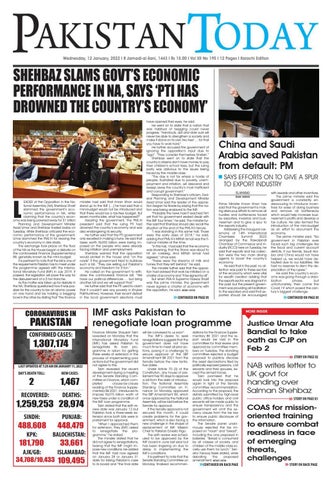
Shehbaz SlamS govt’S economic performance in na, SayS ‘pti haS drowned the country’S economy’
l
eader of the opposition in the national assembly (na) Shehbaz Sharif slammed the government’s economic performance in na, while claiming that the country’s economy was being pawned away for $1 billion planning and development Minister asad umar and Shehbaz traded barbs on tuesday. While Shehbaz criticized the economic performance of the government, umar slammed the pML-n for leaving the country’s economy in dire straits. the exchange took place on the floor of the na as the House began a debate on the controversial finance (Supplementary) Bill, generally known as the mini-budget. it is pertinent to note that the bill is one of the requirements pakistan has to meet under the programme agreed with the international Monetary fund (iMf) in July 2019. if passed, the legislation will pave the way for the disbursement of a $1bn tranche. as the matter was taken up for debate in the na, Shehbaz questioned how it was possible for the country to be an atomic power on one hand and be holding a begging bowl in the other by stating that “the finance
minister had said that imran Khan would stand up to the iMf […] he had said that a mini-budget would not be introduced and that there would be a tax-free budget. But seven months later, what has happened?” assailing the government, the pML-n president said that the ruling pti had drowned the country’s economy and was also endangering its security. He further said that the pti government only excelled in making u-turns. He said that taxes worth rs350 billion were being imposed on the people who were already facing inflation and unemployment. Shehbaz warned that the opposition would protest in the house and “on the roads” if the government tried to bulldoze such a bill. “they are selling out pakistan’s economy and freedom for $1bn.” He called on the government to withdraw the controversial finance bill. “We have our political differences … but bring another bill and we will support that.” He further said that the pti used to claim that it couldn’t see any poverty in Khyber pakhtunkhwa. However, their recent defeat in the local government elections must
coronaviruS in
pakiStan
CONFIRMED CASES:
1,307,174
LAST UPDATED AT 7:29 AM ON JANUARY 11, 2022
DAY'S DEATH TOLL:
NEW CASES:
2
1,467
RECOVERED:
DEATHS:
1,259,253 28,974 SINDH:
PUNJAB:
488,608
448,479
KPK:
BALOCHISTAN:
181,790
33,661
AJK/GB:
ISLAMABAD:
34,708/10,433
109,495
have opened their eyes, he said. He went on to state that a nation that was habitual of begging could never progress. “Handouts, aid and dole outs will never be able to strengthen a society and make it stand on its own two feet … for that you have to work hard.” He further accused the government of ignoring the opposition’s input due to “ego”. “they consider themselves einstein.” Shehbaz went on to state that the country’s citizens don’t have money to pay their children’s school fees, but the ruling party was oblivious to the issues being faced by the middle-class. “the day is not far where a horde of people, frustrated due to poverty, unemployment and inflation, will descend and sweep away the country’s most inefficient and corrupt government.” responding to Shehbaz’s criticism, federal planning and development Minister asad umar said the leader of the opposition began his tirade by saying that the nation was being enslaved to the iMf. “probably the news hasn’t reached him yet that his government sealed deals with the iMf four times,” he said. the minister further said that Shehbaz should also recall the situation at the end of the pML-n’s tenure. “i was standing in this same hall. those were the early days of 2018,” he said, adding that pML-n’s Miftah ismail was the finance minister at the time. “in this hall, i had said that the economy was drowning, that the titanic was about to hit an iceberg. and Miftah ismail had agreed,” umar said. “these were the streams of milk and honey that they left behind,” he said. the minister further said that the opposition had advised that work be initiated on a charter of economy and “it be signed by all”. But when pML-n Supremo nawaz Sharif was the prime minister, the government never signed a charter of economy with the opposition, he said. News Desk
CONTINUED ON PAGE 05
China and Saudi Arabia saved Pakistan from default: PM g
SayS effortS on to give a Spur to export induStry ISLAMABAD MiaN abrar
prime Minister imran Khan has said that the government is making strenuous efforts to remove all hurdles and bottlenecks faced by exporters, investors and businessmen and to give a spur to the exports industry. addressing the inaugural ceremony of 14th international Chambers Summit 2022 arranged by the rawalpindi Chamber of Commerce and industry (rCCi) here on tuesday, he said that exports and tax collection were the two main driving agents to boost the country’s economy He said that in the past, no attention was paid to these sectors of the economy which were vital for wealth creation adding that the exports sector was stagnant in the past, but the present government was providing all facilitation to the exporters and said that exporters should be encouraged
IMF asks Pakistan to renegotiate loan programme finance Minister Shaukat tarin revealed on Monday that the international Monetary fund (iMf) has asked pakistan to renegotiate its loan programme in return for getting three weeks of extension in the process of implementing prior actions but the government did not agree to this. tarin revealed the recent development during a meeting of the Senate Standing Committee on finance, which completed clause-by-clause reading of the finance Supplementary Bill 2021, introduced to impose rs375 billion worth of new taxes under a condition of the iMf loan programme. tarin stated that the sixth review date was January 12 but pakistan took a three-week extension since both bills were in parliament for approval. “When i approached them for extension, they (iMf) asked to renegotiate the programme,” he stated. the minister stated that he did not agree to renegotiations, fearing that the iMf might impose new conditions. He added that the iMf had now agreed on January 28 or January 31 date for taking pakistan’s case to its board and “the final date
will be conveyed to us soon”. the iMf’s desire to seek renegotiations suggests that the government does not have much time to meet all prior actions, posing it a challenge to secure approval of the SBp amendment Bill 2021 from the Senate before the new tentative dates. under article 70 (3) of the Constitution, any house of parliament has 90 days to approve a bill from the date of introduction. the national assembly Standing Committee on finance on Monday approved the SBp amendment Bill, which once approved by the national assembly, will be laid before the Senate for approval. if the Senate approval is not secured this month, it could create problems for the government, which is also facing a new challenge in the shape of replacement of iMf Mission Chief to pakistan ernesto rigo. the sixth review was scheduled to be approved by the iMf board in June last year but has been lingering on due to delay in implementing the iMf’s conditions. it is pertinent to note that the Senate Standing Committee on Monday finalised recommen-
dations for the finance Supplementary Bill 2021 and the report would be laid in the committee for final review and approval by committee members on tuesday. the standing committee rejected a budget proposal to publicly disclose the asset declarations filed by politically exposed persons, civil servants and their spouses, except the armed forces. tarin promised that he would look into the proposal again in light of the Senate committee recommendation. according to the proposal, the details submitted by high-level public office-holders and civil servants will be made public to ensure transparency and the government will omit the secrecy clause from the tax law to ensure public disclosure of the information. the Senate panel unanimously rejected the tax imposed on “naan” and “bread”, including the one prepared in bakeries. “Bread is consumed by all classes of society, and children of the middle class society use them for lunch,” Senator farooq naek stated, while debating the proposed amendment. News Desk
CONTINUED ON BACK PAGE
with awards and other incentives. the prime minister said the government is constantly endeavouring to introduce incentives for ease of doing business and remove all bottlenecks which would help increase businessmen’s profits and develop a tax culture. He also termed the introduction of the mini-budget as an effort to document the economy. the prime minister said, “no government in pakistan ever faced such big challenges like the fiscal and current account deficits. if our friends, Saudi arabia and China would not have helped us, we would have defaulted due to our liabilities. We had no reserves to stem the depreciation of the rupee.” He said the country’s economy was going through a stabilization phase, but unfortunately, then came the Covid 19 which posed the century’s biggest challenge.
CONTINUED ON PAGE 05
more inside
Justice Umar Ata Bandial to take oath as CJP on Feb 2 STORY ON PAGE 02
naB writes letter to uK govt for handing over Salman Shehbaz STORY ON PAGE 03
COAS for missionoriented training to ensure combat readiness in face of emerging threats, challenges STORY ON BACK PAGE
02
Wednesday, 12 January, 2022 | KARACHI
NEWS
Justice umar ata Bandial to take oath as cJP on FeB 2 isLamaBaD
J
StAff report
USTICE Umar Ata Bandial will take oath as the Chief Justice of Pakistan on February 2 following the retirement of incumbent CJP Justice Gulzar Ahmed. Justice Gulzar Ahmed will retire on February 1 after working in the top judicial position for more than two years. Supreme Court judges, including the chief justice, retire after attaining the age of
65 years while the high court justices superannuate on becoming 62-year-old under the Constitution. The age is counted from the date of birth recorded at the time of the judicial appointment. As per details, the law ministry has started working on the summary regarding the appointment of Justice Bandial as CJP. As per law, the summary will be sent to the President of Pakistan Dr Arif Alvi. After the approval from the president, the law ministry will issue notification
regarding the appointment at the top judicial slot. Justice Gulzar Ahmed assumed the office of the chief justice on December 21, 2019, replacing Chief Justice Saqib Nisar. Justice Bandial will continue as the chief justice till his retirement on September 18, 2023, and will hold the position for some 19 months. Following Justice Bandial’s superannuation, Justice Qazi Faez Isa will become the chief justice to serve this office for over one year till October 25, 2024.
Pakistan Railways hands over KCR, Shah Latif express to private sector KaraCHi StAff report
Pakistan Railways has decided to hand over Shah Latif Express and Karachi Circular Railway (KCR) project to the private sector to be run under the Public-Private Partnership mode. Shah Latif Express, which runs between Karachi, Hyderabad and Mirpurkhas generated revenue of Rs20 million monthly. The company that had won the bid
for the express train offered Rs1.33 billion and would be bound to submit more than Rs2.5 million to the Pakistan Railways in advance as payment before every week. In October 2020, it was reported that the Pakistan Railways had decided to outsource commercial management of eight passenger trains to the private sector in order to provide better passenger facilitation to the travellers. The railway department sought proposals from the private sector for the
outsourcing of commercial management of the passenger trains. In a statement, the spokesperson of the railway department said that eight passenger trains are being privatised. The trains include KarachiRawalpindi Sir Syed Express, Karachi-Havelian Hazara Express, Karachi-Lahore Shalimar Express, Lahore-Mari Indus Mianwali Express, Lahore-Sialkot Narowal Passenger, Karachi-Mirpur Khas Mehran Express, Lahore-Multan Moenjo Daro Express
and Lahore-Multan Badar Express. It emerged that proposals have been sought for three routes for Moenjo Daro Express passenger train including KarachiMultan en route Jacobabad, Kotri-Multan en route Jacobabad and Kotri-Sukkur en route Dadu. Under the privatisation plan, the trains’ staff will be managed by the private sector, however, locomotives, bogies, technical assistance and fuel will be provided by the railway management.
NITL denies launching govt’s Rs1bn venture capital fund for startups Taimoor Hassan The National Investment Trust Limited (NITL) of the government of Pakistan has also denied launching a Rs1 billion venture capital fund announced by President Arif Alvi in September last year at a tech conference arranged by PakLaunch to showcase Pakistan’s startups to investors, after a similar denial earlier by the Securities and Exchange Commission of Pakistan (SECP). In September, the Securities and Exchange Commission of Pakistan (SECP), originally quoted by President Arif Alvi as the government body launching the fund, had denied launching the fund but said that the government was launching the venture capital fund under NITL, whereas SECP will only give approvals for investments. Speaking to Profit, Adnan Afridi, the managing director of NITL, however, said that National Investment Trust Limited had not been approached by the government for any such initiative, nor was he privy to any such deliberations.
Confusion has ensued at government departments after the announcement by the president, with the SECP modifying its statement when contacted again by Profit after the denial by NITL. A spokesperson from the SECP this time said that the NITL was launching a social impact fund instead of a venture capital fund and that the president had misspoken during the event when he actually meant the social impact fund. Speaking at PakLaunch’s inaugural conference held in September last year to showcase Pakistan’s startups to domestic and foreign investors, President Arif Alvi said that the government was launching a venture capital fund to support Pakistan’s startups. The president had said that Pakistan was the fifth most populous country in the world with a huge youth bulge, most of whom were educated and English speaking. “The government is making loans available for the youth through the Kamyab Jawan Programme,” the president said, adding that besides the Kamyab Jawan Programme, venture capital was the only way these
youth could be encouraged [to become entrepreneurs]. On the same note, President Alvi had said that the Securities and Exchange Commission of Pakistan, which is the regulator of investments and companies, was creating a Rs1 billion fund to partner with other SECP approved venture capital funds to invest in startups. Later, while speaking to Profit, the SECP said it was only a regulator, hence could not itself launch a fund. The SECP further conveyed to Profit that the fund would be created under NITL whereas their only job would be to give investment approvals. “At the same time, another Rs1 billion venture capital fund is being started so that the startups can roll themselves into the market,” the president had said, without specifying if the second fund was also being launched by the SECP, any other government organisation or if it was a private venture. Profit reached out to the president’s press secretary for comments but no response was received till the filing of this report.
Zia Chishti out as TRG Pakistan elects new board KaraCHi AribA ShAhid
TRG Pakistan, at an Extraordinary General Meeting (EoGM) held on January 11, elected a new board of directors which saw the company founder Muhammad Ziaullah Khan Chishti being ousted from the board. The meeting was held primarily to elect a new board of directors for the company. Earlier, 26 contestants had applied to become one of the 10 elected directors of the company. TRGs founder, Muhammad Ziaullah Khan Chishti, was not among them. A day earlier his name, as well as that of his mother, along with a few of his associates was on the list of proxies that had been nominated for the voting. Zia seemed to have given his proxy to Mahmood Farooq. But once the voting ended, neither him nor his associates were in the top ten recipients of vote shares, meaning he was out of the board. The elected members of the companies board include Khaldoon Bin Latif, Farrukh Imdad, Hasnain Aslam, Waleed Tariq Saigol, John Leone, Patrick Mc Ginnis, Zafar Iqbal
Sobani, Abid Hussain, Asad Nasir, and Suleman Lalani. They will serve for a term of three years commencing January 14, 2022. The company now has nine independent directors, including three from JS Group, two from Pinebridge Investments, one from Faysal Funds, Maple Capital, and Hamdard respectively, and Hasnain Alam who was reelected as the Chief Executive Officer (CEO). Zafar Sobani, who got re-elected, was also previously an independent director on the board. The company is yet to decide on a female director for the board of directors. Chishti who was one of the 26 individuals contesting, despite having the opportunity to vote for himself and re-elect himself on board, voted in favor of Pinebridge, a New York based investment fund, thereby removing himself from the competition. Until before the EoGM, it was uncertain whether Chishti would contest himself or give his proxy to Pinebridge. What this means is despite being a shareholder and the founder of the company, Zia has the same amount of control over the company and its performance as a regular shareholder.
several Balochistan bigwigs including ex-cm raisani set to join Jui-F QUETTa StAff report
Balochistan is once again witnessing the political hiccups as several prominent politicians have decided to join the bandwagon of Jamiat Ulema-e-Islam (Fazl). Sources informed on Tuesday that a former Balochistan chief minister, three ex-provincial ministers and several other political bigwigs would join the JUI (F). Former CM Nawab Aslam Raisani has decided to join the Maulana Fazlur Rehman’s party. The family members of Chief of Sarawan would also join the religious outfit in the presence of its chief Maulana Fazl next month in February. Besides them, a former provincial minister from Dalbandin Sakhi Amanullah, exMPA from Naushki Haji Ghulam Dastgir Badeeni; former home minister from Sorab Zafar Ullah Zehri; a prominent political personality from Kharan Mir Pervez and many other important politicians are going to join the JUI (F). Keeping an eye on the recent development, political observers believe that in the next general elections, the Jamiat will be emerged as a big political force in Balochistan province.
Growers advised to save mango crop from frost aPP The agriculture department advised farmers to opt for light irrigation of their mango orchards at night in case of chances of frost to save mango plants from adverse impact. Assistant Director Abdus Samad said about 18 countries including Pakistan produce over 87% mangoes. Pakistan is ranked as the 6th biggest country in terms of mango production as the fruit was cultivated over 170,000 hectares in the country. The total production of mango in Pakistan is 1,784,000 tons. Abdus Samad observed that frost could damage the plants to a greater extent. He said that farmers should avoid irrigation in case their plants did not bear fruit last year and may have carbohydrates in excess. The AD said that when plants meet flower stage prematurely and early due to higher temperature during the daytime and resorted to water application, which further supported the flowering stage instead of stopping it. He further said that such plants or orchards, should not get water. However, light irrigation can be done on frosty nights to save plants from frost, he said. “Farmers should also beware of mango mealybug. He added that female mealybug lays eggs in the soil and its population start in December every year and they climb up the trees to suck the juice.” He instructed farmers to incorporate some safety hurdles on the trunks of mango trees to prevent the pest crawl up to the upper part of the trees. The branches of trees touching or approaching ground should also be trimmed for prevention of mealy bugs’ access, Samad said. He further said that farmers should also arrange animal waste fertilizers for need-based application in mango orchards.
Wednesday, 12 January, 2022 | KARACHI
NEWS
03
naB writes letter to uk Govt For handinG over salman shehBaz isLamaBaD StAff report
t
HE National Accountability Bureau (NAB) has written a letter to the United Kingdom (UK) government to hand over Salman Shehbaz, who is wanted by the accountability watchdog under money laundering charges and TT scandal. According to sources privy to the development, the application to handover Salman Shehbaz has been submitted to the UK government on December
three murree hotels sealed for overcharging tourists
31. Salman Shehbaz is already being declared an absconder by a court in Pakistan. Previously, the National Accountability Bureau (NAB) decided to approach Interpol to bring back Salman Shhebaz to the country to face corruption cases. The NAB requested the court to declare the accused as an absconder due to his consistent absence from court proceedings. Back in 2019, the National Accountability Bureau (NAB) had seized his property over his no-show despite repeated summons in a money laundering case.
Fed govt okays provision of EVMs to ECP for Islamabad LG elections
mUrrEE StAff report
The Punjab government has launched a crackdown against hotels in Murree for charging massive rents from tourists on the fateful Friday night. At least 22 people died of cold and asphyxiation in Murree after they were stranded in their cars during a snowstorm on January 7. According to tourists, hotel owners jacked up accommodation charges, forcing people to spend the night in their cars. Three hotels in the hill station were sealed Monday after social media posts calling them out for overcharging people went viral. The authorities have refused to share the names of the hotels.
Pml-n, PPP furthering nefarious political agendas on murree tragedy: hasaan khawar
isLamaBaD StAff report
The federal government has decided to provide electronic voting machines (EVMs) to the Election Commission of Pakistan (ECP) to hold local bodies elections in Islamabad. According to details, the federal ministry for Science and Technology will provide 3,900 EVMs to
the election commission during the period from January to April. The handing over of the EVMs to the ECP would begin from January 31 with five machines, followed by 45 more machines to be handed over until March 15. “A total of 2,000 more EVMs will be handed over to the ECP until April 10,” the ministry said and added that the last batch of 1,850 machines would be handed over on April 25.
Abbasi dares govt to show NAB cases’ hearing live isLamaBaD
LaHorE StAff report
StAff report
Special Assistant to Chief Minister Punjab for Information and Spokesperson of Punjab Government, Hasaan Khawar has alleged Pakistan Muslim League-Nawaz (PML-N) and Pakistan Peoples Party (PPP) of shamelessly furthering nefarious political agendas on Mureee tragedy. In a statement issued here on Tuesday, he said that the whole nation is cognizant of the fact that PML-N and PPP have always played politics on corpses. Hasaan Khawar said that the families of 14 martyrs of the Model Town tragedy are still awaiting justice from Shahbaz Sharif, while innocent children of Thar are seeking their faults from Bilawal. He further stated that the PPP has been ruling Sindh for a long time but innocent children in Thar are still dying without any treatment. The Sharif family, which ruled Punjab for decades, did not take any practical steps to strengthen the administrative institutions in Murree, he added. Hasaan said that an impartial inquiry to probe factors that led to the Murree incident has been started on the special directives of Chief Minister Punjab Sardar Usman Buzdar. In the light of the inquiry report, those responsible for negligence will be identified and stern action will be taken against them, he added.
Former prime minister and Pakistan Muslim League-Nawaz (PML-N) vice president Shahid Khaqan Abbasi on Tuesday said that the people could get to know what kind of ‘accountability’ was being done in the country only if the cameras were allowed inside the courts. Speaking to the media outside an accountability court (AC) in Islamabad, he said he challenged the government to install cameras in the courts so that the genuineness of the cases it had framed against us could be exposed through the live coverage of their hearing. He said that the Pakistan Tehreek-iInsaf (PTI) government would be made to pay for what he alleged each and every ‘excess’ it had committed against the opposition. Abbasi further said that the Election Commission of Pakistan (ECP) had disclosed in its report that Prime Minister Imran Khan owned ‘illegal’ companies. “There is a mention in the report of a company’s account or a bank statement
which ‘the selected’ has hidden from the ECP,” he said, and asked whether the National Accountability Bureau (NAB) chairman had read that report. “The question is when the courts could disqualify a sitting prime minister
(Nawaz Sharif), why are they silent now?” Abbasi asked. The PML-N leader claimed that the prime minister had not submitted a single bank statement so far. “Former chief justice of Pakistan (CJP) Justice Saqib
Local cotton prices breach Rs20,000 per 40-kg mark: report KaraCHi StAff report
Local cotton prices have breached Rs20,000 per 40-kg level recently, coinciding with the most recent bull run in international prices where the price of the white fibre touched US 128 cents/pound on international Cotlook-A index, last week, the AKD research said on Tuesday. The prices are expected to remain downward stick in the coming days as the harvesting season is close to culmination where the total production for this year is likely to settle around 8.5 million bales (as opposed to GoP’s target of 9.5mn bales) and the new crop will likely hit the market towards the tail end of the 3rd quarter. The recent surge in international cotton prices comes as a result of slowdown in arrivals in India and China as the harvesting season nears culmination. The local prices of the commodity have moved in tandem and the prices have gone up by PkR2000/maund over the last week only.
It said that the ECP has been provided details on the timeline and the ministry would also give technical support to the commission which would include giving training for the use of the equipment. The ECP has sought 3,900 EVMs from the science and technology ministry of which 3,100 would be used at 800 polling stations for the local bodies elections of Mayor Islamabad while 800 machines would be used for backup.
Yarn margins, which have grown to 70% recently, despite a huge surge in cotton prices, have not been able to keep pace recently and the margins have squeezed to 53% recently. However, we expect most of the textile companies to have done their major buying around PkR15k/maund level and therefore the most recent increase in the commodity
prices is unlikely to hit margins significantly as only sporadic buying has been seen recently. Instead, yarn prices move with a laggard to cotton prices and therefore we expect the yarn margins to pick up in the coming days. Owing to this increase in the commodity prices, more capital will be
tied into the working capital and the short term borrowings of the textile companies will likely remain elevated. Due to this unprecedented hike in commodity prices, we expect many small textile players may experience liquidity crunch and therefore may struggle to meet export commitments. However, the attractive borrowing cost available on EFF (3%) and timely release of export rebates helps contain the risk somewhat. The textile industry is going through unprecedented times where the prices of commodities have raised many challenges. However, owing to a plethora of incentives provided by the government, the industry has seen its profitability grow significantly. We have a buy stance on the sector where NML is our top pick with a TP of Rs128/share, offering a total return of 68% on the last close. The price of raw cotton in Pakistan reached a historic high after rising by over 90 percent this year, mainly due to high global and local demand and short crop, ginners and traders said.
Nisar is yet to explain his position with respect to the allegation that he had influenced the cases against former prime minister Nawaz Sharif and his daughter Maryam Nawaz,” he added. Former prime minister said there were reports that the government was planning to levy more taxes on people. “The government is yet to divulge details of the agreements it had signed with the IMF. Why is the State Bank of Pakistan (SBP) governor being appointed as a viceroy of the IMF here in Pakistan?” he questioned. He went on to add that as many as 22 people died in freezing temperatures in Murree. “But nobody was there to help them in that wilderness; nobody was there to clear the road of thick sheets of snow,” Abbasi said, and regretted that contrary to that there were hundreds of policemen who had been deployed outside the accountability court today. “The Punjab chief minister and his advisors did not utter a word of consolation for the families of the victims,” the PML-N leader said.
Wednesday, 12 January, 2022 | KARACHI
04 NEWS
Fawad dismisses reports oF lockdown, closure oF schools
m
NEwS DESk
INISTER for Information and Broadcasting Fawad Chaudhry stated on Tuesday that Pakistan would not undergo another lockdown and dismissed reports of schools’ closure amid COVID-19. Fawad, while addressing a post-cabinet press conference, said the federal cabinet was informed that the COVID-19 positivity ratio had doubled in the country. “But despite this, it is our resolve that we absolutely not impose a lockdown in Pakistan. Our economy cannot bear the burden [of another lockdown],” he stated.
The information minister said “an excellent” vaccination campaign was underway and the government had invested $2 billion into the vaccines. “Pakistan has a success story of dealing with coronavirus. We will not impose a lockdown. We will, however, monitor the situation. We urge everyone to wear masks,” he stated. Chaudhry’s announcement comes as Pakistan’s coronavirus positivity ratio remained over 3% for the third straight day, as COVID-19’s Omicron variant continues to spread across the country and push infection rates. The National Command and Operations Centre’s (NCOC) Tuesday morning data
showed that 1,467 cases were reported from across the country after 43,540 tests were conducted in the last 24 hours. This took the positivity ratio to 3.33%. The information minister said the federal cabinet had also decided to approach the Lahore High Court (LHC) against the Opposition Leader in the National Assembly Shahbaz Sharif as he was the guarantor for his brother, former prime minister Nawaz Sharif’s, return to Pakistan. “It was not right of Nawaz Sharif to act regarding his health issues. And to bring him back, the federal cabinet has decided to approach the court,” the information minister said. Chaudhry said Nawaz had not undergone any medical treatment for the last 17
months, and the reports he sent — to prolong his stay in London — have been rejected by the Punjab government. “His claim of going out of the country was fraudulent, and Shahbaz was involved in this fraud.” The information minister said Pakistan High Commission in London had contacted Nawaz, but he did not provide his medical reports to it. Chaudhry said Shahbaz should now follow up on his statement to the court and take steps to bring back Nawaz. “We will file a plea in the court, seeking his disqualification if Nawaz does not come back.” The information minister said the Election Commission of Pakistan has suggested
that the local bodies elections in Islamabad should be held on April 15. “Therefore, before April 15, the government will provide electronic voting machines to the ECP, so elections can be held using it,” Chaudhry said. Speaking to Geo.tv earlier, Federal Minister of Science and Technology Shibli Faraz was confident that the EVMs would be tested for the first time in the polls for the mayor of Islamabad. “For now, the main testing ground [for EVMs] will be Islamabad,” Faraz told Geo.tv. “If it is successful there, which I am certain it will be, then the Election Commission of Pakistan (ECP) will decide which election it wants to test the EVMs in next.”
Senate approves recommendations Punjab Mines Department fails to strengthen its on ‘mini-budget’ ISLAMABAD NewS DeSk
The Senate on Tuesday approved the recommendations on the Finance (Supplementary) Bill 2021, which the Opposition calls a “minibudget”. Presenting the final report related to the bill, Standing Committee on Finance Chairman Senator Muhammad Talha Mahmood highlighted that the Opposition did not raise any objections to the bill. It is pertinent to mention here that Federal Minister for Finance Shaukat Tarin presented the supplementary finance bill in the National Assembly last month, as a pre-
requisite to resuming the $6 billion External Fund Facility (EFF) from the International Monetary Fund (IMF). Terming the “mini-budget” an “IMF budget”, Mahmood said that the supplementary finance bill will bring a tsunami of inflation in the country. He added that this is not just an Rs343 billion budget it is far more than that, adding that the finance bill will have a “negative impact on the common man.” He was of the view that the government calls those a thief “whose money is used to run this country and the Parliament.” Condemning the oppression of businessmen, he said that the government is “debasing the dignity of businessmen. It wants to loot
them by raiding their lockers.” Shedding light on the issues that the common man will face after the approval of the bill, he said that the price of medicines will increase along with the rates of other consumer goods. “They have even proposed an increase in the taxes on milk, bread, yoghurt, etc,” he said. Underlining the government’s plan to promote digitalisation in the country, he questioned: “how can people make digital payments when they [government] are increasing the prices of computers and laptops?” “In order to win the economic war, the government should have businessmen on board as they are not thieves,” he suggested.
Islamabad couple harassment case: Victim refuses to pursue case NEwS DESk The female victim in the Islamabad couple harassment case retracted her statement against the accused and informed the trial court that she did not wish to pursue the case, on Tuesday. It is pertinent to note that the case had surfaced when a video of four persons holding a couple at gunpoint, forcing them to strip and then beating them up had gone viral on social media last year in July.
Initially, the police submitted the case challan against Usman Mirza, who has been accused of sexually harassing, torturing, and filming a young couple in Islamabad’s E-11 at a hearing at an Islamabad sessions court, wherein the challan has revealed disturbing details on the nature of the harassment. Usman Mirza and accomplice Abrar were prime suspects in the case and will be indicted on September 28. The suspects filmed inappropriate videos of the couple and then blackmailed them for money. The police seized weapons and mobile phones through which the videos were recorded. Asim Ghaffar, a sub-inspector of the Golra police station said he lodged the complaint against the suspects with police after he watched the sexually explicit video on a cellphone. Sub-Inspector Asim Ghaffar of the Golra police station lodged a complaint against the accused with the police after watching the objectionable video on a mobile phone. As per details of the challan, Mirza took Rs600,000 of the money while Umar Bilal extorted the man for Rs150,000. Mohib Bangash received Rs125,000, Rehan Hussain Mughal Rs100,000, and the rest
Rs50,000 each. Usman Mirza was arrested in early July after a video of him assaulting and getting violent against a young couple sparked outrage across Pakistani Twitter, with #ArrestUsmanMirza appearing on the top trends. According to the couple, Mirza abused and ridiculed them while filming the crime. The couple’s statements, recorded in front of the judicial magistrate, have been included in the case challan as well. “The men extorted Rs1.15 million from the complainants,” the investigation officer told the court. Of this, Rs600,000 were taken by Mirza and the remaining amount was distributed among other suspects, he added. At the previous hearing, the court extended the suspects’ judicial remand for 14 days. They are presently behind bars at the Adiala Jail. Usman Mirza, the co-owner of car business in Islamabad, was arrested when a video surfaced on the internet showing him harassing and torturing a young couple at an apartment in Sector E-11. During raids in the next few days, his accomplices were nabbed from different areas of Rawalpindi and Islamabad. Later, investigations revealed that Mirza had not only tortured and filmed the couple but also blackmailed and extorted money from them. He was said to have received millions of rupees from the young man and woman, who are now married.
sample testing lab LAHORE Shahab omeR
Despite spending RS 108.576 million, Punjab Mines and Minerals Department could not strengthen the Mines Sample Testing Laboratory in Khushab, Pakistan Today learnt reliably. According to an official of the mines department, the said laboratory was set up by the Punjab government in 1983 and at that time the cost of setting up this laboratory was more than RS 3.97 million. Initially, however, the laboratory was equipped with non-digital and manually operated devices to monitor underground mine ventilation. The official added that with the passage of time, as the technology innovated, all the available equipment in the lab had either become outdated/out lived; that’s why it was the need to not only strengthen the available resources in the existing setup, but add more facilities of sample testing. He informed that in this regard the Departmental Development Sub Committee (DDSC) in a meeting held in September 2016 approved the project of strengthening the said lab at a cost of RS 98.106 million with the gestation period of 24 months. However, according to the project documents (available with this scribe), in Fiscal Year 2016-17, there was no allocation of funds in the Capital component, due to which the building department could not award the work order. During FY 2017-18 when funds in capital component were released the Building Department requested to revise the rate of capital work on the basis of plinth area rate of 2nd Bi-annual 2017-18 and also enhanced the gestation period that’s why the project was revised at cost RS 99.084 million with gestation period 30 months, The documents revealed that the
Chairman PPP asks PM to avoid ‘terrorizing farmers’ ISLAMABAD Staff RepoRt
Chairman Pakistan Peoples Party (PPP), Bilawal Bhutto Zardari has asked Prime Minister Imran Khan to mend his ways and avoid terrorizing the farmers. In a statement issued here on Tuesday, he said that urea is being sold at Rs. 3500 per bag in the black market instead of the official price of Rs. 1768. He said, one bag of urea in Punjab, on one identity card is being sold at Rs. 2700 after recommendation by the deputy commissioner. Bilawal Bhutto was of the view that Pakistan used to sell urea all over the world in PPP era and today the entire country is looking for urea. If urea had been made available to farmers before the rains across the country, there would have been an increase in crop production, he said.
CMYK
He announced that the PPP will hold rallies from January 21 against oppression of farmers across the country. The farmers belonging to the PPP will come out in solidarity with the farmer community. “Imran Khan has committed economic terrorism by destroying the agricultural sector of an agricultural country which will not be forgiven at any cost. DAP fertilizer is being sold at Rs. 10000 per bag instead of Rs. 4600. The DAP fertiliser was Rs. 3500 per bag during the PPP government,” he said. Chairman PPP said that there is no water for growers in Punjab and it costs Rs, 600 per hour to operate a tube well. It will not be possible for a grower to produce wheat at government price. The Sindh government has set the wheat price at Rs. 2200 per mound whereas Punjab has set the price at Rs. 1950/mound.
project gestation period and cost were revised four times as the Finance Department did not release funds in time whereas the project 4th revised cost was RS 101.754 million with revised gestation period of 54 months i.e September 29, 2016 to December 31, 2020. According to the documents, the actual expenditure of the project remained RS 108.576 million against the release amount of RS 110.348 million which reflects 98.39 percent of financial utilization over release. As per the documents, the main objectives of the laboratory were to collect samples of the underground mine environment to forecast possible hazards and calculate mine ventilation as well as to monitor and evaluate the site environment. The laboratory’s objectives were also to provide guidance to mine owners as well as workers on how to control or prevent occupational hazards. Similarly, it was also included in the objectives to assist the affected workers for the future environment and teaching /training of mine workers especially in skill courses to use the equipment for improving the working environment. The Directorate General of Monitoring and Evaluation (DG&ME) Punjab recently evaluated the project and declared it a partial success. However, the DG&ME also wrote its observations regarding the project in the report which stated, “As per PC-IV of the project, the total planned amount under the head of machinery and equipment was stated RS 77.568 million which incorrect. The actual year wise sum of the same shown amount of RS 77.9 million”. Further, the report said, the approved cost of PC-I was RS 101.754 million whereas, on the basis of correct calculation it rises to RS 102.086 million.
Wednesday, 12 January, 2022 | KARACHI
Shehbaz SlamS govt’S economic performance in na, SayS ‘pti haS drowned the country’S economy’ contInueD froM pAge 01
“S
TIll, we may sit and talk with them (the opposition),” he continued. “But what will we learn from them? How to launder money through TTs (telegraphic transfers)? How to recover billions of rupees from the accounts of employees whose salaries are Rs15,000 to Rs20,000 per month? Or how Pak-
istan’s prime minister invites disrepute from across the world after Panama Papers [leaks]?” Umar went on to add that the opposition leader had criticised the government over “choice of words”. “(Shehbaz) said that PM Imran calling political leaders robbers had destroyed politics in Pakistan,” he said, recalling that PMl-N leaders, including Nawaz, had used inappropriate words for
former prime minister Benazir Bhutto in the past. He further mentioned that a leaked audio clip of PMl-N Vice President Maryam Nawaz and PMl-N leader Pervaiz Rasheed wherein inappropriate language was used for journalists. Umar went on to add that Shehbaz had claimed that his party was ready to support the government on bills pertaining to the Financial Action Task Force (FATF).
“Just to remind him and the nation, the FATF had placed Pakistan on the grey list during the PMl-N’s tenure,” he said. “And, I challenge them on this floor … they had opposed the bills.” Umar concluded his speech by comparing economic data from the PMl-N’s tenure with that of the PTI government, saying that the country’s economic growth year this year would surpass the estimated target.
Efforts underway to promote export industry: PM ISLAMABAD TLTP
Prime Minister Imran Khan has said that the government is making strenuous efforts to remove all hurdles and bottlenecks faced by exporters, investors and businessmen and to give a spur to the exports industry. Addressing the inaugural ceremony of
14th International Chambers Summit 2022 arranged by the Rawalpindi Chamber of Commerce and Industry (RCCI) here on Tuesday, he said that exports and tax collection were the two main driving agents to boost the country’s economy. He said that in the past, no attention was paid to these sectors of the economy which were vital for wealth creation, adding that the exports
sector was stagnant in the past, but the present government was providing all facilitation to the exporters and said that exporters should be encouraged with awards and other incentives. The prime minister said the government is constantly endeavouring to introduce incentives for ease of doing business and remove all bottlenecks which would help increase businessmen’s profits and develop a tax culture.
cMYK
NEWS 05 China and Saudi Arabia saved Pakistan from default: PM contInueD froM pAge 01 It was worth appreciable how Pakistan was out of the woods. The government not only saved the economy but also the lives of the people, he said, adding, the pandemic brought havoc across the world. In India, its economy was badly impacted with a huge death toll. The prime minister said that he was criticized by the political opponents for not clamping a complete lockdown. But their decision of smart lockdown was being followed by the British prime minister Boris Johnson. Then came the challenge of Afghanistan and the flight of dollars which put pressure on the rupee, he further added. The prime minister said the world also witnessed a record surge in commodity prices as the supply and demand lines were disrupted by the pandemic. The people all over the world had been facing problems, he added. He observed that tax culture could not evolve in the country as the people were reluctant to pay taxes in the past, due to lack of trust over rulers who spent the public tax money on their luxurious living.
He referred to the health cards initiative under which each family was getting a free health facility worth 1 million rupees. Such a health insurance was never thought of in the world. To lift the living standards of poor segments of society, the government also launched Ehasaas programme and stipends. The prime minister said Pakistan was still a cheaper country when compared with petroleum product prices in India and others in the region. About the state of Madina, the prime minister said it had brought the biggest revolution in the world, transforming the humble people as the leaders of the world. The presidents of more than 54 regular chambers, 10 small chambers, 13 women chambers and representatives from the development partners, international business community, political parties, ministries and the government institutions were attending the summit. The summit will provide an opportunity to the businessmen to seek resolution of their issues besides, presentation of solid proposals to the stakeholders for the formulation of the business-friendly policy of the country.
06-07 Comments - 12th January 2022_Layout 1 1/12/2022 12:02 AM Page 1
Wednesday, 12 January, 2022
06 COMMENT
Japan can’t remain silent on Rohingya issue
On the same page again? Things will become clear in Punjab LG polls
F
or nearly three years, every PTI leader repeated ad nauseam that the government was on the same page with the army. While people generally expect the government and the various organs of the state to be in harmony, the phrase parroted by PTI implied there was much more to it than met the eye, in fact a unanimity on all issues including the government’s policy of persecuting the opposition. over a year back the repetition of the phrase suddenly came to an abrupt end without any explanation, leading to all types of kite flying. In october the PM’s keenness to retain the previous ISI chief despite the announcement of the schedule of routine appointments and transfers by the ISPr led to statements from government’s side emphasising that the authority to appoint the ISI chief rests with the prime minister. PTI’s chief whip even spilled the beans regarding what had transpired in PM’s meeting with the CoAS. The issue of government-establishment relations became a popular subject for discussion in media. When the PM told his team of spokesmen that “civilmilitary relations are unprecedented these days” and that the government’s relationship with the military was ‘exceptional’ while the opposition’s narrative of civilmilitary rift was ‘dead and buried’, many took it to be a pep up talk to raise the sagging morale of the government’s propaganda team. only time will show how far the assessment is realistic. The PM took to heart the PTI’s discomfiture in the first phase of KP LG polls which is understandable. What is not is the punishment administered to the party. Imran Khan dissolved PTI’a organisational structure all over the country. What is more he appointed federal ministers as new party officials who are considered by many PTI workers to be the root cause of the debacle in KP. Some of the new provincial presidents are turncoats who joined the party in 2018. Some are known as bureaucratic misanthropes. on Monday newly appointed party general secretary Asad Umar briefed the lot on the plans for party reorganisation. With LG elections in Punjab on the horizon, this amounts to changing horses in midstream. Does the PM expect that those who matter would this time abandon their policy of neutrality that won public praise during the recent by-elections and KP LG polls?
Japan needs both Myanmar and Bangladesh
PARVEJ SIDDIQUE BHUIYAN
F
or decades, democracy and human rights have been under siege in Myanmar due to military coups, iron-fisted military rule and persecution of minorities, especially rohingya Muslims. The military’s wholesale impunity for the outrageous crimes against minorities and other Burmese civilians in the past has set the stage for war crimes committed against rohingyas. The United Nations labelled the genocidal crackdown as a “textbook example of ethnic cleansing”. Since the crackdown and forced exodus of rohingya, Myanmar has faced widespread international pressure: condemnations from the United Nations General Assembly (UNGA) and United Nations Human rights Council (UNHrC) for human rights violations, rulings from the International Court of Justice and targeted sanctions against the military junta from Western governments. Yet Myanmar remains extremely reluctant to create a conducive environment for a voluntary, safe and dignified return of the displaced rohingya despite signing an agreement in 2017. Key regional powers like China, russia and India are not interested in taking any legal actions against Myanmar thanks to their narrowly defined geopolitical calculations. Japan, Asia’s liberal democratic leader and longtime strategic, economic and humanitarian partner of Bangladesh, has been largely silent on the rohingya issue. Japan has provided financial assistance to Bangladesh while it cares for over a million rohingya refugees. Japan’s former Foreign Minister Taro Kono visited rohingya camps in Cox’s Bazar in 2019 when he reportedly said that his government’s help and support for the rohingya will remain uninterrupted. Yet,
IMF review deferred Preparations before fresh attempt to resume programme
P
AKISTAN has tried its best so far to restart its stalled $6 billion extended fund facility (EFF), reaching a staff-level agreement with the IMF late last year to undertake a series of reforms, policy changes and legislation to complete the sixth review and get a much-needed injection of $1 billion. That the current account deficit is increasing each passing month and foreign exchange reserves are falling, makes it all the more important for the government to regularize its deal with the IMF as it would open up doors to other international donors to secure more foreign loans and stabilize the external account situation somewhat. Additionally, the resumption of the EFF would also end a level of uncertainty that continues to prevail and disrupt markets. While periodic increases in energy prices are already in effect, two pieces of legislation, a mini budget and a central bank autonomy bill must be passed before Pakistan goes back to the IMF negotiation table. The mini-budget would primarily withdraw sales tax exemptions on a number of items to generate additional tax revenue by rs 343 billion, and the SBP autonomy bill essentially gives more independence to the central bank governor to implement it monetary and fiscal policy with minimal direct interference and input from the finance ministry. This is where the undeniable influence of politics on the country’s economic management and policy formulation is most visible, when matters have to be taken to Parliament, debated upon and get the required votes to become law. Failing to garner the requisite strength and support for pending two pieces of legislations, the PTI government has deferred its meeting with the IMF that was scheduled to begin today. This is a sensible move on part of the Finance Ministry as it would be pointless to appear before the IMF team once more without meeting all conditions and face another difficult defeat. The opposition is up in arms over both bills and has made attempts to make them more controversial than they really are. As it faces a severe backlash over the condition of the economy, in particular high inflation, it will be a test for the PTI government to ensure the bills pass during the ongoing parliamentary session as it simply does not afford any further delays.
In Rawalpindi and Parachinar, libraries have destroyed
ABID HUSSAIN
L
IBrArIES are true guarantors of a people’s heritage, and they preserve people’s knowledge for the forthcoming generations. They are places where reading materials (books/nonbooks) are acquired, preserved, organized and disseminated for education, research and reference services. Libraries culture is rising in the rest of the world; however, in Pakistan, it is in dwindling stages; libraries in Pakistan face tremendous challenges: budget issues, lack of professional staff, support from the authority, and scarcity of readership, among others. The country’s growth is measured by Gross Domestic Product (GDP) per capita, Gross National Income (GNI) per capita, and other such measures. Though the birth rate, life expectancy, controlling corruption, and so on., also lead the nations to a prosperous future, above all, good governance, checks and balances, and a knowledge economy makes a country more progressive and rise as compared to the rest of the world. If the Government spends a handsome
Arif Nizami (Late) Founding Editor
Yousaf Nizami M. A. Niazi
Umar Aziz
Joint Editor
Joint Editor
Executive Editor
Lahore – Ph: 042-36300938, 042-36375965
Now, Japan must bring an end to its cold-blooded policy and take a strong stance for justice and human rights across all international platforms on issues like the Rohingya crisis in line with its own peace-centric constitution. It needs to keep in mind the great words of Martin Luther King Jr, “Injustice anywhere is a threat to justice everywhere.”
The writer can psbhuiyan92@gmail.com
be
reached
at
Preventing library demolitions
Dedicated to the legacy of late Hameed Nizami
Editor Aziz-ud-Din Ahmad
Japan has maintained silence on the rohingya and even abstained from voting on every UNGA and UNHrC resolution that sought to put pressure on Myanmar in order to find a solution to the rohingya crisis. Human rights groups have criticized Japan’s stance. In 2019, Human rights Watch published a report that criticized Japan’s cold-blooded approach to the crisis. Japan needs to urgently realize what is at stake in Bangladesh without a sustainable solution to the rohingya problem. Since Bangladesh’s independence from Pakistan in 1971, Japan has been a trusted development partner. Bangladesh, one of the fastest-growing economies in the Asia-Pacific region, is a significant market for Japan, with a population of 170 million. Japan is increasing its investments in Special Economic Zones (SEZs), energy, communication sector, and in the Bay of Bengal Industrial Growth Belt (BIG-B). on the other hand, Bangladesh has backed Tokyo’s bid to become a permanent member of the UN Security Council, as well as its position on nuclear weapons. Bangladesh, as a fledgling democracy and peace-loving country, has always sought a peaceful and diplomatic solution to all regional and international disputes. Thus, despite some blowback, Bangladesh still aspires to maintain amicable relations with Myanmar in the spirit of its guiding foreign policy ‘Friendship to all, malice towards none’. Here, Japan can be a “Gap Bridger” by addressing the ongoing rohingya crisis to build mutual trust and foster co-operation in the field of Preferential Trade Agreement, blue economy, energy production, maritime trade and regional connectivity. While Myanmar, Sri Lanka, Pakistan, Cambodia allowed China to use their ports of Kyaukphyu, Hambantota, Gwadar, and ream Naval respectively, Bangladesh has shown a great deal of trust in Japan to build the Matarbari port. The port has the potential to become a major commercial and connectivity hub, as well as a key trade gateway to Asia and beyond.
Such strategic investment will surely bolster Japan’s positive economic and political clout in the region. Asia’s final frontier, Myanmar, on the other hand, is also important to the world’s leading powers both strategically and economically. However, the country’s persistent ethnic insurgency, international sanctions, restricted economic sector for Foreign Direct Investments (FDI), and most importantly, its increasingly pro-Chinese stance have posed a significant risk to international investors. Bangladesh, as a liberal Muslim country, is concerned about Al Qaeda’s statement to support Myanmar’s rohingya in September 2017 and the Islamic State’s threat to relocate its base of operations to Southeast Asia. The rohingya people, who are scattered over 16 countries, may become human resources for extremist networks. This ominous security implication poses a threat to peace and stability as well as to the huge Japanese investments in South East Asia, South Asia, and beyond. Japan must keep in mind that since the rohingya crisis erupted in the Indo-Pacific region’s heartland, it has all the possibilities to directly threaten the QUAD countries’ strategic and economic vision that values the rule of law, democracy, human rights, and freedom. Thus, it is Japan’s vital responsibility to join and influence other key players in the region in order to play a visible and effective role to address major regional issues like the rohingya crisis for peace and stability. So far Japan’s silence on the rohingya crisis has yielded no fruits and it won’t do any good for Asia. rather this deafening silence will further complicate an already worse crisis. Now, Japan must bring an end to its cold-blooded policy and take a strong stance for justice and human rights across all international platforms on issues like the rohingya crisis in line with its own peace-centric constitution. It needs to keep in mind the great words of Martin Luther King Jr, “Injustice anywhere is a threat to justice everywhere.”
I
Karachi – Ph: 021-35381208-9
I
amount on education as a total percentage of GDP, such nations get high preeminence in the world. For a knowledge-based economy, innovative quality research and libraries have a strong correlation and are regarded as the need of the day. Poor information and libraries can never move a nation in the right direction. It is said that developed countries hold developed libraries, such as The British Library in the United Kingdom, the Library of Congress in the USA, the Shanghai Library in China, the russian State Library in russia and the royal Danish Library in Denmark. These libraries hold huge collections for quality and innovative research. regardless of Pakistan’s role in library culture, it is in a mourning state and is lagging even among developing countries. Though the government of Pakistan is trying to build this country into a more prosperous, wealthier and knowledge-based economy, several educational classes are trying to make it more prominent and make it brighter; however, fewer elements are blocking them. over the last few days, two different episodes have come to light, with reports appearing in the press, of a library demolition culture in Pakistan. The two public libraries concerned are the rawalpindi Cantonment Library and the Parachinar public library. A historian Lucien Polastron in a book named Books On Fire wrote that “the loss of a library bears historical and social ramifications of a scale that cries for thoughtful and heartfelt objectivity.” Similarly, in that book, it has been explained that the destruction of the world’s largest libraries, such as the burning of the great library of Alexandria, Libraries of Chines Qing Dynasty, in Nazi-occupied Europe and the 2003 Invasion of Iraq, are the worst catastrophes in the library history. Libraries are always destroyed by natural calamity, earthquakes, floods and fires, but burning a library through terrorist acts is equal to burning those authors whose books existed in those libraries. The rawalpindi Cantonment Library, a 124-year-
Islamabad – Ph: 051-2204545
I
Web: www.pakistantoday.com.pk
I
old library has been converted into a computer section without trust’s approval. It was one of the finest libraries for local inhabitants. The Library was renovated by General Ziaul Haq who provided funds amounting to rs 1.8 million and formed a management committee to run the library’s affairs. Later on, the then president of Pakistan, Farooq Leghari, took the responsibility by approving a handsome grant for the renovation of this library in 1998. What a shameless action is converting a library into a computer section without the approval of the trust. Libraries are public spheres. They ought to be established for the masses living in the vicinity. Another story is the demolishing of the public library in Parachinar, a tribal zone of Khyber Pakhtunkhwa, the sole public library for the area’s inhabitants. It was shocking news to know that the library has been converted into the office and residence of administrative officer. The library in question was established by the then former governor of KP, the late Lt Gen Fazal-e-Haq, in 1982. Instead of launching new libraries in the region, the demolition of present buildings is taking place. That should be strictly prohibited by the government of Pakistan generally and particularly the provincial governments of Punjab and KPK. It is the responsibility of government authority, stakeholders, library associations, the national library, the culture and heritage ministry, the education ministry, and others to make legislation and enforce policies to promote a library culture and avoid library destruction. They should also take necessary actions against those elements which convert library buildings into offices and computer halls. Vandalism of the library buildings should also be discouraged. It is argued that when people demolish libraries it is similar to burning the books. Heinrich Heine a German poet, writer and literary critic has rightly said that “Where they burn books, at the end they also burn people”. The writer is a Library officer at the Institute of Strategic Studies Islamabad. He can be reached at abidhussain@issi.org.pk.
Email: editorial@pakistantoday.com.pk
06-07 Comments - 12th January 2022_Layout 1 1/12/2022 12:02 AM Page 2
Wednesday, 12 January, 2022
COMMENT 07 Editor’s mail Send your letters to: Letters to Editor, Pakistan Today, 4-Shaarey Fatima Jinnah, Lahore, Pakistan. E-mail: letters@pakistantoday.com.pk Letters should be addressed to Pakistan Today exclusively
Revaluation of immovable property
No visa waiver for Israel Arab American rights are protected
Washington Watch DR JAmES J ZogBY
L
AST week the Jerusalem Post ran a story under the headline “Palestinian Americans to be allowed to land at Ben Gurion Airport.” Israeli officials are now saying that instead of only permitting Palestinian Americans to cross over the Allenby Bridge from Jordan, they will allow them to fly into Israel’s airport and proceed from there to the West Bank. Israel is offering to make this change in their treatment of Palestinian Americans to gain entry into the US’s Visa Waiver Program (VWP). If Israel were to gain admittance, its citizens would be able to travel to the USA without first securing a visa. It is a privileged recognition that Israel has sought since the VWP was first created. one key reason why this has never happened, despite continued pressure from Israel’s supporters in Washington, is because for any country to join the visa waiver program they must guarantee reciprocity — that is, it must ensure that it will treat all visiting Americans without discrimination and the USA must agree to do the same with regard to its citizens. The problem is that over several decades clear evidence exists that Israel has engaged in disgraceful, degrading, and discriminatory treatment of US citizens of Arab descent who travel to the country. It appears that the Jerusalem Post story is Israel’s effort to signal to Washington that it is now ready to meet at least some of the US requirements. There are, however, several reasons I find this Israeli move to be both suspicious as well as wholly inadequate. It is suspicious because in 2014, the last time Israel was pressing to enter the program, Haaretz ran a story under the headline “Israel to US: We’ll ease stance on Pal-Americans, if we join the visa waiver program.” Back then, it blamed the oslo Accords for its refusal to allow Palestinian Americans to fly into Ben Gurion Airport. officials claimed that they were respecting the Accords and the Palestinian Authority in requiring Palestinians to cross over the Allenby Bridge. However, there is no such provision in the oslo Accords. And despite having said they would make this change seven years
ago, it still has not happened. The promised Israeli move is also woefully inadequate. While the ability of Palestinian Americans to fly into the country is important, it is only one of the many serious issues that have been raised about Israel’s behaviour toward Palestinian and other Arab Americans. of even greater concern is how Israel treats Arab Americans upon entry— whether in the airport or crossing over the bridge. People suspected of being of Arab descent are routinely singled out for special screening that will often involve hours of repeated harsh interrogation, downloading of information from their phones and laptops, and sometimes even strip searches. It must be noted that it’s not just Palestinian Americans, who carry a Palestinian identification card, who receive this treatment, and it’s not only at the point of entry. We have documented statements received from hundreds of Arab Americans, from a variety of backgrounds who report harrowing and degrading treatment on both entry and exit from Israel. A few examples: A Palestinian American deacon in the orthodox Church who, with a fellow clergyman, was on a pilgrimage to the Holy Land was told on arrival at the airport that he could not enter because he was of Palestinian descent and needed to go to Jordan. When he replied that he was an American and pointed to his passport, the border official said, “What do you want me to do, kiss your passport? To us, you’re not an American, you are an Arab.” After detaining him for hours, he was forced to buy a ticket and return to the USA. A Lebanese American woman, who was teaching in the West Bank, went on a vacation to Europe. She was detained and interrogated for hours on return and eventually denied entry because the Israeli officials were concerned that she sought to settle in the West Bank. Because she couldn’t return to her school, she lost her job and was forced to return to the USA. A US-born Lebanese American was on a business trip to meet with potential partners in the West Bank. He was detained for six hours and repeatedly interrogated about his father’s village in Lebanon, his family history, his position on Palestinian rights. He was eventually allowed in but experienced the same treatment on departure from Ben Gurion Airport. Each of these stories and hundreds more
have been sent to the State Department. And little or nothing has been done. What is most unsettling is not just the Israeli behaviour, but the way the US government has appeared to acquiesce to it. The State Department knows about these reports which is why they post a “Travel Advisory” telling Arab Americans to expect to be treated in a discriminatory manner. When victims of this abuse have called the US Consulate in Jerusalem asking for assistance they have been told “there’s nothing we can do to help you.” While several Secretaries of State have said that they have raised this issue with the Israeli government, “raising the issue” apparently isn’t enough because it continues. In the end, this isn’t just about visa waivers; it’s also about the US government not taking seriously its obligation to protect the rights of its own citizens. The US Passport reads, “The Secretary of State of the United States hereby requests all whom it may concern to permit the citizen/national of the United States named herein to pass without delay or hindrance and in case of need to give all lawful aid and protection.” There is also a 1951 US-Israel Treaty of Friendship, Commerce, and Navigation, which states that US citizens going to Israel be permitted to “travel therein freely, and to reside at places of their choice; to enjoy liberty of conscience...and to bury their dead according to their customs.” Furthermore, the treaty prohibits Israel from “unlawful molestations of every kind” and guarantees that US citizens be offered “constant protections and security.” With their discriminatory entry-exit polices, Israel has, in effect, declared that they recognize three distinct classes of American citizens: American Jews with special privileges, other Americans whose rights are expected, and Arab Americans, whom Israel does not recognize as full Americans. By failing to stand up to this bigoted policy, the USA is, in effect, upholding it. The protection of US citizens’ rights should not be a matter of debate or compromise between the US government and any other country. And hollow gestures allowing Palestinian Americans to fly into Ben Gurion does not absolve the US government or Israel from fulfilling their respective obligations.
There is also a 1951 USIsrael Treaty of Friendship, Commerce, and Navigation, which states that US citizens going to Israel be permitted to “travel therein freely, and to reside at places of their choice; to enjoy liberty of conscience...and to bury their dead according to their customs.” Furthermore, the treaty prohibits Israel from “unlawful molestations of every kind” and guarantees that US citizens be offered “constant protections and security.”
The writer is President, Arab American Institute.
A lot of clamour was heard regarding the new policies implemented by the government in the real estate sector. The real estate business community and other relevant stakeholders of about 40 major cities were seemingly upset as the government announced new market prices for the immovable property on December 1st, 2021. The decision to increase the prices came under the government’s plan to generate greater tax revenue from property and boost the economy of the country. The new evaluation caused a hike in prices from 100 to 600 percent depending on various factors of residential and commercial properties. The rapid and enormous change will only cause a rippling effect in many quarters of the economy involving immovable property. Hence, an uproar was seen and felt throughout the country especially Punjab, and the decision was halted within a week of the said announcement. Significant stakeholders’ inclusion in the revised decision is needed for the revaluation of changes in property prices as promised by the Chairman of the National Assembly Standing Committee on Finance and revenue. Although, this news is a sign of relief compared to the storm that brewed for the real estate community, yet it only softens the blow. It is not a major concern for only real estate property owners and dealers, including builders and construction businesses per se, but it will affect the other segments as well. Those planning private and public investments in schools and hospitals will have to look again at their decisions to invest. other major reviews would include banks taking collateral referrals for loans, judiciary resolving property cases, and people spending money saved from a lifetime, on the purchase of property for their dream homes. AAA Associates recognizes the need to set a transparent valuation standard by the government, and finding the real Estate fraternity onboard, recommends that it needs to be shaped by including everyone on a single page, including government with all stakeholders, to reach a smooth transition rather than as a sudden jolt. The new prices, moderately hiked and not as steeply escalated as previously decided should be deemed effective from 1st of July with the next year’s budget announcement and not as early as 16th January 2022. Doing this will not only enable the stakeholders to be fully prepared and ready but also prevent destabilizing a major contributor to the country’s economy. The real estate business is currently in the recovery phase after the effects that the pandemic had on the trade. The sale and purchase of plots shall receive major setbacks causing market stagnancy, as inflation is already a major concern for investors. Foreign investors who share a prime interest in real estate in the country can take a step back, which will not be good for revenue generation. MARYAM NAWAZ KAYANI ISlAMAbAd
Social media addiction THE sad incident of the unwilling killing of an innocent pedestrian by TikTokers caused goosebumps as it was not really a sight for sore eyes. How irresponsible we have been in a bid to attain cheap fame at the cost of risking innocent lives. The free and fearless exhibition of arms and ammunition must be banned especially when it’s done by the underaged. The police investigation revealed that the guys were having unlicensed arms. In addition to this, they are minors who should not be given such harmful weapons in any case. Parents should see into it with hard hands to overcome such happenings. Social media stardom has caused a kind of mental illness and mental imbalance in youngsters which have completely obsessed them only for coming in limelight. In this race of getting followers and subscribers, they become like a bear with a sore head and can go to any idiotic publicity stunt risking theirs as well as others lives. They are often caught up in such irresolute actions which cause innumerable and irredeemable circumstances for others with or around them. These youngsters often become itinerants and ambulant to record their futile films and vandalized videos to post on social media forums for getting cheap applause from their viewers. All these stunts are done at the cost of their studies. Such things should not be done from that perspective. recreation and excursions are never important if they risk the future. The parents should ponder over this grave issue as they can save their children from this social media addiction and can track them right on the path of their future. The government should see into such a growing tendency of fake pomp and show in our youth, which they believe can be obtained by displaying arms and ammunition on social media forums. SAJJAd HUSSAIN CHEEHANI SINdH
Radical change THE religious minorities of Pakistan have always been left forsaken by the administration of Pakistan at times of predicament. The minorities especially young non-Muslim girls became the prey of influential and mighty thugs and are coerced to spend their entire lives with their predators through kidnapping and forced marriages. Concerning forced conversions, it is estimated by the Human rights Commission of Pakistan that every year there is a ratio of “one thousand” newly converted Muslim girls. Most of the times the girls are minor and belong to the religion of Hinduism and Christianity. There are a number of incidents that quote the heart-sinking occurrence encountered by the discriminated group. In a recent conversation with the parents of an abducted girl named Simran Kumari, who lived in the city of Mirpur Matheli in Sindh’s Northern Ghotki district, during an interview, the parents of the captured girl expressed their despairing regards on reclaiming their daughter. They consider that they are not able to retrieve their daughter as the girl herself threatened to file an FIr against them if they tried to interfere in any matter regarding her conversion. This is because the minor girl is spooked by her potent and heavy “spouse” whose slaying threats has become a serious matter of concern for her life. It is a hard reality that the minorities have to live with. Thousands of girls are left at the hands of the callous justice system of Pakistan. In connection with this matter, the Government of Sindh made several attempts with the aim of providing defence to minorities by proposing “The Protection of Minorities Bill”. However, the bill was doomed to fail as the religious councils have not sanctioned the following bill. These melancholy circumstances lead to the conclusion that the Government of Pakistan must ascertain its responsibilities and obligations of providing ammunition to every citizen without considering the disparity of anyone’s religious identity. MEHAK HAMMAd HYdERAbAd
08 WORLD VIEW 12th January 22_Layout 1 1/11/2022 9:57 PM Page 1
Wednesday, 12 Janauary, 2022
08 WORLD VIEW
amerIca mUst stay away from KazaKhstan’s troUbles THERE’S GREAT TEMPTATION FOR WASHINGTON TO GET INVOLVED, WHETHER IT BE DEMOCRACY PROMOTION OR TO CAUSE TROUBLE FOR RUSSIA AND CHINA
reSponSible StAtecrAft anatol lieven
d
ESPITE Russian hints, there is no evidence that the United States was involved in the latest violent protests in Kazakhstan. However, there now exists a strong temptation for America to get involved — and it is a temptation that must be firmly resisted by the Biden administration. Aspects of the latest unrest remain unclear. It has been suggested that it was partly caused by struggles within the Kazakh elites between supporters and opponents of former President Nur-Sultan Nazarbayev, who until this week retained considerable power over the government. The most important underlying reason for the unrest however is entirely clear. It lies in the gross mismatch between Kazakhstan’s huge revenues from energy exports (more than $30 billion in 2021), the vast wealth of its elites, and the poverty of the mass of its population, with an average household income last year of only $3,200. As a Kazakh trades unionist told the New York Times: “Kazakhstan is a rich country, but these resources do not work in the interests of the people, they work in the interests of the elites. There is a huge stratification of society.” Regional factors also played a part: the hugely expensive move of the capital from the biggest city, Alma Aty, to a new capital, Astana, then renamed — to add insult to injury as far as Alma Aty is concerned — NurSultan after Nazarbayev. The failure to distribute the benefits of energy revenues to the western region of
Menghystau where most of the oil and gas is produced is also a factor. The government decision (now suspended) to lift the cap on domestic fuel prices was only the last straw for many ordinary Kazakhs. The temptation for the United States to become involved in backing unrest in Kazakhstan stems from two sources (apart from the innate tendency of the democratism industry in the West to idealize any protest against an authoritarian regime as “democratic” and to lend it unthinking support). First of course is the desire to make trouble for Russia. Already, while U.S. Secretary of State Anthony Blinken has criticized Russia’s dispatch of troops to Kazakhstan, sections of the Western media and commentariat are celebrating the diversion of Russian military force and attention from Ukraine. The second motive lies in a desire to make trouble for China. One important part of China’s Belt and Road network is intended to run through Kazakhstan. China has invested heavily in Kazakhstan’s infrastructure and created a free trade zone and transport hub at Khorgos on the border with Kazakhstan. Kazakhstan borders on Chinese Sinkiang, and a large part of Sinkiang’s population is ethnic Kazakh. Over the past year, the Kazakh government has had to make intensive efforts to prevent anger within Kazakhstan at China’s repression in Sinkiang from boiling over into mass protests. If the Kazakh government collapses or is gravely weakened, it would be very surprising if hard line elements in Washington did not see this as an opportunity to use Kazakhstan as a base to undermine Chinese rule in Sinkiang — even if (as in Syria) this led them into de facto alliance with Islamist extremist forces. For America to use Kazakhstan in this way would be both a crime and a blunder, that would recall the worst aspects of U.S. policy in Africa, Asia, and Central America during the cold war. It would in fact cast America in
the role in which American commentators like to cast Russia — that of a cynical troublemaker, absolutely indifferent to the consequences of its actions for unfortunate populations on the ground. Kazakhstan’s permanent and inescapable geopolitical position was well summed up for me by a Kazakh official back in 1995, when America was seeking expanded influence in Central Asia. He said that of course the Kazakh government wanted U.S. investment and good relations with the United States but: “You have to understand that every sensible Kazakh has a map in his head. What that map shows is that Russia is there, and China is there, and Kazakhstan is in the middle. And America does not appear anywhere on that map.” An even more morally and politically serious reason why Washington should not seek to weaponize unrest in Kazakhstan against Russia and China relates to Kazakh ethnic nationalism. The greatest achievement of the Kazakh regime since independence has been to consolidate Kazakh independence and national identity without inspiring ethnic chauvinism against the country’s Russian minority. Moscow in turn has never sought to encourage that minority to revolt. The potential for ethnic conflict however remains enormous. In August of 2021, criticism from Russia led the Kazakh government to take action against so-called “language patrols” of Kazakh nationalists forcing shops to use the Kazakh language and humiliating Russians in public for not speaking Kazakh. Under both Russian imperial and Soviet rule Kazakhstan was exposed to repeated waves of Russian and Ukrainian settlement and state repression, until by the 1960s ethnic Kazakhs were a minority. During the famine of the early 1930s caused by Stalin’s collectivization of agriculture, Kazakhs suffered proportionately more deaths than any other Soviet nationality. Since the 1980s, the decline in the Russian birth rate and Russian
Iran calls for Us to Unfreeze afghan fUnds amId hUmanItarIan crIsIs
global supply chain pressures ease, but crisis isn’t over
FOLLOWING A VISIT BY TALIBAN ENVOY AMIR KHAN MUTTAQI TO TEHRAN, THE IRANIAN FOREIGN MINISTRY SAID IT WASN’T READY TO FORMALLY RECOGNISE AFGHANISTAN’S NEW RULERS Al-Monitor StAff Iran called for the United States to release Afghanistan’s frozen funds, but said it is not ready to recognize the Taliban-led government following high-level talks between the Islamist group and Iranian officials. Taliban Foreign Minister Amir Khan Muttaqi visited Tehran over the weekend for talks a spokesperson said would focus on “political, economic, transit and refugee issues between Afghanistan and Iran.” Iran shares a 900-kilometer (560-mile) border with Afghanistan and hosts some 3.6 million Afghan refugees. Since the Taliban’s takeover in August, hundreds of thousands of Afghan civilians have escaped into neighboring Iran using informal border crossings. On Monday, Iranian Foreign Ministry spokesperson Saeed Khatibzadeh described the talks as “positive,” but said Iran is “not at the point of officially recognizing” Afghanistan’s new leaders. “The current condition of Afghanistan is a major concern for the Islamic Republic of Iran and the visit of the Afghan delegation was within the framework of these concerns,” Khatibzadeh said in a press conference on Monday, according to Al Jazeera. No country has offered official recognition to Taliban, which in September unveiled an all-male cabinet that includes a US-designated terrorist and is dominated by ethnic Pashtuns. Last week, Iran’s ambassador to Kabul, Bahador Aminian, told TOLO news that Iran will only recognize an “inclusive” government formed by the Taliban. Shiite Iran did not recognize the Sunni movement when it was last in power from 1996 to 2001, during which the Taliban violently oppressed Afghanistan’s Shiite Hazaras and other ethnic minorities. The Taliban’s execution of at least eight Iranian diplomats and a journalist in the northern Afghan city of Mazar-e-Sharif in 1998 brought Iran and the Taliban to the brink of war. Iran, however, has pledged to work with Afghanistan’s new Taliban leaders despite their historically rocky relationship. Iranian President Ebrahim Raisi has described the United States’ “military defeat” in Afghanistan as an opportunity for peace. During the talks in Tehran, Iran Foreign Minister Hossein AmirAbdollahian pledged humanitarian support for Afghanistan and called for the release of the Afghan government’s financial assets, which the Biden administration froze in August. “The assets of Afghanistan blocked by America … should be used for humanitarian purposes and improvement of the living conditions in Afghanistan,” Amir-Abdollahian said. During his visit to Iran, the Taliban’s foreign minister also met with exiled resistance leaders Ahmad Massoud and Ismail Khan and “assured them that anyone can come to Afghanistan and live without any concerns.” “It’s home to all, and we do not create insecurity or other problems for anyone. Everyone can come freely and live,” Muttaqi said in a video posted to Twitter Monday.
and other European migration from Kazakhstan has reduced the European minorities to just over 20 percent; but Russians still form the majority in the far north of the country. The absence to date of ethnic conflict in Kazakhstan reflects two other, crucially important patterns in postSoviet history. The first is that Vladimir Putin is a Russian state nationalist in the old Russian imperial and Soviet tradition, dedicated to Russian power (naturally, as embodied in the person of Vladimir Putin) but he is not a Russian ethnic nationalist. This is evident both from his own writings and the thoroughly multi-ethnic character of his regime. The second is that rather remarkably, among all the instances of mass ethnic violence that followed the fall of the USSR, none were directed against ethnic Russians outside Russia. The United States has backed anti-Russian ethnic nationalism in the Baltic States, Ukraine, and elsewhere, but this has never taken the form of ethnic pogroms. Given the violent events of the past week in Kazakhstan, there can be no confidence at all that further protests in Kazakhstan may not take the form of ethnic chauvinism and attacks on ethnic Russians. Small-scale violence and the threat of it against Russians did occur in Kazakhstan and elsewhere. Thus in 1992, I interviewed a Russian engineer who had fled that year from a town in southern Kazakhstan (where Russians were already a small minority). He said that every evening when he walked home from work, Kazakh youths would fall in step with him and tell him that if he and his family did not leave, they would rape his daughters. “I did not know if they really would have. As far as I know, I was not unpopular,” he said. “But the risk was there. And above all, I knew that if that happened, the Kazakh police would have done nothing. So we left.” The deployment of Russian troops to Kazakhstan to support the government is likely to increase anti-Russian feelings; and if God forbid ethnic violence does erupt in Kazakhstan, it could help to produce a future Russian government far more chauvinist than that of Putin. This would be a disaster for Russia, Russia’s neighbors, and above all Russia’s own ethnic minorities. And if Washington were seen to be supporting violence against ordinary Russians, then America will be faced in future with a danger far more formidable than that of Putin: an infuriated Russian nation.
Sydney Morning HerAld Stephen BartholomeuSz
t
HE nature of global supply chains is so complex and multi-faceted that it is difficult to get a fix on just how disrupted they have been by the pandemic. We can see the end-result – the queues of container ships at ports, the empty shelves at supermarkets and other retailers, the rising cost of goods, the extended waiting times for deliveries — but it is difficult, if not impossible, to bring together all the intricate strands that connect producers to consumers in a globalised trade environment. Last week the New York Federal Reserve made a stab at doing just that, launching what it calls the Global Supply Chain Pressure Index (GSCPI). The index uses two cross-border indices for transportations costs – the Baltic Dry Index (which measures the cost of shipping bulk commodities) and the Harpex index (which tracks shipping container costs) – along with other indices measuring the cost of air freight and a host of country-specific purchasing managers’ data that captures factory delivery times, orders yet to be fulfilled and inventory levels. With 27 variables, the credibility and utility of the GSCPI could be questioned but the index does appear to reflect the anecdotal evidence of the trajectory of the supply chain crisis over the past two years. There’s an initial spike in the index in early 2020 as China imposed widespread and severe lockdowns – a preview of its “zero COVID” approach to the pandemic – and then, after a brief fall in the index, a much bigger spike to levels not experienced in the quarter of a century of the data the Fed’s researchers based the index on as COVID began raging around the world. Around October/November last year the index started to fall back, albeit to still-elevated levels, which fits with the movements in the Baltic Dry and Harpex indices and broader economic statistics. While that might suggest the supply chain crisis has peaked it would be premature, and almost certainly wrong, to say that it is over. The impact of the Omicron variant on domestic supply chains here – the acute shortages of labour and the severed disruption that is caus-
THERE ARE SUPPLY CHAIN EXPERTS WHO BELIEVE THAT A NEW AND FUNCTIONING NORMAL FOR GLOBAL SUPPLY CHAINS WILL BE ACHIEVED WITHIN THE NEXT TWO YEARS ing to domestic supply chains and availability of goods and services – are evidence of the continuing threat to the complex domestic and external logistics that underpin a modern economy. New outbreaks in China have seen an entire city of nearly 13 million people forced into extreme lockdown while the operations at the world’s third-largest container port, Ningbo, have been disrupted (again) by an outbreak of COVID in one of its suburbs that is impacting trucking into and out of the port. China operates seven of the world’s 10 largest container ports so its hardline approach to the pandemic has routinely disrupted international trade, as have the effects of the pandemic and, more recently, an energy crisis, on its factories. Similarly, labour shortages due to COVID infections and risk-aversion have impacted US ports and land transport capacity, leading to long queues at ports and lengthy turnaround times for cargo ships and delayed and volatile flows of goods to US companies and consumers. It’s also seen spikes in shipping and container costs, which soared to as much as 10 times prepandemic levels before subsiding somewhat late last year, which in turn is being passed on to companies and their end consumers. Shipping accounts for about 90 per cent of the cross-border transport of goods. The dislocations to global supply chains coincided with an enormous increase in consumer demand, partly fuelled by the largesse of governments and central banks but also the impact of lockdowns on where consumers could spend their savings – the lockdowns hit travel, entertainment and restaurants particularly hard. Disrupted supply and greatly increased and distorted (relative to pre-pandemic spending patterns) demand helped generate the global surge in inflation rates to levels not seen in decade that is now forcing U-turns in the unprecedented, ultra-loose monetary and fiscal policies the major economies deployed in response to the pandemic. While some of the supply chain pressures and costs captured by the GSCPI may have sub-
sided from their 2021 peaks (the cost of shipping containers from China to the west coast of the US is 30 per cent off its peak) it is obvious that the continuing outbreaks and mutations of COVID and the responses of companies and consumers to the pandemic means there will be no reversion to the pre-pandemic norm, even if the pandemic is ultimately brought under control. Globalisation, the emergence of China as the world’s low-cost manufacturing base and the seamless movement of goods and services around the world before 2020 enabled companies to be comfortable pursuing the “just in time” low-inventories production strategies pioneered by the Japanese in the 1970s. After the experience of the past two years – of both the pandemic and the increasing tensions between China and the West – corporate strategies will shift from that just in time, lean manufacturing approach to one of “just in case.” They will hold more inventory and source or manufacture closer to home, either absorbing the increased costs or, for those with pricing power, passing them on to consumers. It is likely that companies – the transport companies and the factories and customs they connect – will already be responding to their experiences, which probably explains why the GSCPI started to decline towards the end of last year. It is improbable, however, that the index will fall back from its peak of four standard deviations from its long-term average to pre-pandemic norms. There are supply chain experts who believe that a new and functioning normal for global supply chains will be achieved within the next two years. Whenever that new normal is achieved, and whatever it looks like, it appears certain it will look and operate differently, and cost more, than the one the pandemic has displaced. Stephen Bartholomeusz is one of Australia’s most respected business journalists. He was most recently co-founder and associate editor of the Business Spectator website and an associate editor and senior columnist at The Australian.
Wednesday, 12 January, 2022 | KARACHI
NEWS corporate corner UNICEF, UNDP with support from SoLF launched Youth Challenge in Pakistan
ISLAMABAD: United Nations Children’s Fund (UNICEF) and United Nations Development Fund (UNDP) with implementing partner the School of Leadership Foundation (SoLF), has launched the Generation Unlimited imaGen Ventures Youth Challenge 2021/22 in Pakistan. The Generation Unlimited imaGen Ventures Youth Challenge 2021/22 will be implemented in more than 35 countries worldwide and calls on young innovators to design solutions to improve employment and civic engagement. The youth challenge encourages youth between the age of 14-24 to come forward to participate in this challenge. To welcome young innovators; to design solutions by accelerating the SDGs and fighting climate change, the theme for Pakistan this year is: Alleviating People and the Planet. The challenge objectives are to engage Pakistani youth from disadvantaged and marginalised communities to become problem-solvers in their communities. Solutions and enterprises generated at the grassroots level lead to holistic, strategic SDG fulfillment. It also showcases inspirational young ‘solvers’ and creates role models from disadvantaged communities. In Pakistan, an open call for application was live on December 10, 2021, and the application deadline is; February 9, 2022. pr
PBM joins hands with Qatar Charity to provide artificial limbs to Persons with Disabilities in Swat
Pakistan Bait-ul-Mal (PBM) in collaboration with Qatar Charity provides Artificial Limbs to the Persons with Disabilities (PWDs) in Swat. Managing Director PBM, Malik Zaheer Abbas Khokhar along with Head of Qatar Charity in Pakistan, Ameen Abdulrehman met with the PWDs in a ceremony, held in Saidu Medical College, Saidu Sharif in Swat, who received the Artificial Limbs. Highlighting the deep-rooted bilateral brotherly relations between the two countries, Managing Director PBM, Malik Zaheer Abbas expressed his gratification to Qatar Charity for extending support to the deprived community. He was of the view that PBM is determined to take every possible step for the mobility and sovereign life of the PWDs. Malik Zaheer Abbas further explained that under the Prime Minister’s Ehsaas Programme, PWDs are also benefitted with customized wheelchairs and other assistive products like hearing aids, white cane, elbow crutches and others. Addressing the ceremony, Head of Qatar Charity, Ameen Abdulrehman articulated his contentment being part of such a noble cause. He said its moment of pleasure and excitement for me that PWDs are now able to live a better life ahead. He also vowed for the continued partnership with PBM to comfort the lives of susceptible populace of the country. As many as 65 PWDs were provided various body parts including arms, legs and bionic hands under the supervision and training of expert medical team of PIPOS. pr
09
HaIEr BraND SEMINar 2022 ForwarD TogETHEr TraNSForMaTIoN, LEaDINg & wINNINg
T
HE brand building and globalization strategies keep magnifying Haier's brand influence. Haier has been included in Fortune Global 500 and Haier has ranked no 1 Global Major Appliance brand for 12 consecutive years. Haier is also on the list of BrandZ™ Top 100 Most Valuable Global Brands. Haier celebrates its phenomenal success both on a global scale and here in Pakistan as the #1 choice of home appliances for consumers. Every Year Haier celebrates its achievement, trust of its stakeholders, position in home appliance industry and innovative product launches in a mega event Haier Brand Seminar. Haier Brand Seminar 2022 is one of the biggest events marked on the calendar for the home appliance industry in Pakistan. This year, Haier has announced ‘Forward Together’ as a core message where Haier acknowledged their customers, dealers, business partners, employees and distribution network, and credited them as a major part of the brand’s success and made them believed that together we will move forward.
Haier Brand Seminar 2022 enlightened the audience about the smart products that are further going to ease our lifestyle. This year’s Haier brought a whole range of interactive smart products, smarter technology, smart services, systems and platforms. Haier gave a live experience of smart home scenarios at the Haier Brand Seminar where smart living room, smart kitchen and smart bedroom were set up and the
attendees experienced the interconnectivity of home appliances and they were given demonstration of interactive smart products and devices for better understanding. And the audience were so amazed to see the new innovative smart products. This year Haier Refrigerators are the Digital Inverter + Real Freshness Expert, keeping fruits and vegetables fresh. Haier Air Conditioner are now
voice controlled and Haier Commercial Air Conditioner, are engineered to provide smart inverter and healthy living. Haier Deep Freezers have a complete range of convertible freezers now. Haier Washing Machines incorporates the One Touch Solution to enhance the performance and Haier Front-Load models were specifically manufactured to stand apart for better wash. Haier’s LED TVs with the hands-free voice control features is what we really look forward to this year. Haier COOKING brings safe, healthy, and smart kitchen appliances. Haier Pakistan’s focus on building an eco-brand for IoT era has inspired many lives within the country, and continues to revolutionize the ecosystem of the home appliance market. With a massive range of products ready to meet the needs and wants of consumers, Haier Pakistan continues to win and inspire hearts across the nation and it will continue to listen to its customers. Here’s to another year of building an inspiring future together as we all move forward together into the IoT era. pr
Syngenta's ‘Vibrance Duo’ formula revolutionizing Seed-Treatment in Pakistan KARACHI pr
Syngenta is a leading multinational enterprise, revolutionizing the global agricultural sector. Syngenta Pakistan Limited (SPL) has now introduced ‘Vibrance Duo’ – the company’s latest formula for wheat seed-treatment. This product is a flow-able concentrate containing two chemicals; Fludioxonil and Sedaxane, which ensure strong root-foundation, while also saving the crop from soil and seed-borne diseases i.e. Loose Smut, Bunt. ‘Vibrance Duo’ helps in fetching higher yields and better returns on investments by shielding roots and crops against diseases. It makes sure that the crop germinates well & grows better in different weather conditions. By introducing the Seed Treaters, Syngenta has taken a step forward in its aim of mechanizing Pakistan’s agricultural sector at large. Other benefits of Vibrance Duo include ease of use and high profitability. Timely application of ‘Vibrance Duo’ promises safety from soil & seed borne fungal diseases, which is a primary concern of the wheat-cultivators. This product will ensure better Return-On-Investment (ROI), by increasing the crop-yield of wheat. Syngenta’s “Naya Savera” franchise-centers also provide free seed treatment facilities to the farmers,
who opt for Vibrance Duo for the treatment of the seeds. Its latest equipment is also available for on-farm seed-treatment service, especially for the large acreage. One acre of land uses 50 Kg of wheat-seed, which is difficult to be treated manually, in areas where the average land-holdings are vast. The ‘Seed Treater has become a game-changer in large scale agriculture, as it treats a 50 kg bag of seeds in 5 minutes only. In an agricultural country like Pakistan, where Wheat is cultivated on an area of 9 million hectares, farmers can achieve significant increase in their productivity and derive tremendous advantages by using seed-treatment technology. Seed Treaters have made it very easy to apply Vibrance Duo at a very large scale and this will help prevent crop-damage, and millions of farmers will be saved from incurring financial losses. Syngenta Pakistan is committed to continue providing free seed-treatment facilities for the users of Vibrance Duo in Pakistan, to ensure more sustainability and efficiency. A large number of progressive farmers across the nation have already been briefed about the product & the machine. So, they are now well aware of its benefits and more than 15,000 farmers have subsequently reached out to Syngenta with an aspiration to use these revolutionary solutions. All Syngenta products are easily available at “Naya Savera” Franchisees.
ITP successful in maintaining disciplined traffic system in city ISLAMABAD pr
PAF sorties for flood affected areas of Balochistan Pakistan Air Force (PAF) aircraft undertook 13 sorties for provision of relief goods in flood affected areas of Balochistan. PAF C-130 aircraft have airlifted 131,887 pounds of goods comprising of dry ration, mineral water, medicines, blankets and tents in the calamity hit areas. PAF Medical Camp in Pasni, led by PAF doctors and paramedical staff, is providing medical facilities to the flood affectees round the clock. Additionally, PAF helicopter fleet is actively participating in relief and rescue operations in the flood affected areas. pr
Inauguration of Esporte Complex Nova City On 9 January 2022, Nova Group held the inauguration ceremony of Esporte Complex along with the inauguration ceremony of Badminton Court and Football Court in Nova City to promote the healthy life style in an eco-friendly environment. Chief guest Shoib Akhtar was given the opportunity to speak on the significance of sports as in the ceremony the physical and mental health along with the eco-friendly environment was focused. Esportes block is a proof of our commitment as Nova City will provide its residents with any and everything within Nova City. The chairman Mr. Junaid Afzal has distributed the certificates of associa-
tion among his associates to appreciate their efforts and hard work. Nova Group (NOVA) has a clear vision to continuously contribute to the socio-economic betterment of Pakistan. For this purpose, Nova Group aims to do this by revolutionizing the culture of construction in Pakistan. Nova City aims to provide luxurious, comfortable, and affordable living with contemporary features in a safe and secure environment. Aspiring to offer a serene and diverse environment for future generations, by emphasizing on a smart lifestyle of tomorrow, we strive to create new benchmarks of healthy comfort and luxurious living in Pakistan. pr
Islamabad Traffic Police (ITP) is striving to minimize the accident ratio by educating road users and ensuring strict implementation of traffic rules. It was stated by ASP (Traffic) Ayesha Gul while addressing concluding ceremony of one day road safety education workshop organized by ITP here at Elite International School to educate students regarding traffic rules, regulations and road safety tips. More than 200 students attended and staff members attended the workshop and appreciated the efforts of ITP in maintaining traffic discipline in the city. On the occasion, message of SSP(Traffic) Rai Mazhar Iqbal was also read and students were urged to cooperate with ITP in securing road environment. The ASP (Traffic) Ayesha Gul in her address said the aim of holding of such program is to create a traffic sense among the citizens, advising them that a driver should honour others rights especially the pedestrians while driving. He also urged students to avoid using mobile phones and fasten seat belts during drive for safety in case of road accident. He said a minor negligence of a driver can cause an accident and endanger the lives of many. ITP is striving to provide safer journey to road users and utilizing all available resources. At conclusion gifts were distributed among the participants by the ASP Traffic. The ASP (Traffic) said that ITP had become model of excellence through its serviceoriented policies and further endeavoring to come upto the expectations of the general public by ensuring traffic discipline in the city. Principal Elite International School Mrs. Chaudhry and Vice Principal Nadia Khan lauded the efforts of ITP for safer road environment in the city.
Wednesday, 12 January, 2022 | KARACHI
10 FOREIGN NEWS
China, Bahrain Call to expand Bilateral Cooperation in all fronts
C
MIAn AbRAR
HINESE State Councilor and Foreign Minister Wang Yi held talks with Bahraini Foreign Minister Abdullatif bin Rashid Al Zayani in Wuxi, east China’s Jiangsu Province, on Tuesday, where the two diplomats hailed friendship between the two countries and called to expand cooperation in all fronts. Wang said China appreciates Bahrain’s firm adherence to the friendly policy towards China and thanked Bahrain for its solid support on issues involving China’s core interests and major concerns. Noting that China firmly advocates and practices multilateralism and upholds the purposes and principles of the UN Charter, Wang said China will always stand on the side of developing countries and small and medium-sized countries to jointly defend international fairness and justice. China is willing to be a long-term and re-
liable strategic partner of Bahrain and deepen mutual trust and friendship, Wang added. China will continue to provide vaccines to Bahrain, work with the Gulf Arab country to keep international anti-pandemic cooperation on the right track, and ensure scientific and fair research on global tracing of virus origins, Wang said. Chinese State Councilor and Foreign Minister Wang Yi (R) meets his Bahraini counterpart Abdullatif bin Rashid Al Zayani in Wuxi, east China’s Jiangsu Province, January 11, 2022. /Chinese Foreign Ministry China is ready to strengthen bilateral cooperation on 5G communications, ecommerce, digital economy, and big data, and advance cooperation in the fields of infrastructure and photovoltaic projects, said Wang. China encourages more competitive Chinese enterprises to invest in Bahrain and hopes that Bahrain would continue to provide an open, fair, and non-discriminatory
business environment for Chinese enterprises, he added. Noting that Bahrain and China enjoy time-honored relations and a solid friendship, Al Zayani said Bahrain attaches great importance to strengthening and deepening relations with China and is ready to expand bilateral cooperation in all areas. Al Zayani said Bahrain recognizes the basic norms governing international relations such as non-interference in internal affairs, mutual respect, good neighborliness, and peaceful dispute settlements. He added that Bahrain also opposes politicizing human rights issues and supports China’s efforts to maintain unity and stability. Al Zayani said that Bahrain supports China in hosting the Beijing Winter Olympics and opposes the politicization of sports. The two sides exchanged views on cooperation between China and the Gulf Cooperation Council, as well as on the Iranian nuclear issue and the situation in the Middle East.
Amina to continue as deputy UN chief to advance SDGs nEW YORK
Man arrested for threatening to blow up shah rukh Khan’s Bandra house Mannat AgEncIES The Indian police has arrested a hoax caller for threatening to blow up several locations in Mumbai, including a railway station near Bollywood mega star Shah Rukh Khan’s residence Mannat. According to local media, a man has been detained in Jabalpur, Madhya Pradesh for making a bomb threat call to the Mumbai police on January 6. The caller identified himself as “Jitesh Thakur” from the Indian Army and threatened an attack in Mumbai at various places with the use of “nuclear bombs”, including the Kurla railway station near Khan’s bungalow Mannat. The call forced bomb detection and disposal squads to comb several vicinities near Khan’s bungalow, however, nothing suspicious was found during the search. The 35year-old caller was arrested on January 8 through a mobile number shared by the Maharashtra Police, Jabalpur’s Additional Superintendent of Police Gopal Khandel. The accused, who is believed to be unemployed and a habitual drinker, has been detained in jail. Khan’s residential bungalow (called Mannat) is a landmark in the city. His fans have made it a tradition to gather outside Mannat on his birthday every year, prompting Khan to make make an appearance and wave to them from the balcony of his residence.
The United Nations chief has formally announced that the UN Deputy Secretary General, Amina Mohammed will continue for another five years. He praised her effective leadership so far in advancing the Sustainable Development Goals (SDGs) and protecting the Paris Agreement for climate action. The spokesperson’s office in a statement, confirming the reappointment, said that in delegating the role of coordinating the UN’s development work to his deputy, António Guterres set in motion, with her at the helm, “the most ambitious reform in the history of the UN development system.” “Ms Amina Mohammed’s leadership helped advance the conceptual shift from the UN that Member States called for in adopting the SDGs”, and during the last five years, the UN Sustainable Development Group was strengthened to enhance global leadership and de-
velopment oversight. The UN has established a strengthened UN Resident Coordinator system as the foundation of a more effective way of promoting sustainable development worldwide, the statement said. The secretary general appreciated Ms Mohammed’s leadership of the Group, “and her determination to reinforce collective results and maximize the impact of the UN development’s system on the ground.” Prior to first taking on the mantle of Deputy Secretary General in January 2017, Ms Mohammed served as Minister of Environment for Nigeria and Special Adviser to former Secretary-General Ban Ki-moon on Post-2015 Development Planning. Before joining the UN, Amina Mohammed worked for three successive administrations in Nigeria, serving as Special Adviser on the Millennium Development Goals, providing advice on issues including poverty, public sector reform and sustainable development, and coordinating poverty reduction interventions.
North Korea fires possible ballistic missile, says Japanese coast guard SEOUL ReuteRs
North Korea fired what may be a ballistic missile on Tuesday, the Japanese coast guard said, the second apparent missile launch in less than a week after the reclusive state’s leader urged the military to make more military advances. South Korea’s military also confirmed the launch of an “unidentified projectile,” without elaborating. Last week, North Korea said it fired a “hypersonic missile” that successfully hit a target on Wednesday. The test launches by nuclear-armed
North Korea underscored leader Kim Jong Un’s New Year’s vow to bolster the military to counter an unstable international situation amid stalled talks with South Korea and the United States. The latest test came a day after the United States mission to the United Nations, joined by France, Ireland, Japan, the United Kingdom, and Albania, issued a joint statement condemning last week’s test. “These actions increase the risk of miscalculation and escalation and pose a significant threat to regional stability,” U.S. Ambassador Linda Thomas-Greenfield said in the statement on Monday. Such tests not only improve the
North’s capabilities but expands what it can offer illicit arms clients and dealers around the world, she added. “(North Korea) makes these military investments at the expense of the wellbeing of the North Korean people,” she said. Thomas-Greenfield reiterated calls for North Korea to return to talks and abandon its missiles and nuclear weapons. “Our goal remains the complete, verifiable, and irreversible denuclearization of the Korean Peninsula,” she said. South Korean military officials on Friday cast doubts on the capabilities of the “hypersonic missile” North Korea claimed to have test-fired last week, say-
A million set to throng India’s Ganges for holy dip despite COVID-19 AgEncIES Nearly one million Hindu worshippers are expected to gather on the banks of the Ganges river this Friday and Saturday for a holy bathe despite galloping COVID-19 infections across the country, an official told Reuters on Tuesday. India reported 168,063 new COVID-19 infections on Tuesday, a 20-fold rise in a month. Most infected people have recovered at home and the level of hospitalisations has been less than half of that seen during the last major wave of infections in April and May. Many states have announced night curfews while the capital Delhi has also imposed a weekend lockdown, closed private offices as well as restaurants and bars in a bid to rein in the fast-spreading Omicron variant. But tens of thousands of pilgrims have al-
ready reached the site of the annual Ganges ritual on an island in the eastern state of West Bengal, which is reporting the most number of cases in the country after Maharashtra state in the west. “The crowd may swell to anywhere between 800,000 to one million. We are trying to implement all COVID protocols,” Bankim Chandra Hazra, a West Bengal minister in charge of organising the festival known as the Gangasagar Mela, told Reuters. “We have also arranged for sprinkling of the holy water from drones so that there is no crowding […] but the sadhus (Hindu holy men) are bent on taking the dip. We can’t prevent them.” A similar big religious festival in the north of India last year helped spread the Delta variant that infected millions of people and killed tens of thousands. The Calcutta High Court, responding to a plea from doctors who are worried the festival could be-
come a virus “super spreader” event, ruled on Tuesday that all pilgrims must be tested for COVID-19. It was not immediately clear how so many pilgrims could be tested over the next few days or if the ruling would be enforced. Doctors had appealed to the court to reverse the decision to allow the festival this year. Bhramar Mukherjee, professor of epidemiology at the University of Michigan, has said the gathering could be “disastrous”. Every year on January 14, on the important Hindu day of Makar Sankranti, pilgrims visit Gangasagar village for a dip at the confluence of the Ganges and the Bay of Bengal. They believe doing so washes away their sins and those of their ancestors. India has reported a total of 35.88 million COVID-19 infections, the world’s biggest tally after the United States. Deaths rose by 277 to 484,213 on Monday.
ing it appeared to represent limited progress over Pyongyang’s existing ballistic missiles. U.N. Security Council resolutions ban all ballistic missile and nuclear tests by North Korea and have imposed sanctions over the programmes. North Korea has said it is open to talk, but only if the United States and others drop “hostile policies” such as sanctions and military drills. Few observers expect Kim to ever fully surrender his nuclear arsenal. North Korea argues its missile tests and other military activities are for self-defence and are similar to those regularly undertaken by other nations.
paris attacks trial set to resume after main suspect recovers from Covid-19 PARIS ReuteRs
The main suspect in the November 2015 attack that killed 130 people in Paris has recovered from his Covid-19 infection, allowing the trial into the attacks to resume soon, French media reported on Monday. Salah Abdeslam “is in a position (…) to attend the hearing by the criminal court” according to a medical expertise seen by French public television France Television, which said on its website that the accused will be able to attend the trial’s next session on Tuesday. Abdeslam, 31, is believed by prosecutors to be the only surviving member of the so-called Islamic State cell that carried out the gun-and-bomb attacks on bars, restaurants, the Bataclan concert hall and the Stade de France stadium on November 13, 2015. The trial, which began in September in a specially designed courtroom at Paris’s historical Palace of Justice, is one of the most complex — and most closely followed — in modern French history.
Wednesday, 12 January, 2022 | KARACHI
HBL PSL 2022 tIcketS gO uP fOr SaLe OnLIne NewS DeSk The Pakistan Cricket Board (PCB) on Tuesday said that tickets for the Karachi and Lahore legs of the HBL Pakistan Super League (PSL) 2022 are up for sale on cricket.bookme.pk. It further said the first leg of 15 matches will be played in Karachi from January 27 to February 7, while the remaining 19 matches will be held in Lahore from February 10-27.
According to the PCB’s statement, all ticket-holders will also have to display their immunisation certificates and CNIC at the time of entering the venues. The cricketing board fixed the ticket prices for the tournament opener between Karachi Kings and Multan Sultans on January 27 at the National Stadium at Rs2,500 for VIP enclosure, Rs2,000 for premium enclosure, Rs1,500 for first-class enclosure and Rs500 for general enclosure.
SPORTS 11
It set the ticket prices for the February 27 final at the Gaddafi Stadium at Rs4,000 for VIP enclosure, Rs3,000 for premium enclosure, Rs2,500 for first-class enclosure and Rs1,500 for general enclosure. While it locked the ticket prices for the three play-off matches scheduled from February 23 to 25 at Rs3,000 for VIP enclosure, Rs2,500 for premium enclosure, Rs2,000 for first-class enclosure and Rs1,000 for general enclosure.
Novak Djokovic saga throws light on migrants’ ordeal in Australia AFP It was the most unlikely Australian residence for the world’s number one tennis player, Novak Djokovic: a grim, five-storey former hotel with no check-out allowed. For four nights, Melbourne’s infamous “alternative place of detention” for migrants became his abode: no tennis courts, no swimming pool and no leaving. Dozens of journalists and scores of fans, antivaccination mandate protesters and migrant rights activists rallied outside daily. But the 34-year-old ace reportedly was not seen by his fellow residents: about 32 people held under Australia’s stringent immigration policy, some of them for years. And a day after the Serbian superstar left the detention centre as celebrating fans sang and danced, his cancelled visa restored by a court, the media glare left with him. On Tuesday morning, there were only two television reporters outside and no protesters. A lonely cardboard sign read: “Free Novak and all the refugees”. Chalk scrawled on the front of the hotel said: “#gameover free the refugees”. Days earlier, people had been scrawling graffiti
on the walls, hanging pro-refugee banners from the building, singing and dancing. Among the mix of demonstrators were at least 20 activists trying to highlight the situation of people caught up in Australia’s strict migration system. On Djokovic’s first day in detention, activist Kim Matousek pointedly remarked on the interest being shown in the tennis ace’s brief stay. “Well I find it kind of interesting that they’re protesting for Djokovic, he’s only been in detention for less than a day,” she said. “As for our friends, they’ve been in detention for what was it 3,099 days now?” Above Matousek, men at the facility had put up signs at the windows reading: “Nine years too long” and “Aren’t we human beings like you?” The food served inside is of poor quality, she said. “The coleslaw smells like alcohol because it’s rotten, they won’t eat it.” The facility, formerly the Park Hotel, gained notoriety last December when a fire broke out in the building. One person was hospitalised for smoke inhalation. There were no fatalities. A week later, asylum seekers posted images to social media of food they said they were served, which contained maggots and mouldy bread. Deviani Segal, a 54-year-old piano teacher, was also demonstrating to remind people about
those inside. “I would rather the message be that no one should be locked in this hellhole,” he said. Refugee Action Collective spokesman David Glanz said Djokovic’s detention shone a light on the centre. But for the refugees, he said, “it is not a game”. “We fear that long after Djokovic is back on the lucrative global tennis circuit, those men will still be in detention — many of them in their ninth year of being held by the Australian government,” he said on the weekend. “These men, like all those held onshore and offshore in detention, fled their homelands seeking safety.” Detainee Mehdi Ali told AFP on Thursday that Djokovic is his favourite tennis player, and that he was saddened by the prospect of the star being held there. “The media will talk about us more, the whole world probably, which is so sad, just because Djokovic would be here for a few days,” he said. Under Australia’s hardline immigration policies, migrants attempting to reach the country by boat have for years been sent to detention centres on Papua New Guinea’s Manus Island and the tiny Pacific island nation of Nauru. Last year, Australia and Papua New Guinea announced their so-called “regional resettlement arrangement” would officially end on Dec 31, 2021. But it does not spell an end to Canberra’s approach to migrants who arrive by sea: Nauru has committed to carry on accepting Australia’s asylum seekers. Afghan refugees fleeing the Taliban have been granted asylum by the Australian government and are in temporary accommodation just down the road from the former Park Hotel. The government had been “quite supportive” said Afghan evacuee Qamaria Sharani. “We are quite happy with them,” she told AFP last week. Sharani said she was worried about her extended family left behind, including parents and siblings. “We have left everything behind. We have left our places, our home, our education. Everything there. So we are here for a better future. For my kids, especially.” And she held out sympathy for those being held long term inside the former hotel. “It’s a very hard time. They shouldn’t be up there so if it is possible, they must come out. “
Bangladesh 152-5 as New Zealand close on series-levelling win CHRISTCHURCH AFP
New Zealand were closing in on a big win over Bangladesh on day three of the second Test on Tuesday with the tourists reduced to 152 for five at tea in a gritty second innings, still 243 runs in arrears. It has been an improved batting performance from Bangladesh after being rolled for 126 in their first innings and forced to follow on 385 runs behind. New Zealand need to win to square the two-match series and each time the Bangladesh batsmen have looked set the bowlers have found a way to snare a wicket, with Neil Wagner leading the way. Wagner, with his barrage of bouncers, had 3-58 while Kyle Jamieson and Tim Southee had a wicket each. Jamieson, who struggled with his line in the first Test — won by Bangladesh by eight wickets — has been much sharper in Christchurch but without reaping big rewards. Twice edges from Mominul Haque flew just over the outstretched hands of a leaping slips cordon and an edge of Mohammad Naim landed just in front of Will Young at forward short leg. The first Bangladesh wicket fell for 27 — they were five down for the same score in the first innings — when Shadman Islam feathered a leg-side delivery from Jamieson and was well caught by a diving Tom Blundell for 21. Naim and Najmul Hossain Shanto added 44 for the second wicket when
Shanto, frustrated by a series of short Wagner deliveries, could not resist the temptation to hook and was caught by Trent Boult on the boundary. Naim’s 98-ball stay ended when he was caught by skipper Tom Latham at second slip off the bowling of Tim Southee and Mominul followed, caught by Ross Taylor at first slip off Wagner. Wagner then removed Yasir Ali for two to have Bangladesh at 128 for five. Liton Das was not out 23 at tea with Nurul Hasan on six.
Jubilee Insurance as Official Insurance Partner for HBL PSL Season 7 Jubilee Life Insurance, the leading life insurance company in the private sector, has partnered with Pakistan Cricket Board as the official Insurance Partner for HBL PSL Season 7. The announcement was made at the Gaddafi Stadium, Lahore where senior leadership of both organisations along with supporting members were present. PRESS RELEASE
Pakistan State Oil (PSO) and Karachi Kings team up for the mega tournament Pakistan Super League (PSL) Season 7 where PSO Carient Motor Oil will be powering the team as the Titanium sponsor. The signing ceremony was held at PSO’s head office in Karachi. President Karachi Kings- Mr. Wasim Akram and Captain Karachi Kings – Mr. Babar Azam were present at the ceremony along with CEO & MD PSO - Syed Taha and the company’s senior management. PR
PcB chairman to propose quadrangular t20 series involving India NewS DeSk Pakistan Cricket Board (PCB) Chairman Ramiz Raja plans on proposing an annual quadrangular T20 series, involving Pakistan, India, Australia, and England, sources revealed on Tuesday. “It’s not going to happen right now, but who knows,” Raja stated. The PCB chairman plans on proposing the series during an International Cricket Council (ICC) meeting as he plans on getting arch-rivals India and Pakistan go toe-to-toe in regular international matches. Raja went on to state that “I have a good mind of proposing a rugby Six Nations-style series that they have a cricket series, a T20 international series outside the FTP [Future Tours Programme] where Australia, England, India, and Pakistan can play four sides” “I was thinking of maybe introducing this concept at the ICC meeting. If India and Pakistan are not willing to play bilaterally, involve them in a four-nation [event], and so every year this tournament could go to England, Australia, Pakistan and India and take it from there. I will [propose it], definitely I will. So this is breaking news,” he added. The Aussies are scheduled to tour Pakistan in early March — their first visit to the country since 1998 — for three Tests, three ODIs, and one T20I. The former batsman asked Australian players to tour Pakistan as it would have an emotional impact on the local fans, as they have been deprived of international matches at home. “You’ve got to understand what it means to Pakistani fans. We’ll make sure that we make it into a grand spectacle as well. “Some of the comments coming out of Australia, are very encouraging for us. I heard what Usman Khawaja had to say. You’ve got to understand the emotions behind such a tour. “A young Australian cricketer may not understand the value that he’ll bring by touring Pakistan.”
Wednesday, 12 January, 2022
prayer timingS
NEWS
COAS FOr MISSION-OrIeNted trAININg tO eNSUre COMbAt reAdINeSS IN FACe OF eMergINg threAtS, ChAlleNgeS rAWALpInDI
C
Staff report
HIEF of Army Staff (COAS) General Qamar Javed Bajwa Tuesday emphasised continued mission-oriented training to ensure combat readiness in the face of emerging threats and challenges. The COAS expressed these views while presiding over the 246th Corps Commanders’ Conference held here at the GHQ. The Forum took comprehensive review of the security situation with
UN calls for $5bn in aid for Afghanistan in 2022 neW YorK
Pakistan can ride out rising external account pressures: SBP chief ISLAMABAD reuterS
afp
The United Nations said Tuesday it needed $5 billion in aid for Afghanistan in 2022 to avert a humanitarian catastrophe and offer the ravaged country a future after 40 years of suffering. In its biggest-ever single-country appeal, the UN said $4.4 billion (3.9 billion euros) was needed within Afghanistan, while a further $623 million was required to support the millions of Afghans sheltering beyond its borders. The UN said 22 million people inside Afghanistan and a further 5.7 million displaced Afghans in five neighbouring countries needed vital relief this year. “A full-blown humanitarian catastrophe looms. My message is urgent: don’t shut the door on the people of Afghanistan,” said UN aid chief Martin Griffiths. “Help us scale up and stave off widespread hunger, disease, malnutrition and ultimately death.” Since the Taliban movement seized control of Afghanistan in mid-August, the country has plunged into financial chaos, with inflation and unemployment surging. Washington has frozen billions of dollars of the country’s assets, while aid supplies have been heavily disrupted. Afghanistan also suffered its worst drought in decades in 2021. Without the aid package, “there won’t be a future”, Griffiths told reporters in Geneva. 40 yeArS of InSecurIty: Griffiths said the appeal, if funded, would help aid agencies ramp up the delivery of food and agriculture support, health services, malnutrition treatment, emergency shelters, access to water and sanitation, protection and education. An estimated 4.7 million people will suffer from acute malnutrition in 2022, including 1.1 million children with severe acute malnutrition. Griffiths said that without humanitarian aid, distress, deaths, hunger and further mass displacement would follow, “robbing the people of Afghanistan of the hope that their country will be their home and support, now and in the near term”. However, if international donors come forward, “we will see the opportunity for an Afghanistan which may finally see the fruits of some kind of security.”
particular focus on Border Management and Internal Security. The participants were apprised on the progress and achievements of Operation Radd-ul-Fassad in detail. The COAS appreciated the efforts of formations involved in relief operations to mitigate challenges of people affected due to snow storm in Murree and heavy rainfalls in Balochistan. Expressing satisfaction over operational preparedness of the formations, COAS emphasised continued mission-oriented training to ensure combat readiness in the face of emerging threats and challenges.
The central bank chief believes Pakistan has the capacity and financial cushion to ride out rising external account pressures being driven by a surge in global commodity prices. The pressure should ease soon as central banks around the world tighten monetary policy, which is likely to curb rebounding global demand, he said. “What we have to ensure is that we have the capacity to sustain ourselves through it […] I believe we do,” said State Bank of Pakistan (SBP) Governor Dr Reza Baqir in an interview with Reuters. He said the surge in global commodity prices over the past few months was being driven by a sharp recovery in demand as economies bounced back from a Covid-induced slump. “But as central banks begin to turn hawkish, it is going to moderate global demand growth; that, in turn, is what is going to bring down international commodity prices,” said Baqir, who previously worked at the International Monetary Fund (IMF). “We (Pakistan) just have to get
through it until this commodity supercycle ceases,” he said, adding that two-thirds of the rise in the trade deficit over the past few months had been driven by surging global commodity prices. “One-third of our typical (import) payments on any given day are oil payments […] and you have seen how much oil prices have risen.” The price of Brent crude rose 50 percent in 2021 and has rallied further in 2022. Pakistan’s imports grew 65 percent year-on-year to over $40 billion in the first half of this financial year, while exports rose 25 percent to $15.1 billion. Over the same period, the trade deficit has more than doubled to $25.4 billion from $12.3 billion. The current account balance meanwhile turned to a deficit in the current financial year, standing at $7.1 billion in the first five months compared to a $1.9 billion surplus over the same period last year. The rapid rise in the country’s import bill has put a strain on its foreign exchange reserves. But Baqir said these were high enough to ride out the storm, while Pakistan’s adoption of a flexible exchange rate in 2019 provided an
additional buffer. Pakistan’s foreign exchange reserves stand at $24 billion, up sharply from $7.2 billion in 201819. Out of the $24 billion, $17.6 billion is currently held at the central bank. “Our flexible exchange rate system is one of the institutional reforms that has happened in Pakistan that, in turn, will help to ensure the sustainability of our balance of payments,” Baqir said. The SBP has lifted rates by 275 basis points to 9.75 percent since September to tackle a falling Pakistani rupee, high inflation and a current account deficit. The bank signalled in December that it was likely close to done with hiking rates in the near term. The rupee has depreciated about 10 percent over the past six months against the dollar. The consumer price index rose 12.28 percent in December from a year earlier, above the central bank’s upwardly revised 9-11 percent target for this financial year. “We are confident that they (inflation worries) will be suitably addressed by the measures that we have taken,” Baqir said.
IHC orders CDA to take control of Navy Golf Course, seal Monal restaurant ISLAMABAD: The Islamabad High Court (IHC) on Tuesday declared the occupation of 8,000 acres of Margalla Hills National Park by the Military Directorate Farms as illegal and ordered the Capital Development Authority (CDA) to take control of the Navy Golf Course. IHC Chief Justice Athar Minallah issued the order while hearing a case related to encroachments in the national park. The court ordered the defence secretary to complete an inquiry report dilating upon the encroachment by the Navy Golf Course, besides directing him to take action against the responsible persons. During the hearing, Chief Justice Minallah wondered under which law the 8,000 acres of land was allotted for the Navy Golf Course. “The lawlessness benefits the elite only. Rule of law also applies to all sectors of forces,” the judge remarked. He asked whether the Pakistan Air Force had taken approval from the CDA for all of its constructions The chief justice also ordered to seal the Monal restaurant today after observing that it too was built on the encroached land. “Every institute has indulged in encroachment everywhere,” the CDA chairman told the court. inp
FAJR SUNRISE
ZUHR
ASR MAGHRIB ISHA
5:55
12:35
3:34
7:16
5:53
7:15
IMF asks Pakistan to renegotiate loan programme contInueD froM pAge 01 The committee also rejected the proposed imposition of tax on yogurt, butter, Desi ghee and milk, by a majority vote, while the tax had been imposed on flavoured milk, cheese, cream and whey. The committee unanimously rejected the proposal of binding the corporate sector to make payments only through the digital mode on the plea that digital payments could not be enforced. Unlike the National Assembly Standing Committee on Finance, which approved the SBP bill in one sitting without reading it, the Senate committee members discussed each clause at length. The Senate panel rejected a number of taxes by a majority vote and gave recommendations on the way forward. The standing committee proposed to impose tax only on imported bicycles of over Rs25,000 against the government proposal to impose taxes on all imported bicycles. Tarin showed his surprise over the inclusion of bicycles in the list of items, which would now be subject to 17% GST. The imposition of tax on oilseeds, meant for sowing, was also omitted by the committee. Senator Musaddik Malik stated that it was imputative to agricultural production and innovations. Tax imposition on tillage and seedbed preparation equipment was also rejected through a majority vote. Cool chain machinery and equipment tax imposition was also opposed by the committee. Tax on plants for relocated industries was also unanimously omitted by the committee. Speaking about the impact of mini-budget, Tarin said that there would be a slight increase in inflation but he did not quantify its exact impact. “The mini-budget has disrupted the entire economy of the country,” stated Senator Talha Mehmood, Chairman of the standing committee, while showing his dismay over the imposition of new taxes.
Federal cabinet to seek disqualification of Shehbaz Sharif for submitting a ‘fake affidavit’ The federal cabinet decided on Tuesday that it would approach the Lahore High Court (LHC) to seek disqualification of the Leader of the Opposition in the National Assembly Shehbaz Sharif for submitting a ‘fake affidavit” and over his failure to bring his brother, convicted former premier Nawaz Sharif, back to Pakistan from London. In a presser after the cabinet’s meeting, chaired by PM Imran Khan, Federal Minister for Information and Broadcasting Chaudhry Fawad Hussain stated that the government, through the attorney general for Pakistan, will request the court to direct Shehbaz to either take steps to bring his brother back or be disqualified for submitting a fake affidavit, which is a violation of Article 63 of the Constitution. The federal information minister said that the cabinet has given a go-ahead for seeking legal action against the PML-N President as he had guaranteed the return of his brother after receiving medical treatment from abroad within a stipulated time, but that has not happened. “Shehbaz was fully involved in sending Nawaz Sharif abroad,” the minister said, adding the drama that was staged over Nawaz’s health was false. Terming the ex-premier’s departure a ‘fraud’, Fawad said that the three-time exPM allegedly got no treatment abroad in the last 17 months and the medical reports that he sent to the Punjab government were rejected because they didn’t match the previous reports. In November 2019, Nawaz had left the country after he signed a court-approved undertaking, saying that he would return to the country within four weeks. Shehbaz too had signed an undertaking, that stated he would “ensure the return” of his brother “within four weeks or on certification by doctors that he has regained his health and is fit to return back to Pakistan”. Nawaz was allowed to leave the country for a period of four weeks, extendable on the basis of medical reports. app
PM Khan to unveil country’s first-ever National Security Policy on Friday ISLAMABAD Staff CorreSpondent
Pakistan Tehreek-i-Insaf (PTI) government is all set to unveil the country’s first-ever National Security Policy on Friday with a shift in country’s approach from geo-strategic to geo-economics. However, the longstanding Kashmir dispute with India has been identified as a ‘vital national policy issue’ in the National Security Policy to be launched by Prime Minister Imran Khan. The original 100-page policy document that would be kept classified leaves the door open for trade and business ties with India without final settlement of the longstanding Kashmir dispute provided there is progress in the talks between the two nuclear-armed neighbours, an official in a background briefing to journalists said on Tuesday. Peace with immediate neighbours and economic diplomacy will be the central theme of the country’s foreign policy in the
new National Security Policy. The official said that under the new vision, Pakistan is not seeking hostility with India for the next 100 years. “The new policy seeks peace with immediate neighbours,” the official said, adding if there was a dialogue and progress in it there would be a possibility of normalising trade and commercial ties with India as it had happened in the past. Relations between Pakistan and India have been at virtually standstill since August 2019 when India revoked the special status of the Indian Illegally Occupied Jammu and Kashmir (IIOJK). Pakistan, in reaction to the Indian move, downgraded diplomatic ties and suspended bilateral trade with India. In February last year there were some hopes of a breakthrough when the two sides agreed to restore the ceasefire understanding along the Line of Control (LoC) but the process could not make further headway. Since the new national security policy
seeks a shift in Pakistan’s approach from geostrategic to geo-economics, there is renewed optimism of a possible thaw with India. Economic security will be the central theme of the new national security policy, the official said, adding that there were no prospects of rapprochement with India under the current Modi government in New Delhi. The new policy also deals with the issue of militant and dissident groups. The policy advocates dialogue with ‘reconcilable elements’. Similarly, the policy has identified “intellectual expression” as key for the progress and prosperity of the society. On the internal front, the new policy identifies five key areas that include population/migration, health, climate and water, food security and gender mainstreaming. The official said that economic diplomacy and peace with immediate neighbours would be the central theme of the country’s foreign policy. “But geo-economics does not necessar-
ily mean we overlook our geo-strategic and geo-political interests,” the official stressed. According to the official, this would be the first-ever codified national security policy that would cover both internal security as well as foreign policy. Only a part of the national security policy will be made public, the official clarified, saying such policies often remain classified in other countries too. The official said though Pakistan did have defence, foreign and internal policies, the new policy would act as “umbrella document”, providing direction for the future. It took seven years to prepare this policy, which was started by then National Security Adviser Sartaj Aziz in 2014. “Inputs were taken from all the federal, provincial institutions as well as military and other departments,” the official maintained. However, the official when asked said opposition was not taken on board since the policy making was the domain of the execu-
tive. Nevertheless, the official admitted that such a document would need a consensus. “For this purpose we are ready to sit with opposition on this issue,” the official added. It is pertinent to mention here that when the National Security Adviser Dr Moeed Yusuf briefed the parliamentary committee on national security a few weeks ago, the opposition had boycotted the session. When asked to comment on the implementation of the policy, the official said the classified document lays out a complete implementation mechanism. The prime minister will review the progress on a monthly basis. The policy will be reviewed every year and at the time of change of government, according to the official. The official said the issue of political stability was also taken care of in the new national security policy. Pakistan has a checkered history with no elected prime minister has ever been able to complete a stipulated five-year term.
Published by Arif Nizami at Plot No 66-C, 1st Floor, 21st Commercial Street, Phase-II (Extension), DHA Karachi and printed at Ibn-e-Hassan Printing Press, Hockey Stadium, Karachi, for PT Print (Pvt) Limited. Ph: 021-35381208-9. Email: newsroom@pakistantoday.com.pk