Saturday, 9 April, 2022 I 7 Ramzan, 1443 I Rs 15.00 I Vol XII No 281 I 12 Pages I Islamabad Edition
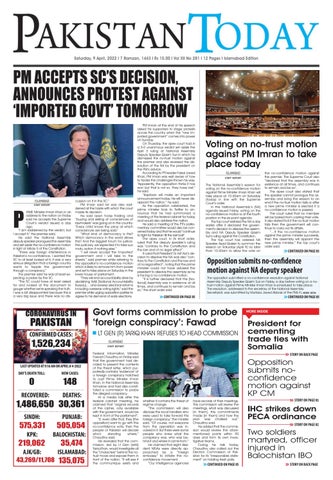
PM accePts sc’s decision, announces Protest against ‘iMPorted govt’ toMorrow
islamabad
P
staff report
rIMe Minister Imran Khan in an address to the nation on Friday said he accepts the Supreme court’s verdict issued a day ago. “I am saddened by the verdict, but I accept it,” the premier said. he said the National Assembly deputy speaker prorogued the assembly and set aside the no-confidence motion in light of Article 5 of the constitution. “There was foreign interference in Pakistan’s no-confidence. I wanted the Sc to at least looked at it, it was a very serious allegation that a foreign country wants to topple the government through a conspiracy.” The premier said he was at least expecting a probe by the Sc. “The Sc could have at least asked for and looked at the document to gauge whether we’re speaking the truth. I was a bit disappointed because this is a very big issue and there was no dis-
cussion on it in the Sc.” PM Imran said he was also saddened at the haste with which the court made its decision. he said open horse trading and “buying and selling of consciences of lawmakers” was going on in the country. “every child knows the price at which consciences are being sold.” “What kind of democracy is this? Which democracy in the world allows this? And the biggest forum for justice, the judiciary, we expected it to take suo motu action if nothing else.” “I will never accept the ‘imported’ government and I will take to the streets,” said premier while referring to the opposition’s no-confidence motion which is likely to remove him from power and set to take place on Saturday in the lower house of parliament. “They will end accountability drive by abolishing NAB [National Accountability Bureau]… and reverse electoral reforms including overseas voting rights,” said the premier while urging opposition parties to agree to his demand of early elections.
coronavirus in
Pakistan
Confirmed Cases:
1,526,234
last updated at 9:16 am on april 8-4-2022
day's death toll:
new Cases:
0
148
reCovered:
deaths:
1,486,650 30,361 sindh:
punjab:
575,331
505,054
kpk:
baloChistan:
219,062
35,474
ajk/gb:
islamabad:
43,269/11,708
135,075
PM Imran at the end of his speech asked his supporters to stage protests across the country when the “new imported government” comes into power on Sunday. on Thursday, the apex court had in a 5-0 unanimous verdict set aside the April 3 ruling of National Assembly Deputy Speaker Qasim Suri in which he dismissed the no-trust motion against the premier and also reversed the dissolution of the NA by the president on the PM’s advice. According to PTI leader Faisal Javed Khan, PM Imran was well aware of how to tackle the challenges thrown his way. “Apparently, the opposition thinks it has won but that is not so. They have lost,” he said. “Kaptaan will make an important announcement today. he will never disappoint the nation,” he said. As the opposition celebrated, the prime minister took to Twitter to announce that he had summoned a meeting of the federal cabinet for today and would also address the nation. he said a meeting of the PTI’s parliamentary committee would also be convened today and that he would “continue to fight for Pakistan till the last ball”. The apex court, in its short order, ruled that the deputy speaker’s ruling was “contrary to the constitution and the law and of no legal effect”. It ruled that President Dr Arif Alvi’s decision to dissolve the NA was also “contrary to the constitution and the law and of no legal effect”, noting that the prime minister could not have advised the president to dissolve the assembly as he is facing a no-confidence motion. “It is further declared that the [National] Assembly was in existence at all times, and continues to remain and be so,” the short order said.
Voting on no-trust motion against PM Imran to take place today islamabad staff report
The National Assembly’s session for voting on the no-confidence motion against Prime Minister Imran Khan will take place at 10:30am on Saturday (today) in line with the Supreme court’s order. In the National Assembly’s (NA) agenda issued Friday, voting on the no-confidence motion is at the fourth position in the six-point agenda. The top court restored the NA a day earlier after it declared the government’s decision to dissolve the assembly and NA Deputy Speaker Qasim Suri’s ruling against the constitution. The top court has ordered NA Speaker Asad Qasier to summon the session on Saturday (April 9) no later than 10:30am to allow the vote on
The opposition submitted a no-confidence resolution against National Assembly Deputy Speaker Qasim Suri on Friday, a day before voting on a notrust motion against Prime Minister Imran Khan is scheduled to take place. The resolution, addressed to the secretary of the National Assembly Secretariat, was submitted by Murtaza Javed Abbasi of the PML-N. news desk
Continued on page 05
Continued on page 05
LT GeN (r) TArIQ KhAN reFuSeS To heAD coMMISSIoN islamabad staff report
Federal Information Minister Fawad chaudhry on Friday said that the government had decided to present the contents of the threat letter, which purportedly contains “evidence” of a foreign conspiracy hatched to oust Prime Minister Imran Khan, in the National Assembly tomorrow and had also constituted a commission to probe the alleged conspiracy. At a media talk after the federal cabinet meeting, he claimed that “original records of the cipher, only available with the government, would be kept in front of the parliament”. “If, even after that, they [the opposition] want to go with the no-confidence vote, then the people of Pakistan will decide who’s standing where,” chaudhry said. he revealed that the commission, led by Lt Gen (retd) Tariq Khan, would investigate all the “characters” behind the notrust move and expose them in front of the nation. “It will see if the communique exists and
Continued on page 05
opposition submits no-confidence motion against na deputy speaker
Govt forms commission to probe ‘foreign conspiracy’: Fawad g
the no-confidence motion against the premier. The Supreme court also “declared that the assembly was in existence at all times, and continues to remain and be so”. The apex court also stated that the speaker cannot prorogue the assembly and bring the session to an end if the no-trust motion fails or after a new prime minister is elected if a no-confidence motion is passed. The court ruled that no member will be barred from casting their vote. It also stated that if the no-trust motion fails then the government will continue to carry out its affairs. “…if the no-confidence motion against the prime minister succeeds, then the assembly will appoint the new prime minister,” the top court’s order said.
more inside
President for cementing trade ties with Somalia story on baCk page
opposition submits noconfidence motion against KP cM whether it contains the threat of regime change. “The commission will also disclose the local handlers who were used to take forward this foreign conspiracy,” the minister said. “of course, not everyone from the opposition was involved in it. But there were some people who knew what the conspiracy was, who was behind it and where it came from.” he claimed that eight dissident MNAs were directly approached by a “foreign embassy” to initiate the noconfidence movement. “our intelligence agencies
have records of their meetings. This commission will review the meetings, what was discussed [in them], the commitments made [in them] and how the plan was chalked out,” chaudhry said. he added that the commission would review the aforementioned points within 90 days and form its own investigative teams. During his talk today, chaudhry also called out the election commission of Pakistan for its “irresponsible statement” on holding fresh polls.
Continued on page 05
story on page 03
IHC strikes down PECA ordinance story on page 02
Two soldiers martyred, officer injured in Balochistan IBo story on baCk page
02
Saturday, 9 April, 2022 | ISLAMABAD
NEWS
IHC stRIkEs down PECA oRdInAnCE
t
News Desk
HE Islamabad High Court (IHC) on Friday said the amendments to the Pakistan Electronic Crimes Act (PECA) through an ordinance promulgated in February this year were ‘unconstitutional’. The decision was announced by IHC Chief Justice Athar Minallah in connection with the petitions filed against the PECA ordinance by the Pakistan Broadcasters Association (PBA) and other media bodies. In a four-page order, CJ Minallah said the court has also declared null and void Section 20 of the PECA law. The IHC has also ordered a probe into the abuse of power by the Federal Investigation Agency (FIA) under the PECA law and the interior secretary has been directed to submit a report in this regard within 30 days. The cases registered under Section 20 of PECA have also been dismissed, the court said. The IHC said the government is expected to review the legislation concerning
defamation as freedom of expression was one of the fundamental rights. “Access to information and freedom to express opinions are vital for a vibrant society,” the court said, adding that attempts to undermine these rights were contrary to the democratic spirit and against the Constitution. The interior secretary needed to launch an investigation into the conduct of FIA’s cybercrime officials over rampant abuse of power by the government agency. It said the PECA ordinance violated Article 9, Article 14, Article 19, and 19-A. The Council of Pakistan Newspapers Editors (CPNE) lauded the high court for its decision. CPNE President Kazim Khan said that an independent judiciary was imperative for constitutional supremacy. In February this year, President Dr Arif Alvi promulgated the PECA ordinance, making online public defamation a cognisable and a non-bailable offence and also increasing the jail term for defaming any person or institution from three years to
five years. Before the ordinance came into effect, Section 20, which pertains to the registration of complaints against individuals by aggrieved parties over defamation, was a
bailable and non-criminal offence. There was a stream of criticism from the opposition parties, rights organisations, and civil society against the controversial legislation which termed it an attack on
freedom of speech and journalism. The critics had said that the move was aimed not only to control the digital space but to prevent criticism against the government and the country’s powerful institutions. Subsequently, the high court restrained the Federal Investigation Agency (FIA) from arresting anyone under Section 20 of the PECA ordinance while seeking a response from the government over the law. As the proceedings inched forward, the ordinance, now declared void, had prompted the IHC CJ to say that the PM had been misguided about the law. Prime Minister Imran Khan and his cabinet members, however, had defended PECA on multiple occasions. The PM had said that the amendments to PECA were brought because “social media was filled with filth such as child pornography”. According to PM Imran, the content being shared on social media was causing a threat to the institution of the family. He had regretted that even he was not being spared, recalling that a few years ago a journalist had reported that his wife had left him and that he had done something illegal at his Bani Gala residence.
‘Last option’: Rasheed suggests mass resignations to PM Imran News Desk
ECP to finalise delimitation of constituencies within four months News Desk The Election Commission of Pakistan (ECP) has decided to complete the delimitation of all constituencies of the national and the provincial assemblies within four months on the basis of the 2017 census. The decision was taken at a meeting of the ECP, with Chief Election Commissioner Sikandar Sultan Raja in the chair, after a series of recent events in the politics of Pakistan. The ECP has asked the provincial governments to immediately provide maps and other data so that the process of delimitation could be completed in a timely manner. Meanwhile, ECP secretary and special secretary were directed to present a complete action plan for the general election on Wednesday. The meeting also decided to expedite and complete the process to review and update the voters’ lists for the general election at the earliest. Moreover, the ECP also decided to seek assistance from the federal secretary of finance and the Punjab chief secretary, and then conclude on how to ensure timely local government elections in Punjab. The ECP is performing its constitutional role for the continuation of democratic process, transparency and rule of law and it will continue to do so in future as well, a statement issued by the Commission read.
Rupee recovers Rs3.5 against dollar kARACHI TLTP
Pakistani rupee snapped a losing streak against the US dollar after 19 consecutive sessions and recovered to 184.68 on Friday. The State Bank of Pakistan said in a statement that the dollar opened at Rs188.18 in the interbank market and closed at Rs184.68 after losing Rs3.50 (+1.9 percent). The central bank’s bold move to raise the policy rate by 250bps a day earlier provided support to rupee and it made a decent recovery against the US dollar. The SBP on Thursday sharply increased the key policy rate by 2.5 percent to 12.25 percent in an unscheduled monetary policy committee meeting. Moreover, the Supreme Court on Thursday ruled to end political uncertainty in the country, which also helped stabilise the rupee. The rupee set 18 all-time lowest levels in the interbank market against the greenback during the last 20 sessions. Overall, the rupee shed Rs0.69 against the US dollar during this week, while the local unit devalued by Rs27.25 during the ongoing fiscal year 2021-22 and Rs8.23 during the current year 2022. The SBP reported a day earlier that foreign exchange reserves of the country fell to $17.477 billion by the week ended April 1, 2022. The country’s foreign exchange reserves hit an all-time high of $27.228 billion on August 27, 2021 and have declined $9.78 billion since then, owing to demand for the dollars for import payments and external repayment of government debt. The foreign exchange reserves are declining for the last eight consecutive weeks and recorded a fall of $6.24 billion since February 4, 2022, when the reserves were at $23.721 billion. The official forex reserves of the central bank, which is the benchmark for calculating the financial strength of a country, also fell to $11.32 billion, which are less than two months of import cover. The import bill for the month of March 2022 stood at $6.186 billion, according to the Pakistan Bureau of Statistics.
Interior Minister Sheikh Rashid said on Friday that he had told Prime Minister Imran Khan that “mass resignations” were the “last option” left for the government. The minister’s remarks came a day after the Supreme Court set aside National Assembly Deputy Speaker Qasim Suri’s April 3 ruling which dismissed the no-trust resolution against the premier and the subsequent dissolution of the NA by the president on the PM’s advice. Speaking to the media in Islamabad, he said “a wave of disappointment has taken over the nation after the decision”. He said that the sentiment among the people was that a conspiracy was under way to bring those involved in corruption to power. “But if someone believes that we are laying down our weapons, have no [misconceptions],” he said. “We will fight till our last breath against these thugs, robbers and looters,” he added, referring to the opposition. He then told media persons that yesterday he had told PM Imran that “we
should all resign” as this was the “last option” because the country would not be able to function with “robbers and thugs” at the helm. “I had suggested [submitting] resignations three months ago as I knew what the issues were,” Rashid said without elaborating further. “I was right in saying that we
should resign and hold new elections. I was right when I said impose an emergency and I was right when I said to impose governer’s rule. “And I say this today as well that we all should resign together […] and expose their (the opposition’s) real faces to the nation.” The minister said opposition
parties would destroy the country’s “independent foreign policy”. He followed up on this claim with a cryptic remark, saying: “If there is anyone who believes that people don’t understand what has happened, how it has happened and who did it, [understand that] the people know everything.” At the outset of his media talk, the minister, without naming anyone, had implied that “big powers” were behind the no-trust motion against PM Imran. “This is how big powers execute a no-confidence motion. They buy people. They use health as an excuse and help robbers and thugs flee the country,” he said. “Now you will see that all of them will return.” “Foreign powers, who want to impose their mentality in Pakistan, curb our freedom and put an end to our neutrality, will be defeated,” he said. He went on to say that in this case — seemingly an allusion to events that unfolded following the submission of the no-trust motion against PM Imran — “all forces have been exposed”. This, the minister said, was the real issue.
IHC directs President Alvi to meet Baloch students News Desk The Islamabad High Court (IHC) on Friday directed President Arif Alvi to meet Baloch students in light of the petition against their harassment at Quaid-e-Azam University. Chief Justice Athar Minallah heard the petition and ordered the home secretary to meet with and ensure the safety of Baloch students. The Baloch student’s advocate, Zainab Janjua, informed the high court that students are apprehensive to go back to Balochistan due to fear of abduction. Highlighting the disappearance of QAU student Hafeez Baloch, the IHC chief justice questioned the deputy attorney general on why students go missing, “why is a child missing for even one day?” The IHC ordered the country’s institutions to eliminate the fear of harassment and abduction of Baloch students in their province, adding that there is no justification for the experiences of the students. “Whatever the current situation may be, it does not matter, Baloch students are the favourite students of this court,” Chief Justice Athar Minallah stated. The chief justice urged that relevant authorities must do more to eliminate the reservations of Baloch students and added that not enough initiative was being taken. “Why should students be afraid to go to their province?” he questioned. The IHC ordered the secretary to the
president to submit a report to the court upon the next hearing and has directed the deputy attorney general to arrange a meeting of Baloch students with President Arif Alvi. The DAG informed the court that the president has met the home secretary regarding the students, and requires the court to grant more time to meet the students in light of the current political situation.
“It is the responsibility of the federal government, but the government does not meet them. This court expects the president of Pakistan to ensure the safety of children,” the IHC chief justice added. The court also stated that the president had previously directed all the universities of Islamabad to refrain from racial profiling of children. The lawyer for Quaid-e-Azam University informed the court that a
committee has been formed and is looking into the matter, adding that the university inquired into the professor about whom the students have reservations. The varsity’s lawyer also stated that a “high-level” committee has been formed on the matter of the missing student and is in the process of conducting an inquiry. The case has been adjourned for a week.
Saturday, 9 April, 2022 | ISLAMABAD
HAMzA APPRoACHEs LHC foR HoLdIng PunjAb CM ELECtIon
P
News Desk
ML-N leader Hamza Shahbaz approached the Lahore High Court (LHC) on Friday seeking its help in holding elections for Punjab’s new chief minister in a “fair and transparent” manner. Hamza’s petition, a copy of which is available, named the province of Punjab through its chief secretary, the PA speaker and deputy speaker, and the provincial police chief as respondents. LHC Chief Justice Amir Bhatti took up the petition alongside a similar plea filed by Punjab Assembly (PA) Deputy Speaker Sardar Dost Mazari — who was recently stripped of his powers by Speaker Chaudhry Pervez Elahi for joining the opposition ranks. Earlier in the day, the registrar had raised objections on Hamza’s petition, stating that the speaker’s orders could not be challenged in the court. However, they were removed by the LHC CJ, who admitted the plea. At the outset of the hearing, Hamza’s counsel Senator Azam Nazeer Tarar argued that provincial lawmakers were barred from entering the assembly building on April 6. He said that the session for voting on the province’s new chief was first scheduled to be held on April 6, before being moved to April 16. “When the date for voting has been announced, what’s the problem,” the judge asked the counsel. The lawyer replied that the province was without a chief executive for days, cautioning that it was an “important issue”. He went on to say that the Punjab advocate general had assured the Supreme Court on April 5 that the session would be held the next day. “When the deputy speaker was made aware of this, he summoned a session,” the lawyer said, adding that the apex court had announced a “historic” decision yesterday. At this, the LHC chief justice summoned the Punjab advocate general and admitted the petition. When the hearing resumed after a short break, the judge was informed that the Punjab advocate general was in Islamabad and would not be able to appear in court. Consequently, Justice Bhatti decided to issue notices to all respondents for Monday (April 11). However, the PML-N lawyer protested that Monday would be too late and suggested that it should be fixed for tomorrow. “The SC even heard the case on a Sunday,” he said, referring to the court’s suo motu notice of National Assembly proceedings. Justice Bhatti replied that the apex court had taken a suo-motu notice. “The hearing will take place as per the Constitution and the law. You have filed the case today. We will only be able to proceed once the record is available,” the judge said, adding that the court had to work according to the rules of the Constitution. The court issued notices to Elahi, Mazari, the Punjab chief secretary, and the provincial police chief. The judge also sought a record of the Punjab chief
PtI's political committee proposes mass resignations: report News Desk The PTI's political committee has suggested that the party should hand down en masse resignations from the legislatures in the Centre, Punjab, and Khyber Pakhtunkhwa, a news outlet reported on Friday. According to the report, the suggestion came during the meeting of PTI's political committee chaired by Prime Minister Imran Khan. The report said that the meeting discussed the current political situation in the country and held consultations on whether to make the alleged foreign plot in the "threat letter" public. The committee members gave suggestions regarding the matter in light of the Secrets Act and judicial orders. The committee suggested making the "threat letter" public, saying that since there is pressure from the public, a decision should be made through thoughtful consideration. Moreover, it was decided that the party leadership will take people into confidence over the alleged conspiracy against the government, the report added. It said that PTI also decided to expedite the party's public relations campaign and hold rallies in all the districts across the country. The report quoted PM Imran Khan as saying that a foreign conspiracy was hatched to topple his government. "We exposed the opposition becoming an instrument in the foreign conspiracy," the premier was quoted as saying. "Opposition is scared of going towards new elections."
minister’s election from the provincial secretary and adjourned the hearing till April 11. In his petition, the PML-N leader stated that the inaction in holding elections for the post was “based on mala fide, with [the] intent to defeat the mandatory constitutional requirements, making political gains by using public office(s) and authority is evidently inchoate; arbitrary; unreasonable; irrational and without jurisdiction”. The petition said that after Buzdar’s resignation, the nomination papers of Hamza and Elahi were submitted in the provincial assembly and which were later accepted. It added that a session was called on April 3 in order to elect the new chief minister but it was adjourned. Consequently, the petitioner added, the deputy speaker directed to hold the session on April 6 at 07:30pm but the assembly premises were sealed and members weren’t allowed to enter the building. “In order to exhibit the clear will of the people’s representatives, the political parties who nominated and support the petitioner for the slot of chief minister, held a session in a hotel next to the building of the [PA] and passed a resolution in favour of the petitioner by a majority of 200 votes,” the petition said, referring to the opposition’s mock assembly session. The petition also argued that under these circumstances, a constitutional crisis had been triggered which was “never witnessed before.” Hamza urged court to declare the impugned actions and inactions — such as adjourning the house without holding the election, sealing the PA premises and
barring lawmakers from discharging their constitutional mandate — to be “without lawful authority and of no legal effect”. The PML-N leader called on the court to issue directives for convening the session of the provincial assembly “forthwith” and for the election process to be “completed without any adjournment in any manner whatsoever”. He also called on the court to direct the respondents to ensure that there is no interference with lawmakers who wished to attend the session and cast their vote. The Punjab Assembly (PA) has to elect the new leader of the house after Usman Buzdar resigned last month. PML-Q’s Chaudhry Pervaiz Elahi and PMLN’s Hamza, who has secured the support of PTI’s dissident lawmakers — the Jahangir Khan Tarin and Aleem Khan groups — are expected to go head to head in the race to become the next chief minister. To be elected as chief minister, a candidate will need at least 186 votes in the 371-member house. In the Punjab Assembly, the PTI has 183 lawmakers, PML-Q 10, PML-N 165, PPP seven, five are independent and one belongs to Rah-i-Haq. The decisive factor in the election will be the support of the Jahangir Tarin group, which is said to have the votes of at least 16 MPAs. On Thursday, the opposition submitted a noconfidence motion against Elahi, who is also the PA speaker, further squeezing space for the provincial government to play its cards. After the apex court’s decision yesterday, where it nullified the National Assembly deputy speaker’s ruling on the no-confidence motion against Prime Minister Imran Khan, the ruling coalition in Punjab has once again warned its MPAs against voting for Hamza or they would be de-seated. In the National Assembly, the joint opposition may not need the dissident PTI MNAs to oust PM Imran as it has the required numbers, including the support of the former government’s allies. But in the PA, the opposition needs the backing of a good number of PTI dissenters to install its chief minister. On Wednesday, the PML-N-led opposition had been barred from entering the PA, as it was sealed after Elahi declared Deputy Speaker Dost Muhammad Mazari’s ‘order’ to summon the session ‘illegal’. According to the assembly secretariat, the session will be convened on April 16 as per an earlier notification of the assembly signed by the deputy speaker. Elahi had used his authority as the speaker and ordered withdrawal of powers delegated to Mazari with immediate effect. Mazari’s power to preside over a session was also snatched following the submission of a no-confidence motion against him by his own fellow lawmakers in the PTI-PML-Q coalition. His sudden change of heart was termed the ‘handiwork’ of the PML-N leadership that allegedly wooed him through a ‘good offer’.
IHC dismisses case against Mohsin Baig News Desk The Islamabad High Court (IHC) on Friday dismissed a case filed by Federal Minister for Communication and Postal Services Murad Saeed against media person Mohsin Baig under Section 20 of the Pakistan Electronic Crimes Act (PECA) ordinance. The high court also dismissed the cases against journalist Bilal Ghauri and Absar Alam that were registered under the same section. However, it added that the minister could file a case under other defamation laws. In an earlier hearing, the IHC said the amendments to the PECA through an ordinance promulgated in February this year were ‘unconstitutional’. The decision was announced by IHC Chief Justice Athar Minallah in connection with the petitions filed against the PECA ordinance by the Pakistan Broadcasters Association (PBA) and other media bodies. In a four-page order, CJ Minallah said the court has also declared null and void Section 20 of the PECA law. The IHC has also ordered a probe into the abuse of power by the Federal Investigation Agency (FIA) under the PECA law and the interior secretary has been directed to submit a report in this regard within 30 days. The cases registered under Section 20 of PECA have also been dismissed, the court said. The IHC said the government is expected to review the legislation concerning defamation as freedom of expression was one of the fundamental rights. “Access to information and freedom to express opinions are vital for a vibrant society,” the court said, adding that attempts to undermine these rights were contrary to the democratic spirit and against the Constitution.
On March 17, the Federal Investigation Agency (FIA) had arrested Baig, after a large contingent of police raided his house in the morning for criticising Communications Minister Murad Saeed. The FIA had registered a case against Baig at Saeed’s request, days after the former made an unethical and disparaging remark against the latter during a private TV channel programme. The panellists were discussing Murad’s ministry receiving a top performance award by Prime Minister Imran Khan recently. The programme received heavy criticism from the government quarters, and the channel was also served a show-cause notice by the media regulator.
NEWS
03
opposition submits no-confidence motion against kP CM News Desk After Prime Minister Imran Khan and CM Usman Buzdar, the Opposition on Friday turned its guns toward Khyber Pakhtunkhwa Chief Minister Mahmood Khan and submitted a no-confidence motion against him in the KP Assembly. A delegation of senior lawmakers submitted the no-trust motion against Khan. “We beg to move that leave may be granted under sub-rule (1) of rule 18D of the Provincial Assembly of Khyber Pakhtunkhwa Procedure and Conduct of Business Rules to move a resolution of no-confidence against the Chief Minister under Article 136 of the Constitution of the Islamic Republic of Pakistan,” the notice read. According to the resolution: “[..] Mahmood Khan has ceased to command the confidence of the majority of the Members of this Assembly as this Assembly as the Chief Minister, it is hereby resolved that the said Mr Mahmood Khan shall stand ceased to hold the said office.” It is worth mentioning that the National Assembly’s session for voting on the no-confidence motion against Prime Minister Imran Khan will take place at 10:30am tomorrow (Saturday) in line with the Supreme Court’s order. In the National Assembly’s (NA) agenda issued Friday, voting on the no-confidence motion is at the fourth position in the six-point agenda.
PsX gains 658 points as bulls stage comeback kARACHI TLTP
Pakistan Stock Exchange (PSX) turned bullish on Friday, a day after the Supreme Court ruled to end political uncertainty in the country, with the benchmark KSE-100 Index gaining 657.75 points (+1.5 percent) to close at 44,444.58 points. The market opened on a positive note and remained positive throughout the session. The State Bank of Pakistan’s bold move to raise the policy rate by 250bps a day earlier provided support to rupee and it made a decent recovery against the US dollar, which also boosted the investors’ confidence. The KSE-100 Index moved in a range of 714.72 points, showing an intraday high of 44,501.55 and a low of 43,786.83 points, which was the last day’s closing point. Among other indices, the KSE All Share Index gained 380.05 points (+1.27 percent) to close at 30,369.28 points, while KMI All Share Islamic Index gained 248.47 points (+1.15 percent) to close at 21,894.23 points. A total of 333 companies traded shares in the stock exchange, out of them shares of 238 closed up, shares of 76 closed down while shares of 19 companies remained unchanged. Out of 88 traded companies in the KSE100 Index, 74 closed up, 13 closed down and one remained unchanged. The overall market volumes increased by 86.87 million to 227.89 million shares. Total volumes traded for the KSE-100 Index increased by 24.59 million to 93.98 million shares. The number of total trades increased by 13,051 to 83,225, the value traded increased by Rs1.80 billion to Rs6.79 billion and the overall market capitalisation increased by Rs93.52 billion. Among scrips, TELE topped the volumes with 19.72 million shares, followed by GGL (17.72 million) and TREET (16.88 million). Stocks that contributed significantly to the volumes included TELE, GGL, TREET, CNERGY, and TPLP, which formed around 37 percent of total volumes. In terms of rupee, BATA remained the top gainer and witnessed an increase of Rs80 (+3.54 percent) per share, closing at Rs2,339.2. The runner-up was INDU, the share price of which climbed up by Rs39.61 (+3.02 percent) to Rs1,349.72. SFL remained the top loser in terms of rupee and witnessed a decrease of Rs60.35 (-7.31 percent) per share, closing at Rs765.25, followed by HINO, the share price of which declined by Rs10.9 (3.41 percent) to close at Rs309.1 per share. The sectors taking the index towards the north were commercial banks (328 points), oil & gas exploration companies (81 points), cement (52 points), technology & communication (34 points) and fertilizer (31 points). The most points added to the index were by MEBL (78 points), UBL (67 points), HBL (45 points), MCB (44 points) and LUCK (42 points). The sectors taking the index towards the south were power generation & distribution (4 points), insurance (3 points), and real estate investment trust and miscellaneous (one point each). The most points taken off the index were by HUBC and IGIHL (4 points each), and MUGHAL, JVDC and EFERT (2 points each).
Saturday, 9 April, 2022 | ISLAMABAD
04
NEWS
SoUnD oF MUgHal-era Sarangi inStrUMent FaDing aWay in PakiStan LAHORE
i
AFP
N the shadow of Lahore’s centuries-old Badshahi Mosque, Zohaib Hassan plucks at the strings of a sarangi, filling the streets with a melodious hum and cry. Remarkable for its resemblance to the human voice, the classical instrument is fading from Pakistan’s music scene –except for a few players dedicated to preserving its place. Difficult to master, expensive to repair, and with little financial reward for professionals, the sarangi’s decline has been difficult to halt, Hassan told AFP. “We are trying to keep the instrument alive, not even taking into account our miserable financial condition,” he said. For seven generations, his family has mastered the bowed, short-necked instrument and Hassan is well-respected across Pakistan for his abilities, regularly appearing on television, radio and at private parties. “My family’s craze for the instrument forced me to pursue a career as a sarangi player, leaving my education incomplete,” he said. “I live hand-to-mouth as the majority
of directors arrange musical programmes with the latest orchestras and pop bands.” Traditional instruments are competing with a booming R&B and pop scene in a country where more than 60 percent of the population is aged under 30. Sara Zaman, a classical music teacher at the National Council of Arts in Lahore, said alongside the sarangi, other traditional instruments such as the sitar, santoor, and tanpura are also dying out. “Platforms have been given to other disciplines like pop music, but it has been missing in the case of classical music,” she said. “The sarangi, being a very difficult instrument, has not been given due importance and attention in Pakistan leading to its gradual demise.” ‘The sTrings of my hearT’: The sarangi gained prominence in Indian classical music in the 17th century, during the reign of the Mughals in the subcontinent. Its decline began in the 1980s after the death of several master players and classical singers in the country, said Khwaja Najam-ul-Hassan, a television director who has created an archive of Pakistan’s leading musicians. “The instrument was close to the
hearts of the top internationally acclaimed male and female classical singers, but it began to fade away after they died,” he said. Ustad Allah Rakha, one of Pakistan’s most globally acclaimed sarangi players, died in 2015 after a career that saw him perform with orchestras around the world. Now players say they struggle to survive on performance fees alone, often much smaller than those paid to modern guitarists, pianists or violinists. Carved by hand from a single block of cedar native to parts of Pakistan, the sarangi’s primary strings are made of goat gut while the seventeen sympathetic strings –- a common feature on subcontinent folk instruments –- are steel. The instrument costs around 120,000 rupees ($625) and most of its parts are imported from neighbouring India, where it remains a principal part of the canon. “The price has gone up as there is a ban on imports from India,” said Muhammad Tahir, the owner of one of only two repair shops in Lahore. Pakistan downgraded diplomatic ties and stopped bilateral trade with India over New Delhi’s decision in 2019 to strip the Indian Illegally Occupied
Jammu and Kashmir (IIOJK) of its semiautonomous status. Tahir, who spends around two months carefully restoring a single wornout sarangi, said no one in Pakistan manufactures the special steel strings because of the lack of demand. “There is no admiration for sarangi players and the few people who are repairing this wonderful instrument,” said Ustad Zia-ud-Din, the owner of the other Lahore repair shop, which has existed in some form for 200 years. Efforts to adapt to the modern music scene have shown pockets of promise. “We have invented new ways of playing, including making the sarangi semi-electric to enhance the sound during performances with modern musical instruments,” said Hassan of the academy he runs in Lahore. He has now performed several times with the adapted instrument, and says the reception has been positive. One of the few students is 14year-old musician Mohsin Muddasir, who has shunned instruments such as the guitar to take on the sarangi. “I am learning this instrument because it plays with the strings of my heart,” he said.
NHA employees stage protest against FBR Leaders of the NHA Employees Joint Action Committee have demanded that the FBR and CTO immediately reinstate the NHA accounts. The work has come to a standstill, which is severely hampering the national development of the organization and has ruined the economic and social security of thousands of employees. Addressing a protest rally outside 9 a.m., NHA employees hung placards with protest slogans. The protesters added that the Federal Board of Revenue (FBR) A) All accounts have been frozen, as a result of which the payment of dues to the contractors has stopped and projects of national importance for construction and repair of roads are being delayed and additional burden on the department is increasing and the country's economy. In addition, NHA employees will be paid for their March pay, medical and transport and housing taxes. The nonpayment in the month of Ramadan is a matter of concern. During the protest, the employees demanded immediate restoration of NHA accounts so that the economic murder of the employees could be stopped. Demonstrators said that within 48 hours If not restored, protests will be held in front of the CTO office on Monday April 11 at 10:30 am.
IESCO releases power suspension schedule According to Islamabad Electric Supply Company (IESCO)’s spokesman, System Maintenance/Development Work is in process. Therefore power supply of below mentioned feeders/areas will be temporary suspended as per given schedule: On 11th April, From 06:00 AM to 10:00 AM, Sudhran, Tufail Shaheed, Darga, CMH, Sanaullah, Bolani Feeders, From 06:00 AM to 11:00 AM, Barahkoh, Race Course, Askari-11, Misrayal Road, Iqbal Road, Social Security Hospital, Westridge Feeders and surroundings will remain off. IESCO management apologizes to its esteemed customers for the power outage. If the work is completed ahead of time, the power supply can be restored even before the scheduled time. PR
FUSH celebrates World Health Day World Health Day 2022 was celebrated at Foundation University School of Health Sciences (FUSH) on Aril 08, 2022 under the leadership of Rector Foundation University Islamabad (FUI) Maj Gen Nasir Dilawar Shah, HI (M) (Retd) and Director FUSH, Maj Gen Imran Fazal, HI (M) (Retd). The goal of this world health day was environmental health upgrading to maintain a healthy, livable environment for humans and other living species, an environment that promotes well-being and a high quality of mental and physical health for its inhabitants. The importance of this year’s theme “ Our Planet, Our Health” could not have been highlighted better at highest level by Lt Gen Nigar Johar HI (M), Surgeon General Pakistan Army herself and Fatima Jinnah Women University/Vice-Chancellor Dr. Saima Hamid who were guest of honor and key note speakers of the event. The program started with the recitation from the Holy Quran followed by welcome address by Brig. Prof. Naila Azam (RETD), HOD Community Medicine, FUMC. Lt Gen Nigar Johar HI (M), Surgeon General Pakistan Army and Dr. Saima Hamid both key note speakers emphasized on long-term investments, well-being budgets, social protection and legal and fiscal strategies. They also spoke about breaking cycles of destruction for the planet and human health requires legislative action, corporate reform and individuals to be supported and incentivized to make healthy choices. PR
CMYK
USC MD directs staff to facilitate customers Managing Director Utility Stores Corporation Taha Aziz Maghribi is monitoring the Ramadan relief package vigilantly. Accompanied by General Manager Operations, Managing Director USC has visited various stores in Peshawar, Abbottabad and has reviewed the supply and sale of basic items provided under the package and has expressed satisfaction over it. He has also issued orders to USC staff to take positive steps to facilitate the customers. Till date more than 2.5 million families have availed the Ramadan relief package, and the process is ongoing successfully. The management of Utility Stores Corporation is working hard day and night to ensure ample supply to customers across Pakistan. A spokesman of Utility Stores Corporation termed the reports of shortage of sugar, ghee and flour in the media as untrue and said that we are ensuring the uninterrupted supply of subsidized items to USC consumers across the country. Basic items like sugar, ghee and flour are supplied daily but are sold out fast due to inundation of keen customers . At present Utility Stores Corporation has a substantial stock of subsidized ghee and sugar to cater the demands of public for next 10 days. Continued procurement is in process to ensure availability across 9 zones. PR
Saturday, 9 April, 2022 | ISLAMABAD
NEWS corporate corner dawood praises dawlance, arcelik
PM accePts sc’s decIsIon, announces Protest agaInst ‘IMPorted goVt’ toMorrow
t KARACHI: Dawlance – Pakistan’s No. 1 brand of home appliances in Pakistan and a wholly-owned subsidiary of Arcelik, Turkey, initiates its new localized AC production line built with European Standards. Arcelik – the second largest manufacturer in Europe (based in Turkey), has facilitated the design and manufacture of this product through the transfer of technology and design know-how to Pakistan in its efforts to facilitate and support the Government of Pakistan’s Make in Pakistan thrust and to facilitate its subsidiary in to strategically serve its large consumer base in Pakistan and in other countries. Since the corporate acquisition of Dawlance in 2016, this resourceful global enterprise has consistently invested in Pakistan in building capacity, upgrading products, and transferring technology to Pakistan. The progressive move to set up a state-of-the-art production line in Pakistan for split air-conditioners aims not only to facilitate the consumers to benefit from the latest technology of indigenously-designed ACs but also pave the way for increased foreign exchange earnings through a noticeable increase in the export of the country and paving the way for sustainable economic growth within the sector. Chief Executive Officer, Dawlance, Mr. Umar Ahsan Khan met the Advisor to Prime Minister on Commerce, Mr. Abdul Razzaq Dawood, in Islamabad to discuss this progressive step which has been taken in the interest of benefitting the consumers as well as the country’s economy via a vision aimed at boosting the exports of the home appliances sector of Pakistan. “This assembly line will not only serve the consumers locally but also carries a vision to reach consumers around the globe via a noticeable surge in the exports from Pakistan”, he added while discussing the vision of his organization. Appreciating the progressive efforts taken in the interest of consumers and the country’s economic growth, The Adviser to Prime Minister of Pakistan for Commerce and investment Mr. Abdul Razak Dawood said, “I congratulate Dawlance, Arcelik, and the whole Pakistani nation, on successfully executing this revolutionary project that will open new vistas for Foreign Direct Investments (FDI), CommercialCollaborations, and Technology-Transfers, between Pakistan and Turkey, while the two brotherly nations pursue the vision to work together, for enriching the global home appliances and electronics industry.” Through this venture, Arçelik has transferred productdesign technology for capacity-building in Pakistan. This production line will not only cater to local Pakistani consumers but will also add great value to exports of Pakistan thereby adding to the foreign exchange earnings of Pakistan. PR
Martin Dow Marker Limited and Dawaai sign a Memorandum of Understanding. PR
05
continued from page 01
HE court’s verdict restored the prime minister and his cabinet in their position. “In consequence of the foregoing, it is declared that the prime minister and federal ministers, ministers of state, advisers, etc stand restored to their respective offices,” the office said. The court also ordered for the NA session to reconvene on Saturday (tomorrow) no later than 10:30am, saying that the session cannot be prorogued without the conclusion of the no-trust motion against PM Imran. The joint opposition had submitted a no-confidence motion against the premier with the NA Secretariat on March 8. In the days to follow, the country’s political land-
scape was abuzz with activity as parties and individuals changed alliances and the PTI and opposition were seen trading barbs and allegations alongside intensifying efforts to ensure their success in the noconfidence contest. Eventually, major allies of the ruling PTI — Balochistan Awami Party and Muttahida Qaumi Movement-Pakistan — deserted the government and joined the opposition ranks which led to PM Imran losing his majority in the lower house of parliament. It was expected that if voting on the motion went ahead as scheduled on April 3, PM Imran would be ousted from office. The joint opposition, meanwhile, had nominated Shehbaz Sharif as their candidate for the top post. But before voting could go ahead, the deputy
Govt forms commission to probe ‘foreign conspiracy’: Fawad
speaker, who was chairing the session, in a shock ruling, dismissed the no-trust motion, terming it contradictory to Article 5 of the Constitution, which mandates loyalty to the state. According to the deputy speaker, the no-confidence motion was part of a foreign conspiracy to oust PM Imran, evidence of which had been seen by the National Security Committee and the federal cabinet in the form of a ‘threat letter’ sent to Pakistan through its ambassador in a foreign country. Immediately after Suri prorogued the session following his ruling, the premier addressed the nation on television, saying that he had advised the president to dissolve the National Assembly. Hours later, the president issued a notification to dissolve the lower house.
Voting on no-trust motion against PM Imran to take place today continued from page 01
continued from page 01 “The federal cabinet has categorically expressed reservations on the announcement by ECP in which it claimed that elections can’t be held before seven months.” He hypothetically asked that had the PM called early elections before the no-confidence movement, would the electoral body’s decision be the same. “The cabinet has, therefore, taken notice of the conduct of the chief election commissioner and the ECP,” he pointed out, adding that the government had been pushing ECP to prepare for elections since two years and even offered it assistance in the delimitation process. Talking about the apex court’s verdict, the Chaudhry said that its decision hinted that the National Assembly’s supremacy had been transferred to the judiciary, urging the top court to review its decision. Yesterday, the Supreme Court set aside the deputy speaker’s ruling to dismiss the notrust resolution against Prime Minister Imran Khan and the subsequent dissolution of the
NA by the president on the PM’s advice. “The court can’t call the deputy speaker’s ruling unconstitutional without going through the contents it [the ruling] was based on,” Chaudhry contended. The minister also said that the parliament and the top court had separate functions and worked independently, adding that the government was consulting its legal team and was mulling on filing for a review of the verdict. He added that the premier would make important announcements in his address to the nation tonight. Meanwhile, Lt Gen (r) Tariq Khan has refused to head the government’s commission that was formed to probe the “threat letter” allegedly sent from the United States. Gen Khan said said the commission could not last beyond the incumbent government’s tenure, which is expected to end in two days. He said voting on the no-confidence resolution against PM Imran — due to take place on Saturday — would bring into power a new government, which would “dissolve the commission or not cooperate with it, making it dysfunctional”.
Interior Minister Sheikh Rasheed — who was restored as a cabinet member after the Supreme Court’s landmark judgement — has said mass resignations from the treasury benches could resolve the current political turmoil. “I used to suggest three months back: tender your resignations, dissolve the assemblies, impose an emergency, impose governor’s rule. I was right in all instances,” the interior minister told journalists in the federal capital. “I stand by my decision of mass resignations. We should take to the streets and expose these hired guns [the Opposition]. They will [compromise] on Pakistan’s foreign policy,” the interior minister said. Despite being clean bowled by the Supreme Court’s judgement, giving the PTI-led government a major setback, PM Imran Khan has pledged to fight for Pakistan “till the last ball.” To review the latest situation, the prime minister has called a federal cabinet meeting today — which started at 2pm — after almost a month’s hiatus, while he will also chair a meeting of the PTI’s parliamentary party later in the day. “I have called a cabinet mtg tomorrow as well as our parliamentary party meeting, and tomorrow evening I will address the nation,” the prime minister said in a tweet after the order was issued. “My message to our nation is I have always and will continue to fight for Pakistan till the last ball,” PM Imran Khan said. PM Imran Khan’s coalition lost its majority in the national assembly last week, but he avoided being dismissed when the deputy speaker blocked a no-confidence motion against him and the president dissolved parliament and ordered fresh elections. The premier claimed the Opposition had colluded with the United States for “regime change” when the deputy speaker — a member of PTI — refused to allow the no-confidence motion. Simultaneously, Khan asked President Arif Alvi — who is also a PTI loyalist — to dissolve the assembly. The decision — which the court said was unanimous — was met with jubilation by opposition supporters in the capital, with packed cars racing through the streets, sounding their horns. There had been high hopes for Khan when he was elected in 2018 on a promise of sweeping away decades of entrenched corruption and cronyism, but he struggled to maintain support with soaring inflation, a feeble rupee and crippling debt.
Opposition submits no-confidence motion against NA deputy speaker continued from page 01 According to the resolution, the deputy speaker had “repeatedly violated the rules, parliamentary practices, democratic norms and traditions, and even Constitutional provisions and when presiding over the House, failed to conduct proceedings in an orderly manner to enable productive debate on issues of public importance”. After the opposition submitted a no-confidence resolution against Speaker Asad Qaiser on April 3, Suri had presided over the NA session. Minutes after the session began, the deputy speaker had dismissed the notrust resolution against PM Imran terming it contradictory to Article 5 of the Constitution. In the no-confidence resolution submitted against Suri today, Abbasi stated that instead of performing his role fairly and impartially, the deputy speaker acted in a “blatantly partisan manner” that had favoured the government and frequently deprived the opposition of their right to voice their views and the views of their electorates. Referring to Suri’s decision to dismiss the no-trust move against the prime minister, the
resolution stated that the deputy speaker “wilfully and mala fidely subverted the Constitution” and his actions fell under the purview of Article 6, which is related to treason. Earlier in the day, the NA secretariat issued a six-point agenda for the session tomorrow that will begin at 10:30am. This will be the second time that the house will convene to vote on the resolution calling for the premier’s ouster. The last time the session convened was last week on April 3, but instead of the vote going ahead as scheduled, the NA deputy speaker dismissed the resolution terming it contradictory to Article 5 of the Constitution. The contentious ruling by the deputy speaker had transpired a series of events, including the dissolution of the NA by President Arif Alvi on the premier’s advice, leading to political turmoil and a constitutional crisis. The matter was eventually decided after the Supreme Court took suo motu notice and formed a larger bench to issue a ruling. After lengthy debates at hearings that spanned the past five days, the apex court set aside the deputy speaker’s ruling and the
subsequent dissolution of the NA yesterday. The SC also ordered the speaker to convene a session of the NA on Saturday no later than 10:30am, saying that the session could not be prorogued without the conclusion of the no-trust motion against the prime minister. Besides voting on the no-trust resolution, the agenda for tomorrow also includes two calling attention notices, one of which draws the defence minister’s attention to the non-payment of salaries to councilors in the country’s cantonment boards and the other invites the energy minister’s attention regarding the increase of petroleum prices. The joint opposition had submitted a noconfidence motion against the premier with the NA Secretariat on March 8. In the days to follow, the country’s political landscape was abuzz with activity as parties and individuals changed alliances and the PTI and opposition were seen trading barbs and allegations alongside intensifying efforts to ensure their success in the no-confidence contest. Eventually, major allies of the ruling PTI — Balochistan Awami Party and Muttahida Qaumi Movement-Pakistan — deserted the
cmYK
government and joined the opposition ranks which led to PM Imran losing his majority in the lower house of parliament. It was expected that if voting on the motion went ahead as scheduled on April 3, PM Imran would be ousted from office. The joint opposition, meanwhile, had nominated Shehbaz Sharif as their candidate for the top post. But before voting could go ahead, the deputy speaker, who was chairing the session, in a shock ruling, dismissed the no-trust motion, terming it contradictory to Article 5 of the Constitution, which mandates loyalty to the state. The deputy speaker had said the no-confidence motion was part of a foreign conspiracy to oust PM Imran, evidence of which had been seen by the National Security Committee and the federal cabinet in the form of a ‘threat letter’ sent to Pakistan through its ambassador in a foreign country. According to a list shared by PML-N Information Secretary Marriyum Aurangzeb at the time, opposition parties had managed to cross the magical figure of 172, claiming to enjoy the support of 174 NA members. The number did not include over a dozen dissi-
dents of the ruling PTI, who had publicly declared the withdrawal of their support to the prime minister. Irked by the dismissal of the no-trust motion, opposition parties had held their own mock session in the lower house of parliament with PML-N’s Ayaz Sadiq sitting on the speaker’s seat. During the mock proceedings, 195 lawmakers voted in favour of the no-confidence motion, according to PPP’s Sherry Rehman. Eventually, the day saw President Alvi dissolving the NA on the premier’s advice. While the rest of the cabinet was dissolved as a result of the move, the prime minister continued to serve as the country’s chief executive until the appointment of a caretaker setup. Meanwhile, the Chief Justice of Pakistan Umar Ata Bandial had taken suo motu notice of the matter to decide on the legality of the deputy speaker’s ruling and the NA’s dissolution. Yesterday, the top court set aside the deputy speaker’s ruling and the subsequent dissolution of the lower house, ordering that voting on the no-trust motion be held on Saturday.
06-07 Comments - 9th April 2022_Layout 1 4/8/2022 11:43 PM Page 1
Saturday, 9 April, 2022
06 COMMENT
The touted trump card
After losing the National Assembly’s trust Imran Khan’s future
T
he Supreme Court verdict has significantly dispelled political uncertainty in the country. Within hours of the decision, the rupee markedly appreciated in the open market. Once a new government with a solid support base is in office, this would hopefully create an enabling environment for improvement of business sentiment. however, disregarding national interest Imran Khan continues with his gimmicks in a futile attempt to save his government, the appointment of a so-called commission of enquiry and presentation of the original records of the ‘threatening’ cipher before Parliament being stunts of the sort. Mr Khan whose tenure was restored by the Supreme Court for three days faces the no-confidence move today. The only facesaving option for him is to resign before going to the National Assembly. In case he doesn’t he would be booted out of the office of PM. Last week he recounted the three choices he faced: resignation, noconfidence motion and elections. he insisted that he would fight the no-confidence motion, would never resign and would prefer to fight elections. he would be out of job as a result of the no-confidence vote today while the elections which he desired at the earliest will not be held before six months. It is time Mr Khan resorted to another U-turn and resigned as the PM to avoid the humiliation of being voted out of office. Mr Khan has failed to realize that his tricks cannot save him. Any decision to offer en masse resignations from national and provincial assemblies would do no harm to the next government which possesses more than 172 seats in the National Assembly and can, along with other opposition parties, get like-minded candidates elected on seats falling vacant. Mr Khan currently holds more seats in the house than any other opposition party. This has led PPP-P President Asif Zardari to welcome Mr Khan as leader of the opposition. But can people trust a leader who jeopardizes Pakistan’s relations with an important country only to remain in power? Mr Khan will have to prove over coming years that he abides by democratic values and rules of the game before he can be trusted.
Dr Qaisar rashiD
T
he touted trump card turned out to be a violation of the constitution. All scruples dissipated. ego reigned supreme. In the whole effort, two things were misused: first, a diplomatic cable; and second, Article 5 (describing loyalty to the State and obedience to the Constitution and law). Before the ruling regime, the question was how to avoid defeat in the vote of no-confidence. The answer was to hoodwink both participants and bystanders. Political defeat was imminent, yet a face-saving was a requisite. A diplomatic cable was used to save face. The diplomatic cable became a new instrument to circumvent a constitutional need for holding a no-confidence motion. Pakistan is unique in the world that no one has so far considered the utility of a diplomatic cable better than using it for face-saving. A foreign conspiracy can topple a sitting government; Pakistan has reached such a pass. A simple routine diplomatic cable was renamed as a letter, and then accentuated publicly as a threatening letter. What an act of audacity! All excuses were stacked around the letter, which was modified to serve the purpose. The forum of the National Security Committee was also used to dwell upon the foreign conspiracy. To fill the gap, a strong demarche was issued. In other words, directed against itself, a foreign conspiracy was hatched to be cashed in on by invoking Article 5, which saw its own first utility. The factor that has gone entrenched in Pakistan’s body politics is political turmoil. Look at Russia, which has swung into action to support Pakistan’s outgoing ruling regime.
PECA amendment struck down
T
he Islamabad high Court has struck down the Pakistan electronic Crimes Act (Amendment) Ordinance as unconstitutional, and has tasked the government to report back on the abuse of law. A large number of press bodies, including the Council of Pakistan Newspaper editors (CPNe), the Pakistan Federal Union of Journalists (PFUJ), the Pakistan Broadcasters Association (PBA), the All Pakistan Newspapers Society (APNS), the and the Association of electronic Media editors and News Directors (AeMeND) had petitioned the IhC against the Ordinance, promulgated by the President in February. While the government claimed it had promulgated the Ordinance so as to prevent fake news, the press organizations saw the Ordinance as yet another attempt to impose controls over the press. The law has been struck down, but even if it had remained, it would not have served the purpose of bringing the press under control, because harsh punishments fail to deter, as offenders feel they will be able to get away with their crime. existing laws can do the job, provide they are implemented. That involves funding and capacity building of the justice system, which would actually solve problems in wide areas of social life. The ruling has come just as the PTI has lost before the Supreme Court, and now faces the fall of its government. Still, that should not mean that the problem is swept under the carpet, and is assumed to disappear. While it may be too much to assume that a successor government will accord the matter priority on the legislative agenda ahead of election law changes or budget passage, the subject must be given due attention by the government yielded up by fresh elections, whenever they are held. Then, a law against fake news should indeed be passed, starting with arriving at a definition of fake news, which not only involves all the stakeholders in the print and electronic media, but which is implementable and directed at the abuse. It must not be a machinegun ready to be sprayed at all and sundry at the whim of powerful individuals.
A field with immense potential
shaza arif
T
he world is proceeding towards digitalisation at an unbelievably fast pace. emphasising its importance, Marc Andreessen, an American entrepreneur wrote, ‘Software is eating the world’. Indeed, digitalisation has revolutionized every other field of life. Amongst the many areas, where its impact is visible is entrepreneurship. Digital technologies are rapidly facilitating both Small and Medium enterprises (SMes) and ‘Innovation-Driven enterprises (IDes).SMes rely more on traditional business approaches and their scope is limited to local markets. The potential net revenues of such businesses are relatively easier to forecast and are less risky. Digital applications (or apps) have especially enabled SMes to structure and manage their businesses and services. Furthermore,social media has also aided SMes to expand their work by promoting it on various platforms. In contrast,IDes aim for a business style guided by the pursuit of products or services for regional and global markets. This does not necessarily refer to giant technological discoveries; rather such ventures offer new approaches for various economic activities ranging from provision of services to development of innovative products, but the innovation itself is technology driven. Such innovation
Dedicated to the legacy of late Hameed Nizami
Arif Nizami (Late) Founding Editor
Yousaf Nizami M. A. Niazi
Umar Aziz
Joint Editor
Joint Editor
Executive Editor
Lahore – Ph: 042-36300938, 042-36375965
Instead of playing till the last ball, the ball was tampered and stumps went missing. In place of accepting political defeat, the whole country was plunged into a constitutional crisis. The prop offered by Dr Tahir-ul Qadri in 2014 is no more available. Nevertheless, in the end of the regime, many people see a relief hidden in the expiration of the foul language, lies and bravado at the national level. The post-2018 curse is dying of its own affliction. The evolving situation is fraught with three main repercussions. First, the faith of people in democracy and fair play has vanished. Through an unfair play, the ruling party denied the opposition the right of removing a government through a constitutional way by resorting to no-confidence motion. Next time, any opposition would prefer to resort to unlawful ways to topple the government under the dread that it can be outmaneuvered by any unconstitutional means afterwards. The water of politics has got muddied. Uncertainty has crept in. The question is this: what have the military and the higher judiciary learnt from the crisis? The making of a hybrid regime in the hope of running the country vicariously and with ensured exclusion of two mainstream political parties has failed to yield any fruit. Second, Pakistan has been plunged into a severe economic crisis. Pakistan is heading for default. Seeing the political mayhem, the International Monetary Fund has suspended its facility and the same would be the behaviour of the World Bank and the Asian Development Bank. To avert an imminent financial crisis, Pakistan has to manage the inflow of $5 billion over the next few months. how would that be possible? The broader question is this: who would reverse the tide of economic meltdown? Before 2018, the military leadership was concerned about the economic condition. What does it say about the current situation? Interestingly, the military has declared itself neutral. What is otherwise the choice? Neutrality is an escape. The damage has been done. Pakistan witness economic slowdown. Third, political confusion opens space for antiState elements to do terrorist acts and execute sabotage activities to spread unrest in the country. The writer may qaisarrashid@yahoo.com
be
reached
at
Promoting Technology-driven Entrepreneurship in Pakistan
The problem remains, but can wait a little
Editor Aziz-ud-Din Ahmad
Nevertheless, the chaos tells the story of how easy it is to generate an excuse of foreign conspiracy to hide behind to sabotage the foreign policy. The nationalism card and the victim card are also in full swing to secure face-saving. Interestingly, just to defeat the opposition, the patron-in-chief sacrificed the tenure of his own government. he knew that the next term belonged to the opposition parties. The ploy to dissolve assemblies and announce fresh elections was to avoid the noconfidence motion, which could have been humiliating for the government. The no-confidence motion, with all its constitutional requirements, was dumped. It was a self-inflicted wound. Instead of using the Constitution to protract its stay at the helm of affairs, the Constitution was misused to shorten the government’s own term. What a surprise oozed! Wrapping up a surprise in an unconstitutional act has caused a ripple effect. The real victims are democracy, the rule of law and the Constitution. The manoeuvre has subverted democracy and impaired the confidence of people in democracy. In the post2014 era, cursing traditional politics or the status quo remained a striking slogan to woo the voters, but the outcome remained short of serving the flaunted purpose: dividends of the change. The post-2014 upheaval ruined the even tenor of Pakistan and stymied democratic progress. To the consternation of many, the ethnic (South Punjab) card and the religion card were played blatantly. After 2018, the rule forced many people to repine over the lost past, and regret their electoral decision. The rule made people think about the benefits of traditional politics and about the tribulations of change politics. With that, traditional politicians, against whom the slogan of change had worked wonders, got emboldened. People harbour doubts about the wisdom of any flaunted change. They take umbrage against anyone who tries to sell the slogan of change of 2018 type. They want to go back to traditional politics. The storm called the tsunami is over. It has foundered on the sea shore of reality. The mesmerized urban youth, especially in Punjab, has got disgruntled and disappointed. Promises outnumbered performances. Dreams were shattered. Slogans went hollow. Rules of the game were torn apart. Sportsman spirit vanished.
I
Karachi – Ph: 021-35381208-9
I
demands consistent investment of time, resources, and effort. Given that global markets are the target, the risk involved is also higher than SMes. however, exponential growth is more likely in this case. While both SMes and IDes contribute to a country’s economy, it is the latter which bring about transformative impact due to wider scope, extended reach, and high growth prospects. There is more chance of IDe start-ups turning into ‘unicorns’ (companies valued at $1 billion) as opposed to SMe businesses or services. When it comes to Pakistan, the number of such enterprises has soared recently, particularly SMes. According to a World Bank report, Pakistan improved its position vis-à-vis ease of doing business from 136 to 108 in 2021 which is reflective of good progress. In 2019, there were approximately 3.2 million SMes in the country. The figure reached around 5 million by late 2021.The growing number of SMes is a positive development and must be encouraged. On the other hand, it is equally important to pay attention to empowering IDes– which are fewer in the country–so that their (rather Pakistani) products and services can reach global markets. In the first three quarters of 2021, Pakistani start-ups raised $244 million, which is more than the amount of the previous six years combined. Start-ups such as Bazaar, Airlift andMaqsad have emerged as multi-million dollar enterprises.This shows that there are immense growth opportunities for IDes, especially in sectors like health, agriculture, climate change, green infrastructure, and education, amongst others. On the positive side, the Government of Pakistan has been trying to cultivate a business environment that supports IDes. From providing tax relief of three years to regulation of local Venture Capital firms to zero tax on IT freelancers, measures have been taken to reduce existing barriers.
Islamabad – Ph: 051-2204545
There is a vast potential for the IT industry in Pakistan. Last year, Pakistan’s IT sector grew by 47 percent and is expected to reach 75 percent in 2022. In one year, IT exports rose from $2 billion to $3.75 billion.These are expected to rise to $7.5 billion by the end of this year and $9 billion by next year. The government is expecting that IT exports could reach $50 billion over the next few years. Recently, the Prime Minister inaugurated an ecommerce Portal to encourage entrepreneurs and freelancers. Speaking at the occasion, he urged youth to avail the incentives being offered by the government since IT was being promoted on ‘emergency’ footing.The recent visit of Microsoft cofounder Bill Gates was put in motion to get him involved in Pakistan’s IT sector. The government is also working to shift 50,000 SMes to digital platforms. Pakistan is the fastest growing freelancing market in the region and the fourth largest in the world which shows its immense potential. With a young generation entering the workforce, it is imperative to foster an environment where technology-driven entrepreneurship is promoted. hassle-free government policies, reinforced by funding from the private sector, can play an effective role in supporting young entrepreneurs. Pakistani conglomerates should also invest in tech start-ups to help them grow and provide employment platforms. however, awareness must be created in young people to explore IT related fields. This trend can become more prevalent if universities and schools nurture an environment where the importance of both entrepreneurship in general and IDes, in particular, is cultivated in the younger generation.
However, awareness must be created in young people to explore IT related fields. This trend can become more prevalent if universities and schools nurture an environment where the importance of both entrepreneurship in general and IDEs, in particular, is cultivated in the younger generation
I
Web: www.pakistantoday.com.pk
I
The writer is a Researcher at the Centre for Aerospace & Security Studies (CASS), Islamabad, and can be reached at cass.thinkers@gmail.com
Email: editorial@pakistantoday.com.pk
06-07 Comments - 9th April 2022_Layout 1 4/8/2022 11:43 PM Page 2
Saturday, 9 April, 2022
COMMENT 07 Editor’s mail Send your letters to: Letters to Editor, Pakistan Today, 4-Shaarey Fatima Jinnah, Lahore, Pakistan. E-mail: letters@pakistantoday.com.pk Letters should be addressed to Pakistan Today exclusively
Impacts of Social media
Vladimir Putin: Policy and Political Profile The method behind the moves
Dr rajkumar singh
V
LADIMIR PUTIN, the present President of Russian Federation, maintained throughout his life a very upward and forward-looking policy which gave him much name and fame not only in the country but across the globe and as a result he remained either Prime Minister or President of the country for the last 24 years without any break or gap. Although, he started his career as a foreign intelligence officer in the KGB and after serving for 16 years, in 1990 he resigned to become adviser of the Mayor of the Saint Petersburg where he served the institution in different capacities and in March 1994 became first deputy head of the city administration, getting a major breakthrough in 1996 when elected the Mayor of St Petersburg. The same year in June he was called on by Moscow to be made deputy chief of the Presidential Staff of Boris Yeltsin where he remained till May 1998 when he was made First Deputy Chief of Presidential Staff and going a step further was 1999 appointed acting Prime Minister after the sack of the government led by Sergei Stepashin. Now, his phase of top political began, as when Boris Yeltsin resigned he became President of the Russian Federation and as a result of his policy and performance re-elected twice as President then and in 2004. From 2008 to 2012 he served as Prime Minister under the Presidency of Dmitry Medvedev, when term limits prevented from contesting again, but Putin returned to power in 2012 as President of Russia. After being re-elected as President in 2018, in 2021 through a referendum and constitutional amendment his potential term of Presidency was extended up to 2036. In the last 22 years, during his prime ministerial and presidential terms beginning in 2000, the most significant contribution of Vladimir Putin to the Russian Federation is related to the increase of the country’s potential in all walks of life- from the economy to military and general administration. his first term of office as President was devoted to making the country’s economy sound and it grew with an average of 7 percent per year but in succeeding years it improved further because of economic reforms he implemented and the fivetimes increase of the price of oil and gas. In the period he prepared a new group of
business magnates, such as Gennady Timchenko, Vladimir Yakunin, Yuriy Kovalchuk and Sergey Chemezov, and also established close personal relations with them to move the nation forward smoothly. In the same phase he continued to reform the faults in legal system, land tax arrangements, Russian press, and international media, although he devoted lots of his time in handling and finishing his political opponents and successfully ended the oligarchs of the Yeltsin era. he was victorious against the politically ambitious people who were jealous of his power as well as position which gave the nation ultimately a consolidated form of administrative stability when in May 2000 issued an order which divided the federal subjects of Russia in 89 heads and 7 districts to maintain the federal structure of the constitution. Likewise, the second term of his office which began on 14 March 2004 with 71 percent votes received in the presidential election. he made some changes in the preferential order of the nation and new National Priority Projects were initiated with focus on health care, education, housing and agriculture. In those sectors while wages of employees were increased significantly, for the betterment of working efficiency, it was decided to purchase modernized equipment in both sectors in 2006 and 2007. It also followed another scheme for enhancing maternity benefits along with state-supported parental care for women, under the demographic programmes of the government. From the beginning of his regime the first and foremost aim of Putin’s policy and strategic design was to re-establish Kremlin’s lost power, position and the might at national and international levels it availed in the post-World War two phase when it strongly stood against another superpower, the USA,as a superpower of equal potentiality. According to him the worst chapter of Russian history was the disintegration of the earlier USSR in the early 1990s which undermined its prestige across the world and while regaining the lost power, power and influence, it became essential first to expand the territories of the present Russian Federation. In line with this, he first tackled the unrest of Chechnya which erupted after the adoption of a constitution which accepted the republic as a part of Russia, and where the Russian Federation openly supported pro-Kremlin elements which helped stabilize the situation along with restor-
ing the control of federal Chechnya. As Vladimir Putin had made a lot of reforms in military and police, under the premiership of Putin when Dmitry Medvedev was President, Russia got a victory against its war with Georgia. At the time Russia defeated Georgia, a common ally of US and the NATO, it was the phase of great global recession when its economy was badly affected by the flow of cheap Western credit and investments. This however was controlled and managed by the previous capital accumulation and strong anti-crisis measures which were considered by many including the World Bank, as one of the achievements of Putin’s regime. It paved the way for Putin’s third term as President beginning in 2012 which he won in the month of March by getting 63 percent of the total votes polled. Gradually Putin became very powerful in national politics and his influences spread across the globe in the passingyears and the day he assumed office on 7 May 2012, he issued 14 Presidential decrees which detailed goals of Russian economy, education, housing, skilled-labour, relations with the european Union, defence industry, and inter-ethnic relations. In this phase too, Putin’s policy of expanding Russia’s territorial area and restoring hegemony over the foreigner Soviet republics remained active, which compelled him to initiate several military incursions into Ukrainian territory and to annex Crimea and Sevastopol into the Russian Federation after conducting a referendum there on the issue. In 2014 an antiRussian government took over in Ukraine. Kremlin, began fomenting anti-Ukraine elements in the country and extended them required support by all possible means, especially in the Donetsk and Luhansk People’s Republics which were recognized by the Russian Federation as separate states in response to the current Russia-Ukraine war that has been going on since February 2022. Till date, all efforts to get a permanent ceasefire or end the war have failed to achieve a desired result despite global good wishes and pious intentions.
In 2014 an anti-Russian government took over in Ukraine. Kremlin, began fomenting anti-Ukraine elements in the country and extended them required support by all possible means, especially in the Donetsk and Luhansk People’s Republics which were recognized by the Russian Federation as separate states in response to the current Russia-Ukraine war that has been going on since February 2022.
The writer is presently Professor and Head, Department of Political Science and Dean of Social Sciences at B.N. Mandal University, Madhepura (Bihar), India. His 19 books published in addition to 900 articles in national and international journals and daily newspapers from 25 foreign countries.
MANY of us use different social media applications to stay in touch with the world and keep ourselves updated on current affairs. Unfortunately, many people have taken advantage of the absence of controls on social media to promote hateful or indecent content. every day, I come across vile trends that reflect poorly on our ethics and ethos. The freedom to speak our minds on social media is gradually transforming us into an uncivilised and mannerless society. Whilst dissent is key for societal progress and change, the language and expression used are worsening and must be regulated. Online controls and regulations must be implemented to prevent people from targeting individuals, initiating smear campaigns, and trending unnecessary things. Instead of passing laws hastily, the government needs to understand and analyse the root problem of the growing misuse of social media in the country. Most people have access to phones and social media; however, very few understand how to use them effectively. People should be informed on the healthy use of social media and the difference between disrespect and dissent. Local online platforms can play an important role by imposing restrictions/controls on the misuse of sites. People often enjoy the clout they receive for their misbehaviour on social media. To combat this, everyone must try to dissuade such individuals. Around the world, social media and other online platforms are used to improve connectivity, learn skills via free courses, undertake freelance work, and more, which helps both the individual and society. Therefore, we must also use online platforms to engage in productive activities and stimulate our minds. INSAF ALI KANDHKOT
Noise pollution in Hub GIVeN that hub is home to several industries, the city was already experiencing high levels of noise pollution due to heavy industrial machinery. however, there was some relief as the factories do not operate throughout the day. With the ever-increasing number of private vehicles combined with the sound of obsolete engines in public buses, noise pollution has risen at an unprecedented high. In the last few months, there has been an influx of motorcycles, rickshaws, and other vehicles equipped with heavy silencers and pressure horns. The use of silencers and pressure horns have caused serious disruptions to people’s daily lives. Those living in busy areas are faced with constant noise pollution, which has resulted in sleep disturbances, hypertension, headaches, and more. Students often suffer from academic losses as they are unable to study at home because of the constant commotion. The elderly and sick seldom find the chance to relax. even businesses are affected by the noise and struggle to maintain decorum during work hours. Suzuki trucks with loud radios and street vendors i.e., vegetable/fruit sellers further add to the chaos in the city. They pass through every street across the city interrupting the peace and comfort of residents. Street vendors must be instructed to conduct their business in residential areas only during the day. Also, the relevant authorities should ban the use of silencers and pressure horns and fine those found using them. AHSANULLAH MENGAL HUB
Our Mother tongue IN Pakistan, the ability to read and speak english fluently still serves as a sign of prestige. There is a general belief that those who can read and write in english are likely to perform better academically and avail more opportunities in the future. This is true to some extent as employers often prefer candidates with good english-speaking skills. We regularly witness people being more respectful towards anyone fluent in english. expats often avoid conversing in Urdu when they visit, and many locals have also adopted english as a first language and avoid the use of Urdu altogether. The glorification of the english language reflects an inferiority complex and can be seen as one of the major reasons for growing polarisation amongst the Pakistani people. The mother tongue consolidates unity and distinguishes the country from other countries. Instead of using Urdu as a second language, it must be used as a primary source of communication to establish unity and contact within the population. Besides Urdu, even regional languages must be embraced and should be spoken widely. The use of a mother tongue along with several regional languages will help people stay connected with the cultural history, diversity, and heritage of the country. Countries like China, Iran, Germany and others have prioritised their national languages and accorded them respect. Resultantly, they have witnessed significant economic growth and development, and many countries trade with them. Therefore, Pakistan must also embrace its mother tongue by implementing policies to promote Urdu and uphold its position. This will increase inclusivity and connectivity, which will foster unity and cooperation amongst the people. ZAKEER AHMED AWARAN
Suicides in Balochistan MORe and more incidents of suicide are happening in the Kech district of Balochistan. Recently, a girl and two boys ended their lives within a span of two days. One of the boys, only 18, committed suicide in the Jivani area of Kech. Separately, a boy and a girl killed themselves in the mountains of Kech. While the reason behind the suicides is not yet known, love in a tender age and lack of education appear to be the provocation. AMNA ALI KECH
08 WORLD VIEW 9th April 22_Layout 1 4/8/2022 9:33 PM Page 1
Saturday, 9 April, 2022
08 WORLD VIEW
US ‘coercIve dIplomacy’ IS gettIng leSS effectIve gloBal timeS EditORiaL
t
HESE days, the US tends to kidnap countries across the international community that are not standing with it over the Ukraine issue. Washington’s senior officials have taken turns, making intensive threats to countries, including China and India. On Wednesday, US Deputy Secretary of State, Wendy Sherman, arrogantly said that sanctions on Russia should give China a “good understanding” of the consequences it could face if it provides material support to Moscow. On the same day, the director of the White House national Economic Council, Brian Deese, claimed that the US told India that the consequences of a “more explicit strategic alignment” with Moscow would be “significant and long-term.” Previously, US officials named and pressured India in several occasions and even hinted at imposing sanctions. US President Joe Biden also criticized India’s response to the RussiaUkraine conflict as “shaky.” It seems that the Ukraine crisis is also a mirror reflecting the US’ nature of seeking hegemony for itself by coercion. Washington first kidnapped small countries with the lure of security, turning them into pawns to check and contain major countries. Then, it has continued to instigate and incite disputes, and pushed these pawns into the fiery pit, held allies hostage by virtue of so-called values and made them pay for its hegemony. After that, Washington has further expanded its scope and exploited various means to force other countries across the world to take sides, trying to overwhelm opponents and maintain its absolute hegemony.
THE US HAS FORMED A SYSTEM OF ‘COMBINATION BLOWS’ TO FULLY COORDINATE WITH ITS HEGEMONIC LOGIC THAT ‘WHOEVER OBEYS THE US WILL BE PROSPEROUS BUT WHO GOES AGAINST IT WILL SUFFER’ Ironically, Washington has been accusing China of engaging in “coercion diplomacy” in recent years but the Ukraine crisis has precisely shown that it is the US who is sparing no efforts to coerce other countries. It is trying to drag other parties to the crisis while it passes the bucks and reaps profits. As a matter of fact, “coercive diplomacy” is tailor-made for Washington. The term “coercive diplomacy” was also created by US scholars to summarize US policies toward Laos, Cuba and Vietnam in the 1970s. After the end of the Cold War, from Latin America to Europe and the AsiaPacific, through rogue-style measures such as military threat, political isolation, sanctions and blockades on technology, the US has intimidated small countries to serve its national interests. Otherwise, those countries would be sanctioned and isolated, and their governments
dhaka, for all intents and purposes, is dead
Daily Star, BanglaDeSh Badiuzzaman Bay
I
n Dhaka, we don’t live anymore, we merely survive. To me, this distinction is important because a capital city is supposed to be not just the administrative or financial hub of a country, but also a symbol of the best living experience it can offer. To be clear, when I say “live” as opposed to “survive”—or jibon udjapon as opposed to jibon japon—I don’t mean a joyride with all the fun and none of the troubles. But living comes with a certain degree of stability, security, and satisfaction. It comes with the chance to pursue a higher purpose. Surviving, on the other hand, is about having the worst thrown at you and being able to continue on despite that. But just that. This is what we do in Dhaka—day in, day out. We scrape through with a Zen-like attitude in helpless submission to the rigours of this city, making the “citizen” in us bizarrely meaningful. Dhaka is trapped in an ironic twist as it grows and falls apart at the same time. Its aggressive development is rivalled only by the progressive decline in almost all other parameters of urban life. Long gone are the mysteries of the 70s, the quaint, small-town charm of the 80s, the romantic appeal of the 90s, or the thrills and spills of the 00s. Today’s Dhaka, for all its expansion and infrastructural development, is a city that has hit the saturation point, and is now feeding on itself. What does Dhaka offer to its residents? Any list will invariably include toxic air, loud noise, unsafe drinking water, traffic gridlocks, high population density, high cost of living, inadequate road, transport and recreational facilities, general lack of security, etc. There are also seasonal and governance-related issues like waterlogging, mosquito infestation and “ghost” utility bills. To single out one of them would be an injustice to the others—all being equally painful and persisting—which highlights the futility of any effort by the city managers and planners to make Dhaka liveable again. not to be outdone by other struggling global cities, the city authorities of late have been busy collecting medals for the extraordinary nature of its problems. Consider the following “laurels”: Dhaka’s air, according to the recently published 2021 World Air Quality Report by IQAir, is now the world’s second-most polluted, with the average PM2.5 concentration in the air found to be 15 times higher than the limit set by the World Health Organization (WHO). The city has been hovering around the top spot for some time now, thanks to unchecked fumes from vehicles and brick kilns, dust from construction sites, etc. Dhaka, according to the latest report of the United nations Environment Programme (Unep), is also the world’s noisiest city now. Its average noise level stands at a stupefying 119 decibels.
In another ironic twist, Dhaka is regularly cited as one of the most expensive yet least liveable cities in the world. This apparent dualism can be explained by global statistics from not too long ago, when the city ranked seventh among the most stressful cities, the worst in terms of density, one of the worst in terms of traffic congestion, and the second-worst in terms of physical health and family purchasing power. The city’s status in these rankings is unlikely to have changed now. Its water quality also remains a constant source of worries, with the ongoing cholera outbreak blamed on Dhaka Wasa’s poor supply system. The true costs of all these problems are immeasurable. To give just one example: air pollution in Dhaka, according to a study last year, is taking 7.7 years off a resident’s life. Imagine the cumulative effect of all of its chronic problems and pollutions on the physical, mental, financial and intergenerational health of its residents. It really boggles the mind. The reasons for the problems are well-known and many solutions for each have already been suggested, only to be ignored in most cases while some implemented to little or no effect. The trouble is, Dhaka’s afflictions are mostly interlinked, feeding off each other. With no central oversight, and with none of the agencies responsible for the city working in conjunction, we’ve reached a point where targeting one problem at a time no longer stands a chance of improving our living and breathing experience. What Dhaka needs is a hard reset, a complete overhaul of how it functions as a capital city and as the residential hub of 20 million people. Clearly, Dhaka’s ambition as the former is no longer compatible with the expectations of the latter. The idea of a hard reset, therefore, should no longer sound radical. “The much-valorised policy of decentralisation has not worked in Bangladesh. The question of why it hasn’t worked is less useful than to explore what other options are available to save Dhaka, as well as Bangladesh,” said Adnan Zillur Morshed, an architect and urbanist, in a column for The Daily Star. Morshed contrasts Dhaka’s aggressive development with the “mofussilisation” of other cities in the country to show how the former is “bursting at the urban seams,” before suggesting that the only way we can resolve this crisis is by splitting the administrative functions of the capital into two cities. He adds: “We should begin to incubate this idea in our political and administrative heads. Given the historic significance of the parliament building, the legislative arm of the government may stay in Dhaka. The executive and judicial branches, along with the cantonment, can move to the new city to initiate a culture of decentralisation. This model of decentralised government would be a great fit for Digital Bangladesh. Physical proximity as a prerequisite for governance is an outdated idea of the yore.” This is not to suggest a complete relocation of the capital away from Dhaka, which would be an impractical move. But taking some of the administrative burden off it means a chance to reduce its urban footprint as well as dependence on its resources. How does the split plan sit with the expectations of the residents? Well, this is still just a means to an end. A hard reset should ideally see a “Save Dhaka” principle govern all the decisions and activities of the agencies and departments responsible for the city (DnCC, DSCC, RAJUK, WASA, DESA, Titas, DMP, Traffic Division, etc.), guided by a strong political will and a central vision of sustainable urbanism. Dhaka’s residents deserve a chance to live and breathe without having to worry about their city dying or, worse, causing their deaths. Badiuzzaman Bay is an assistant editor at The Daily Star.
could be overthrown. “Coercive diplomacy” has been integrated into the path of American foreign behavior and it has risen and fallen together with US hegemony. The US has formed a system of “combination blows” to fully coordinate with its hegemonic logic that “whoever obeys the US will be prosperous but who goes against it will suffer.” On one hand, “coercive diplomacy” has a strong implication of hijacking morality and intimidation. The US has gone out of its way to monopolize the interpretation of “democracy,” “freedom,” “human rights” and “sovereignty.” It tends to stick various labels to nonWestern countries that insist on independent foreign policy and push them into the opposite of “universal values.” The values and aspirations accumulated over the long history of human kind have become the sandglass that the US can wantonly overturn. At one time it wants “human rights to override
sovereignty” and at another moment it advocates that “sovereignty should override human rights.” On the other hand, “coercive diplomacy” is all about calculation of interests. Recently, the Deputy Secretary of the Security Council of Russia, Mikhail Popov, said that the US, while pressuring European countries to sanction Russia, itself continues to import Russian oil with last week’s imports increasing 43 percent from a week ago, to 100,000 barrels per day. It also allowed US firms to import Russian mineral fertilizers. for Europe, war and sanctions brought wave of refugees, capital outflow and energy shortages, but for the US, war and sanctions have allowed the US to profit from the chaos. However, US’ “coercive diplomacy” has also eroded American national credibility as it has caused a large number of victims. Data showed that since the World War II, the number of unnatural deaths of foreign citizens due to US sanctions have exceeded the total death toll in all the wars during the same period. now, more and more countries are unwilling to submit to US coercion. Therefore, in face of the US pressure, Indian Prime Minister narendra Modi said that “India stands firm before the world with its interests without any fear or pressure.” Countries like Singapore, which has “friendly ties” with the US, also expressed that they are reluctant to take sides. These are the resistance against US “coercive diplomacy.” US “coercive diplomacy” is increasingly ineffective as its fake morality and true hegemony are seen by the world. fundamentally, it is Washington that stands on the wrong side of history. It cannot always threaten other countries to “take chestnuts from the fire” for it, and it is even less possible to extend its hegemony through intimidation.
france needs a more decentralized approach to Islam
araB newS KHaLEd aBOu zaHR
I
f you were to ask a 1980s American movie scriptwriter how to represent a frenchman, he would probably describe him wearing a gilet and beret, holding a baguette and with a cigarette in the side of his mouth, while complaining about the price of camembert. In the same way, if you were to ask the french establishment how they would represent a french Muslim, they would likely come up with a similarly archaic description. This is, in part, why Muslims and Islam are a key topic at every french presidential election, just like the economy or healthcare. When watching french TV, especially in times of crisis — whether after a terrorist attack by extremists or any confrontation involving Muslims — guests invited on to discuss the place of Muslims in french society are always of the same type. And so, the establishment seems quite at ease with this picture of a religious figure speaking french with a heavy accent and calling for peace and brotherhood among the french. Most importantly, they state that we must not stigmatize Muslims and that these terrorists represent only a tiny minority. I am not here to say that these voices are not positive or that they are not good people, but they keep perpetuating an archaic image of Muslims and do not raise the proper questions. And so, with both the frenchman holding a baguette and the Muslim scholar on TV, the story the writers are looking to tell through their characters is misleading. I am still surprised at how the french media and authorities have consistently made a choice of projecting this image. In fact, it needs to be torn apart. first of all, why should a religious figure or Muslim scholar always be the voice that speaks on behalf of french Muslims? Muslims are french. Do we bring in priests to discuss the rising price of the baguette? In fact, the french establishment has been using the completely wrong theme for too long, under the banner of “Islam of france.” It has been a completely useless exercise that has pushed for the representation of Muslims through shallow stereotypes. It is either the thug dealing drugs or the obsequious religious leader carrying a guilt that should not be. In reality, it reflects a weakness from those who
should be protecting france’s sovereignty. To prove that this theme is completely wrong, I can only build from my own experience. I went to a Catholic school, which had a convent and a church on its premises. However, not once did the school disrespect me or my religion or treat me differently. Quite the opposite. During Ramadan, I remember very well the school allowing Muslim students to leave class early in order to go and end their fast, organizing for missed lessons to be shared. Once again, when we leave it to the communities and a decentralized system, things get solved. I did not ask for pork to be removed from the school canteen — I just found something else to eat and sometimes alternatives were there. However, it is also a fact that there have been Muslim organizations, perhaps aligned with the Muslim Brotherhood, that use the authorities’ mistakes to push for something different for Muslims. Such groups use this to put pressure on public opinion and everyone is falling for each and every trap. It has also become a political battle, with Islam as the core enemy of france and secularism; literally trying to place Muslims at odds with the conservative parties. It is like forcing the entire community to vote in a single direction and remove the choice that others have. One should also be aware of those within the Muslim community and left-leaning organizations that use religion to push for this different agenda, while accusing all others of being racist. Indeed, these groups are not asking for equal rights, which are already granted. They are asking for a separate set of rules for Muslims in france — this is unacceptable and not needed. It also encourages extremist views. More dangerously, these concepts are also now being heavily relayed on social media by young influencers. This is why the best way to fight these views and those hiding behind these agendas is to break the stereotypes and diversify Muslim voices. There are so many successful Muslim lawyers, business executives and public servants and they all have different political views and social wishes, just like all french of other religions. And so, as france this month decides on its next president, I believe that in reality the real issue is more about a left-right divide, as well as french-Algerian relations and france’s relations with other northern African countries, rather than a true question about the place of Islam in the country. All the themes around the veil — which, by the way, now also include the kippa — are just distractions and an incorrect framing of the issue. This is why the theme “Islam of france” needs to be dropped and the focus should be on what france is as a country and the role it plays. It is an exercise that also means leaving each community, not only religious voices, to solve its issues with a more decentralized approach. Khaled Abou Zahr is CEO of Eurabia, a media and tech company. He is also the editor of Al-Watan Al-Arabi.
Saturday, 9 April, 2022 | ISlAmAbAd
newS
corporate corner bankIslami, United Motors join hands for auto financing
09
FoRex ReseRves Fall $1.07bn to $17.48bn: sbP islamabad tltp
t KARACHI: Pakistan’s leading Islamic bank, BankIslami Pakistan Limited (BIPL) has collaborated with United Motors Pvt. Ltd., a renowned manufacturer of cars and motorcycles, to offer vehicle financing for its customers. Bankislami Car and Bike Financing is a Shariahcompliant financing facility through which anyone can fulfill their dream of owning their vehicle on easy and affordable monthly payments. The MoU signing ceremony between BankIslami and United Motors Pvt. Ltd was held at United Motors Head Office on Wednesday April 06, 2022. Mr. Rizwan Ata Group Head – Distribution BankIslami and Mr. Sanaullah Choudhry – Chairman, United Group of Companies signed the MoU. Speaking on the occasion, Mr.Rizwan Ata said “BankIslami is aimed to provide benefits of Islamic Banking to all segments of the society. Through bike financing, employees of any company, be it male or female, can solve their transportation and mobility issue and can purchase bikes or scooty on very affordable monthly installments under shariah compliant financing scheme of BankIslami.” Auto Finance is amongst the biggest financing sectors in Pakistan enabling consumers across the country to own a vehicle in a convenient and affordable manner. BankIslami takes pride in providing a Sharia-compliant, Riba-free solution to individuals and businesses across Pakistan for easy vehicle finance. With short processing times, robust partnerships with leading manufacturers and lowest rates, BankIslami is revolutionizing the market effectively. The Ceremony was also attended, Mr. Aasim Saleem, General Manager, Central Region BankIslami, Mr. Madieh Khawar, Area General Manager BankIslami, , Mr. Sibtain Mehtab Munir, Chief Manager, Mr. Usman Saeed General Manager United Motors, Mr. Muhammad Afzal – GM Sales & Marketing United Motors, Mr. Imran Bashir – GM After Sales United Motors and Mr. Salamullah – Manager Marketing United Motors. pr
He foreign exchange reserves of the country dropped for the eighth straight week by $1.07 billion (5.77 per cent) on a week-on-week basis to reach $17.48 billion. According to data released by the State Bank of Pakistan (SBP) on Thursday, the foreign exchange reserves held by the country decreased on a weekly basis during the week ended on April 01 to $17.48 billion from $18.55 billion billion recorded on March 25, 2022. The foreign exchange reserves held by the central bank decreased 6.04 per cent on a weekly basis. On April 1, the foreign currency reserves held by the SBP were recorded at $11,319.2 million, down $728 million, compared with $12,047.3 million on March 25. According to the central bank, the decrease largely reflected debt repayment and the government’s payment pertaining to the settlement of an arbitration award related to a mining project. Overall liquid foreign currency reserves held by the country, including net reserves held by banks other than the SBP, stood at $17,476.9 million. Net reserves held by the commercial banks decreased to $6,157.7 million against $6,507.2 million in the preceding week, showing a decline of $349.5 million (-5.37 per cent) The International Monetary Fund’s (IMF) executive Board on February 2 approved Pakistan’s request for an $1 billion loan tranche. A meeting of the IMF’s executive Board took place to discuss and fi-
nalise Pakistan’s request for the completion of the sixth review and release of a $1 billion tranche under the extended Fund Facility (eFF). The foreign exchange reserves held by the central
FTO directs FBR to implement decision to refund excessive excise duty
Careem announces $25m investment islamabad stAff report
The announcement was made by Feroz Jaleel, Country Head of Careem Pakistan, during the Sitara-e-Careem Award ceremony where the top performing Captains were awarded for being of service with their hard work, dedication and commitment. Senior leadership from Careem and JS Bank graced the award ceremony held in Karachi to recognize the efforts of the best performing Captains who went above and beyond and made lives simpler for Customers. Representatives from JS Bank spoke at length about how the Captains can benefit from subsidized car loans through the Kamyan Jawan initiative. pr
bank soared to an all-time high of $20.15 billion after Pakistan received a general allocation of Special Drawing Rights (SDRs) worth $2,751.8 million from the International Monetary Fund (IMF) on August 24.
The federal Tax ombudsman has directed the Federal Board of Revenue (FBR) to implement the decision to refund excessive excise duty to 24 complainants in the Pak Suzuki case. As per the details, twenty four complaints were filed against FBR Islamabad and Pak Suzuki Motor Company Limited, in terms of Section 10(1) of the Federal Tax Ombudsman Ordinance, 2000 (FTO Ordinance) for charging sales tax at the rate of 17 per cent on the purchase of Suzuki Cultus vehicle 998cc after July 2021 as against 12.5 per cent, which was the actual rate at that time. In this way, the taxpayers were constrained to pay in excess of what was actually due. FTO had recommended that collection of the sales tax in excess of being legislated in the Finance Act 2021 and delay in settling the tax refund tantamount to maladministration. The President of Pakistan had upheld the decision and rejected FBR’s pleas against the recommendation for a refund.
Federal Tax Ombudsman Asif Mahmood Jah had directed Advisor Income Tax Karachi to hold meetings with the stakeholders for smooth implementation of the findings/recommendations in the refereed complaints of overcharge of tax by Pak Suzuki. Both the representative of LTO Karachi and Pak Suzuki Company agreed Pak Suzuki will furnish the refund claims under Section 66 to LTO Karachi in respect of refund due to the subject complaint. The refund claim will be accompanied by the relevant invoices and proof of tax paid on these invoices. On receipt of the refund claims, LTO Karachi will process the claim as per law and issue a refund to Pak Suzuki Company. Pak Suzuki Company will then remit the amount to all the complainants as per their due share and submit proof of payment to LTO Karachi and the FTO office for the final implementation of the order. As per the information with the FTO office, apart from the 24 initial complaints, there are 9000 such buyers of upto 1000cc vehicles who have been charged tax not due after July 1st 2022.
Cost of water supply project from Mohmand Dam increased by Rs53bn islamabad Aziz Buneri
The estimated cost of the project for drinking water supply to Peshawar from the under construction Mohmand dam has increased by Rs53 billion. According to the Water and Sanitation Company Peshawar (WSSP) an estimated Rs107.55 billion plan has been presented to the Provincial Development Working Party (PDWP) for approval. Sources said that after discussion on the project in the meeting, some changes have been made in PC-1 as a result the estimated cost of the project has been increased by Rs53 billion. According to WSSP, the project was approved by the PDWP but the hike in estimated cost has not been included in the meeting minutes. The company has requested the Local Government department to enhance the project cost and get its approval from PDWP.
ICCI for urgent measures to curb rising trade deficit islamabad tltp
The Islamabad Chamber of Commerce and Industry (ICCI) has expressed great concerns over the rising trade deficit of the country, which has widened 70 per cent to $35.4 billion during July-March 2022 due to rising imports and stagnant export. In a statement, ICCI President Muhammad Shakeel Muhammad called for urgent remedial measures to curb this unhealthy trend as it would create multiple problems for the fragile economy. He said this while talking to a delegation of traders. Shakeel Munir said that the trade deficit had reached an all-time high of $37.7 billion in 2017-18 fiscal year and due to the great ef-
forts of the government, it was brought down to $23.2 billion in 2019-20. However, the trade deficit has again increased to an alarming level and if this trend continues, it could cross $40 billion by the end of this fiscal year. He said that despite being an agricultural country, Pakistan was importing many agricultural products including wheat, sugar, palm oil and other food items, which was contributing to rising trade deficit. He stressed that the agriculture research institutes of the government should work with farmers and help them to improve the per acre yield of agriculture productivity so that the indigenous production could meet the local needs and the country could get rid of relying on imported food items. The ICCI president said that the indus-
trial sector was importing many products including raw materials and intermediate goods to meet its manufacturing needs and emphasized that the government should encourage the indigenous production of imports substitutions that would help in reducing import bill and cutting down the trade deficit of the country. ICCI Senior Vice President Jamshaid Akhtar Sheikh and Vice President Muhammad Faheem Khan said that the Ministry of Commerce and Trade Development Authority of Pakistan should facilitate the private sector in exploring all potential exports markets including Africa, Central Asia and others to boost export that would be instrumental in keeping the trade deficit within manageable level.
Saturday, 9 April, 2022 | ISLAMABAD
10 FOREIGN NEWS
Sri Lanka doubLeS intereSt rateS to tame infLation, StabiLiSe economy COLOMBO
S
ReuteRs
RI Lanka’s central bank doubled its key interest rates on Friday, raising each by an unprecedented 700 basis points to tame inflation that has soared due to crippling shortages of basic goods driven by a devastating economic crisis. The heavily indebted country has little money left to pay for imports, meaning fuel, power, food, and, increasingly, medicines are in short supply. Street protests have been held nearly nonstop for more than a month, despite a five-day state of emergency and a two-day curfew. The Central Bank of Sri Lanka’s (CBSL) monetary board raised its standing lending facility to 14.50% and its standing deposit facility to 13.50%. The buildup of aggregate demand, domestic supply disruptions, the plunge of the local currency, and high prices of commodities globally could keep up the pressure on
inflation, CBSL said in its monetary policy decision statement. “The rate hike will give a strong signal to investors and markets that we are coming out of this as soon as possible,” governor P. Nandalal Weerasinghe said at a post-policy decision briefing. INdEPENdENT CENTRAL bANk: Weerasinghe said that he wanted to run the central bank independently without any external influence and that he had been given the authority to do so by the president and has been asked to expedite measures to get the country out of the current crisis. “I want to be very clear that my message is not one of blind positivity. Things are challenging and we need to take decisive action. Things will get worse before they get better, but we need to apply the brakes to this vehicle before it crashes,” he added. INFLATION HIT 18.7% IN MARCH: An analyst had expected hikes of up to 400 basis points. “With the monetary policy tightening now finally clear, the stage is set to take the next vital steps with regards to IMF (Inter-
national Monetary Fund) and debt restructuring and clearly communicate this to the international stage,” said Thilina Panduwawala, head of economic research at Frontier Research. Finance Minister Ali Sabry said earlier that the country must urgently restructure its debt and seek external financial help, while the main opposition threatened a no-confidence motion in the government and business leaders warned exports could plummet. “We cannot step away from repaying debt because the consequences are terrifying. There is no alternative, we must restructure our debt,” Sabry told parliament. JP Morgan analysts estimate that Sri Lanka’s gross debt servicing costs will amount to $7 billion this year, with a $1-billion repayment due in July. “We have to go for a debt moratorium,” said Sabry, who offered to quit a day after he was appointed on Monday, April 4, but later confirmed that he was still finance minister. “We have to suspend debt repayment for some time and get bilateral and multilateral support to manage our balance of
payments.” NO-CONFIdENCE MOTION? President Gotabaya Rajapaksa is running his administration with only a handful of ministers after his entire Cabinet resigned this week, while the opposition and some coalition partners rejected calls for a unity government to deal with the country’s worst
crisis in decades. At least 41 lawmakers have quit the ruling coalition to become independents, though the government says it still has a majority in parliament. “The government needs to address the financial crisis and work to improve governance, or we will move a no-confidence motion,” Sajith Premadasa, leader of the Samagi Jana Balawegaya opposition group, said in parliament. Sabry, a former justice minister, said political stability was necessary as the country prepared to start talks with the IMF this month. Earlier on Friday, nearly two dozen associations, representing industries that collectively employ a fifth of the country’s 22 million people, together urged the government to quickly seek financial help from the IMF, the World Bank, and the Asian Development Bank. “We need a solution within weeks or the country will fall off the precipice,” Rohan Masakorala, director-general of the Sri Lanka Association of Manufacturers and Exporters of Rubber Products, told a news conference. Masakorala said that both merchandise and service exports could drop 20% to 30% this year due to a dollar shortage, higher freight costs, and power cuts. Sri Lanka’s foreign exchange reserves have plunged some 70% in the past two years, hitting $1.93 billion at the end of March.
India’s Hindu hardliners jump on anti-Muslim movie to stir up hatred AFP
india reports first case of covid variant Xe: report BENGALURU ReuteRs
India’s first case of coronavirus variant XE was detected in Mumbai, NDTV reported on Wednesday. India has reported fewer than 2,000 cases per day for nearly two weeks versus its peak this year in January of over 300,000 cases on average per day. India’s Bharat Biotech said on Friday it was slowing down the production of Covid-19 vaccine Covaxin, as demand was dropping along with a fall in infections and wider immunisation coverage in the country. “For the coming period, the company will focus on pending facility maintenance, process and facility optimization activities,” the vaccine manufacturer said in a statement.
Hindu hardliners have jumped on an explosive new film endorsed by Prime Minister Narendra Modi on the mass flight of Hindus from Indian Illegally Occupied Jammu and Kashmir (IIOJK) 30 years ago to stir up hatred against minority Muslims. “The Kashmir Files” is the latest Bollywood offering — more famous for its song-and-dance love stories — to tackle themes close to the political agenda of Modi’s Hindu nationalist government, critics say. Released last month and already one of the country’s highest-grossing films this year, it depicts in harrowing detail how several hundred thousand Hindus fled IIOJK in 1989-90. Authorities have made entrance to the film tax-free in many states, with police and others given time off to go watch. Numerous videos shared on social media and verified as genuine by AFP have shown people in cinemas calling for revenge and for Muslims to be killed. One clip shows Swami Jeetendranand, a Hindu monk, leading a crowd in nationalist and anti-Muslim chants. “We think that we are safe, but
we are safe as long as they don’t attack us,” he rails. “(Muslims) are not only dangerous to India but to the whole world.” Around 200,000 Kashmiri Hindus in IIOJK— known as Pandits — fled after the violence began in the late 1980s. Up to 219 may have been killed, according to official figures. Redressing this “genocide” and “exodus”, as right-wing Hindu groups call it — likening it to the Holocaust — has long been a central theme of Modi’s Bharatiya Janata Party. In 2019, his administration — often accused of marginalising and vilifying India’s 200 million Muslims — revoked the occupied region’s partial autonomy and imposed a vice-like security blanket. But Sanjay Kaw, a Kashmiri Pandit journalist who himself fled in the 1990s, said the movie makes no allusion to the persecution of the region’s Muslim community either before or since. “One of my relatives was shot dead… barely 300 meters away from our home,” Kaw told AFP. “The movie only talks about the exodus part, and only refers to the failure of the state but not the things that led to the situation.” The movie’s director Vivek Agnihotri, an avowed Modi fan, told AFP
that he wanted to give “some dignity to the people who have been hurt”. “Nobody asked Steven Spielberg why there were a few violent reactions to ‘Schindler’s List’,” he said, referring to the 1993 movie on the Holocaust that was widely acclaimed as historically accurate. “Give (people) the right to react the way they want to react. As long as they are not hurting anybody physically, I think it’s fine,” Agnihotri added. But the film “certainly has an agenda”, said documentary filmmaker Sanjay Kak, as it “strongly feeds into the current Islamophobic discourse in
our society”. “I think the film makes those goals (of the BJP) quite explicit: which is basically about setting up Kashmir as a kind of ideological pole for their vision of a new resurgent Hindu India,” he told AFP. Modi has hit back against the criticism, saying a “whole ecosystem is trying to silence the person who made the film and tried to reveal the truth”. The world’s largest democracy has a long history of film censorship, but detractors say the industry has come under increased pressure to make films that dovetail more with the BJP’s narrative.
All-private astronaut team lifts off on landmark launch to space station CAPE CANAVERAL ReuteRs
A SpaceX rocket ship blasted off on Friday carrying the first all-private astronaut team ever launched to the International Space Station (ISS), a flight hailed by industry executives and NASA as a milestone in the commercialization of space flight. The four-man team selected by Houston-based startup Axiom Space Inc for its landmark debut spaceflight and orbital science mission lifted off at 11:17 a.m. EDT (1517 GMT) from NASA's Kennedy Space Center in Cape Canaveral, Florida. Live video webcast by Axiom showed the 25-storytall SpaceX launch vehicle - consisting of a two-stage Falcon 9 rocket topped by its Crew Dragon capsule streaking into the blue skies over Florida's Atlantic coast atop a fiery, yellowish tail of exhaust. Cameras inside the crew compartment beamed footage of the four men strapped into the pressurized cabin, seated calmly in their helmeted white-and-black flight suits moments after the rocket soared toward space. About nine minutes after launch, the rocket's upper stage delivered the crew capsule into its preliminary orbit, according to launch commentators. Meanwhile, the rocket's reusable lower stage, having detached from the rest of the spacecraft, flew itself back to Earth and successfully touched down on a landing platform floating on a drone vessel in the Atlantic. Launch webcast commentator Kate Tice described the liftoff as "absolutely picture-perfect." One crew member could be heard telling mission control in a radio transmission, "That was a hell of a ride." If all goes as planned, the quartet led by retired
NASA astronaut Michael Lopez-Alegria will arrive at the space station on Saturday, after a 20-hour-plus flight, and the autonomously operated Crew Dragon will dock with the orbiting outpost some 250 miles (400 km) above the Earth. SpaceX, the rocket company founded in 2002 by billionaire Elon Musk, was directing mission control for the flight from its headquarters near Los Angeles. NASA, besides furnishing the launch site, will assume responsibility for the astronauts once they rendezvous with the space station to undertake eight days of science and biomedical research while in orbit. COMMERCIAL SPACEFLIGHT MILESTONE: The mission, representing a partnership among Axiom, SpaceX and NASA, has been touted by all three as a major step in the expansion of commercial space ventures collectively referred to by insiders as the low-Earth orbit economy, or "LEO economy" for short. Friday's launch also stands as SpaceX's sixth human space flight in nearly two years, following four NASA astronaut missions to the space station and the "Inspiration 4" launch in September that sent an allcivilian crew to orbit for the first time. That flight did not dock with ISS. While the space station has hosted civilian visitors from time to time, the Ax-1 mission will mark the first all-commercial team of astronauts to use ISS for its intended purpose as an orbiting research laboratory. The four-man Axiom team will be sharing the weightless work environment with seven regular, governmentpaid ISS crew members - three American astronauts, a German astronaut and three Russian cosmonauts. Lopez-Alegria, 63, the Spanish-born Axiom mission commander, is also company's vice president for busi-
ness development. His second-in-command is Larry Connor, a real estate and technology entrepreneur and aerobatics aviator from Ohio designated as the mission pilot. Connor is in his 70s but the company did not provide his precise age. Rounding out the Ax-1 team are investor-philanthropist and former Israeli fighter pilot Eytan Stibbe, 64, and Canadian businessman and philanthropist Mark
Pathy, 52, both serving as mission specialists. The flight makes Stibbe the second Israeli in space, after Ilan Ramon, who perished with six NASA crewmates in the 2003 space shuttle Columbia disaster. The Axiom crew members may appear to have a lot in common with many of the wealthy passengers taking suborbital rides in recent months aboard the Blue Origin and Virgin Galactic services offered by billionaires Jeff Bezos and Richard Branson, respectively. But Axiom executives said their mission goes far beyond space tourism, with each crew member undergoing extensive astronaut training with both NASA and SpaceX. The Ax-1 team also will be conducting more than two dozen science experiments aboard ISS, including research on brain health, cardiac stem cells, cancer and aging as well as a technology demonstration to produce optics using the surface tension of fluids in microgravity, company executives said. Launched to orbit in 1998, the space station has been continuously occupied since 2000 under a U.S.-Russian-led partnership including Canada, Japan and 11 European countries. NASA has no plans to invest in a new space station once ISS is retired, sometime around 2030. But NASA selected Axiom in 2020 to design and develop a new commercial wing to the orbiting laboratory, which currently spans the approximate size of a football field. Plans call for eventually detaching the Axiom modules from the rest of the station when it is ready to be decommissioned. Other private operators are expected to place their own stations in orbit once ISS is out of service. In the meantime, Axiom said it has contracted with SpaceX to fly three more private astronaut missions to the space station over the next two years.
Saturday, 9 April, 2022 | ISLAMABAD
SPORTS 11
Taijul islam Keeps souTh afriCa waiTing for reTurn of CenTuries GqebeRhA
B
AFP
ANGLADESH left-arm spinner Taijul Islam ensured that South Africa's quest for Test centuries at home was frustrated again on the first day of the second Test at St George's Park in Gqeberha on Friday. South African captain Dean Elgar said after winning the toss that he had set his batsmen the challenge of making centuries, but Taijul dismissed him for 70, which was South Africa's highest score in a total of 278 for five. Taijul also dismissed another set batsman when Keegan Petersen was given out leg before wicket on review for 64. Taijul sent down 32 overs – 24 in one spell - and took three for 77. "There is no margin for error on this pitch," he said. "Any width will be punished. There was a bit in it in the first hour but it became very flat as the day progressed. Now the ball is coming nicely onto the bat." South Africa were scoring freely early in the day but largely due to Taijul they were pegged back, losing three wickets and scoring only 122 runs in 51 overs after a brief rain interruption in mid-afternoon. "We gave away too many boundaries but we did manage to pull things back and we need to be patient on day two," said Taijul. Petersen said he thought South Africa had "a decent score". However, he added: "The three wickets we lost at the back end of the day kind of levelled it out."
Elgar earlier said the dry pitch "tied in" with South Africa's selection of two spinners in Keshav Maharaj and Simon Harmer. 'Tricky piTch': Petersen described the pitch as "tricky", with assistance for the seam bowlers. South Africa have not scored a Test century in a home match since Elgar and the now-retired Faf du Plessis succeeded against Sri Lanka in the 2020/21 season. "We have had plenty of chances and quite a few fifties but no-one has really kicked on," admitted Petersen. Although South Africa were winning matches, "hundreds will put us in a better position." Taijul didn't play when South Africa won the first Test in Durban by 220 runs but he virtually carried the bowling attack on Friday after replacing injured fast bowler Taskin Ahmed. Fellow slow bowler, off-spinner Mehidy Hasan, was unable to exert the control he had in Durban and Taijul had to take over the role of keeping the scoring rate under control. Following controversy over umpiring during the first Test, two of Taijul's wickets came after successful reviews. Petersen was initially given not out by umpire Allahudien Paleker when he was struck on the pads after taking two strides out of his batting crease. Bangladesh reviewed the decision, the ball was shown to be on target and television umpire Adrian Holdstock decided Petersen had not advanced the 2.5 metres necessary to get the benefit of the on-field umpire's call.
The second successful review came when the left-handed Ryan Rickelton attempted a reverse sweep and the ball lobbed to Yasir Ali at slip. Umpire Marais Erasmus turned down the appeal for a catch but replays showed the ball deflected off the glove covering
his wrist. Rickelton, playing in his second Test, made 42 and was looking threatening. He used his feet to hit lofted shots against both Taijul and Mehidy in sharing an 83-run fourth-wicket partnership with Bavuma.
Ronaldo back for Man United but injured Shaw faces weeks out
ReuteRs Manchester United forward Cristiano Ronaldo will return for their Premier League clash with Everton after overcoming illness but defender Luke Shaw will be unavailable for up to three weeks,
interim manager Ralf Rangnick said on Friday. Ronaldo, United's top goalscorer this season with 12 league goals, will be back after missing their 1-1 draw with Leicester City last weekend while Shaw is set for a spell out due to follow-up treatment
for a broken leg sustained in 2015. "Cristiano is back again," Rangnick told reporters ahead of Saturday's game. "Luke is still injured, we had to take him off at halftime (against Leicester), he's had his problems with his leg where he had the operation in 2015.
"The doctor told me they decided to remove two metal bolts in his leg and this will happen tomorrow and he will be out for the next two or three weeks. "Edinson Cavani is still injured, Raphael Varane is injured and will miss out again tomorrow and the same is true for Scott McTominay, he's having problems with the sole of his foot." Rangnick, whose side are seventh with 51 points from 30 games, said their mentality, attitude and physicality would play a crucial role against Everton who are a point and a place above the relegation zone. "These factors will decide the game," Rangnick said. "We're aware of the importance of the game for both sides." Rangnick's tenure is set to end after this season, with Ajax Amsterdam boss Erik ten Hag a candidate to take over, but the interim boss was not drawn into talk about his successor. "I don't intend to speak about any possible new managers," Rangnick said. "From what I know, all the managers with whom the club have so far spoken are top managers, top coaches. "If this includes Erik ten Hag, then it's also true with him. That's all I can say at this stage."
Bangladesh could have had a wicket in the third over of the day when an appeal for leg before wicket by Khaled Ahmed against Sarel Erwee was turned down but not reviewed, although replays showed the ball would have hit the top of leg stump.
Kane can be one of the best in history: Conte LONDON ReuteRs
Tottenham manager Antonio Conte believes Harry Kane is capable of becoming one of the greatest strikers in history, not merely of his generation. The 28year-old is in sight of becoming England's all-time leading goalscorer and is 82 goals short of Alan Shearer's Premier League record. "I think he deserves an important position in the world of football," Conte said ahead of Saturday's visit to Aston Villa. "I think Harry, also he has the right age to show that he can be one of the best, best in the world but especially in history no?" The Italian added: "I think he's already in the history because he scored a lot of goals for the club and scored a lot of goals for the national team. He's the captain. "He has the right age to consolidate and be one of the best in the world. His role, he's a number nine but at the same time he can be a number 10 because of his quality." Spurs are now fourth in the Premier League table, ahead of north London rivals Arsenal on goal difference. "About our team, I'm trying to improve not his (Kane's) quality but to be more effective, to be in the box and a striker," said Conte. "I repeat we're talking about a fantastic player, so it's very difficult to improve him but we're trying to work, to push him to have the top ambition to become the best striker." Sergio Reguilon is set to return from injury at Villa Park, with Ryan Sessegnon back in training but unlikely to be fit enough for the match.
Woods makes bogey start to Masters second round, Schwartzel leads AuGustA ReuteRs
Tiger Woods followed his impressive start at the Masters with a bogey to open his second round at Augusta National on Friday while former champion Charl Schwartzel navigated windy conditions to grab the early clubhouse lead. Woods, back in action this week after a February 2021 car accident that nearly cost him his right leg, sent his opening tee shot into a fairway bunker, hit his approach right of the green and then failed to get up and down from 26 yards. The five-times Masters champion ended the first round four
shots back of Im Sung-jae after a one-under par 71 that left him in a nine-way share of 10th place. If Woods, 46, can pull off the unthinkable with a win this week he would become the oldest Masters champion by three weeks over 18-times major winner Jack Nicklaus, who collected his record sixth Green Jacket in 1986. Schwartzel, who began the day five shots back of Im, mixed two bogeys with five birdies for a three-under-par 69 that left the 2011 Masters champion at three under on the week. Im, who led Cameron Smith by one shot after the first round, was even par on the day until bogeys at the 10th, where his approach shot missed the green, and
the par-three 12th where he failed to get up and down from a greenside bunker. But the South Korean responded with a tap-in birdie from two feet at the par-five 13th, and was one over on the day through 14 holes. World number one Scottie Scheffler, former champion Danny Willett and Chilean Joaquin Niemann, who were all two shots off the lead after the first round, were either early into their second round or had yet to tee off. Rory McIlroy, who this week is making his eighth consecutive attempt to complete the career Grand Slam of golf's four majors, carded one birdie and two bogeys through his first 10 holes and was two over on the week with the projected cut at three over.
Saturday, 9 April, 2022
PrayEr TimiNgS
NEWS
PResident foR cementinG tRade ties With somalia P NEWS DESK
ReSIDeNT Dr Arif Alvi has called for strengthening bilateral relations between Pakistan and Somalia in all areas of mutual interest, particularly trade and economy. Talking to the outgoing Ambassador of Somalia to Pakistan, Khadija M Almakhzoumi on Friday, the president said that Pakistan has initiated the ''Look Africa Policy'', which will further boost bilateral relations with all African countries. The president thanked Somalia for participating in the two sessions of the Council of Foreign Ministers of OIC
FAJR SUNRISE
ZUHR
ASR MAGHRIB ISHA
4:29
12:12
3:46
5:54
6:30
7:55
fiqah-e-hanfia lahore sehr: 4:20 am iftar: 6:27 Pm
islamabad sehr: 4:21 am iftar: 6:33 Pm
karachi sehr: 4:59 am iftar: 6:51 Pm
fiqah-e-jafaria j lahore sehr: 3:30 am iftar: 6:37 Pm
islamabad sehr: 4:31 am iftar: 6:43 Pm
karachi sehr: 5:09 am iftar: 7:01 Pm
Countries in Islamabad. He underscored the need for increasing the exchange of parliamentary delegations between the two countries and invited the Somali parliamentarians to benefit from the Parliamentary Services Program offered by the Pakistan Institute of Parliamentary Service (PIPS), Islamabad. He highlighted that Pakistan eagerly welcomed African students and a large number of Somali students have already been enrolled in Pakistani academic institutions. The president appreciated the services of the outgoing envoy in promoting bilateral ties between the two countries and conveyed his best wishes for her future responsibilities.
Two soldiers martyred, officer injured in Balochistan IBO
Gold falls to Rs114,800 per 10gm Gold price inched up on Friday despite a stronger US dollar and rising treasury bond yields. As of 1310 hours GMT, gold in the international market was available at $1,934 per ounce, gaining $2.80 (+0.14 percent). Out of the $2.80 per ounce increase, -$5.40 was due to stronger dollar and +$8.20 was due to predominant buyers, according to Kitco Gold Index. The price of 10 grams of 24-carat yellow metal in Pakistan, meanwhile, decreased to Rs114,800 after shedding Rs2,300. Gold price in the local market settled at Rs117,100 on Thursday last. A relatively higher decrease in local gold prices was due to strengthening rupee against the US dollar. The State Bank of Pakistan said that the dollar opened at Rs188.18 in the interbank market and closed at Rs184.68 after losing Rs3.50 (+1.9 percent). From a technical perspective, the bulls need a decisive close above the 21-daily moving average (DMA) at $1,935 to kick start a fresh uptrend. Sustained strength beyond this resistance might trigger a short-covering move and push gold prices to an intermediate hurdle at $1,945. On the flip side, the gold price is lacking a clear directional bias and enjoys strong support at $1,930. A daily closing below $1,925 is needed to yield a sustained move lower. The $1,910 level seems to protect the immediate downside ahead of the $1,9o0 psychological level. NEWS DESK
Two soldiers were martyred and an officer injured during an intelligence-based operation (IBO) by the security forces in Singi, near Mashkai in Balochistan, according to a press release issued by the Inter-Services Public Relations (ISPR) on Friday. The military’s media wing informed that the security forces conducted an operation in the area between the night of April 7 and 8 on information of the terrorists’ presence. “During the operation, two valiant sons of soil, Naik Tajwali and Sepoy Osama embraced Shahadat while one officer got injured.” The ISPR added that once the troops started establishing blocking positions in the area, terrorists tried to escape from their hideout and opened fire at security forces. “2 terrorists have been killed in the ensuing heavy exchange of fire. These terrorists were involved in different security incidents in District Awaran and surroundings,”
The ISPR added that arms and ammunition were also recovered which were intended to be used by the terrorists for disrupting peace and security in the area. “Security Forces remain determined to thwart attempts at sabotaging peace, stability and progress of Balochistan,” the communique added. On March 22, at least two soldiers and three civilians were martyred during a terrorist attack in Khyber-Pakhtunkhwa’s Bajaur district, the military said in a statement. According to the ISPR, the terrorists fired on security forces in Bloro area of the district which initiated a response from the security forces. “Resultantly, four terrorists were killed. Weapons and ammunition were also recovered from the killed terrorists,” it added. The ISPR said that the militants remained actively involved in terrorist activities against security forces. NEWS DESK
Weekly inflation surges 1.53pc ISLAMABAD TLTP
The Sensitive Price Indicator (SPI) based inflation increased by 1.53 percent for the third straight week ended on April 7 after surging 0.53 percent and 1.10 percent in the preceding weeks. According to the data released by Pakistan Bureau of Statistics (PBS) on Friday, inflation on a year-on-year basis increased to 17.87 percent from 16.79 percent recorded a week earlier. The weekly inflation for the lowest income group (Q1) witnessed an increase of 1.85 percent, while it went 16.13 percent up on a year-on-year (YoY) basis for the same group. Overall for the other four income groups, the weekly inflation increased from 1.39 percent (Q5) to 1.83 percent (Q2), while it went up from 16.13 percent (Q2) to 18.47 percent (Q5) on a year-on-year (YoY) basis. According to the PBS, the combined index was at 174.45 on April 7, 2022 as compared to 171.82 on March 31, 2022 while the index was recorded at 148.00 a year ago on April 08, 2021. The SPI is computed on a weekly basis to assess the price movements of essential commodities at a shorter interval of time so as to review the price situation in the country. The SPI with base 2015-16=100 comprises 51 essential items and the prices are being collected from 50 markets in 17 cities of the country for all expenditure groups/quintiles and combined. During the week under review, out of 51 items, prices of 22 (43.14%) items increased, prices of 08 (15.68%) items decreased, and prices of 21 (41.18%) items remained stable. The SPI for the current week recorded an increase in the prices of food items including tomatoes (52.75%), onions (27.34%), bananas (12.24%), garlic (2.80%), beef (2.74%), mutton (2.70%), cooking oil 5-litre (2.29%), salt powdered (1.70%) and vegetable ghee 1-kg (1.35%), and non-food item, LPG (2.14%) is observed with joint impact of (1.59%) into the overall SPI for combined group of (1.53%). On the other hand, a decrease was observed in the prices of chillies powdered (3.29%), chicken (2.92%), potatoes (0.91%), wheat flour (0.68%), gur (0.54%), pulse Mash (0.33%), sugar (0.09%) and pulse Moong (0.01%). According to the PBS data, the year-on-year trend depicts an increase of 17.87%, with tomatoes (223.16%), onions (82.21%), LPG (79.21%), garlic (76.45%), cooking oil 5 litre (57.86%), vegetable ghee 2.5-kg (57.67%), mustard oil (57.55%), vegetable ghee 1-kg (56.88%), washing soap (39.60%), pulse Masoor (38.47%), petrol (35.25%), bananas (28.07%) and diesel (27.00%), while a major decrease was observed in the prices of chillies powdered (39.50%), pulse Moong (28.61%), eggs (22.39%), potatoes (13.38%) and sugar (11.45%).
Shehbaz asks PM Imran to show 'threatening letter' to nation NEWS DESK Soon after the prime minister's address to the nation, Leader of the Opposition in National Assembly and Pakistan Muslim LeagueNawaz (PML-N) President Shehbaz Sharif on Friday urged the premier to stop "lying" and show the "threatening letter" to the nation. "A person who is clinging to power is not a self-respecting person but a selfish one," he said in a statement. Shehbaz said that Imran Khan was attacking parliament, Constitution and the judiciary as he is in grief after losing power, adding that the premier has already announced the success of the vote on no-confidence today. "Imran Niazi has been proved a liar over
the letter issue. Do not consider the people cattle," he added. Shehbaz said that the Supreme Court declared the ruling of NA Deputy Speaker Qasim Suri only after analysing the facts, urging the premier to contest the no-trust vote constitutionally. He vowed to defeat Imran Khan in the National Assembly tomorrow (Saturday) during the no-confidence vote. PML-N Vice President Maryam Nawaz, taking to Twitter, said that PM Imran has been sent home not by anyone else but his own party. "If you like India so much then why don't you move there and leave Pakistan alone." Maryam said that a total of 27 no-confidence motions have been tabled against dif-
ferent prime ministers of India and none exploited the country's Constitution like PM Imran. "Vajpayee lost by only one vote but still left the government unlike you who has taken the constitution and entire nation hostage." Party leader Rana Sanaullah, during an interview with a private TV channel, questioned whether the MQM-P left the government and joined the opposition on the instructions of the United States? "When they were with you, they were patriotic but now they have become unpatriotic," he questioned. Former Punjab law minister said that the majority of the members of the National Assembly are against the current government.
Published by Arif Nizami at Plot # 7, Al-Baber Centre, F/8 Markaz, Islamabad, for PT Print (Pvt) Limited. Ph: 051-2204545. Email: newsroom@pakistantoday.com.pk