Thursday, 28 April, 2022 I 26 Ramzan, 1443 I Rs 15.00 I Vol XII No 300 I 12 Pages I Islamabad Edition
LHC asks Punjab governor to ComPLete Hamza’s oatH-taking ProCess
LAHORE
t
staff report
he Lahore high Court (LhC) Wednesday directed Punjab Governor Omar Sarfaraz Cheema to administer the oath of office to chief ministerelect hamza Shehbaz either personally or appoint a nominee for the constitutional duty by Thursday (today). Chief Justice Muhammad Ameer Bhatti announced the verdict, a short order, on a petition moved by Shehbaz requesting the high court to direct the Senate chairman or another suitable official to administer the oath instead of Governor Cheema. The Pakistan Muslim League-Nawaz (PML-N) vice president was elected as Punjab’s new chief minister on April 16, after a chaotic session of the Punjab Assembly where legislators of the Pakistan Tehreek-i-Insaf (PTI) and Pakistan Muslim League-Quaid (PML-Q) scuffled
with one another. Shehbaz polled 197 votes — including from 24 PTI dissidents, two independents and the lone Rah-i-haq Party lawmaker — while his opponent, Speaker Chaudhry Pervaiz elahi, failed to secure a single vote from the assembly. PTI and PML-Q lawmakers had boycotted the voting process after the ruckus. Now, despite the passage of almost two weeks, Shehbaz has yet to be sworn into office because the governor and President Arif Alvi have delayed the proceedings, observing the election was in contrast with “all democratic norms and constitutional provisions.” The governor has sought to claim the election was “unconstitutional,” while the president has thus far resisted calls to nominate the Senate chairman to administer the oath. The court order read: “It is, there-
fore, concluded that all the enabling provisions/Articles of the Constitution of Islamic Republic of Pakistan, 1973, suggest the prompt formation of Governments, i.e. Provincial and Federal. “For that matter, expeditious administration of oath either by President or by Governor or their nominee, as the case may be, is mandatory; as all expected reasons/options causing delay are excluded/procured by suggesting/providing an alternate mechanism and I do not find any vacuum or space in the Constitution for causing any delay in the administration of oath required under Constitution.” The judge added that the province is being operated without a regular government for the last 25 days, since the acceptance of the resignation of the then-chief minister Usman Buzdar. “On the other hand, the oath of Shahbaz is being delayed on one pretext or the other which is not only against democratic norms but also against the scheme of the Constitution,” he insisted. “That being the case, it is suggested/advised/proposed that Governor shall ensure the completion of the process of administration of the oath of Chief Minister Punjab, either himself or through his nominee, in terms of Article 255 of the Constitution, on or before 28.04.2022,” the order read. Justice Bhatti further maintained that President Alvi, “who is also under constitutional obligation to facilitate the expeditious administration of the oath of prime minister or chief minister in any province”, is suggested to play his role mandated by the Constitution, ensuring a functional provincial government in Punjab. “The office of this Court is directed to transmit this order through fax immediately to the offices of the Governor and President for its placement before them, today.”
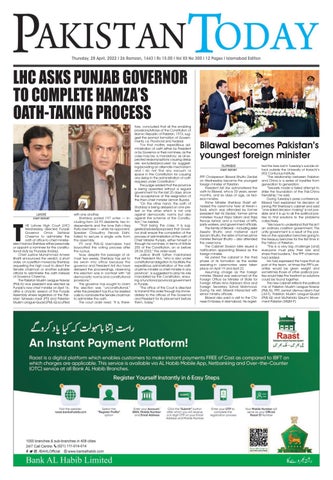
Bilawal becomes Pakistan’s youngest foreign minister ISLAMABAD staff report
PPP Chairperson Bilawal Bhutto Zardari on Wednesday became the youngest foreign minister of Pakistan. President Arif Alvi administered the oath to Bilawal, who is 33 years, seven months, and six days of age, as federal minister. Prime Minister Shehbaz Sharif witnessed the ceremony here at Aiwan-iSadr, which was attended by former president Asif Ali Zardari, former prime ministers Yousuf Raza Gillani and Raja Pervaiz Ashraf, and a number of MPs, party workers, and government officials. The family of Bilawal – including sister Aseefa Bhutto and maternal aunt Sanam Bhutto, the sister of former prime minister Benazir Bhutto – also attended the ceremony. The Cabinet Division later issued a notification appointing Bilawal as the foreign minister. he joined the cabinet in the third phase of its formation as the earlier swearing-in ceremonies were taken place on April 19 and April 22. Assuming charge as the foreign minister, Bilawal was welcomed at the Foreign Office by Minister of State for Foreign Affairs hina Rabbani Khar and Foreign Secretary Sohail Mahmood. During his visit, Bilawal interacted with senior ministry officials. Bilawal also paid a visit to the Chinese embassy in Islamabad. he regret-
ted the lives lost in Tuesday’s suicide attack outside the University of Karachi’s (KU) Confucius Institute. “The relationship between Pakistan and China is a series of loyalties from generation to generation. “Terrorists made a failed attempt to strike the foundation of the Pak-China friendship,” he said. During Tuesday’s press conference, Bilawal had explained his decision of joining PM Shehbaz’s cabinet and said “one-sided decision making” is not possible and it is up to all the political parties to find solutions to the problems collectively. “We have to understand that this isn’t an ordinary coalition government. This unity government is a result of the parties on the opposition benches going to the treasury benches for the first time in the history of Pakistan. “This is a very big challenge [and] everyone must play their role and share their burdens,” the PPP chairman had added. he had expressed the hope that as part of the team, at times the PPP’s priorities would be given weight and sometimes those of other political parties would take the forefront so solutions could be found together. The new cabinet reflects the political mix of Pakistan Muslim League-Nawaz (PML-N), PPP, Jamiat Ulema-i-Islam-Fazl (JUI-F), Pakistan Muslim League-Quaid (PML-Q) and Muttahida Qaumi Movement-Pakistan (MQM-P).
02
Thursday, 28 April, 2022 | ISLAMABAD
NEWS
PM diReCts ReinstAteMent oF BisP BeneFiCiARies exPelled FRoM PRogRAMMe By Pti govt APP
P
RIME Minister Shehbaz Sharif on Wednesday issued directives for the reinstatement of “eligible persons” that were removed from the beneficiary list of the Benazir Income Support Programme (BISP) by the PTI-led government. The premier issued these directives during a meeting with Federal Minister for Poverty Alleviation and Social Safety, Shazia Marri. The previous government had in December 2019 removed 820,165 names from the BISP database, describing the beneficiaries as “undeserving”. It was later also revealed by the PTI government that out of over 800,000 beneficiaries removed from the programme, more than 140,000 were those who either themselves or whose spouses were government employees.
The changes in the BISP database were made in the wake of reservations expressed by some PTI cabinet members that the supporters of opposition parties, especially those backing the PPP, were benefiting from the programme, while those belonging to the PTI were being ignored. The BISP was launched in July 2008. During the meeting today, PM Shehbaz welcomed a proposal from Marri to devise a procedure for making an appeal for the re-inclusion of those expelled from the BISP. He was also briefed by the minister on the proposed procedure of the appeal. Marri appreciated the prime minister for announcing assistance for the deserving people of Balochistan under the BISP and offering scholarships to students, besides extending financial support to the parents of female students.
Karachi attack perpetrators will be brought to book: minister
China condemns suicide blast at KU, demands strict punishment for perpetrators NewS DeSk
ISLAMABAD Staff RepoRt
Minister for Interior Rana Sanaullah Khan vowed on Wednesday to use all means to hunt and bring to justice the perpetrators of the Karachi suicide attack which targeted a Chinese delegation.
Asim Ahmad appointed FBR chairman ISLAMABAD Staff RepoRt
His statement came a day after a suspected female suicide bomber killed three Chinese teachers in the provincial metropolis, in the first major attack this year against nationals of Islamabad’s long-time ally working in Pakistan. The three were among passengers on a minibus returning to the University of Karachi after a lunch break when the bomb exploded at the entrance to
the institute’s Confucius Institute, killing the Chinese teachers and a local, police and officials said. A militant group, the Baloch Liberation Army (BLA), based in Balochistan bordering Afghanistan and Iran, claimed responsibility for the blast, adding in an email to Reuters the attack was carried out by a woman suicide bomber. Khan said that on the directives of Prime Minister Shehbaz Sharif, he was traveling to Karachi today, said a press statement. The minister said the entire country expressed solidarity with the Chinese brethren and it was our mutual grief. We will deal with it with full force as it is an attack on Pakistan-China friendship, he added. He said that he would find out the facts in meeting with the law enforcement agencies. “Our great friend China will be kept fully informed in progress about the investigation into the incident,” he added. Khan said the government would review all security apparatus for Chinese residents and would take effective measures after a thorough review of security. “Every aspect will be carefully examined,” he added. “The federal government would cooperate fully to bring the perpetrators to justice.” Meanwhile, China’s Foreign Ministry strongly condemned the attack and “demanded” Pakistan punish the perpetrators, protect Chinese citizens and prevent such incidents from happening again. “The blood of the Chinese people should not be shed in vain, and those behind this incident will surely pay the price,” it said in a statement.
ECP adjourns proceedings in PTI funding case ISLAMABAD Staff RepoRt
The government on Wednesday appointed Asim Ahmad as chairman of the Federal Board of Revenue (FBR). Ahmad has replaced Muhammad Ashfaq Ahmed. A notification to this effect has also been issued by Establishment Division. “With the approval of the federal government, Asim Ahmad, a BS-21 officer of Inland Revenue Service (IRS), is appointed as chairman, Federal Board of Revenue under Section 10 of the Civil Servants Act, 1970, with immediate effect and until further orders,” the notification read. The development comes after the cabinet which met in Islamabad under Prime Minister Shehbaz Sharif ’s chair approved Ahmed’s appointment as the new FBR boss. A BPS-21 officer of the Inland Revenue Service (IRS), Ahmad has previously served as the interim chairman of the revenue body between April 9 to August 24 in 2021 before he was replaced following a cyberattack on taxpayers’ data.
The Election Commission of Pakistan (ECP) Wednesday adjourned the hearing of the foreign funding case against Pakistan Tehreek-i-Insaf (PTI) until May 10 while approving the request of its counsel who sought additional time. A three-member bench of the commission was hearing the case. The case was being heard on daily basis after an order by the Islamabad High Court (IHC) that the matter be decided within 30 days. But later on Monday, while accepting the PTI plea, the court suspended its earlier order to this effect and asked the agency to scrutinise other parties’ accounts as well. At the outset of the hearing, PTI counsel Anwar Mansoor Khan read before the court the IHC order and beseeched it to put off the case for now and wait for the scrutiny report. But the ECP member from Balochistan objected wondering where in the IHC order had been written that we should wait for the scrutiny committee report. Khan objected that the case against the PTI foreign accounts was being heard on daily basis but other parties were given three months date. He rued that an application against the PML-N and PPP funding was submitted in 2017. The commission should have immediately sent the matter to the scrutiny committee five years ago, he added. On this, Chief Election Commissioner
Sikandar Sultan Raja remarked that he (Khan) should not become sentimental. He said the commission held him in high esteem. He assured that all three cases were being heard simultaneously. He asked the lawyer to give his arguments on his case while reiterating that no case was being stopped. Khan excused the court from presenting his arguments insisting that the commission first brought other cases at par with the PTI case and demanded a level-playing field. He complained that the PTI’s financial documents were provided to other parties but other parties’ financial documents were not given for perusal to his client. The CEC said that he had ordered for the provision of other parties’ documents to his client. He said that Islamabad High Court had sent notice to the commission and
the commission would submit its reply to the IHC. He said as the PTI contended that Akbar S Babar had nothing to do with its foreign funding case and he should be detached, in the same way, the PTI had nothing to do with other parties’ foreign funding case and it should not become inclusive in the scrutiny of other parties. The lawyer said that Babar’s case had been pending since 2014. On this, Sindh ECP member said that the commission was fully aware of its mandate. The election commissioner said three cases of foreign funding against PTI, PMLN and PPP were pending before the commission. He observed that the IHC had not stopped the commission to proceed on this case. He said the commission would carry on its proceedings on this case.
China expressed “strong condemnation and indignation” on Wednesday over the suicide attack outside the University of Karachi’s (KU) Confucius Institute a day earlier in which four people, including three Chinese nationals, were killed. The incident had taken place as van, carrying three Chinese teachers, was about to enter the Confucius Institute. CCTV footage showed a burqa-clad woman standing outside the entrance of the Confucius Institute who detonated herself just as the van neared the institute’s entrance. Resultantly, three Chinese teachers, including Confucius Institute director Ding Mupeng, who were travelling in the van, and the vehicle’s driver were killed. Later, the Balochistan Liberation Army claimed responsibility for the attack. A Chinese foreign ministry spokesperson, in response to a question about the incident during a press briefing on Wednesday, said the attack had left three Chinese teachers dead and one injured. Acknowledging that there “are also casualties on the Pakistani side”, he went on to say that the “Chinese side expresses strong condemnation and indignation over this major terrorist attack, and extends deep condolences to the victims and sympathies to the injured and bereaved families”. He further said the Chinese foreign ministry and diplomatic missions in Pakistan activated the “emergency response mechanism” immediately after the incident, and that Chinese Assistant Foreign Affairs Minister Wu Jianghao made an urgent phone call to Pakistan’s ambassador in China. The spokesperson said that the Chinese minister expressed “grave concern” over incident during the call and demanded that Pakistan conducted a thorough probe immediately. The minister further demanded that the perpetrators of the attack should be apprehended and punished to full extent of the law and all possible measures be taken to ensure the safety of Chinese citizens in Pakistan so that such incidents were prevented in the future. “The Chinese embassy in Pakistan and consulate-general in Karachi are working with the Pakistani side to deal with the follow-up matters of the casualties,” the foreign ministry spokesperson said. He also mentioned Prime Minister Shehbaz Sharif’s visit to the Chinese embassy in Islamabad on Tuesday evening, saying that the premier had conveyed his condolences and the Pakistan government would conduct an “in-depth probe” into the incident, “give exemplary punishment to the perpetrators and strengthen the security of Chinese personnel, projects and institutions in Pakistan in an all-round way”. The spokesperson quoted PM Shehbaz as saying that the Pakistan government would “never allow any force to undermine the Pakistan-China friendship”. According to the spokesperson’s stAtement, loc al authorities in Sindh and Karachi have already launched a “full-scale investigation to hunt down the perpetrators”. “The Chinese foreign ministry and Chinese diplomatic missions in Pakistan will continue to urge relevant Pakistani departments to handle properly the follow-up matters of those killed, treat the injured, and resolutely crack down on the terrorist organisation involved,” the spokesperson said. “The blood of the Chinese people should not be shed in vain, and those behind this incident will surely pay the price.” Earlier, Sindh Chief Minister Syed Murad Ali Shah had also paid a visit to the Chinese consulate in Karachi where he briefed Consul General Li Bijian about the blast. The CM had expressed grief over the death of Chinese nationals, assured that the incident would be fully investigated and those involved in the incident would be brought to justice.
Thursday, 28 April, 2022 | ISLAMABAD
iMRAn wAnts 2M PeoPle to gAtheR in islAMABAd on his CAll
P
NewS DeSk
TI Chairman Imran Khan said on Wednesday that he wanted two million people to gather in Islamabad when he gives the call to his party’s supporters on a yet unspecified date. Addressing an adoring crowd chanting slogans in support of the PTI chairman at a workers’ convention in Lahore, he said: “I want two million people to come to Islamabad when I give the call. I want all of you to go to the people and preach to them about our movement for true freedom.” He told party workers to go to their neighbourhoods and inform the people of the “conspiracy” that had been hatched to topple the PTI government in the form of a no-trust motion in the National Assembly. “When you go to the people, you have to tell them that an imported government has been brought through a conspiracy […] this
means that the United States will control us through these stooges and boot polishers,” he said, referring to the former opposition that has since formed the new government. Imran claimed that the leaders of the incumbent government will be easily controllable since their assets and wealth were stashed abroad. “They will enslave the whole country to save their looted wealth. They will sacrifice the country for the interests of another.” He maintained that the move to oust him was born due to the fact that he wanted to follow an independent foreign policy that would benefit the people of Pakistan. “The conspiracy was carried out because your prime minister said he wanted a foreign policy that would only look at the interests of his people. That is why a conspiracy was carried out,” he thundered as party workers roared with chants of “imported government, namanzoor“. Giving the example of former Iranian
prime minister Mohammad Mosaddegh, Imran said that the US and Britain colluded to conduct a regime change operation. “What was the plan? First they fed money to the media […] they did character assassination and levelled charges against him. Then, they gave bribes to his party’s parliamentarians to get them to switch loyalties. Then, opposition parties were given money and were brought onto the streets.” He claimed that a conspiracy similar to the one against the Mosaddegh government was carried out against his own government. “Campaigns were run on media calling us the most incompetent government.” He urged party workers to inform the people of the PTI government’s performance and the way it had effectively handled the economy while also successfully battling the Covid19 pandemic. The PTI chairman also alleged that US embassy officials met with his party’s lawmakers, some of who later be-
came turncoats. “When embassy officials meet [lawmakers], they discuss foreign policy. They met our people who knew nothing about foreign policy, but who they knew were unhappy with the party.” He reiterated that US Assistant Secretary of State for Central and South Asia Donald Lu met the Pakistani envoy in Washington on March 7 and told him that a no-trust move would be tabled against the PTI government. “He knew beforehand. He also said that Pakistan would have to suffer the consequences if it is not successful. He said the US would isolate Pakistan and the European Union would also follow suit. But he said that if Imran Khan is removed, then Pakistan would be forgiven.” He alleged that preparations for this had been done beforehand, adding that the notrust move was tabled immediately after the meeting was held. “This is called a conspiracy. First, a conspiracy is carried out, prepa-
Zardari, Shehbaz agree to work in unison for democratic stability APP
F
ORMER president and Pakistan Peoples Party (PPP) co-chairman Asif Ali Zardari on Wednesday called on Prime Minister Shehbaz Sharif in Islamabad. Federal ministers Bilawal Bhutto Zardari, Khawaja Muhammad Asif and Khawaja Saad Rafiq were also present on the occasion. Overall political situation in the country was discussed during the meeting. The prime minister said that the country’s development was linked with the supremacy of the Constitution and the democratic process. They agreed to work in unison with all political parties for democratic stability as well as the public welfare.
The prime minister congratulated Bilawal on taking oath as a federal minister and reiterated resolve to overcome the prevailing challenges through mutual cooperation. Earlier in the day, President Dr Arif Alvi administered the oath of Bilawal as the federal minister for foreign affairs. The PPP chief took oath following the approval of the party’s top decision-making body a day earlier. PM Shehbaz witnessed the oath-taking ceremony at the Aiwan-e-Sadr which was attended by former president Asif Ali Zardari, ex-prime ministers Yousuf Raza Gilani and Raja Pervaiz Ashraf, and a large number of parliamentarians, party workers, and government officials. The premier also held a meeting with Federal Minister for Poverty Alleviation Shazia Atta Marri. PM Shehbaz di-
rected her to reinstate eligible persons into Benazir Income Support Programme (BISP), who were struck out of the beneficiary list by the previous government without any reason. The prime minister welcomed devising a procedure about making an appeal for re-inclusion of the persons expelled from BISP. PM Shehbaz was briefed on the proposed procedure of the appeal for such 820,000 people who were evicted from the BISP by the previous government without any investigation. Marri also updated the prime minister regarding the working of her ministry. She paid tribute to PM Shehbaz for announcing assistance for the deserving people of Balochistan under BISP and offering scholarships to students besides extending financial support to the parents of female students.
PTI moves LHC for de-seating of 25 dissident Punjab lawmakers NewS DeSk The Lahore High Court (LHC) on Wednesday directed the Election Commission of Pakistan (ECP) and Chief Election Commissioner Sikandar Sultan Raja to submit their responses on April 29 in connection with a reference to de-seat dissident PTI lawmakers in the Punjab Assembly. Justice Shujaat Ali Khan heard the petition which was filed by the party’s parliamentary leader in the provincial assembly, Muhammad Sibtain Khan. Earlier this month, PML-N’s Hamza Shehbaz won the election for Punjab chief minister, defeating PTIPML-Q’s joint candidate, Chaudhry Parvez Elahi. Hamza had bagged 197 votes, including 26 from PTI dissidents, while Elahi did not get any as the PTI and PML-Q lawmakers felt they were not allowed to vote. Subsequently, Punjab Asembly Speaker Elahi sent a reference against the dissident MPAs to the ECP, urging it to declare them defected from the PTI since they had violated party discipline. The petition filed in the LHC stated that
25 lawmakers cast their votes in favour of the joint opposition’s candidate Hamza Shehbaz in violation of party directions. These lawmakers were: Raja Sagheer Ahmad, Malik Ghulam Rasool Sanga, Saeed Akbar Khan, Muhammad Ajmal, Faisal Hayat, Mehr Muhammad Aslam, Mian Khalid Mehmood, Abdul Aleem Khan, Nazir Ahmad Chohan, Muhammad Amin Zulqarnain, Malik Nauman Langrial, Muhammad Salman, Zawar Hussain Warraich, Nazir Ahmad Khan, Fida Hussain, Zahra Batool, Muhammad Tahir, Ayesha Nawaz, Sajida Yousaf, Haroon Imran Gill, Uzma Kardar, Malik Asad Ali, Ijaz Masih, Muhammad Sibtain Raza and Mohsin Atta Khosa. The petition contended that under Article 63-A(1)(b)(i) of the Constitution, if any member of a parliamentary party votes or abstains from voting in the House contrary to any direction issued by the parliamentary party to which he belongs, in relation to the election of a prime minister or chief minister, he may be declared in writing by the party head to have defected from the political party, and the party head may forward a
copy of the declaration to the presiding officer and the chief election commissioner and shall similarly forward a copy thereof to the member concerned. The 25 MPAs named in the petition had been issued directions by the PTI but they had cast their votes for Hamza, it stated. Subsequently, the dissident MPAs had been issued show cause notices to explain their position but they had not replied, it added. Finally, PTI Chairman Imran Khan “passed a declaration for disqualification on the ground of defection under Article 63A(1)(b)(i) … and forwarded this declaration to the Punjab Assembly speaker and to the respondents for the de-seating of the above said members under Article 63-A of the Constitution”, the petition said, adding that the declaration was then forwarded to the ECP. The ECP and the chief election commissioner were “duty bound to de-seat abovesaid parliamentarians as they have committed violation of the party discipline and cast their votes for Hamza Shehbaz but the said [declaration] is pending before respondents”, it said. It added that the ECP and
CEC were “lingering on the matter on one pretext or the other and using delaying tactics to facilitate the defected parliamentarians so they can enjoy as a member of Punjab Assembly for a long time”. The dissident lawmakers should have been “disqualified” immediately but the ECP and CEC were “facilitating” them so they could cast “illegal” votes on the noconfidence resolution against the Punjab Assembly deputy speaker, it said. The matter had not even been fixed for hearing yet and no notices had been issued to the lawmakers concerned by the election commission despite the commission being bound to decide the matter within 30 days, it stated. The petition requested the court to issue directions to the ECP and CEC to decide the matter and “de-seat [the MPAs] immediately”. It also asked the court to suspend the membership of the 25 dissident MPAs while the reference was being heard and to stop them from voting on the no-confidence resolution against the deputy speaker. The ECP had on Monday issued notices to 46 dissident members of the National and Punjab assemblies, asking them to appear before it on April 28 and May 6, respectively. The decision was taken at an ECP meeting during which a letter written to the commission by PTI chairman Imran was deliberated upon.
NEWS
rations are done and then there is interference.” Imran went on to say that if this conspiracy was successful, no prime minister would dare to stand up to foreign countries in the future. “This is a war for our freedom.” He also reiterated his criticism of Chief Election Commissioner (CEC) Sikandar Sultan Raja, calling him a “PML-N agent”. He accused Raja of targeting the PTI and called on him to resign. “CEC, the biggest political party has no faith in you. Therefore, you have no right to remain at your post and you should resign.” Imran also lambasted the purported media blackout of the PTI on mainstream TV channels and questioned why the defenders of press freedom were not standing up against it. “During our stint in power, 80 per cent of the programmes were against our government. So why is there a media blackout now?” he asked.
PM to leave for saudi Arabia today NewS DeSk Prime Minister Shehbaz Sharif will embark on a visit to Saudi Arabia today (Thursday ) — the premier’s first visit abroad after assuming office earlier this month — the Foreign Office said. In a statement, the Ministry of Foreign Affairs spokesperson Asim Iftikhar said Wednesday PM Shehbaz would visit Saudi Arabia from April 28-30 at the invitation of Crown Prince Mohammad Bin Salman. The premier will be accompanied by a high-level delegation, including key members of the federal cabinet, the spokesperson said. Iftikhar that said during the visit, PM Shehbaz will have bilateral interaction with the Saudi leadership, with a particular focus on advancing economic, trade and investment ties and creation of greater opportunities for the Pakistani workforce in Saudi Arabia. The ministry’s spokesperson further added that the two sides will also exchange views on a range of regional and international issues of mutual interest. “Pakistan and Saudi Arabia are bound by a fraternal relationship marked by mutual trust and understanding, close cooperation, and an abiding tradition of supporting each other,” the spokesperson said. Moreover, the spokesperson added that the bilateral relationship is complemented by close mutual collaboration at regional and international fora. Saudi Arabia is a member of the Organisation of Islamic Cooperation (OIC) Contact Group on Jammu and Kashmir. “Saudi Arabia is home to more than two million Pakistanis, contributing to the progress, prosperity and economic development of the two brotherly countries,” he said. The spokesperson further noted that regular high-level visits are a key feature of this special relationship. Iftikhar added that the prime minister’s visit to Saudi Arabia will impart a strong impetus to deepening bilateral cooperation in diverse fields and further reinforce the growing partnership between the two countries.a
Maryam withdraws request for return of passport LAHORe INp
Pakistan Muslim League-Nawaz (PMLN) vice president Maryam Nawaz withdrew a petition filed in the Lahore High Court (LHC) for the return of her passport so that she could travel to Saudi Arabia to perform the pilgrimage. A special division bench headed by Justice Ali Baqar Najafi took up the petition. During the hearing, Maryam’s counsel, Amjad Pervez, informed the court that the PML-N leader wished to withdraw her request. Subsequently, the court
disposed of the petition. Nawaz’s withdrawal comes after no less than four benches were formed to hear the petition due to judges recusing themselves one after the other. Last week, the first bench — comprising Justice Syed Shahbaz Ali Rizvi and Justice Anwarul Haq Pannun — had observed that the petition should be heard by the same bench, headed by Justice Najafi, that had granted bail to the petitioner before recusing itself. A bench comprising Justice Najafi and Justice Farooq Haider had then issued notices on Maryam’s petition on Monday. But Justice Haider recused
himself from the matter when the petition came for hearing on Tuesday. LHC Chief Justice Muhammad Ameer Bhatti then constituted a bench comprising Justice Najafi and Justice Asjad Javed Ghural to hear the petition. However, Justice Ghural also recused himself from the matter when the bench assembled to take up the petition. The bench then sent the case file back to the chief justice for its fixing before any other appropriate bench after which a division bench comprising Justice Najafi and Justice Sardar Ahmad Naeem took up the petition on Wednesday (today).
Former information minister and PTI leader Fawad Chaudhry on Tuesday said the general impression of the LHC over cases related to the Sharif family was “negative”, adding that the chief justice should keep that in mind. “Judges are constantly not hearing Maryam’s cases,” he had said on Twitter. A bench comprising Justice Najafi and Justice Haider had granted post-arrest bail to Maryam in the Chaudhry Sugar Mills case on Nov 4, 2019. However, the bench had ordered her to surrender her passport as the National Accountability Bureau (NAB) feared she could flee the country.
03
04
Thursday, 28 April, 2022 | ISLAMABAD
NEWS
Miftah calls for expanding pakistan-Uk ties in Meeting with British envoy
f
APP
eDeRAL Minister for Finance and Revenue Miftah Ismail on Wednesday met British High Commissioner Christian Turner and expressed the desire to “further expand” the long-standing ties between Pakistan and the United Kingdom for the “mutual benefit” of both countries. In a statement issued by the Finance Ministry, Turner called on Ismail along with Annabel Gerry, head of UK’s development team in Pakistan. The secretary finance was also a part of the meeting. During the meeting with Turner — his first since he assumed office — the finance minister and the British envoy exchanged views on “matters of common interest”. The finance minister shared the new government’s broad economic agenda and priorities with the British high commissioner. According to the statement, he assured Turner that the Shehbaz Sharif-led
government aimed to bring about economic and fiscal stability leading to economic recovery and growth. Meanwhile, Turner extended the warm wishes of the UK government to the minister on assuming his post and expressed good wishes for the new government. He said that both the countries enjoyed excellent economic relations, which will be further strengthened. The British envoy assured Ismail of the full support of the British government and the people of Britain. In a tweet following their meeting, Turner said the United Kingdom “stands committed to supporting Pakistan and its people”. earlier this month, Turner had met Prime Minister Shehbaz Sharif and expressed the UK’s desire to “work closely with Pakistan on deepening and broadening bilateral cooperation”. He had also “felicitated him on assuming office and conveyed the best wishes of the British government” to the prime minister.
PPP sought PTI’s help to keep PML-N out of power in Punjab: lawmaker ISLAMABAD Monitoring report
In a twisted turn of events, a Pakistan Tehreek-i-Insaf (PTI) MP claimed that Pakistan Peoples Party (PPP) approached her with a proposition to keep Pakistan Muslim League-Nawaz (PML-N) out of office, “especially in Punjab”. The PPP — which, with its 56 lawmakers, is the second-largest party in the coalition ruling in the Centre — was pivotal in the tabling, and subsequent success, of the vote of no-confidence in then-prime minister Imran Khan. Following Khan’s ouster and the formation of the government by the Pakistan Democratic Movement (PDM) component parties, the PPP initially refused to sit in the cabinet and instead demanded constitutional offices like the Senate chairman and National Assembly speaker, but later changed its mind and took a lion’s share of portfolios, including the speaker office. It also helped PML-N in getting its vice president Hamza Shehbaz elected chief minister of Punjab in a contentious election. Following the events, Syed Talat Hussain, a journalist, claimed that shortly before the voting on the no-confidence motion, Khan had approached PPP through business tycoon Malik Riaz Hussain, requesting it to not support the vote but the party refused.
Refuting the statement on the journalist’s political chat show, Shandana Gulzar Khan said it was in fact PPP which sought PTI’s help. “I want to put this on the record […] you’ve your sources [and] I have mine […] I was approached on behalf of Peoples Party […] by certain quarters […] suggesting that PTI will only succeed if the PPP throws its weight behind the PTI,” she said. “So [Imran] Khan must put his ego aside [sic] and work with the Peoples Party.” A gobsmacked Hussain asked if the MP was speaking in the context of the trust vote or the present scenario. “Both,” Gulzar responded. “These people [PPP] don’t want PML-N in power, especially in Punjab,” she said before adding that PPP’s wheeling and dealing with the Pakistan Muslim League-Quaid (PML-Q) in the run-up to the trust vote was part of the plan to target PML-N. “I still have the text messages, received on April 9, saved in my phone and I can share those with you.”
Stop maligning credible institutions
a
MArIAM KhAn
S a nation, it is our responsibility to protect our institutions that are working towards easing the pain and suffering of the people of Pakistan. One such institution is the Shaukat Khanum Memorial Trust, which was founded by Imran Khan. everyone has the right to disagree with Imran Khan on his politics but it is morally reprehensible to malign his philanthropic ventures based on political biases. Khan used his fame to create a model cancer hospital in a low- and middle-income country like Pakistan, which is nothing short of a miracle. This hospital became an ambassador for Pakistan and many international celebrities demonstrated their support for the cause, including Princess of Wales, Lady Diana. The hospital has been acknowledged by the World Health Organisation (WHO) for outstanding work in health development, far beyond the call of normal duties. There is no justifiable explanation for dragging a charitable hospital amidst political battles. This is not to say that institutions should be like holy cows—no charitable organisation is beyond accountability—but it is also important to realise the gross injustice in wrongly accusing an institution which has maintained an impeccable reputation when it comes to financial transparency, along with clinical excellence. At various levels, the Shaukat Khanum Memorial Trust has demonstrated that it is a model institution, which has consistently resisted various ills that have befallen our society. It has distinguished itself from other hospitals built for the poor by providing treatment based on the principles of quality and equality. Accreditation of Shaukat Khanum hospitals located in Lahore and Peshawar by the Joint Commission International is a clear example that its claims about quality treatment for all are not empty words but these are based on facts and actions. One might argue that Imran Khan has become a polarising figure in Pakistan. However, this should not translate into making credible projects associated with him controversial for political gains. The truth is that we cannot remove Imran Khan from the story of Shaukat Khanum hospitals. He believed in his dream of making cancer care accessible for the poor and he made Pakistanis believe in this dream as well, and together, they carved a new window of hope for the cancer patients of Pakistan. Since the beginning, unfortunately, his hospital became a victim of politics of hate. In April 1996, after Khan announced plans for launching his own political party, a bomb ripped through the hospital’s outpatient area. This incident was reported in international media as well and the New York Times linked the explosion with “political feud heating up”. Since then, the attacks on the hospital have taken a different form. On various occasions, certain people have chosen to damage the reputation of the hospital as part of political campaigning. Perhaps they knew that this was something that Imran was proud of and they wanted to hit where it hurt the most. Fortunately, for cancer patients of this region, all attempts to malign the hospital slid off like mud from a clean, shiny surface. This is evident from the continuous trust of people, which is demonstrated by increasing number of donations each year as well as increasing clinical activity. If we look at some numbers from last year, despite the coronavirus pandemic, more
new patients were registered than pre-pandemic years. The devotion and hard-work of staff and commitment of leadership meant that the mission to fight cancer continued uninterrupted. Rs9.7 billion worth of philanthropic support was provided to deserving cancer patients in 2021. Both SKMCH&RC in Lahore and in Peshawar continued to provide financially supported treatment to over 75 per cent of all cancer patients. The construction work for Pakistan's third and largest SKMCH&RC continued and over 70 per cent of structural works were completed by December 2021, which is expected to serve the population of Sindh and Southern Balochistan. All other aspects of the mission statement of SKMCH&RC, such as research and awareness activities also continued. In 2021, the hospital published a record number of over 120 research publications in peer reviewed journals, as available on their website, and awareness activities on breast cancer, which is reported as the commonest type of cancer in Pakistan, also continued. In a country like ours where governments cannot afford to cater to the healthcare requirements of the entire population, charitable hospitals have stepped up to fill the gap. There are many hospitals doing a tremendous job in serving those who are suffering from various illnesses in Pakistan. Shaukat Khanum healthcare system is unique for fighting a disease which requires highly-skilled healthcare professionals, state-of-the-art equipment, and expensive medicines. Research in cancer care and technology to treat cancer are continuously evolving. Cancer is not one disease; it is more than 200 different types of diseases which affects organs, blood, lymphatic system and so on. This means that providing quality cancer treatment, free of charge, is an uphill battle in Pakistan. SKMCH&RC accepted this challenge and over the past twenty-seven years, showed that building model institutions in this country is possible if we are willing to expect more of ourselves. So often, we have used excuses such as oh, this is Pakistan where dishonesty, corruption and disregard for the needy is the norm, and we let injustice prevail. It is high time that we stop maligning credible institutions and instead, try supporting institutions that are reducing immense suffering for humanity with their existence. It is unfortunate, that instead of being proud of such institutions, some of us are blinded by hate to the extent that we are willing to threaten lives of other humans. We are blind to the anguish
of those who are fighting cancer every day. We seem to be unaware that one thoughtless touch on our smartphones can contribute towards false propaganda and threaten lives of other humans. Let us try to think before we act. It might end up saving lives. The writer is a community social worker with special interest in public health, philosophy and human rights.
PID (I) 7587/21
Thursday, 28 April, 2022 | ISLAMABAD
NEWS
Postings, transfers notified ISLAMABAD: The federal government on Wednesday posted Syed Asif Haider Shah, a BPS-22 officer of Pakistan Administrative Service, as Climate Division secretary, while Inter-Provincial Coordination Secretary Mohsin Mushtaq has been transferred and posted as Information Technology Division secretary. According to a series of notifications issued by the Establishment Division, Usman Akhtar Bajwa, a BPS-21 officer of the PAS cadre, who was serving as additional secretary at the Prime Minister’s Office (PMO), has been made officer on special duty (OSD) and directed to report back to the Establishment Division. Similarly, Finance Division Additional Secretary Sara Saeed, another BPS-21 officer of the PAS cadre, has been transferred and posted as Additional Secretary at the PMO. Mohyuddin Ahmad Wani, also a BPS-21 civil servant from the erstwhile DMG cadre, has been posted as Gilgit-Baltistan chief secretary. Likewise, Interior Division Additional Secretary Fakhar-i-Alam Irfan has been transferred to the Poverty Alleviation Division where he will serve as additional secretary (in-charge) of the ministry. Similarly, Poverty Alleviation Division Secretary Muhammad Ali Shahzada has been directed to report to the Establishment Division. staff report
Israeli forces kill Palestinian in new West Bank raid JENIN: Israeli forces killed a Palestinian man in the West Bank flashpoint city of Jenin Wednesday, in what the army alleged its latest "counterterrorism" raid following a series of clashes in Israel since late March. The army alleged that during the operation at Jenin’s refugee camp, troops used "live ammunition" after being targeted with gunfire and explosives by Palestinian "rioters". The Palestinian health ministry identified the man killed as Ahmad Massad, 18, from Burqin village in the north of the occupied West Bank. He was shot in the head, a hospital official told the official Palestinian news agency WAFA. The army said 12 people were arrested in the overnight raids at several West Bank locations. The Palestinian Prisoner’s Club group put the number of arrests at 17. More than a thousand people gathered for Massad’s funeral in Burqin, and masked gunmen fired volleys into the air as his body was taken from his family home. Israeli security forces have stepped up operations in recent weeks in the West Bank — particularly around Jenin, where there are alleged active fighters from several Palestinian armed groups. Raad Hazem — who killed three Israelis in a shooting spree in a Tel Aviv nightlife district last month, before being shot dead after a massive man-hunt — hailed from Jenin’s refugee camp. During the overnight operation, the army said it also delivered a demolition notice to Hazem’s family home. The destruction of assailants’ homes is a common Israeli practice and is condemned by critics as an illegal form of collective punishment. The Tel Aviv shooter’s father Fathi Hazem and brother Hamam are both wanted by Israel. Hours after the demolition notice was handed over, the father appeared in a video that then circulated widely in Palestinian media. He accused Israel of labelling all Palestinian youths as "terrorists" and told a small crowd, speaking at an unknown location, that "we will defeat them, God willing, and soon". Hamam Hazem told AFP earlier this month that the family had no prior knowledge of Raad’s plans for the Tel Aviv attack. afp
05
What Imran Couldn’t do In Four years, shehBaz has done In tWo Weeks: mInIster ISLAMABAD
m
staff report
InISTER for Information and Broadcasting Marriyum Aurangzeb said on Wednesday that Prime Minister Shehbaz Sharif has done in two weeks what his predecessor, Imran Khan, could not even think of doing in his four years in office. In a statement, presenting a review of the two-week performance of Sharif’s government, Aurangzeb said that the supply of affordable goods like sugar and wheat flour had been started to the afflicted people. Prime Minister Sharif reduced the price of sugar from Rs85 a kilogramme to Rs70 whereas the 10-kilogramme bag of flour has come down to Rs400 from Rs550. She said that inflation, which had reached an all-time high in four years, had started to come down gradually. Marriyum said that the PM had issued directives to end loadshedding from May 1 and in two weeks, 20 out of 27
closed power generating units had been made operational. Aurangzeb said that during the past two weeks, steps were taken to supply oil and gas in record time to run power plants. Industries that have been shut down for over a year due to technical glitches were starting to come back to life, she maintained. The Peshawar More-new Airport Metro project, which had been lingering on for the past four years, was launched and made operational within days. Moreover, she said that preparations had been started for the feasibility of connecting the Metro from new Islamabad Airport to the motorway and Faizabad, and its extension to Bara Kahu and Rawat and construction work started on the metro station on the motorway. She said that construction work of the Diamer-Bhasha Dam has been sped up and a new deadline for its completion in 2026 had been given instead of 2029. The PM, she said, also ordered the preparation of the feasibility of a modern hospital for the treatment of the local population.
Sharif also laid the foundation stone of sections 1 and 2 of the Kuchlar-Khuzdar highway from two to four lanes and then six lanes in the next phase. The prime minister also announced the plan for Pakistan’s most advanced technical university to train Balochistan youth, she said. Sharif also ordered the feasibility to run metro in Quetta like Rawalpindi, Islamabad, Lahore, Multan and Karachi. The prime minister had announced to provide assistance to the poorest 500,000 people from Balochistan through Benazir Income Support Programme (BISP), she added. She reminded former prime minister Khan that this was called practical service with “Pakistan speed”. Addressing a press conference later in the day, she said it is the public, not the media, that is “blacking out” Imran Khan. She said when the Pakistan Electronic Media Regulatory Authority (Pemra) was asked for data regarding which channels were restricted from covering the PTI’s activities, the body said
no such information is available. “It is the public of Pakistan that is blacking you out from politics,” she added. “During our stint in power, 80 per cent of the programmes were against our government. So why is there a media blackout now?” he asked. Marriyum said that during the PTI’s tenure, journalists were roughed up, shot at and jailed while their programmes were forced off-air. “In whose time was the [new] media regulatory authority being set up?” she asked while referring to the Pakistan Media Development Authority (PMDA) that was “disbanded” by the coalition government shortly after coming to power. When the media houses had refused to be influenced by the PTI government’s thuggery, they were pressured financially. The incumbent government did not believe in censorship and Pemra was always independent during PML-n’s governments, she said. “You cannot do politics by lying. You are being blacked out by the people of Pakistan [because of] your performance.”
Indian ban on studies in Pakistan puts future of Kashmiri students at risk ISLAMABAD anadolu agency
India’s decision to effectively ban its citizens from studying in Pakistan has put in jeopardy the future of hundreds of students from occupied Kashmir. Scores of students from the Indian-occupied region are currently enrolled in medical and engineering colleges and universities across Pakistan, while a similar number have completed their degrees and returned home. “This move to invalidate the degrees of those who study in Pakistan is illogical and may prove to be disastrous for hundreds of students who are studying here,” a student from Kashmir in Islamabad, who asked not to be named due to fear of reprisal from Indian security agencies, told Anadolu Agency. “It seems they are hell-bent on destroying our careers. no democracy bans people from seeking education. But at the same time, what else can the colonised
Factbox: Who are the militants behind attack on Chinese citizens in Pakistan? KARACHI: The Baloch Liberation Army (BLA), which claimed a deadly attack on Chinese citizens in Karachi on Tuesday, is the most prominent of a number of militant groups operating against the state in Balochistan. The province has seen a decades-long insurgency against what militants call the unfair exploitation of resources in the mineral-rich region. Balochistan borders Afghanistan to the north and Iran to the west, and has a long coastline on the Arabian Sea. It has Pakistan’s largest natural gas field and is believed to have many more undiscovered reserves. It is also rich in precious metals including gold, the production of which has grown over recent years. Most of the militant groups operate independently, but some recent reports in media have pointed to increasing cooperation between them. The security forces have been their main focus, but in recent years they have also targeted Chinese interests, given Beijing’s increasing economic footprint in the region. Among China’s major projects in Balochistan is the port of Gwadar, strategically located near the Strait of Hormuz — a crucial oil shipping route in the Arabian Sea. Chinese engineers working at the port came under attack from an operation claimed by the BLA last year. A Chinese company also operates a major gold and copper mine in Balochistan. The security of its nationals in Pakistan has become a major issue for Beijing, especially since it launched the China-Pakistan Economic Corridor (CPEC), which envisages development projects worth more than $60 billion. reuters
CMYK
expect from the coloniser?” Last week, Indian higher education authorities issued an advisory warning Indian nationals not to enrol in any college or educational institution in Pakistan. Those intending to receive an education in Pakistan will not be eligible for employment or further education in India, said the University Grants Commission (UGC) and the All India Council for Technical Education (AICTE). “Any Indian national/Overseas Citizen of India who intends to take admission in any degree (of a) college/educational institution of Pakistan shall not be eligible for seeking employment or higher studies in India on the basis of such educational qualifications (in any subject) acquired in Pakistan,” read the statement. Currently, over 500 students are studying in Pakistan, and 50 to 100 graduate from Pakistan’s institutions each year, according to Pakistan-based representatives of the All Parties Hurriyat Conference (APHC).
The APHC is an alliance of several parties that has spearheaded Kashmir’s movement for self-determination and resistance against Indian rule since the early 1990s. “The state of education in Kashmir due to the military occupation is severely troubled. Pakistan offers us an affordable rescue,” said another student, who also preferred to remain anonymous. Pakistan provides students from Indian-occupied Kashmir with scholarships covering tuition fees, boarding and lodging and other facilities at educational institutions across the country. “The Indian state’s order is an attempt to deprive Kashmiris who choose to study in Pakistan of employment and livelihood opportunities,” said the student, adding that the move was “not surprising.” “For a long time, family members of Kashmiri students studying in Pakistan have been harassed by Indian police and returning students have been subjected to interrogations,” he said.
06-07 Comments - 28th April 2022_Layout 1 4/27/2022 11:03 PM Page 1
Thursday, 28 April, 2022
06 COMMENT
Gross miscalculation of the establishment
PTI in desperation Throwing punches in all directions
t
The establishment failed to realise how popular Imran Khan is
HE world has accepted the change of government in Pakistan. the newly elected government is gradually settling down despite the serious challenges that it has yet to cope with. Prime Minister shehbaz sharif has received congratulatory messages from the Gulf states, the Usa and countries of the European Union. after his forthcoming visit to saudi arabia he is scheduled to hold talks in Beijing. On tuesday Microsoft co-founder and philanthropist Bill Gates assured the new PM of the continued support of the Bill & Melinda Gates Foundation in the fight against polio. ti chief imran khan however continues to call into question the legitimacy of the new government, maintaining that it was brought to power through a Us conspiracy. He calls himself a victim of Cia’s underhand methods like the 1950’s iranian PM Mohammad Mosaddegh and Chile’s President allende two decades later. Dr Mosaddegh had dared to nationalise the giant British Petroleum Company, a measure that threatened vital economic interests of the Usa and its allies. Chile’s Marxist President was overthrown as he tried to turn Chile, located in Washington’s sphere of influence, into a socialist state. imran khan fails to explain what earth shaking feat he had performed to earn the Us ire and how he escaped the horrendous punishment meted out to the two leaders despite the immense pubic support they enjoyed. imran khan falsely accuses the Usa of giving money to media outlets to defame him. the Usa, he claims bribed Pti politicians to turn them into dissidents. interestingly, two of them are known to be Pti’s major financers. Mr khan wants dissidents to be disqualified for life from holding public office. He wants immediate elections. For years the Pti created hurdles in the investigation of its foreign funding case. now that investigation in its own case has been finally completed, the Pti does not want the verdict to be announced till completion of the audit of accounts of 101 political parties named by it. since the mainstream media stuck to independent reporting and a section of Pti leaders dared to differ with r khan’s disastrous policies, both were accused of being in the Usa’s pay. since the ECP insists on following the law instead of acting according to imran khan’s whims, the Pti demands the Chief Election Commissioner’s resignation. at a time when fascistic tendencies are on the rise one expects the government to stand up to mob rule, discourage false news and ensure media freedom.
Dr FariD a Malik
T
HE year was 1977, and Prime Minister Zulfiqar ali Bhutto (ZaB) was brimming with confidence. Lt. Gen. Ghulam Jilani khan (Jill) was heading the isi which also included the ‘ Political surveillance Wing ‘. On the input from Jill, ZaB decided to surprise the divided opposition. He dissolved the assemblies ahead of schedule and announced national elections. an alliance of nine political parties called Pakistan national alliance (Pna) was waiting in the wings to take on the ‘Quaide-awam ‘. they even applied for a single election symbol for a one-on-one contest with the PPP. so, the contest was between the talwar (sword) and the Hal (Plough). in the original 1973 Constitution, there was no provision for a caretaker set-up, so ZaB continued as an interim PM and so did the four Chief Ministers. Elections were held for the national assembly followed by the Provincial a day later. the PM and the four CMs managed to get elected unopposed, which created doubts in the mind of the people about the fairness of the contest. it was ZaB’s dream to get a two-thirds majority in the legislature thus enabling him to amend the Constitution. He realized his lifelong desire but it sparked an organized protest against his regime. the religious card was also thrown in, it was called ‘nizam-eMustafa Movement’. While air Marshal asghar khan was the star of this uprising, the religious right took control of the streets. though the protests were nationwide, Lahore was the epicentre of the conflict. Punjab under nawab sadiq Hussain Qureshi had insulated the party leadership from the grassroot workers. Chants of ‘Hul Chalado’ (Use the Plough) were all over. the armed forces were called for the maintenance of law and order. When it was evident that ZaB was politically done with, COas Gen Ziaul
Another Karachi attack Terrorists seem to be extending their range
t
HE Balochistan Liberation army (BLa) seems to be extending its range, though it seems singleminded about its target: Chinese interests. the suicide blast at the karachi University’s Confucius Center seems to have established a number of firsts, being not just the first attack in Pakistan to target China’s Confucius Centre, and thus its soft power, but also the first BLa attack to be carried out by a female suicide bomber. the nexus between the BLa and the tehrik i taliban Pakistan means that the BLa has the capacity to strike anywhere in the country, including at such urban centres as Lahore and Rawalpindi. so far, the BLa has hit at commercial targets and diplomatic missions, including on the Chinese Consulate General in karachi. that the BLa has thought of using female suicide bombers was announced through this attack, and indicates another potential source of recruits for the cause. it does mean that those charged with guarding against such attacks cannot afford to ignore women as unlikely. at least initially, the government reacted properly. Prime Minister shehbaz sharif promptly went to the Chinese Embassy to offer his condolences, and sindh Chief Minister announced a probe. However, that is far from the end of the matter. nine Chinese residents were killed in the July 2021 blast targeting the Dasu hydropower project, and China was not happy with the investigation. One result of that sloppiness was the repetition of the modus operandi. again, a vehicle carrying Chinese was targeted. there is a clear need for intelligence agencies to realign their priorities, and not only try to get information about the organizations behind such gruesome attempts, but also forestall them. the police and the courts must also show the ability to collect evidence and promptly prosecute and convict the guilty. the China-Pakistan Economic Corridor is under attack, and there is a deliberate effort to drive a wedge between Pakistan and China. With the Usa and india ganging up, it seems that foreign interference is not aimed at changing governments, but stopping projects. the friendship between China and Pakistan may be very strong, but it cannot survive infinite strain.
Not only is there a prejudice against treatment, there is also a huge shortage
MuhaMMaD ZahiD riFat
P
akistan direly needs more and more psychologists as the country’s population continues to grow rapidly in an unabated manner, and increasing number of people including women and children are suffering from mental health problems. Pakistan’s population has already crossed 220 million but has one of the poorest mental health indicators as only less than 500 psychologists or psychiatrists are there for the entire population. this paucity of mental health professionals is creating a narrow treatment gap, leaving more than 90 percent of the people with common mental health diseases without any treatment whatsoever. Psychological problems in Pakistan are pretty widespread. according to one estimate, around 50 million people of all genders and ages suffer from mental disorders. a wide range of psychiatric disorders have generally been reported such as depression, substance and alcohol use, schizophrenia, bipolar disorder and post-traumatic stress disorder. according to another estimate, a large number of about 36 percent of Pakistanis suffer from anxiety and depression, which is often caused by strained family and friends’ relations, the feeling of not fitting in the society, and the unstable economic and political conditions of the country giving rise to unemployment and poverty. Bipolar disorder is a mental disorder that causes extreme and unusual shifts in mood, energy and activity levels. a lot can be said about sorts of mental disorders and issues but that is being avoided here for want of space.
Arif Nizami (Late) Founding Editor
Yousaf Nizami M. A. Niazi
Umar Aziz
Joint Editor
Joint Editor
Executive Editor
Lahore – Ph: 042-36300938, 042-36375965
The writer is ex-Chairman, Pakistan Science Foundation. He can be contacted at: fmaliks@hotmail.com.
Psychologists direly needed
Dedicated to the legacy of late Hameed Nizami
Editor Aziz-ud-Din Ahmad
Haque deposed the elected PM on 5 July 1977. the PM was kept in confinement at the Murree Governor’s House. Fresh elections were announced in accordance with the 90 days constitutional requirement. Before his release, the General went to see ZaB who gave him a piece of his mind. the threat of article 6 was not taken seriously at that time. ZaB arrived at the Lahore airport to a hero’s welcome that surprised everyone. He was staying at the nawab’s residence located in shadman ii. there was a sea of supporters who refused to go away. Occasionally ZaB would appear on the balcony with a request to the people to go home but they kept chanting “Quaid-eawam” “Fakhar-e-asia” (Leader of the Masses, Pride of asia). as i had to go to work in the morning, i finally left around midnight. the establishment had miscalculated the public support of the fallen leader. Events that followed are now a part of our chequered political history. ZaB was physically eliminated through ‘Judicial Murder’ on 4 april 1979 but his legacy lives on. On 9 april 2022 another elected PM was voted out of power by a coalition of diverse political parties called Pakistan Democratic Movement (PDM). it started as a ‘Mehengai (inflation) March, but ended up as a ‘Freedom Movement ‘. While the personal credibility and honesty of imran khan (ik) was not an issue, the performance of his team was. after failing to win public support, the opposition decided to work on a no-confidence motion in Parliament. Within days the pieces started to fall in place. the PDM, establishment and the judiciary all seemed to be working in tandem to remove the PM. the movement gained strength by the hour. ik termed it a foreign conspiracy while the establishment admitted it was only interference. in the past sovereignty of several developing countries has been trampled through external involvement with the connivance of compromised local support. For the major part of its existence the islamic Republic of Pakistan has been a satellite state obeying orders of foreign masters even against its national interests. the involvement in the afghan Crisis has been disastrous for the nation with massive collateral damage yet no leader had the courage to say “no More”‘. Only ik had the moral strength to say “absolutely not” which was not taken lightly. as the PM held his ground, it was decided to get rid of him as the popularity ratings of his government were very low. another gross miscalculation was done by the establishment. While the performance evaluation of the regime was marginal, the personal popularity of the PM was intact. When he decided to expose the foreign interference as a direct attack on the freedom of the nation, the people responded to his call as they trusted his leadership. His demand for fresh elections is gaining grounds.
national elections are now unstoppable. any attempts to keep ik out through the traditional rigging or manipulation will result in massive street protests. Unfortunately, it may prove to be a rerun of the 1977 imbroglio from which the country has still not recovered. History is witness to the fact that in developing countries popularly elected leaders who stand up for national interests are physically eliminated. the personal security of ik has to be taken very seriously. From his death cell in 1979, ZaB predicted that if he was harmed, “the Himalayas would cry and the water of the River indus would turn red.”. this did not happen then but it may happen this time around. all stakeholders must exercise extreme caution in the best interests of Pakistan to contain destabilization of any kind. Establishments worldwide have historically failed to sense the sentiments of the people, and as such they usually miscalculate their actions which then lead to disastrous consequences. Gone are the days when the will of the people could be suppressed through ‘thanas and Patwarkhanas’. information highways cannot be blocked. in the 20th century. tagore remarked that, “a country with a free press has never faced famine”. i am sure in the 21st century with the available technologies of mass communication, uproar of the masses will reach every corner of the country from khyber to karachi and Gwadar. From the election results from the na-33 constituency of Hangu, the voters have spoken, kaptaan has come ahead. as already claimed the establishment should be apolitical, which is a good sign but then the stables have to be cleansed of the ‘siasi Basta B’ whose record it has been maintaining anD updating, followed by the necessary surveillance. Either the entire record of the bad characters should be returned to the original police stations from where it came or made public together with details of their misdeeds and crimes against the nation. Pakistan has been a constitutional democracy since 14 august 1973. Every state institution must operate within its own domain, thereby ending the ‘Zia Dark ages’ that have denied the entry of light needed to march forward in the new millennium. the scourge of external interference has to be totally wiped out, and the law of the land must come hard against perpetrators who sell national interests for short-term personal gains. the people’s mandate has to be respected; assemblies should be allowed to complete their terms. the entire state apparatus has to be apolitical, major reforms are needed in the bureaucracy, judiciary and the law enforcement agencies. Establishment calculations do not work, never have and never will in the future. to put this country of over 220 million people back on track, a free, fair and credible election is the only way forward.
I
Karachi – Ph: 021-35381208-9
I
While it is socially acceptable to seek help from a health professional for physical disorders, seeking help for psychological disorders is rather problematic in the country. Families often hide mental illness to prevent the patient from being adversely stereotyped. it is generally said and believed that if a doctor listens to his patient attentively, almost half of his pain due to disease is gone even before any formal treatment. as a matter of fact, both psychologists and psychiatrists are trained to identify mental disorders and issues. a psychologist may help the patient in addressing symptoms through therapy by touching skills whereas a psychiatrist may prescribe medication to any such patient. in the backdrop of this not so encouraging situation, it is good to note that people, particularly young women, are opting for studying and specializing in clinical psychology for treating their fellow countrymen of all ages and genders. One such young woman is Zunaira Qayyum, whom this scribe came across recently and with whom the discussion briefly mentioned above took place, who emphatically stated that her childhood dream of becoming a successful girl in the medical profession is one-half coming true as she is very close to the goal of becoming a clinical psychologist and next half of the dream will hopefully be accomplished when she become known throughout Pakistan as an empathetic listener. about her being an empathetic listener, Zunair Qayyum said,” i want to listen to my country’s sorrows and i really want to spend my life serving the people of Pakistan, every day i keep praying that almighty allah give me the courage to become a better person and a successful psychologist for the people who are suffering from any illness, i will spend my entire life working for kids and adults having mental health problems, telling everyone to remember no matter how difficult life be there is always hope and there is always help”. she said that her cherished goal in life is to become a leading psychologist, start private practice in Lahore and start taking patients, and the most important skill for a therapist is also her best skill, namely
Islamabad – Ph: 051-2204545
I
Web: www.pakistantoday.com.pk
I
the power of listening. she already has to her credit working with the adult patients at the Punjab institute of Mental Health Lahore and with autistic children at an international institute in Gulberg, Lahore. Zunaira Qayyum did her Msc Psychology from Government College for Women Gujranwala, studied hard for higher studies in Philosophy and is now specializing in Clinical Psychology and doing thesis work at the University of Lahore. according to her, when she was 10 years old she used to dream that one day she would become a successful girl in a medical profession. she has all along been encouraged and supported by her mother to grow up and achieve her cherished goals. she is the first girl in her family to have studied for higher academic degrees. One of Zunaira Qayyum’s maternal aunts was abnormal, and as a small child she used to look after her. On growing up she decided to continue helping out the people who are differently abled and have different abilities and needs than most of us adding “i have an enthusiasm in my heart to feel the sensitivity of psychological matters, please come to me, meet me, we will discuss and discover ideas to deal with your problems in a very clear and simple manner”. she has got most of her inspiration from world renowned Pakistani artist and social crusader Jimmy Engineer who has served Pakistan all his life, saying “i want to become like Jimmy Engineer, let me admit that all my heart, my spirit and my breath is for the people of Pakistan, i promise to serve them faithfully from now onwards till my day of death, it is an honour to be a servant of Pakistan”. Please join this scribe in wishing her the best in realizing her cherished goal of becoming a leading clinical psychologist and serving the people of her motherland and in praying that more and more people, particularly young women follow her suit and opt for higher studies in Psychology as the country needs more and more qualified and trained psychologists and psychiatrists. The writer can zahidriffat@gmail.com;
Email: editorial@pakistantoday.com.pk
be
reached
at
06-07 Comments - 28th April 2022_Layout 1 4/27/2022 11:03 PM Page 2
Thursday, 28 April, 2022
COMMENT 07 Editor’s mail
Send your letters to: Letters to Editor, Pakistan today, 4-Shaarey Fatima Jinnah, Lahore, Pakistan. E-mail: letters@pakistantoday.com.pk Letters should be addressed to Pakistan today exclusively
Global cooperation
The spirit of electoral reforms
Dr abDus sattar abbasi
D
UE to the proven history of election irregularities and manipulations we lost the spirit of electoral reforms by focusing merely on procedural interventions to ensure transparent and reliable elections. Our concern about procedural lacunas is not without reason. i personally witnessed several irregularities in different elections at the grassroots during the 1990s. i remember once i joined a colleague to be a polling agent of one of our colleagues contesting election for the provincial assembly of nWFP, now kPk. We were placed at the home station of one of the expected winning contestants; and our candidate was not among those. However, after the lunch break there was a huge roar to oust both of us from the polling station because they heard that another winning candidate ensured polling of all eligible votes on the voter list, even those who had died, in connivance with the polling staff and they wanted to do the same here at their polling station. i initially resisted but when it came to guns i left the polling station for them along with my colleague. it is one of the first-hand accounts; there are several other observations of rigging in different forms which still prevail in our electoral system including failure of the Rts, counting behind the closed doors reportedly without polling agents at some places and most recent revelation of spoiling ten thousand votes of a winning candidate in karachi while putting additional stamp on the ballot paper to favour a weak candidate who eventually won a national assembly.seat. all these instances do emphasize the importance of electoral reforms to eliminate such operational and procedural problems during elections but there is a need to consider some other important aspects to strengthen democratic norms and establish genuine democracy according to our ground realities. the spirit should remain to establish the importance and maintenance of the vote. according to Joshua a. Douglas from University of kentucky, “Voting is the foundational concept for our entire democratic structure. We think of voting as a fundamental– the most fundamental– right in our democracy. When a group of citizens collectively elects its representatives, it
affirms the notion that we govern ourselves by free choice. an individual’s right to vote ties that person to our social order, even if that person chooses not to exercise that right. Voting represents the beginning; everything else in our democracy follows the right to vote. Participation is more than just a value. it is a foundational virtue of our democracy.” it is indeed a frustration for masses when they observe obvious wastage of their votes as depicted in previous elections. Because in 2018 Pti took almost 32 percent votes, the opposition got approximately 42 percent, while considerable votes of less popular parties were not represented in Parliament; we can witness nearly the same trend in 2013 when PML(n) was on the treasury benches. therefore we need to find ways to eliminate the general distress of voters through electoral reforms for inclusive governments. Representation of all factions of the society is important in Parliament including some factions of Balochistan, ex-Fata territories, southern Punjab, and a few sectarian and ethnic groups who have not yet witnessed any considerable say in national policies; because, they usually emerge as important stakeholders during any wave of instability. therefore it is important to develop a system which assimilates all these integral components of our society. He current plurality-based electoral system does not serve even in the senate because it again reflects the same party-based majority instead of philosophical equal representation of all provinces. the very purpose of the Upper House was to ensure equitable representation of provinces but it failed to accommodate all communities of the provinces because same members who make it to the provincial assemblies on the basis of majority votes elect members of the senate, thus again depriving considerable voices in the society from being heard in Parliament. We have a history of decades-long extremism in the country which usually stems from the exclusion of smaller groups in the mainstream population due to their specific ethnic or sectarian approaches. these groups never stopped propagating their view of life and probably will not do so during our journey on the road of democracy because, probably, this is one of the good aspects of democracy where everyone is allowed to live with his or her thoughts and preferences. We are subject to unusual circumstances from Day One of our independence. the existence of these parties and clusters can’t be denied in all provinces of the country from north to south, and their exclusion from power corridors has provided fertile ground for global players to pursue their agendas in the country.
Our establishment always remained busy in coining counter-narratives and curbing foreign interventions. Probably the most effective strategy would be to ensure inclusion of such smaller parties and groups in the mainstream democratic processes through electoral reforms, because we could not eliminate them through existing policies and perhaps would not be able to do so for at least another two to three decades. Considering all these aspects it is quite appropriate to suggest an electoral system based on proportional representation (PR). PR can probably provide remedy to several deeprooted ailments of our electoral landscape. apparently it seems quite appropriate to opt for PR to accommodate all voices, to ensure true representation of every section of the society, to ensure that every vote is counted, avoiding wastage of votes as largely happens in plurality-based electoral systems, to eliminate extremism from politics and the society, to encourage coalition and collaboration, to enhance turn-out and reduce apathy, and to exhibit preferences for both the candidates and the political parties. However, technically it needs extensive brainstorming to determine the most appropriate type of proportional representation. in a closed party-list PR there is absolutely no influence of voters on selection of candidates which, i think, is not a suitable option, that voters only vote for the party and then the party decides the list of successful candidates; it will be a new form of totalitarianism. Open party-list PR has some influence on at least the order in which party candidates are elected. Ranked voting provides an opportunity to the voter to rank their candidates in a sequence of 1st, 2nd, 3rd etc. and also accommodates transfer of votes to other constituencies. Mixedmember PR provides an opportunity to the voters to elect the representative for their constituency as well as to vote for their preferred political party. it is indeed a matter which needs attention and scholarly reflections to bring novel electoral reforms for Pakistan. nevertheless, not every system is without limitations, PR is also subject to several challenges including compromises, political gridlocks, unstable governments and above all reduced accountability to voters. therefore we have to move cautiously to maintain the spirit of electoral reforms for the benefit and prosperity of all stakeholders of the society.
Nevertheless, not every system is without limitations, PR is also subject to several challenges including compromises, political gridlocks, unstable governments and above all reduced accountability to voters.
The writer is Associate Professor Management Science and Head, Center of Islamic Finance, COMSATS University (CUI) Lahore Campus, and can be reached at drabdussattar@cuilahore.edu.pk
CLiMatE change is the gravest of all challenges facing the world today. its costs are incalculable and damage irreparable. it has gripped the whole world and wreaked havoc all over the world. the reality is that climate change is costing lives and it is a humanitarian crisis as well as an environmental one. the menace of climate change has been triggered by many factors such as excessive greenhouse gas emissions, enormous use of non-renewable energy sources, deforestation and other anthropogenic activities. Ostensibly, thanks to these factors, the earth gets warmer which leads to changes in climate patterns. the intergovernmental panel on climate change (iPCC), the leading body of the United nations for the assessment of climate change has proved some scientific evidence for the warming of the climate. Unequivocally, scientists, climate experts and authorities of the world have observed the changing patterns of rainfall, floods and temperature rising are some indicators of climate change. Over several decades the scientists have sounded the alarm about this global problem they have come together to show a pattern that the current atmospheric warming driven by human activities, has the potential to change in ways that could profoundly affect human livelihood in many parts of the world. However, the process of the industrial revolution in the 18th century and the phenomena of decolonisation spewed an alarming rate of carbon emissions. the global emissions rate keeps worsening over time. in addition, colonialism has also greatly influenced the shape of prevalent economic systems, which have enabled vast accumulation via the ruthless exploitation of people and our planet. some prominent scientists and climate experts have warned if the global temperature continues to rise at the current pace it should have catastrophic consequences. Most importantly, deforestation is warmly welcome to global warming and has profoundly exacerbated green energy and climate change. therefore, the effects are significant and include melting polar ice, rising sea levels and severe storms, droughts and flooding. international cooperation and coordination is prerequisite to significantly mitigate the impact of climate change and could bring unprecedented changes in the pattern of the climate system. First of all the large dynamic emerging economies- China, india, Brazil and indonesia have assured leadership, offering contributions of their own and prodding other industrial countries to take their actions. Moreover, all the largely emitters must make their contribution to galvanize the technological revolution. they would take early actions to eliminate fossil fuels, subsidies commit to matching carbon price increases in the future, and strengthen the protection of intellectual property for green technology. now, China is the leading country in carbon emissions, for instance, it plans to spend $780 billion on renewable energy by 2030. similarly, saudi arabia, one of the leading countries in the production of fossil fuels, intends to invest $50 billion in its renewable energy sector. ZAKIR ULLAH MARDAN
Re-adjusting aROUnD the world, the Covid pandemic brought significant changes and redefined our lifestyles. the change affected everyone differently with some people utilising the lockdowns and isolation as a time to work on themselves and their skills. Whereas others descended into idleness and lethargy. across the country, many students did not have access to broadband services and electronic devices to attend online classes, which affected their learning and educational outcomes. also, lack of physical interaction with teachers and peers curbed them from understanding and clarifying concepts. Fresh graduates struggled to find employment as the already sparse job market further contracted. this negatively impacted graduates’ selfconfidence and put them under severe stress. the economy took a big hit as many industries came to a sudden halt. With the closure of airspaces, tourism was non-existent for nearly two years. Hospitality and retail industries also suffered significantly because the government banned mass gatherings, indoor dining, etc. Many businesses suffered big losses and were compelled to either dismiss employees or close down. Overall economic productivity and growth were slow throughout the pandemic. those who contracted Covid themselves or lost loved ones to the virus have been living in a constant state of fear. now that the rate of infections has declined, people are beginning to adjust back to normal lives; however, many are struggling. those who failed to gain employment or were made redundant during the pandemic are now battling depression, anxiety, and stress. Everyone must offer help and support to one another during this time. Educational institutes should concentrate on facilitating both teachers and students. also, the government should aid businesses and industries to get back on track. More importantly, people must continue following the standard operating procedures and get vaccinated to avoid another wave of the virus. AYESHA RAZAQ RAWALKOT
Reckless driving RECEntLy, i witnessed a horrific hit-and-run accident after a speeding truck hit a young motorcyclist and drove off. Due to the absence of CCtV cameras and traffic police, the truck driver will per usual go scot-free. in the last few months, across Rawalpindi, several fatal accidents have been reported daily. the usual suspects are teenagers and truck drivers who are notorious for reckless driving whilst being under the influence of substances. the inaction of authorities has further emboldened the reckless drivers who unabashedly speed and break traffic laws. Often drivers speed in residential areas, which is extremely dangerous as children are playing on the streets. at times, drivers race cars and lose control of their vehicles ramming into trees or other vehicles on the roads causing severe damage. Large trucks/containers carrying heavy items overtake other vehicles, which confuses other drivers and disrupts traffic. the complete disregard for the lives of other drivers and passengers, pedestrians, and stray animals is deplorable. the traffic police can play a crucial role by acting against reckless drivers and investigating cases reported by the people. Drivers without licenses should be punished if they are caught driving or speeding. also, speed limits should be labelled on roads across the city and CCtV cameras must be installed as it may encourage drivers to remain vigilant. SYEDA AIMEN RAWALPINDI
08 WORLD VIEW 28th April 22_Layout 1 4/27/2022 8:45 PM Page 1
Thursday, 28 April, 2022
08 WORLD VIEW
lies, damned lies and sOme very big egOs! INCREASINGLY CONCERNED ABOUT THE PRESIDENT’S MENTAL STATE AND FEARFUL THAT HE COULD PLUNGE THE WORLD INTO A HOLOCAUST, SCHLESINGER TOOK AN EXTRAORDINARY STEP. HE TOLD AMERICA’S MILITARY LEADERS THAT IF THE PRESIDENT GAVE THEM ANY ORDERS, COMMANDERS SHOULD CHECK EITHER WITH HIM OR THE SECRETARY OF STATE, HENRY KISSINGER. IN OTHER WORDS: ‘IF YOU’RE ORDERED TO PUSH THE BUTTON, MAKE SURE YOU RUN IT BY ME FIRST’ dAILY MAIL rogEr alton
d
UrING the early days of August 1974, President richard Nixon was engulfed by the ever-expanding scandals of the Watergate affair. It had become a way of life. By now he was drinking heavily, often alone, depressed, anxious and uncertain of what to do. A couple of days before he became the first man to voluntarily resign the presidency, he told his Chief of Staff, Alexander Haig: ‘Al, you soldiers have the best way of dealing with a situation like this. You just leave a man alone in a room with a loaded pistol.’ Haig knew Nixon was speaking figuratively about suicide. But Defence Secretary James Schlesinger believed it went beyond that. He recalled an alarming remark Nixon had made to U.S. politicians when asked about fighting Communism: ‘I can go in my office and pick up a telephone, and in 25 minutes millions of people will be dead.’ Increasingly concerned about the President’s mental state and fearful that he could plunge the world into a holocaust, Schlesinger took an extraordinary step. He told America’s military leaders that if the President gave them any orders, commanders should check either with him or the Secretary of State, Henry Kissinger. In other words: ‘If you’re ordered to push the button, make sure you run it by me first.’ In the event, the final days of the Nixon presidency passed off without alarms. This extraordinary insight into the pressures engulfing the most powerful man in America is just one of countless rich anecdotes in Garrett Graff’s monumental history of the Watergate affair. Vividly told by Graff, a prolific and awardwinning journalist and historian, this work effortlessly clarifies the strands of one of the most complex episodes in modern history and is full of vivid characters: doomed advisers, diligent journalists, assiduous political investigators on Capitol Hill. ‘My goal,’ writes Graff, ‘was not to reinvestigate.’ Instead he relies on voluminous sources and documentary evidence to tell the story as clearly as possible. Watergate might have started with a failed robbery, but it led to dozens more arrests, the ruin of several political careers — including two Attorneys General — an alleged kidnapping, investigations by the FBI and Congress, an FBI director jailed, the sinking of a Vice President (Spiro Agnew was convicted of bribery), and the ruin of the President as well as most of the President’s men. It is one of the most reported stories ever. There are more than 30 memoirs from key participants, hundreds of pages of transcripts of Nixon’s tapes and 30 volumes of a senate committee report. For people in this country, the defining image, from the Oscar-winning movie All The President’s Men, will be of robert redford and Dustin Hoffman as the Washington Post’s investigative reporters Bob Woodward and Carl Bernstein, leaping over newsroom desks in their hurry to uncover the scandal after another meeting with
their source, Deep Throat, and bring what turns out to be a corrupt President to justice. The driving force behind the scandal was the insane levels of paranoia in the White House, which became critical in 1971 when the Washington Post and New York Times published what became known as the Pentagon Papers, thousands of leaked documents chronicling decades of U.S. involvement in Vietnam and revealing the lies told to the American people. With Nixon furious at the leaks, hostile to the Press and determined not to have his re-election jeopardised, a ruthless attitude of ‘win at all costs’ developed in the White House. To this end, the President signed up a team of former CIA and FBI operatives to do his dirty work. Determined to smear Daniel Ellsberg, the man who leaked the Pentagon Papers, one of their first jobs was to break into the offices of his psychiatrist, hoping to find something damaging. But the scandal really began on June 17, 1972, with a 2.30 am breakin at the Watergate building, a mile from the White House. When police arrived, they found five men in the offices of the Democratic Party National Committee, wearing suits and latex gloves and carrying bugging devices and walkietalkies, as well as hundreds of dollars to bribe security. Not your typical burglars, then. That became even more apparent at the first court hearing a few hours later, when one of the defendants, James W. McCord Jr, told the judge he was a security consultant, recently working for the CIA. The judge was visibly taken aback. It was clear this was no normal break-in. There were two conspiracies, argues Graff. The first, to burgle the Democrats, was part of the republican Nixon world’s paranoid obsession with dirty tricks — bugging, smearing, stealing documents. It was chaotic, but it was a worked-out plan to subvert the 1972 presidential election. Quite why is beyond anyone’s guess: Nixon won it by a landslide. The second conspiracy — the cover-up — just grew and grew because no one stopped it. And it went right to the top. As the shockwaves of the breakin widened, with allegations of slush funds, corruption, misplaced campaign funding, bribery and tax fraud, the proliferating scandal was blown wide open in July 1973 when it was revealed that Nixon had routinely taped every conversation and call in the Oval Office. He fought hard to keep his profanity-strewn recordings secret, but lost in the Supreme Court — and the crucial tape, The Smoking Pistol, was revealed. On it, in a conversation that took place just six days after the Watergate break-in, Nixon and his Chief of Staff Bob Haldeman are heard plotting to persuade the CIA to tell the FBI to drop any inquiry. So the cover-up had started in the Oval Office. Within days Nixon was gone. The tragedy was that in many ways he should be regarded as one of the greatest men to occupy the White House. Nixon wound down the Vietnam War, signed the Clean Air Act, created the Environmental Protection Agency, hiked social security, declared war on cancer, tripled the number of women in policy-making roles,
OppOsitiOn mOunts tO trudeau’s Online censOrship University of Ottawa law professor Michael Geist has been a principled critic of the federal government’s various attempts to regulate and censor the Internet ToronTo Sun Editorial
calmed the Cold War and was the first to visit Peking and Moscow. But he was betrayed by his darker side: paranoid, fearful of his opponents and the media, and determined to do them down. Even now the Watergate scandal retains its mysteries, admits Graff. Who ordered the break-in? What was the purpose and target? Were they looking for blackmail material — there were rumours of a call girl ring at Democratic HQ — or disruptive political intelligence? For anyone growing up as a journalist in this period, the role of the anonymous source Deep Throat — a nickname from a big porn film of the time — was heroic. Graff is more sceptical. Deep Throat was outed decades later as Mark Felt, the deputy director of the FBI. But for Graff, Felt’s actions were the payback of an embittered man, furious that he had been passed over to succeed J. Edgar Hoover as FBI director. This is a masterful, epic look at a story that is still barely believable. Graff skilfully guides us through the forest of supporting players, crooks, conmen, business aides, judges, lawyers, miscellaneous wives, White House operatives, spooks and cops. If anything, for this limey reader not totally steeped in the story for decades, a few pages listing the various players would not have gone amiss. For America, the scandal ushered in an age of greater transparency and hard-nosed investigative watchdog journalism that still, thankfully, exists. But despite the lessons of Watergate, in our own time President Trump not only wanted to screw up his opponents, just like Nixon, but unlike Nixon, refused to accept an election result. He even fomented a revolt on the Capitol Building that has not lost its power to shock. Perhaps we should go back to Watergate and re-learn its lessons. In politics, as in everything, morality matters. WATERGATE: A NEW HISTORY by Garrett M. Graff (Simon & Schuster £25, 832pp)
The recent consultation process undertaken by the Trudeau Liberal government into crafting laws to do away with what they call online harms is “an absolute embarrassment to the government”, according to an expert in the field. While few people would disagree with the notion that things like online hate speech and misinformation are bad, the idea of a partisan government defining what these terms mean and then using that to regulate speech is a big problem. University of Ottawa law professor Michael Geist has been a principled critic of the federal government’s various attempts to regulate and censor the Internet. This past week, Geist released access-to-information documents he unearthed that unveils the responses the government received from individuals, businesses and organizations to its plans. What the documents reveal is that the opposition to Liberal plans is even wider than first thought. But why didn’t the government’s report on their consultations reveal this aspect? As Geist writes in a blog post, “the government’s determination to keep the consultations submissions secret until compelled to disclose them by law eviscerates its claims to support open, transparent government.” This alone shows the Liberals aren’t well-suited to the task of regulating online content. Geist’s findings reveal other interesting things, such as how TikTok reported that “in the first quarter of 2021, content that violated its community guidelines accounted for less than 1% of all video and that 91.3% of the videos it removed were identified and removed even before a user reported them.” This suggests that social media companies are doing a good job of removing inappropriate content as is. Why does the Trudeau cabinet need to wade into the matter and take control? Geist also unearthed Twitter’s damning response to the government: “The proposal by the government of Canada to allow the Digital Safety Commissioner to block websites is drastic. People around the world have been blocked from accessing Twitter and other services in a similar manner as the one proposed by Canada by multiple authoritarian governments (China, North Korea, and Iran for example) under the false guise of ‘online safety’ impeding peoples’ rights to access information online.” Wow. If your online regulation is being compared to that of dictatorships, that’s a clear sign you need to back down.
What will elon musk’s takeover of twitter mean for free speech? MANY SILICON VALLEY INSIDERS BORN AND BRED UPON TECHNO-UTOPIAN FREE SPEECH IDEALS HAVE STRUGGLED WITH TRANSLATING THESE PRINCIPLES INTO WORKABLE ONLINE RULES IndependenT Jacob MchangaMa
i
N 2017, a group of tech executives prostrated themselves before hostile British MPs who demanded tougher action on hate speech. Twitter´s representative announced that the platform was abandoning its “John Stuart Mill-style philosophy’’, declaring it was “no longer possible to stand up for all speech”. Yet, Elon Musk´s recent acquisition of Twitter for $44bn is premised on a return to the principles of Mill who wrote that: “Strange it is, that men should admit the validity of the arguments for free discussion, but object to their being ‘pushed to an extreme’; not seeing that unless the reasons are good for an extreme case, they are not good for any case.” And, like Musk, Mill believed
that protection against private threats to free speech is as important as protection against the “tyranny of the magistrate”. Although no one knows how Musk will implement Millian principles in practice, the prospect of less rigorous content moderation on Twitter has caused important debates about the potential consequences. This includes an outbreak of “elite panic” among many pundits and politicians, whose livelihoods depend on exercising free speech. US Senator Elizabeth Warren called the deal “dangerous for our democracy”, others view the takeover as a manifestation of White Power that would end #BlackTwitter. On the other hand, some uncritically hail Musk as the saviour of free speech from Twitter´s alleged digital authoritarianism. In truth, there are both reasons to be wary and hopeful about Muskian Twitter, as well as ways forward that protect speech and empower users. In 1945, George Orwell warned against a centralised press “owned by wealthy men who have every motive to be dishonest on certain important topics”. Twitter is the plat-
form of choice for media outlets, journalists, pundits and politicians, giving it an outsized influence on the public sphere. Accordingly, Orwell’s warning is still relevant in the digital age. That Musk professes a faithful commitment to free speech is no guarantee that he will stay true to this ideal. In Areopagitica, John Milton railed against censorship, only to end up serving as a censor under Cromwell. Ever since, the history of free speech has been afflicted by “Milton’s Curse”, the selective and unprincipled defence of this freedom. Will Musk also be tempted to curate his online persona and protect his business interests via Twitter, just as he has apparently sought to deflect or suppress negative news stories about Tesla? These dangers could be offset by Musk´s promise to increase transparency and he would be wise to erect “Chinese walls” between himself and the enforcement of content moderation once new principles are in place. What about the dangers of hate speech and disinformation? Well, it’s important to
have some perspective. In absolute numbers, one can find many examples of hatred and misinformation (especially when using broad and subjective definitions). But overall, the share of such speech has often been exaggerated by traditional media and politicians eager to rein in the digital disruptors of the old elitist public sphere. This is cold comfort to vulnerable groups subjected to vile hatred, but it is also true that Twitter has been instrumental in giving voice to campaigns like Black Lives Matter, #MeToo and LGBT+ activists. Inescapably, free speech comes with costs and harms. There are good arguments that Twitter has come to err on the side of restrictiveness, removing ever broader categories of hate and disinformation, sometimes inadvertently affecting the minorities the removals were supposed to protect, as well as suppressing genuinely newsworthy stories. But it is also true that the few but bright lines that ought to delineate the legal limits of free speech very quickly become blurry in cyberspace. Many Silicon Valley insiders born and bred upon techno-utopian free
speech ideals have struggled with translating these principles into workable online rules. Global platforms have hundreds of millions of users in different countries with very different ideas about where to draw the line. Moreover, content moderation depends on scale and speed, which is incompatible with precision and thoughtfulness. Accordingly, mistakes and inconsistent enforcement is a feature not a bug. No doubt, Musk will also run into this problem. In fact, in a recent TED interview Musk seemed to acknowledge that his vision would not include total free speech absolutism. One way forward could be to reduce centralised moderation by Twitter, while allowing users more control through so-called distributed content moderation. This would take much of the centralised decision making out of the hands of Twitter – and ultimately Elon Musk – and empower individuals to decide. If, for instance, women or LGBT+ groups find specific types of lawful but awful content deeply offensive and offputting, they could avoid it by using filters developed by third parties without affecting the wider ecosystem of news, views and information that is central to Twitter. Jacob Mchangama is the executive director of Justitia, a Copenhagen-based think tank focusing on human rights and author of ‘Free Speech: A Global History From Socrates to Social Media’.
Thursday, 28 April, 2022 | ISLAMABAD
NEWS
Gold falls to Rs113,200 per 10gm ISLAMABAD TLTP
Spot gold prices fell on Wednesday amid a stronger US dollar. As of 1320 hours GMT, gold in the international market was available at $1,896 per ounce, shedding $9.70 (-0.51 percent). Out of the $9.70 per ounce decrease, -$12.40 was due to strengthening of the US dollar and +$2.70 was due to predominant buyers, according to Kitco Gold Index. The price of 10 grams of 24-carat yellow metal in Pakistan, meanwhile, decreased to Rs113,200 after shedding Rs500. Gold price in the local market settled at Rs113,700 on Tuesday last. According to experts, the bearish potential remains intact for gold, as the US dollar holds near two-year highs versus its main rivals. They said that gold is attempting a rebound from two-month lows of $1,886. The market mood remains upbeat despite the ongoing EU-Russia energy conflict, in the face of the Ukraine war. They said the US dollar is pulling back from two-year highs amid the improving sentiment, offering a muchneeded respite to gold bulls. The negative sentiment seen around the US Treasury yields also aided the rebound in the non-yielding gold price. Persistent concerns over global growth, China’s lockdowns and more aggressive Federal Reserve rate hikes are likely to keep the demand for the greenback intact, which could limit gold’s rebound. From a technical perspective, gold price breached the March 29 lows of $1,890 but found bids just above the endof-February lows near $1,880. Even though gold bounced back towards the $1,900 mark, the 14-day Relative Strength Index (RSI) keeps pointing lower below the midline, suggesting that any recovery attempts are likely to remain shallow. If bulls succeed in recapturing $1,900 on a sustained basis, then Tuesday’s high of $1,911 could be retested. Further up, the $1,950 psychological level will be closely followed by gold bulls. On the downside, only a daily closing below the $1,890 support could initiate a fresh downswing towards the February 24 lows of $1,878. Sustained weakness below the latter will expose the rising 100-Daily Moving Average (DMA) at $1,875.
Rupee recovers 17 paisas against USD KARACHI TLTP
Pakistani rupee recovered to 185.45 against the US dollar for the third straight day on Wednesday, as reports about revival of the International Monetary Fund (IMF) loan programme provided some stability to the market. The State Bank of Pakistan said in a statement that the rupee opened at 185.62 against the US dollar in the interbank market and closed at 185.45 after gaining 17 paisas (+0.09 percent). Within the open market, the rupee was traded at 185/186.5 per dollar without any change. The rupee has gained Rs1.30 against the dollar during the last three days. During the last week, the rupee shed Rs5.20 against the US dollar and slipped to 186.75 from 181.55. Overall, the rupee devalued by Rs28.02 against the US dollar during the ongoing fiscal year 2021-22 and Rs9 during the current year 2022. According to experts, although there is stress on the economy, some stability is visible. Despite better exports, the current account deficit has surged to alarming levels and in order to address this challenge, there is a need to look at the agriculture sector and curtail needless imports, they added. Currency dealers believe that the IMF statement, saying the Fund mission will visit Pakistan in May to resume discussions over policies for completing the seventh review has helped sentiment, as did the news of extending the stalled programme by up to one year and increasing the loan size to $8 billion from $6 billion. Traders and markets are looking at the IMF as progress with the Fund instils investor confidence in the economy, stabilises Pakistan’s foreign exchange reserves, and unlocks funding from other international financial institutions. Besides IMF programme revival, expected $2.4 billion rollover from China and other foreign inflows would provide much-needed support to the balance of payments and the currency as well.
09
PakiStan neeDS to ReDUce itS cURRent accoUnt Deficit: iMf
t
hE International Monetary Fund (IMF) has urged Pakistan to bring its current account deficit under control, an official said, as Prime Minister Shebaz Sharif's government seeks an increase in the size and duration of the current IMF programme. Pakistan's current account deficit ballooned to $13.2 billion in the nine months of the current fiscal year from a gap of $275 million a year earlier on the back of soaring oil import costs, official data showed. Rating agency Moody's expects the deficit to widen to five to six per cent of gross domestic product in the current fiscal year ending June 30, up from
its earlier 4pc projection, putting greater pressure on Pakistan's foreign reserves. Jihad Azour, director of IMF's Middle East and Central Asia Department, told Reuters that the fund's team will assess the policy priorities of the new government and the economic impact in the context of the war in Ukraine. “But of course, we have been over the last few months highlighting the importance of maintaining the current account situation under control [and] reduce the current account deficit.” he did not elaborate on the policy actions, but the IMF has earlier said that a continued commitment to a
market-determined exchange rate and a prudent macroeconomic policy mix would help reduce the deficit. The new government faces enormous economic challenges, predicting the fiscal deficit will exceed 10pc of GDP at the end of the current financial year. Finance Minister Miftah Ismail said on Monday that Pakistan sought an increase in the size and duration of its $6bn IMF programme. When asked whether Pakistan would need to take certain steps first, such as cutting oil and gas subsidies, Azour said these will be discussed during the visit in May. “We'll discuss these issues and therefore I will not preempt those discussions,” he said. REUTERS
Pakistan’s exports to USA increased by 40.27pc Pakistan’s exports of goods and services to United State of America (USA) witnessed an increase of 40.27 per cent during the first three quarters of fiscal year (2021-22) as compared to the exports of corresponding period of last year. The overall exports to USA were recorded as $5000.275 million during July-March (2021-22) against exports of $3564.575 million during JulyMarch (2020-21), showing growth of 40.27 per cent, State Bank of Pakistan (SBP) data revealed on Wednesday. Meanwhile on year-to-year basis, exports to USA during March 2022 also increased by 21.80 per cent from $484.376 million to $590.001 million. Similarly on month-on-month basis, exports to USA rose by 7.69 per cent during March 2022 in comparison with exports of $547.856 million in February 2022, SBP data said.
Overall Pakistan’s exports to other countries witnessed an increase of 26.64 per cent in nine months, from $18.713 billion to $23.699 billion. On the other hand, the imports from USA during the period under review were recorded as $2227.417 million against $1778.120 million last year, showing growth of 25.26 per cent in nine months of this year. Meanwhile, year-to-year basis, imports from USA during March 2022 however decreased by 2.31 per cent from $284.597 million last year to $278.008 million. On month-on-month basis, the import from USA also dipped by 3.89 per cent during March 2022 as compared to the import of $289.273 million in February 2022, the SBP data said. The overall imports into the country increased by 41.33 per cent, from $38.061 billion to $53.795 billion. aPP
Pakistan earns $360m from travel services in 8 months Pakistan earned $360.034 million by providing different travel services in various countries during the first eight months of the current financial year 2021-22. This shows a growth of 10.05 per cent as compared to the $327.152 million same services were provided during the corresponding period of the last fiscal year 2020-21, Pakistan Bureau of Statistics (PBS) reported. During the month under review, the personal travel services increased by 10.05 per cent, from the $325.802 million last year to the $358.544 million during July-February 2021-22.
Among these personal services, the exports of health-related expenditure rose by 92.66 per cent while the education-related expenditure decreased by 4.95 per cent. In addition, the other personal services witnessed an increase of 10.16 per cent. Meanwhile, the exports of business services also grew by 10.37 per cent, from the $1.350 million to the $1.490 million, the PBS data revealed. It is pertinent to mention here that the exports of services from the country witnessed an increase of
18.17 per cent during the first eight months of current financial year (2021-22) as compared to the corresponding period of last year, Pakistan Bureau of Statistics (PBS) reported. The exports of services during July-February (2021-22) were recorded at $4,492.02 million against the exports of $3,801.18 million in July- February (2020-21), showing growth of 18.17 per cent. The imports also rose by 39.20 per cent by growing from $5,089.31 million last year to $7,084.40 million during the period under review. aPP
Thursday, 28 April, 2022 | ISLAMABAD
10 FORIGEN NEWS
IndIa too hot, says ModI, sendIng fIre warnIng natIonwIde as delhI landfIll burns
I
REUtERS
NDIA is getting too hot too early, raising the risk of fires, Prime Minister Narendra Modi warned on Wednesday, as New Delhi sweltered in extreme heat and a burning landfill on the outskirts of the capital spewed toxic smoke into the air. “Temperatures are rising rapidly in the country, and rising much earlier than usual,” Modi told heads of India’s state governments in an online conference. “During such a time, we are seeing increasing incidents of fires in various places — in jungles, important buildings and in hospitals — in the past few days.”
The prime minister asked the state governments to prioritise fire-safety audits for hospitals. Dozens of people die every year in fires in Indian hospitals and factories, mainly due to illegal construction and lax enforcement of safety requirements. Fire trucks are seen on a road as smoke billows from burning garbage at the Bhalswa landfill site in New Delhi, India, on April 27, 2022. — Reuters Fire trucks are seen on a road as smoke billows from burning garbage at the Bhalswa landfill site in New Delhi, India, on April 27, 2022. — Reuters Fires in Delhi’s filthy dump yards also contribute to the toxic air that people living in the world’s most polluted capital have to breathe.
As Modi spoke, firefighters were struggling to extinguish a blaze at the Bhalswa landfill site, a hillock rising above the northwestern edge of the city. Fumes from the burning waste forced a nearby school to close on Tuesday. Many of the pupils’ parents work as trash pickers at the site. “We can’t make them sit here, it won’t be healthy for them at all,” Nayna, a parttime teacher who gave just one name, told Reuters’ partner ANI. The cause of the landfill fire was under investigation, though such incidents are commonplace during India’s scorching summers, when temperatures regularly surpass 40 degrees Celsius (104 degrees Fahrenheit) before the monsoon rains bring relief.
Myanmar junta court sentences Suu Kyi to five years for corruption YANGON AFP
A court in military-ruled Myanmar convicted the country’s former leader Aung San Suu Kyi of corruption and sentenced her to five years in prison Wednesday in the first of several corruption cases against her. Suu Kyi, who was ousted by an army takeover last year, had denied the allegation that she had accepted gold and hundreds of thousands of dollars given her as a bribe by a top political colleague. Her supporters and independent legal experts consider her prosecution an unjust move to discredit Suu Kyi and legitimize the military’s seizure of power while keeping the 76-year-old elected leader from returning to an active role in politics. She has already been sentenced to six years imprisonment in other cases and faces 10 more corruption charges. The maximum punishment under the Anti-Corruption Act is 15 years in prison and a fine. Convictions in the other cases could bring sentences of more than 100 years in prison in total for a Nobel Peace Prize laureate who already spent years in detention for defying the military rule. News of Wednesday’s verdict came from a legal official who asked not to be identified because he is not authorized to release such information. Suu Kyi’s trial in the capital Naypyitaw was closed to the media, diplomats and spectators, and her lawyers were barred from speaking to the press. Suu Kyi’s National League for Democracy party won a landslide victory in the 2020 general election, but lawmakers were not allowed to take their seats when the army seized power on February 1, 2021, arresting Suu Kyi and many senior colleagues in her party and government. The army claimed it acted because there had been massive
electoral fraud, but independent election observers didn’t find any major irregularities. The takeover was met with large nonviolent protests nationwide, which security forces quashed with lethal force that has so far led to the deaths of almost 1,800 civilians, according to a watchdog group, the Assistance Association for Political Prisoners. As repression escalated, armed resistance against the military government grew, and some U.N. experts now characterize the country as being in a state of civil war.
Suu Kyi has not been seen or allowed to speak in public since she was detained and is being held in an undisclosed location. However, at last week’s final hearing in the case, she appeared to be in good health and asked her supporters to “stay united,” said a legal official familiar with the proceedings who asked not to be named because he is not authorized to release information. In earlier cases, Suu Kyi was sentenced to six years’ imprisonment on convictions of illegally importing and possessing walkie-talkies, violating coronavirus restrictions and sedition. In the case decided Wednesday, she was accused of receiving $600,000 and seven gold bars in 2017-18 from Phyo Min Thein, the former chief minister of Yangon, the country’s biggest city and a senior member of her political party. Her lawyers, before they were served with gag orders late last year, said she rejected all his testimony against her as “absurd.” The nine other cases currently being tried under the Anti-Corruption Act include several related to the purchase and rental of a helicopter by one of her former Cabinet ministers. Violations of the law carry a maximum penalty for each offense of 15 years in prison and a fine. Suu Kyi is also charged with diverting money meant as charitable donations to build a residence, and with misusing her position to obtain rental properties at lower-than-market prices for a foundation named after her mother. The state Anti-Corruption Commission has declared that several of her alleged actions deprived the state of revenue it would otherwise have earned. Another corruption charge alleging that she accepted a bribe has not yet gone to trial. Suu Kyi is also being tried on a charge of violating the Official Secrets Act, which carries a maximum sentence of 14 years, and on a charge alleging election fraud, which carries a maximum sentence of three years.
Shiekh Shahidul, 18, walks past the burning garbage at the Bhalswa landfill site in New Delhi, India, April 27, 2022. — Reuters Shiekh Shahidul, 18, walks past the burning garbage at the Bhalswa landfill site in New Delhi, India, April 27, 2022. — Reuters The capital has been hotter than 40 C for several days this month, with peak summer still to come before the cooling monsoon rains arrive in June. The India Meteorological Department forecast heatwave conditions in the east, central and northwest of the country — which includes the capital — over the next five days and flagged risks to the health of infants, the elderly and people with chronic diseases.
a Musk-owned twitter opens door to potential trump return NEW YORK AFP
Four days after Twitter permanently suspended Donald Trump’s account on January 8, 2021, the then-US president’s son pleaded with entrepreneur Elon Musk to employ his “brilliance” to launch a social media platform that “isn’t biased” to crush the competition. Musk didn’t accept Donald Trump Jr’s challenge. But the Tesla chief’s deal to acquire Twitter sets him up to revisit the ban on the brash Republican — a move that could roil US politics as the nation marches towards the 2024 presidential race and a potential Trump re-election bid. The Trump matter has loomed as a question mark throughout the twists and turns of the Twitter deal saga. A reinstatement of Trump would have significant implications for a media landscape the ex-president once dominated before he was de-platformed “due to the risk of further incitement of violence.” Since then, Trump has remained the most powerful figure in Republican politics, even as he has all but vanished from the daily news cycle. When Trump does make news, he continues to claim the 2020 election was stolen from him, a false narrative that fuels his movement and sows distrust of US institutions. Irresistible? Trump has said he wouldn’t return to Twitter even if offered, telling Fox News on Monday he would instead stay on his fledgling Truth Social platform, which has struggled to fully get off the ground. On Tuesday, Truth Social was the most downloaded iPhone app, at least for that day. But its launch has been beset with technical problems and it has yet to make it onto the national political radar. Nevertheless, many remain skeptical Trump would be able to resist rejoining Twitter if given the chance. A Washington Post article Monday quoted anonymous Trump aides who said the ex-president badly misses Twitter, which he employed as president to settle scores and mold the news cycle. While pursuing Twitter in recent weeks, Musk has not directly addressed the Trump question. Analysts believe Musk is driven primarily by a desire to control a visible marketing platform more than aspirations to shape American politics. But many read Musk’s criticism of Twitter content policies as suggesting he will lift the Trump ban. “Free speech is the bedrock of a functioning democracy, and Twitter is the digital town square where matters vital to the future of humanity are debated,” Musk said Monday in announcing the deal. ‘He sells news’ A Trump reinstatement is not without downside for Musk, who could face pushback beyond the world of Twitter.
EU estimates up to 80pc of population has had Covid BRUSSELS ReuteRs
The European Commission said that between 60 per cent and 80 per cent of the EU population was estimated to have been infected with Covid-19, as the bloc enters a post-emergency phase in which mass reporting of cases was no longer necessary. In preparing for this less acute phase, European Union governments should ramp up Covid19 immunisations of children, the bloc’s executive body said, signallingit was considering plans to develop antivirals. “It is estimated that between 60% to 80% of the EU population has by now had Covid,” EU health commissioner Stella Kyriakides told a news conference. The EU public health agency said reported cases had covered about 30% of the European population so far, but if unreported infections were added, cases could be as high as 350 million, about 77% of the European population. With a recent drop in infections and deaths linked to Covid-19, the EU is now shifting away from mass testing and reporting of cases, Kyriakides said, confirming what Reuters reported on Tuesday. But fresh Covid-19 surges are likely as the virus is expected to continue mutating, and therefore countries should have in place plans to shift back into emergency mode, and should ramp up
vaccinations, the commission said. In a document outlining the strategy for the post-emergency phase of the pandemic, Brussels urged governments to continue pushing for the immunisation of the unvaccinated, especially children before the start of the new school term in the autumn. Immunisation rates are below 15% among children aged between 5 and 9, the youngest age group for which Covid-19 vaccines have been authorised in Europe. That compares to over 70% of teens aged 15 to 17, the document says. The Commission also said it could back the development of new drugs against Covid-19, especially antivirals that are easier to store and administer. The EU “will explore possibilities to support projects targeting the development of antivirals,” it said. Antiviral pills against Covid-19 developed by Pfizer (PFE.N) and Merck & Co (MRK.N) have been approved for use in the EU. But their uptake has so far been limited, due to a range of reasons including the slowing of the pandemic, high prices and complicated national procedures to prescribe them. The EU executive also said it would work to support the development of the next generation of Covid-19 vaccines which it expects will offer more robust and longer-lasting protection against infection or transmission.
Thursday, 28 April, 2022 | ISLAMABAD
SPORTS 11
Manchester city narrowly beat real Madrid in chaMpions league seMi-final thriller LOnDOn
M
AFP
ANCHESTER City have a slender lead to defend in the second leg of their Champions League semi-final against Real Madrid after winning a thrilling first leg 4-3 at the Etihad on Tuesday. The English champions could live to regret not killing off the 13-time winners after taking a two-goal lead three times. Kevin De Bruyne, Gabriel Jesus, Phil Foden and Bernardo Silva were on target for Pep Guardiola’s men, who should have scored many more. But Karim Benzema’s double and a brilliant individual effort from Vinicius Junior gave Madrid hope of another famous Champions League fightback at the Santiago Bernabeu on May 4. Guardiola lamented letting Liverpool escape “alive” in the Premier League title race after a 2-2 draw at the Etihad nine days ago and will have similar regrets after a blistering opening that could have seen City go 40 up inside half an hour. Madrid were playing in their 30th semifinal to City’s third, but the English giants lived up to their tag as pre-tie favourites early on. Only 92 seconds had passed before the Madrid rearguard was breached by Riyad Mahrez’s quick feet and perfect cross for De Bruyne to stoop and head past Thibaut Courtois. Guardiola has often been criticised for overthinking his team selection at the business end of the Champions League.
But his decision to break from the mould of the past two seasons and play Jesus as a central striker was inspired as the Brazilian ran the Real defence ragged. Jesus pounced to make it 2-0 after just 10 minutes after David Alaba failed to deal with De Bruyne’s cross.
former australia batsman slater avoids jail in domestic violence case
The Spanish champions-elect were without Casemiro and his absence showed as City cut through midfield on the counter-attack at will. Guardiola was furious with Mahrez after he selfishly smashed into the side-netting with Foden awaiting the cross for a tap in.
Moments later it was Foden who was guilty of wasting a glorious chance when he dragged wide another pinpoint De Bruyne through ball. Benzema rouses Madrid: Benzema dragged Madrid back from the dead to see off Paris Saint-Germain and Chelsea in the
Shaheen Shah Afridi relishing Lord’s ‘dream’ with Middlesex
MeLBOURne
AFP
ReuteRs
Former Australia batsman Michael Slater avoided jail on Wednesday after a Sydney court dismissed domestic violence charges against him on mental health grounds, Australian state media reported. Slater, 52, was arrested by police in October and charged with harassment and intimidation of his ex-wife following an allegation of domestic violence. The once-prominent cricket commentator was later charged with breaching a restraining order in December after he was alleged to have sent dozens of texts and calls to his ex-wife. Magistrate Ross Hudson of Waverley Local Court declined to sentence Slater to jail time on Wednesday but ordered that he spend three weeks in a mental health unit, the Australian Broadcasting Corporation said. “Since February, Mr Slater has recognised his need to stay medicated and to stay on top of his mental health,” the ABC quoted Hudson as saying in court. “He’s shown a tangible commitment to therapy and counselling.” The report said Slater did not appear in court because he was detained by police and ambulance officers on Tuesday and taken to a mental health unit for treatment at a Sydney hospital. Slater had already seen five separate psychiatrists and spent more than 100 days in various mental health facilities, the ABC said. The former opening batter played 74 tests from 19932001 and 42 one-day internationals before becoming a cricket commentator but was axed by the Seven Network last year. His departure from Seven came after a furious tirade against Australian Prime Minister Scott Morrison on social media.
Pakistan paceman Shaheen Shah Afridi says he will be living a dream when he makes his Middlesex home debut at Lord’s on Thursday. The towering left-arm quick has signed to play for the English county club, based at the London ground — the game’s spiritual home. “It’s every cricketer’s dream to come here and play at the home of cricket,” Afridi told reporters at Lord’s on Wednesday ahead of Middlesex’s match against Leicestershire. Afridi has already starred at the ground, taking 6-35 against Bangladesh during a 50-over 2019 World Cup match. “Now I want to take 10 (wickets in an innings),” he said with a smile. “When you play for your country you always feel proud and that came against Bangladesh so it was a good game for me as well. “As a youngster, you’re playing in a World Cup game and you take six wickets so yes, it’s a big high for me and one of the best memories for me.” Rising staR: Afridi, one of the rising stars of world cricket, with 95 wickets in 24 Tests at an av-
erage of 25, is set to play his maiden first-class match at Lord’s, having made his Middlesex debut away to Glamorgan last week. Middlesex, who play in the second division of the County Championship, won that match by an innings and 82 runs, with 22-year-old Afridi taking four wickets.
Eintracht bank on away support at West Ham Agencies Eintracht Frankfurt expect thousands of German fans to travel again in the hope of inspiring another away victory, like the shock win at Barcelona, for Thursday’s Europa League semi-final first leg at West Ham. Around 30,000 Eintracht fans managed to get tickets for the second leg of their quarter-final at Camp Nou, roaring the German club to a stunning 3-2 win at Barcelona to seal a 4-3 aggregate victory. Visiting Frankfurt fans have been allocated 5,000 tickets for the game at West Ham’s London Stadium, which has a capacity of 60,000, but the German club expects tens of thousands of fans to make the journey. “I am absolutely sure there will be more than 5,000 in the city,” Eintracht CEO Axel Hellmann told AFP. “Our fans like to travel and support their team abroad – that’s why we brought 15,000 to Inter Milan” for the last-16 tie in 2019.
previous two rounds and again rose to his side’s rescue before half-time. The Frenchman cushioned in his 40th goal of the season off the post from Ferland Mendy’s cross. Yet, Madrid’s good work in steadying the ship towards the end of the first half was undone in another slow start after the break. Mahrez hit the post when one-on-one with Courtois before Dani Carvajal blocked Foden’s follow-up on the line. Fernandinho was forced to deputise at right-back after replacing the injured John Stones in the first half. And the City captain had a major role to play in two goals in two minutes at either end. Firstly, he picked out Foden to restore City’s two-goal lead. But the 36-year-old showed his age as Vinicius sprinted clear of his Brazilian compatriot from the halfway line before slotting past Ederson. City continued to create chances at an alarming rate for Carlo Ancelotti but it took something special when they did finally get a fourth. Oleksandr Zinchenko was fouled on the edge of the area, but Romanian referee Istvan Kovacs played advantage and Silva thrashed into the top corner. Again City failed to put the tie to bed as Mahrez was inches away from finding the far corner from the narrowest of angles. But there was a final twist eight minutes from time when Aymeric Laporte handled inside the area. Benzema was the coolest man in the stadium as he chipped the spot-kick down the middle to leave the tie on a knife-edge headed back to the Spanish capital.
Frankfurt reached the semi-finals that year before losing to Chelsea on penalties. “30,000 at Barcelona was absolutely the peak of our club history’s going abroad. It’s part of our DNA.” Frankfurt’s Colombia forward Rafael Borre explained why the upset win on a magic night in Barcelona has captured the imagination of Frankfurt fans. “Many people thought it was impossible. So when you achieve it, it’s normal for people to feel euphoric,” said Borre, who scored away to Barcelona in the quarter-final. In a bid to avoid a repeat of the scenes at Camp Nou that prompted Barcelona coach Xavi Hernandez to say it felt like they had been “robbed in their own home”, West Ham have warned their supporters against selling tickets to Frankfurt fans. Under Austrian coach Oliver Glasner, Frankfurt have struggled at times in the Bundesliga this season, saving their best performances for Europe. Their fans are desperate to reach the
final in Seville on May 18 for the chance of silverware. Before their shock win over Bayern Munich in the 2018 German Cup final, Eintracht’s previous title was in 1979-80 when they won the UEFA Cup – the precursor to the Europa League – by beating Borussia Moenchengladbach over two legs in an allGerman final. Frankfurt’s run to the semi-finals has reportedly so far earned around 27 million euros ($29 million), a welcome sum with fans only just returning to home games after months of matches behind closed doors due to the pandemic. “Covid had a bad impact on our balance sheet,” admitted Hellmann. “We lost 70 million euros over the three years. “The Europa League is important for us to compensate for that, but it won’t cover it completely. “There’ll still be a gap we have to close, which might mean selling one or two players this summer.”
CMYK
“The first game, everywhere you go, is crucial,” said the paceman, who twice dismissed Australian Test star Marnus Labuschagne in the match — after taking his wicket three times in the recent Test series between Australia and Pakistan. Afridi’s captain at Middlesex is another Australia batsman in Peter Handscomb. “It’s nice being on this side, definitely,” said Handscomb, 31, who last played Test cricket in 2019. “Not so nice in the nets, but out in the middle it’s nice having him on your team. “That first game, the energy he had running in, the pace on the ball. “He always wanted another over, so that energy is great to see from someone just coming in. The boys loved him, loved everything that he brought. “I hope that’s a good sign to come for the next few games.” Afridi is getting acclimatised to English conditions in more ways than one. “Last week I felt cold, but it’s really good for me here. I spent time with my cousin and friends and my team-mates as well in the first game and we really enjoyed that time.”
Thursday, 28 April, 2022
pRayeR tiMings
NEWS
Court to indiCt PM Shehbaz, haMza in Money laundering CaSe on May 14
laHORE
a
staff RepoRt
N accountability court in Lahore on Wednesday deferred until May 14 the indictment of Prime Minister Shehbaz Sharif and his son Hamza Shehbaz in a moneylaundering case. Sharif and his family are facing charges of money laundering of billions of rupees using ac-
counts operated in the name of their businesses and employees, according to the Federal Investigation Agency (FIA). During the proceedings, Punjab chief ministerelect Hamza Shehbaz appeared before the Special Central Court in the case. The court, which was scheduled to hear arguments regarding the indictment of the father-son duo, instead heard the requests for an increase in their interim bail periods.
Hamza Shehbaz appeared before the court but Shehbaz Sharif skipped the hearing citing “important engagements”. He submitted an application requesting to grant him exemption from appearance. Prosecutor Aqeel Khan appeared before the court to argue the case on behalf of the agency. During the hearing, Khan informed the court that the investigation officer (IO) of the case has been changed and his successor, Nadeem Akhtar, will appear before the court. He requested the court to grant Akhtar some time to get a grip on the case. At this, the court adjourned the hearing. The reference mainly accused Shehbaz Sharif of being a beneficiary of assets held in the name of his family members and benamidars, who had no sources to acquire such assets. It said the family members and benamidars of the Shehbaz family received fake foreign remittances of billions in their personal bank accounts. In addition to these remittances, the bureau said, billions of rupees were laundered by way of foreign pay orders, which were deposited in the personal bank accounts of Hamza and his brother Suleman Shehbaz. The reference further said that the family of Shehbaz failed to justify the sources of funds used for the acquisition of assets. It said the suspects committed offences of corruption and corrupt practices as envisaged under the provisions of the National Accountability Ordinance, 1999, and money laundering as delineated in the AntiMoney Laundering Act, 2010. It asked the trial court to try the suspects and punish them under the law.
Bashir Memon likely to be appointed NAB chairman IslamaBad naveed MiRaj
COAS Gen Bajwa visits LoC, lauds combat readiness of troops
Chairman NAB Justice (retired) Javed Iqbal whose term expired last year in October but was asked by the then PTI government to continue till the appointment of new Chairman, is now finally and likely to be replaced with Bashir Memon, the former DG FIA. Sources told this correspondent that PML-N Quaid Mian Muhammad Nawaz Sharif wants installation of Bashir Memon on the seat of NAB Chairman and in this regard, he has also asked Prime Minister Shehbaz Sharif to contact and reach a consensus with the allied parties. The sources said the Prime Minister has conveyed the desire of PML-N Quaid to other parties in the coalition government. “The parties especially the PPP has not responded or given the green signal on the matter”.
They said that Bashir Memon, during his tenure in the civil service, had the repute of an officer having the audacity and character not to bow down under any sort of government pressure. “This is the reason that he had a very uneasy relationship with the PTI government and resigned from the top seat of FIA just few days before he was due to retire. Also during the PPP government, Bashir Memon had earned the wrath of then President Asif Ali Zardari after he refused to make compromise in an investigation against Muzaffar Tappi, the step-brother of Zardari. The fake accounts case that landed Zardari in jail was also unearthed by the FIA under the leadership of Memon In this backdrop, the sources said it is yet to be seen whether the PPP agrees to the name of Bashir Memon for the slot of NAB Chairman.
Chief of Army Staff (COAS) General Qamar Javed Bajwa on Wednesday appreciated the combat readiness and high state of morale of the troops stationed at the Line of Control’s (LOC) Chakothi Sector. According to Inter-Services Public Relations (ISPR), Gen Bajwa passed the remarks while visiting the forward areas along the LOC. During the visit, the army chief was briefed on the situation along LOC and the operational preparedness of the formation. He also interacted with the troops deployed along LOC in the Chakothi Sector and spent time with them. “COAS appreciated their combat readiness and high state of morale,” said the ISPR. Earlier, on arrival, COAS was received by Rawalpindi Corps Commander Lieutenant General Sahir Shamshad Mirza. news desk
FAJR SUNRISE
ZUHR
ASR MAGHRIB ISHA
3:58
12:07
3:47
5:27
6:46
8:16
fiqah-e-hanfia lahore sehr: 3:57 am iftar: 6:38 Pm
islamabad sehr: 4:00 am iftar: 6:44 Pm
karachi sehr: 4:41 am iftar: 6:59 Pm
fiqah-e-jafaria lahore sehr: 4:07 am iftar: 6:48 Pm
islamabad sehr: 4:10 am iftar: 6:54 Pm
karachi sehr: 4:51 am iftar: 7:09 Pm
Pakistan urges strengthening of financial institutions for debt sustainability
UNITEd NaTIONs app
Pakistan, speaking on behalf of the Group of 77 and China, voiced concern over the increasing debt vulnerabilities of developing countries, and called for strengthening the international financial institutions for long-term debt sustainability. Speaking at the UN Financing for Development Forum on Tuesday, Ambassador Munir Akram said the developing countries were facing a triple challenge — Covid19, environmental and economic — exacerbating the existing inequalities within and between countries. “It is feared that owing to the extreme economic hardship, unsustainable debt burden, high borrowing cost, rising inflation, illicit financial flows, and difficulties in accessing concessional finance, many developing countries would not be able to recover soon from the crisis and achieve the SDGs (Sustainable Development Goals),” he said. Pakistan is the current chairman of G-77 and China, which now has 134 members and is the United Nations’ biggest intergovernmental group of emerging countries. Road to recovery from the Covid-19 pandemic and achievement of the 2030 development agenda would first of all need to ensure equitable access to safe and effective pandemic vaccines at affordable prices, the G-77 chairman said. The Group, he said, also calls for the elimination of safe havens that create incentives for the transfer of stolen assets and illicit financial flows, and emphasizes the return of stolen assets to the countries of origin. The Group reiterates its call for the upgrade of the Committee of Experts in Tax Matters to a UN intergovernmental body, as there is still no single global forum for tax cooperation at the intergovernmental level. Public financing should be scaled up to catalyze private investments in sustainable and resilient infrastructure that will help to achieve the 2030 Agenda, with the UN system providing support to the developing countries for maintaining a pipeline of bankable projects. The Group urges developed countries to fulfil their unmet Official Development Assistance (ODA) commitments to developing countries to achieve the national target of 0.7 % of gross national income (GNI) and 0.15 to 0.20 percent of ODA/GNI for the least developed countries. In addition, Ambassador Akram said, the Group emphasises special and differential treatment for developing countries in harnessing the developmental benefit of international trade. “The Group remains alerted by the increase in the unilateral and protectionist measures that will not only undermine the multilateral trading system, but also will lead to a negative impact on access of the developing countries’ exports to the global markets, the G-77 chairman said. States are strongly urged to refrain from promulgating and applying any unilateral economic, financial or trade measures not in accordance with international law and the U.N. Charter that impede the full achievement of economic and social development. While appreciating the historic allocation of $650 billion SDRs (Special Drawing Rights), the Pakistani envoy said, “We encourage countries with strong external positions to voluntary channel at least $250 billion SDRs to all developing countries in need.” “We, therefore, call upon the developed countries to honour their commitment and provide financial resources of at least USD 100 billion per year to assist developing countries in their climate change actions with at least half allocated to adaptation,” he added.
China reports first human case of H3N8 bird flu BEIJING ReuteRs
China has recorded its first human infection with the H3N8 strain of bird flu, but the risk of its spread among people is low, the health authority said. The variant was found in a fouryear-old boy from the central province of Henan province who showed fever and other symptoms on April 5, the Na-
tional Health Commission said in a statement on Tuesday. The child had been in contact with chickens and crows raised at his home, it added in a statement. The H3N8 variant is common in horses and dogs and has even been found in seals. No human cases of H3N8 have been reported, said the NHC. Whole genome sequence analyses indicate that the H3N8 virus in this
human case is a reassortant, with genes from viruses that have been detected previously in poultry and wild birds, said Nicola Lewis, an influenza expert at the Royal Veterinary College in Britain. The virus warrants expanded surveillance, said Erik Karlsson, deputy head of the virology unit at the Institut Pasteur in Cambodia. Its implication in the 1889 influenza
pandemic, known as the Russian flu, was "a major concern for the risk of the virus", he added. China's huge populations of both farmed and wild birds of many species provide an ideal environment for avian viruses to mix and mutate. Some sporadically infect people, usually those who work with poultry. Last year, China reported the first human case of H10N3.
Published by Arif Nizami at Plot # 7, Al-Baber Centre, F/8 Markaz, Islamabad, for PT Print (Pvt) Limited. Ph: 051-2204545. Email: newsroom@pakistantoday.com.pk
The health commission said an initial study showed the variant did not yet have the ability to effectively infect humans, and the risk of a large-scale epidemic was low. Though rare, infections in humans can lead to adaptive mutations that potentially allow these viruses to more easily spread in mammals, said Karlsson. "We need to be concerned about all spillover events," he said.