Thursday, 3 March, 2022 I 29 Rajab, 1443 I Rs 15.00 I Vol XII No 244 I 12 Pages I Islamabad Edition
Imran launches Interest-free fInancIng for small busInesses, property projects
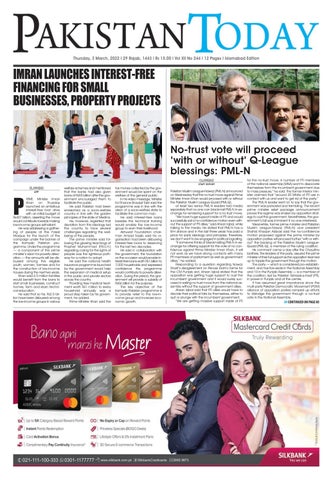
No-trust vote will proceed ‘with or without’ Q-League blessings: PML-N ISLAMABAD StAff RePoRt
ISLAMABAD
p
APP
rime minister imran Khan on Thursday launched an ambitious interest-free loan drive with an initial budget of rs407 billion, asserting the move would contribute towards making low-income groups self-reliant. He was addressing a gathering of people at the Faisal mosque for the launch of the campaign under the banner of the Kamyab Pakistan programme. Under the programme — a component of the prime minister’s vision for poverty alleviation — the amounts will be disbursed among the eligible youth, women, farmers and for the construction of low-income houses during the next two years. Khan said 4.5 million families would benefit from the loans to start small businesses, construct homes, farm and learn technical education. He said that so far, rs2.5 billion have been disbursed among the low-income groups in various
welfare schemes and mentioned that the banks had also given loans of rs55 billion after the government encouraged them to facilitate the public. He said Pakistan had been envisioned as a socio-welfare country in line with the golden principles of the state of medina. He, however, regretted that deviation from this ideology led the country to face several challenges regarding the wellbeing of the people. The prime minister said following the glowing teachings of Prophet muhammad (P.B.U.H.) regarding caring for the rights of people was the righteous pathway for a nation to adopt. He said the national health insurance programme launched by the government would help the expansion of medical setup in the public and private sectors across the country. Providing free medical treatment worth rs1 million to every household annually was a proud step taken by his government, he added. Prime minister Khan said the
tax money collected by the government would be spent on the welfare of the general public. in his video message, minister for Finance Shaukat Tarin said the programme was in line with the vision of a socio-welfare state to facilitate the common man. He said interest-free loans besides the technical training would enable the low-income group to earn their livelihood. Akhuwat Foundation chairman Amjad Saqib said his organisation had been disbursing interest-free loans to deserving for the last two decades. He said in collaboration with the government, the foundation on the occasion would provide interest-free loans worth rs1 billion to 7,000 households and expressed confidence the programme would contribute to poverty alleviation. During the period, the government will provide a subsidy of rs56 billion for the purpose. The key objective of the Kamyab Pakistan programme is to provide relief to the low-income group and increase economic growth.
Pakistan muslim League-Nawaz (PmL-N) announced on Wednesday that the no trust move against Prime minister imran Khan would proceed with or without the Pakistan muslim League-Quaid (PmL-Q). at least two senior PmL-N leaders told media separately that no one can blackmail PmL-N in exchange for rendering support for a no-trust move. “We have huge support inside of PTi and would successfully sail a no-confidence motion even without the support of PTi allies,” said Ahsan iqbal, while talking to the media. He stated that PmL-N has a firm stance and in the last three years has paid a price for party ideology and principles. Therefore, we don’t want to be engaged in political logrolling. “if someone thinks of blackmailing PmL-N in exchange for offering support for the vote of no confidence against Prime minister imran Khan, it will not work as we have strong contacts with many PTi members of parliament as well as government allies,” he added. responding to a question regarding Nawaz Sharif’s disagreement on Pervaiz elahi’s name for the Cm Punjab slot, Ahsan iqbal stated that the opposition was getting huge support to oust the incumbent government and it would surely succeed in sailing no trust move from the national assembly without the support of government allies. Ahsan iqbal said that PTi allies would have to decide their political fate by themselves, either to quit or plunge with the incumbent government. “We are getting massive support inside of PTi
for the no-trust move. A number of PTi members of the national assembly (mNA) want to dissociate themselves from the incumbent government due to mass pressure,” he said. The former interior minister claimed that “around 20 mNAs of PTi are in contact with us and want to get rid of the party.” The PmL-N leader went on to say that the government was panicked and trembling. The recent prime minister relief package announcement proves the regime was shaken by opposition strategy to oust the government. Nevertheless, the government’s fall was imminent if no one interfered. meanwhile, former prime minister and Pakistan muslim League-Nawaz (PmL-N) vice president Shahid Khaqan Abbasi said the no-confidence motion proposed against the prime minister by opposition parties will proceed further “with or without” the backing of the Pakistan muslim LeagueQuaid (PmL-Q), a member of the ruling coalition. His comment came a day after the Chaudhry brothers, the leaders of the party, assured the prime minister of their full support as the opposition teamed up to topple the government through the motion. The party — which is considered pro-establishment, and has five seats in the National Assembly and 10 in the Punjab Assembly — is a member of the coalition, led by Pakistan Tehreek-e-insaf (PTi), in power in Punjab and at the centre. it has assumed great importance since the multi-party Pakistan Democratic movement (PDm) alliance of opposition parties ramped up efforts to dislodge the government through a no-trust vote in the National Assembly.
CONTINUED ON PAGE 05
02
Thursday, 3 March, 2022 | ISLAMABAD
NEWS
BirMiNghAM MAyOr FOr cAPiTALiSiNg ON PAk-Uk TrAde POTeNTiAL ISLAMABAD StAff report
L
ORD Mayor of Birmingham Councillor Muhammad Afzal has said that Pakistan and UK have great potential to promote bilateral trade and the Pakistani private sector should step up efforts to capitalise on this unrealised potential for achieving beneficial outcomes. He said this while addressing the business community during his visit to Islamabad Chamber of Commerce & Industry. Lt Gen (Retd) Muhammad Afzal, former chairman of National Disaster Management Authority (NDMA), also accompanied him.
Social media accounts of Pakistan mission in Algeria hacked: FO NEWS DESk The Foreign Office on Wednesday said the social media accounts of Pakistan’s embassy in Algeria have been “hacked” and the posts did not belong to the mission. “The Twitter, Facebook and Instagram accounts of the Embassy of Pakistan in Algeria have been hacked,” the FO spokesperson said on Twitter. It further mentioned that all recent messages posted through those accounts were not from Pakistan’s embassy in Algeria. The FO’s statement came after social media posts from the embassy said that all missions of the country were allegedly “ordered to divert funds to Ukraine for evacuating Pakistani nationals.” It further claimed that no Pakistani nationals had been evacuated from war-hit Ukraine and that the embassy did not have funds to pay its employees. The said post questioned if the embassy should turn to India for funds as Pakistani nationals were “using the Indian flag to flee”. Last year, the official Twitter handle of Pakistan’s embassy in Serbia criticized the PTI-led government over record-breaking inflation and alleged non-payment of salaries for the past three months. However, the Foreign Office spokesperson, in a tweet, claimed that Twitter, Facebook and Instagram accounts of the country’s mission in Belgrade were “hacked”.
The lord mayor said that after Brexit, the UK was interested in promoting trade relations with various countries including Pakistan. He said that Birmingham was the 2nd largest city of the UK with a GDP equal to that of Portugal, which showed its economic potential for Pakistan. He said that a strong Pakistani community of around 0.3 million people was living in Birmingham who could play a role in strengthening Pak-UK trade relations. He said that construction was a booming industry in Birmingham, which offered good scope of cooperation to Pakistan. He assured that he would encourage close cooperation of ICCI with Greater
Birmingham Chamber of Commerce (GBCC) for improving business linkages between the private sectors of both countries. Lt Gen (retd) Muhammad Afzal said that Pakistan’s IT sector as the potential to enhance IT exports from US$ 100 to 200 billion, which should be realized to improve the financial and economic sovereignty of the country. He stressed that the business community should develop its strong internal systems for sustainable growth instead of looking towards the public sector. He also shared his experiences of developing financial models to support CPEC and develop FWO into a strong business entity.
Speaking at the occasion, ICCI President Muhammad Shakeel Munir appreciated the services of Lord Mayor of Birmingham Councillor Muhammad Afzal for the Pakistani community and Pakistan. He said that Pakistan offered great opportunities to foreign investors in CPEC and in many other sectors of its economy and emphasized that the lord mayor should encourage investors from the UK to explore JVs and investment in Pakistan. He also lauded the services of Lt. Gen. (R) Muhammad Afzal former Chairman NDMA and said that ICCI would like to take benefit from his experiences for promoting SMEs.
PM Imran’s petro-politics unsettle opposition’s plans, economists’ predictions MANAL JAffERy Prime Minister Imran Khan stunned the nation on Monday by announcing a major cut of Rs10 in the petroleum prices and slashing the electricity price by Rs5 per unit, which is the single largest contributor to the country’s import bill. The decision caught everyone by surprise as the relief package has been announced by the PM amidst a global crisis in the form of the Russian invasion of Ukraine that sent global markets tumbling and a political storm brewing at home. The PM took the decision during the time when the opposition parties were already up in arms against the government over inflation and other issues and were gearing up to move a no-trust motion against the PTI-led government. He announced the decision with a pledge that the prices would not be increased until the next federal budget. It is pertinent to note that this carefully planned decision not just slashed opposition’s aims of going against the government, but also proved that the PM is not a political novice, as the opposition had long been threatening the government with a no-confidence motion against him, while the Pakistan Peoples Party (PPP) had embarked on a long march towards the federal capital to send the Pakistan Tehreek-e-Insaf (PTI) government packing. So, this decision is proving to be a politically correct move in this crucial times. The PM’s far-sightedness proved to be ahead of the opposition’s moves, as when the opposition began with pointing out flaws in the package and called it a ‘fake relief package’, the prime minister played his trump card on Tuesday by overriding the opposition’s back-to-back visits to the Chaudhrys of Gujrat. He very strategically postponed the weekly meeting of the federal cabinet and went to the residence of his only allies at the Centre and in Punjab – the Pakistan Muslim League-Quaid-e-Azam (PML-Q) It is pertinent to note that during the former president Gen (retd) Pervez Musharraf’s
era, the Chaudhrys of Gujrat were known as kingmakers owing to their political influence behind the scenes. This time, they have once again become the centre of attention as their five votes in the National Assembly could help decide the fate of the government and the opposition. At present, the government has total of 179 members, including 156 members of the PTI. The MQM-P has 7; PML-Q 5; BAP 5; GDA 3; besides one each from AMLP, JWP and an independent member. With the demise of one PTI MNA, the treasury benches’ total number stands at 178. On the other hand, the opposition has total of 162 votes, including 84 of the PML-N; 56 of the PPPP; 14 of MMAP; 4 of the BNP; three independent candidates and one from the ANP. The JI’s one vote could make the government’s tally to 179 again or take the opposition’s strength to 163 members. With the demise of one MNA, the House’s current strength stands at 341 and if JI abstains from voting then the total votes would be 340 out of the total 342 lawmakers. Considering the numbers game, several ‘first-time’ meetings or ones taking place after a ‘long hiatus’ have been witnessed in the past few weeks. Before Imran’s meeting, former president Asif Zardari and the anti-government alliance – Pakistan Democratic Movement (PDM) – chief Maulana Fazlur Rehman also met for the ‘first time’ after the PPP’s exit from PDM several months ago. Meanwhile, PML-N President Shehbaz Sharif also visited Zahoor Elahi Palace to seek PML-Q’s support for the no-trust move, after a hiatus of 14 years. Both the parties have a shared purpose, which is to oust the government with the help of the PTI’s disgruntled members or with the support of government allies. Considering the political happenings of the past few weeks, the opposition parties believed that they could table a no-confidence in a few weeks, the Prime Minister’s two significant moves of announcing a relief package and meeting the Chaudhrys put the opposition in qualms about their leader’s strategy.
KP govt completes Dir Motorway feasibility PESHAWAR Aziz Buneri
The Khyber Pakhtunkhwa (KP) government has approved the PC-1 of the much-awaited Dir motorway which will be completed at the cost of Rs38 billion. The PC-1 of the project said that it will be 30 km long four lines road with two tunnels. The Pakhtunkhwa Highways Authority officials said that after the completion of feasibility report of the project, the relevant forum has also approved of the project construction.
The sources said that bids have also been invited till March 10 to hire a contractor to formally start construction work on the muchawaited road project. Starting from Chakdara Interchange, Malakand and Swat River, the road will connect Lower Dir through Och and Ramyal towns. After its completion, it will be possible to travel at a speed of 60 km per hour. The new motorway will be two tunnels for 625 meters and 6,230 meters. The government believes that the construction of Dir Motorway
will attract influx of tourists in Lower Dir, Chitral and other connected areas which will generation employment opportunities. The officials are of the view that the construction of Dir Motorway will save both time and resources in term of transportation. A government official hoped, “Completion of this geographically important motorway will not only boost tourism but will also enhance develop trade, industry and agriculture in the mountainous region. It will usher in a new era of development and prosperity.”a
PTA chief vows to address profitability challenges of telecom sector ISLAMABAD tltp
All possible support through prudent policy and regulatory interventions will be provided to Pakistan’s telecommunication industry to address profitability challenges and seek further investments in the sector. Pakistan Telecommunication Authority (PTA) Chairman Maj Gen (retd) Amir Azeem Bajwa said this while addressing the ‘Whole-of-Government Digital Pakistan Roundtable’ at the GSMA Mobile World Congress 2022 in Barcelona, said a statement issued on Wednesday. The chairman PTA briefed the audience about the digital profile of Pakistan and emphasised on the connectivity landscape vis-à-vis investment potential in the telecom sector of Pakistan. The major regulatory interventions to facilitate the industry and consumers were highlighted by the chairman such as cellular license renewal and spectrum auction, rationalisation of spectrum, 5G roadmap, fiberisation of backhaul, IoT framework and quality of service up-gradation, etc. He also shared PTA’s efforts for digital inclusion of women and girls in ICTs as well as the successful impact of Device Identification Registration & Blocking System (DIRBS) in Pakistan. Matters related to tax rationalisation and financial health of the industry were also discussed. It was resolved that all possible support through prudent policy and regulatory interventions will be provided to the industry to address profitability challenges and seek further investments in the sector. The roundtable was curated by GSMA in the presence of senior leadership from the Ministry of IT&T, USF, FAB, and industry CEOs. At the end of the roundtable, a joint declaration was issued to reaffirm commitment to the ‘Digital Pakistan Vision’ of the government. Meanwhile, Maj General (retd) Amir Azeem Bajwa met with the Vice-President Commercial, Starlink and CEO Starlink Pakistan, at the GSMA Mobile World Congress 2022 (MWC) in Barcelona.
88 new Nadra centres opened nationwide: PM ISLAMABAD StAff report
The prime minister Wednesday lauded the National Database and Registration Authority (Nadra) for expanding its outreach by opening new facilitation centres across the country. In a tweet, Imran Khan said: “To facilitate our citizens, Nadra has expanded its outreach by opening 88 new registration centres including in tehsils where no centre existed before.” Providing a breakdown of the new centres, the prime minister said 23 new centres were opened in Sindh, 16 in Khyber Pakhtunkhwa, 13 in Balochistan, 12 in Azad Jammu and Kashmir, 11 each in Punjab and Gilgit-Baltistan and one each in twin cities of Islamabad and Rawalpindi. In August last, Khan inaugurated the Pak-ID mobile application of Nadra, enabling people to use their smartphones for biometric verification.
Seven killed in interior Sindh clashes kARACHI Monitoring report
At least seven people were killed after a clash in the Shikarpur district of Sindh. According to the ARY News, the killings occurred as a result of crossfires between two rival groups. Both the parties exchanged heavy cross-fire while also using rocket launchers, police told media. The reason for the clash was old enmity, police said, adding all the deceased had been identified. Reportedly, police reached the site after the incident and started an investigation.
Pakistan to import wheat, natural gas from Russia ISLAMABAD AnAdolu Agency
Pakistan will import 2 million metric tons of wheat and natural gas from Russia despite the international sanctions on Moscow that came with its attacks in Ukraine, according to the prime minister. Announcing the development, Imran Khan said Islamabad will import the gas to meet Pakistan’s rising domestic and industrial needs. “We have signed agreements with
them to import natural gas because Pakistan’s own gas reserves are depleting,” he said in his televised address to the nation earlier this week. “Insha’Allah (God willing), the time will tell that we have had great discussions.” In his address, Khan, who paid a twoday maiden visit to Moscow last week, said Islamabad would toe an “independent” foreign policy, and no longer join “anyone’s” war. “My two recent visits to China and
CMYK
Russia have earned respect for Pakistan. You will soon see the benefits of these visits,” he contended. Khan has expressed concern over the attacks in Ukraine. A post-meeting statement said Khan told President Vladimir Putin he “regretted the latest situation between Russia and Ukraine” and had hoped “diplomacy could avert a military conflict.” Now, the top diplomats of 22 countries stationed in Islamabad have urged Pakistan to support a resolution con-
demning the violence in Ukraine in the United Nations General Assembly. Pakistan and Russia have inked two agreements — in 2015 and 2021– for the construction of a 1,100-kilometre (684mile) gas pipeline, known as the Pakistan Stream Gas Pipeline Project, from Karachi to Punjab. The $2.5-billion project is slated to begin next year, but analysts see dim chances for meeting the deadline due to myriad global sanctions on Moscow, which will have longtime impacts.
Thursday, 3 March, 2022 | ISLAMABAD
gPS TAgS: SiNdh TUrNS TO TrAckerS TO FighT riSiNg STreeT criMe kARACHI
i
StAff report
N a scheme aimed at cracking down on neighbourhood criminals, Sindh Chief Minister Syed Murad Ali Shah approved a plan suggesting burglars, thieves and robbers released from prison be made to wear GPS tags to track their movements. The GPS-tracking devices — similar to tags used to keep tabs on sex offenders — detect when a criminal gets too close and trigger an alert to the security agency, which tells him to back off. If the man refuses, police are called. Such systems are already in use in Spain and the United States and have been piloted
in Britain and Australia, but activists and researchers say the technology has limitations. He took this decision while presiding over a meeting at his office on Wednesday. The meeting was attended by Sindh Chief Secretary Mumtaz Shah, Shah’s legal advisor Murtaza Wahab, police chief Mushtaq Maher, among others. The chief minister said that in his last meeting on the matter of street crime, he had directed the police to start extensive patrolling and take strict action against street criminals. He also said he had directed the police and administration to start removing drug addicts from the streets and other places. At this, a police official said that from January 1 and February 28, some 143 encounters
were made against the street criminals wherein 143 were killed and 147 injured. He added that 1446 criminals have been arrested. The chief minister was told that patrolling has been increased in the city and intelligence-based targeted operations are also in progress. As far as e-tagging of the repeat offenders was concerned, Mahar said 7,500 offenders have been identified who are either on bail or at large. Wahab said that a draft law for E-tagging of repeat offenders has been prepared and sent for vetting. The chief minister formally approved the proposal and directed his law advisor to expedite its vetting so that it could be discussed and approved in the cabinet.
Giving progress of arranging a rehabilitation centre for drug addicts, Chief Secretary Shah said his office has identified a suitable place at Gulshan-e-Maymar where drug addicts would be rehabilitated. At this, the chief minister directed the chief secretary to provide all the required facilities at the proposed centre so that police could start lifting the drug addicts from the streets and send them there for rehabilitation. “The drug addicts are involved in street crime, therefore their removal from the street was most important,” he said. Discussing the cancellation of bails of repeat criminals and strengthening prosecution, CM Shah directed Wahab and Mahar to take onboard competent lawyers for the prosecution of criminals and cancellation of
Notices served on gardener’s appeal against conviction in Noor murder ISLAMABAD StAff report
The Islamabad High Court (IHC) on Wednesday served notices on the respondents on the petition of Jan Muhammad, the gardener who was handed a 10-year prison term for his role in the murder of Noor Mukadam, challenging his conviction. Pakistan-American Zahir Jaffer, 30, attacked Mukadam at his Islamabad home in July last year after she refused his marriage proposal — torturing her
with a knuckleduster and using a “sharpedged weapon” to behead her. Mukadam, the 27-year-old daughter of a former ambassador, had made repeated attempts to escape the sprawling mansion but was blocked by Muhammad and Muhammad Iftikhar, a watchman at the residence. Jaffer was sentenced to death and the two staff were handed 10 years in prison each for abetting murder. But Muhammad filed the appeal assailing his conviction in the murder. His
lawyer, Senator Kamran Murtaza, said Muhammad was not nominated as accused in the original FIR but his name was later added in a supplementary statement. He was an employee of the Prime Minister’s Office (PMO) and worked part-time as a gardener at Jaffer’s residence, the counsel added. He argued there was no concrete evidence to show Muhammad’s involvement in the case, requesting the court to set aside his conviction. After a preliminary hearing, the
court issued notices to the prosecution department. The shocking nature of the murder, involving a couple from the privileged elite of society, led to pressure for the trial to conclude swiftly in a country where the justice system is notoriously sluggish and cases typically drag on for years. According to the Asma Jahangir Legal Aid Cell, a group providing legal assistance to vulnerable women, the conviction rate for cases of violence against them is lower than three percent.
Wildlife in Pakistan showing signs of recovery kARACHI AnAdolu Agency
Massive destruction and alteration of natural habitats, water dispersion, deforestation and illegal hunting and trade have taken a toll on Pakistan’s struggling wildlife over the past decade, posing serious threats to several rare species, according to experts and government officials. Nevertheless, they said some “balancing” conservation efforts by the government and wildlife groups in collaboration with local communities have resulted in a rise in the population of several otherwise near-extinct species. “Pakistan’s wildlife has long been under stress due to several factors, including habitat destruction, water dispersion, illegal hunting and trade and deforestation in recent years,” said Mohammad Moazzam Khan, a technical adviser to World Wide Fund for Nature (WWF) -Pakistan. Speaking to Anadolu Agency on the occasion of World Wildlife Day falling on March 3, Khan, however, observed that there has been a “remarkable” increase in the population of several marine and land species in the country during the same period.
The country has seen an “ostensible” decrease in the number of migratory birds, wild bears, blackbucks, pangolins and Onagher (Indian asp), whereas there are some animals like leopards whose population has been reduced and increased simultaneously in different areas, according to the WWF official. The number of snow leopards in Gilgit-Baltistan, which borders China, and the common leopard found in Punjab and Azad Jammu and Kashmir (AJK) has soared, whereas the leopard population in Sindh and Balochistan has alarmingly declined, he added. Khan said the population of hogs, gavials and crocodiles has also fallen by alarming levels due to “massive” deforestation” along the Indus River, mainly in Sindh. Mudassir Hasan, the deputy director of wildlife for Punjab, noted that “degrading “ and “shrinking” habitats due to increasing human activity and climate change have wreaked havoc on the wildlife in the province. “Climate change has brought all natural resources including wildlife around the world under stress, and Pakistan is no exception,” Hasan told Anadolu Agency, adding the province has recorded a huge decline in the number of migratory ducks in recent years.
“Our water bodies have become polluted and are shrinking. Space for migratory birds like cranes, flamingoes, gadwalls and canvasbacks is rapidly shrinking due to pollution and the unavailability of food,” he added. According to Nawaz Khuhro, a Karachi-based analyst who regularly writes on the environment and climate change, the forest cover in Sindh has been reduced to an alarming level of less than 2 percent. The key factors behind this massive deforestation, he said, are illegal encroachment by tribal chieftains and the allotment of forest lands to politicians and landlords for farming purposes by the government. “Over the past three decades, over 200,000 acres of forest land have either been illegally occupied or allotted by the successive governments to their favourites in Sindh alone,” he said. Fencing of the Line of Control (LoC) — a de facto frontier that divides the Himalayan Kashmir valley between Pakistan and India — and the Thar border has shrunk the habitat for wild boars, leopards and Onagher, he added. Khan cited huge illegal trade behind the shrinking number of pangolins due to the high demand for its meat and shells in China.
“There are some species like vultures and other rare birds which have shown signs of a recovery, but they are still endangered,” he said. However, the populations of several species of Markhor goat, Pakistan’s national animal, the Sindh Ibex (wild goat), Balochistan Urial (wild sheep), Chinkara (deer), snow leopard and Nilgai (bluebuck) have shown an upward trajectory in recent years, contrary to predictions about their possible extinction, according to Khan. In terms of marine species, he went on to say the number of blind Indus dolphins, all five species of marine turtles found in the Arabian Sea, and whales has seen significant growth. Sharing a similar view, Hasan said wildlife authorities “to an extent” have managed to protect the rare Chinkara deer in the Cholistan Desert which borders India. He said in the Potohar range, the Urial goat has been protected with the help of local communities. “The local communities take care of Urial, and in return, the government spends 80 percent of the money it earns through the issuance of the license for hunting the four oldest goats on them every year,” he explained, adding the fee is charged in US dollars, with one Urial costing $18,000 to hunt.
Pakistan decides not to pick sides in Russia, Ukraine crisis ISLAMABAD StAff report
Pakistani government on Wednesday decided not to pick sides in the ongoing crisis between Russia and Ukraine and to pursue its considered policy that suggests that dialogue was the only way forward to resolve the crisis. Official sources told this scribe that the decision was taken during a meeting chaired by Prime Minister Imran Khan on security matters and attended by the civil and military leadership of the country. “We have decided not to pick sides in any voting in the United Nations or any other international forum as Pakistan believes in resolution of conflicts through talks,” the sources said. The sources said that the meeting discussed issues related to national secu-
rity and also reviewed the security situation in the country. Strategic consultations were also held and important decisions were taken given the regional situation. Officials privy to the matter said the government has decided to pursue an “indepen-
dent foreign policy” and urged that negotiations were the right way to resolve the Russia-Ukraine conflict. The meeting decided that Pakistan was not in favour of tensions under any circumstances. On February 24, PM Imran Khan, while meeting with Russian President Vladimir Putin in Moscow, had regretted the latest Kyiv-Moscow conflict and said that Pakistan had hoped diplomacy could avert a military conflict. The president and the prime minister’s meeting had lasted for more than three hours, during which they discussed Islamophobia, Afghanistan, bilateral, regional, and South Asian issues, among other “important matters”, the Russian Foreign Ministry said in a statement.
NEWS
03
their bails from the courts. The CM also directed the police to arrange prosecution through the lawyers in high profile cases. “I want to put a sizable number of lawyers on a panel and the complainant of the case will have the choice to select any lawyer out of the panel to prosecute his case,” he said.
Qureshi, romania counterpart discuss evacuations from Ukraine ISLAMABAD StAff report
Foreign Minister Shah Mahmood Qureshi held a telephonic conversation with his Romania counterpart, Bogdan Aurescu, and conveyed his appreciation for the assistance rendered by Bucharest in the evacuation of stranded people from war-hit Ukraine. Qureshi said he looked forward to continued and swift facilitation in border crossing of Pakistan nationals, including students, being evacuated. Aurescu assured Qureshi of Romania’s full support and cooperation in the evacuation. In addition to reviewing bilateral relations, the two ministers also discussed regional and international matters of mutual interest. Sharing Pakistan’s perspective on the Ukraine crisis, Qureshi noted that Prime Minister Imran Khan, in his recent visit to Moscow, regretted the violence between Russia and Ukraine and stressed that conflict was not in anyone’s interest as their economic impacts hit developing countries the hardest. The foreign minister underlined the indispensability of dialogue and diplomacy to resolve disputes. The two also agreed to remain in contact.
Front-line responders: government to honour paramedics tackling covid-19 ISLAMABAD StAff report
The government will express its gratitude to the medical workers who battled the coronavirus crisis with civil awards, recognising their services in the fight against the pandemic, people in the Ministry of National Health Services said. The healthcare workers from the four provinces and Azad Jammu and Kashmir and Gilgit-Baltistan will be honoured in a ceremony on March 23. The government will invite nominations from provinces and finalise names for the awards.
Thursday, 3 March, 2022 | ISLAMABAD
04
NEWS
PTA to help enhance Pak-Uzbek trade: Dawood ISLAMABAD Staff RepoRt
There is a huge potential for trade growth between Pakistan and Uzbekistan in various sectors once the Preferential Trade Agreement (PTA) is finalised. Adviser to PM on Commerce and Investment, Abdul Razak Dawood said this on Wednesday while addressing the ‘Pakistan-Uzbekistan Business Forum’ along with the Deputy Prime Minister, Minister of Investments and Foreign Trade of Uzbekistan Sardor Umurzakov. The adviser hoped that the promotion of trade between the two countries would increase regional trade, besides providing trade connectivity to the Russian Federation and European markets. Dawood said that the PTA would increase bilateral trade between Pakistan and Uzbekistan. The signing of the agreement would take place during the Uzbek president’s visit to Pakistan on March 3 to 4, to facilitate bilateral trade and transit trade to boost trade ties between the two countries and also enhance the connectivity with Afghanistan, the adviser said. Dawood said President of Uzbekistan Shavkat Mirziyoyev would pay a visit to Pakistan to discuss ways to improve the bilateral economic and trade relations and also would sign various bilateral trade agreements. He said that a strong economic bloc could be established among Pakistan and Afghanistan and the five Central Asian countries, which would enable trade in goods to reach Russia and European countries. He said that there was a possibility of mutual agreement for smooth transactions between the central banks of the two countries. In addition, the facilitation of transit trade between the two countries will be discussed. An agreement has already been reached in that regard and now transit trade trucks would be able to supply goods between Pakistan, Afghanistan, and Uzbekistan, which would boost trade in the region, Razak said. Similarly, the promotion of transit trade and the free moments of trucks would usher in a new era of trade promotion in the region, he said. Meanwhile, the trade minister of Uzbekistan said that Pakistan and Uzbekistan bilateral trade increased by 70 percent in last two months of January and February. He urged for industrial and investment cooperation between the two countries and said that business communities from both needed to jointly work for increasing the bilateral trade between. He said that the 350 million markets of Pakistan, Afghanistan, and Central Asian countries could play a significant role in world trade. The deputy prime minister said that leadership on both sides agreed to the promotion of bilateral trade and regional economic integration. He said that after the visit of Prime Minister Imran Khan in July 2021, new avenues of mutual relations and cooperation were opened between the two countries, which also opened the way for the development of trade and economic relations.
Goods exports grow fastest-ever on monthly basis in Feb: Dawood
AsiA-PACiFiC CoUnTries PoiseD To TrAnsForm AGriFooD sysTems ThroUGh innovATion, DiGiTAl TeChnoloGies By QU DongyU, DIrector-generAL, FooD AnD AgrIcULtUre orgAnIzAtIon oF the UnIteD nAtIonS (FAo)
T
newS deSk
HE current nutrition situation in Asia and the Pacific is difficult in many areas across the region. About 40 percent of its inhabitants cannot afford a healthy diet, and in some areas the fight against hunger has seen reversals rather than advances. Progress toward meeting the Sustainable Development Goals (SDGs) of defeating both poverty (SDG 1) and hunger (SDG 2) has been thrown off track amid the COVID-19 pandemic, which has devastated both lives and livelihoods. Luckily, the picture is not all bleak and there are signs of optimism and dynamism. Advances in the region’s agrifood systems are changing the ways in which food is sustainably produced, marketed and consumed. This transformation reflects a greater awareness by Asia-Pacific producers and a growing demand
from consumers for healthier, more nutritious foods. Crop and livestock farmers, fishers, pastoralists, other producers and retailers – large and small – are successfully turning to innovative ideas and digital technologies. These improvements in production and sustainable resource management keeps more money in their pockets, while also helping to reverse environmental degradation. All this is helping to create a paradigm shift that is taking shape in other parts of the world too. In Asia and the Pacific, there is a clear and growing movement toward innovation and digitalization along the entire agrifood value chain. Retail grocery and food shopping is an important example. This is not only a phenomenon of well-developed economies, with four out of five sales of online food and grocery purchases taking place in the Asia-Pacific region. This is just one aspect of the agrifood systems overhaul that is reshaping coun-
tries rapidly across Asia and the Pacific, from West Asia, all across South Asia, Southeast Asia and East Asia to the Pacific island countries. In the Pacific’s Small Island Developing States (SIDS), grassroots entrepreneurs are increasingly stepping forward. Their innovative smart phone apps help producers and consumers to make informed, nutritious choices. The private and development sectors are also leveraging increasingly available data to make the supply chain of agricultural commodities to markets more efficient and timely, and to map areas vulnerable to extreme weather events. Several of these innovations were showcased at the ‘SIDS Solutions Forum’, the first of an event to be held biennially, coconvened in August 2021 by the Food and Agriculture Organization of the United Nations (FAO) and the Government of Fiji. There are still some challenges in accessing data on demand and without interruption, as we saw when Tonga’s
Reactivation of dysfunctional Pak, Afghan border crossings to help promote connectivity, trade; says PM’s aide ISLAMABAD mian abRaR
The sixth meeting of the Task Force of Pak-Afghan Parliamentary Friendship Group was held at the Parliament House under the Chairmanship of Mohammad Shehzad Arbab, Special Assistant to Prime Minister. The meeting held indepth discussions on ways to improve trade with Afghanistan with particular focus on fast tracking cross border movement of cargo vehicles and pedestrians, finding avenues of enhancing trade in the wake of limited banking operations, digitalization of operations at border crossing points. Shehzad Arbab said that it was essential to move forward with a clear time bound plan of action to arrest the dwindling trade with Afghanistan. He stressed that smooth and
timely movement of trade vehicles should be ensured as it was essential to avoid decay of perishable trading goods and lowering cost of business. He further remarked that more and more crossing points should be opened to facilitate trade and movement of people across the border. Shandana Gulzar, MNA/Member of the Committee said that we could not allow anybody to reverse the gains made in terms of trade and connectivity with Afghanistan. Immediate actions were the need of the hour to address the legitimate concerns of traders, she added. Moreover, the Committee also directed Ministry of Interior to come up with a plan of setting up separate counters for patients, businessmen and ordinary travellers to facilitate timely cross border movements of people. The meeting also instructed State
Bank of Pakistan to share proposals for promoting trade with Afghanistan in the absence of banking channels with particular documents on barter trade, enhancing trade in Pakistani rupees and third country payment mechanism. The meeting came to the conclusion that the ministry responsible for promoting bilateral trade should come up with a clear plan of action in consultation with other stakeholders and share it with the Committee in its next meeting. The Committee will make sure that all procedural or operational issues in implementation of the action plan would be done away with in a timely manner to expand trade with Afghanistan. The meeting was attended by the Members of the Task Force and Institutional stakeholders from FBR (Customs) and Interior ministry.
ISLAMABAD Staff RepoRt
Pakistan’s exports of goods witnessed the fastestever growth on a monthly basis in February 2022. Adviser to the PM on Commerce and Investment Abdul Razak Dawood said this in a tweet on Wednesday, stating: “Our exports increased at the rate of $100 million/day which is the fastest for any month.” Dawood said that according to provisional data released by the Pakistan Bureau of Statistics (PBS), exports soared by 36 percent to $2.808 billion in February 2022 as compared to $2.068 billion in the corresponding period last year. Dawood mentioned that Pakistan’s exports increased by 26 percent to $20.552 billion during July-February 2022 as compared to $16.324 billion from the corresponding period last year. Regarding imports, he said, “The import data will be shared shortly after it is confirmed by the PBS.” While Pakistan’s exports continue to grow, the current account deficit continued to widen in recent months due to the higher import bill — with a record increase in January 2022 surging to over $11.5 billion during the first seven months of the current financial year.
Pakistan horticulture exports hit by Russia-Ukraine war ISLAMABAD Ghulam abbaS
As the financial sanctions imposed following the RussianUkraine war have started affecting the global economy, Pakistan’s exports are also going to face the impact. In a letter to the Ministry of Commerce, Pakistan’s fruit and vegetable exporters have informed that their exports and payments from importers in Russia and Ukraine have stuck-up after the outbreak of war. “The exporters of our sector who export Kinnow & Potato to Russia & Ukraine have been severely hit by this conflict,” said the exporters in the letter on Wednesday. “The payments from Russia have been stuck up due to sanctions on Russia and now the exporters are facing liquidity problems. If the war further prolongs, this issue of
payment would be further deepened and hence there is a dire need to put some sort of “Financial Mechanism” its place to resolve this serious issue,” the letter which addressed Adbul Razaq Dawood Advisor to Prime Minister on Economy, trade and investment said. Apart from the payment issue, the horticulture exporters claim that the export proceeds is required to be remitted to Pakistan against E-forms within a time frame of 120 days, however under the prevailing war conditions, it is more likely that the exporters may be unable to meet this time frame as the E-Forms which are now “overdue” would lead to various other problems. “It is therefore requested that the time frame of these E-Forms may kindly be extended keeping the specific conditions due to war in view between Russia & Ukraine,” it added.
undersea communications cable was severed during the eruption of the Hunga Tonga–Hunga Haʻapai volcano. But these setbacks will bring forth the new ideas needed to overcome them! At FAO, we are working with our Members across Asia and the Pacific region to transform agrifood systems to be MORE efficient, inclusive, resilient and sustainable – to the benefit of all. Through the Hand-in-Hand Initiative, we are assisting policy makers in their plans to further leverage data, technology and innovation to meet the SDGs targets by 2030. We are proactively identifying and supporting digital villages across the region as part of FAO’s 1,000 Digital Villages Initiative. We are continuing to nurture and promote country-led SIDS solutions and Hand-in-Hand partnerships, which includes advising on climate event mitigation and adaptation, and helping to overcome the damage caused to lives and livelihoods by the pandemic and the climate crisis.
Farmers keen to export their onions to China ISLAMABAD Xinhua
Arshad Swati from Khyber Pakhtunkhwa is among the thousands of onion farmers in the country. He dreams of selling his onions overseas to fund a better education for his children. In particular, he wants his onions to be sold to China. “Many farmers in Pakistan export their onions and have got rich by doing so. I want to join other producers in my hometown and export our crop to China. It will mean more money for everyone,” Swati told Xinhua. Swati thinks that KP, which is located not very far from China, is well-positioned to access China’s huge market. Pakistan is one of the world’s largest onion producers. Malaysia, Gulf countries, Bangladesh and Sri Lanka are the major overseas destinations of its onions today. Currently, about 30 percent of the nation’s fresh produce of onions are wasted due to the lack of storage facilities and substandard practices in packing and transportation. Pakistan exporting onions to China has not yet begun, but related rules were agreed on in November last year. Minister for Food Security and Research Syed Fakhar Imam told Xinhua that agriculture is one of the focuses for cooperation in the second phase of the China-Pakistan Economic Corridor (CPEC). Pakistan’s production of many crops, including onions, will improve with access to Chinese technology and research, he said. “The Chinese agriculture sector is very modern, and they have a high per acre yield. Pakistan too has a very fertile land with rich potential to produce crops of high export value. We are already producing some very high-quality onions, and our scope can be enhanced in cooperation with China,” the minister noted. Yasar Saleem Khan, a provincial team manager at the Pakistan office of the Center for Agriculture and Bioscience International (CABI) said the CPEC cooperation with China may “save millions of dollars and increase onion production by millions of tons” for Pakistan. According to the CABI, no onion processing of any kind currently takes place in Pakistan, even though the technology is very simple. With a small investment, excellent export value can be generated. “Dried onions are in demand in the UAE (United Arab Emirates) and the Gulf at large.
Industrial package to bring undocumented money into system: Bakhtiar ISLAMABAD Staff RepoRt
The industrial promotion packages would generate jobs, broaden the tax net and promote industrial development that would ultimately help overall economic growth on sustainable grounds. Federal Minister for Industries and Production, Makhdoom Khusro Bakhtiar Wednesday expressed this while addressing
a press conference along with State Minister for Information and Broadcasting Farrukh Habib on Wednesday. Bakhtiar said that the package has three main targets including bringing undocumented money into the system through investing in productive sector. Secondly, he added, another objective of the package was to revive the shut industrial units through new investments and thirdly encourage overseas Pakistan to invest in the
industrial sector of the country. The minister lamented that the previous governments had failed to link such amnesty packages with the productive sector that was why these packages could not produce desired results in the past. The minister said that last year Large Scale Manufacturing (LSM) grew by 12 percent, whereas the growth was recorded at 7.4 percent during the current year so far. He said that all sectors of LSM showed positive
cMyK
growth during the period. On the external side, the minister added, during the ongoing tenure of the Pakistan Tehreek-e-Insaf government, the exports and remittances have increased from US $42 billion to US$ 64 billion, showing an upward trend of US$22 billion. He said that the government had set a US $36 billion export target this year. He said the government has already announced the Small and Medium Enterprises
(SMEs), mobile and auto policy to promote sustainable economic growth. Talking about the economy, the minister said that gross domestic product (GDP) would definitely go further up as compared to the growth of last year. He said that the incentives announced by the government would promote industrial growth and would boost overall economic activity in the country and put the economy on a high growth trajectory.
Thursday, 3 March, 2022 | ISLAMABAD
NEWS No-trust vote will proceed ‘with or without’ Q-League blessings: PML-N continued from page 01
UK hIStORIAN SEEKS INtERNAtIONAL MEdIAtION IN KAShMIR UNdER SIMLA PAct LaHore
But in order for such a move to succeed, the opposition would require the support of Q-League MPs in the House. During Tuesday’s meeting with the prime minister, PML-Q president Chaudhry Shujaat Hussain assured Imran Khan his party does not trust deposed prime minister Nawaz Sharif whose PML-N has reportedly offered the office of Punjab chief minister to Pervaiz Elahi in return for his backing of the motion. “Sharifs […] ditched us in the past. We know them all, and do not trust them,” a report in Dawn quoted Hussain, also a former prime minister, as saying. Commenting on the meeting, Abbasi, who was talking to media outside an accountability court in Islamabad where he came to attend the hearing in a case filed against him by the National Accountability Bureau (NAB), said it was up to Q-League if it wanted to stick to power or side with the people of Pakistan. He was of the view the purpose of politics should be to serve the nation. “Countries do not run on amnesty schemes,” he remarked. On the proceedings in the reference, he said Pakistan has been witnessing the “NAB shows” for the last 22 years. The dirty money watchdog had made baseless cases against the opposition MPs, he claimed, adding it will be held accountable for its actions. Abbasi said the NAB had damaged the national institutions. It is playing with the lives of [innocent] people, he said, stressing the institution needed to be abolished altogether.
Bagallery Announces Pakistan’s biggest beauty and Fashion Expo KARACHI: Pakistan’s biggest beauty & fashion online retail brand, Bagallery understands what customers want and is always ready to set new standards for the market. Equipped with experience and focus, this growing company is yet again challenging the status quo by arranging one of its kind, Pakistan’s biggest beauty and fashion exhibition on 5th and 6th March in Expo Centre Karachi. Bagallery’s CEO, Salman Sattar with his team of over 150 people will be leading from the front to set new records. Bagallery is committed to give its customers an experience they will not forget at the most instagrammable event ever seen in Pakistan. In addition to availability of more than 500 brands at the exhibition, including some of the biggest beauty and fashion local and international names, visitors will be able to enjoy Fashion Shows, Influencer meet-ups, Celebrity interactions, Makeup and Makeover Classes, Skin consultation, Hair styling, food stalls, Concert and much more with a seamless shopping experience at this two day event. pr
Low-profile Russian air force puzzles Western experts moScoW afp
Russia’s air force still does not enjoy total superiority in the skies above Ukraine despite its overwhelming numerical advantage, part of the reason for the army’s slow progress on the ground, experts say. According to strategic intelligence research service Janes, Russia’s air force comprises 132 bombers versus none for Ukraine, 832 fighter jets against 86 for Ukraine, and 358 transport planes against 63 for Kyiv. Other aerial weapons show a similarly crushing asymmetry, except for drones of which Ukraine has 66 and Russia 25. Even though Russia has not engaged its entire air force in the conflict, its forces would still have been expected to rule the Ukrainian air space by now, experts say. “While Russia has the advantage that comes with greater numbers, it has not yet gained control of the skies over Ukraine to the extent that it has been able to prevent the Ukrainian Air Force from operating and inflicting damage on the Russian war effort,” said Gareth Jennings at Janes. “They are still engaged in trying to neutralise Ukrainian ground- and air-based air defences,” he told AFP. BoRdeR ContRol: The Russian air force is, nevertheless, in a position to protect the advancing army where it counts, such as a convoy — dozens of kilometres (miles) long of trucks, armoured vehicles and artillery — advancing on Kyiv from the north, as seen on satellite images Tuesday. “The Russians certainly have air superiority along a 200-kilometre (125-mile) stretch close to the border, and around priority objectives,” said Pierre Razoux, head of research at the FMES strategic research foundation.
05
t
aNaDolu ageNcy
HE landmark 1972 Simla Agreement between Pakistan and India does not obligate the two nuclear neighbours to resolve the lingering Kashmir conflict through “bilateral means” alone, a British historian and author argued. Victoria Schofield, an eminent historian, author, scholar, and biographer with a particular interest in South Asia and the Kashmir dispute, said that according to the agreement, the two countries will try to resolve the issue bilaterally or through any other mutually agreed means. During a session on the topic of Kashmir at the Institute of Policy Studies (IPS), a think tank based in Islamabad, she stressed
that this clause of the agreement “needs to be highlighted to seek international mediation on the issue.” The peace treaty was signed in July 1972 between Pakistan and India following the war in 1971 in Shimla, the capital of India’s Himachal Pradesh state, with the goal of normalising the bitter tensions and paving the way for bilateral talks to resolve all conflicting issues. The conflict, Schofield said, demands the international community’s attention and arbitration be resolved for the sake of the millions of lives of the region’s inhabitants, as well as the peace that Pakistan and India deserve in the future. Schofield, who has visited both sides of the disputed region many times, lamented the people in Indianoccupied Kashmir are “still living traumatic lives […] there are a number
of civilian deaths and arrests occurring every day, and armed soldiers roaming the streets.” She described the situation in the valley as a “grave humanitarian crisis,” saying she believes the long-running dispute must be resolved with the participation of multiple stakeholders, including China due to its claim to the Aksai Chin and Trans Karakoram Tract. She said the people of both sides of the valley, the Jammu region, GilgitBaltistan, which borders neighbouring China, and the Ladakh region “may not necessarily have a similar opinion” on the long-smouldering dispute. Several young activists from the Indian-occupied territory of Jammu and Kashmir, including Mujahid Gilani and Ahmed bin Qasim, the son of incarcerated leaders Qasim Faktoo and Asiya Andrabi from Kashmir, took
President IIUI addresses annual gettogether at faculty of languages, literature
Dr. Hathal Homoud Alotaibi, President International Islamic University Islamabad (IIUI), Tuesday, addressed the annual get-together at the Faculty of Languages and Literature (FLL) where he shared his plans and vision for the university. On the occasion, President, IIUI expressed his delight on meeting the faculty and stated that the university is a home to all and that the FLL ought to launch interesting new programs in line with the university’s Strategic Plan. He added that his team of Vice Presidents and Deans was there to ensure that the university grows exponentially and numerous projects have been set in place for this reason. Dr. Hathal emphasized that with the shift towards technology, the IIUI’s ODL program
remains a vital tool for disseminating education far and wide and expressed his desire for the FLL to initiate degree programs via the ODL particularly since the HEC has also disseminated its distance education policy. He also emphasized that improvements have been made as regards promotion policies and assured that the departments will be granted more freedom to initiate innovative programs that are in line with the needs of the future. IIU President ensured all-out support for the academic and professional growth of all the faculties of the university. Earlier, on his arrival, President IIU was welcomed by the Dean FLL Prof. Dr. Najeeba Arif and the Chairpersons of the Departments of English, Urdu, Persian and
CLT. In her welcome address, Dr. Najeeba Arif expressed her gratitude to the President and highlighted that this event aims to bring into focus the services of the faculty members and the administrative staff who are extremely essential to running the faculty smoothly. In the introduction to the event, Dr. Aroosa Kanwal, InCharge Department of English, apprised the President of the various awards and accolades earned by the faculty members of the FLL while emphasizing the fact that it has attracted a record number of new admissions in recent years, despite covid-related constraints. Later, The President, Vice President Academics Prof. Dr. Ayyaz Afsar, Vice President Research & Enterprise, Prof. Dr. Ahmed Shuja and Vice President Administration & Finance Prof. Dr. N.B.Jumani distributed shields among the administrative staff members who had earned the Best Employee of the Year award. The award winners included Mr.Mahmood Iqbal, Mr. Muhammad Ishaq Khan, Ms. Asma Nazir, Ms. Farah Riaz, Mr. Ali Asghar, Ms. Nazli Masood and Mr. Yasir Ali. pr
German consul general celebrates Baloch Culture Day German Consul General Holger Ziegeler and his wife put on beautiful Baloch attire to celebrate Baloch Culture Day with the people of Balochistan on Wednesday. The German Consulate General in Karachi released a video on the occasion that showed a proper celebration was held there to mark the day. The video showed the couple interacting with two employees of the Consulate of Balochi descent. The employees and the couple exchange thanks and say “Germany-Pakistan dosti zindabad [long live German-Pakistan friendship]”.
In a statement issued by the German Consulate General, Ziegeler said that the cultural exchanges and dialogues are an integral part of international relations in the modern world. “Cultural exchange is an important part of life in Germany. It is a great way to incorporate people in a positive way,” he said. The statement further quoted Ziegeler as saying that in order to appreciate the cultural diversity, one has to experience the elements of culture, for example food, music, dance, art and clothing, so that the sophistication and philosophy behind different cultures can be understood. News Desk
part in the discussion. Syed Abrar Hussain, Pakistan’s former ambassador to Afghanistan, stated that Islamabad has tried on numerous occasions to resolve this issue through dialogue and international mediation. “India, however, remains adamant in its unilateral stance,” he added. Hussain, who is also the policy institute’s vice chair, reiterated that the people of Kashmir are the principal stakeholders in the international conflict and that no resolution is possible unless they were granted their “right to self-determination.” Pakistan and India both hold Kashmir in part and claim the Himalayan region in full. China also controls part of the contested region, but it is New Delhi and Islamabad which have fought two wars over the territory.
On Ukraine, Iran says US govt is ‘crisiscreating’ regime US policies are to blame for Russia’s invasion of Ukraine, calling for an end to the war that broke out last week Iran’s supreme leader on Tuesday said US policies are to blame for Russia’s invasion of Ukraine, calling for an end to the war that broke out last week. “The root cause of the Ukraine crisis is the US and the West’s policies,” Ayatollah Ali Khamenei said in a televised speech marking a Muslim religious anniversary. “The United States regime is a crisis-creating and crisis-living one. It feeds on crisis. “In my opinion, today Ukraine is also the victim of such policy. Today, the Ukraine situation is related to this US policy. The US has dragged Ukraine to this point,” he added. He accused Washington of meddling in the “internal affairs of the country, setting up demonstrations against the governments, creating velvet revolutions, creating colour coup d’etats”. Russian President Vladimir Putin launched an invasion of Ukraine last Thursday. Ukraine says more than 350 civilians have been killed since, and that Moscow is amassing more troops for a possible assault on the capital city Kyiv. Iran’s supreme leader said Tehran wants the “war to end”, and called for civilians’ lives and infrastructure to be spared during the conflict. “We are against war and destruction, anywhere in the world,” Khamenei said, adding that “we are against killing people, the destruction of people’s infrastructure”. The invasion has pushed tensions between Russia and the West to their highest point in decades. The US, European allies and NATO members have imposed severe sanctions on Moscow and are supplying Ukraine with weapons and defence equipment. Khamenei said that lessons should be drawn from the war, mainly that “Western powers’ support of puppet regimes and governments is a mirage, it is not real”. Relations between the US and Iran have been severed since April 1980, a year after the fall of the pro-Western shah. This was followed by the occupation of the American embassy in Tehran, and the seizing of hostages in a crisis that lasted for more than a year. The two arch-rivals are currently engaged in indirect negotiations in Vienna to restore a 2015 nuclear deal between Iran and world powers, from which Washington unilaterally withdrew in 2018. Iran’s leader, who has the final say in major state policies, called the US a “mafia regime”. “Political mafia, economic mafia, arms-producing mafia; different types of mafias that control and lead the policies of the country and actually control the country,” he said. afp
Oil surges past $110, global stocks slide on further deepening of Russia-Ukraine crisis Crude oil surged past $110 a barrel Wednesday and stock markets sank with investors growing increasingly fearful about the Ukraine war’s impact on global energy supplies and the economic recovery. Vladimir Putin’s invasion of his neighbour has sent world markets into a spiral over the past week, further fraying nerves on trading floors caused by runaway inflation and tighter central bank monetary policies. The crisis has seen numerous countries hammer Moscow with a series of wide-ranging sanctions that have isolated Russia and threaten to crash its economy. The measures have injected a huge amount of uncertainty into markets with supplies of crucial commodities including met-
als and grains soaring. The price of global staple wheat is sitting at a 14-year high — having risen 30 percent in the past month. But the main source of unease on trading floors is crude, which has rocketed since Russia began preparing to invade. On Wednesday Brent topped $110 for the first time since 2014, while WTI moved closer to that figure. Incoming sanctions have fuelled worries that exports will be cut off from Russia, the world’s third-biggest producer of the commodity. The conflict in eastern Europe comes with prices already elevated owing to tight supplies and a strong recovery in global demand as economies reopen from pandemic-induced lockdowns. Traders will be keeping a close eye on a
meeting of OPEC and other major producers, including Russia, later in the day where they will discuss whether to ramp up output to temper the price rises, which are helping fan inflation. In his State of the Union address, President Joe Biden said the United States would join a 30-country deal to release 60 million barrels to help temper the surge in prices, though analysts have warned such moves would likely only have a limited impact. The oil price surge has compounded fears about inflation as it sits at a 40-year high in the United States and hurts Americans in the pocket even as the economy rebounds from the pandemic shock. However, the Ukraine crisis has given
cmYK
the Fed another headache as it is forced to rethink its plans to hike interest rates to get consumer prices under control. It had been widely expected to lift this month and then up to seven times more before the end of the year, but commentators say it will likely tone down its hawkishness for fear of damaging the recovery. “The supply chain issues and inflationary pressures will be top of mind for many investors globally,” Andy McCormick at T. Rowe Price said. “These things will almost certainly complicate the already difficult task that central banks were facing trying to battle inflation.” And Uma Pattarkine, of CenterSquare Investment Management, told
Bloomberg Television: “The market was looking at anywhere up to seven rate hikes this year — I think it will be closer to maybe the three or four we were anticipating at the very beginning of this conversation.” Fed boss Jerome Powell’s two days of congressional testimony will be closely watched this week for an idea about the bank’s thinking. Wall Street and European markets tumbled Tuesday and the losses largely flowed through to Asia, which had enjoyed two days of relative calm though the selling was not as severe. Tokyo led losses, falling 1.9 percent, while Hong Kong, Shanghai, Singapore, Taipei, Manila and Wellington also dropped. However, Sydney, Seoul, Jakarta and Bangkok eked out marginal gains. afp
06-07 Comments - 3rd March 2022_Layout 1 3/2/2022 9:01 PM Page 1
Thursday, 3 March, 2022
06 COMMENT
Threat of the Paparhwalas
The Ukraine affair Testing the mettle of the Foreign Ministry
t
He impact of the ongoing war in Ukraine will not remain confined to europe alone. the war is likely to trigger a massive negative supply shock to the global economy. the pandemic has already left the global economy with high inflation and jittery financial markets. the aftershocks from the ongoing conflict could worsen both. the developing countries would be the worst sufferers. the war poses a challenge to the global dominance of the USA and the western-led international order created after World War II. this is apparent from dissenting voices rising from countries who are unwilling to endorse the stand taken by the USA and its western allies on Ukraine. With India and UAe joining china in abstaining on a Un Security council resolution condemning Russia’s invasion of Ukraine is reflective of the change. Pakistan too abstained from supporting the resolution in the Un General Assembly that demanded immediate withdrawal of Russian troops from Ukraine. the Ukraine issue has provided an opportunity to countries like Pakistan to defy bloc politics, give priority to their national interest and try to cultivate good relations with all. the USA was unhappy over Prime Minister Imran Khan visiting Russia at this juncture. the explanation that the visit was meant to discuss bilateral issues only was not acceptable to Washington which insisted that it was the responsibility of every country to voice objection to Russian President Vladimir Putin’s plans. Pressures are now being exerted on Pakistan through european Union diplomats stationed in Islamabad to urge it to condemn the Russian invasion of Ukraine. the USA and europe being the biggest destinations of Pakistan’s exports, Islamabad cannot altogether ignore their views. Pakistan however is not the only county who is keen to have good relations with both the USA and Russia. the USA and europe are the biggest destination of Pakistan’s exports. Millions of Pakistanis are either working in these countries or have permanently settled there. Remittances sent by expatriates constitute a lifeline for the country’s economy. Similarly thousands of Pakistani students get admission in universities in the West. Pakistan has therefore to walk a fine line to convince the West that neutrality on the issue is in the best interests of Pakistan.
Pakistan risks financial collapse unles the ‘Paparhwalas’ are checked
Dr FariD a Malik
O
UR banking system is under threat from the ‘Paparhwalas’. After Habib Bank limited (HBl), the national Bank of Pakistan (nBP) has been fined for ‘Money laundering’. the ‘Paparhwalas’ and the ‘chaprassis’ are unstoppable and untouchable. no court has been able to convict them. the wstolen wealth of the nation is illegally transferred through the banking system to acquire expensive real estate abroad or to be re-routed back as white money. If caught, the bank has to pay the fine, thereby burdening the other account holders. In 2017 HBl paid $225 Million in fines and had to shut down its new york operations. this time nBP has been fined $55 Million for the same offence. Being a Public Sector enterprise (PSe), the burden will have to be carried by the people. While the ‘Paparhwalas’ go scot-free, the regulators blame the bank officials for negligence Recently there have been serious charges of nepotism in senior appointments. Unfortunately, despite the commitment to merit of the Prime Minister, several questionable selections have been carried out right under the nose of the PM. In case of HBl, then President nauman Dar, a person of professional integrity, went home. After this debacle, heads should also roll in nBP but it should not end here, the ‘Paparhwalas’ should also be taken to task to plug these leaks together with the ministers who appointed them. the word ‘Wala’ is extensively used in the land of
Posthumous vindication Another innocent victim of NAB’s persecution
Ensuring an aid economy SaMina akhter
R
ecently US President Joe Biden issued an executive order of unfreezing of $7 billion of Afghan central Bank funds held in the USA, releasing $3.5 billion for humanitarian and other aid in Afghanistan, with an equivalent amount set aside for relatives of those killed in the 9/11 attacks who have legal claims against the taliban. Ostensibly, the Biden Administration has launched a procedure to take the central Bank of Afghanistan’s assets on deposit at the Federal Reserve Bank of new york, in a move that can only be defined as outrageously unethical and absolutely repugnant. that money has been frozen since the taliban took control of the war-torn country last year. now, the Administration took custody of money that they didn’t own in the first place, intending to use half of it for humanitarian aid in Afghanistan and the other half for families of 9/11 victims who have filed claims against the taliban for the 2001 terrorist attacks. that too in a situation where Afghanistan’s economy is on the verge of crumbling, and inflation is skyrocketing, putting millions of Afghans starving. to begin with, why is it logical that regular Afghan civilians who had nothing to do with the September 11 attacks have their funds seized and their lives jeopardized by Washington bureaucrats? (Afghan assets at the central Bank are said to be made up of foreign exchange money, commercial bank reserves, and ordinary people’s savings, according to reports.) We can all agree that no one elected the taliban into power in 1996, without revisiting the subject of how the taliban came to be in the first place. Why should the Afghan people be held accountable for the activities of that group? no one from Afghanistan was among the 19 hijackers who carried out the September 11 attacks. the fact is that the taliban and Al-Qaeda have disproportionately targeted the Afghan people, and using Afghan funds to compensate bereaved Americans in order to punish the taliban is tantamount to collective punishment.
Dedicated to the legacy of late Hameed Nizami
Arif Nizami (Late) Founding Editor
Yousaf Nizami M. A. Niazi
Umar Aziz
Joint Editor
Joint Editor
Executive Editor
Lahore – Ph: 042-36300938, 042-36375965
Till the 1980s ‘Paparh’ was a popular domestic industry but with the entry of corrupt politicians the ‘Paparwalas’ were created as cover to rob the nation on one hand while ruining the once popular local snack called ‘Paparh’ locally or ‘Papadum’ internationally.
The writer is ex-Chairman, Pakistan Science Foundation. He can be contacted at: fmaliks@hotmail.com.
Biden splits Afghan reserve despite need for immediate aid
A
FteR being hounded by the nAB, threatened with arrest and fearing that his reputation would be tarnished through a media trial, former member of the capital Development Authority Brigadier (retd) Asad Munir committed suicide in 2019, succumbing to the mental pressure caused by the accountability watchdog’s high handedness. yesterday, three years after his death, the deceased was acquitted of all allegations, with the case ruled as ‘not fit for trial’ and lacking ‘any shred of evidence to prove that the accused committed any wrongdoing’. Similar acquittals in nAB cases have been witnessed more recently as well. Sixteen persons, including a PMl(n) MPA, who were made part of a reference in the Saaf Pani corruption case filed by nAB in 2018, were found not guilty of any alleged financial malfeasance or procedural irregularities. Separately, Mir Shakil Ur Rehman, who was arrested and kept behind bars for eight months in relation to a 34-year-old property transaction dispute case was also acquitted, with the court commenting that pursuing the case further would be a “futile exercise” due to a lack of evidence presented by nAB. An accountability system where a case can evidently be created out of thin air by an institution that has a reputation of dragging individuals through the mud out of pure vindictiveness, forcing one to take his own life, should be a source of shame for those responsible in creating and using it to advance their personal agendas. the responsibility here does not only lie with the current government and establishment but rather all those past regimes that chose to use the nAB as a tool against their political opponents, and in some case even to settle personal scores, rather than take the necessary measures to rationalize and bring some sanity to a law that is far too arbitrary, open-ended, draconian and contains too many internal inconsistencies. A dialing down of tensions and the resultant fierce rivalry between the opposition and government is required to reach any consensus over how to reform the accountability process. Short of this, no meaningful legislation can be passed.
Editor Aziz-ud-Din Ahmad
the pure. It signifies a domain, connection or a link. During the governorship of nawab Amir Muhammad Khan of Kalabagh, there was a ‘Goonda’ (Ruffian) called ‘ Achha Shakkarwala ‘ though he had nothing to do with the sugar trade. He was a favourite of the nawab and was bestowed with several awards. Achha’s rival was ‘Jagga Gujjar’ also known as ‘Bakarmandiwala’. While Jagga was his own man, Achha did the dirty work of the Governor. the city of lahore was controlled by these outlaws in the 1960s. Finally when better sense prevailed and the nawab was replaced by General (retd) Musa Khan as Governor, and both these notorious characters were gunned down in ‘ police encounters ‘. then there were upscale ‘Walas’ like ‘Australiawala’. the Kashmiri Bux family of lahore decided to transfer their fortune from Australia to their hometown. they made heavy investments in real estate, established the famous lahore Hotel near the Railway Station,and also started the Australasia Bank which was later nationalized and named Allied Bank of Pakistan (ABl). then there were several of them in Karachi, e.g. Motiwala, Mandviwala, Japanwala to name a few. except for Accha of lahore most of these ‘ Walas ‘ were credible individuals. then there was a ‘truckanwala’ who was recently gunned down at the lahore Airport. ‘Paparhwalas’ is a new phenomenon directly linked with the ‘charter of Democracy’ that was signed in london by Benazir Bhutto and nawaz Sharif and drafted by the late Rehman Malik. A concept of ‘Frontmen’ was created to syphon off the wealth of the nation through official banking channels without being noticed. In the 20th century, Al capone, the Mafia Boss of chicago, invented this approach to avoid legal scrutiny or conviction. the term ‘teflon crime Boss ‘ could well be used for him, teflon being the most
resistant and durable material developed by mankind. He had the services of expensive lawyers, no one dared to appear as a witness against his crimes. Scar Face, as he was called, remained untouchable. Finally the Internal Revenue Service (IRS) got him for tax evasion and undeclared assets for which he could not provide legal sources or trails. Once imprisoned his chain of command was disrupted, and he was convicted. He was unable to complete his term and died in prison thus ending his reign of terror, crime and corruption. Our ‘Paparhwalas’ are in fact the Al capones of the 21st century, equally untouchable as the ‘teflon crime Boss’. Most of them can also be classified as ‘Shakarwala’ of our times but much more influential than the gunned down ‘Achha’. Unless controlled, checked and convicted the ‘Paparhwalas’ can cause the collapse of our entire financial framework. It is a serious attack on our institutions which cannot remain unchecked. the current no-confidence motion against the Prime Minister is also linked with the same phenomenon of loot and plunder by individuals holding high public offices. Performance of the present regime is an issue but the menace of the Paparhwalas’ is a much more lethal attack on our institutions. In the next general elections scheduled for 2023, the party in power can be voted out but if ‘Paparhwalas’ prevail it will lead to the financial collapse of the Islamic Republic of Pakistan for which our parents struggled and sacrificed. till the 1980s ‘Paparh’ was a popular domestic industry but with the entry of corrupt politicians the ‘Paparwalas’ were created as cover to rob the nation on one hand while ruining the once popular local snack called ‘Paparh’ locally or ‘Papadum’ internationally. In both cases the beneficiaries are few and sufferers are many. It is time to unmask the mystery of the ‘Paparhwalas’ to uncover the real faces behind them.
I
Karachi – Ph: 021-35381208-9
I
And why does this type of financial hostage-taking in the first world only go in one direction? After all, don’t the USA, Pakistan, Saudi Arabia, Russia, the United Kingdom, and a slew of other countries share some of the blame for Afghanistan’s tens of thousands of civilian deaths? the money offered in condolence payments by coalition forces is little in comparison to the devastation they have wreaked. Shouldn’t we seek recompense for the Afghan victims of allied brutality if we determine that the September 11 families deserve justice for their losses, as they do? nonetheless, the notion that Afghans may seek legal methods to flee the US treasury because of their people’s deaths and the USA’s participation in the country’s devastation is absurd. this terrible disparity exemplifies international politics’ continuing colonial character. Whatever legal squabbling over lawsuits and default judgments this presidential order is allegedly intended to solve, the message it communicates is clear: American lives are more important than Afghan lives, and American sorrow looms larger than Afghan grief. However, the suffering continues. Afghanistan has suffered 40 years of deadly turbulence, beginning with the USA and the USSR conscripting Afghans into their global fight and thrusting ordinary people into one of the hottest zones of the cold war. (the 40th anniversary of Ronald Reagan’s proclamation of 21 March 1982 as Afghanistan Day approaches.) Following 9/11, Afghans were subjected to systematic torture by Americans at Bagram Airbase, as well as brutal American drone assaults, homicidal night raids, and other atrocities. no doubt, the taliban have a large share of the blame for their tremendous violence and harsh repression, and assisting them in regaining power would be devastating. However, taking Afghanistan’s money and dispersing it as you see fit is hardly in the interests of justice. It’s incredible that anyone, much
Islamabad – Ph: 051-2204545
alone the US Administration, believes it’s possible. On the contrary, the people of Afghanistan are today experiencing a massive economic catastrophe. Since the taliban gained control last year, the nation has been in disarray due to a lengthy drought, the effects of the virus, and the halting of western help. At least 95 percent of households in the country are unable to feed themselves adequately. One million Afghan youngsters are very malnourished. Malnutrition affects over three million people. In a country where four million people had already been internally displaced, last year’s war uprooted nearly three-quarters of a million people from their homes. According to the government, this executive action will free up cash that will be distributed as help right away. But, in practice, the administration’s alchemy of converting other people’s money into humanitarian aid is likewise misguided. the action will further impoverish the country, pushing it closer to being a region virtually totally reliant on foreign aid. While urgent relief and aid are needed, Afghanistan’s long-term requirements include a functional economy, which is becoming increasingly impossible as the US effectively bankrupts the Afghan central Bank. As a result, Biden’s executive action jeopardizes the future of economic development and stability. Without a central bank and a functioning trade system, the national economy simply cannot function. there has to be a better way, and suggestions are being developed that would allow the Afghan central Bank’s actions to be overseen by independent auditors to ensure that none of the money is seized by the taliban. this executive order is cruelty and thievery disguised as charity and justice, and it must be rescinded before irreversible damage is done.
There has to be a better way, and suggestions are being developed that would allow the Afghan Central Bank’s actions to be overseen by independent auditors to ensure that none of the money is seized by the Taliban.
I
Web: www.pakistantoday.com.pk
I
The writer is a freelance columnist
Email: editorial@pakistantoday.com.pk
06-07 Comments - 3rd March 2022_Layout 1 3/2/2022 9:01 PM Page 2
Thursday, 3 March, 2022
COMMENT 07 Editor’s mail Send your letters to: Letters to Editor, Pakistan today, 4-Shaarey Fatima Jinnah, Lahore, Pakistan. E-mail: letters@pakistantoday.com.pk Letters should be addressed to Pakistan today exclusively
Climate change denial in Pakistan
What went wrong in Ukraine? The West was caught wrong footed
Zain abbaS riZvi
T
He onslaught of Russian forces is at full throttle against Kyiv, with them tinkering with the possibility of toppling the Zelenskiy regime and negotiating directly with the military (at least that is the word from the Russian Security council). the Western response is as expected: slamming restrictions on notable Russian banks, barring industries from supplying raw material to Russia, and levying heavy sanctions on core members of the Kremlin, including Russian President Vladimir V. Putin and his close circle of confidants. Regardless, the brazen invasion continues as more than 350 Ukrainian soldiers and civilians have reportedly died while hundreds of thousands of citizens swarm the neighbouring borders of Romania, Poland and Hungary for refuge. Roads strewn with blood and rubble, the world is perplexed, almost hazed, by the unraveling conflict: the most brutal since the mighty war in the 1940s. Russians are drilling Ukraine into segments, the western block is busy drafting rafts of sanctions, and rivals are weaving strategies to somehow remain neutral in a stark spread towards a modern cold War- deny it as much as you want, but it is cold War 2.0! the underlying question, that I am sure is pestering the West as much as Ukrainian policymakers, is quite apparent: What went wrong? the USA was sure that Putin had been planning an invasion since December. US President Joe Biden claimed it as a historic step that classified information regarding nefarious Russian plans was getting peddled across the Atlantic to disarm Putin’s aspirations. Analysts hailed that the USA was pushing back after the colossal failure in Afghanistan. Diplomats believed that this USA was vastly different from the isolationist country envisioned by Donald trump. to give due credit, Biden did manage to engage nAtO at a record pace in response to Russian threats. the sanctions placed at standby were contingent on Russian sway towards militancy or diplomacy. Barring a few roadblocks, the alliance seemed united. And at some point, Russia legitimately seemed to backtrack. Putin announced that the military drills in the region adjacent to rebel-controlled eastern Ukraine approached denouement, and the troops were returning. Suddenly, Putin recognised the independence of the luhansk and Donetsk People’s Republics and tabled his order to Russian troops to invade - supposedly as a ‘peacekeeping
mission’ since the Russian forces have allegedly loitered in the Donbas region since the 2014 crimean annexation. the world jolted as Russian forces penetrated Ukraine from three fronts - Belarus in the north, Donbas in the east, and crimea in the southern peninsula. the positions were apparent for weeks as Russian forces were swelling across the border, when Putin denied any intent of an invasion. the western world panicked and ventured into default mode, in which it slammed sanctions and issued strong-worded warnings. Did it make a difference? “Have the US sanctions solved any problem? Is the world a better place because of those sanctions? Will the Ukraine issue resolve itself thanks to the US sanctions on Russia? Will european security be better-guaranteed thanks to the US sanctions on Russia?” Hua chunying, a chinese foreign ministry spokesperson, echoed the prevailing rhetoric. the attacks continue while Ukraine pleads with the european Union to do more than mere sanctions and warnings. the problem is simple: they cannot do very much else. the european Union is the largest importer of Russian energy supplies. crude prices have already soared through the roof - Brent crude, the global benchmark, trading up by 8.5 percent to an eight-year high of $105.40 per barrel. naturally, the Oil and Gas industry got conveniently sidestepped when imposing sanctions. the Russian commodity market also stands safeguarded to a large extent. true, the Russian bourse has plummeted, and the Rouble is at its lowest in years. But the impact is barely damaging to the Russian economy in the long run. Russia is the world’s second largest gas, and the third-largest oil producer (second-largest crude exporter). While the USA is not directly dependent on Russian energy, europe imports almost half of its energy requirements from Russia. true, Germany’s unprecedented decision to halt certification of the nord Stream 2 Pipeline (Russia’s $11 billion energy project) would be damaging to Russia, both economically and strategically. However, the consequences are not particularly scenic for europe either. “Welcome to the new world where europeans will soon have to pay 2,000 euros per thousand cubic meters!” remarked Dmitry Medvedev, Russia’s former president. Analysts believe that, while Russia has yet not choked its regular gas supply to europe, the energy prices are bound to double as early as April. On the other hand, Russia has spent the last eight years diversifying away from the US dollar, to soften the blow of such sanctions. Russia currently
stands with $600 billion in foreign exchange reserves, the fourth largest of the world. However, barely 16 percent of these reserves are in US dollars, down from almost 40 percent a few years ago. this dedollarisation campaign would hedge the Russian economy from the searing brunt of these sanctions. china currently stands as Russia’s largest trading partner, both as an exporter and as an importer. the Sino-Russian bilateral trade has consistently grown over the past few years, hitting a record high of more than $145 billion in 2021. According to AidData, an international research lab, Russia has been the largest recipient of chinese loans from official sector institutions, totalling $151 billion between 2000 and 2017. It does not take a political scientist to connect the dots. Russia has a backup plan to counter an economic fallout. europe (unfortunately) does not have a backup! Both china and Iran have blamed the USA for conjuring up this crisis and riling Putin to invade Ukraine. While the statements are outrageously exaggerated, there is some truth to the stance. Putin continued to protest that Russian security concerns have been violated by nAtO expansion in eastern europe. But the USA persisted in keeping a vague prospect for Ukraine as a potential nAtO member. Putin persistently critiqued the legitimacy of nAtO expansion after the collapse of the Soviet Union. yet, europe continued to forge alliances with the former Warsaw Pact nations, again with a vague promise of eU membership. Until recently, Ukraine was a point of contention that nAtO held as leverage against Russia. Many warned that baiting a nation with a ruthless history of dictatorship could backfire. And despite the exhibits of the Georgian invasion and crimean annexation, the western obduracy never receded. the war at hand is by no means a fault of Ukraine. But it is not solely the fault of Russia either. the western bloc, particularly the USA, is equally to blame. It was so busy forcing its supremacy over Russia that it never once occurred o it to ask what if an invasion did ensue? never once did the USA or europe offer an unequivocal platform to Russia to discuss its security concerns (no matter if they were trivial or contrived!). now Ukraine is proposing neutrality apropos of nAtO and eU. now the USA and nAtO are concerned about the safety of civilians while abandoning Ukraine with artillery and a barrage of worthless sanctions. now they expect the Russians to retreat and return to the table. However, it is too late to urge level-playing diplomacy when a restive Russia is on the point of dismembering Ukraine while the world watches as mere bystanders!
Now the USA and NATO are concerned about the safety of civilians while abandoning Ukraine with artillery and a barrage of worthless sanctions. Now they expect the Russians to retreat and return to the table. However, it is too late to urge levelplaying diplomacy when a restive Russia is on the point of dismembering Ukraine while the world watches as mere bystanders!
The writer is a freelance columnist
clIMAte change isn’t something new. It’s been here for decades and with the increased awareness of climate change there has also been an evident wave of denial and general disdain towards this notion. In this piece I not only want to delve into the basic reasons for this denial but also the depth of the psychology behind their thinking. One of the most common reasons is illiteracy, but there are so many more reasons which include the fact that climate change sometimes clashes with the a community’s understand of the world and shatters this bubble they live in and then come the disruption or the counter effects to some big names if we transition to a low emissions economy. Borderline, it rubs them the wrong way and it is plainly inconvenient to their world view. the difference presented in psychological terms from sheer ignorance and misunderstanding is the fact that people don’t want to revise their beliefs, they are presented with facts which don’t align with their thinking and the immediate response is to reason around these cold hard facts. According to research the society in grained hierarchy and status quo also plays a huge role, older, poorer and more religious people are more likely to see this all as a sham. even one’s political allegiance plays a huge factor into this. It is a dismal situation as it is a repression of facts. taking a look at the US we can see people heavily influenced by puritanical values similarly in Pakistan has had extreme effects such as increase in temperature and general unnatural climatic patterns however most people have described anthropogenic global heating as the will of God and were generally unaware or resistant. Although Pakistan has increased awareness through extensive reforestation programs and plans like the clean, Green Pakistan movement however this is not enough. We need to approach the issue keeping in mind the social and psychological factors. We need to diversify to reach all groups of society, one pitch with the same rehashed facts won’t work, it needs to appeal to them, more effort needs to be put into understanding. the deniers can shift their views, sometimes a simple bombardment of facts isn’t the greatest help. the actual difference can be made by the people. It is a democracy after all. MuhaMMad haad LahORE
Unique heated gloves UnIQUe heated gloves consist of one or a combination of more warm and durable materials that work as the primary layer of insulation against the cold. nylon, fleece, leather, lycra, cotton, and/or polyester are generally used as glove materials. they also incorporate batteries as known as warmers, and a charger. the warmers work to keep the extremities warm according to the user’s preferences as heat dilates the blood vessels and regulates the blood flow through them. Small wires are woven in the gloves and connected to the battery that allows the passage of electric current through the surface of the glove. the charging cord allows the users to recharge the gloves to use the next time they’re going out in cold. A power switch is given to switch on and off the heating as required. Fingertips of the gloves are specifically designed to enable them to operate touchscreen devices. Several other supporting features are introduced to ensure ease and convenience for the user in different situations. the gloves are meant to be versatile so as not to interrupt the daily-life activities of the user. the idea is to create versatile heated gloves that provide warmth to the hands. the gloves will have a built-in temperature control system for the user to adjust the temperature as he or she wishes. During the design and manufacturing, it will be kept in mind to keep the gloves as thin as possible so the thickness of the gloves does not hinder the movements of fingers. this will ensure the versatility for the user to carry out his or her normal chores while wearing the heated gloves. the user will also be able to use touchscreen devices with their heated gloves on. the components used in the gloves will be two nichrome wires for heating element, one for each glove, batteries, connectors, wire harness for each glove, a temperature controller or a thermostat in each glove, charging cord, and glove material for which lycra and fleece will be the great options. the stretchy lycra will keep the gloves thin enough to allow for the movement of hands and fingers whereas the fleece on the inside shall provide a warm insulating layer to the hands. Fleece also feels soft on the inside making the user feel comfortable while wearing gloves and performing different tasks. to make the fingertips of the gloves, copper yarn is utilized to build a capacitive technology. Although calcium channel blockers and vasodilator drugs are taken by people with such conditions, they are always not accessible to everyone. there needs to be handy solution providing relief to the individual on the go. Our gloves can be used by literally anyone in the cold weather without interrupting their chores. ChERYLL PaTRaS LahORE
Civil services reforms GlOBAlly, the civil service is an essential and vital component of state capacity for countries. Surely, there exists a strong positive relationship among quality of bureaucracy, economic development and overall domestic stability and prosperity of a county. this, undoubtedly, makes civil service reforms critical for holistic national progress. But these reforms are complex and challenging owing to several long-prevalent formidable factors. As per my opinion, deeprooted feudalistic tendencies in our society and among officials, red-tapism, nepotism and politicization etc. are a few of them. these issues urgently need to be tackled. Few remedial measures can be suggested in this regard. Firstly, strict accountability and a system of check and balance of the officials should be ensured in true letter and spirit. Secondly, the menace of feudalism should be fully eradicated as it will help in depoliticizing all the institutions and efficient service delivery. last but not the least, adequate financial incentives must be provided to the civil servants as per the nature of their jobs. If these steps are taken on a priority basis then development and prosperity would be the fate of this country. aMJad RIaZ GuRu ShEIKhuPuRa
08 WORLD VIEW 3rd March 22_Layout 1 3/2/2022 10:44 PM Page 1
Thursday, 3 March, 2022
08 WORLD VIEW
The WesT’s $1 TRIllIon bId To CollApse RussIA’s eConomy
cNN CharleS riley
T
HE West has responded to Russia’s invasion of Ukraine with round after round of punishing sanctions. The latest salvo is designed to spark a banking crisis, overwhelm moscow’s financial defenses and tip the Russian economy into a deep recession. never before has an economy with the global importance of Russia’s been targeted with sanctions at this level, according to analysts, who say there is now a high risk that Russia will face a financial crisis that pushes its largest banks to the brink of collapse. Western officials have described their campaign as an economic war meant to punish President Vladimir Putin and turn the country he leads into an international pariah — even if it takes years for sanctions to destroy the defenses of Russia’s “fortress economy.” “We will provoke the collapse of the Russian economy,” French Finance minister Bruno Le maire told a local news channel on Tuesday. Russia’s status as a global energy supplier will make that mission all the more difficult. Europe gets nearly 40% of its natural gas and 25% of its oil from Russia, and any disruptions to those exports would cause already elevated global prices to rise even further. HOW THE WEST IS FIGHTING: Putin’s invasion of Ukraine has been met with an unprecedented response from the United States, the United Kingdom, the European Union, Canada, Japan, Australia and other countries. Even Switzerland, famous for its neutrality and banking
secrecy, has pledged to impose sanctions on Russia. The West has cut off Russia’s two largest banks, Sberbank (SBRCY) and VTB, from direct access to the US dollar. It has also taken steps to remove some Russian banks from SWIFT, a global messaging service that connects financial institutions and facilitates rapid and secure payments. The coalition is trying to prevent Russia’s central bank from selling dollars and other foreign currencies to defend the ruble and its economy. In total, nearly $1 trillion worth of Russian assets have now been frozen by sanctions, according to Le maire. “Western democracies have surprised many by pursuing a strategy of exerting intense economic pressure on Russia through effectively cutting it off from global financial markets,” oliver Allen, markets economist at Capital Economics, said in a research note. “If Russia continues on its current path, it is quite easy to see how the latest sanctions could be just the first steps in a severe and enduring severing of Russia’s financial and economic ties with the rest of the world,” he added. Western countries have ruled out sending troops to fight in Ukraine, leaving sanctions as the primary means of challenging Russia. The measures could wipe as much as 6% off Russia’s gross domestic product, according to oxford Economics. “our strategy, to put it simply, is to make sure that the Russian economy goes backward as long as President Putin decides to go forward with his invasion of Ukraine,” a senior US administration official told reporters. RUSSIA’S ‘FORTRESS’ ECONOMY: Since 2014, when the United States and its Western allies imposed sanctions on moscow following the annexation of Crimea and the downing of malaysian Airlines Flight 17, Putin has been trying to sanction-proof Russia’s $1.5 trillion economy, the 11th largest in the world. moscow has attempted to wean its oil-dependent
The risks of heeding America’s warmongers
SubStack Steve CorteS
A
mong the cognoscenti of the Western capitals of politics and finance, the chorus screams unanimously for ever-escalating economic sanctions against Russia. Lost amidst the cacophony of those calling for a historic financial bloodletting is a dispassionate and careful analysis of the potential peril of such unprecedented collective actions. Specifically, for the first time ever, the powers of the Western World align to purposefully and willfully destroy the currency of a major power – and not just any power, but the most armed nuclear force on earth. The decision to essentially de-bank the entire country of Russia, save very key carve-outs (more on those elements in a moment), represents a brash entry into a heretofore uncharted path of the weaponization of money. After all, even the despicable nazi regime during WWII did not face this level of monetary attack. In fact, the germans transacted internationally via the Bank of International Settlements, which remained neutral in a Switzerland which was then committed to that overarching principle. Today, the Russians find no such financial harbor, resulting in the recent absolute plunge in Russia’s currency. See this chart on the US Dollar vs. the Ruble: Even a columnist for the Washington Post recognized the potential massive and dangerous unknowable ramifications of such actions. When the committed globalists of Jeff Bezos’s own leftist paper can recognize the dangers, everyone better start paying attention. Here’s the main problem with this weaponization of money: it specifically and immediately targets the Russian people, rather than Putin, the oligarchs, or their war machine. Regular Russian citizens now find themselves suddenly forced to deal with massive, runaway inflation. Their hard-earned wages become more and more worthless by the hour as their currency collapses as a direct consequence of the concerted efforts of ruling class elites in Washington, new York, London, and Brussels. What will be the fallout of cornering a proud nation of 145 mil-
lion people in this manner? Putin and his fabulously wealthy connected cronies can handle, at least in the near-term, such historic volatility — but the masses of Russia cannot. Biden, as usual, has this policy approach exactly backwards. If the main goal is to punish the leadership and starve moscow’s war machine, then a cessation of purchases of Russian energy would be the actual, brutal, and effective prescription. Under Biden, even energyblessed America welcomed in a surge of Russian energy imports in 2021, an 11 year high of Russian imports to the US. These products include over 200,000 barrels of Crude per day and over 700,000 total barrels per day of all fuel products from Putin’s moscow, according to S&P global. These shipments continue unabated, right now, meaning America pours tens of millions of dollars of hard US currency into the accounts of the oligarchs on a daily basis. moreover, this flow of funds is somehow… miraculously…EXCLUDED from the otherwise onerous banking clampdown on Russian transactions. of course, America’s purchases of Russian energy, as large as they are, cannot compare to Western Europe’s, which remains totally beholden to Russian supplies, especially for natural gas. Those gigantic flows continue as well, proving the utter duplicity of the ruling class powerbrokers of the US and Europe. As bluechecks post Ukraine flags on their social media, they play a never-before attempted experiment in global Foreign Exchange warfare. But as these same virtue- signaling globalists pour out Russian vodka in performative protest, they welcome in torrents of Russian energy. It seems as though this Ukraine-flag waving crowd of self-assured warmongers in the West actually wants the fighting to continue, otherwise they would resolutely refuse all Russian Energy, and leave the Ruble alone. Clearly, many Western elites also clamor for regime change, hoping that a wave of economic pain upon the Russian people will compel an uprising – and it may. But it might also unleash rulers who are far less predictable and far more ferociously anti-American than Putin. Recall that after America eliminated the terrible Saddam Hussein in Iraq, we ended up dealing with an even worse ISIS. In that scenario, at least the Caliphate did not possess nuclear weapons. The reality in Russia is quite different, of course, as the total warhead count in Russia exceeds America’s, see this Bloomberg chart: Courage is the most important human virtue. Plenty of Ukrainians show real courage in repelling the Putin invasion. In contrast, there is nothing courageous about American politico laptop war-dogs constantly agitating for escalation, and instituting a money war against Russia. The kinetic war that could well unfold from these actions will not be fought by these effete dilletantes, but instead by everyday American citizens from the heartland, by brave young men from flyover country with names like mendez and Jackson. Real courage in US politics right now requires standing up against the powerful and loud bi-partisan Washington War machine.
economy off the dollar, limited government spending and stockpiled foreign currencies. Putin’s economic planners have also sought to boost domestic production of certain goods by blocking equivalent products from abroad. Russia’s central bank has meanwhile amassed a war chest of $630 billion in reserves including foreign currencies and gold — a huge sum compared to most other countries. Those defenses are now being severely tested. The sanctions have rendered roughly 50% of Russia’s foreign reserve stockpile useless, according to Capital Economics. “External conditions for the Russian economy have drastically changed,” the Russian central bank said monday, announcing that it would roughly double interest rates to 20%. “This is needed to support financial and price stability and protect the savings of citizens from depreciation,” the bank added. Russia is also imposing capital controls. The central bank ordered companies to sell foreign currencies on monday to prop up the ruble as it plunged to a record low against the US dollar. And Putin is planning a decree that would temporarily ban foreign companies and investors from selling Russian assets — which have become toxic for many since the invasion. “The $600 billion-plus war chest of Russia’s foreign reserves is only powerful if Putin can use it,” a senior Biden administration official told reporters. WHAT HAPPENS NEXT: All eyes are on the Russian financial system. There were reports over the weekend that Russians were standing in long lines to withdraw cash from ATms, raising the prospect of a run on the country’s banks. Already the main target of sanctions, Russian banks could come under even greater pressure if borrowers are unable to repay loans as the inevitable recession hits businesses and households. Liam Peach, an emerging markets economist at Capital Economics, said that Russian banks could be forced
to respond by selling assets — probably on the cheap. Credit could become scarce, making the economic pain from sanctions even worse. “The ratcheting up of Western sanctions over the weekend has left Russian banks on the edge of crisis,” said Peach. one early casualty was the European subsidiary of Sberbank, Russia’s biggest lender that has been sanctioned by Western allies. The European Central Bank said monday that Sberbank Europe, including its Austrian and Croatian branches, was failing, or likely to fail, because of “significant deposit outflows” triggered by the crisis. Another problem is that Russian banks only have enough foreign cash on hand to cover roughly 15% of the foreign currency deposits on their books. The central bank would normally supply banks with foreign currency, but with half its war chest out of bounds it may not be able to do that, and defend the ruble at the same time. The central bank could be under pressure for months or even years. Thanks to oil and gas, the value of Russia’s exports far exceeds imports, and payments into the country are a major source of foreign currency. But investors and businesses could try to move large amounts of foreign cash outside the country as the ruble falls, forcing the central bank to spend up to $100 billion of its available reserves this year, according to Capital Economics. At the same time, the West could crack down even harder. The United States and its allies could remove more Russian banks from SWIFT and further restrict their access to dollars and euros, according to the Institute of International Finance. They could also cut off Russian energy exports, although that would cause prices to spike. Further escalation of the economic conflict could have major consequences. “Don’t forget that in human history, economic wars quite often turned into real ones,” former Russian President Dmitry medvedev said Thursday in response to Le maire’s comments.
Can India balance ties between Russia and the West?
DeutSche Welle Murali KriShnan
A
S fighting intensifies on the ground following Russia’s invasion of Ukraine, India has been left in a tough spot, with new Delhi struggling to maintain its traditional balancing act between moscow and the West. India has attempted to avoid taking sides even as Russia finds itself increasingly isolated from the rest of the world for its war on the former Soviet republic. new Delhi has so far avoided criticizing moscow for its actions in Ukraine. Last week, India abstained on a Un Security Council resolution slamming Russia’s “aggression” against Ukraine, winning praise from moscow. new Delhi also abstained from a procedural vote taken in the UnSC to call for a rare special emergency session of the Un general Assembly to meet on the crisis. Addressing a special briefing on the crisis over the weekend, Indian Foreign Secretary Harsh Vardhan Shringla pointed out that dialogue between the warring sides was the only way ahead. “We have been engaged with all parties. our prime minister has spoken with the presidents of Russia and Ukraine. We are essentially a country that has direct interest in the region,” said Shringla. “We have friends and equities in the area,” he added. STRATEGIC AMBIVALENCE: It’s likely that new Delhi will for now stick to a path of strategic ambivalence on the Ukraine crisis. “I think India’s position has been spelt out clearly in our explanation of vote after the first UnSC resolution where we abstained,” former diplomat Deepa Wadhwa told DW. new Delhi’s position is shaped by its concerns over territorial integrity and sovereignty, its unresolved borders and the difficult relationship with its two northern neighbors. “There are understandable reasons for India’s subtle pro-Russia position. An aggressive Russia is a problem for the US and the West, not for India. nATo’s expansion is Russia’s problem, not India’s. India’s problem is China,” foreign policy and international relations expert Happymon Jacob told DW. Jacob maintained that the weakening of the US-
led global order and the rise of China as a counter-pole throws up a unique and unprecedented challenge for India. Against this backdrop, having Russia on new Delhi’s side is crucial, the expert said. India and Russia have deep historical ties that go back to the early decades of the Cold War, when new Delhi leaned towards the Soviet Union while Pakistan was in the Western camp. Russia is still by far India’s largest supplier of military gear, parts and technology. According to the Business Standard, between 2016 and 2020, almost 50% of its defense purchases were from Russia. For instance, Russian T-90 tanks form the mainstay of the Indian army, and Russian mig and Sukhoi fighter jets play a vital role in its air force arsenal. India recently began taking delivery from Russia of the S-400 missile defense system that it agreed to buy for over $5 billion (€4.5 billion) in 2018, despite the threat of US sanctions. “India has diversified its sources of defense equipment in recent years, with the USA, Israel and France emerging as major new partners. However, 60% of our defense equipment is still of Russian origin and Russia is a strategic partner mainly in the defense and energy sectors,” meera Shankar, a former Indian envoy to the US, told DW. “We are also aware of the historical context under which Russia’s legitimate concerns about nATo expansion to its doorstep were ignored and opportunities to avert a conflict were lost,” added Shankar. India is also a major consumer of Russian oil. Total annual bilateral trade runs at around $9 billion, with much smaller quantities of pharmaceuticals, tea and coffee going the other way. Both modi and Putin met last year to discuss defense and trade relations. They signed an agreement to extend their cooperation in the fields of military technology and energy for the next decade. In the past, Russia has also repeatedly vetoed Un resolutions condemning new Delhi over its behavior in India-occupied Kashmir where a violent insurgency has raged for decades. PRIORITY IS TO EVACUATE INDIAN NATIONALS: In addition to the impact on India’s economy and trade, the ongoing conflict has a direct impact on thousands of Indian citizens. over 20,000 students from the South Asian country are in Ukraine studying medicine or engineering, accounting for roughly 24% of total international students there. While new Delhi has evacuated around 4,000 Indians in the last month, about 16,000 still remain trapped in the former Soviet republic, according to the latest data from India’s Foreign ministry. Despite growing pressure from the West, Indian officials and foreign policy experts believe new Delhi should pursue a pragmatic path and avoid making hasty decisions. For now, India’s priorities are the immediate evacuation of its nationals from the war zone, cessation of hostilities and restoration of dialogue between the two sides. D B Venkatesh Varma, a former diplomat who served as India’s ambassador to Russia until last year, believes that India has taken a well-considered and balanced position on the evolving crisis. “European security is at stake. The diplomatic tightrope is there, not here,” said Varma.
Thursday, 3 March, 2022 | ISLAMABAD
NEWS
Bank Alfalah, Alchemative collaborate to provide Digital Payments Infrastructure to online businesses in Pakistan KARACHI: Bank Alfalah, one of the largest private banks in Pakistan and one of the pioneers in the digital banking realm has partnered with Alchemative, a 1-Click Checkout Solution. The two innovative organizations have collaborated to facilitate digital payments for e-commerce businesses. Alchemative enables organizations to sell products globally through an integration with Alfa Payment Gateway. This platform will enable a robust digital payments collection mechanism. The Alfa Payment Gateway is a unique ecommerce payment gateway, allowing businesses to go online through a comprehensive e-commerce payments infrastructure. The platforms provide distinct opportunities for businesses that are moving with times and adopting digital payments for facilitation of customers. pr
PAAPAM finally launches its much-awaited Pakistan Auto Parts Show 2022 KARACHI: The largest exhibition of automobiles in the country – The Pakistan Auto Show 2022 (PAPS 2022) is finally going to happen in Pakistan on 27th July, 2022 – 29th July, 2022 at the Expo Center Lahore, organized by the Pakistan Automotive Parts and Accessories Manufacturers (PAAPAM). It is the most electrifying initiative of the ‘Pakistan Association of Automotive Parts & Accessories Manufacturers (PAAPAM), representing over 300 large, medium & small industries from all over Pakistan. The theme of this year’s PAPS show is; “MAKE IN PAKISTAN”. The launching ceremony happened in Lahore and was attended by a large number of automobiles and parts manufacturers across the country. The government had announced many incentives for the auto sector a couple of months ago, followed by the Prime Minister’s Visit to China especially focusing on new investors for this growing market of 220 million. pr
SBP ISSueS QR CoDe StAnDARDS to ACCeleRAte DIgItAl RetAIl PAyMentS KARACHI
I
staff report
N a move towards digitalisation of financial products and services and to accelerate the digitisation of retail payments, the State Bank of Pakistan (SBP) has issued standards for Quick Response (QR) code-based payments. These standards are to be met for issuing QR codes and accepting payments through the same, the central bank said in a statement on Wednesday. This initiative is a part of SBP’s drive to promote inclusion, innovation, and modernisation of payment systems in the country. The development and issuance of a single QR code was ear-
lier announced by Governor State Bank of Pakistan, Dr Reza Baqir, while chairing the 5th Stakeholders consultation meeting on Digital Financial Services in August 2021. With the issuance of a single country-wide QR code standard Pakistan joins the list of countries that have taken similar steps to promote low-cost digitisation of payment services, especially at retail level. According to the statement, QR code-based payments are increasingly becoming popular around the world for being low cost and easy to use via mobile applications. However, in Pakistan, QR codes that are being issued by financial institutions are not usually based on com-
mon industry standards and have limited interoperability due to which their acceptance and usage in the country is very low. Accordingly, the common QR code standards have been developed by an industry consultative group, formed by SBP, and is based on EMVCo’s QR Code Specifications for merchant payments. EMVCo is a global technical body that facilitates worldwide interoperability and acceptance of secure payment transactions by managing and evolving the EMV Specifications and related testing processes. The standards are designed to be flexible to adapt to new and innovative use-cases, with data objects allocated for scheme, acquirers and SBP for fu-
Islamabad police become pioneer to provide facilities to public under one roof ISLAMABAD pr
Salman A. Siddiqui, Head of Corporate Communications, Sui Southern Gas Company, receiving CSR Award from Commissioner Karachi Iqbal Memon, conferred upon SSGC during 11th CSR Summit organised by The Professional Network in s Karachi hotel. pr
Faysal Bank has signed an MOU with Xpence Pakistan to offer innovative financial services through Fintech Express Program. pr
Naval Chief visits forward naval posts amid major maritime exercise Seaspark 2022 KARACHI pr
Chief of the Naval Staff, Admiral Muhammad Amjad Khan Niazi visited Pakistan Navy units at Sea, Coastal and forward post in Creeks Areas to witness the operational readiness and preparedness of deployed troops in Major Maritime Exercise SEASPARK 2022. Upon arrival at Jinnah Naval Base at Ormara, a comprehensive brief was presented on operational situation and deployment of PN Fleet assets in Area of Op-
ture use, said the statement. To facilitate the issuance and adoption of QR code-based payments, SBP has issued two variations: one for person-to-person payments and the other for person-to merchant payments. The Person to Person (P2P) standard would be used by banks and financial institutions to generate personalized QR codes for their customers, using which they would be able to receive payments on their mobile apps. Similarly, the person to merchant standard would be used for accepting and processing merchant-based payments, using mobile apps, on lines similar to card-based payment acceptance.
Fatima Fertiliser has organized a range of activities at Pakistan Pavilion of Expo 2020 Dubai to help promote awareness about Pakistan’s agriculture sector and its unique rural culture. pr
PSW Digitizes Phytosanitary Certification Process of DPP ISLAMABAD: Pakistan Single Window has launched the electronic processing and issuance of the phytosanitary certificate on exports by the Department of Plant Protection (DPP) under the Ministry of National Food Security and Research (MNFS&R). The phytosanitary certificate is required for the export of plant and plant related products. On an average, approximately 5000 certificates are issued annually through paper based manual procedures of DPP. The same will now be processed and issued through the PSW platform under the export single declaration. The new system will be rolled out gradually on all ports starting from consignments exported through Port Muhammad Bin Qasim. Commenting on the automation of DPP, CEO PSW Syed Aftab Haider shared that with this latest feature, DPP has become the first Government Agency other than Customs to have become the part of the PSW system. He said, “PSW’s vision and mission is to enhance the competitiveness of the Pakistani exporters by leveraging technology to reduce the time and cost of doing business. The digitization of DPP certification will provide a seamless process for traders as we roll out this new feature,” he added. PSW has also digitized the import permit of DPP so subscribers can receive their import permits for any plant or plant related products by applying for the permit online using the PSW system. With the planned roll out of the Single Declaration for imports in March, DPP’s import and export related functions will be fully integrated within the PSW platform. Director General Department of Plant Protection, Mr. Tariq Khan said, “The automation of DPP’s certificates in the PSW platform will definitely provide ease to the traders in getting their required certifications online without visiting any offices. We continue to support all such initiatives which can reduce time and automate business processes.” The PSW system rolled out the online subscription module in July 2021 and has recently begun a phased integration of authorized dealers/commercial banks for electronic exchange of trade related financial information. pr
09
erations. Subsequently, Naval Chief boarded PN Ships TARIQ & TUGHRIL at sea and interacted with officers and men involved in various evolutions of the exercise. Chief of the Naval Staff commended professional competence of officers and men performing valiantly at sea. Later, Admiral visited Security Station at Coastal area that ensures vigilance and defence across the coast. During visit to Forward Post at Creeks Area, the Naval Chief was briefed on prevailing threat environment and combat readiness for defence of Creeks Area. Naval Chief also vis-
ited HQ Creeks Bde and interacted with marine officers/ troops and appreciated their commitment and devotion in defence of the country. Chief of the Naval Staff expressed full satisfaction over operational readiness of PN units and professional excellence of officers and men. He appreciated the dedication and high morale of troops in ensuring impregnable defence of motherland in the prevailing challenging environment. The Naval Chief also reiterated Pakistan Navy’s resolve to safeguard the maritime frontiers of the country at all cost.
Islamabad police have become pioneer force in providing state-of-the-art facilities to public under one roof round the clock which is being appreciated widely by the public. For the first time in policing history of Pakistan, Islamabad police have led in providing multiple services to people and a modern facilitation center at sector F-6/1 is functioning round the clock to provide state-of-the-art facilities to the public. The center remains open for the whole week and is serving round the clock. It provides various services to people related to police and traffic. Following the directions of Inspector General of Police (IGP) Islamabad Muhammad Ahsan Younas, this center has been made functional while women are being provided police related services on priority. An entire floor at the Police Facilitation Center has also been allocated for women. The public is availing 28 services including Character Certificate, General Police Verification, Tenant Registration, Missing/Lost Report, Foreigner Registration, Volunteer Registration, Servant Registration, Driving License Verification, Copy of FIR, and Vehicle Verification at any time of the day from their vehicle. Police said that all of the already-provided services is available to the citizens round the clock and they are also able to avail new services including renewal of driving license through the drive-through facility. SSP (Traffic) Rai Mazhar Iqbal said that this facilitation center has been set up for convenience of citizens. He said that all resources would be used to provide better services to people and ensure protection to their lives and property.
Thursday, 3 March, 2022 | ISLAMABAD
10 FORIGEN NEWS
Russia says Ready to continue talks as its foRces land in ukRaine’s second-biggest city
t
AFP
HE Kremlin said on Wednesday that a Russian delegation was ready to continue peace talks with Ukraine as Moscow’s invasion of the pro-Western country entered its seventh day. “Our delegation will be ready to continue talks,” Kremlin spokesman Dmitry Peskov said, adding that Moscow’s delegation expected the talks to resume on Wednesday evening. He said that President Vladimir Putin’s aide Vladimir Medinsky remained Russia’s top negotiator on Ukraine but did not say where the next round of talks would take place. A first round of talks between Russian and Ukrainian delegations took place on the Ukrainian-Belarusian border, but brought no
results. Russian troops land in Ukraine’s secondbiggest city Kharkiv: Meanwhile, Russian forces landed in Ukraine’s second-biggest city and triggered immediate clashes in the streets of Kharkiv, the military said, following Moscow’s relentless air assault across the ex-Soviet state. The airborne operation came as US President Joe Biden branded Vladimir Putin a “dictator”, warning the sanction campaign to cripple Russia’s economy would escalate and its oligarchs were being targeted. In Biden’s first State of the Union address, he hailed the resolve of the Western alliance and voiced solidarity with Ukraine as lawmakers in the US Congress gave a standing ovation to the Ukrainian people. “A Russian dictator, invading a foreign country, has costs around the world,” Biden
told lawmakers in his annual State of the Union address, promising “robust action to make sure the pain of our sanctions is targeted at Russia’s economy”. But as he spoke a Russian escalation was reported to be underway in Kharkiv, an apparent bid by Moscow to capture its first major Ukrainian city of the invasion. Since Russian troops rolled into Ukraine last week to achieve Putin’s mission of overthrowing the pro-Western government of President Volodymyr Zelensky, hundreds of civilians have been reported killed. Russian forces have carried out a massive bombing campaign and encircled urban centres, but Ukraine insists no major city has yet been overtaken. “Russian airborne troops landed in Kharkiv … and attacked a local hospital,” the Ukrainian army said in a statement on messaging app Telegram.
“There is an ongoing fight between the invaders and the Ukrainians.” Russia hit a residential building in the city on Tuesday killing eight people, drawing comparisons to the massacres of civilians in Sarajevo in the 1990s and condemnation for what Zelensky called a “war crime”. A fire broke out on Wednesday in the barracks of a flight school in Kharkiv following an airstrike, according to Anton Gerashchenko, adviser to the Ukrainian Interior Minister. “Practically there are no areas left in Kharkiv where an artillery shell has not yet hit,” he was quoted as saying in a statement on Telegram. Kharkiv, a largely Russian-speaking city near the Russian border, has a population of around 1.4 million. Russian military says has control of Kherson: The Russian army claimed on Wednesday it had taken control
Wb announces over $1bn in aid for afghanistan
Western energy, tech, shipping companies exit Russia MOSCOW Agencies
The list of major western companies turning their backs on Russia is growing in the fallout over the country’s military offensive in Ukraine. List of major western companies exiting Russia so far included Shell, BP, ExxonMobil, Eni, Centrica, Equinor, HSBC, Volkswagen, Volvo, General Motors, Maersk, Ocean Network Express, AerCap, United Parcel Service, FedEx, Microsoft, Google, Daimler Truck, Harley Davidson, Meta, and Apple. The US and its allies
in Europe imposed a host of sanctions on Moscow, while some Russian banks were barred from the Swift global financial network. The US Treasury prohibited Americans from engaging in transactions with the Bank of Russia, the Russian Direct Investment Fund and the country’s Ministry of Finance. Some countries closed their airspace to Russian aircraft, and the US Justice Department is also seeking to seize yachts, luxury apartments and private jets belonging to wealthy Russians with ties to Putin. Meanwhile, five out of the world’s six
biggest container lines have suspended bookings to and from Russian ports after the invasion of Ukraine. Hapag-Lloyd announced the suspension of bookings to Russia last week, followed by ONE and Maersk. MSC and CMA CGM followed suit on Tuesday. The details vary between carriers, and at least one – MSC – will continue partial service. “Mediterranean Shipping Company is introducing as of 1 March, with immediate effect, a temporary stoppage on all cargo bookings to/from Russia, covering all access areas including Baltics, Black Sea and Far East Russia,” MSC said in a statement. “MSC will continue to accept
and screen bookings for delivery of essential goods such as food, medical equipment and humanitarian goods.” MSC cited the rising tide of sanctions targeting Russian commerce in explaining its announcement. CMA CGM pointed to the need to maintain safety, and it said that it would also be upping its cybersecurity efforts, responding to the heightened cyber threat environment. With the exception of ONE, most East Asian carriers – notably Chinese state-owned COSCO, the fourth-largest line – have not announced any changes to service to Russia.
Pressure grows in India to condemn old friend Russia’s invasion of Ukraine ReuTeRS India’s opposition on Wednesday stepped up pressure on the government to condemn the Russian invasion of Ukraine, a day after an Indian student died during shelling in the eastern city of Kharkiv. India is yet to criticise long-standing arms supplier Russia publicly, instead urging both sides to cease hostilities, causing frustration among its other allies including the United States. Thousands of Indian students remain trapped in Ukraine, leading to calls for the
government to step up pressure on Russia to assist evacuation efforts. “The government of India should stop its verbal balancing act and sternly demand that Russia stop immediately the bombing of key cities in Ukraine,” said P. Chidambaram, a lawmaker from the opposition Congress party, in a tweet. India abstained in a United Nations Security Council vote condemning the invasion last week, though in recent days it has subtly shifted tone. Indian Prime Minister Narendra Modi “stressed upon the importance of respect-
ing the sovereignty and territorial integrity of nations” during a call with Polish president Andrzej Duda, a statement by India’s foreign ministry said late on Tuesday. In addition, India has taken a critical stand privately with Russian president Vladimir Putin, an Indian foreign ministry source said. Russia has long supported India internationally on critical issues including Indian Illegally Occupied Jammu and Kashmir (IIOJK), as well as provided the bulk of its military capability. New Delhi has for decades attempted to lessen its reliance on Russian-made
of the southern Ukrainian city of Kherson. “The Russian divisions of the armed forces have taken the regional centre of Kherson under full control,” defence ministry spokesman Igor Konashenkov said in televised remarks. He claimed that public services and transport were operating as usual. “The city is not experiencing shortages of food and essential goods,” he added. He said talks were under way between the Russian army and local authorities on maintaining order, protecting the population and keeping public services functioning. Kherson’s mayor Igor Kolykhaiev said in a post on Facebook: “We are still Ukraine. Still firm.” Apparently contradicting the Russian army’s claims, he said he needed to find a way to “collect the (bodies of the) dead” and “restore electricity, gas, water and heating where they are damaged”.
weapons, while keeping the relationship close enough to avoid Moscow aligning more with rival Asian power China. “India is increasingly uncomfortable with the position that Russia has taken, but it is very difficult for it to voice it in public,” said Harsh Pant, a defence and geopolitical analyst at the New Delhibased Observer Research Foundation. Some 60 per cent of India’s military hardware is still Russian-made, Pant said, and a relationship with Moscow is essential to maintain equipment and source spare parts.
WASHINGTON Agencies
The World Bank has announced more than $1 billion in humanitarian aid for Afghanistan, stating the money will go to UN agencies and international NGOs, while remaining “outside the control” of the country’s Taliban rulers. The reallocation from the Afghanistan Reconstruction Trust Fund (ARTF) follows the $280 million in ARTF funds disbursed last December and is aimed at supporting the humanitarian response over the critical winter months. The funds, to be delivered in the form of grants, aim “to support the delivery of essential basic services, protect vulnerable Afghans, help preserve human capital and key economic and social services and reduce the need for humanitarian assistance in the future,” the Washington-based lender said in a statement. The bank suspended its aid to Kabul late last August after the Taliban swept back into power. ARTF is a multi-donor fund that coordinates international aid to improve the lives of millions of Afghans. It is administered by the World Bank on behalf of the donor partners. Until the Taliban took over, the ARTF was the largest source of development funding for Afghanistan, financing up to 30 percent of the government’s budget. Because the World Bank is unable to provide money directly to the Taliban regime, which is not recognised by the international community, it has redirected the funds to organisations such as UN children’s agency Unicef in response to the humanitarian crisis. Afghanistan’s population has faced food shortages and mounting poverty since the Taliban took over. The objective of the new aid is to “protect vulnerable Afghans (and) help preserve human capital and key economic and social services,” the World Bank said.
Has India abandoned its spy Kulbhushan Jadhav? ISLAMABAD MiAn AbrAr
Six years since its senior-most serving officer was captured in Pakistan on espionage charges, India looks to either have dumped Naval Officer Kulbhushan Jadhav or it has decided to let him die in solitary confinement in Pakistan. Commander Jadhav, an Indian spy, and RAW operative was found facilitating numerous acts of terrorism in Pakistan, which resulted in the killings of countless innocent citizens of Pakistan. Sources privy to the details of the diplomatic communication between India and Pakistan say that New Delhi has also decided not to avail the legal remedies provided by Pakistan for its spy Kulbhushan Jadhav, who was arrested in Balochistan six years back on charges of carrying out subversive activities on Pakistani soil. “It seems the Indian intelligence has lost hopes in Jadhav’s case. Perhaps, the confessional statements by Jadhav and the huge evidence found along with the naval officer has made Indians convinced not to pursue his case,” an official privy to the details told this scribe.
Asked to elabourate, the official said that India’s continuous refusal to file a review petition in line with the directive of the International Court of Justice (ICJ) speaks volumes about its denial of the ground reality, when the serving navy commander was caught red-handed on March 3, 2016, in Balochistan. It merits mention here that in the case of Commander Jadhav, Pakistan’s parliament had adopted legislation namely ICJ’s Review and Re-consideration Act, 2020 that provided for the right of review and reconsideration in giving effect to the judgment of the ICJ. The passage of the Bill, according to the Office, reaffirmed that “Pakistan continues to take its obligation with regard to the ICJ judgment very seriously”. “As Pakistan repeatedly reminded India of its obligation to arrange legal representation of Commander Jadhav under paragraph 118 of the ICJ judgment, the response from the Indian side is a clear manifestation that India is shying away from the solid proof of its sabotage activities against Pakistan,” the official said. Who is Jadhav? Kulbhushan Jadhav, alias Hussain
Mubarek Patel, was arrested on March 3, 2016, from Mashkel, Balochistan while traveling to Pakistan on an Iranian passport. A serving Indian Navy officer, Jadhav was involved in spying, acts of terrorism, and sabotage against the state of Pakistan on behalf of the Indian government. Born in the city of Sangli in the Indian state of Maharashtra on April 15, 1969, he joined the Indian National Defence Academy in 1987 and was commis-
sioned in the engineering branch of the Indian Navy in 1991. Kulbhushan Jadhav was picked up by the Indian spy agency Research and Analysis Wing (RAW) at the end of 2013, which had been carrying out various subversive activities in Karachi and Balochistan. RAW gave Jadhav a pseudo name as Hossein Mubarak Patel to conceal his real identity and his job was to hold meetings with Baloch insurgents and collaborate with them
to carry out activities of a criminal nature. During interrogation, Jadhav revealed that at Wadh, he was in contact with Haji Baloch, who provided financial and logistic support to Baloch separatists and the Islamic State network in Karachi. The Indian spy also confessed that the masterminds of the Safoora bus attack, where gunmen shot dead 45 Ismaili passengers, were also in contact with Haji Baloch. On Jadhav’s information, Pakistani security agencies arrested hundreds of undercover operatives working to sabotage peace in Pakistan. Kulbhushan Jadhav was found guilty of heinous crimes against the state of Pakistan. On April 10, 2017, he was sentenced to death by the Field General Court Martial (FGCM) on April 10, 2017. In July 2019, after a petition lodged by India, the International Court of Justice ordered Pakistan to allow Jadhav full and unimpeded consular access to Indian officials, however rejected an Indian plea for the dismissal of his conviction. After six years of his arrest, Kulbhushan Jadhav remains a living proof of Indian aggression and state-sponsored terrorism against Pakistan.
Thursday, 3 March, 2022 | IsLAMABAD
RivalRy Renewed: Five memoRable Pakistan-austRalia clashes ISLAMABAD AFP
Australia will play their first Test in Pakistan for 24 years under tight security when their three-match series begins in Rawalpindi on Friday. Here, AFP Sport recalls five memorable past Test between the two nations as they renew a rivalry that stretches back over 66 years: The first-ever encounter between Pakistan and Australia in 1956 saw just 95 runs scored on the first day as 12 wickets fell on a matting pitch — still the least scored in a full day’s play in Test history. The Ian Johnson-led Australians had landed in Pakistan just two days earlier after flight delays and then were humbled for 80 as police superintendent-turned seamer Fazal Mahmood took 6-34 and pace partner Khan Mohammad 4-43. Pakistan were 15-2 at the close before being all out for 199 on the second day. Mahmood and Mohammad then again ran through an Australian line-up containing greats such as Neil Harvey, Keith Miller and Richie Benaud as they crawled to 187 all out off 109.5 overs, Benaud topscoring with 56. Mahmood finished with 7-80 and 13 wickets in the match and Mohammad took 3-69 as the seam pair accounted for all 20 wickets and Pakistan secured a famous nine-wicket victory. Legendary fast bowler Imran Khan,
now prime minister, took 12 wickets — six in each innings — as Pakistan registered a first Test victory on Australian soil at the Sydney Cricket Ground in 1977. It was a turning point for Pakistan who, despite having world-class players, had struggled to win outside their own country. The performance started the elevation of Imran among the era’s great all-rounders alongside England’s Ian Botham, India’s Kapil Dev and New Zealand’s Richard Hadlee. It also enabled Pakistan to draw the three-Test series 1-1, one of the rare times they had avoided defeat away from home. Maverick Pakistan pace bowler Sar-
fraz Nawaz unleashed a miraculous spell of swing bowling to turn the first Test in Melbourne on its head as Pakistan won by 71 runs. Facing a target of 382 for victory, Australia were cruising at 305-3 with Allan Border on 105 when Sarfraz, who had earlier removed both openers, launched an astonishing burst of seven wickets for one run. Australia collapsed to 310 all out, Sarfraz finished with 9-86 in the innings and 11 wickets in the match as Graham Yallop’s side were stunned. The hosts bounced back in the second Test in Perth, winning by seven wickets to
tie the two-match series 1-1 legendary Australian pace bowler Dennis Lillee described the Iqbal Stadium pitch in Faisalabad as “a graveyard of fast bowlers” and it proved it was devoid of life as only 12 wickets fell in 337 overs. Bad weather washed out the first day and Australia then batted for two and a half days with Greg Chappell scoring 235 and Graham Yallop 172 in their 617 all out. Lillee, one of the all-time masters of the seam bowling craft, bowled 21 wicketless overs as Pakistan replied with 382-2 with Taslim Arif scoring an unbeaten 210 and Javed Miandad 106. Only medium-pacer Geoff Dymock took a wicket with the ball, the only other to fall was from a run out as all 11 Australian players turned their arms over as the match headed for an inevitable draw. Even wicketkeeper Rod Marsh swapped gloves for ball and sent down 10 overs of part-time off-breaks, conceding 51 runs. Images of Javed Miandad threatening to hit Dennis Lillee with his raised bat flashed around the world during a feisty first Test in Perth. Miandad and Lillee nearly came to blows as the Pakistan batsman took a quick single and then collided with the pace bowler. Dennis Lillee and Javed Miandad have a coming together after an incident on the field during the First Test match between Australia and Pakistan played at the WACA ground on November 16, 1981, in Perth, Australia. — Getty Images
Australia step into unknown for first Test in Pakistan since 1998 ISLAMABAD AFP
Ashes-winning Australia will face unfamiliar conditions, heavy security and unpredictable, but talented, opponents when they begin their first Test in Pakistan for 24 years on Friday. Having landed in Islamabad just three days ago to be immediately engulfed in “head of state-level security”, the Australians have had little time to acclimatise to conditions in Rawalpindi, where the first Test will be played. But they may like what they see as they practise, with a pitch often more conducive to seam bowling than the more typical spinners’ wickets more usually found across Pakistan. In three Tests played in Rawalpindi since 2019, 10 years on from the fatal attack on the Sri Lanka team bus in Lahore, fast bowlers have snapped up 52 wickets with spinners only bagging 21. Australia captain Pat Cummins, fresh from leading his side to a 4-0 Ashes drubbing of England in his first series in charge, admitted it would be all new to his players. “You know most international players — and conditions — but this series comes with a few more unknowns than perhaps normally, so it’s going to be interesting and
challenging,” said Cummins. “I have a big belief in making sure our own game is in order. We must think that we are in great form since the Ashes and look at that, rather than on the opposition.” The Australian will not have encountered some of Pakistan’s players before. Spinners Nauman Ali and Sajid Khan have come in to replace leg-spinner Yasir Shah and fast bowler Mohammad Abbas, who both starred in Pakistan’s 1-0 win over Australia in the United Arab Emi-
rates (UAE) in 2018. “I think the one thing with the Pakistan team is that they have some young guys who come and shine straight away so it’s a new challenge,” said Cummins. Australia have not won an away Test series since their tour of New Zealand in 2016, but have an experienced line-up capable of adapting to conditions. Opener David Warner and the prolific Steve Smith have scored 15,368 runs between them in 173 Tests, more than the
Pakistan top seven batsmen’s combined 13,120. They also have the top-ranked Test batsman Marnus Labuschagne plus the inform duo of Pakistan-born Usman Khawaja and Travis Head, who both plundered two centuries in the Ashes. Cummins leads a world-class pace attack alongside left-armer Mitchell Starc and the fit-again Josh Hazlewood. They are complemented by Australia’s greatest off-spinner Nathan Lyon, who passed 400 Test wickets in the Ashes and has taken 95 of those in Asia. Pakistan’s batting will heavily rely on the talented trio of veteran Azhar Ali, skipper Babar Azam and in-form Mohammad Rizwan. Captain Babar Azam catches the ball during a practice session at the Rawalpindi Cricket Stadium in Rawalpindi on February 27, 2022, ahead of the first cricket Test match between Pakistan and Australia. — AAMIR QURESHI/AFP via Getty Images But their opening pair of Abdullah Shafique, who has played two Tests, with either Shan Masood or Imam ul-Haq, looks vulnerable. Pakistan will miss the injured duo of pace bowler Hasan Ali and fast-bowling all-rounder Faheem Ashraf, while another quick Haris Rauf has tested positive for Covid.
Winter Paralympics flames combined at the Temple of Heaven in Beijing StAff RePoRt The 2022 Winter Paralympics flame was combined from nine flames into one at the Temple of Heaven in Beijing on Wednesday. One of the flames originated in the birthplace of the Paralympic movement, Stoke Mandeville in the UK, and then it was sent virtually to Beijing to be combined with the other eight flames from the three competition zones of Beijing, Yanqing and Zhangjiakou. The torch relay began immediately after the flame was combined with the theme “Fire of the Ninth Heaven,” which is the highest of heavens. A total of 565 torchbearers will participate in the relay, 21 percent of whom have a disability. The relay will last for three days in the three competition zones before entering the Olympic Forest Park on Thursday afternoon to be passed on inside the closed-loop management system. The 2022 Paralympic Winter Games will begin on March 4 and end on March 13.
CMYK
sPorTs 11
djokovic announces split from long-time coach vajda PARIS AFP
Novak Djokovic’s turbulent start to 2022 took another twist Wednesday as the 20-time Grand Slam champion revealed he had split from his long-time coach Marian Vajda after last year’s ATP Finals. Djokovic was deported on the eve of the Australian Open in January and on Monday lost his number one ranking to Russian Daniil Medvedev. “Marian has been by my side during the most important and memorable moments in my career,” said the 34-year-old Djokovic on his official website. Djokovic began working with the Slovakian coach since he was a teenager in 2006, though they split for a year in 2017. “Together, we have achieved some incredible things and I am very grateful for his friendship and dedication over the last 15 years.” Vadja stopped working with Djokovic following the tour finals in Turin in November. He had not been seen as part of Djokovic’s back-room team in Melbourne before the Serbian player was deported in a visa row over his Covid vaccination status. “During my time with Novak, I have been lucky to watch him transform into the player he is today,” said Vajda. “I will look back on our time together with immense pride.”
lyon: australia aiming for test series sweep in Pakistan ISLAMABAD Veteran off-spinner Nathan Lyon is aiming for a 3-0 sweep in Australia’s first Test series in Pakistan since 1998. “It’s going to be a big challenge, but I’m going into this Test series thinking we’re going to be performing and playing our best cricket to win 3-0,” Lyon said in an online news conference Wednesday, two days ahead of the first Test at the Pindi Cricket Stadium. “We haven’t played an away Test since 2019 […] it’s a very young, exciting Australian Test squad that we’ve got here and we’re coming off a pretty spectacular summer.” Australia will have just three practice sessions to prepare for the Test matches after arriving in Pakistan on Sunday and spending two days in the team hotel. They will be playing three Test matches within 22 days, part of the International Cricket Council’s World Test Championship, before competing in a threematch ODI series and a one-off T20 against Pakistan. “We’ve got enough people to cover all the bases,” Lyon said. “Whatever team we go out with, we’re confident we can play a really, really positive brand of cricket here in Pakistan.” With 415 wickets in 105 Test matches, Lyon will share the major workload of Australian slow bowlers. Left-arm spinner Ashton Agar and uncapped 28-year-old legspinner Mitchell Swepson are also in selection contention if Australia opts to go into the first Test with two specialist spinners. Lyon has a decent record on typical slow subcontinent wickets, claiming 95 wickets in 19 Test matches across India, Sri Lanka and Bangladesh. His tally also includes 15 wickets in four Test matches against Pakistan played in the United Arab Emirates (UAE). And after one day of practice at the match venue, Lyon predicted a similar type of wicket prepared for the first Test that he has experienced in the UAE during his previous two tours. “There’s not much grass on it,” Lyon said. “It’s going to be pretty shiny come day one … pretty nice to bat on the first couple of days. Then we’ll look to hopefully spin and reverse swing may come into it.” Australia also has three part-time spinners in Steve Smith, Marnus Labuschagne and Travis Head, if required to support an attack that is usually spearheaded by the pace bowlers. “So we’re very lucky in that area,” Lyon said. “We’ve seen both Marnus and Smithy play a role in taking some big wickets. I think they will have the opportunity to get the ball at some stage.”
Thursday, 3 March, 2022
PRAyeR timiNgs
NEWS
PAkISTAn, IRAn To EnHAnCE CooPERATIon In dEFEnCE, SECuRITy FIEldS
P
AKISTAN and Iran on Wednesday agreed to enhance cooperation in defence and security fields. The agreement reached during a call on General Qamar Javed Bajwa, Chief of Army Staff (COAS) by Brigadier General Pilot Hamid Vahedi, Commander Islamic Republic of Iran Air Force here at the GHQ. During the meeting, matters of mutual interest, regional security situation
and bilateral cooperation between the two countries were discussed. The COAS said that Pakistan wants peaceful and close ties with its neighbors. He further stressed on the need for collective efforts towards regional stability. The visiting dignitary acknowledged professionalism of Pakistan Armed Forces and vowed to enhance cooperation in various fields. He also appreciated Pakistan’s role in Afghan situation and effective border management measures.
PM wins hearts of poor by giving historical relief package: Rasheed Interior Minister Sheikh Rasheed on Wednesday said that Prime Minister Imran Khan has won the hearts of the poor people by giving historical relief package. Addressing the participants at World Civil Defence Day celebrations held at National Institute of Fire Technology in Islamabad, the minister said that Pakistan is pursuing a neutral foreign policy under the leadership of Imran Khan. He said that the importance of civil defence is undeniable, adding that civil defence has always been at the forefront of relief work particularly in natural calamity. The minister said that the authorities of civil defence deserve tribute for their outstanding services, adding that civil defence now needs to be innovated and adapted to modern requirements. Congratulating the civil defence, he said that the role of the organisation in October 8 earthquake and 1965 war was commendable. He said that the department should regularly conduct training sessions to impart training to the students in educational institutions of the provinces, adding that NGOs should also be trained in this regard. To a question about Pakistan People’s Party’s long march, the minister said that the opposition parties cannot succeed to achieve their set goals and the PTI government would complete its constitutional term. Referring to the opposition parties’ talks of moving a noconfidence motion against the PM, he said that a no-trust move “shakes the foundation of a country” and is not an easy task. News Desk
Bilawal says he will fulfil Benazir Bhutto’s promises Pakistan People’s Party (PPP) Chairman Bilawal Bhutto Zardari has said that he would fulfil the promises which his late mother Benazir Bhutto made during her lifetime. In his speech on the fourth day of PPP’s long march against the incumbent government in Ghotki on Wednesday, Bilawal thanked the citizens of the city and said that Prime Minister Imran Khan is facing defeat because they are standing against him. “The PM promised us a change but only brought an economic crisis in the country,” he said. Talking about the current situation in the country, he said that people are going through the worst economic
situation due to lack of jobs. He said that the nation will have to fight for its right and future of the upcoming generation, adding that “he will fulfil the promises made by late Benazir Bhutto.” He reiterated that the opposition will topple the government following democratic tactics and that “it is time to bring about a no-confidence motion against PM as his time is over”. He said the countdown has begun for Imran Khan’s government and predicted that the latter will flee to London after leaving his chair. “We will bring no-confidence motion against the prime minister. The person sitting on the [prime minister’s] chair has no future [in this
country] and he will flee to London after leaving it.” “The puppet in fact used gimmickery because just a few days ago he had increased petrol price by Rs12 per litre and just a day ago he had increased power tariff by Rs6 and then announced reducing that to 10 and 5 rupees respectively. This Naya Pakistan of the puppet is an expensive Pakistan,” he added. Earlier on Sunday, Bilawal had said that neither Sindh nor Pakistan can progress as long as the PTI-led incumbent government is in power. “The ineligible and incompetent prime minister has plundered the rights of Sindh and Khyber Pakhtunkhwa.” News Desk
PM lauds FBR for surpassing tax revenue target Prime Minister Imran Khan on Wednesday lauded the Federal Board of Revenue’s (FBR) performance as it achieved its February revenue target of Rs441 billion. The premier took to his official Twitter handle to state that the FBR has “successfully knocked down February revenue target of Rs441 billion” and posted a robust growth of 28.5% and a monthly growth of 30%. PM Imran maintained that his government was able to “subsidise petrol, diesel and electricity and give relief” to the people because of the FBR’s performance.
PM Imran on Monday announced a Rs10 per litre reduction in the prices of petrol and diesel as well as a Rs5 per unit cut in the electricity tariff, along with a bonanza of incentives in several areas of the economy. In a televised address to the nation, the prime minister, while acknowledging the hue and cry made by the opposition parties about the runaway inflation, among other things, said that there would be no increase in the petrol, diesel and electricity charges until the next budget. APP
FAJR SUNRISE
ZUHR
ASR MAGHRIB ISHA
5:14
12:21
3:36
6:37
6:04
7:27
FM Qureshi lambasts Bilawal, Sindh govt Foreign Minister Shah Mehmood Qureshi on Wednesday lambasted Bilawal Bhutto Zardari and his party and said the PPP popularity in Punjab is ‘merely 5pc’. The foreign minister added that the PPP chairperson is not popular in Khyber Pakhtunkhwa, Balochistan or Karachi. The minister while talking to the media in Sakrand stated that the old PPP slogan of ‘roti, kapra, makaan’ was no longer attracting people to the party in Sindh. Qureshi added that the PPP was using resources such as ambulances and police forces in their “so-called march”. Reiterating that Bilawal ‘still had to learn’, Qureshi said the young PPP leader still needs more experience. “However, a plant does not bear fruit in a year”, he remarked, adding that he himself had 36 years of practical political experience and had worked his way up from the municipality level. “Rs1,400 billion had been allocated for the development of Sindh in the past 14 years. Imran Khan has allocated Rs1 trillion for Sindh in just three years”, FM Qureshi compared. He maintained that the audit report showed that 44% of Sindh’s budget went towards corruption, a statistic that Qureshi claimed was highlighted by government agencies and not PPP’s opposition. “You [PPP] have been sitting in the provincial government for the last 15 years, yet you refuse to answer for your actions”, Qureshi said. He stated that the health, education, and law-and-order in Sindh – which were controlled by the provincial government – were apparent for all to see. Qureshi further claimed that the people of Sindh had been frustrated for 15 years, were fed up with PPP’s rule and wanted a change. “We have come to save Sindh,’ he said. He maintained that PTI’s allies still supported them and that the ruling party’s MNA’s were not part of any group, except Imran Khan’s. “There is no group in PTI except Imran Khan”, he said. FM Qureshi said that the opposition did not have strength in numbers as PML-N wanted elections and the PPP did not want elections. FM Qureshi maintained that Pakistan supported peace and dialogue in the ongoing armed conflict in Ukraine. He stated that Ukraine bordered three countries with whom the government was in touch and 1,132 Pakistani students had crossed the border of Ukraine to safer areas. “There were a total of 3,000 male and female students, most of whom have crossed the border,” he said. According to the minister, the remaining students’ documents were not complete, which is why they were left behind. However, he stated that the government was working towards rescuing them. News Desk
Three Policemen martyred, 25 injured in Quetta blast Three policemen were martyred while 25 people were injured in a blast near a police van at Quetta’s Fatima Jinnah Road, officials said on Wednesday. Quetta Civil Hospital Spokesperson Dr Waseem Baig confirmed the casualties, adding that the injured were being transported to the hospital for medical treatment. TV footage showed rescue workers dousing tall flames at the site of the blast. The nature of the blast has not yet been ascertained. Balochistan Chief Minister Mir Abdul Qudoos Bizenjo, in a statement, strongly condemned the incident. He also directed hospitals to impose an emergency and for all doctors and paramedical staff to ensure their presence. “Cowardly terrorists targeted innocent citizens in a terrorist attack,” he said. “Efforts are being made to disrupt peace in Quetta and the province under a planned and well-thought-out conspiracy.” The chief minister said terrorists and their sponsors were receiving “external support”, directing the IG to submit a detailed report of the incident. “All resources should be utilised to bring those responsible for the incident to justice,” the chief minister said in his directives, also telling officials to make security arrangements in the city more effective. stAff RePoRt
PBA, journalists challenges PECA ordinance in IHC The Pakistan Broadcasters Associations (PBA) along with journalist bodies challenged the PECA ordinance in the Islamabad High Court (IHC) on Wednesday. As per the details, the petition which was filed through lawyer Munir A Malik stated that the ordinance aims to stifle criticism and debate on the actions of the public office holders in the garb of action against fake news and disinformation. It further said criticism of the actions of the public office holders was necessary for a vibrant democracy. The petitioners said Section 44 (a)(5) inserted in the ordinance – that bounds the courts to decide defamation cases within six months – will pressurise the judges hearing the cases. The petition said that in order to issue an ordinance, the president must have a valid cause, adding that the PECA law will result in an increase in self-censorship. It said the law was in violation of Article 4, Article 9, Article 19 and 19-A, and Article 89 of the Constitution. News Desk Published by Arif Nizami at Plot # 7, Al-Baber Centre, F/8 Markaz, Islamabad, for PT Print (Pvt) Limited. Ph: 051-2204545. Email: newsroom@pakistantoday.com.pk