Wednesday, 3 November, 2021 I 27 Rabi-ul-Awwal, 1443 I Rs 15.00 I Vol XII No 125 I 12 Pages I Islamabad Edition
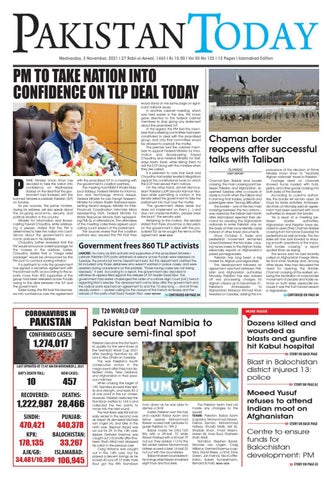
PM to take nation into confidence on tLP deaL today
P
RIME Minister Imran Khan has decided to take the nation into confidence on Wednesday (today) on the deal that the government had finalised with the banned Tehreek-e-Labbaik Pakistan (TLP) on Sunday. As per sources, the prime minister, during his address, will also speak about the on-going economic, security, and political situation in the country. Minister for Information and Broadcasting Fawad Chaudhry, while addressing a presser, stated that the PM is determined to take the nation into confidence about the government’s economic policies in his address. Chaudhry further revealed that the PM would announce a relief package for the masses in the address. Earlier, Chaudhry stated that a “mega relief package” would be announced by the PM soon to combat soaring inflation. It is pertinent to note the government has signed a secretive agreement with the banned outfit, as according to the reports, more than 800 supporters of the group had been released across Punjab owing to the deal between the TLP and the government. Earlier today, the PM took the lawmakers into confidence over the agreement
with the proscribed TLP in a meeting with the government’s coalition partners. The meeting had MQM-P Khalid Maqbool Siddiqui, Federal Minister for Information and Technology Aminul Haque, Federal Minister for Law Farogh Naseem, Minister for Interior Sheikh Rasheed representing Awami League, Minister for InterProvincial Coordination Fehmida Mirza representing GDA, Federal Minister for Water Resources Moonis Elahi representing PML-Q, in attendance. The attendees of the meeting collectively agreed upon calling a joint session of the parliament. The sources reveal that the coalition partners also assured the PM that they
Government frees 860 TLP activists LAHORE: As many as 860 activists and supporters of the proscribed Tehreek-iLabbaik Pakistan (TLP) party detained at prisons across Punjab were released on Tuesday, the provincial Home Department said. But the department clarified the list included only those detainees who weren’t wanted in police cases, and were arrested during crackdowns on the protests. “Those facing cases are not being released,” it said. According to a report, the government also decided to withdraw its appeal filed against the release of TLP leader Saad Rizvi. The government had earlier challenged the order of a Lahore High Court (LHC) bench regarding Rizvi’s release. The development came days after the government and the radical party reached an agreement to end the 10-day long — and at times deadly violent — protest calling for the closure of the French embassy and the release of the party chief Saad Hussain Rizvi. staff report CONTINUED ON PAGE 04
coronavirus in
Pakistan
CONFIRMED CASES:
1,274,017
LAST UPDATED AT 11:47 AM ON NOVEMBER 2, 2021
DAY'S DEATH TOLL:
NEW CASES:
10
457
RECOVERED:
DEATHS:
1,222,987 28,466 SINDH:
PUNJAB:
470,421
440,378
KPK:
BALOCHISTAN:
178,135 AJK/GB: 34,481/10,390
would stand on the same page on significant national issues. In another cabinet meeting, which was held earlier in the day, PM Imran gave directive to the federal cabinet members to stop giving any statement about the proscribed TLP. In this regard, the PM told the members that a steering committee had been constituted to deal with the proscribed group, and only that committee would be allowed to overlook the matter. The premier told the cabinet members to support Federal Minister for Information and Broadcasting Fawad Chaudhry and Federal Minister for Railways Azam Swati, while telling them to visit the ECP along with the ministers when they are called. It is pertinent to note that Swati and Chaudhry had earlier levelled allegations against the constitutional body for which the ECP had served them notices. On the other hand, Jamiat Ulema-eIslam Pakistan (JUIP) Senator Kamran Murtaza while submitting a motion in the Senate asked the government to take the parliament into trust over the matter. “The government strikes deals but does not implement on them […] and due non-implementation, people bear the brunt,” the senator said. Pertaining to the motion, the senator stated that there should be a discussion on the government’s deal with the proscribed TLP, as he sought the terms of the agreement. news desk
33,267 ISLAMABAD:
106,945
Chaman border reopens after successful talks with Taliban ISLAMABAD staff report
Chaman-Spin Boldak land border crossing, the main crossing point between Pakistan and Afghanistan, reopened Tuesday after a closure of nearly a month when the Taliban shut it claiming that traders, patients and passengers were “facing difficulties”. The border – one of the two main crossings between the two nations – was closed by the Taliban last month after Islamabad rejected their demand for allowing the Afghanistan nationals to enter Pakistan only on the basis of their local identity cards instead of other travel documents. Since October 5, trade and pedestrian movement remained closed between the two sides, causing heavy losses to the Afghan trade, especially exports of Afghanistan’s prized pomegranates. Pakistan has long been a big market for Afghan pomegranates. The development followed an agreement reached between Pakistan and Afghanistan authorities Monday. Pakistan has also waived off visa processing charges for Afghan citizens up to December 31, Pakistan’s Ambassador to Afghanistan Mansoor Ahmad Khan tweeted on Tuesday, adding this is in
CONTINUED ON PAGE 04
more inside
T20 WORLD CUP
Pakistan beat Namibia to secure semi-final spot Pakistan became the first team to qualify for the semi-finals of the Twenty20 World Cup 2021 after beating Namibia by 45 runs in Abu Dhabi on Tuesday. This was Pakistan’s fourth consecutive victory in the mega event after they had defeated India, New Zealand, and Afghanistan in their previous matches. While chasing the target of 190, Namibia showed their ability and strength, and were 83-2 at one point in the run chase. However, Pakistan restricted the Namibian batters to 144-5 and collected the two points to move into the next round. The Namibian side first lost an early wicket in the second over as Hasan Ali dismissed Michael van Lingen (4), and later, in the ninth over, Stephan Baard was run out for 29. In the 13th over, skipper Gerhard Erasmus was caught out (15) shortly after Shaheen Shah Afridi had dropped his catch in the previous over. Craig Williams was caught out in the 14th over, but he played a decent innings as he scored 40 runs off 37 balls. Haris Rauf got the fifth Namibian
pursuance of the decision of Prime Minister Imran Khan to “facilitate Afghan nationals’ travel to Pakistan.” Footage aired on channels showed trucks loaded with fruits, grains, and other goods crossing into both sides of the border. According to customs authorities, the border will remain open 24 hours for trade activities. Ambassador Khan on Monday said an agreement had been reached with local authorities to reopen the border. “As a result of a meeting between border authorities, Afghanistan and Pakistan have decided to open [the] Chaman-Boldak crossing from tomorrow [Tuesday] for pedestrians as well as trade. The two sides will now look forward to ensuring smooth operations of the important border crossing,” a report quoted Khan as saying. The envoy said he had recently called on Afghanistan Foreign Minister Amir Khan Muttaqi and, among other issues, they had discussed the need for opening the BoldakChaman crossing at the earliest, ensuring the facilitation of cross-border movement of people and trade vehicles on both sides, especially because it was the fruit harvest season in Afghanistan.
Dozens killed and wounded as blasts and gunfire hit Kabul hospital STORY ON BACK PAGE
Blast in Balochistan district injured 13: police STORY ON PAGE 02
man down as he was able to dismiss JJ Smit. Earlier, Pakistan won the toss and captain Babar Azam and fellow opener Mohammad Rizwan scored half centuries to guide Pakistan to 189-2. Babar made his 23rd T20I fifty with a 49-ball 70 while Rizwan finished with a 50-ball 79 not out. They added 113 for the first wicket before Mohammad Hafeez scored a brisk 16-ball 32 not out with five boundaries. Babar hit seven boundaries in his innings while Rizwan smashed eight fours and four sixes.
The Pakistan team had not made any changes to the squad. TEAMs: Pakistan: Babar Azam (captain), Mohammad Rizwan, Fakhar Zaman, Mohammad Hafeez, Shoaib Malik, Asif Ali, Shadab Khan, Imad Wasim, Hasan Ali, Haris Rauf, Shaheen Shah Afridi. Namibia: Stephen Baard, Michael van Lingen, Craig Williams, Gerhard Erasmus (captain), David Wiese, JJ Smit, Zane Green, Jan Frylinck, Nicol LoftieEaton, Ruben Trumpelmann, Bernard Scholtz. news desk
Moeed Yusuf refuses to attend Indian moot on Afghanistan STORY ON BACK PAGE
Centre to ensure funds for Balochistan development: PM STORY ON PAGE 03
02
Wednesday, 3 November, 2021 | ISLAMABAD
NEWS
BlAst In BAlochIstAn DIstrIct InjureD 13: PolIce QUeTTA
Four terrorists killed in clash with police ISLAMABAD Staff RepoRt
Four terrorists were killed in a clash with police in Khyber Pakhtunkhwa, police said in a statement on Tuesday. The counter-terrorism department of police conducted the operation in the Hangu district of the province on an intelligence tip-off regarding the presence of some high-profile targets in a compound, said the statement. During the operation, an exchange of fire broke out in which four terrorists were killed while four others escaped by taking advantage of the darkness. Police seized arms and ammunition from the militants’ hideout and kicked off a search operation for the fleeing terrorists. The killed terrorists were involved in planning and executing attacks on polio eradication teams, kidnapping for ransom, street crimes and terrorist attacks on police and civilians, according to the statement.
Direct PIA flights to Baghdad soon: spokesperson ISLAMABAD app
Pakistan International Airlines (PIA) resumed direct flights to Najaf city of Iraq while special flights for the capital of Baghdad will begin soon. PIA spokesperson Abdullah Hafeez Niazi on Tuesday said the latest operations would further strengthen ties between the brotherly nations and efforts were underway to resume flights to Baghdad. “Our special flight operations to Najaf were highly successful,” Niazi said while speaking to Pakistan Television. The inaugural flight, PK-219, carrying 91 passengers, landed in Najaf on October 30. PIA was taking practical steps to provide the best facilities to passengers besides providing onboard wi-fi internet service, he said. Replying to a question, the spokesman said the airline had also upgraded its kitchen services focusing on fresh food with varied tastes and improved presentation.
A
Staff RepoRt
N explosion in the Kharan District of Balochistan wounded at least 13 people on Tuesday, Station House Officer (SHO) Mohammad Qasim said. Four critical patients were shifted to Quetta while the remaining were taken to the District Headquarters Hospital, he said. Qasim said the bomb, fitted in a motorbike, exploded shortly after a vehicle of security forces passed through the neighbourhood. Balochistan Chief Minister Abdul Qudoos Bizenjo condemned the incident, calling it an act of terrorism and ordered an inquiry. “Anti-state elements want to disrupt peace in the province,” said Bizenjo. “The people of the province stand by their security forces to eradicate the scourge of terrorism.” Militant groups, including the Tehreek-i-Taliban Pakistan, have been carrying out a small-scale insurgency in the province. Although the military had quelled the insurgency in Baluchistan, violence has increased in recent months. The province also shares a long border with Iran and Afghanistan.
Fawad says alliance with extremist group means international isolation NewS DeSk Minister for Information and Broadcasting Fawad Chaudhry on Tuesday stated that an alliance with an extremist group would mean “international isolation”. The minister gave the statement on his official Twitter account, as the government is set to implement a deal made with the banned outfit Tehreek-e-Taliban Pakistan (TTP), which had launched protests in Lahore on October 20, seeking the release of their leader Saad Rizvi, while martyring police officers and injuring many civilians. The demonstrations lasted for more than 10 days, after which the government on Sunday finally signed an accord with the the proscribed outfit. As per the agreement, amnesty was to be extended to Rizvi, and the TLP workers who are not facing any formal criminal charges were to be released. Chaudhry in a tweet stated that the religious groups have the capacity to use mobs for violence but their capacity to create any change in politics “has always been limited”. “At one point Sunni Tehreek was more violent than TLP, but done and dusted. This party will be over sooner,” he stated.
“[An] alliance with such a party means international isolation,” the information minister added. Meanwhile, the government is all set to implement the secretive deal. As per the reports, more than 800 supporters of the party arrested across Punjab would be released under the deal. In this regard, PM Imran Khan held a meeting on Monday, with the steering committee to discuss the implementation of the agreement. The meeting was chaired by Federal Minister Ali Mohammad Khan. The meeting had Punjab’s Minister for Law Raja Basharat, secretaries of the federal interior ministry, additional chief secretary of the Punjab Home Department, other officials, as well as some members of the TLP in attendance. As per the Punjab Home Department, 860 persons who were not facing any formal charges have been released across Punjab. It has been decided in the meeting that the appeal filed against the release of Saad Rizvi will also be withdrawn. It is pertinent to note that the government had earlier challenged the order of a Lahore High Court (LHC) bench pertaining to Rizvi’s release. Saylani Welfare Trust Chairman Maulana Bashir
Farooqui who was present during negotiations between the TLP and the government assured that the contents of the agreement “do not go against the national interest”. However it still cannot be made public before the 10th day of the deal. The news of the agreement between the government and TLP was announced on Sunday in a presser hosted by officials from the PTI’s negotiating team. FM Shah Mahmood Qureshi and NA Speaker Asad Qaiser were also present on behalf of the government at the presser. Barelvi scholar Mufti Muneeb-urRehman was also present to support dialogue between the protestors and the government. Mufti Rehman initiated the presser held in Islamabad, stating that talks with the proscribed TLP had been “successful” and that an “agreement” had been reached, while adding that the details of the agreement will be revealed at a “suitable time”. It it to note that other signatories of the agreement included the NA speaker, FM Qureshi and Minister of State for Parliamentary Affairs Ali Muhammad Khan, besides members of the proscribed TLP.
Cabinet gives approval to launch Ehsaas Targeted Subsidy Programme ISLAMABAD Shahzad paRacha
The federal cabinet has given approval to launch the Rs120 billion Ehsaas Commodity subsidy programme for 20 million households across Pakistan. Sources said that the federal cabinet under the chair of Prime Minister Imran Khan gave the approval to launch the Ehsaas Commodity subsidy program for those 20 million household people who have less than Rs31500 income per month. The government under this program will provide Rs 1,000 per family per month to cover staple food items (wheat flour/Atta), daal, cooking oil/ghee) besides 25% of the food spend for low-income households to reduce the inflationary impact on the most vulnerable. Similarly, the government will cover 20 million households across Pakistan with a PMT Score of less than 39 and an income of Rs. 31,500 per month by annual funding of Rs. 120 billion. Moreover, the government has also authorized NBP to handle the execution of the program in collaboration with Ehsaas whereas the ministry of Finance assigns fiscal management and oversight of the program. Under this program, the Federal government and all the federating units will share fiscal resources in the ratio of 35/65 except Sindh and Balochistan as they have not joined yet and the budgetary allocation may change; if both of these provinces will join the program. Sources said that the government will also give a 510% (recommended 8%) incentive for Kiryana stores for (Rs —12 / subsidy transaction) on the value of the subsidy amounting to Rs. 7.3 bn for FY 2021. This is to encourage them to shift from cash-based transactions to electronic dealings, open their bank accounts and purchase/install internet-enabled devices and compensate them for additional time spent on
processing, the source added. Sources said that the Poverty Alleviation and Social Safety division informed the cabinet that Pakistan has experienced a marked increase in commodity prices with prices of 3 major food items rising by 15% within a year. Although the domestic increases are being driven by rising prices in the international market, inflationary control remains an important policy objective for the government.
Sania Nisthar informed that the government wants to help the financially vulnerable groups in society by Launching the ETCSP for this, the State Bank of Pakistan has nominated the National Bank of Pakistan (NBP) as the sole national agent for this subsidy program. Sources said that ETCSP is designed to be a precision-target system of subsidy delivery focusing on deserving beneficiaries to provide financial assistance
for the purchase of essential commodities at a discount through digitally processed transactions at ETCSPenlisted stores, using a mobile P (mPOS). This will include Utility Stores Corporation outlets as well as local Kiryana stores. The program may enable the government over time, to remove current untargeted subsidies and move to targeted-subsidy-only mechanisms as envisioned in this paper. The government may choose to reduce the size of the targeted subsidy program or end it once the current inflationary cycle ends or the economic situation improves. According to the ETCSP design, enlisted stores and beneficiaries will go through a rigorous verification process to minimize the incidence of fraud. Sources said that the beneficiaries will register through a secure portal, with eligibility cut-off authenticated by BISP, family information validated by NADRA and CNIC-Mobile number pairing certified by Pakistan Mobile Number Portability Database (PMD, PTA). At the time of availing subsidy, beneficiaries will be required to go through 2-factor authentication consisting of physical verification of CNIC and an OTP sent to the beneficiary’s registered mobile number; and the Kiryana stores will go through all checks mandated by the SBP including CNIC verification by NADRA, SIM ownership authentication by PMD/PTA, all banking checks and biometric verification. It is pertinent to note that Ehsaas and NBP have already executed a technical Pilot for evaluating the program design which tested the program’s operating model in several cities. Hundreds of beneficiaries and Kiryana stores participated in the program, and all subsidy transactions were processed successfully, sources added.
Wednesday, 3 November, 2021 | ISLAMABAD
CeNtre tO eNsure fuNds fOr BalOCHistaN develOPmeNt: Pm
P
NEWS DESK
RIME Minister Imran Khan has reiterated that the federal government will ensure provision of all possible resources for development of backward areas of Balochistan. Talking to Balochistan Chief Minister Abdul Quddus Bizenjo, who called on him on Tuesday, the prime minister said that the China-Pakistan Economic Corridor (CPEC) projects in Balochistan will be completed within the stipulated time. The chief minister briefed the prime minister about development projects in Balochistan and also exchanged views on the overall political situation in the province. Separately, a delegation of the leaders of government’s allied parties called on the prime minister on Tuesday and expressed their full confidence in his
leadership and policies. During the meeting, matters relating to the overall political and economic situation in the country were discussed. Member of National Assembly
(MNA) Dr Khalid Maqbool Siddiqui, Minister for Law Farogh Nasim, and Minister for Information Technology Amin-ul-Haq represented the Muttahida Qaumi Movement (MQM). The Grand
Democratic Alliance (GDA) was represented by MNA Ghaus Bakhsh Mehr and Minister for Inter-Provincial Coordination Dr Fehmida Mirza. Minister for Water Resources Moonis Elahi represented Pakistan Muslim League – Quaid-e-Azam (PML-Q). Similarly, Balochistan Awami Party (BAP) was represented by Chief Minister Balochistan Abdul Quddus Bizenjo and Senator Manzoor Ahmad Khan Kakar. Interior Minister Sheikh Rasheed Ahmad represented Awami Muslim League Pakistan (AMLP). Special Assistant to PM Shahzain Bugti represented Jamhoori Watan Party (JWP). The government side was represented by Minister for Defence Pervaiz Khattak, Minister for Planning Asad Umar, Minister for Information and Broadcasting Fawad Chaudhry and Special Assistant to PM Malik Muhammad Amir Dogar.
Skilled youth vital for development: president
NEWS
03
NCOC daily update: 457 new cases, 10 deaths from Covid-19 ISLAMABAD staff RepoRt
Pakistan on Monday reported 457 new Covid-19 cases and 10 more deaths, the National Command and Operation Center (NCOC) said on Tuesday. The NCOC, a department leading campaign against the pandemic, said that the country has conducted 20,879,087 tests so far confirming overall 1,274,017 cases, including 1,222,987 recoveries. There are 22,564 active cases who are under treatment across the country, including 1,234 those who are in critical condition. According to the NCOC, the pandemic killed 10 people on Monday, raising the overall death toll to 28,466. Sindh is the most-affected province of the country in terms of the number of cases with 470,421 infections followed by Punjab which has reported 440,378 infections.
PHC declares non-partisan local govt elections ‘unconstitutional’ PESHAWAR
ISLAMABAD app
News Desk
President Dr Arif Alvi on Tuesday, while terming intellectual excellence the key to match the pace of global advancement, said Pakistan needed to achieve an edge in applied sciences to bring in a real transformation and ensure development. Addressing the convocation of Quaid-i-Azam University in Islamabad, the president said equipping the country’s youth bulge with knowledge and skills as per market demands was essential to properly utilize their potential. President Alvi said Pakistan had the fifth-largest young human resource in the world, and thus required the right direction to achieve the goals of prosperity in line with the vision of Muhammad Ali Jinnah and Muhammad Iqbal. He said nations are built, not only with resources but with their intellectual dominance. He said the government was focusing to expand the scope of higher education and ensure access to students across the country. However, he regretted that only up to 10 percent of the students in Pakistan could make their way to universities compared with 20 and 16 percent in India and Bangladesh, respectively. President Alvi proposed to universities in the country to also work on a ‘virtual component’ of education to help increase the number of highlyqualified graduates. He said the nation, in view of its immense capabilities and determination, was blessed with all the right ingredients to rise amongst its contemporaries. He said that the brain drain of professionals in the 70s and 80s incurred a big intellectual loss to the country and urged the graduates to serve the nation and contribute towards their society. He said an inclusive job structure with the provision of home-based work facilities and a safe environment would encourage women to continue with their careers in addition to their family commitments. He lauded the QAU for achieving the top rank in the country besides getting several other accolades at the world stage of academics. Vice Chancellor Dr Muhammad Ali said the QAU was continuing with its tradition of academic prestige and was ranked among the top 100 universities of Asia,
The Peshawar High Court (PHC) on Tuesday declared Neighbourhood and Village Council elections to be held in KP on a non-partisan basis unconstitutional. In a short ruling, the high court announced this decision while hearing pleas filed by the opposition politicians against the KP government. As per the details, Akram Khan Durrani of Jamiat Ulema-e-Islam-Fazl (JUI-F), Inayatullah Khan and Mushtaq Ahmad Khan of Jamaat-e-Islami and Khushdal Khan, Himayatullah Mayar had filed a petition against the local government polls. The PHC gave directive to the ECP to take important measures for holding party-based elections. Soon after the ruling of the high court, it became evident that the local government elections in KP will be delayed as the provincial government has sought time to think over their decision. After the ruling, the ECP contacted the KP government and said that it will make a decision regarding the election schedule after consultations with the government. Adding to that, the government has also restored the accounts of local bodies under the Local Government Act 2013. Guidelines pertaining to the accounts’ operations were issued to the chief officers on the directions of Local Government Secretary Noorul Amin Mengal. As per a spokesperson of the local government, the competent officers will be responsible for transferring of funds, currently in accounts established under the 2019 Act to the accounts created under the 2013 Act. The statement added that these transfers will be made via cross cheques. PFC, all local government revenue shares that tax shares would be transferred to bank accounts established under the 2013 Act as soon as possible. Additionally, the bank account opened under the Local Government Act 2019 will cease to function. The decision concluded by stating that payments for employees’ salaries, pensions, electricity bills, petrol and other expenses will continue as routine.
with its faculty ranked at 28th in the world. He said QAU had recently established a Kamyab Jawan Centre and a Business Incubation under one umbrella to provide the graduates with a platform for entrepreneurship. He announced that the disciplines of artificial intelligence and cyber security would be started from the next academic session. Also, on the directive of Prime Minister Imran Khan, the QAU was set to launch Sports Sciences and Media Studies, he added.
The VC said the QAU had signed 70 Memoranda of Understanding with different universities across the globe and had established a pension fund and student endowment fund to facilitate both its faculty and pupils. The president on the occasion gave away medals to the students on achieving distinction in their respective disciplines. Parliamentary Secretary for Education Wajiha Akram, members of faculty, and graduates of the QAU attended the event.
Modi’s plane to use Pakistani airspace after returning from G20, COP26 summits today KARACHI News Desk
Narendra Modi’s Boeing 777 plane will use Pakistani airspace today morning on its way back from Italy and Scotland, where the Indian premier took part in the G20 and COP26 summits respectively. As per the details, around 3pm, the 300ER, K7066 will enter Bahawalpur and cross Turbat and Panjgur to reach New Delhi. It will then land at the Indira Gandhi International Airport. Spokesperson Civil Aviation Authority (CAA) confirmed that the Indian PM had been allowed to pass through the Pakistani airspace tomorrow. Earlier, Modi’s aircraft crossed the Pakistani airspace and reached Italy to attend the G20 summit, after obtaining permission from Islamabad.
It is to note that Modi’s plane entered the Pakistani airspace using the same route and reached Italy via Iran
and Turkey, after New Delhi requested permission from the Ministry of Foreign Affairs to use the airspace. It merits mention that the two-day summit of the Group of 20 was held in Rome to endorse a global agreement for a minimum 15 per cent corporate tax. The Indian PM had to travel to Italy to attend the meeting, for which it was required to use Pakistani airspace. After attending the summit, the Indian premier travelled to Glasgow to attend COP26, a climate change summit. As per reports, Modi is one of the 120 leaders who have gathered in Glasgow for the two-week conference. It is pertinent to note that it isn’t the first time than an Indian plane has requested to use the Pakistani airspace, the Indian commercial aircrafts had used Pakistani airspace earlier as well.
wednesday, 3 november, 2021 | IsLAMABAD
04 news
PakisTan LnG issues emeRGenCy TendeR aFTeR TeRm CaRGoes CanCeLLed ISLAMABAD
s
ReuteRS
TATE-owned Pakistan LNG Limited is seeking two liquefied natural gas (LNG) cargoes for delivery in November through an emergency tender after its term suppliers cancelled delivery of cargoes, two industry sources said on Tuesday. A sharp increase in gas prices has caused power shortages in many parts of the world, including China, amid a global energy crunch. Pakistan LNG is seeking the cargoes for delivery into Port Qasim, Karachi, over November 19 to 20 and November 26 to 27 through a tender closing on November 5, with same-day validity, according to a tender document posted on the company website. This is due to the cancellation of two cargoes by the firm’s term suppliers for the month, one of the sources familiar with the matter said.
FBR to launch single sales tax portal this month PORTAL TO AID SURVEILLANCE OF BUSINESS ACTIVITIES ACROSS COUNTRY FOR MAXIMISING REVENUE POTENTIAL, TAX COMPLIANCE ISLAMABAD Staff RepoRt
Federal Board of Revenue (FBR) is set to launch Single Sales Tax Portal during this month in order to facilitate taxpayers and ensure ease of doing business (EoDB) through automation, digitisation, and minimisation of human interaction with taxpayers. This landmark initiative has been made possible after thorough discussions with the provincial revenue authorities of Punjab, Sindh, KP, Balochistan, and AJK. This facility will enable taxpayers to file single monthly sales tax returns instead of multiple returns on different portals; thereby, significantly reducing the time and cost of compliance, and thus achieving maximum efficiency. The system would be intelligent enough to sift and collect revenues from a single taxpayer and distribute the same among multiple revenue agencies. This unique project would also help in resolving the long outstanding issues of input tax adjustment among relevant stakeholders. With the proposed launch of the portal later this month, the existing cumbersome and tedious processes would be replaced with an efficient and automated system of tax adjustments, with minimum human involvement. The portal would also be beneficial for tax collectors in having a 360degree view of business activities across the country in order to maximise revenue potential and tax compliance.
Chaman border reopens after successful talks with Taliban CoNtINueD froM pAge 01 “We also had discussions about following up on the recent visit of the foreign minister of Pakistan to Kabul, which was extremely productive. We remain closely engaged with Afghan authorities for facilitating the movement of people at all border crossings,” he said. According to a senior member of the Chaman Chamber of Commerce, Usman Achakzai, the decision to reopen the ChamanSpin Boldak crossing was taken at a meeting held on the Afghan side of the border on Monday morning. The Taliban government’s deputy spokesman Bilal Karimi also confirmed that both sides had reached an understanding that passengers should not face difficulties. “Similarly, imports and exports via Chaman-Spin Boldak should continue without any hurdles. Both sides have also agreed that there should be no problem in the transit trade. We have held discussions on the issue and I am confident that a permanent solution will be found out,” Karimi said. The Taliban had closed the key crossing along the frontier with Afghanistan in Balochistan on October 5, claiming that “traders, patients and passengers were facing difficulties [at the border]”. Pakistan shares a 2,200-kilometer- (1,375 mile-) long porous border with landlocked Afghanistan. They share 18 crossing points — the most frequently used are Torkham and Chaman.
Commodities trader Gunvor could not supply the cargo because of force majeure at Equatorial Guinea’s LNG plant, the source said. Italian energy group ENI could not deliver a cargo due to a default by its backend supplier, the source added. Gunvor, ENI and Pakistan LNG did not immediately respond to Reuters’ requests for comment. Pakistan has a five-year import deal with Gunvor and a 15-year agreement with ENI to buy LNG. Under the contracts, Pakistan LNG can impose a penalty of about 30 percent of the contractual price of a cargo on each company for cargo defaults. Spot LNG prices rose to a record high of above $56 per million British thermal units (mmBtu) last month before pulling back to just above $30 per mmBtu, which is still over 400 percent higher than the same time last year. That works out to three times the price of oil-linked term cargoes, which are priced at above 11 percent of Brent crude oil prices, or about $10 per mmBtu based on current oil prices.
Azerbaijan embassy marks first anniversary of Karabakh liberation ISLAMABAD anadolu agency
The Azerbaijani embassy in Islamabad marked the first anniversary of the “44day patriotic war” against Armenia that resulted in the liberation of Karabakh and other territories under occupation for nearly three decades. Addressing a press conference in Islamabad, Ambassador Khazar Farhadov thanked Pakistan for standing with his country on the Karabakh dispute, saying his nation will always remember its true friends. “Armenia occupied almost 20% of my country’s territory for 30 years, and during this time it committed war crimes, as well as crimes against humanity,” he said. “Armenia committed the Khojaly
genocide in February 1992, killing hundreds of civilians, including 106 women and 63 children […] 1,275 Azerbaijanis were taken hostage, 150 of them are still missing.” On the night of February 25-26, 1992, Armenian forces massacred ethnic Azerbaijanis in Khojaly, a small town in the Nagorno-Karabakh region of Azerbaijan. During the two-hour Armenian offensive, 613 Azerbaijanis were killed and 487 others critically injured, according to Azerbaijani record. Eight families were completely wiped out, while 130 children lost one parent and 25 children lost both. Farhadov said the UN Security Council, in its four resolutions In 1993, called for immediate, complete and un-
conditional withdrawal of armed forces of Armenia from the territories of Azerbaijan. “However, these and all other similar decisions adopted by relevant international organizations have been ignored by Armenia,” he said. He expressed disappointment over the role of the UN Security Council and said that some resolutions are implemented by the world body in a matter of hours and days, but they failed to implement its resolutions on Karabakh. He claimed that Armenia committed war crimes in last year’s war, killing and injuring civilians and destroying civilian infrastructure. “During the Patriotic War, the government, parliament and people of Pakistan morally and politically supported us, condemning Armenian aggression
and supporting Azerbaijan’s just position to restore its territorial integrity,” he said and added that his country also supports Pakistan on the Kashmir dispute, which should be resolved in accordance with the relevant UN Security Council resolutions. Pakistan and India hold parts of the Kashmir region but claim it in full. Both have fought three full-scale wars — in 1948, 1965, and 1971 — and two of them were over Kashmir. Already fraught relations between the neighbors further plummeted after New Delhi scrapped the special status of Indian-occupied Jammu and Kashmir in August 2019. Earlier in a photo exhibition, the ambassador briefed reporters about the destruction of Azerbaijani territories during occupation.
Government frees 860 TLP activists CoNtINueD froM pAge 01 However, neither Foreign Minister Shah Mahmood Qureshi, who represented the government during the talks, nor religious leader Mufti Muneebur Rehman, who took part in the dialogue on behalf of the group, gave any details of the agreement. Thousands of supporters of the party marched from Lahore on October 22 toward Islamabad. They demanded the expulsion of the French envoy to Pakistan over the publication of caricatures of Prophet Muhammad (P.B.U.H.) in France. The protest march saw supporters clash with police at several points along the way. At least eight police officers and four demonstrators were killed. Addressing the press conference on Sunday, Rehman said a steering committee headed by Minister of State for Parliamentary Affairs Ali Mohammad Khan
also comprising Punjab Law Minister Raja Basharat, the federal interior secretary and Punjab home secretary, besides TLP representatives Mufti Ghulam Ghous Baghdadi and Engineer Hafeez Ullah Alvi would oversee the implementation of the agreement. The committee met in Lahore Monday to oversee the implementation of the agreement. Reports citing people familiar with the development said the decision to release the detainees was taken during the second meeting of the committee on Tuesday. In the first phase, the activists who were not directly involved in violence were released, the sources said. These people were taken into custody to avoid any untoward law and order situation. They were released after scrutiny was completed, Basharat said, adding that workers against whom first information reports (FIRs) were registered would
have to obtain bail from courts. The minister, however, said it was yet to be decided whether protestors who were arrested under Section 16 of the Maintenance of Public Order, 1960, would also be released. The party called off its march to the capital on Monday and ended its occupation of GT Road highway after reaching the deal with the government, following more than a week of clashes that left seven policemen dead. “We have called off our march to Islamabad after reaching an agreement with the government,” Sajjad Saifi, a spokesman for the TLP, told AFP. “Our supporters have moved to the nearby park and until 50 percent of terms are fulfilled we will stay here,” Saifi added. The TLP claimed 14 of its supporters were killed and scores injured. The group has been behind major anti-France protests that earlier this year
led to the French embassy issuing a warning for all its citizens to leave the country. Several thousand supporters had begun a stop-start march from Lahore to Islamabad, reaching about one-third of the way. Rizvi’s party started demanding the expulsion of the French envoy in October 2020 after France President Emmanuel Macron defended blasphemous caricatures as freedom of expression. Macron’s comments came after a young man beheaded a French school teacher who had shown the caricatures in class. The images were republished by the satirical magazine Charlie Hebdo to mark the opening of the trial over the deadly 2015 attack against the publication for the original caricatures. The party gained prominence in the 2018 general elections, campaigning on the single issue of defending the blasphemy law, which calls for the death penalty for anyone who insults Islam or the prophet.
Lahore farmers accuse ‘mafia’ of land grab for Ravi Riverfront Urban Development Project NewS DeSk It has been called Pakistan’s answer to Dubai, a brand new multitrillion-rupee development of towering skyscrapers, futuristic domes and floating walkways. But Ravi Riverfront City, described as the “world’s largest riverfront modern city” also faces accusations of rampant land grabs by Prime Minister Imran Khan’s government, which has championed the project. Hundreds of thousands of farmers who could never afford to live in the modern urban utopia are now at risk of eviction, Guardian reported. As well as the human cost of the development, being built on a 40,000hectare (100,000-acre) site adjacent to
Lahore, many fear it will wreak environmental devastation to the Ravi river, currently undergoing ecological restoration, and surrounding forests. According to the government, the new city will be an alternative to London and Dubai for local and foreign tourists, create millions of jobs and alleviate pressure on land in Lahore. Khan has been supportive of the project, describing it as “essential” for Pakistan’s development. The government says $8 billion in foreign money has now gone into the project with the biggest investors coming from China. However last month, a Lahore High Court judge found “gross irregularities” in the Ravi riverfront project and said it would benefit land developers.
CMYK
To oversee the implementation of the city, the Ravi Urban Development Authority (Ruda) was established last year. But in a move that opponents described as “draconian and unprecedented”, the government bestowed complete legal immunity to Ruda so that no lawsuit or legal challenge could be filed against the project or anyone working on it. The government has also applied Section 4, which means it can legally acquire any land for public purposes, even though Ravi Riverfront will be a commercial enterprise. In recent months, thousands of farmers and residents on the land where the city is to be sited have gathered to voice their opposition. The Punjab state government responded by pressing charges
against 90 of the protesting farmers. Of the 41,000 hectares (102,271 acres) the government will acquire on behalf of the private developers, 85 percent is agricultural land occupied by almost a million farmers, labourers and business owners. Many claim that the government is refusing to pay market value for farms, instead declaring their land almost worthless. “The government is snatching our land for urban development and displacing us from farms we have occupied for centuries,” says Chaudhary Mahmood Ahmed, 65, a fourth-generation farmer whose land lies within the 46km-long stretch of the river where the new city will be built.
Wednesday, 3 November, 2021 | islamaBad
WhEAt nEAr 9-yEAr high On supply COnCErns, strOng glObAl dEmAnd SINGAPORE
C
Agencies
HICAGO wheat rose on Tuesday to trade near a nineyear high scaled in the previous session as the declining condition of the US winter crop raised worries over global supply amid strong demand. Corn ticked lower, while soybeans gained ground. “The wheat market was earlier tied down to corn prices, but it now has its own bullish story,” said a Singaporebased trader from an international grains trading company. “We see prices remaining firm well into next year.” The most-active wheat contract on the Chicago Board Of Trade (CBOT) was up 0.3% at $7.99-1/4 a bushel, as of 0258 GMT, closing 3.2% higher on Monday when prices hit a December 2012
high of $8.00-1/2 a bushel. Corn slid 0.2% to $5.78 a bushel and soybeans gained 0.4% at $12.53-1/2 a bushel. The US Department of Agriculture (USDA) rated 45% of the 2022 winter wheat crop in “good-to-excellent” condition, down from 46% a week earlier. Analysts on average had expected the USDA to rate 48% of the crop as “good-
iAEA head meets malik Amin
ISLAMABAD: Director General of International Atomic Energy Agency (IAEA) Rafael Mariano Grossi called on Prime Minister’s Special Assistant on Climate Change, Malik Amin Aslam in Glasgow city, the most populous city in Scotland and the fourth-most populous city in the United Kingdom. Both sides discussed various areas of cooperation for promotion of nuclear energy as clean energy in Pakistan, according to press release issued here on Tuesday from the climate change ministry. The meeting was held at the Pakistan Pavilion on the sidelines of the two-week UN climate summit that began on Sunday, 2021. Malik Amin Aslam is in Glasgow and is leading Pakistan’s delegation at the crucial U.N. climate summit amid at intense diplomatic negotiations over the next two weeks by almost 200 countries reaching a consensus over approaches to slow intensifying global warming and adapting to the climate damage already underway. During the meeting the PM’s aide underscored that nuclear power, as a zero-carbon source of energy, had an indispensable role to play in support of global efforts to combat and mitigate the effects of climate change. He also briefed the IAEA’s director general on Pakistan’s ambition to attain the goal 60 percent of the clean green energy share in the country’s mix by 2030. Malik Amin added that Pakistan’s efforts to mitigate Green House Gases (GHGs) emissions included the use of nuclear energy for power generation. Malik Amin also informed the IAEA director general that the country’s revised Nationally Determined Contributions (NDC), a carbon reduction framework, under the Paris climate pact 2015 envisaged avoidance of around 50 million tons of CO2 equivalent on annual basis by 2030, mostly by replacing coal-fired power plants with renewable, clean energy projects. The SAPM also welcomed IAEA’s engagement in the global discourse and efforts to combat the climate crisis in line with its primary mandate to promote peaceful uses of nuclear technology worldwide. Director General IAEA praised the Prime Minister Imran Khan's Eco-System Restoration Initiative, which included a programme to plant 10 billion trees across the country. He acknowledged Pakistan’s accomplishments in the peaceful uses of nuclear technologies for coping with the adverse impacts of the global warming-caused climate breakdown. During the meeting, the IAEA official lauded Pakistan’s successful development of a high-yield climate resilient cotton plant by dint of the use of nuclear techniques. Recalling IAEA’s long-standing relationship with Pakistan, Mr. Grossi also stated that he was looking forward to visit Pakistan in the near future. “Pakistan is among countries which are the most vulnerable to the impacts of climate change, and at the same time an energy deficient country. Our efforts to expand the share of nuclear power in the national energy mix will help the country address this twin challenge,” the IAEA director-general remarked. He acknowledged the operational nuclear power plants in Pakistan are, in fact, contributing to global efforts for the reduction of GHGs emissions. Pr
to-excellent”. The US soybean harvest was 79% complete, as of Sunday, the USDA said in a weekly crop progress report on Monday, behind the five-year average of 81% and the average estimate in a Reuters analyst poll, also 81%. The US corn crop was 74% harvested, the USDA said, ahead of the five-
year average of 66% but behind the average analyst expectation of 75%. Wheat is drawing support as poor spring wheat harvests and an export duty imposed by Russia have heightened expectations of relatively tight supplies this season. Russian wheat export prices gained further last week, amid higher prices for wheat in Chicago and Paris and demand from Egypt, the world’s largest wheat importer, analysts said on Monday. Saudi Arabia’s main state wheat buying agency said it bought about 1.268 million metric tonnes of milling wheat in a massive deal that exceeded some traders’ expectations. Commodity funds were net buyers of CBOT corn, wheat and soyoil futures contracts on Monday, traders said. The funds were net even in soybeans and net sellers of soymeal futures, they said.
Police officials call for inquiry into flawed security plan for TLP protest Around 60 police officers deputed at GT Road in Sadhoki to stop the Tehreek-e-Labbaik Pakistan (TLP) protesters to move ahead have asked Punjab Police Inspector-General Rao Sardar to launch an inquiry into the “flawed security plan” for the protest. Police officials who were facing the protesters head on in Hafizabad held their senior cadre responsible for the poor security arrangements. As per sources, a letter had been written to the IGP on Tuesday in which the the police officials have highlighted the senior officers’ negligence, and blamed the district police and other law enforcers for the failure of security plan, resulting in death of at least seven police officers. The personnel demanded for constituting a committee to identify those who were responsible for this ‘cowardice’ in this intense clash between the police and the TLP protestors. According to sources, the police officers asked as to why the back-up force failed to show up when the frontline was struggling with pushing back the violent protesters. They went on to state that the committee should also investigate whether the security plan matched the requirements, while adding that was replicating the plan of other security branches feasible in the case as well? The personnel also called for registering criminal cases against those responsible for putting the lives of the frontline officials at stake. “It is the time that instead of running the department on bureaucratic orders of individuals, it is run on scientific grounds,” they stated in the application. An officer deputed in Hafizabad, SI Khalid Nawaz Warya eloborated in the letter that he, along with 60 other policemen, stopped the movement of a large number of protesters and pushed them back bravely. However, after two hours of clashes, depletion of supplies of tear gas shells and other equipment begun. He added that the clashes had also resulted into multiple injuries to his fellow officials. Officer Warya went on to reveal that when the sit-
05
corporate corner iEsCO announces power suspension schedule According to Islamabad Electric Supply Company (IESCO)’s spokesman, System Maintenance/Development Work is in process. Therefore power supply of below mentioned feeders/areas will be temporary suspended as per given schedule: On 03rd November, From 09:00 a.m. to 2:00 p.m., New Rawat, Nadar, Klar City, Fazal Ahmed Shaheed, New Chua, Nara Motor, Tamir, Iqbal Town, Service Road East, Club-1, Shaheed Millat, F-9 Park, G-9/3, AIOU, I-10 / 4, G11/3, Golden Heights, Shahpur, Pindi Point, Berote, TDCP, Shahdara, Raja Sultan, New Malpur, Curry Road, Gulzar Quaid, Service Road, Zafarul Haq, City, Gulshanabad, Sarafa Bazaar, Jinnah Road, Pirudhai, Ali Market, Asghar Mall, Tench Bhatta, Cheering Cross, Radio Pak, Shams Colony, Lakho Road, Mohanpura, Bank Road-1, Dhok Farman Ali, Rehmatabad-II, CBR. II, Park View, Topi Pump, Major Riaz, 502 Workshop, Mort, Shah Jeewan, Cannt, New Rawat, Color City, Mandira, Kaliam, Bengali, Nishan Haider, Gagan, Jalala, Nawababad, Khanabad, Industrial Estate, Lala Rukh , Burhan, Shafi Chauhan, Hussainabad, Nisar Shaheed, People's Colony, Hazro, Wesa, Shahnaka, Dar es Salaam, Bahtar, Darya Sharif, Pindi Gheep City, Mianwala, Pind Sultani, Galyal, Dharnal, Laniwala, F-5 Jeddah, Zebar Shaheed, F-3 Gul Afshan, Shukrila, Mandi Bhalwal, Shamsabad, Chapran, Akram Shaheed, F-8 Civil Line, Borian, F-2 Chip Board, F-10 Kala Base, Mangla Cantt, Captain Nisar Shaheed, Doomily, Col. Muhammad Akram, Citi Housing, Mankiala, Kot Dhamik, Baba Shaheed, Thackeray, Kangar Thatti, Kadiala, Mayani, Millat Chowk, Islam Chowk, Dhadial Rural, Khanpur, Jund Awan, Chakral, ICI Khyura, Duffer, CWO, Katas, Toba, Kot Chaudhry, Lawa, Madina Town, Mugla, Dollar, Timon, Multan Khurd, Patwali Feeders, From 09:00 am to 03:00 pm, Bhakri, Line Park, Millat Chowk feeders and surroundings will remain closed. IESCO management apologizes to its esteemed customers for the power outage. If the work is completed ahead of time, the power supply can be restored even before the scheduled time. Pr
bOi holds seminar on construction and housing uation got worse, the backup force flee from the scene. Resulting in the forward force to multiply their efforts. In this regard, IG Rao Sardar held a meeting at the Central Police Office (CPO), where the role of police officers from Lahore, Sheikhupura and Gujranwala was pointed out. IG Rao went on to jeer at the senior officers for bringing bad name to police, and issued a warning to ‘incompetent officials’. It has been further revealed by sources that PM Imran Khan has asked Punjab CM Usman Buzdar to justify how the protesters managed to exit Lahore despite presence of forces like the Anti-Riot Force (ARF). During the meeting, the failure of Lahore police to stop TLP supporters outside their headquarters, failure of the reinforcements at Sadhoki GT Road and inability to stop their movement inside Lahore over the passage of two days was brought to light. The performance of the intelligence wing of Lahore police also came in question during the meeting. Adding to that, senior police officers have also reportedly held the provincial government responsible for its policy of dealing with the protesters. Lastly, reservations have been expressed by the command over the signing of an agreement with the TLP leadership, which is blatant ignorance of the loss of lives of the police officers during the protests. news desk
Brent oil to rise into $85.77-$87 range, flat pattern forming SINGAPORE
The Board of investment, under the leadership of Secretary Board of Investment (BOI), Ms. Fareena Mazhar held an investment Seminar on “Construction & Housing for Sustainable Development” in Dubai on Tuesday, November 2nd. While discussing the opportunities in housing sector, Ms. Fareena shared that Pakistan’s annual demand of housing is estimated to be about 700,000 units, while only about half of this demand is currently being met. She encouraged investors to explore the Housing sector of Pakistan which offers tremendous tax-based rebates under tax laws amendment Ordinance 2020 and the incentives and facilitation in project approvals through one window operation by Naya Pakistan Housing and Development Authority (NAPHDA). The Secretary further added that the Income Tax Ordinance has been amended to declare construction sector as an industrial undertaking, making it eligible for benefits and concession available to other industries. Further elaborating on the tax incentives, she said that eligible developers and builders shall be exempted from withholding taxes on purchase of building materials and any tax payable on the income, profits and gains of projects of low-cost housing under NAPHDA or EHSAAS programme shall be reduced by 90%. Ms. Fareena underscored that in order to promote housing and construction of buildings. (residential and non- residential) in Pakistan, State Bank of Pakistan (SBP) has decided to advise mandatory targets to the banks. Accordingly, each bank shall ensure that the financing for housing and construction of buildings shall be at least 5% of their domestic private sector credit by December, 2021, she added. Pr
Audi CEO hopes for chip supply stabilisation by summer 2022
Agencies
Brent oil may rise into a range of $85.77 to $87 per barrel, as the consolidation from the Oct. 25 high of $86.70 may adopt a flat pattern. The pattern consists of three waves that are roughly equal. This relation would mean an extension of the current wave b towards 86.74. A more bullish scenario is the uptrend may have resumed. Regardless of the exact interpretation, oil seems to be poised to retest the resistance at $86.74, the 2018 high. Immediate support is at $84.53, a break below could cause a fall into $83.05-$83.76 range. On the daily chart, oil simply ignores the bearish divergence on
NeWs
the RSI and keeps rising. This only happens when the bullish sentiment is extremely strong. It won’t be a surprise if the divergence is violated over the next few days.
CMYK
Each reader should consult his or her own professional or other advisers for business, financial or legal advice regarding the products mentioned in the analyses.
FRANKFURT: Volkswagen’s premium carmaker Audi expects chip supplies to remain tight at least until summer 2022, Chief Executive Markus Duesmann told German newspaper Augsburger Allgemeine. “We hope that we can reach a stabilisation with regard to production and chip deliveries at the end of the first half of 2022,” Duesmann, who also sits on the management board of Volkswagen, was quoted as saying. Volkswagen last week cut its outlook for deliveries, toned down sales expectations and warned of job cuts as a shortage of computer chips caused Europe’s largest carmaker to report lower-than-expected operating profit for the third quarter. Agencies
06-07 Comments - 3rd November 2021_Layout 1 11/2/2021 10:29 PM Page 1
Wednesday, 3 November, 2021
06 COMMENT
USA’s arbitrary blacklist of religious violators
Confusing TLP deal Government’s reckless handling of a crisis
A
LThough the government was successful in convincing the banned Tehreek e Labbaik Pakistan (TLP) to end its protest march towards the capital, many important questions have risen since, that require satisfactory answers. To begin with, the deal itself and the terms agreed upon by both parties are shrouded in secrecy as the PTI government has chosen not to reveal any details related to it. That the Punjab government has released over 800 TLP workers two days after the undisclosed agreement was signed and has also taken back its appeal against the bail granted to the banned outfit’s leader Saad Rizvi bythe LhC suggests that primarily a blanket pardon and a promise to not pursue cases against TLP leaders and workers, are part of the understanding. This suggests that the five martyred policemen killed by a TLP mob are unlikely to get any justice. how much more the government has left on the negotiating table is unknown. There is also no explanation as to why the government’s negotiating team and the narrative around how the TLP would be dealt with changed overnight. Interior Minister Sheikh Rashid had refused to accept the TLP’s demand for the French ambassador’s expulsion, called in the Rangers in Punjab for two months and had threatened use of force if the protesters continued being violent. Minister for Information Fawad Chaudhry claimed that the group had Indian support, which was also echoed by Minister for Planning Asad umar. In typical PTI-fashion, an unexpected u-turn was taken as both Ministers were replaced with other cabinet ministers who had a completely opposite tone to the original negotiating team. Perhaps the inclusion of Mufti Muneeb, a political nobody who holds no public office, is the most intriguing due to his apparent pivotal role in brokering the deal and the claim he has made that the TLP had never demanded the expulsion of the French ambassador, calling both Sheikh Rashid and Fawad Chaudhry, liars. This begs the question: what exactly was the TLP protesting for then? The PTI government has not only shamelessly capitulated in front of a violent bloodthirsty banned extremist outfit but has done so in such a reckless incompetent manner, that it has created significant confusion over what exactly happened. In the process it has also opened the door for other ambitious religiously charged groups to consider taking the TLP route, as they too could also literally get away with murder.
It’s not just Muslims who are persecuted in India
Amjed jAAved
I
nDIA was categorised as a “Tier 2 country” in last year’s listing by the uS State Department. But the State Department notification, now issued, does not name it among countries of particular concern. Last year, the uS religious commission noted that religious freedom conditions in India had experienced a drastic turn downward, with religious minorities under increasing assault. It also noted that the BJP government allowed violence against minorities and their houses of worship to continue with impunit,y and tolerated hate speech and incitement to violence. The uS concern was understandable, India being a `secular republic’. Article 25A of India’s Constitution provides for unfettered religious freedom. not only Muslims but also Christians, Dalits and other minorities are persecuted communities. Despite being constitutionally secular, “national minority” status in India is defined by religion. There are six `minorities’, Muslims, Christians, Sikhs, Jains, Buddhists and Zoroastrians. The legal classification is not sacrosanct. each caste has its own sub-divisions. even Muslims are practically subdivided into ajlaf, ashraf and arzal. even a hindu dalit cannot enter a high-caste temple, ride a bike or a horse, or wear casuals (he must go barefoot). A dalit was murdered for sitting in a temple verandah. he can’t even eat in front of a Brahmin. The disagreement over the use of ‘harijan’ to
A border reopens The reopening of the Chaman crossing should not bear the wrong cost
T
he reopening of the Spin Boldak-Chaman border crossing between Pakistan and Afghanistan shows that normalcy is returning to Afghanistan after the Taliban takeover, for it not only means that trucks carrying goods can be exchanged, but the reopening of the pedestrian lane allows the tribes divided by the Durand Line to go on undisturbed by the border. The agreement to allow Afghan nationals to enter Pakistan on Afghan identity papers perhaps owes something to the high-level diplomacy that was carried out when Foreign Minister Shah Mahmood Qureshi led a delegation to Kabul. however, that is a risky step to take, even with peaceable and stable regimes, but especially so if a country is coming off a prolonged conflict, and the government in power has taken over by force of arms. Apart from the doubts about the Afghan identity papers, which could be forged or tampered with in turbulent times such as the present, it is likely that a lot of people will try to leave the epicentre of instability and become refugees. It is not necessary that some malign force organise crossings by its agents. It is enough that those sympathetic to militancy cross genuinely as refugees, and then get recruited here do such sabotage activities as are beginning to plague Balochistan. The nexus of the refugees, Indian intelligence agencies and extremist organisations needs to be watched carefully by the Pakistani law enforcing agencies, and it must be ensured that these elements do not feed into the unrest already gripping the province. As the immediate area of Afghanistan affected is also the Taliban strongold, there is all the more reason to seek their assistance in making sure that the crossing is only used for trade and intra-tribal communication. This crossing is likely to increase in importance in future, as it will be one of the primary routes by which the Chinese Belt and Road Initiative will cross from Pakistan (along the CPeC) to Afghanistan, and across it to Central Asia and beyond. however, it must at all times be properly policed; for only then will it achieve its true potential.
Iran wouldn’t be able to use a nuclear weapon, not that it has one
Washington Watch dr jAmes j. Zogby
O
nCe again, gallons of ink are being spilled on articles arguing for and against uS efforts to secure a new nuclear weapons pact with Iran. Will Iran return to the talks? Will the uSA agree to Iranian terms (and vice versa)? And at this point, do the Iranians even want a deal? While at times interesting, the entire discussion is focused on an issue that I feel is a dangerous diversion. Similar to my thoughts during the negotiations that led to the JCPoA, I find myself asking again why we are expending so much political capital, imposing so many sanctions, and involving so many important countries to address a problem that doesn’t exist, while doing nothing to address real problems plaguing the region The simple fact is that Iran doesn’t have a nuclear bomb and, as difficult as it may be for some to accept, even if it did have one, it could never use it. Meanwhile, the real problem posed by Iran is the meddlesome role it’s playing across the region. Let’s look more closely at both of these matters. First, Iran has no bomb and even if it did it could not use it for two reasons. In the age of “mutually assured destruction,” Iran’s use of a nuclear warhead would result in its becoming a radioactive parking lot
Arif Nizami (Late) Founding Editor
Yousaf Nizami M. A. Niazi
Umar Aziz
Joint Editor
Joint Editor
Executive Editor
Lahore – Ph: 042-36300938, 042-36375965
The writer is a freelance journalist, has served in the Pakistan government for 39 years and holds degrees in economics, business administration, and law. He can be reached at amjedjaaved@gmail.com
Refocus on Iran’s behaviour
Dedicated to the legacy of late Hameed Nizami
Editor Aziz-ud-Din Ahmad
refer to dalits goes back to the 1930s. ‘harijan’, meaning ‘children of god’, was a term first used by gandhi for dalits in 1932. When gandhi started using the term, many Dalits, including B.R. Ambedkar, objected, as it was condescending and obscurantist in nature, an attempt to sidestep the real issue. Courts are reluctant to grant relief to members of lower castes or minorities. The Patna high Court acquitted 26 men, 16 under death sentence; from the outlawed upper-caste militia Ranveer Sena, for killing 58 dalits at Laxmanpur Bathe on 1 December 1997. The Babri Mosque demolition was validated by the Supreme Court. The court, in a way, admitted that the mosque was the ram janambhoomi, the birthplace of god ram born millennia ago. nepalese prime minister oli however contests that Ram was born in nepal. In another judgment, the court held that a mosque was not necessary for worship. It outlawed triple divorce. Khushwant Singh wrote that ‘The nanavati report to investigate the post-Indira-assassination Sikhs’ `massacre is ‘utter garbage’. The 2018 Bhima Koregaon violence refers to attack on visitors during an annual celebratory gathering at Bhima Koregaon to mark the 200th year of the Battle of Bhima Koregaon, in which British-led Mahar, had beaten Marathas. Stone pelting caused the death of a 28-year-old. Police took no action. Instead, in August 2018 five activists, including Varavara Rao, Arun Ferreira, Sudha Bharadwaj and gautam navlakha, were arrested. Police slapped terrorism charges on them for, euphemistically, having `nexus with Maoist insurgents. Religious persecution mocks India’s Constitution. not only Muslims but also other minorities have a miserable plight. To stifle dissent, India clamps its draconian laws. But, The uSA is “concerned” about Pakistan, not India. A Buddhist girl, witnessing the Republic Day Parade, was picked up and molested in a military truck. hindu Bengali settlers and soldiers have raped native Jumma (Chakma) women with impunity . Many Jain temples were converted into hindu temples. Many Jains were converted into hindus at the time Thousands of Buddhists converted to Christianity at mass conversion rallies. Indian authorities had linked dozens of covid19 cases to the annual Tableeghi Jamaat conference in Delhi in early March 2020, and health officials were racing to track down anyone with contact with the participants. Videos falsely claiming to show Jamaat members spitting on police and others
quickly went viral. Tweets with the hashtag #CoronaJihad appeared over 300,000 times and were potentially seen by 165 million people on Twitter. The social posts were mostly fake. For instance, one post, purporting to show a person spitting on a hindu, was actually fabricated in Thailand. Subconsciously, hindus believe that Muslims are untouchables. They are treated as a malaise. Several past events reflect how hindus showed antipathy toward Muslims, and occasionally other, minorities. To discourage dalits from converting to Christianity, not only the Centre but also the Indian states have deprived dalit Christians’ of minority-status privileges. Any hindu who converts is socially boycotted and tortured. Six women at Kilipala village in Jagatsinghpur, orissa, had their heads tonsured by influential hindus for abandoning hinduism. Christian missionaries are harassed, deported and even killed. Thw Indian government ordered the deportation of three uS preachers on the first available flight. To add insult to injury, the preachers had a narrow escape when attacked by hindu fanatics. Courts rarely punish people who manhandle Christian preachers. hindus attacked Christians for a book which allegedly insulted hindu deities. Investigations revealed the book was not written by any Christian, but had been displayed at one of the book-shops of the emanuel Mission, which runs a chain of schools in various Indian states. narendra Modi, then gujarat chief minister harboured xenophobic attitudes not only towards Muslims but also Christians. he started a survey of Christians in northern and central gujarat in 1999. It was withdrawn after protests. Modi restarted the survey in 2003 in Christian-inhabited areas. In June 2000, four churches around India were bombed (in Andhra Pradesh and Tamil nadu), one in Maharashtra was ransacked. In September 2008, two were partly damaged in Kerala. In 2015, a church building under construction was vandalised in haryana. St george church in Mumbai was also attacked by masked persons. The same month, the Jabalpur cathedral was attacked and over a dozen injured. It had also been attacked in 2008 and the altar burnt down. In April 2015, St. Mary’s Church in Agra was vandalised and statues of Mary and the infant Jesus damaged. A church in Kachna, Raipur, was attacked by a mob during a Sunday service and five people injured. Several churches were attacked in Delhi in recent years, including St. Sebastian’s Church (burned), and St. Stephen’s college chapel (vandalised and the cross desecrated with pro-hindutva slogans). In Madhya Pradesh a church was destroyed and Bibles burnt in Mandla district in 2014. A 2015 Bible convention was attacked in Jabalpur, with allegations of religious conversions The uSA owes an explanation how India slipped out of its focus? Why is India is its protégé and Pakistan a bête noire?
I
Karachi – Ph: 021-35381208-9
I
within minutes. even if it were not flattened by a counterattack, its use of such a horrible weapon would ensure not only worldwide condemnation, but also repercussions that would mark the end of the Islamic Republic. Further, Iran could never use a nuclear bomb because of the consequences of the explosion’s fallout. If it bombed Israel, radioactivity (depending on the direction the wind was blowing) would also take countless Palestinian, Jordanian, and Lebanese lives and possibly many others as well. And if Iran were to use a nuclear bomb across the gulf, the impact would devastate the entire region, including Iran itself. For these same reasons, Israel, despite reportedly possessing hundreds of nuclear warheads, has never used them in any of its many wars with its Arab neighbors, nor can it use them in the future. The same is true for India, Pakistan, and north Korea. given this, the only apparent reason for possessing such a weapon is the bragging rights. In reality, our obsessive preoccupation with Iran’s “programme” is giving it more attention and bragging rights than Iran would ever get from actually having a bomb it couldn’t use. Iran sits centrestage with all of the world’s powers meeting with and cajoling its leaders. It’s exactly the type of attention “bad boys” crave and we’re giving it to them, while not paying attention to the really dangerous things Iran is doing across the region. Ironically, it was Israel who pushed the Iranian “nuclear threat” to the front burner. When the obama Administration took the bait and negotiated the “nuclear deal,” Israel then led the charge against the deal. There are two reasons for this: First, Israel and Iran need each other as foils. Second, their intended audience is the Arab World that lies between them. When Israel was bombing Lebanon, Iran was able to play to the Arab masses saying: “Look at what Israel’s doing and only our ally, hizbollah, is standing against them and the uSA.” As a result, a little more than a decade ago, Iran and hizbollah had extraordinarily high favorable ratings in most Arab countries.
Islamabad – Ph: 051-2204545
I
Web: www.pakistantoday.com.pk
I
But during the past decade, as Iran’s machinations in Lebanon, Syria, Iraq, and Yemen have become increasingly clear, Iran’s ratings plummeted across the region and some Arabs came to see Israel as a possible source of support against the Islamic Republic’s meddlesome actions. It was for this reason that I could never understand why so much effort was expended on stopping Iran’s nuclear programme while ignoring its dangerous and unsettling regional role. These are exactly the issues we should be addressing. At this point, the P5+1 nations and their negotiators should focus on ways of assisting Iraqis and Lebanese in building non-sectarian governments that can rein in Iranian-backed militias, bringing them under the control of their respective governments. our polling in both countries makes clear that strong majorities support this. There should also be a concerted effort in Yemen to stop the houthi assault on Ma’rib and to press for negotiations that can bring an end to that horrible conflict. At home, Iran has problems on all sides that must be addressed, facing unrest with their substantial Azeri population in the north and their Arab citizens in the Ahwaz region. Iran also faces the renewed threat from the unsettling situation resulting from the Taliban victory in Afghanistan. And, if that were not enough, young Iranians in major cities continue to demand more jobs and personal freedoms. These are the issues that need to be on the table. Rather than focusing on a bomb that doesn’t exist, we should direct diplomacy and apply economic pressure on efforts to make Iran see the benefits of becoming responsible citizens in the gulf and Arab east by reining in their meddlesome behaviour and putting their own people’s needs first. Such an effort might not yield immediate results or even work at all. But it would at least be focused on the right issues. The writer is President of the Arab American Institute
Email: editorial@pakistantoday.com.pk
06-07 Comments - 3rd November 2021_Layout 1 11/2/2021 10:29 PM Page 2
Wednesday, 3 November, 2021
COMMENT 07 Editor’s mail Send your letters to: Letters to Editor, Pakistan Today, 4-Shaarey Fatima Jinnah, Lahore, Pakistan. e-mail: letters@pakistantoday.com.pk Letters should be addressed to Pakistan Today exclusively
Urbanization
The international community must fulfill its responsibility to Bangladesh Bangladesh is being made to bear the burden of the Rohingya alone HAfiZur TAlukdAr
R
ohIngYAS taking refuge in Bangladesh are deteriorating law and order situation in Cox’s Bazar. At the same time, they have been destroying the environment, forests, topography and biodiversity of the district for four years. Because of them, Bangladesh is now facing a terrible environmental disaster. Rohingyas deported from Myanmar for humanitarian reasons were given asylum in the country. But in the situation they have created, there is no chance for them to be flexible and sympathetic. either way, they have to be sent back to their home country of Myanmar. There is no alternative. otherwise, there is danger in front of Bangladesh. Rohingyas have entered Bangladesh from Arakan and Rakhine regions due to torture and genocide by Myanmar’s military. But here the Myanmar government and the military junta are responsible for the damage they have done and are doing to the law-and-order situation and the environment. Because they pushed the Rohingyas to Bangladesh. Therefore, Sqngladesh has to demand appropriate compensation from Myanmar for causing an environmental disaster in Bangladesh. For this, if necessary, it should also go to the international court. Since 25 August 2017, the Rohingyas who were persecuted in Myanmar have crossed the border in groups and settled in different places of Cox’s Bazar, including Teknaf and ukhia. Within a few months, their number stood at 700,000. earlier, about 300,000 more Rohingya men and women were staying in Cox’s Bazar. Talks were also underway with Myanmar to send them back. But Myanmar sent another 700,000 Rohingyas to this country without the previous ones returning them. As a result, the total number of Rohingyas coming to Bangladesh stands at 1,000,000. In the last three years, they have given birth to about 100,000 children in the camps in Bangladesh. As a result, the number of Rohingyas sheltered in Bangladesh is now 1.1 million. In a populous country, this huge number of Rohingyas is now a huge burden. For humanitarian reasons and at the request of world leaders, the Bangladesh government has given temporary shelter to the Rohingyas. Shelters have been set up for them. They are also getting food and treatment. In return, they continue to increase their numbers. If it continues to grow in this way, their number will be 1.5 million after a few years. When you think about what the situation will be like, panic arises. Cox’s Bazar, the world’s longest beach area and the country’s main tourist destination, is in dire straits today because of the Rohingya. There are reports that Rohingyas are leaving government-run camps and building houses in the hilly areas and natural forests in the southern part of the district. Surprisingly, they are doing these misdeeds without hindrance. According to media reports, the Rohingyas have cut down to build houses and
collect fuel over 6000 acres of forest. The IuCno, a Swiss-based environmental organization, has reported the damage due to Rohingya migration. These forests are the habitat of Asian elephants. But due to deforestation, their free movement is being disrupted. They cannot get enough food and are attacking the locals. In addition to elephants, other wildlife and bird habitats have also been damaged or destroyed. Along with livestock, various species of trees, medicinal plants, vines, shrubs, bamboo, cane and many other plants have been destroyed or wiped out from that area of Cox’s Bazar. The unDP and various agencies have conducted research on the extentthe Rohingya migration has damaged the environment in the southern part of Cox’s Bazar, including ukhia and Teknaf. The biodiversity of Cox’s Bazar is being severely damaged. hills and mounds have also been cut indiscriminately. geo-natural changes are thus occurring in a large area in southern Cox’s Bazar. The ground water level in the area has gone down. So far, over 9000 tube wells have been installed to meet the Rohingya’s demand for drinking water. That is also why the groundwater level is getting lower. Most of the hill streams are now dehydrated almost year round. As a result, there is a shortage of natural potable water for local residents. Landslides are also occurring. Several people, including Rohingyas, were killed during the monsoon Waste management in Rohingya camps is inadequate. During the monsoon, various wastes including plastics are mixed with the flood water and fall into various connection canals including the naf river. This is polluting the river water and has a detrimental effect on fish and other aquatic life. The law-and-order situation in the southern part of Cox’s Bazar has deteriorated significantly in the last four years. The main reason is the drug business. Large quantities of yaba are entering Bangladesh illegally from Myanmar. A section of Rohingya refugees and drug producers in Myanmar are actively involved with yaba smuggling. There are various drug factories inside Myanmar,, including those making yaba and ice. The military junta there does not prevent this. Drugs produced in Myanmar are not sold or used there. The main market is Bangladesh. There are allegations that some terrorist groups are also among the Rohingya. At least six people, including three teachers and a student, were killed when gunmen opened fire on sleeping teachers and students at a madrassa in the ukhia Rohingya camp on october 29. earlier, on September 29, a group of terrorists shot dead Rohingya leader Muhibullah inside the camp and fled. he was vocal in his support for the repatriation of Rohingya refugees to Myanmar. There was also an organization of Rohingyas under his leadership. he sought to build international support for the repatriation of Rohingya. It is suspected that a group of anti-repatriation Rohingyas carried out the killings. Many believe that Myanmar’s military junta may be behind this. Because the military rulers of Myanmar do not want to take back the Rohingyas. Agents of the military junta may also be in the
camps. Also, many Rohingya do not want to return to Myanmar. Bangladesh gave shelter to Rohingyas for humanitarian reasons. Initially, various international organizations, including the un, and many countries, including the uSA, praised Bangladesh’s role and extended a helping hand. They promised to cooperate in all kinds of repatriation. But no one spoke. Foreign aid is coming for the Rohingyas, foreign agencies and ngos have opened offices in Cox’s Bazar to serve them. Domestic and foreign officials are taking huge salaries. They no longer talk about Rohingya repatriation. They take no pains for repatriation. earlier, it was said that the Rohingya issue is international and will be resolved through international initiatives and efforts. But foreigners no longer see it as international, but as bilateral between Bangladesh and Myanmar. The reality now is that Myanmar does not even consider it a bilateral issue. They are in their previous position. They claim that Rohingyas are the people of Bangladesh, and will stay there. however, before 2016, a significant number of Rohingya refugees in Bangladesh were repatriated to Myanmar and resettled in Rakhine. now they have forgotten that, because the international pressure on Myanmar on the Rohingya issue is not the same as before. Bangladesh’s diplomatic efforts are relevant. There is not enough space to say enough about them. neither China, the uSA nor India has taken a clear stand with Bangladesh on repatriation. It would not be wrong to say that their diplomatic position is more or less towards Myanmar, because of their interests. In this situation, experts think there is only one way open to Bangladesh, a strong, vigorous and effective diplomatic effort. Bangladesh now has good relations with China. Trade and economic cooperation exists, and China is actively participating in many projects in Bangladesh. It is thus possible to get China’s cooperation If China can be persuaded, it will not be difficult to get the active support of India and the uSA. It has been said from the beginning that Bangladesh is facing a terrible environmental catastrophe due to Rohingya refugees. The damage to the environment that has already taken place is huge financially. The loss of forest products and biodiversity alone is about Rs 2.5 billion. The total financial loss will be much higher if the hill cutting, pollution etc. are calculated. Bangladesh can demand compensation from Myanmar and the international community for causing environmental disasters and extensive environmental damage. This demand can be presented in various international forums including the un. The issue of Rohingya repatriation will again dominate the international arena. Demands for compensation from Myanmar will help strengthen diplomatic efforts to repatriate the Rohingya. The international community must do its duty to Bangladesh. The writer is a freelance columnist
WhAT is the main reason rural people prefer to live and stay in urban cities more than villages? In South Asia, Pakistan has the highest urbanisation rate, 36.4 in 2017 which was 32.5 in 1988. The rate is growing slowly. It might be a trouble for people and the government in the future. The public, either villagers or citizens all want to taste the facilities of the modern world. The advancement and modernization in every institution bring facilities that are loved by everyone. But due to lack of facilities and less education in villages, the public love to settle in the cities. Such actions make cities more congested and polluted. urbanisation is not a new story in Pakistan. In 1947, the year of Partition, masses of Indian Muslims (estimates range from 6 million to 8 million) crossed the new border. Many of these refugees settled in urban areas in the eastern Pakistani provinces of Sindh and Punjab. Additional migratory flows occurred in 1965 and 1971, when wars between Pakistan and India resulted in more Indian Muslims streaming into Pakistani cities (certainly these wars also sparked outflows of Pakistani hindus into urban India). These new arrivals were mostly urduspeaking ethnic Mohajirs, who would later launch the Muttahida Qaumi Movement (MQM), a political party that has dominated the southern metropolis of Karachi (in Sindh province) for decades. In the 1990s, the anti-Soviet insurgency in Afghanistan spawned a new exodus into urban Pakistan. Scores of Afghans, most of them ethnic Pashtuns, crossed the Durand Line into north-western Pakistan; as early as 1992, nearly 4 million had arrived. Initially they resided in border refugee camps, but because of economic struggles in these rural areas – the Pakistani government forbade Afghans to cultivate land –many ventured to the western Pakistani cities of Peshawar and Quetta. Today, urbanisation continues to be fuelled by war, insecurity, and economic necessity. Pakistani military offensives in the rural north-west have induced many people to flee to cities. While most are civilians, militants – including the Pakistani Taliban – are on the move as well. According to some reports, 8,000 Taliban fighters now operate in Karachi. RAHMATULLAH SHAFIQ MAkRAn
Air pollution in Pakistan SMog is a huge challange for pakistan. Province of punjab and lahore city is most affected by it. Smog is the mixture of fog and smoke that arises from waste materials which are being burned by people and it arises because of smokes of vehicles, burning of agriculture wastes and many more. Therefore, it is creating numerous issues for the citizens. Residents of punjab are dying on daily basis due to smog challenges. Air pollution is a major public health problem across Pakistan, where an estimated 128,000 people die annually from air pollution-related illnesses, according to the global Alliance on health and Pollution. But researchers say the government has downplayed the severity of the problem for years, produced unreliable data and sought to pass blame to neighboring India. Indeed, the environmental protection department of Punjab, the province surrounding Lahore, has not updated its air quality level for several weeks on its website, reporting it at 166 – a level of airborne fine particulate matter that the u.S. ePA considers to be “unhealthy” but which the Pakistani government says is “satisfactory.” Some of the sources for this smog include vehicular pollution with very poor fuel quality being used along with lack of pollution control technologies in our vehicles, industrial pollution, burning of municipal and even industrial waste and brick kilns which again use dirty fuel such as rubber tyres,” says Khalid who also heads the environment and Climate Change Department at the Sustainable Development Policy Institute, Islamabad. Sectoral emission Inventory for Punjab shows that the major portion of air pollution emissions are coming from the transport sector and it holds 43pc share in all sectors (power, industry, transport, and crop burning residue). The second major pollutant is industry whose share is 25pc while the third major pollutant is agriculture which accounts for 20pc. Collectively, the main sectors creating air pollutants and emissions are power, industry and transport which have 80pc contribution to emissions and pollution, from which Punjab’s photochemical smog conditions arise. FARIS kHALIQ TURbAT, kecH
Afghan lives matter In the twenty years of Afghanistan's war, previously and even now, the citizens of Afghanistan bear the same tearful and bombastic story: there are whistles of falling shells and rumble of gun fired. everyday, Afghanis wake up with a new blast and so it was on Tuesday. An explosion was reported at the entrance of a military hospital in Kabul that took the lives of 3 and injured 17. Residents have reported two bomb blasts in the area of hospital in Kabul's 10th district along with the sounds of gunfire. The Taliban’s control over the country is once again a reminder of the brutal style of war that took place in Afghanistan in the 1990s. Back then, Zarmina, a woman shrouded in a blue burqa, a mother of five, including 1year-old twins (a boy and girl) was accused of killing her abusive husband to protect her children. At Kabul Stadium, Zarmina was made to kneel in front of 30,000 spectators before being executed by the Taliban. Anyone who thinks that the 21st century Taliban is a new version is delusional. Taliban spokesperson Zabiullah Mujahid publicly stated, “Women will be afforded all rights within the limits of Islam [Shariah].” however, they have not explained what they mean by “the limits of Islam,” given their messages are not in sync with their actions on the ground. What form of education will be provided and will women’s rights be safeguarded as before? Will women be able to maintain their positions in media and government? even if the Taliban stick to their words, they would still fall short of their obligations under international human rights law. The Taliban’s way of justice translates to harsh punishments, including public executions and beheading of accused murderers and adulterers. It is very unlikely that they will accept any form of criticism, which is incompatible with the universal declaration of human rights. Women and girls are living in constant fear and many are refusing to leave their homes. Women’s requests to remain anonymous in this article are an indication of the level of anxiety, uncertainty, and distrust of the new “authorities,” who took over by force. MARIA nASeeM TURbAT
08 WORLD VIEW 3rd November 21_Layout 1 11/2/2021 10:16 PM Page 1
Wednesday, 3 November, 2021
08 WORLD VIEW
SlurS, lieS And SledgeS: iS MACron or MorriSon telling the Whole Story? THE FRENCH PRESIDENT’S SIMMERING ANGER BURST INTO THE OPEN IN ROME NIGHT WHEN HE TOOK THE EXTRAORDINARY STEP OF BRANDING MORRISON A LIAR
sydNey MorNiNG Herald
A
Bevan SHieLdS
T the heart of the collapse of Emmanuel Macron and Scott Morrison’s relationship are two questions: did the Australian Prime Minister lie to the French President; and are both leaders now telling the whole story in their high-stakes slanging match? Macron’s charge is that the federal government systematically duped France while plotting to torpedo a $90 billion submarine contract. The French President’s simmering anger burst into the open in rome on Sunday night when he took the extraordinary step of branding Morrison a liar. Prime Minister Scott Morrison says he made the ‘right call’ in changing submarine contracts, and claims his conversations with French President Emmanuel Macron about concerns were candid and ‘made very clear’. A visibly agitated Morrison denied the
allegation and then sharpened his attack the next morning in Glasgow. Macron had more than enough information to know the contract was in jeopardy, Morrison insisted. And for the first time, he also cited problems with the mammoth contract as a factor behind the decision to ditch it in favour of a nuclear submarine pact with the united States and united Kingdom. Having been labelled a liar on the world stage, Morrison was more than entitled to fire back and many colleagues believe the Prime Minister’s candid tone should have been deployed in September when the AuKuS pact first went public and the French went ballistic. The problem is that the Prime Minister’s defence in Glasgow contained contradictions and inconsistencies. The biggest is his claim that Macron used “slurs” against Australia when he was bailed up by reporters at the G20. “I’m not going to cop sledging at Australia. I’m not going to cop that on behalf of Australians,” Morrison said. French President says Scott Morrison lied to him over the cancellation of a mammoth submarine contract as tensions between the two leaders escalated further. This is a potent message which will resonate with many back home. But the truth is Macron went out of his way to stress his beef
was with Morrison, not the nation as a whole. “I have a lot of respect for your country, a lot of respect and friendship for your people,” Macron told reporters in rome. “Your country was shoulder-to-shoulder with us during the wars, you had fighters with us when our freedom was at stake. We do have the same values. We have to honour this common path and these common values.” Morrison’s disclosure that dissatisfaction with the way French shipbuilder naval Group was carrying out the submarine contract was also at odds with the government’s public position in September and october, which was that the rise of China was behind the need to acquire nuclear-powered submarines and that costs and delays were not behind the decision to strip the French of the work. on the same day that the French submarine deal collapsed, the defence department sent naval Group a letter saying it was satisfied with the company’s performance. To cap it off, Gillian Bird, Australia’s ambassador to France, stressed the decision to axe naval Group “in no way reflects on the powers of the naval Group and the French defence industry, which are recognised worldwide as market leaders”. These public statements at the time rang hollow because anyone even remotely
plugged into Canberra knew Morrison and defence Minister Peter dutton were increasingly worried about the company’s performance. But the government went ahead and told the public the opposite. We don’t know what the apparent problems with naval Group were because Morrison and dutton haven’t really said. What we do know is that at Senate estimates last week, rear Admiral Gregory Sammut said the program had not suffered any cost blowouts. He also said naval Group had presented an affordable and acceptable offer to proceed to the next phase of the design contract. So did Morrison lie, as Macron alleges? It is not in doubt that the government seriously misled an ally and military partner. Australia, the uS and uK conducted months of secret negotiations to strike a new nuclear submarine deal and never told France what they were up to. Foreign Minister Marise Payne and dutton met their French counterparts two weeks before the AuKuS deal was unveiled and not only said nothing, but released a public statement singing the praises of the French partnership. This doesn’t mean France was blind to the reality that something was up. The Prime Minister told Macron at a dinner at the Elysee Palace in June that Australia was looking at al-
ONCE APPROVED, AFGHAN PAROLEES WOULD TRULY FIND REFUGE FROM OPPRESSION
A
miCHaeL neaL
T a u.S. government facility in Texas where refugees relocated from Afghanistan are being processed, Afghan children twirl American flags in the desert wind and decorate the inside of their tents with the stars and stripes. Transports flow in and out the sprawling facility, airlifting Afghan evacuees whose families fled from Afghanistan. Having found refuge in the u.S., many Afghans wonder—how long can they stay? now, tens of thousands of Afghans dream of a new life in the united States. A young doctor plans to start his own practice. A human rights activist aims to empower Afghan women in her country. A petrochemical engineer wants to work in Texas. other Afghans simply want to live free—far away from the oppression of women and ethnic and religious minorities, far away from retributions from being aligned with the u.S. Yet as soon as they arrived on u.S. soil, many Afghans received an ultimatum—they may only stay in the u.S. for one to two years unless they receive a more permanent immigration status in the u.S. Many Afghans could eventually face deportation. These Afghans entered the u.S. under humanitarian parole. Humanitarian parole allows noncitizens to temporarily enter the u.S. for urgent humanitarian reasons. As power shifted in Kabul, many Afghans feared a return of the brutal oppression between 1996 and 2001, as well as reprisals against anyone who assisted the u.S. during the war. The lightning speed of this shift in territory caused many Afghans to flee with virtually nothing. American servicemembers airlifted thousands of Afghans out of Kabul Airport, including desperate Afghans without visas. now that they are here, what will happen to Afghans when their humanitarian parole expires? Afghan parolees need special legislation from Congress. recently, Congress passed legislation to allow Afghan parolees to access many of the same services refugees typically do when they arrive in the united States. A path to citizenship was not part of the bill despite the White House requesting its inclusion. Yet this is not a new concept. After the
Cuban revolution, Congress passed the Cuban Adjustment Act, allowing Cubans paroled into the u.S. after fleeing from the regime of Fidel Castro to become lawful permanent residents after a year. The White House proposal for Afghans is similar. An Afghan Adjustment Act is a practical solution to the precarious state of Afghan parolees. Without special legislation, many Afghan parolees would face the tenuous, complex procedure of claiming asylum. Asylum protects individuals fearing political and social persecution in their homeland, persecution many Afghan parolees would undoubtedly face if sent back. Afghan parolees include Tajiks, Balochs, Hazaras, Shiite Muslims, young women and activists—targets of oppression. To them, returning to Afghanistan is unthinkable. But the American immigration and asylum system is on the brink of collapse. The u.S. Citizenship and Immigration Services and the department of Justice face a combined backlog of nearly 2 million claims including almost 400,000 affirmative asylum claims and more than 1.4 million defensive claims of relief from removal. They continue to rise amid a slowdown of processing due to the CoVId-19 pandemic and large numbers of asylum-seekers seeking safety at the u.S. southern border. Many asylum officers suffer from poor morale. The turnover is high. Saddling the government with tens of thousands of Afghan asylum claims needlessly overwhelms an already-overburdened system. Instead, an Afghan Adjustment Act would allow Afghans eligible for lawful permanent residency to go through a simple, straightforward application process. once approved, Afghan parolees would truly find refuge from oppression. our service members in Kabul saved countless Afghan men, women and children. Sending Afghan parolees back to certain harm, now or in the future, would undo their sacrifice. Congress should honor their deeds by passing an Afghan Adjustment Act. Michael Neal is the International Rescue Committee (IRC)’s rapid response attorney. He has recently returned from deployment assisting in the reception and processing of Afghan parolees at a U.S. government facility.
Bevan Shields is the Europe correspondent for The Sydney Morning Herald and The Age.
Forecasting time
Why Congress must pass an Afghan Adjustment Act Newsweek
ternatives to the French-designed diesel submarines, although never said he was negotiating the AuKuS nuclear deal. Morrison says this should have been enough for Macron to join the dots about what was to come. In an attempt to demonstrate that Macron knew the submarine contract was in peril, someone with access to Morrison’s mobile phone handed over a text message to news Corp publications this week in which the French President enquired whether “good or bad news” was coming about the $90 billion deal. But as my colleague david Crowe pointed out to Morrison, rather than proving Macron had long known the deal was dead, the text actually suggests he did not know that the AuKuS deal was imminent. Australian officials insist there is much more to this story which would reflect poorly on France if made public. The French say much the same and note they also have texts from Morrison. At this low point, full disclosure from all sides probably couldn’t make this already extraordinarily serious situation much worse.
Geopolitical Futures
A
GeorGe Friedman
round november each year, we at GPF begin our forecasting process for the coming year. In a real sense, we are always forecasting, as our analysis may be about current realities but always with an eye on what these events portend for the future. However, on nov. 1, each analyst is required to state in a few lines what they believe will happen in the next year. The brevity is what differentiates our method from others. Most geopolitical forecasts include so many caveats that success is guaranteed. Given that we have already analyzed virtually every notable event this year, on nov. 1, we move to using declarative sentences and taking risks. There is always the danger of the banal. History is a continuum, and in many cases the only thing we can say is that next year will be pretty much like last year and the year before. That’s also worth discussing. Sometimes we have to speak to ongoing and well-established crises, and see what turn they will take. other times we must identify a major event in a place that had been stable. That’s what we love to do, but believing we see something that really isn’t there is the bane of our profession, as is the desire to crouch in safety by saying nothing. It’s our profession, and it beats working the loading docks. This is where we begin our work; arguing over whether we were correct in 2021 is the necessary preface to developing a forecast for 2022. We are reasonably satisfied with our work for this year, and with some adjustments, we have the foundation with which to build a forecast. The first step was to consider the important questions, in terms of both place and significance to the world, coming out of 2021. These were analyzed last week, and the next step is to consider the questions that need to be answered for 2022. obviously, our list of questions indicates what we think is important and, by exclusion of certain topics, what is less important. COVID-19: This is the biggest global topic for 2022 affecting all nations in different ways. The first major socio-eco-
nomic impact of the pandemic was the effect of the cure on society and business. That has graduated now to major economic dysfunction, including an array of shortages ranging from labor to coal. The origin of each of these shortages is fairly clear. The reason for the confluence of shortages is less clear. Three questions arise: Will the medical constraints imposed in 2020 be suspended in 2022? How long will it take to deal with the shortages? What will be the global and national effects of these questions? CHINA: China is undergoing a major economic crisis. Solving a crisis such as this has a price, and we have to figure out not so much what the costs will be but what the social and political consequences will be. other nations at this phase of aggressive development based on exports have had to deal with major, unexpected shifts in how they work. Is China at this stage, and can it absorb economic dysfunction without destabilizing? our forecast was that China would not launch a war this year. With economic dysfunction, doing so could become either less likely (because the cost of defeat goes up) or more likely (because victory would make up for the economic and social stress). obviously, China is claiming to have great confidence in everything, but what does it really think, and is it in touch with reality? RUSSIA: russia in 2021 continued using soft power (economic, political and covert) rather than military power to regain strategic depth. We saw this in Belarus, the Caucasus and Central Asia. The key for russia, however, is ukraine. Given energy shortages, rising energy prices and European disinclination to get involved in this conflict, will Moscow see 2022 as the year when the advantages for it accumulate and it must attack before they dissipate? If not, why not? If so, what methods and countries will it use? Is this the year of ukraine for russia? EUROPE: The Europeans appear simultaneously committed to the European union’s current structure and unable to deal with fundamental problems. northern Europe is trying to stabilize its economy by attempting to limit inflation, while Italy is trying to deal with inflation through a loose money strategy. European institutions cannot handle dual strategies with the euro. The Eu manages its system by providing economic incentives to poorer member countries. Will the economics shift on this policy
for both grantors and recipients? Is this the year when the Eu will emerge from the crisis as a very different place? Will its handling of the economic fallout of CoVId-19 be a breaking point? MIDDLE EAST: The Middle East seems to be a secondary region at the moment. The main question here is: What will the Abraham Accords mean for the region? The amazement over their signing is over, and we need to figure out what the substance is. More important is what Turkey, a major regional power, will do to improve its economy and build regional power. There is an assumption that nothing will happen until President recep Tayyip Erdogan retires. Assuming that the fate of one man determines the fate of a nation runs counter to geopolitics. Ignoring the personnel issue, what might Turkey do in 2022 to reverse its fortunes? UNITED STATES: As with other countries in the world, the united States’ primary geopolitical issue is whether and when the range of shortages can be resolved, and how much damage they will do to the American economy and social stability. The u.S. is in a cyclical period of social instability and economic fragility, and the effect of these shortages could generate a major failure in 2022, depending on the damage done and when they can be resolved. Intensified unrest might change or speed up China’s or russia’s military activities. Easing shortages of all sorts and doing so as early as possible, therefore, can affect the global balance. CARIBBEAN: The Caribbean is destabilizing from the northern edge of South America through the islands. The region is normally a secondary issue, but it has the possibility of becoming a primary issue if an outside power decided to challenge u.S. security by creating a foothold there. We have speculated on whether China or russia would play that role. What is the possibility that one or both of these countries might be turned into an asset for a hostile or less-than-friendly country? There are other secondary and tertiary issues we will not deal with. And some of the questions asked here will turn out to be the wrong ones. But this is where we begin our process for the 2022 forecast. George Friedman is an internationally recognized geopolitical forecaster and strategist on international affairs and the founder and chairman of Geopolitical Futures.
Wednesday, 3 November, 2021 | islamabaD
NeWs
09
PAkIsTAN, GErmANy sIGN €129m FINANCIAl COOPErATION AGrEEmENT ISLAMABAD
P Nutshell Group CEO Azfar Ahsan appointed chairman BoI, minister of state NUTSHELL HAS IN ITS ROSTER MAJOR INFLUENTIALS, INCLUDING FORMER COUNTRY HEAD OF COKE AND VISA FROM THE CORPORATE WORLD Azfar Ahsan, the founder of Pakistan’s first dedicated corporate lobbying firm, has been picked to head the Board of Investment as its Chairman with the status of minister of state. Mr Ahsan, who has decades of experience organizing conferences and is famous for his vast network of political, corporate, and military officials will take over the currently vacant position after he is officially notified by the federal cabinet. Ahsan founded the Nutshell Group in 2003 as an event management company that focused on organizing and executing large conferences for both the corporate sector and political players. He very quickly gained a reputation for being able to draw big names to his conferences, and often seated bitter rivals on the same panels without incident. Between 2003 and 2020, Ahsan’s Nutshell Group organised more than 400 conferences. As an event organizer and political mover and shaker, Ahsan cultivated a deep and complex network comprising the country’s political and business elite. Using the momentum from this, his latest project is Nutshell Communications, a public relations company he founded this year which represents major clients such as large banks, telecommunication companies, power companies, and other corporations. The new company reportedly has 80-90 regular clients. Nutshell has in its roster major influentials, including Amer Pasha the former country head of Coke and Visa from the corporate world and former Air force chief Sohail Amman. In his own words, Nutshell Communications is a research driven lobbying firm that advocates for its clients on a government level. The lobbying firm and Mr Ahsan were part of a recent feature by Profit on corporate lobbying in Pakistan. Ahsan is also the founder of Corporate Group Pakistan, which started off as a whatsapp group for the who’s who of Pakistan’s rich and powerful. The group has since evolved into an organisation that hosts dinners, parties, events, and promotes dialogue. The group, which Ahsan likes to describe as more exclusive than the Punjab and Sindh clubs, is a living embodiment of the networking success of Ahsan and his ability to get things done and connect his clients with the relevant people. The news comes only a few months after Khalid Mansoor was appointed the Chairman of the CPEC project in Pakistan. A former CEO of both the Hub Power Company and Engro fertilizer, Mansoor as per sources is a supporter of Ahsan. Earlier, it was also being predicted that since the BoI was supposed to work in very close proximity with the CPEC Authority, either Mansoor would be given the additional charge or someone close to him would be handed the position. Details are emerging that Ahsan has been gunning for the position for a few months now, and back in June this year, he had said that “this time round, an energetic and young person with zeal having well defined goals should be appointed as BoI’s Chairman. Irrespective of the gender, the new chairman should be a livewire who can unveil a well defined execution strategy.” As chairman of the board, Azfar will also have the status of a minister of state. AbdullAh NiAzi
GhulAm AbbAs
AKISTAN and Germany on Tuesday signed a financial cooperation agreement amounting to €129 million to finance development
projects. Federal Minister for Economic Affairs Omar Ayub Khan witnessed the signing of the financial cooperation agreement amounting between the Ministry of Economic Affairs and Germany’s Federal Ministry for Economic Cooperation and Development. The new financing will be allocated to different projects including digital governance Pakistan, social protection, promotion of startups in Pakistan, promotion of solar energy, self-employment of women in private health sector, and development of hydropower and renewable energy. According to officials, prior to the signing of the agreement, biennial negotiations on development cooperation between the two governments were also held. Secretary Economic Affairs Division, Mian Asad Hayaud Din led the Pakistan delegation, while the Ger-
BIENNIAL NEGOTIATIONS ON DEVELOPMENT COOPERATION ALSO HELD AT ECONOMIC AFFAIRS DIVISION
man delegation was headed by Commissioner for Asia at the Federal Ministry for Economic Cooperation and Development, Gisela Hammerschmidt and included representatives from the German Foreign Office, KfW, GIZ and the Federal Institute for Geosciences and Natural Resources (BGR). The two sides took stock of the ex-
isting development cooperation and expressed satisfaction at the trajectory of cooperation in different areas since 1961. As a result of the negotiations, Germany committed €129 million for future German development cooperation in Pakistan in addition to the ongoing portfolio. During the current talks, both sides
PSX crosses 47,000 points barrier on IMF deal prospects
KARACHI TlTp
The Pakistan Stock Exchange (PSX) remained positive on Tuesday, the fifth session in a row, with the benchmark KSE-100 Index gaining 138.14 points to close at 47,112.92 points. The market opened on a positive note and remained in the green territory throughout the session. The market closed above the 47,000 point barrier on the prospects of resumption of $6 billion Extended Fund Facility by the International Monetary Fund (IMF). The KSE-100 Index moved in a range of 340 points, showing an intraday high of 47,314.7 points and a low of 46,974.7 points, last day closing point. Among other indices, the KSE All Share Index gained 58.97 points (+0.18 percent) to close at 32,096.21 points, while All Share Islamic Index shed 18.18 points (-0.08 percent) to close at 22,904.31 points.
A total of 370 companies traded shares in the stock exchange, out of them shares of 177 closed up, shares of 177 closed down while shares of 16 companies remained unchanged. Out of 96 traded companies in the KSE100 Index, 49 closed up, 45 closed down and two remained unchanged. The overall market volumes decreased by 123.83 million to 306.25 million shares. Total volumes traded for the KSE-100 Index were 139.28 million shares. The number of total trades decreased by 17,899 to 134,282, while the value traded decreased by Rs1.01 billion to Rs13.78. Overall, market capitalisation increased by Rs14.87 billion. Among scrips, BYCO topped the volumes with 19.27 million shares, followed by TELE (14.41 million) and FNEL (10.8 million). Stocks that contributed significantly to the volumes include BYCO, TELE, FNEL, HUMNL,
and WTL, which formed around 21.3 percent of total volumes. The sectors propping up the index were technology and communication with 120 points, commercial banks with 57 points, engineering with 16 points, leather & tanneries with 15 points and refinery with 14 points. The most points added to the index were by SYS which contributed 73 points followed by TRG with 46 points, MEBL with 19 points, HBL with 18 points and DGKC with 15 points. Sector wise, the index was let down by cement with 29 points, oil & gas exploration companies with 27 points, textile composite with 17 points, power generation & distribution with 9 points and chemical with 8 points. The most points taken off the index were by LUCK which stripped the index of 28 points followed by MARI with 10 points, POL with 10 points, AICL with 9 points and FCCL with 9 points.
underlined the importance of close cooperation and partnership. The German Federal Ministry for Economic Cooperation and Development committed new funding in three sectors – good governance, climate and energy and training and sustainable growth. The Pakistani side briefed the German counterparts about ongoing policy reforms and initiatives and future development priorities of the government, which include a stronger focus on transparency, institutional reforms, poverty alleviation and social protection, human resource development, climate change and green energy. Both sides also exchanged views on increasing the cost effectiveness of development assistance initiatives and the measures to enhance cooperation with the private sector. Minister for Economic Affairs, Omar Ayub Khan, who witnessed the agreement signing ceremony, appreciated Germany’s enhanced bilateral economic cooperation with Pakistan, and expressed that Pakistan and Germany are long-standing development partners and congratulated the both side on completing sixty years of development cooperation.
Pak-Thailand FTA likely to be finalised by end of year: envoy ISLAMABAD: Ambassador of Thailand to Pakistan Chakkrid Krachaiwong on Tuesday announced that the Free Trade Agreement (FTA) between Pakistan and Thailand to increase market access is expected to be finalised by the end of this year. He was speaking at the Pakistan ASEAN Business Forum, organised by United Business Group (UBG) of Federation Pakistan Chamber of Commerce and Industry (FPCCI) here. The idea for an FTA in both countries was initially floated in 2013, during bilateral talks on trade between the two countries; the Thai ambassador said. Krachaiwong said the first round of FTA talks between the two countries was followed in September 2015, however, the process of dialogue between had slowed down due to the pandemic. “Now, the 10th round of FTA between Pakistan and Thailand would start next month in which big progress is expected,” he said. He informed that Pakistan and Thailand were in a process of finalising offer lists on 200 priority items under the proposed agreement. While talking to APP, a senior official of the Ministry of Commerce said Thailand and Pakistan had held nine rounds of talks that had concluded 12 chapters of the agreement’s 13 chapters in total. He said the remaining issues pending negotiations included customs protocol, trade facilitation, as well as related regulations regarding market access, he informed. He said Pakistan had liberalised investment in most industries, especially food processing, logistics, textiles, automobiles, Information Technology (IT), construction, tourism and hotels, adding that the country was an interesting and large market with a population of more than 220 million, the world’s fifth largest, including 30 million adults with a high level of purchasing power. He further added that Pakistan has an abundance of natural resources such as copper, coal, gold and fishery resources such as shrimp, crab, fish and shellfish, which are raw materials for the seafood processing industries. App
Dollar slips to Rs170.54 as rupee extends recovery for fifth session ISLAMABAD TlTp
The Pakistani rupee continued recovering against the US dollar in the inter-bank market for the fifth straight session on Tuesday with the local unit gaining 75 paisas on prospects of resumption of the $6 billion Extended Fund Facility by the International Monetary Fund (IMF). According to the State Bank of Pakistan (SBP), the US dollar opened at Rs171.29 and closed at Rs170.54. Within the open market, the rupee was traded at 171/172.50 per dollar. Adviser to the PM on Finance and Revenue, Shaukat Tarin Monday said that Pakistan and the IMF will sign an agreement on
the release of a $1 billion tranche of a bailout package this week. “All issues have been settled with the International Monetary Fund and an agreement will be signed this week,” Tarin said while talking to the media persons. There are some legal issues that will be resolved soon leading to a final agreement, the advisor further said. “You can take an assurance from me right now, we are very close to an agreement,” Shaukat Tarin had told reporters earlier. “There are just one or two things which we are still discussing,” he had added. The Pakistani rupee made an all-time low of Rs175.27 on Tuesday last and since then after the announcement of the Saudi package for Pakistan, the local currency has
recovered Rs4.73 against the greenback during the last five sessions. Overall, the rupee appreciated by Rs1.11 during the last two days. The rupee depreciation during the fiscal year 2021-22 (FY22) has been Rs13.12. The local unit has shed Rs10.37 against the US dollar in the current year 2021. The local currency has maintained a downtrend after it touched 22-month high of Rs152.48 in May 2021, losing a cumulative Rs18.25 in the past five months to date. Saudi Arabia announced additional support of $3 billion to Pakistan for building its foreign exchange reserves. The financial support is in addition to a $1.2 billion deferred oil facility to Pakistan to help its balance of payment issues.
Wednesday, 3 November, 2021 | ISLAMABAD
10 FOREIGN NEWS
Top IndIa brandS baUlk afTer ThreaTS by hIndU hardlInerS NEW DELHI
I
AFP
NDIA’S biggest festive season is in full swing but top brands are under pressure from right-wing hardliners accusing them of hurting Hindu sentiments. Critics say an atmosphere of growing religious intolerance and fear since Hindu nationalist Prime Minister Narendra Modi came to power in 2014 is behind the rise in social media vitriol and physical attacks on minority groups. Clothes and furniture retailer FabIndia and wellness firm Dabur had to pull adverts in the busy shopping period ahead of Diwali, the Hindu festival of lights later this week. Household name FabIndia triggered a storm of abuse online for using an Urdu term, Jashn-i-Rivaaj (celebration of tradition), to describe its latest festive collection. Urdu is one of India’s 22 official languages but uses a Persian-Arabic script and is considered a “Muslim language”. While Urdu originated in India, which is home to nearly 200 million Muslims, it is also the na-
tional language of bitter rival Pakistan. Many devout Hindus believe it should not be used for their rituals and festivals. Others were outraged that women featured in the advert were not wearing a bindi, a decorative design with religious significance often adorned by Hindu women on their foreheads. Soon, the hashtag #NoBindiNoBusiness began to trend on Twitter. Tejasvi Surya, a parliamentarian from Modi’s ruling Bharatiya Janata Party (BJP), tweeted that FabIndia “must face economic costs for such deliberate misadventures”. FabIndia insisted the collection was not for Diwali and said it has “always stood for the celebration of India with its myriad traditions in all hues.” Dabur’s advert courted controversy by showing two women in a same-sex partnership celebrating “Karwa Chauth” — a festival in which married Hindu women pray and fast for the longevity of their husbands. After Dabur pulled the ad following intense pressure online, Twitter user Milind Risbud, whose bio calls for the global supremacy of Hinduism, wrote: “That’s the
power of United Hindus! Well done Hindus!” ‘obScene and objectionable’ Designer Sabyasachi Mukherjee, whose creations are popular with top Indian celebrities such as Priyanka Chopra-Jonas, was next. Mukherjee’s promotional campaign featured seductive close-up images of women — and men — wearing a traditional mangalsutra necklace usually reserved for married women. Narottam Mishra, the home minister in the central Indian state of Madhya Pradesh, called it “objectionable and obscene” and threatened to have Mukherjee arrested. His Sabyasachi label pulled the ad late Sunday, saying it was “deeply saddened that it has instead offended a section of our society.” But it added: “In the context of making heritage and culture a dynamic conversation, the Mangalsutra campaign aimed to talk about inclusivity and empowerment.” Clothing brand Manyavar too had to roll back its campaign after one of its ads featuring Bollywood A-lister Alia Bhatt ap-
peared to question a traditional wedding ritual. The latest incidents come after jewellery brand Tanishq, owned by the Tata conglomerate, was last year forced to withdraw an advert showing an interfaith couple at a baby shower organised for the Hindu bride by her Muslim in-laws. The brand was accused of glorifying “love jihad” — a term coined by nationalist extremists to accuse Muslim men of seducing Hindu women and forcing them to convert — a flashpoint issue in the officially secular country. The brand faced a backlash on social media and a store manager in Modi’s home state of Gujarat was forced to write an apology note by men who stormed into his shop. 50 threatS a day Activists say since Modi took power, minority groups have become increasingly marginalized, something the government denies. A spate of incidents have been taken place in the real world and not just on social media, including attacks on Muslims and
lower-caste Hindus for cow slaughter, or vandalism of churches. Even entertainers have felt the heat with three shows in Mumbai featuring comedian Munawar Faruqui cancelled last week after Hindu right-wing outfit Bajrang Dal threatened to burn down the venues. Faruqui, who was arrested in January in a case accusing him of insulting Hindu gods and goddesses, told NDTV in an interview Monday that he gets “50 threat calls daily”. Last month, Bajrang Dal members ransacked the set of web series “Ashram” in Madhya Pradesh and threw ink on producerdirector Prakash Jha, accusing him of showing Hindus in a wrong light. “Because of the silence at the top both in the government and the party, people at the lower end, the rank and file, feel they can flex their muscles and indulge in such ruffian behaviour,” political analyst Parsa Venkateshwar Rao told AFP. “The pendulum is swinging towards right-wing attitudes which has become sort of legitimate because of the right-wing government.”
Messages from Macron to Morrison leaked amid submarine deal row CANBERRA ReuteRs
Climate change main cause of fires in US west: study WASHINGTON AFP
Climate change caused overwhelmingly by human activity is the primary source of the unprecedented forest fires regularly ravaging the western United States, according to a study published late Monday. Fires destroyed an average of 13,500 square kilometers (5,200 square miles) per year in the American west between 2001 and 2018 — twice as much as between 1984-2000. “It’s happened so much faster than we previously anticipated,” Rong Fu, who led the study published by the US National Academy of Sciences (PNAS), told the Los Angeles Times. In order to understand what contributed to such a significant deterioration of conditions in such a short time, a team of American researchers led by Fu analyzed various factors at work in the “vapor pressure deficit” (VPD), which indicates how dry the air is. The VPD represents the difference between the amount of water actually present in the atmosphere and the maximum that the atmosphere could hold. The greater the deficit, the more water is drawn into the air from soil and plants, drying them out and creating conditions that are increasingly conducive to fires. Scientists have determined that the increase in wildfires in the western United States is closely linked to this deficit during the warm season. Between May and September, the number of days with a high VPD increased 94 percent between 2001 and 2008 compared to the previous period, the study said. According to Fu and her colleagues’ calculations, “natural” atmospheric variations were only responsible for an average 32 percent increase in VPD. The remaining 68 percent of the increase in atmospheric water deficit over the past 20 years is due to global warming, which is largely caused by human activities. “Prior to 2000, we can explain this fire weather pretty well just using weather patterns,” said Fu, a climatologist at the University of California UCLA. “But now we can only explain 30 percent of what we see with fire weather.” Some models show anthropogenic, or humanoriginated, warming could explain up to 88 percent of the anomalies seen in the VPD, the study found. In August 2020, when California suffered the largest fire ever recorded in the region — the August Complex Fire, which alone burned nearly 4,200 square kilometers (1,600 square miles) — so-called anthropogenic warming was responsible for about 50 percent of the “unprecedented high” moisture deficit, the study said. According to climate experts, due to greenhouse gases generated by human activity, primarily fossil fuel use, the planet has already warmed about 1.1 degrees Celsius since the pre-industrial era.
Australian media on Tuesday published messages between French President Emmanuel Macron and Australian Prime Minister Scott Morrison, as Canberra seeks to push back against allegations it lied to Paris about a multibillion-dollar submarine contract. Australia in September cancelled a deal with France’s Naval Group, opting instead to build at least 12 nuclear-powered submarines after striking a deal with the United States and Britain. The cancellation caused a major bilateral rift, and Macron on Sunday said Morrison had lied to him about Australia’s intentions, an unprecedented allegation among allies. Morrison has denied the claim. According to a source familiar with
the messages, when Morrison tried to set up a call with Macron about the submarine contract on Sept. 14, two days before the deal with the U.S. and Britain was announced, Macron responded with a message saying “Should I expect good or bad news for our joint submarines ambitions?” The message with Morrison’s response was not leaked. The source declined to be identified because of the sensitivity of the matter. France has said Australia did not attempt to inform it of the cancellation until the day Canberra announced its deal with the United States and Britain. “There is no doubt Morrison needed to put his front foot forward and convince Australians and allies that he wasn’t being duplicitous and lying, but there was grave concern that the project would not be completed,” said Haydon
Manning, a political science professor at Flinders University in South Australia. This month, the European Union postponed the next round of talks on a
potential free trade deal for a second time, amid simmering anger over Canberra’s decision to cancel the contract with France.
‘The Taliban has a kill list’ for Afghanistan LGBT community, NGO claims KABUL AFP
Since the Taliban took control of Afghanistan at the end of August, the alleged persecution of the country’s LGBT+ community has ramped up, forcing many to live in hiding, fearing for their lives. “We now know for sure the Taliban has a ‘kill list’,” claimed the head of the Rainbow Railroad, a Canadian NGO helping under-threat Afghans to flee into exile. The situation for the LGBT+ community in Afghanistan has never been easy. Same-sex relations have always been taboo in the Muslim-majority country, where — even under the former Western-backed government — non-heterosexual relations were illegal and could lead to up to two years in prison. But since the Taliban came to power after the US military withdrawal on August 30, the situation has deteriorated rapidly. Although the militant group has not yet officially said how it plans to deal with acts of homosexuality, reports are increasingly suggesting that the Taliban is applying a strict interpretation of Islam, under which same-sex relations may be punishable by death. “This is a really scary time to be in Afghanistan,” Executive Director Kimahli Powell of Rainbow Railroad, the only international LGBT+ organisation on the ground in Afghanistan, told FRANCE 24 in a telephone interview. “We now know for sure the Taliban has a ‘kill list’ circulating, identifying LBTQI+ persons.” According to Powell, the Taliban
most likely profited from the power vacuum that took place in the days and weeks leading up to the US withdrawal deadline to draw up these “kill lists” by paying close attention to the names of people that foreign rights groups were trying to evacuate. “After the fall of Kabul, there was a lot of information sharing,” he said, noting that the people who never made it aboard any of the departing flights were instead left vulnerable, with their identities exposed. Powell also said the Taliban seem to have complemented these lists through active persecution, by means of “entrapment” and data leaks. “[Some] individuals who have reached out to us have told us about how they’ve received a mystery email from someone claiming to be connected with Rainbow Railroad asking for their information and passport. That’s how we know the information has been leaked.” Spike in requeStS for help
Rainbow Railroad was founded in 2006 with the aim of helping at-risk LGBT+ people around the world flee violence and persecution in their homelands. In 2017, the group shot to worldwide fame after helping more than a hundred people escape persecution during the deadly antigay purge in Chechnya. In the past few months, however, most of its efforts has been focused on Afghanistan, where it is helping threatened members of the local LGBT+ community find temporary refuge in safe houses, after which it tries to bring them “by land or by air” to permanent safety abroad. “I can guarantee you already right now, that the number of requests we will receive this year will spike,” Powell said, noting that for Afghanistan alone, the group has already fielded 700 requests this year and identified at least 200 more people “in need of immediate evacuation”. The group usually receives a global total of 4,000 help requests per
year. In August, just prior to the US troop departure, Rainbow Railroad helped dozens of at-risk LGBT Afghans to safety via the military airlift. Last Friday, the NGO helped bring another 29 people into Britain via a second airlift. “There are private citizens [in Afghanistan] that have been keen to help. But as far as LGBTQ organisations go, it’s really just us there. But it has allowed us to form partnerships with nonLGBTQI+ groups who have also been getting people out,” he said. paSSport burned Powell described a recent incident in which Rainbow Railroad was actively working to bring a threatened individual to safety, but who was then suddenly subjected to a Taliban raid. “People entered the house without any sort of uniform, and while ransacking the place they discovered information that made them suspect the person was part of the [LGBT+] community. Then they took their phone, through which they confirmed the person was a part of the community and proceeded to physically assault and humiliate the individual. Then they found their passport and burned it.” “The person is still there, and our job to try to get them to safety is now infinitely harder,” he said. turned in by family memberS Powell described the current climate in Afghanistan as “lawless”, saying the general uncertainty and unpredictability of what Taliban rule entails for the population as a whole has even led to some people turning in family members for suspected LGBT+ activity.
Wednesday, 3 November, 2021 | ISLAMABAD
SPORTS 11
South AfRIcA thRASh BAnglAdeSh By 6 wIcketS ABU DHABI
k
AFP
AGISO Rabada took 3-20 and skipper Temba Bavuma made an unbeaten 31 as South Africa beat Bangladesh by six wickets at the T20 World Cup on Tuesday to edge closer to the semi-finals. Rabada and fellow quick Anrich Nortje shared six wickets between them to skittle out Bangladesh for 84 in 18.2 overs in Abu Dhabi. South Africa lost four wickets but Bavuma steered the team home in 13.3 overs to boost their semi-final hopes with three wins from four Super 12 matches. Bangladesh officially bowed out of the race for the final four after losing all their four matches. South Africa skipper Temba Bavuma had won the toss and elected to bowl against Bangladesh. The Proteas play the same team that beat Sri Lanka in the previous match to boost their chances of moving into the semifinals from Group 1 led by unbeaten England. “Good for our confidence. It is good that batting got us home,” Bavuma said on his team’s successful but tense chase against Sri
Lanka. “Looking at the wicket, we hope that it assists our bowlers. We would want to improve our fielding.” Bangladesh had made two changes with Shamim Hossain and Nasum Ahmed coming in for Mustafizur Rahman, who has been rested, and Shakib Al Hasan, who was ruled out with hamstring injury. Captain Mahmudullah Riyad said the team will play for pride after being effectively knocked out of the race for the semifinals with three losses from three games. “Still need to play for our pride and get wins under our belt,” said Mahmudullah. “The three games we have played, we were close to winning in two of those games. We would like to play some good cricket.” TeAmS South Africa: Quinton de Kock, Reeza Hendricks, Temba Bavuma (captain), Rassie van der Dussen, Aiden Markram, David Miller, Dwaine Pretorius, Kagiso Rabada, Keshav Maharaj, Anrich Nortje, Tabraiz Shamsi. Bangladesh: Mohammad Naim, Liton Das, Soumya Sarkar, Mushfiqur Rahim, Mahmudullah (captain), Afif Hossain, Shamim Hossain, Mahedi Hasan, Nasum Ahmed, Shoriful Islam, Taskin Ahmed.
Blatter, Platini charged with fraud by Swiss authorities Run rate worry can wait, India's focus on must-win matches: Vikram Rathour REUTERS India's immediate target is to win their remaining three group matches to try and stay alive in the Twenty20 World Cup and not worry about any run rate scenario yet, batting coach Vikram Rathour said on Tuesday. The team's semi-final hopes hang by a thread after backto-back thrashings by Pakistan and New Zealand in India's first two Super 12 matches. Even if they beat Afghanistan on Wednesday and Scotland and Namibia in their subsequent Group II matches, the 2007 champions would need other results to go their way and the net run rate to favour them to make the last four. “At this time, the focus is to play good cricket and to win the remaining three games,” Rathour said. “I think this calculation will come into picture when we get to the last game, and when other results are out." “At this moment, no, there's no focus on calculating run rates or anything. We're just looking to play when and sort out issues and win the games.” The 2007 champions have looked jaded in the tournament and languish in fifth place in Group II sandwiched between Namibia and Scotland. Put into bat in both the matches so far, the Indian batsmen have been largely starved of boundaries and struggled to rotate the strike. “The pitches are definitely one of the factors,” former India player Rathour said. “With variable pace and bounce, strike rotation is an issue and it's not with only our team. “But yes, unfortunately, we were not able to execute the big shots. That happens once in a while in a game. Unfortunately that happened with us in the last game.” In their next game, India face Afghanistan, who are second in the group, behind Pakistan, with two wins from three matches. “They're a good team and they have done well,” Rathour said of the Afghan team boasting a formidable spin attack spearheaded by Rashid Khan. “I think the challenge will be their spinners. But We have a tremendous set of skilful players, who have done well in past. If we play to our potential, I think we should do well.”
ZURICH ReuteRs
Former FIFA president Sepp Blatter and ex-UEFA president Michel Platini have been charged with fraud over unlawfully arranging a payment of two million Swiss francs ($2.19 million), the Office of the Attorney General (OAG) of Switzerland said on Tuesday. The two men were indicted on Tuesday following a six-year investigation into the payment that Blatter authorised to be paid from world soccer's governing body FIFA to Platini in 2011. Blatter and Platini said the payment was for backdated salary. "This payment damaged FIFA’s assets and unlawfully enriched Platini,” Switzerland's OAG said on Tuesday. The Swiss investigation was opened in 2015 amidst the series of scandals which engulfed FIFA. The affair led to a FIFA ethics investigation, following which both men were banned from the game and forced to leave their positions. The OAG accused Blatter and Platini of "fraud, in the alternative of misappropriation, in the further alternative of criminal mismanagement as well as of forgery of a document." Platini, who captained France to victory in the 1984 European Championship, was also charged as an accomplice. Blatter, 85, and Platini were both banned in 2016 from soccer for six
years over the payment, made with Blatter's approval for work done a decade earlier. Both have denied any wrongdoing. "I look forward to the trial before the Federal Criminal Court with optimism and I hope that this story will come to an end and that all the facts will be dealt with properly," Blatter said in a statement on Tuesday. "Regarding the payment of the sum of two million francs from FIFA to Michel Platini, I can only repeat myself: It was based on an oral contract that regulated Platini's advisory activities for FIFA between 1998 and 2002," he added. Blatter said the payment had been de-
layed because FIFA was not able to pay the entire amount and that Platini only made his claim for the money in 2010. The former FIFA president said that the payments had been approved by "all responsible FIFA bodies" and that Platini had paid tax on the amount "at his Swiss place of residence". Platini said he had only heard news of the trial through media reports. UNFAIR ACCUSATIONS: "These methods are an extension of the prosecutor’s relentlessness to unduly implicate me in a case in which my entire good faith has been recognised. I fully challenge these unfounded and unfair accusations," he
said. Platini's lawyer Dominic Nellen said he was confident the former France and Juventus midfielder would prove his innocence. "It is shocking that the Federal Prosecutor's Office brought charges against my client without hearing the witnesses we have requested during the procedure," he said. "From the defence's point of view, it is clear that the investigation should have been discontinued long ago. There are enough witness reports and documents in the case files that prove my client's innocence. "I am 100% confident that we will be able to prove my client's innocence in court," he added. The OAG said its investigation revealed that Platini worked as a consultant for then FIFA president Blatter between 1998-2002 and that an annual compensation of 300,000 Swiss francs was agreed in a written contract. The OAG said Platini had sent an invoice and had been paid in full but the 66year-old former France international continued to demand payment. "Over eight years after the termination of his advisory activity, Platini demanded a payment in the amount of two million Swiss francs," the OAG said. "With Blatter's involvement, FIFA made a payment to Platini in said amount at the beginning of 2011. The evidence gathered by the OAG has corroborated that this payment to Platini was made without a legal basis."
Nadal plans to return at Abu Dhabi exhibition next month REUTERS Rafa Nadal is aiming to return from injury at an exhibition event in Abu Dhabi next month before playing another tournament in his buildup to the Australian Open, the world number five said. Nadal struggled with back issues at the start of this year and pulled out of Wimbledon and the Tokyo Olympics. He last competed in August at the Citi Open in Washington. He announced ahead of the U.S. Open that the injury to his left foot would rule him out for the rest of the year but said on Monday he might return at the Dec. 16-18 Mubadala World Tennis Championship exhibition event. "My plan is to play Abu Dhabi in December and a tournament before playing the Australian Open. It is my goal and we are working hard to make it that way," Nadal said at a sponsor event in Paris.
"I don't know exactly when I'll be back, but I can say that my goal is to try to come back to Abu Dhabi in December, and then, of course, for the start of the new season
in January. "The injury in my foot still needs to get a little better, but I'm already training almost an hour and a half a day so that's positive." World number 12 Dominic Thiem, who has not played since suffering a wrist injury at the Mallorca Open in June, will also return to competitive tennis in Abu Dhabi. Organisers confirmed the 2020 U.S. Open champion's participation with Casper Ruud, Denis Shapovalov, Emma Raducanu and Tokyo Olympics singles champion Belinda Bencic also named for the event. Nadal will be bidding for a men's record 21st major title at the Australian Open, which is scheduled to start on Jan. 17. Victoria Premier Daniel Andrews has said no unvaccinated players would be permitted to play despite Prime Minister Scott Morrison telling local media they could compete but only after undergoing a 14-day quarantine.
Wednesday, 3 November, 2021
prayer timings
NEWS
FAJR SUNRISE
ZUHR
ASR MAGHRIB ISHA
5:04
11:52
2:53
6:27
5:16
6:40
Dozens killeD anD wounDeD as blasts anD gunfire hit kabul hospital KABUL
a
agencies
T least 25 people were killed and more than 50 wounded in an attack on Afghanistan’s biggest military hospital on Tuesday which saw two heavy blasts followed up by gunmen assaulting the site in central Kabul, officials said. The explosions took place at the entrance of the 400-bed Sardar Mohammad Daud Khan hospital and were followed immediately with an assault by a group of gunmen, Taliban spokesman Bilal Karimi said. Four of the attackers were killed by Taliban security forces and a fifth was captured, he said. The blasts add to a growing list of attacks and killings since the Taliban completed their victory over the Western-backed government in August, undermining their claim to have restored security to Afghanistan after decades of war. There was no immediate claim of responsibility but the operation was typical of the complex attacks mounted by Daesh. It follows a string of bombings by the group which has emerged as the
biggest threat to Taliban control of Afghanistan. A Taliban security official, speaking on condition of anonymity, said at least 25 people had been killed and more than 50 wounded in the assault but there was no officially confirmed casualty toll. Photographs shared by residents showed a plume of smoke over the area of the blasts near the former diplomatic zone in the Wazir Akbar Khan area of the city and witnesses said at least two helicopters flew over the area as the assault went on.
A health worker at the hospital, who managed to escape, said he heard a large explosion followed by a couple of minutes of gunfire. About ten minutes later, there was a second, larger explosion, he said. He said it was unclear whether the blasts and the gunfire were inside the sprawling hospital complex. Daesh, which has carried out a series of attacks on mosques and other targets since the Taliban’s seizure of Kabul in August, mounted a complex attack on the hospital in 2017, killing more than
30 people. The group’s attacks have caused mounting worries outside Afghanistan about the potential for the country to become a haven for militant groups as it was when an al Qaeda group attacked the United States in 2001. The concern has been worsened by a spiralling economic crisis that has threatened millions with poverty as winter approaches and left thousands of former fighters with no employment. The abrupt withdrawal of international support following the Taliban victory has brought Afghanistan’s fragile economy to the brink of collapse just as a severe drought has threatened millions with hunger. Pakistan has strongly condemned the terrorist attacks in Kabul which led to the loss of many innocent lives, a statement released by the Ministry of Foreign Affairs (MOFA) said Tuesday. “We share the pain and suffering of the families who lost their loved ones in these mindless terrorist acts,” the ministry said in the statement. “We also convey our sympathies and support for those injured and pray for their early recovery.” Per the statement, Pakistan reiterates its strong condemnation of terrorism in all its forms and manifestations.
Pakistan, Uzbekistan establish joint security commission ISLAMABAD staff report
Pakistan and Uzbekistan on Tuesday signed a protocol on the establishment of a joint security commission which was followed by the inaugural session of the body. The signing ceremony was joined by Lt Gen Victor Makhmudov, Secretary of the Security Council of Uzbekistan, and National Security Advisor Moeed Yusuf who led their respective delegations, said a press release issued by the National Security Division. The protocol covered wide-ranging security-related matters of mutual interest and established a coordination mechanism between National Security Division and the Security Council under their respective heads. During the inaugural session, both sides discussed various aspects of the newly-formed joint commission and the way forward for making the commission effective and mutually beneficial. The evolving situation in Afghanistan and the need to remain constructively engaged was also discussed. The second session of the body would be held in Uzbekistan next year. Makhmudov, heading a five-member delegation, is on a three-day visit to Pakistan at the invitation of Yusuf.
9 out of 10 killings of journalists go unpunished: un experts GENEVA anadolu agency
The UN experts on Tuesday said nine out of 10 killings of journalists continue to go unpunished. In a joint statement on International Day to End Impunity for Crimes Against Journalists, the UN expert on freedom of opinion and expression, Irene Khan; the special rapporteur on the extrajudicial, summary, or arbitrary executions, Morris Tidball-Binz; and expert on violence against women, Reem Alsalem, called on countries to investigate violence against journalists and prosecute the perpetrators. “The safety of journalists remains as precarious as ever, impunity for crimes against them as high and persistent as before,” they said. “Over the past year, around the world, journalists have been threatened, harassed, attacked physically, abducted, arbitrarily detained, forcibly disappeared, tortured and killed – simply for doing their job.” Threats to the safety of journalists, far from abating, have taken new forms in the digital age, especially for women journalists. While both male and female journalists are threatened while doing their work, women, including those from minority groups, are at much higher risk of sexual attacks and online gender-based violence, including online harassment, trolling, doxing, rape, and death threats, they added. “The failure to investigate and address attacks online has real-life consequences for women journalists, affecting their mental and physical health,” they said. According to the statement, such failures undermined their confidence and autonomy, stigmatising them and generating fear, shame, and reputational and professional damage. ExtrEmE casEs: “In extreme cases, online threats can escalate to physical violence and even murder, as the killing of Daphne Caruana Galizia,” who fought corruption in Malta, showed, the experts said. “Attacks on journalists are an assault on society’s right to be informed, on the right to freedom of expression as well as many other human rights, including the right to life and liberty of the individuals concerned,” the experts said. “That the needle has not shifted over the past decade is a clear indication that national and international measures for protecting the safety of journalists are failing. Much more needs to be done.” Last year, according to UNESCO, 62 journalists around the world were killed just for doing their jobs, UN Secretary-General Antonio Guterres said in an earlier statement. “Many lost their lives while covering the conflict. But in recent years, the number of media workers killed outside conflict zones has risen,” said Guterres. “In many countries, simply investigating corruption, trafficking, human rights violations or environmental issues puts journalists’ lives at risk.”
Moeed Yusuf refuses to attend Indian moot on Afghanistan National Security Adviser (NSA) Moeed Yusuf on Tuesday categorically said that he would not attend an upcoming moot on the Afghanistan issue hosted by India. The NSA was addressing a news conference in Islamabad after Pakistan and Uzbekistan signed a Protocol on the Establishment of Joint Security Commission that was followed by the inaugural session of the commission. According to the reports, regional countries including China, Pakistan, Iran, Russia, Tajikistan and Uzbekistan have been invited to the meeting which is expected to be held in New Delhi on November 10. “I will not go, a spoiler can’t be a peacemaker,” Yusuf said in response to a question by a reporter about whether Pakistan will be attending. The NSA regretted the international community’s silence over human rights violations and Indian state-sponsored terrorism in occupied Kashmir, and New Delhi’s expansionist vision which was leading the region nowhere. Questioned on what hurdles Pakistan was facing in the region to achieve peace and progress, the NSA said: “I think the region’s obstacles are in front of you, there is no need for debate on this. On one
hand is India […] unfortunately [because of] the government’s behaviour and ideology there, I don’t see how this [peace] process will move forward — not just for Pakistan but the region.” He said all regions needed to be concerned if a major country started going down a similar path as India. “The world has unfortunately kept its eyes closed and isn’t talking to India as it should.” The NSA also pointed out an “opportunity” instead of an obstacle, saying that if peace was established in Afghanistan then it could become a major hub as a corridor of connectivity. The NSA was also questioned about the comments of the China-Pakistan Economic Corridor Authority czar Khalid Mansoor who last month alleged that the United States was trying to derail the project. Yusuf said he had talked to Mansoor himself on the matter and “we confirmed that he was quoted completely out of context.” He said that he had a “clear stance” that the world would do what it wanted but Pakistan needed to ensure that its targets were met, any weaknesses were removed and strengths were further worked upon. Yusuf also said that that Western
countries may have the luxury to disengage from Afghanistan but Pakistan did not have that option. The NSA said that Pakistan was criticised sometimes for being proactive in promoting engagement with Afghanistan. Explaining the rationale behind the stance, Yusuf said: “It may be a luxury for the Western world sitting 10,000 miles away [to not bother about Afghanistan] but we do not have any option to disengage from Afghanistan.” Yusuf said the world needed to coordinate and constructively engage with the present Afghan government to avert a humanitarian crisis for the sake of the country’s people — warning that a worse situation might develop if this was not done. “This is not a matter of the Taliban or some other government but of the ordinary Afghan [citizens].” He said that Afghanistan was in a state of war for four decades and its direct impact had been felt by Pakistan in lives lost, economic losses and rise in terrorism. “We are the biggest victim of this [instability in Afghanistan] so when we talk about stability in Afghanistan then one [reason] is that it is the right of our
Afghan brothers and sisters […] but secondly it is also necessary for our national security that there is stability in Afghanistan and continuous peace is established. “It is our right as Pakistan to remind the world about this,” the NSA said. He reiterated that engagement with Afghanistan was not a political matter for Pakistan but a “humanitarian one and a matter of our national security”. Yusuf said Uzbekistan shared the same stance with Pakistan on the war-torn country and there was a long discussion on the issue in today’s meeting. Regarding the details of the newly set up commission and what issues were discussed, Yusuf said it encompassed matters ranging from transnational crime, drug trafficking, cooperation against terrorism and mutual capacity building in areas such as disaster management. He said the issues would be further developed in the form of working groups and previous existing agreements would also be “revitalised” and taken forward in the same way. The NSA lamented that Pakistan had perhaps not benefitted from its geographical position in the past as it should have but now under the government’s geo-eco-
Published by Arif Nizami at Plot # 7, Al-Baber Centre, F/8 Markaz, Islamabad, for PT Print (Pvt) Limited. Ph: 051-2204545. Email: newsroom@pakistantoday.com.pk
nomic paradigm, the process of connectivity via Pakistan was important. He said the Central Asian states would be a “crucial element” in the future for fulfilling Pakistan’s geo-economic vision, adding that Uzbekistan, in particular, had a “critical role” to play. A press release issued by the National Security Division said that Yusuf met with Secretary of the Security Council of the Republic of Uzbekistan Lieutenant General Victor Makhmudov who is on a threeday visit to Pakistan. Regarding the signed protocol, the press release said that it “covered wideranging security related [to] matters of mutual interest and established [a] coordination mechanism between Pakistan’s National Security Division and the Security Council of Uzbekistan”. “During the inaugural session, both sides discussed various aspects of the newly formed joint commission and the way forward for making the commission effective and mutually beneficial,” the press release reads. Yusuf said Central Asia was a priority for Pakistan since tapping into the region would open up access and allow it to benefit from the bloc’s markets and energy reserves.