Monday, 2 August, 2021 I 22 Zil-Hajj, 1442 I Rs 40.00 I Vol XII No 33 I 48 Pages I Islamabad Edition
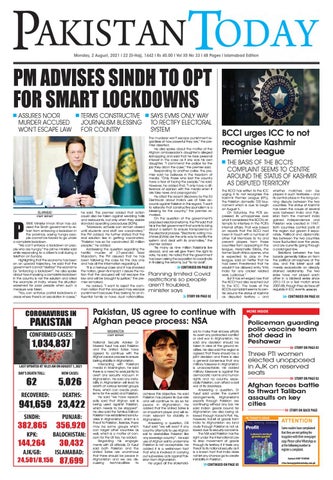
PM advises sindh to oPt for sMart lockdowns g
assures noor murder aCCused won’T esCaPe law
g
ISLAMABAD
P
staff report
rime minister imran Khan has advised the sindh government to refrain from enforcing a lockdown in the province, saying hungry people cannot be forced to go under a complete lockdown. “we can’t enforce a lockdown on people who are hungry,” the prime minister said while responding to a citizen’s call during a telethon on sunday. highlighting that the economy has been on an upward trajectory, he said that the government cannot “destroy” the economy by “enforcing a lockdown”. he also spoke about how imposing a complete lockdown in the country is not the solution and cited the example of india, where the situation worsened for poor people when such a measure was taken. “you can enforce partial lockdowns in areas where there’s an escalation in cases,”
Terms ConsTruCTiVe journalism blessing for CounTry
he said. The premier added that action could also be taken against wedding halls and restaurants, but only when they violate standard operating procedures (soPs). “moreover, schools can remain closed until students and staff are vaccinated,” the Pm added. he further stated that the real solution lies in getting vaccinated. “Pakistan has so far vaccinated 30 million people,” he added. addressing the question regarding the horrific murder of 27-year-old noor mukadam, the Pm assured that he has been following the case for the day one and has all the information regarding it. “it is a heinous case and it has shocked the nation, given its impact. i assure the nation that the accused will not escape the law and will be brought to justice,” the premier remarked. he added, “i want to reject the common notion that the accused may escape punishment because they belong to an influential family or have dual nationalities.
coronavirus in
Pakistan
CONFIRMED CASES:
1,034,837
LAST UPDATED AT 10:25 AM ON AUGUST 1, 2021
DAY'S DEATH TOLL:
NEW CASES:
62
5,026
RECOVERED:
DEATHS:
941,659 23,422 SINDH:
PUNJAB:
382,865
356,920
KPK:
BALOCHISTAN:
144,264 AJK/GB: 24,501/8,156
g
30,432 ISLAMABAD:
87,699
says eVms only way To reCTify eleCToral sysTem
The murderer won’t escape punishment regardless of how powerful they are,” the premier asserted. he also spoke about the matter of the afghan ambassador’s daughter’s alleged kidnapping and said that he took personal interest in the case as if she was his own daughter. “i commend the police for the job they did in the case,” the premier said. responding to another caller, the premier said he believes in the freedom of media. “only those who loot the country have a fear of facing the people,” he said. however, he added that, “i only have a difference of opinion with the media when it airs fake news and propaganda.” he cited the recent discovery by the eu disinfolab about india’s use of fake accounts against Pakistan in this regard. “i want to reiterate that constructive journalism is a blessing for the country,” the premier remarked. on the question of the government’s proposed electoral reforms, the Pm said that his is the first government that wants to bring about a system to ensure transparency in the electoral process. “electronic voting machines (eVms) are the only way to rectify the system and deal with its anomalies,” the premier added. “as many as nine million Pakistanis live abroad, and we will give them the right to vote, he said. he noted that the government has been asking the opposition to coordinate in finalising the reforms, but “to no avail”.
CONTINUED ON PAGE 03
Planning limited Covid restrictions so people aren’t troubled, minister says STORY ON PAGE 02
BCCI urges ICC to not recognise Kashmir Premier League g
The basis of The bCCi's ComPlainT seems To CenTre around The sTaTus of Kashmir as disPuTed TerriTory
The bCCi has written to the iCC urging it to not recognise the Kashmir Premier league (KPl), the Pakistan domestic T20 tournament which is due to begin on august 6. on saturday, the PCb expressed its unhappiness over what it considered the bCCi’s attempts to interfere in the PCb’s internal affairs. That was based on reports that the bCCi had been in touch with a number of other full members to try and prevent players from those countries from appearing in the league. herschelle gibbs, the former south africa opener, who is expected to play in the league, said on Twitter that he had been threatened that he wouldn’t be allowed entry “into india for any cricket related work. ludicrous.” but it has emerged now that the bCCi had also reached out to the iCC. The basis of the bCCi’s complaint seems to centre around the status of Kashmir as disputed territory – and
Pakistan, US agree to continue with Afghan peace process: NSA WASHINGTON staff report
national security adviser dr moeed yusuf has said Pakistan and the united sates have agreed to continue with the afghan peace process to ensure lasting stability in afghanistan. interacting with Pakistani media in washington, he said there is a need to work jointly to avert any security vacuum in afghanistan. he said any instability in afghanistan will lead to rebirth of various terrorist groups there, which can create problems for the world and Pakistan. he said “we have repeatedly said that afghan soil is being used against Pakistan, which needs to be stopped”. he also said the Tehrik-e-Taliban Pakistan has established sanctuaries in afghanistan, which is a threat to Pakistan. besides, there may be some groups which can target other countries as well, which is a matter of concern for the us too, he added. regarding his engagements with us officials, dr yusuf said both Pakistan and the united sates are unanimous that there should be peace in afghanistan and we are discussing technicalities to
achieve this objective. he said Pakistan has played its due role and will continue to do so for peace in afghanistan. he added that the united sates is an important player and will remain relevant for stability in afghanistan. answering a question, dr yusuf said “we will react if any country attempts to use afghan soil to destabilise Pakistan like any sovereign country”. he said use of afghan soil to undermine Pakistan is not acceptable. he added it is a well-known fact that who is involved in carrying out subversive acts against Pakistan from afghanistan. he urged all the stakehold-
ers to make their sincere efforts to avert any protracted conflict or civil war in afghanistan. he said any decision should be taken in view of the ground realities. he also said the region is agreed that there should be a joint decision and there is also a general consensus that any military takeover in afghanistan is unacceptable. he added military takeover is against the democratic norms and human rights and no country, especially Pakistan, can afford a civil war at its doorsteps. answering a question, dr yusuf said under the current arrangements, afghanistan’s exports through Pakistan are continuing without any bar. he said indian goods bound for afghanistan are also being allowed through Karachi Port. he, however, transit of goods from india to afghanistan via land route through Pakistan is not allowed due to security concerns. The nsa said Pakistan has the right under the international law to stop movement of goods through its territory if it feels any threat to its national security as it is a known fact that india does not let any chance go to create instability in Pakistan.
CONTINUED ON PAGE 03
whether matches can be played in such territories – and its central place in the long-running dispute between the two countries. The status of Kashmir has been the cause of several wars between india and Pakistan from the moment india gained independence and Pakistan was created in 1947. both countries control parts of the region but govern it separately. Political and diplomatic ties between the two countries have fluctuated over the years, and are currently going through a prolonged low. relations between the two boards generally follow on from the political atmosphere of the day, and this latest spat will merely exacerbate an already strained relationship. The two sides have not played each other in a bilateral series since 2012-13 or a Test match since 2007-08, though they do face off regularly in iCC events. agencies
CONTINUED ON PAGE 03
more inside
Policeman guarding polio vaccine team shot dead in Peshawar STORY ON PAGE 03
Three PTi women elected unopposed in ajK on reserved seats STORY ON PAGE 02
Afghan forces battle to thwart Taliban assaults on key cities STORY ON BACK PAGE in today’s issue
attention Some readers have complained that they are not getting the magazine with their newspaper copy. Please call or WhatsApp us at the following number to register a complaint. Contact: 0307-7338168 irfan.farooq@pakistantoday.com.pk
02
Monday, 2 August, 2021
ISLAMABAD
NEWS
PlAnnIng lImITed CovId reSTrICTIonS So PeoPle Aren’T Troubled, mInISTer SAyS ISLAMABAD
A
iNp
HEAD of possible nationwide Covid restrictions due to the rising numbers of infections, Federal Planning Minister Asad Umar and Special Assistant to the Prime Minister on health Faisal Sultan held on Sunday a presser to explain statistics and possible restrictions that the country might face. “We are planning targeted restrictions with coordinated plans so that people are least troubled,” said Asad Umar while noting that Pakistan has fended off Covid carnage better than in the other regional countries, where the disease had wreaked havoc.
He said everyone witnessed the ravaged state of India and Iran and noted that Pakistan has nevertheless been steered off safely in all the preceding waves of the pandemic. The past few weeks have seen Covid laying destruction in Indonesia and Bangladesh while Afghanistan numbers are not too promising as well, he said as he underscored the threats and dreads of the delta variant. There have been 2,600 vaccination centres established across Pakistan and 3,000 mobile teams administering the vaccine to people door to door, he said. He shared numbers of Covid vaccinations that how in just the past 16 days the country jabbed 10 million people, which is the same number of vaccines administered in
Three PTI women elected unopposed in AJK on reserved seats MUZAFFARABAD iNp
Pakistan Tehreek-e-Insaaf (PTI) secured three seats out of nine followed by Pakistan Peoples’ Party (PPP) and Pakistan Muslim League-Nawaz (PML-N) who managed to obtain one seat each as the elections on five reserved seats for women in the Azad Jammu and Kashmir Legislative Assembly has completed. Three women candidates of PTI have been elected unopposed out of five reserved seats for women in the Azad Kashmir Legislative Assembly. Sabiha Siddique Chaudhry, Imtiaz Naseem and Taqdees Gilani from the PTI were among those elected unopposed. After three reserved seats for women, the number of PTI members in the AJK Legislative Assembly has risen to 29, while the PPP and PML-N stand at 12 and 7 respectively. Meanwhile, the polling on three special seats for technocrats, Ulema and Mashaikh (Muslim religious scholars) and overseas Kashmiris will be held on Monday. On the other hand, the inaugural session of the newly elected Azad Jammu and Kashmir Legislative Assembly will be held on Tuesday, wherein the newly elected members of the house will take oath of their office.
Sindh designates Covid vaccination centres in Karachi NEwS DESk The Sindh government on Sunday designated centres for Covid vaccination in Karachi in order to facilitate the general public. According to details, more hospitals for corona vaccinations include: DOW Ojha Campus in district East; I Khaliq Dino Hall, JPMC and Lyari General Hospital in district South; Children Hospital, Sindh Government Hospital New Karachi and SG Hospital Liaquatabad in district Central; Sindh Government Qatar Hospital in district West; SG Hospital Murad Memon Goth, district Malir; and SG Hospital Korangi-05 and SG Hospital, Saudabad, in district Korangi. BUsinesses wiTh VACCinATed sTAff To reopen: The Sindh government has assured traders of reopening business sectors whose workforce has received Covid-19 vaccination from August 09. In a hurriedly called meeting with traders on Sunday, Sindh Information Minister Nasir Hussain Shah said that they would allow businesses having vaccinated workforce to operate from August 09. “We will be facilitating traders with setting up separate vaccination centres for them,” he said as traders said that they were also assured of relief in municipal taxes and provision of interest-free loans. The All-City Tajir Ittehad asked the provincial minister to open wholesale markets as there is less congregation in these markets. Nasir Shah said that the government would ask the police to deal with traders in a polite manner. “I am thankful to the business community for supporting the government on the Covid-19 situation,” he said, adding that all businesses would be reopened after the implementation of the Covid SOPs. He, however, warned that anybody challenging the writ of the government will have to face a shutdown of their shop for 30 days. It is pertinent to mention here that the Sindh government on Friday announced to impose a lockdown in the province from July 31 until August 08 after an abnormal surge in Covid-19 cases, especially in Karachi. The decision was taken by Chief Minister Sindh Syed Murad Ali Shah during the meeting of the Covid task force that was specially attended by opposition leaders and traders. “Lockdown would remain in place in the province from July 31 to August 08,” Murad Ali Shah said.
the first 113 days of the vaccination drive. We jabbed around 934,000 people just yesterday, he added. Pakistan has given doses of a coronavirus vaccine to more than 30 million people as public health experts call on the government to target future vaccinations in hotspots where the disease is threatening to run out of control. Official figures from across the country showed that 934,608 people received a jab on Saturday, taking the headline total to 30.59 million, less than six months after the programme began in March. Giving the breakdown of jabs in a tweet separately, the minister said the first 10 million shots took 113 days, the second 28 days and the third only 16 days.
“[The] pace [of vaccination] has rapidly increased. All six days this week were a record. 9 lakh 34 thousand vaccinations yesterday [Saturday]. In [the] last six days, five million vaccinations were done,” he said. The tweet came as the government portal keeping track of the outbreak in Pakistan registered 5,026 new cases in the last 24 hours, its highest single-day increase in infections since April. The last time when the number of daily cases crossed 5,000 was on April 29 with 5,113 cases. Pakistan has seen coronavirus infections soar, dominated by Delta variant, and its fragile health infrastructure is under extreme pressure. The Delta variant, which has been classified by the World Health
Organisation as among the four Covid-19 variants of concern due to evidence that they spread more easily, likely caused the latest outbreak. The highly contagious mutation is surging through Asia, with record numbers of infections in Australia and South Korea, prompting some countries to tighten curbs and others to hasten vaccination. According to the National Command and Operation Centre, it tested 56,965 samples on Saturday, receiving back a positivity rate of 8.82 percent. The latest figures also showed that 62 Covid-19 deaths were recorded in the last 24 hours, taking the overall number of deaths related to the coronavirus in Pakistan to 23,422. With infection numbers
16 MEPs letter to EC president urges to implement UN resolutions on Kashmir BRUSSELS stAff report
A letter addressed to the European Commission president and signed by 16 members of the European Parliament has raised the Kashmir issue was received by Kashmir and urged that the EU should use all its leverage and tools to cooperate with our Indian and Pakistani partners to honour the pledge made to the Kashmiris by the international community and create an environment conducive to the implementation of the United Nations resolutions. MEPs declare warned EU about the humanitarian crisis and said that the long-standing dispute over Jammu and Kashmir in South Asia also poses a major threat to peace, stability, and
security in the region, being a flashpoint between two nuclear-armed countries and we are worried that any miscalculation can lead to unwarranted consequences. MEPs accused Indian forces of misusing the special powers against the Kashmiri population. Highlighting the miseries faced by the people, the letter says that a number of legislations introduced by the Indian governments over the years to prevent terrorism and separatism, including the Special Powers Act, the Armed Forces Special Protection Act and the Unlawful Activities Prevention Act, have been often misused against the Kashmiri population. “This Indian-administered region had already suffered a debilitating
lockdown since the revocation of its special status in 2019, and the restraints on the rights to movement, access to information, health care, education as well as free speech have been intensified by the Covid-19 pandemic,” it stated. It read: “As a champion of universal human rights, fundamental freedoms and the rule-based international order, the EU must raise its voice against the violations of human rights affecting the people of Jammu and Kashmir. We believe that the EU should use all its leverage and tools to cooperate with our Indian and Pakistani partners to honour the pledge made to the Kashmiris by the international community and create an environment conducive to the implementation of the United Nations (UN) resolutions.”
beginning to rise again, the government has ramped up its vaccination efforts. Health experts say it was too early to see any positive impact from the vaccinations because so many had taken place so recently. The government has offered a first dose of a Covid-19 vaccine to 24.08 million people, or 9.1 percent of the total population. Those involved in the programme say refusal rates have been relatively low. Public health experts said there was now a case that the vaccination should be rolled out faster in hotspot areas after a research released over the weekend suggested it could cut transmission of the virus by two-thirds. Late on Saturday, the Punjab government announced targetted restrictions in 13 neighbourhoods of Lahore after recording an uptick in the transmission rate. Umar during the presser also shed light on the curbs that the federal and provincial governments have imposed in different cities of the country to contain the spread of the virus and said that both the Centre and the provinces “are in this situation together.”
The leTTer highlighTed The following poinTs: To convey our grave concerns at the violations of human rights and fundamental freedoms in the Indianadministered Jammu and Kashmir to the Indian Government; To take urgent action to address the alarming human rights situation in the region; To contribute to the peace and stability of the region enhancing dialogues with India, Pakistan and the representatives of Kashmiri people, making use of our special relationships with both India and Pakistan to facilitate engagement and dialogue between the two neighbours and resolve the dispute through peaceful means and in accordance with the wishes and aspirations of the people of Kashmir. EU-Pak Friendship Federation Chairman Chaudhry Pervaiz Iqbal Losar has said that all credit for the letter goes to the MEP Fabio Massimo, who is a staunch supporter of Kashmiris demanding implementation of UN resolutions and is lobbying for it since 2014 in the European Parliament.
Terrorism Watch: July witnesses rise in terrorist attacks but decline in human loss ISLAMABAD MiAN AbrAr
Although July 2021 witnessed highest number of militant attacks in a single month in Pakistan during the ongoing year, the number of deaths slightly declined compared with June and May 2021. According to the statistics released by an Islamabad-based independent think tank, Pakistan Institute for Conflict and Security Studies (PICSS), the institute recorded 25 militant attacks in July 2021 which claimed lives of 33 people including 24 civilians and 9 security forces personnel.
54 were injured including 36 civilians and 18 security forces personnel. While in June 2021, PICSS had recorded 22 militant attacks in which 42 people were killed and 56 others were injured. The number deaths also declined in July as compared with May as in May 41 people were killed. The highest number of militant attacks were reported in Khyber Pakhtunkhwa province where ten militant attacks were carried out which claimed 20 lives including 16 civilians and six security forces personnel. 35 others were injured including 29 civilians and six security forces personnel. It appeared that the epicenter of militant attacks shifted this month from Balochistan region to KP. Tribal districts of KP
(Erstwhile FATA) also witnessed nine militant attacks in which ten people were killed including seven civilians and three security forces personnel while three others security forces personnel injured. Four militant attacks were carried out in Balochistan which claimed lives of two security forces personnel while 15 others were injured including nine security forces personnel and six civilians. Sindh witnessed two militant attack in which one civilian was killed and one other was injured. While Punjab province, Islamabad Capital Territory (ICT) Azad Jammu Kashmir (AJK), witnessed no militant attack.
The universe goes back to normal City Notes M A NiAzi There’s been a lot of worry about the Indian having used software from Israel to hack an inordinate amount of telephones, including that of Prime Minister Imran Khan. I wonder whether Imran has consulted Ch Shujat Hussain about this, because he was faced with a similar problem years ago, but at home. It seems that Ch Shujat’s sources told him that thenprime minister Benazir Bhutto had ordered that not only Ch Shujat’s phone be tapped, but that as soon as a call was complete, the tapes be rushed over to the PM. Ch Shujat was then in the opposition, and she apparently suspected Ch Shujat of being the key figure in any plan to sack her. In the succeeding days, Ch Shujat’s friends and acquaintances, anyone who had given him their number, were awakened around dawn by Ch Shujat on the blower, anxious to discuss the iniquities of the PPP government. Obviously, Ch Shujat did not have much to say in approval, and the diatribe would very quickly descend to him swearing colourfully against Benazir. Now Ch Shujat was much younger than today, and his speech was clear as a bell. And a Jat of Gujrat knows how to swear at length, colourfully and eloquently. Now all these diatribes were delivered post-haste
to Benazir, which meant that not only were her days started earlier than she would have liked, but those early morning starts were to the sound of Ch Shujat sounding off about her in the crudest Punjabi that he could think of. This went on, they say, till Benazir rescinded the order, Ch Shujat was informed, and his circle could get their morning beauty sleep. Ch Shujat has been a PPP ally, so Imran could probably do the same. Would that presage a time when he would be a Modi ally? I doubt it, because I don’t think his widow will ever get near succeeding him. But then, these days, what would the Indian listeners hear except congratulatory yelps and celebratory whoops, as the victory in the AJK elections was followed by one in the Sialkot byelection? The wins provided a sort of reassurance that the universe still operates according to the laws of physics, that the party ruling in Islamabad still wins the AJK elections, and that the party ruling the province still wins the by-elections. The PTI had actually put this to the test, by having Ali Amin Gandapur not just Kashmir Affairs Minister, but one ready to call Bhutto names. That the AJK result was safely delivered despite him, is a tribute to the men who ensure that patriotism always triumphs, and that treason is always defeated. Then there was the victory in Sialkot, which is probably what saved Usman Buzdar as Punjab chief minister. Now that is the sort of byelection result that has been traditional: an opposition
seat which swings to the government. There seem to be some convulsions about the murder of Noor Mukadam in Islamabad, but the killer, Zahir Jaffer, took one of the most privileged pleas possible: that he was an American citizen. He might have in mind the way how the US government put pressure on the government in the Raymond Davis case, and hoped against hope. He had planned to get back to the USA after the murder, but he was caught before he could fly off. But he shouldn’t expect American support. I mean, Davis was white. His victims were Pakistani. But still, that case does hold out some hope. If Noor’s family can be persuaded to take blood money… Of course, the murder will not be proved. There is no evidence of an old enmity, nor was Zahir heard to have given a lalkara, which is a detailed shout enumerating the reasons out loud. That the beheaded corpse, as well as the murder weapon, was recovered from his room, can be explained away by any clever mouthpiece. But not a lalkara. And let alone an old enmity, the two families seem to have been friends. More generally, there seems to have been a flurry of worry over the delta variant of covid-19.It seems to be more infectious and more deadly. It reduced India to ruin. Well, we tried to make things easy for it during Eid. But the worst part is that it might make vaccines ineffective. That can’t be good.
Monday, 2 August, 2021
ISLAMABAD
PolicemAN gUArdiNg Polio vAcciNe teAm SHot deAd iN PeSHAwAr tHe ASSoCIAteD preSS
g
UNMEN on a motorcycle shot and killed a police officer returning home after security duty with polio vaccination workers in Peshawar, police said. The killing came during one of two attacks in Khyber Pakhtunkhwa on Sunday on police providing security for polio vaccination teams.
The officer was returning home on his motorcycle after providing security for a polio team, said Iftikhar Khan, the area police chief. Meanwhile, a roadside bomb exploded as a police van passed by while escorting a polio vaccination team in the Ladha area of the South Waziristan tribal district. The blast wounded an officer in the van, said police officer Shaukat Ali. In both attacks, members of the vaccination teams were unhurt. No one
immediately claimed responsibility for either attack. The violence came two days after the government launched polio vaccination drives in 18 districts of the province to eradicate the crippling disease by the end of the year. Militants often target polio teams and police assigned to protect them claiming the vaccination campaigns are a Western conspiracy to sterilise children. Pakistan and Afghanistan are the
only two remaining countries in the world where polio is endemic, after Nigeria was last year declared free of the virus. Aimal Khan, provincial spokesman for the anti-polio programme, said the goal of the five-day drive was to vaccinate 3.7 million children. Nearly 17,000 trained workers were going home-to-home to administer the vaccines, he said. Police and security forces have been assigned to protect the vaccination teams.
Punjab government plans to demolish Wahdat Colony and Mayo Gardens LAHore Shahab omeR
The Punjab government has decided to demolish the oldest and historical residential area ‘Wahdat Colony’ which was built for government employees in Lahore and the the government has also decided to demolish historical houses in Mayo Garden which was built during the British Era for the officials of Pakistan Railways. According to details, the Punjab government has recently established an authority ‘Lahore Central Business District Development Authority (LCBDDA) and the purpose of the authority was to regenerate the city and build high-rise buildings on government land. Moreover, the authority planned to vacate the area of Wahdat Colony by constructing multi-storey flats in the same area for all the residents of Wahdat Colony and constructing high rise buildings on the rest of the area
NHA launches tree plantation drive along highways ISLAMABAD app
The National Highway Authority Sunday launched an afforestation drive to increase green cover along the highways under the Clean and Green Pakistan programme. According to a press statement, the initiative was taken in line with the vision of Prime Minister Imran Khan and directives of Minister for Communications and Postal Services Murad Saeed. NHA Maintenance General Manager Iftikhar Ahmed Sajid along with a team planted saplings at various locations. A memorandum of understanding was also signed between the authority and the Field Sports and Conservation Society for tree plantation along the Lahore Eastern Bypass. A plantation drive along the aforementioned highway was already underway, it added. A ruling MP from Sheikhupura, Rahat Amanullah Bhatti, also planted a sampling along the highway. Similarly, a plantation campaign was also undertaken at Karachi Northern Bypass by Sindh Assembly Opposition Leader Haleem Adil Sheikh. Another MoU was signed between the NHA and a private real estate developer to carry out the plantation campaign. The tree plantation campaign would be continued in the upcoming days, the statement said.
Pakistan, US agree to continue with Afghan peace process: NSA ContInueD froM pAge 01 Dr Yusuf said, despite all this, Pakistan, especially Prime Minister Imran Khan, has tried its best to improve bilateral relations with India and both the countries can live like a civilised neighbours. But, unfortunately, India, at present, is being ruled by an ideologically motivated government that actively pursues Hindutva ideology. To another question, Dr Yusuf said Islamabad desires peace in Afghanistan as it is not only in the best interest of Pakistan, but it also serves the interests of other countries. He said Pakistan wants sustainability in Afghanistan’s economy and will welcome any country to invest in the economic development of Afghanistan. Regarding repatriation of Afghan refugees living in Pakistan, the SAPM said “we want dignified return of these refugees to their homeland”. He said no country has extended generous hospitality toward Afghan refugees more than Pakistan.
and using it for commercial activities. Similarly, the authority also intended to occupy the area of Mayo Garden which was the land of Pakistan Railways and where the residences of railway officers were located, the demolition process should be started there too and high rise buildings should be constructed. The chief executive officer of LCBDDA, Imran Amin, speaking to this scribe, informed, “We have taken the data of all the residents of Wahdat Colony. Since this is all a government place and only government employees are living in houses built by the government here. Maintenance is a big issue in this colony. Our plan is that, first we will build multi-storey flats in some areas here and later we will give ownership rights to the residents by shifting them to these flats. We are making this plan for about two and a half thousand residents which will benefit the residents as they will get their own house. Similarly, there is a slum in this area and its resettlement plan will be
fulfilled by building multi-storey houses at low cost. Later we will move this whole area for commercial activities. The resettlement of slums will also fulfill the government’s vision of housing and start our commercial activities,” he said. When this scribe asked that this is a very difficult task because the resident of Wahdat Colony has to retire one day or the other and those whose retirement is imminent, will they also get property rights? He replied that the government would decide to whom and how the property rights would be given. “The general concept of colonies needs to be scrapped as it becomes difficult for the government to maintain them. This is the concept of urban regeneration. However, whatever projects we undertake will be financially, technically and socially feasible. Similarly, with Pakistan Railways, we are still considering the residential area of Mayo Garden in Lahore at the very early stages.
PM advises Sindh to opt for smart lockdowns ContInueD froM pAge 01 The PM questioned the opposition’s claims of rigging in the Azad Jammu and Kashmir elections. He further added that all government functionaries in AJK belonged to the Pakistan Muslim League-Nawaz (PML-N). “The PML-N also lost Sialkot polls,” the prime minister said, adding that the “AJK premier himself alleged rigging in the polls.” The premier reiterated that the only solution to all such allegations was to introduce the electronic voting system. To another question, the PM said that those being targeted for their corruption are pressurising the government to be granted an NRO (national reconciliation ordinance). “These elements threaten to dislodge the government so as to keep their corruption hidden,” he added. Answering a question regarding job quotas, the premier said that the Centre’s jurisdiction is smaller as compared to provinces, therefore, he would instruct all
the provinces to allot job quotas to deserving people. The premier also shed light on the future of the government’s flagship Ehsaas Programme. In response to a question, the premier said that he could earlier not invest time in developing sports in the country but now — during the last two years of his government’s tenure — he will oversee the development of sports in the country. Shedding light on electricity load shedding, he acknowledged it has caused trouble to the people, adding that the country’s power supply was affected due to water shortages as the dams received 35 percent less water this year. The prime minister said he spoke to Saudi Arabia’s Foreign Minister Prince Faisal bin Farhan Al Saud on the issues faced by Pakistanis residing in the Kingdom. “The Saudi foreign minister assured me he would resolve them,” he said. The premier said on the request of the Pakistani community living in Uzbekistan, the federal government is working on establishing a Pakistani bank over there.
NEWS
03
roof collAPSe KillS five cHildreN iN lodHrAN newS DeSk At least five children were killed while three others were injured on Sunday when the roof of a room collapsed near Shujaabad Road in Lodhran, according to reports from rescue officials. According to details, children were watching TV in a room of the under-construction house when the roof collapsed. Five minors who got trapped in the rubble died while three others were injured and shifted to a hospital for medical treatment. Upon receiving information, the rescue teams claimed they reached the location in time and pulled all eight children out from under the rubble. On July 21, at least eight people, including two minors belonging to the same family, died while several others sustained injuries in rain-related incidents in different parts of the country, officials and rescuers reported. Intermittent monsoon showers continued to pummel Punjab and Khyber Pakhtunkhwa, inundating the low-lying areas, damaging houses and causing road accidents. A light rain was also reported from Karachi and other parts of Sindh. Two children of a family died in their sleep, while three other children and the houseowner and his wife sustained multiple injuries after the roof of their house collapsed in Kamal Khel village of district Kohat due to heavy downpour in the city, the local police said.
Bcci urges icc to not recognise Kashmir Premier league ContInueD froM pAge 01 But there would appear to be little the ICC can do about this. Approval for such domestic leagues is given by the Full Member country in which the tournament is being played, and not the ICC, and the KPL has the PCB’s approval. There is also nothing in any ICC regulations about matches in disputed territories. The KPL is a six-team franchise-model league, PCB-approved, and to be played at the Muzaffarabad cricket stadium in Pakistanadministered Kashmir from August 6. Squads were selected in a draft last month and, according to the organisers, would be captained by Shahid Afridi, Shoaib Malik, Imad Wasim, Mohammad Hafeez, Kamran Akmal and Shadab Khan. The BCCI’s concern centres, however, on the foreign players signed up with the league, on the basis that international players turn the tournament into something more than just a domestic event and give it international legitimacy of sorts. Foreign players on the roster are retired and include Monty Panesar, Matt Prior, Phil Mustard, Tino Best, Tillakaratne Dilshan and Gibbs. Through conversations with several boards, the BCCI has made it clear that these players would be considered rebels and would be treated by them as would the participants of any unrecognised league.
Improving drainage only way to avoid urban flooding risks: WASA chief ISLAMABAD Staff RepoRt
As monsoon rains mark the start of the rainy season, Water and Sanitation Agency chairman Tariq Mehmood Murtaza Sunday said the agency was put on high alert to meet any emergency-like situation due to urban flooding in the Lai drain in Rawalpindi. Talking to a news channel, Murtaza expressed hope the people would be responsible in conduct and cooperate with the agency’s officials at the time of evacuation. He said the agency was prepared to face a potential
flash flood in the coming days and all arrangements have been finalised for the relocation of the affectees. Responding to a query, he said the drain passed through a congested neighbourhood and widening of its corners was also a challenge for the agency. He added that about 1,600 people living around the drain were also to be saved from any potential damage. He said WASA had already provided compensation to affectees and had removed many encroachments from there. As far as low-lying areas around the drain were concerned, we had dug wells to resolve the water issue,
he said. Talking about his future plans of action, he said planning was being done to deal with urban flooding threats during monsoon season. He said due to unplanned town structures, nearby drains were causing blockage of floodwater and after a restructuring of drains, especially Leh drain which was the only watercourse of the floodwater in twin cities, the problem could be solved permanently. To avoid any unpleasant situation he said, the authority launched a pre-monsoon cleanliness campaign of the main drains in the city.
Alvi advises student to request institution to retake test ISLAMABAD app
President Dr Arif Alvi on Sunday, on complaint of a medical student facing denial by his institution to appear in examinations, said the aggrieved could invoke a relevant clause of Pakistan Medical Commission that gave universities a prerogative to allow students as many retakes. Sarbuland Khan had filed a representation with the president assailing the order of federal ombudsperson, which had upheld the decision of Muhammad Medical College in Mirpurkhas on grounds that the case was timebound. Khan had mentioned that he had failed twice in the second year’s paper of
Biochemistry, and under the rules had four chances to pass the examination. However, he could not avail the third and fourth chances as the medical college did not intimate him timely and also had banned his entry into the institution. He prayed before the president that if he was not given a chance to appear in the examination, then the medical college be directed to refund his paid fee Rs1,500,000 with seven-year interest. He also requested for rechecking of his paper, wherein he had failed by one mark only. The ombudsperson, in its order, said no maladministration on part of medical
college was evident and the assertion of the complainant for the four-time limit under Pakistan Medical and Dental Council stood repealed after the Pakistan Medical Commissioo Act, 2020, came into force. The president, in his decision, referred to a notification of PMC Admission Regulations (Amended), 2021, that explained on how the university could allow the students to retake the examinations. “A university may allow a student as many retakes as may be determined by
the university, subject to no student being required to pay the college tuition fee in addition to the fee paid for the given year,” he quoted the notification’s chapter four. He also mentioned another provision of the same clause titled “Opportunity to retake failed examinations” which stated: “Each university shall frame its own regulations for allowing failed students to retake professional examinations and such regulations shall be publicly notified and made available to the students.” Alvi said: “there was no fault with the orders passed by the Wafaqi Mohtasib”, however the complainant, if desired, could invoke the said clause. “If so desired, the complainant may take a chance of invoking the above mentioned R.16 before the competent authority for redressal of his grievance,” he added, disposing of the representation.
Monday, 2 August, 2021
04 NEWS
ISLAMABAD
LAHORE: A view of Jahangir's Tomb in the outskirts u of the provincial capital. ZUBAIR MEHFOOZ
PAkisTAn RAnks ‘chEAPEsT cOunTRy TO livE in’ AFGHANISTAN COMES IN SECOND, INDIA THIRD AND SYRIA FOURTH, ACCORDING TO COST OF LIVING INDEX BY GO BANKING RATES COMPANY ISLAMABAD
P
APP
AKISTAN has been ranked as ‘the cheapest country in the world to live in’ with a cost of living index showing 18.58, followed by Afghanistan 24.51, India 25.14 and Syria 25.31, according to cost of living index by GoBankingRatesCompany. Several organisations have used statistics to determine the cheapest countries to live in. One of these companies is GoBankingRates and the company uses four metrics to determine which countries are the most affordable.
The metrics used include rent index, local purchasing power index, consumer price index, groceries index and information compiled is compared to the cost of living in New York City, one of the most expensive cities in the world. The index confirms the stability in prices of daily commodities in Pakistan making living as the most affordable and cheapest in the world. Contrary to it, worldwide, the prices of daily commodities spiraled impacting the most thriving economies of the world amidst coronavirus pandemic which resulted in tumbling down of income per capita and steep rise in the daily inflation. According to the US Department of
Agriculture’s latest report, the global food supplies are expected to grow in 2021-22 and so the prices of daily commodities, driven by strong demand and supply shortfalls. Whereas in a corresponding report by the United Nations Food and Agriculture Organisation (FAO) projected that world food prices were set to rise on monthly basis. The FAO’s food price index, measured monthly changes for a basket of cereals, oilseeds, dairy products, meat and sugar. According to it, the vegetable oil price index jumped due to rising palm, soy and rapeseed oil quotations. Palm oil prices were boosted by slow production growth in southeast Asia, while prospects of robust global demand, especially from the biodiesel sector, drove up soy oil prices. The sugar index also posted a 6.8% month-on-month gain, due to harvest delays and concerns over reduced crop yields in Brazil, the world’s largest sugar
exporter, FAO said. The FAO also noted similar rising trends in the prices of almost major edible items on monthly basis as the world was still reeling under the impacts of Covid 19. The GoBankingRatesCompany said on the opposite end, the most expensive countries to live in are the Cayman Islands 141.64, Bermuda 138.22, Switzerland 122.67, and Norway 104.49. All four of these countries have a higher cost of living than New York City. The cost of living is the money needed to sustain a certain comfort level in a location and covers basics like housing, groceries, taxes, and healthcare. Some countries have a very high cost of living, particularly in areas surrounding large cities as in the United States, cities like New York and San Francisco have a very high cost of living. On the flip side, some nations have a very low cost of living, so many people are packing their belongings to move to these countries.
Pakistan to be special partner country at 18th CAEXPO in China BEIJING AGENCIES
Pakistan, like the previous year, will be the special partner country at the upcoming 18th China-ASEAN Expo (CAEXPO) to be held in Nanning, Capital of Guangxi Zhuang autonomous of China from Sept 10 to 13. The Pakistan Pavilion will be established to display major export and cultural items as well as print and audio-visual material on tourist attractions of Pakistan. In addition to Pakistan Pavilion, around 25 stalls to exhibit various Pakistani products will be set up at the exhibition center of the Expo, Muhammad Irfan, Trade and Investment Counsellor, Pakistan Consulate, Guangzhou told APP. Pakistani entrepreneurs will showcase jewelry, precious stones, marble, carpets, furniture, handicrafts, and sports goods during the exhibition. Trade and Investment Conference would also be organized on sidelines of the expo as part of the celebrations of 70 years of the establishment of diplomatic relations between China and Pakistan, he added. Pakistan Ambassador to China, Moin ul Haque is likely address the Chinese investors and businessmen at the conference and brief them about the investment-
friendly environment offered by the incumbent government in Pakistan. According to senior Chinese government officials, the event would facilitate China and the 10-member Association of Southeast Asian Nations (ASEAN) to further broaden trade relations under the regional free trade agreements and supported the recovery of global economy. The exhibitors and purchasing agents from Japan, Republic of Korea, New Zealand, and other signatory states of Regional Comprehensive Economic Partnership (RCEP) have been invited to participate in the expo this year. This should help deepen the cooperation between the two sides, said Liu Hongwu, vicechairman Guangxi. The exhibition will hold 27 high-level forums, covering sectors from green development to digital economy. With a total floor area of 124,000sq metres, the expo will have a dedicated RCEP display zone and organise training workshops themed on the agreement details, to facilitate early implementation of the RCEP. To deepen economic cooperation between China and the Asean, China will promote regional economic integration and the implementation of the RCEP agreement, as well as further regional interconnection of RCEP members in the next stage, said Ren Hongbin, assistant commerce minister.
Benefiting from the complementary goods trade structure, easing of the pandemic and vaccinations in the Asean region, China’s trade with it soared 38.2 per cent year-on-year to US $ 410.76 billion in the first half of this year, according to the Ministry of Commerce. China mainly ships medical products, construction machinery and materials, manufacturing equipment, steel, electronics and household appliances to Asean markets. In addition to minerals, precious and base metals, and agricultural products, the bloc’s exports to China include natural rubber, timber and materials of textile and garment goods. “The close business ties and FTAs, including Asean-China Free Trade Agreement, will facilitate the two sides to better integrate resources in the coming years, and build a high-quality service platform to restore both regional and global economic growth,” said Zhang Shaogang, vice-chairman of the Beijing-based China Council for the Promotion of International Trade. Owing to epidemic prevention and control requirements, which are similar to those seen last year, the expo this year will combine a physical trade show with an online version. It’s online platform will be running all year round, providing companies with business promotion services on a regular basis.
CMYK
OGRA issues pipeline construction and operation licenses to Energas, Tabeer ISLAMABAD SHAHZAD PARACHA
The Oil and Gas Regulatory Authority (OGRA) has issued licences for construction and operation of pipelines, the last leg of Liquefied Natural Gas (LNG) supply, to Energas Terminal (Pvt.) Limited and Tabeer Energy (Pvt.) Limited. According to the authority, all licensing formalities have been completed in the minimum possible time enabling companies to install facilities and bring RLNG in the country. Once the facilities are completed and made operational by the two companies, the country will have an additional supply of 1500-2000 MMCFD of natural gas for industrial and other customers. According to a statement by OGRA, this activity will bring huge investment in the RLNG sector, competition in the gas market, create new job opportunities by restarting operations of closed industries and starting new ones, thus playing a vital role in the country’s economic boost. Imran Ghaznavi, a spokesman of OGRA, said that the authority is determined with its vision in cohesion with the federal government’s policy to contribute towards growth of the energy sector and ensure that the energy market is accessible, competitive and profitable. He said that OGRA has granted these licences for the implementation of policies and to increase private investment and ownership in the midstream and downstream oil and gas industry of the country while protecting public interest and providing effective regulation. He said in this effect, OGRA, in the recent past, has granted licences to the private sector including the LNG virtual pipeline licences to Daewoo Pvt. Ltd. and LNG Easy Pvt. Ltd., and sale of RLNG licences to Trafigura, and Shell Energy. Earlier, the authority granted licences for an LNG Terminal with the capacity of 750-1000MMCFD each and sale of RLNG licences. It is pertinent to mention here that Pakistan has announced that it will auction highly lucrative oil and gas exploration blocks, mainly the ones earlier awarded to exploration firms; however, the deals were later cancelled or remained under litigation by the end of the year in an effort to increase hydrocarbon production. The move is expected to help reduce the country’s reliance on expensive imported fuels. The government unveiled the strategy to increase local production and overcome energy scarcity after booking four cargo ships of LNG at a high price of over $15 per million British thermal units (mmbtu) for September delivery. “The government is doubling down on its efforts to enhance gas production by launching the next exploration and production bidding round, targeting high-potential ‘surrendered’ and ‘under litigation’ blocks, by the year end,” the Ministry of Energy said in a statement on Friday. “Earlier, the government cancelled awarded blocks in Balochistan and Sindh after the winning companies failed to initiate work or develop the blocks for production or they were placed under litigation for some reason,” Pak-Kuwait Investment Company Head of Research Samiullah Tariq said.
Monday, 2 August, 2021
ISLAMABAD
NEWS
05
PSX faceS tough week amid covid, Sindh lockdown KARACHI
gold’s near-term outlook remains bullish After closing the last week in green, gold’s near-term outlook remains bullish and the majority of experts see gold trading above its current level by the end of August. During this week, the ISM will release the Manufacturing PMI report for July on Monday. A reading above 90 could revive inflation concerns and help the US dollar gather strength. The same goes for the ISM’s Services PMI report, which will be published on Wednesday. On Thursday, the weekly Initial Jobless Claims will be the only data featured in the US economic docket. On Friday, the US Bureau of Labour Statistics will publish the Nonfarm Payrolls data for July. A stronger-than-expected reading could cause investors to price a hawkish policy outlook and lift the US dollar against its peers and vice versa. Following the decline of last Friday, the Relative Strength Index (RSI) indicator on the daily chart retreated to 50, pointing to a loss of bullish momentum. Additionally, gold closed the week below the critical 200-day SMA after rising above that level on Thursday, suggesting that buyers are struggling to remain in control. In the near term, gold seems to be poised to move sideways between the 100-day SMA and 200-day SMA but the market reaction to Friday’s US jobs report could cause it to break out of that range. On the upside, the initial resistance is located at $1,820 (200-day SMA) ahead of $1,830 (50-day SMA) and $1,845 (static level). Supports, on the other hand, are located at $1,810 (20-day SMA), $1,800 (100-day SMA, psychological level, Fibonacci 50% retracement of the April-June uptrend) and $1,790 (July 23 low). After closing the previous week in the negative territory, gold stayed on the back foot on Monday and dropped below $1,800. However, the subdued market action ahead of key macroeconomic events allowed the precious metal to stay in a consolidation phase on Tuesday. With the greenback coming under heavy selling pressure in the second half of the week, gol managed to stage an impressive rebound. Following a rally to a fresh two-week high of $1,832 on Thursday, the pair retraced a portion of its upside but registered weekly gains by settling at $1,815.20 per ounce. NEWS DESK
fBR surpasses July revenue collection target by Rs71bn The Federal Board of Revenue (FBR) collected net revenue of Rs413 billion in the first month of the fiscal year 2021-22, showing about 36 percent growth over the collection of Rs303 billion during the last year’s corresponding period. According to provisional data, July’s tax collection surpassed the target of Rs342 billion by Rs71 billion. The FBR said it disbursed refunds amounting to Rs20 billion compared to Rs15.7 billion paid last year, showing an increase of 26.6 percent. “This is reflective of FBR’s resolve to fast-track refunds to prevent liquidity shortages in the industry despite facing the challenge of fourth wave of Covid-19,” it pointed out. Income tax returns for tax year-2020 reached 3.53 million compared to 2.72 million in tax year-2019, showing an increase of 30 percent. The tax deposited with returns was Rs51 billion compared to Rs33 billion last year, showing an increase of 54percent. The tax collecting body said 11,744 point of sale terminals have been integrated with the real time reporting system of FBR. Pakistan Customs collected Rs67 billion under the head of customs duty during July 2021 whereas during the month of July last year, an amount of Rs49 billion was collected, which showed growth of 37 percent. During July 2021, smuggled goods worth Rs3.6 billion were seized. NEWS DESK
a
TLTP
recent surge in Covid-19 cases and lockdown in Sindh may dent investors’ confidence and the Pakistan Stock Exchange (PSX) is likely to witness volatile sessions; however, ongoing result season may help some equities perform sideways. According to analysts, the investors should adopt the sell on strength strategy in the upcoming week. “Going forward, we expect the market will remain volatile,” they opined. “In the light of the Covid concerns, we recommend investors to adopt a buy on dips strategy in the banking, textile and fertilizer sectors,” they said. According to them, with the result season commencing, and cyclical expected to post a robust jump in the earnings on a yearly basis, given a nationwide lockdown was enforced in the second quarter last year, certain select stocks might come under limelight next week. “Karachi is set to observe a more stringent lockdown in place this week to contain the highly contagious delta variant of the novel coronavirus, and it appears the market may remain upward sticky in the short-term,” they said. On the regional level, major stock markets in Asia closed the week with massive losses. Last week, the Asia Dow lost 0.62% and Nikkei 225 fell 0.96%, while Hang Seng and Shanghai plummeted 4.97% and 4.3%, respectively, amid the Chinese government’s crackdown on tech companies for monopolistic practices and data security. The benchmark KSE-100 Index shed 737.78 points (-1.54 percent) last week to close at 47,055.29 points. The index remained under pressure for most of the week, closing in red in four out of the five sessions. The fertilizer sector outperformed the benchmark index over better-than-expected margins and strong overall expectations. Overall, the investors’ participation remained healthy, as average daily volumes went up 28
percent to 405 million shares/day and the value of traded securities surged 14 per cent to $81 million/day for the outgoing week. The foreigners offloaded stocks worth $5.4 million, compared with the net selling of $21.02 million last week. The major selling was witnessed in commercial banks ($2.94 million) and all other sectors ($2.56 million). On the local front, buying was reported by banks ($6.3 million); followed by the mutual funds ($2.43 million). During the week, the Monetary Policy Committee decided to keep the policy rate unchanged at 7 percent to facilitate economic growth in line with the general expectations of the market. Moreover, the International Monetary Fund (IMF) revised upwards Pakistan’s growth forecast to 3.9 per cent for FY21. With regard to the Extended Fund Facility (EFF), discussions are
still underway between the government and the IMF on the sixth review of the programme. Sector-wise, cements came under heavy battering throughout the week, representing loss of 212 points followed by commercial banks 178 points; oil and gas exploration companies 58 points and pharmaceuticals 53 points. Scrip-wise leading the laggards were LUCK (118 points), TRG (62 points), MCB (60 points), PSO (45 points), and HBL (44 points). Going forward, investors foresee the market trend between hope and apprehensions. The strict lockdown put in place by the Sindh government would inevitably result in disruption of business and industrial activities. Though increased Covid vaccinations are a positive sign, the uncertainty could keep investors off the market at least in the earlier part of the week.
Cryptos on upward slide with Bitcoin reaches $41,579 The cryptocurrency market remained bullish on Sunday with the market cap increasing 0.8 percent to $1.7 trillion as of 1140 hours GMT. The price of Bitcoin (BTC), the largest cryptocurrency, increased to $41,579 after gaining 0.08 percent. With this increase in price, the market capitalisation of the BTC has reached $780.5 billion. Likewise, ethereum (ETH) price jumped 4.80 percent to reach $2,581. With this increase in price, the market capitalisation of ETH has reached $301.8 billion. Similarly, XRP gained 1.10 percent to reach $0.760. The market capitalisation of XRP stands at $76 billion after this increase. Cardano (ADA) price reached $1.36 with a 3.62 percent increase in its price. Its market capitalisation has reached $43.8 billion after this increase. Likewise, Dogecoin (Doge) price ap-
preciated by 1.52 percent to reach $0.211. With this increase in price, the market capitalisation of Doge reached $27.4 billion. According to analysts, Bitcoin has kicked off the August month on the right footing, looking to extend the previous week’s 15 percent gains amid favourable fundamental and technical catalysts. The flagship cryptocurrency hit the highest level since
May 20 at $42,404 on Saturday, although failed to extend its recent winning streak and ended the day in the red around $41,400 levels. The retracement in BTC price from twomonth highs could be partly associated to profittaking amid weekly closing. Meanwhile, the People’s Bank of China’s (PBOC) pledge to maintain heavy regulatory pressure on cryptocurrency trading and spec-
ulation also may have prompted a pullback in the world’s most favourite digital asset. However, the upbeat momentum around the granddaddy of cryptocurrencies remains intact amid increased institutional demand and widespread adoption in financial transactions. Earlier, Germany set out a new law, effective August 2, allowing institutional funds to hold up to 20 percent of their assets in cryptocurrencies. The 14-day Relative Strength Index (RSI) of BTC remains in the overbought region but has eased off the higher levels, suggesting that bullish grip could likely persist in the near term. On the flip side, a drop below Saturday’s low of $41,069 could revive the selling bias, extending the corrective pullback towards the mildly bearish 100-DMA at $39,995. NEWS DESK
OGRA jacks up LPG price by Rs5.95 per kg for August The Oil and Gas Regulatory Authority (Ogra) has, once again, hiked the price of liquefied petroleum gas (LPG) up to Rs5.95 per kilogram. According to a notification, the price of an 11.8-kg LPG cylinder for domestic consumers has been jacked up to Rs113 to Rs2,002. The new prices came into effect on Sunday. Since LPG is considered the “poor man’s fuel” and is also used in the majority of areas where system gas is not available, it might hit household budgets of a large part of the population. The LPG price has been on consecutive rise for the last several months. Saudi Aramco propane contract
price also increased for the month of August 2021 by $40/tonne to $660/tonne. Price of Butane CP also increased by $35/tonne to $655/tonne. This is the third straight monthly increase and the highest so far this year. Propane and butane are two major components of LPG, which the Middle Eastern oil producers sell to Asian countries. It is worth mentioning that for the second-half of July, the government has raised the petrol price by Rs5.40 per litre and that of high-speed diesel (HSD) by Rs2.54 per litre. Similarly, the prices of kerosene and light-diesel oil (LDO) have also been increased by Rs1.39 and Rs1.27 per litre respectively.
Earlier, for the first half of July, the government had increased petrol price by Rs2 per litre, diesel Rs1.44 per litre, kerosene by Rs3.86 per litre and that of LDO by Rs3.72 per litre. LPG Distributors Association of Pakistan Chairman Irfan Khokhar demanded the government recommence the activities of Jam Shoro Joint Venture (JJVL) and reduce taxes on LPG including levy on LPG. For the last 15 months, this plant has been closed and at the time of its closure its production was 15,000 tonnes per month. The closure was costing around Rs1.58 billion to the economy, as the commodity was being imported to meet domestic demand. NEWS DESK
Facebook creates business opportunities for Pakistanis ISLAMABAD TLTP
After Amazon, Facebook has now created opportunities for Pakistanis running online businesses to flourish with its initiative. “I am happy to see that after Amazon, Facebook has recently launched Marketplace for Pakistan,” Adviser to the PM on Commerce Abdul Razak Dawood wrote on Twitter the other day. “It will encourage small entrepreneurs to sell online; such op-
portunities during Covid-19 could be a lifeline for micro enterprises,” he added. Faisal Sheikh, Jack of Digital CEO, told the media that the Facebook Marketplace has opened new avenues for small businesses seeking online opportunities. “These kinds of opportunities give a huge access to small businesses not only in Pakistan but internationally too,” said Faisal, whose company is an advertising reseller of TikTok, Eskimi DSP and Spider AF in Pakistan. Through these types of marketplaces,
local customers can also access products sold in other countries easily, he added. Besides access, they also give business owners easy payment solutions through local third parties. For example, initially Amazon, Facebook, and other such platforms accept US dollars. But with the introduction of the marketplace in Pakistan, people can now pay in Pakistani Rupees as well. “Another benefit of these online platforms is that the government can collect taxes such as GST from online sellers,”
CMYK
Faisal added. Currently, the government was not able to collect taxes from online platforms that do not have local offices or a partner in Pakistan. “By opening online marketplaces, these platforms open an office in the country where small business owners can talk to the help centre in their native language i.e. Urdu in Pakistan,” Faisal noted. “This in turn enhances the efficiency of the digital platform and the business owner.” Since the help centres are aware of the
local issues of the country, they can provide better solutions accordingly. The Marketplace will also allow women to contribute to the economy without doing any extensive physical work. Razak Dawood, Adviser to Prime Minister of Pakistan for Commerce and Investment, said that initiative was beneficial to female entrepreneurs who wished to participate in buying and selling among their friends, family, and networks as a first step toward e-commerce.
Monday, 2 August, 2021
06 COMMENT
Vaccine inequality and a tale of two growth recoveries
Expensive gas Electricity is also affected
T
he only concern, it seems, the present government has with liquefied natural gas (LNG) is its use in prosecuting opposition figures. It is a sad paradox that the only contract for the long-term supply of LNG that the government can show is the deal with Qatar, for which NAB had arrested former Prime Minister Shahid Khaqan Abbassi, former Finance Minister Miftah Ismail, as well as the then Petroleum Secretary. Let alone sign a long-term deal, which would assure the country of LNG supplies in the medium term, the government was unable to place orders for spot cargoes while prices were low because of the covid-19 recession. One result was the recent shortage, which not only meant consumers could not cook, but that electric plants had to use much more expensive furnace oil to generate electricity. The government, to handle the shortage, then apparently panicked, and bought LNG at whatever price it was charged. The result has been that the government has committed to pay more than $400 million too much. The government itself is not affected, but that money will be a pass-through item which will be paid by the consumer. The gas distribution companies have not asked for tariff increases, but that is likely to be coming soon. It seems ironic that that seems to be the situation, for the PTI government had brought in industry insiders to handle the situation, with the only result being first a petrol pricing scandal about a year ago, and now this fecklessness which has not only affected the gas supply, but also the price of electricity. Another problem was seen when energy SAPM Tabish Gauhar was in office, when he dealt with the minister, hammad Azhar, as someone who knew nothing and should be isolated, instead of acknowledging that he was the political master of the ministry, to be facilitated and given good advice. That he had resigned earlier this year and was brought back in only a few months later indicates that the power struggle within the power ministry is still ongoing and it should never be forgotten among the turf battles that it is the consumer who has to pay the price, both of gas and of electricity, and that if industry is affected, owners, shareholders and employees all suffer.
Not only are rich countries saving lives, they are recovering faster
Dr. Omer JaveD
‘I
NduSTrIALISed countries have been able to use their enormous fiscal and monetary capacity to shield their populations from the pandemic. …For many emerging markets and developing countries, currently hit hard by variants, the prospects are bleaker.’ – Excerpt from a recent Financial Times published article ‘A lopsided recovery from the pandemic bodes ill for emerging economies’ by Raghuram Rajan The International Monetary Fund (IMF), in its July update of its flagship report World economic Outlook (WeO), highlighted that due to vaccine inequality, global economic recovery prospects for rich, advanced countries and the developing ones were significantly diverging in terms of pace. In this regard, the report titled ‘Fault lines widen in the global recovery’ highlighted ‘economic prospects have diverged further across countries since the April 2021 World economic Outlook (WeO) forecast. Vaccine access has emerged as the principal fault line along which the global recovery splits into two blocs: those that can look forward to further normalization of activity later this year (almost all advanced economies) and those that will still face resurgent infections and rising COVId death tolls. The recovery, however, is not assured even in countries where infections are currently very low so long as the virus circulates elsewhere. … A double hit to emerging market and developing economies from worsening pandemic
Tussle over covid-19 The Centre must avoid repeating its initial mistake
T
he central and Sindh governments seem to be making an issue over the lockdown in Sindh that the latter has imposed. Federal Information Minister Fawad Chaudhry on Saturday waxed furious over the latter’s temerity on imposing a lockdown on the province, while the Sindh PPP leader Murtaza Wahab insisted that the province was within its rights to impose a lockdown. Ironically, the Sindh government relaxed the lockdown partially, as it allowed pillion riding and the plying of inter-provincial transport. It might be remembered that the central government spent more time during the very first wave of infections sniping at the Sindh government instead of making a vigorous response itself. It almost seemed as if Prime Minister Imran Khan felt personally threatened by the performance of Sindh Chief Minister Murad Ali Shah, whose energy and verve were visible. It should not be forgotten that Sindh will be at the cutting edge of any new infection, because it is the main port and main airport, and thus any new germ from abroad will be brought in through it. In this case, it is the delta variant, more infectious and deadlier. The jostling is unfortunate, for it shows that politicians see politics as more important than human lives. The PTI should realize that it will have to decide on similar lockdowns in Punjab and KP, where it controls the provincial governments too. Both governments must realize that Karachi, a megalopolis in itself, is also a gateway for the rest of Pakistan. That the new variant will move upcountry is an inevitability, and cannot be avoided. The attempts to keep the economy going become meaningless in the face of deaths of economic participants. There is a need to stop parties playing politics at this juncture, and instead of a blame game, or a kind of half-baked doctrinairism, there is a need to let the figures speak for themselves, for all decision makers to let themselves be driven by facts, and guided by6 the numbers.
ZeeSHaN aHmaD KHaN
T
he judiciary plays the role of regulating the unlimited discretion of individuals in dayto-day affairs, avoiding the suffering of man as a result of absolute discretion, but the uS Supreme Court’s Justice douglas significantly remarks that law has ensured the ultimate discretion of some supreme authorities in the societies, making judiciary reforms an unconditional thing. reforms are not focused on judicial rights like independence and acquiescence, but ensure quality service of social justice for Pakistani citizens. The judiciary has lost its effectiveness due to unjustified delays and wrongdoers exploiting the loopholes to serve their interests using tools such as stay orders, causing limited access to a large poor segment of the society. More than one-third of Pakistani firms consider the court system in Pakistan a major obstacle and the quality of courts as poor which is higher than the average of 14 percent in South Asia, with even Bangladesh in better condition, according to the World Bank enterprise Survey. Firstly, the cost of justice is the biggest evil and causes biased out-of-court settlements by non-conventional methods. This bias in the court system towards the wrongdoers brings poor economic governance which can only be ameliorated by emancipation of the poor from these constraints in law and bringing the rich under jurisdiction of law. Secondly, outdated faulty laws governing economic transactions from history need to be revised to make them applicable in the present world, specially the agrarian laws related to Land revenue Act to ensure a better production rate of goods and services and to settle land disputes which will reduce the appeals load on the Supreme Court. Better policies for land sales and land consumptions will ameliorate the process of adjudication by increasing its efficiency. That is why, the justice system is long, difficult and takes many years to dispose of the cases. In
Founding Editor
Yousaf Nizami Umar Aziz
Joint Editor
Joint Editor
Executive Editor
Lahore – Ph: 042-36300938, 042-36375965
The writer holds PhD in Economics degree from the University of Barcelona, and previously worked at International Monetary Fund.Prior to this, he did MSc. in Economics from the University of York (United Kingdom), and worked at the Ministry of Economic Affairs & Statistics (Pakistan), among other places. He is author of Springer published book (2016) ‘The economic impact of International Monetary Fund programmes: institutional quality, macroeconomic stabilization and economic growth’.He tweets @omerjaved7
system of Jirgas, sardaris and qazi courts but the real thing is that we have to learn the basic components of these informal channels to foster our judicial system. The Federal Board of revenue made a new mechanism, Alternative dispute resolution (Adr) in 2008. It was predicted that the new government at that time would hold it in abeyance by not looking into the weak this regard, litigation can be mitigated if land sale is done areas and loopholes to make it an efficient system. In this scenario, it is the duty of the government through candid title and market-based transaction can to establish small courts at village level with Masalfacilitate speedy justice in rural and urban areas. Thirdly, it is the need of the hour to upgrade the ihat committees and other areas of Adr which are system by engaging judges and lawyers who deal conducive to provide relief to the current judicial syswith economic related cases and are involved in such tem by providing quick and easy justice at the grassprocesses. One reason why right decisions are not root level with minimum cost. Sixthly, an innovative step to establish a National made in such cases is judges and lawyers having a Judicial Policy was taken in dearth of knowledge to un2009. In this step, some new derstand the minute issues rules were made where cases of the transaction. In this context, legal edIt is high time the government relating to banking, taxes, income tax and property tax ucation must be imparted as reformed the judiciary so as to had to be decided within the happens in other fields fixed period of 6 months. where they have specialized deliver quick and speedy Whereas stay of judgments is knowledge of engineering, justice. Otherwise, people will concerned, they should be medicine, and accounting. judged within the 15 days of Moreover, the help of exnot trust the system as it is the grant of interim orders. perts especially in this field Furthermore, rent cases must be consulted to facililong, cumbersome and ought to be decided within tate the smooth process of difficult to decide cases. four months by trial courts decision in complex and difand a person has the right to ficult cases. Views and roles of experts in appeal within two months. Fourthly, case-load different fields relevant to Cases regarding bills of exmanagement needs to be imchange, hundi and promisproved as cases in the lower judiciary must be shared with sory notes should be decided courts are confronting the iswithin 90 days. But one sues of rampant corruption, the top judiciary to settle the wonders that to accomplish delayed justice and incomcomplex and specialized these tasks within the period petent decisions which furof eight year raises doubts ther tarnish the image of the cases of different fields over its performance. judiciary. In this regard, an It is high time the goveffort to introduce computernment reformed the judicierization is working, still the ary so as to deliver quick and issues are at a standstill during the last few years. The steps are achievable if the top judiciary de- speedy justice. Otherwise, people will not trust the velops a mechanism to set deadlines. In addition, system as it is long, cumbersome and difficult to demonitoring the performance of the lower courts can cide cases. Views and roles of experts in different yield better results where rewards for those who are fields relevant to judiciary must be shared with the working quickly to decide the cases should be given top judiciary to settle the complex and specialized and action ought to be taken against those who are cases of different fields. not performing as per the set criteria. The writer is a freelance columnist Fifthly, it is a fact that we denounce the informal
Commercial cases simply take too long
Arif Nizami (Late)
M. A. Niazi
countries to take urgent action to share at least 1bn doses with developing nations… the IMF said the new coronavirus variants would wipe $4.5 trillion from global GdP by 2025 with the potential for more than two-thirds of that loss falling on middle- and low-income countries.’ Gita Gopinath in her same article, pointed out in this regard that ‘Multilateral action is needed to ensure rapid, worldwide access to vaccines, diagnostics, and therapeutics. …IMF staff’s recent proposal to end the pandemic… sets a goal of vaccinating at least 40 percent of the population in every country by the end of 2021 and at least 60 percent by mid-2022, alongside ensuring adequate diagnostics and therapeutics at a price of $50 billion. To achieve these targets, at least 1 billion vaccine doses should be shared in 2021 by countries with surplus vaccines... It is essential to also make available upfront grant financing of around $25 billion for diagnostics, therapeutics, and vaccine preparedness for low-income developing countries.’ Sustainable global economic recovery requires both developed and developing countries vaccinating at a similar pace, which is not only important in assisting developing countries show similar growth outcomes as the developed ones, but also in overall saving lives globally, by avoiding new potent coronavirus variants; which in turn could also affect the already highly vaccinated rich, advanced countries. A recent FT article ‘Vaccine inequality threatens global economic recovery, IMF warns’ in this regard pointed out “Vaccine access has emerged as the principal faultline along which the global recovery splits into two blocs,” the IMF said. Some countries “can look forward to further normalisation of activity later this year” but many others “still face resurgent infections and rising Covid death tolls”. even countries on the recovery track should not be complacent about this, the Fund warned: “The recovery… is not assured even in countries where infections are currently very low so long as the virus circulates elsewhere.” ’
Judicial reforms
Dedicated to the legacy of late Hameed Nizami
Editor Aziz-ud-Din Ahmad
dynamics and tighter external financial conditions would severely set back their recovery and drag global growth below this outlook’s baseline.’ Similarly, Gita Gopinath, who is the chief economist at IMF, in her recent article ‘drawing further apart: widening gaps in the global recovery’ highlighted through two important charts a) ‘lopsided recoveries, and b) two-track pandemic’ that while advanced countries had administered full vaccination to around 40 percent of their populations, as against 11 percent and 1 percent of the population in emerging markets, and low-income developing countries that had been fully vaccinated, the impact of this could be seen in terms of their economic growth outlook, whereby as per the article, ‘Growth prospects for advanced economies this year have improved by 0.5 percentage point, but this is offset exactly by a downward revision for emerging market and developing economies driven by a significant downgrade for emerging Asia.’ In an article ‘The IMF is right: global economic recovery from Covid could go wrong’ that was recently published in The Guardian, and written by Larry elliot, it was pointed out that ‘Given the ebbs and flows of the Covid-19 pandemic, the International Monetary Fund’s assessment of the state of the global economy has changed little over the past three months. Back in April the IMF said world growth would be a chunky six percent this year and it has left that forecast unchanged. Beneath the surface, though, plenty has been going on. The outlook for advanced countries has improved while that for emerging market economies has deteriorated. A new north-south divide is opening up and that’s a big concern.’ Moreover, the article asked the rich countries to help assist developing countries by redistributing their share of allocation of special drawing rights (Sdrs) by the IMF, which was agreed recently. In this regard, it indicated ‘rich countries don’t really need their share of a recently agreed $650 billion allocation of IMF special drawing rights, which boost the reserve assets of member countries. They should redistribute them so that poorer countries have greater fiscal firepower.’ The fact that it was important that developed countries assisted the developing countries during the pandemic a lot more, was pointed out in a recently published Guardian article by Phillip Inman, whereby he indicated ‘The world economy risks losing $4.5 trillion (£3.3 trillion) from highly infectious variants of Covid-19 spreading through poor countries where vaccination rates are lower, the International Monetary Fund has warned. Calling on rich
I
Karachi – Ph: 021-35381208-9
I
Islamabad – Ph: 051-2204545
I
Web: www.pakistantoday.com.pk
I
Email: editorial@pakistantoday.com.pk
Monday, 2 August, 2021
COMMENT 07 Editor’s mail Send your letters to: Letters to Editor, Pakistan Today, 4-Shaarey Fatima Jinnah, Lahore, Pakistan. E-mail: letters@pakistantoday.com.pk Letters should be addressed to Pakistan Today exclusively
Vaccination best protection of SARS-COV-2 The current variants of SArS-COV-2 are relatively rampant in their transmissibility and severity, many faculty members and students are fast getting infected, Vaccination is the best protection which Science has thankfully offered to us, You may have heard that vaccinated peoples are also getting infected but keep in mind about two facts. 1. Percentage of vaccinated individuals getting the virus is far smaller than the unvaccinated individuals even if you normalized the data against the proportion 2. even if the vaccinated individual gets infected, the disease is not progressing to severity. Therefore, Its my sincere suggestion to all of you get vaccinated at the earliest, the best vaccine is what's available to you first. remember in Science and Scientific problems like the COVId-19, Facts solve problem opinions creates one, God Speed, Again urging get vaccinated asap. No body is safe until every body is safe. Laiba baqai Karachi
Petrol pumps unleashed
Why Bangladesh should use CPEC Connectivity is the synonym of development. So there is no alternative in this modern globalization era. We also know the current’ of the most strategically important investments Afghan Peace Process’. Bangladesh can play an PartHiK HaSaN is in Payra port of Bangladesh. China has fi- important role to develop the infrastructure, and nanced and constructed the Payra deep Sea Port many other sectors in Afghanistan are utilizing project estimated to cost between $11 billion and these regional connectivities. Bangladesh, PakANGLAdeSh has ensured its re- $15 billion. The port is istan and Afghanistan markable achievements by expanding the third-largest port in share a common platits textile and garment industry. Its the country and started form like SAArC. apparel sector is booming day by day. operating in 2016. If this Eighty percent of the Bangladesh and The country’s main export is gar- port could be connected Afghanistan both ments. So it is easy to say that Bangladesh needs with Gwadar port via Bangladeshi population is would be benefitted by cotton. But the production of cotton is low in hambantota port, youth and they are willing to bilateral trade if the poBangladesh. To fulfill the demand, Bangladesh Bangladesh would bensituation is stagimports cotton. On the other hand, Pakistan and efit ultimately. be employed by the business litical nant in the war ravaged Central Asian states are the main source of cotNow another opporcommunity. We need to help country. Therefore, ton in South Asia and Central Asia. tunity is awaiting there are some opporhowever, Bangladesh is the overall top tenth Bangladesh. CPeC is the youth on both sides to tunities for Bangladesh export market of Pakistani products as fabrics, going to create some in case of utilization of cotton, plastic, leather, fruits, dates, which are benefits for the South connect not only nationally CPeC project. the products exported to Bangladesh. Jute and Asian, Central Asian but regionally and globally. Bangladeshi busimedicines are among the other products im- and Middle eastern renesses may explore ported for the Pakistani market. But there are no gional countries. So, Bangladesh should opportunities being ofdirect shipping lines between Pakistan and Bangladesh can and utilize the CPEC connectivity fered by CPeC which Bangladesh to import and export easily. Busi- should exploit the concan also be used as a ness is affected because of the lack of a direct nectivity project for its project to maximize its own transport link if connection, which causes late consignments, and own interest. other hurdles for importers and exporters. New routes will be business interest. There is no Bangladesh is sourcing its imports from It is very pertinent to mention that Bangladesh available now for alternative path without Western and Central has made a tremendous effort to boost its economy Bangladesh to reach China. in the past few years. Pakistan and Bangladesh Pakistan, such as connectivity, in the There may be have the potential to work together to boost their through China. These globalized world some problems bebusiness and connectivity ties. routes must be utilized tween Pakistan and everyone is dependent on everyone in this for increasing bilateral Bangladesh too. Pakglobalized world. States are more connected re- trade. In 2020, the volistan and Bangladesh gionally and globally now. regional connectiv- ume of bilateral trade ity is needed to bolster the development. was $644 million, which was very little consid- have become very serious regarding building reChina-Pakistan economic Corridor is one of the ering the market and opportunities. The good lations with each other in the last few years. We regional connectivity projects in Asia. It is a news is that the volume of trade has increased have found great fabric and yarn manufacturers Project under the China -funded ‘Belt and road significantly in 2021, as a rise in trade between from Pakistan. Bangladesh has a very small winInitiative’ project. Pakistan and Bangladesh has been reported. dow of opportunity available to it. Although there Bangladesh and Pakistan both have already Bangladesh and Pakistan are both developing are issues between Pakistan and Bangladesh, the joined in the project. Chinese President Xi Jin- countries, faced with similar kind of conditions, businessmen on both sides understand the imporping visited thus, both countries tance of bilateral trade. CPeC holds great imporBangladesh in 2016. should take measures tance and this opportunity will bring prosperity he declared to invest a and collaborate in en- to Bangladesh as well because 30-40 percent of huge amount of dollars hancing their bilateral its imports are coming from China. using CPeC Everyone is dependent on as a channel, Pakistan should promote it to in Bangladesh under trade ties. the Project. Bangladesh Bangladesh Payra, Bangladeshi businessmen. everyone in this globalized Pakistan exports potatoes to russia and imand China signed 27 Chattogram (Chitworld. States are more agreements worth biltagong) and Mongla ports wheat from it. Bangladesh also needs to lions of dollars during ports can be connected export potatoes to russia and import wheat from connected regionally and his visit to Bangladesh. with Gwadar port via it. Bangladesh can utilize this route easily taking Bangladesh joined the Sri Lanka’s hamban- the help of Pakistani businessmen. Although globally now. Regional BrI in 2017 officially. tota port. Then Bangladesh and Pakistan compete with each connectivity is needed to That was the right Bangladesh will be other in this sector, bilateral efforts would pave decision of PM Sheikh able to utilize the the way to strengthen the business ties. bolster the development. In the onion crisis in 2019 in Bangladesh hasina Wazed. China China-run CPeC conChina-Pakistan Economic and Bangladesh vowed nectivity project in when India stopped exporting onions to to deepen their BrI coPakistan. Bangladesh Bangladesh, Bangladesh imported onions from Corridor is one of the operation during the can easily import and Pakistan. Therefore, Bangladeshis understood visit of PM Sheikh export the products the significance of the route in time of emerregional connectivity hasina to Beijing in from Central China, gency. eighty percent of the Bangladeshi popuprojects in Asia. It is a 2019. The Chinese Pakistan, Central Asian lation is youth and they are willing to be government has alstates, russia, Iran. We employed by the business community. We need Project under the China ready granted duty-free know that Central to help the youth on both sides to connect not funded ‘Belt and Road access to 97 percent of Asian states would like only nationally but regionally and globally. So, Bangladeshi products to connect with Pak- Bangladesh should utilize the CPeC connectivInitiative’ project. to its market. istan now through this ity project to maximize its own business interest. Bangladesh-China project. The Peshawar- There is no alternative path without connectivity, bilateral trade is growKabul-Kandahar rail- in the globalized world. ing day by day. China way connectivity, MD Pathik Hasan freelance writer particuis an important source of import for Bangladesh. Turkey-Iran-Afghanistan-Pakistan connectivity, China has made significant investment in the in- Bangladesh-Sri Lanka connectivity would be larly on current international issues, Dhaka based NGO worker. frastructural development of Bangladesh. One boosted up also.
CPEC is not just about China or Pakistan
B
AS consumers across the country face difficulties due to petrol shortage, the government is currently contemplating completely deregulating pricing and marketing of petrol. According to a report published in dawn, the government is considering doing away with uniform pricing of petrol and deregulating it in line with other petroleum products like hOBC which are already deregulated. recently OMC’s have come under severe criticism for their alleged collusive behavior that has seen the price of hi-octane blending component (hOBC), to increase to rs148-160 per litre. While the government slashed petrol prices to rs74 per litre in line with the decrease in international oil prices, no such reduction was seen in the price of hOBC. According to the report, the government has also decided to deregulate the Inland Freight equalisation Margin (IFeM) that currently ensures uniform prices throughout the country. As a result, consumers that are close to ports and refineries will be able to buy petroleum products at a cheaper price that may differ anywhere from rs1 to rs5 depending on the transportation cost. earlier, on June 4, the Competition Commission of Pakistan (CCP) had taken notice of public concerns and complaints about the shortage of petroleum products in the country and had initiated an inquiry to see whether such a shortage is the result of any anti-competitive activity. The CCP’s inquiry will determine the possibility of the existence of any anticompetitive practices causing the shortage of fuel in the country and the undertakings involved in it. The inquiry will further examine why the impact of the reduction in the prices of oil have not resulted in the corresponding reduction in the prices of the lubricants and other oil-based products, including the prices of hi-octane, which are primarily deregulated products. aSfandyar Khan iSLamabad
Next generation IN psychology, It is said that “We are the product of what we see and imitate in our daily life.” when this quote came across my eyes, held me thinking and wondering about the younger generation of ours. Since the arrival of user-friendly technology, we all have been stuck under the piles of fictional fun which has no real value in the world. While being physically suppressed by these so-called technology, we have left one thing and unnoticed “Our children observing us.” In the early age of development (3 to 12 years) children’s brain is more like a photocopy machine. Learning from the environment through observation and what they perceive, it will become the part of their personality. Connecting this theory of psychology with what we have today, you will see a lot of children using smartphone fluently and frequently because they learn it by continously observing their parents and relatives. Although alot of studies have shown the negative effects of frequent mobile usage on child mind yet the parents rather than engaging them in some physical activity and intellectual exercises, they hand them over the mindnumbing device and this made me pondering if this didn’t dwindle, how will we be able to generate athletes, scientists and leaders for future. Seeing the scenario, it can be obtained that it’s not the children but the parents who must get aware of this for the sake of their next generation. mian aizaz ahmEd ShadaKot
Cutting through difficulties The issues like food crisis, unemployment have been greatly highlighted by the mainstream english television channels like BBC, CNN especially in the wake of the current COVId situation. The other day CNN had highlighted the issue of food insecurities in America caused by the current pandemic whereas BBC has been highlighting the larger unemployment crisis in european countries like the uK. As a matter of fact, countries from the West like the uSA, uK should take these issues seriously and must tackle them all head-on given their characteristics, geological structure, socio-economic status. The recent farmer protests in India had caught the attention of everyone out there. Any crisis in the farming sector should not be allowed to escalate into a bigger issue. By the by, I have been able to see rigorous farming activities going on in my native areas like Korkai, Tiruchendur, Tuticorin, Tirunelveli, Nagercoil, Marthandam, Kanyakumari in Tamil Nadu all thanks to the good and bountiful rainfall this ongoing monsoon. Such rigorous agro activities should be encouraged continuously and they must go on back to back with all backup options like water sources, land, finance in place. Most importantly, agricultural activities, food production and consequent trade activities should be accelerated and even strengthened simultaneously and non-stop. Besides this, the apparent port operations should be fully supported by the regime out there through proper ways like superb infrastructure, reliable tax/tariff system. P SEnthiL Saravana durai mumbai
Monday, 2 August, 2021
08 WORLD VIEW
MandEla’s drEaM for south africa is in ruins
New Yorker
o
robin Wright
N June 16, 1976, thousands of Black South african children poured out of their classrooms to peacefully protest the government’s decision to forcibly teach them in afrikaans, the language of Dutch settlers. as a young foreign correspondent, i covered the chaos as police fired noxious plumes of tear gas and then live bullets at the kids in Soweto, an impoverished Black township outside Johannesburg. The children’s courage, amid poverty and political depravity embedded in national laws, was stunning. Hector Pieterson, who was only twelve, was among the first of some two dozen protesters to die that day. a museum commemorating the uprising is named for him. Barack Obama visited it, with Hector’s sister antoinette as his guide, in 2006. “if it wasn’t for some of the activities that happened here, i might not be involved in politics and might not be doing what i am doing in the United States,″ Obama said, adding that he had wept when he saw the pictures of the children shot to death, including Hector. Over the next fourteen years, thousands more died during sporadic waves of unrest that led, in 1990, to the release of Nelson Mandela, arguably the most famous political prisoner of the twentieth century, and eventually to the end of apartheid, one of the century’s most odious ideologies. “i have fought against white domination, and i have fought against Black domination,” Mandela said, on the day of his release, from Cape Town City Hall. “i have cherished the ideal of a democratic and free society in which all persons live together in harmony and with equal opportunities.” June 16th is now a national holiday. This month, South africa witnessed the worst violence since the end of the apartheid era. More than three hundred and thirty died over a week of escalating tensions. Forty thousand businesses—including stores, banks, factories, and post offices—were vandalized or burned; damage to the economy was estimated in the billions of dollars. The government eventually had to deploy twenty-five thousand troops to contain the violence in the provinces around Durban, the largest port in subSaharan africa, and then Johannesburg, the financial hub, and Pretoria, the administrative capital. On July 16th, President Cyril ramaphosa accused instigators of fomenting instability to “weaken, or even dislodge,” the democratic state. “Using the pretext of a political grievance, those behind these acts have sought to provoke a
FOLLOWING THE IMPRISONMENT OF JACOB ZUMA, AND AT A TIME WHEN INEQUALITY IS WORSE THAN DURING APARTHEID, MOB VIOLENCE IS THREATENING THE COUNTRY’S CONSTITUTIONAL ORDER popular insurrection,” he said, after touring the damage in Durban. The spark was the imprisonment of former President Jacob Zuma, a close Mandela ally during the long slog against apartheid. South africans often compare Zuma, a charismatic populist who maliciously exploited the country’s political, racial, and ethnic divisions, to Donald Trump. Zuma had a long-standing reputation for political thuggery and corruption. in 2005, he was dismissed as Deputy President in connection with a bribery scandal. He was separately charged the same year with raping the H.i.V.-positive daughter of a family friend. On the stand, he claimed that he had minimized his risk of infection— at a time when South africa had five million H.i.V. cases—because he had taken a shower afterward. aids activists were horrified. Zuma was acquitted in 2006 and, three years later, was sworn in as President. after nine years in office, Zuma was forced to resign, in 2018, amid new corruption allegations. an estimated thirty-four billion dollars went “missing” during his tenure, ramaphosa, his successor, claimed. Under Zuma, “government came to resemble an organisedcrime gang,” The economist noted last week. a commission investigating the allegations summoned Zuma, but he refused to testify and was sentenced to fifteen months for contempt of court. The violence erupted after he reported to prison, on July 7th, and his supporters in the province of KwaZulu-Natal—using social media to mobilize mobs—went on a rampage. “The unrest was orchestrated, instigated, and planned,” Khumbudzo Ntshavheni, a cabinet minister, said. “it almost brought our country to its knees.” The contempt charge is not the last of Zuma’s legal problems—nor the last potential trigger for unrest. The former President is due to appear in court next month to face more than a dozen charges of corruption, fraud, racketeering, and money laundering from an arms deal when he was Deputy President. The separate investigation into his Presidency—the one for which he refused to testify—could produce others. Zuma is only a symbol of South africa’s myriad challenges. The country was long viewed as an exception to the poor governance and graft that plagued other parts of the continent—much like the United States long claimed to be an exceptional state, even in the West. Both were illusions. Over the past month, South africa proved that it is not superior to other african countries, just as amer-
icans have learned, amid our own turbulence, divisions, and failures, that we aren’t politically special, either. Three decades after Mandela was freed, the racial, class, education, and economic divisions spawned by apartheid still define the country. “The Mandela formula—if we can call it that—failed to deal with a series of issues linked to the country’s political economy,” Peter Vale, the Nelson Mandela professor of politics emeritus at rhodes University, wrote to me, in a tough assessment of his country. “in particular, the century’s long question of white wealth and black poverty: until (and unless) serious efforts are made to address this issue and its attendant features, the pattern of politics will be convulsion followed by impasse, convulsion-impasse, etc.” South africa is today among the world’s most unequal countries, the World Bank reported in March. inequality has only worsened since apartheid formally ended, with the country’s first majority-rule election, in 1994. Black education remains abysmal, while more than seventy per cent of top management leaders in the private sector are white. Unemployment has hit thirty-three per cent—the highest rate in South african history, and one of the highest in the world. almost two-thirds of those under thirty-five are jobless. even before the current unrest, the economy was deep into a recession. in a Gallup survey, sixty-five per cent of South africa’s sixty million people reported that they had struggled to afford food over the previous twelve months. Despite its vast natural resources, from gold and diamonds to titanium and uranium, South africa still suffers electricity blackouts. “The fabric of our nation has eroded over the past twenty-two years, since the Mandela government,” Mamphela ramphele told me. ramphele was the partner of Steve Biko, the founder of the Black Consciousness Movement who was beaten to death in police custody, in 1977. For her activism, ramphele was banished to a remote northern area for seven years. after apartheid, she was the first Black woman to be appointed vice-chancellor at the University of Cape Town. in 2000, she became a managing director at the World Bank. in 2013, she formed a new but short-lived political party and considered running for President. She is both distraught about the failures of governance and disgusted with the instigators of the unrest. “Now you can see the nakedness of our being as a nation,” she said. “Our problems have been laid bare.” The unrest also has roots in party politics, which are
still “prisoners of the country’s wretched past,” Vale told me. Mandela’s once-celebrated party, the african National Congress, has degenerated into just another corrupt, fractured, and failing liberation movement. it has split in multiple directions over ideology, class, ethnicity, and personal rivalries, Vale said: “What we are witnessing is the proverbial war for the soul of a liberation movement.” Tensions are particularly high between factions loyal to Zuma, the former President, and ramaphosa, the current head of state; it will only end with the breakup of Mandela’s party into two, three, or more parties. “The problem is not just Zuma,” ramphele said. “it’s the political culture that confuses the government party with the state. The lines are blurred. The leaders of liberation movements in every country, with few exceptions, simply are taking over the state as an instrument of patronage for themselves.” The tragedy of South africa is most of all human, which gets lost amid the numbers of deaths, arrests, and destruction. erica Platter is a writer who has spent much of her life in KwaZulu-Natal. “How desperately sad i feel that our new South africa has come to this. and how deeply disappointed i am that ‘the rainbow nation’ has faltered,” she wrote me. “Of course, it was a delusion to think it might succeed. How, after all the years of terrible inequality, through colonialism and apartheid, could we possibly imagine a ‘New South africa’ would work? The scars will never heal. There are scabs over the wounds, even bandages, but underneath there is still pus and pain, and infections ready to spread, to be spread.” She anguished over the inequalities, like the desperately poor in rural isolation and the squatters on the fringes of rich cities who are told to wash their hands as covid-19 rampages and yet have little access to water. South africa accounts for about a third of all covid cases on a continent with fifty-four countries. Dozens of pharmacies were damaged during the recent unrest; tens of thousands of vaccine doses were reportedly destroyed. riddled with corruption, divided politically, unsettled by deadly turmoil, and overcome by the pandemic, the state is increasingly unable to address its people’s woes. South africa teeters. The one major hope is that the justice system remains robust. “it has been tested and, to be sure, will be tested again and again,” Vale said. “But equality before the law—as a fundamental Constitutional principle—remains an article of faith for the country’s people.” Zuma is in jail. Yet South africans express more despair than hope. as Platter lamented, “We need another miracle.” Robin Wright, a contributing writer and columnist, has written for The New Yorker since 1988. She is the author of “Rock the Casbah: Rage and Rebellion Across the Islamic World.”
The European Court of Justice’s ruling on hijab exposed Europe’s hypocrisy THE EU CANNOT CLAIM TO BE A BASTION OF DEMOCRACY AND HUMAN RIGHTS WHILE OPENLY DISCRIMINATING AGAINST ITS MUSLIM CITIZENS
Al JAzeerA Fahrettin altun
E
arlier this month, the (CJeU) issued a scandalous ruling which practically made it legal for employers to discriminate against their Muslim employees in workplaces across europe. in a July 15 decision, the court declared that companies in the european Union can legally ban their female Muslim employees from wearing a headscarf under certain conditions. The case was brought to the luxembourg-based court by two women in Germany who were suspended from their jobs after they started wearing the hijab, a headscarf worn by many Muslim women who feel it is part of their religion. The ruling not only added to the ever-growing concerns over the safety, freedoms and rights of european Muslims but also once again revealed the eU’s hypocritical approach to human rights, religious freedoms and equality. The court’s verdict, however, did not come as a surprise to anyone who has been paying attention to europe’s gradual descent into islamophobia. indeed, a systemic effort to demonise, marginalise and even criminalise Muslims has been under way in europe for many years. islamophobia, which became more visible across the world after the 9/11 attacks and the beginning of the socalled “war on terror”, gradually penetrated into mainstream european politics in recent years. european politicians across the political spectrum started scapegoating Muslims for economic downturns, rising unemployment, irregular immigration, societal discontent and global terror. While anti-Muslim sentiment has long been grow-
ing in europe, the CJeU’s ruling still marked a significant turning point in the eU’s relationship with Muslims. By allowing companies to ban their Muslim employees from wearing headscarves, the court institutionalised, legalised and justified anti-Muslim discrimination in european workplaces. Over the last five years, the number of racist and anti-islam attacks in the West increased by 250 percent, and the rate of those who lost their lives in such attacks increased by 70 percent. During the same period, no less than 15,000 islamophobic attacks have been documented in europe’s five largest countries. in the context of these devastating figures, the CJeU ruling sent a clear message to european Muslims: You can live safely and peacefully in europe, but only if you agree to distance yourself from your religion and abandon all visible symbols of your religious identity. Needless to say, the court’s move to legalise anti-Muslim discrimination not only increased the severity of the threats european Muslims are facing but also cast a shadow over the story europe has long been telling the world about itself. indeed, it is ironic that the top court of the eU – an organisation that never misses an opportunity to criticise Muslim countries for their alleged human rights misconduct – has ruled that an employee can be sanctioned and terminated for merely displaying a religious symbol in the workplace. it is also ironic that the court issued a ruling that targets women specifically, given the eU’s repeated declarations on its commitment to ensuring gender equality. With this month’s CJeU ruling, the eU has effectively embraced a stance on religious freedoms that is more fitting to extreme far-right movements than a self-proclaimed “champion of democracy, human rights and freedom”. let us engage in a thought experiment to develop a better appreciation of the eU’s hypocrisy: How would european leaders have reacted if the top court of a Muslim-majority country, such as Turkey, issued a similar ruling against its Christian, Jewish or Hindu citizens? The answer, of course, is quite obvious. They would have condemned the court for undermining religious freedoms and
human rights. They would have called on international institutions to sanction the country for discriminating against its own citizens. They would have called the verdict unjustifiable and unacceptable. But when it is the eU’s top court that is discriminating against european Muslims, they seem to have very little to say. in Turkey, we are hardly surprised by the hypocrisy europe’s leaders have demonstrated on this issue. Turkey has been subjected to all types of double standards in its decades-long journey to join the eU, mostly due to it being a Muslim-majority country. Certain european politicians have even publicly acknowledged that the primary obstacle to Turkey’s membership was the religious affiliation of its population. as such, we know better than to expect the eU to act morally on any issue concerning Muslims – in europe or beyond. Still, we could not help but expect some kind of a reaction from european leaders in the face of a court ruling that makes a mockery of the eU’s own claims of being a bastion of human rights and democracy. after all, such a discriminatory verdict undoubtedly undermines europe’s standing in the international community. That reaction, however, never came, confirming our worst fears – that the eU is concerned about human rights and freedoms only when it suits its interests. Perhaps the leaders in europe chose to remain silent on the CJeU verdict because they saw it as a step towards establishing a “european islam” – a hypothesised new “branch” of the faith that would have its roots in “european” values, and that would supposedly help european Muslims to fully assimilate into european societies. indeed, many european politicians believe that by institutionalising discrimination against Muslims and forcing them to adapt their behaviour and religious expression to accommodate the baseless fears and prejudices of the wider population, they could bring an end to deep-rooted societal problems like xenophobia, islamophobia and racism. Of course, in reality, the forced establishment of a less visible and more obedient “european islam”, through discriminatory policies like the one that received the CJeU’s
stamp of approval earlier this month, would achieve nothing other than depriving european Muslims of their cultural roots and identity. Furthermore, by cutting Muslims’ links to their culture and erasing their religious identities, such policies would pave the way for radicalisation. We have already seen the disastrous results of such policies in the mid-2010s when global terror groups were working hard to add young, impressionable europeans to their ranks. These groups could not radicalise european Muslims who preserved their links to their ancestral homelands and attended religious services at mosques linked to respected foreign organisations, such as the Turkish Diyanet, because they had trustworthy venues to obtain accurate information about their religion from. By contrast, countless young europeans, who have been deprived of such support and kept away from legitimate organisations that could give them reliable religious guidance, ended up being radicalised and joining terrorist groups like iSil. in short, the eU’s attempts to forcefully assimilate Muslims, erase their religious identity and prevent them from engaging with their culture openly harm not only european Muslims but the wider european society. The deafening silence of the eU officials and leaders in the face of this month’s anti-Muslim CFeU ruling, however, demonstrates that europe’s elites are still too myopic to see the damage they are inflicting on their own people through such policies. The eU cannot establish itself as a true champion of human rights and freedoms in the international arena if it continues to turn a blind eye to discriminatory, harmful and outright racist policies and practices within its own borders. The eU officials and leaders must therefore stop with the theatrics and urgently live up to their responsibilities towards europe’s Muslim citizens. Failure to act now will not just result in islamophobia and xenophobia deepening the lurking security crisis at the heart of europe. it will also deepen the crisis of legitimacy the eU is currently facing. Fahrettin Altun is the communications director of the Turkish presidency.
Monday, 2 August, 2021
BUSINESS 09
ISLAMABAD corporate corner Farah Naz appointed as Falcon-i’s first female MD KARACHI: A A Farah Naz has joined Falcon-i, Pakistan’s leading IoT fleet management company, as the first female Managing Director since the company’s inception. An alumna of the Institute of Business Administration (IBA), Naz joins Falcon-i from the energy sector and is looking to take the company to new heights. Naz’s illustrious experience spans over 28 years in various key business functions including consumer financing, corporate communication, corporate social responsibility, service quality, and customer relationship management. She has been associated with some of the most iconic brands across the banking and energy sectors where she has led large teams and cultivated relationships with key clients all while significantly contributing to company goals and objectives. As Falcon-i continues its mission of providing the best tracking services in Pakistan, Farah Naz, using her experience, will direct and control all of Falcon-i’s business operations and provide strategic guidance and direction to the board to ensure that the company achieves its vision, mission and long term goals. In 2015, Pakistan committed to various UN Sustainable Development Goals (SDGs) of which UN SDG 5 aims to “achieve gender equality and empower all women and girls by 2030”. There is a dearth of female MDs in the tracking industry, making Naz’s appointment at Falcon-i a significant one. Having female leadership at Falcon-i is a diversity and inclusion milestone for the organisation as well, resonating with the ‘Women in Leadership’ International Women’s Day (IWD) agenda for 2021 which focuses on achieving an equal future in a Covid-19 world. Naz commented, “Harnessing the skills and abilities of Falcon-i’s employees will serve as a catalyst for achieving our goals and objectives. I look forward to working with my colleagues at Falcon-i towards creating greater value for our customers.” PREss RElEasE
FFC announces half yearly results for period ended June 30, 2021
BeIJINg’s INFrAstruCture DeveloPMeNt INDex rANks PAkIstAN toP IN south AsIA BEIJING aGENCIEs
D
ESPITE the unexpected shock from the Covid-19 pandemic, Pakistan has elevated one place to fifth in infrastructure development, against the trend of an overall decline in the South Asia region. According to the annual report on the Development of Belt and Road Infrastructure Development Index (2021), 71 countries were covered in the report, including 63 nations involved in the Belt and Road Initiative (BRI) and eight Portuguese-speaking countries. Among the Seven Regions, Southeast Asia ranked number one, with Indonesia, Malaysia, the Philippines, and Vietnam taking the top four places. The Central and Eastern European region ranked at the bottom as it did last year. While South Asia was the only region suffering a major fall, declining from third to sixth place in the index, due to a severe blow to the infrastructure development undermined by the rampant spread of the Coronavirus in India, according to China Economic
Net (CEN). The Report, jointly published by the China International Contractors Association (CHINCA) and the China Export and Credit Insurance Corporation, was released at the 12th International Infrastructure Investment and Construction Forum (IIICF), a two-day event kicked off in Macao on July 22. The report pointed out that the overall index in 2021 rose to 113 from 110, turning the downward trend in 2020. This was largely attributed to easy fiscal and monetary policies put forward by major economies around the world and the global campaign of accelerating vaccination. Besides, the economy of the BRI countries has been recovering from the pandemic, driving the rebound of the infrastructure sector. Speaking at the launching ceremony, CHINCA Chairman Fang Qiuchen said carbon neutrality would lead the way of infrastructure development and new renewable energies would become a priority. Countries along the Belt and Road have been promoting the new energy and optimizing the energy mix, and several financial institutions have announced that they would stop financing fossil energy projects
and enhance support for new energy projects instead. In addition, in the post-pandemic era, projects related to people’s livelihood, such as housing, medical and health care, have become a priority in national infrastructure plans to expand social employment and stimulate the economy, and small and medium scale infrastructure projects that could deliver results in a short term were preferred in this period. The report also revealed the risks and challenges facing infrastructure development in BRI countries under the new circumstances. Among them, the impact of Covid-19 and its derivative risks, the potential threat of security and political risks, the financial risks of enterprises driven by inflationary pressure and exchange rate fluctuations, and the impact of extreme weather and natural disasters should be paid high attention. The BRI Development Index is a composite index reflecting the environment, demand, heat and cost of the infrastructure development in BRI countries. The higher the score, the better the prospects of the infrastructure industry of a country, and the more attractive it will be for enterprises to invest in the infrastructure industry in the country.
PM commends record FBR collection in July Prime Minister (PM) Imran Khan on Saturday commended the efforts of the Federal Board of Revenue (FBR) for achieving the record Rs410 billion revenue collection in July. Taking to Twitter, the prime minister said: “I commend efforts of FBR in achieving record revenue collection in July,” adding that “this is a reflection of government’s policies for sustained economic growth and revival”. The Rs410 billion provisional collection was higher by 36.5pc or Rs109 billion over the revenue generated during the same month
of last fiscal year (FY21), according to FBR’s data. FBR paid Rs20 refunds during the first month of the current fiscal year (1MFY22). The FBR did not take any advance tax in the fourth quarter of the last fiscal year (Q4FY21) due to which it surpassed the revenue target of July. Besides, the government has also increased sales tax on imports due to which it collected around Rs15 billion more tax on imports compared to the first month of last fiscal year. As per reports, FBR high ups have informed Finance Minister Shaukat Tarin that it can achieve
the collection target of the current fiscal year by focusing on Point of sales (POS). The finance minister has said that the FBR can deliver the target without taking additional revenue measures. It is pertinent to note that the government has set a Rs5,829 billion revenue target for the current fiscal year whereas FBR is regularly sending notices to retailers who do not integrate their machines with the FBR system, sources further added that tax employees are visiting the outlets on a daily basis to check the systems of retailers. NEWs DEsK
KP govt utilises 54pc of development fund in FY21 PESHAWAR sTaFF REPORT
KARACHI: A A In the meeting of Board of Directors of Fauji Fertilizer Company Limited (FFC) held on July 30, the board announced financial results for the six month period ended June 30, 2021. The company achieved net profitably of Rs9.44 billion translating into an EPS of Rs7.42 which was 3 per cent higher than the corresponding period of last year. The company also declared second interim dividend of Rs2.60 per share for the quarter with an aggregate distribution of Rs6.10 per share during the first half of the year. FFC attained Sona Urea production of 1,222 thousand tonnes during the period and registered all product sales revenue of Rs44.02 billion. Other income of company increased due to higher dividend distribution by associated companies whereas the unwinding of GIDC liability of Rs1.2 billion had an adverse impact on profitability. PREss RElEasE
Khyber Pakhtunkhwa (KP) government has utilised just 54 per cent of the allocated fund for the Annual Development Program out of the total allocations of Rs317.85 billion in the last fiscal year (FY21), said a report compiled by the Planning and Development department. According to details, the Finance Department had released Rs180.88bn out of which Rs172.27bn could be utilised, which is 95pc of the ongoing development fund. According to the report, the province faced the biggest cut in the form of foreign aid and loans as the KP government was expected to re-
ceive loans and aid of Rs86 billion but it could secured only Rs17.17 billion out of which Rs13.56 billion has been spent which is only 15pc of the allocated funds. Similarly, a total of Rs231.86 billion was allocated for the development programme of tribal districts out of which Rs163.71 billion was released and Rs158.72 billion has been spent till June 30. Out of this fund, Rs49 billion was allocated under the accelerated action plan for tribal districts and Rs27.42 billion out of which only 56pc of the allocated fund could be utilised. Similarly, Rs46.93 billion was allocated for the newly merged districts under the development program out of which Rs18.72 billion was released and utilised which is
39pc of the total allocated fund. Documents show that Rs95.93 billion was earmarked for the tribal districts in both the terms out of which only Rs46.14 billion could be spent which makes just 48pc of the development fund allocated for the tribes. KP government had utilised Rs150.90 billion out of the Rs319 billion development fund allocated during the financial year 2019-20 (FY20), which is 47pc whereas in FY21, Rs172.27bn was untilised out of the Rs317.85bn allocation which makes 54pc. The Khyber Pakhtunkhwa government has now approved a development programme of Rs371 billion for the current fiscal year and claimed to have release 100pc of local development funds.
PIBs fail to attract any foreign inflows during July The first month of the 2021-22 financial year passed without any foreign inflow in the Pakistan Investment Bonds (PIBs) which attracted $256 million during the outgoing fiscal year. The data released by the State Bank of Pakistan on Friday showed a sudden stop to foreign inflows for PIBs in July against a net inflow of $22m in June. The data shows that during July the outflow of investment from PIBs was $8.3 million; mostly from the United Kingdom and the rest of it from Luxemburg. Outflow to the UK was 6.76m and $1.5m to Luxemburg. The changing trend for the investment in treasury bills continued during July as there was little gap between inflows and outflows. In June the trend changed for the first time in FY21 as the inflow in treasury bills was higher than the outflow. The inflow during June was $163.4m while the outflow was $150.8m; in July the inflow was $63.5m and outflow was $68.6m. The biggest difference was noted in the inflow and outflow in the equity market. The inflow during July FY22 was $26.7m while the outflow was $49.2m. MONITORING REPORT
Aviation minister puts PIA privatisation rumours to rest Aviation Minister Ghulam Sarwar Khan on Saturday said that the government had no plan to sell Pakistan International Airlines (PIA), adding that four new aircraft would be added to the PIA fleet this year. He was speaking during at a press conference at PTI Public Secretariat in Islamabad. According to a report by Dawn, the minister said Pakistan aviation industry was lucky as its losses during pandemic were much lower than other countries where, according to International Air Transport Association reports, the losses were $400 billion. MONITORING REPORT
Millions of Americans at risk of losing homes NEW YORK aGENCIEs
Millions of Americans could find themselves homeless starting Sunday when a nationwide ban on evictions expires, even as billions in government funds meant to help them go untapped. The wave of evictions would come as the fast-spreading Delta variant has taken hold in the country and rental housing is in high demand in the hot real estate market. US President Joe Biden on Thursday urged Congress to extend the 11-month-old eviction moratorium, after a recent Supreme Court ruling meant the White House could not extend the measure through September as intended. Democratic leaders in Congress were pushing for an extension, but it was unclear if they had the votes, even among moderates in their own party, to prevent the ban from expiring. Efforts stalled on Friday in the
House after a move to pass the extension was unsuccessful, with House Speaker Nancy Pelosi saying in a statement, that “not a single Republican would support this measure.” The day before, she had said called the extension “a moral imperative.” She also called on governors and local officials “to take whatever steps are necessary to distribute the rental assistance that Congress already allocated.” Unlike other pandemic-related aid that was distributed from Washington, such as stimulus checks, it was states, counties and cities that were responsible for building programs from the ground up to dole out assistance earmarked for renters. The Treasury Department said that as of June, only $3 billion in aid had reached households out of the $25 billion sent to states and localities in early February, less than three weeks after Biden took office. The Centers for Disease Control and Prevention (CDC) ordered the eviction
moratorium in September 2020, as the world’s largest economy lost over 20 million jobs amid the pandemic shutdowns. The CDC feared increasing homelessness would boost coronavirus infections. Although more than half of those lost jobs were recovered as businesses were able to reopen, many families still have not caught up on missed rent payments. The Census Bureau’s latest Household Pulse survey through the first week of July showed that of 51 million renters surveyed, 7.4 million were behind on their rent and nearly half of those said they were at risk of being evicted in the next two months. Where is the help? Through the end of June, only about 450,000 households had received aid through the Emergency Rental Assistance program, and some states and localities have yet to pay out any funds, according to Treasury data. The Treasury launched a campaign this
week to spread the word about the program and help authorities get their systems up and running, modeling those in Virginia and Houston, which have been successful in helping struggling families. Immediately after taking over, the Biden administration had eased paperwork and eligibility requirements for the program, but the Treasury says management remains in the hands of state and local officials. The White House also shifted responsibility to states. Biden said “there can be no excuse for any state or locality not accelerating funds to landlords and tenants that have been hurt during this pandemic.” “Every state and local government must get these funds out to ensure we prevent every eviction we can,” he said in a statement Friday. And while the White House cannot act, there is nothing preventing state and local authorities from instituting their own protections, Biden added.
‘pulling out all the stops’ Pelosi called the delays an unjust “bureaucratic situation.” California Democrat Maxine Waters, chair of the House Financial Services Committee, introduced the bill to extend the prohibition of evictions. “I’m pulling out all the stops right now,” she tweeted Friday. But some Democrats oppose the move, and a congressional source confirmed to AFP that several were planning to leave town rather than participate in a vote, making it hard for the party to use their slim majority to push through a bill. A handful of states and Washington, DC have imposed their own temporary eviction protections, and the White House also asked government departments involved in housing to extend eviction bans for federally-insured properties they control. Another $21.5 billion is available in a second round of funding, but it will not go out until the first tranche is spent.
Monday, 2 August, 2021
10 FOREIGN NEWS
ISLAMABAD
Millions of AMericAns AT risk of evicTion As MorAToriuM expires
A
REUTERS
pandemic-related U.S. government ban on residential evictions expired at midnight on Saturday, putting millions of American renters at risk of being forced from their homes. The expiration was a blow to President Joe Biden, who on Thursday made a lastditch request to Congress to extend the moratorium, citing the raging Delta variant. On Friday, the U.S. House of Representatives adjourned without reviewing the ten-
ant protections after a Republican congressman blocked a bid to extend it by unanimous consent until Oct. 18. Democratic leaders said they lacked sufficient support to put the proposal to a formal vote. The U.S. Senate held a rare Saturday session but did not address the eviction ban. The White House had made clear it would not unilaterally extend the protections, arguing it does not have legal authority to do so following a Supreme Court ruling in June. More than 15 million people in 6.5 million U.S. households are currently behind on rental payments, according to a study by the
Aspen Institute and the Covid-19 Eviction Defense Project, collectively owing more than $20 billion to landlords. Democratic Senator Elizabeth Warren on Saturday said that in "every state in this country, families are sitting around their kitchen table right now, trying to figure out how to survive a devastating, disruptive and unnecessary eviction." Democratic Representative Cori Bush and others spent Friday night outside the U.S. Capitol to call attention to the issue. She asked how parents could go to work and take care of children if they are evicted.
"We cannot put people on the street in a deadly global pandemic," Bush said on Saturday. Landlord groups opposed the moratorium, and some landlords have struggled to keep up with mortgage, tax and insurance payments on properties without rental income. An eviction moratorium has largely been in place under various measures since late March 2020. The ban by the U.S. Centers for Disease Control and Prevention (CDC) went into effect in September 2020 to combat the spread of COVID-19 and prevent homelessness during the pandemic.
It has been extended multiple times, most recently through Saturday. CDC said in June it would not issue further extensions. A CDC spokeswoman confirmed that the moratorium had expired but declined to comment further. House Speaker Nancy Pelosi, in explaining the need to extend the eviction ban, noted that out of $46.5 billion in rental relief previously approved by Congress, "only $3 billion has been distributed to renters." Late Saturday, Pelosi said lawmakers were demanding "the $46.5 billion provided by Congress be distributed expeditiously to renters and landlords." Some Democratic lawmakers early Sunday were rallying outside the Capitol to call for the ban's reinstatement. Some states like California and New York have chosen to extend eviction moratoriums beyond July 31. Federal agencies that finance rental housing on Friday urged owners of those properties to take advantage of assistance programs and avoid evicting tenants.
Myanmar army ruler pledges elections, ASEAN cooperation BANGKOK REUTERS
Turkey’s coast guard helps evacuate tourists as death toll rises from wildfires AP Panicked tourists in Turkey hurried to the seashore to wait for rescue boats Saturday after being told to evacuate some hotels in the Aegean resort of Bodrum due to the dangers posed by nearby wildfires, Turkish media reported. Coast guard units were leading the operation and authorities asked private boats and yachts to assist in evacuation efforts from the sea as new wildfires erupted. Video showed plumes of smoke and fire enveloping a hill close to the seashore. The death toll from wildfires raging in Turkey’s Mediterranean towns rose to six Saturday after two forest workers were killed, the country’s health minister said. Fires across Turkey since Wednesday have burned down forests and some settlements, encroaching on villages and tourist destinations and forcing people to evacuate. The minister of agriculture and forestry, Bekir Pakdemirli, said Saturday that 88 of the 98 fires that broke out amid strong winds and scorching heat have been brought under control. Neighborhoods affected by the fire in five provinces were declared disaster zones by Turkey's emergency and disaster authority. President Recep Tayyip Erdogan visited the area Saturday, inspecting the damage from a helicopter. Speaking from the town of Manavgat, Erdogan announced that the Turkish government would cover the rents for people affected by the fire and rebuild their homes. He said taxes, social security and credit payments would be postponed for those affected and small businesses would be offered credit with zero interest. “We cannot do anything beyond wishing the mercy of God for the lives we have lost but we can replace everything that was burned," he said. Erdogan said the number of planes fighting the fires had been increased from six to 13, including planes from Ukraine, Russia, Azerbaijan and Iran, and that thousands of Turkish personnel as well as dozens of helicopters and drones were assisting the firefighting efforts. At least five people have died from the fires in Manavgat and one died in Marmaris. Both towns are located on the Mediterranean and are tourist destinations. Health Minister Fahrettin Koca said 400 people affected by the fires in Manavgat were treated at hospitals and released, while 10 others were still hospitalized for fire injuries. In Marmaris, 159 people were treated at the hospital and one person was still undergoing treatment for burns. In southern Hatay province, flames jumped into populated areas but were later apparently brought under control. Wildfires are common in Turkey’s Mediterranean and Aegean regions during the arid summer months. A heat wave across southern Europe, fed by hot air from Africa, has led to wildfires across the Mediterranean. Firefighters in Italy's Sicily on Saturday battled dozens of blazes fueled by high temperatures, prompting the region’s governor to request assistance from Rome. Some 150 people trapped in two seaside areas in the city of Catania were evacuated late Friday by sea, where they were picked up by rubber dinghies and transferred to Coast Guard boats. Temperatures in Greece and nearby countries in southeast Europe are expected to climb to 42 degrees Celsius (more than 107 Fahrenheit) Monday in many cities and towns and ease only later next week. Turkey has blamed some previous forest fires on arson or outlawed Kurdish militants. Erdogan said Saturday that authorities were investigating the possibility of “sabotage" causing fires. Tourism is an important source of revenue for Turkey, and business owners were hoping that this summer would be much more profitable than last year, when pandemic travel restrictions caused tourism to plummet.
Myanmar's military ruler Min Aung Hlaing on Sunday again promised new multi-party elections and said his government is ready to work with any special envoy named by the Association of Southeast Asian Nations. He spoke in a televised address six months after the army seized power from a civilian government after disputed elections won by Nobel laureate Aung San Suu Kyi's ruling party, which he called "extremists" and accused of inciting violence. "Myanmar is ready to work on ASEAN cooperation within the ASEAN framework including the dialogue with the ASEAN Special Envoy in Myanmar," Min Aung Hlaing said. ASEAN foreign ministers are to meet on Monday, when diplomats say they aim to finalise a special envoy tasked with ending violence and promoting dialogue between the junta and its opponents.
Min Aung Hlaing also repeated a pledge to restore democracy, though again without detailing a time frame. "I guarantee the establishment of a union based on democracy and federalism," he said. The army seized power on February 1 from the civilian government led by Aung San Suu Kyi after her ruling party won elections that the military argues were tainted by fraud. It has said its takeover was in line with the constitution. The country's electoral commission has dismissed the fraud allegations. Since the coup, military authorities have faced protests, strikes that have paralysed public and private sectors, and a resurgence of armed conflicts in the borderlands. The military authorities have branded their opponents as terrorists. "At present, the whole country is stable except for some terrorist attacks," Min Aung Hlaing said in his speech. The Assistance Association for Political Prisoners activist group has ac-
cused the armed forces of killing 939 people in suppressing dissent since the coup and said at least 6,990 military opponents have been arrested. The military said the number of
protesters killed is far lower and members of the armed forces have also died in the violence. It said its response has met international norms in the face of threats to national security.
Lebanon’s middle class joins mass exodus – or finds creative ways to survive at home AGENCIES Thousands of middle-class Lebanese families have moved overseas since the August 4, 2020, blast that rocked the city of Beirut. Some of those leaving town, particularly those who grew up during the 1975-1990 civil war, want a better quality of life and security for their children. But not everyone has the luxury of leaving. When Fouad Assaf, 51, first felt the tremors of the explosion that rocked the capital last August 4, he rushed to the Red Cross in the hard-hit district of Gemmayze where he has volunteered as a first aid worker for the past 30 years. As he searched through the rubble for survivors and helped treat the injured, he had a “revelation” – a “huge shock in that I realised that nothing here would change”. While Beirut reeled from one of the largest non-nuclear explosions in history, a blast that killed 218 people, injured another 7,000 and destroyed much of the city, Assaf began making plans to leave. Like his fellow Lebanese, he had been grappling with the growing struggles of day-to-day life in Beirut: queuing three hours for petrol, working around the lack of electricity, trying to feed his family on a sharply dwindling income and struggling to get hold of basic medicines like paracetamol. Lebanon’s current economic crisis is “among the world’s worst in 150 years”, according to the World Bank, and it has thrown the country into turmoil. Citizens are wrestling with soaring unemployment, record hyperinflation, the plummeting value of the Lebanese pound and growing food insecurity – as well as the Covid-19 crisis. More than half the people in the tiny Middle Eastern nation now live below the poverty line. But for Assaf, the August 2020 explosion was the “coup de grace”. At the end of the summer he and his family leave Lebanon for Paris, where his children are now enrolled in school. “Many people were thinking about leaving before August 4,” said Assaf, a technology entrepreneur and father of two young boys. “But the explosion woke them up.” As a boy growing up during Lebanon’s 1975-1990 civil war, he spent his “entire childhood” hearing his parents say the war would end at any mo-
ment. “This week, next month, the international delegate is coming, the United Nations is coming, this next week, next year, we're going to get our Lebanon back,” he recounted in a sing-song voice. “We don’t want to put our children through what we went through,” he said simply. “Many of our friends have left,” he continued. “All the teachers and the doctors are leaving. That means the quality of medical care will plummet, the quality of education will plummet.” LES NOUVEAUX PAUVRES: “There is no more middle class in Beirut,” he said. “Those who have the means to leave have left, the others will leave very soon … the middle class who stay behind are les nouveaux pauvres (the new poor).” Hala Dahrouge, 42, is used to hearing about “highly educated” Lebanese people going hungry. Stories of people living without electricity, mothers unable to feed their kids for a whole week and people being kicked out of their homes because they can’t pay the rent fill her Facebook feed all day long. “It’s horrible, it’s horrendous what’s happening,” she said, deploring “the lack of medicine – the lack of everything”. “A 10-month-old baby died because her father couldn’t find the medicine he needed in any pharmacy in Lebanon,” Dahrouge said. In December 2019, just months into the country’s deepening financial crisis, she launched LibanTroc, an online bartering platform to encourage “solidarity among Lebanese”. What began as a spontaneous gesture on Facebook – and a way of circumventing the extortionate exchange rates between the US dollar and the Lebanese pound – quickly grew into a large humanitarian community, run by volunteers and largely funded by small contributions from the Lebanese diaspora. LibanTroc, which now has more than 73,000 members on Facebook, also helps the homeless and young drug addicts to get off the streets. Volunteers deliver medicine, food boxes and clothes to those in need. They help people find jobs, start businesses and look after their mental health. “We deal with cases in a very transparent way,” said Dahrouge, explaining that every request for help
is carefully verified. “So donors trust us.” LibanTroc is her “daily dose of positivity”. Sometimes she closes 10 cases a day, some of them in less than half an hour. She’s delighted that no one has ever been turned down. And she’s endlessly touched by those “keen to pay it forward” – people who want to give them a stroller, or medicine they don’t need any more, so they can be redistributed. But right now, Dahrouge, a mother of three, thinks about leaving Lebanon “every single day”. She is tired of trying to cook for her kids without power, organising her day around three-hour electricity blackouts and managing the household budget on an ever-decreasing income. She can no longer buy the breakfast cereals her kids are used to. Brands like Nescafé and Nutella have to be scratched off the shopping list. She’s worn down by living with no social security and no free healthcare, trying to raise teenagers who are “traumatised” by the explosion. "People are so depressed, drained and helpless, everyone is in ‘survival mode’,” she said. “We can’t see the light at the end of the tunnel.” Sometimes she thinks about sending out her CV to try to get a job overseas. Before the economic crisis, she worked as a copywriter and advertising creative director – until the “clients stopped paying and advertising projects ran out”. But the thought of leaving Lebanon is “heartbreaking”. “Leaving your home, everything – just to try and fix your pieces back together,” she said. “Just when I think of it I want to cry. I love my country. The warmth of the people … we are like one big family.” But even if she decides to leave Lebanon, she can’t. All her savings – the money she put aside for her children’s education – are stuck in one of Lebanon’s moribund banks because of the liquidity problem. She can only withdraw a small amount of Lebanese lira a month. Air tickets have to be paid for in “fresh dollars” – dollars transferred from overseas rather than “local dollars”. But while Dahrouge, like many others in Lebanon, feels like she is “held hostage”, Lebanon’s ruling elite smuggled their money out of the country when the economic crisis first began.
Monday, 2 August, 2021
SPORTS 11
ISLAMABAD
Tokyo sizzles, Tempers flare in boxing, biles wiThdraws again TOKYO
T
MCKEON GETS RECORD SEVENTH MEDAL, DRESSEL CLINCHES SPRINT DOUBLE
REUTERS
OKyO sizzled on Sunday with temperatures soaring on the athletics track as the world waited to see who would fill Usain Bolt's shoes in the most wide-open Olympic 100 metres final in years. After the threat of a typhoon and rain disrupted competition earlier in the Olympics, Tokyo's searing summer heat returned with a vengeance on day eight of the Games. Tempers boiled over in the boxing arena when French super heavyweight Mourad Aliev refused to leave the ring after he was disqualified at the Kokugikan arena. The Frenchman flew into a rage when the judges ruled he had headbutted his opponent, spitting out his mouthguard and kicking at it, punching at a television camera and making offensive arm gestures. "It's totally unfair -- I was winning the match," the 26-year-old told a throng of reporters after finally abandoning an hour-long sit-down protest. "I prepared my whole life for this event." It was a day of firsts in gymnastics with Artem Dolgopyat delivering Israel's maiden gold in the sport in the men's floor and Rebeca Andrade, a surprise silver medallist in the all-around, going one better in the vault to give Brazil its first ever women's title.
American Mykayla Skinner won silver. American Simone Biles was not competing, having earlier announced her decision to also pull out of Monday's floor exercise final as she continued to deal with the mental health issues that have limited her to a single vault in Tokyo. Emma McKeon continued Australia's success on the final day of competition in the pool to become the first female swimmer to win seven medals at a single Olympic Games when she won golds in the 50m freestyle and 4x100 medley relay. Ghana celebrated its first individual
antetokounmpo takes nba trophy home to greece ATHENS
medal in almost half a century when featherweight boxer Samuel Takyi overpowered his Colombian opponent Ceiber Avila to guarantee himself at least a bronze. Su Bingtian became the first Chinese man to qualify for the blue-riband 100 metres sprint final when he ran a blistering 9.83 seconds to win his semi-final. China was on top of the medal tally with 23 gold at about 7.30 p.m. Tokyo time (1030 GMT). The Americans were in second place with 20 golds, Japan were third with 17 and Australia fourth with 14. Caeleb Dressel helped Team USA to rise
DHAKA AFP
Giannis Antetokounmpo returned home to Athens bearing the NBA trophy on Sunday saying he was still "thirsty for victory". "It's an addictive feeling to be a champion and we want to experience it again," Giannis, who was accompanied by his brother and Milwaukee Bucks teammate Thanasis, said at a short press conference at Athens airport. Their triumph sparked joy and pride of Greek fans, media and political leaders. Giannis said he was "happy to bring the cup home" and promised to take the trophies to the working-class neighbourhoods of Sepolia and Zografou, where he grew up. The son of Nigerian immigrants who arrived in Greece in 1991, Giannis was born and raised in poverty in Sepolia, a poor suburb of Athens. "All our lives we saw our parents working, they never stopped. We also strive to become better and better, we work hard to do that," he said, looking at his brother. "I don't know what the ceiling is for me but I know that tomorrow I will go back to the stadium, I will train to be the best I can be." Giannis Antetokounmpo became a father in 2020 and his partner Mariah Riddlesprigger is expecting their second child. He said that while he wanted to "relive those incredible moments" of victory, he added that "the most emotional moment of my life was when I became a father".
Bangladesh coach Russell Domingo said Sunday he "couldn't understand" Australia's strict Covid-19 protocols that forced wicketkeeper-batsman Mushfiqur Rahim to miss out on their upcoming Twenty20 series in Dhaka. In a virtual press conference ahead of the first of five T20 matches in Dhaka on Tuesday, Domingo questioned why players had to be in a bio-secure zone at least 10 days before the series. "I can't understand the stringent rules Australia placed. (It's) very disappointing the way they went about it," the South African said. "But look, we want to play against the best team in the world and it's an opportunity for other one or two younger players or fringe players to come and play and I am sure they are capable. "No Mushfiqur is surely a loss for us but we have got a big squad and some
CAPE TOWN AFP
British and Irish Lions full-back Stuart Hogg on Sunday denied that he bit South Africa counterpart Willie le Roux during the second Test in Cape Town. The accusation followed inconclusive footage of an altercation between the backs during the match, which the Springboks won 27-9 to level the series ahead of the August 7 third Test decider. "Following speculation that has surfaced online, I would like to categorically deny any foul play in the game," Scot Hogg said in a statement. "I would never bite an opponent and I am annoyed and upset by this unsubstantiated accusation. I have always been proud of playing rugby in the spirit of the game. "Respect to the Springboks for their deserved win yesterday. "The squad is hurting after the defeat, but it is all to play for next week. It is going to be a cup final and everyone is going to be up for it." The citing window for disciplinary action has been extended to 24 hours, meaning the authorities have until late on Sunday to announce any charges. Others who could face action include Lions lock Maro Itoje and Springboks winger Cheslin Kolbe and scrumhalf Faf de Klerk.
up the medal rankings and confirmed his dominance in men's sprint swimming when he won his fifth medal at the Tokyo Aquatics Centre. As the swimming ended, the celebrations promised to be more muted at the Tokyo Game than in previous years after organisers said they were investigating a report of athletes breaching Covid-19 health proto-
cols by drinking in a park in the village. "We're all fine with putting off any celebrating," said U.S swimmer Ryan Murphy. "We love this team. We love to celebrate with this team. We're not going to be in a gathering where other people are there. We're going to continue to be safe and make sure the Japanese public feels safe with us being here until we're gone."
Bangladesh coach 'disappointed' at Australia virus conditions
AFP
british and irish lions' hogg denies biting springbok le roux
TOKYO: Australia's Emma McKeon became the first female swimmer to win seven medals at a single Olympic Games on Sunday after completing the sprint double with victory in the 50m freestyle and then winning another gold in the women's 4x100 medley relay. American Caeleb Dressel confirmed his dominance in men's sprint swimming, powering to victory in the 50 free to go with his 100 gold and clinching a fifth medal of the Games as Team USA triumphed in the men's medley relay. There was more gold joy for the United States with Robert Finke completing the distance double, producing another late push to win the 1,500 freestyle to add to his 800 gold. The United States ended what has been an enthralling swimming competition in Tokyo with 11 gold medals, five less than in Rio and London. Australia won nine, their most swimming golds at a Games, and Britain left with four golds as part of a record haul of eight total medals. McKeon, who has pocketed four golds in Tokyo, swam the butterfly leg as part of Australia's 'Awesome Foursome' in the medley relay, with Cate Campbell's superb final leg pushing the United States into silver. That saw McKeon join Michael Phelps, Mark Spitz and Matt Biondi as the only swimmers to win seven medals at a Games. Russian gymnast Maria Gorokhovskaya, in 1952, is the only woman to have won seven in any other sport. Phelps holds the record in swimming with eight medals won in both Athens in 2004 and Beijing four years later. REUTERS
quality players to replace him." Mushfiqur returned from Bangladesh's tour of Zimbabwe on July 14 but was then in contact with his parents, who tested positive for the virus, officials said. Their positive results meant he could not meet the bio-bubble eligibility cut-off date of July 20, they added.
Officials said last week they tried to reduce the period to eight days for Mushfiqur, but the Australian medical team did not agree. Opening batsman-wicketkeeper Liton Das is also sitting out the series as he did not meet the protocol, officials added. Both teams and match officials are
Did we really need the Hundred? ESPNCRICINFO IAN CHAPPELL
Throughout my playing career I believed there were two possible solutions to a problem: a simple one and a complicated one. I also believed that to the benefit of Australia, England would regularly choose the complicated solution. They've done it again. To overcome the perceived problem of a public not fully conversant with cricket, they've concocted another form of the game - The Hundred. That's right, they've reduced by a mere 20 balls a format that was extremely popular with players and the public. At least previous changes to format options were substantial; from five days to 50 overs and then a further abbreviation to 20 overs. If you're going to introduce reductions don't do it in half-measures. And don't make changes simply for change's sake; what cricket's evolution needs is improvements. To make matters worse, the Hundred hasn't so much made changes as it has engulfed the game in gimmicks. If the requirement for a terrestrial television deal truly is a format that doesn't exceed a three-hour time frame, then why include tactical time-outs? The original plan for T20 cricket was for the overs to be completed in 80 minutes, with a ten-minute break between innings. That's a not unreasonable four min-
utes per over (with a bit of leeway built in) and a match finished in three hours. However, when you allow lengthy DRS deliberations and numerous replays to decide boundaries - to mention just a couple of administrator-induced interruptions - it's difficult for the players to uphold their end of the bargain. Surely a terrestrial television deal that gave the game a wider audience reach, could have been arranged around the T20 format. And if you're truly interested in further educating the public about cricket, why not utilise the video screen at the ground. Showing valuable tips on the game from current players could replace the tra-
dition whereby fathers used to educate their kids at the ground. Useful tips on the game would be far more educational than constantly bombarding patrons with the inane rubbish that regularly invades the video screens. "Every ball counts." Now there's a revelation. If that hasn't always been the case then I wasted the bulk of my first 36 years. In smaller markets T10 leagues are already sprouting and the Hundred is a logical stepping stone on the way to mainstream cricket heading in that direction. At what point does cricket become less of a game and more of an entertainment?
staying in the same hotel, which was sealed off to the general public from July 20. The games will be held at the Sher-eBangla national stadium on August 3, 4, 6, 7 and 9. Opening batsman Tamim Iqbal will miss the series due to an injury. But Domingo said he was confident that those in Bangladesh's squad would perform well against the world's fifthranked T20 international team. "There is no major injury concern. Soumya Sarkar is recovering from a mild strain that he is carrying from Zimbabwe but I am pretty confident that he will be fit," he said. "Mitchell Starc and (Josh) Hazlewood are quality bowlers and we have looked at some of their footage. But at the end of the day you will play the ball not the man." He added that Bangladesh need to put away any "bad balls" from the Australian star bowlers. Bangladesh has never won a T20 match against Australia.
When does it become more fulfilling for the patrons than the players? For cricketers of my vintage - I'm pre-helmets, not prehistoric - that point is probably reached at 20 overs. I recall days where play was severely restricted by poor weather and the after-stumps beer didn't feel like it was earned. I can imagine feeling the same way if I had only faced two balls at the end of an innings while fielding for 20 overs. I loved fielding but more so if the potential was there for a decent bat in between stints chasing leather. Imagine the frustration of Australia's Michael Clarke - a prolific run scorer in longer formats - who played five matches in the ICC's 2007 World T20 tournament for a total of four balls faced. Apart from reducing the number of balls to obtain a terrestrial television deal, the reasoning behind the Hundred could well be that it improves the chances of cricket fulfilling the Olympic dream. This is often cited as a way to spread the game's popularity to a wider audience. Surely the T20 format could achieve that same outcome without yet another reduction. Cricket is a team game ideally played by 11 members a side. Performance satisfaction is a big reason why youngsters fall in love with the game. Administrators would do well to remember that before they rush into devising shorter forms of the game. The more the length of an innings is reduced, the greater chance that there will be players "just making up the numbers". Even those players crave occasional performance satisfaction.
Monday, 2 August, 2021
PRAyER TImINgS
NEWS
FAJR SUNRISE
ZUHR
ASR MAGHRIB ISHA
3:42
12:15
3:59
5:17
7:12
8:48
AfghAn forCes bAttle to thwArt tAlibAn AssAults on key Cities KAndAHAR
A
AFP
FGHAn government forces struggled against Taliban assaults on several major cities Sunday as the insurgents stepped up a nationwide offensive that saw a key airport in the south come under rocket fire overnight. Fighting has surged in the months since early May when US-led foreign forces began a final withdrawal from Afghanistan that is now almost complete. After seizing large tracts of rural territory and capturing key border crossings, the Taliban has now started to besiege provincial capitals. Flights out of Kandahar, Afghanistan's second-largest city, were halted after rockets struck the airport before dawn. Airport chief Massoud Pashtun said two rockets had hit the runway and repairs were underway with planes likely to resume service later on Sunday. The facility is vital to providing the logistical and air support needed to keep the Taliban from overrunning the city, while also providing aerial cover for large tracts of southern Afghanistan. The attack came as the Taliban inched
closer to overrunning at least two other provincial capitals, including nearby Lashkar Gah in Helmand province. "Fighting is going on inside the city and we have asked for special forces to be deployed in the city," Ataullah Afghan, head of Helmand provincial council, told AFP. Afghan security forces have increasingly relied on air strikes to push the mil-
itants back from cities even as they run the risk of hitting civilians in heavily populated areas. "The city is in the worst condition. I do not know what will happen," said Halim Karimi, a resident of Lashkar Gah. "neither the Taliban will have mercy on us, nor will the government will stop bombing." Further west in the city of Herat, fighting continued on the city's
outskirts overnight with air strikes on Taliban positions. Herat provincial governor's spokesman Jailani Farhad said that around 100 Taliban fighters had been killed in the attacks. Both the Taliban and government forces exaggerate their claims of casualties inflicted on each other's forces and true counts are difficult to independently verify. INCREASING PRESSURE: For months, the Taliban's territorial gains during the final stages of the US military withdrawal have largely been in sparsely populated rural areas. But in recent weeks they have brought increasing pressure on provincial capitals and seized key border crossings. The capture of any major urban centre would take their current offensive to another level and fuel concerns that the army is incapable of resisting the Taliban's battlefield advances. The government has repeatedly dismissed the Taliban's steady gains over the summer as lacking strategic value. In recent weeks the Afghan government's air force has provided Kabul with its biggest battlefield advantage over the Taliban and has so far largely kept the insurgents from overrunning urban areas.
Qatar sets rules for arrivals from Pakistan, other countries Qatar has updated its travel policy for passengers arriving from six Asian countries, including India and Pakistan, instituting mandatory hotel quarantine for them, Gulf news reported. Starting from Monday (August 2), arrivals from Bangladesh, India, nepal, Pakistan, the Philippines and Sri Lanka who have got vaccinated or recovered from
Covid-19 in Qatar will go into two-day hotel quarantine, the Health Ministry said. Those passengers will be allowed to leave the quarantine if the result of the virus-detecting PCR testing is negative. Other arrivals from these countries will have to go into hotel quarantine for 10 days, according to the ministry. Qatar, a country of 2.7 million people including 2.3
million expatriates, initiated mass vaccinations against the virus on December 23. Health authorities there have authorised using vaccines of Pfizer-BionTech, Moderna, AstraZeneca, Johnson & Johnson and Sinopharm. Last month, Qatar’s Interior Ministry announced resuming the issuance of tourist and family entry visas. NEWS DESK
CAA bars unvaccinated people from boarding domestic flights KARACHI STAFF REPORT
The Civil Aviation Authority on Sunday issued a new travel advisory for passengers boarding domestic flights as the country scrambles to stem a resurgence in Covid-19 infections. According to a notification issued by the office of the Air Transport Wing chief, the regulator has declared the Covid-19 vaccination certificate mandatory from Sunday. “In continuation to the steps being undertaken to curb the spread of Covid-19 in Pakistan, it has been decided by the Competent Authority that with effect from August 1, 2021, no Pakistani passenger of 18 years of age and above, will be allowed to undertake domestic air travel within Pakistan without proof of Covid-19 vaccination,” read the notification. The authority on July 17 directed all its employees to get themselves vaccinated by July 31. The government on Thursday announced to ban staff from entering public offices, schools, restaurants, transport and shopping malls without vaccination certificates. The certificate will also be required for all air passengers and crew, said Minister for Planning and Development Asad Umar. Umar said the certificate would be required for air travel and school staff from August 1 and from the end of August for employees of malls, restaurants, public transport and public sector offices. Students aged above 18 will also be required to be vaccinated. “If you’re not vaccinated you can’t go to teach at schools and colleges from August 1,” Umar said.
Covid may dent demand recovery of crude oil As surge in global Covid-19 cases is likely to continue along with the slower-than-expected return of Iranian shipments, it will continue affecting the global markets for crude until the end of the current year, remaining a major source of volatility. According to a poll, $70 per barrel looks to be a more realistic projection for Brent Crude prices for the rest of 2021, rather than the previously predicted $80 per barrel. The survey of 38 analysts suggests Brent might hover at around $68.76 per barrel – up slightly from June’s $67.48 estimate. So far this year, the global benchmark averaged around $66.57. “The wax and wane of Covid-19 waves will have more of an influence on sentiment than supplyand-demand fundamentals during the rest of the year, as we do not expect politicians to impose hard and broadbased lockdown measures anymore,” Julius Baer analyst Carsten Menke said, as cited by the media. The expert added that oil politics is expected to remain another source of volatility, especially if prices do overshoot this summer, raising the pressure on producers to react. Earlier, the Organization of the Petroleum Exporting countries and allies (OPEC+) struck another deal to raise oil production by two million barrels per day (bpd) from August till December 2021, after prices hit nearly 2.5-year highs. “With rising OPEC+ output, a possible comeback of US production in the second half of 2021, and Covid19 still threatening to cool down oil demand once again, I think $70 is a more realistic level for oil,” LBBW analyst Frank Schallenberger told Reuters. Although OPEC+ and the International Energy Agency have predicted demand will reach pre-pandemic levels as soon as next year, China and other Asian nations are still imposing restrictive measures against rising coronavirus cases. Global prices for crude will also be affected by a delay in the return of ‘wildcard’ oil supplies from Iran, which is currently awaiting the lifting of US sanctions. “It looks likely that Iran will be a 2022 story now, boosting oil market prospects in the near-term but possibly dampening the trajectory in 1H2022,” said DBS Bank analyst Suvro Sarkar. NEWS DESK
HYDERABAD: Fishermen wrap up their nets on the bank of River Indus. ONLINE
IMF mulls ways to help countries confront climate change The International Monetary Fund (IMF) is exploring ways to help its members address climate change policy challenges as global warming threatens to undermine productivity and growth, affecting the fiscal positions of governments and their debt trajectories. Climate change is expected to affect asset valuations, with repercussions for financial stability, and also redistribute income around the globe, which will influence trade patterns and exchange rate valuations, said a
press statement. This will make it critical for the Fund to play a bigger role in climate-related activities, said the statement. The Fund is discussing a paper that proposes strategies on how the multilateral institution can play a role in promoting policy coordination between countries to mitigate climate change. "To live up to its mandate ... the IMF needs to assist its members with addressing these challenges," it said. "The time has
come for a systematic and strategic integration of macro-critical aspects of climate change into the IMF’s core activities." In April, the fund urged countries to take swift action on climate change to avert future disasters, accelerate the push for greener economies and boost the economic recovery from the Covid-19 pandemic. A policy mix of carbon taxes and green investment stimulus could increase the level of global output in the next 15 years by about
0.7 per cent and create about 12 million new jobs through 2027, IMF managing director Kristalina Georgieva said at the time. The new IMF paper proposes covering climate change-related policy challenges comprehensively during economic consultations with countries. The fund aims to ensure it discusses these issues with all members every five to six years, but more frequently with the largest emitters of greenhouse gases and countries
Published by Arif Nizami at Plot # 7, Al-Baber Centre, F/8 Markaz, Islamabad, for PT Print (Pvt) Limited. Ph: 051-2204545. Email: newsroom@pakistantoday.com.pk
particularly vulnerable to climate change. It also suggests expanding coverage of climate risk to all financial stability assessments and a substantial scaling up of climaterelated capacity development activities. The IMF's executive directors welcomed the proposed strategies and agreed that climate change is a "global existential threat that poses critical macroeconomic and financial policy challenges" for member countries in the coming years. NEWS DESK