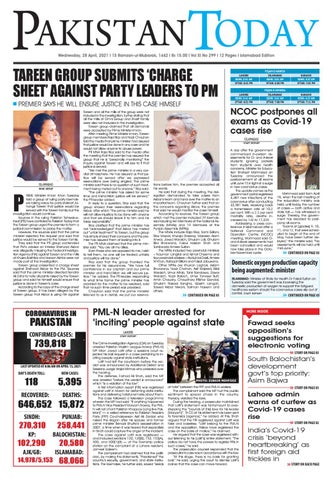
Wednesday, 28 April, 2021 I 15 Ramzan-ul-Mubarak, 1442 I Rs 15.00 I Vol XI No 299 I 12 Pages I Islamabad Edition
Tareen grouP submiTs ‘charge sheeT’ againsT ParTy leaders To Pm g
Premier SAYS He WiLL eNSUre JUSTiCe iN THiS CASe HimSeLF
ISLAMABAD mian abrar
P
rime minister imran Khan Tuesday told a group of ruling party lawmakers raising voice for party stalwart Jahangir Tareen that justice would be served with the Tareen family but the investigation would continue. Sources in the ruling Pakistan Tehreek-einsaf (PTi) have confided to Pakistan Today that the Tareen group urged the premier to form a judicial commission to probe the matter. However, the sources said that the prime minister rejected the request and said that justice would be served to the Tareen family. They said that the PTi group contended that Pm’s advisor on interior Shehzad Akbar was allegedly misusing the Federal investigation Agency (FiA) against Tareen and the mills of Khusro Bakhtiar and Haroon Akhtar were not made part of the investigation. Tareen group presented a charge sheet against Shehzad Akbar to the Pm. Sources said that the prime minister directed Senator Ali Zafar to note all points raised by the Tareen group and said he himself would ensure that justice is done in Tareen’s case. According to the copy of the charge sheet of Tareen group, it has been alleged by the Tareen group that Akbar is using FiA against
Tareen and all the mills of the group were not included in the investigation; further stating that all the mills of Omni Group and Sharif family were also not included in the investigation. Tareen group claimed that all demands were accepted by Prime minister imran. After meeting Prime minister imran, Tareen group members raja riaz and Nazir Chauhan told the media that prime minister had assured that justice would be done in any case and he would not allow anyone to abuse power. PTi mNA raja riaz said to the media after the meeting that the premier has assured the group that he is “personally monitoring” the inquiry against Tareen and will see to it that justice is served. “We met the prime minister in a very cordial atmosphere. He has assured us that justice will be served after we expressed reservations over being singled. The prime minister said there is no question of such treatment being meted out to anyone,” riaz said. “The prime minister has asked for some time and insha’Allah justice will be served,” the PTi leader added. in reply to a question, riaz said that the group shared their reservations regarding Akbar, after which “the prime minister said he will not allow injustice to be done with anyone and that we should leave it to him and he takes responsibility”. riaz clarified that the prime minister has not “acknowledged” that Akbar has meted out “unfair treatment” to Tareen, but the group has simply shared their concerns and the premier has assured them of looking into it. The PTi mNA claimed that the prime minister said: “You are all my allies. even those who are opposed to me, i wish to tell them, no one will be treated unfairly and justice will be done.” riaz said that the group thanked the premier for his assurances. “We have full confidence in our captain and our prime minister and insha’Allah we will secure justice,” he added. The PTi leader, responding to what time frame the prime minister has provided for the matter to be resolved, said that no such time period was provided. Chauhan said that the prime minister listened to us in detail, we put our reserva-
coronavirus in
PakisTan
CONFIRMED CASES:
739,818
LAST UPDATED AT 8:06 AM ON APRIL 15, 2021
DAY'S DEATH TOLL:
NEW CASES:
118
5,395
RECOVERED:
DEATHS:
646,652 15,872 SINDH:
PUNJAB:
270,310
258,441
KP:
BALOCHISTAN:
102,290 AJK/GB: 14,978/5,153
20,580 ISLAMABAD:
68,066
fiqah-e-hanfia lahore sehr: 3:51 am iftar: 6:41 pm
islamabad sehr: 3:51 am iftar: 6:50 pm
karachi sehr: 4:37 am iftar: 7:01 pm
fiqah-e-jafaria lahore sehr: 3:41 am iftar: 6:51 pm
islamabad sehr: 3:41 am iftar: 7:00 pm
karachi sehr: 4:27 am iftar: 7:11 pm
NCOC postpones all exams as Covid-19 cases rise ISLAMABAD staff report
tions before him, the premier accepted all his words. He said that during the meeting, the delegation demanded to take cases from Akbar’s team and hand over the matter to an impartial team. Chauhan further said that on the concerns regarding Akbar, the premier that said he would monitor the case himself. According to sources, the Tareen group which met the premier included 29 lawmakers including ten members of the National Assembly (mNAs) and 19 members of the Punjab Assembly (mPAs). The mNAs include raja riaz, Sami Gillani, riaz mazari, Khwaja Sheeraz, mobeen Alam Anwar, Javed Waraich, Ghulam Lali, Ghulam Bibi Bharwana, Faizul Hassan Shah and Sahibzada Ameer Sultan. The mPAs included two provincial ministers – Nauman Langrial and Ajmal Cheema and four provincial advisers – Abdul Hai Dasti, Ameer m Khan, rafaqat Gillani and Faisal Jabuwana. Other mPAs are Khurran Laghari, Aslam Bharwana, Nazir Chohan, Asif majeed, Bilal Waraich, Umar Aftab, Tahir randawa, Zawar Waraich, Nazir Baloch, Umer Tanveer Butt, Amin Chaudry, Chaudhary iftikhar Gondal, Ghulam rasool Sangha, Qasim Langah, Saeed Akbar Niwani, Salman Naeem and others.
CONTINUED ON PAGE 05
A day after the government commenced in-person assessments for O- and A-level students ignoring protests from students over health concerns, minister for education Shafqat mahmood on Tuesday announced the postponement of all exams until June 15 in light of a surge in new coronavirus cases. The update comes as the government portal registered 4,487 new infections of the coronavirus after conducting 43,981 tests, receiving back a transmission rate of 10.2 per cent. With a 2.2 per cent mortality ratio, deaths increased by 142 to 17,329. Addressing a press conference in islamabad after a National Command and Operation Centre (NCOC) meeting, mahmood said Oand A-level assessments had been cancelled and would now take place in the October-November cycle.
CONTINUED ON PAGE 05
Domestic oxygen production capacity being augmented: minister ISLAMABAD: minister of State for Health Dr Faisal Sultan on Tuesday said the government was increasing the domestic production of oxygen to support the fatigued healthcare system should the coronavirus cases slip out of control. staff r epo rt
PML-N leader arrested for ‘inciting’ people against state LAHORE staff report
The Crime investigation Agency (CiA) on Tuesday arrested Pakistan muslim League-Nawaz (PmL-N) mP mian Javed Latif after a sessions court rejected his bail request in a case pertaining to inciting people against state institutions. Latif had left the courtroom before the verdict was announced by Additional District and Sessions Judge Wajid minhas who presided over the hearing. The defense, Farhad Ali Shah, said the mP was arrested “before the verdict is announced” which “is a violation of the law”. A first information report (Fir) was registered against Latif in march for defaming state institutions and delivering hateful remarks about them. The case followed a television programme wherein the mP had said: “if anything happened to PmL-N Vice President maryam Nawaz, the PmLN will not chant Pakistan Khappay [Long live Pakistan]” — a veiled reference to Pakistan People’s Party (PPP) Co-chairperson Asif Ali Zardari who raised the slogan after his spouse and former prime minister Benazir Bhutto’s assassination in 2007, a time when it was feared that separatists in Sindh could capture the anger at the incident. The case against Latif was registered — and included sections 120, 120(B), 153, 153(A), 500, and 500(1)(B) — at the Township police station on the complaint of a Lahore resident, Jameel Saleem. The complainant had claimed that the politician, by making the statements, “threatened” the country’s security, government, and state institutions. The lawmaker, he further said, sowed “seeds
mehmood said from April 18, when the last meeting of the education ministry was held, until today, the number of cases — both active and daily toll — has witnessed a surge. Thereby, the government has decided to postpone all exams. “exams of [grades] 9, 10, 11, and 12, that were scheduled to begin at the end of may, have been further delayed,” the minister said. “No assessments will be held until mid-June.”
CONTINUED ON PAGE 05
more inside
Fawad seeks opposition’s suggestions for electronic voting STORY ON PAGE 03
photo: zubair mehfooz
of hate” between the PPP and PmL-N workers. The complainant said the mP hurt the public sentiment to spread chaos in the country, thereby, violated the laws. During the hearing, a prosecutor maintained that Latif’s statement was tantamount to overstepping the “bounds of [his] love for his leader [maryam]”. “A CD of his statement has been sent to forensics [agency],” he added. At this, Shah argued that the Fir registered against Latif was fake and baseless. “Latif belong to the PmL-N and the opposition. Police have registered the case on the basis of malice,” he claimed. He argued that the case was registered without listening to his [Latif’s] entire statement. “The police do not have the powers to register Firs in such cases,” he said. The prosecution counsel responded that the prosecution’s case was in accordance with the law. “At this stage, there is no basis for granting bail,” he said, urging the court to dismiss Latif’s bail so that the case can move forward.
South Balochistan’s development govt’s top priority: Asim Bajwa STORY ON PAGE 03
Lahore admin warns of curfew as Covid-19 cases rise STORY ON PAGE 02
india’s Covid-19 crisis ‘beyond heartbreaking’ as first foreign aid trickles in STORY ON BACK PAGE
02
Wednesday, 28 April, 2021
ISLAMABAD
NEWS
TruCe HoLdS IN KASHMIr, gIvINg SHeLL-SHoCKed reSIdeNTS uNeASy PeACe IsLAMABAD
T
agENcIES
HE guns have gone silent, schools have reopened and the bunkers are empty along the restive Line of Control (LoC) with India, but even as residents in the Kashmir region relax thanks to an uneasy truce, they fear fighting may erupt again soon. For months, a precarious peace has been welcomed by conflict-wary Kashmiris along the LoC — the boundary that divides the disputed region between Pakistan and India. The surprise truce announced in late February brought an end to years of violence along the frontier that saw thousands of skirmishes rattle the Himalayan territory, where the two sides have used artillery, mortars, and small arms. “Life before the ceasefire was very miserable,” Kashif Hussain, the deputy commissioner of Poonch district in Azad
Jammu and Kashmir (AJK), told reporters on a military-escorted visit to the area. But education has since resumed, health facilities reopened and people can move around, he said, providing “a very positive effect on the psychological life of the people”. The deal effectively reinstated an earlier ceasefire signed by the two sides in 2003 that had been trampled by thousands of violations in recent years. The military said the original deal had largely held until 2016, when tensions exploded in Indian-occupied Kashmir, resulting in a surge in violence between the two sides. As fighting along the LoC raged, ties between the rivals went into freefall with India repeatedly accusing Pakistan of sending infiltrators across the frontier, while Islamabad lambasted Prime Minister Narendra Modi’s government for stoking Hindu nationalist sentiment against Muslims. The two sides came close to another allout war after an attack inside held Kashmir in
2019 led to the downing of at least one Indian fighter and capturing by Pakistan of its pilot. ‘CAN’T TRUST THE ENEMY’: But even after stepping back from the brink, fighting along the LoC escalated, reaching an apex last year with thousands of clashes reported.
But the damage from the coronavirus and slowing economies in both countries — along with a geopolitical tug of war — appears to have convinced Pakistan and India to halt for the time being. “Both countries have an interest in
cooling tensions right now,” said Myra MacDonald, the author of multiple books on the conflict. “Because of Covid, but also because India faces problems on its disputed frontier with China, while Pakistan has to address both its own economic difficulties and the fallout of the US withdrawal from Afghanistan.” The truce appears to be holding, with the Pakistan Army telling AFP there had been “no significant” ceasefire violations since the deal was signed. For residents living near the ceasefire line, the end of fighting has brought back a sense of normality after years of strife. “Schools were closed. Kids who used to go to mosques also got confined to their houses,” said Tooba Imitiaz, who fled her home two years ago but recently resettled in Poonch. “There were a lot of psychological problems. Our children would start shouting ‘mortar, mortar’ when they even hear a small thud.” Pakistan Army said about 1.5 million residents live along the ceasefire line under their control, where they have long relied on a network of community bunkers and homemade shelters to weather the perennial bouts of unrest over the years. The ridges and valleys bisected by the LoC continue to host tens of thousands of troops armed with heavy weapons, with some outposts between the rivals just a few dozen metres (yards) apart.
PHC grants pre-arrest bail to Safdar in wealth case
PML-N will fight rigging attempts in AJK polls, says Maryam
PESHAWAR: The Peshawar High Court (PHC) on Tuesday granted pre-arrest bail to deposed prime minister Nawaz Sharif’s son-in-law Capt (r) Safdar Awan in assets beyond income case. A single-judge bench comprising Justice Lal Jan Khattak announced the verdict that was postponed earlier due to the non-appearance of the suspect. Last month, a National Accountability Bureau (NAB) meeting okayed further probe into the case and a letter directing a further investigation of assets owned by him and his family. The agency wrote to Lahore Development Authority (LDA), the deputy commissioner’s office, and the Cooperatives Department Punjab Lahore to collect all the details into assets owned by Awan and his family members. A total of nine people of the family are currently on the NAB radar including PML-N vice president Maryam Nawaz and her daughter Mehrun Nisa. The accountability watchdog had also written to various other institutions to accumulate data and details on their assets in the form of buildings, houses, plots, and shops in all residential and commercial lands. INP
News Desk
Iqbal says building Narowal sports complex ‘his only crime’ ISLAMABAD: Pakistan Muslim League-Nawaz (PML-N) Secretary General Ahsan Iqbal on Tuesday said that the only charge against him was that he had built the country’s largest sports complex in his hometown of Narowal. Speaking to reporters in Islamabad, Iqbal said it was extremely unfortunate that when 90 percent of work on Narowal Sports City was complete, the Pakistan Tehreek-e-Insaf (PTI) government withheld the funds, thereby turning the entire complex into ruins. “In fact, the damage done to this project is what is culpable,” the PML-N leader argued. He challenged the government to prove the corruption of a single penny against him. He said that all rules and regulations were followed before starting work on the project. “Kartarpur Corridor was built at the cost of Rs17 billion, while the cabinet was giving its approval only now,” he said, asking: “Is not it a discrepancy?” He regretted that he remained imprisoned despite being innocent but nobody was holding those people accountable who bypassed the rules and regulations before launching their projects. Mocking the slogan of “Do Nahi, Aik Pakistan” (one, and not two, Pakistan), the PML-N leader said today there was no accountability of those sitting in the corridors of power. He slammed the government for what he said was the destruction of the economy. “Prime Minister Imran Khan can only collect funds, [he] cannot run a country,” he commented. He also accused the Punjab government of plundering the province, claiming only a PML-N government can run the country honestly. “Now even the PTI leaders and workers drive their vehicles on the same motorways which we had built,” he boasted. He said he and other members of his party were proud to have served Pakistan. Lashing out at the Punjab government, the PML-N leader said the situation had come to such a pass that even people from within the PTI were raising eyebrows. “The level of your governance is that even for making people wear masks, you have to call in Pakistan Army, while when were in power, the same job was done by the civil departments,” he said. INP
KARACHI:Pakistan Army personnel have been deployed in various parts of the country to enforce precautionary measures against the coronavirus pandemic. ONLINE
Pakistan Muslim League-Nawaz (PML-N) Vice President Maryam Nawaz on Tuesday, while warning the state premier about possible rigging in the upcoming polls, said that her party would fight any attempts in this direction. Raja Farooq Haider, the prime minister of the autonomous state, said that any rigging in the upcoming polls would benefit India. “[Rigging in the elections] would benefit India and it will be a move to deceive the people the Azad Kashmir,” he said. “Everything will go in vain if elections are rigged,” he added. AJK is scheduled to see general elections in summer, with the exact date yet to be announced. Moreover, before the government announced postponement of examinations, the PML-N VP said that the government was putting students’ lives at risk by conducting O/A-Level exams at a time when the coronavirus situation is worsening. “The countries in the region had opted for other ways to conduct the examinations, then why did this incompetent government put students in harm’s way,” she asked. “We want this curse (incumbent government) to end …. we can bear them, but the people cannot,” she added. She lashed out at the government for failing to curb the coronavirus pandemic and protecting public’s health. Speaking about Prime Minister Imran Khan’s meeting with the group backing estranged party leader Jahangir Tareen, she questioned whether the sugar baron had been given an NRO by the premier.
Lahore admin warns of curfew as Covid-19 cases rise LAHORe Staff REPORt
A curfew could be imposed in Lahore within days unless people follow the guidelines on social gatherings, the district administration has said. “If the situation worsens, the district administration has many options [including] imposing a curfew,” Lahore Commissioner Capt (r) Muhammad Usman Younis told the reporters during a press conference. He was flanked by
the deputy commissioner, Lahore police chief, and military officials. Younis announced that a notification announcing the closure of markets at 6:00 pm has already been issued. He said joint teams of civilian administration and army troops will hold a flag march in the city to ensure the restrictions are being followed in letter and spirit. He further said coronavirus cases were increasing in Lahore on a daily basis, adding that the healthcare system was under immense pressure. He also
appealed to the people to follow the guidelines strictly. “Everything is possible with the cooperation of the people. Coronavirus can only be controlled by implementing SOPs,” Younis said. The commissioner said 50 per cent attendance of staff in offices will be allowed and said businesses found violating the order will face legal action. He also said dine-in services, both indoor and outdoor, have been suspended and eateries also would not be allowed to allow customers to eat inside
their parked vehicles. Personnel from law enforcement departments will hold a flag march in the city after 4:00 pm on a daily basis. Younis further said intercity transport services will remain suspended until further orders. He said traffic in areas where micro smart restrictions are imposed will be brought to zero. “Anyone who [is found] not wearing a mask will go to the prison,” said Lahore police chief, adding that those who say “there is no coronavirus” would also be thrown behind bars.
Sindh asks SHC to suspend routine work, allow only urgent proceedings kARACHI Staff REPORt
The Sindh government on Tuesday wrote a letter to the Sindh High Court (SHC) Chief Justice Ahmed Ali Shaikh requesting him to suspend routine court work in light of the current coronavirus situation.
“The current situation demands reiteration of earlier administrative measures taken and implemented by your honour last year,” Sindh government spokesperson Murtaza Wahab said in the letter. “I would, therefore, request and urge if the routine court work is suspended and only matters of urgent
nature are fixed for hearing so that the Honorable Judges, learned lawyers, court staff as well as litigants are protected from this pandemic.” He also listed the recent steps taken by the provincial government to curb the spread of the disease in the country. He informed the high court that
the provincial task force on Covid-19 is monitoring the situation on daily basis and has taken a host of measures to curtail the spread of the disease. The spokesperson appreciated the judge for taking “very effective and efficient measures in controlling and containing the severity of the disease” during the first peak.
Wednesday, 28 April, 2021
ISLAMABAD
NEWS
03
Fawad seeks oPPosition’s suggestions For electronic voting ISLAMABAD
M
Staff RepoRt
INISTER for Information and Broadcasting Fawad Chaudhry on Tuesday urged the opposition to submit their suggestions for electoral reforms to hold the next general elections through electronic voting system and granting the right of vote to nine million overseas Pakistanis. Apprising media persons about the decisions taken by the federal cabinet, which met with Prime Minister Imran Khan in the chair, Fawad said that Prime Minister’s Adviser on Parliamentary Affairs Dr Babar Awan briefed the cabinet about the electoral reforms and electronic voting machines. The government, he said, wanted to move forward on the electoral reforms with political consensus and the prime minister had written a letter to the National Assembly (NA) speaker to engage the opposition on the matter. The speaker, he said, had also written letters to the opposition leaders for their input on the electoral voting system but so far, no reply had been given by them. Fawad said that the government could
not wait for the opposition’s response indefinitely as it wanted to hold next general elections through the electronic voting machines (EVMs) and grant overseas Pakistanis the right to franchise. Both the Pakistan Muslim LeagueNawaz (PML-N) and Pakistan People’s Party (PPP), he said, wanted to oppose the move of granting the right of vote to the expatriates as they were not their supporters. The two parties should openly express their viewpoint whether they wanted to give the vote right to the overseas Pakistanis or not, he added. The minister said that Special Assistant to the Prime Minister on Health Dr Faisal and Minister for Planning Asad Umar briefed the cabinet about the latest coronavirus situation in the country. The cabinet, he said, was informed that around 5,000 patients suffering from the deadly virus were in critical condition, which was the highest number as compared to the last two peaks of the contagion when the maximum number of serious patients remained 3,400. He said that currently Pakistan was producing 792 metric tons of oxygen to meet the requirement of Covid-19 patients. The situation in Pakistan would have different had it not increased 7,000 ventilator beds and doubled the production of oxygen during the last one year. It was decided that the oxygen meant for the industrial sector would also be diverted
to the health sector if the situation worsened, he added. The government, Fawad said, was also considering import of oxygen from China and Iran if the need arose. The minister said that Prime Minister Imran had directed to ensure supply of essential items during the pandemic. The government was trying hard to avoid complete lockdown and that was why it was considering a five-day holiday for Eidul Fitr. About anti-Covid vaccination, Fawad said that so far 2 million people had been vaccinated. The vaccine was fully safe for human health, he added and urged the people to get themselves vaccinated against the virus as around one billion people, across the world, had so far been immunized against the disease. He said that 3.7 million doses of the coronavirus vaccine were available in the country and now 40 and above people were eligible for vaccination. He appreciated the print and electronic media for creating awareness among the people to follow the standard operating procedures (SOPs) against the pandemic. He said that the prime minister while chairing the meeting of National Coordination Committee (NCC), had observed that in case a complete lockdown were imposed, the government would have to ensure supply of the essential commodities. The five-day Eid holidays would ease
burden on the cities as the pandemic was an urban phenomena, he added. The information minister said that the cabinet was also given a detailed presentation on the electricity sector’s circular debt. Due to inefficient policies of the previous government and 40-50 per cent excessive production of electricity, he said, the capacity charges of plants had increased from Rs450 billion to Rs900 billion. “It means that the government has to pay Rs900 billion to the power-producing companies whether we use electricity or not.” He said that in 2023, which would be the election year, the capacity charges would reach Rs1,500 billion, causing raise in electricity rate from Rs11.75 to Rs16.44 per unit. “The cost of per unit electricity production is at around Rs22 or 23.” Fawad said that had the full cost of electricity production was passed on to the consumers, all the industry would have collapsed because of unaffordable power. The prime minister, he said, had asked the quarters concerned to find a way to get rid of the capacity charges issue without increasing the electricity tariff. The issue could be tackled by shutting down inefficient power production plants, he added. Some had already been closed and the remaining would be shut down by September 2022. Similarly, the minister said, there were
South Balochistan’s development govt’s top priority: Asim Bajwa ISLAMABAD app
China-Pakistan Economic Corridor (CPEC) Authority Chairman Lt General (r) Asim Saleem Bajwa Tuesday said the development of roads in South Balochistan was a key priority of the government to improve the connectivity of Gwadar with North.
kP health minister booked for flouting covid-19 restrictions PESHAWAR INp
The district administration on Tuesday booked the Khyber Pakhtunkhwa Health Minister Taimur Khan Jhagra for flouting coronavirus health guidelines by attending an iftar dinner at a restaurant in Peshawar where hundreds of guests were present. The administration took action following the news coverage of the event and pictures posted on social media platforms showing Jhagra attending the dinner despite a ban on social gatherings due to the pandemic. The authorities, in a press handout, said that a police case had been registered against the minister and manager of the restaurant for organising the event and violating standard operating procedures (SOPs). The manager of the restaurant, quoted in the statement, said the dinner went on despite his warning to the minister about the ban on indoor dining service. “No one is above the law,” Peshawar Deputy Commissioner Capt (r) Khalid Mahmood said in a statement. “The district administration is taking indiscriminate actions on the violation of government’s rules.”
In a tweet, he said about 60 per cent of the construction work of BasimaKhuzdar road had been completed while the construction of Hoshab Awaran road had also been started. “The prime minister’s vision of uplifting remote areas especially South Balochistan is being realized,” he added. The 146 kilometres Hoshab-Awaran project is an integral part of the CPEC
Central Alignment which connects Gwadar Port with the Sindh. The project is expected to be completed in three years at an estimated cost of Rs20 billion. Similarly, the Basima-Khuzdar road (N-30) is 106 km long having a cost of Rs11.749 billion. This project is expected to be completed by end of the current year. With respect to the completed road
projects under CPEC, an official in the CPEC authority told APP that the 449km Quetta to Hoshab Road (N-85) has been completed and is operational while the 235 KM long Surab-Quetta (N-25) road has also been completed and is operational. Similarly, the official added that the 193km Gwadar-Hoshab (M-8) road and 250km Ratodero–Khuzdar (M-8) road is also operational.
Scientists urged to play role in combating health misinformation campaigns ISLAMABAD app
Minister for Science and Technology Senator Shibli Faraz on Tuesday urged the Pakistan Academy of Sciences (PAS) and scientists in general to play their role in countering the disinformation campaigns related to public health and global health security. Speaking at a webinar “Pandemic Preparedness: Science and Countermeasures” organised by the Pakistan Academy of Sciences (PAS), the minister stated that the abundance of unfiltered information makes it difficult for people to identify truthful and trustworthy sources from false or misleading ones. Pakistan was facing different challenges as compared to the developed world as on one hand we had to control the pandemic and on the other, we could not afford to shut the country down and leaving people at the mercy of fate. In this situation, the government policy of “smart lockdowns” worked successfully and was appreciated internationally, he said. Faraz appreciated different segments of the society like religious leaders, academia, and philanthropists for helping us to cater to the situation. He pointed out that among the most pressing issues in preparing for the global response to a pandemic are the design, development, manufacture, and dissemination of vaccines. The response to this pandemic has shown that when leading vaccine manufacturers are fully engaged in a global response, it might be possible for them to manufacture substantial doses of vaccine on timelines faster than previously envisioned. It is heartening to note that even Africa has planned to enhance their vaccine production capacity from 1 percent to 60 percent by 2040, he said. He assured that the Ministry of Science and Technology will welcome any such effort in the country. “I am sure that through events like this we will learn an enormous amount from the policies, technologies, and financing strategies used to have better diagnostic techniques and produce Covid-19 vaccines”. “These lessons will be critical to informing emergency global vaccine manufacturing; diagnosis and therapeutics efforts in the future”, he said. Speaking on the occasion, PAS President Professor Khalid Mahmood Khan appreciated the efforts of the Association of Academy of Sciences of Asia
(AASSA) for supporting the group in organising the event. He said that Pakistan as a responsible nation is doing all that is possible to prevent the spread of this virus. AASSA Professor Yoo Hang Kim reiterated his support to PAS for holding such an event and containing coronavirus and Pakistan is mentioned as a success story in the world for reducing the deadly effect as compared to its neighboring countries. Professor Khairul Anuar bin Abdullah highlighted issues related to vaccines and their equitable access by all including the least developed countries. PAS Secretary General Professor Tasawar Hayat thanked all the speakers and participants for their input and announced that PAS will publish a special issue on the proceedings of the workshop and a policy document as to how to respond to avoid any such pandemic in the future. Speaking on the occasion, Professor Zabta Khan Shinwari said that what emerges next will partly depend on the ongoing evolution of SARS-CoV-2, on the behaviour of citizens, and on governments’ decisions about how to respond to the pandemic. It will also depend on the progress in vaccine development and treatments and also in a broader range of disciplines in the sciences and humanities that focus both on bringing this pandemic to an end and learning how to reduce the impacts of future zoonoses, and on the extent to which the international community can stand together in its efforts to control Covid-19. Many factors will determine the overall outcome of the pandemic. A nationalistic rather than global approach to vaccine delivery is not only morally wrong but will also delay any return to a level of “normality” (including relaxed border controls) because no country can be safe until all countries are safe, he stressed.
around 11 IPPs (independent power producers) generating around 3,300megawatt electricity that cost extremely expensive. “We are giving Rs 6,00 billion to these IPPs. The government is in negotiation for the purchase of the 11 IPPs so that these could also be shut down as per its policy.” He said that the sector’s line losses had also come down from 18.3 per cent to 17. 8 per cent, despite the increase in the electricity price which showed the government’s good performance. Regarding the national flag carrier, the minister said that the cabinet was apprised that the operational losses of Pakistan International Airlines (PIA) had come down from Rs57 billion to Rs1 billion, which was a ‘great success’ of the present management. The real problem of the PIA, however, was its loan which caused an overall loss of Rs460 billion, he added. The national flag-carrier’s per aircraft staff ratio, he said, was 450, that was the highest in the world. The previous governments of the PML-N and PPP had ruined the national institution by making political and unnecessary appointments, he added. Winding up the media briefing, Fawad said that a delegation of Pakistan Tehreek-e-Insaf (PTI) MNAs had called on Prime Minister Imran Khan to convey their recommendations over the Jahangir Khan Tareen issue. The meeting discussed all the issues in detail.
4 killed, 5 injured in clash in Punjab ISLAMABAD Staff RepoRt
Four people were killed and five others injured in a clash between two rival groups in the Mianwali district of Punjab late on Monday night, reports said. According to the initial investigation by police, the incident was an act of personal enmity on a land dispute, the reports quoted police officials as saying. The groups belonging to two different families had a common claim on a piece of land and they gathered to decide about the possession of the land on Monday night, but their verbal argument turned ugly and they ended up attacking each other with weapons, the reports added. The injured have been shifted to a nearby hospital where two of them are reportedly in critical condition. The killers from both sides fled the scene after carrying out the attack and police had kicked off a search operation to arrest them.
ex-official accuses govt of politicising Fia NEWS DESK Bashir Memon, the former director general of the Federal Investigation Authority (FIA), on Tuesday accused the government of using the investigative agency for political purposes. Speaking to a private TV channel, the former official said that he was approached by Shahzad Akbar and Farogh Naseem to prepare a charge sheet against Supreme Court (SC) judge, Justice Qazi Faez Isa. Spilling the beans over other incidences, he said that he was also summoned and asked to take notice of a picture of first lady tweeted by Maryam Nawaz and to charge her under terrorism clauses, which he refused to do. He added that the government had also asked him to imprison the Pakistan Muslim League-Nawaz (PML-N) vice president for being anti-state, which he refused to do as well. Memon said that once Prime Minister Imran Khan summoned him and said that LEAs ignore charges against Nawaz Sharif, Khawaja Asif, etc. while they are after Arif Naqvi. He said that the premier told him that Naqvi was his friend. He added that PM Imran accused him of holding a soft corner for opposition leaders. The former director general of the investigative agency said that he was fired over his refusal to comply with the government’s instructions.
04
Wednesday, 28 April, 2021
ISLAMABAD
NEWS
CHina offerS enHanCed aSSiSTanCe To parTnerS in SouTH aSia region ISLAMABAD
C
MIAN ABRAR
HINA on Tuesday offered enhanced assistance to its partners in South Asia region and called for enhancing cooperation and collaboration in areas like Covid-19 pandemic, poverty alleviation and disaster relief. A six-country conference was hosted by China Foreign Minister Wang Yi while the
QURESHI SAYS CPEC, BRI WOULD HELP EXPAND REGIONAL TRADE AND CONNECTIVITY foreign ministers of Pakistan, Bangladesh, Nepal, Sri Lanka and Afghanistan attended the event. India was not included in the conference. Pakistan Foreign Minister Makhdoom Shah Mahmood Qureshi welcomed the initia-
tive and said that it is important for all participating countries to enhance cooperation and collaboration in areas like Covid-19 pandemic, poverty alleviation and disaster relief. He stressed that the pandemic is a common chal-
lenge and requires joint efforts. Qureshi appreciated the China-South Asia Emergency Supplies Reserve, ChinaSouth Asia Poverty Alleviation Cooperative Development Centre and China-South Asia E-Commerce Cooperation Forum on Poverty Alleviation in Rural Areas. He underlined that these initiatives will equip participating countries to better respond to health emergencies and natural disasters, and will be helpful in eradicating
poverty. He underlined that economic and human security stand at the centre of regional development paradigm. China-Pakistan Economic corridor (CPEC) and Belt and Road Initiative (BRI) would help expand regional trade, connectivity and economic activity, he added. He stressed the need to ensure equitable and affordable supply of vaccine as ‘global public good.’ He maintained that notions of insinuations on the origin of the virus must be discouraged. He underscored that all countries should uphold multilateralism and extend full support to WHO’s science-based work and reject its politicisation. Qureshi briefed the participants about various measures taken by Pakistan to combat the virus aimed at preserving lives and securing livelihoods.
Two killed, 10 injured in coach-truck collision in Hub HUB INP
At least two people were killed and 10 others injured in a collision between an overspeeding passenger coach and a truck here on Tuesday. According to details, the accident took place near Marble City in Hub, where a passenger coach collided with a truck. Two people were killed on the spot in the accident while 10 others were injured. The local police and rescue team of Edhi reached to the scene and shifted the bodies and injured to a nearby hospital.
Youth killed over personal grudge in Swabi SWABI INP
Some armed men gunned down a youth over personal grudge and escaped the scene here on Tuesday, the local police said. According to details, the culprits and deceased had exchanged hot words during a cricket match the other day. On Tuesday, when 17year-old Fahd Hussain along with his father Haji Hussain and cousin Jihad Ali came out of a mosque in Sheikhan Bachai area after offering prayers, the culprits Hamza and Ehtisham, sons of Sher Aftab, sprayed bullets at them. As a result of firing, Fahd was killed on the spot while his father Hussain and cousin Jihad narrowly escaped. The culprits immediately fled the scene of the crime. The body was shifted to a nearby hospital for legal formalities and the police, after registering a case against the culprits, started raids for their arrest.
Two killed in road accidents in Chiniot CHINIOT INP
Two, including a youth and a woman, were killed in separate road mishaps in different localities of Chiniot on Tuesday. According to details, an overspeeding dumper ran over a motorcycle on the Sargodha Road in Lalian. Resultantly, a youth Mohammad Afzal was killed. The dumper driver fled the scene. Another 50-year-old woman was killed in an accident in the city. The bodies were shifted to different hospitals and the police, after registering separate cases at concerned police stations, started investigations into the incidents.
LAHORE: People flout coronavirus guidelines, especially social distancing, at Bano Market. ZuBAIR MEHfOOZ
Masood asks Delhi to open humanitarian corridor towards IOK MUZAFFARABAD TLTP
Azad Jammu and Kashmir (AJK) President Sardar Masood Khan has said that Pakistan offered assistance to the people of India to fight coronavirus pandemic on humanitarian ground and expressed hope that New Delhi will demonstrate the same spirit by establishing a humanitarian corridor towards Indian-occupied Kashmir (IOK). He stated this while talking to a delegation that called on him on Tuesday under the leadership of International Forum for Justice Vice Chairman Mushtaq-ul-Islam and Pasban-e-Hurriyat Chairman Uzair Ahmed Ghazali. The president said that the rescue of besieged Kashmiri people, who are eyeing on Pakistan and Azad Kashmir for help is a national obligation, and to avoid fulfilling this obligation is a national crime. The president expressed his confidence the day is not far off when the sacrifices of the Kashmiri people would materialize, dark night of sub-
jugation will end and the day of freedom will dawn. In order to internationalise the Kashmir liberation movement with a focus on civil liberties and human rights, the political parties of Pakistan and Azad Kashmir need to unite on one platform to raise an even more powerful and forceful voice for the Kashmir cause, he maintained. For this purpose, he added that an alliance of likeminded political parties already exist in Azad Kashmir while such an alliance on the single point agenda of Kashmir cause is direly needed on a national level. Earlier, talking to a London-based news web portal, Sardar Masood Khan said that the third wave of Covid-19 has badly affected hundreds of millions of people in India, and the death toll is rising with every passing day. “The third wave of coronavirus pandemic has hit India very badly, where fatalities are increasing with every passing day. This situation is a cause of concern not just for India but for all the neighbouring states and
even distant countries. We wish the suffering population well,” Khan said. He said that the situation that erupted in India is alarming for not only India but all neighbouring and even distant countries as well. Keeping in view this situation, Pakistan not only expressed sympathy and solidarity with the Indian people but also offered cooperation and humanitarian assistance to the pandemic-stricken people of India. In spite of all out oppression by the Indian government towards the Kashmiri people, Pakistan expressed solidarity with India which reflects a firm belief of the people of Pakistan and Azad Kashmir on humanitarianism and human values, he added. “The government of Pakistan has formally offered humanitarian assistance to the Indian people to fight this lethal virus. The face of AJK and Pakistan is a humanitarian face. In this hour of suffering, we express solidarity with the people of India. We are practicing what we believe in,” he said.
P&DB starts consultation with private sector for next FY’s development programmes LAHORE SHAHAB OMER
Punjab’s Planning and Development Board (P&DB) has started preparation of development programmes for the upcoming fiscal year and initiated consultative meetings with industrial sectors, Pakistan Today learnt on Tuesday. The first session of the consultative meetings was chaired by Punjab Finance Minister Makhdoom Hashim Jawan Bakht through a video link while Provincial Minister for Industries and Commerce Mian Aslam Iqbal and the representatives of the Lahore Chamber of Commerce and Industry and private sector also participated. The finance minister reiterated his com-
mitment that the budget 2021-22 would be a business friendly budget while special attention will be given to the industrial and agricultural sectors to revive the economy and promote business. “The Punjab government has given a historic relief package of Rs57 billion in the current financial year to rehabilitate the Covid affected business and protect the livelihood of the common man. The Punjab government is ensuring the involvement of stakeholders in the budget preparation process this year as it did last year. For the first time, the industrialists and businessmen from private sector are being given an opportunity to participate in the preparation of the annual development programme,” Bakht said. During the session, Mian Aslam Iqbal
said the provision of one-window services for starting new businesses is being ensured to facilitate business. “In the next fiscal year, special attentions will be given to skills development. More courses will be added to institutions under TEVTA as per market demand. We have assured the stakeholders from the private sector that their suggestions will be made part of the next development programme,” Iqbal said. Addressing the session, Chairman P&DB Abdullah Khan Sumbal said that economy without industry is unthinkable. “We are well aware of the difficulties being faced by the private sector due to Covid-19. Public policies will be taken into account in the preparation of the annual development programme,” he maintained.
Wednesday, 28 April, 2021
ISLAMABAD
PAkiStAN, JAPAN SigN Debt SuSPeNSioN AgReemeNtS WoRth $367m ISLAMABAD
P
staff report
AKISTAN and Japan on Tuesday signed debt suspension agreements amounting to $367 million under G-20 phase one Debt Service Suspension Initiative. Economic Affairs Division Secretary Noor Ahmed and Ambassador of Japan
to Pakistan Kuninori Matsuda signed the agreements in Islamabad. The signing ceremony was witnessed by senior officials of Japanese Embassy. In the wake of Covid-19, the G20 countries, together with the Paris Club creditors, announced a Debt Service Suspension Initiative (DSSI) to provide much needed fiscal space to stressed countries in order to meet their urgent economic and health needs. The government of Pak-
Pakistan, Azerbaijan to hold business forum ISLAMABAD
istan, taking advantage of this initiative, entered into negotiations with 21 creditor countries for debt suspension amounting to $1.6 billion under DSSI Phase-I. Pakistan will repay the suspended amount in four years starting January 2022. On this occasion, Noor Ahmed reiterated his appreciation for the debt suspension provided by Japan. He highlighted that Japan is the second largest bilateral lender to Pakistan. He
also acknowledged continued support of Japan for health, education, agriculture, infrastructure, disaster management and urban services including water supply, sanitation and waste management. While speaking on the occasion, Ambassador Matsuda also reaffirmed Japanese support to Pakistan on issues of mutual interest. Both sides reiterated strong commitment towards further expanding bilateral
Tarin for timely completion of remaining FATF action plan
staff report
Pakistan will organise a Pak-Azerbaijan Business Forum, according to the Pakistani Embassy in Baku. The forum will be held in a video conference format, in collaboration with AZPROMO on April 29. Business firms operating in pharmaceutical, surgical, agro food, textile and light industry sectors were informed by the relevant authorities about participation in the forum.
CDNS obtains free deposit of Rs670bn in Q3FY21
ISLAMABAD app
Federal Minister for Finance and Revenue, Shaukat Tarin, on Tuesday expressed satisfaction over the significant headway made across all the areas of the Financial Action Task Force (FATF) action plan and resolved to continue efforts for timely completion of the remaining parts of it. The minister was talking to Financial Monitoring Unit’s (FMU) Director General Lubna Farooq Malik,
who briefed him about progress made on the FATF plan, according to press statement issued by the Finance Ministry. The DG FMU highlighted various measures that the government of Pakistan had taken to strengthen Anti-Money Laundering (AML) and Countering Financing of Terrorism (CFT) regime in line with the international best practices. She also apprised the finance minister that FATF had acknowledged Pakistan’s performance in its last plenary held in February 2021.
Gucci, Facebook file joint lawsuit against alleged counterfeiter NEW YORK agencies
ISLAMABAD app
The Central Directorate of National Savings (CDNS) has received a free deposit of Rs670 billion in the last three quarters from July 1, to April 25, in the current fiscal year 2020-21. The CDNS has set Rs249 billion annual collection target collection from July 1 to June 30 for the year 2020-21 as compared to Rs352 billion for the previous year’s 2019-20 to enhance savings and promote saving culture in the country, a senior official of CDNS told APP here on Tuesday. The CDNS had set Rs352 billion annual collection target for the year 2019-20 as compared to Rs350 billion for the previous year’s 2018-19, he said.
Gucci and Facebook have filed a joint lawsuit in California against an individual who allegedly used the US group’s social media platforms to sell fake Gucci products, the two companies said on Tuesday. The initiative, a first of its kind for both Gucci and Facebook, is the latest example of an Internet giant joining forces with a luxury label to fight the proliferation of counterfeit goods being sold via social media. Amazon has filed similar lawsuits over the past year with
Valentino and Ferragamo. In a statement, Gucci – the profit engine of French group Kering – and Facebook alleged the
unidentified defendant used multiple Facebook and Instagram accounts to promote her international online counterfeit business.
NCOC postpones all exams as Covid-19 cases rise cONtINuED fROM pAgE 01 “We will continue analysing [the situation] and in midMay or in the third week of May, we will analyse the disease and a decision will be made whether to further postpone exams or allow them to take place,” he said. This means that if exams are started after June 15, they could go into July and some part of August as well.” The minister further suggested the country appears to be headed towards a complete lockdown in areas witnessing particularly high positivity ratios. Mahmood had earlier in the day conceded there were problems with the level of compliance with Covid19 rules outside examination centres. “Permission to hold exams was conditional on strict SOP observance. As more reports have come in, it is obvious that outside the exam centres the compliance is poor,” he said. “This and the latest corona spread reports will be discussed in a special NCOC meeting in the afternoon.” The government had refused to delay exams despite the closure of schools in all neighbourhoods where the transmission rate is beyond 5 per cent. The decision to hold exams comes at a time when the country is averaging 4,000 cases per day for the last two weeks. Before the beginning of the assessments, the government had assured the protesting students that “strict
implementation” of health protocols would be followed during the exams. “These are tough times, and difficult decisions have been made keeping the students’ best interest in view,” Mahmood had said. “British Council is committed to strict implementation of SOPs [standard operating procedures] and we will monitor them closely,” he added, wishing all the students taking exams his very best. Last year, Cambridge International had cancelled all exams that were scheduled to be held in the country in May and June at Islamabad’s request and in view of the pandemic. However, this year, it announced it would be cancelling in-person exams in a “very small” number of countries — 10, including the United Kingdom — and would award students grades based on their teachers’ assessment, or expected grades. Last week, the Islamabad High Court (IHC), Lahore High Court (LHC), Peshawar High Court (PHC) and Sindh High Court (SHC) had dismissed separate petitions challenging the physical presence of students in O- and A-level exams and seeking a switch to schoolassessed grades. The petitions were filed by students in each of the four high courts against the Cambridge Assessment International Education’s (CAIE) decision and the government’s approval for holding in-person exams in Pakistan.
In March, the government had closed down all educational institutions in several major cities and Islamabad initially for two weeks, but later extended the duration until April 11, after a surge in Covid-19 cases. TOURISM, PUBLIC TRANSPORT SUSPENDED: Meanwhile, the NCOC announced to temporarily suspend public transport and tourism in a bid to strengthen efforts to contain the spread of the coronavirus, Radio Pakistan reported. A communiqué issued by the Ministry of Interior announced the aforementioned services would remain suspended between May 8 and 16. Travel, both inter-provincial and inter-city, during the Eid holidays will also remain suspended however, locals of Gilgit-Baltistan would be allowed to return to their homeland. Roads leading to tourist spots will remain closed “with a special focus on Murree, Galiyat, Swat-Kalam, Sea View/beaches and northern areas”. All tourist resorts, public parks, hotels, restaurants shopping malls, and transport “in and around” the tourist points will remain closed. The notification also called for timely issuance of health guidelines and suggestions for Itikaf, Qadr Night, Jumu’atul Wida and Eid prayers. It also called on authorities to ensure uninterrupted electricity supply during the Eidul Fitr holidays.
NEWS
05
Domestic oxygen production capacity being augmented: minister cONtINuED fROM pAgE 01 Addressing a press conference, Dr Faisal said the government was preparing for a potential surge in infections, noting that the capacity of healthcare facilities was being increased. In a reference to India, where the ongoing peak has faced issues with ensuring oxygen supply for critical for serious patients, he said a special committee of the National Command and Operation Center (NCOC) was monitoring the situation in Pakistan. “If the pandemic surges, the government is planning to bring online additional oxygen plants to ensure there is no shortage,” he disclosed and said the oxygen plant of Pakistan Steel Mills (PSM) was being examined in this regard. A day earlier, the NCOC on the recommendation of Prime Minister Imran Khan gave a green signal to the National Engineers Welfare Association, an association of experts affiliated with the PSM, to conduct a preliminary review of the plant. A team of experts, including those from the Engineering Corps of the army, will make its first visit to the plant today. “If ours needs reach a critical point, we would also recommend halting oxygen to non-essential industries or even import oxygen supplies to overcome the shortfall,” Dr Faisal said on Tuesday. In addition to the supply concerns, he said the NCOC was also examining the matter of logistics and transport. “We are reviewing all measures to ensure there is no supply gap,” he said. “The NCOC would issue guidelines on the efficient use of oxygen to curb losses.” On vaccines, the minister said the government was dependent solely on grants and gifts but was actively procuring and pursuing the jabs. “The government is in the process of purchasing vaccines from three different manufacturers,” he said. Some 3 million doses had been procured since March 30, while deals for 30 [million] additional doses had already been signed, he said, without disclosing the developers. “We will also have a transfer of technology to manufacture our own doses of the [Chinese] CanSino vaccine,” he revealed. The minister said the process of procuring the drug was slow due to their overall shortage around the world. “It does not matter how much money one possesses. If a thing does not exist, you simply cannot buy it,” he said. “Due to this shortage of the vaccine, vaccine roll out under the COVAX initiative [Covid-19 Vaccines Global Access] had also been delayed,” he said. “Hopefully, the programme would resume as soon as the problem of the vaccine scarcity is resolved.” So far, more than 2 million doses of vaccines have been administered across the country, he said, urging people to adhere to guidelines to curb the spread of contagion disease. “Yesterday, 88,000 doses of vaccines were administered,” he said and added the vaccination drive was continuing without any hindrance. The government, he said, has established 22 vaccination centers nationwide, each with a daily capacity of 5,000 inoculations. “Getting vaccinated is very important but more important is to follow the Covid-19 SOPs. Wear face masks, maintenance a distance of about six feet, do not go outside of the house unnecessarily, and do not roam around in groups,” Dr Faisal said. He said the nation would have to spend the remaining days of the holy month of Ramadan and celebrate Eid with “utmost simplicity” to avoid the risk of Covid-19 getting out of control.
CDWP okays two projects worth Rs196bn ISLAMABAD: The government on Monday cleared two new development projects worth Rs196.5 billion, including the Hyderabad-Sukkur motorway at a cost of Rs191.47 billion aimed at completing a major missing link of the eastern corridor that connects Gwadar and Karachi ports. The meeting, presided over by Deputy Chairman of Planning Commission Muhammad Jehanzeb Khan, recommended the M-6 project to the Executive Committee of the National Economic Council (ECNEC) with significantly higher financial share of the government. The 6-lane divided and fenced mega motorway project was dropped due to proposed changes in its financing model during the last meeting, and now seeks Rs92 billion from the budget compared to the original plan of constructing the road with private sector funding. ghulam abbas
Tareen group submits ‘charge sheet’ against party leaders to PM cONtINuED fROM pAgE 01 FIA PROBER REMOVED: The government on Monday removed the FIA officer heading the investigation against estranged PTI leader Tareen and his son Ali Tareen in last year’s sugar scam. The development took place a day before a likely meeting of the posse of disgruntled PTI MPs — led by Tareen — with Prime Minister Imran Khan in Islamabad today. The agency registered three cases against the two on charges of corporate fraud and money laundering in March. Tareen rejected the “fabricated” charge sheet, denying any wrongdoing.
“The head of the sugar scam inquiry team FIA Lahore chapter’s Director Mohammad Rizwan has been removed from the investigation with immediate effect,” a local publication quoted a source as saying. Rizwan’s removal, it said, was the main demand of the group. However, it is yet to be confirmed whether Rizwan has also been transferred from his present posting. The official had not only booked Tareen and his son but also registered cases against Pakistan Muslim League-Nawaz (PML-N) president and National Assembly Opposition Leader Shehbaz Sharif and his son Punjab Assembly Opposition Leader Hamza Shehbaz in the scam.
The probe under Rizwan had detected Rs110 billion earning by the sugar cartel in 2020 alone through “speculative pricing” — a practice prevalent in the markets where price movements of commodities are highly frequent and volatile. “It has transpired that sugar industry barons, sugar-brokers & their satta-agents (speculative pricing players), in active connivance with sugar-mills, have transformed into a clandestine sugar satta-mafia and are operating in a collusive but secret-mode, especially through electronic means/ WhatsApp groups to dishonestly and fraudulently maneuver, manipulate and artificially hike sugar prices, amidst hoax of impending sugar-stocks
cMYK
shortages (while sugar-stocks are lying ‘unsold’ or ‘sold/un-lifted’ in mills & godowns and demand-supply gap is artificial),” an earlier FIA inquiry against the cartel said. “The satta-mafia had already fraudulently ramped-up the (speculative) ex-mill price by Rs20/kg in last one year (from Rs70/kg on Feb 11, 2020 to Rs90 per kg on March 21, 2021; they are now conspiring to pump it upwards to Rs110 per kg in Ramzan,” it added. THE CASE: Tareen had returned to Pakistan in November after ending his seven-monthlong self-imposed exile after falling out with Prime Minister Imran following an inquiry into the last year’s sugar scandal that accused several sugar producers — including him —
of “underreported sales and fraud”. At the time, Special Assistant to Prime Minister on Accountability Mirza Shahzad Akbar had declared sugar-producing units under Tareen’s JDW-Group were found guilty of “double billing” and “over-invoicing” as well as “corporate fraud”. Tareen had rejected the findings of the Sugar Inquiry Commission. “I am shocked at the kind of false allegations levelled against me. I have always run a clean business. All Pakistan knows I always pay full price to my growers,” he had said in a tweet. “I DO NOT maintain 2 sets of Books. I pay all my taxes diligently. I will answer every allegation and be vindicated IA.”
Wednesday, 28 April, 2021
06 COMMENT
Arab Americans Demand Respect
A tactical step back or an embrace? Principles and political exigencies
I
N the ongoing eyeball-to-eyeball confrontation, Prime Minister Imran Khan has been the first to blink. Mr Khan has agreed to meet a group of party lawmakers who are angry at the treatment being meted out to the party’s former general secretary. The man who had inducted electables from different parties into the PTI fold on the eve of the 2018 elections to help Mr Khan form the government, has proved that he could recall them whenever he desired, with equal ease. It must have come as a shock to Mr Khan that when push comes to shove not all party law makers would be loyal to him. Things came to a head when the FIA booked Mr Jehangir Khan Tareen, son Ali Tareen and other members of the family in two separate cases pertaining to financial embezzlement and money laundering. While MrTareen maintained that he was innocent and was being subjected to a targeted campaign of character assassination, Adviser to Prime Minister Shahzad Akbar insisted that there would be no favouritism in the case and MrTareen would be prosecuted as per law. The PM agreed to meet the group as the departure of 11 MNAs and 22 Punjab MPAS could pose a threat to both the federal and Punjab governments. This is likely to be seen as a deviation on the part of Mr Khan from the high moral principles professed by him, in order to continue to remain in power. A day ahead of the PM’s scheduled meeting with the PTI dissidents, the sugar scam inquiry team head Mohammad rizwan, who was investigating Mr Tareen’s case was removed from chairing the investigation team “with immediate effect”. The FIA Lahore director had carried out investigations against PTI’s disgruntled leader Tareen and PML(N) President Shehbaz Sharif. His removal is likely to be seen as a surrender to political pressure and would send a disturbing message to the bureaucracy. Henceforth bureaucrats would be hesitant to take up cases against political leaders. The incident has revived fears in the anti-Tareen group within the PTI. FM Shah Mehmood Qureshi has advised PTI activists not to worry about a few MPAs or MNAs going astray, while he told the disgruntled group to take one position and not play both sides.
Dr James J. Zogby
A
rAB Americans have long been plagued by a range of hostile behaviour: outright discrimination, maligning or denying our identity, political exclusion or silencing our voices. All had painful consequences but were all too often dismissed because they weren’t acknowledged as bigotry. This manifested itself in a variety of forms. We were denied employment or excluded from coalitions because we were Arabs. Candidates returned our contributions or rejected our endorsements. Our heritage was denigrated by Hollywood and other forms of popular culture. Worse still, our cultural products were misappropriated and termed Israeli or Middle eastern– but never Arab. Personal examples abound. In 1973, I was hired by a college, but was told I could only teach courses in religion. Anything to do with the Middle east was off limits because they said, “It would be controversial to have a person of your background in that role.” When I applied to teach at another college, I was told that my being an Arab might be helpful in getting some funding for the school. In either case, it wasn’t my qualifications that mattered, it was my ethnicity. In 1978, on Halloween, at my children’s grade school, some classmates dressed as “Arabs” carrying bags of money or toy guns. When I asked the principal to speak to the children’s parents about how hurtful this had been, she declined. Then in 1984, the late Senator Alan Cranston, on
How ideology influences people
Examination obsession What was the Education Minister expecting would happen?
F
Or close to a month now, there has been a fair amount of controversy surrounding the holding of Cambridge International ‘O’ andMinister. Not only were these basic and valid concerns continuously raised on various social ,forums and within the federal cabinet as well, but also through multiple court petitions. By ignoring all such warnings and forcing children to sit exams despite the prevailing health crisis and serious risk posed by the most lethal and viral wave of the Coronavirus pandemic the country has seen so far, the education Minister has displayed gross negligence and the sort of carelessness and ignorance unbecoming of a well-educated senior federal minister. Naturally, speculation is now rife that there are vested interests at play, forcing decisions that are contrary to common sense and protocols that become standard when the virus is spreading at an uncontrollable rate, especially considering how this current strain is proving lethal for children who remained relatively unscathed in the past two cycles. The NCOC, after taking account of the situation, has delayed exams till the October/November session, except for around 20,000 A2 students who have no option but to take them now. All told, no promotions will happen without exams, whenever they are conducted. This has rendered the whole ‘exercise’ a pointless escalation in the virus’ threat level. Students have been subjected to unnecessary stress and confusion that was easily avoidable, had better sense prevailed and all stakeholders been consulted in the decision-making process as opposed to the autocratic approach thus far adopted. The only logical solution here is and was school-assessed grades, a process that has been refined and is more accurate than last year’s.
amJeD JaaveD
E
very country has an ideology, explicit or implicit. A country’s institutions get adapted to its ideology whether it accelerates or retards economic growth. Though Pakistan has to conform to an interest-based international economic system, it did take measures like redesignating “interest”, as “profit loss sharing”, and introducing Modarba, Mosharika, etc. Karl Marx abhorred “ideology” as a tool to perpetuate domination of the proletariat by the classes. The USA’s ideology legalized slavery until abolition. The way a politico-religious party, Tehrik Labbaik Pakistan, shook the formal law-and-order apparatus has stark lessons about ideology in Pakistan. A sit-in could paralyse a formal structure of government. It may have to give in to some demands willynilly. The legislature may become a pawn for a party that commands infinitesimal influence within Parliament but tremendous influence without. What counts is not political power measured by numbers in Parliament but the number of hooligans on the street. Our prevailing climate is epitomized by Bodin’s dictum majesta est summa in civas ac subditoes legibusque salute potestas, ‘highest power over citizens and subjects unrestrained by law’. Bodin explained power resides with whosoever has ‘power to coerce’. It does not rest with the electorate, Parliament, the judiciary or even Constitution. In the past, our bureaucrats, judges, politicos, and even praetorian rulers fought tooth and nail to prove that power belonged to them. Decades ago, ZA Bhutto was hanged. His sup-
Dedicated to the legacy of the late Hameed Nizami
Arif Nizami Editor Yousaf Nizami Aziz-ud-Din Ahmad Managing Editor
Joint Editor
Umar Aziz Executive Editor
Lahore – Ph: 042-36300938, 042-36375965
finding out that I was of Arab descent, asked with a nervous chuckle, “What kind of crazy Ay-rab are you?” His comment came at the end of a meeting he was having with Jesse Jackson during which he pressed Jackson to make amends to the Jewish community for insulting language he had been reported to have made. Apparently, Cranston didn’t think Arabs were deserving of the same concern. That same year, I did an exhaustive study of portrayals of Arabs and Arab Americans on American network television. I found no Arab Americans and the only portrayal of Arabs were terrorists or greedy suspicious oil sheikhs. When I met with the vice-president for programming at one network and told him how hurtful this was for our children, his response was, “everyone has a complaint. The potato folks were here last week upset that we had a character on one of our shows claiming that potatoes are fattening.” I couldn’t make him understand that we were people, not potatoes. While our heritage and ethnicity were vilified, our cultural products were misappropriated, adding insult to injury. We were denounced as being overly sensitive when we protested The New york Times promoting potato kibbee as Israeli, or rachel ray calling tabouli, hummus, and baba ghanoush Israeli cuisine. In the language of the day, we weren’t being overly sensitive, we were objecting to being cancelled. In other instances, the discrimination had a more pernicious intent. When Arab Americans were first becoming organized, respected major Jewish organizations denounced our efforts. One withdrew from a pan-ethnic committee on media stereotyping, saying to the organizers that our presence on the committee was problematic. Another group wrote that “Arab American” was a fiction. We weren’t an ethnic community. Instead, they said we were Lebanese, Syrian, Palestinians, etc., who, as a result of petro-dollar funding, had formed an “anti-Israel Arab Lobby.” In 1983 we were invited to serve in the leadership of the committee to celebrate the 20th anniversary of Martin Luther King’s March on Washington, and Jewish groups threatened to withdraw unless the in-
I
Karachi – Ph: 021-35381208-9
I
porters still call his hanging a judicial murder.This was though his party enjoyed grassroot support. But it lacked nerve to bring millions on the streets. Similarly, three-time prime minister Nawaz Sharif could not attract . In contrast, It was not the law, but street power that got Mujeebur rehman acquitted. When leaders like Bhutto and Sharif become irreverent to the masses, non-political or non-elected entities make them irrelevant. Bhuttos are hanged and Sharifs ousted or exiled Bhutto was a pseudo-democrat contemptuous of the vote. So, a million pseudo-supporters sat at home instead of coming on to the streets. As such, it should not be surprising that a handful of TLP people could immobilize the government so easily. Aware of the selfishness of the Indian people, the British created a class of chiefs (chieftains) to suit their need for loyalists, war-fund raisers and recruiters in the post-Mutiny period and during the Second World War. Peek into the pre-partition gazetteers and you would know the lineage of today’s’ Tiwanas, Nawabs, Pirs, Syed Faqirs, Qizilbash, Kharrals, Gakhars, and their ilk. A gubernatorial gazetteer states, ‘I have for many years felt convinced that the time had arrived for the Government to try to introduce some distinction for those who can show hereditary services before the Hon’ble Company’s rule in India ceased. I have often said that I should be proud to wear a Copper Order, bearing merely the words ‘Teesri pusht Sirkar Company ka Naukar’. Some pirs (shrine holders) and mashaikh (religious scholars) even quoted verses from Holy Quran to justify allegiance to the english (amir, ruler), after loyalty to Allah and the Messenger (Peace be upon him)). They pointed out that Quran ordained that ihsan (favour) be returned with favour. The ihsan were British favours like titles (khan bahadur, sir, etc), office of honorary magistrate, assistant commissioner, etc. Gandhi astutely perceived that Indians themselves allowed themselves to be colonised for their own material interests. About 460 scions of the pre-partition chiefs along with industrial barons created in the Ayub era are returned again and again to assemblies. Like sand dunes they keep changing their parties depending on direction of the wind, However, it is questionable whether they could amass people like the TLP can, on the streets. The TLP draws its support from urban centres and the martial belt Jhelum onward. Demokratia (power of the people) could never equalise citizens. However, all democracies envision ‘opportunities for political participation to larger proportions of the population’, and across-the-board accountability. Democracy is a progressive effort to equalise citizens before law, rather than legalising mafias. What a pity that demokratia (power of the people)
Islamabad – Ph: 051-2204545
I
Web: www.pakistantoday.com.pk
I
vitation was rescinded. They charged that our community had not been a part of the civil rights movement– which was patently untrue and hurtful– and our only purpose was to use the platform of the event to denounce Israel. They sought to define us and would not accept us as an ethnic community. As a result of this mischaracterization of our ethnicity, we have long been plagued by instances of painful exclusion. After attending a fundraiser with Arab Americans and American Jews, a candidate for mayor in Philadelphia was attacked by his opponent for “going soft on Arabs.” Instead of living up to his promise to be “the mayor for all Philadelphians,” he returned the contributions – only to those made by Arab Americans. In the years that followed, a number of other candidates did the same. Because my community organized, fought back, and won many allies, we have overcome many of these obstacles, but others remain. We now participate in politics and claim our ethnicity and heritage with pride. But the same bigotry rears its ugly head when we advocate for Palestinian rights. We are denounced as anti-Semitic when we call out Israeli policies as inhumane. This too is a form of discrimination. We are silenced and denied our full rights because we care about Palestinians. At the same time, Palestinian humanity and their rights to life and liberty are also denied. Beginning with the Bush Administration and continuing through the Obama years, we’ve been confronted with a new challenge to our right to define ourselves– the conflation of Arabs with Muslims and dividing our community on the basis of religion. This, too, is a form of erasure– since it denies us the right to define ourselves as an ethnic community. When our heritage is defamed, when our culture or ethnicity are denied, when we are excluded because of our beliefs, or silenced because others don’t want our voices heard– it’s bigotry. And we must demand that it end. That’s why we celebrate Arab American Heritage Month. The writer is President of the Arab American Institute
never succeeded in equalising citizens in Pakistan. Most nominees, even those of the Naya Pakistan party, are filthy rich. even our lower house has no place for paupers. Then who would do pro-poor legislation? evolve a national healthcare and education system? ensure basic facilities and justice at doorstep? Media as the tertiary wing of the parliament is docile. Since creation of Pakistan, there has been little pro-poor representation. A political order and culture, dominated by feudal, industrial robber barons, tribal dynasties or their extended clans, and mullahs, fostered clienteles’ politics. Taxes become regressive, throttling the poor, and sparing the rich (owners of plazas, car fleets, ‘farm’ houses, posh idyllic mansions including those at politicians, Clifton, Sea view, and elsewhere at home and abroad). There is abhorrence to taxing the network of supporters. Instead, there isa tendency to rely on or blame the USA for the country’s problems, leverage Pakistan’s geographic location to attract foreign funds instead of tapping وٹبown resources, including its tax base, creating divisions in society by popularising extremist versions of Islam and justifying persecution of minorities. According to the UNDP, 2020, the feudal aristocracy and industrial barons together enjoyed privileges of whopping rs. 1094 billion, rs 370 billion and rs. 724 billion respectively . Being perched in Parliament, they remain untouchable. Pakistan’s Constitution gives paramountcy to Islam. Islam is itelf the most progressive religion. But, the problem is that , unlike Iran, Pakistan has no supra-constitutional authority to overturn such Islamic legislation as is against broader public interest (maslaha mursala). A case in point is Qazalbash Waqf v. Chief Land Commissioner, Punjab. Judgment in the case was pronounced on August 10, 1989. A 3-2 vote judgment of the Shariat Appellate Bench of the Supreme Court blocked land reforms in Pakistan. Pakistan can’t do away with all jagirs as did India way back in 1948, because of it. Mufti Muhammad Taqi Usmani wrote the lead judgment: In an interview with Al-Jazeera, the UNDP assistant secretary general, lamented that Pakistan’s power structure is so deep rooted that only a “social movement”, euphemism for revolution, could change the status quo. Are jagirs a divine or a British gift? How did the filthy rich, the feudal lords and the industrial barons come into being? If accumulated wealth in a few hands is rooted in wrongdoing, a considerable chunk of it should be mopped up. Taqi Usmani perhaps overlooked that a feudal aristocracy was created whose generations ruled post-independence governments. It is eerie that the government could not stop Maulana Taqi Usmani from supporting the TLP. The writer is a freelance journalist, has served in the Pakistan government for 39 years and holds degrees in economics, business administration, and law. He can be reached at amjedjaaved@gmail.com
Email: editorial@pakistantoday.com.pk
Wednesday, 28 April, 2021
COMMENT 07 Editor’s mail Send your letters to: Letters to Editor, Pakistan Today, 4-Shaarey Fatima Jinnah, Lahore, Pakistan. E-mail: letters@pakistantoday.com.pk Letters should be addressed to Pakistan Today exclusively
Political restructuring FOreIGN Minister Shah Mahmood Qureshi Monday said the Pakistan Tehreek-i-Insaf (PTI) was the only party which had taken steps for political restructuring after culmination of One Unit and 1973 Constitution . "Today is a historic day. It is an honour for the PTI that it has initiated measures for the South Punjab province in shape of opening of a secretariat in Multan,'' he said while addressing the inauguration ceremony of South Punjab Secretariat here at the Circuit House. Qureshi stated that it was devolution of power and the funds allocated for the region would now be spent here unlike the past. He lambasted the Pakistan Peoples Party (PML-N) and the Pakistan Muslim League-Nawaz (PML-N), which did nothing for the South Punjab masses. He said Syed yusuf Gilani had become the prime minister, but he could not make the new province.The PPP always told the masses that it would create a new province for them in South Punjab while the PML-N made the people fight on it. He felicitated Prime Minister Imran Khan that he got the honour of taking practical steps for the new province by opening a secretariat for South Punjab. The critics of PTI should see for themselves that the party had laid the foundation of new province by setting up the secretariat here, the foreign minister remarked. Z A Bhutto, he recalled, had allocated quota for rural and urban Sindh, and that measure had opened for job opportunities for the Sindhi masses. The future decisions of South Punjab would be made here and not in Lahore, Qureshi said. Parliamentarians, notables, South Punjab secretaries and other officials attended the ceremony. Sohail iSlam Karachi
Alarming onset of third wave The government is making every effort
malik muhammaD ashraf
N
OTWITHSTANDING the fact that the government has shown remarkable commitment in dealing with the third wave of covid- 19, particularly the NCOC which is monitoring the situation on a daily basis and revising the SOPs besides putting in place preventive measures in response to the emerging situation, the pandemic continues to remain on the upward curve. For the last many days the daily toll of deaths has remained in three figures while new infections have been hovering between 5000 and 6000, with the positivity rate showing a countrywide average of 11.2 percent. In some cities, the daily positivity percentage is in the 20s. It is indeed a very alarming situation, which unfortunately is a sequel to people not abiding by the SOPs. If the trend continues with the same velocity things are likely to get out of hand and put a lot of strain on our health system. The advisories being issued by NCOC on a daily basis are falling on deaf ears. Go around the city and you will find that most of the people in the streets and markets are without face masks and are not observing social distancing either, in spite of the persuasive campaign by the NCOC through the media underlining the importance of wearing masks and abiding by the SOPs. The government, after witnessing flouting of the SOPs on an extensive scale and the failure of persuasive methods to achieve the objective, has perforce sought the assistance of the Army to ensure implementation of the SOPs. The government has also hinted at the possibility of going for a complete lockdown as a last resort, which it has rightly avoided to opt so far due to its serious repercussions for the poorer sections of the society, particularly the daily wagers. Pakistan is lucky to have waded through the previous two waves with minimum loss of lives and infections as compared to rest of the world; thanks to the prudent strategy of smart lockdowns pursued by the government. The government is not only engaged in administrative measures required to check the onslaught of the pandemic but it is also making strenuous efforts to treat the covid-19 patients and protecting the citizens from the virus through a sustained country-wide vaccination campaign. It has almost completed the vaccination of
the front line health workers and doctors engaged in dealing with coronavirus cases, and currently the senior citizens and now people above the age of 50 are being vaccinated throughout the country in the centres established by the NCOC with the number being further increased. According to reliable sources 70,000-80,000 people are being vaccinated every day, with the number likely to increase in the coming days. Our friend and iron brother China has already donated 1.5 million doses of coronavirus vaccines and yesterday 1.5 million more doses were delivered to Pakistan. More supplies are also expected to arrive in May. China also gifted a consignment to the Pakistani armed forces but the military decided to surrender the vaccine to the frontline healthcare workers. reportedly Foreign Minister Shah Mahmood Qureshi held a telephone conversation with his Chinese counterpart and State Councilor Wang yi, recently, underscoring that Pakistan had devised an elaborate plan of vaccination across the country as part of its efforts to combat the pandemic. He discussed with him the efforts to reinforce Pakistan’s capacity to effectively and expeditiously fight the pandemic by ensuring the supply of Chinese vaccines to Pakistan. The Chinese Foreign Minister assured him that China would continue to firmly support Pakistan in its fight against the pandemic and accord highest priority to the requirements of its time-tested friend. Last August Pakistan also signed an agreement with GAvI under which the organization would provide 90 million vaccines to Pakistan, good enough to cover 20 percent of the population, as soon as the vaccines come available. GAvI is a global health partnership of public and private sector organizations dedicated to “immunization for all”. It provides a unique opportunity for a wide-range of partners to build consensus around policies, strategies, and priorities and to recommend responsibility of implementation to the partner with the most experience and insight in the area. GAvI has developed innovative approaches to international health and development. It also provides support to save the lives of children and to protect people’s health by increasing access to immunization in poor countries. It contributes to achieving the
United Nations’ Millennium Development Goals by focusing on performance, outcomes and results. Its partners provide funding for vaccines and intellectual resources for care advancement. They contribute, also, to strengthening the capacity of the health system to deliver immunization and other health services in a sustainable manner. GAvI will bear the cost of these doses and the government has already announced free vaccination of all its citizens in due course of time. In the meantime, the private sector has also been allowed to import vaccines and according to media reports a private party in Karachi has already imported a consignment of the russian vaccine, ‘Sputnik’, which will be marketed after approval of the government and determination of its prices. The foregoing facts clearly indicate the dedication and commitment of the government in securing the public against onslaught of the coronavirus and to have the maximum number of people vaccinated against it. But the irony is that a lot of people are skeptical about having themselves vaccinated due to all sorts of rumours about the efficacy of the vaccination and the side-effects, notwithstanding the fact that no ill effect of vaccination has been reported in Pakistan. People therefore need to realize that it is about their lives that the government was worried about and it was their religious duty as well to secure their lives by observing the SOPs and having themselves vaccinated. As they say prevention is better than cure. The best defence against contracting the virus is to abide by the SOPs and also to have yourself vaccinated without any fear. Needless to say, no policy or strategy adopted by the government can be successful without the cooperation and support of the masses. The coronavirus is not only a threat to the human lives but also to the economies of the affected countries. God forbid the spread of coronavirus like in other countries, whch can have a devastating effect on the economy of Pakistan besides consuming human lives. We can succeed in keeping that eventuality at bay through collective efforts.
Needless to say, no policy or strategy adopted by the government can be successful without the cooperation and support of the masses. The coronavirus is not only a threat to the human lives but also to the economies of the affected countries. God forbid the spread of coronavirus like in other countries, whch can have a devastating effect on the economy of Pakistan besides consuming human lives. We can succeed in keeping that eventuality at bay through collective efforts.
Malik Muhammad Ashraf is an academic. He can be contacted at: ashpak10@gmail.com.
Looming disaster THere have been many diseases in the past, but Coronavirus seems to have engulfed the world like a storm. The virus is running havoc in many countries. Most worrisome is the situation in our neighboring country India. People are dying in thousands, there is a lack of oxygen in hospitals, and the number of those infected and needing hospitalizations has gone far beyond the capacity of the health system. resultantly, people are dying on streets, and morgues and crematories or burial places have run out of capacity. every country is trying to curb the virus by vaccinating its people and enforcing strict measures to restrict contact among people. While the rest of the world is scrambling to deal with the deadly virus, we in Pakistan seem largely indifferent. Plato once said that people are what the state is and that seems to be true for Pakistan at least. While people are completely disregarding the social distancing precautions, the government also does not seem prepared or willing to put in full effort to stop the deadly virus. Despite government appeals, shopping malls are full, and people seldom wear masks. So much so that government had to call in the army to ensure enforcement of SOPs. However, the hesitation on part of the government to implementing a complete lockdown for a couple of weeks is also mindboggling, especially when we are witnessing the horrors of Coronavirus in our neighboring country. The government keeps second-guessing lockdowns for political reasons, which is deplorable. The economy is important but it is if people are. Sanctity of life take precedent over everything. The government does not have a solid vaccination plan. We only have ordered vaccines for a handful of our population. They have not been exposed because people are not registering and going for vaccination. If they did, we would be out of stocks in days. The worst part is that both government and the opposition hold public meetings and press conferences with people not following the SOPs. I am afraid that if we do not take this virus seriously and work on war footings, we would be facing India like situation soon (God forbid). The government must enforce a complete and strict lockdown and people must follow the social distancing and wear masks. May Allah save our country from this looming catastrophe. raja Shafaatullah iSlamabad
Maskless ministers THe deadly third wave of Covid-19 has hit the country’s population, according to t9 statics of NCOC (Nation Command Of Operation Center) the third wave has been drastic rather than the First one. Also, it was stated that only 25% of the population wears face masks. Implementation of SOPs remained very poor. Minister addressing nations via press conferences and other various ways are without face masks. A few weeks ago prime minister Imran khan while quarantined after tested positive conducted a meeting of ministers and party members. When the effect was criticized Govt officials defended rather acceding to the fact. Noor baloch malir
Online learning and health issues THe outbreak of pandemic throughout the world has paralyzed all activities including the education system,it has its impact on students health be it mental or physical , premarily it triggers new changes in mood and mental health. Although online learning is quite convenient to take but with some benefits comes disadvantages as well. recent studies have indicated that individuals who spend excessive amount of time on electronic devices experience difficulties focusing and can lead to social isolation and mental illness such as dispersion. The physical structure of computer and digital devices creates visual challenges and attending online classes without a break is said to be causing problems like dry eye syndrome,burning sensation of eyes and several other problems besides eye problems.Prolonged use of earphones can result on noise-induced deafness.Increasing eyesight problems with frequent headaches are attributed to prolonged screen time with sleep disorders are also on the rise. Online classes for young children can cause stress on their growing brain. obesity in children is on the rise owing to lack of outdoor physical activities. Distance learning turned teachers and students life into sedentary lifestyle and this lifestyle can lead to various chronic diseases including heart diseases,type 2 diabetes and various cancers. Weak eyesight,overweight,sleep deprivation,increased mortality rate due to excessive sitting and behavioral issues among students are found to be higher owing to online classes. Students can still balance and offset some of the risks by being physically active and should resort to more and more exercise and should also try to take frequent breaks in between online classes and walk across the house or apartment and move their bodies time to time else the consequences are dire. Being a student i also have to confront with excessive sitting and with the view to avoid sitting the only solution i can think of is to resort to standing and walk slightly during online classes it might helps combat with health problems which are attributed to excessive sitting. rabia rafiullah Karachi
Wednesday, 28 April, 2021
08 WORLD VIEW StockHolM international Peace reSearcH inStitute
T
OTAL global military expenditure rose to $1981 billion last year, an increase of 2.6 per cent in real terms from 2019, according to new data published by the Stockholm International Peace Research Institute (SIPRI). The five biggest spenders in 2020, which together accounted for 62 per cent of global military expenditure, were the United States, China, India, Russia and the United Kingdom. Military spending by China grew for the 26th consecutive year. MILITARY EXPENDITURE INCREASES IN THE FIRST YEAR OF THE PANDEMIC The 2.6 per cent increase in world military spending came in a year when global gross domestic product (GDP) shrank by 4.4 per cent (October 2020 projection by the International Monetary Fund), largely due to the economic impacts of the Covid-19 pandemic. As a result, military spending as a share of GDP—the military burden— reached a global average of 2.4 per cent in 2020, up from 2.2 per cent in 2019. This was the biggest year-on-year rise in the military burden since the global financial and economic crisis in 2009. even though military spending rose globally, some countries explicitly reallocated part of their planned military spending to pandemic response, such as Chile and South Korea. Several others, including Brazil and Russia, spent considerably less than their initial military budgets for 2020. ‘We can say with some certainty that the pandemic did not have a significant impact on global military spending in 2020,’ said Dr Diego Lopes da Silva, Researcher with the SIPRI Arms and Military expenditure Programme. ‘It remains to be seen whether countries will maintain this level of military spending through a second year of the pan-
World miliTary spending rises To almosT $2 Trillion in 2020 IN ADDITION TO CHINA, INDIA ($72.9 BILLION), JAPAN ($49.1 BILLION), SOUTH KOREA ($45.7 BILLION) AND AUSTRALIA ($27.5 BILLION) WERE THE LARGEST MILITARY SPENDERS IN THE ASIA AND OCEANIA REGION
demic.’ STRONG INCREASE IN US MILITARY SPENDING CONTINUES IN 2020 In 2020 US military expenditure reached an estimated $778 billion, representing an increase of 4.4 per cent over 2019. As the world’s largest military spender, the USA accounted for 39 per cent of total military expenditure in 2020. This was the third consecutive year of growth in US military spending, following seven years of continuous reductions. ‘The recent increases in US military spending can be primarily attributed to heavy investment in research and development, and several long-term projects such as modernizing the US nuclear arsenal and large-scale arms procurement,’ said Alexandra Marksteiner, a researcher with SIPRI’s Arms and Military expenditure Programme. ‘This reflects growing concerns over perceived threats from strategic competitors such as China and Russia, as well as the Trump administration’s drive to bolster what it saw as a depleted US military.’ CHINA’S MILITARY EXPENDITURE RISES FOR 26TH CONSECUTIVE YEAR China’s military expenditure, the second highest in the world, is estimated to have totalled $252 billion in 2020. This represents
an increase of 1.9 per cent over 2019 and 76 per cent over the decade 2011–20. China’s spending has risen for 26 consecutive years, the longest series of uninterrupted increases by any country in the SIPRI Military expenditure Database. ‘China stands out as the only major spender in the world not to increase its military burden in 2020 despite increasing its military expenditure, because of its positive GDP growth last year,’ said Dr nan Tian, SIPRI Senior Researcher. ‘The ongoing growth in Chinese spending is due in part to the country’s long-term military modernization and expansion plans, in line with a stated desire to catch up with other leading military powers.’ ECONOMIC DOWNTURN LEADS TO MORE NATO MEMBERS PASSING THE SPENDING TARGET nearly all members of the north Atlantic Treaty Organization (nATO) saw their military burden rise in 2020. As a result, 12 nATO members spent 2 per cent or more of their GDP on their militaries, the Alliance’s guideline spending target, compared with 9 members in 2019. France, for example, the 8th biggest spender globally, passed the 2 per cent threshold for the first time since 2009. ‘Although more nATO members spent more than 2 per cent of GDP on their mili-
taries in 2020, in some cases this probably had more to do with the economic fallout of the pandemic than a deliberate decision to reach the Alliance’s spending target,’ said Lopes da Silva, Researcher with the SIPRI Arms and Military expenditure Programme. OTHER NOTABLE DEVELOPMENTS • Russia’s military expenditure increased by 2.5 per cent in 2020 to reach $61.7 billion. This was the second consecutive year of growth. nevertheless, Russia’s actual military spending in 2020 was 6.6 per cent lower than its initial military budget, a larger shortfall than in previous years. • With a total of $59.2 billion, the UK became the fifth largest spender in 2020. The UK’s military spending was 2.9 per cent higher than in 2019, but 4.2 per cent lower than in 2011. Germany increased its spending by 5.2 per cent to $52.8 billion, making it the seventh largest spender in 2020. Germany’s military expenditure was 28 per cent higher than in 2011. Military spending across europe rose by 4.0 per cent in 2020. • In addition to China, India ($72.9 billion), Japan ($49.1 billion), South Korea ($45.7 billion) and Australia ($27.5 billion) were the largest military spenders in the Asia and Oceania region. All four countries increased their military spending between 2019
Iran-Israel tensions: Return to nuclear deal, or see region go up in flames WITH CONTINUED ISRAELI SABOTAGE AND IN THE ABSENCE OF A REVIVAL OF THE NUCLEAR DEAL, WE COULD SEE THE PROLIFERATION OF NUCLEAR-ARMS PROGRAMMES AND THE OUTBREAK OF NEW WARS IN THE ABSENCE OF A REVIVAL OF THE NUCLEAR DEAL AND WITH CONTINUED ISRAELI SABOTAGE, THE DEAL WILL NOT SURVIVE - AND THE END STATE WILL BE A NUCLEAR-ARMED IRAN
Middle east eye
T
Seyed HoSSein MouSavian
en days after an explosion, widely attributed to Israeli sabotage, cut off electrical power to the centrifuges at Iran’s main underground uranium-enrichment facility at natanz, a Syrian surface-to-surface missile exploded near Israel’s Dimona nuclear reactor on Thursday, resulting in tensions running high in the region. The natanz attack came just before a second round of talks in Vienna between Iran and the five permanent members of the Un Security Council plus Germany, aimed at reviving the 2015 nuclear deal. Israel fiercely opposed the deal, and former US president Donald Trump withdrew from it in May 2018. Iran’s foreign ministry has blamed Israel for the natanz attack, calling it “nuclear terrorism” and a “crime against humanity”. In response to the sabotage, Iran announced that it would activate 1,000 advanced centrifuges at natanz and begin producing a small amount of uranium enriched to 60 percent, close to the 90-percent level considered to be weaponsgrade. There is little doubt that the sabotage was aimed at undermining US President Joe Biden’s decision to revive the nuclear deal. “The past week has underlined a sharp divergence in US and Israeli interests,” noted a Washington Post editorial. In addition to the negative political and security consequences of Israel’s opposition to reviving the Iran nuclear deal, there are other ramifications. Technically, there is a huge difference between Iran’s nuclear programme and that of Libya, for example, which attempted to import an enrichment plant as a kit requiring only assembly. Iran built its programme from the bottom up, starting with research and development in its universities and
then going on to industrial development in its machinery and electrical sectors. It is true that the first generation of Iranian centrifuges were simple copies of first-generation Pakistani centrifuges provided by the Abdul Qadeer Khan network, which were in turn based on an early Dutch design with an aluminium rotor. The Pakistani design, to which Iran has been limited by the nuclear agreement, is not comparable to the much more efficient designs currently deployed by the european multinational enrichment company, Urenco. STRATEGIC ERROR: In the meantime, however, following the line of development pursued by Urenco, Iran’s centrifuge experts have been able to develop new generations of much more advanced centrifuges with rotors made of carbon-fibre reinforced composites. By sabotaging natanz, Israel might therefore have made a strategic mistake by creating an opening for Iran to replace its old, inefficient centrifuges with much more advanced designs, reportedly up to 50 times faster than the first-generation IR-1s to which Iran was limited by the 2015 nuclear deal. In the last two decades, Iran has also made progress in building small submarines, and has expressed an interest in developing nuclear-powered submarines, similar to those developed by the US, Russia, Britain, France, China and India. The US and Britain use uranium enriched to more than 90 percent to make compact reactors that do not have to be refuelled during the lifetime of a submarine. Iran has thus used the example set by the US and Britain to justify its plans to produce 60 percent enriched uranium for its naval programme. In recent decades, Iran’s nuclear scientists - some of whom have been assassinated by Israel - have formed a cadre of nuclear experts without access to international academic training. Specialists have been trained in Iranian universities in the fields of nuclear physics and nuclear engineering. no one should underestimate Iran’s human resources; Iran’s nuclear programme can no longer be destroyed by sabotage or bombing. INCREASED LEVERAGE Three years after Trump’s withdrawal from the nuclear deal, Iran increased its uranium enrichment level from
3.67 percent to 20 percent. After the Israeli sabotage, that figure reached 60 percent. The history of Iran’s nuclear programme shows how, in response to US and Israeli coercion, Iran has increased the capacity of its nuclear programme to increase its own leverage. It therefore appears likely that, in the absence of a revival of the nuclear deal and with continued Israeli sabotage, the deal will not survive - and the end state will be a nucleararmed Iran. According to an editorial in the conservative Kayhan newspaper, Iran should “walk out of the Vienna talks, suspend all nuclear commitments, retaliate against Israel and identify and dismantle the domestic infiltration network behind the sabotage”. But there is an alternative path forward: save the Iran deal. Under the agreement, Iran accepted the most comprehensive transparency measures and limits that a member state of the nonproliferation Treaty has ever accepted. This model should be accepted by other countries pursuing nuclearenergy programmes. For the international community, therefore, preserving the Iran deal must be a vital first step towards strengthening the nonproliferation regime. The nuclear deal also provides a potential foundation for a nuclear-weapons-free zone in the Gulf. In 2019, Iranian President Hassan Rouhani presented to the Un a proposal for a Hormuz Peace endeavor, including a broad spectrum of ideas for cooperation and security around the Gulf, such as arms control and establishing a zone free of weapons of mass destruction. If the Iran nuclear deal is allowed to collapse, there will be zero chance of realising such a zone. Instead, we could see Saudi Arabia pursuing its own nuclear-weapons programme, and perhaps Turkey and egypt as well. Of course, Israel and the US would feel compelled to try to stop them, with more wars the likely result. This is what’s at stake in the current negotiations in Vienna. Seyed Hossein Mousavian is Middle East Security and Nuclear Policy Specialist at Princeton University, and a former Chief of Iran’s National Security Foreign Relations Committee.
and 2020 and over the decade 2011–20. • Military expenditure in sub-Saharan Africa increased by 3.4 per cent in 2020 to reach $18.5 billion. The biggest increases in spending were made by Chad (+31 per cent), Mali (+22 per cent), Mauritania (+23 per cent) and nigeria (+29 per cent), all in the Sahel region, as well as Uganda (+46 per cent). • Military expenditure in South America fell by 2.1 per cent to $43.5 billion in 2020. The decrease was largely due to a 3.1 per cent drop in spending by Brazil, the subregion’s largest military spender. • The combined military spending of the 11 Middle eastern countries for which SIPRI has spending figures decreased by 6.5 per cent in 2020, to $143 billion. • eight of the nine members of the Organization of the Petroleum exporting Countries (OPeC) for which SIPRI has figures cut their military spending in 2020. Angola’s spending fell by 12 per cent, Saudi Arabia’s by 10 per cent, and Kuwait’s by 5.9 per cent. non-OPeC oil exporter Bahrain also cut its spending by 9.8 per cent. • The countries with the biggest increases in military burden among the top 15 spenders in 2020 were Saudi Arabia (+0.6 percentage points), Russia (+0.5 percentage points), Israel (+0.4 percentage points) and the USA (+0.3 percentage points).
Where India went wrong WHAT SHOULD BE DONE AT THIS STAGE IS WELL-KNOWN. BUT EFFECTIVE EXECUTION NOT ONLY REQUIRES A DECENTRALISED APPROACH AND BETTER COORDINATION, BUT, MOST IMPORTANTLY, SHEDDING HUBRIS. CAN THE STATE RISE TO THE CHALLENGE?
indian express
T
Sunny JoSe
He economic Survey 2020-21 (Vol.1) extols India’s approach to containing the first wave of COVID-19 as “humane, evidence-based and informed by nobel-Prize winning research”. It goes on to predict that “the prospect of India facing a strong second wave is receding with the start of the vaccination this year”. Whether the no-notice, ill-prepared lockdown was “sagacious and humane” or “brutal and inept” is certainly a matter of academic and policy debate. But what is beyond debate is that the economic Survey’s evidence-based foresight of “receding prospect of a second wave” is downright wrong. The irrefutable fact is that India faces a strong, rapidly rising second wave. The state is yet to put in place informed, well-coordinated and decentralised policy measures that can effectively halt the surge with a minimal loss of lives and livelihoods. How did we lose track and regress towards a crisis? I identify at least three intertwined sources of hubris that converted a foreseeable and manageable problem into a dreadful, devastating crisis. To start with, from television pundits to chestthumping politicians, everyone took pride in flattening the curve. The immediate fallout was a laxity in COVID-appropriate behaviour in general and mask wearing in particular. By the end of January this year, almost everything was back to the previous normal. This led a fair measure of the population to believe that while vaccination may be necessary later, it is not now, leading to vaccine hesitancy.
The second reason was the euphoria of vaccine nationalism. We were informed that not only India has the capability to vaccinate all its citizens, but also a larger part of the world. Some referred to this vaccine capability as emblematic of India’s “rising soft power”. Today we are faced with a double whammy of vaccine shortages in some states and having to import multiple vaccines. Many also overlooked the fact that vaccination may not offer a complete protection against an infection in the immediate future. To do so, a critical threshold of vaccination might be required. Also, studies indicate an increased susceptibility to infection after vaccination caused possibly by a lowered immunity and unsafe behaviour. These call for a continuous use of masks. However, the centrality of mask wearing was neither conveyed clearly and widely, nor was mask-wearing strictly imposed. The third source of hubris came from overestimating the ability of the state. To be sure, the pandemic proved the centrality of the state, which managed the entire process of lockdown without much participation of, or collaboration with civil society. The state, however, has serious limitations in outreach. This assumes significance especially against emerging evidence of the possibility of aerosol transmission of the virus. If this evidence is true and aerosol transmission has already been happening in India, it has serious implications for the state’s capacity to contain the spread. Because this implies that the virus will also spread indoors besides in crowded places and gatherings. This lends urgency to a mass campaign on protective mask-wearing, including indoors. While the state can kick-start a campaign, its ability to ensure its rapid success is severely limited. Herein, the active participation of civil society becomes crucial. What should be done at this stage is well-known. But effective execution not only requires a decentralised approach and better coordination, but, most importantly, shedding hubris. Can the state rise to the challenge? The writer is RBI chair professor at Council for Social Development, Hyderabad.
Wednesday, 28 April, 2021
BUSINESS 09
ISLAMABAD corporate corner Punjab finance and industry ministers chair development talk session by P&d board
TARIN oRdeRS SuPPLY ChAIN RevIew To ReduCe GAP beTweeN whoLeSALe, ReTAIL PRICeS ISLAMABAD
F
LAHORE: First session of Development Talks Series (#PnDDevTalks) on the industrial sector by the Planning and Development Board was held under the cochairmanship of Punjab Finance Minister, Makhdoom Hashim Jawan Bakht, and Punjab Minister Industries, Muhammad Aslam Iqbal. The objective of the talks was to include the inputs of industry and private stakeholders in the ADP Formulation 2021-22 to support the industry sector. Top industrialists, business men including representatives of Chambers from all over Punjab and govt representatives participated in the session. Chairman P&D Board Mr. Abdulllah Khan Sumbal, Secretary P&D Board Mr. Imran Sikandar Baloch, Secretary Industries and officers from different departments joined the session. The key objective of the talk series was to bridge the gap between public and private sector and include feedback before preparing and finalising the ADP 202122. From institutional framework to labour asset, infrastructural development and regulatory issues were discussed. On the occasion, Hashim Jawan Bakht said that the govt believes in inclusive budgeting where stakeholders who would be directly impacted by decisions and allocations are conducted before formulating development plans, policies and budgets. He said the first two sessions are on industry and agriculture, which are the key drivers of economic growth for the province. Minister Industries said that promoting industry and industrial growth is a top priority of the government and by focusing on this sector we will get better edge with global competitiveeness in this sector. PrESS rElEASE
byco turns net profit of Rs2.17 billion in 9 months’ results KARACHI: Byco Petroleum Pakistan Limited reported financial results for the nine months ending on 31 March 2021. Byco’s gross revenues dropped to Rs150.1 billion from Rs192.1 billion posted in the same period last year, due to pandemic-induced drop in oil prices in 2020. Due to price risk mitigating measures implemented during this period and improved inventory management, the gross profits more than quadrupled to Rs5.47 billion from Rs1.19 billion the previous year. Operating profit rose to Rs4.04 billion from Rs0.24 billion in 2020, including the impact of a modest increase in operating expenses. Byco showed a net profit of Rs2.17 billion, or Rs0.41 earnings per share, in the first nine months of the current financial year from a net loss of Rs2.67 billion, or Rs0.50 loss per share, last year. PrESS rElEASE
ICI Pakistan Ltd. announces results for 9MFY21 KARACHI: Following the meeting of the Board of Directors, ICI Pakistan Limited (the Company) announced its financial results for the nine months period ended March 31, 2021. On a consolidated basis, including the results of the Company’s subsidiaries: ICI Pakistan PowerGen Limited and NutriCo Morinaga (Private) Limited, net turnover for the nine months period under review was Rs48,085 million, an 8pc increase over the same period last year (SPLY). The operating result at Rs6, 449 million is higher by 28pc in comparison to the SPLY. The strong results were mainly driven by the Polyester, Pharmaceuticals and Animal Health businesses. PAT for the nine months period under review at Rs4, 319 million is 86pc higher than SPLY whereas Earnings per share (EPS) attributable to the owners of the holding company at Rs49.58 are 92pc higher than the SPLY. These improved results were driven by operational excellence across all businesses, lower finance cost due to lower interest rate and debt levels, and a stable exchange rate as compared to the SPLY. The Company recognised PKR 402 million as share of profit from its Associate - NutriCo Pakistan (Private) Limited. On a standalone basis, PAT and EPS for the nine months period under review at Rs4, 401 million and Rs47.65 per share respectively, are 60pc higher than SPLY. PrESS rElEASE
STAFF rEPOrT
EdERAl Minister for Finance and Revenue Shaukat Tarin has directed the officials concerned to review the entire supply chain from farmer to end-consumer for minimising difference between wholesale and retail prices of basic commodities. “The aim of this exercise is to ensure that the farmer is well paid and the consumer gets maximum relief,” he stated while chairing the meeting of the National Price Monitoring Committee (NPMC) at the Finance division held to review the price trends of essential commodities especially wheat flour, sugar, edible ghee, chicken, eggs and vegetables during the last week. during the meeting, Pakistan Bureau of Statistics (PBS) briefed the finance minister about data collection methodology and updated on the recent changes incorporated to reflect price variation between wholesale and retail levels across different cities. Tarin underscored the need to build six million metric tons of strategic wheat reserves, as the total public sector stocks depleted to less than three weeks of consumption level. However, the strategic reserves will
FINANCE MINISTER CALLS FOR MAINTAINING SIX MILLION METRIC TONNES WHEAT RESERVES IN COUNTRY have to be built by importing the commodity due to estimated production of slightly over 26 million metric tons of wheat this year, which is already three million tons short of coming year’s total consumption requirements, according to the proceedings of the NPMC. The meeting was informed that the total wheat stocks across the country were 647,687 metric tons as of last week, which at current consumption levels would last for hardly two-anda-half weeks. By the end of April, the stocks would further deplete to 384,000 metric tons – the time when harvesting of the new crop will be in full swing. Punjab’s stock was less than 400,000 metric tons, Sindh about 57,000 metric tons, KhyberPakhtunkhwa over 58,000 metric tons and PASSCO less than 140,000 metric tons, according to the NPMC proceedings. The Balochistan government did not any stock of wheat. The finance minister observed that in order to ensure price stability and meet the requirement, there was a need to maintain six million metric tons of
wheat reserves in the country. The finance minister also emphasised the need for extending market coverage by including more cities and local areas including Ramzan Sasta and Sahulat Bazaars. “The data must represent and reflect prevailing price trends accurately,” he said. Tarin also sought a briefing from the representatives of the provincial governments regarding efficacy of Ramzan Bazaars which have been set up to provide maximum relief to the masses during the holy month. An official announcement, quoting provincial administrations, said the response has been very encouraging as people are making regular purchases and taking benefit of reduced prices of basic commodities. Tarin urged the respective provincial administrations to chalk out a firm plan for strict monitoring of prices and availability of stock of basic commodities at Ramzan Bazaars to facilitate the general public in Eid shopping which largely takes place during the last week of the holy month and also directed the provincial governments to keep the
Oil rebounds to $66 ahead of OPEC+ meeting, India’s Covid surge weighs
prices of basic commodities in check during the Eid holidays. The Utility Stores Corporation (USC) managing director (Md) updated the NPMC that all basic commodities are well-stocked across the chain of USC outlets including wheat flour, sugar, ghee and pulses at subsidised prices in compliance with the directives of the prime minister. He further informed that maximum buying across USC outlets takes place during the second half of the day. He requested the general public to visit Utility Stores outlets during morning hours to avoid large queues. It may be mentioned here that Shaukat Tarin will chair the session of the Economic Coordination Committee (ECC) to discuss a six-point agenda on tomorrow. The ECC deliberate upon the 40 per cent payments to the independent power producers (IPPs), while Energy Ministry will present its report in this context. Moreover, the participants of the session will discuss the provision of 100 per cent subsidy to the export industries on the regasified-liquified natural gas (RlNG). Grants related to housing, law and disabled persons will also come under consideration in the meeting.
Peek Freans Sooper celebrates Ramzan with #ShukarKaAikPal
LONDON: Oil rebounded to $66 a barrel on Tuesday on speculation that a meeting of producer group OPEC+ may tweak oil output policy to address India’s coronavirus crisis that could dent fuel demand. OPEC and allies will hold a monitoring meeting on Tuesday instead of April 28 as planned earlier. A technical meeting on Monday had voiced concern about surging Covid-19 cases, although it kept its 2021 oil demand forecast unchanged. Brent crude was up 58 cents, or 0.9 percent, at $66.23 a barrel by 0820 GMT, after dropping 0.7 percent on Monday. US oil gained 79 cents, or 1.3 percent, to $62.70. “Oil prices are ticking up today on trader hopes that OPEC+ may address India’s demand destruction with supply policy amendments in its coming meeting,” said Bjornar Tonhaugen of Rystad Energy. The group known as OPEC+ is set to slightly ease oil output cuts from May 1, as demand further recovers from the coronavirus crisis. The easing plan was agreed before the surge in Indian cases. India, the world’s third-largest crude importer, over the past 24 hours recorded 323,144 new cases, slightly below a worldwide peak of 352,991 reached on Monday. The number of deaths neared 200,000. AGENCIES
Philip Morris Pakistan Ltd. announces financial results for Q1 2021 KARACHI: Philip Morris Pakistan Limited (PMPKL) posted a Profit After Tax (PAT) of Rs718.4 million for the first quarter ended March 31, compared to PAT of Rs361.4 million for the same period last year. During the stated quarter, the company's domestic net turnover stood at Rs4,440 million reflecting an increase by 6pc versus same period last year. Being one of the two companies paying 98 per cent of the total tobacco tax collection, the PMPKL’s contribution to the national exchequer, in the form of excise duty, sales tax and other government levies, stood at Rs7,089 million. The company’s contribution for the first quarter of 2021 is higher by 23.3pc compared to the same period last year, reflecting 61.1pc of Q1’21 Gross Turnover whereas Profit After Tax of Rs718.4million retained for the business is only 6.2pc of Q1’21 Gross Turnover. PrESS rElEASE
Create, communicate and capture cherished moments with Samsung Galaxy A series LAHORE: Samsung has brought offers and discounts on multiple devices for their customers, which can be availed exclusively on their Online Shop, the Galaxy A32, A52 and A72 feature numerous features at modest prices. The latest Galaxy A Series lineup includes innovative Galaxy flagship camera features such as the 4K Video Snap, Scene Optimizer, Optical Image Stabilization, Night mode, Pro Video mode and much more. The Galaxy A52 and A72 also come with IP67 rated water resistance, which enables you to take pictures and videos from 15cm to 1m under water while adding a sense of security to your daily usage. PrESS rElEASE
KARACHI: English Biscuit Manufacturers (EBM), under the banner of Sooper, has come up with a campaign titled ‘Dua-e-Shukr’ to evoke a realisation of Shukr. Every day after Iftar at tea time, Peek Freans Sooper serves as the perfect complement to celebrate our blessings. PrESS rElEASE
KARACHI: TPL Trakker has partnered with Mobilink Microfinance Bank Limited (MMBL) to provide Vehicle Monitoring Services. Under this partnership, commercial vehicles financed by MMBL will have the added facility of Vehicle Telematics powered by TPL Trakker. Pr
Nestlé Pakistan Ltd announces financial results for Q1FY21 LAHORE: Nestlé Pakistan Limited posted revenue of Rs32.3 billion for the three months period ended March, an increase of 8.2pc compared to the same period last year. The growth was driven by volume increase and pricing management and benefitted from the improvement in the macro-economic situation of the country. Operating profit of the company improved compared to the same period of last year due to various cost savings initiatives across the value chain and better absorption of fixed overheads. Net profit for the quarter also improved due to lower financing cost owing to reduction in the policy rate. PrESS rElEASE
ISLAMABAD: President Alvi, Pakistan Dairy Association discuss dairy sector’s future at the President House. The PDA delegation comprised of notable members of the dairy industry including PDA VC Haseeb Aslam, PDA CEO Dr Shehzad Amin and FrieslandCampina Engro Pakistan Limited Director Corporate Affairs Syed Saud Ahmed Pasha. Pr
CMYK
LAHORE: The City School (TCS) students take part in tree plantation across Punjab, clean cities to celebrate Earth Day in collaboration with Parks and Horticulture Authority (PHA) and waste management authorities. Pr
Wednesday, 28 April, 2021
10 FOREIGN NEWS
ISLAMABAD
HRW accuses IsRael of ‘apaRtHeId’ cRImes agaInst palestInIans TEL AVIV
a
AGENCIES
N international rights watchdog accused Israel on Tuesday of pursuing policies of apartheid and persecution against Palestinians — and against its own Arab minority — that amount to crimes against humanity. New York-based Human Rights Watch published a 213-page report which, it said, was not aimed at comparing Israel with apartheid-era South Africa but rather at assessing “whether specific acts and policies” constitute apartheid as defined under international law. Israel’s foreign ministry rejected the claims as “both preposterous and false” and accused HRW of harbouring an “anti-Israeli
agenda,” saying the group had sought “for years to promote boycotts against Israel”. Just weeks ago the International Criminal Court (ICC) announced it would investigate war crimes in the Israeli-occupied West Bank and Gaza Strip, with the Israeli military and armed Palestinian groups such as Hamas named as possible perpetrators. In its report, HRW pointed to Israeli restrictions on Palestinian movement and seizure of Palestinian-owned land for Jewish settlement in territory occupied in the 1967 Middle East war as examples of policies it said were crimes of apartheid and persecution. “Across Israel and the [Palestinian territories], Israeli authorities have pursued an intent to maintain domination over Palestinians by exercising control over land and demographics for the benefit of Jewish
Israelis,” the report says. “On this basis, the report concludes that Israeli officials have committed the crimes against humanity of apartheid and persecution,” as defined under the 1973 Apartheid Convention and the 1998 Rome Statute. BOYCOTT ACCUSATIONS: Israeli officials fiercely object to apartheid accusations. “The purpose of this spurious report is in no way related to human rights, but to an ongoing attempt by HRW to undermine the State of Israel’s right to exist as the nationstate of the Jewish people,” Strategic Affairs Minister Michael Biton said. Israel’s foreign ministry said HRW’s Israel programme was being “led by a known [BDS] supporter, with no connection to facts or reality on the ground,” referring to the pro-Palestinian Boycott, Divestment and
Sanctions movement. The report’s author, HRW Israel and Palestine Director Omar Shakir, was expelled from Israel in 2019 over accusations he backs BDS. Shakir denies that his HRW work and pro-Palestinian statements he made before being appointed to the HRW post in 2016 constitute active support for BDS. Shakir told Reuters that HRW would send its report to the ICC prosecutor’s office, “as we normally do when we reach conclusions about the commissions of crimes that fall within the Court’s jurisdiction.” He said HRW also sent the ICC its 2018 report about possible crimes against human-
ity by President Mahmoud Abbas’s Palestinian Authority and Hamas. ICC PROBE: The International Criminal Court’s prosecutor said in March that she would formally investigate war crimes in the Palestinian territories, after ICC judges ruled that the court had jurisdiction there. The Palestinian Authority welcomed the ruling but Israeli Prime Minister Benjamin Netanyahu denounced it as antiSemitism and said Israel does not recognise the court’s authority. HRW called on the ICC prosecutor to “investigate and prosecute individuals credibly implicated” in apartheid and persecution.
Erdogan urges Biden to reverse 'wrong step' on Armenian declaration ANkArA AGENCIES
europeans killed in Burkina faso after gunmen ambush antipoaching patrol OuAgADOugOu AGENCIES
Two Spanish citizens and an Irish national who were abducted by gunmen in Burkina Faso have been killed, security sources in the country said Tuesday. Spanish authorities later confirmed that two Spanish nationals had been killed in an ambush in the east of the country. The hostages were taken after an ambush on an anti-poaching patrol in eastern Burkina Faso on Monday. The attackers were aboard two pick-up vehicles and a dozen motorbikes, according to security sources. The sources said the assailants made off with vehicles and various weapons after the attack. Spanish Foreign Minister Arancha Gonzalez Laya confirmed that two of the bodies found in Burkina Faso were those of the missing Spanish journalists. Laya told a press conference that the two Spaniards were from northern Spain and were working on a documentary on how Burkina Faso authorities were tackling poaching and on the communities of people living in the wildlife park. They were travelling at the time of the attack in a group with about 40 people, she said. “It is a dangerous area where terrorists usually operate,” she said. Prime Minister Pedro Sanchez addressed the deaths of the two Spanish nationals in a tweeted statement. "The worst of news is confirmed," Sanchez said on his Twitter account, sending his condolences to the two men's families. He named them as David Beriain and Roberto Fraile. The government of Burkina Faso took a more cautious approach, saying the four abducted individuals – three foreigners and a Burkinabe national – were still missing, underscoring that alleged photos of the victims' bodies now circulating on social media had not been formally identified. The Irish government has said it was “aware of the reports and is liaising closely with international partners regarding the situation on the ground”. OUTNUMBERED: Two soldiers wounded in the attack and evacuated to a military hospital in Ouagadougou earlier told AP they were attacked by attackers who outnumbered their 15-person patrol. One soldier was shot in the leg and the other in his arm, requiring it to be amputated. They insisted on anonymity because they were not authorised to speak to the press. When the attackers attacked, the soldiers tried to form a protective shield around the foreigners, but once the shooting stopped they realised they had disappeared, he said. “We were discouraged. It’s like you leave your house with 10 people, you go to work and then you come back with eight people. What do you say to those two people’s families?” said one of the soldiers.
Turkish President Tayyip Erdogan urged US President Joe Biden to swiftly reverse his declaration that 1915 massacres of Armenians in the Ottoman Empire constituted genocide, an action he said was upsetting and diminished bilateral ties. Biden's historic declaration on Saturday infuriated its NATO ally Turkey, which has said the announcement had opened a "deep wound" in relations already strained over a host of issues. In his first comments since Biden's statement, Erdogan said "the wrong step" would hinder ties, advised the United States to "look in the mirror", and added Turkey still sought to establish "good neighbourly" ties with Armenia. "The US president has made baseless, unjust and untrue remarks about the sad events that took place in our geography over a century ago," Erdogan said after a cabinet meeting. He again called for Turkish and Armenian historians to form a joint commission to investigate the events. "I hope the US president will turn back from this wrong step as soon as possible." He slammed the United States for having failed to find a solution to the decades-old conflict be-
tween Azerbaijan and Armenia in Nagorno-Karabakh - where the United States, Russia and France were mediators - and said Washington had stood by as massacres unfolded. "If you say genocide, then you need to look at yourselves in the mirror and make an evaluation. The Native Americans, I don't even need to mention them, what happened is clear," he said, in reference to the treatment of Native Americans by European settlers. "While all these truths are out there, you cannot pin the genocide accusation on the Turkish people." Turkey supported Baku in the con-
flict last year, in which Azeri forces seized swathes of lands in the Nagorno-Karabakh region. Baku has criticised Biden's statement, while Yerevan has praised it. Erdogan also contested the death toll from the 1915 killings and said some 150,000 people had been killed, as opposed to the roughly 1.5 million people Armenia says were killed, adding the toll was "exaggerated by adding a zero to the end." Turkey accepts that many Christian Armenians living in the Ottoman Empire were killed in clashes with Ottoman forces during World War One,
but it contests the figures and denies that the killings were systematically orchestrated or constitute a genocide. COMPARTMENTALISING ISSUES: Ankara and Washington have been struggling to repair ties, strained in recent years over several issues, including Turkey's purchase of Russian defence systems which resulted in US sanctions, policy differences in Syria, and legal matters. On Sunday, Erdogan's spokesman and national security adviser Ibrahim Kalin told Reuters the statement was "simply outrageous" and Turkey will respond over the coming months. Speaking to reporters in Ankara, Turkey's parliament speaker Mustafa Sentop said lawmakers would respond to Biden's remarks on Wednesday. Turkey's government and most of the opposition have shown a rare unity in their rejection of Biden's statement. Erdogan said he expected to "open the door for a new period" in ties and to discuss all disputes with Biden at a NATO summit in June, but warned that ties would deteriorate further unless the allies can compartmentalise issues. "We now need to put aside our disagreements and look at what steps we can take from now on, otherwise we will have no choice but to do what is required by the level our ties have fallen to on April 24," he said.
UK PM Johnson denies saying ‘let the bodies pile high’ over imposition of third lockdown LONDON AGENCIIES
British Prime Minister Boris Johnson on Monday denied a newspaper report that he had said he would rather bodies piled "high in their thousands" than order a third Covid-19 lockdown. Johnson is facing a stream of allegations in newspapers - all of them denied - about everything from his muddled initial handling of the Covid19 crisis to questions over who financed the redecoration of his official apartment. The Daily Mail newspaper cited unidentified sources as saying that, in October, shortly after agreeing to a second lockdown, Johnson told a meeting in Downing Street: "No more fucking lockdowns - let the bodies pile high in their thousands." Asked whether he had made the remark, Johnson told broadcasters: "No, but again, I think the important thing, I
think, that people want us to get on and do as a government is to make sure that the lockdowns work, and they have." The Daily Mail did not respond to a request for comment but the BBC later also reported that Johnson made the remark in a "heated discussion" about lockdowns. Reuters was unable to immediately verify the reports. Though Johnson has over the years repeatedly weathered gaffes, crises over Brexit and disclosures about his adultery, he is now grappling with an array of accusations which opponents say show he is unfit for office. He or his supporters have denied all of them. Opposition Labour Party leader Keir Starmer, who has cast Johnson's government as "sleazy", said he was astonished to read the Daily Mail's report. "If he did say those things, he's got to explain it," he said. Johnson did impose the third lockdown, in January, though critics say it could have been avoided had he
yielded to pressure from senior ministers to make the second lockdown more stringent. Britain has the world's fifth-largest official Covid-19 death toll, with 127,681 deaths, after the United States, Brazil, Mexico, and India, according to the Johns Hopkins University of Medicine. JOHNSON UNDER FIRE: Downing Street last week named Johnson's former chief adviser, Dominic Cummings, as the source of leaks against the prime minister. But Cummings denied he was the source and cast Johnson as incompetent and lacking in integrity. Johnson, 56, and Cummings, 49, were once close allies who worked on the successful 'Vote Leave' campaign to take Britain out of the European Union in the 2016 referendum. Cummings also advised Johnson in the 2019 election campaign, which won the Conservatives their biggest parliamentary majority since 1987, but
he left the prime minister's staff suddenly late last year. Cummings said Johnson had planned to have donors pay secretly for the renovation of his Downing Street apartment, adding that was "unethical, foolish, possibly illegal - and almost certainly broke the rules on proper disclosure of political donations". Defence Secretary Ben Wallace on Monday declined to confirm or deny if Johnson had been given an undeclared loan from political donors to pay for the renovation of the flat. What mattered now was that Johnson had borne the cost himself, Wallace said. "Do I think the prime minister is sleazy? No, I don't," he told BBC radio. Asked last month about the refurbishment plans, Johnson's spokeswoman said all donations, gifts and benefits were properly declared, and that no party funds were being used to pay for the refurbishment.
Wednesday, 28 April, 2021
SPORTS 11
ISLAMABAD
Premier LeAgue: iheAnAcho Powers LeicesTer fighTbAcK To sTrengThen ToP-four sPoT LEicEsTER
L
AGENCIES
EICESTER strengthened their grip on third place in the Premier League as Kelechi Iheanacho’s superb strike capped a spirited fightback in Monday’s 2-1 win against Crystal Palace. Brendan Rogers’ side trailed to Wilfried Zaha’s first half goal at the King Power Stadium. But Timothy Castagne equalised soon after the interval with his first goal since September. And Nigeria striker Iheanacho sealed Leicester’s second successive victory when he scored with a thunderous finish 10 minutes from full-time. Leicester are four points clear of fourth placed Chelsea and seven ahead of fifth placed West Ham as they bid to qualify for next season’s Champions League. “It was a very important win for us. It was the third game in nine days so a tough schedule,” Rodgers said. “Going one behind against Palace, they’re super organised and tough to break down. I thought the players were outstanding. They kept the calmness and control and scored two very good goals.” With five games left, the FA Cup finalists have already matched their total of 62 points from last season. A late collapse cost the Foxes a place in the Champions League in 2020, but Rodgers’ men are firmly on course to make amends thanks to the sparkling form of Iheanacho. “We spoke about it at the start of the season and put it to bed them. Our performance levels this season have shown that is in the past,” Rodgers said. Going into February, Iheanacho had not
scored a single league goal this season, but no-one has netted more than his 10 in the competition since then. The 24-year-old has 12 goals in his last nine games in all compe-
Zimbabwe names squad for Test series against Pakistan HARARE
titions. He is the first Nigerian to reach double figures in Premier League goals in a season since Odion Ighalo’s 15 for Watford in 2015-16.
Sri Lanka adds Sandakan, Karunaratne to squad for second Bangladesh Test PALLEKELE
AGENCIES
AGENCIES
Zimbabwe has named a 16-player squad for its two-Test series against Pakistan with five uncapped stars in the group. The series will begin on Thursday (tomorrow). Luke Jongwe, Richard Ngarava, Roy Kaia, Milton Shumba, and Tanaka Chivanga have all been given their maiden Test call-ups. Jongwe comes into the squad on the back of a strong performance in the recently-concluded T20I series, where he was the leading wicket-taker for Zimbabwe with nine wickets. In a huge boost for the hosts, Brendan Taylor has been recalled to the squad after missing out on Zimbabwe's last Test series against Afghanistan in the UAE because of health issues. Zimbabwe will be without Craig Ervine and Wesley Madhevere. Ervine is out with a calf injury while Madhevere, who scored a half-century in the final T20I, is sidelined with a hamstring injury. All-rounder Sikandar Raza will continue to miss out as he is about to receive treatment for a bone marrow infection. Squad: Sean Williams (captain), Regis Chakabva, Tendai Chisoro, Tanaka Chivanga, Luke Jongwe, Roy Kaia, Kevin Kasuza, Wellington Masakadza, Prince Masvaure, Tarisai Musakanda, Blessing Muzarabani, Richard Ngarava, Victor Nyauchi, Milton Shumba, Brendan Taylor, Donald Tiripano.
Left-arm wristspinner Lakshan Sandakan and fast bowler Chamika Karunaratne have been added to Sri Lanka's squad for the second Test against Bangladesh as replacements for Lahiru Kumara and Dilshan Madushanka, who have been ruled out due to injury. Kumara picked up a hamstring injury while
ATP roundup: Kevin Anderson records 20 aces during win in Portugal PORTUGAL AGENCIES
South African Kevin Anderson recorded 20 aces while posting a 4-6, 7-6 (6), 7-6 (4) victory over American Frances Tiafoe in the first round of the Millennium Estoril Open in Portugal on Monday. Anderson converted 72.4 per cent of his first serves while prevailing in two hours, 47 minutes. Tiafoe had six aces while dropping to 1-4 all-time against Anderson. In other firstround matches, eighth-seeded Alejandro Davidovich Fokina was a 6-3, 4-6, 6-1 winner over fellow Spaniard Pablo Andujar, France's Jeremy Chardy posted a 3-6, 6-3, 6-4 triumph over Spain's Jaume Munar and Portugal's Nuno Borges registered a 7-6 (5), 6-3 win over Australia's Jordan Thompson. BMW Open: Eighth-seeded John Millman fought off fellow Australian Alexei Popyrin to record a 7-6 (3), 3-6, 7-5 victory in an opening-round match at Munich, Germany. Argentina's Federico Coria outlasted Germany's Cedrik-Marcel Stebe 6-3, 3-6, 6-2. His countrymate, Guido Pella was leading 6-0, 2-0 when Argentine Egor Gerasimov retired. Also, Ilya Ivashka of Belarus knocked off Finland's Emil Ruusuvuori 6-1, 6-2, and Lithuania's Ricardas Berankis also advanced by outlasting Germany's Maximilian Marterer 7-6 (10), 6-3.
“Over the last few months he’s been absolutely incredible. He has no ego whatsoever, he works so hard,” Rodgers said of Iheanacho.
“But the goal he scored was just sheer quality. You watch it back again, just his touch to come inside and then take it so early. It was a brilliant finish.” STIRRING REVIVAL: Despite Leicester’s early pressure, Palace snatched the lead with a ruthless counter-attack in the 12th minute. Christian Benteke robbed Youri Tielemans with a strong challenge on the halfway line and Eberechi Eze strode forward before slipping a defence-splitting pass through to Zaha. The Ivory Coast forward eluded Leicester’s offside trap and guided a cool finish past Kasper Schmeichel for his 10th goal of the season. It was a familiar, dispiriting sight for Leicester as Zaha celebrated his sixth goal in his last seven league appearances against the Foxes. But there was no end to Leicester’s territorial dominance and Jonny Evans nodded down to his fellow centre-back Caglar Soyuncu, who shot wide from a good position. Leicester deservedly equalised in the 50th minute when Iheanacho superbly controlled Tielemans’ lofted pass inside the Palace area and slipped the ball into Castagne’s path. The Belgium wing-back wasted no time dispatching a curling strike high into the roof of Vicente Guaita’s net from 10 yards. Tielemans blasted narrowly wide from the edge of the area and Jamie Vardy was inches off target before Leicester completed their stirring revival in the 80th minute. Evans’ long pass picked out Iheanacho’s run and the Nigerian held off two Palace defenders inside the area before cutting back inside for a blistering strike that flashed past Guaita.
fielding on day three of the first Test in Pallekele. He bowled 28 overs in the first innings, returning figures of 1 for 88. It was the second time in five months that Kumara was unable to complete a Test after also picking up a groin strain in the Boxing Day Test against South Africa in Centurion last year. Madushanka did not feature in the playing XI in the first Test against Bangladesh. Karunaratne, who made his debut against Australia in 2019, has been brought in to bolster the
fast-bowling ranks. Although he has participated in white-ball domestic cricket in 2021, he hasn't played a first-class game since August last year. Like Karunaratne, Sandakan's previous firstclass match was also in August last year. However, he has been a regular inclusion in Sri Lanka's whiteball squads. Sandakan has taken 37 wickets in 11 Tests at an average of 34.48. Sri Lanka also have uncapped left-arm spinner Praveen Jayawickrama in their squad.
Federer playing French Open with eye on Wimbledon: McEnroe LONDON AGENCIES
Roger Federer's decision to make his long-awaited Grand Slam return on his least favourite surface at next month's French Open is part of a grand plan to peak in time for his beloved Wimbledon, according to ESPN commentator Patrick McEnroe. Federer, who due to injury or schedule preference has not competed on the clay courts at Roland Garros in four of the last five years, returned to competition last month after sitting out more than a year following two knee operations. "He wouldn't be showing up to play if he didn't think he could play well," former player McEnroe told Reuters in a telephone interview. "But I don't think he is realistically going there thinking he could win the tournament." According to McEnroe, Federer just wants to get more matches under his belt and is more focused on both the grasscourt and hardcourt events ahead, particularly Wimbledon, where he has won a record eight times, and the U.S. Open. McEnroe, whose "Holding Court" podcast will begin a second season on Tuesday, said Federer, 39, may make a run in Paris but a potential clash with reigning champion Rafa Nadal or world number one Novak Djokovic could prove too much to handle. "Even when Roger was at his highest level he was the second best claycourt player in the world, which is saying something. I don't think we can say that right now, especially coming off such a long layoff," said McEnroe. "But his expectations are certainly to go there and play well and make a little bit of a run."
Federer, whose first event back ended in a quarter-final loss at the Qatar Open, will kickstart his claycourt campaign at the Geneva Open in three weeks before going onto the French Open for his first Grand Slam event since the 2020 Australian Open. McEnroe conceded he was among those who did not expect Federer to pull off a late-career revival during which he added three Grand Slam crowns over a 12-month span that started at the 2017 Australian Open and has learned to never
count him out. "He's still a threat to win a big tournament," said McEnroe, the younger brother of seven-times Grand Slam champion John. "I never underestimate greatness and he's great, one of the greatest if not the greatest of all time. "He just loves the game. He loves to play. I don't think he plays with the sole intention of 'I'm going to play to try and win every tournament' and I think that's part of his popularity and part of his sustainability."
Wednesday, 28 April, 2021
Prayer Timings
NEWS
FAJR SUNRISE
ZUHR
ASR MAGHRIB ISHA
3:54
12:00
4:44
5:21
6:39
8:07
A deCAde After his deAth, OsAmA bin LAden stiLL hAunts PAkistAn India’s Covid-19 crisis ‘beyond heartbreaking’ as first foreign aid trickles in
ISLAMABAD
C
agencies
hildren play cricket in a patch of scorched grass and scattered rubble in Abbottabad — all that remains of the final lair of the man who was once the most wanted person on the
planet. it was in this city that Osama bin laden was killed in the clandestine “Operation Geronimo” raid by US navy Seals in the early hours of May 2, 2011. it was claimed that Bin laden had been living in seclusion for at least five years in Abbottabad, hidden behind the high walls of an imposing white building less than two kilometers from the Pakistan Military Academy (PMA). “it was a very bad thing for this place and for the whole country,” said Altaf hussain, a retired schoolteacher, walking down an alley alongside Bin laden’s former residence. “By living here, Osama gave this city a bad reputation.” The raid caught Pakistan between a rock and a hard place. Officials could deny knowing he was there — but in doing so they would effectively be ad-
mitting to a shocking intelligence failure. They could also have admitted that the world’s most infamous fugitive was under their protection, but that would concede being powerless to prevent Washington from carrying out such a daring raid on sovereign soil. They opted for the former, but the US operation reinforced an already strong anti-American sentiment among a population tired of the heavy financial and human toll paid for the war on terror — and islamabad’s alliance with Washington after the September 11, 2001 attacks. At the time of his death, Bin laden’s local popularity had waned. “Before, i remember that people named their children Osama, even in my village,” said journalist rahimullah Yusufzai, a specialist in militant networks. Bin laden’s death did not stop militancy from spreading in Pakistan, and conservative religious movements became even more influential. Over the next three years, several terror groups — foremost among them the proscribed Afghanistan-based Tehreek-e-Taliban Pakistan (TTP) — carried out bloody attacks and established strongholds in erstwhile tribal areas bordering restive Afghanistan.
Operation Zarb-e-Azb, a military campaign, launched in 2014 helped bring down the violence, although a recent series of minor attacks has raised fears that extremists are regrouping. Without its charismatic leader, Al Qaeda “survived, but barely” and is no longer able to launch major attacks in the West, says Yusufzai. The group is also no longer “a great threat to Pakistan,” believes hamid Mir — the last journalist to interview Bin laden face-to-face — although other groups such as the so-called islamic State remain so. he claimed while the Al-Qaeda founder is still seen as a “freedom fighter” by some, many also acknowledge him as “a bad person who killed innocent people and caused destruction — not only in Pakistan but in many countries, in violation of the teachings of islam.” even in Abbottabad, a prosperous and largely tolerant medium-sized city, there is ambiguity toward Bin laden, whose house was razed in 2012 by authorities so that it would not become a memorial. “in this street, there are differences of opinion,” says teenage former neighbour numan hattak. “Some say he was good, others that he was bad.”
The first emergency medical supplies trickled into Covid-stricken india on Tuesday as part of efforts to staunch a catastrophic wave in the latest pandemic hotspot, with the United States also pledging to export millions of AstraZeneca vaccine doses. india’s infection and death rates are growing exponentially, overwhelming hospitals, in contrast to some wealthier Western nations that are starting to ease restrictions. The virus has now killed over 3.1 million people worldwide, with india driving the latest surge in global case numbers, recording more than 2,800 deaths on Monday. Crates of ventilators and oxygen concentrators from the UK were unloaded at a delhi airport early Tuesday, the first shipment to arrive in the country to deal with the crisis. “international cooperation at work,” Foreign Ministry spokesman Arindam Bagchi tweeted alongside photos of the crates. elsewhere in the capital, AFP images showed Covid victims burning on funeral pyres set up in rows, the earth between them scorched by embers and littered with ash. “So many people are dying because they are unable to get the most basic services,” Vinod Kumar told AFP outside a delhi hospital as he tried to buy medication for a sick family member. “This government has failed us so much.” ‘WE WILL BE THERE FOR THEM’: US President Joe Biden promised Monday the United States would send up to 60 million doses of the AstraZeneca Covid-19 vaccine abroad. The offer came with Washington under pressure to lift restrictions on exporting vaccine and vaccine supplies. White house spokeswoman Jen
Psaki said the recipient countries had not yet been decided and that the administration was still formulating its distribution plan. But india appeared to be a leading contender after Biden spoke with his counterpart Prime Minister narendra Modi – whose hindu-nationalist government is under fire for allowing mass gatherings such as religious festivals and political rallies in recent weeks. “india was there for us, and we will be there for them,” Biden tweeted after the call with Modi. Others have also rushed to pledge help. Germany and Canada have promised support, while France said Monday it will send eight oxygen production units as well as oxygen containers and respirators to india. TRAVEL CURBS: india has called on its armed forces to help tackle the devastating crisis. Chief of defence Staff General Bipin rawat said late on Monday that oxygen would be released from armed forces reserves and retired medical personnel would join health facilities that are struggling under the strain of cases. The World health Organization chief, Tedros Adhanom Ghebreyesus, described the situation in india as “beyond heartbreaking”. “WhO is doing everything we can, providing critical equipment and supplies,” Tedros said. Several countries, including Thailand, Singapore, Bangladesh and Britain, have taken steps to curb travel from india to prevent more virulent virus variants from entering their borders. On Tuesday, Australia became the latest country to halt passenger flights from india, until May 15. agencies
As US troops leave Afghanistan, lawmakers fear dark future for women WASHINGTON agencies
US lawmakers will grill President Joe Biden’s envoy for Afghanistan on Tuesday about how the administration plans to ensure women’s rights will be protected if the hardline islamist Taliban take control after US troops withdraw later this year. Zalmay Khalilzad, special envoy for Afghanistan reconciliation, will testify to the Senate Foreign relations Committee at the panel’s first public hearing on the administration’s Afghanistan policy since Biden announced plans to withdraw troops by September 11 after two decades of war. When Biden made his announcement on April 14, he said the United States would continue providing assistance to Afghan security forces and to civilian programs, including those for women and girls. Members of Congress, many of whom are skeptical about the plans to bring home the 2,500 remaining troops, worry the US departure would cede control to the Taliban, whose 1996-2001 rule severely curtailed activities for Afghan women.
Since the Taliban was driven from power, the international community has poured billions into Afghanistan’s development. Gains for women and girls in access to education and public life are repeatedly touted as one of the major successes. Women have been underrepresented during peace talks, despite promises that they would have a place at the table. Senator Jeanne Shaheen, a senior democrat on the Foreign relations Committee and its only woman member, said Khalilzad, who also served under former republican President donald Trump, had not made including women enough of a priority. She said there was too much uncertainty about the plans for Afghanistan after September 11 to know whether women’s rights would be protected. “They at least recognize it’s an issue, which is a start,” Shaheen told reuters. Shaheen, who is also on the Senate Armed Services Committee, said women’s rights had been discussed at every briefing she had been to. “i think it’s important for us to continue to do everything we can,” she said.
HARSH RESTRICTIONS: Under the Taliban, women were barred from education or work, required to fully cover their bodies and faces and could not leave home without
a male relative. “Moral offences” were punished by flogging and stoning. democratic Senator Bob Menendez, the foreign relations committee’s chairman, said
Published by Arif Nizami at Plot # 7, Al-Baber Centre, F/8 Markaz, Islamabad, for PT Print (Pvt) Limited. Ph: 051-2204545. Email: newsroom@pakistantoday.com.pk
after a classified committee briefing last week that he had continuing concerns about ensuring rights for Afghan women and minorities will be protected. republican Senator lindsey Graham said he had no doubt the Taliban would close schools and again impose harsh restrictions on women. The September 11 deadline — which marks 20 years since the attacks on the United States that prompted Washington to go to war in Afghanistan — extended the US presence there beyond the May 1 deadline negotiated under Trump. Graham was among republicans, and some democrats, who also questioned Trump’s plan. Former republican President George W. Bush, who sent the US troops into Afghanistan in 2001, has also said he is worried. “My first reaction was, ‘wow, these girls are going to have real trouble with the Taliban,'” Bush recently told nBC’s “Today” show. “A lot of gains have been made, and so i’m deeply concerned about the plight of women and girls in that country.”