CMYK
29 November, 2020 I 12 Rabi-ul-Akhir, 1442 I Rs 25.00 I Vol XI No 150 I 36 Pages I Islamabad Edition
Govt not under pressure from army, says pm g
‘Pakistan's foreign Policy centers around Pti's manifesto’
ISLAMABAD STAFF REPORT
p
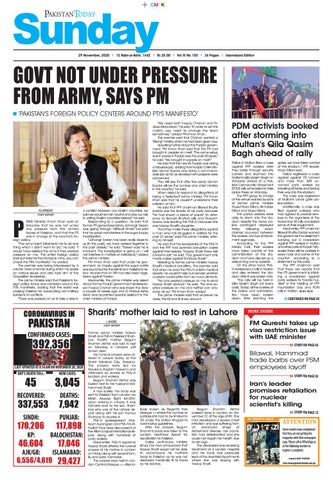
rime minister imran khan said on saturday that he was not under any pressure from the armed forces of Pakistan, and that the Pti was in charge of the country's foreign policy. "the army hasn't [directed] me to do one thing which i didn’t want to do," he said. "i would have resisted the army if they exerted pressure on me. the entire foreign policy [being implemented today] is mine, you can check the Pti's manifesto," he added. the premier was being interviewed by a private news channel during which he spoke on various issues and also took aim at the opposition leadership. the prime minister said that Pakistan's foreign policy today was centered around the Pti's manifesto, adding that the world was praising Pakistan for advocating non-military solutions to conflicts. "there was pressure on us to take a side in
a conflict between any muslim countries; we said we would remain neutral and play our role in uniting muslim countries instead," he said. responding to a question, he said that former Pti general-secretary Jahangir tareen was going through "difficult times" but said that he would not interfere in the sugar inquiry investigation. "Jahangir tareen has been really close to us [in the past], we have worked together in the past closely," he said. "tareen says he is innocent. the investigation is going on, i will not interfere in matters of institutions," added the prime minister. Pm imran khan said that under his government, an inquiry against the sugar cartel was launched for the first time in Pakistan's history. He said that an fir had also been registered against tareen. meanwhile, the prime minister was asked about former Punjab government spokesperson fayyaz chohan who was shown the door a couple of weeks ago and dr firdous ashiq awan was appointed special assistant to the chief minister of Punjab.
Coronavirus in
pakistan
CONFIRMED CASES:
392,356
LAST UPDATED AT 8:16 AM ON NOVEMBER 28, 2020
DAY'S DEATH TOLL:
NEW CASES:
45
3,045
RECOVERED:
DEATHS:
337,553 SINDH:
170,206 KP:
46,604
7,942 PUNJAB:
117,898 BALOCHISTAN:
17,046
AJK/GB: ISLAMABAD: 6,556/4,619 29,427
"We need both fayyaz chohan and firdous ashiq awan," he said. "in order to win the match, you need to change the team sometimes," added Pm imran khan. the premier said that chohan wanted a "strong" ministry which he had been given now. speaking further about the Punjab government, Pm imran khan said that the Pti had brought in people on merit. "the same setup was in power in Punjab over the past 30 years," he said. "We brought in people on merit." He said that the new ig Punjab was doing a fabulous job, adding that Punjab chief minister usman Buzdar was doing a commendable job as far as development projects were concerned. "you will see that after five years, usman Buzdar will be the number one chief minister in the country," he said. When asked to respond to allegations of being a "selected" prime minister, Pm imran khan said that he couldn't understand their criticism at him. He said that PPP chairman Bilawal Bhutto Zardari was the leader of his party because "he had shown a piece of paper" (in reference to Benazir Bhutto's will) and maryam nawaz was leading the Pml-n because she was nawaz sharif's daughter. "and they make these allegations against a man who has struggled in politics for the past 22 years," said the prime minister, referring to himself. He said that the leaderships of the Pml-n and the PPP had opened corruption cases against themselves. "nawaz sharif threw asif Zardari in jail," he said. "our government only made cases against shahbaz sharif." referring to former prime minister nawaz sharif's medical condition, the premier said that when he read the Pml-n chief's medical reports, he couldn't help but wonder whether a person could suffer from so many ailments. "no one exerted pressure on me to send nawaz sharif abroad," he said. "no one exerted pressure on me and neither can anybody do so," Pm imran khan added. the prime minister said that whatever he does, the isi and iB know about it.
PDM activists booked after storming into Multan's Qila Qasim Bagh ahead of rally Police in multan filed a case against PPP workers after they broke through security barriers and stormed into multan's Qila Qasim Bagh on saturday ahead of a Pakistan democratic movement (Pdm) rally scheduled to take place there on monday. the PPP group to charge at the venue was led by sons of former prime minister yousuf raza gilani, ali Haider gilani and musa gilani. the party's workers were able to storm into the stadium despite the heavy police contingent deployed there, following which clashes occurred between the workers and law enforcement agencies. according to the PPP media cell, their workers have taken control of the administration of the stadium and have also set up a welcoming camp outside. on the other hand, Pmln workers led a rally in multan and also entered the stadium after it was broken into. “the rally will be held in Qila Qasim Bagh (at every cost). today all the barriers of the police and administration have been broken down. after storming the
Sharifs’ mother laid to rest in Lahore
CONTINUED ON PAGE 05
more inside
FM Qureshi takes up visa restriction issue with UAE minister
LAHORE STAFF REPORT
former prime minister nawaz sharif and Pml-n President shahbaz sharif's mother Begum shamim akhtar was laid to rest on saturday in lahore's Jati umrah area. Her funeral prayers were offered in lahore today at the sharif medical city, raiwind. the prayers were led by maulana raghim naeemi and attended by scores of Pml-n leaders and workers. Begum shamim akhtar was buried next to her husband mohammad sharif. a day earlier, her body was sent to Pakistan from london via British airways flight Ba-059. upon arriving in lahore, it was handed over to her son, shahbaz who was at the lahore airport along with his son Hamza shahbaz to receive it. Pml-n spokesperson marriyum aurangzeb and Pml-n's attaullah tarar were also present at the allama iqbal international airport, along with hundreds of party workers. meanwhile, Pml-n supremo nawaz sharif offered the funeral prayers of his mother in london on friday along with several family and party members. the prayers were held in london central mosque — alterna-
gates, we have taken control of the stadium,” PPP leader musa gilani said. Police registered a case against against 70 named and more than 300 unnamed party workers for breaking off locks and forcing their way into the stadium. the case was registered at multan's lohari gate police station. additionally, a case was filed against caterers who had agreed to provide services to the organisers of the november 30 rally and seized some of their equipment. meanwhile, PPP chairman Bilawal Bhutto-Zardari warned the government to desist from carrying out a crackdown against PPP workers in multan and other parts of Punjab "otherwise there will be protests in every nook and corner of the country", according to a statement by the party. the PPP chairman said that there are reports that the Pti government is initiating a crackdown against party workers to "create hurdles" in the holding of PPP foundation day and Pdm rally in multan. NEWS DESK
STORY ON PAGE 02
Bilawal, Hammad trade barbs over Psm employees layoff STORY ON PAGE 03
tively known as regent's Park mosque — where the number of participants had to be limited to 30 under the united kingdom's coronavirus guidelines. after the prayers, Begum shamim's body was taken to the london Heathrow airport for repatriation to Pakistan. earlier, ex-finance minister ishaq dar had announced that nawaz sharif would not be able to accompany his mother's body to Pakistan as he was not declared medically fit to travel by his doctors.
Begum shamim akhtar passed away in london on november 22 at the age of 89. she had developed a severe chest infection and was suffering from an advanced stage of alzheimer's disease. Her condition had deteriorated and she could not regain her health due to old age. the deceased was receiving treatment at a london hospital and her body was previously kept at the avenfield apartments where she was staying with nawaz sharif.
Iran's leader promises retaliation for nuclear scientist's killing STORY ON PAGE 12 in today’s issue
attention Some readers have complained that they are not getting the magazine with their newspaper copy. Please call or WhatsApp us at the following number to register a complaint. Contact: 0307-7338168 irfan.farooq@pakistantoday.com.pk
02
Sunday, 29 November, 2020
NEWS
Pakistan rePorts over 3,000 CoviD Cases for fourth straight Day ISLAMABAD
P
STAFF REPORT
AKISTAN has witnessed more than 3,000 Covid-19 cases for the fourth consecutive day, as the National Command and Operations Centre (NCOC) informed on Saturday that another 3,045 cases were reported during the last 24 hours. These fresh infections have increased the national tally to 392,356 cases. As many as 45 patients succumbed to the virus during the last twenty-four hours, lifting the death toll from the highly
ANOTHER 45 DIE ACROSS COUNTRY; KP LINKS SPIKE IN CASES TO PDM PESHAWAR RALLY infectious disease to 7,942. A total of 48,223 tests were conducted over the previous 24 hours, out of which 3,045 turned out to be positive. The positivity ratio of cases dropped to 6.31pc after two days of remaining at 7.2pc. Sindh reported the most cases with 1,423 people testing positive, while Punjab is second with 738 new cases. At least 447
people tested positive in Islamabad, 323 in Khyber Pakhtunkhwa, 38 in Balochistan, 55 in Azad Jammu and Kashmir and 21 in Gilgit-Baltistan. According to the NCOC, 15 deaths were recorded in Punjab, 12 in Sindh, nine in KP, six in AJK, two in Islamabad Capital Territory and one in GB. Balochistan reported no deaths in the past 24 hours.
There are at least 2,172 patients under critical care while the number of active cases stands at 46,861. The NCOC said that 281 ventilators are occupied across Pakistan out of 1,760 ventilators allocated for Covid-19 patients. In Sindh, 802 people recovered from the virus. The second highest singleday recoveries were observed in Islamabad at 334 and third in KP with 277 people beating the virus. The AJK recorded 103 recoveries, Punjab 98, Balochistan 30, and 28 in GB. Meanwhile, the Khyber Pakhtunkhwa government said in a statement on Saturday that after Pakistan Democratic Movement’s
FM Qureshi takes up visa restriction issue with UAE minister NEWS DESK Foreign Minister Shah Mahmood Qureshi, in a meeting with Emirati State Minister Reem Al Hashimi on Saturday, highlighted the difficulties being faced by Pakistani citizens concerning visas for the United Arab Emirates (UAE). According to a statement released by the Foreign Office (FO), Qureshi underscored the need to address the issue at the earliest during the meeting held on the sidelines of the 47th Session of the Organisation of Islamic Cooperation (OIC) Council of Foreign Ministers in Niamey, Niger. Last week, the FO had confirmed that the UAE had suspended issuance of visas to Pakistani nationals among others, saying that the measure appeared to be due to the coronavirus pandemic but that it was seeking further clarity from Emirati
authorities. During today's meeting with Hashimi, Qureshi also highlighted the close fraternal ties as well as people-topeople contacts between the two countries and stressed Pakistan's commitment to forge closer cooperation with UAE in diverse fields. "During the meeting, the two sides exchanged views on bilateral cooperation, Covid-19 situation, Pakistan’s participation in the expo, and other matters of mutual interest." Appreciating Qureshi’s statement at the CFM, the Emirati minister lauded Pakistan’s initiative to propose an OIC resolution on combatting Islamophobia. The two sides also exchanged views on OIC matters and stressed the importance of further strengthening the organisation as a united and pivotal platform for the Muslim ummah, the
statement said. It was also agreed to enhance mutual exchanges to carry forward the process of growing bilateral cooperation, it concluded. VISA SUSPENSION: Last week, the FO had confirmed that the UAE had temporarily suspended the issuance of visit visas to a dozen countries, including Pakistan, until further notice. Days later, a report revealed the UAE had temporarily suspended the visas over security concerns. A source privy to the matter did not say what those concerns were but said the visa ban was expected to last for a short period. Following that report, the FO denied there were security concerns that led to such a measure but this time said changes in UAE's visa policy had not been confirmed. Meanwhile, Special Assistant to the
Prime Minister on Overseas Pakistanis Zulfiqar Bukhari on Thursday denied reports of the UAE suspending work visas to Pakistanis, saying that there was "no ban on export of Pakistani workforce". Bukhari said that "contrary to media reports", UAE Minister for Human Resources and Emiratisation Nasser bin Thani Al Hamli had "categorically stated that there is no ban on export of Pakistani workforce". Furthermore, the UAE was giving priority to those workers, who were registered on the Virtual Labour Market Database and had been laid off due to the economic slump caused by Covid-19, Bukhari said. The premier's aide added that there has been an 11 per cent increase Pakistani knowledge workers in the UAE. The Arab state was also encouraging applications for the 10-year golden visa, Bukhari said.
Masood urges OIC to help stop genocide of Kashmiris ISLAMABAD TLTP
The AJK President Sardar Masood Khan has called upon the Organisation of Islamic Cooperation (OIC) to intervene for saving Kashmiris from ethnic cleansing, state terrorism and oppressive settler-colonialism of India. Addressing the second working session of the 47th OIC Foreign Ministers Council in Niamer, Niger, on Saturday, Khan said that Kashmiris are experiencing the worst Islamophobia in the world, said a press statement. He said, "The Kashmiri people are looking towards 1.8 billion Muslims and 57 Islamic states for help to rescue them from the evil clutches of an aggressor country which is poised to eliminate them en-mass.” He said that at present, Kashmir is burning and the genocide of Kashmiri people is on the climax as the people demanding freedom and dignity are being massacred, injured and deprived of their eyesight. The president said that the Kashmiri people are being illegally arrested in Indian occupied Kashmir, subjected to
the worst torture. The youth are being kidnapped and forcibly disappeared. At present, he maintained that 20,000 Kashmiri people are languishing in different prisons and detention camps facing a grave threat to their lives. Khan said that crimes against mankind are being committed on a large-scale in the length and cranny of the held territory, and the game of death and destruction continues in every street and corner. He said that India's fascist regime is bringing Indian citizens from all across the country to the held territory, and is unlawfully settling them in order to turn occupied Kashmir into its colony. In this way, he asserted that a Muslim state was being forcibly turned into a Hindu state. While describing the Kashmiri people as the victims of the worst state terrorism, the AJK president said that India's one million troops are perpetrating a reign of terror against the innocent subjects of held Kashmir, and were also subjecting the citizens of Azad Kashmir to the worst aggression on daily basis.
He pointed out that India's fanatic BJP regime, under its Hindutva agenda, had merged occupied Jammu and Kashmir into the Indian Union without the consent of Kashmiri people, and this action is the flagrant violation of the UN Security Council resolutions. "After the revocation of the special status of occupied Kashmir and doing away with the symbols of the disputed status of Kashmir i.e. abolition of the separate constitution, flag and legislative assembly, the Indian government is going to stage an election farce to get its illegal occupation and actions validated," he insisted. Khan said that in order to divert the world's attention from the situation prevailing in occupied Kashmir, the Indian occupation troops are constantly committing aggression against more than half a million people living along the Line of Control in Azad Kashmir, and as a consequence, 30 innocent citizens have lost their lives this year alone. The state president also thanked the OIC for deputing a high-level delegation to Islamabad and Muzaffarabad to examine the actual situation prevailing in Kashmir.
PTI all set to get its chief minister elected in GB tomorrow GILGIT STAFF REPORT
The Pakistan Tehreek-e-Insaf is all set to get its nominee Barrister Khalid Khurshid elected as new chief minister of Gilgit Baltistan, as election for the slot is scheduled to be held on Monday (tomorrow). The PTI has secured 22 out of 33 seats in the GB Legislative Assembly. The opposition parties, Pakistan Peoples’ Party (PPP) and Pakistan Muslim LeagueNawaz (PML-N), hold four and three seats, respectively. According to the revised schedule for the election of the leader of the house, issued by the Gilgit Baltistan Assembly secretariat the other day, the candidates can
submit their nomination papers on Monday at 11:30am. The papers will be scrutinised and published at noon. Candidatures can be withdrawn till 2:00pm. The results will be announced at 4pm. Addressing PTI workers in Gilgit, Khurshid thanked the Prime Minister for nominating him for the chief minister’s post. He appealed to GB Assembly members to work as a team for the welfare of the people. “We have to work hard to fulfil the expectations of the people who have voted for us,” he said. Barrister Khalid Khurshid’s name was finalised after a meeting presided over by Prime Minister Imran Khan and attended by PTI Chief Organiser Saifullah Khan Nyazee.
Khurshid was elected member of the GB Legislative Assembly from GBLA-13 (Astore-1) constituency by defeating the PPP’s Abdul Hameed Khan by a margin of 1,719 votes. Born on November 17, 1980 in the Rattu area of Shounter tehsil in Astore, Khalid Khurshid did his SSC from Public School and College, Gilgit, and received a law degree from Queen Mary University of London. He contested election from GBLA-13, Astore, in 2009 as an independent candidate but lost. He again lost in the 2015 election. Khurshid joined the PTI on July 28, 2018, and was later appointed president of the party’s Astore-Diamer division chapter. He belongs to a well-known political
(PDM) public meeting in Peshawar, the novel coronavirus is spreading rapidly in the city. “PDM public meeting led to coronavirus infections in organizers, the leadership and party workers,” provincial government spokesperson Kamran Bangash said. The public meeting in Peshawar caused a hike in the number of coronavirus cases, “We pray for the recovery of all patients,” the spokesman stated. “It is our national responsibility to follow precautionary measures,” he said. He further said, “The government tried its best to convince the opposition to behave with sanity. Now their irresponsible attitude has inflicted irreparable loss,” Bangash observed. Moreover, Sindh Chief Minister Murad Ali Shah said that the positivity rate in the province has reached 15.3pc, as the province tested 9,072 samples out of which 1,389 returned positive. The provincial death toll jumped to 2,911 on Saturday. As many as 1,650 patients have recovered from the disease in the province, taking the total to 150,765, he added.
PDM activists clash with local administration ahead of Multan rally MULTAN TLTP
Clashes broke out between political workers aligned with the Pakistan Democratic Movement (PDC) and the city administration of Multan on Saturday, two days ahead of the alliance’s rally in the city. The PDM is all set to hold a power show in Multan on Monday for which members of Pakistan Peoples’ Party (PPP) and Pakistan Muslim League-Nawaz (PML-N) have started gathering in the city. The clashes broke out when activists tried to enter the Qasim Bagh Stadium in the southern Punjab city — the venue of the expected PDM gathering. Activists were seen jumping over barricades placed outside the stadium and breaking the lock on the gate. They chanted slogans after getting inside the venue despite efforts by authorities to stop them from doing so. The Islamabad High Court, in its decision on November 19, had placed a ban on all outdoor gatherings of more than 300 persons. The National Command and Operation Centre also made a decision that no indoor event would be allowed and only outdoor events with a maximum of 300 guests would be allowed. Containers were seen placed on all roads leading to Multan ahead of the PDM rally in the city. According to news reports, more than 200 political activists have been arrested. It is being reported that Aseefa Bhutto will be addressing the rally on Monday as Bilawal Bhutto Zardari, who is spearheading the campaign from PPP, has recently tested positive for coronavirus and will be addressing the crowd through video link.
family of Astore district. His father Mohammad Khurshid Khan was a member of the GB Advisory Council in the early 70s. Meanwhile, Prime Minister Imran Khan is expected to visit GB on Monday to participate in the oath-taking ceremony of the new GB chief minister. Earlier on Thursday,the PTI bagged both speaker and deputy speaker seats in the Gilgit Baltistan Legislative Assembly. The PTI candidate Syed Amjad Ali was elected to the position of speaker, while Advocate Nazir Ahmed secured the seat of deputy speaker. In all, the GB Assembly has 33 seats — 24 of which are contested through directed elections; six are reserved for women and three others reserved for technocrats and professionals. Political parties can nominate their candidates to the latter through proportional representation.
Sunday, 29 November, 2020
600 Sikh pilgrimS from india arrive aS BaBa guru nanak Birth anniverSary celeBrationS Begin ISLAMABAD
t
APP
HE three-day celebrations of the birth anniversary of Baba Guru Nanak began Saturday in Nankana Sahib with the arrival of over 600 Sikh pilgrims from India through Wagah border. The main ceremony of the celebrations of the 551st birth anniversary of Guru Nanak Dev will be held on November 30 at Gurdwara Janamasthan in Nankana Sahib. The celebrations will end after the Nagar Kirtan procession on Monday, followed by the Bhog ritual at night. Various departments, including Rescue 1122, Health Department, Civil Defence, Evacuee Trust Property Board (ETPB) and police have already completed necessary arrangements in this regard, including for security, accommodation, food, healthcare and transport of the Sikh pilgrims. Hundreds of policemen and security personnel have been deployed to provide security to the guests. During their stay, the pilgrims will also visit other gurdwaras in Punjab. A day earlier, ETPB Additional Secretary (Shrines) Tariq Wazir, Pakistan Sikh Gurdwara Parbandak Committee (PSGPC) President Satwant Singh and General Secretary Ameer Singh, and former PSGPC President Bishan Singh welcomed the Sikh pilgrims at the Wagah border crossing point. Two members of the Indian High Commission, RB Sohran and Santosh Kumar, also arrived from Islamabad to greet the pilgrims at Wagah. The representatives of Punjab Health Department checked all the passengers for Covid-19 negative test reports and any signs of the infection. After immigration and customs formalities, the delegates left for Gurdwara Janamasthan in Nankana Sahib by buses. The pilgrims also brought a Palki for Guru Garanth Sahib from India, which they will place in the Gurdwara.
NEWS
03
8 people killed in Swabi's chota lahor area during Jirga session Eight people were killed during a Jirga session in the city's Chota Lahor area on Saturday. According to Swabi District Police Officer Imran Shahid, a Jirga session turned violent when firing broke out during the session. The Jirga had been called to resolve a property dispute between two sides. Tempers flared and firing broke out, resulting in the killing of four persons from the two sides, confirmed police. NEWS DESK
Bilawal, hammad trade barbs over pSm employees layoff
Every year, more than 2,000 Sikhs come to Pakistan to participate in the birth anniversary celebrations of Guru Nanak Dev. However, the number has reduced this year due to the Covid-19 pandemic. Meanwhile, Sardar Janam Singh, Head Granthi of Gurdwara Janamasthan, has demanded of the United Nations to take notice of Kartarpur Corridor's closure by India. He said Pakistan had opened the corridor on the 550th birth anniversary of Baba Guru Nanak as a gift to the Sikh community while India closed it. The UN must ensure implementation of the agreement reached on the corridor, he added. A special song has also been released
to mark the occasion and to promote religious harmony in Pakistan and across the world by the Ministry of Information and Broadcasting. The song showcases the opening of Kartarpur Corridor with a visa-free access to the Sikh community to visit Gurdwara Darbar Sahib, Kartarpur, in Narowal district of Punjab. It also contains reaction of the members of Sikh community, who visited Kartarpur. Bollywood celebrity Ponam Kaur and her family also expressed their gratitude to Prime Minister Imran Khan for taking the unprecedented initiative for facilitating them in their religious journey and on making their long unfulfilled dreams come true. The move comes in the backdrop
of Imran Khan’s vision of achieving prosperity for the entire region through peace and opening of hearts for the communities belonging to other faiths. His vision has already started bearing fruits in the form of enhanced interfaith harmony and religious tourism. The prime minister inaugurated the visa-free border crossing on November 9, 2019, on the eve of the 550th birth anniversary of Baba Guru Nanak, the founder of the Sikh faith. The initiative by the Pakistan Government has been appreciated by the Sikh community across the globe. Under the religious tourism agreement between Pakistan and India, 3,000 Sikh pilgrims from India can visit Pakistan on Baba Guru Nanak’s birthday.
Asad Umar eyes PTI rule, end of Zardari-era in Sindh LARKANA STAFF REPORT
Federal Minister for Planning, Development and Special Initiatives Asad Umar on Saturday claimed that the Zardari-era would soon end in Sindh and that the PTI would rule the province in the future. The federal government and the Opposition have been at loggerheads after the latter announced the 11party alliance Pakistan Democratic Movement to oust the incumbent rulers. Speaking to media in the city that is considered PPP's stronghold, the federal minister said that the ruling PTI would establish its rule in Larkana. "We will draft a package for Sindh's development." Umar lamented that "a few families accumulated wealth" in the province, while the poor people of Sindh continued to suffer.
Talking about rallies, Umar said that PTI could hold public gatherings in Sindh, but it "preferred not to put people's lives at risk over [mere] politics." The minister, shedding light on PTI's work in Sindh, said that the Centre had distributed the most cash to underprivileged people in the province during the lockdown. "The government distributed [billions] among poor people as they were severely affected due to the lockdown," he said. The minister had apparently visited the city to meet senior PTI leader Ameer Bakhsh Bhutto, where he assured him that Prime Minister Imran Khan was serious about clearing reservations of party leaders. Bhutto voiced his concerns that despite joining the PTI, no one in the top-brass was ready to listen to him. "The party is facing difficulties due to lack of organisation and security."
"All your reservations will be removed," Umar assured him. Meanwhile, addressing the media in Sukkur earlier in the day, Umer said PPP had completely failed to develop the Sukkur district, however, the PTI government was working for all districts' development, including Sukkur. PM Imran Khan has taken important decisions to control the rising inflation in the country, he said, adding that he would discuss Sukkur’s development projects with Sindh Chief Minister Syed Murad Ali Shah. The minister said that the Centre, through the Sindh government, would soon execute federal-funded development projects. Umar further said that Pakistan’s Covid-19 policy has been appreciated globally, and advised the masses to follow the government’s prescribed safety precautions, warning everyone that the virus is still present.
KARACHI: Minister for Industries and Production Hammad Azhar on Saturday criticised the Pakistan Peoples Party (PPP) for turning the Pakistan Steel Mills (PSM) “from a profit-making entity with billions in [its] bank account to a heavy loss-making and bankrupt entity” after the party’s chairperson Bilawal Bhutto-Zardari lashed out at the PTI government for sacking over 4,500 PSM employees. Following the federal government’s decision to lay off 4,500 employees of the Pakistan Steel Mills (PSM), the PPP Chairman had said that Prime Minister (PM) Imran Khan should be sacked and not the workers. In a tweet earlier in the day, Bilawal vowed to return ‘each and every’ sacked employee back to work, adding that the land of this ‘historical industrial asset belongs to the people of Sindh’. Calling the government’s move “economic murder,” Bilawal said PPP will not let the Pakistan Tehreek-eInsaf (PTI) get away with taking such a step. Hitting back at the young PPP leader, Hammad Azhar wrote on his official Twitter handle, “Let me remind everyone that it was during PPP tenure that PSM went from a profit-making entity with billions in the bank account to a heavy loss-making and bankrupt entity. Capacity was taken down to 40 per cent and then PML-N shut it down in 2015.” Meanwhile, PSM employees staged a sit-in at the national highway against the sacking of their services by the federal government. Protestors in large numbers along with a body of a worker, who passed away on Friday after hearing news of his termination from services, observed a sit-in at the highway, urging the government to take back its decision of laying-off their services. The sit-in resulted in massive traffic jams on both sides of the highway. It is to be mentioned here that the outraged employees of the PSM also protested last night against the decision. Earlier on Friday, the PSM laid off over 4,500 of its employees. The employees were fired in the wake of an emergency meeting chaired by the PSM chief executive officer (CEO) at the CEO Secretariat. The Economic Coordination Committee (ECC) of the Cabinet on June 3 also approved to give the employees due to monetary benefits along with one month salary that would cost the exchequer Rs18 billion to Rs19.7 billion. STAFF REPORT
ctd, fc arrest three ‘terrorists’ from khuzdar The Counter-Terrorism Department (CTD) and Frontier Corps, in a joint operation, on Saturday arrested three suspected terrorists belonging to the proscribed Balochistan Liberation Army (BLA) from Khuzdar. A CTD spokesperson said while the personnel detained the terrorists, their three managed to escape. An AK-47 rifle, 25 kilograms of explosives, remote control devices were also seized from the hideout of the terrorists. The investigation from the arrested terrorists is underway. NEWS DESK
Security forces playing key role for durable peace: CM Kamal QUETTA APP
Balochistan Chief Minister Mir Jam Kamal Khan said security forces including the Levies were playing a key role in maintaining durable peace in the province and ensuring its development and prosperity. He expressed these views while addressing a ceremony of Inter-District Levies Recruits Passing out Parade in Khuzdar. Provincial Minister for Home Minister Mir Ziaullah Langove, Parliamentary Secretary for Information Bushara Rind, Member of Provincial Assembly (MPA) Naseebullah Murree, DG Levies Force and other senior officials also attended the ceremony.
The chief minister said Pakistan’s security forces had given great sacrifices for restoration of peace in the country and their efforts for Balochistan were highly commendable. “There is peace in the respective areas of Balochistan owing to numerous sacrifices of security forces,” Chief Minister Jam Kamal said. He also paid rich tributes to martyrs of security forces. He said increasing the capacity of the Levies Force in Balochistan was a great achievement which would help counter
crime in all areas of the province. Jam Kamal added incumbent government was utilizing all resources to improve the capacity of forces for ensuring protection of public lives and their property in the area. He said peace was essential for development of the province. He said funds have been released for setting up a new Levies Training Center in Kuchlak aimed at improving performance of the Levies force in
the area, adding “Balochistan is our province for which we all have to play a responsible role to bring development and prosperity.” He said steps were being taken in all the district of the province to improve the system. He said “it is our duty to make comprehensive planning for the province to put it on path of development. CM said the women in Levies Recruits showed excellent performance and said he was proud of their performance. He also congratulated the Levies Recruits on their successful passing out. Earlier, Mir Jam Kamal was greeted by a contingent of the Levies recruits. CM Mir Jam Kamal also inspected the Levies Recruits Parade and was informed that 24 women constables were included in
the 600 Levies recruits of 9 districts who were provided 4 months of training. Chief Minister Jam Kamal, along with Provincial Interior Minister Mir Zia Lango, Parliamentary Secretaries Rubaba Bulaedi Bushra Rind, and MPA Mir Naseebullah Mari with the passed out Levies force Chief Minister Jam Kamal, along with Provincial Interior Minister Mir Zia Lango, Parliamentary Secretaries Rubaba Bulaedi Bushra Rind, and MPA Mir Naseebullah Mari with the passed out Levies force The recruits also took oath at the Ceremony and later demonstrated excellent skills acquired during their training. At the end of the ceremony, Chief Minister Jam Kamal distributed prizes among the best performing Levies recruits.
Sunday, 29 November, 2020
04 NEWS
MCR inCReases MonThly RenT of PGGa’s hosTel fRoM Rs10 To Rs415,000 LAHORE
T
SHAHAB OMER
He Municipal Corporation Rawalpindi (MCR) has increased the monthly rent of Pakistan Girl Guides Association’s (PGGA) Girls Guide House -- a historic, national, non-profit organization located at Asghar Mall -- from Rs10 to Rs4,15,000. According to details, a letter written by MCR to the association revealed that the monthly rent of the said house has been increased to Rs415,000, with PGGA being asked to pay a three-month (July 2020 to Sep 2020) rent of Rs1,245,000. Sources disclosed that a key politician, who is currently holding the portfolio of an important ministry, was behind the increase in PGGA's monthly rent. They informed that in the past (during Ziaul Haq's regime), the same politician had also helped set up a school by seizing half of the land leased to the PGGA House. A wall was later built between the house and the school. Talking to this scribe, PGGA Deputy Provincial Commissioner Taazen Fazal
Ahmed said the association was established in December 1947, with Fatima Jinnah appointed as its first patron, adding that the major proportion of PGGA’s funding comes from the Punjab government. She maintained that PGGA has over the years strived hard to provide opportunities for the development of girls and young women, such as camps, training sessions, workshops and seminars. When asked about the matter of lease of the Asghar Mall property, she replied, “On May 15, 1957, the MCR had approved the lease of 10 kanals and 12 marlas (original allotment) at Asghar Mall to the PGGA for the purpose of constructing its Girl Guides House. The rent for the property was kept at Rs10 per year. However, in 2018, certain government quarters unlawfully attempted to take over the said PGGA’s Girls Guide House.” She said in the vide order dated Nov 19, 2018, in Human Rights Case No.52827-P/2018, the Supreme Court of Pakistan took notice of interference with and non-renewal of the leasehold rights of the PGGA with respect to the Girl Guides House and directed that the MCR
Balochistan reports 21st polio case of 2020 QUETTA
to execute and register a 99 years lease in perpetuity in favor of the PGGA with respect to the Girl Guides House, Rawalpindi. The SC also instructed that no inference for any reason or of any nature in the PGGA land or possession shall be made by any authority, entity, department or private party in Pakistan without prior permission of this court. “Subsequently, MCR and PGGA executed a Lease Deed dated May 17, 2019, with respect to the original allotment for a period of 99 years commencing from July 19, 1957. Both entities executed another Lease Deed dated Feb 07, 2020, with respect to the excess land for a period of 99 years commencing from July 19, 1957,” she informed. She further informed that the lease deeds stipulated that the total annual rent payable by PGGA for the Asghar Mall Property, Rawalpindi, would be Rs20 per year, subject to a 10 per cent annual increase. “On Aug 29, 2020, the MCR informed PGGA that the District Price Committee, Rawalpindi, assessed the monthly rent of the Asghar Mall property
as Rs4,15,000, amounting to approximately 2,074,900 per cent increase in annual rent as stipulated in the lease deed, and also issued Challan no. 423074 demanding payment of a total amount of Rs1,265,750 as rent for the period July 2020 to September 2020. The astronomical increase in the rental amount demanded by the MCC is violation of the orders of the Supreme Court, is arbitrary, unreasonable and excessive and amounts to an abuse of government authority,” Tazeen added. She claimed that the challan has been issued with mala fide intent to deprive the PGGA from its lawful possession of the property by demanding a rental amount that admittedly PGGA, being a non-profit organization, cannot afford to pay. “The rental amount demanded would expropriate the bulk of the government grant and will render it non-functional. The PGGA approached the MCC, Rawalpindi, expressing its legitimate concerns regarding the exorbitant amount of rent demanded. But its request for reconsideration was unequivocally and unreasonably denied by the MCC,” she concluded.
Asad Umar vows ‘Karachi-like development package’ for other parts of Sindh SUKKUR STAFF REPORT
NEWS DESK Pakistan and the US have jointly completed restoration work at the Takht-i-Bahi Buddhist monastery in northwest Pakistan under the $230,000 cultural preservation project. US Consul General Gregory Macris virtually participated in the closing ceremony of the project at the monastery in Mardan in Khyber Pakhtunkhwa. “The US mission in Pakistan is committed to working with local partners to support conservation and preservation of sites of great cultural significance across Pakistan,” said Macris. The Humanitarian and Facilitation Organisation (HAFO) received a US grant to execute the two-phase project at Takht-i-Bahi. Working in close collaboration with the Directorate of Archeology and Museums Khyber Pakhtunkhwa, HAFO completed preservation of the Buddhist priests’ living quarters over the past year in the second phase. During phase one, HAFO received a $400,000 grant to preserve Block-B of the monastery from 2017 to 2019. The preservation project provided training and employment to dozens of skilled and unskilled labourers. It also encouraged increased local and international religious tourism, with hundreds of visitors coming to the monastery each week. The US mission in Pakistan supports cultural preservation efforts across the country and has previously funded restoration work at Masjid Mohabbat Khan and Gor Gathrie in the province.
Gas crisis intensifies in Karachi KARACHI
TLTP
Another case of the crippling poliovirus disease has surfaced in Balochistan, taking the tally of the cases for the current year to 21 in the province. Provincial health department confirmed on Saturday that a tenmonth old baby girl, resident of Kharotabad near Quetta, tested positive for the virus. The health officials said that the samples of the child had been taken on November 11 and 12 and its results came positive. Balochistan health department officials claimed that the victim’s family members had refused to get their child vaccinated during anti-polio campaigns. Polio is a highly infectious disease caused by polio virus mainly affecting children under the age of five. It invades the nervous system and can cause paralysis or even death. While there is no cure for polio, vaccination is the most effective way to protect children from this crippling disease. Repeated immunizations have protected millions of children from polio across the world, allowing almost all countries to become poliofree. There are only two countries in the world, Pakistan and neighbouring Afghanistan, where polio cases are still being reported.
Restoration work on Takht-i-Bahi Buddhist monastery completed
Planning, Development and Special Initiatives Minister Asad Umar said on Saturday that a Karachi-like development package will soon be announced for other parts of Sindh. Talking to media persons on Saturday, Asad Umar said that Pakistan Peoples Party has completely failed to develop Sukkur district, but the Pakistan Tehreeke-Insaf government is working for the development all districts, including Sukkur. He said that Prime Minister Imran Khan has taken important decisions to control the rising inflation in the country, adding that he would discuss Sukkur’s development projects with Sindh Chief Minister Syed Murad Ali Shah. He said that the federal government is fully aware of the problems being faced by residents of the region, and that the centre, through Sindh government, is going to execute federal-funded development projects. He appealed the people to strictly adhere to standard operating procedures (SOPs) to prevent the spread of a second wave of coronavirus in the country. He said that the government is making all-out efforts to ensure safety of people’s health and save their livelihoods.
TLTP
Umar said that Pakistan’s Covid-19 policy has been appreciated globally, and advised the masses to follow the government’s prescribed SOPs, cautioning that the virus is still there. In reply to a question, the minister regretted that during the last two tenures of the PPP government, no development project was completed to improve infrastructure of basic amenities. Later, the minister also addressed a meeting of PTI youth at Sweet Garden, Sukkur.
Rs14bn to be spent on construction of rural roads: Buzdar LAHORE TLTP
Punjab Chief Minister Sardar Usman Buzdar has said in the second phase of ‘Naya Pakistan Manzilein Asaan’ programme, Rs14 billion will be spent to construct carpeted roads in rural areas of the province. In a statement on Saturday, the chief minister said that 154 rural roads with a total length of 1,076 kilometres will be constructed across the province. He said that the construction of roads in rural areas will help farmers take their produce to the markets in an easy and timely manner. “The construction of these roads will not only improve the transportation means for people living in rural areas but will also promote trade and economic activities.” He said that the ‘Naya Pakistan Manzalien Asaan’ programme is a flagship project of the PTI government. He said that rulers of previous regimes believed in pomp and show whereas the PTI government has delivered and worked for the welfare and betterment of the people. He said that in the first phase of the programme, 1,236 kilometres long roads were constructed and repaired at a cost of Rs15 billion. Spe-
cial funds will also be allocated for this programme in the next fiscal year, he added. Separately, Usman Buzdar congratulated the Sikh community on the birth anniversary of Baba Guru Nanak Dev Ji and welcomed them in Punjab. He said that according to the Islamic teachings, the PTI government believes in religious tolerance. He said that the birth anniversary of Baba Guru Nanak Dev Ji is a traditional and joyful festival of the Sikh community. He said participating in each other’s joys will promote brotherhood and harmony. He further maintained that Baba Guru Nanak Dev Ji was the best example of religious tolerance and inter-religious harmony. He said that setting up of Kartarpur Corridor is a historic achievement of the PTI government. It is a matter of pleasure for the PTI government to serve the Sikh community every year. He said that all facilities have been provided to the Sikh community for performing their religious rituals. Sikh community is free to live their lives according to their religious beliefs. The government is paying special attention for maintaining, renovating and security of Gurdwaras, he said, adding the PTI government has ensured the protection of the rights of the minorities.
Citizens of Karachi are bearing the brunt of institutional negligence as their gas supply has been hampered with unprecedented severity, while the situation further deteriorated on Saturday when Sui Southern Gas Company’s online system collapsed. Similar to adding insult to injury, the citizenry cannot make complaints or find out the status of their gas supply restoration as Sui Southern Gas Company (SSGC) has noted its system is down and the complaint center is out of order. “Our online system is likely to restore by 7:00pm,” the complaint centre said on Saturday, while the people staged protests across different parts of the city for long gas outages in the winters. Irate residents of New Karachi area took to roads to express their annoyance over gas loadshedding while those from the Garden area, Kharadar, Soldier Bazaar, Nishter Road have reported the worst gas outage as well. Parts of Gulshan e Maymar, Old City area, Orangi town, Landhi have also reported low gas pressure. On the other hand, SSGC, Karachi’s sole gas utility supplier, claimed there was no gas loadshedding anywhere in the port city. It said if there’s a low-pressure grievance in any part of the city, the people should register their complaints. “We are trying to ensure smooth gas supply to both domestic and commercial consumers,” the SSGC said while denying claims of loadshedding being protested in the city.
Sunday, 29 November, 2020
81 PakiStaniS naMeD in toP 2PC SCientiStS aCroSS tHe GloBe a
MERICA’s Stanford University has featured 81 Pakistani scientists in its global list of the world’s top scientists. As many as 11 professors from Quaid-iAzam University (QAU) Islamabad figured among the top two per cent researchers in a global list compiled by Prof. John Ioannidis of Stanford University and his team. The list carries names of 159,683 people from all scientific disciplines. According to the details, recently the Stanford university has compiled a list of top 2 per cent scientists working round the globe in which a number of Pakistani
are three professors of University of the Punjab have also been ranked in Stanford list of researchers, including Prof. Dr. Muhammad Sharif, Dean, Faculty of Science (ranked in the field of Nuclear and Particle Physics), Prof. Dr. Khalid Mahmood, Dean, Faculty of Economics and Management Sciences (ranked in the field of Information and Library Science), and Prof. Dr. Muhammad Akram, Department of Mathematics (ranked in the field of Artificial Intelligence and Image Processing). Prof. Dr Bilal Abbasi, General Secretary Academic Staff Association QAU,
researchers from different universities were included in the list for their best research work. The QAU scientists whose names have appeared in the list include Dr. Bilal Haider Abbasi from Biotechnology, Zabta Khan Shinwari and Mushtaq Ahmad from Plant Sciences, Amir Ali Shah from Microbiology, Riffle Nasim Malik from Environment Sciences, Muhammad Rashid Khan from Biochemistry, Masood Khan from Maths, Afzal Shah and Aamer Saeed from Chemistry, Abdul Haq from Statistics. Among the other scientists in the list
PDM activists booked after storming into Multan's Qila Qasim Bagh ahead of rally COntinued frOM page 01 "Misuse of the state machinery against democratic workers will add fuel to the fire and every responsibility of the situation thereafter would lay on the PTI regime," read the statement. Bilawal said the Foundation Day rally will be held "anyhow" and PPP and other PDM parties "won't be cowed down by the highhandedness of the regime". PPP leader Ali Musa Gilani vowed that the rally will proceed as planned and said that the arrests were a "badge of honour" for the party. He said that 4,000-5,000 party workers will camp on the stadium grounds till November 30. "If a crackdown takes place, Chief Minister Punjab Usman Buzdar will be responsible (for the resultant fallout)," he warned. PPP's Ali Qasim Gilani, the chief coordinator of the scheduled event, said that the "rally had to take place on November 30 but has already begun today because of the administration's moves". "We had sought to set up a welcoming camp today and so we proceeded to make preparations," he said. "But the police is harassing us," he continued, adding: "All roads leading to the venue have been blocked." He said that the party's central leadership will arrive at the venue tomorrow and appealed to the people to ensure they wear masks at all times. Meanwhile, Special Assistant to Chief Minister Punjab on Information Dr Firdous Ashiq Awan said that the Buzdar government is "exercising restraint". Awan said that the government is holding back but PDM wants the situation to take "a different turn". "Action will definitely be taken against those elements who tried to take the law into their own hands in Multan!" vowed Awan. The government and the Opposition are at odds with each other over the PDM jalsa at Qila Qasim Bagh on November 30. Prime Minister Imran Khan has asked the Opposition parties to call off their rallies as the coronavirus situation in the country is worsening day by day. However, the Opposition alliance has categorically rejected the government’s demands and vowed to hold rallies all over Multan if it is stopped from holding the Qila Qasim Bagh gathering.
Google doodle honours Bano Qudsia on 92nd birthday Google Doodle on Saturday honoured the life and legacy of Pakistani novelist and stage and television playwright Bano Qudsia, affectionately known as Bano Aapa. Qudsia is widely credited as one of the most significant Urdu language authors in modern times who earned acclaim for like her television play Aadhi Baat (1968) and novel Raja Gidh (1981), both classics of their genre. In addition, she wrote a prolific 25 novels and founded her own magazine called Dastango. Even as her legend grew throughout her six-decade career, she maintained a reputation for her radical acceptance and kindness, known to embrace those from all walks of life who approached her for mentorship or assistance. NEWS DESK
whose name is also included in the list, said that it is a proud moment for the country that a number of Pakistani scientists working in different universities have been named in top two percent scientists across the globe. In his message, Dr Bilal urged the government to allocate more budget for the top ranked university of Pakistan to resolve its issues and improving its global ranking. All these authors were selected on the basis of an international evaluation of their research papers. A report on this list has been recently published in PLOS Biology. NEWS DESK
Iconic tech entrepreneur Tony Hsieh dies at 46 LaS VegaS TLTP
Prominent businessman Tony Hsieh, often credited for helping to transform downtown Las Vegas, has died at the age of 46. He co-founded online retailer Zappos and sealed a deal to sell off the empire to Amazon over a decade ago. The cause of Hsieh’s death is unknown. “The world has lost a tremendous visionary and an incredible human being,” current Zappos CEO Kedar Deshpande wrote in a statement. “Tony played such an integral part in helping create the thriving Zappos business we have today, along with his passion for helping to support and drive our com-
pany culture.” Before launching the shoe and apparel business, Harvard graduate Hsieh co-founded an advertising startup called LinkExchange. The tech firm was sold to Microsoft for $265 million in 1998, when he was just 24. Hsieh co-founded Zappos, then called ShoeSite.com, in 1999 and turned it into a massive business that eventually caught the eye of another industry behemoth, Amazon. Seeing enormous growth potential, Amazon acquired Zappos for $1.2 billion in 2009, and it remains one of Amazon’s largest acquisitions to date. The late tech entrepreneur is also known for the Downtown Project – a plan aimed at helping revitalize part of downtown Las
Vegas by investing in people and projects. The initiative has allocated and invested $350 million, helping to create more than 165 new businesses and over 1,000 new jobs. Local businessmen and officials also offered their condolences to Hsieh’s family, praising him for helping to change the landscape of downtown Las Vegas. “The world has lost a tremendous visionary and an incredible human being,” current Zappos CEO Kedar Deshpande wrote in a statement. “Tony played such an integral part in helping create the thriving Zappos business we have today, along with his passion for helping to support and drive our company culture.”
NEWS
05
corporate corner
KARACHI: Chughtai Lab hosted its Corporate Partners Connect at its new Corporate Center at Sky Tower, Khalique-uz-Zaman Road, Clifton. The event included discussions on the recent initiatives and programs of Chughtai Lab including the Diabetes Care Programme, through which diabetes patients can get up to 50pc discount on diabetes tests, and the launch of Chughtai Vaccination Centers across Pakistan. PRESS RELEASE
LAHORE: The exponential increase in Covid-19 cases across Pakistan has once again created a difficult situation for citizens. Being a people centric brand, the safety and security of customers is of utmost importance to Ufone. Hence the company is providing online balance recharge service so customers can avoid unnecessary visits to retailers or service centers. PRESS RELEASE
LAHORE: Punjab Group of Colleges and AntiNarcotics Force-Rawalpindi signed a landmark MoU for free education to Martyrs’ children and various discounts to serving personnel. PRESS RELEASE
Washington tells Deutsche Bank to wind up business in Russia MOSCOW AGENCIES
Outside monitors appointed by the New York state authorities have recommended that Germany’s largest lender, Deutsche Bank, should cease doing business in Russia, to avoid potential risks connected to illegal practices. Deutsche Bank is reportedly planning to expand its Russian business, despite a spate of scandals connected to cases of money-laundering, and a series of hefty fines for failure to act against them. The call from Chicago-based law firm Jenner & Block came as the efforts taken by the bank’s subsidiary in Russia against money-laundering practices were deemed insufficient, according to sources connected to the matter as quoted by the Wall Street Journal. The monitors reportedly said Deutsche Bank runs a high risk of potential prosecution if it keeps doing business in Russia. The US set up a watch on the financial activity of Deutsche Bank’s branch in Russia after one of the world’s biggest lenders was fined $425 million by the New York State Department of Financial Serv-
ices and £163 million by the UK Financial Conduct Authority, in connection with laundering $10 billion out of Russia. The monitoring agency has no legal right to dictate the bank’s policy. However, the monitors can pass on information to the New York financial watchdog, which is in a position to impose fines and introduce sanctions. Earlier this year, US regulators suspected Deutsche Bank of facilitating more than half of the $2 trillion of suspicious transactions around the world that were flagged between 1999 and 2017.
ISLAMABAD: In line with the directive of Prime Minister Imran Khan on reaching out to the public through holding Khuli Kachehris by organizations under the federal government, National Highway Authority Member Coordination Asim Amin held EKachehri at the head office of the authority through NHA official facebook page. PRESS RELEASE
HSBC considers exit from US retail banking HSBC Holdings Plc is considering a complete exit from retail banking in the United States after narrowing the options for how to improve performance at its struggling North America business, the Financial Times reported on Saturday. The bank’s senior management aim to present the plan to the board in the coming weeks, the FT reported, citing people familiar with the situation. HSBC declined to comment on the report. AGENCIES
K-Electric holds 110th AGM, report Rs2.96bn net loss for FY20 KaraCHi PRESSRELEASE
K-Electric (KE) held its 110th Annual General Meeting (AGM) for FY2020. With the on-going Covid-19 pandemic, the AGM was hosted virtually. The meeting was chaired by Shan Ashary, Chairman of the KE Board, with Moonis Alvi, Chief Executive Officer, also in attendance, along with Aamir Ghaziani, Chief Financial Officer, Rizwan Dalia, Company Secretary & Chief People Officer and other members of the Board and KE leadership. Shareholders were briefed about prevalent challenges such as the Covid-19 lockdown, continuous accumulation of outstanding net receivables from govern-
ment entities (over Rs80 billion on principal basis, as of September 30, 2020), increased finance cost (up by 166pc) and the resulting distressed working capital situation. Before the Covid-19 lockdown, KE showed strong operational performance and upto March 20, 2020, recorded 3.1pc growth in units sent-out, with around 2pc points improvement in T&D losses, compared to the same period last year. However, significant drops in consumption by industrial and commercial consumer segments, load-shed exemption to high-loss areas and inability to carry-out theft detection activities, adversely impacted the sales mix leading to an overall increase in T&D losses. These factors along with a significant increase in finance cost, resulted in Rs2.96 bil-
lion net loss, compared to Rs17.3 billion net profit in the preceding year. During FY2020, despite the lockdown, KE invested over Rs55 billion across its energy value chain. Construction of the 900MW RLNG-fired BQPS-III is being pursued on fast track basis. Further, with the objective of enhancing transmission capacity and improving overall network reliability, KE has completed over 94pc of the TP-1000 project. KE has also converted over 9,000 Pole Mounted Transformers (PMTs) to Aerial Bundled Cable (ABC). This has enabled the Company to significantly reduce T&D losses and benefit consumers through reduced load-shed. KE has continued to invest in technology, including installation of Automated Meter Readers (AMRs) at PMT level
CMYK
and implementation of a Meter Data Management System (MDMS), which will provide greater visibility into network performance. In FY 2020, ‘Project Sarbulandi’ was launched. This project is aimed at improving network health, providing a safer environment, network upgradation through installation of ABCs, load-shed reduction, and upliftment of areas through community engagement activities. Project Sarbulandi, to date, has managed to positively impact over five million inhabitants, through the conversion of over 1,000 PMTs to ABC and provision of low-cost meters to over 100,000 customers. As part of a diversification strategy, KE has incorporated a wholly owned subsidiary, KE Venture Company (Pvt) Ltd (KEVCL).
KEVCL will be a holding company for different initiatives taken by the Company in the energy sector. Initially, the subsidiary will explore investments in renewable energy. Another wholly owned subsidiary, KSolar, has been incorporated under KEVCL. K-Solar will specialize in Distributed Generation. In addition, 150 MW solar IPPs at Vinder, Uthal and Bela are going to be developed as joint ventures under KEVCL. Customer-centric initiatives remained a core focus. KE’s social media platforms, 118 call centre and KE Live App were instrumental in customer facilitation during the lockdown. KE also introduced various alternative payment solutions, such as digital banking, reducing the need of physical visits to banks, and partnerships with Bykea and Daraz.
Sunday, 29 November, 2020
06 COMMENT
The last bastion
The need for flexibility A stubborn government facing a stubborn opposition
The Bihar state election shows which way the wind is blowing
T
he second wave of coronavirus inside the country and in countries who are Pakistan’ major export markets is having a toll on the national economy. exports have come down, so have imports, while the trade deficit has increased by 4 percent to $6.7 billion. A report by the Finance Ministry acknowledges that the fiscal deficit as of November 20 increased by almost 70 percent when compared with the same period of last year even though development expenditure remained almost flat. We are told that the effects on the economic outlook would depend on the intensity and duration of restrictions being imposed on some sectors and areas of economy. Pakistan can do little to reduce the virus threat in other countries. It can however take measures to reduce its impact inside the country. The ongoing confrontation between the government and the PDM is helping in the pandemic’s spread. The opposition parties were practically forced to take recourse to street agitation on account of the unrelenting vengefulness on the part of the Prime Minister. Fresh cases continue to be opened against opposition leaders by NAB after failing to penalize them in the old ones. A large team of hired government spokesmen has continued a barrage of propaganda against the PDM leadership, adding insult to injury. The government wants to put an end to the opposition’s protests on terms that are humiliating for its leaders. It is thus using the pandemic to force the opposition to surrender, while it continues to pile fresh cases against its leaders amidst grave provocations. There is a need for a truce between the opposition and the government. This requires an end to the filing of fresh cases, a signal to the pliant NAB to allow bail to those under investigation followed by invitation to the PDM for talks by the PM himself. Trying to subdue the opposition through threats like banning the protests did not help in the past and is not likely to help now. It is time the government showed flexibility in the larger interest of the nation. At stake are people’s lives and the national economy.
M J AKBAR
S
o much lightning, so little light. There is more to the many outcomes of the recent Bihar Assembly election than meets the media eye. In this Age of the Mighty Algorithm it is certain that someone will eventually do the precise mathematics, but it seems very likely that almost as much has been written about the five victories of the All India Majlis-e-Ittehad-ulMuslimeen [AIMIM] in the north-east of Bihar as about the rest of the state. This is perfectly understandable, for this was the one result that left traditional vote-bank politicians aghast and professional pundits startled. Compared to this, the defeat of the “Mahagathbandhan” of rashtriya Janata Dal, Left and Congress was merely partisan bewilderment encouraged by that self-lubricating lobby of opinion-thrusters mistakenly called opinion pollsters. But most analysts, from either the political class or the media, missed the crucial message from seemanchal: the last Muslim bastion of the Congress in the north has collapsed. The demography of what is known as seemanchal-Koshi, the districts of Araria, Kishanganj, Katihar, Purnia, Madhepura, saharsa and supaul in the riverine tracts south of Nepal and west of Bengal and Bangladesh, is unique. Muslims constitute 36.4 percent of the region’s population. The economically Backward Castes form the next largest bloc with 21.7 percent. The Mahadalits and scheduled Tribes are 11.4 percent; Yadavs 11.1 percent; other Backward Castes 8.3 percent; and the sawarn [or “forward” castes] just 5.3 percent. This does not mean that these blocs are always united, come election time. Muslims can easily split along dialect and ethnicity. They may agree on who they will vote against, but not necessarily on who they will vote for. The eBC, oBC and sawarn are by definition conglomerates, as are Mahadalits and scheduled Tribes. The Yadavs may be the only voting group that displays substantial [but never unanimous] identity solidarity, which translates, as in the rest of the state, to a base vote for the rJD. however, this can sometimes work to its disadvantage as when a Yadav candidate from a different party becomes a more powerful magnet on the basis of caste identity. What the existence of blocs means is that given the right circumstances and political impetus, they can become electorally homogenous. The blend happened in the Kishanganj belt. No statistic represents an even spread; it is merely a classified average rather than the more nu-
PSM layoffs A public sector disaster that remains a burden on exchequer
e
FForTs made, or lack thereof, to turn around the Pakistan steel Mills (PsM) by practically any of the past civilian and military regimes had failed miserably, making it one of the most expensive burdens in the long list of financially unviable Public sector enterprises (Pses) of the country. The current PTI government under Prime Minister Imran Khan has not fared any better, having spent close to three years in office with little to no progress as far as PsM is concerned. Before coming to power, there was a lot of talk from Mr Khan of reforming this money-hemorrhaging behemoth, but as with most other similar promises, this too remains unfulfilled. however, it now seems the PTI has accepted the reality that under the PsM’s current ownership structure, it is near impossible to bring about any meaningful policy changes and reforms that would make it a profitable stateowned institution. It has therefore opted for the unpopular route of privatization and the first step is trimming the fat, which it has begun by laying off 4500 of the 9000 employees who were collecting salaries despite PsM being shut down for the past five years. At one point, PsM’s workforce was a ridiculously bulky 30,000. each employee that has been let go will be receiving a compensation of rs2.3 million, which isn’t a bad deal, but they would no longer be ‘government employees’ that usually means a cushy job with benefits and a guaranteed spot for the next generation in the family. Apart from the fundamental problem of finding a suitable buyer for the country’s largest industrial unit, willing to pay an estimated $1.4 billion over three years plus an additional $580 million for revival, there is the political angle as well. While the PTI will not be that bothered about the opposition parties’ condemnations and protests against the retrenchment at PsM, it will have to pay attention to the MQM and other Karachi-based allies who are also against the move. The PTI is at least not leaving the PsM in limbo; by changing its ownership structure so that it is no longer a consistent strain on the exchequer. But this will be a major political challenge for a government that has so far not displayed it has the chops to effectively manoeuvre.
God help us all get through 2020 to a better ‘21
RABiA AhMed
J
UsT as a virus changes or mutates─ and we’re more familiar with the idea now than before, language changes as well. The words we use and the phrases that are popular from one generation to the next are shaped by various factors, and many of these words and phrases change or disappear depending on the times they flourish in, the people who use them and events that occur at various times. even legal terms can find themselves into common parlance like section 420 of the Indian Penal Code which deals with ‘cheating and dishonesty,’ 420 has come to be known by the people of the subcontinent as another term for a fraud. It’s the same with 92-11 which is something similar and means ‘an absconder’. With that in mind, the end of the year may be a good opportunity to guess what other changes are likely to take place in the language we speak. To start with there could be sentences like ‘it turned out to be a complete 2020’ which would refer to something during the course of which everything went wrong. optometrists will need to come up with another description for perfect vision also, because 2020 has not
Arif Nizami Editor Umar Aziz
Asher John
Joint Editor
Executive Editor
Deputy Editor
Lahore – Ph: 042-36300938, 042-36375965
Mobashar Jawed Akbar is a leading Indian journalist and author. He is the Editor-in-Chief of The Sunday Guardian. He has also served as Editorial Director of India Today. He tweets at: @mjakbar.
Say goodbye to 2020
Dedicated to the legacy of the late Hameed Nizami
Aziz-ud-Din Ahmad
anced ground reality. seemanchal might have an overall Muslim proportion of 36 percent, but the Kishanganj area has a Muslim population of around 65 percent, giving Muslims far greater political and electoral weightage. MIM won five Assembly seats in constituencies contiguous to Kishanganj. There was nothing accidental or incidental about these victories. MIM got 51.2 percent of the votes in Amour, 49.8 percent in Bahadurganj, 49.4 percent in Kochhadhaman, 38.3 percent in Baisi, and 34.2 percent in Araria. It defeated Nitish Kumar’s JDU in Amour and Kochchadhaman, rJD in Jokihat, Vikassheel Insaan Party [a constituent of NDA] in Bahadurganj and BJP in Baisi. Congress got 29,818 votes against MIM’s 85,472 in Bahadurganj; and 31,475 in Amour against MIM’s 94,108. Compare this with five years before. In 2015 Congress got 53,533 votes in Bahadurganj and 100,135 votes in Amour. In both Assembly battles Congress fought in alliance with a regional party; long gone is the era when Congress could compete on its own. But as is now inarguable, it is the Congress core vote that collapsed in this election, as its performance elsewhere confirms. Congress won only 19 of the 70 seats it contested, or a strike rate of less than 14 percent. Just a year before, this was the only Lok sabha constituency which Congress won, which must make the future seem even more bleak for its diminishing votaries. In fact, Kishanganj is the only Lok sabha seat in Bihar and Uttar Pradesh which Congress won during the consecutive wipeout debacles of 2014 and 2019, since rahul Gandhi lost Amethi in 2019. Congress has held Kishanganj since 2009. This seems to be the final phase of a slow-motion evolution over the last three decades: wherever Muslims see a credible alternative to Congress, they abandon the party they have propped up electorally since 1952. The departure of the Muslim vote from Congress began in 1967, and has continued, phase-wise, with variations. The CPI[M]-led Left Front in Bengal was the first alliance which separated the Muslim vote from Congress and then held it in its grasp for more than three decades, until Mamata Banerjee maneuvered it into her fold. Mulayam singh Yadav in Uttar Pradesh was the second political force to do so; his party can still count on Muslim support. In Assam it went to a regional leader Badruddin Ajmal, an alumnus of Deoband who is the state president of the Jamiat-e-Ulema-i-hind, and now heads the All India United Democratic Front. In the 2019 general election Ajmal transferred his votes to Congress, but discovered there was no payback. either the Congress had no votes which it could deliver, or did not want to. The decisive shift in Kishanganj, propelled by the
enthusiasm of young Muslims, is towards the MIM. Muslim youth have responded to a party that is as unapologetic about its Muslim identity as the rJD is about its Yadav credentials. MIM is what it says on the label, an Islamic party for Muslims. Its roots lie in the pre-partition princely state of hyderabad, where it was founded in 1927 after a silent nod from the last Nizam Mir osman Ali Khan. In 1944, a lawyer called Qasim rizvi took over its leadership and launched an activist, and soon violent, movement against the integration of hyderabad into India, using the razakars as its strike force. rizvi was imprisoned after 1948, and then left for Pakistan. rizvi’s successor was Abdul owaisi. The owaisis have followed an Indian political tradition by converting the party into a family fiefdom. Abdul owaisi’s grandson Asaduddin, wearing the full conservative regalia of beard, sherwani and skullcap, is the undisputed leader now. he has expanded MIM’s footprint from Telengana, where it is a recognized state party, to Aurangabad and Mumbai in Maharashtra, and seemanchal in Bihar. he is planning to contest in next year’s Bengal Assembly elections, either alone or in alliance with those who will accept him as a partner. his allies are more wary of him than his opponents, since they know that giving him political legitimacy means that the Muslim vote may go over to him for a lifetime. In Maharashtra the Muslim mood is fluid, which may be good news for owaisi. he is also likely to test the waters in certain urban constituencies in Madhya Pradesh and rajasthan, like Bhopal and Jaipur. In Telengana, owaisi has a deal with K. Chandrashekar rao’s Telengana rashtra samiti. Kerala is not an issue, since the Muslims there are represented by the like-minded Muslim League. The common factor is that Congress is being displaced where it is still in some place, even if the space is increasingly marginal. Congress might still be comparatively alive in Kerala, but when rahul Gandhi goes to Kerala to secure a place for himself in the Lok sabha, he does so at the mercy of the Muslim League. In Uttar Pradesh, Akhilesh Yadav has already clarified that he is not interested in sharing seats with Congress in the next Assembly election, which is logical. Congress brings nothing but memory of a withered legacy to the Uttar Pradesh table. In Bihar, there is now a good argument to be made for the proposition that rJD might have got much closer to victory if it had fought on the 70 seats it surrendered to Congress. At the moment of writing, only the DMK in Tamil Nadu is still ready to play tag with Congress. There are many reasons for the unease and even anger of senior Congress leaders who feel that their party is being misled rather than being lead. The Congress debacle in Bihar, Madhya Pradesh and Uttar Pradesh has confirmed their apprehensions about Congress prospects. If your only course is to sleepwalk through nowhere land, crumble will turn into collapse.
I
Karachi – Ph: 021-35381208-9
I
cial Assistant to the Prime Minister’s recent combeen a year known for a good vision. stuff like ‘doing a u-turn worthy of IK,’ when a ment when she spoke of Nawaz shareef ‘parceling’ complete turnabout─ even in apparent matters of his dead mother home from the UK to Pakistan. principle─ takes place, is now old hat and a bit te- That was uncannily reminiscent of the PoTUs indious because it has lost its novelty. But there’s al- terrupting Biden in their first debate to say “I don’t ways the term ‘a puppet theatre deserving of know Beau,” speaking of the now President’s dead Pakistan’ which well describes current affairs and son. That was base cruelty if anything, or ‘a base which could be used in the future for anytime some- trumpet (ism).’ I know, one gets kind of stuck on that theme. so one imagines he or she has a hand in matters when he or she does not, despite all rafi Peer Theatre’s at- let’s break away from it. But wait, there’s one more. tempts to give puppet shows a positive cultural spin. What will you say in future when a person is allowed to get off scot-free deAnd then, for example, is spite admitting to grave anyone still happy to hear crimes? ‘Getting Pardoned ‘you’ve come up trumps’ as a with the turkey?’ Yep. compliment if someone means so closer to home, how you have completed someOr a thief ‘getting about ‘doing an Isa’, what will thing successfully and well? nabbed’… in future perhaps that mean in future years? It is It’s very doubtful. Perhaps a Trump reference will become that will bring up feelings of likely to be used for when someone does everything he the same as a four letter word or she is supposed to do but from now on, and its use will anger instead of satisfaction still cops plenty of unfair flack be restricted to ‘trumped-up because it would be because e or she has courage charges’ or to refer to unand principles. savoury matters, accusations, understood that the thief or a thief ‘getting or other such things. There who was nabbed was the nabbed’… in future perhaps may be other usage, such as that will bring up feelings of the next time we have elecwrong one, caught on anger instead of satisfaction betions and the previous leadership refuses to concede defeat, purpose to allow all the actual cause it would be understood that the thief who was nabbed that will henceforth be referred ones to run away. was the wrong one, caught on to as ‘doing a trump.’ really, purpose to allow all the actual that phrase could be used in a ones to run away. number of ways, when a tenant of course the phrase that refuses to vacate a house, or when a person lays claims to success when the evi- has the most impact will have to be ‘she’s a positive dence points to quite the opposite. All of these are person.’ Watch everyone take cover and disperse. things occur all the time so it’s possible that a Trump God help us all get through 2020 to a better ‘21. legacy does exist. For example, ‘playing a base trumpet’. such a Rabia Ahmed is a freelance columnist. Read more phrase would be ideal for times when someone says something really despicable. such as our spe- by her at http://rabia-ahmed.blogspot.com
Islamabad – Ph: 051-2204545
I
Web: www.pakistantoday.com.pk
I
Email: editorial@pakistantoday.com.pk
Sunday, 29 November, 2020
COMMENT 07 Editor’s mail Send your letters to: Letters to Editor, Pakistan Today, 4-Shaarey Fatima Jinnah, Lahore, Pakistan. E-mail: letters@pakistantoday.com.pk Letters should be addressed to Pakistan Today exclusively
Unemployment UNeMPLoYMeNT is a term referring to individuals who are employable and seeking a job but we are unable to find a job. Furthermore, it is those people in the workforce or full of people who are available for work that does not have an appropriate job. Unemployment is the one of the common problems affecting many people in the world .there have been in debates on the core causes of unemployment in the United states. The UsA unemployment rate Fells sharply to 8 % from 9.9℅ percent. There have always not brought joy to millions who are out there in search for the best jobs. Causes of unemployment in the United states are fewer new openings, lack of real growth, advancement in technology, high taxes and increase Chinese job grab. Safia Riaz KEch
Pathetic leadership
Deception, delusion, destruction Insisting on continuing the protest borders on making fodder of innocent people
Candid Corner RAoof hAsAn “When we don’t put the brakes on our selfabsorption, we have nothing stopping us from total self-destruction. We become the fruits of our actions.” —Zeena Schreck
I
don’t give much to what may not strictly fall within the rational domain, but the actions of the opposition parties make one wonder whether they are actually aware of the line that separates sanity from madness. A quick answer would be an assertive no. But why do they seem to be headed towards espousing the latter classification with such single-minded devotion? It may not be difficult to find the reasons. I have said on numerous occasions in the past that the opposition is virtually fighting a battle for survival of their brand of politics. This brand took shape over a period close to four decades which was dictated by the cardinal need to perpetuate personal interests in preference to the interests of the state and people. That is how we landed up with a coterie of self-seeking and self-promoting politicians who could barely look beyond their noses and, for whom corruption was an innate constituent of politics to be promoted, even glorified. In essence, it resulted in the gradual decline of the power of the state and its accumulation among a band of vile and wicked individuals. With their unceasing ‘legitimisation’ through acquiring a combination of diktat and pelf, the state continued to be pushed into the background. This resulted in the emergence of a closely guarded and criminally manipulated oligarchy ruled by the whims of individuals rather than the writ of the state which would be acquired through fulfilment of its responsibilities onto the people, most notably the impoverished and marginalised communities who needed succour and support for their mere survival. The emergence of this beneficiary-dominated dispensation was duly accompanied by an exaggerated belief that no one would be able to alter this as the instruments of change had been dismantled. Its evil creators also believed that they would be able to pass on the mantle of power from generation to generation to not only protect their loot, but also keep adding to the illicit empire. such was the aura of invincibility they had created around them that when the initial jolts shook them, they brushed them away disparagingly thinking that they were just whiffs
of air that would pass without inflicting any sus- raw sentiments of the voters there by broadcasttainable damage to either their seat of power, or ing a false but emotion-charged rhetoric. on the contrary, the three leading parties of the concoctheir sordid accumulations. That was not to be as a wrong deed has no tion, the PML(N), the PPP and the JUI(F), were roots. so the initial jolts turned into massive administered a conclusive drubbing. The PTI shocks which knocked down not only their em- emerged as the clear winner, both in terms of sepire, but their hold on the seat of power. What curing the highest number of seats and the looked like an invincible structure only yester- largest share of the popular vote. It won 11 seats day came crumbling down like a house of in comparison to 3 by the PPP, 2 by the PML(N) cards. since it never stood on any concrete ed- and one by the JUI(F). With 6 independents joinifice, there was no prospect that it would be ing it, and together with technocrats and able to withstand the impact of change that was women’s seats, PTI emerged with a comfortable majority of 22 seats in a house of 33 to form the taking shape. But reality takes time to sink in. Deception government. The PPP ended with 5, the PML(N) and delusion make for a lethal combination to 3 and the JUI(F) 1. With their dream of staging an upset badly spell self-destruction. That appears to be the combined sufferance of the parties of the oppo- battered, they are now faced with full scale resition these days. In the pursuit of their self- volt within their parties as well as in the coalirighteous agenda to reclaim unchallenged hold tion. As a consequence, PPP has gradually of their empire, they took to toppling the gov- distanced itself from the mainstream and the PML(N) and the JUI(F) ernment that had herare faced with losing alded this change. In some of their party doing so, they showed members while others distinct signs of not only Thus, a movement that had are bitterly estranged. suffering from an ailThe PDM is no more a ment of the mind, but started to upstage the part of the coalition, also feigned total ignogovernment has been reduced thus reducing its number rance of the dynamics to 10. There are indicaof change that was takto saving itself from being tions of further schisms ing shape. They also did blown away in an avalanche of brewing which would not realise that the state their strength. could not be permarejection and revolt. Instead of deplete By insisting on connently consigned to the seeing the back of the tinuing the movement to background with a pack topple the government of hounds on the prowl government to kickstart their as Covid-19 digs its tenin a ceaseless spree of factories for indulging in tacles deeper, they have scavenging. lost all semblance of raWhen their pleas for further illicit plunder, they are tionale, if there ever was a reprieve in shape of alfaced with the growing any. With the positivity terations proposed in 34 rate increasing from (of 36) clauses of the challenge of saving their under 2 percent to over proposed FATF legislaparties and maintaining a 7 percent within days, tion were duly exposed is aggravating by the government, and semblance of the coalition they which further with the passage their backdoor channels had pieced together with such of time, their insistence did not yield any posion continuing their tive results, they defanfare and arrogance protest borders on makcided to take the plunge ing fodder of the innoof attacking the military cent people. This should and initiating a protest be viewed against the movement on the plea that elections had been stolen. They put together personal safety mechanisms put in place on the a concoction of 11 parties joined in the common occasion of the wedding ceremony of cause to restart pillaging the country. They Bakhtawar Zardari where no individual would thought that they would be able to duly exploit be allowed entry who is not carrying a coronathe challenges the government was faced with free certificate. Brother Bilawal Zardari will be in lieu of a ruined economy it had inherited and absent as he is also down with the scourge. Thus, a movement that had started to upthe consequent issues because of the advent of the coronavirus scourge. The party spearheading stage the government has been reduced to saving the protest was led by the convict-absconder itself from being blown away in an avalanche of Nawaz sharif who had so far been the worst af- rejection and revolt. Instead of seeing the back of the government to kickstart their factories for fected by the process of accountability. In their utter political bankruptcy, they tried indulging in further illicit plunder, they are faced to market an anti-state narrative that they with the growing challenge of saving their parthought would catch attention quickly. Instead, ties and maintaining a semblance of the coalition it generated a strong wave of resentment among they had pieced together with such fanfare and the people even from within their own rank and arrogance. In one’s flight of hubris, deception and delufile. Protest also brewed in their party and many legislators openly disapproved of the narrative. sion are bound to spell destruction. As an expression of their dissent, some of them The writer is a political and security strateeven renounced their support for the party. The timing of the protest was also ill-ad- gist, and heads the Regional Peace Institute – vised as it virtually coincided with the holding an Islamabad-based think tank. Email: Twitter: of elections in Gilgit-Baltistan. They may have raoofhasan@hotmail.com. thought that they would be able to exploit the @RaoofHasan
PeoPLe of Pakistan have completely gone weary of hearing fiery speeches of leaders claiming to change the fate of the country and to dub their opponents as liars, traitors, and a danger to the country. Instead of grooming themselves with a culture of decency, they have embraced the habit of hurling abuses against each other. This absurd behavior continues even in the worst of times. For example, while the world is in grip of the Coronavirus pandemic, our politicians mock and taint their opponents. They all exhibit the same reckless behaviors but blame their opponents for fueling the pandemic. Their contempt for the life of the people of Pakistan and the lust for power seem insatiable. Instead of creating consensus to fight the virus jointly, both the government and the opposition follow the easy path to malign each other to score points and dupe their followers. This virus has affected world economies and it will be a source of disaster for those who do not plan ahead. our leaders need to shun their differences and debate all issues in parliament to strengthen democracy and take decisions on matters concerning human lives. They also need to pay attention to ever-rising inflation, lack of basic facilities for people, and the rising gap between rich and poor. Mere sloganeering cannot save lives or reduce the gap between rich and poor, which eventually can lead to a civil war-like situation. Let us pray that our leaders see the light of the day sooner than later. Raja Shafaatullah iSlamabad
Trajectory of doctrines As Biden’s victory in the Us elections trigger a sense of jubilation across the world as it signals a return to the doctrine of multilateralism and revival in the faith of globalism especially when the pandemic-stricken world is at its lowest ebb, a careful scrutiny over the future course of events is needful. even though the office of Us president has alternated for 72 years between Democrats and republicans, one question has always remained unanswered; what difference does it take? Will Biden’s presidency might open exceptionally innovative avenues in the bumpy road that runs between Pakistan and Washington, or things would remain largely the same or get worse? If history be the guide, it is pertinent that foreign policies are never the outcome of utopian and idealistic moorings of democracy and preservation of fundamental freedom. In reality, they are the manifestation of national interests. In this respect, Us foreign policy crafted under Monroe doctrine, Truman Doctrine, Carter Doctrine, reagan Doctrine and Bush Doctrine is dictated by the dynamics of “real politick”. From asserting its hegemony in the region that called for putting lids on european colonialism to containing soviet’s influence during the cold war to the imminent threat to the world, “are you with or against us” Us foreign policy has not only evolved with the passage of time but it had allowed her to embolden in multiple ways. even though obama’s administration promised to end wars in Afghanistan and Iraq, the contours of Af-Pak strategy avidly highlighted in Woodward’s book, “obama’s War” depicts the reappraisal of the situation. Biden who was the pivotal figure in devising and executing obama’s strategy, it is apparent that obama’s decision to sign a strategic partnership with Asian Pacific countries to contain China along with the AF-Pak strategy to increase Us troops for counter terrorism might have deep imprints on Biden as he takes the office. such a move can be both welcoming and alarming. A continued Us presence in Afghan can put lids on violence erupting from Afghanistan, however, the same move can embolden India and contain China’s BrI aspirations. Pakistan’s ultimate national interests in the midst rest firmly on two standpoints. one, it does not want a hasty Us withdrawal and second, it desires a friendly government at Kabul which ensures that Afghanistan soil does not become a safe haven for terrorists that ultimately mars Pakistan’s international credibility. With the new realities of China’s oBor initiative and Doha agreement emerging, it is irrefutable that Biden will look at things from the lens of Us security and vital interests. Voices are heard that if Biden’s administration sees threat to Us interest emanating from Afghanistan the old “do more” mantra might return and it might not be too easy on China. Thus as China makes inroads into Iran by signing the momentous strategic partnership deal and Us responding reciprocally by emboldening India, deploying Israel in the Middle east under the guise of Abraham Accords and polarizing the region against Iran, in these changing regional apparatus, balance of power have to be maintained. More than that, Pakistan needs to play its cards well especially dealing with Afghanistan by ensuring equilibrium through alignment of countervailing alliances. hadia muKhtaR KaRachi
Sunday, 29 November, 2020
08 WORLD VIEW
France IS WeaponISIng ITS 'repuBlIcan valueS' aS a meanS oF excluSIon FRANCE IS WEAPONISING ITS 'REPUBLICAN VALUES' AS A MEANS OF EXCLUSION RECENT SURVEY FOUND THAT 42 PERCENT OF MUSLIMS LIVING IN FRANCE HAVE FACED DISCRIMINATION BECAUSE OF THEIR RELIGION
MIddlE EAsT EyE
l
Marwan MuhaMMad
AST week, French President Emmanuel Macron announced his plan against what he calls "Islamist separatism", which includes measures such as a "charter of republican values" a list of "approved imams", a tax on pilgrims and the forbidding of any "political activity" for Muslim organisations. For the first time in our common history, Muslims are formally asked by the president to choose between "being with the Republic or not being with the Republic", as if there was a doubt about their loyalty to the country. The government is now moving to dissolve the Collective ContreIslamophobieen France (CCIF), the main human rights organisation addressing discrimination and hate crime against Muslims.This summarises the French Muslim conundrum. As a French citizen, I’m always torn between the need to explain (and sometimes defend) the complexity of my country and the urge to raise awareness internationally, on what is actually going on here: an accelerated path to the far right’s political hegemony in the French political spectrum, as mainstream leaders recode structural racism into "republican policies", mainly targeting Muslim communities for short-term political gain. As a Muslim man, I’m not always given a choice. I have to explain, with relentless patience, how terrorists have absolutely nothing to do with my understanding of Islam and why it is, in and of itself, problematic to ask Muslims to distance themselves from political violence,
implying that there could be a time and space, be it theoretical, where they would express support for the killing of civilians, innocents, teachers, children… and any variety of barbary produced by terrorists. In France, security and freedom are opposed, as if they were mutually exclusive concepts. The French government is applying arbitrary measures and is infringing on fundamental freedoms, when Minister of Interior Gerald Darmanin admits that he uses state resources for political motives, conducting raids on mosques, Muslim homes and Islamic organisations that have nothing to do with terrorism, just to "send a message”.What message does the French government want to send us all, nationally and internationally, when human rights organisations working against Islamophobia are being dissolved and designated "an enemy of the Republic”, just for criticising government policy? We are destroyed by what we are going through as a people, between the divisiveness of political rhetoric and the slow demise of our social, educational and health system, between the never-ending stream of terrorist attacks targeting our country and the constant stigmatisation of Black, Arab, Roma, and Muslim minorities, constructed as a problem in France and denied equal treatment in every possible way: from police violence to access to housing, work, education and health. And after every terrorist attack, the same process: the naming, the scapegoating, the repression, the hate. We are denied the right to mourn and defied in the right to hope. As an advocate for fundamental freedoms, I observe the way France is weaponising its ideals and values as means of exclusion, while still deluding itself (and sometimes others) into thinking it is the everlasting torchbearer of human rights, when so many people are still affected by racism, discrimination and human rights vi-
olations as reiterated every year by the national Commission for Human Rights (CnCDH). On one hand, "laicite", a legal principle enacted in 1905 to separate political power from religious influences, evolved from a liberal framework for freedom of religion or belief, into a "neo-laicite", an instrument for the demonisation and exclusion of any religious visibility (with a deliberate focus on Muslim communities, always at the core of the discussion when laicite is evoked). On the other hand, "freedom of expression" is at stake and is sometimes used asymmetrically, depending on who is the target of the criticism and how much power they can mobilise. This is how, for instance, Minister of Education Jean-Michel Blanquer can claim that "we should all be conscious and mobilised to defend freedom of expression", while at the same time censoring a cartoon in the press, deleting parts of a historical reference, taking legal action against a teachers' union for criticising his policy or talking about racism. Even academic freedom is under threat when critical race theory and gender studies are targeted by the national Assembly since they are accused of "separatism" and complicity with terrorism. And when international organisations, journalists, academics, human rights defenders and observers all across the globe see the same thing and raise concerns about what is going on in France, their comments are dismissed as uninformed and unaware of how "complex" and “specific” the situation is, calling for "more pedagogy" and "respect for the sovereignty of the French model", as if there was a cultural exception that could justify structural streams of racism. Maybe we should all welcome President Macron’s advice and look closer, to actually be better informed on the situation in France. As a statistician, I like to focus on facts
The Biden calculus
TIMEs of INdIA
W
KantiBajpai
Ill Joe Biden be “good” for India? It is too early to tell, but we can reasonably conclude that international life will be more predictable with him. India-US relations will not unravel, but there are significant challenges ahead. For India, the key issues with the US are China, Pakistan, arms sales, trade, visas and human rights. Ideally, Biden would push back against China both geopolitically and economically. He would partner India against terrorism.And he would continue to sell hightech weapons to India. On trade, he would roll back US tariffs on Indian products and quickly sign a trade deal (there is one waiting to be signed). With respect to visas, ideally, he would raise the limits on H-1B visas. And on human rights, he would
leave India alone on Kashmir, treatment of minorities, and the decline of democratic checks and balances. Is this likely? Biden will definitely adopt a softer tone with China even though the Democrats are far more stiff-necked about Beijing than they used to be. The US will inevitably rebalance between India and China somewhat. While Biden won’t sell India out, his team favours more liberal approaches to security even with China. More positive for India is that Biden will be tougher with China on economic issues than on security issues since the economy affects Americans directly. Also, having the US back in international institutions will be a gain for Delhi: Beijing’s global influence will be checked more effectively than during the Donald Trump era. Will Biden sell India high-tech weapons as the US does to allies? Probably yes, as arms sales create jobs and profits and help build India into more of a balance against China. Trump had a mixed record on terrorism and Pakistan. He called Pakistan out on terrorism and cut some bilateral aid. On the other hand, he stayed engaged with Islamabad so that he could cut a deal with the Afghan Taliban on a US exit from Afghanistan. like other presidents, Biden will find himself deeply ambivalent towards Pakistan but unable to take strong action against it. He is also likely to continue Trump’s policy of looking for an exit from Afghanistan, though his timetable will be slower. Worth adding here is that Biden will ease the pressures on Iran,
which will help India. On trade and visas, Biden will find his hands tied by Congress. Democrats and Republicans will be pretty tough on trade. Both political parties have to keep an eye on working-class and middle-class Americans and their jobs and salaries. China benefited from two decades of a wide-open US economy, and it thrived on it. India, as always, came to the party too late. It will never see that kind of openness. There is simply no return to the halcyon days of globalisation. So also on liberalising visas, Biden will encounter stiff opposition from his own constituencies and a Republicandominated Senate. Trump’s controls on immigrants probably raised the incomes of many Americans who voted for Biden. They will not want Biden to loosen controls too much. As for human rights and democracy, Biden will certainly be more watchful of India’s record. The new administration will not break with India over the issues, but Delhi will not get a blank cheque politically. Delhi cannot be complacent on relations with the US, for at least two other reasons. One, India will have to work much harder to get Washington’s attention. Biden will pay more attention to European and East Asian allies, and to climate change than Trump did. As a result, India may not figure as high as it did for Trump. Two, Biden is likely to be a one-term president, and Trump could return to power in four years. How fulsome should India be with Biden given those possibilities?
and data. So here are a few. President Macron claims he is not targeting Islam and Muslims in his policy, yet they are the main (and sole) focus of his grand speech in les Mureaux on "separatisms", with 62 mentions in one single speech. He then moves on to present his plan to regulate Muslim communities at a theological, political, social, legal and financial level, addressing Muslim citizens through a security and control framework, while telling them how they should organise and which imams they are allowed to follow. This led to a petition opposing "a state of exception for Muslim citizens". So much for laicite. President Macron explains that he makes a clear difference between what he calls "Islamist separatism" and the average Muslim citizen, yet his successive interior ministers have consistently identified mainstream practices of Islam as signs of "radicalisation" and “separatism", ranging from “halal and kosher aisles in supermarkets", "growing a beard", or simply "attending congregational prayers during Ramadan". The government asked the population to report any suspicious behavior to the “Stop jihadism hotline”, including signs such as a change of diet, a change of clothing style, not listening to music or not watching TV. Unsurprisingly, this line is jammed with false reports on neighbours and colleagues made by "zealous" and "concerned" citizens. Meanwhile, police forces and intelligence services are too busy watching Muslim activists and breaking doors to detect and prevent real terrorists, only resulting in more victims and more harm to our country, as we collectively fail to address the actual threat. President Macron denies the fact that there are structural forms of Islamophobia in France, yet 59 percent of cases of discrimination against Muslims occur in public services. Inflammatory statements have been consistently produced by French government officials over the last 10 years, in what could be called a transpartisan effort to scapegoat Muslims and fuel hatred against them: former interior minister Claude Gueant explained "the number of Muslims is a problem". Another former interior minister, Manuel Valls, described our situation as a "war of civilisations". Then family minister laurence Rossignol compared Muslim women wearing a headscarf to “ni**ers
supporting slavery”. Current Interior Minister Gerald Darmanin denounced the “‘ensauvagement’ of the society”, a concept forged by the far right intellectuals. Education Minister Jean-Michel Blanquer explained that “the headscarf is not welcome”. Prime Minister Jean Castex said: "I want to denounce all the compromises that lasted for too many years, the justifications of radical Islamism: should we accuse ourselves and regret colonization?" And President Emmanuel Macron himself explained that wearing a headscarf "is not in line with civility". So these rhetorics, at the highest level of the French state, have an impact. A recent survey found that 42 percent of Muslims living in France have faced discrimination because of their religion. Sixty percent of women wearing a headscarf share the same experience, and 44 percent of those who do not wear it. Muslims face physical assault twice as often as their fellow citizens, like the two women who were stabbed near the Eiffel Tower recently, in a case where the prosecutor eventually identified anti-Muslim bias as part of the investigation. Mosques and Islamic institutions are now also a target for attacks and desecration. Men are also a target for racism. According to a study by the Observatory for the Defence of Rights, young Arab and Black men are 20 times more likely to be stopped and searched by the police, three times more likely to be insulted verbally, and 2.5 times more likely to be physically attacked. So as much as I professionally appreciate President Macron’s skilful damage management effort on Al Jazeera, in the new York Times and in the Financial Times to minimise the extent of Islamophobia in France, there is an inescapable and dual reality: France is a target for terrorism, France has a problem of racism. And unless we address both "enmême temps", we will fail. There was once a dynamic and liberal candidate for the presidential election in France. His name was Emmanuel. He would criticise all forms of racism, including Islamophobia. He would consider colonisation as "a crime against humanity".He would call out those who weaponiselaicite against Muslims, while still taking the security agenda seriously and trying to craft a common narrative for our people. He knew better than any other mainstream politician that France can’t do without all its children and he would pose, internationally, as the champion of progress, diversity and equal opportunity for all. Maybe candidate Emmanuel could teach President Macron a few things. Marwan Muhammad was the spokesman and then the director of the Collective Against Islamophobia in France (CCIF), the most prominent human rights NGO in France supporting Muslims.
Should corporates run banks?
I
THEPRINT TEAM
n a list of recommendations presented by an Internal Working Group (IWG) to the Reserve Bank of India on 20 november, it has been suggested that private corporations be allowed to enter the Indian banking system. The IWG was created to review extant ownership guidelines and corporate structure for Indian private sector banks. One of the recommendations made by the working group — for permitting entry of corporate houses into the banking sector — include necessary amendments to the Banking Regulation Act, 1949 to prevent connected lending. Connected lending, ThePrint’s Editor-inChief ShekharGupta said, can work in different ways and it basically means “taking money out of one pocket and lending it to the other”.“Either a private company can get its own bank to lend money to itself or banks can lend to each other based on the special connection that private companies might share,” Gupta explained. Another condition recommended by the IWG was raising the cap on promoters’ stake in private sector banks to 26 per cent over a period of 15 years. The group has also suggested that non-promoters’ shareholding be capped at 15 per cent. “The biggest pro will be that India’s banks need capital and a lot of people do not have access to banking in the country. The government keeps picking money from the tax payers pocket and funding its public sector undertakings. So letting private sector into the mix will help bring an end to this,” Gupta said. Talking about disadvantages of the IWG’s recommendation, Gupta said there were “too many of them”. Gupta also mentioned concerns raised by former RBI governor RaghuramRajan, former RBI deputy governor Viral Acharya, former chief economic advisors Shankar Acharya and Arvind Subramanian, former finance secretary Vijay Kelkar, and economist VivekKaul about bringing corporate houses in banking.
“The banking sector in India has been in trouble for the last few years, keeping that in mind the RBI is 2016 had created new guidelines on limit of lending to a single company. If a bank lends too much to one company only then it risks losing that money if the company sinks. Compare that rule with the new proposal, which only large companies will be able to fulfill. With the new rule, the RBI will create large capital, large entrepreneurship and large lending capacity, which, all in one hand is not healthy,” Gupta said.He also said this will lead to the creation of money into the hands of some, which could corrupt politics even more. “And they say, in the best of all worlds, powerful regulators need to be truly independent and impartial boards. But such a thing does not exist in India, if anything, the independence of the regulators and institutions in India has been under an attack, and they’ve been getting weaker by the day instead of getting stronger.” Public sector banks in the country have become “blind wells”, said Gupta, in which the government keeps throwing money with no returns. In order to revive taxpayers’ and depositors’ money, the government will have to either sell these banks to private players or find other public sector undertakings to return the amount. Gupta also refers to Ila Patnaik and Radhika Pandey’s article in which they have said how Indian banking regulators are not strong enough to prevent connected lending and the move to bring private players was too risky. The article also said that Indian banking system does not have the desired supervisory capacity. Had it existed, selfdestruction of banks like the Yes Bank could have been prevented. Gupta added, “Mixing industry and finance will set us on a road that is dangerous for growth, public finance and the future of the country itself. So I would say there will be a time to bring in larger banking reform but that time is not now. This is not the time to invite corporates and tell them to bid for PSU banks.”
Sunday, 29 November, 2020
buSiNeSS 09
FPCCI lAmentS govt’S unIlAteRAl DeCISIon to CloSe mARRIAge hAllS, eAteRIeS KARACHI INP
t
Sugar prices drop Rs15 per kg in a week KARACHI TLTP
The efforts of the federal government have started bearing fruit, as sugar prices in the country have witnessed a decline of Rs15 per kilogramme in wholesale and retail markets during the outgoing week. The sugar prices saw a decline by Rs750 per 50-kg sack as it was sold out at Rs4,000 rather than the earlier rate of Rs4,750. In the wholesale market, the sugar prices went down to Rs80 per kg from Rs95. A spokesman of the wholesale dealers association in Jodia Bazaar Karachi said that the sugar prices went down by Rs15 per kg in the ongoing week as its prices have come down to Rs80 from Rs95. The sugar price, he added, witnessed a decrease after the government announced a timely crushing of sugarcane in the country. The commodity’s prices in the retail market have also come down below Rs100 per kilogram and are now traded at Rs92 per kilogram. It is pertinent to mention that Industries & Production Minister Hammad Azhar on November 24 said in a press briefing that sugar prices had previously soared, thus the government imported about 0.12 million tonnes following which the commodity is now available for Rs62 per kilo. Talking about steps to offset crises of sugar and wheat, the minister had noted that the imminent crushing season will bring down sugar prices further.
KP govt finalises recommendations for economic rehabilitation of seven tribal districts PESHAWAR AZIZ BUNERI
The Khyber Pakhtunkhwa (KP) government has finalised recommendations for the ‘economic rehabilitation programme’ to uplift seven tribal districts of the province. The final recommendations, prepared jointly by the Small and Medium Enterprise Development Authority (SMEDA), United Nations Development Programme (UNDP) and USAID, and were presented to Khyber Pakhtunkhwa Chief Minister Mahmood Khan for approval. UNDP programme manager and SMEDA chief executive officer were also present on the occasion. Chief Minister Mehmood Khan termed the recommendations an important document for the sustainable development of integrated districts, noting that the recommendations were aimed at creating new employment opportunities through promotion of private sector investments in tribal districts. He said that it would be helpful and will provide guidance to the provincial government in policymaking and other important decisions, including the formulation of public welfare plans in these areas. The chief minister said that sustainable and rapid development of the tribal districts was the top priority of his government, adding that the government would use all available resources for this purpose. Khan said that the process of mainstreaming of the former tribal districts has been successfully completed and now the entire focus of the government was on the development of these areas for which the government was taking fruitful steps in collaboration with other partners. He commended the performance of UNDP, USAID and the SMEDA in preparing these recommendations.
HE Federation of Pakistan Chambers of Commerce and Industry (FPCCI) has voiced against the closure of marriage halls and restaurants, saying that government’s unilateral decision in this regard was unacceptable for the business community, which creates millions of jobs in the country. Talking to a delegation of the restaurants and banquet halls association on Saturday, FPCCI President Mian Anjum Nisar noted that marriage halls and restaurants industry were among the most important sectors and their closure will hit the country’s economy hard. While appreciating Prime Minister Imran Khan’s decision of not closing down factories and manufacturing businesses despite a spike in coronavirus infections, he said food industry also contributed largely to the GDP and its closure would directly affect 50-60 allied industries, including meat, poultry, rice, cooking oil, flour, fruits/vegetables, crockery, clothing, shoes, photography, wedding cards and jewellery, cosmetics, decoration, furniture, lighting and electronics. “The permission of outdoor gatherings and cere-
monies is not a practicable idea in winters,” he said and suggested to allow indoor activities in marriage halls and banquets with limited capacity and strict implementation of SOPs. Being the elected body of trade and industry across Pakistan, the FPCCI also suggested the government to allow smooth functioning of restaurants with at least 40pc capacity, as the industry was already affected heavily due to late reopening of restaurants during first wave of the pandemic. The FPCCI president noted that State Bank of Pakistan had introduced a temporary finance scheme for payment of salaries and wages to the workers, “but restaurants industry was not accommodated in the scheme” due to extra restrictions for them to avail this facility. “The federal chamber is ready to join hands with the government to defeat the second wave of coronavirus while strictly observing SOPs, which primarily requires wearing face masks at public places,” he maintained. Nisar said the country’s exports were now increasing due to government’s sustained economic policies, which had helped Pakistan overcome its fiscal deficit and current account deficit signifantly. “FPCCI applauds the government achievement that for the first time in 17 years, Pakistan showed
current account deficit in surplus, but this situation might reverse if the food sector, which is majorly run by the restaurants and marriage halls, remains closed,” he warned. He said that like other parts of the world, Pakistan was also hit by the second wave of Covid-19, but the country should not opt for a complete lockdown. He added that Pakistan should only shut nonessential sectors as per the vision of the PM to save its poor people as well as economy from the severe consequences. “With the high level of poverty and the lessons learnt from the first wave of Covid-19, we cannot afford the lockdown of businesses and factories, where people are employed.” He said the government tackled the first wave of Covid-19 through effective measures and saved the people from economic effects; the same strategy should be adopted in second wave of corona. “After realizing the worst economic impact of complete lockdown, the government adopted the strategy of ‘smart lockdown’ on hot spots and quickly opened the construction sector, followed by other businesses, to save the poor and daily-wage earners from hunger, which was a right decision and FPCCI appreciates it,” he concluded.
360 brick kilns in Kasur converted to zigzag technology KASUR APP
PESHAWAR: Farmers packing persimmons for onward supply to different markets. INP
Poultry farmers raise concerns over rising input costs LAHORE HASSAN NAQVI
Poultry farmers on Saturday raised concerns over the rapid increase in raw material prices which may lead to reduced production and high priced poultry products in the long run. In this regard, Pakistan Poultry Association (PPA) North Region Vice Chairman (VC) Raja Attiqueur-Rehman said, “The price for corn, which was Rs1,132 per maund in July, has shot up to Rs1,700 per maund; soybean meal from Rs3,273 to Rs4,160, rice tips from Rs1,371 to Rs1,800, wheat bran from Rs1,078 to Rs 1,421, canola meal from Rs2,412 to Rs2,508 and sunflower meal from Rs1,814 to Rs2,160 per maund during the same period.” Lamenting that feed prices are increasing on a daily basis, the PPA
vice chairman alleged that in the case of corn, large scale hoarding is taking place. “Stockists have enough stocks but they are not releasing it in the market. They are releasing small quantities and increasing prices on a daily basis”. Rehman opined that poultry feed being 75-80pc of the input cost will have a serious impact on the cost of production and will contribute to losses suffered by farmers. He maintained that feed prices during July to November have gone up from Rs3,085 per 50kg to Rs3,530 which means that there has been an increase of Rs8,900 per tonne within just a few months. He further said that protocols which are in place to curtail the spike of Covid-19 have reduced the consumption of chicken due to restrictions on weddings and restaurants, which would further depress supplies and increase costs.
The PPA office bearer demanded that custom duty and regulatory duty be removed temporarily from corn import, while customs duty on soybean oilseed – raw material of oil sector – be brought down from 3pc to 0pc and sales tax be brought down from 17pc to 5pc. “Soybean meal is an essential ingredient of poultry feed and also produces edible oil for consumption. Customs on its import must be brought down,” he stressed. PPA Regional Secretary Major (r) Syed Javed Hussain Bukhari said if production remains depressed for a longer period of time, it will result in a reduction in placement of grandparent and parent stock chicks, which will affect production for 77 weeks. “Concerned departments need to take action with utmost urgency in order to save the poultry sector and consumers from long term inflation,” he said.
As many as 360 brick kilns have been switched over to zigzag technology in Kasur district while other kilns owners were being forced to convert to latest technology. Talking to APP here on Saturday, Environmental Protection Agency (EPA) Assistant Director Noman Younis said the process of converting kilns to zigzag technology was in progress which would be completed by end of next month. He said 85 brick kilns were sealed for creating pollution while cases against 12 kiln owners were got registered in the district. He claimed the district Kasur was leading with regard to converting brick kilns to zigzag technology.
AirSial set to commence operations from mid-December KARACHI ARIBA SHAHID
AirSial, previously expected to launch flight operations in June 2020, has delayed its launch due to Covid-19 and restrictions on air travel. However, as domestic travel opens up, the airline is now set to embark on its first flight in mid-December. Profit has confirmed that the first aircraft, an Airbus A320-232, is on its way from Goodyear, Arizona to Karachi, Pakistan after stopping at Portsmouth. The aircraft is registered as AP-BOA. AirSial’s initial operations will rely on three Airbus A320-200s, which the airline has leased from AerCap, the world’s largest independent aircraft leasing company, headquartered in Dublin, Ireland. It is unclear at this point whether the inaugural flight will be from. On Friday, the CAA convened a session to mull over flight schedules and slots for winter where AirSial presented its recommendations.
Oil rounds off fourth week of gains amid vaccine-fuelled optimism LONDON TLTP
Oil rounded a fourth week of gains on the back of positive news about Covid-19 vaccines and ahead of a meeting of Opec+ producers. Brent, the international benchmark, under which two-thirds of the world’s oil is traded, registered a weekly gain of 7.2pc. The benchmark settled 0.8 per cent higher at $48.18 per barrel on Friday. West Texas Intermediate, which tracks
US crude grades, rounded off the week 8 percent higher. The benchmark, however, pared its gains and settled 0.39 per cent lower at $45.53 per barrel on Friday. Opec is set to meet for its annual meeting on December 1, alongside non-member producers led by Russia. The group is set to extend the current level of curbs for another three months. Opec+ cut a record 9.7 million barrels per day between May and July to balance crude prices after the coronavirus-induced movement restrictions led to a plunge in de-
mand. The alliance has since tapered restrictions and is currently drawing back 7m bpd. The group was set to further taper cuts at the start of the new year. However, analysts say that Opec+ is considering maintaining the current level of cuts until the end of the first quarter of 2021 after lockdowns in some countries following a second wave of infections hit energy demand. "If Opec+ decides to extend its phase two cuts into 2021, then the crude overhang should disappear by July 2021. But if not, this will take through late 2021,” Energy As-
CMYK
pects said in a note. "We believe there is still broad consensus within Opec+ (including Russia) to extend phase two of its cuts into Q1 2021,” the report said. Oil has also gained significantly from reports of the efficacy of at least three vaccine trials. The Pfizer-BioNTech collaboration has proved to be more than 90 per cent effective in clinical trials, while vaccine candidates from pharma companies Moderna and AstraZeneca have also proved efficacy at 90 per cent and 70 per cent.
Demand for crude is also picking up in some parts of the world. "Global demand seems to have recovered beyond 95 percent of pre-crisis levels, with Asia especially sticking out in terms of positive dynamics more recently,” Norbert Rücker, head economics and next generation research at Julius Baer, said. "The upcoming petro-nations’ meeting should bring an extension of the supply cuts, in order to not threaten the oil-market recovery and to make room for Libya’s export boost,” he added.
Sunday, 29 November, 2020
10 FOREIGN NEWS Cuba sees rare protest over freedom of expression HAVANA AGENCIES
About 200 Cuban artists demonstrated outside the country's culture ministry on Friday in a rare protest over freedom of expression that received support from leading Cuban cinema figures. The demonstration followed the expulsion by authorities on Thursday night of protesting members of an artists' collective from their premises in the historic center of Havana. Authorities said the eviction of the 14 members of the San Isidro Movement was necessary due to Covid-19 protocols since one had returned from Mexico via the United States and not properly quarantined. They had been protesting for 10 days, with six of them on hunger strike, and their movement had gained significant attention. Demonstrators outside the culture ministry on Friday demanded "dialogue" and representatives were waiting to meet with vice minister Fernando Rojas after having gathered there for much of the day. The demonstration was rare in Cuba, where permission for such protests is not often given. Security personnel and uniformed police watched over the protest from a distance but without intervening. "On the one hand, we do not have much confidence, but on the other we feel that it is an obligation," said activist Michel Matos. "They are public officials of this country and this has become a political situation." The San Isidro Movement had been demanding the release of another member of the group, rapper Denis Solis, arrested on November 9 and sentenced to eight months in prison for contempt. After the raid on their premises, the 14 members of the group were given Covid-19 tests and returned to their homes, with the collective's headquarters closed by the authorities, activists said on social media. Two of them refused to go home and were arrested again: Luis Manuel Otero Alcantara, 32, a plastics artist, and Anamely Ramos, 35. Some activists said on social media that Ramos had been released.
Thai protesters move to Bangkok suburbs BANGKOK AGENCIES
Thai anti-government protesters demonstrated in Bangkok’s outskirts on Saturday with a duck parade and speeches demanding the removal of Prime Minister Prayuth Chan-ocha, a new constitution and reforms to the monarchy. Protests have been stepped up this week despite threats by Prayuth, a former junta ruler, to use all available laws against protesters who break them and charges of insulting the monarchy against several protest leaders. Hundreds of people gathered in both Nonthaburi and Bang Na, to the northwest and southeast of Bangkok respectively. “We have had too many years of corrupt dictatorship. We want an election in which our voices are really heard,” said one 24-year-old recent graduate, who gave only her nickname “A”. Protesters are seeking the removal of Prayuth, accusing him of engineering an election last year to keep power that he seized from an elected government in a 2014 coup.
ProTeSTS over SeCuriTy law aS FranCe reelS From PoliCe violenCe PARIS
D
AGENCIES
OZENS of rallies are planned Saturday against a new French law that would restrict sharing images of police, only days after the country was shaken by footage showing officers beating and racially abusing a black man. The case shocked France with celebrities and politicians alike condemning the officers' actions, and has brought debate over President Emmanuel Macron's law to boiling point. Macron on Friday called the incident an "unacceptable attack" and asked the government to come up with proposals to "fight against discrimination". One of the most controversial elements of the new law is Article 24, which would criminalise the publication of images of on-duty police officers with the intent of harming their "physical or psychological integrity". It was passed by the National Assembly last week -- although it is awaiting Senate approval -- provoking protests across France. Rally organisers are calling for the article to be withdrawn, claiming that it contradicts the fundamental freedoms of the French republic. "This bill aims to undermine the freedom of the press, the freedom to inform and be informed, the free-
dom of expression," one of Saturday's protest organisers said. Trade unions are expected to join the demonstrations, with members of the yellow vests -whose sometimes violent protests in 2018 and 2019 shook the country -- also expected. 'FUNDAMENTAL FREEDOMS': In Paris, the authorities had demanded that organisers limit the rally to a single location, but on Friday evening officials authorised a march. And in a sign that the government could be preparing to backtrack, Prime Minister Jean Castex announced Friday that he would appoint a commission to redraft Article 24. Under the article, offenders could be sentenced to up to a year in jail, and fined 45,000 euros ($53,000) for sharing images of police officers. The government says the provision is intended to protect officers from doxxing and online abuse, but critics say it is further evidence of the Macron administration's slide to the right. But media unions say it could give police a green light to prevent journalists -- and social media users - from documenting abuses. They point to the case of music producer Michel Zecler, whose racial abuse and beating at the hands of police was recorded by CCTV and later published online, provoking widespread criticism of the officers' actions. In another instance, journalists on the ground at a
French migrant camp in Paris witnessed and recorded police brutality on Monday as the area was cleared. Laurent Fabius, a former prime minister who heads the Constitutional Council, said Saturday that the top court would review the law. "Freedom of opinion, freedom of the press and freedom of demonstration are, for the Council, fundamental freedoms. We will see, after the final vote in parliament, what will be the exact content of this article," he said. In a letter seen by AFP, Paris police chief Didier Lallement wrote to officers to tell them: "In the coming days, the coming weeks... there's no doubt you will face difficulty, doubt, even anger and fear." But he insisted that he could "count on the integrity, sense of honour and ethics" in the force. Protests over police brutality have already taken place elsewhere in country. In the southern city of Toulouse demonstrators took to the streets on Friday evening brandishing placards with slogans such as "police everywhere, justice nowhere". In the western city of Nantes, police said around 3,500 rallied, while organisers put the crowd at 6,000-7,000. Montpellier city officials said 3,800 people were demonstrating Saturday, more than double the number who attended a march a week ago, while organisers said there were 5,000 people.
UK appoints vaccines minister to oversee Covid-19 inoculations The British government appointed a vaccines minister on Saturday as it prepares to inoculate millions of people against the coronavirus, potentially starting within days. Prime Minister Boris Johnson said Conservative lawmaker Nadhim Zahawi will oversee the country’s biggest vaccine program in decades. The UK medicines regulator is currently assessing two vaccines — one developed by Pfizer and BioNTech, the other by Oxford University and AstraZeneca — to see if they are safe and effective. The Guardian newspaper reported that hospitals have been told they could receive the first doses of the Pfizer shot the week of Dec. 7, if it receives approval. The UK says frontline health care workers and nursing home res-
idents will be the first to be vaccinated, followed by older people, starting with those over age 80. Britain has ordered 40 million doses of the Pfizer/BioNTech vaccine, enough for 20 million people, and 100 million doses of the Oxford/AstraZeneca vaccine. In all, the U.K. government has agreed to purchase up to 355 million doses of vaccine from seven different producers, as it prepares to vaccinate as many of the country’s 67 million people as possible. Decisions about which, if any, vaccines to authorize will be made by the independent Medicines and Healthcare Products Regulatory Agency. Pfizer and BioNTech say their vaccine is 95% effective, according to preliminary data. It must be stored at ultra-cold temperatures
of around minus 70 degrees Celsius (minus 94 Fahrenheit). The Oxford-AstraZeneca vaccine can be stored at conventional refrigerator temperatures, and is also cheaper than its main rivals. But some scientists have questioned gaps in its reported results. Oxford and AstraZeneca reported this week that their vaccine appeared to be 62% effective in people who received two doses, and 90% effective when volunteers were given a half dose followed by a full dose. They said the half dose was administered because of a manufacturing error, and they plan a new clinical trial to investigate the most effective dosing regimen. The British government hopes a combination of vaccines and mass testing will end.
German minister says partial lockdown could last until Spring 2021 BERLIN: Germany’s partial lockdown measures could be extended until early Spring if infections are not brought under control, Economy Minister Peter Altmaier said in a newspaper interview published on Saturday. Altmaier told Die Welt it was not possible to give the all-clear while there were incidences of more than 50 infections per 100,000 inhabitants in large parts of Germany. “We have three to four long winter months ahead of us,” he was quoted as saying. “It is possible that the restrictions will remain in place in the first months of 2021.” Chancellor Angela Merkel agreed with leaders of Germany’s 16 federal states on Wednesday to extend and tighten measures against the coronavirus until at least Dec. 20. Germany imposed a “lockdown light” in early November, which closed bars and restaurants but allowed schools and shops to stay open. The measures have stopped the exponential growth of cases but infections have stabilised at a high level. AGENCIES
In Syria, Yarmuk residents plan return to war-torn Palestinian camp YARMUK AGENCIES
When Syrian authorities said they would allow returns to the war-ravaged Yarmuk camp for Palestinian refugees in southern Damascus, Issa al-Loubani rushed to sign up and quickly started repairing his home. Hundreds of former residents have already requested permission to go back to the settlement, home to 160,000 Palestinian refugees and some Syrian families before the conflict broke out in 2011. More than 400 families have returned in the last few months because they cannot afford to rent homes elsewhere after years of displacement, the United Nations said in early November. Loubani, who first left in 2012, is determined to join their ranks even if the windows of his wrecked apartment are still covered with plastic sheeting. "Our flat needs major work, but it's better than paying rent," said Loubani, who has been living in a Damascus apartment with his wife and daughter. "We still need electricity, running water, and to clear rubble from the streets" before moving back in, the 48-year-old Palestinian refugee told AFP from Yarmuk. Syrian government and allied forces retook the camp in 2018 from the Islamic State group. But two years on, reconstruction has been slow and the scars of war remain visible. The walls of Loubani's building are pockmarked with bullet holes. Neighbouring blocks have had their facades blown off or seen their balconies cave. Some structures have collapsed entirely
following years of bombardment and heavy fighting. Loubani's wife, Ilham, finds an old photo from their wedding in the rubble-strewn alley. "That's Umm Walid," she says, pointing to one of the guests in the picture. WASTELAND: Founded in 1957 with tents for Palestinians who fled or were ousted from their homes with the establishment of Israel, Yarmuk grew into a bustling neighbourhood. In 2012, around 140,000 residents fled as clashes raged. Those who stayed faced severe shortages of food and medicine under a withering yearslong government siege. IS entered the area in 2015, bringing further suffering to remaining residents until jihadists were forced out three years later. This month, the Damascus municipality said residents could register to return to Yarmuk if their homes were structurally sound. Some 600 families have already signed up, said Mahmoud al-Khaled, a Palestinian who heads a committee that clears rubble in the camp. But the civil engineer who grew up in Yarmuk said less than half of the buildings were currently safe for reoccupation. The 430 families that have already returned despite difficult living conditions rely heavily on the UN agency for Palestinian refugees (UNRWA). Around 75 percent of UNRWA's 23 premises in Yarmuk, including 16 schools, need to be completely rebuilt, and all three of its health centres have been destroyed. To compensate, the organisation sends a mobile health clinic to the camp once a week and provides buses to transport children to
schools in Damascus. 'MAKE DO': A month ago, Syrian Shehab al-Din Blidi returned to his home -- one of the few apartments in Yarmuk largely spared by the fighting. Its cosy living room with bright paint and upholstered armchairs stands in stark contrast with the wasteland outside. "If we had waited for electricity, water and sewage to return, we would have perhaps" had to wait for a year before coming back, Blidi said. With little outside help, he said it was up to residents to fend for themselves. "Reconstruction requires efforts from several countries," Blidi said. "In the meantime, we have to make do." The 60-year-old has managed to secure some electricity for his flat through a long cable connected to a power source beyond the camp. With no running water, he buys large bottles from outside Yarmuk and stores them at home. But for camp residents displaced to Idlib -the last major opposition bastion, in northwestern Syria -- returning is nearly impossible. "No one in the (opposition-held) north can register to return or even reach Yarmuk," said Ahmad Khormandi, who left the camp when IS entered in 2015. He and his family now live in a displacement camp in Idlib province near the border with Turkey. The 43-year-old Palestinian told an AFP correspondent in northwestern Syria that he fears arrest if he returns to Yarmuk. But even if he were allowed back, he said, returning to live in his home would be impossible. "I don't have the means to fix my house," he said.
Sunday, 29 November, 2020
SeventH PAkIStAn teAM MeMBer teStS POSItIve FOr COvID-19 In neW ZeALAnD
O
AGENCIES
six who have already returned a positive result, are negative,” the ministry said. The team had initially been given an exemption to train together in managed isolation but that had been temporarily revoked and will remain on hold pending consideration by health officials, which is expected to take until next week, the ministry added. Pakistan are due to play three Twenty20 internationals and two Tests from December 18, while a Pakistan 'A' tour will also be held concurrently. ‘NO DANGER TO TOUR’ A day earlier, Pakistan Cricket Board (PCB) Chairman Ehsan Mani said he respected the concerns raised by the New Zealand government, but hoped no major danger loomed over the tour. Speaking to a private media outlet, he
NE more member of the Pakistan cricket team has tested positive for the novel coronavirus, New Zealand's Ministry of Health said on Saturday, taking the tally of infections within the touring party to seven. Six of the 53 members of the group had tested positive for the novel coronavirus upon their arrival in New Zealand, while there was also evidence there had been breaches of bio-security rules. “One additional member of the Pakistan squad has today tested positive during routine testing. The remainder of the results from the squad's Day 3 swab testing — apart from the
PFF to honour Diego Maradona, Wali Mohammad in Challenge Cup
said, "We respect NZC [New Zealand Cricket] and their government’s concern after six of our players tested positive. "Separately, there were a few minor breaches immediately upon the side’s arrival in New Zealand, which have been made public without providing any context. “Despite these, I don’t think there in any danger to the series as our players are strictly following the isolation facility's protocols," he said. He added that the breaches mentioned by the New Zealand cricket board and health authorities happened when the players were checking in to the isolation facility. During that period, they interacted with each other, he said. “It was a 22-hour journey and players deserved a bit of grace period.
SPORTS 11 ‘PCB'S Penny-PInCHInG On AIr trAveL BeHInD PLAyerS CAtCHInG vIruS’ NEWS DESK The Pakistan Cricket Board's (PCB) decision to send Shaheens squad to New Zealand in an economy class flight rather than business could be the reason why the national contingent is hit by Covid-19 despite them clearing multiple tests in Pakistan, Daily Express reported on Saturday. The publication, citing its sources, stated that the Pakistan Cricket Board and New Zealand authorities have been trying to solve the mystery of quite how the players were found infected when they were dispatched from Pakistan virus-free. The most viable theory is that the PCB had split up the seniors and Shaheens squads into two: sending the former on the far more expensive business class and the latter in self-explanatory economy class - possibly in a bid to save up money. The paper's theory further states that while the plane's business class was reserved for cricketers only, the Shaheens travelled with general public. Hence, they could have caught the virus there, before transmitting the same to the members of the seniors squad when reunited at airport lounge.
Nevertheless, breaches have taken place and there is no hiding behind any excuses." He added that the PCB was in discussions with NZC about allowing the remaining cricketers to resume match preparation and get on the field. “With regards to the positive test results of six players, the PCB had shared the outcomes of all the tests conducted by one of the most reputed and cred-
Dasun Shanaka, Samit Patel hand Kandy Tuskers their second loss
The Pakistan Football Federation (PFF) has announced that it will honour Diego Maradona during the PFF Challenge Cup Football, which starts next week in Lahore, Geo Super reported. An official of the PFF confirmed that a decision has been taken to honour Maradona along with former national team player Wali Mohammad during a Challenge Cup game. The PFF announcement came after FIFA said it requested all its members association to observe a minute of silence to honour Maradona, who passed away recently. “We will follow the FIFA request but it was already decided on Friday to honour Maradona and Wali Mohammad, who also passed away recently, as a sign of respect and mourn during the first fixtures of every team in the upcoming National Challenge Cup,” said PFF director technical Daniel Limones. “Maradona is and was the reason that many of us fell in love with football and this will be, in a tiny way, our way to honour the legend,” he said. Earlier on Friday, FIFA, in a statement, stated that the world of football will honour Diego Maradona during various competitions this weekend. “As the world of football mourns the passing of Diego Armando Maradona, FIFA has today requested its 211 member associations to call upon all competition organisers to hold a minute of silence at every football match this coming weekend, or at the next possible occasion”. NEWS DESK
NEWS DESK The Kandy Tuskers suffered their second-straight narrow defeat as the Dambulla Viiking eked out a four-run victory (DLS method) after rain brought play to an abrupt close in Sooriyawewa. Set a target of 196, the Tuskers lost Kusal Perera early in the chase but Rahmanullah Gurbaz carried on where he had left off from the previous game, blazing four boundaries and six in an 18-ball 30. With rain on the horizon, many of those runs took on added meaning. As such when he was dropped in the fifth over, it was all the more painful for the Viiking, though Malinda Pushpakumara would rattle his stumps a few balls later to ensure no further damage was done. Despite Kusal Mendis' best efforts the asking rate would remain just beyond reach - particularly once Kamindu Mendis found the man in the deep six balls before play was called off, to make the DLS equation even more troublesome. While the rollercoaster nature of impending rain and DLS permutations provided much of the excitement towards the end, it was the 127-run fourth-wicket stand between Viiking Captain Dasun Shanaka and Samit Patel's that was the highlight of the game. While the Viiking looked like they would struggle to make 150, the pair took it upon themselves to put up a competitive, and eventually match-winning, total. STARS OF THE DAY: Who else but Shanaka and Patel. Coming together with the Viiking limping at 64 for 2 - effectively three down with Oshada Fernando retired hurt - at the end of the ninth over, the pair would eventually only be separated midway through the final over.
Shanaka's innings despite a shaky start - he twice came close to being dismissed early - was largely one of little risk and maximum effectiveness. On a flat deck with almost no lateral movement, over half of his 38-ball 74 came from booming hits down the ground, though he wasn't afraid to mix things up, twice scooping Nuwan Pradeep over the keeper's head for four - the quintessential captain's knock. Patel, meanwhile, did well to keep the momentum on Viiking's side. While not quite keeping up with the near-200 strike rate of Shanaka, he saved his big hits for the crucial moments - many a time converting good Tuskers overs into mediocre ones in one swing.
Liverpool frustrated by VAR as Brighton snatch late equaliser BRIGHTON AGENCIES
Liverpool were frustrated by VAR as Pascal Gross's controversial late penalty rescued a dramatic 1-1 draw for Brighton at the Amex Stadium on Saturday. Jurgen Klopp's side took the lead through Diogo Jota's second half strike after Brighton's Neal Maupay had missed a penalty in the first half. But Liverpool were stunned in stoppage-time when Andrew Robertson's challenge on Danny Welbeck was ruled a penalty after Stuart Attwell overturned his initial decision. Gross converted from the spot, leaving Klopp sarcastically applauding the officials at the end of a disappointing week for Liverpool after their shock Champions League defeat at home to Atalanta. Liverpool went back to the top of the table as a result of their draw, but the champions are just one point ahead of previous leaders Tottenham. Tottenham would regain pole position if they avoid defeat at Chelsea on Sunday, while the Blues will go top if they win the London derby. It was one of those days for Liverpool, who also saw goals correctly disallowed by VAR for offside against Mohamed Salah and Sadio Mane. There was more bad news for injuryravaged Liverpool as James Milner was forced off in the second half. Klopp had claimed it was almost a "crime" that Liverpool had to feature in the early Saturday
match after playing in the Champions League just three days earlier. He made six changes from the Atalanta game as Jota, Fabinho, Roberto Firmino, Andrew Robertson, Takumi Minamino and Nathaniel Phillips came into the starting line-up. Liverpool should have taken the lead in the opening moments when Fabinho unfurled a perfectly-weighted long pass that picked out Salah's run, but the Egyptian fired wastefully wide from just inside the Brighton area. PENALTY DRAMA: With Virgil van Dijk and Joe Gomez injured and Joel Matip rested, Klopp's makeshift defence were exposed when Maupay's pass sent the
unmarked Aaron Connolly racing through on goal. But with just Liverpool 'keeper Alisson Becker to beat, Connolly lost his nerve and timidly guided his shot well wide. Connolly's runs were causing Liverpool problems and when the Brighton forward made another well-timed incursion in the 20th minute, he was tripped in the penalty area by the panicked Neco Williams after he was caught out of position. Maupay stepped up to take the spotkick, but his side-foot effort went wide despite Alisson diving the wrong way. It was a lucky escape for Liverpool and Maupay's misery was compounded when he limped off injured moments later.
CMYK
Liverpool thought they had hit back with a sucker punch when Salah sprinted onto Firmino's pass and scuffed his shot past Brighton keeper Mat Ryan. But VAR curtailed Salah's celebrations as he was ruled offside by the tightest of margins. After a spluttering first half, Klopp's men finally found some rhythm following Jordan Henderson's introduction at the break. In a warning that Brighton failed to heed, Jota turned to flash a shot narrowly wide and in the 60th minute the Portugal forward put Liverpool. Robertson found Salah and his pass teed up Jota on the edge of the Brighton area. Skipping past two Brighton defenders, Jota cleverly drilled low shot back into the bottom corner. Jota has enjoyed a superb start to life with the Premier League champions, scoring nine times in 14 games since signing from Wolves in September. Salah was substituted just after the goal, but he didn't seem happy with Klopp's move, gesticulating with his hands and ignoring the German when he walked past him to the bench. Liverpool were seconds away from three points when Robertson went to clear in his own area as Welbeck closed in. Robertson's foot made contact with Welbeck, but there were few appeals from Brighton before Attwell awarded a contentious penalty after consulting the pitchside monitor. With Maupay off the pitch, Gross took this one and fired down the middle to salvage an unexpected point.
ible laboratories with the New Zealand government and they were satisfied. “It now needs to be examined and investigated how they could have contracted the virus but it is anticipated and understood that this happened somewhere between Lahore and the isolation facility. We are also investigating which players were infected first and how it was transmitted to others," he said.
India fined 20pc of match fee for slow over rate in Sydney SYDNEY: Indian players will lose 20pc of their match fees for taking more than the allotted time for bowling their overs in the first one-day international against hosts Australia in Sydney, the International Cricket Council said on Saturday. Virat Kohli’s men were found one over short of their target in the stipulated time and were penalised by match referee David Boon at the conclusion of the match, which Australia won by 66 runs at the Sydney Cricket Ground. “Kohli pleaded guilty to the offence and accepted the proposed sanction, so there was no need for a formal hearing,” the ICC said in a statement. The second of the threematch, 50-over series will be played at the same venue on Sunday. AGENCIES
Lewis Hamilton takes Bahrain Grand Prix pole MANAMA: Lewis Hamilton claimed pole position at this weekend's Bahrain Formula One Grand Prix on Saturday after posting a new track record lap. The newly-crowned world champion finished ahead of Mercedes team-mate Valtteri Bottas and Red Bull's Max Verstappen with a blistering time of one minute, 27.264 seconds at the Bahrain International Circuit. The pole was Briton Hamilton's 10th of 15 races run so far this season, and a record-extending 98th of his career. Verstappen's Red Bull team-mate Alex Albon finished fourth, just over a second back, in a qualifying session that saw the likes of Charles Leclerc and Sebastian Vettel fail to make the top 10 places. AGENCIES
'Odd' Polish golfer Meronk retains lead in South Africa JOHANNESBURG: Adrian Meronk, once considered "odd" by Polish friends because he played golf, clung to a one-shot lead Saturday after three rounds of the Alfred Dunhill Championship in South Africa. The 27-yearold, born in Germany but reared in Poland, carded a one-under-par 71 at Leopard Creek Country Club for a 202 total in the European Tour/Sunshine Tour co-sanctioned tournament. South African teenager Jayden Schaper fired a 67 for the equal best round of the day and second place, with partly cloudy conditions easing the discomfort of playing in 29 degree celsius (84 fahrenheit) heat. A further two shots back on 205 is another South African, Christiaan Bezuidenhout, one of only two competitors among the first nine on the leaderboard who have boast of a European Tour victory. The other is Dane Joachim B. Hansen, winner of the Joburg Open last Sunday, who was two shots ahead of the field at once stage before a quadruple bogey eight at 11 severely dented hopes of back-to-back titles. Hansen finished with a 73 to trail Meronk by five shots going into the final round over a course that borders the world renowned Kruger National Park game reserve. AGENCIES
Sunday, 29 November, 2020
PrAyEr TImINGS
NEWS
Iran's leaDer prOmIses retalIatIOn fOr nuClear sCIentIst's kIllIng TEHRAN
I
AGENCIES
RAN’S supreme leader promised on Saturday to retaliate for the killing of the Islamic Republic’s top nuclear scientist, raising the threat of a new confrontation with the West and Israel in the remaining weeks of Donald Trump’s presidency. Ayatollah Ali Khamenei pledged to continue the work of Mohsen Fakhrizadeh, who Western and Israeli governments believe was the architect of a secret Iranian programme to make weapons. Friday’s killing, which Iran’s president was swift to blame on Israel, could complicate any efforts by President-elect Joe Biden to revive a detente with Tehran that was forged when he was in Barack Obama’s administration. Trump pulled Washington out of the 2015 international nuclear pact agreed between Tehran and major powers. Khamenei, who is Iran’s top authority and who says the country has never sought nuclear arms, said on Twitter that Iranian officials must take up the task of “pursuing this crime and punishing its perpetrators and those who commanded it”. Fakhrizadeh, who had little public profile in Iran but who Israel named as a prime player in what it says is Iran’s nu-
ISRAELI EMBASSIES PUT ON HIGH ALERT AFTER IRANIAN THREATS clear weapons quest, was killed on Friday when he was ambushed near Tehran and his car sprayed with bullets. He was rushed to hospital where he died. Iranian President Hassan Rouhani told a televised cabinet meeting on Saturday Iran would respond “at the proper time”. “Once again, the evil hands of Global Arrogance and the Zionist mercenaries were stained with the blood of an Iranian son,” he said, using terms officials employ to refer to Israel. Israel’s N12 news channel said Israeli embassies had been put on high alert after the Iranian threats of retaliation. Israel has declined to comment on the killing of Fakhrizadeh and an Israeli Foreign Ministry spokesman said the ministry did not comment on security regarding missions abroad. The White House, Pentagon, US State Department and CIA have also declined to comment on the killing, as has Biden’s transition team. Biden takes office on Jan. 20. “Whether Iran is tempted to take revenge or whether it restrains itself, it will
Indonesia police hunt suspected militants after four killed on island JAKARTA: Police in Indonesia were on Saturday hunting suspected militants accused of killing four people said by rights groups to be Christians, beheading one and burning down their homes. Ten militants linked to a “terrorist” group beheaded one victim and slit the throats of the others on the island of Sulawesi on Friday, national police spokesman Awi Setiyono quoted a witness as saying. Indonesia, the world’s biggest Muslim-majority country, has grappled with intermittent militant attacks recently. “This attack is another serious escalation against the Christian minority in Indonesia,” Human Rights Watch researcher Andreas Harsono told Reuters. Gomar Gultom, the head of the Communion of Churches in Indonesia, said the victims were Christian and urged the authorities to resolve the case. International Christian Concern, a Washington-based advocacy group, said “an alleged terrorist” killed four Christians in the Sulawesi village, burning down a Salvation Army post and Christian homes. According to witness reports, the perpetrators had asked for food from the victims who were killed when they refused, Awi told Reuters. He denied the attacks were religiously motivated. “We’re on the ground now, there’s about 100 people who will start chasing,” he told the news channel Metro TV. AGENCIES
make it difficult for Biden to return to the nuclear agreement,” Amos Yadlin, a former Israeli military intelligence chief and director of Israel’s Institute for National Security Studies, wrote on Twitter. Under the 2015 nuclear deal, Iran agreed to curb its nuclear work in return for the lifting of sanctions. Once Trump withdrew in 2018, US sanctions were ramped up, driving down Iran’s vital oil exports and crippling the economy. Tehran, meanwhile, sped up its nuclear work. ‘REMEMBER THAT NAME’ Germany, one of the signatories to the nuclear pact, called for restraint on all sides to avoid derailing any future talks. “Definitely Iran will retaliate. When and how depends on our national interests. It might happen in the coming days or weeks, but it will happen,” a senior Iranian official told Reuters. He pointed to Iran’s retaliatory missile attacks in January on an Iraqi base where US forces were stationed, days after a US drone strike in Baghdad killed top Iranian military commander Qassem Soleimani. No US troops were killed in the action. “The martyrdom of Fakhrizadeh will accelerate our nuclear work,” said Fereydoon Abbasi, the former head of Iran’s Atomic Energy Organisation, who survived an assassination attempt in 2010. At least four scientists were killed between 2010 and 2012 in what Tehran said
was a programme of assassinations aimed at sabotaging its nuclear energy programme. Iran has always denied pursuing nuclear weapons, saying its aims are only peaceful. Fakhrizadeh was thought to have headed what the U.N. International Atomic Energy Agency (IAEA) and the US intelligence services believe was Iran’s nuclear arms programme. He was the only Iranian scientist named in the IAEA’s 2015 “final assessment” of open questions about Iran’s nuclear programme. It said he oversaw activities “in support of a possible military dimension to (Iran’s) nuclear programme”. Fakhrizadeh was also a central figure in a presentation by Israeli Prime Minister Benjamin Netanyahu in 2018 accusing Iran of continuing to seek nuclear weapons. “Remember that name, Fakhrizadeh,” Netanyahu said at the time. US intelligence services and the IAEA believe Iran halted its coordinated weapons programme in 2003. The IAEA has said it had no credible indications of activities in Iran relevant to the development of a nuclear explosive device after 2009. The United States deployed US aircraft carrier Nimitz with accompanying ships to the Gulf on Wednesday, shortly before the killing, but a US Navy spokeswoman said the deployment was not related to any specific threats.
Tough security for Occupied Kashmir's first vote since autonomy cancelled AGENCIES Voters in Indian-occupied Kashmir went to the polls on Saturday amid a heavy security presence in the first direct elections in the disputed region since the government stripped its semiautonomy last year. Under high alert for attacks by Kashmiri fighters, dozens of police and paramilitaries carrying machine guns surrounded each voting station while the army kept up street patrols. Observers said only small numbers braved the security, coronavirus fears and snow-covered terrain to elect members of their local councils. Voting is to be held over eight days up to December 19 with the count to start three days later. At a polling booth in the Kashmir valley, Faizi, 70, told AFP she had voted “to facilitate development work, like paving the roads”. The Himalayan region has been under a heavy security blanket since the ruling Hindu nationalist Bharatiya Janata Party (BJP) government imposed direct rule in August 2019. Two soldiers were killed in an ambush blamed on fighters in the main city of Srinagar on Thursday. Thermal scanners were set up at
polling booths and staff handed out facemasks and hand sanitiser as precautions against the coronavirus. While the local councils have only limited powers, several Kashmir political parties, including the influential National Conference and Peoples Democratic Party have formed an alliance to campaign for the restoration of the region's political autonomy. The alliance has accused the government of harassing its candidates while helping those from the BJP. The
local election commission denied the allegations. A day before polling, authorities restricted PDP leader Mehbooba Mufti to her home and police stopped reporters from attending a press conference she called. Mufti was among scores of political leaders held under house arrest for months after the clampdown. Kashmiri groups have been fighting Indian forces since 1989 in an uprising that has left tens of thousands dead, mainly civilians.
FAJR SUNRISE
ZUHR
ASR MAGHRIB ISHA
5:25
11:56
3:22
6:53
4:59
6:27
Defiant protesters hit streets in south Iraq for second day NASIRIYAH : Anti-government protesters defied lockdowns and the threat of violence to demonstrate on Saturday in several Iraqi cities, with new clashes with security forces claiming the life of one protester. Tensions were high in several Iraqi cities, a day after clashes between the dwindling members of the October 2019 anti-government protest movement and supporters of populist Shiite cleric Moqtada Sadr. Sadr had called on his followers to hit the streets in a show of force on Friday, prompting tens of thousands to turn out in the capital Baghdad and other cities. In the southern hotspot of Nasiriyah, antigovernment activists accused the Sadrists of shooting at them and torching their tents in their main gathering place of Habboubi Square late Friday. Clashes continued into the night, with medics reporting a total of seven dead by Saturday morning, five of them from bullet wounds, and at least 60 wounded. Nasiriyah was a major hub for the protest movement that erupted last year against a government seen by demonstrators as corrupt, inept and beholden to neighbouring Iran. Violence also broke out on Saturday night in the southern city of Kut, where a police source told AFP on condition of anonymity that a protester was killed in skirmishes with security forces. Authorities in Kut had imposed new restrictions on movement at dawn on Saturday and fired tear gas at anti-government demonstrators in an effort to clear out their camp. The fresh violence has coincided with the one-year anniversary of one of the bloodiest incidents of the 2019 anti-government uprising. On November 28 last year, more than three dozen people died in protest-related violence at Nasiriyah's Zeitun (Olive) Bridge. The deaths sparked outrage across Iraq and prompted the resignation of then-prime minister Adel Abdel Mahdi. His successor, Mustafa al-Kadhemi, has sought to reach out to protesters and set June 2021 as a date for early elections -- a major demand of the youth-dominated movement. AGENCIES
Islam has nothing to do with extremism, terrorism: OIC NIAMEY: Organisation of Islamic Cooperation (OIC) Secretary General Yousef bin Ahmad Al-Othaimeen has said that Islam has nothing to do with any kind of extremism and terrorism. Yousef bin Ahmad Al-Othaimeen was addressing the federal ministers of the OIC member states during a session on Saturday in the capital of Niger. The secretary general underlined unreserved condemnation of terrorism. “We reject any and every sort of extremism and terrorism being orchestrated anywhere in the world.” He said that Islam only preaches peace and that terrorists anywhere in the world today do not represent this religion. On the other hand, the huddle set in motion to deliberate over issues and challenges being faced by Islamic countries across the world and also acknowledged that Islam does not oppose empowering women or an empowered woman. Taking the discussion on fundamentalism forward, the huddle noted that equipping women with education and allowing her stability is not in opposition to Islamic teachings. Meanwhile, the former foreign minister of Chad Republic, Hissein Brahim Taha has been appointed new secretary general of OIC. TLTP
Ethiopian forces launch offensive on Tigray capital ADDIS ABABA/NAIROBI AGENCIES
Ethiopian government forces began an offensive to capture the regional capital Mekelle in the rebellious northern Tigray region on Saturday, said a diplomat in direct contact with residents, and the leader of Tigrayan forces. The government, which says its military campaign is in its final stages, had given the Tigray People’s Liberation Front (TPLF) an ultimatum that expired on Wednesday to lay down arms or face an assault on Mekelle, a city of 500,000 people. The government stressed on Saturday that it seeks to protect civilians. Debretsion Gebremichael, leader of the TPLF, told Reuters in a text message that Mekelle was under “heavy bombardment”. The Ethiopian military is using artillery in the assault, he said in a subsequent text message. The diplomat said explosions were reported in the north of the city, in the Hamidai
area. A second diplomat also said the attack had begun. Billene Seyoum, a spokeswoman for the prime minister’s office, said: “The Ethiopian National Defense Forces do not have a mission to bombard its own city and people. Mekelle remains one of Ethiopia’s key cities and the efforts to bring to justice the criminal clique will not entail discriminatory ‘bombardment’ as alluded by TPLF and their propagandists.” She added, “The safety of Ethiopians in Mekelle and Tigray region continues as priority for the federal government”. Claims from all sides are difficult to verify since phone and internet links to the region have been down and access has been tightly controlled since fighting began on Nov. 4 between forces of the government and the TPLF. Abiy told African peace envoys on Friday that his government will protect civilians in Tigray. The prime minister has said he regards the conflict as an internal matter and his government has so far rebuffed attempts
at mediation. MILITARY OFFENSIVE: Abiy accuses Tigrayan leaders of starting the war by attacking federal troops at a base in Tigray. The TPLF says the attack was a pre-emptive strike. Thousands of people are believed to have died and around 43,000 refugees have fled to neighbouring Sudan. The northern region of Tigray also borders the nation of Eritrea. Debretsion also accused the Eritrean military of crossing the border and raiding refugee camps in Tigray to capture refugees who have fled Eritrea in the past. Reuters was not immediately able to get comment from the Eritrean government, which has not responded to calls from Reuters for more than two weeks. United Nations refugee agency chief Filippo Grandi said on Saturday that he was deeply concerned about the 100,000 Eritrean refugees in Ethiopia and what he called unconfirmed reports of violence against them. “I really want to appeal to the Ethiopian
government for exercising maximum responsibility,” he told Reuters in an interview while visiting Sudan on Saturday. “They’ve always been a very responsible government, they know how to deal with refugees. This has to continue also for the Eritreans in Tigray.” The TPLF and Eritrea are archenemies: the TPLF was in charge in Addis Ababa when Ethiopia and Eritrea fought a war from 1998-2000. But Eritrea and Abiy have warm relations. The Ethiopian government has denied TPLF accusations that Eritrean troops are operating on Ethiopian soil. Eritrea is one of the world’s most repressive nations. It has never had elections and no independent media has operated there for two decades. Upon turning 18, Eritrean men and women must enter compulsory service to the state for an indefinite amount of time. Around 10% of the population has fled. On Friday evening in Eritrea, “a loud noise, possibly an explosion” was heard in the capital Asmara, the U.S. Embassy there
Published by Arif Nizami at Plot # 7, Al-Baber Centre, F/8 Markaz, Islamabad, for PT Print (Pvt) Limited. Ph: 051-2204545. Email: newsroom@pakistantoday.com.pk
said in a statement early on Saturday. TPLF rockets hit Eritrea on Nov. 14. LETTER TO DEFENCE ATTACHES: On Friday, a letter was sent to embassies in Addis Ababa warning defence attaches that they risked expulsion if they were in contact with unnamed enemies of Ethiopia. “Some military attaches are working with those who endangered the security of the country, identified in blacklist and sought by attorney of the court,” said the letter. The letter was stamped by BrigadierGeneral Boultie Tadesse of the Defence Foreign Relations Directorate, on the copy seen by Reuters. A military spokesman and the head of the government’s Tigray taskforce did not respond to requests for comment. Billene, the prime minister’s spokeswoman, said she could not address questions about the letter, including whether it was referring to the TPLF, without seeing the original document.